Questions as text
Q1 · The origins of the Civil War, 1820–61 (a) Explain why the Fugitive Slave Act of 1850 was… 9489/22 May/June 2022
4 The origins of the Civil War, 1820–61 (a) Explain why the Fugitive Slave Act of 1850 was difficult to implement. [10] (b) ‘The election of Lincoln was the reason the Civil War began in April 1861.’ How far do you agree with this view? [20]
30 marks
Mark scheme: 4(a) Explain why the Fugitive Slave Act of 1850 was difficult to implement. 10 Indicative content Northerners saw the Fugitive Slave Act of 1850 as imposition of federal control in Northern states. The changes with the previous law, which had been passed in 1793, meant that any adult male could be called upon to take part in a posse to capture a slave. This was seen as an affront to the abolitionist feeling of many in the North. Many abolitionists encouraged and helped slaves escape through the underground railway. Many states and Free Soil members of Congress tried to argue that the new law was unconstitutional. Accept any other valid responses. 4(b) ‘The election of Lincoln was the reason the Civil War began in April 20 1861.’ How far do you agree with this view? Indicative content On 12 April 1861 Confederate shore batteries under General P.G.T. Beauregard opened fire on Union-held Fort Sumter in South Carolina’s Charleston Bay. During the next 34 hours, 50 Confederate guns and mortars launched more than 4,000 rounds at the poorly supplied fort. On April 13, U.S. Major Robert Anderson surrendered the fort. Two days later, U.S. President Abraham Lincoln issued a proclamation calling for 75,000 volunteer soldiers to quell the Southern “insurrection.” 4(b) Possible discussion around the impact of the election: By 1860, the majority of the slave states were publicly threatening secession if the Republicans, the anti-slavery party, won the presidency. Following Republican Abraham Lincoln’s victory over the divided Democratic Party in November 1860, South Carolina immediately initiated secession proceedings. On December 20, the South Carolina legislature passed the “Ordinance of Secession,” which declared that “the Union now subsisting between South Carolina and other states, under the name of the United States of America, is hereby dissolved.” After the declaration, South Carolina set about seizing forts, arsenals, and other strategic locations within the state. Within six weeks, five more Southern states–Mississippi, Florida, Alabama, Georgia, and Louisiana–had followed South Carolina’s lead. When Abraham Lincoln was inaugurated on March 4, 1861, a total of seven states (including now Texas) had seceded from the Union, and federal troops held only Fort Sumter in South Carolina, Fort Pickens off the Florida coast, and a handful of minor outposts in the South. The South saw the election of Lincoln as an attack on the institution of slavery and a break in the compact of the Union. They believed it was their right to secede. Possible discussion about other factors in the spring of 1861: Declarations of secession record other reasons for acting than the election of Lincoln and it is clear that it took a few months for the war to come. Economic issues were also clear – Georgia accused the federal government of exploiting the South and the North of dominating the federal government. Similarly, Texas officials expressed dissatisfaction with federal military protection. Many states continued to use the call of States’ Rights to explain their secession even mentioning the lack of implementation of the 1850 Fugitive Slave Act as a grievance. Answers which contrast the importance of long term factors like ‘Bloody Kansas’ the Dredd Scott Case etc with the effect of Lincoln’s election and characterise Lincolns elections as simply a short-term or ‘trigger’ factor, are equally acceptable. Accept any other valid responses.
This question in 9489/22 May/June 2022
Q2 · The origins of the Civil War, 1820–61 (a) Explain why Lincoln won the 1860 presidential… 9489/23 May/June 2022
4 The origins of the Civil War, 1820–61 (a) Explain why Lincoln won the 1860 presidential election. [10] (b) To what extent was Texas joining the Union the biggest challenge to the Missouri Compromise before 1850? [20]
30 marks
Mark scheme: 4(a) Explain why Lincoln won the 1860 Presidential election. 10 Indicative content With four candidates in the field, Lincoln received only 40% of the popular vote and 180 electoral votes — enough to narrowly win the crowded election. This meant that 60% of the voters selected someone other than Lincoln. Lincoln as a candidate - Lincoln emerged as the man who would symbolise the hard working self-made man of the frontier in these states. His choice was an astute political tactic by Republicans who realised the impact that the Democratic split would have. Anti-slavery in Northern States – although Lincoln was not an abolitionist he attracted many voters who wanted to see an end to slavery. The Republican Party clearly ran on a ticket of Free Soil in new 4(a) territories and voters felt this was enough for Lincoln to win their support. Splits in the Democratic Party – The Democrats nominated Douglas and Breckenridge because they could not agree. This sectional division within the party meant that votes were split and handed victory to Lincoln. Smaller parties – Another group of politicians wanted slavery to not be the central issue of the election and so formed the Constitutional Unionist Party and nominated John Bell as their candidates. This further split the vote in some areas and helped hand victory to Lincoln. Accept any other valid responses. 4(b) To what extent was Texas joining the Union the biggest challenge to 20 the Missouri Compromise before 1850? Indicative content Possible discussion of Texas as a challenge to the Missouri Compromise: After gaining independence from Spain in the 1820s, Mexico welcomed foreign settlers to sparsely populated Texas, and a large group of Americans led by Stephen F. Austin settled along the Brazos River. The Americans soon outnumbered the resident Mexicans, and by the 1830s attempts by the Mexican government to regulate these semi-autonomous American communities led to rebellion. In March 1836, in the midst of armed conflict with the Mexican government, Texas declared its independence from Mexico. The citizens of the independent Republic of Texas elected Sam Houston president but also endorsed the entrance of Texas into the Union. The likelihood of Texas joining the Union as a slave state delayed any formal action by the U.S. Congress for more than a decade. In 1844, Congress finally agreed to annex the territory of Texas. On December 29, 1845, Texas entered the United States as a slave state. The inclusion of Texas in the Union challenged the Missouri Compromise because it threatened to upset the delicate balance over slavery which was held in the Senate. Possible discussion of other challenges to the Missouri Compromise: Westward Expansion – the growth of the country Westwards (especially after 1840) became an increasing challenge to the Missouri Compromise as questions over the entrance of states to the union was posed. The 36°30’ ‘Dixie’ line became unworkable as people, goods and slaves were taken west. This was particularly problematic in the far west in places like California which saw huge population explosions. 4(b) Wider issues following the Treaty of Guadalupe Hidalgo – the treaty which followed the Mexican American War signed in 1848 offered particular challenges to the Missouri Compromise. The inclusion of large swathes of land in the South West of the country worried many Northerners because the territories technically fell under the Missouri Compromise and could thus become slave states. Northerners in Congress argued that these new territories should not be subject to the Compromise whereas Southerners argued vigorously that slavery should be allowed. These discussions eventually resulted in the Compromise of 1850. The nullification crisis of 1828 also offered a challenge to the Missouri Compromise because John Calhoun and his supporters proposed that it was legal for States to overrule or ‘nullify’ federal law. Although the argument was particularly over tariffs rather than slavery it was a clear challenge to the established order of the Missouri Compromise that federal government was supreme. Southern dissatisfaction with the failure to apply Slave Act of 1793. Accept any other valid responses.
This question in 9489/23 May/June 2022
Q3 · The origins of the Civil War, 1820–61 (a) Explain why there was a battle at Fort Sumter… 9489/22 Oct/Nov 2022
4 The origins of the Civil War, 1820–61 (a) Explain why there was a battle at Fort Sumter in 1861. [10] (b) ‘The Missouri Compromise effectively dealt with the issue of slavery throughout the period 1820–50.’ How far do you agree? [20]
30 marks
Mark scheme: 4(a) Explain why there was a battle at Fort Sumter in 1861. 10 Indicative content The Battle of Fort Sumter was the first battle of the American Civil War and signalled the start of the war. It took place over two days from April 12–13, 1861. The fort was commanded by Major Robert Anderson of the Northern army. • Fort Sumter sat on an artificial island near Charleston in South Carolina. It held no strategic value but it was a symbol of Northern power in the region. After the secession of South Carolina in December 1860 Gov. Francis Pickens sent commissioners to Washington, D.C., to claim possession of the forts in Charleston Harbor and all other U.S. property in his state. • The situation surrounding the fort had grown increasingly tense as South Carolina had seceded from the Union and the Confederacy was established. The leader of the Confederate Army, General P.T. Beauregard, began building up his forces around the fort in Charleston Harbor. • Major Anderson and his troops soon began to run out of food and supplies on the isolated island. However, even though they were surrounded by the Confederate army his troops refused to leave. • On April 12, 1861 General Beauregard sent Major Anderson a message saying that he would fire in one hour if Anderson didn't surrender. Anderson didn't surrender and the firing began. The South bombarded Fort Sumter from all sides. Accept any other valid responses. 4(b) ‘The Missouri Compromise effectively dealt with the issue of slavery 20 throughout the period 1820–50.’ How far do you agree? Indicative content Possible discussion over the successes of the Missouri Compromise: The Missouri Compromise was successful in that it kept peace between the sections for 30 years from its adoption in 1820 to its repeal in 1850. The idea that a balance should be sought and discussed at federal level was generally accepted in this period and kept peace through a time of huge transition for the United States. The period saw the beginning of industrialisation in the North while agricultural practices were entrenched in the South. The Compromise also enabled Westward Expansion to proceed to some extent as there was an ‘agreed’ method of deciding the status of new territories and states. Possible discussions over the failures of the Missouri Compromise: • The major challenges to the Missouri Compromise appeared throughout the 1840s and it is possible to argue that it was just not effective in facing these. The huge land acquisition brought about by the inclusion of Texas into the union and the following treaty gains after the Mexican American war meant that the fragile balance could not be maintained. • Westward Expansion – the growth of the country Westwards (especially after 1840) became an increasing challenge to the Missouri Compromise as questions over the entrance of states to the union was posed. The 36°30’ ‘Dixie’ line became unworkable as people, goods and slaves were taken west. This was particularly problematic in the far west in places like California which saw huge population explosions. • Wider issues following the Treaty of Guadalupe Hidalgo – the treaty which followed the Mexican American War signed in 1848 offered particular challenges to the Missouri Compromise. The inclusion of large swathes of land in the South West of the country worried many Northerners because the territories technically fell under the Missouri Compromise and could thus become slave states. Northerners in Congress argued that these new territories should not be subject to the Compromise whereas Southerners argued vigorously that slavery should be allowed. These discussions effectively saw the destruction of the Missouri Compromise and the renewed agreement of 1850. Accept any other valid responses.
This question in 9489/22 Oct/Nov 2022
Q4 · The origins of the Civil War, 1820–61 (a) Explain why many people were worried by… 9489/22 Feb/March 2023
4 The origins of the Civil War, 1820–61 (a) Explain why many people were worried by Lincoln’s victory in the 1860 presidential election. [10] (b) To what extent were disagreements over slavery before 1850 caused by the migration of people westwards? [20]
30 marks
Mark scheme: 4(a) Explain why many people were worried by Lincoln’s victory in the 1860 10 presidential election. Indicative content • The election of Lincoln through the electoral college system was largely welcomed by abolitionists in the North and seen as a disaster for slave owning southerners. Lincoln won less than 40% of the popular vote but carried the electoral college with Northern states. • The election had been unusual because there were 4 main candidates on the ticket – Lincoln (Republican), Douglas (Democratic), Breckenridge (Democratic South) and Bell (Constitutional Union). Supporters of Bell especially were concerned about the increased sectionalism in US politics and the result seemed to confirm that. • In the North people saw Lincoln’s victory as the triumph of abolitionist feeling. Lincoln had been brought from relative obscurity and won the Republican nomination ahead of Seward. There were also links here to issues surrounding immigration. Republicans knew that taking Pennsylvania was vital to winning the electoral college and Lincoln’s quieter stance on immigration was more popular there. • In the South reactions to Lincoln’s victory ranged in severity. Quickly there were conversations about secession which led to the first state South Carolina leaving the Union on 20 December. Accept any other valid responses. 4(b) To what extent were disagreements over slavery before 1850 caused 20 by the migration of people westwards? Indicative content Possible discussions on the impact of westward migration: • The idea of the Missouri Compromise in 1820 had largely been decided in a period where people looked West but were not necessarily moving there. The growth of the country Westwards (especially after 1840) became an increasing challenge to the Missouri Compromise as questions over the entrance of states to the union was posed. These discussions became more and more focused on slavery. The 36°30’ ‘Dixie’ line became unworkable as people, goods and slaves were taken west. • This was particularly problematic in places which saw rapid population explosions which enabled questions of statehood to be discussed quickly. California was the prime example of this as the gold prospectors rushed in and questions about its transition from a territory to a state began. Possible discussions on the impact of other factors: • Impact of territorial expansion – the huge land acquisition brought about by the inclusion of Texas into the union (1846) and the following treaty gains after the Mexican American war meant that discussions about the place of slavery in the United States were brought to a head. The Treaty of Guadalupe Hidalgo (which followed the Mexican American War signed in 1848) offered particular challenges to the Missouri Compromise. The inclusion of large swathes of land in the south-west of the country worried many Northerners because the territories technically fell under the Missouri Compromise and could thus become slave states. • Balance of sectional interests – Northerners in Congress argued that these new territories should not be subject to the Compromise whereas Southerners argued vigorously that slavery should be allowed. These discussions effectively saw the destruction of the Missouri Compromise and provoked the discussions surrounding the 1850 Compromise. Accept any other valid responses.
This question in 9489/22 Feb/March 2023
Q5 · The origins of the Civil War, 1820–61 (a) Explain why seven states had seceded from the… 9489/21 May/June 2023
4 The origins of the Civil War, 1820–61 (a) Explain why seven states had seceded from the Union by February 1861. [10] (b) To what extent were increased sectional tensions between 1850 and 1856 caused by the violence seen in ‘Bleeding Kansas’? [20]
30 marks
Mark scheme: 4(a) Explain why seven states had seceded from the Union by February 1861. 10 Indicative content By the beginning of February 1861 seven states had seceded from the Union. They were: Alabama, Florida, Georgia, Louisiana, Mississippi, South Carolina, and Texas. The primary reason was the defence of slavery as an institution. Many of the official documents from the states mentioned the constitutional, natural and Godly nature of slavery as it existed in the United States. In states such as Texas and Georgia they also argued for the extension of slavery into the territories and newly acquired land. They feared that the election of Lincoln would mean the end of slavery, as many in the North hoped. Many were also concerned about the economic impact of abolishing slavery. In the official secession documents from Mississippi and Georgia representatives noted that submitting to the North would mean a loss of billions of dollars in terms of property and business. States’ Rights – The states also argued that the Union was a compact, one that could be annulled if the states were not satisfied with what they received in return from other states and/or from the federal government. They argued that because the North had refused to uphold the Fugitive Slave act (as detailed in the 1850 Compromise) that this compact had already been broken. Accept any other valid responses 4(b) To what extent were increased sectional tensions between 1850 and 1856 20 caused by the violence seen in ‘Bleeding Kansas’? Indicative content Discussion of sectional divisions in Kansas might consider how, in 1854, the Kansas-Nebraska act was proposed to open the territory for building the Transcontinental Railroad. However, there was concern because the territory was North of the 36, 30 line and so slavery was forbidden under the Missouri Compromise. To resolve this Stephen Douglas proposed Popular Sovereignty in the state to allow settlers to decide whether it should be slave or free. Following the decision that Popular Sovereignty would be used the state was flooded by pro-slavery settlers and abolitionists wanting to vote in elections and decide how the state should be run. Two rival state capitals were set up; one that was pro-slavery in Lecompton and the abolitionists in Topeka. The tensions led to open warfare in the territory between pro and anti-slavery settlers; one example was the Battle of Osawatomie in 1856 where John Brown fought. The term Bleeding Kansas was used to describe the conflict. This open violence horrified those in both the North and South but many blamed antagonists from the other section for the violence. The discussions spilled over into Congressional disagreements (including the notorious Caning of Senator Sumner) and hardened opinions across the country. Other possible causes of sectional division might include the application of the Fugitive Salve Act which was included in the Compromise of 1850 and caused sectional tensions to increase. Many Northerners felt that being made to capture and return fugitive slaves was against their constitutional rights. On the other hand, Southern public opinion felt it was part of the commitment of the Compromise to not destroying slavery completely. The continuing discussions over the Fugitive Slave Act meant that tensions were constantly being brought to the fore. The foundation of the Republican Party in 1854 also encouraged renewed sectional tensions. It was a political party which was clearly aimed at just the Northern section and was designed to fight for their views. This caused outrage amongst many Southerners even those who had previously seen as moderate. It showed that the political system was becoming increasingly split. Accept any other valid responses.
This question in 9489/21 May/June 2023
Q6 · The origins of the Civil War, 1820–61 (a) Explain why the Democratic Party was divided… 9489/23 May/June 2023
4 The origins of the Civil War, 1820–61 (a) Explain why the Democratic Party was divided during the 1860 presidential election campaign. [10] (b) To what extent were increased sectional tensions between 1850 and 1856 caused by the Fugitive Slave Act (1850)? [20]
30 marks
Mark scheme: 4(a) Explain why the Democratic Party was divided during the 1860 10 presidential election campaign. Indicative content During the 1860 election campaign the Democratic Party was split over its attitude towards slavery and then extension of slavery and over the sectional divisions between North and South. For many, Stephen Douglas was the obvious candidate to beat Lincoln in the North. He had been involved in agreeing compromise in the South and had stood up to Lincoln in the debates for the Senate seat in 1858. However, Douglas was committed to Popular Sovereignty. During the debates in what became known as the Freeport Doctrine Douglas stated that no law could overcome the opinion of citizens on slavery. This was seen as a betrayal by many Southern Democrats. The Democrats met in Charleston in April 1860 to choose their candidate for the election in tumultuous mood. Northern Democrats wanted to nominate Douglas, but Southern Democrats left the convention and later nominated the then vice-president John C. Breckenridge. This split would prove fatal to Democratic electoral hopes. Accept any other valid responses. 4(b) To what extent were increased sectional tensions between 1850 and 20 1856 caused by the Fugitive Slave Act (1850)? Indicative content Possible discussion about disagreements about the Fugitive Slave Act might include how the Fugitive Slave Act of 1850 was a reinforcement of a previous act of the same name passed by Congress in 1793 to provide for the return of slaves who had attempted to escape from their owners to freedom. The new act made any federal marshal or other official who did not arrest an alleged runaway slave liable to a fine of $1,000. In addition, any person aiding a runaway slave by providing food or shelter was subject to a six-month imprisonment and a $1,000 fine. Slave owners only needed to supply an affidavit to a federal marshal to capture an escaped slave. Because suspected slaves were not permitted trial and could not defend themselves against accusations, many free African Americans were forced into slavery. The application of the Fugitive Salve Act, which was included in the Compromise of 1850, also caused sectional tensions to increase. Many Northerners felt that being made to capture and return fugitive slaves was against their constitutional rights. On the other hand, Southern public opinion felt it was part of the commitment of the Compromise to not destroying slavery completely. The continuing discussions over the Fugitive Slave Act meant that tensions were constantly being brought to the fore. Possible discussion about other causes of sectional tension might include how the foundation of the Republican Party in 1854 encouraged renewed sectional tensions. It was a political party which was clearly aimed at just the Northern section and was designed to fight for their views. This caused outrage amongst many Southerners even those who had been previously seen as moderate. It showed that the political system was becoming increasingly split. Additionally, in 1854 the Kansas–Nebraska Act was proposed to open the territory for building the Transcontinental Railroad. However, there was concern because the territory was North of the 36, 30 line and so slavery was forbidden under the Missouri Compromise. To resolve this Stephen Douglas proposed popular sovereignty in the state to allow settlers to decide whether it should be slave or free. Following the decision that popular sovereignty would be used, the state was flooded by pro-slavery settlers and abolitionists wanting to vote in elections and decide how the state should be run. Two rival state capitals were set up; one that was pro-slavery in Lecompton and the abolitionists in Topeka. The tensions led to open warfare in the territory between pro and anti-slavery settlers; one example was the Battle of Osawatomie in 1856 where John Brown fought. The term ‘Bleeding Kansas’ was used to describe the conflict. Accept any other valid responses.
This question in 9489/23 May/June 2023
Q7 · The origins of the Civil War, 1820–61 (a) Explain why implementing the Compromise of 1850… 9489/22 Oct/Nov 2023
4 The origins of the Civil War, 1820–61 (a) Explain why implementing the Compromise of 1850 caused problems. [10] (b) ‘By April 1861 both the North and the South wanted war.’ How far do you agree? [20]
30 marks
Mark scheme: 4(a) Explain why implementing the Compromise of 1850 caused problems. 10 The Compromise of 1850 contained the following provisions: (1) California was admitted to the Union as a free state; (2) the remainder of the Mexican cession was divided into the two territories of New Mexico and Utah and organized without mention of slavery; (3) the claim of Texas to a portion of New Mexico was satisfied by a payment of $10 million; (4) new legislation (the Fugitive Slave Act) was passed to apprehend runaway slaves and return them to their masters; and (5) the buying and selling of slaves (but not slavery) was abolished in the District of Columbia. As a result of this compromise: • The North seemed to have gained from the admittance of California and the subsequent lack of balance in the Senate between slave and non- slave states. Southerners were also concerned about the issue of slavery not being mentioned in relation to the new territories. • Undoubtedly though the South ‘won’ with the passing of the Fugitive Slave Act. Northerners saw the Fugitive Slave Act of 1850 as imposition of federal control in Northern states. The changes with the previous law, which had been passed in 1793, meant that any adult male could be called upon to take part in a posse to capture a slave. This was seen as an affront to the abolitionist feeling of many in the North. • Under the previous law it had been difficult to find judges to rule on cases but provided for federal circuit courts to designate commissioners specifically to hear rendition proceedings. The commissioners who heard rendition cases earned a fee of $10 if they found in favour of the slave- owner but only $5 if they found that the alleged slave had been misidentified. This was seen as unfair. • Many states and Free Soil members of Congress tried to argue that the new law was unconstitutional. Accept any other valid responses. 4(b) ‘By April 1861 both the North and the South wanted war.’ How far do you 20 agree? Indicative content Extremists (sometimes known as Fire-eaters) in the South had been calling for secession and conflict for many years. In the decade prior to the outbreak of war they had constantly highlighted what they saw as threats to slavery and claimed that any attempt at compromise was an attempt to undermine ‘King Cotton’. Thus, the South saw the election of Lincoln as an attack on the institution of slavery and a break in the compact of the Union. They believed it was their right to secede. Economic issues were also clear – Georgia accused the federal government of exploiting the South and the North of dominating the federal government. Similarly, Texas officials expressed dissatisfaction with federal military protection. Many states continued to use the call of States’ Rights to explain their secession even mentioning the lack of implementation of the 1850 Fugitive Slave Act as a grievance. There is also a lot of legitimate discussion about how far Lincoln wanted war. Many historians have accused him of not pursuing a positive war (i.e. a crusade against slavery) but equally there is evidence that by the time of Fort Sumter he was clear that continuing to hold it would likely result in war. However, Lincoln saw maintaining slavery as a legitimate trade-off to avoid war and save the union. This can be seen by his support for the Corwin Amendment which attempted to protect slavery where it existed. The amendment was passed by Congress in early 1861 but was never ratified. On 12th April 1861 Confederate shore batteries under General P.G.T. Beauregard opened fire on Union-held Fort Sumter in South Carolina’s Charleston Bay. During the next 34 hours, 50 Confederate guns and mortars launched more than 4000 rounds at the poorly supplied fort. On April 13, US Major Robert Anderson surrendered the fort. Two days later, US President Abraham Lincoln issued a proclamation calling for 75 000 volunteer soldiers to quell the Southern ‘insurrection’. Accept any other valid responses.
This question in 9489/22 Oct/Nov 2023
Q8 · The origins of the Civil War, 1820–61 (a) Explain why the Republican Party grew rapidly… 9489/22 Feb/March 2024
4 The origins of the Civil War, 1820–61 (a) Explain why the Republican Party grew rapidly after its foundation in 1854. [10] (b) ‘Attempts at compromise after the 1860 election were bound to fail.’ How far do you agree? [20]
30 marks
Mark scheme: 4(a) Explain why the Republican Party grew rapidly after its foundation in 10 1854. Indicative content • The 1852 Presidential election had seen the virtual death of the Whig Party because they were so divided over the issue of slavery in the territories. Many Northern Whigs joined the new Republican party in 1854. • The Kansas-Nebraska act saw the fears of many Northerners put into practice as it looked like many new territories would become slave states. This encouraged them to join the new Republican party when it was founded. • Policies that made the Republican party popular in the North included a belief in strong centralised government, westward expansion by free settlers rather than those with slaves and the building of a Transcontinental railway. • The new Republican party chose Californian John C. Fremont, explorer and military leader, as its presidential candidate in 1856. The party's platform, which condemned the repeal of the Missouri Compromise and called for free soil, was more important than the nominee; the Republicans were the first major political party to take a position on slavery. Accept any other valid responses. 4(b) ‘Attempts at compromise after the 1860 election were bound to fail.’ How 20 far do you agree? Indicative content Possible discussion over attempts to compromise: There were hopes of compromise even at the end of 1860. The nation had been at moments of impasse before (in 1848 after the Mexican American war and in 1850 with the Compromise) and there was no reason to believe that one could not be found again. The Crittenden Compromise – Congress met on 3 December 1860 before Lincoln’s inauguration. The Whig senator for Kentucky John J. Crittenden proposed a compromise. It consisted of a number of constitutional amendments but the key one proposed to revive the Missouri Compromise line by extending the southern boundary of Missouri (36 degrees, 30 minutes) west to the Pacific Ocean. It would prohibit slavery in territories north of the line and protect, not just permit, slavery in territories south of the line, including any areas to be added to the United States in the future. In short, slavery would exist in any present or future territories south of the line but be prohibited north of it. This Crittenden amendment would thereby introduce the word "slavery" into the Constitution for the first time. Although many Republicans thought that Crittenden’s ideas could work, Lincoln was not one of them and his opposition to the plans meant they could not proceed. Additionally, the Peace Conference of 1861 also tried to prevent the war. It met in Washington D.C. in February to try to find new ways of compromise. The delegates struggled to find common ground but did in the end adopt a modified version of the Crittenden proposals. The final legislative attempt at Compromise was the Corwin amendment. It was passed by Congress in early March and would have prevented the federal government from abolishing slavery in the states where it existed. Lincoln did not oppose the Corwin amendment, but it still failed because it was not ratified by the states. Responses may also discuss the push to secession by Southern states in the period after the 1860 election. Accept any other valid responses.
This question in 9489/22 Feb/March 2024
Q9 · The origins of the Civil War, 1820–61 (a) Explain why it took a decade for the… 9489/23 May/June 2024
4 The origins of the Civil War, 1820–61 (a) Explain why it took a decade for the independent Republic of Texas to join the Union. [10] (b) To what extent was Lincoln’s victory in the 1860 election the result of the growing belief in the ‘slave power’? [20]
30 marks
Mark scheme: 4(a) Explain why it took a decade for the independent Republic of Texas to 10 join the Union. Indicative content After gaining independence from Spain in the 1820s, Mexico welcomed foreign settlers to sparsely populated Texas, and a large group of Americans led by Stephen F. Austin settled along the Brazos River. The Americans soon outnumbered the resident Mexicans, and by the 1830s attempts by the Mexican government to regulate these semi-autonomous American communities led to rebellion. In March 1836, amid armed conflict with the Mexican government, Texas declared its independence from Mexico. The citizens of the independent Republic of Texas elected Sam Houston president but also endorsed the entrance of Texas into the Union. The likelihood of Texas joining the Union as a slave state delayed any formal action by the US Congress for more than a decade. It was feared that it would upset the balance within Congress and pull power in the United States further to the South. In 1844, Congress finally agreed to annex the territory of Texas. On December 29, 1845, Texas entered the United States as a slave state. The inclusion of Texas in the Union challenged the Missouri Compromise because it threatened to upset the delicate balance over slavery which was held in the Senate and seemed to show a growing ‘slave power’. Mexico had been reluctant to give up control of Texas and the US did not want to provoke war with Mexico over this issue. Because of the other controversies around this issue the presidents of the period, van Buren, Harrison Tyler and Polk were reluctant to make a decision on the matter. Accept any other valid responses. 4(b) To what extent was Lincoln’s victory in the 1860 election the result of 20 the growing belief in the ‘slave power’? Indicative content Possible discussion around the importance of a ‘slave power’: The ‘slave power’ (sometimes referred to as slavocracy) referred to the perceived influence held by slave owners in the federal government in the 1840s and 50s. Belief in this idea became more popular in the North during the 1850s as various decisions and votes went against the abolitionist cause. Many in the North who were not abolitionists also began to fear this power as it looked to be upsetting the delicate balance in the Constitution which they sought to maintain. The term was popularised in the Northern media by campaigners such as Frederick Douglass and Horace Greeley. Rulings throughout the 1850s including the 1850 Compromise, the Kansas-Nebraska Act, and the Dred Scott decision made many Northerners believe that the odds were stacked against them. This meant that as the Republican party grew, they were more likely to vote for a sectional party. These ideas can be held up as one reason why Lincoln won the 1860 election. Possible discussion of other reasons for Lincoln’s victory in 1860: The Lincoln-Douglas debates took place from August 21st to October 15th across the state of Illinois. Lincoln and Douglas were both candidates for election to the Senate seat which was to be decided that autumn. Lincoln had challenged Douglas to a ‘war of ideas’ and Douglas was happy to oblige. They held seven debates in the period which caught the attention of the public across the nation. Divisions amongst Democrats. The Democrats met Charleston in April 1860 to choose their candidate for the election in tumultuous mood. Northern Democrats wanted to nominate Stephen Douglas because they felt he had the best chance of beating Republicans in the North. Douglas was an enemy of many Southern Democrats because of his championing of popular sovereignty in new territories. Southern Democrats left the convention and later nominated the then vice-president John C. Breckenridge. This split would prove fatal to Democratic electoral hopes. Collapse of the Whig party. The Whig party collapsed because of divisions over slavery. It was replaced by the Republican Party which was firmly anti-Slavery which also attracted disillusioned northern democrats and followers of smaller parties Accept any other valid responses.
This question in 9489/23 May/June 2024
Q10 · The origins of the Civil War, 1820–61 (a) Explain why the Civil War began in April 1861 9489/21 Oct/Nov 2024
4 The origins of the Civil War, 1820–61 (a) Explain why the Civil War began in April 1861. [10] (b) ‘The enforcement of the Fugitive Slave Act was the main cause of increased sectional tensions in the 1850s.’ How far do you agree? [20]
30 marks
Mark scheme: 4(a) Explain why the Civil War began in April 1861. 10 Indicative content • The South saw the election of Lincoln as an attack on the institution of slavery and a break in the compact of the Union. They believed it was their right to secede. • On 20 December the South Carolina legislature passed the ‘Ordinance of Secession’ which declared that; ‘the Union now subsisting between South Carolina and other states, under the name of the United States of America, is hereby dissolved.’ After the declaration, South Carolina set about seizing forts, arsenals, and other strategic locations within the state. • Within six weeks, five more Southern states–Mississippi, Florida, Alabama, Georgia, and Louisiana–had followed South Carolina’s lead. • When Abraham Lincoln was inaugurated on March 4, 1861, a total of seven states (including now Texas) had seceded from the Union, and federal troops held only Fort Sumter in South Carolina, Fort Pickens off the Florida coast, and a handful of minor outposts in the South. • Economic issues were also clear – Georgia accused the federal government of exploiting the South and the North of dominating the federal government. Similarly, Texas officials expressed dissatisfaction with federal military protection. • Many states continued to use the call of States’ Rights to explain their secession even mentioning the lack of implementation of the 1850 Fugitive Slave Act as a grievance. Accept any other valid responses. 4(b) ‘The enforcement of the Fugitive Slave Act was the main cause of 20 increased sectional tensions in the 1850s.’ How far do you agree? Indicative content Possible discussion might include the application of the Fugitive Slave Act which was included in the Compromise of 1850 caused sectional tensions to increase. Many Northerners felt that being made to capture and return fugitive slaves was against their constitutional rights. On the other hand, Southern public opinion felt it was part of the commitment of the Compromise to not destroying slavery completely. The continuing discussions over the Fugitive Slave Act meant that tensions were constantly being brought to the fore. Discussion of other possible factors might include the Kansas-Nebraska Act – Following the decision that popular sovereignty would be used the state was flooded by pro-slavery settlers and abolitionists wanting to vote in elections and decide how the state should be run. Two rival state capitals were set up; one that was pro-slavery in Lecompton and the abolitionists in Topeka. The tensions led to open warfare in the territory between pro and anti-slavery settlers; one example was the Battle of Osawatomie in 1856 where John Brown fought. The term Bleeding Kansas was used to describe the conflict. The foundation of the Republican Party in 1854 also encouraged renewed sectional tensions. It was a political party which was clearly aimed at just the Northern section and was designed to fight for their views. This caused outrage amongst many Southerners even those who had previously been as moderate. It showed that the political system was becoming increasingly split. Accept any other valid responses.
This question in 9489/21 Oct/Nov 2024
Q11 · The origins of the Civil War, 1820–61 (a) Explain why people believed in a ‘slave power’… 9489/22 Oct/Nov 2024
4 The origins of the Civil War, 1820–61 (a) Explain why people believed in a ‘slave power’ conspiracy during the 1850s. [10] (b) To what extent did the Republican victory in the 1860 election cause the Civil War? [20]
30 marks
Mark scheme: 4(a) Explain why people believed in a ‘slave power’ conspiracy during the 10 1850s. Indicative content • The ‘Slave Power’ (sometimes referred to as slavocracy) referred to the perceived influence held by slave owners in the federal government in the 1840s and 50s. Belief in this idea became more popular in the North during the 1850s as various decisions and votes went against the abolitionist cause. • Many in the North who were not abolitionists also began to fear this power as it looked to be upsetting the delicate balance in the Constitution which they sought to maintain. The term was popularised in the Northern media by campaigners such as Frederick Douglass and Horace Greeley. • Rulings throughout the 1850s including the 1850 Compromise, the Kansas-Nebraska Act, and the Dred Scott decision made many Northerners believe that the odds were stacked against them and that rather than slavery withering away they were facing a resurgence of its power. Accept any other valid responses. 4(b) To what extent did the Republican victory in the 1860 election cause the 20 Civil War? Indicative content Possible discussion around the impact of the election might consider how by 1860, the majority of the slave states were publicly threatening secession if the Republicans, the anti-slavery party, won the presidency. Following Republican Abraham Lincoln’s victory over the divided Democratic Party in November 1860, South Carolina immediately initiated secession proceedings. On December 20, the South Carolina legislature passed the “Ordinance of Secession” which declared that “the Union now subsisting between South Carolina and other states, under the name of the United States of America, is hereby dissolved”. After the declaration South Carolina set about seizing forts, arsenals, and other strategic locations within the state. Within six weeks, five more Southern states–Mississippi, Florida, Alabama, Georgia, and Louisiana– had followed South Carolina’s lead. When Abraham Lincoln was inaugurated on March 4, 1861, a total of seven states (including now Texas) had seceded from the Union, and federal troops held only Fort Sumter in South Carolina, Fort Pickens off the Florida coast, and a handful of minor outposts in the South. The South saw the election of Lincoln as an attack on the institution of slavery and a break in the compact of the Union. They believed it was their right to secede. Possible discussion about other factors in the spring of 1861 might consider how the Declarations of secession record other reasons for acting than the election of Lincoln and it is clear that it took a few months for the war to come. Economic issues were also clear. Georgia accused the federal government of exploiting the South and the North of dominating the federal government. Similarly, Texas officials expressed dissatisfaction with federal military protection. Many states also continued to use the call of States’ Rights to explain their secession even mentioning the lack of implementation of the 1850 Fugitive Slave Act as a grievance. Note: a valid alternative approach to this question is to compare short term factors like the events of 1860–61 with longer term factors stemming from the Compromise of 1850 and the subsequent Kansas Nebraska Act etc. Accept any other valid responses.
This question in 9489/22 Oct/Nov 2024
Q12 · The origins of the Civil War, 1820–61 (a) Explain why Confederate forces attacked Fort… 9489/23 Oct/Nov 2024
4 The origins of the Civil War, 1820–61 (a) Explain why Confederate forces attacked Fort Sumter. [10] (b) How significant was the issue of ‘Bleeding Kansas’ in bringing about the Civil War? [20]
30 marks
Mark scheme: 4(a) Explain why Confederate forces attacked Fort Sumter. 10 Indicative content • Fort Sumter sat on an artificial island near Charleston in South Carolina. It held no strategic value, but it was a symbol of Northern power in the region. After the secession of South Carolina in December 1860 Gov. Francis Pickens sent commissioners to Washington, D.C., to claim possession of the forts in Charleston Harbor and all other U.S. property in his state. • The situation surrounding the fort had grown increasingly tense as South Carolina had seceded from the Union and the Confederacy was established. The leader of the Confederate Army, General P.T. Beauregard, began building up his forces around the fort in Charleston Harbor. • Major Anderson and his troops soon began to run out of food and supplies on the isolated island. However, even though they were surrounded by the Confederate army his troops refused to leave. • On April 12, 1861 General Beauregard sent Major Anderson a message saying that he would fire in one hour if Anderson didn't surrender. Anderson didn't surrender and the firing began. The South bombarded Fort Sumter from all sides. Accept any other valid responses. 4(b) How significant was the issue of ‘Bleeding Kansas’ in bringing about the 20 Civil War? Indicative content Possible discussion around the importance of ‘Bleeding Kansas’ might include the idea that in 1854 the Kansas-Nebraska act was proposed to open the territory for building the Transcontinental Railroad. However, there was concern because the territory was North of the 36, 30 line and so slavery was forbidden under the Missouri Compromise. To resolve this Stephen Douglas proposed popular sovereignty in the state to allow settlers to decide whether it should be slave or free. There were also tensions which led to open warfare in the territory between pro and anti-slavery settlers; one example was the Battle of Osawatomie in 1856 where John Brown fought. The term Bleeding Kansas was used to describe the conflict. This open violence horrified those in both the North and South but many blamed antagonists from the other section for the violence. The discussions spilled over into congressional disagreements (including the notorious Caning of Senator Sumner) and hardened opinions across the country. It can be argued that once blood was shed in Kansas the country was clearly on the path to Civil War. Possible discussion of other factors might include the idea that the application of the Fugitive Slave Act which was included in the Compromise of 1850 caused sectional tensions to increase. Many Northerners felt that being made to capture and return fugitive slaves was against their constitutional rights. On the other hand, Southern public opinion felt it was part of the commitment of the Compromise to not destroying slavery completely. The continuing discussions over the Fugitive Slave Act meant that tensions were constantly being brought to the fore. Furthermore, the election of Lincoln through the electoral college system was largely welcomed by abolitionists in the North and seen as a disaster for slave owning southerners. Lincoln won less than 40% of the popular vote but carried the electoral college with Northern states. This was seen as the final straw by many in the South who refused to accept the legitimacy of the new government or of the sanctity of the union. Accept any other valid responses.
This question in 9489/23 Oct/Nov 2024
![Question 1: The origins of the Civil War, 1820–61 (a) Explain why the Fugitive Slave Act of 1850 was difficult to implement. [10] (b) ‘The election of …](https://img.pastlit.com/crops/add952c7-e96d-4797-b251-f72e907439e5/q4.webp)
![Question 2: The origins of the Civil War, 1820–61 (a) Explain why Lincoln won the 1860 presidential election. [10] (b) To what extent was Texas joining…](https://img.pastlit.com/crops/cdfe1459-4531-4ac2-8be6-4c93b03d18cd/q4.webp)
![Question 3: The origins of the Civil War, 1820–61 (a) Explain why there was a battle at Fort Sumter in 1861. [10] (b) ‘The Missouri Compromise effectiv…](https://img.pastlit.com/crops/124b0c92-4203-4199-9793-a06889ebec9c/q4.webp)
![Question 4: The origins of the Civil War, 1820–61 (a) Explain why many people were worried by Lincoln’s victory in the 1860 presidential election. [10]…](https://img.pastlit.com/crops/1e81c614-eec2-4b3f-926b-ab8f6c37216e/q4.webp)
![Question 5: The origins of the Civil War, 1820–61 (a) Explain why seven states had seceded from the Union by February 1861. [10] (b) To what extent wer…](https://img.pastlit.com/crops/918b9df9-a753-48e6-b28a-da3c8235de60/q4.webp) 1 / 3
1 / 3![Question 6: The origins of the Civil War, 1820–61 (a) Explain why the Democratic Party was divided during the 1860 presidential election campaign. [10]…](https://img.pastlit.com/crops/890a2614-fc34-4d5c-8514-677039bca9fe/q4.webp)
![Question 7: The origins of the Civil War, 1820–61 (a) Explain why implementing the Compromise of 1850 caused problems. [10] (b) ‘By April 1861 both the…](https://img.pastlit.com/crops/1c0289c9-3e5f-4d38-a85a-0247ebc67c41/q4.webp)
![Question 8: The origins of the Civil War, 1820–61 (a) Explain why the Republican Party grew rapidly after its foundation in 1854. [10] (b) ‘Attempts at…](https://img.pastlit.com/crops/fe40b30a-a626-4555-9a8e-9c296cf5d55d/q4.webp)
![Question 9: The origins of the Civil War, 1820–61 (a) Explain why it took a decade for the independent Republic of Texas to join the Union. [10] (b) To…](https://img.pastlit.com/crops/1ba80a66-7d3b-4183-b897-f2a4e68305f3/q4.webp)
![Question 10: The origins of the Civil War, 1820–61 (a) Explain why the Civil War began in April 1861. [10] (b) ‘The enforcement of the Fugitive Slave Ac…](https://img.pastlit.com/crops/5a216cca-6ede-4d0a-8b84-12a4d3c58783/q4.webp)
![Question 11: The origins of the Civil War, 1820–61 (a) Explain why people believed in a ‘slave power’ conspiracy during the 1850s. [10] (b) To what exte…](https://img.pastlit.com/crops/3cd171d1-0ecf-44fa-ae60-c8f47acabfd0/q4.webp) 2 / 3
2 / 3![Question 12: The origins of the Civil War, 1820–61 (a) Explain why Confederate forces attacked Fort Sumter. [10] (b) How significant was the issue of ‘B…](https://img.pastlit.com/crops/6f253293-5518-447c-bfd7-2df728a3c945/q4.webp) 3 / 3
3 / 3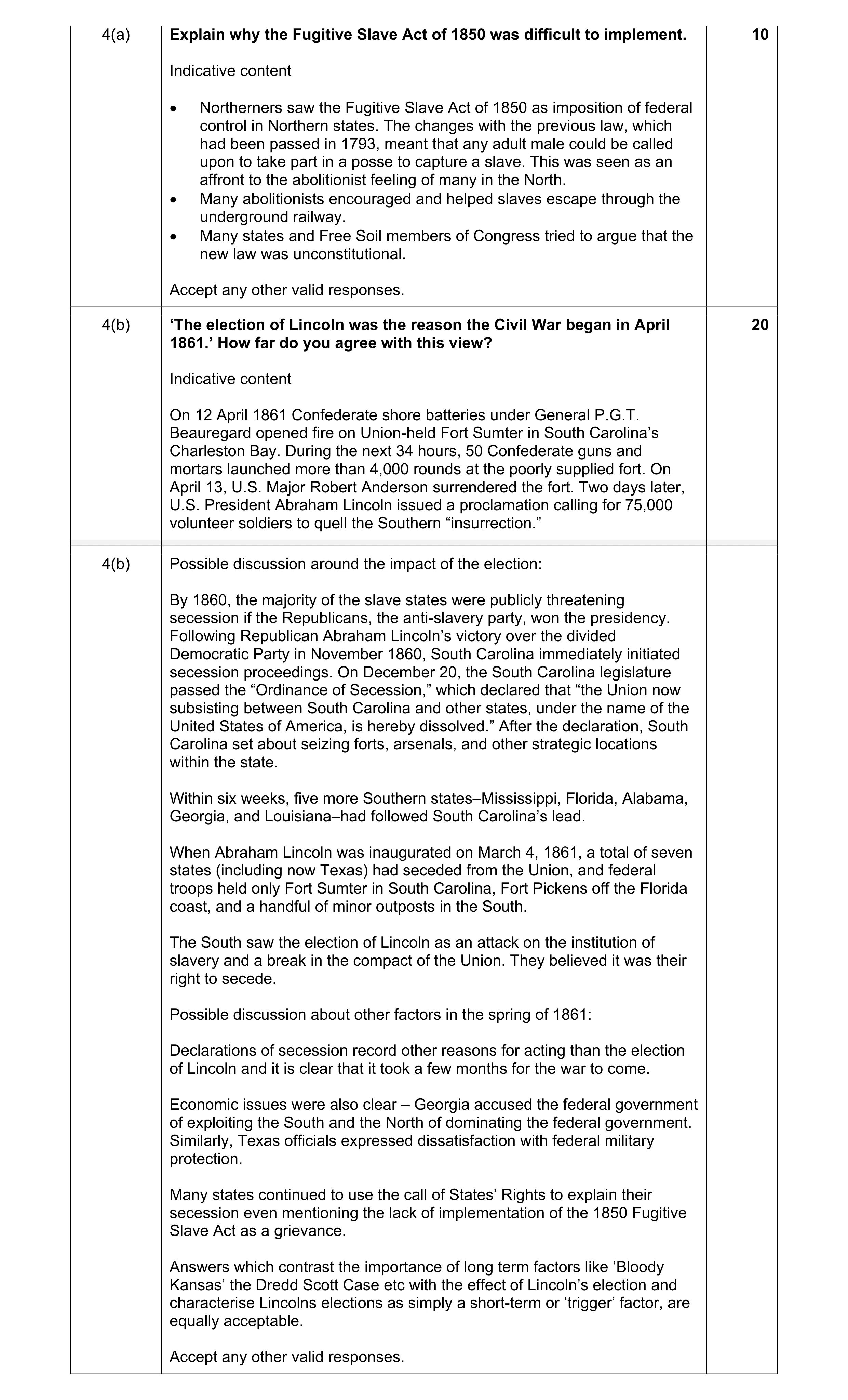 30
30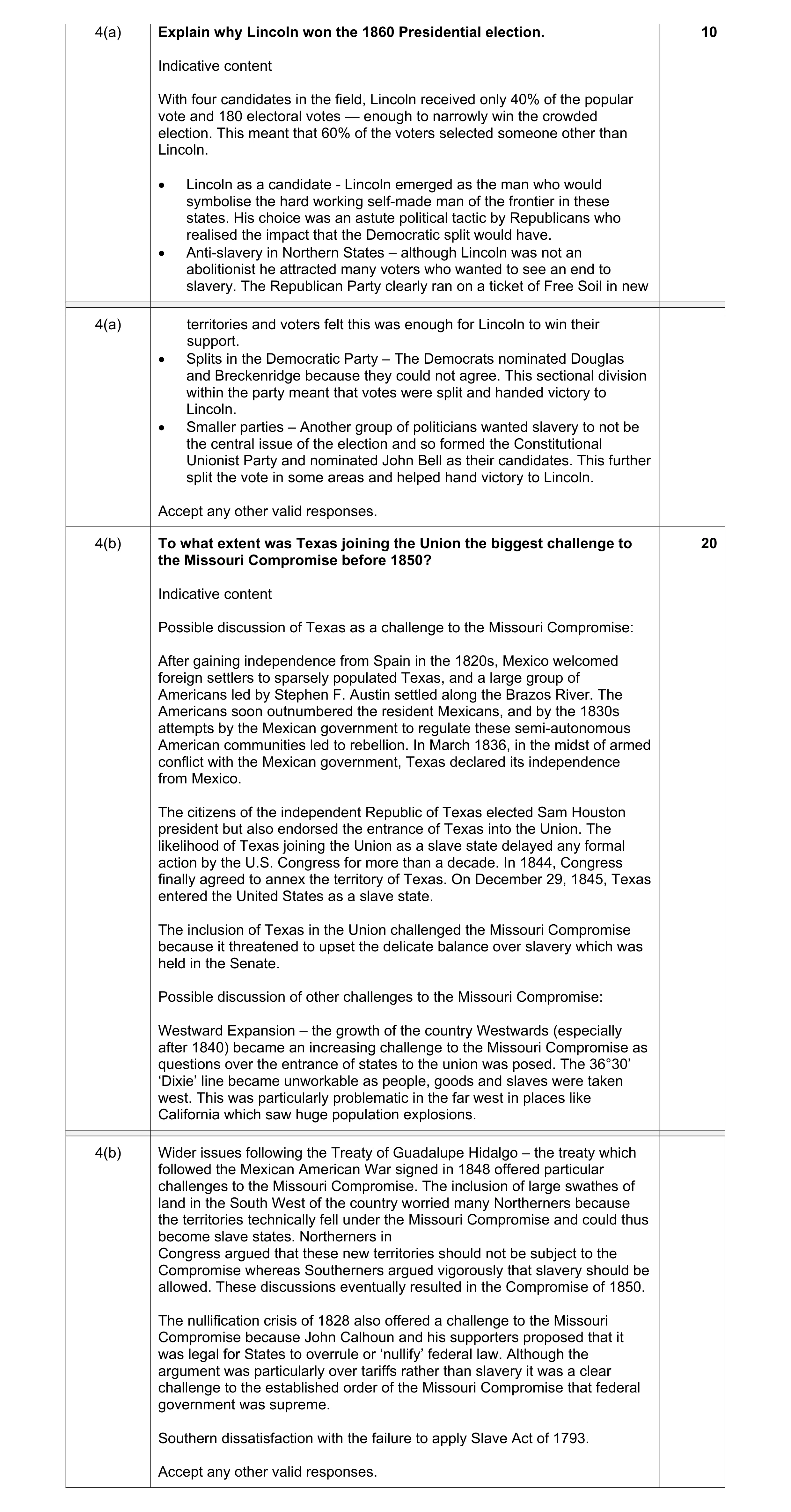 30
30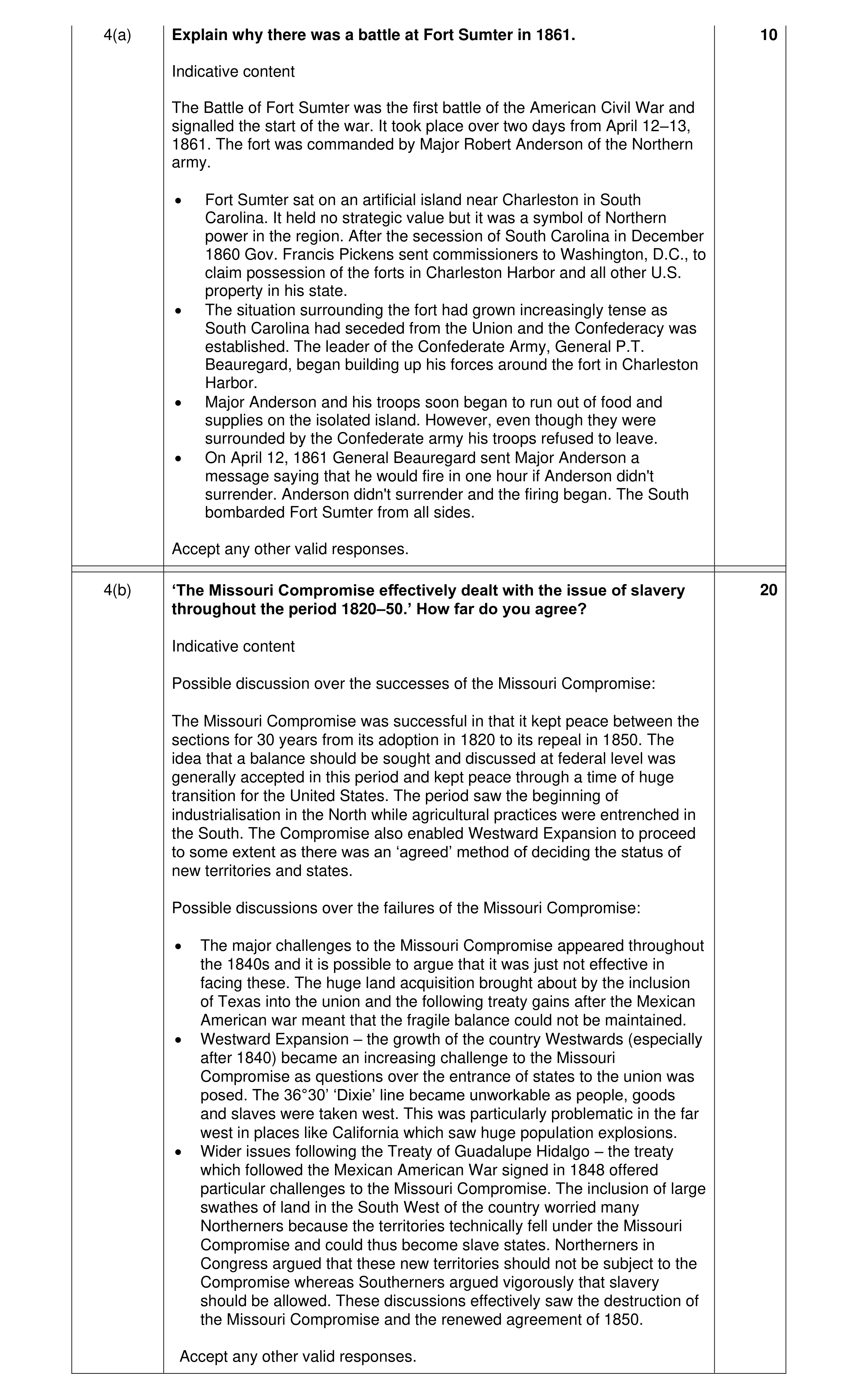 30
30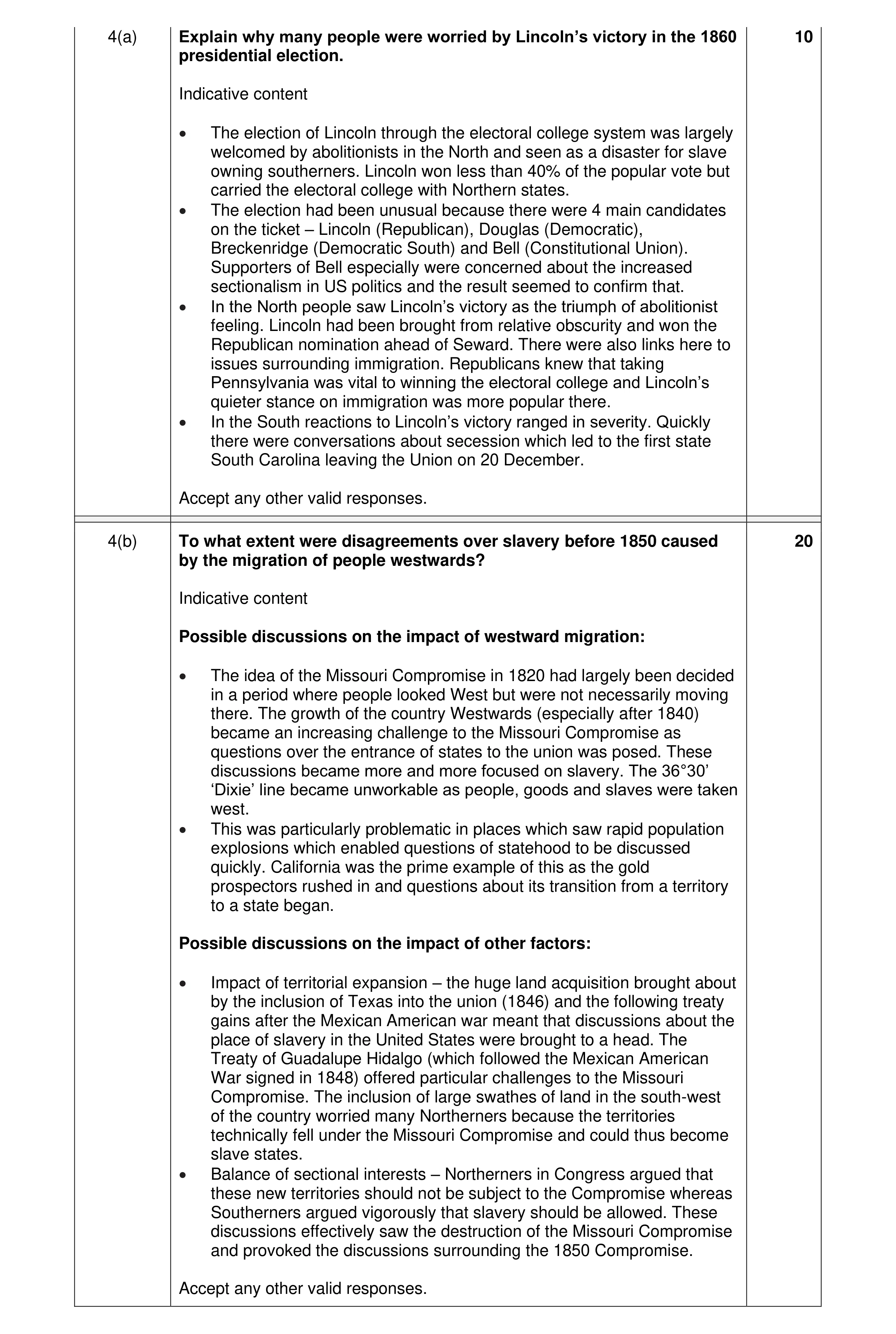 30
30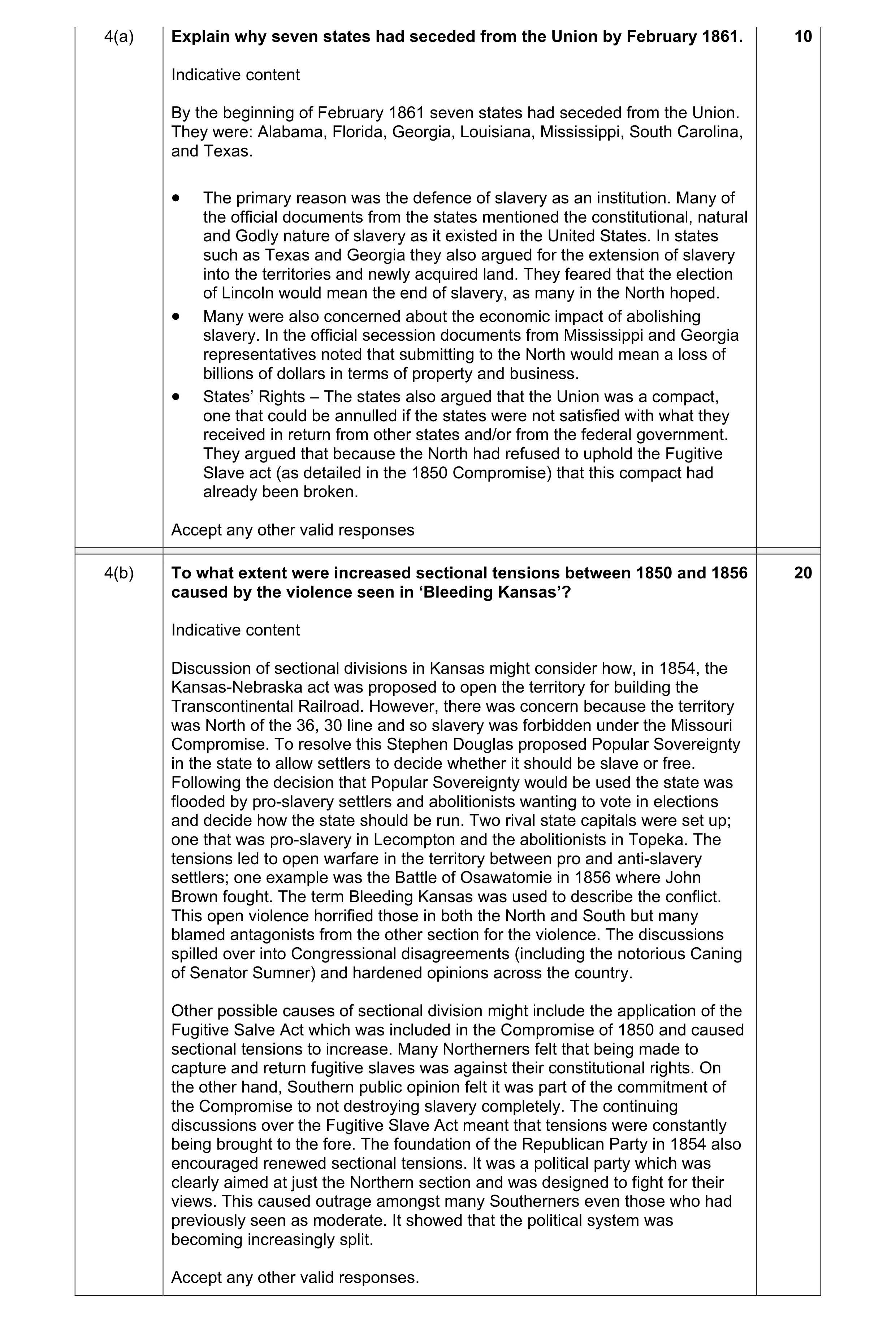 30
30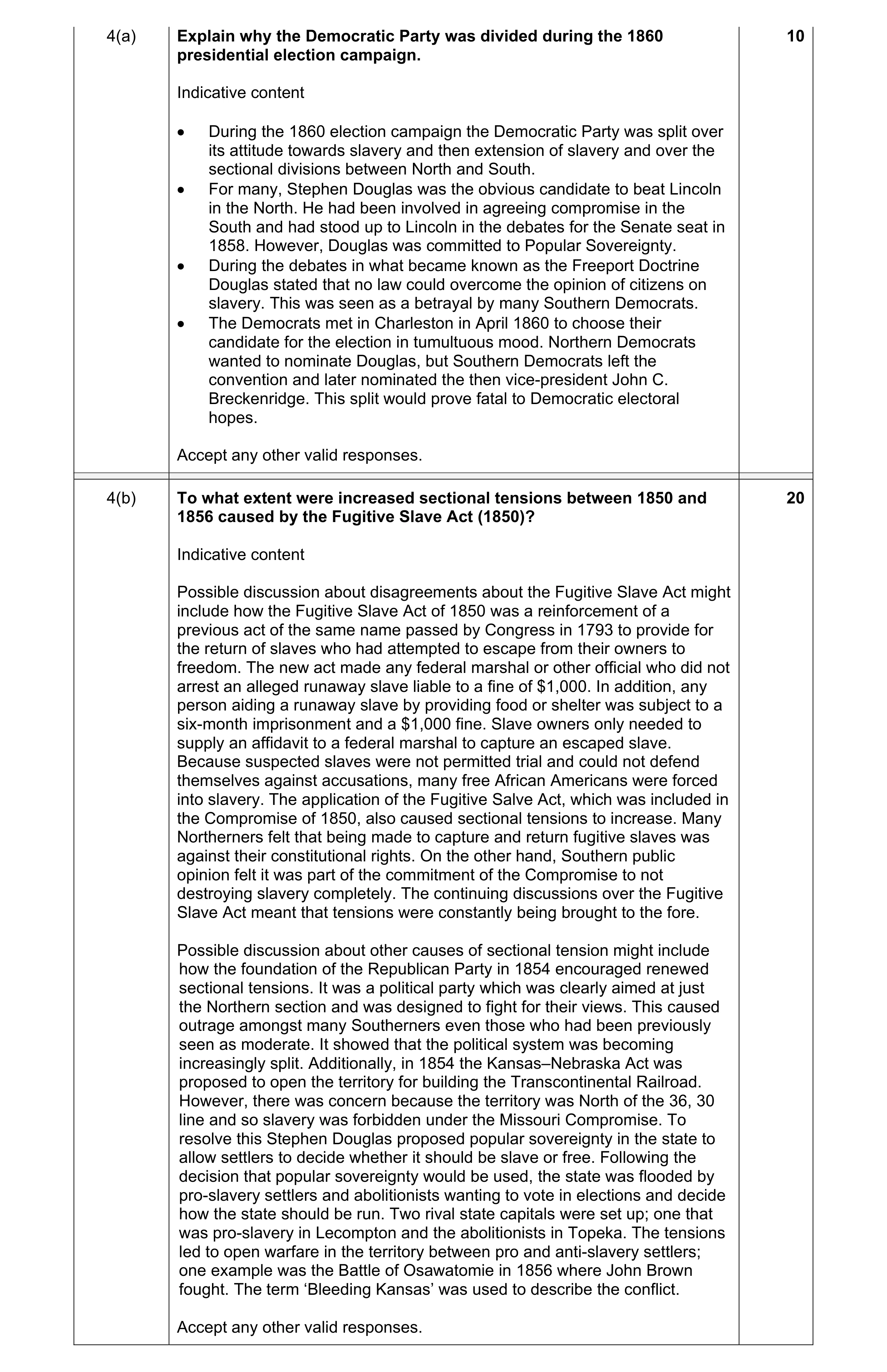 30
30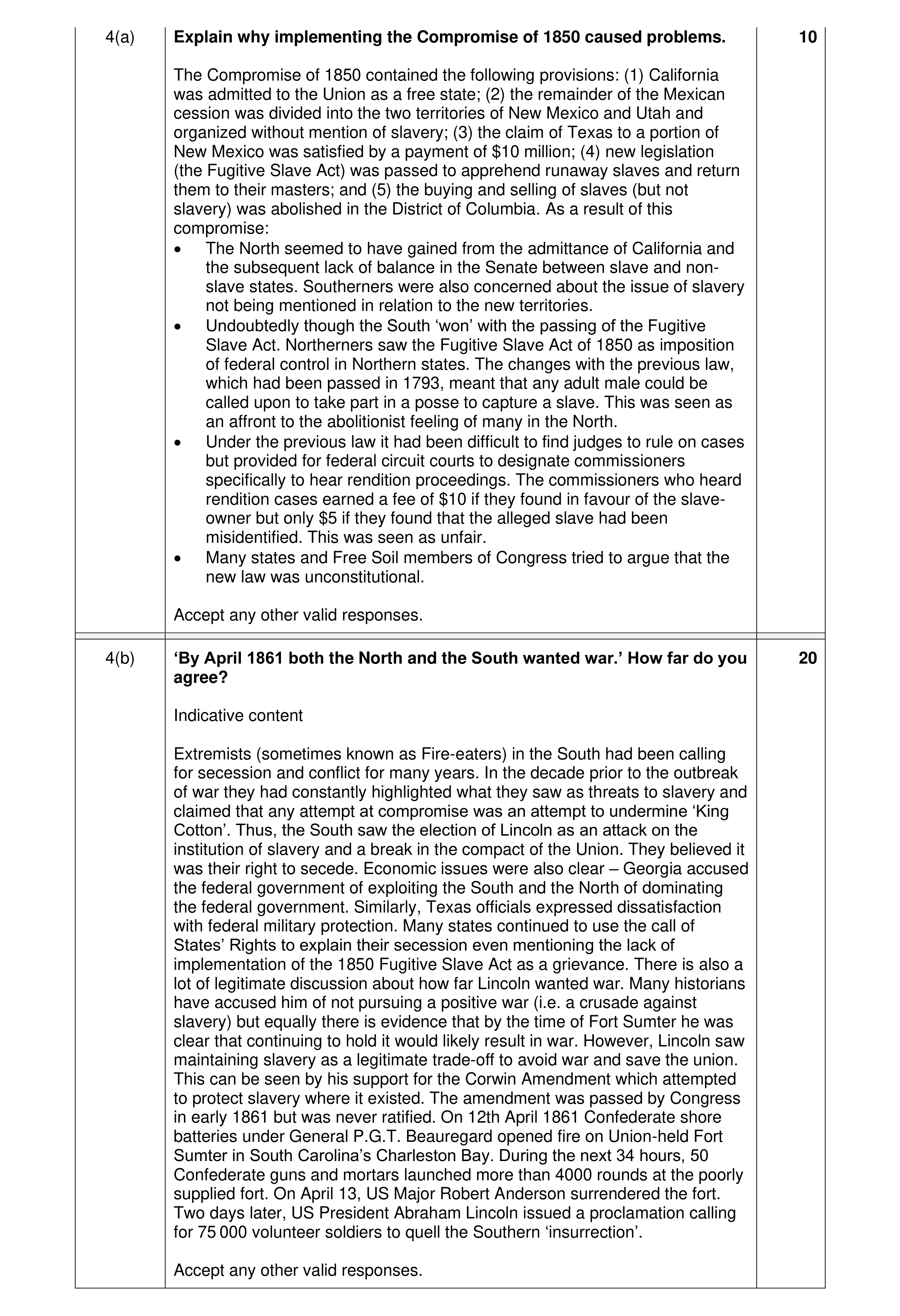 30
30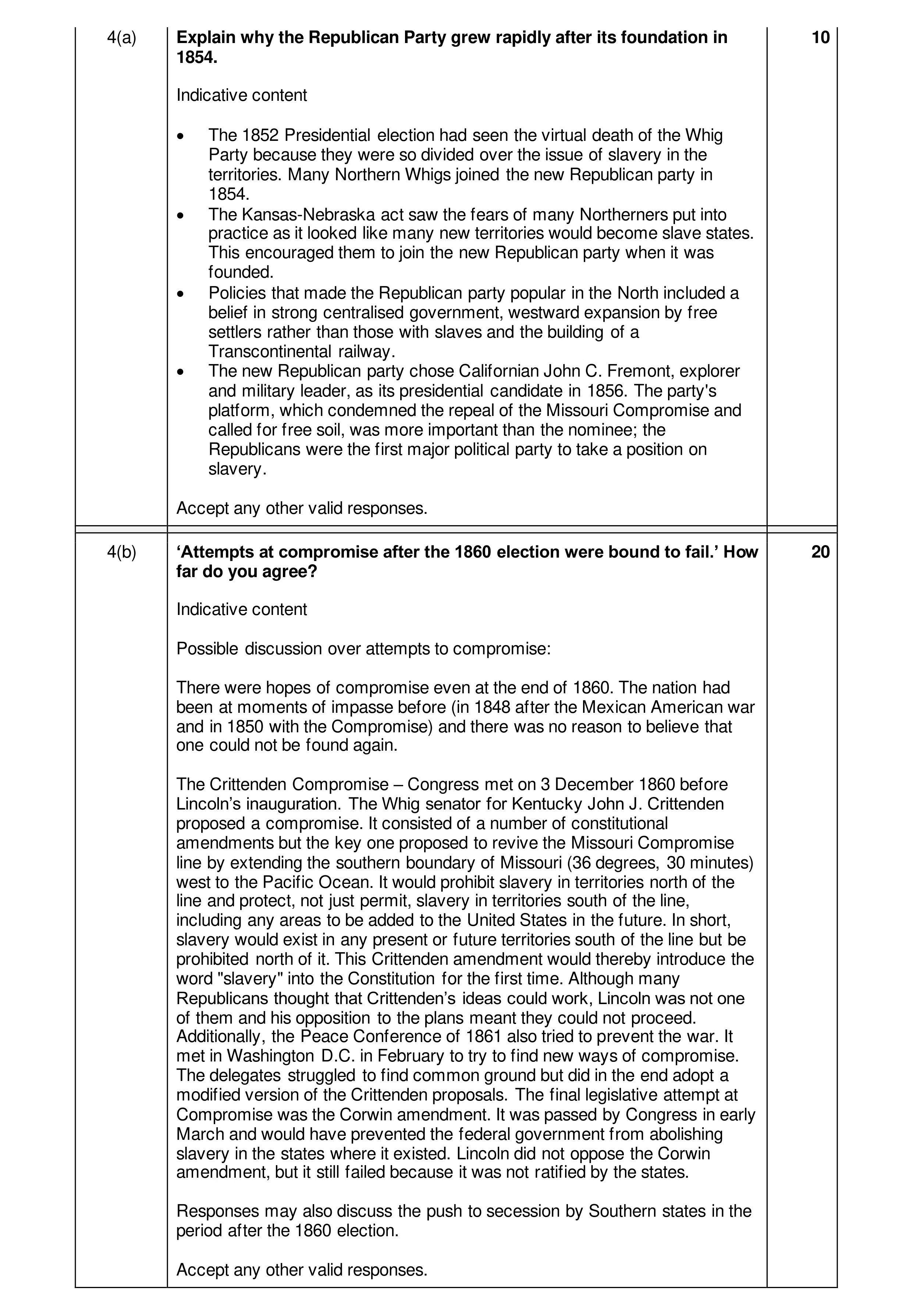 30
30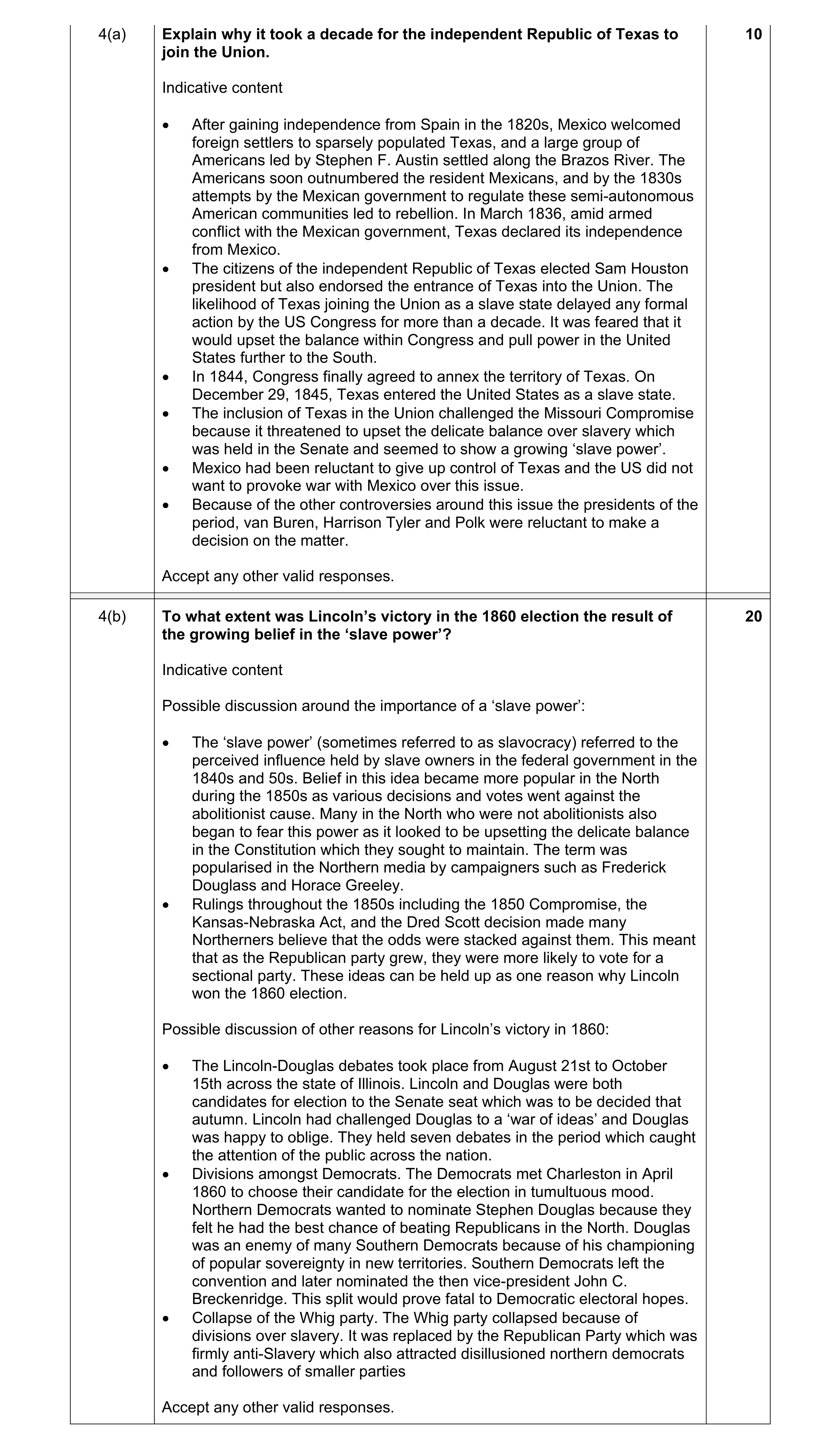 30
30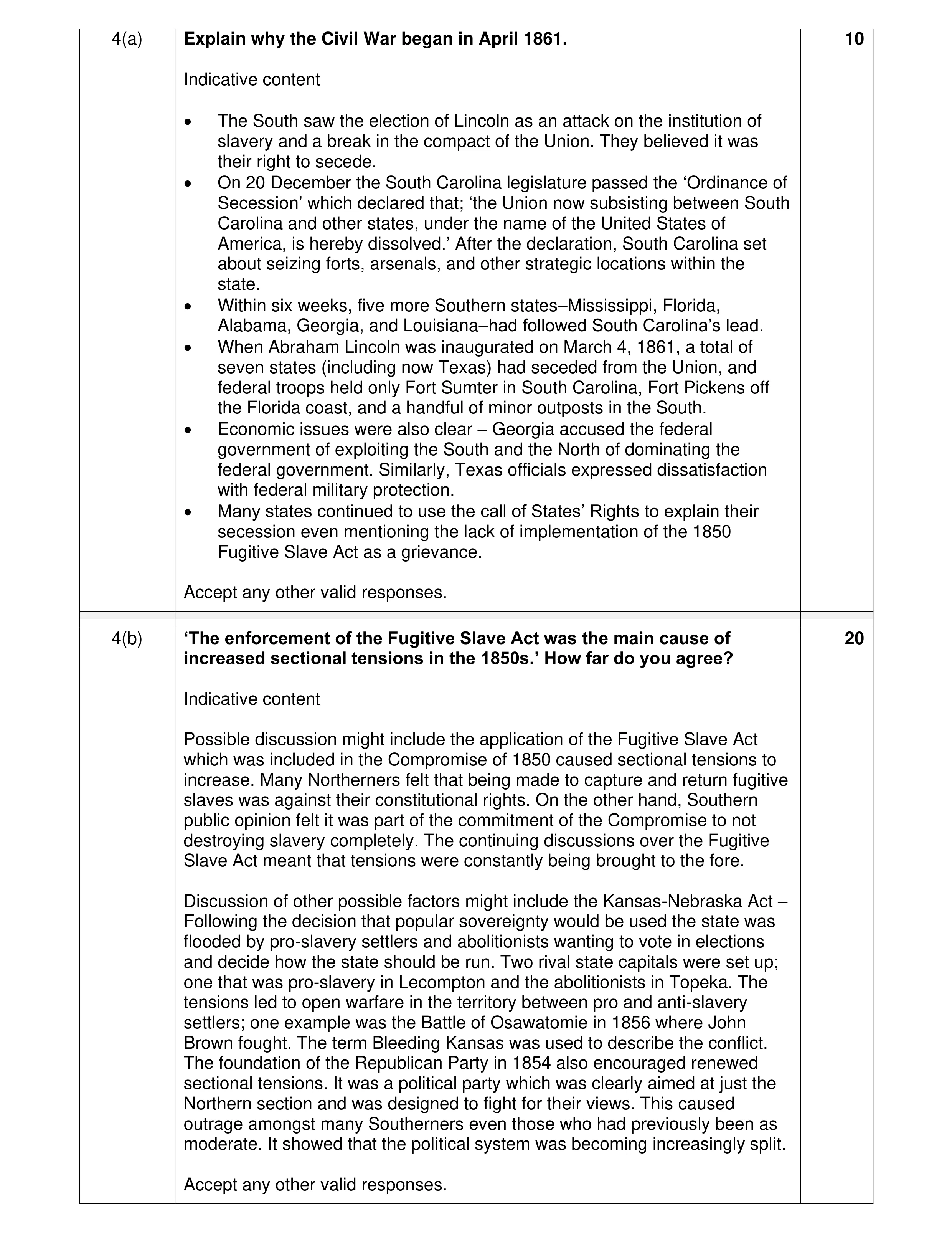 30
30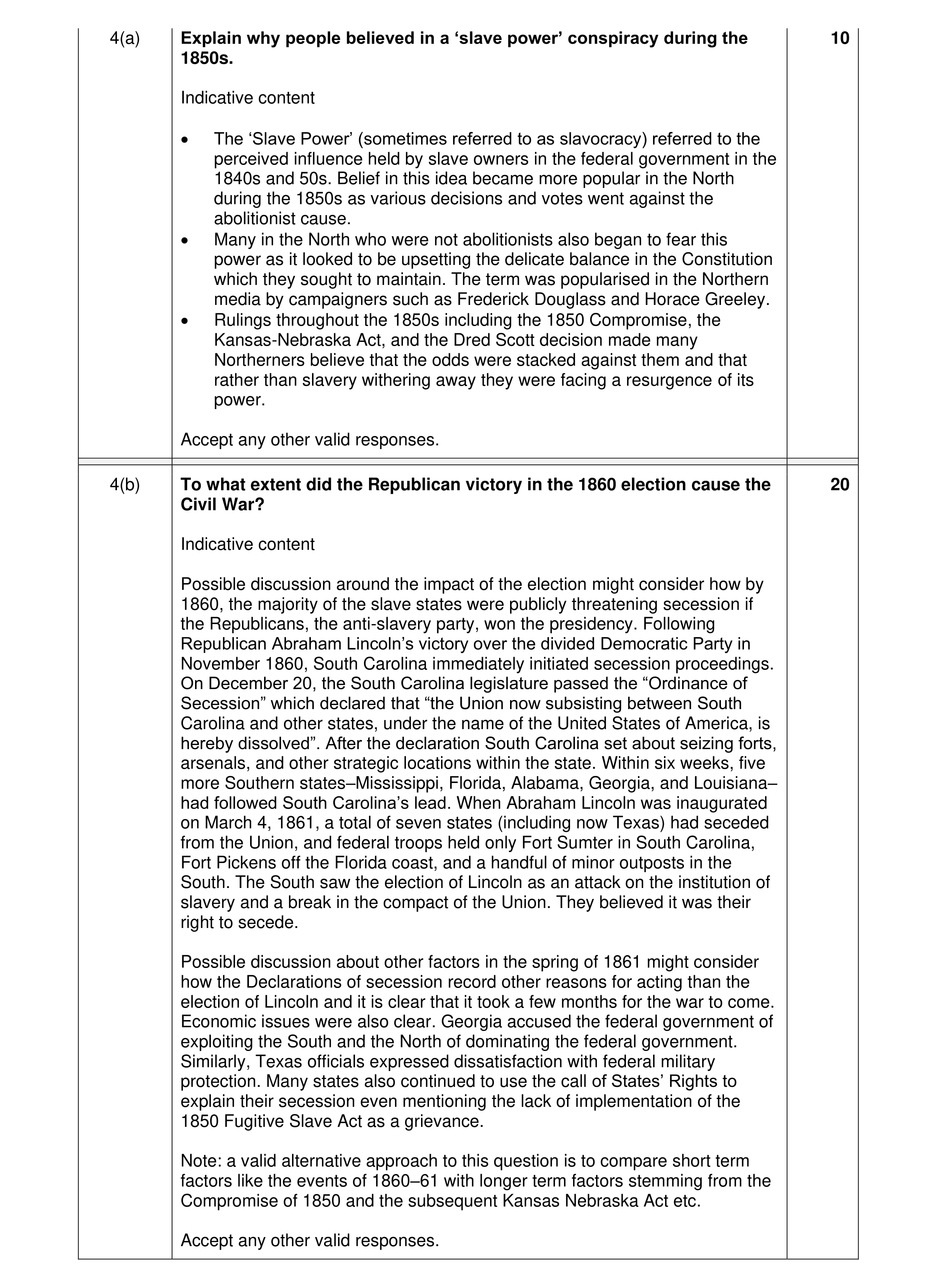 30
30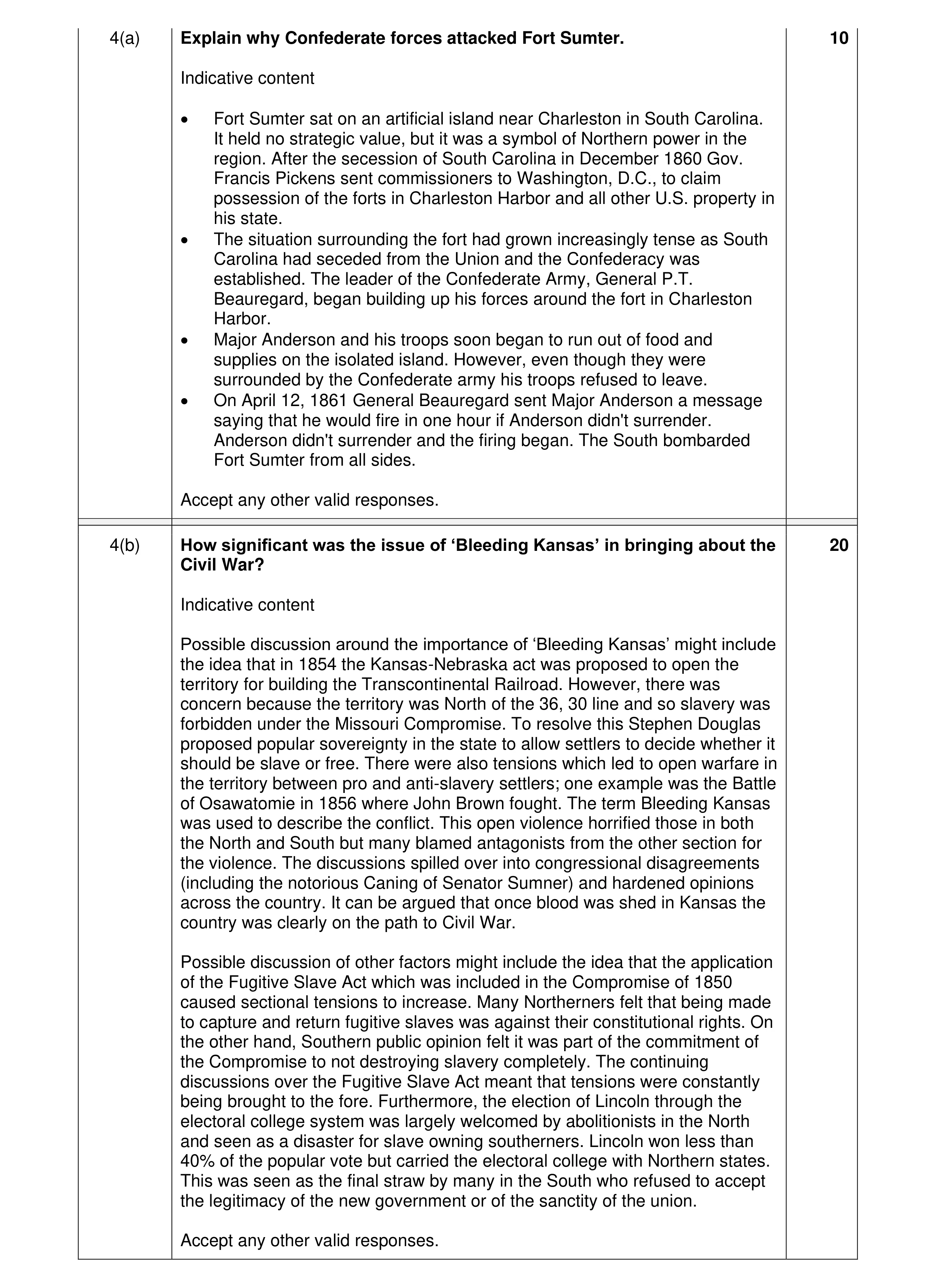 30
30