Cambridge A Level History 9489 — 2022 May/June Paper 3 · Variant 3
9489/33/M/J/22 · 3 questions · 40 marks · ≈45 min
The question paper and its mark scheme, free to read here and free to download. This is Cambridge’s own paper, exactly as it was sat.
Question paper8 pages
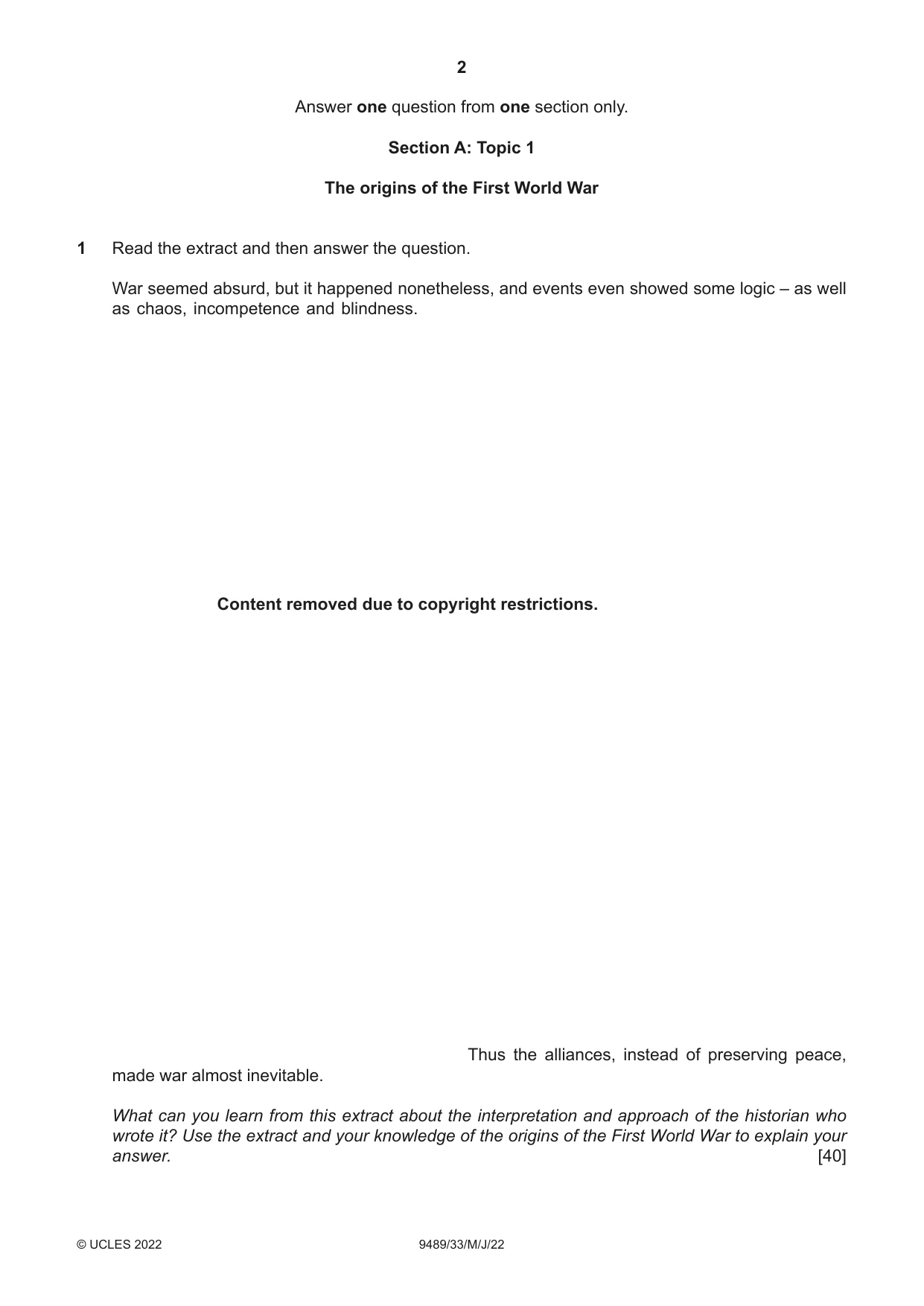
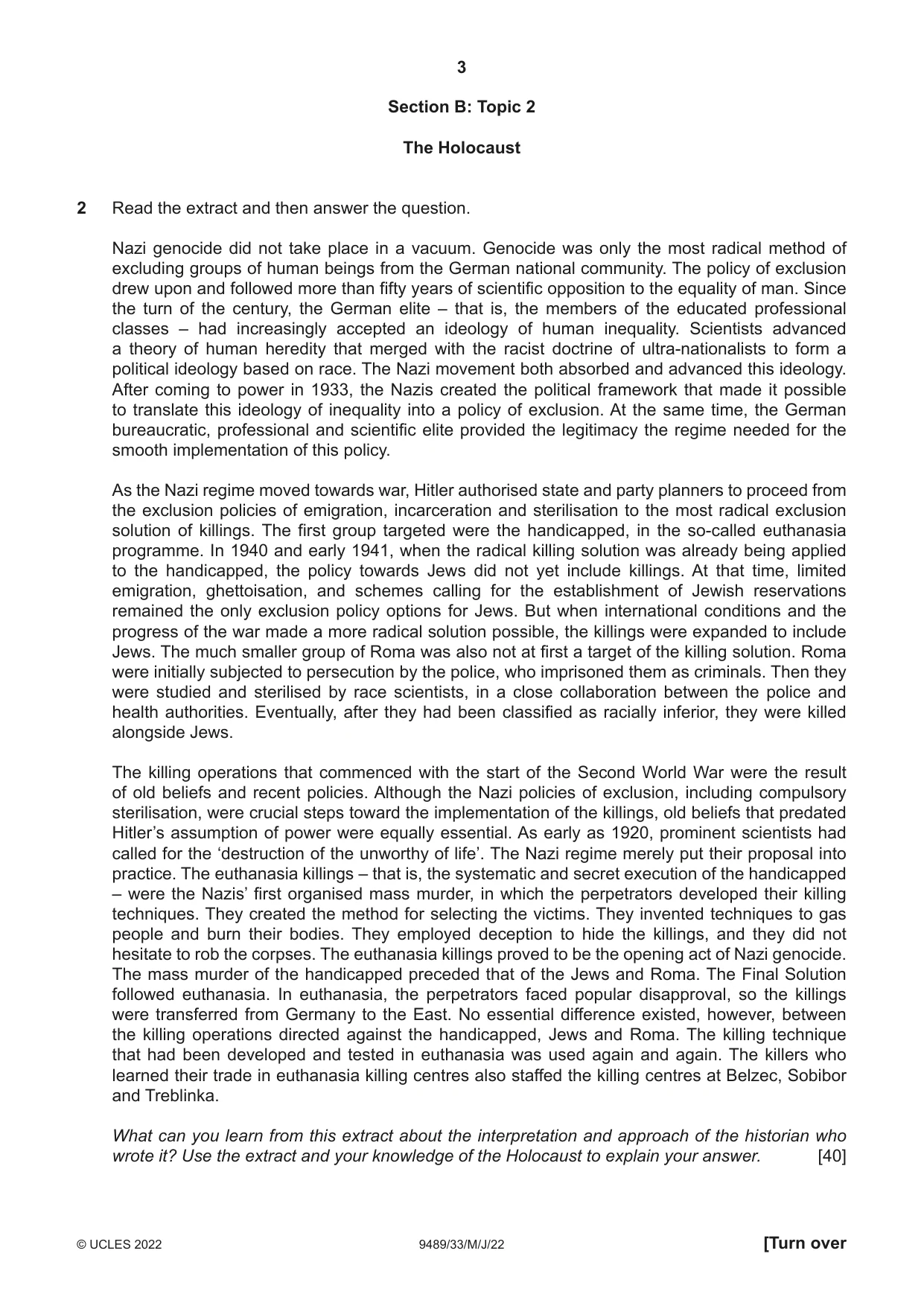
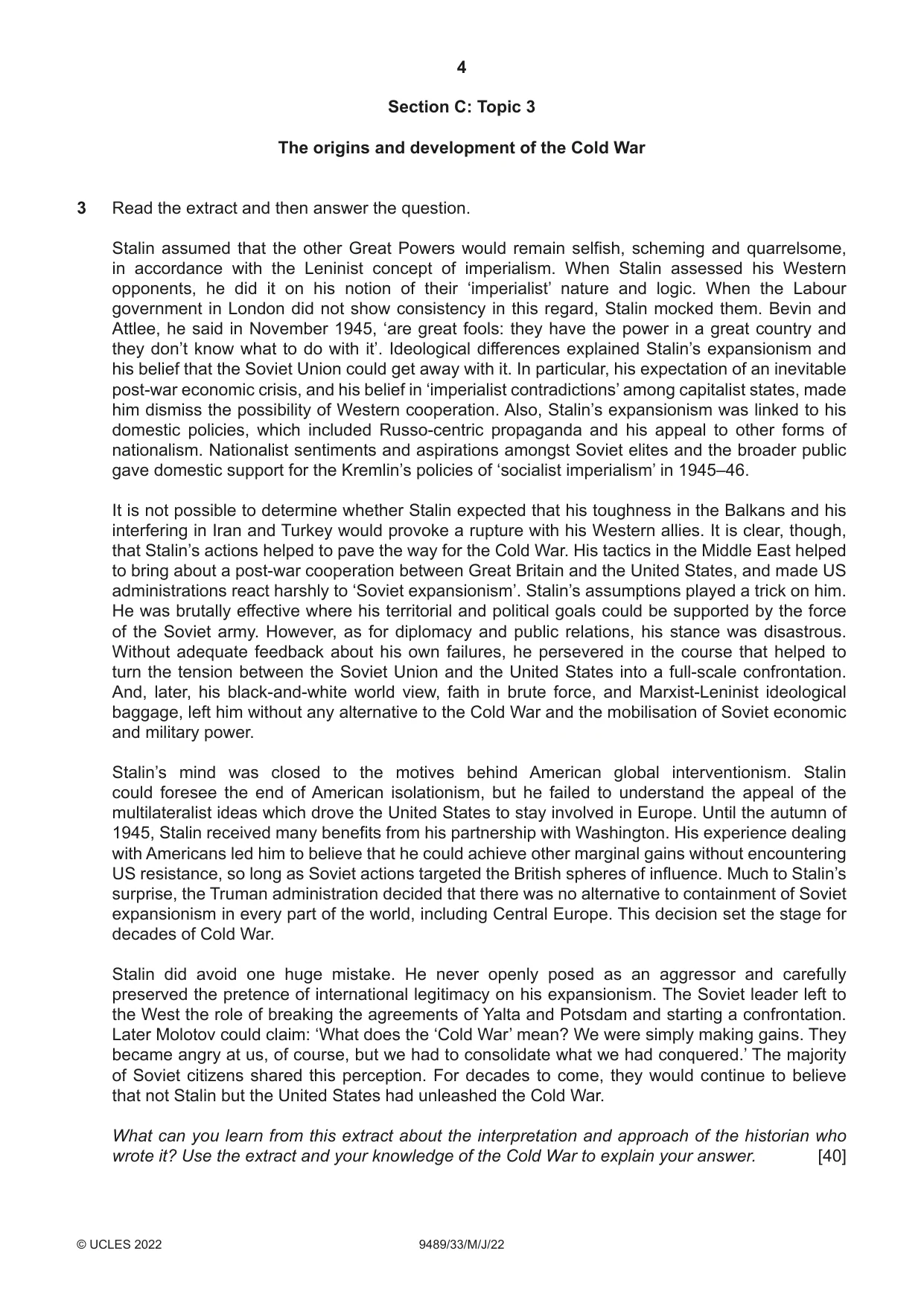



Mark scheme8 pages
Answers below. Sit the paper first if you are practising.
Questions as text
Q1 · Read the extract and then answer the question
1 Read the extract and then answer the question. War seemed absurd, but it happened nonetheless, and events even showed some logic – as well as chaos, incompetence and blindness. Content removed due to copyright restrictions. Thus the alliances, instead of preserving peace, made war almost inevitable. What can you learn from this extract about the interpretation and approach of the historian who wrote it? Use the extract and your knowledge of the origins of the First World War to explain your answer. [40]
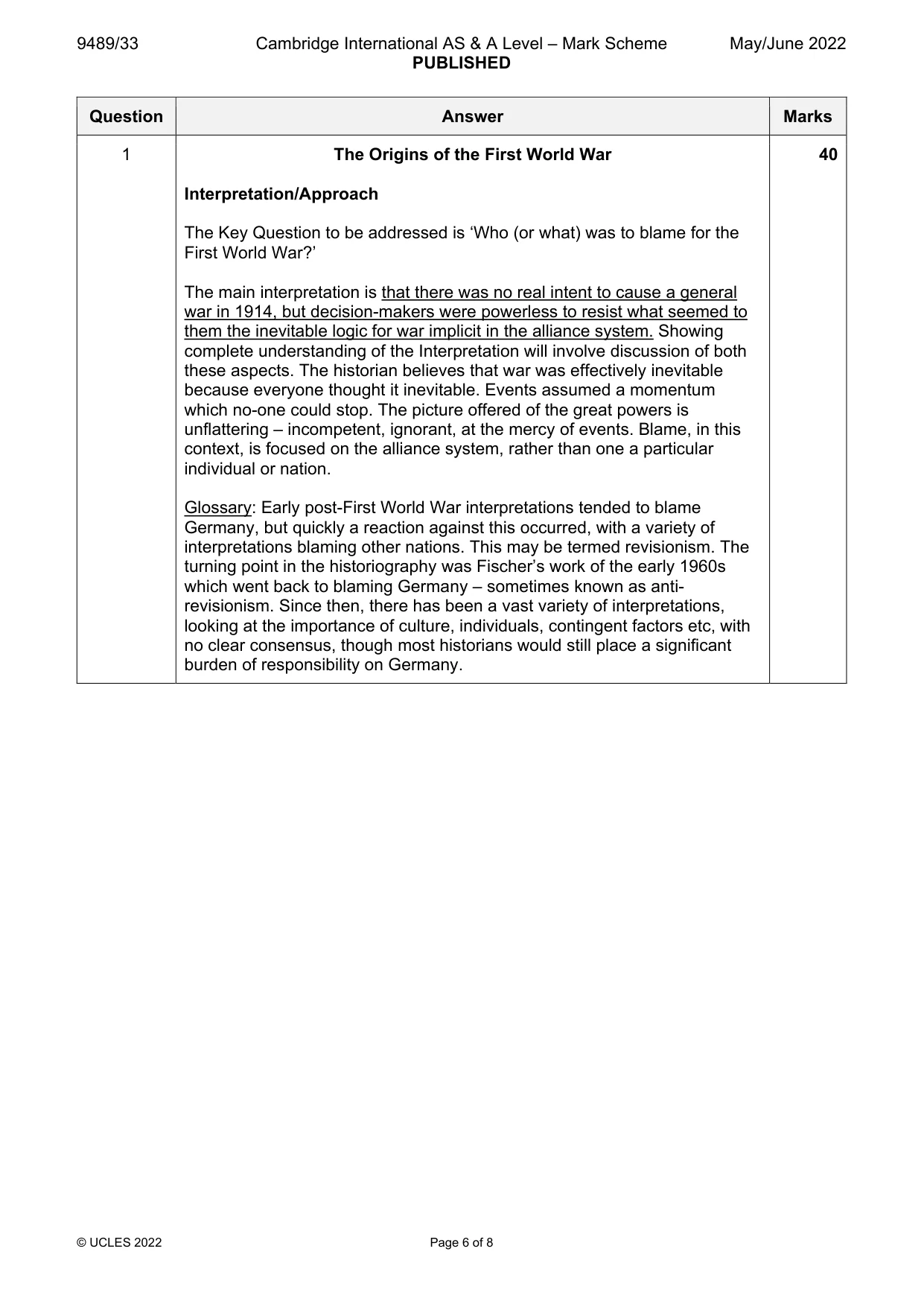
Mark scheme: Question Answer Marks 1 The Origins of the First World War 40 Interpretation/Approach The Key Question to be addressed is ‘Who (or what) was to blame for the First World War?’ The main interpretation is that there was no real intent to cause a general war in 1914, but decision-makers were powerless to resist what seemed to them the inevitable logic for war implicit in the alliance system. Showing complete understanding of the Interpretation will involve discussion of both these aspects. The historian believes that war was effectively inevitable because everyone thought it inevitable. Events assumed a momentum which no-one could stop. The picture offered of the great powers is unflattering – incompetent, ignorant, at the mercy of events. Blame, in this context, is focused on the alliance system, rather than one a particular individual or nation. Glossary: Early post-First World War interpretations tended to blame Germany, but quickly a reaction against this occurred, with a variety of interpretations blaming other nations. This may be termed revisionism. The turning point in the historiography was Fischer’s work of the early 1960s which went back to blaming Germany – sometimes known as anti- revisionism. Since then, there has been a vast variety of interpretations, looking at the importance of culture, individuals, contingent factors etc, with no clear consensus, though most historians would still place a significant burden of responsibility on Germany.
Q2 · Read the extract and then answer the question
2 Read the extract and then answer the question. Nazi genocide did not take place in a vacuum. Genocide was only the most radical method of excluding groups of human beings from the German national community. The policy of exclusion drew upon and followed more than fifty years of scientific opposition to the equality of man. Since the turn of the century, the German elite – that is, the members of the educated professional classes – had increasingly accepted an ideology of human inequality. Scientists advanced a theory of human heredity that merged with the racist doctrine of ultra-nationalists to form a political ideology based on race. The Nazi movement both absorbed and advanced this ideology. After coming to power in 1933, the Nazis created the political framework that made it possible to translate this ideology of inequality into a policy of exclusion. At the same time, the German bureaucratic, professional and scientific elite provided the legitimacy the regime needed for the smooth implementation of this policy. As the Nazi regime moved towards war, Hitler authorised state and party planners to proceed from the exclusion policies of emigration, incarceration and sterilisation to the most radical exclusion solution of killings. The first group targeted were the handicapped, in the so-called euthanasia programme. In 1940 and early 1941, when the radical killing solution was already being applied to the handicapped, the policy towards Jews did not yet include killings. At that time, limited emigration, ghettoisation, and schemes calling for the establishment of Jewish reservations remained the only exclusion policy options for Jews. But when international conditions and the progress of the war made a more radical solution possible, the killings were expanded to include Jews. The much smaller group of Roma was also not at first a target of the killing solution. Roma were initially subjected to persecution by the police, who imprisoned them as criminals. Then they were studied and sterilised by race scientists, in a close collaboration between the police and health authorities. Eventually, after they had been classified as racially inferior, they were killed alongside Jews. The killing operations that commenced with the start of the Second World War were the result of old beliefs and recent policies. Although the Nazi policies of exclusion, including compulsory sterilisation, were crucial steps toward the implementation of the killings, old beliefs that predated Hitler’s assumption of power were equally essential. As early as 1920, prominent scientists had called for the ‘destruction of the unworthy of life’. The Nazi regime merely put their proposal into practice. The euthanasia killings – that is, the systematic and secret execution of the handicapped – were the Nazis’ first organised mass murder, in which the perpetrators developed their killing techniques. They created the method for selecting the victims. They invented techniques to gas people and burn their bodies. They employed deception to hide the killings, and they did not hesitate to rob the corpses. The euthanasia killings proved to be the opening act of Nazi genocide. The mass murder of the handicapped preceded that of the Jews and Roma. The Final Solution followed euthanasia. In euthanasia, the perpetrators faced popular disapproval, so the killings were transferred from Germany to the East. No essential difference existed, however, between the killing operations directed against the handicapped, Jews and Roma. The killing technique that had been developed and tested in euthanasia was used again and again. The killers who learned their trade in euthanasia killing centres also staffed the killing centres at Belzec, Sobibor and Treblinka. What can you learn from this extract about the interpretation and approach of the historian who wrote it? Use the extract and your knowledge of the Holocaust to explain your answer. [40] Section C: Topic 3 The origins and development of the Cold War
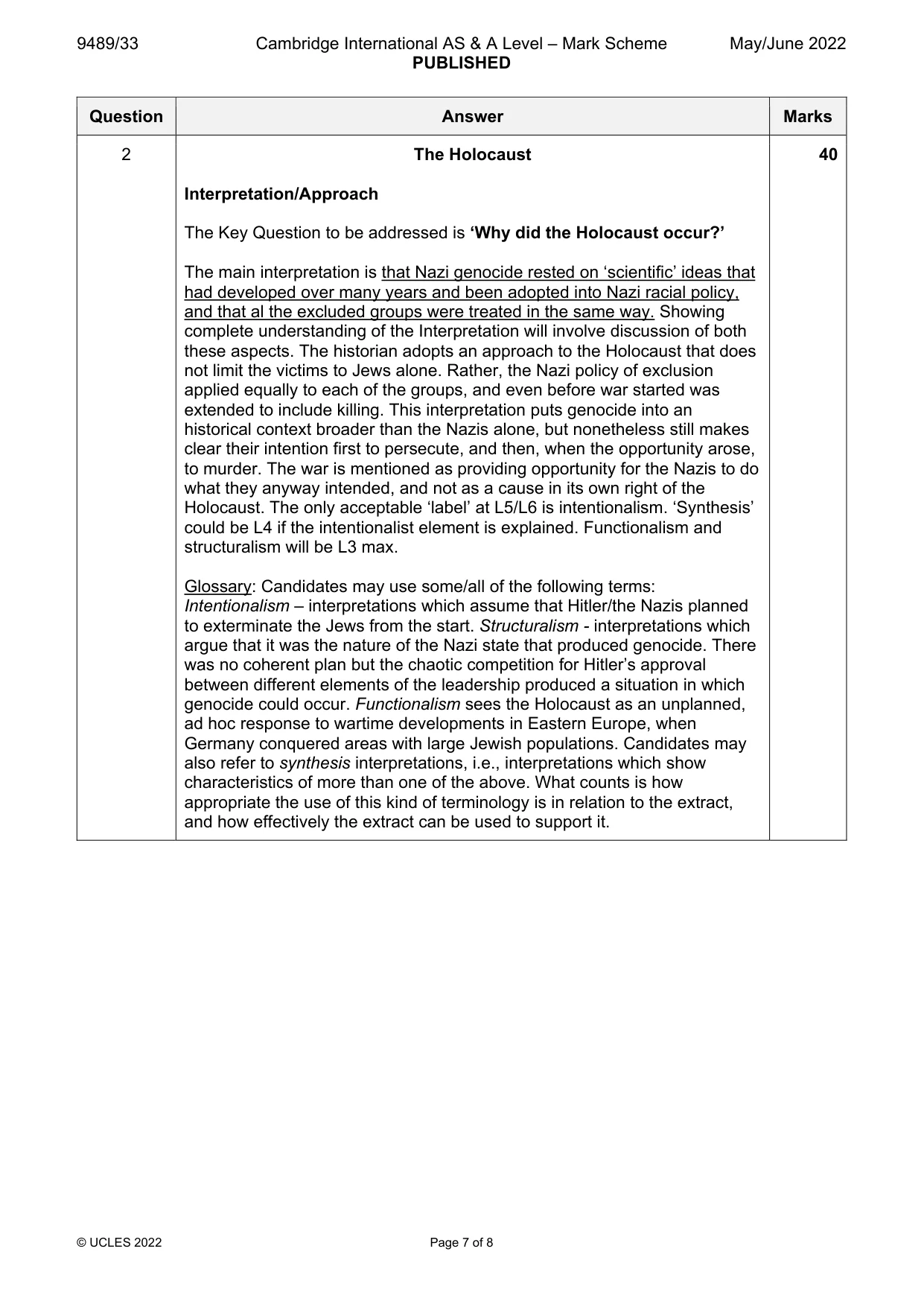
Mark scheme: 2 The Holocaust 40 Interpretation/Approach The Key Question to be addressed is ‘Why did the Holocaust occur?’ The main interpretation is that Nazi genocide rested on ‘scientific’ ideas that had developed over many years and been adopted into Nazi racial policy, and that al the excluded groups were treated in the same way. Showing complete understanding of the Interpretation will involve discussion of both these aspects. The historian adopts an approach to the Holocaust that does not limit the victims to Jews alone. Rather, the Nazi policy of exclusion applied equally to each of the groups, and even before war started was extended to include killing. This interpretation puts genocide into an historical context broader than the Nazis alone, but nonetheless still makes clear their intention first to persecute, and then, when the opportunity arose, to murder. The war is mentioned as providing opportunity for the Nazis to do what they anyway intended, and not as a cause in its own right of the Holocaust. The only acceptable ‘label’ at L5/L6 is intentionalism. ‘Synthesis’ could be L4 if the intentionalist element is explained. Functionalism and structuralism will be L3 max. Glossary: Candidates may use some/all of the following terms: Intentionalism – interpretations which assume that Hitler/the Nazis planned to exterminate the Jews from the start. Structuralism - interpretations which argue that it was the nature of the Nazi state that produced genocide. There was no coherent plan but the chaotic competition for Hitler’s approval between different elements of the leadership produced a situation in which genocide could occur. Functionalism sees the Holocaust as an unplanned, ad hoc response to wartime developments in Eastern Europe, when Germany conquered areas with large Jewish populations. Candidates may also refer to synthesis interpretations, i.e., interpretations which show characteristics of more than one of the above. What counts is how appropriate the use of this kind of terminology is in relation to the extract, and how effectively the extract can be used to support it.
Q3 · Read the extract and then answer the question
3 Read the extract and then answer the question. Stalin assumed that the other Great Powers would remain selfish, scheming and quarrelsome, in accordance with the Leninist concept of imperialism. When Stalin assessed his Western opponents, he did it on his notion of their ‘imperialist’ nature and logic. When the Labour government in London did not show consistency in this regard, Stalin mocked them. Bevin and Attlee, he said in November 1945, ‘are great fools: they have the power in a great country and they don’t know what to do with it’. Ideological differences explained Stalin’s expansionism and his belief that the Soviet Union could get away with it. In particular, his expectation of an inevitable post-war economic crisis, and his belief in ‘imperialist contradictions’ among capitalist states, made him dismiss the possibility of Western cooperation. Also, Stalin’s expansionism was linked to his domestic policies, which included Russo-centric propaganda and his appeal to other forms of nationalism. Nationalist sentiments and aspirations amongst Soviet elites and the broader public gave domestic support for the Kremlin’s policies of ‘socialist imperialism’ in 1945–46. It is not possible to determine whether Stalin expected that his toughness in the Balkans and his interfering in Iran and Turkey would provoke a rupture with his Western allies. It is clear, though, that Stalin’s actions helped to pave the way for the Cold War. His tactics in the Middle East helped to bring about a post-war cooperation between Great Britain and the United States, and made US administrations react harshly to ‘Soviet expansionism’. Stalin’s assumptions played a trick on him. He was brutally effective where his territorial and political goals could be supported by the force of the Soviet army. However, as for diplomacy and public relations, his stance was disastrous. Without adequate feedback about his own failures, he persevered in the course that helped to turn the tension between the Soviet Union and the United States into a full-scale confrontation. And, later, his black-and-white world view, faith in brute force, and Marxist-Leninist ideological baggage, left him without any alternative to the Cold War and the mobilisation of Soviet economic and military power. Stalin’s mind was closed to the motives behind American global interventionism. Stalin could foresee the end of American isolationism, but he failed to understand the appeal of the multilateralist ideas which drove the United States to stay involved in Europe. Until the autumn of 1945, Stalin received many benefits from his partnership with Washington. His experience dealing with Americans led him to believe that he could achieve other marginal gains without encountering US resistance, so long as Soviet actions targeted the British spheres of influence. Much to Stalin’s surprise, the Truman administration decided that there was no alternative to containment of Soviet expansionism in every part of the world, including Central Europe. This decision set the stage for decades of Cold War. Stalin did avoid one huge mistake. He never openly posed as an aggressor and carefully preserved the pretence of international legitimacy on his expansionism. The Soviet leader left to the West the role of breaking the agreements of Yalta and Potsdam and starting a confrontation. Later Molotov could claim: ‘What does the ‘Cold War’ mean? We were simply making gains. They became angry at us, of course, but we had to consolidate what we had conquered.’ The majority of Soviet citizens shared this perception. For decades to come, they would continue to believe that not Stalin but the United States had unleashed the Cold War. What can you learn from this extract about the interpretation and approach of the historian who wrote it? Use the extract and your knowledge of the Cold War to explain your answer. [40]
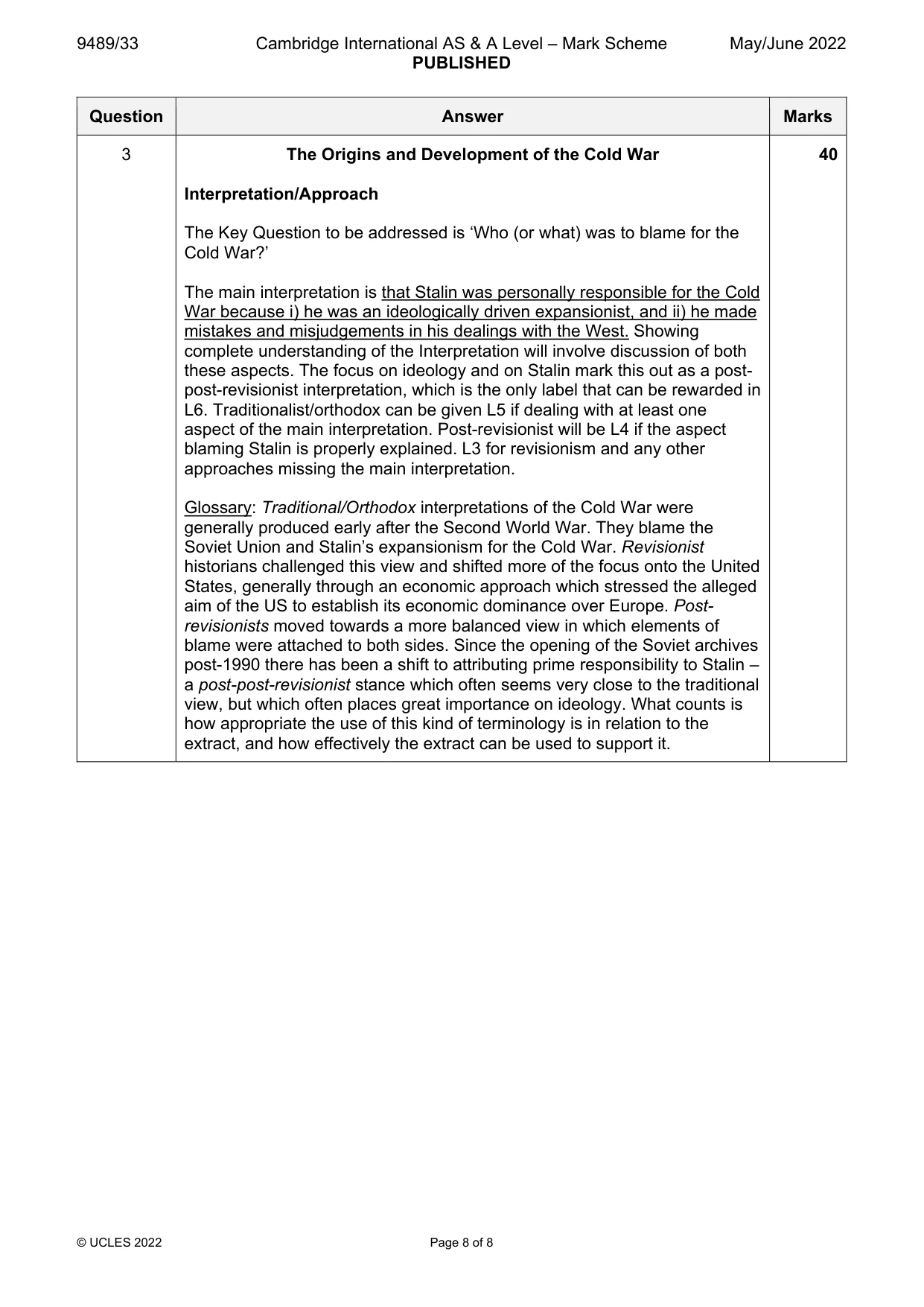
Mark scheme: 3 The Origins and Development of the Cold War 40 Interpretation/Approach The Key Question to be addressed is ‘Who (or what) was to blame for the Cold War?’ The main interpretation is that Stalin was personally responsible for the Cold War because i) he was an ideologically driven expansionist, and ii) he made mistakes and misjudgements in his dealings with the West. Showing complete understanding of the Interpretation will involve discussion of both these aspects. The focus on ideology and on Stalin mark this out as a post- post-revisionist interpretation, which is the only label that can be rewarded in L6. Traditionalist/orthodox can be given L5 if dealing with at least one aspect of the main interpretation. Post-revisionist will be L4 if the aspect blaming Stalin is properly explained. L3 for revisionism and any other approaches missing the main interpretation. Glossary: Traditional/Orthodox interpretations of the Cold War were generally produced early after the Second World War. They blame the Soviet Union and Stalin’s expansionism for the Cold War. Revisionist historians challenged this view and shifted more of the focus onto the United States, generally through an economic approach which stressed the alleged aim of the US to establish its economic dominance over Europe. Post- revisionists moved towards a more balanced view in which elements of blame were attached to both sides. Since the opening of the Soviet archives post-1990 there has been a shift to attributing prime responsibility to Stalin – a post-post-revisionist stance which often seems very close to the traditional view, but which often places great importance on ideology. What counts is how appropriate the use of this kind of terminology is in relation to the extract, and how effectively the extract can be used to support it.
What was in this paper
The subtopics covered by these 3 questions, and how many questions each got. Open one in a new tab to see every Cambridge question on it.
What you needed in this session
Cambridge’s own grade thresholds for 2022 May/June, Paper 3 · Variant 3. A higher threshold means an easier paper — the bar moves with how the cohort did.