Cambridge A Level History 9489 — 2022 May/June Paper 3 · Variant 2
9489/32/M/J/22 · 3 questions · 40 marks · ≈45 min
The question paper and its mark scheme, free to read here and free to download. This is Cambridge’s own paper, exactly as it was sat.
Question paper8 pages
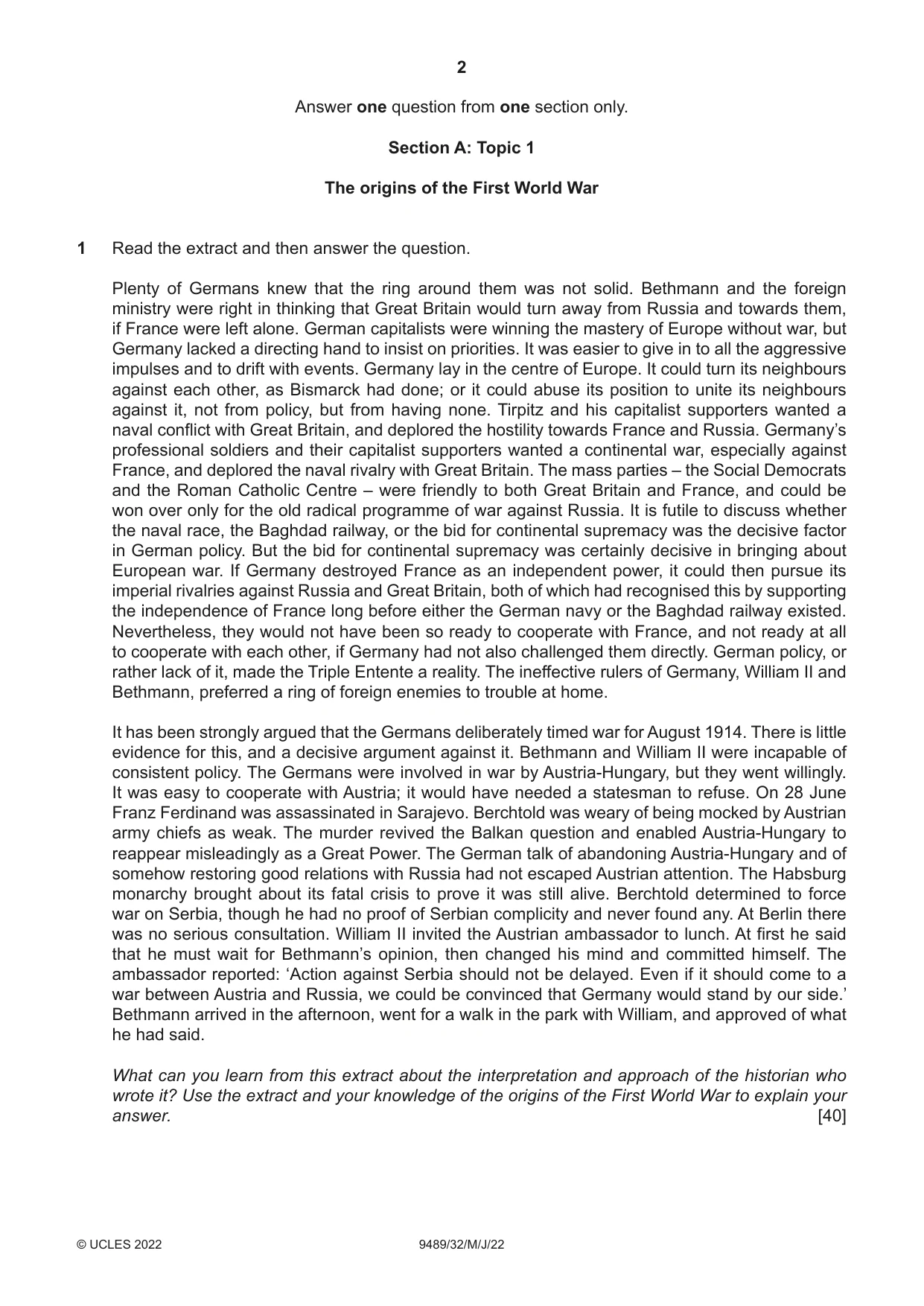
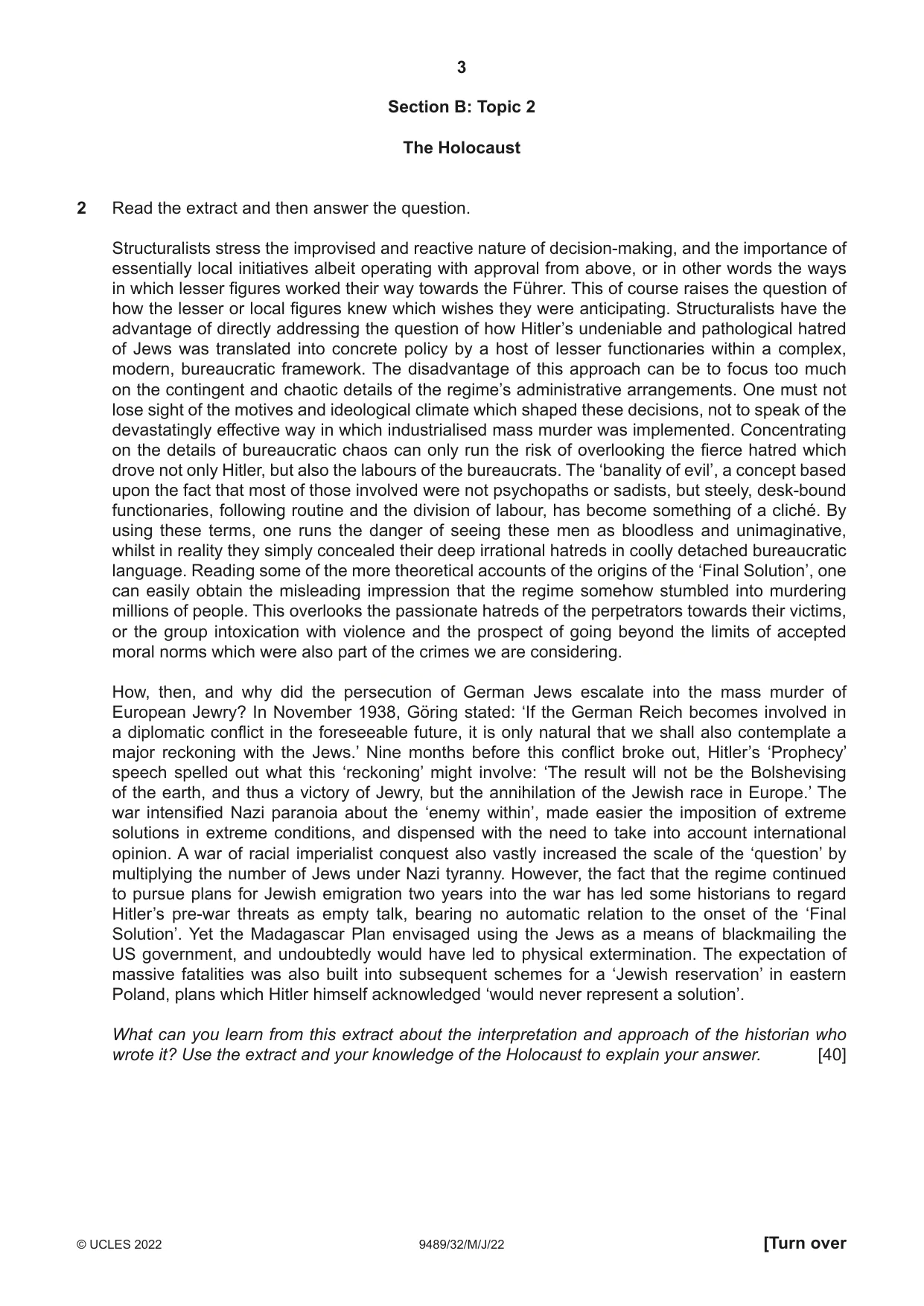
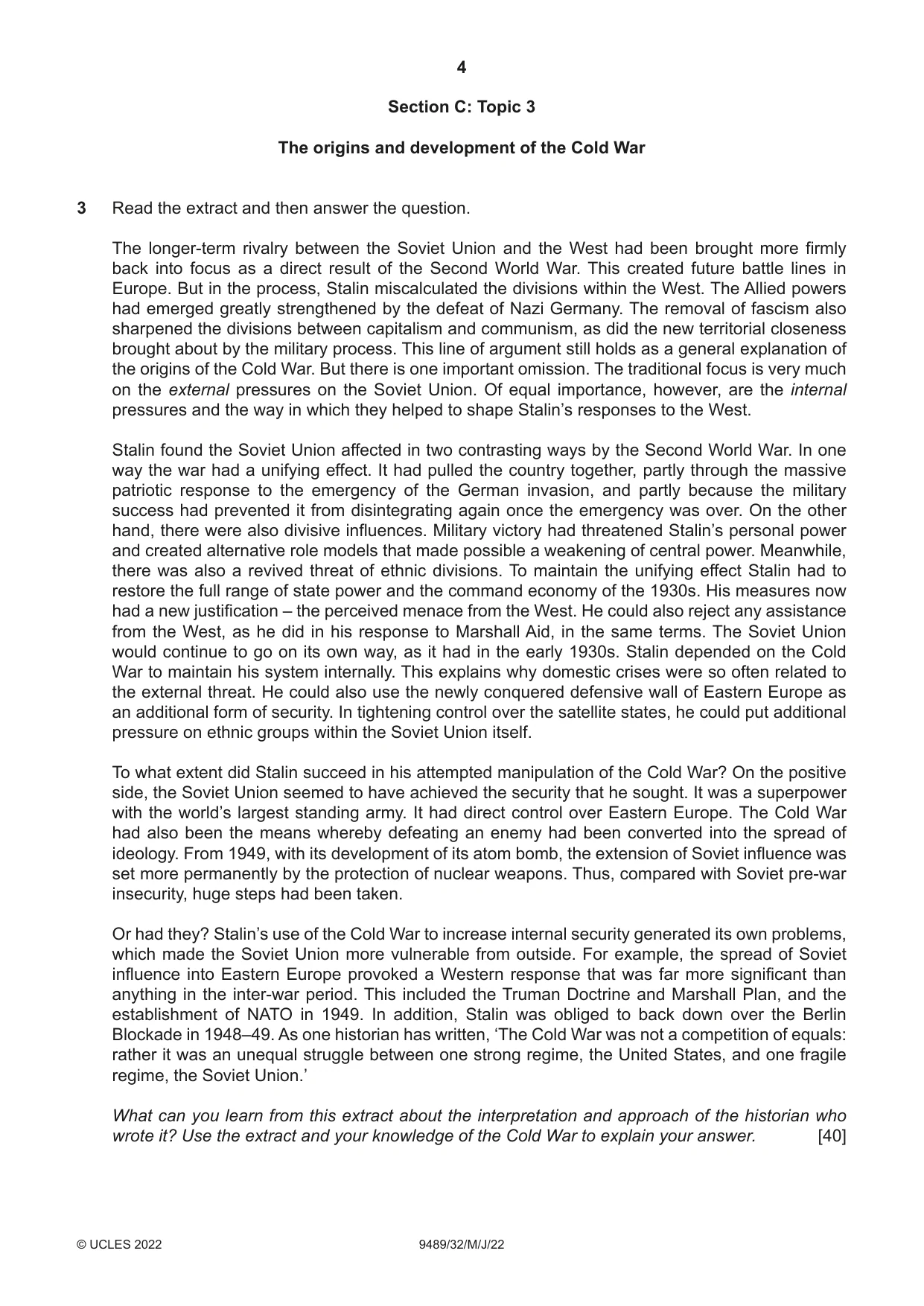



Mark scheme5 pages
Answers below. Sit the paper first if you are practising.
Questions as text
Q1 · Read the extract and then answer the question
1 Read the extract and then answer the question. Plenty of Germans knew that the ring around them was not solid. Bethmann and the foreign ministry were right in thinking that Great Britain would turn away from Russia and towards them, if France were left alone. German capitalists were winning the mastery of Europe without war, but Germany lacked a directing hand to insist on priorities. It was easier to give in to all the aggressive impulses and to drift with events. Germany lay in the centre of Europe. It could turn its neighbours against each other, as Bismarck had done; or it could abuse its position to unite its neighbours against it, not from policy, but from having none. Tirpitz and his capitalist supporters wanted a naval conflict with Great Britain, and deplored the hostility towards France and Russia. Germany’s professional soldiers and their capitalist supporters wanted a continental war, especially against France, and deplored the naval rivalry with Great Britain. The mass parties – the Social Democrats and the Roman Catholic Centre – were friendly to both Great Britain and France, and could be won over only for the old radical programme of war against Russia. It is futile to discuss whether the naval race, the Baghdad railway, or the bid for continental supremacy was the decisive factor in German policy. But the bid for continental supremacy was certainly decisive in bringing about European war. If Germany destroyed France as an independent power, it could then pursue its imperial rivalries against Russia and Great Britain, both of which had recognised this by supporting the independence of France long before either the German navy or the Baghdad railway existed. Nevertheless, they would not have been so ready to cooperate with France, and not ready at all to cooperate with each other, if Germany had not also challenged them directly. German policy, or rather lack of it, made the Triple Entente a reality. The ineffective rulers of Germany, William II and Bethmann, preferred a ring of foreign enemies to trouble at home. It has been strongly argued that the Germans deliberately timed war for August 1914. There is little evidence for this, and a decisive argument against it. Bethmann and William II were incapable of consistent policy. The Germans were involved in war by Austria-Hungary, but they went willingly. It was easy to cooperate with Austria; it would have needed a statesman to refuse. On 28 June Franz Ferdinand was assassinated in Sarajevo. Berchtold was weary of being mocked by Austrian army chiefs as weak. The murder revived the Balkan question and enabled Austria-Hungary to reappear misleadingly as a Great Power. The German talk of abandoning Austria-Hungary and of somehow restoring good relations with Russia had not escaped Austrian attention. The Habsburg monarchy brought about its fatal crisis to prove it was still alive. Berchtold determined to force war on Serbia, though he had no proof of Serbian complicity and never found any. At Berlin there was no serious consultation. William II invited the Austrian ambassador to lunch. At first he said that he must wait for Bethmann’s opinion, then changed his mind and committed himself. The ambassador reported: ‘Action against Serbia should not be delayed. Even if it should come to a war between Austria and Russia, we could be convinced that Germany would stand by our side.’ Bethmann arrived in the afternoon, went for a walk in the park with William, and approved of what he had said. What can you learn from this extract about the interpretation and approach of the historian who wrote it? Use the extract and your knowledge of the origins of the First World War to explain your answer. [40]
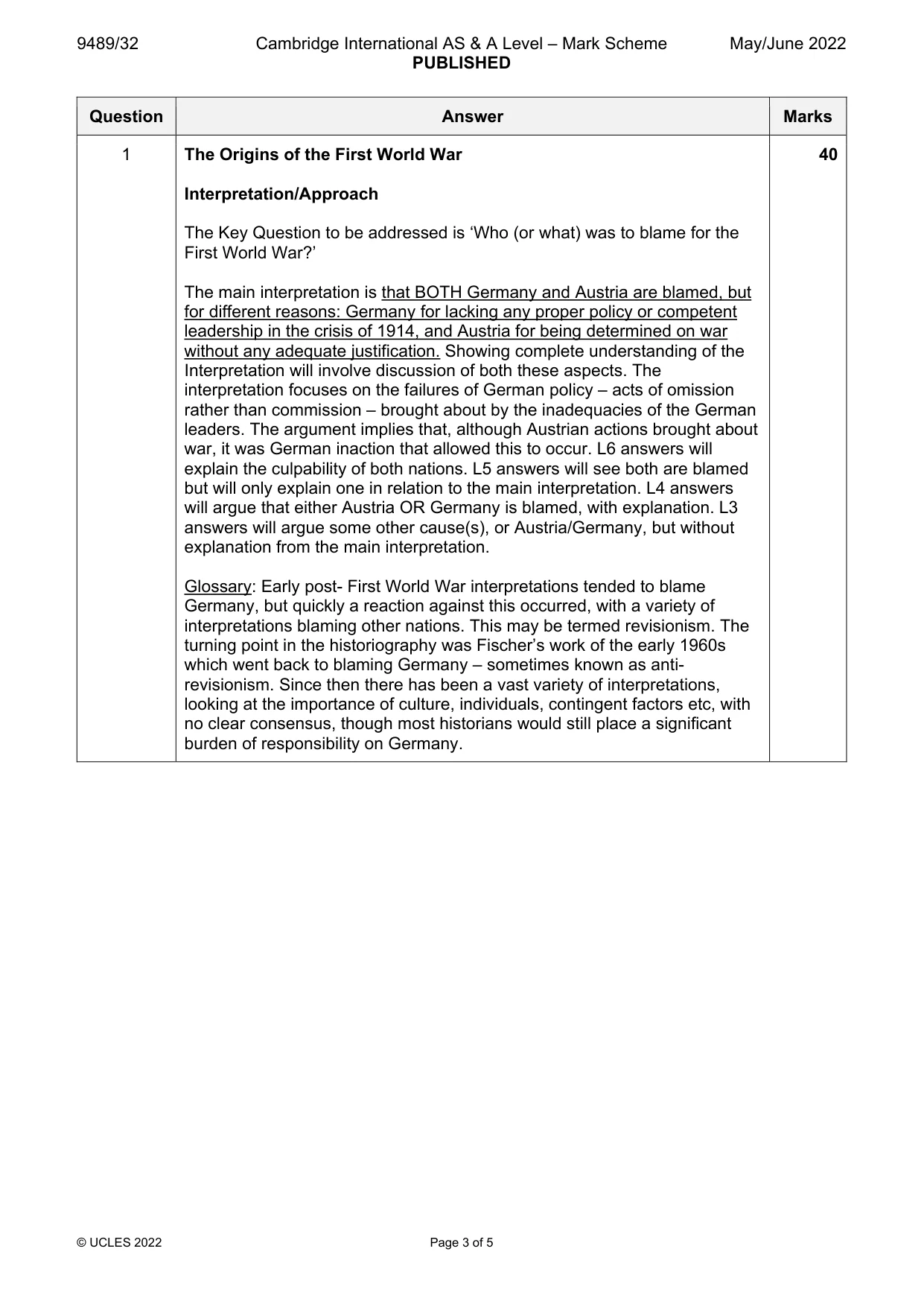
Mark scheme: Question Answer Marks 1 The Origins of the First World War 40 Interpretation/Approach The Key Question to be addressed is ‘Who (or what) was to blame for the First World War?’ The main interpretation is that BOTH Germany and Austria are blamed, but for different reasons: Germany for lacking any proper policy or competent leadership in the crisis of 1914, and Austria for being determined on war without any adequate justification. Showing complete understanding of the Interpretation will involve discussion of both these aspects. The interpretation focuses on the failures of German policy – acts of omission rather than commission – brought about by the inadequacies of the German leaders. The argument implies that, although Austrian actions brought about war, it was German inaction that allowed this to occur. L6 answers will explain the culpability of both nations. L5 answers will see both are blamed but will only explain one in relation to the main interpretation. L4 answers will argue that either Austria OR Germany is blamed, with explanation. L3 answers will argue some other cause(s), or Austria/Germany, but without explanation from the main interpretation. Glossary: Early post- First World War interpretations tended to blame Germany, but quickly a reaction against this occurred, with a variety of interpretations blaming other nations. This may be termed revisionism. The turning point in the historiography was Fischer’s work of the early 1960s which went back to blaming Germany – sometimes known as anti- revisionism. Since then there has been a vast variety of interpretations, looking at the importance of culture, individuals, contingent factors etc, with no clear consensus, though most historians would still place a significant burden of responsibility on Germany.
Q2 · Read the extract and then answer the question
2 Read the extract and then answer the question. Structuralists stress the improvised and reactive nature of decision-making, and the importance of essentially local initiatives albeit operating with approval from above, or in other words the ways in which lesser figures worked their way towards the Führer. This of course raises the question of how the lesser or local figures knew which wishes they were anticipating. Structuralists have the advantage of directly addressing the question of how Hitler’s undeniable and pathological hatred of Jews was translated into concrete policy by a host of lesser functionaries within a complex, modern, bureaucratic framework. The disadvantage of this approach can be to focus too much on the contingent and chaotic details of the regime’s administrative arrangements. One must not lose sight of the motives and ideological climate which shaped these decisions, not to speak of the devastatingly effective way in which industrialised mass murder was implemented. Concentrating on the details of bureaucratic chaos can only run the risk of overlooking the fierce hatred which drove not only Hitler, but also the labours of the bureaucrats. The ‘banality of evil’, a concept based upon the fact that most of those involved were not psychopaths or sadists, but steely, desk-bound functionaries, following routine and the division of labour, has become something of a cliché. By using these terms, one runs the danger of seeing these men as bloodless and unimaginative, whilst in reality they simply concealed their deep irrational hatreds in coolly detached bureaucratic language. Reading some of the more theoretical accounts of the origins of the ‘Final Solution’, one can easily obtain the misleading impression that the regime somehow stumbled into murdering millions of people. This overlooks the passionate hatreds of the perpetrators towards their victims, or the group intoxication with violence and the prospect of going beyond the limits of accepted moral norms which were also part of the crimes we are considering. How, then, and why did the persecution of German Jews escalate into the mass murder of European Jewry? In November 1938, Göring stated: ‘If the German Reich becomes involved in a diplomatic conflict in the foreseeable future, it is only natural that we shall also contemplate a major reckoning with the Jews.’ Nine months before this conflict broke out, Hitler’s ‘Prophecy’ speech spelled out what this ‘reckoning’ might involve: ‘The result will not be the Bolshevising of the earth, and thus a victory of Jewry, but the annihilation of the Jewish race in Europe.’ The war intensified Nazi paranoia about the ‘enemy within’, made easier the imposition of extreme solutions in extreme conditions, and dispensed with the need to take into account international opinion. A war of racial imperialist conquest also vastly increased the scale of the ‘question’ by multiplying the number of Jews under Nazi tyranny. However, the fact that the regime continued to pursue plans for Jewish emigration two years into the war has led some historians to regard Hitler’s pre-war threats as empty talk, bearing no automatic relation to the onset of the ‘Final Solution’. Yet the Madagascar Plan envisaged using the Jews as a means of blackmailing the US government, and undoubtedly would have led to physical extermination. The expectation of massive fatalities was also built into subsequent schemes for a ‘Jewish reservation’ in eastern Poland, plans which Hitler himself acknowledged ‘would never represent a solution’. What can you learn from this extract about the interpretation and approach of the historian who wrote it? Use the extract and your knowledge of the Holocaust to explain your answer. [40] Section C: Topic 3 The origins and development of the Cold War
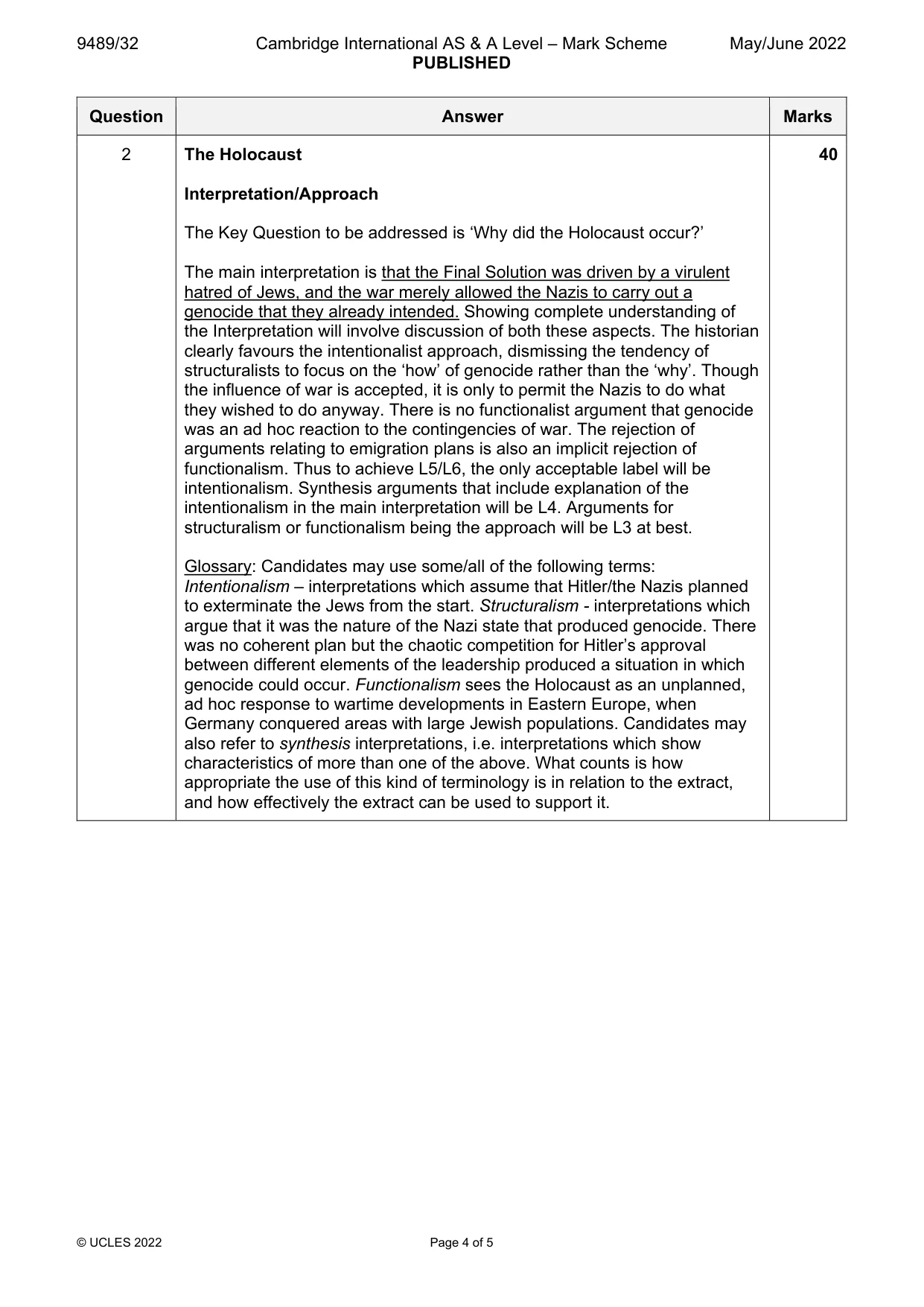
Mark scheme: 2 The Holocaust 40 Interpretation/Approach The Key Question to be addressed is ‘Why did the Holocaust occur?’ The main interpretation is that the Final Solution was driven by a virulent hatred of Jews, and the war merely allowed the Nazis to carry out a genocide that they already intended. Showing complete understanding of the Interpretation will involve discussion of both these aspects. The historian clearly favours the intentionalist approach, dismissing the tendency of structuralists to focus on the ‘how’ of genocide rather than the ‘why’. Though the influence of war is accepted, it is only to permit the Nazis to do what they wished to do anyway. There is no functionalist argument that genocide was an ad hoc reaction to the contingencies of war. The rejection of arguments relating to emigration plans is also an implicit rejection of functionalism. Thus to achieve L5/L6, the only acceptable label will be intentionalism. Synthesis arguments that include explanation of the intentionalism in the main interpretation will be L4. Arguments for structuralism or functionalism being the approach will be L3 at best. Glossary: Candidates may use some/all of the following terms: Intentionalism – interpretations which assume that Hitler/the Nazis planned to exterminate the Jews from the start. Structuralism - interpretations which argue that it was the nature of the Nazi state that produced genocide. There was no coherent plan but the chaotic competition for Hitler’s approval between different elements of the leadership produced a situation in which genocide could occur. Functionalism sees the Holocaust as an unplanned, ad hoc response to wartime developments in Eastern Europe, when Germany conquered areas with large Jewish populations. Candidates may also refer to synthesis interpretations, i.e. interpretations which show characteristics of more than one of the above. What counts is how appropriate the use of this kind of terminology is in relation to the extract, and how effectively the extract can be used to support it.
Q3 · Read the extract and then answer the question
3 Read the extract and then answer the question. The longer-term rivalry between the Soviet Union and the West had been brought more firmly back into focus as a direct result of the Second World War. This created future battle lines in Europe. But in the process, Stalin miscalculated the divisions within the West. The Allied powers had emerged greatly strengthened by the defeat of Nazi Germany. The removal of fascism also sharpened the divisions between capitalism and communism, as did the new territorial closeness brought about by the military process. This line of argument still holds as a general explanation of the origins of the Cold War. But there is one important omission. The traditional focus is very much on the external pressures on the Soviet Union. Of equal importance, however, are the internal pressures and the way in which they helped to shape Stalin’s responses to the West. Stalin found the Soviet Union affected in two contrasting ways by the Second World War. In one way the war had a unifying effect. It had pulled the country together, partly through the massive patriotic response to the emergency of the German invasion, and partly because the military success had prevented it from disintegrating again once the emergency was over. On the other hand, there were also divisive influences. Military victory had threatened Stalin’s personal power and created alternative role models that made possible a weakening of central power. Meanwhile, there was also a revived threat of ethnic divisions. To maintain the unifying effect Stalin had to restore the full range of state power and the command economy of the 1930s. His measures now had a new justification – the perceived menace from the West. He could also reject any assistance from the West, as he did in his response to Marshall Aid, in the same terms. The Soviet Union would continue to go on its own way, as it had in the early 1930s. Stalin depended on the Cold War to maintain his system internally. This explains why domestic crises were so often related to the external threat. He could also use the newly conquered defensive wall of Eastern Europe as an additional form of security. In tightening control over the satellite states, he could put additional pressure on ethnic groups within the Soviet Union itself. To what extent did Stalin succeed in his attempted manipulation of the Cold War? On the positive side, the Soviet Union seemed to have achieved the security that he sought. It was a superpower with the world’s largest standing army. It had direct control over Eastern Europe. The Cold War had also been the means whereby defeating an enemy had been converted into the spread of ideology. From 1949, with its development of its atom bomb, the extension of Soviet influence was set more permanently by the protection of nuclear weapons. Thus, compared with Soviet pre-war insecurity, huge steps had been taken. Or had they? Stalin’s use of the Cold War to increase internal security generated its own problems, which made the Soviet Union more vulnerable from outside. For example, the spread of Soviet influence into Eastern Europe provoked a Western response that was far more significant than anything in the inter-war period. This included the Truman Doctrine and Marshall Plan, and the establishment of NATO in 1949. In addition, Stalin was obliged to back down over the Berlin Blockade in 1948–49. As one historian has written, ‘The Cold War was not a competition of equals: rather it was an unequal struggle between one strong regime, the United States, and one fragile regime, the Soviet Union.’ What can you learn from this extract about the interpretation and approach of the historian who wrote it? Use the extract and your knowledge of the Cold War to explain your answer. [40]
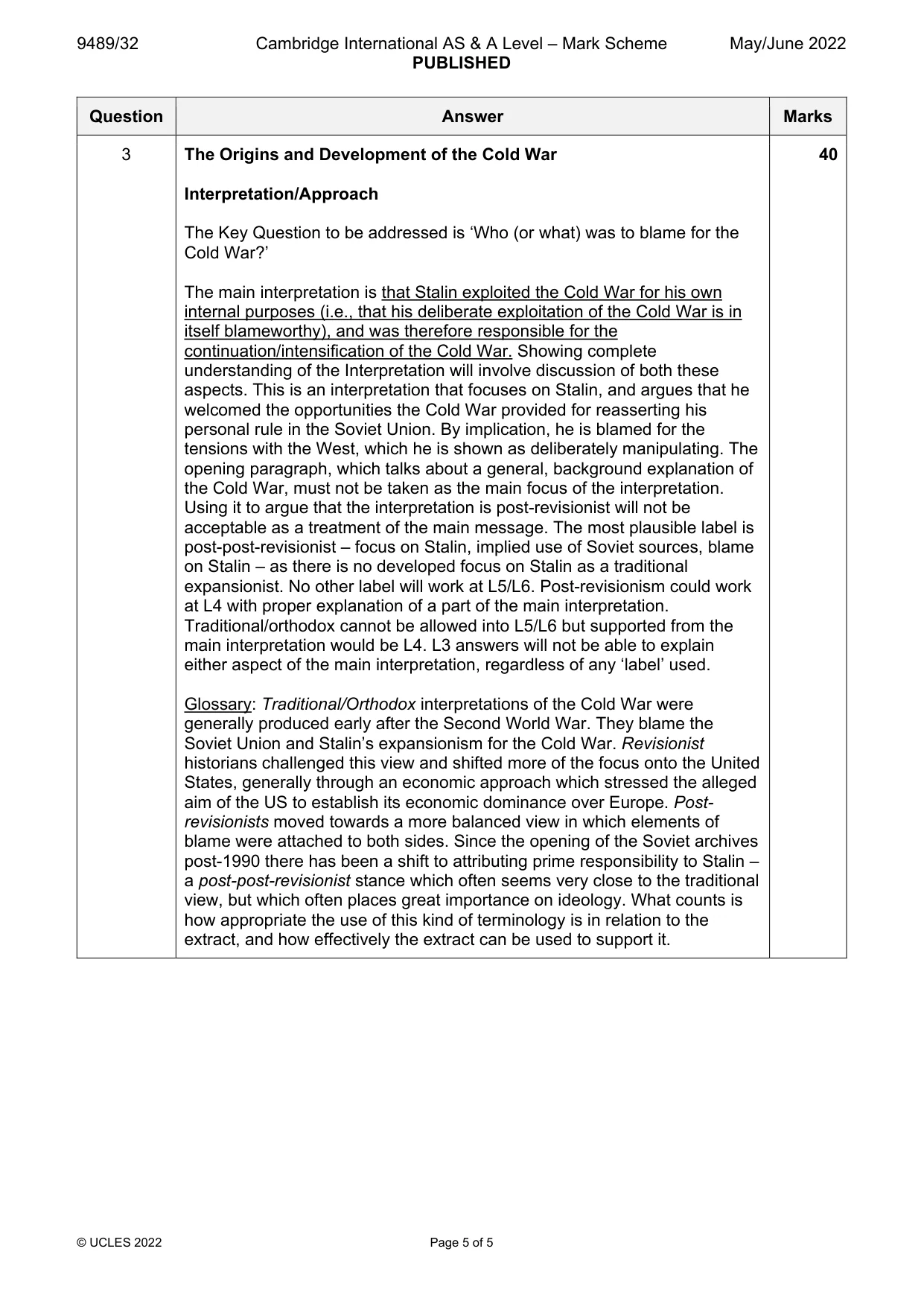
Mark scheme: 3 The Origins and Development of the Cold War 40 Interpretation/Approach The Key Question to be addressed is ‘Who (or what) was to blame for the Cold War?’ The main interpretation is that Stalin exploited the Cold War for his own internal purposes (i.e., that his deliberate exploitation of the Cold War is in itself blameworthy), and was therefore responsible for the continuation/intensification of the Cold War. Showing complete understanding of the Interpretation will involve discussion of both these aspects. This is an interpretation that focuses on Stalin, and argues that he welcomed the opportunities the Cold War provided for reasserting his personal rule in the Soviet Union. By implication, he is blamed for the tensions with the West, which he is shown as deliberately manipulating. The opening paragraph, which talks about a general, background explanation of the Cold War, must not be taken as the main focus of the interpretation. Using it to argue that the interpretation is post-revisionist will not be acceptable as a treatment of the main message. The most plausible label is post-post-revisionist – focus on Stalin, implied use of Soviet sources, blame on Stalin – as there is no developed focus on Stalin as a traditional expansionist. No other label will work at L5/L6. Post-revisionism could work at L4 with proper explanation of a part of the main interpretation. Traditional/orthodox cannot be allowed into L5/L6 but supported from the main interpretation would be L4. L3 answers will not be able to explain either aspect of the main interpretation, regardless of any ‘label’ used. Glossary: Traditional/Orthodox interpretations of the Cold War were generally produced early after the Second World War. They blame the Soviet Union and Stalin’s expansionism for the Cold War. Revisionist historians challenged this view and shifted more of the focus onto the United States, generally through an economic approach which stressed the alleged aim of the US to establish its economic dominance over Europe. Post- revisionists moved towards a more balanced view in which elements of blame were attached to both sides. Since the opening of the Soviet archives post-1990 there has been a shift to attributing prime responsibility to Stalin – a post-post-revisionist stance which often seems very close to the traditional view, but which often places great importance on ideology. What counts is how appropriate the use of this kind of terminology is in relation to the extract, and how effectively the extract can be used to support it.
More questions on How were the Bolsheviks able to consolidate their power up to 1924?
What was in this paper
The subtopics covered by these 3 questions, and how many questions each got. Open one in a new tab to see every Cambridge question on it.
What you needed in this session
Cambridge’s own grade thresholds for 2022 May/June, Paper 3 · Variant 2. A higher threshold means an easier paper — the bar moves with how the cohort did.