Cambridge A Level History 9489 — 2024 Oct/Nov Paper 3 · Variant 1
9489/31/O/N/24 · 3 questions · 40 marks · ≈45 min
The question paper and its mark scheme, free to read here and free to download. This is Cambridge’s own paper, exactly as it was sat.
Question paper4 pages
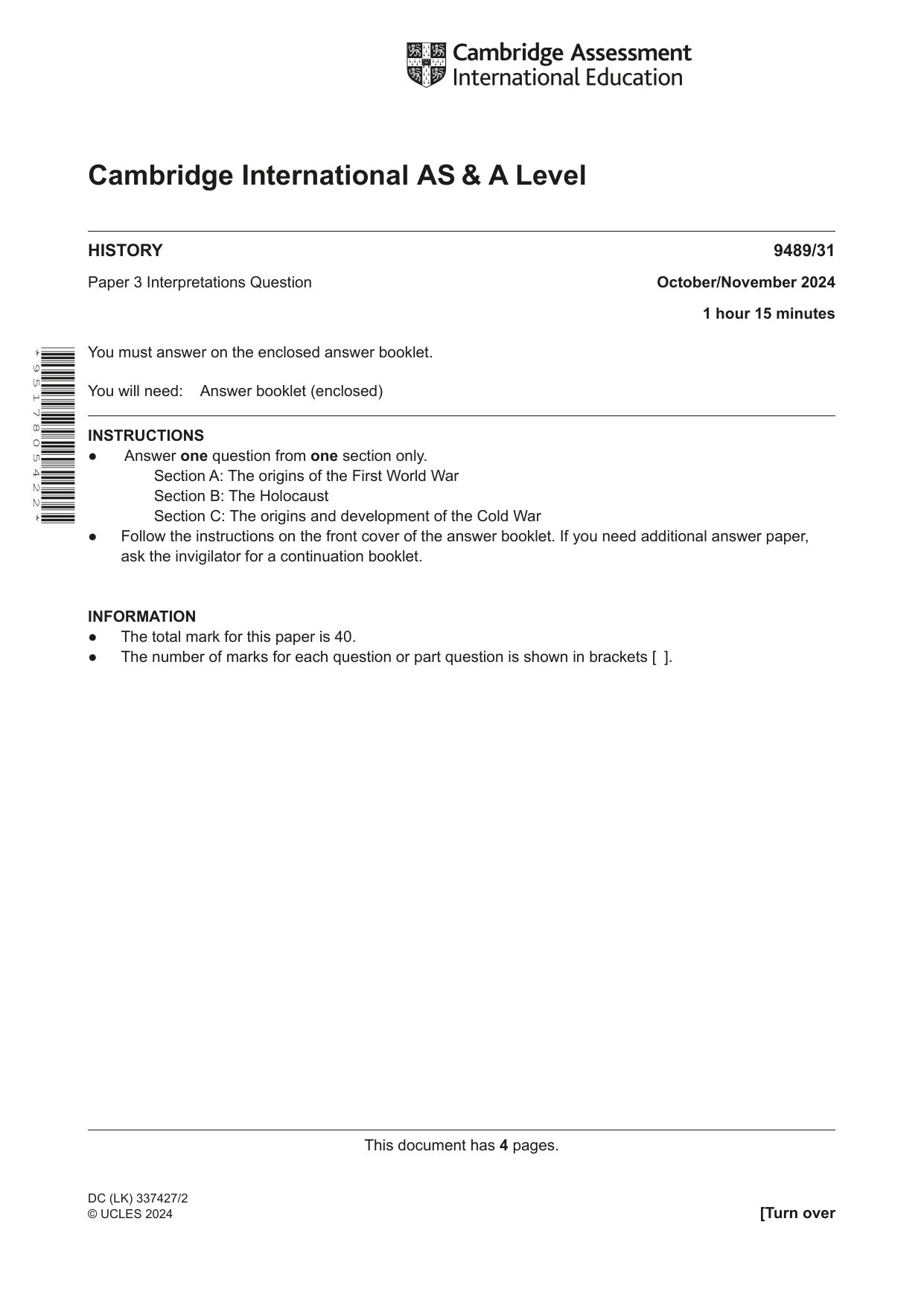
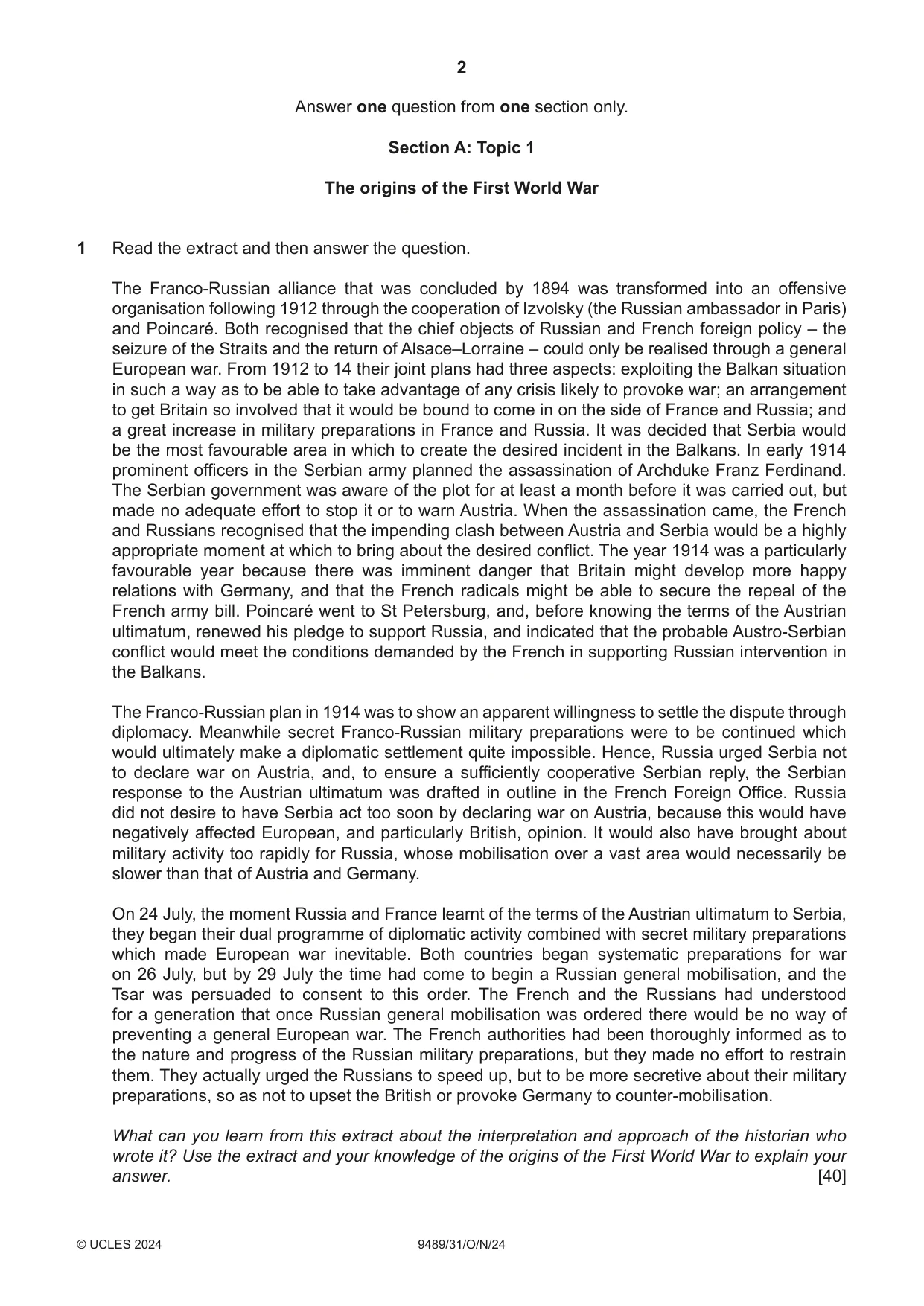
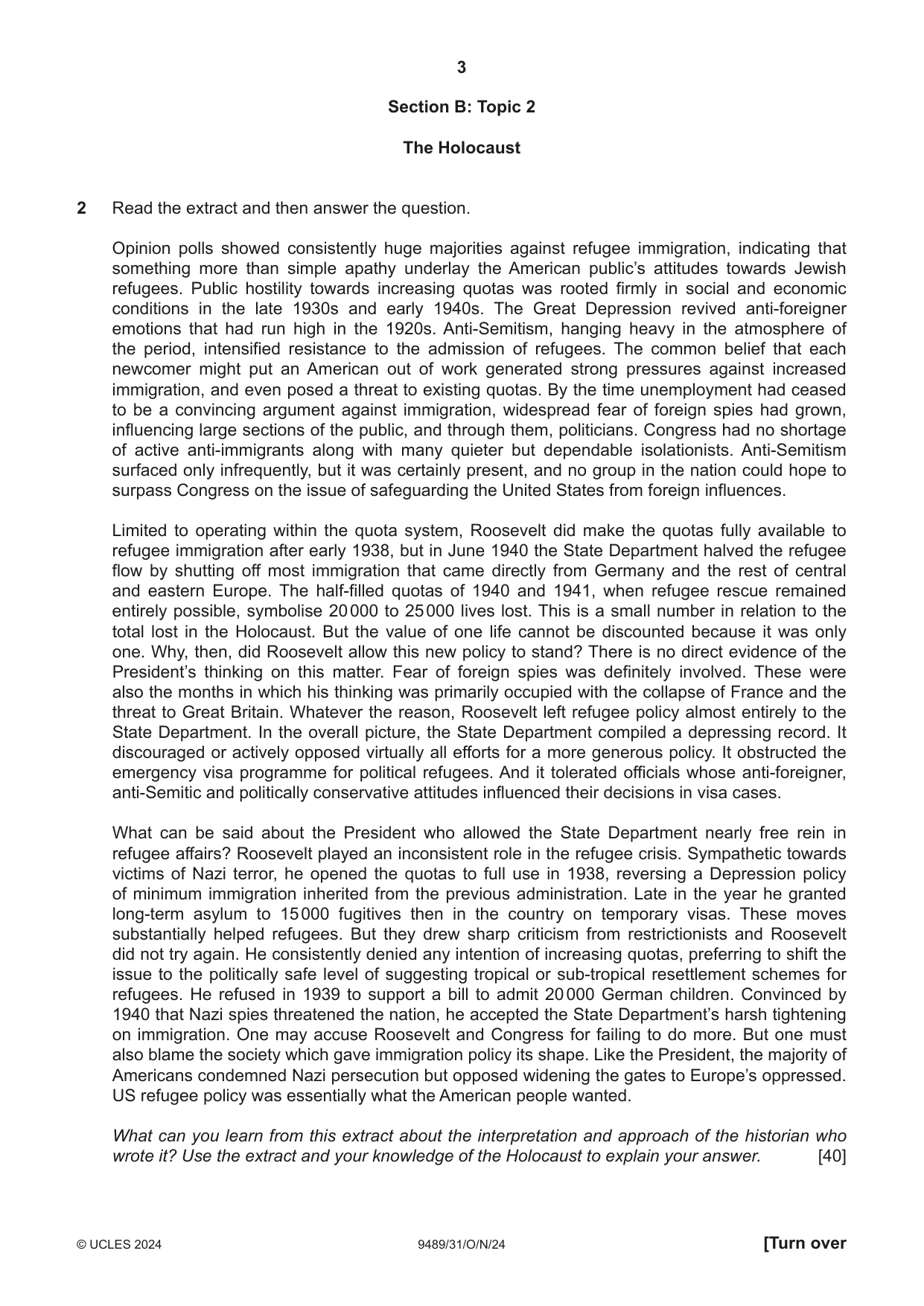
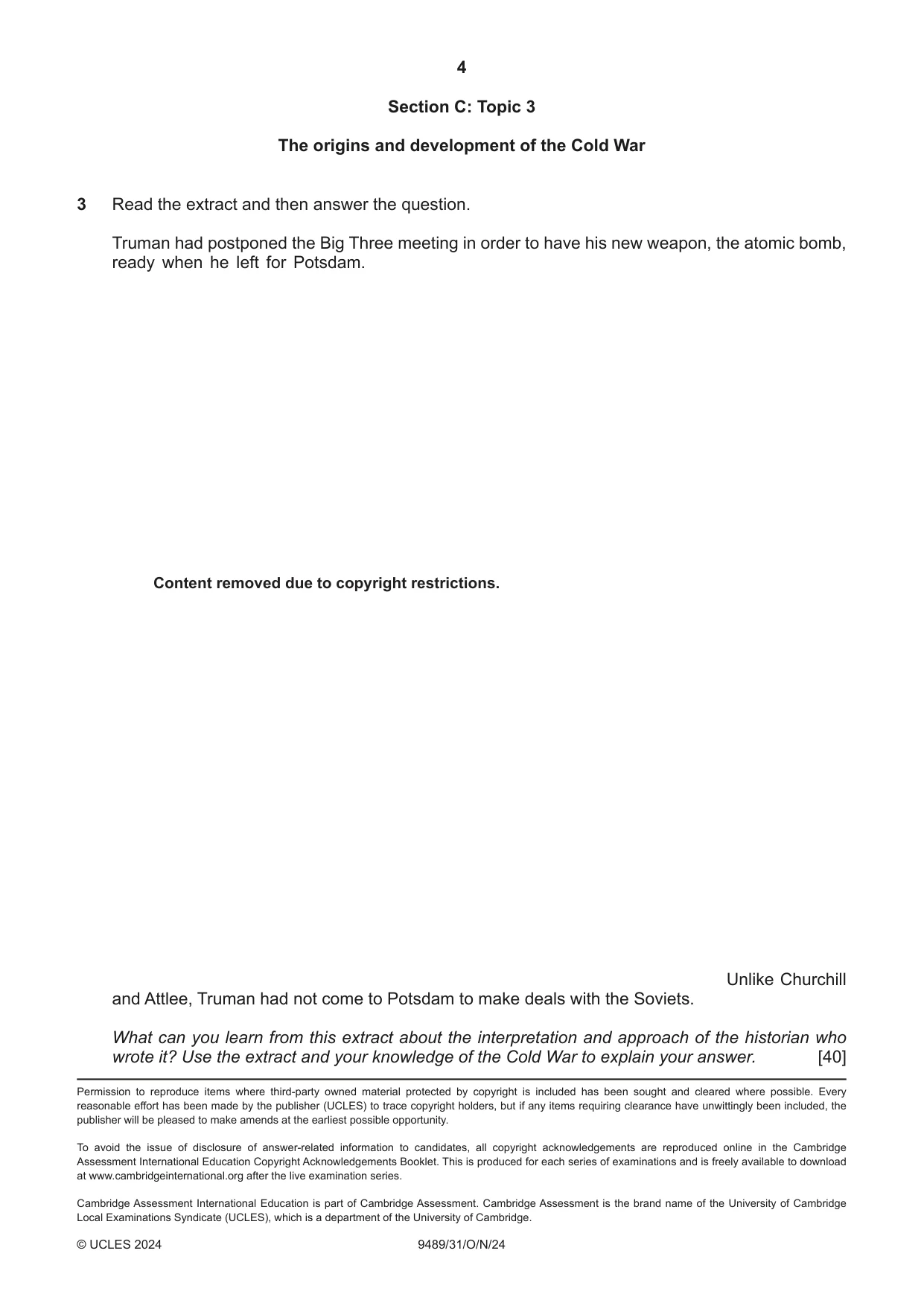
Mark scheme8 pages
Answers below. Sit the paper first if you are practising.
Questions as text
Q1 · Read the extract and then answer the question
1 Read the extract and then answer the question. The Franco-Russian alliance that was concluded by 1894 was transformed into an offensive organisation following 1912 through the cooperation of Izvolsky (the Russian ambassador in Paris) and Poincaré. Both recognised that the chief objects of Russian and French foreign policy – the seizure of the Straits and the return of Alsace–Lorraine – could only be realised through a general European war. From 1912 to 14 their joint plans had three aspects: exploiting the Balkan situation in such a way as to be able to take advantage of any crisis likely to provoke war; an arrangement to get Britain so involved that it would be bound to come in on the side of France and Russia; and a great increase in military preparations in France and Russia. It was decided that Serbia would be the most favourable area in which to create the desired incident in the Balkans. In early 1914 prominent officers in the Serbian army planned the assassination of Archduke Franz Ferdinand. The Serbian government was aware of the plot for at least a month before it was carried out, but made no adequate effort to stop it or to warn Austria. When the assassination came, the French and Russians recognised that the impending clash between Austria and Serbia would be a highly appropriate moment at which to bring about the desired conflict. The year 1914 was a particularly favourable year because there was imminent danger that Britain might develop more happy relations with Germany, and that the French radicals might be able to secure the repeal of the French army bill. Poincaré went to St Petersburg, and, before knowing the terms of the Austrian ultimatum, renewed his pledge to support Russia, and indicated that the probable Austro-Serbian conflict would meet the conditions demanded by the French in supporting Russian intervention in the Balkans. The Franco-Russian plan in 1914 was to show an apparent willingness to settle the dispute through diplomacy. Meanwhile secret Franco-Russian military preparations were to be continued which would ultimately make a diplomatic settlement quite impossible. Hence, Russia urged Serbia not to declare war on Austria, and, to ensure a sufficiently cooperative Serbian reply, the Serbian response to the Austrian ultimatum was drafted in outline in the French Foreign Office. Russia did not desire to have Serbia act too soon by declaring war on Austria, because this would have negatively affected European, and particularly British, opinion. It would also have brought about military activity too rapidly for Russia, whose mobilisation over a vast area would necessarily be slower than that of Austria and Germany. On 24 July, the moment Russia and France learnt of the terms of the Austrian ultimatum to Serbia, they began their dual programme of diplomatic activity combined with secret military preparations which made European war inevitable. Both countries began systematic preparations for war on 26 July, but by 29 July the time had come to begin a Russian general mobilisation, and the Tsar was persuaded to consent to this order. The French and the Russians had understood for a generation that once Russian general mobilisation was ordered there would be no way of preventing a general European war. The French authorities had been thoroughly informed as to the nature and progress of the Russian military preparations, but they made no effort to restrain them. They actually urged the Russians to speed up, but to be more secretive about their military preparations, so as not to upset the British or provoke Germany to counter-mobilisation. What can you learn from this extract about the interpretation and approach of the historian who wrote it? Use the extract and your knowledge of the origins of the First World War to explain your answer. [40]
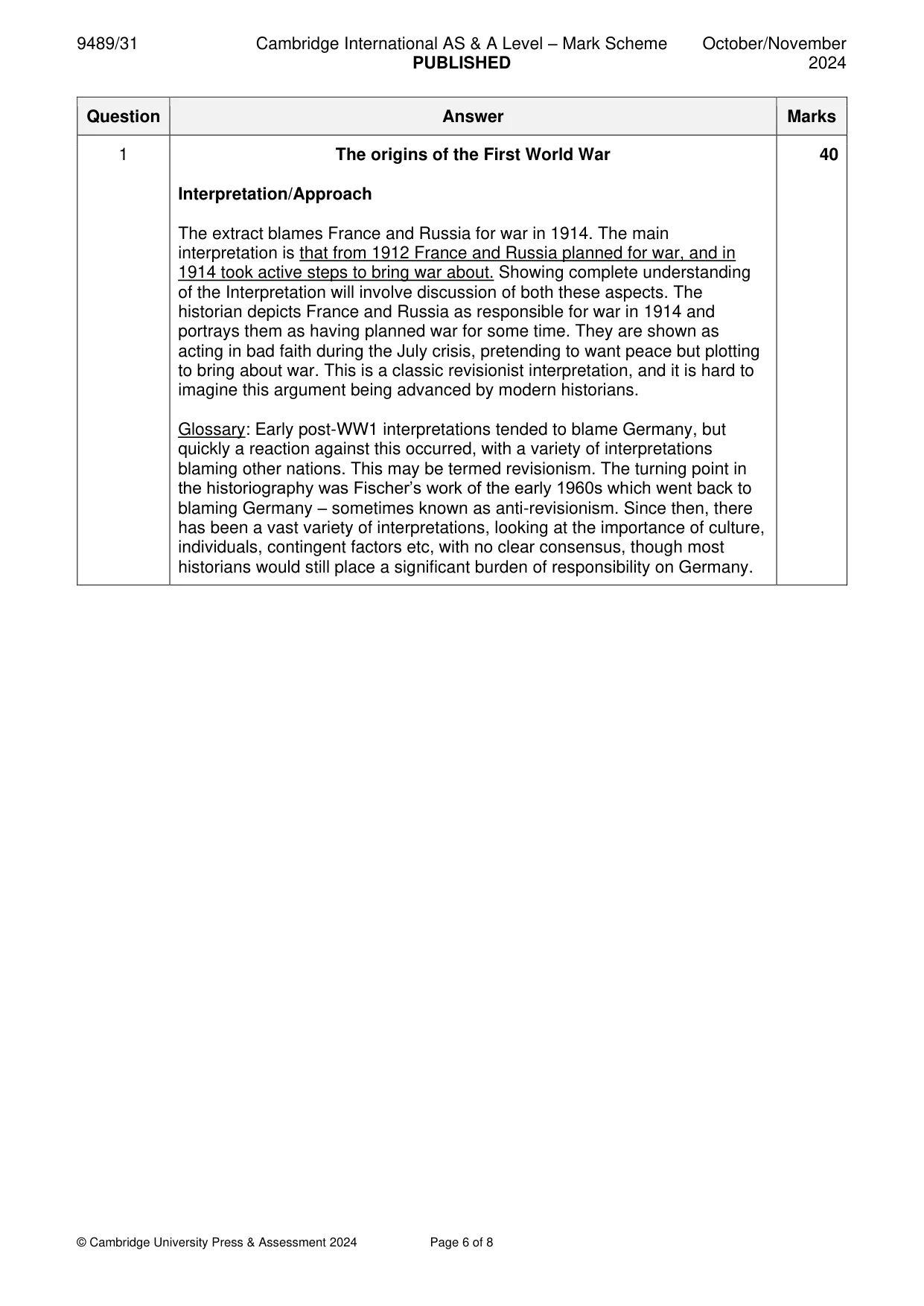
Mark scheme: Question Answer Marks 1 The origins of the First World War 40 Interpretation/Approach The extract blames France and Russia for war in 1914. The main interpretation is that from 1912 France and Russia planned for war, and in 1914 took active steps to bring war about. Showing complete understanding of the Interpretation will involve discussion of both these aspects. The historian depicts France and Russia as responsible for war in 1914 and portrays them as having planned war for some time. They are shown as acting in bad faith during the July crisis, pretending to want peace but plotting to bring about war. This is a classic revisionist interpretation, and it is hard to imagine this argument being advanced by modern historians. Glossary: Early post-WW1 interpretations tended to blame Germany, but quickly a reaction against this occurred, with a variety of interpretations blaming other nations. This may be termed revisionism. The turning point in the historiography was Fischer’s work of the early 1960s which went back to blaming Germany – sometimes known as anti-revisionism. Since then, there has been a vast variety of interpretations, looking at the importance of culture, individuals, contingent factors etc, with no clear consensus, though most historians would still place a significant burden of responsibility on Germany.
Q2 · Read the extract and then answer the question
2 Read the extract and then answer the question. Opinion polls showed consistently huge majorities against refugee immigration, indicating that something more than simple apathy underlay the American public’s attitudes towards Jewish refugees. Public hostility towards increasing quotas was rooted firmly in social and economic conditions in the late 1930s and early 1940s. The Great Depression revived anti-foreigner emotions that had run high in the 1920s. Anti-Semitism, hanging heavy in the atmosphere of the period, intensified resistance to the admission of refugees. The common belief that each newcomer might put an American out of work generated strong pressures against increased immigration, and even posed a threat to existing quotas. By the time unemployment had ceased to be a convincing argument against immigration, widespread fear of foreign spies had grown, influencing large sections of the public, and through them, politicians. Congress had no shortage of active anti-immigrants along with many quieter but dependable isolationists. Anti-Semitism surfaced only infrequently, but it was certainly present, and no group in the nation could hope to surpass Congress on the issue of safeguarding the United States from foreign influences. Limited to operating within the quota system, Roosevelt did make the quotas fully available to refugee immigration after early 1938, but in June 1940 the State Department halved the refugee flow by shutting off most immigration that came directly from Germany and the rest of central and eastern Europe. The half-filled quotas of 1940 and 1941, when refugee rescue remained entirely possible, symbolise 20 000 to 25 000 lives lost. This is a small number in relation to the total lost in the Holocaust. But the value of one life cannot be discounted because it was only one. Why, then, did Roosevelt allow this new policy to stand? There is no direct evidence of the President’s thinking on this matter. Fear of foreign spies was definitely involved. These were also the months in which his thinking was primarily occupied with the collapse of France and the threat to Great Britain. Whatever the reason, Roosevelt left refugee policy almost entirely to the State Department. In the overall picture, the State Department compiled a depressing record. It discouraged or actively opposed virtually all efforts for a more generous policy. It obstructed the emergency visa programme for political refugees. And it tolerated officials whose anti-foreigner, anti-Semitic and politically conservative attitudes influenced their decisions in visa cases. What can be said about the President who allowed the State Department nearly free rein in refugee affairs? Roosevelt played an inconsistent role in the refugee crisis. Sympathetic towards victims of Nazi terror, he opened the quotas to full use in 1938, reversing a Depression policy of minimum immigration inherited from the previous administration. Late in the year he granted long-term asylum to 15 000 fugitives then in the country on temporary visas. These moves substantially helped refugees. But they drew sharp criticism from restrictionists and Roosevelt did not try again. He consistently denied any intention of increasing quotas, preferring to shift the issue to the politically safe level of suggesting tropical or sub-tropical resettlement schemes for refugees. He refused in 1939 to support a bill to admit 20 000 German children. Convinced by 1940 that Nazi spies threatened the nation, he accepted the State Department’s harsh tightening on immigration. One may accuse Roosevelt and Congress for failing to do more. But one must also blame the society which gave immigration policy its shape. Like the President, the majority of Americans condemned Nazi persecution but opposed widening the gates to Europe’s oppressed. US refugee policy was essentially what the American people wanted. What can you learn from this extract about the interpretation and approach of the historian who wrote it? Use the extract and your knowledge of the Holocaust to explain your answer. [40] Section C: Topic 3 The origins and development of the Cold War
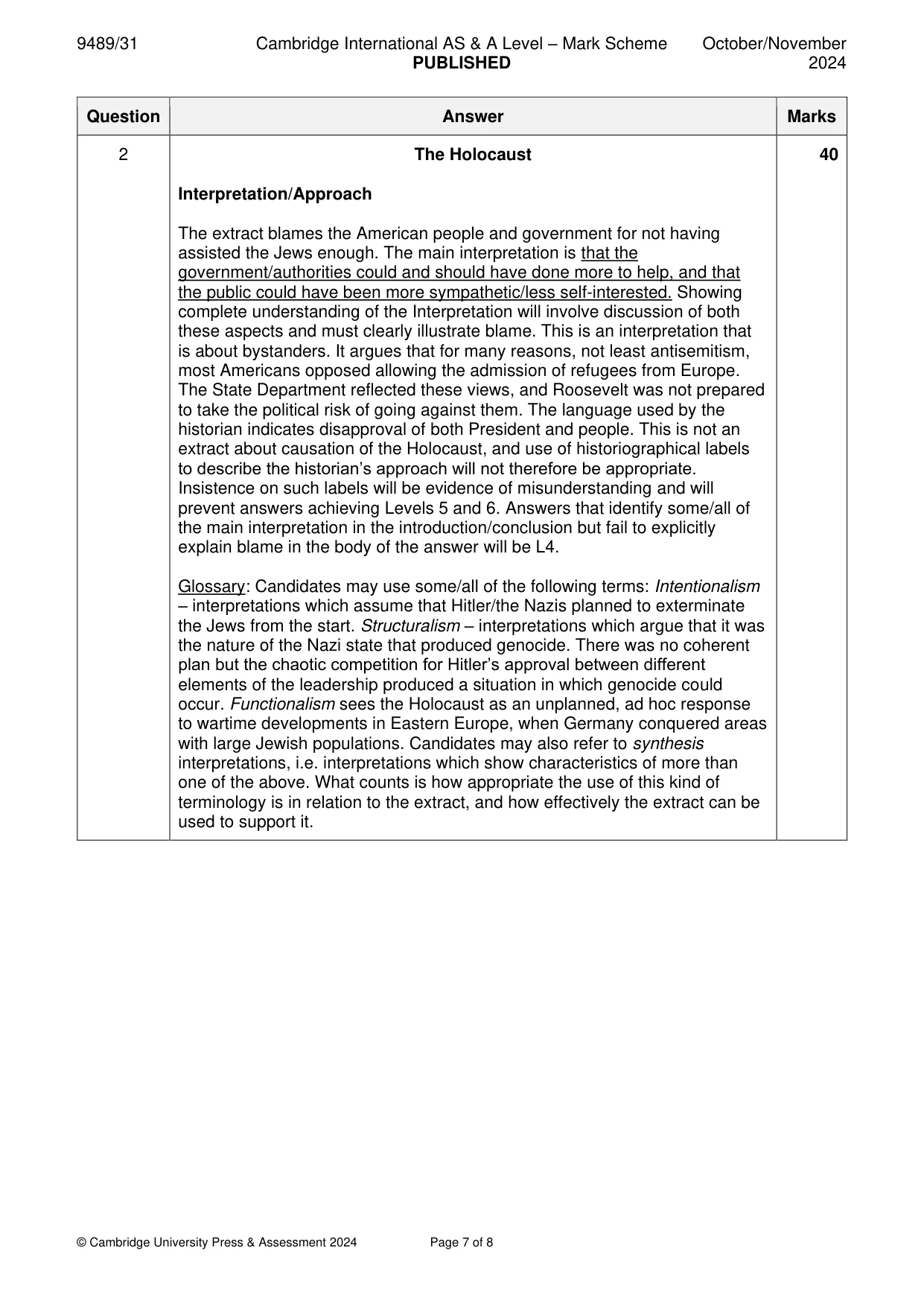
Mark scheme: 2 The Holocaust 40 Interpretation/Approach The extract blames the American people and government for not having assisted the Jews enough. The main interpretation is that the government/authorities could and should have done more to help, and that the public could have been more sympathetic/less self-interested. Showing complete understanding of the Interpretation will involve discussion of both these aspects and must clearly illustrate blame. This is an interpretation that is about bystanders. It argues that for many reasons, not least antisemitism, most Americans opposed allowing the admission of refugees from Europe. The State Department reflected these views, and Roosevelt was not prepared to take the political risk of going against them. The language used by the historian indicates disapproval of both President and people. This is not an extract about causation of the Holocaust, and use of historiographical labels to describe the historian’s approach will not therefore be appropriate. Insistence on such labels will be evidence of misunderstanding and will prevent answers achieving Levels 5 and 6. Answers that identify some/all of the main interpretation in the introduction/conclusion but fail to explicitly explain blame in the body of the answer will be L4. Glossary: Candidates may use some/all of the following terms: Intentionalism – interpretations which assume that Hitler/the Nazis planned to exterminate the Jews from the start. Structuralism – interpretations which argue that it was the nature of the Nazi state that produced genocide. There was no coherent plan but the chaotic competition for Hitler’s approval between different elements of the leadership produced a situation in which genocide could occur. Functionalism sees the Holocaust as an unplanned, ad hoc response to wartime developments in Eastern Europe, when Germany conquered areas with large Jewish populations. Candidates may also refer to synthesis interpretations, i.e. interpretations which show characteristics of more than one of the above. What counts is how appropriate the use of this kind of terminology is in relation to the extract, and how effectively the extract can be used to support it.
Q3 · Read the extract and then answer the question
3 Read the extract and then answer the question. Truman had postponed the Big Three meeting in order to have his new weapon, the atomic bomb, ready when he left for Potsdam. Content removed due to copyright restrictions. Unlike Churchill and Attlee, Truman had not come to Potsdam to make deals with the Soviets. What can you learn from this extract about the interpretation and approach of the historian who wrote it? Use the extract and your knowledge of the Cold War to explain your answer. [40]
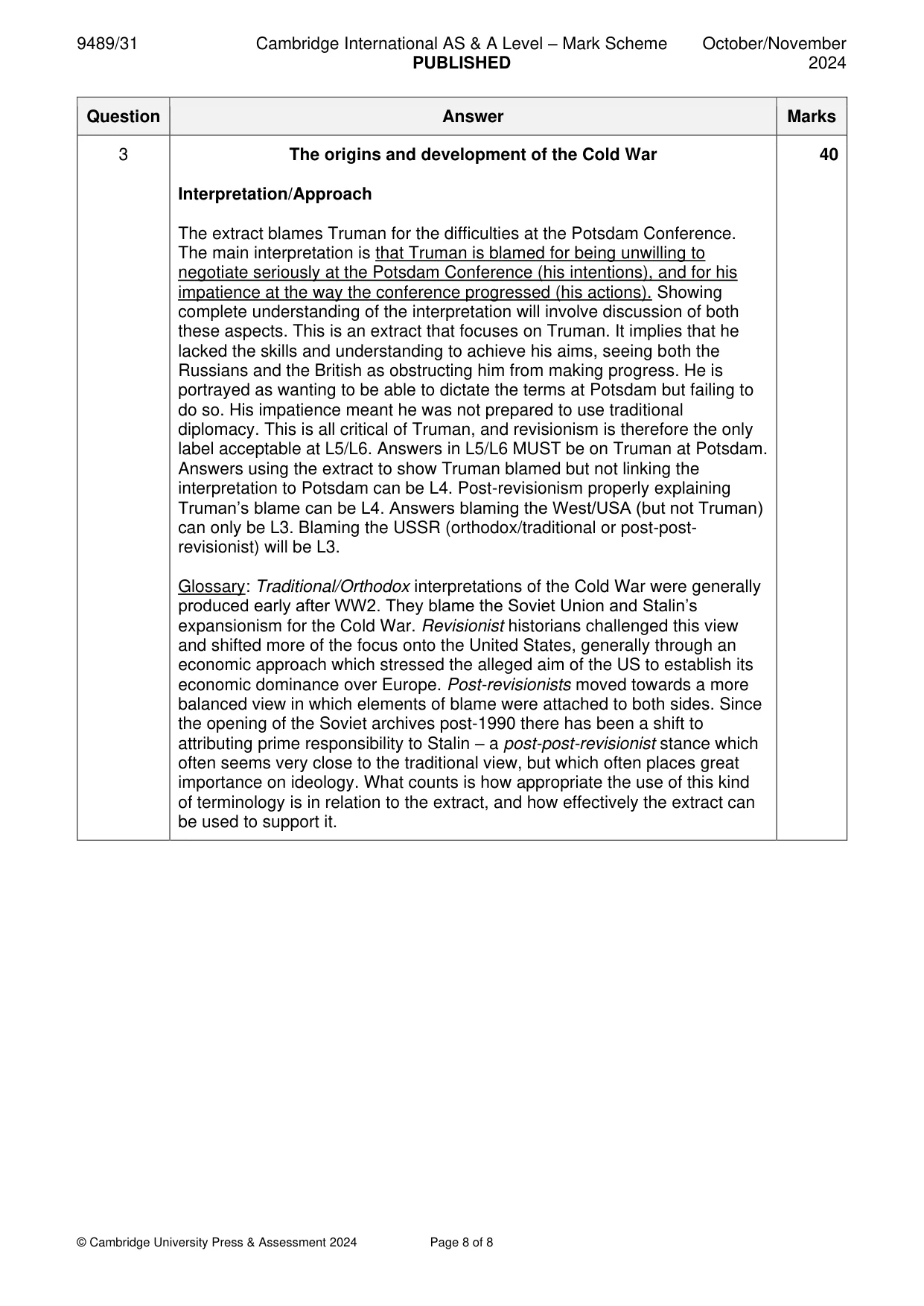
Mark scheme: 3 The origins and development of the Cold War 40 Interpretation/Approach The extract blames Truman for the difficulties at the Potsdam Conference. The main interpretation is that Truman is blamed for being unwilling to negotiate seriously at the Potsdam Conference (his intentions), and for his impatience at the way the conference progressed (his actions). Showing complete understanding of the interpretation will involve discussion of both these aspects. This is an extract that focuses on Truman. It implies that he lacked the skills and understanding to achieve his aims, seeing both the Russians and the British as obstructing him from making progress. He is portrayed as wanting to be able to dictate the terms at Potsdam but failing to do so. His impatience meant he was not prepared to use traditional diplomacy. This is all critical of Truman, and revisionism is therefore the only label acceptable at L5/L6. Answers in L5/L6 MUST be on Truman at Potsdam. Answers using the extract to show Truman blamed but not linking the interpretation to Potsdam can be L4. Post-revisionism properly explaining Truman’s blame can be L4. Answers blaming the West/USA (but not Truman) can only be L3. Blaming the USSR (orthodox/traditional or post-post- revisionist) will be L3. Glossary: Traditional/Orthodox interpretations of the Cold War were generally produced early after WW2. They blame the Soviet Union and Stalin’s expansionism for the Cold War. Revisionist historians challenged this view and shifted more of the focus onto the United States, generally through an economic approach which stressed the alleged aim of the US to establish its economic dominance over Europe. Post-revisionists moved towards a more balanced view in which elements of blame were attached to both sides. Since the opening of the Soviet archives post-1990 there has been a shift to attributing prime responsibility to Stalin – a post-post-revisionist stance which often seems very close to the traditional view, but which often places great importance on ideology. What counts is how appropriate the use of this kind of terminology is in relation to the extract, and how effectively the extract can be used to support it.
What was in this paper
The subtopics covered by these 3 questions, and how many questions each got. Open one in a new tab to see every Cambridge question on it.
What you needed in this session
Cambridge’s own grade thresholds for 2024 Oct/Nov, Paper 3 · Variant 1. A higher threshold means an easier paper — the bar moves with how the cohort did.