Cambridge A Level History 9489 — 2021 Oct/Nov Paper 1 · Variant 3
9489/13/O/N/21 · 40 marks · ≈45 min
The question paper and its mark scheme, free to read here and free to download. This is Cambridge’s own paper, exactly as it was sat.
Question paper8 pages

Mark scheme14 pages
Answers below. Sit the paper first if you are practising.
Paper as text
Question paper, page 1
This document has 8 pages. Any blank pages are indicated. Cambridge International AS & A Level DC (PQ/CGW) 204341/2 © UCLES 2021 [Turn over * 6 6 3 1 1 2 7 6 3 6 * HISTORY 9489/13 Paper 1 Document Question October/November 2021 1 hour 15 minutes You must answer on the enclosed answer booklet. You will need: Answer booklet (enclosed) INSTRUCTIONS ● Answer one question from one section only. Section A: European option Section B: American option Section C: International option ● Follow the instructions on the front cover of the answer booklet. If you need additional answer paper, ask the invigilator for a continuation booklet. INFORMATION ● The total mark for this paper is 40. ● The number of marks for each question or part question is shown in brackets [ ].
Question paper, page 2
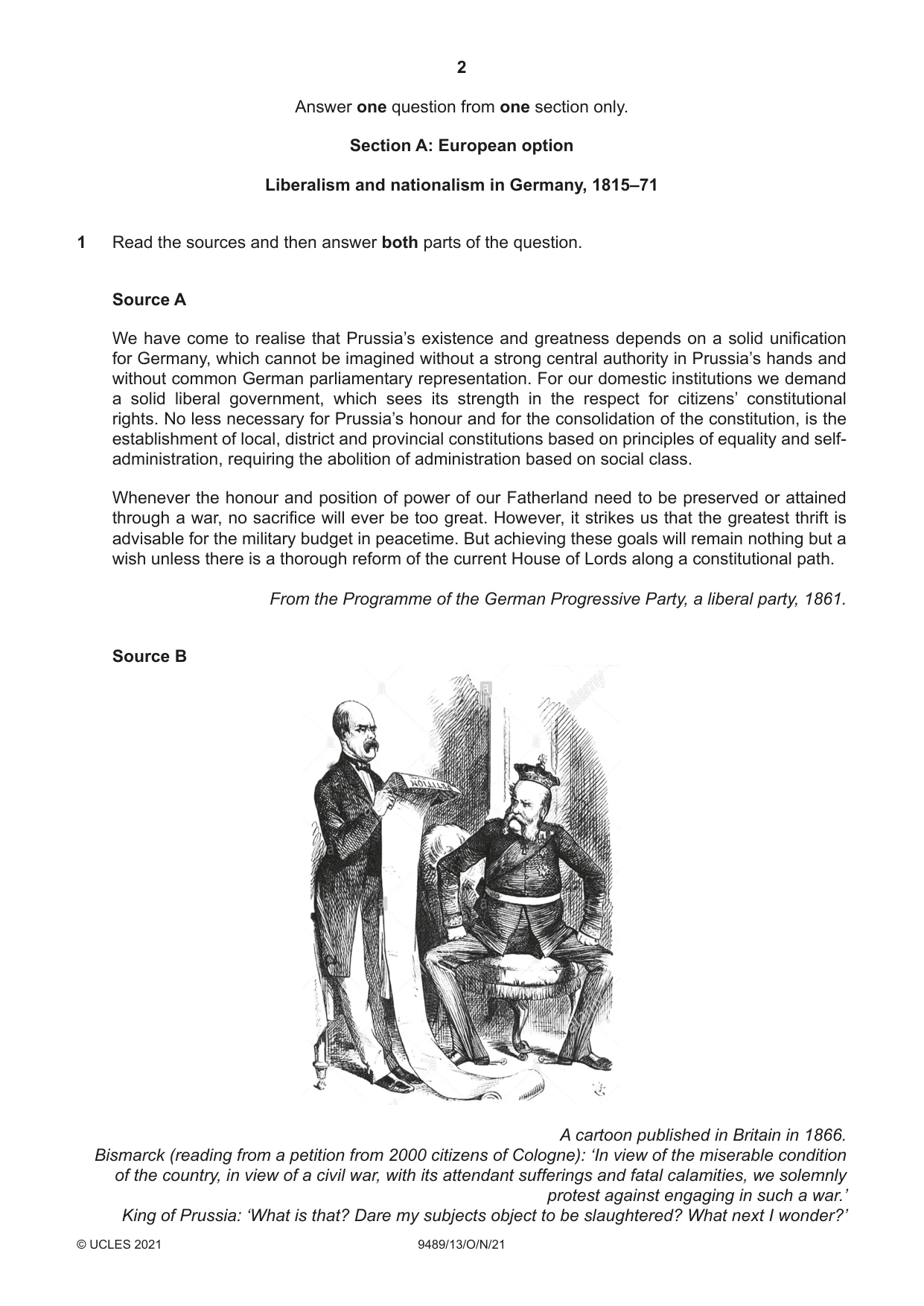
2 9489/13/O/N/21 © UCLES 2021 Answer one question from one section only. Section A: European option Liberalism and nationalism in Germany, 1815–71 1 Read the sources and then answer both parts of the question. Source A We have come to realise that Prussia’s existence and greatness depends on a solid unification for Germany, which cannot be imagined without a strong central authority in Prussia’s hands and without common German parliamentary representation. For our domestic institutions we demand a solid liberal government, which sees its strength in the respect for citizens’ constitutional rights. No less necessary for Prussia’s honour and for the consolidation of the constitution, is the establishment of local, district and provincial constitutions based on principles of equality and self- administration, requiring the abolition of administration based on social class. Whenever the honour and position of power of our Fatherland need to be preserved or attained through a war, no sacrifice will ever be too great. However, it strikes us that the greatest thrift is advisable for the military budget in peacetime. But achieving these goals will remain nothing but a wish unless there is a thorough reform of the current House of Lords along a constitutional path. From the Programme of the German Progressive Party, a liberal party, 1861. Source B A cartoon published in Britain in 1866. Bismarck (reading from a petition from 2000 citizens of Cologne): ‘In view of the miserable condition of the country, in view of a civil war, with its attendant sufferings and fatal calamities, we solemnly protest against engaging in such a war.’ King of Prussia: ‘What is that? Dare my subjects object to be slaughtered? What next I wonder?’
Question paper, page 3
3 9489/13/O/N/21 © UCLES 2021 [Turn over Source C Even now the man who has made a united Germany a possibility and has raised Prussia from the position of a second-rate power to the highest rank among continental empires is but little honoured in his own country. The cheers with which he was greeted were tame compared to those which welcomed the generals who had been the instruments of the work his brain had planned. But to those who look at all beyond the excitement of the day, the true hero of that brilliant gathering was neither King nor Princes of the royal blood, but Bismarck. The sickly, livid- looking statesman was there in spite of terrible pain, and against his doctor’s advice, in order that his work might be completed to the end. A British journalist describes the return of the victorious Prussian army to Berlin, September 1866. Source D We welcome the memorable moment when the old and new Prussia will seal its united statehood in a common representative body of the people. We have come together in the Reichstag as German countrymen, and it shall thus be the German national interest that unites us in the most heartfelt way. We recognise the legitimacy of the party system, but we resolutely reject its excesses and exaggerations. We always value the Fatherland above the party; we value the national interest above all else. We honour the state constitution as a source of strength for the monarchy. We reject constitutionalism as a moral corruption of public life. The nature and the benefits of liberty are not founded on allowing as many people as possible to be called upon to join in governing the state. Instead, they derive from the fact that everywhere a sphere of independent will and action, based on law and justice, makes itself in regard to a strong government. From the Founding Manifesto of the Imperial and Free Conservative Party, 1867. Answer both parts of the question with reference to the sources. (a) Read Sources A and D. Compare and contrast the political views expressed in Sources A and D. [15] (b) Read all of the sources. How far do these sources show that the unification of Germany was a popular policy? [25]
Question paper, page 4
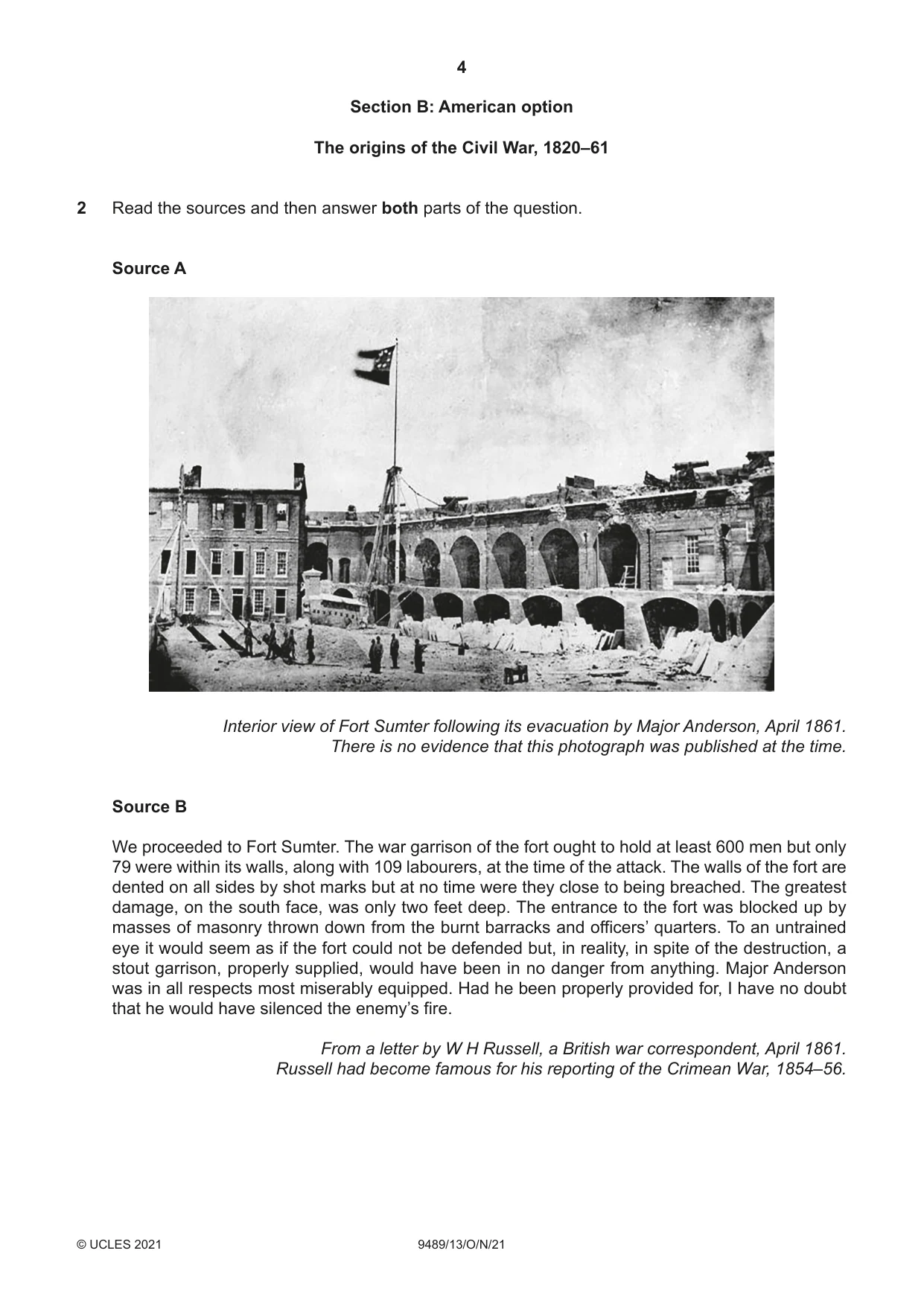
4 9489/13/O/N/21 © UCLES 2021 Section B: American option The origins of the Civil War, 1820–61 2 Read the sources and then answer both parts of the question. Source A Interior view of Fort Sumter following its evacuation by Major Anderson, April 1861. There is no evidence that this photograph was published at the time. Source B We proceeded to Fort Sumter. The war garrison of the fort ought to hold at least 600 men but only 79 were within its walls, along with 109 labourers, at the time of the attack. The walls of the fort are dented on all sides by shot marks but at no time were they close to being breached. The greatest damage, on the south face, was only two feet deep. The entrance to the fort was blocked up by masses of masonry thrown down from the burnt barracks and officers’ quarters. To an untrained eye it would seem as if the fort could not be defended but, in reality, in spite of the destruction, a stout garrison, properly supplied, would have been in no danger from anything. Major Anderson was in all respects most miserably equipped. Had he been properly provided for, I have no doubt that he would have silenced the enemy’s fire. From a letter by W H Russell, a British war correspondent, April 1861. Russell had become famous for his reporting of the Crimean War, 1854‒56.
Question paper, page 5
5 9489/13/O/N/21 © UCLES 2021 [Turn over Source C A gentleman in this city has received a letter from a soldier in the Southern army. The letter is dated 19 April, Charleston (South Carolina), and is ornamented with a representation of the Southern confederacy flag with seven stars. ‘This is the flag that floats over Fort Sumter’ was written at the side. A few extracts will no doubt interest our readers: ‘Dear Joe, You will see from what I said in my last letter, we were going to have a real fight, which has been the case. I am sorry to say I was not in the engagement, although I was close by. It was rather a splendid sight to see the shell, red hot shot and round shot pouring into Fort Sumter like a shower of hail. Major Anderson stood it well. He fought like a brick. He did his best and could do no more. I am sure that even if there had been one thousand men in Fort Sumter, we would have made them surrender.’ From the New York Herald, April 1861. Source D Never were liars so clever as those of the New York press. One of their favourite stories is that we had 7000 troops against the 70 in Fort Sumter. It is just as well to put on record our version of the story. The 75 regular soldiers of Fort Sumter had an auxiliary force of some 30 workmen who were forced to fight at the guns and not allowed to leave the fort, however much they desired it. Of our 7000 troops on the adjoining islands, 6000 were not put there to fight Fort Sumter. They were there to engage those Northern troops, 6000 in number, whom the greedy editors of New York reported as being sent to eat us up. Our men waited in vain and they have been wanting a fight ever since. From the ‘Charleston (South Carolina) Mercury’, May 1861. Answer both parts of the question with reference to the sources. (a) Read Sources A and B. Compare and contrast these two sources as evidence about Fort Sumter after the attack. [15] (b) Read all of the sources. ‘The Federal garrison in Fort Sumter was easily defeated.’ How far do the sources support this view? [25]
Question paper, page 6
6 9489/13/O/N/21 © UCLES 2021 Section C: International option The League of Nations and international relations in the 1930s 3 Read the sources and then answer both parts of the question. Source A On 10 March Vienna woke up in a fever of patriotic enthusiasm. The supporters of the Fatherland Front* had been at work all night stencilling Schuschnigg’s portrait, huge ‘Yesses’, and slogans on walls and streets. Aeroplanes showered leaflets over the city. Demonstrators were marching through every district shouting their loyalty to Schuschnigg and to Austria. The whole city was alive with patriotic emotion and activity. From the autobiography of a young Jewish Austrian, who was living in Vienna in March 1938. * The Fatherland Front campaigned for Austrian nationalism and independence from Germany. Source B The Austrian Chancellor, Herr Schuschnigg, said that he wished the world to know that he had been forced to surrender by the German threat of invasion. Our Ambassador in Berlin registered a protest in strong terms with the German government against such use of force against an independent state. Britain and Austria are both members of the League, and were signatories, as was the German government, of treaties which guaranteed the independence of Austria. It is wrong to suggest that we have ever given Germany any encouragement to absorb Austria into the German Reich. We have never refused to recognise the special interest that Germany had in the development of relations with Austria, given the close ties existing between the two countries. But on every occasion on which any representative of the British government has discussed these matters with representatives of the German government, it has always been made clear that we would strongly disapprove of the use of violence to solve these problems. From a speech in the British parliament by the Prime Minister Neville Chamberlain, 14 March 1938. Source C Wilson’s principle of self-determination was replaced by the most brutal national violation of countless millions of Germans. The free will of millions of people in Austria was simply cut off by the so-called peace diktats. These people were forced to surrender their right of self-determination and to accept an unnatural separation from the great motherland. I left no doubt in Herr Schuschnigg’s mind that every German-born Austrian with a sense of honour would be willing to strive for unification. Herr Schuschnigg, who was perfectly aware that only a minority of the population was behind him, attempted to gain for himself, by means of an election fraud, the moral justification for avoiding his obligations. I decided to put an end to any further violation of my homeland. Within the space of three days my entire homeland came rushing to meet me without a single shot having been fired and without a single casualty, as far as I know. From a speech by Adolf Hitler to the Reichstag, 18 March 1938.
Question paper, page 7
7 9489/13/O/N/21 © UCLES 2021 Source D The Foreign Office thought a pact between Germany and Italy could be prevented by making it known that it would no longer oppose the Anschluss between Germany and Austria. At that time Mussolini was still entirely opposed to the Anschluss. The British statement was made in November 1937 during the visit of their Foreign Secretary, Lord Halifax, to Berlin. He told me at that time – and I took care to make a note of his statement, which I quote in English word for word: ‘People in Britain would never understand why they should go to war only because two German countries wish to unite.’ But at the same time, the Foreign Office, in a directive to the British Minister in Vienna, the wording of which is now well known, called upon the Austrian government to offer stubborn resistance to the Anschluss, and promised every support. From a speech by the German Minister of Foreign Affairs (1932 to 1938), at the Nuremberg Trials, 1946. Answer both parts of the question with reference to the sources. (a) Read Sources B and D. Compare and contrast Sources B and D as evidence about Britain’s attitude to the Anschluss. [15] (b) Read all of the sources. How far do the sources support the view that the people of Austria wanted the Anschluss? [25]
Question paper, page 8
8 9489/13/O/N/21 © UCLES 2021 Permission to reproduce items where third-party owned material protected by copyright is included has been sought and cleared where possible. Every reasonable effort has been made by the publisher (UCLES) to trace copyright holders, but if any items requiring clearance have unwittingly been included, the publisher will be pleased to make amends at the earliest possible opportunity. To avoid the issue of disclosure of answer-related information to candidates, all copyright acknowledgements are reproduced online in the Cambridge Assessment International Education Copyright Acknowledgements Booklet. This is produced for each series of examinations and is freely available to download at www.cambridgeinternational.org after the live examination series. Cambridge Assessment International Education is part of the Cambridge Assessment Group. Cambridge Assessment is the brand name of the University of Cambridge Local Examinations Syndicate (UCLES), which itself is a department of the University of Cambridge. BLANK PAGE
Mark scheme, page 1
This document consists of 14 printed pages. © UCLES 2021 [Turn over Cambridge International AS & A Level HISTORY 9489/13 Paper 1 Document Questions October/November 2021 MARK SCHEME Maximum Mark: 40 Published This mark scheme is published as an aid to teachers and candidates, to indicate the requirements of the examination. It shows the basis on which Examiners were instructed to award marks. It does not indicate the details of the discussions that took place at an Examiners’ meeting before marking began, which would have considered the acceptability of alternative answers. Mark schemes should be read in conjunction with the question paper and the Principal Examiner Report for Teachers. Cambridge International will not enter into discussions about these mark schemes. Cambridge International is publishing the mark schemes for the October/November 2021 series for most Cambridge IGCSE™, Cambridge International A and AS Level components and some Cambridge O Level components.
Mark scheme, page 2
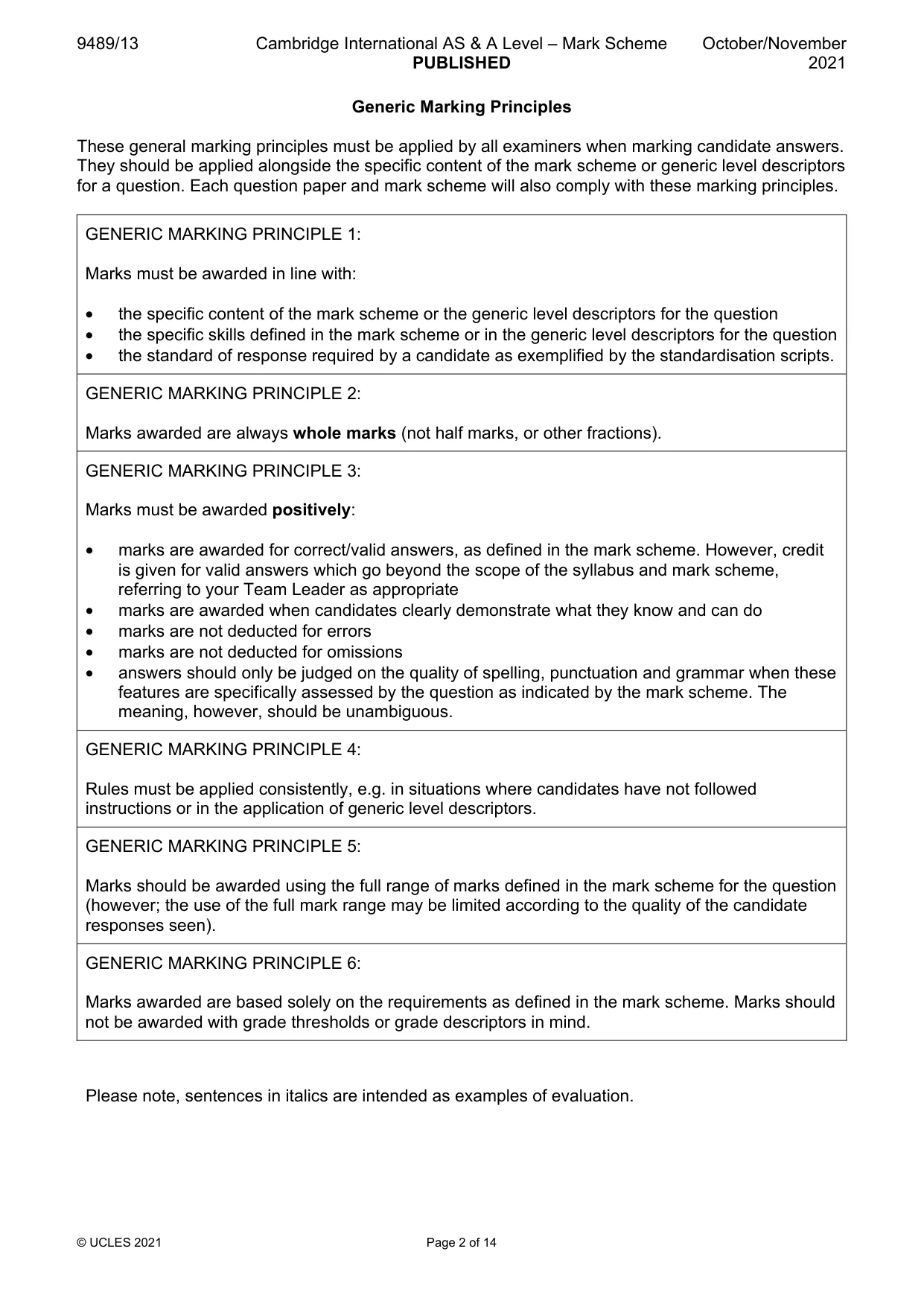
9489/13 Cambridge International AS & A Level – Mark Scheme PUBLISHED October/November 2021 © UCLES 2021 Page 2 of 14 Generic Marking Principles These general marking principles must be applied by all examiners when marking candidate answers. They should be applied alongside the specific content of the mark scheme or generic level descriptors for a question. Each question paper and mark scheme will also comply with these marking principles. GENERIC MARKING PRINCIPLE 1: Marks must be awarded in line with: • the specific content of the mark scheme or the generic level descriptors for the question • the specific skills defined in the mark scheme or in the generic level descriptors for the question • the standard of response required by a candidate as exemplified by the standardisation scripts. GENERIC MARKING PRINCIPLE 2: Marks awarded are always whole marks (not half marks, or other fractions). GENERIC MARKING PRINCIPLE 3: Marks must be awarded positively: • marks are awarded for correct/valid answers, as defined in the mark scheme. However, credit is given for valid answers which go beyond the scope of the syllabus and mark scheme, referring to your Team Leader as appropriate • marks are awarded when candidates clearly demonstrate what they know and can do • marks are not deducted for errors • marks are not deducted for omissions • answers should only be judged on the quality of spelling, punctuation and grammar when these features are specifically assessed by the question as indicated by the mark scheme. The meaning, however, should be unambiguous. GENERIC MARKING PRINCIPLE 4: Rules must be applied consistently, e.g. in situations where candidates have not followed instructions or in the application of generic level descriptors. GENERIC MARKING PRINCIPLE 5: Marks should be awarded using the full range of marks defined in the mark scheme for the question (however; the use of the full mark range may be limited according to the quality of the candidate responses seen). GENERIC MARKING PRINCIPLE 6: Marks awarded are based solely on the requirements as defined in the mark scheme. Marks should not be awarded with grade thresholds or grade descriptors in mind. Please note, sentences in italics are intended as examples of evaluation.
Mark scheme, page 3
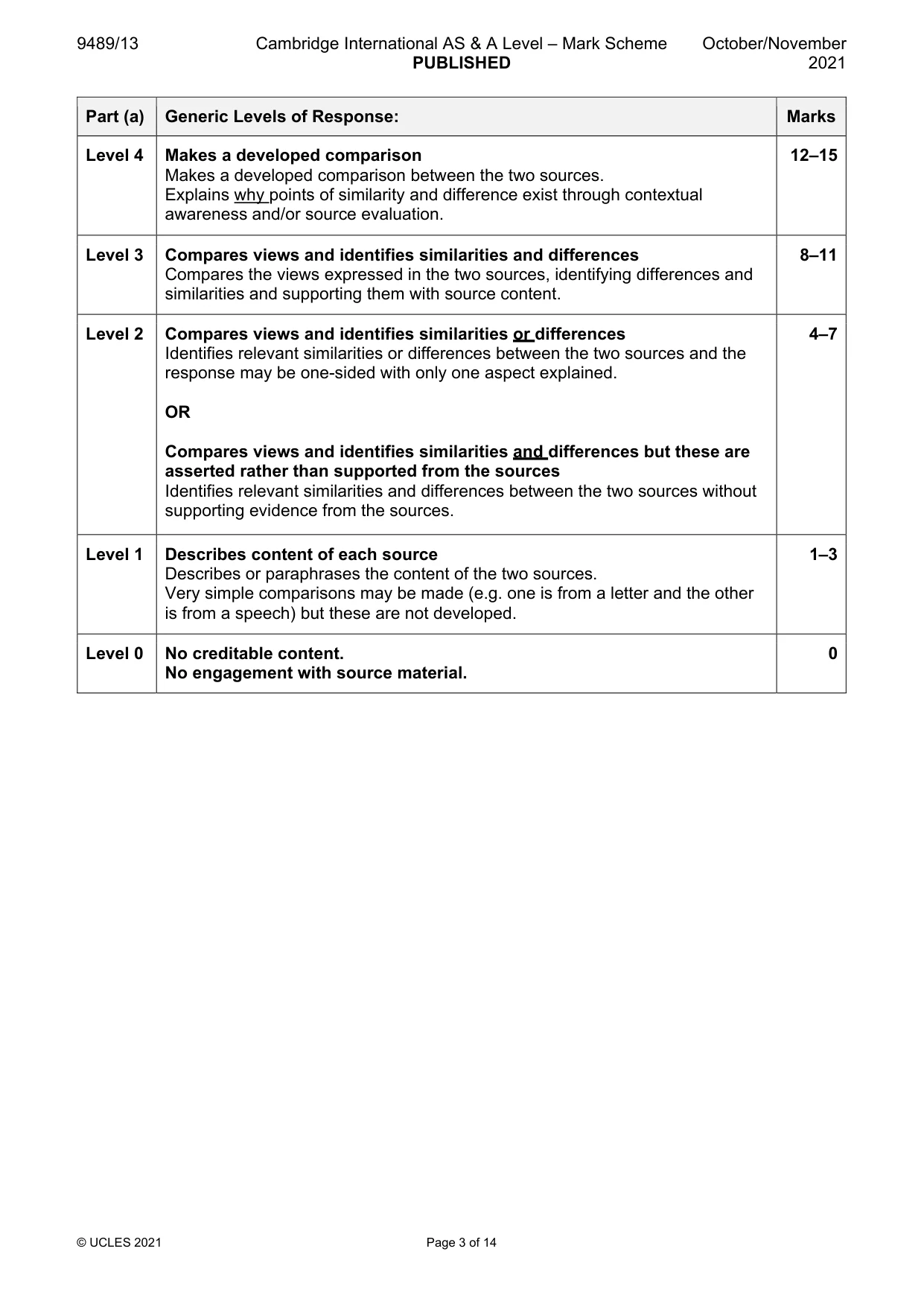
9489/13 Cambridge International AS & A Level – Mark Scheme PUBLISHED October/November 2021 © UCLES 2021 Page 3 of 14 Part (a) Generic Levels of Response: Marks Level 4 Makes a developed comparison Makes a developed comparison between the two sources. Explains why points of similarity and difference exist through contextual awareness and/or source evaluation. 12–15 Level 3 Compares views and identifies similarities and differences Compares the views expressed in the two sources, identifying differences and similarities and supporting them with source content. 8–11 Level 2 Compares views and identifies similarities or differences Identifies relevant similarities or differences between the two sources and the response may be one-sided with only one aspect explained. OR Compares views and identifies similarities and differences but these are asserted rather than supported from the sources Identifies relevant similarities and differences between the two sources without supporting evidence from the sources. 4–7 Level 1 Describes content of each source Describes or paraphrases the content of the two sources. Very simple comparisons may be made (e.g. one is from a letter and the other is from a speech) but these are not developed. 1–3 Level 0 No creditable content. No engagement with source material. 0
Mark scheme, page 4
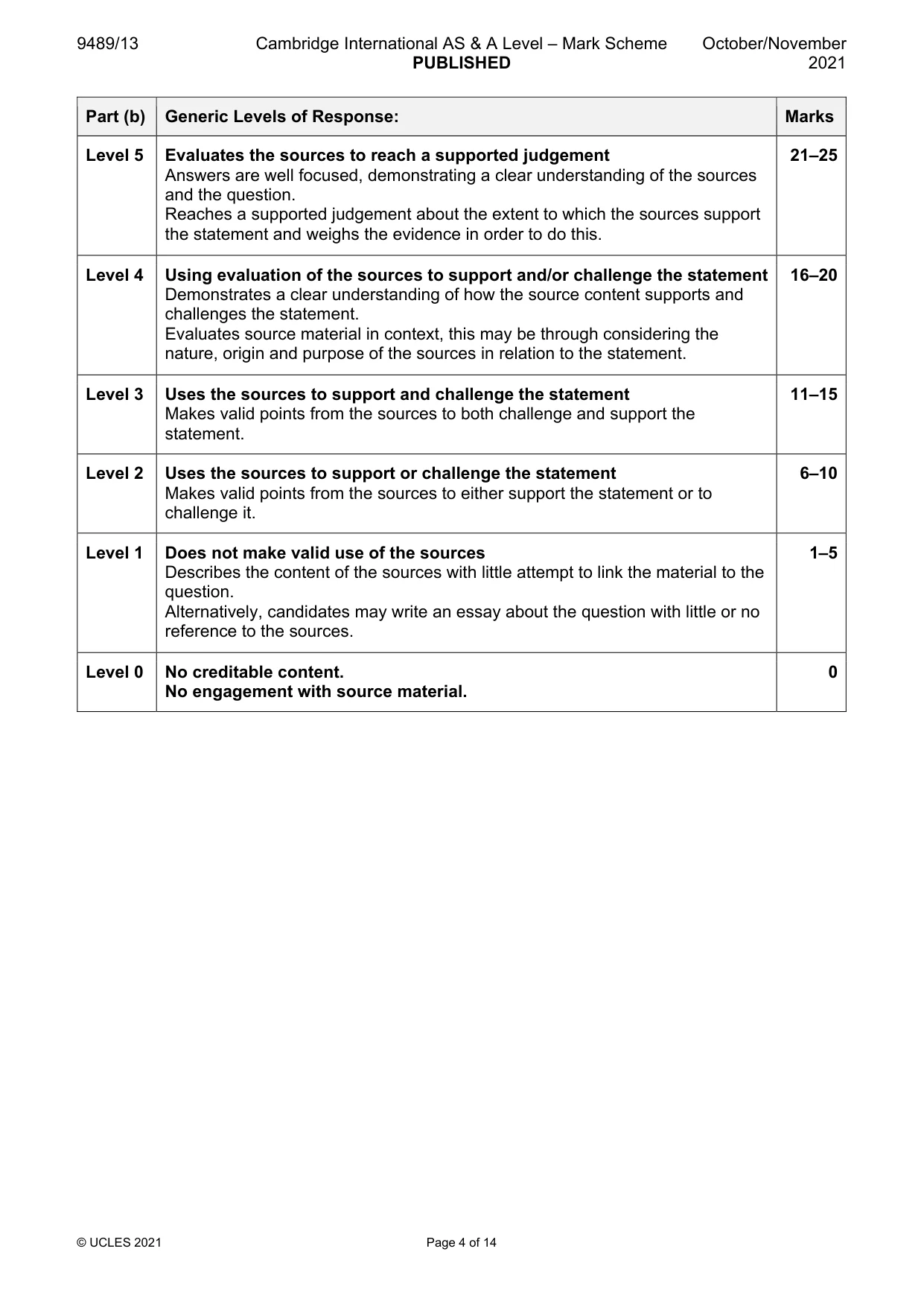
9489/13 Cambridge International AS & A Level – Mark Scheme PUBLISHED October/November 2021 © UCLES 2021 Page 4 of 14 Part (b) Generic Levels of Response: Marks Level 5 Evaluates the sources to reach a supported judgement Answers are well focused, demonstrating a clear understanding of the sources and the question. Reaches a supported judgement about the extent to which the sources support the statement and weighs the evidence in order to do this. 21–25 Level 4 Using evaluation of the sources to support and/or challenge the statement Demonstrates a clear understanding of how the source content supports and challenges the statement. Evaluates source material in context, this may be through considering the nature, origin and purpose of the sources in relation to the statement. 16–20 Level 3 Uses the sources to support and challenge the statement Makes valid points from the sources to both challenge and support the statement. 11–15 Level 2 Uses the sources to support or challenge the statement Makes valid points from the sources to either support the statement or to challenge it. 6–10 Level 1 Does not make valid use of the sources Describes the content of the sources with little attempt to link the material to the question. Alternatively, candidates may write an essay about the question with little or no reference to the sources. 1–5 Level 0 No creditable content. No engagement with source material. 0
Mark scheme, page 5
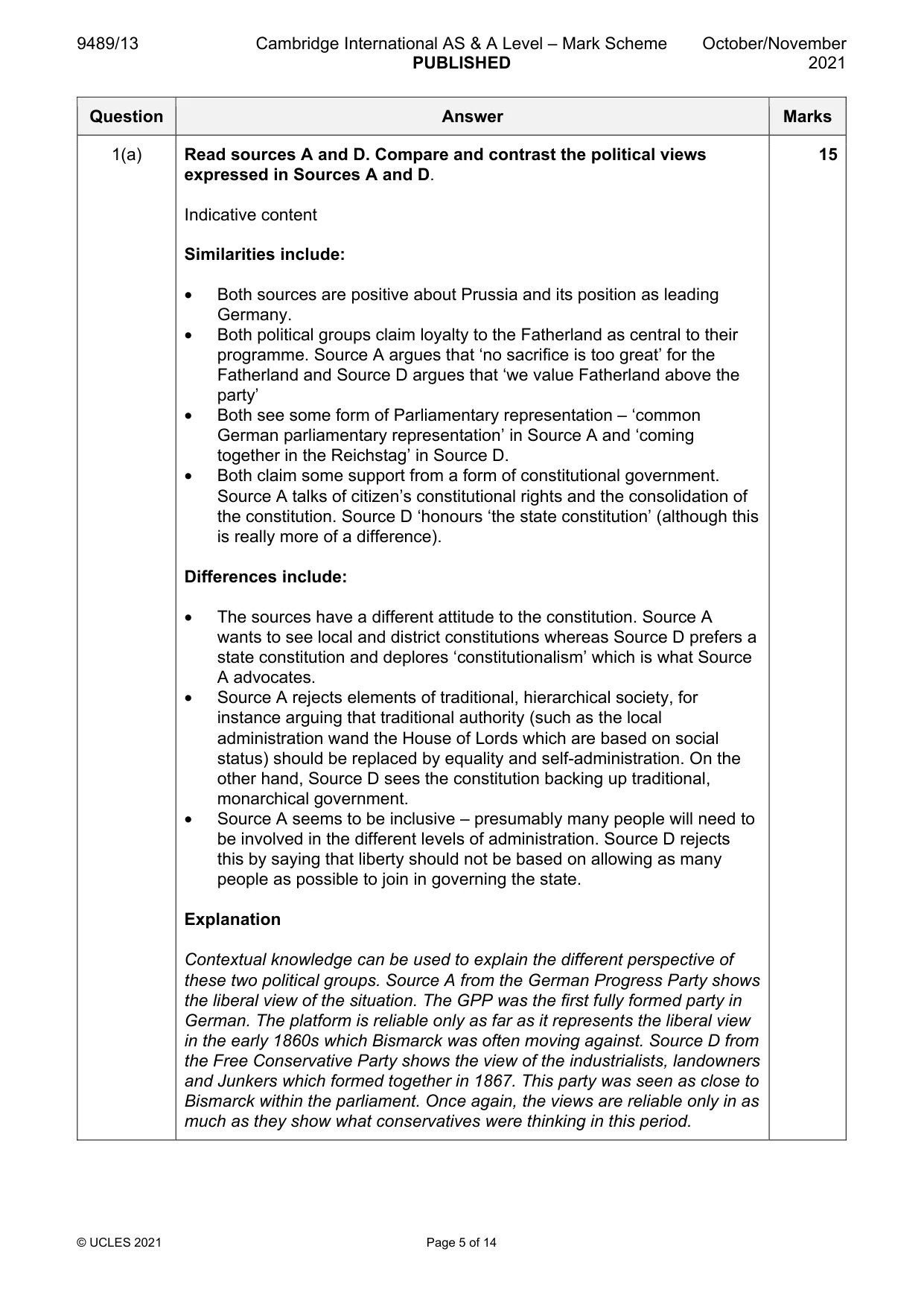
9489/13 Cambridge International AS & A Level – Mark Scheme PUBLISHED October/November 2021 © UCLES 2021 Page 5 of 14 Question Answer Marks 1(a) Read sources A and D. Compare and contrast the political views expressed in Sources A and D. Indicative content Similarities include: • Both sources are positive about Prussia and its position as leading Germany. • Both political groups claim loyalty to the Fatherland as central to their programme. Source A argues that ‘no sacrifice is too great’ for the Fatherland and Source D argues that ‘we value Fatherland above the party’ • Both see some form of Parliamentary representation – ‘common German parliamentary representation’ in Source A and ‘coming together in the Reichstag’ in Source D. • Both claim some support from a form of constitutional government. Source A talks of citizen’s constitutional rights and the consolidation of the constitution. Source D ‘honours ‘the state constitution’ (although this is really more of a difference). Differences include: • The sources have a different attitude to the constitution. Source A wants to see local and district constitutions whereas Source D prefers a state constitution and deplores ‘constitutionalism’ which is what Source A advocates. • Source A rejects elements of traditional, hierarchical society, for instance arguing that traditional authority (such as the local administration wand the House of Lords which are based on social status) should be replaced by equality and self-administration. On the other hand, Source D sees the constitution backing up traditional, monarchical government. • Source A seems to be inclusive – presumably many people will need to be involved in the different levels of administration. Source D rejects this by saying that liberty should not be based on allowing as many people as possible to join in governing the state. Explanation Contextual knowledge can be used to explain the different perspective of these two political groups. Source A from the German Progress Party shows the liberal view of the situation. The GPP was the first fully formed party in German. The platform is reliable only as far as it represents the liberal view in the early 1860s which Bismarck was often moving against. Source D from the Free Conservative Party shows the view of the industrialists, landowners and Junkers which formed together in 1867. This party was seen as close to Bismarck within the parliament. Once again, the views are reliable only in as much as they show what conservatives were thinking in this period. 15
Mark scheme, page 6
9489/13 Cambridge International AS & A Level – Mark Scheme PUBLISHED October/November 2021 © UCLES 2021 Page 6 of 14 Question Answer Marks 1(a) Contextual knowledge can be used to explain how the position of Prussia had changed by 1867 and to consider what impact this might have had on the nature of the political ideas presented. The victory over Austria is likely to have had an impact on Source D. Accept any other valid responses.
Mark scheme, page 7
9489/13 Cambridge International AS & A Level – Mark Scheme PUBLISHED October/November 2021 © UCLES 2021 Page 7 of 14 Question Answer Marks 1(b) Read all of the sources. How far do these sources show that the unification of Germany was a popular policy? Indicative content Support: Source A: supports the idea of Prussian greatness, loyalty to the Fatherland and a willingness to fight if called upon. Source C: Bismarck is part of the victory parade and so the victory over Austria seems to be popular. He is credited with the victory by the British observer. Source D: there is clear support for the Fatherland and for unity between the old and new Prussia. There is also emphasis on German unity. Challenge: Source B: suggest the citizens of Cologne were not impressed by the call to arms against Austria and have petitioned the King to protest against the possibility of being slaughtered. Source C: The source suggests that Bismarck is not that popular and maybe that means they don’t care about unification but rather military glorification. Source A: could challenge the prompt as the reference to keeping military spending down in peacetime was a direct criticism of Bismarck’s spending on the military which was not authorized by parliament. Evaluation Source A: contextual knowledge can be used to explain the reasons for the kind of government proposed here. Candidates may point out the liberal view being expressed here and use their own knowledge to look at the ideas of constitutionalism etc. This source (and the party) is clearly set against Bismarck so may have some issues with reliability. Source B: By the time the cartoon was published it was obvious that Prussia would fight Austria. This cartoon is clearly meant to mock the King and his thirst for war. It suggests that people are also anti unification but has limited utility. Source C: is a British observer and therefore might be considered less opinionated than a Prussian observer. However, it is possible that the British were wary of the power that Bismarck was building and so sought to undermine it. 25
Mark scheme, page 8
9489/13 Cambridge International AS & A Level – Mark Scheme PUBLISHED October/November 2021 © UCLES 2021 Page 8 of 14 Question Answer Marks 1(b) Source D: contextual knowledge can be used to evaluate the views presented in this source. The Imperial and Free Conservative party gave unqualified support to the idea of unification so its characterisation of the views of the German people may not be reliable. It was also closely aligned with Bismarck so would be likely to support him. Accept any other valid responses.
Mark scheme, page 9
9489/13 Cambridge International AS & A Level – Mark Scheme PUBLISHED October/November 2021 © UCLES 2021 Page 9 of 14 Question Answer Marks 2(a) Read Sources A and B. Compare and contrast these two sources as evidence about Fort Sumter after the attack. Indicative content Similarities include: • Both describe similar features of destruction following the attack. The three-storey building on the left-hand side of Source A must be the barracks referred to in Source B. Both sources provide evidence of their destruction. • Both provide evidence of the solidity of the fort itself. Source A shows that the external walls of the fort are still intact while Source B says ‘the walls ‘at no time were close to being breached’. Differences include: • Source A provides clear evidence that the attack had been successful, e.g. the Confederate flag. All Unionist resistance had ended, as shown by the few people just standing around, all presumably Confederates, none obviously soldiers. • Source B, however, focuses on the failure of the Unionists forces, making a series of assertions about poor preparation. The success of the Confederates is implied, rather than made explicit • A suggests that there is serious threat whereas B doesn’t. • A there are still guns and walls, B says that to the untrained eye it could not be defended. Explanation As evidence, the sources are very different. Source A can only describe whereas Source B can describe and explain. Even then, a photograph makes sense only if the viewer brings some contextual knowledge, e.g. that the flag is the Confederate flag. As descriptions of destruction, Source A is more useful than Source B. In terms of reliability, both sources are one person’s description, Source A in a single image, Source B in words. Source A seems more reliable because ‘the camera never lies.’ However, a photographer has chosen this particular image, for motives which remain unclear. The perspective of Source B is more apparent, its author a famous – and non-American – war reporter. Which is more trustworthy? Accept any other valid responses. 15
Mark scheme, page 10
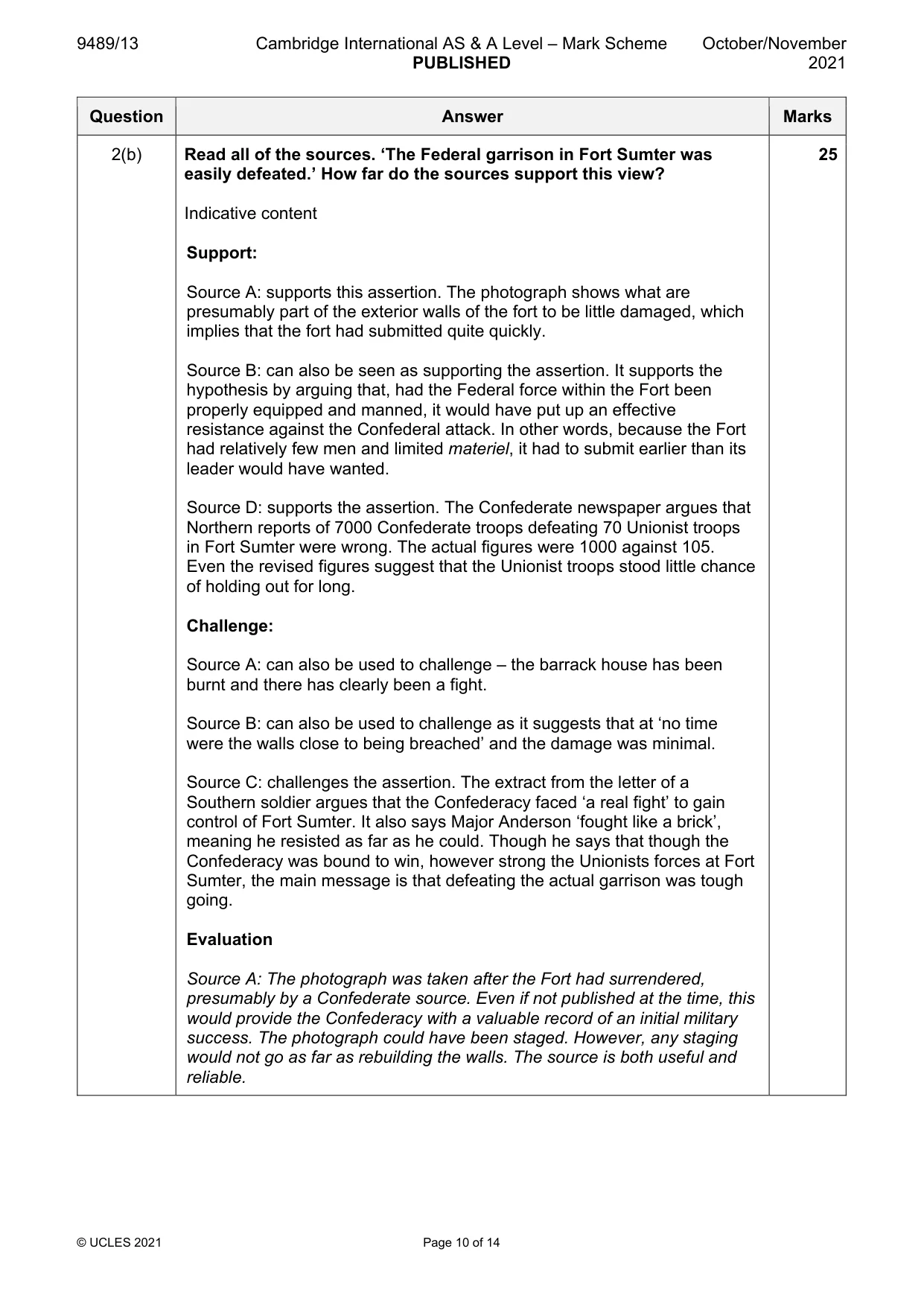
9489/13 Cambridge International AS & A Level – Mark Scheme PUBLISHED October/November 2021 © UCLES 2021 Page 10 of 14 Question Answer Marks 2(b) Read all of the sources. ‘The Federal garrison in Fort Sumter was easily defeated.’ How far do the sources support this view? Indicative content Support: Source A: supports this assertion. The photograph shows what are presumably part of the exterior walls of the fort to be little damaged, which implies that the fort had submitted quite quickly. Source B: can also be seen as supporting the assertion. It supports the hypothesis by arguing that, had the Federal force within the Fort been properly equipped and manned, it would have put up an effective resistance against the Confederal attack. In other words, because the Fort had relatively few men and limited materiel, it had to submit earlier than its leader would have wanted. Source D: supports the assertion. The Confederate newspaper argues that Northern reports of 7000 Confederate troops defeating 70 Unionist troops in Fort Sumter were wrong. The actual figures were 1000 against 105. Even the revised figures suggest that the Unionist troops stood little chance of holding out for long. Challenge: Source A: can also be used to challenge – the barrack house has been burnt and there has clearly been a fight. Source B: can also be used to challenge as it suggests that at ‘no time were the walls close to being breached’ and the damage was minimal. Source C: challenges the assertion. The extract from the letter of a Southern soldier argues that the Confederacy faced ‘a real fight’ to gain control of Fort Sumter. It also says Major Anderson ‘fought like a brick’, meaning he resisted as far as he could. Though he says that though the Confederacy was bound to win, however strong the Unionists forces at Fort Sumter, the main message is that defeating the actual garrison was tough going. Evaluation Source A: The photograph was taken after the Fort had surrendered, presumably by a Confederate source. Even if not published at the time, this would provide the Confederacy with a valuable record of an initial military success. The photograph could have been staged. However, any staging would not go as far as rebuilding the walls. The source is both useful and reliable. 25
Mark scheme, page 11
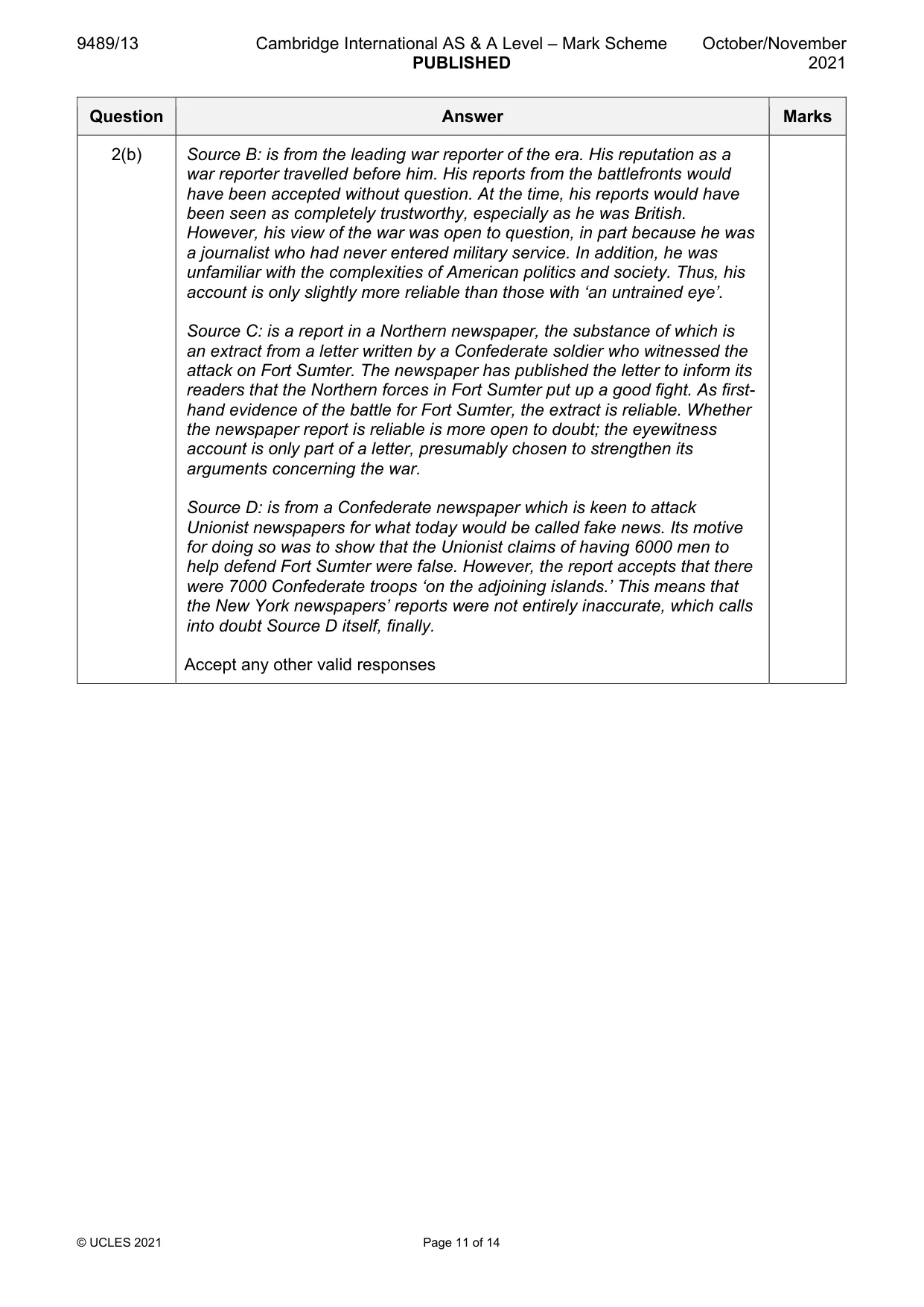
9489/13 Cambridge International AS & A Level – Mark Scheme PUBLISHED October/November 2021 © UCLES 2021 Page 11 of 14 Question Answer Marks 2(b) Source B: is from the leading war reporter of the era. His reputation as a war reporter travelled before him. His reports from the battlefronts would have been accepted without question. At the time, his reports would have been seen as completely trustworthy, especially as he was British. However, his view of the war was open to question, in part because he was a journalist who had never entered military service. In addition, he was unfamiliar with the complexities of American politics and society. Thus, his account is only slightly more reliable than those with ‘an untrained eye’. Source C: is a report in a Northern newspaper, the substance of which is an extract from a letter written by a Confederate soldier who witnessed the attack on Fort Sumter. The newspaper has published the letter to inform its readers that the Northern forces in Fort Sumter put up a good fight. As first- hand evidence of the battle for Fort Sumter, the extract is reliable. Whether the newspaper report is reliable is more open to doubt; the eyewitness account is only part of a letter, presumably chosen to strengthen its arguments concerning the war. Source D: is from a Confederate newspaper which is keen to attack Unionist newspapers for what today would be called fake news. Its motive for doing so was to show that the Unionist claims of having 6000 men to help defend Fort Sumter were false. However, the report accepts that there were 7000 Confederate troops ‘on the adjoining islands.’ This means that the New York newspapers’ reports were not entirely inaccurate, which calls into doubt Source D itself, finally. Accept any other valid responses
Mark scheme, page 12
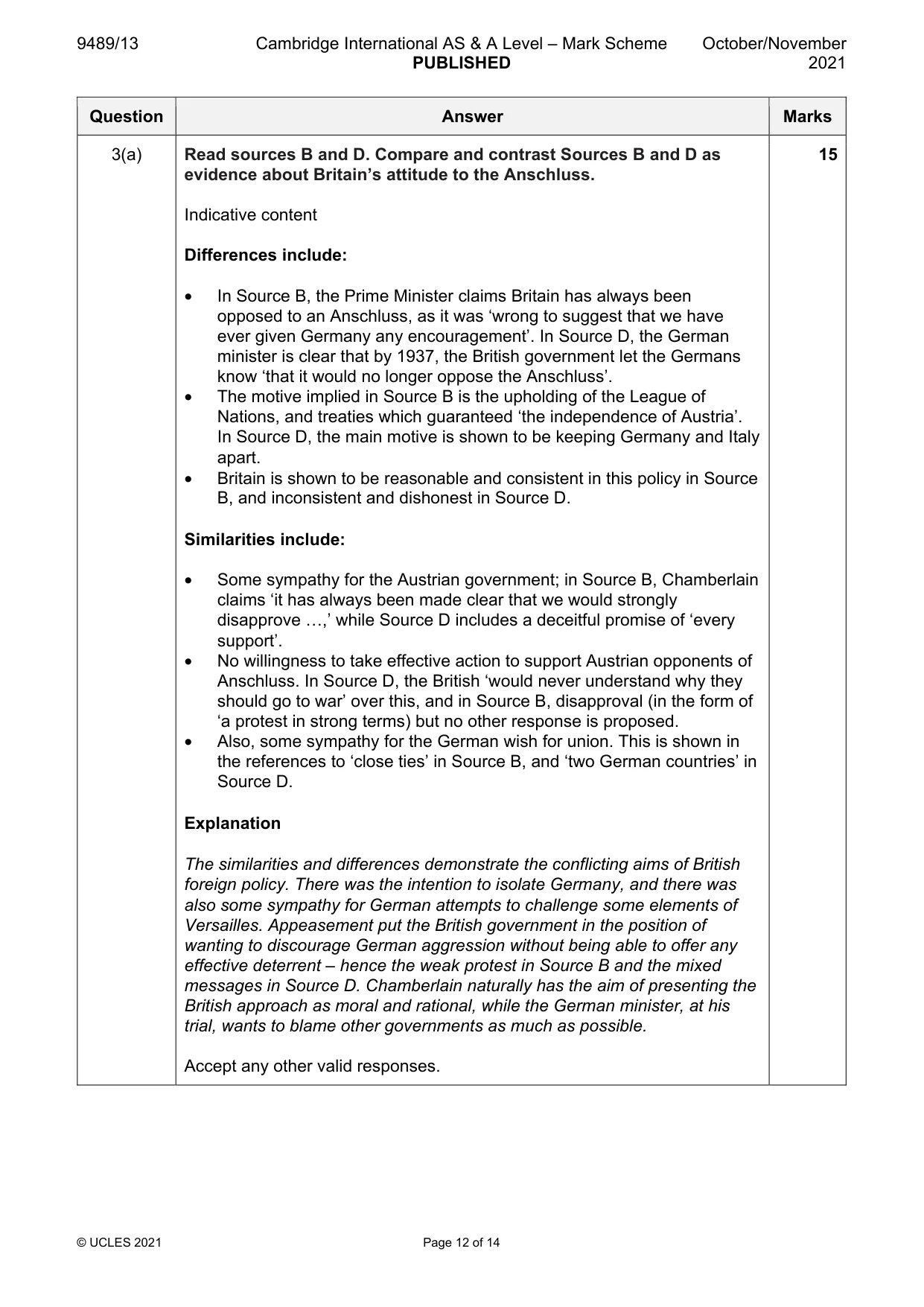
9489/13 Cambridge International AS & A Level – Mark Scheme PUBLISHED October/November 2021 © UCLES 2021 Page 12 of 14 Question Answer Marks 3(a) Read sources B and D. Compare and contrast Sources B and D as evidence about Britain’s attitude to the Anschluss. Indicative content Differences include: • In Source B, the Prime Minister claims Britain has always been opposed to an Anschluss, as it was ‘wrong to suggest that we have ever given Germany any encouragement’. In Source D, the German minister is clear that by 1937, the British government let the Germans know ‘that it would no longer oppose the Anschluss’. • The motive implied in Source B is the upholding of the League of Nations, and treaties which guaranteed ‘the independence of Austria’. In Source D, the main motive is shown to be keeping Germany and Italy apart. • Britain is shown to be reasonable and consistent in this policy in Source B, and inconsistent and dishonest in Source D. Similarities include: • Some sympathy for the Austrian government; in Source B, Chamberlain claims ‘it has always been made clear that we would strongly disapprove …,’ while Source D includes a deceitful promise of ‘every support’. • No willingness to take effective action to support Austrian opponents of Anschluss. In Source D, the British ‘would never understand why they should go to war’ over this, and in Source B, disapproval (in the form of ‘a protest in strong terms) but no other response is proposed. • Also, some sympathy for the German wish for union. This is shown in the references to ‘close ties’ in Source B, and ‘two German countries’ in Source D. Explanation The similarities and differences demonstrate the conflicting aims of British foreign policy. There was the intention to isolate Germany, and there was also some sympathy for German attempts to challenge some elements of Versailles. Appeasement put the British government in the position of wanting to discourage German aggression without being able to offer any effective deterrent – hence the weak protest in Source B and the mixed messages in Source D. Chamberlain naturally has the aim of presenting the British approach as moral and rational, while the German minister, at his trial, wants to blame other governments as much as possible. Accept any other valid responses. 15
Mark scheme, page 13
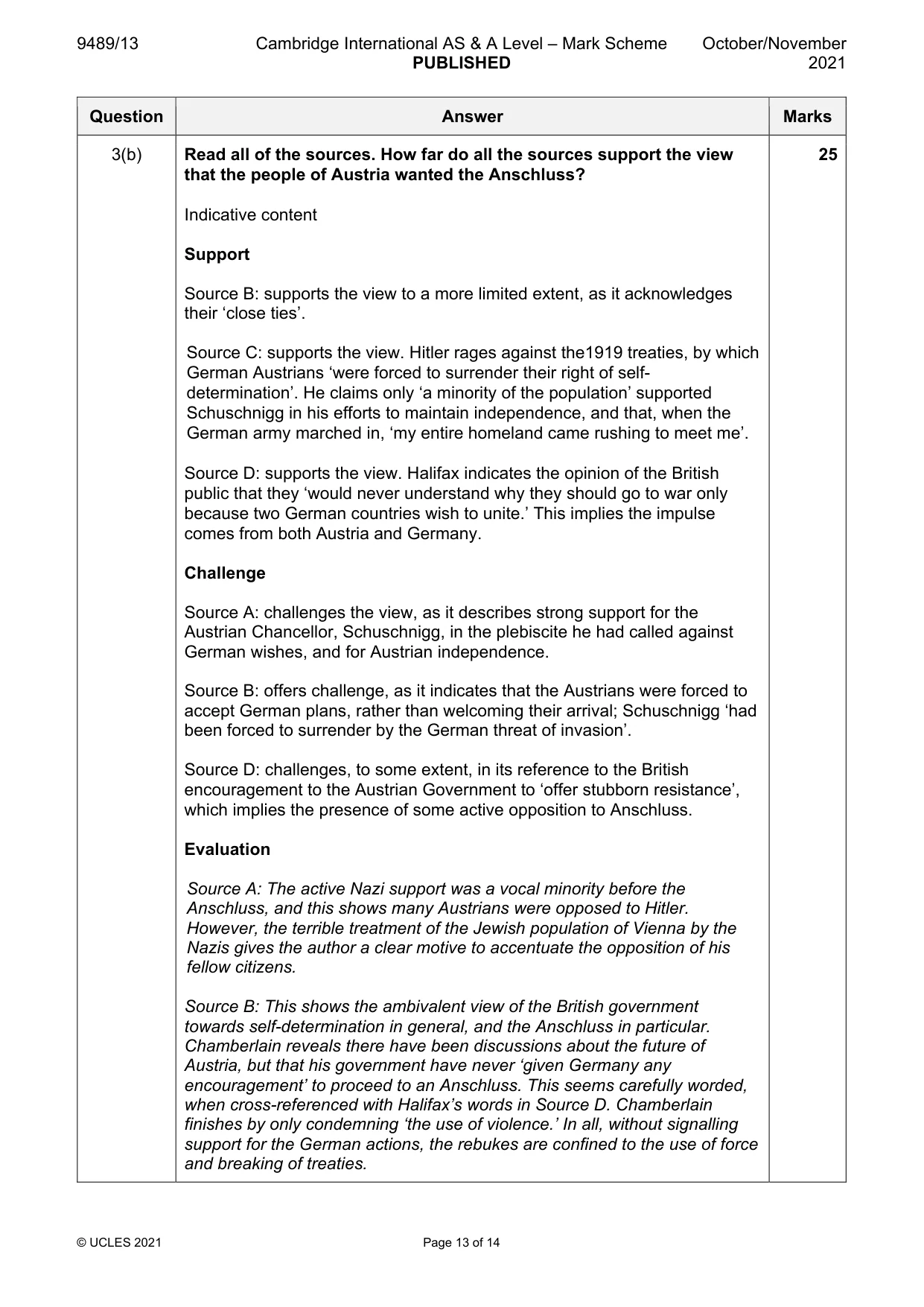
9489/13 Cambridge International AS & A Level – Mark Scheme PUBLISHED October/November 2021 © UCLES 2021 Page 13 of 14 Question Answer Marks 3(b) Read all of the sources. How far do all the sources support the view that the people of Austria wanted the Anschluss? Indicative content Support Source B: supports the view to a more limited extent, as it acknowledges their ‘close ties’. Source C: supports the view. Hitler rages against the1919 treaties, by which German Austrians ‘were forced to surrender their right of self- determination’. He claims only ‘a minority of the population’ supported Schuschnigg in his efforts to maintain independence, and that, when the German army marched in, ‘my entire homeland came rushing to meet me’. Source D: supports the view. Halifax indicates the opinion of the British public that they ‘would never understand why they should go to war only because two German countries wish to unite.’ This implies the impulse comes from both Austria and Germany. Challenge Source A: challenges the view, as it describes strong support for the Austrian Chancellor, Schuschnigg, in the plebiscite he had called against German wishes, and for Austrian independence. Source B: offers challenge, as it indicates that the Austrians were forced to accept German plans, rather than welcoming their arrival; Schuschnigg ‘had been forced to surrender by the German threat of invasion’. Source D: challenges, to some extent, in its reference to the British encouragement to the Austrian Government to ‘offer stubborn resistance’, which implies the presence of some active opposition to Anschluss. Evaluation Source A: The active Nazi support was a vocal minority before the Anschluss, and this shows many Austrians were opposed to Hitler. However, the terrible treatment of the Jewish population of Vienna by the Nazis gives the author a clear motive to accentuate the opposition of his fellow citizens. Source B: This shows the ambivalent view of the British government towards self-determination in general, and the Anschluss in particular. Chamberlain reveals there have been discussions about the future of Austria, but that his government have never ‘given Germany any encouragement’ to proceed to an Anschluss. This seems carefully worded, when cross-referenced with Halifax’s words in Source D. Chamberlain finishes by only condemning ‘the use of violence.’ In all, without signalling support for the German actions, the rebukes are confined to the use of force and breaking of treaties. 25
Mark scheme, page 14
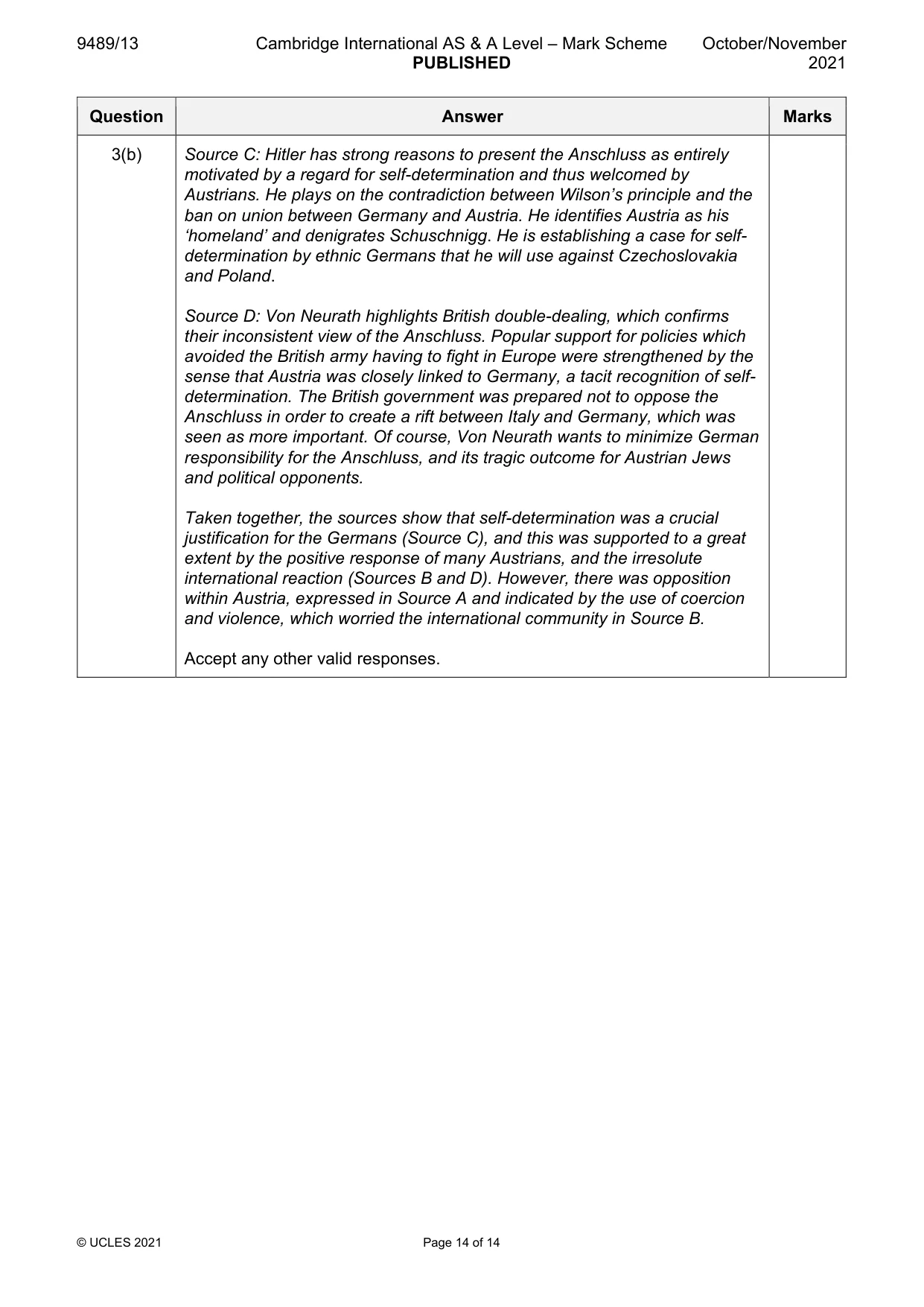
9489/13 Cambridge International AS & A Level – Mark Scheme PUBLISHED October/November 2021 © UCLES 2021 Page 14 of 14 Question Answer Marks 3(b) Source C: Hitler has strong reasons to present the Anschluss as entirely motivated by a regard for self-determination and thus welcomed by Austrians. He plays on the contradiction between Wilson’s principle and the ban on union between Germany and Austria. He identifies Austria as his ‘homeland’ and denigrates Schuschnigg. He is establishing a case for self- determination by ethnic Germans that he will use against Czechoslovakia and Poland. Source D: Von Neurath highlights British double-dealing, which confirms their inconsistent view of the Anschluss. Popular support for policies which avoided the British army having to fight in Europe were strengthened by the sense that Austria was closely linked to Germany, a tacit recognition of self- determination. The British government was prepared not to oppose the Anschluss in order to create a rift between Italy and Germany, which was seen as more important. Of course, Von Neurath wants to minimize German responsibility for the Anschluss, and its tragic outcome for Austrian Jews and political opponents. Taken together, the sources show that self-determination was a crucial justification for the Germans (Source C), and this was supported to a great extent by the positive response of many Austrians, and the irresolute international reaction (Sources B and D). However, there was opposition within Austria, expressed in Source A and indicated by the use of coercion and violence, which worried the international community in Source B. Accept any other valid responses.
What you needed in this session
Cambridge’s own grade thresholds for 2021 Oct/Nov, Paper 1 · Variant 3. A higher threshold means an easier paper — the bar moves with how the cohort did.