Cambridge A Level History 9489 — 2021 Oct/Nov Paper 1 · Variant 2
9489/12/O/N/21 · 40 marks · ≈45 min
The question paper and its mark scheme, free to read here and free to download. This is Cambridge’s own paper, exactly as it was sat.
Question paper8 pages
Mark scheme12 pages
Answers below. Sit the paper first if you are practising.
Paper as text
Question paper, page 1
This document has 8 pages. Any blank pages are indicated. DC (RW/CGW) 204340/2 © UCLES 2021 [Turn over * 8 8 9 9 7 2 3 5 2 7 * Cambridge International AS & A Level HISTORY 9489/12 Paper 1 Document Question October/November 2021 1 hour 15 minutes You must answer on the enclosed answer booklet. You will need: Answer booklet (enclosed) INSTRUCTIONS ● Answer one question from one section only. Section A: European option Section B: American option Section C: International option ● Follow the instructions on the front cover of the answer booklet. If you need additional answer paper, ask the invigilator for a continuation booklet. INFORMATION ● The total mark for this paper is 40. ● The number of marks for each question or part question is shown in brackets [ ].
Question paper, page 2
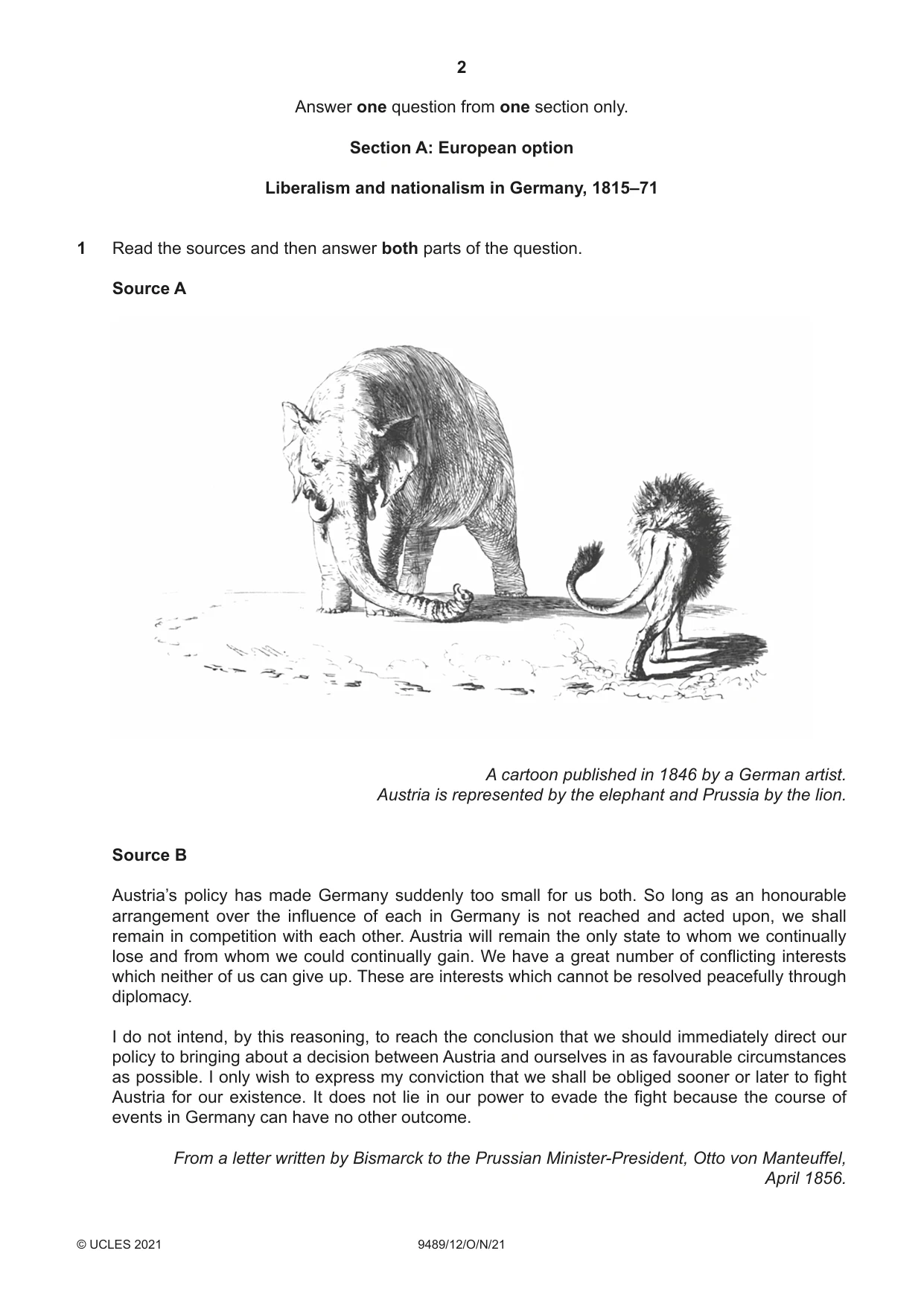
2 9489/12/O/N/21 © UCLES 2021 Answer one question from one section only. Section A: European option Liberalism and nationalism in Germany, 1815–71 1 Read the sources and then answer both parts of the question. Source A A cartoon published in 1846 by a German artist. Austria is represented by the elephant and Prussia by the lion. Source B Austria’s policy has made Germany suddenly too small for us both. So long as an honourable arrangement over the influence of each in Germany is not reached and acted upon, we shall remain in competition with each other. Austria will remain the only state to whom we continually lose and from whom we could continually gain. We have a great number of conflicting interests which neither of us can give up. These are interests which cannot be resolved peacefully through diplomacy. I do not intend, by this reasoning, to reach the conclusion that we should immediately direct our policy to bringing about a decision between Austria and ourselves in as favourable circumstances as possible. I only wish to express my conviction that we shall be obliged sooner or later to fight Austria for our existence. It does not lie in our power to evade the fight because the course of events in Germany can have no other outcome. From a letter written by Bismarck to the Prussian Minister-President, Otto von Manteuffel, April 1856.
Question paper, page 3
3 9489/12/O/N/21 © UCLES 2021 [Turn over Source C Prussia, so Austria reasons, must be opposed on every occasion, since what is good for Prussia is bad for Austria. The old, unhappy jealousy has blazed up. Prussia shall be weakened, annihilated, dishonoured. With Prussia no treaties are to be observed. The confederated princes have not only been aroused against Prussia; they have been encouraged to dissolve the confederation. Wherever we look throughout Germany we are surrounded by enemies, whose war cry is ‘Down with Prussia!’ But the spirit of 1813, when we defeated Napoleon, still lives in my people. Who can rob us of a single foot of Prussian soil, if we are firmly resolved to protect it, if the king and people are united more firmly than ever by the danger to the fatherland? From a speech by William I to his people, 18 June 1866. Source D During the joint occupation of the Duchies it soon became evident that Austria’s game was not an open one regarding Prussia, but Austria considered this new ground a favourable one for its long‑established jealousy. This policy placed Prussia in a false position in Europe, the more so as the state of things at home demanded the restoration of a conservative policy. The hatred against Prussia was purposely excited in and out of Germany, and Austria considered the ground sufficiently prepared for a war by which Prussia must suffer. In the winter of 1865‒66 Austria began to provoke Prussia in every way. You know well what conflicts of conscience I had to go through before I could believe in the possibility of this war and how I tried every means of preventing it. It was not until I saw how the honour of Prussia was at stake, and when all doubts of Austria’s intentions were removed, that I considered it my duty to break the dual control over Germany by the force of arms. From a letter written by William I to his wife, 1867. Answer both parts of the question with reference to the sources. (a) Read Sources A and B. How far do these sources agree about the relationship between Austria and Prussia? [15] (b) Read all of the sources. How far do the sources support the view that Austria was responsible for war with Prussia? [25]
Question paper, page 4
4 9489/12/O/N/21 © UCLES 2021 Section B: American option The origins of the Civil War, 1820–61 2 Read the sources and then answer both parts of the question. Source A The declared purpose of the Union from which we have just withdrawn was ‘to ensure domestic tranquillity and secure the blessings of liberty to ourselves and posterity’. When, in the judgement of the sovereign states now composing this Confederacy, it had been perverted from the purposes for which it had been established, a peaceful appeal to the ballot box declared that, so far as they were concerned, the government created by the Union should cease to exist. In this they merely asserted a right which the Declaration of Independence of 1776 had defined as inalienable. It is by abuse of language that their act has been nominated a revolution. Anxious to cultivate peace and commerce, if we cannot avoid war, we may at least expect future generations to acquit us of having needlessly engaged in it. From the inaugural address of Jefferson Davis, President of the Confederate States of America, February 1861. Source B The Union is perpetual, confirmed by the history of the Union itself. The Union is much older than the Constitution. It was formed, in fact, by the Articles of Association in 1774. Finally, in 1787, one of the declared acts for establishing the Constitution was ‘to form a more perfect Union’. It was matured and continued by the Declaration of Independence in 1776. It follows that no state, upon its own mere motion, can lawfully get out of the Union. Resolutions to that effect are legally void and acts of violence against the authority of the United States are insurrectionary or revolutionary. The power confided to me will be used to hold the property belonging to the government and to collect duties and taxes but beyond what may be necessary for these objects there will be no using of force against or among the people anywhere. From the inaugural address of President Abraham Lincoln, March 1861. Source C The prospect of war is not so threatening as it has been. The idea of coercion, anticipated in President Lincoln’s inaugural address, seems not to have been followed up thus far so vigorously as was expected. Fort Sumter, it is believed, will soon be evacuated. We are willing to settle all matters relating to Federal property within the Confederacy. War can be of no more benefit to the North than to us. Whether the evacuation of Fort Sumter is to be received as evidence of a desire for a peaceful solution of our difficulties with the United States, or as the result of necessity, I will not undertake to say. I would happily hope the former. There are rumours that it is the result of necessity. All I can say to you is keep your armour bright and your powder dry. [Enthusiastic cheering.] From a speech by the Vice-President of the Confederate States, Alexander Stephens, in Georgia, March 1861.
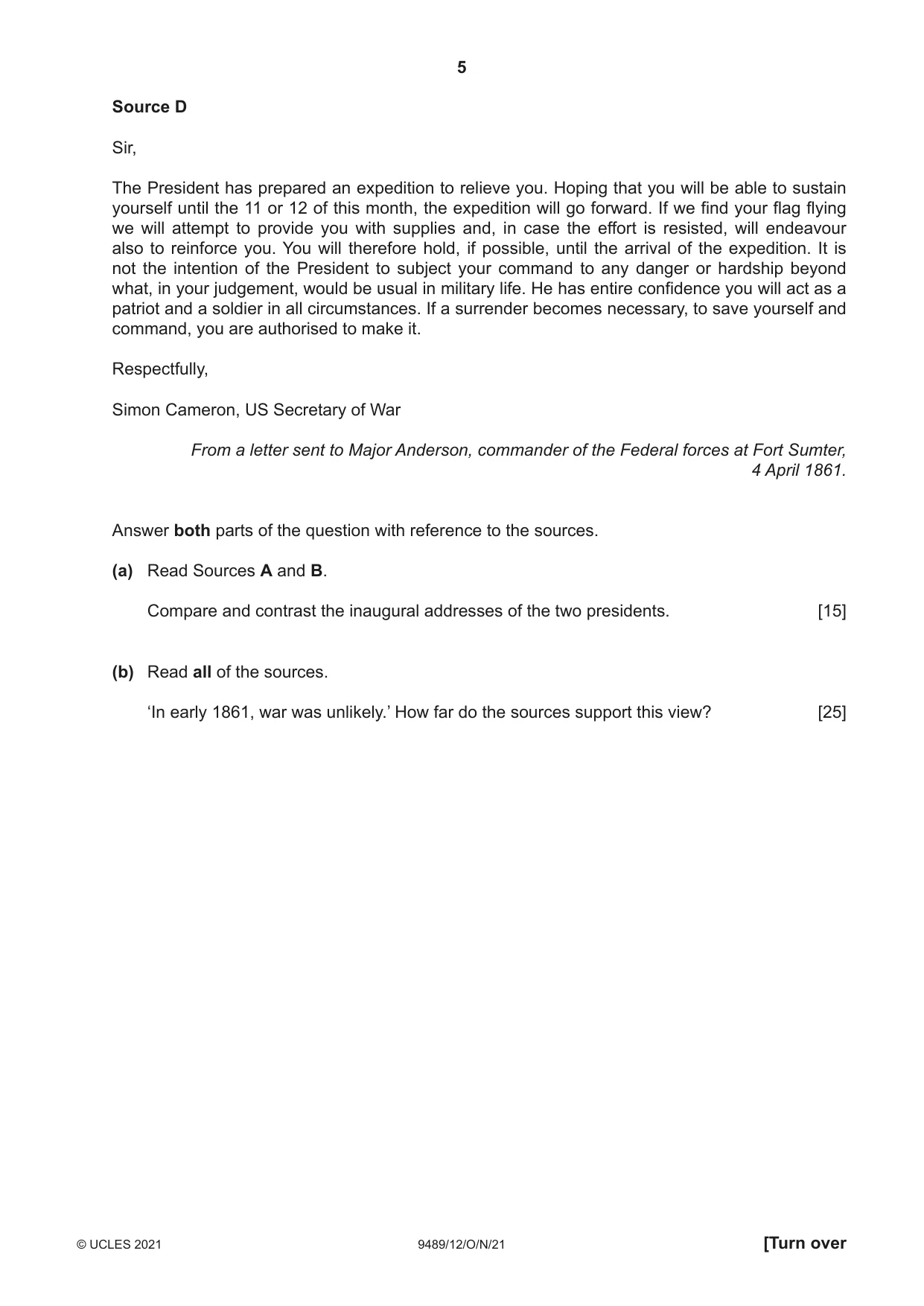
Question paper, page 5
5 9489/12/O/N/21 © UCLES 2021 [Turn over Source D Sir, The President has prepared an expedition to relieve you. Hoping that you will be able to sustain yourself until the 11 or 12 of this month, the expedition will go forward. If we find your flag flying we will attempt to provide you with supplies and, in case the effort is resisted, will endeavour also to reinforce you. You will therefore hold, if possible, until the arrival of the expedition. It is not the intention of the President to subject your command to any danger or hardship beyond what, in your judgement, would be usual in military life. He has entire confidence you will act as a patriot and a soldier in all circumstances. If a surrender becomes necessary, to save yourself and command, you are authorised to make it. Respectfully, Simon Cameron, US Secretary of War From a letter sent to Major Anderson, commander of the Federal forces at Fort Sumter, 4 April 1861. Answer both parts of the question with reference to the sources. (a) Read Sources A and B. Compare and contrast the inaugural addresses of the two presidents. [15] (b) Read all of the sources. ‘In early 1861, war was unlikely.’ How far do the sources support this view? [25]
Question paper, page 6
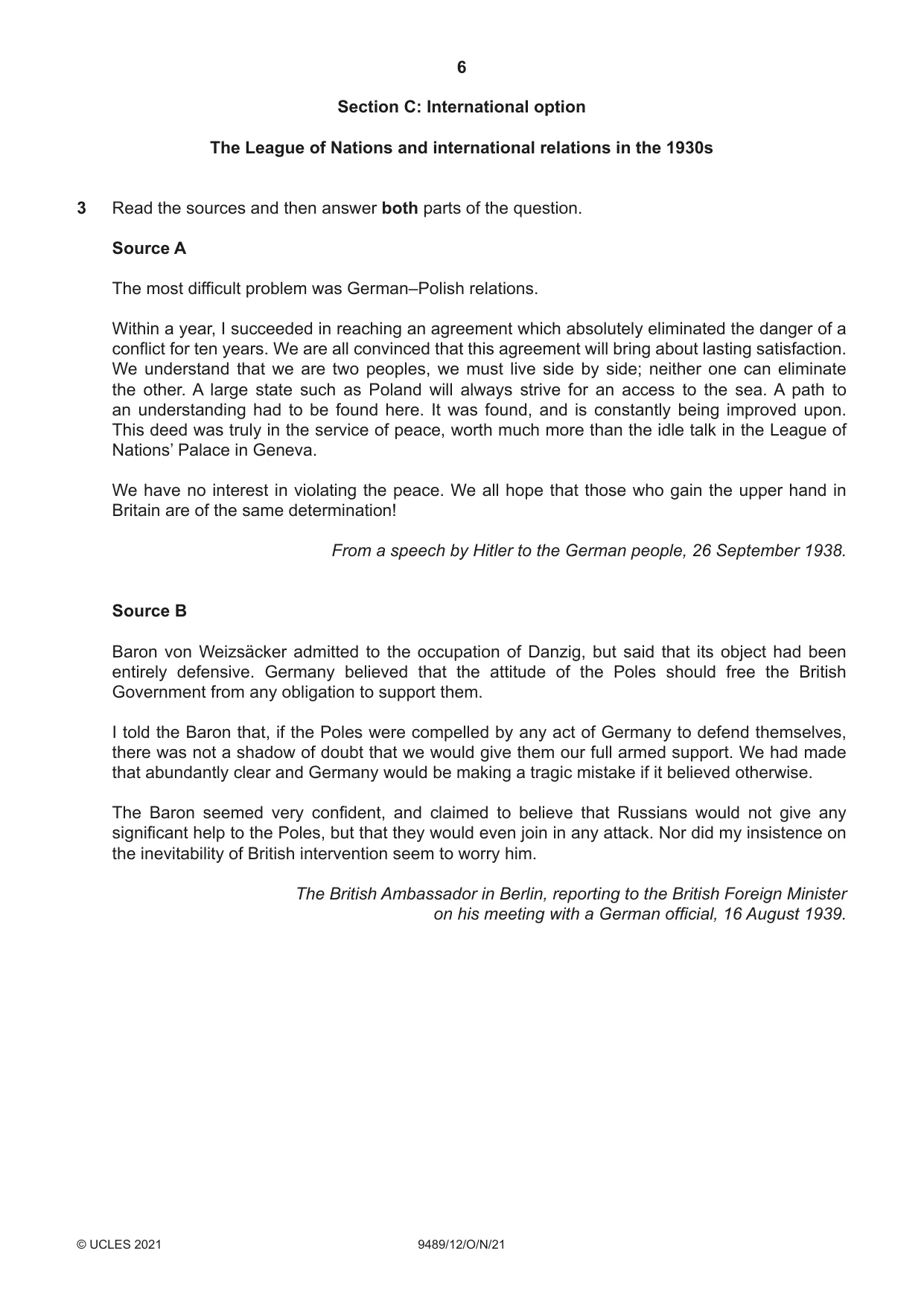
6 9489/12/O/N/21 © UCLES 2021 Section C: International option The League of Nations and international relations in the 1930s 3 Read the sources and then answer both parts of the question. Source A The most difficult problem was German–Polish relations. Within a year, I succeeded in reaching an agreement which absolutely eliminated the danger of a conflict for ten years. We are all convinced that this agreement will bring about lasting satisfaction. We understand that we are two peoples, we must live side by side; neither one can eliminate the other. A large state such as Poland will always strive for an access to the sea. A path to an understanding had to be found here. It was found, and is constantly being improved upon. This deed was truly in the service of peace, worth much more than the idle talk in the League of Nations’ Palace in Geneva. We have no interest in violating the peace. We all hope that those who gain the upper hand in Britain are of the same determination! From a speech by Hitler to the German people, 26 September 1938. Source B Baron von Weizsäcker admitted to the occupation of Danzig, but said that its object had been entirely defensive. Germany believed that the attitude of the Poles should free the British Government from any obligation to support them. I told the Baron that, if the Poles were compelled by any act of Germany to defend themselves, there was not a shadow of doubt that we would give them our full armed support. We had made that abundantly clear and Germany would be making a tragic mistake if it believed otherwise. The Baron seemed very confident, and claimed to believe that Russians would not give any significant help to the Poles, but that they would even join in any attack. Nor did my insistence on the inevitability of British intervention seem to worry him. The British Ambassador in Berlin, reporting to the British Foreign Minister on his meeting with a German official, 16 August 1939.
Question paper, page 7
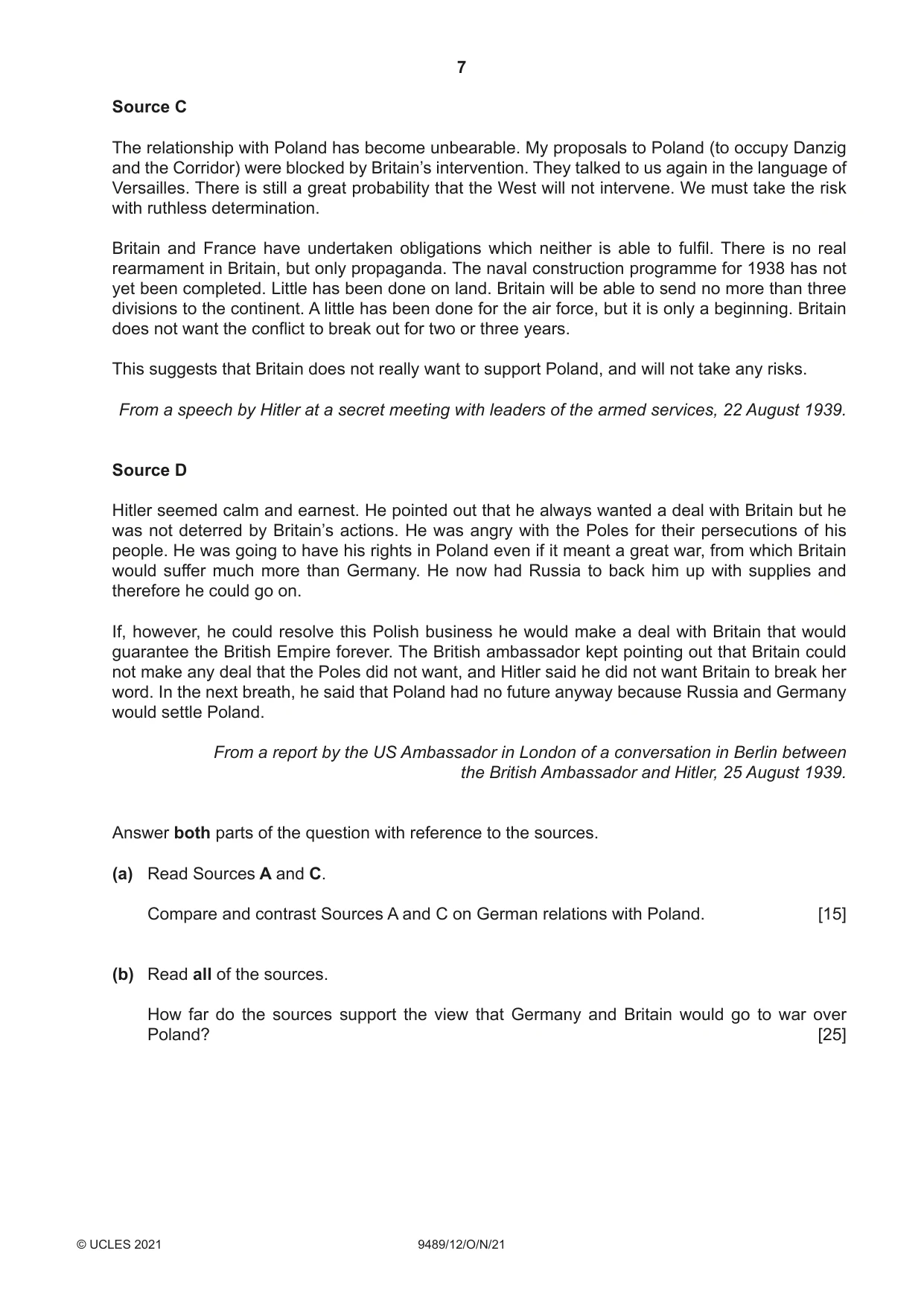
7 9489/12/O/N/21 © UCLES 2021 Source C The relationship with Poland has become unbearable. My proposals to Poland (to occupy Danzig and the Corridor) were blocked by Britain’s intervention. They talked to us again in the language of Versailles. There is still a great probability that the West will not intervene. We must take the risk with ruthless determination. Britain and France have undertaken obligations which neither is able to fulfil. There is no real rearmament in Britain, but only propaganda. The naval construction programme for 1938 has not yet been completed. Little has been done on land. Britain will be able to send no more than three divisions to the continent. A little has been done for the air force, but it is only a beginning. Britain does not want the conflict to break out for two or three years. This suggests that Britain does not really want to support Poland, and will not take any risks. From a speech by Hitler at a secret meeting with leaders of the armed services, 22 August 1939. Source D Hitler seemed calm and earnest. He pointed out that he always wanted a deal with Britain but he was not deterred by Britain’s actions. He was angry with the Poles for their persecutions of his people. He was going to have his rights in Poland even if it meant a great war, from which Britain would suffer much more than Germany. He now had Russia to back him up with supplies and therefore he could go on. If, however, he could resolve this Polish business he would make a deal with Britain that would guarantee the British Empire forever. The British ambassador kept pointing out that Britain could not make any deal that the Poles did not want, and Hitler said he did not want Britain to break her word. In the next breath, he said that Poland had no future anyway because Russia and Germany would settle Poland. From a report by the US Ambassador in London of a conversation in Berlin between the British Ambassador and Hitler, 25 August 1939. Answer both parts of the question with reference to the sources. (a) Read Sources A and C. Compare and contrast Sources A and C on German relations with Poland. [15] (b) Read all of the sources. How far do the sources support the view that Germany and Britain would go to war over Poland? [25]
Question paper, page 8
8 9489/12/O/N/21 © UCLES 2021 Permission to reproduce items where third‑party owned material protected by copyright is included has been sought and cleared where possible. Every reasonable effort has been made by the publisher (UCLES) to trace copyright holders, but if any items requiring clearance have unwittingly been included, the publisher will be pleased to make amends at the earliest possible opportunity. To avoid the issue of disclosure of answer‑related information to candidates, all copyright acknowledgements are reproduced online in the Cambridge Assessment International Education Copyright Acknowledgements Booklet. This is produced for each series of examinations and is freely available to download at www.cambridgeinternational.org after the live examination series. Cambridge Assessment International Education is part of the Cambridge Assessment Group. Cambridge Assessment is the brand name of the University of Cambridge Local Examinations Syndicate (UCLES), which itself is a department of the University of Cambridge. BLANK PAGE
Mark scheme, page 1
This document consists of 12 printed pages. © UCLES 2021 [Turn over Cambridge International AS & A Level HISTORY 9489/12 Paper 1 Document Question October/November 2021 MARK SCHEME Maximum Mark: 40 Published This mark scheme is published as an aid to teachers and candidates, to indicate the requirements of the examination. It shows the basis on which Examiners were instructed to award marks. It does not indicate the details of the discussions that took place at an Examiners’ meeting before marking began, which would have considered the acceptability of alternative answers. Mark schemes should be read in conjunction with the question paper and the Principal Examiner Report for Teachers. Cambridge International will not enter into discussions about these mark schemes. Cambridge International is publishing the mark schemes for the October/November 2021 series for most Cambridge IGCSE™, Cambridge International A and AS Level components and some Cambridge O Level components.
Mark scheme, page 2
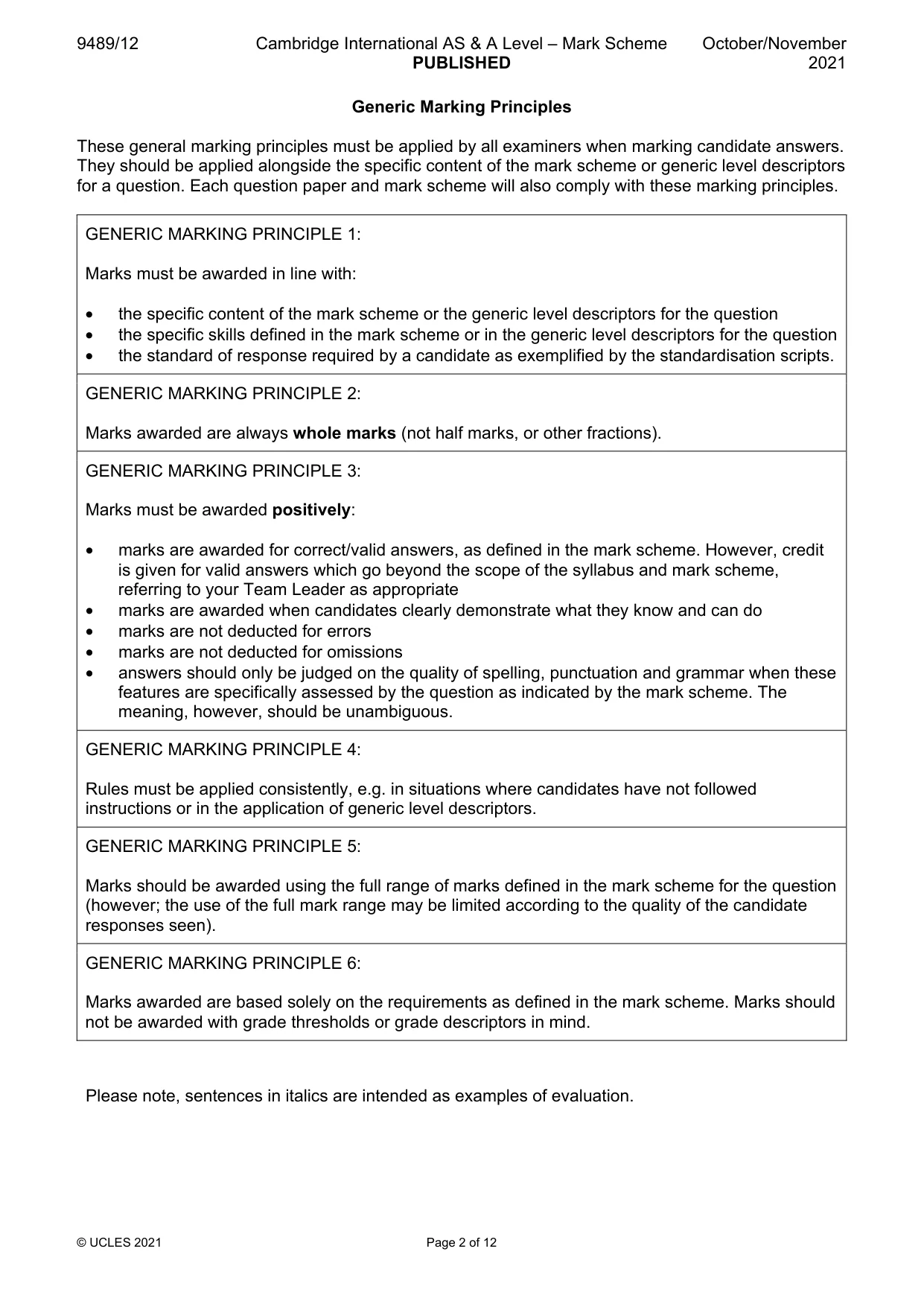
9489/12 Cambridge International AS & A Level – Mark Scheme PUBLISHED October/November 2021 © UCLES 2021 Page 2 of 12 Generic Marking Principles These general marking principles must be applied by all examiners when marking candidate answers. They should be applied alongside the specific content of the mark scheme or generic level descriptors for a question. Each question paper and mark scheme will also comply with these marking principles. GENERIC MARKING PRINCIPLE 1: Marks must be awarded in line with: • the specific content of the mark scheme or the generic level descriptors for the question • the specific skills defined in the mark scheme or in the generic level descriptors for the question • the standard of response required by a candidate as exemplified by the standardisation scripts. GENERIC MARKING PRINCIPLE 2: Marks awarded are always whole marks (not half marks, or other fractions). GENERIC MARKING PRINCIPLE 3: Marks must be awarded positively: • marks are awarded for correct/valid answers, as defined in the mark scheme. However, credit is given for valid answers which go beyond the scope of the syllabus and mark scheme, referring to your Team Leader as appropriate • marks are awarded when candidates clearly demonstrate what they know and can do • marks are not deducted for errors • marks are not deducted for omissions • answers should only be judged on the quality of spelling, punctuation and grammar when these features are specifically assessed by the question as indicated by the mark scheme. The meaning, however, should be unambiguous. GENERIC MARKING PRINCIPLE 4: Rules must be applied consistently, e.g. in situations where candidates have not followed instructions or in the application of generic level descriptors. GENERIC MARKING PRINCIPLE 5: Marks should be awarded using the full range of marks defined in the mark scheme for the question (however; the use of the full mark range may be limited according to the quality of the candidate responses seen). GENERIC MARKING PRINCIPLE 6: Marks awarded are based solely on the requirements as defined in the mark scheme. Marks should not be awarded with grade thresholds or grade descriptors in mind. Please note, sentences in italics are intended as examples of evaluation.
Mark scheme, page 3
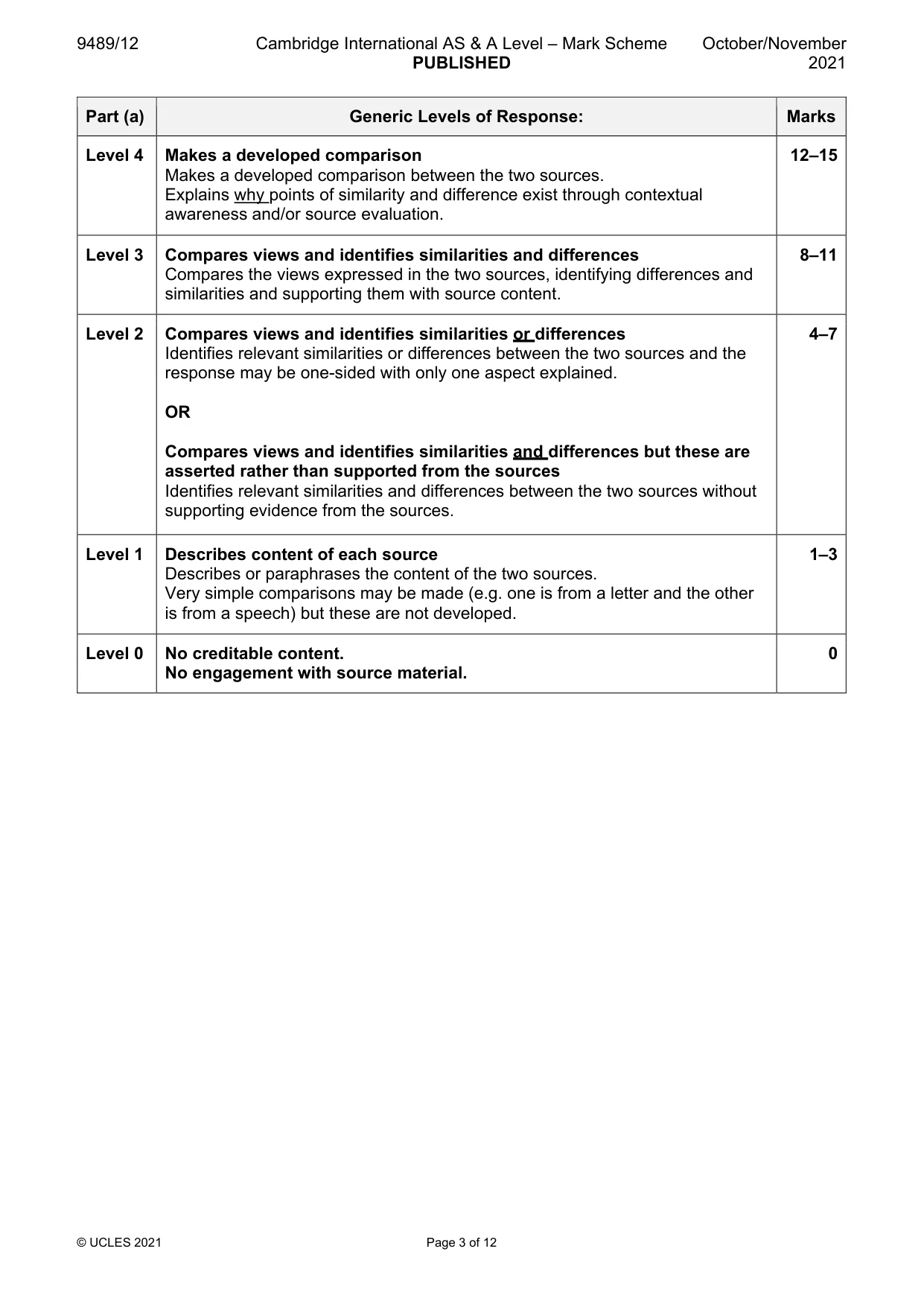
9489/12 Cambridge International AS & A Level – Mark Scheme PUBLISHED October/November 2021 © UCLES 2021 Page 3 of 12 Part (a) Generic Levels of Response: Marks Level 4 Makes a developed comparison Makes a developed comparison between the two sources. Explains why points of similarity and difference exist through contextual awareness and/or source evaluation. 12–15 Level 3 Compares views and identifies similarities and differences Compares the views expressed in the two sources, identifying differences and similarities and supporting them with source content. 8–11 Level 2 Compares views and identifies similarities or differences Identifies relevant similarities or differences between the two sources and the response may be one-sided with only one aspect explained. OR Compares views and identifies similarities and differences but these are asserted rather than supported from the sources Identifies relevant similarities and differences between the two sources without supporting evidence from the sources. 4–7 Level 1 Describes content of each source Describes or paraphrases the content of the two sources. Very simple comparisons may be made (e.g. one is from a letter and the other is from a speech) but these are not developed. 1–3 Level 0 No creditable content. No engagement with source material. 0
Mark scheme, page 4
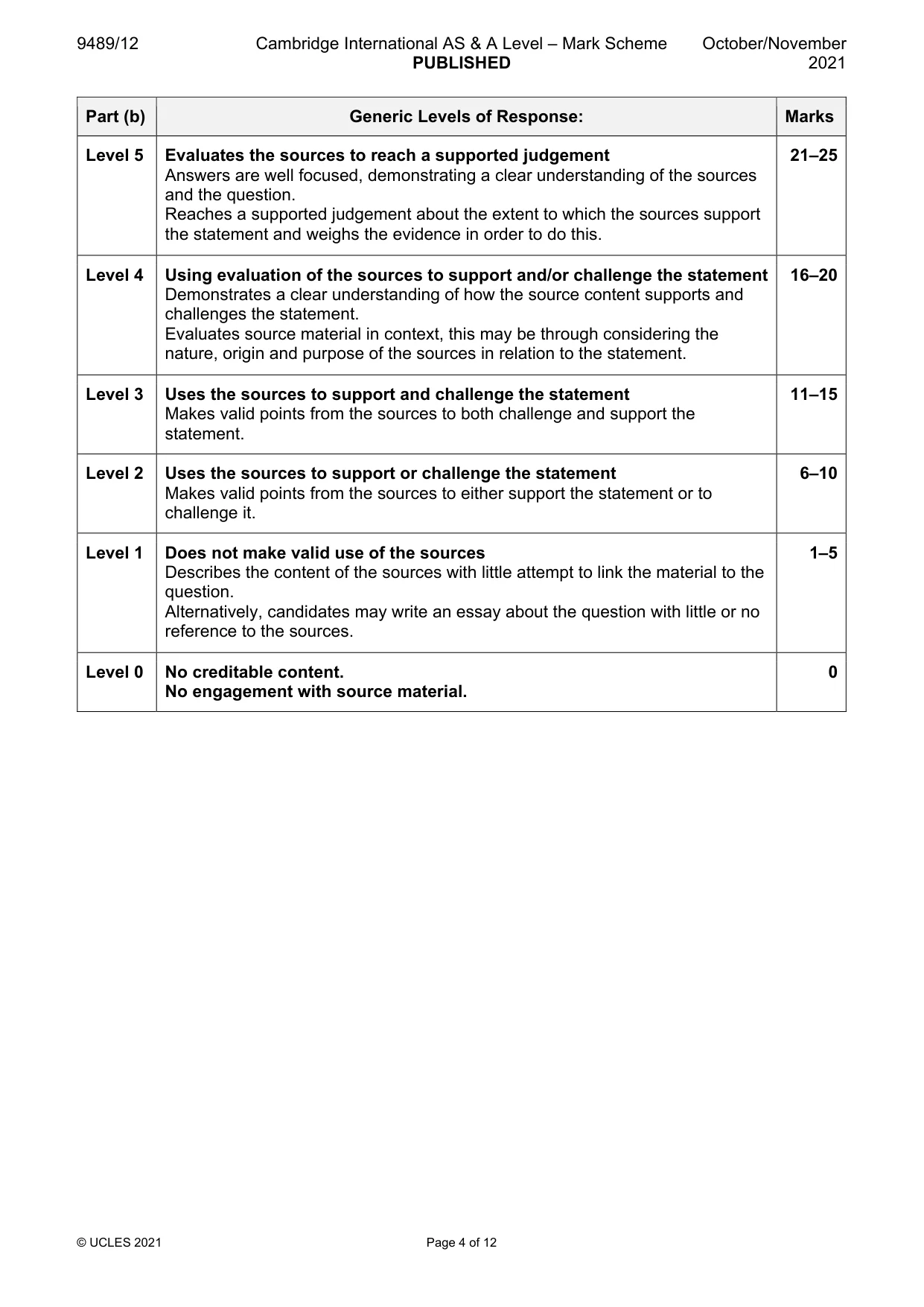
9489/12 Cambridge International AS & A Level – Mark Scheme PUBLISHED October/November 2021 © UCLES 2021 Page 4 of 12 Part (b) Generic Levels of Response: Marks Level 5 Evaluates the sources to reach a supported judgement Answers are well focused, demonstrating a clear understanding of the sources and the question. Reaches a supported judgement about the extent to which the sources support the statement and weighs the evidence in order to do this. 21–25 Level 4 Using evaluation of the sources to support and/or challenge the statement Demonstrates a clear understanding of how the source content supports and challenges the statement. Evaluates source material in context, this may be through considering the nature, origin and purpose of the sources in relation to the statement. 16–20 Level 3 Uses the sources to support and challenge the statement Makes valid points from the sources to both challenge and support the statement. 11–15 Level 2 Uses the sources to support or challenge the statement Makes valid points from the sources to either support the statement or to challenge it. 6–10 Level 1 Does not make valid use of the sources Describes the content of the sources with little attempt to link the material to the question. Alternatively, candidates may write an essay about the question with little or no reference to the sources. 1–5 Level 0 No creditable content. No engagement with source material. 0
Mark scheme, page 5
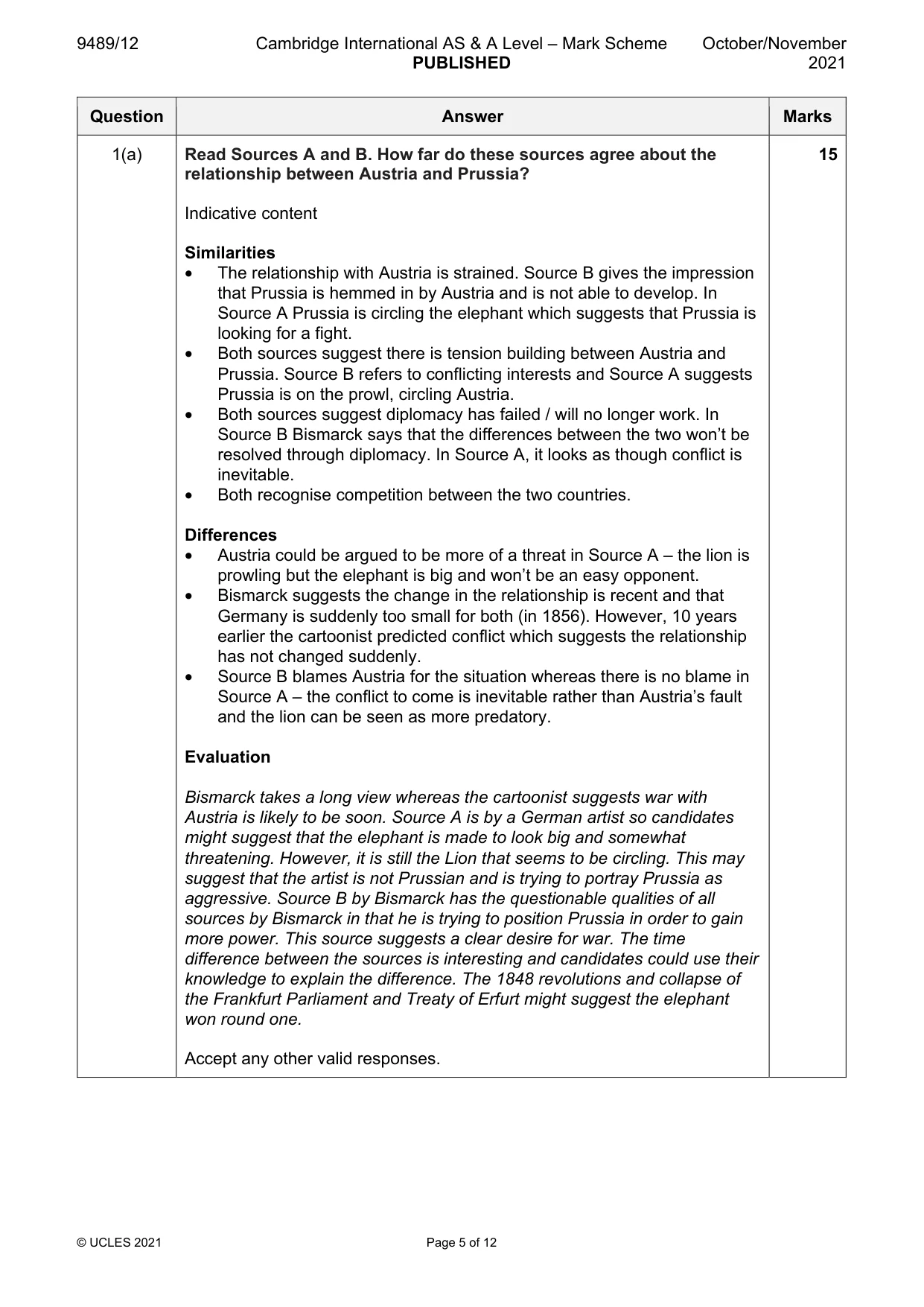
9489/12 Cambridge International AS & A Level – Mark Scheme PUBLISHED October/November 2021 © UCLES 2021 Page 5 of 12 Question Answer Marks 1(a) Read Sources A and B. How far do these sources agree about the relationship between Austria and Prussia? Indicative content Similarities • The relationship with Austria is strained. Source B gives the impression that Prussia is hemmed in by Austria and is not able to develop. In Source A Prussia is circling the elephant which suggests that Prussia is looking for a fight. • Both sources suggest there is tension building between Austria and Prussia. Source B refers to conflicting interests and Source A suggests Prussia is on the prowl, circling Austria. • Both sources suggest diplomacy has failed / will no longer work. In Source B Bismarck says that the differences between the two won’t be resolved through diplomacy. In Source A, it looks as though conflict is inevitable. • Both recognise competition between the two countries. Differences • Austria could be argued to be more of a threat in Source A – the lion is prowling but the elephant is big and won’t be an easy opponent. • Bismarck suggests the change in the relationship is recent and that Germany is suddenly too small for both (in 1856). However, 10 years earlier the cartoonist predicted conflict which suggests the relationship has not changed suddenly. • Source B blames Austria for the situation whereas there is no blame in Source A – the conflict to come is inevitable rather than Austria’s fault and the lion can be seen as more predatory. Evaluation Bismarck takes a long view whereas the cartoonist suggests war with Austria is likely to be soon. Source A is by a German artist so candidates might suggest that the elephant is made to look big and somewhat threatening. However, it is still the Lion that seems to be circling. This may suggest that the artist is not Prussian and is trying to portray Prussia as aggressive. Source B by Bismarck has the questionable qualities of all sources by Bismarck in that he is trying to position Prussia in order to gain more power. This source suggests a clear desire for war. The time difference between the sources is interesting and candidates could use their knowledge to explain the difference. The 1848 revolutions and collapse of the Frankfurt Parliament and Treaty of Erfurt might suggest the elephant won round one. Accept any other valid responses. 15
Mark scheme, page 6
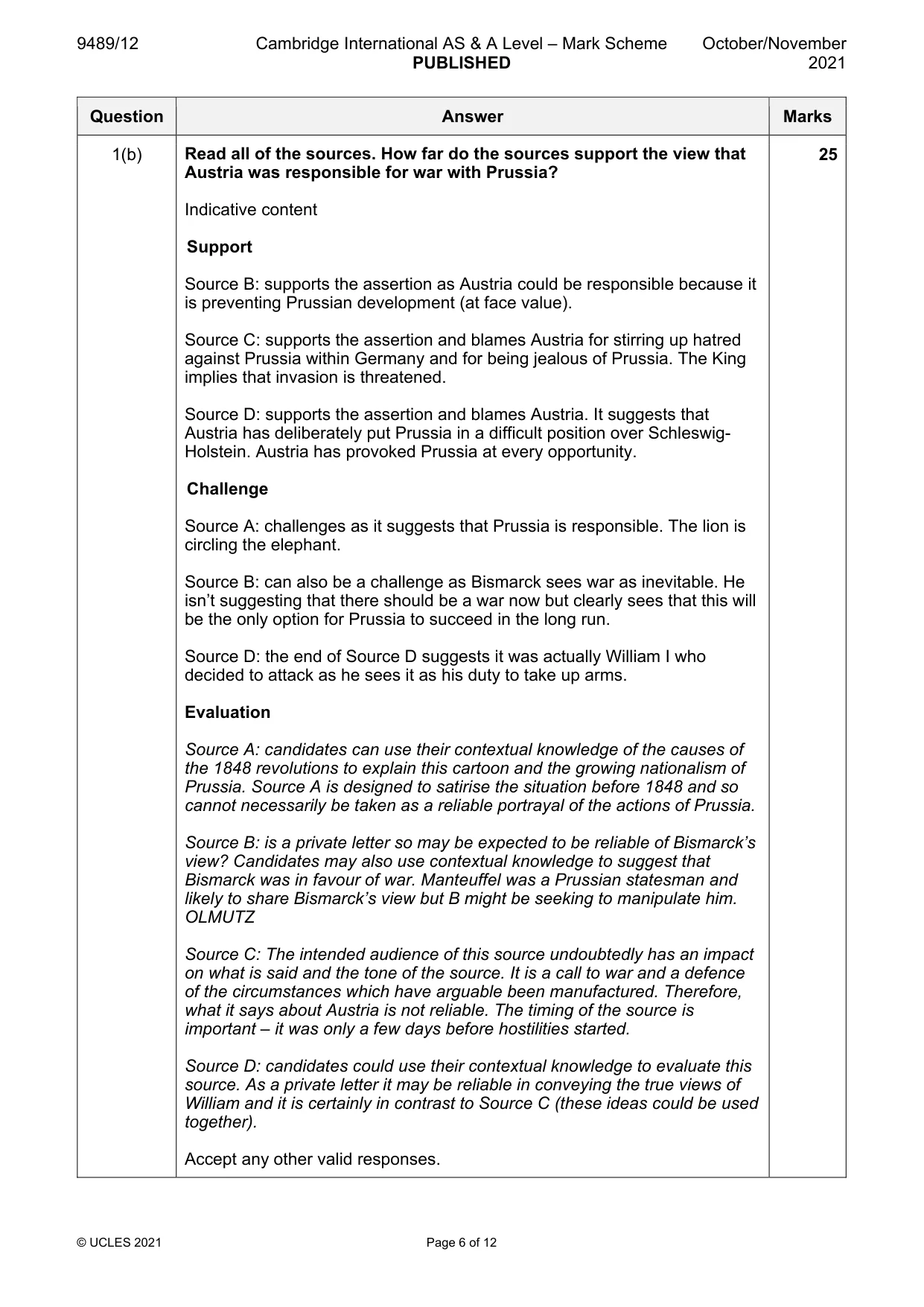
9489/12 Cambridge International AS & A Level – Mark Scheme PUBLISHED October/November 2021 © UCLES 2021 Page 6 of 12 Question Answer Marks 1(b) Read all of the sources. How far do the sources support the view that Austria was responsible for war with Prussia? Indicative content Support Source B: supports the assertion as Austria could be responsible because it is preventing Prussian development (at face value). Source C: supports the assertion and blames Austria for stirring up hatred against Prussia within Germany and for being jealous of Prussia. The King implies that invasion is threatened. Source D: supports the assertion and blames Austria. It suggests that Austria has deliberately put Prussia in a difficult position over Schleswig- Holstein. Austria has provoked Prussia at every opportunity. Challenge Source A: challenges as it suggests that Prussia is responsible. The lion is circling the elephant. Source B: can also be a challenge as Bismarck sees war as inevitable. He isn’t suggesting that there should be a war now but clearly sees that this will be the only option for Prussia to succeed in the long run. Source D: the end of Source D suggests it was actually William I who decided to attack as he sees it as his duty to take up arms. Evaluation Source A: candidates can use their contextual knowledge of the causes of the 1848 revolutions to explain this cartoon and the growing nationalism of Prussia. Source A is designed to satirise the situation before 1848 and so cannot necessarily be taken as a reliable portrayal of the actions of Prussia. Source B: is a private letter so may be expected to be reliable of Bismarck’s view? Candidates may also use contextual knowledge to suggest that Bismarck was in favour of war. Manteuffel was a Prussian statesman and likely to share Bismarck’s view but B might be seeking to manipulate him. OLMUTZ Source C: The intended audience of this source undoubtedly has an impact on what is said and the tone of the source. It is a call to war and a defence of the circumstances which have arguable been manufactured. Therefore, what it says about Austria is not reliable. The timing of the source is important – it was only a few days before hostilities started. Source D: candidates could use their contextual knowledge to evaluate this source. As a private letter it may be reliable in conveying the true views of William and it is certainly in contrast to Source C (these ideas could be used together). Accept any other valid responses. 25
Mark scheme, page 7
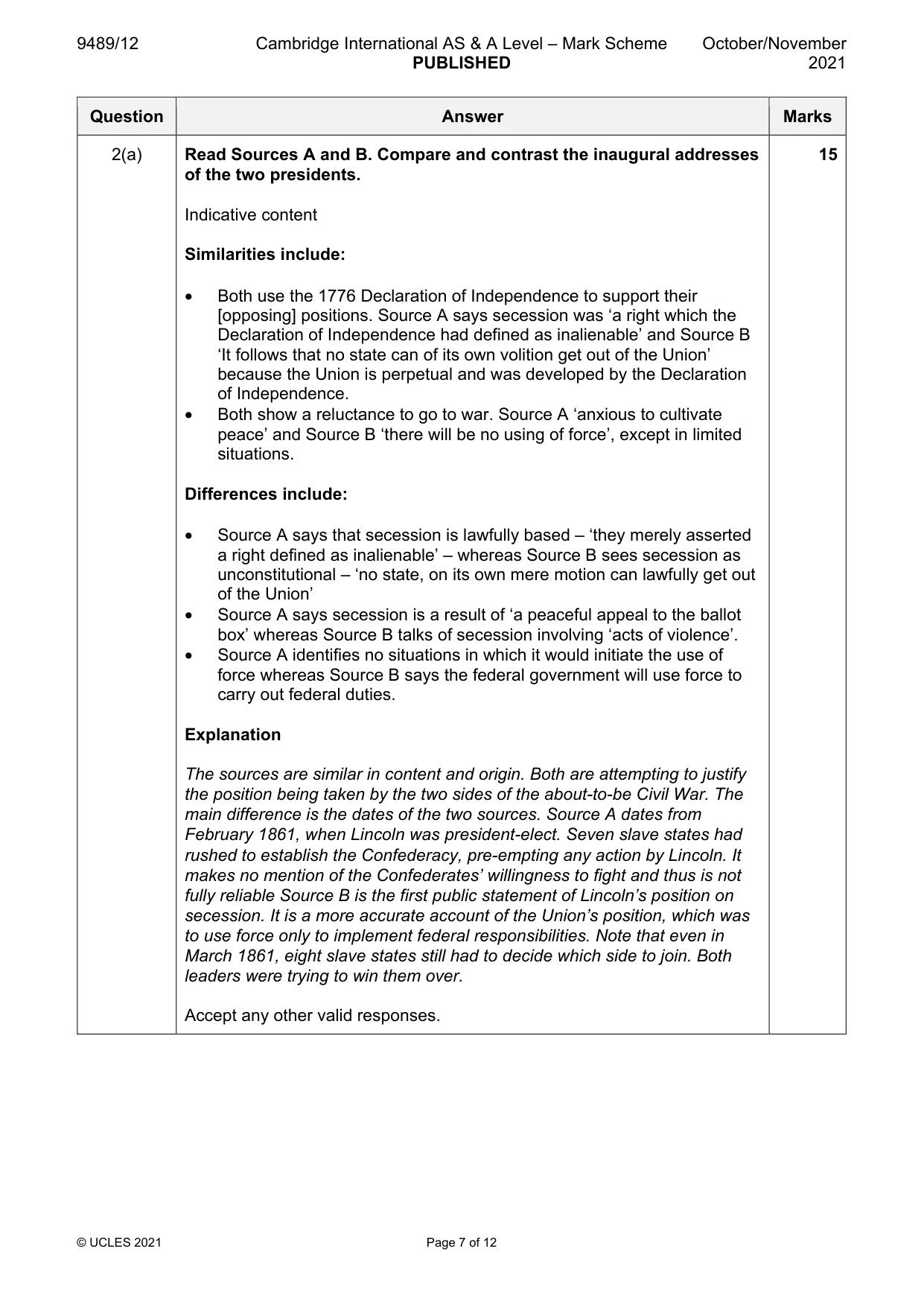
9489/12 Cambridge International AS & A Level – Mark Scheme PUBLISHED October/November 2021 © UCLES 2021 Page 7 of 12 Question Answer Marks 2(a) Read Sources A and B. Compare and contrast the inaugural addresses of the two presidents. Indicative content Similarities include: • Both use the 1776 Declaration of Independence to support their [opposing] positions. Source A says secession was ‘a right which the Declaration of Independence had defined as inalienable’ and Source B ‘It follows that no state can of its own volition get out of the Union’ because the Union is perpetual and was developed by the Declaration of Independence. • Both show a reluctance to go to war. Source A ‘anxious to cultivate peace’ and Source B ‘there will be no using of force’, except in limited situations. Differences include: • Source A says that secession is lawfully based – ‘they merely asserted a right defined as inalienable’ – whereas Source B sees secession as unconstitutional – ‘no state, on its own mere motion can lawfully get out of the Union’ • Source A says secession is a result of ‘a peaceful appeal to the ballot box’ whereas Source B talks of secession involving ‘acts of violence’. • Source A identifies no situations in which it would initiate the use of force whereas Source B says the federal government will use force to carry out federal duties. Explanation The sources are similar in content and origin. Both are attempting to justify the position being taken by the two sides of the about-to-be Civil War. The main difference is the dates of the two sources. Source A dates from February 1861, when Lincoln was president-elect. Seven slave states had rushed to establish the Confederacy, pre-empting any action by Lincoln. It makes no mention of the Confederates’ willingness to fight and thus is not fully reliable Source B is the first public statement of Lincoln’s position on secession. It is a more accurate account of the Union’s position, which was to use force only to implement federal responsibilities. Note that even in March 1861, eight slave states still had to decide which side to join. Both leaders were trying to win them over. Accept any other valid responses. 15
Mark scheme, page 8
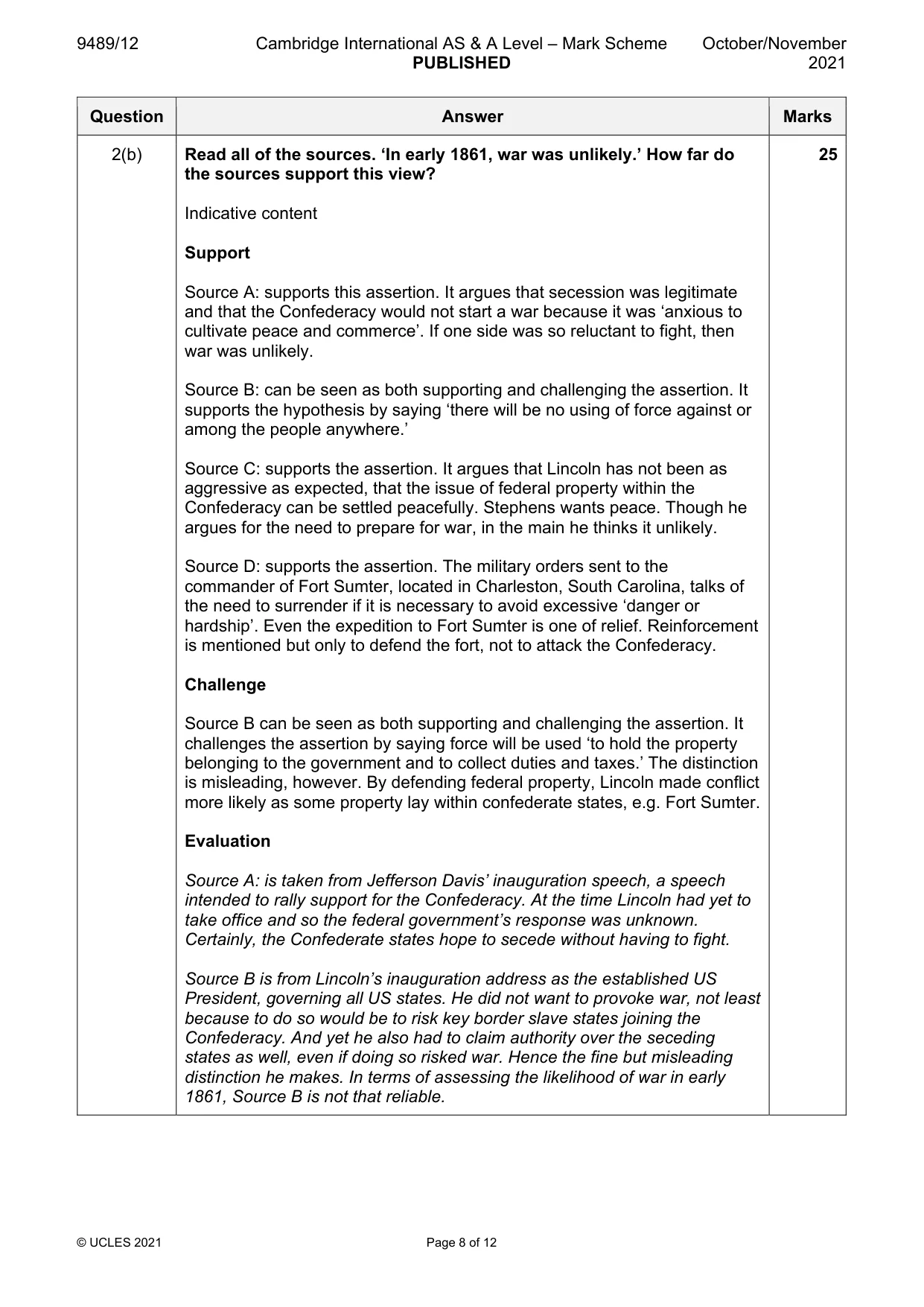
9489/12 Cambridge International AS & A Level – Mark Scheme PUBLISHED October/November 2021 © UCLES 2021 Page 8 of 12 Question Answer Marks 2(b) Read all of the sources. ‘In early 1861, war was unlikely.’ How far do the sources support this view? Indicative content Support Source A: supports this assertion. It argues that secession was legitimate and that the Confederacy would not start a war because it was ‘anxious to cultivate peace and commerce’. If one side was so reluctant to fight, then war was unlikely. Source B: can be seen as both supporting and challenging the assertion. It supports the hypothesis by saying ‘there will be no using of force against or among the people anywhere.’ Source C: supports the assertion. It argues that Lincoln has not been as aggressive as expected, that the issue of federal property within the Confederacy can be settled peacefully. Stephens wants peace. Though he argues for the need to prepare for war, in the main he thinks it unlikely. Source D: supports the assertion. The military orders sent to the commander of Fort Sumter, located in Charleston, South Carolina, talks of the need to surrender if it is necessary to avoid excessive ‘danger or hardship’. Even the expedition to Fort Sumter is one of relief. Reinforcement is mentioned but only to defend the fort, not to attack the Confederacy. Challenge Source B can be seen as both supporting and challenging the assertion. It challenges the assertion by saying force will be used ‘to hold the property belonging to the government and to collect duties and taxes.’ The distinction is misleading, however. By defending federal property, Lincoln made conflict more likely as some property lay within confederate states, e.g. Fort Sumter. Evaluation Source A: is taken from Jefferson Davis’ inauguration speech, a speech intended to rally support for the Confederacy. At the time Lincoln had yet to take office and so the federal government’s response was unknown. Certainly, the Confederate states hope to secede without having to fight. Source B is from Lincoln’s inauguration address as the established US President, governing all US states. He did not want to provoke war, not least because to do so would be to risk key border slave states joining the Confederacy. And yet he also had to claim authority over the seceding states as well, even if doing so risked war. Hence the fine but misleading distinction he makes. In terms of assessing the likelihood of war in early 1861, Source B is not that reliable. 25
Mark scheme, page 9
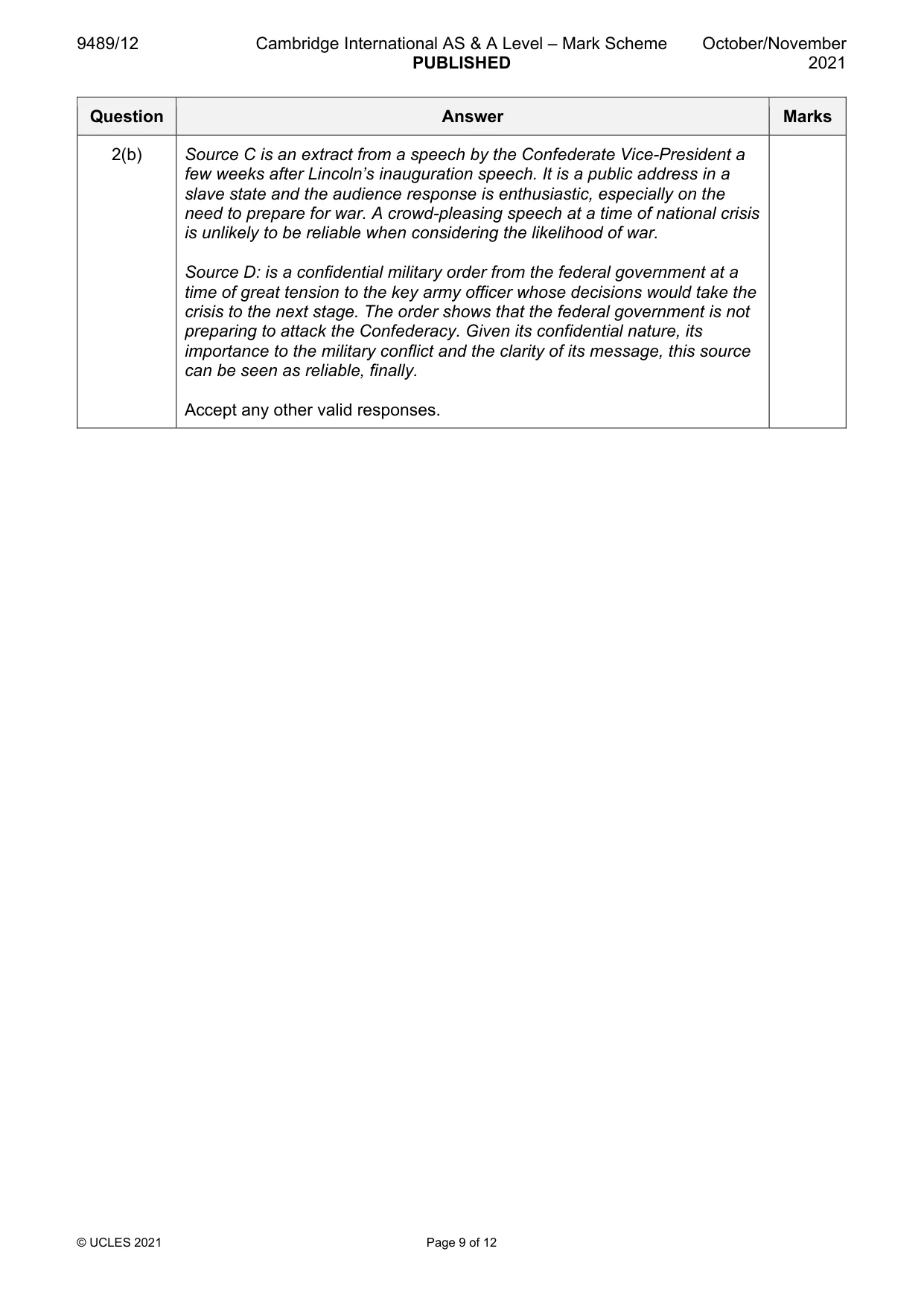
9489/12 Cambridge International AS & A Level – Mark Scheme PUBLISHED October/November 2021 © UCLES 2021 Page 9 of 12 Question Answer Marks 2(b) Source C is an extract from a speech by the Confederate Vice-President a few weeks after Lincoln’s inauguration speech. It is a public address in a slave state and the audience response is enthusiastic, especially on the need to prepare for war. A crowd-pleasing speech at a time of national crisis is unlikely to be reliable when considering the likelihood of war. Source D: is a confidential military order from the federal government at a time of great tension to the key army officer whose decisions would take the crisis to the next stage. The order shows that the federal government is not preparing to attack the Confederacy. Given its confidential nature, its importance to the military conflict and the clarity of its message, this source can be seen as reliable, finally. Accept any other valid responses.
Mark scheme, page 10
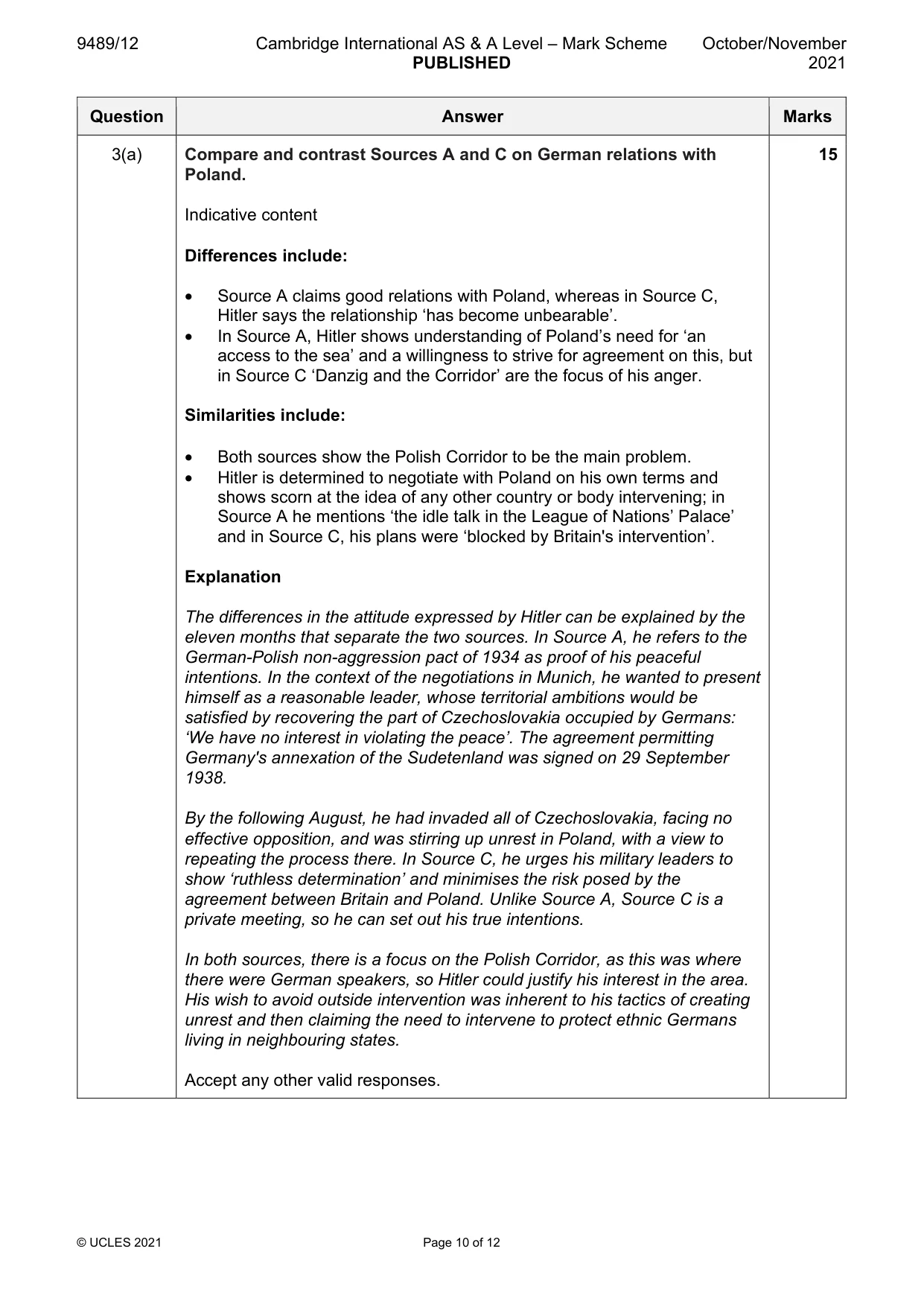
9489/12 Cambridge International AS & A Level – Mark Scheme PUBLISHED October/November 2021 © UCLES 2021 Page 10 of 12 Question Answer Marks 3(a) Compare and contrast Sources A and C on German relations with Poland. Indicative content Differences include: • Source A claims good relations with Poland, whereas in Source C, Hitler says the relationship ‘has become unbearable’. • In Source A, Hitler shows understanding of Poland’s need for ‘an access to the sea’ and a willingness to strive for agreement on this, but in Source C ‘Danzig and the Corridor’ are the focus of his anger. Similarities include: • Both sources show the Polish Corridor to be the main problem. • Hitler is determined to negotiate with Poland on his own terms and shows scorn at the idea of any other country or body intervening; in Source A he mentions ‘the idle talk in the League of Nations’ Palace’ and in Source C, his plans were ‘blocked by Britain's intervention’. Explanation The differences in the attitude expressed by Hitler can be explained by the eleven months that separate the two sources. In Source A, he refers to the German-Polish non-aggression pact of 1934 as proof of his peaceful intentions. In the context of the negotiations in Munich, he wanted to present himself as a reasonable leader, whose territorial ambitions would be satisfied by recovering the part of Czechoslovakia occupied by Germans: ‘We have no interest in violating the peace’. The agreement permitting Germany's annexation of the Sudetenland was signed on 29 September 1938. By the following August, he had invaded all of Czechoslovakia, facing no effective opposition, and was stirring up unrest in Poland, with a view to repeating the process there. In Source C, he urges his military leaders to show ‘ruthless determination’ and minimises the risk posed by the agreement between Britain and Poland. Unlike Source A, Source C is a private meeting, so he can set out his true intentions. In both sources, there is a focus on the Polish Corridor, as this was where there were German speakers, so Hitler could justify his interest in the area. His wish to avoid outside intervention was inherent to his tactics of creating unrest and then claiming the need to intervene to protect ethnic Germans living in neighbouring states. Accept any other valid responses. 15
Mark scheme, page 11
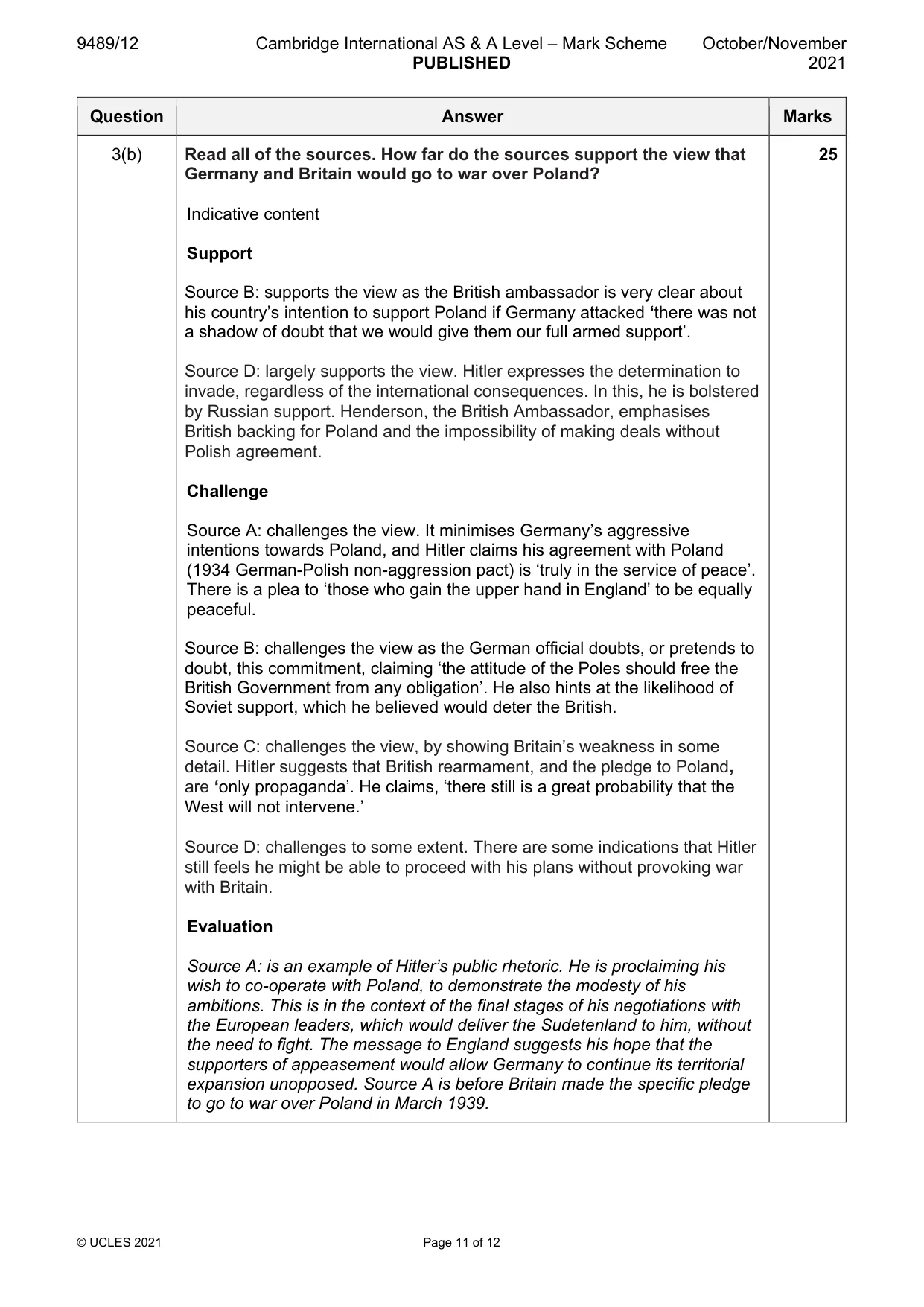
9489/12 Cambridge International AS & A Level – Mark Scheme PUBLISHED October/November 2021 © UCLES 2021 Page 11 of 12 Question Answer Marks 3(b) Read all of the sources. How far do the sources support the view that Germany and Britain would go to war over Poland? Indicative content Support Source B: supports the view as the British ambassador is very clear about his country’s intention to support Poland if Germany attacked ‘there was not a shadow of doubt that we would give them our full armed support’. Source D: largely supports the view. Hitler expresses the determination to invade, regardless of the international consequences. In this, he is bolstered by Russian support. Henderson, the British Ambassador, emphasises British backing for Poland and the impossibility of making deals without Polish agreement. Challenge Source A: challenges the view. It minimises Germany’s aggressive intentions towards Poland, and Hitler claims his agreement with Poland (1934 German-Polish non-aggression pact) is ‘truly in the service of peace’. There is a plea to ‘those who gain the upper hand in England’ to be equally peaceful. Source B: challenges the view as the German official doubts, or pretends to doubt, this commitment, claiming ‘the attitude of the Poles should free the British Government from any obligation’. He also hints at the likelihood of Soviet support, which he believed would deter the British. Source C: challenges the view, by showing Britain’s weakness in some detail. Hitler suggests that British rearmament, and the pledge to Poland, are ‘only propaganda’. He claims, ‘there still is a great probability that the West will not intervene.’ Source D: challenges to some extent. There are some indications that Hitler still feels he might be able to proceed with his plans without provoking war with Britain. Evaluation Source A: is an example of Hitler’s public rhetoric. He is proclaiming his wish to co-operate with Poland, to demonstrate the modesty of his ambitions. This is in the context of the final stages of his negotiations with the European leaders, which would deliver the Sudetenland to him, without the need to fight. The message to England suggests his hope that the supporters of appeasement would allow Germany to continue its territorial expansion unopposed. Source A is before Britain made the specific pledge to go to war over Poland in March 1939. 25
Mark scheme, page 12
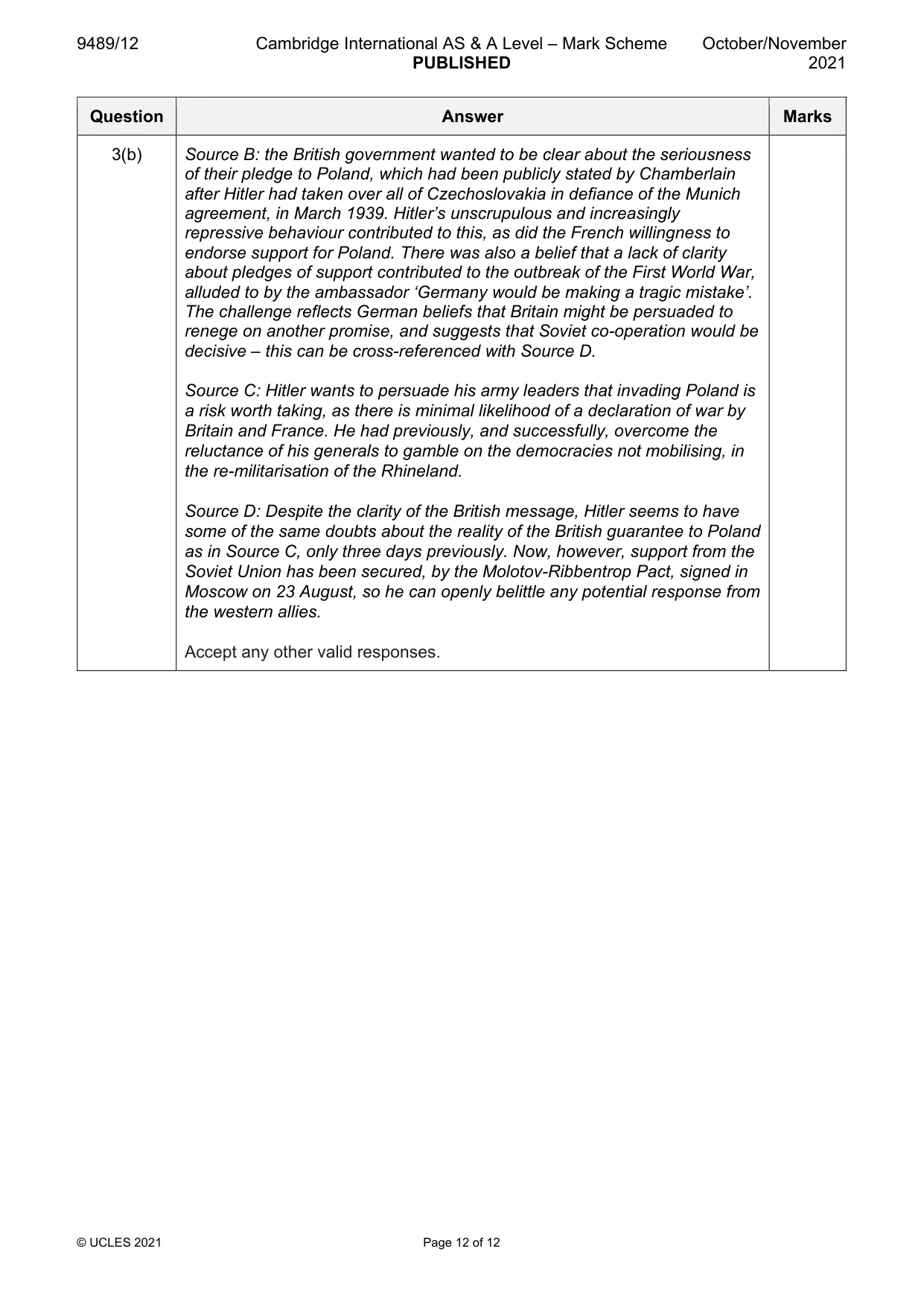
9489/12 Cambridge International AS & A Level – Mark Scheme PUBLISHED October/November 2021 © UCLES 2021 Page 12 of 12 Question Answer Marks 3(b) Source B: the British government wanted to be clear about the seriousness of their pledge to Poland, which had been publicly stated by Chamberlain after Hitler had taken over all of Czechoslovakia in defiance of the Munich agreement, in March 1939. Hitler’s unscrupulous and increasingly repressive behaviour contributed to this, as did the French willingness to endorse support for Poland. There was also a belief that a lack of clarity about pledges of support contributed to the outbreak of the First World War, alluded to by the ambassador ‘Germany would be making a tragic mistake’. The challenge reflects German beliefs that Britain might be persuaded to renege on another promise, and suggests that Soviet co-operation would be decisive – this can be cross-referenced with Source D. Source C: Hitler wants to persuade his army leaders that invading Poland is a risk worth taking, as there is minimal likelihood of a declaration of war by Britain and France. He had previously, and successfully, overcome the reluctance of his generals to gamble on the democracies not mobilising, in the re-militarisation of the Rhineland. Source D: Despite the clarity of the British message, Hitler seems to have some of the same doubts about the reality of the British guarantee to Poland as in Source C, only three days previously. Now, however, support from the Soviet Union has been secured, by the Molotov-Ribbentrop Pact, signed in Moscow on 23 August, so he can openly belittle any potential response from the western allies. Accept any other valid responses.
What you needed in this session
Cambridge’s own grade thresholds for 2021 Oct/Nov, Paper 1 · Variant 2. A higher threshold means an easier paper — the bar moves with how the cohort did.