Cambridge A Level History 9489 — 2024 May/June Paper 1 · Variant 3
9489/13/M/J/24 · 40 marks · ≈45 min
The question paper and its mark scheme, free to read here and free to download. This is Cambridge’s own paper, exactly as it was sat.
Question paper8 pages
Mark scheme14 pages
Answers below. Sit the paper first if you are practising.
Paper as text
Question paper, page 1
This document has 8 pages. [Turn over Cambridge International AS & A Level HISTORY 9489/13 Paper 1 Document Question May/June 2024 1 hour 15 minutes You must answer on the enclosed answer booklet. You will need: Answer booklet (enclosed) INSTRUCTIONS ● Answer one question from one section only. Section A: European option Section B: American option Section C: International option ● Follow the instructions on the front cover of the answer booklet. If you need additional answer paper, ask the invigilator for a continuation booklet. INFORMATION ● The total mark for this paper is 40. ● The number of marks for each question or part question is shown in brackets [ ]. * 7 6 3 1 0 7 2 0 6 5 * DC (SL/FC) 330456/2 © UCLES 2024
Question paper, page 2
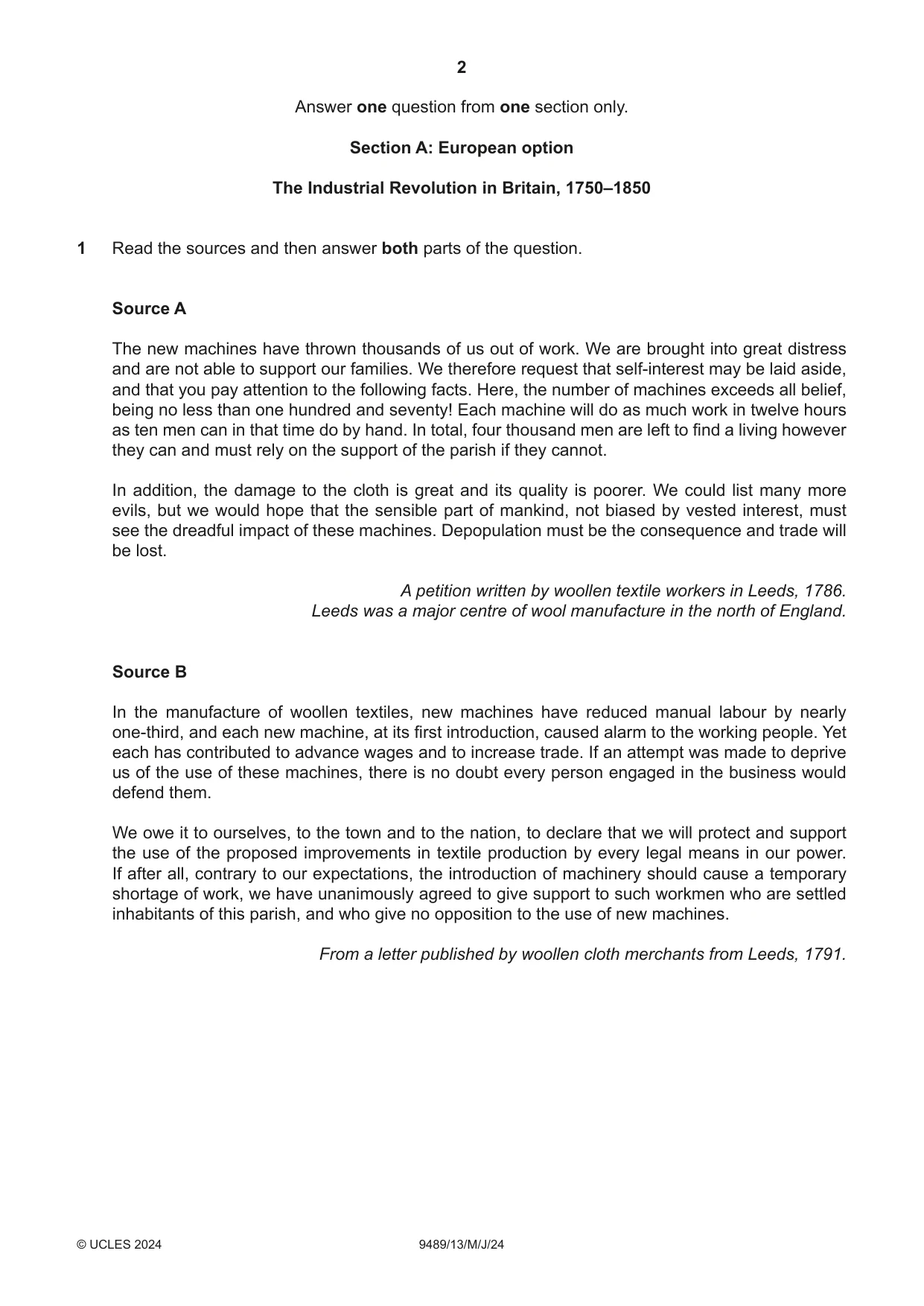
2 9489/13/M/J/24 © UCLES 2024 Answer one question from one section only. Section A: European option The Industrial Revolution in Britain, 1750–1850 1 Read the sources and then answer both parts of the question. Source A The new machines have thrown thousands of us out of work. We are brought into great distress and are not able to support our families. We therefore request that self-interest may be laid aside, and that you pay attention to the following facts. Here, the number of machines exceeds all belief, being no less than one hundred and seventy! Each machine will do as much work in twelve hours as ten men can in that time do by hand. In total, four thousand men are left to find a living however they can and must rely on the support of the parish if they cannot. In addition, the damage to the cloth is great and its quality is poorer. We could list many more evils, but we would hope that the sensible part of mankind, not biased by vested interest, must see the dreadful impact of these machines. Depopulation must be the consequence and trade will be lost. A petition written by woollen textile workers in Leeds, 1786. Leeds was a major centre of wool manufacture in the north of England. Source B In the manufacture of woollen textiles, new machines have reduced manual labour by nearly one-third, and each new machine, at its first introduction, caused alarm to the working people. Yet each has contributed to advance wages and to increase trade. If an attempt was made to deprive us of the use of these machines, there is no doubt every person engaged in the business would defend them. We owe it to ourselves, to the town and to the nation, to declare that we will protect and support the use of the proposed improvements in textile production by every legal means in our power. If after all, contrary to our expectations, the introduction of machinery should cause a temporary shortage of work, we have unanimously agreed to give support to such workmen who are settled inhabitants of this parish, and who give no opposition to the use of new machines. From a letter published by woollen cloth merchants from Leeds, 1791.
Question paper, page 3
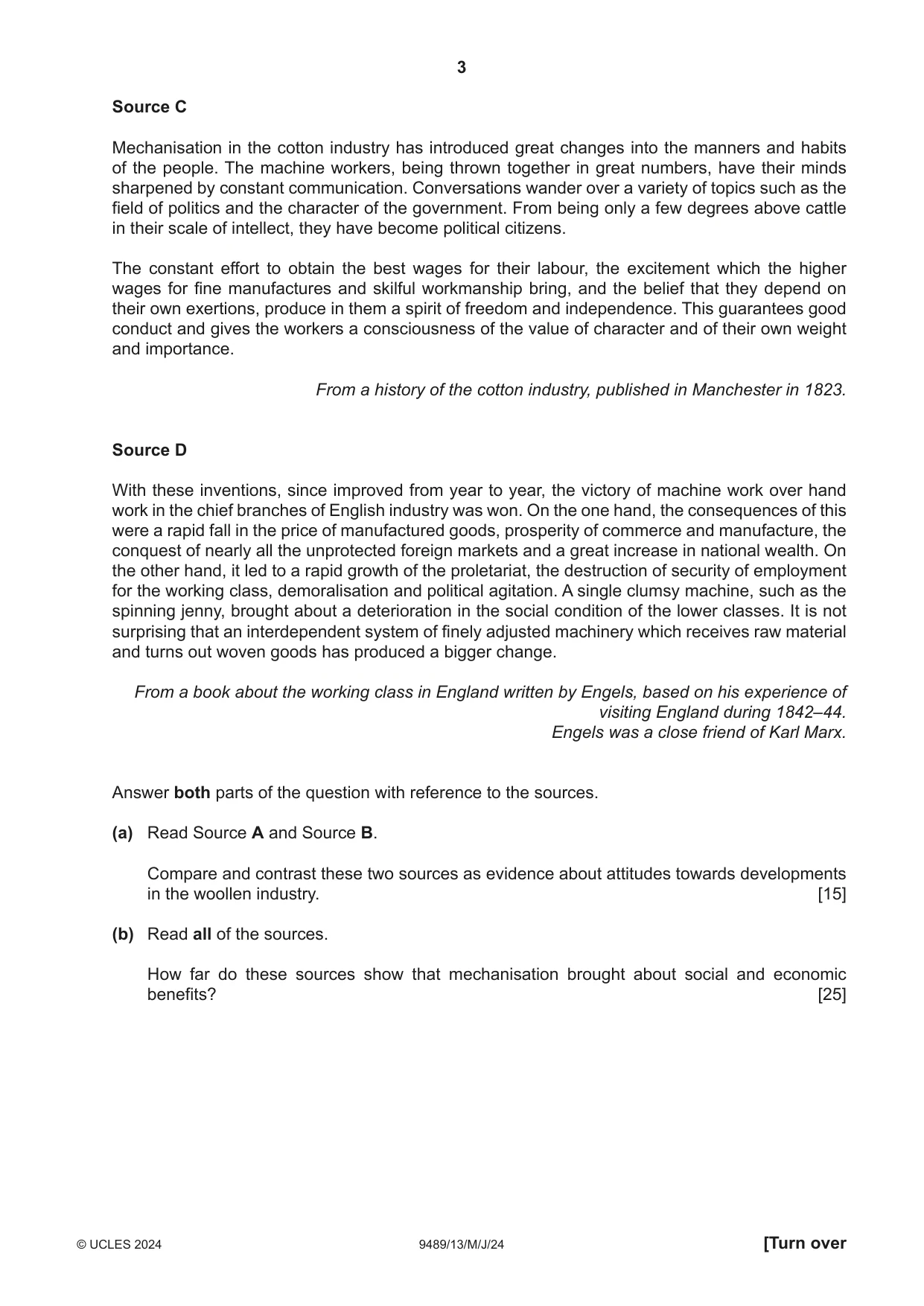
3 9489/13/M/J/24 © UCLES 2024 [Turn over Source C Mechanisation in the cotton industry has introduced great changes into the manners and habits of the people. The machine workers, being thrown together in great numbers, have their minds sharpened by constant communication. Conversations wander over a variety of topics such as the field of politics and the character of the government. From being only a few degrees above cattle in their scale of intellect, they have become political citizens. The constant effort to obtain the best wages for their labour, the excitement which the higher wages for fine manufactures and skilful workmanship bring, and the belief that they depend on their own exertions, produce in them a spirit of freedom and independence. This guarantees good conduct and gives the workers a consciousness of the value of character and of their own weight and importance. From a history of the cotton industry, published in Manchester in 1823. Source D With these inventions, since improved from year to year, the victory of machine work over hand work in the chief branches of English industry was won. On the one hand, the consequences of this were a rapid fall in the price of manufactured goods, prosperity of commerce and manufacture, the conquest of nearly all the unprotected foreign markets and a great increase in national wealth. On the other hand, it led to a rapid growth of the proletariat, the destruction of security of employment for the working class, demoralisation and political agitation. A single clumsy machine, such as the spinning jenny, brought about a deterioration in the social condition of the lower classes. It is not surprising that an interdependent system of finely adjusted machinery which receives raw material and turns out woven goods has produced a bigger change. From a book about the working class in England written by Engels, based on his experience of visiting England during 1842–44. Engels was a close friend of Karl Marx. Answer both parts of the question with reference to the sources. (a) Read Source A and Source B. Compare and contrast these two sources as evidence about attitudes towards developments in the woollen industry. [15] (b) Read all of the sources. How far do these sources show that mechanisation brought about social and economic benefits? [25]
Question paper, page 4
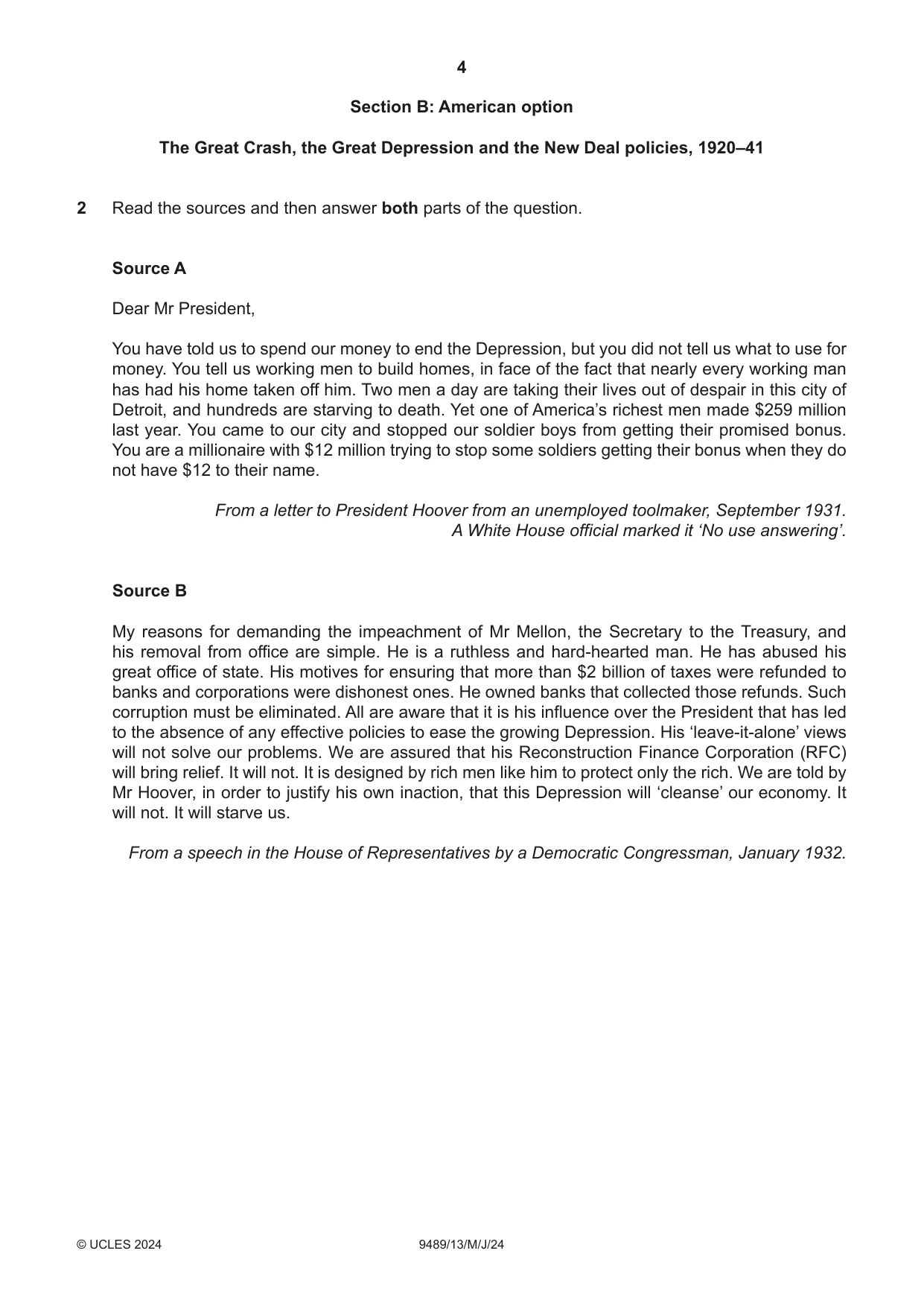
4 9489/13/M/J/24 © UCLES 2024 Section B: American option The Great Crash, the Great Depression and the New Deal policies, 1920–41 2 Read the sources and then answer both parts of the question. Source A Dear Mr President, You have told us to spend our money to end the Depression, but you did not tell us what to use for money. You tell us working men to build homes, in face of the fact that nearly every working man has had his home taken off him. Two men a day are taking their lives out of despair in this city of Detroit, and hundreds are starving to death. Yet one of America’s richest men made $259 million last year. You came to our city and stopped our soldier boys from getting their promised bonus. You are a millionaire with $12 million trying to stop some soldiers getting their bonus when they do not have $12 to their name. From a letter to President Hoover from an unemployed toolmaker, September 1931. A White House official marked it ‘No use answering’. Source B My reasons for demanding the impeachment of Mr Mellon, the Secretary to the Treasury, and his removal from office are simple. He is a ruthless and hard-hearted man. He has abused his great office of state. His motives for ensuring that more than $2 billion of taxes were refunded to banks and corporations were dishonest ones. He owned banks that collected those refunds. Such corruption must be eliminated. All are aware that it is his influence over the President that has led to the absence of any effective policies to ease the growing Depression. His ‘leave-it-alone’ views will not solve our problems. We are assured that his Reconstruction Finance Corporation (RFC) will bring relief. It will not. It is designed by rich men like him to protect only the rich. We are told by Mr Hoover, in order to justify his own inaction, that this Depression will ‘cleanse’ our economy. It will not. It will starve us. From a speech in the House of Representatives by a Democratic Congressman, January 1932.
Question paper, page 5
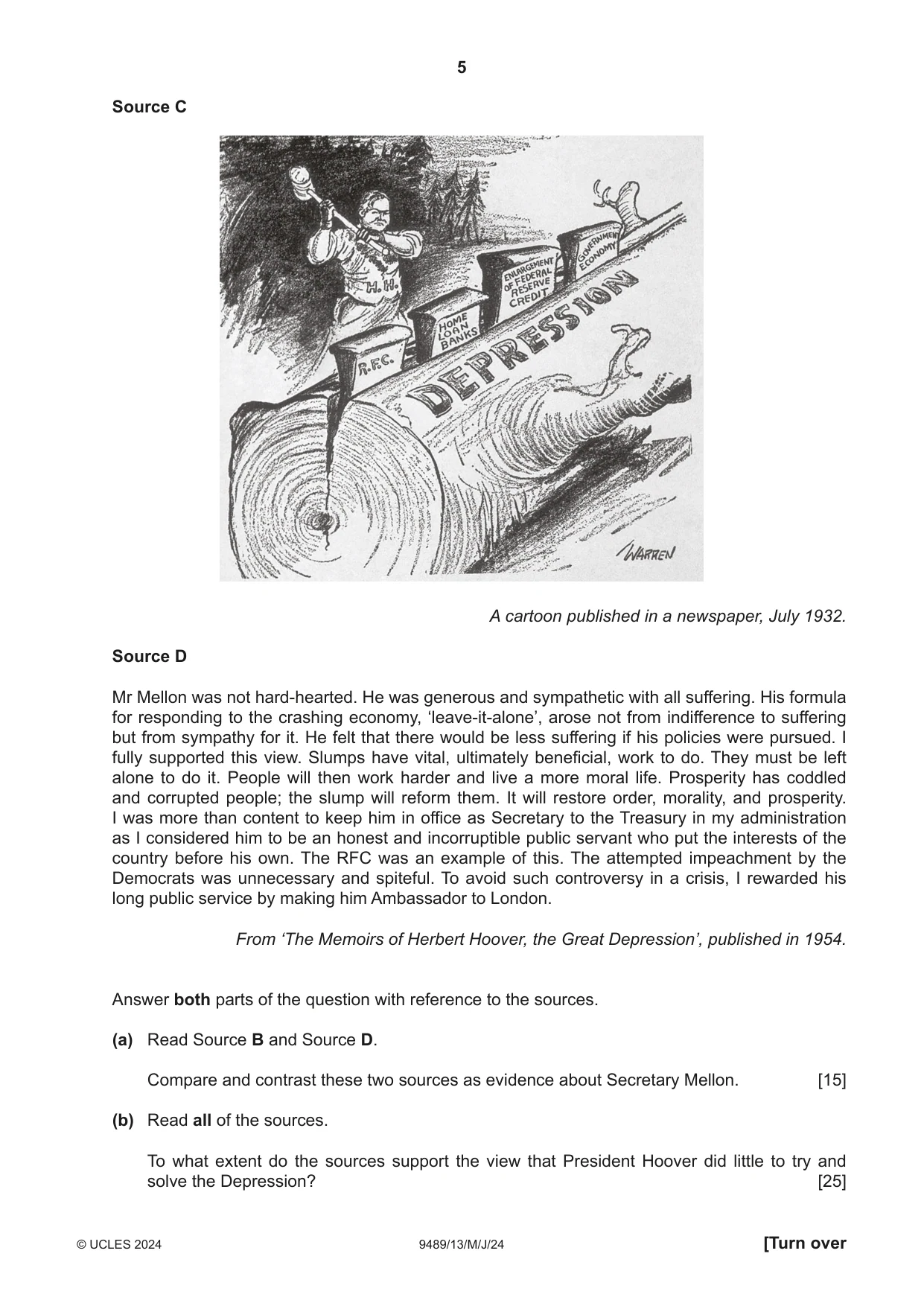
5 9489/13/M/J/24 © UCLES 2024 [Turn over Source C A cartoon published in a newspaper, July 1932. Source D Mr Mellon was not hard-hearted. He was generous and sympathetic with all suffering. His formula for responding to the crashing economy, ‘leave-it-alone’, arose not from indifference to suffering but from sympathy for it. He felt that there would be less suffering if his policies were pursued. I fully supported this view. Slumps have vital, ultimately beneficial, work to do. They must be left alone to do it. People will then work harder and live a more moral life. Prosperity has coddled and corrupted people; the slump will reform them. It will restore order, morality, and prosperity. I was more than content to keep him in office as Secretary to the Treasury in my administration as I considered him to be an honest and incorruptible public servant who put the interests of the country before his own. The RFC was an example of this. The attempted impeachment by the Democrats was unnecessary and spiteful. To avoid such controversy in a crisis, I rewarded his long public service by making him Ambassador to London. From ‘The Memoirs of Herbert Hoover, the Great Depression’, published in 1954. Answer both parts of the question with reference to the sources. (a) Read Source B and Source D. Compare and contrast these two sources as evidence about Secretary Mellon. [15] (b) Read all of the sources. To what extent do the sources support the view that President Hoover did little to try and solve the Depression? [25]
Question paper, page 6
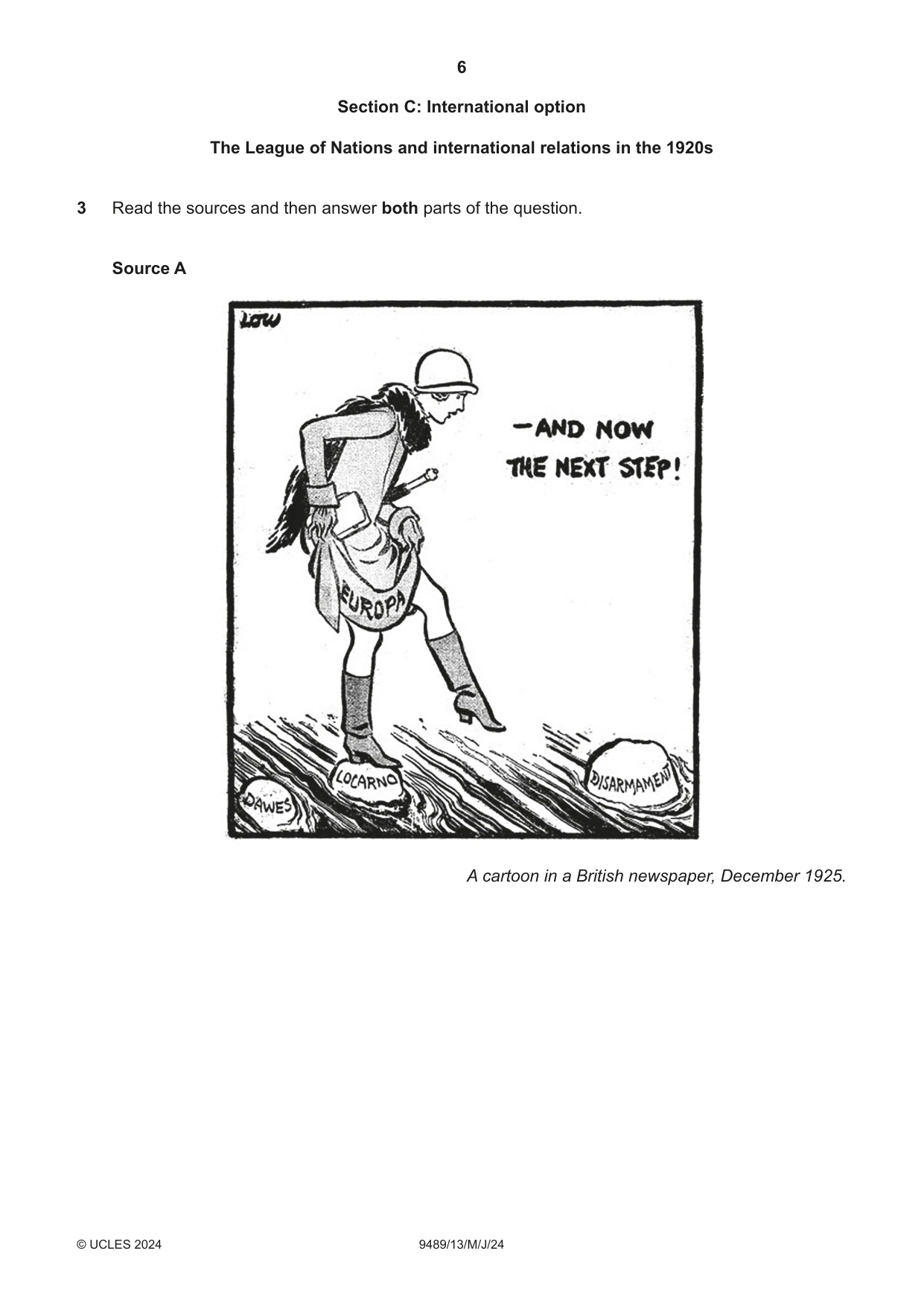
6 9489/13/M/J/24 © UCLES 2024 Section C: International option The League of Nations and international relations in the 1920s 3 Read the sources and then answer both parts of the question. Source A A cartoon in a British newspaper, December 1925.
Question paper, page 7
7 9489/13/M/J/24 © UCLES 2024 [Turn over Source B The Locarno Conference was supposed to have eliminated all the contradictions between the victors and the defeated, but it only aggravated them. There is talk about pacifism, there is talk about peace among the states of Europe. Briand and Chamberlain embrace, Stresemann lavishes compliments on Britain. That is all nonsense. Germany as an armed force no longer exists; she has been disarmed. Nevertheless, the growth of armaments in the victor countries is proceeding as never before. How, for example, is the monstrous growth of the air force in France and of the navy in Britain, America and Japan to be explained? What has the League of Nations done to put a stop to this furious growth of armaments? The rulers of Europe are now trying to cover up this fact with shouting about pacifism. But I have already said what this pacifism is worth. The Bolsheviks have been demanding disarmament ever since the time of Genoa. From an address by Stalin to the Congress of the Communist Party of the Soviet Union, December 1925. Source C The German government and public have followed with great interest the efforts which the League of Nations has made to reduce armaments. Although, until now, these efforts have not succeeded, we hope that this conference will mark the beginning of a new era. The problem is of peculiar and special interest for Germany. In the Treaty of Versailles, the chapter concerning our disarmament is preceded by a declaration to the effect that the object of Germany’s disarmament is to be the first step of a general plan of disarmament to be undertaken by the League of Nations. We have faithfully complied. No accusations made against us by the foreign press have been proved, and in any case, how could a few thousand rifles alter the fact that Germany is disarmed? Our forces lack all the equipment necessary for modern warfare and are no longer sufficient to guarantee national security. From a speech by the German delegate to the committee preparing for the League of Nations Disarmament Conference, May 1926. Source D Russia is involved in the illegal activities of the German army and the associated secret armed groups. A rather disconcerting fact is that in November this year several ships arrived at Stettin from Russia. Their cargoes consisted of arms and ammunition, apparently for the German army. To what extent can the German government be held responsible? These activities were carried out with the knowledge of officers in the German army and some high officials, at least, in the ministry of war. They are consistent with the policy begun by the Germans at Rapallo, but inconsistent with the policies of the present foreign minister, Stresemann. The German government is genuinely concerned by them and determined to end them immediately, so, sensational as they are, they can soon be seen as belonging to the past. From an article by a British newspaper’s correspondent in Germany, December 1926.
Question paper, page 8
8 9489/13/M/J/24 © UCLES 2024 Permission to reproduce items where third-party owned material protected by copyright is included has been sought and cleared where possible. Every reasonable effort has been made by the publisher (UCLES) to trace copyright holders, but if any items requiring clearance have unwittingly been included, the publisher will be pleased to make amends at the earliest possible opportunity. To avoid the issue of disclosure of answer-related information to candidates, all copyright acknowledgements are reproduced online in the Cambridge Assessment International Education Copyright Acknowledgements Booklet. This is produced for each series of examinations and is freely available to download at www.cambridgeinternational.org after the live examination series. Cambridge Assessment International Education is part of Cambridge Assessment. Cambridge Assessment is the brand name of the University of Cambridge Local Examinations Syndicate (UCLES), which is a department of the University of Cambridge. Answer both parts of the question with reference to the sources. (a) Read Source C and Source D. Compare and contrast these two sources as evidence about German disarmament after the Treaty of Versailles. [15] (b) Read all of the sources. ‘Worldwide disarmament was achievable after the agreement at Locarno.’ How far do the sources support this view? [25]
Mark scheme, page 1
This document consists of 14 printed pages. © Cambridge University Press & Assessment 2024 [Turn over Cambridge International AS & A Level HISTORY 9489/13 Paper 1 Document question May/June 2024 MARK SCHEME Maximum Mark: 40 Published This mark scheme is published as an aid to teachers and candidates, to indicate the requirements of the examination. It shows the basis on which Examiners were instructed to award marks. It does not indicate the details of the discussions that took place at an Examiners’ meeting before marking began, which would have considered the acceptability of alternative answers. Mark schemes should be read in conjunction with the question paper and the Principal Examiner Report for Teachers. Cambridge International will not enter into discussions about these mark schemes. Cambridge International is publishing the mark schemes for the May/June 2024 series for most Cambridge IGCSE, Cambridge International A and AS Level and Cambridge Pre-U components, and some Cambridge O Level components.
Mark scheme, page 2
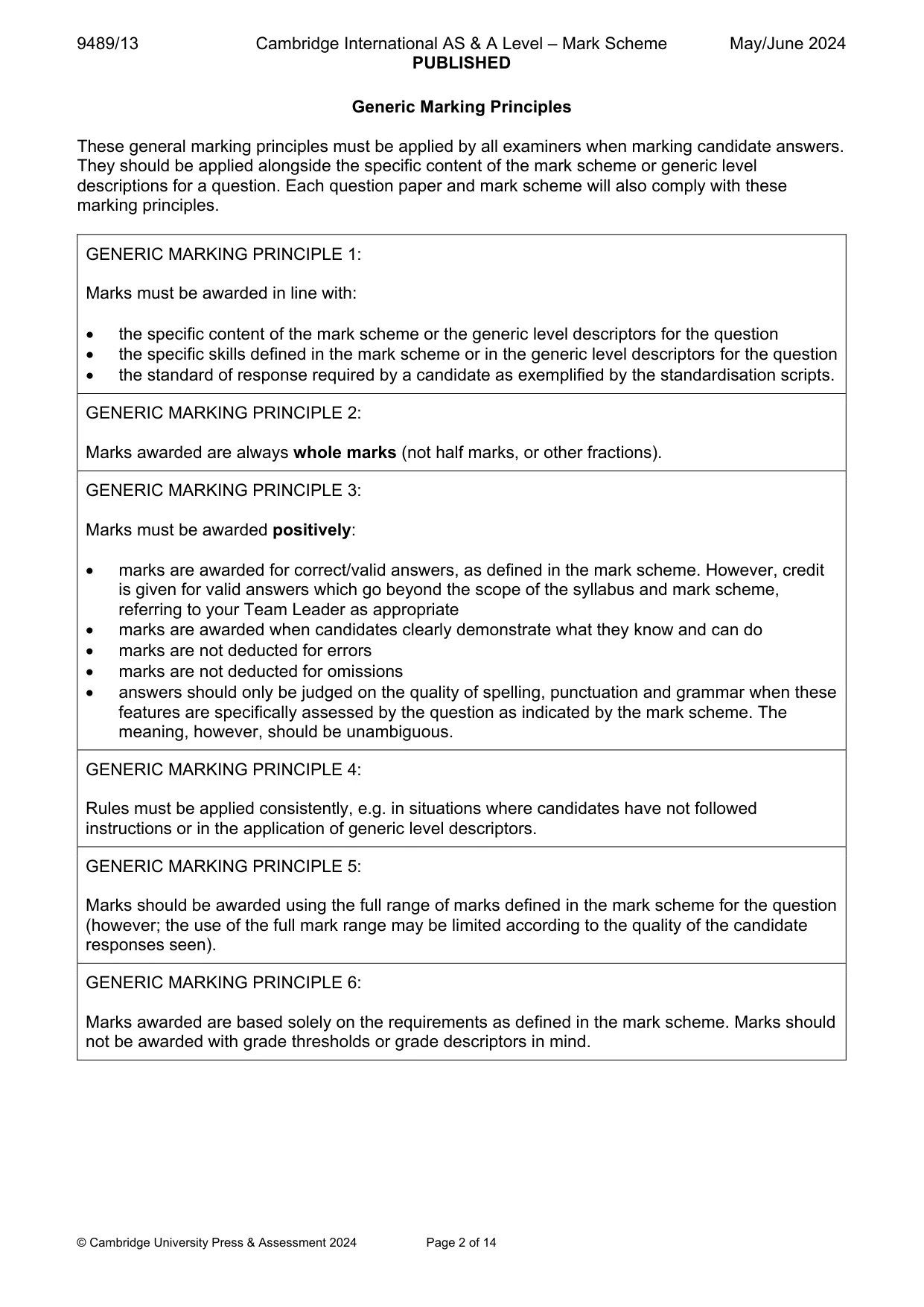
9489/13 Cambridge International AS & A Level – Mark Scheme PUBLISHED May/June 2024 © Cambridge University Press & Assessment 2024 Page 2 of 14 Generic Marking Principles These general marking principles must be applied by all examiners when marking candidate answers. They should be applied alongside the specific content of the mark scheme or generic level descriptions for a question. Each question paper and mark scheme will also comply with these marking principles. GENERIC MARKING PRINCIPLE 1: Marks must be awarded in line with: the specific content of the mark scheme or the generic level descriptors for the question the specific skills defined in the mark scheme or in the generic level descriptors for the question the standard of response required by a candidate as exemplified by the standardisation scripts. GENERIC MARKING PRINCIPLE 2: Marks awarded are always whole marks (not half marks, or other fractions). GENERIC MARKING PRINCIPLE 3: Marks must be awarded positively: marks are awarded for correct/valid answers, as defined in the mark scheme. However, credit is given for valid answers which go beyond the scope of the syllabus and mark scheme, referring to your Team Leader as appropriate marks are awarded when candidates clearly demonstrate what they know and can do marks are not deducted for errors marks are not deducted for omissions answers should only be judged on the quality of spelling, punctuation and grammar when these features are specifically assessed by the question as indicated by the mark scheme. The meaning, however, should be unambiguous. GENERIC MARKING PRINCIPLE 4: Rules must be applied consistently, e.g. in situations where candidates have not followed instructions or in the application of generic level descriptors. GENERIC MARKING PRINCIPLE 5: Marks should be awarded using the full range of marks defined in the mark scheme for the question (however; the use of the full mark range may be limited according to the quality of the candidate responses seen). GENERIC MARKING PRINCIPLE 6: Marks awarded are based solely on the requirements as defined in the mark scheme. Marks should not be awarded with grade thresholds or grade descriptors in mind.
Mark scheme, page 3
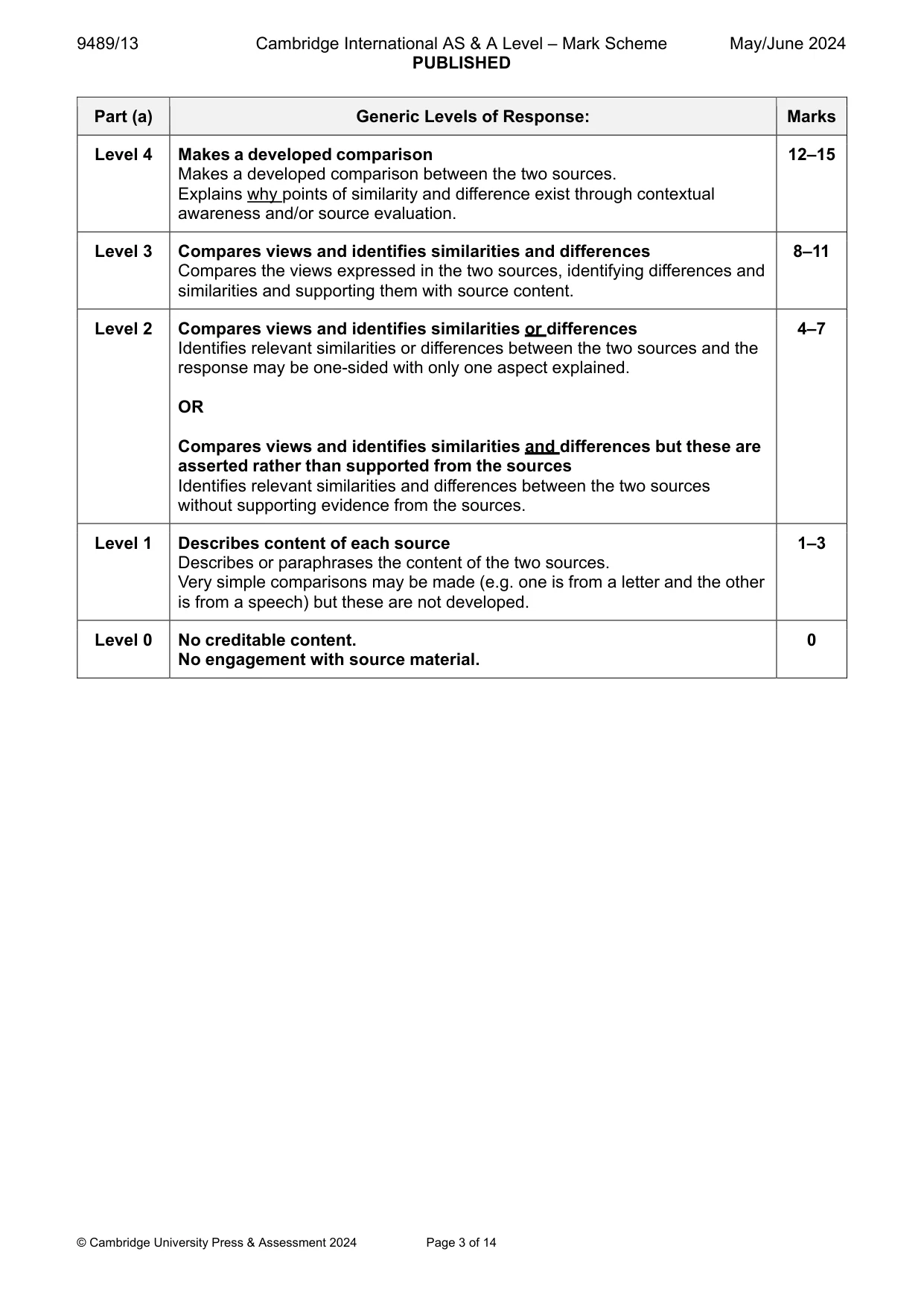
9489/13 Cambridge International AS & A Level – Mark Scheme PUBLISHED May/June 2024 © Cambridge University Press & Assessment 2024 Page 3 of 14 Part (a) Generic Levels of Response: Marks Level 4 Makes a developed comparison Makes a developed comparison between the two sources. Explains why points of similarity and difference exist through contextual awareness and/or source evaluation. 12–15 Level 3 Compares views and identifies similarities and differences Compares the views expressed in the two sources, identifying differences and similarities and supporting them with source content. 8–11 Level 2 Compares views and identifies similarities or differences Identifies relevant similarities or differences between the two sources and the response may be one-sided with only one aspect explained. OR Compares views and identifies similarities and differences but these are asserted rather than supported from the sources Identifies relevant similarities and differences between the two sources without supporting evidence from the sources. 4–7 Level 1 Describes content of each source Describes or paraphrases the content of the two sources. Very simple comparisons may be made (e.g. one is from a letter and the other is from a speech) but these are not developed. 1–3 Level 0 No creditable content. No engagement with source material. 0
Mark scheme, page 4
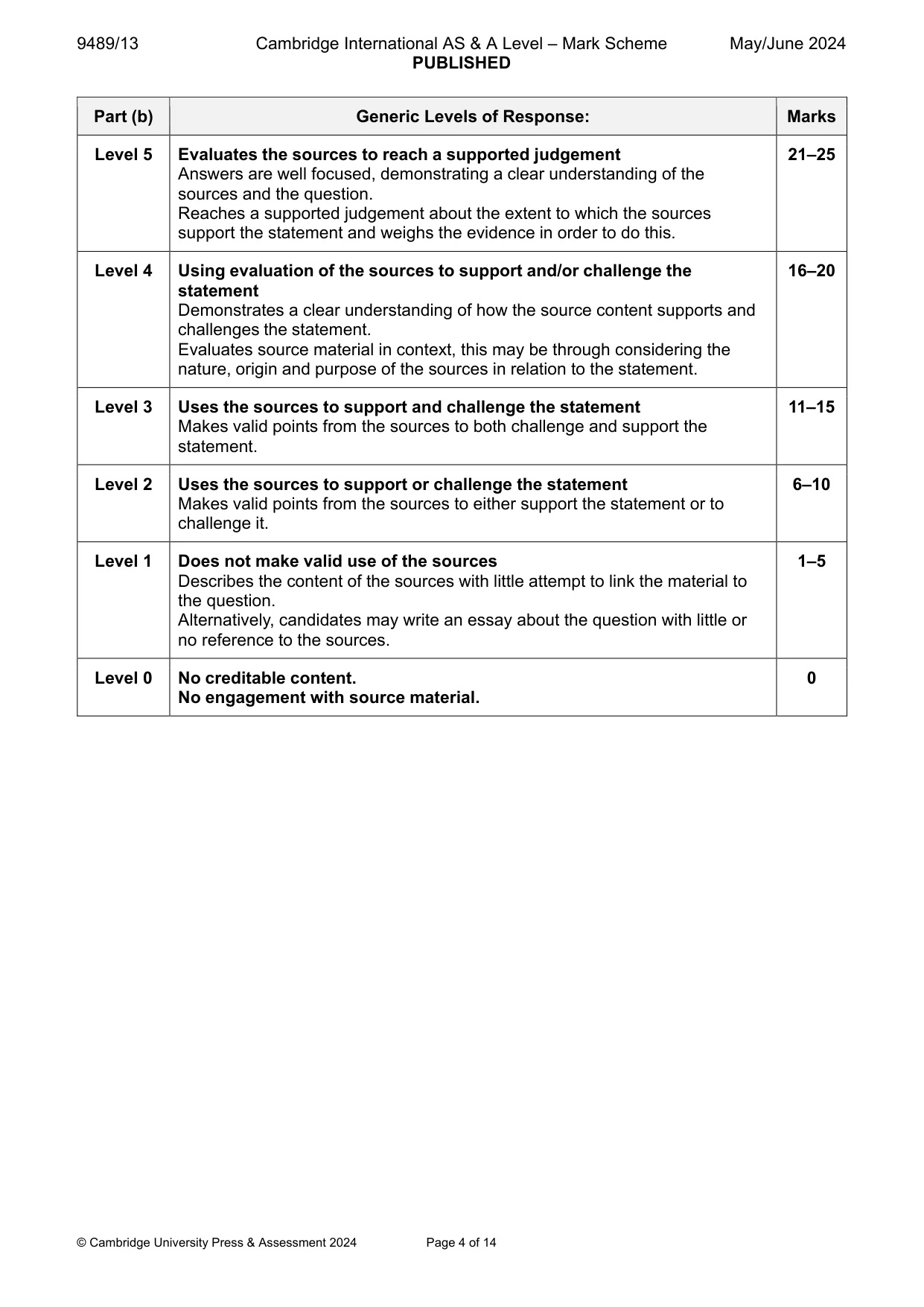
9489/13 Cambridge International AS & A Level – Mark Scheme PUBLISHED May/June 2024 © Cambridge University Press & Assessment 2024 Page 4 of 14 Part (b) Generic Levels of Response: Marks Level 5 Evaluates the sources to reach a supported judgement Answers are well focused, demonstrating a clear understanding of the sources and the question. Reaches a supported judgement about the extent to which the sources support the statement and weighs the evidence in order to do this. 21–25 Level 4 Using evaluation of the sources to support and/or challenge the statement Demonstrates a clear understanding of how the source content supports and challenges the statement. Evaluates source material in context, this may be through considering the nature, origin and purpose of the sources in relation to the statement. 16–20 Level 3 Uses the sources to support and challenge the statement Makes valid points from the sources to both challenge and support the statement. 11–15 Level 2 Uses the sources to support or challenge the statement Makes valid points from the sources to either support the statement or to challenge it. 6–10 Level 1 Does not make valid use of the sources Describes the content of the sources with little attempt to link the material to the question. Alternatively, candidates may write an essay about the question with little or no reference to the sources. 1–5 Level 0 No creditable content. No engagement with source material. 0
Mark scheme, page 5
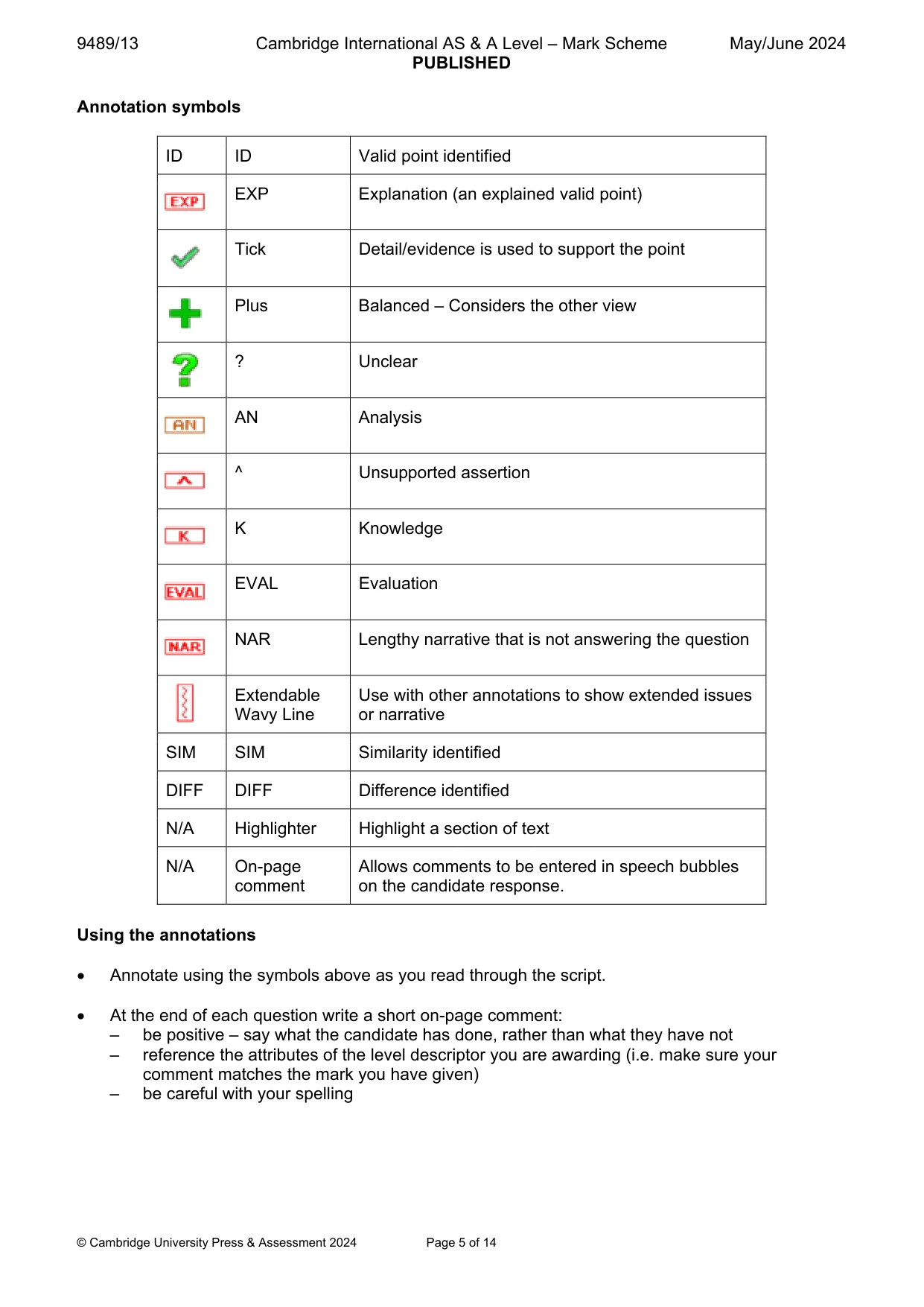
9489/13 Cambridge International AS & A Level – Mark Scheme PUBLISHED May/June 2024 © Cambridge University Press & Assessment 2024 Page 5 of 14 Annotation symbols ID ID Valid point identified EXP Explanation (an explained valid point) Tick Detail/evidence is used to support the point Plus Balanced – Considers the other view ? Unclear AN Analysis ^ Unsupported assertion K Knowledge EVAL Evaluation NAR Lengthy narrative that is not answering the question Extendable Wavy Line Use with other annotations to show extended issues or narrative SIM SIM Similarity identified DIFF DIFF Difference identified N/A Highlighter Highlight a section of text N/A On-page comment Allows comments to be entered in speech bubbles on the candidate response. Using the annotations Annotate using the symbols above as you read through the script. At the end of each question write a short on-page comment: – be positive – say what the candidate has done, rather than what they have not – reference the attributes of the level descriptor you are awarding (i.e. make sure your comment matches the mark you have given) – be careful with your spelling
Mark scheme, page 6
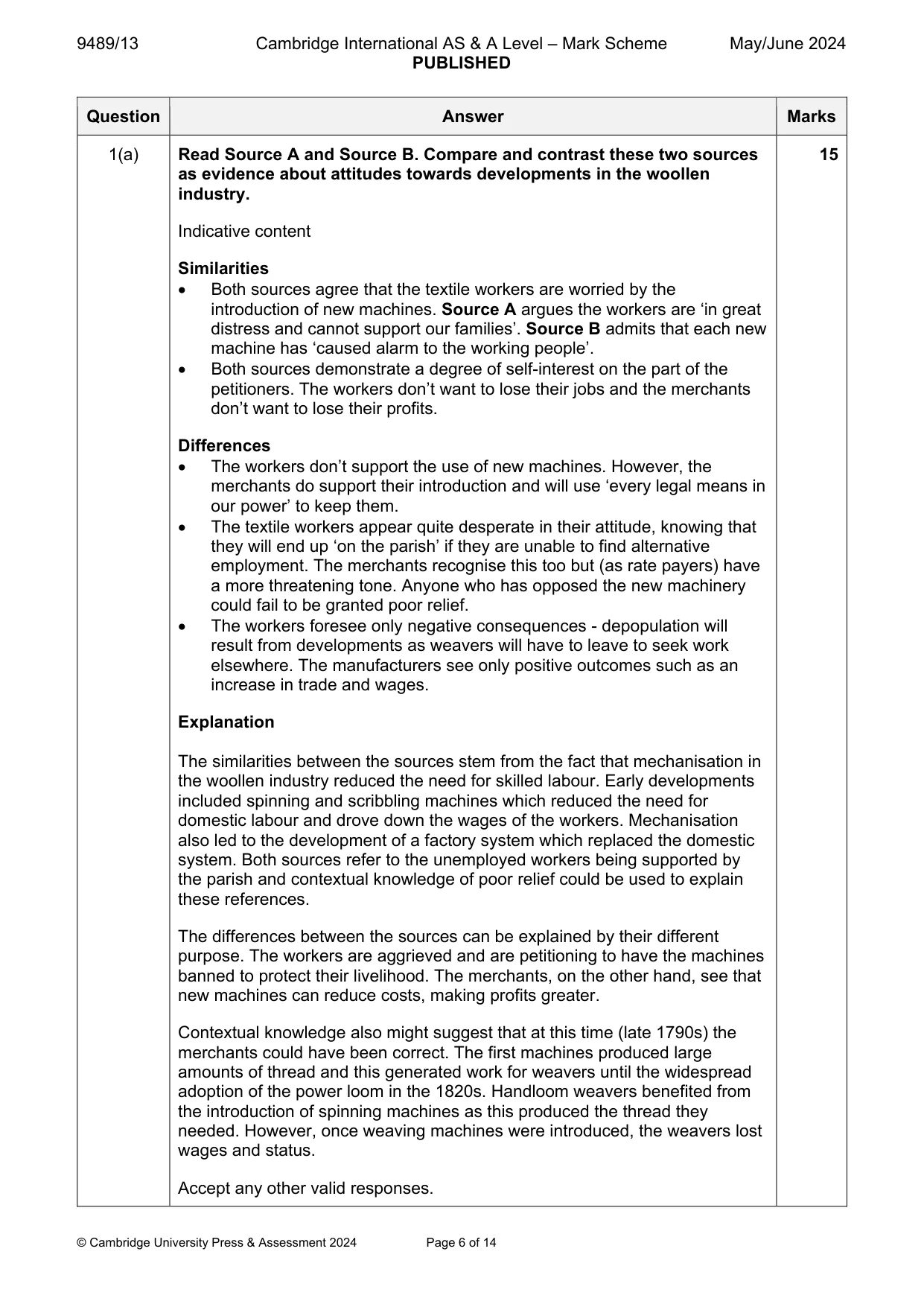
9489/13 Cambridge International AS & A Level – Mark Scheme PUBLISHED May/June 2024 © Cambridge University Press & Assessment 2024 Page 6 of 14 Question Answer Marks 1(a) Read Source A and Source B. Compare and contrast these two sources as evidence about attitudes towards developments in the woollen industry. Indicative content Similarities Both sources agree that the textile workers are worried by the introduction of new machines. Source A argues the workers are ‘in great distress and cannot support our families’. Source B admits that each new machine has ‘caused alarm to the working people’. Both sources demonstrate a degree of self-interest on the part of the petitioners. The workers don’t want to lose their jobs and the merchants don’t want to lose their profits. Differences The workers don’t support the use of new machines. However, the merchants do support their introduction and will use ‘every legal means in our power’ to keep them. The textile workers appear quite desperate in their attitude, knowing that they will end up ‘on the parish’ if they are unable to find alternative employment. The merchants recognise this too but (as rate payers) have a more threatening tone. Anyone who has opposed the new machinery could fail to be granted poor relief. The workers foresee only negative consequences - depopulation will result from developments as weavers will have to leave to seek work elsewhere. The manufacturers see only positive outcomes such as an increase in trade and wages. Explanation The similarities between the sources stem from the fact that mechanisation in the woollen industry reduced the need for skilled labour. Early developments included spinning and scribbling machines which reduced the need for domestic labour and drove down the wages of the workers. Mechanisation also led to the development of a factory system which replaced the domestic system. Both sources refer to the unemployed workers being supported by the parish and contextual knowledge of poor relief could be used to explain these references. The differences between the sources can be explained by their different purpose. The workers are aggrieved and are petitioning to have the machines banned to protect their livelihood. The merchants, on the other hand, see that new machines can reduce costs, making profits greater. Contextual knowledge also might suggest that at this time (late 1790s) the merchants could have been correct. The first machines produced large amounts of thread and this generated work for weavers until the widespread adoption of the power loom in the 1820s. Handloom weavers benefited from the introduction of spinning machines as this produced the thread they needed. However, once weaving machines were introduced, the weavers lost wages and status. Accept any other valid responses. 15
Mark scheme, page 7
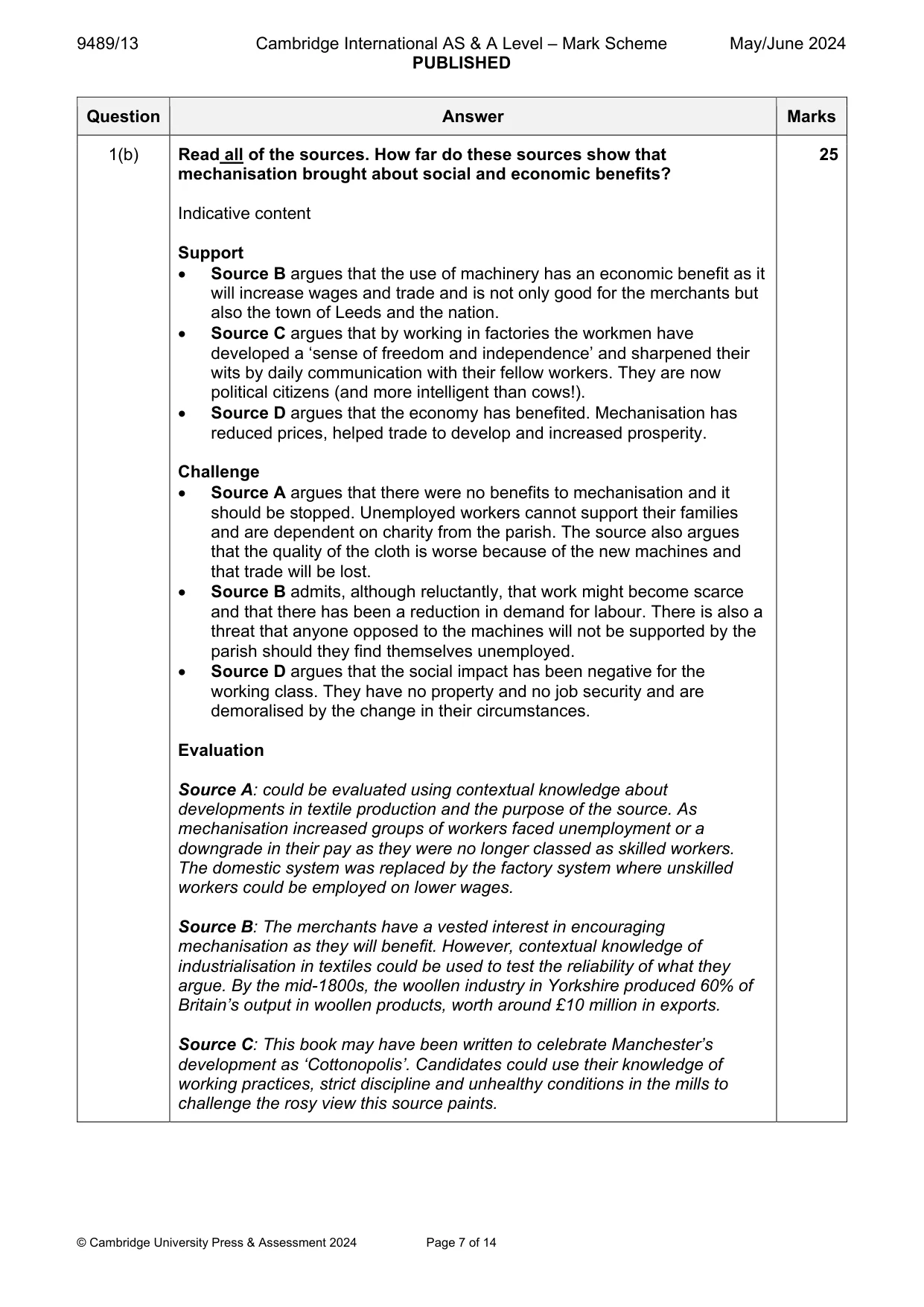
9489/13 Cambridge International AS & A Level – Mark Scheme PUBLISHED May/June 2024 © Cambridge University Press & Assessment 2024 Page 7 of 14 Question Answer Marks 1(b) Read all of the sources. How far do these sources show that mechanisation brought about social and economic benefits? Indicative content Support Source B argues that the use of machinery has an economic benefit as it will increase wages and trade and is not only good for the merchants but also the town of Leeds and the nation. Source C argues that by working in factories the workmen have developed a ‘sense of freedom and independence’ and sharpened their wits by daily communication with their fellow workers. They are now political citizens (and more intelligent than cows!). Source D argues that the economy has benefited. Mechanisation has reduced prices, helped trade to develop and increased prosperity. Challenge Source A argues that there were no benefits to mechanisation and it should be stopped. Unemployed workers cannot support their families and are dependent on charity from the parish. The source also argues that the quality of the cloth is worse because of the new machines and that trade will be lost. Source B admits, although reluctantly, that work might become scarce and that there has been a reduction in demand for labour. There is also a threat that anyone opposed to the machines will not be supported by the parish should they find themselves unemployed. Source D argues that the social impact has been negative for the working class. They have no property and no job security and are demoralised by the change in their circumstances. Evaluation Source A: could be evaluated using contextual knowledge about developments in textile production and the purpose of the source. As mechanisation increased groups of workers faced unemployment or a downgrade in their pay as they were no longer classed as skilled workers. The domestic system was replaced by the factory system where unskilled workers could be employed on lower wages. Source B: The merchants have a vested interest in encouraging mechanisation as they will benefit. However, contextual knowledge of industrialisation in textiles could be used to test the reliability of what they argue. By the mid-1800s, the woollen industry in Yorkshire produced 60% of Britain’s output in woollen products, worth around £10 million in exports. Source C: This book may have been written to celebrate Manchester’s development as ‘Cottonopolis’. Candidates could use their knowledge of working practices, strict discipline and unhealthy conditions in the mills to challenge the rosy view this source paints. 25
Mark scheme, page 8
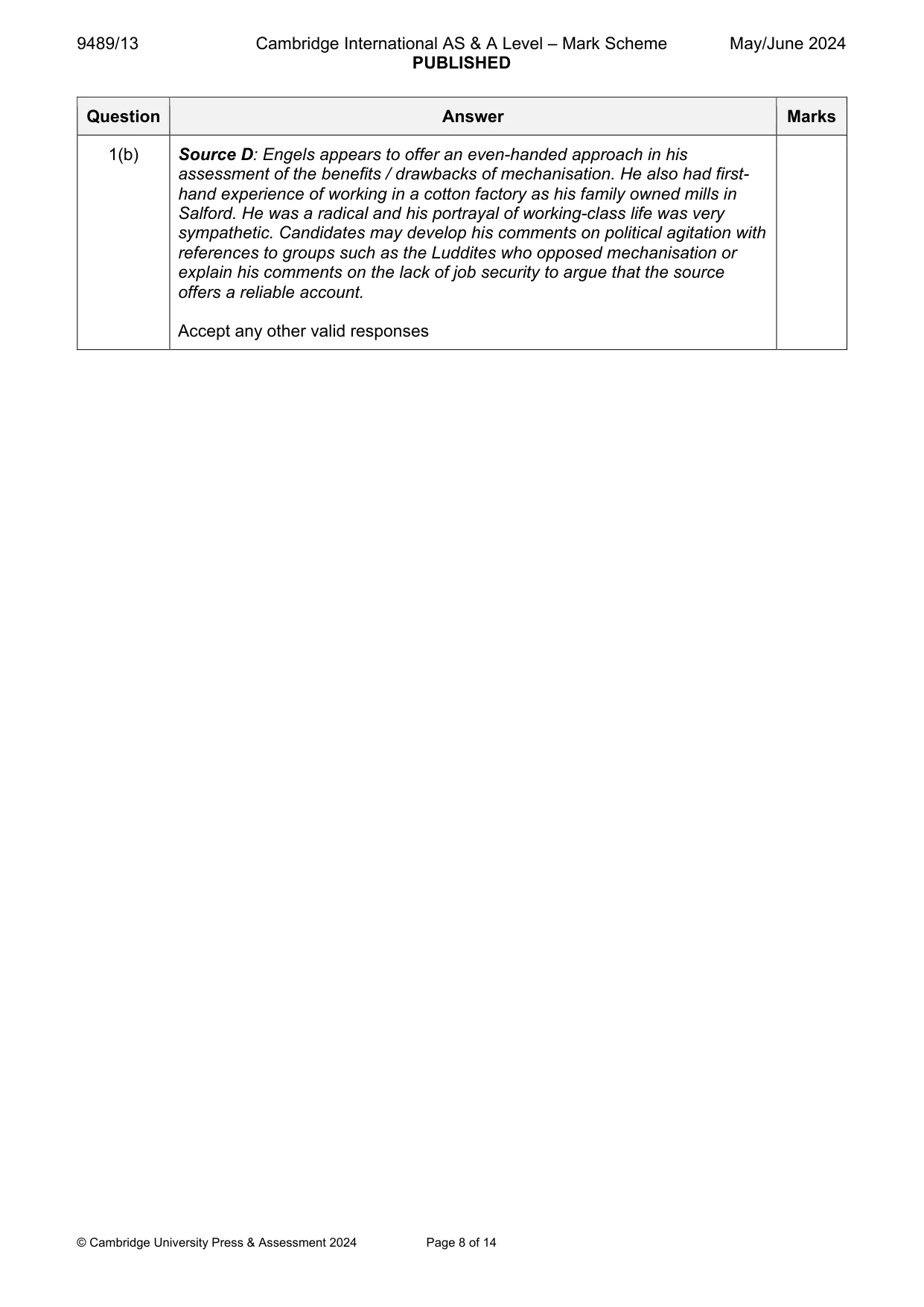
9489/13 Cambridge International AS & A Level – Mark Scheme PUBLISHED May/June 2024 © Cambridge University Press & Assessment 2024 Page 8 of 14 Question Answer Marks 1(b) Source D: Engels appears to offer an even-handed approach in his assessment of the benefits / drawbacks of mechanisation. He also had first- hand experience of working in a cotton factory as his family owned mills in Salford. He was a radical and his portrayal of working-class life was very sympathetic. Candidates may develop his comments on political agitation with references to groups such as the Luddites who opposed mechanisation or explain his comments on the lack of job security to argue that the source offers a reliable account. Accept any other valid responses
Mark scheme, page 9
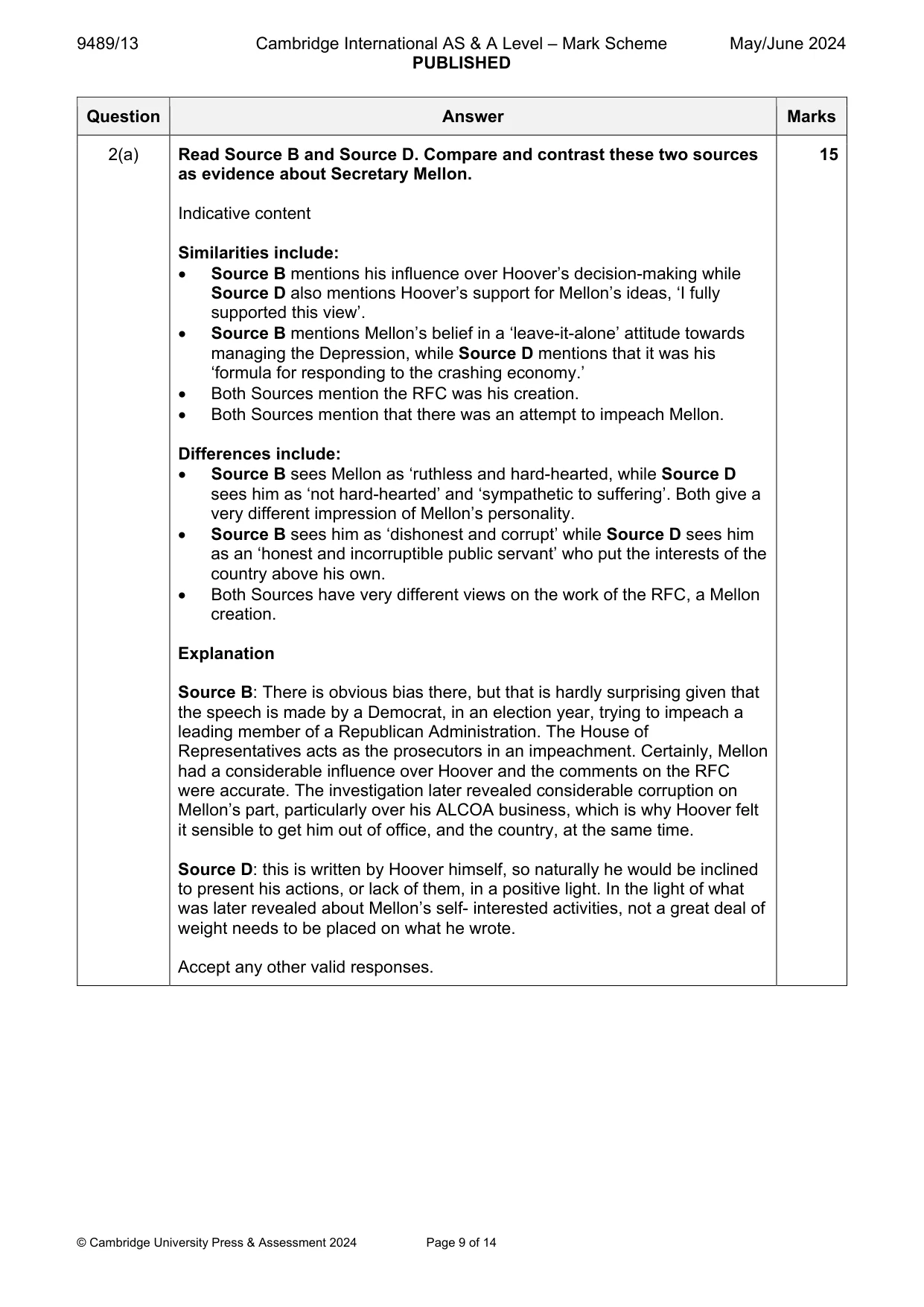
9489/13 Cambridge International AS & A Level – Mark Scheme PUBLISHED May/June 2024 © Cambridge University Press & Assessment 2024 Page 9 of 14 Question Answer Marks 2(a) Read Source B and Source D. Compare and contrast these two sources as evidence about Secretary Mellon. Indicative content Similarities include: Source B mentions his influence over Hoover’s decision-making while Source D also mentions Hoover’s support for Mellon’s ideas, ‘I fully supported this view’. Source B mentions Mellon’s belief in a ‘leave-it-alone’ attitude towards managing the Depression, while Source D mentions that it was his ‘formula for responding to the crashing economy.’ Both Sources mention the RFC was his creation. Both Sources mention that there was an attempt to impeach Mellon. Differences include: Source B sees Mellon as ‘ruthless and hard-hearted, while Source D sees him as ‘not hard-hearted’ and ‘sympathetic to suffering’. Both give a very different impression of Mellon’s personality. Source B sees him as ‘dishonest and corrupt’ while Source D sees him as an ‘honest and incorruptible public servant’ who put the interests of the country above his own. Both Sources have very different views on the work of the RFC, a Mellon creation. Explanation Source B: There is obvious bias there, but that is hardly surprising given that the speech is made by a Democrat, in an election year, trying to impeach a leading member of a Republican Administration. The House of Representatives acts as the prosecutors in an impeachment. Certainly, Mellon had a considerable influence over Hoover and the comments on the RFC were accurate. The investigation later revealed considerable corruption on Mellon’s part, particularly over his ALCOA business, which is why Hoover felt it sensible to get him out of office, and the country, at the same time. Source D: this is written by Hoover himself, so naturally he would be inclined to present his actions, or lack of them, in a positive light. In the light of what was later revealed about Mellon’s self- interested activities, not a great deal of weight needs to be placed on what he wrote. Accept any other valid responses. 15
Mark scheme, page 10
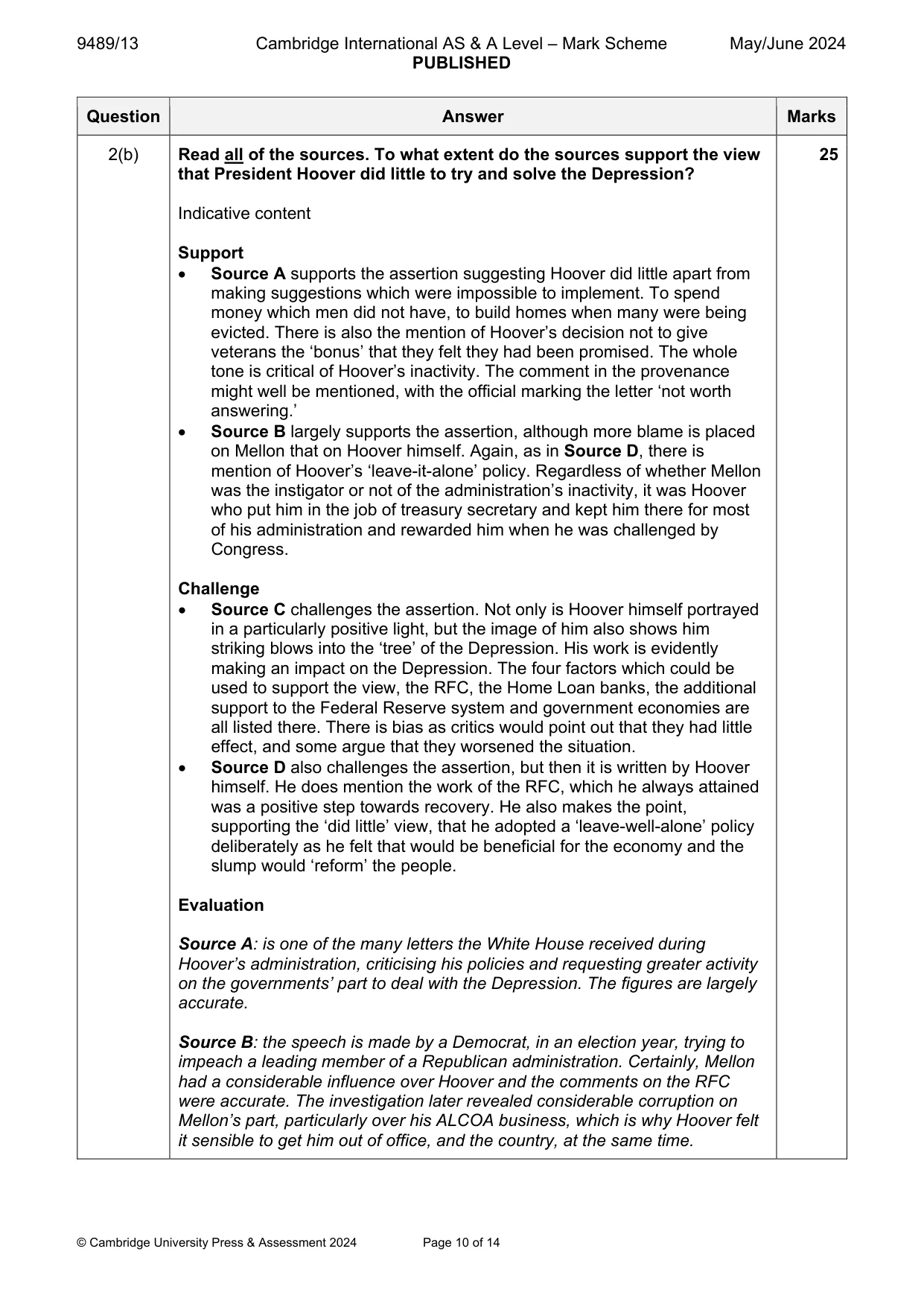
9489/13 Cambridge International AS & A Level – Mark Scheme PUBLISHED May/June 2024 © Cambridge University Press & Assessment 2024 Page 10 of 14 Question Answer Marks 2(b) Read all of the sources. To what extent do the sources support the view that President Hoover did little to try and solve the Depression? Indicative content Support Source A supports the assertion suggesting Hoover did little apart from making suggestions which were impossible to implement. To spend money which men did not have, to build homes when many were being evicted. There is also the mention of Hoover’s decision not to give veterans the ‘bonus’ that they felt they had been promised. The whole tone is critical of Hoover’s inactivity. The comment in the provenance might well be mentioned, with the official marking the letter ‘not worth answering.’ Source B largely supports the assertion, although more blame is placed on Mellon that on Hoover himself. Again, as in Source D, there is mention of Hoover’s ‘leave-it-alone’ policy. Regardless of whether Mellon was the instigator or not of the administration’s inactivity, it was Hoover who put him in the job of treasury secretary and kept him there for most of his administration and rewarded him when he was challenged by Congress. Challenge Source C challenges the assertion. Not only is Hoover himself portrayed in a particularly positive light, but the image of him also shows him striking blows into the ‘tree’ of the Depression. His work is evidently making an impact on the Depression. The four factors which could be used to support the view, the RFC, the Home Loan banks, the additional support to the Federal Reserve system and government economies are all listed there. There is bias as critics would point out that they had little effect, and some argue that they worsened the situation. Source D also challenges the assertion, but then it is written by Hoover himself. He does mention the work of the RFC, which he always attained was a positive step towards recovery. He also makes the point, supporting the ‘did little’ view, that he adopted a ‘leave-well-alone’ policy deliberately as he felt that would be beneficial for the economy and the slump would ‘reform’ the people. Evaluation Source A: is one of the many letters the White House received during Hoover’s administration, criticising his policies and requesting greater activity on the governments’ part to deal with the Depression. The figures are largely accurate. Source B: the speech is made by a Democrat, in an election year, trying to impeach a leading member of a Republican administration. Certainly, Mellon had a considerable influence over Hoover and the comments on the RFC were accurate. The investigation later revealed considerable corruption on Mellon’s part, particularly over his ALCOA business, which is why Hoover felt it sensible to get him out of office, and the country, at the same time. 25
Mark scheme, page 11
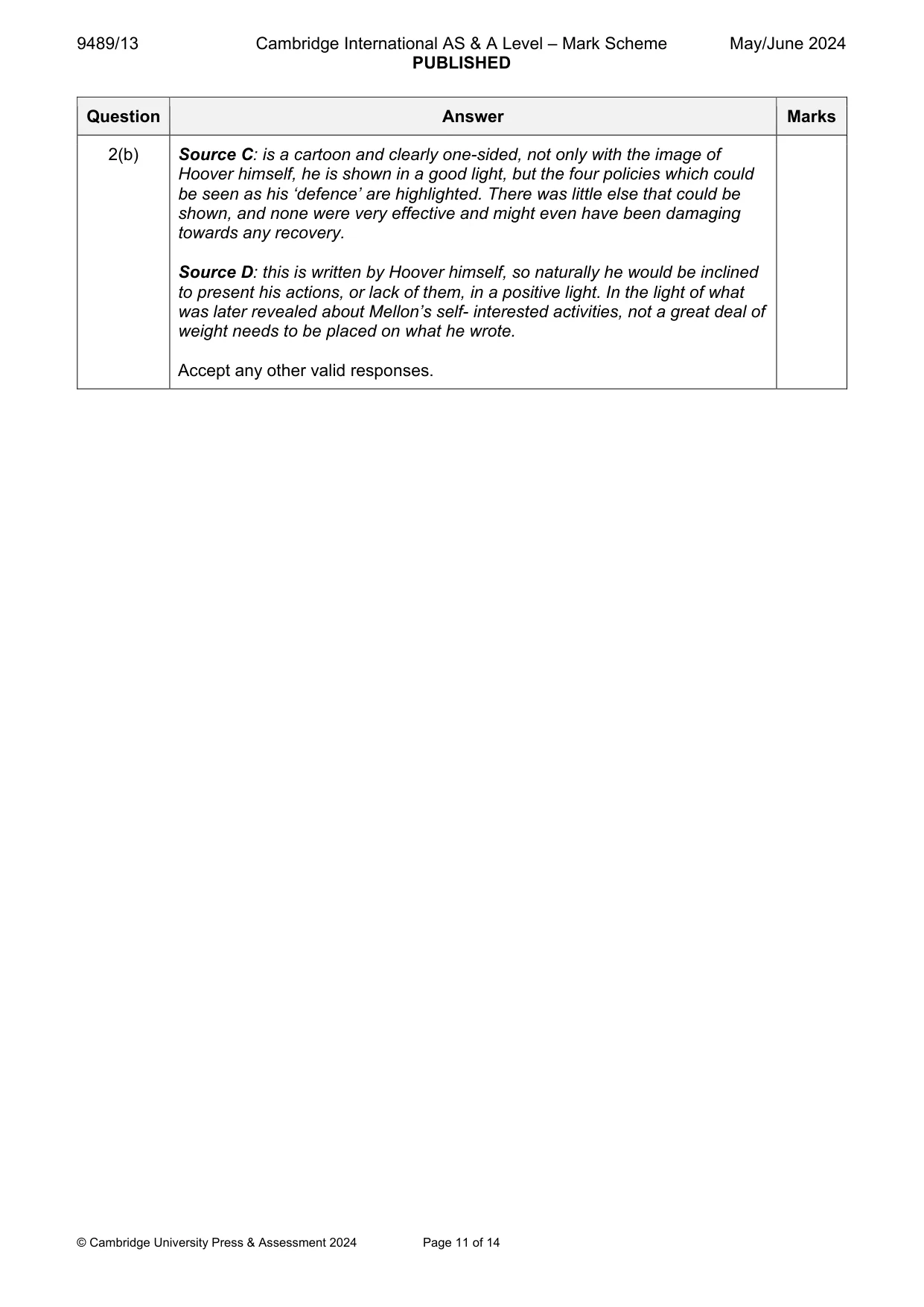
9489/13 Cambridge International AS & A Level – Mark Scheme PUBLISHED May/June 2024 © Cambridge University Press & Assessment 2024 Page 11 of 14 Question Answer Marks 2(b) Source C: is a cartoon and clearly one-sided, not only with the image of Hoover himself, he is shown in a good light, but the four policies which could be seen as his ‘defence’ are highlighted. There was little else that could be shown, and none were very effective and might even have been damaging towards any recovery. Source D: this is written by Hoover himself, so naturally he would be inclined to present his actions, or lack of them, in a positive light. In the light of what was later revealed about Mellon’s self- interested activities, not a great deal of weight needs to be placed on what he wrote. Accept any other valid responses.
Mark scheme, page 12
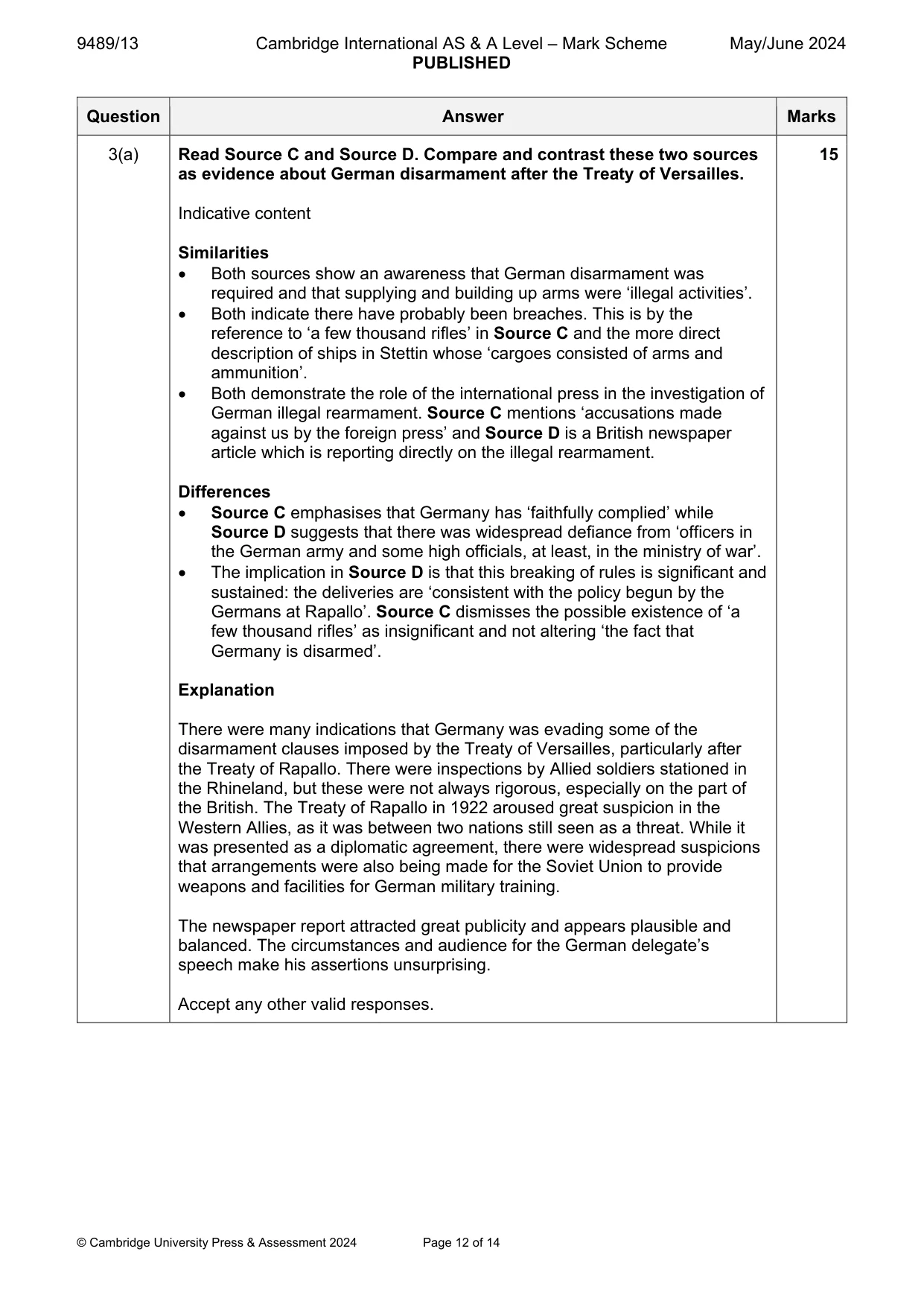
9489/13 Cambridge International AS & A Level – Mark Scheme PUBLISHED May/June 2024 © Cambridge University Press & Assessment 2024 Page 12 of 14 Question Answer Marks 3(a) Read Source C and Source D. Compare and contrast these two sources as evidence about German disarmament after the Treaty of Versailles. Indicative content Similarities Both sources show an awareness that German disarmament was required and that supplying and building up arms were ‘illegal activities’. Both indicate there have probably been breaches. This is by the reference to ‘a few thousand rifles’ in Source C and the more direct description of ships in Stettin whose ‘cargoes consisted of arms and ammunition’. Both demonstrate the role of the international press in the investigation of German illegal rearmament. Source C mentions ‘accusations made against us by the foreign press’ and Source D is a British newspaper article which is reporting directly on the illegal rearmament. Differences Source C emphasises that Germany has ‘faithfully complied’ while Source D suggests that there was widespread defiance from ‘officers in the German army and some high officials, at least, in the ministry of war’. The implication in Source D is that this breaking of rules is significant and sustained: the deliveries are ‘consistent with the policy begun by the Germans at Rapallo’. Source C dismisses the possible existence of ‘a few thousand rifles’ as insignificant and not altering ‘the fact that Germany is disarmed’. Explanation There were many indications that Germany was evading some of the disarmament clauses imposed by the Treaty of Versailles, particularly after the Treaty of Rapallo. There were inspections by Allied soldiers stationed in the Rhineland, but these were not always rigorous, especially on the part of the British. The Treaty of Rapallo in 1922 aroused great suspicion in the Western Allies, as it was between two nations still seen as a threat. While it was presented as a diplomatic agreement, there were widespread suspicions that arrangements were also being made for the Soviet Union to provide weapons and facilities for German military training. The newspaper report attracted great publicity and appears plausible and balanced. The circumstances and audience for the German delegate’s speech make his assertions unsurprising. Accept any other valid responses. 15
Mark scheme, page 13
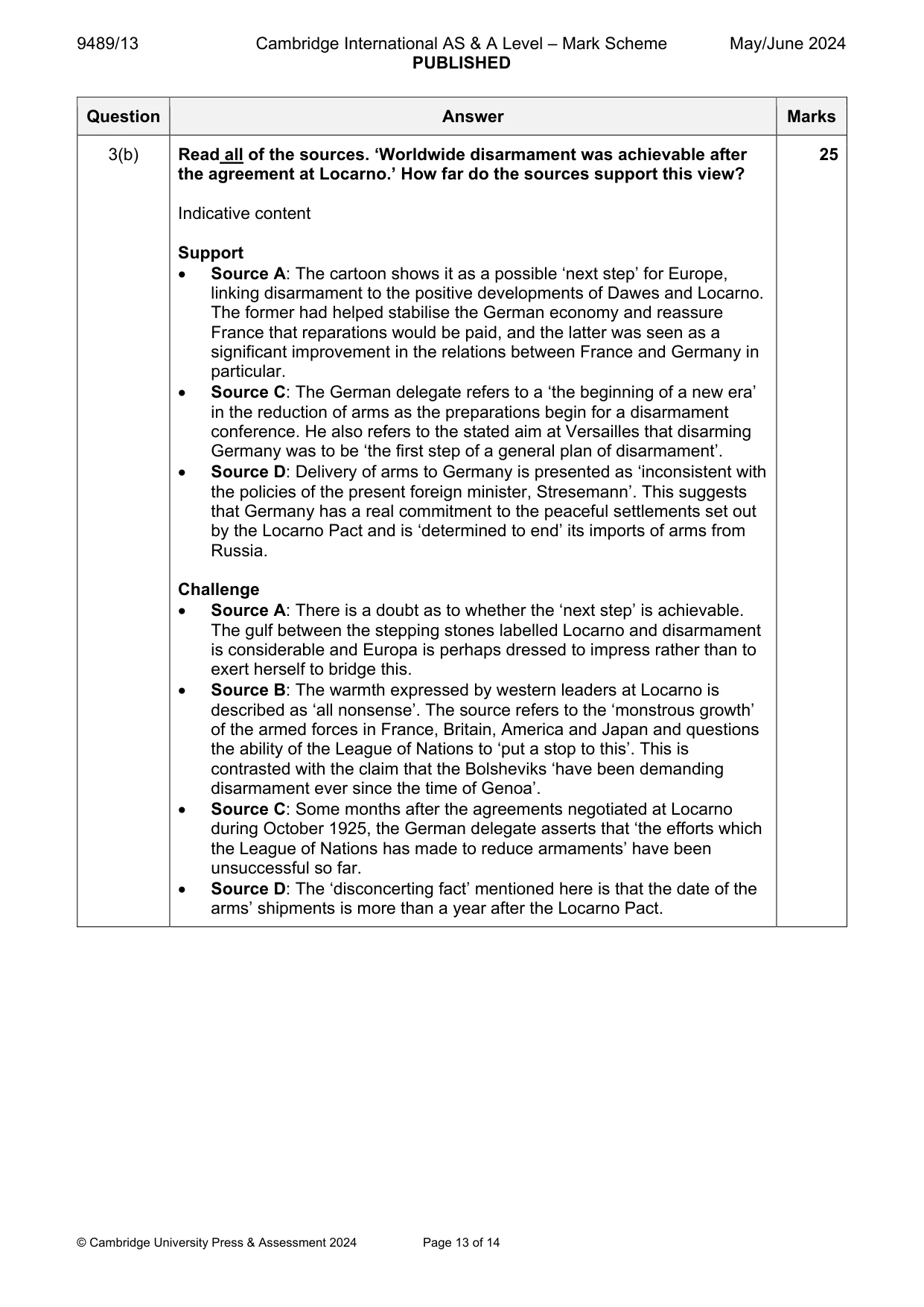
9489/13 Cambridge International AS & A Level – Mark Scheme PUBLISHED May/June 2024 © Cambridge University Press & Assessment 2024 Page 13 of 14 Question Answer Marks 3(b) Read all of the sources. ‘Worldwide disarmament was achievable after the agreement at Locarno.’ How far do the sources support this view? Indicative content Support Source A: The cartoon shows it as a possible ‘next step’ for Europe, linking disarmament to the positive developments of Dawes and Locarno. The former had helped stabilise the German economy and reassure France that reparations would be paid, and the latter was seen as a significant improvement in the relations between France and Germany in particular. Source C: The German delegate refers to a ‘the beginning of a new era’ in the reduction of arms as the preparations begin for a disarmament conference. He also refers to the stated aim at Versailles that disarming Germany was to be ‘the first step of a general plan of disarmament’. Source D: Delivery of arms to Germany is presented as ‘inconsistent with the policies of the present foreign minister, Stresemann’. This suggests that Germany has a real commitment to the peaceful settlements set out by the Locarno Pact and is ‘determined to end’ its imports of arms from Russia. Challenge Source A: There is a doubt as to whether the ‘next step’ is achievable. The gulf between the stepping stones labelled Locarno and disarmament is considerable and Europa is perhaps dressed to impress rather than to exert herself to bridge this. Source B: The warmth expressed by western leaders at Locarno is described as ‘all nonsense’. The source refers to the ‘monstrous growth’ of the armed forces in France, Britain, America and Japan and questions the ability of the League of Nations to ‘put a stop to this’. This is contrasted with the claim that the Bolsheviks ‘have been demanding disarmament ever since the time of Genoa’. Source C: Some months after the agreements negotiated at Locarno during October 1925, the German delegate asserts that ‘the efforts which the League of Nations has made to reduce armaments’ have been unsuccessful so far. Source D: The ‘disconcerting fact’ mentioned here is that the date of the arms’ shipments is more than a year after the Locarno Pact. 25
Mark scheme, page 14
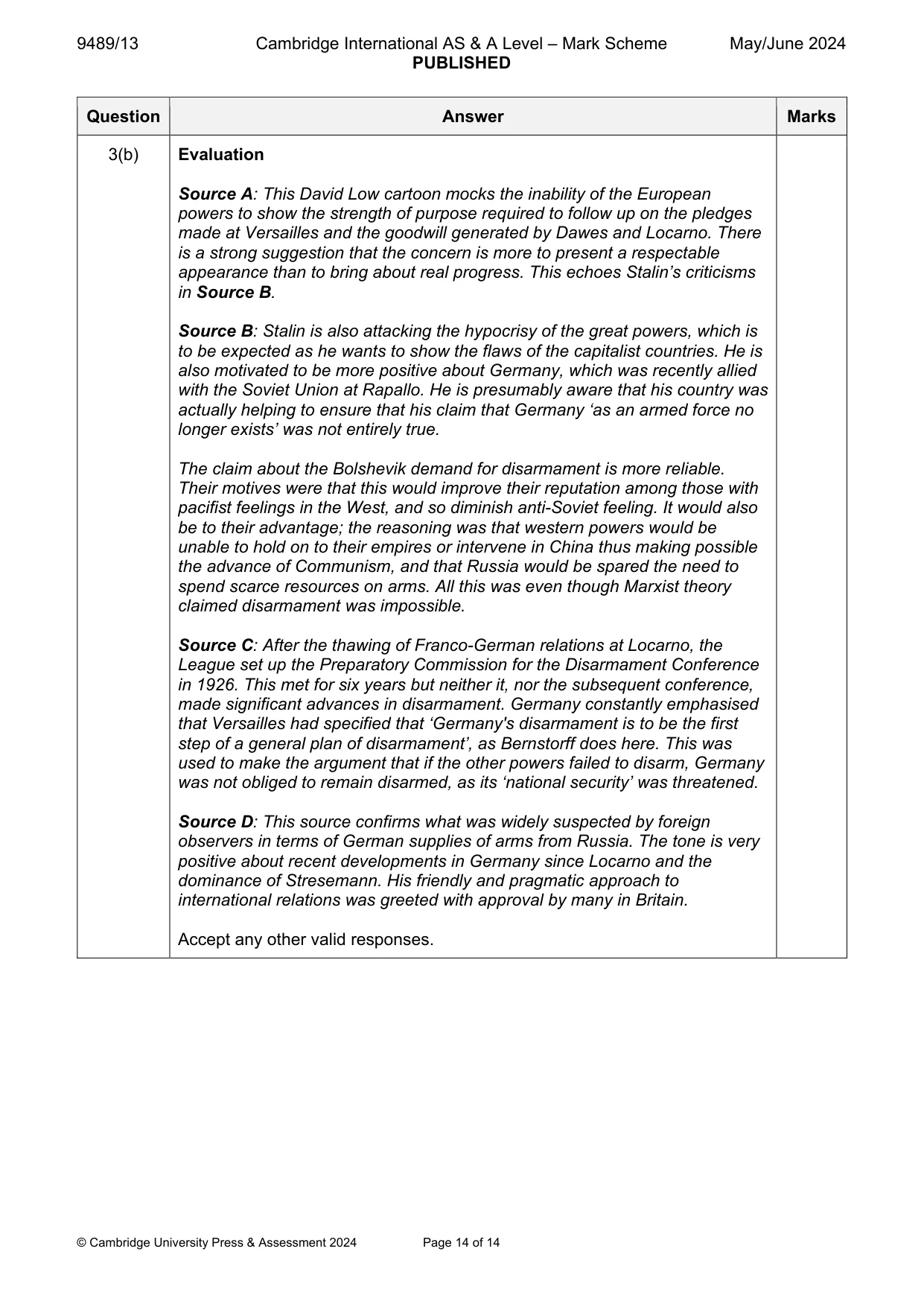
9489/13 Cambridge International AS & A Level – Mark Scheme PUBLISHED May/June 2024 © Cambridge University Press & Assessment 2024 Page 14 of 14 Question Answer Marks 3(b) Evaluation Source A: This David Low cartoon mocks the inability of the European powers to show the strength of purpose required to follow up on the pledges made at Versailles and the goodwill generated by Dawes and Locarno. There is a strong suggestion that the concern is more to present a respectable appearance than to bring about real progress. This echoes Stalin’s criticisms in Source B. Source B: Stalin is also attacking the hypocrisy of the great powers, which is to be expected as he wants to show the flaws of the capitalist countries. He is also motivated to be more positive about Germany, which was recently allied with the Soviet Union at Rapallo. He is presumably aware that his country was actually helping to ensure that his claim that Germany ‘as an armed force no longer exists’ was not entirely true. The claim about the Bolshevik demand for disarmament is more reliable. Their motives were that this would improve their reputation among those with pacifist feelings in the West, and so diminish anti-Soviet feeling. It would also be to their advantage; the reasoning was that western powers would be unable to hold on to their empires or intervene in China thus making possible the advance of Communism, and that Russia would be spared the need to spend scarce resources on arms. All this was even though Marxist theory claimed disarmament was impossible. Source C: After the thawing of Franco-German relations at Locarno, the League set up the Preparatory Commission for the Disarmament Conference in 1926. This met for six years but neither it, nor the subsequent conference, made significant advances in disarmament. Germany constantly emphasised that Versailles had specified that ‘Germany's disarmament is to be the first step of a general plan of disarmament’, as Bernstorff does here. This was used to make the argument that if the other powers failed to disarm, Germany was not obliged to remain disarmed, as its ‘national security’ was threatened. Source D: This source confirms what was widely suspected by foreign observers in terms of German supplies of arms from Russia. The tone is very positive about recent developments in Germany since Locarno and the dominance of Stresemann. His friendly and pragmatic approach to international relations was greeted with approval by many in Britain. Accept any other valid responses.
What you needed in this session
Cambridge’s own grade thresholds for 2024 May/June, Paper 1 · Variant 3. A higher threshold means an easier paper — the bar moves with how the cohort did.