Cambridge A Level History 9489 — 2025 May/June Paper 1 · Variant 3
9489/13/M/J/25 · 40 marks · ≈45 min
The question paper and its mark scheme, free to read here and free to download. This is Cambridge’s own paper, exactly as it was sat.
Question paper8 pages
Mark scheme16 pages
Answers below. Sit the paper first if you are practising.
Paper as text
Question paper, page 1
This document has 8 pages. [Turn over Cambridge International AS & A Level HISTORY 9489/13 Paper 1 Document Question May/June 2025 1 hour 15 minutes You must answer on the enclosed answer booklet. You will need: Answer booklet (enclosed) INSTRUCTIONS ● Answer one question from one section only. Section A: European option Section B: American option Section C: International option ● Follow the instructions on the front cover of the answer booklet. If you need additional answer paper, ask the invigilator for a continuation booklet. INFORMATION ● The total mark for this paper is 40. ● The number of marks for each question or part question is shown in brackets [ ]. * 6 4 8 9 5 7 7 9 7 9 * DC (PQ/CT) 342921/2 © UCLES 2025
Question paper, page 2
2 9489/13/M/J/25 © UCLES 2025 Answer one question from one section only. Section A: European option Liberalism and nationalism in Germany, 1815–71 1 Read the sources and then answer both parts of the question. Source A We will be obliged sooner or later to fight Austria for our existence. It does not lie in our power to evade the fight because the course of events in Germany can have no other outcome. If it came to a point when France threatened war with Austria in Italy, we should not join Austria in opposing it because we should probably be defeated. Even if we were victorious, we would have spent our blood only for the benefit of Austria. What in the end should we have fought for? For the maintenance of Austria’s superiority in Germany and the pitiful constitution of the Confederation. We cannot possibly exert our last reserves of strength for that. Were we to seek, in co-operation with Austria, to alter the German Confederation in our favour, every trick would be practised, preventing Prussia from reaching a higher standing in Germany. From a letter written by Bismarck to Prussian Minister-President Manteuffel, April 1856. Source B All were agreed that France, with its unpredictable Emperor, was the greatest threat to Europe, Prussia and Germany. However, for the last forty years, almost all the German states have cherished a hostile spirit against Prussia. This has been decidedly on the increase for over a year. Therefore I must admit the sad possibility that the south German states may seek to preserve their neutrality by means of separate negotiation with France, leaving Prussia to endure the struggle alone and be defeated. It is a matter then of finding ways and means to put an end to German animosity against Prussia. By virtue of Prussia’s superiority in moral and physical power, this would be easy if Austria, with its own hostility to us, were not also the moving spirit of German opposition. The necessity therefore arises that we should enter an understanding with Austria so as to make such an extreme eventuality impossible. Nothing then remains but to give up our sharp opposition to Austria and the German states. From a report of a Prussian Council meeting written by the Prince Regent to the Prussian Foreign Minister, March 1860.
Question paper, page 3
3 9489/13/M/J/25 © UCLES 2025 [Turn over Source C A true German policy is only possible when Austria and Prussia are united and take the lead. The strong alliance of these two powers has been our aim from the outset. We consider combination (such as the joint action in waging war on Denmark) as the foundation of an enduring unity. We consider the uncontested leadership of Germany by its two great powers as an essential requirement both for Germany and for Austria and Prussia. If they are united, leadership belongs to them of right. At the same time, they gain an increase in their own strength and security. If we hesitate on the path we have so far trodden, timidity or disunity will be thought to weaken our resolution. If we come forward firmly and energetically, the other German states will hardly dare to oppose us. They will understand the danger of such decisions. They will conform as soon as they see the firm will of Austria and Prussia. From a letter written by Bismarck to the Prussian Ambassador in Vienna, August 1864. Source D The war of 1866 between Prussia and Austria did not begin because the existence of Prussia was threatened, nor was it caused by public opinion and the voice of the people. It was a struggle long foreseen and calmly prepared for. It was recognised as a necessity by the Cabinet, not for territorial expansion, nor the extension of our influence, nor for material advantage, but for an ideal end – the establishment of power. Not a foot of land was taken from Austria but it had to renounce all part in the leadership of Germany. Prussia felt itself called upon and strong enough to assume the leadership of the German races. From the memoirs of General Moltke, published in 1893. Answer both parts of the question with reference to the sources. (a) Read Source B and Source C. Compare and contrast these two sources as evidence about Prussia’s position in Germany. [15] (b) Read all of the sources. ‘Prussia pursued a hostile policy towards Austria.’ How far do the sources agree? [25]
Question paper, page 4
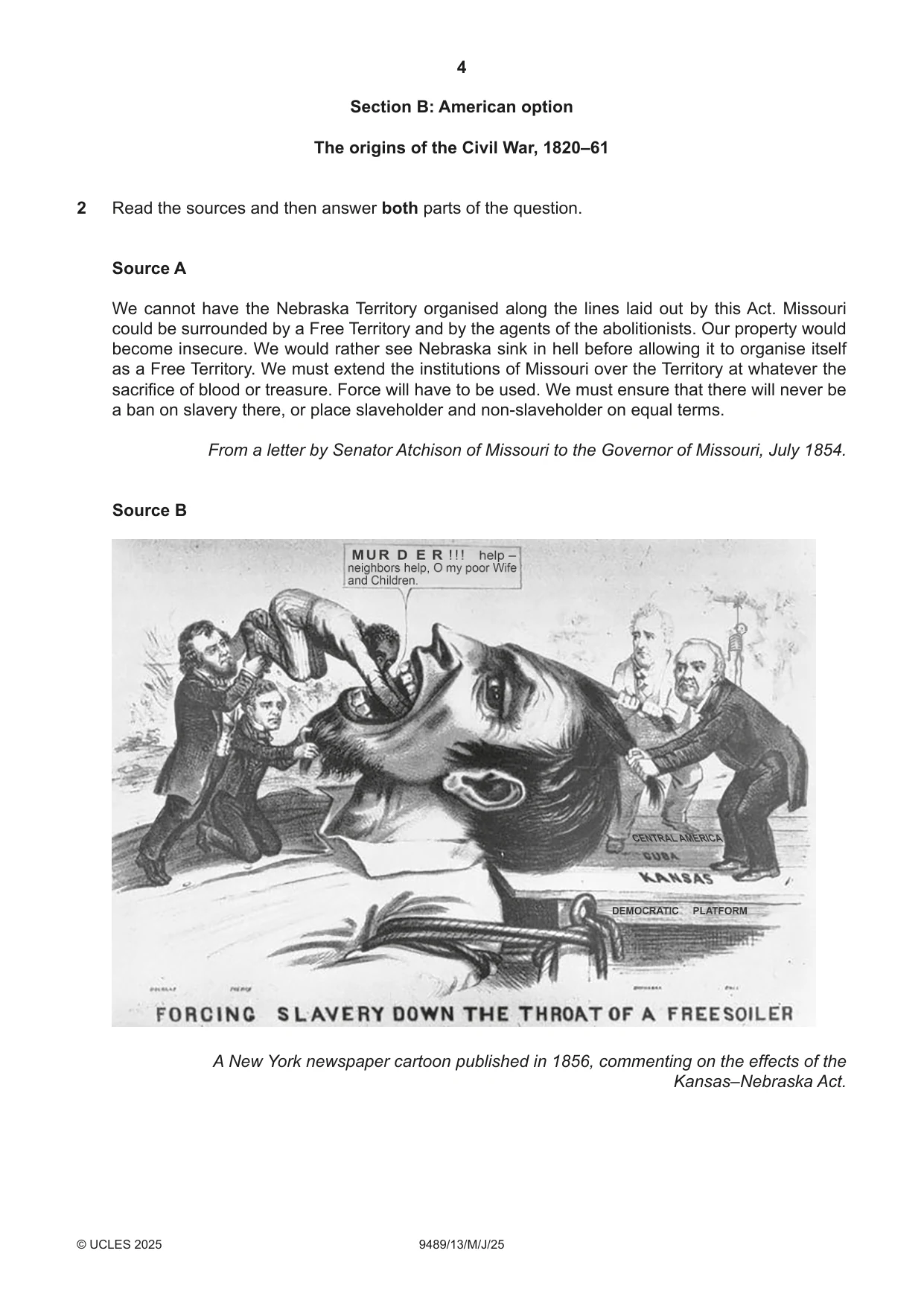
4 9489/13/M/J/25 © UCLES 2025 Section B: American option The origins of the Civil War, 1820–61 2 Read the sources and then answer both parts of the question. Source A We cannot have the Nebraska Territory organised along the lines laid out by this Act. Missouri could be surrounded by a Free Territory and by the agents of the abolitionists. Our property would become insecure. We would rather see Nebraska sink in hell before allowing it to organise itself as a Free Territory. We must extend the institutions of Missouri over the Territory at whatever the sacrifice of blood or treasure. Force will have to be used. We must ensure that there will never be a ban on slavery there, or place slaveholder and non-slaveholder on equal terms. From a letter by Senator Atchison of Missouri to the Governor of Missouri, July 1854. Source B A New York newspaper cartoon published in 1856, commenting on the effects of the Kansas–Nebraska Act.
Question paper, page 5
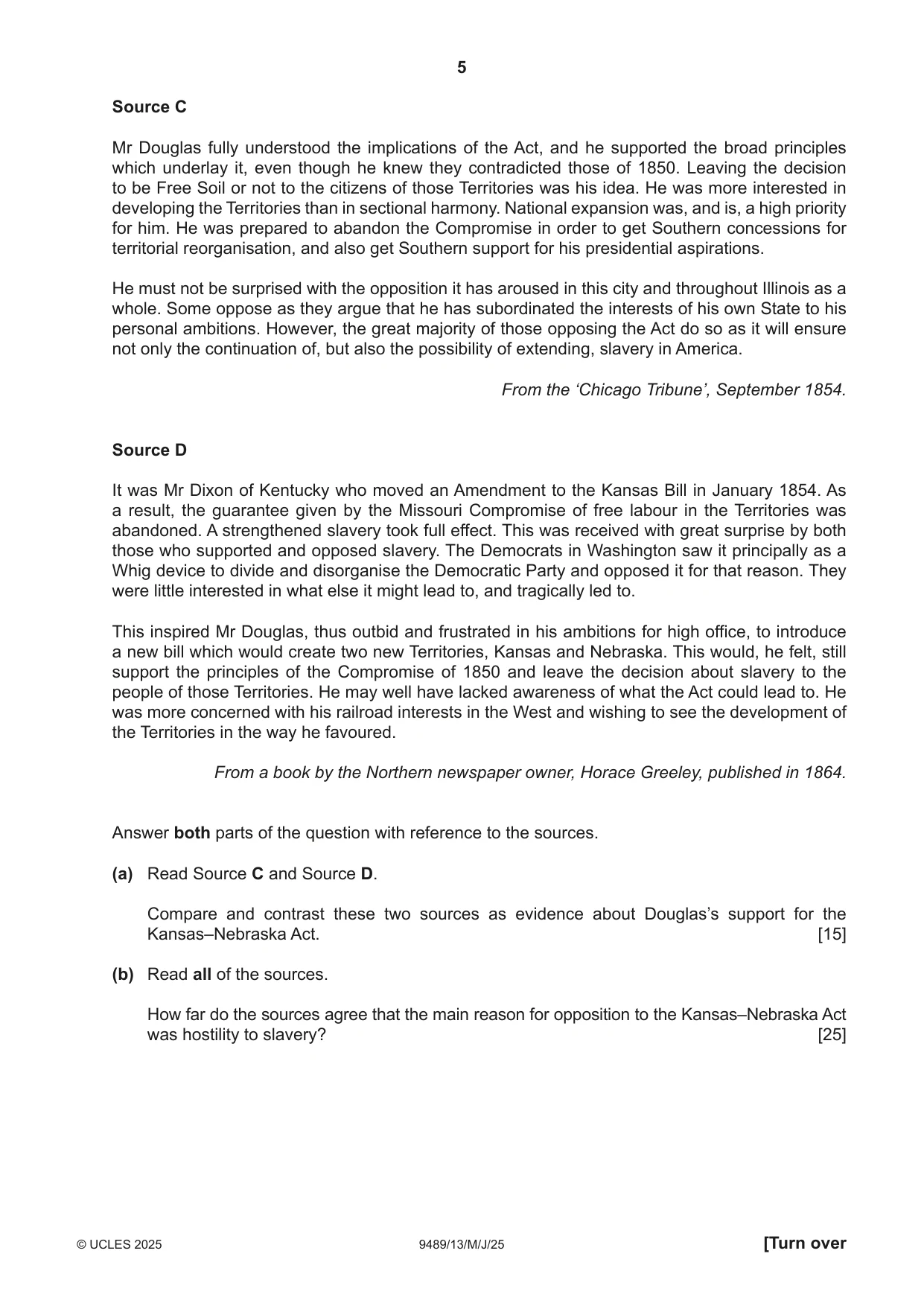
5 9489/13/M/J/25 © UCLES 2025 [Turn over Source C Mr Douglas fully understood the implications of the Act, and he supported the broad principles which underlay it, even though he knew they contradicted those of 1850. Leaving the decision to be Free Soil or not to the citizens of those Territories was his idea. He was more interested in developing the Territories than in sectional harmony. National expansion was, and is, a high priority for him. He was prepared to abandon the Compromise in order to get Southern concessions for territorial reorganisation, and also get Southern support for his presidential aspirations. He must not be surprised with the opposition it has aroused in this city and throughout Illinois as a whole. Some oppose as they argue that he has subordinated the interests of his own State to his personal ambitions. However, the great majority of those opposing the Act do so as it will ensure not only the continuation of, but also the possibility of extending, slavery in America. From the ‘Chicago Tribune’, September 1854. Source D It was Mr Dixon of Kentucky who moved an Amendment to the Kansas Bill in January 1854. As a result, the guarantee given by the Missouri Compromise of free labour in the Territories was abandoned. A strengthened slavery took full effect. This was received with great surprise by both those who supported and opposed slavery. The Democrats in Washington saw it principally as a Whig device to divide and disorganise the Democratic Party and opposed it for that reason. They were little interested in what else it might lead to, and tragically led to. This inspired Mr Douglas, thus outbid and frustrated in his ambitions for high office, to introduce a new bill which would create two new Territories, Kansas and Nebraska. This would, he felt, still support the principles of the Compromise of 1850 and leave the decision about slavery to the people of those Territories. He may well have lacked awareness of what the Act could lead to. He was more concerned with his railroad interests in the West and wishing to see the development of the Territories in the way he favoured. From a book by the Northern newspaper owner, Horace Greeley, published in 1864. Answer both parts of the question with reference to the sources. (a) Read Source C and Source D. Compare and contrast these two sources as evidence about Douglas’s support for the Kansas–Nebraska Act. [15] (b) Read all of the sources. How far do the sources agree that the main reason for opposition to the Kansas–Nebraska Act was hostility to slavery? [25]
Question paper, page 6
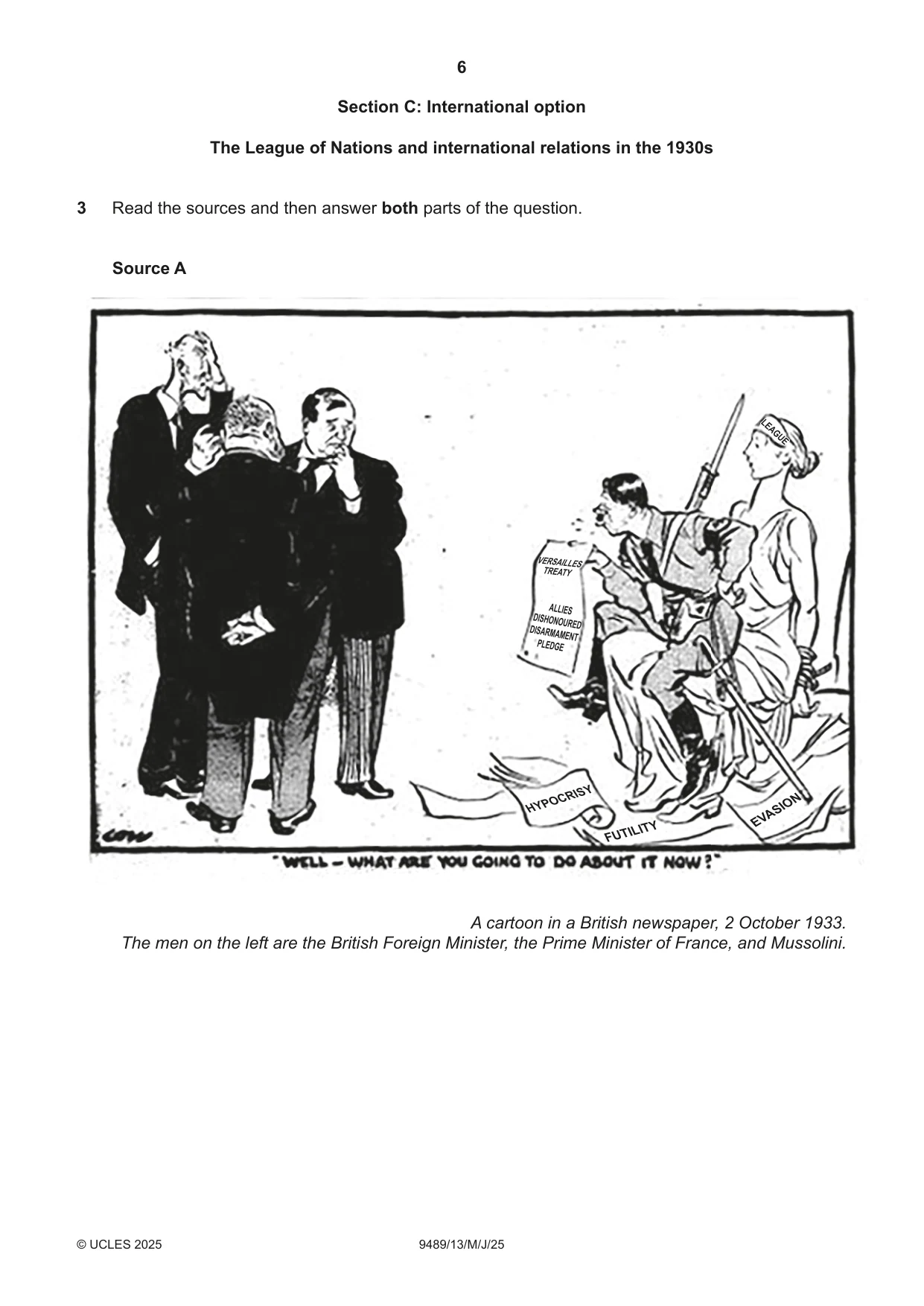
6 9489/13/ M/J/25 © UCLES 2025 Section C: International option The League of Nations and international relations in the 1930s 3 Read the sources and then answer both parts of the question. Source A HYPOCRISY FUTILITY EVASION A cartoon in a British newspaper, 2 October 1933. The men on the left are the British Foreign Minister, the Prime Minister of France, and Mussolini.
Question paper, page 7
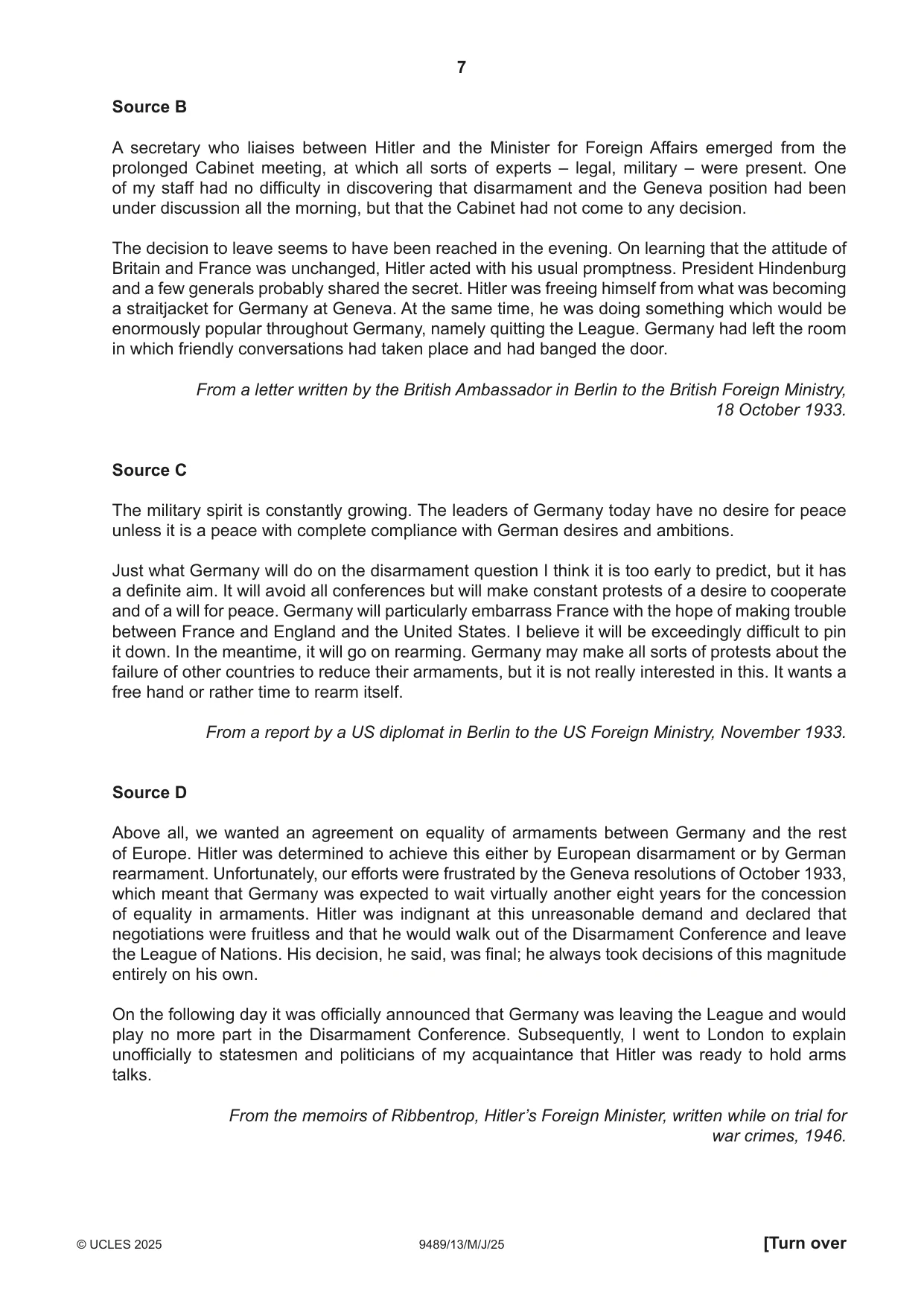
7 9489/13/M/J/25 © UCLES 2025 Source B A secretary who liaises between Hitler and the Minister for Foreign Affairs emerged from the prolonged Cabinet meeting, at which all sorts of experts – legal, military – were present. One of my staff had no difficulty in discovering that disarmament and the Geneva position had been under discussion all the morning, but that the Cabinet had not come to any decision. The decision to leave seems to have been reached in the evening. On learning that the attitude of Britain and France was unchanged, Hitler acted with his usual promptness. President Hindenburg and a few generals probably shared the secret. Hitler was freeing himself from what was becoming a straitjacket for Germany at Geneva. At the same time, he was doing something which would be enormously popular throughout Germany, namely quitting the League. Germany had left the room in which friendly conversations had taken place and had banged the door. From a letter written by the British Ambassador in Berlin to the British Foreign Ministry, 18 October 1933. Source C The military spirit is constantly growing. The leaders of Germany today have no desire for peace unless it is a peace with complete compliance with German desires and ambitions. Just what Germany will do on the disarmament question I think it is too early to predict, but it has a definite aim. It will avoid all conferences but will make constant protests of a desire to cooperate and of a will for peace. Germany will particularly embarrass France with the hope of making trouble between France and England and the United States. I believe it will be exceedingly difficult to pin it down. In the meantime, it will go on rearming. Germany may make all sorts of protests about the failure of other countries to reduce their armaments, but it is not really interested in this. It wants a free hand or rather time to rearm itself. From a report by a US diplomat in Berlin to the US Foreign Ministry, November 1933. Source D Above all, we wanted an agreement on equality of armaments between Germany and the rest of Europe. Hitler was determined to achieve this either by European disarmament or by German rearmament. Unfortunately, our efforts were frustrated by the Geneva resolutions of October 1933, which meant that Germany was expected to wait virtually another eight years for the concession of equality in armaments. Hitler was indignant at this unreasonable demand and declared that negotiations were fruitless and that he would walk out of the Disarmament Conference and leave the League of Nations. His decision, he said, was final; he always took decisions of this magnitude entirely on his own. On the following day it was officially announced that Germany was leaving the League and would play no more part in the Disarmament Conference. Subsequently, I went to London to explain unofficially to statesmen and politicians of my acquaintance that Hitler was ready to hold arms talks. From the memoirs of Ribbentrop, Hitler’s Foreign Minister, written while on trial for war crimes, 1946. [Turn over
Question paper, page 8
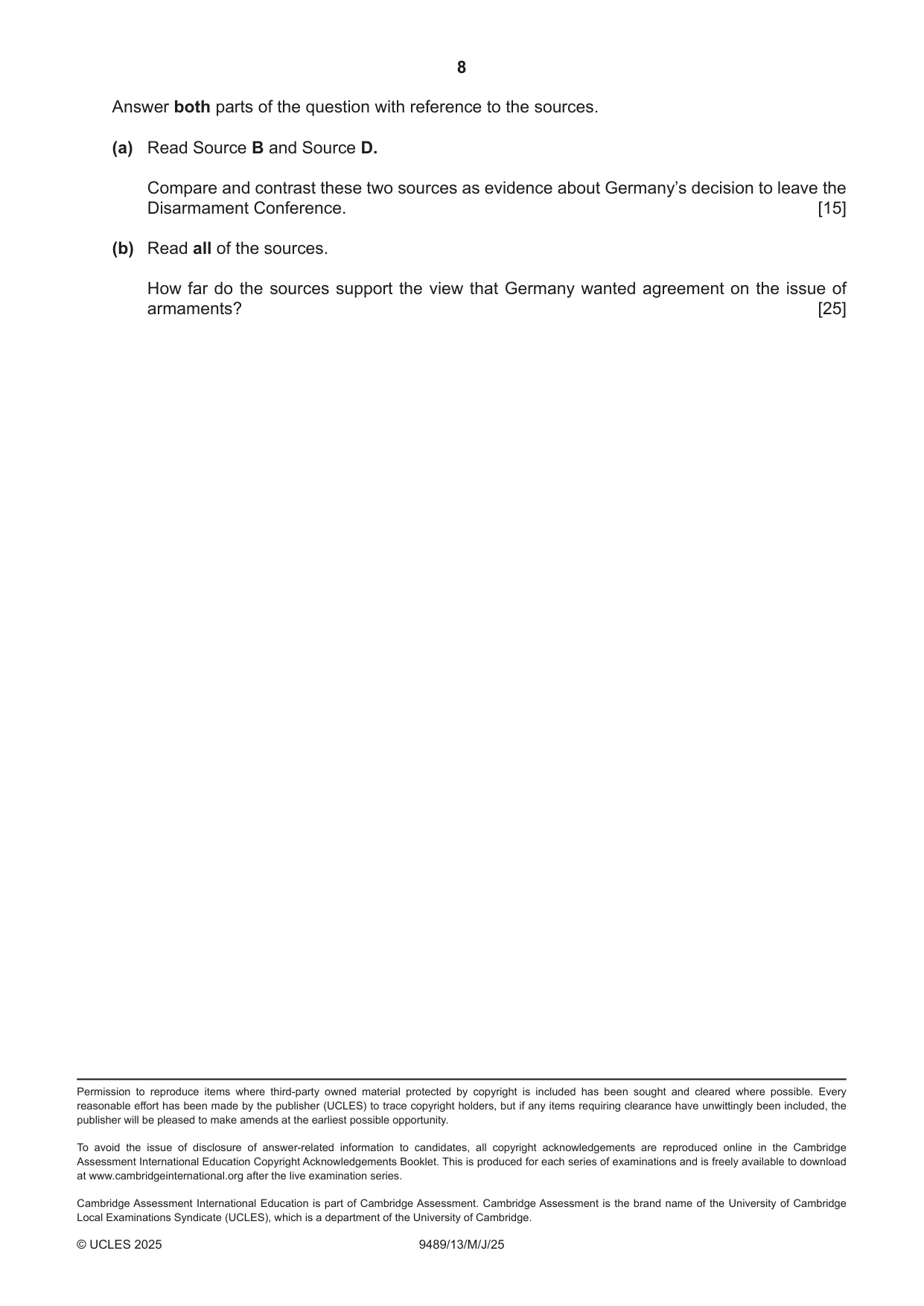
8 9489/13/M/J/25 © UCLES 2025 Permission to reproduce items where third-party owned material protected by copyright is included has been sought and cleared where possible. Every reasonable effort has been made by the publisher (UCLES) to trace copyright holders, but if any items requiring clearance have unwittingly been included, the publisher will be pleased to make amends at the earliest possible opportunity. To avoid the issue of disclosure of answer-related information to candidates, all copyright acknowledgements are reproduced online in the Cambridge Assessment International Education Copyright Acknowledgements Booklet. This is produced for each series of examinations and is freely available to download at www.cambridgeinternational.org after the live examination series. Cambridge Assessment International Education is part of Cambridge Assessment. Cambridge Assessment is the brand name of the University of Cambridge Local Examinations Syndicate (UCLES), which is a department of the University of Cambridge. Answer both parts of the question with reference to the sources. (a) Read Source B and Source D. Compare and contrast these two sources as evidence about Germany’s decision to leave the Disarmament Conference. [15] (b) Read all of the sources. How far do the sources support the view that Germany wanted agreement on the issue of armaments? [25]
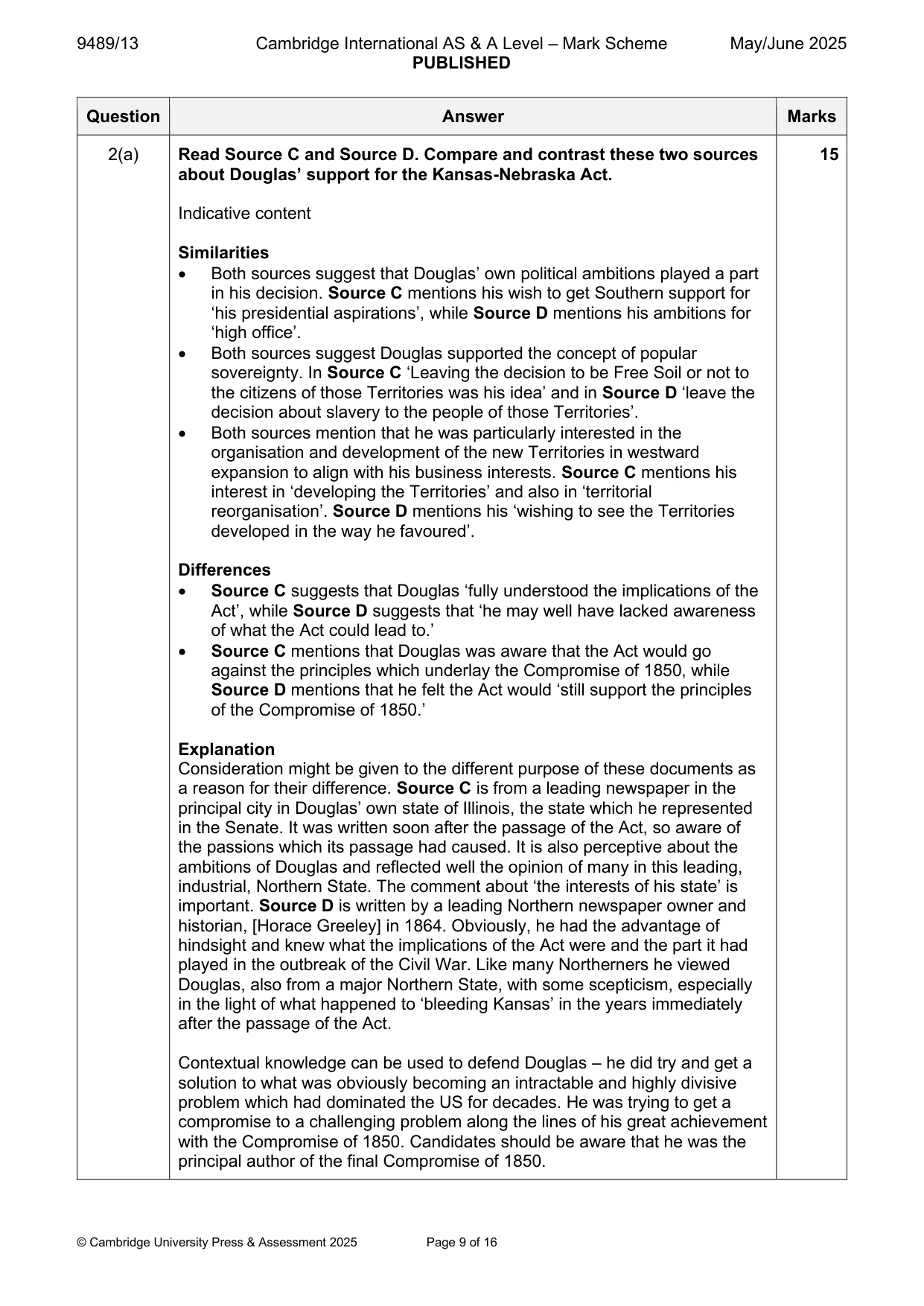
Mark scheme, page 1
This document consists of 16 printed pages. © Cambridge University Press & Assessment 2025 [Turn over Cambridge International AS & A Level HISTORY 9489/13 Paper 1 Document question May/June 2025 MARK SCHEME Maximum Mark: 40 Published This mark scheme is published as an aid to teachers and candidates, to indicate the requirements of the examination. It shows the basis on which Examiners were instructed to award marks. It does not indicate the details of the discussions that took place at an Examiners’ meeting before marking began, which would have considered the acceptability of alternative answers. Mark schemes should be read in conjunction with the question paper and the Principal Examiner Report for Teachers. Cambridge International will not enter into discussions about these mark schemes. Cambridge International is publishing the mark schemes for the May/June 2025 series for most Cambridge IGCSE, Cambridge International A and AS Level components, and some Cambridge O Level components.
Mark scheme, page 2
9489/13 Cambridge International AS & A Level – Mark Scheme PUBLISHED May/June 2025 © Cambridge University Press & Assessment 2025 Page 2 of 16 Generic Marking Principles These general marking principles must be applied by all examiners when marking candidate answers. They should be applied alongside the specific content of the mark scheme or generic level descriptions for a question. Each question paper and mark scheme will also comply with these marking principles. GENERIC MARKING PRINCIPLE 1: Marks must be awarded in line with: • the specific content of the mark scheme or the generic level descriptors for the question • the specific skills defined in the mark scheme or in the generic level descriptors for the question • the standard of response required by a candidate as exemplified by the standardisation scripts. GENERIC MARKING PRINCIPLE 2: Marks awarded are always whole marks (not half marks, or other fractions). GENERIC MARKING PRINCIPLE 3: Marks must be awarded positively: • marks are awarded for correct/valid answers, as defined in the mark scheme. However, credit is given for valid answers which go beyond the scope of the syllabus and mark scheme, referring to your Team Leader as appropriate • marks are awarded when candidates clearly demonstrate what they know and can do • marks are not deducted for errors • marks are not deducted for omissions • answers should only be judged on the quality of spelling, punctuation and grammar when these features are specifically assessed by the question as indicated by the mark scheme. The meaning, however, should be unambiguous. GENERIC MARKING PRINCIPLE 4: Rules must be applied consistently, e.g. in situations where candidates have not followed instructions or in the application of generic level descriptors. GENERIC MARKING PRINCIPLE 5: Marks should be awarded using the full range of marks defined in the mark scheme for the question (however; the use of the full mark range may be limited according to the quality of the candidate responses seen). GENERIC MARKING PRINCIPLE 6: Marks awarded are based solely on the requirements as defined in the mark scheme. Marks should not be awarded with grade thresholds or grade descriptors in mind.
Mark scheme, page 3
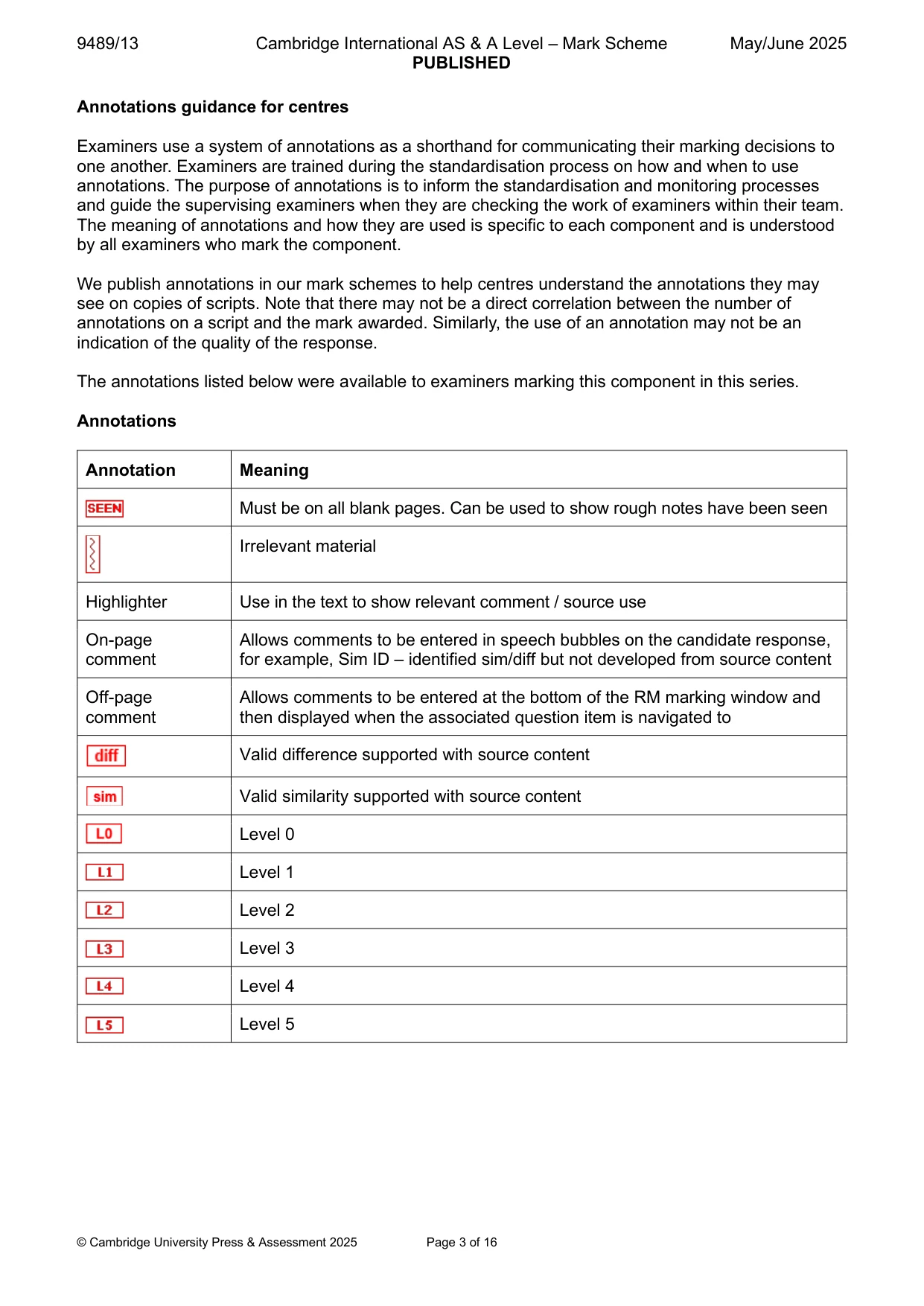
9489/13 Cambridge International AS & A Level – Mark Scheme PUBLISHED May/June 2025 © Cambridge University Press & Assessment 2025 Page 3 of 16 Annotations guidance for centres Examiners use a system of annotations as a shorthand for communicating their marking decisions to one another. Examiners are trained during the standardisation process on how and when to use annotations. The purpose of annotations is to inform the standardisation and monitoring processes and guide the supervising examiners when they are checking the work of examiners within their team. The meaning of annotations and how they are used is specific to each component and is understood by all examiners who mark the component. We publish annotations in our mark schemes to help centres understand the annotations they may see on copies of scripts. Note that there may not be a direct correlation between the number of annotations on a script and the mark awarded. Similarly, the use of an annotation may not be an indication of the quality of the response. The annotations listed below were available to examiners marking this component in this series. Annotations Annotation Meaning Must be on all blank pages. Can be used to show rough notes have been seen Irrelevant material Highlighter Use in the text to show relevant comment / source use On-page comment Allows comments to be entered in speech bubbles on the candidate response, for example, Sim ID – identified sim/diff but not developed from source content Off-page comment Allows comments to be entered at the bottom of the RM marking window and then displayed when the associated question item is navigated to Valid difference supported with source content Valid similarity supported with source content Level 0 Level 1 Level 2 Level 3 Level 4 Level 5
Mark scheme, page 4
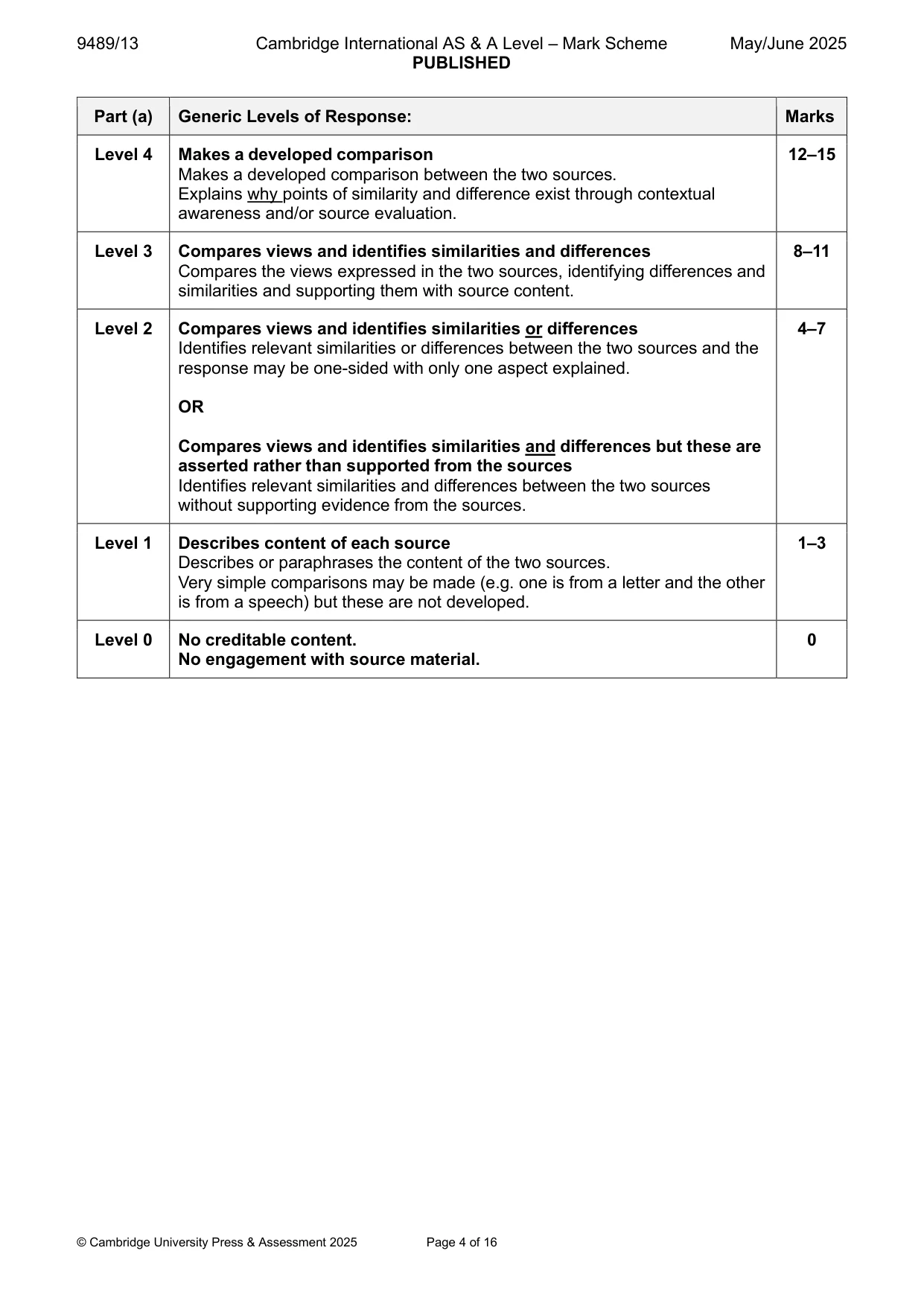
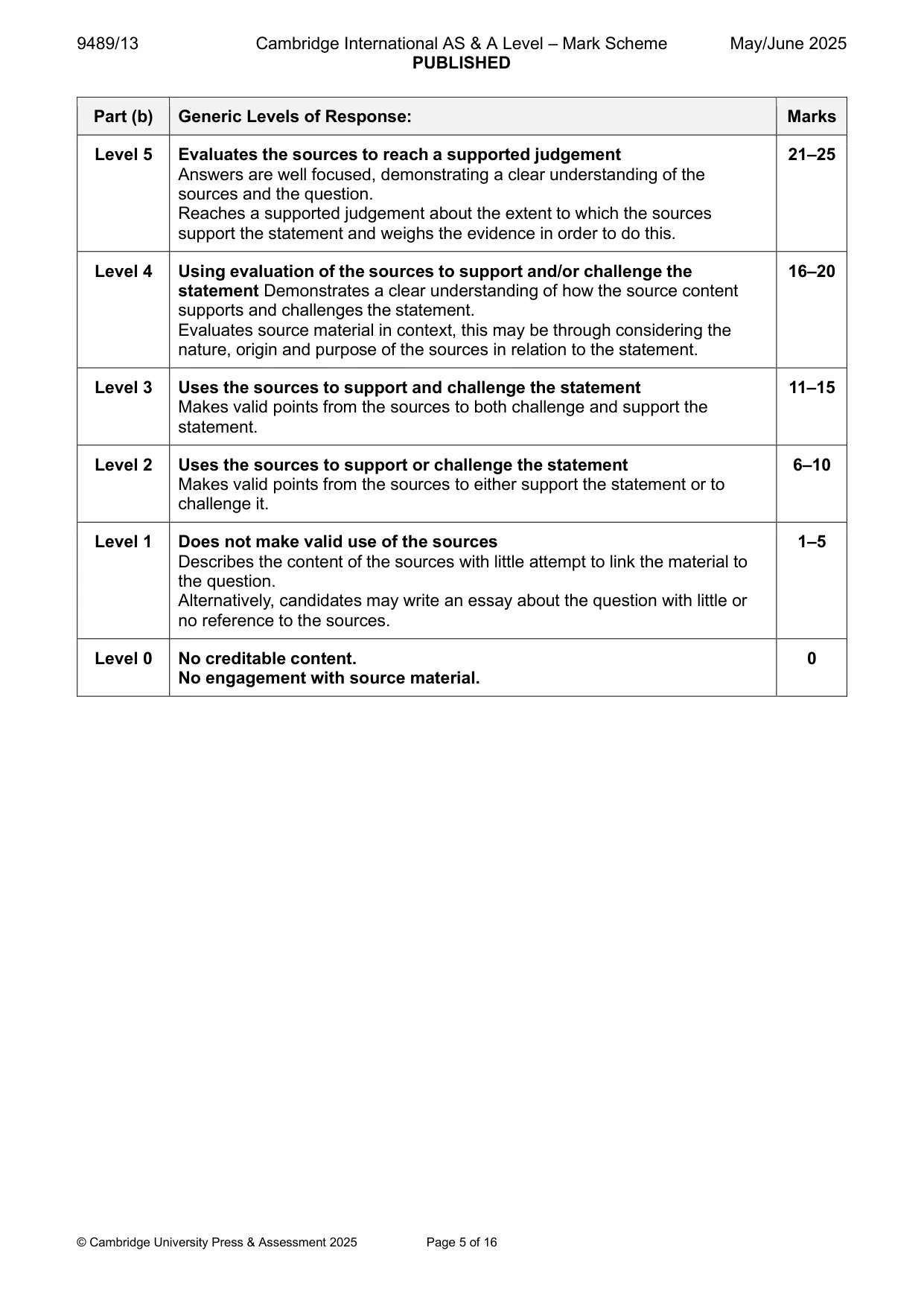
9489/13 Cambridge International AS & A Level – Mark Scheme PUBLISHED May/June 2025 © Cambridge University Press & Assessment 2025 Page 4 of 16 Part (a) Generic Levels of Response: Marks Level 4 Makes a developed comparison Makes a developed comparison between the two sources. Explains why points of similarity and difference exist through contextual awareness and/or source evaluation. 12–15 Level 3 Compares views and identifies similarities and differences Compares the views expressed in the two sources, identifying differences and similarities and supporting them with source content. 8–11 Level 2 Compares views and identifies similarities or differences Identifies relevant similarities or differences between the two sources and the response may be one-sided with only one aspect explained. OR Compares views and identifies similarities and differences but these are asserted rather than supported from the sources Identifies relevant similarities and differences between the two sources without supporting evidence from the sources. 4–7 Level 1 Describes content of each source Describes or paraphrases the content of the two sources. Very simple comparisons may be made (e.g. one is from a letter and the other is from a speech) but these are not developed. 1–3 Level 0 No creditable content. No engagement with source material. 0
Mark scheme, page 5
9489/13 Cambridge International AS & A Level – Mark Scheme PUBLISHED May/June 2025 © Cambridge University Press & Assessment 2025 Page 5 of 16 Part (b) Generic Levels of Response: Marks Level 5 Evaluates the sources to reach a supported judgement Answers are well focused, demonstrating a clear understanding of the sources and the question. Reaches a supported judgement about the extent to which the sources support the statement and weighs the evidence in order to do this. 21–25 Level 4 Using evaluation of the sources to support and/or challenge the statement Demonstrates a clear understanding of how the source content supports and challenges the statement. Evaluates source material in context, this may be through considering the nature, origin and purpose of the sources in relation to the statement. 16–20 Level 3 Uses the sources to support and challenge the statement Makes valid points from the sources to both challenge and support the statement. 11–15 Level 2 Uses the sources to support or challenge the statement Makes valid points from the sources to either support the statement or to challenge it. 6–10 Level 1 Does not make valid use of the sources Describes the content of the sources with little attempt to link the material to the question. Alternatively, candidates may write an essay about the question with little or no reference to the sources. 1–5 Level 0 No creditable content. No engagement with source material. 0
Mark scheme, page 6
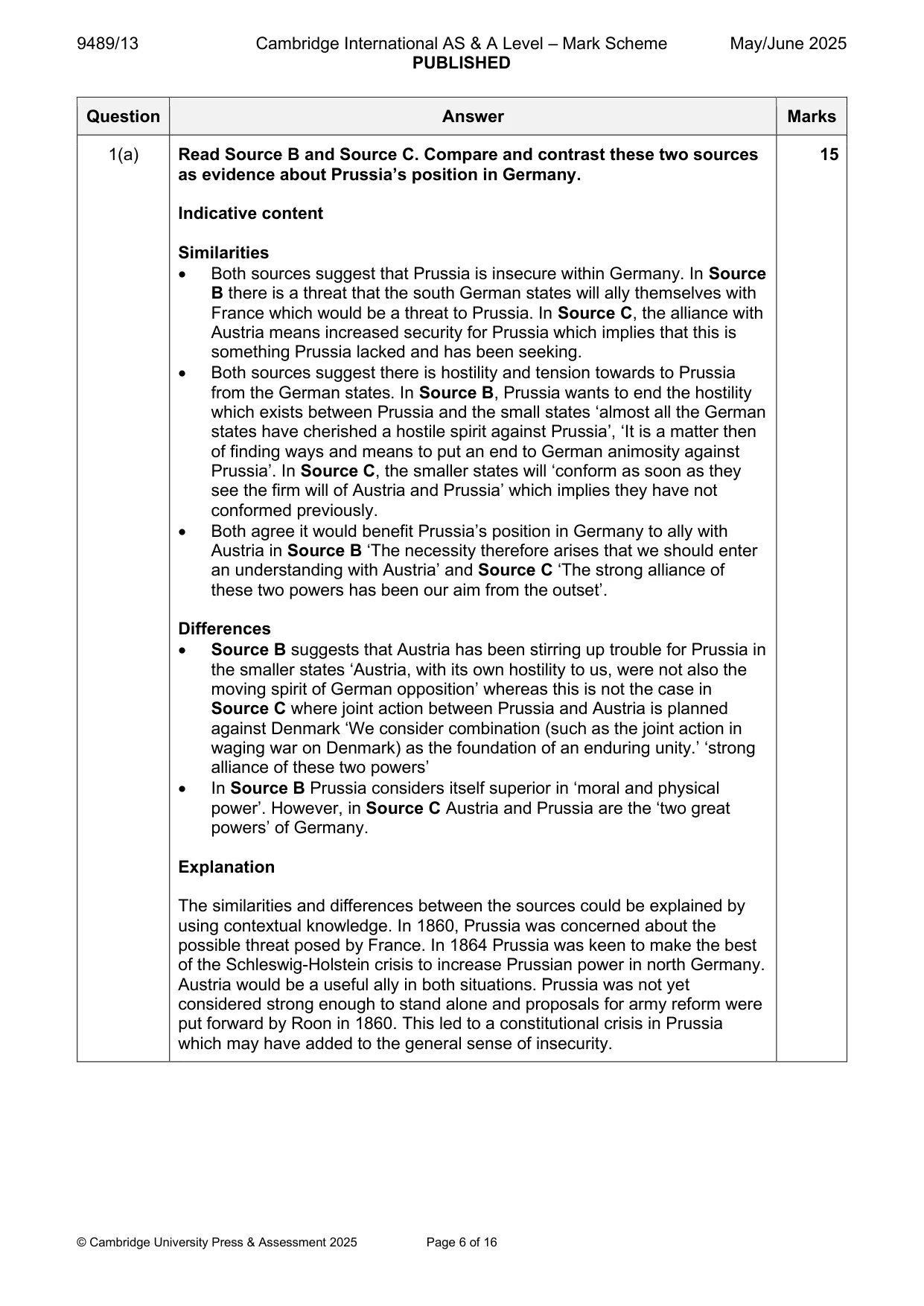
9489/13 Cambridge International AS & A Level – Mark Scheme PUBLISHED May/June 2025 © Cambridge University Press & Assessment 2025 Page 6 of 16 Question Answer Marks 1(a) Read Source B and Source C. Compare and contrast these two sources as evidence about Prussia’s position in Germany. Indicative content Similarities • Both sources suggest that Prussia is insecure within Germany. In Source B there is a threat that the south German states will ally themselves with France which would be a threat to Prussia. In Source C, the alliance with Austria means increased security for Prussia which implies that this is something Prussia lacked and has been seeking. • Both sources suggest there is hostility and tension towards to Prussia from the German states. In Source B, Prussia wants to end the hostility which exists between Prussia and the small states ‘almost all the German states have cherished a hostile spirit against Prussia’, ‘It is a matter then of finding ways and means to put an end to German animosity against Prussia’. In Source C, the smaller states will ‘conform as soon as they see the firm will of Austria and Prussia’ which implies they have not conformed previously. • Both agree it would benefit Prussia’s position in Germany to ally with Austria in Source B ‘The necessity therefore arises that we should enter an understanding with Austria’ and Source C ‘The strong alliance of these two powers has been our aim from the outset’. Differences • Source B suggests that Austria has been stirring up trouble for Prussia in the smaller states ‘Austria, with its own hostility to us, were not also the moving spirit of German opposition’ whereas this is not the case in Source C where joint action between Prussia and Austria is planned against Denmark ‘We consider combination (such as the joint action in waging war on Denmark) as the foundation of an enduring unity.’ ‘strong alliance of these two powers’ • In Source B Prussia considers itself superior in ‘moral and physical power’. However, in Source C Austria and Prussia are the ‘two great powers’ of Germany. Explanation The similarities and differences between the sources could be explained by using contextual knowledge. In 1860, Prussia was concerned about the possible threat posed by France. In 1864 Prussia was keen to make the best of the Schleswig-Holstein crisis to increase Prussian power in north Germany. Austria would be a useful ally in both situations. Prussia was not yet considered strong enough to stand alone and proposals for army reform were put forward by Roon in 1860. This led to a constitutional crisis in Prussia which may have added to the general sense of insecurity. 15
Mark scheme, page 7
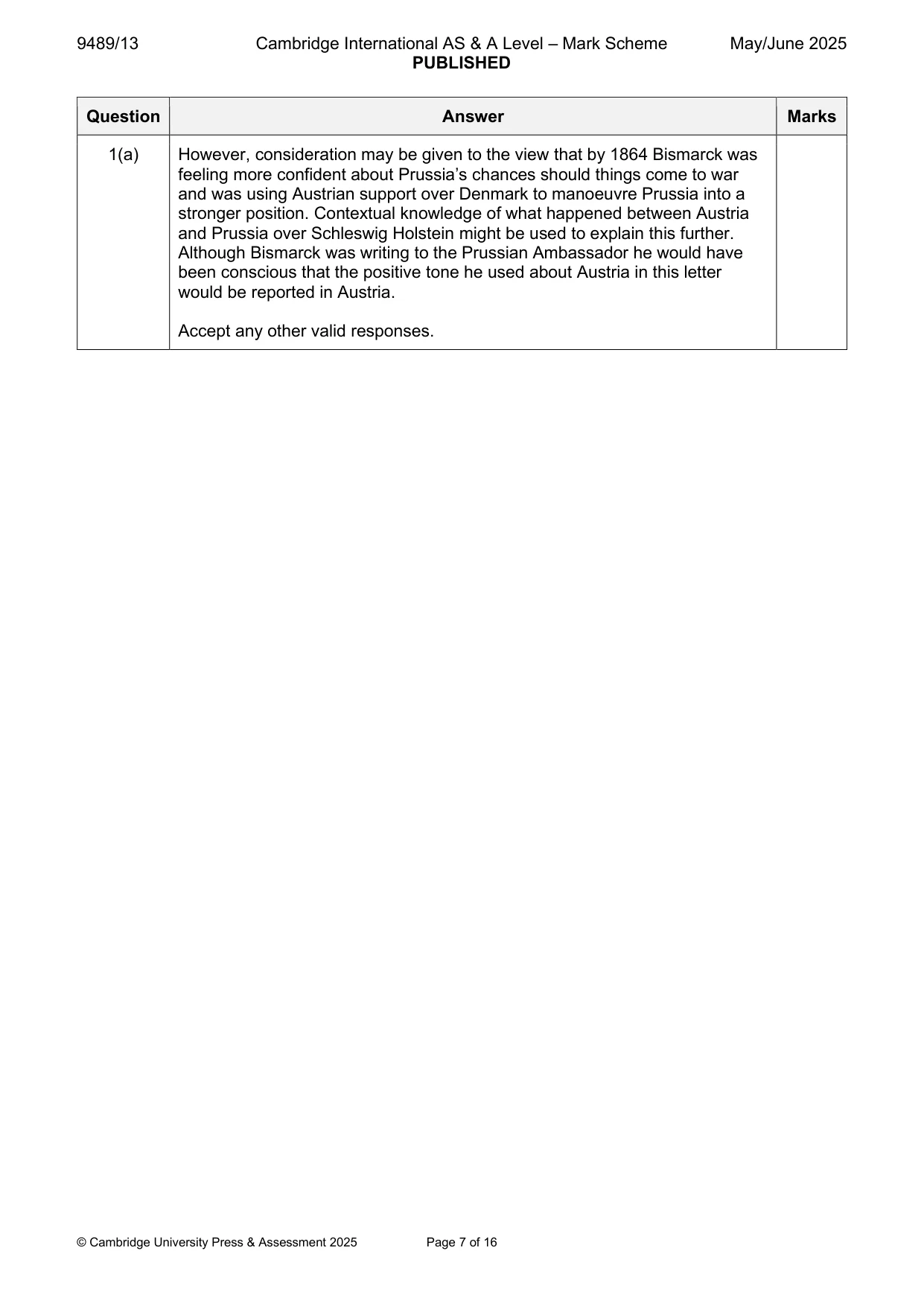
9489/13 Cambridge International AS & A Level – Mark Scheme PUBLISHED May/June 2025 © Cambridge University Press & Assessment 2025 Page 7 of 16 Question Answer Marks 1(a) However, consideration may be given to the view that by 1864 Bismarck was feeling more confident about Prussia’s chances should things come to war and was using Austrian support over Denmark to manoeuvre Prussia into a stronger position. Contextual knowledge of what happened between Austria and Prussia over Schleswig Holstein might be used to explain this further. Although Bismarck was writing to the Prussian Ambassador he would have been conscious that the positive tone he used about Austria in this letter would be reported in Austria. Accept any other valid responses.
Mark scheme, page 8
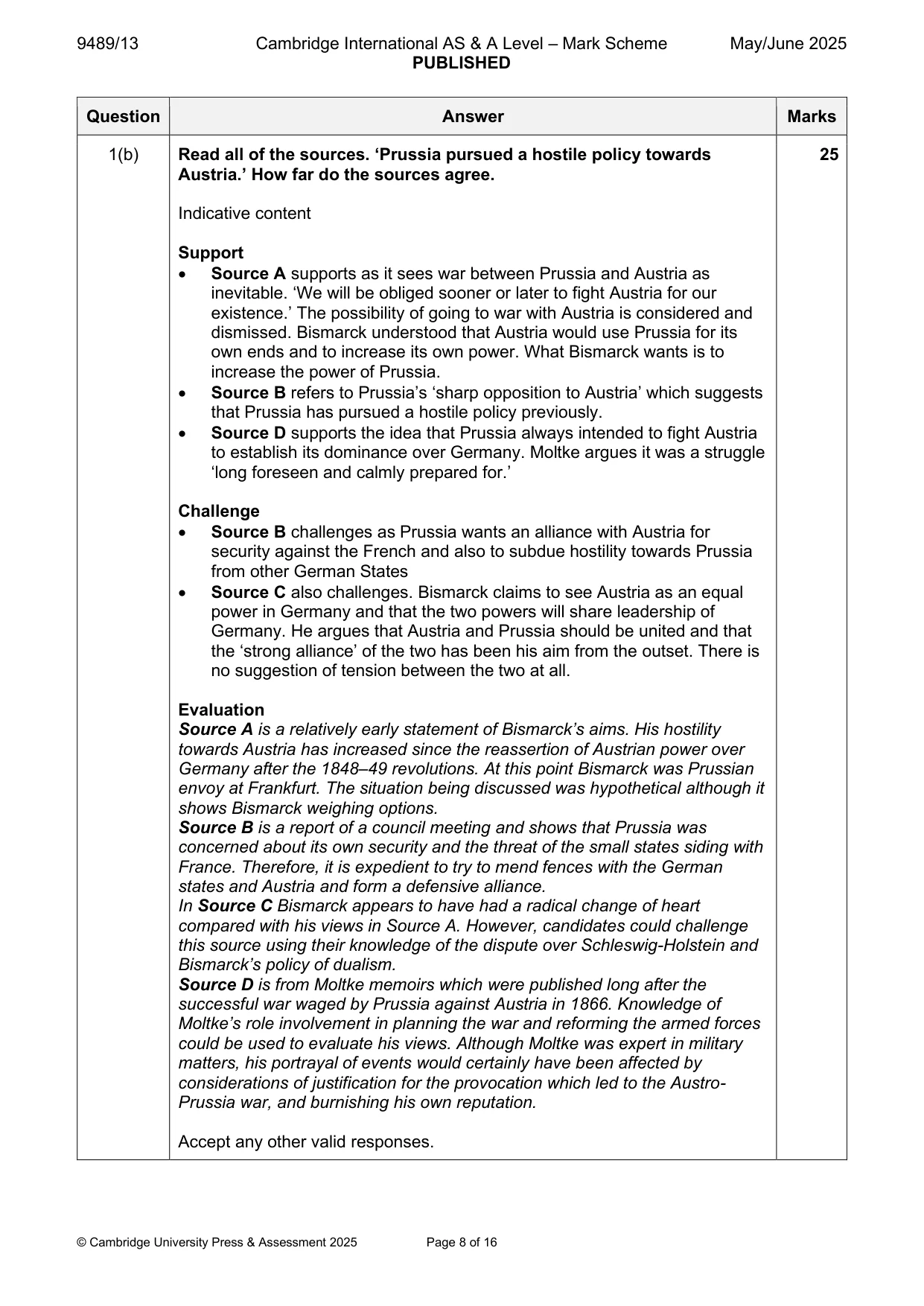
9489/13 Cambridge International AS & A Level – Mark Scheme PUBLISHED May/June 2025 © Cambridge University Press & Assessment 2025 Page 8 of 16 Question Answer Marks 1(b) Read all of the sources. ‘Prussia pursued a hostile policy towards Austria.’ How far do the sources agree. Indicative content Support • Source A supports as it sees war between Prussia and Austria as inevitable. ‘We will be obliged sooner or later to fight Austria for our existence.’ The possibility of going to war with Austria is considered and dismissed. Bismarck understood that Austria would use Prussia for its own ends and to increase its own power. What Bismarck wants is to increase the power of Prussia. • Source B refers to Prussia’s ‘sharp opposition to Austria’ which suggests that Prussia has pursued a hostile policy previously. • Source D supports the idea that Prussia always intended to fight Austria to establish its dominance over Germany. Moltke argues it was a struggle ‘long foreseen and calmly prepared for.’ Challenge • Source B challenges as Prussia wants an alliance with Austria for security against the French and also to subdue hostility towards Prussia from other German States • Source C also challenges. Bismarck claims to see Austria as an equal power in Germany and that the two powers will share leadership of Germany. He argues that Austria and Prussia should be united and that the ‘strong alliance’ of the two has been his aim from the outset. There is no suggestion of tension between the two at all. Evaluation Source A is a relatively early statement of Bismarck’s aims. His hostility towards Austria has increased since the reassertion of Austrian power over Germany after the 1848–49 revolutions. At this point Bismarck was Prussian envoy at Frankfurt. The situation being discussed was hypothetical although it shows Bismarck weighing options. Source B is a report of a council meeting and shows that Prussia was concerned about its own security and the threat of the small states siding with France. Therefore, it is expedient to try to mend fences with the German states and Austria and form a defensive alliance. In Source C Bismarck appears to have had a radical change of heart compared with his views in Source A. However, candidates could challenge this source using their knowledge of the dispute over Schleswig-Holstein and Bismarck’s policy of dualism. Source D is from Moltke memoirs which were published long after the successful war waged by Prussia against Austria in 1866. Knowledge of Moltke’s role involvement in planning the war and reforming the armed forces could be used to evaluate his views. Although Moltke was expert in military matters, his portrayal of events would certainly have been affected by considerations of justification for the provocation which led to the Austro- Prussia war, and burnishing his own reputation. Accept any other valid responses. 25
Mark scheme, page 9
9489/13 Cambridge International AS & A Level – Mark Scheme PUBLISHED May/June 2025 © Cambridge University Press & Assessment 2025 Page 9 of 16 Question Answer Marks 2(a) Read Source C and Source D. Compare and contrast these two sources about Douglas’ support for the Kansas-Nebraska Act. Indicative content Similarities • Both sources suggest that Douglas’ own political ambitions played a part in his decision. Source C mentions his wish to get Southern support for ‘his presidential aspirations’, while Source D mentions his ambitions for ‘high office’. • Both sources suggest Douglas supported the concept of popular sovereignty. In Source C ‘Leaving the decision to be Free Soil or not to the citizens of those Territories was his idea’ and in Source D ‘leave the decision about slavery to the people of those Territories’. • Both sources mention that he was particularly interested in the organisation and development of the new Territories in westward expansion to align with his business interests. Source C mentions his interest in ‘developing the Territories’ and also in ‘territorial reorganisation’. Source D mentions his ‘wishing to see the Territories developed in the way he favoured’. Differences • Source C suggests that Douglas ‘fully understood the implications of the Act’, while Source D suggests that ‘he may well have lacked awareness of what the Act could lead to.’ • Source C mentions that Douglas was aware that the Act would go against the principles which underlay the Compromise of 1850, while Source D mentions that he felt the Act would ‘still support the principles of the Compromise of 1850.’ Explanation Consideration might be given to the different purpose of these documents as a reason for their difference. Source C is from a leading newspaper in the principal city in Douglas’ own state of Illinois, the state which he represented in the Senate. It was written soon after the passage of the Act, so aware of the passions which its passage had caused. It is also perceptive about the ambitions of Douglas and reflected well the opinion of many in this leading, industrial, Northern State. The comment about ‘the interests of his state’ is important. Source D is written by a leading Northern newspaper owner and historian, [Horace Greeley] in 1864. Obviously, he had the advantage of hindsight and knew what the implications of the Act were and the part it had played in the outbreak of the Civil War. Like many Northerners he viewed Douglas, also from a major Northern State, with some scepticism, especially in the light of what happened to ‘bleeding Kansas’ in the years immediately after the passage of the Act. Contextual knowledge can be used to defend Douglas – he did try and get a solution to what was obviously becoming an intractable and highly divisive problem which had dominated the US for decades. He was trying to get a compromise to a challenging problem along the lines of his great achievement with the Compromise of 1850. Candidates should be aware that he was the principal author of the final Compromise of 1850. 15
Mark scheme, page 10
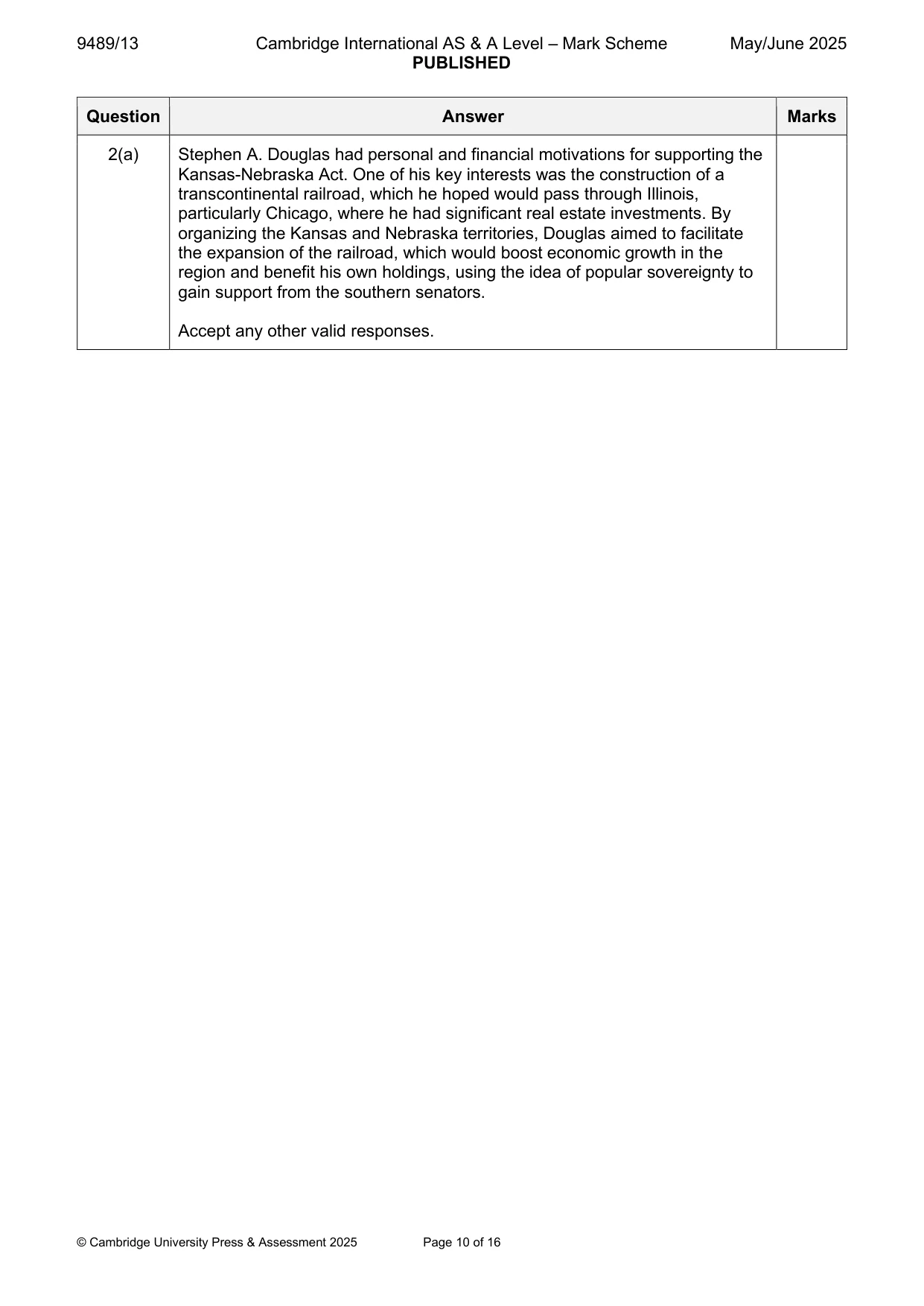
9489/13 Cambridge International AS & A Level – Mark Scheme PUBLISHED May/June 2025 © Cambridge University Press & Assessment 2025 Page 10 of 16 Question Answer Marks 2(a) Stephen A. Douglas had personal and financial motivations for supporting the Kansas-Nebraska Act. One of his key interests was the construction of a transcontinental railroad, which he hoped would pass through Illinois, particularly Chicago, where he had significant real estate investments. By organizing the Kansas and Nebraska territories, Douglas aimed to facilitate the expansion of the railroad, which would boost economic growth in the region and benefit his own holdings, using the idea of popular sovereignty to gain support from the southern senators. Accept any other valid responses.
Mark scheme, page 11
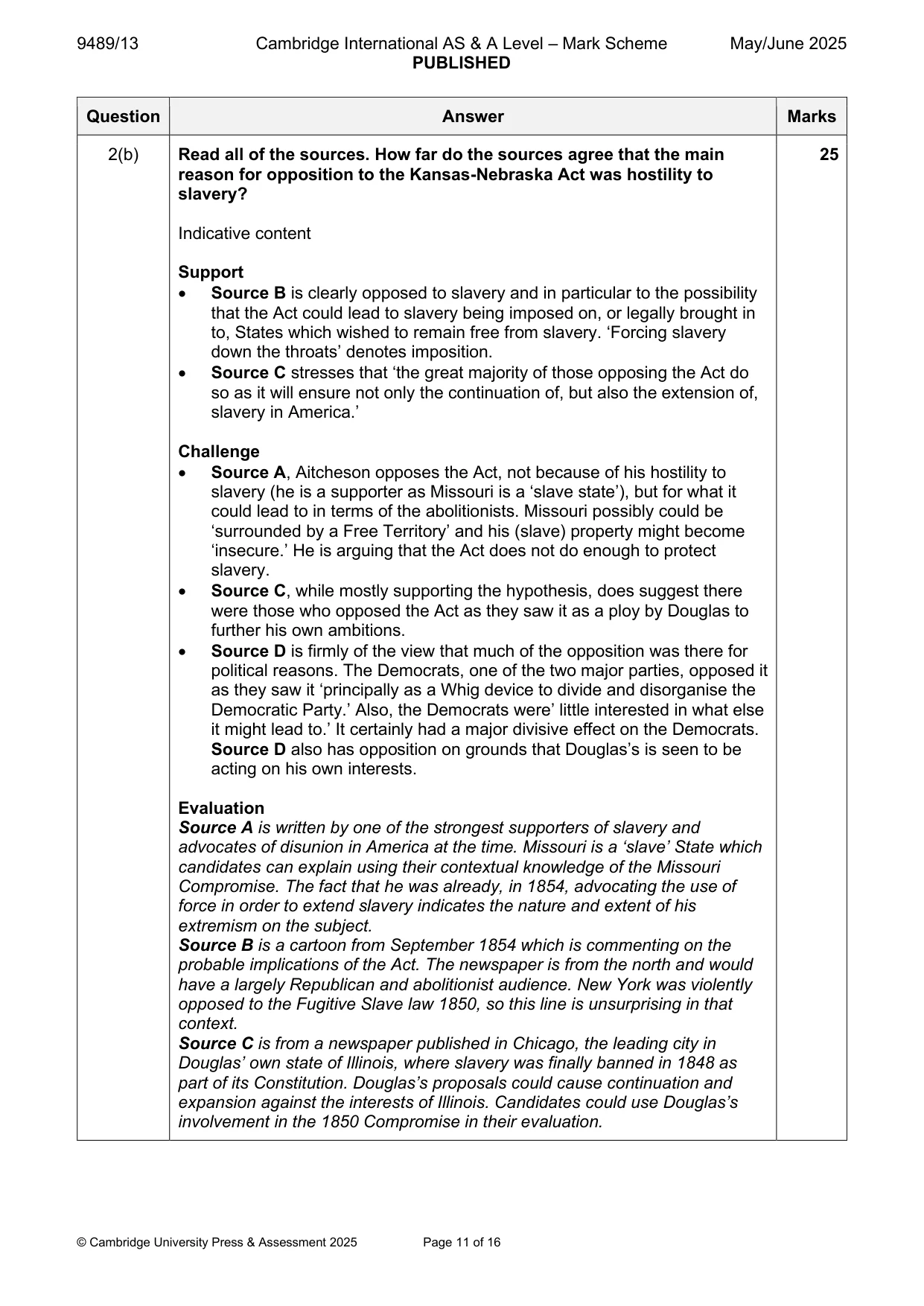
9489/13 Cambridge International AS & A Level – Mark Scheme PUBLISHED May/June 2025 © Cambridge University Press & Assessment 2025 Page 11 of 16 Question Answer Marks 2(b) Read all of the sources. How far do the sources agree that the main reason for opposition to the Kansas-Nebraska Act was hostility to slavery? Indicative content Support • Source B is clearly opposed to slavery and in particular to the possibility that the Act could lead to slavery being imposed on, or legally brought in to, States which wished to remain free from slavery. ‘Forcing slavery down the throats’ denotes imposition. • Source C stresses that ‘the great majority of those opposing the Act do so as it will ensure not only the continuation of, but also the extension of, slavery in America.’ Challenge • Source A, Aitcheson opposes the Act, not because of his hostility to slavery (he is a supporter as Missouri is a ‘slave state’), but for what it could lead to in terms of the abolitionists. Missouri possibly could be ‘surrounded by a Free Territory’ and his (slave) property might become ‘insecure.’ He is arguing that the Act does not do enough to protect slavery. • Source C, while mostly supporting the hypothesis, does suggest there were those who opposed the Act as they saw it as a ploy by Douglas to further his own ambitions. • Source D is firmly of the view that much of the opposition was there for political reasons. The Democrats, one of the two major parties, opposed it as they saw it ‘principally as a Whig device to divide and disorganise the Democratic Party.’ Also, the Democrats were’ little interested in what else it might lead to.’ It certainly had a major divisive effect on the Democrats. Source D also has opposition on grounds that Douglas’s is seen to be acting on his own interests. Evaluation Source A is written by one of the strongest supporters of slavery and advocates of disunion in America at the time. Missouri is a ‘slave’ State which candidates can explain using their contextual knowledge of the Missouri Compromise. The fact that he was already, in 1854, advocating the use of force in order to extend slavery indicates the nature and extent of his extremism on the subject. Source B is a cartoon from September 1854 which is commenting on the probable implications of the Act. The newspaper is from the north and would have a largely Republican and abolitionist audience. New York was violently opposed to the Fugitive Slave law 1850, so this line is unsurprising in that context. Source C is from a newspaper published in Chicago, the leading city in Douglas’ own state of Illinois, where slavery was finally banned in 1848 as part of its Constitution. Douglas’s proposals could cause continuation and expansion against the interests of Illinois. Candidates could use Douglas’s involvement in the 1850 Compromise in their evaluation. 25
Mark scheme, page 12
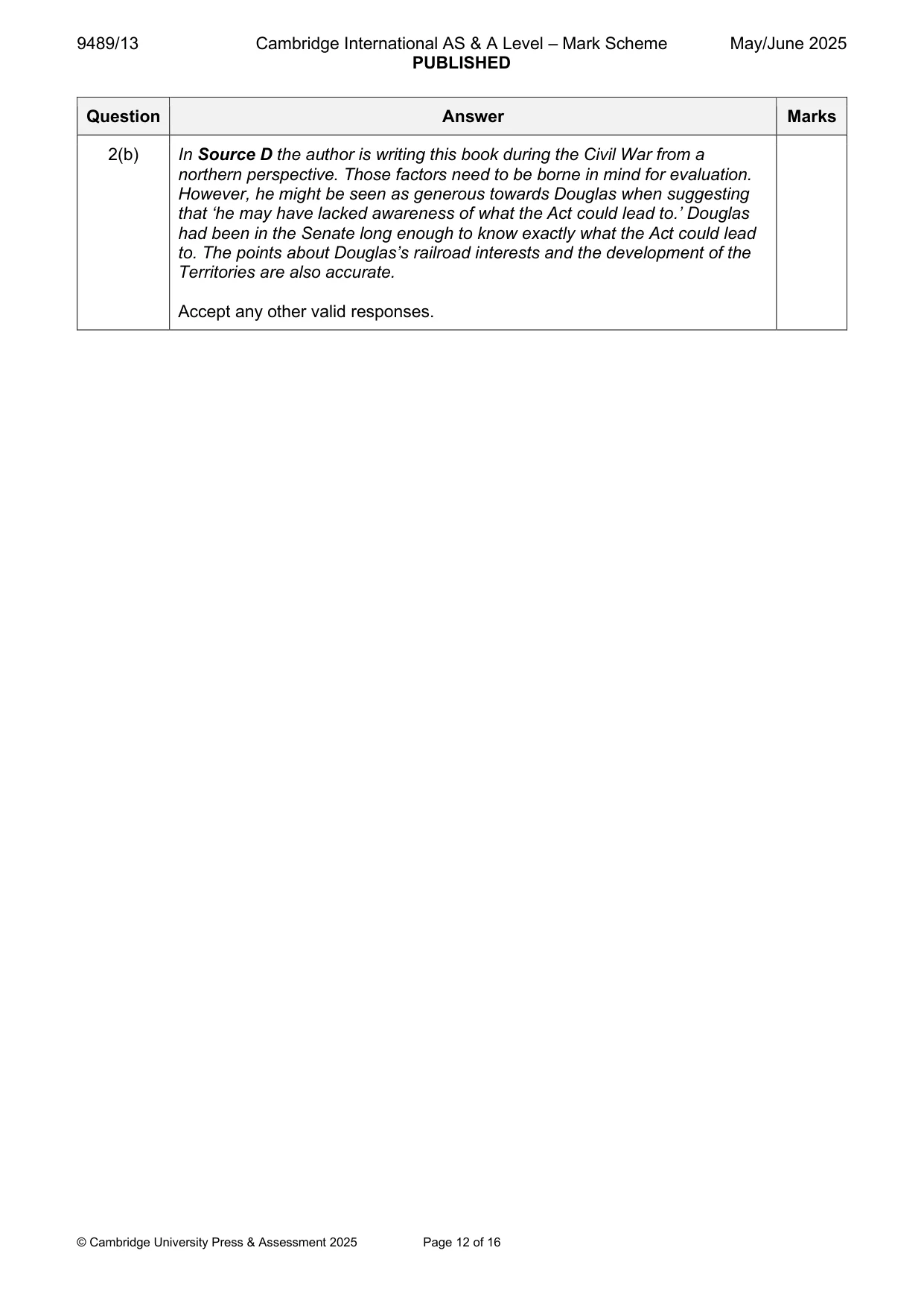
9489/13 Cambridge International AS & A Level – Mark Scheme PUBLISHED May/June 2025 © Cambridge University Press & Assessment 2025 Page 12 of 16 Question Answer Marks 2(b) In Source D the author is writing this book during the Civil War from a northern perspective. Those factors need to be borne in mind for evaluation. However, he might be seen as generous towards Douglas when suggesting that ‘he may have lacked awareness of what the Act could lead to.’ Douglas had been in the Senate long enough to know exactly what the Act could lead to. The points about Douglas’s railroad interests and the development of the Territories are also accurate. Accept any other valid responses.
Mark scheme, page 13
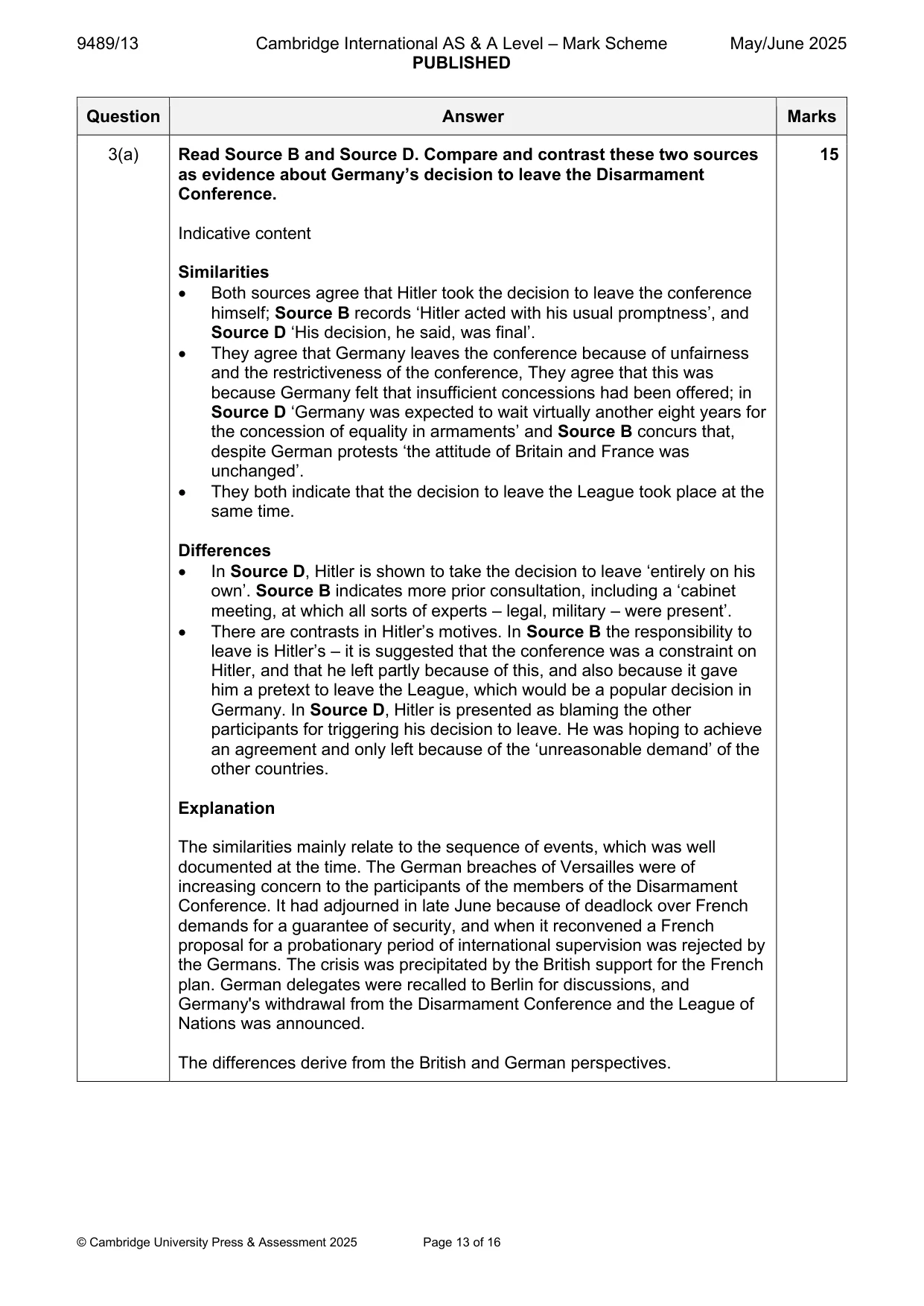
9489/13 Cambridge International AS & A Level – Mark Scheme PUBLISHED May/June 2025 © Cambridge University Press & Assessment 2025 Page 13 of 16 Question Answer Marks 3(a) Read Source B and Source D. Compare and contrast these two sources as evidence about Germany’s decision to leave the Disarmament Conference. Indicative content Similarities • Both sources agree that Hitler took the decision to leave the conference himself; Source B records ‘Hitler acted with his usual promptness’, and Source D ‘His decision, he said, was final’. • They agree that Germany leaves the conference because of unfairness and the restrictiveness of the conference, They agree that this was because Germany felt that insufficient concessions had been offered; in Source D ‘Germany was expected to wait virtually another eight years for the concession of equality in armaments’ and Source B concurs that, despite German protests ‘the attitude of Britain and France was unchanged’. • They both indicate that the decision to leave the League took place at the same time. Differences • In Source D, Hitler is shown to take the decision to leave ‘entirely on his own’. Source B indicates more prior consultation, including a ‘cabinet meeting, at which all sorts of experts – legal, military – were present’. • There are contrasts in Hitler’s motives. In Source B the responsibility to leave is Hitler’s – it is suggested that the conference was a constraint on Hitler, and that he left partly because of this, and also because it gave him a pretext to leave the League, which would be a popular decision in Germany. In Source D, Hitler is presented as blaming the other participants for triggering his decision to leave. He was hoping to achieve an agreement and only left because of the ‘unreasonable demand’ of the other countries. Explanation The similarities mainly relate to the sequence of events, which was well documented at the time. The German breaches of Versailles were of increasing concern to the participants of the members of the Disarmament Conference. It had adjourned in late June because of deadlock over French demands for a guarantee of security, and when it reconvened a French proposal for a probationary period of international supervision was rejected by the Germans. The crisis was precipitated by the British support for the French plan. German delegates were recalled to Berlin for discussions, and Germany's withdrawal from the Disarmament Conference and the League of Nations was announced. The differences derive from the British and German perspectives. 15
Mark scheme, page 14
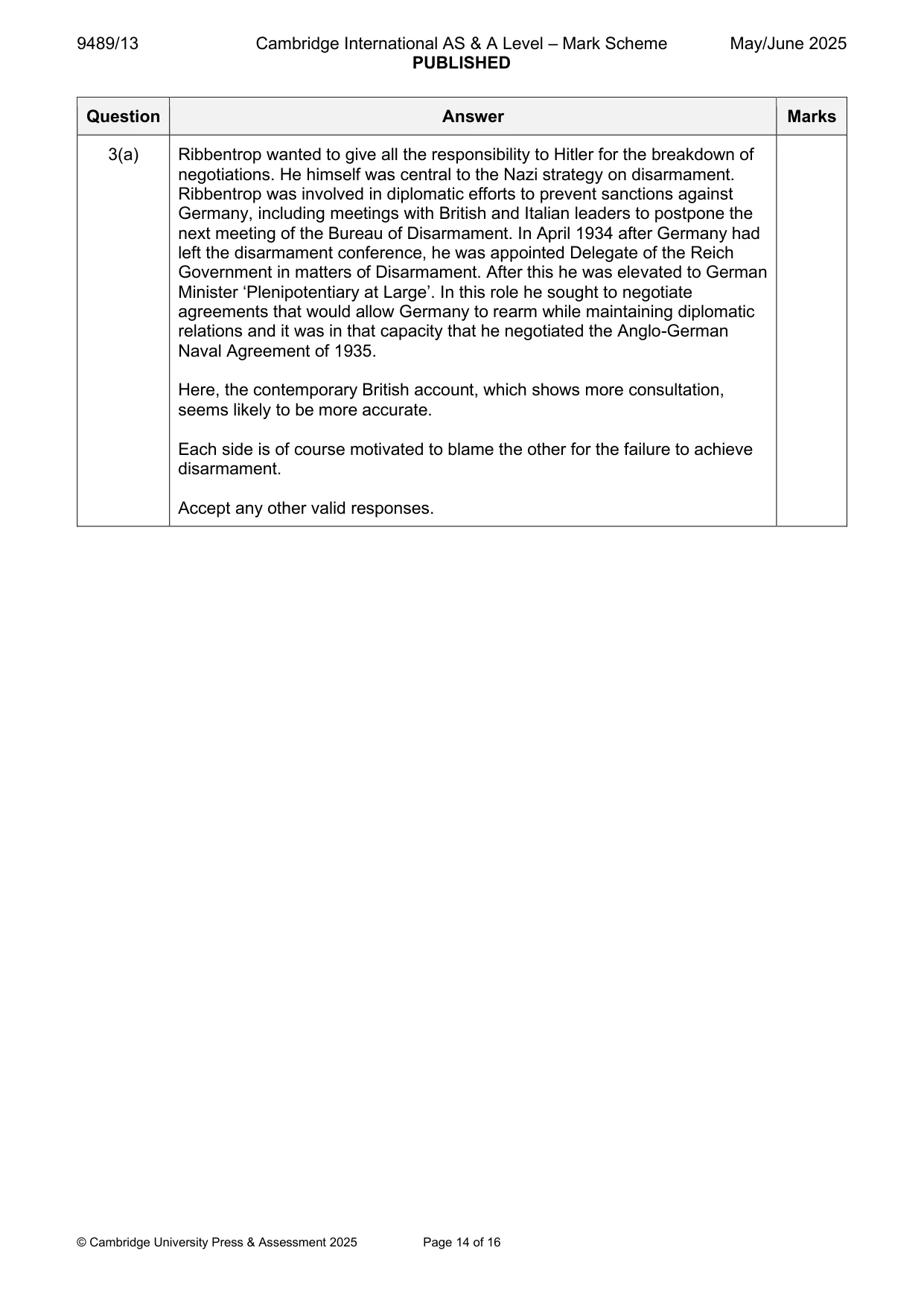
9489/13 Cambridge International AS & A Level – Mark Scheme PUBLISHED May/June 2025 © Cambridge University Press & Assessment 2025 Page 14 of 16 Question Answer Marks 3(a) Ribbentrop wanted to give all the responsibility to Hitler for the breakdown of negotiations. He himself was central to the Nazi strategy on disarmament. Ribbentrop was involved in diplomatic efforts to prevent sanctions against Germany, including meetings with British and Italian leaders to postpone the next meeting of the Bureau of Disarmament. In April 1934 after Germany had left the disarmament conference, he was appointed Delegate of the Reich Government in matters of Disarmament. After this he was elevated to German Minister ‘Plenipotentiary at Large’. In this role he sought to negotiate agreements that would allow Germany to rearm while maintaining diplomatic relations and it was in that capacity that he negotiated the Anglo-German Naval Agreement of 1935. Here, the contemporary British account, which shows more consultation, seems likely to be more accurate. Each side is of course motivated to blame the other for the failure to achieve disarmament. Accept any other valid responses.
Mark scheme, page 15
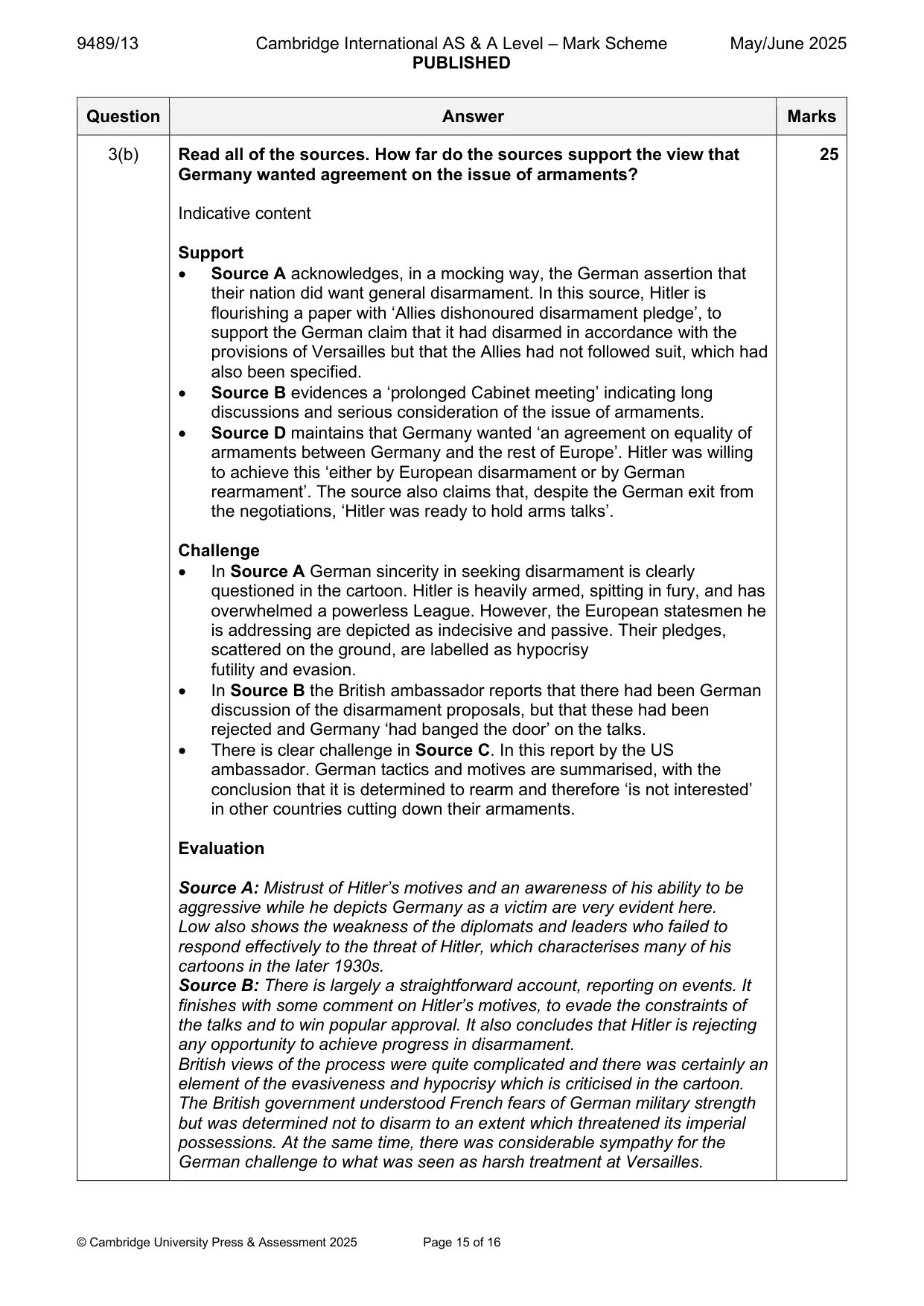
9489/13 Cambridge International AS & A Level – Mark Scheme PUBLISHED May/June 2025 © Cambridge University Press & Assessment 2025 Page 15 of 16 Question Answer Marks 3(b) Read all of the sources. How far do the sources support the view that Germany wanted agreement on the issue of armaments? Indicative content Support • Source A acknowledges, in a mocking way, the German assertion that their nation did want general disarmament. In this source, Hitler is flourishing a paper with ‘Allies dishonoured disarmament pledge’, to support the German claim that it had disarmed in accordance with the provisions of Versailles but that the Allies had not followed suit, which had also been specified. • Source B evidences a ‘prolonged Cabinet meeting’ indicating long discussions and serious consideration of the issue of armaments. • Source D maintains that Germany wanted ‘an agreement on equality of armaments between Germany and the rest of Europe’. Hitler was willing to achieve this ‘either by European disarmament or by German rearmament’. The source also claims that, despite the German exit from the negotiations, ‘Hitler was ready to hold arms talks’. Challenge • In Source A German sincerity in seeking disarmament is clearly questioned in the cartoon. Hitler is heavily armed, spitting in fury, and has overwhelmed a powerless League. However, the European statesmen he is addressing are depicted as indecisive and passive. Their pledges, scattered on the ground, are labelled as hypocrisy futility and evasion. • In Source B the British ambassador reports that there had been German discussion of the disarmament proposals, but that these had been rejected and Germany ‘had banged the door’ on the talks. • There is clear challenge in Source C. In this report by the US ambassador. German tactics and motives are summarised, with the conclusion that it is determined to rearm and therefore ‘is not interested’ in other countries cutting down their armaments. Evaluation Source A: Mistrust of Hitler’s motives and an awareness of his ability to be aggressive while he depicts Germany as a victim are very evident here. Low also shows the weakness of the diplomats and leaders who failed to respond effectively to the threat of Hitler, which characterises many of his cartoons in the later 1930s. Source B: There is largely a straightforward account, reporting on events. It finishes with some comment on Hitler’s motives, to evade the constraints of the talks and to win popular approval. It also concludes that Hitler is rejecting any opportunity to achieve progress in disarmament. British views of the process were quite complicated and there was certainly an element of the evasiveness and hypocrisy which is criticised in the cartoon. The British government understood French fears of German military strength but was determined not to disarm to an extent which threatened its imperial possessions. At the same time, there was considerable sympathy for the German challenge to what was seen as harsh treatment at Versailles. 25
Mark scheme, page 16
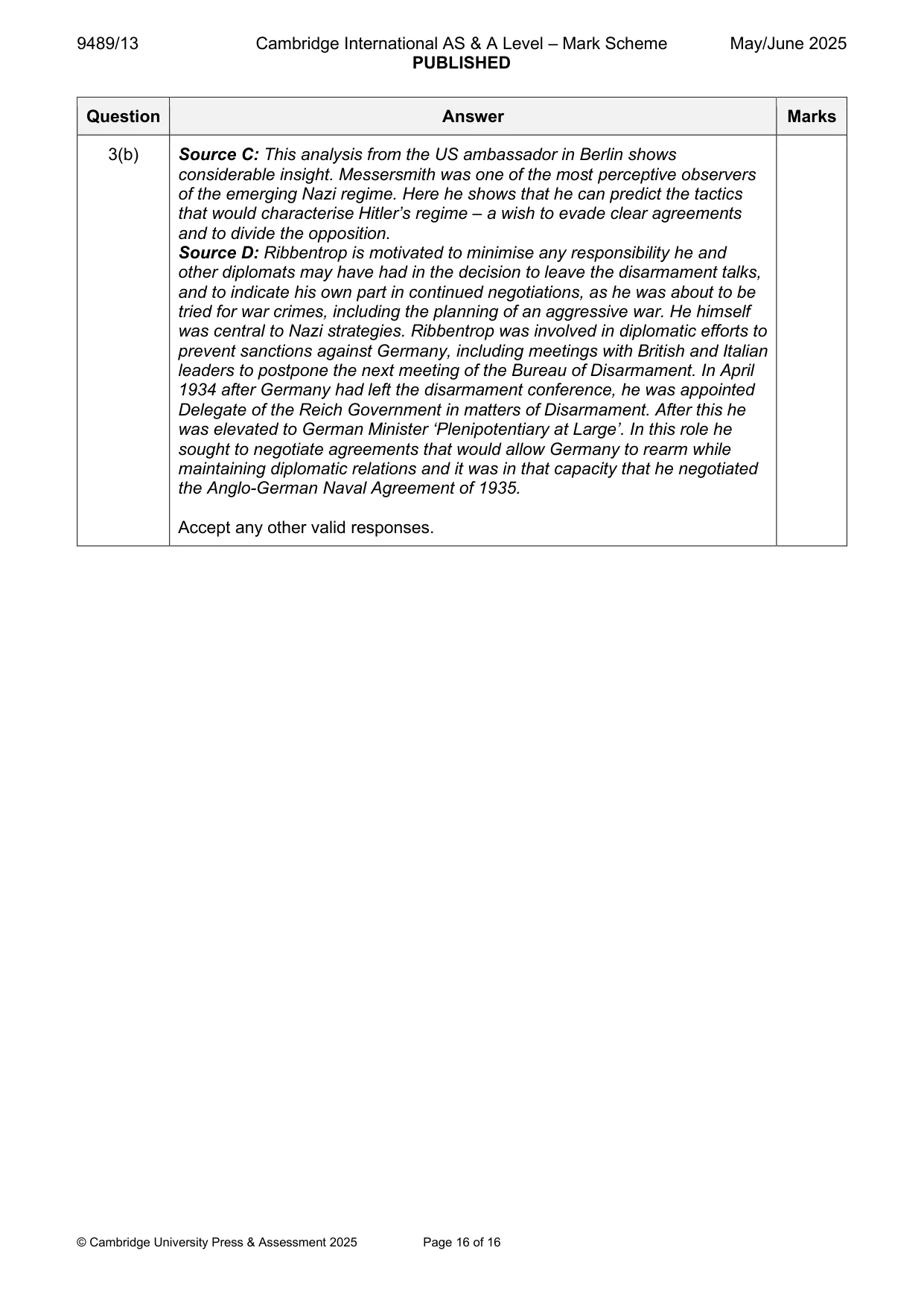
9489/13 Cambridge International AS & A Level – Mark Scheme PUBLISHED May/June 2025 © Cambridge University Press & Assessment 2025 Page 16 of 16 Question Answer Marks 3(b) Source C: This analysis from the US ambassador in Berlin shows considerable insight. Messersmith was one of the most perceptive observers of the emerging Nazi regime. Here he shows that he can predict the tactics that would characterise Hitler’s regime – a wish to evade clear agreements and to divide the opposition. Source D: Ribbentrop is motivated to minimise any responsibility he and other diplomats may have had in the decision to leave the disarmament talks, and to indicate his own part in continued negotiations, as he was about to be tried for war crimes, including the planning of an aggressive war. He himself was central to Nazi strategies. Ribbentrop was involved in diplomatic efforts to prevent sanctions against Germany, including meetings with British and Italian leaders to postpone the next meeting of the Bureau of Disarmament. In April 1934 after Germany had left the disarmament conference, he was appointed Delegate of the Reich Government in matters of Disarmament. After this he was elevated to German Minister ‘Plenipotentiary at Large’. In this role he sought to negotiate agreements that would allow Germany to rearm while maintaining diplomatic relations and it was in that capacity that he negotiated the Anglo-German Naval Agreement of 1935. Accept any other valid responses.
What you needed in this session
Cambridge’s own grade thresholds for 2025 May/June, Paper 1 · Variant 3. A higher threshold means an easier paper — the bar moves with how the cohort did.