Cambridge A Level History 9489 — 2021 Oct/Nov Paper 1 · Variant 1
9489/11/O/N/21 · 40 marks · ≈45 min
The question paper and its mark scheme, free to read here and free to download. This is Cambridge’s own paper, exactly as it was sat.
Question paper8 pages

Mark scheme13 pages
Answers below. Sit the paper first if you are practising.
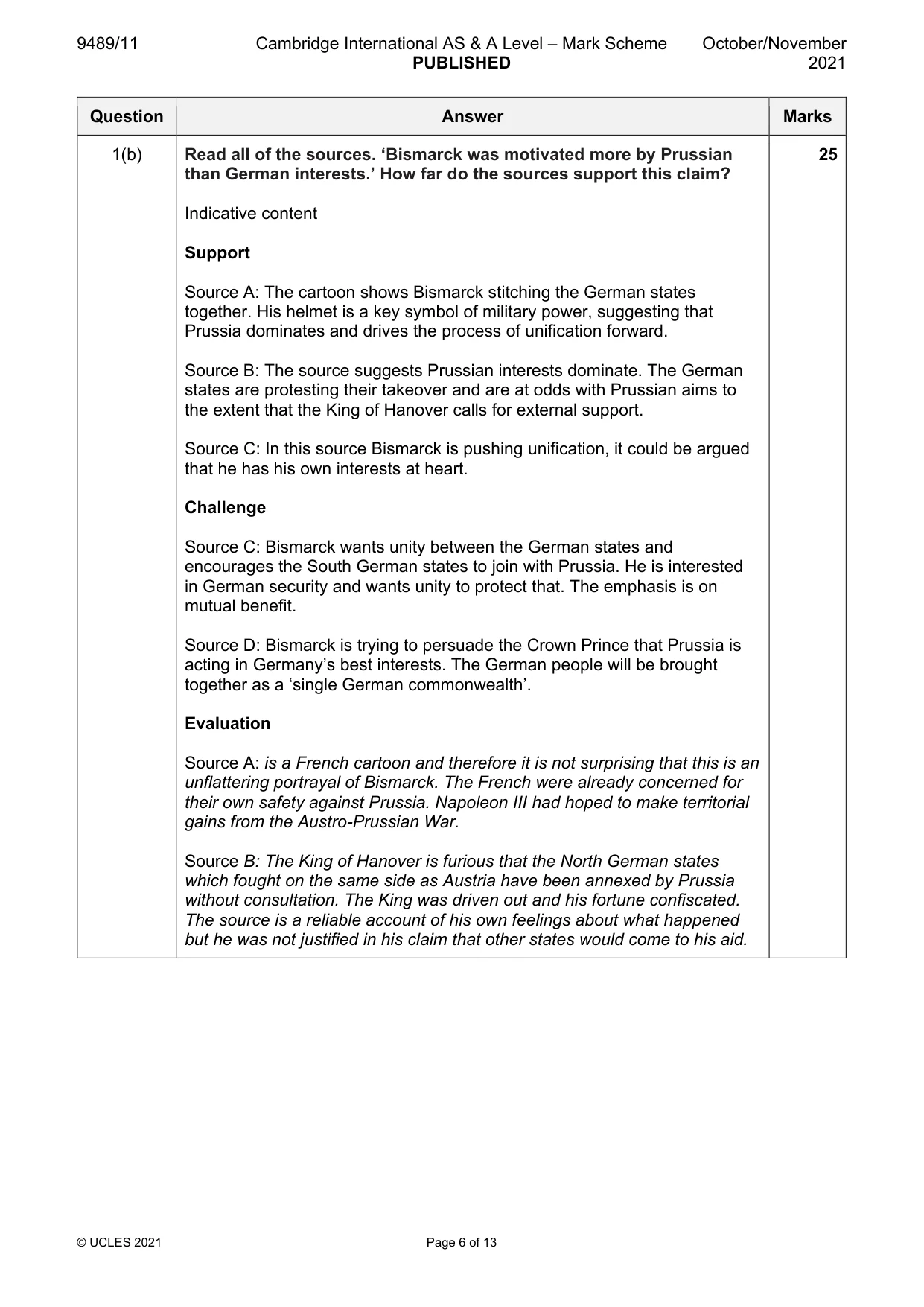
Paper as text
Question paper, page 1
This document has 8 pages. Any blank pages are indicated. Cambridge International AS & A Level DC (PQ/CGW) 204339/3 © UCLES 2021 [Turn over * 8 8 5 1 6 0 4 6 5 4 * HISTORY 9489/11 Paper 1 Document Question October/November 2021 1 hour 15 minutes You must answer on the enclosed answer booklet. You will need: Answer booklet (enclosed) INSTRUCTIONS ● Answer one question from one section only. Section A: European option Section B: American option Section C: International option ● Follow the instructions on the front cover of the answer booklet. If you need additional answer paper, ask the invigilator for a continuation booklet. INFORMATION ● The total mark for this paper is 40. ● The number of marks for each question or part question is shown in brackets [ ].
Question paper, page 2
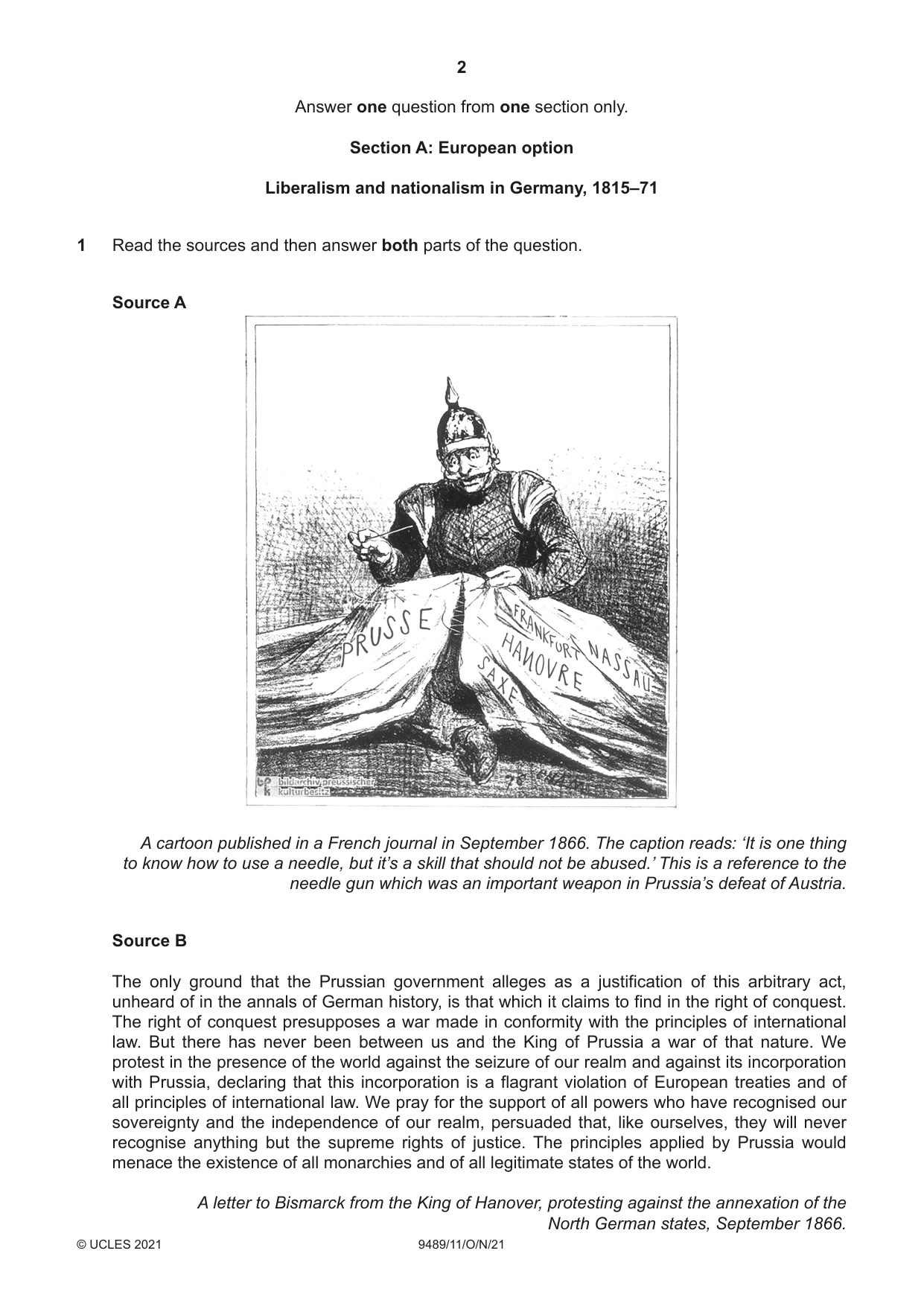
2 9489/11/O/N/21 © UCLES 2021 Answer one question from one section only. Section A: European option Liberalism and nationalism in Germany, 1815–71 1 Read the sources and then answer both parts of the question. Source A A cartoon published in a French journal in September 1866. The caption reads: ‘It is one thing to know how to use a needle, but it’s a skill that should not be abused.’ This is a reference to the needle gun which was an important weapon in Prussia’s defeat of Austria. Source B The only ground that the Prussian government alleges as a justification of this arbitrary act, unheard of in the annals of German history, is that which it claims to find in the right of conquest. The right of conquest presupposes a war made in conformity with the principles of international law. But there has never been between us and the King of Prussia a war of that nature. We protest in the presence of the world against the seizure of our realm and against its incorporation with Prussia, declaring that this incorporation is a flagrant violation of European treaties and of all principles of international law. We pray for the support of all powers who have recognised our sovereignty and the independence of our realm, persuaded that, like ourselves, they will never recognise anything but the supreme rights of justice. The principles applied by Prussia would menace the existence of all monarchies and of all legitimate states of the world. A letter to Bismarck from the King of Hanover, protesting against the annexation of the North German states, September 1866.
Question paper, page 3
3 9489/11/O/N/21 © UCLES 2021 [Turn over Source C Towards the South German states we stand in a different, one might say more favourable, relationship. Our security demands that the bonds between us and the North German states should be drawn as tight as possible, and that we should have the domestic and foreign forces of the North German Federation at our unconditional disposal. Our need for security will, however, be satisfied by the compact organisation of the North German Confederation and especially by the accession of Saxony to it. In regard to South Germany we do not need the same strict form of union. We need only to be confident that the South German states will never be tempted into a hostile attitude towards North Germany. These aims can be attained by a looser, less restrictive relationship with the South German states. We will demand nothing of them which would do more than give this confidence. A letter from Bismarck to the Prussian envoy in Bavaria, January 1867. Source D Our policy must be to look to the future, putting aside memories of past family quarrels, to seek and cherish national unity. Prussia must bring about for all Germany what it once brought about for itself. In land conquered from Poland, France and Saxony, Prussia made the conquered forget the conquest and raised them to a feeling of community and equality. So now Prussia must do away with the relationship - which cannot permanently be maintained - between the victorious and the defeated. Prussia must fuse loyalty to particular sections of the German people, or to particular states, into a willing and proud attachment to a single German commonwealth at whose head stands the King of Prussia. From a letter by Bismarck to the Crown Prince of Prussia, February 1867. Answer both parts of the question with reference to the sources. (a) Read Sources A and B. To what extent do these sources agree about the attitudes of other powers towards Prussia? [15] (b) Read all of the sources. ‘Bismarck was motivated more by Prussian than German interests.’ How far do the sources support this claim? [25]
Question paper, page 4
4 9489/11/O/N/21 © UCLES 2021 Section B: American option The origins of the Civil War, 1820–61 2 Read the sources and then answer both parts of the question. Source A Our own convictions have ever been favourable to such a measure and for the following reasons: • The annexation of Texas would exclude the further introduction of slaves from abroad into that beautiful country because the laws of the United States make the slave trade piracy. • With the rich lands of Texas constituting part of our Union, no slaveholder in Delaware, Maryland, Kentucky or Missouri could afford to retain their slaves but would find it in their interest to send them further south. Every person who has at heart the welfare of the slave should zealously advocate any measure which is calculated to compel the slaveholders in those states to send them further south. • The annexation of Texas would greatly increase the wealth and commerce of the country. • In twenty years Texas will grow all the cotton that Britain will require. From the ‘New York Courier and Enquirer’, March 1844. Source B There are northern as well as southern friends of the annexation of Texas. It is not surprising if they occasionally come into conflict. For example, it is said in the South that one of the effects of annexing Texas will be an increase in the relative strength of the slave states by adding to their number. But this doctrine is not palatable in the North and therefore is not preached there. On the contrary, it is argued that the annexation of Texas will diminish relatively the power of the slave states. See the recent report from a Pennsylvanian Congressman, a warm advocate of annexation. He says that three-fourths of Texas are upland, where slave labour cannot profitably be employed. Texas could be divided into three states without slaves and only one with them. If this is true, what argument remains to tempt the South to an act of political suicide? From the ‘Liberty (Mississippi) Advocate’, August 1844. Source C The New York Evening Post, the most ably conducted Democrat newspaper in the country, boldly denounces the scheme lately adopted in the House of Representatives for the annexation of Texas. It says: ‘This bill is a combination of fraud and oppression. It has been obtained by a bold and tyrannical use of the majority on the one hand. On the other, while it fraudulently holds out the idea of a compromise between the free and slave interests, it seized Texas, the whole of Texas, for the sole benefit of the South. By a mere majority vote, without any consideration of the people themselves, by a Congress elected without the slightest reference to the question, the basis of the Union is entirely changed. The whole substantial power of the country is forever transferred to the slaveholding states.’ From the ‘Cecil (Maryland) Whig’, March 1845.
Question paper, page 5
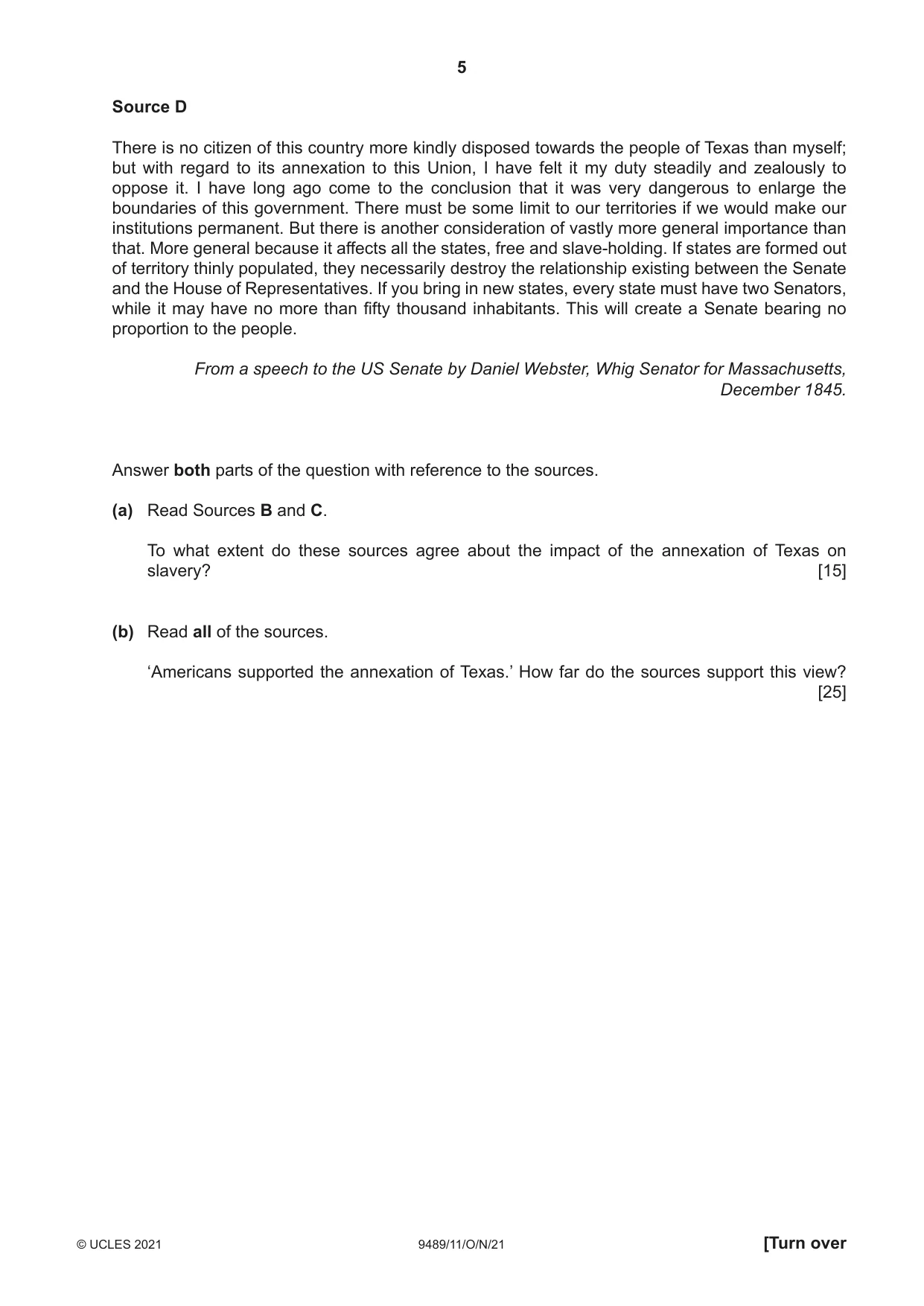
5 9489/11/O/N/21 © UCLES 2021 [Turn over Source D There is no citizen of this country more kindly disposed towards the people of Texas than myself; but with regard to its annexation to this Union, I have felt it my duty steadily and zealously to oppose it. I have long ago come to the conclusion that it was very dangerous to enlarge the boundaries of this government. There must be some limit to our territories if we would make our institutions permanent. But there is another consideration of vastly more general importance than that. More general because it affects all the states, free and slave-holding. If states are formed out of territory thinly populated, they necessarily destroy the relationship existing between the Senate and the House of Representatives. If you bring in new states, every state must have two Senators, while it may have no more than fifty thousand inhabitants. This will create a Senate bearing no proportion to the people. From a speech to the US Senate by Daniel Webster, Whig Senator for Massachusetts, December 1845. Answer both parts of the question with reference to the sources. (a) Read Sources B and C. To what extent do these sources agree about the impact of the annexation of Texas on slavery? [15] (b) Read all of the sources. ‘Americans supported the annexation of Texas.’ How far do the sources support this view? [25]
Question paper, page 6
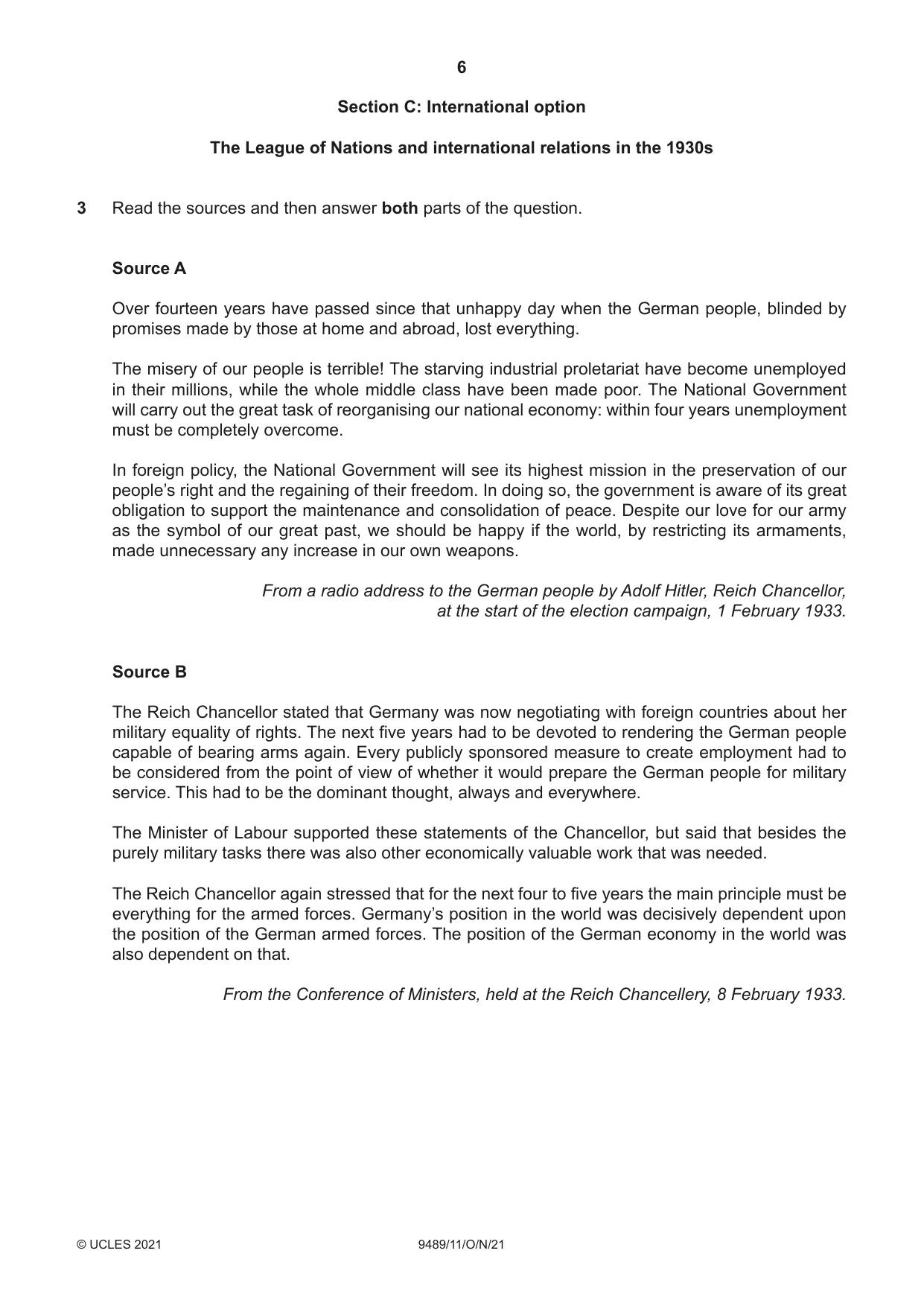
6 9489/11/O/N/21 © UCLES 2021 Section C: International option The League of Nations and international relations in the 1930s 3 Read the sources and then answer both parts of the question. Source A Over fourteen years have passed since that unhappy day when the German people, blinded by promises made by those at home and abroad, lost everything. The misery of our people is terrible! The starving industrial proletariat have become unemployed in their millions, while the whole middle class have been made poor. The National Government will carry out the great task of reorganising our national economy: within four years unemployment must be completely overcome. In foreign policy, the National Government will see its highest mission in the preservation of our people’s right and the regaining of their freedom. In doing so, the government is aware of its great obligation to support the maintenance and consolidation of peace. Despite our love for our army as the symbol of our great past, we should be happy if the world, by restricting its armaments, made unnecessary any increase in our own weapons. From a radio address to the German people by Adolf Hitler, Reich Chancellor, at the start of the election campaign, 1 February 1933. Source B The Reich Chancellor stated that Germany was now negotiating with foreign countries about her military equality of rights. The next five years had to be devoted to rendering the German people capable of bearing arms again. Every publicly sponsored measure to create employment had to be considered from the point of view of whether it would prepare the German people for military service. This had to be the dominant thought, always and everywhere. The Minister of Labour supported these statements of the Chancellor, but said that besides the purely military tasks there was also other economically valuable work that was needed. The Reich Chancellor again stressed that for the next four to five years the main principle must be everything for the armed forces. Germany’s position in the world was decisively dependent upon the position of the German armed forces. The position of the German economy in the world was also dependent on that. From the Conference of Ministers, held at the Reich Chancellery, 8 February 1933.
Question paper, page 7
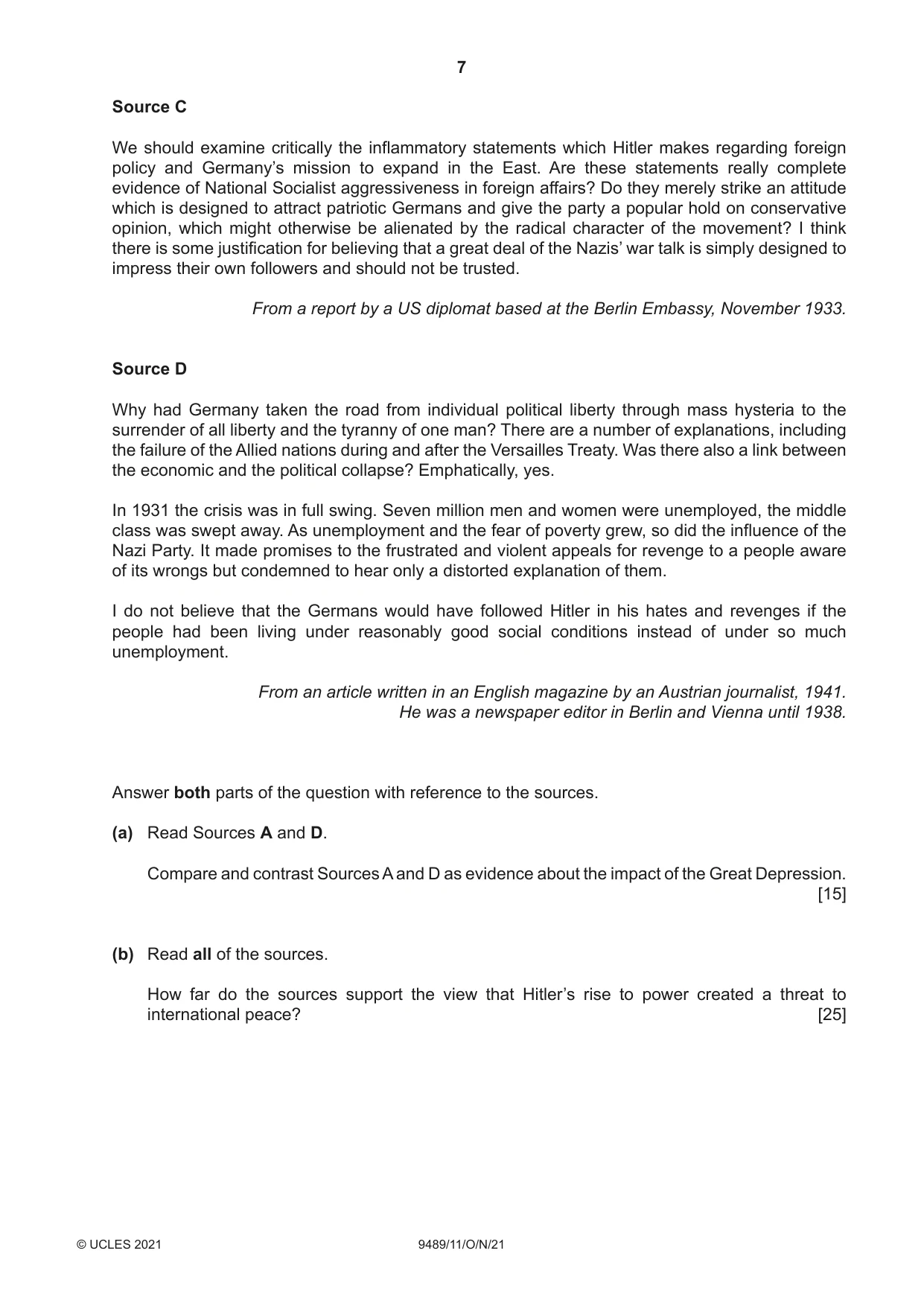
7 9489/11/O/N/21 © UCLES 2021 Source C We should examine critically the inflammatory statements which Hitler makes regarding foreign policy and Germany’s mission to expand in the East. Are these statements really complete evidence of National Socialist aggressiveness in foreign affairs? Do they merely strike an attitude which is designed to attract patriotic Germans and give the party a popular hold on conservative opinion, which might otherwise be alienated by the radical character of the movement? I think there is some justification for believing that a great deal of the Nazis’ war talk is simply designed to impress their own followers and should not be trusted. From a report by a US diplomat based at the Berlin Embassy, November 1933. Source D Why had Germany taken the road from individual political liberty through mass hysteria to the surrender of all liberty and the tyranny of one man? There are a number of explanations, including the failure of the Allied nations during and after the Versailles Treaty. Was there also a link between the economic and the political collapse? Emphatically, yes. In 1931 the crisis was in full swing. Seven million men and women were unemployed, the middle class was swept away. As unemployment and the fear of poverty grew, so did the influence of the Nazi Party. It made promises to the frustrated and violent appeals for revenge to a people aware of its wrongs but condemned to hear only a distorted explanation of them. I do not believe that the Germans would have followed Hitler in his hates and revenges if the people had been living under reasonably good social conditions instead of under so much unemployment. From an article written in an English magazine by an Austrian journalist, 1941. He was a newspaper editor in Berlin and Vienna until 1938. Answer both parts of the question with reference to the sources. (a) Read Sources A and D. Compare and contrast Sources A and D as evidence about the impact of the Great Depression. [15] (b) Read all of the sources. How far do the sources support the view that Hitler’s rise to power created a threat to international peace? [25]
Question paper, page 8
8 9489/11/O/N/21 © UCLES 2021 Permission to reproduce items where third-party owned material protected by copyright is included has been sought and cleared where possible. Every reasonable effort has been made by the publisher (UCLES) to trace copyright holders, but if any items requiring clearance have unwittingly been included, the publisher will be pleased to make amends at the earliest possible opportunity. To avoid the issue of disclosure of answer-related information to candidates, all copyright acknowledgements are reproduced online in the Cambridge Assessment International Education Copyright Acknowledgements Booklet. This is produced for each series of examinations and is freely available to download at www.cambridgeinternational.org after the live examination series. Cambridge Assessment International Education is part of the Cambridge Assessment Group. Cambridge Assessment is the brand name of the University of Cambridge Local Examinations Syndicate (UCLES), which itself is a department of the University of Cambridge. BLANK PAGE
Mark scheme, page 1
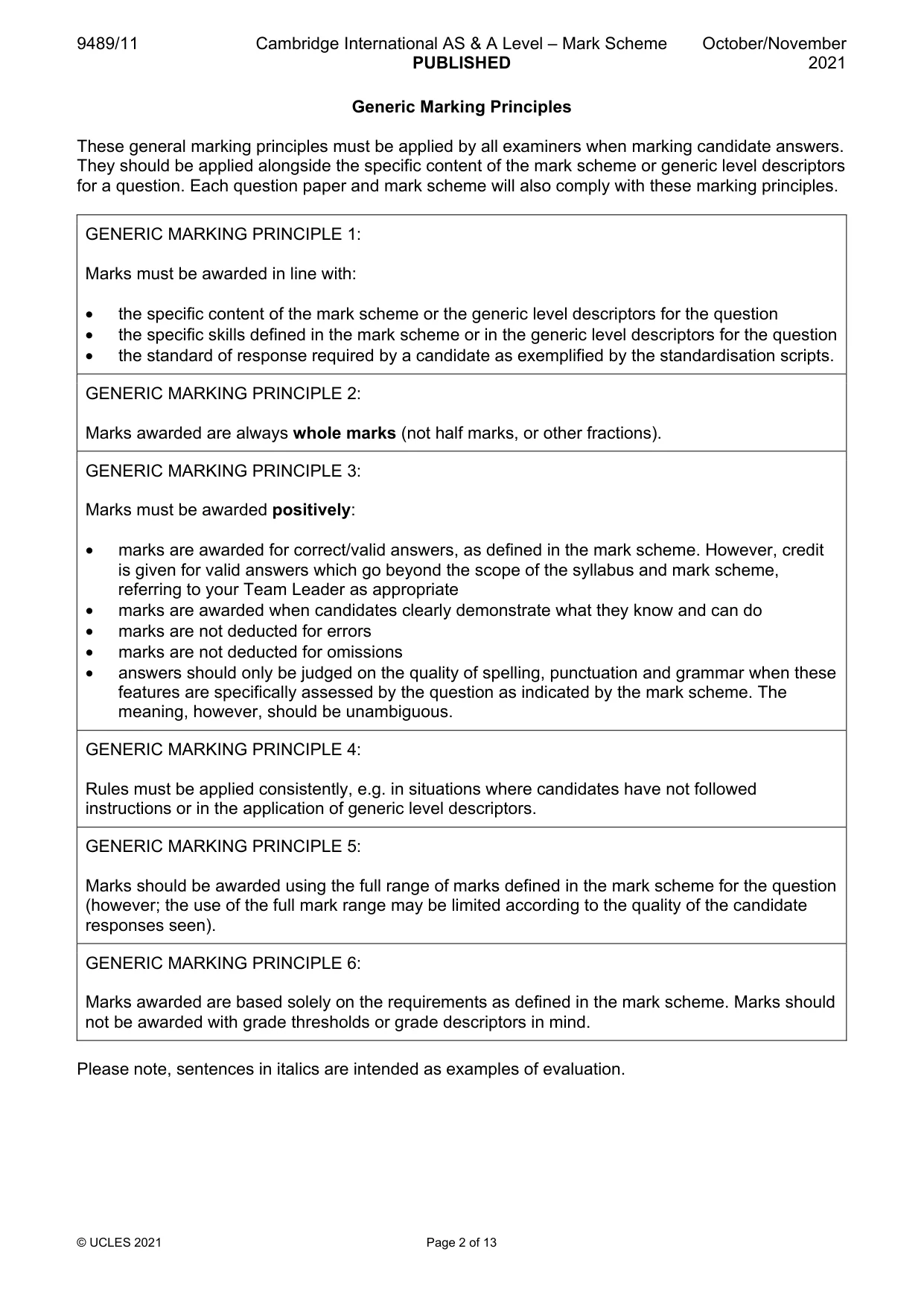
This document consists of 13 printed pages. © UCLES 2021 [Turn over Cambridge International AS & A Level HISTORY 9489/11 Paper 1 October/November 2021 MARK SCHEME Maximum Mark: 40 Published This mark scheme is published as an aid to teachers and candidates, to indicate the requirements of the examination. It shows the basis on which Examiners were instructed to award marks. It does not indicate the details of the discussions that took place at an Examiners’ meeting before marking began, which would have considered the acceptability of alternative answers. Mark schemes should be read in conjunction with the question paper and the Principal Examiner Report for Teachers. Cambridge International will not enter into discussions about these mark schemes. Cambridge International is publishing the mark schemes for the October/November 2021 series for most Cambridge IGCSE™, Cambridge International A and AS Level components and some Cambridge O Level components.
Mark scheme, page 2
9489/11 Cambridge International AS & A Level – Mark Scheme PUBLISHED October/November 2021 © UCLES 2021 Page 2 of 13 Generic Marking Principles These general marking principles must be applied by all examiners when marking candidate answers. They should be applied alongside the specific content of the mark scheme or generic level descriptors for a question. Each question paper and mark scheme will also comply with these marking principles. GENERIC MARKING PRINCIPLE 1: Marks must be awarded in line with: • the specific content of the mark scheme or the generic level descriptors for the question • the specific skills defined in the mark scheme or in the generic level descriptors for the question • the standard of response required by a candidate as exemplified by the standardisation scripts. GENERIC MARKING PRINCIPLE 2: Marks awarded are always whole marks (not half marks, or other fractions). GENERIC MARKING PRINCIPLE 3: Marks must be awarded positively: • marks are awarded for correct/valid answers, as defined in the mark scheme. However, credit is given for valid answers which go beyond the scope of the syllabus and mark scheme, referring to your Team Leader as appropriate • marks are awarded when candidates clearly demonstrate what they know and can do • marks are not deducted for errors • marks are not deducted for omissions • answers should only be judged on the quality of spelling, punctuation and grammar when these features are specifically assessed by the question as indicated by the mark scheme. The meaning, however, should be unambiguous. GENERIC MARKING PRINCIPLE 4: Rules must be applied consistently, e.g. in situations where candidates have not followed instructions or in the application of generic level descriptors. GENERIC MARKING PRINCIPLE 5: Marks should be awarded using the full range of marks defined in the mark scheme for the question (however; the use of the full mark range may be limited according to the quality of the candidate responses seen). GENERIC MARKING PRINCIPLE 6: Marks awarded are based solely on the requirements as defined in the mark scheme. Marks should not be awarded with grade thresholds or grade descriptors in mind. Please note, sentences in italics are intended as examples of evaluation.
Mark scheme, page 3
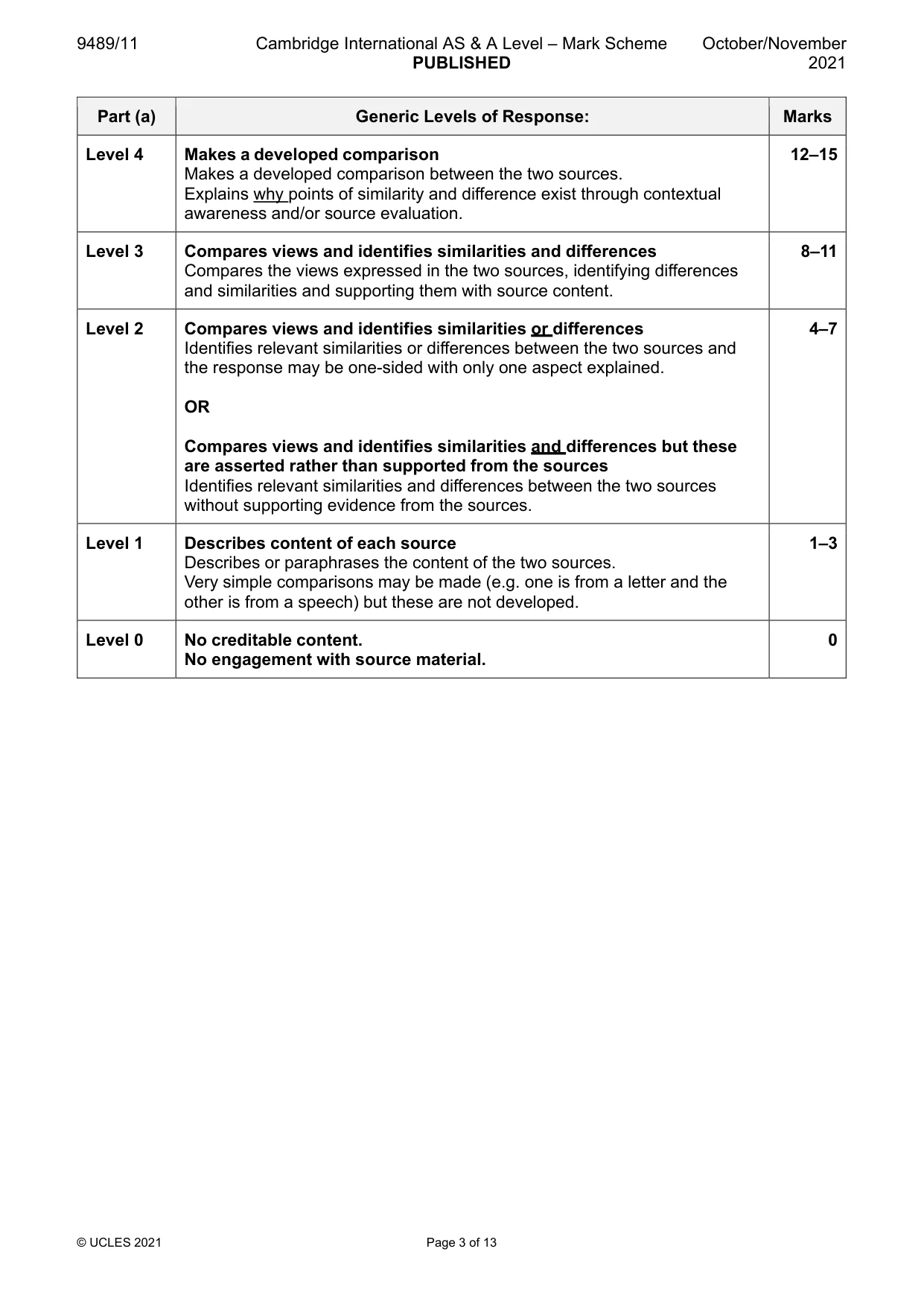
9489/11 Cambridge International AS & A Level – Mark Scheme PUBLISHED October/November 2021 © UCLES 2021 Page 3 of 13 Part (a) Generic Levels of Response: Marks Level 4 Makes a developed comparison Makes a developed comparison between the two sources. Explains why points of similarity and difference exist through contextual awareness and/or source evaluation. 12–15 Level 3 Compares views and identifies similarities and differences Compares the views expressed in the two sources, identifying differences and similarities and supporting them with source content. 8–11 Level 2 Compares views and identifies similarities or differences Identifies relevant similarities or differences between the two sources and the response may be one-sided with only one aspect explained. OR Compares views and identifies similarities and differences but these are asserted rather than supported from the sources Identifies relevant similarities and differences between the two sources without supporting evidence from the sources. 4–7 Level 1 Describes content of each source Describes or paraphrases the content of the two sources. Very simple comparisons may be made (e.g. one is from a letter and the other is from a speech) but these are not developed. 1–3 Level 0 No creditable content. No engagement with source material. 0
Mark scheme, page 4
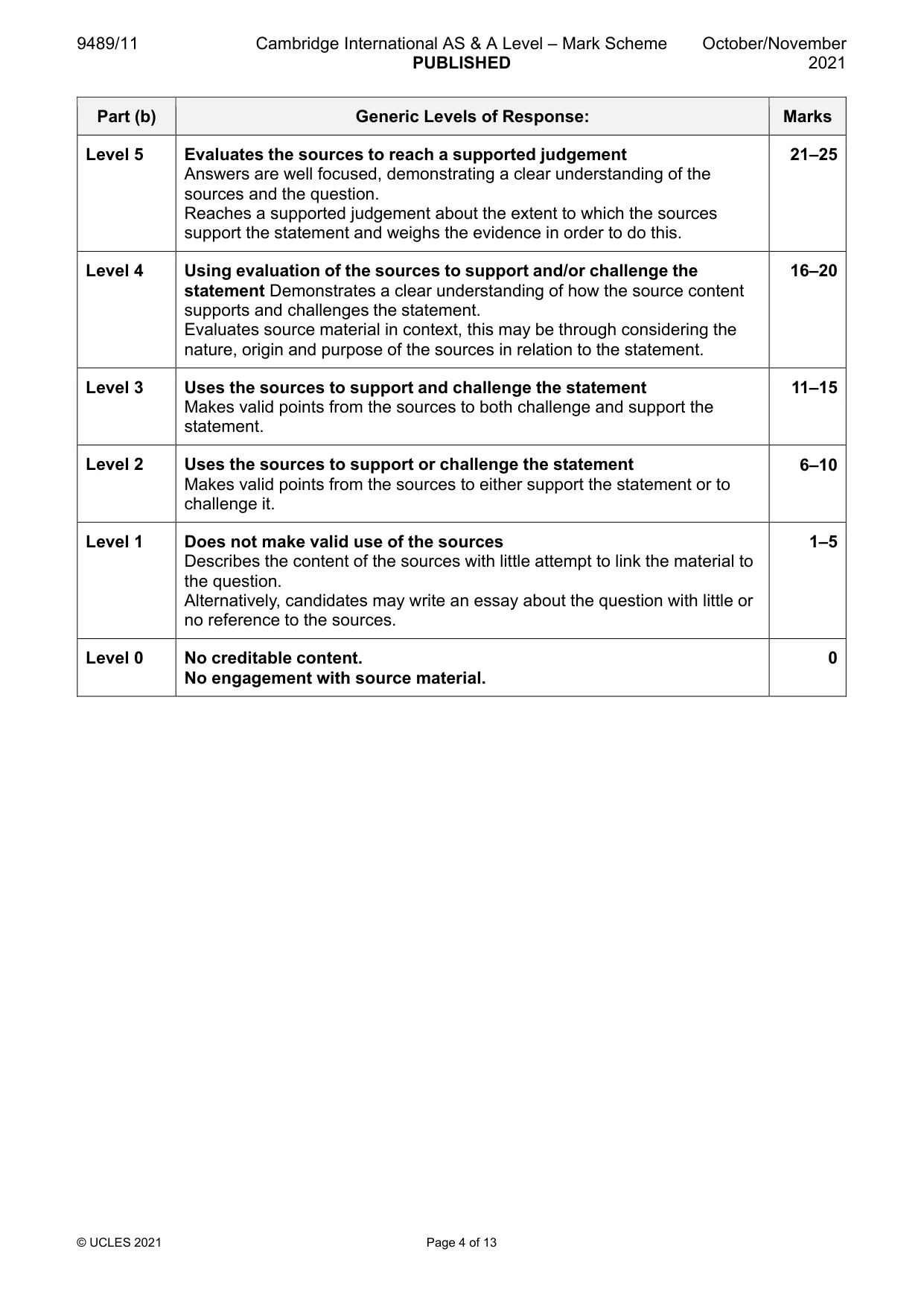
9489/11 Cambridge International AS & A Level – Mark Scheme PUBLISHED October/November 2021 © UCLES 2021 Page 4 of 13 Part (b) Generic Levels of Response: Marks Level 5 Evaluates the sources to reach a supported judgement Answers are well focused, demonstrating a clear understanding of the sources and the question. Reaches a supported judgement about the extent to which the sources support the statement and weighs the evidence in order to do this. 21–25 Level 4 Using evaluation of the sources to support and/or challenge the statement Demonstrates a clear understanding of how the source content supports and challenges the statement. Evaluates source material in context, this may be through considering the nature, origin and purpose of the sources in relation to the statement. 16–20 Level 3 Uses the sources to support and challenge the statement Makes valid points from the sources to both challenge and support the statement. 11–15 Level 2 Uses the sources to support or challenge the statement Makes valid points from the sources to either support the statement or to challenge it. 6–10 Level 1 Does not make valid use of the sources Describes the content of the sources with little attempt to link the material to the question. Alternatively, candidates may write an essay about the question with little or no reference to the sources. 1–5 Level 0 No creditable content. No engagement with source material. 0
Mark scheme, page 5
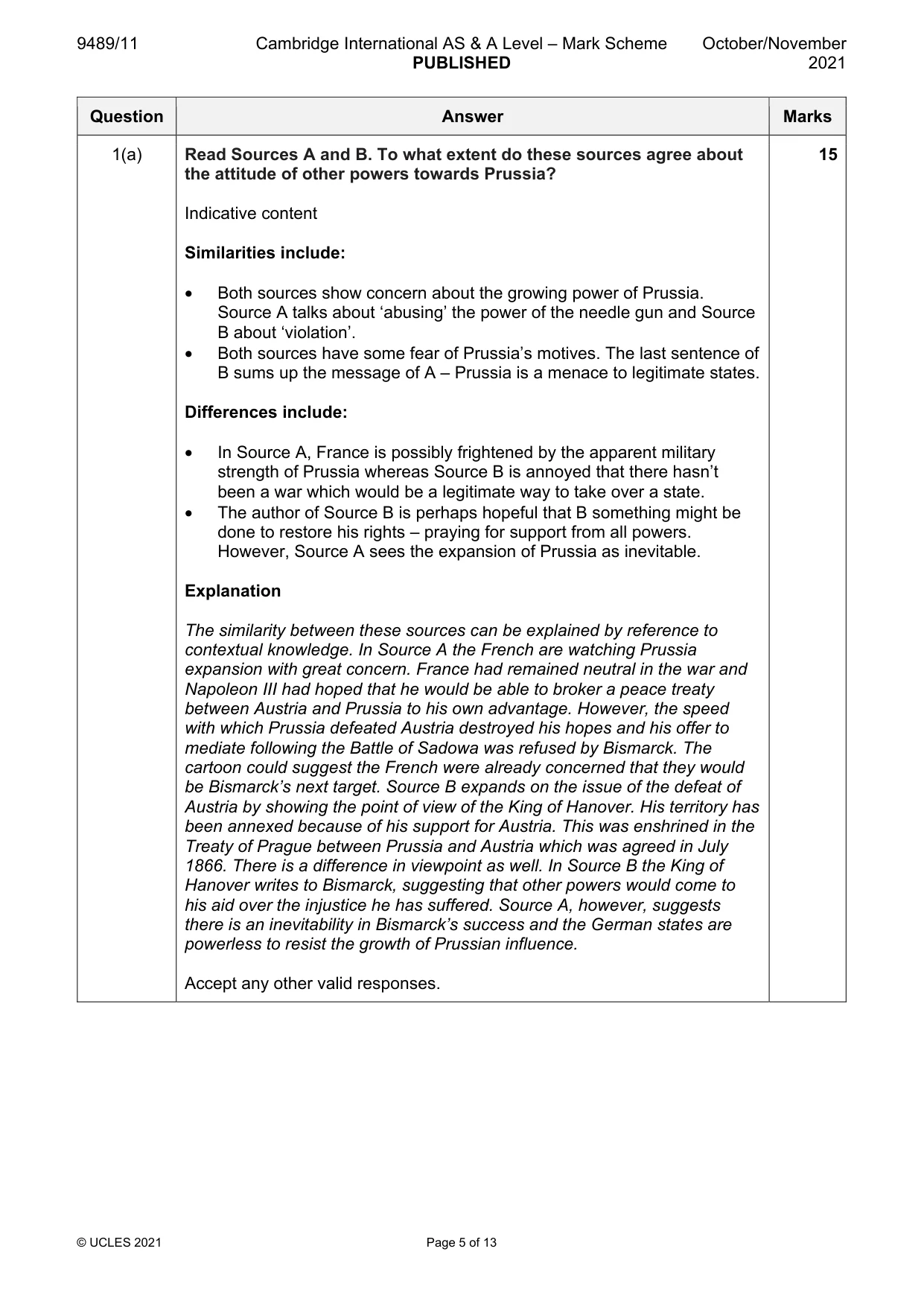
9489/11 Cambridge International AS & A Level – Mark Scheme PUBLISHED October/November 2021 © UCLES 2021 Page 5 of 13 Question Answer Marks 1(a) Read Sources A and B. To what extent do these sources agree about the attitude of other powers towards Prussia? Indicative content Similarities include: • Both sources show concern about the growing power of Prussia. Source A talks about ‘abusing’ the power of the needle gun and Source B about ‘violation’. • Both sources have some fear of Prussia’s motives. The last sentence of B sums up the message of A – Prussia is a menace to legitimate states. Differences include: • In Source A, France is possibly frightened by the apparent military strength of Prussia whereas Source B is annoyed that there hasn’t been a war which would be a legitimate way to take over a state. • The author of Source B is perhaps hopeful that B something might be done to restore his rights – praying for support from all powers. However, Source A sees the expansion of Prussia as inevitable. Explanation The similarity between these sources can be explained by reference to contextual knowledge. In Source A the French are watching Prussia expansion with great concern. France had remained neutral in the war and Napoleon III had hoped that he would be able to broker a peace treaty between Austria and Prussia to his own advantage. However, the speed with which Prussia defeated Austria destroyed his hopes and his offer to mediate following the Battle of Sadowa was refused by Bismarck. The cartoon could suggest the French were already concerned that they would be Bismarck’s next target. Source B expands on the issue of the defeat of Austria by showing the point of view of the King of Hanover. His territory has been annexed because of his support for Austria. This was enshrined in the Treaty of Prague between Prussia and Austria which was agreed in July 1866. There is a difference in viewpoint as well. In Source B the King of Hanover writes to Bismarck, suggesting that other powers would come to his aid over the injustice he has suffered. Source A, however, suggests there is an inevitability in Bismarck’s success and the German states are powerless to resist the growth of Prussian influence. Accept any other valid responses. 15
Mark scheme, page 6
9489/11 Cambridge International AS & A Level – Mark Scheme PUBLISHED October/November 2021 © UCLES 2021 Page 6 of 13 Question Answer Marks 1(b) Read all of the sources. ‘Bismarck was motivated more by Prussian than German interests.’ How far do the sources support this claim? Indicative content Support Source A: The cartoon shows Bismarck stitching the German states together. His helmet is a key symbol of military power, suggesting that Prussia dominates and drives the process of unification forward. Source B: The source suggests Prussian interests dominate. The German states are protesting their takeover and are at odds with Prussian aims to the extent that the King of Hanover calls for external support. Source C: In this source Bismarck is pushing unification, it could be argued that he has his own interests at heart. Challenge Source C: Bismarck wants unity between the German states and encourages the South German states to join with Prussia. He is interested in German security and wants unity to protect that. The emphasis is on mutual benefit. Source D: Bismarck is trying to persuade the Crown Prince that Prussia is acting in Germany’s best interests. The German people will be brought together as a ‘single German commonwealth’. Evaluation Source A: is a French cartoon and therefore it is not surprising that this is an unflattering portrayal of Bismarck. The French were already concerned for their own safety against Prussia. Napoleon III had hoped to make territorial gains from the Austro-Prussian War. Source B: The King of Hanover is furious that the North German states which fought on the same side as Austria have been annexed by Prussia without consultation. The King was driven out and his fortune confiscated. The source is a reliable account of his own feelings about what happened but he was not justified in his claim that other states would come to his aid. 25
Mark scheme, page 7
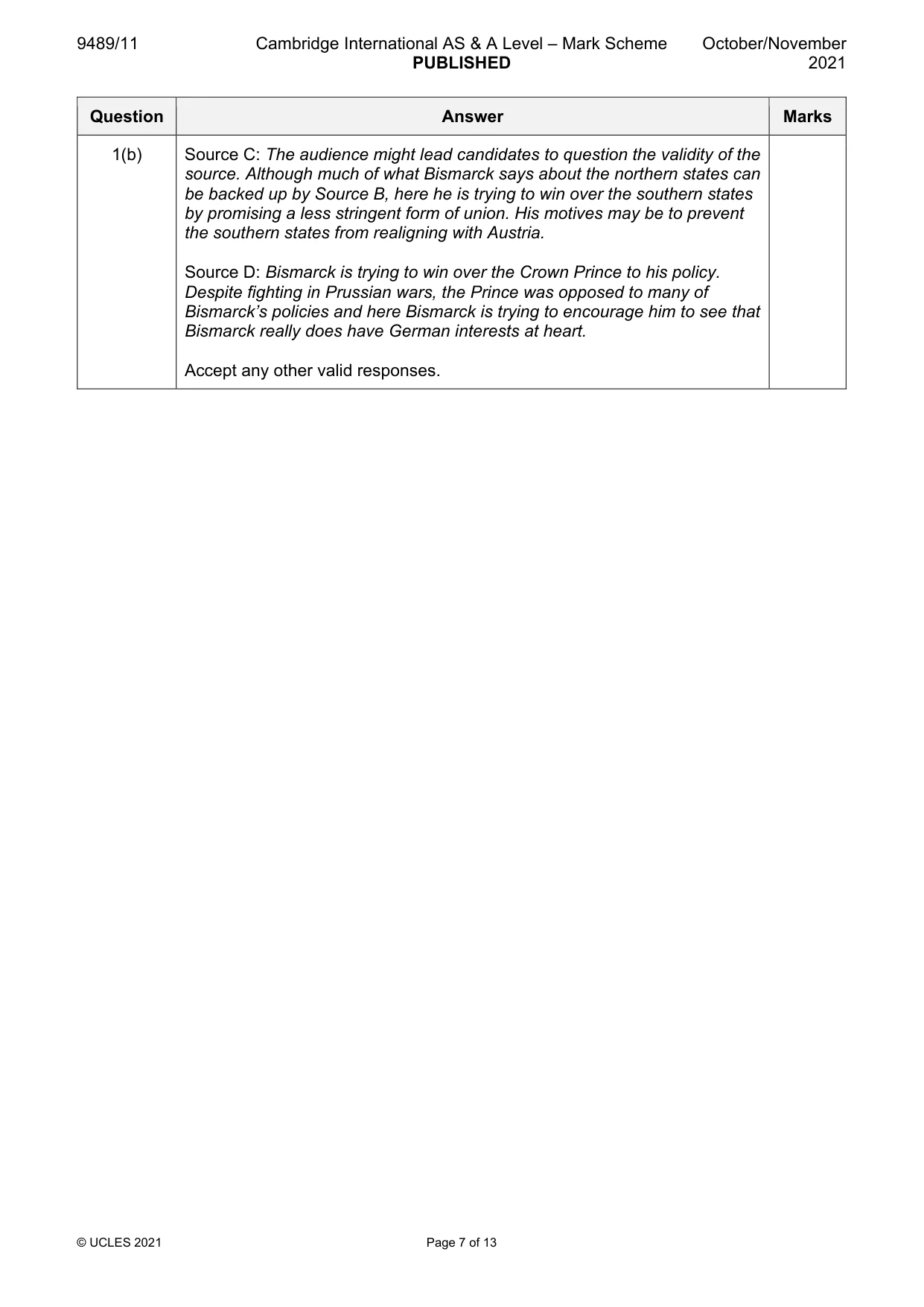
9489/11 Cambridge International AS & A Level – Mark Scheme PUBLISHED October/November 2021 © UCLES 2021 Page 7 of 13 Question Answer Marks 1(b) Source C: The audience might lead candidates to question the validity of the source. Although much of what Bismarck says about the northern states can be backed up by Source B, here he is trying to win over the southern states by promising a less stringent form of union. His motives may be to prevent the southern states from realigning with Austria. Source D: Bismarck is trying to win over the Crown Prince to his policy. Despite fighting in Prussian wars, the Prince was opposed to many of Bismarck’s policies and here Bismarck is trying to encourage him to see that Bismarck really does have German interests at heart. Accept any other valid responses.
Mark scheme, page 8
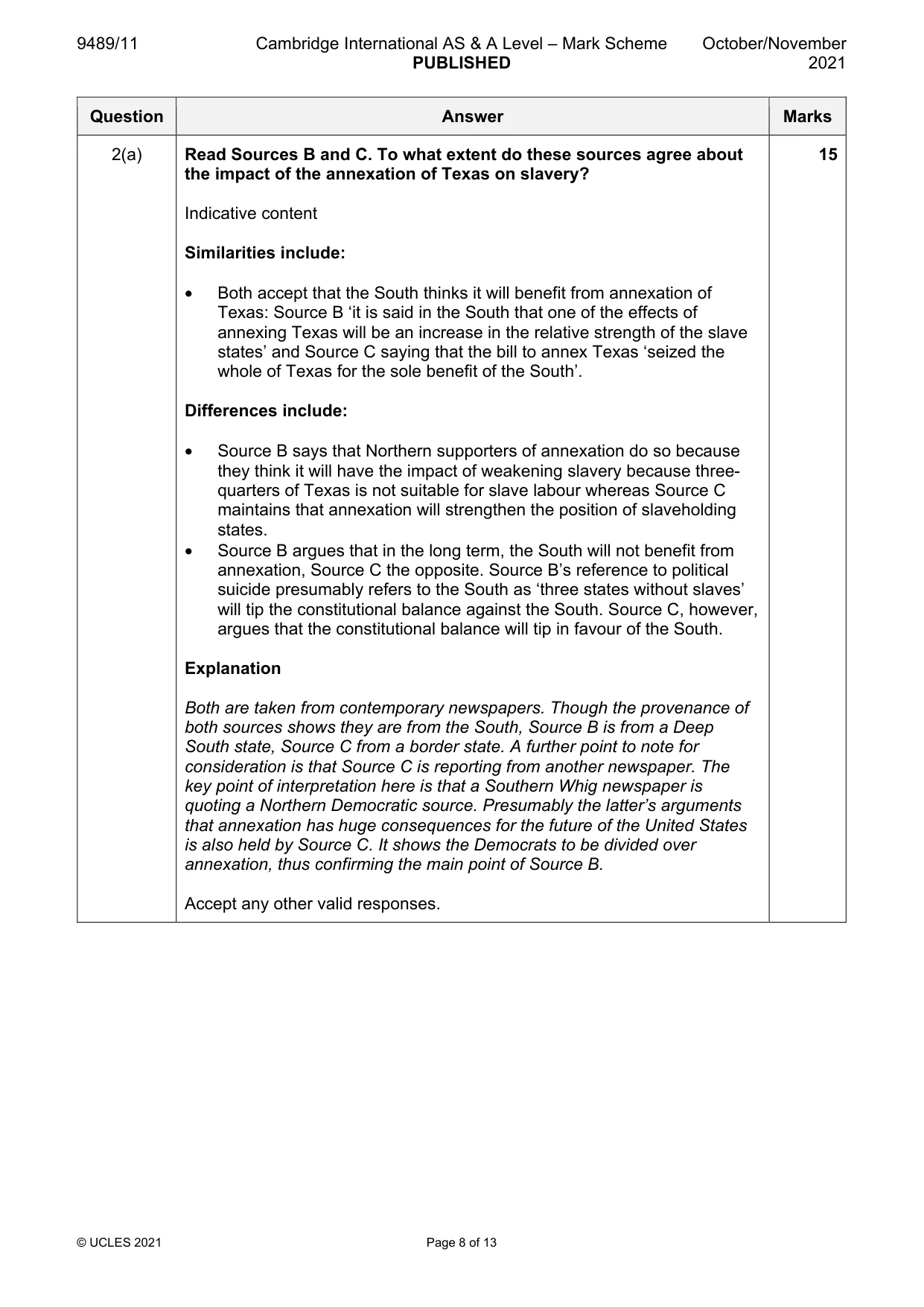
9489/11 Cambridge International AS & A Level – Mark Scheme PUBLISHED October/November 2021 © UCLES 2021 Page 8 of 13 Question Answer Marks 2(a) Read Sources B and C. To what extent do these sources agree about the impact of the annexation of Texas on slavery? Indicative content Similarities include: • Both accept that the South thinks it will benefit from annexation of Texas: Source B ‘it is said in the South that one of the effects of annexing Texas will be an increase in the relative strength of the slave states’ and Source C saying that the bill to annex Texas ‘seized the whole of Texas for the sole benefit of the South’. Differences include: • Source B says that Northern supporters of annexation do so because they think it will have the impact of weakening slavery because three- quarters of Texas is not suitable for slave labour whereas Source C maintains that annexation will strengthen the position of slaveholding states. • Source B argues that in the long term, the South will not benefit from annexation, Source C the opposite. Source B’s reference to political suicide presumably refers to the South as ‘three states without slaves’ will tip the constitutional balance against the South. Source C, however, argues that the constitutional balance will tip in favour of the South. Explanation Both are taken from contemporary newspapers. Though the provenance of both sources shows they are from the South, Source B is from a Deep South state, Source C from a border state. A further point to note for consideration is that Source C is reporting from another newspaper. The key point of interpretation here is that a Southern Whig newspaper is quoting a Northern Democratic source. Presumably the latter’s arguments that annexation has huge consequences for the future of the United States is also held by Source C. It shows the Democrats to be divided over annexation, thus confirming the main point of Source B. Accept any other valid responses. 15
Mark scheme, page 9
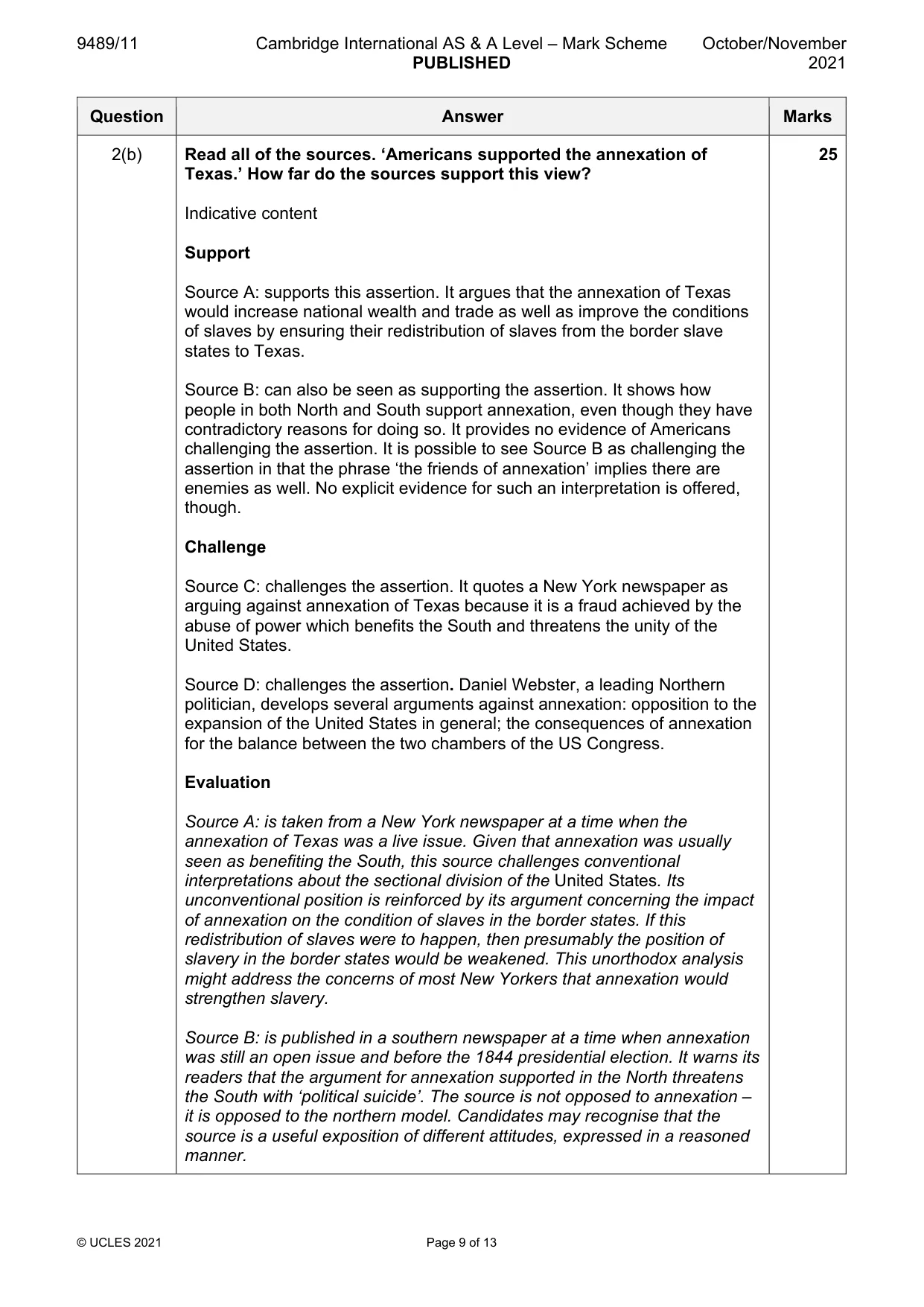
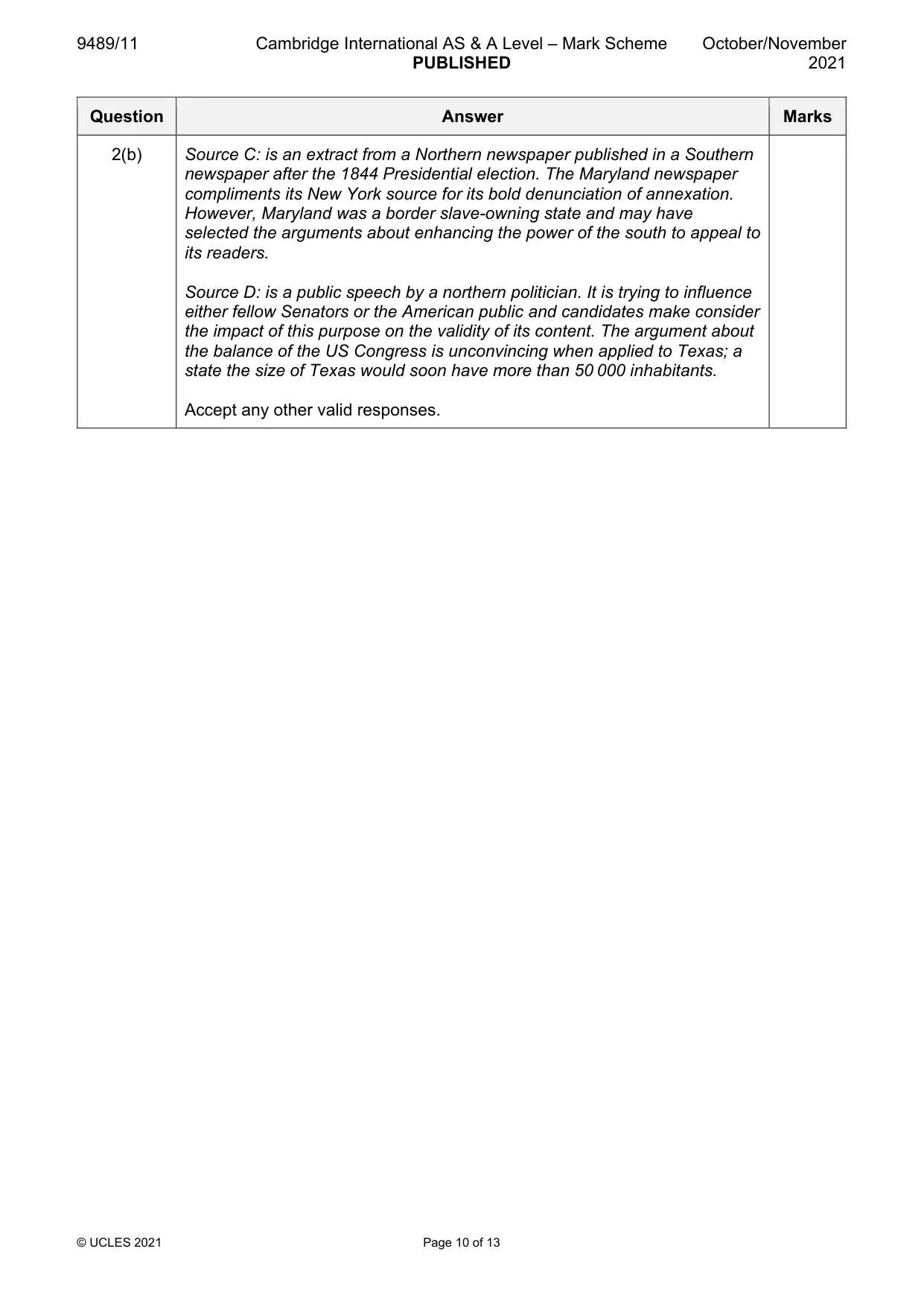
9489/11 Cambridge International AS & A Level – Mark Scheme PUBLISHED October/November 2021 © UCLES 2021 Page 9 of 13 Question Answer Marks 2(b) Read all of the sources. ‘Americans supported the annexation of Texas.’ How far do the sources support this view? Indicative content Support Source A: supports this assertion. It argues that the annexation of Texas would increase national wealth and trade as well as improve the conditions of slaves by ensuring their redistribution of slaves from the border slave states to Texas. Source B: can also be seen as supporting the assertion. It shows how people in both North and South support annexation, even though they have contradictory reasons for doing so. It provides no evidence of Americans challenging the assertion. It is possible to see Source B as challenging the assertion in that the phrase ‘the friends of annexation’ implies there are enemies as well. No explicit evidence for such an interpretation is offered, though. Challenge Source C: challenges the assertion. It quotes a New York newspaper as arguing against annexation of Texas because it is a fraud achieved by the abuse of power which benefits the South and threatens the unity of the United States. Source D: challenges the assertion. Daniel Webster, a leading Northern politician, develops several arguments against annexation: opposition to the expansion of the United States in general; the consequences of annexation for the balance between the two chambers of the US Congress. Evaluation Source A: is taken from a New York newspaper at a time when the annexation of Texas was a live issue. Given that annexation was usually seen as benefiting the South, this source challenges conventional interpretations about the sectional division of the United States. Its unconventional position is reinforced by its argument concerning the impact of annexation on the condition of slaves in the border states. If this redistribution of slaves were to happen, then presumably the position of slavery in the border states would be weakened. This unorthodox analysis might address the concerns of most New Yorkers that annexation would strengthen slavery. Source B: is published in a southern newspaper at a time when annexation was still an open issue and before the 1844 presidential election. It warns its readers that the argument for annexation supported in the North threatens the South with ‘political suicide’. The source is not opposed to annexation – it is opposed to the northern model. Candidates may recognise that the source is a useful exposition of different attitudes, expressed in a reasoned manner. 25
Mark scheme, page 10
9489/11 Cambridge International AS & A Level – Mark Scheme PUBLISHED October/November 2021 © UCLES 2021 Page 10 of 13 Question Answer Marks 2(b) Source C: is an extract from a Northern newspaper published in a Southern newspaper after the 1844 Presidential election. The Maryland newspaper compliments its New York source for its bold denunciation of annexation. However, Maryland was a border slave-owning state and may have selected the arguments about enhancing the power of the south to appeal to its readers. Source D: is a public speech by a northern politician. It is trying to influence either fellow Senators or the American public and candidates make consider the impact of this purpose on the validity of its content. The argument about the balance of the US Congress is unconvincing when applied to Texas; a state the size of Texas would soon have more than 50 000 inhabitants. Accept any other valid responses.
Mark scheme, page 11
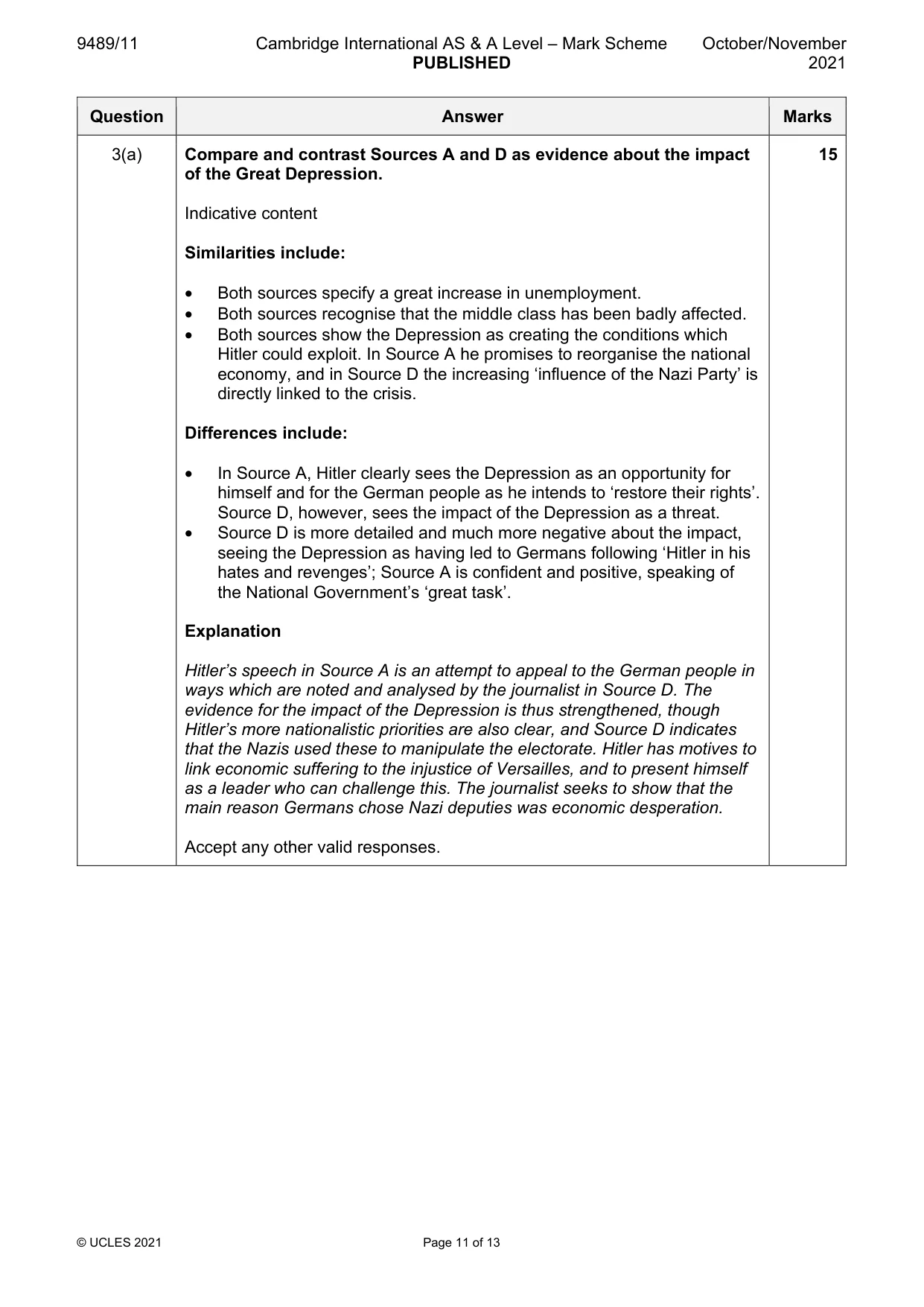
9489/11 Cambridge International AS & A Level – Mark Scheme PUBLISHED October/November 2021 © UCLES 2021 Page 11 of 13 Question Answer Marks 3(a) Compare and contrast Sources A and D as evidence about the impact of the Great Depression. Indicative content Similarities include: • Both sources specify a great increase in unemployment. • Both sources recognise that the middle class has been badly affected. • Both sources show the Depression as creating the conditions which Hitler could exploit. In Source A he promises to reorganise the national economy, and in Source D the increasing ‘influence of the Nazi Party’ is directly linked to the crisis. Differences include: • In Source A, Hitler clearly sees the Depression as an opportunity for himself and for the German people as he intends to ‘restore their rights’. Source D, however, sees the impact of the Depression as a threat. • Source D is more detailed and much more negative about the impact, seeing the Depression as having led to Germans following ‘Hitler in his hates and revenges’; Source A is confident and positive, speaking of the National Government’s ‘great task’. Explanation Hitler’s speech in Source A is an attempt to appeal to the German people in ways which are noted and analysed by the journalist in Source D. The evidence for the impact of the Depression is thus strengthened, though Hitler’s more nationalistic priorities are also clear, and Source D indicates that the Nazis used these to manipulate the electorate. Hitler has motives to link economic suffering to the injustice of Versailles, and to present himself as a leader who can challenge this. The journalist seeks to show that the main reason Germans chose Nazi deputies was economic desperation. Accept any other valid responses. 15
Mark scheme, page 12
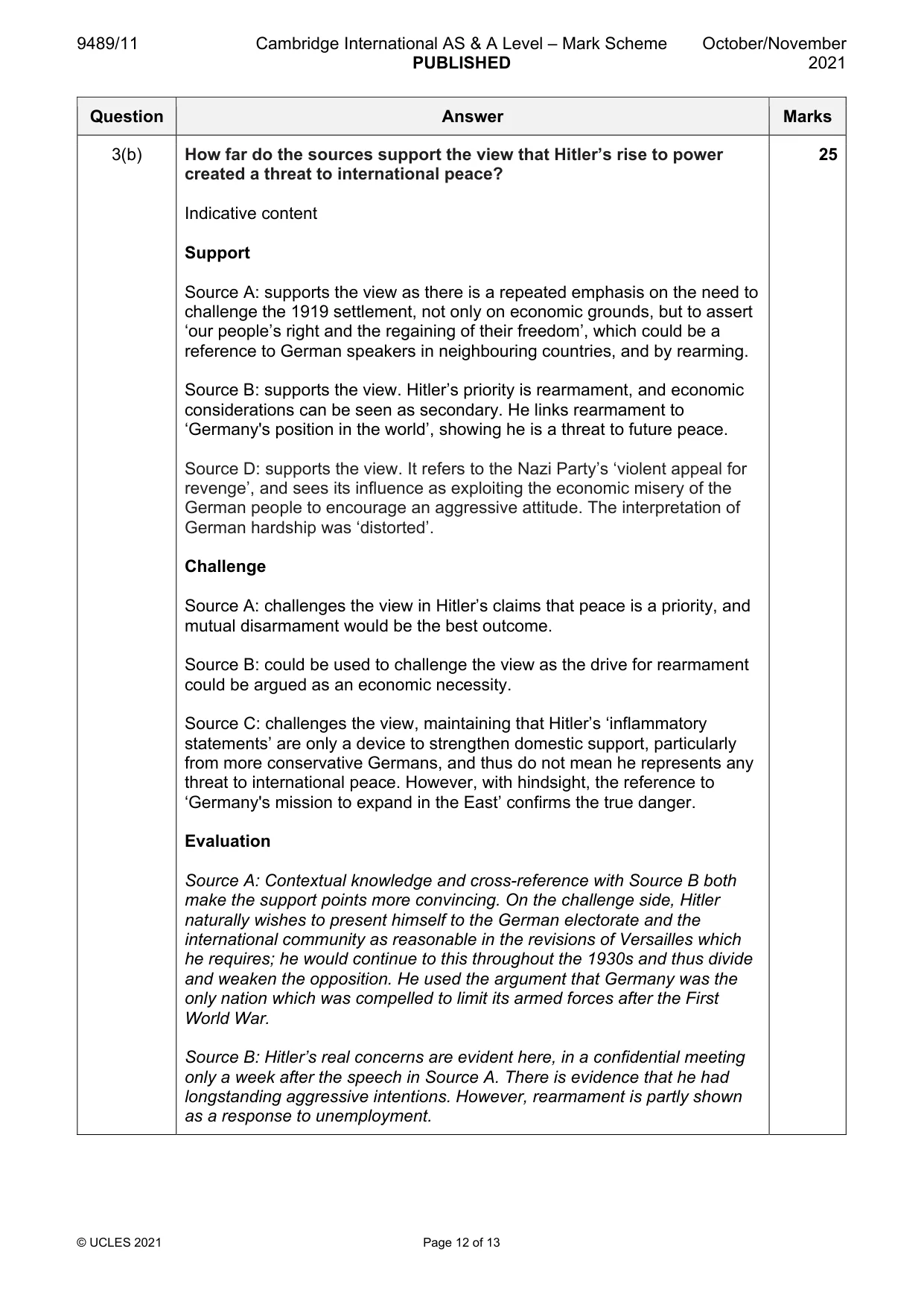
9489/11 Cambridge International AS & A Level – Mark Scheme PUBLISHED October/November 2021 © UCLES 2021 Page 12 of 13 Question Answer Marks 3(b) How far do the sources support the view that Hitler’s rise to power created a threat to international peace? Indicative content Support Source A: supports the view as there is a repeated emphasis on the need to challenge the 1919 settlement, not only on economic grounds, but to assert ‘our people’s right and the regaining of their freedom’, which could be a reference to German speakers in neighbouring countries, and by rearming. Source B: supports the view. Hitler’s priority is rearmament, and economic considerations can be seen as secondary. He links rearmament to ‘Germany's position in the world’, showing he is a threat to future peace. Source D: supports the view. It refers to the Nazi Party’s ‘violent appeal for revenge’, and sees its influence as exploiting the economic misery of the German people to encourage an aggressive attitude. The interpretation of German hardship was ‘distorted’. Challenge Source A: challenges the view in Hitler’s claims that peace is a priority, and mutual disarmament would be the best outcome. Source B: could be used to challenge the view as the drive for rearmament could be argued as an economic necessity. Source C: challenges the view, maintaining that Hitler’s ‘inflammatory statements’ are only a device to strengthen domestic support, particularly from more conservative Germans, and thus do not mean he represents any threat to international peace. However, with hindsight, the reference to ‘Germany's mission to expand in the East’ confirms the true danger. Evaluation Source A: Contextual knowledge and cross-reference with Source B both make the support points more convincing. On the challenge side, Hitler naturally wishes to present himself to the German electorate and the international community as reasonable in the revisions of Versailles which he requires; he would continue to this throughout the 1930s and thus divide and weaken the opposition. He used the argument that Germany was the only nation which was compelled to limit its armed forces after the First World War. Source B: Hitler’s real concerns are evident here, in a confidential meeting only a week after the speech in Source A. There is evidence that he had longstanding aggressive intentions. However, rearmament is partly shown as a response to unemployment. 25
Mark scheme, page 13
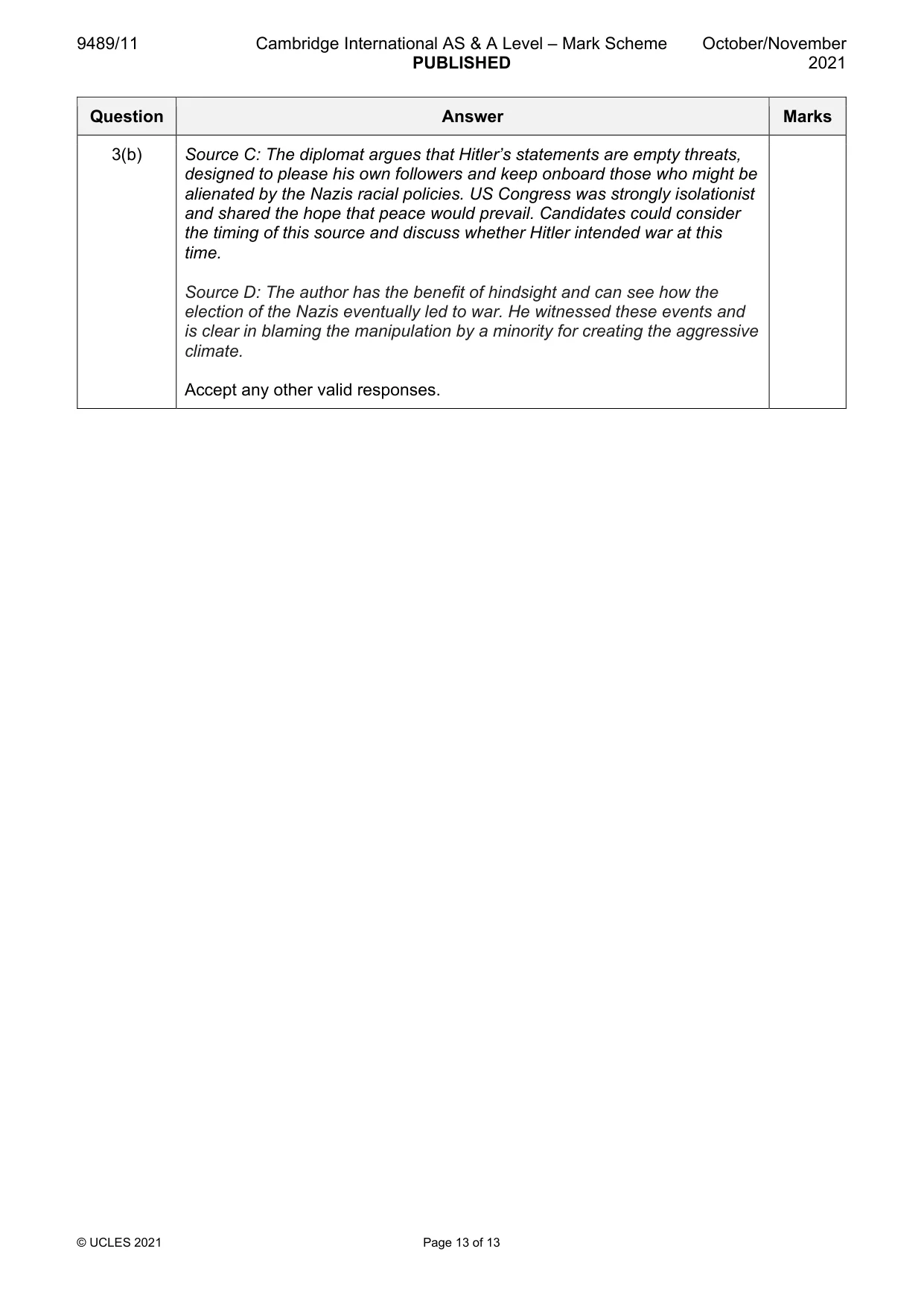
9489/11 Cambridge International AS & A Level – Mark Scheme PUBLISHED October/November 2021 © UCLES 2021 Page 13 of 13 Question Answer Marks 3(b) Source C: The diplomat argues that Hitler’s statements are empty threats, designed to please his own followers and keep onboard those who might be alienated by the Nazis racial policies. US Congress was strongly isolationist and shared the hope that peace would prevail. Candidates could consider the timing of this source and discuss whether Hitler intended war at this time. Source D: The author has the benefit of hindsight and can see how the election of the Nazis eventually led to war. He witnessed these events and is clear in blaming the manipulation by a minority for creating the aggressive climate. Accept any other valid responses.
What you needed in this session
Cambridge’s own grade thresholds for 2021 Oct/Nov, Paper 1 · Variant 1. A higher threshold means an easier paper — the bar moves with how the cohort did.