Cambridge A Level History 9489 — 2025 Oct/Nov Paper 1 · Variant 3
9489/13/O/N/25 · 40 marks · ≈45 min
The question paper and its mark scheme, free to read here and free to download. This is Cambridge’s own paper, exactly as it was sat.
Question paper8 pages

Mark scheme15 pages
Answers below. Sit the paper first if you are practising.
Paper as text
Question paper, page 1
[Turn over Cambridge International AS & A Level DC (WW/CGW) 342940/3 © UCLES 2025 This document has 8 pages. Any blank pages are indicated. HISTORY 9489/13 Paper 1 Document Question October/November 2025 1 hour 15 minutes You must answer on the enclosed answer booklet. You will need: Answer booklet (enclosed) INSTRUCTIONS ● Answer one question from one section only. Section A: European option Section B: American option Section C: International option ● Follow the instructions on the front cover of the answer booklet. If you need additional answer paper, ask the invigilator for a continuation booklet. INFORMATION ● The total mark for this paper is 40. ● The number of marks for each question or part question is shown in brackets [ ]. * 1 0 7 8 4 5 7 0 1 6 *
Question paper, page 2
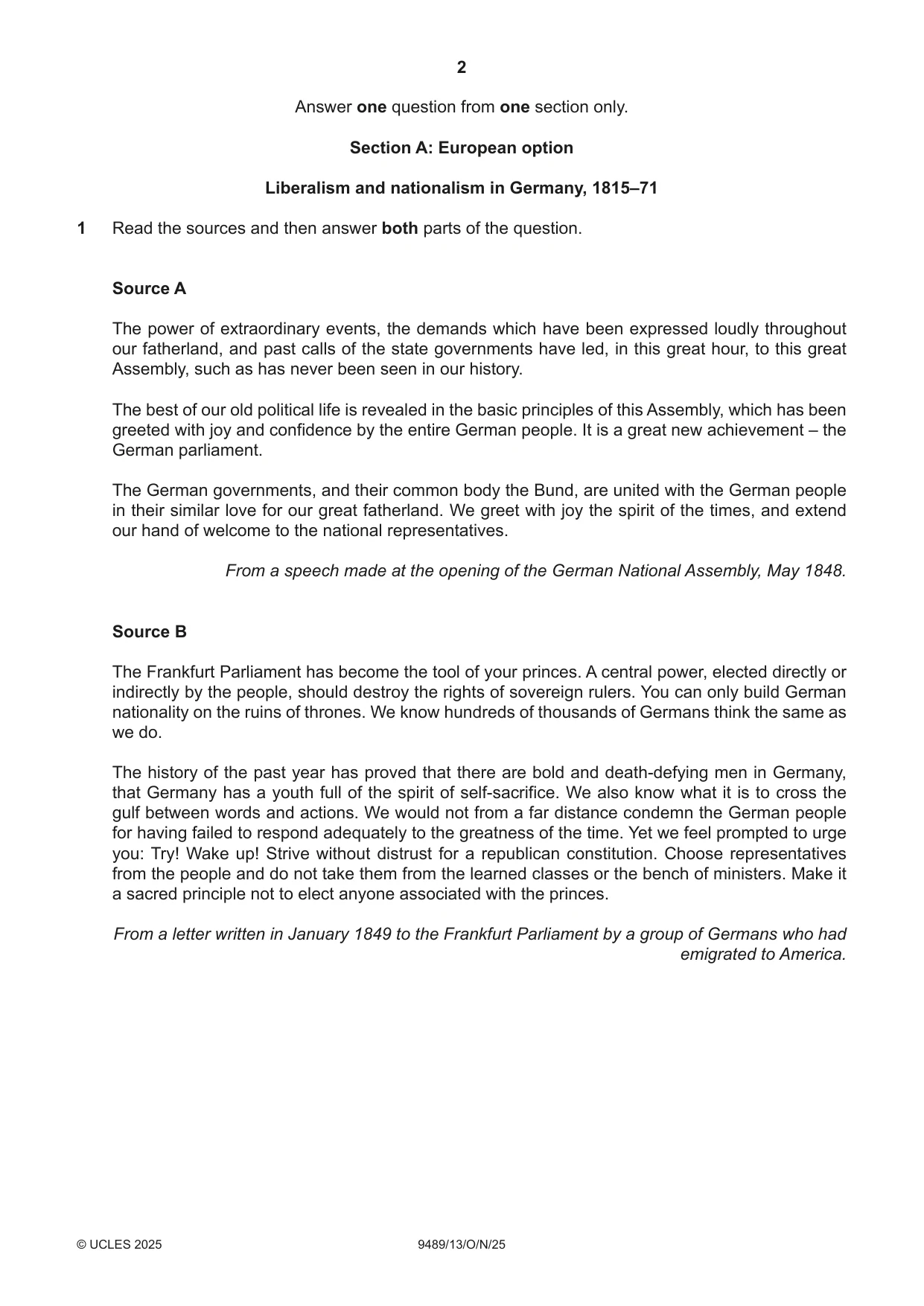
2 9489/13/O/N/25 © UCLES 2025 Answer one question from one section only. Section A: European option Liberalism and nationalism in Germany, 1815–71 1 Read the sources and then answer both parts of the question. Source A The power of extraordinary events, the demands which have been expressed loudly throughout our fatherland, and past calls of the state governments have led, in this great hour, to this great Assembly, such as has never been seen in our history. The best of our old political life is revealed in the basic principles of this Assembly, which has been greeted with joy and confidence by the entire German people. It is a great new achievement – the German parliament. The German governments, and their common body the Bund, are united with the German people in their similar love for our great fatherland. We greet with joy the spirit of the times, and extend our hand of welcome to the national representatives. From a speech made at the opening of the German National Assembly, May 1848. Source B The Frankfurt Parliament has become the tool of your princes. A central power, elected directly or indirectly by the people, should destroy the rights of sovereign rulers. You can only build German nationality on the ruins of thrones. We know hundreds of thousands of Germans think the same as we do. The history of the past year has proved that there are bold and death‑defying men in Germany, that Germany has a youth full of the spirit of self‑sacrifice. We also know what it is to cross the gulf between words and actions. We would not from a far distance condemn the German people for having failed to respond adequately to the greatness of the time. Yet we feel prompted to urge you: Try! Wake up! Strive without distrust for a republican constitution. Choose representatives from the people and do not take them from the learned classes or the bench of ministers. Make it a sacred principle not to elect anyone associated with the princes. From a letter written in January 1849 to the Frankfurt Parliament by a group of Germans who had emigrated to America.
Question paper, page 3
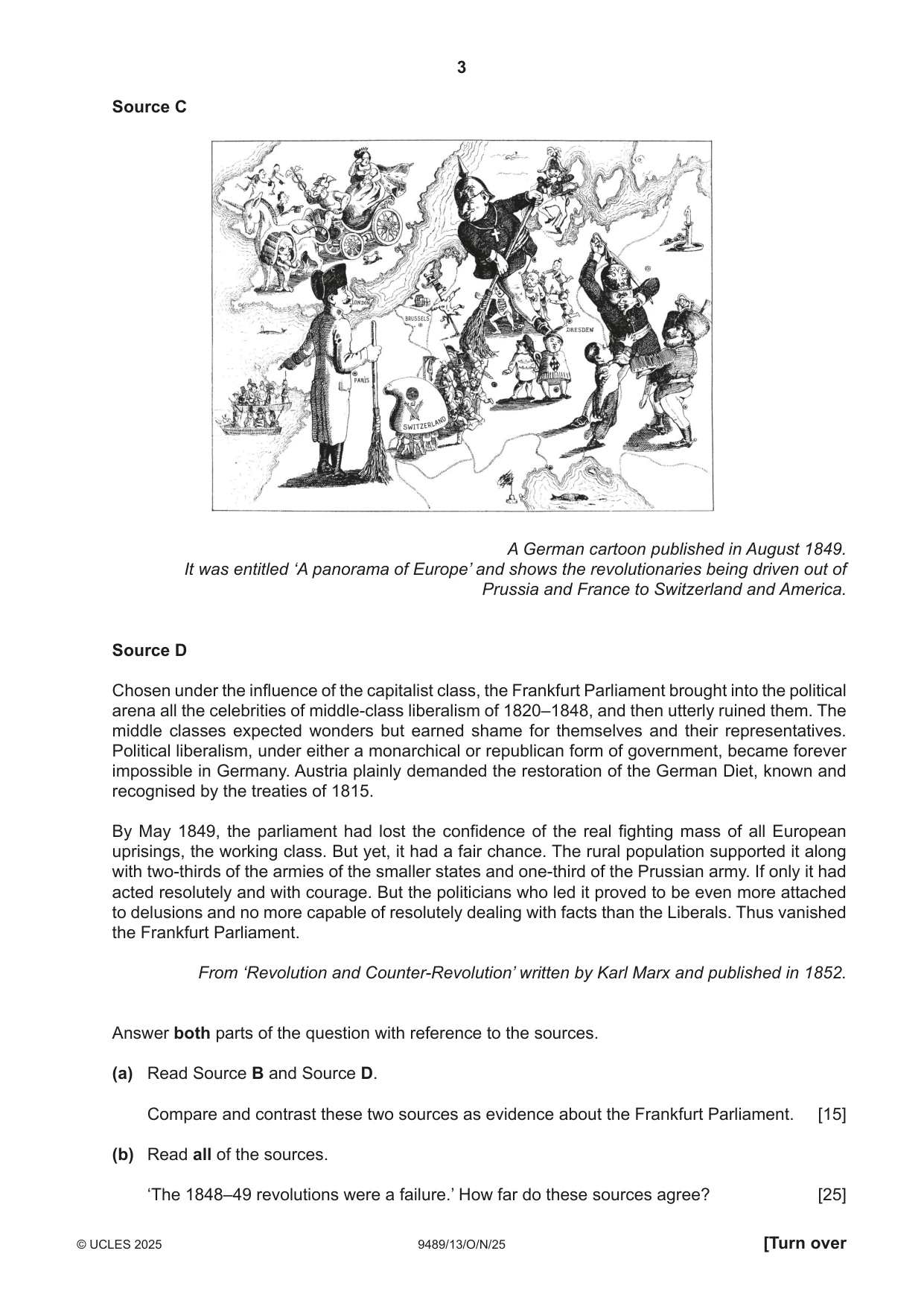
3 9489/13/O/N/25 © UCLES 2025 [Turn over Source C A German cartoon published in August 1849. It was entitled ‘A panorama of Europe’ and shows the revolutionaries being driven out of Prussia and France to Switzerland and America. Source D Chosen under the influence of the capitalist class, the Frankfurt Parliament brought into the political arena all the celebrities of middle‑class liberalism of 1820–1848, and then utterly ruined them. The middle classes expected wonders but earned shame for themselves and their representatives. Political liberalism, under either a monarchical or republican form of government, became forever impossible in Germany. Austria plainly demanded the restoration of the German Diet, known and recognised by the treaties of 1815. By May 1849, the parliament had lost the confidence of the real fighting mass of all European uprisings, the working class. But yet, it had a fair chance. The rural population supported it along with two‑thirds of the armies of the smaller states and one‑third of the Prussian army. If only it had acted resolutely and with courage. But the politicians who led it proved to be even more attached to delusions and no more capable of resolutely dealing with facts than the Liberals. Thus vanished the Frankfurt Parliament. From ‘Revolution and Counter‑Revolution’ written by Karl Marx and published in 1852. Answer both parts of the question with reference to the sources. (a) Read Source B and Source D. Compare and contrast these two sources as evidence about the Frankfurt Parliament. [15] (b) Read all of the sources. ‘The 1848–49 revolutions were a failure.’ How far do these sources agree? [25]
Question paper, page 4
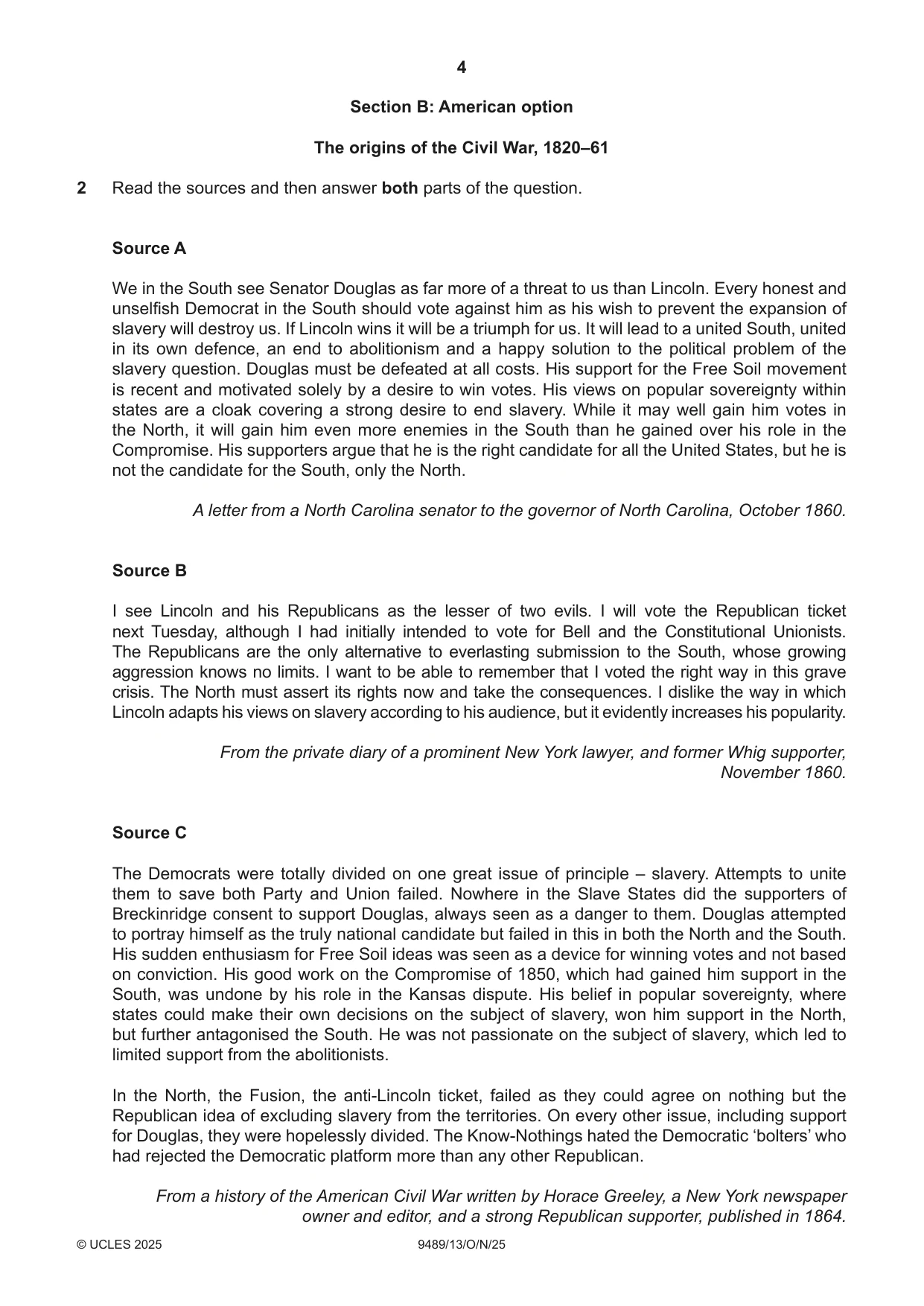
4 9489/13/O/N/25 © UCLES 2025 Section B: American option The origins of the Civil War, 1820–61 2 Read the sources and then answer both parts of the question. Source A We in the South see Senator Douglas as far more of a threat to us than Lincoln. Every honest and unselfish Democrat in the South should vote against him as his wish to prevent the expansion of slavery will destroy us. If Lincoln wins it will be a triumph for us. It will lead to a united South, united in its own defence, an end to abolitionism and a happy solution to the political problem of the slavery question. Douglas must be defeated at all costs. His support for the Free Soil movement is recent and motivated solely by a desire to win votes. His views on popular sovereignty within states are a cloak covering a strong desire to end slavery. While it may well gain him votes in the North, it will gain him even more enemies in the South than he gained over his role in the Compromise. His supporters argue that he is the right candidate for all the United States, but he is not the candidate for the South, only the North. A letter from a North Carolina senator to the governor of North Carolina, October 1860. Source B I see Lincoln and his Republicans as the lesser of two evils. I will vote the Republican ticket next Tuesday, although I had initially intended to vote for Bell and the Constitutional Unionists. The Republicans are the only alternative to everlasting submission to the South, whose growing aggression knows no limits. I want to be able to remember that I voted the right way in this grave crisis. The North must assert its rights now and take the consequences. I dislike the way in which Lincoln adapts his views on slavery according to his audience, but it evidently increases his popularity. From the private diary of a prominent New York lawyer, and former Whig supporter, November 1860. Source C The Democrats were totally divided on one great issue of principle – slavery. Attempts to unite them to save both Party and Union failed. Nowhere in the Slave States did the supporters of Breckinridge consent to support Douglas, always seen as a danger to them. Douglas attempted to portray himself as the truly national candidate but failed in this in both the North and the South. His sudden enthusiasm for Free Soil ideas was seen as a device for winning votes and not based on conviction. His good work on the Compromise of 1850, which had gained him support in the South, was undone by his role in the Kansas dispute. His belief in popular sovereignty, where states could make their own decisions on the subject of slavery, won him support in the North, but further antagonised the South. He was not passionate on the subject of slavery, which led to limited support from the abolitionists. In the North, the Fusion, the anti‑Lincoln ticket, failed as they could agree on nothing but the Republican idea of excluding slavery from the territories. On every other issue, including support for Douglas, they were hopelessly divided. The Know‑Nothings hated the Democratic ‘bolters’ who had rejected the Democratic platform more than any other Republican. From a history of the American Civil War written by Horace Greeley, a New York newspaper owner and editor, and a strong Republican supporter, published in 1864.
Question paper, page 5
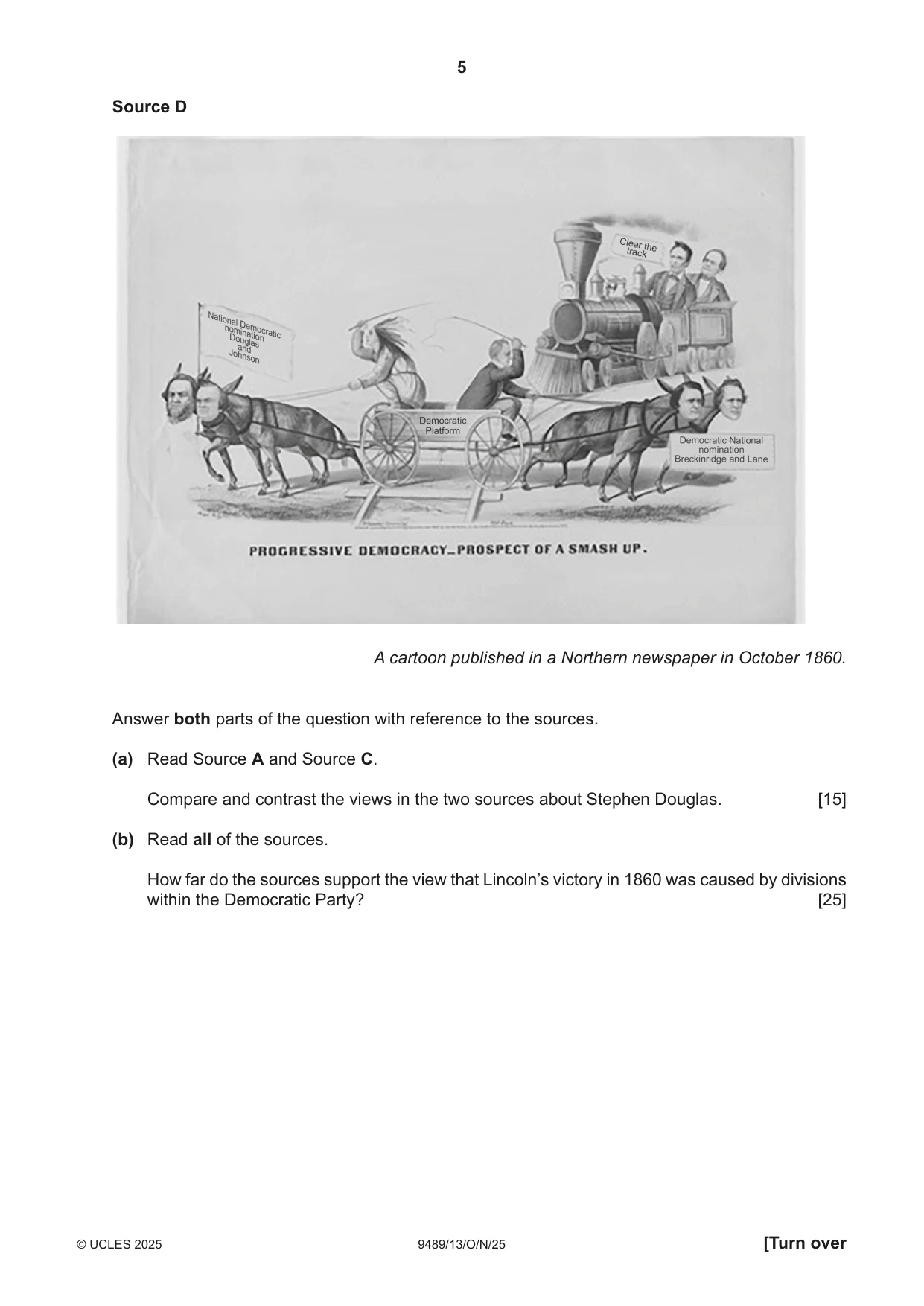
5 9489/13/O/N/25 © UCLES 2025 [Turn over Source D A cartoon published in a Northern newspaper in October 1860. Answer both parts of the question with reference to the sources. (a) Read Source A and Source C. Compare and contrast the views in the two sources about Stephen Douglas. [15] (b) Read all of the sources. How far do the sources support the view that Lincoln’s victory in 1860 was caused by divisions within the Democratic Party? [25]
Question paper, page 6
6 9489/13/O/N/25 © UCLES 2025 Section C: International option The League of Nations and international relations in the 1930s 3 Read the sources and then answer both parts of the question. Source A We urged the Czech government to agree to the cession of territory, and to agree promptly. The Czech government, through the wisdom and courage of President Beneš, accepted the advice of the French government and ourselves. It was a hard decision for anyone who loved his country to take, but to accuse us of having by that advice betrayed the Czechoslovakian state is simply preposterous. What we did was to save it from annihilation and give it a chance of new life as a new state, which involves the loss of territory and fortifications, but may perhaps enable it to enjoy the future. The emergency has thrown a vivid light upon our preparations for defence. We have already ordered a prompt and thorough inquiry to cover the whole of our preparations, military and civil, in order to do what may be necessary to make good our deficiencies in the shortest possible time. From a speech by Prime Minister Chamberlain in the British parliament, October 1938. Source B Look back less than a year. At that time, the Rome–Berlin Axis was a mere phrase, now you can see it stretching across the map of Europe. Russia, which was then playing its part as an active member of the League of Nations in defence of the rule of law, is now alienated. We see that Germany has not been slow to send missions to Moscow to improve trade relations, as a start. Austrian independence is gone, Czechoslovakia is sacrificed. That fine army which mobilised some 40 divisions with 1000 aeroplanes no longer exists for the defence of democracy. The Skoda works is now geared up to the German munitions industry instead of being available for the help of the democratic powers. While we are rearming, we are losing the support of vital and powerful forces abroad, on which, only a few months ago, we could have relied to help us to resist aggression. From a speech by the leader of an opposition party in the British parliament, December 1938. Source C In this solemn hour, it is a consolation to recall our repeated efforts for peace. All have been doomed, but all have been faithful and sincere. This is of the highest moral value, and not only moral value, but practical value, at the present time. The wholehearted agreement of millions of men and women, whose co‑operation is indispensable, is the only foundation upon which the trial and tribulation of modern war can be endured and overcome. This moral conviction alone affords that resilience which renews the strength and energy of people in long, doubtful and dark days. Outside, the storms of war may blow, but our consciences are at rest. From a speech by Churchill in the British parliament, 3 September 1939.
Question paper, page 7
7 9489/13/O/N/25 © UCLES 2025 Source D The Prime Minister at Munich agreed with Hitler that his demands should be granted. The Czechs were told that if they objected to the deal, they would fight against Germany alone. They abandoned their objections. On 2 October 1938, the German tanks advanced unopposed to take over their new territory (which included all the fortifications the Czechs had made sacrifices to erect on this German frontier during the previous five years). That Sunday, the Czech people prayed to the Almighty to forgive all those who imposed this injustice. There was a unanimous view, expressed most vigorously by those proclaiming, ‘Peace in our Time’, that Britain must now rearm day and night. However, these efforts were ineffective. The British government broke its pledge. The evidence is the state of armaments of the British Expeditionary Force, stranded on the blood‑soaked dunes of Dunkirk more than a year later. From ‘Guilty Men’, written anonymously by a group of British journalists as a criticism of the policy of appeasement, 1940. Answer both parts of the question with reference to the sources. (a) Read Source A and Source D. Compare and contrast these two sources as evidence about the German takeover of the Sudetenland. [15] (b) Read all of the sources. How far do the sources support the view that Chamberlain’s policy of appeasement meant Britain would be in a stronger position when war came? [25]
Question paper, page 8
8 9489/13/O/N/25 © UCLES 2025 Permission to reproduce items where third‑party owned material protected by copyright is included has been sought and cleared where possible. Every reasonable effort has been made by the publisher (UCLES) to trace copyright holders, but if any items requiring clearance have unwittingly been included, the publisher will be pleased to make amends at the earliest possible opportunity. To avoid the issue of disclosure of answer‑related information to candidates, all copyright acknowledgements are reproduced online in the Cambridge Assessment International Education Copyright Acknowledgements Booklet. This is produced for each series of examinations and is freely available to download at www.cambridgeinternational.org after the live examination series. Cambridge Assessment International Education is part of Cambridge Assessment. Cambridge Assessment is the brand name of the University of Cambridge Local Examinations Syndicate (UCLES), which is a department of the University of Cambridge. BLANK PAGE
Mark scheme, page 1
This document consists of 15 printed pages. © Cambridge University Press & Assessment 2025 [Turn over Cambridge International AS & A Level HISTORY 9489/13 Paper 1 Document Question October/November 2025 MARK SCHEME Maximum Mark: 40 Published This mark scheme is published as an aid to teachers and candidates, to indicate the requirements of the examination. It shows the basis on which Examiners were instructed to award marks. It does not indicate the details of the discussions that took place at an Examiners’ meeting before marking began, which would have considered the acceptability of alternative answers. Mark schemes should be read in conjunction with the question paper and the Principal Examiner Report for Teachers. Cambridge International will not enter into discussions about these mark schemes. Cambridge International is publishing the mark schemes for the October/November 2025 series for most Cambridge IGCSE, Cambridge International A and AS Level components, and some Cambridge O Level components.
Mark scheme, page 2
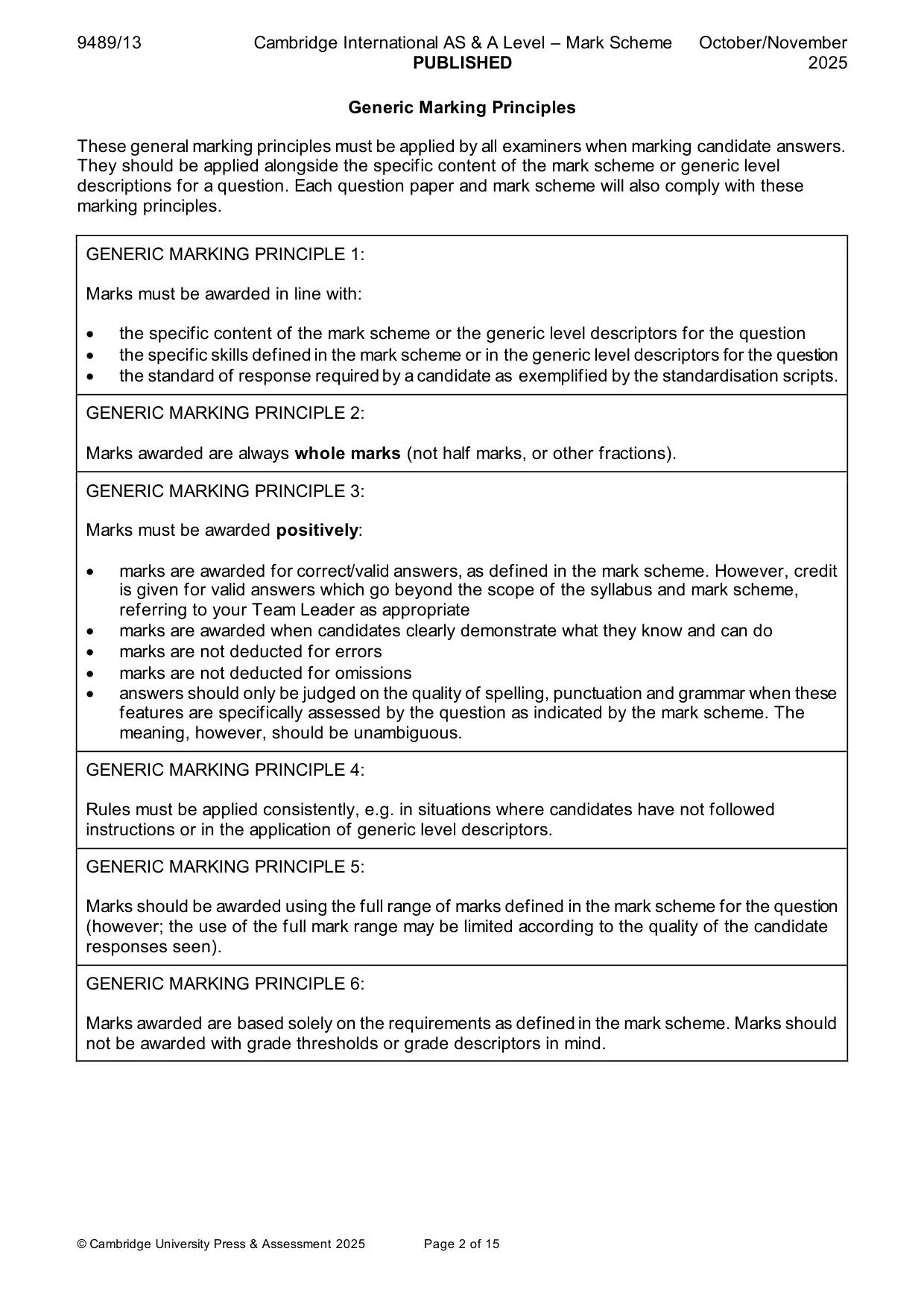
9489/13 Cambridge International AS & A Level – Mark Scheme PUBLISHED October/November 2025 © Cambridge University Press & Assessment 2025 Page 2 of 15 Generic Marking Principles These general marking principles must be applied by all examiners when marking candidate answers. They should be applied alongside the specific content of the mark scheme or generic level descriptions for a question. Each question paper and mark scheme will also comply with these marking principles. GENERIC MARKING PRINCIPLE 1: Marks must be awarded in line with: • the specific content of the mark scheme or the generic level descriptors for the question • the specific skills defined in the mark scheme or in the generic level descriptors for the question • the standard of response required by a candidate as exemplified by the standardisation scripts. GENERIC MARKING PRINCIPLE 2: Marks awarded are always whole marks (not half marks, or other fractions). GENERIC MARKING PRINCIPLE 3: Marks must be awarded positively: • marks are awarded for correct/valid answers, as defined in the mark scheme. However, credit is given for valid answers which go beyond the scope of the syllabus and mark scheme, referring to your Team Leader as appropriate • marks are awarded when candidates clearly demonstrate what they know and can do • marks are not deducted for errors • marks are not deducted for omissions • answers should only be judged on the quality of spelling, punctuation and grammar when these features are specifically assessed by the question as indicated by the mark scheme. The meaning, however, should be unambiguous. GENERIC MARKING PRINCIPLE 4: Rules must be applied consistently, e.g. in situations where candidates have not followed instructions or in the application of generic level descriptors. GENERIC MARKING PRINCIPLE 5: Marks should be awarded using the full range of marks defined in the mark scheme for the question (however; the use of the full mark range may be limited according to the quality of the candidate responses seen). GENERIC MARKING PRINCIPLE 6: Marks awarded are based solely on the requirements as defined in the mark scheme. Marks should not be awarded with grade thresholds or grade descriptors in mind.
Mark scheme, page 3
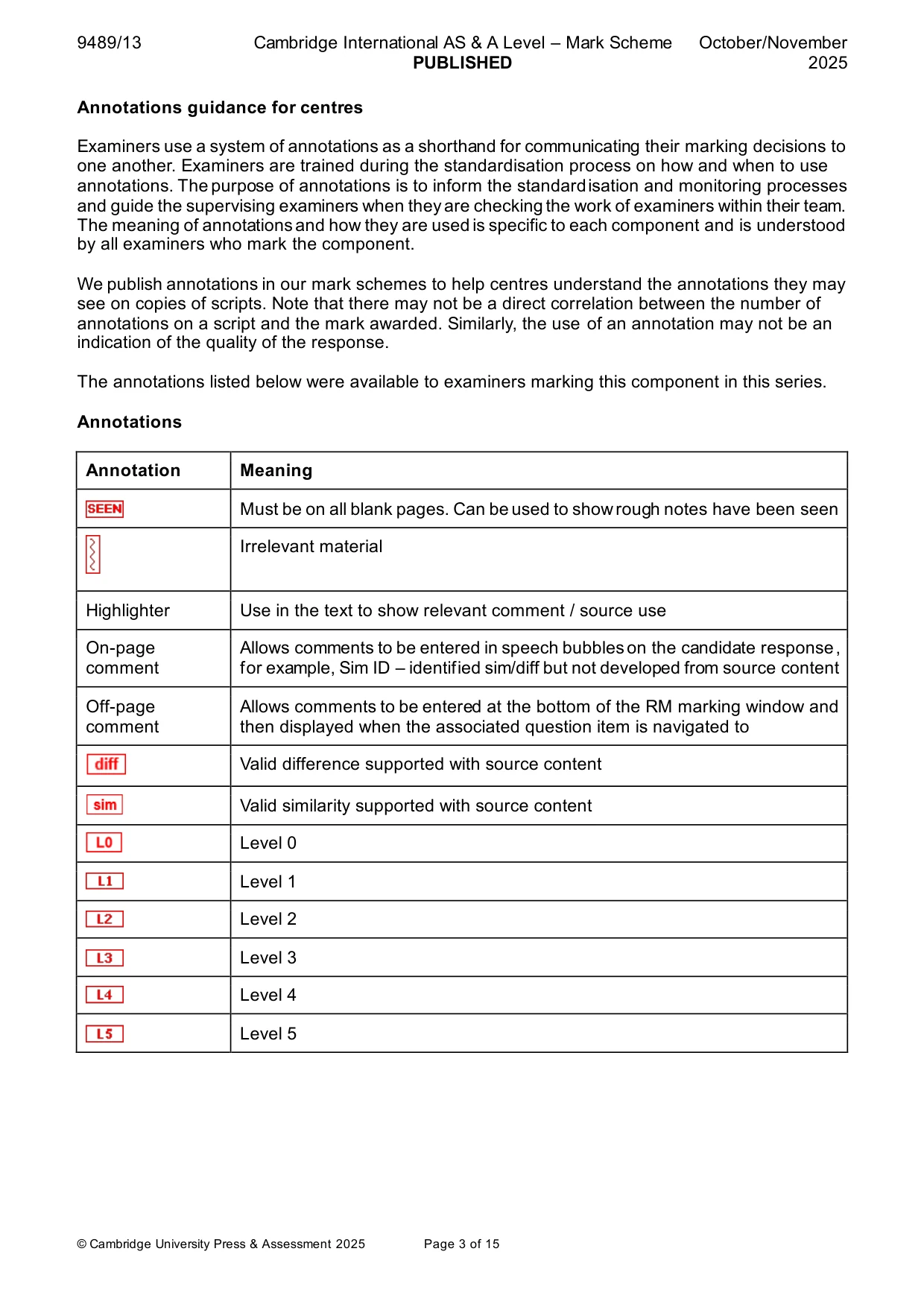
9489/13 Cambridge International AS & A Level – Mark Scheme PUBLISHED October/November 2025 © Cambridge University Press & Assessment 2025 Page 3 of 15 Annotations guidance for centres Examiners use a system of annotations as a shorthand for communicating their marking decisions to one another. Examiners are trained during the standardisation process on how and when to use annotations. The purpose of annotations is to inform the standardisation and monitoring processes and guide the supervising examiners when they are checking the work of examiners within their team. The meaning of annotations and how they are used is specific to each component and is understood by all examiners who mark the component. We publish annotations in our mark schemes to help centres understand the annotations they may see on copies of scripts. Note that there may not be a direct correlation between the number of annotations on a script and the mark awarded. Similarly, the use of an annotation may not be an indication of the quality of the response. The annotations listed below were available to examiners marking this component in this series. Annotations Annotation Meaning Must be on all blank pages. Can be used to show rough notes have been seen Irrelevant material Highlighter Use in the text to show relevant comment / source use On-page comment Allows comments to be entered in speech bubbles on the candidate response, for example, Sim ID – identified sim/diff but not developed from source content Off-page comment Allows comments to be entered at the bottom of the RM marking window and then displayed when the associated question item is navigated to Valid difference supported with source content Valid similarity supported with source content Level 0 Level 1 Level 2 Level 3 Level 4 Level 5
Mark scheme, page 4
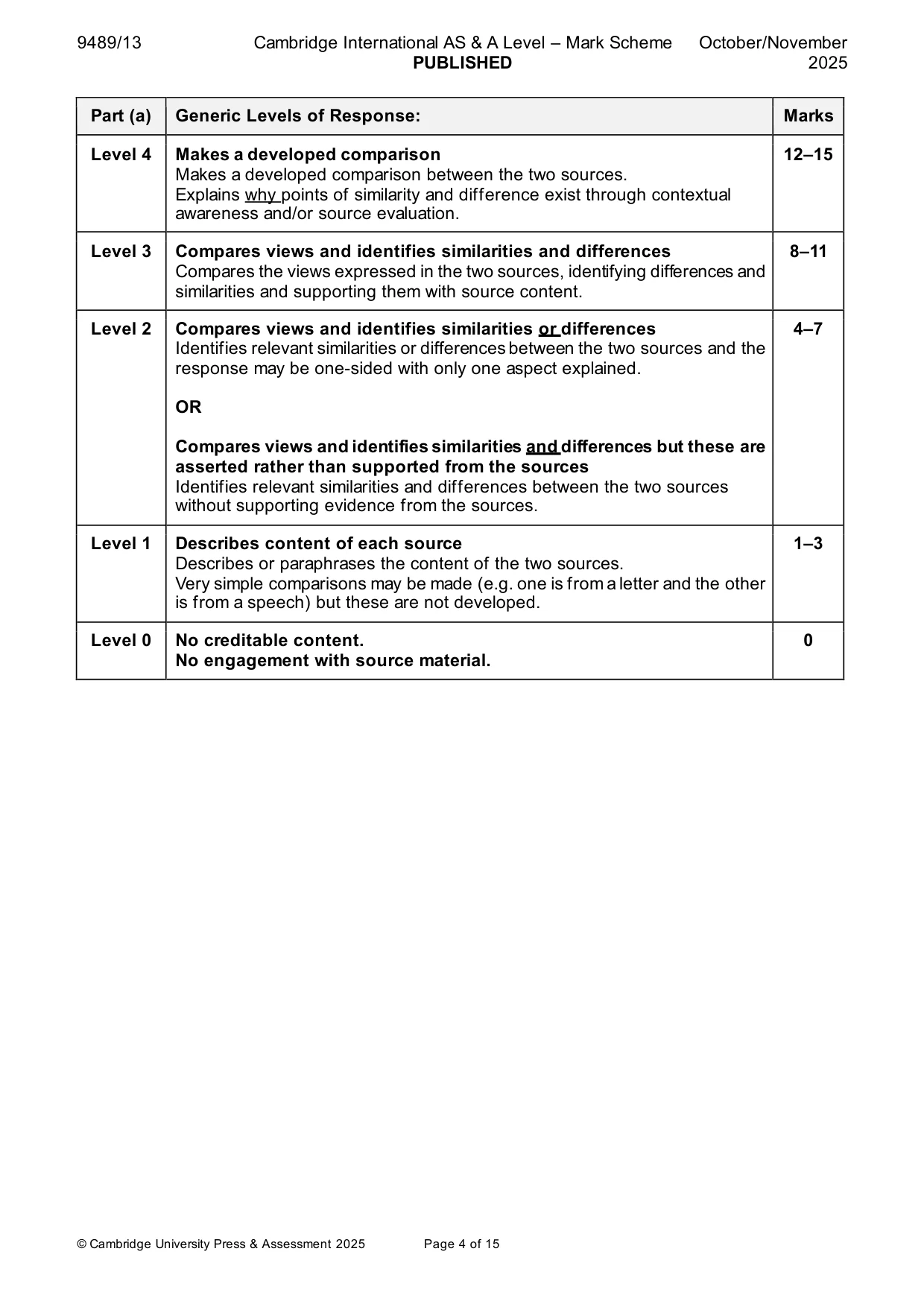
9489/13 Cambridge International AS & A Level – Mark Scheme PUBLISHED October/November 2025 © Cambridge University Press & Assessment 2025 Page 4 of 15 Part (a) Generic Levels of Response: Marks Level 4 Makes a developed comparison Makes a developed comparison between the two sources. Explains why points of similarity and difference exist through contextual awareness and/or source evaluation. 12–15 Level 3 Compares views and identifies similarities and differences Compares the views expressed in the two sources, identifying differences and similarities and supporting them with source content. 8–11 Level 2 Compares views and identifies similarities or differences Identifies relevant similarities or differences between the two sources and the response may be one-sided with only one aspect explained. OR Compares views and identifies similarities and differences but these are asserted rather than supported from the sources Identifies relevant similarities and differences between the two sources without supporting evidence from the sources. 4–7 Level 1 Describes content of each source Describes or paraphrases the content of the two sources. Very simple comparisons may be made (e.g. one is from a letter and the other is from a speech) but these are not developed. 1–3 Level 0 No creditable content. No engagement with source material. 0
Mark scheme, page 5
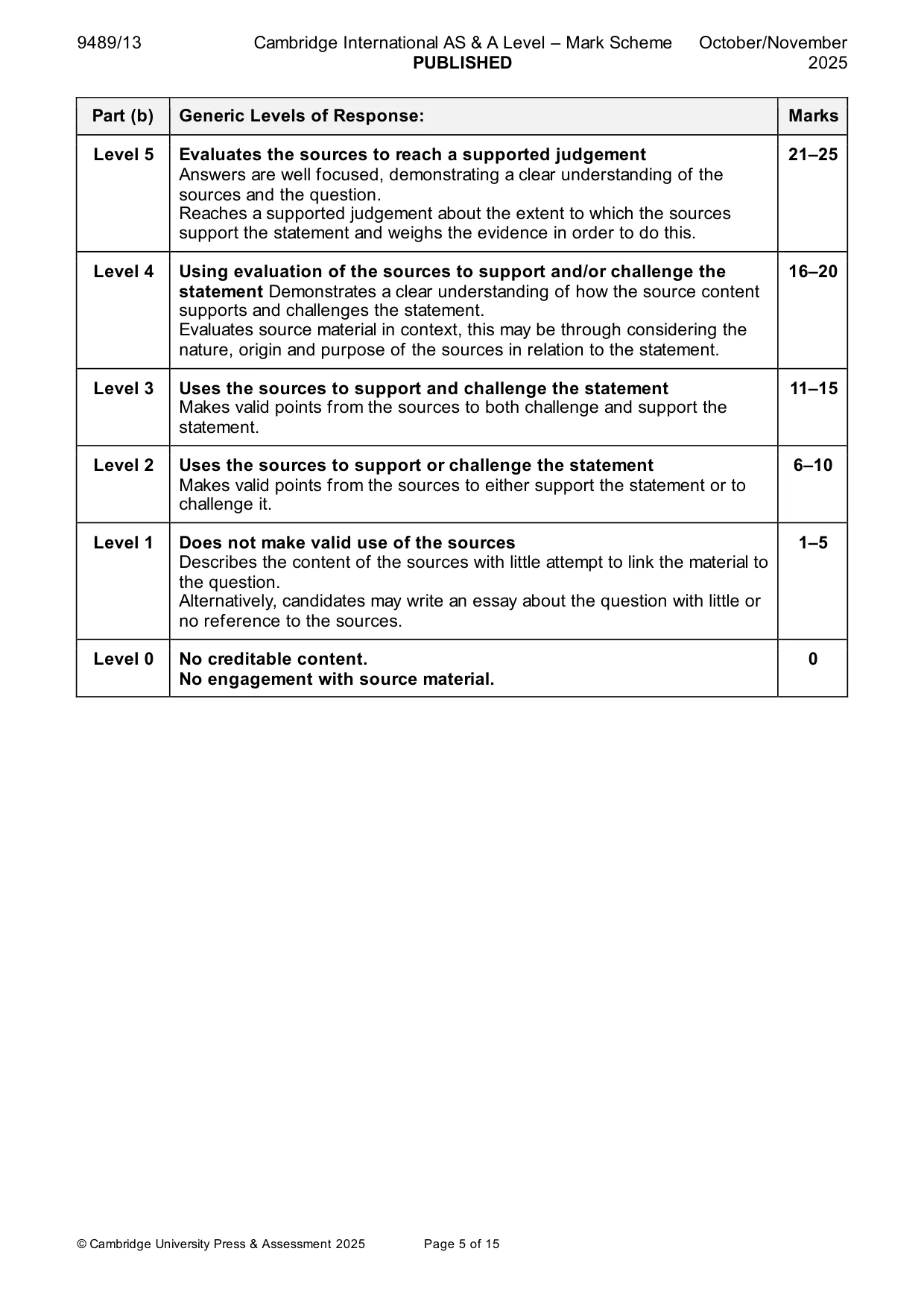
9489/13 Cambridge International AS & A Level – Mark Scheme PUBLISHED October/November 2025 © Cambridge University Press & Assessment 2025 Page 5 of 15 Part (b) Generic Levels of Response: Marks Level 5 Evaluates the sources to reach a supported judgement Answers are well focused, demonstrating a clear understanding of the sources and the question. Reaches a supported judgement about the extent to which the sources support the statement and weighs the evidence in order to do this. 21–25 Level 4 Using evaluation of the sources to support and/or challenge the statement Demonstrates a clear understanding of how the source content supports and challenges the statement. Evaluates source material in context, this may be through considering the nature, origin and purpose of the sources in relation to the statement. 16–20 Level 3 Uses the sources to support and challenge the statement Makes valid points from the sources to both challenge and support the statement. 11–15 Level 2 Uses the sources to support or challenge the statement Makes valid points from the sources to either support the statement or to challenge it. 6–10 Level 1 Does not make valid use of the sources Describes the content of the sources with little attempt to link the material to the question. Alternatively, candidates may write an essay about the question with little or no reference to the sources. 1–5 Level 0 No creditable content. No engagement with source material. 0
Mark scheme, page 6
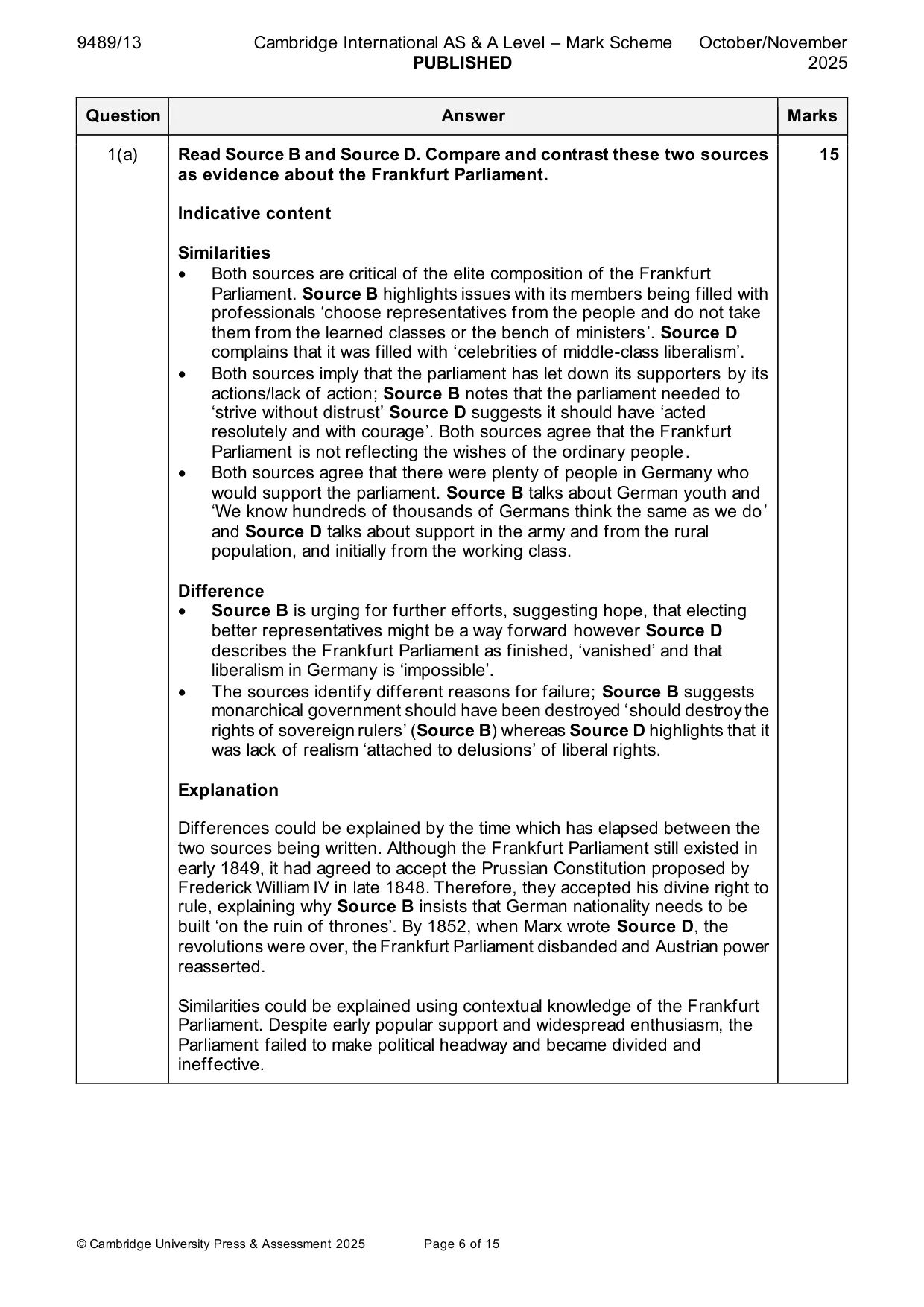
9489/13 Cambridge International AS & A Level – Mark Scheme PUBLISHED October/November 2025 © Cambridge University Press & Assessment 2025 Page 6 of 15 Question Answer Marks 1(a) Read Source B and Source D. Compare and contrast these two sources as evidence about the Frankfurt Parliament. Indicative content Similarities • Both sources are critical of the elite composition of the Frankfurt Parliament. Source B highlights issues with its members being filled with professionals ‘choose representatives from the people and do not take them from the learned classes or the bench of ministers’. Source D complains that it was filled with ‘celebrities of middle-class liberalism’. • Both sources imply that the parliament has let down its supporters by its actions/lack of action; Source B notes that the parliament needed to ‘strive without distrust’ Source D suggests it should have ‘acted resolutely and with courage’. Both sources agree that the Frankfurt Parliament is not reflecting the wishes of the ordinary people. • Both sources agree that there were plenty of people in Germany who would support the parliament. Source B talks about German youth and ‘We know hundreds of thousands of Germans think the same as we do’ and Source D talks about support in the army and from the rural population, and initially from the working class. Difference • Source B is urging for further efforts, suggesting hope, that electing better representatives might be a way forward however Source D describes the Frankfurt Parliament as finished, ‘vanished’ and that liberalism in Germany is ‘impossible’. • The sources identify different reasons for failure; Source B suggests monarchical government should have been destroyed ‘should destroy the rights of sovereign rulers’ (Source B) whereas Source D highlights that it was lack of realism ‘attached to delusions’ of liberal rights. Explanation Differences could be explained by the time which has elapsed between the two sources being written. Although the Frankfurt Parliament still existed in early 1849, it had agreed to accept the Prussian Constitution proposed by Frederick William IV in late 1848. Therefore, they accepted his divine right to rule, explaining why Source B insists that German nationality needs to be built ‘on the ruin of thrones’. By 1852, when Marx wrote Source D, the revolutions were over, the Frankfurt Parliament disbanded and Austrian power reasserted. Similarities could be explained using contextual knowledge of the Frankfurt Parliament. Despite early popular support and widespread enthusiasm, the Parliament failed to make political headway and became divided and ineffective. 15
Mark scheme, page 7
9489/13 Cambridge International AS & A Level – Mark Scheme PUBLISHED October/November 2025 © Cambridge University Press & Assessment 2025 Page 7 of 15 Question Answer Marks 1(a) Candidates may be aware of Marx’s view on the development of the proletariat and use that to explain his reference to the working class who no longer support the revolution. They may also be aware that the United States had a republican government, having rejected monarchical rule by the British in the American revolution. Accept any other valid responses.
Mark scheme, page 8
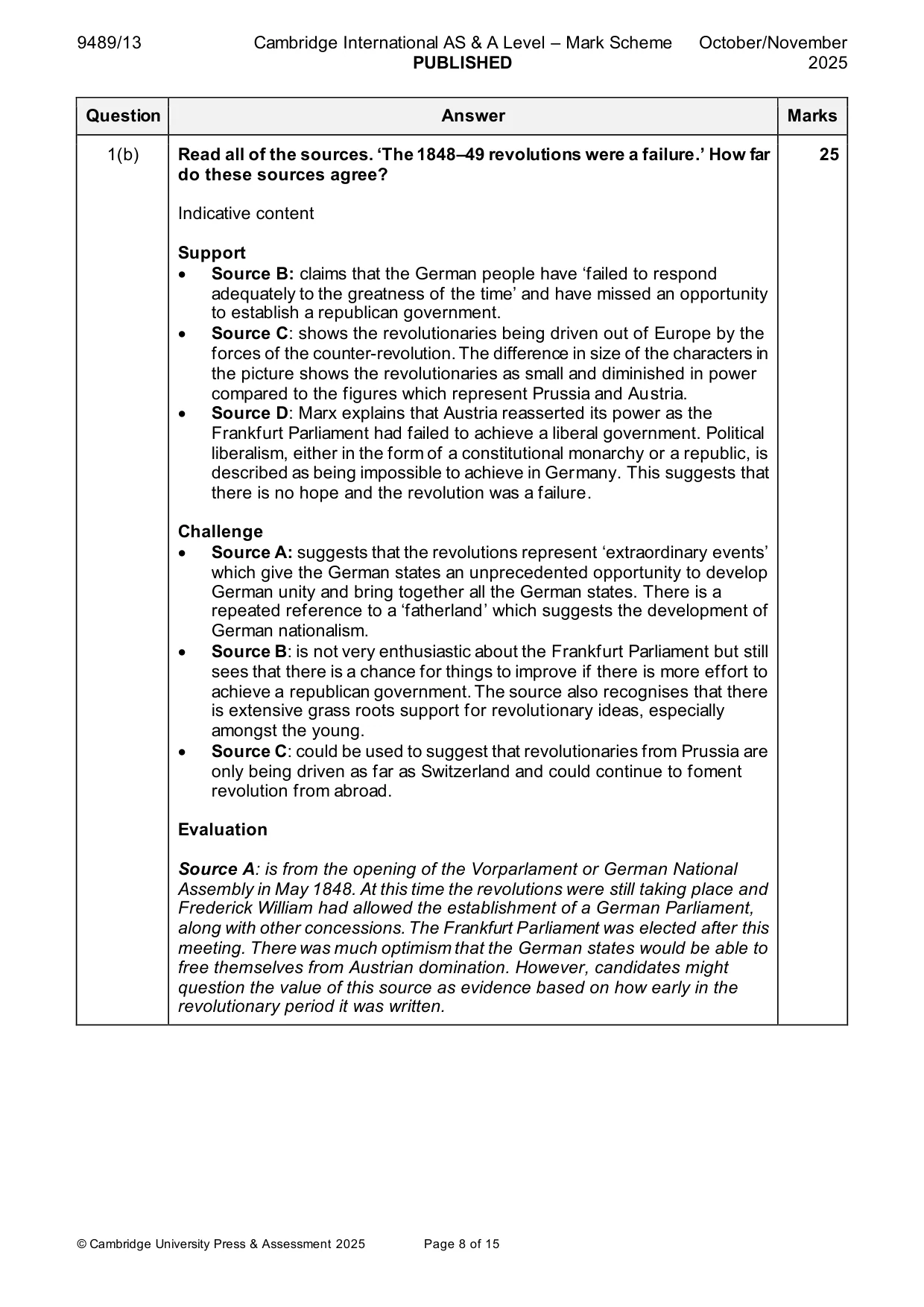
9489/13 Cambridge International AS & A Level – Mark Scheme PUBLISHED October/November 2025 © Cambridge University Press & Assessment 2025 Page 8 of 15 Question Answer Marks 1(b) Read all of the sources. ‘The 1848–49 revolutions were a failure.’ How far do these sources agree? Indicative content Support • Source B: claims that the German people have ‘failed to respond adequately to the greatness of the time’ and have missed an opportunity to establish a republican government. • Source C: shows the revolutionaries being driven out of Europe by the forces of the counter-revolution. The difference in size of the characters in the picture shows the revolutionaries as small and diminished in power compared to the figures which represent Prussia and Austria. • Source D: Marx explains that Austria reasserted its power as the Frankfurt Parliament had failed to achieve a liberal government. Political liberalism, either in the form of a constitutional monarchy or a republic, is described as being impossible to achieve in Germany. This suggests that there is no hope and the revolution was a failure. Challenge • Source A: suggests that the revolutions represent ‘extraordinary events’ which give the German states an unprecedented opportunity to develop German unity and bring together all the German states. There is a repeated reference to a ‘fatherland’ which suggests the development of German nationalism. • Source B: is not very enthusiastic about the Frankfurt Parliament but still sees that there is a chance for things to improve if there is more effort to achieve a republican government. The source also recognises that there is extensive grass roots support for revolutionary ideas, especially amongst the young. • Source C: could be used to suggest that revolutionaries from Prussia are only being driven as far as Switzerland and could continue to foment revolution from abroad. Evaluation Source A: is from the opening of the Vorparlament or German National Assembly in May 1848. At this time the revolutions were still taking place and Frederick William had allowed the establishment of a German Parliament, along with other concessions. The Frankfurt Parliament was elected after this meeting. There was much optimism that the German states would be able to free themselves from Austrian domination. However, candidates might question the value of this source as evidence based on how early in the revolutionary period it was written. 25
Mark scheme, page 9
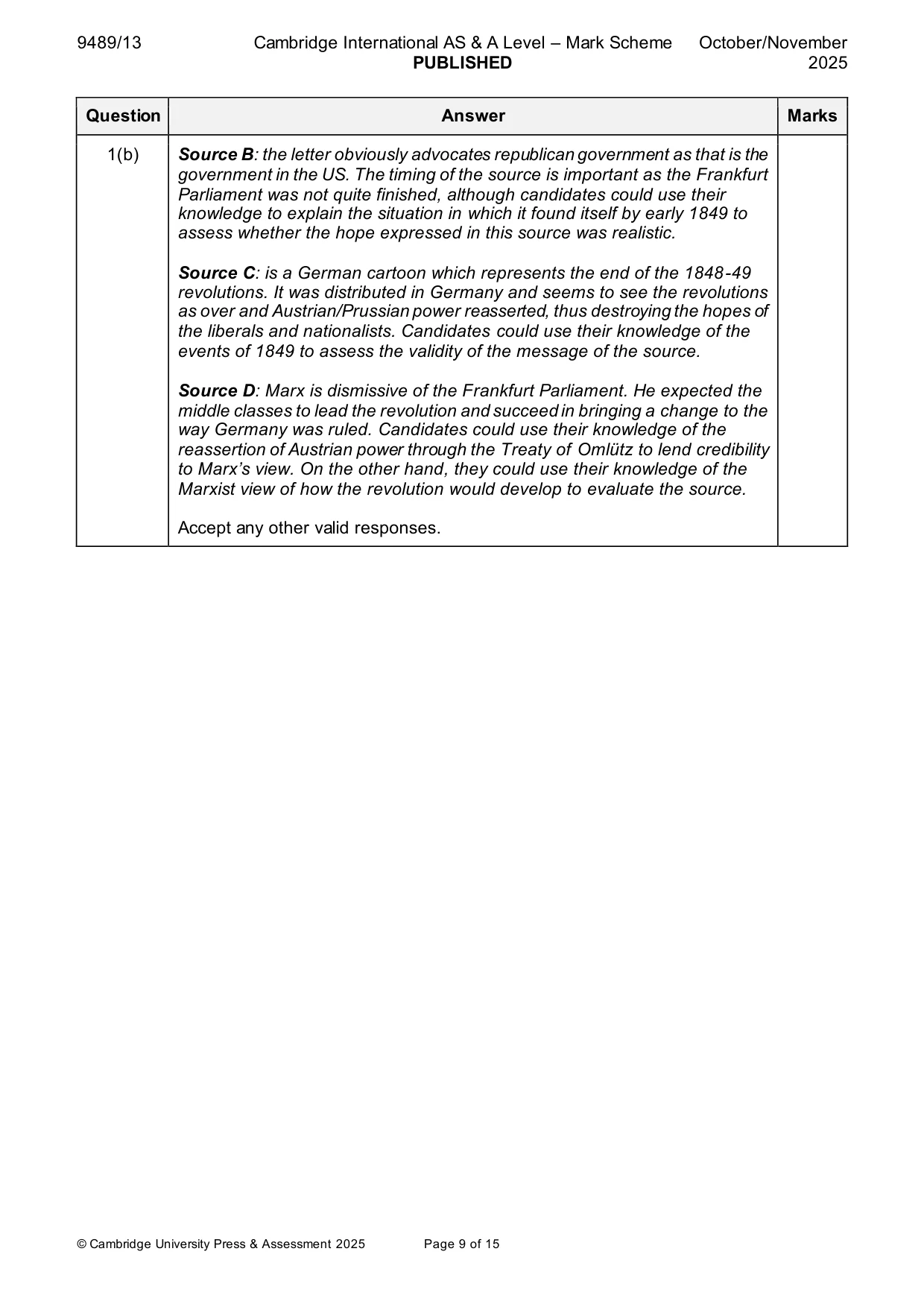
9489/13 Cambridge International AS & A Level – Mark Scheme PUBLISHED October/November 2025 © Cambridge University Press & Assessment 2025 Page 9 of 15 Question Answer Marks 1(b) Source B: the letter obviously advocates republican government as that is the government in the US. The timing of the source is important as the Frankfurt Parliament was not quite finished, although candidates could use their knowledge to explain the situation in which it found itself by early 1849 to assess whether the hope expressed in this source was realistic. Source C: is a German cartoon which represents the end of the 1848-49 revolutions. It was distributed in Germany and seems to see the revolutions as over and Austrian/Prussian power reasserted, thus destroying the hopes of the liberals and nationalists. Candidates could use their knowledge of the events of 1849 to assess the validity of the message of the source. Source D: Marx is dismissive of the Frankfurt Parliament. He expected the middle classes to lead the revolution and succeed in bringing a change to the way Germany was ruled. Candidates could use their knowledge of the reassertion of Austrian power through the Treaty of Omlütz to lend credibility to Marx’s view. On the other hand, they could use their knowledge of the Marxist view of how the revolution would develop to evaluate the source. Accept any other valid responses.
Mark scheme, page 10
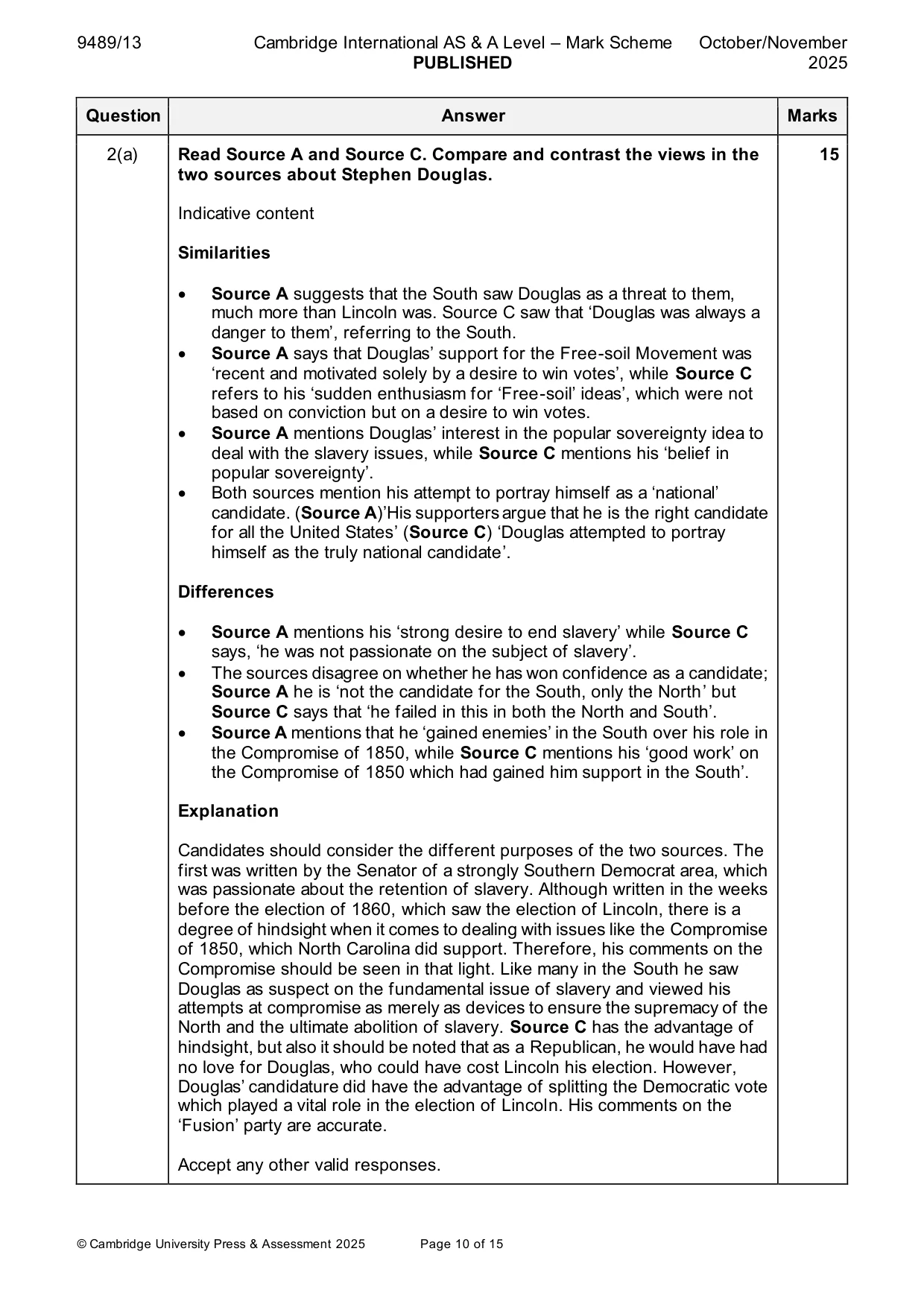
9489/13 Cambridge International AS & A Level – Mark Scheme PUBLISHED October/November 2025 © Cambridge University Press & Assessment 2025 Page 10 of 15 Question Answer Marks 2(a) Read Source A and Source C. Compare and contrast the views in the two sources about Stephen Douglas. Indicative content Similarities • Source A suggests that the South saw Douglas as a threat to them, much more than Lincoln was. Source C saw that ‘Douglas was always a danger to them’, referring to the South. • Source A says that Douglas’ support for the Free-soil Movement was ‘recent and motivated solely by a desire to win votes’, while Source C refers to his ‘sudden enthusiasm for ‘Free-soil’ ideas’, which were not based on conviction but on a desire to win votes. • Source A mentions Douglas’ interest in the popular sovereignty idea to deal with the slavery issues, while Source C mentions his ‘belief in popular sovereignty’. • Both sources mention his attempt to portray himself as a ‘national’ candidate. (Source A)’His supporters argue that he is the right candidate for all the United States’ (Source C) ‘Douglas attempted to portray himself as the truly national candidate’. Differences • Source A mentions his ‘strong desire to end slavery’ while Source C says, ‘he was not passionate on the subject of slavery’. • The sources disagree on whether he has won confidence as a candidate; Source A he is ‘not the candidate for the South, only the North’ but Source C says that ‘he failed in this in both the North and South’. • Source A mentions that he ‘gained enemies’ in the South over his role in the Compromise of 1850, while Source C mentions his ‘good work’ on the Compromise of 1850 which had gained him support in the South’. Explanation Candidates should consider the different purposes of the two sources. The first was written by the Senator of a strongly Southern Democrat area, which was passionate about the retention of slavery. Although written in the weeks before the election of 1860, which saw the election of Lincoln, there is a degree of hindsight when it comes to dealing with issues like the Compromise of 1850, which North Carolina did support. Therefore, his comments on the Compromise should be seen in that light. Like many in the South he saw Douglas as suspect on the fundamental issue of slavery and viewed his attempts at compromise as merely as devices to ensure the supremacy of the North and the ultimate abolition of slavery. Source C has the advantage of hindsight, but also it should be noted that as a Republican, he would have had no love for Douglas, who could have cost Lincoln his election. However, Douglas’ candidature did have the advantage of splitting the Democratic vote which played a vital role in the election of Lincoln. His comments on the ‘Fusion’ party are accurate. Accept any other valid responses. 15
Mark scheme, page 11
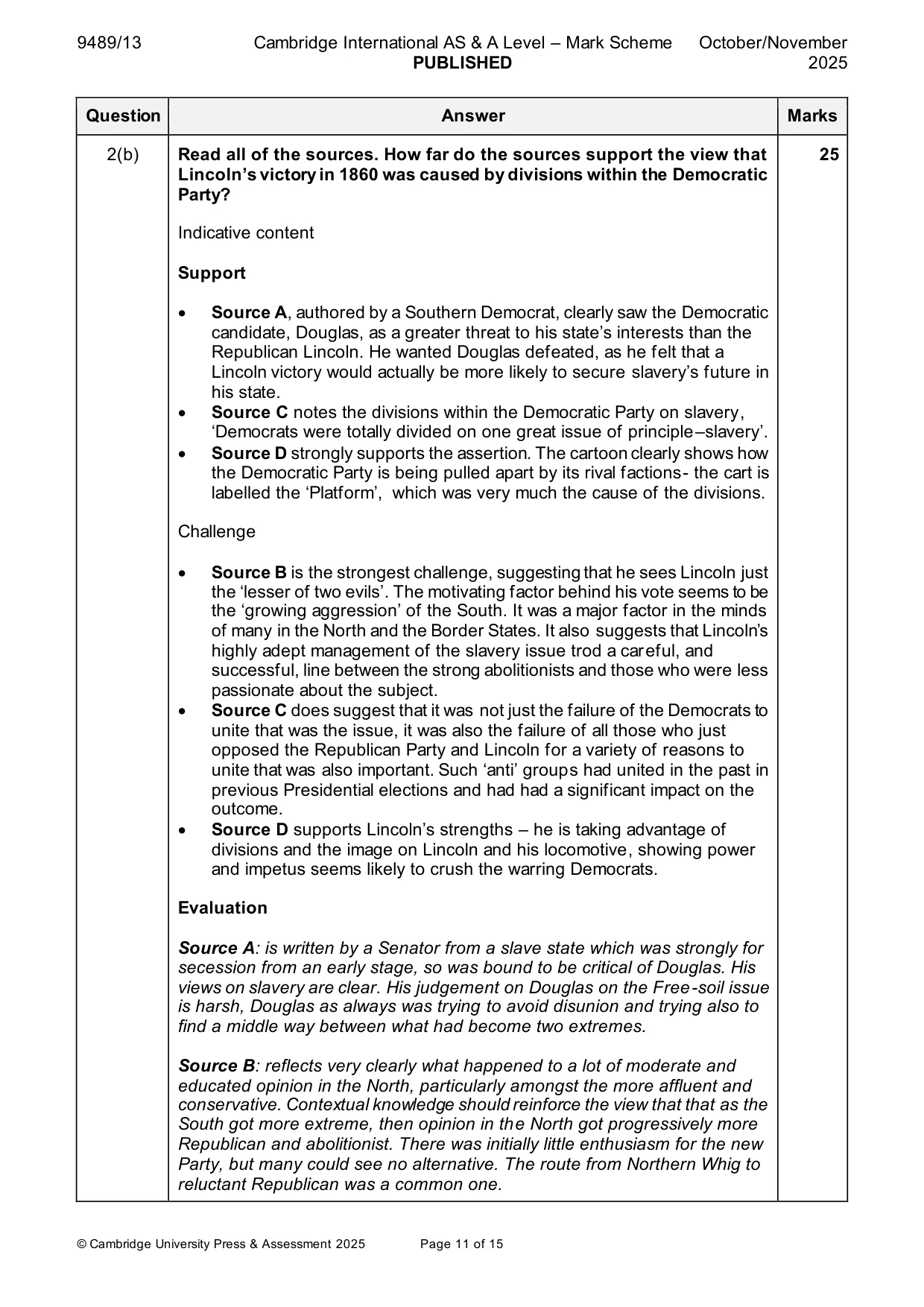
9489/13 Cambridge International AS & A Level – Mark Scheme PUBLISHED October/November 2025 © Cambridge University Press & Assessment 2025 Page 11 of 15 Question Answer Marks 2(b) Read all of the sources. How far do the sources support the view that Lincoln’s victory in 1860 was caused by divisions within the Democratic Party? Indicative content Support • Source A, authored by a Southern Democrat, clearly saw the Democratic candidate, Douglas, as a greater threat to his state’s interests than the Republican Lincoln. He wanted Douglas defeated, as he felt that a Lincoln victory would actually be more likely to secure slavery’s future in his state. • Source C notes the divisions within the Democratic Party on slavery, ‘Democrats were totally divided on one great issue of principle–slavery’. • Source D strongly supports the assertion. The cartoon clearly shows how the Democratic Party is being pulled apart by its rival factions- the cart is labelled the ‘Platform’, which was very much the cause of the divisions. Challenge • Source B is the strongest challenge, suggesting that he sees Lincoln just the ‘lesser of two evils’. The motivating factor behind his vote seems to be the ‘growing aggression’ of the South. It was a major factor in the minds of many in the North and the Border States. It also suggests that Lincoln’s highly adept management of the slavery issue trod a careful, and successful, line between the strong abolitionists and those who were less passionate about the subject. • Source C does suggest that it was not just the failure of the Democrats to unite that was the issue, it was also the failure of all those who just opposed the Republican Party and Lincoln for a variety of reasons to unite that was also important. Such ‘anti’ groups had united in the past in previous Presidential elections and had had a significant impact on the outcome. • Source D supports Lincoln’s strengths – he is taking advantage of divisions and the image on Lincoln and his locomotive, showing power and impetus seems likely to crush the warring Democrats. Evaluation Source A: is written by a Senator from a slave state which was strongly for secession from an early stage, so was bound to be critical of Douglas. His views on slavery are clear. His judgement on Douglas on the Free-soil issue is harsh, Douglas as always was trying to avoid disunion and trying also to find a middle way between what had become two extremes. Source B: reflects very clearly what happened to a lot of moderate and educated opinion in the North, particularly amongst the more affluent and conservative. Contextual knowledge should reinforce the view that that as the South got more extreme, then opinion in the North got progressively more Republican and abolitionist. There was initially little enthusiasm for the new Party, but many could see no alternative. The route from Northern Whig to reluctant Republican was a common one. 25
Mark scheme, page 12
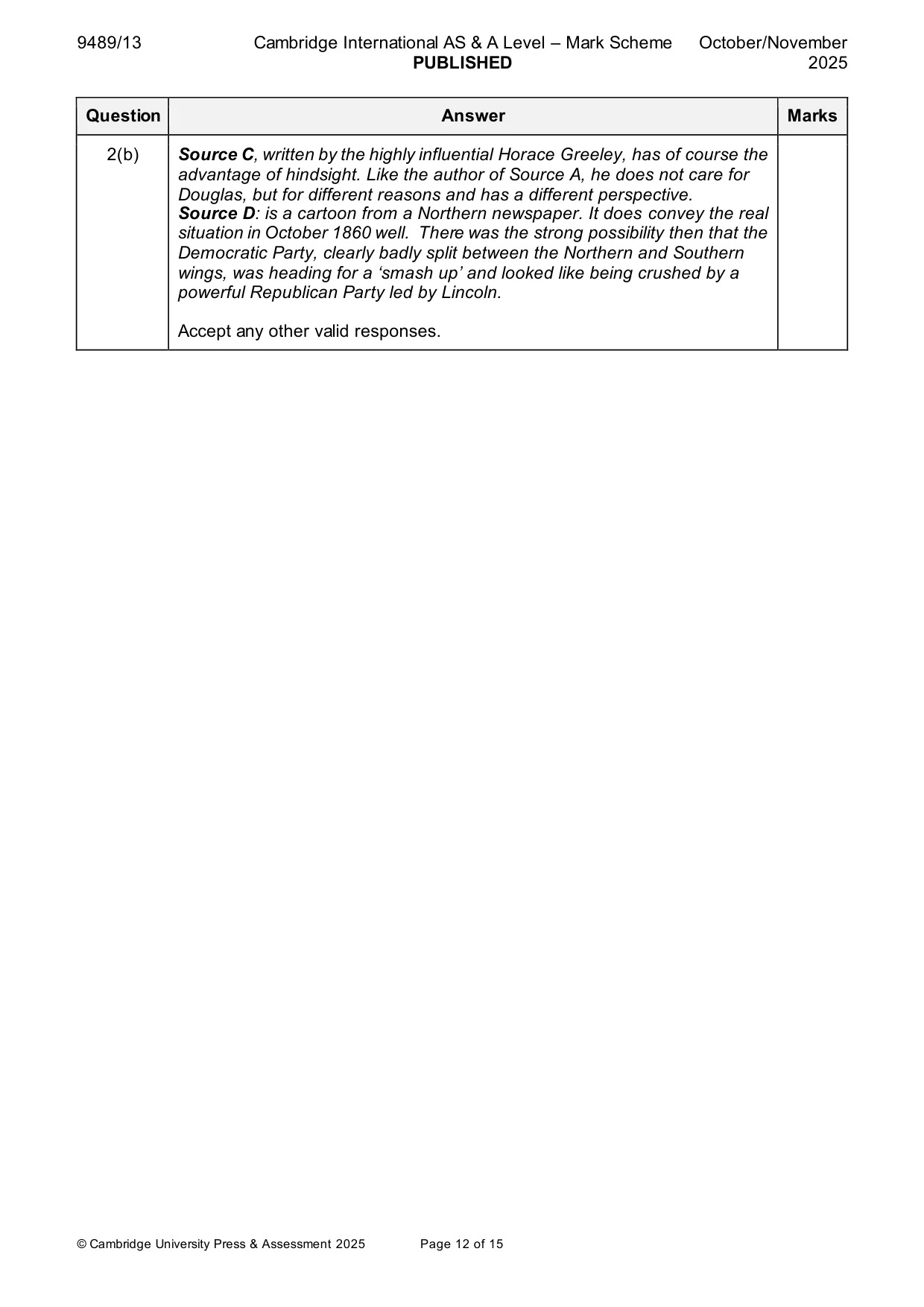
9489/13 Cambridge International AS & A Level – Mark Scheme PUBLISHED October/November 2025 © Cambridge University Press & Assessment 2025 Page 12 of 15 Question Answer Marks 2(b) Source C, written by the highly influential Horace Greeley, has of course the advantage of hindsight. Like the author of Source A, he does not care for Douglas, but for different reasons and has a different perspective. Source D: is a cartoon from a Northern newspaper. It does convey the real situation in October 1860 well. There was the strong possibility then that the Democratic Party, clearly badly split between the Northern and Southern wings, was heading for a ‘smash up’ and looked like being crushed by a powerful Republican Party led by Lincoln. Accept any other valid responses.
Mark scheme, page 13
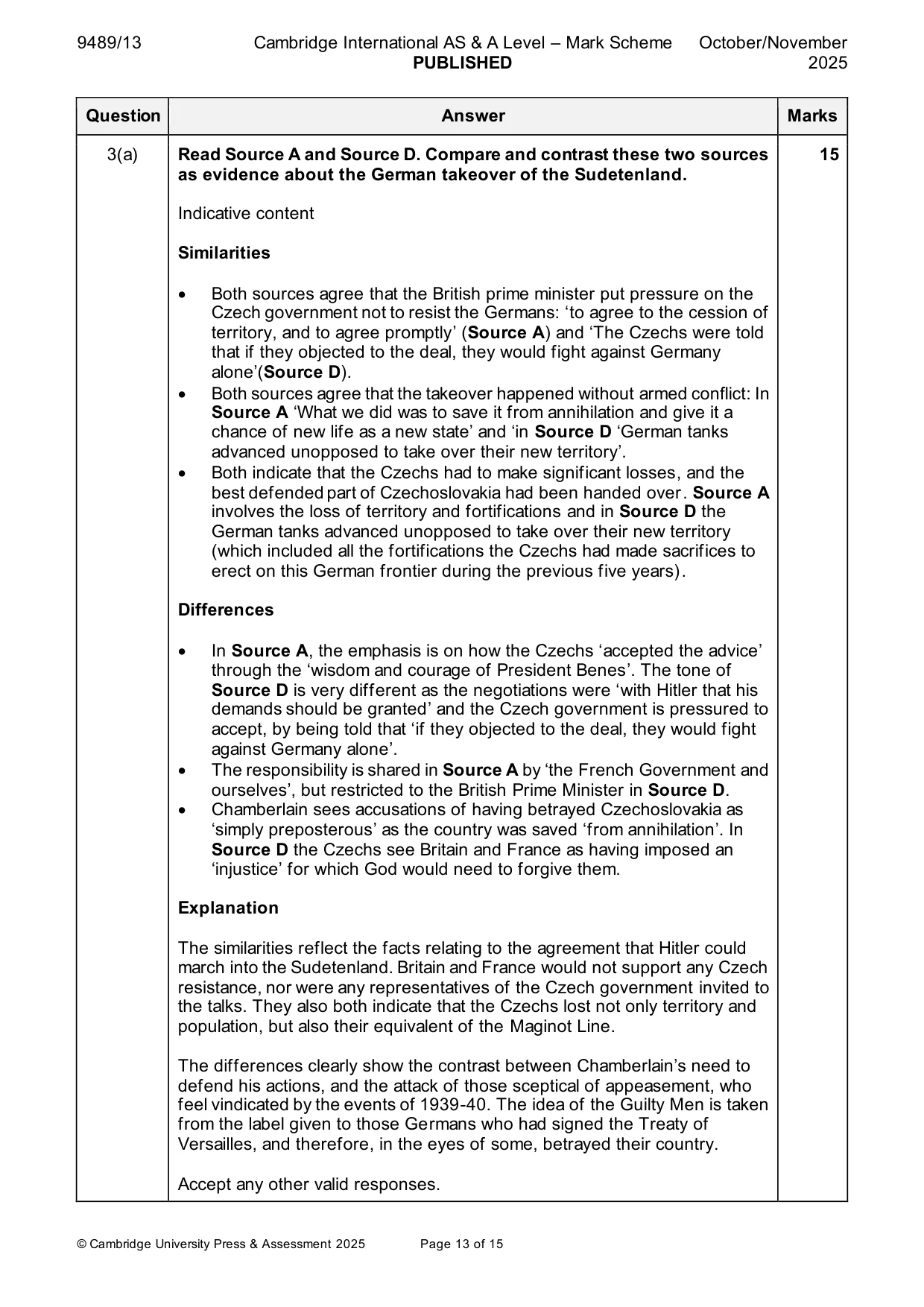
9489/13 Cambridge International AS & A Level – Mark Scheme PUBLISHED October/November 2025 © Cambridge University Press & Assessment 2025 Page 13 of 15 Question Answer Marks 3(a) Read Source A and Source D. Compare and contrast these two sources as evidence about the German takeover of the Sudetenland. Indicative content Similarities • Both sources agree that the British prime minister put pressure on the Czech government not to resist the Germans: ‘to agree to the cession of territory, and to agree promptly’ (Source A) and ‘The Czechs were told that if they objected to the deal, they would fight against Germany alone’(Source D). • Both sources agree that the takeover happened without armed conflict: In Source A ‘What we did was to save it from annihilation and give it a chance of new life as a new state’ and ‘in Source D ‘German tanks advanced unopposed to take over their new territory’. • Both indicate that the Czechs had to make significant losses, and the best defended part of Czechoslovakia had been handed over. Source A involves the loss of territory and fortifications and in Source D the German tanks advanced unopposed to take over their new territory (which included all the fortifications the Czechs had made sacrifices to erect on this German frontier during the previous five years). Differences • In Source A, the emphasis is on how the Czechs ‘accepted the advice’ through the ‘wisdom and courage of President Benes’. The tone of Source D is very different as the negotiations were ‘with Hitler that his demands should be granted’ and the Czech government is pressured to accept, by being told that ‘if they objected to the deal, they would fight against Germany alone’. • The responsibility is shared in Source A by ‘the French Government and ourselves’, but restricted to the British Prime Minister in Source D. • Chamberlain sees accusations of having betrayed Czechoslovakia as ‘simply preposterous’ as the country was saved ‘from annihilation’. In Source D the Czechs see Britain and France as having imposed an ‘injustice’ for which God would need to forgive them. Explanation The similarities reflect the facts relating to the agreement that Hitler could march into the Sudetenland. Britain and France would not support any Czech resistance, nor were any representatives of the Czech government invited to the talks. They also both indicate that the Czechs lost not only territory and population, but also their equivalent of the Maginot Line. The differences clearly show the contrast between Chamberlain’s need to defend his actions, and the attack of those sceptical of appeasement, who feel vindicated by the events of 1939-40. The idea of the Guilty Men is taken from the label given to those Germans who had signed the Treaty of Versailles, and therefore, in the eyes of some, betrayed their country. Accept any other valid responses. 15
Mark scheme, page 14
9489/13 Cambridge International AS & A Level – Mark Scheme PUBLISHED October/November 2025 © Cambridge University Press & Assessment 2025 Page 14 of 15 Question Answer Marks 3(b) Read all of the sources. How far do the sources support the view that Chamberlain’s policy of appeasement meant Britain would be in a stronger position when war came? Indicative content Support • Source A: Support is indicated here, in the suggestion that the Munich crisis has ‘thrown a vivid light upon our preparations for defence’ and would enable the government to rearm and ‘make good our deficiencies in the shortest possible time’. • Source C: This supports the idea as appeasement has been ‘of the highest moral value’. All the failed efforts at achieving peace would ensure the support of the population for war and give ‘strength and energy’ in the difficult times ahead. • Source D: Germany’s advance into the Sudetenland increased the awareness of the threat and led to a unanimous view that ‘Britain must now rearm day and night’. Challenge • Source B: The speech paints a very negative view of the impact of appeasement. It indicates how Germany has been strengthened, through the acquisition of territory, resources and allies, while depriving Britain ‘of vital and powerful forces’ such as the Czech army. • Source D: This refers the opportunity to rearm mentioned in Source A but is clear that ‘these efforts were ineffective’. It uses ‘the state of armaments’ in 1940 as proof of this. It also makes the point that valuable ‘fortifications the Czechs had made sacrifices to erect’ were surrendered to the Germans. Evaluation Source A is from Chamberlain, the author of the Munich agreement, who needs to justify his part in postponing war and enabling Britain to be better prepared. While rearmament was stepped up, many pointed out the deficiencies of the programme. It was hampered by the conflict of ideas, hinted at here, and stated in Source D, that if the appeasers trusted Hitler’s pledge not to commit any more acts of aggression, massive rearmament was not a priority. Source B is from a strong anti-appeaser. This comes from a politician who worked with Churchill, and condemned the Munich agreement, urged the formation of a Ministry of Supply to speed up rearming and argued that Britain should isolate Germany by coming to an understanding with the Russians. He sets out the drawbacks of the contrasting policies followed by Chamberlain in this extract. However, the view shown here was a minority one among British politicians. 25
Mark scheme, page 15
9489/13 Cambridge International AS & A Level – Mark Scheme PUBLISHED October/November 2025 © Cambridge University Press & Assessment 2025 Page 15 of 15 Question Answer Marks 3(b) Source C, from Churchill, seems surprising. While scathing about the effectiveness of appeasement, he shows appreciation of the aims and moral outcomes. The explanation clearly lies in the date; on the day on which war was declared it was most important to build a sense of common purpose. Source D is intended as a criticism of the policy of appeasement. It argues here that, not only was it a betrayal of allies, but that the ambiguity identified here meant that rearmament was not effective. The disastrous retreat to Dunkirk in the summer of 1940 is given as proof of this deficiency. Accept any other valid responses.
What you needed in this session
Cambridge’s own grade thresholds for 2025 Oct/Nov, Paper 1 · Variant 3. A higher threshold means an easier paper — the bar moves with how the cohort did.