Cambridge A Level History 9489 — 2023 May/June Paper 1 · Variant 3
9489/13/M/J/23 · 40 marks · ≈45 min
The question paper and its mark scheme, free to read here and free to download. This is Cambridge’s own paper, exactly as it was sat.
Question paper8 pages
Mark scheme13 pages
Answers below. Sit the paper first if you are practising.
Paper as text
Question paper, page 1
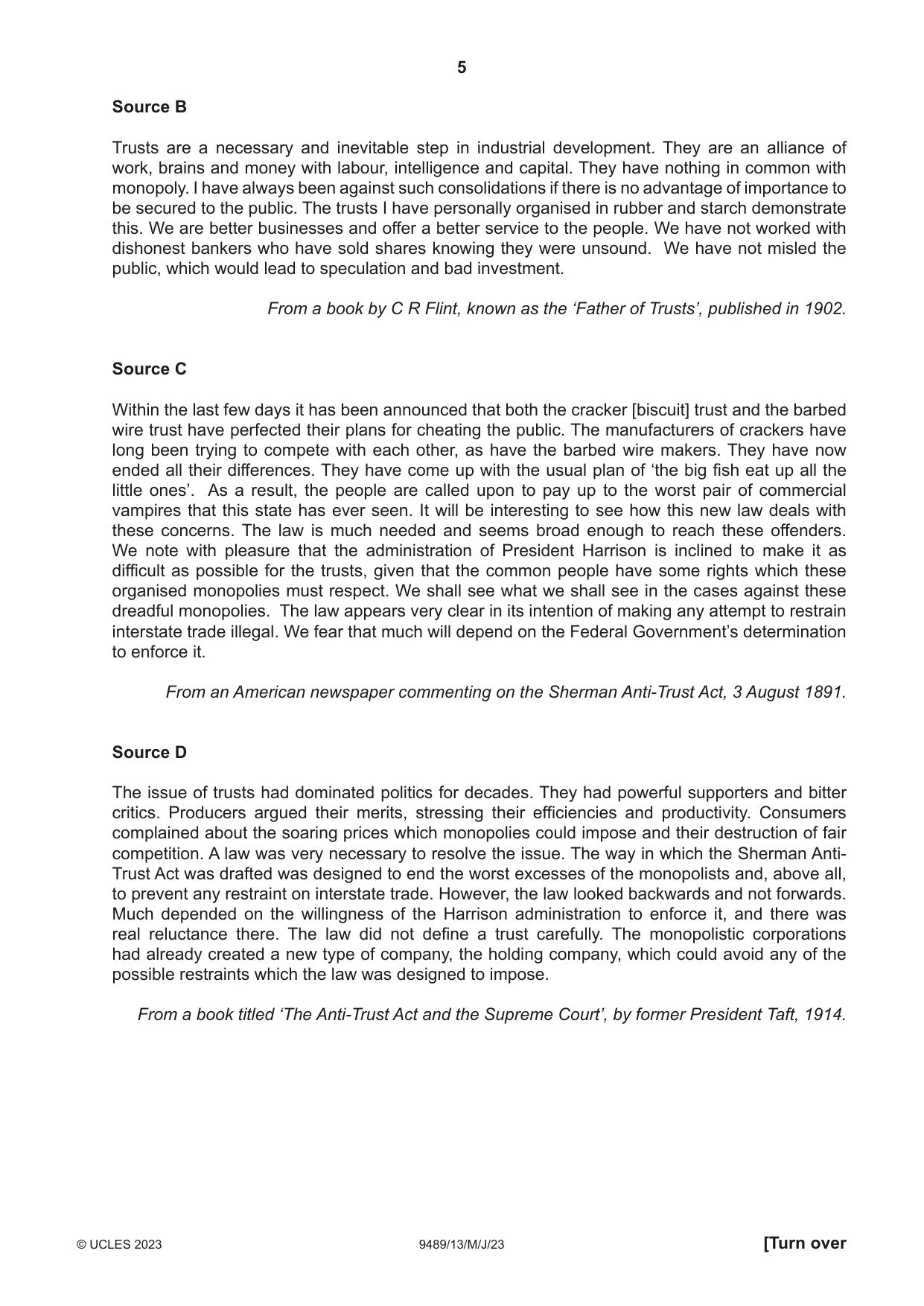
This document has 8 pages. [Turn over Cambridge International AS & A Level * 5 7 3 4 5 8 9 9 4 5 * HISTORY 9489/13 Paper 1 Document Question May/June 2023 1 hour 15 minutes You must answer on the enclosed answer booklet. You will need: Answer booklet (enclosed) INSTRUCTIONS ● Answer one question from one section only. Section A: European option Section B: American option Section C: International option ● Follow the instructions on the front cover of the answer booklet. If you need additional answer paper, ask the invigilator for a continuation booklet. INFORMATION ● The total mark for this paper is 40. ● The number of marks for each question or part question is shown in brackets [ ]. DC (CJ/CT) 311590/3 © UCLES 2023
Question paper, page 2
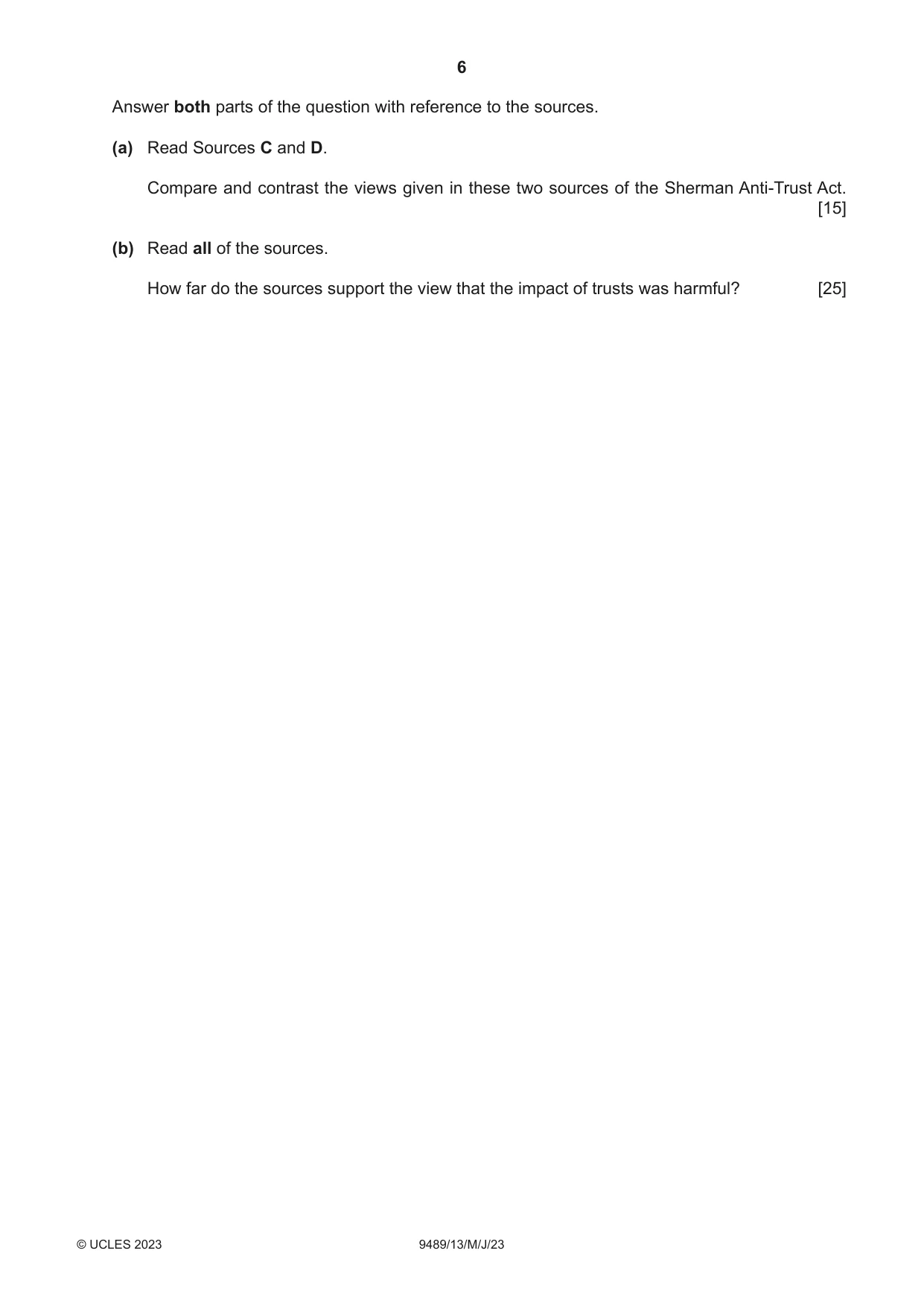
2 9489/13/M/J/23 © UCLES 2023 Answer one question from one section only. Section A: European option France, 1774–1814 1 Read the sources and then answer both parts of the question. Source A During the evening, a proposed proclamation was read out. It was the cause of an impressive debate and a scene which was truly magnificent and unforgettable. De Noailles proposed a motion that the assembly should decree that labour services to landlords and personal servitude would be abolished without compensation. The abolition of landlords’ courts was proposed. The Bishop of Chartres added the abolition of noble hunting rights. Never have so many bodies and individuals voted for such sacrifices at one time, in such generous terms and with such agreement. This had been a night for radical change and for public happiness. We may view the moment as the dawn of a new revolution, when all the burdens weighing on the people were abolished and France was truly reborn. The feudal regime which had oppressed the people for centuries was demolished at a stroke and in an instant. From the memoirs, written in 1792, of the first elected President of the National Constituent Assembly, about a meeting held on 4 August 1789. Source B The people of all the provinces regard these proposals which you are discussing today as fully decreed. They take every advantage. They no longer pay taxes and they have armed themselves for smuggling. They have fixed the price of salt, and it is indeed happy that they have consented to pay half of its former value. They have devastated the woods, destroyed the countryside and estates and even ruined the crops at the very time when they have become valuable to us. They have refused to acknowledge rights whose abolition is still being discussed. They have ceased to fear the ministers of justice whose abolition in the villages you advise. They are acting exactly as people who no longer fear the law, and it is the strongest who enjoy liberty while your mission is to give to the weak as well as to those who are powerful. From an article in a royalist Paris newspaper, addressed to the National Constituent Assembly, September 1789.
Question paper, page 3
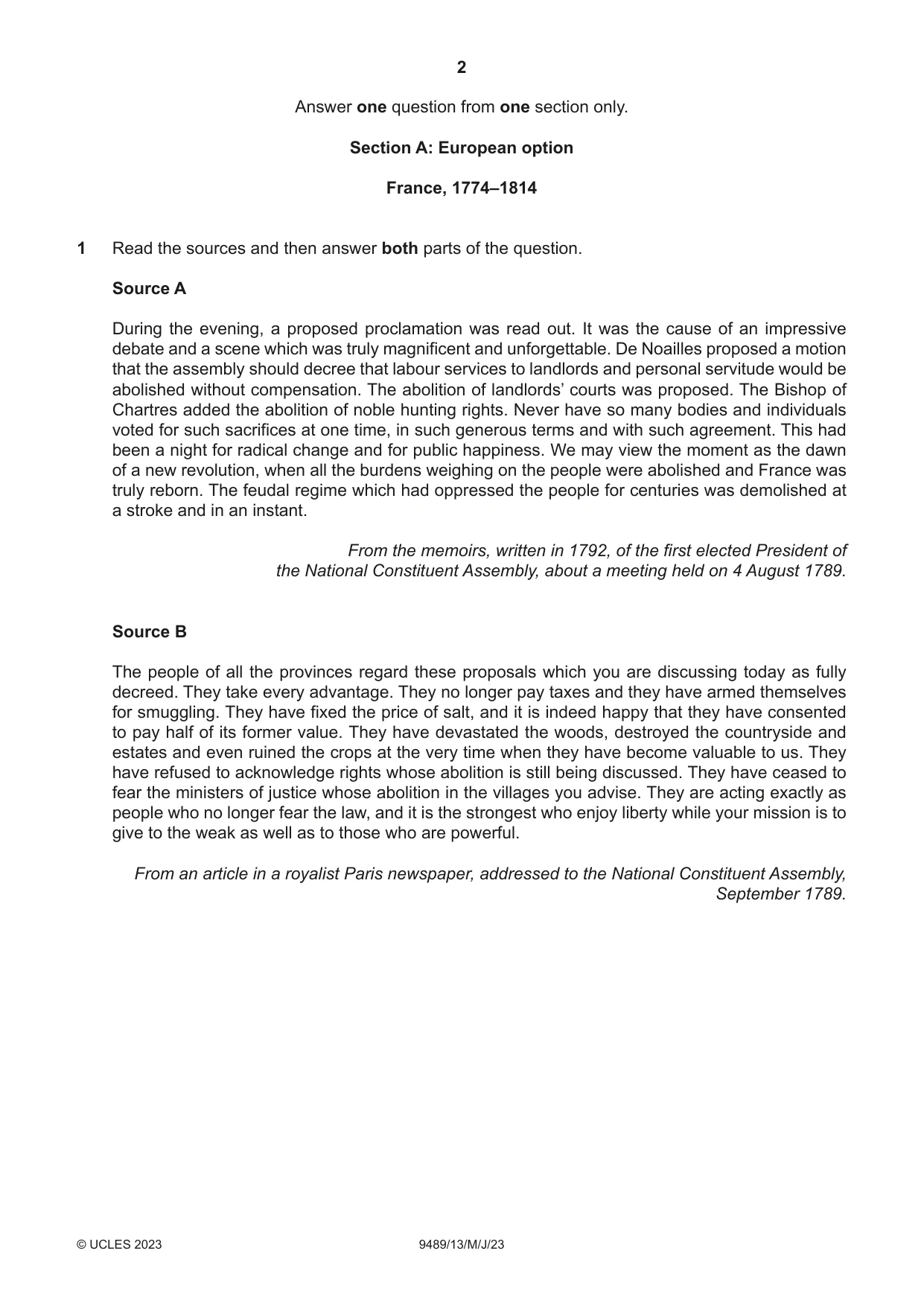
3 9489/13/M/J/23 © UCLES 2023 [Turn over Source C A contemporary illustration of the return of the King to Paris on 6 October 1789. Source D The revolution which has been brought about in France is of so wonderful a nature that the mind can hardly recognise the fact. But I fear, though it has gone triumphantly through the first phase, it is not the last it has to encounter before matters are finally settled. The revolution is of too great a magnitude to be carried out in so short a space, and with the loss of so little blood. The humiliation of the king, the intrigues of the queen and the discontent of the nobles, will create divisions in the National Constituent Assembly, and they will unquestionably make every mistake in the formation of the constitution, if they do not take a stronger position. Great firmness and foresight are necessary. To prevent running from one extreme to another is no easy matter, and should this be the case, problems not visible at present may give rise to an even more oppressive government than the one which existed before. President Washington of the United States, writing to an American friend in France, 13 October 1789. Answer both parts of the question with reference to the sources. (a) Read Sources A and B. Compare and contrast these two sources as evidence about the work of the National Constituent Assembly. [15] (b) Read all of the sources. ‘There were good prospects for the revolution to proceed peacefully.’ How far do these sources support this view? [25]
Question paper, page 4
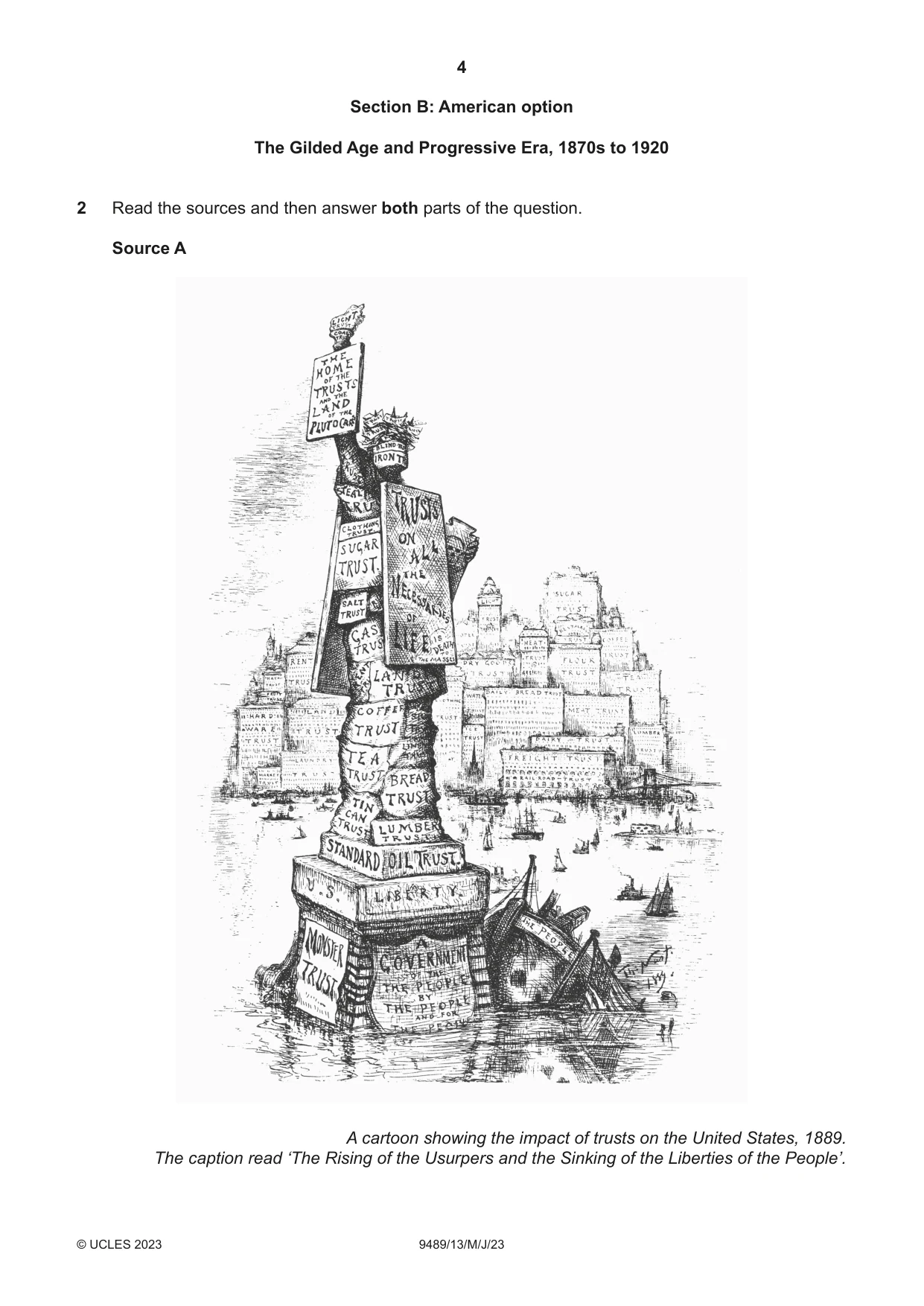
4 9489/13/M/J/23 © UCLES 2023 Section B: American option The Gilded Age and Progressive Era, 1870s to 1920 2 Read the sources and then answer both parts of the question. Source A A cartoon showing the impact of trusts on the United States, 1889. The caption read ‘The Rising of the Usurpers and the Sinking of the Liberties of the People’.
Question paper, page 5
5 9489/13/M/J/23 © UCLES 2023 [Turn over Source B Trusts are a necessary and inevitable step in industrial development. They are an alliance of work, brains and money with labour, intelligence and capital. They have nothing in common with monopoly. I have always been against such consolidations if there is no advantage of importance to be secured to the public. The trusts I have personally organised in rubber and starch demonstrate this. We are better businesses and offer a better service to the people. We have not worked with dishonest bankers who have sold shares knowing they were unsound. We have not misled the public, which would lead to speculation and bad investment. From a book by C R Flint, known as the ‘Father of Trusts’, published in 1902. Source C Within the last few days it has been announced that both the cracker [biscuit] trust and the barbed wire trust have perfected their plans for cheating the public. The manufacturers of crackers have long been trying to compete with each other, as have the barbed wire makers. They have now ended all their differences. They have come up with the usual plan of ‘the big fish eat up all the little ones’. As a result, the people are called upon to pay up to the worst pair of commercial vampires that this state has ever seen. It will be interesting to see how this new law deals with these concerns. The law is much needed and seems broad enough to reach these offenders. We note with pleasure that the administration of President Harrison is inclined to make it as difficult as possible for the trusts, given that the common people have some rights which these organised monopolies must respect. We shall see what we shall see in the cases against these dreadful monopolies. The law appears very clear in its intention of making any attempt to restrain interstate trade illegal. We fear that much will depend on the Federal Government’s determination to enforce it. From an American newspaper commenting on the Sherman Anti-Trust Act, 3 August 1891. Source D The issue of trusts had dominated politics for decades. They had powerful supporters and bitter critics. Producers argued their merits, stressing their efficiencies and productivity. Consumers complained about the soaring prices which monopolies could impose and their destruction of fair competition. A law was very necessary to resolve the issue. The way in which the Sherman Anti- Trust Act was drafted was designed to end the worst excesses of the monopolists and, above all, to prevent any restraint on interstate trade. However, the law looked backwards and not forwards. Much depended on the willingness of the Harrison administration to enforce it, and there was real reluctance there. The law did not define a trust carefully. The monopolistic corporations had already created a new type of company, the holding company, which could avoid any of the possible restraints which the law was designed to impose. From a book titled ‘The Anti-Trust Act and the Supreme Court’, by former President Taft, 1914.
Question paper, page 6
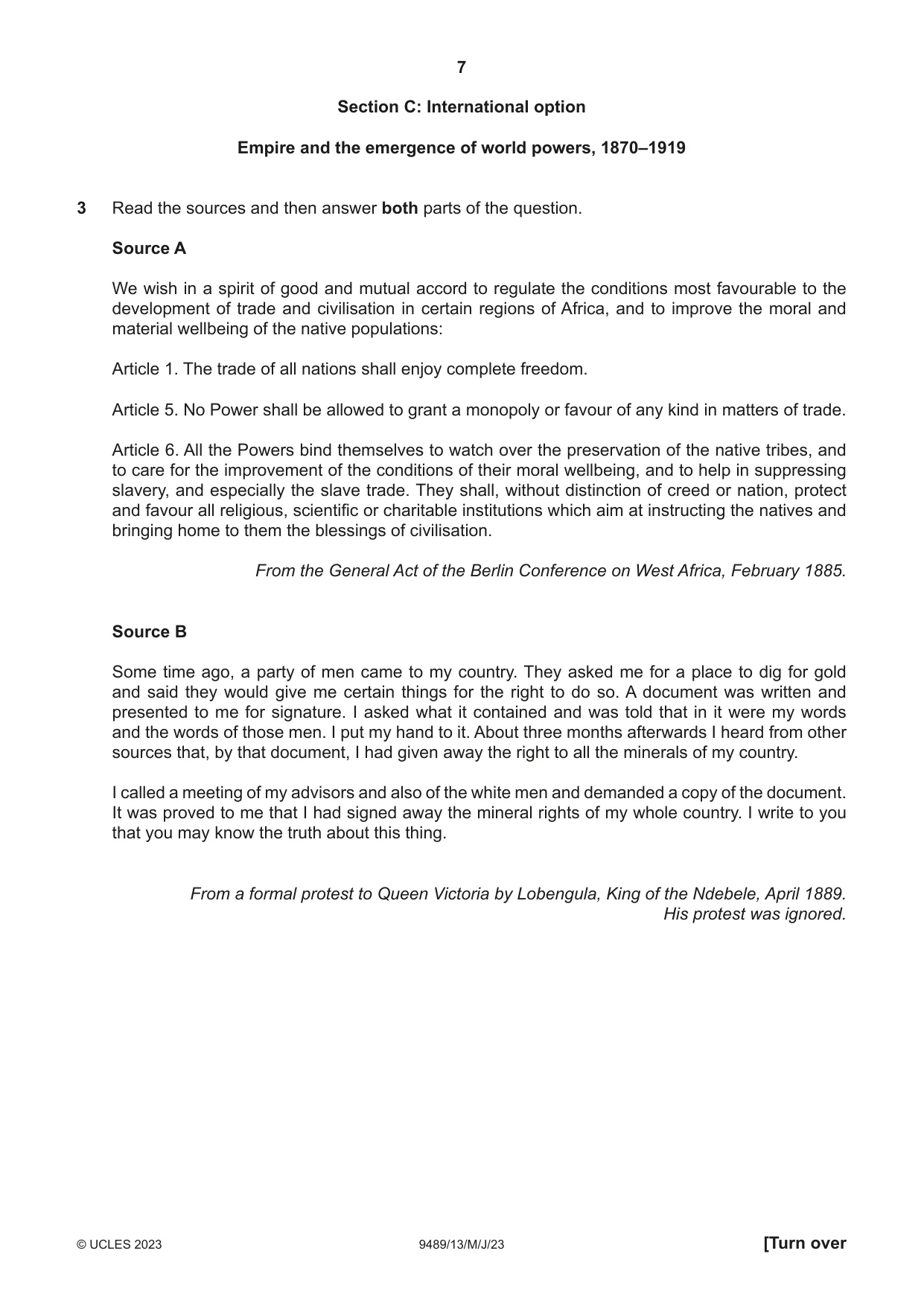
6 9489/13/M/J/23 © UCLES 2023 Answer both parts of the question with reference to the sources. (a) Read Sources C and D. Compare and contrast the views given in these two sources of the Sherman Anti-Trust Act. [15] (b) Read all of the sources. How far do the sources support the view that the impact of trusts was harmful? [25]
Question paper, page 7
7 9489/13/M/J/23 © UCLES 2023 [Turn over Section C: International option Empire and the emergence of world powers, 1870–1919 3 Read the sources and then answer both parts of the question. Source A We wish in a spirit of good and mutual accord to regulate the conditions most favourable to the development of trade and civilisation in certain regions of Africa, and to improve the moral and material wellbeing of the native populations: Article 1. The trade of all nations shall enjoy complete freedom. Article 5. No Power shall be allowed to grant a monopoly or favour of any kind in matters of trade. Article 6. All the Powers bind themselves to watch over the preservation of the native tribes, and to care for the improvement of the conditions of their moral wellbeing, and to help in suppressing slavery, and especially the slave trade. They shall, without distinction of creed or nation, protect and favour all religious, scientific or charitable institutions which aim at instructing the natives and bringing home to them the blessings of civilisation. From the General Act of the Berlin Conference on West Africa, February 1885. Source B Some time ago, a party of men came to my country. They asked me for a place to dig for gold and said they would give me certain things for the right to do so. A document was written and presented to me for signature. I asked what it contained and was told that in it were my words and the words of those men. I put my hand to it. About three months afterwards I heard from other sources that, by that document, I had given away the right to all the minerals of my country. I called a meeting of my advisors and also of the white men and demanded a copy of the document. It was proved to me that I had signed away the mineral rights of my whole country. I write to you that you may know the truth about this thing. From a formal protest to Queen Victoria by Lobengula, King of the Ndebele, April 1889. His protest was ignored.
Question paper, page 8
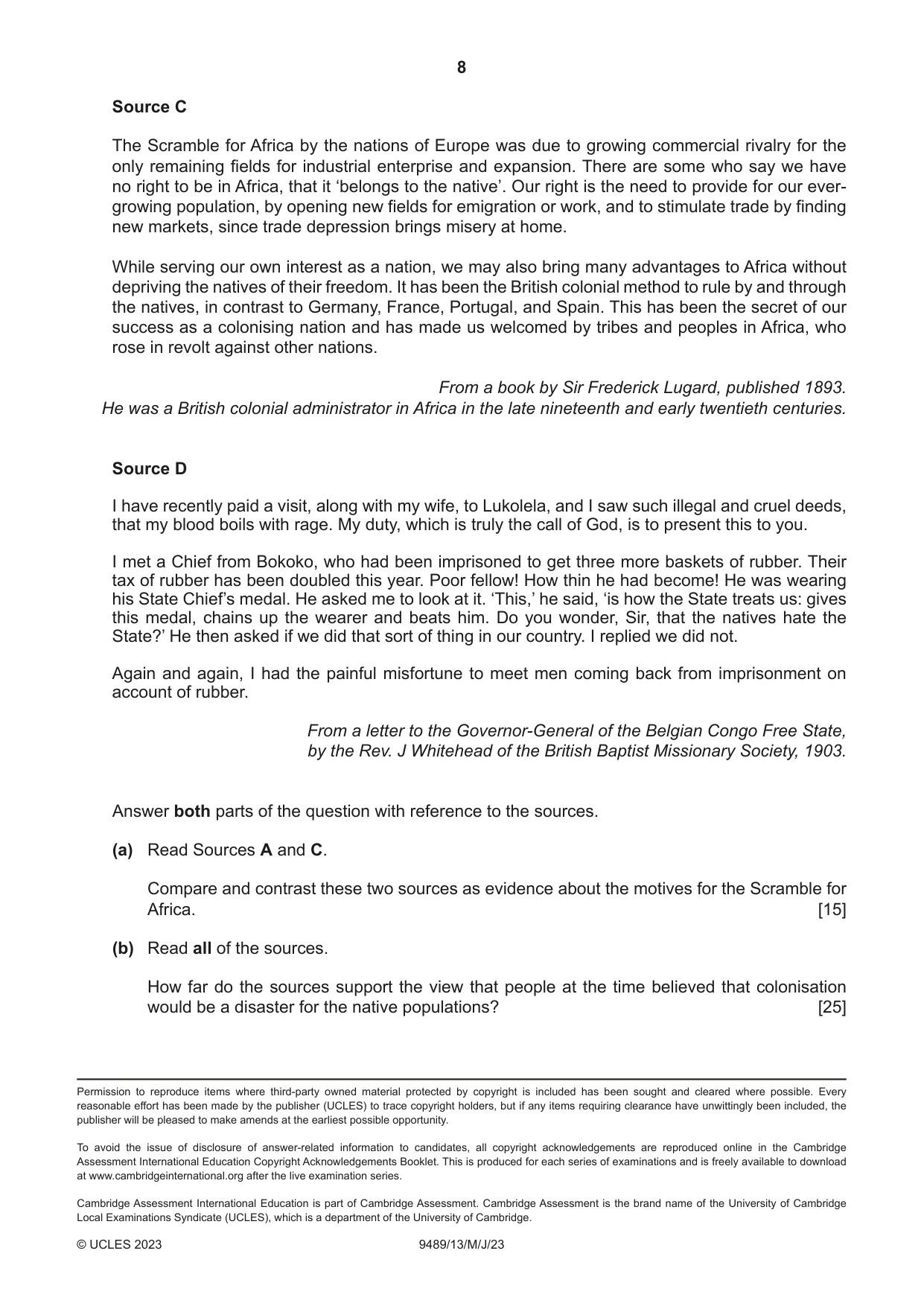
8 9489/13/M/J/23 © UCLES 2023 Permission to reproduce items where third-party owned material protected by copyright is included has been sought and cleared where possible. Every reasonable effort has been made by the publisher (UCLES) to trace copyright holders, but if any items requiring clearance have unwittingly been included, the publisher will be pleased to make amends at the earliest possible opportunity. To avoid the issue of disclosure of answer-related information to candidates, all copyright acknowledgements are reproduced online in the Cambridge Assessment International Education Copyright Acknowledgements Booklet. This is produced for each series of examinations and is freely available to download at www.cambridgeinternational.org after the live examination series. Cambridge Assessment International Education is part of Cambridge Assessment. Cambridge Assessment is the brand name of the University of Cambridge Local Examinations Syndicate (UCLES), which is a department of the University of Cambridge. Source C The Scramble for Africa by the nations of Europe was due to growing commercial rivalry for the only remaining fields for industrial enterprise and expansion. There are some who say we have no right to be in Africa, that it ‘belongs to the native’. Our right is the need to provide for our ever- growing population, by opening new fields for emigration or work, and to stimulate trade by finding new markets, since trade depression brings misery at home. While serving our own interest as a nation, we may also bring many advantages to Africa without depriving the natives of their freedom. It has been the British colonial method to rule by and through the natives, in contrast to Germany, France, Portugal, and Spain. This has been the secret of our success as a colonising nation and has made us welcomed by tribes and peoples in Africa, who rose in revolt against other nations. From a book by Sir Frederick Lugard, published 1893. He was a British colonial administrator in Africa in the late nineteenth and early twentieth centuries. Source D I have recently paid a visit, along with my wife, to Lukolela, and I saw such illegal and cruel deeds, that my blood boils with rage. My duty, which is truly the call of God, is to present this to you. I met a Chief from Bokoko, who had been imprisoned to get three more baskets of rubber. Their tax of rubber has been doubled this year. Poor fellow! How thin he had become! He was wearing his State Chief’s medal. He asked me to look at it. ‘This,’ he said, ‘is how the State treats us: gives this medal, chains up the wearer and beats him. Do you wonder, Sir, that the natives hate the State?’ He then asked if we did that sort of thing in our country. I replied we did not. Again and again, I had the painful misfortune to meet men coming back from imprisonment on account of rubber. From a letter to the Governor-General of the Belgian Congo Free State, by the Rev. J Whitehead of the British Baptist Missionary Society, 1903. Answer both parts of the question with reference to the sources. (a) Read Sources A and C. Compare and contrast these two sources as evidence about the motives for the Scramble for Africa. [15] (b) Read all of the sources. How far do the sources support the view that people at the time believed that colonisation would be a disaster for the native populations? [25]
Mark scheme, page 1
This document consists of 13 printed pages. © UCLES 2023 [Turn over Cambridge International AS & A Level HISTORY 9489/13 Paper 1 Document question May/June 2023 MARK SCHEME Maximum Mark: 40 Published This mark scheme is published as an aid to teachers and candidates, to indicate the requirements of the examination. It shows the basis on which Examiners were instructed to award marks. It does not indicate the details of the discussions that took place at an Examiners’ meeting before marking began, which would have considered the acceptability of alternative answers. Mark schemes should be read in conjunction with the question paper and the Principal Examiner Report for Teachers. Cambridge International will not enter into discussions about these mark schemes. Cambridge International is publishing the mark schemes for the May/June 2023 series for most Cambridge IGCSE, Cambridge International A and AS Level and Cambridge Pre-U components, and some Cambridge O Level components.
Mark scheme, page 2
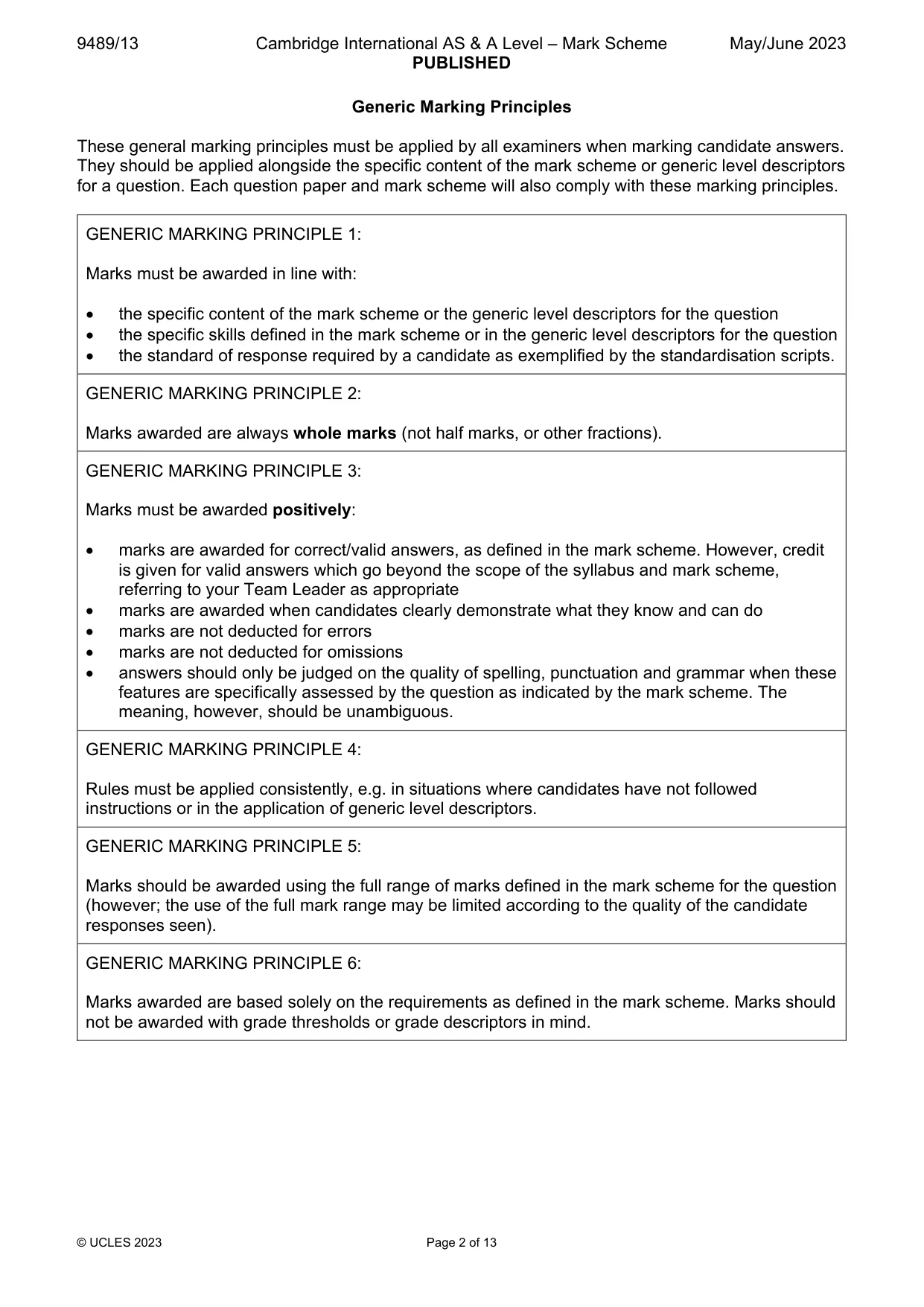
9489/13 Cambridge International AS & A Level – Mark Scheme PUBLISHED May/June 2023 © UCLES 2023 Page 2 of 13 Generic Marking Principles These general marking principles must be applied by all examiners when marking candidate answers. They should be applied alongside the specific content of the mark scheme or generic level descriptors for a question. Each question paper and mark scheme will also comply with these marking principles. GENERIC MARKING PRINCIPLE 1: Marks must be awarded in line with: the specific content of the mark scheme or the generic level descriptors for the question the specific skills defined in the mark scheme or in the generic level descriptors for the question the standard of response required by a candidate as exemplified by the standardisation scripts. GENERIC MARKING PRINCIPLE 2: Marks awarded are always whole marks (not half marks, or other fractions). GENERIC MARKING PRINCIPLE 3: Marks must be awarded positively: marks are awarded for correct/valid answers, as defined in the mark scheme. However, credit is given for valid answers which go beyond the scope of the syllabus and mark scheme, referring to your Team Leader as appropriate marks are awarded when candidates clearly demonstrate what they know and can do marks are not deducted for errors marks are not deducted for omissions answers should only be judged on the quality of spelling, punctuation and grammar when these features are specifically assessed by the question as indicated by the mark scheme. The meaning, however, should be unambiguous. GENERIC MARKING PRINCIPLE 4: Rules must be applied consistently, e.g. in situations where candidates have not followed instructions or in the application of generic level descriptors. GENERIC MARKING PRINCIPLE 5: Marks should be awarded using the full range of marks defined in the mark scheme for the question (however; the use of the full mark range may be limited according to the quality of the candidate responses seen). GENERIC MARKING PRINCIPLE 6: Marks awarded are based solely on the requirements as defined in the mark scheme. Marks should not be awarded with grade thresholds or grade descriptors in mind.
Mark scheme, page 3
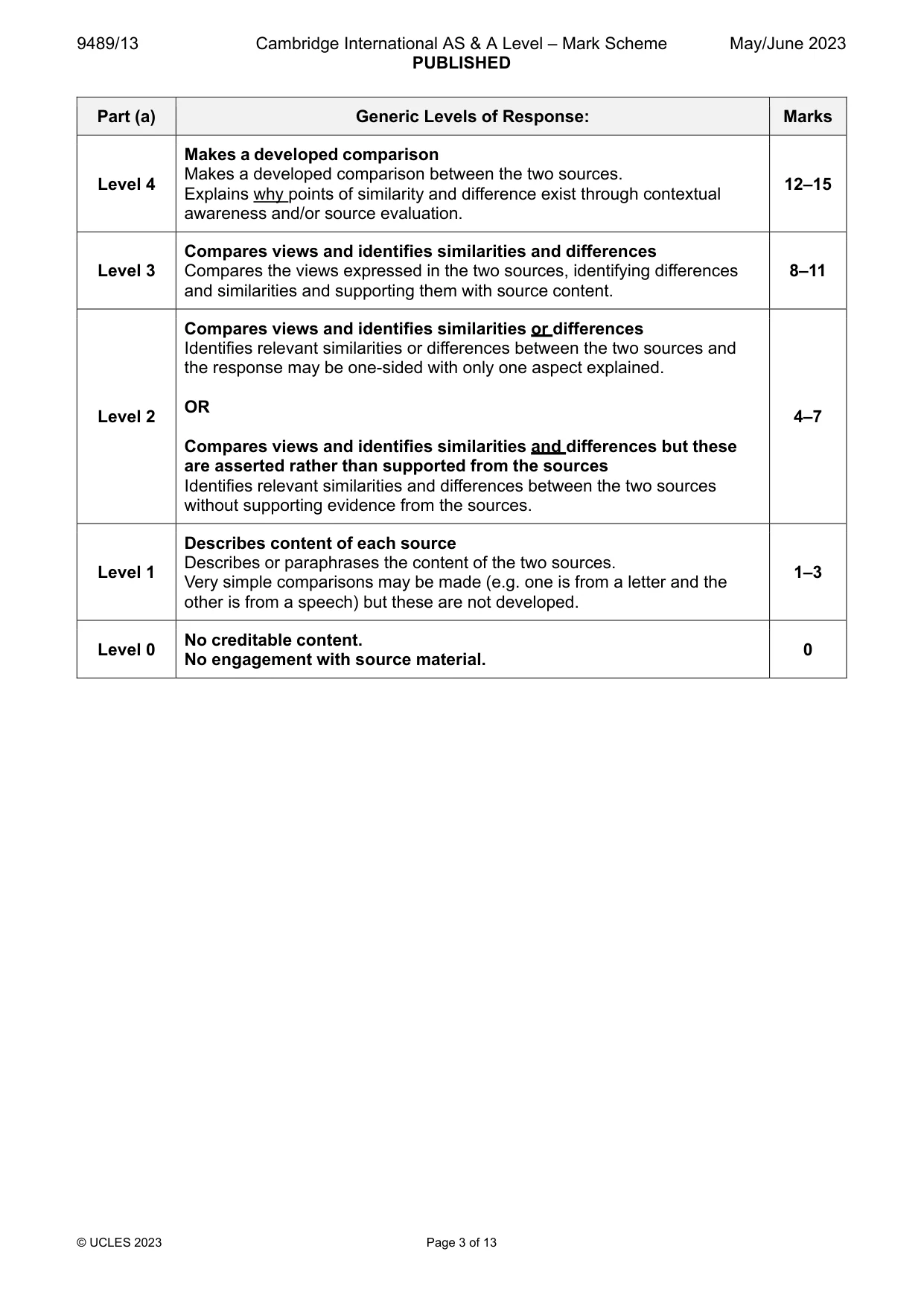
9489/13 Cambridge International AS & A Level – Mark Scheme PUBLISHED May/June 2023 © UCLES 2023 Page 3 of 13 Part (a) Generic Levels of Response: Marks Level 4 Makes a developed comparison Makes a developed comparison between the two sources. Explains why points of similarity and difference exist through contextual awareness and/or source evaluation. 12–15 Level 3 Compares views and identifies similarities and differences Compares the views expressed in the two sources, identifying differences and similarities and supporting them with source content. 8–11 Level 2 Compares views and identifies similarities or differences Identifies relevant similarities or differences between the two sources and the response may be one-sided with only one aspect explained. OR Compares views and identifies similarities and differences but these are asserted rather than supported from the sources Identifies relevant similarities and differences between the two sources without supporting evidence from the sources. 4–7 Level 1 Describes content of each source Describes or paraphrases the content of the two sources. Very simple comparisons may be made (e.g. one is from a letter and the other is from a speech) but these are not developed. 1–3 Level 0 No creditable content. No engagement with source material. 0
Mark scheme, page 4
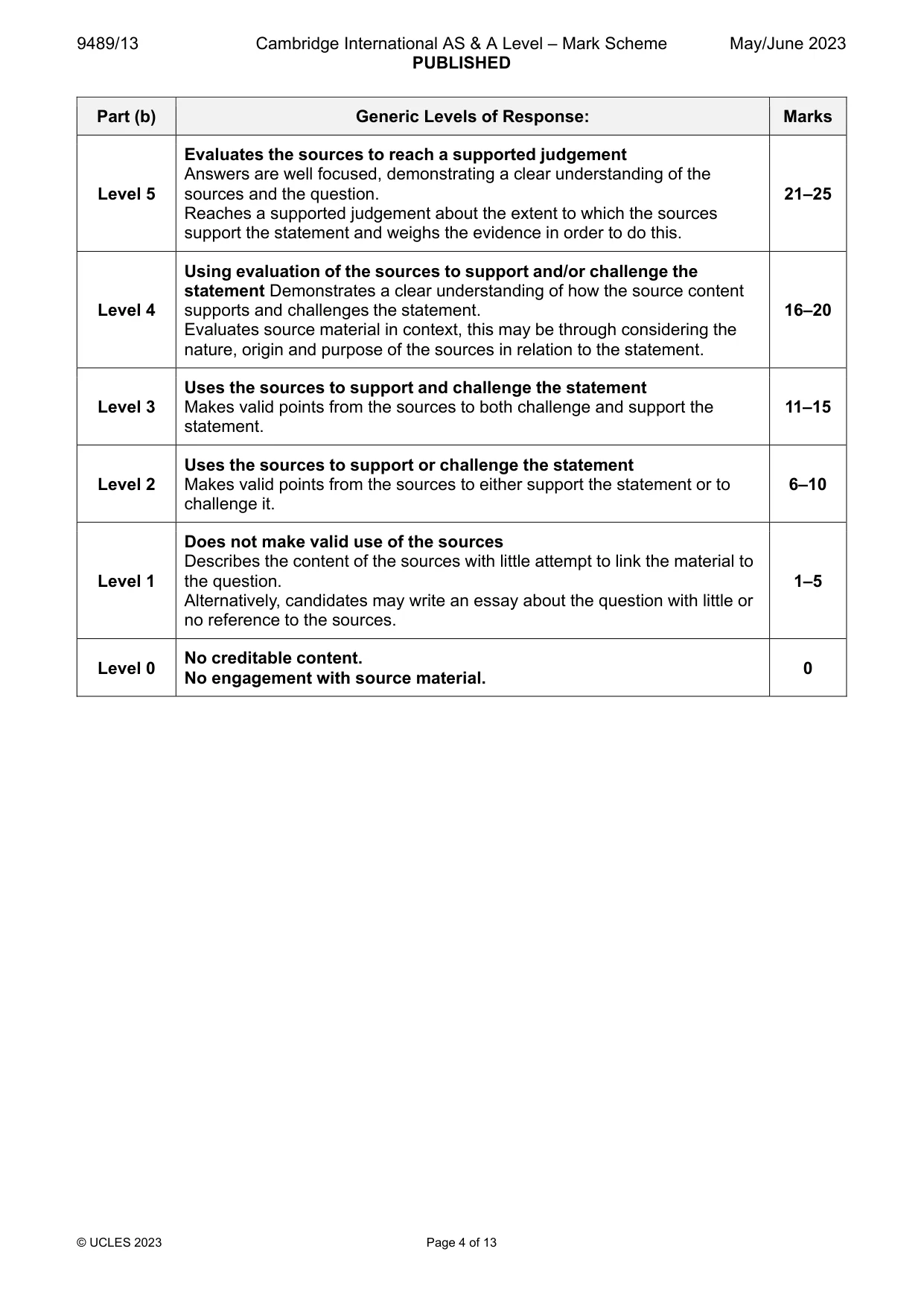
9489/13 Cambridge International AS & A Level – Mark Scheme PUBLISHED May/June 2023 © UCLES 2023 Page 4 of 13 Part (b) Generic Levels of Response: Marks Level 5 Evaluates the sources to reach a supported judgement Answers are well focused, demonstrating a clear understanding of the sources and the question. Reaches a supported judgement about the extent to which the sources support the statement and weighs the evidence in order to do this. 21–25 Level 4 Using evaluation of the sources to support and/or challenge the statement Demonstrates a clear understanding of how the source content supports and challenges the statement. Evaluates source material in context, this may be through considering the nature, origin and purpose of the sources in relation to the statement. 16–20 Level 3 Uses the sources to support and challenge the statement Makes valid points from the sources to both challenge and support the statement. 11–15 Level 2 Uses the sources to support or challenge the statement Makes valid points from the sources to either support the statement or to challenge it. 6–10 Level 1 Does not make valid use of the sources Describes the content of the sources with little attempt to link the material to the question. Alternatively, candidates may write an essay about the question with little or no reference to the sources. 1–5 Level 0 No creditable content. No engagement with source material. 0
Mark scheme, page 5
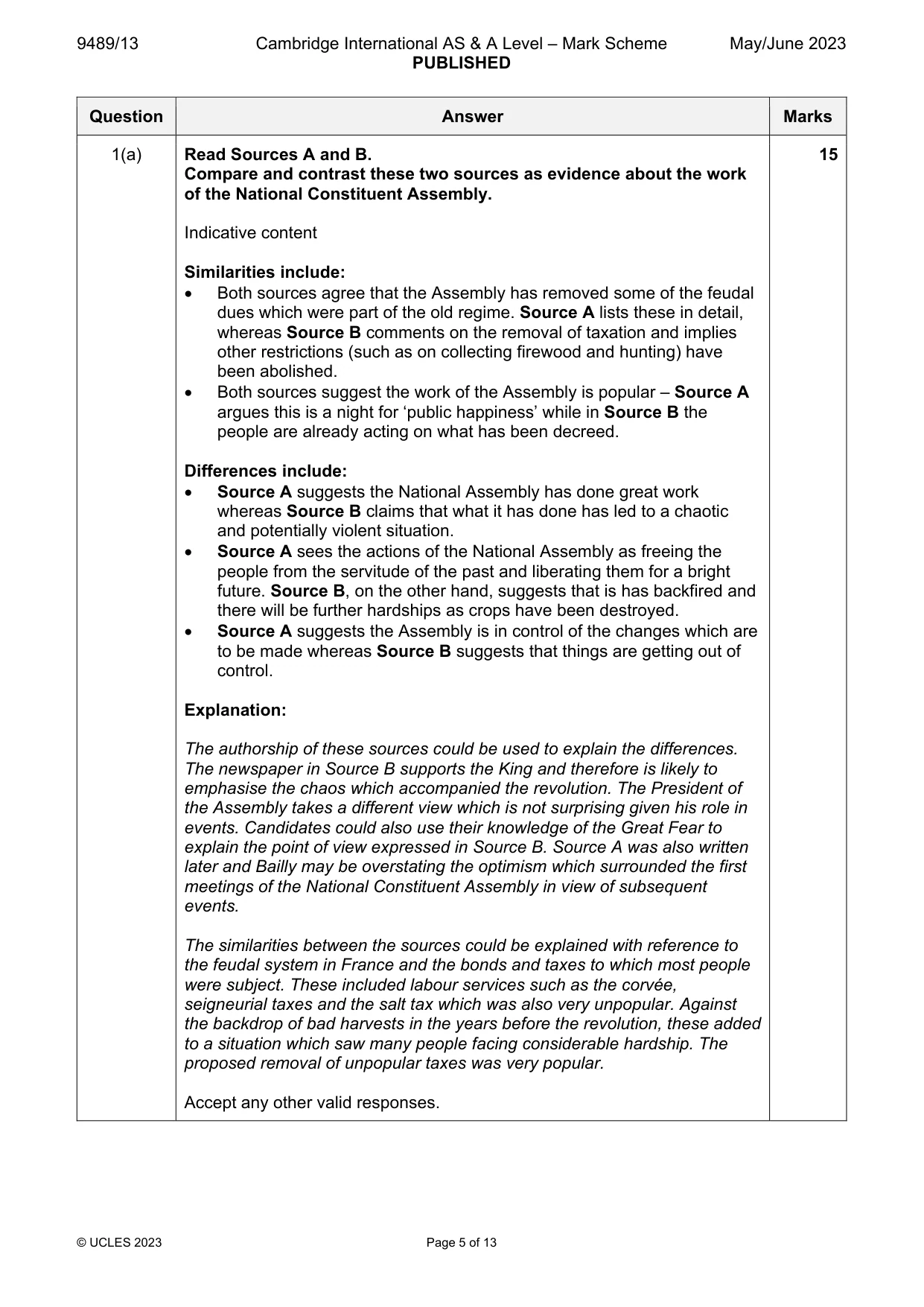
9489/13 Cambridge International AS & A Level – Mark Scheme PUBLISHED May/June 2023 © UCLES 2023 Page 5 of 13 Question Answer Marks 1(a) Read Sources A and B. Compare and contrast these two sources as evidence about the work of the National Constituent Assembly. Indicative content Similarities include: Both sources agree that the Assembly has removed some of the feudal dues which were part of the old regime. Source A lists these in detail, whereas Source B comments on the removal of taxation and implies other restrictions (such as on collecting firewood and hunting) have been abolished. Both sources suggest the work of the Assembly is popular – Source A argues this is a night for ‘public happiness’ while in Source B the people are already acting on what has been decreed. Differences include: Source A suggests the National Assembly has done great work whereas Source B claims that what it has done has led to a chaotic and potentially violent situation. Source A sees the actions of the National Assembly as freeing the people from the servitude of the past and liberating them for a bright future. Source B, on the other hand, suggests that is has backfired and there will be further hardships as crops have been destroyed. Source A suggests the Assembly is in control of the changes which are to be made whereas Source B suggests that things are getting out of control. Explanation: The authorship of these sources could be used to explain the differences. The newspaper in Source B supports the King and therefore is likely to emphasise the chaos which accompanied the revolution. The President of the Assembly takes a different view which is not surprising given his role in events. Candidates could also use their knowledge of the Great Fear to explain the point of view expressed in Source B. Source A was also written later and Bailly may be overstating the optimism which surrounded the first meetings of the National Constituent Assembly in view of subsequent events. The similarities between the sources could be explained with reference to the feudal system in France and the bonds and taxes to which most people were subject. These included labour services such as the corvée, seigneurial taxes and the salt tax which was also very unpopular. Against the backdrop of bad harvests in the years before the revolution, these added to a situation which saw many people facing considerable hardship. The proposed removal of unpopular taxes was very popular. Accept any other valid responses. 15
Mark scheme, page 6
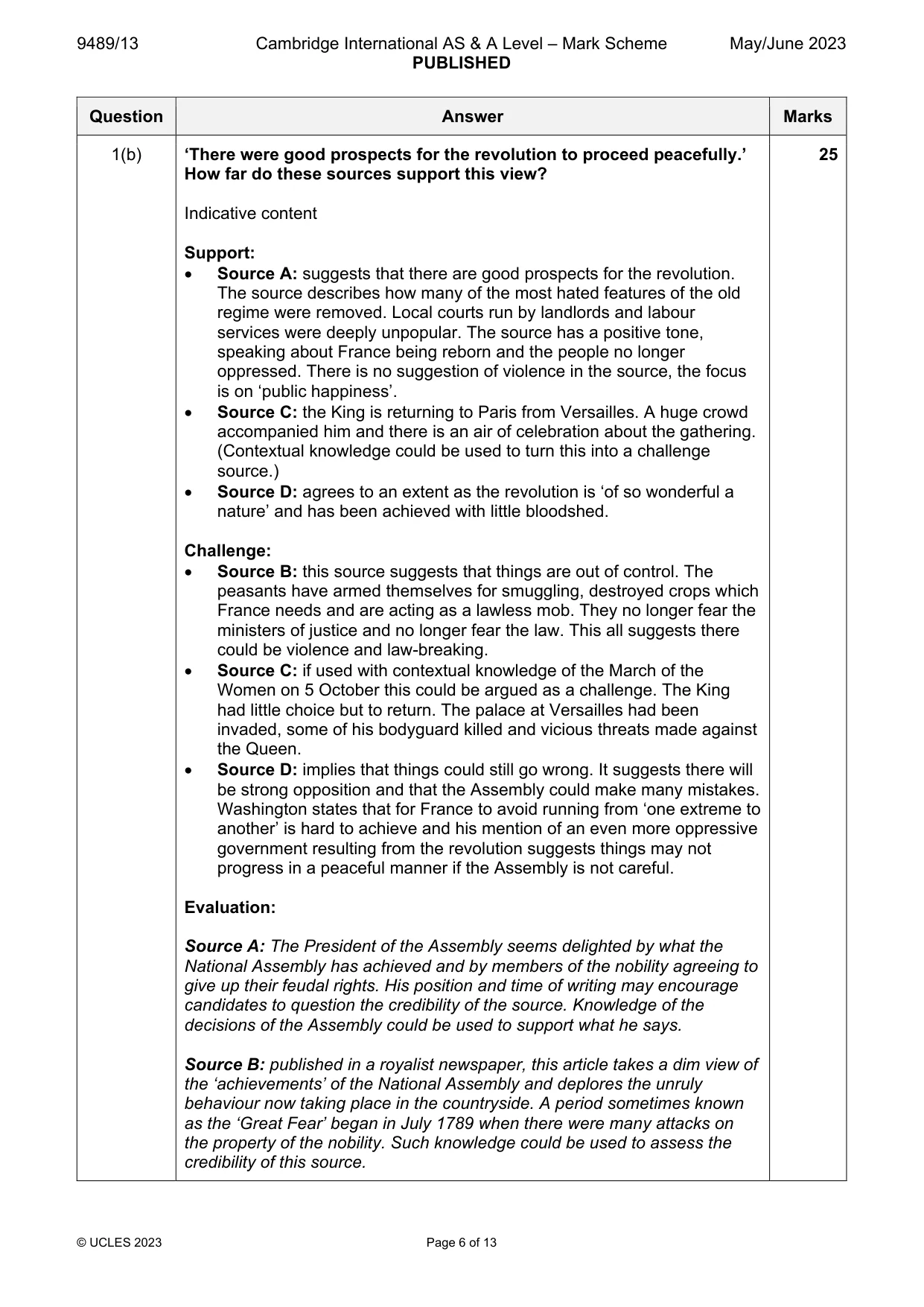
9489/13 Cambridge International AS & A Level – Mark Scheme PUBLISHED May/June 2023 © UCLES 2023 Page 6 of 13 Question Answer Marks 1(b) ‘There were good prospects for the revolution to proceed peacefully.’ How far do these sources support this view? Indicative content Support: Source A: suggests that there are good prospects for the revolution. The source describes how many of the most hated features of the old regime were removed. Local courts run by landlords and labour services were deeply unpopular. The source has a positive tone, speaking about France being reborn and the people no longer oppressed. There is no suggestion of violence in the source, the focus is on ‘public happiness’. Source C: the King is returning to Paris from Versailles. A huge crowd accompanied him and there is an air of celebration about the gathering. (Contextual knowledge could be used to turn this into a challenge source.) Source D: agrees to an extent as the revolution is ‘of so wonderful a nature’ and has been achieved with little bloodshed. Challenge: Source B: this source suggests that things are out of control. The peasants have armed themselves for smuggling, destroyed crops which France needs and are acting as a lawless mob. They no longer fear the ministers of justice and no longer fear the law. This all suggests there could be violence and law-breaking. Source C: if used with contextual knowledge of the March of the Women on 5 October this could be argued as a challenge. The King had little choice but to return. The palace at Versailles had been invaded, some of his bodyguard killed and vicious threats made against the Queen. Source D: implies that things could still go wrong. It suggests there will be strong opposition and that the Assembly could make many mistakes. Washington states that for France to avoid running from ‘one extreme to another’ is hard to achieve and his mention of an even more oppressive government resulting from the revolution suggests things may not progress in a peaceful manner if the Assembly is not careful. Evaluation: Source A: The President of the Assembly seems delighted by what the National Assembly has achieved and by members of the nobility agreeing to give up their feudal rights. His position and time of writing may encourage candidates to question the credibility of the source. Knowledge of the decisions of the Assembly could be used to support what he says. Source B: published in a royalist newspaper, this article takes a dim view of the ‘achievements’ of the National Assembly and deplores the unruly behaviour now taking place in the countryside. A period sometimes known as the ‘Great Fear’ began in July 1789 when there were many attacks on the property of the nobility. Such knowledge could be used to assess the credibility of this source. 25
Mark scheme, page 7
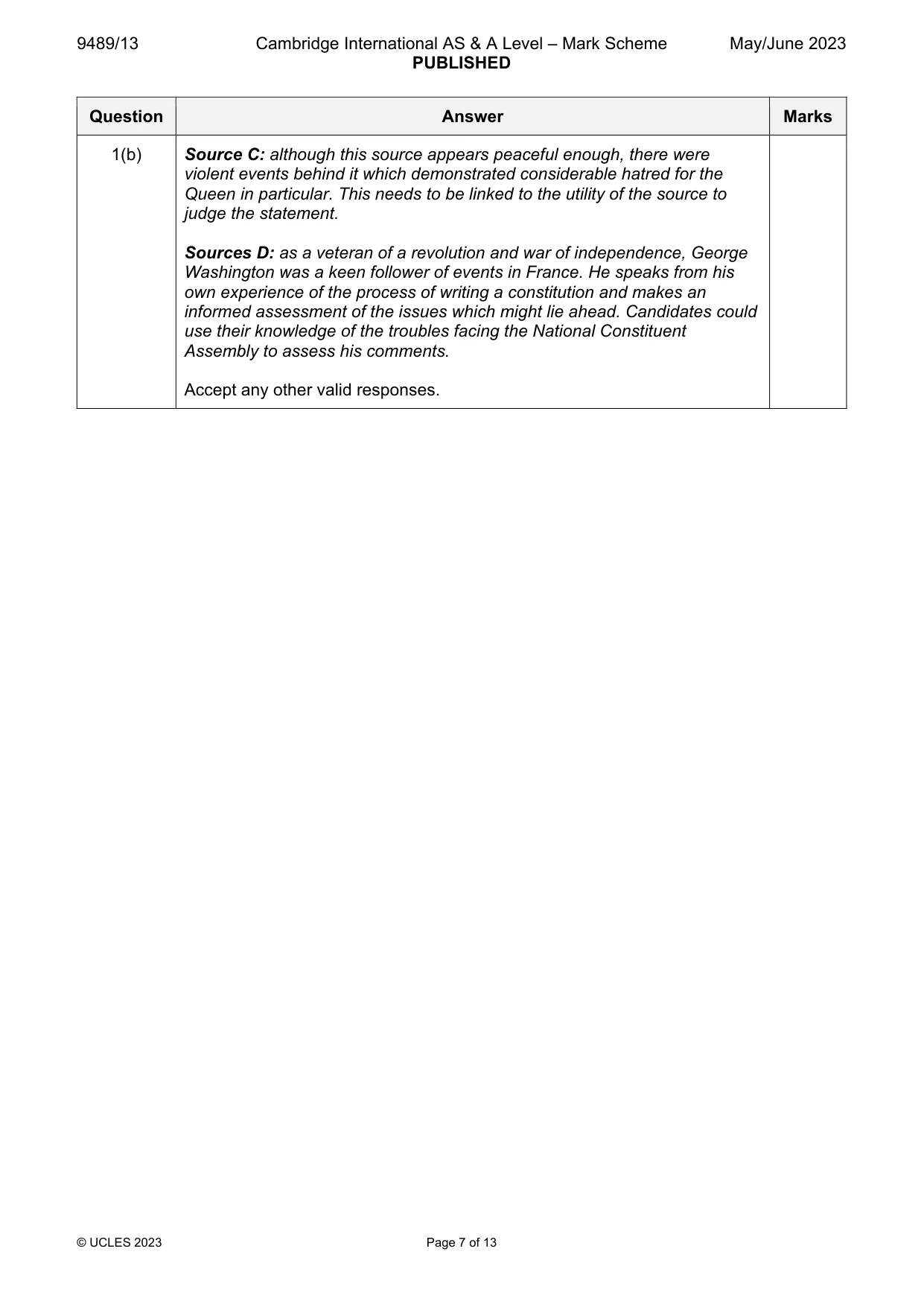
9489/13 Cambridge International AS & A Level – Mark Scheme PUBLISHED May/June 2023 © UCLES 2023 Page 7 of 13 Question Answer Marks 1(b) Source C: although this source appears peaceful enough, there were violent events behind it which demonstrated considerable hatred for the Queen in particular. This needs to be linked to the utility of the source to judge the statement. Sources D: as a veteran of a revolution and war of independence, George Washington was a keen follower of events in France. He speaks from his own experience of the process of writing a constitution and makes an informed assessment of the issues which might lie ahead. Candidates could use their knowledge of the troubles facing the National Constituent Assembly to assess his comments. Accept any other valid responses.
Mark scheme, page 8
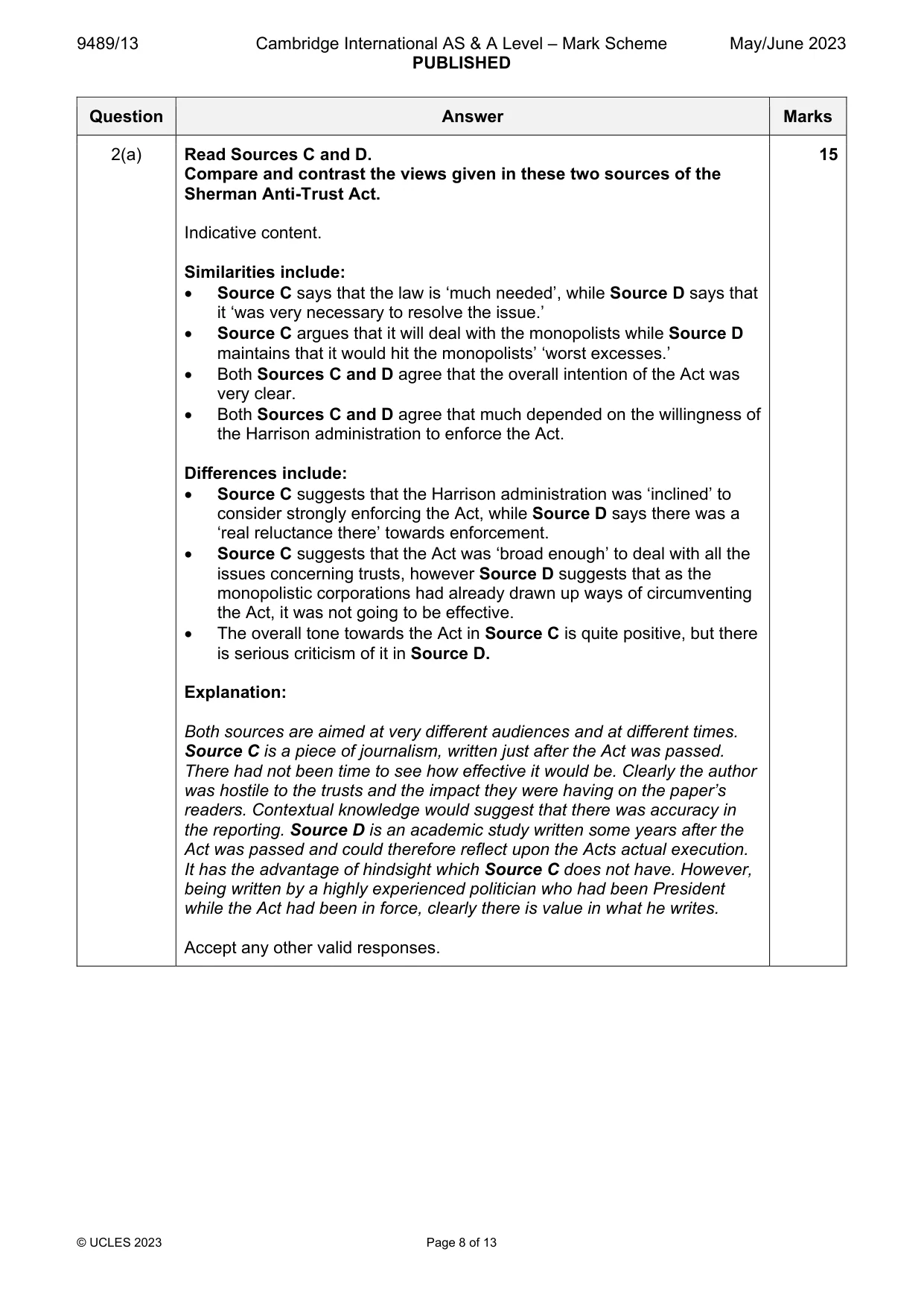
9489/13 Cambridge International AS & A Level – Mark Scheme PUBLISHED May/June 2023 © UCLES 2023 Page 8 of 13 Question Answer Marks 2(a) Read Sources C and D. Compare and contrast the views given in these two sources of the Sherman Anti-Trust Act. Indicative content. Similarities include: Source C says that the law is ‘much needed’, while Source D says that it ‘was very necessary to resolve the issue.’ Source C argues that it will deal with the monopolists while Source D maintains that it would hit the monopolists’ ‘worst excesses.’ Both Sources C and D agree that the overall intention of the Act was very clear. Both Sources C and D agree that much depended on the willingness of the Harrison administration to enforce the Act. Differences include: Source C suggests that the Harrison administration was ‘inclined’ to consider strongly enforcing the Act, while Source D says there was a ‘real reluctance there’ towards enforcement. Source C suggests that the Act was ‘broad enough’ to deal with all the issues concerning trusts, however Source D suggests that as the monopolistic corporations had already drawn up ways of circumventing the Act, it was not going to be effective. The overall tone towards the Act in Source C is quite positive, but there is serious criticism of it in Source D. Explanation: Both sources are aimed at very different audiences and at different times. Source C is a piece of journalism, written just after the Act was passed. There had not been time to see how effective it would be. Clearly the author was hostile to the trusts and the impact they were having on the paper’s readers. Contextual knowledge would suggest that there was accuracy in the reporting. Source D is an academic study written some years after the Act was passed and could therefore reflect upon the Acts actual execution. It has the advantage of hindsight which Source C does not have. However, being written by a highly experienced politician who had been President while the Act had been in force, clearly there is value in what he writes. Accept any other valid responses. 15
Mark scheme, page 9
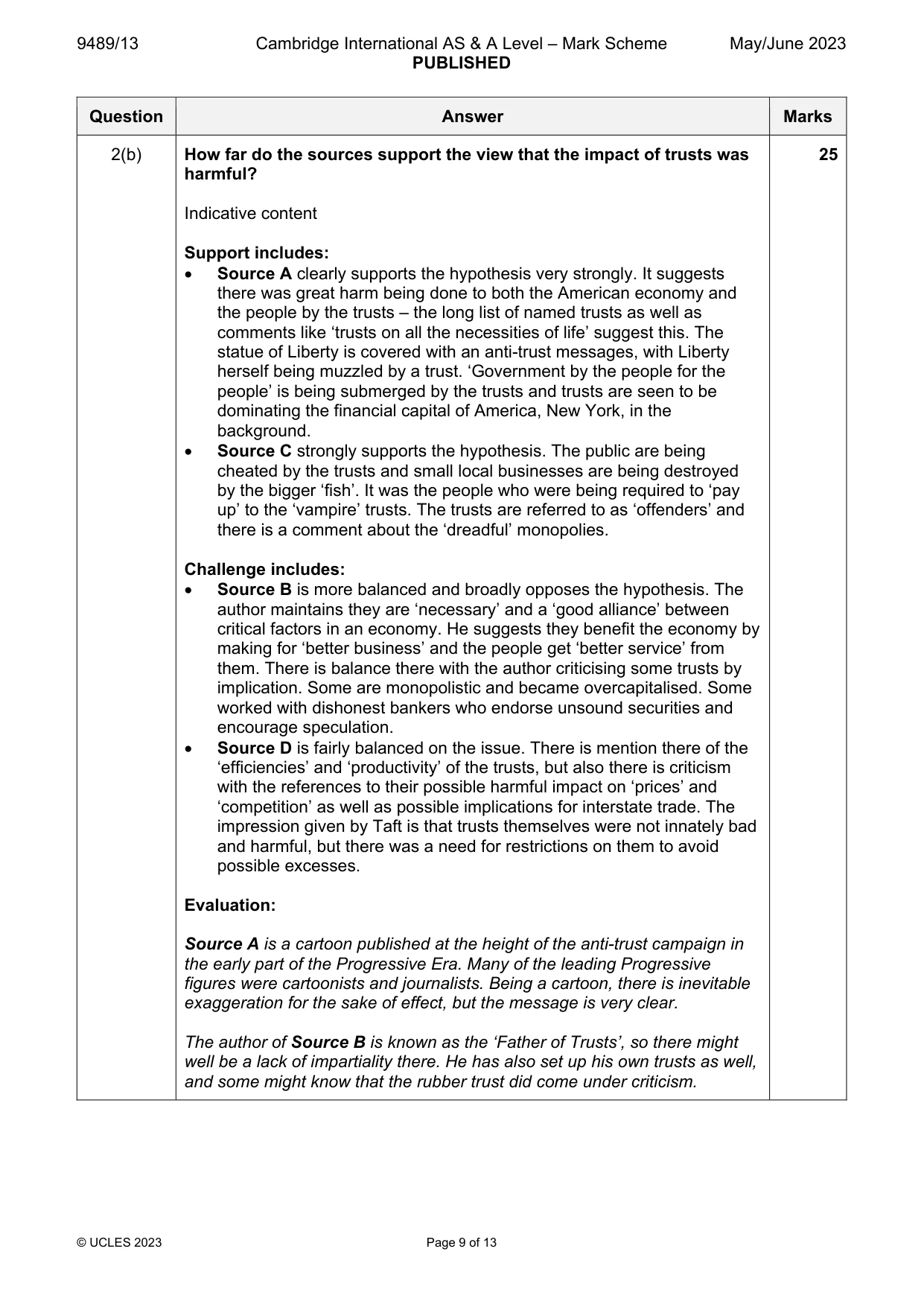
9489/13 Cambridge International AS & A Level – Mark Scheme PUBLISHED May/June 2023 © UCLES 2023 Page 9 of 13 Question Answer Marks 2(b) How far do the sources support the view that the impact of trusts was harmful? Indicative content Support includes: Source A clearly supports the hypothesis very strongly. It suggests there was great harm being done to both the American economy and the people by the trusts – the long list of named trusts as well as comments like ‘trusts on all the necessities of life’ suggest this. The statue of Liberty is covered with an anti-trust messages, with Liberty herself being muzzled by a trust. ‘Government by the people for the people’ is being submerged by the trusts and trusts are seen to be dominating the financial capital of America, New York, in the background. Source C strongly supports the hypothesis. The public are being cheated by the trusts and small local businesses are being destroyed by the bigger ‘fish’. It was the people who were being required to ‘pay up’ to the ‘vampire’ trusts. The trusts are referred to as ‘offenders’ and there is a comment about the ‘dreadful’ monopolies. Challenge includes: Source B is more balanced and broadly opposes the hypothesis. The author maintains they are ‘necessary’ and a ‘good alliance’ between critical factors in an economy. He suggests they benefit the economy by making for ‘better business’ and the people get ‘better service’ from them. There is balance there with the author criticising some trusts by implication. Some are monopolistic and became overcapitalised. Some worked with dishonest bankers who endorse unsound securities and encourage speculation. Source D is fairly balanced on the issue. There is mention there of the ‘efficiencies’ and ‘productivity’ of the trusts, but also there is criticism with the references to their possible harmful impact on ‘prices’ and ‘competition’ as well as possible implications for interstate trade. The impression given by Taft is that trusts themselves were not innately bad and harmful, but there was a need for restrictions on them to avoid possible excesses. Evaluation: Source A is a cartoon published at the height of the anti-trust campaign in the early part of the Progressive Era. Many of the leading Progressive figures were cartoonists and journalists. Being a cartoon, there is inevitable exaggeration for the sake of effect, but the message is very clear. The author of Source B is known as the ‘Father of Trusts’, so there might well be a lack of impartiality there. He has also set up his own trusts as well, and some might know that the rubber trust did come under criticism. 25
Mark scheme, page 10
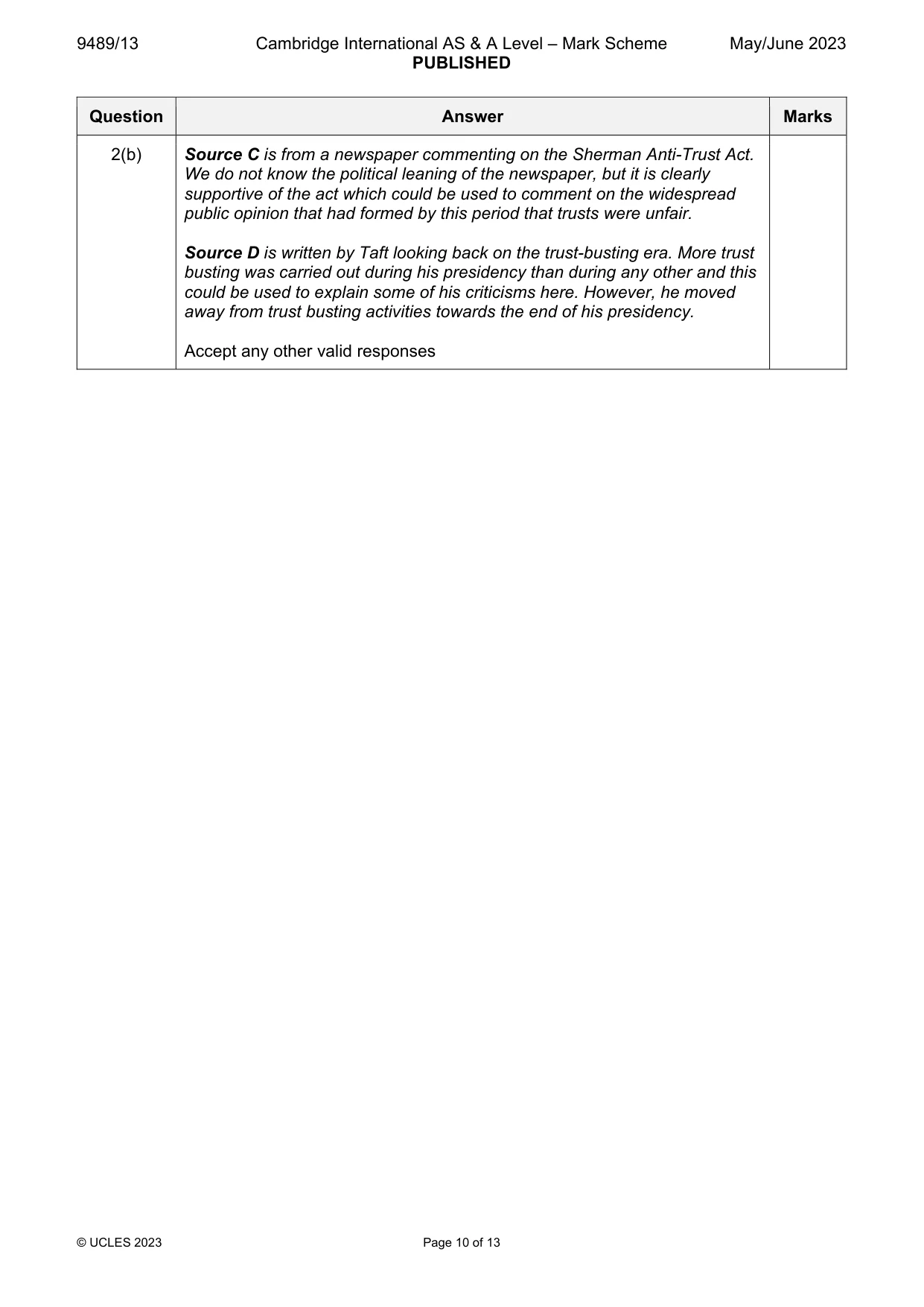
9489/13 Cambridge International AS & A Level – Mark Scheme PUBLISHED May/June 2023 © UCLES 2023 Page 10 of 13 Question Answer Marks 2(b) Source C is from a newspaper commenting on the Sherman Anti-Trust Act. We do not know the political leaning of the newspaper, but it is clearly supportive of the act which could be used to comment on the widespread public opinion that had formed by this period that trusts were unfair. Source D is written by Taft looking back on the trust-busting era. More trust busting was carried out during his presidency than during any other and this could be used to explain some of his criticisms here. However, he moved away from trust busting activities towards the end of his presidency. Accept any other valid responses
Mark scheme, page 11
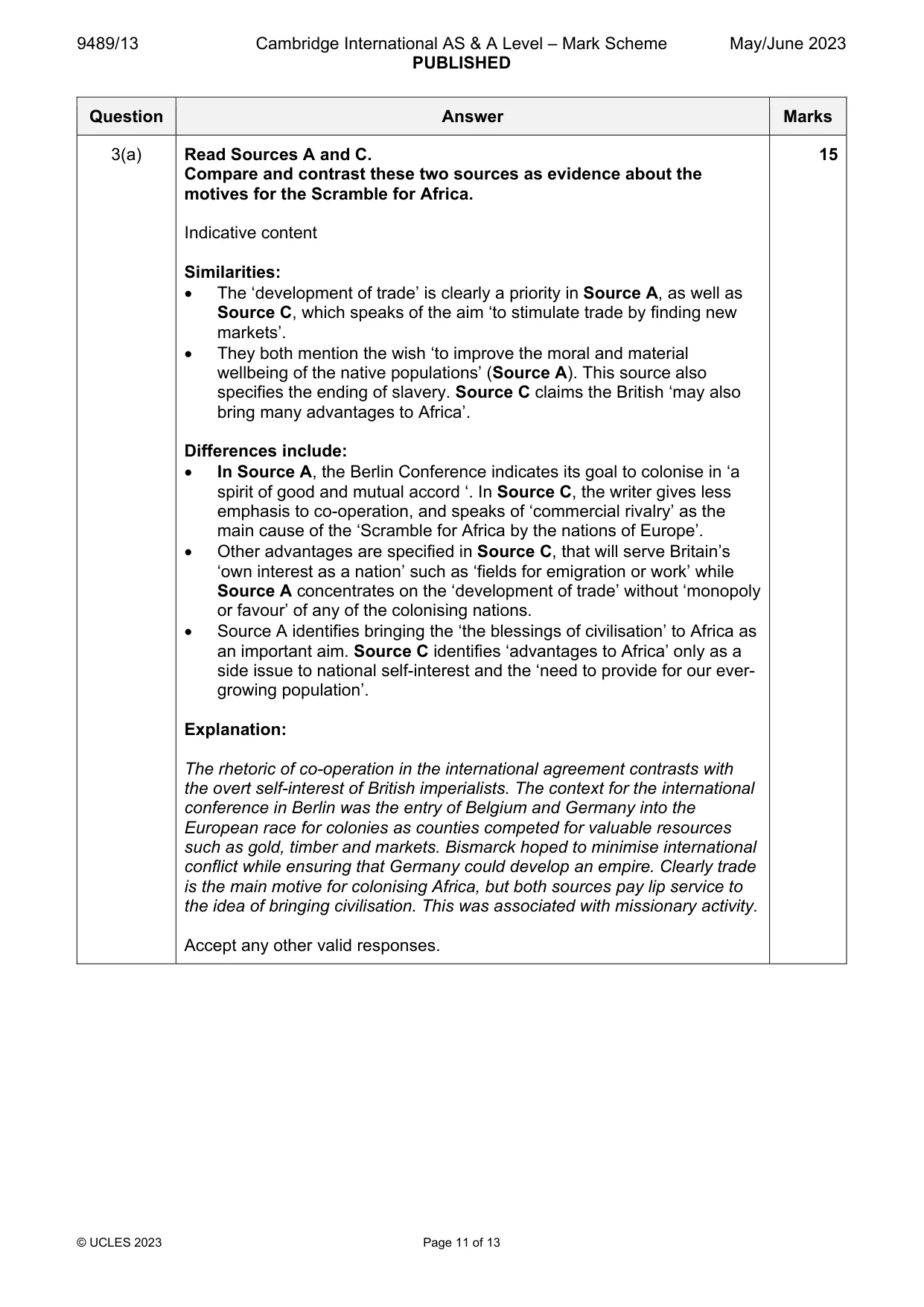
9489/13 Cambridge International AS & A Level – Mark Scheme PUBLISHED May/June 2023 © UCLES 2023 Page 11 of 13 Question Answer Marks 3(a) Read Sources A and C. Compare and contrast these two sources as evidence about the motives for the Scramble for Africa. Indicative content Similarities: The ‘development of trade’ is clearly a priority in Source A, as well as Source C, which speaks of the aim ‘to stimulate trade by finding new markets’. They both mention the wish ‘to improve the moral and material wellbeing of the native populations’ (Source A). This source also specifies the ending of slavery. Source C claims the British ‘may also bring many advantages to Africa’. Differences include: In Source A, the Berlin Conference indicates its goal to colonise in ‘a spirit of good and mutual accord ‘. In Source C, the writer gives less emphasis to co-operation, and speaks of ‘commercial rivalry’ as the main cause of the ‘Scramble for Africa by the nations of Europe’. Other advantages are specified in Source C, that will serve Britain’s ‘own interest as a nation’ such as ‘fields for emigration or work’ while Source A concentrates on the ‘development of trade’ without ‘monopoly or favour’ of any of the colonising nations. Source A identifies bringing the ‘the blessings of civilisation’ to Africa as an important aim. Source C identifies ‘advantages to Africa’ only as a side issue to national self-interest and the ‘need to provide for our ever- growing population’. Explanation: The rhetoric of co-operation in the international agreement contrasts with the overt self-interest of British imperialists. The context for the international conference in Berlin was the entry of Belgium and Germany into the European race for colonies as counties competed for valuable resources such as gold, timber and markets. Bismarck hoped to minimise international conflict while ensuring that Germany could develop an empire. Clearly trade is the main motive for colonising Africa, but both sources pay lip service to the idea of bringing civilisation. This was associated with missionary activity. Accept any other valid responses. 15
Mark scheme, page 12
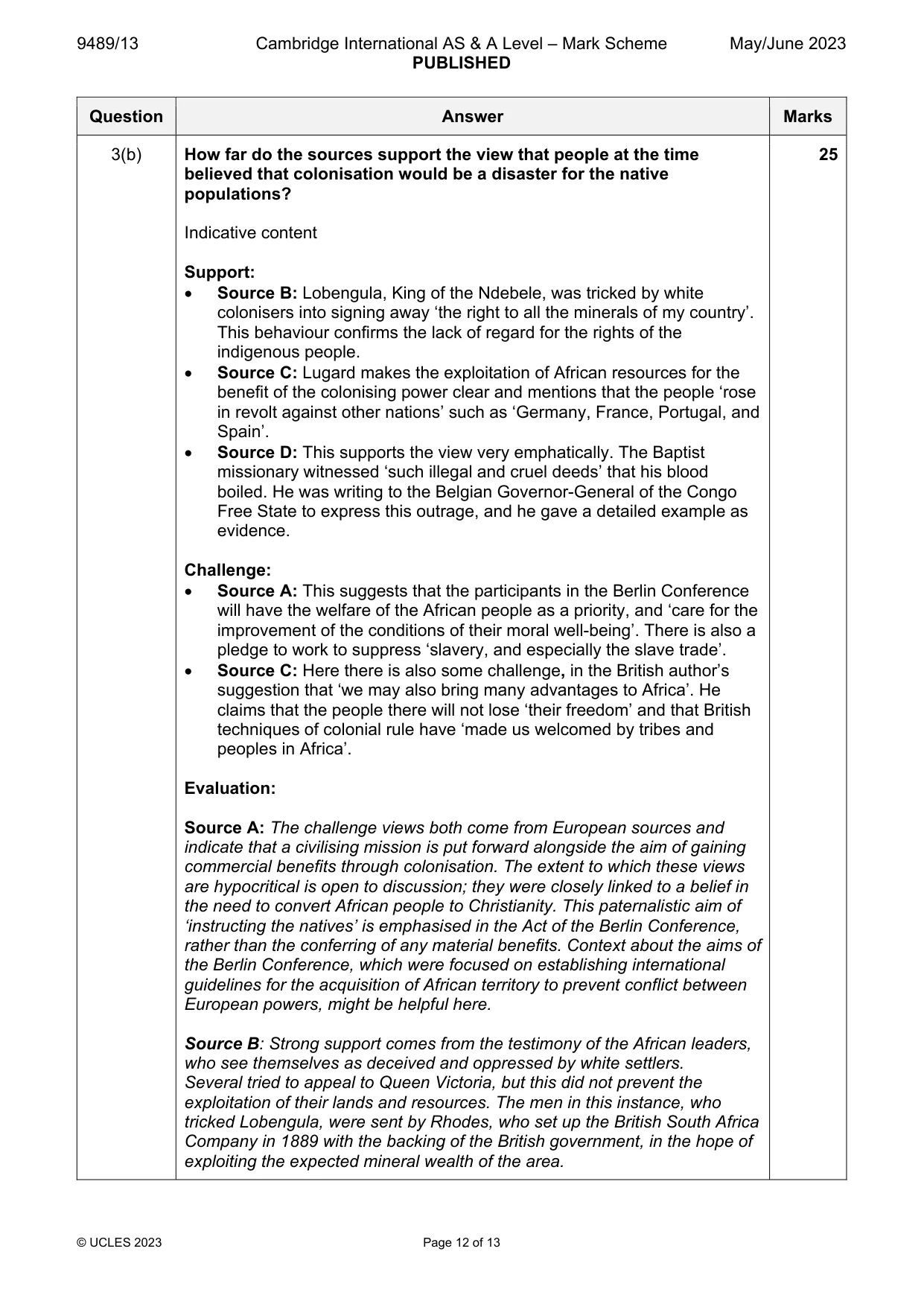
9489/13 Cambridge International AS & A Level – Mark Scheme PUBLISHED May/June 2023 © UCLES 2023 Page 12 of 13 Question Answer Marks 3(b) How far do the sources support the view that people at the time believed that colonisation would be a disaster for the native populations? Indicative content Support: Source B: Lobengula, King of the Ndebele, was tricked by white colonisers into signing away ‘the right to all the minerals of my country’. This behaviour confirms the lack of regard for the rights of the indigenous people. Source C: Lugard makes the exploitation of African resources for the benefit of the colonising power clear and mentions that the people ‘rose in revolt against other nations’ such as ‘Germany, France, Portugal, and Spain’. Source D: This supports the view very emphatically. The Baptist missionary witnessed ‘such illegal and cruel deeds’ that his blood boiled. He was writing to the Belgian Governor-General of the Congo Free State to express this outrage, and he gave a detailed example as evidence. Challenge: Source A: This suggests that the participants in the Berlin Conference will have the welfare of the African people as a priority, and ‘care for the improvement of the conditions of their moral well-being’. There is also a pledge to work to suppress ‘slavery, and especially the slave trade’. Source C: Here there is also some challenge, in the British author’s suggestion that ‘we may also bring many advantages to Africa’. He claims that the people there will not lose ‘their freedom’ and that British techniques of colonial rule have ‘made us welcomed by tribes and peoples in Africa’. Evaluation: Source A: The challenge views both come from European sources and indicate that a civilising mission is put forward alongside the aim of gaining commercial benefits through colonisation. The extent to which these views are hypocritical is open to discussion; they were closely linked to a belief in the need to convert African people to Christianity. This paternalistic aim of ‘instructing the natives’ is emphasised in the Act of the Berlin Conference, rather than the conferring of any material benefits. Context about the aims of the Berlin Conference, which were focused on establishing international guidelines for the acquisition of African territory to prevent conflict between European powers, might be helpful here. Source B: Strong support comes from the testimony of the African leaders, who see themselves as deceived and oppressed by white settlers. Several tried to appeal to Queen Victoria, but this did not prevent the exploitation of their lands and resources. The men in this instance, who tricked Lobengula, were sent by Rhodes, who set up the British South Africa Company in 1889 with the backing of the British government, in the hope of exploiting the expected mineral wealth of the area. 25
Mark scheme, page 13
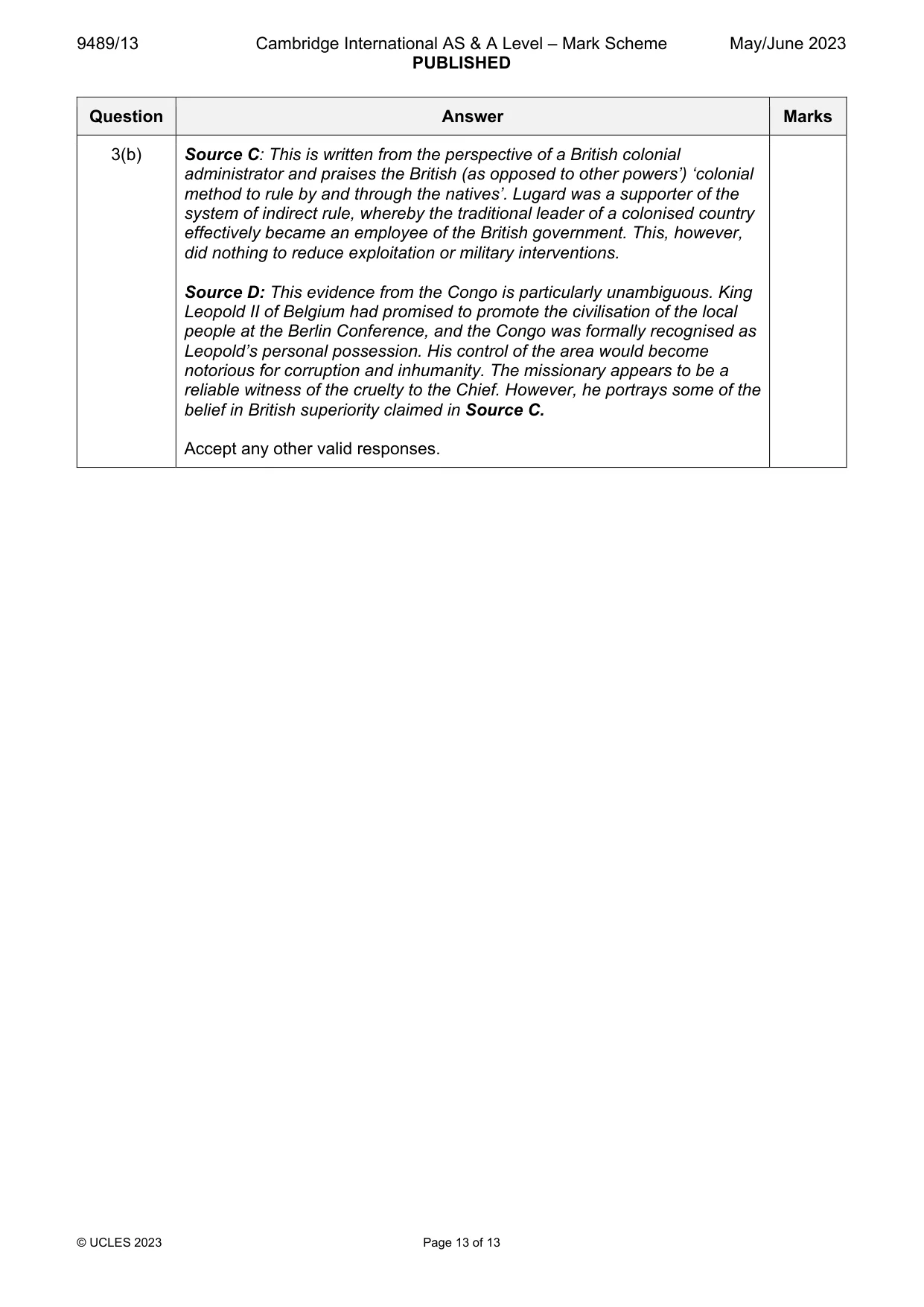
9489/13 Cambridge International AS & A Level – Mark Scheme PUBLISHED May/June 2023 © UCLES 2023 Page 13 of 13 Question Answer Marks 3(b) Source C: This is written from the perspective of a British colonial administrator and praises the British (as opposed to other powers’) ‘colonial method to rule by and through the natives’. Lugard was a supporter of the system of indirect rule, whereby the traditional leader of a colonised country effectively became an employee of the British government. This, however, did nothing to reduce exploitation or military interventions. Source D: This evidence from the Congo is particularly unambiguous. King Leopold II of Belgium had promised to promote the civilisation of the local people at the Berlin Conference, and the Congo was formally recognised as Leopold’s personal possession. His control of the area would become notorious for corruption and inhumanity. The missionary appears to be a reliable witness of the cruelty to the Chief. However, he portrays some of the belief in British superiority claimed in Source C. Accept any other valid responses.
What you needed in this session
Cambridge’s own grade thresholds for 2023 May/June, Paper 1 · Variant 3. A higher threshold means an easier paper — the bar moves with how the cohort did.