Cambridge A Level History 9489 — 2024 Oct/Nov Paper 1 · Variant 3
9489/13/O/N/24 · 40 marks · ≈45 min
The question paper and its mark scheme, free to read here and free to download. This is Cambridge’s own paper, exactly as it was sat.
Question paper8 pages

Mark scheme15 pages
Answers below. Sit the paper first if you are practising.

Paper as text
Question paper, page 1
This document has 8 pages. Any blank pages are indicated. [Turn over Cambridge International AS & A Level DC (CE/FC) 337470/1 © UCLES 2024 * 6 2 5 6 0 1 3 9 7 0 * HISTORY 9489/13 Paper 1 Document Question October/November 2024 1 hour 15 minutes You must answer on the enclosed answer booklet. You will need: Answer booklet (enclosed) INSTRUCTIONS ● Answer one question from one section only. Section A: European option Section B: American option Section C: International option ● Follow the instructions on the front cover of the answer booklet. If you need additional answer paper, ask the invigilator for a continuation booklet. INFORMATION ● The total mark for this paper is 40. ● The number of marks for each question or part question is shown in brackets [ ].
Question paper, page 2
2 9489/13/O/N/24 © UCLES 2024 Answer one question from one section only. Section A: European option The Industrial Revolution in Britain, 1750–1850 1 Read the sources and then answer both parts of the question. Source A The Select Committee report on the Petition of the Millowners was brought up. The substance of the report was that there existed between millworkers in certain districts a combination which was dangerous to the public and which the owners did not have the power to address. One of the MPs proposed that a Bill should be brought in to prevent unlawful combinations of workmen employed in the mills. Mr Wilberforce said that he did not object to the principle of this idea, but he asked whether it should be extended to make it general against all combinations of workmen. He regarded these combinations as a disease in our society. The Chancellor said it was his intention to provide a remedy to an evil of very serious magnitude by which he meant that of unlawful combination among workmen in general. This practice had become much too widespread and was likely, if unchecked, to produce very serious mischief. From a report of a debate in the British Parliament in 1799. Combinations were groups of workers who joined together to protect their members from unemployment and reductions in wages. Source B During the short time I spent in Nottingham, not twelve hours passed without some fresh act of violence. On the day I left I was informed that forty weaving frames had been broken the preceding evening without resistance and without detection. It cannot be denied that these outrages have arisen from circumstances of unparalleled distress. The perseverance of these miserable weavers proves that nothing but absolute poverty could have driven a large, once honest and industrious, section of society into the commission of excesses so hazardous to themselves, their families and the community. Had proper meetings been held in the earlier stages of these riots, had the grievances of these men and their masters been fairly and properly considered, I think that means might have been devised to restore these workmen to their occupations and tranquillity to the country. From a speech made in the British Parliament, February 1812.
Question paper, page 3
3 9489/13/O/N/24 © UCLES 2024 [Turn over Source C An illustration of the Peterloo Massacre published by a supporter of Henry Hunt who was due to speak at the meeting pictured, August 1819. Source D The first action of the Battle of Manchester is over and, I am happy to say, has ended in the complete defeat of the enemy. Hunt made his appearance with a rabble which numbered around 3000. The magistrates decided to take Hunt into custody but the mob attempted to resist. The military were at hand and rushed upon them. The number of the mob that were rode over might have been very great. I don’t know that any were killed. I am sorry to say one of the soldiers on horseback was shot dead and three of the constables were badly wounded. The mob fired shots from the tops of the houses and out of the windows, which were returned by our infantry. I was much amused to see the way in which the cavalry knocked the mob about. The instant they saw a dozen mobbites together, they rode at them and gave them a good thrashing. An account of the Peterloo Massacre by Major Dyneley, 16 August 1819. Dyneley was in command of one of the detachments of troops. Answer both parts of the question with reference to the sources. (a) Read Source C and Source D. Compare and contrast these two sources as evidence about the Peterloo Massacre. [15] (b) Read all of the sources. ‘There was widespread support for working-class demands.’ How far do these sources agree? [25]
Question paper, page 4
4 9489/13/O/N/24 © UCLES 2024 Section B: American option The Great Crash, the Great Depression and the New Deal policies, 1920–41 2 Read the sources and then answer both parts of the question. Source A A cartoon entitled ‘What We Need is a New Pump’, published in a newspaper, 1935. Source B Those who defend the Tennessee Valley Authority (TVA) always argue that we should ignore the fact that it is illegal and only focus on its benefits. We agree that it has assisted in the temporary provision of cheaper and more available electric power. We agree that the agricultural programme linked to the TVA is dealing with flooding and soil erosion. We agree that it has created some jobs and preserved others. However, it is compelling farmers to plough up their land and plant what they do not want to plant. It has only consulted those who they know will benefit from the TVA. The real motive behind it is the federal government trying to control agriculture in the interests of its supporters. The price paid by business for the TVA, and similar New Deal organisations, is too high. Competition in great industries has been destroyed. Men will not invest in any new business if government can dictate what a man can earn and his working conditions. These temporary measures will not secure the long-term future for any business or its employees. From a speech by a lawyer to the Supreme Court, March 1936.
Question paper, page 5
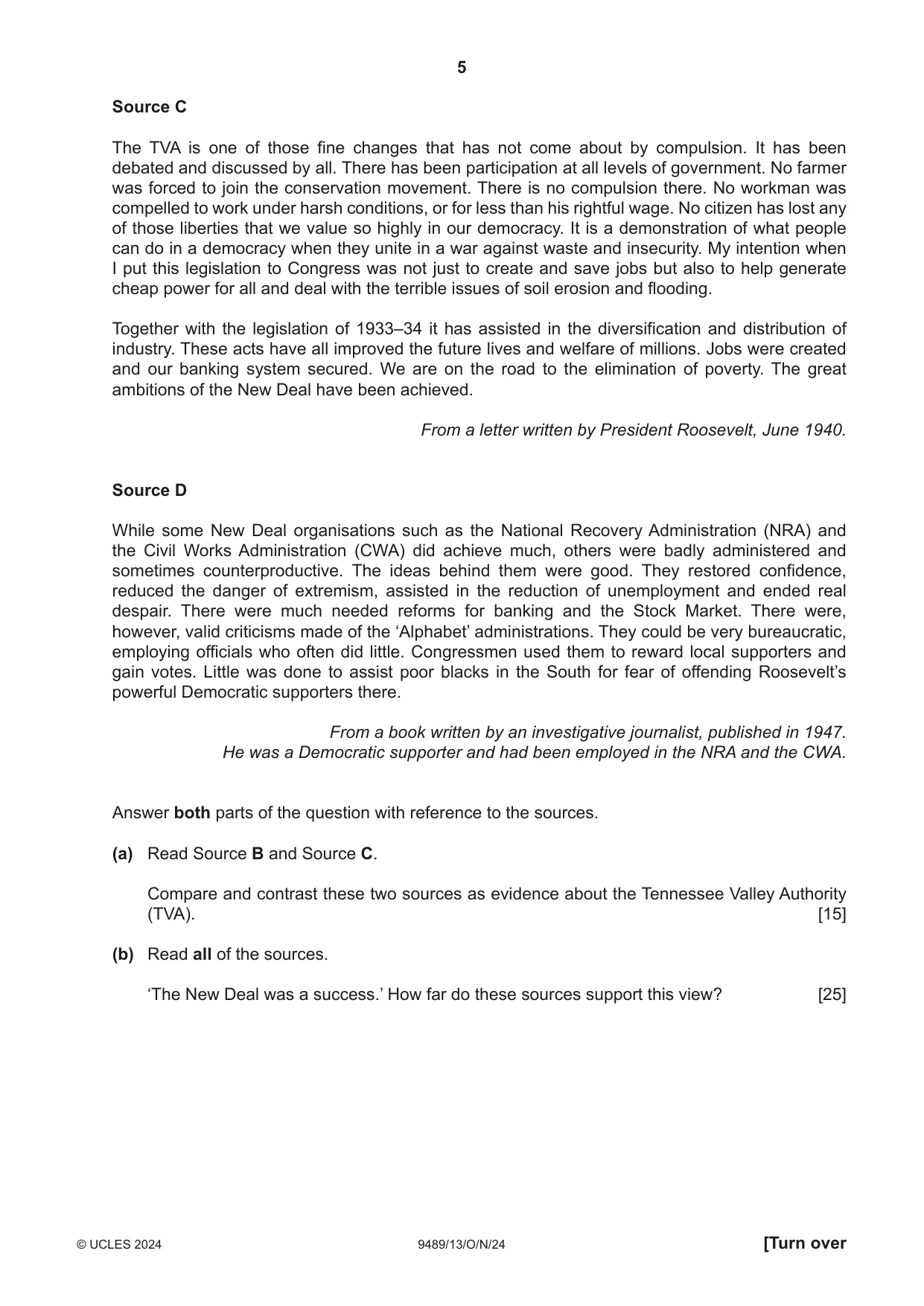
5 9489/13/O/N/24 © UCLES 2024 [Turn over Source C The TVA is one of those fine changes that has not come about by compulsion. It has been debated and discussed by all. There has been participation at all levels of government. No farmer was forced to join the conservation movement. There is no compulsion there. No workman was compelled to work under harsh conditions, or for less than his rightful wage. No citizen has lost any of those liberties that we value so highly in our democracy. It is a demonstration of what people can do in a democracy when they unite in a war against waste and insecurity. My intention when I put this legislation to Congress was not just to create and save jobs but also to help generate cheap power for all and deal with the terrible issues of soil erosion and flooding. Together with the legislation of 1933–34 it has assisted in the diversification and distribution of industry. These acts have all improved the future lives and welfare of millions. Jobs were created and our banking system secured. We are on the road to the elimination of poverty. The great ambitions of the New Deal have been achieved. From a letter written by President Roosevelt, June 1940. Source D While some New Deal organisations such as the National Recovery Administration (NRA) and the Civil Works Administration (CWA) did achieve much, others were badly administered and sometimes counterproductive. The ideas behind them were good. They restored confidence, reduced the danger of extremism, assisted in the reduction of unemployment and ended real despair. There were much needed reforms for banking and the Stock Market. There were, however, valid criticisms made of the ‘Alphabet’ administrations. They could be very bureaucratic, employing officials who often did little. Congressmen used them to reward local supporters and gain votes. Little was done to assist poor blacks in the South for fear of offending Roosevelt’s powerful Democratic supporters there. From a book written by an investigative journalist, published in 1947. He was a Democratic supporter and had been employed in the NRA and the CWA. Answer both parts of the question with reference to the sources. (a) Read Source B and Source C. Compare and contrast these two sources as evidence about the Tennessee Valley Authority (TVA). [15] (b) Read all of the sources. ‘The New Deal was a success.’ How far do these sources support this view? [25]
Question paper, page 6
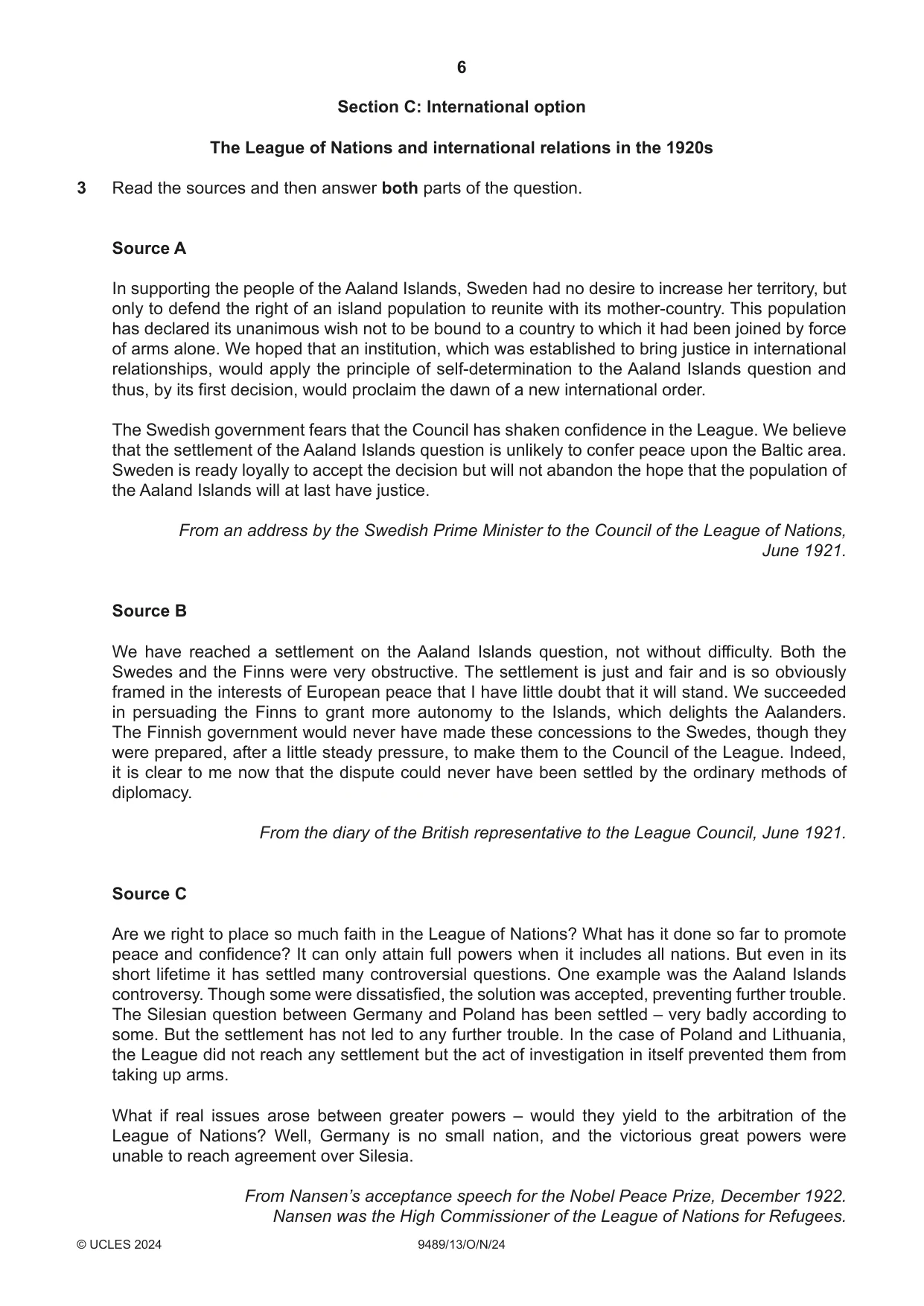
6 9489/13/O/N/24 © UCLES 2024 Section C: International option The League of Nations and international relations in the 1920s 3 Read the sources and then answer both parts of the question. Source A In supporting the people of the Aaland Islands, Sweden had no desire to increase her territory, but only to defend the right of an island population to reunite with its mother-country. This population has declared its unanimous wish not to be bound to a country to which it had been joined by force of arms alone. We hoped that an institution, which was established to bring justice in international relationships, would apply the principle of self-determination to the Aaland Islands question and thus, by its first decision, would proclaim the dawn of a new international order. The Swedish government fears that the Council has shaken confidence in the League. We believe that the settlement of the Aaland Islands question is unlikely to confer peace upon the Baltic area. Sweden is ready loyally to accept the decision but will not abandon the hope that the population of the Aaland Islands will at last have justice. From an address by the Swedish Prime Minister to the Council of the League of Nations, June 1921. Source B We have reached a settlement on the Aaland Islands question, not without difficulty. Both the Swedes and the Finns were very obstructive. The settlement is just and fair and is so obviously framed in the interests of European peace that I have little doubt that it will stand. We succeeded in persuading the Finns to grant more autonomy to the Islands, which delights the Aalanders. The Finnish government would never have made these concessions to the Swedes, though they were prepared, after a little steady pressure, to make them to the Council of the League. Indeed, it is clear to me now that the dispute could never have been settled by the ordinary methods of diplomacy. From the diary of the British representative to the League Council, June 1921. Source C Are we right to place so much faith in the League of Nations? What has it done so far to promote peace and confidence? It can only attain full powers when it includes all nations. But even in its short lifetime it has settled many controversial questions. One example was the Aaland Islands controversy. Though some were dissatisfied, the solution was accepted, preventing further trouble. The Silesian question between Germany and Poland has been settled – very badly according to some. But the settlement has not led to any further trouble. In the case of Poland and Lithuania, the League did not reach any settlement but the act of investigation in itself prevented them from taking up arms. What if real issues arose between greater powers – would they yield to the arbitration of the League of Nations? Well, Germany is no small nation, and the victorious great powers were unable to reach agreement over Silesia. From Nansen’s acceptance speech for the Nobel Peace Prize, December 1922. Nansen was the High Commissioner of the League of Nations for Refugees.
Question paper, page 7
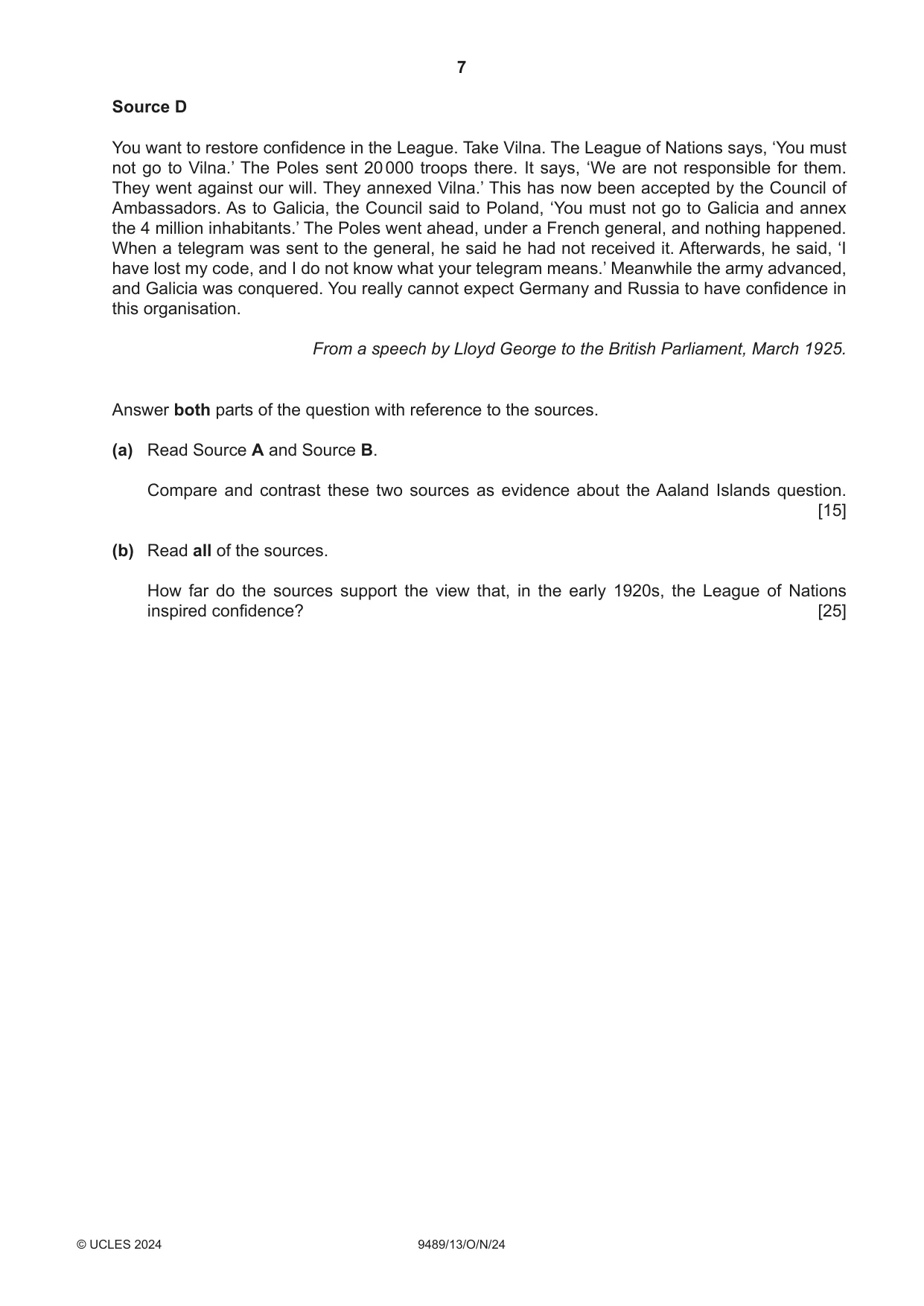
7 9489/13/O/N/24 © UCLES 2024 Source D You want to restore confidence in the League. Take Vilna. The League of Nations says, ‘You must not go to Vilna.’ The Poles sent 20 000 troops there. It says, ‘We are not responsible for them. They went against our will. They annexed Vilna.’ This has now been accepted by the Council of Ambassadors. As to Galicia, the Council said to Poland, ‘You must not go to Galicia and annex the 4 million inhabitants.’ The Poles went ahead, under a French general, and nothing happened. When a telegram was sent to the general, he said he had not received it. Afterwards, he said, ‘I have lost my code, and I do not know what your telegram means.’ Meanwhile the army advanced, and Galicia was conquered. You really cannot expect Germany and Russia to have confidence in this organisation. From a speech by Lloyd George to the British Parliament, March 1925. Answer both parts of the question with reference to the sources. (a) Read Source A and Source B. Compare and contrast these two sources as evidence about the Aaland Islands question. [15] (b) Read all of the sources. How far do the sources support the view that, in the early 1920s, the League of Nations inspired confidence? [25]
Question paper, page 8
8 9489/13/O/N/24 © UCLES 2024 Permission to reproduce items where third-party owned material protected by copyright is included has been sought and cleared where possible. Every reasonable effort has been made by the publisher (UCLES) to trace copyright holders, but if any items requiring clearance have unwittingly been included, the publisher will be pleased to make amends at the earliest possible opportunity. To avoid the issue of disclosure of answer-related information to candidates, all copyright acknowledgements are reproduced online in the Cambridge Assessment International Education Copyright Acknowledgements Booklet. This is produced for each series of examinations and is freely available to download at www.cambridgeinternational.org after the live examination series. Cambridge Assessment International Education is part of Cambridge Assessment. Cambridge Assessment is the brand name of the University of Cambridge Local Examinations Syndicate (UCLES), which is a department of the University of Cambridge. BLANK PAGE
Mark scheme, page 1
This document consists of 15 printed pages. © Cambridge University Press & Assessment 2024 [Turn over Cambridge International AS & A Level HISTORY 9489/13 Paper 1 Document Question October/November 2024 MARK SCHEME Maximum Mark: 40 Published This mark scheme is published as an aid to teachers and candidates, to indicate the requirements of the examination. It shows the basis on which Examiners were instructed to award marks. It does not indicate the details of the discussions that took place at an Examiners’ meeting before marking began, which would have considered the acceptability of alternative answers. Mark schemes should be read in conjunction with the question paper and the Principal Examiner Report for Teachers. Cambridge International will not enter into discussions about these mark schemes. Cambridge International is publishing the mark schemes for the October/November 2024 series for most Cambridge IGCSE, Cambridge International A and AS Level components, and some Cambridge O Level components.
Mark scheme, page 2
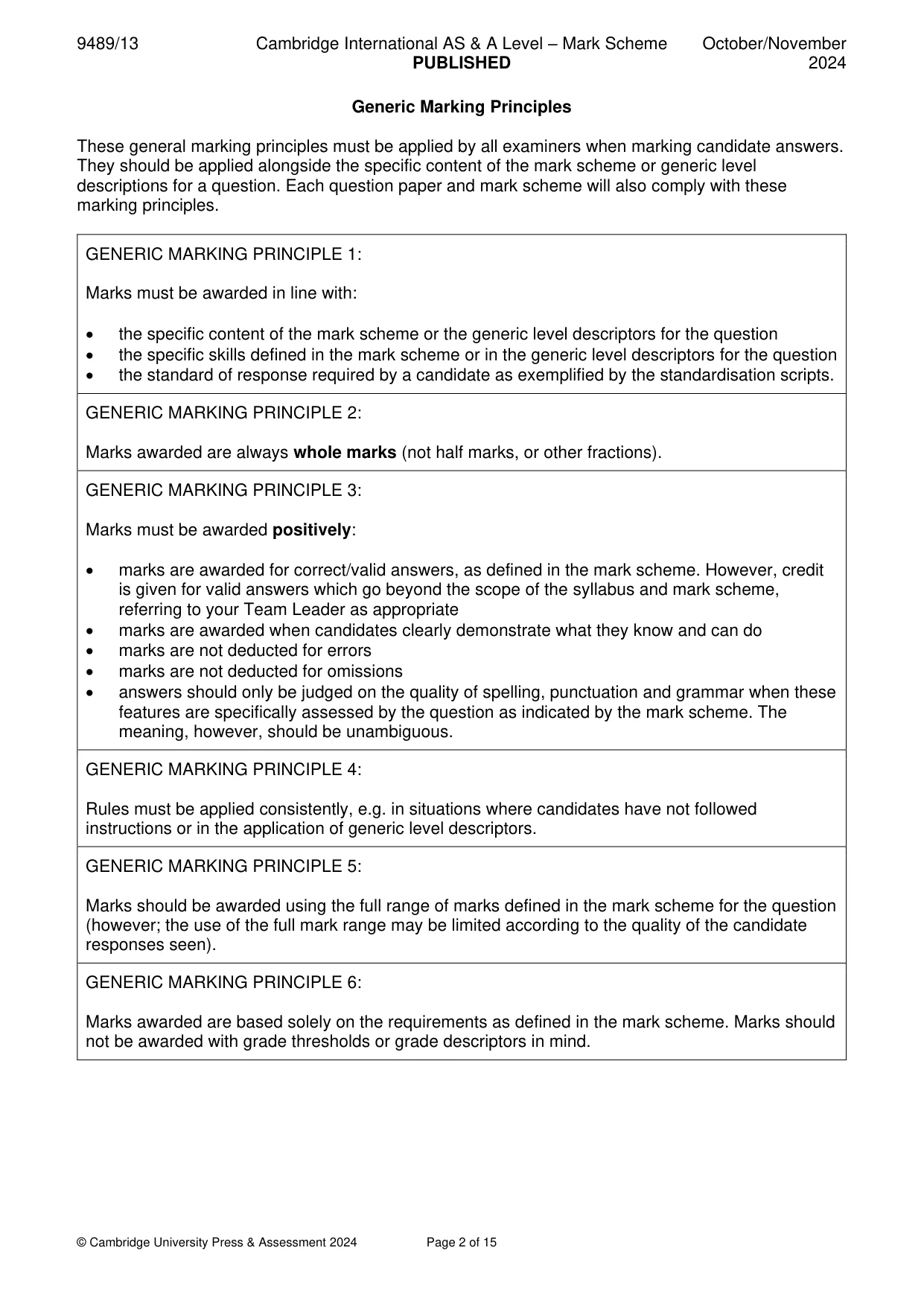
9489/13 Cambridge International AS & A Level – Mark Scheme PUBLISHED October/November 2024 © Cambridge University Press & Assessment 2024 Page 2 of 15 Generic Marking Principles These general marking principles must be applied by all examiners when marking candidate answers. They should be applied alongside the specific content of the mark scheme or generic level descriptions for a question. Each question paper and mark scheme will also comply with these marking principles. GENERIC MARKING PRINCIPLE 1: Marks must be awarded in line with: • the specific content of the mark scheme or the generic level descriptors for the question • the specific skills defined in the mark scheme or in the generic level descriptors for the question • the standard of response required by a candidate as exemplified by the standardisation scripts. GENERIC MARKING PRINCIPLE 2: Marks awarded are always whole marks (not half marks, or other fractions). GENERIC MARKING PRINCIPLE 3: Marks must be awarded positively: • marks are awarded for correct/valid answers, as defined in the mark scheme. However, credit is given for valid answers which go beyond the scope of the syllabus and mark scheme, referring to your Team Leader as appropriate • marks are awarded when candidates clearly demonstrate what they know and can do • marks are not deducted for errors • marks are not deducted for omissions • answers should only be judged on the quality of spelling, punctuation and grammar when these features are specifically assessed by the question as indicated by the mark scheme. The meaning, however, should be unambiguous. GENERIC MARKING PRINCIPLE 4: Rules must be applied consistently, e.g. in situations where candidates have not followed instructions or in the application of generic level descriptors. GENERIC MARKING PRINCIPLE 5: Marks should be awarded using the full range of marks defined in the mark scheme for the question (however; the use of the full mark range may be limited according to the quality of the candidate responses seen). GENERIC MARKING PRINCIPLE 6: Marks awarded are based solely on the requirements as defined in the mark scheme. Marks should not be awarded with grade thresholds or grade descriptors in mind.
Mark scheme, page 3
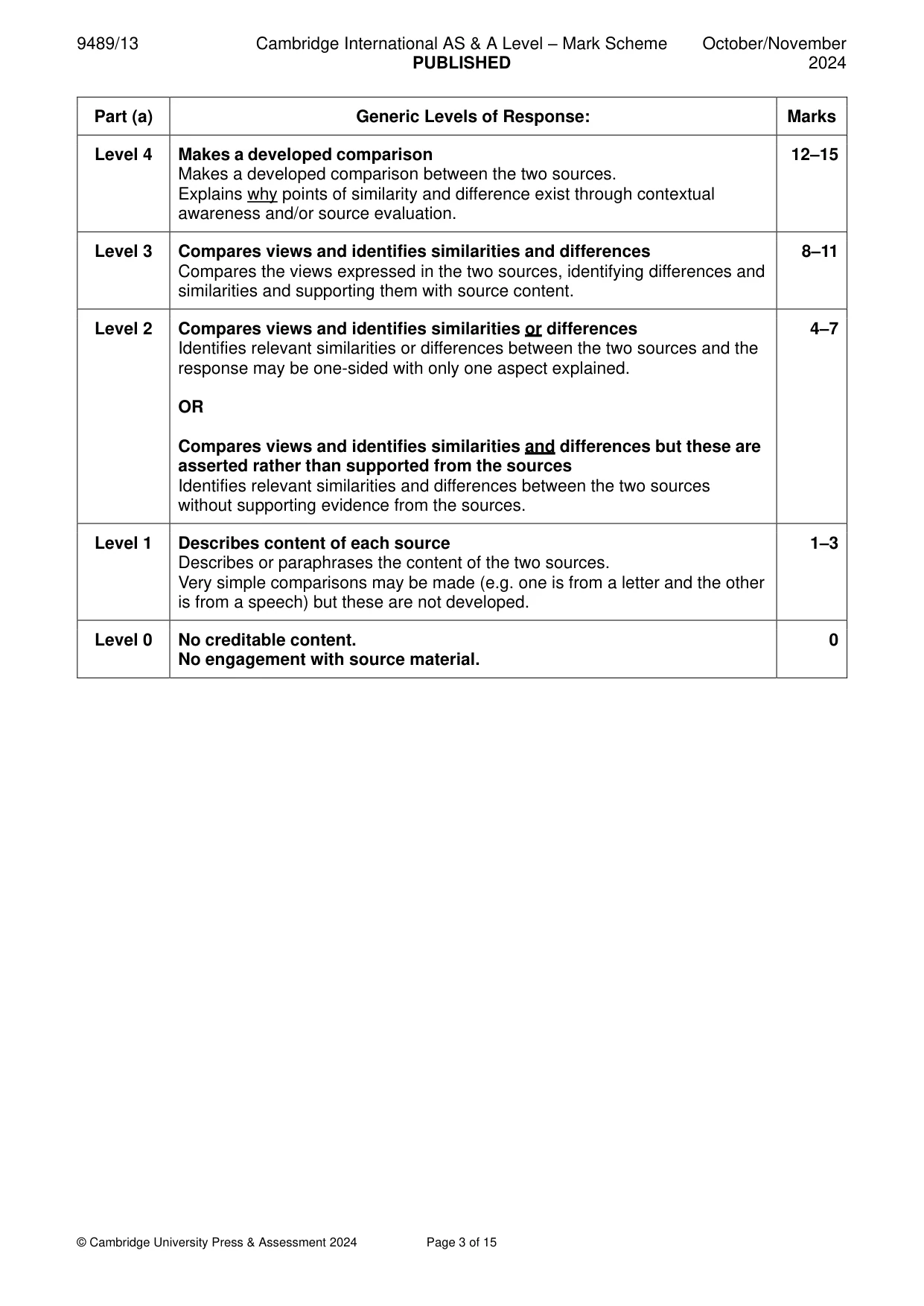
9489/13 Cambridge International AS & A Level – Mark Scheme PUBLISHED October/November 2024 © Cambridge University Press & Assessment 2024 Page 3 of 15 Part (a) Generic Levels of Response: Marks Level 4 Makes a developed comparison Makes a developed comparison between the two sources. Explains why points of similarity and difference exist through contextual awareness and/or source evaluation. 12–15 Level 3 Compares views and identifies similarities and differences Compares the views expressed in the two sources, identifying differences and similarities and supporting them with source content. 8–11 Level 2 Compares views and identifies similarities or differences Identifies relevant similarities or differences between the two sources and the response may be one-sided with only one aspect explained. OR Compares views and identifies similarities and differences but these are asserted rather than supported from the sources Identifies relevant similarities and differences between the two sources without supporting evidence from the sources. 4–7 Level 1 Describes content of each source Describes or paraphrases the content of the two sources. Very simple comparisons may be made (e.g. one is from a letter and the other is from a speech) but these are not developed. 1–3 Level 0 No creditable content. No engagement with source material. 0
Mark scheme, page 4
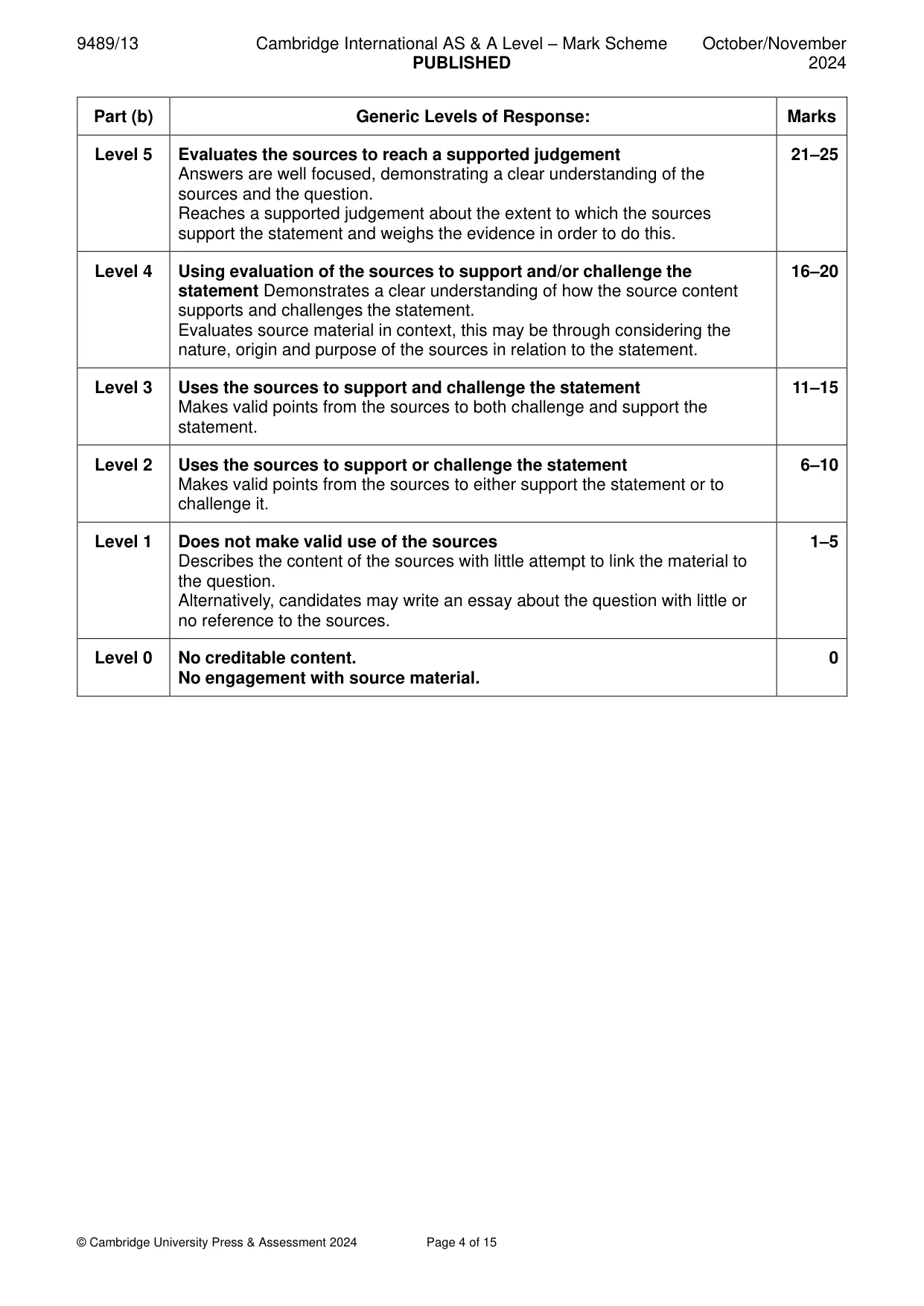
9489/13 Cambridge International AS & A Level – Mark Scheme PUBLISHED October/November 2024 © Cambridge University Press & Assessment 2024 Page 4 of 15 Part (b) Generic Levels of Response: Marks Level 5 Evaluates the sources to reach a supported judgement Answers are well focused, demonstrating a clear understanding of the sources and the question. Reaches a supported judgement about the extent to which the sources support the statement and weighs the evidence in order to do this. 21–25 Level 4 Using evaluation of the sources to support and/or challenge the statement Demonstrates a clear understanding of how the source content supports and challenges the statement. Evaluates source material in context, this may be through considering the nature, origin and purpose of the sources in relation to the statement. 16–20 Level 3 Uses the sources to support and challenge the statement Makes valid points from the sources to both challenge and support the statement. 11–15 Level 2 Uses the sources to support or challenge the statement Makes valid points from the sources to either support the statement or to challenge it. 6–10 Level 1 Does not make valid use of the sources Describes the content of the sources with little attempt to link the material to the question. Alternatively, candidates may write an essay about the question with little or no reference to the sources. 1–5 Level 0 No creditable content. No engagement with source material. 0
Mark scheme, page 5
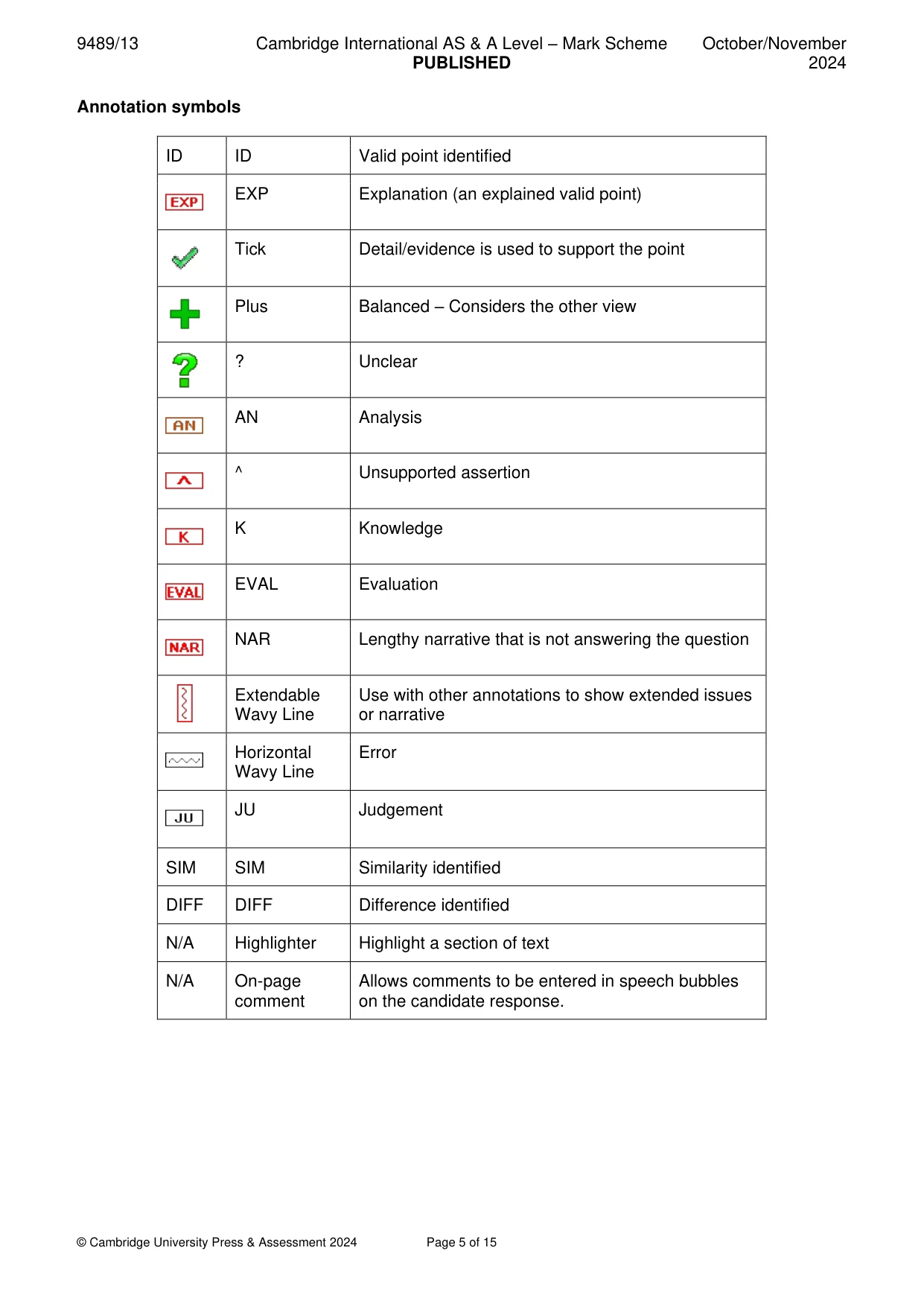
9489/13 Cambridge International AS & A Level – Mark Scheme PUBLISHED October/November 2024 © Cambridge University Press & Assessment 2024 Page 5 of 15 Annotation symbols ID ID Valid point identified EXP Explanation (an explained valid point) Tick Detail/evidence is used to support the point Plus Balanced – Considers the other view ? Unclear AN Analysis ^ Unsupported assertion K Knowledge EVAL Evaluation NAR Lengthy narrative that is not answering the question Extendable Wavy Line Use with other annotations to show extended issues or narrative Horizontal Wavy Line Error JU Judgement SIM SIM Similarity identified DIFF DIFF Difference identified N/A Highlighter Highlight a section of text N/A On-page comment Allows comments to be entered in speech bubbles on the candidate response.
Mark scheme, page 6
9489/13 Cambridge International AS & A Level – Mark Scheme PUBLISHED October/November 2024 © Cambridge University Press & Assessment 2024 Page 6 of 15 Using the annotations • Annotate using the symbols above as you read through the script. • At the end of each question write a short on-page comment: – be positive – say what the candidate has done, rather than what they have not – reference the attributes of the level descriptor you are awarding (i.e. make sure your comment matches the mark you have given) – be careful with your spelling
Mark scheme, page 7
9489/13 Cambridge International AS & A Level – Mark Scheme PUBLISHED October/November 2024 © Cambridge University Press & Assessment 2024 Page 7 of 15 Question Answer Marks 1(a) Read Source C and Source D. Compare and contrast these two sources as evidence about the Peterloo Massacre. Indicative content Similarities • Both sources agree that a large crowd had gathered to hear speeches. • Both sources agree that the cavalry charged at the crowd. They are seen brandishing their swords in Source C and ‘knocked the mob about’ in Source D. • Both sources seem to agree that some of the crowd may have been injured. Source C shows the crowd being trampled by the troops on horseback and Source D writes about the mob being ‘rode over’. Differences • Source D refers to events as the Battle of Manchester whereas Source C depicts a massacre. Source D’s title glorifies the role of the troops, implying it is a military victory. Source C suggests innocents were murdered. • In Source D the Major claims that the mob fired shots at the soldiers from ‘the tops of the houses and out of the windows’, and the soldiers fired back. Although there are some people watching from windows on the left of Source C, they don’t appear to be armed. • The crowd in Source C contains men and women, quite well dressed and respectable. However, Source D refers to them as a ‘rabble’ and a ‘mob’, both derogatory terms which suggest violent men have simply turned up to cause trouble. Explanation Contextual knowledge of the background to the Peterloo could be used to explain the similarities between the sources. The Combination Acts were widely disliked and there was widespread poverty caused by the Corn Laws. One of the most outspoken radicals was ‘Orator’ Henry Hunt. He spoke about the need for political reform to large crowds in many towns. Possibly alarmed by the size of the crowd, the magistrates ordered the troops to disperse the meeting. It is possible the troops were inexperienced, but 11 members of the public were killed and 400 were injured. The differences between the sources can be explained by their purpose. The picture was published by a supporter of a radical who was due to speak at the meeting. It is unlikely that he would have portrayed fellow supporters as a ‘rabble’. From the perspective of the authorities, this was a justified suppression of a seditious gathering. Source D was published by one of those in charge of the troops and it is not surprising that he sees what he has done as a great victory for the authorities. The timing of the account, and congratulations given to them by the Prince Regent underlines that the Major felt actions by the troops were entirely proportionate. Accept any other valid responses. 15
Mark scheme, page 8
9489/13 Cambridge International AS & A Level – Mark Scheme PUBLISHED October/November 2024 © Cambridge University Press & Assessment 2024 Page 8 of 15 Question Answer Marks 1(b) Read all of the sources. ‘There was widespread support for working- class demands.’ How far do these sources agree? Indicative content Support • In Source A popular support for change was demonstrated by the formation of combinations among workers. • Source B suggests a number of outbreaks of violence ‘not twelve hours passed without some fresh act of violence’, so it could be inferred that support is widespread and this is not an isolated incident. He has sympathy for the workers who have been made destitute by the downturn in trade: it sees them as being driven to destroy the machines in their desperation. The speaker thinks that a more proactive approach on the part of the government might have prevented the worst excesses of the riots. • In Source C the portrayal of the large crowd being brutally attacked suggests there was support from the artist/publisher for working-class demands for change. The banners being held on the platform suggest support for giving workers more rights such as universal suffrage. • In Source D the ‘mob’ of 3000 people shows considerable popular support. Challenge • Source A shows no support for working class demands. The petition by the millwrights who wish to stop the formation of combinations is taken up in Parliament and the application of the new law proposed to take in all working men’s combinations. The source expresses the views that ‘serious mischief’ will result if action is not taken. • In Source C the charge by the troops into the crowd suggests there was little support on the part of the authorities for the protest which was taking place. • In Source D the Major, who represents the views of the authorities, calls them a mob and a rabble and rejoices in the fact that they were knocked about by his troops. He also describes Hunt as ‘the enemy’ and implies that this event could be part of a bigger battle. Evaluation Source A: Parliament was a conservative organisation which generally represented the interests of the landed classes. Therefore, it is not surprising that it is more likely to listen to the demands of the mill owners than their workers. Wilberforce was widely criticised for his role in the passing of the combination acts. He had fought to end the slave trade but would not fight for the rights of the workers in Britain. 25
Mark scheme, page 9
9489/13 Cambridge International AS & A Level – Mark Scheme PUBLISHED October/November 2024 © Cambridge University Press & Assessment 2024 Page 9 of 15 Question Answer Marks 1(b) Source B: takes a different line from Source A. The speaker (Byron) is sympathetic and although he argues machine breaking should not be condoned, thinks the government should have taken a different approach. He blames the Napoleonic wars for the problems facing the textile industry and was influential in reducing sentences for convicted Luddites. Source C: the reliability of this source could be challenged as it was published by a well-known radical speaker who supported extending the vote to the working class. However, candidates might use their knowledge of events on 16 August to support his point of view. Source D: the Major displays a typically arrogant attitude towards the working class and this might be expected. Candidates could challenge the reliability of his views using their contextual knowledge of other working-class protests or reform movements. Accept any other valid responses.
Mark scheme, page 10
9489/13 Cambridge International AS & A Level – Mark Scheme PUBLISHED October/November 2024 © Cambridge University Press & Assessment 2024 Page 10 of 15 Question Answer Marks 2(a) Read Source B and Source C. Compare and contrast these two sources as evidence about the Tennessee Valley Authority (TVA). Indicative content Similarities include • Source C does mention that the TVA brought ‘benefits’ while Source D mentions that it was one of the ‘fine changes’ that came in. • Both sources mention that it assisted in the creation of cheaper and more available electricity. • Both sources mention that it assisted in job creation. • Both sources mention that it assisted in both flood control and dealing with soil erosion. Differences include • Source B suggests measures were temporary while Source C indicates they will provide long-term solutions. • Source B maintains that the motivation behind the creation of the TVA was a government trying to get control of agriculture in the interests of its supporters. Source C argues that the intention was to create and save jobs, as well as deal with flooding and soil erosion. • Source B maintains that there was considerable compulsion involved while Source C says’ there was no compulsion there.’ • Source B suggests that there was limited and selective consultation while Source C maintains that the TVA was ‘debated and discussed’ by all. Explanation Both Sources approach the TVA from very different perspectives. Source B is a speech before the Supreme Court by a lawyer whose task is to persuade the Court that the TVA is illegal and should be closed down. He was in essence the ‘prosecuting counsel’ in the case and was hired purely to argue for the destruction of the TVA and all it stood for. He was suggesting to the Court that while some might see the benefits of the TVA, there were real flaws in what it did, as well as the fact that the Administration which created it simply did not have the power under the Constitution to actually create it. Source C is the view of Roosevelt himself on what he, perhaps rightly, saw as one of the greatest achievements of the New Deal. The impact of the TVA on several states, some of the poorest in the US, had been huge and beneficial. 1940 was also an election year, with Roosevelt standing for an unprecedent third term, so naturally he would be doing all he could to emphasise his achievements. Accept any other valid responses. 15
Mark scheme, page 11
9489/13 Cambridge International AS & A Level – Mark Scheme PUBLISHED October/November 2024 © Cambridge University Press & Assessment 2024 Page 11 of 15 Question Answer Marks 2(b) Read all of the sources. ‘The New Deal was a success.’ How far do these sources support this view? Indicative content Support • Source B agrees that there has been partial success e.g. ‘We agree that it has assisted in the temporary provision of cheaper and more available electric power’ • Source C can be used to support the assertion. New Deal legislation ‘assisted in the diversification of industry.’ They improved the lives and welfare of millions – and contextual knowledge should back that up. There was job creation, and the banking system was made more secure. Roosevelt rightly comments that the US was ‘on the road to the elimination of poverty’, especially acts like the Social Security Act. • Source D can also be quoted, when it says that New Deal organisations did ‘achieve much’. The New Deal also helped to restore confidence and reduced the danger of political extremism. Neither the Left nor the Right made serious headway. Like Source C there is mention of the reforms of banking. Challenge • Source A challenges the assertion suggesting that the New Deal is wasting money and is not really fit for purpose. • Source B has the strongest challenge. The author argues that the price that business has paid for the New Deal is ‘too high.’ Competition has been destroyed. Investment has been damaged and the ‘temporary’ measures would not secure the long-term future for any business and its employees. It is strongly critical. • Source D while having some positive points about the New Deal, is also critical. Organisations could be ‘badly administrated and sometimes counterproductive’, and also bureaucratic and self-serving. They could also be used for purely political purposes and did little to assist Black Americans in the South. Evaluation Source A implies that New Deal was a failure because of its financial costs and wastage. This is supported by contextual knowledge: Republicans were aggrieved that $8 billion was spent supporting emergency measures which prompted The Revenue Act in 1935 – (also known as the Wealth Tax Act). This was popularly referred to as the ‘soak the rich’ tax. The cartoon features the taxpayer shouldering the burden. 25
Mark scheme, page 12
9489/13 Cambridge International AS & A Level – Mark Scheme PUBLISHED October/November 2024 © Cambridge University Press & Assessment 2024 Page 12 of 15 Question Answer Marks 2(b) Source B is very obviously one-sided. The sources are a speech by a lawyer before the Supreme Court who had been hired to attack the TVA and was trying to persuade the Court to declare it unconstitutional (as well as much of the rest of the famous 100 Days legislation). This demonstrates the failure of the New Deal as it was too invasive into the lives of ordinary people. There is also a suggestion that the provisions of New Deal were politically self- interested. Source C is written by Roosevelt himself, so naturally he would be anxious to speak highly of what his administration had achieved. It was also an election year, and he was thinking of running for an unprecedented third term, so he was bound to emphasise the benefits of what he had done. He was also speaking in the context of the Second World War and attempting to distance himself from the state interventions of the dictatorships. The fact that the author of Source D was a Democratic supporter and had benefited from employment in the NRA and the CWA needs to be taken into consideration. However, he was also an investigative reporter and the fact that there are criticisms of the New Deal there, seen at first hand probably, show a degree of balance. Contextual knowledge suggests that what he wrote was accurate in terms of restoring confidence but also in his acceptance of the criticisms of the Alphabet administrations. Accept any other valid responses.
Mark scheme, page 13
9489/13 Cambridge International AS & A Level – Mark Scheme PUBLISHED October/November 2024 © Cambridge University Press & Assessment 2024 Page 13 of 15 Question Answer Marks 3(a) Read Source A and Source B. Compare and contrast these two sources as evidence about the Aaland Islands question. Indicative content Similarities • Both sources confirm that the dispute was about possession of the Aaland Islands and whether they should revert to Swedish rule. • Both indicate that the solution – that the islands should be ruled from Finland – was finally accepted. In Source A ‘Sweden is ready loyally to accept the decision’ and in Source B ‘We have reached a settlement’. • Both demonstrate that this has been a difficult and controversial process. In Source A, Sweden still hopes that ‘the Aaland Isles will at last have justice’ and the British representative in Source B reflects that ‘the dispute could never have been settled by the ordinary methods of diplomacy’. Differences • Source A asserts the reasonable intentions of the Swedes ‘only to defend the right of an island population’ while Source B emphasises that both ‘the Swedes and the Finns were very obstructive’. • There are differences regarding the reaction to the settlement. The message of Source A is that the solution has left the islanders unsatisfied and still hoping to ‘at last have justice’ as the ‘principle of self- determination’ has been ignored; Source B maintains that it ‘delights the Aalanders’ as concessions on their autonomy have been achieved. • Source B’s contention that the outcome is ‘in the interests of European peace’ is contested by Source A’s claim that it ‘is unlikely to confer peace upon the Baltic area’. Explanation The Swedish leader sets out his country’s perspective quite forcefully. He had wanted the issue to be discussed at the Paris Peace Conference, in the hope that the principle of self-determination would ensure a settlement in Sweden’s favour. The Aaland Islands, along with the rest of Finland, had been part of the Russian empire. After the October Revolution, the islands’ Swedish- speaking inhabitants, freed of Russian rule, asked for reunion with their former mother country. The Allies were reluctant as it was seen as too difficult to decide, given that the Finns claimed it was an internal Finnish matter and refused to agree to a plebiscite involving only a fraction of Finland’s population. The Swedish prime minister sounds disappointed, and determined to explain why, but also acquiescent as he addresses the Council of the League of Nations. The British representative to the League Council clearly believes that the decision made by that organisation was fair and that important concessions were gained for the islanders. It was difficult for imperial powers to assert the right to self-determination consistently. As this is a diary entry, we can assume these were his genuine opinions. Accept any other valid responses. 15
Mark scheme, page 14
9489/13 Cambridge International AS & A Level – Mark Scheme PUBLISHED October/November 2024 © Cambridge University Press & Assessment 2024 Page 14 of 15 Question Answer Marks 3(b) Read all of the sources. How far do the sources support the view that, in the early 1920s, the League of Nations inspired confidence? Indicative content Support • In Source B there is clear pride in the role of the League in the settlement of the Aaland Islands question in a way that ‘is just and fair’. Support also is suggested by the claim that important concessions were achieved through ‘a little steady pressure’ by the League Council. In general, the League achieved a settlement that ‘could never have been settled by the ordinary methods of diplomacy’. • In Source C League success is also highlighted here; it is claimed it can ‘promote peace and confidence’ as it has already ‘settled many controversial questions’. Various examples are given where the work of the League led to solutions which prevented ‘further trouble’. The idea that this only works when small powers are involved is refuted with the reference to the dispute over Silesia as ‘Germany is no small nation’. Challenge • In Source A challenge is offered in the claim that the decision on the Aaland Islands ‘has shaken confidence in the League of Nations’. The reason given is that this fails to respect ‘the principle of self- determination’. • In Source C, while largely positive about the League, there are some reservations. Limited membership is an issue and it ‘can attain full powers only when it includes all nations’. There is also a recognition that not all decisions have been popular – the Silesian question was settled ‘very badly according to some’, and no settlement was found to the ‘case of Poland and Lithuania’. • In Source D Lloyd George indicates various failures of the League, and the way that its directives are ignored. This means it is unrealistic to ‘expect Germany and Russia to have confidence in this organisation’. 25
Mark scheme, page 15
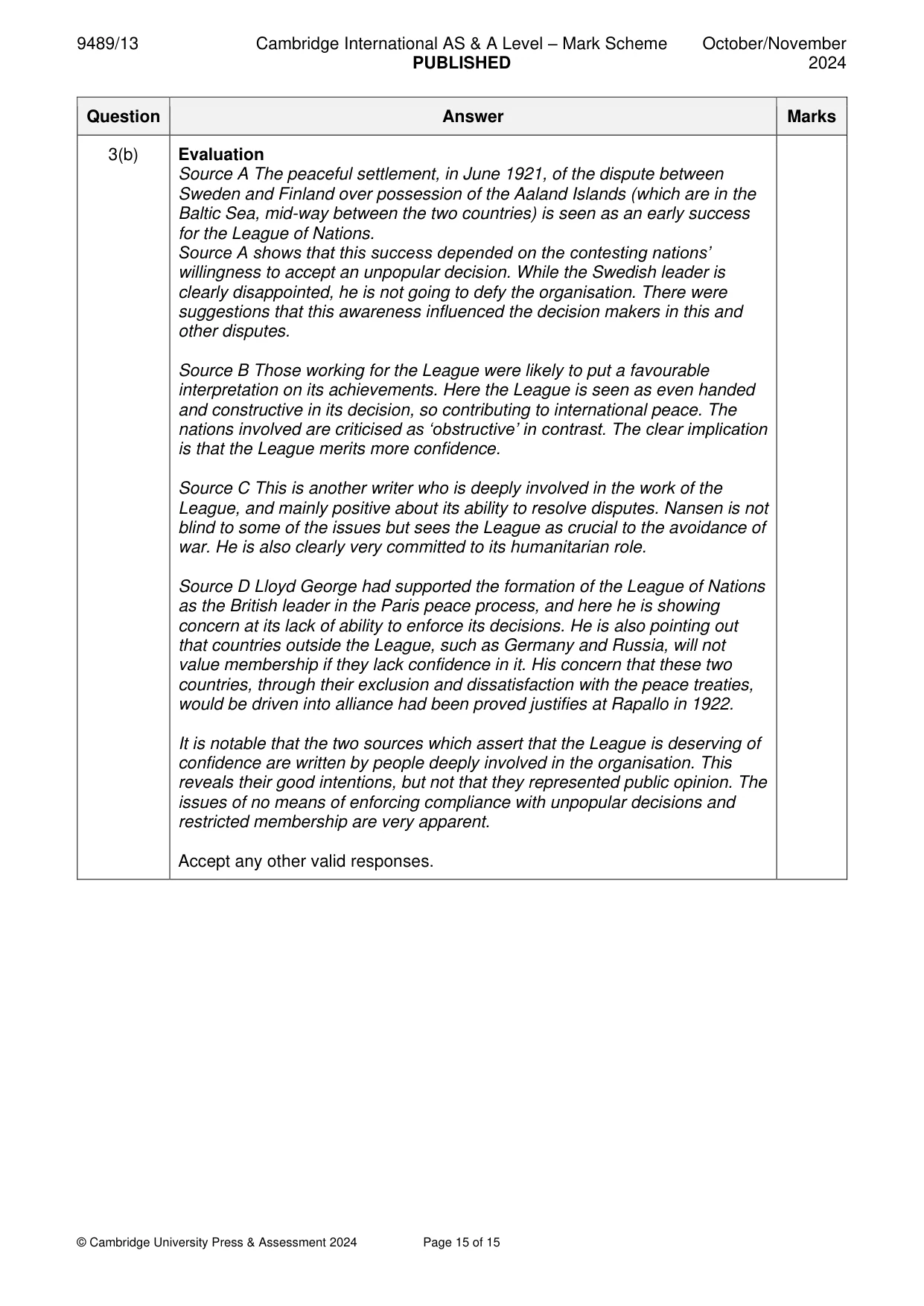
9489/13 Cambridge International AS & A Level – Mark Scheme PUBLISHED October/November 2024 © Cambridge University Press & Assessment 2024 Page 15 of 15 Question Answer Marks 3(b) Evaluation Source A The peaceful settlement, in June 1921, of the dispute between Sweden and Finland over possession of the Aaland Islands (which are in the Baltic Sea, mid-way between the two countries) is seen as an early success for the League of Nations. Source A shows that this success depended on the contesting nations’ willingness to accept an unpopular decision. While the Swedish leader is clearly disappointed, he is not going to defy the organisation. There were suggestions that this awareness influenced the decision makers in this and other disputes. Source B Those working for the League were likely to put a favourable interpretation on its achievements. Here the League is seen as even handed and constructive in its decision, so contributing to international peace. The nations involved are criticised as ‘obstructive’ in contrast. The clear implication is that the League merits more confidence. Source C This is another writer who is deeply involved in the work of the League, and mainly positive about its ability to resolve disputes. Nansen is not blind to some of the issues but sees the League as crucial to the avoidance of war. He is also clearly very committed to its humanitarian role. Source D Lloyd George had supported the formation of the League of Nations as the British leader in the Paris peace process, and here he is showing concern at its lack of ability to enforce its decisions. He is also pointing out that countries outside the League, such as Germany and Russia, will not value membership if they lack confidence in it. His concern that these two countries, through their exclusion and dissatisfaction with the peace treaties, would be driven into alliance had been proved justifies at Rapallo in 1922. It is notable that the two sources which assert that the League is deserving of confidence are written by people deeply involved in the organisation. This reveals their good intentions, but not that they represented public opinion. The issues of no means of enforcing compliance with unpopular decisions and restricted membership are very apparent. Accept any other valid responses.
What you needed in this session
Cambridge’s own grade thresholds for 2024 Oct/Nov, Paper 1 · Variant 3. A higher threshold means an easier paper — the bar moves with how the cohort did.