Cambridge A Level History 9489 — 2023 Oct/Nov Paper 1 · Variant 3
9489/13/O/N/23 · 40 marks · ≈45 min
The question paper and its mark scheme, free to read here and free to download. This is Cambridge’s own paper, exactly as it was sat.
Question paper8 pages
Mark scheme14 pages
Answers below. Sit the paper first if you are practising.
Paper as text
Question paper, page 1
This document has 8 pages. Any blank pages are indicated. [Turn over Cambridge International AS & A Level * 6 5 9 9 5 7 8 2 5 4 * DC (EF/CT) 311592/3 © UCLES 2023 HISTORY 9489/13 Paper 1 Document Question October/November 2023 1 hour 15 minutes You must answer on the enclosed answer booklet. You will need: Answer booklet (enclosed) INSTRUCTIONS ● Answer one question from one section only. Section A: European option Section B: American option Section C: International option ● Follow the instructions on the front cover of the answer booklet. If you need additional answer paper, ask the invigilator for a continuation booklet. INFORMATION ● The total mark for this paper is 40. ● The number of marks for each question or part question is shown in brackets [ ].
Question paper, page 2
2 9489/13/O/N/23 © UCLES 2023 Answer one question from one section only. Section A: European option France, 1774–1814 1 Read the sources and then answer both parts of the question. Source A Although the King’s power has appeared gravely weakened since 1789, it still has great influence and could increase that influence. The nobility and the constitutional monarchists are battling for the King’s ear. The nobility has an apparent common cause with the throne. For a long time the King has invited them to give in, as he has, to the changes dictated by the national will. The constitutional monarchists support an order of things which forbids absolute power and where the extent of royal power is based upon principle, owing nothing to previous practices. The Republicans can never hope to work harmoniously with the King: they want only to destroy his power. Mistrust of the King’s intentions is one of the Republican’s most deadly weapons. Republican ideas are collected greedily by the nobility. They repeat them to foreign powers to provoke the émigrés and stir up opposition to the King’s official negotiations for peace. From a memorandum to the Royal Council by Narbonne in February 1792. Narbonne was a supporter of constitutional monarchy and Minister of War. Source B France is in a state of crisis, the violence of which is reaching its height. This must be ended by a measure which should interest your Majesty as much as it concerns the whole nation. The Declaration of Rights has become a political gospel and the Constitution a religion for which the people are ready to die. The nation has greeted the war, which offers an opportunity to guarantee these rights, with joy. However, émigrés and rebels have united and caused this anarchy to discredit the new regime. Two important decrees have been passed. Both concern public stability and the safety of the State. Your veto of these decrees has created mistrust. If this continues, it will cause discontent. In the stirring of passions, those who oppose you will carry all before them. I know the harsh language of truth is rarely welcomed at the throne. I know that because truth almost never makes itself heard there, revolutions become necessary. From a letter by the Minister of the Interior, a member of the Girondins, to Louis XVI, 10 June 1792.
Question paper, page 3
3 9489/13/O/N/23 © UCLES 2023 [Turn over Source C We aim to end the anarchy in France, to end the attacks upon the throne and the altar, to restore to the King the security and the liberty of which he is now deprived, and to place him in a position to exercise once more the legitimate authority which belongs to him. The city of Paris and all its inhabitants shall be required to submit at once to the King, to place that prince in full and complete liberty, and to assure to him the respect which the law of nature and of nations demands of subjects toward sovereigns. If the Tuileries Palace is entered by force or attacked, if the slightest violence is suffered by their Majesties, and if their safety and liberty are not immediately assured, we will inflict an unforgettable vengeance. We would deliver the city of Paris over to military execution and complete destruction and the rebels guilty of the said outrages to the punishment that they merit. From the Brunswick Manifesto, 25 July 1792. Brunswick was a Prussian General and commander of the forces fighting against revolutionary France. Source D A contemporary painting of the attack on the Tuileries Palace, home to the royal family, 10 August 1792. The attack was carried out by citizens of one of the most radical sections of Paris. Answer both parts of the question with reference to the sources. (a) Read Sources A and B. Compare and contrast these two sources as evidence of attitudes towards the King. [15] (b) Read all of the sources. ‘Foreign intervention was the most serious threat to France in 1792.’ How far do these sources agree? [25]
Question paper, page 4
4 9489/13/O/N/23 © UCLES 2023 Section B: American option The Gilded Age and Progressive Era, 1870s to 1920 2 Read the sources and then answer both parts of the question. Source A This Government is faced with great danger, and that danger cannot be avoided by bringing in protection or free trade. That danger lies in the votes possessed by the males in the slums of the cities, and by ignorant foreign immigrants. These are the votes which political parties bid for to ensure political success. There is only one way to avoid the danger – take away the vote of the slums and immigrants and give it to educated women. They suffer most without it, and the vote will give them power to protect themselves. All who desire good government will benefit by granting the vote to women and cutting the vote of the slums. It will end the power of corrupt bosses in our cities. From a speech made by a leading woman campaigner for female emancipation, 15 December 1894. Source B There was a public debate yesterday in New York between prominent women opponents and supporters of female emancipation. The opponents argued that their churches did not support the idea on religious grounds. They expressed the fear that enfranchising women of the lower classes would lead to greater corruption in politics. Women would be more likely to believe the promises of politicians. The supporters of emancipation argued passionately for the right to vote, emphasising the great improvements that had been gained in terms of reform in those States which allowed women the vote. There had been a great decline in corruption and increased spending on schools. They maintained that opposition came largely from the monopolists who dominated Congress seeking to maintain their economic supremacy. While the Republican Party remains largely under the control of those who oppose emancipation, it was mentioned that the Democratic Party is increasingly inclined to support it in order to increase its representation in Congress. From an article in the New York Tribune, October 1908.
Question paper, page 5
5 9489/13/O/N/23 © UCLES 2023 [Turn over Source C The two dominating influences in politics today are the trusts and the liquor interest. The government finds in them an endless source of revenue. They control millions of votes. There are few members of Congress who do not owe their election to their influence. They see the emancipated woman as a determined enemy. They see her as incorruptible. No dominant political party can see any advantage to the enfranchisement of women, so Congress will ignore it. Their opposition is primarily for political reasons. Neither Democrat nor Republican will make it an issue. The aristocracy observe the large families of the working classes and fear to give them any more political power. The churches are largely hostile for social rather than religious reasons. Justice and morality demand that women obtain the vote. We are educated and are responsible for the education and upbringing of our children and we have contributed much to creating the greatness that is America. From an article by a leading campaigner for female emancipation titled ‘Why women cannot vote in the United States’, December 1912. Source D A vote is like a rifle, its usefulness depends on the character of the user. The mere possession of the vote will no more benefit men and women not sufficiently developed to use it than the possession of a rifle will turn an untrained youth into a good soldier. This is as true of women as it is of men. Universal suffrage in Haiti has not made the Haitians able to govern themselves better. Universal suffrage in Utah has not affected in any way the real problem of men taking several wives. I believe in suffrage for women in America as I think they are fit for it. I firmly believe more in the duty of fitting oneself to do well and wisely in the ballot rather than I do in any ‘natural’ right to the ballot. Women are as capable of preparing themselves for the vote as men. From Theodore Roosevelt’s autobiography published in 1913. Answer both parts of the question with reference to the sources. (a) Read Sources B and C. Compare and contrast these sources as evidence about the reasons for opposing female emancipation. [15] (b) Read all of the sources. How far do the sources support the view that the main argument in favour of female emancipation was that it would improve government in the United States? [25]
Question paper, page 6
6 9489/13/O/N/23 © UCLES 2023 Section C: International option Empire and the emergence of world powers, 1870–1919 3 Read the sources and then answer both parts of the question. Source A I must confess that as a true-born American who deeply loves this land of liberty, I am sickened by the cowardly policy of our country, which allows Britain to pull our nose, slap our face, and then licks the hand that strikes us. British ships patrol our waters, Britain forbids us to buy ships and to trade with neutral nations as we would like, Britain cuts the cables leading from our shores to a friendly nation, and Britain decides for our Secretary of State what news he may impart to us American citizens even though we employ and pay him. From a speech by the President of the National German–American Alliance, November 1914. Source B With regards to the loss of life when the British passenger steamer Lusitania was sunk, the German government has already expressed its deep regret to the neutral governments concerned. The government of the United States proceeds on the assumption that the Lusitania is to be considered as an ordinary unarmed merchant vessel. On her last trip the Lusitania had troops and munitions on board, including no less than 5400 cases of ammunition destined for the destruction of brave German soldiers. The German government acts in justifiable self-defence when it seeks to protect the lives of its soldiers by destroying ammunition destined for the enemy. The British steamship company must have been aware of the dangers to which passengers on board the Lusitania were exposed. It deliberately tried to use the lives of American citizens as protection for the ammunition carried and broke American laws. From the German government’s official response to the US government on the sinking of the Lusitania, 28 May 1915. Source C The government of the United States’ duty as a neutral nation was to see that the Lusitania was not armed and that, if in fact it was a naval vessel of Britain, it should not receive clearance as a merchant ship; and we performed that duty with scrupulous vigilance. We are able, therefore, to assure the Imperial German government that it has been misinformed. Whatever the other facts regarding the Lusitania, the principal fact is that a great steamer, chiefly carrying passengers, more than a thousand souls who had no part in the conduct of the war, was torpedoed and sunk without so much as a warning, and that men, women, and children were sent to their death. Only a refusal to stop if ordered to do so could have given the commander of the submarine any justification for putting the lives of those on board the ship in danger. From the second US protest to the German government over the sinking of the Lusitania, 9 June 1915.
Question paper, page 7
7 9489/13/O/N/23 © UCLES 2023 Source D If, at the beginning of Germany’s onslaught on civilisation – when Belgium was invaded, or, later, when the Lusitania was sunk – the President had given a sign or spoken a word, the whole American people would have denounced Germany and gone to war if necessary. But the President had silenced and suppressed the people by making the artificial quality of neutrality a positive virtue. He suppressed the natural feeling of Americans and even suppressed discussion as far as he could. This benefited people of German origin in the United States, and Bernstorff* took command, to a large degree, of American sentiment. He threatened and the President feared. It has been a regime of fear of Germany ever since – see the much greater respect of tone shown in notes to Germany than in notes to Britain. Thus, Bernstorff has grown more and more influential. From a private memorandum by the US ambassador to Britain, 31 December, 1916. *Bernstorff was the German ambassador to the United States from 1908 to 1917. Answer both parts of the question with reference to the sources. (a) Read Sources B and C. Compare and contrast these two sources as evidence about the sinking of the Lusitania. [15] (b) Read all of the sources. How far do the sources support the view that the US maintained a position of neutrality up to 1917? [25]
Question paper, page 8
8 9489/13/O/N/23 © UCLES 2023 Permission to reproduce items where third-party owned material protected by copyright is included has been sought and cleared where possible. Every reasonable effort has been made by the publisher (UCLES) to trace copyright holders, but if any items requiring clearance have unwittingly been included, the publisher will be pleased to make amends at the earliest possible opportunity. To avoid the issue of disclosure of answer-related information to candidates, all copyright acknowledgements are reproduced online in the Cambridge Assessment International Education Copyright Acknowledgements Booklet. This is produced for each series of examinations and is freely available to download at www.cambridgeinternational.org after the live examination series. Cambridge Assessment International Education is part of Cambridge Assessment. Cambridge Assessment is the brand name of the University of Cambridge Local Examinations Syndicate (UCLES), which is a department of the University of Cambridge. BLANK PAGE
Mark scheme, page 1
This document consists of 14 printed pages. © UCLES 2023 [Turn over Cambridge International AS & A Level HISTORY 9489/13 Paper 1 Document Question October/November 2023 MARK SCHEME Maximum Mark: 40 Published This mark scheme is published as an aid to teachers and candidates, to indicate the requirements of the examination. It shows the basis on which Examiners were instructed to award marks. It does not indicate the details of the discussions that took place at an Examiners’ meeting before marking began, which would have considered the acceptability of alternative answers. Mark schemes should be read in conjunction with the question paper and the Principal Examiner Report for Teachers. Cambridge International will not enter into discussions about these mark schemes. Cambridge International is publishing the mark schemes for the October/November 2023 series for most Cambridge IGCSE, Cambridge International A and AS Level components, and some Cambridge O Level components.
Mark scheme, page 2
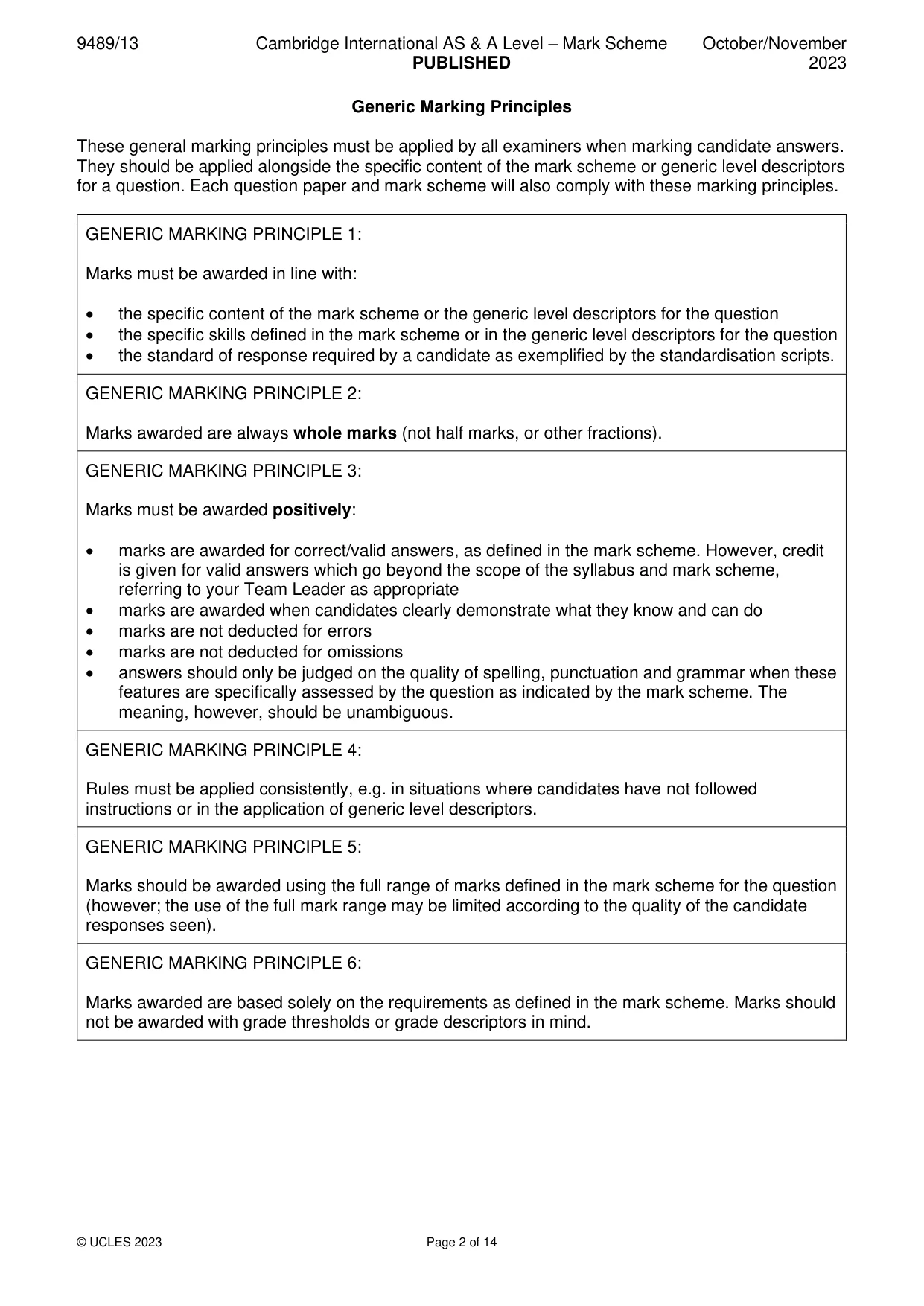
9489/13 Cambridge International AS & A Level – Mark Scheme PUBLISHED October/November 2023 © UCLES 2023 Page 2 of 14 Generic Marking Principles These general marking principles must be applied by all examiners when marking candidate answers. They should be applied alongside the specific content of the mark scheme or generic level descriptors for a question. Each question paper and mark scheme will also comply with these marking principles. GENERIC MARKING PRINCIPLE 1: Marks must be awarded in line with: • the specific content of the mark scheme or the generic level descriptors for the question • the specific skills defined in the mark scheme or in the generic level descriptors for the question • the standard of response required by a candidate as exemplified by the standardisation scripts. GENERIC MARKING PRINCIPLE 2: Marks awarded are always whole marks (not half marks, or other fractions). GENERIC MARKING PRINCIPLE 3: Marks must be awarded positively: • marks are awarded for correct/valid answers, as defined in the mark scheme. However, credit is given for valid answers which go beyond the scope of the syllabus and mark scheme, referring to your Team Leader as appropriate • marks are awarded when candidates clearly demonstrate what they know and can do • marks are not deducted for errors • marks are not deducted for omissions • answers should only be judged on the quality of spelling, punctuation and grammar when these features are specifically assessed by the question as indicated by the mark scheme. The meaning, however, should be unambiguous. GENERIC MARKING PRINCIPLE 4: Rules must be applied consistently, e.g. in situations where candidates have not followed instructions or in the application of generic level descriptors. GENERIC MARKING PRINCIPLE 5: Marks should be awarded using the full range of marks defined in the mark scheme for the question (however; the use of the full mark range may be limited according to the quality of the candidate responses seen). GENERIC MARKING PRINCIPLE 6: Marks awarded are based solely on the requirements as defined in the mark scheme. Marks should not be awarded with grade thresholds or grade descriptors in mind.
Mark scheme, page 3
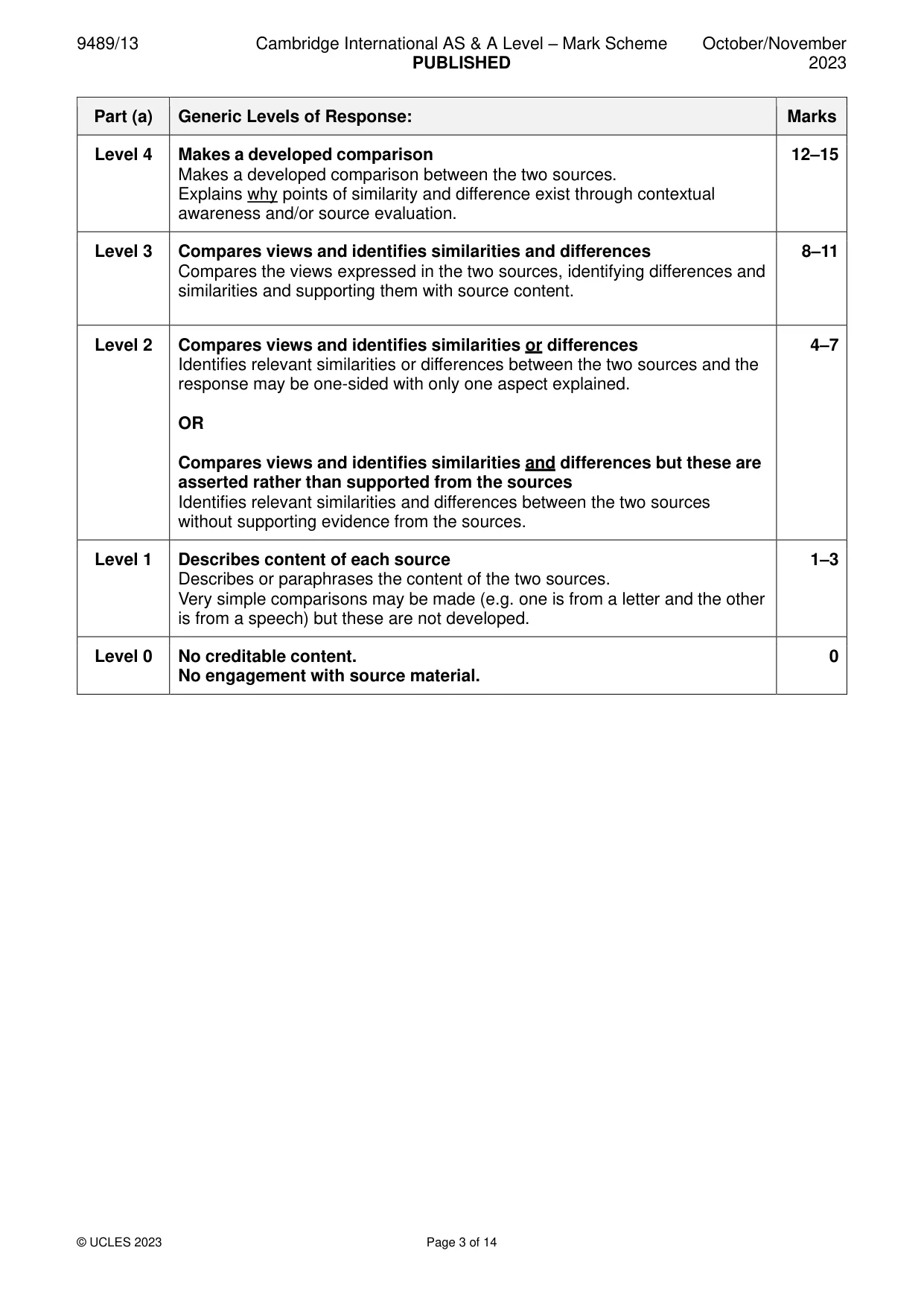
9489/13 Cambridge International AS & A Level – Mark Scheme PUBLISHED October/November 2023 © UCLES 2023 Page 3 of 14 Part (a) Generic Levels of Response: Marks Level 4 Makes a developed comparison Makes a developed comparison between the two sources. Explains why points of similarity and difference exist through contextual awareness and/or source evaluation. 12–15 Level 3 Compares views and identifies similarities and differences Compares the views expressed in the two sources, identifying differences and similarities and supporting them with source content. 8–11 Level 2 Compares views and identifies similarities or differences Identifies relevant similarities or differences between the two sources and the response may be one-sided with only one aspect explained. OR Compares views and identifies similarities and differences but these are asserted rather than supported from the sources Identifies relevant similarities and differences between the two sources without supporting evidence from the sources. 4–7 Level 1 Describes content of each source Describes or paraphrases the content of the two sources. Very simple comparisons may be made (e.g. one is from a letter and the other is from a speech) but these are not developed. 1–3 Level 0 No creditable content. No engagement with source material. 0
Mark scheme, page 4
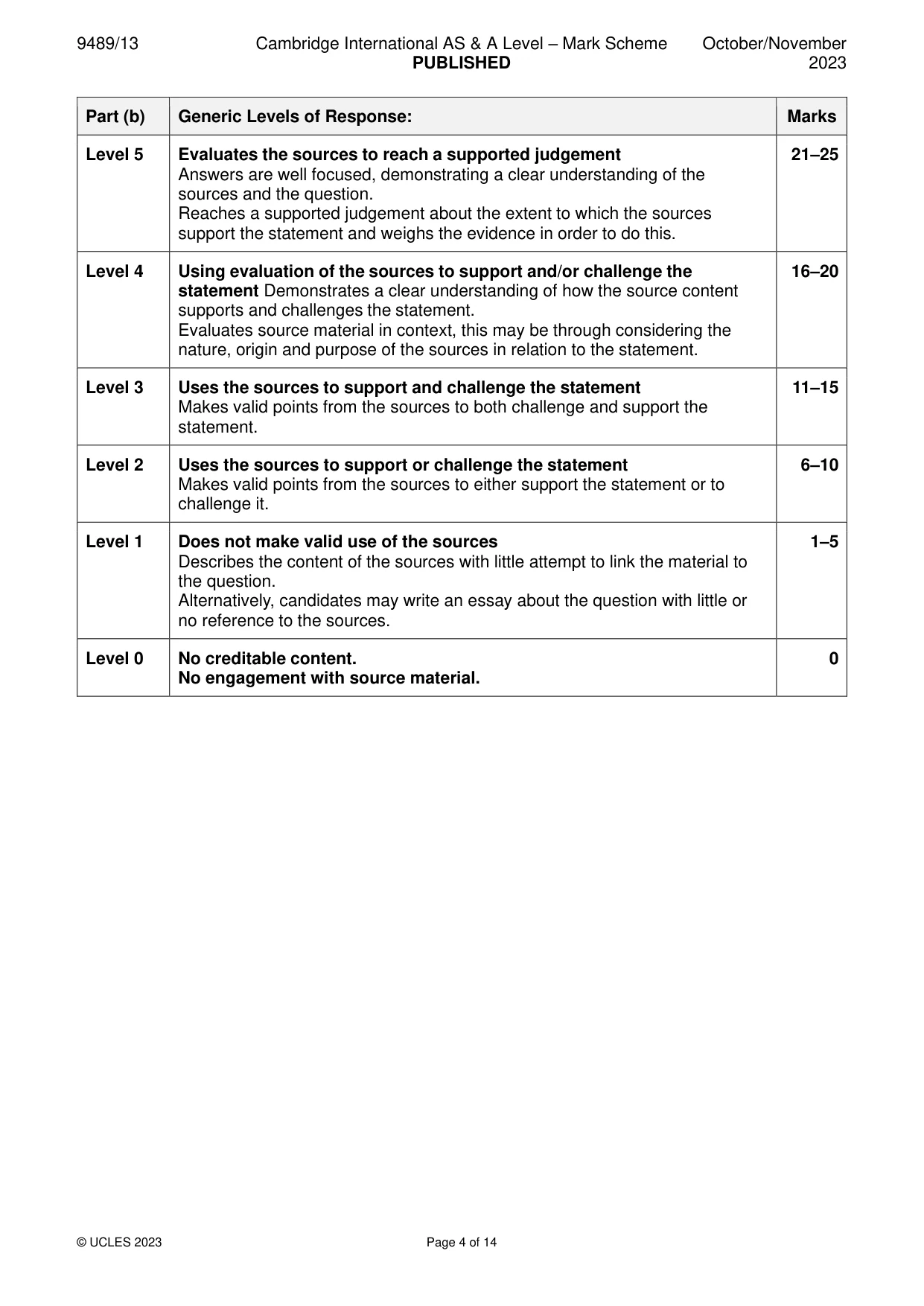
9489/13 Cambridge International AS & A Level – Mark Scheme PUBLISHED October/November 2023 © UCLES 2023 Page 4 of 14 Part (b) Generic Levels of Response: Marks Level 5 Evaluates the sources to reach a supported judgement Answers are well focused, demonstrating a clear understanding of the sources and the question. Reaches a supported judgement about the extent to which the sources support the statement and weighs the evidence in order to do this. 21–25 Level 4 Using evaluation of the sources to support and/or challenge the statement Demonstrates a clear understanding of how the source content supports and challenges the statement. Evaluates source material in context, this may be through considering the nature, origin and purpose of the sources in relation to the statement. 16–20 Level 3 Uses the sources to support and challenge the statement Makes valid points from the sources to both challenge and support the statement. 11–15 Level 2 Uses the sources to support or challenge the statement Makes valid points from the sources to either support the statement or to challenge it. 6–10 Level 1 Does not make valid use of the sources Describes the content of the sources with little attempt to link the material to the question. Alternatively, candidates may write an essay about the question with little or no reference to the sources. 1–5 Level 0 No creditable content. No engagement with source material. 0
Mark scheme, page 5
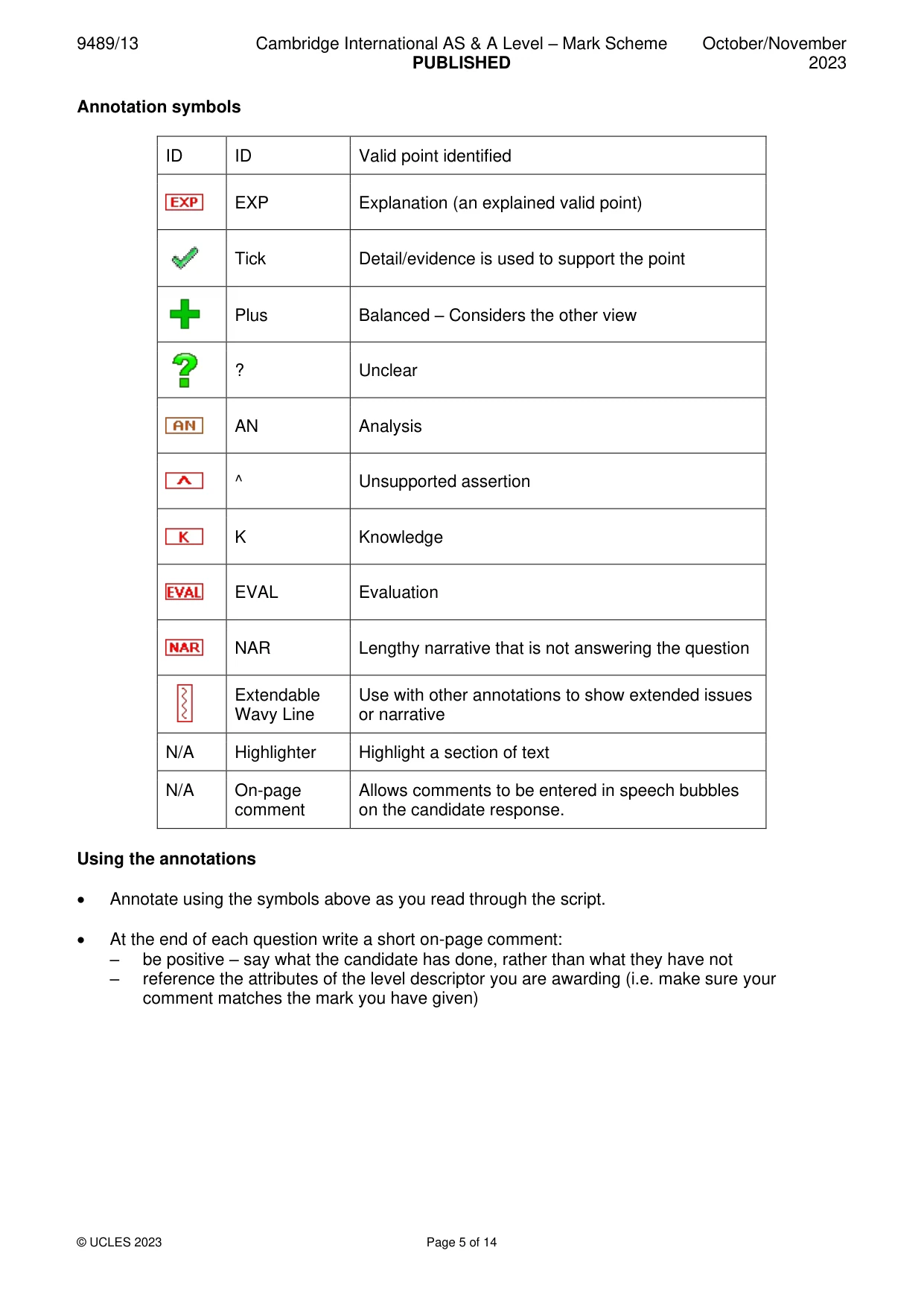
9489/13 Cambridge International AS & A Level – Mark Scheme PUBLISHED October/November 2023 © UCLES 2023 Page 5 of 14 Annotation symbols ID ID Valid point identified EXP Explanation (an explained valid point) Tick Detail/evidence is used to support the point Plus Balanced – Considers the other view ? Unclear AN Analysis ^ Unsupported assertion K Knowledge EVAL Evaluation NAR Lengthy narrative that is not answering the question Extendable Wavy Line Use with other annotations to show extended issues or narrative N/A Highlighter Highlight a section of text N/A On-page comment Allows comments to be entered in speech bubbles on the candidate response. Using the annotations • Annotate using the symbols above as you read through the script. • At the end of each question write a short on-page comment: – be positive – say what the candidate has done, rather than what they have not – reference the attributes of the level descriptor you are awarding (i.e. make sure your comment matches the mark you have given)
Mark scheme, page 6
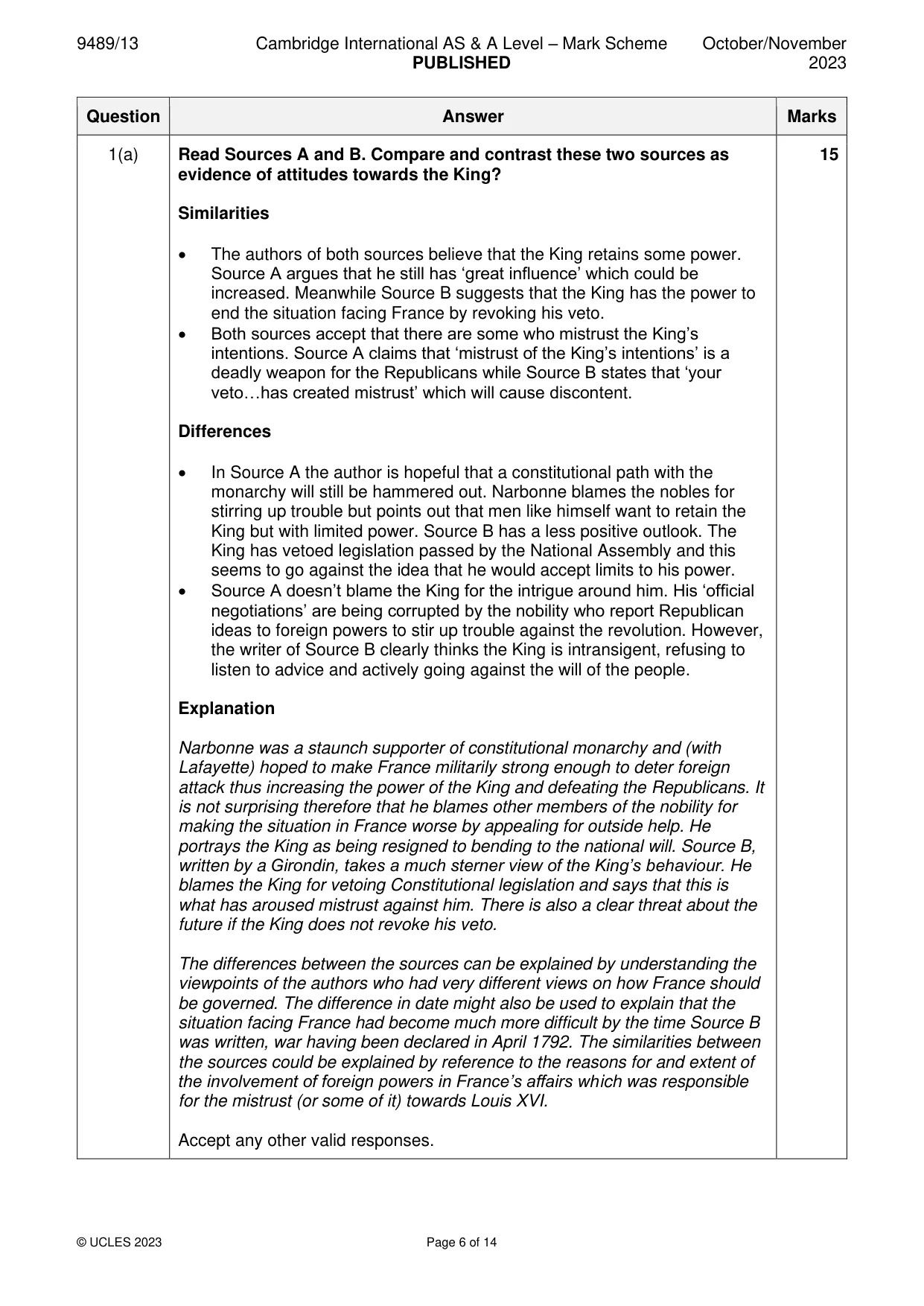
9489/13 Cambridge International AS & A Level – Mark Scheme PUBLISHED October/November 2023 © UCLES 2023 Page 6 of 14 Question Answer Marks 1(a) Read Sources A and B. Compare and contrast these two sources as evidence of attitudes towards the King? Similarities • The authors of both sources believe that the King retains some power. Source A argues that he still has ‘great influence’ which could be increased. Meanwhile Source B suggests that the King has the power to end the situation facing France by revoking his veto. • Both sources accept that there are some who mistrust the King’s intentions. Source A claims that ‘mistrust of the King’s intentions’ is a deadly weapon for the Republicans while Source B states that ‘your veto…has created mistrust’ which will cause discontent. Differences • In Source A the author is hopeful that a constitutional path with the monarchy will still be hammered out. Narbonne blames the nobles for stirring up trouble but points out that men like himself want to retain the King but with limited power. Source B has a less positive outlook. The King has vetoed legislation passed by the National Assembly and this seems to go against the idea that he would accept limits to his power. • Source A doesn’t blame the King for the intrigue around him. His ‘official negotiations’ are being corrupted by the nobility who report Republican ideas to foreign powers to stir up trouble against the revolution. However, the writer of Source B clearly thinks the King is intransigent, refusing to listen to advice and actively going against the will of the people. Explanation Narbonne was a staunch supporter of constitutional monarchy and (with Lafayette) hoped to make France militarily strong enough to deter foreign attack thus increasing the power of the King and defeating the Republicans. It is not surprising therefore that he blames other members of the nobility for making the situation in France worse by appealing for outside help. He portrays the King as being resigned to bending to the national will. Source B, written by a Girondin, takes a much sterner view of the King’s behaviour. He blames the King for vetoing Constitutional legislation and says that this is what has aroused mistrust against him. There is also a clear threat about the future if the King does not revoke his veto. The differences between the sources can be explained by understanding the viewpoints of the authors who had very different views on how France should be governed. The difference in date might also be used to explain that the situation facing France had become much more difficult by the time Source B was written, war having been declared in April 1792. The similarities between the sources could be explained by reference to the reasons for and extent of the involvement of foreign powers in France’s affairs which was responsible for the mistrust (or some of it) towards Louis XVI. Accept any other valid responses. 15
Mark scheme, page 7
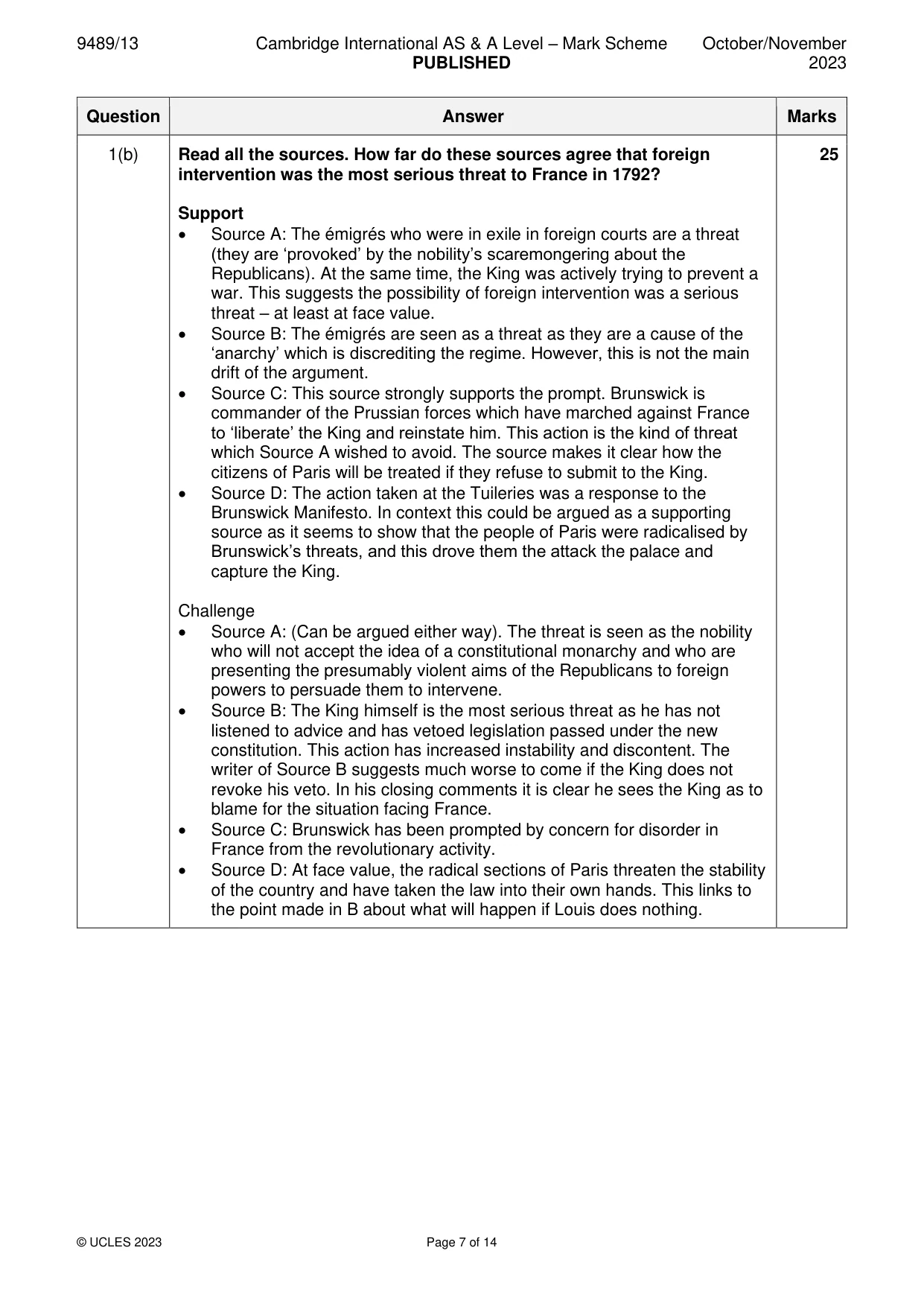
9489/13 Cambridge International AS & A Level – Mark Scheme PUBLISHED October/November 2023 © UCLES 2023 Page 7 of 14 Question Answer Marks 1(b) Read all the sources. How far do these sources agree that foreign intervention was the most serious threat to France in 1792? Support • Source A: The émigrés who were in exile in foreign courts are a threat (they are ‘provoked’ by the nobility’s scaremongering about the Republicans). At the same time, the King was actively trying to prevent a war. This suggests the possibility of foreign intervention was a serious threat – at least at face value. • Source B: The émigrés are seen as a threat as they are a cause of the ‘anarchy’ which is discrediting the regime. However, this is not the main drift of the argument. • Source C: This source strongly supports the prompt. Brunswick is commander of the Prussian forces which have marched against France to ‘liberate’ the King and reinstate him. This action is the kind of threat which Source A wished to avoid. The source makes it clear how the citizens of Paris will be treated if they refuse to submit to the King. • Source D: The action taken at the Tuileries was a response to the Brunswick Manifesto. In context this could be argued as a supporting source as it seems to show that the people of Paris were radicalised by Brunswick’s threats, and this drove them the attack the palace and capture the King. Challenge • Source A: (Can be argued either way). The threat is seen as the nobility who will not accept the idea of a constitutional monarchy and who are presenting the presumably violent aims of the Republicans to foreign powers to persuade them to intervene. • Source B: The King himself is the most serious threat as he has not listened to advice and has vetoed legislation passed under the new constitution. This action has increased instability and discontent. The writer of Source B suggests much worse to come if the King does not revoke his veto. In his closing comments it is clear he sees the King as to blame for the situation facing France. • Source C: Brunswick has been prompted by concern for disorder in France from the revolutionary activity. • Source D: At face value, the radical sections of Paris threaten the stability of the country and have taken the law into their own hands. This links to the point made in B about what will happen if Louis does nothing. 25
Mark scheme, page 8
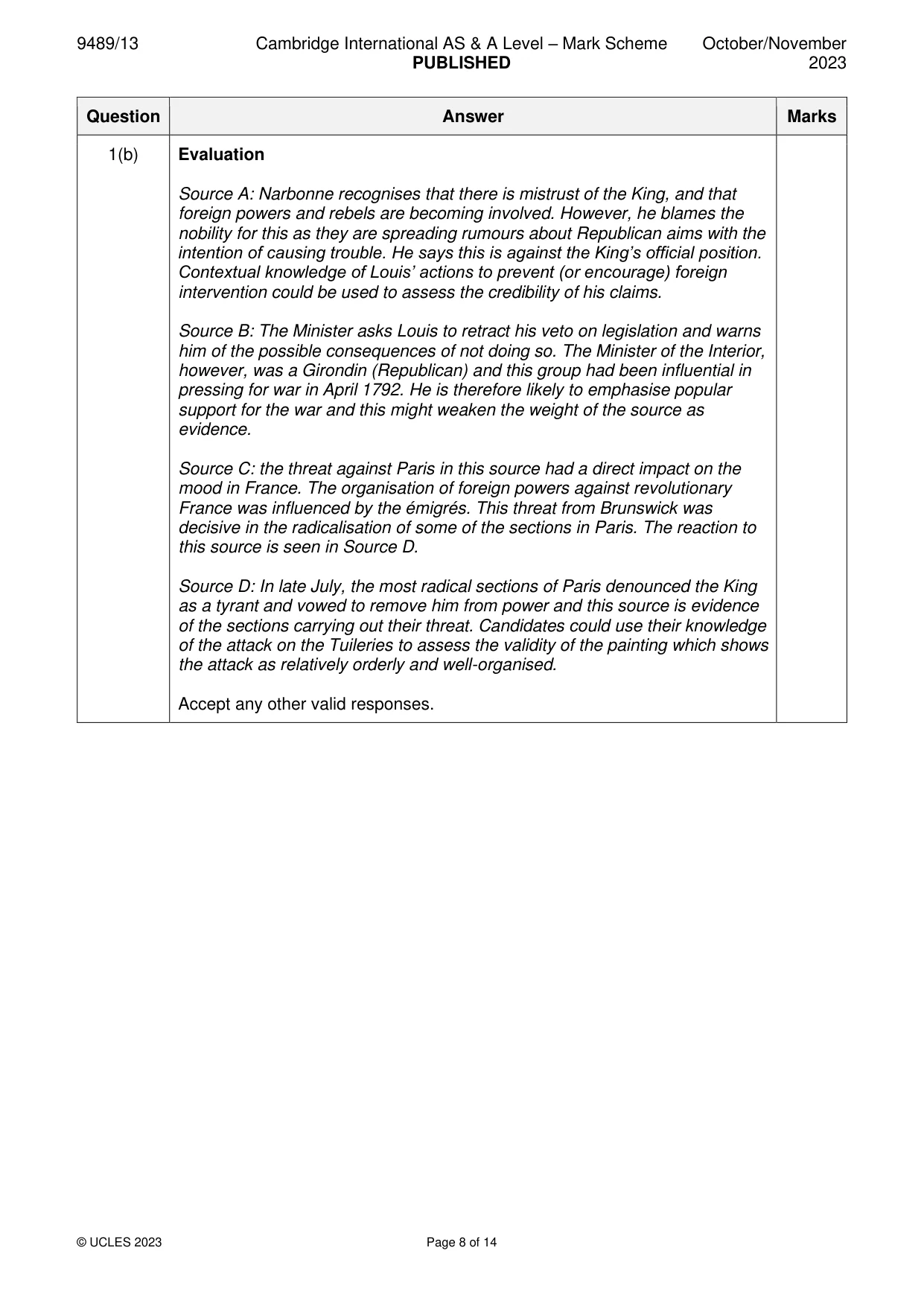
9489/13 Cambridge International AS & A Level – Mark Scheme PUBLISHED October/November 2023 © UCLES 2023 Page 8 of 14 Question Answer Marks 1(b) Evaluation Source A: Narbonne recognises that there is mistrust of the King, and that foreign powers and rebels are becoming involved. However, he blames the nobility for this as they are spreading rumours about Republican aims with the intention of causing trouble. He says this is against the King’s official position. Contextual knowledge of Louis’ actions to prevent (or encourage) foreign intervention could be used to assess the credibility of his claims. Source B: The Minister asks Louis to retract his veto on legislation and warns him of the possible consequences of not doing so. The Minister of the Interior, however, was a Girondin (Republican) and this group had been influential in pressing for war in April 1792. He is therefore likely to emphasise popular support for the war and this might weaken the weight of the source as evidence. Source C: the threat against Paris in this source had a direct impact on the mood in France. The organisation of foreign powers against revolutionary France was influenced by the émigrés. This threat from Brunswick was decisive in the radicalisation of some of the sections in Paris. The reaction to this source is seen in Source D. Source D: In late July, the most radical sections of Paris denounced the King as a tyrant and vowed to remove him from power and this source is evidence of the sections carrying out their threat. Candidates could use their knowledge of the attack on the Tuileries to assess the validity of the painting which shows the attack as relatively orderly and well-organised. Accept any other valid responses.
Mark scheme, page 9
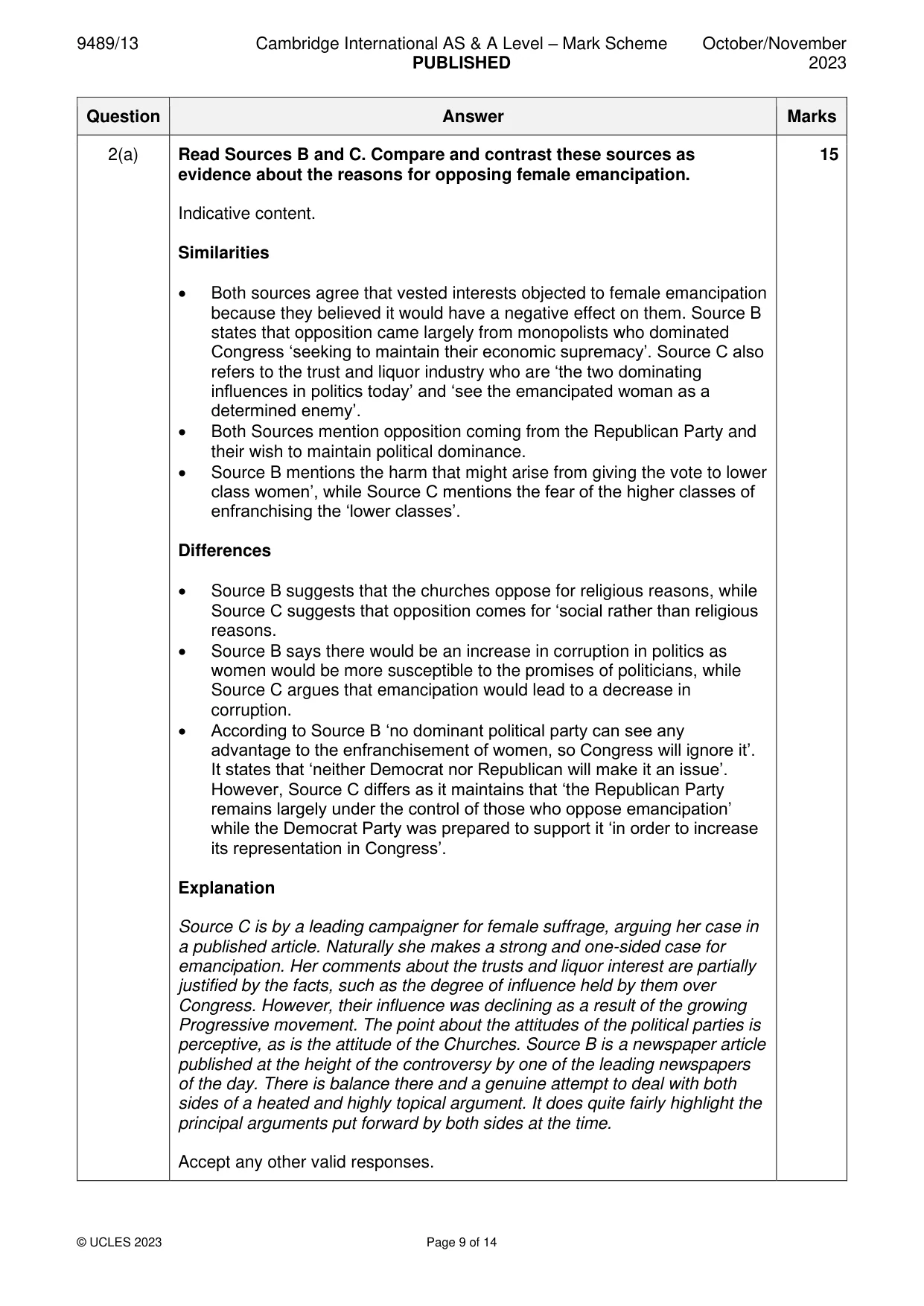
9489/13 Cambridge International AS & A Level – Mark Scheme PUBLISHED October/November 2023 © UCLES 2023 Page 9 of 14 Question Answer Marks 2(a) Read Sources B and C. Compare and contrast these sources as evidence about the reasons for opposing female emancipation. Indicative content. Similarities • Both sources agree that vested interests objected to female emancipation because they believed it would have a negative effect on them. Source B states that opposition came largely from monopolists who dominated Congress ‘seeking to maintain their economic supremacy’. Source C also refers to the trust and liquor industry who are ‘the two dominating influences in politics today’ and ‘see the emancipated woman as a determined enemy’. • Both Sources mention opposition coming from the Republican Party and their wish to maintain political dominance. • Source B mentions the harm that might arise from giving the vote to lower class women’, while Source C mentions the fear of the higher classes of enfranchising the ‘lower classes’. Differences • Source B suggests that the churches oppose for religious reasons, while Source C suggests that opposition comes for ‘social rather than religious reasons. • Source B says there would be an increase in corruption in politics as women would be more susceptible to the promises of politicians, while Source C argues that emancipation would lead to a decrease in corruption. • According to Source B ‘no dominant political party can see any advantage to the enfranchisement of women, so Congress will ignore it’. It states that ‘neither Democrat nor Republican will make it an issue’. However, Source C differs as it maintains that ‘the Republican Party remains largely under the control of those who oppose emancipation’ while the Democrat Party was prepared to support it ‘in order to increase its representation in Congress’. Explanation Source C is by a leading campaigner for female suffrage, arguing her case in a published article. Naturally she makes a strong and one-sided case for emancipation. Her comments about the trusts and liquor interest are partially justified by the facts, such as the degree of influence held by them over Congress. However, their influence was declining as a result of the growing Progressive movement. The point about the attitudes of the political parties is perceptive, as is the attitude of the Churches. Source B is a newspaper article published at the height of the controversy by one of the leading newspapers of the day. There is balance there and a genuine attempt to deal with both sides of a heated and highly topical argument. It does quite fairly highlight the principal arguments put forward by both sides at the time. Accept any other valid responses. 15
Mark scheme, page 10
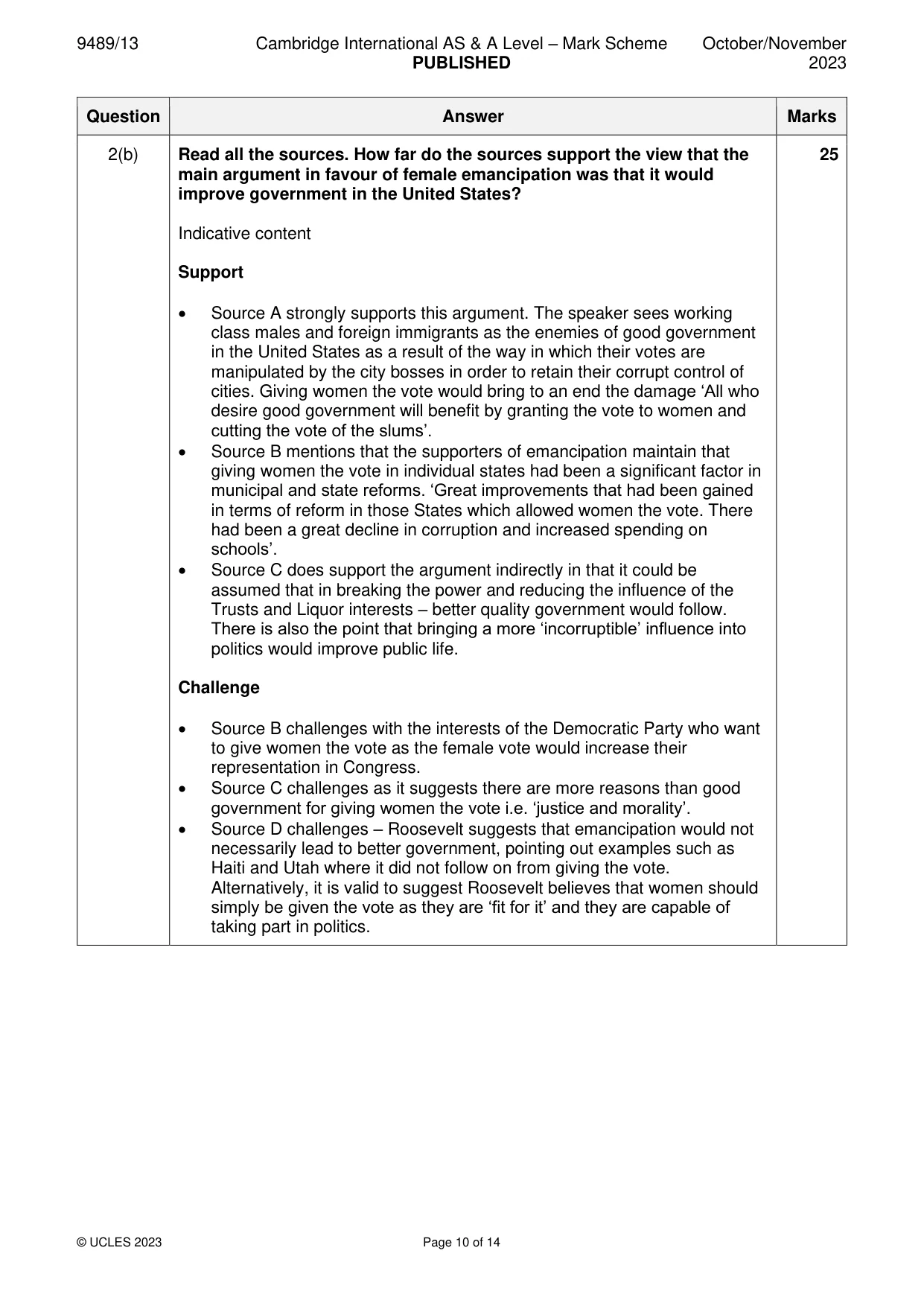
9489/13 Cambridge International AS & A Level – Mark Scheme PUBLISHED October/November 2023 © UCLES 2023 Page 10 of 14 Question Answer Marks 2(b) Read all the sources. How far do the sources support the view that the main argument in favour of female emancipation was that it would improve government in the United States? Indicative content Support • Source A strongly supports this argument. The speaker sees working class males and foreign immigrants as the enemies of good government in the United States as a result of the way in which their votes are manipulated by the city bosses in order to retain their corrupt control of cities. Giving women the vote would bring to an end the damage ‘All who desire good government will benefit by granting the vote to women and cutting the vote of the slums’. • Source B mentions that the supporters of emancipation maintain that giving women the vote in individual states had been a significant factor in municipal and state reforms. ‘Great improvements that had been gained in terms of reform in those States which allowed women the vote. There had been a great decline in corruption and increased spending on schools’. • Source C does support the argument indirectly in that it could be assumed that in breaking the power and reducing the influence of the Trusts and Liquor interests – better quality government would follow. There is also the point that bringing a more ‘incorruptible’ influence into politics would improve public life. Challenge • Source B challenges with the interests of the Democratic Party who want to give women the vote as the female vote would increase their representation in Congress. • Source C challenges as it suggests there are more reasons than good government for giving women the vote i.e. ‘justice and morality’. • Source D challenges – Roosevelt suggests that emancipation would not necessarily lead to better government, pointing out examples such as Haiti and Utah where it did not follow on from giving the vote. Alternatively, it is valid to suggest Roosevelt believes that women should simply be given the vote as they are ‘fit for it’ and they are capable of taking part in politics. 25
Mark scheme, page 11
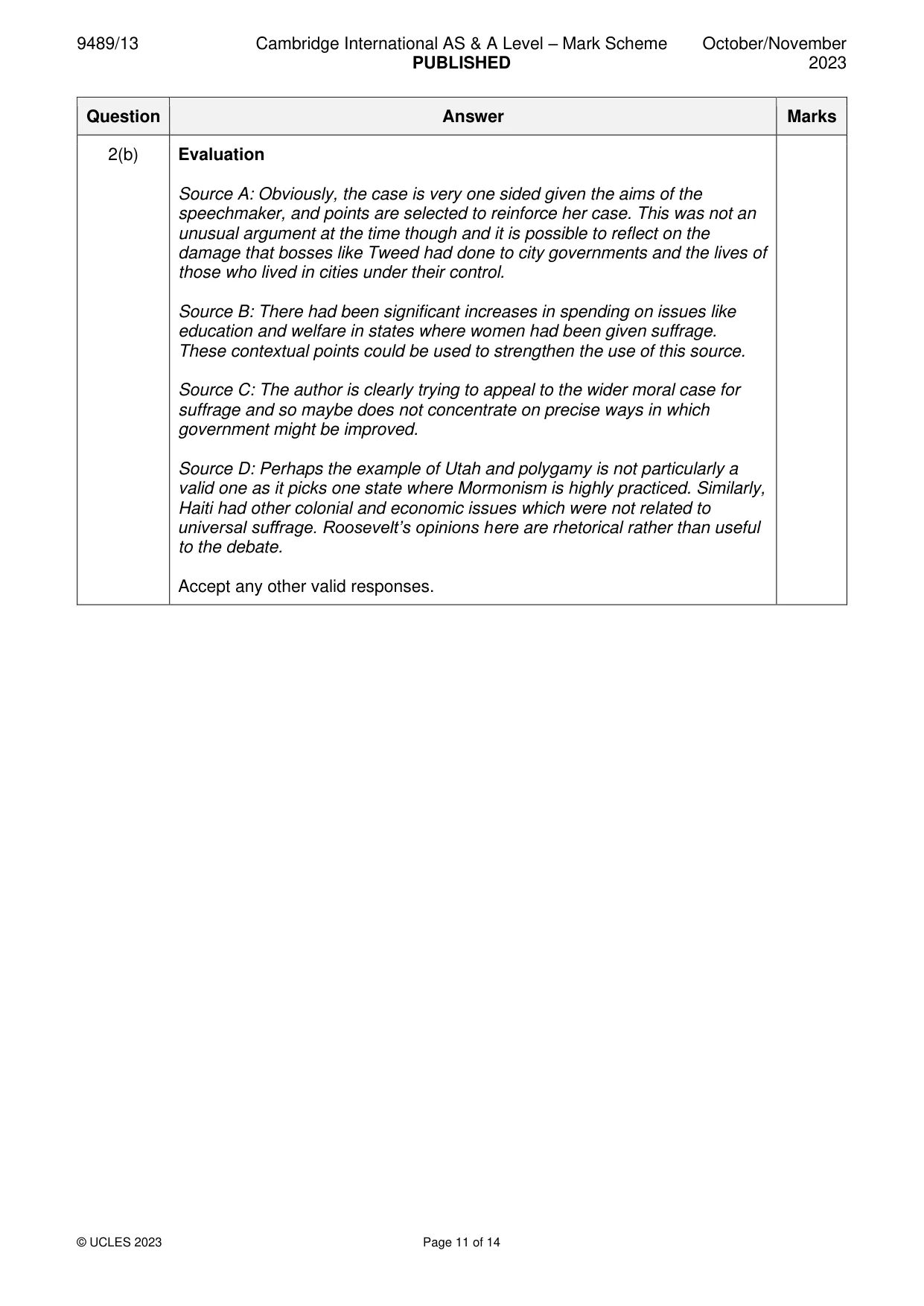
9489/13 Cambridge International AS & A Level – Mark Scheme PUBLISHED October/November 2023 © UCLES 2023 Page 11 of 14 Question Answer Marks 2(b) Evaluation Source A: Obviously, the case is very one sided given the aims of the speechmaker, and points are selected to reinforce her case. This was not an unusual argument at the time though and it is possible to reflect on the damage that bosses like Tweed had done to city governments and the lives of those who lived in cities under their control. Source B: There had been significant increases in spending on issues like education and welfare in states where women had been given suffrage. These contextual points could be used to strengthen the use of this source. Source C: The author is clearly trying to appeal to the wider moral case for suffrage and so maybe does not concentrate on precise ways in which government might be improved. Source D: Perhaps the example of Utah and polygamy is not particularly a valid one as it picks one state where Mormonism is highly practiced. Similarly, Haiti had other colonial and economic issues which were not related to universal suffrage. Roosevelt’s opinions here are rhetorical rather than useful to the debate. Accept any other valid responses.
Mark scheme, page 12
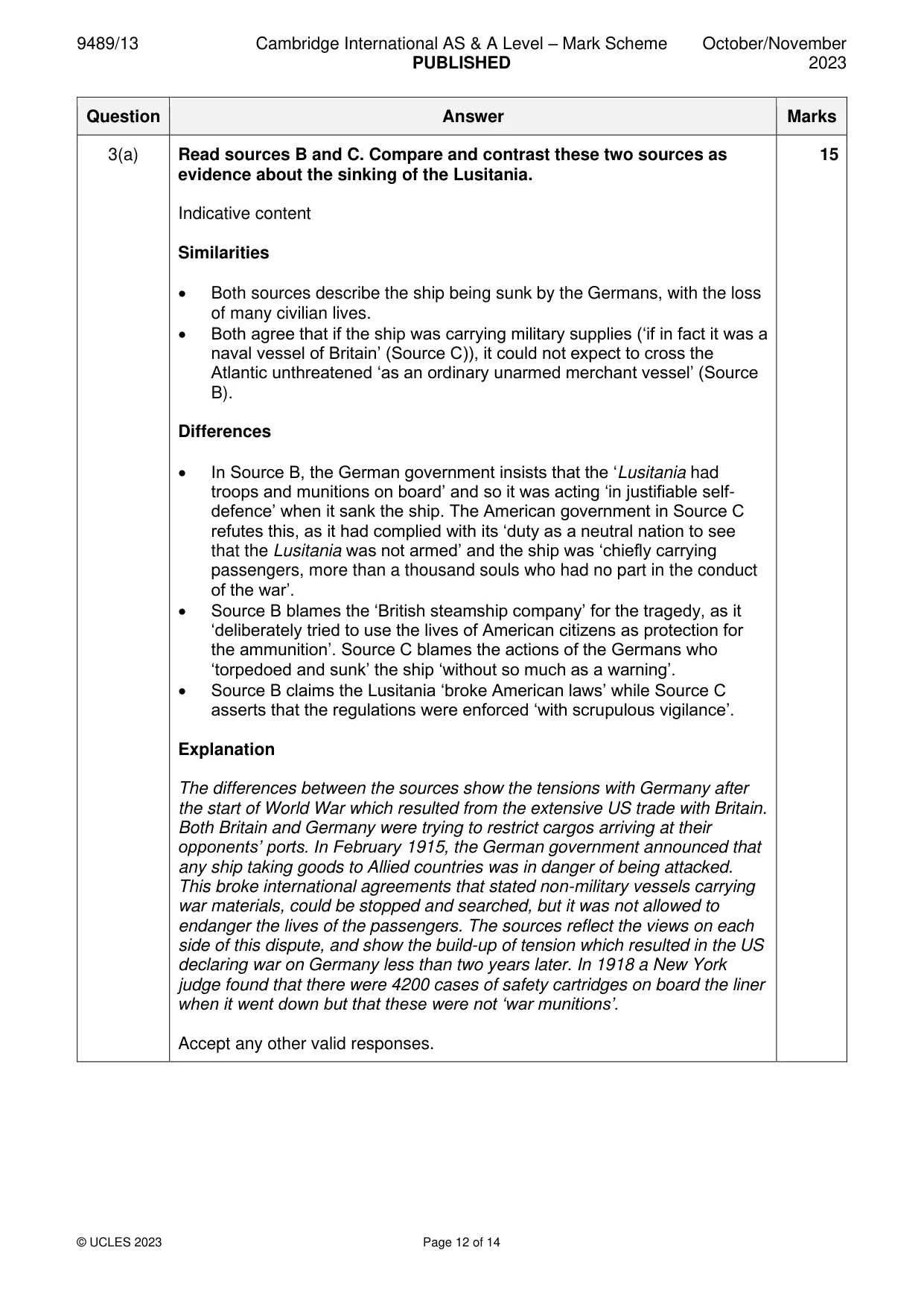
9489/13 Cambridge International AS & A Level – Mark Scheme PUBLISHED October/November 2023 © UCLES 2023 Page 12 of 14 Question Answer Marks 3(a) Read sources B and C. Compare and contrast these two sources as evidence about the sinking of the Lusitania. Indicative content Similarities • Both sources describe the ship being sunk by the Germans, with the loss of many civilian lives. • Both agree that if the ship was carrying military supplies (‘if in fact it was a naval vessel of Britain’ (Source C)), it could not expect to cross the Atlantic unthreatened ‘as an ordinary unarmed merchant vessel’ (Source B). Differences • In Source B, the German government insists that the ‘Lusitania had troops and munitions on board’ and so it was acting ‘in justifiable self- defence’ when it sank the ship. The American government in Source C refutes this, as it had complied with its ‘duty as a neutral nation to see that the Lusitania was not armed’ and the ship was ‘chiefly carrying passengers, more than a thousand souls who had no part in the conduct of the war’. • Source B blames the ‘British steamship company’ for the tragedy, as it ‘deliberately tried to use the lives of American citizens as protection for the ammunition’. Source C blames the actions of the Germans who ‘torpedoed and sunk’ the ship ‘without so much as a warning’. • Source B claims the Lusitania ‘broke American laws’ while Source C asserts that the regulations were enforced ‘with scrupulous vigilance’. Explanation The differences between the sources show the tensions with Germany after the start of World War which resulted from the extensive US trade with Britain. Both Britain and Germany were trying to restrict cargos arriving at their opponents’ ports. In February 1915, the German government announced that any ship taking goods to Allied countries was in danger of being attacked. This broke international agreements that stated non-military vessels carrying war materials, could be stopped and searched, but it was not allowed to endanger the lives of the passengers. The sources reflect the views on each side of this dispute, and show the build-up of tension which resulted in the US declaring war on Germany less than two years later. In 1918 a New York judge found that there were 4200 cases of safety cartridges on board the liner when it went down but that these were not ‘war munitions’. Accept any other valid responses. 15
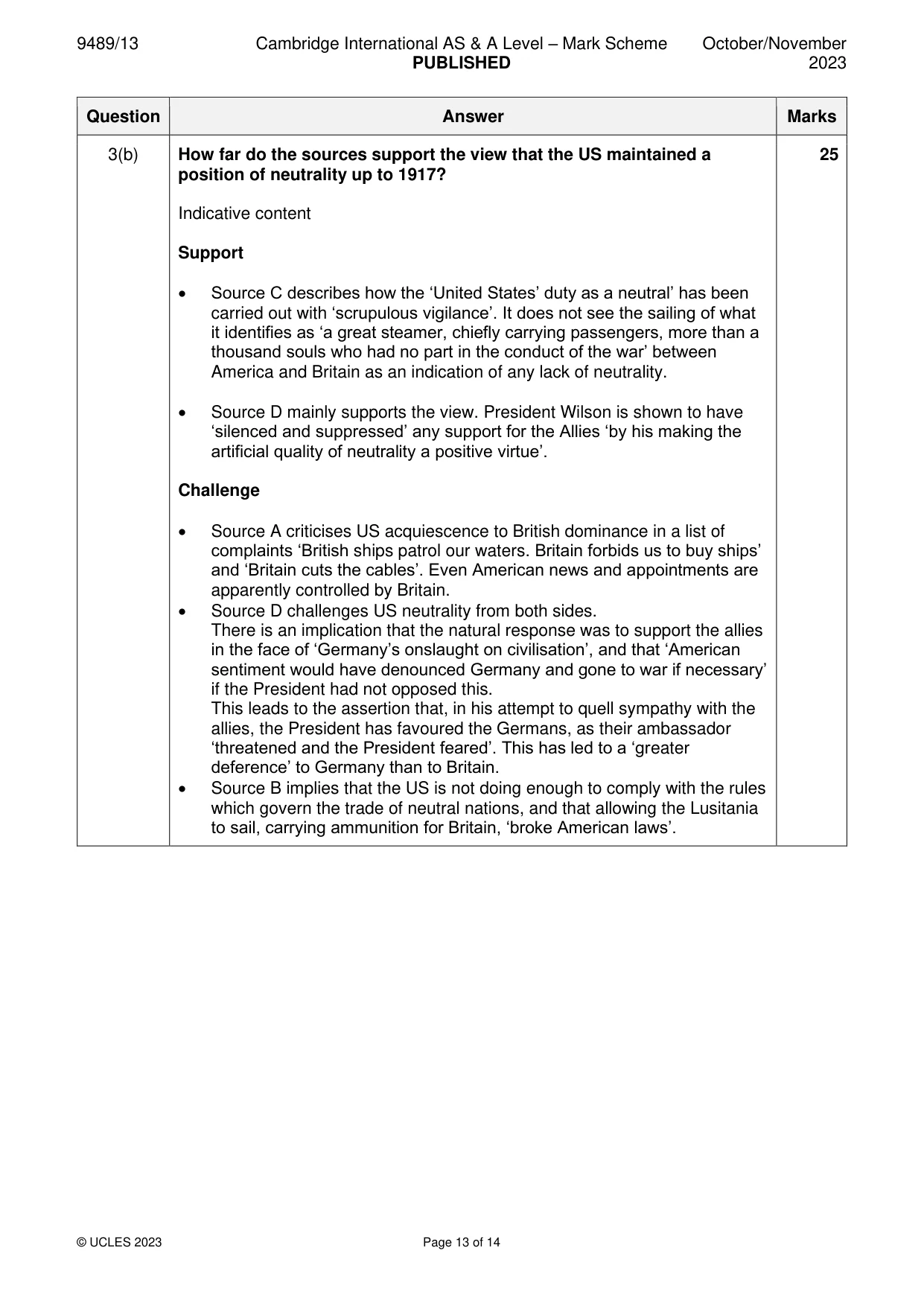
Mark scheme, page 13
9489/13 Cambridge International AS & A Level – Mark Scheme PUBLISHED October/November 2023 © UCLES 2023 Page 13 of 14 Question Answer Marks 3(b) How far do the sources support the view that the US maintained a position of neutrality up to 1917? Indicative content Support • Source C describes how the ‘United States’ duty as a neutral’ has been carried out with ‘scrupulous vigilance’. It does not see the sailing of what it identifies as ‘a great steamer, chiefly carrying passengers, more than a thousand souls who had no part in the conduct of the war’ between America and Britain as an indication of any lack of neutrality. • Source D mainly supports the view. President Wilson is shown to have ‘silenced and suppressed’ any support for the Allies ‘by his making the artificial quality of neutrality a positive virtue’. Challenge • Source A criticises US acquiescence to British dominance in a list of complaints ‘British ships patrol our waters. Britain forbids us to buy ships’ and ‘Britain cuts the cables’. Even American news and appointments are apparently controlled by Britain. • Source D challenges US neutrality from both sides. There is an implication that the natural response was to support the allies in the face of ‘Germany’s onslaught on civilisation’, and that ‘American sentiment would have denounced Germany and gone to war if necessary’ if the President had not opposed this. This leads to the assertion that, in his attempt to quell sympathy with the allies, the President has favoured the Germans, as their ambassador ‘threatened and the President feared’. This has led to a ‘greater deference’ to Germany than to Britain. • Source B implies that the US is not doing enough to comply with the rules which govern the trade of neutral nations, and that allowing the Lusitania to sail, carrying ammunition for Britain, ‘broke American laws’. 25
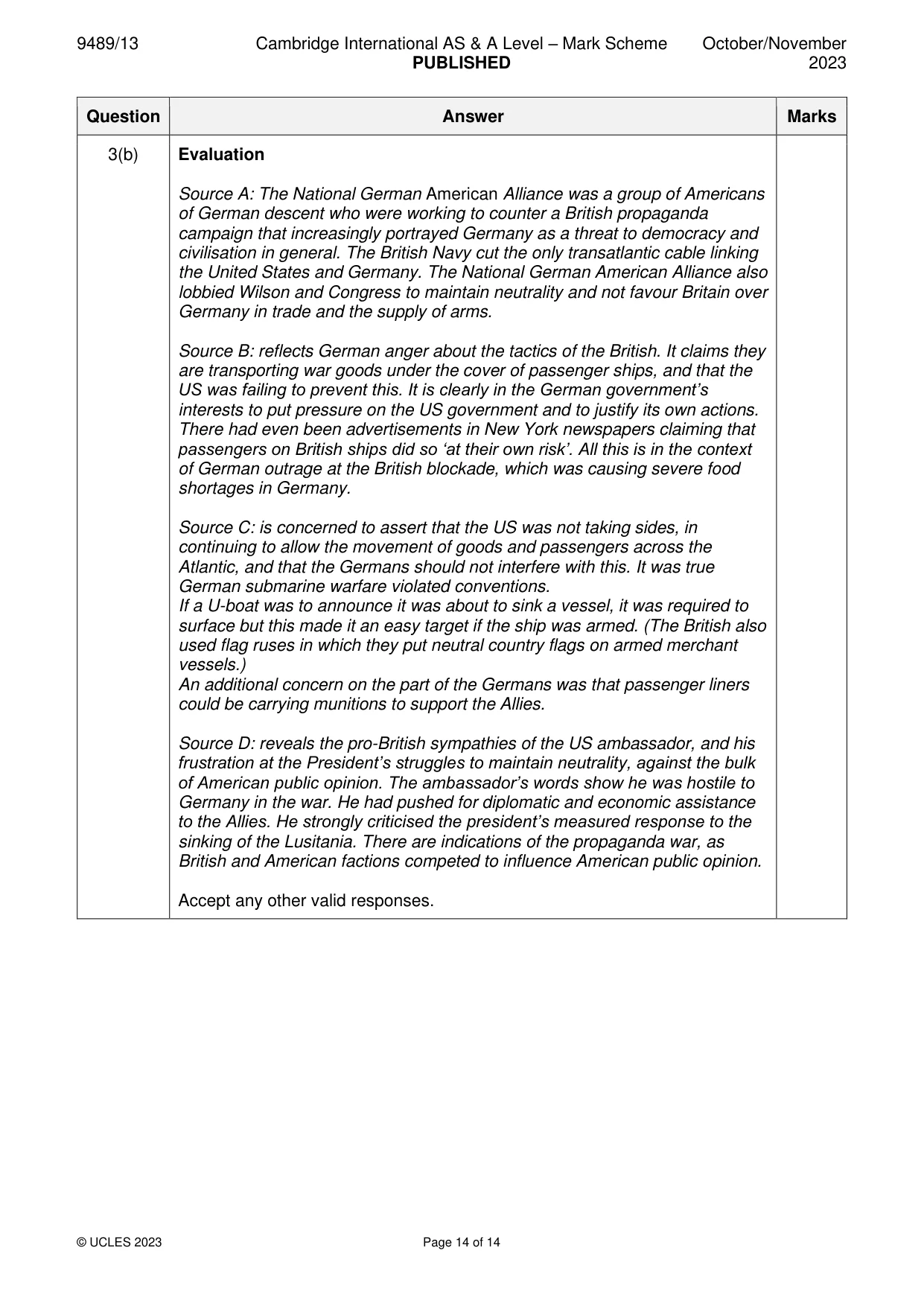
Mark scheme, page 14
9489/13 Cambridge International AS & A Level – Mark Scheme PUBLISHED October/November 2023 © UCLES 2023 Page 14 of 14 Question Answer Marks 3(b) Evaluation Source A: The National German American Alliance was a group of Americans of German descent who were working to counter a British propaganda campaign that increasingly portrayed Germany as a threat to democracy and civilisation in general. The British Navy cut the only transatlantic cable linking the United States and Germany. The National German American Alliance also lobbied Wilson and Congress to maintain neutrality and not favour Britain over Germany in trade and the supply of arms. Source B: reflects German anger about the tactics of the British. It claims they are transporting war goods under the cover of passenger ships, and that the US was failing to prevent this. It is clearly in the German government’s interests to put pressure on the US government and to justify its own actions. There had even been advertisements in New York newspapers claiming that passengers on British ships did so ‘at their own risk’. All this is in the context of German outrage at the British blockade, which was causing severe food shortages in Germany. Source C: is concerned to assert that the US was not taking sides, in continuing to allow the movement of goods and passengers across the Atlantic, and that the Germans should not interfere with this. It was true German submarine warfare violated conventions. If a U-boat was to announce it was about to sink a vessel, it was required to surface but this made it an easy target if the ship was armed. (The British also used flag ruses in which they put neutral country flags on armed merchant vessels.) An additional concern on the part of the Germans was that passenger liners could be carrying munitions to support the Allies. Source D: reveals the pro-British sympathies of the US ambassador, and his frustration at the President’s struggles to maintain neutrality, against the bulk of American public opinion. The ambassador’s words show he was hostile to Germany in the war. He had pushed for diplomatic and economic assistance to the Allies. He strongly criticised the president’s measured response to the sinking of the Lusitania. There are indications of the propaganda war, as British and American factions competed to influence American public opinion. Accept any other valid responses.
What you needed in this session
Cambridge’s own grade thresholds for 2023 Oct/Nov, Paper 1 · Variant 3. A higher threshold means an easier paper — the bar moves with how the cohort did.