Cambridge A Level History 9389 — 2021 Oct/Nov Paper 1 · Variant 2
9389/12/O/N/21 · 40 marks · ≈45 min
The question paper and its mark scheme, free to read here and free to download. This is Cambridge’s own paper, exactly as it was sat.
Question paper8 pages

Mark scheme10 pages
Answers below. Sit the paper first if you are practising.
Paper as text
Question paper, page 1
This document has 8 pages. Any blank pages are indicated. DC (JP) 202651/2 © UCLES 2021 [Turn over * 6 3 6 2 7 7 5 7 0 5 * Cambridge International AS & A Level HISTORY 9389/12 Paper 1 Document Question October/November 2021 1 hour You must answer on the enclosed answer booklet. You will need: Answer booklet (enclosed) INSTRUCTIONS ● Answer one question from one section only. Answer both parts of the question. Section A: European Option Section B: American Option Section C: International Option ● Follow the instructions on the front cover of the answer booklet. If you need additional answer paper, ask the invigilator for a continuation booklet. INFORMATION ● The total mark for this paper is 40. ● The number of marks for each question or part question is shown in brackets [ ].
Question paper, page 2
2 9389/12/O/N/21 © UCLES 2021 Section A: European Option Liberalism and Nationalism in Italy and Germany, 1815–1871 The Schleswig-Holstein Question 1 Read the sources and then answer both parts of the question. Source A The Duchies are armed to the teeth and the sword is kept in its sheath only by the presence of Prussian and Swedish troops. The Danes are aware of this. It would appear that they calculate upon driving the Duchies into despair, and that the Danes want to provoke them into an attack. This would naturally be resented by the Great Powers determined to maintain the peace. The Danes hope, with the assistance of some powers, to impose upon the Duchies the badge of servitude. I hope that Great Britain, disgusted by the Danes’ eternal shifts and delays, will step in and mediate in order to prevent any spilling of blood and block the Danes from their actions. From a letter by a German historian to Lord Palmerston, British Foreign Secretary, 1850. Source B Everyone in Germany is conscious of the profound significance the Schleswig-Holstein question must have for the internal policies of our states. Everyone knows that through the Schleswig- Holstein question the German question will also be decided. The question of Schleswig-Holstein is therefore to the people a broader question of rights. For the governments it is also a question of their power. It is a question of the existence of the Confederation and the smaller states in Germany. Prince Hohenlohe, writing in his diary, August 1863. Later in the 1860s Hohenlohe became Prime Minister of Bavaria. Source C We ought to have a fixed programme in order to proceed on this issue of the Duchies, the realisation of which would still depend on circumstances. Instead, the only programme you seem to have is that we must ‘act according to circumstances’. However, there are secret intentions which are attributed to you. With regard to these secret ideas of a Prussian policy of expansion, I will only state that my opinion is that to carry them out would entirely damage our whole German policy. It might also place us in a difficult position within Europe. It would not be the first time that Prussia had tried to be better than everyone else, only to find itself with no support from the other powers. A letter from Crown Prince Frederick of Prussia to Bismarck, 17 April 1864.
Question paper, page 3
3 9389/12/O/N/21 © UCLES 2021 [Turn over Source D The whole episode of the Schleswig-Holstein war, looked at as a whole, so completely exhibits the character of a dramatic intrigue—the cleverest and most successful ever seen on a political stage. Both his friends and enemies see it as Bismarck’s masterpiece. If it be true that the series of incidents which followed in succession after the sudden death of the King of Denmark up to the actual war were the result of a preconceived plan, it must be admitted that cynical plotting, at its most extreme, has never produced anything parallel to it. To damage Austria at the same time, to undermine the German Princes, avoid conflict with France and England and annex the Duchies as well, must certainly be reckoned the highest perfection of the art of deception. From a biography of Bismarck, written by a German Liberal politician, published in 1868. Answer both parts of the question with reference to the sources. (a) Compare and contrast the views of Bismarck’s policies in Sources C and D. [15] (b) ‘Denmark caused the Schleswig-Holstein crisis.’ How far do Sources A to D support this view? [25]
Question paper, page 4
4 9389/12/O/N/21 © UCLES 2021 Section B: American Option The Origins of the Civil War, 1846–1861 The Dred Scott Judgement, 1857 2 Read the sources and then answer both parts of the question. Source A The slavery question has finally found its way into the Supreme Court. The Court decides that the constitution recognises ‘man’ can be property and that, as a result, human slavery must be protected wherever the Constitution is in force. The Court seemed to think that it had headed off the great Republican Party, which came so near to triumphing in the election, and had consolidated the slaveholders’ political power. It forgot that its decision would be regarded, throughout the free states, only as the votes of the five slaveholders and two doughfaces* about a question upon which its opinion was not asked. Alas, the character of the Supreme Court as an impartial judicial body has gone. It has abdicated its proper functions and descended into the political arena. It is clear that the decision must be temporary. From the ‘New York Tribune’, March 1857. * doughfaces was a term given to Northern Democrats who supported slavery. Source B The decision of the Supreme Court in the Dred Scott case will bring the enemies of the South face to face with the constitution of the country. They cannot escape the issue presented – the observance of the laws of the land or disunion. The leaders of the Black Republican party are denouncing the decision. They will endeavour to organise a party on the basis of opposition to the Dred Scott decision. Some of our Southern newspapers regret the trouble that this may cause. But let it come. The fury of the storm has passed. The treasonable conduct of the leaders of the Black Republican Party will be rejected even in the North. The issue they have raised will be met by the true-hearted, constitutional, law-abiding men of the North who will sustain the determination of the Supreme Court in the Dred Scott case. From the Milledgeville (Georgia) ‘Federal Union’, March 1857. Source C The decision of the Supreme Court, in this instance, as in all others, is the law of the land. What it has decided must stand, regardless of all the arguments in the world to the contrary. If we thought we could persuade the judges to reverse their decision, we would gladly try, but we see no special ground to hope for such a result. Some of our readers denounce the Court’s judges, reject its authority and strive to stir up popular hostility against the supremacy assigned to it by the Constitution. We cannot approve of their plans because we deem them unsound and unsafe. The Supreme Court is an essential part of our federal organisation. The government could not exist without it. If any section, or any party, is to seek the annihilation of whatever branch of government happens to be against it, our political contests will become struggles for national life. From the ‘New York Times’, March 1857.
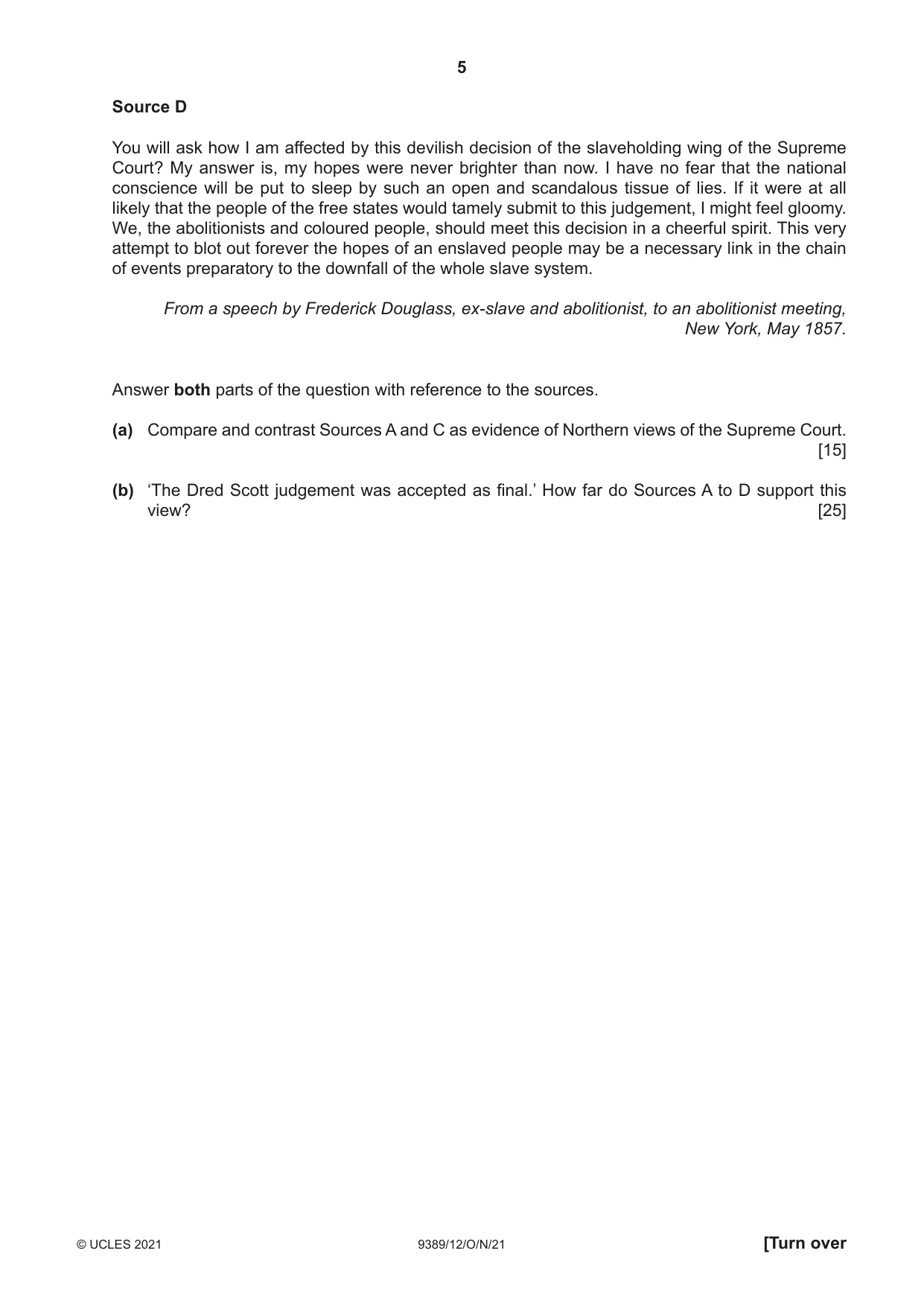
Question paper, page 5
5 9389/12/O/N/21 © UCLES 2021 [Turn over Source D You will ask how I am affected by this devilish decision of the slaveholding wing of the Supreme Court? My answer is, my hopes were never brighter than now. I have no fear that the national conscience will be put to sleep by such an open and scandalous tissue of lies. If it were at all likely that the people of the free states would tamely submit to this judgement, I might feel gloomy. We, the abolitionists and coloured people, should meet this decision in a cheerful spirit. This very attempt to blot out forever the hopes of an enslaved people may be a necessary link in the chain of events preparatory to the downfall of the whole slave system. From a speech by Frederick Douglass, ex-slave and abolitionist, to an abolitionist meeting, New York, May 1857. Answer both parts of the question with reference to the sources. (a) Compare and contrast Sources A and C as evidence of Northern views of the Supreme Court. [15] (b) ‘The Dred Scott judgement was accepted as final.’ How far do Sources A to D support this view? [25]
Question paper, page 6
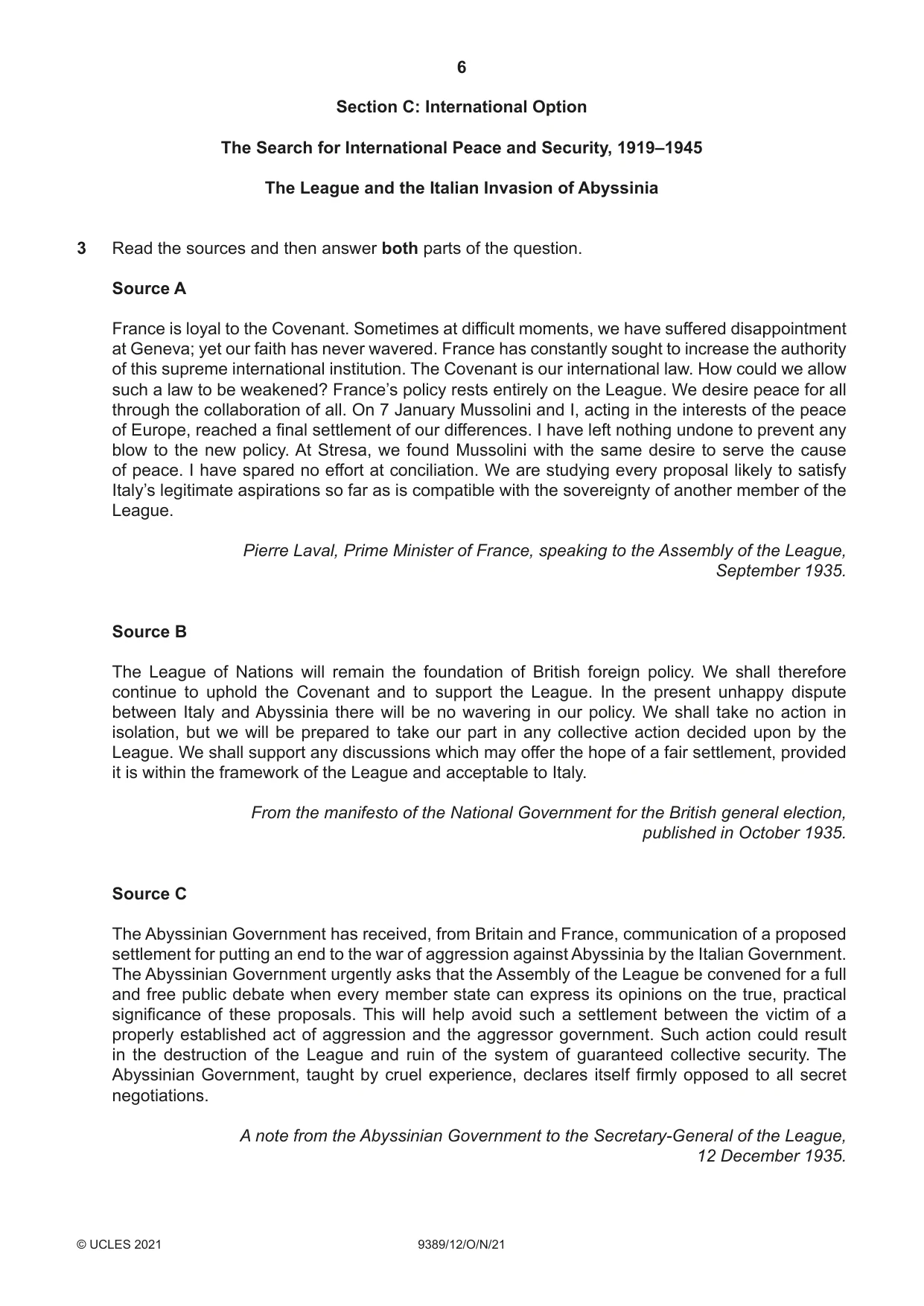
6 9389/12/O/N/21 © UCLES 2021 Section C: International Option The Search for International Peace and Security, 1919–1945 The League and the Italian Invasion of Abyssinia 3 Read the sources and then answer both parts of the question. Source A France is loyal to the Covenant. Sometimes at difficult moments, we have suffered disappointment at Geneva; yet our faith has never wavered. France has constantly sought to increase the authority of this supreme international institution. The Covenant is our international law. How could we allow such a law to be weakened? France’s policy rests entirely on the League. We desire peace for all through the collaboration of all. On 7 January Mussolini and I, acting in the interests of the peace of Europe, reached a final settlement of our differences. I have left nothing undone to prevent any blow to the new policy. At Stresa, we found Mussolini with the same desire to serve the cause of peace. I have spared no effort at conciliation. We are studying every proposal likely to satisfy Italy’s legitimate aspirations so far as is compatible with the sovereignty of another member of the League. Pierre Laval, Prime Minister of France, speaking to the Assembly of the League, September 1935. Source B The League of Nations will remain the foundation of British foreign policy. We shall therefore continue to uphold the Covenant and to support the League. In the present unhappy dispute between Italy and Abyssinia there will be no wavering in our policy. We shall take no action in isolation, but we will be prepared to take our part in any collective action decided upon by the League. We shall support any discussions which may offer the hope of a fair settlement, provided it is within the framework of the League and acceptable to Italy. From the manifesto of the National Government for the British general election, published in October 1935. Source C The Abyssinian Government has received, from Britain and France, communication of a proposed settlement for putting an end to the war of aggression against Abyssinia by the Italian Government. The Abyssinian Government urgently asks that the Assembly of the League be convened for a full and free public debate when every member state can express its opinions on the true, practical significance of these proposals. This will help avoid such a settlement between the victim of a properly established act of aggression and the aggressor government. Such action could result in the destruction of the League and ruin of the system of guaranteed collective security. The Abyssinian Government, taught by cruel experience, declares itself firmly opposed to all secret negotiations. A note from the Abyssinian Government to the Secretary-General of the League, 12 December 1935.
Question paper, page 7
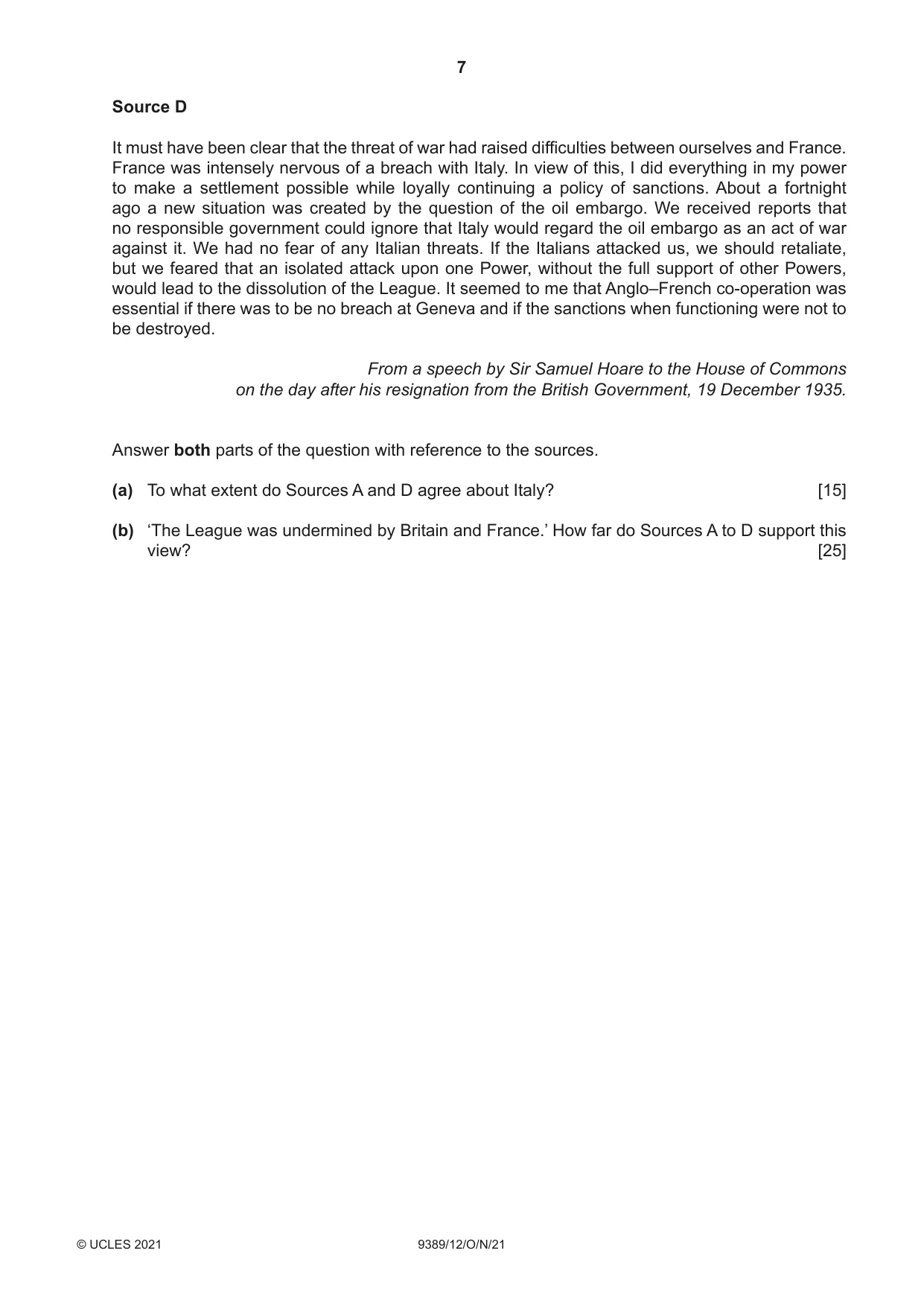
7 9389/12/O/N/21 © UCLES 2021 Source D It must have been clear that the threat of war had raised difficulties between ourselves and France. France was intensely nervous of a breach with Italy. In view of this, I did everything in my power to make a settlement possible while loyally continuing a policy of sanctions. About a fortnight ago a new situation was created by the question of the oil embargo. We received reports that no responsible government could ignore that Italy would regard the oil embargo as an act of war against it. We had no fear of any Italian threats. If the Italians attacked us, we should retaliate, but we feared that an isolated attack upon one Power, without the full support of other Powers, would lead to the dissolution of the League. It seemed to me that Anglo–French co-operation was essential if there was to be no breach at Geneva and if the sanctions when functioning were not to be destroyed. From a speech by Sir Samuel Hoare to the House of Commons on the day after his resignation from the British Government, 19 December 1935. Answer both parts of the question with reference to the sources. (a) To what extent do Sources A and D agree about Italy? [15] (b) ‘The League was undermined by Britain and France.’ How far do Sources A to D support this view? [25]
Question paper, page 8
8 9389/12/O/N/21 © UCLES 2021 Permission to reproduce items where third-party owned material protected by copyright is included has been sought and cleared where possible. Every reasonable effort has been made by the publisher (UCLES) to trace copyright holders, but if any items requiring clearance have unwittingly been included, the publisher will be pleased to make amends at the earliest possible opportunity. To avoid the issue of disclosure of answer-related information to candidates, all copyright acknowledgements are reproduced online in the Cambridge Assessment International Education Copyright Acknowledgements Booklet. This is produced for each series of examinations and is freely available to download at www.cambridgeinternational.org after the live examination series. Cambridge Assessment International Education is part of the Cambridge Assessment Group. Cambridge Assessment is the brand name of the University of Cambridge Local Examinations Syndicate (UCLES), which itself is a department of the University of Cambridge. BLANK PAGE
Mark scheme, page 1
This document consists of 10 printed pages. © UCLES 2021 [Turn over Cambridge International AS & A Level HISTORY 9389/12 Paper 1 Document Question October/November 2021 MARK SCHEME Maximum Mark: 40 Published This mark scheme is published as an aid to teachers and candidates, to indicate the requirements of the examination. It shows the basis on which Examiners were instructed to award marks. It does not indicate the details of the discussions that took place at an Examiners’ meeting before marking began, which would have considered the acceptability of alternative answers. Mark schemes should be read in conjunction with the question paper and the Principal Examiner Report for Teachers. Cambridge International will not enter into discussions about these mark schemes. Cambridge International is publishing the mark schemes for the October/November 2021 series for most Cambridge IGCSE™, Cambridge International A and AS Level components and some Cambridge O Level components.
Mark scheme, page 2
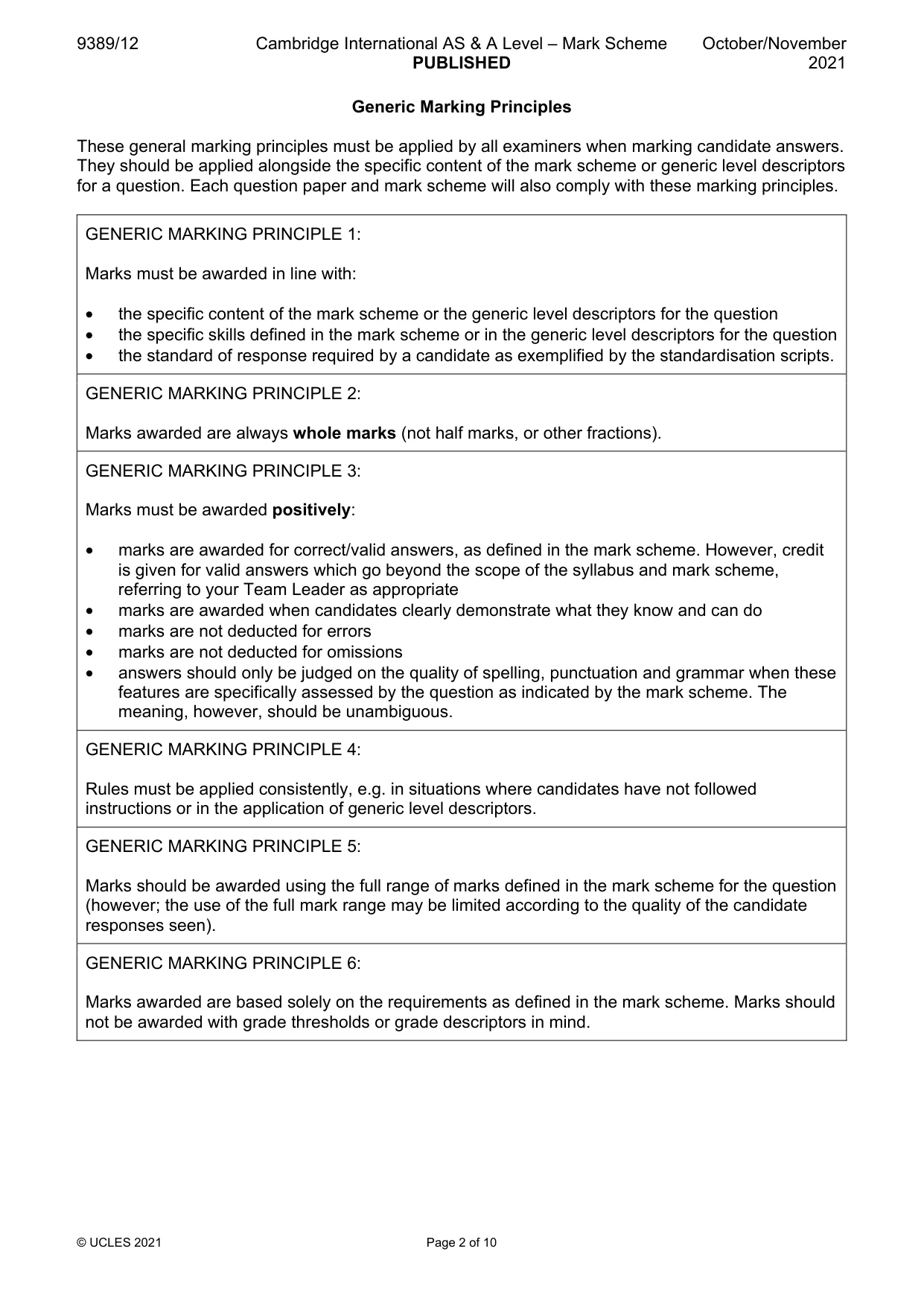
9389/12 Cambridge International AS & A Level – Mark Scheme PUBLISHED October/November 2021 © UCLES 2021 Page 2 of 10 Generic Marking Principles These general marking principles must be applied by all examiners when marking candidate answers. They should be applied alongside the specific content of the mark scheme or generic level descriptors for a question. Each question paper and mark scheme will also comply with these marking principles. GENERIC MARKING PRINCIPLE 1: Marks must be awarded in line with: • the specific content of the mark scheme or the generic level descriptors for the question • the specific skills defined in the mark scheme or in the generic level descriptors for the question • the standard of response required by a candidate as exemplified by the standardisation scripts. GENERIC MARKING PRINCIPLE 2: Marks awarded are always whole marks (not half marks, or other fractions). GENERIC MARKING PRINCIPLE 3: Marks must be awarded positively: • marks are awarded for correct/valid answers, as defined in the mark scheme. However, credit is given for valid answers which go beyond the scope of the syllabus and mark scheme, referring to your Team Leader as appropriate • marks are awarded when candidates clearly demonstrate what they know and can do • marks are not deducted for errors • marks are not deducted for omissions • answers should only be judged on the quality of spelling, punctuation and grammar when these features are specifically assessed by the question as indicated by the mark scheme. The meaning, however, should be unambiguous. GENERIC MARKING PRINCIPLE 4: Rules must be applied consistently, e.g. in situations where candidates have not followed instructions or in the application of generic level descriptors. GENERIC MARKING PRINCIPLE 5: Marks should be awarded using the full range of marks defined in the mark scheme for the question (however; the use of the full mark range may be limited according to the quality of the candidate responses seen). GENERIC MARKING PRINCIPLE 6: Marks awarded are based solely on the requirements as defined in the mark scheme. Marks should not be awarded with grade thresholds or grade descriptors in mind.
Mark scheme, page 3
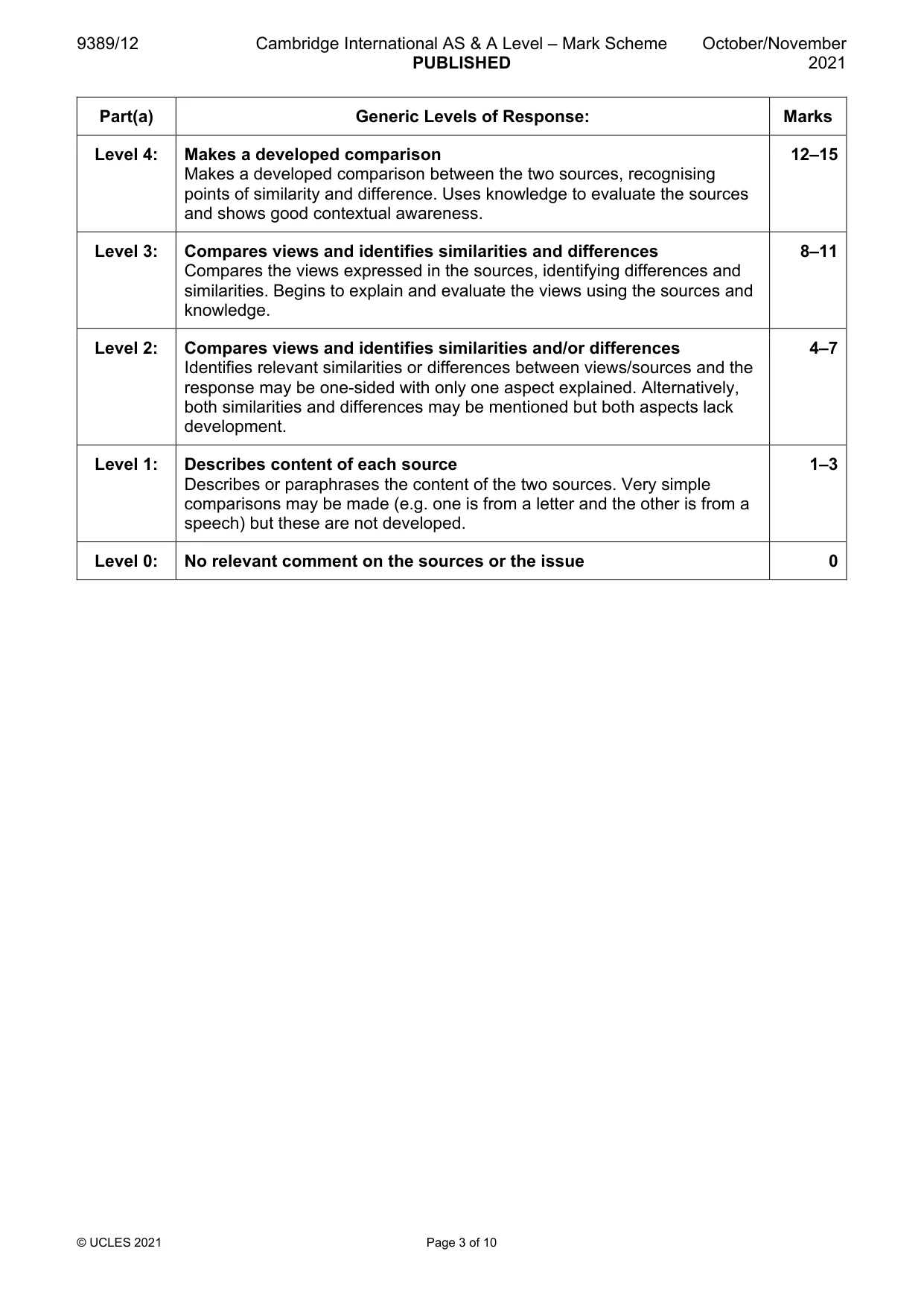
9389/12 Cambridge International AS & A Level – Mark Scheme PUBLISHED October/November 2021 © UCLES 2021 Page 3 of 10 Part(a) Generic Levels of Response: Marks Level 4: Makes a developed comparison Makes a developed comparison between the two sources, recognising points of similarity and difference. Uses knowledge to evaluate the sources and shows good contextual awareness. 12–15 Level 3: Compares views and identifies similarities and differences Compares the views expressed in the sources, identifying differences and similarities. Begins to explain and evaluate the views using the sources and knowledge. 8–11 Level 2: Compares views and identifies similarities and/or differences Identifies relevant similarities or differences between views/sources and the response may be one-sided with only one aspect explained. Alternatively, both similarities and differences may be mentioned but both aspects lack development. 4–7 Level 1: Describes content of each source Describes or paraphrases the content of the two sources. Very simple comparisons may be made (e.g. one is from a letter and the other is from a speech) but these are not developed. 1–3 Level 0: No relevant comment on the sources or the issue 0
Mark scheme, page 4
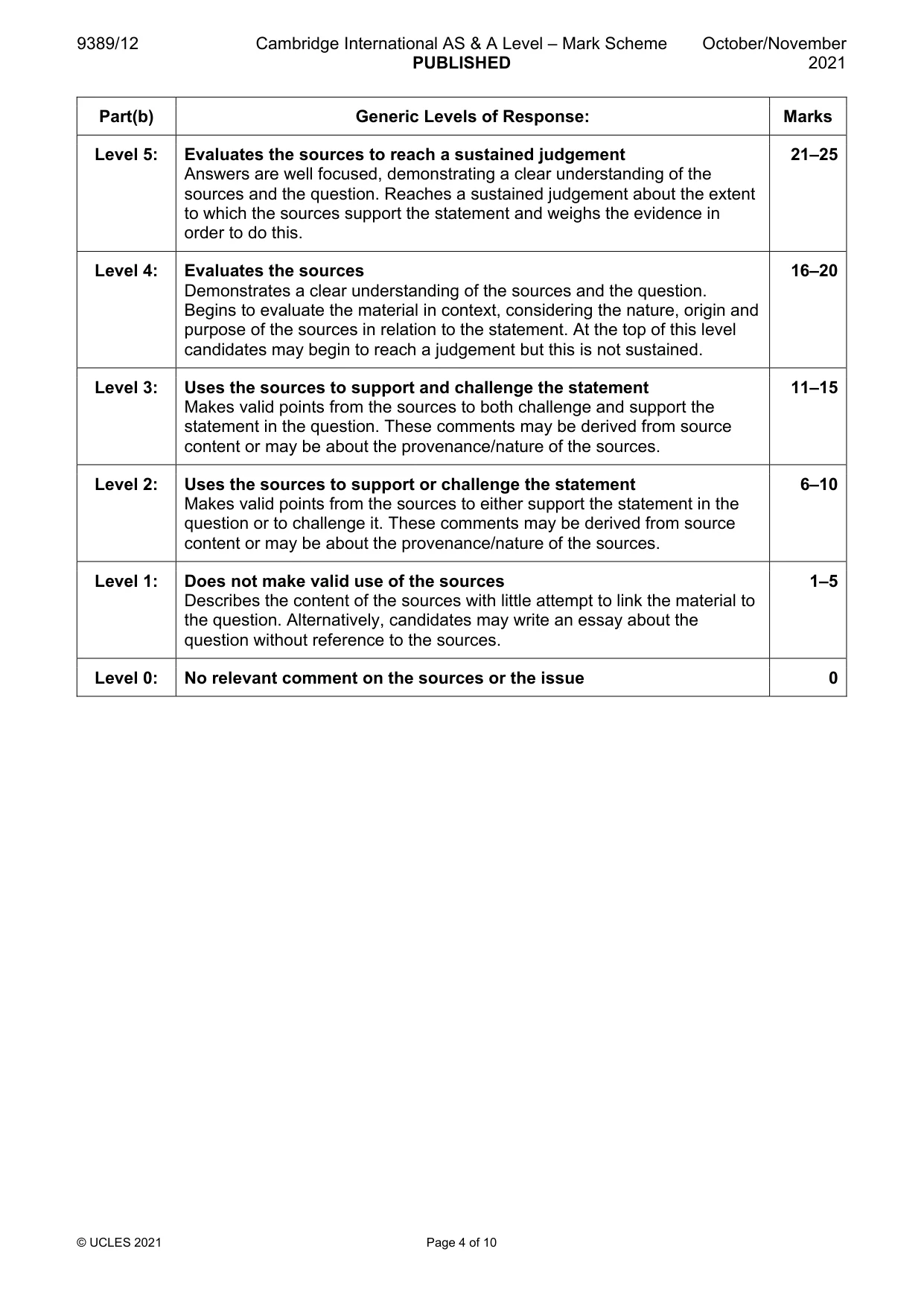
9389/12 Cambridge International AS & A Level – Mark Scheme PUBLISHED October/November 2021 © UCLES 2021 Page 4 of 10 Part(b) Generic Levels of Response: Marks Level 5: Evaluates the sources to reach a sustained judgement Answers are well focused, demonstrating a clear understanding of the sources and the question. Reaches a sustained judgement about the extent to which the sources support the statement and weighs the evidence in order to do this. 21–25 Level 4: Evaluates the sources Demonstrates a clear understanding of the sources and the question. Begins to evaluate the material in context, considering the nature, origin and purpose of the sources in relation to the statement. At the top of this level candidates may begin to reach a judgement but this is not sustained. 16–20 Level 3: Uses the sources to support and challenge the statement Makes valid points from the sources to both challenge and support the statement in the question. These comments may be derived from source content or may be about the provenance/nature of the sources. 11–15 Level 2: Uses the sources to support or challenge the statement Makes valid points from the sources to either support the statement in the question or to challenge it. These comments may be derived from source content or may be about the provenance/nature of the sources. 6–10 Level 1: Does not make valid use of the sources Describes the content of the sources with little attempt to link the material to the question. Alternatively, candidates may write an essay about the question without reference to the sources. 1–5 Level 0: No relevant comment on the sources or the issue 0
Mark scheme, page 5
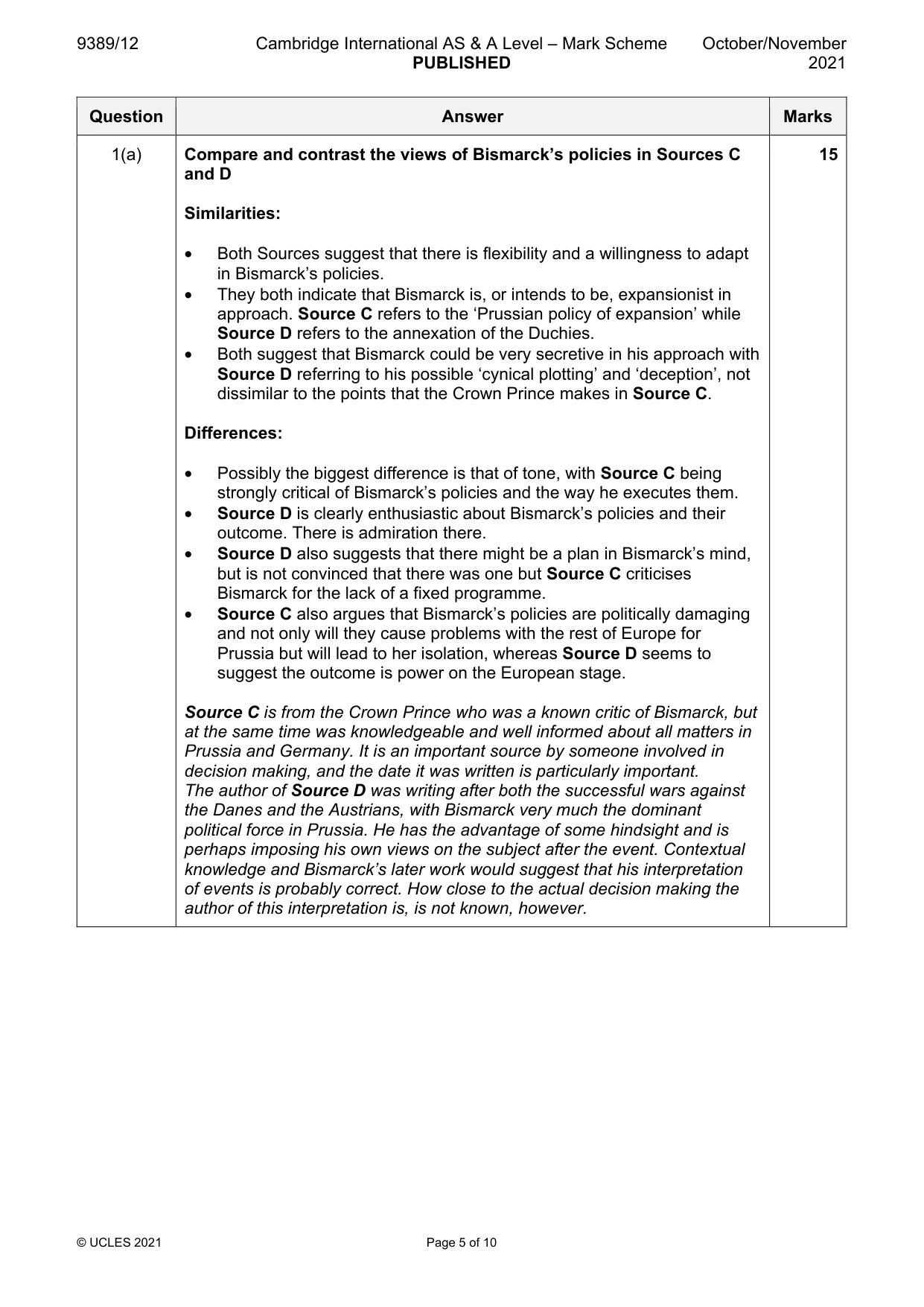
9389/12 Cambridge International AS & A Level – Mark Scheme PUBLISHED October/November 2021 © UCLES 2021 Page 5 of 10 Question Answer Marks 1(a) Compare and contrast the views of Bismarck’s policies in Sources C and D Similarities: • Both Sources suggest that there is flexibility and a willingness to adapt in Bismarck’s policies. • They both indicate that Bismarck is, or intends to be, expansionist in approach. Source C refers to the ‘Prussian policy of expansion’ while Source D refers to the annexation of the Duchies. • Both suggest that Bismarck could be very secretive in his approach with Source D referring to his possible ‘cynical plotting’ and ‘deception’, not dissimilar to the points that the Crown Prince makes in Source C. Differences: • Possibly the biggest difference is that of tone, with Source C being strongly critical of Bismarck’s policies and the way he executes them. • Source D is clearly enthusiastic about Bismarck’s policies and their outcome. There is admiration there. • Source D also suggests that there might be a plan in Bismarck’s mind, but is not convinced that there was one but Source C criticises Bismarck for the lack of a fixed programme. • Source C also argues that Bismarck’s policies are politically damaging and not only will they cause problems with the rest of Europe for Prussia but will lead to her isolation, whereas Source D seems to suggest the outcome is power on the European stage. Source C is from the Crown Prince who was a known critic of Bismarck, but at the same time was knowledgeable and well informed about all matters in Prussia and Germany. It is an important source by someone involved in decision making, and the date it was written is particularly important. The author of Source D was writing after both the successful wars against the Danes and the Austrians, with Bismarck very much the dominant political force in Prussia. He has the advantage of some hindsight and is perhaps imposing his own views on the subject after the event. Contextual knowledge and Bismarck’s later work would suggest that his interpretation of events is probably correct. How close to the actual decision making the author of this interpretation is, is not known, however. 15
Mark scheme, page 6
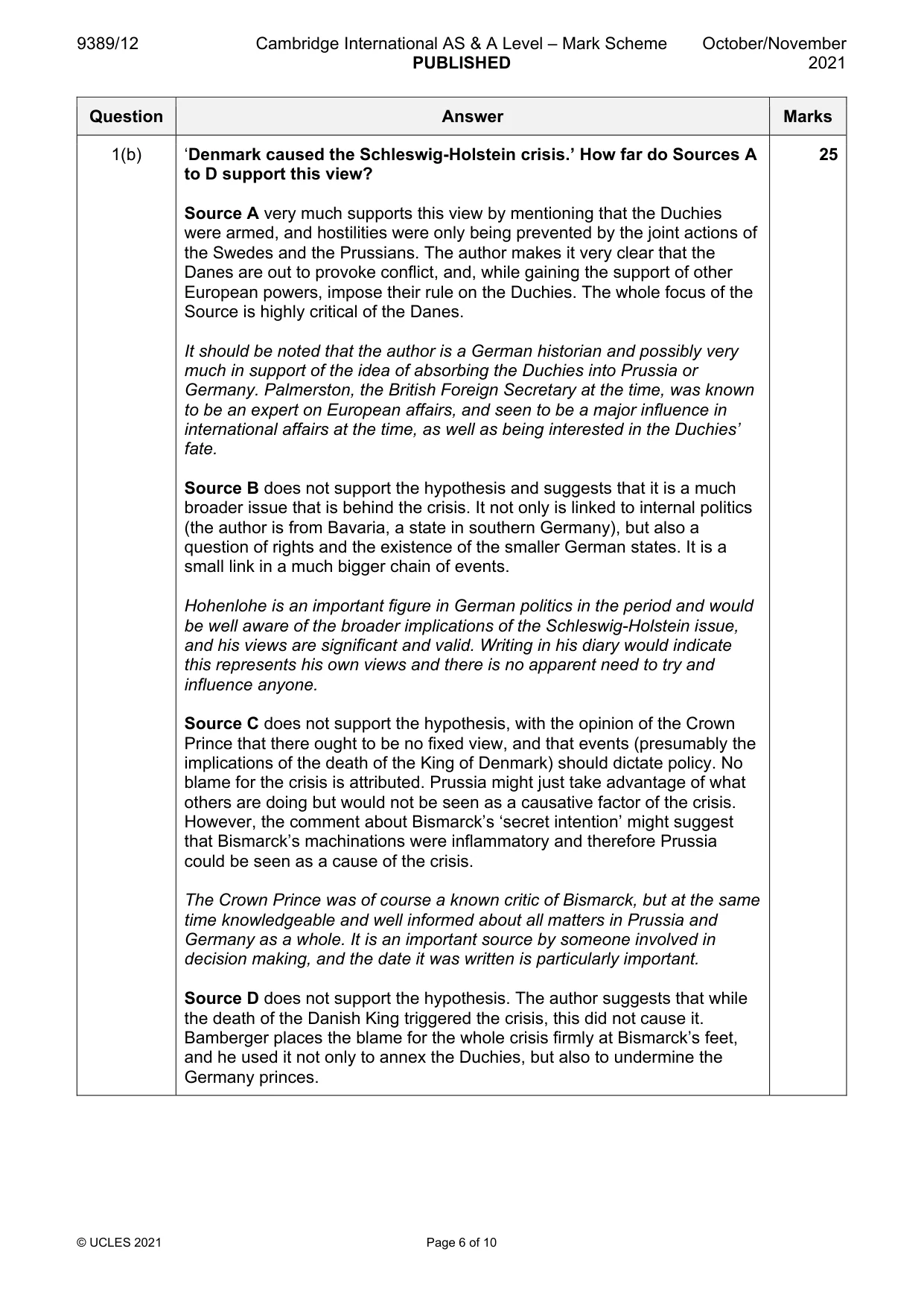
9389/12 Cambridge International AS & A Level – Mark Scheme PUBLISHED October/November 2021 © UCLES 2021 Page 6 of 10 Question Answer Marks 1(b) ‘Denmark caused the Schleswig-Holstein crisis.’ How far do Sources A to D support this view? Source A very much supports this view by mentioning that the Duchies were armed, and hostilities were only being prevented by the joint actions of the Swedes and the Prussians. The author makes it very clear that the Danes are out to provoke conflict, and, while gaining the support of other European powers, impose their rule on the Duchies. The whole focus of the Source is highly critical of the Danes. It should be noted that the author is a German historian and possibly very much in support of the idea of absorbing the Duchies into Prussia or Germany. Palmerston, the British Foreign Secretary at the time, was known to be an expert on European affairs, and seen to be a major influence in international affairs at the time, as well as being interested in the Duchies’ fate. Source B does not support the hypothesis and suggests that it is a much broader issue that is behind the crisis. It not only is linked to internal politics (the author is from Bavaria, a state in southern Germany), but also a question of rights and the existence of the smaller German states. It is a small link in a much bigger chain of events. Hohenlohe is an important figure in German politics in the period and would be well aware of the broader implications of the Schleswig-Holstein issue, and his views are significant and valid. Writing in his diary would indicate this represents his own views and there is no apparent need to try and influence anyone. Source C does not support the hypothesis, with the opinion of the Crown Prince that there ought to be no fixed view, and that events (presumably the implications of the death of the King of Denmark) should dictate policy. No blame for the crisis is attributed. Prussia might just take advantage of what others are doing but would not be seen as a causative factor of the crisis. However, the comment about Bismarck’s ‘secret intention’ might suggest that Bismarck’s machinations were inflammatory and therefore Prussia could be seen as a cause of the crisis. The Crown Prince was of course a known critic of Bismarck, but at the same time knowledgeable and well informed about all matters in Prussia and Germany as a whole. It is an important source by someone involved in decision making, and the date it was written is particularly important. Source D does not support the hypothesis. The author suggests that while the death of the Danish King triggered the crisis, this did not cause it. Bamberger places the blame for the whole crisis firmly at Bismarck’s feet, and he used it not only to annex the Duchies, but also to undermine the Germany princes. 25
Mark scheme, page 7
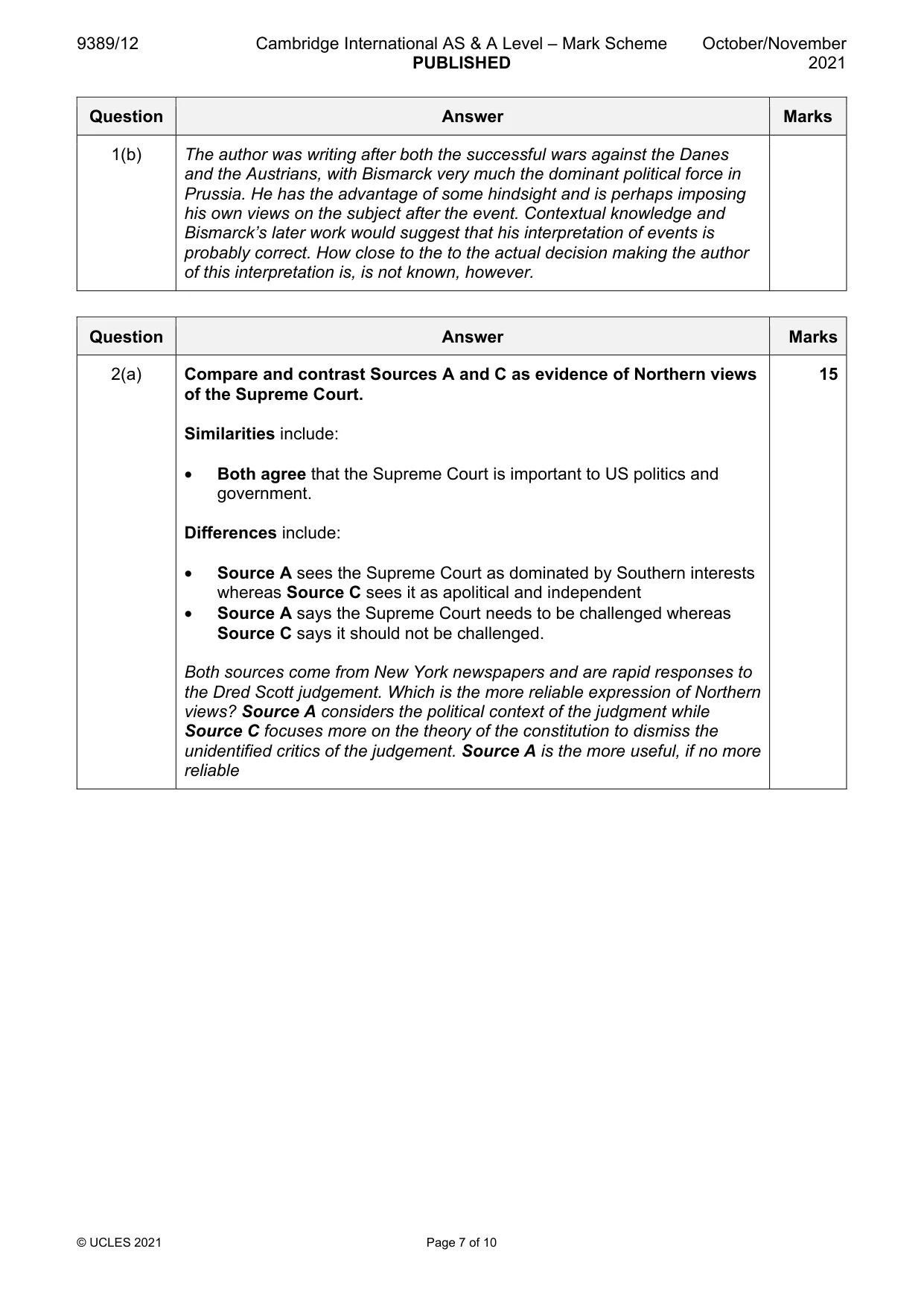
9389/12 Cambridge International AS & A Level – Mark Scheme PUBLISHED October/November 2021 © UCLES 2021 Page 7 of 10 Question Answer Marks 1(b) The author was writing after both the successful wars against the Danes and the Austrians, with Bismarck very much the dominant political force in Prussia. He has the advantage of some hindsight and is perhaps imposing his own views on the subject after the event. Contextual knowledge and Bismarck’s later work would suggest that his interpretation of events is probably correct. How close to the to the actual decision making the author of this interpretation is, is not known, however. Question Answer Marks 2(a) Compare and contrast Sources A and C as evidence of Northern views of the Supreme Court. Similarities include: • Both agree that the Supreme Court is important to US politics and government. Differences include: • Source A sees the Supreme Court as dominated by Southern interests whereas Source C sees it as apolitical and independent • Source A says the Supreme Court needs to be challenged whereas Source C says it should not be challenged. Both sources come from New York newspapers and are rapid responses to the Dred Scott judgement. Which is the more reliable expression of Northern views? Source A considers the political context of the judgment while Source C focuses more on the theory of the constitution to dismiss the unidentified critics of the judgement. Source A is the more useful, if no more reliable 15
Mark scheme, page 8
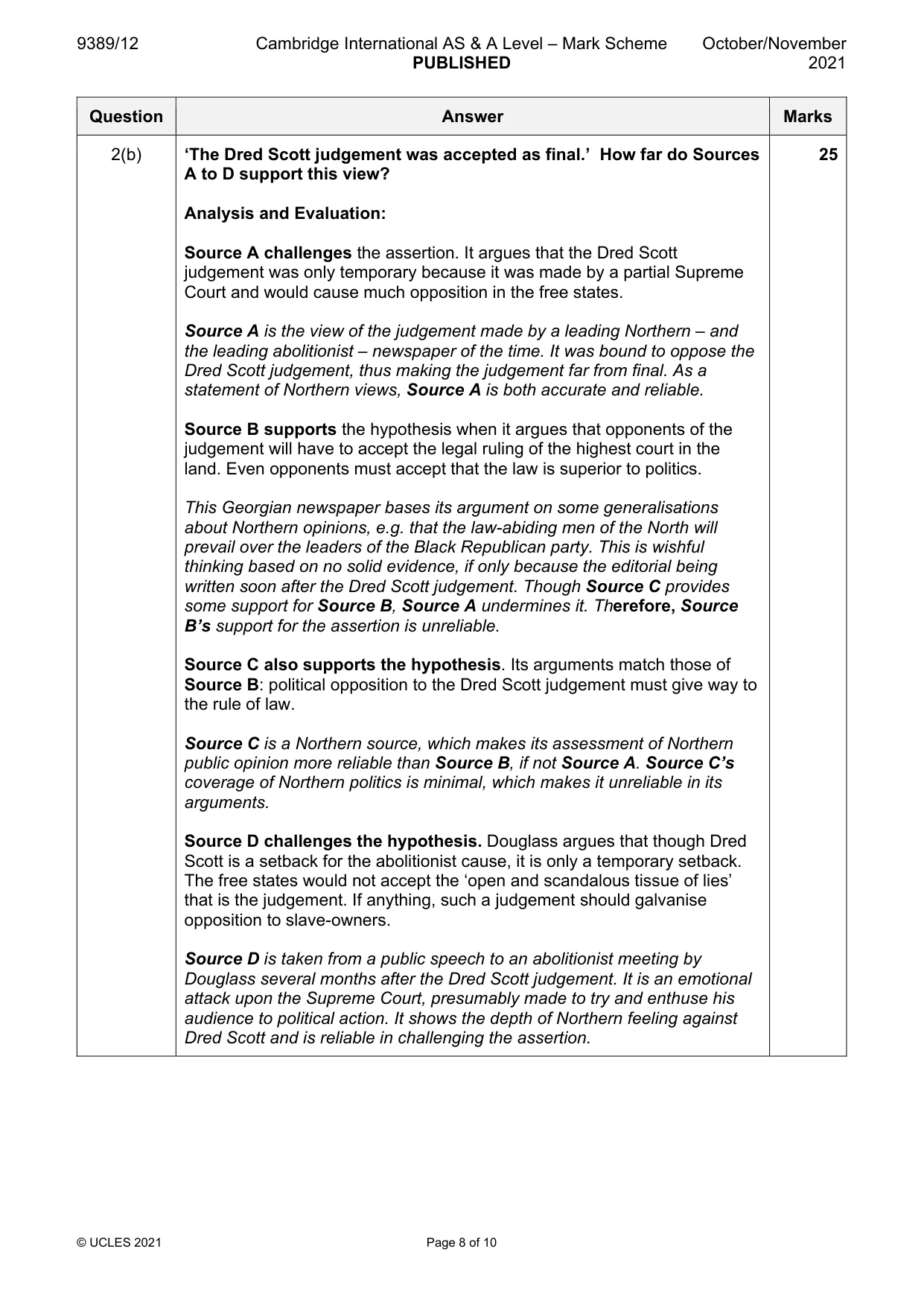
9389/12 Cambridge International AS & A Level – Mark Scheme PUBLISHED October/November 2021 © UCLES 2021 Page 8 of 10 Question Answer Marks 2(b) ‘The Dred Scott judgement was accepted as final.’ How far do Sources A to D support this view? Analysis and Evaluation: Source A challenges the assertion. It argues that the Dred Scott judgement was only temporary because it was made by a partial Supreme Court and would cause much opposition in the free states. Source A is the view of the judgement made by a leading Northern – and the leading abolitionist – newspaper of the time. It was bound to oppose the Dred Scott judgement, thus making the judgement far from final. As a statement of Northern views, Source A is both accurate and reliable. Source B supports the hypothesis when it argues that opponents of the judgement will have to accept the legal ruling of the highest court in the land. Even opponents must accept that the law is superior to politics. This Georgian newspaper bases its argument on some generalisations about Northern opinions, e.g. that the law-abiding men of the North will prevail over the leaders of the Black Republican party. This is wishful thinking based on no solid evidence, if only because the editorial being written soon after the Dred Scott judgement. Though Source C provides some support for Source B, Source A undermines it. Therefore, Source B’s support for the assertion is unreliable. Source C also supports the hypothesis. Its arguments match those of Source B: political opposition to the Dred Scott judgement must give way to the rule of law. Source C is a Northern source, which makes its assessment of Northern public opinion more reliable than Source B, if not Source A. Source C’s coverage of Northern politics is minimal, which makes it unreliable in its arguments. Source D challenges the hypothesis. Douglass argues that though Dred Scott is a setback for the abolitionist cause, it is only a temporary setback. The free states would not accept the ‘open and scandalous tissue of lies’ that is the judgement. If anything, such a judgement should galvanise opposition to slave-owners. Source D is taken from a public speech to an abolitionist meeting by Douglass several months after the Dred Scott judgement. It is an emotional attack upon the Supreme Court, presumably made to try and enthuse his audience to political action. It shows the depth of Northern feeling against Dred Scott and is reliable in challenging the assertion. 25
Mark scheme, page 9
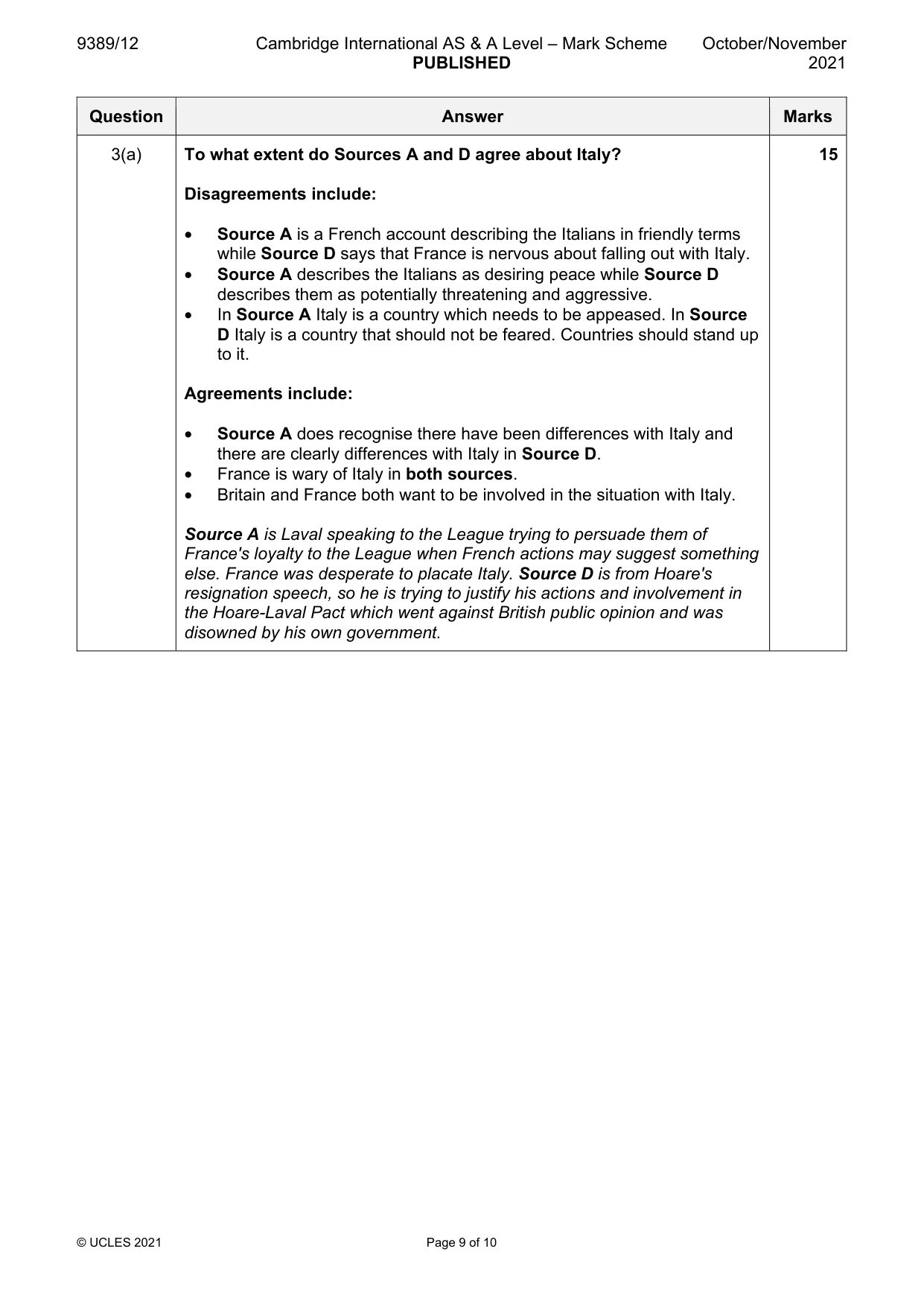
9389/12 Cambridge International AS & A Level – Mark Scheme PUBLISHED October/November 2021 © UCLES 2021 Page 9 of 10 Question Answer Marks 3(a) To what extent do Sources A and D agree about Italy? Disagreements include: • Source A is a French account describing the Italians in friendly terms while Source D says that France is nervous about falling out with Italy. • Source A describes the Italians as desiring peace while Source D describes them as potentially threatening and aggressive. • In Source A Italy is a country which needs to be appeased. In Source D Italy is a country that should not be feared. Countries should stand up to it. Agreements include: • Source A does recognise there have been differences with Italy and there are clearly differences with Italy in Source D. • France is wary of Italy in both sources. • Britain and France both want to be involved in the situation with Italy. Source A is Laval speaking to the League trying to persuade them of France's loyalty to the League when French actions may suggest something else. France was desperate to placate Italy. Source D is from Hoare's resignation speech, so he is trying to justify his actions and involvement in the Hoare-Laval Pact which went against British public opinion and was disowned by his own government. 15
Mark scheme, page 10
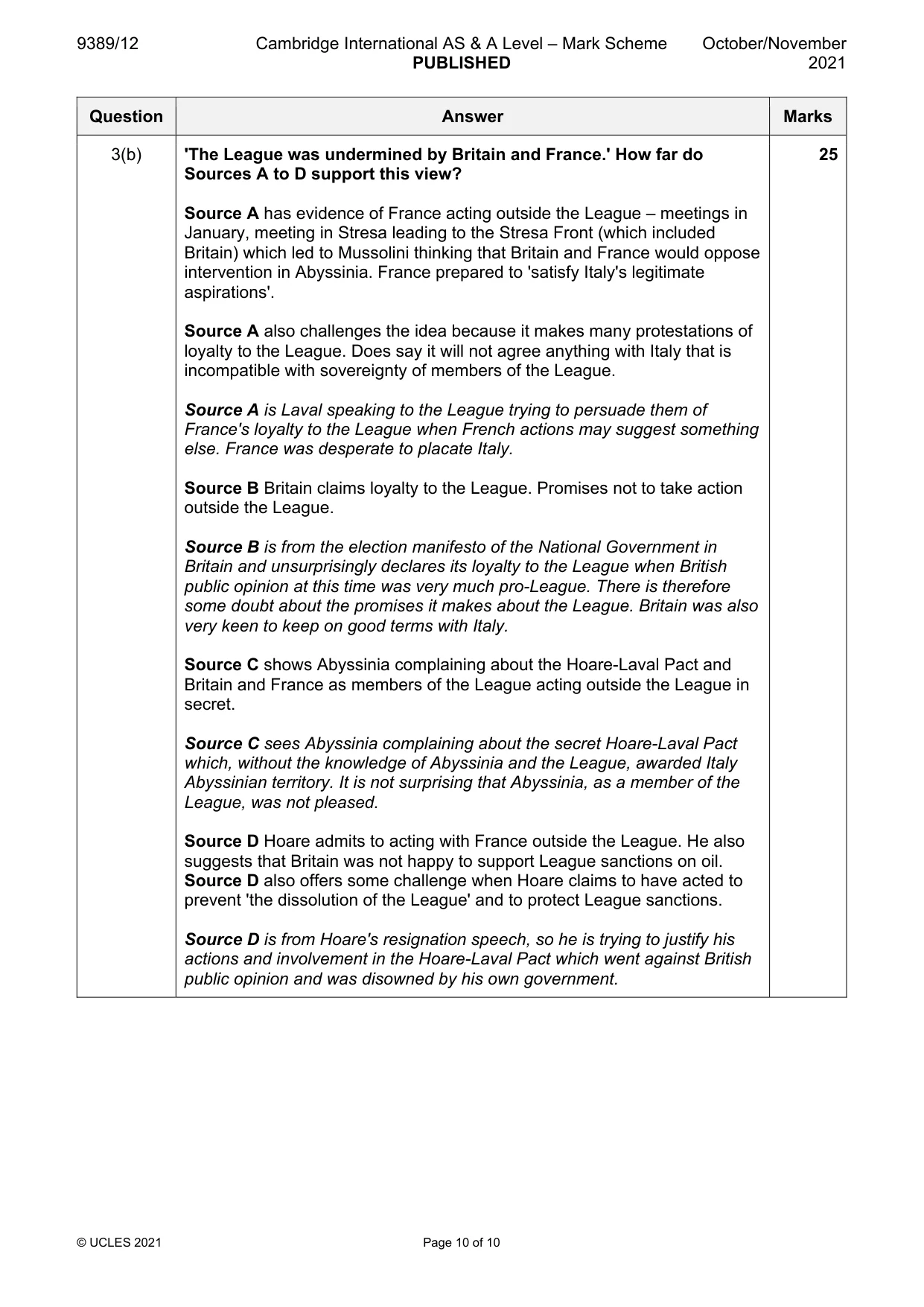
9389/12 Cambridge International AS & A Level – Mark Scheme PUBLISHED October/November 2021 © UCLES 2021 Page 10 of 10 Question Answer Marks 3(b) 'The League was undermined by Britain and France.' How far do Sources A to D support this view? Source A has evidence of France acting outside the League – meetings in January, meeting in Stresa leading to the Stresa Front (which included Britain) which led to Mussolini thinking that Britain and France would oppose intervention in Abyssinia. France prepared to 'satisfy Italy's legitimate aspirations'. Source A also challenges the idea because it makes many protestations of loyalty to the League. Does say it will not agree anything with Italy that is incompatible with sovereignty of members of the League. Source A is Laval speaking to the League trying to persuade them of France's loyalty to the League when French actions may suggest something else. France was desperate to placate Italy. Source B Britain claims loyalty to the League. Promises not to take action outside the League. Source B is from the election manifesto of the National Government in Britain and unsurprisingly declares its loyalty to the League when British public opinion at this time was very much pro-League. There is therefore some doubt about the promises it makes about the League. Britain was also very keen to keep on good terms with Italy. Source C shows Abyssinia complaining about the Hoare-Laval Pact and Britain and France as members of the League acting outside the League in secret. Source C sees Abyssinia complaining about the secret Hoare-Laval Pact which, without the knowledge of Abyssinia and the League, awarded Italy Abyssinian territory. It is not surprising that Abyssinia, as a member of the League, was not pleased. Source D Hoare admits to acting with France outside the League. He also suggests that Britain was not happy to support League sanctions on oil. Source D also offers some challenge when Hoare claims to have acted to prevent 'the dissolution of the League' and to protect League sanctions. Source D is from Hoare's resignation speech, so he is trying to justify his actions and involvement in the Hoare-Laval Pact which went against British public opinion and was disowned by his own government. 25
What you needed in this session
Cambridge’s own grade thresholds for 2021 Oct/Nov, Paper 1 · Variant 2. A higher threshold means an easier paper — the bar moves with how the cohort did.