Cambridge A Level History 9389 — 2019 Oct/Nov Paper 1 · Variant 2
9389/12/O/N/19 · 40 marks · ≈45 min
The question paper and its mark scheme, free to read here and free to download. This is Cambridge’s own paper, exactly as it was sat.
Question paper8 pages

Mark scheme13 pages
Answers below. Sit the paper first if you are practising.
Paper as text
Question paper, page 1
This document consists of 7 printed pages, 1 blank page and 1 Insert. DC (SC/CB) 173264/2 © UCLES 2019 [Turn over Cambridge Assessment International Education Cambridge International Advanced Subsidiary and Advanced Level * 1 8 5 8 9 4 3 8 1 3 * HISTORY 9389/12 Paper 1 Document Question October/November 2019 1 hour No Additional Materials are required. READ THESE INSTRUCTIONS FIRST An answer booklet is provided inside this question paper. You should follow the instructions on the front cover of the answer booklet. If you need additional answer paper ask the invigilator for a continuation booklet. This paper contains three sections: Section A: European Option Section B: American Option Section C: International Option Answer both parts of the question from one section only. The marks are given in brackets [ ] at the end of each part question.
Question paper, page 2
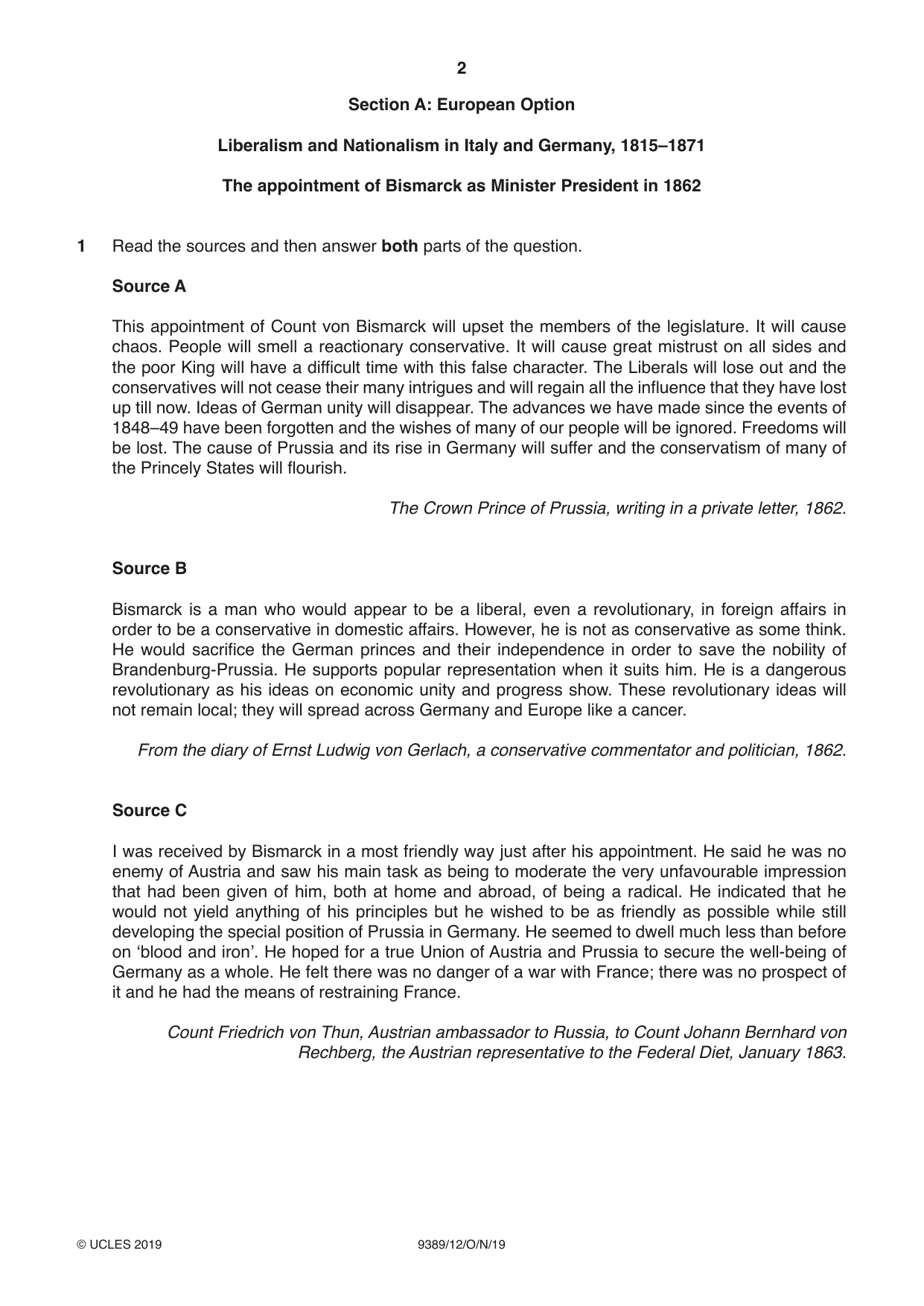
2 9389/12/O/N/19 © UCLES 2019 Section A: European Option Liberalism and Nationalism in Italy and Germany, 1815–1871 The appointment of Bismarck as Minister President in 1862 1 Read the sources and then answer both parts of the question. Source A This appointment of Count von Bismarck will upset the members of the legislature. It will cause chaos. People will smell a reactionary conservative. It will cause great mistrust on all sides and the poor King will have a difficult time with this false character. The Liberals will lose out and the conservatives will not cease their many intrigues and will regain all the influence that they have lost up till now. Ideas of German unity will disappear. The advances we have made since the events of 1848–49 have been forgotten and the wishes of many of our people will be ignored. Freedoms will be lost. The cause of Prussia and its rise in Germany will suffer and the conservatism of many of the Princely States will flourish. The Crown Prince of Prussia, writing in a private letter, 1862. Source B Bismarck is a man who would appear to be a liberal, even a revolutionary, in foreign affairs in order to be a conservative in domestic affairs. However, he is not as conservative as some think. He would sacrifice the German princes and their independence in order to save the nobility of Brandenburg-Prussia. He supports popular representation when it suits him. He is a dangerous revolutionary as his ideas on economic unity and progress show. These revolutionary ideas will not remain local; they will spread across Germany and Europe like a cancer. From the diary of Ernst Ludwig von Gerlach, a conservative commentator and politician, 1862. Source C I was received by Bismarck in a most friendly way just after his appointment. He said he was no enemy of Austria and saw his main task as being to moderate the very unfavourable impression that had been given of him, both at home and abroad, of being a radical. He indicated that he would not yield anything of his principles but he wished to be as friendly as possible while still developing the special position of Prussia in Germany. He seemed to dwell much less than before on ‘blood and iron’. He hoped for a true Union of Austria and Prussia to secure the well-being of Germany as a whole. He felt there was no danger of a war with France; there was no prospect of it and he had the means of restraining France. Count Friedrich von Thun, Austrian ambassador to Russia, to Count Johann Bernhard von Rechberg, the Austrian representative to the Federal Diet, January 1863.
Question paper, page 3
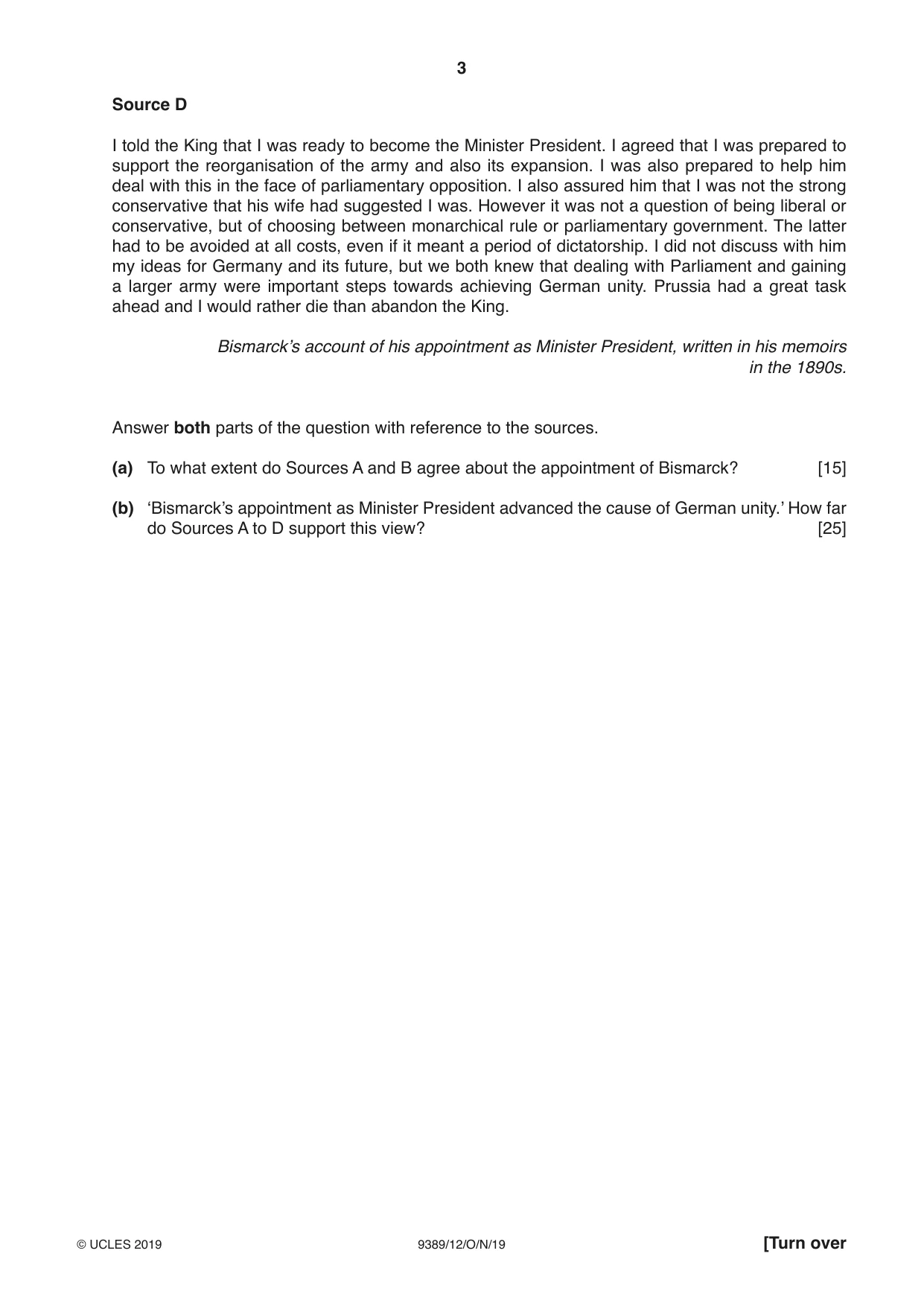
3 9389/12/O/N/19 © UCLES 2019 [Turn over Source D I told the King that I was ready to become the Minister President. I agreed that I was prepared to support the reorganisation of the army and also its expansion. I was also prepared to help him deal with this in the face of parliamentary opposition. I also assured him that I was not the strong conservative that his wife had suggested I was. However it was not a question of being liberal or conservative, but of choosing between monarchical rule or parliamentary government. The latter had to be avoided at all costs, even if it meant a period of dictatorship. I did not discuss with him my ideas for Germany and its future, but we both knew that dealing with Parliament and gaining a larger army were important steps towards achieving German unity. Prussia had a great task ahead and I would rather die than abandon the King. Bismarck’s account of his appointment as Minister President, written in his memoirs in the 1890s. Answer both parts of the question with reference to the sources. (a) To what extent do Sources A and B agree about the appointment of Bismarck? [15] (b) ‘Bismarck’s appointment as Minister President advanced the cause of German unity.’ How far do Sources A to D support this view? [25]
Question paper, page 4
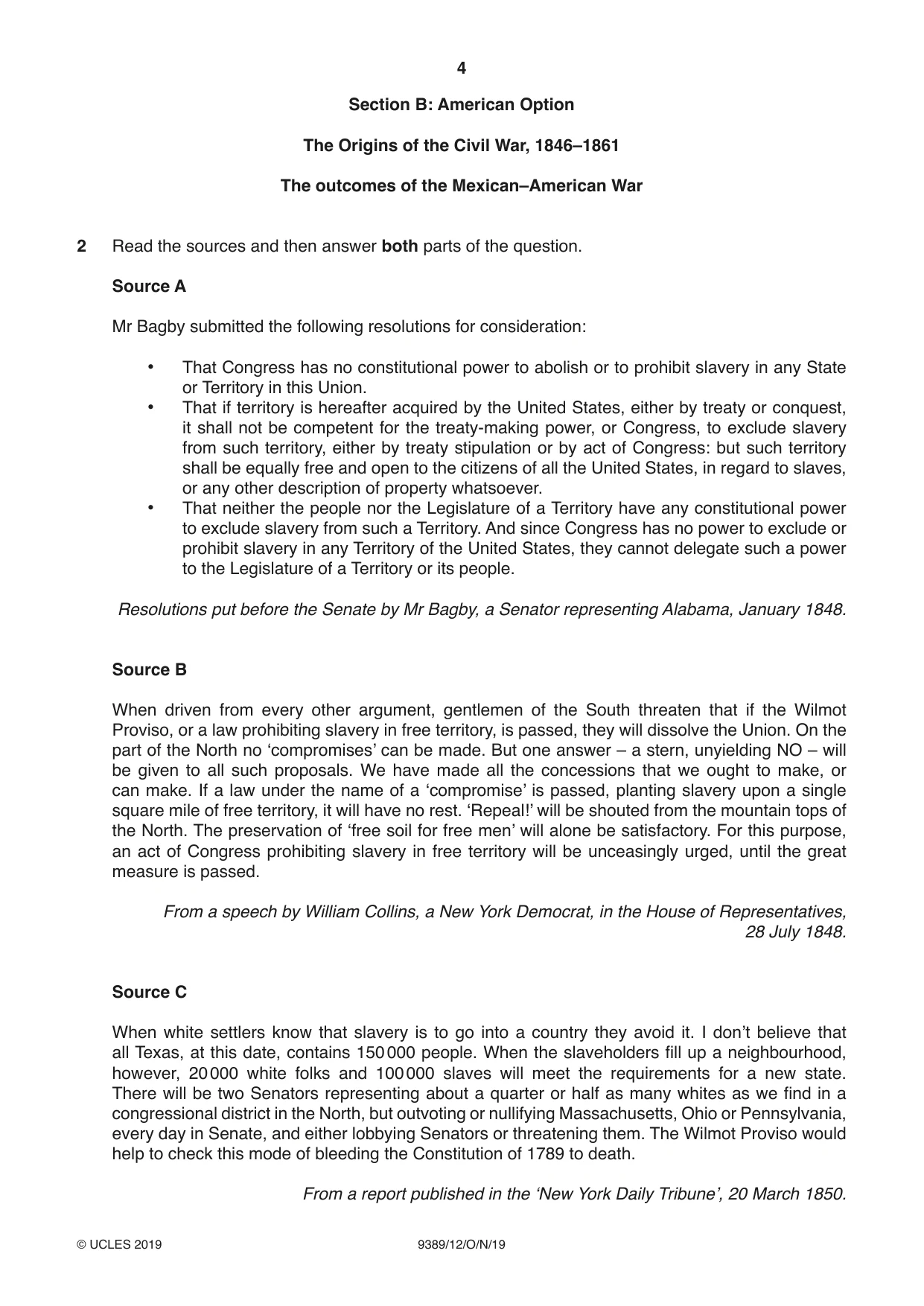
4 9389/12/O/N/19 © UCLES 2019 Section B: American Option The Origins of the Civil War, 1846–1861 The outcomes of the Mexican–American War 2 Read the sources and then answer both parts of the question. Source A Mr Bagby submitted the following resolutions for consideration: • That Congress has no constitutional power to abolish or to prohibit slavery in any State or Territory in this Union. • That if territory is hereafter acquired by the United States, either by treaty or conquest, it shall not be competent for the treaty-making power, or Congress, to exclude slavery from such territory, either by treaty stipulation or by act of Congress: but such territory shall be equally free and open to the citizens of all the United States, in regard to slaves, or any other description of property whatsoever. • That neither the people nor the Legislature of a Territory have any constitutional power to exclude slavery from such a Territory. And since Congress has no power to exclude or prohibit slavery in any Territory of the United States, they cannot delegate such a power to the Legislature of a Territory or its people. Resolutions put before the Senate by Mr Bagby, a Senator representing Alabama, January 1848. Source B When driven from every other argument, gentlemen of the South threaten that if the Wilmot Proviso, or a law prohibiting slavery in free territory, is passed, they will dissolve the Union. On the part of the North no ‘compromises’ can be made. But one answer – a stern, unyielding NO – will be given to all such proposals. We have made all the concessions that we ought to make, or can make. If a law under the name of a ‘compromise’ is passed, planting slavery upon a single square mile of free territory, it will have no rest. ‘Repeal!’ will be shouted from the mountain tops of the North. The preservation of ‘free soil for free men’ will alone be satisfactory. For this purpose, an act of Congress prohibiting slavery in free territory will be unceasingly urged, until the great measure is passed. From a speech by William Collins, a New York Democrat, in the House of Representatives, 28 July 1848. Source C When white settlers know that slavery is to go into a country they avoid it. I don’t believe that all Texas, at this date, contains 150 000 people. When the slaveholders fill up a neighbourhood, however, 20 000 white folks and 100 000 slaves will meet the requirements for a new state. There will be two Senators representing about a quarter or half as many whites as we find in a congressional district in the North, but outvoting or nullifying Massachusetts, Ohio or Pennsylvania, every day in Senate, and either lobbying Senators or threatening them. The Wilmot Proviso would help to check this mode of bleeding the Constitution of 1789 to death. From a report published in the ‘New York Daily Tribune’, 20 March 1850.
Question paper, page 5
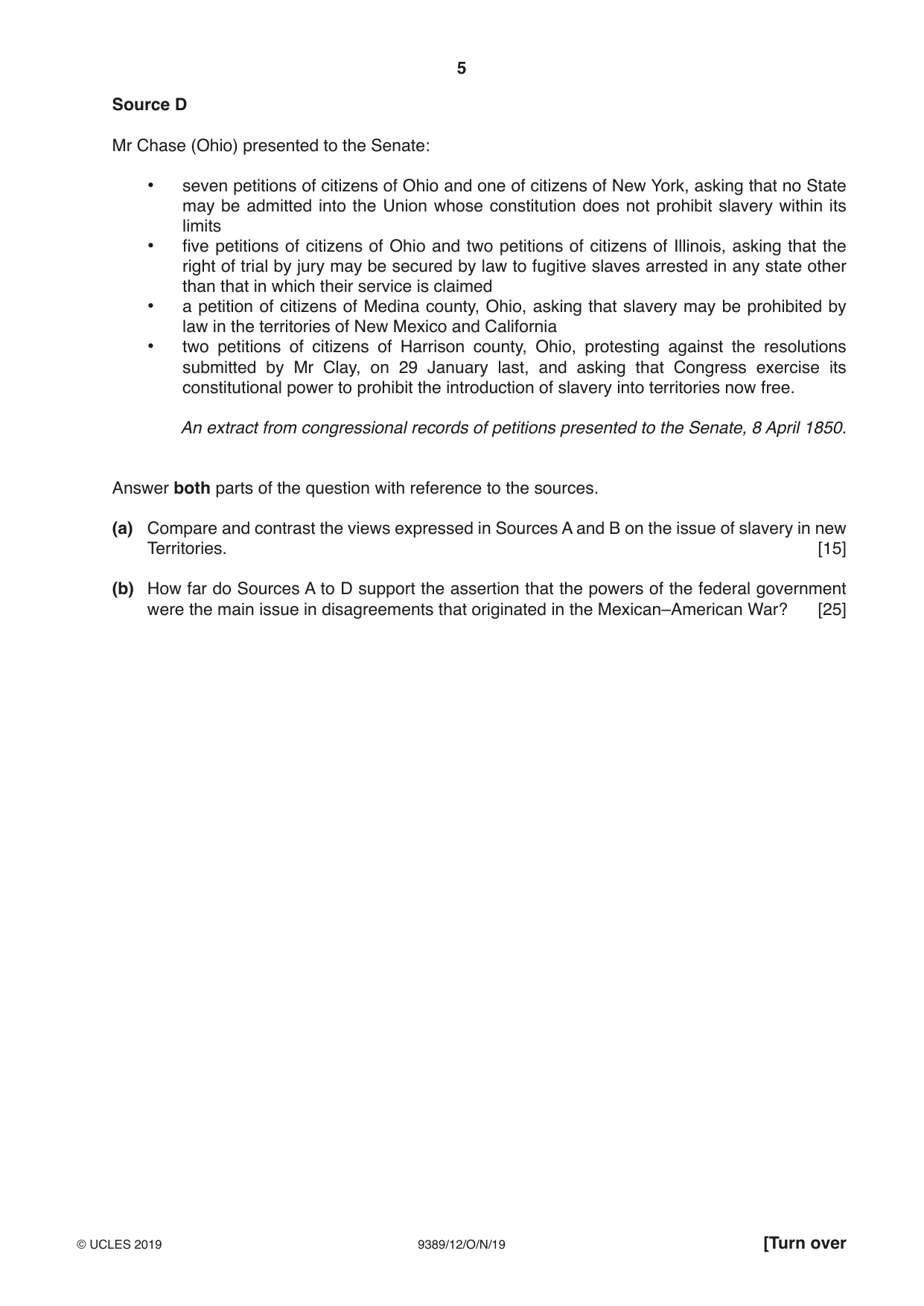
5 9389/12/O/N/19 © UCLES 2019 [Turn over Source D Mr Chase (Ohio) presented to the Senate: • seven petitions of citizens of Ohio and one of citizens of New York, asking that no State may be admitted into the Union whose constitution does not prohibit slavery within its limits • five petitions of citizens of Ohio and two petitions of citizens of Illinois, asking that the right of trial by jury may be secured by law to fugitive slaves arrested in any state other than that in which their service is claimed • a petition of citizens of Medina county, Ohio, asking that slavery may be prohibited by law in the territories of New Mexico and California • two petitions of citizens of Harrison county, Ohio, protesting against the resolutions submitted by Mr Clay, on 29 January last, and asking that Congress exercise its constitutional power to prohibit the introduction of slavery into territories now free. An extract from congressional records of petitions presented to the Senate, 8 April 1850. Answer both parts of the question with reference to the sources. (a) Compare and contrast the views expressed in Sources A and B on the issue of slavery in new Territories. [15] (b) How far do Sources A to D support the assertion that the powers of the federal government were the main issue in disagreements that originated in the Mexican–American War? [25]
Question paper, page 6
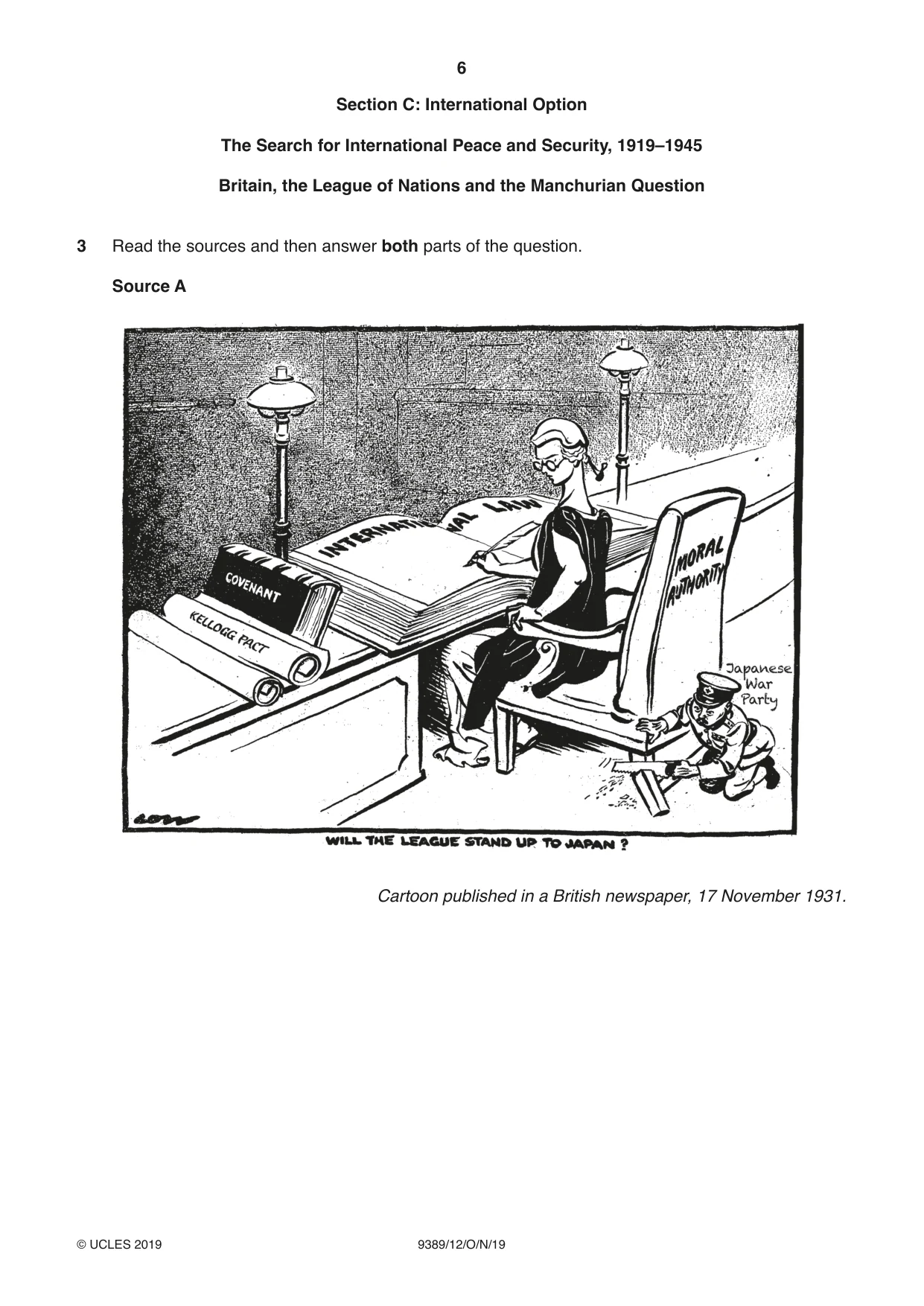
6 9389/12/O/N/19 © UCLES 2019 Section C: International Option The Search for International Peace and Security, 1919–1945 Britain, the League of Nations and the Manchurian Question 3 Read the sources and then answer both parts of the question. Source A Cartoon published in a British newspaper, 17 November 1931.
Question paper, page 7
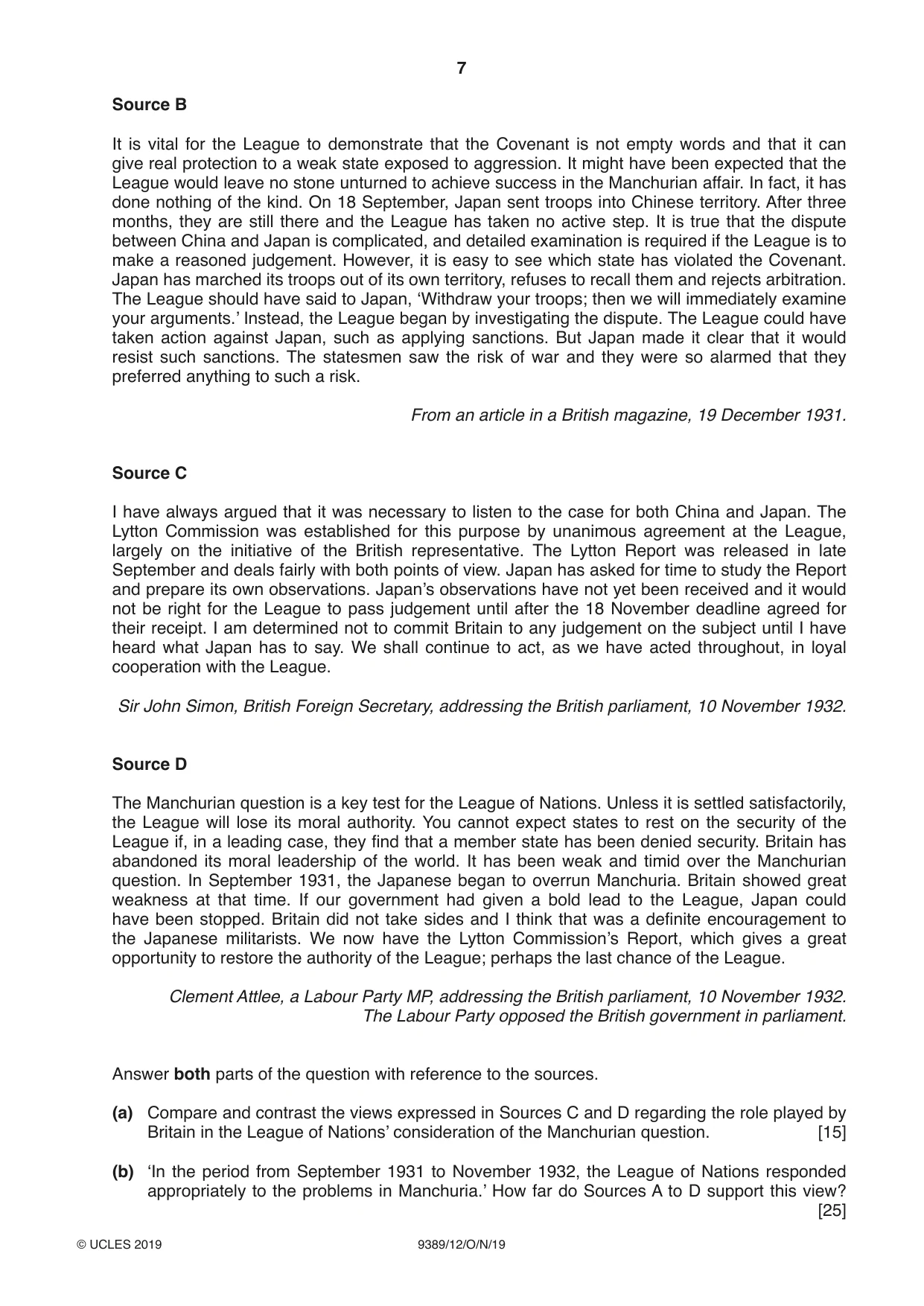
7 9389/12/O/N/19 © UCLES 2019 Source B It is vital for the League to demonstrate that the Covenant is not empty words and that it can give real protection to a weak state exposed to aggression. It might have been expected that the League would leave no stone unturned to achieve success in the Manchurian affair. In fact, it has done nothing of the kind. On 18 September, Japan sent troops into Chinese territory. After three months, they are still there and the League has taken no active step. It is true that the dispute between China and Japan is complicated, and detailed examination is required if the League is to make a reasoned judgement. However, it is easy to see which state has violated the Covenant. Japan has marched its troops out of its own territory, refuses to recall them and rejects arbitration. The League should have said to Japan, ‘Withdraw your troops; then we will immediately examine your arguments.’ Instead, the League began by investigating the dispute. The League could have taken action against Japan, such as applying sanctions. But Japan made it clear that it would resist such sanctions. The statesmen saw the risk of war and they were so alarmed that they preferred anything to such a risk. From an article in a British magazine, 19 December 1931. Source C I have always argued that it was necessary to listen to the case for both China and Japan. The Lytton Commission was established for this purpose by unanimous agreement at the League, largely on the initiative of the British representative. The Lytton Report was released in late September and deals fairly with both points of view. Japan has asked for time to study the Report and prepare its own observations. Japan’s observations have not yet been received and it would not be right for the League to pass judgement until after the 18 November deadline agreed for their receipt. I am determined not to commit Britain to any judgement on the subject until I have heard what Japan has to say. We shall continue to act, as we have acted throughout, in loyal cooperation with the League. Sir John Simon, British Foreign Secretary, addressing the British parliament, 10 November 1932. Source D The Manchurian question is a key test for the League of Nations. Unless it is settled satisfactorily, the League will lose its moral authority. You cannot expect states to rest on the security of the League if, in a leading case, they find that a member state has been denied security. Britain has abandoned its moral leadership of the world. It has been weak and timid over the Manchurian question. In September 1931, the Japanese began to overrun Manchuria. Britain showed great weakness at that time. If our government had given a bold lead to the League, Japan could have been stopped. Britain did not take sides and I think that was a definite encouragement to the Japanese militarists. We now have the Lytton Commission’s Report, which gives a great opportunity to restore the authority of the League; perhaps the last chance of the League. Clement Attlee, a Labour Party MP, addressing the British parliament, 10 November 1932. The Labour Party opposed the British government in parliament. Answer both parts of the question with reference to the sources. (a) Compare and contrast the views expressed in Sources C and D regarding the role played by Britain in the League of Nations’ consideration of the Manchurian question. [15] (b) ‘In the period from September 1931 to November 1932, the League of Nations responded appropriately to the problems in Manchuria.’ How far do Sources A to D support this view? [25]
Question paper, page 8
8 9389/12/O/N/19 © UCLES 2019 Permission to reproduce items where third-party owned material protected by copyright is included has been sought and cleared where possible. Every reasonable effort has been made by the publisher (UCLES) to trace copyright holders, but if any items requiring clearance have unwittingly been included, the publisher will be pleased to make amends at the earliest possible opportunity. To avoid the issue of disclosure of answer-related information to candidates, all copyright acknowledgements are reproduced online in the Cambridge Assessment International Education Copyright Acknowledgements Booklet. This is produced for each series of examinations and is freely available to download at www.cambridgeinternational.org after the live examination series. Cambridge Assessment International Education is part of the Cambridge Assessment Group. Cambridge Assessment is the brand name of the University of Cambridge Local Examinations Syndicate (UCLES), which itself is a department of the University of Cambridge. BLANK PAGE
Mark scheme, page 1
This document consists of 13 printed pages. © UCLES 2019 [Turn over Cambridge Assessment International Education Cambridge International Advanced Subsidiary and Advanced Level HISTORY 9389/12 Paper 1 Document Question October/November 2019 MARK SCHEME Maximum Mark: 40 Published This mark scheme is published as an aid to teachers and candidates, to indicate the requirements of the examination. It shows the basis on which Examiners were instructed to award marks. It does not indicate the details of the discussions that took place at an Examiners’ meeting before marking began, which would have considered the acceptability of alternative answers. Mark schemes should be read in conjunction with the question paper and the Principal Examiner Report for Teachers. Cambridge International will not enter into discussions about these mark schemes. Cambridge International is publishing the mark schemes for the October/November 2019 series for most Cambridge IGCSE™, Cambridge International A and AS Level components and some Cambridge O Level components.
Mark scheme, page 2
9389/12 Cambridge International AS/A Level – Mark Scheme PUBLISHED October/November 2019 © UCLES 2019 Page 2 of 13 Generic Marking Principles These general marking principles must be applied by all examiners when marking candidate answers. They should be applied alongside the specific content of the mark scheme or generic level descriptors for a question. Each question paper and mark scheme will also comply with these marking principles. GENERIC MARKING PRINCIPLE 1: Marks must be awarded in line with: • the specific content of the mark scheme or the generic level descriptors for the question • the specific skills defined in the mark scheme or in the generic level descriptors for the question • the standard of response required by a candidate as exemplified by the standardisation scripts. GENERIC MARKING PRINCIPLE 2: Marks awarded are always whole marks (not half marks, or other fractions). GENERIC MARKING PRINCIPLE 3: Marks must be awarded positively: • marks are awarded for correct/valid answers, as defined in the mark scheme. However, credit is given for valid answers which go beyond the scope of the syllabus and mark scheme, referring to your Team Leader as appropriate • marks are awarded when candidates clearly demonstrate what they know and can do • marks are not deducted for errors • marks are not deducted for omissions • answers should only be judged on the quality of spelling, punctuation and grammar when these features are specifically assessed by the question as indicated by the mark scheme. The meaning, however, should be unambiguous. GENERIC MARKING PRINCIPLE 4: Rules must be applied consistently e.g. in situations where candidates have not followed instructions or in the application of generic level descriptors. GENERIC MARKING PRINCIPLE 5: Marks should be awarded using the full range of marks defined in the mark scheme for the question (however; the use of the full mark range may be limited according to the quality of the candidate responses seen). GENERIC MARKING PRINCIPLE 6: Marks awarded are based solely on the requirements as defined in the mark scheme. Marks should not be awarded with grade thresholds or grade descriptors in mind.
Mark scheme, page 3
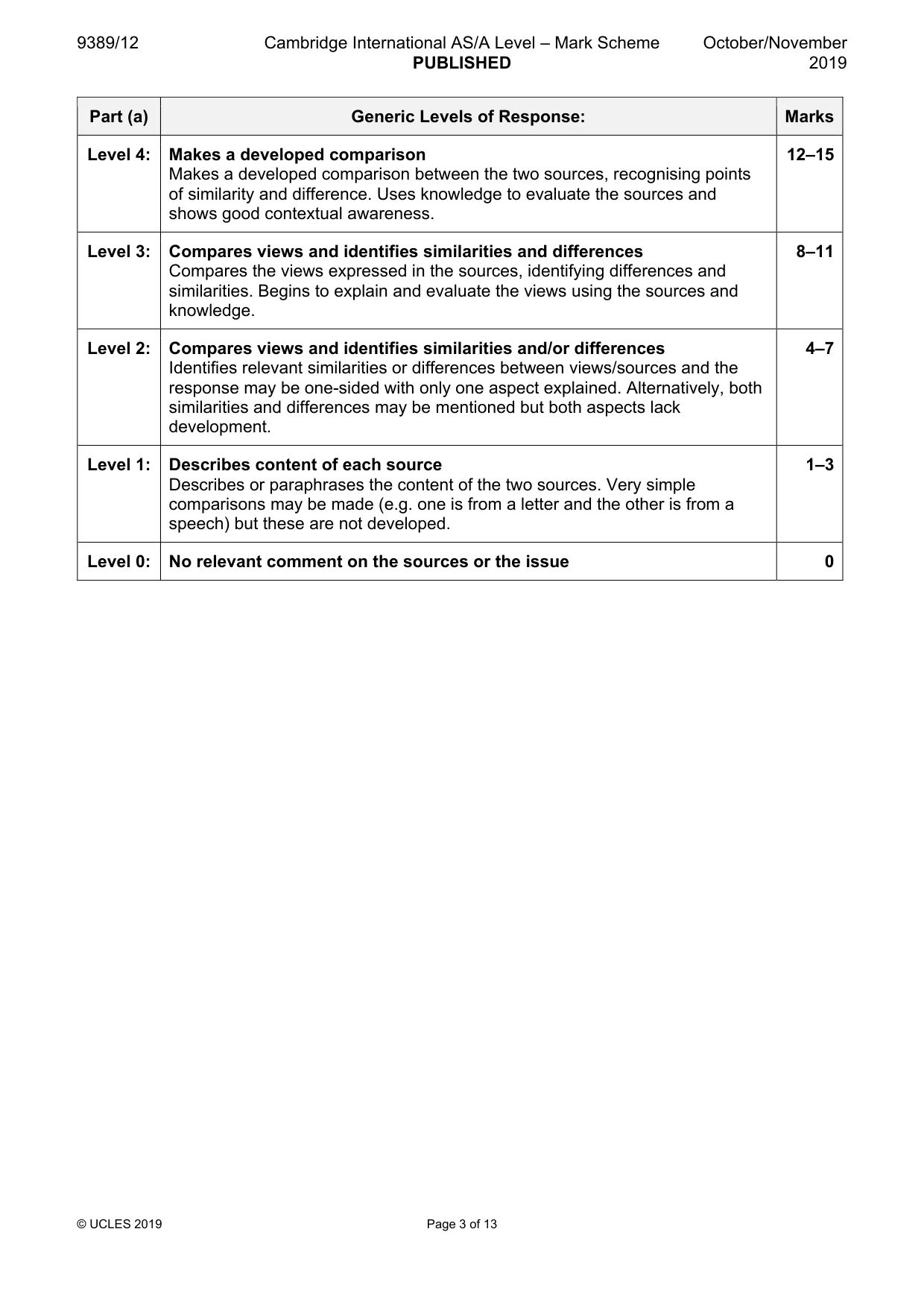
9389/12 Cambridge International AS/A Level – Mark Scheme PUBLISHED October/November 2019 © UCLES 2019 Page 3 of 13 Part (a) Generic Levels of Response: Marks Level 4: Makes a developed comparison Makes a developed comparison between the two sources, recognising points of similarity and difference. Uses knowledge to evaluate the sources and shows good contextual awareness. 12–15 Level 3: Compares views and identifies similarities and differences Compares the views expressed in the sources, identifying differences and similarities. Begins to explain and evaluate the views using the sources and knowledge. 8–11 Level 2: Compares views and identifies similarities and/or differences Identifies relevant similarities or differences between views/sources and the response may be one-sided with only one aspect explained. Alternatively, both similarities and differences may be mentioned but both aspects lack development. 4–7 Level 1: Describes content of each source Describes or paraphrases the content of the two sources. Very simple comparisons may be made (e.g. one is from a letter and the other is from a speech) but these are not developed. 1–3 Level 0: No relevant comment on the sources or the issue 0
Mark scheme, page 4
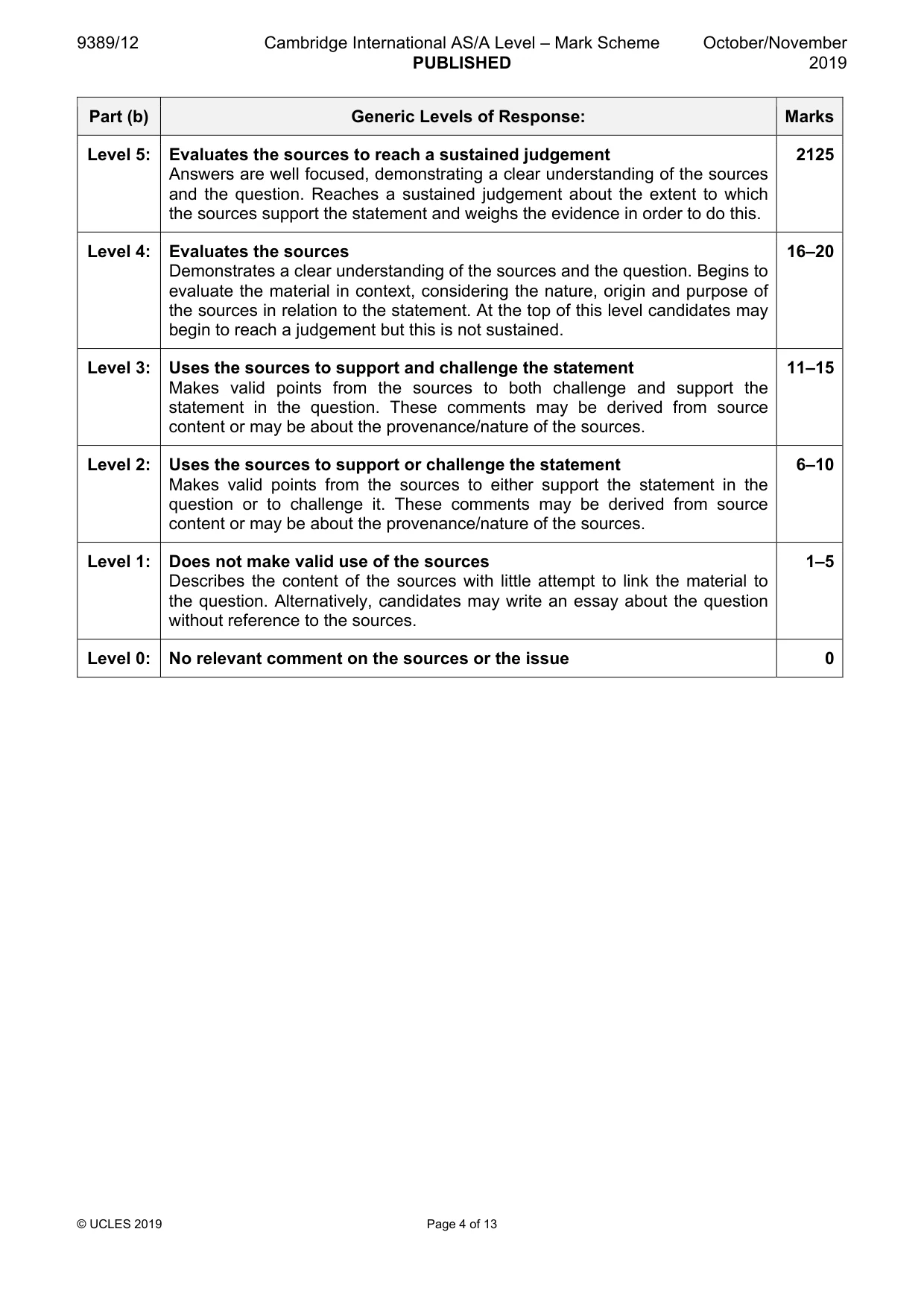
9389/12 Cambridge International AS/A Level – Mark Scheme PUBLISHED October/November 2019 © UCLES 2019 Page 4 of 13 Part (b) Generic Levels of Response: Marks Level 5: Evaluates the sources to reach a sustained judgement Answers are well focused, demonstrating a clear understanding of the sources and the question. Reaches a sustained judgement about the extent to which the sources support the statement and weighs the evidence in order to do this. 2125 Level 4: Evaluates the sources Demonstrates a clear understanding of the sources and the question. Begins to evaluate the material in context, considering the nature, origin and purpose of the sources in relation to the statement. At the top of this level candidates may begin to reach a judgement but this is not sustained. 16–20 Level 3: Uses the sources to support and challenge the statement Makes valid points from the sources to both challenge and support the statement in the question. These comments may be derived from source content or may be about the provenance/nature of the sources. 11–15 Level 2: Uses the sources to support or challenge the statement Makes valid points from the sources to either support the statement in the question or to challenge it. These comments may be derived from source content or may be about the provenance/nature of the sources. 6–10 Level 1: Does not make valid use of the sources Describes the content of the sources with little attempt to link the material to the question. Alternatively, candidates may write an essay about the question without reference to the sources. 1–5 Level 0: No relevant comment on the sources or the issue 0
Mark scheme, page 5
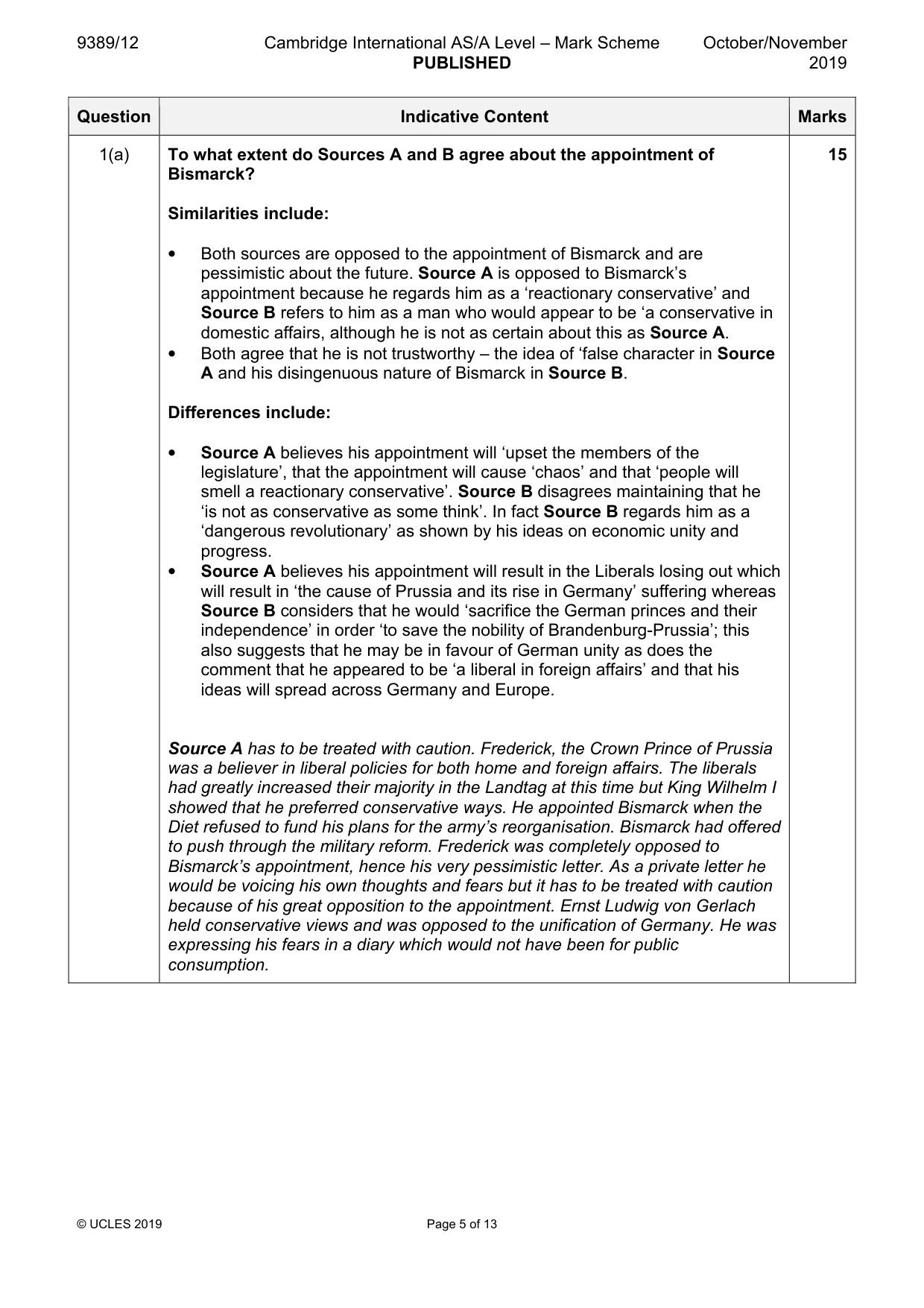
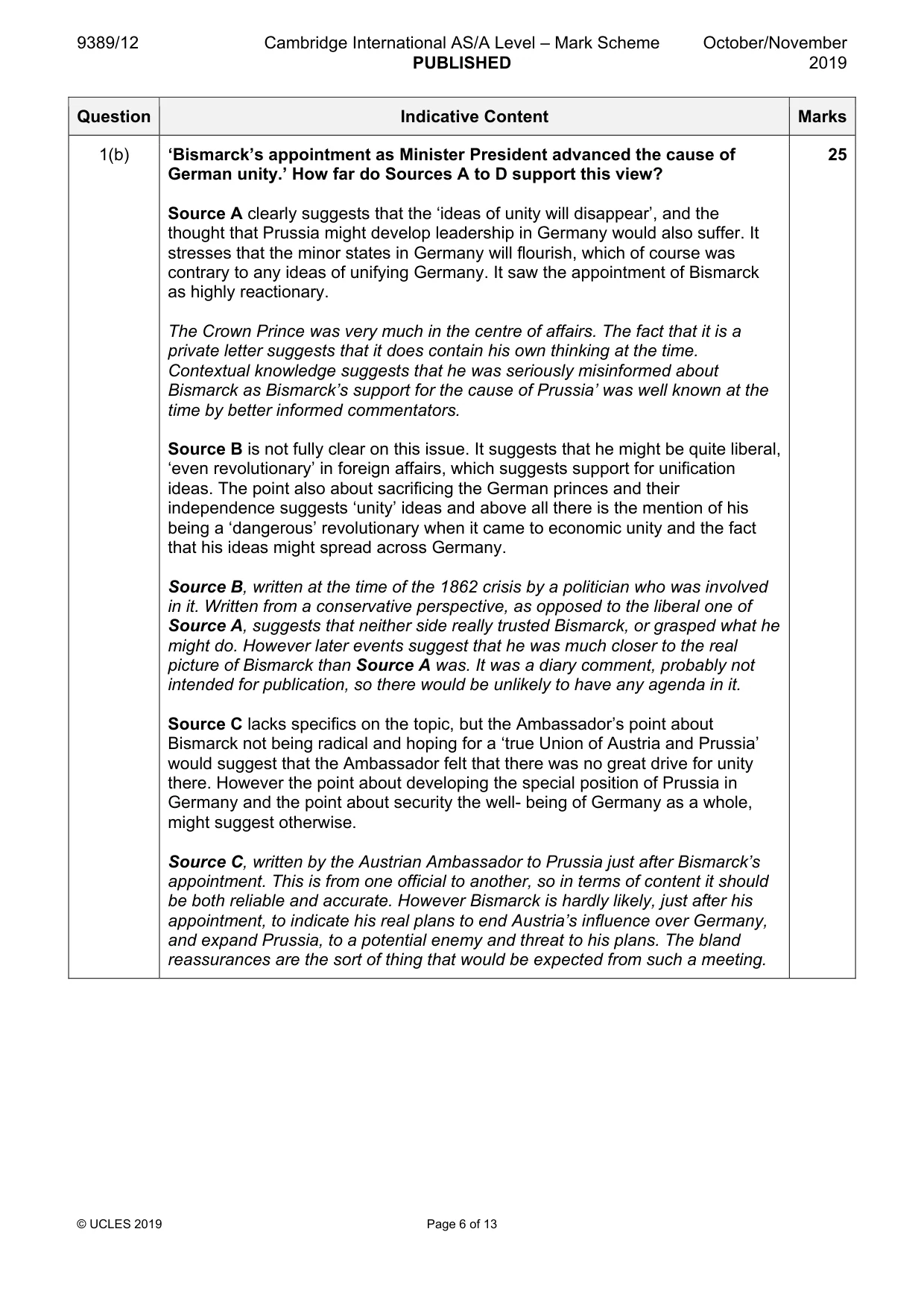
9389/12 Cambridge International AS/A Level – Mark Scheme PUBLISHED October/November 2019 © UCLES 2019 Page 5 of 13 Question Indicative Content Marks 1(a) To what extent do Sources A and B agree about the appointment of Bismarck? Similarities include: • Both sources are opposed to the appointment of Bismarck and are pessimistic about the future. Source A is opposed to Bismarck’s appointment because he regards him as a ‘reactionary conservative’ and Source B refers to him as a man who would appear to be ‘a conservative in domestic affairs, although he is not as certain about this as Source A. • Both agree that he is not trustworthy – the idea of ‘false character in Source A and his disingenuous nature of Bismarck in Source B. Differences include: • Source A believes his appointment will ‘upset the members of the legislature’, that the appointment will cause ‘chaos’ and that ‘people will smell a reactionary conservative’. Source B disagrees maintaining that he ‘is not as conservative as some think’. In fact Source B regards him as a ‘dangerous revolutionary’ as shown by his ideas on economic unity and progress. • Source A believes his appointment will result in the Liberals losing out which will result in ‘the cause of Prussia and its rise in Germany’ suffering whereas Source B considers that he would ‘sacrifice the German princes and their independence’ in order ‘to save the nobility of Brandenburg-Prussia’; this also suggests that he may be in favour of German unity as does the comment that he appeared to be ‘a liberal in foreign affairs’ and that his ideas will spread across Germany and Europe. Source A has to be treated with caution. Frederick, the Crown Prince of Prussia was a believer in liberal policies for both home and foreign affairs. The liberals had greatly increased their majority in the Landtag at this time but King Wilhelm I showed that he preferred conservative ways. He appointed Bismarck when the Diet refused to fund his plans for the army’s reorganisation. Bismarck had offered to push through the military reform. Frederick was completely opposed to Bismarck’s appointment, hence his very pessimistic letter. As a private letter he would be voicing his own thoughts and fears but it has to be treated with caution because of his great opposition to the appointment. Ernst Ludwig von Gerlach held conservative views and was opposed to the unification of Germany. He was expressing his fears in a diary which would not have been for public consumption. 15
Mark scheme, page 6
9389/12 Cambridge International AS/A Level – Mark Scheme PUBLISHED October/November 2019 © UCLES 2019 Page 6 of 13 Question Indicative Content Marks 1(b) ‘Bismarck’s appointment as Minister President advanced the cause of German unity.’ How far do Sources A to D support this view? Source A clearly suggests that the ‘ideas of unity will disappear’, and the thought that Prussia might develop leadership in Germany would also suffer. It stresses that the minor states in Germany will flourish, which of course was contrary to any ideas of unifying Germany. It saw the appointment of Bismarck as highly reactionary. The Crown Prince was very much in the centre of affairs. The fact that it is a private letter suggests that it does contain his own thinking at the time. Contextual knowledge suggests that he was seriously misinformed about Bismarck as Bismarck’s support for the cause of Prussia’ was well known at the time by better informed commentators. Source B is not fully clear on this issue. It suggests that he might be quite liberal, ‘even revolutionary’ in foreign affairs, which suggests support for unification ideas. The point also about sacrificing the German princes and their independence suggests ‘unity’ ideas and above all there is the mention of his being a ‘dangerous’ revolutionary when it came to economic unity and the fact that his ideas might spread across Germany. Source B, written at the time of the 1862 crisis by a politician who was involved in it. Written from a conservative perspective, as opposed to the liberal one of Source A, suggests that neither side really trusted Bismarck, or grasped what he might do. However later events suggest that he was much closer to the real picture of Bismarck than Source A was. It was a diary comment, probably not intended for publication, so there would be unlikely to have any agenda in it. Source C lacks specifics on the topic, but the Ambassador’s point about Bismarck not being radical and hoping for a ‘true Union of Austria and Prussia’ would suggest that the Ambassador felt that there was no great drive for unity there. However the point about developing the special position of Prussia in Germany and the point about security the well- being of Germany as a whole, might suggest otherwise. Source C, written by the Austrian Ambassador to Prussia just after Bismarck’s appointment. This is from one official to another, so in terms of content it should be both reliable and accurate. However Bismarck is hardly likely, just after his appointment, to indicate his real plans to end Austria’s influence over Germany, and expand Prussia, to a potential enemy and threat to his plans. The bland reassurances are the sort of thing that would be expected from such a meeting. 25
Mark scheme, page 7
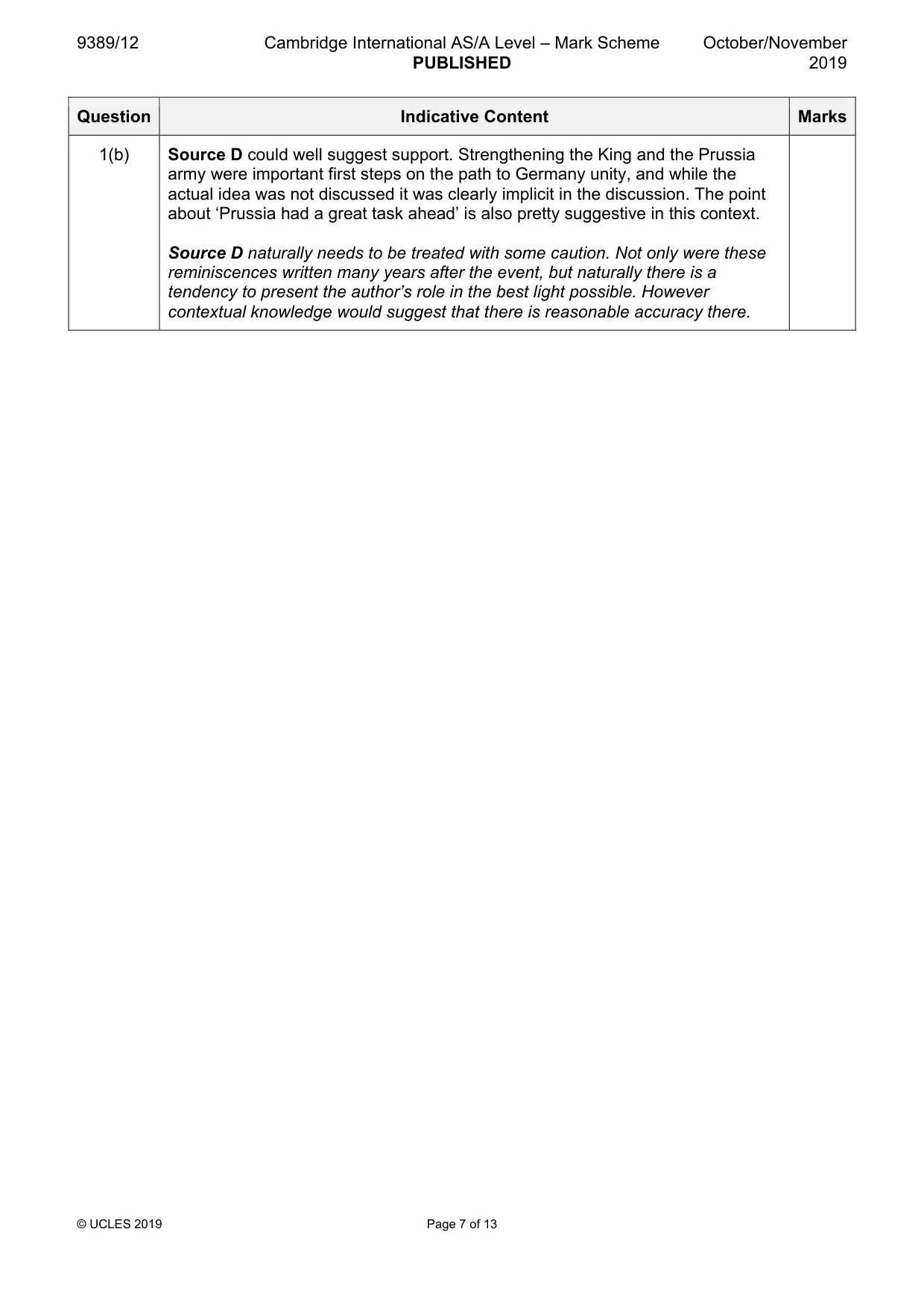
9389/12 Cambridge International AS/A Level – Mark Scheme PUBLISHED October/November 2019 © UCLES 2019 Page 7 of 13 Question Indicative Content Marks 1(b) Source D could well suggest support. Strengthening the King and the Prussia army were important first steps on the path to Germany unity, and while the actual idea was not discussed it was clearly implicit in the discussion. The point about ‘Prussia had a great task ahead’ is also pretty suggestive in this context. Source D naturally needs to be treated with some caution. Not only were these reminiscences written many years after the event, but naturally there is a tendency to present the author’s role in the best light possible. However contextual knowledge would suggest that there is reasonable accuracy there.
Mark scheme, page 8
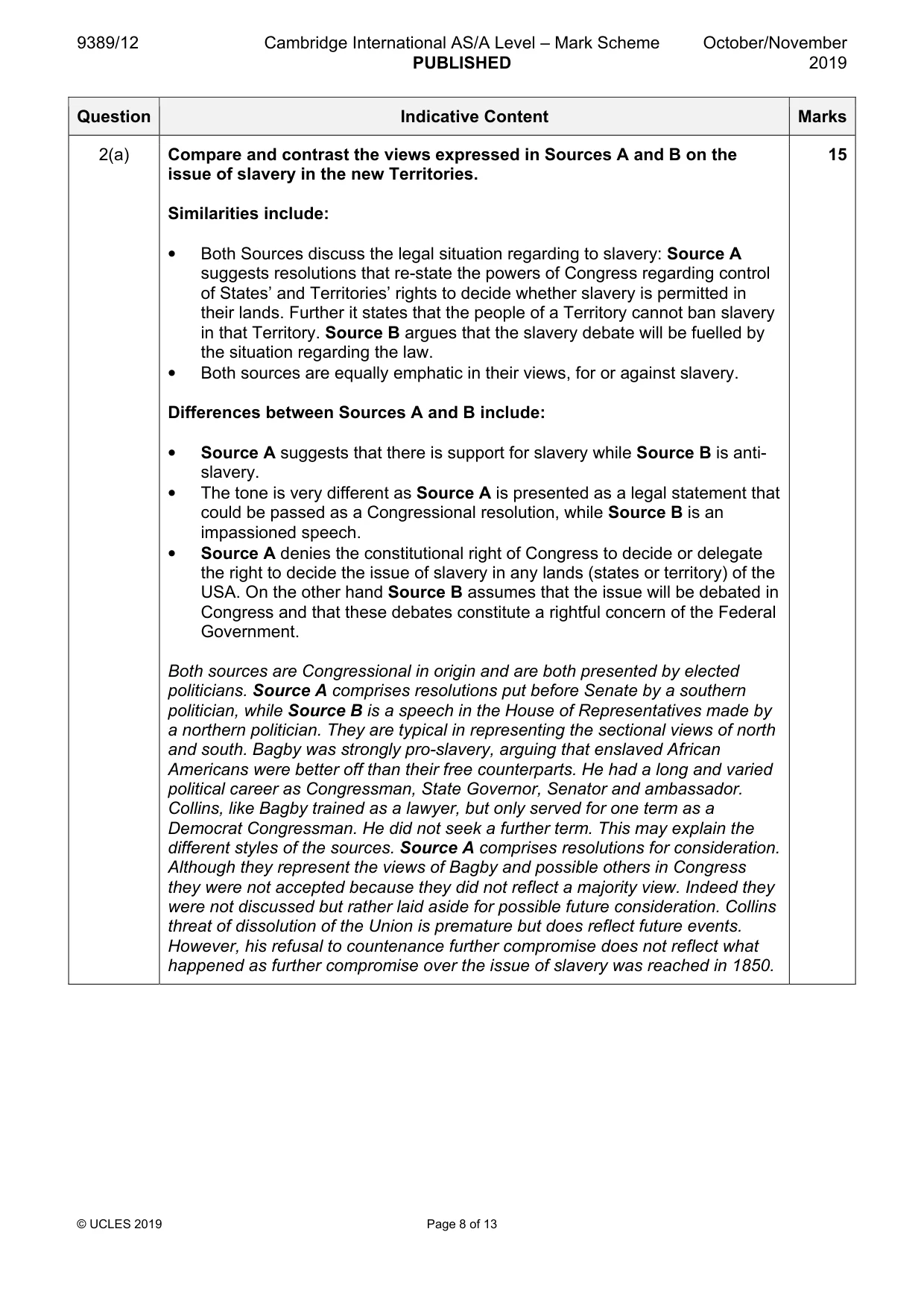
9389/12 Cambridge International AS/A Level – Mark Scheme PUBLISHED October/November 2019 © UCLES 2019 Page 8 of 13 Question Indicative Content Marks 2(a) Compare and contrast the views expressed in Sources A and B on the issue of slavery in the new Territories. Similarities include: • Both Sources discuss the legal situation regarding to slavery: Source A suggests resolutions that re-state the powers of Congress regarding control of States’ and Territories’ rights to decide whether slavery is permitted in their lands. Further it states that the people of a Territory cannot ban slavery in that Territory. Source B argues that the slavery debate will be fuelled by the situation regarding the law. • Both sources are equally emphatic in their views, for or against slavery. Differences between Sources A and B include: • Source A suggests that there is support for slavery while Source B is anti- slavery. • The tone is very different as Source A is presented as a legal statement that could be passed as a Congressional resolution, while Source B is an impassioned speech. • Source A denies the constitutional right of Congress to decide or delegate the right to decide the issue of slavery in any lands (states or territory) of the USA. On the other hand Source B assumes that the issue will be debated in Congress and that these debates constitute a rightful concern of the Federal Government. Both sources are Congressional in origin and are both presented by elected politicians. Source A comprises resolutions put before Senate by a southern politician, while Source B is a speech in the House of Representatives made by a northern politician. They are typical in representing the sectional views of north and south. Bagby was strongly pro-slavery, arguing that enslaved African Americans were better off than their free counterparts. He had a long and varied political career as Congressman, State Governor, Senator and ambassador. Collins, like Bagby trained as a lawyer, but only served for one term as a Democrat Congressman. He did not seek a further term. This may explain the different styles of the sources. Source A comprises resolutions for consideration. Although they represent the views of Bagby and possible others in Congress they were not accepted because they did not reflect a majority view. Indeed they were not discussed but rather laid aside for possible future consideration. Collins threat of dissolution of the Union is premature but does reflect future events. However, his refusal to countenance further compromise does not reflect what happened as further compromise over the issue of slavery was reached in 1850. 15
Mark scheme, page 9
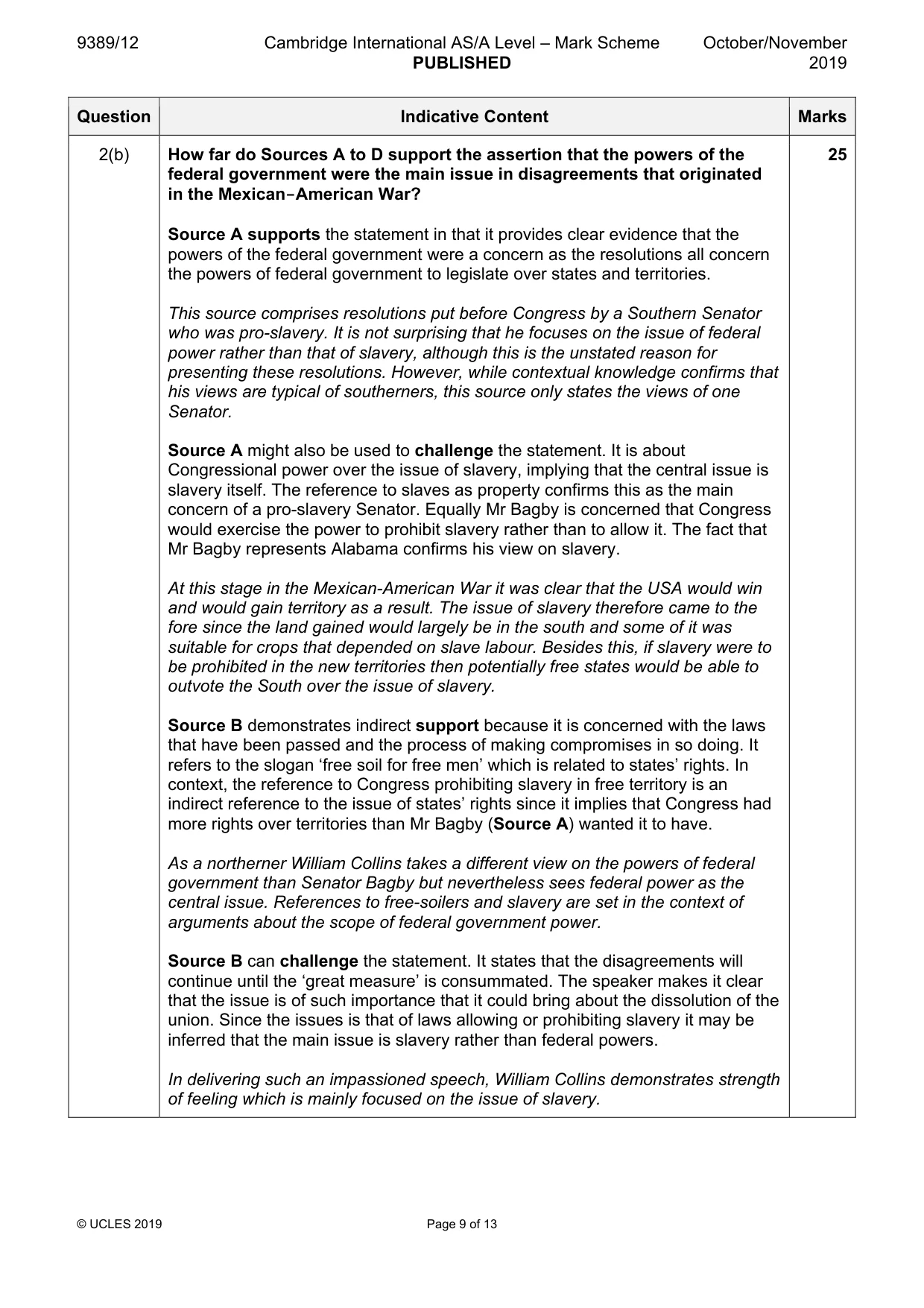
9389/12 Cambridge International AS/A Level – Mark Scheme PUBLISHED October/November 2019 © UCLES 2019 Page 9 of 13 Question Indicative Content Marks 2(b) How far do Sources A to D support the assertion that the powers of the federal government were the main issue in disagreements that originated in the Mexican-American War? Source A supports the statement in that it provides clear evidence that the powers of the federal government were a concern as the resolutions all concern the powers of federal government to legislate over states and territories. This source comprises resolutions put before Congress by a Southern Senator who was pro-slavery. It is not surprising that he focuses on the issue of federal power rather than that of slavery, although this is the unstated reason for presenting these resolutions. However, while contextual knowledge confirms that his views are typical of southerners, this source only states the views of one Senator. Source A might also be used to challenge the statement. It is about Congressional power over the issue of slavery, implying that the central issue is slavery itself. The reference to slaves as property confirms this as the main concern of a pro-slavery Senator. Equally Mr Bagby is concerned that Congress would exercise the power to prohibit slavery rather than to allow it. The fact that Mr Bagby represents Alabama confirms his view on slavery. At this stage in the Mexican-American War it was clear that the USA would win and would gain territory as a result. The issue of slavery therefore came to the fore since the land gained would largely be in the south and some of it was suitable for crops that depended on slave labour. Besides this, if slavery were to be prohibited in the new territories then potentially free states would be able to outvote the South over the issue of slavery. Source B demonstrates indirect support because it is concerned with the laws that have been passed and the process of making compromises in so doing. It refers to the slogan ‘free soil for free men’ which is related to states’ rights. In context, the reference to Congress prohibiting slavery in free territory is an indirect reference to the issue of states’ rights since it implies that Congress had more rights over territories than Mr Bagby (Source A) wanted it to have. As a northerner William Collins takes a different view on the powers of federal government than Senator Bagby but nevertheless sees federal power as the central issue. References to free-soilers and slavery are set in the context of arguments about the scope of federal government power. Source B can challenge the statement. It states that the disagreements will continue until the ‘great measure’ is consummated. The speaker makes it clear that the issue is of such importance that it could bring about the dissolution of the union. Since the issues is that of laws allowing or prohibiting slavery it may be inferred that the main issue is slavery rather than federal powers. In delivering such an impassioned speech, William Collins demonstrates strength of feeling which is mainly focused on the issue of slavery. 25
Mark scheme, page 10
9389/12 Cambridge International AS/A Level – Mark Scheme PUBLISHED October/November 2019 © UCLES 2019 Page 10 of 13 Question Indicative Content Marks 2(b) Source C can also be used to support the statement because the argument presented focuses on the preservation of the Constitution. it provides evidence about the workings of the Constitution and a reference to the Wilmot Proviso which would have over-ridden the claims of those who advocated states’ rights. In this sense it sees the issue of the powers of federal government as important. As a report in a New York newspaper the focus is unsurprising. New Yorkers were less likely to argue about the issue of slavery because they were less likely to be abolitionist than other northerners as their main concern was commerce, including the cotton trade, which depended on slave labour. Hence for New Yorkers the powers of the federal government can be confirmed as the main issue. Source C might be used to challenge the statement in that it shows that the main issue for this reporter is the balance of power in the Federal government: he claims that if slavery were allowed in a territory then the slave interest would influence that state’s representatives and that the slave owners of, in this case Texas, would hold disproportionate sway in Congress compared with the inhabitants of northern free states. This source emphasises the bigger picture of sectional balance in Congress by using emotive language in its final sentence. The source addresses a New York readership who would be well-informed on constitutional matters. Although the evidence from Source D is mixed: there is reference to the actions of Congress, but the petitions imply the understanding of the citizens that Congress had the right to legislate on the issue of slavery and fugitive slaves in territories and states. Hence the source can be used to challenge the statement in the question as it was slavery rather than states’ rights that concerned the petitioners. Introducing the views of ordinary citizens shows that in the wider debates that originated in the Mexican-American War, the issue of slavery was of primary importance to these northerners. Source D may be used to support the statement in that reference is made to the issue of states’ rights, but the assumption is that Congress has the right to decide on the issue of slavery in territories and states. The reference to exercise of constitutional power shows that the petitioners recognise there is an issue over whether or not Congress has such power. This source takes the debate beyond Congress and demonstrates that citizens from a range of northern states wanted to have their views considered. It is, however, questionable if the powers of federal government can be seen as the main issue in this source. Two sources, A and B, date from the time of war while Sources C and D date from two years after the war when the issues raised by the acquisition of vast tracts of sparsely inhabited land had still not been resolved. However all the sources show some balance between different factors.
Mark scheme, page 11
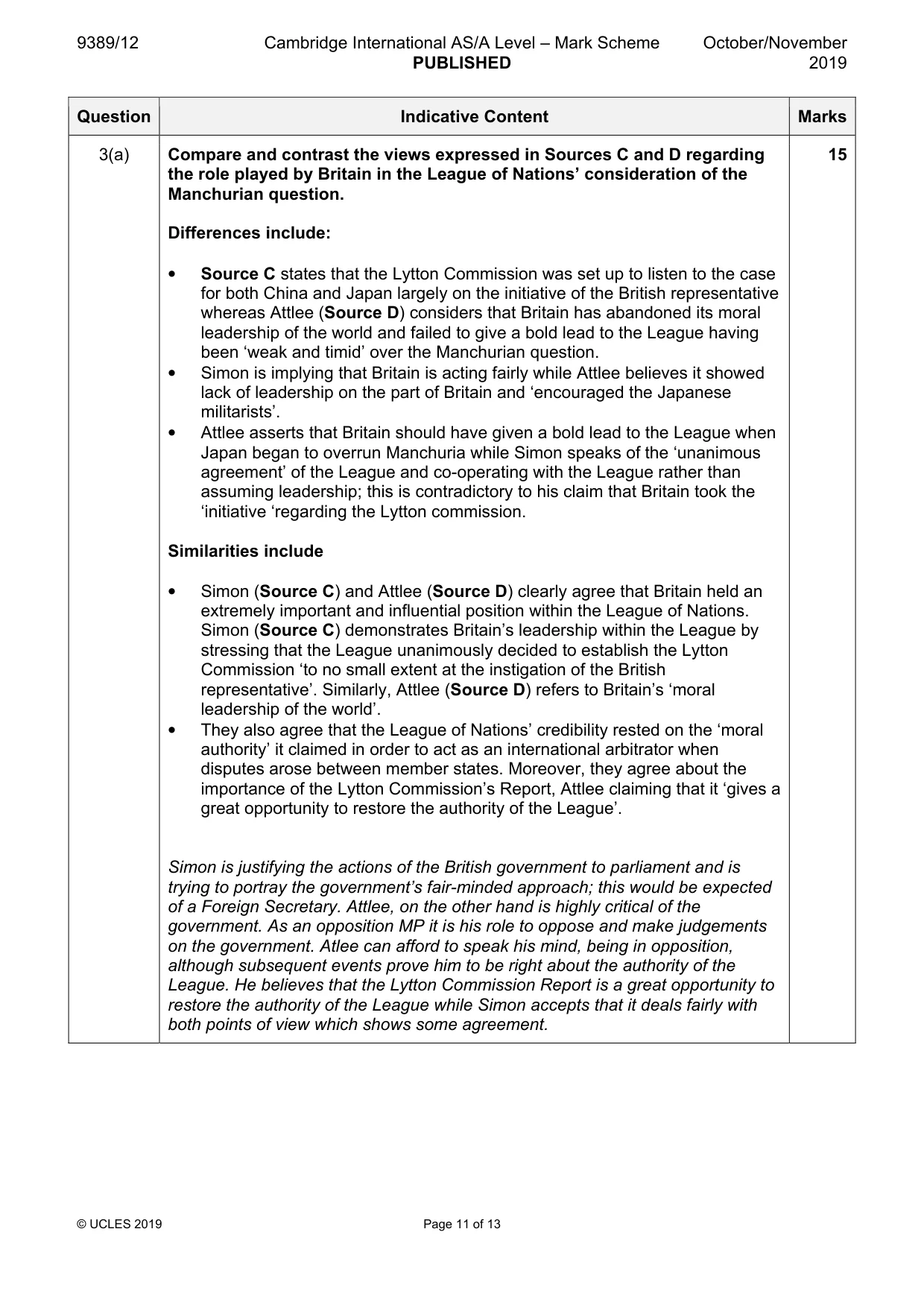
9389/12 Cambridge International AS/A Level – Mark Scheme PUBLISHED October/November 2019 © UCLES 2019 Page 11 of 13 Question Indicative Content Marks 3(a) Compare and contrast the views expressed in Sources C and D regarding the role played by Britain in the League of Nations’ consideration of the Manchurian question. Differences include: • Source C states that the Lytton Commission was set up to listen to the case for both China and Japan largely on the initiative of the British representative whereas Attlee (Source D) considers that Britain has abandoned its moral leadership of the world and failed to give a bold lead to the League having been ‘weak and timid’ over the Manchurian question. • Simon is implying that Britain is acting fairly while Attlee believes it showed lack of leadership on the part of Britain and ‘encouraged the Japanese militarists’. • Attlee asserts that Britain should have given a bold lead to the League when Japan began to overrun Manchuria while Simon speaks of the ‘unanimous agreement’ of the League and co-operating with the League rather than assuming leadership; this is contradictory to his claim that Britain took the ‘initiative ‘regarding the Lytton commission. Similarities include • Simon (Source C) and Attlee (Source D) clearly agree that Britain held an extremely important and influential position within the League of Nations. Simon (Source C) demonstrates Britain’s leadership within the League by stressing that the League unanimously decided to establish the Lytton Commission ‘to no small extent at the instigation of the British representative’. Similarly, Attlee (Source D) refers to Britain’s ‘moral leadership of the world’. • They also agree that the League of Nations’ credibility rested on the ‘moral authority’ it claimed in order to act as an international arbitrator when disputes arose between member states. Moreover, they agree about the importance of the Lytton Commission’s Report, Attlee claiming that it ‘gives a great opportunity to restore the authority of the League’. Simon is justifying the actions of the British government to parliament and is trying to portray the government’s fair-minded approach; this would be expected of a Foreign Secretary. Attlee, on the other hand is highly critical of the government. As an opposition MP it is his role to oppose and make judgements on the government. Atlee can afford to speak his mind, being in opposition, although subsequent events prove him to be right about the authority of the League. He believes that the Lytton Commission Report is a great opportunity to restore the authority of the League while Simon accepts that it deals fairly with both points of view which shows some agreement. 15
Mark scheme, page 12
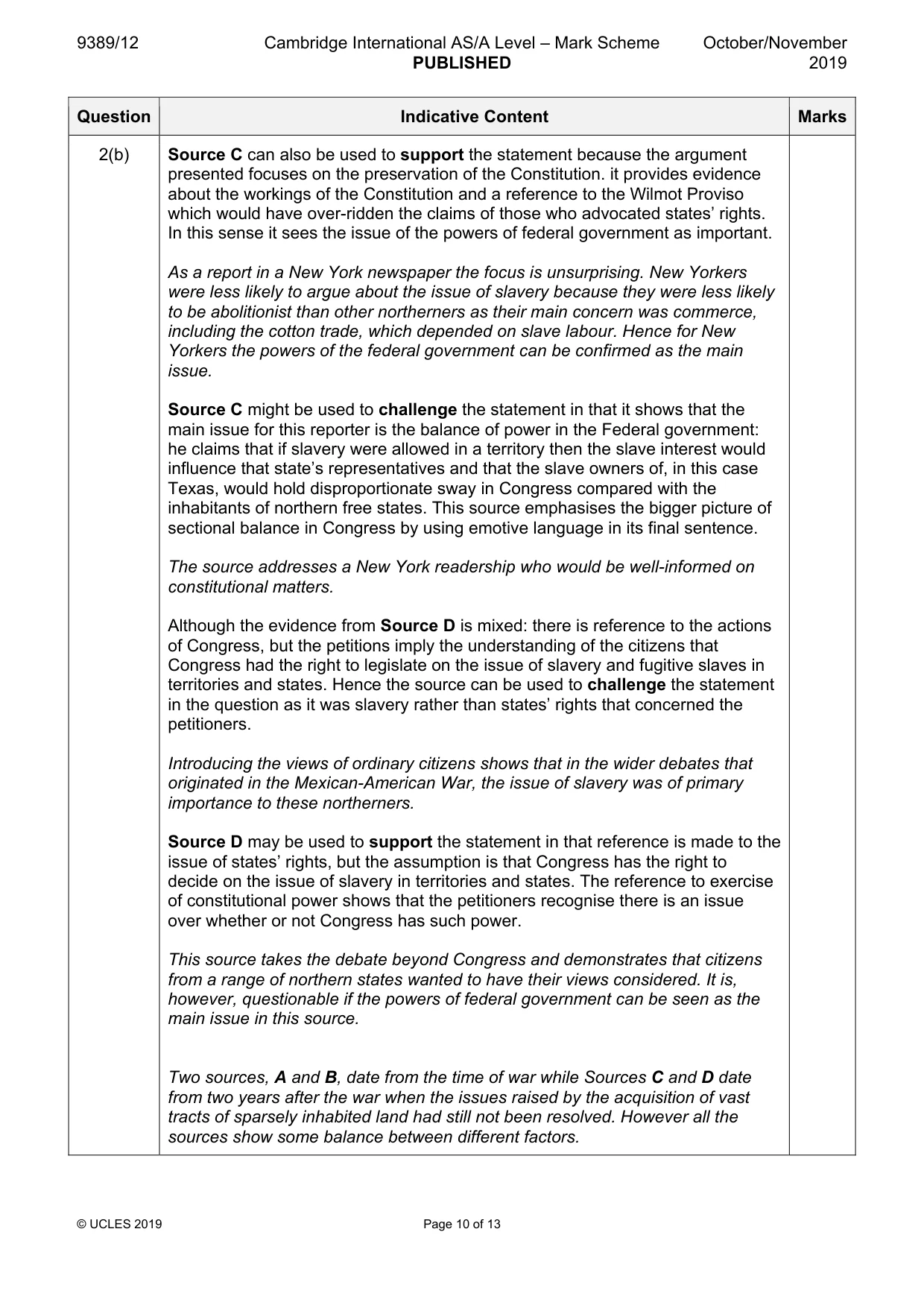
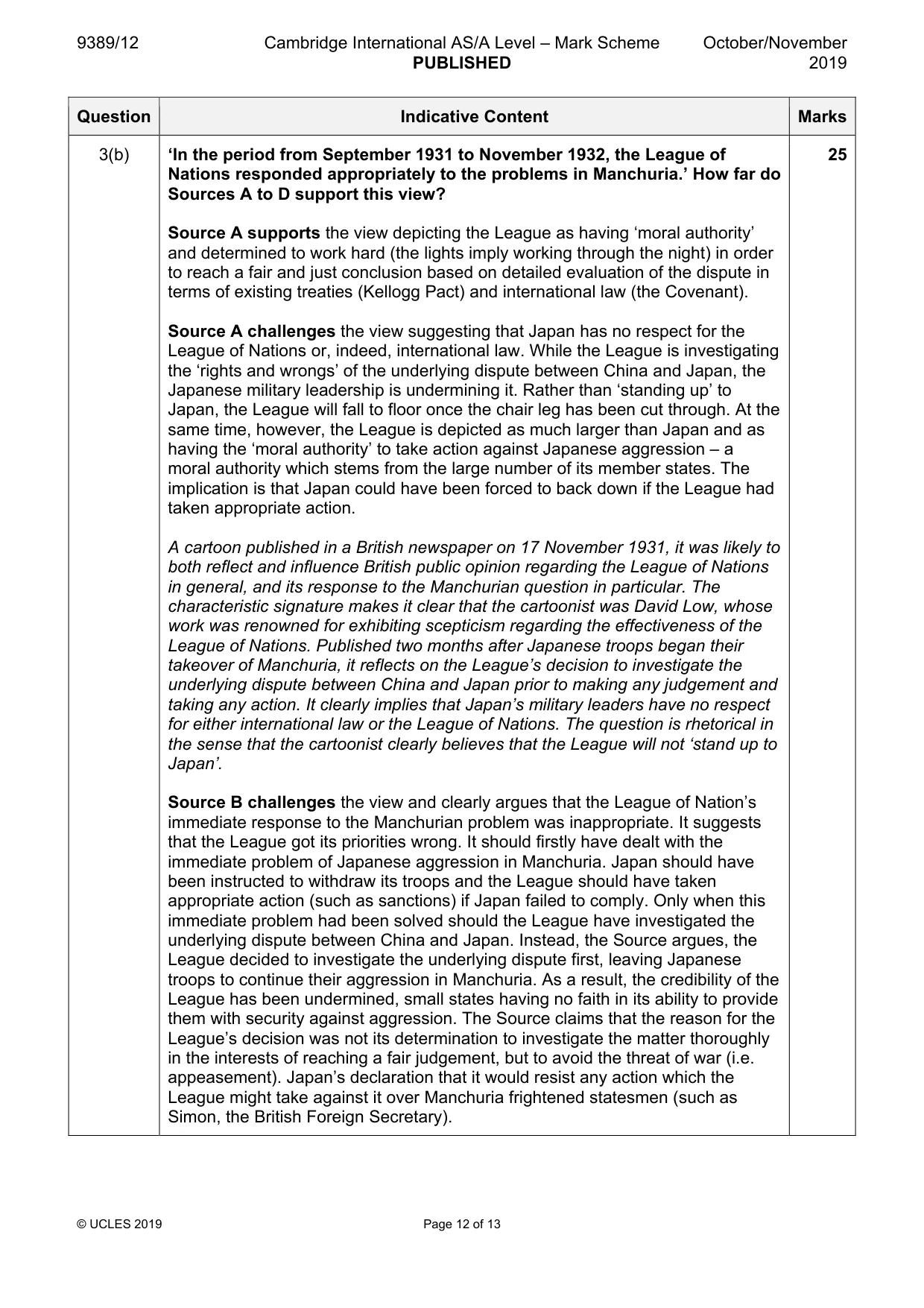
9389/12 Cambridge International AS/A Level – Mark Scheme PUBLISHED October/November 2019 © UCLES 2019 Page 12 of 13 Question Indicative Content Marks 3(b) ‘In the period from September 1931 to November 1932, the League of Nations responded appropriately to the problems in Manchuria.’ How far do Sources A to D support this view? Source A supports the view depicting the League as having ‘moral authority’ and determined to work hard (the lights imply working through the night) in order to reach a fair and just conclusion based on detailed evaluation of the dispute in terms of existing treaties (Kellogg Pact) and international law (the Covenant). Source A challenges the view suggesting that Japan has no respect for the League of Nations or, indeed, international law. While the League is investigating the ‘rights and wrongs’ of the underlying dispute between China and Japan, the Japanese military leadership is undermining it. Rather than ‘standing up’ to Japan, the League will fall to floor once the chair leg has been cut through. At the same time, however, the League is depicted as much larger than Japan and as having the ‘moral authority’ to take action against Japanese aggression – a moral authority which stems from the large number of its member states. The implication is that Japan could have been forced to back down if the League had taken appropriate action. A cartoon published in a British newspaper on 17 November 1931, it was likely to both reflect and influence British public opinion regarding the League of Nations in general, and its response to the Manchurian question in particular. The characteristic signature makes it clear that the cartoonist was David Low, whose work was renowned for exhibiting scepticism regarding the effectiveness of the League of Nations. Published two months after Japanese troops began their takeover of Manchuria, it reflects on the League’s decision to investigate the underlying dispute between China and Japan prior to making any judgement and taking any action. It clearly implies that Japan’s military leaders have no respect for either international law or the League of Nations. The question is rhetorical in the sense that the cartoonist clearly believes that the League will not ‘stand up to Japan’. Source B challenges the view and clearly argues that the League of Nation’s immediate response to the Manchurian problem was inappropriate. It suggests that the League got its priorities wrong. It should firstly have dealt with the immediate problem of Japanese aggression in Manchuria. Japan should have been instructed to withdraw its troops and the League should have taken appropriate action (such as sanctions) if Japan failed to comply. Only when this immediate problem had been solved should the League have investigated the underlying dispute between China and Japan. Instead, the Source argues, the League decided to investigate the underlying dispute first, leaving Japanese troops to continue their aggression in Manchuria. As a result, the credibility of the League has been undermined, small states having no faith in its ability to provide them with security against aggression. The Source claims that the reason for the League’s decision was not its determination to investigate the matter thoroughly in the interests of reaching a fair judgement, but to avoid the threat of war (i.e. appeasement). Japan’s declaration that it would resist any action which the League might take against it over Manchuria frightened statesmen (such as Simon, the British Foreign Secretary). 25
Mark scheme, page 13
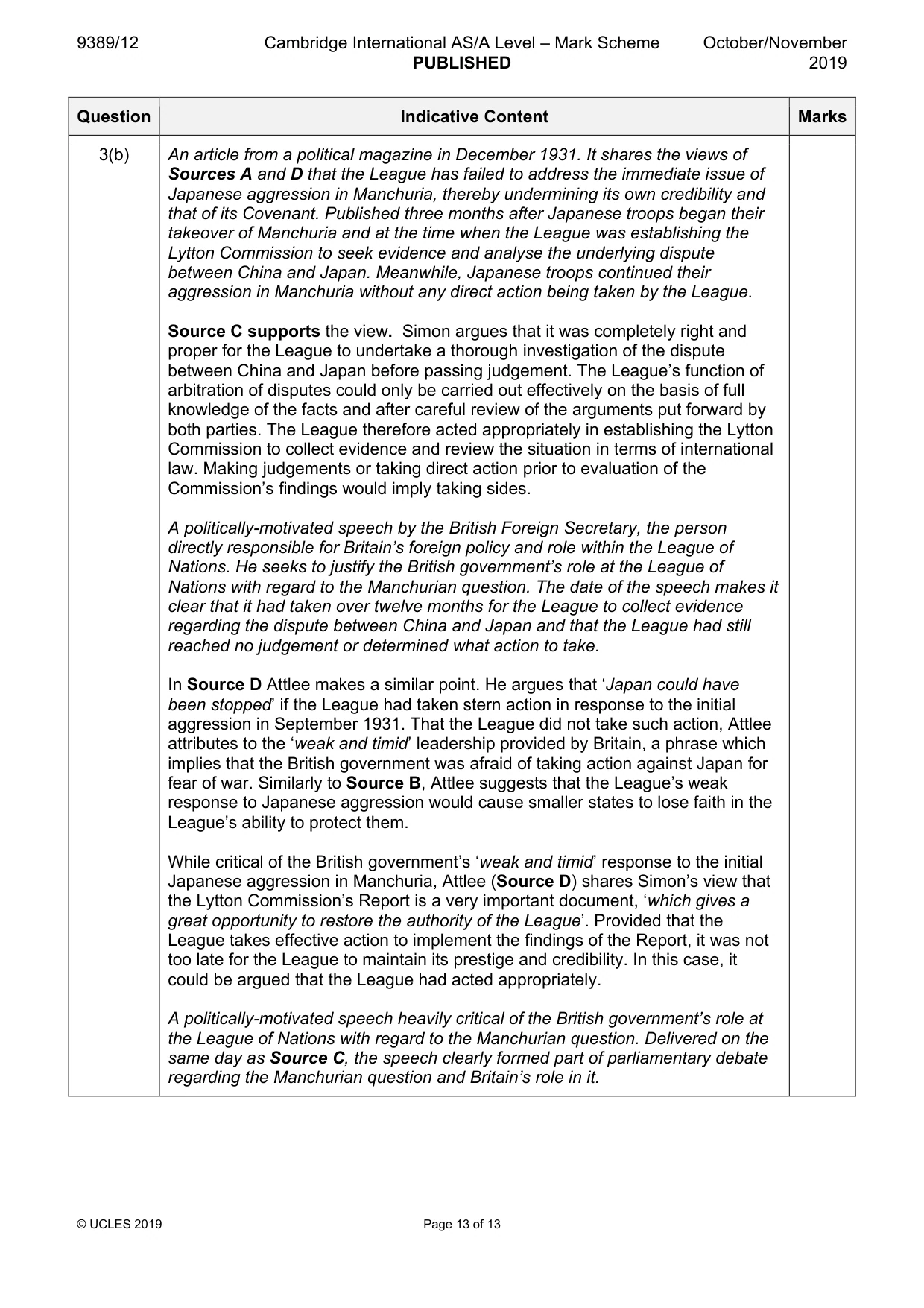
9389/12 Cambridge International AS/A Level – Mark Scheme PUBLISHED October/November 2019 © UCLES 2019 Page 13 of 13 Question Indicative Content Marks 3(b) An article from a political magazine in December 1931. It shares the views of Sources A and D that the League has failed to address the immediate issue of Japanese aggression in Manchuria, thereby undermining its own credibility and that of its Covenant. Published three months after Japanese troops began their takeover of Manchuria and at the time when the League was establishing the Lytton Commission to seek evidence and analyse the underlying dispute between China and Japan. Meanwhile, Japanese troops continued their aggression in Manchuria without any direct action being taken by the League. Source C supports the view. Simon argues that it was completely right and proper for the League to undertake a thorough investigation of the dispute between China and Japan before passing judgement. The League’s function of arbitration of disputes could only be carried out effectively on the basis of full knowledge of the facts and after careful review of the arguments put forward by both parties. The League therefore acted appropriately in establishing the Lytton Commission to collect evidence and review the situation in terms of international law. Making judgements or taking direct action prior to evaluation of the Commission’s findings would imply taking sides. A politically-motivated speech by the British Foreign Secretary, the person directly responsible for Britain’s foreign policy and role within the League of Nations. He seeks to justify the British government’s role at the League of Nations with regard to the Manchurian question. The date of the speech makes it clear that it had taken over twelve months for the League to collect evidence regarding the dispute between China and Japan and that the League had still reached no judgement or determined what action to take. In Source D Attlee makes a similar point. He argues that ‘Japan could have been stopped’ if the League had taken stern action in response to the initial aggression in September 1931. That the League did not take such action, Attlee attributes to the ‘weak and timid’ leadership provided by Britain, a phrase which implies that the British government was afraid of taking action against Japan for fear of war. Similarly to Source B, Attlee suggests that the League’s weak response to Japanese aggression would cause smaller states to lose faith in the League’s ability to protect them. While critical of the British government’s ‘weak and timid’ response to the initial Japanese aggression in Manchuria, Attlee (Source D) shares Simon’s view that the Lytton Commission’s Report is a very important document, ‘which gives a great opportunity to restore the authority of the League’. Provided that the League takes effective action to implement the findings of the Report, it was not too late for the League to maintain its prestige and credibility. In this case, it could be argued that the League had acted appropriately. A politically-motivated speech heavily critical of the British government’s role at the League of Nations with regard to the Manchurian question. Delivered on the same day as Source C, the speech clearly formed part of parliamentary debate regarding the Manchurian question and Britain’s role in it.
What you needed in this session
Cambridge’s own grade thresholds for 2019 Oct/Nov, Paper 1 · Variant 2. A higher threshold means an easier paper — the bar moves with how the cohort did.