Cambridge A Level History 9389 — 2020 May/June Paper 1 · Variant 2
9389/12/M/J/20
The question paper and its mark scheme, free to read here and free to download. This is Cambridge’s own paper, exactly as it was sat.
Question paper8 pages

Mark scheme11 pages
Answers below. Sit the paper first if you are practising.
Paper as text
Question paper, page 1
Cambridge International AS & A Level This document has 8 pages. Blank pages are indicated. HISTORY 9389/12 Paper 1 Document Question May/June 2020 1 hour You must answer on the enclosed answer booklet. You will need: Answer booklet (enclosed) INSTRUCTIONS ● Answer one question from one section only. Answer both parts of the question. Section A: European Option Section B: American Option Section C: International Option ● Follow the instructions on the front cover of the answer booklet. If you need additional answer paper, ask the invigilator for a continuation booklet. INFORMATION ● The total mark for this paper is 40. ● The number of marks for each question or part question is shown in brackets [ ]. * 8 5 0 8 9 0 2 5 5 4 * DC (CJ/FC) 187798/2 © UCLES 2020 [Turn over
Question paper, page 2
2 9389/12/M/J/20 © UCLES 2020 Section A: European Option Liberalism and Nationalism in Italy and Germany, 1815–1871 Bismarck and the War with Denmark 1 Read the sources and then answer both parts of the question. Source A 1 The Great German association recognises a considerable violation of the rights of Germany and the Germans living in Schleswig-Holstein in the recent measure taken in Denmark which will bring about not only a complete division of Schleswig from Holstein but also make Schleswig into a Danish province. 2 The Great German association demands that all German governments will energetically oppose this step by Denmark of imposing its will on the inhabitants of Schleswig-Holstein. 3 The Great German association finds the attempt by Denmark to withdraw from its duties towards Germany gives grounds for pointing out the necessity of creating a more unified and effective German military force. 4 Denmark has broken the terms of earlier Treaties by injuring the rights of Germans. 5 The Schleswig-Holstein affair is a struggle for law against aggression, for honesty against lies and for freedom against foreign domination. Resolutions of a group of conservative Deputies in the Prussian Landtag, May 1863. Source B We consider the Danish conflict as a part of the fight of monarchies against the European revolution. From the outset, the present government of Prussia has been guided by this conviction in its handling of the Danish question. We have been successful and I am convinced that in Vienna, as well as here, the good influence which the two German powers have exercised, by their common and energetic action, will be felt. We record, with satisfaction, the substantial progress of conservative feeling within both monarchies. We are no longer in danger of being driven into the current of revolution. We have found a bond in this joint action. If people are not convinced of the solid combination of Austria and Prussia, anarchy could once again raise its head in Germany and we would lose trust and respect abroad. This unity with Austria is vital. Bismarck to the Prussian Ambassador in Vienna, June 1864.
Question paper, page 3
3 9389/12/M/J/20 © UCLES 2020 [Turn over Source C Article 1 His Majesty the Emperor of Austria shall exercise rights over the Duchy of Holstein. The King of Prussia shall exercise rights over the Duchy of Schleswig. Article 2 Austria and Prussia will suggest to the German Diet the establishment of a German fleet, based in Kiel. Until this happens the warships of both powers shall use this harbour. The command of it and the police duties within it shall be exercised by Prussia. Article 4 The Royal Prussian Government shall retain two military roads through Holstein; the one from Lübeck to Kiel, the other from Hamburg to Lauenburg. Article 9 The Emperor of Austria cedes to his Majesty the King of Prussia the rights granted by the Treaty of Vienna over the Duchy of Lauenburg, for which the Royal Prussian Government will pay the Austrian 2 500 000 Danish rixdollars. Extracts from the Articles of the Convention of Gastein, August 1865. Source D It is utterly impossible to explain how Bismarck succeeded in persuading Austria to enter this war with Denmark to further Prussia’s interest. This was in direct contradiction to Bismarck’s previous hostile policy towards Austria. It was his energetic initiative that pulled Austria in to support his invasion, but it is still not at all clear why he did so. Why Austria joined in against Denmark is also not clear, but some argue Austria was obliged to join in in order to watch over Prussia and contain it. Many in Vienna claimed it was done purely in the interests of Prussia and Germany. However, there was a desire in Austria to retrieve the army’s prestige after the disasters in Italy in 1859. Bismarck cleverly played on the Austrian emperor’s friendly feeling towards him. Also, all knew that Bismarck’s traditionally conservative policy at the time was favourably viewed in Vienna. Bismarck knew perfectly well that, after the victory over Denmark, the quarrel with Austria would break out again, and it could well be a war to the death. From a biography of Bismarck by a German writer, published in 1869. Answer both parts of the question with reference to the sources. (a) Compare and contrast Sources B and D as evidence about Bismarck’s attitude towards Austria. [15] (b) ‘The Schleswig-Holstein question was solely a dispute between Prussia and Denmark.’ How far do Sources A to D support this view? [25]
Question paper, page 4
4 9389/12/M/J/20 © UCLES 2020 Section B: American Option The Origins of the Civil War, 1846–1861 The Passage of the Kansas–Nebraska Act, 1854 2 Read the sources and then answer both parts of the question. Source A According to existing law, this territory of Kansas–Nebraska is now guarded against slavery by the act of Congress, approved 6 March 1820, in preparation for the admission of Missouri into the Union, and in the following explicit words: Section 8: In all the territory ceded by France to the United States under the name of Louisiana, which lies north of 36˚ 30’, slavery and involuntary servitude shall be, and is hereafter, FOREVER PROHIBITED. It is now proposed to set this aside. The term Abolitionist, which is so often used as a criticism, should instead be applied to those who would overthrow this well-established principle. They are not Abolitionists of Slavery. They are Abolitionists of Freedom. From a speech by Charles Sumner to the US Senate, February 1854. Source B During the discussion of the Kansas–Nebraska Bill, it was stated that Section 8 of the Act of 6 March 1820, commonly called the Missouri Compromise, deprived the people of the Territory, while it remained a Territory, of the right to decide the slavery question. In order to overcome this objection, Section 8 was declared void and an amendment which was included in the Bill on the motion of Senator Douglas, with these words of explanation: ‘It being the true intent of this Act, not to impose slavery into any Territory or State, nor to exclude it, but to leave the people there perfectly free to form and regulate their domestic institutions in their own way, subject only to the Constitution of the United States.’ In this form the Kansas–Nebraska Act became law by the approval of the President, on 30 May 1854. From private conversations between Stephen Douglas and a US Army officer, written down in 1859 and published in 1866. Source C Yesterday the Kansas–Nebraska Bill was passed by the House of Representatives by 113 votes to 100, a small majority. A measure which reopens a vast region, closed against it for a third of a century, to the barbarous institution of slavery, brings dishonour on our country. The greater part of this dishonour is concentrated on the Democratic Party. The Whigs of the Free States have taken care that they do not share in this guilt. Their representatives in Congress, to a man, voted against the Kansas–Nebraska Bill. The result is inevitable. The Democratic Party has lost its moral strength in the Free States. The deed of yesterday puts us in a minority for years to come. From the ‘New York Evening Post’ (Democrat), May 1854.
Question paper, page 5
5 9389/12/M/J/20 © UCLES 2020 [Turn over Source D We have the inexpressible pleasure of announcing to our readers this morning that, amid the general defection of Democratic states, Illinois remains faithful to her Democratic beliefs. Although gallant Douglas, that distinguished Senator, had the most bitter opposition to contend with, he has gloriously sustained himself by a triumphant majority. The surges of fanaticism of every kind have beat against Illinois in vain. A majority of its people have declared in favour of the Kansas–Nebraska Bill and of civil and religious liberty for all. The Democratic Party of the whole Union will extend their congratulations to Mr Douglas for his extraordinary and unexpected triumph. The Abolitionists have resorted to the most incredible efforts to beat him but have failed dismally. From the ‘Cincinnati Enquirer’ (Ohio), November 1854. Answer both parts of the question with reference to the sources. (a) Compare and contrast the views of the Missouri Compromise shown in Sources A and B. [15] (b) How far do Sources A to D support the view that, in passing the Kansas–Nebraska Act in 1854, the Democratic Party had become a sectional, Southern Party? [25]
Question paper, page 6
6 9389/12/M/J/20 © UCLES 2020 Section C: International Option The Search for International Peace and Security, 1919–1945 Disagreements about Disarmament 3 Read the sources and then answer both parts of the question. Source A It is true we are pledged several times over to disarm: it is not so clear that we are pledged to sign a general disarmament convention. Certainly, we are nowhere pledged to reduction to the German level. What we told the Germans in 1919 was that the first step towards general disarmament must be a disarmament of Germany. Germany accepted the military, naval and air clauses of the Treaty of Versailles (and may have carried them out). Once that was done, other nations were free to reduce their armaments to the ‘lowest point consistent with national safety’. We have done so. Other nations have done something similar – how much is a matter between them and their consciences. The League has chosen to act as if it were committed to produce a general disarmament convention. The Germans have seized on this to connect general disarmament with their own so that they can claim to be free of their part of the bargain if the Allied governments do not perform theirs. A memorandum from the British Foreign Office to the British government, January 1928. Source B The reason given for Germany’s disarmament in the Treaty of Versailles was that it would make possible a general limitation of armaments in all countries. Germany has done her part. We have disarmed to a degree unexampled in history. But the other powers undertook to follow us along the way of disarmament. Authoritative statesmen in those countries have admitted that this was a legally binding obligation. Our disarmament should be matched by a corresponding action on the part of the other powers in accordance with their obligations under the Treaty. We have the right to demand the same degree of security as other countries. We put forward our demand for general disarmament in the interests of peace and the reconstruction of Europe, the most urgent tasks of our time. Germany is ready, and always was ready, to cooperate actively in any form of disarmament which is based on equality. From a speech by General Groener, German Defence Minister, in the Reichstag, March 1931. Source C I can say without fear of contradiction that this country has continuously reduced its naval, military and air forces. We have carried out to the letter Germany’s statement that its agreement to the disarmament proposals should be merely the first step, and that other nations should follow the disarmament which had been forced upon Germany. Unfortunately, our example has not been followed by other countries in the world. That is entirely because there is a great fear among nations. We have not got to the point of every nation trusting every other nation, or of nations having sufficient confidence in the League to bring about a settlement of their disputes. Therefore, because of the possibilities of war which may arise in the future, each country is determined to maintain the forces at its disposal to give it a measure of national security. From a speech by a Senior Naval Officer to the British Parliament, May 1932.
Question paper, page 7
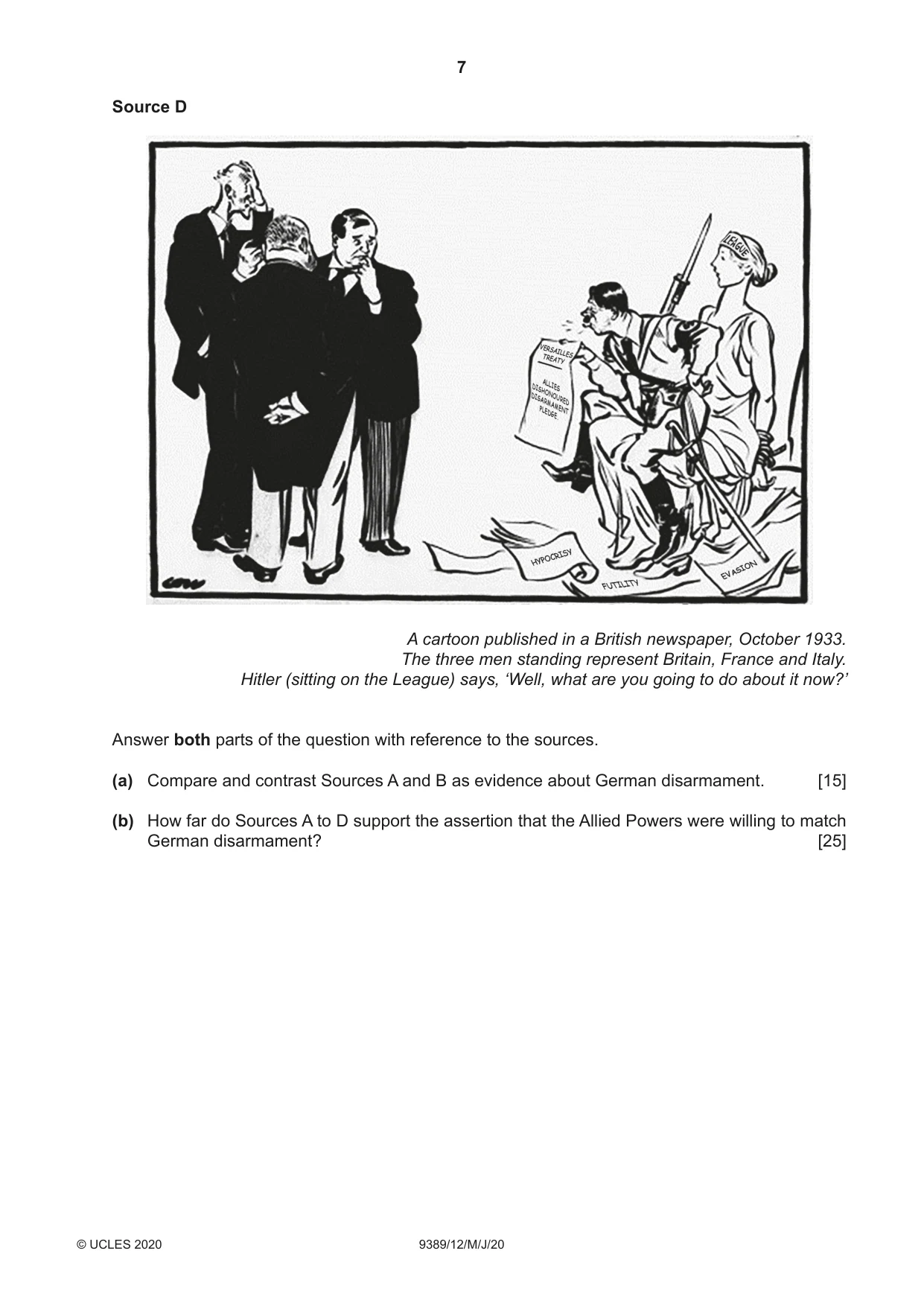
7 9389/12/M/J/20 © UCLES 2020 Source D A cartoon published in a British newspaper, October 1933. The three men standing represent Britain, France and Italy. Hitler (sitting on the League) says, ‘Well, what are you going to do about it now?’ Answer both parts of the question with reference to the sources. (a) Compare and contrast Sources A and B as evidence about German disarmament. [15] (b) How far do Sources A to D support the assertion that the Allied Powers were willing to match German disarmament? [25]
Question paper, page 8
8 9389/12/M/J/20 © UCLES 2020 Permission to reproduce items where third-party owned material protected by copyright is included has been sought and cleared where possible. Every reasonable effort has been made by the publisher (UCLES) to trace copyright holders, but if any items requiring clearance have unwittingly been included, the publisher will be pleased to make amends at the earliest possible opportunity. To avoid the issue of disclosure of answer-related information to candidates, all copyright acknowledgements are reproduced online in the Cambridge Assessment International Education Copyright Acknowledgements Booklet. This is produced for each series of examinations and is freely available to download at www.cambridgeinternational.org after the live examination series. Cambridge Assessment International Education is part of the Cambridge Assessment Group. Cambridge Assessment is the brand name of the University of Cambridge Local Examinations Syndicate (UCLES), which itself is a department of the University of Cambridge. BLANK PAGE
Mark scheme, page 1
This document consists of 11 printed pages. © UCLES 2020 [Turn over Cambridge International AS & A Level HISTORY 9389/12 Paper 1 Document Question 12 May/June 2020 MARK SCHEME Maximum Mark: 40 Published Students did not sit exam papers in the June 2020 series due to the Covid-19 global pandemic. This mark scheme is published to support teachers and students and should be read together with the question paper. It shows the requirements of the exam. The answer column of the mark scheme shows the proposed basis on which Examiners would award marks for this exam. Where appropriate, this column also provides the most likely acceptable alternative responses expected from students. Examiners usually review the mark scheme after they have seen student responses and update the mark scheme if appropriate. In the June series, Examiners were unable to consider the acceptability of alternative responses, as there were no student responses to consider. Mark schemes should usually be read together with the Principal Examiner Report for Teachers. However, because students did not sit exam papers, there is no Principal Examiner Report for Teachers for the June 2020 series. Cambridge International will not enter into discussions about these mark schemes. Cambridge International is publishing the mark schemes for the June 2020 series for most Cambridge IGCSE™ and Cambridge International A & AS Level components, and some Cambridge O Level components.
Mark scheme, page 2
9389/12 Cambridge International AS & A Level – Mark Scheme PUBLISHED May/June 2020 © UCLES 2020 Page 2 of 11 Generic Marking Principles These general marking principles must be applied by all examiners when marking candidate answers. They should be applied alongside the specific content of the mark scheme or generic level descriptors for a question. Each question paper and mark scheme will also comply with these marking principles. GENERIC MARKING PRINCIPLE 1: Marks must be awarded in line with: • the specific content of the mark scheme or the generic level descriptors for the question • the specific skills defined in the mark scheme or in the generic level descriptors for the question • the standard of response required by a candidate as exemplified by the standardisation scripts. GENERIC MARKING PRINCIPLE 2: Marks awarded are always whole marks (not half marks, or other fractions). GENERIC MARKING PRINCIPLE 3: Marks must be awarded positively: • marks are awarded for correct/valid answers, as defined in the mark scheme. However, credit is given for valid answers which go beyond the scope of the syllabus and mark scheme, referring to your Team Leader as appropriate • marks are awarded when candidates clearly demonstrate what they know and can do • marks are not deducted for errors • marks are not deducted for omissions • answers should only be judged on the quality of spelling, punctuation and grammar when these features are specifically assessed by the question as indicated by the mark scheme. The meaning, however, should be unambiguous. GENERIC MARKING PRINCIPLE 4: Rules must be applied consistently e.g. in situations where candidates have not followed instructions or in the application of generic level descriptors. GENERIC MARKING PRINCIPLE 5: Marks should be awarded using the full range of marks defined in the mark scheme for the question (however; the use of the full mark range may be limited according to the quality of the candidate responses seen). GENERIC MARKING PRINCIPLE 6: Marks awarded are based solely on the requirements as defined in the mark scheme. Marks should not be awarded with grade thresholds or grade descriptors in mind.
Mark scheme, page 3
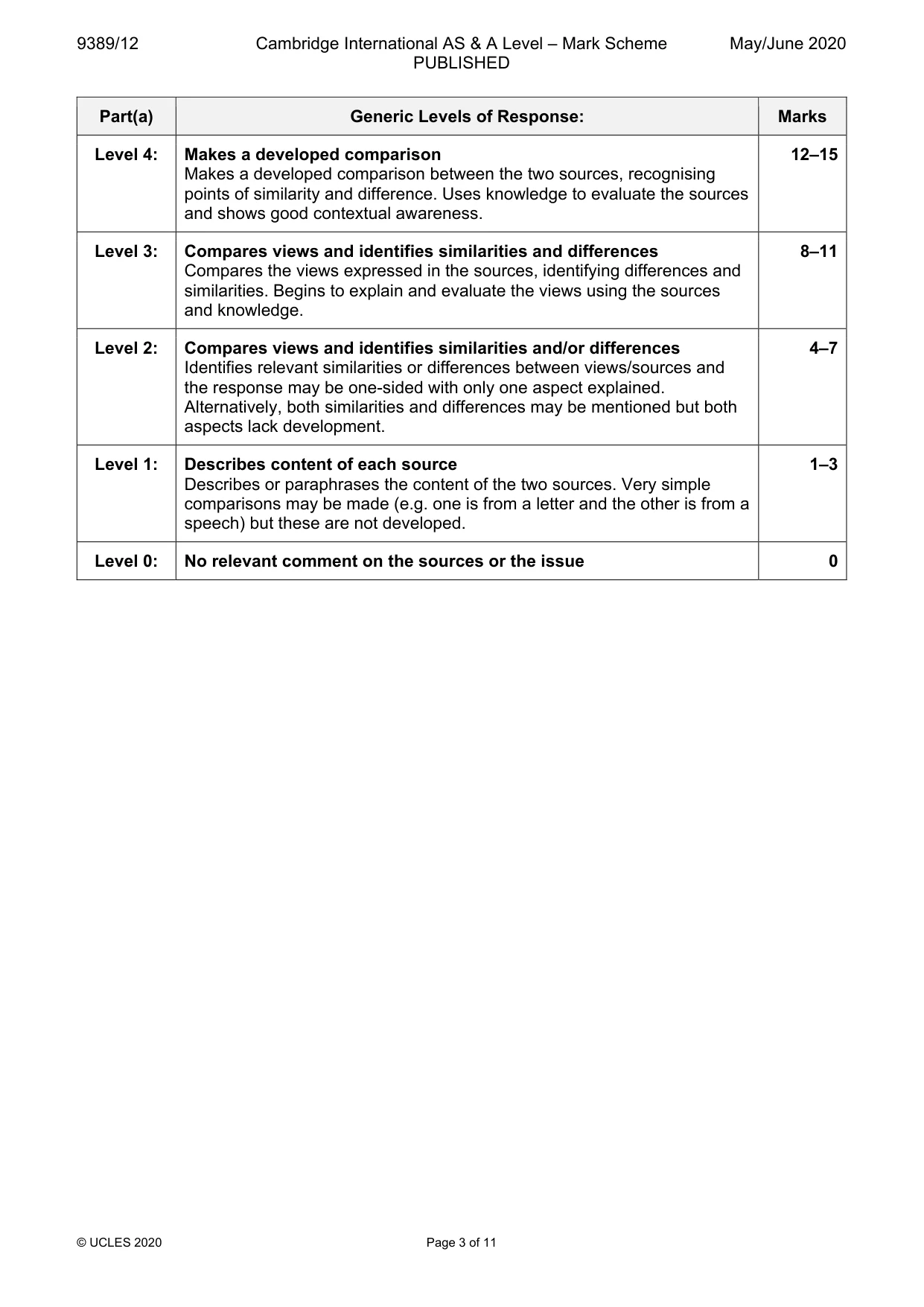
9389/12 Cambridge International AS & A Level – Mark Scheme PUBLISHED May/June 2020 © UCLES 2020 Page 3 of 11 Part(a) Generic Levels of Response: Marks Level 4: Makes a developed comparison Makes a developed comparison between the two sources, recognising points of similarity and difference. Uses knowledge to evaluate the sources and shows good contextual awareness. 12–15 Level 3: Compares views and identifies similarities and differences Compares the views expressed in the sources, identifying differences and similarities. Begins to explain and evaluate the views using the sources and knowledge. 8–11 Level 2: Compares views and identifies similarities and/or differences Identifies relevant similarities or differences between views/sources and the response may be one-sided with only one aspect explained. Alternatively, both similarities and differences may be mentioned but both aspects lack development. 4–7 Level 1: Describes content of each source Describes or paraphrases the content of the two sources. Very simple comparisons may be made (e.g. one is from a letter and the other is from a speech) but these are not developed. 1–3 Level 0: No relevant comment on the sources or the issue 0
Mark scheme, page 4
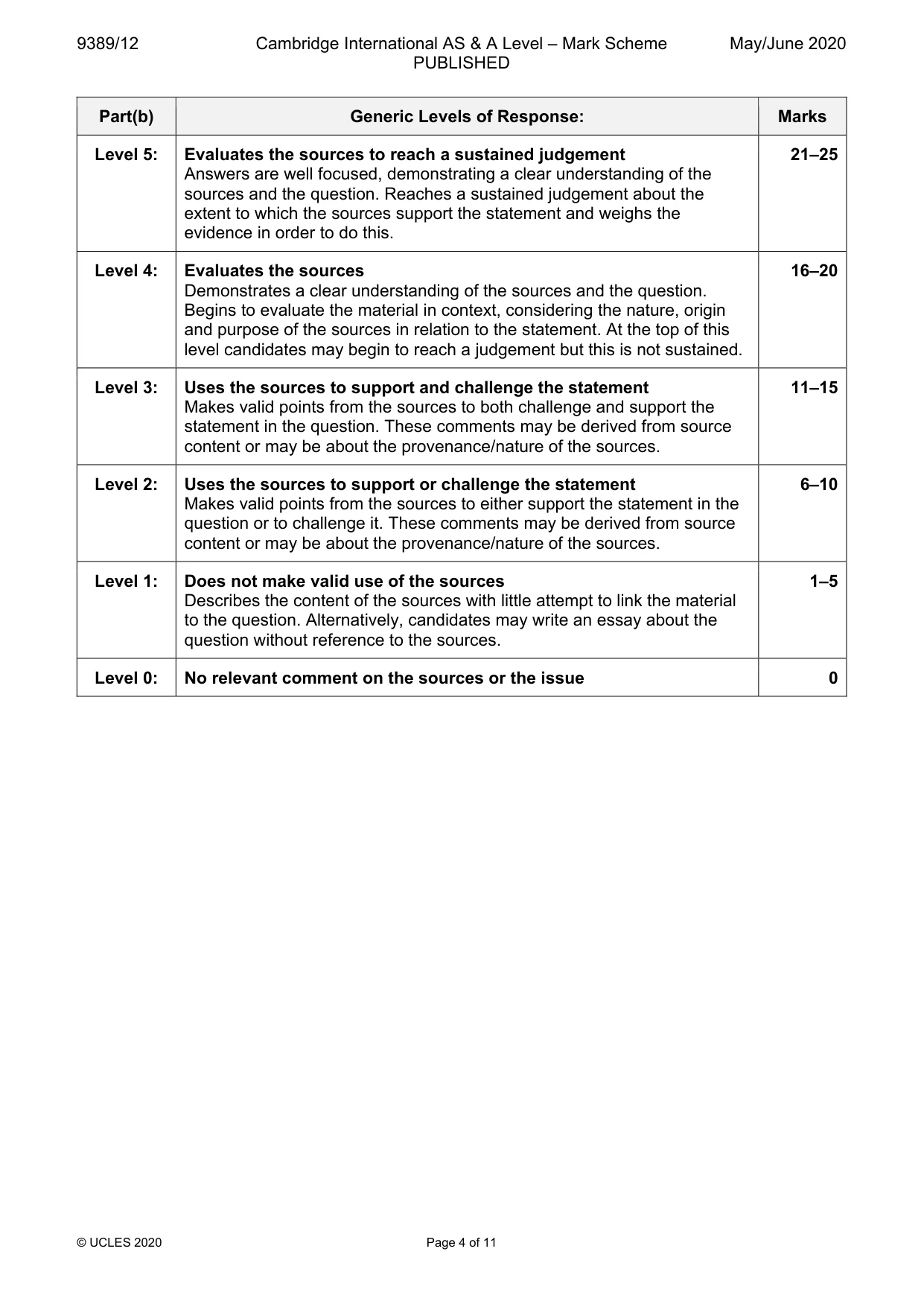
9389/12 Cambridge International AS & A Level – Mark Scheme PUBLISHED May/June 2020 © UCLES 2020 Page 4 of 11 Part(b) Generic Levels of Response: Marks Level 5: Evaluates the sources to reach a sustained judgement Answers are well focused, demonstrating a clear understanding of the sources and the question. Reaches a sustained judgement about the extent to which the sources support the statement and weighs the evidence in order to do this. 21–25 Level 4: Evaluates the sources Demonstrates a clear understanding of the sources and the question. Begins to evaluate the material in context, considering the nature, origin and purpose of the sources in relation to the statement. At the top of this level candidates may begin to reach a judgement but this is not sustained. 16–20 Level 3: Uses the sources to support and challenge the statement Makes valid points from the sources to both challenge and support the statement in the question. These comments may be derived from source content or may be about the provenance/nature of the sources. 11–15 Level 2: Uses the sources to support or challenge the statement Makes valid points from the sources to either support the statement in the question or to challenge it. These comments may be derived from source content or may be about the provenance/nature of the sources. 6–10 Level 1: Does not make valid use of the sources Describes the content of the sources with little attempt to link the material to the question. Alternatively, candidates may write an essay about the question without reference to the sources. 1–5 Level 0: No relevant comment on the sources or the issue 0
Mark scheme, page 5
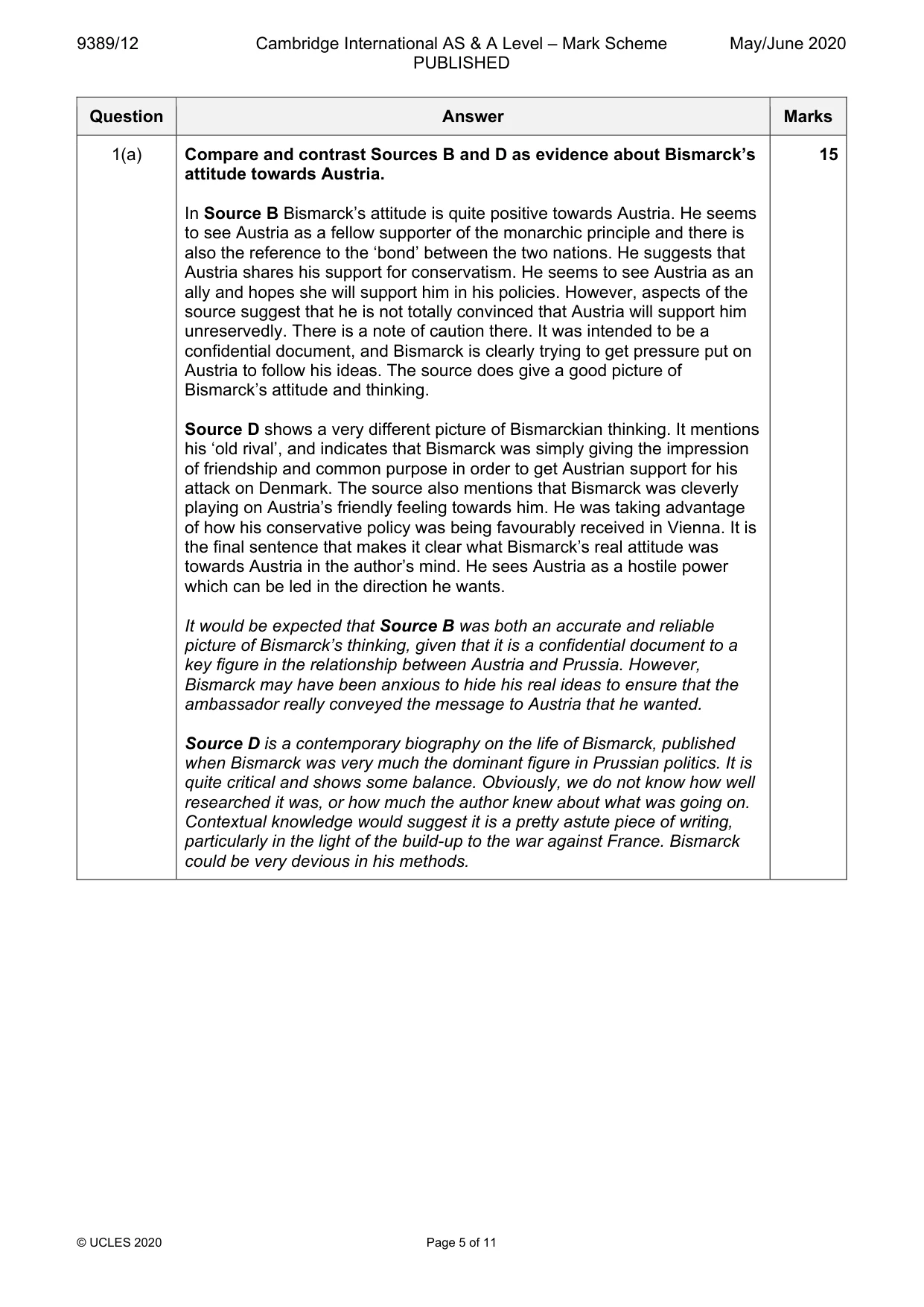
9389/12 Cambridge International AS & A Level – Mark Scheme PUBLISHED May/June 2020 © UCLES 2020 Page 5 of 11 Question Answer Marks 1(a) Compare and contrast Sources B and D as evidence about Bismarck’s attitude towards Austria. In Source B Bismarck’s attitude is quite positive towards Austria. He seems to see Austria as a fellow supporter of the monarchic principle and there is also the reference to the ‘bond’ between the two nations. He suggests that Austria shares his support for conservatism. He seems to see Austria as an ally and hopes she will support him in his policies. However, aspects of the source suggest that he is not totally convinced that Austria will support him unreservedly. There is a note of caution there. It was intended to be a confidential document, and Bismarck is clearly trying to get pressure put on Austria to follow his ideas. The source does give a good picture of Bismarck’s attitude and thinking. Source D shows a very different picture of Bismarckian thinking. It mentions his ‘old rival’, and indicates that Bismarck was simply giving the impression of friendship and common purpose in order to get Austrian support for his attack on Denmark. The source also mentions that Bismarck was cleverly playing on Austria’s friendly feeling towards him. He was taking advantage of how his conservative policy was being favourably received in Vienna. It is the final sentence that makes it clear what Bismarck’s real attitude was towards Austria in the author’s mind. He sees Austria as a hostile power which can be led in the direction he wants. It would be expected that Source B was both an accurate and reliable picture of Bismarck’s thinking, given that it is a confidential document to a key figure in the relationship between Austria and Prussia. However, Bismarck may have been anxious to hide his real ideas to ensure that the ambassador really conveyed the message to Austria that he wanted. Source D is a contemporary biography on the life of Bismarck, published when Bismarck was very much the dominant figure in Prussian politics. It is quite critical and shows some balance. Obviously, we do not know how well researched it was, or how much the author knew about what was going on. Contextual knowledge would suggest it is a pretty astute piece of writing, particularly in the light of the build-up to the war against France. Bismarck could be very devious in his methods. 15
Mark scheme, page 6
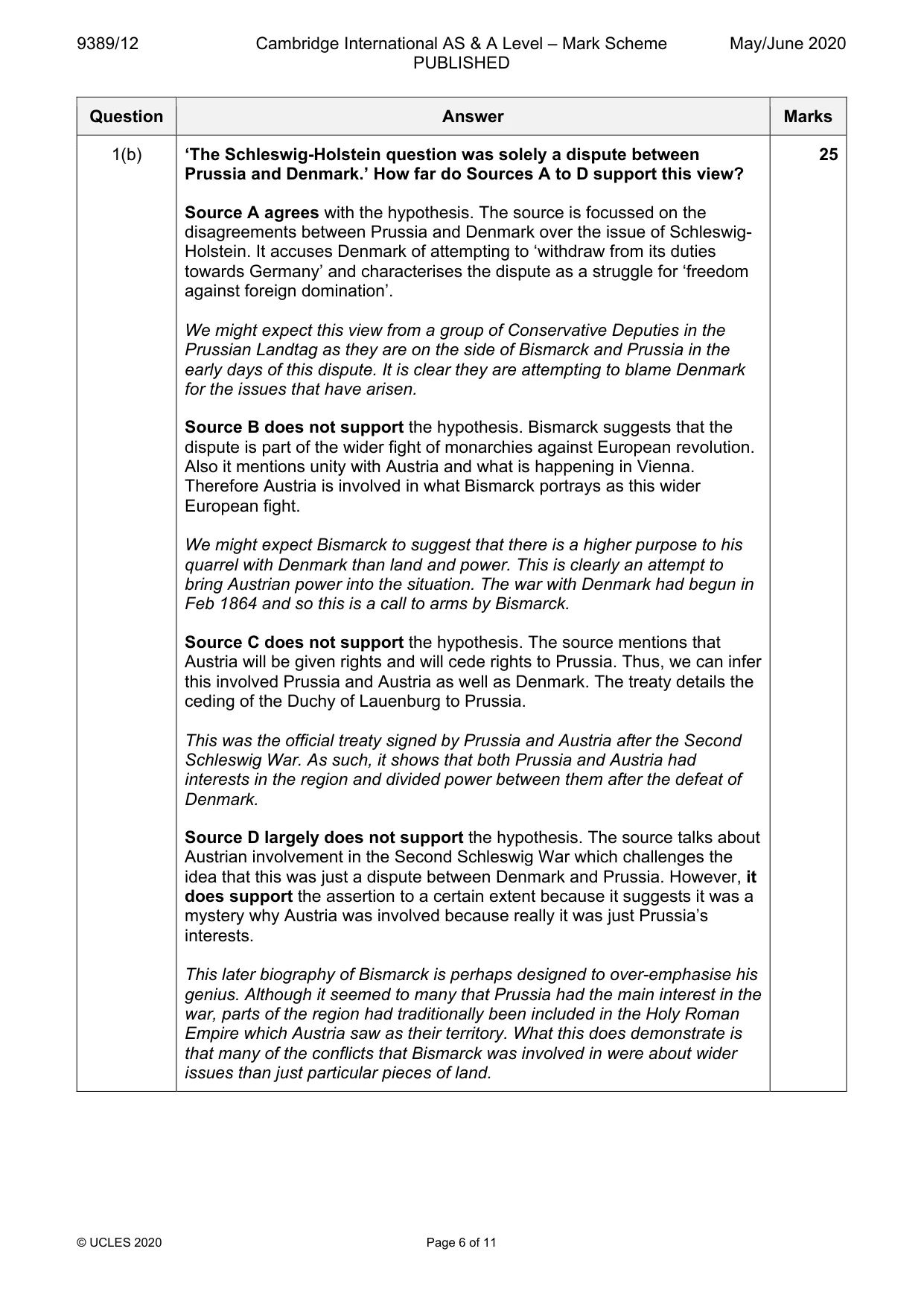
9389/12 Cambridge International AS & A Level – Mark Scheme PUBLISHED May/June 2020 © UCLES 2020 Page 6 of 11 Question Answer Marks 1(b) ‘The Schleswig-Holstein question was solely a dispute between Prussia and Denmark.’ How far do Sources A to D support this view? Source A agrees with the hypothesis. The source is focussed on the disagreements between Prussia and Denmark over the issue of Schleswig- Holstein. It accuses Denmark of attempting to ‘withdraw from its duties towards Germany’ and characterises the dispute as a struggle for ‘freedom against foreign domination’. We might expect this view from a group of Conservative Deputies in the Prussian Landtag as they are on the side of Bismarck and Prussia in the early days of this dispute. It is clear they are attempting to blame Denmark for the issues that have arisen. Source B does not support the hypothesis. Bismarck suggests that the dispute is part of the wider fight of monarchies against European revolution. Also it mentions unity with Austria and what is happening in Vienna. Therefore Austria is involved in what Bismarck portrays as this wider European fight. We might expect Bismarck to suggest that there is a higher purpose to his quarrel with Denmark than land and power. This is clearly an attempt to bring Austrian power into the situation. The war with Denmark had begun in Feb 1864 and so this is a call to arms by Bismarck. Source C does not support the hypothesis. The source mentions that Austria will be given rights and will cede rights to Prussia. Thus, we can infer this involved Prussia and Austria as well as Denmark. The treaty details the ceding of the Duchy of Lauenburg to Prussia. This was the official treaty signed by Prussia and Austria after the Second Schleswig War. As such, it shows that both Prussia and Austria had interests in the region and divided power between them after the defeat of Denmark. Source D largely does not support the hypothesis. The source talks about Austrian involvement in the Second Schleswig War which challenges the idea that this was just a dispute between Denmark and Prussia. However, it does support the assertion to a certain extent because it suggests it was a mystery why Austria was involved because really it was just Prussia’s interests. This later biography of Bismarck is perhaps designed to over-emphasise his genius. Although it seemed to many that Prussia had the main interest in the war, parts of the region had traditionally been included in the Holy Roman Empire which Austria saw as their territory. What this does demonstrate is that many of the conflicts that Bismarck was involved in were about wider issues than just particular pieces of land. 25
Mark scheme, page 7
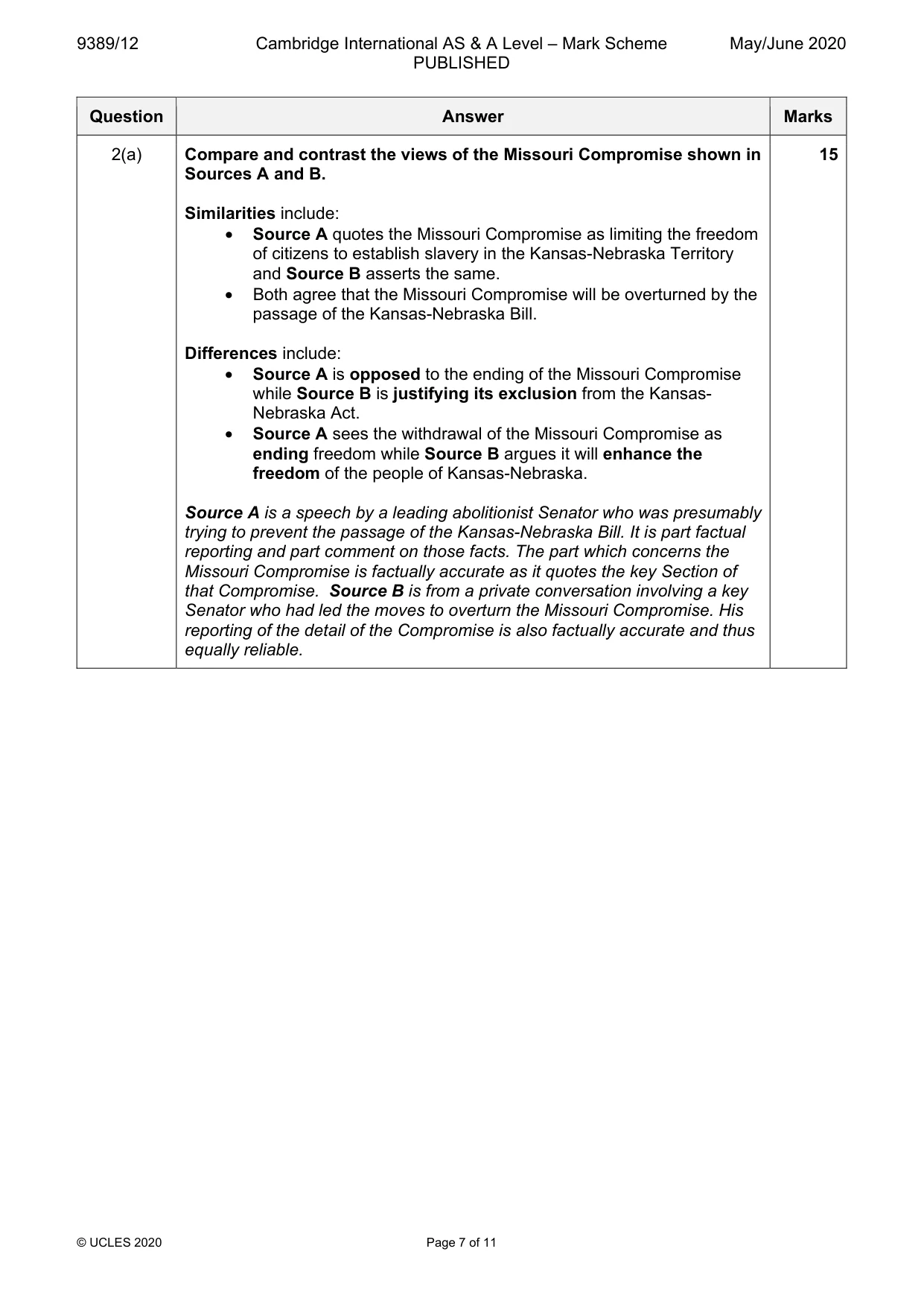
9389/12 Cambridge International AS & A Level – Mark Scheme PUBLISHED May/June 2020 © UCLES 2020 Page 7 of 11 Question Answer Marks 2(a) Compare and contrast the views of the Missouri Compromise shown in Sources A and B. Similarities include: • Source A quotes the Missouri Compromise as limiting the freedom of citizens to establish slavery in the Kansas-Nebraska Territory and Source B asserts the same. • Both agree that the Missouri Compromise will be overturned by the passage of the Kansas-Nebraska Bill. Differences include: • Source A is opposed to the ending of the Missouri Compromise while Source B is justifying its exclusion from the Kansas- Nebraska Act. • Source A sees the withdrawal of the Missouri Compromise as ending freedom while Source B argues it will enhance the freedom of the people of Kansas-Nebraska. Source A is a speech by a leading abolitionist Senator who was presumably trying to prevent the passage of the Kansas-Nebraska Bill. It is part factual reporting and part comment on those facts. The part which concerns the Missouri Compromise is factually accurate as it quotes the key Section of that Compromise. Source B is from a private conversation involving a key Senator who had led the moves to overturn the Missouri Compromise. His reporting of the detail of the Compromise is also factually accurate and thus equally reliable. 15
Mark scheme, page 8
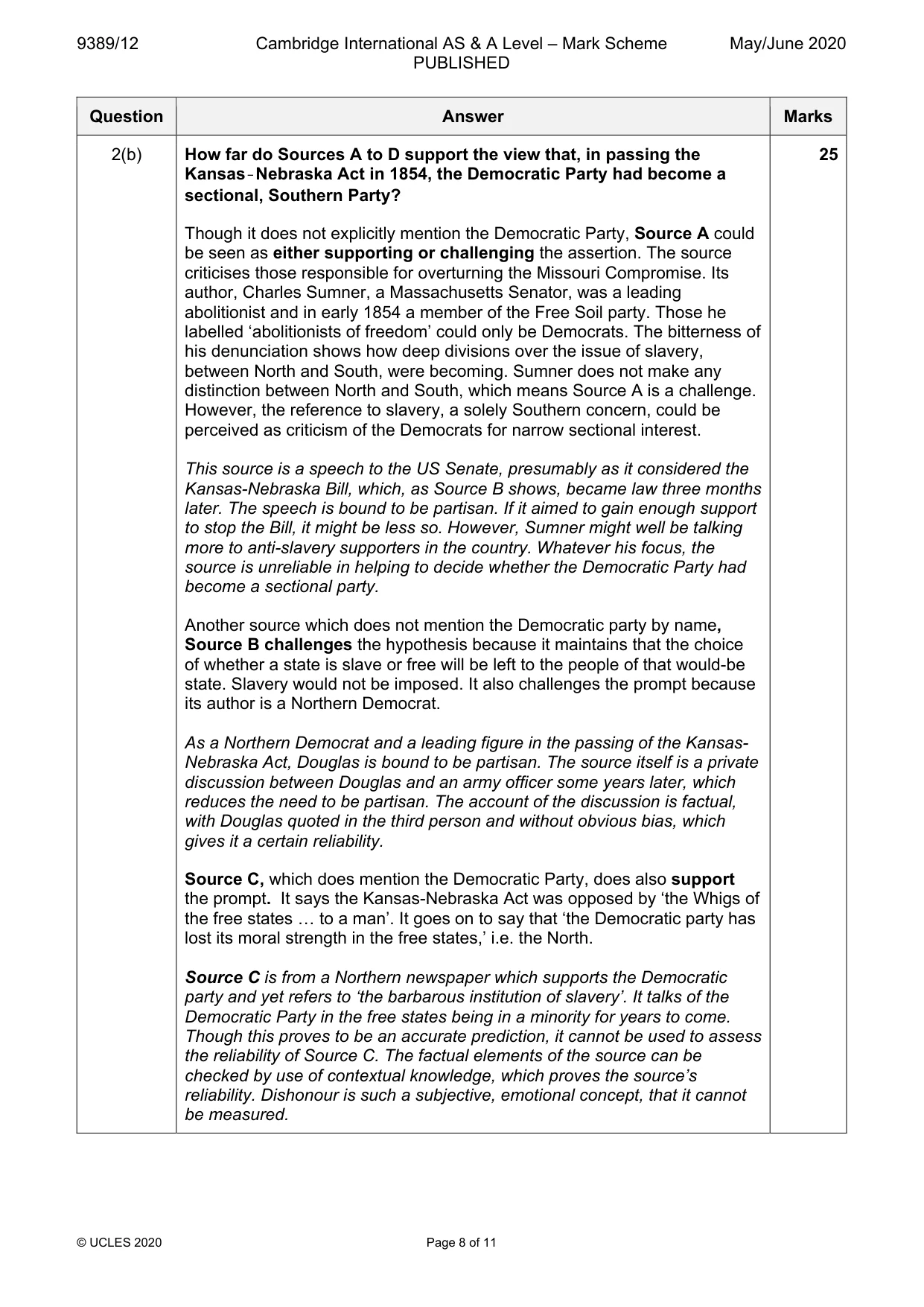
9389/12 Cambridge International AS & A Level – Mark Scheme PUBLISHED May/June 2020 © UCLES 2020 Page 8 of 11 Question Answer Marks 2(b) How far do Sources A to D support the view that, in passing the Kansas-Nebraska Act in 1854, the Democratic Party had become a sectional, Southern Party? Though it does not explicitly mention the Democratic Party, Source A could be seen as either supporting or challenging the assertion. The source criticises those responsible for overturning the Missouri Compromise. Its author, Charles Sumner, a Massachusetts Senator, was a leading abolitionist and in early 1854 a member of the Free Soil party. Those he labelled ‘abolitionists of freedom’ could only be Democrats. The bitterness of his denunciation shows how deep divisions over the issue of slavery, between North and South, were becoming. Sumner does not make any distinction between North and South, which means Source A is a challenge. However, the reference to slavery, a solely Southern concern, could be perceived as criticism of the Democrats for narrow sectional interest. This source is a speech to the US Senate, presumably as it considered the Kansas-Nebraska Bill, which, as Source B shows, became law three months later. The speech is bound to be partisan. If it aimed to gain enough support to stop the Bill, it might be less so. However, Sumner might well be talking more to anti-slavery supporters in the country. Whatever his focus, the source is unreliable in helping to decide whether the Democratic Party had become a sectional party. Another source which does not mention the Democratic party by name, Source B challenges the hypothesis because it maintains that the choice of whether a state is slave or free will be left to the people of that would-be state. Slavery would not be imposed. It also challenges the prompt because its author is a Northern Democrat. As a Northern Democrat and a leading figure in the passing of the Kansas- Nebraska Act, Douglas is bound to be partisan. The source itself is a private discussion between Douglas and an army officer some years later, which reduces the need to be partisan. The account of the discussion is factual, with Douglas quoted in the third person and without obvious bias, which gives it a certain reliability. Source C, which does mention the Democratic Party, does also support the prompt. It says the Kansas-Nebraska Act was opposed by ‘the Whigs of the free states … to a man’. It goes on to say that ‘the Democratic party has lost its moral strength in the free states,’ i.e. the North. Source C is from a Northern newspaper which supports the Democratic party and yet refers to ‘the barbarous institution of slavery’. It talks of the Democratic Party in the free states being in a minority for years to come. Though this proves to be an accurate prediction, it cannot be used to assess the reliability of Source C. The factual elements of the source can be checked by use of contextual knowledge, which proves the source’s reliability. Dishonour is such a subjective, emotional concept, that it cannot be measured. 25
Mark scheme, page 9
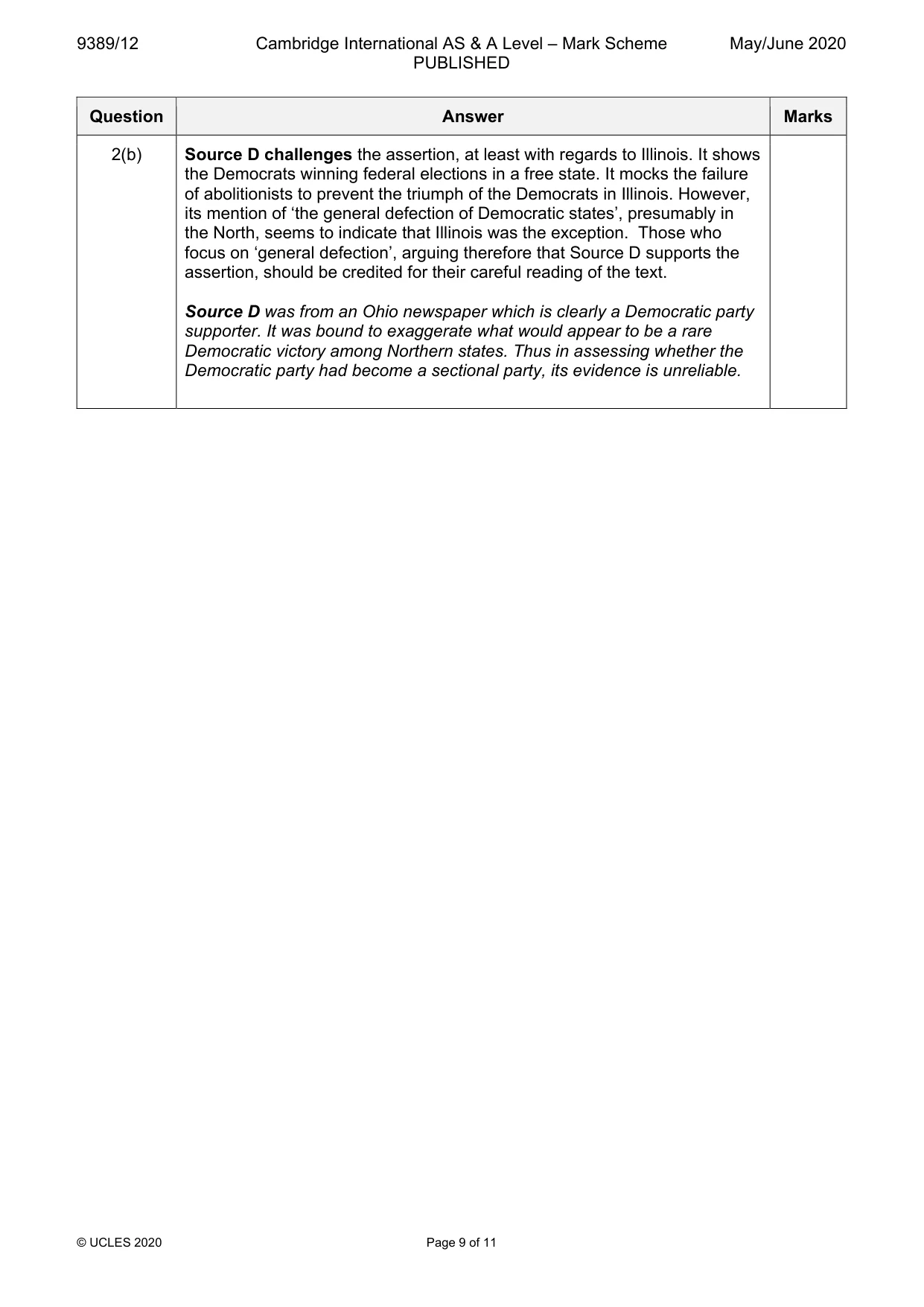
9389/12 Cambridge International AS & A Level – Mark Scheme PUBLISHED May/June 2020 © UCLES 2020 Page 9 of 11 Question Answer Marks 2(b) Source D challenges the assertion, at least with regards to Illinois. It shows the Democrats winning federal elections in a free state. It mocks the failure of abolitionists to prevent the triumph of the Democrats in Illinois. However, its mention of ‘the general defection of Democratic states’, presumably in the North, seems to indicate that Illinois was the exception. Those who focus on ‘general defection’, arguing therefore that Source D supports the assertion, should be credited for their careful reading of the text. Source D was from an Ohio newspaper which is clearly a Democratic party supporter. It was bound to exaggerate what would appear to be a rare Democratic victory among Northern states. Thus in assessing whether the Democratic party had become a sectional party, its evidence is unreliable.
Mark scheme, page 10
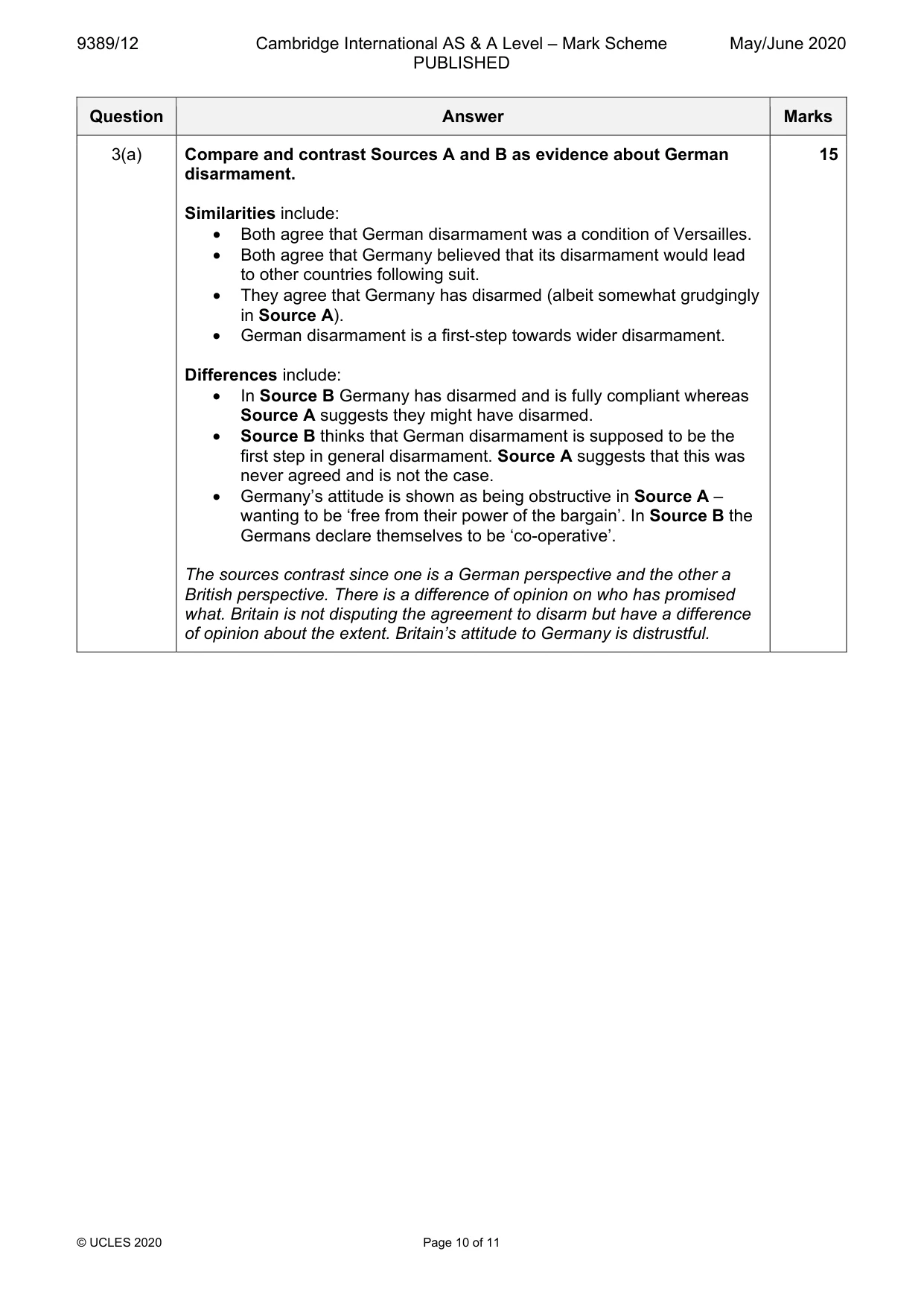
9389/12 Cambridge International AS & A Level – Mark Scheme PUBLISHED May/June 2020 © UCLES 2020 Page 10 of 11 Question Answer Marks 3(a) Compare and contrast Sources A and B as evidence about German disarmament. Similarities include: • Both agree that German disarmament was a condition of Versailles. • Both agree that Germany believed that its disarmament would lead to other countries following suit. • They agree that Germany has disarmed (albeit somewhat grudgingly in Source A). • German disarmament is a first-step towards wider disarmament. Differences include: • In Source B Germany has disarmed and is fully compliant whereas Source A suggests they might have disarmed. • Source B thinks that German disarmament is supposed to be the first step in general disarmament. Source A suggests that this was never agreed and is not the case. • Germany’s attitude is shown as being obstructive in Source A – wanting to be ‘free from their power of the bargain’. In Source B the Germans declare themselves to be ‘co-operative’. The sources contrast since one is a German perspective and the other a British perspective. There is a difference of opinion on who has promised what. Britain is not disputing the agreement to disarm but have a difference of opinion about the extent. Britain’s attitude to Germany is distrustful. 15
Mark scheme, page 11
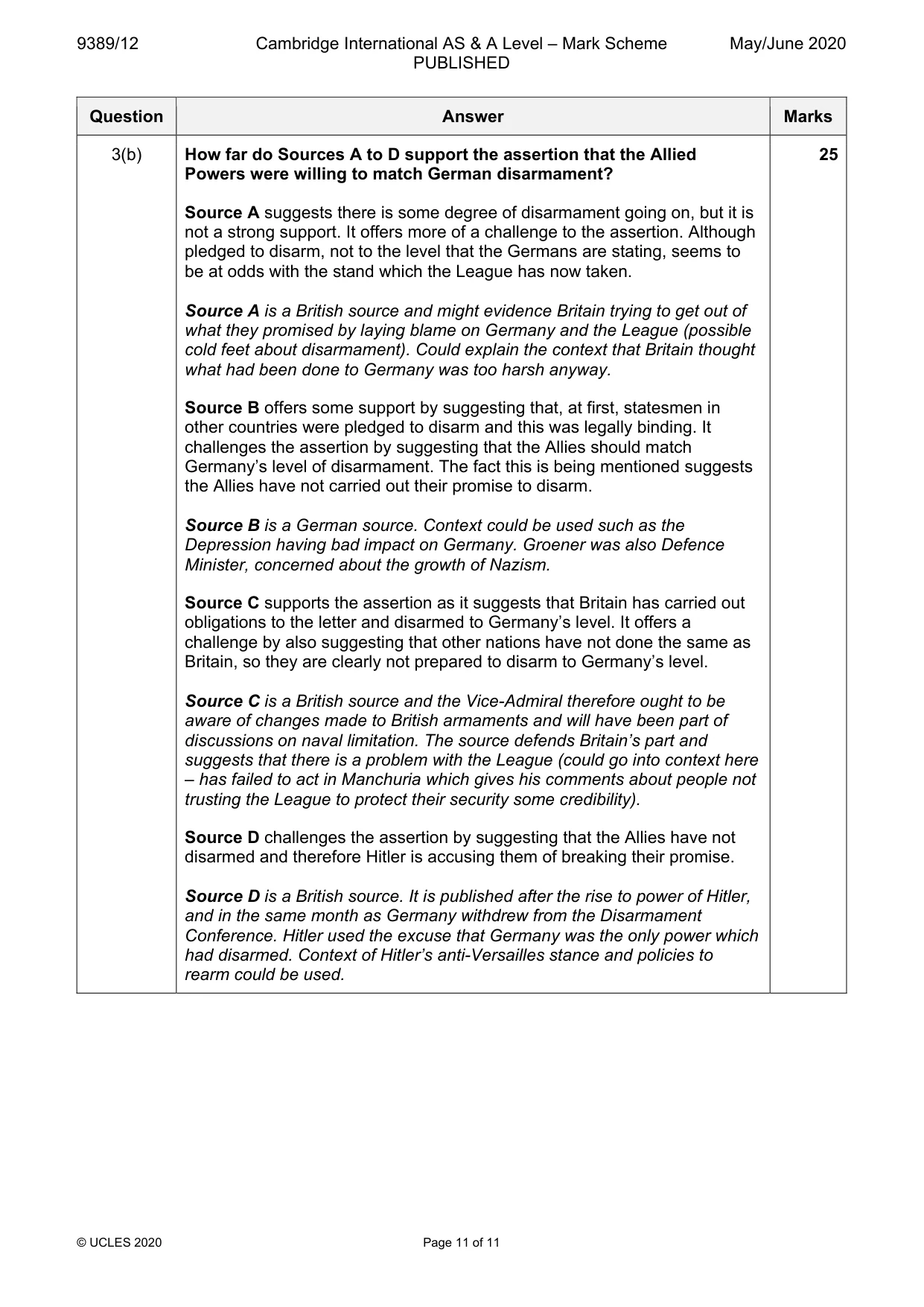
9389/12 Cambridge International AS & A Level – Mark Scheme PUBLISHED May/June 2020 © UCLES 2020 Page 11 of 11 Question Answer Marks 3(b) How far do Sources A to D support the assertion that the Allied Powers were willing to match German disarmament? Source A suggests there is some degree of disarmament going on, but it is not a strong support. It offers more of a challenge to the assertion. Although pledged to disarm, not to the level that the Germans are stating, seems to be at odds with the stand which the League has now taken. Source A is a British source and might evidence Britain trying to get out of what they promised by laying blame on Germany and the League (possible cold feet about disarmament). Could explain the context that Britain thought what had been done to Germany was too harsh anyway. Source B offers some support by suggesting that, at first, statesmen in other countries were pledged to disarm and this was legally binding. It challenges the assertion by suggesting that the Allies should match Germany’s level of disarmament. The fact this is being mentioned suggests the Allies have not carried out their promise to disarm. Source B is a German source. Context could be used such as the Depression having bad impact on Germany. Groener was also Defence Minister, concerned about the growth of Nazism. Source C supports the assertion as it suggests that Britain has carried out obligations to the letter and disarmed to Germany’s level. It offers a challenge by also suggesting that other nations have not done the same as Britain, so they are clearly not prepared to disarm to Germany’s level. Source C is a British source and the Vice-Admiral therefore ought to be aware of changes made to British armaments and will have been part of discussions on naval limitation. The source defends Britain’s part and suggests that there is a problem with the League (could go into context here – has failed to act in Manchuria which gives his comments about people not trusting the League to protect their security some credibility). Source D challenges the assertion by suggesting that the Allies have not disarmed and therefore Hitler is accusing them of breaking their promise. Source D is a British source. It is published after the rise to power of Hitler, and in the same month as Germany withdrew from the Disarmament Conference. Hitler used the excuse that Germany was the only power which had disarmed. Context of Hitler’s anti-Versailles stance and policies to rearm could be used. 25