Cambridge A Level History 9389 — 2018 May/June Paper 1 · Variant 2
9389/12/M/J/18 · 40 marks · ≈45 min
The question paper and its mark scheme, free to read here and free to download. This is Cambridge’s own paper, exactly as it was sat.
Question paper8 pages

Mark scheme12 pages
Answers below. Sit the paper first if you are practising.
Paper as text
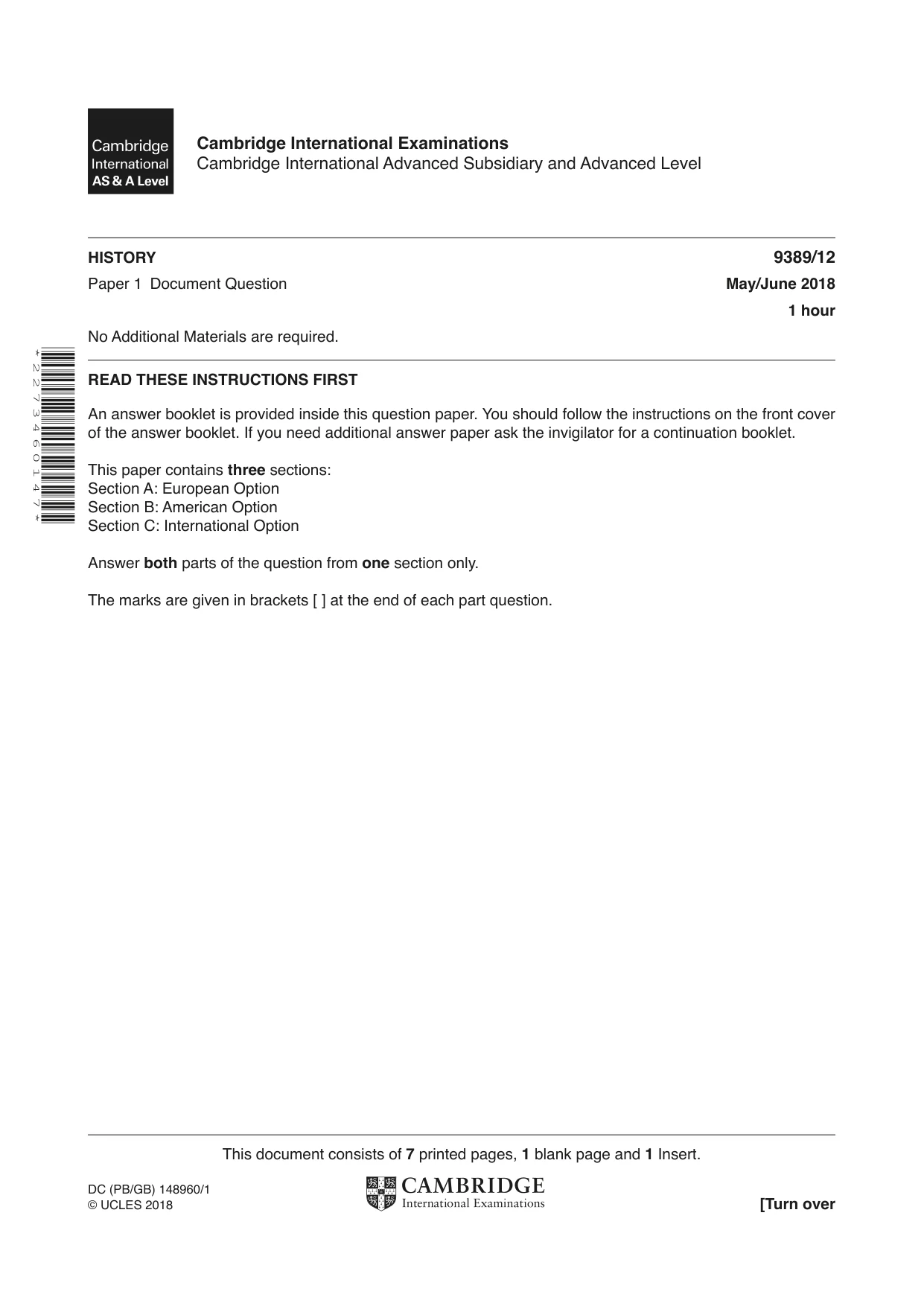
Question paper, page 1
This document consists of 7 printed pages, 1 blank page and 1 Insert. DC (PB/GB) 148960/1 © UCLES 2018 [Turn over Cambridge International Examinations Cambridge International Advanced Subsidiary and Advanced Level * 2 2 7 3 4 6 0 1 4 7 * HISTORY 9389/12 Paper 1 Document Question May/June 2018 1 hour No Additional Materials are required. READ THESE INSTRUCTIONS FIRST An answer booklet is provided inside this question paper. You should follow the instructions on the front cover of the answer booklet. If you need additional answer paper ask the invigilator for a continuation booklet. This paper contains three sections: Section A: European Option Section B: American Option Section C: International Option Answer both parts of the question from one section only. The marks are given in brackets [ ] at the end of each part question.
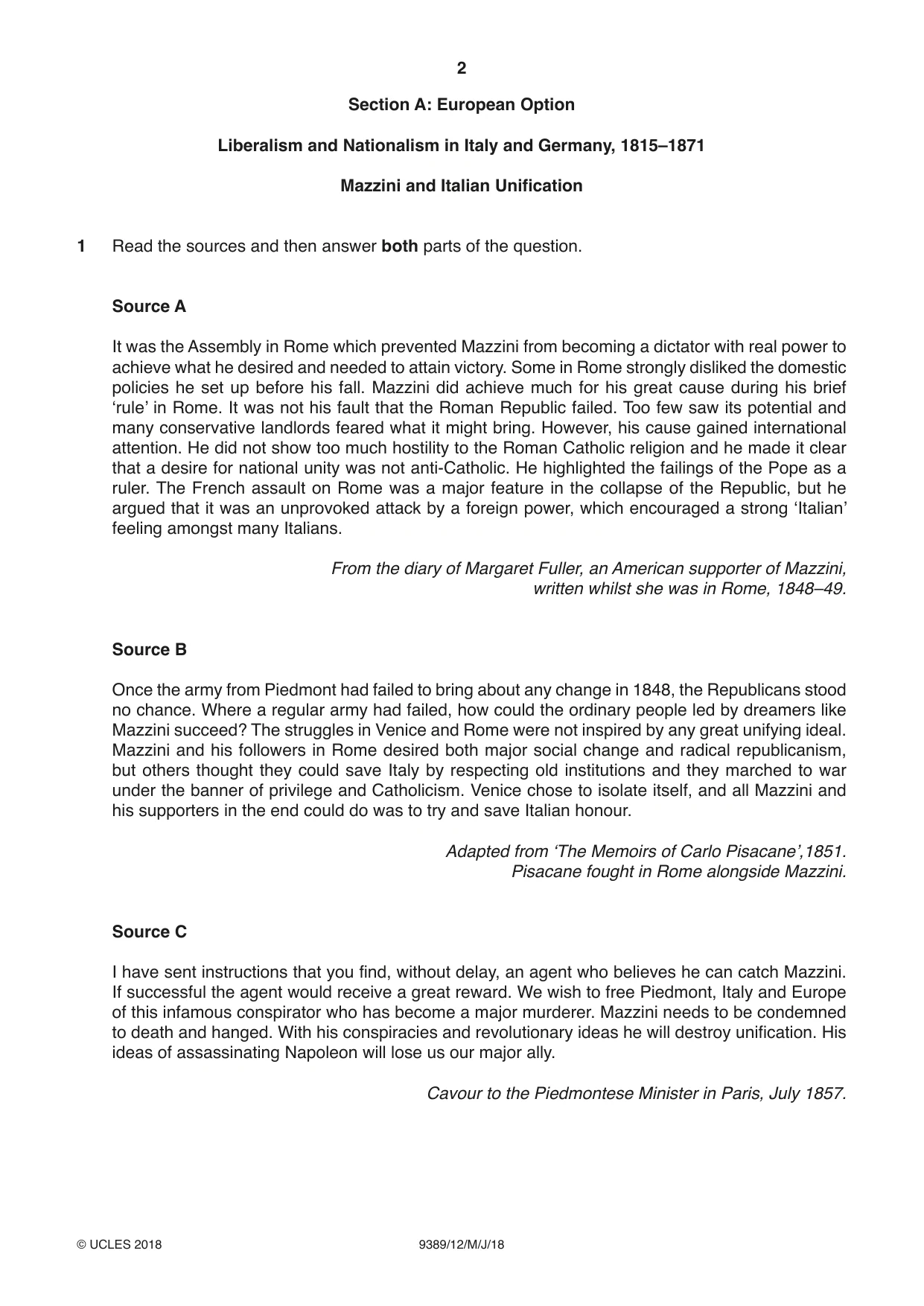
Question paper, page 2
2 9389/12/M/J/18 © UCLES 2018 Section A: European Option Liberalism and Nationalism in Italy and Germany, 1815–1871 Mazzini and Italian Unification 1 Read the sources and then answer both parts of the question. Source A It was the Assembly in Rome which prevented Mazzini from becoming a dictator with real power to achieve what he desired and needed to attain victory. Some in Rome strongly disliked the domestic policies he set up before his fall. Mazzini did achieve much for his great cause during his brief ‘rule’ in Rome. It was not his fault that the Roman Republic failed. Too few saw its potential and many conservative landlords feared what it might bring. However, his cause gained international attention. He did not show too much hostility to the Roman Catholic religion and he made it clear that a desire for national unity was not anti‑Catholic. He highlighted the failings of the Pope as a ruler. The French assault on Rome was a major feature in the collapse of the Republic, but he argued that it was an unprovoked attack by a foreign power, which encouraged a strong ‘Italian’ feeling amongst many Italians. From the diary of Margaret Fuller, an American supporter of Mazzini, written whilst she was in Rome, 1848–49. Source B Once the army from Piedmont had failed to bring about any change in 1848, the Republicans stood no chance. Where a regular army had failed, how could the ordinary people led by dreamers like Mazzini succeed? The struggles in Venice and Rome were not inspired by any great unifying ideal. Mazzini and his followers in Rome desired both major social change and radical republicanism, but others thought they could save Italy by respecting old institutions and they marched to war under the banner of privilege and Catholicism. Venice chose to isolate itself, and all Mazzini and his supporters in the end could do was to try and save Italian honour. Adapted from ‘The Memoirs of Carlo Pisacane’,1851. Pisacane fought in Rome alongside Mazzini. Source C I have sent instructions that you find, without delay, an agent who believes he can catch Mazzini. If successful the agent would receive a great reward. We wish to free Piedmont, Italy and Europe of this infamous conspirator who has become a major murderer. Mazzini needs to be condemned to death and hanged. With his conspiracies and revolutionary ideas he will destroy unification. His ideas of assassinating Napoleon will lose us our major ally. Cavour to the Piedmontese Minister in Paris, July 1857.
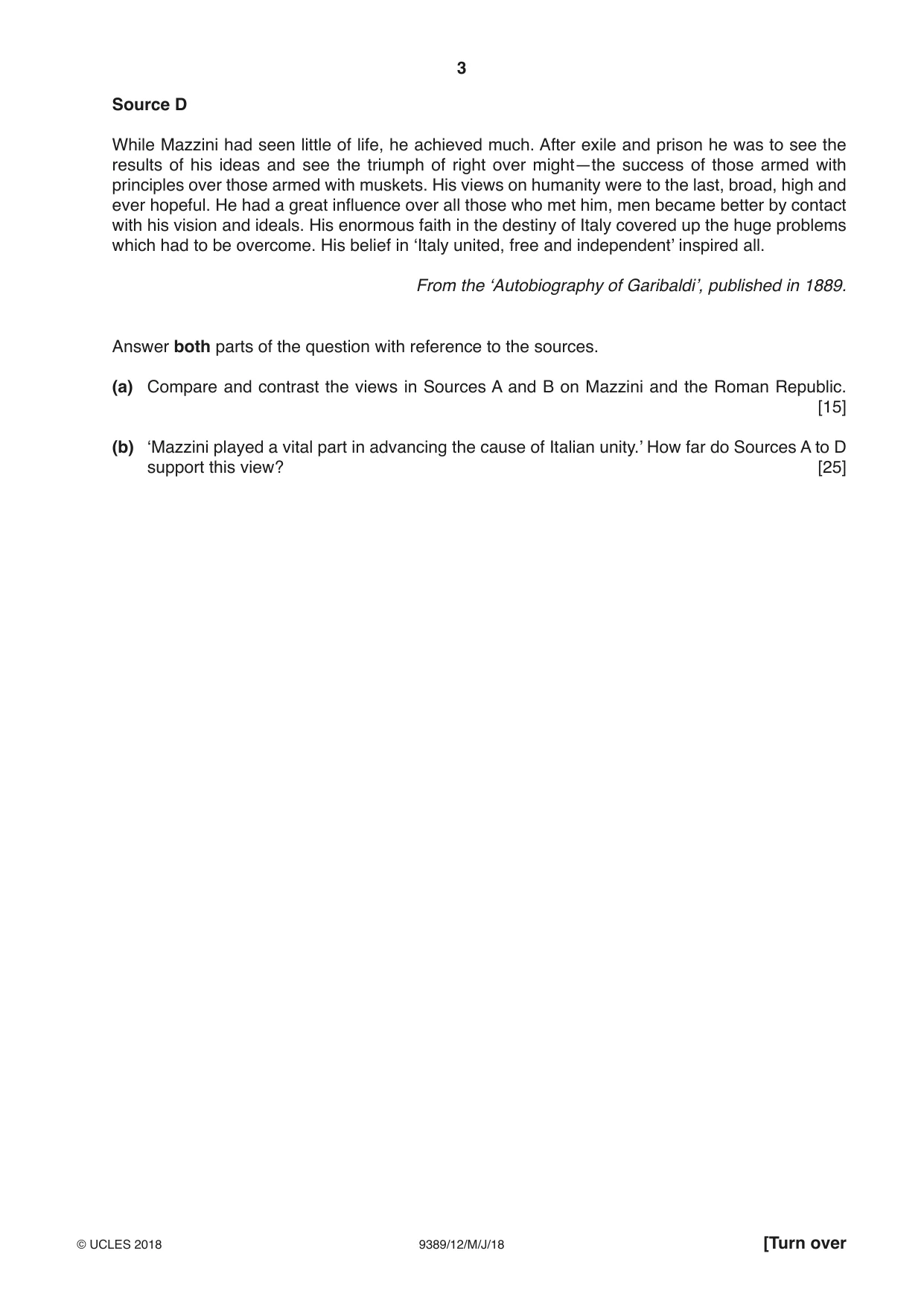
Question paper, page 3
3 9389/12/M/J/18 © UCLES 2018 [Turn over Source D While Mazzini had seen little of life, he achieved much. After exile and prison he was to see the results of his ideas and see the triumph of right over might—the success of those armed with principles over those armed with muskets. His views on humanity were to the last, broad, high and ever hopeful. He had a great influence over all those who met him, men became better by contact with his vision and ideals. His enormous faith in the destiny of Italy covered up the huge problems which had to be overcome. His belief in ‘Italy united, free and independent’ inspired all. From the ‘Autobiography of Garibaldi’, published in 1889. Answer both parts of the question with reference to the sources. (a) Compare and contrast the views in Sources A and B on Mazzini and the Roman Republic. [15] (b) ‘Mazzini played a vital part in advancing the cause of Italian unity.’ How far do Sources A to D support this view? [25]
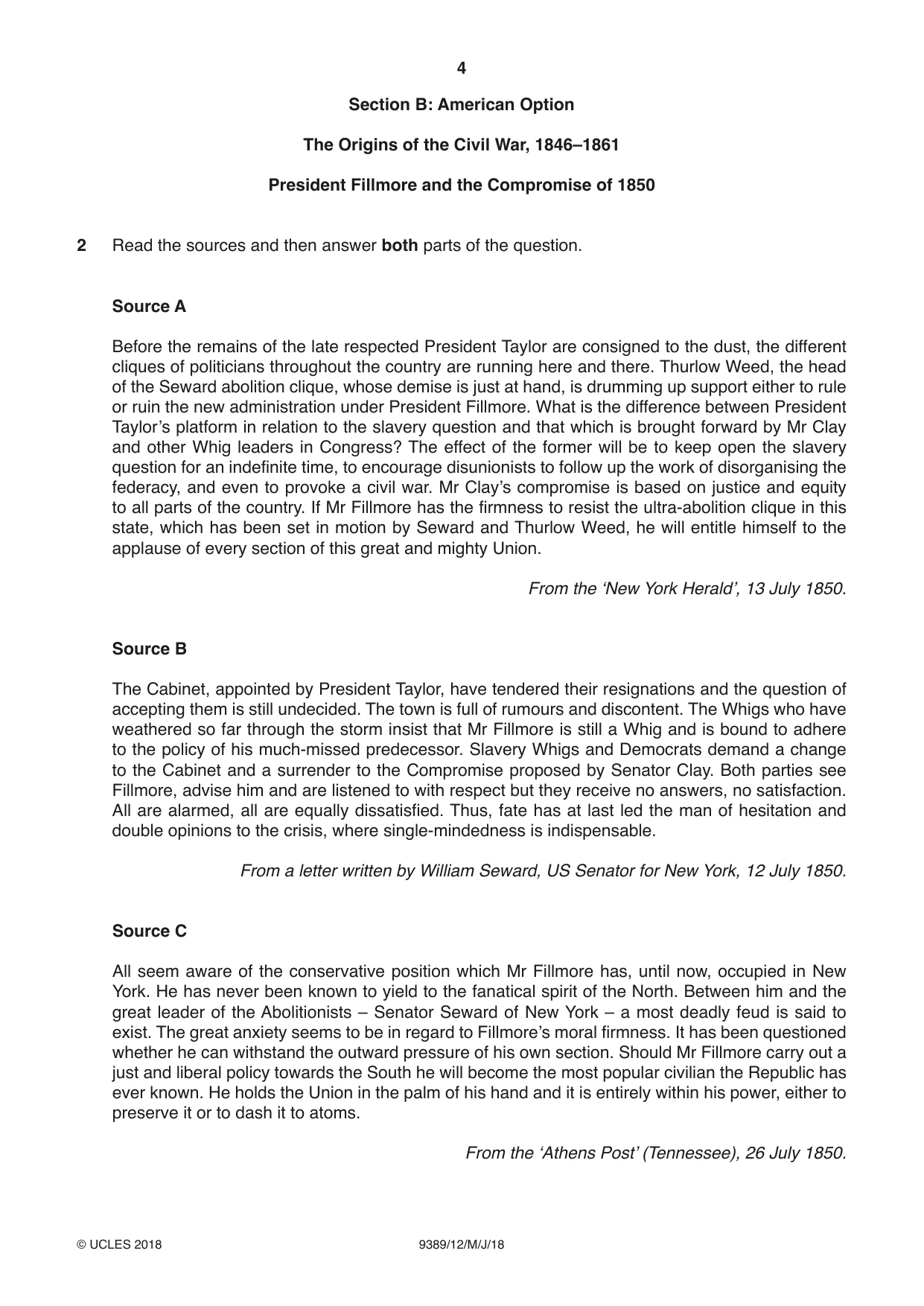
Question paper, page 4
4 9389/12/M/J/18 © UCLES 2018 Section B: American Option The Origins of the Civil War, 1846–1861 President Fillmore and the Compromise of 1850 2 Read the sources and then answer both parts of the question. Source A Before the remains of the late respected President Taylor are consigned to the dust, the different cliques of politicians throughout the country are running here and there. Thurlow Weed, the head of the Seward abolition clique, whose demise is just at hand, is drumming up support either to rule or ruin the new administration under President Fillmore. What is the difference between President Taylor’s platform in relation to the slavery question and that which is brought forward by Mr Clay and other Whig leaders in Congress? The effect of the former will be to keep open the slavery question for an indefinite time, to encourage disunionists to follow up the work of disorganising the federacy, and even to provoke a civil war. Mr Clay’s compromise is based on justice and equity to all parts of the country. If Mr Fillmore has the firmness to resist the ultra‑abolition clique in this state, which has been set in motion by Seward and Thurlow Weed, he will entitle himself to the applause of every section of this great and mighty Union. From the ‘New York Herald’, 13 July 1850. Source B The Cabinet, appointed by President Taylor, have tendered their resignations and the question of accepting them is still undecided. The town is full of rumours and discontent. The Whigs who have weathered so far through the storm insist that Mr Fillmore is still a Whig and is bound to adhere to the policy of his much‑missed predecessor. Slavery Whigs and Democrats demand a change to the Cabinet and a surrender to the Compromise proposed by Senator Clay. Both parties see Fillmore, advise him and are listened to with respect but they receive no answers, no satisfaction. All are alarmed, all are equally dissatisfied. Thus, fate has at last led the man of hesitation and double opinions to the crisis, where single‑mindedness is indispensable. From a letter written by William Seward, US Senator for New York, 12 July 1850. Source C All seem aware of the conservative position which Mr Fillmore has, until now, occupied in New York. He has never been known to yield to the fanatical spirit of the North. Between him and the great leader of the Abolitionists – Senator Seward of New York – a most deadly feud is said to exist. The great anxiety seems to be in regard to Fillmore’s moral firmness. It has been questioned whether he can withstand the outward pressure of his own section. Should Mr Fillmore carry out a just and liberal policy towards the South he will become the most popular civilian the Republic has ever known. He holds the Union in the palm of his hand and it is entirely within his power, either to preserve it or to dash it to atoms. From the ‘Athens Post’ (Tennessee), 26 July 1850.
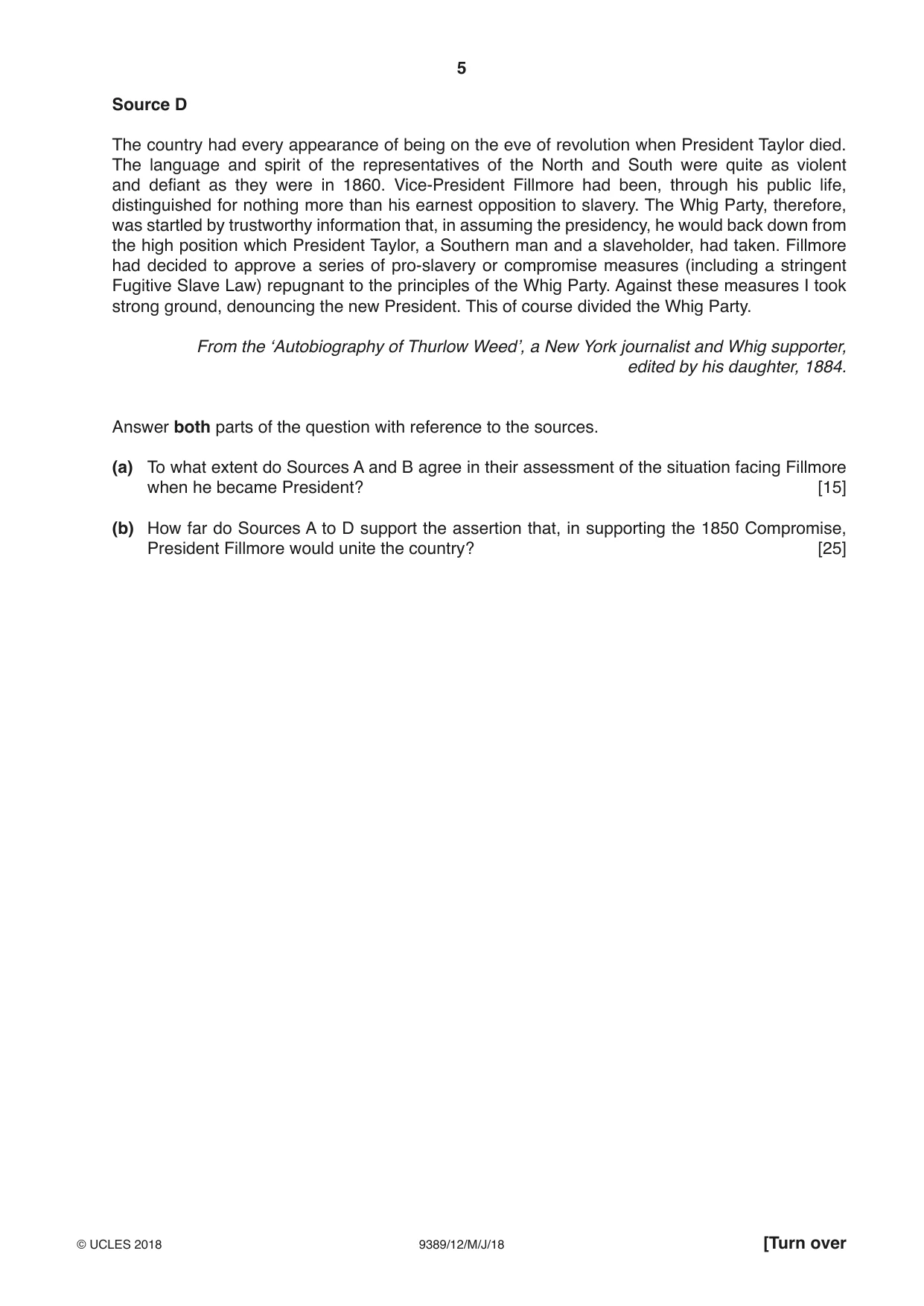
Question paper, page 5
5 9389/12/M/J/18 © UCLES 2018 [Turn over Source D The country had every appearance of being on the eve of revolution when President Taylor died. The language and spirit of the representatives of the North and South were quite as violent and defiant as they were in 1860. Vice‑President Fillmore had been, through his public life, distinguished for nothing more than his earnest opposition to slavery. The Whig Party, therefore, was startled by trustworthy information that, in assuming the presidency, he would back down from the high position which President Taylor, a Southern man and a slaveholder, had taken. Fillmore had decided to approve a series of pro‑slavery or compromise measures (including a stringent Fugitive Slave Law) repugnant to the principles of the Whig Party. Against these measures I took strong ground, denouncing the new President. This of course divided the Whig Party. From the ‘Autobiography of Thurlow Weed’, a New York journalist and Whig supporter, edited by his daughter, 1884. Answer both parts of the question with reference to the sources. (a) To what extent do Sources A and B agree in their assessment of the situation facing Fillmore when he became President? [15] (b) How far do Sources A to D support the assertion that, in supporting the 1850 Compromise, President Fillmore would unite the country? [25]
Question paper, page 6
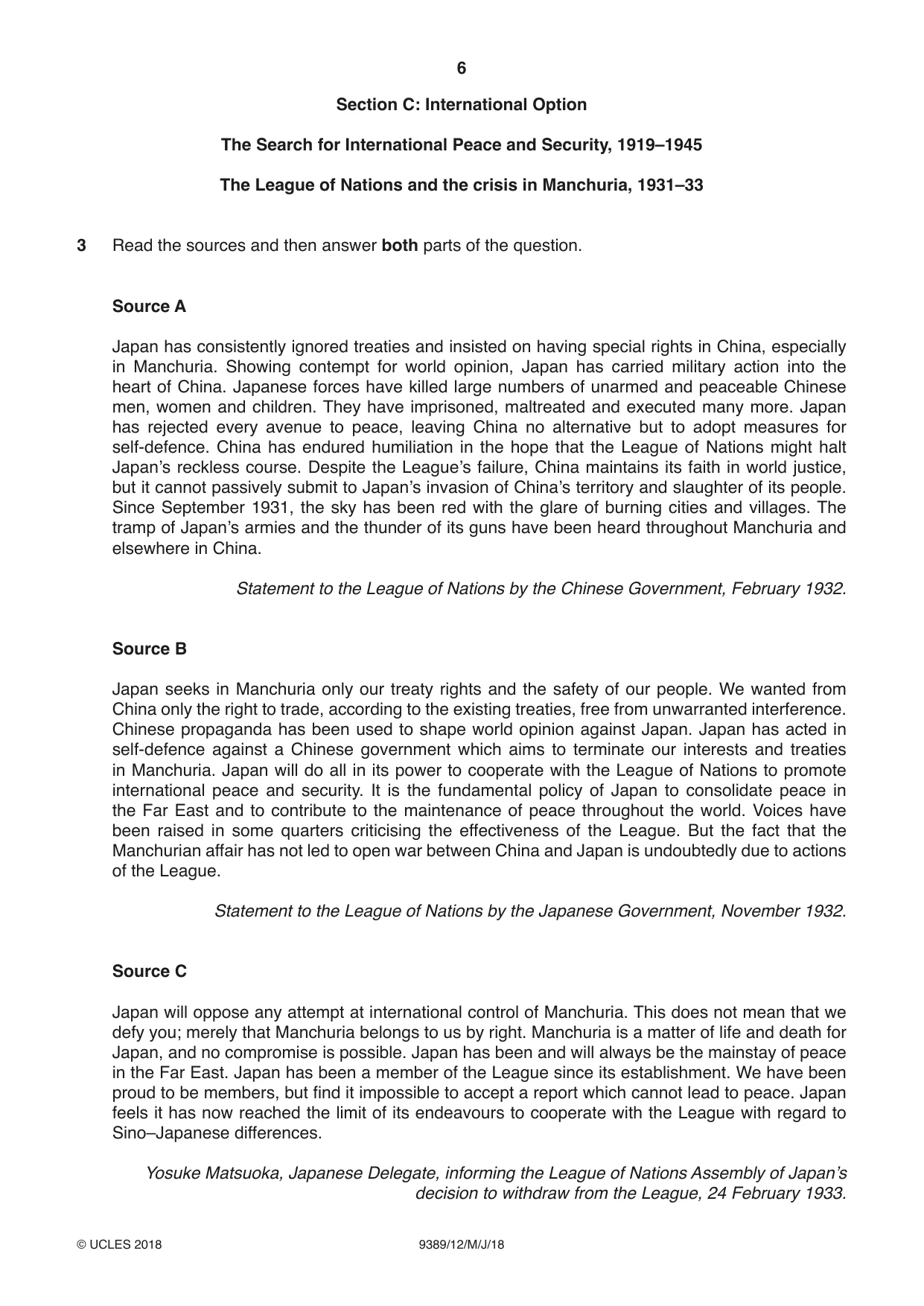
6 9389/12/M/J/18 © UCLES 2018 Section C: International Option The Search for International Peace and Security, 1919–1945 The League of Nations and the crisis in Manchuria, 1931–33 3 Read the sources and then answer both parts of the question. Source A Japan has consistently ignored treaties and insisted on having special rights in China, especially in Manchuria. Showing contempt for world opinion, Japan has carried military action into the heart of China. Japanese forces have killed large numbers of unarmed and peaceable Chinese men, women and children. They have imprisoned, maltreated and executed many more. Japan has rejected every avenue to peace, leaving China no alternative but to adopt measures for self‑defence. China has endured humiliation in the hope that the League of Nations might halt Japan’s reckless course. Despite the League’s failure, China maintains its faith in world justice, but it cannot passively submit to Japan’s invasion of China’s territory and slaughter of its people. Since September 1931, the sky has been red with the glare of burning cities and villages. The tramp of Japan’s armies and the thunder of its guns have been heard throughout Manchuria and elsewhere in China. Statement to the League of Nations by the Chinese Government, February 1932. Source B Japan seeks in Manchuria only our treaty rights and the safety of our people. We wanted from China only the right to trade, according to the existing treaties, free from unwarranted interference. Chinese propaganda has been used to shape world opinion against Japan. Japan has acted in self‑defence against a Chinese government which aims to terminate our interests and treaties in Manchuria. Japan will do all in its power to cooperate with the League of Nations to promote international peace and security. It is the fundamental policy of Japan to consolidate peace in the Far East and to contribute to the maintenance of peace throughout the world. Voices have been raised in some quarters criticising the effectiveness of the League. But the fact that the Manchurian affair has not led to open war between China and Japan is undoubtedly due to actions of the League. Statement to the League of Nations by the Japanese Government, November 1932. Source C Japan will oppose any attempt at international control of Manchuria. This does not mean that we defy you; merely that Manchuria belongs to us by right. Manchuria is a matter of life and death for Japan, and no compromise is possible. Japan has been and will always be the mainstay of peace in the Far East. Japan has been a member of the League since its establishment. We have been proud to be members, but find it impossible to accept a report which cannot lead to peace. Japan feels it has now reached the limit of its endeavours to cooperate with the League with regard to Sino–Japanese differences. Yosuke Matsuoka, Japanese Delegate, informing the League of Nations Assembly of Japan’s decision to withdraw from the League, 24 February 1933.
Question paper, page 7
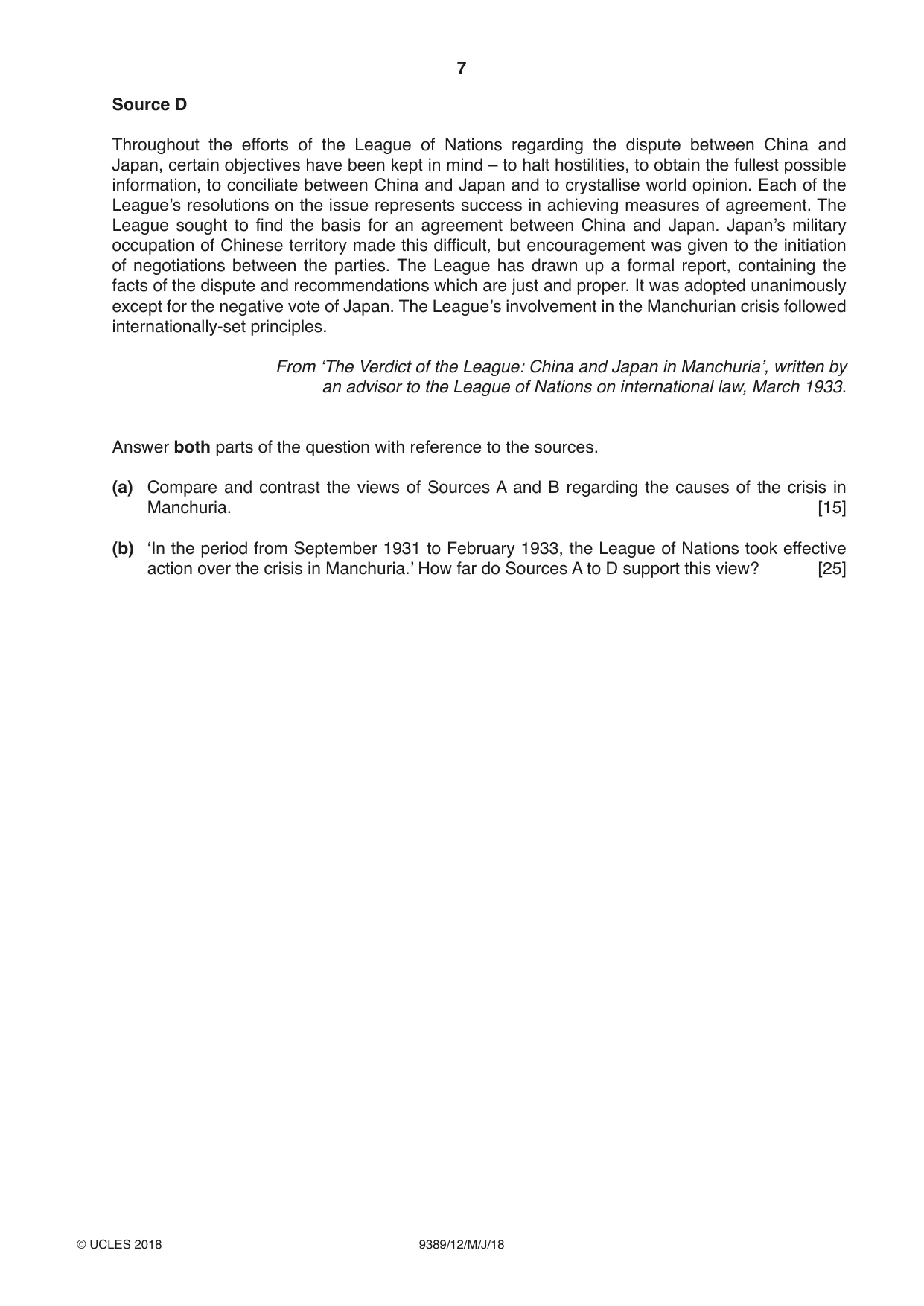
7 9389/12/M/J/18 © UCLES 2018 Source D Throughout the efforts of the League of Nations regarding the dispute between China and Japan, certain objectives have been kept in mind – to halt hostilities, to obtain the fullest possible information, to conciliate between China and Japan and to crystallise world opinion. Each of the League’s resolutions on the issue represents success in achieving measures of agreement. The League sought to find the basis for an agreement between China and Japan. Japan’s military occupation of Chinese territory made this difficult, but encouragement was given to the initiation of negotiations between the parties. The League has drawn up a formal report, containing the facts of the dispute and recommendations which are just and proper. It was adopted unanimously except for the negative vote of Japan. The League’s involvement in the Manchurian crisis followed internationally‑set principles. From ‘The Verdict of the League: China and Japan in Manchuria’, written by an advisor to the League of Nations on international law, March 1933. Answer both parts of the question with reference to the sources. (a) Compare and contrast the views of Sources A and B regarding the causes of the crisis in Manchuria. [15] (b) ‘In the period from September 1931 to February 1933, the League of Nations took effective action over the crisis in Manchuria.’ How far do Sources A to D support this view? [25]
Question paper, page 8
8 9389/12/M/J/18 © UCLES 2018 BLANK PAGE Permission to reproduce items where third‑party owned material protected by copyright is included has been sought and cleared where possible. Every reasonable effort has been made by the publisher (UCLES) to trace copyright holders, but if any items requiring clearance have unwittingly been included, the publisher will be pleased to make amends at the earliest possible opportunity. To avoid the issue of disclosure of answer‑related information to candidates, all copyright acknowledgements are reproduced online in the Cambridge International Examinations Copyright Acknowledgements Booklet. This is produced for each series of examinations and is freely available to download at www.cie.org.uk after the live examination series. Cambridge International Examinations is part of the Cambridge Assessment Group. Cambridge Assessment is the brand name of University of Cambridge Local Examinations Syndicate (UCLES), which is itself a department of the University of Cambridge.
Mark scheme, page 1
IGCSE™ is a registered trademark. This document consists of 12 printed pages. © UCLES 2018 [Turn over Cambridge Assessment International Education Cambridge International Advanced Subsidiary and Advanced Level HISTORY 9389/12 Paper 1 Document Question May/June 2018 MARK SCHEME Maximum Mark: 40 Published This mark scheme is published as an aid to teachers and candidates, to indicate the requirements of the examination. It shows the basis on which Examiners were instructed to award marks. It does not indicate the details of the discussions that took place at an Examiners’ meeting before marking began, which would have considered the acceptability of alternative answers. Mark schemes should be read in conjunction with the question paper and the Principal Examiner Report for Teachers. Cambridge International will not enter into discussions about these mark schemes. Cambridge International is publishing the mark schemes for the May/June 2018 series for most Cambridge IGCSE™, Cambridge International A and AS Level and Cambridge Pre-U components, and some Cambridge O Level components.
Mark scheme, page 2
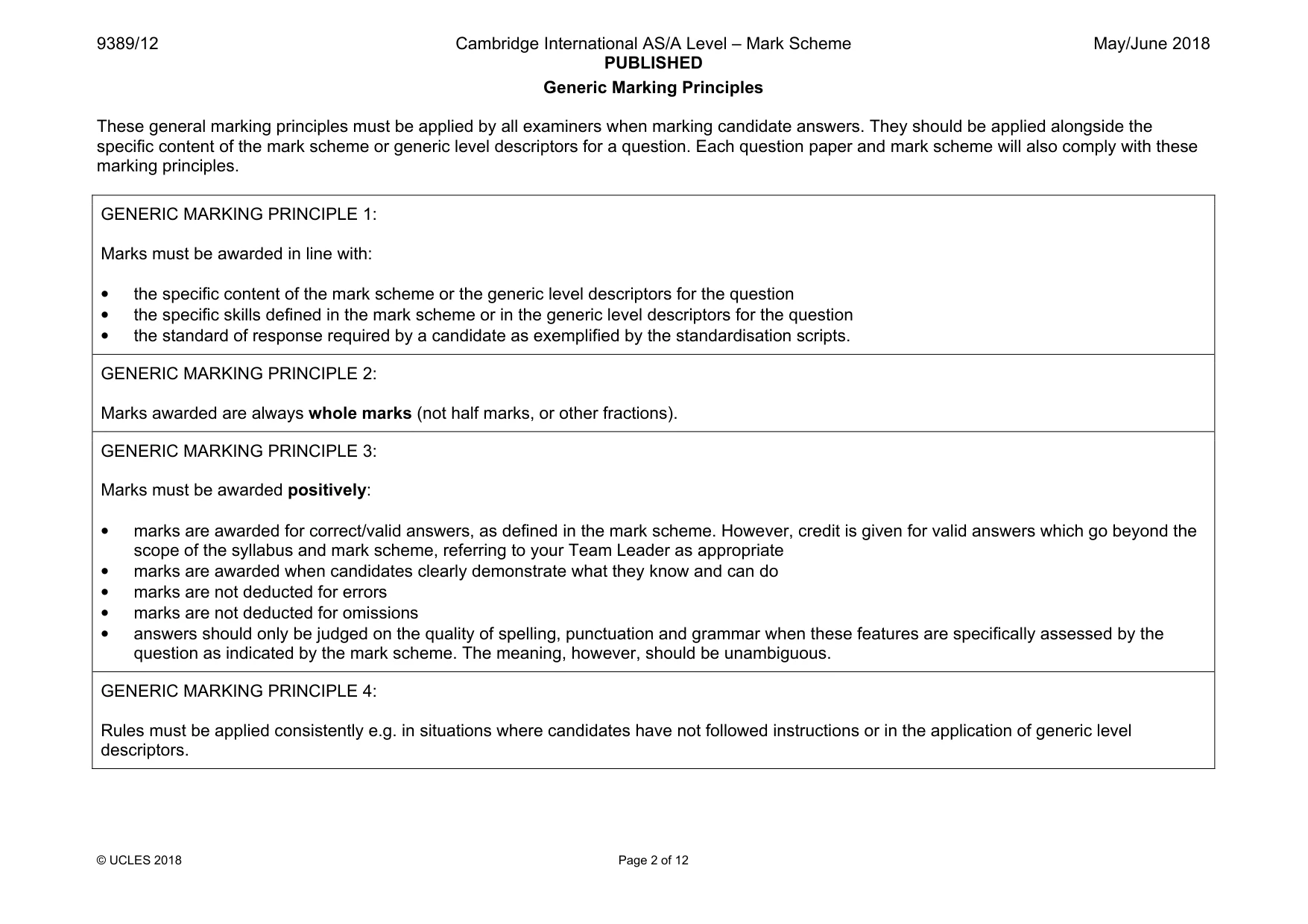
9389/12 Cambridge International AS/A Level – Mark Scheme PUBLISHED May/June 2018 © UCLES 2018 Page 2 of 12 Generic Marking Principles These general marking principles must be applied by all examiners when marking candidate answers. They should be applied alongside the specific content of the mark scheme or generic level descriptors for a question. Each question paper and mark scheme will also comply with these marking principles. GENERIC MARKING PRINCIPLE 1: Marks must be awarded in line with: • the specific content of the mark scheme or the generic level descriptors for the question • the specific skills defined in the mark scheme or in the generic level descriptors for the question • the standard of response required by a candidate as exemplified by the standardisation scripts. GENERIC MARKING PRINCIPLE 2: Marks awarded are always whole marks (not half marks, or other fractions). GENERIC MARKING PRINCIPLE 3: Marks must be awarded positively: • marks are awarded for correct/valid answers, as defined in the mark scheme. However, credit is given for valid answers which go beyond the scope of the syllabus and mark scheme, referring to your Team Leader as appropriate • marks are awarded when candidates clearly demonstrate what they know and can do • marks are not deducted for errors • marks are not deducted for omissions • answers should only be judged on the quality of spelling, punctuation and grammar when these features are specifically assessed by the question as indicated by the mark scheme. The meaning, however, should be unambiguous. GENERIC MARKING PRINCIPLE 4: Rules must be applied consistently e.g. in situations where candidates have not followed instructions or in the application of generic level descriptors.
Mark scheme, page 3
9389/12 Cambridge International AS/A Level – Mark Scheme PUBLISHED May/June 2018 © UCLES 2018 Page 3 of 12 GENERIC MARKING PRINCIPLE 5: Marks should be awarded using the full range of marks defined in the mark scheme for the question (however; the use of the full mark range may be limited according to the quality of the candidate responses seen). GENERIC MARKING PRINCIPLE 6: Marks awarded are based solely on the requirements as defined in the mark scheme. Marks should not be awarded with grade thresholds or grade descriptors in mind.
Mark scheme, page 4
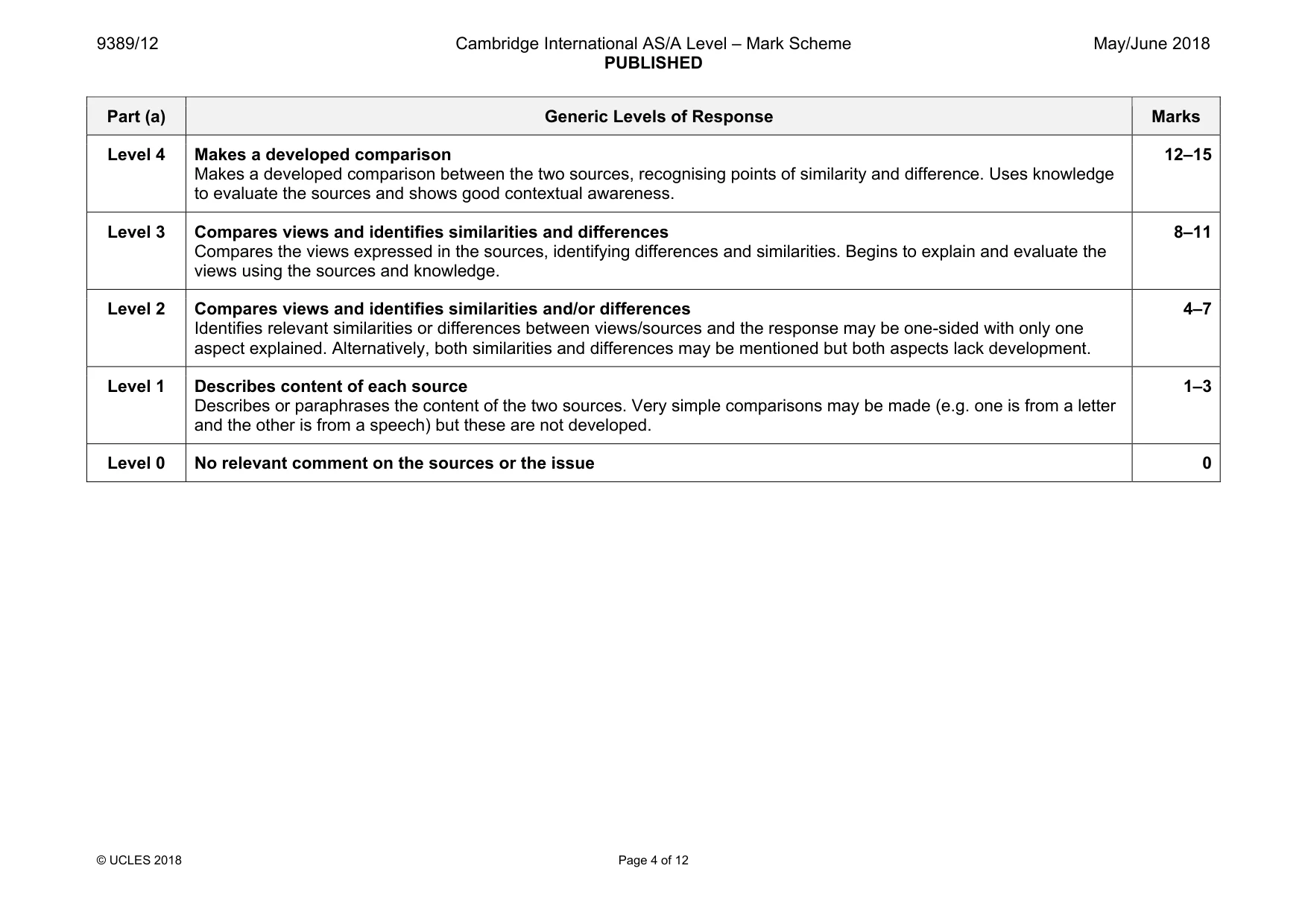
9389/12 Cambridge International AS/A Level – Mark Scheme PUBLISHED May/June 2018 © UCLES 2018 Page 4 of 12 Part (a) Generic Levels of Response Marks Level 4 Makes a developed comparison Makes a developed comparison between the two sources, recognising points of similarity and difference. Uses knowledge to evaluate the sources and shows good contextual awareness. 12–15 Level 3 Compares views and identifies similarities and differences Compares the views expressed in the sources, identifying differences and similarities. Begins to explain and evaluate the views using the sources and knowledge. 8–11 Level 2 Compares views and identifies similarities and/or differences Identifies relevant similarities or differences between views/sources and the response may be one-sided with only one aspect explained. Alternatively, both similarities and differences may be mentioned but both aspects lack development. 4–7 Level 1 Describes content of each source Describes or paraphrases the content of the two sources. Very simple comparisons may be made (e.g. one is from a letter and the other is from a speech) but these are not developed. 1–3 Level 0 No relevant comment on the sources or the issue 0
Mark scheme, page 5
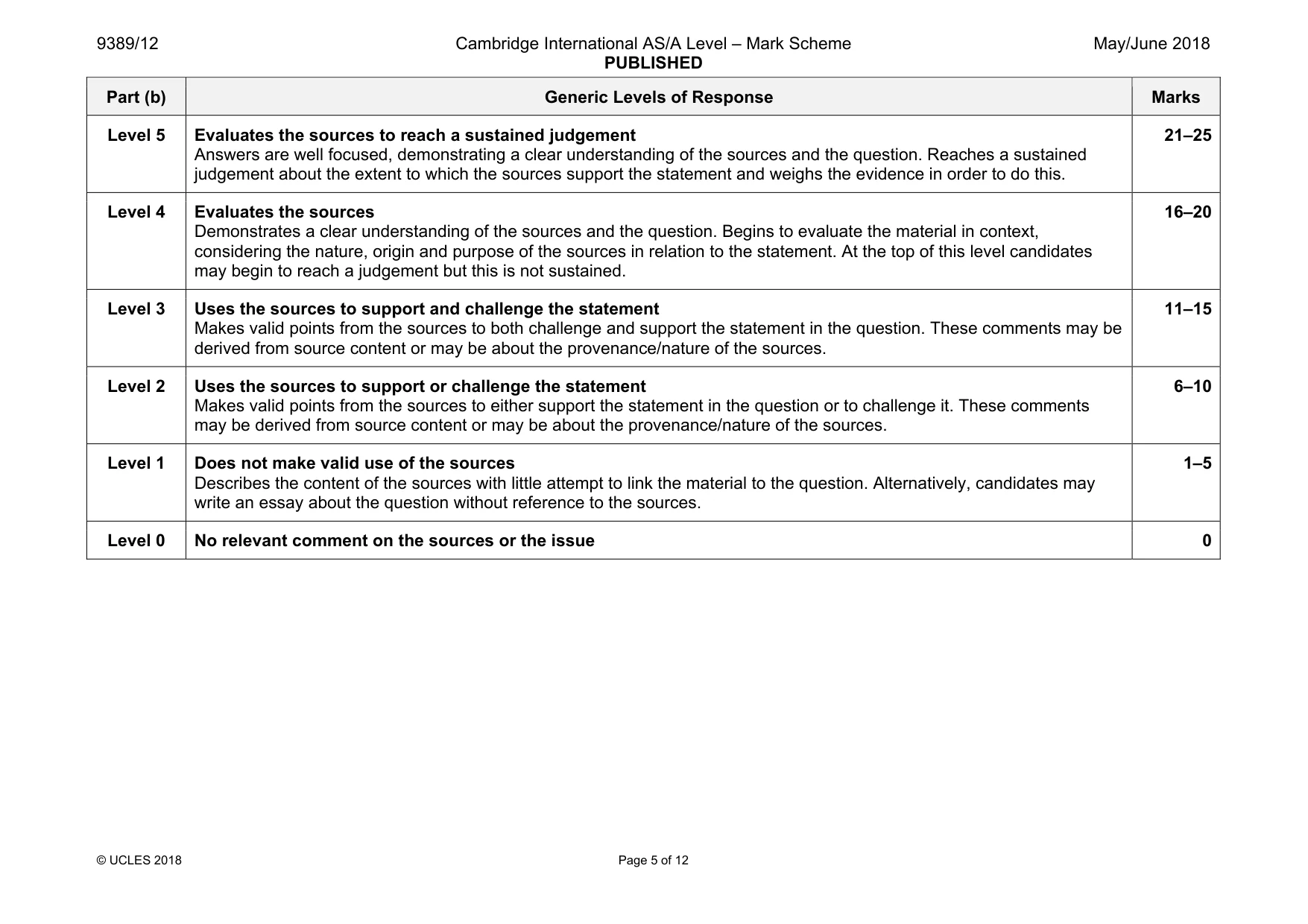
9389/12 Cambridge International AS/A Level – Mark Scheme PUBLISHED May/June 2018 © UCLES 2018 Page 5 of 12 Part (b) Generic Levels of Response Marks Level 5 Evaluates the sources to reach a sustained judgement Answers are well focused, demonstrating a clear understanding of the sources and the question. Reaches a sustained judgement about the extent to which the sources support the statement and weighs the evidence in order to do this. 21–25 Level 4 Evaluates the sources Demonstrates a clear understanding of the sources and the question. Begins to evaluate the material in context, considering the nature, origin and purpose of the sources in relation to the statement. At the top of this level candidates may begin to reach a judgement but this is not sustained. 16–20 Level 3 Uses the sources to support and challenge the statement Makes valid points from the sources to both challenge and support the statement in the question. These comments may be derived from source content or may be about the provenance/nature of the sources. 11–15 Level 2 Uses the sources to support or challenge the statement Makes valid points from the sources to either support the statement in the question or to challenge it. These comments may be derived from source content or may be about the provenance/nature of the sources. 6–10 Level 1 Does not make valid use of the sources Describes the content of the sources with little attempt to link the material to the question. Alternatively, candidates may write an essay about the question without reference to the sources. 1–5 Level 0 No relevant comment on the sources or the issue 0
Mark scheme, page 6
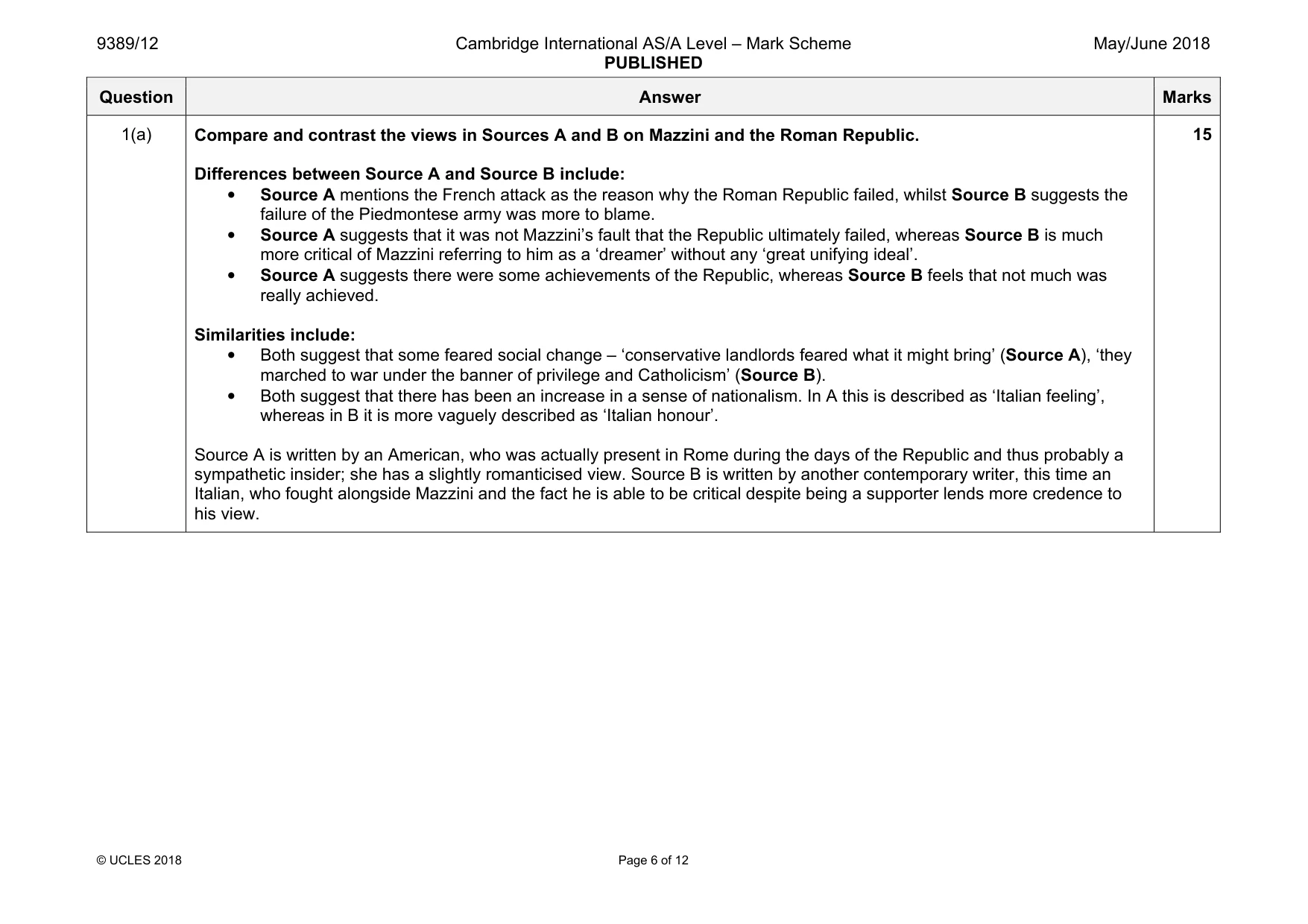
9389/12 Cambridge International AS/A Level – Mark Scheme PUBLISHED May/June 2018 © UCLES 2018 Page 6 of 12 Question Answer Marks 1(a) Compare and contrast the views in Sources A and B on Mazzini and the Roman Republic. Differences between Source A and Source B include: • Source A mentions the French attack as the reason why the Roman Republic failed, whilst Source B suggests the failure of the Piedmontese army was more to blame. • Source A suggests that it was not Mazzini’s fault that the Republic ultimately failed, whereas Source B is much more critical of Mazzini referring to him as a ‘dreamer’ without any ‘great unifying ideal’. • Source A suggests there were some achievements of the Republic, whereas Source B feels that not much was really achieved. Similarities include: • Both suggest that some feared social change – ‘conservative landlords feared what it might bring’ (Source A), ‘they marched to war under the banner of privilege and Catholicism’ (Source B). • Both suggest that there has been an increase in a sense of nationalism. In A this is described as ‘Italian feeling’, whereas in B it is more vaguely described as ‘Italian honour’. Source A is written by an American, who was actually present in Rome during the days of the Republic and thus probably a sympathetic insider; she has a slightly romanticised view. Source B is written by another contemporary writer, this time an Italian, who fought alongside Mazzini and the fact he is able to be critical despite being a supporter lends more credence to his view. 15
Mark scheme, page 7
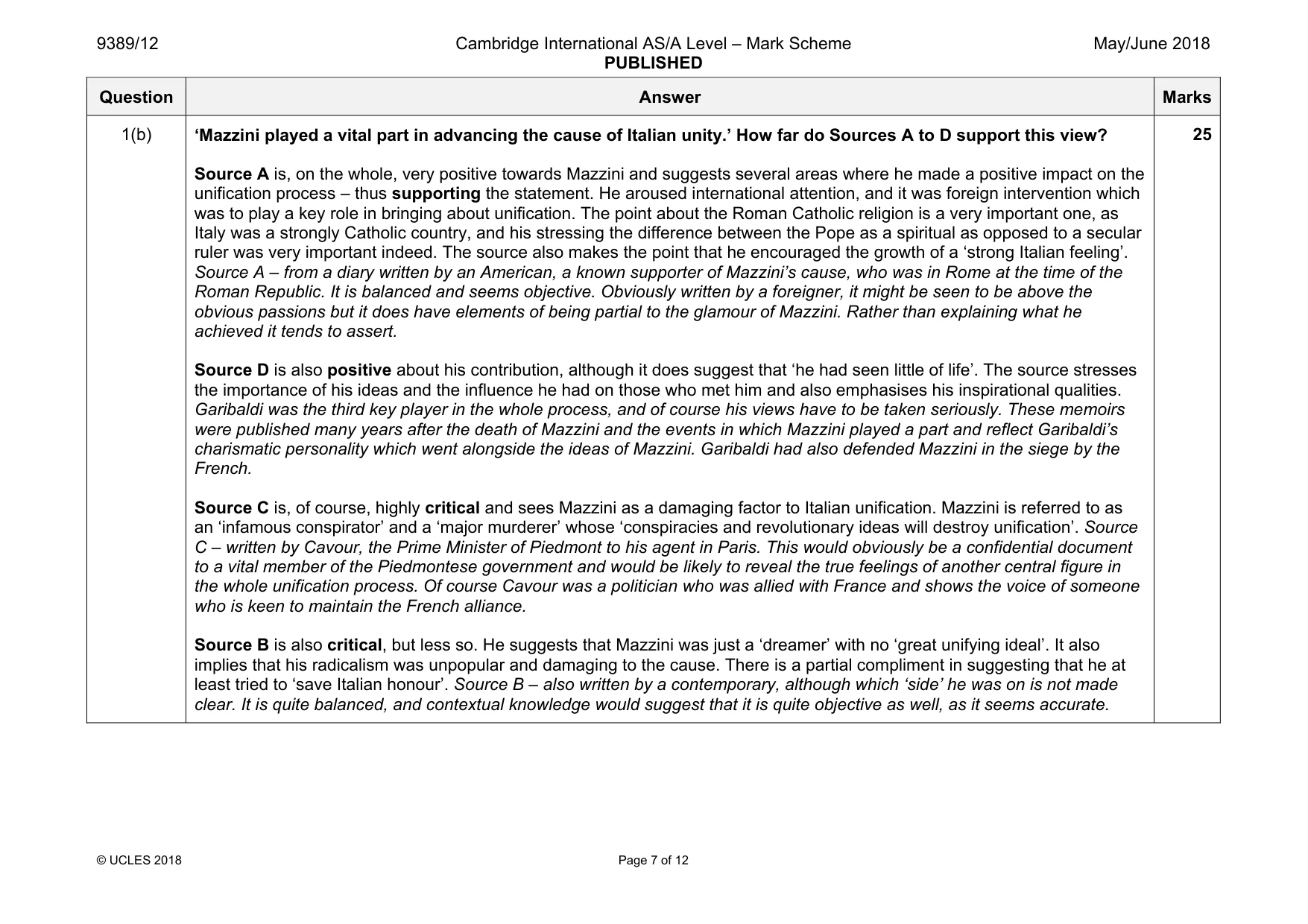
9389/12 Cambridge International AS/A Level – Mark Scheme PUBLISHED May/June 2018 © UCLES 2018 Page 7 of 12 Question Answer Marks 1(b) ‘Mazzini played a vital part in advancing the cause of Italian unity.’ How far do Sources A to D support this view? Source A is, on the whole, very positive towards Mazzini and suggests several areas where he made a positive impact on the unification process – thus supporting the statement. He aroused international attention, and it was foreign intervention which was to play a key role in bringing about unification. The point about the Roman Catholic religion is a very important one, as Italy was a strongly Catholic country, and his stressing the difference between the Pope as a spiritual as opposed to a secular ruler was very important indeed. The source also makes the point that he encouraged the growth of a ‘strong Italian feeling’. Source A – from a diary written by an American, a known supporter of Mazzini’s cause, who was in Rome at the time of the Roman Republic. It is balanced and seems objective. Obviously written by a foreigner, it might be seen to be above the obvious passions but it does have elements of being partial to the glamour of Mazzini. Rather than explaining what he achieved it tends to assert. Source D is also positive about his contribution, although it does suggest that ‘he had seen little of life’. The source stresses the importance of his ideas and the influence he had on those who met him and also emphasises his inspirational qualities. Garibaldi was the third key player in the whole process, and of course his views have to be taken seriously. These memoirs were published many years after the death of Mazzini and the events in which Mazzini played a part and reflect Garibaldi’s charismatic personality which went alongside the ideas of Mazzini. Garibaldi had also defended Mazzini in the siege by the French. Source C is, of course, highly critical and sees Mazzini as a damaging factor to Italian unification. Mazzini is referred to as an ‘infamous conspirator’ and a ‘major murderer’ whose ‘conspiracies and revolutionary ideas will destroy unification’. Source C – written by Cavour, the Prime Minister of Piedmont to his agent in Paris. This would obviously be a confidential document to a vital member of the Piedmontese government and would be likely to reveal the true feelings of another central figure in the whole unification process. Of course Cavour was a politician who was allied with France and shows the voice of someone who is keen to maintain the French alliance. Source B is also critical, but less so. He suggests that Mazzini was just a ‘dreamer’ with no ‘great unifying ideal’. It also implies that his radicalism was unpopular and damaging to the cause. There is a partial compliment in suggesting that he at least tried to ‘save Italian honour’. Source B – also written by a contemporary, although which ‘side’ he was on is not made clear. It is quite balanced, and contextual knowledge would suggest that it is quite objective as well, as it seems accurate. 25
Mark scheme, page 8
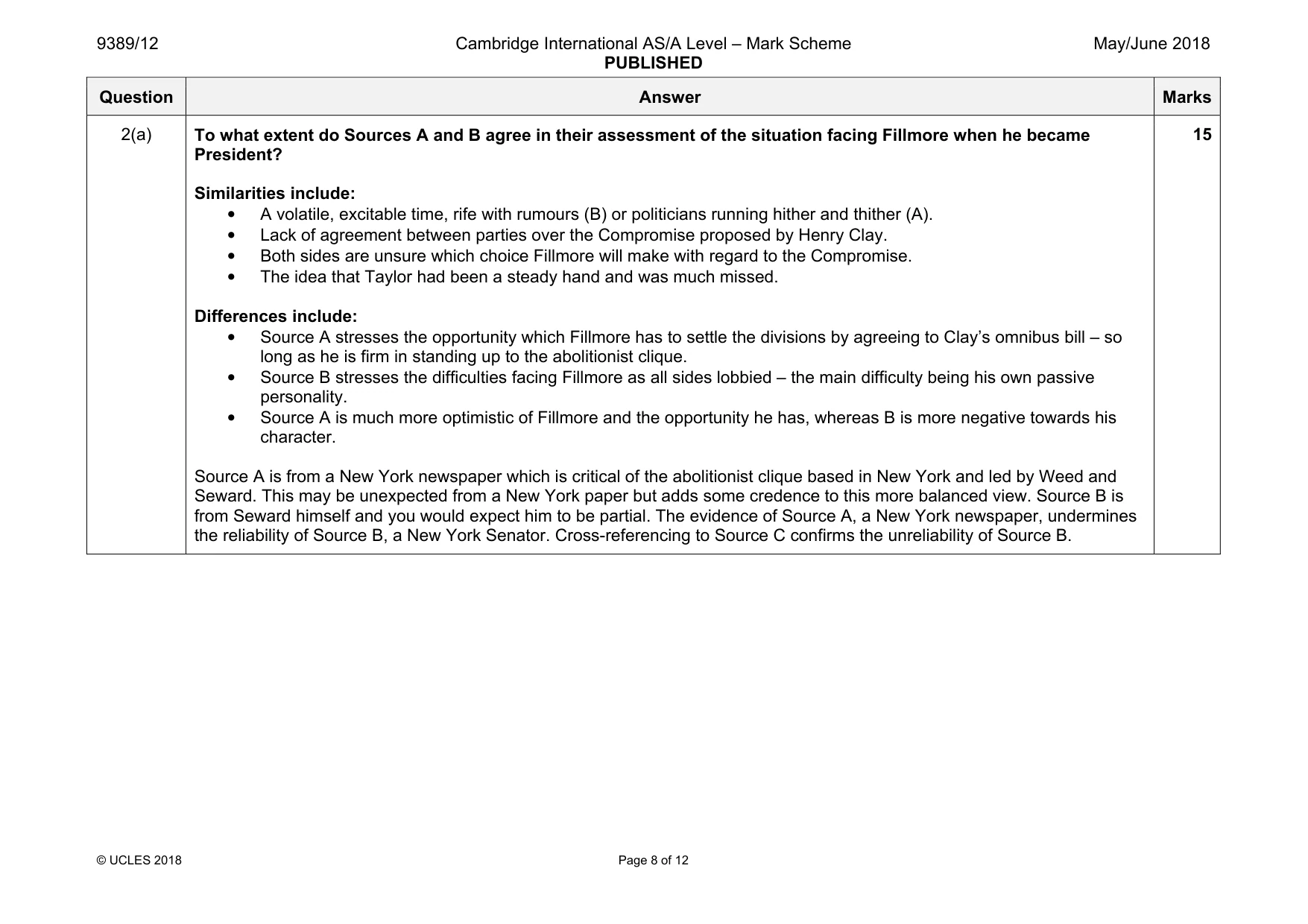
9389/12 Cambridge International AS/A Level – Mark Scheme PUBLISHED May/June 2018 © UCLES 2018 Page 8 of 12 Question Answer Marks 2(a) To what extent do Sources A and B agree in their assessment of the situation facing Fillmore when he became President? Similarities include: • A volatile, excitable time, rife with rumours (B) or politicians running hither and thither (A). • Lack of agreement between parties over the Compromise proposed by Henry Clay. • Both sides are unsure which choice Fillmore will make with regard to the Compromise. • The idea that Taylor had been a steady hand and was much missed. Differences include: • Source A stresses the opportunity which Fillmore has to settle the divisions by agreeing to Clay’s omnibus bill – so long as he is firm in standing up to the abolitionist clique. • Source B stresses the difficulties facing Fillmore as all sides lobbied – the main difficulty being his own passive personality. • Source A is much more optimistic of Fillmore and the opportunity he has, whereas B is more negative towards his character. Source A is from a New York newspaper which is critical of the abolitionist clique based in New York and led by Weed and Seward. This may be unexpected from a New York paper but adds some credence to this more balanced view. Source B is from Seward himself and you would expect him to be partial. The evidence of Source A, a New York newspaper, undermines the reliability of Source B, a New York Senator. Cross-referencing to Source C confirms the unreliability of Source B. 15
Mark scheme, page 9
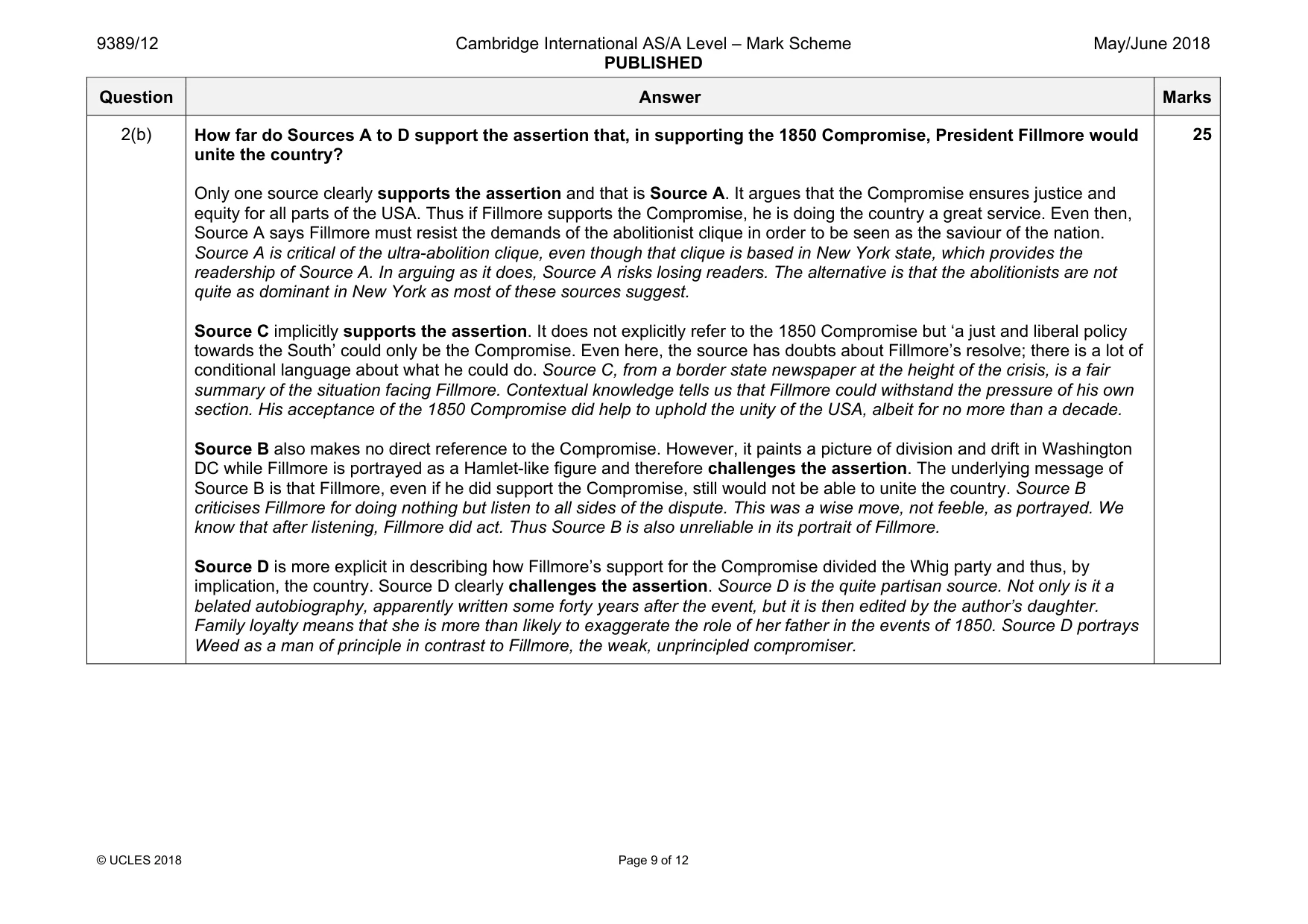
9389/12 Cambridge International AS/A Level – Mark Scheme PUBLISHED May/June 2018 © UCLES 2018 Page 9 of 12 Question Answer Marks 2(b) How far do Sources A to D support the assertion that, in supporting the 1850 Compromise, President Fillmore would unite the country? Only one source clearly supports the assertion and that is Source A. It argues that the Compromise ensures justice and equity for all parts of the USA. Thus if Fillmore supports the Compromise, he is doing the country a great service. Even then, Source A says Fillmore must resist the demands of the abolitionist clique in order to be seen as the saviour of the nation. Source A is critical of the ultra-abolition clique, even though that clique is based in New York state, which provides the readership of Source A. In arguing as it does, Source A risks losing readers. The alternative is that the abolitionists are not quite as dominant in New York as most of these sources suggest. Source C implicitly supports the assertion. It does not explicitly refer to the 1850 Compromise but ‘a just and liberal policy towards the South’ could only be the Compromise. Even here, the source has doubts about Fillmore’s resolve; there is a lot of conditional language about what he could do. Source C, from a border state newspaper at the height of the crisis, is a fair summary of the situation facing Fillmore. Contextual knowledge tells us that Fillmore could withstand the pressure of his own section. His acceptance of the 1850 Compromise did help to uphold the unity of the USA, albeit for no more than a decade. Source B also makes no direct reference to the Compromise. However, it paints a picture of division and drift in Washington DC while Fillmore is portrayed as a Hamlet-like figure and therefore challenges the assertion. The underlying message of Source B is that Fillmore, even if he did support the Compromise, still would not be able to unite the country. Source B criticises Fillmore for doing nothing but listen to all sides of the dispute. This was a wise move, not feeble, as portrayed. We know that after listening, Fillmore did act. Thus Source B is also unreliable in its portrait of Fillmore. Source D is more explicit in describing how Fillmore’s support for the Compromise divided the Whig party and thus, by implication, the country. Source D clearly challenges the assertion. Source D is the quite partisan source. Not only is it a belated autobiography, apparently written some forty years after the event, but it is then edited by the author’s daughter. Family loyalty means that she is more than likely to exaggerate the role of her father in the events of 1850. Source D portrays Weed as a man of principle in contrast to Fillmore, the weak, unprincipled compromiser. 25
Mark scheme, page 10
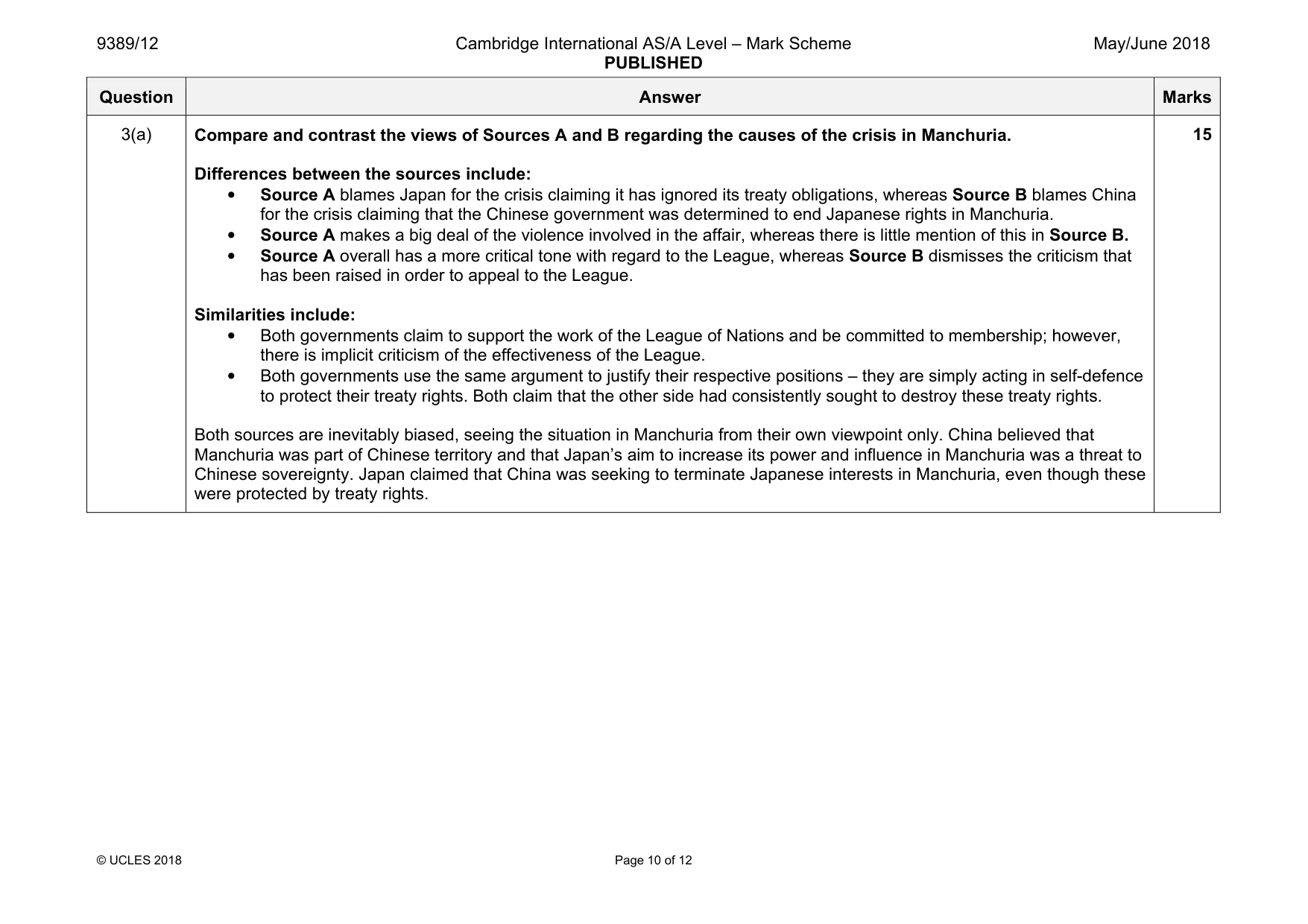
9389/12 Cambridge International AS/A Level – Mark Scheme PUBLISHED May/June 2018 © UCLES 2018 Page 10 of 12 Question Answer Marks 3(a) Compare and contrast the views of Sources A and B regarding the causes of the crisis in Manchuria. Differences between the sources include: • Source A blames Japan for the crisis claiming it has ignored its treaty obligations, whereas Source B blames China for the crisis claiming that the Chinese government was determined to end Japanese rights in Manchuria. • Source A makes a big deal of the violence involved in the affair, whereas there is little mention of this in Source B. • Source A overall has a more critical tone with regard to the League, whereas Source B dismisses the criticism that has been raised in order to appeal to the League. Similarities include: • Both governments claim to support the work of the League of Nations and be committed to membership; however, there is implicit criticism of the effectiveness of the League. • Both governments use the same argument to justify their respective positions – they are simply acting in self-defence to protect their treaty rights. Both claim that the other side had consistently sought to destroy these treaty rights. Both sources are inevitably biased, seeing the situation in Manchuria from their own viewpoint only. China believed that Manchuria was part of Chinese territory and that Japan’s aim to increase its power and influence in Manchuria was a threat to Chinese sovereignty. Japan claimed that China was seeking to terminate Japanese interests in Manchuria, even though these were protected by treaty rights. 15
Mark scheme, page 11
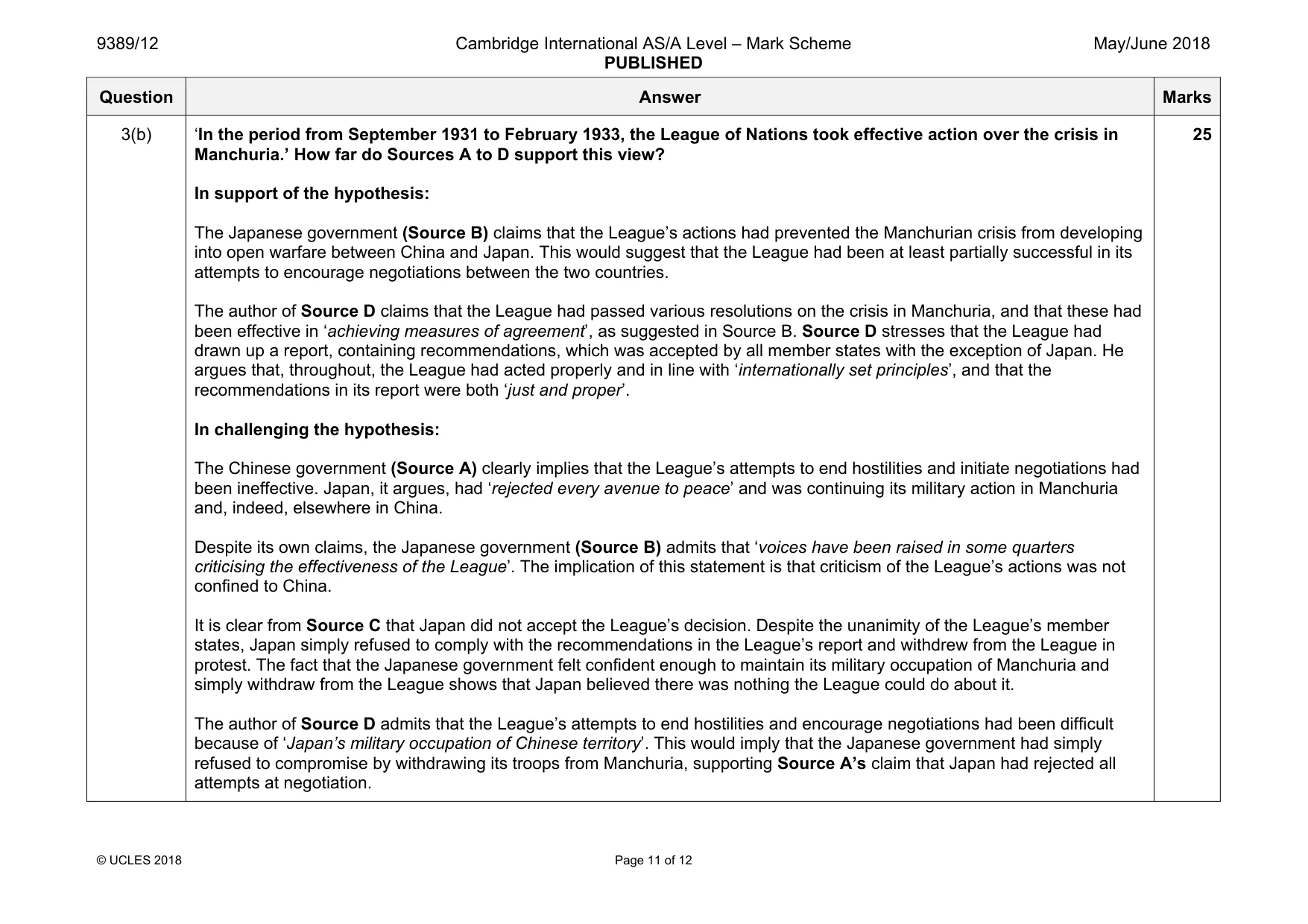
9389/12 Cambridge International AS/A Level – Mark Scheme PUBLISHED May/June 2018 © UCLES 2018 Page 11 of 12 Question Answer Marks 3(b) ‘In the period from September 1931 to February 1933, the League of Nations took effective action over the crisis in Manchuria.’ How far do Sources A to D support this view? In support of the hypothesis: The Japanese government (Source B) claims that the League’s actions had prevented the Manchurian crisis from developing into open warfare between China and Japan. This would suggest that the League had been at least partially successful in its attempts to encourage negotiations between the two countries. The author of Source D claims that the League had passed various resolutions on the crisis in Manchuria, and that these had been effective in ‘achieving measures of agreement’, as suggested in Source B. Source D stresses that the League had drawn up a report, containing recommendations, which was accepted by all member states with the exception of Japan. He argues that, throughout, the League had acted properly and in line with ‘internationally set principles’, and that the recommendations in its report were both ‘just and proper’. In challenging the hypothesis: The Chinese government (Source A) clearly implies that the League’s attempts to end hostilities and initiate negotiations had been ineffective. Japan, it argues, had ‘rejected every avenue to peace’ and was continuing its military action in Manchuria and, indeed, elsewhere in China. Despite its own claims, the Japanese government (Source B) admits that ‘voices have been raised in some quarters criticising the effectiveness of the League’. The implication of this statement is that criticism of the League’s actions was not confined to China. It is clear from Source C that Japan did not accept the League’s decision. Despite the unanimity of the League’s member states, Japan simply refused to comply with the recommendations in the League’s report and withdrew from the League in protest. The fact that the Japanese government felt confident enough to maintain its military occupation of Manchuria and simply withdraw from the League shows that Japan believed there was nothing the League could do about it. The author of Source D admits that the League’s attempts to end hostilities and encourage negotiations had been difficult because of ‘Japan’s military occupation of Chinese territory’. This would imply that the Japanese government had simply refused to compromise by withdrawing its troops from Manchuria, supporting Source A’s claim that Japan had rejected all attempts at negotiation. 25
Mark scheme, page 12
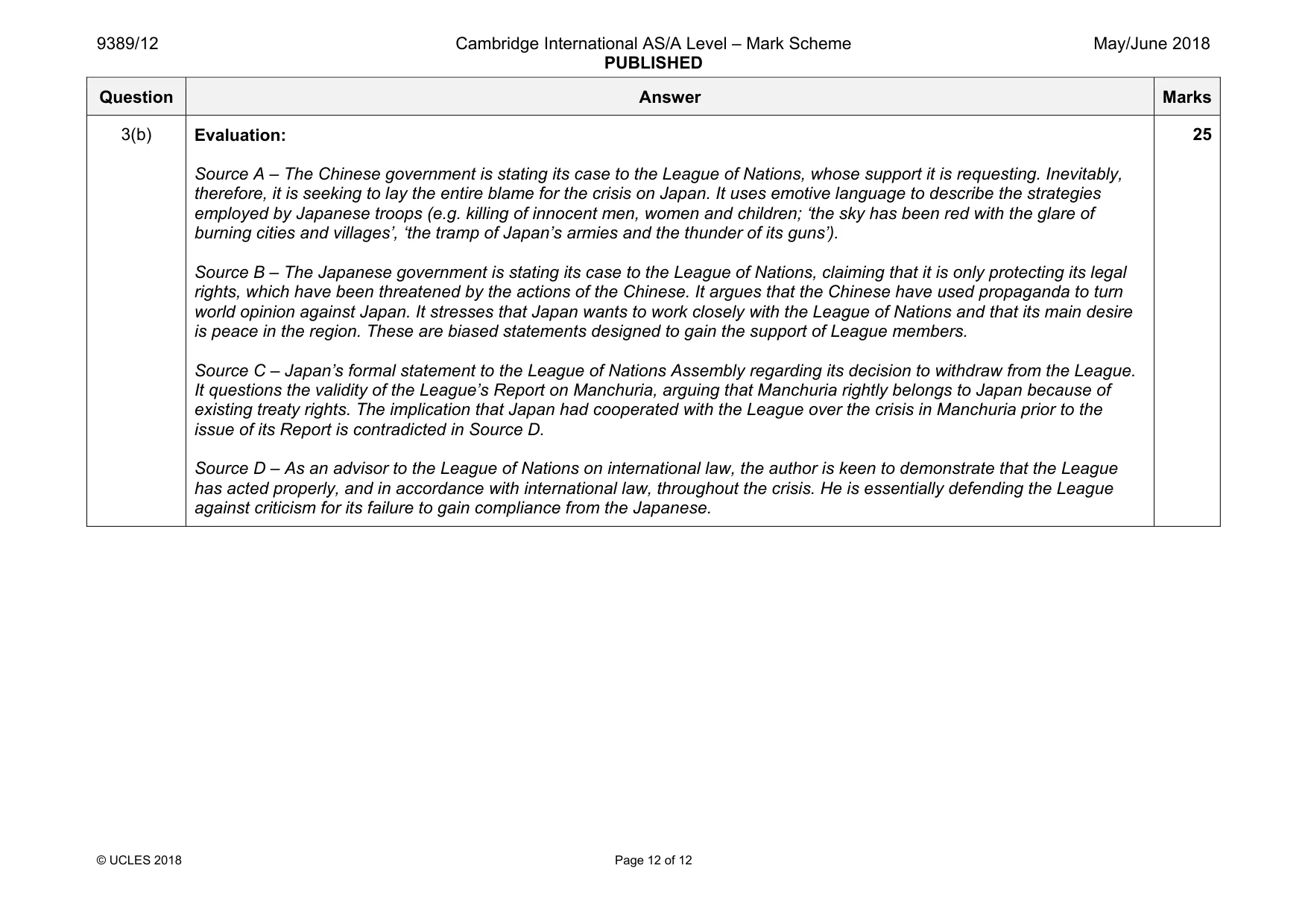
9389/12 Cambridge International AS/A Level – Mark Scheme PUBLISHED May/June 2018 © UCLES 2018 Page 12 of 12 Question Answer Marks 3(b) Evaluation: Source A – The Chinese government is stating its case to the League of Nations, whose support it is requesting. Inevitably, therefore, it is seeking to lay the entire blame for the crisis on Japan. It uses emotive language to describe the strategies employed by Japanese troops (e.g. killing of innocent men, women and children; ‘the sky has been red with the glare of burning cities and villages’, ‘the tramp of Japan’s armies and the thunder of its guns’). Source B – The Japanese government is stating its case to the League of Nations, claiming that it is only protecting its legal rights, which have been threatened by the actions of the Chinese. It argues that the Chinese have used propaganda to turn world opinion against Japan. It stresses that Japan wants to work closely with the League of Nations and that its main desire is peace in the region. These are biased statements designed to gain the support of League members. Source C – Japan’s formal statement to the League of Nations Assembly regarding its decision to withdraw from the League. It questions the validity of the League’s Report on Manchuria, arguing that Manchuria rightly belongs to Japan because of existing treaty rights. The implication that Japan had cooperated with the League over the crisis in Manchuria prior to the issue of its Report is contradicted in Source D. Source D – As an advisor to the League of Nations on international law, the author is keen to demonstrate that the League has acted properly, and in accordance with international law, throughout the crisis. He is essentially defending the League against criticism for its failure to gain compliance from the Japanese. 25
What you needed in this session
Cambridge’s own grade thresholds for 2018 May/June, Paper 1 · Variant 2. A higher threshold means an easier paper — the bar moves with how the cohort did.