Cambridge A Level History 9389 — 2021 Oct/Nov Paper 1 · Variant 3
9389/13/O/N/21 · 40 marks · ≈45 min
The question paper and its mark scheme, free to read here and free to download. This is Cambridge’s own paper, exactly as it was sat.
Question paper8 pages

Mark scheme11 pages
Answers below. Sit the paper first if you are practising.
Paper as text
Question paper, page 1
This document has 8 pages. Any blank pages are indicated. Cambridge International AS & A Level * 6 1 2 3 4 2 5 3 0 1 * DC (MB) 202650/1 © UCLES 2021 [Turn over HISTORY 9389/13 Paper 1 Document Question October/November 2021 1 hour You must answer on the enclosed answer booklet. You will need: Answer booklet (enclosed) INSTRUCTIONS ● Answer one question from one section only. Answer both parts of the question. Section A: European Option Section B: American Option Section C: International Option ● Follow the instructions on the front cover of the answer booklet. If you need additional answer paper, ask the invigilator for a continuation booklet. INFORMATION ● The total mark for this paper is 40. ● The number of marks for each question or part question is shown in brackets [ ].
Question paper, page 2
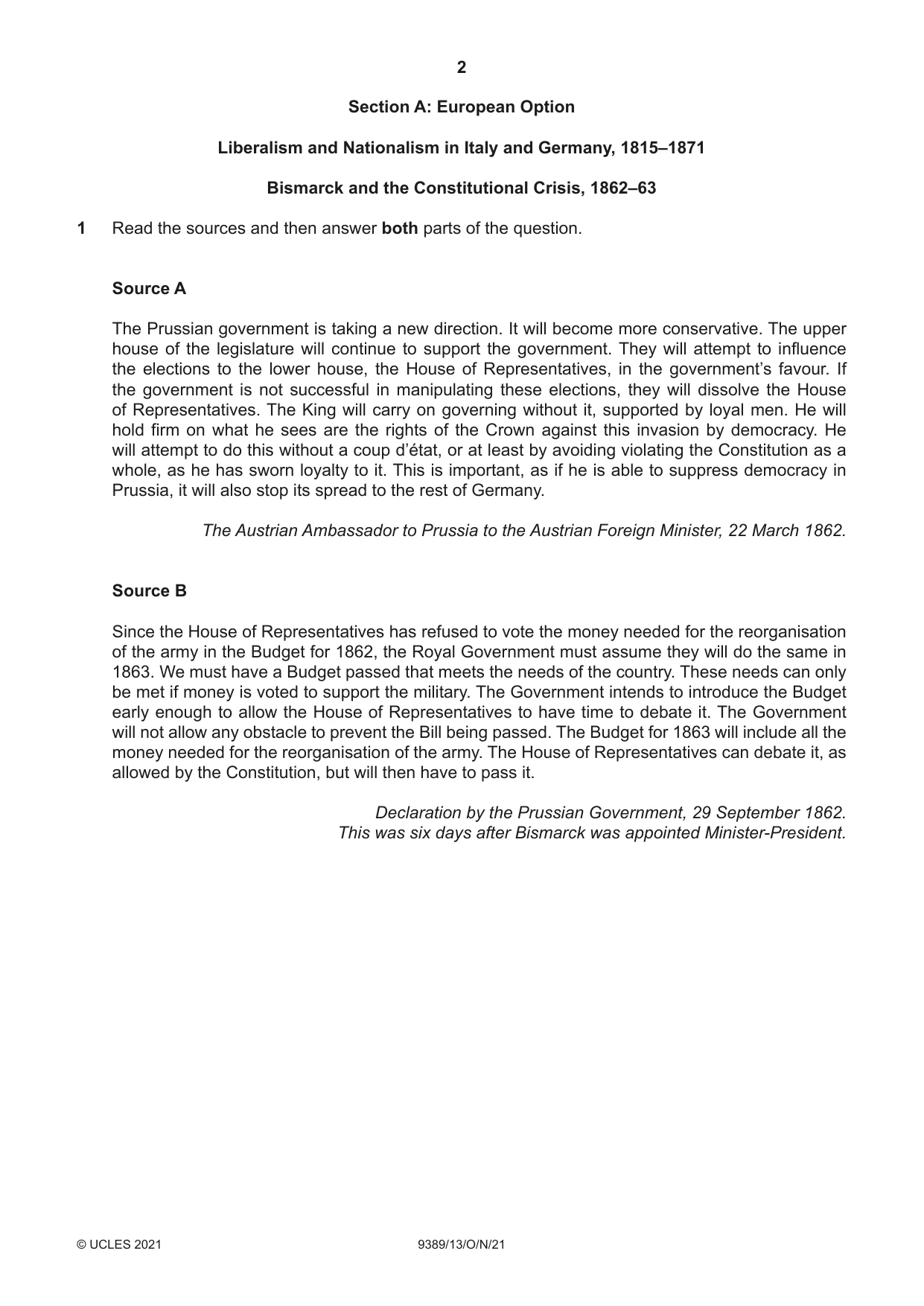
2 9389/13/O/N/21 © UCLES 2021 Section A: European Option Liberalism and Nationalism in Italy and Germany, 1815–1871 Bismarck and the Constitutional Crisis, 1862–63 1 Read the sources and then answer both parts of the question. Source A The Prussian government is taking a new direction. It will become more conservative. The upper house of the legislature will continue to support the government. They will attempt to influence the elections to the lower house, the House of Representatives, in the government’s favour. If the government is not successful in manipulating these elections, they will dissolve the House of Representatives. The King will carry on governing without it, supported by loyal men. He will hold firm on what he sees are the rights of the Crown against this invasion by democracy. He will attempt to do this without a coup d’état, or at least by avoiding violating the Constitution as a whole, as he has sworn loyalty to it. This is important, as if he is able to suppress democracy in Prussia, it will also stop its spread to the rest of Germany. The Austrian Ambassador to Prussia to the Austrian Foreign Minister, 22 March 1862. Source B Since the House of Representatives has refused to vote the money needed for the reorganisation of the army in the Budget for 1862, the Royal Government must assume they will do the same in 1863. We must have a Budget passed that meets the needs of the country. These needs can only be met if money is voted to support the military. The Government intends to introduce the Budget early enough to allow the House of Representatives to have time to debate it. The Government will not allow any obstacle to prevent the Bill being passed. The Budget for 1863 will include all the money needed for the reorganisation of the army. The House of Representatives can debate it, as allowed by the Constitution, but will then have to pass it. Declaration by the Prussian Government, 29 September 1862. This was six days after Bismarck was appointed Minister-President.
Question paper, page 3
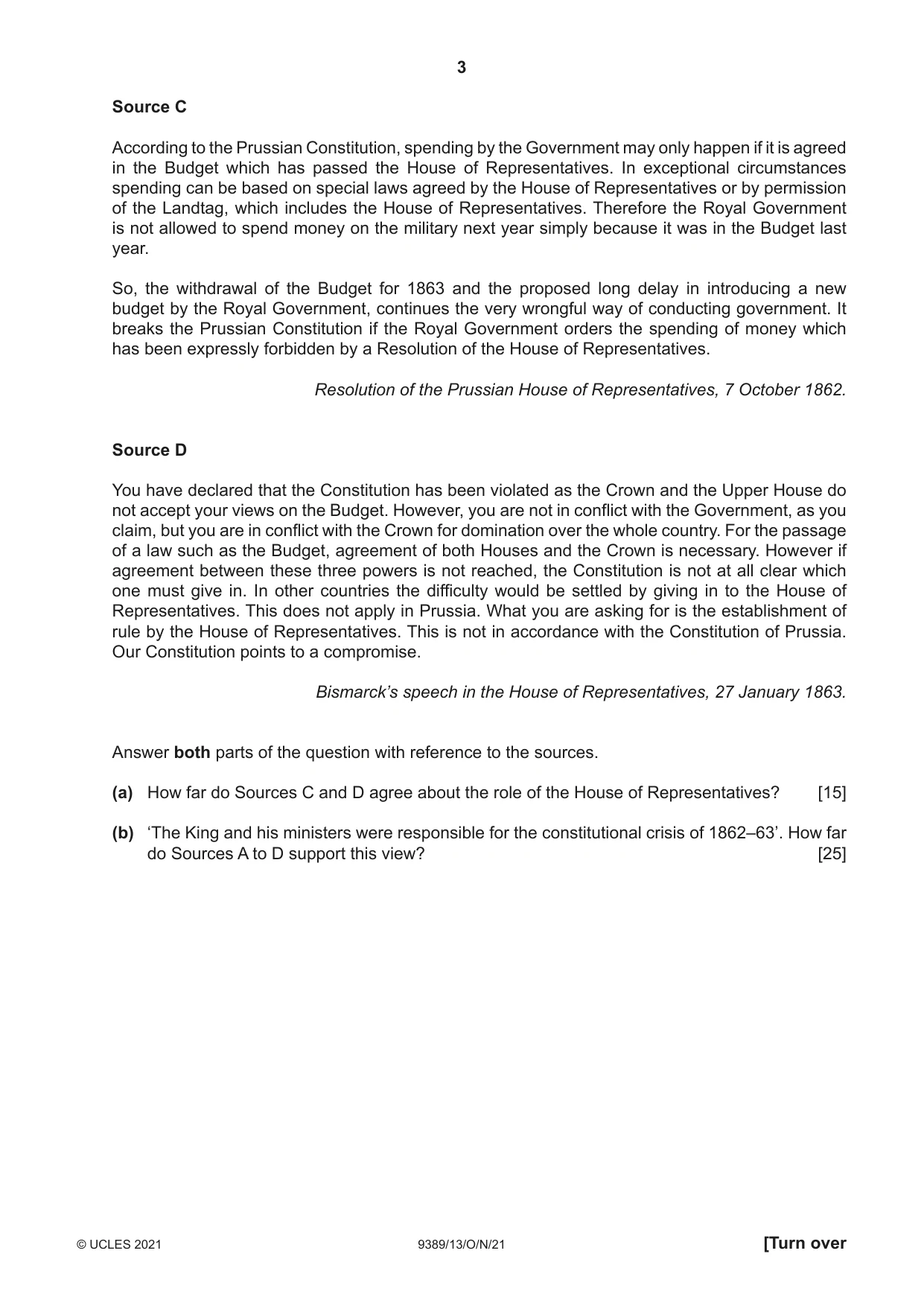
3 9389/13/O/N/21 © UCLES 2021 [Turn over Source C According to the Prussian Constitution, spending by the Government may only happen if it is agreed in the Budget which has passed the House of Representatives. In exceptional circumstances spending can be based on special laws agreed by the House of Representatives or by permission of the Landtag, which includes the House of Representatives. Therefore the Royal Government is not allowed to spend money on the military next year simply because it was in the Budget last year. So, the withdrawal of the Budget for 1863 and the proposed long delay in introducing a new budget by the Royal Government, continues the very wrongful way of conducting government. It breaks the Prussian Constitution if the Royal Government orders the spending of money which has been expressly forbidden by a Resolution of the House of Representatives. Resolution of the Prussian House of Representatives, 7 October 1862. Source D You have declared that the Constitution has been violated as the Crown and the Upper House do not accept your views on the Budget. However, you are not in conflict with the Government, as you claim, but you are in conflict with the Crown for domination over the whole country. For the passage of a law such as the Budget, agreement of both Houses and the Crown is necessary. However if agreement between these three powers is not reached, the Constitution is not at all clear which one must give in. In other countries the difficulty would be settled by giving in to the House of Representatives. This does not apply in Prussia. What you are asking for is the establishment of rule by the House of Representatives. This is not in accordance with the Constitution of Prussia. Our Constitution points to a compromise. Bismarck’s speech in the House of Representatives, 27 January 1863. Answer both parts of the question with reference to the sources. (a) How far do Sources C and D agree about the role of the House of Representatives? [15] (b) ‘The King and his ministers were responsible for the constitutional crisis of 1862–63’. How far do Sources A to D support this view? [25]
Question paper, page 4
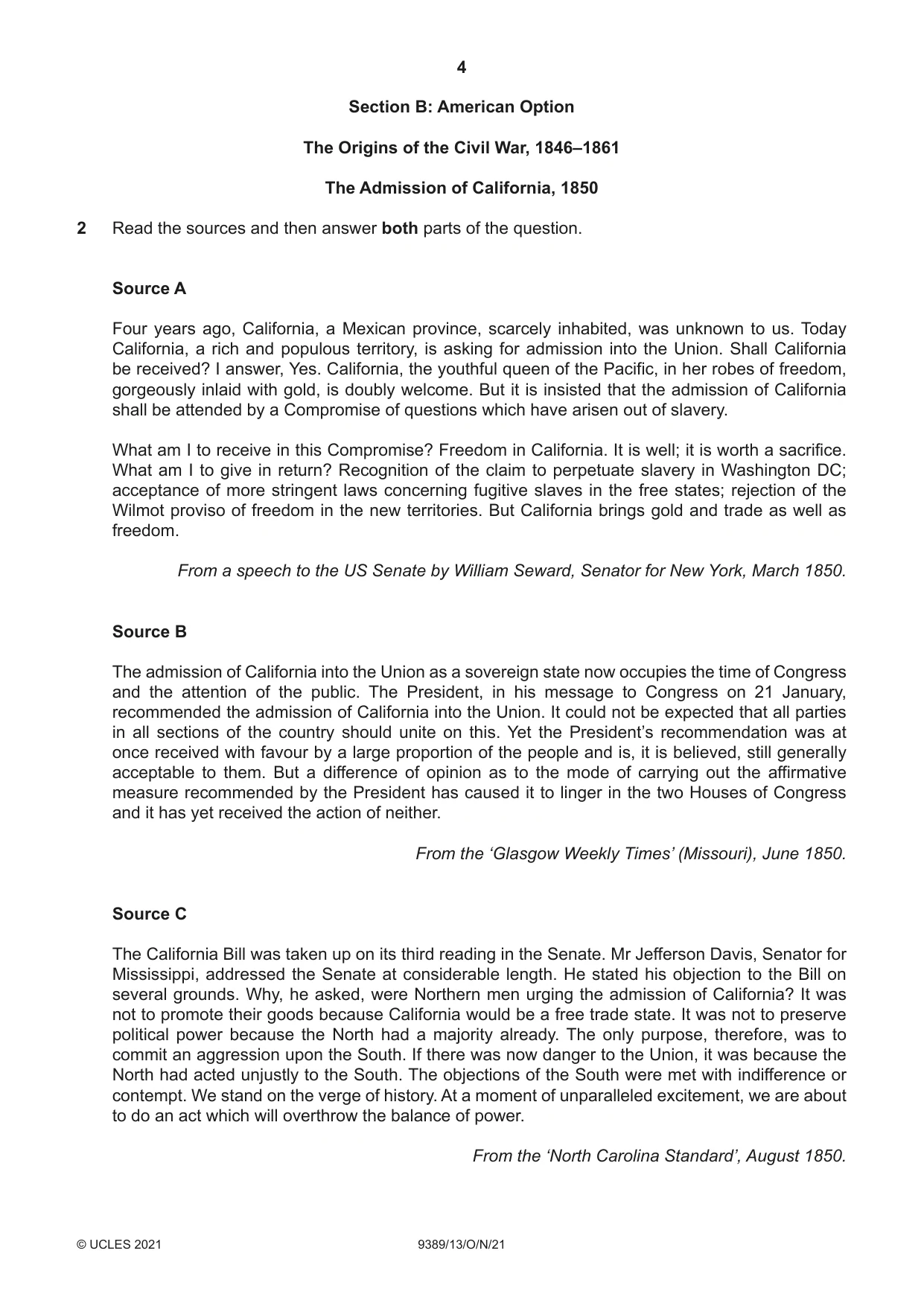
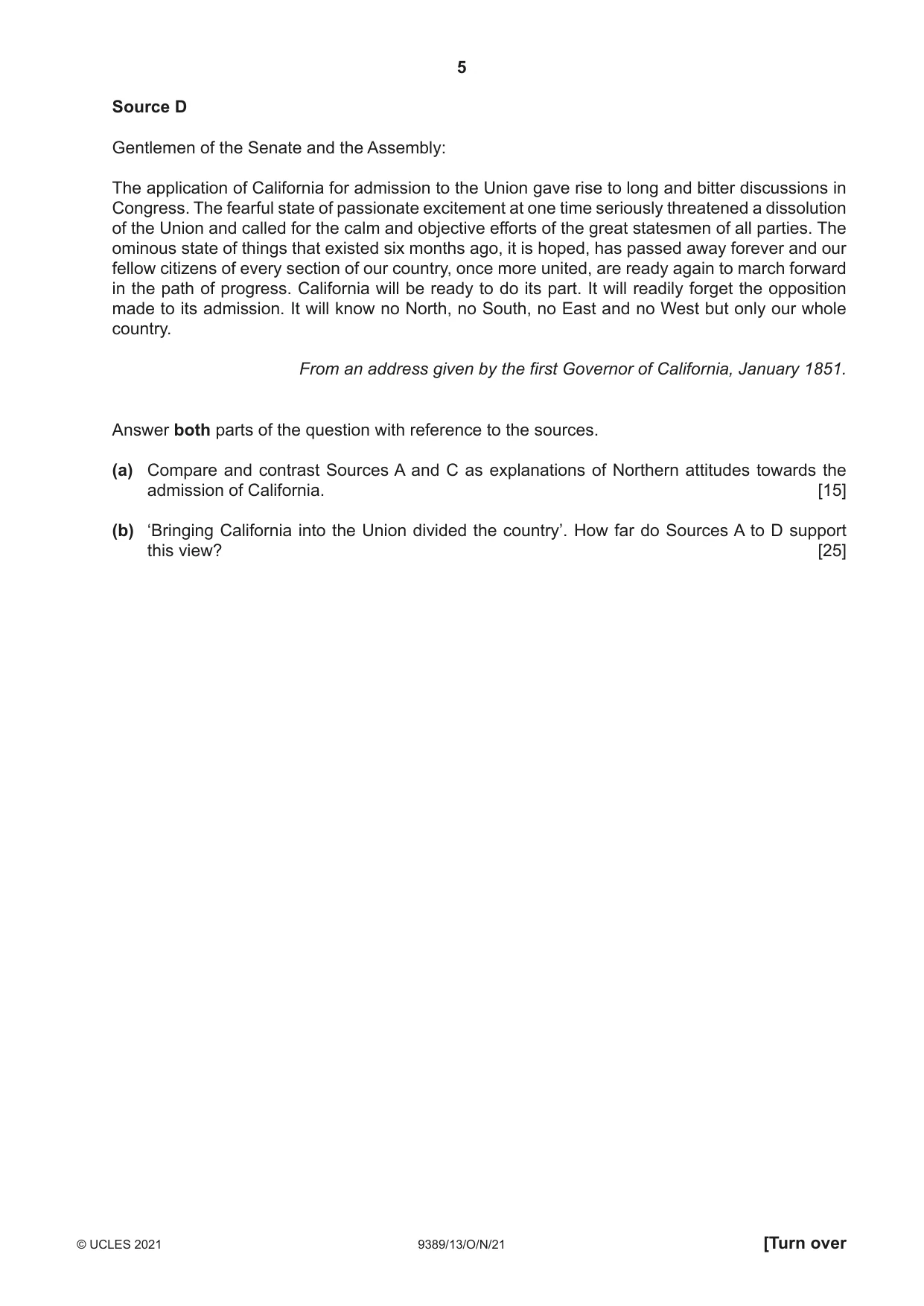
4 9389/13/O/N/21 © UCLES 2021 Section B: American Option The Origins of the Civil War, 1846–1861 The Admission of California, 1850 2 Read the sources and then answer both parts of the question. Source A Four years ago, California, a Mexican province, scarcely inhabited, was unknown to us. Today California, a rich and populous territory, is asking for admission into the Union. Shall California be received? I answer, Yes. California, the youthful queen of the Pacific, in her robes of freedom, gorgeously inlaid with gold, is doubly welcome. But it is insisted that the admission of California shall be attended by a Compromise of questions which have arisen out of slavery. What am I to receive in this Compromise? Freedom in California. It is well; it is worth a sacrifice. What am I to give in return? Recognition of the claim to perpetuate slavery in Washington DC; acceptance of more stringent laws concerning fugitive slaves in the free states; rejection of the Wilmot proviso of freedom in the new territories. But California brings gold and trade as well as freedom. From a speech to the US Senate by William Seward, Senator for New York, March 1850. Source B The admission of California into the Union as a sovereign state now occupies the time of Congress and the attention of the public. The President, in his message to Congress on 21 January, recommended the admission of California into the Union. It could not be expected that all parties in all sections of the country should unite on this. Yet the President’s recommendation was at once received with favour by a large proportion of the people and is, it is believed, still generally acceptable to them. But a difference of opinion as to the mode of carrying out the affirmative measure recommended by the President has caused it to linger in the two Houses of Congress and it has yet received the action of neither. From the ‘Glasgow Weekly Times’ (Missouri), June 1850. Source C The California Bill was taken up on its third reading in the Senate. Mr Jefferson Davis, Senator for Mississippi, addressed the Senate at considerable length. He stated his objection to the Bill on several grounds. Why, he asked, were Northern men urging the admission of California? It was not to promote their goods because California would be a free trade state. It was not to preserve political power because the North had a majority already. The only purpose, therefore, was to commit an aggression upon the South. If there was now danger to the Union, it was because the North had acted unjustly to the South. The objections of the South were met with indifference or contempt. We stand on the verge of history. At a moment of unparalleled excitement, we are about to do an act which will overthrow the balance of power. From the ‘North Carolina Standard’, August 1850.
Question paper, page 5
5 9389/13/O/N/21 © UCLES 2021 [Turn over Source D Gentlemen of the Senate and the Assembly: The application of California for admission to the Union gave rise to long and bitter discussions in Congress. The fearful state of passionate excitement at one time seriously threatened a dissolution of the Union and called for the calm and objective efforts of the great statesmen of all parties. The ominous state of things that existed six months ago, it is hoped, has passed away forever and our fellow citizens of every section of our country, once more united, are ready again to march forward in the path of progress. California will be ready to do its part. It will readily forget the opposition made to its admission. It will know no North, no South, no East and no West but only our whole country. From an address given by the first Governor of California, January 1851. Answer both parts of the question with reference to the sources. (a) Compare and contrast Sources A and C as explanations of Northern attitudes towards the admission of California. [15] (b) ‘Bringing California into the Union divided the country’. How far do Sources A to D support this view? [25]
Question paper, page 6
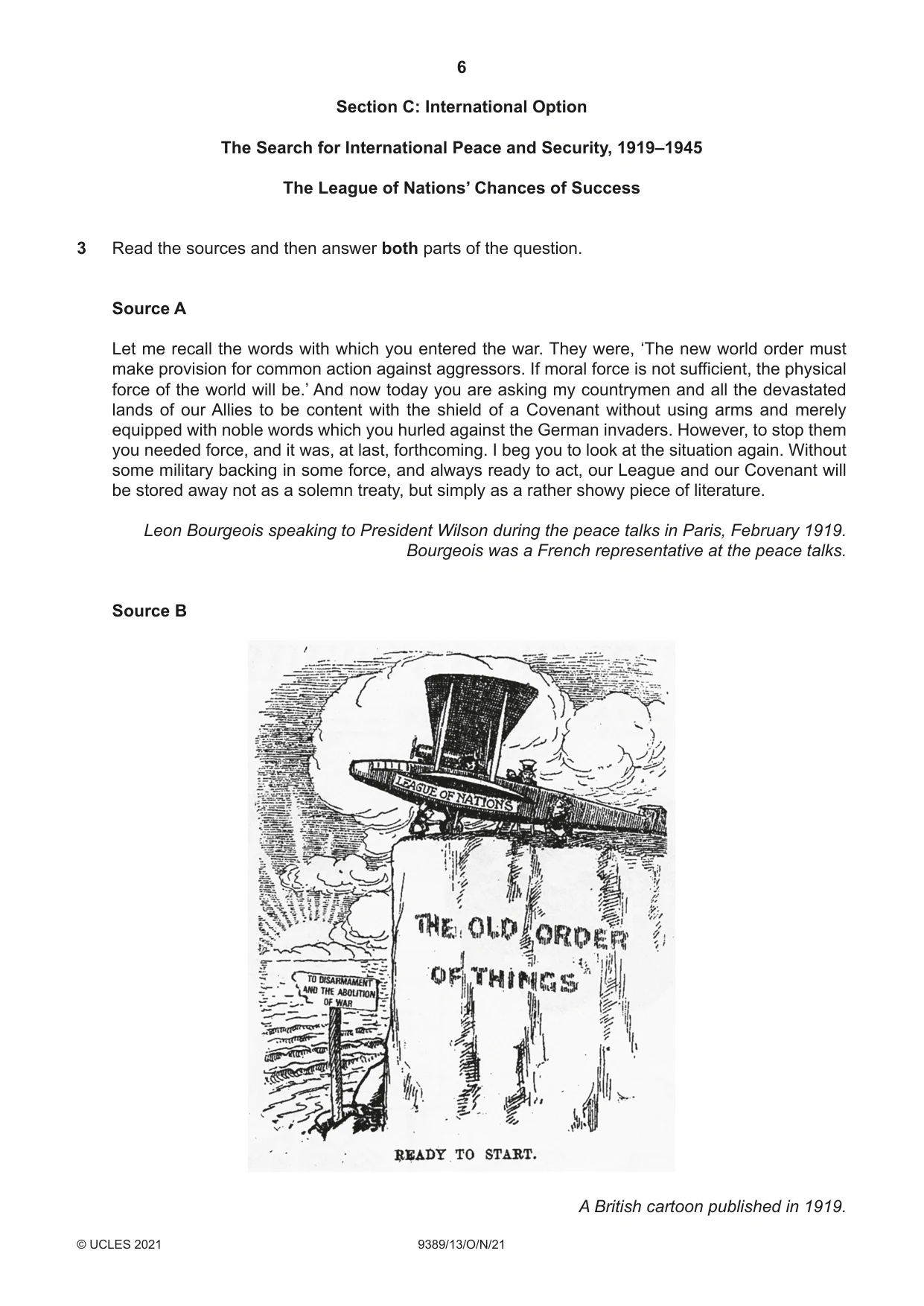
6 9389/13/O/N/21 © UCLES 2021 Section C: International Option The Search for International Peace and Security, 1919–1945 The League of Nations’ Chances of Success 3 Read the sources and then answer both parts of the question. Source A Let me recall the words with which you entered the war. They were, ‘The new world order must make provision for common action against aggressors. If moral force is not sufficient, the physical force of the world will be.’ And now today you are asking my countrymen and all the devastated lands of our Allies to be content with the shield of a Covenant without using arms and merely equipped with noble words which you hurled against the German invaders. However, to stop them you needed force, and it was, at last, forthcoming. I beg you to look at the situation again. Without some military backing in some force, and always ready to act, our League and our Covenant will be stored away not as a solemn treaty, but simply as a rather showy piece of literature. Leon Bourgeois speaking to President Wilson during the peace talks in Paris, February 1919. Bourgeois was a French representative at the peace talks. Source B A British cartoon published in 1919.
Question paper, page 7
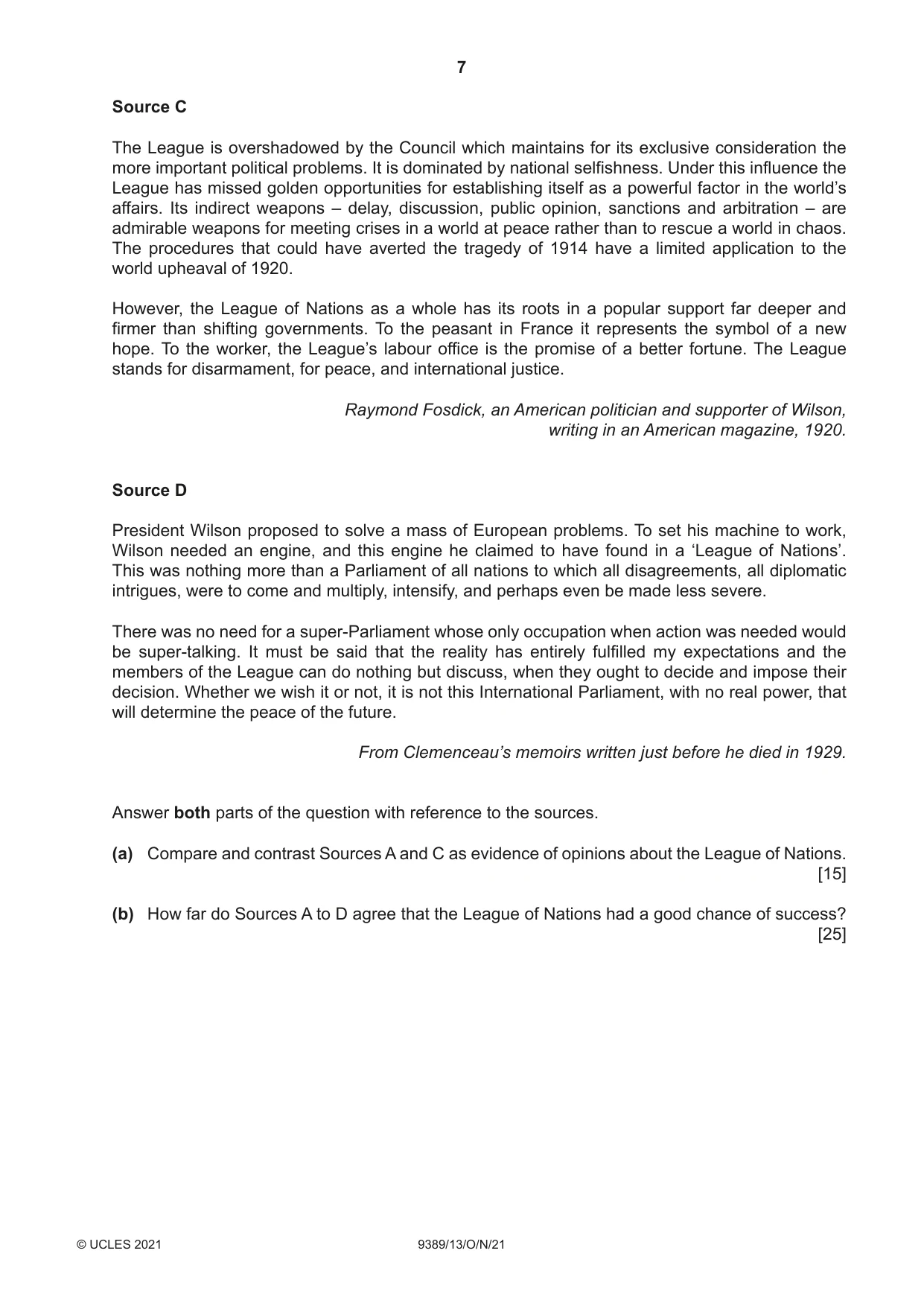
7 9389/13/O/N/21 © UCLES 2021 Source C The League is overshadowed by the Council which maintains for its exclusive consideration the more important political problems. It is dominated by national selfishness. Under this influence the League has missed golden opportunities for establishing itself as a powerful factor in the world’s affairs. Its indirect weapons ‒ delay, discussion, public opinion, sanctions and arbitration ‒ are admirable weapons for meeting crises in a world at peace rather than to rescue a world in chaos. The procedures that could have averted the tragedy of 1914 have a limited application to the world upheaval of 1920. However, the League of Nations as a whole has its roots in a popular support far deeper and firmer than shifting governments. To the peasant in France it represents the symbol of a new hope. To the worker, the League’s labour office is the promise of a better fortune. The League stands for disarmament, for peace, and international justice. Raymond Fosdick, an American politician and supporter of Wilson, writing in an American magazine, 1920. Source D President Wilson proposed to solve a mass of European problems. To set his machine to work, Wilson needed an engine, and this engine he claimed to have found in a ‘League of Nations’. This was nothing more than a Parliament of all nations to which all disagreements, all diplomatic intrigues, were to come and multiply, intensify, and perhaps even be made less severe. There was no need for a super-Parliament whose only occupation when action was needed would be super-talking. It must be said that the reality has entirely fulfilled my expectations and the members of the League can do nothing but discuss, when they ought to decide and impose their decision. Whether we wish it or not, it is not this International Parliament, with no real power, that will determine the peace of the future. From Clemenceau’s memoirs written just before he died in 1929. Answer both parts of the question with reference to the sources. (a) Compare and contrast Sources A and C as evidence of opinions about the League of Nations. [15] (b) How far do Sources A to D agree that the League of Nations had a good chance of success? [25]
Question paper, page 8
8 9389/13/O/N/21 © UCLES 2021 Permission to reproduce items where third-party owned material protected by copyright is included has been sought and cleared where possible. Every reasonable effort has been made by the publisher (UCLES) to trace copyright holders, but if any items requiring clearance have unwittingly been included, the publisher will be pleased to make amends at the earliest possible opportunity. To avoid the issue of disclosure of answer-related information to candidates, all copyright acknowledgements are reproduced online in the Cambridge Assessment International Education Copyright Acknowledgements Booklet. This is produced for each series of examinations and is freely available to download at www.cambridgeinternational.org after the live examination series. Cambridge Assessment International Education is part of the Cambridge Assessment Group. Cambridge Assessment is the brand name of the University of Cambridge Local Examinations Syndicate (UCLES), which itself is a department of the University of Cambridge. BLANK PAGE
Mark scheme, page 1
This document consists of 11 printed pages. © UCLES 2021 [Turn over Cambridge International AS & A Level HISTORY 9389/13 Paper 1 Document Question October/November 2021 MARK SCHEME Maximum Mark: 40 Published This mark scheme is published as an aid to teachers and candidates, to indicate the requirements of the examination. It shows the basis on which Examiners were instructed to award marks. It does not indicate the details of the discussions that took place at an Examiners’ meeting before marking began, which would have considered the acceptability of alternative answers. Mark schemes should be read in conjunction with the question paper and the Principal Examiner Report for Teachers. Cambridge International will not enter into discussions about these mark schemes. Cambridge International is publishing the mark schemes for the October/November 2021 series for most Cambridge IGCSE™, Cambridge International A and AS Level components and some Cambridge O Level components.
Mark scheme, page 2
9389/13 Cambridge International AS & A Level – Mark Scheme PUBLISHED October/November 2021 © UCLES 2021 Page 2 of 11 Generic Marking Principles These general marking principles must be applied by all examiners when marking candidate answers. They should be applied alongside the specific content of the mark scheme or generic level descriptors for a question. Each question paper and mark scheme will also comply with these marking principles. GENERIC MARKING PRINCIPLE 1: Marks must be awarded in line with: • the specific content of the mark scheme or the generic level descriptors for the question • the specific skills defined in the mark scheme or in the generic level descriptors for the question • the standard of response required by a candidate as exemplified by the standardisation scripts. GENERIC MARKING PRINCIPLE 2: Marks awarded are always whole marks (not half marks, or other fractions). GENERIC MARKING PRINCIPLE 3: Marks must be awarded positively: • marks are awarded for correct/valid answers, as defined in the mark scheme. However, credit is given for valid answers which go beyond the scope of the syllabus and mark scheme, referring to your Team Leader as appropriate • marks are awarded when candidates clearly demonstrate what they know and can do • marks are not deducted for errors • marks are not deducted for omissions • answers should only be judged on the quality of spelling, punctuation and grammar when these features are specifically assessed by the question as indicated by the mark scheme. The meaning, however, should be unambiguous. GENERIC MARKING PRINCIPLE 4: Rules must be applied consistently, e.g. in situations where candidates have not followed instructions or in the application of generic level descriptors. GENERIC MARKING PRINCIPLE 5: Marks should be awarded using the full range of marks defined in the mark scheme for the question (however; the use of the full mark range may be limited according to the quality of the candidate responses seen). GENERIC MARKING PRINCIPLE 6: Marks awarded are based solely on the requirements as defined in the mark scheme. Marks should not be awarded with grade thresholds or grade descriptors in mind.
Mark scheme, page 3
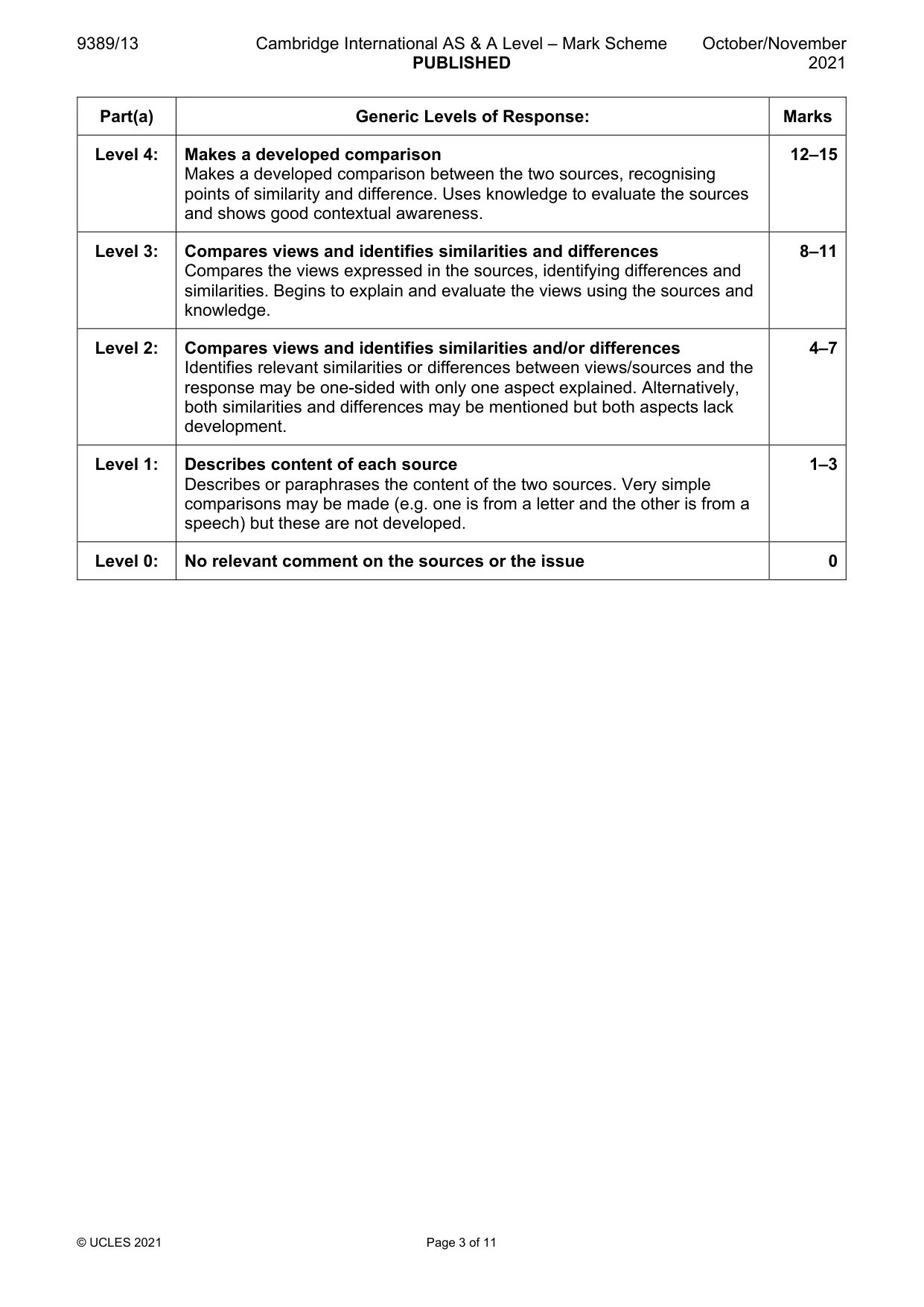
9389/13 Cambridge International AS & A Level – Mark Scheme PUBLISHED October/November 2021 © UCLES 2021 Page 3 of 11 Part(a) Generic Levels of Response: Marks Level 4: Makes a developed comparison Makes a developed comparison between the two sources, recognising points of similarity and difference. Uses knowledge to evaluate the sources and shows good contextual awareness. 12–15 Level 3: Compares views and identifies similarities and differences Compares the views expressed in the sources, identifying differences and similarities. Begins to explain and evaluate the views using the sources and knowledge. 8–11 Level 2: Compares views and identifies similarities and/or differences Identifies relevant similarities or differences between views/sources and the response may be one-sided with only one aspect explained. Alternatively, both similarities and differences may be mentioned but both aspects lack development. 4–7 Level 1: Describes content of each source Describes or paraphrases the content of the two sources. Very simple comparisons may be made (e.g. one is from a letter and the other is from a speech) but these are not developed. 1–3 Level 0: No relevant comment on the sources or the issue 0
Mark scheme, page 4
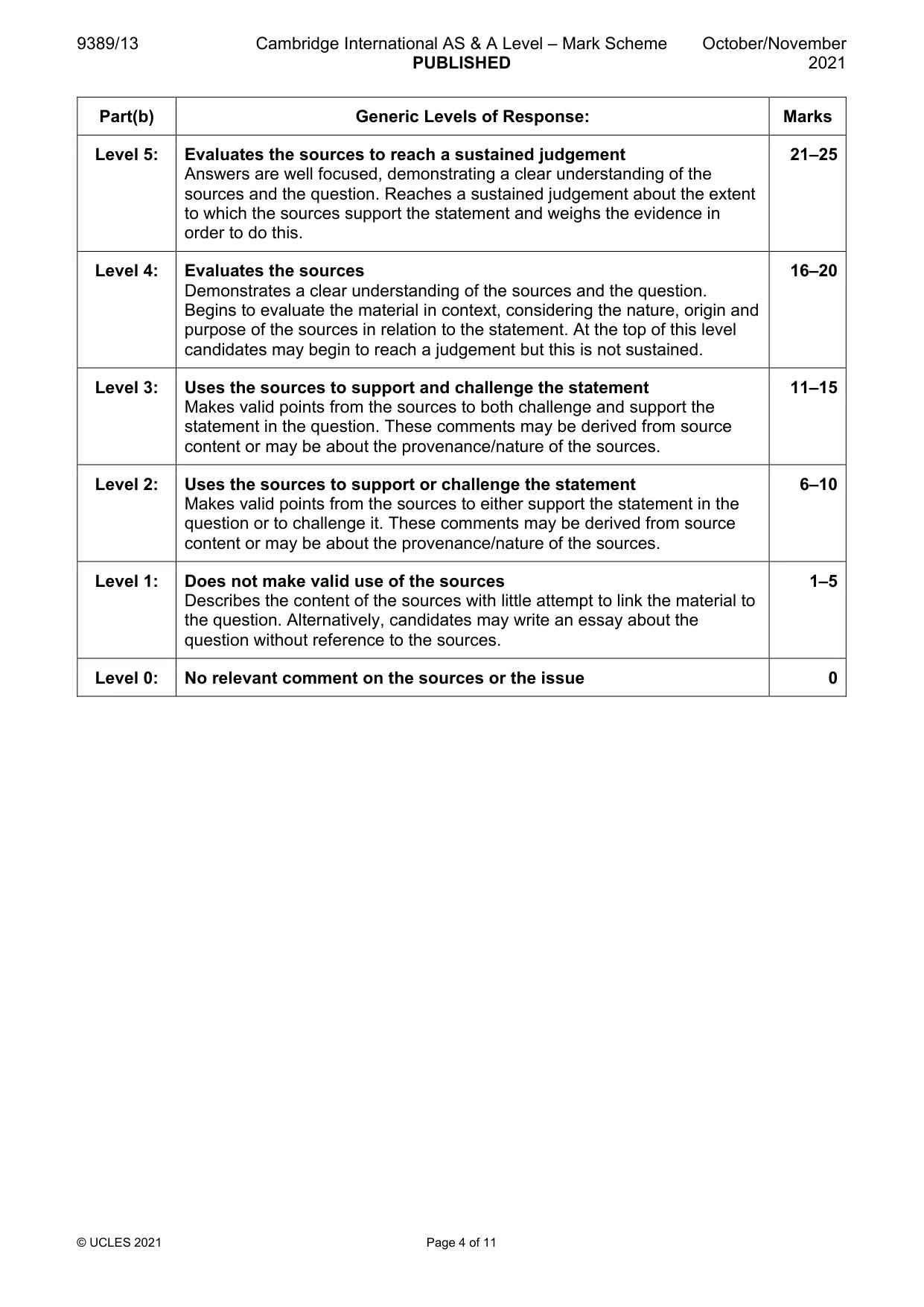
9389/13 Cambridge International AS & A Level – Mark Scheme PUBLISHED October/November 2021 © UCLES 2021 Page 4 of 11 Part(b) Generic Levels of Response: Marks Level 5: Evaluates the sources to reach a sustained judgement Answers are well focused, demonstrating a clear understanding of the sources and the question. Reaches a sustained judgement about the extent to which the sources support the statement and weighs the evidence in order to do this. 21–25 Level 4: Evaluates the sources Demonstrates a clear understanding of the sources and the question. Begins to evaluate the material in context, considering the nature, origin and purpose of the sources in relation to the statement. At the top of this level candidates may begin to reach a judgement but this is not sustained. 16–20 Level 3: Uses the sources to support and challenge the statement Makes valid points from the sources to both challenge and support the statement in the question. These comments may be derived from source content or may be about the provenance/nature of the sources. 11–15 Level 2: Uses the sources to support or challenge the statement Makes valid points from the sources to either support the statement in the question or to challenge it. These comments may be derived from source content or may be about the provenance/nature of the sources. 6–10 Level 1: Does not make valid use of the sources Describes the content of the sources with little attempt to link the material to the question. Alternatively, candidates may write an essay about the question without reference to the sources. 1–5 Level 0: No relevant comment on the sources or the issue 0
Mark scheme, page 5
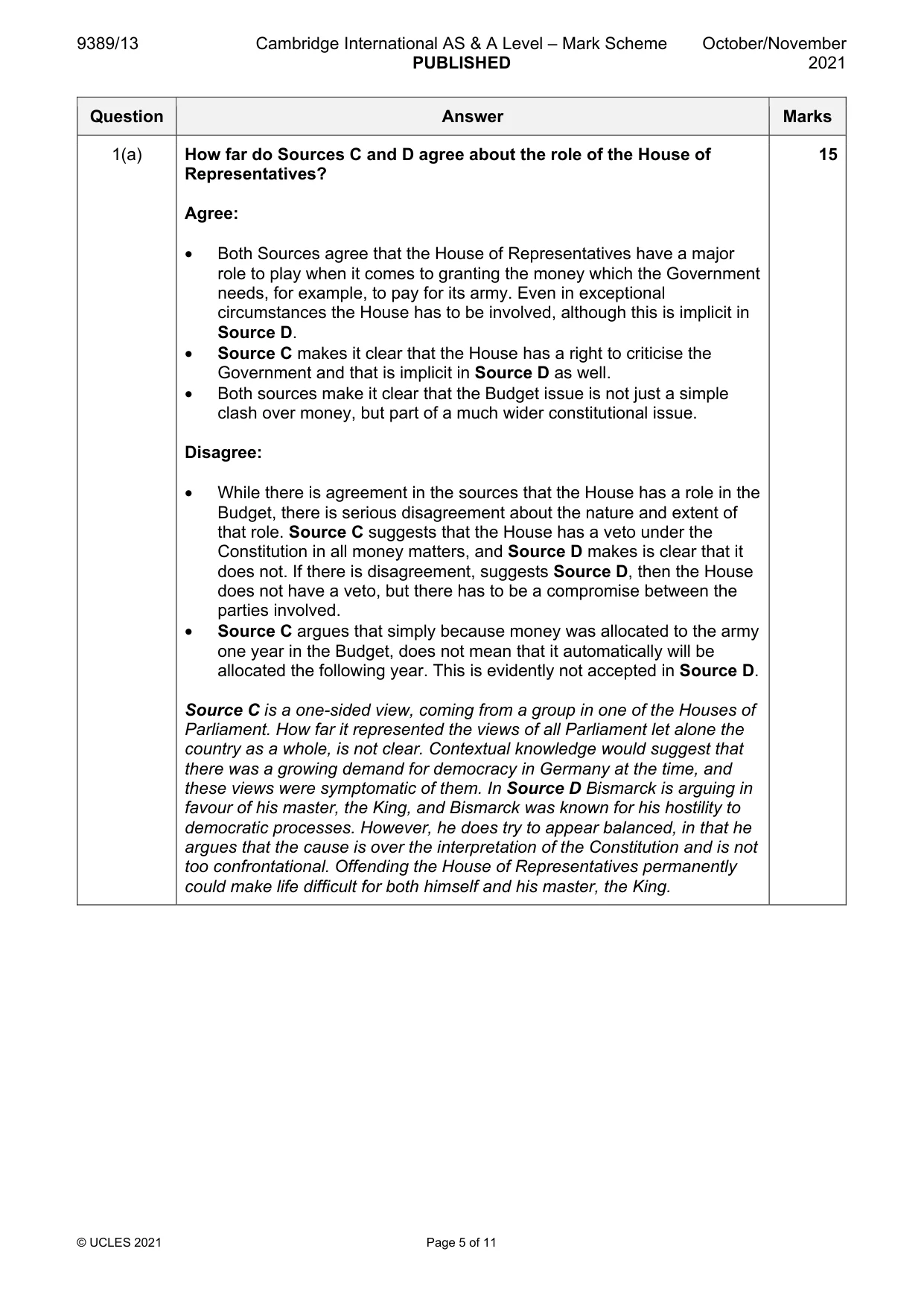
9389/13 Cambridge International AS & A Level – Mark Scheme PUBLISHED October/November 2021 © UCLES 2021 Page 5 of 11 Question Answer Marks 1(a) How far do Sources C and D agree about the role of the House of Representatives? Agree: • Both Sources agree that the House of Representatives have a major role to play when it comes to granting the money which the Government needs, for example, to pay for its army. Even in exceptional circumstances the House has to be involved, although this is implicit in Source D. • Source C makes it clear that the House has a right to criticise the Government and that is implicit in Source D as well. • Both sources make it clear that the Budget issue is not just a simple clash over money, but part of a much wider constitutional issue. Disagree: • While there is agreement in the sources that the House has a role in the Budget, there is serious disagreement about the nature and extent of that role. Source C suggests that the House has a veto under the Constitution in all money matters, and Source D makes is clear that it does not. If there is disagreement, suggests Source D, then the House does not have a veto, but there has to be a compromise between the parties involved. • Source C argues that simply because money was allocated to the army one year in the Budget, does not mean that it automatically will be allocated the following year. This is evidently not accepted in Source D. Source C is a one-sided view, coming from a group in one of the Houses of Parliament. How far it represented the views of all Parliament let alone the country as a whole, is not clear. Contextual knowledge would suggest that there was a growing demand for democracy in Germany at the time, and these views were symptomatic of them. In Source D Bismarck is arguing in favour of his master, the King, and Bismarck was known for his hostility to democratic processes. However, he does try to appear balanced, in that he argues that the cause is over the interpretation of the Constitution and is not too confrontational. Offending the House of Representatives permanently could make life difficult for both himself and his master, the King. 15
Mark scheme, page 6
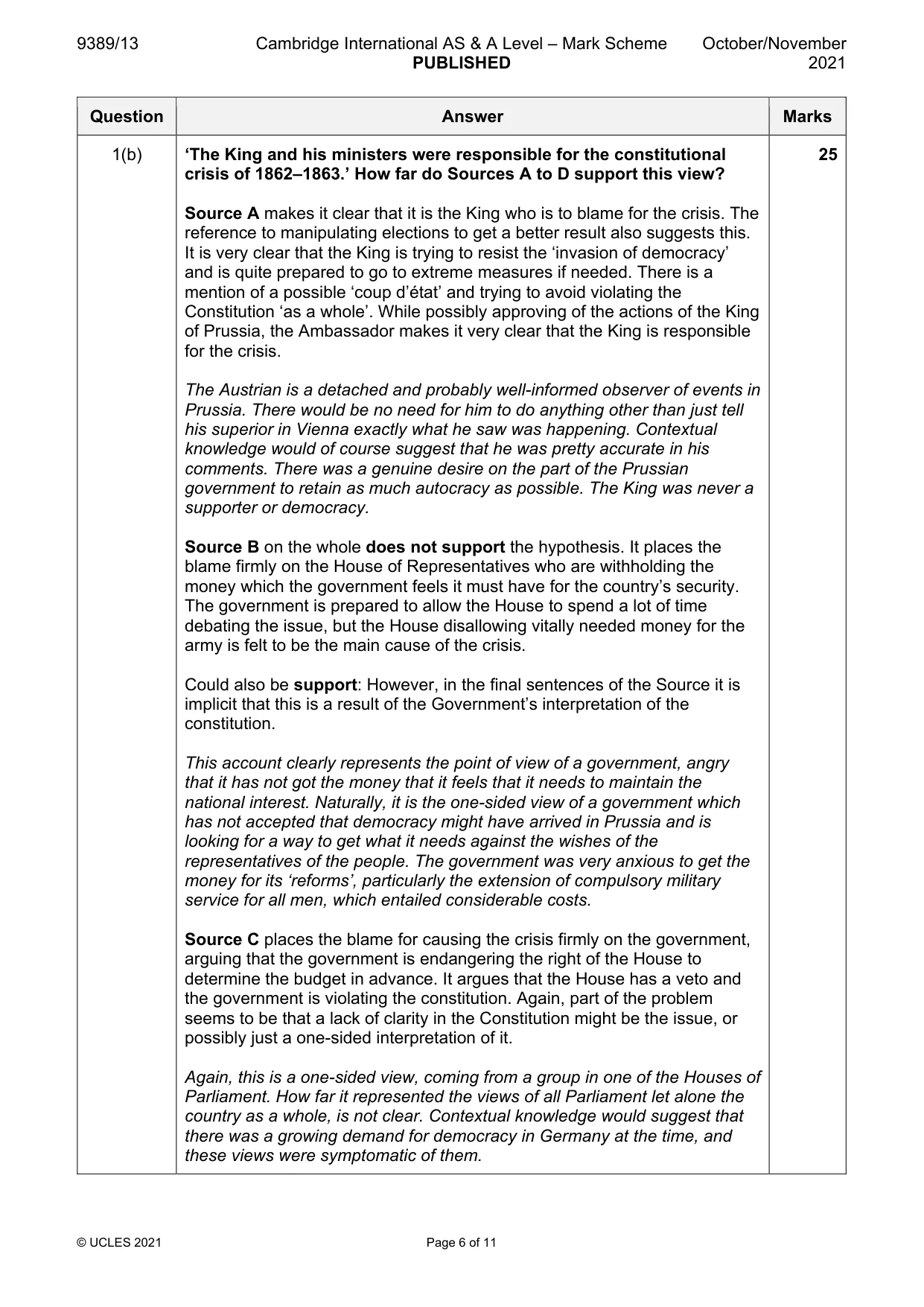
9389/13 Cambridge International AS & A Level – Mark Scheme PUBLISHED October/November 2021 © UCLES 2021 Page 6 of 11 Question Answer Marks 1(b) ‘The King and his ministers were responsible for the constitutional crisis of 1862–1863.’ How far do Sources A to D support this view? Source A makes it clear that it is the King who is to blame for the crisis. The reference to manipulating elections to get a better result also suggests this. It is very clear that the King is trying to resist the ‘invasion of democracy’ and is quite prepared to go to extreme measures if needed. There is a mention of a possible ‘coup d’état’ and trying to avoid violating the Constitution ‘as a whole’. While possibly approving of the actions of the King of Prussia, the Ambassador makes it very clear that the King is responsible for the crisis. The Austrian is a detached and probably well-informed observer of events in Prussia. There would be no need for him to do anything other than just tell his superior in Vienna exactly what he saw was happening. Contextual knowledge would of course suggest that he was pretty accurate in his comments. There was a genuine desire on the part of the Prussian government to retain as much autocracy as possible. The King was never a supporter or democracy. Source B on the whole does not support the hypothesis. It places the blame firmly on the House of Representatives who are withholding the money which the government feels it must have for the country’s security. The government is prepared to allow the House to spend a lot of time debating the issue, but the House disallowing vitally needed money for the army is felt to be the main cause of the crisis. Could also be support: However, in the final sentences of the Source it is implicit that this is a result of the Government’s interpretation of the constitution. This account clearly represents the point of view of a government, angry that it has not got the money that it feels that it needs to maintain the national interest. Naturally, it is the one-sided view of a government which has not accepted that democracy might have arrived in Prussia and is looking for a way to get what it needs against the wishes of the representatives of the people. The government was very anxious to get the money for its ‘reforms’, particularly the extension of compulsory military service for all men, which entailed considerable costs. Source C places the blame for causing the crisis firmly on the government, arguing that the government is endangering the right of the House to determine the budget in advance. It argues that the House has a veto and the government is violating the constitution. Again, part of the problem seems to be that a lack of clarity in the Constitution might be the issue, or possibly just a one-sided interpretation of it. Again, this is a one-sided view, coming from a group in one of the Houses of Parliament. How far it represented the views of all Parliament let alone the country as a whole, is not clear. Contextual knowledge would suggest that there was a growing demand for democracy in Germany at the time, and these views were symptomatic of them. 25
Mark scheme, page 7
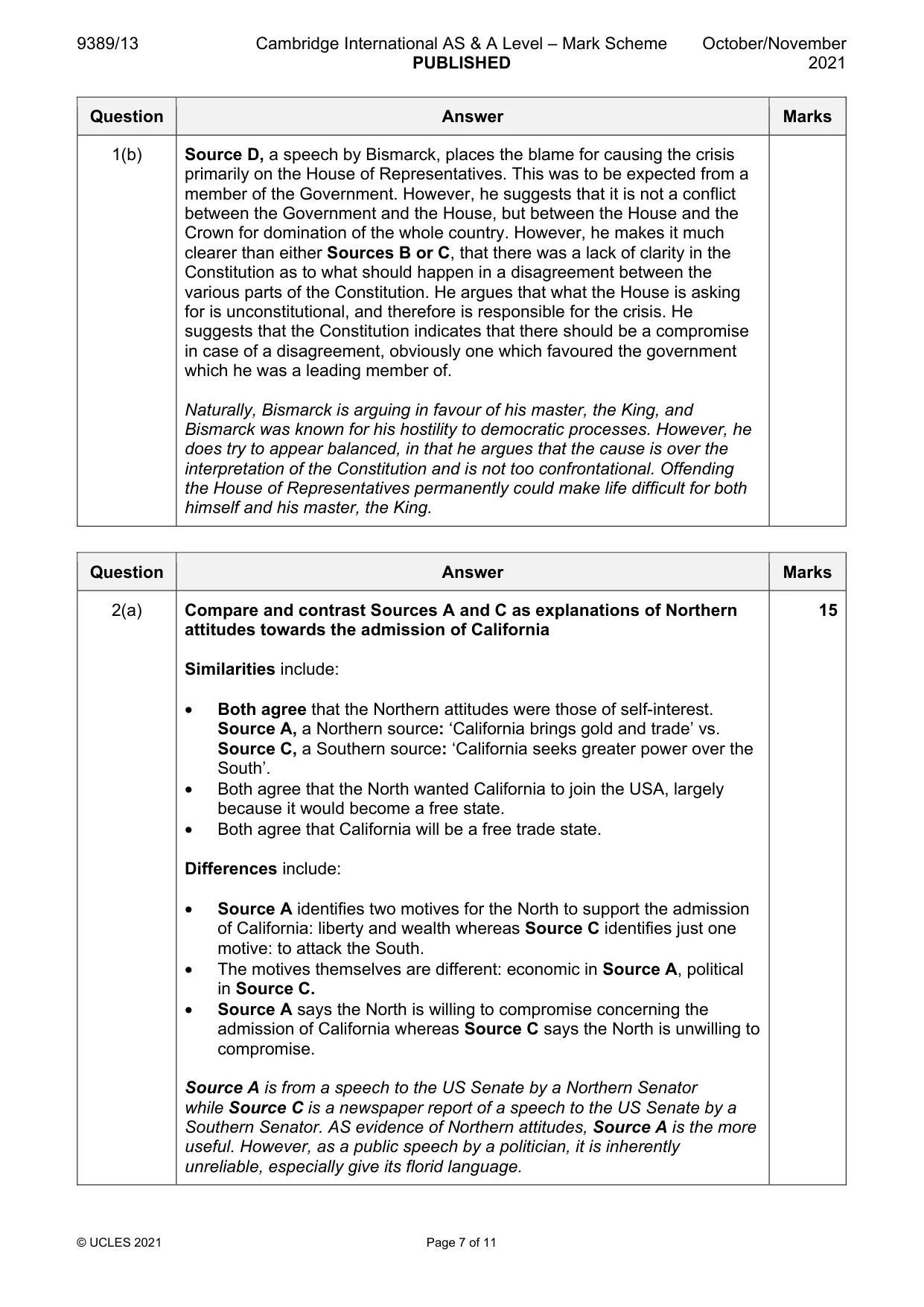
9389/13 Cambridge International AS & A Level – Mark Scheme PUBLISHED October/November 2021 © UCLES 2021 Page 7 of 11 Question Answer Marks 1(b) Source D, a speech by Bismarck, places the blame for causing the crisis primarily on the House of Representatives. This was to be expected from a member of the Government. However, he suggests that it is not a conflict between the Government and the House, but between the House and the Crown for domination of the whole country. However, he makes it much clearer than either Sources B or C, that there was a lack of clarity in the Constitution as to what should happen in a disagreement between the various parts of the Constitution. He argues that what the House is asking for is unconstitutional, and therefore is responsible for the crisis. He suggests that the Constitution indicates that there should be a compromise in case of a disagreement, obviously one which favoured the government which he was a leading member of. Naturally, Bismarck is arguing in favour of his master, the King, and Bismarck was known for his hostility to democratic processes. However, he does try to appear balanced, in that he argues that the cause is over the interpretation of the Constitution and is not too confrontational. Offending the House of Representatives permanently could make life difficult for both himself and his master, the King. Question Answer Marks 2(a) Compare and contrast Sources A and C as explanations of Northern attitudes towards the admission of California Similarities include: • Both agree that the Northern attitudes were those of self-interest. Source A, a Northern source: ‘California brings gold and trade’ vs. Source C, a Southern source: ‘California seeks greater power over the South’. • Both agree that the North wanted California to join the USA, largely because it would become a free state. • Both agree that California will be a free trade state. Differences include: • Source A identifies two motives for the North to support the admission of California: liberty and wealth whereas Source C identifies just one motive: to attack the South. • The motives themselves are different: economic in Source A, political in Source C. • Source A says the North is willing to compromise concerning the admission of California whereas Source C says the North is unwilling to compromise. Source A is from a speech to the US Senate by a Northern Senator while Source C is a newspaper report of a speech to the US Senate by a Southern Senator. AS evidence of Northern attitudes, Source A is the more useful. However, as a public speech by a politician, it is inherently unreliable, especially give its florid language. 15
Mark scheme, page 8
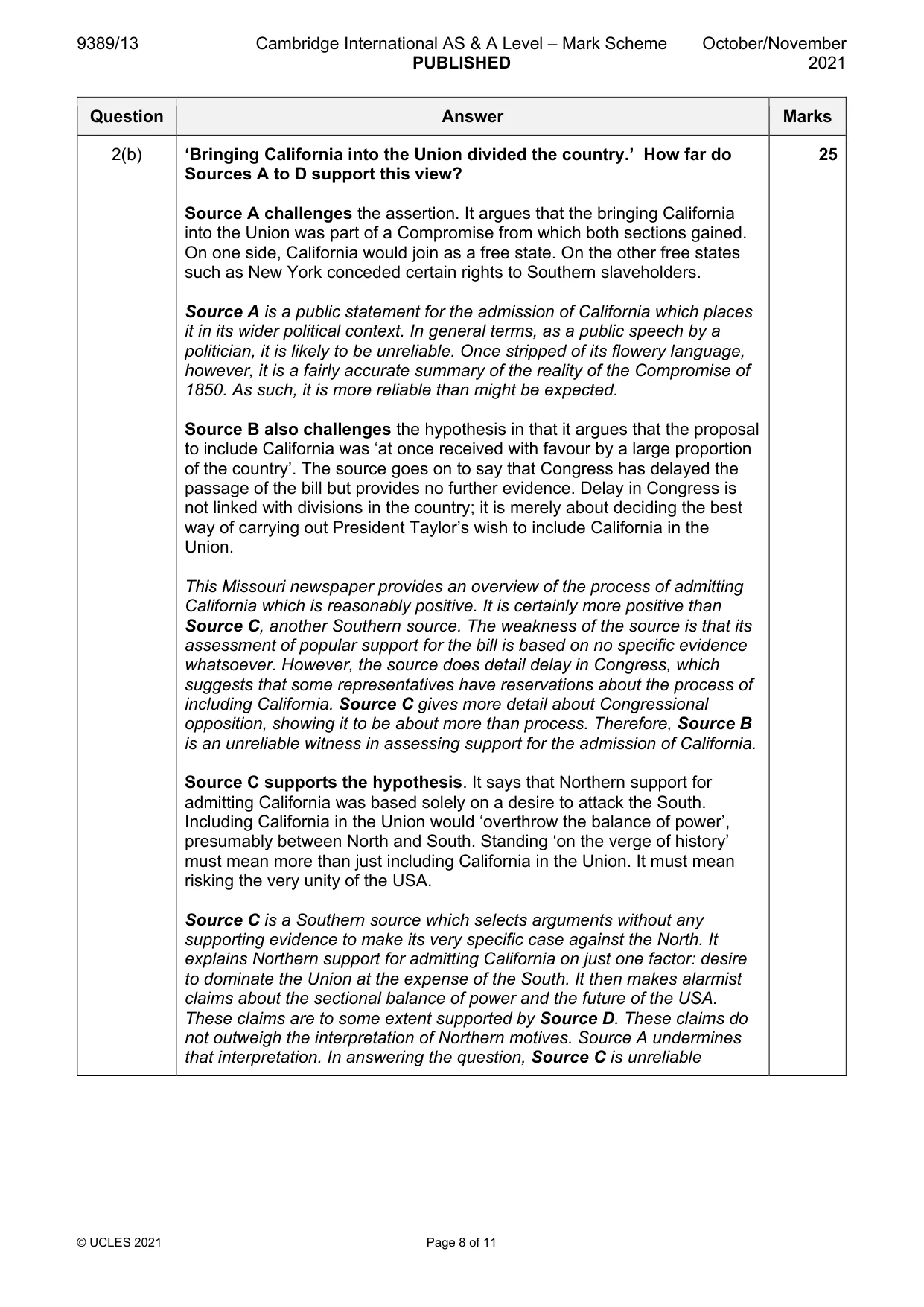
9389/13 Cambridge International AS & A Level – Mark Scheme PUBLISHED October/November 2021 © UCLES 2021 Page 8 of 11 Question Answer Marks 2(b) ‘Bringing California into the Union divided the country.’ How far do Sources A to D support this view? Source A challenges the assertion. It argues that the bringing California into the Union was part of a Compromise from which both sections gained. On one side, California would join as a free state. On the other free states such as New York conceded certain rights to Southern slaveholders. Source A is a public statement for the admission of California which places it in its wider political context. In general terms, as a public speech by a politician, it is likely to be unreliable. Once stripped of its flowery language, however, it is a fairly accurate summary of the reality of the Compromise of 1850. As such, it is more reliable than might be expected. Source B also challenges the hypothesis in that it argues that the proposal to include California was ‘at once received with favour by a large proportion of the country’. The source goes on to say that Congress has delayed the passage of the bill but provides no further evidence. Delay in Congress is not linked with divisions in the country; it is merely about deciding the best way of carrying out President Taylor’s wish to include California in the Union. This Missouri newspaper provides an overview of the process of admitting California which is reasonably positive. It is certainly more positive than Source C, another Southern source. The weakness of the source is that its assessment of popular support for the bill is based on no specific evidence whatsoever. However, the source does detail delay in Congress, which suggests that some representatives have reservations about the process of including California. Source C gives more detail about Congressional opposition, showing it to be about more than process. Therefore, Source B is an unreliable witness in assessing support for the admission of California. Source C supports the hypothesis. It says that Northern support for admitting California was based solely on a desire to attack the South. Including California in the Union would ‘overthrow the balance of power’, presumably between North and South. Standing ‘on the verge of history’ must mean more than just including California in the Union. It must mean risking the very unity of the USA. Source C is a Southern source which selects arguments without any supporting evidence to make its very specific case against the North. It explains Northern support for admitting California on just one factor: desire to dominate the Union at the expense of the South. It then makes alarmist claims about the sectional balance of power and the future of the USA. These claims are to some extent supported by Source D. These claims do not outweigh the interpretation of Northern motives. Source A undermines that interpretation. In answering the question, Source C is unreliable 25
Mark scheme, page 9
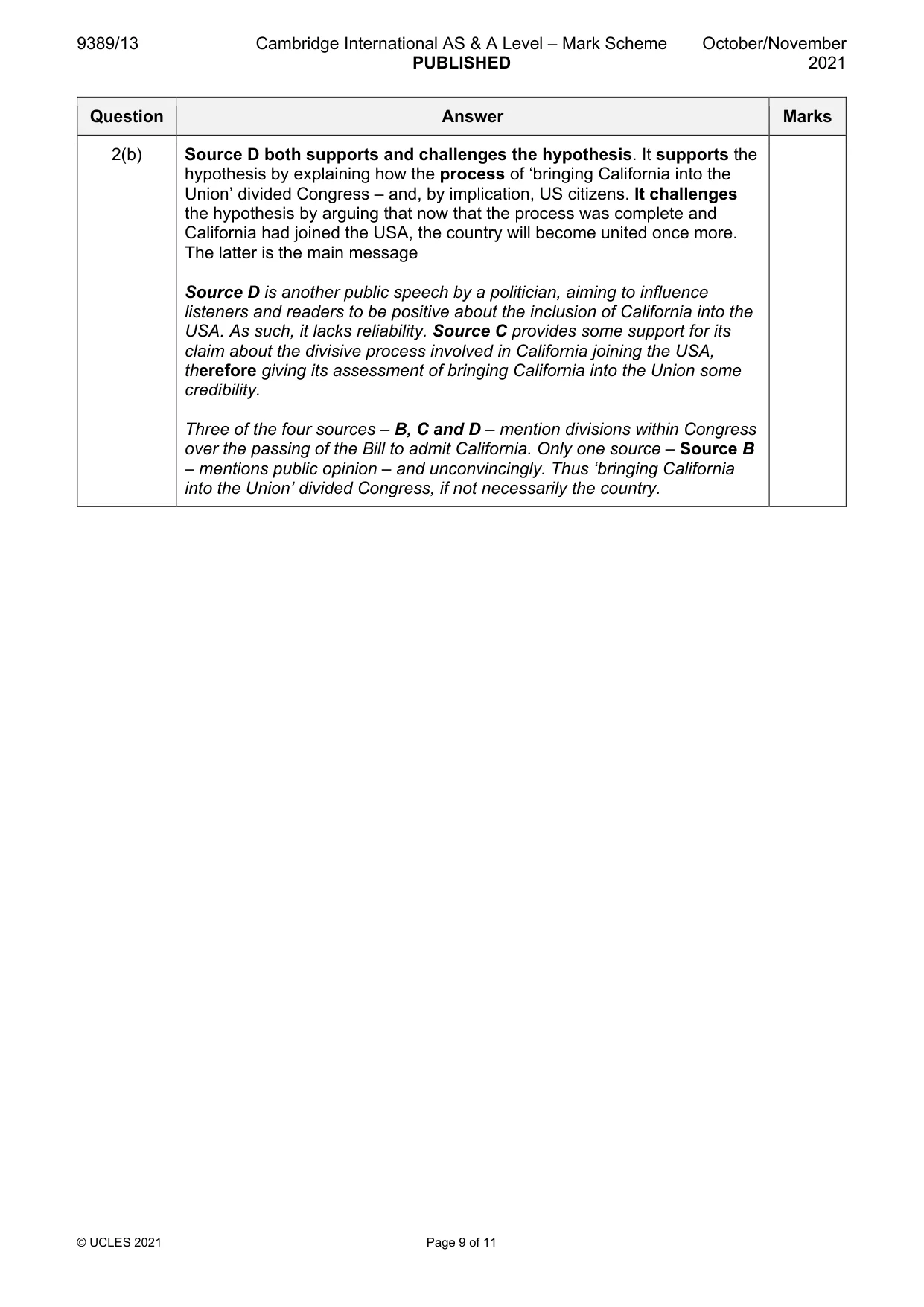
9389/13 Cambridge International AS & A Level – Mark Scheme PUBLISHED October/November 2021 © UCLES 2021 Page 9 of 11 Question Answer Marks 2(b) Source D both supports and challenges the hypothesis. It supports the hypothesis by explaining how the process of ‘bringing California into the Union’ divided Congress – and, by implication, US citizens. It challenges the hypothesis by arguing that now that the process was complete and California had joined the USA, the country will become united once more. The latter is the main message Source D is another public speech by a politician, aiming to influence listeners and readers to be positive about the inclusion of California into the USA. As such, it lacks reliability. Source C provides some support for its claim about the divisive process involved in California joining the USA, therefore giving its assessment of bringing California into the Union some credibility. Three of the four sources – B, C and D – mention divisions within Congress over the passing of the Bill to admit California. Only one source – Source B – mentions public opinion – and unconvincingly. Thus ‘bringing California into the Union’ divided Congress, if not necessarily the country.
Mark scheme, page 10
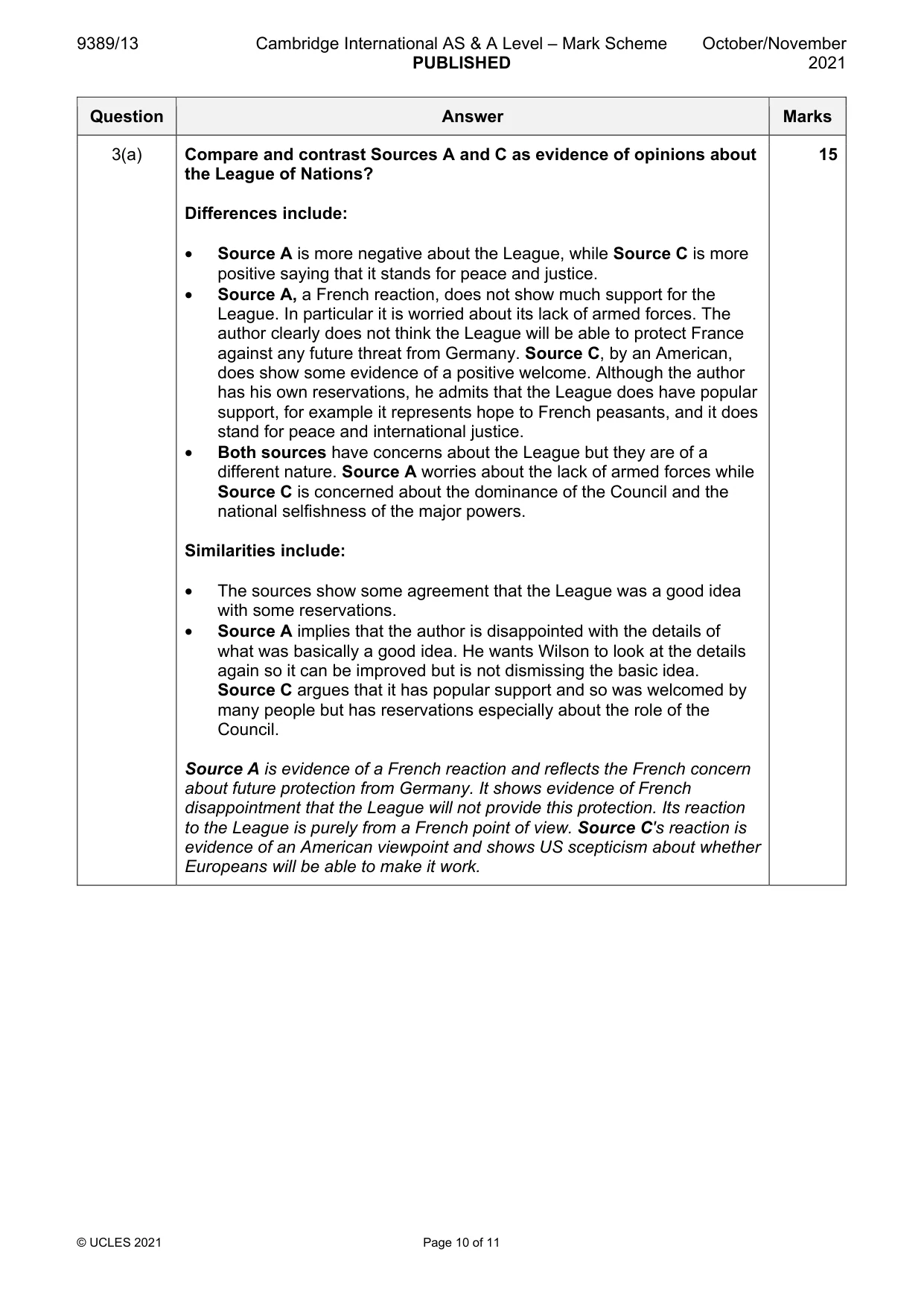
9389/13 Cambridge International AS & A Level – Mark Scheme PUBLISHED October/November 2021 © UCLES 2021 Page 10 of 11 Question Answer Marks 3(a) Compare and contrast Sources A and C as evidence of opinions about the League of Nations? Differences include: • Source A is more negative about the League, while Source C is more positive saying that it stands for peace and justice. • Source A, a French reaction, does not show much support for the League. In particular it is worried about its lack of armed forces. The author clearly does not think the League will be able to protect France against any future threat from Germany. Source C, by an American, does show some evidence of a positive welcome. Although the author has his own reservations, he admits that the League does have popular support, for example it represents hope to French peasants, and it does stand for peace and international justice. • Both sources have concerns about the League but they are of a different nature. Source A worries about the lack of armed forces while Source C is concerned about the dominance of the Council and the national selfishness of the major powers. Similarities include: • The sources show some agreement that the League was a good idea with some reservations. • Source A implies that the author is disappointed with the details of what was basically a good idea. He wants Wilson to look at the details again so it can be improved but is not dismissing the basic idea. Source C argues that it has popular support and so was welcomed by many people but has reservations especially about the role of the Council. Source A is evidence of a French reaction and reflects the French concern about future protection from Germany. It shows evidence of French disappointment that the League will not provide this protection. Its reaction to the League is purely from a French point of view. Source C's reaction is evidence of an American viewpoint and shows US scepticism about whether Europeans will be able to make it work. 15
Mark scheme, page 11
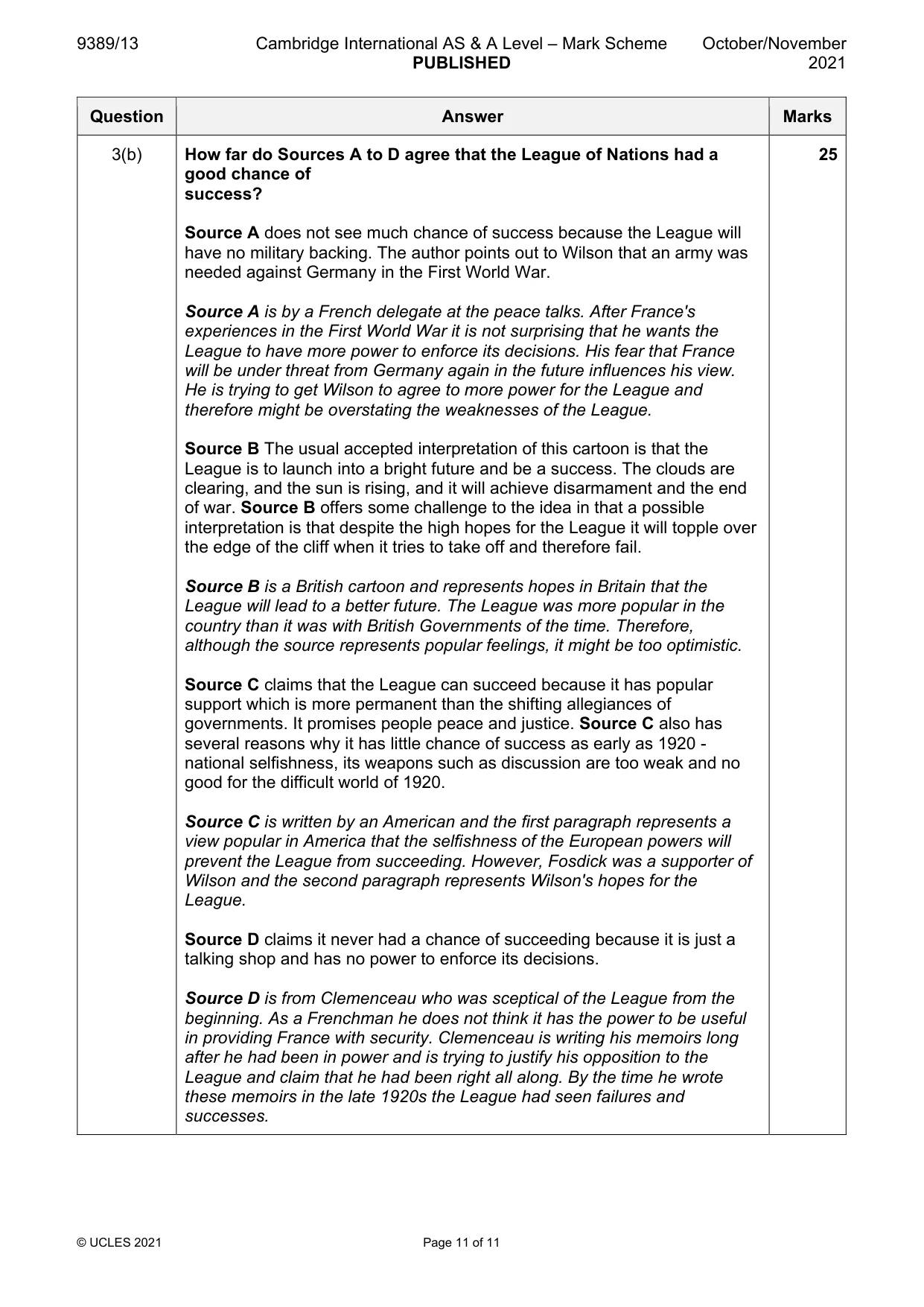
9389/13 Cambridge International AS & A Level – Mark Scheme PUBLISHED October/November 2021 © UCLES 2021 Page 11 of 11 Question Answer Marks 3(b) How far do Sources A to D agree that the League of Nations had a good chance of success? Source A does not see much chance of success because the League will have no military backing. The author points out to Wilson that an army was needed against Germany in the First World War. Source A is by a French delegate at the peace talks. After France's experiences in the First World War it is not surprising that he wants the League to have more power to enforce its decisions. His fear that France will be under threat from Germany again in the future influences his view. He is trying to get Wilson to agree to more power for the League and therefore might be overstating the weaknesses of the League. Source B The usual accepted interpretation of this cartoon is that the League is to launch into a bright future and be a success. The clouds are clearing, and the sun is rising, and it will achieve disarmament and the end of war. Source B offers some challenge to the idea in that a possible interpretation is that despite the high hopes for the League it will topple over the edge of the cliff when it tries to take off and therefore fail. Source B is a British cartoon and represents hopes in Britain that the League will lead to a better future. The League was more popular in the country than it was with British Governments of the time. Therefore, although the source represents popular feelings, it might be too optimistic. Source C claims that the League can succeed because it has popular support which is more permanent than the shifting allegiances of governments. It promises people peace and justice. Source C also has several reasons why it has little chance of success as early as 1920 - national selfishness, its weapons such as discussion are too weak and no good for the difficult world of 1920. Source C is written by an American and the first paragraph represents a view popular in America that the selfishness of the European powers will prevent the League from succeeding. However, Fosdick was a supporter of Wilson and the second paragraph represents Wilson's hopes for the League. Source D claims it never had a chance of succeeding because it is just a talking shop and has no power to enforce its decisions. Source D is from Clemenceau who was sceptical of the League from the beginning. As a Frenchman he does not think it has the power to be useful in providing France with security. Clemenceau is writing his memoirs long after he had been in power and is trying to justify his opposition to the League and claim that he had been right all along. By the time he wrote these memoirs in the late 1920s the League had seen failures and successes. 25
What you needed in this session
Cambridge’s own grade thresholds for 2021 Oct/Nov, Paper 1 · Variant 3. A higher threshold means an easier paper — the bar moves with how the cohort did.