Cambridge A Level History 9389 — 2020 Oct/Nov Paper 1 · Variant 2
9389/12/O/N/20 · 40 marks · ≈45 min
The question paper and its mark scheme, free to read here and free to download. This is Cambridge’s own paper, exactly as it was sat.
Question paper8 pages
Mark scheme12 pages
Answers below. Sit the paper first if you are practising.
Paper as text
Question paper, page 1
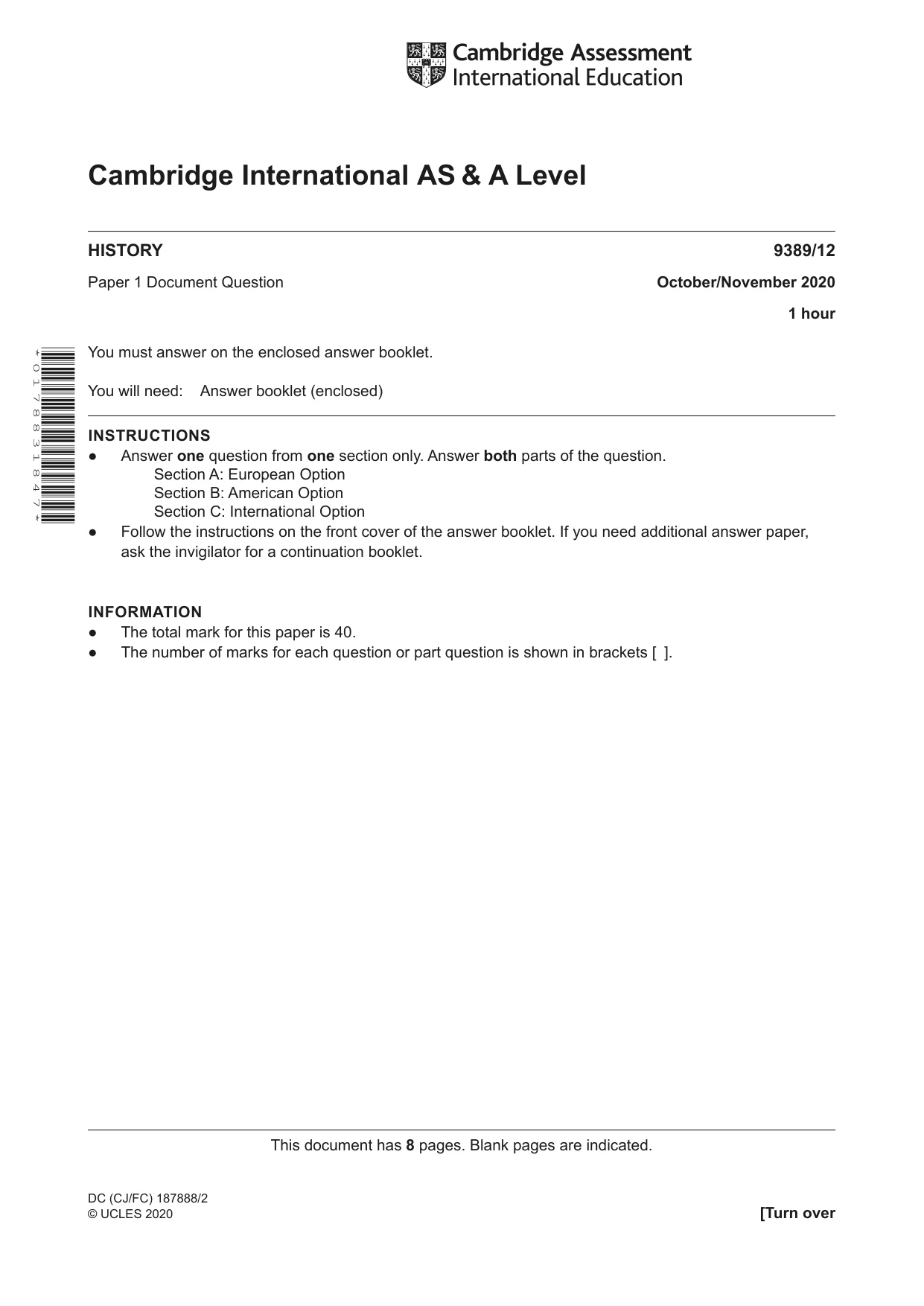
Cambridge International AS & A Level This document has 8 pages. Blank pages are indicated. HISTORY 9389/12 Paper 1 Document Question October/November 2020 1 hour You must answer on the enclosed answer booklet. You will need: Answer booklet (enclosed) INSTRUCTIONS ● Answer one question from one section only. Answer both parts of the question. Section A: European Option Section B: American Option Section C: International Option ● Follow the instructions on the front cover of the answer booklet. If you need additional answer paper, ask the invigilator for a continuation booklet. INFORMATION ● The total mark for this paper is 40. ● The number of marks for each question or part question is shown in brackets [ ]. * 0 1 7 8 8 3 1 8 4 7 * DC (CJ/FC) 187888/2 © UCLES 2020 [Turn over
Question paper, page 2
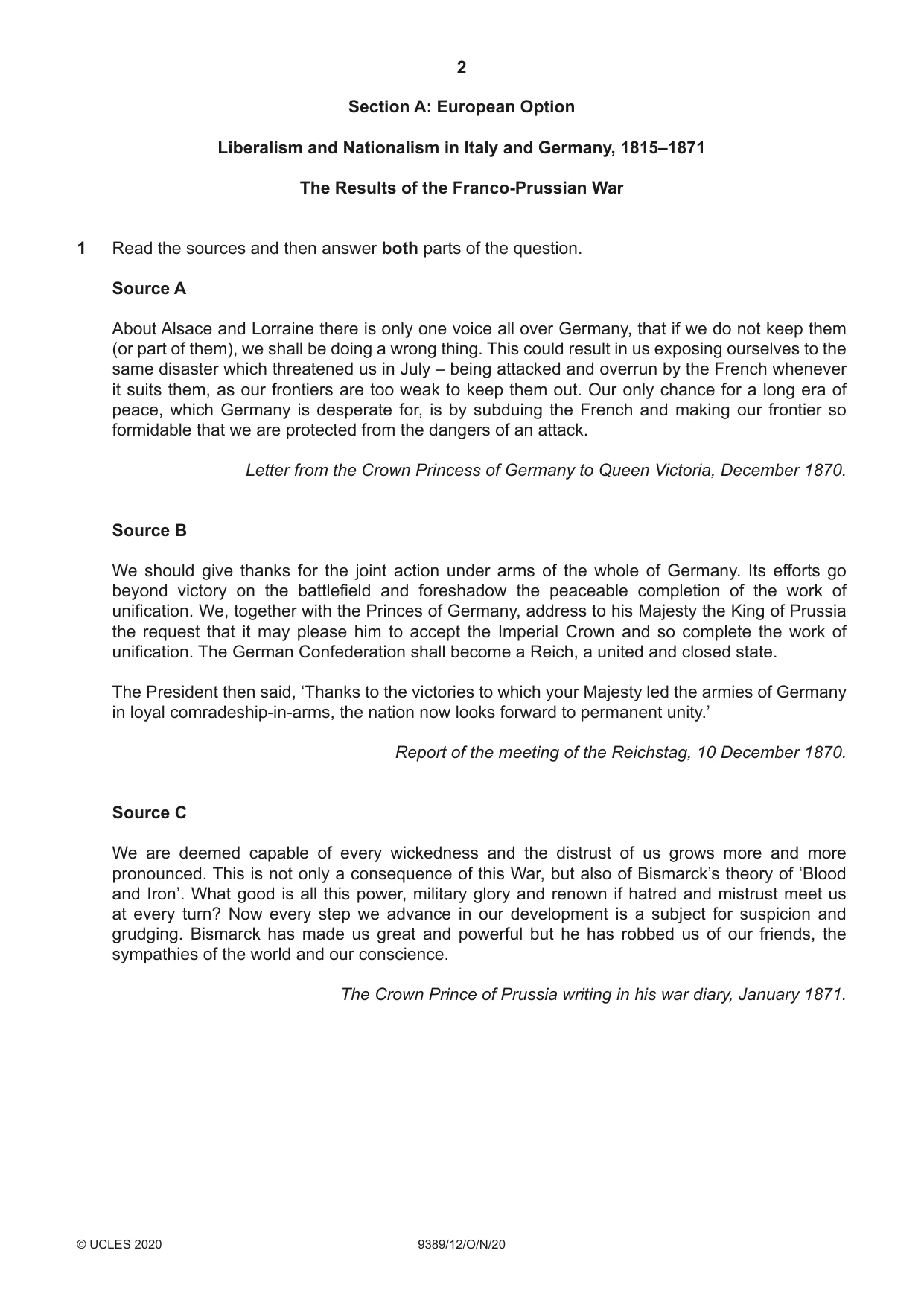
2 9389/12/O/N/20 © UCLES 2020 Section A: European Option Liberalism and Nationalism in Italy and Germany, 1815–1871 The Results of the Franco-Prussian War 1 Read the sources and then answer both parts of the question. Source A About Alsace and Lorraine there is only one voice all over Germany, that if we do not keep them (or part of them), we shall be doing a wrong thing. This could result in us exposing ourselves to the same disaster which threatened us in July – being attacked and overrun by the French whenever it suits them, as our frontiers are too weak to keep them out. Our only chance for a long era of peace, which Germany is desperate for, is by subduing the French and making our frontier so formidable that we are protected from the dangers of an attack. Letter from the Crown Princess of Germany to Queen Victoria, December 1870. Source B We should give thanks for the joint action under arms of the whole of Germany. Its efforts go beyond victory on the battlefield and foreshadow the peaceable completion of the work of unification. We, together with the Princes of Germany, address to his Majesty the King of Prussia the request that it may please him to accept the Imperial Crown and so complete the work of unification. The German Confederation shall become a Reich, a united and closed state. The President then said, ‘Thanks to the victories to which your Majesty led the armies of Germany in loyal comradeship-in-arms, the nation now looks forward to permanent unity.’ Report of the meeting of the Reichstag, 10 December 1870. Source C We are deemed capable of every wickedness and the distrust of us grows more and more pronounced. This is not only a consequence of this War, but also of Bismarck’s theory of ‘Blood and Iron’. What good is all this power, military glory and renown if hatred and mistrust meet us at every turn? Now every step we advance in our development is a subject for suspicion and grudging. Bismarck has made us great and powerful but he has robbed us of our friends, the sympathies of the world and our conscience. The Crown Prince of Prussia writing in his war diary, January 1871.
Question paper, page 3
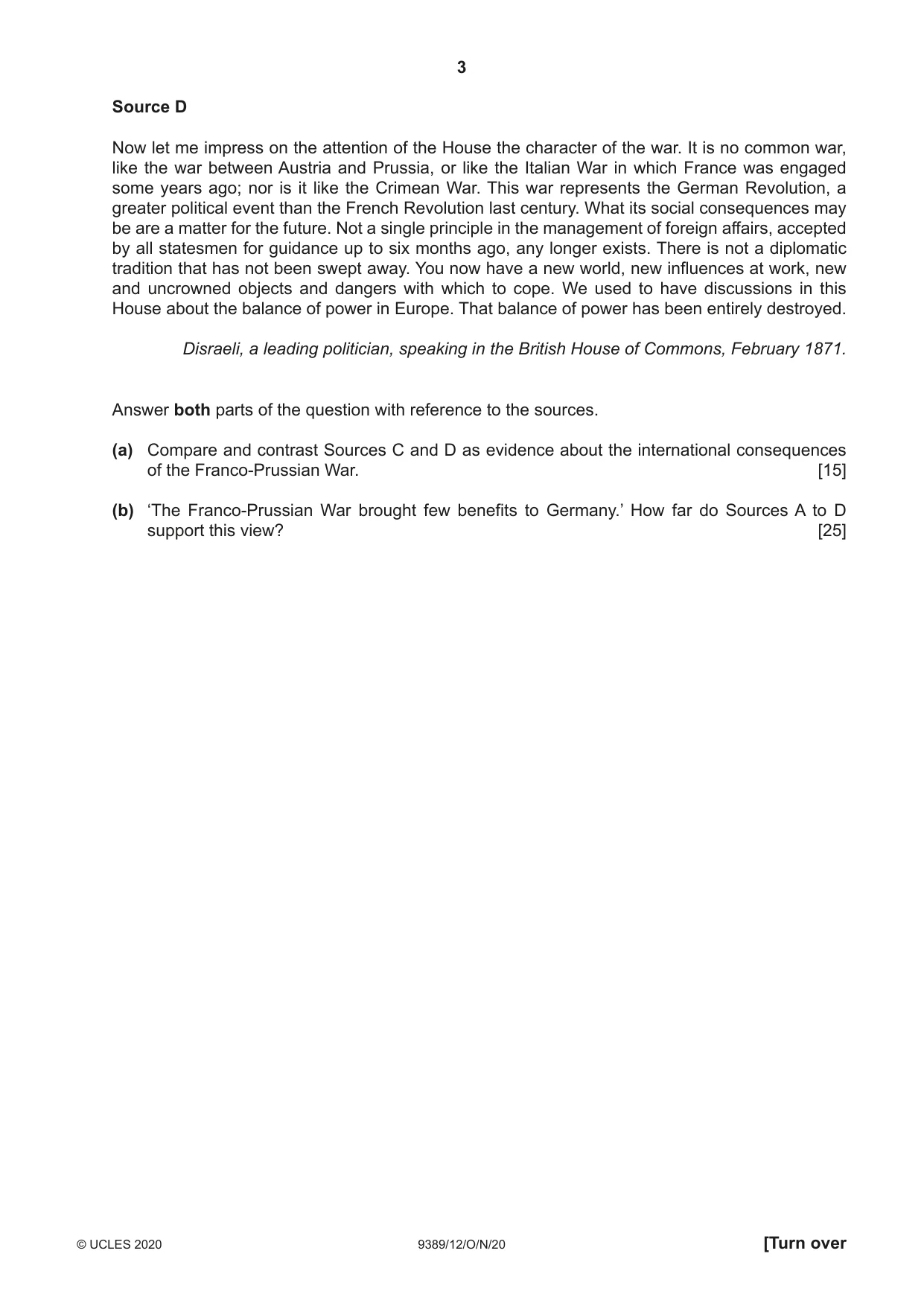
3 9389/12/O/N/20 © UCLES 2020 [Turn over Source D Now let me impress on the attention of the House the character of the war. It is no common war, like the war between Austria and Prussia, or like the Italian War in which France was engaged some years ago; nor is it like the Crimean War. This war represents the German Revolution, a greater political event than the French Revolution last century. What its social consequences may be are a matter for the future. Not a single principle in the management of foreign affairs, accepted by all statesmen for guidance up to six months ago, any longer exists. There is not a diplomatic tradition that has not been swept away. You now have a new world, new influences at work, new and uncrowned objects and dangers with which to cope. We used to have discussions in this House about the balance of power in Europe. That balance of power has been entirely destroyed. Disraeli, a leading politician, speaking in the British House of Commons, February 1871. Answer both parts of the question with reference to the sources. (a) Compare and contrast Sources C and D as evidence about the international consequences of the Franco-Prussian War. [15] (b) ‘The Franco-Prussian War brought few benefits to Germany.’ How far do Sources A to D support this view? [25]
Question paper, page 4
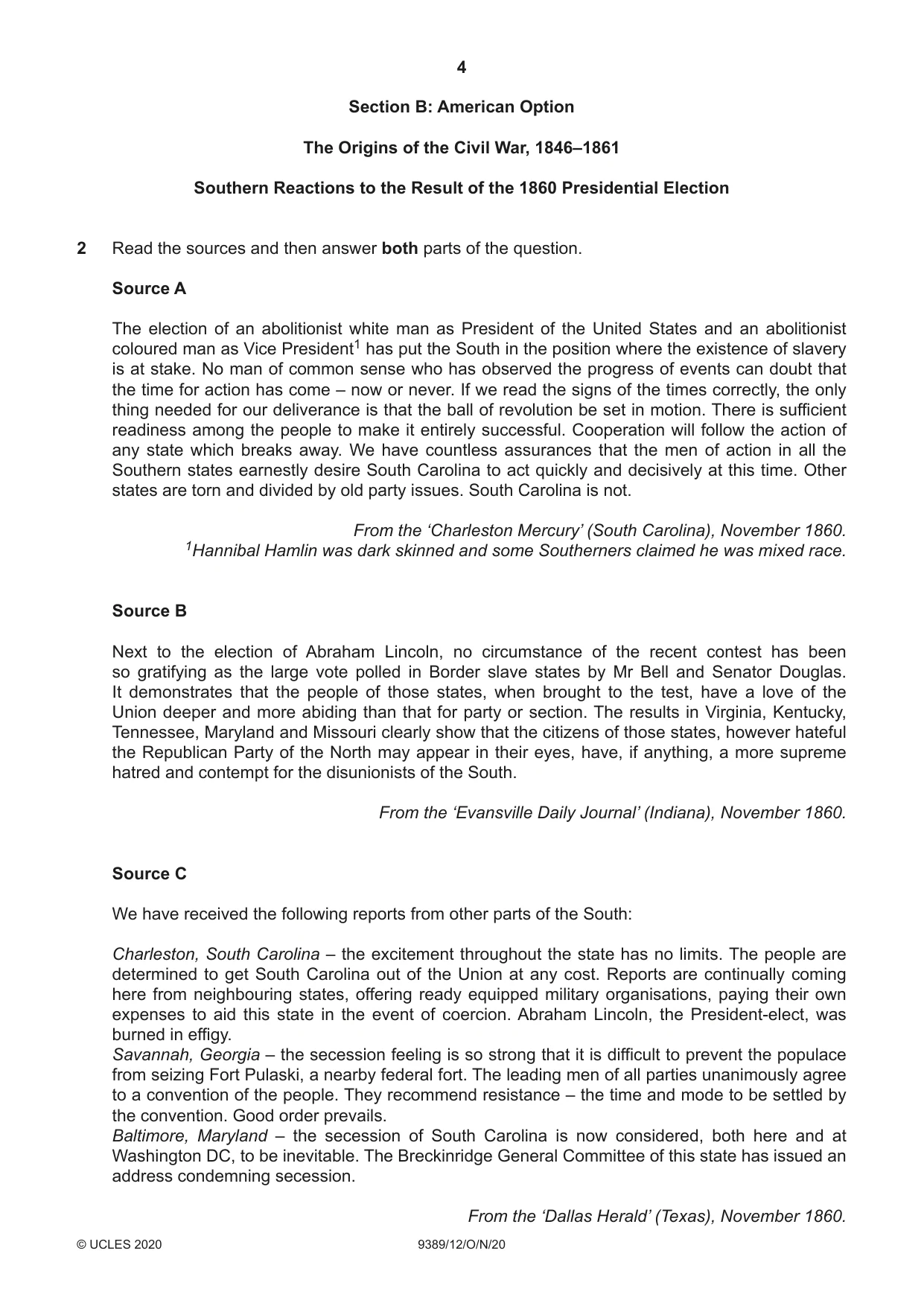
4 9389/12/O/N/20 © UCLES 2020 Section B: American Option The Origins of the Civil War, 1846–1861 Southern Reactions to the Result of the 1860 Presidential Election 2 Read the sources and then answer both parts of the question. Source A The election of an abolitionist white man as President of the United States and an abolitionist coloured man as Vice President1 has put the South in the position where the existence of slavery is at stake. No man of common sense who has observed the progress of events can doubt that the time for action has come – now or never. If we read the signs of the times correctly, the only thing needed for our deliverance is that the ball of revolution be set in motion. There is sufficient readiness among the people to make it entirely successful. Cooperation will follow the action of any state which breaks away. We have countless assurances that the men of action in all the Southern states earnestly desire South Carolina to act quickly and decisively at this time. Other states are torn and divided by old party issues. South Carolina is not. From the ‘Charleston Mercury’ (South Carolina), November 1860. 1Hannibal Hamlin was dark skinned and some Southerners claimed he was mixed race. Source B Next to the election of Abraham Lincoln, no circumstance of the recent contest has been so gratifying as the large vote polled in Border slave states by Mr Bell and Senator Douglas. It demonstrates that the people of those states, when brought to the test, have a love of the Union deeper and more abiding than that for party or section. The results in Virginia, Kentucky, Tennessee, Maryland and Missouri clearly show that the citizens of those states, however hateful the Republican Party of the North may appear in their eyes, have, if anything, a more supreme hatred and contempt for the disunionists of the South. From the ‘Evansville Daily Journal’ (Indiana), November 1860. Source C We have received the following reports from other parts of the South: Charleston, South Carolina – the excitement throughout the state has no limits. The people are determined to get South Carolina out of the Union at any cost. Reports are continually coming here from neighbouring states, offering ready equipped military organisations, paying their own expenses to aid this state in the event of coercion. Abraham Lincoln, the President-elect, was burned in effigy. Savannah, Georgia – the secession feeling is so strong that it is difficult to prevent the populace from seizing Fort Pulaski, a nearby federal fort. The leading men of all parties unanimously agree to a convention of the people. They recommend resistance – the time and mode to be settled by the convention. Good order prevails. Baltimore, Maryland – the secession of South Carolina is now considered, both here and at Washington DC, to be inevitable. The Breckinridge General Committee of this state has issued an address condemning secession. From the ‘Dallas Herald’ (Texas), November 1860.
Question paper, page 5
5 9389/12/O/N/20 © UCLES 2020 [Turn over Source D We strongly opposed Mr Lincoln because we fully anticipated the dreadful events that have followed his election. We now cherish an intense desire that he may be a patriot in action as we believe he is in intention. War waged by the federal government against the South could accomplish no rightful purpose but would work terrible ruin to both sections. The forts and arsenals seized by the South could not be taken by an army of a hundred thousand strong. Let none of the Border States falter for an instant in their position of conservatism. There is no shadow of reason why they should. Their plain duty to themselves and to their country is to watch the progress of events calmly and keenly and to be ready to meet wisely whatever crisis may arise. Impulsive moves at a time like this would be a sin against earth and against heaven. Those who counsel them are traitors. From the ‘Louisville Journal’ (Kentucky), February 1861. Answer both parts of the question with reference to the sources. (a) Compare and contrast Sources B and D as evidence of attitudes towards the election of Abraham Lincoln as President in 1860. [15] (b) How far do Sources A to D support the view that, following the election of Abraham Lincoln, the Southern states were united in their determination to secede? [25]
Question paper, page 6
6 9389/12/O/N/20 © UCLES 2020 Section C: International Option The Search for International Peace and Security, 1919–1945 The Great Powers and the League in the 1920s 3 Read the sources and then answer both parts of the question. Source A In the first place, Mussolini challenged the League of Nations, of which both Italy and Greece are members and bound by the Covenant. In the second, he challenged the existing order in the Mediterranean. The seizure of Corfu has placed Britain in a most unhappy dilemma. How to retain friendship with Italy, and at the same time preserve the existing order, is the problem. The moment Great Britain insisted on the League becoming a referee in the dispute, Europe was confronted with another problem that was difficult to resolve. The League of Nations has been given an opportunity to win heavily or lose everything. Success for the League would open the way for that body to become a potent force in world settlement. Failure would mean an end to the Geneva assembly. Of course, there is always the question of the Ruhr and whether Italy will support France there. France and Italy also have conflicting ambitions in the Mediterranean. Friendship between the two countries has been maintained only with the greatest difficulty. From an article in an American newspaper, September 1923. Source B A British cartoon about the Corfu crisis published in September 1923. It shows the French Prime Minister, Poincaré, on the left and Mussolini on the right.
Question paper, page 7
7 9389/12/O/N/20 © UCLES 2020 Source C You must not believe that the occupation of Corfu was carried out only as a sanction against Greece; it was also carried out to increase the prestige of Italy. Greece very cleverly turned to the League of Nations, saying the matter came within the scope of the Covenant. The League threw itself into the affair with the greatest excitement, because this was a dramatic episode and because it offered the opportunity of pronouncing a verdict that would go down in history. In my opinion the Corfu crisis is of the very greatest importance in the history of Italy because it has brought the problem of the League of Nations to the attention of the Italian public. Italians have never been very much interested in the League; they believed that it was a lifeless organisation of no importance. In fact, the League is an Anglo–French duet; each of these powers has its satellites and clients, and Italy’s position so far has been one of absolute inferiority. From a speech by Mussolini to the Italian Senate, November 1923. Source D There must be no clinging to ancient rights to wage wars. There must be no secret hopes that, if the League is weak in certain areas, it can be made to serve national interests. Certainly, it cannot be denied that the Great Powers on occasion have given the impression of acting without proper consideration for the views of the other members of the League. But the small nations have ample opportunity to state their case if they will just confidently take it. And when they fail to do so, the blame falls chiefly on themselves. As Briand said in his splendid speech to the last Assembly, there must be no more resorting to ‘methods of negotiation which are inconsistent with the true spirit of the League of Nations. In future, the League’s work shall take place in the full light of day and with the collaboration of all its members.’ From a speech by Nobel Peace Prize winner Fridtjof Nansen, High Commissioner for Refugees in the League of Nations, December 1926. Answer both parts of the question with reference to the sources. (a) Compare and contrast Sources A and C as evidence about the Corfu crisis. [15] (b) ‘The Great Powers were determined to put their own interests before those of the League.’ How far do Sources A to D support this view? [25]
Question paper, page 8
8 9389/12/O/N/20 © UCLES 2020 Permission to reproduce items where third-party owned material protected by copyright is included has been sought and cleared where possible. Every reasonable effort has been made by the publisher (UCLES) to trace copyright holders, but if any items requiring clearance have unwittingly been included, the publisher will be pleased to make amends at the earliest possible opportunity. To avoid the issue of disclosure of answer-related information to candidates, all copyright acknowledgements are reproduced online in the Cambridge Assessment International Education Copyright Acknowledgements Booklet. This is produced for each series of examinations and is freely available to download at www.cambridgeinternational.org after the live examination series. Cambridge Assessment International Education is part of the Cambridge Assessment Group. Cambridge Assessment is the brand name of the University of Cambridge Local Examinations Syndicate (UCLES), which itself is a department of the University of Cambridge. BLANK PAGE
Mark scheme, page 1
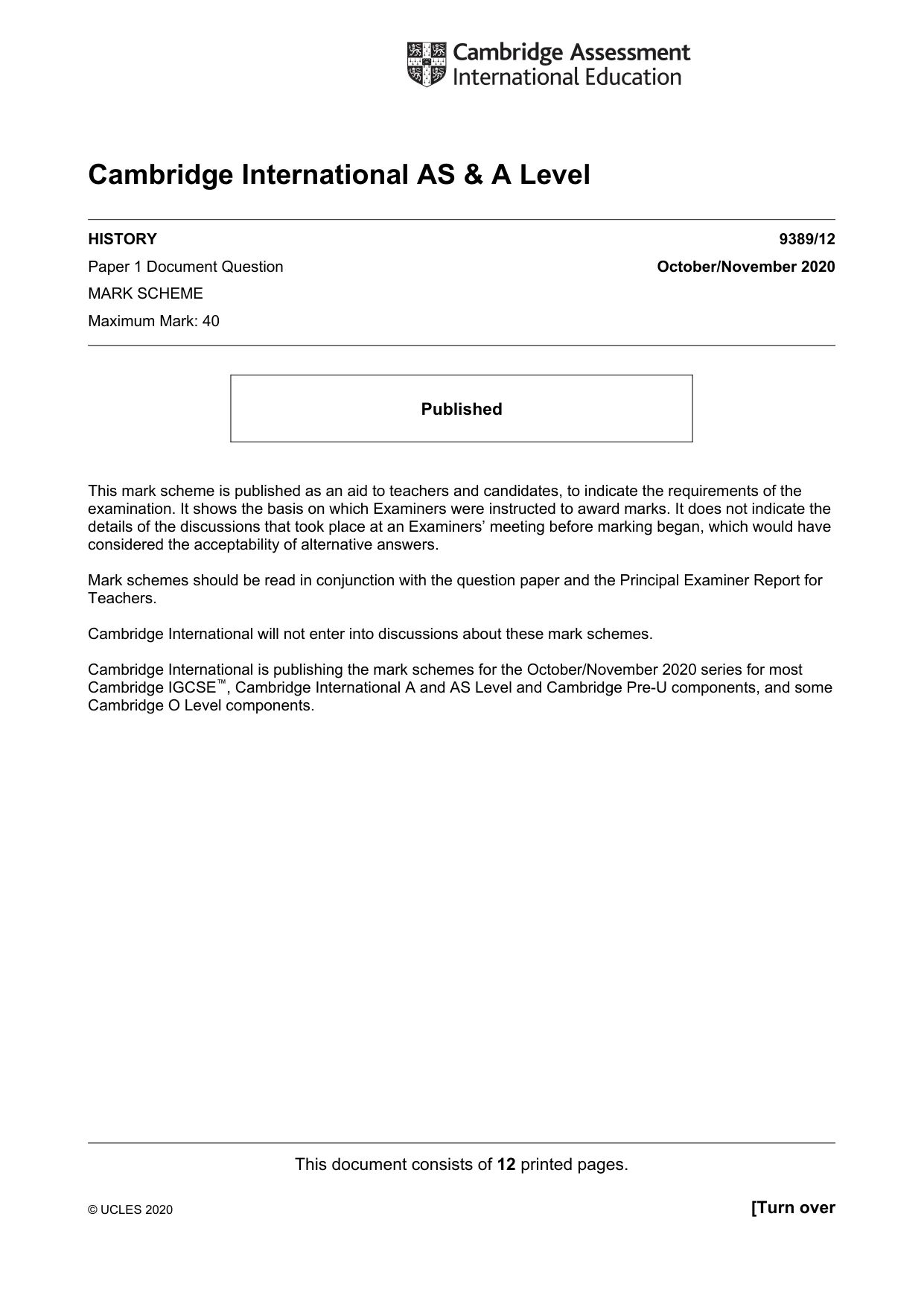
This document consists of 12 printed pages. © UCLES 2020 [Turn over Cambridge International AS & A Level HISTORY 9389/12 Paper 1 Document Question October/November 2020 MARK SCHEME Maximum Mark: 40 Published This mark scheme is published as an aid to teachers and candidates, to indicate the requirements of the examination. It shows the basis on which Examiners were instructed to award marks. It does not indicate the details of the discussions that took place at an Examiners’ meeting before marking began, which would have considered the acceptability of alternative answers. Mark schemes should be read in conjunction with the question paper and the Principal Examiner Report for Teachers. Cambridge International will not enter into discussions about these mark schemes. Cambridge International is publishing the mark schemes for the October/November 2020 series for most Cambridge IGCSE™, Cambridge International A and AS Level and Cambridge Pre-U components, and some Cambridge O Level components.
Mark scheme, page 2
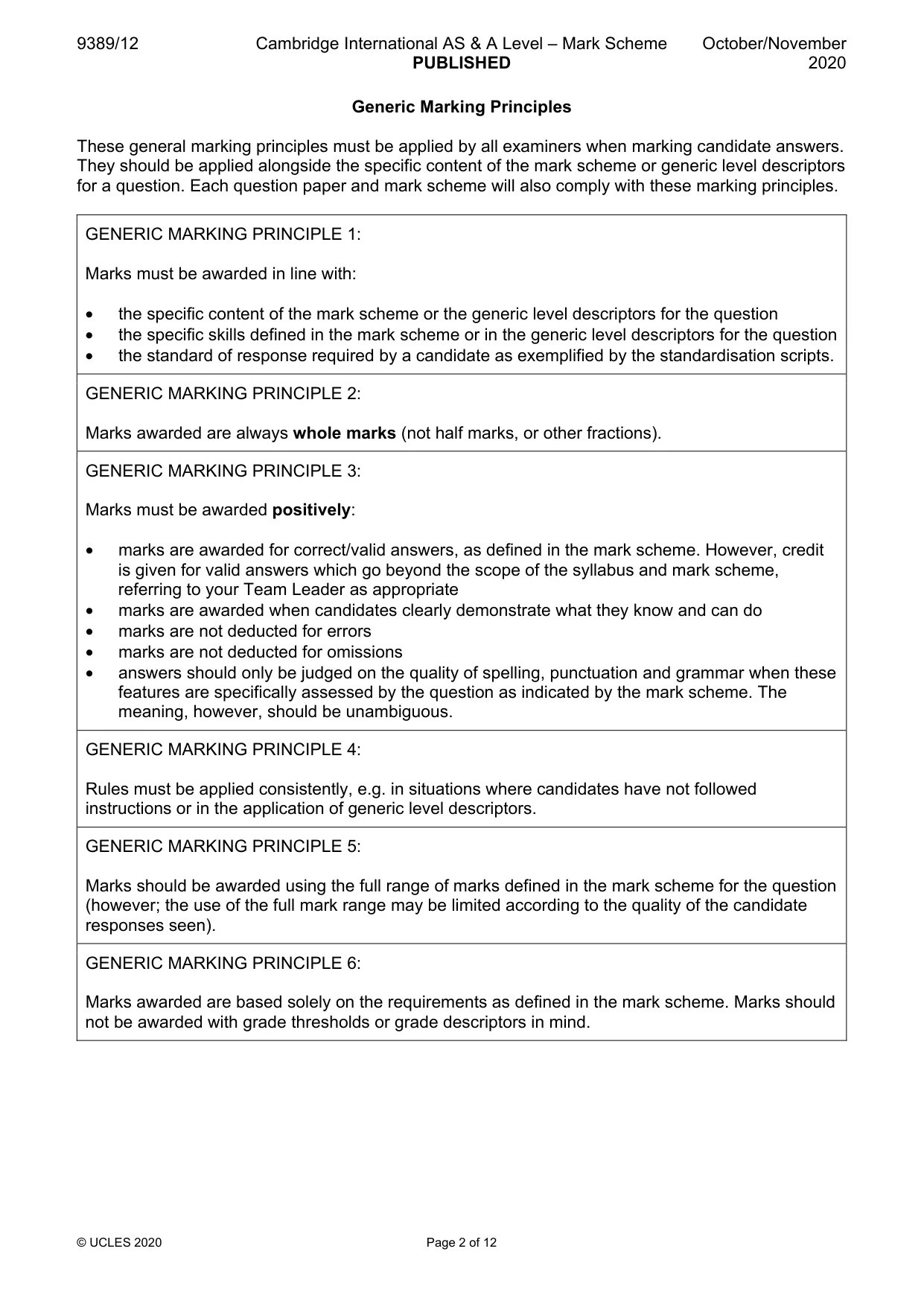
9389/12 Cambridge International AS & A Level – Mark Scheme PUBLISHED October/November 2020 © UCLES 2020 Page 2 of 12 Generic Marking Principles These general marking principles must be applied by all examiners when marking candidate answers. They should be applied alongside the specific content of the mark scheme or generic level descriptors for a question. Each question paper and mark scheme will also comply with these marking principles. GENERIC MARKING PRINCIPLE 1: Marks must be awarded in line with: • the specific content of the mark scheme or the generic level descriptors for the question • the specific skills defined in the mark scheme or in the generic level descriptors for the question • the standard of response required by a candidate as exemplified by the standardisation scripts. GENERIC MARKING PRINCIPLE 2: Marks awarded are always whole marks (not half marks, or other fractions). GENERIC MARKING PRINCIPLE 3: Marks must be awarded positively: • marks are awarded for correct/valid answers, as defined in the mark scheme. However, credit is given for valid answers which go beyond the scope of the syllabus and mark scheme, referring to your Team Leader as appropriate • marks are awarded when candidates clearly demonstrate what they know and can do • marks are not deducted for errors • marks are not deducted for omissions • answers should only be judged on the quality of spelling, punctuation and grammar when these features are specifically assessed by the question as indicated by the mark scheme. The meaning, however, should be unambiguous. GENERIC MARKING PRINCIPLE 4: Rules must be applied consistently, e.g. in situations where candidates have not followed instructions or in the application of generic level descriptors. GENERIC MARKING PRINCIPLE 5: Marks should be awarded using the full range of marks defined in the mark scheme for the question (however; the use of the full mark range may be limited according to the quality of the candidate responses seen). GENERIC MARKING PRINCIPLE 6: Marks awarded are based solely on the requirements as defined in the mark scheme. Marks should not be awarded with grade thresholds or grade descriptors in mind.
Mark scheme, page 3
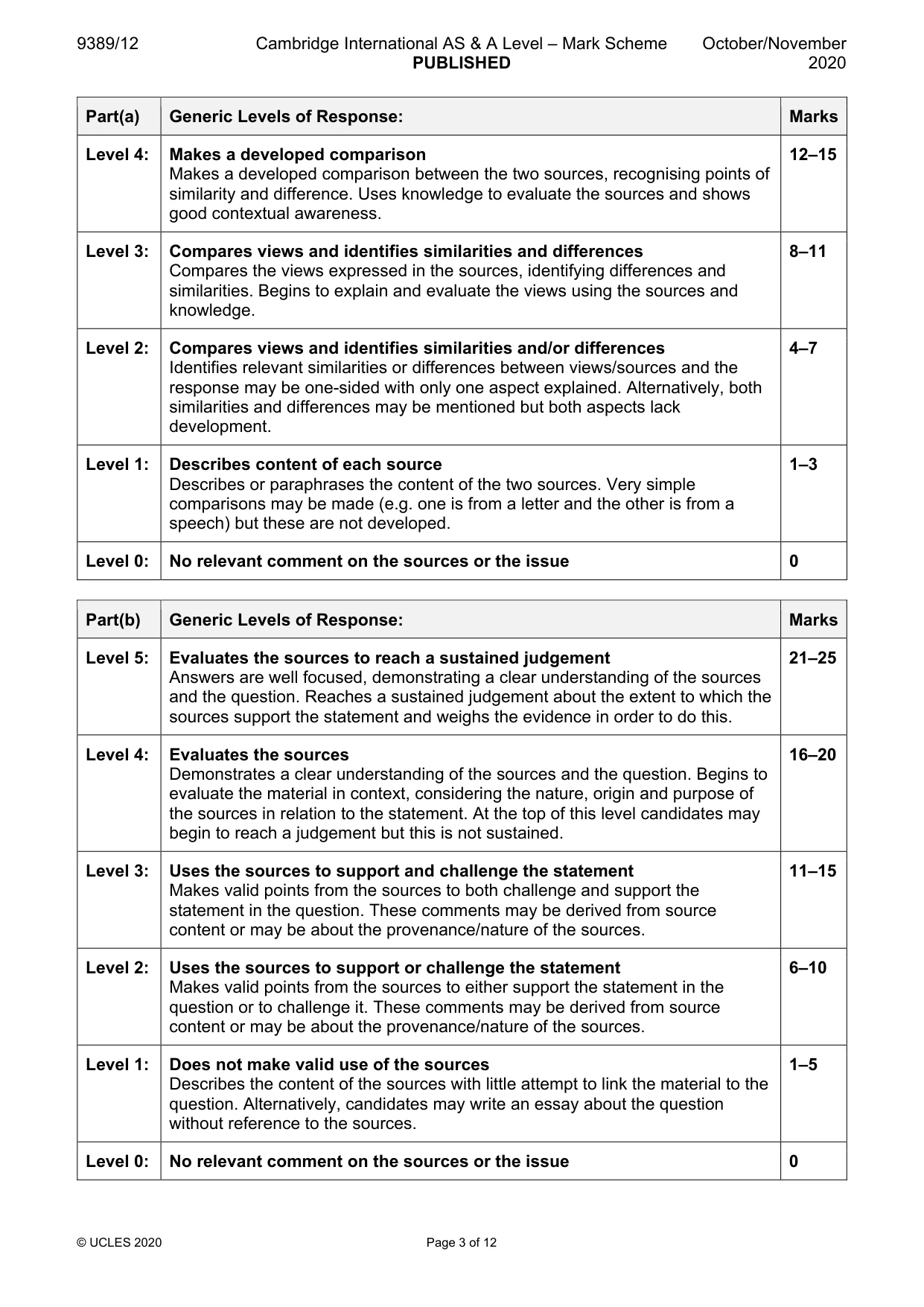
9389/12 Cambridge International AS & A Level – Mark Scheme PUBLISHED October/November 2020 © UCLES 2020 Page 3 of 12 Part(a) Generic Levels of Response: Marks Level 4: Makes a developed comparison Makes a developed comparison between the two sources, recognising points of similarity and difference. Uses knowledge to evaluate the sources and shows good contextual awareness. 12–15 Level 3: Compares views and identifies similarities and differences Compares the views expressed in the sources, identifying differences and similarities. Begins to explain and evaluate the views using the sources and knowledge. 8–11 Level 2: Compares views and identifies similarities and/or differences Identifies relevant similarities or differences between views/sources and the response may be one-sided with only one aspect explained. Alternatively, both similarities and differences may be mentioned but both aspects lack development. 4–7 Level 1: Describes content of each source Describes or paraphrases the content of the two sources. Very simple comparisons may be made (e.g. one is from a letter and the other is from a speech) but these are not developed. 1–3 Level 0: No relevant comment on the sources or the issue 0 Part(b) Generic Levels of Response: Marks Level 5: Evaluates the sources to reach a sustained judgement Answers are well focused, demonstrating a clear understanding of the sources and the question. Reaches a sustained judgement about the extent to which the sources support the statement and weighs the evidence in order to do this. 21–25 Level 4: Evaluates the sources Demonstrates a clear understanding of the sources and the question. Begins to evaluate the material in context, considering the nature, origin and purpose of the sources in relation to the statement. At the top of this level candidates may begin to reach a judgement but this is not sustained. 16–20 Level 3: Uses the sources to support and challenge the statement Makes valid points from the sources to both challenge and support the statement in the question. These comments may be derived from source content or may be about the provenance/nature of the sources. 11–15 Level 2: Uses the sources to support or challenge the statement Makes valid points from the sources to either support the statement in the question or to challenge it. These comments may be derived from source content or may be about the provenance/nature of the sources. 6–10 Level 1: Does not make valid use of the sources Describes the content of the sources with little attempt to link the material to the question. Alternatively, candidates may write an essay about the question without reference to the sources. 1–5 Level 0: No relevant comment on the sources or the issue 0
Mark scheme, page 4
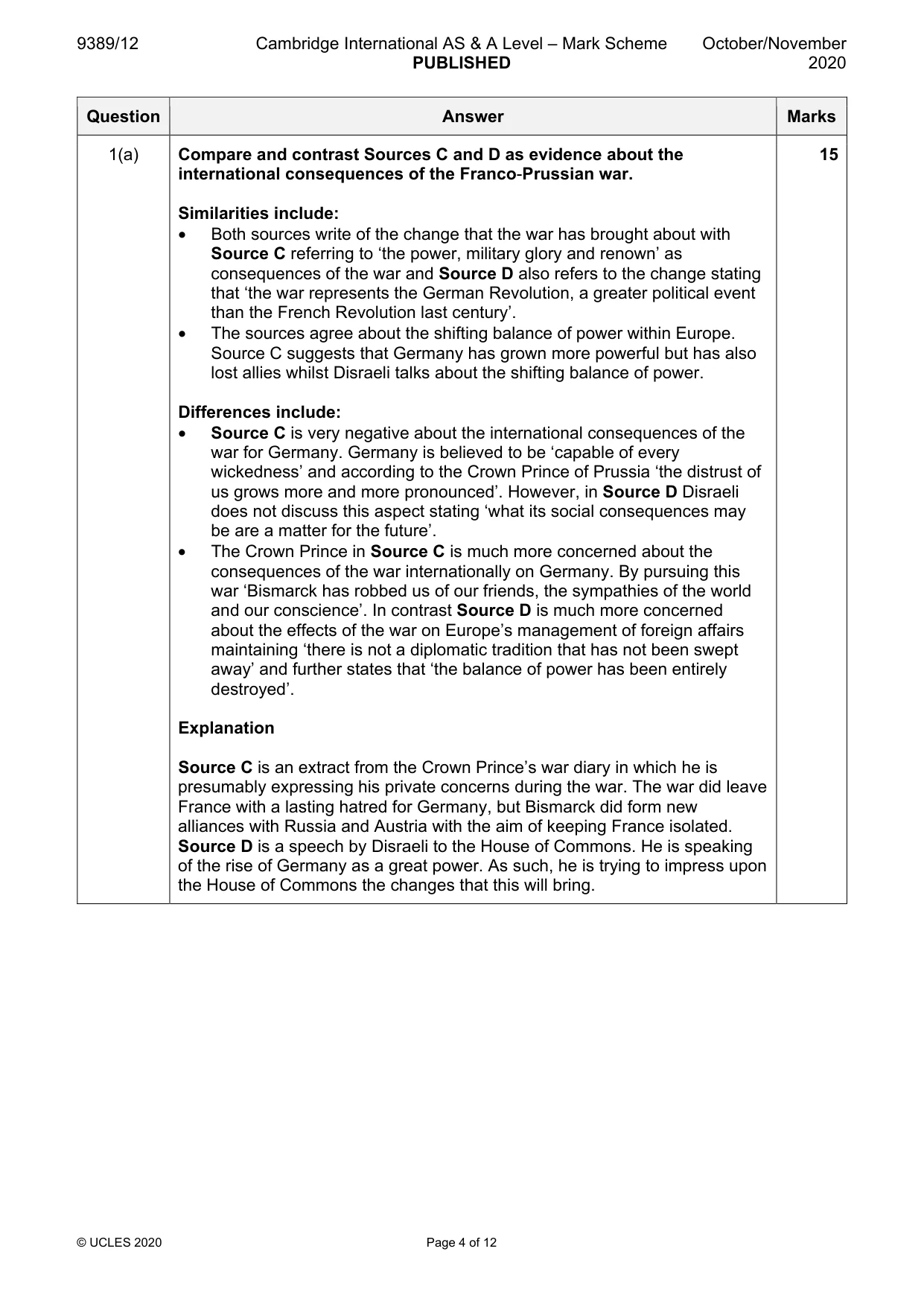
9389/12 Cambridge International AS & A Level – Mark Scheme PUBLISHED October/November 2020 © UCLES 2020 Page 4 of 12 Question Answer Marks 1(a) Compare and contrast Sources C and D as evidence about the international consequences of the Franco-Prussian war. Similarities include: • Both sources write of the change that the war has brought about with Source C referring to ‘the power, military glory and renown’ as consequences of the war and Source D also refers to the change stating that ‘the war represents the German Revolution, a greater political event than the French Revolution last century’. • The sources agree about the shifting balance of power within Europe. Source C suggests that Germany has grown more powerful but has also lost allies whilst Disraeli talks about the shifting balance of power. Differences include: • Source C is very negative about the international consequences of the war for Germany. Germany is believed to be ‘capable of every wickedness’ and according to the Crown Prince of Prussia ‘the distrust of us grows more and more pronounced’. However, in Source D Disraeli does not discuss this aspect stating ‘what its social consequences may be are a matter for the future’. • The Crown Prince in Source C is much more concerned about the consequences of the war internationally on Germany. By pursuing this war ‘Bismarck has robbed us of our friends, the sympathies of the world and our conscience’. In contrast Source D is much more concerned about the effects of the war on Europe’s management of foreign affairs maintaining ‘there is not a diplomatic tradition that has not been swept away’ and further states that ‘the balance of power has been entirely destroyed’. Explanation Source C is an extract from the Crown Prince’s war diary in which he is presumably expressing his private concerns during the war. The war did leave France with a lasting hatred for Germany, but Bismarck did form new alliances with Russia and Austria with the aim of keeping France isolated. Source D is a speech by Disraeli to the House of Commons. He is speaking of the rise of Germany as a great power. As such, he is trying to impress upon the House of Commons the changes that this will bring. 15
Mark scheme, page 5
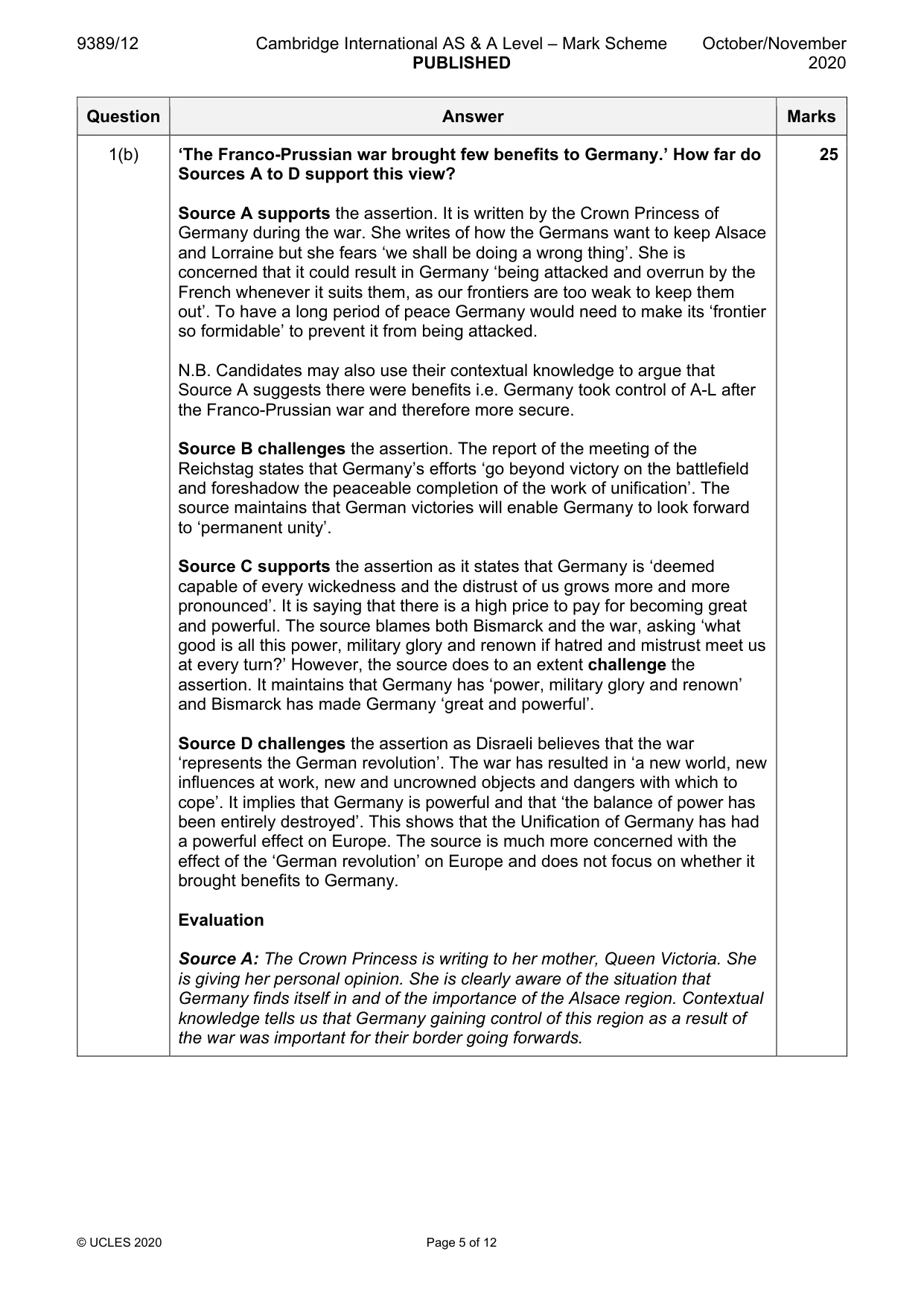
9389/12 Cambridge International AS & A Level – Mark Scheme PUBLISHED October/November 2020 © UCLES 2020 Page 5 of 12 Question Answer Marks 1(b) ‘The Franco-Prussian war brought few benefits to Germany.’ How far do Sources A to D support this view? Source A supports the assertion. It is written by the Crown Princess of Germany during the war. She writes of how the Germans want to keep Alsace and Lorraine but she fears ‘we shall be doing a wrong thing’. She is concerned that it could result in Germany ‘being attacked and overrun by the French whenever it suits them, as our frontiers are too weak to keep them out’. To have a long period of peace Germany would need to make its ‘frontier so formidable’ to prevent it from being attacked. N.B. Candidates may also use their contextual knowledge to argue that Source A suggests there were benefits i.e. Germany took control of A-L after the Franco-Prussian war and therefore more secure. Source B challenges the assertion. The report of the meeting of the Reichstag states that Germany’s efforts ‘go beyond victory on the battlefield and foreshadow the peaceable completion of the work of unification’. The source maintains that German victories will enable Germany to look forward to ‘permanent unity’. Source C supports the assertion as it states that Germany is ‘deemed capable of every wickedness and the distrust of us grows more and more pronounced’. It is saying that there is a high price to pay for becoming great and powerful. The source blames both Bismarck and the war, asking ‘what good is all this power, military glory and renown if hatred and mistrust meet us at every turn?’ However, the source does to an extent challenge the assertion. It maintains that Germany has ‘power, military glory and renown’ and Bismarck has made Germany ‘great and powerful’. Source D challenges the assertion as Disraeli believes that the war ‘represents the German revolution’. The war has resulted in ‘a new world, new influences at work, new and uncrowned objects and dangers with which to cope’. It implies that Germany is powerful and that ‘the balance of power has been entirely destroyed’. This shows that the Unification of Germany has had a powerful effect on Europe. The source is much more concerned with the effect of the ‘German revolution’ on Europe and does not focus on whether it brought benefits to Germany. Evaluation Source A: The Crown Princess is writing to her mother, Queen Victoria. She is giving her personal opinion. She is clearly aware of the situation that Germany finds itself in and of the importance of the Alsace region. Contextual knowledge tells us that Germany gaining control of this region as a result of the war was important for their border going forwards. 25
Mark scheme, page 6
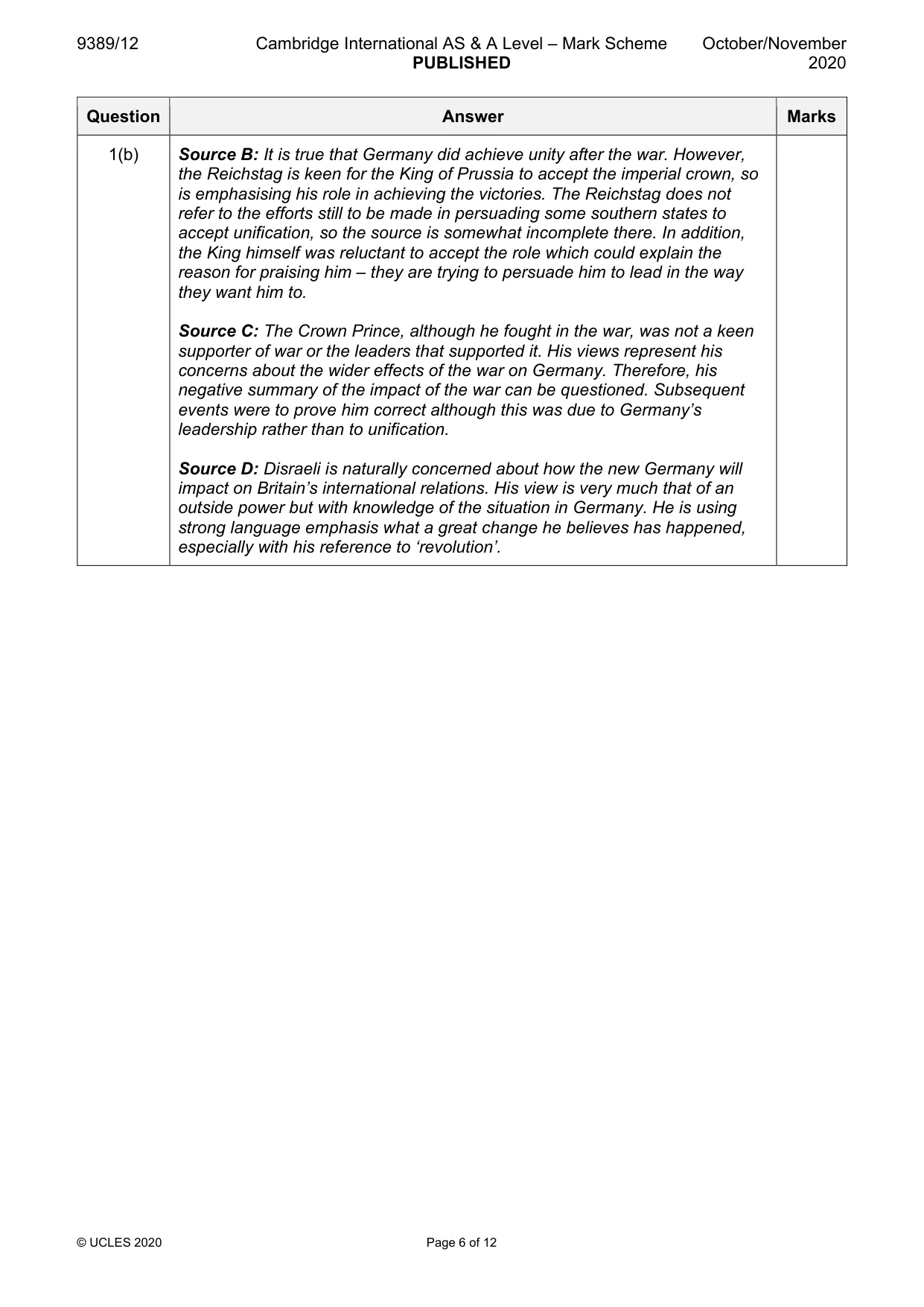
9389/12 Cambridge International AS & A Level – Mark Scheme PUBLISHED October/November 2020 © UCLES 2020 Page 6 of 12 Question Answer Marks 1(b) Source B: It is true that Germany did achieve unity after the war. However, the Reichstag is keen for the King of Prussia to accept the imperial crown, so is emphasising his role in achieving the victories. The Reichstag does not refer to the efforts still to be made in persuading some southern states to accept unification, so the source is somewhat incomplete there. In addition, the King himself was reluctant to accept the role which could explain the reason for praising him – they are trying to persuade him to lead in the way they want him to. Source C: The Crown Prince, although he fought in the war, was not a keen supporter of war or the leaders that supported it. His views represent his concerns about the wider effects of the war on Germany. Therefore, his negative summary of the impact of the war can be questioned. Subsequent events were to prove him correct although this was due to Germany’s leadership rather than to unification. Source D: Disraeli is naturally concerned about how the new Germany will impact on Britain’s international relations. His view is very much that of an outside power but with knowledge of the situation in Germany. He is using strong language emphasis what a great change he believes has happened, especially with his reference to ‘revolution’.
Mark scheme, page 7
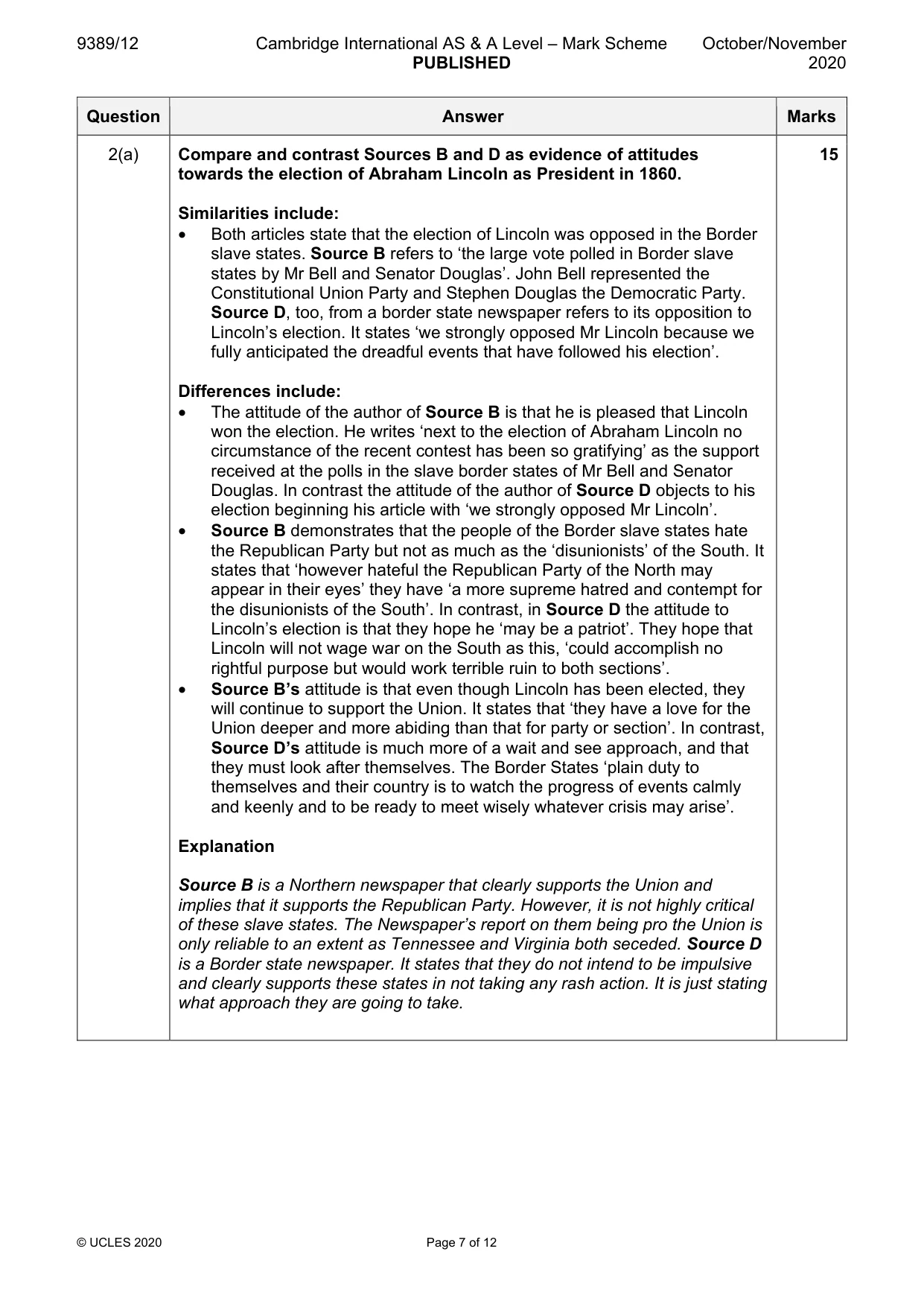
9389/12 Cambridge International AS & A Level – Mark Scheme PUBLISHED October/November 2020 © UCLES 2020 Page 7 of 12 Question Answer Marks 2(a) Compare and contrast Sources B and D as evidence of attitudes towards the election of Abraham Lincoln as President in 1860. Similarities include: • Both articles state that the election of Lincoln was opposed in the Border slave states. Source B refers to ‘the large vote polled in Border slave states by Mr Bell and Senator Douglas’. John Bell represented the Constitutional Union Party and Stephen Douglas the Democratic Party. Source D, too, from a border state newspaper refers to its opposition to Lincoln’s election. It states ‘we strongly opposed Mr Lincoln because we fully anticipated the dreadful events that have followed his election’. Differences include: • The attitude of the author of Source B is that he is pleased that Lincoln won the election. He writes ‘next to the election of Abraham Lincoln no circumstance of the recent contest has been so gratifying’ as the support received at the polls in the slave border states of Mr Bell and Senator Douglas. In contrast the attitude of the author of Source D objects to his election beginning his article with ‘we strongly opposed Mr Lincoln’. • Source B demonstrates that the people of the Border slave states hate the Republican Party but not as much as the ‘disunionists’ of the South. It states that ‘however hateful the Republican Party of the North may appear in their eyes’ they have ‘a more supreme hatred and contempt for the disunionists of the South’. In contrast, in Source D the attitude to Lincoln’s election is that they hope he ‘may be a patriot’. They hope that Lincoln will not wage war on the South as this, ‘could accomplish no rightful purpose but would work terrible ruin to both sections’. • Source B’s attitude is that even though Lincoln has been elected, they will continue to support the Union. It states that ‘they have a love for the Union deeper and more abiding than that for party or section’. In contrast, Source D’s attitude is much more of a wait and see approach, and that they must look after themselves. The Border States ‘plain duty to themselves and their country is to watch the progress of events calmly and keenly and to be ready to meet wisely whatever crisis may arise’. Explanation Source B is a Northern newspaper that clearly supports the Union and implies that it supports the Republican Party. However, it is not highly critical of these slave states. The Newspaper’s report on them being pro the Union is only reliable to an extent as Tennessee and Virginia both seceded. Source D is a Border state newspaper. It states that they do not intend to be impulsive and clearly supports these states in not taking any rash action. It is just stating what approach they are going to take. 15
Mark scheme, page 8
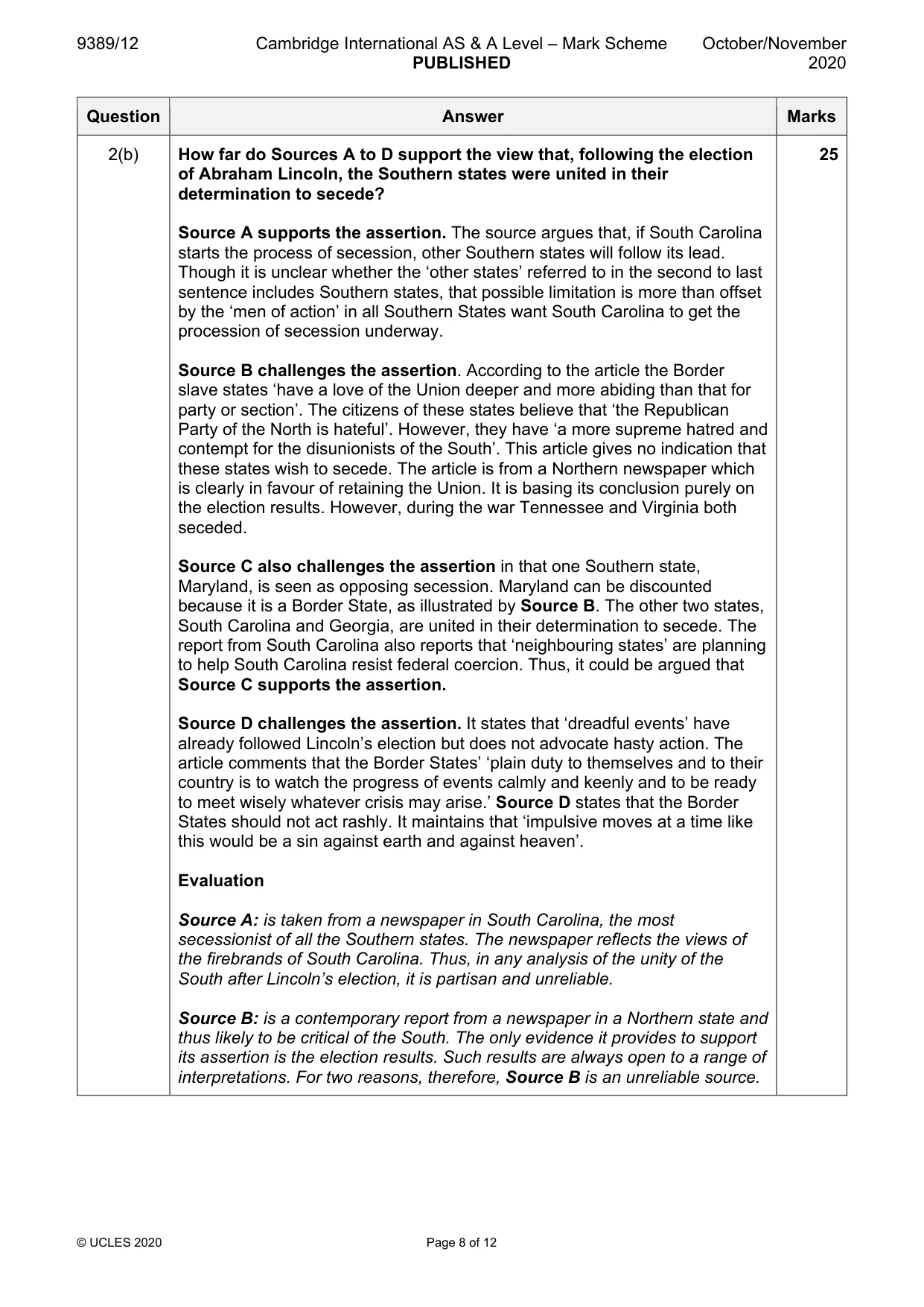
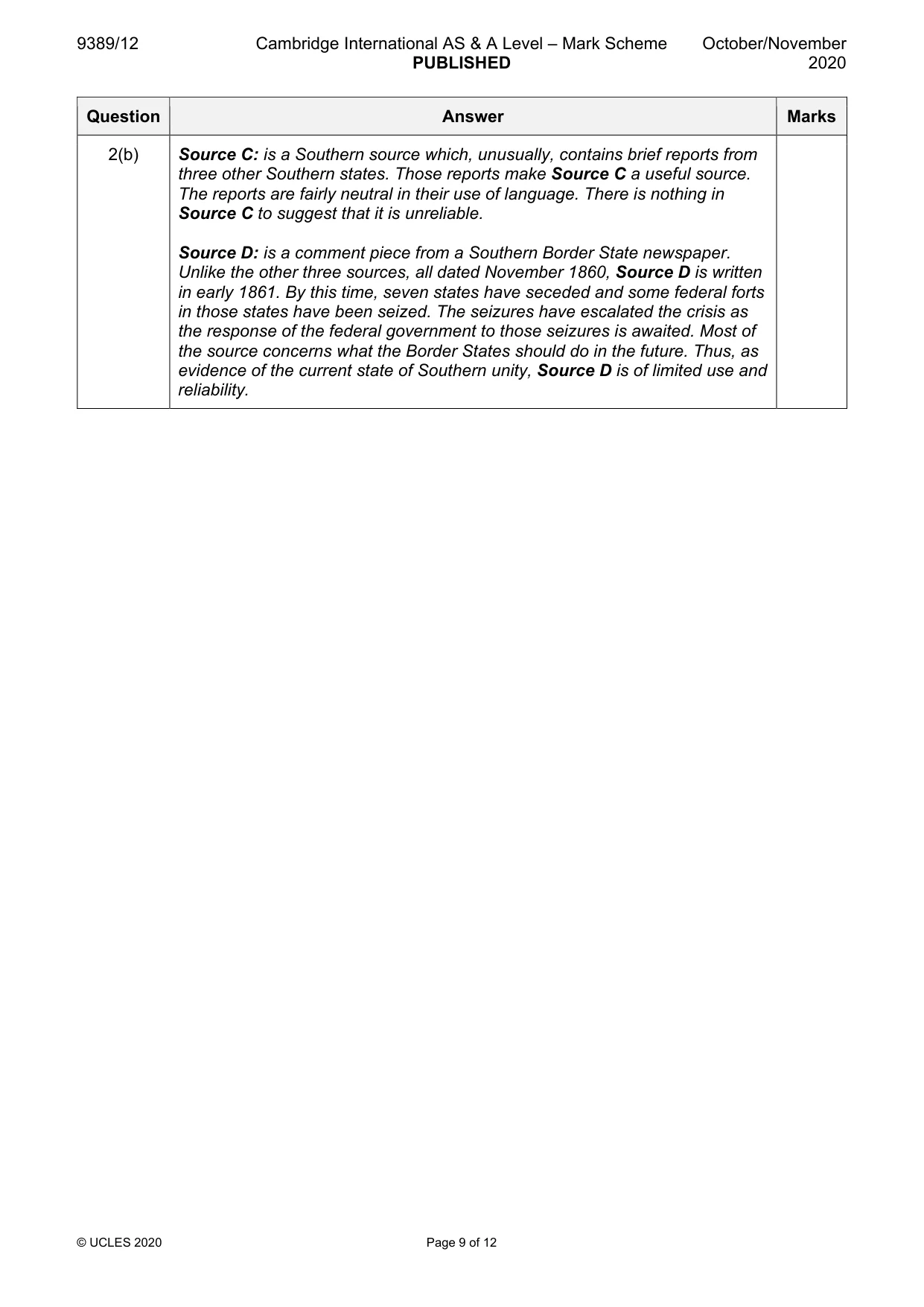
9389/12 Cambridge International AS & A Level – Mark Scheme PUBLISHED October/November 2020 © UCLES 2020 Page 8 of 12 Question Answer Marks 2(b) How far do Sources A to D support the view that, following the election of Abraham Lincoln, the Southern states were united in their determination to secede? Source A supports the assertion. The source argues that, if South Carolina starts the process of secession, other Southern states will follow its lead. Though it is unclear whether the ‘other states’ referred to in the second to last sentence includes Southern states, that possible limitation is more than offset by the ‘men of action’ in all Southern States want South Carolina to get the procession of secession underway. Source B challenges the assertion. According to the article the Border slave states ‘have a love of the Union deeper and more abiding than that for party or section’. The citizens of these states believe that ‘the Republican Party of the North is hateful’. However, they have ‘a more supreme hatred and contempt for the disunionists of the South’. This article gives no indication that these states wish to secede. The article is from a Northern newspaper which is clearly in favour of retaining the Union. It is basing its conclusion purely on the election results. However, during the war Tennessee and Virginia both seceded. Source C also challenges the assertion in that one Southern state, Maryland, is seen as opposing secession. Maryland can be discounted because it is a Border State, as illustrated by Source B. The other two states, South Carolina and Georgia, are united in their determination to secede. The report from South Carolina also reports that ‘neighbouring states’ are planning to help South Carolina resist federal coercion. Thus, it could be argued that Source C supports the assertion. Source D challenges the assertion. It states that ‘dreadful events’ have already followed Lincoln’s election but does not advocate hasty action. The article comments that the Border States’ ‘plain duty to themselves and to their country is to watch the progress of events calmly and keenly and to be ready to meet wisely whatever crisis may arise.’ Source D states that the Border States should not act rashly. It maintains that ‘impulsive moves at a time like this would be a sin against earth and against heaven’. Evaluation Source A: is taken from a newspaper in South Carolina, the most secessionist of all the Southern states. The newspaper reflects the views of the firebrands of South Carolina. Thus, in any analysis of the unity of the South after Lincoln’s election, it is partisan and unreliable. Source B: is a contemporary report from a newspaper in a Northern state and thus likely to be critical of the South. The only evidence it provides to support its assertion is the election results. Such results are always open to a range of interpretations. For two reasons, therefore, Source B is an unreliable source. 25
Mark scheme, page 9
9389/12 Cambridge International AS & A Level – Mark Scheme PUBLISHED October/November 2020 © UCLES 2020 Page 9 of 12 Question Answer Marks 2(b) Source C: is a Southern source which, unusually, contains brief reports from three other Southern states. Those reports make Source C a useful source. The reports are fairly neutral in their use of language. There is nothing in Source C to suggest that it is unreliable. Source D: is a comment piece from a Southern Border State newspaper. Unlike the other three sources, all dated November 1860, Source D is written in early 1861. By this time, seven states have seceded and some federal forts in those states have been seized. The seizures have escalated the crisis as the response of the federal government to those seizures is awaited. Most of the source concerns what the Border States should do in the future. Thus, as evidence of the current state of Southern unity, Source D is of limited use and reliability.
Mark scheme, page 10
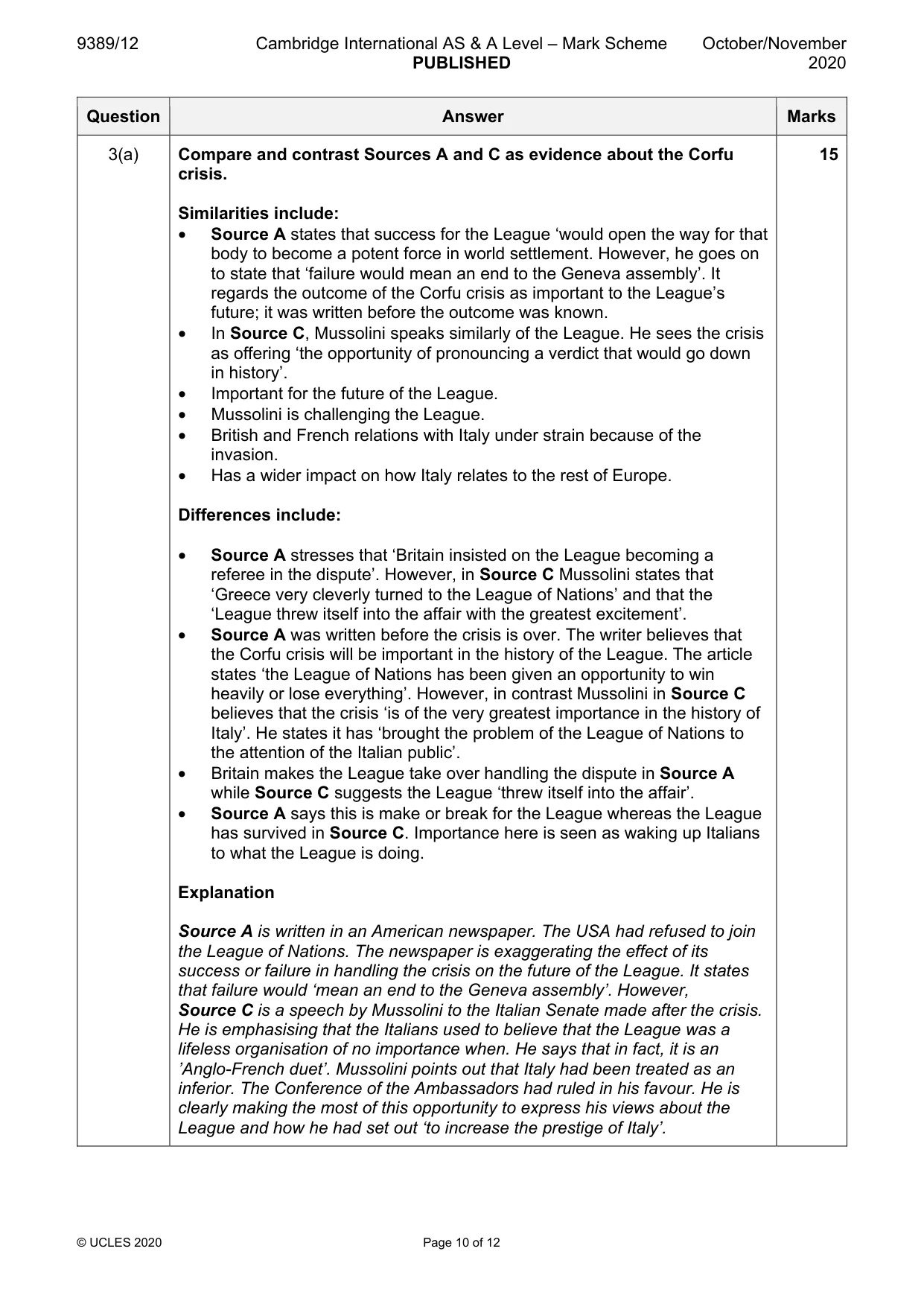
9389/12 Cambridge International AS & A Level – Mark Scheme PUBLISHED October/November 2020 © UCLES 2020 Page 10 of 12 Question Answer Marks 3(a) Compare and contrast Sources A and C as evidence about the Corfu crisis. Similarities include: • Source A states that success for the League ‘would open the way for that body to become a potent force in world settlement. However, he goes on to state that ‘failure would mean an end to the Geneva assembly’. It regards the outcome of the Corfu crisis as important to the League’s future; it was written before the outcome was known. • In Source C, Mussolini speaks similarly of the League. He sees the crisis as offering ‘the opportunity of pronouncing a verdict that would go down in history’. • Important for the future of the League. • Mussolini is challenging the League. • British and French relations with Italy under strain because of the invasion. • Has a wider impact on how Italy relates to the rest of Europe. Differences include: • Source A stresses that ‘Britain insisted on the League becoming a referee in the dispute’. However, in Source C Mussolini states that ‘Greece very cleverly turned to the League of Nations’ and that the ‘League threw itself into the affair with the greatest excitement’. • Source A was written before the crisis is over. The writer believes that the Corfu crisis will be important in the history of the League. The article states ‘the League of Nations has been given an opportunity to win heavily or lose everything’. However, in contrast Mussolini in Source C believes that the crisis ‘is of the very greatest importance in the history of Italy’. He states it has ‘brought the problem of the League of Nations to the attention of the Italian public’. • Britain makes the League take over handling the dispute in Source A while Source C suggests the League ‘threw itself into the affair’. • Source A says this is make or break for the League whereas the League has survived in Source C. Importance here is seen as waking up Italians to what the League is doing. Explanation Source A is written in an American newspaper. The USA had refused to join the League of Nations. The newspaper is exaggerating the effect of its success or failure in handling the crisis on the future of the League. It states that failure would ‘mean an end to the Geneva assembly’. However, Source C is a speech by Mussolini to the Italian Senate made after the crisis. He is emphasising that the Italians used to believe that the League was a lifeless organisation of no importance when. He says that in fact, it is an ’Anglo-French duet’. Mussolini points out that Italy had been treated as an inferior. The Conference of the Ambassadors had ruled in his favour. He is clearly making the most of this opportunity to express his views about the League and how he had set out ‘to increase the prestige of Italy’. 15
Mark scheme, page 11
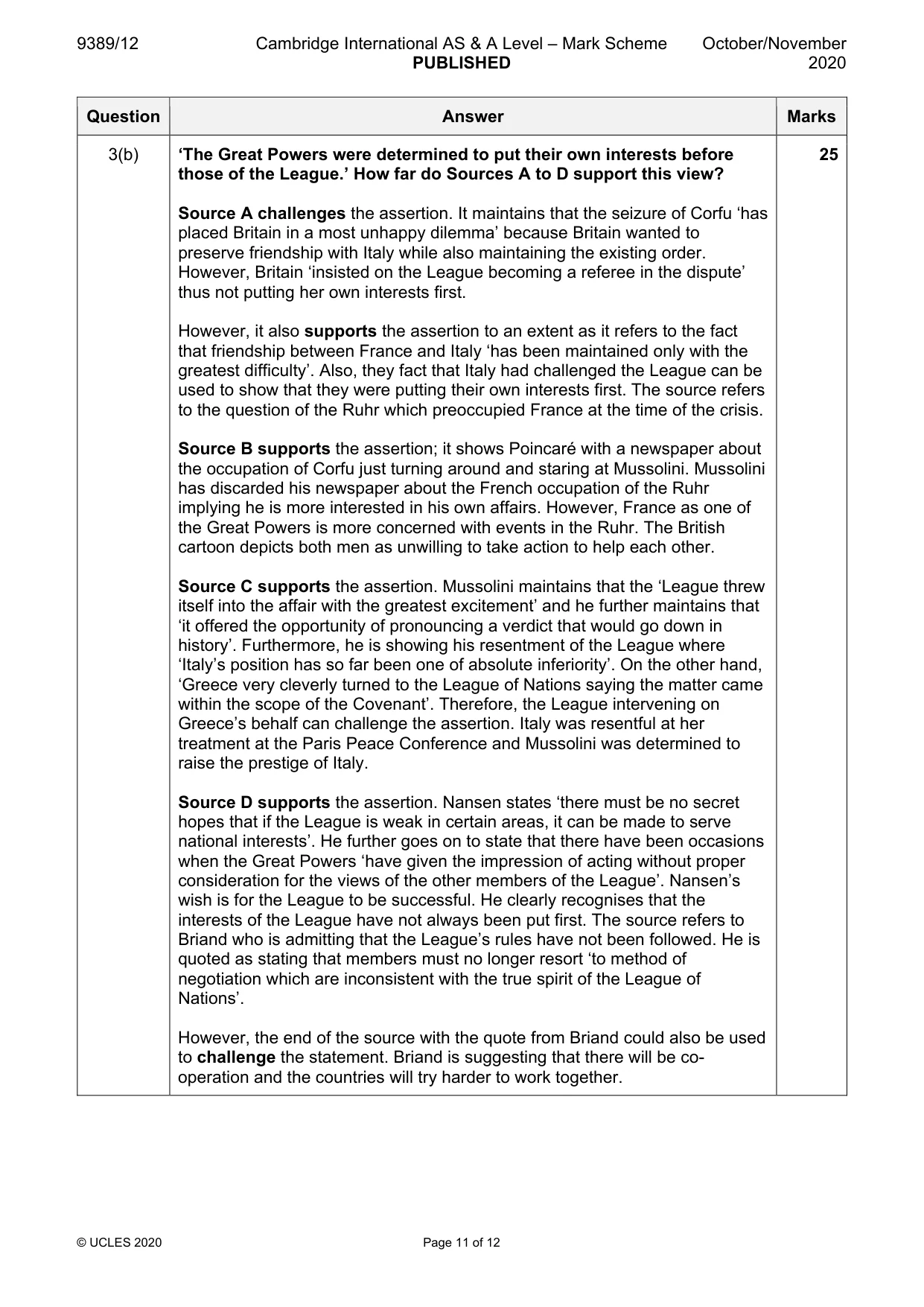
9389/12 Cambridge International AS & A Level – Mark Scheme PUBLISHED October/November 2020 © UCLES 2020 Page 11 of 12 Question Answer Marks 3(b) ‘The Great Powers were determined to put their own interests before those of the League.’ How far do Sources A to D support this view? Source A challenges the assertion. It maintains that the seizure of Corfu ‘has placed Britain in a most unhappy dilemma’ because Britain wanted to preserve friendship with Italy while also maintaining the existing order. However, Britain ‘insisted on the League becoming a referee in the dispute’ thus not putting her own interests first. However, it also supports the assertion to an extent as it refers to the fact that friendship between France and Italy ‘has been maintained only with the greatest difficulty’. Also, they fact that Italy had challenged the League can be used to show that they were putting their own interests first. The source refers to the question of the Ruhr which preoccupied France at the time of the crisis. Source B supports the assertion; it shows Poincaré with a newspaper about the occupation of Corfu just turning around and staring at Mussolini. Mussolini has discarded his newspaper about the French occupation of the Ruhr implying he is more interested in his own affairs. However, France as one of the Great Powers is more concerned with events in the Ruhr. The British cartoon depicts both men as unwilling to take action to help each other. Source C supports the assertion. Mussolini maintains that the ‘League threw itself into the affair with the greatest excitement’ and he further maintains that ‘it offered the opportunity of pronouncing a verdict that would go down in history’. Furthermore, he is showing his resentment of the League where ‘Italy’s position has so far been one of absolute inferiority’. On the other hand, ‘Greece very cleverly turned to the League of Nations saying the matter came within the scope of the Covenant’. Therefore, the League intervening on Greece’s behalf can challenge the assertion. Italy was resentful at her treatment at the Paris Peace Conference and Mussolini was determined to raise the prestige of Italy. Source D supports the assertion. Nansen states ‘there must be no secret hopes that if the League is weak in certain areas, it can be made to serve national interests’. He further goes on to state that there have been occasions when the Great Powers ‘have given the impression of acting without proper consideration for the views of the other members of the League’. Nansen’s wish is for the League to be successful. He clearly recognises that the interests of the League have not always been put first. The source refers to Briand who is admitting that the League’s rules have not been followed. He is quoted as stating that members must no longer resort ‘to method of negotiation which are inconsistent with the true spirit of the League of Nations’. However, the end of the source with the quote from Briand could also be used to challenge the statement. Briand is suggesting that there will be co- operation and the countries will try harder to work together. 25
Mark scheme, page 12
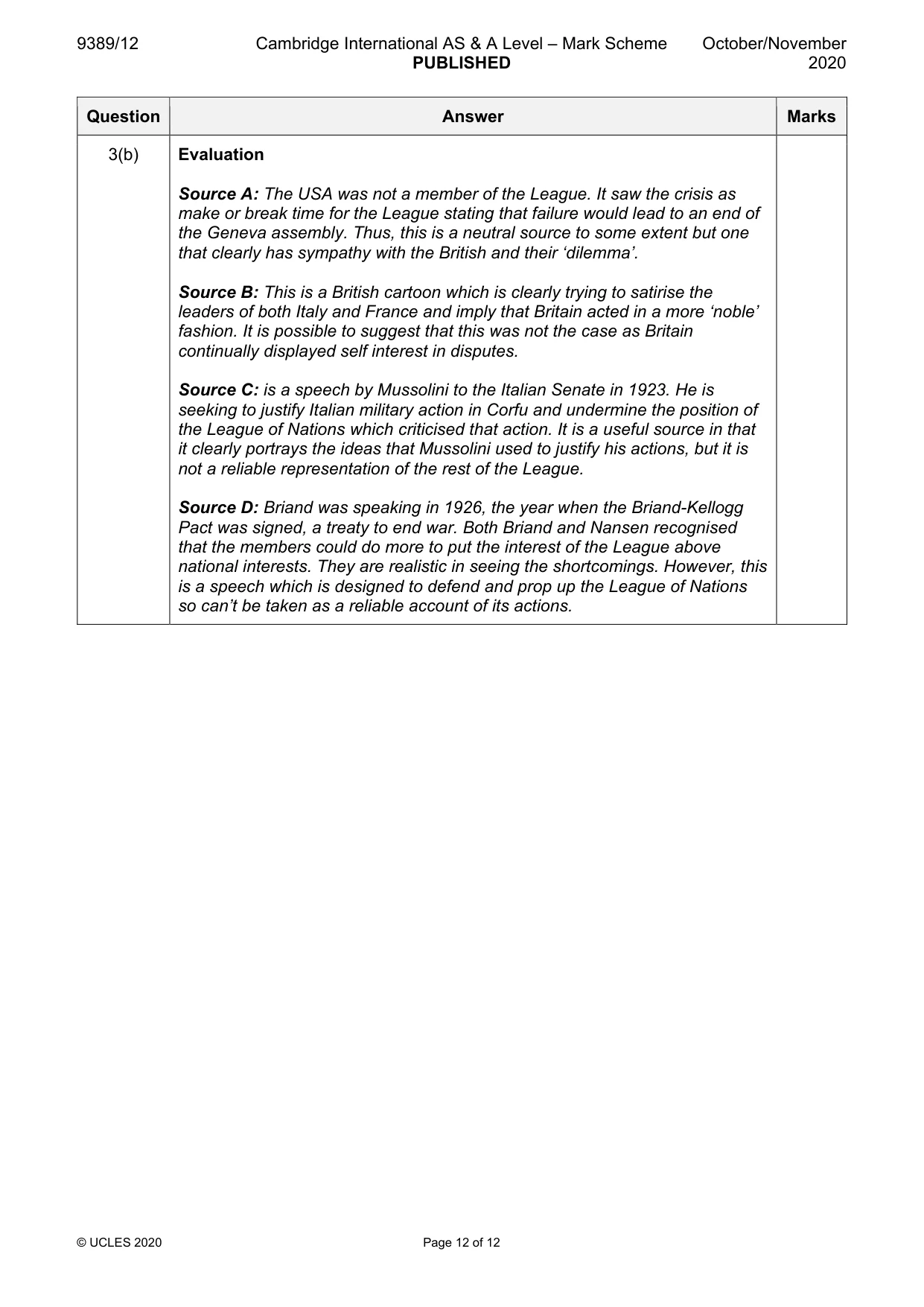
9389/12 Cambridge International AS & A Level – Mark Scheme PUBLISHED October/November 2020 © UCLES 2020 Page 12 of 12 Question Answer Marks 3(b) Evaluation Source A: The USA was not a member of the League. It saw the crisis as make or break time for the League stating that failure would lead to an end of the Geneva assembly. Thus, this is a neutral source to some extent but one that clearly has sympathy with the British and their ‘dilemma’. Source B: This is a British cartoon which is clearly trying to satirise the leaders of both Italy and France and imply that Britain acted in a more ‘noble’ fashion. It is possible to suggest that this was not the case as Britain continually displayed self interest in disputes. Source C: is a speech by Mussolini to the Italian Senate in 1923. He is seeking to justify Italian military action in Corfu and undermine the position of the League of Nations which criticised that action. It is a useful source in that it clearly portrays the ideas that Mussolini used to justify his actions, but it is not a reliable representation of the rest of the League. Source D: Briand was speaking in 1926, the year when the Briand-Kellogg Pact was signed, a treaty to end war. Both Briand and Nansen recognised that the members could do more to put the interest of the League above national interests. They are realistic in seeing the shortcomings. However, this is a speech which is designed to defend and prop up the League of Nations so can’t be taken as a reliable account of its actions.
What you needed in this session
Cambridge’s own grade thresholds for 2020 Oct/Nov, Paper 1 · Variant 2. A higher threshold means an easier paper — the bar moves with how the cohort did.