Cambridge A Level History 9389 — 2021 Oct/Nov Paper 1 · Variant 1
9389/11/O/N/21 · 40 marks · ≈45 min
The question paper and its mark scheme, free to read here and free to download. This is Cambridge’s own paper, exactly as it was sat.
Question paper8 pages
Mark scheme11 pages
Answers below. Sit the paper first if you are practising.
Paper as text
Question paper, page 1
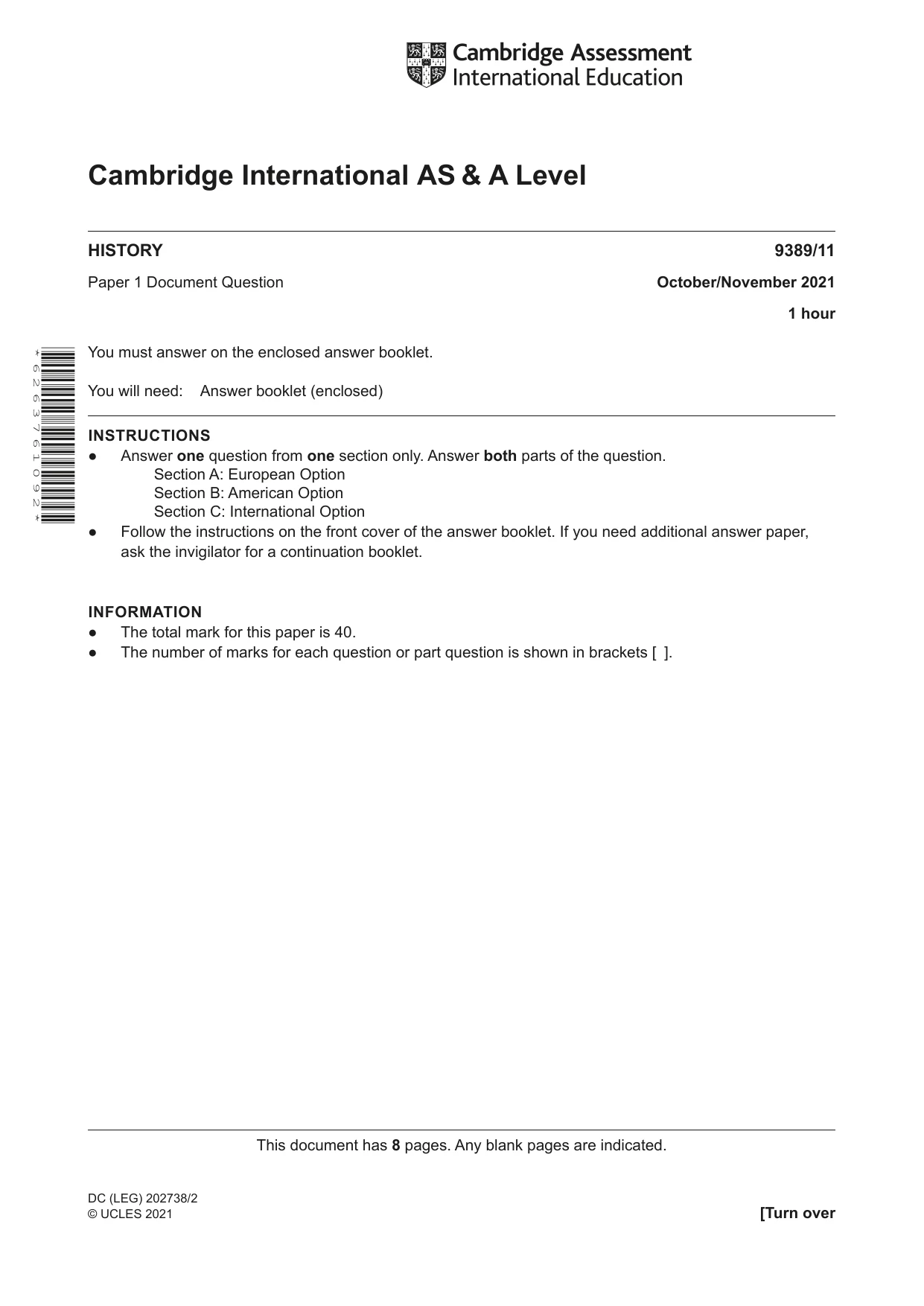
Cambridge International AS & A Level This document has 8 pages. Any blank pages are indicated. DC (LEG) 202738/2 © UCLES 2021 [Turn over * 6 2 6 3 7 6 1 0 9 2 * HISTORY 9389/11 Paper 1 Document Question October/November 2021 1 hour You must answer on the enclosed answer booklet. You will need: Answer booklet (enclosed) INSTRUCTIONS ● Answer one question from one section only. Answer both parts of the question. Section A: European Option Section B: American Option Section C: International Option ● Follow the instructions on the front cover of the answer booklet. If you need additional answer paper, ask the invigilator for a continuation booklet. INFORMATION ● The total mark for this paper is 40. ● The number of marks for each question or part question is shown in brackets [ ].
Question paper, page 2
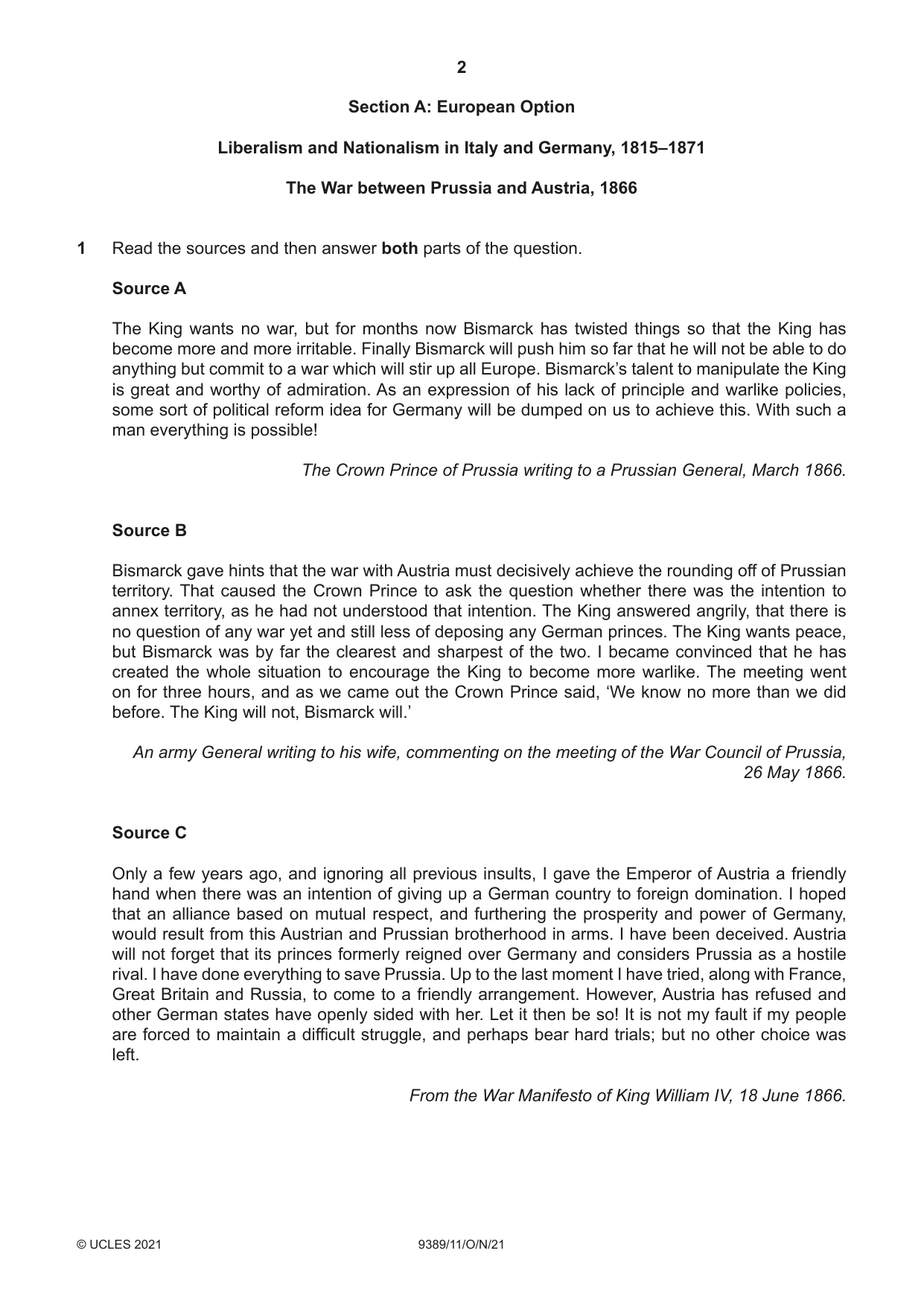
2 9389/11/O/N/21 © UCLES 2021 Section A: European Option Liberalism and Nationalism in Italy and Germany, 1815–1871 The War between Prussia and Austria, 1866 1 Read the sources and then answer both parts of the question. Source A The King wants no war, but for months now Bismarck has twisted things so that the King has become more and more irritable. Finally Bismarck will push him so far that he will not be able to do anything but commit to a war which will stir up all Europe. Bismarck’s talent to manipulate the King is great and worthy of admiration. As an expression of his lack of principle and warlike policies, some sort of political reform idea for Germany will be dumped on us to achieve this. With such a man everything is possible! The Crown Prince of Prussia writing to a Prussian General, March 1866. Source B Bismarck gave hints that the war with Austria must decisively achieve the rounding off of Prussian territory. That caused the Crown Prince to ask the question whether there was the intention to annex territory, as he had not understood that intention. The King answered angrily, that there is no question of any war yet and still less of deposing any German princes. The King wants peace, but Bismarck was by far the clearest and sharpest of the two. I became convinced that he has created the whole situation to encourage the King to become more warlike. The meeting went on for three hours, and as we came out the Crown Prince said, ‘We know no more than we did before. The King will not, Bismarck will.’ An army General writing to his wife, commenting on the meeting of the War Council of Prussia, 26 May 1866. Source C Only a few years ago, and ignoring all previous insults, I gave the Emperor of Austria a friendly hand when there was an intention of giving up a German country to foreign domination. I hoped that an alliance based on mutual respect, and furthering the prosperity and power of Germany, would result from this Austrian and Prussian brotherhood in arms. I have been deceived. Austria will not forget that its princes formerly reigned over Germany and considers Prussia as a hostile rival. I have done everything to save Prussia. Up to the last moment I have tried, along with France, Great Britain and Russia, to come to a friendly arrangement. However, Austria has refused and other German states have openly sided with her. Let it then be so! It is not my fault if my people are forced to maintain a difficult struggle, and perhaps bear hard trials; but no other choice was left. From the War Manifesto of King William IV, 18 June 1866.
Question paper, page 3
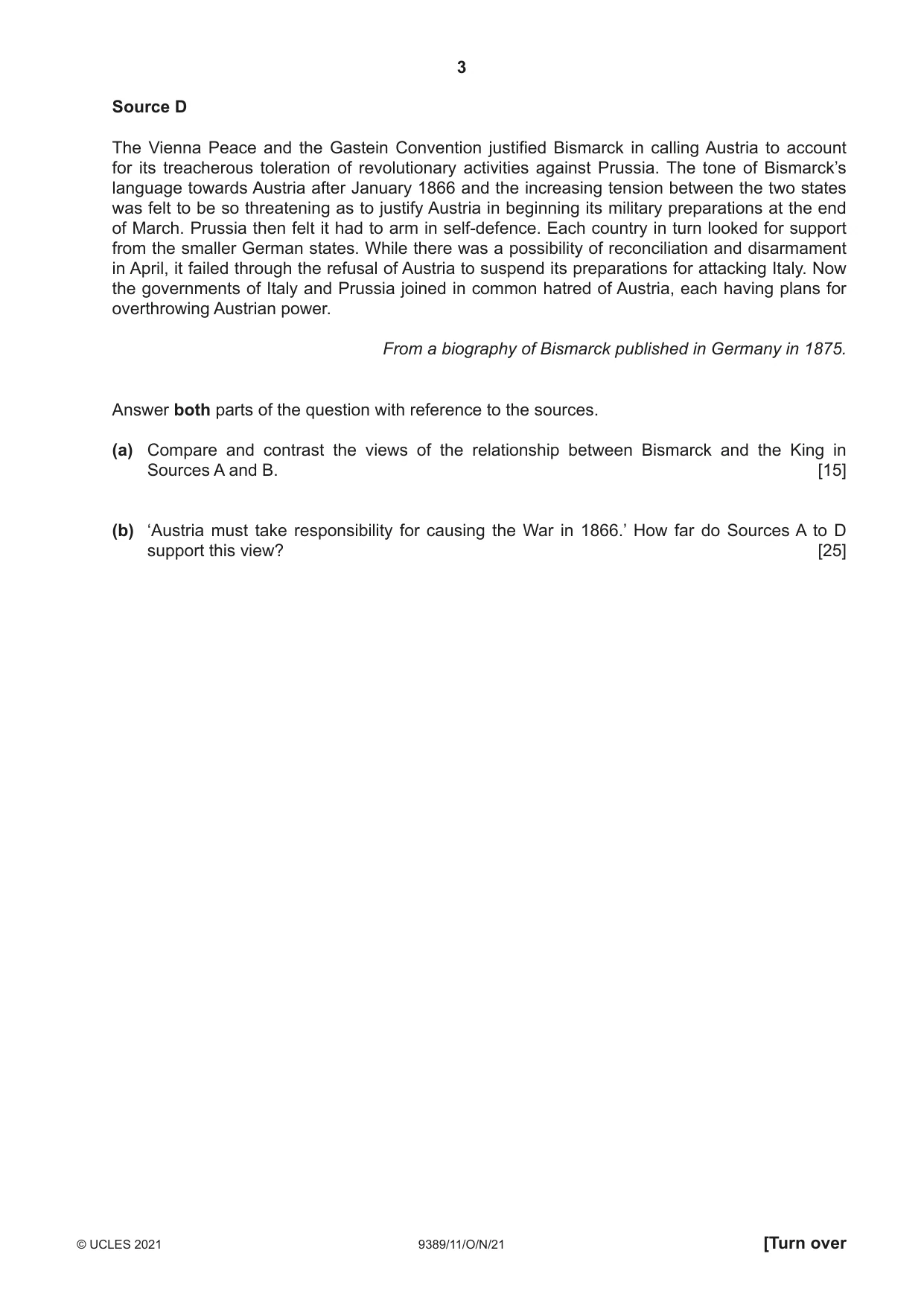
3 9389/11/O/N/21 © UCLES 2021 [Turn over Source D The Vienna Peace and the Gastein Convention justified Bismarck in calling Austria to account for its treacherous toleration of revolutionary activities against Prussia. The tone of Bismarck’s language towards Austria after January 1866 and the increasing tension between the two states was felt to be so threatening as to justify Austria in beginning its military preparations at the end of March. Prussia then felt it had to arm in self‑defence. Each country in turn looked for support from the smaller German states. While there was a possibility of reconciliation and disarmament in April, it failed through the refusal of Austria to suspend its preparations for attacking Italy. Now the governments of Italy and Prussia joined in common hatred of Austria, each having plans for overthrowing Austrian power. From a biography of Bismarck published in Germany in 1875. Answer both parts of the question with reference to the sources. (a) Compare and contrast the views of the relationship between Bismarck and the King in Sources A and B. [15] (b) ‘Austria must take responsibility for causing the War in 1866.’ How far do Sources A to D support this view? [25]
Question paper, page 4
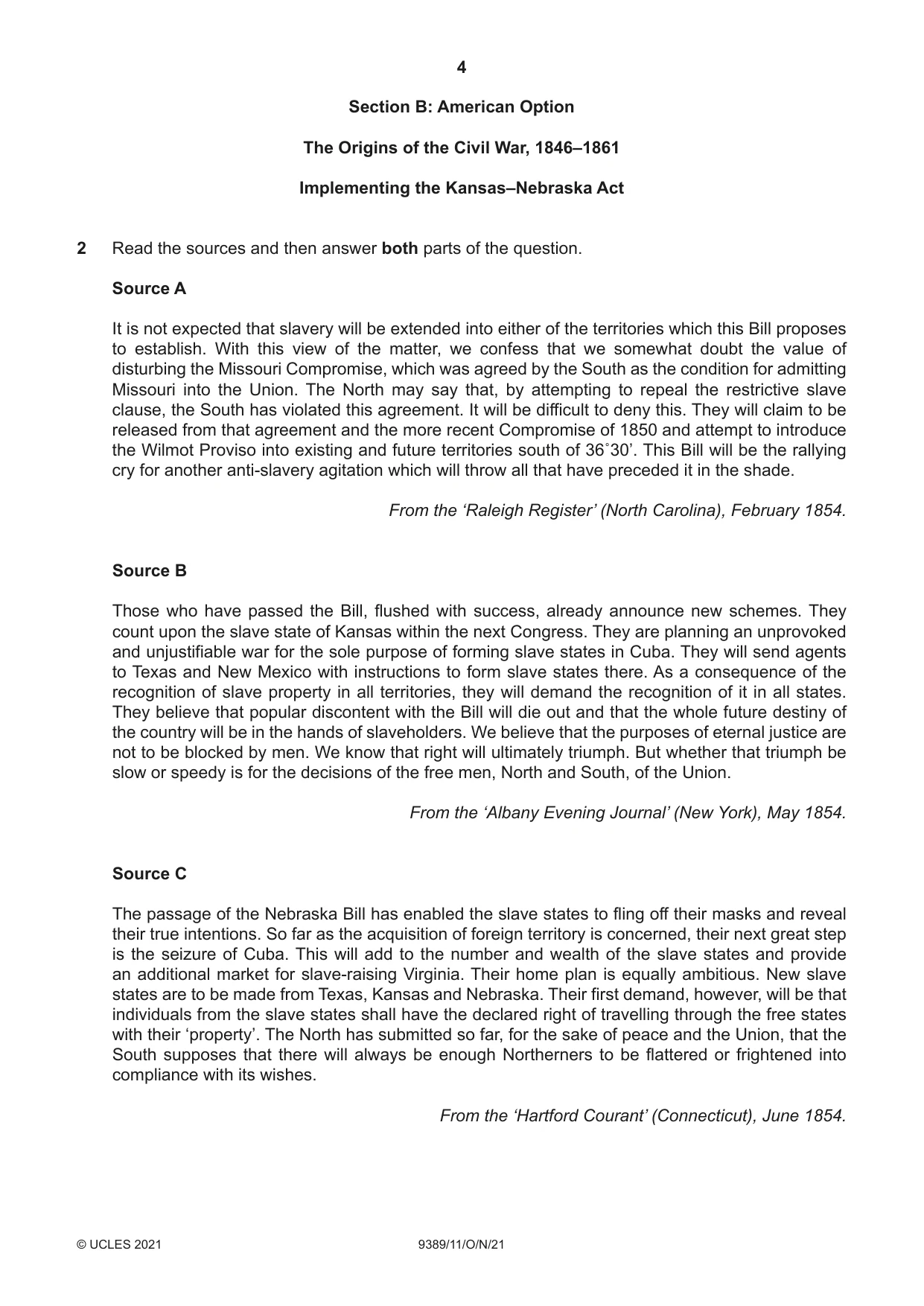
4 9389/11/O/N/21 © UCLES 2021 Section B: American Option The Origins of the Civil War, 1846–1861 Implementing the Kansas–Nebraska Act 2 Read the sources and then answer both parts of the question. Source A It is not expected that slavery will be extended into either of the territories which this Bill proposes to establish. With this view of the matter, we confess that we somewhat doubt the value of disturbing the Missouri Compromise, which was agreed by the South as the condition for admitting Missouri into the Union. The North may say that, by attempting to repeal the restrictive slave clause, the South has violated this agreement. It will be difficult to deny this. They will claim to be released from that agreement and the more recent Compromise of 1850 and attempt to introduce the Wilmot Proviso into existing and future territories south of 36˚30’. This Bill will be the rallying cry for another anti‑slavery agitation which will throw all that have preceded it in the shade. From the ‘Raleigh Register’ (North Carolina), February 1854. Source B Those who have passed the Bill, flushed with success, already announce new schemes. They count upon the slave state of Kansas within the next Congress. They are planning an unprovoked and unjustifiable war for the sole purpose of forming slave states in Cuba. They will send agents to Texas and New Mexico with instructions to form slave states there. As a consequence of the recognition of slave property in all territories, they will demand the recognition of it in all states. They believe that popular discontent with the Bill will die out and that the whole future destiny of the country will be in the hands of slaveholders. We believe that the purposes of eternal justice are not to be blocked by men. We know that right will ultimately triumph. But whether that triumph be slow or speedy is for the decisions of the free men, North and South, of the Union. From the ‘Albany Evening Journal’ (New York), May 1854. Source C The passage of the Nebraska Bill has enabled the slave states to fling off their masks and reveal their true intentions. So far as the acquisition of foreign territory is concerned, their next great step is the seizure of Cuba. This will add to the number and wealth of the slave states and provide an additional market for slave‑raising Virginia. Their home plan is equally ambitious. New slave states are to be made from Texas, Kansas and Nebraska. Their first demand, however, will be that individuals from the slave states shall have the declared right of travelling through the free states with their ‘property’. The North has submitted so far, for the sake of peace and the Union, that the South supposes that there will always be enough Northerners to be flattered or frightened into compliance with its wishes. From the ‘Hartford Courant’ (Connecticut), June 1854.
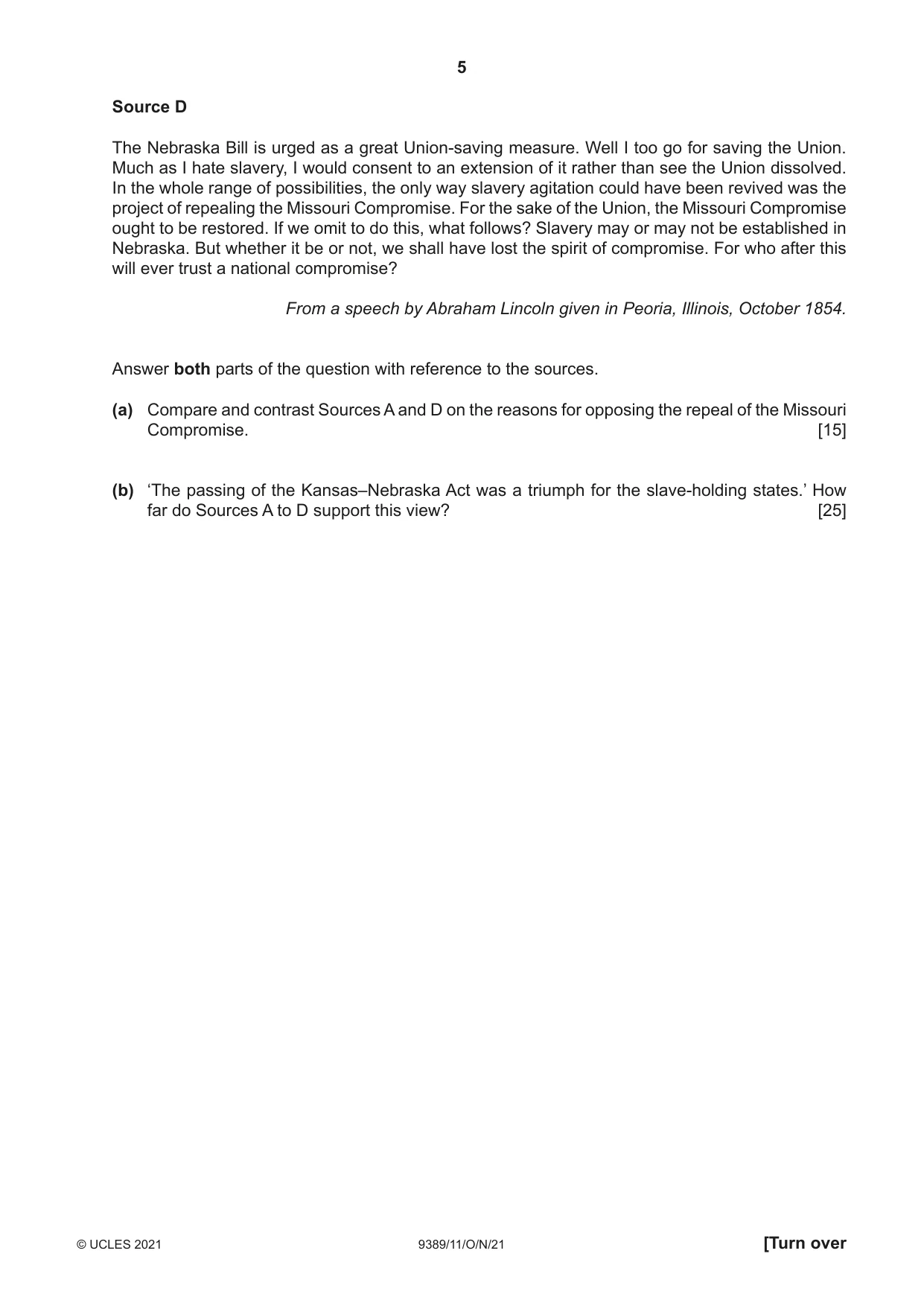
Question paper, page 5
5 9389/11/O/N/21 © UCLES 2021 [Turn over Source D The Nebraska Bill is urged as a great Union‑saving measure. Well I too go for saving the Union. Much as I hate slavery, I would consent to an extension of it rather than see the Union dissolved. In the whole range of possibilities, the only way slavery agitation could have been revived was the project of repealing the Missouri Compromise. For the sake of the Union, the Missouri Compromise ought to be restored. If we omit to do this, what follows? Slavery may or may not be established in Nebraska. But whether it be or not, we shall have lost the spirit of compromise. For who after this will ever trust a national compromise? From a speech by Abraham Lincoln given in Peoria, Illinois, October 1854. Answer both parts of the question with reference to the sources. (a) Compare and contrast Sources A and D on the reasons for opposing the repeal of the Missouri Compromise. [15] (b) ‘The passing of the Kansas–Nebraska Act was a triumph for the slave‑holding states.’ How far do Sources A to D support this view? [25]
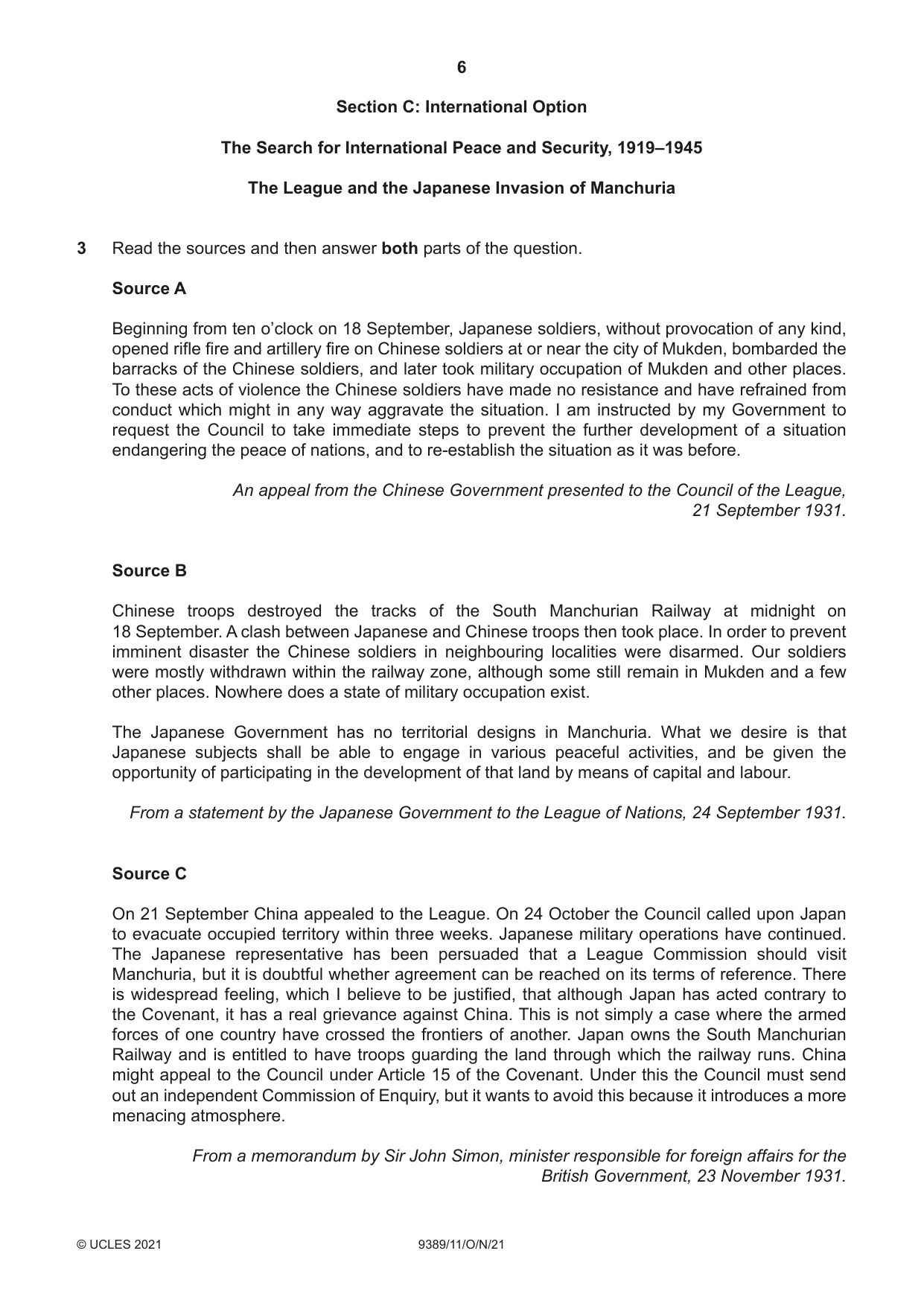
Question paper, page 6
6 9389/11/O/N/21 © UCLES 2021 Section C: International Option The Search for International Peace and Security, 1919–1945 The League and the Japanese Invasion of Manchuria 3 Read the sources and then answer both parts of the question. Source A Beginning from ten o’clock on 18 September, Japanese soldiers, without provocation of any kind, opened rifle fire and artillery fire on Chinese soldiers at or near the city of Mukden, bombarded the barracks of the Chinese soldiers, and later took military occupation of Mukden and other places. To these acts of violence the Chinese soldiers have made no resistance and have refrained from conduct which might in any way aggravate the situation. I am instructed by my Government to request the Council to take immediate steps to prevent the further development of a situation endangering the peace of nations, and to re‑establish the situation as it was before. An appeal from the Chinese Government presented to the Council of the League, 21 September 1931. Source B Chinese troops destroyed the tracks of the South Manchurian Railway at midnight on 18 September. A clash between Japanese and Chinese troops then took place. In order to prevent imminent disaster the Chinese soldiers in neighbouring localities were disarmed. Our soldiers were mostly withdrawn within the railway zone, although some still remain in Mukden and a few other places. Nowhere does a state of military occupation exist. The Japanese Government has no territorial designs in Manchuria. What we desire is that Japanese subjects shall be able to engage in various peaceful activities, and be given the opportunity of participating in the development of that land by means of capital and labour. From a statement by the Japanese Government to the League of Nations, 24 September 1931. Source C On 21 September China appealed to the League. On 24 October the Council called upon Japan to evacuate occupied territory within three weeks. Japanese military operations have continued. The Japanese representative has been persuaded that a League Commission should visit Manchuria, but it is doubtful whether agreement can be reached on its terms of reference. There is widespread feeling, which I believe to be justified, that although Japan has acted contrary to the Covenant, it has a real grievance against China. This is not simply a case where the armed forces of one country have crossed the frontiers of another. Japan owns the South Manchurian Railway and is entitled to have troops guarding the land through which the railway runs. China might appeal to the Council under Article 15 of the Covenant. Under this the Council must send out an independent Commission of Enquiry, but it wants to avoid this because it introduces a more menacing atmosphere. From a memorandum by Sir John Simon, minister responsible for foreign affairs for the British Government, 23 November 1931.
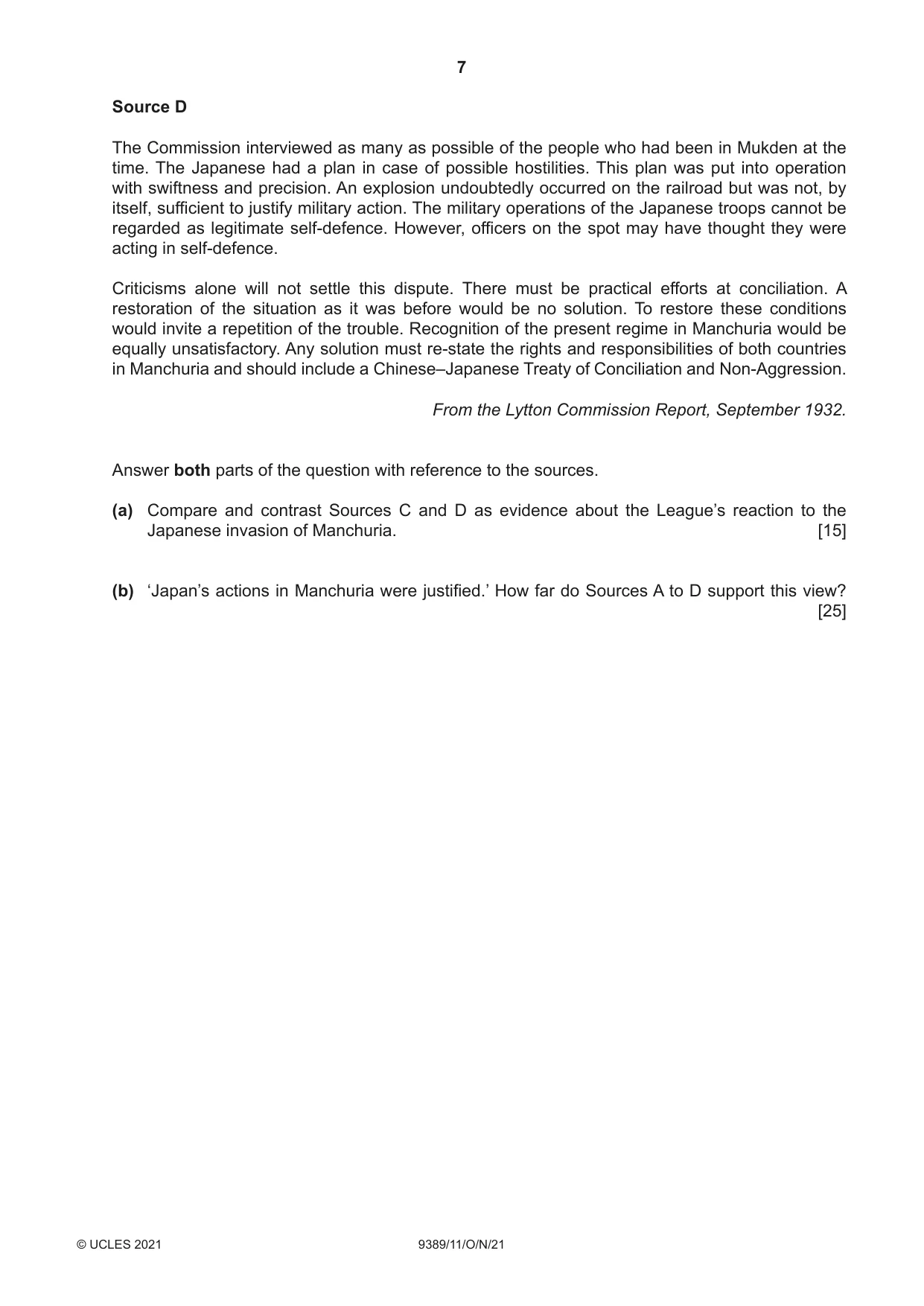
Question paper, page 7
7 9389/11/O/N/21 © UCLES 2021 Source D The Commission interviewed as many as possible of the people who had been in Mukden at the time. The Japanese had a plan in case of possible hostilities. This plan was put into operation with swiftness and precision. An explosion undoubtedly occurred on the railroad but was not, by itself, sufficient to justify military action. The military operations of the Japanese troops cannot be regarded as legitimate self‑defence. However, officers on the spot may have thought they were acting in self‑defence. Criticisms alone will not settle this dispute. There must be practical efforts at conciliation. A restoration of the situation as it was before would be no solution. To restore these conditions would invite a repetition of the trouble. Recognition of the present regime in Manchuria would be equally unsatisfactory. Any solution must re‑state the rights and responsibilities of both countries in Manchuria and should include a Chinese–Japanese Treaty of Conciliation and Non‑Aggression. From the Lytton Commission Report, September 1932. Answer both parts of the question with reference to the sources. (a) Compare and contrast Sources C and D as evidence about the League’s reaction to the Japanese invasion of Manchuria. [15] (b) ‘Japan’s actions in Manchuria were justified.’ How far do Sources A to D support this view? [25]
Question paper, page 8
8 9389/11/O/N/21 © UCLES 2021 Permission to reproduce items where third‑party owned material protected by copyright is included has been sought and cleared where possible. Every reasonable effort has been made by the publisher (UCLES) to trace copyright holders, but if any items requiring clearance have unwittingly been included, the publisher will be pleased to make amends at the earliest possible opportunity. To avoid the issue of disclosure of answer‑related information to candidates, all copyright acknowledgements are reproduced online in the Cambridge Assessment International Education Copyright Acknowledgements Booklet. This is produced for each series of examinations and is freely available to download at www.cambridgeinternational.org after the live examination series. Cambridge Assessment International Education is part of the Cambridge Assessment Group. Cambridge Assessment is the brand name of the University of Cambridge Local Examinations Syndicate (UCLES), which itself is a department of the University of Cambridge. BLANK PAGE
Mark scheme, page 1
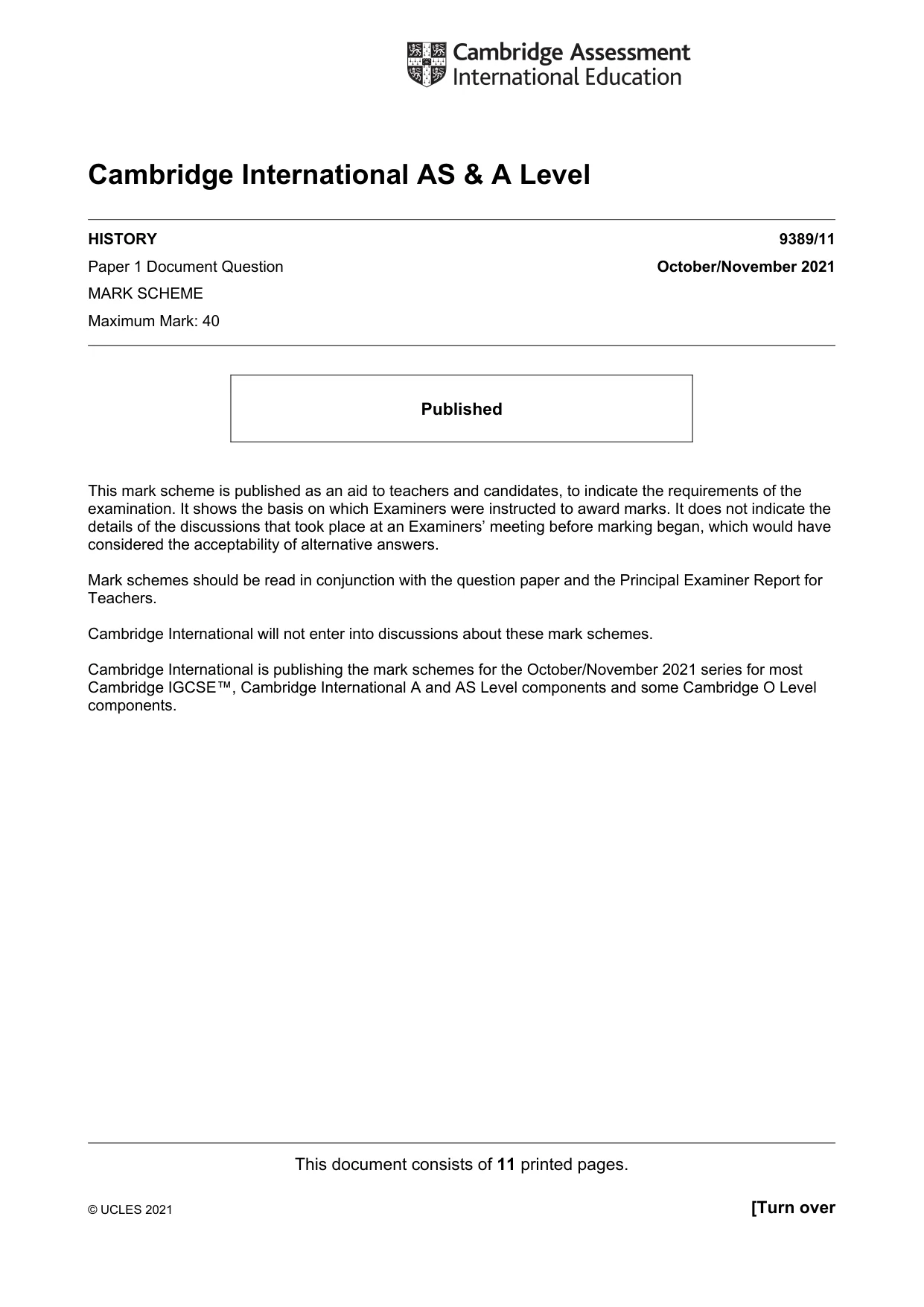
This document consists of 11 printed pages. © UCLES 2021 [Turn over Cambridge International AS & A Level HISTORY 9389/11 Paper 1 Document Question October/November 2021 MARK SCHEME Maximum Mark: 40 Published This mark scheme is published as an aid to teachers and candidates, to indicate the requirements of the examination. It shows the basis on which Examiners were instructed to award marks. It does not indicate the details of the discussions that took place at an Examiners’ meeting before marking began, which would have considered the acceptability of alternative answers. Mark schemes should be read in conjunction with the question paper and the Principal Examiner Report for Teachers. Cambridge International will not enter into discussions about these mark schemes. Cambridge International is publishing the mark schemes for the October/November 2021 series for most Cambridge IGCSE™, Cambridge International A and AS Level components and some Cambridge O Level components.
Mark scheme, page 2
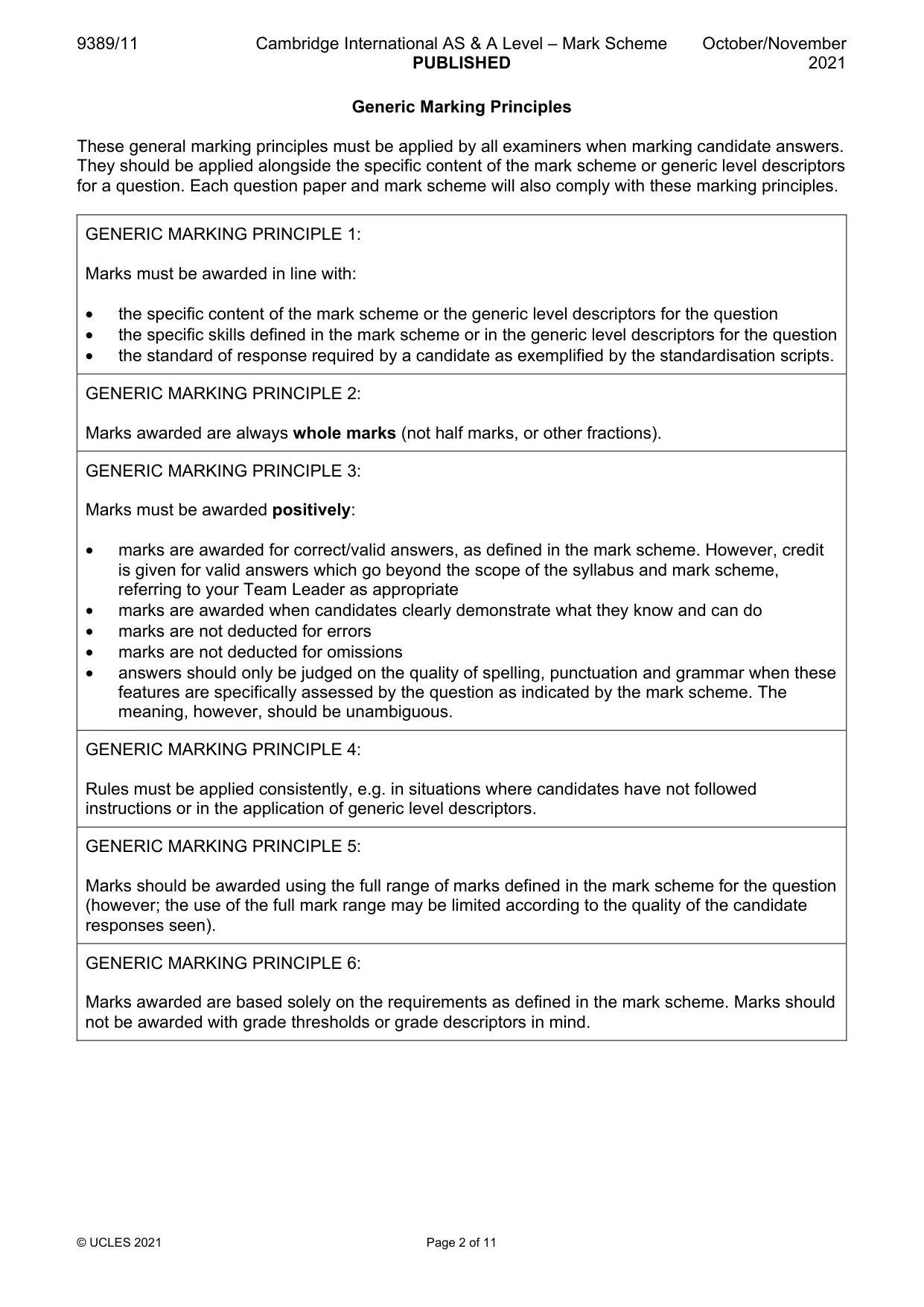
9389/11 Cambridge International AS & A Level – Mark Scheme PUBLISHED October/November 2021 © UCLES 2021 Page 2 of 11 Generic Marking Principles These general marking principles must be applied by all examiners when marking candidate answers. They should be applied alongside the specific content of the mark scheme or generic level descriptors for a question. Each question paper and mark scheme will also comply with these marking principles. GENERIC MARKING PRINCIPLE 1: Marks must be awarded in line with: • the specific content of the mark scheme or the generic level descriptors for the question • the specific skills defined in the mark scheme or in the generic level descriptors for the question • the standard of response required by a candidate as exemplified by the standardisation scripts. GENERIC MARKING PRINCIPLE 2: Marks awarded are always whole marks (not half marks, or other fractions). GENERIC MARKING PRINCIPLE 3: Marks must be awarded positively: • marks are awarded for correct/valid answers, as defined in the mark scheme. However, credit is given for valid answers which go beyond the scope of the syllabus and mark scheme, referring to your Team Leader as appropriate • marks are awarded when candidates clearly demonstrate what they know and can do • marks are not deducted for errors • marks are not deducted for omissions • answers should only be judged on the quality of spelling, punctuation and grammar when these features are specifically assessed by the question as indicated by the mark scheme. The meaning, however, should be unambiguous. GENERIC MARKING PRINCIPLE 4: Rules must be applied consistently, e.g. in situations where candidates have not followed instructions or in the application of generic level descriptors. GENERIC MARKING PRINCIPLE 5: Marks should be awarded using the full range of marks defined in the mark scheme for the question (however; the use of the full mark range may be limited according to the quality of the candidate responses seen). GENERIC MARKING PRINCIPLE 6: Marks awarded are based solely on the requirements as defined in the mark scheme. Marks should not be awarded with grade thresholds or grade descriptors in mind.
Mark scheme, page 3
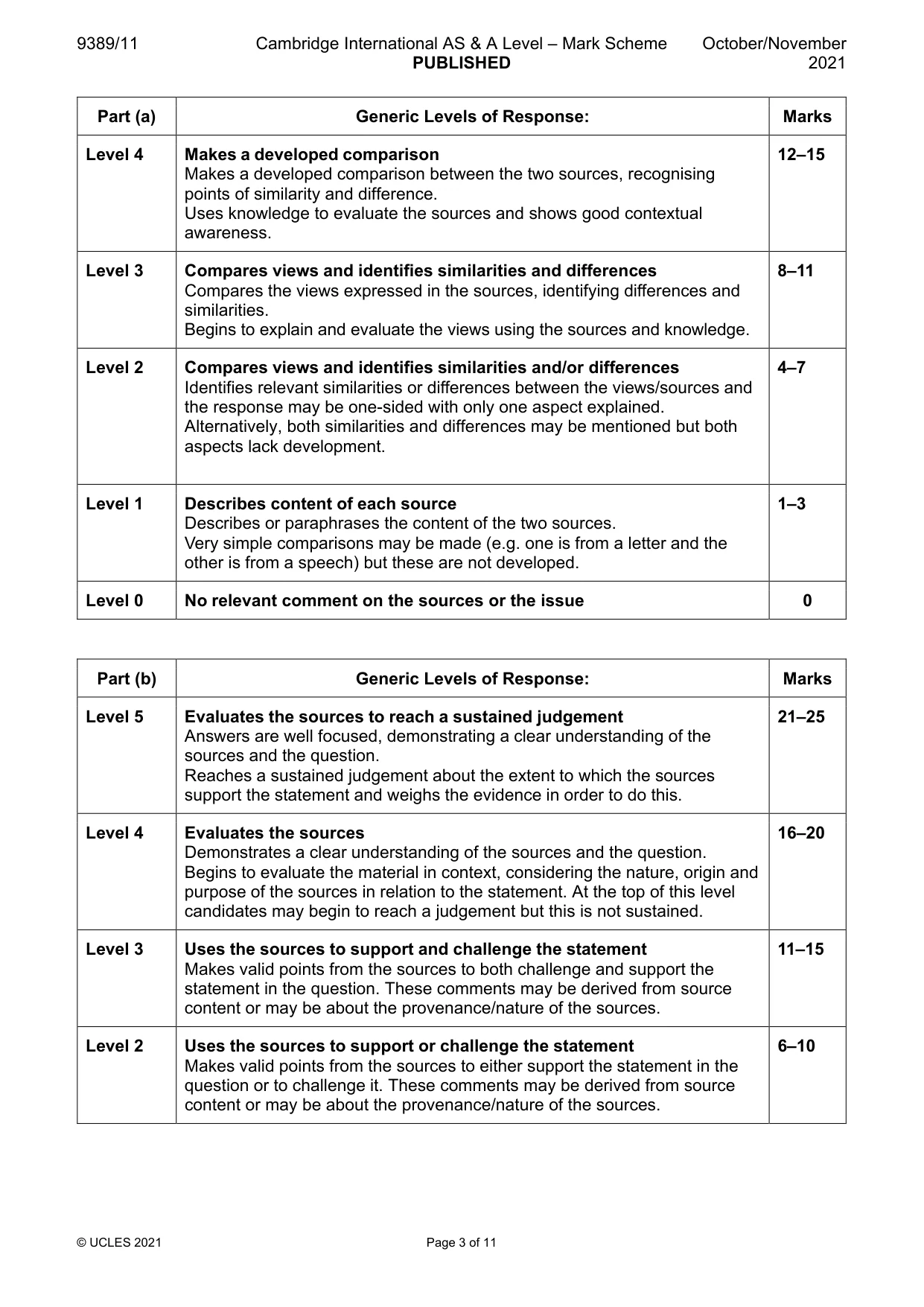
9389/11 Cambridge International AS & A Level – Mark Scheme PUBLISHED October/November 2021 © UCLES 2021 Page 3 of 11 Part (a) Generic Levels of Response: Marks Level 4 Makes a developed comparison Makes a developed comparison between the two sources, recognising points of similarity and difference. Uses knowledge to evaluate the sources and shows good contextual awareness. 12–15 Level 3 Compares views and identifies similarities and differences Compares the views expressed in the sources, identifying differences and similarities. Begins to explain and evaluate the views using the sources and knowledge. 8–11 Level 2 Compares views and identifies similarities and/or differences Identifies relevant similarities or differences between the views/sources and the response may be one-sided with only one aspect explained. Alternatively, both similarities and differences may be mentioned but both aspects lack development. 4–7 Level 1 Describes content of each source Describes or paraphrases the content of the two sources. Very simple comparisons may be made (e.g. one is from a letter and the other is from a speech) but these are not developed. 1–3 Level 0 No relevant comment on the sources or the issue 0 Part (b) Generic Levels of Response: Marks Level 5 Evaluates the sources to reach a sustained judgement Answers are well focused, demonstrating a clear understanding of the sources and the question. Reaches a sustained judgement about the extent to which the sources support the statement and weighs the evidence in order to do this. 21–25 Level 4 Evaluates the sources Demonstrates a clear understanding of the sources and the question. Begins to evaluate the material in context, considering the nature, origin and purpose of the sources in relation to the statement. At the top of this level candidates may begin to reach a judgement but this is not sustained. 16–20 Level 3 Uses the sources to support and challenge the statement Makes valid points from the sources to both challenge and support the statement in the question. These comments may be derived from source content or may be about the provenance/nature of the sources. 11–15 Level 2 Uses the sources to support or challenge the statement Makes valid points from the sources to either support the statement in the question or to challenge it. These comments may be derived from source content or may be about the provenance/nature of the sources. 6–10
Mark scheme, page 4
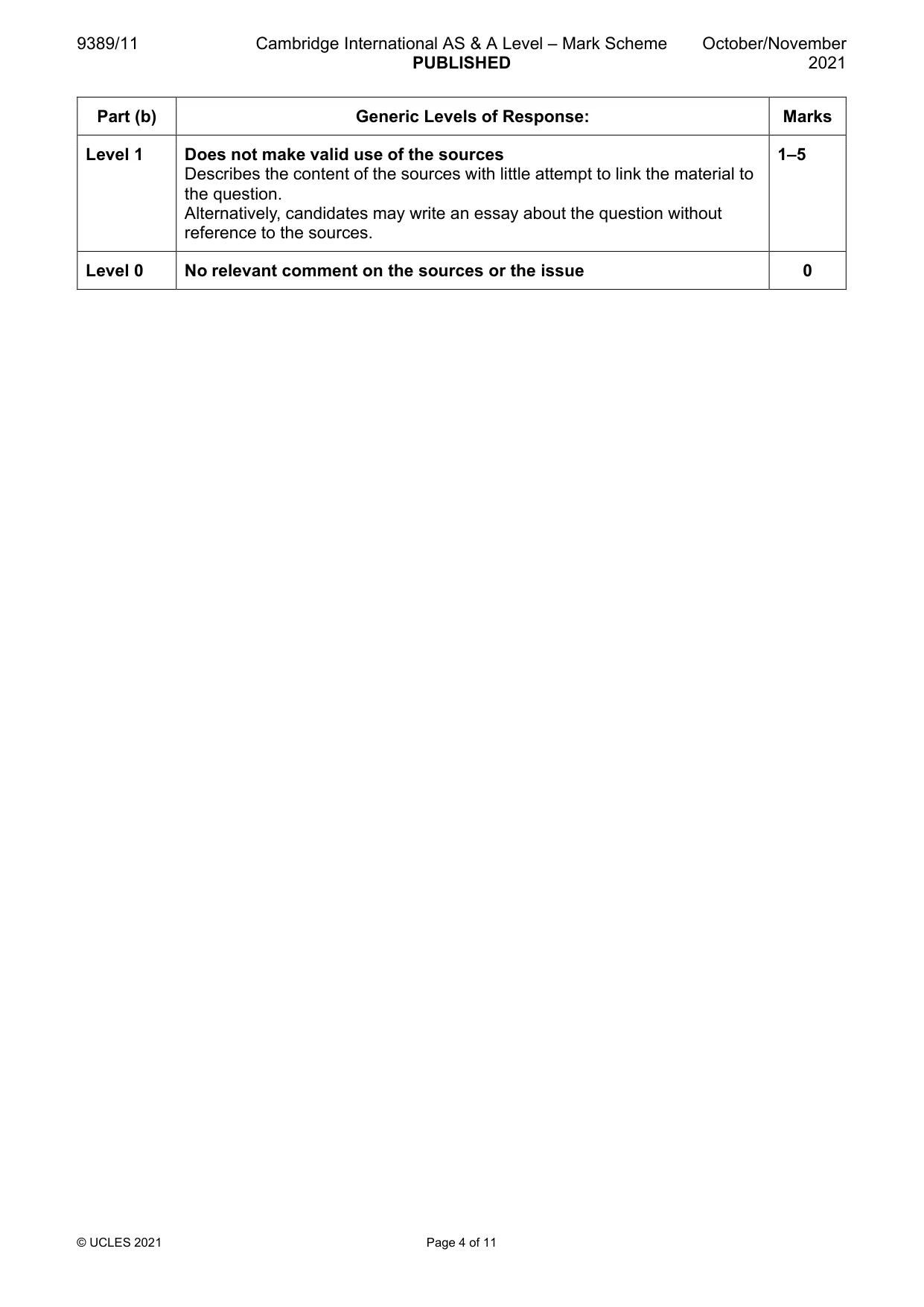
9389/11 Cambridge International AS & A Level – Mark Scheme PUBLISHED October/November 2021 © UCLES 2021 Page 4 of 11 Part (b) Generic Levels of Response: Marks Level 1 Does not make valid use of the sources Describes the content of the sources with little attempt to link the material to the question. Alternatively, candidates may write an essay about the question without reference to the sources. 1–5 Level 0 No relevant comment on the sources or the issue 0
Mark scheme, page 5
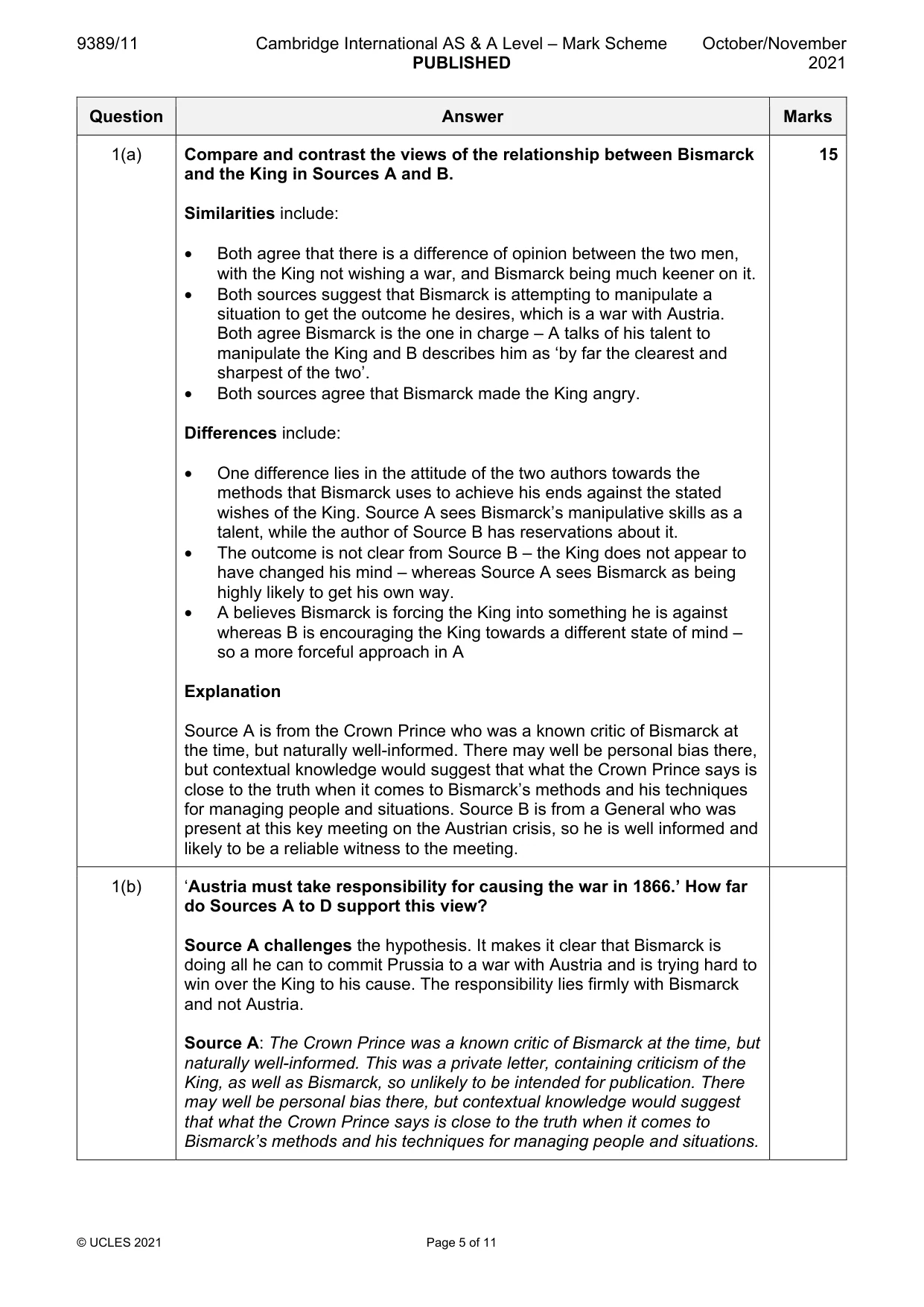
9389/11 Cambridge International AS & A Level – Mark Scheme PUBLISHED October/November 2021 © UCLES 2021 Page 5 of 11 Question Answer Marks 1(a) Compare and contrast the views of the relationship between Bismarck and the King in Sources A and B. Similarities include: • Both agree that there is a difference of opinion between the two men, with the King not wishing a war, and Bismarck being much keener on it. • Both sources suggest that Bismarck is attempting to manipulate a situation to get the outcome he desires, which is a war with Austria. Both agree Bismarck is the one in charge – A talks of his talent to manipulate the King and B describes him as ‘by far the clearest and sharpest of the two’. • Both sources agree that Bismarck made the King angry. Differences include: • One difference lies in the attitude of the two authors towards the methods that Bismarck uses to achieve his ends against the stated wishes of the King. Source A sees Bismarck’s manipulative skills as a talent, while the author of Source B has reservations about it. • The outcome is not clear from Source B – the King does not appear to have changed his mind – whereas Source A sees Bismarck as being highly likely to get his own way. • A believes Bismarck is forcing the King into something he is against whereas B is encouraging the King towards a different state of mind – so a more forceful approach in A Explanation Source A is from the Crown Prince who was a known critic of Bismarck at the time, but naturally well-informed. There may well be personal bias there, but contextual knowledge would suggest that what the Crown Prince says is close to the truth when it comes to Bismarck’s methods and his techniques for managing people and situations. Source B is from a General who was present at this key meeting on the Austrian crisis, so he is well informed and likely to be a reliable witness to the meeting. 15 1(b) ‘Austria must take responsibility for causing the war in 1866.’ How far do Sources A to D support this view? Source A challenges the hypothesis. It makes it clear that Bismarck is doing all he can to commit Prussia to a war with Austria and is trying hard to win over the King to his cause. The responsibility lies firmly with Bismarck and not Austria. Source A: The Crown Prince was a known critic of Bismarck at the time, but naturally well-informed. This was a private letter, containing criticism of the King, as well as Bismarck, so unlikely to be intended for publication. There may well be personal bias there, but contextual knowledge would suggest that what the Crown Prince says is close to the truth when it comes to Bismarck’s methods and his techniques for managing people and situations.
Mark scheme, page 6
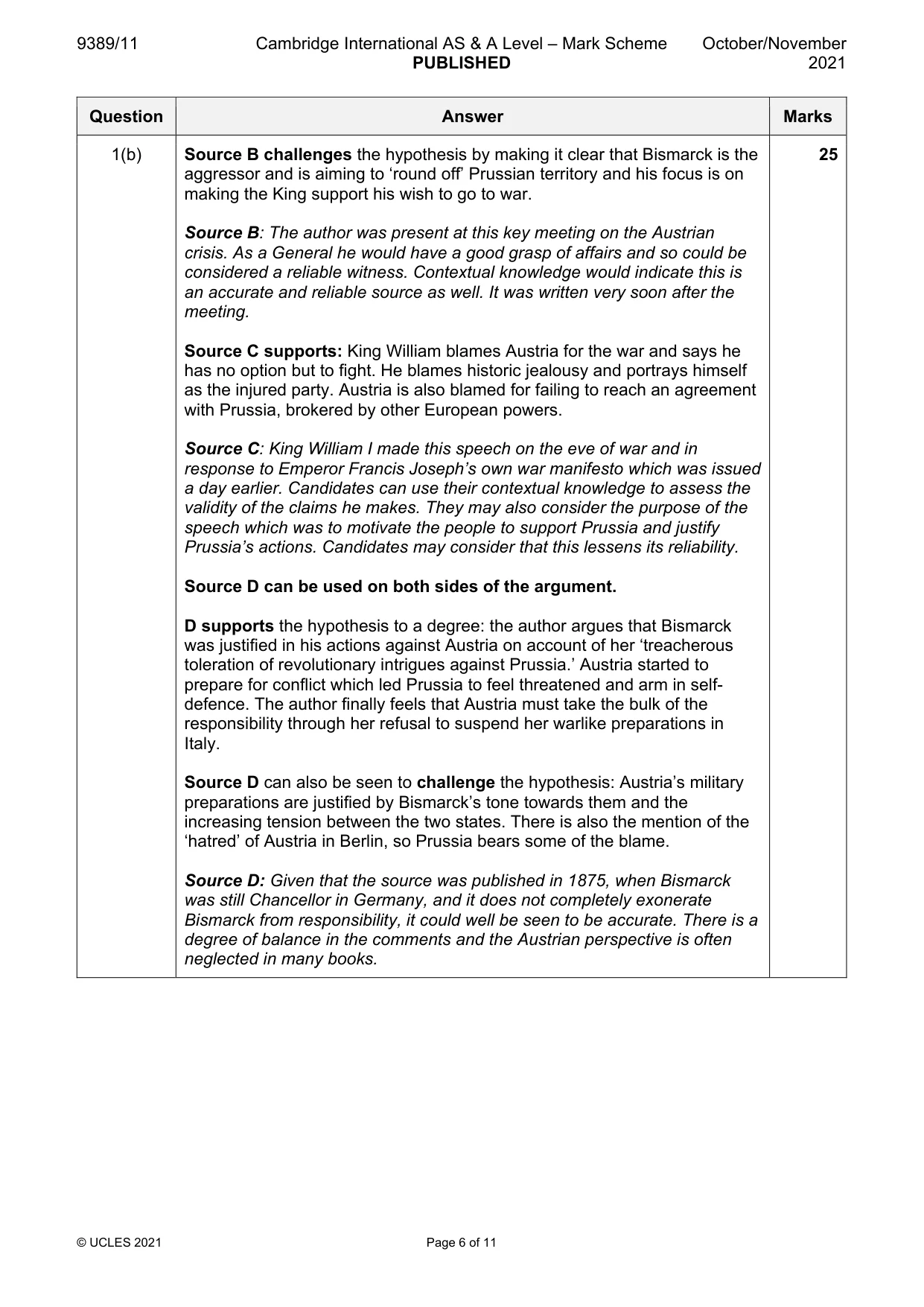
9389/11 Cambridge International AS & A Level – Mark Scheme PUBLISHED October/November 2021 © UCLES 2021 Page 6 of 11 Question Answer Marks 1(b) Source B challenges the hypothesis by making it clear that Bismarck is the aggressor and is aiming to ‘round off’ Prussian territory and his focus is on making the King support his wish to go to war. Source B: The author was present at this key meeting on the Austrian crisis. As a General he would have a good grasp of affairs and so could be considered a reliable witness. Contextual knowledge would indicate this is an accurate and reliable source as well. It was written very soon after the meeting. Source C supports: King William blames Austria for the war and says he has no option but to fight. He blames historic jealousy and portrays himself as the injured party. Austria is also blamed for failing to reach an agreement with Prussia, brokered by other European powers. Source C: King William I made this speech on the eve of war and in response to Emperor Francis Joseph’s own war manifesto which was issued a day earlier. Candidates can use their contextual knowledge to assess the validity of the claims he makes. They may also consider the purpose of the speech which was to motivate the people to support Prussia and justify Prussia’s actions. Candidates may consider that this lessens its reliability. Source D can be used on both sides of the argument. D supports the hypothesis to a degree: the author argues that Bismarck was justified in his actions against Austria on account of her ‘treacherous toleration of revolutionary intrigues against Prussia.’ Austria started to prepare for conflict which led Prussia to feel threatened and arm in self- defence. The author finally feels that Austria must take the bulk of the responsibility through her refusal to suspend her warlike preparations in Italy. Source D can also be seen to challenge the hypothesis: Austria’s military preparations are justified by Bismarck’s tone towards them and the increasing tension between the two states. There is also the mention of the ‘hatred’ of Austria in Berlin, so Prussia bears some of the blame. Source D: Given that the source was published in 1875, when Bismarck was still Chancellor in Germany, and it does not completely exonerate Bismarck from responsibility, it could well be seen to be accurate. There is a degree of balance in the comments and the Austrian perspective is often neglected in many books. 25
Mark scheme, page 7
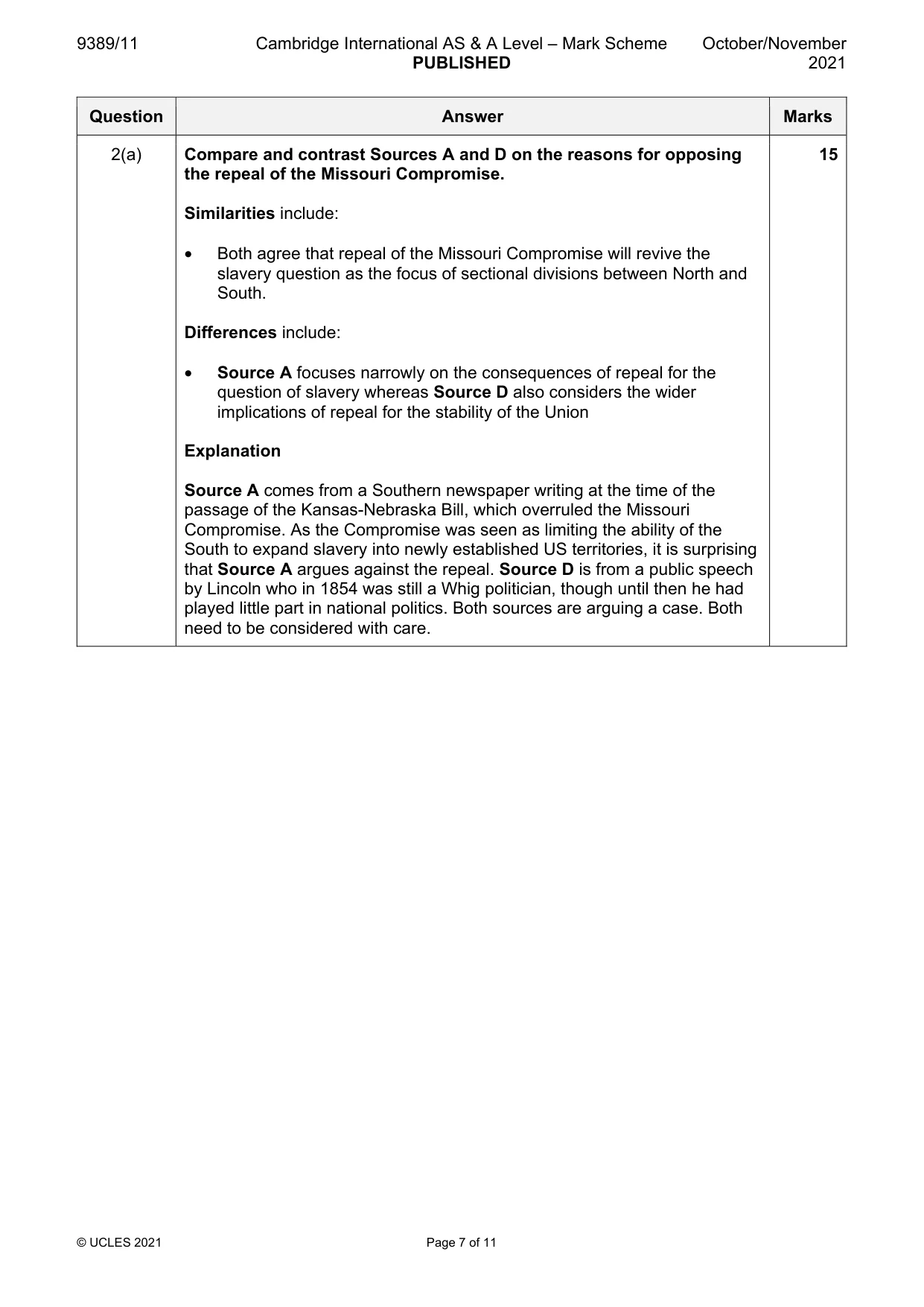
9389/11 Cambridge International AS & A Level – Mark Scheme PUBLISHED October/November 2021 © UCLES 2021 Page 7 of 11 Question Answer Marks 2(a) Compare and contrast Sources A and D on the reasons for opposing the repeal of the Missouri Compromise. Similarities include: • Both agree that repeal of the Missouri Compromise will revive the slavery question as the focus of sectional divisions between North and South. Differences include: • Source A focuses narrowly on the consequences of repeal for the question of slavery whereas Source D also considers the wider implications of repeal for the stability of the Union Explanation Source A comes from a Southern newspaper writing at the time of the passage of the Kansas-Nebraska Bill, which overruled the Missouri Compromise. As the Compromise was seen as limiting the ability of the South to expand slavery into newly established US territories, it is surprising that Source A argues against the repeal. Source D is from a public speech by Lincoln who in 1854 was still a Whig politician, though until then he had played little part in national politics. Both sources are arguing a case. Both need to be considered with care. 15
Mark scheme, page 8
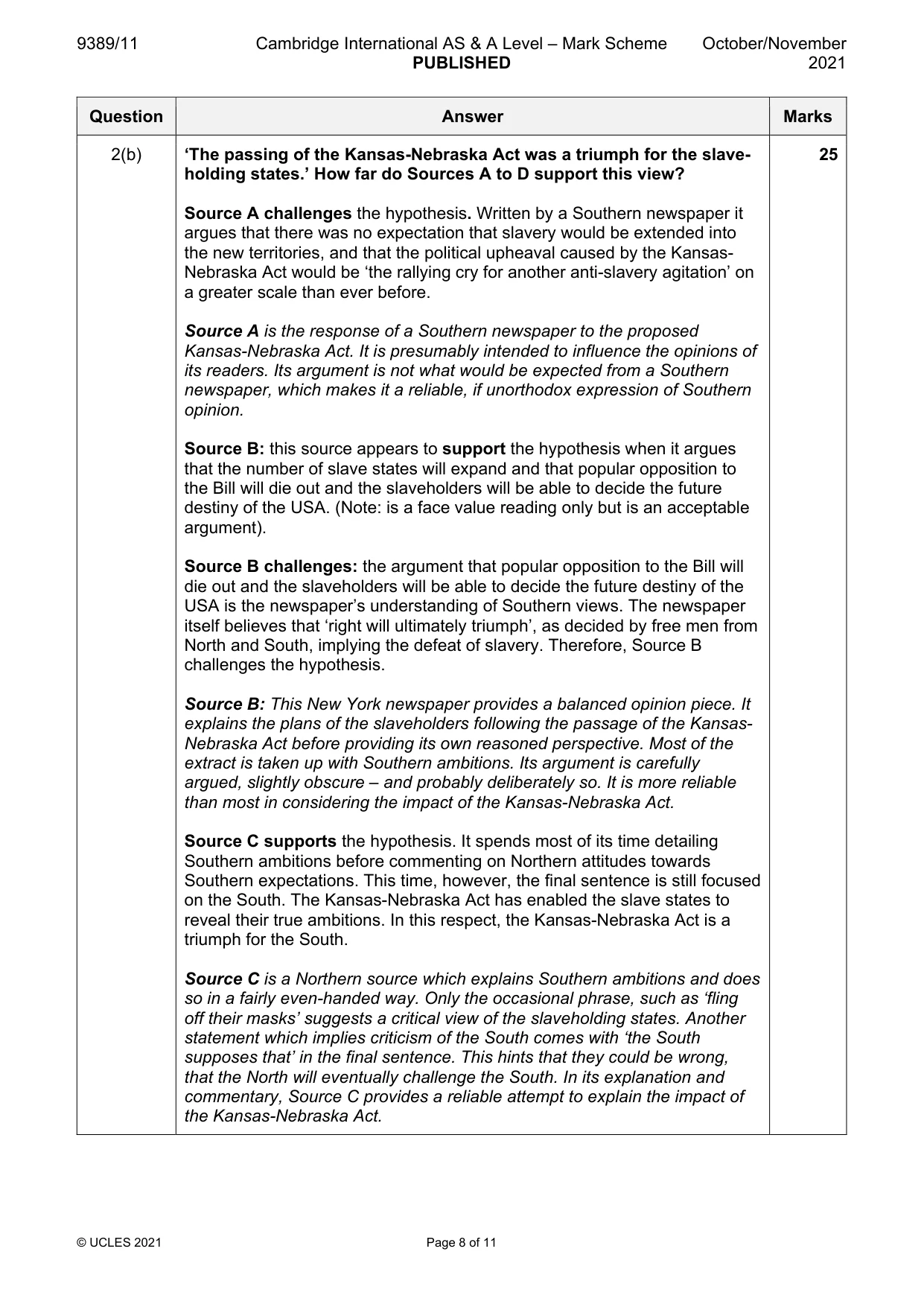
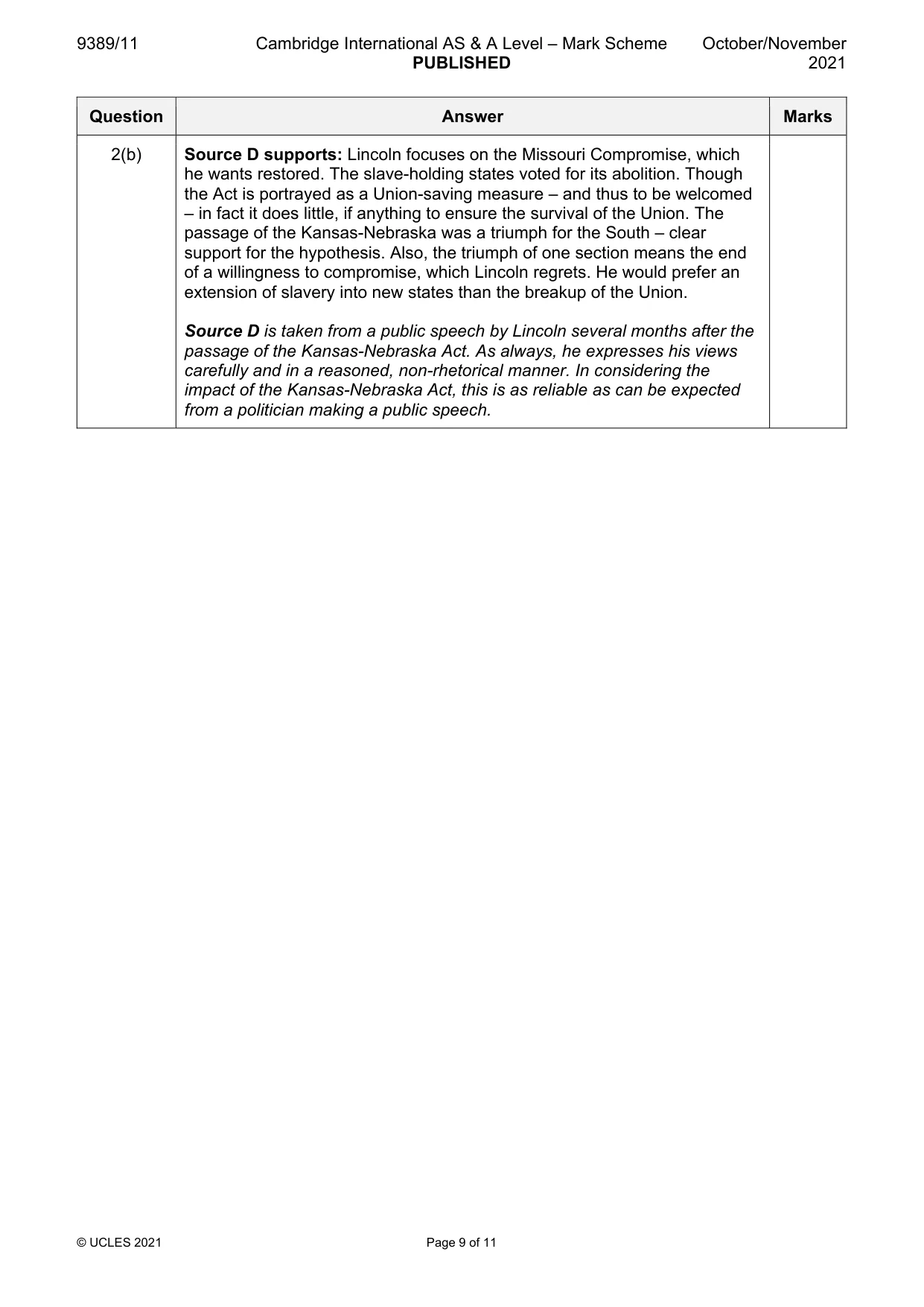
9389/11 Cambridge International AS & A Level – Mark Scheme PUBLISHED October/November 2021 © UCLES 2021 Page 8 of 11 Question Answer Marks 2(b) ‘The passing of the Kansas-Nebraska Act was a triumph for the slave- holding states.’ How far do Sources A to D support this view? Source A challenges the hypothesis. Written by a Southern newspaper it argues that there was no expectation that slavery would be extended into the new territories, and that the political upheaval caused by the Kansas- Nebraska Act would be ‘the rallying cry for another anti-slavery agitation’ on a greater scale than ever before. Source A is the response of a Southern newspaper to the proposed Kansas-Nebraska Act. It is presumably intended to influence the opinions of its readers. Its argument is not what would be expected from a Southern newspaper, which makes it a reliable, if unorthodox expression of Southern opinion. Source B: this source appears to support the hypothesis when it argues that the number of slave states will expand and that popular opposition to the Bill will die out and the slaveholders will be able to decide the future destiny of the USA. (Note: is a face value reading only but is an acceptable argument). Source B challenges: the argument that popular opposition to the Bill will die out and the slaveholders will be able to decide the future destiny of the USA is the newspaper’s understanding of Southern views. The newspaper itself believes that ‘right will ultimately triumph’, as decided by free men from North and South, implying the defeat of slavery. Therefore, Source B challenges the hypothesis. Source B: This New York newspaper provides a balanced opinion piece. It explains the plans of the slaveholders following the passage of the Kansas- Nebraska Act before providing its own reasoned perspective. Most of the extract is taken up with Southern ambitions. Its argument is carefully argued, slightly obscure – and probably deliberately so. It is more reliable than most in considering the impact of the Kansas-Nebraska Act. Source C supports the hypothesis. It spends most of its time detailing Southern ambitions before commenting on Northern attitudes towards Southern expectations. This time, however, the final sentence is still focused on the South. The Kansas-Nebraska Act has enabled the slave states to reveal their true ambitions. In this respect, the Kansas-Nebraska Act is a triumph for the South. Source C is a Northern source which explains Southern ambitions and does so in a fairly even-handed way. Only the occasional phrase, such as ‘fling off their masks’ suggests a critical view of the slaveholding states. Another statement which implies criticism of the South comes with ‘the South supposes that’ in the final sentence. This hints that they could be wrong, that the North will eventually challenge the South. In its explanation and commentary, Source C provides a reliable attempt to explain the impact of the Kansas-Nebraska Act. 25
Mark scheme, page 9
9389/11 Cambridge International AS & A Level – Mark Scheme PUBLISHED October/November 2021 © UCLES 2021 Page 9 of 11 Question Answer Marks 2(b) Source D supports: Lincoln focuses on the Missouri Compromise, which he wants restored. The slave-holding states voted for its abolition. Though the Act is portrayed as a Union-saving measure – and thus to be welcomed – in fact it does little, if anything to ensure the survival of the Union. The passage of the Kansas-Nebraska was a triumph for the South – clear support for the hypothesis. Also, the triumph of one section means the end of a willingness to compromise, which Lincoln regrets. He would prefer an extension of slavery into new states than the breakup of the Union. Source D is taken from a public speech by Lincoln several months after the passage of the Kansas-Nebraska Act. As always, he expresses his views carefully and in a reasoned, non-rhetorical manner. In considering the impact of the Kansas-Nebraska Act, this is as reliable as can be expected from a politician making a public speech.
Mark scheme, page 10
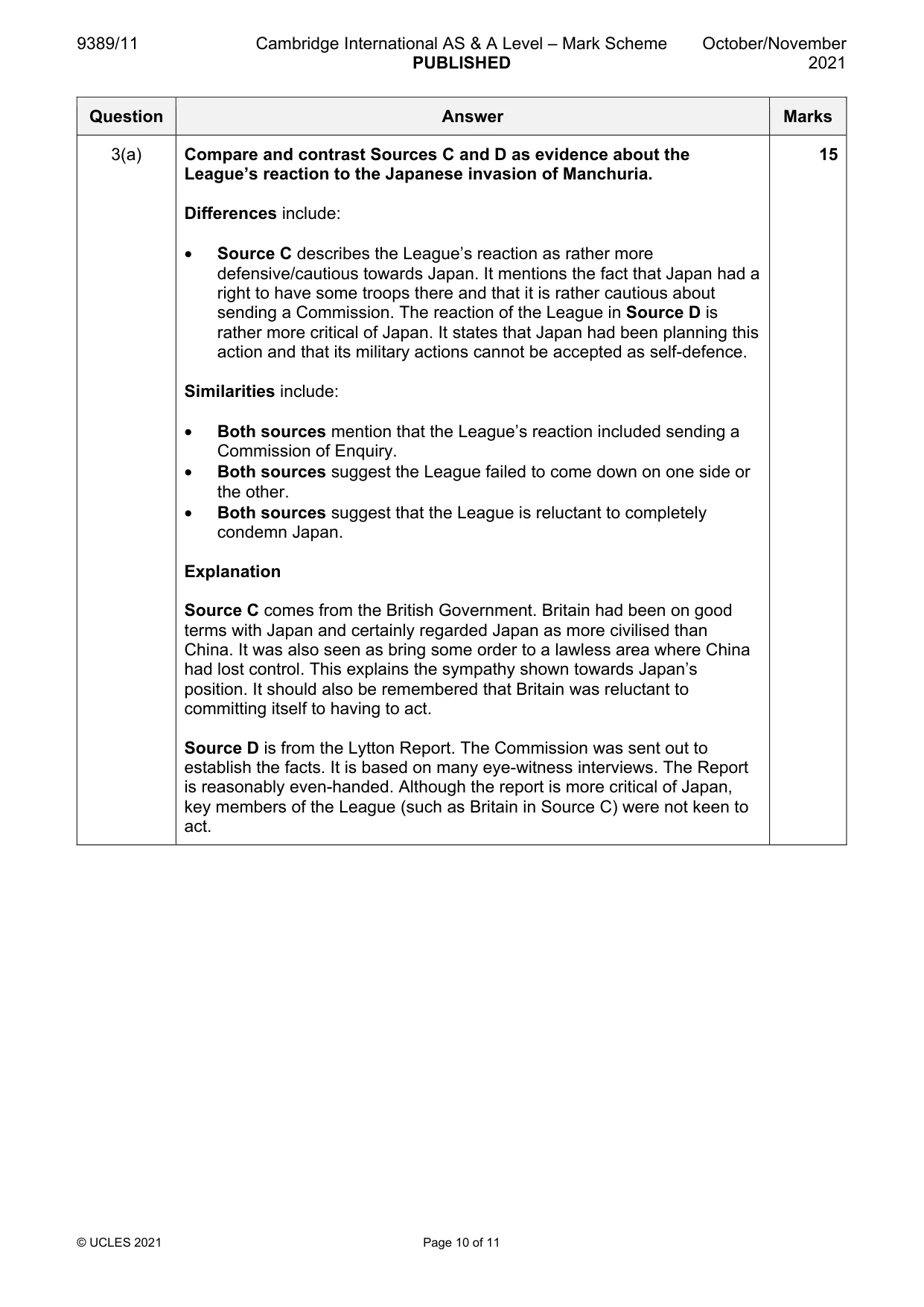
9389/11 Cambridge International AS & A Level – Mark Scheme PUBLISHED October/November 2021 © UCLES 2021 Page 10 of 11 Question Answer Marks 3(a) Compare and contrast Sources C and D as evidence about the League’s reaction to the Japanese invasion of Manchuria. Differences include: • Source C describes the League’s reaction as rather more defensive/cautious towards Japan. It mentions the fact that Japan had a right to have some troops there and that it is rather cautious about sending a Commission. The reaction of the League in Source D is rather more critical of Japan. It states that Japan had been planning this action and that its military actions cannot be accepted as self-defence. Similarities include: • Both sources mention that the League’s reaction included sending a Commission of Enquiry. • Both sources suggest the League failed to come down on one side or the other. • Both sources suggest that the League is reluctant to completely condemn Japan. Explanation Source C comes from the British Government. Britain had been on good terms with Japan and certainly regarded Japan as more civilised than China. It was also seen as bring some order to a lawless area where China had lost control. This explains the sympathy shown towards Japan’s position. It should also be remembered that Britain was reluctant to committing itself to having to act. Source D is from the Lytton Report. The Commission was sent out to establish the facts. It is based on many eye-witness interviews. The Report is reasonably even-handed. Although the report is more critical of Japan, key members of the League (such as Britain in Source C) were not keen to act. 15
Mark scheme, page 11
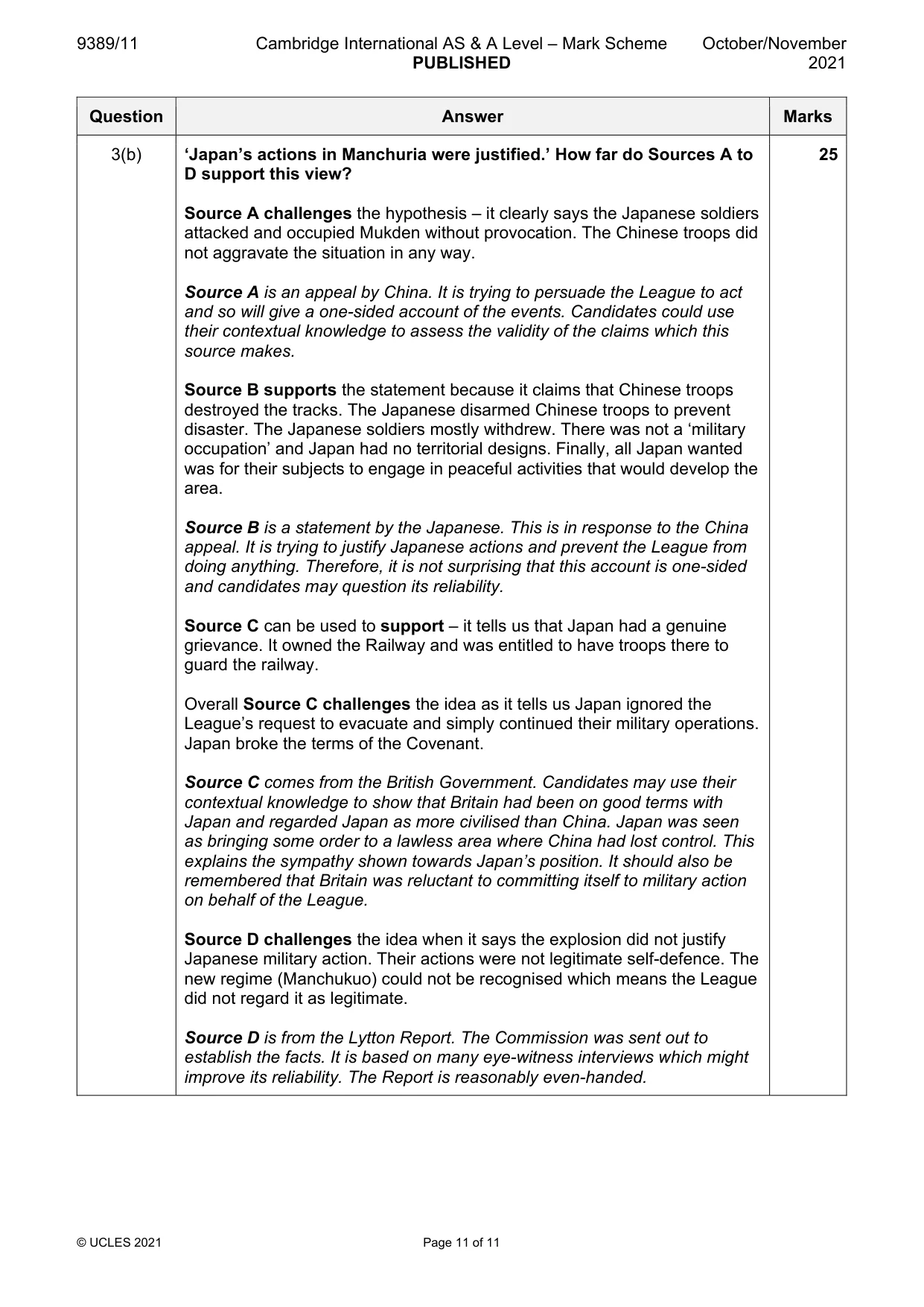
9389/11 Cambridge International AS & A Level – Mark Scheme PUBLISHED October/November 2021 © UCLES 2021 Page 11 of 11 Question Answer Marks 3(b) ‘Japan’s actions in Manchuria were justified.’ How far do Sources A to D support this view? Source A challenges the hypothesis – it clearly says the Japanese soldiers attacked and occupied Mukden without provocation. The Chinese troops did not aggravate the situation in any way. Source A is an appeal by China. It is trying to persuade the League to act and so will give a one-sided account of the events. Candidates could use their contextual knowledge to assess the validity of the claims which this source makes. Source B supports the statement because it claims that Chinese troops destroyed the tracks. The Japanese disarmed Chinese troops to prevent disaster. The Japanese soldiers mostly withdrew. There was not a ‘military occupation’ and Japan had no territorial designs. Finally, all Japan wanted was for their subjects to engage in peaceful activities that would develop the area. Source B is a statement by the Japanese. This is in response to the China appeal. It is trying to justify Japanese actions and prevent the League from doing anything. Therefore, it is not surprising that this account is one-sided and candidates may question its reliability. Source C can be used to support – it tells us that Japan had a genuine grievance. It owned the Railway and was entitled to have troops there to guard the railway. Overall Source C challenges the idea as it tells us Japan ignored the League’s request to evacuate and simply continued their military operations. Japan broke the terms of the Covenant. Source C comes from the British Government. Candidates may use their contextual knowledge to show that Britain had been on good terms with Japan and regarded Japan as more civilised than China. Japan was seen as bringing some order to a lawless area where China had lost control. This explains the sympathy shown towards Japan’s position. It should also be remembered that Britain was reluctant to committing itself to military action on behalf of the League. Source D challenges the idea when it says the explosion did not justify Japanese military action. Their actions were not legitimate self-defence. The new regime (Manchukuo) could not be recognised which means the League did not regard it as legitimate. Source D is from the Lytton Report. The Commission was sent out to establish the facts. It is based on many eye-witness interviews which might improve its reliability. The Report is reasonably even-handed. 25
What you needed in this session
Cambridge’s own grade thresholds for 2021 Oct/Nov, Paper 1 · Variant 1. A higher threshold means an easier paper — the bar moves with how the cohort did.