Cambridge A Level History 9389 — 2021 May/June Paper 1 · Variant 2
9389/12/M/J/21 · 40 marks · ≈45 min
The question paper and its mark scheme, free to read here and free to download. This is Cambridge’s own paper, exactly as it was sat.
Question paper8 pages

Mark scheme13 pages
Answers below. Sit the paper first if you are practising.
Paper as text
Question paper, page 1
This document has 8 pages. Any blank pages are indicated. Cambridge International AS & A Level * 9 3 1 3 8 9 4 9 1 8 * DC (MB/SW) 202622/1 © UCLES 2021 [Turn over HISTORY 9389/12 Paper 1 Document Question May/June 2021 1 hour You must answer on the enclosed answer booklet. You will need: Answer booklet (enclosed) INSTRUCTIONS ● Answer one question from one section only. Answer both parts of the question. Section A: European Option Section B: American Option Section C: International Option ● Follow the instructions on the front cover of the answer booklet. If you need additional answer paper, ask the invigilator for a continuation booklet. INFORMATION ● The total mark for this paper is 40. ● The number of marks for each question or part question is shown in brackets [ ].
Question paper, page 2
2 9389/12/M/J/21 © UCLES 2021 Section A: European Option Liberalism and Nationalism in Italy and Germany, 1815–1871 Piedmont and the Crimean War 1 Read the sources and then answer both parts of the question. Source A I know that you would want to have exact information as to the part which Piedmont could take if it joins with us and our ally Austria against Russia. Will the rest of Italy rise in revolution against Austria, the Pope, and the King of Naples who they see as enemies? If so, how is this revolution to be mastered and suppressed? I understand from the government of Piedmont that if Austria is given new territories in the East, this will make it the barrier to Russia. Austria would then retain some territory in Italy and assist in the repression of revolution there. We then give Piedmont both Lombardy and Venice. This will calm Italy. The questions of Tuscany, Rome and Naples would slowly then be solved without harming Austria. These states would see the good sense of reforms which would disarm radicals and then Piedmont would be strong enough to crush any attempt at revolution in Italy. Unless Piedmont is given territory, it will not join us against Russia. The British Ambassador to Piedmont writing to the British Foreign Secretary, October 1854. Source B The French Ambassador: ‘Am I to understand that your Majesty wishes to join France in our alliance with England and contribute your contingent of troops to the Crimea?’ The King: ‘Yes, that is my wish, and it will be done. It was on my orders that Cavour spoke of it and if the ministers have to be dismissed as a result, then I will dismiss them. Sending troops is the only sensible thing to do. Once our soldiers are joined with yours, I won’t worry about Austria and its future in Italy. Besides, one must do something against Austria to pacify our nationalists. If we don’t send our soldiers to Russia, even working alongside Austria, we shall be led by all these Italian revolutionaries into committing a major mistake of some sort in Italy. Cavour is getting too involved with his friends in Lombardy and their anti-Austrian conspiracies, but their turn will come and I want to help them too. Austria is at present too powerful in Italy and its role needs reducing.’ An account of a conversation between Victor Emmanuel ll and the French Ambassador, November 1854. This account was given in a book written by a journalist who was a strong supporter of Cavour, published in 1878.
Question paper, page 3
3 9389/12/M/J/21 © UCLES 2021 [Turn over Source C The Piedmontese Government desires to adhere to the offensive and defensive Treaty of 10 April between the governments of France and England. At the same time, it will sign an agreement by which it undertakes to provide a contingent of 15 000 men and will be loaned the money to pay for them. In addition, the two Western Powers declare that they will, at the conclusion of the peace, take into consideration the services provided by the Piedmontese Government. By the Treaty the Piedmontese Government: • enters the European Concert, takes part in the negotiations • sits on the Congress held for re-establishing peace and restoring the European balance • requires that the condition of Italy will be taken into consideration. Piedmont’s agreement with France and Britain, 14 December 1854. Source D The experience of recent years has proved, in my opinion, how little Italy has benefitted from conspiracies, revolutions and disorderly uprisings. Far from helping Italy they have been a tremendous calamity and they have damaged the sympathy that other European peoples felt for Italy. We need now to prove to Europe that Italy has sufficient sense to govern itself freely and according to law, adopting the best forms of government. We need also to prove that Italy’s military bravery is as great as those of its ancestors. This Treaty with France and Britain will not produce any serious economic and financial disadvantages. The military part will not offer any dangers and the political consequences should be positively happy. Cavour’s speech to the Piedmontese Parliament, 6 February 1855. Answer both parts of the question with reference to the sources. (a) Compare and contrast the views on Austria’s future role in Italian affairs in Sources A and B. [15] (b) ‘Piedmont went to war against Russia in order to prevent revolution in Italy.’ How far do Sources A to D support this view? [25]
Question paper, page 4
4 9389/12/M/J/21 © UCLES 2021 Section B: American Option The Origins of the Civil War, 1846–1861 Implementing the Fugitive Slave Act 2 Read the sources and then answer both parts of the question. Source A We have this morning the happiness to announce the passage through Congress of another healing measure, the Fugitive Slave Bill. It is a measure which we have always thought to be constitutional. We should have been glad to see it passed as a measure which Congress owed to the Southern states, even if it had not been passed in the spirit of compromise and peace. Nonetheless, we feel respect and gratitude to those representatives of the non-slaveholding states who have given their support to it. In doing so, they doubtless gave up some sectional feelings against the Bill and ignored many sectional prejudices. Therefore, their consent, though justified by the constitution, is a concession made in the spirit of unity and patriotism. However, these feelings and prejudices prevented many Northern members from supporting the Bill. From the ‘National Intelligencer’ (Washington DC), September 1850. Source B The vote in the House of Representatives on the Fugitive Slave Bill presents an alarming view of the state of feeling in the North. It is amazing that 75 out of the 106 Representatives from the non-slaveholding states should assert their determination to deny the South a constitutional right. What sort of Union is this? If the desire to preserve the Union had been as strong among the free states as it has been among the slave states, then the Fugitive Slave Bill would have passed the House unanimously. The fact there were so many votes against it is conclusive evidence that the Union principle and feeling is rotten to the core. This vote shows that the Union is already dissolved so far as friendly feeling is concerned. From the ‘Wilmington Commercial’ (North Carolina), September 1850. Source C Despite feeling astonished, horrified and indignant about that crowning act of American shame, the Fugitive Slave Bill, we have not despaired. It may be regarded as short-term victory for slavery, but a long-term defeat for slave power. It is becoming fearfully certain that, for the mere prospect of doubtful advantage in law, the South must pay a great and ruinous price. The cost to the South is the creation of agitation and hatred of slavery here in the North. The strongest support which that hateful institution has enjoyed these many years consists in the apathy and indifference with which the North has regarded it. With the Fugitive Slave Bill, slaveholders have provided a sure method to dispel that indifference. From the ‘Old Colony Reporter’ (Massachusetts), November 1850.
Question paper, page 5
5 9389/12/M/J/21 © UCLES 2021 [Turn over Source D The Washington [DC] Union, in reporting on the Fugitive Slave Bill, which has just become law, says, ‘It is decidedly liberal in its spirit, for the benefit of the South – efficient in its provisions and well designed to carry out the guarantees of the Constitution. The essence of the Bill is to be found in the fifth section. The marshal is compelled, under a penalty of $1 000, to undertake his duty in arresting the fugitive and, further, to pay the value of the slave if he allows him to escape from his custody. The adoption of such a Bill is most gratifying evidence of the liberal disposition of the North to carry out the guarantees of the Constitution. We welcome such a spirit with great pleasure and hope it will remove some of the prejudices which extremists have towards the North.’ From the ‘Athens Post’ (Tennessee), September 1850. Answer both parts of the question with reference to the sources. (a) Compare and contrast attitudes in Sources A and B towards the role of the North in passing the 1850 Fugitive Slave Bill. [15] (b) ‘There was little chance of the 1850 Fugitive Slave Bill being a success.’ How far do Sources A to D support this view? [25]
Question paper, page 6
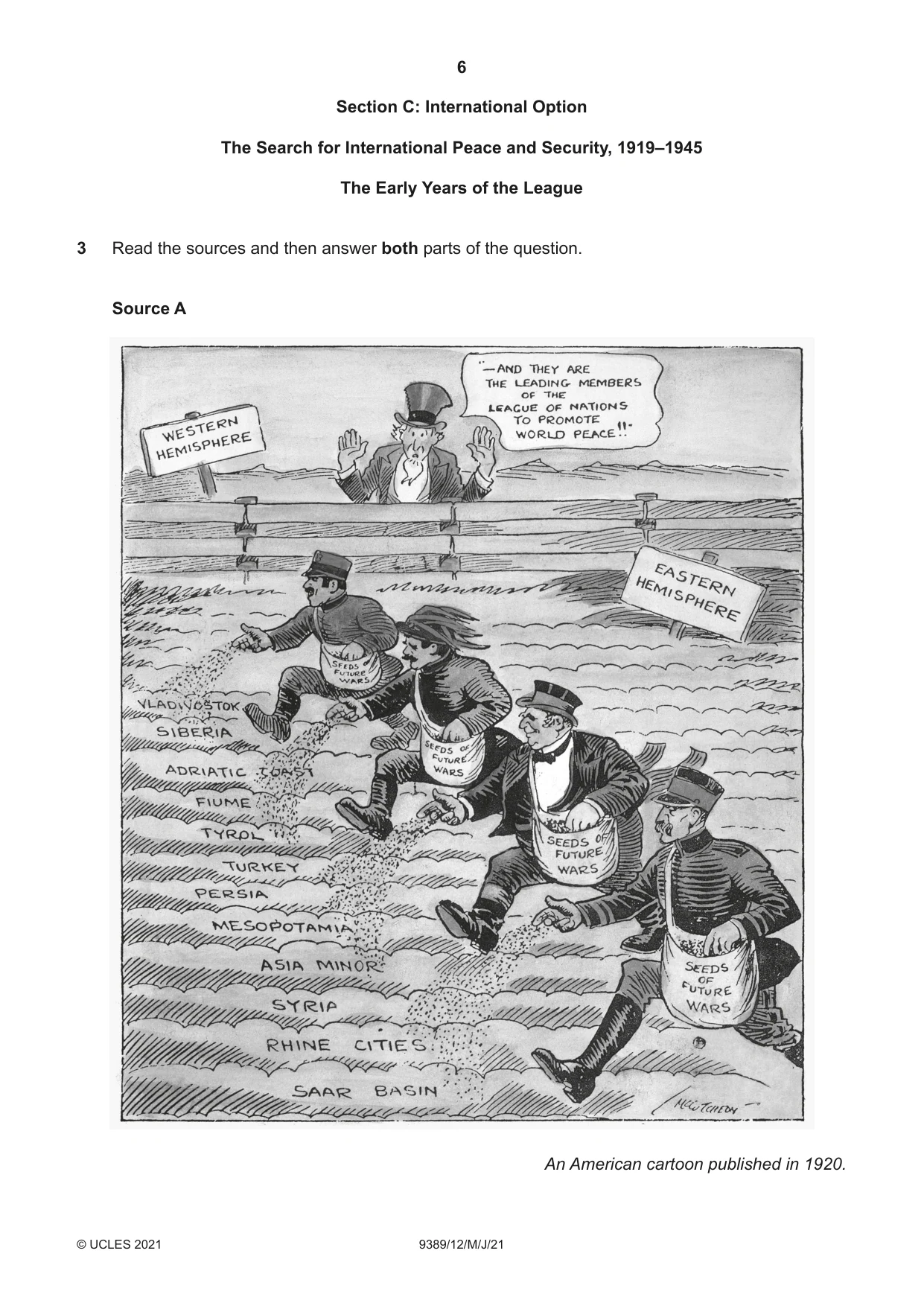
6 9389/12/M/J/21 © UCLES 2021 Section C: International Option The Search for International Peace and Security, 1919–1945 The Early Years of the League 3 Read the sources and then answer both parts of the question. Source A An American cartoon published in 1920.
Question paper, page 7
7 9389/12/M/J/21 © UCLES 2021 Source B I need hardly point out that we lack the means of control that would make the decisions of the League effective. We all want our actions to be effective, we do not want anybody to be able to make fun of us. We desire the security which is due under the Covenant if it is loyally observed. I have to say that at the present moment we do not feel that the securities are adequate. We can only feel secure when the German Republic is established on a stable foundation, and when it is filled with the ideas of justice, dignity and liberty, which are the ideals of the League. Meanwhile, France is obliged to maintain its military strength in order to avoid the resumption of war. It does not want to have lost a million and a half lives for nothing. From a speech to the League Assembly by a French delegate, 1921. Source C The one serious defect in the Covenant is the element of compulsory obligation, the attempt to promote peace by compelling members to take sanctions. This criticism of the Covenant does not imply any lack of support of the League of Nations. It is by far the most effective and hopeful instrument for the prevention of war and the promotion of international understanding that the world has seen. The main weakness of League procedures is the problem of securing delay. If adequate delay can be secured after notification of a dispute likely to lead to war, the greatest menace to peace will have been removed. If the League can secure delay and refer the matter to a commission of inquiry, it will succeed in its main purpose. The best way of achieving this is to leave the full responsibility for decisions about their action to each individual member. From an article from a British journal, 1924. Source D The League succeeded as long as governments, and particularly governments of the Great Powers, put their faith in it and supported it, and as long as the possibility could always be perceived in the background that their force would be put at the service of its decisions. In the period following the peace treaties the League settled various serious disputes: Memel, the Aaland Islands, Upper Silesia and the dispute between Greece and Bulgaria – all of them involving areas which might have become battlefields if the League had not settled the disputes in their initial stages. It is, indeed, the very success which it achieved in causing the disputes to be minimised that makes us forget all that it accomplished. From a speech by a French delegate at the last meeting of the Assembly, April 1946. Answer both parts of the question with reference to the sources. (a) To what extent do Sources B and C agree about how the League should work? [15] (b) How far do Sources A to D support the view that, from the beginning, the League was unlikely to succeed? [25]
Question paper, page 8
8 9389/12/M/J/21 © UCLES 2021 Permission to reproduce items where third-party owned material protected by copyright is included has been sought and cleared where possible. Every reasonable effort has been made by the publisher (UCLES) to trace copyright holders, but if any items requiring clearance have unwittingly been included, the publisher will be pleased to make amends at the earliest possible opportunity. To avoid the issue of disclosure of answer-related information to candidates, all copyright acknowledgements are reproduced online in the Cambridge Assessment International Education Copyright Acknowledgements Booklet. This is produced for each series of examinations and is freely available to download at www.cambridgeinternational.org after the live examination series. Cambridge Assessment International Education is part of the Cambridge Assessment Group. Cambridge Assessment is the brand name of the University of Cambridge Local Examinations Syndicate (UCLES), which itself is a department of the University of Cambridge. BLANK PAGE
Mark scheme, page 1
This document consists of 13 printed pages. © UCLES 2021 [Turn over Cambridge International AS & A Level HISTORY 9389/12 Paper 1 Document 12 May/June 2021 MARK SCHEME Maximum Mark: 40 Published This mark scheme is published as an aid to teachers and candidates, to indicate the requirements of the examination. It shows the basis on which Examiners were instructed to award marks. It does not indicate the details of the discussions that took place at an Examiners’ meeting before marking began, which would have considered the acceptability of alternative answers. Mark schemes should be read in conjunction with the question paper and the Principal Examiner Report for Teachers. Cambridge International will not enter into discussions about these mark schemes. Cambridge International is publishing the mark schemes for the May/June 2021 series for most Cambridge IGCSE™, Cambridge International A and AS Level components and some Cambridge O Level components.
Mark scheme, page 2
9389/12 Cambridge International AS & A Level – Mark Scheme PUBLISHED May/June 2021 © UCLES 2021 Page 2 of 13 Generic Marking Principles These general marking principles must be applied by all examiners when marking candidate answers. They should be applied alongside the specific content of the mark scheme or generic level descriptors for a question. Each question paper and mark scheme will also comply with these marking principles. GENERIC MARKING PRINCIPLE 1: Marks must be awarded in line with: • the specific content of the mark scheme or the generic level descriptors for the question • the specific skills defined in the mark scheme or in the generic level descriptors for the question • the standard of response required by a candidate as exemplified by the standardisation scripts. GENERIC MARKING PRINCIPLE 2: Marks awarded are always whole marks (not half marks, or other fractions). GENERIC MARKING PRINCIPLE 3: Marks must be awarded positively: • marks are awarded for correct/valid answers, as defined in the mark scheme. However, credit is given for valid answers which go beyond the scope of the syllabus and mark scheme, referring to your Team Leader as appropriate • marks are awarded when candidates clearly demonstrate what they know and can do • marks are not deducted for errors • marks are not deducted for omissions • answers should only be judged on the quality of spelling, punctuation and grammar when these features are specifically assessed by the question as indicated by the mark scheme. The meaning, however, should be unambiguous. GENERIC MARKING PRINCIPLE 4: Rules must be applied consistently, e.g. in situations where candidates have not followed instructions or in the application of generic level descriptors. GENERIC MARKING PRINCIPLE 5: Marks should be awarded using the full range of marks defined in the mark scheme for the question (however; the use of the full mark range may be limited according to the quality of the candidate responses seen). GENERIC MARKING PRINCIPLE 6: Marks awarded are based solely on the requirements as defined in the mark scheme. Marks should not be awarded with grade thresholds or grade descriptors in mind.
Mark scheme, page 3
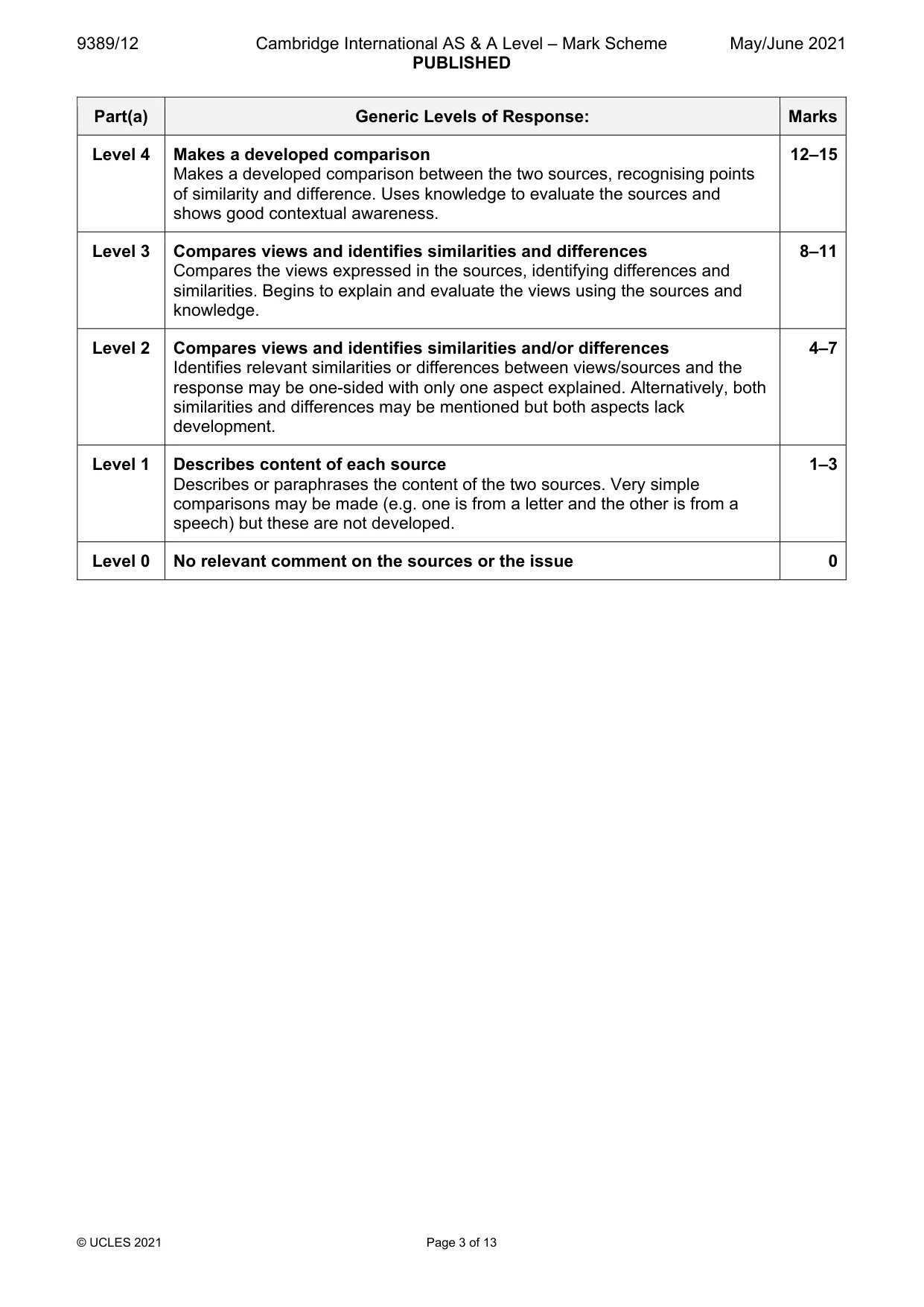
9389/12 Cambridge International AS & A Level – Mark Scheme PUBLISHED May/June 2021 © UCLES 2021 Page 3 of 13 Part(a) Generic Levels of Response: Marks Level 4 Makes a developed comparison Makes a developed comparison between the two sources, recognising points of similarity and difference. Uses knowledge to evaluate the sources and shows good contextual awareness. 12–15 Level 3 Compares views and identifies similarities and differences Compares the views expressed in the sources, identifying differences and similarities. Begins to explain and evaluate the views using the sources and knowledge. 8–11 Level 2 Compares views and identifies similarities and/or differences Identifies relevant similarities or differences between views/sources and the response may be one-sided with only one aspect explained. Alternatively, both similarities and differences may be mentioned but both aspects lack development. 4–7 Level 1 Describes content of each source Describes or paraphrases the content of the two sources. Very simple comparisons may be made (e.g. one is from a letter and the other is from a speech) but these are not developed. 1–3 Level 0 No relevant comment on the sources or the issue 0
Mark scheme, page 4
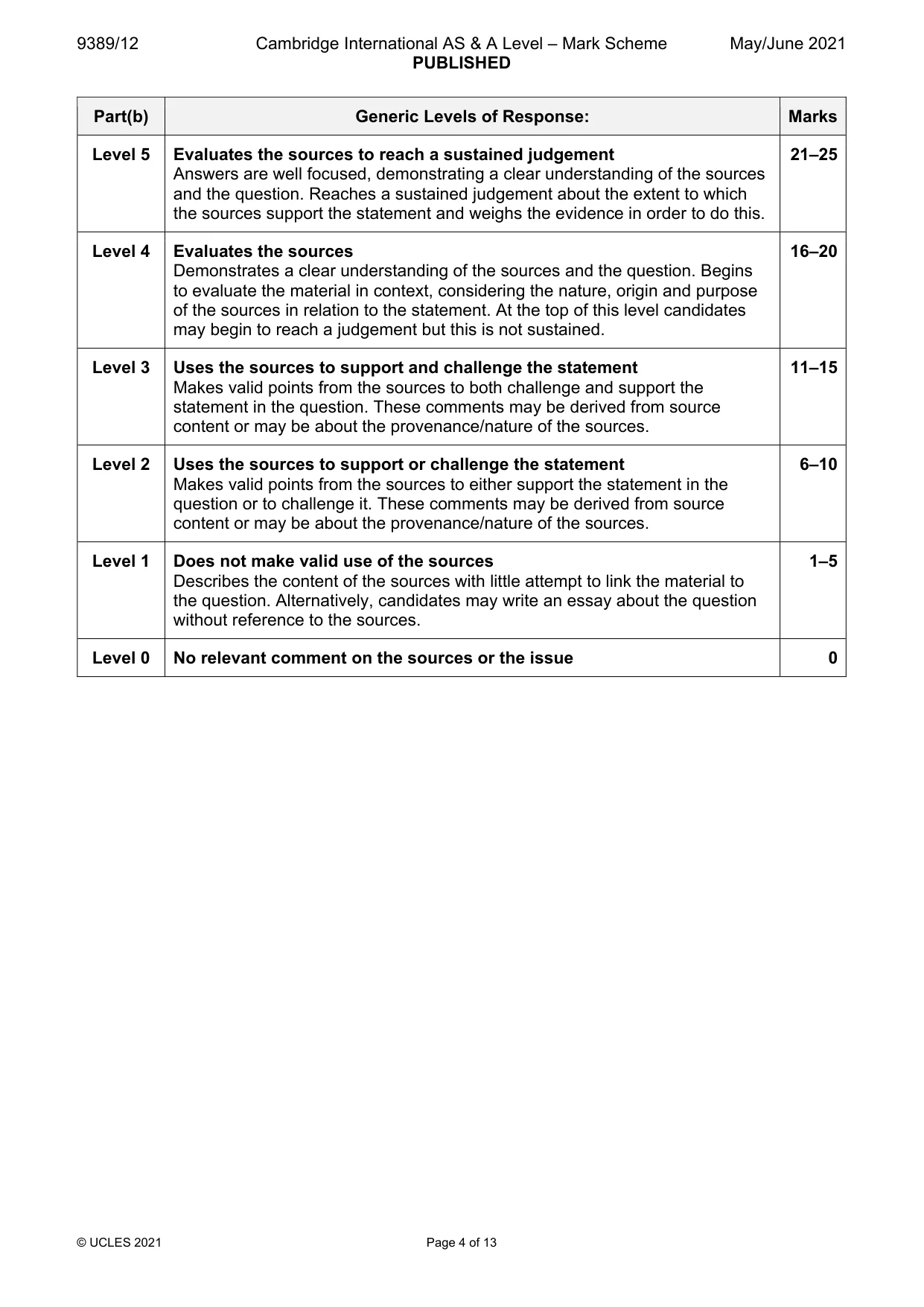
9389/12 Cambridge International AS & A Level – Mark Scheme PUBLISHED May/June 2021 © UCLES 2021 Page 4 of 13 Part(b) Generic Levels of Response: Marks Level 5 Evaluates the sources to reach a sustained judgement Answers are well focused, demonstrating a clear understanding of the sources and the question. Reaches a sustained judgement about the extent to which the sources support the statement and weighs the evidence in order to do this. 21–25 Level 4 Evaluates the sources Demonstrates a clear understanding of the sources and the question. Begins to evaluate the material in context, considering the nature, origin and purpose of the sources in relation to the statement. At the top of this level candidates may begin to reach a judgement but this is not sustained. 16–20 Level 3 Uses the sources to support and challenge the statement Makes valid points from the sources to both challenge and support the statement in the question. These comments may be derived from source content or may be about the provenance/nature of the sources. 11–15 Level 2 Uses the sources to support or challenge the statement Makes valid points from the sources to either support the statement in the question or to challenge it. These comments may be derived from source content or may be about the provenance/nature of the sources. 6–10 Level 1 Does not make valid use of the sources Describes the content of the sources with little attempt to link the material to the question. Alternatively, candidates may write an essay about the question without reference to the sources. 1–5 Level 0 No relevant comment on the sources or the issue 0
Mark scheme, page 5
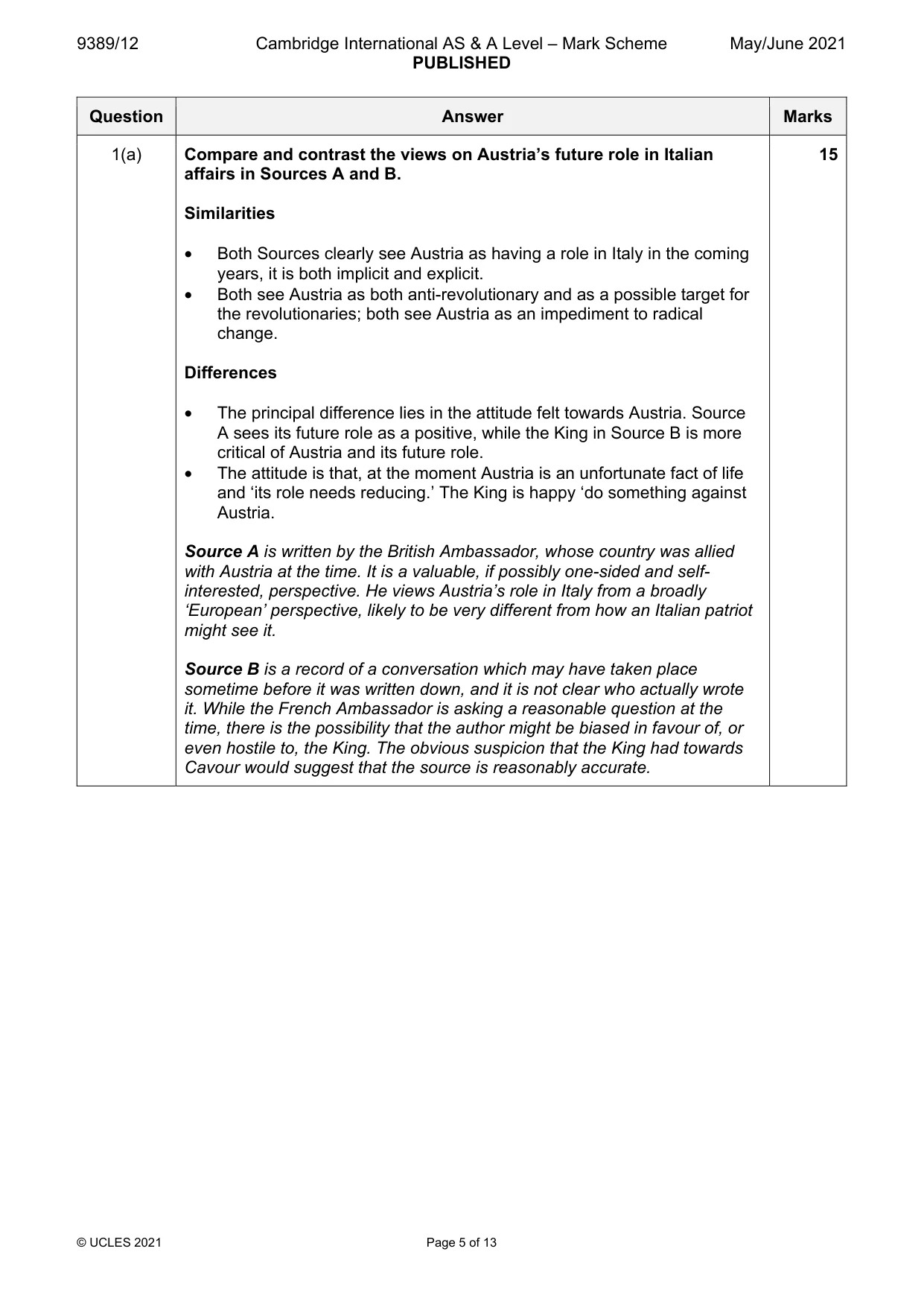
9389/12 Cambridge International AS & A Level – Mark Scheme PUBLISHED May/June 2021 © UCLES 2021 Page 5 of 13 Question Answer Marks 1(a) Compare and contrast the views on Austria’s future role in Italian affairs in Sources A and B. Similarities • Both Sources clearly see Austria as having a role in Italy in the coming years, it is both implicit and explicit. • Both see Austria as both anti-revolutionary and as a possible target for the revolutionaries; both see Austria as an impediment to radical change. Differences • The principal difference lies in the attitude felt towards Austria. Source A sees its future role as a positive, while the King in Source B is more critical of Austria and its future role. • The attitude is that, at the moment Austria is an unfortunate fact of life and ‘its role needs reducing.’ The King is happy ‘do something against Austria. Source A is written by the British Ambassador, whose country was allied with Austria at the time. It is a valuable, if possibly one-sided and self- interested, perspective. He views Austria’s role in Italy from a broadly ‘European’ perspective, likely to be very different from how an Italian patriot might see it. Source B is a record of a conversation which may have taken place sometime before it was written down, and it is not clear who actually wrote it. While the French Ambassador is asking a reasonable question at the time, there is the possibility that the author might be biased in favour of, or even hostile to, the King. The obvious suspicion that the King had towards Cavour would suggest that the source is reasonably accurate. 15
Mark scheme, page 6
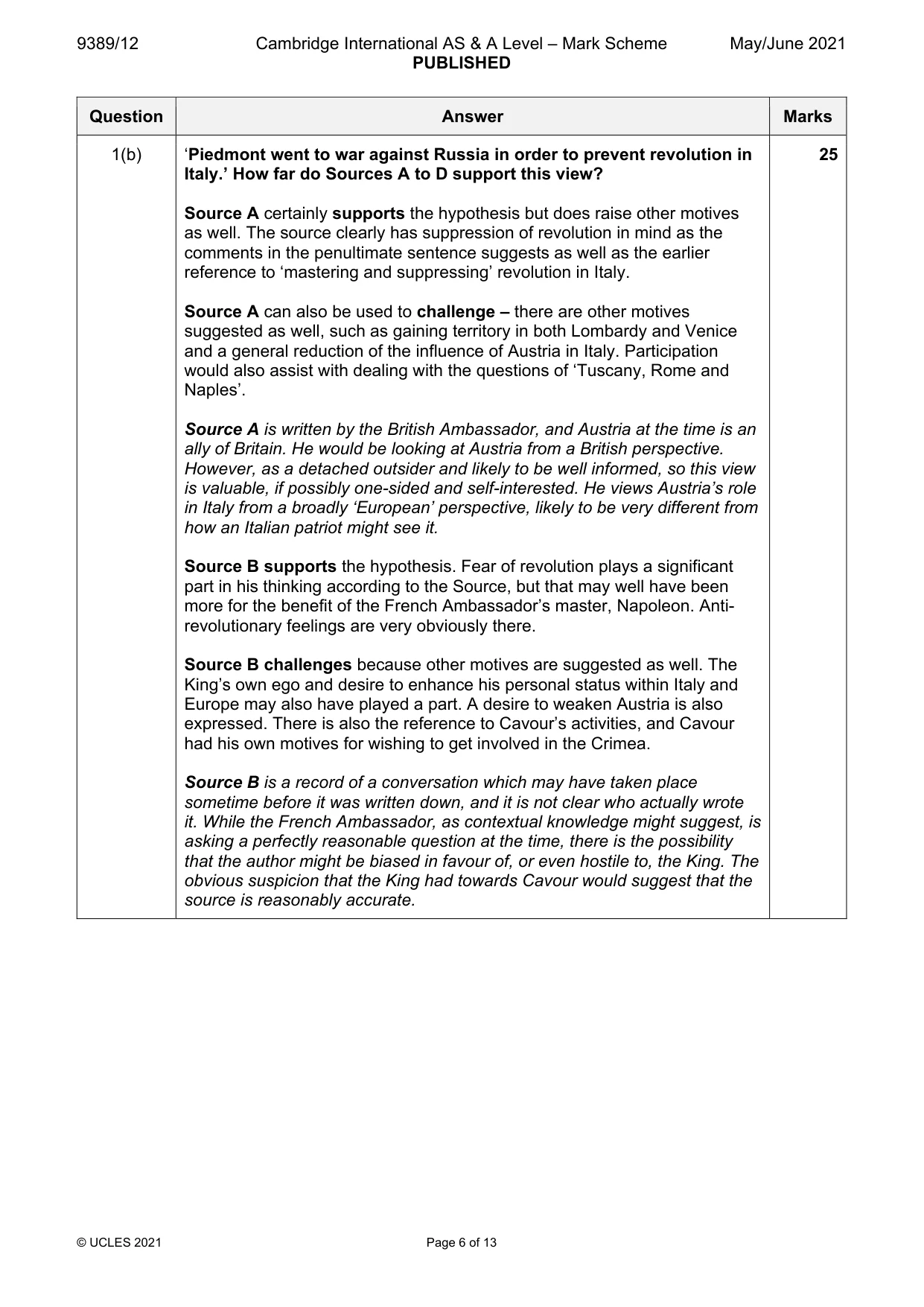
9389/12 Cambridge International AS & A Level – Mark Scheme PUBLISHED May/June 2021 © UCLES 2021 Page 6 of 13 Question Answer Marks 1(b) ‘Piedmont went to war against Russia in order to prevent revolution in Italy.’ How far do Sources A to D support this view? Source A certainly supports the hypothesis but does raise other motives as well. The source clearly has suppression of revolution in mind as the comments in the penultimate sentence suggests as well as the earlier reference to ‘mastering and suppressing’ revolution in Italy. Source A can also be used to challenge – there are other motives suggested as well, such as gaining territory in both Lombardy and Venice and a general reduction of the influence of Austria in Italy. Participation would also assist with dealing with the questions of ‘Tuscany, Rome and Naples’. Source A is written by the British Ambassador, and Austria at the time is an ally of Britain. He would be looking at Austria from a British perspective. However, as a detached outsider and likely to be well informed, so this view is valuable, if possibly one-sided and self-interested. He views Austria’s role in Italy from a broadly ‘European’ perspective, likely to be very different from how an Italian patriot might see it. Source B supports the hypothesis. Fear of revolution plays a significant part in his thinking according to the Source, but that may well have been more for the benefit of the French Ambassador’s master, Napoleon. Anti- revolutionary feelings are very obviously there. Source B challenges because other motives are suggested as well. The King’s own ego and desire to enhance his personal status within Italy and Europe may also have played a part. A desire to weaken Austria is also expressed. There is also the reference to Cavour’s activities, and Cavour had his own motives for wishing to get involved in the Crimea. Source B is a record of a conversation which may have taken place sometime before it was written down, and it is not clear who actually wrote it. While the French Ambassador, as contextual knowledge might suggest, is asking a perfectly reasonable question at the time, there is the possibility that the author might be biased in favour of, or even hostile to, the King. The obvious suspicion that the King had towards Cavour would suggest that the source is reasonably accurate. 25
Mark scheme, page 7
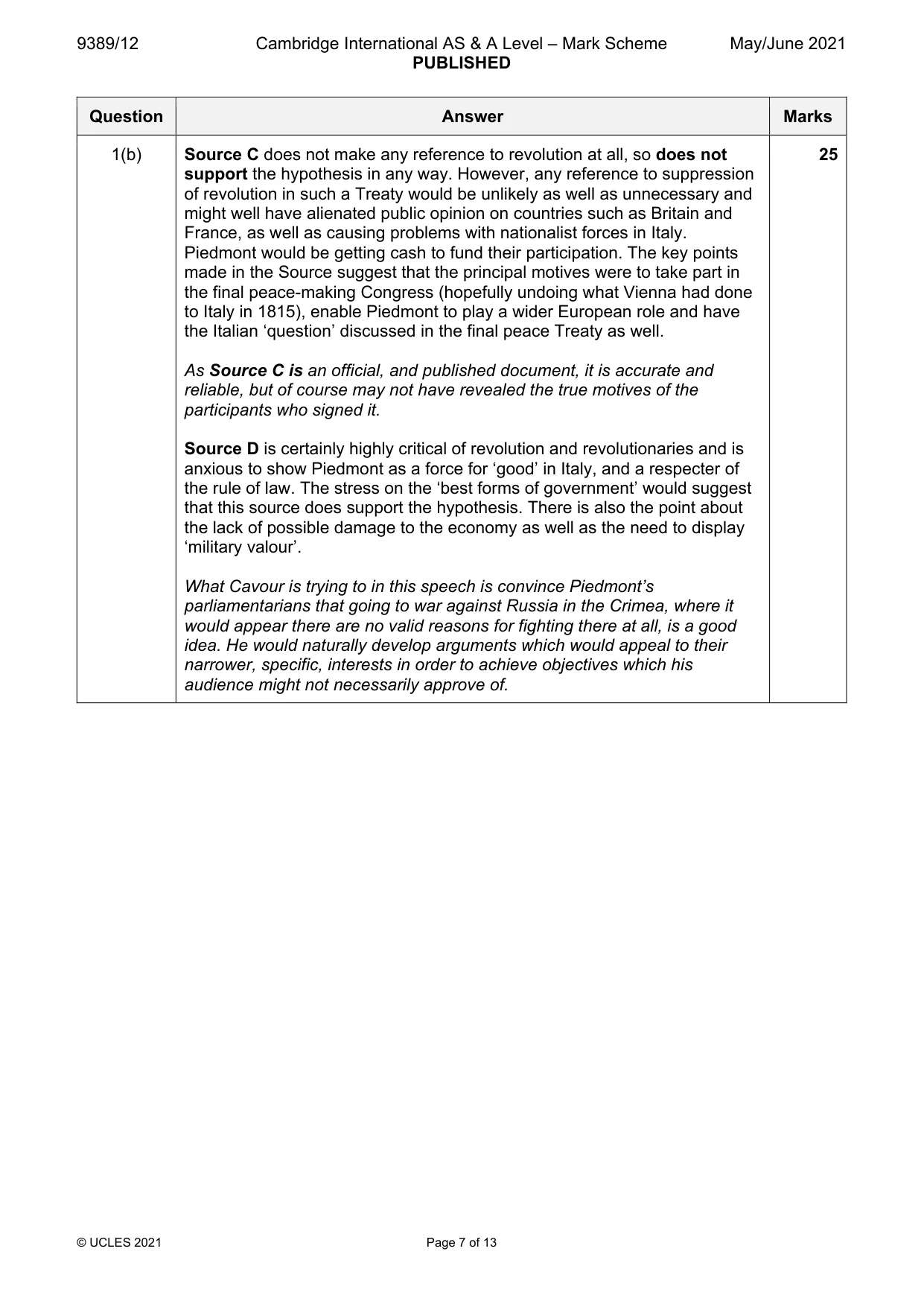
9389/12 Cambridge International AS & A Level – Mark Scheme PUBLISHED May/June 2021 © UCLES 2021 Page 7 of 13 Question Answer Marks 1(b) Source C does not make any reference to revolution at all, so does not support the hypothesis in any way. However, any reference to suppression of revolution in such a Treaty would be unlikely as well as unnecessary and might well have alienated public opinion on countries such as Britain and France, as well as causing problems with nationalist forces in Italy. Piedmont would be getting cash to fund their participation. The key points made in the Source suggest that the principal motives were to take part in the final peace-making Congress (hopefully undoing what Vienna had done to Italy in 1815), enable Piedmont to play a wider European role and have the Italian ‘question’ discussed in the final peace Treaty as well. As Source C is an official, and published document, it is accurate and reliable, but of course may not have revealed the true motives of the participants who signed it. Source D is certainly highly critical of revolution and revolutionaries and is anxious to show Piedmont as a force for ‘good’ in Italy, and a respecter of the rule of law. The stress on the ‘best forms of government’ would suggest that this source does support the hypothesis. There is also the point about the lack of possible damage to the economy as well as the need to display ‘military valour’. What Cavour is trying to in this speech is convince Piedmont’s parliamentarians that going to war against Russia in the Crimea, where it would appear there are no valid reasons for fighting there at all, is a good idea. He would naturally develop arguments which would appeal to their narrower, specific, interests in order to achieve objectives which his audience might not necessarily approve of. 25
Mark scheme, page 8
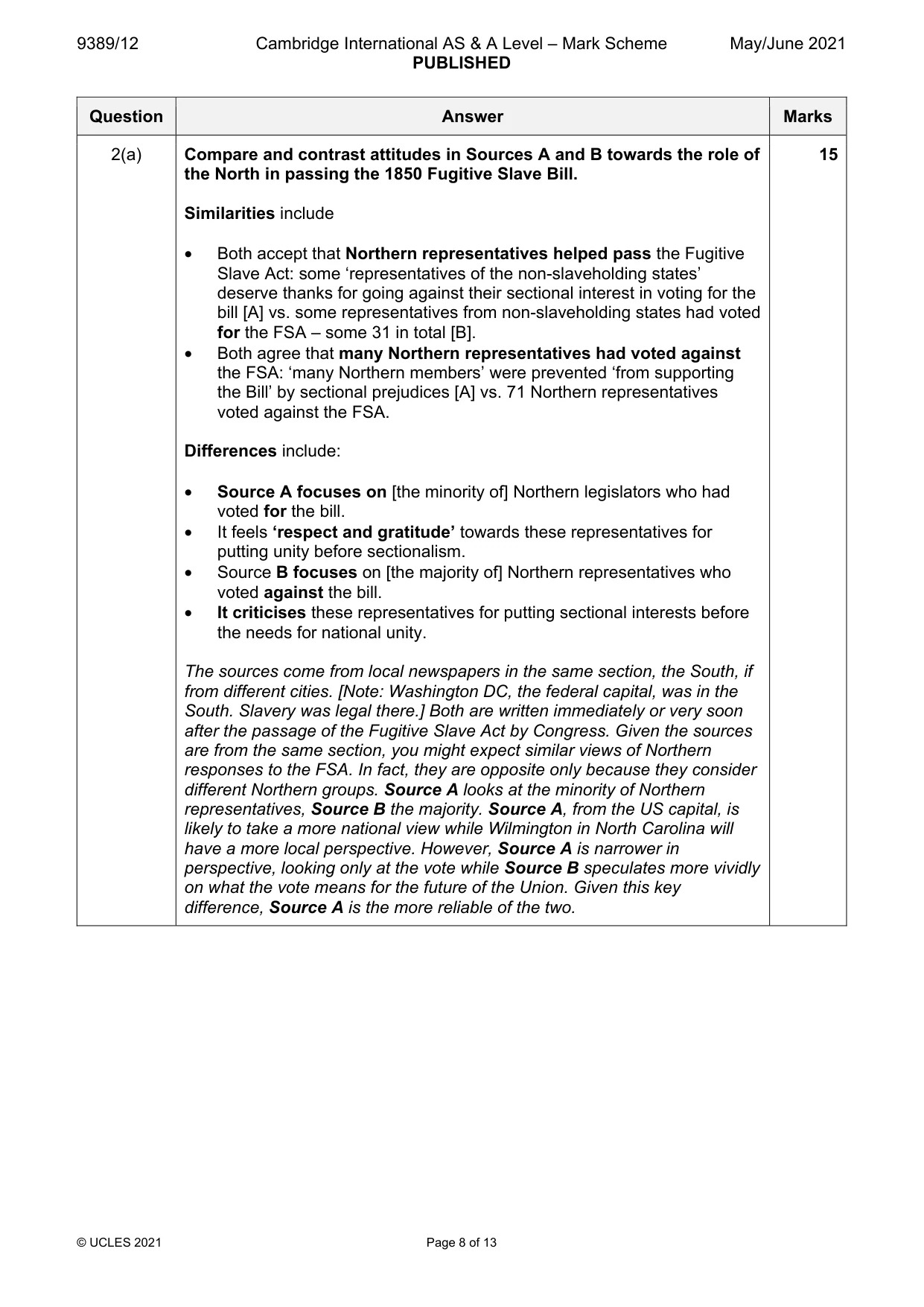
9389/12 Cambridge International AS & A Level – Mark Scheme PUBLISHED May/June 2021 © UCLES 2021 Page 8 of 13 Question Answer Marks 2(a) Compare and contrast attitudes in Sources A and B towards the role of the North in passing the 1850 Fugitive Slave Bill. Similarities include • Both accept that Northern representatives helped pass the Fugitive Slave Act: some ‘representatives of the non-slaveholding states’ deserve thanks for going against their sectional interest in voting for the bill [A] vs. some representatives from non-slaveholding states had voted for the FSA – some 31 in total [B]. • Both agree that many Northern representatives had voted against the FSA: ‘many Northern members’ were prevented ‘from supporting the Bill’ by sectional prejudices [A] vs. 71 Northern representatives voted against the FSA. Differences include: • Source A focuses on [the minority of] Northern legislators who had voted for the bill. • It feels ‘respect and gratitude’ towards these representatives for putting unity before sectionalism. • Source B focuses on [the majority of] Northern representatives who voted against the bill. • It criticises these representatives for putting sectional interests before the needs for national unity. The sources come from local newspapers in the same section, the South, if from different cities. [Note: Washington DC, the federal capital, was in the South. Slavery was legal there.] Both are written immediately or very soon after the passage of the Fugitive Slave Act by Congress. Given the sources are from the same section, you might expect similar views of Northern responses to the FSA. In fact, they are opposite only because they consider different Northern groups. Source A looks at the minority of Northern representatives, Source B the majority. Source A, from the US capital, is likely to take a more national view while Wilmington in North Carolina will have a more local perspective. However, Source A is narrower in perspective, looking only at the vote while Source B speculates more vividly on what the vote means for the future of the Union. Given this key difference, Source A is the more reliable of the two. 15
Mark scheme, page 9
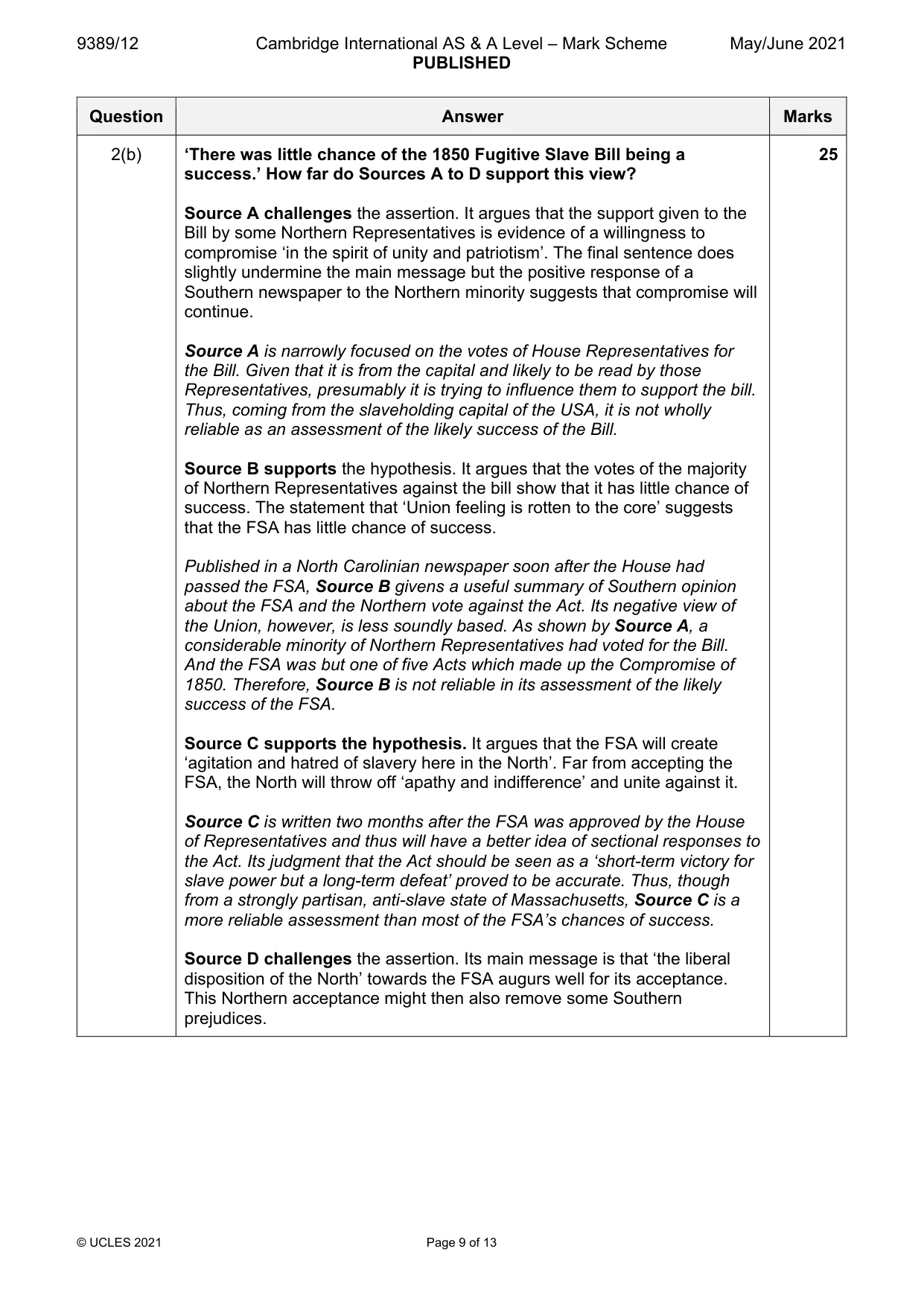
9389/12 Cambridge International AS & A Level – Mark Scheme PUBLISHED May/June 2021 © UCLES 2021 Page 9 of 13 Question Answer Marks 2(b) ‘There was little chance of the 1850 Fugitive Slave Bill being a success.’ How far do Sources A to D support this view? Source A challenges the assertion. It argues that the support given to the Bill by some Northern Representatives is evidence of a willingness to compromise ‘in the spirit of unity and patriotism’. The final sentence does slightly undermine the main message but the positive response of a Southern newspaper to the Northern minority suggests that compromise will continue. Source A is narrowly focused on the votes of House Representatives for the Bill. Given that it is from the capital and likely to be read by those Representatives, presumably it is trying to influence them to support the bill. Thus, coming from the slaveholding capital of the USA, it is not wholly reliable as an assessment of the likely success of the Bill. Source B supports the hypothesis. It argues that the votes of the majority of Northern Representatives against the bill show that it has little chance of success. The statement that ‘Union feeling is rotten to the core’ suggests that the FSA has little chance of success. Published in a North Carolinian newspaper soon after the House had passed the FSA, Source B givens a useful summary of Southern opinion about the FSA and the Northern vote against the Act. Its negative view of the Union, however, is less soundly based. As shown by Source A, a considerable minority of Northern Representatives had voted for the Bill. And the FSA was but one of five Acts which made up the Compromise of 1850. Therefore, Source B is not reliable in its assessment of the likely success of the FSA. Source C supports the hypothesis. It argues that the FSA will create ‘agitation and hatred of slavery here in the North’. Far from accepting the FSA, the North will throw off ‘apathy and indifference’ and unite against it. Source C is written two months after the FSA was approved by the House of Representatives and thus will have a better idea of sectional responses to the Act. Its judgment that the Act should be seen as a ‘short-term victory for slave power but a long-term defeat’ proved to be accurate. Thus, though from a strongly partisan, anti-slave state of Massachusetts, Source C is a more reliable assessment than most of the FSA’s chances of success. Source D challenges the assertion. Its main message is that ‘the liberal disposition of the North’ towards the FSA augurs well for its acceptance. This Northern acceptance might then also remove some Southern prejudices. 25
Mark scheme, page 10
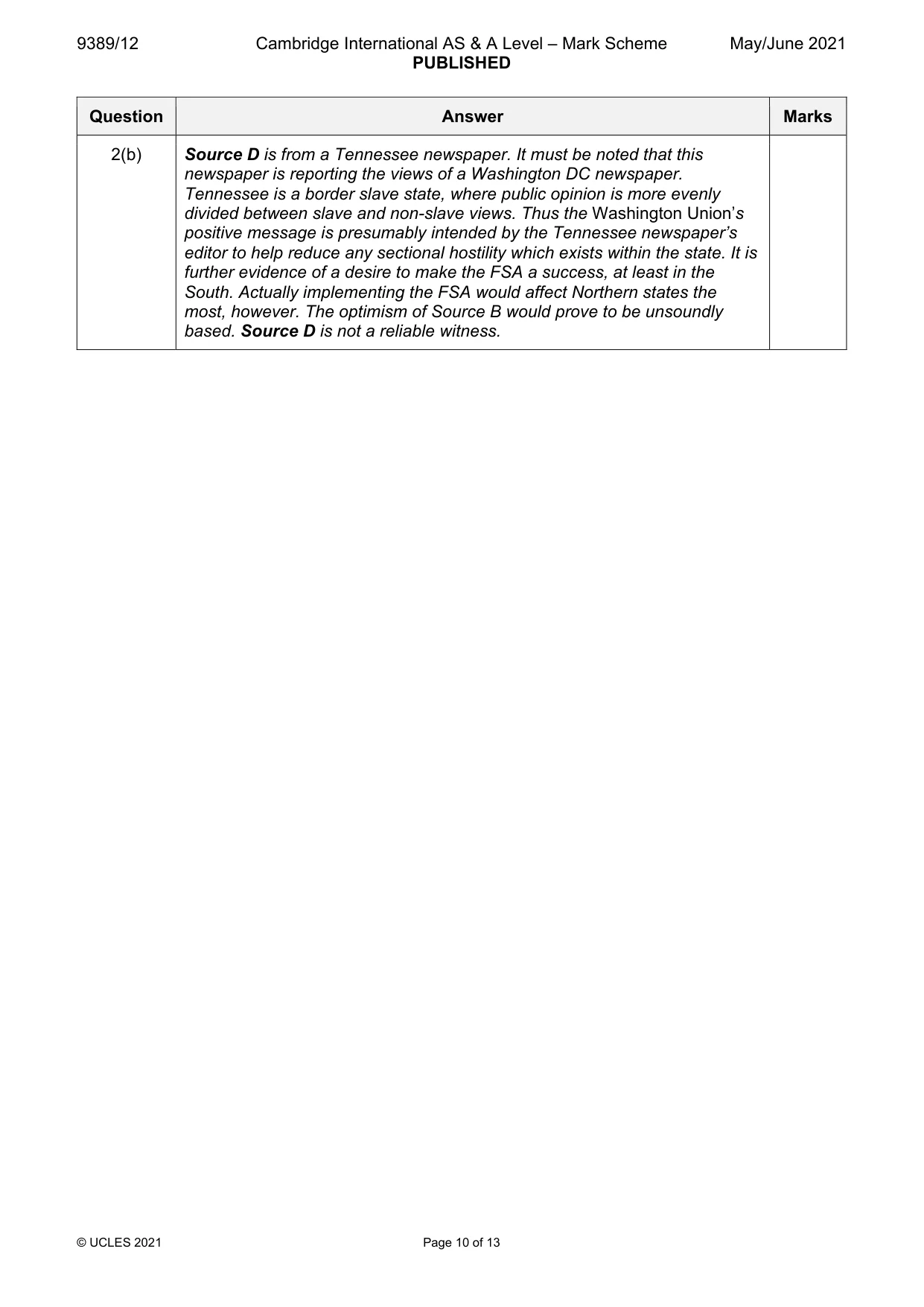
9389/12 Cambridge International AS & A Level – Mark Scheme PUBLISHED May/June 2021 © UCLES 2021 Page 10 of 13 Question Answer Marks 2(b) Source D is from a Tennessee newspaper. It must be noted that this newspaper is reporting the views of a Washington DC newspaper. Tennessee is a border slave state, where public opinion is more evenly divided between slave and non-slave views. Thus the Washington Union’s positive message is presumably intended by the Tennessee newspaper’s editor to help reduce any sectional hostility which exists within the state. It is further evidence of a desire to make the FSA a success, at least in the South. Actually implementing the FSA would affect Northern states the most, however. The optimism of Source B would prove to be unsoundly based. Source D is not a reliable witness.
Mark scheme, page 11
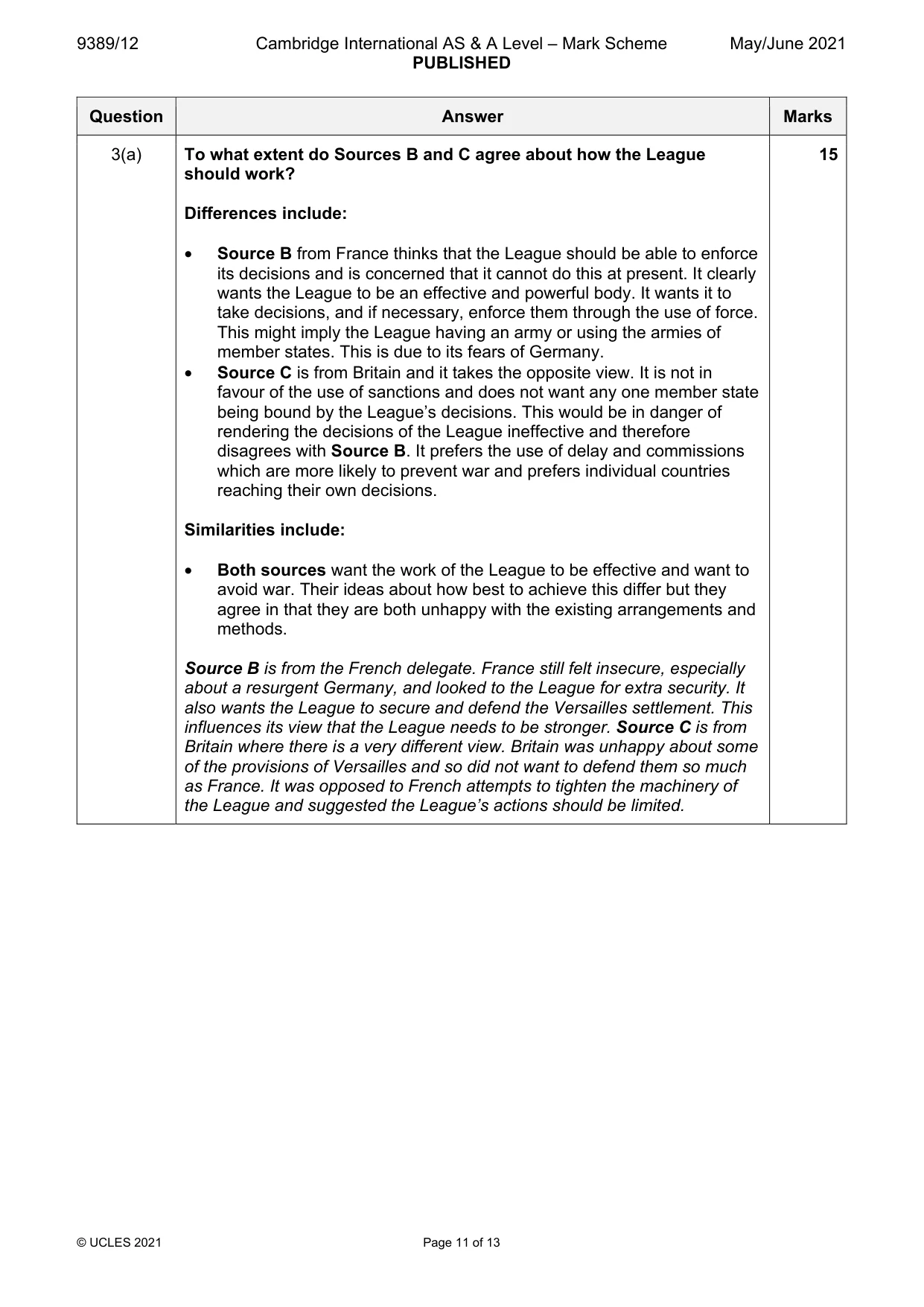
9389/12 Cambridge International AS & A Level – Mark Scheme PUBLISHED May/June 2021 © UCLES 2021 Page 11 of 13 Question Answer Marks 3(a) To what extent do Sources B and C agree about how the League should work? Differences include: • Source B from France thinks that the League should be able to enforce its decisions and is concerned that it cannot do this at present. It clearly wants the League to be an effective and powerful body. It wants it to take decisions, and if necessary, enforce them through the use of force. This might imply the League having an army or using the armies of member states. This is due to its fears of Germany. • Source C is from Britain and it takes the opposite view. It is not in favour of the use of sanctions and does not want any one member state being bound by the League’s decisions. This would be in danger of rendering the decisions of the League ineffective and therefore disagrees with Source B. It prefers the use of delay and commissions which are more likely to prevent war and prefers individual countries reaching their own decisions. Similarities include: • Both sources want the work of the League to be effective and want to avoid war. Their ideas about how best to achieve this differ but they agree in that they are both unhappy with the existing arrangements and methods. Source B is from the French delegate. France still felt insecure, especially about a resurgent Germany, and looked to the League for extra security. It also wants the League to secure and defend the Versailles settlement. This influences its view that the League needs to be stronger. Source C is from Britain where there is a very different view. Britain was unhappy about some of the provisions of Versailles and so did not want to defend them so much as France. It was opposed to French attempts to tighten the machinery of the League and suggested the League’s actions should be limited. 15
Mark scheme, page 12
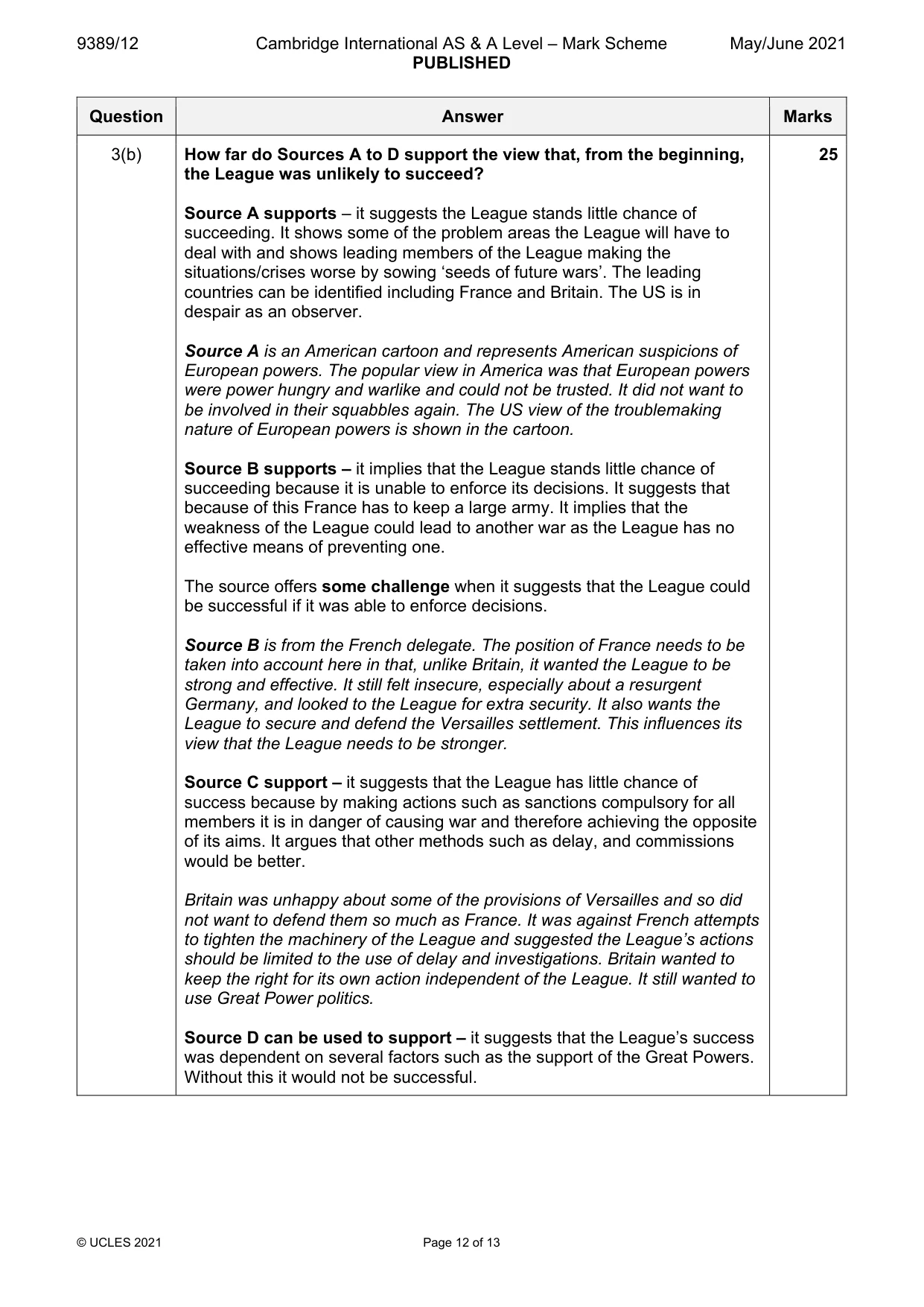
9389/12 Cambridge International AS & A Level – Mark Scheme PUBLISHED May/June 2021 © UCLES 2021 Page 12 of 13 Question Answer Marks 3(b) How far do Sources A to D support the view that, from the beginning, the League was unlikely to succeed? Source A supports – it suggests the League stands little chance of succeeding. It shows some of the problem areas the League will have to deal with and shows leading members of the League making the situations/crises worse by sowing ‘seeds of future wars’. The leading countries can be identified including France and Britain. The US is in despair as an observer. Source A is an American cartoon and represents American suspicions of European powers. The popular view in America was that European powers were power hungry and warlike and could not be trusted. It did not want to be involved in their squabbles again. The US view of the troublemaking nature of European powers is shown in the cartoon. Source B supports – it implies that the League stands little chance of succeeding because it is unable to enforce its decisions. It suggests that because of this France has to keep a large army. It implies that the weakness of the League could lead to another war as the League has no effective means of preventing one. The source offers some challenge when it suggests that the League could be successful if it was able to enforce decisions. Source B is from the French delegate. The position of France needs to be taken into account here in that, unlike Britain, it wanted the League to be strong and effective. It still felt insecure, especially about a resurgent Germany, and looked to the League for extra security. It also wants the League to secure and defend the Versailles settlement. This influences its view that the League needs to be stronger. Source C support – it suggests that the League has little chance of success because by making actions such as sanctions compulsory for all members it is in danger of causing war and therefore achieving the opposite of its aims. It argues that other methods such as delay, and commissions would be better. Britain was unhappy about some of the provisions of Versailles and so did not want to defend them so much as France. It was against French attempts to tighten the machinery of the League and suggested the League’s actions should be limited to the use of delay and investigations. Britain wanted to keep the right for its own action independent of the League. It still wanted to use Great Power politics. Source D can be used to support – it suggests that the League’s success was dependent on several factors such as the support of the Great Powers. Without this it would not be successful. 25
Mark scheme, page 13
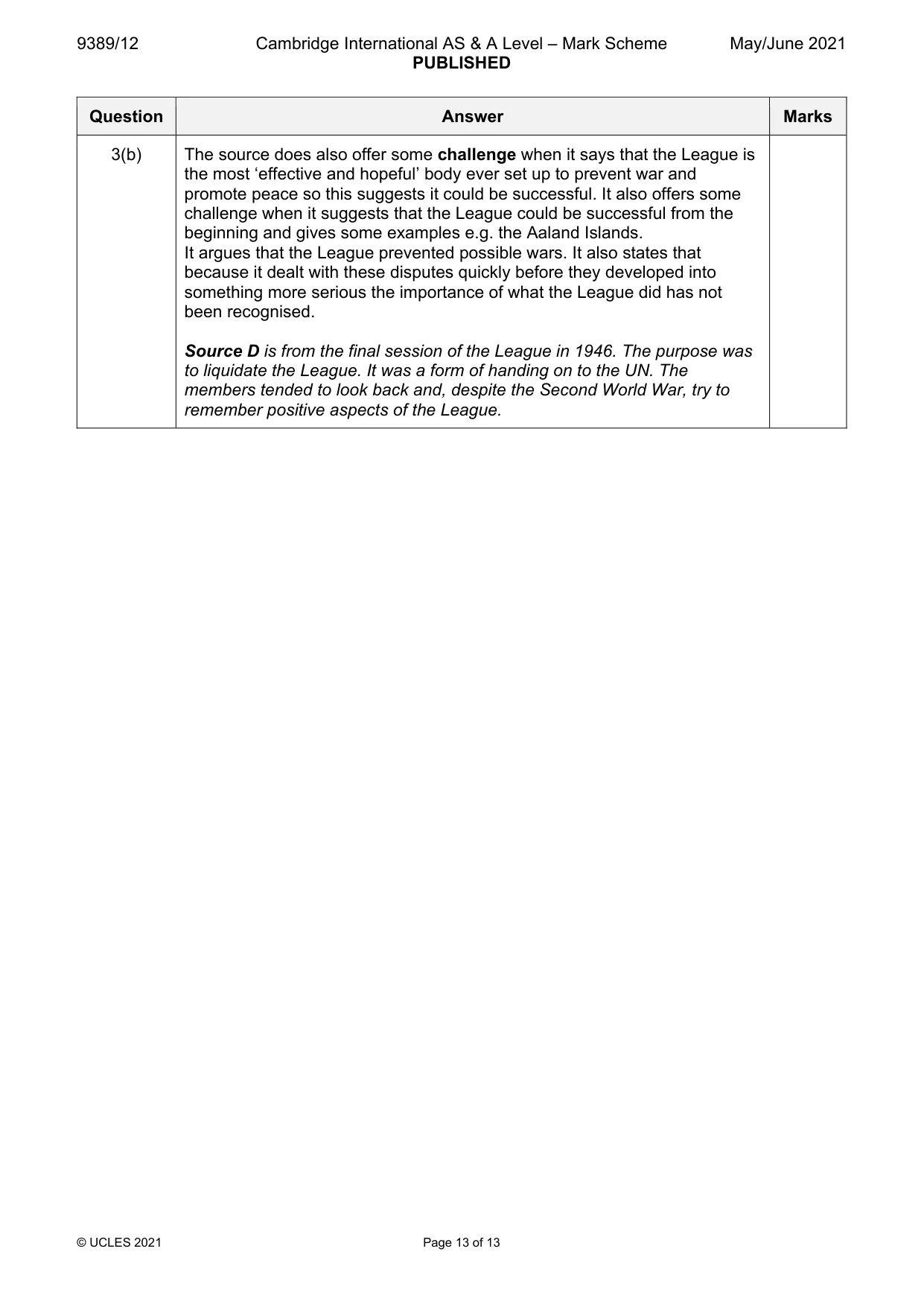
9389/12 Cambridge International AS & A Level – Mark Scheme PUBLISHED May/June 2021 © UCLES 2021 Page 13 of 13 Question Answer Marks 3(b) The source does also offer some challenge when it says that the League is the most ‘effective and hopeful’ body ever set up to prevent war and promote peace so this suggests it could be successful. It also offers some challenge when it suggests that the League could be successful from the beginning and gives some examples e.g. the Aaland Islands. It argues that the League prevented possible wars. It also states that because it dealt with these disputes quickly before they developed into something more serious the importance of what the League did has not been recognised. Source D is from the final session of the League in 1946. The purpose was to liquidate the League. It was a form of handing on to the UN. The members tended to look back and, despite the Second World War, try to remember positive aspects of the League.
What you needed in this session
Cambridge’s own grade thresholds for 2021 May/June, Paper 1 · Variant 2. A higher threshold means an easier paper — the bar moves with how the cohort did.