Cambridge A Level History 9389 — 2021 May/June Paper 1 · Variant 1
9389/11/M/J/21 · 40 marks · ≈45 min
The question paper and its mark scheme, free to read here and free to download. This is Cambridge’s own paper, exactly as it was sat.
Question paper8 pages

Mark scheme10 pages
Answers below. Sit the paper first if you are practising.
Paper as text
Question paper, page 1
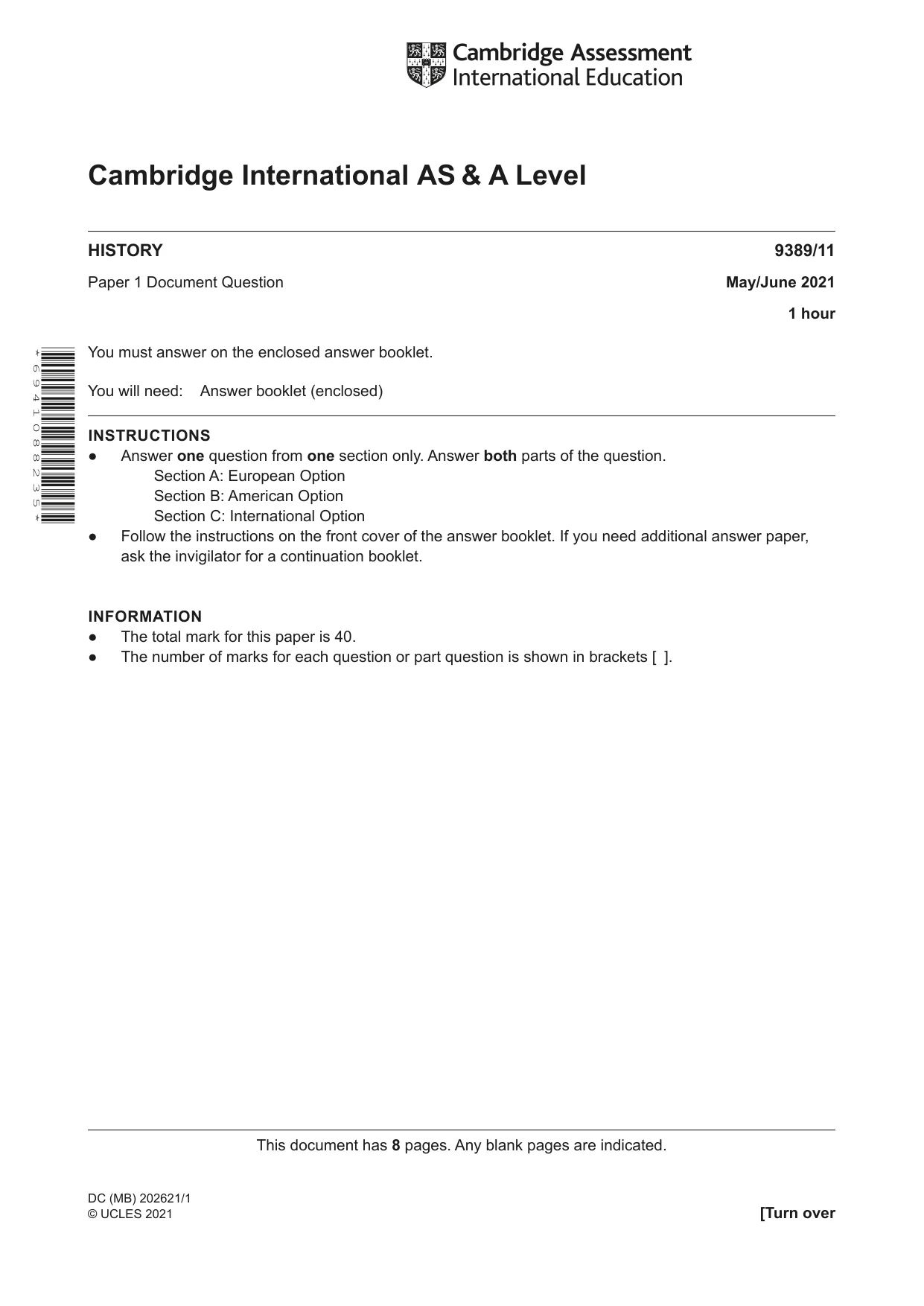
This document has 8 pages. Any blank pages are indicated. Cambridge International AS & A Level * 6 9 4 1 0 8 8 2 3 5 * DC (MB) 202621/1 © UCLES 2021 [Turn over HISTORY 9389/11 Paper 1 Document Question May/June 2021 1 hour You must answer on the enclosed answer booklet. You will need: Answer booklet (enclosed) INSTRUCTIONS ● Answer one question from one section only. Answer both parts of the question. Section A: European Option Section B: American Option Section C: International Option ● Follow the instructions on the front cover of the answer booklet. If you need additional answer paper, ask the invigilator for a continuation booklet. INFORMATION ● The total mark for this paper is 40. ● The number of marks for each question or part question is shown in brackets [ ].
Question paper, page 2
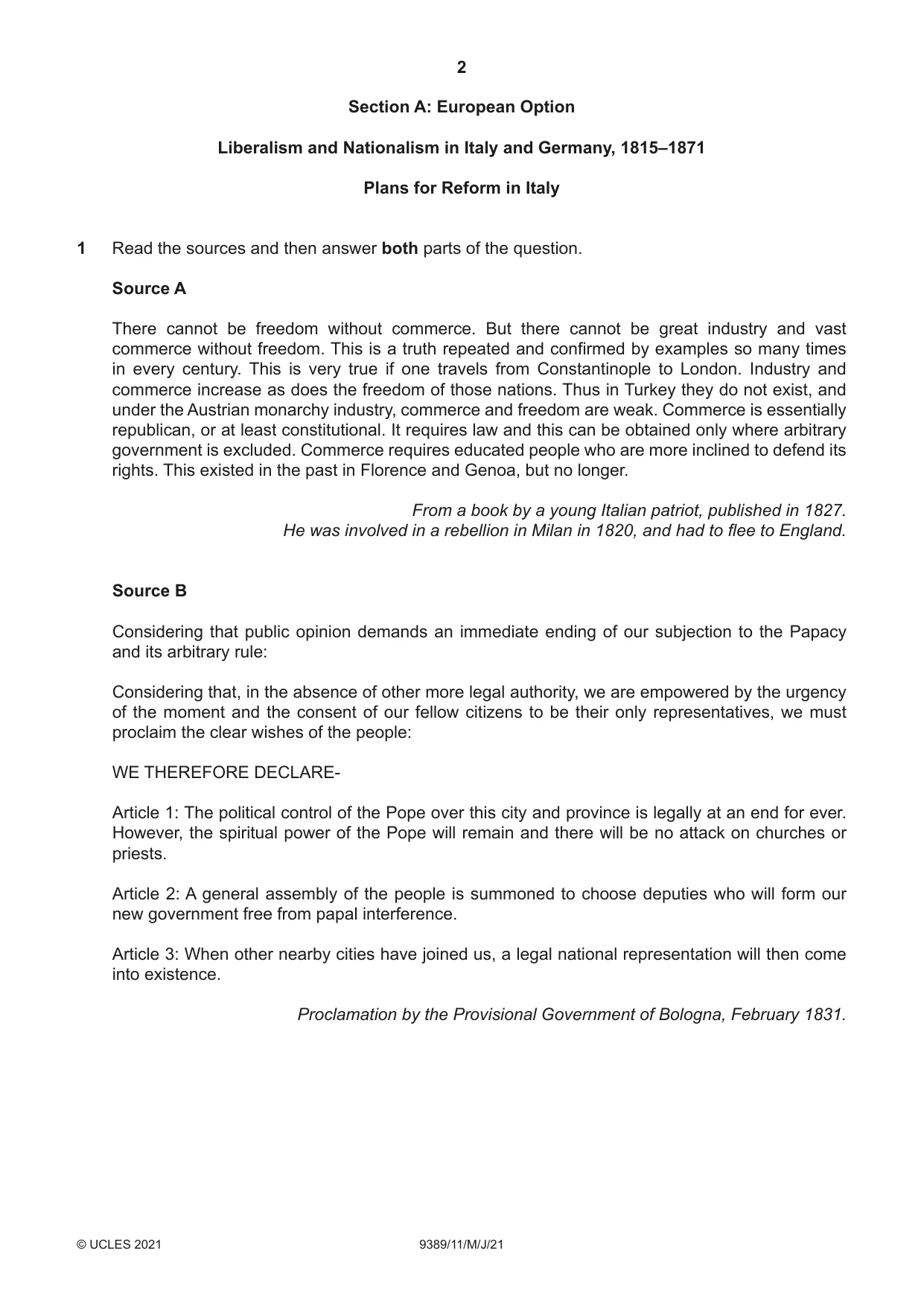
2 9389/11/M/J/21 © UCLES 2021 Section A: European Option Liberalism and Nationalism in Italy and Germany, 1815–1871 Plans for Reform in Italy 1 Read the sources and then answer both parts of the question. Source A There cannot be freedom without commerce. But there cannot be great industry and vast commerce without freedom. This is a truth repeated and confirmed by examples so many times in every century. This is very true if one travels from Constantinople to London. Industry and commerce increase as does the freedom of those nations. Thus in Turkey they do not exist, and under the Austrian monarchy industry, commerce and freedom are weak. Commerce is essentially republican, or at least constitutional. It requires law and this can be obtained only where arbitrary government is excluded. Commerce requires educated people who are more inclined to defend its rights. This existed in the past in Florence and Genoa, but no longer. From a book by a young Italian patriot, published in 1827. He was involved in a rebellion in Milan in 1820, and had to flee to England. Source B Considering that public opinion demands an immediate ending of our subjection to the Papacy and its arbitrary rule: Considering that, in the absence of other more legal authority, we are empowered by the urgency of the moment and the consent of our fellow citizens to be their only representatives, we must proclaim the clear wishes of the people: WE THEREFORE DECLARE- Article 1: The political control of the Pope over this city and province is legally at an end for ever. However, the spiritual power of the Pope will remain and there will be no attack on churches or priests. Article 2: A general assembly of the people is summoned to choose deputies who will form our new government free from papal interference. Article 3: When other nearby cities have joined us, a legal national representation will then come into existence. Proclamation by the Provisional Government of Bologna, February 1831.
Question paper, page 3
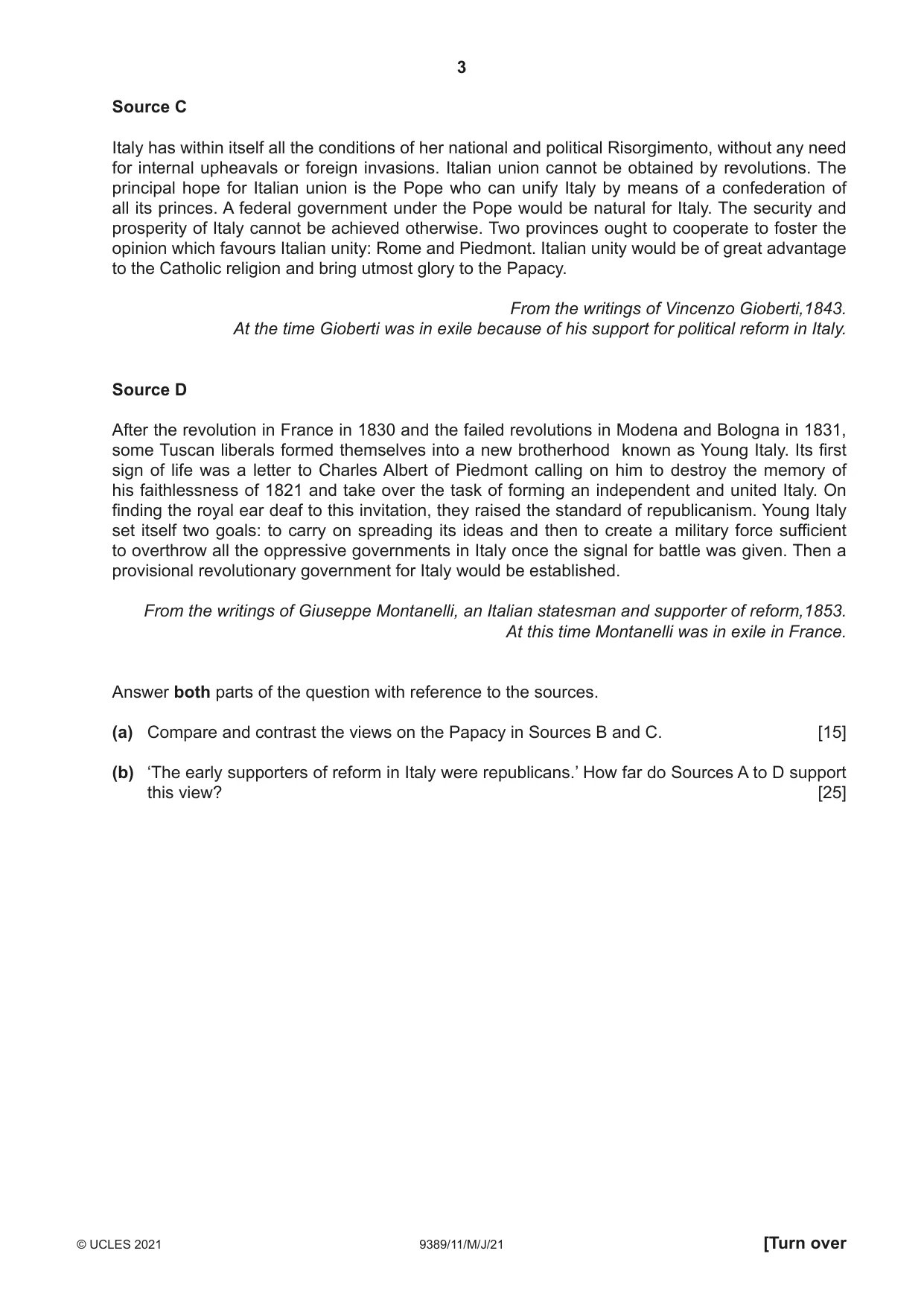
3 9389/11/M/J/21 © UCLES 2021 [Turn over Source C Italy has within itself all the conditions of her national and political Risorgimento, without any need for internal upheavals or foreign invasions. Italian union cannot be obtained by revolutions. The principal hope for Italian union is the Pope who can unify Italy by means of a confederation of all its princes. A federal government under the Pope would be natural for Italy. The security and prosperity of Italy cannot be achieved otherwise. Two provinces ought to cooperate to foster the opinion which favours Italian unity: Rome and Piedmont. Italian unity would be of great advantage to the Catholic religion and bring utmost glory to the Papacy. From the writings of Vincenzo Gioberti,1843. At the time Gioberti was in exile because of his support for political reform in Italy. Source D After the revolution in France in 1830 and the failed revolutions in Modena and Bologna in 1831, some Tuscan liberals formed themselves into a new brotherhood known as Young Italy. Its first sign of life was a letter to Charles Albert of Piedmont calling on him to destroy the memory of his faithlessness of 1821 and take over the task of forming an independent and united Italy. On finding the royal ear deaf to this invitation, they raised the standard of republicanism. Young Italy set itself two goals: to carry on spreading its ideas and then to create a military force sufficient to overthrow all the oppressive governments in Italy once the signal for battle was given. Then a provisional revolutionary government for Italy would be established. From the writings of Giuseppe Montanelli, an Italian statesman and supporter of reform,1853. At this time Montanelli was in exile in France. Answer both parts of the question with reference to the sources. (a) Compare and contrast the views on the Papacy in Sources B and C. [15] (b) ‘The early supporters of reform in Italy were republicans.’ How far do Sources A to D support this view? [25]
Question paper, page 4
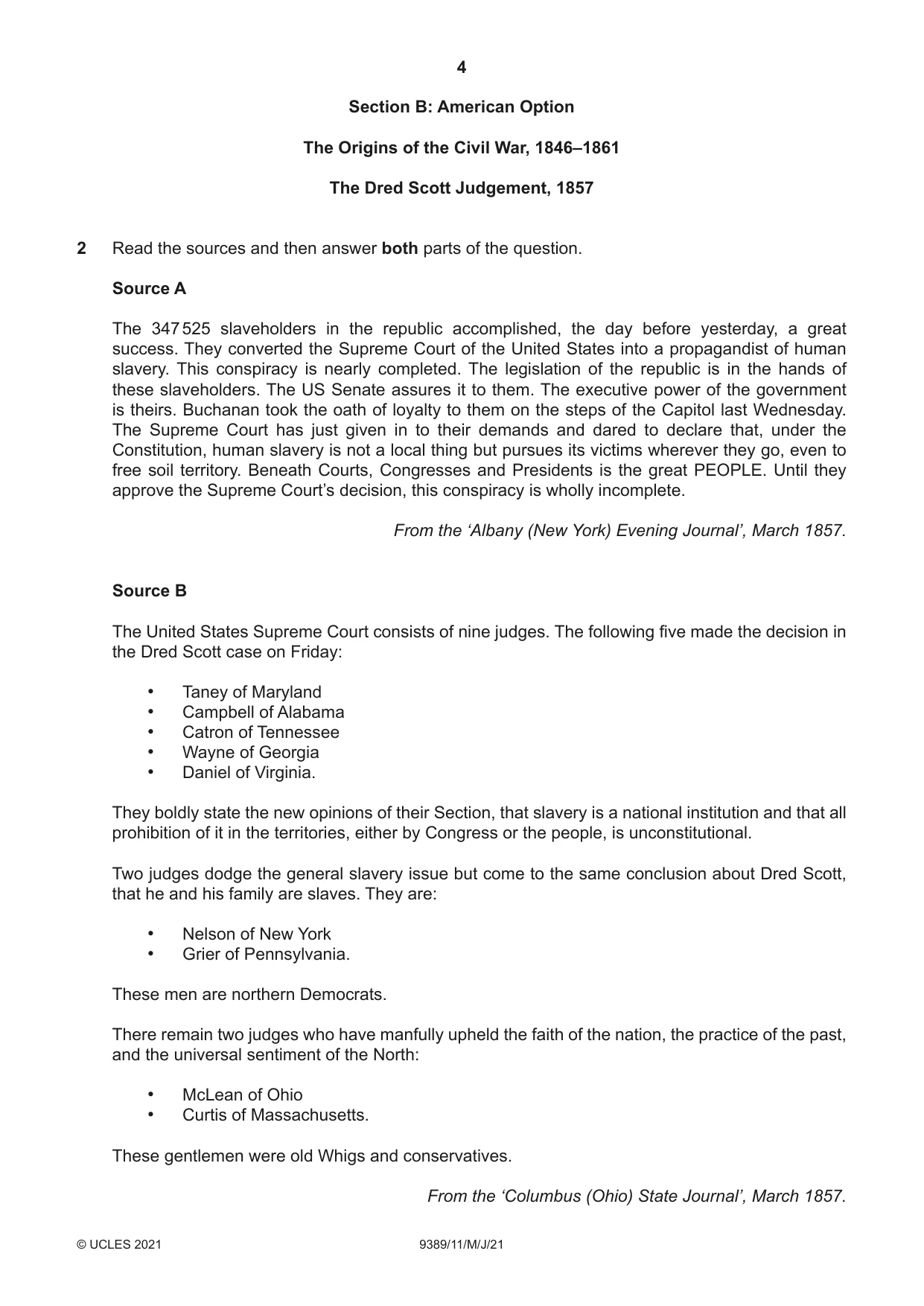
4 9389/11/M/J/21 © UCLES 2021 Section B: American Option The Origins of the Civil War, 1846–1861 The Dred Scott Judgement, 1857 2 Read the sources and then answer both parts of the question. Source A The 347 525 slaveholders in the republic accomplished, the day before yesterday, a great success. They converted the Supreme Court of the United States into a propagandist of human slavery. This conspiracy is nearly completed. The legislation of the republic is in the hands of these slaveholders. The US Senate assures it to them. The executive power of the government is theirs. Buchanan took the oath of loyalty to them on the steps of the Capitol last Wednesday. The Supreme Court has just given in to their demands and dared to declare that, under the Constitution, human slavery is not a local thing but pursues its victims wherever they go, even to free soil territory. Beneath Courts, Congresses and Presidents is the great PEOPLE. Until they approve the Supreme Court’s decision, this conspiracy is wholly incomplete. From the ‘Albany (New York) Evening Journal’, March 1857. Source B The United States Supreme Court consists of nine judges. The following five made the decision in the Dred Scott case on Friday: • Taney of Maryland • Campbell of Alabama • Catron of Tennessee • Wayne of Georgia • Daniel of Virginia. They boldly state the new opinions of their Section, that slavery is a national institution and that all prohibition of it in the territories, either by Congress or the people, is unconstitutional. Two judges dodge the general slavery issue but come to the same conclusion about Dred Scott, that he and his family are slaves. They are: • Nelson of New York • Grier of Pennsylvania. These men are northern Democrats. There remain two judges who have manfully upheld the faith of the nation, the practice of the past, and the universal sentiment of the North: • McLean of Ohio • Curtis of Massachusetts. These gentlemen were old Whigs and conservatives. From the ‘Columbus (Ohio) State Journal’, March 1857.
Question paper, page 5
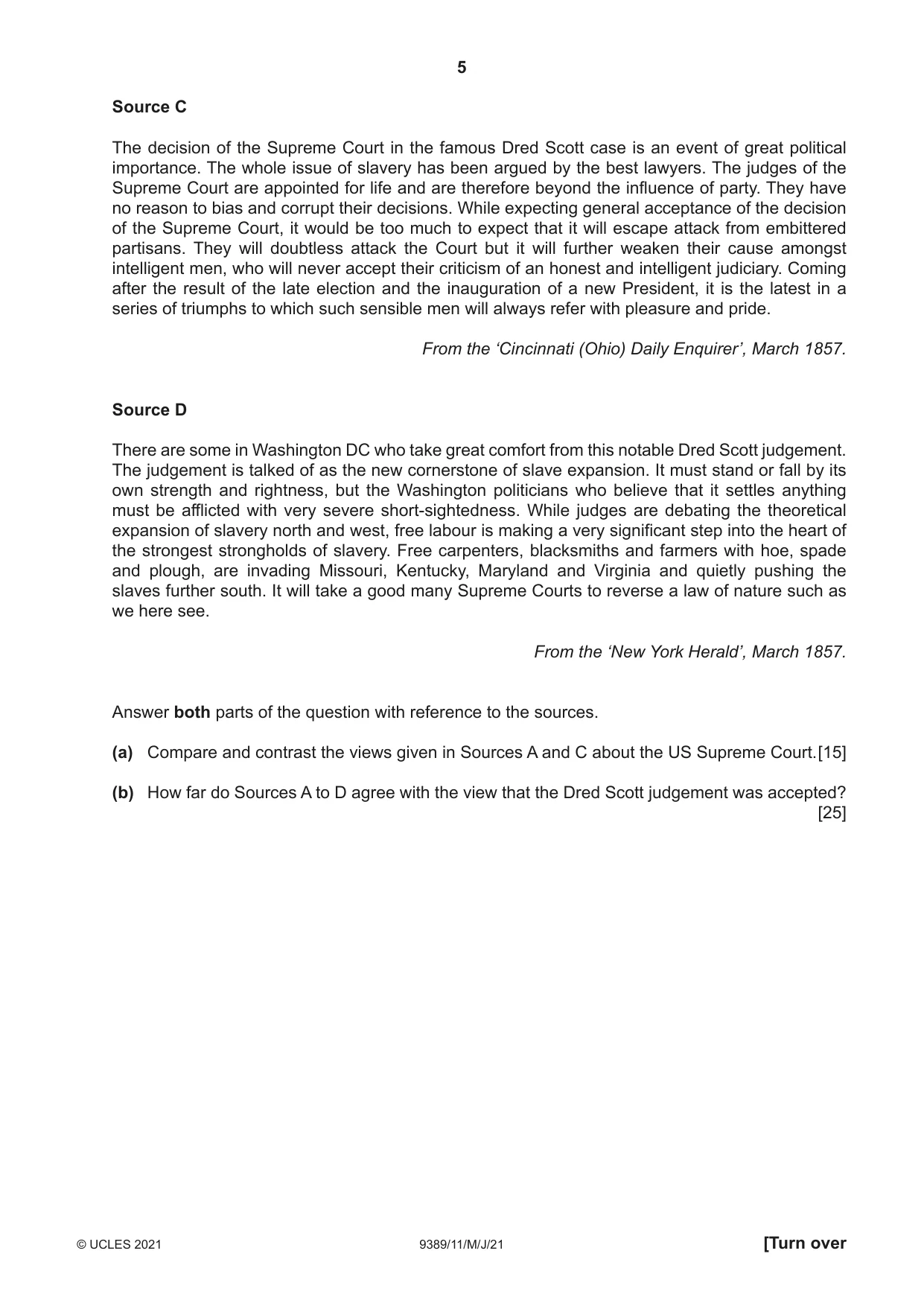
5 9389/11/M/J/21 © UCLES 2021 [Turn over Source C The decision of the Supreme Court in the famous Dred Scott case is an event of great political importance. The whole issue of slavery has been argued by the best lawyers. The judges of the Supreme Court are appointed for life and are therefore beyond the influence of party. They have no reason to bias and corrupt their decisions. While expecting general acceptance of the decision of the Supreme Court, it would be too much to expect that it will escape attack from embittered partisans. They will doubtless attack the Court but it will further weaken their cause amongst intelligent men, who will never accept their criticism of an honest and intelligent judiciary. Coming after the result of the late election and the inauguration of a new President, it is the latest in a series of triumphs to which such sensible men will always refer with pleasure and pride. From the ‘Cincinnati (Ohio) Daily Enquirer’, March 1857. Source D There are some in Washington DC who take great comfort from this notable Dred Scott judgement. The judgement is talked of as the new cornerstone of slave expansion. It must stand or fall by its own strength and rightness, but the Washington politicians who believe that it settles anything must be afflicted with very severe short-sightedness. While judges are debating the theoretical expansion of slavery north and west, free labour is making a very significant step into the heart of the strongest strongholds of slavery. Free carpenters, blacksmiths and farmers with hoe, spade and plough, are invading Missouri, Kentucky, Maryland and Virginia and quietly pushing the slaves further south. It will take a good many Supreme Courts to reverse a law of nature such as we here see. From the ‘New York Herald’, March 1857. Answer both parts of the question with reference to the sources. (a) Compare and contrast the views given in Sources A and C about the US Supreme Court. [15] (b) How far do Sources A to D agree with the view that the Dred Scott judgement was accepted? [25]
Question paper, page 6
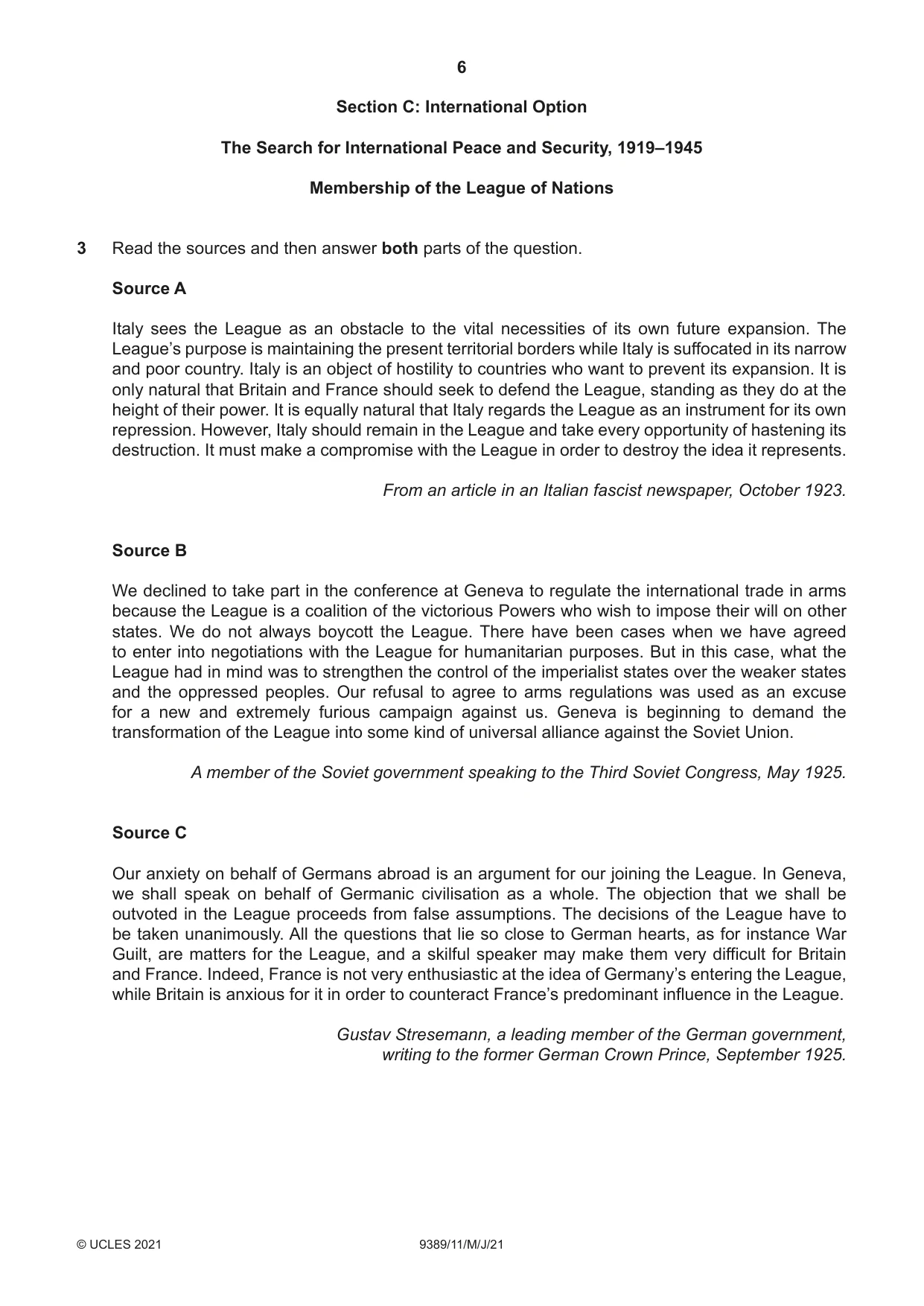
6 9389/11/M/J/21 © UCLES 2021 Section C: International Option The Search for International Peace and Security, 1919–1945 Membership of the League of Nations 3 Read the sources and then answer both parts of the question. Source A Italy sees the League as an obstacle to the vital necessities of its own future expansion. The League’s purpose is maintaining the present territorial borders while Italy is suffocated in its narrow and poor country. Italy is an object of hostility to countries who want to prevent its expansion. It is only natural that Britain and France should seek to defend the League, standing as they do at the height of their power. It is equally natural that Italy regards the League as an instrument for its own repression. However, Italy should remain in the League and take every opportunity of hastening its destruction. It must make a compromise with the League in order to destroy the idea it represents. From an article in an Italian fascist newspaper, October 1923. Source B We declined to take part in the conference at Geneva to regulate the international trade in arms because the League is a coalition of the victorious Powers who wish to impose their will on other states. We do not always boycott the League. There have been cases when we have agreed to enter into negotiations with the League for humanitarian purposes. But in this case, what the League had in mind was to strengthen the control of the imperialist states over the weaker states and the oppressed peoples. Our refusal to agree to arms regulations was used as an excuse for a new and extremely furious campaign against us. Geneva is beginning to demand the transformation of the League into some kind of universal alliance against the Soviet Union. A member of the Soviet government speaking to the Third Soviet Congress, May 1925. Source C Our anxiety on behalf of Germans abroad is an argument for our joining the League. In Geneva, we shall speak on behalf of Germanic civilisation as a whole. The objection that we shall be outvoted in the League proceeds from false assumptions. The decisions of the League have to be taken unanimously. All the questions that lie so close to German hearts, as for instance War Guilt, are matters for the League, and a skilful speaker may make them very difficult for Britain and France. Indeed, France is not very enthusiastic at the idea of Germany’s entering the League, while Britain is anxious for it in order to counteract France’s predominant influence in the League. Gustav Stresemann, a leading member of the German government, writing to the former German Crown Prince, September 1925.
Question paper, page 7
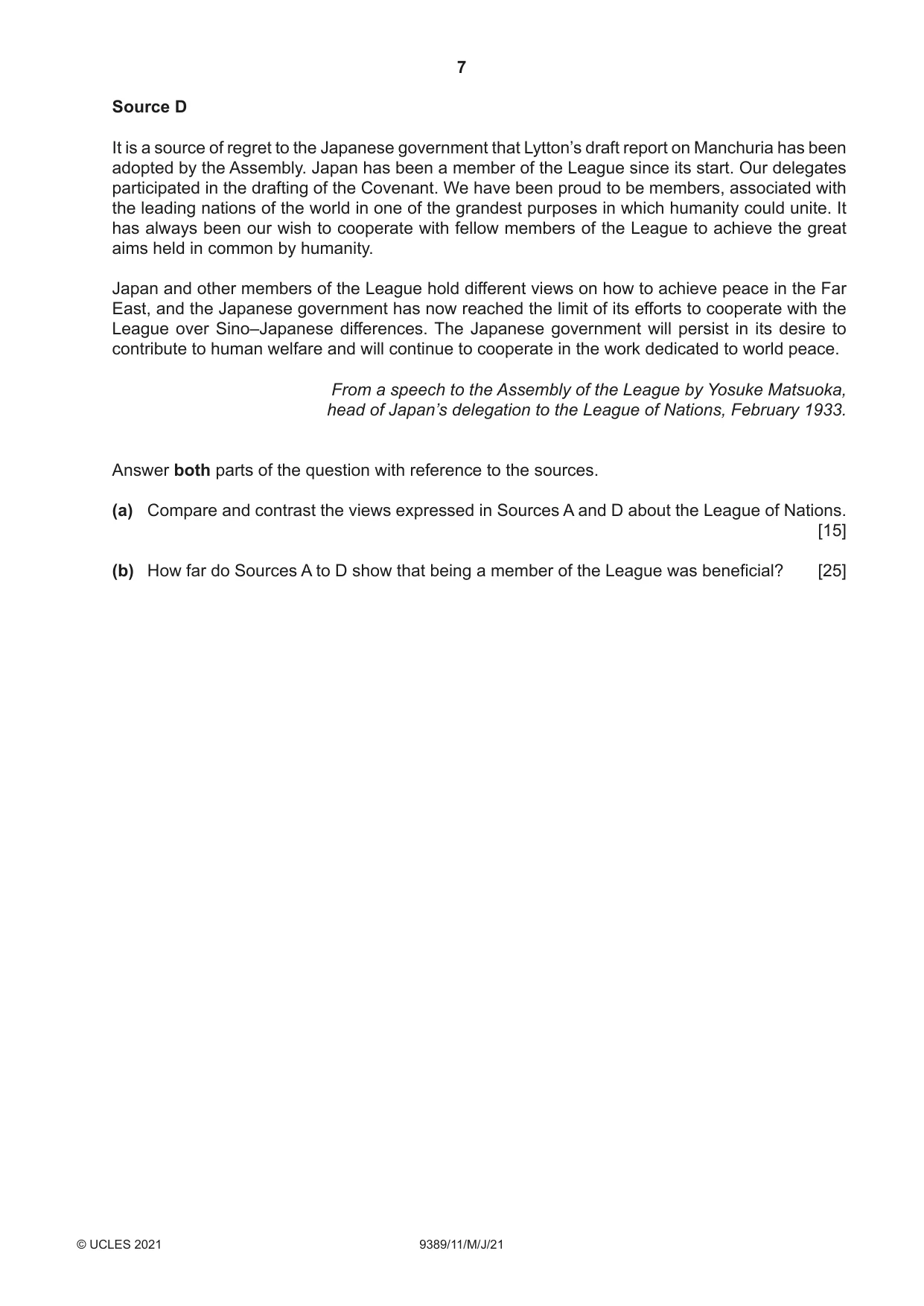
7 9389/11/M/J/21 © UCLES 2021 Source D It is a source of regret to the Japanese government that Lytton’s draft report on Manchuria has been adopted by the Assembly. Japan has been a member of the League since its start. Our delegates participated in the drafting of the Covenant. We have been proud to be members, associated with the leading nations of the world in one of the grandest purposes in which humanity could unite. It has always been our wish to cooperate with fellow members of the League to achieve the great aims held in common by humanity. Japan and other members of the League hold different views on how to achieve peace in the Far East, and the Japanese government has now reached the limit of its efforts to cooperate with the League over Sino–Japanese differences. The Japanese government will persist in its desire to contribute to human welfare and will continue to cooperate in the work dedicated to world peace. From a speech to the Assembly of the League by Yosuke Matsuoka, head of Japan’s delegation to the League of Nations, February 1933. Answer both parts of the question with reference to the sources. (a) Compare and contrast the views expressed in Sources A and D about the League of Nations. [15] (b) How far do Sources A to D show that being a member of the League was beneficial? [25]
Question paper, page 8
8 9389/11/M/J/21 © UCLES 2021 Permission to reproduce items where third-party owned material protected by copyright is included has been sought and cleared where possible. Every reasonable effort has been made by the publisher (UCLES) to trace copyright holders, but if any items requiring clearance have unwittingly been included, the publisher will be pleased to make amends at the earliest possible opportunity. To avoid the issue of disclosure of answer-related information to candidates, all copyright acknowledgements are reproduced online in the Cambridge Assessment International Education Copyright Acknowledgements Booklet. This is produced for each series of examinations and is freely available to download at www.cambridgeinternational.org after the live examination series. Cambridge Assessment International Education is part of the Cambridge Assessment Group. Cambridge Assessment is the brand name of the University of Cambridge Local Examinations Syndicate (UCLES), which itself is a department of the University of Cambridge. BLANK PAGE
Mark scheme, page 1
This document consists of 10 printed pages. © UCLES 2021 [Turn over Cambridge International AS & A Level HISTORY 9389/11 Paper 1 Document Question 11 May/June 2021 MARK SCHEME Maximum Mark: 40 Published This mark scheme is published as an aid to teachers and candidates, to indicate the requirements of the examination. It shows the basis on which Examiners were instructed to award marks. It does not indicate the details of the discussions that took place at an Examiners’ meeting before marking began, which would have considered the acceptability of alternative answers. Mark schemes should be read in conjunction with the question paper and the Principal Examiner Report for Teachers. Cambridge International will not enter into discussions about these mark schemes. Cambridge International is publishing the mark schemes for the May/June 2021 series for most Cambridge IGCSE™, Cambridge International A and AS Level components and some Cambridge O Level components.
Mark scheme, page 2
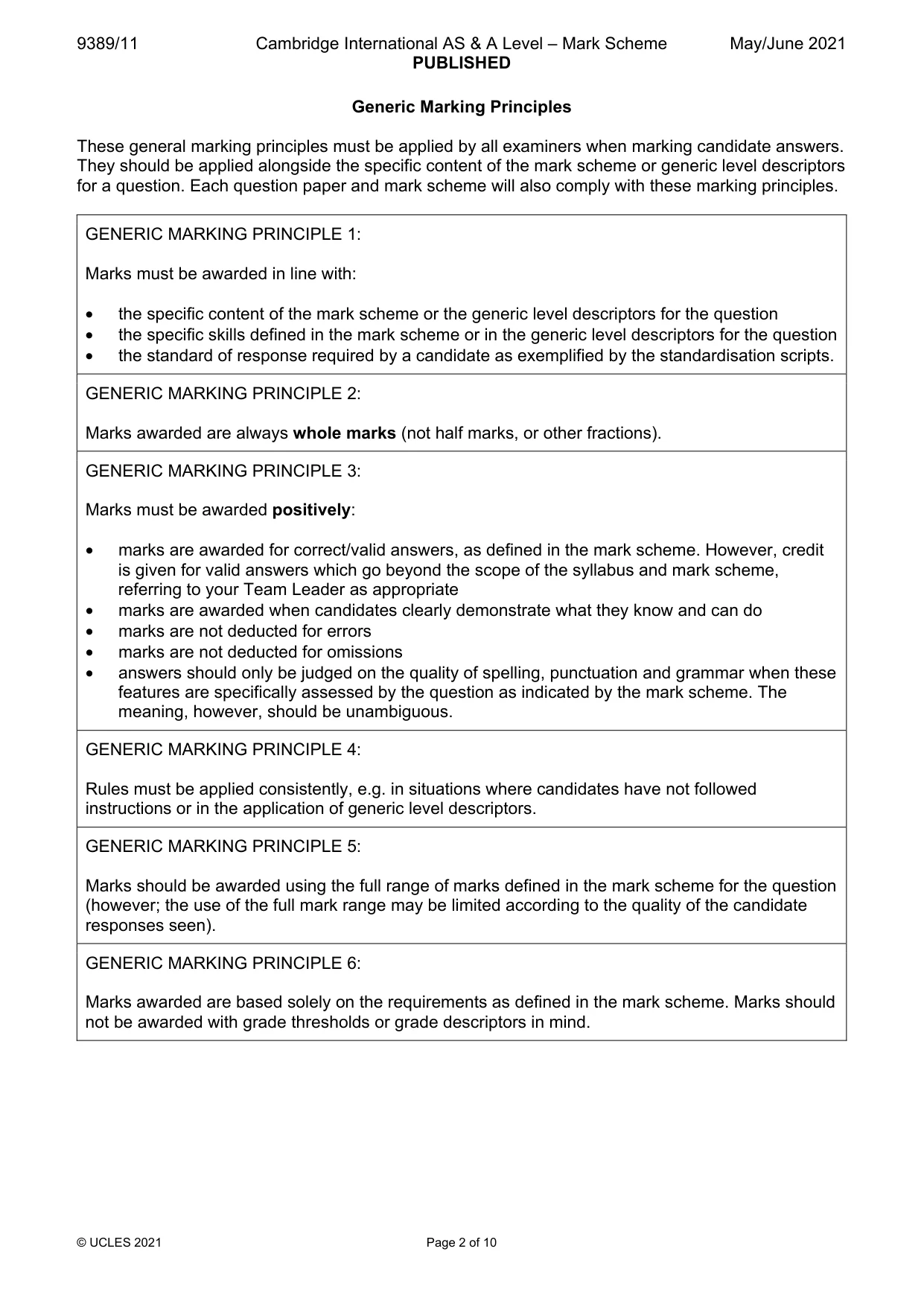
9389/11 Cambridge International AS & A Level – Mark Scheme PUBLISHED May/June 2021 © UCLES 2021 Page 2 of 10 Generic Marking Principles These general marking principles must be applied by all examiners when marking candidate answers. They should be applied alongside the specific content of the mark scheme or generic level descriptors for a question. Each question paper and mark scheme will also comply with these marking principles. GENERIC MARKING PRINCIPLE 1: Marks must be awarded in line with: • the specific content of the mark scheme or the generic level descriptors for the question • the specific skills defined in the mark scheme or in the generic level descriptors for the question • the standard of response required by a candidate as exemplified by the standardisation scripts. GENERIC MARKING PRINCIPLE 2: Marks awarded are always whole marks (not half marks, or other fractions). GENERIC MARKING PRINCIPLE 3: Marks must be awarded positively: • marks are awarded for correct/valid answers, as defined in the mark scheme. However, credit is given for valid answers which go beyond the scope of the syllabus and mark scheme, referring to your Team Leader as appropriate • marks are awarded when candidates clearly demonstrate what they know and can do • marks are not deducted for errors • marks are not deducted for omissions • answers should only be judged on the quality of spelling, punctuation and grammar when these features are specifically assessed by the question as indicated by the mark scheme. The meaning, however, should be unambiguous. GENERIC MARKING PRINCIPLE 4: Rules must be applied consistently, e.g. in situations where candidates have not followed instructions or in the application of generic level descriptors. GENERIC MARKING PRINCIPLE 5: Marks should be awarded using the full range of marks defined in the mark scheme for the question (however; the use of the full mark range may be limited according to the quality of the candidate responses seen). GENERIC MARKING PRINCIPLE 6: Marks awarded are based solely on the requirements as defined in the mark scheme. Marks should not be awarded with grade thresholds or grade descriptors in mind.
Mark scheme, page 3
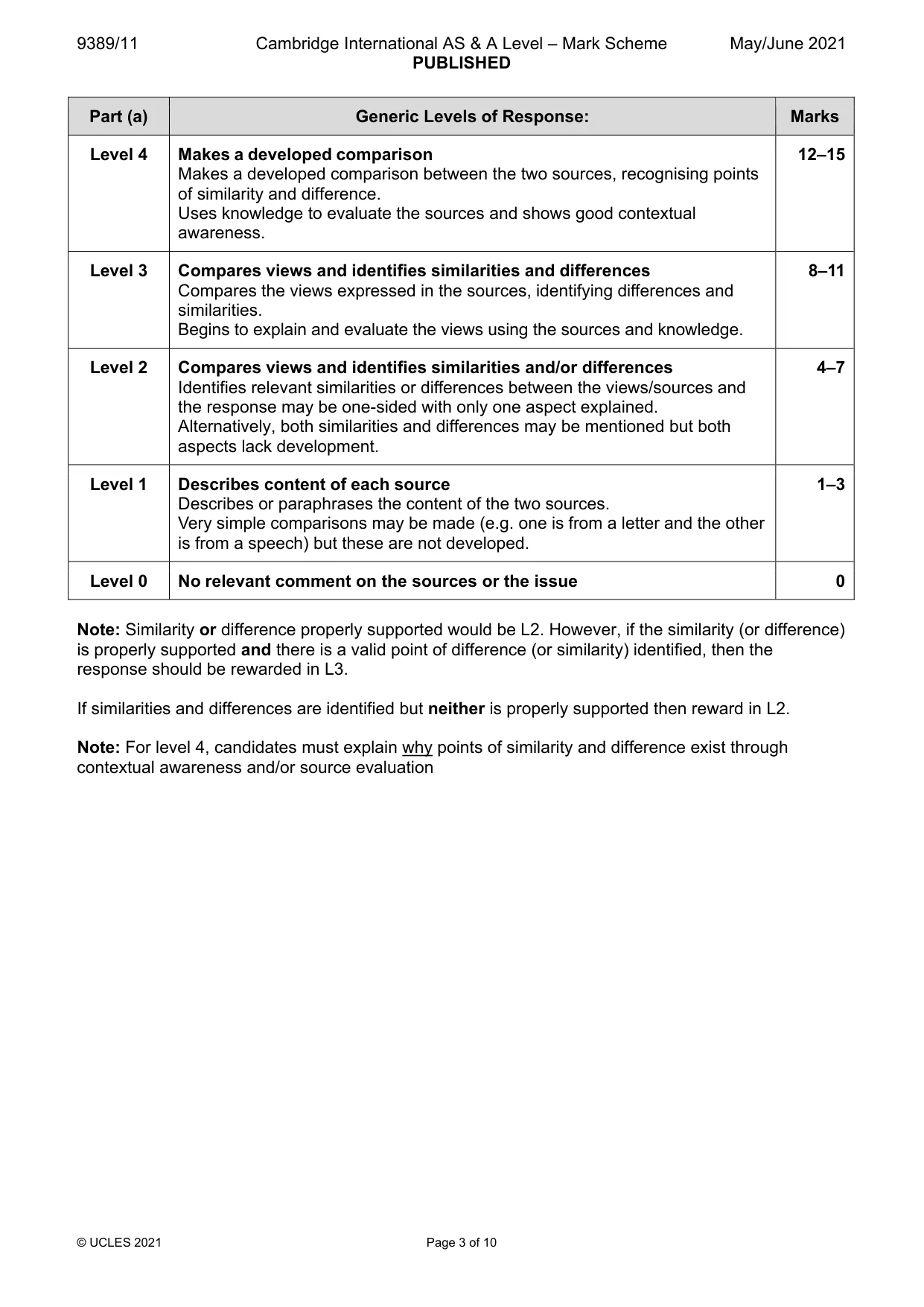
9389/11 Cambridge International AS & A Level – Mark Scheme PUBLISHED May/June 2021 © UCLES 2021 Page 3 of 10 Part (a) Generic Levels of Response: Marks Level 4 Makes a developed comparison Makes a developed comparison between the two sources, recognising points of similarity and difference. Uses knowledge to evaluate the sources and shows good contextual awareness. 12–15 Level 3 Compares views and identifies similarities and differences Compares the views expressed in the sources, identifying differences and similarities. Begins to explain and evaluate the views using the sources and knowledge. 8–11 Level 2 Compares views and identifies similarities and/or differences Identifies relevant similarities or differences between the views/sources and the response may be one-sided with only one aspect explained. Alternatively, both similarities and differences may be mentioned but both aspects lack development. 4–7 Level 1 Describes content of each source Describes or paraphrases the content of the two sources. Very simple comparisons may be made (e.g. one is from a letter and the other is from a speech) but these are not developed. 1–3 Level 0 No relevant comment on the sources or the issue 0 Note: Similarity or difference properly supported would be L2. However, if the similarity (or difference) is properly supported and there is a valid point of difference (or similarity) identified, then the response should be rewarded in L3. If similarities and differences are identified but neither is properly supported then reward in L2. Note: For level 4, candidates must explain why points of similarity and difference exist through contextual awareness and/or source evaluation
Mark scheme, page 4
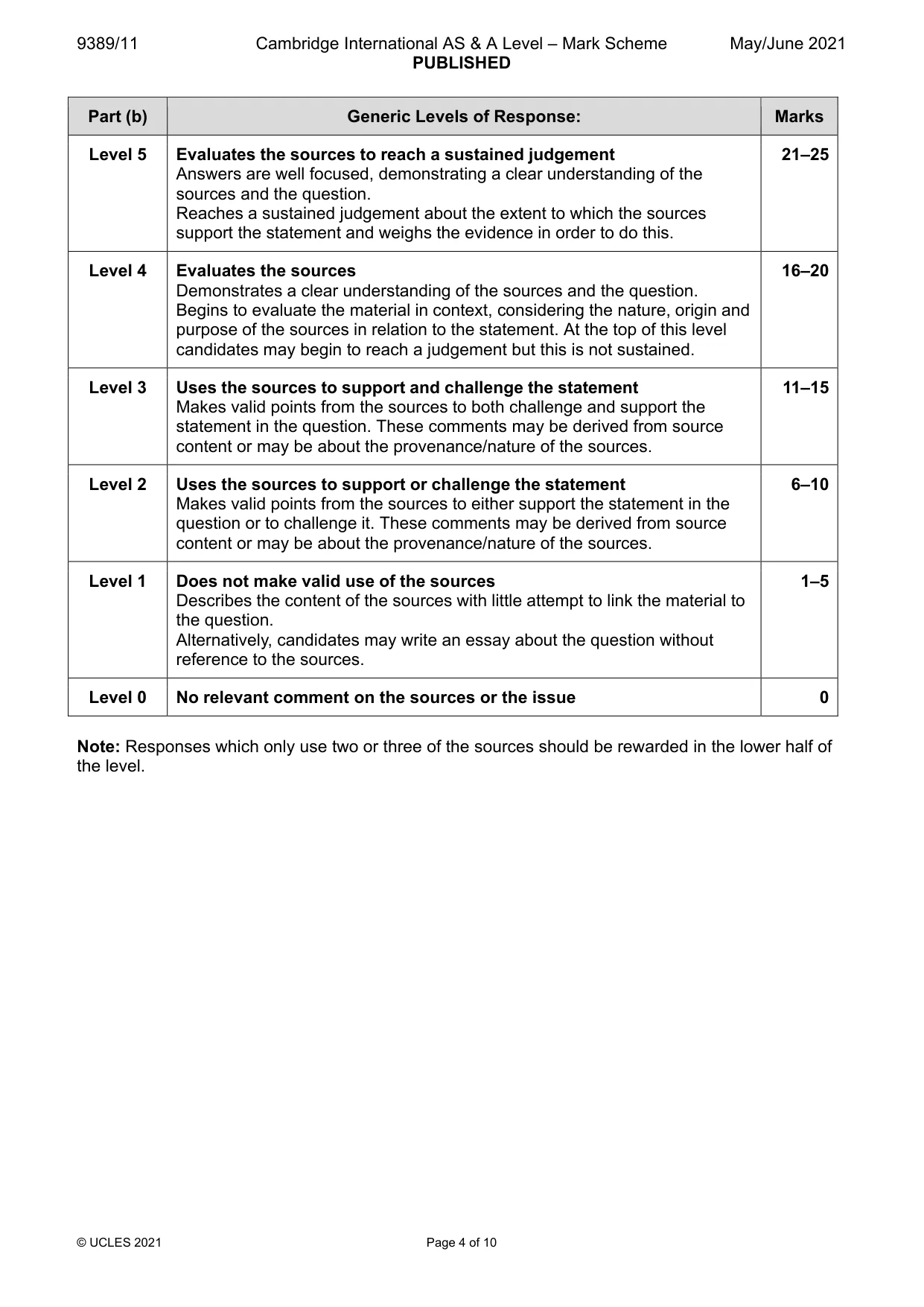
9389/11 Cambridge International AS & A Level – Mark Scheme PUBLISHED May/June 2021 © UCLES 2021 Page 4 of 10 Part (b) Generic Levels of Response: Marks Level 5 Evaluates the sources to reach a sustained judgement Answers are well focused, demonstrating a clear understanding of the sources and the question. Reaches a sustained judgement about the extent to which the sources support the statement and weighs the evidence in order to do this. 21–25 Level 4 Evaluates the sources Demonstrates a clear understanding of the sources and the question. Begins to evaluate the material in context, considering the nature, origin and purpose of the sources in relation to the statement. At the top of this level candidates may begin to reach a judgement but this is not sustained. 16–20 Level 3 Uses the sources to support and challenge the statement Makes valid points from the sources to both challenge and support the statement in the question. These comments may be derived from source content or may be about the provenance/nature of the sources. 11–15 Level 2 Uses the sources to support or challenge the statement Makes valid points from the sources to either support the statement in the question or to challenge it. These comments may be derived from source content or may be about the provenance/nature of the sources. 6–10 Level 1 Does not make valid use of the sources Describes the content of the sources with little attempt to link the material to the question. Alternatively, candidates may write an essay about the question without reference to the sources. 1–5 Level 0 No relevant comment on the sources or the issue 0 Note: Responses which only use two or three of the sources should be rewarded in the lower half of the level.
Mark scheme, page 5
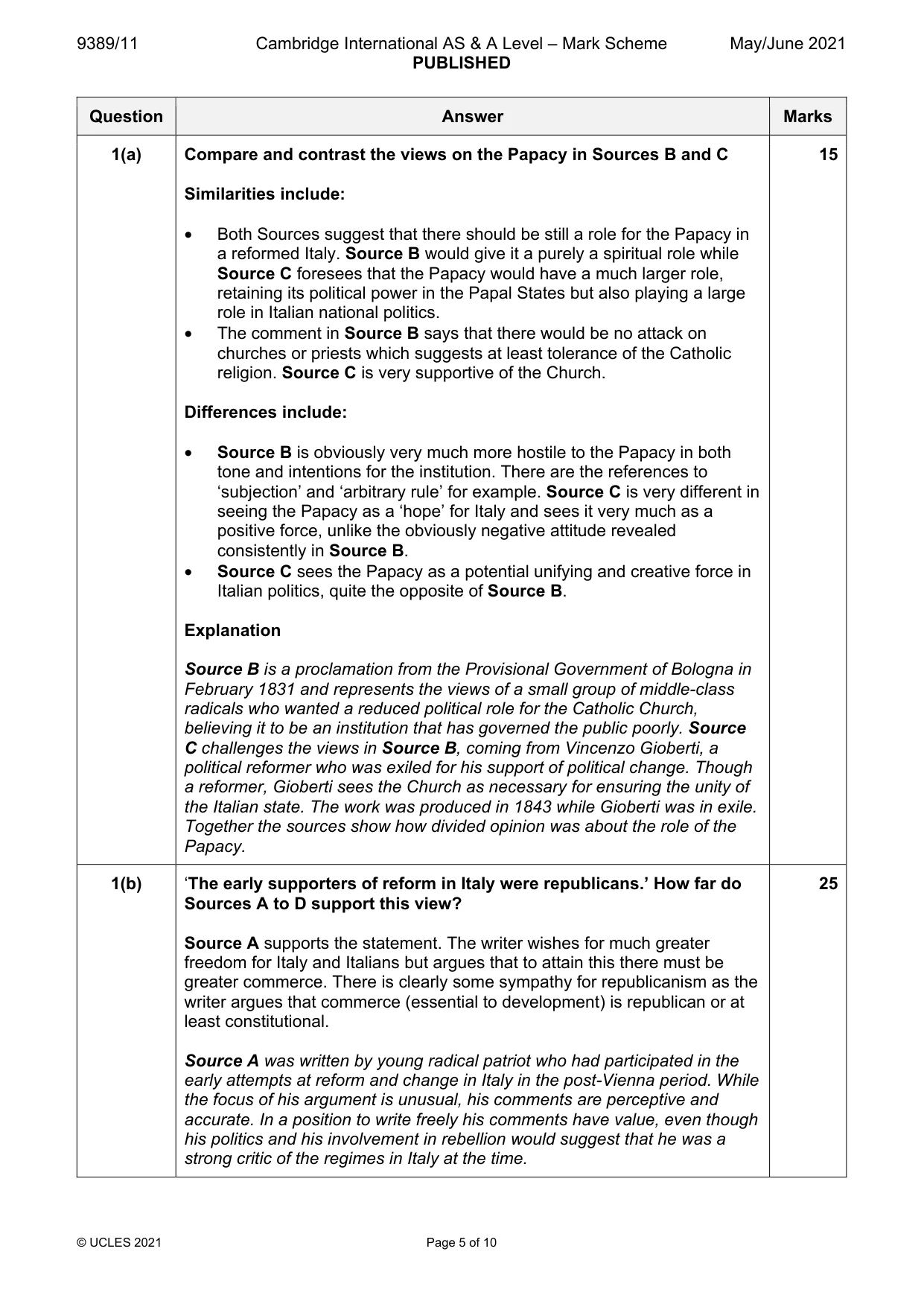
9389/11 Cambridge International AS & A Level – Mark Scheme PUBLISHED May/June 2021 © UCLES 2021 Page 5 of 10 Question Answer Marks 1(a) Compare and contrast the views on the Papacy in Sources B and C Similarities include: • Both Sources suggest that there should be still a role for the Papacy in a reformed Italy. Source B would give it a purely a spiritual role while Source C foresees that the Papacy would have a much larger role, retaining its political power in the Papal States but also playing a large role in Italian national politics. • The comment in Source B says that there would be no attack on churches or priests which suggests at least tolerance of the Catholic religion. Source C is very supportive of the Church. Differences include: • Source B is obviously very much more hostile to the Papacy in both tone and intentions for the institution. There are the references to ‘subjection’ and ‘arbitrary rule’ for example. Source C is very different in seeing the Papacy as a ‘hope’ for Italy and sees it very much as a positive force, unlike the obviously negative attitude revealed consistently in Source B. • Source C sees the Papacy as a potential unifying and creative force in Italian politics, quite the opposite of Source B. Explanation Source B is a proclamation from the Provisional Government of Bologna in February 1831 and represents the views of a small group of middle-class radicals who wanted a reduced political role for the Catholic Church, believing it to be an institution that has governed the public poorly. Source C challenges the views in Source B, coming from Vincenzo Gioberti, a political reformer who was exiled for his support of political change. Though a reformer, Gioberti sees the Church as necessary for ensuring the unity of the Italian state. The work was produced in 1843 while Gioberti was in exile. Together the sources show how divided opinion was about the role of the Papacy. 15 1(b) ‘The early supporters of reform in Italy were republicans.’ How far do Sources A to D support this view? Source A supports the statement. The writer wishes for much greater freedom for Italy and Italians but argues that to attain this there must be greater commerce. There is clearly some sympathy for republicanism as the writer argues that commerce (essential to development) is republican or at least constitutional. Source A was written by young radical patriot who had participated in the early attempts at reform and change in Italy in the post-Vienna period. While the focus of his argument is unusual, his comments are perceptive and accurate. In a position to write freely his comments have value, even though his politics and his involvement in rebellion would suggest that he was a strong critic of the regimes in Italy at the time. 25
Mark scheme, page 6
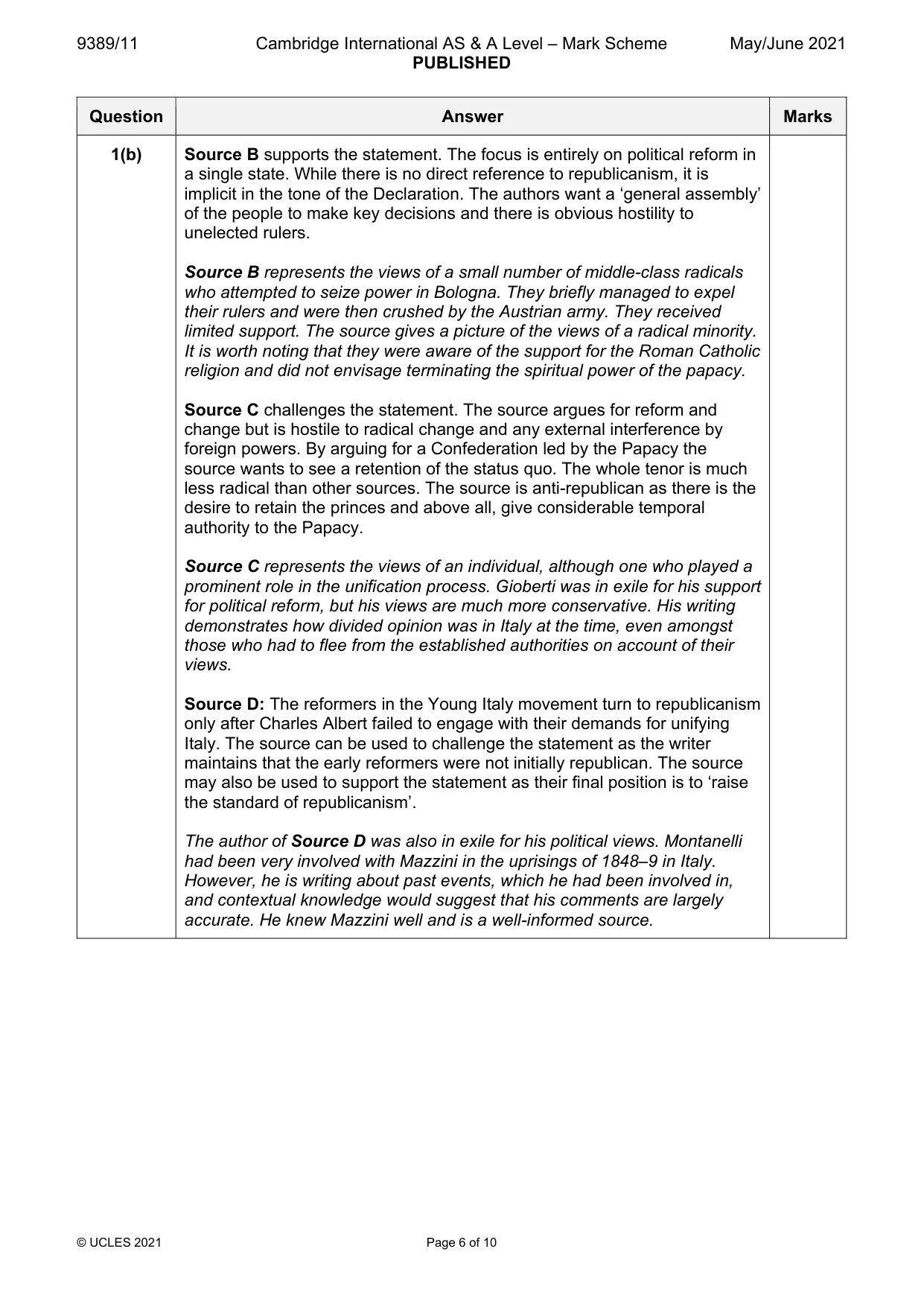
9389/11 Cambridge International AS & A Level – Mark Scheme PUBLISHED May/June 2021 © UCLES 2021 Page 6 of 10 Question Answer Marks 1(b) Source B supports the statement. The focus is entirely on political reform in a single state. While there is no direct reference to republicanism, it is implicit in the tone of the Declaration. The authors want a ‘general assembly’ of the people to make key decisions and there is obvious hostility to unelected rulers. Source B represents the views of a small number of middle-class radicals who attempted to seize power in Bologna. They briefly managed to expel their rulers and were then crushed by the Austrian army. They received limited support. The source gives a picture of the views of a radical minority. It is worth noting that they were aware of the support for the Roman Catholic religion and did not envisage terminating the spiritual power of the papacy. Source C challenges the statement. The source argues for reform and change but is hostile to radical change and any external interference by foreign powers. By arguing for a Confederation led by the Papacy the source wants to see a retention of the status quo. The whole tenor is much less radical than other sources. The source is anti-republican as there is the desire to retain the princes and above all, give considerable temporal authority to the Papacy. Source C represents the views of an individual, although one who played a prominent role in the unification process. Gioberti was in exile for his support for political reform, but his views are much more conservative. His writing demonstrates how divided opinion was in Italy at the time, even amongst those who had to flee from the established authorities on account of their views. Source D: The reformers in the Young Italy movement turn to republicanism only after Charles Albert failed to engage with their demands for unifying Italy. The source can be used to challenge the statement as the writer maintains that the early reformers were not initially republican. The source may also be used to support the statement as their final position is to ‘raise the standard of republicanism’. The author of Source D was also in exile for his political views. Montanelli had been very involved with Mazzini in the uprisings of 1848–9 in Italy. However, he is writing about past events, which he had been involved in, and contextual knowledge would suggest that his comments are largely accurate. He knew Mazzini well and is a well-informed source.
Mark scheme, page 7
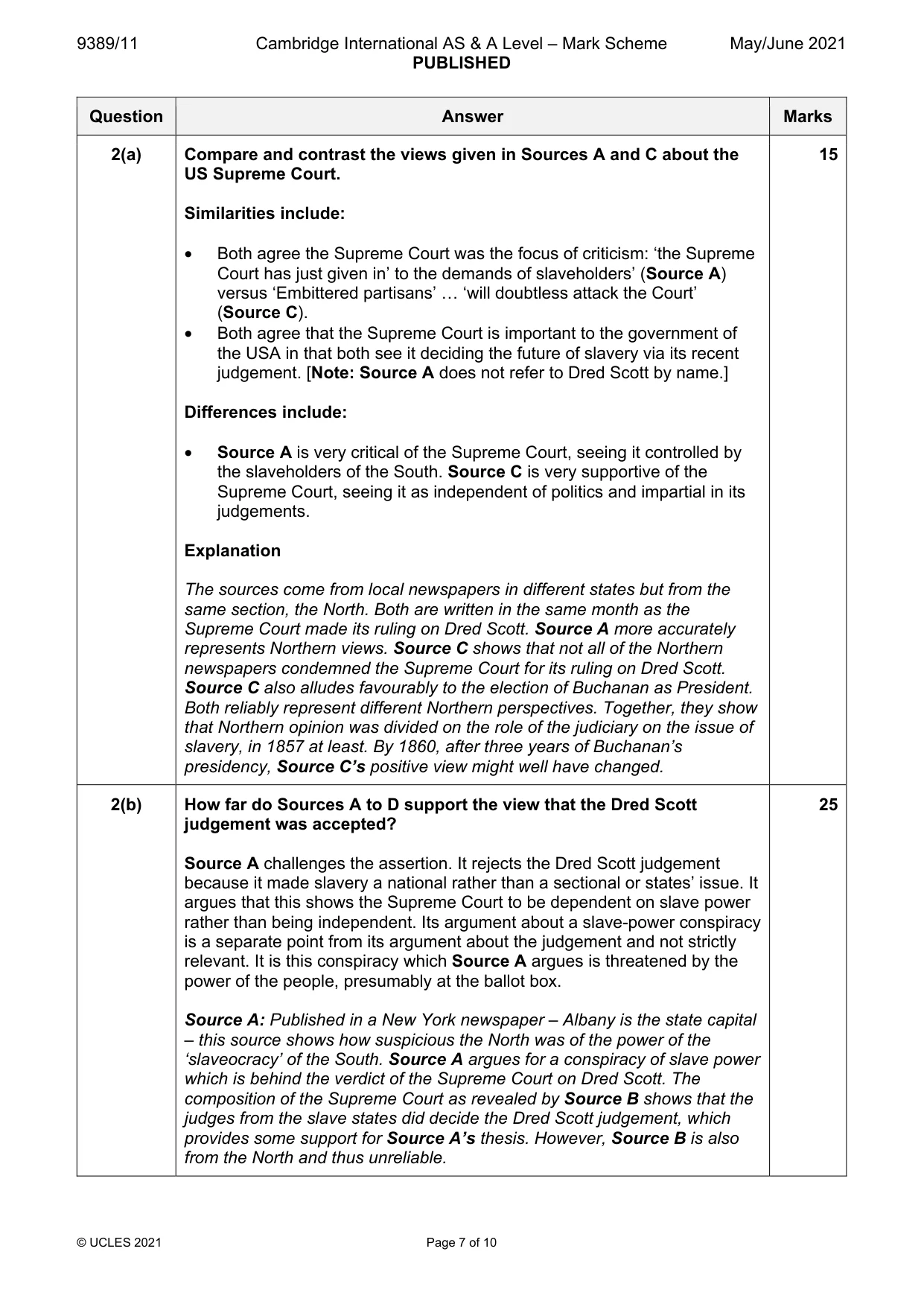
9389/11 Cambridge International AS & A Level – Mark Scheme PUBLISHED May/June 2021 © UCLES 2021 Page 7 of 10 Question Answer Marks 2(a) Compare and contrast the views given in Sources A and C about the US Supreme Court. Similarities include: • Both agree the Supreme Court was the focus of criticism: ‘the Supreme Court has just given in’ to the demands of slaveholders’ (Source A) versus ‘Embittered partisans’ … ‘will doubtless attack the Court’ (Source C). • Both agree that the Supreme Court is important to the government of the USA in that both see it deciding the future of slavery via its recent judgement. [Note: Source A does not refer to Dred Scott by name.] Differences include: • Source A is very critical of the Supreme Court, seeing it controlled by the slaveholders of the South. Source C is very supportive of the Supreme Court, seeing it as independent of politics and impartial in its judgements. Explanation The sources come from local newspapers in different states but from the same section, the North. Both are written in the same month as the Supreme Court made its ruling on Dred Scott. Source A more accurately represents Northern views. Source C shows that not all of the Northern newspapers condemned the Supreme Court for its ruling on Dred Scott. Source C also alludes favourably to the election of Buchanan as President. Both reliably represent different Northern perspectives. Together, they show that Northern opinion was divided on the role of the judiciary on the issue of slavery, in 1857 at least. By 1860, after three years of Buchanan’s presidency, Source C’s positive view might well have changed. 15 2(b) How far do Sources A to D support the view that the Dred Scott judgement was accepted? Source A challenges the assertion. It rejects the Dred Scott judgement because it made slavery a national rather than a sectional or states’ issue. It argues that this shows the Supreme Court to be dependent on slave power rather than being independent. Its argument about a slave-power conspiracy is a separate point from its argument about the judgement and not strictly relevant. It is this conspiracy which Source A argues is threatened by the power of the people, presumably at the ballot box. Source A: Published in a New York newspaper – Albany is the state capital – this source shows how suspicious the North was of the power of the ‘slaveocracy’ of the South. Source A argues for a conspiracy of slave power which is behind the verdict of the Supreme Court on Dred Scott. The composition of the Supreme Court as revealed by Source B shows that the judges from the slave states did decide the Dred Scott judgement, which provides some support for Source A’s thesis. However, Source B is also from the North and thus unreliable. 25
Mark scheme, page 8
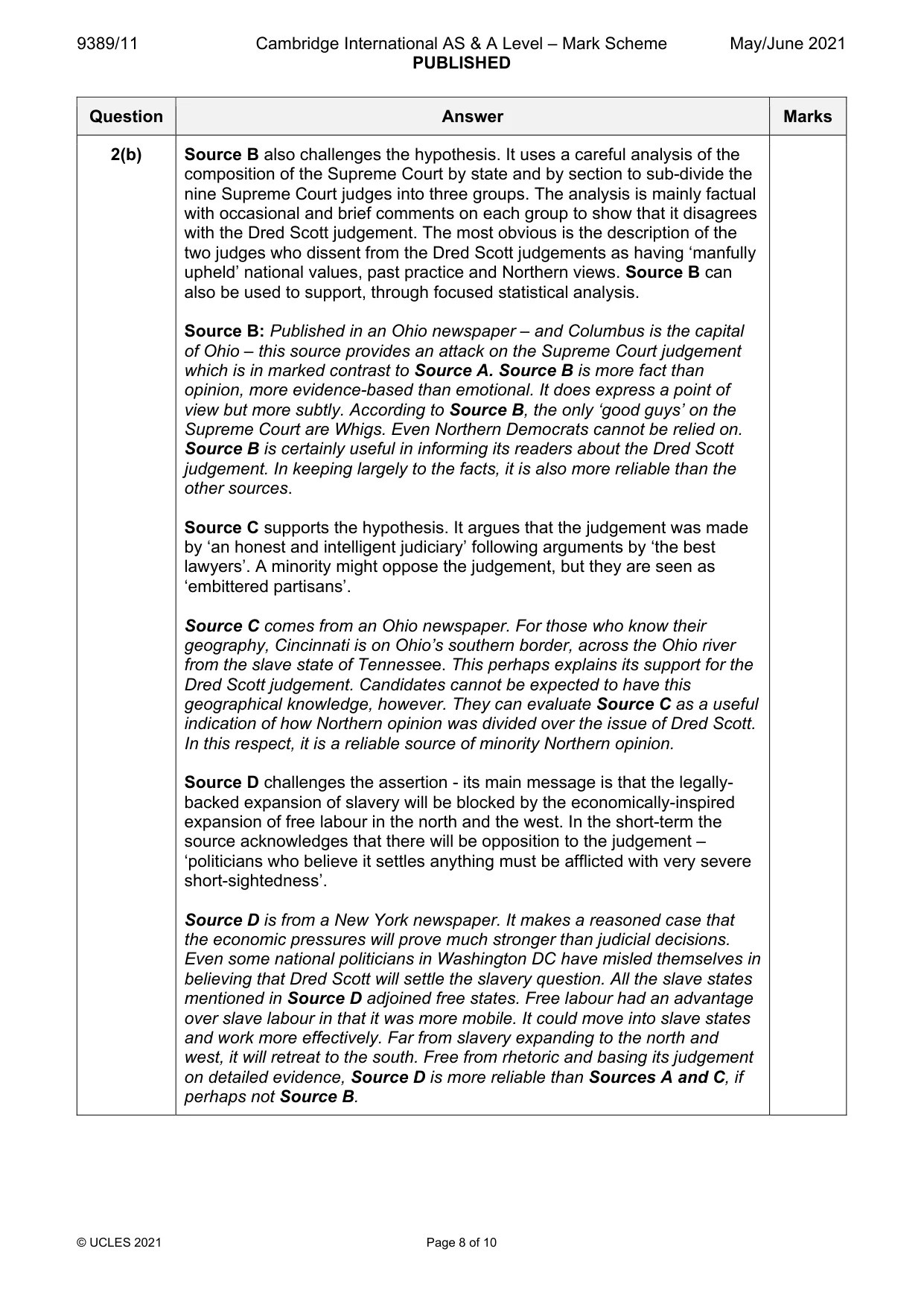
9389/11 Cambridge International AS & A Level – Mark Scheme PUBLISHED May/June 2021 © UCLES 2021 Page 8 of 10 Question Answer Marks 2(b) Source B also challenges the hypothesis. It uses a careful analysis of the composition of the Supreme Court by state and by section to sub-divide the nine Supreme Court judges into three groups. The analysis is mainly factual with occasional and brief comments on each group to show that it disagrees with the Dred Scott judgement. The most obvious is the description of the two judges who dissent from the Dred Scott judgements as having ‘manfully upheld’ national values, past practice and Northern views. Source B can also be used to support, through focused statistical analysis. Source B: Published in an Ohio newspaper – and Columbus is the capital of Ohio – this source provides an attack on the Supreme Court judgement which is in marked contrast to Source A. Source B is more fact than opinion, more evidence-based than emotional. It does express a point of view but more subtly. According to Source B, the only ‘good guys’ on the Supreme Court are Whigs. Even Northern Democrats cannot be relied on. Source B is certainly useful in informing its readers about the Dred Scott judgement. In keeping largely to the facts, it is also more reliable than the other sources. Source C supports the hypothesis. It argues that the judgement was made by ‘an honest and intelligent judiciary’ following arguments by ‘the best lawyers’. A minority might oppose the judgement, but they are seen as ‘embittered partisans’. Source C comes from an Ohio newspaper. For those who know their geography, Cincinnati is on Ohio’s southern border, across the Ohio river from the slave state of Tennessee. This perhaps explains its support for the Dred Scott judgement. Candidates cannot be expected to have this geographical knowledge, however. They can evaluate Source C as a useful indication of how Northern opinion was divided over the issue of Dred Scott. In this respect, it is a reliable source of minority Northern opinion. Source D challenges the assertion - its main message is that the legally- backed expansion of slavery will be blocked by the economically-inspired expansion of free labour in the north and the west. In the short-term the source acknowledges that there will be opposition to the judgement – ‘politicians who believe it settles anything must be afflicted with very severe short-sightedness’. Source D is from a New York newspaper. It makes a reasoned case that the economic pressures will prove much stronger than judicial decisions. Even some national politicians in Washington DC have misled themselves in believing that Dred Scott will settle the slavery question. All the slave states mentioned in Source D adjoined free states. Free labour had an advantage over slave labour in that it was more mobile. It could move into slave states and work more effectively. Far from slavery expanding to the north and west, it will retreat to the south. Free from rhetoric and basing its judgement on detailed evidence, Source D is more reliable than Sources A and C, if perhaps not Source B.
Mark scheme, page 9
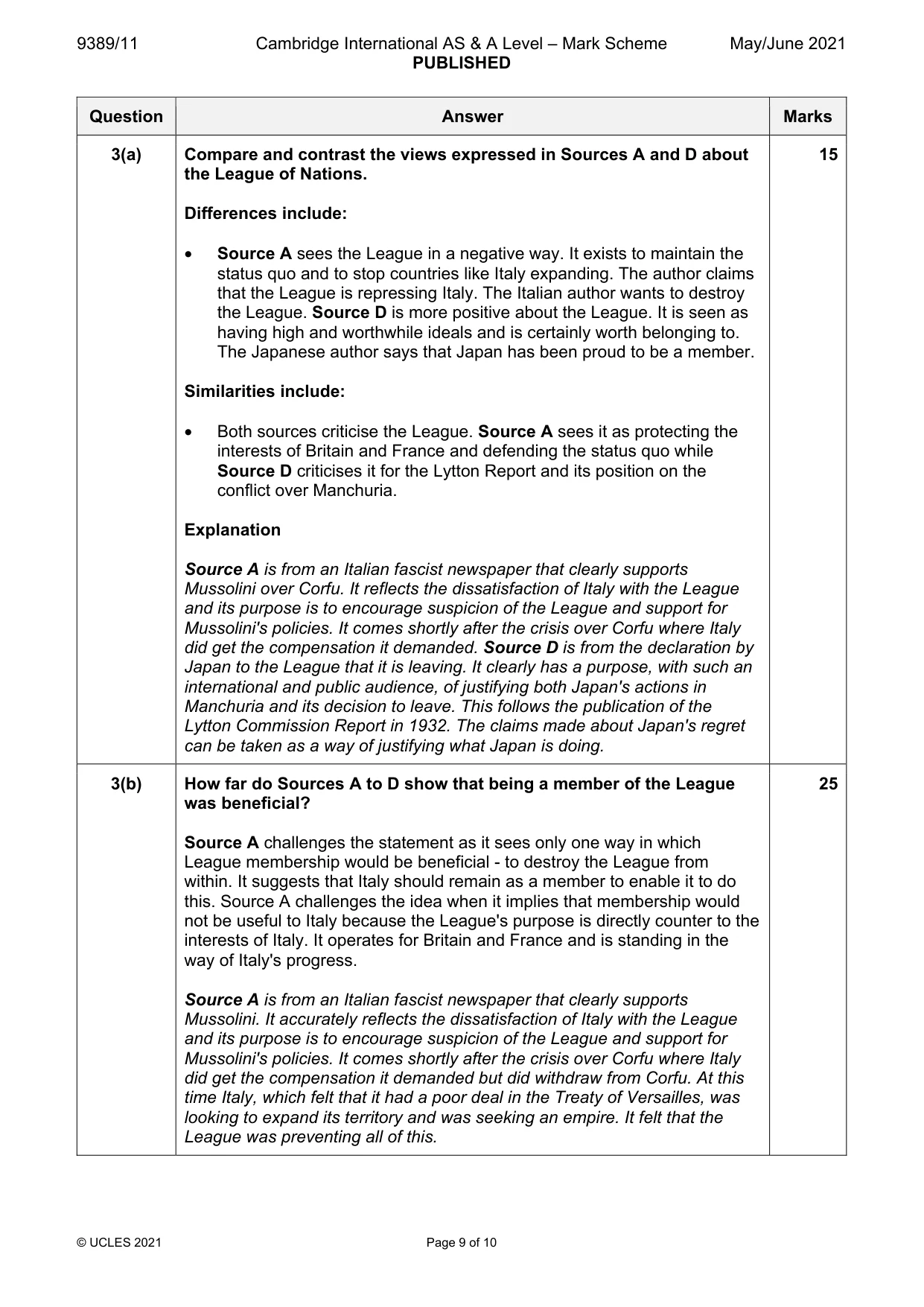
9389/11 Cambridge International AS & A Level – Mark Scheme PUBLISHED May/June 2021 © UCLES 2021 Page 9 of 10 Question Answer Marks 3(a) Compare and contrast the views expressed in Sources A and D about the League of Nations. Differences include: • Source A sees the League in a negative way. It exists to maintain the status quo and to stop countries like Italy expanding. The author claims that the League is repressing Italy. The Italian author wants to destroy the League. Source D is more positive about the League. It is seen as having high and worthwhile ideals and is certainly worth belonging to. The Japanese author says that Japan has been proud to be a member. Similarities include: • Both sources criticise the League. Source A sees it as protecting the interests of Britain and France and defending the status quo while Source D criticises it for the Lytton Report and its position on the conflict over Manchuria. Explanation Source A is from an Italian fascist newspaper that clearly supports Mussolini over Corfu. It reflects the dissatisfaction of Italy with the League and its purpose is to encourage suspicion of the League and support for Mussolini's policies. It comes shortly after the crisis over Corfu where Italy did get the compensation it demanded. Source D is from the declaration by Japan to the League that it is leaving. It clearly has a purpose, with such an international and public audience, of justifying both Japan's actions in Manchuria and its decision to leave. This follows the publication of the Lytton Commission Report in 1932. The claims made about Japan's regret can be taken as a way of justifying what Japan is doing. 15 3(b) How far do Sources A to D show that being a member of the League was beneficial? Source A challenges the statement as it sees only one way in which League membership would be beneficial - to destroy the League from within. It suggests that Italy should remain as a member to enable it to do this. Source A challenges the idea when it implies that membership would not be useful to Italy because the League's purpose is directly counter to the interests of Italy. It operates for Britain and France and is standing in the way of Italy's progress. Source A is from an Italian fascist newspaper that clearly supports Mussolini. It accurately reflects the dissatisfaction of Italy with the League and its purpose is to encourage suspicion of the League and support for Mussolini's policies. It comes shortly after the crisis over Corfu where Italy did get the compensation it demanded but did withdraw from Corfu. At this time Italy, which felt that it had a poor deal in the Treaty of Versailles, was looking to expand its territory and was seeking an empire. It felt that the League was preventing all of this. 25
Mark scheme, page 10
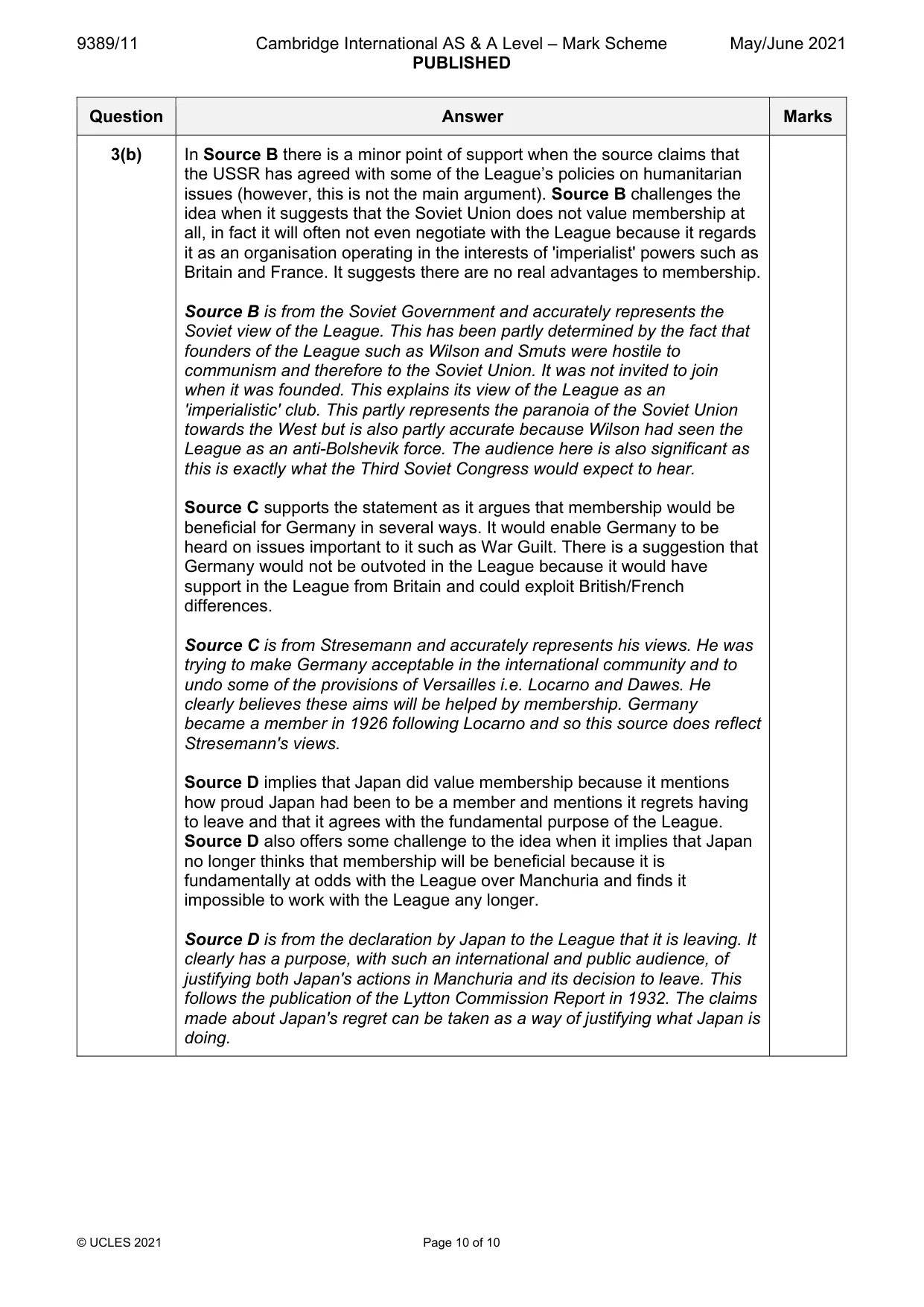
9389/11 Cambridge International AS & A Level – Mark Scheme PUBLISHED May/June 2021 © UCLES 2021 Page 10 of 10 Question Answer Marks 3(b) In Source B there is a minor point of support when the source claims that the USSR has agreed with some of the League’s policies on humanitarian issues (however, this is not the main argument). Source B challenges the idea when it suggests that the Soviet Union does not value membership at all, in fact it will often not even negotiate with the League because it regards it as an organisation operating in the interests of 'imperialist' powers such as Britain and France. It suggests there are no real advantages to membership. Source B is from the Soviet Government and accurately represents the Soviet view of the League. This has been partly determined by the fact that founders of the League such as Wilson and Smuts were hostile to communism and therefore to the Soviet Union. It was not invited to join when it was founded. This explains its view of the League as an 'imperialistic' club. This partly represents the paranoia of the Soviet Union towards the West but is also partly accurate because Wilson had seen the League as an anti-Bolshevik force. The audience here is also significant as this is exactly what the Third Soviet Congress would expect to hear. Source C supports the statement as it argues that membership would be beneficial for Germany in several ways. It would enable Germany to be heard on issues important to it such as War Guilt. There is a suggestion that Germany would not be outvoted in the League because it would have support in the League from Britain and could exploit British/French differences. Source C is from Stresemann and accurately represents his views. He was trying to make Germany acceptable in the international community and to undo some of the provisions of Versailles i.e. Locarno and Dawes. He clearly believes these aims will be helped by membership. Germany became a member in 1926 following Locarno and so this source does reflect Stresemann's views. Source D implies that Japan did value membership because it mentions how proud Japan had been to be a member and mentions it regrets having to leave and that it agrees with the fundamental purpose of the League. Source D also offers some challenge to the idea when it implies that Japan no longer thinks that membership will be beneficial because it is fundamentally at odds with the League over Manchuria and finds it impossible to work with the League any longer. Source D is from the declaration by Japan to the League that it is leaving. It clearly has a purpose, with such an international and public audience, of justifying both Japan's actions in Manchuria and its decision to leave. This follows the publication of the Lytton Commission Report in 1932. The claims made about Japan's regret can be taken as a way of justifying what Japan is doing.
What you needed in this session
Cambridge’s own grade thresholds for 2021 May/June, Paper 1 · Variant 1. A higher threshold means an easier paper — the bar moves with how the cohort did.