Cambridge A Level History 9389 — 2020 Oct/Nov Paper 1 · Variant 3
9389/13/O/N/20 · 40 marks · ≈45 min
The question paper and its mark scheme, free to read here and free to download. This is Cambridge’s own paper, exactly as it was sat.
Question paper8 pages
Mark scheme11 pages
Answers below. Sit the paper first if you are practising.
Paper as text
Question paper, page 1
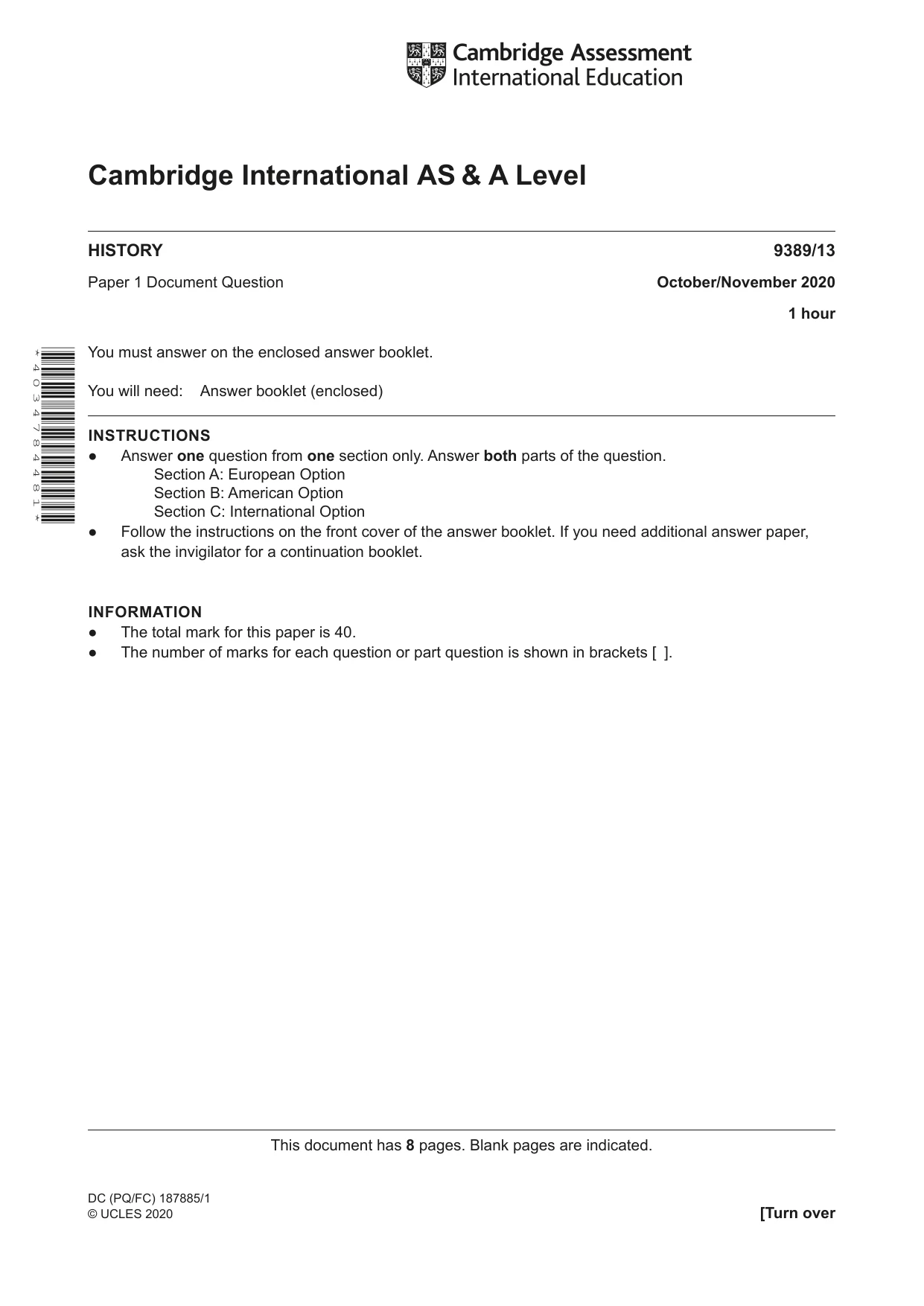
Cambridge International AS & A Level * 4 0 3 4 7 8 4 4 8 1 * DC (PQ/FC) 187885/1 © UCLES 2020 [Turn over This document has 8 pages. Blank pages are indicated. HISTORY 9389/13 Paper 1 Document Question October/November 2020 1 hour You must answer on the enclosed answer booklet. You will need: Answer booklet (enclosed) INSTRUCTIONS ● Answer one question from one section only. Answer both parts of the question. Section A: European Option Section B: American Option Section C: International Option ● Follow the instructions on the front cover of the answer booklet. If you need additional answer paper, ask the invigilator for a continuation booklet. INFORMATION ● The total mark for this paper is 40. ● The number of marks for each question or part question is shown in brackets [ ].
Question paper, page 2
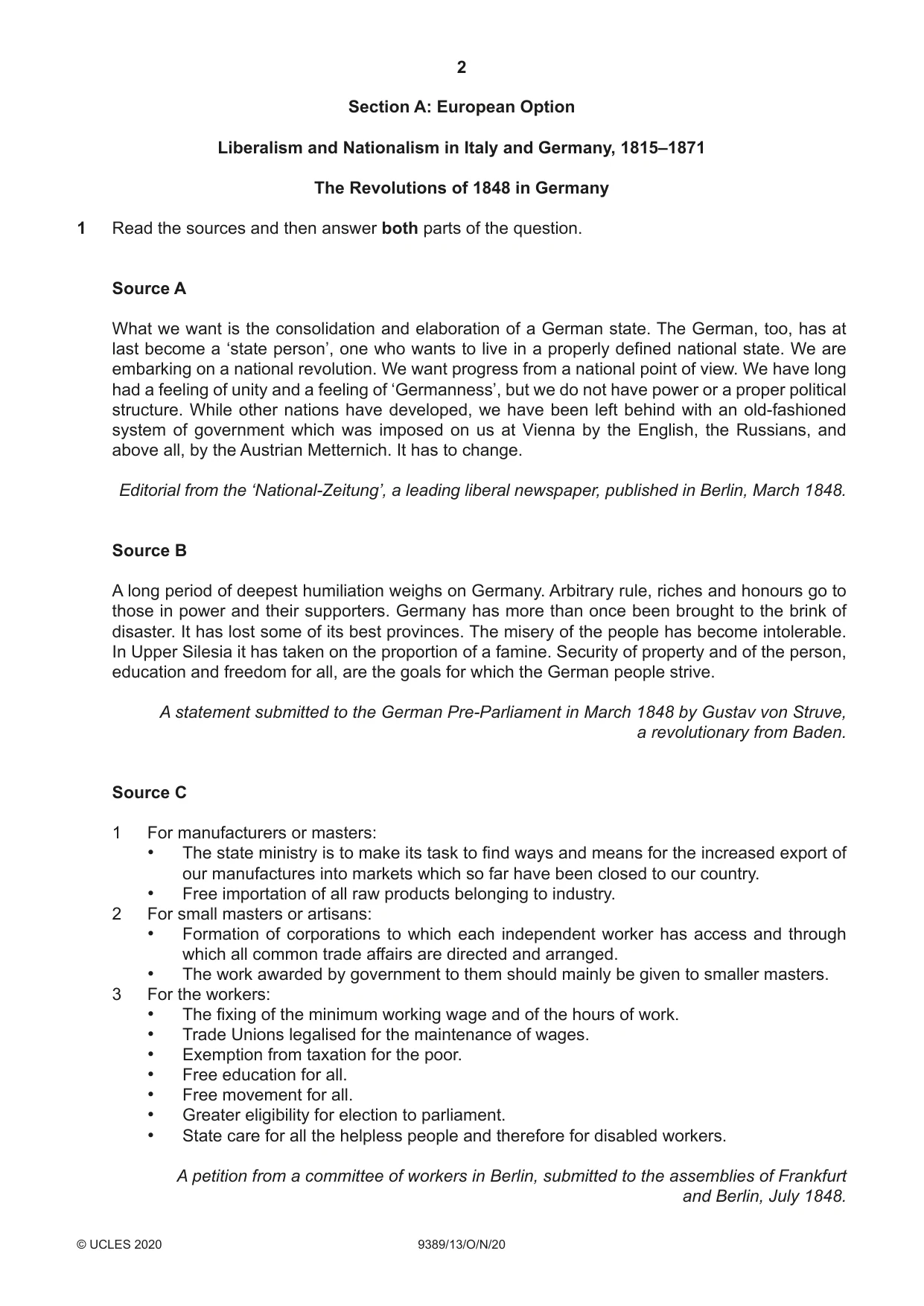
2 9389/13/O/N/20 © UCLES 2020 Section A: European Option Liberalism and Nationalism in Italy and Germany, 1815–1871 The Revolutions of 1848 in Germany 1 Read the sources and then answer both parts of the question. Source A What we want is the consolidation and elaboration of a German state. The German, too, has at last become a ‘state person’, one who wants to live in a properly defined national state. We are embarking on a national revolution. We want progress from a national point of view. We have long had a feeling of unity and a feeling of ‘Germanness’, but we do not have power or a proper political structure. While other nations have developed, we have been left behind with an old-fashioned system of government which was imposed on us at Vienna by the English, the Russians, and above all, by the Austrian Metternich. It has to change. Editorial from the ‘National-Zeitung’, a leading liberal newspaper, published in Berlin, March 1848. Source B A long period of deepest humiliation weighs on Germany. Arbitrary rule, riches and honours go to those in power and their supporters. Germany has more than once been brought to the brink of disaster. It has lost some of its best provinces. The misery of the people has become intolerable. In Upper Silesia it has taken on the proportion of a famine. Security of property and of the person, education and freedom for all, are the goals for which the German people strive. A statement submitted to the German Pre-Parliament in March 1848 by Gustav von Struve, a revolutionary from Baden. Source C 1 For manufacturers or masters: • The state ministry is to make its task to find ways and means for the increased export of our manufactures into markets which so far have been closed to our country. • Free importation of all raw products belonging to industry. 2 For small masters or artisans: • Formation of corporations to which each independent worker has access and through which all common trade affairs are directed and arranged. • The work awarded by government to them should mainly be given to smaller masters. 3 For the workers: • The fixing of the minimum working wage and of the hours of work. • Trade Unions legalised for the maintenance of wages. • Exemption from taxation for the poor. • Free education for all. • Free movement for all. • Greater eligibility for election to parliament. • State care for all the helpless people and therefore for disabled workers. A petition from a committee of workers in Berlin, submitted to the assemblies of Frankfurt and Berlin, July 1848.
Question paper, page 3
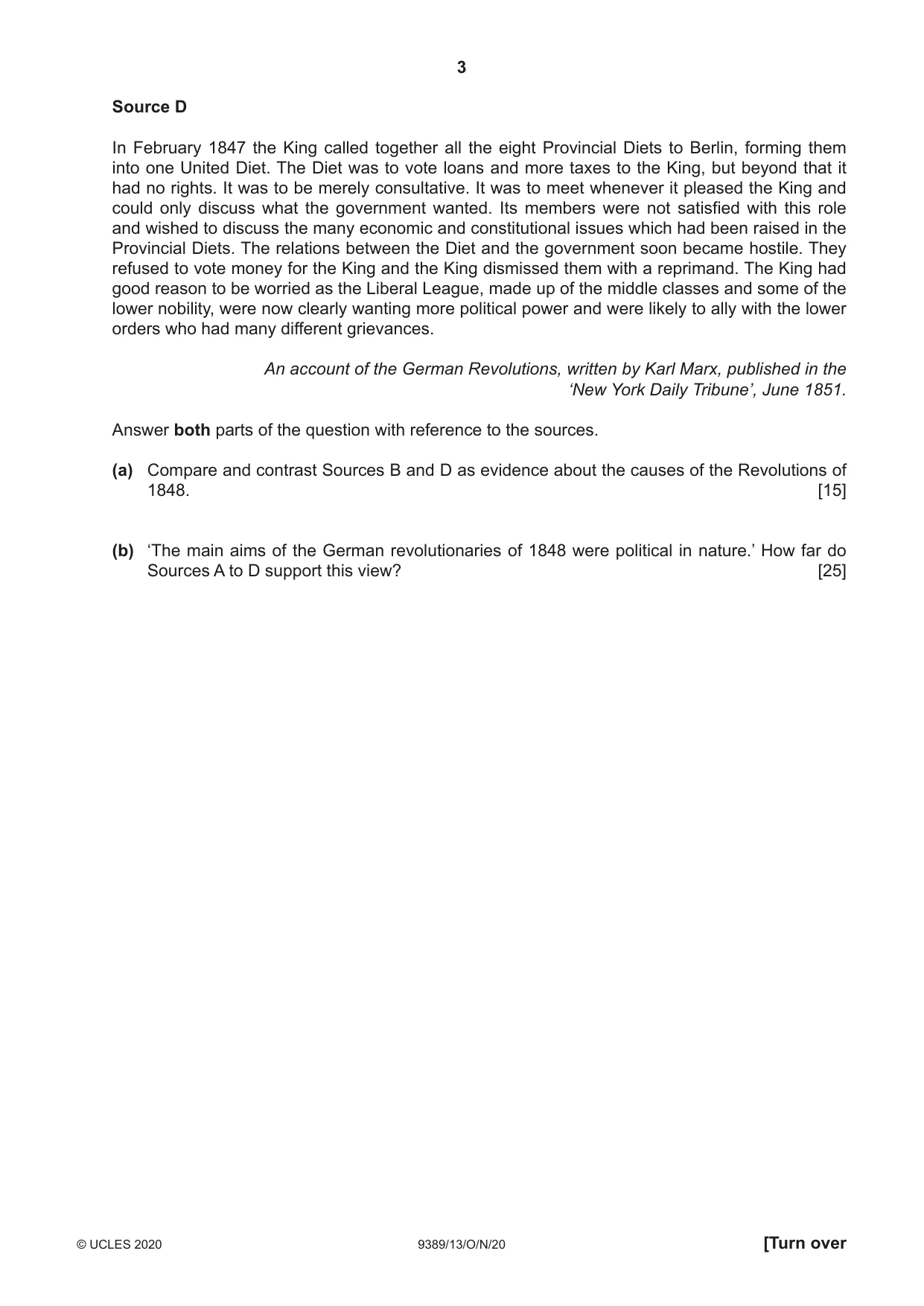
3 9389/13/O/N/20 © UCLES 2020 [Turn over Source D In February 1847 the King called together all the eight Provincial Diets to Berlin, forming them into one United Diet. The Diet was to vote loans and more taxes to the King, but beyond that it had no rights. It was to be merely consultative. It was to meet whenever it pleased the King and could only discuss what the government wanted. Its members were not satisfied with this role and wished to discuss the many economic and constitutional issues which had been raised in the Provincial Diets. The relations between the Diet and the government soon became hostile. They refused to vote money for the King and the King dismissed them with a reprimand. The King had good reason to be worried as the Liberal League, made up of the middle classes and some of the lower nobility, were now clearly wanting more political power and were likely to ally with the lower orders who had many different grievances. An account of the German Revolutions, written by Karl Marx, published in the ‘New York Daily Tribune’, June 1851. Answer both parts of the question with reference to the sources. (a) Compare and contrast Sources B and D as evidence about the causes of the Revolutions of 1848. [15] (b) ‘The main aims of the German revolutionaries of 1848 were political in nature.’ How far do Sources A to D support this view? [25]
Question paper, page 4
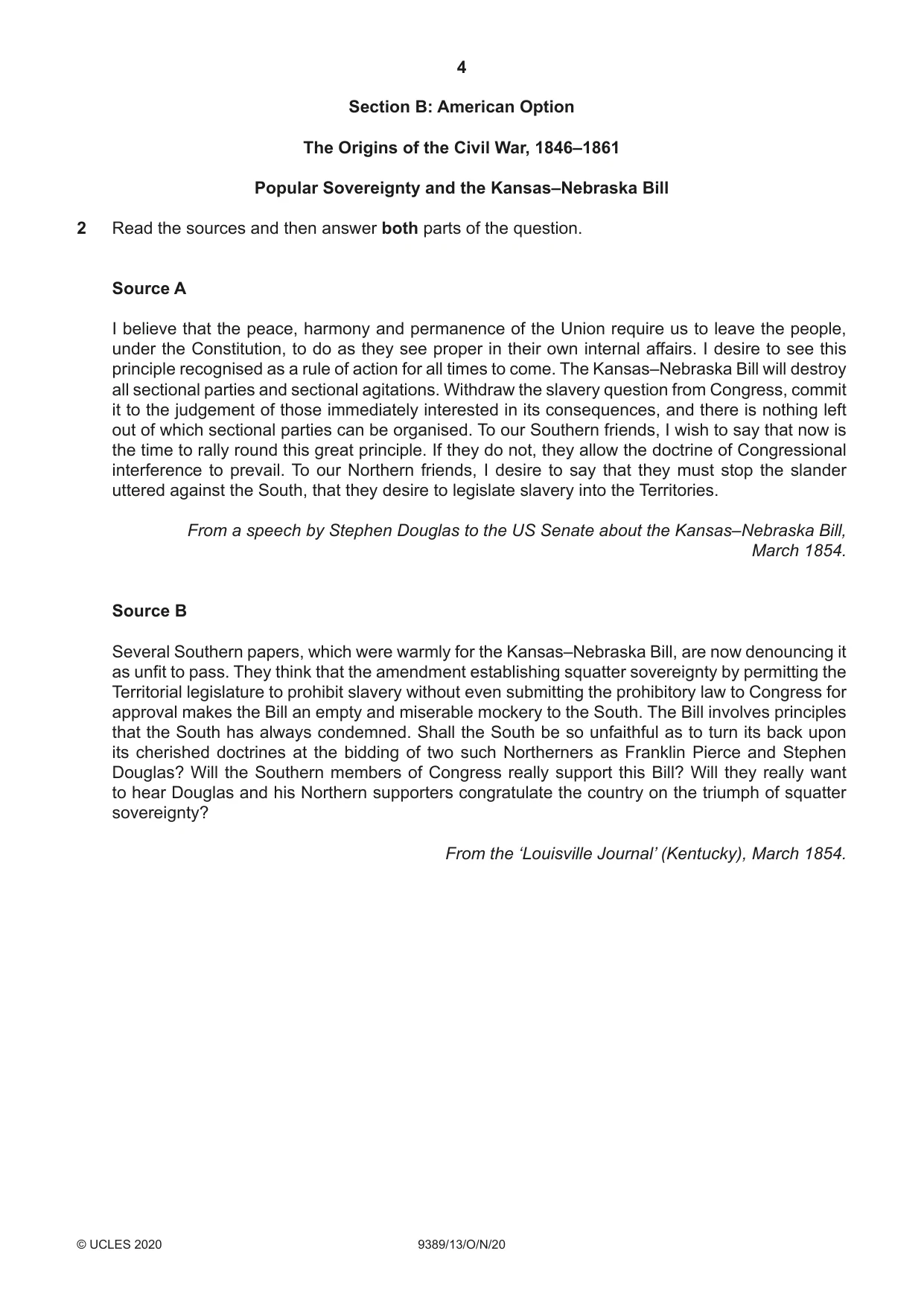
4 9389/13/O/N/20 © UCLES 2020 Section B: American Option The Origins of the Civil War, 1846–1861 Popular Sovereignty and the Kansas–Nebraska Bill 2 Read the sources and then answer both parts of the question. Source A I believe that the peace, harmony and permanence of the Union require us to leave the people, under the Constitution, to do as they see proper in their own internal affairs. I desire to see this principle recognised as a rule of action for all times to come. The Kansas–Nebraska Bill will destroy all sectional parties and sectional agitations. Withdraw the slavery question from Congress, commit it to the judgement of those immediately interested in its consequences, and there is nothing left out of which sectional parties can be organised. To our Southern friends, I wish to say that now is the time to rally round this great principle. If they do not, they allow the doctrine of Congressional interference to prevail. To our Northern friends, I desire to say that they must stop the slander uttered against the South, that they desire to legislate slavery into the Territories. From a speech by Stephen Douglas to the US Senate about the Kansas–Nebraska Bill, March 1854. Source B Several Southern papers, which were warmly for the Kansas–Nebraska Bill, are now denouncing it as unfit to pass. They think that the amendment establishing squatter sovereignty by permitting the Territorial legislature to prohibit slavery without even submitting the prohibitory law to Congress for approval makes the Bill an empty and miserable mockery to the South. The Bill involves principles that the South has always condemned. Shall the South be so unfaithful as to turn its back upon its cherished doctrines at the bidding of two such Northerners as Franklin Pierce and Stephen Douglas? Will the Southern members of Congress really support this Bill? Will they really want to hear Douglas and his Northern supporters congratulate the country on the triumph of squatter sovereignty? From the ‘Louisville Journal’ (Kentucky), March 1854.
Question paper, page 5
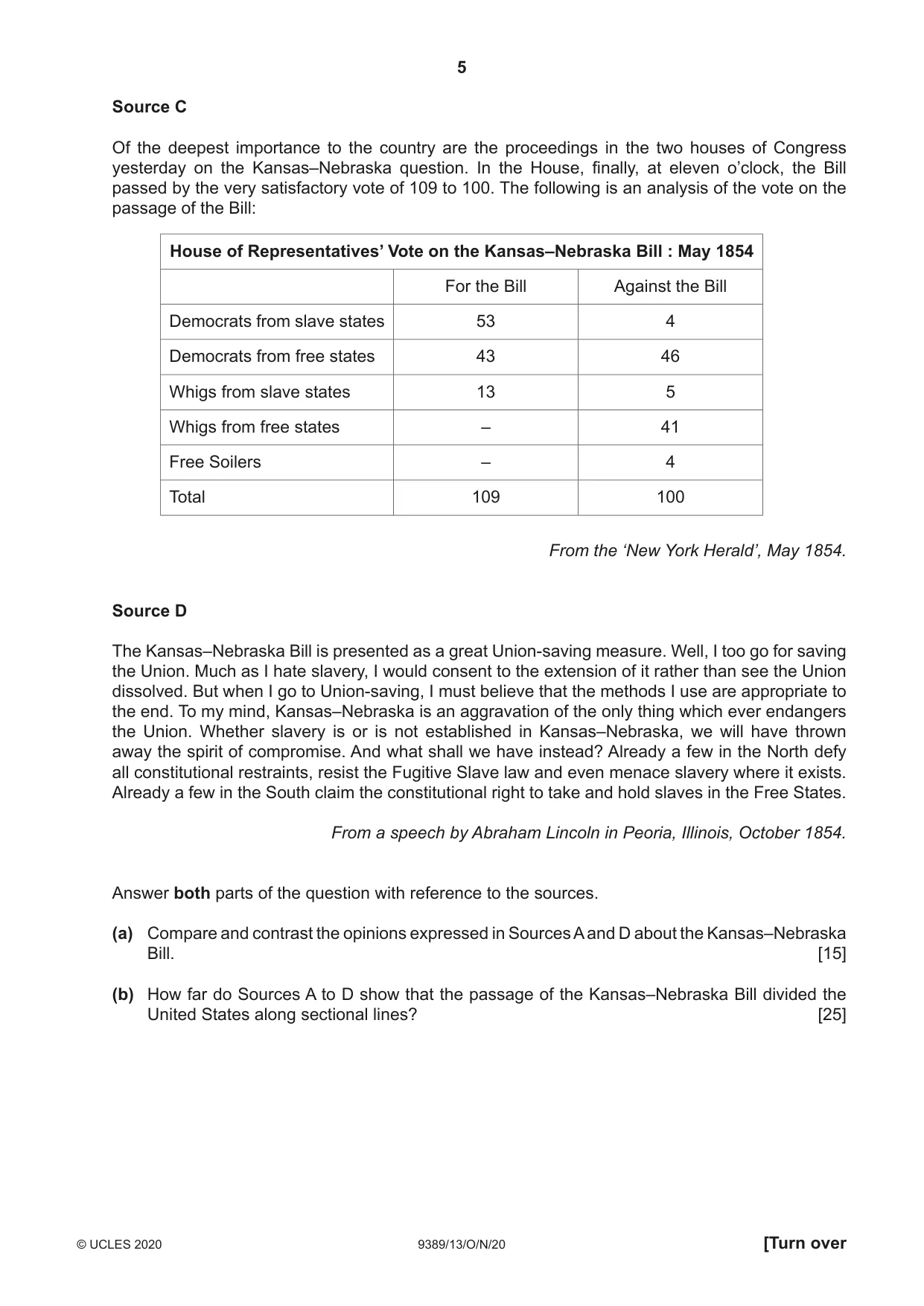
5 9389/13/O/N/20 © UCLES 2020 [Turn over Source C Of the deepest importance to the country are the proceedings in the two houses of Congress yesterday on the Kansas–Nebraska question. In the House, finally, at eleven o’clock, the Bill passed by the very satisfactory vote of 109 to 100. The following is an analysis of the vote on the passage of the Bill: House of Representatives’ Vote on the Kansas–Nebraska Bill : May 1854 For the Bill Against the Bill Democrats from slave states 53 4 Democrats from free states 43 46 Whigs from slave states 13 5 Whigs from free states – 41 Free Soilers – 4 Total 109 100 From the ‘New York Herald’, May 1854. Source D The Kansas–Nebraska Bill is presented as a great Union-saving measure. Well, I too go for saving the Union. Much as I hate slavery, I would consent to the extension of it rather than see the Union dissolved. But when I go to Union-saving, I must believe that the methods I use are appropriate to the end. To my mind, Kansas–Nebraska is an aggravation of the only thing which ever endangers the Union. Whether slavery is or is not established in Kansas–Nebraska, we will have thrown away the spirit of compromise. And what shall we have instead? Already a few in the North defy all constitutional restraints, resist the Fugitive Slave law and even menace slavery where it exists. Already a few in the South claim the constitutional right to take and hold slaves in the Free States. From a speech by Abraham Lincoln in Peoria, Illinois, October 1854. Answer both parts of the question with reference to the sources. (a) Compare and contrast the opinions expressed in Sources A and D about the Kansas–Nebraska Bill. [15] (b) How far do Sources A to D show that the passage of the Kansas–Nebraska Bill divided the United States along sectional lines? [25]
Question paper, page 6
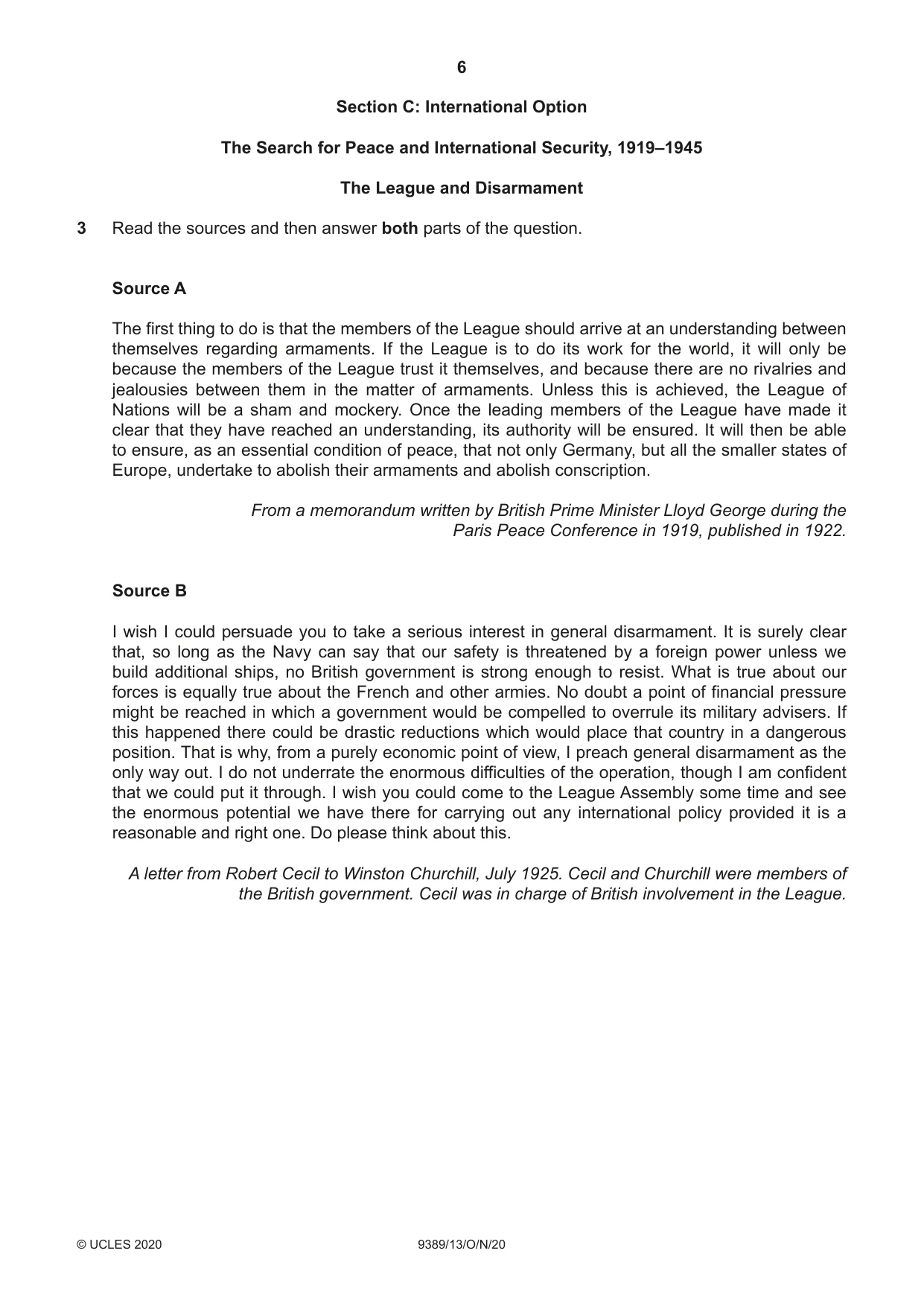
6 9389/13/O/N/20 © UCLES 2020 Section C: International Option The Search for Peace and International Security, 1919–1945 The League and Disarmament 3 Read the sources and then answer both parts of the question. Source A The first thing to do is that the members of the League should arrive at an understanding between themselves regarding armaments. If the League is to do its work for the world, it will only be because the members of the League trust it themselves, and because there are no rivalries and jealousies between them in the matter of armaments. Unless this is achieved, the League of Nations will be a sham and mockery. Once the leading members of the League have made it clear that they have reached an understanding, its authority will be ensured. It will then be able to ensure, as an essential condition of peace, that not only Germany, but all the smaller states of Europe, undertake to abolish their armaments and abolish conscription. From a memorandum written by British Prime Minister Lloyd George during the Paris Peace Conference in 1919, published in 1922. Source B I wish I could persuade you to take a serious interest in general disarmament. It is surely clear that, so long as the Navy can say that our safety is threatened by a foreign power unless we build additional ships, no British government is strong enough to resist. What is true about our forces is equally true about the French and other armies. No doubt a point of financial pressure might be reached in which a government would be compelled to overrule its military advisers. If this happened there could be drastic reductions which would place that country in a dangerous position. That is why, from a purely economic point of view, I preach general disarmament as the only way out. I do not underrate the enormous difficulties of the operation, though I am confident that we could put it through. I wish you could come to the League Assembly some time and see the enormous potential we have there for carrying out any international policy provided it is a reasonable and right one. Do please think about this. A letter from Robert Cecil to Winston Churchill, July 1925. Cecil and Churchill were members of the British government. Cecil was in charge of British involvement in the League.
Question paper, page 7
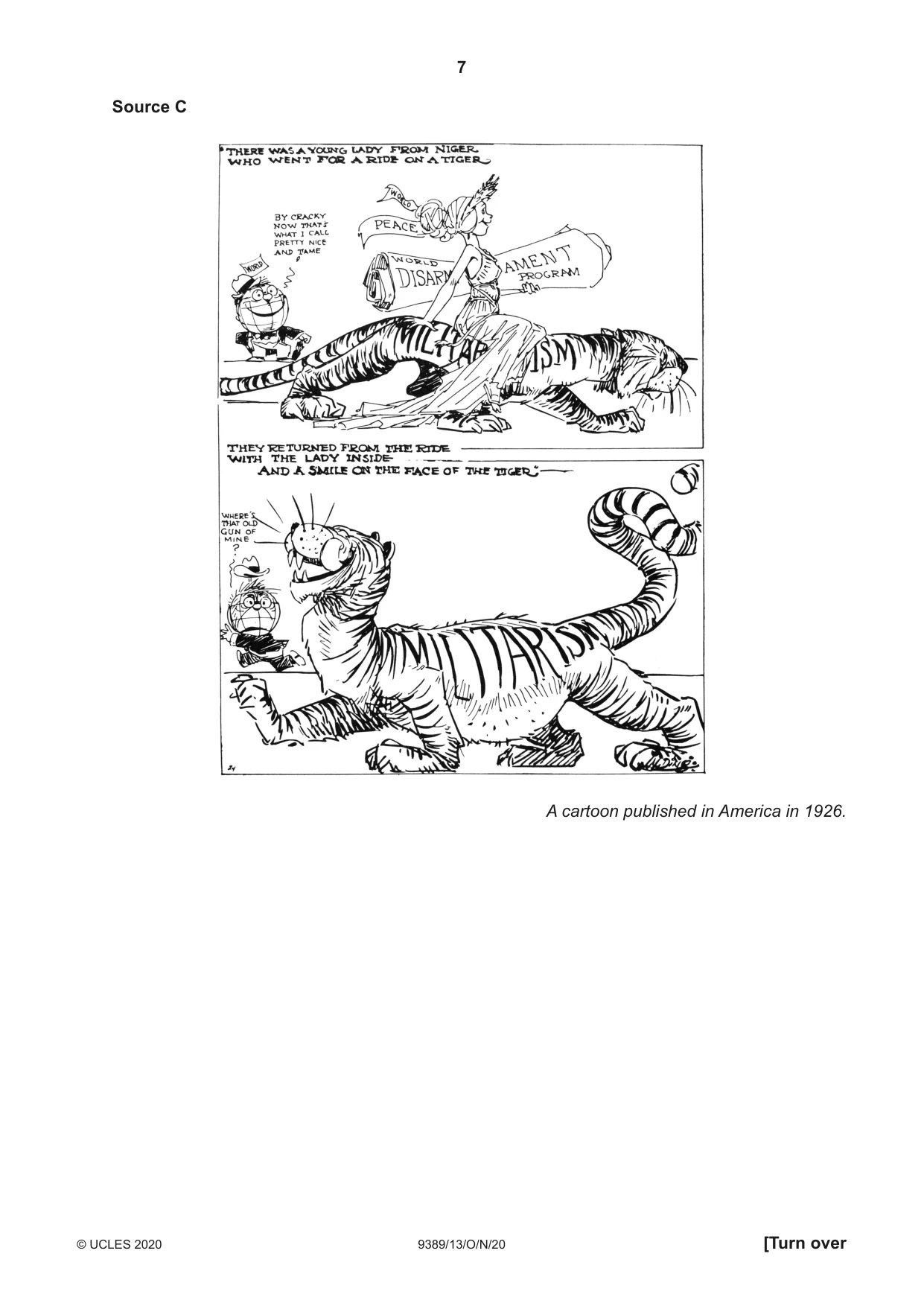
7 9389/13/O/N/20 © UCLES 2020 Source C A cartoon published in America in 1926. [Turn over
Question paper, page 8
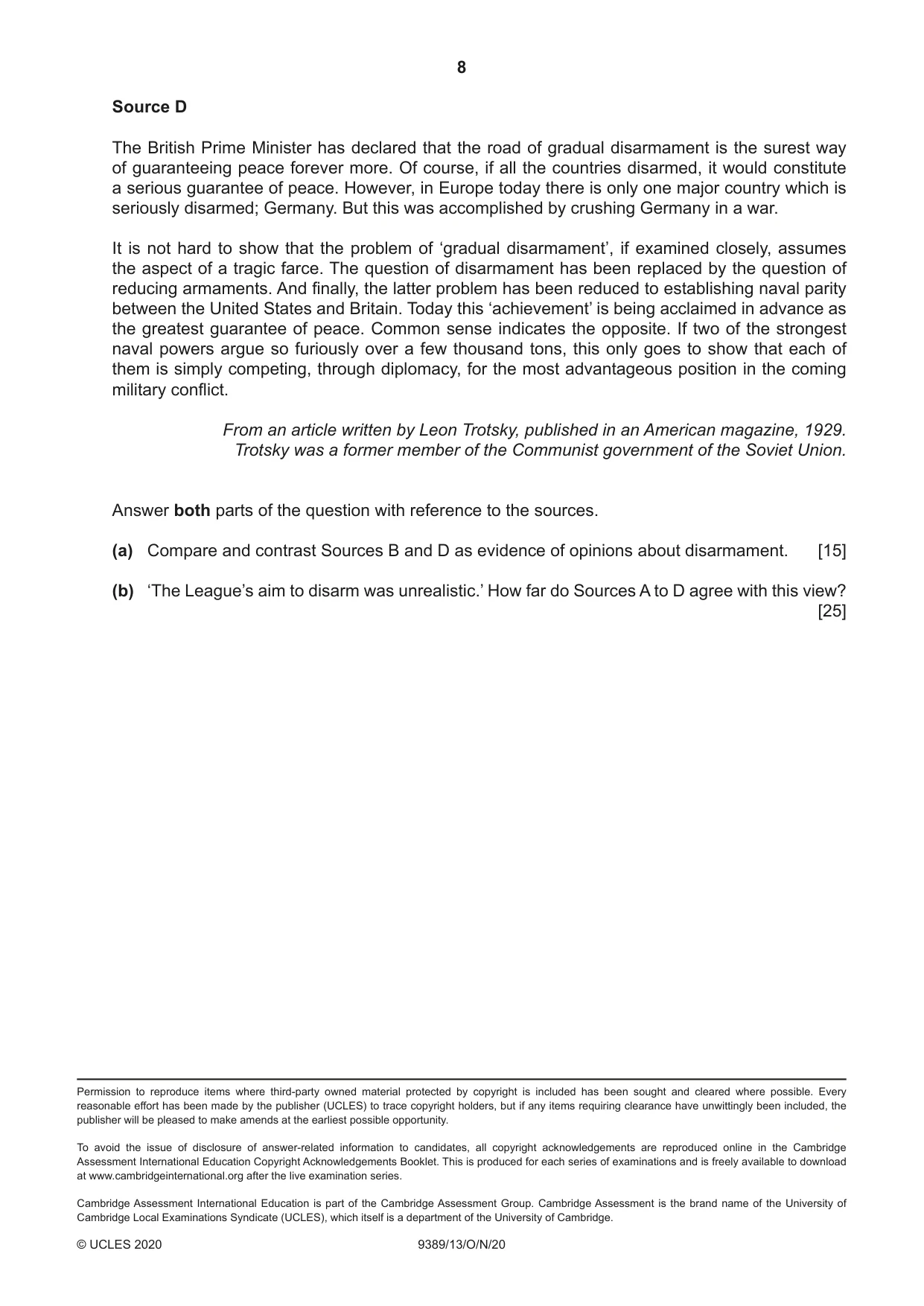
8 9389/13/O/N/20 © UCLES 2020 Source D The British Prime Minister has declared that the road of gradual disarmament is the surest way of guaranteeing peace forever more. Of course, if all the countries disarmed, it would constitute a serious guarantee of peace. However, in Europe today there is only one major country which is seriously disarmed; Germany. But this was accomplished by crushing Germany in a war. It is not hard to show that the problem of ‘gradual disarmament’, if examined closely, assumes the aspect of a tragic farce. The question of disarmament has been replaced by the question of reducing armaments. And finally, the latter problem has been reduced to establishing naval parity between the United States and Britain. Today this ‘achievement’ is being acclaimed in advance as the greatest guarantee of peace. Common sense indicates the opposite. If two of the strongest naval powers argue so furiously over a few thousand tons, this only goes to show that each of them is simply competing, through diplomacy, for the most advantageous position in the coming military conflict. From an article written by Leon Trotsky, published in an American magazine, 1929. Trotsky was a former member of the Communist government of the Soviet Union. Answer both parts of the question with reference to the sources. (a) Compare and contrast Sources B and D as evidence of opinions about disarmament. [15] (b) ‘The League’s aim to disarm was unrealistic.’ How far do Sources A to D agree with this view? [25] Permission to reproduce items where third-party owned material protected by copyright is included has been sought and cleared where possible. Every reasonable effort has been made by the publisher (UCLES) to trace copyright holders, but if any items requiring clearance have unwittingly been included, the publisher will be pleased to make amends at the earliest possible opportunity. To avoid the issue of disclosure of answer-related information to candidates, all copyright acknowledgements are reproduced online in the Cambridge Assessment International Education Copyright Acknowledgements Booklet. This is produced for each series of examinations and is freely available to download at www.cambridgeinternational.org after the live examination series. Cambridge Assessment International Education is part of the Cambridge Assessment Group. Cambridge Assessment is the brand name of the University of Cambridge Local Examinations Syndicate (UCLES), which itself is a department of the University of Cambridge.
Mark scheme, page 1
This document consists of 11 printed pages. © UCLES 2020 [Turn over Cambridge International AS & A Level HISTORY 9389/13 Paper 1 Document Question October/November 2020 MARK SCHEME Maximum Mark: 40 Published This mark scheme is published as an aid to teachers and candidates, to indicate the requirements of the examination. It shows the basis on which Examiners were instructed to award marks. It does not indicate the details of the discussions that took place at an Examiners’ meeting before marking began, which would have considered the acceptability of alternative answers. Mark schemes should be read in conjunction with the question paper and the Principal Examiner Report for Teachers. Cambridge International will not enter into discussions about these mark schemes. Cambridge International is publishing the mark schemes for the October/November 2020 series for most Cambridge IGCSE™, Cambridge International A and AS Level and Cambridge Pre-U components, and some Cambridge O Level components.
Mark scheme, page 2
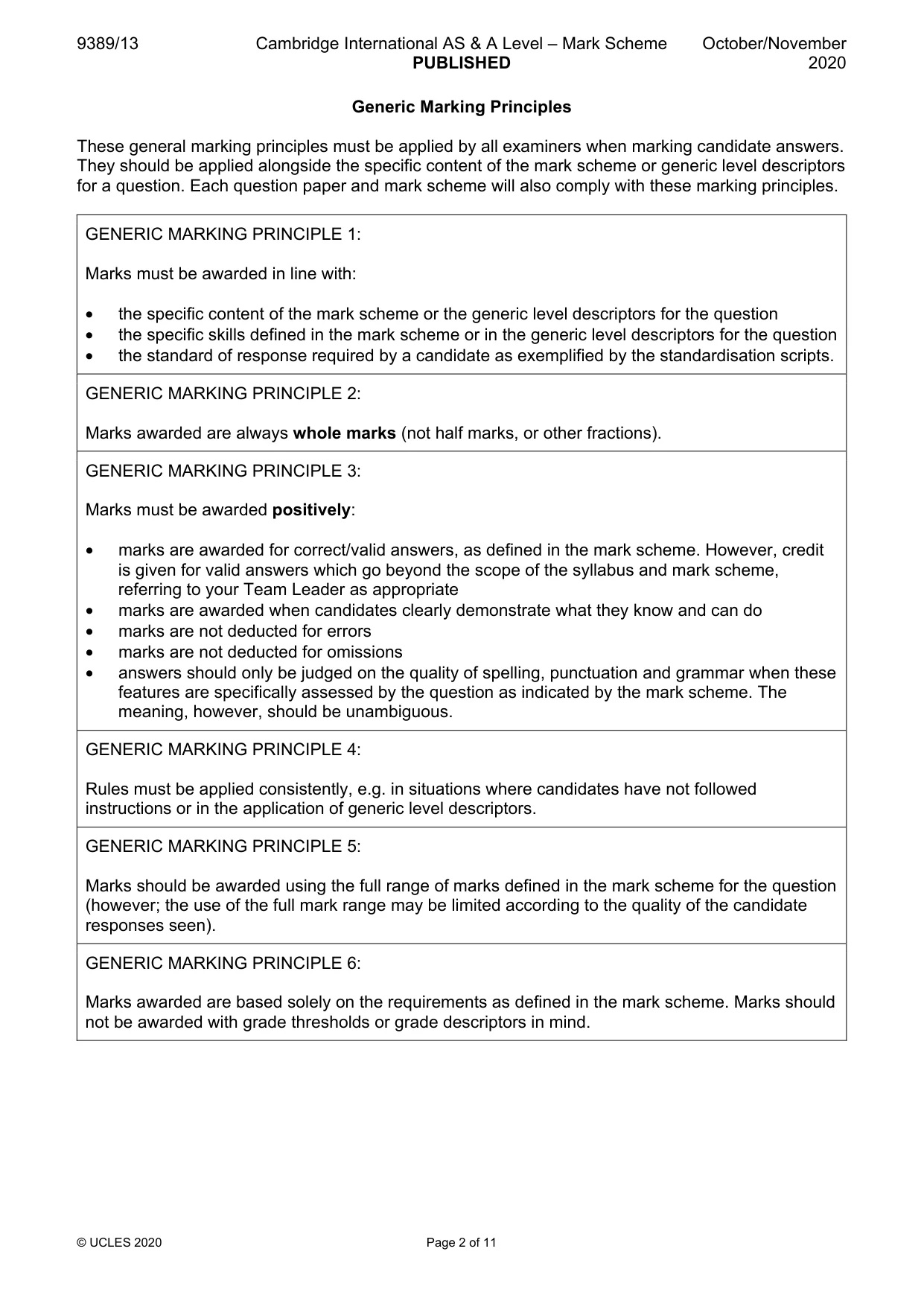
9389/13 Cambridge International AS & A Level – Mark Scheme PUBLISHED October/November 2020 © UCLES 2020 Page 2 of 11 Generic Marking Principles These general marking principles must be applied by all examiners when marking candidate answers. They should be applied alongside the specific content of the mark scheme or generic level descriptors for a question. Each question paper and mark scheme will also comply with these marking principles. GENERIC MARKING PRINCIPLE 1: Marks must be awarded in line with: • the specific content of the mark scheme or the generic level descriptors for the question • the specific skills defined in the mark scheme or in the generic level descriptors for the question • the standard of response required by a candidate as exemplified by the standardisation scripts. GENERIC MARKING PRINCIPLE 2: Marks awarded are always whole marks (not half marks, or other fractions). GENERIC MARKING PRINCIPLE 3: Marks must be awarded positively: • marks are awarded for correct/valid answers, as defined in the mark scheme. However, credit is given for valid answers which go beyond the scope of the syllabus and mark scheme, referring to your Team Leader as appropriate • marks are awarded when candidates clearly demonstrate what they know and can do • marks are not deducted for errors • marks are not deducted for omissions • answers should only be judged on the quality of spelling, punctuation and grammar when these features are specifically assessed by the question as indicated by the mark scheme. The meaning, however, should be unambiguous. GENERIC MARKING PRINCIPLE 4: Rules must be applied consistently, e.g. in situations where candidates have not followed instructions or in the application of generic level descriptors. GENERIC MARKING PRINCIPLE 5: Marks should be awarded using the full range of marks defined in the mark scheme for the question (however; the use of the full mark range may be limited according to the quality of the candidate responses seen). GENERIC MARKING PRINCIPLE 6: Marks awarded are based solely on the requirements as defined in the mark scheme. Marks should not be awarded with grade thresholds or grade descriptors in mind.
Mark scheme, page 3
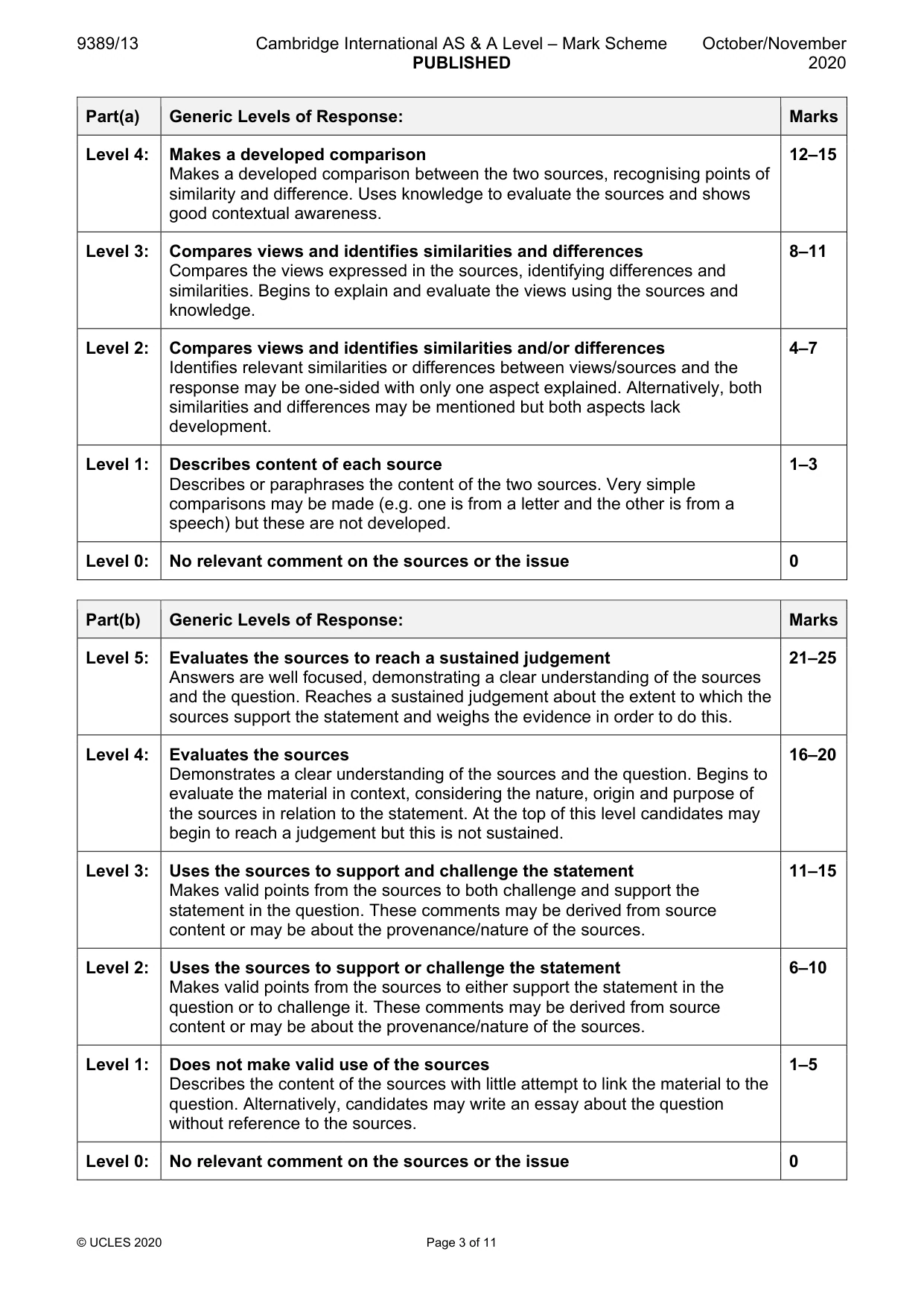
9389/13 Cambridge International AS & A Level – Mark Scheme PUBLISHED October/November 2020 © UCLES 2020 Page 3 of 11 Part(a) Generic Levels of Response: Marks Level 4: Makes a developed comparison Makes a developed comparison between the two sources, recognising points of similarity and difference. Uses knowledge to evaluate the sources and shows good contextual awareness. 12–15 Level 3: Compares views and identifies similarities and differences Compares the views expressed in the sources, identifying differences and similarities. Begins to explain and evaluate the views using the sources and knowledge. 8–11 Level 2: Compares views and identifies similarities and/or differences Identifies relevant similarities or differences between views/sources and the response may be one-sided with only one aspect explained. Alternatively, both similarities and differences may be mentioned but both aspects lack development. 4–7 Level 1: Describes content of each source Describes or paraphrases the content of the two sources. Very simple comparisons may be made (e.g. one is from a letter and the other is from a speech) but these are not developed. 1–3 Level 0: No relevant comment on the sources or the issue 0 Part(b) Generic Levels of Response: Marks Level 5: Evaluates the sources to reach a sustained judgement Answers are well focused, demonstrating a clear understanding of the sources and the question. Reaches a sustained judgement about the extent to which the sources support the statement and weighs the evidence in order to do this. 21–25 Level 4: Evaluates the sources Demonstrates a clear understanding of the sources and the question. Begins to evaluate the material in context, considering the nature, origin and purpose of the sources in relation to the statement. At the top of this level candidates may begin to reach a judgement but this is not sustained. 16–20 Level 3: Uses the sources to support and challenge the statement Makes valid points from the sources to both challenge and support the statement in the question. These comments may be derived from source content or may be about the provenance/nature of the sources. 11–15 Level 2: Uses the sources to support or challenge the statement Makes valid points from the sources to either support the statement in the question or to challenge it. These comments may be derived from source content or may be about the provenance/nature of the sources. 6–10 Level 1: Does not make valid use of the sources Describes the content of the sources with little attempt to link the material to the question. Alternatively, candidates may write an essay about the question without reference to the sources. 1–5 Level 0: No relevant comment on the sources or the issue 0
Mark scheme, page 4
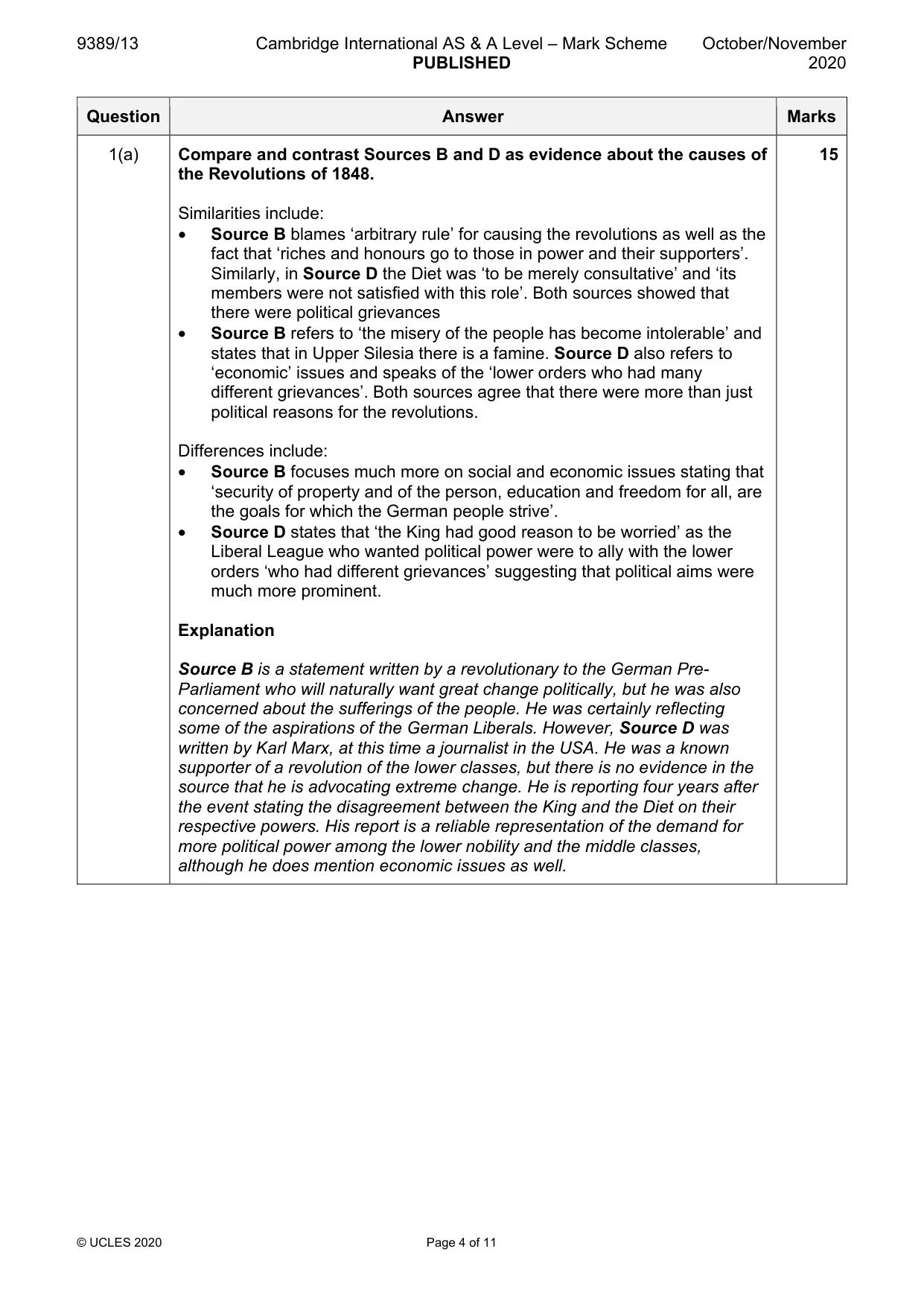
9389/13 Cambridge International AS & A Level – Mark Scheme PUBLISHED October/November 2020 © UCLES 2020 Page 4 of 11 Question Answer Marks 1(a) Compare and contrast Sources B and D as evidence about the causes of the Revolutions of 1848. Similarities include: • Source B blames ‘arbitrary rule’ for causing the revolutions as well as the fact that ‘riches and honours go to those in power and their supporters’. Similarly, in Source D the Diet was ‘to be merely consultative’ and ‘its members were not satisfied with this role’. Both sources showed that there were political grievances • Source B refers to ‘the misery of the people has become intolerable’ and states that in Upper Silesia there is a famine. Source D also refers to ‘economic’ issues and speaks of the ‘lower orders who had many different grievances’. Both sources agree that there were more than just political reasons for the revolutions. Differences include: • Source B focuses much more on social and economic issues stating that ‘security of property and of the person, education and freedom for all, are the goals for which the German people strive’. • Source D states that ‘the King had good reason to be worried’ as the Liberal League who wanted political power were to ally with the lower orders ‘who had different grievances’ suggesting that political aims were much more prominent. Explanation Source B is a statement written by a revolutionary to the German Pre- Parliament who will naturally want great change politically, but he was also concerned about the sufferings of the people. He was certainly reflecting some of the aspirations of the German Liberals. However, Source D was written by Karl Marx, at this time a journalist in the USA. He was a known supporter of a revolution of the lower classes, but there is no evidence in the source that he is advocating extreme change. He is reporting four years after the event stating the disagreement between the King and the Diet on their respective powers. His report is a reliable representation of the demand for more political power among the lower nobility and the middle classes, although he does mention economic issues as well. 15
Mark scheme, page 5
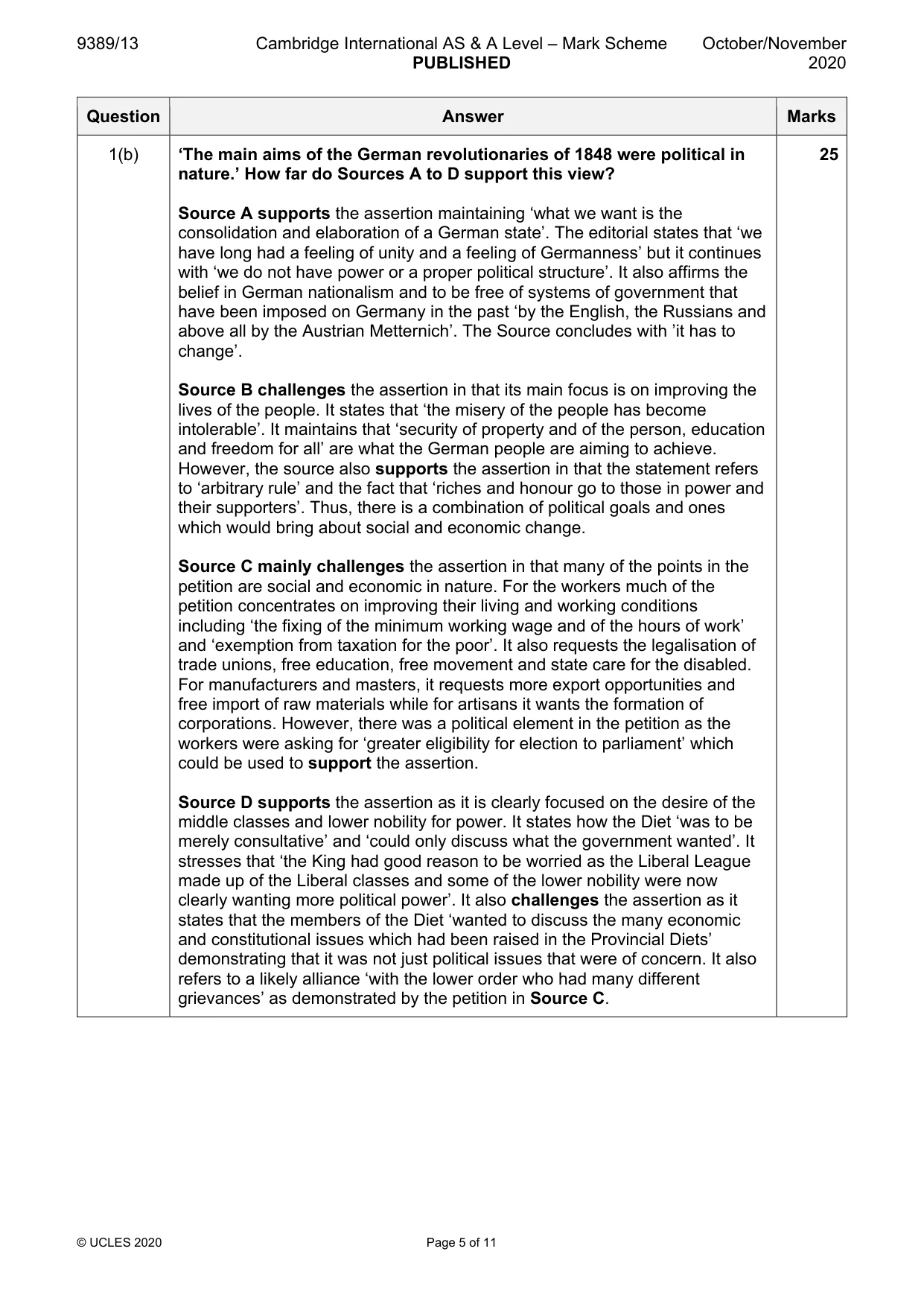
9389/13 Cambridge International AS & A Level – Mark Scheme PUBLISHED October/November 2020 © UCLES 2020 Page 5 of 11 Question Answer Marks 1(b) ‘The main aims of the German revolutionaries of 1848 were political in nature.’ How far do Sources A to D support this view? Source A supports the assertion maintaining ‘what we want is the consolidation and elaboration of a German state’. The editorial states that ‘we have long had a feeling of unity and a feeling of Germanness’ but it continues with ‘we do not have power or a proper political structure’. It also affirms the belief in German nationalism and to be free of systems of government that have been imposed on Germany in the past ‘by the English, the Russians and above all by the Austrian Metternich’. The Source concludes with ’it has to change’. Source B challenges the assertion in that its main focus is on improving the lives of the people. It states that ‘the misery of the people has become intolerable’. It maintains that ‘security of property and of the person, education and freedom for all’ are what the German people are aiming to achieve. However, the source also supports the assertion in that the statement refers to ‘arbitrary rule’ and the fact that ‘riches and honour go to those in power and their supporters’. Thus, there is a combination of political goals and ones which would bring about social and economic change. Source C mainly challenges the assertion in that many of the points in the petition are social and economic in nature. For the workers much of the petition concentrates on improving their living and working conditions including ‘the fixing of the minimum working wage and of the hours of work’ and ‘exemption from taxation for the poor’. It also requests the legalisation of trade unions, free education, free movement and state care for the disabled. For manufacturers and masters, it requests more export opportunities and free import of raw materials while for artisans it wants the formation of corporations. However, there was a political element in the petition as the workers were asking for ‘greater eligibility for election to parliament’ which could be used to support the assertion. Source D supports the assertion as it is clearly focused on the desire of the middle classes and lower nobility for power. It states how the Diet ‘was to be merely consultative’ and ‘could only discuss what the government wanted’. It stresses that ‘the King had good reason to be worried as the Liberal League made up of the Liberal classes and some of the lower nobility were now clearly wanting more political power’. It also challenges the assertion as it states that the members of the Diet ‘wanted to discuss the many economic and constitutional issues which had been raised in the Provincial Diets’ demonstrating that it was not just political issues that were of concern. It also refers to a likely alliance ‘with the lower order who had many different grievances’ as demonstrated by the petition in Source C. 25
Mark scheme, page 6
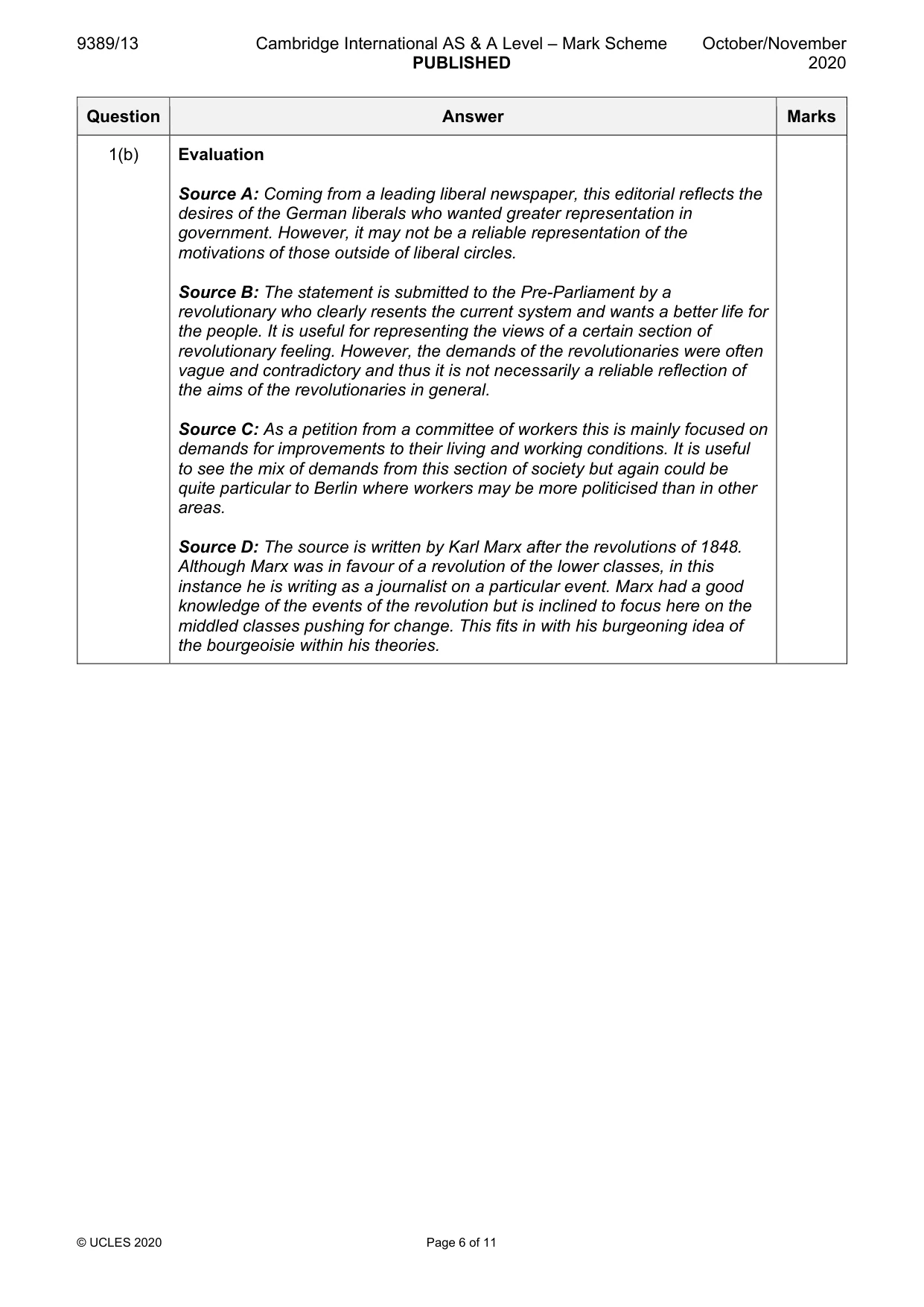
9389/13 Cambridge International AS & A Level – Mark Scheme PUBLISHED October/November 2020 © UCLES 2020 Page 6 of 11 Question Answer Marks 1(b) Evaluation Source A: Coming from a leading liberal newspaper, this editorial reflects the desires of the German liberals who wanted greater representation in government. However, it may not be a reliable representation of the motivations of those outside of liberal circles. Source B: The statement is submitted to the Pre-Parliament by a revolutionary who clearly resents the current system and wants a better life for the people. It is useful for representing the views of a certain section of revolutionary feeling. However, the demands of the revolutionaries were often vague and contradictory and thus it is not necessarily a reliable reflection of the aims of the revolutionaries in general. Source C: As a petition from a committee of workers this is mainly focused on demands for improvements to their living and working conditions. It is useful to see the mix of demands from this section of society but again could be quite particular to Berlin where workers may be more politicised than in other areas. Source D: The source is written by Karl Marx after the revolutions of 1848. Although Marx was in favour of a revolution of the lower classes, in this instance he is writing as a journalist on a particular event. Marx had a good knowledge of the events of the revolution but is inclined to focus here on the middled classes pushing for change. This fits in with his burgeoning idea of the bourgeoisie within his theories.
Mark scheme, page 7
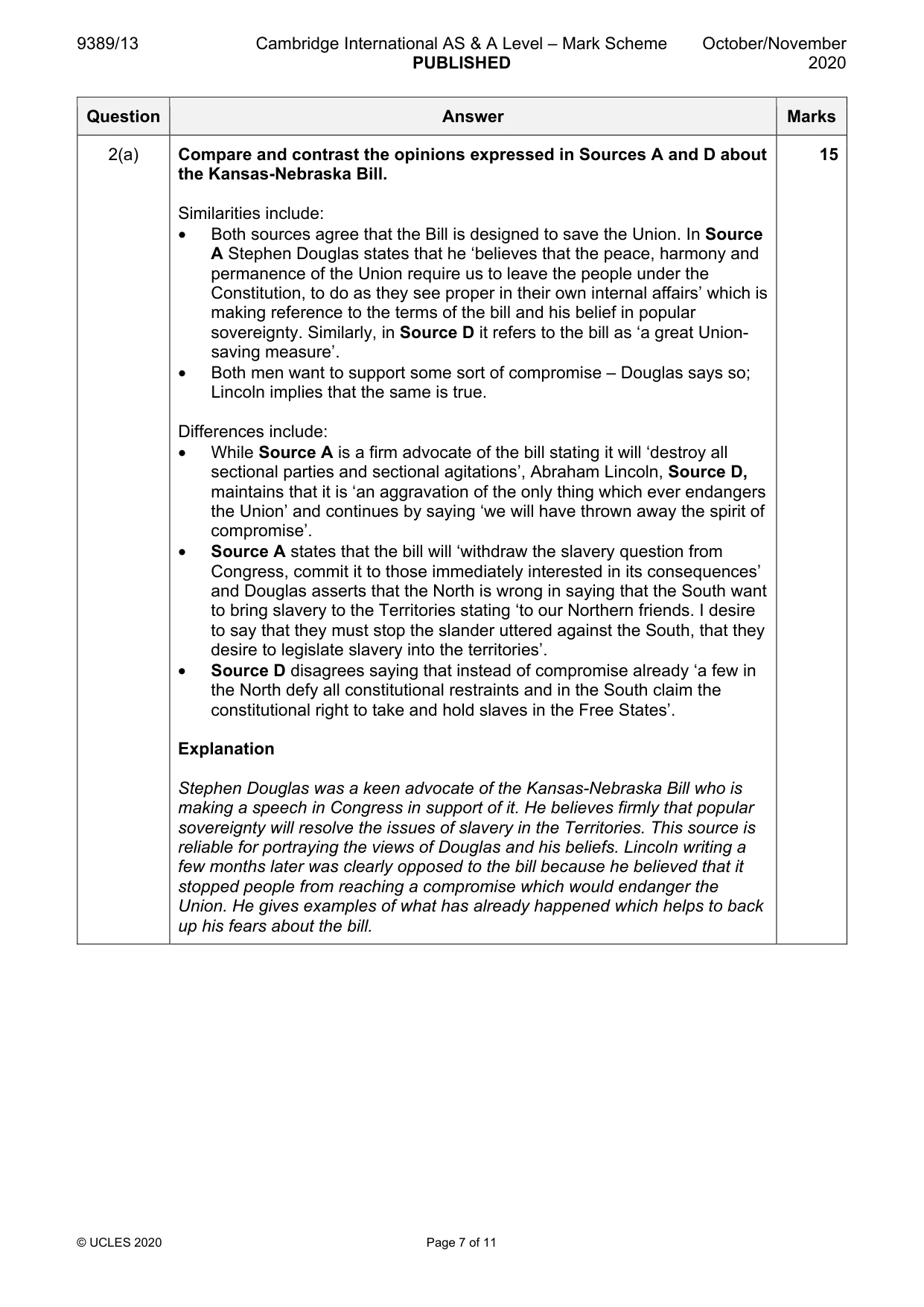
9389/13 Cambridge International AS & A Level – Mark Scheme PUBLISHED October/November 2020 © UCLES 2020 Page 7 of 11 Question Answer Marks 2(a) Compare and contrast the opinions expressed in Sources A and D about the Kansas-Nebraska Bill. Similarities include: • Both sources agree that the Bill is designed to save the Union. In Source A Stephen Douglas states that he ‘believes that the peace, harmony and permanence of the Union require us to leave the people under the Constitution, to do as they see proper in their own internal affairs’ which is making reference to the terms of the bill and his belief in popular sovereignty. Similarly, in Source D it refers to the bill as ‘a great Union- saving measure’. • Both men want to support some sort of compromise – Douglas says so; Lincoln implies that the same is true. Differences include: • While Source A is a firm advocate of the bill stating it will ‘destroy all sectional parties and sectional agitations’, Abraham Lincoln, Source D, maintains that it is ‘an aggravation of the only thing which ever endangers the Union’ and continues by saying ‘we will have thrown away the spirit of compromise’. • Source A states that the bill will ‘withdraw the slavery question from Congress, commit it to those immediately interested in its consequences’ and Douglas asserts that the North is wrong in saying that the South want to bring slavery to the Territories stating ‘to our Northern friends. I desire to say that they must stop the slander uttered against the South, that they desire to legislate slavery into the territories’. • Source D disagrees saying that instead of compromise already ‘a few in the North defy all constitutional restraints and in the South claim the constitutional right to take and hold slaves in the Free States’. Explanation Stephen Douglas was a keen advocate of the Kansas-Nebraska Bill who is making a speech in Congress in support of it. He believes firmly that popular sovereignty will resolve the issues of slavery in the Territories. This source is reliable for portraying the views of Douglas and his beliefs. Lincoln writing a few months later was clearly opposed to the bill because he believed that it stopped people from reaching a compromise which would endanger the Union. He gives examples of what has already happened which helps to back up his fears about the bill. 15
Mark scheme, page 8
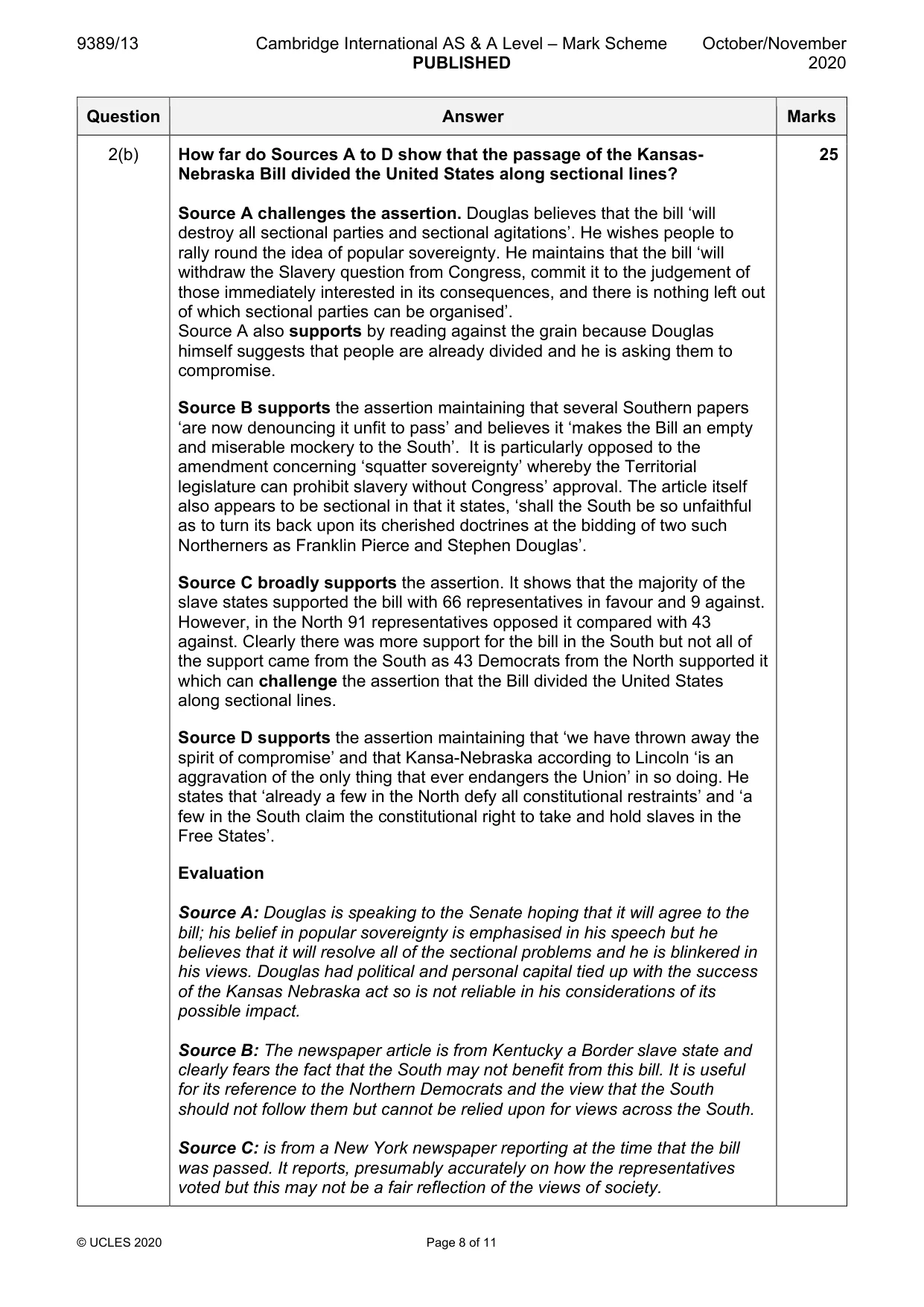
9389/13 Cambridge International AS & A Level – Mark Scheme PUBLISHED October/November 2020 © UCLES 2020 Page 8 of 11 Question Answer Marks 2(b) How far do Sources A to D show that the passage of the Kansas- Nebraska Bill divided the United States along sectional lines? Source A challenges the assertion. Douglas believes that the bill ‘will destroy all sectional parties and sectional agitations’. He wishes people to rally round the idea of popular sovereignty. He maintains that the bill ‘will withdraw the Slavery question from Congress, commit it to the judgement of those immediately interested in its consequences, and there is nothing left out of which sectional parties can be organised’. Source A also supports by reading against the grain because Douglas himself suggests that people are already divided and he is asking them to compromise. Source B supports the assertion maintaining that several Southern papers ‘are now denouncing it unfit to pass’ and believes it ‘makes the Bill an empty and miserable mockery to the South’. It is particularly opposed to the amendment concerning ‘squatter sovereignty’ whereby the Territorial legislature can prohibit slavery without Congress’ approval. The article itself also appears to be sectional in that it states, ‘shall the South be so unfaithful as to turn its back upon its cherished doctrines at the bidding of two such Northerners as Franklin Pierce and Stephen Douglas’. Source C broadly supports the assertion. It shows that the majority of the slave states supported the bill with 66 representatives in favour and 9 against. However, in the North 91 representatives opposed it compared with 43 against. Clearly there was more support for the bill in the South but not all of the support came from the South as 43 Democrats from the North supported it which can challenge the assertion that the Bill divided the United States along sectional lines. Source D supports the assertion maintaining that ‘we have thrown away the spirit of compromise’ and that Kansa-Nebraska according to Lincoln ‘is an aggravation of the only thing that ever endangers the Union’ in so doing. He states that ‘already a few in the North defy all constitutional restraints’ and ‘a few in the South claim the constitutional right to take and hold slaves in the Free States’. Evaluation Source A: Douglas is speaking to the Senate hoping that it will agree to the bill; his belief in popular sovereignty is emphasised in his speech but he believes that it will resolve all of the sectional problems and he is blinkered in his views. Douglas had political and personal capital tied up with the success of the Kansas Nebraska act so is not reliable in his considerations of its possible impact. Source B: The newspaper article is from Kentucky a Border slave state and clearly fears the fact that the South may not benefit from this bill. It is useful for its reference to the Northern Democrats and the view that the South should not follow them but cannot be relied upon for views across the South. Source C: is from a New York newspaper reporting at the time that the bill was passed. It reports, presumably accurately on how the representatives voted but this may not be a fair reflection of the views of society. 25
Mark scheme, page 9
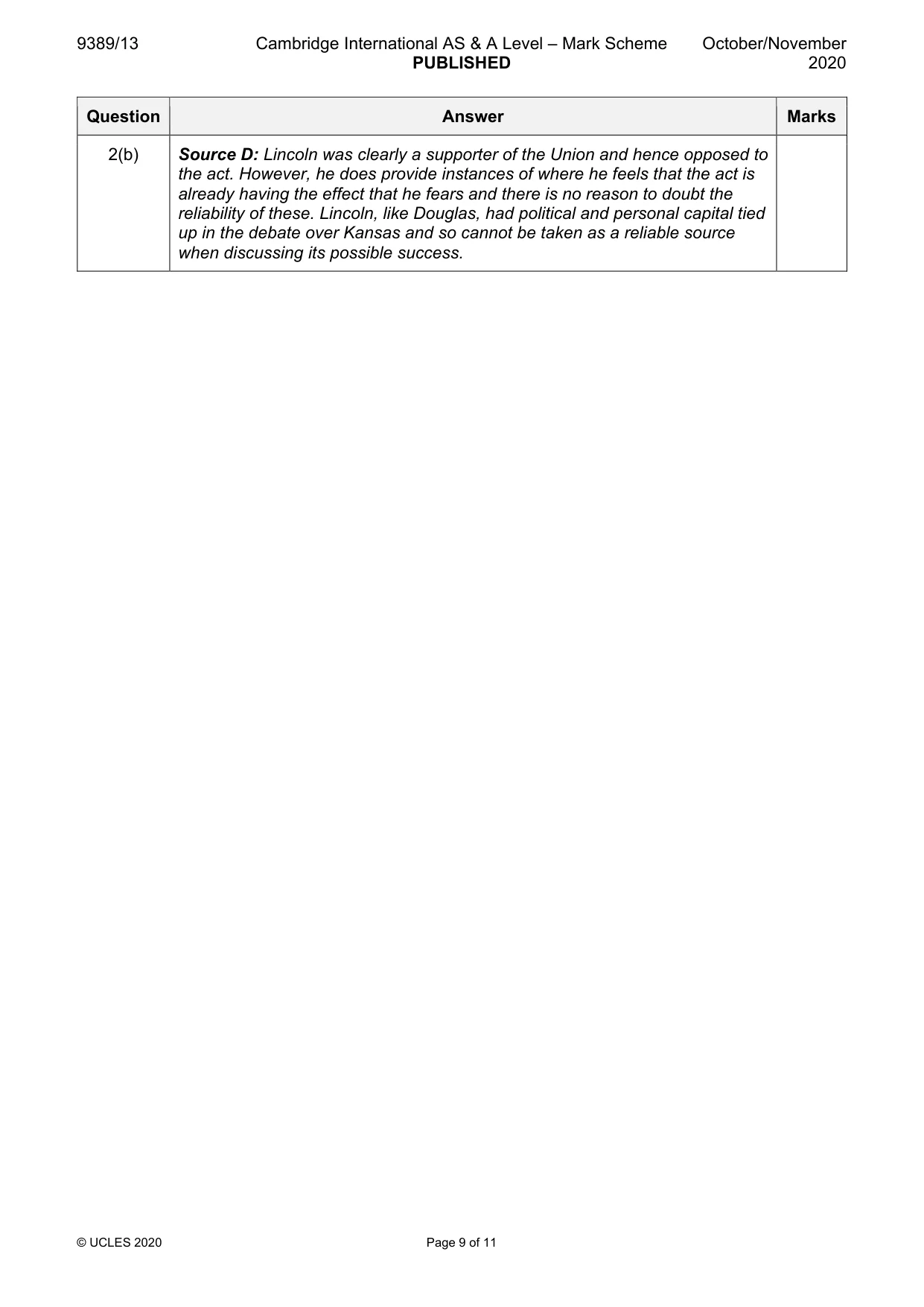
9389/13 Cambridge International AS & A Level – Mark Scheme PUBLISHED October/November 2020 © UCLES 2020 Page 9 of 11 Question Answer Marks 2(b) Source D: Lincoln was clearly a supporter of the Union and hence opposed to the act. However, he does provide instances of where he feels that the act is already having the effect that he fears and there is no reason to doubt the reliability of these. Lincoln, like Douglas, had political and personal capital tied up in the debate over Kansas and so cannot be taken as a reliable source when discussing its possible success.
Mark scheme, page 10
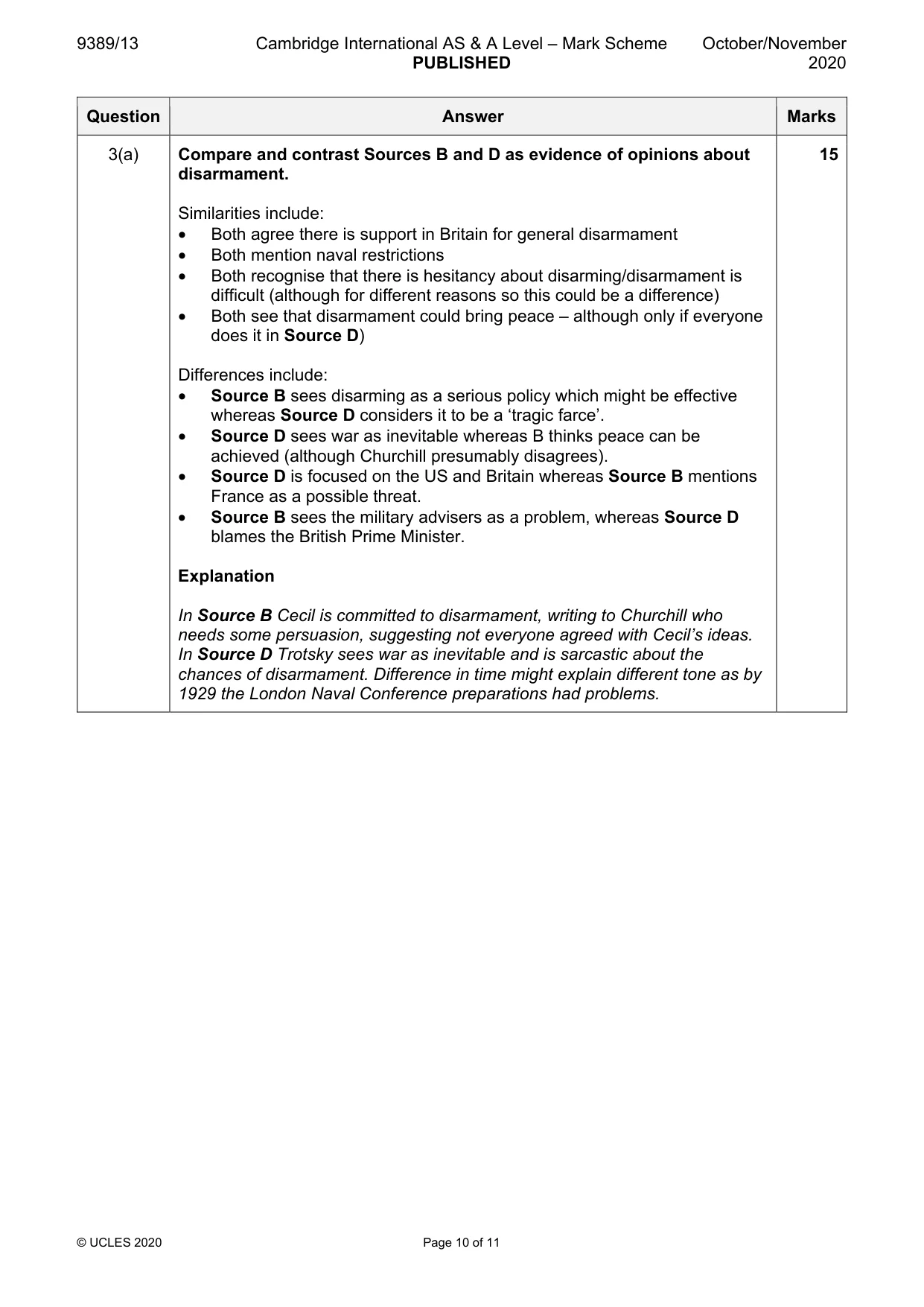
9389/13 Cambridge International AS & A Level – Mark Scheme PUBLISHED October/November 2020 © UCLES 2020 Page 10 of 11 Question Answer Marks 3(a) Compare and contrast Sources B and D as evidence of opinions about disarmament. Similarities include: • Both agree there is support in Britain for general disarmament • Both mention naval restrictions • Both recognise that there is hesitancy about disarming/disarmament is difficult (although for different reasons so this could be a difference) • Both see that disarmament could bring peace – although only if everyone does it in Source D) Differences include: • Source B sees disarming as a serious policy which might be effective whereas Source D considers it to be a ‘tragic farce’. • Source D sees war as inevitable whereas B thinks peace can be achieved (although Churchill presumably disagrees). • Source D is focused on the US and Britain whereas Source B mentions France as a possible threat. • Source B sees the military advisers as a problem, whereas Source D blames the British Prime Minister. Explanation In Source B Cecil is committed to disarmament, writing to Churchill who needs some persuasion, suggesting not everyone agreed with Cecil’s ideas. In Source D Trotsky sees war as inevitable and is sarcastic about the chances of disarmament. Difference in time might explain different tone as by 1929 the London Naval Conference preparations had problems. 15
Mark scheme, page 11
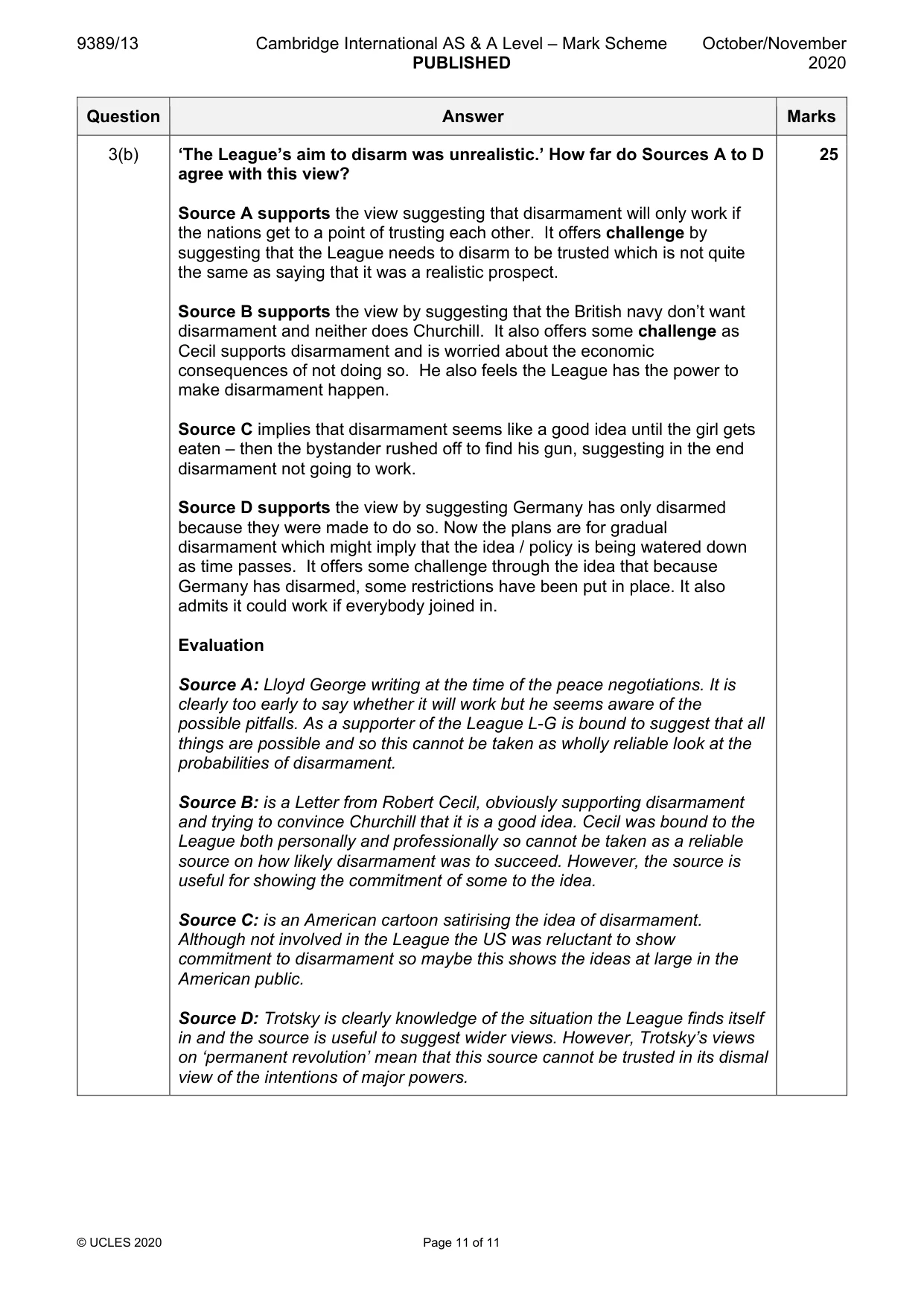
9389/13 Cambridge International AS & A Level – Mark Scheme PUBLISHED October/November 2020 © UCLES 2020 Page 11 of 11 Question Answer Marks 3(b) ‘The League’s aim to disarm was unrealistic.’ How far do Sources A to D agree with this view? Source A supports the view suggesting that disarmament will only work if the nations get to a point of trusting each other. It offers challenge by suggesting that the League needs to disarm to be trusted which is not quite the same as saying that it was a realistic prospect. Source B supports the view by suggesting that the British navy don’t want disarmament and neither does Churchill. It also offers some challenge as Cecil supports disarmament and is worried about the economic consequences of not doing so. He also feels the League has the power to make disarmament happen. Source C implies that disarmament seems like a good idea until the girl gets eaten – then the bystander rushed off to find his gun, suggesting in the end disarmament not going to work. Source D supports the view by suggesting Germany has only disarmed because they were made to do so. Now the plans are for gradual disarmament which might imply that the idea / policy is being watered down as time passes. It offers some challenge through the idea that because Germany has disarmed, some restrictions have been put in place. It also admits it could work if everybody joined in. Evaluation Source A: Lloyd George writing at the time of the peace negotiations. It is clearly too early to say whether it will work but he seems aware of the possible pitfalls. As a supporter of the League L-G is bound to suggest that all things are possible and so this cannot be taken as wholly reliable look at the probabilities of disarmament. Source B: is a Letter from Robert Cecil, obviously supporting disarmament and trying to convince Churchill that it is a good idea. Cecil was bound to the League both personally and professionally so cannot be taken as a reliable source on how likely disarmament was to succeed. However, the source is useful for showing the commitment of some to the idea. Source C: is an American cartoon satirising the idea of disarmament. Although not involved in the League the US was reluctant to show commitment to disarmament so maybe this shows the ideas at large in the American public. Source D: Trotsky is clearly knowledge of the situation the League finds itself in and the source is useful to suggest wider views. However, Trotsky’s views on ‘permanent revolution’ mean that this source cannot be trusted in its dismal view of the intentions of major powers. 25
What you needed in this session
Cambridge’s own grade thresholds for 2020 Oct/Nov, Paper 1 · Variant 3. A higher threshold means an easier paper — the bar moves with how the cohort did.