Cambridge A Level History 9389 — 2020 Oct/Nov Paper 1 · Variant 1
9389/11/O/N/20 · 40 marks · ≈45 min
The question paper and its mark scheme, free to read here and free to download. This is Cambridge’s own paper, exactly as it was sat.
Question paper8 pages

Mark scheme12 pages
Answers below. Sit the paper first if you are practising.
Paper as text
Question paper, page 1
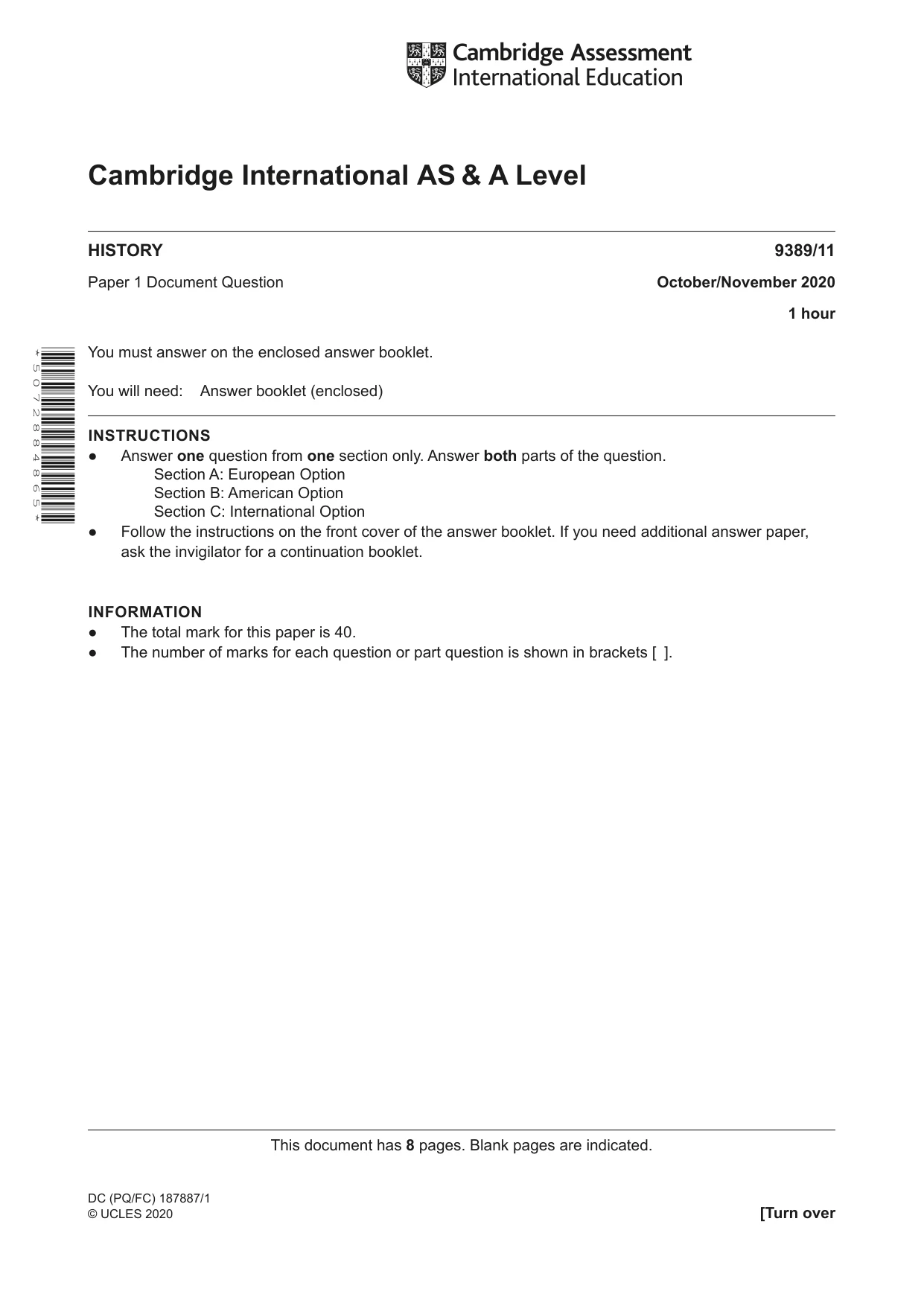
Cambridge International AS & A Level This document has 8 pages. Blank pages are indicated. DC (PQ/FC) 187887/1 © UCLES 2020 [Turn over * 5 0 7 2 8 8 4 8 6 5 * HISTORY 9389/11 Paper 1 Document Question October/November 2020 1 hour You must answer on the enclosed answer booklet. You will need: Answer booklet (enclosed) INSTRUCTIONS ● Answer one question from one section only. Answer both parts of the question. Section A: European Option Section B: American Option Section C: International Option ● Follow the instructions on the front cover of the answer booklet. If you need additional answer paper, ask the invigilator for a continuation booklet. INFORMATION ● The total mark for this paper is 40. ● The number of marks for each question or part question is shown in brackets [ ].
Question paper, page 2
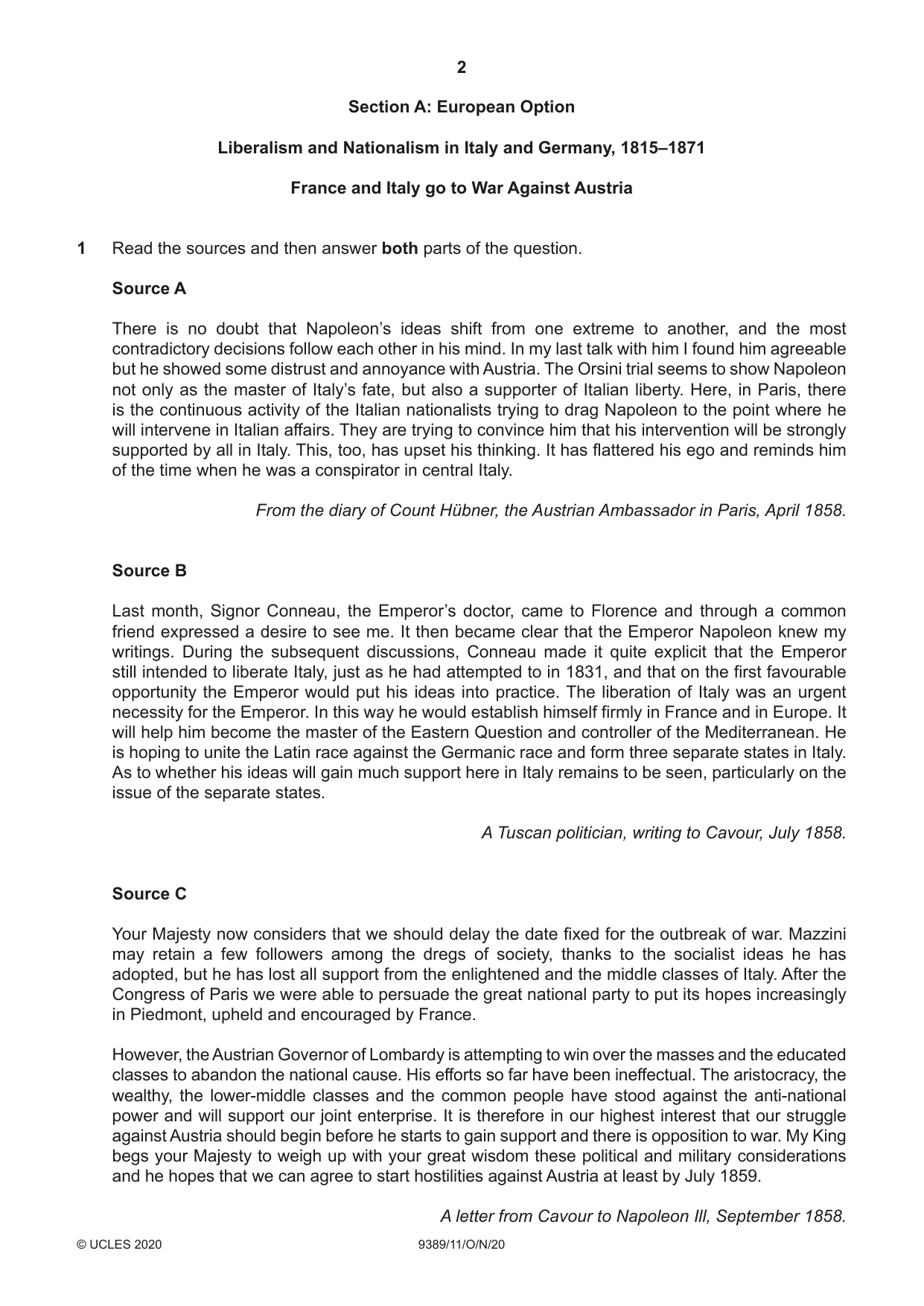
2 9389/11/O/N/20 © UCLES 2020 Section A: European Option Liberalism and Nationalism in Italy and Germany, 1815–1871 France and Italy go to War Against Austria 1 Read the sources and then answer both parts of the question. Source A There is no doubt that Napoleon’s ideas shift from one extreme to another, and the most contradictory decisions follow each other in his mind. In my last talk with him I found him agreeable but he showed some distrust and annoyance with Austria. The Orsini trial seems to show Napoleon not only as the master of Italy’s fate, but also a supporter of Italian liberty. Here, in Paris, there is the continuous activity of the Italian nationalists trying to drag Napoleon to the point where he will intervene in Italian affairs. They are trying to convince him that his intervention will be strongly supported by all in Italy. This, too, has upset his thinking. It has flattered his ego and reminds him of the time when he was a conspirator in central Italy. From the diary of Count Hübner, the Austrian Ambassador in Paris, April 1858. Source B Last month, Signor Conneau, the Emperor’s doctor, came to Florence and through a common friend expressed a desire to see me. It then became clear that the Emperor Napoleon knew my writings. During the subsequent discussions, Conneau made it quite explicit that the Emperor still intended to liberate Italy, just as he had attempted to in 1831, and that on the first favourable opportunity the Emperor would put his ideas into practice. The liberation of Italy was an urgent necessity for the Emperor. In this way he would establish himself firmly in France and in Europe. It will help him become the master of the Eastern Question and controller of the Mediterranean. He is hoping to unite the Latin race against the Germanic race and form three separate states in Italy. As to whether his ideas will gain much support here in Italy remains to be seen, particularly on the issue of the separate states. A Tuscan politician, writing to Cavour, July 1858. Source C Your Majesty now considers that we should delay the date fixed for the outbreak of war. Mazzini may retain a few followers among the dregs of society, thanks to the socialist ideas he has adopted, but he has lost all support from the enlightened and the middle classes of Italy. After the Congress of Paris we were able to persuade the great national party to put its hopes increasingly in Piedmont, upheld and encouraged by France. However, the Austrian Governor of Lombardy is attempting to win over the masses and the educated classes to abandon the national cause. His efforts so far have been ineffectual. The aristocracy, the wealthy, the lower-middle classes and the common people have stood against the anti-national power and will support our joint enterprise. It is therefore in our highest interest that our struggle against Austria should begin before he starts to gain support and there is opposition to war. My King begs your Majesty to weigh up with your great wisdom these political and military considerations and he hopes that we can agree to start hostilities against Austria at least by July 1859. A letter from Cavour to Napoleon Ill, September 1858.
Question paper, page 3
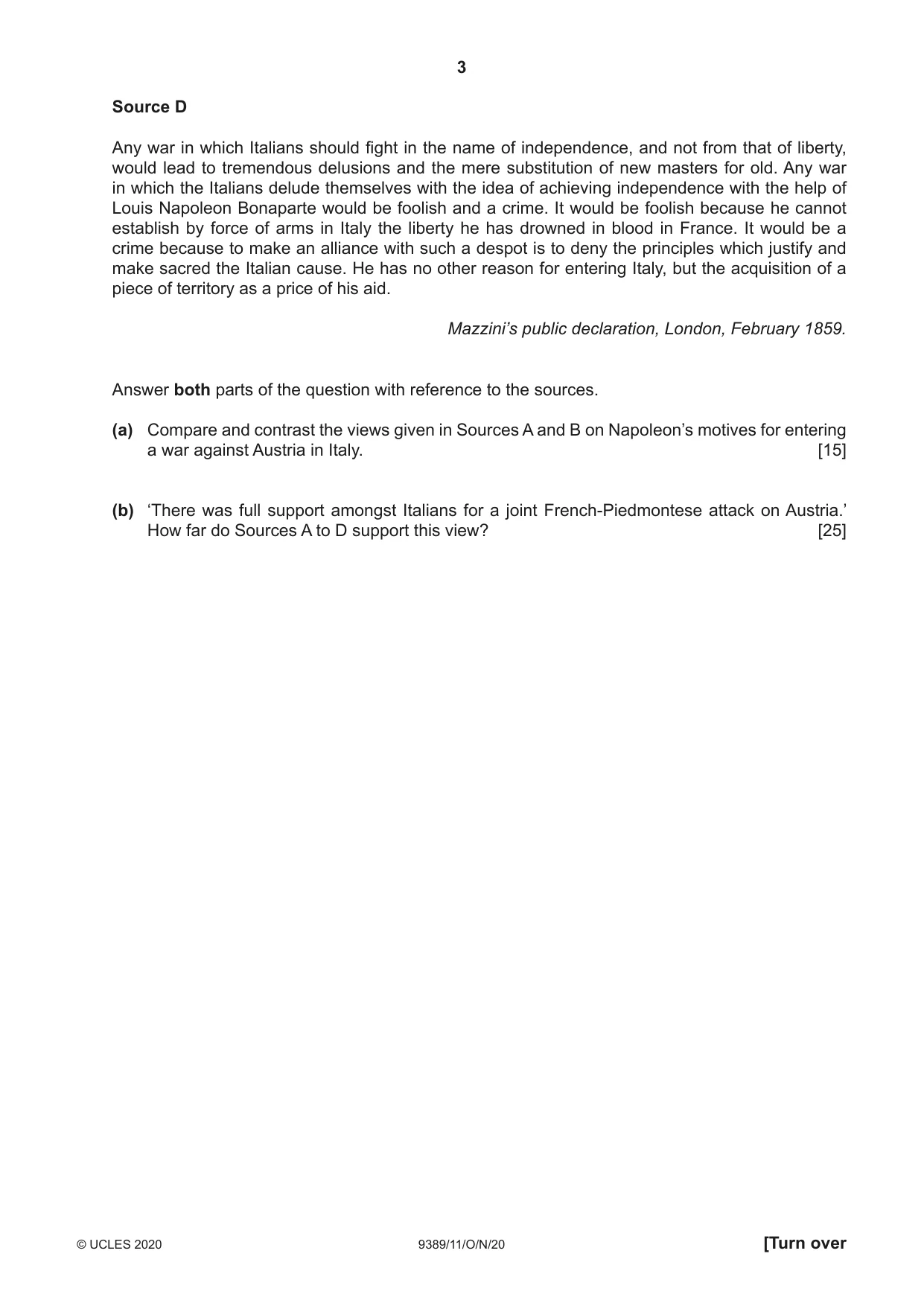
3 9389/11/O/N/20 © UCLES 2020 [Turn over Source D Any war in which Italians should fight in the name of independence, and not from that of liberty, would lead to tremendous delusions and the mere substitution of new masters for old. Any war in which the Italians delude themselves with the idea of achieving independence with the help of Louis Napoleon Bonaparte would be foolish and a crime. It would be foolish because he cannot establish by force of arms in Italy the liberty he has drowned in blood in France. It would be a crime because to make an alliance with such a despot is to deny the principles which justify and make sacred the Italian cause. He has no other reason for entering Italy, but the acquisition of a piece of territory as a price of his aid. Mazzini’s public declaration, London, February 1859. Answer both parts of the question with reference to the sources. (a) Compare and contrast the views given in Sources A and B on Napoleon’s motives for entering a war against Austria in Italy. [15] (b) ‘There was full support amongst Italians for a joint French-Piedmontese attack on Austria.’ How far do Sources A to D support this view? [25]
Question paper, page 4
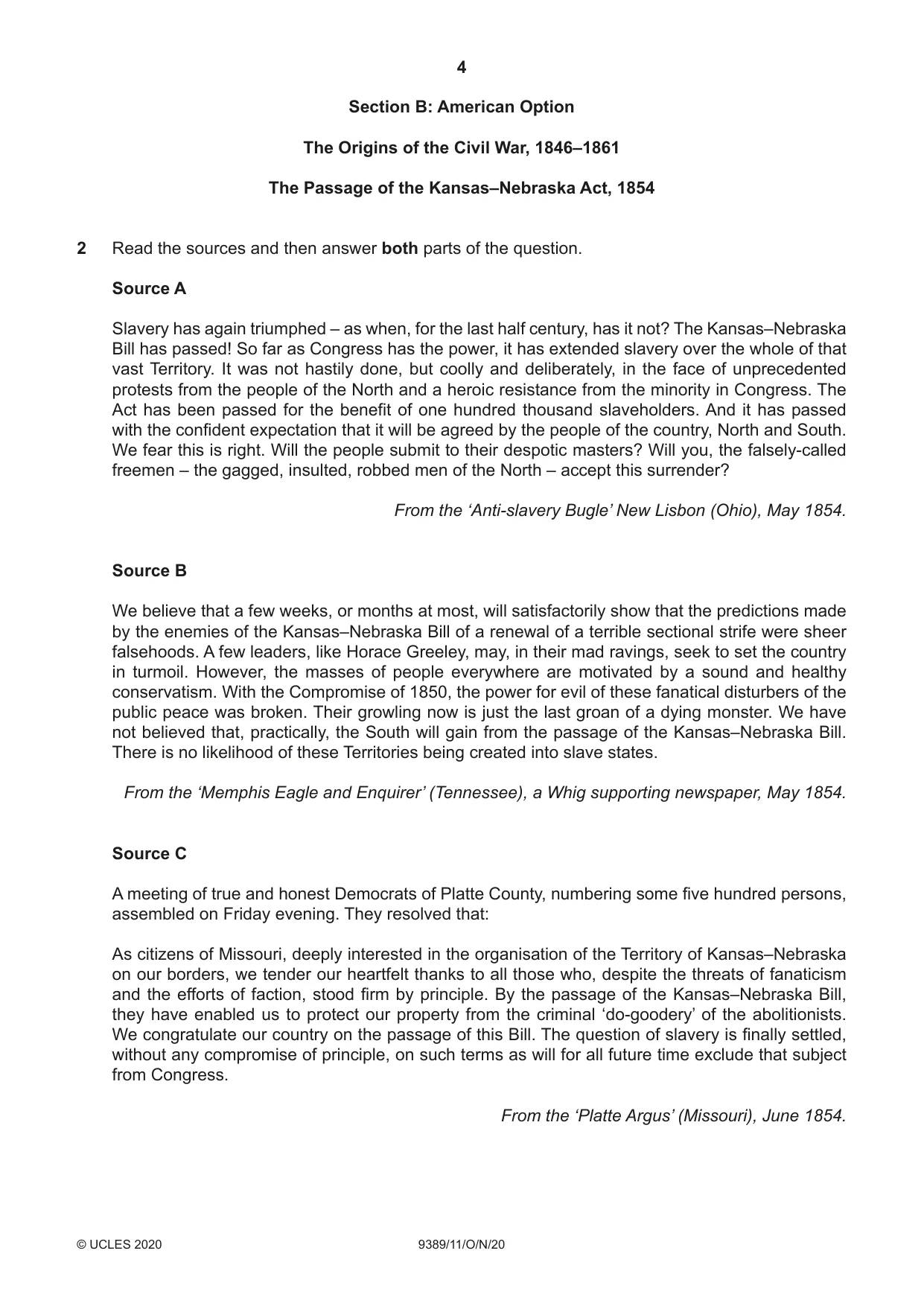
4 9389/11/O/N/20 © UCLES 2020 Section B: American Option The Origins of the Civil War, 1846–1861 The Passage of the Kansas–Nebraska Act, 1854 2 Read the sources and then answer both parts of the question. Source A Slavery has again triumphed – as when, for the last half century, has it not? The Kansas–Nebraska Bill has passed! So far as Congress has the power, it has extended slavery over the whole of that vast Territory. It was not hastily done, but coolly and deliberately, in the face of unprecedented protests from the people of the North and a heroic resistance from the minority in Congress. The Act has been passed for the benefit of one hundred thousand slaveholders. And it has passed with the confident expectation that it will be agreed by the people of the country, North and South. We fear this is right. Will the people submit to their despotic masters? Will you, the falsely-called freemen – the gagged, insulted, robbed men of the North – accept this surrender? From the ‘Anti-slavery Bugle’ New Lisbon (Ohio), May 1854. Source B We believe that a few weeks, or months at most, will satisfactorily show that the predictions made by the enemies of the Kansas–Nebraska Bill of a renewal of a terrible sectional strife were sheer falsehoods. A few leaders, like Horace Greeley, may, in their mad ravings, seek to set the country in turmoil. However, the masses of people everywhere are motivated by a sound and healthy conservatism. With the Compromise of 1850, the power for evil of these fanatical disturbers of the public peace was broken. Their growling now is just the last groan of a dying monster. We have not believed that, practically, the South will gain from the passage of the Kansas–Nebraska Bill. There is no likelihood of these Territories being created into slave states. From the ‘Memphis Eagle and Enquirer’ (Tennessee), a Whig supporting newspaper, May 1854. Source C A meeting of true and honest Democrats of Platte County, numbering some five hundred persons, assembled on Friday evening. They resolved that: As citizens of Missouri, deeply interested in the organisation of the Territory of Kansas–Nebraska on our borders, we tender our heartfelt thanks to all those who, despite the threats of fanaticism and the efforts of faction, stood firm by principle. By the passage of the Kansas–Nebraska Bill, they have enabled us to protect our property from the criminal ‘do-goodery’ of the abolitionists. We congratulate our country on the passage of this Bill. The question of slavery is finally settled, without any compromise of principle, on such terms as will for all future time exclude that subject from Congress. From the ‘Platte Argus’ (Missouri), June 1854.
Question paper, page 5
5 9389/11/O/N/20 © UCLES 2020 [Turn over Source D The freemen of Vermont assembled, in response to spontaneous calls from various parts of the state and embracing all political parties, to consider the present crisis concerning the passage of the Kansas–Nebraska Act. They resolved that the repeal of the Missouri Compromise contained in the recent Act of Congress for the creation of Kansas and Nebraska Territories, admitting slavery into a region till then sealed against it by law, is destructive of all confidence in the integrity, good faith and honour of the national and state governments favouring such repeal. They also resolved that, as there were now no great measures of legislation or policy dividing political parties except that of slavery, as Whigs, Free Soilers and Democrats they should freely relinquish former party associations and form a new party. The aim of this party would be to secure the blessings of liberty for themselves and posterity. They recommended to the friends of freedom in other states to join this party and be known as Republicans. From the ‘Burlington Free Press’ (Vermont), July 1854. Answer both parts of the question with reference to the sources. (a) Compare and contrast Sources C and D as responses to the passage of the Kansas–Nebraska Act. [15] (b) ‘The passage of the Kansas–Nebraska Act divided the country over the question of slavery.’ How far do Sources A to D support this view? [25]
Question paper, page 6
6 9389/11/O/N/20 © UCLES 2020 Section C: International Option The Search for International Peace and Security, 1919–1945 The League of Nations in the 1920s 3 Read the sources and then answer both parts of the question. Source A In the recent history of the League nothing has been more admirable than the joint effort to come to the aid of Austria, not only because it was of value to other nations that Austria should not be allowed to fall into chaos, but because they thought it was the duty of the League to do its best to rescue a nation which was in serious trouble. There have been many other things in which the members of the League have worked together. The opium question, the release of prisoners of war, helping refugees, and many other activities have made it possible for a spirit of international friendship to exist. No one who has attended the Assemblies at Geneva can fail to recognise that an atmosphere has been created in which international disputes lose their bitterness, and their solutions become possible without disaster or humiliation to either of the contestants. The League can work. It has proved that public opinion and international cooperation are weapons against war, and that peace can be secured by their means. From a book by Robert Cecil, published in August 1923. He was a British politician and toured the United States in 1923 promoting the work of the League. Source B The avoidance of its responsibility by the League of Nations in the Corfu crisis was commented upon yesterday, when the Council of the League of Nations met in public in Geneva. It discussed its reply to the findings of the Ambassadors’ Conference on the dispute between Greece and Italy. It was left to Sweden to voice the anxiety which had reigned in League circles during this critical period. Sweden expressed regret that the Council had not addressed the challenge made by Mussolini on the question of the competency of the League and explained its position in plain language. Amongst those who looked to the League as an important guarantee for their security, this passive attitude on the part of the Council had caused profound anxiety. From an article in a British newspaper, September 1923.
Question paper, page 7
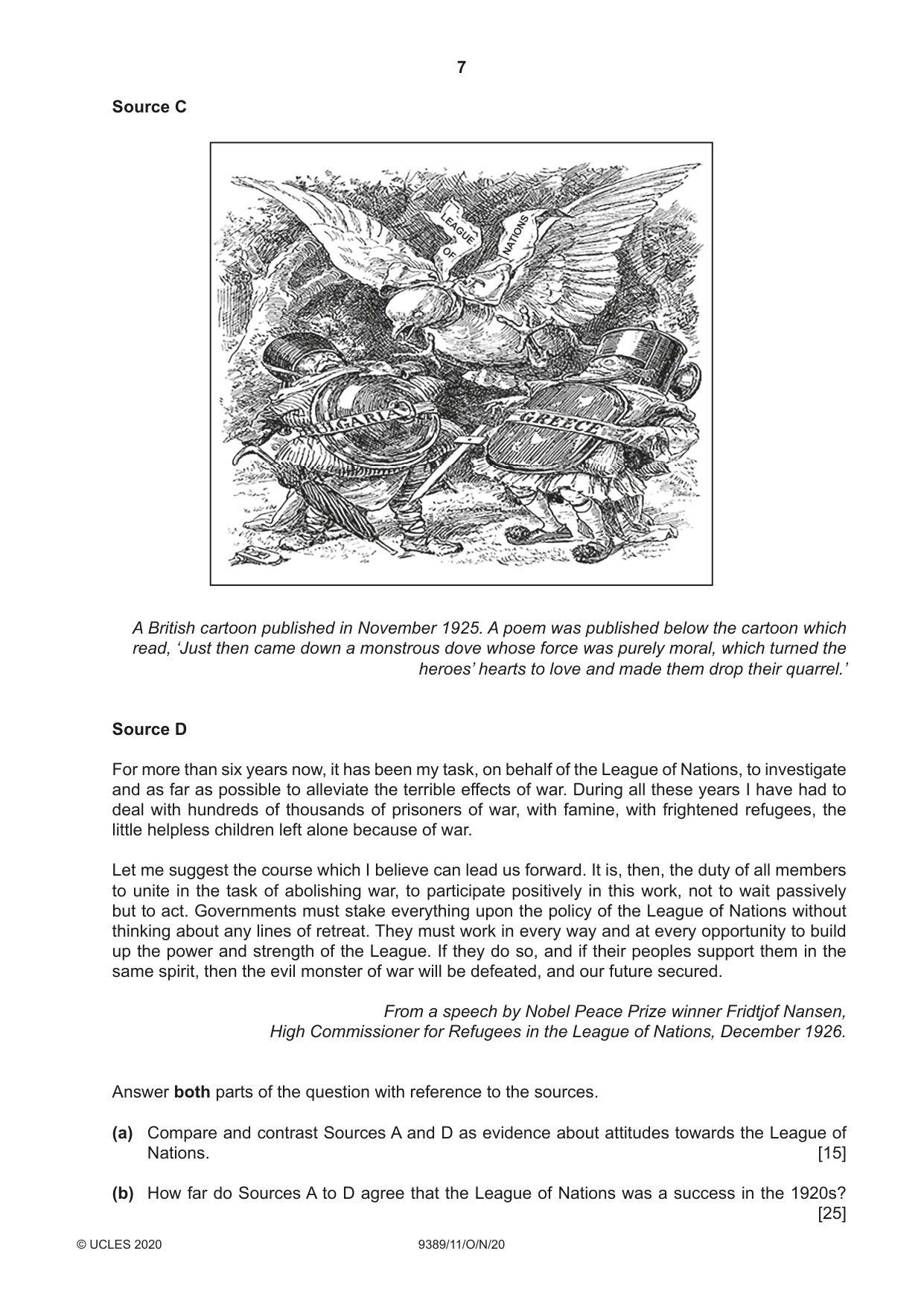
7 9389/11/O/N/20 © UCLES 2020 Source C A Br itish cartoon published in November 1925. A poem was published below the cartoon which read, ‘Just then came down a monstrous dove whose force was purely moral, which turned the heroes’ hearts to love and made them drop their quarrel.’ Source D For more than six years now, it has been my task, on behalf of the League of Nations, to investigate and as far as possible to alleviate the terrible effects of war. During all these years I have had to deal with hundreds of thousands of prisoners of war, with famine, with frightened refugees, the little helpless children left alone because of war. Let me suggest the course which I believe can lead us forward. It is, then, the duty of all members to unite in the task of abolishing war, to participate positively in this work, not to wait passively but to act. Governments must stake everything upon the policy of the League of Nations without thinking about any lines of retreat. They must work in every way and at every opportunity to build up the power and strength of the League. If they do so, and if their peoples support them in the same spirit, then the evil monster of war will be defeated, and our future secured. From a speech by Nobel Peace Prize winner Fridtjof Nansen, High Commissioner for Refugees in the League of Nations, December 1926. Answer both parts of the question with reference to the sources. (a) Compare and contrast Sources A and D as evidence about attitudes towards the League of Nations. [15] (b) How far do Sources A to D agree that the League of Nations was a success in the 1920s? [25]
Question paper, page 8
8 9389/11/O/N/20 © UCLES 2020 Permission to reproduce items where third-party owned material protected by copyright is included has been sought and cleared where possible. Every reasonable effort has been made by the publisher (UCLES) to trace copyright holders, but if any items requiring clearance have unwittingly been included, the publisher will be pleased to make amends at the earliest possible opportunity. To avoid the issue of disclosure of answer-related information to candidates, all copyright acknowledgements are reproduced online in the Cambridge Assessment International Education Copyright Acknowledgements Booklet. This is produced for each series of examinations and is freely available to download at www.cambridgeinternational.org after the live examination series. Cambridge Assessment International Education is part of the Cambridge Assessment Group. Cambridge Assessment is the brand name of the University of Cambridge Local Examinations Syndicate (UCLES), which itself is a department of the University of Cambridge. BLANK PAGE
Mark scheme, page 1
This document consists of 12 printed pages. © UCLES 2020 [Turn over Cambridge International AS & A Level HISTORY 9389/11 Paper 1 Document Question October/November 2020 MARK SCHEME Maximum Mark: 40 Published This mark scheme is published as an aid to teachers and candidates, to indicate the requirements of the examination. It shows the basis on which Examiners were instructed to award marks. It does not indicate the details of the discussions that took place at an Examiners’ meeting before marking began, which would have considered the acceptability of alternative answers. Mark schemes should be read in conjunction with the question paper and the Principal Examiner Report for Teachers. Cambridge International will not enter into discussions about these mark schemes. Cambridge International is publishing the mark schemes for the October/November 2020 series for most Cambridge IGCSE, Cambridge International A and AS Level and Cambridge Pre-U components, and some Cambridge O Level components.
Mark scheme, page 2
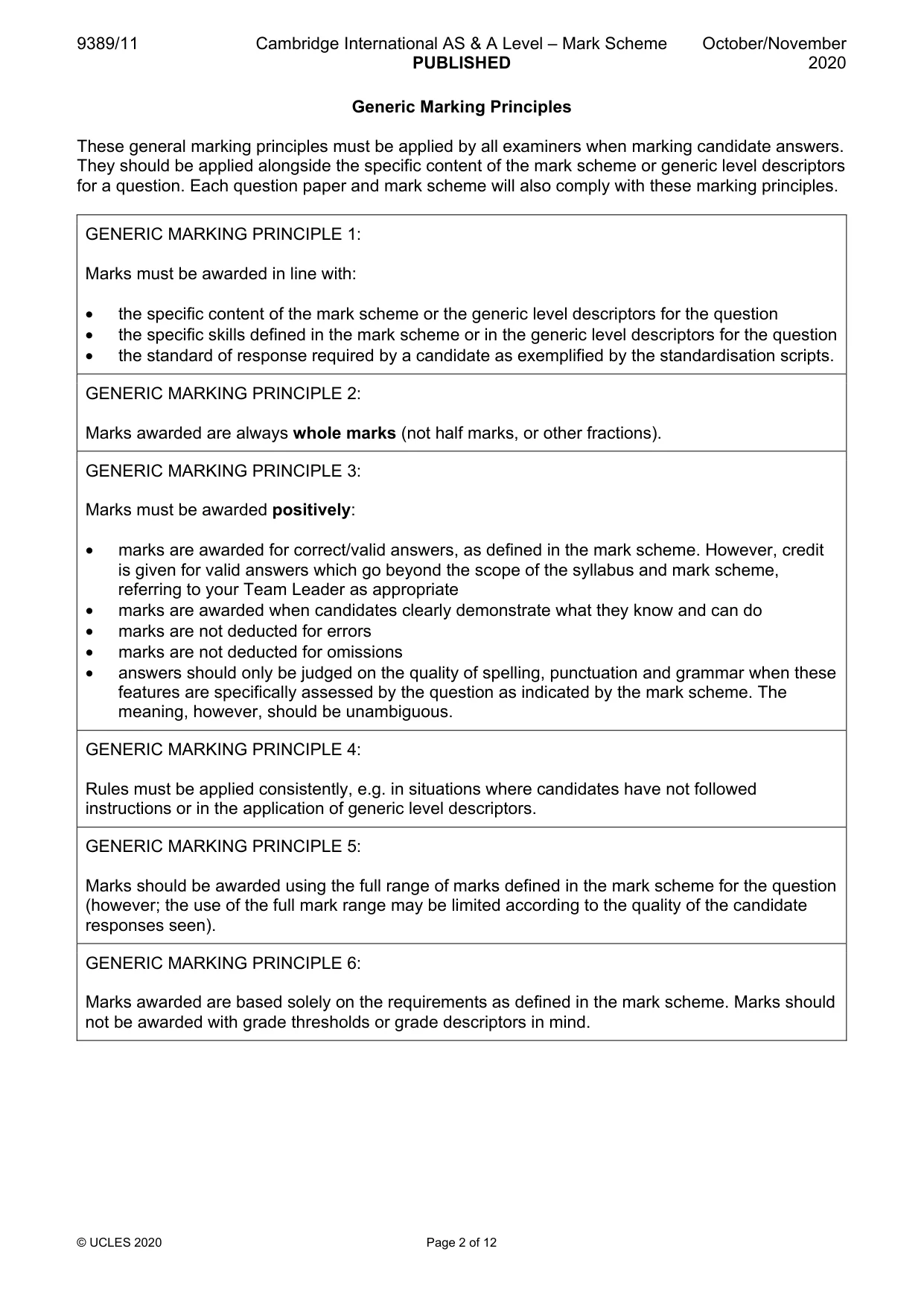
9389/11 Cambridge International AS & A Level – Mark Scheme PUBLISHED October/November 2020 © UCLES 2020 Page 2 of 12 Generic Marking Principles These general marking principles must be applied by all examiners when marking candidate answers. They should be applied alongside the specific content of the mark scheme or generic level descriptors for a question. Each question paper and mark scheme will also comply with these marking principles. GENERIC MARKING PRINCIPLE 1: Marks must be awarded in line with: • the specific content of the mark scheme or the generic level descriptors for the question • the specific skills defined in the mark scheme or in the generic level descriptors for the question • the standard of response required by a candidate as exemplified by the standardisation scripts. GENERIC MARKING PRINCIPLE 2: Marks awarded are always whole marks (not half marks, or other fractions). GENERIC MARKING PRINCIPLE 3: Marks must be awarded positively: • marks are awarded for correct/valid answers, as defined in the mark scheme. However, credit is given for valid answers which go beyond the scope of the syllabus and mark scheme, referring to your Team Leader as appropriate • marks are awarded when candidates clearly demonstrate what they know and can do • marks are not deducted for errors • marks are not deducted for omissions • answers should only be judged on the quality of spelling, punctuation and grammar when these features are specifically assessed by the question as indicated by the mark scheme. The meaning, however, should be unambiguous. GENERIC MARKING PRINCIPLE 4: Rules must be applied consistently, e.g. in situations where candidates have not followed instructions or in the application of generic level descriptors. GENERIC MARKING PRINCIPLE 5: Marks should be awarded using the full range of marks defined in the mark scheme for the question (however; the use of the full mark range may be limited according to the quality of the candidate responses seen). GENERIC MARKING PRINCIPLE 6: Marks awarded are based solely on the requirements as defined in the mark scheme. Marks should not be awarded with grade thresholds or grade descriptors in mind.
Mark scheme, page 3
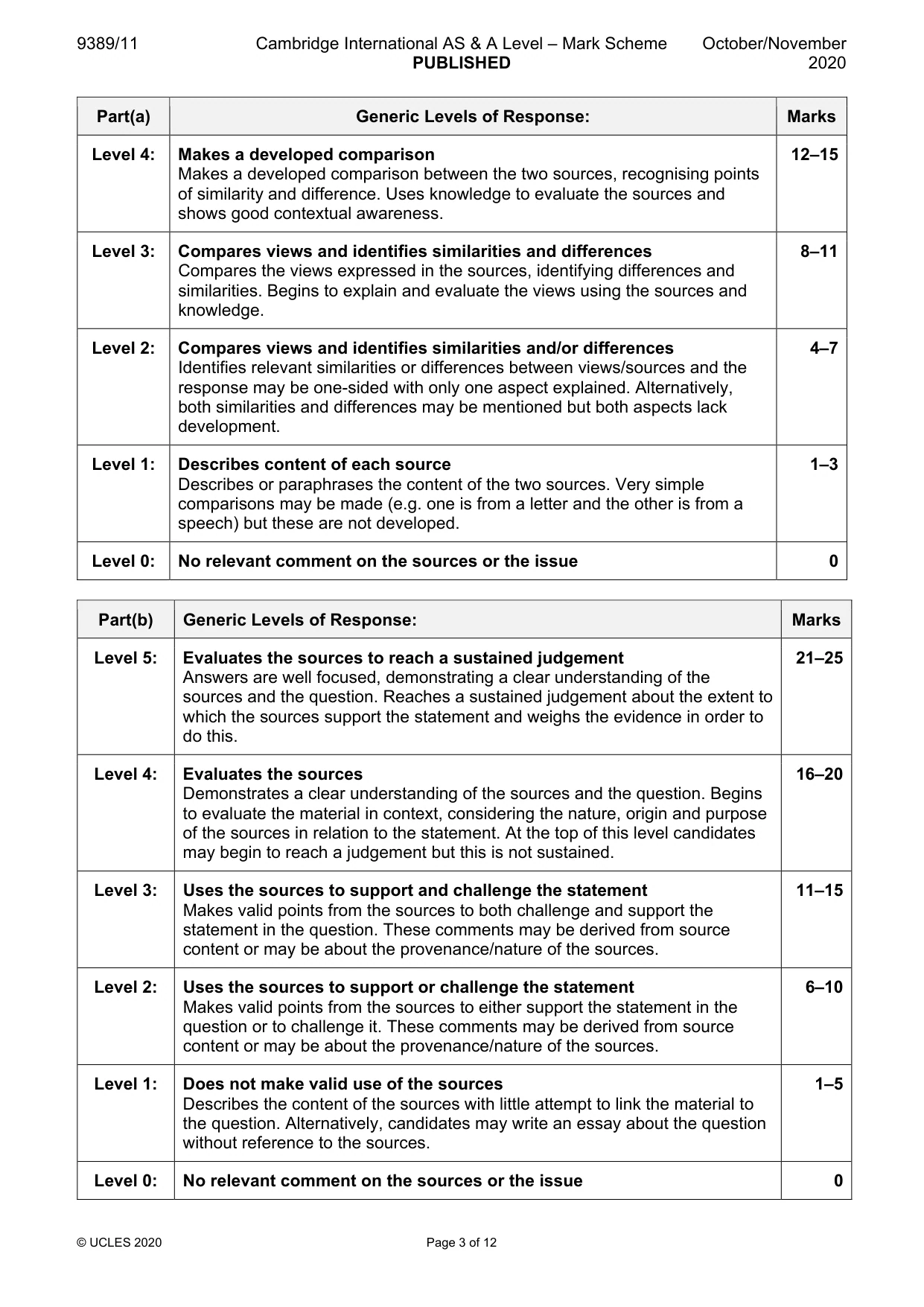
9389/11 Cambridge International AS & A Level – Mark Scheme PUBLISHED October/November 2020 © UCLES 2020 Page 3 of 12 Part(a) Generic Levels of Response: Marks Level 4: Makes a developed comparison Makes a developed comparison between the two sources, recognising points of similarity and difference. Uses knowledge to evaluate the sources and shows good contextual awareness. 12–15 Level 3: Compares views and identifies similarities and differences Compares the views expressed in the sources, identifying differences and similarities. Begins to explain and evaluate the views using the sources and knowledge. 8–11 Level 2: Compares views and identifies similarities and/or differences Identifies relevant similarities or differences between views/sources and the response may be one-sided with only one aspect explained. Alternatively, both similarities and differences may be mentioned but both aspects lack development. 4–7 Level 1: Describes content of each source Describes or paraphrases the content of the two sources. Very simple comparisons may be made (e.g. one is from a letter and the other is from a speech) but these are not developed. 1–3 Level 0: No relevant comment on the sources or the issue 0 Part(b) Generic Levels of Response: Marks Level 5: Evaluates the sources to reach a sustained judgement Answers are well focused, demonstrating a clear understanding of the sources and the question. Reaches a sustained judgement about the extent to which the sources support the statement and weighs the evidence in order to do this. 21–25 Level 4: Evaluates the sources Demonstrates a clear understanding of the sources and the question. Begins to evaluate the material in context, considering the nature, origin and purpose of the sources in relation to the statement. At the top of this level candidates may begin to reach a judgement but this is not sustained. 16–20 Level 3: Uses the sources to support and challenge the statement Makes valid points from the sources to both challenge and support the statement in the question. These comments may be derived from source content or may be about the provenance/nature of the sources. 11–15 Level 2: Uses the sources to support or challenge the statement Makes valid points from the sources to either support the statement in the question or to challenge it. These comments may be derived from source content or may be about the provenance/nature of the sources. 6–10 Level 1: Does not make valid use of the sources Describes the content of the sources with little attempt to link the material to the question. Alternatively, candidates may write an essay about the question without reference to the sources. 1–5 Level 0: No relevant comment on the sources or the issue 0
Mark scheme, page 4
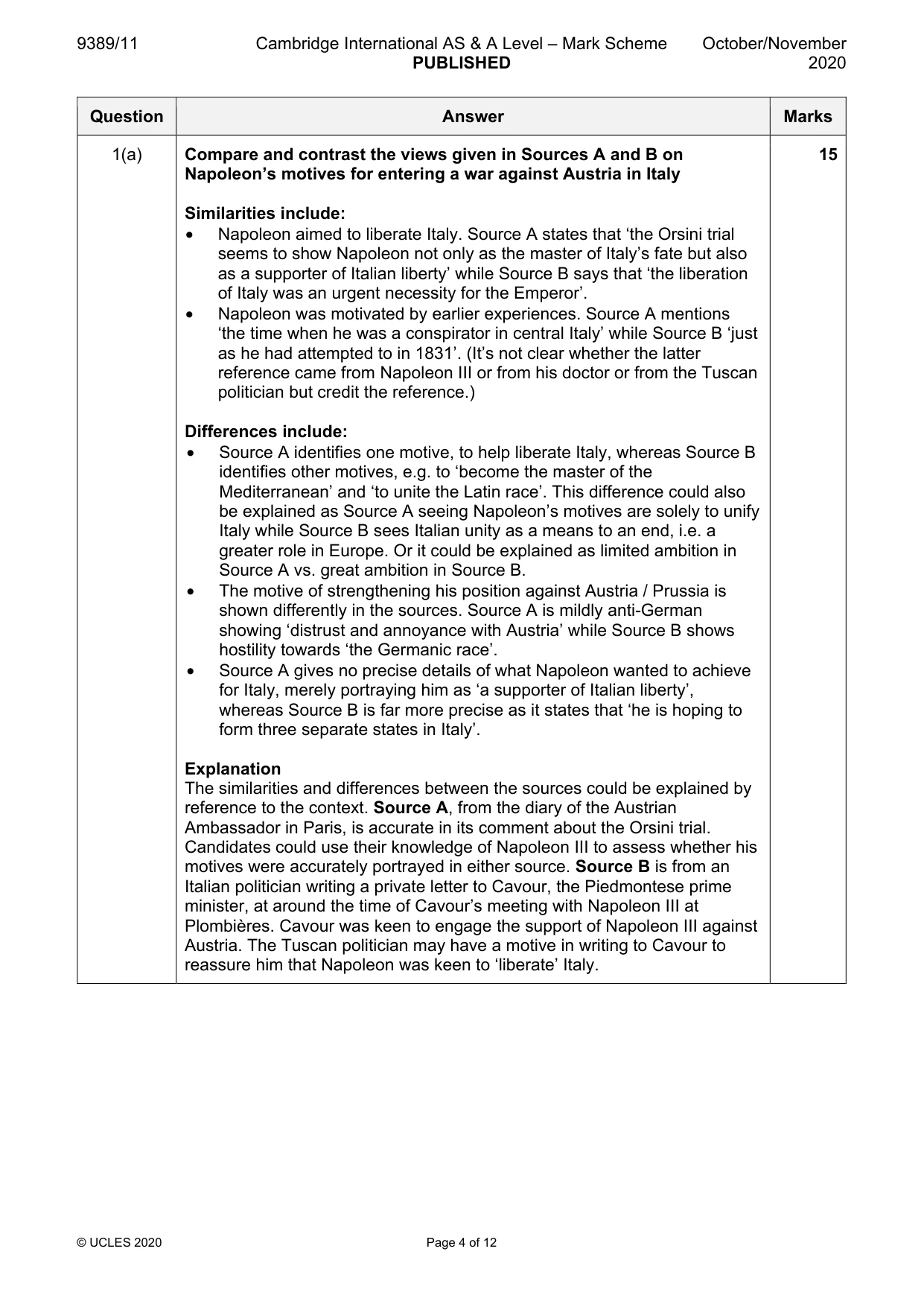
9389/11 Cambridge International AS & A Level – Mark Scheme PUBLISHED October/November 2020 © UCLES 2020 Page 4 of 12 Question Answer Marks 1(a) Compare and contrast the views given in Sources A and B on Napoleon’s motives for entering a war against Austria in Italy Similarities include: • Napoleon aimed to liberate Italy. Source A states that ‘the Orsini trial seems to show Napoleon not only as the master of Italy’s fate but also as a supporter of Italian liberty’ while Source B says that ‘the liberation of Italy was an urgent necessity for the Emperor’. • Napoleon was motivated by earlier experiences. Source A mentions ‘the time when he was a conspirator in central Italy’ while Source B ‘just as he had attempted to in 1831’. (It’s not clear whether the latter reference came from Napoleon III or from his doctor or from the Tuscan politician but credit the reference.) Differences include: • Source A identifies one motive, to help liberate Italy, whereas Source B identifies other motives, e.g. to ‘become the master of the Mediterranean’ and ‘to unite the Latin race’. This difference could also be explained as Source A seeing Napoleon’s motives are solely to unify Italy while Source B sees Italian unity as a means to an end, i.e. a greater role in Europe. Or it could be explained as limited ambition in Source A vs. great ambition in Source B. • The motive of strengthening his position against Austria / Prussia is shown differently in the sources. Source A is mildly anti-German showing ‘distrust and annoyance with Austria’ while Source B shows hostility towards ‘the Germanic race’. • Source A gives no precise details of what Napoleon wanted to achieve for Italy, merely portraying him as ‘a supporter of Italian liberty’, whereas Source B is far more precise as it states that ‘he is hoping to form three separate states in Italy’. Explanation The similarities and differences between the sources could be explained by reference to the context. Source A, from the diary of the Austrian Ambassador in Paris, is accurate in its comment about the Orsini trial. Candidates could use their knowledge of Napoleon III to assess whether his motives were accurately portrayed in either source. Source B is from an Italian politician writing a private letter to Cavour, the Piedmontese prime minister, at around the time of Cavour’s meeting with Napoleon III at Plombières. Cavour was keen to engage the support of Napoleon III against Austria. The Tuscan politician may have a motive in writing to Cavour to reassure him that Napoleon was keen to ‘liberate’ Italy. 15
Mark scheme, page 5
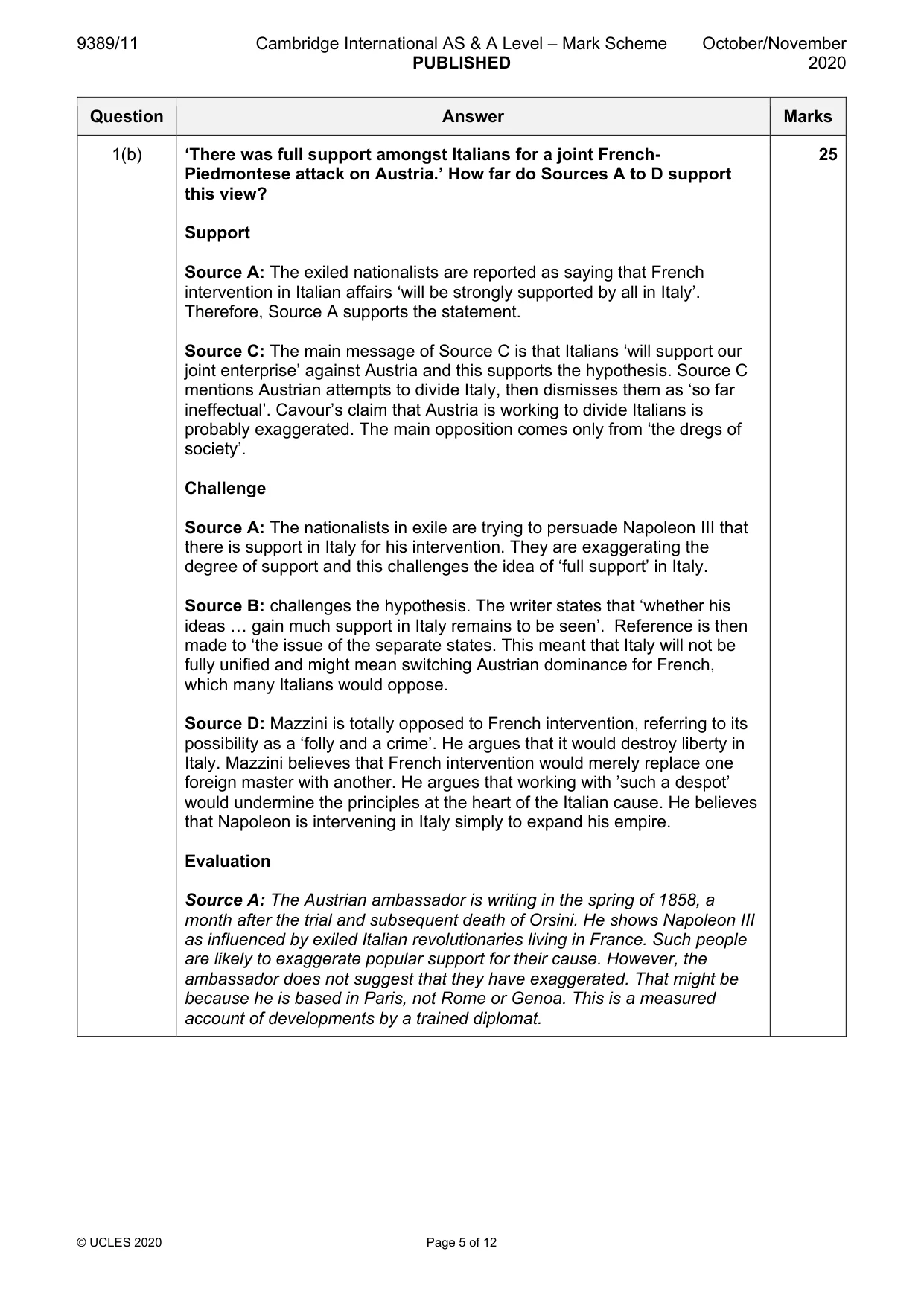
9389/11 Cambridge International AS & A Level – Mark Scheme PUBLISHED October/November 2020 © UCLES 2020 Page 5 of 12 Question Answer Marks 1(b) ‘There was full support amongst Italians for a joint French- Piedmontese attack on Austria.’ How far do Sources A to D support this view? Support Source A: The exiled nationalists are reported as saying that French intervention in Italian affairs ‘will be strongly supported by all in Italy’. Therefore, Source A supports the statement. Source C: The main message of Source C is that Italians ‘will support our joint enterprise’ against Austria and this supports the hypothesis. Source C mentions Austrian attempts to divide Italy, then dismisses them as ‘so far ineffectual’. Cavour’s claim that Austria is working to divide Italians is probably exaggerated. The main opposition comes only from ‘the dregs of society’. Challenge Source A: The nationalists in exile are trying to persuade Napoleon III that there is support in Italy for his intervention. They are exaggerating the degree of support and this challenges the idea of ‘full support’ in Italy. Source B: challenges the hypothesis. The writer states that ‘whether his ideas … gain much support in Italy remains to be seen’. Reference is then made to ‘the issue of the separate states. This meant that Italy will not be fully unified and might mean switching Austrian dominance for French, which many Italians would oppose. Source D: Mazzini is totally opposed to French intervention, referring to its possibility as a ‘folly and a crime’. He argues that it would destroy liberty in Italy. Mazzini believes that French intervention would merely replace one foreign master with another. He argues that working with ’such a despot’ would undermine the principles at the heart of the Italian cause. He believes that Napoleon is intervening in Italy simply to expand his empire. Evaluation Source A: The Austrian ambassador is writing in the spring of 1858, a month after the trial and subsequent death of Orsini. He shows Napoleon III as influenced by exiled Italian revolutionaries living in France. Such people are likely to exaggerate popular support for their cause. However, the ambassador does not suggest that they have exaggerated. That might be because he is based in Paris, not Rome or Genoa. This is a measured account of developments by a trained diplomat. 25
Mark scheme, page 6
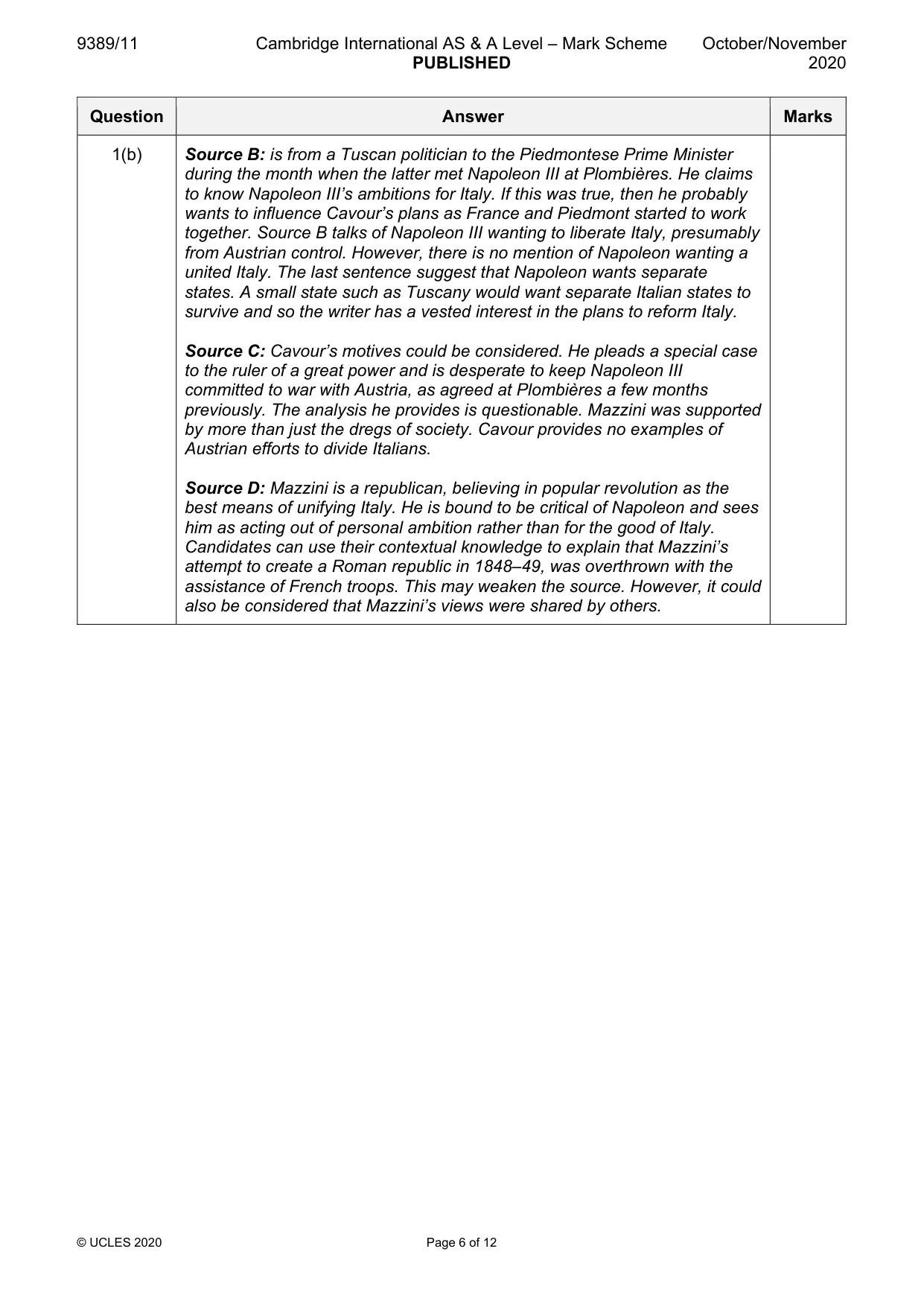
9389/11 Cambridge International AS & A Level – Mark Scheme PUBLISHED October/November 2020 © UCLES 2020 Page 6 of 12 Question Answer Marks 1(b) Source B: is from a Tuscan politician to the Piedmontese Prime Minister during the month when the latter met Napoleon III at Plombières. He claims to know Napoleon III’s ambitions for Italy. If this was true, then he probably wants to influence Cavour’s plans as France and Piedmont started to work together. Source B talks of Napoleon III wanting to liberate Italy, presumably from Austrian control. However, there is no mention of Napoleon wanting a united Italy. The last sentence suggest that Napoleon wants separate states. A small state such as Tuscany would want separate Italian states to survive and so the writer has a vested interest in the plans to reform Italy. Source C: Cavour’s motives could be considered. He pleads a special case to the ruler of a great power and is desperate to keep Napoleon III committed to war with Austria, as agreed at Plombières a few months previously. The analysis he provides is questionable. Mazzini was supported by more than just the dregs of society. Cavour provides no examples of Austrian efforts to divide Italians. Source D: Mazzini is a republican, believing in popular revolution as the best means of unifying Italy. He is bound to be critical of Napoleon and sees him as acting out of personal ambition rather than for the good of Italy. Candidates can use their contextual knowledge to explain that Mazzini’s attempt to create a Roman republic in 1848–49, was overthrown with the assistance of French troops. This may weaken the source. However, it could also be considered that Mazzini’s views were shared by others.
Mark scheme, page 7
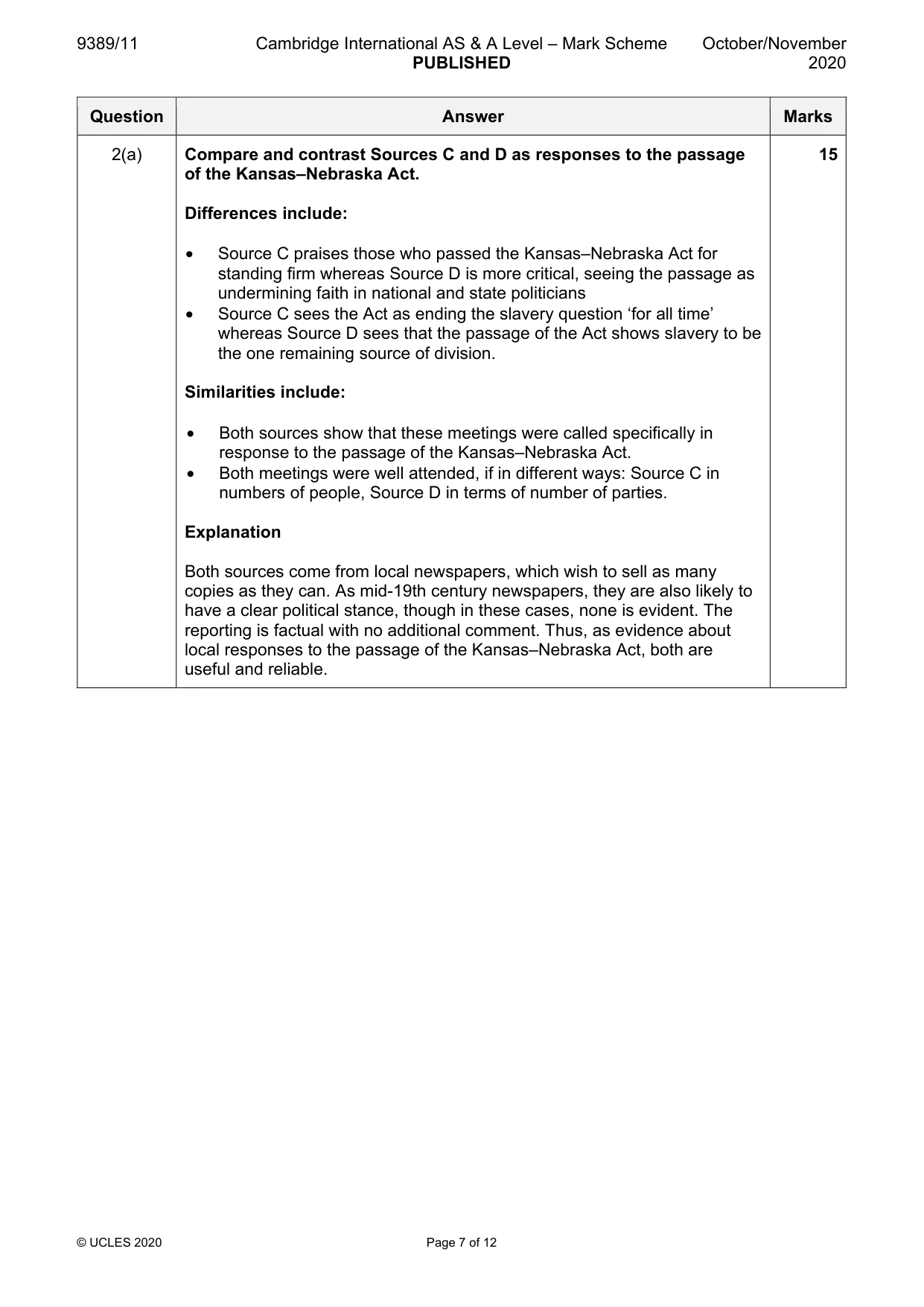
9389/11 Cambridge International AS & A Level – Mark Scheme PUBLISHED October/November 2020 © UCLES 2020 Page 7 of 12 Question Answer Marks 2(a) Compare and contrast Sources C and D as responses to the passage of the Kansas–Nebraska Act. Differences include: • Source C praises those who passed the Kansas–Nebraska Act for standing firm whereas Source D is more critical, seeing the passage as undermining faith in national and state politicians • Source C sees the Act as ending the slavery question ‘for all time’ whereas Source D sees that the passage of the Act shows slavery to be the one remaining source of division. Similarities include: • Both sources show that these meetings were called specifically in response to the passage of the Kansas–Nebraska Act. • Both meetings were well attended, if in different ways: Source C in numbers of people, Source D in terms of number of parties. Explanation Both sources come from local newspapers, which wish to sell as many copies as they can. As mid-19th century newspapers, they are also likely to have a clear political stance, though in these cases, none is evident. The reporting is factual with no additional comment. Thus, as evidence about local responses to the passage of the Kansas–Nebraska Act, both are useful and reliable. 15
Mark scheme, page 8
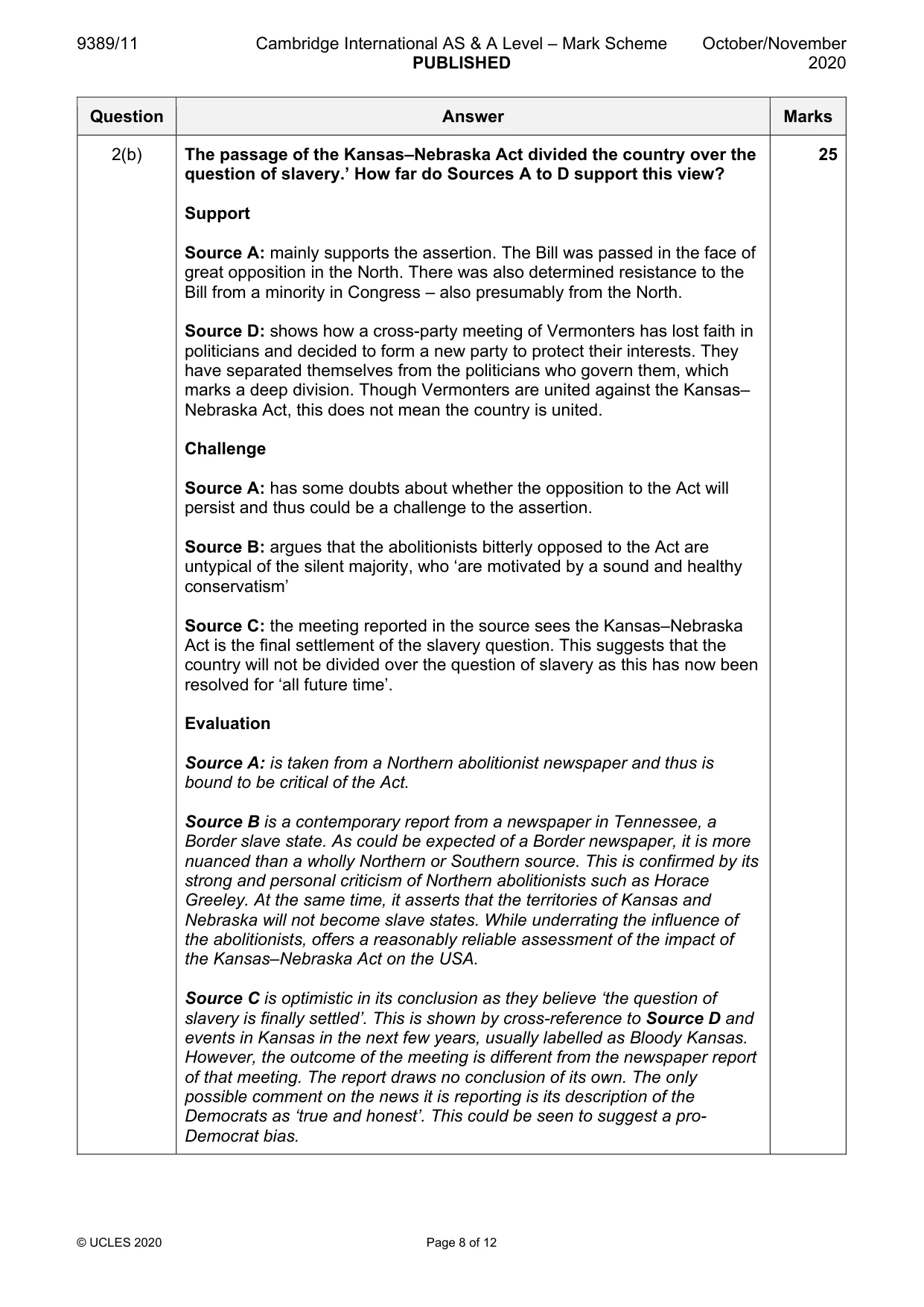
9389/11 Cambridge International AS & A Level – Mark Scheme PUBLISHED October/November 2020 © UCLES 2020 Page 8 of 12 Question Answer Marks 2(b) The passage of the Kansas–Nebraska Act divided the country over the question of slavery.’ How far do Sources A to D support this view? Support Source A: mainly supports the assertion. The Bill was passed in the face of great opposition in the North. There was also determined resistance to the Bill from a minority in Congress – also presumably from the North. Source D: shows how a cross-party meeting of Vermonters has lost faith in politicians and decided to form a new party to protect their interests. They have separated themselves from the politicians who govern them, which marks a deep division. Though Vermonters are united against the Kansas– Nebraska Act, this does not mean the country is united. Challenge Source A: has some doubts about whether the opposition to the Act will persist and thus could be a challenge to the assertion. Source B: argues that the abolitionists bitterly opposed to the Act are untypical of the silent majority, who ‘are motivated by a sound and healthy conservatism’ Source C: the meeting reported in the source sees the Kansas–Nebraska Act is the final settlement of the slavery question. This suggests that the country will not be divided over the question of slavery as this has now been resolved for ‘all future time’. Evaluation Source A: is taken from a Northern abolitionist newspaper and thus is bound to be critical of the Act. Source B is a contemporary report from a newspaper in Tennessee, a Border slave state. As could be expected of a Border newspaper, it is more nuanced than a wholly Northern or Southern source. This is confirmed by its strong and personal criticism of Northern abolitionists such as Horace Greeley. At the same time, it asserts that the territories of Kansas and Nebraska will not become slave states. While underrating the influence of the abolitionists, offers a reasonably reliable assessment of the impact of the Kansas–Nebraska Act on the USA. Source C is optimistic in its conclusion as they believe ‘the question of slavery is finally settled’. This is shown by cross-reference to Source D and events in Kansas in the next few years, usually labelled as Bloody Kansas. However, the outcome of the meeting is different from the newspaper report of that meeting. The report draws no conclusion of its own. The only possible comment on the news it is reporting is its description of the Democrats as ‘true and honest’. This could be seen to suggest a pro- Democrat bias. 25
Mark scheme, page 9
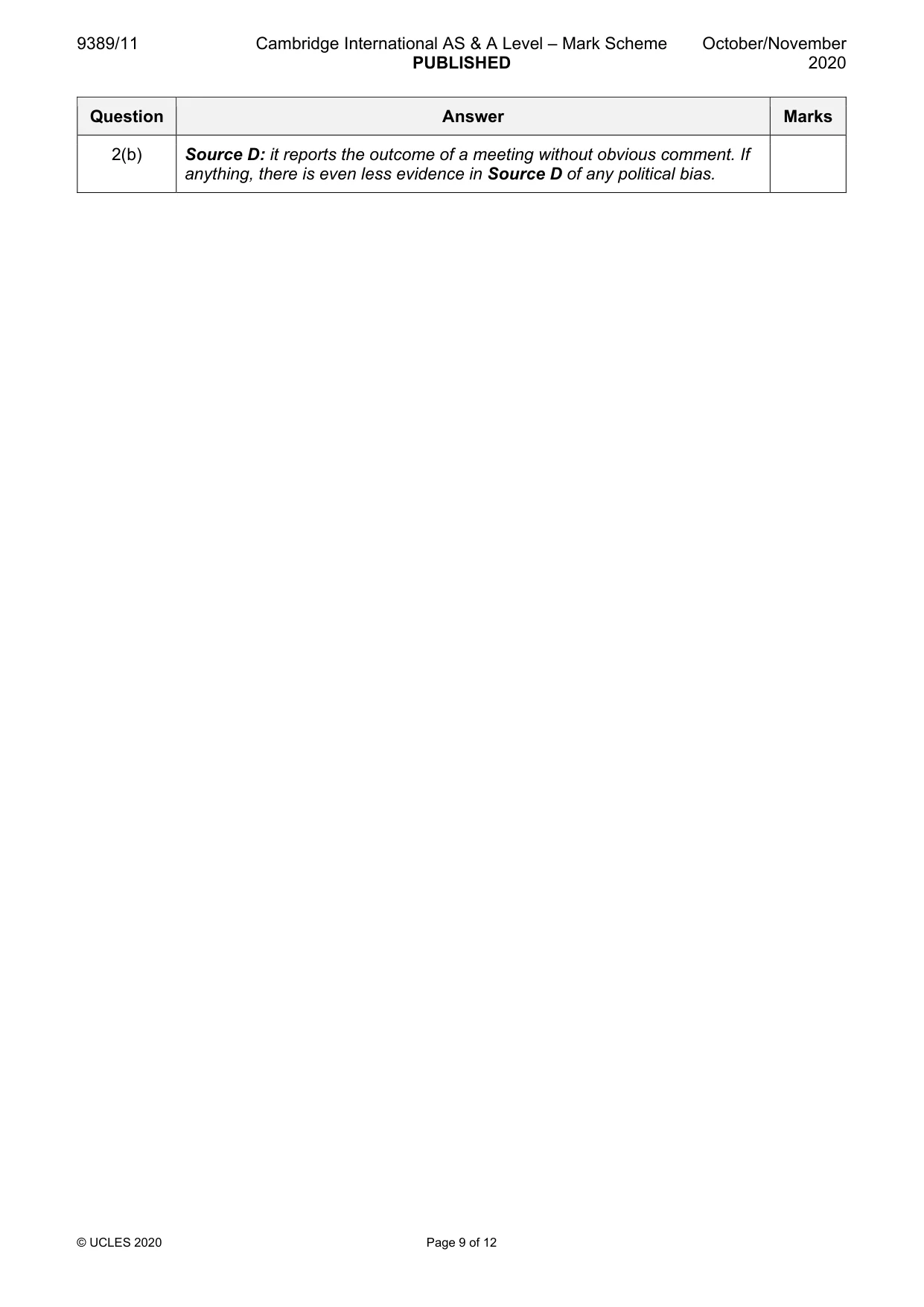
9389/11 Cambridge International AS & A Level – Mark Scheme PUBLISHED October/November 2020 © UCLES 2020 Page 9 of 12 Question Answer Marks 2(b) Source D: it reports the outcome of a meeting without obvious comment. If anything, there is even less evidence in Source D of any political bias.
Mark scheme, page 10
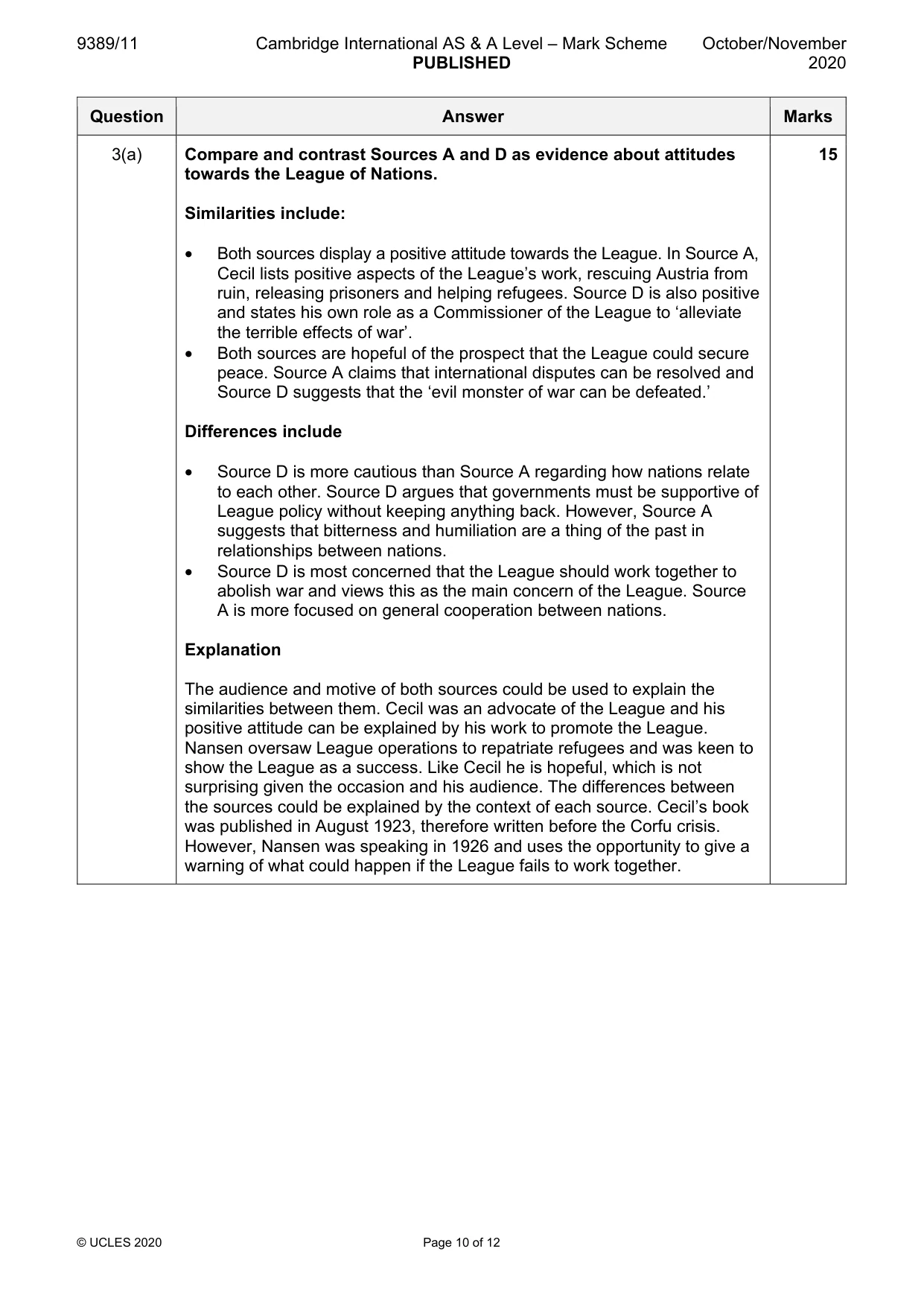
9389/11 Cambridge International AS & A Level – Mark Scheme PUBLISHED October/November 2020 © UCLES 2020 Page 10 of 12 Question Answer Marks 3(a) Compare and contrast Sources A and D as evidence about attitudes towards the League of Nations. Similarities include: • Both sources display a positive attitude towards the League. In Source A, Cecil lists positive aspects of the League’s work, rescuing Austria from ruin, releasing prisoners and helping refugees. Source D is also positive and states his own role as a Commissioner of the League to ‘alleviate the terrible effects of war’. • Both sources are hopeful of the prospect that the League could secure peace. Source A claims that international disputes can be resolved and Source D suggests that the ‘evil monster of war can be defeated.’ Differences include • Source D is more cautious than Source A regarding how nations relate to each other. Source D argues that governments must be supportive of League policy without keeping anything back. However, Source A suggests that bitterness and humiliation are a thing of the past in relationships between nations. • Source D is most concerned that the League should work together to abolish war and views this as the main concern of the League. Source A is more focused on general cooperation between nations. Explanation The audience and motive of both sources could be used to explain the similarities between them. Cecil was an advocate of the League and his positive attitude can be explained by his work to promote the League. Nansen oversaw League operations to repatriate refugees and was keen to show the League as a success. Like Cecil he is hopeful, which is not surprising given the occasion and his audience. The differences between the sources could be explained by the context of each source. Cecil’s book was published in August 1923, therefore written before the Corfu crisis. However, Nansen was speaking in 1926 and uses the opportunity to give a warning of what could happen if the League fails to work together. 15
Mark scheme, page 11
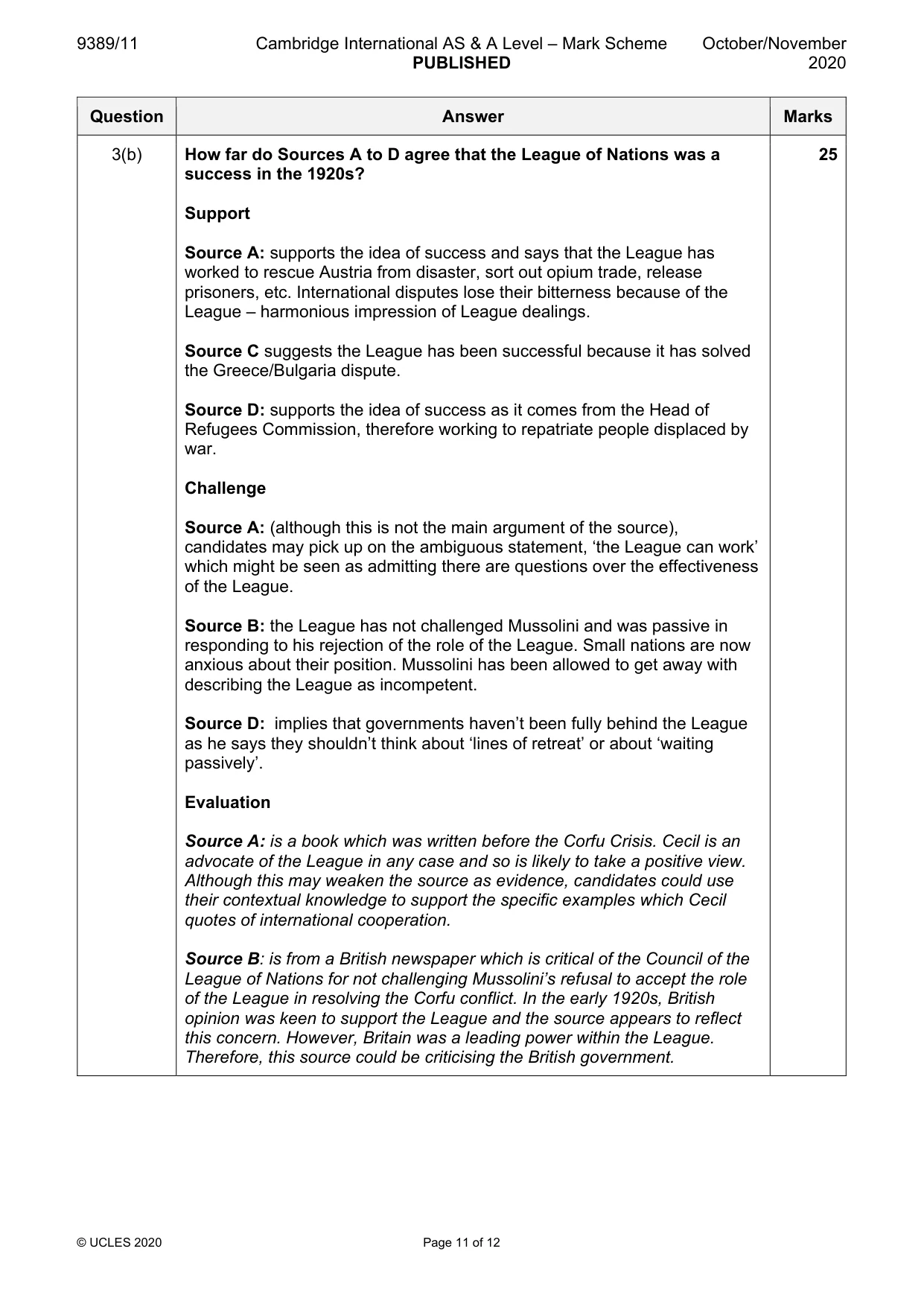
9389/11 Cambridge International AS & A Level – Mark Scheme PUBLISHED October/November 2020 © UCLES 2020 Page 11 of 12 Question Answer Marks 3(b) How far do Sources A to D agree that the League of Nations was a success in the 1920s? Support Source A: supports the idea of success and says that the League has worked to rescue Austria from disaster, sort out opium trade, release prisoners, etc. International disputes lose their bitterness because of the League – harmonious impression of League dealings. Source C suggests the League has been successful because it has solved the Greece/Bulgaria dispute. Source D: supports the idea of success as it comes from the Head of Refugees Commission, therefore working to repatriate people displaced by war. Challenge Source A: (although this is not the main argument of the source), candidates may pick up on the ambiguous statement, ‘the League can work’ which might be seen as admitting there are questions over the effectiveness of the League. Source B: the League has not challenged Mussolini and was passive in responding to his rejection of the role of the League. Small nations are now anxious about their position. Mussolini has been allowed to get away with describing the League as incompetent. Source D: implies that governments haven’t been fully behind the League as he says they shouldn’t think about ‘lines of retreat’ or about ‘waiting passively’. Evaluation Source A: is a book which was written before the Corfu Crisis. Cecil is an advocate of the League in any case and so is likely to take a positive view. Although this may weaken the source as evidence, candidates could use their contextual knowledge to support the specific examples which Cecil quotes of international cooperation. Source B: is from a British newspaper which is critical of the Council of the League of Nations for not challenging Mussolini’s refusal to accept the role of the League in resolving the Corfu conflict. In the early 1920s, British opinion was keen to support the League and the source appears to reflect this concern. However, Britain was a leading power within the League. Therefore, this source could be criticising the British government. 25
Mark scheme, page 12
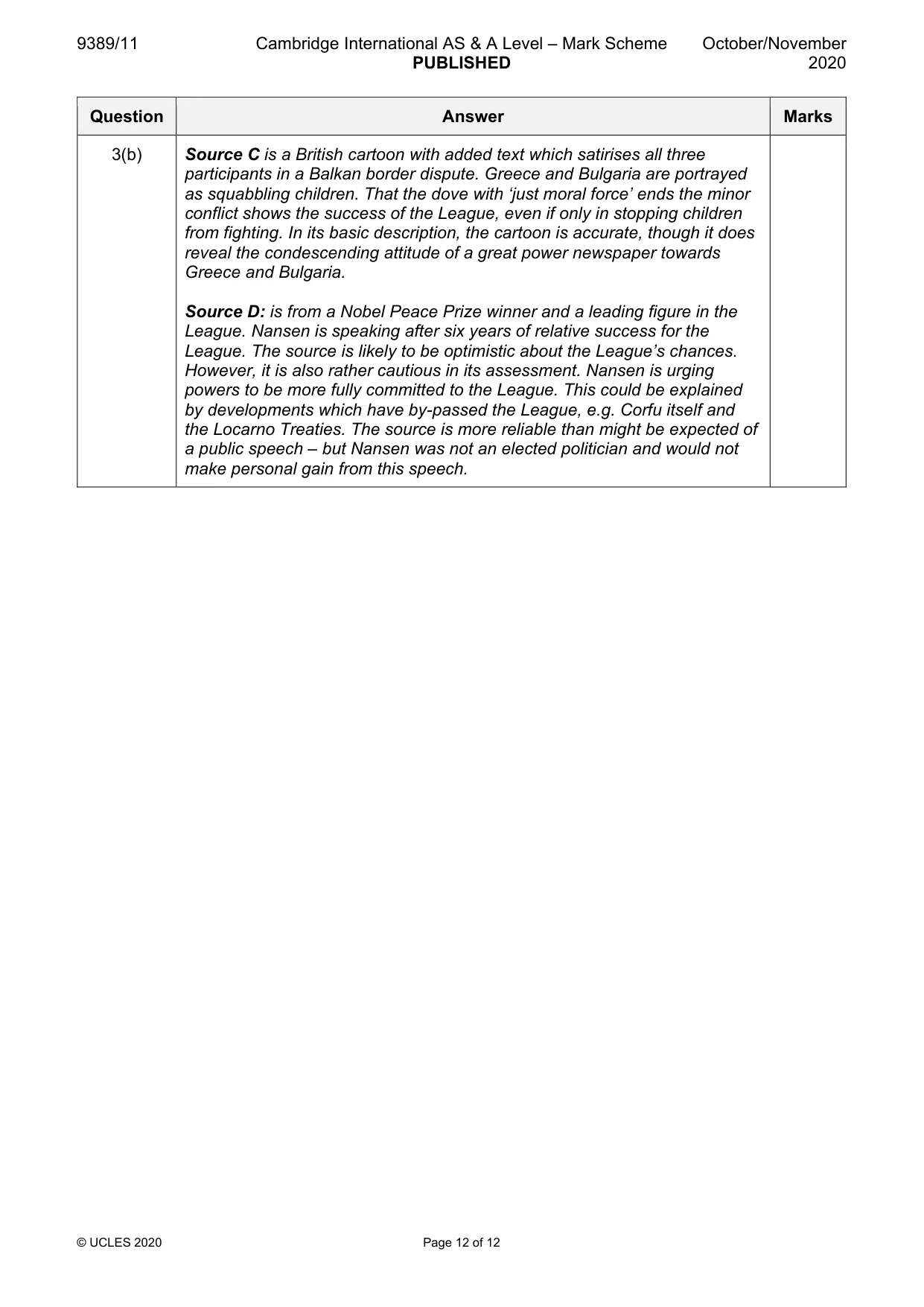
9389/11 Cambridge International AS & A Level – Mark Scheme PUBLISHED October/November 2020 © UCLES 2020 Page 12 of 12 Question Answer Marks 3(b) Source C is a British cartoon with added text which satirises all three participants in a Balkan border dispute. Greece and Bulgaria are portrayed as squabbling children. That the dove with ‘just moral force’ ends the minor conflict shows the success of the League, even if only in stopping children from fighting. In its basic description, the cartoon is accurate, though it does reveal the condescending attitude of a great power newspaper towards Greece and Bulgaria. Source D: is from a Nobel Peace Prize winner and a leading figure in the League. Nansen is speaking after six years of relative success for the League. The source is likely to be optimistic about the League’s chances. However, it is also rather cautious in its assessment. Nansen is urging powers to be more fully committed to the League. This could be explained by developments which have by-passed the League, e.g. Corfu itself and the Locarno Treaties. The source is more reliable than might be expected of a public speech – but Nansen was not an elected politician and would not make personal gain from this speech.
What you needed in this session
Cambridge’s own grade thresholds for 2020 Oct/Nov, Paper 1 · Variant 1. A higher threshold means an easier paper — the bar moves with how the cohort did.