Cambridge A Level History 9389 — 2020 May/June Paper 1 · Variant 1
9389/11/M/J/20
The question paper and its mark scheme, free to read here and free to download. This is Cambridge’s own paper, exactly as it was sat.
Question paper8 pages
Mark scheme12 pages
Answers below. Sit the paper first if you are practising.
Paper as text
Question paper, page 1
Cambridge International AS & A Level This document has 8 pages. Blank pages are indicated. HISTORY 9389/11 Paper 1 Document Question May/June 2020 1 hour You must answer on the enclosed answer booklet. You will need: Answer booklet (enclosed) INSTRUCTIONS ● Answer one question from one section only. Answer both parts of the question. Section A: European Option Section B: American Option Section C: International Option ● Follow the instructions on the front cover of the answer booklet. If you need additional answer paper, ask the invigilator for a continuation booklet. INFORMATION ● The total mark for this paper is 40. ● The number of marks for each question or part question is shown in brackets [ ]. * 1 2 4 0 2 1 2 9 4 8 * DC (CJ/FC) 187797/2 © UCLES 2020 [Turn over
Question paper, page 2
2 9389/11/M/J/20 © UCLES 2020 Section A: European Option Liberalism and Nationalism in Italy and Germany, 1815–1871 The Impact of the Vienna Settlement on Italy 1 Read the sources and then answer both parts of the question. Source A Austria is composed of various different states and has no sense of national unity. If it is given the rule over Italy then it will bring nothing but misery to Italy and problems for itself. If Austria will just allow itself to keep possession of Lombardy, and allow that kingdom its own local government, then it might prevent further problems. However Austria seems determined to rule or influence much of Italy and restrain all advancement or progress in civilisation in all Italian states. This plan will ruin Austria’s finances and lead to further wars. Austria’s only motivation is self-interest and a desire to avoid any new ideas of liberty and nationalism, stirred up by France, moving into its territories. A letter from Count Ernst of Münster to the British Prince Regent, 1815. Münster was a personal friend of the Prince Regent and was present at the Vienna negotiations. Source B Leaving aside any ideas of rights or generosity, and considering only the interests of the other peoples of Europe, is the present state of Italy favourable or not to peace and prosperity? In all fairness it must be said that, at the Congress of Vienna, consideration of general interests may have led the Allied Sovereigns to consent to the present partition of Italy. The pressing need at the time was to bring peace to Europe. There had been many years of terrible war. If the partition of Italy was necessary to bring an end to this war, I, as an Italian, would have consented to it at that price. But will the present state of Italy help to maintain peace in either Italy itself or in the rest of Europe? No. The Austrians and the French will be back. The Piedmontese Ambassador to Russia, writing to the Tsar, March 1818. Source C At present I cannot see any immediate peril to the system imposed by the Congress in any part of Italy, provided that our master in Vienna agrees to send substantial forces into Italy, at least two more armies. The government of our adorable monarch is paternal, just and generous, and has brought to his Italian subjects many advantages such as equality before the law and no arbitrary government behaviour. All these advantages have not been sufficient to compensate for the simple fact that they have insulted Italian self-esteem. Italians have lost sight of the many advantages that our rule has given them. They want their own system of government and not one imposed on them by Austrians. They loathe it. There is a further risk that the current structure of Italy will enable the plague of revolution to spread from Piedmont into Lombardy and Venetia, and then into the Papal States. Our position in Italy is guaranteed by physical force alone; moral force we lack entirely. Memorandum by the Governor of Lombardy to Prince Metternich, July 1820.
Question paper, page 3
3 9389/11/M/J/20 © UCLES 2020 [Turn over Source D The settlement imposed on Italy by the Congress of Vienna was as arbitrary as it was ineffective. It was based on no principle, not even that of legitimacy, as may be seen in the treatment given to Genoa and Venice. Certainly it was not based on national interests or popular will. Disregarding not only geographical circumstances but general interests and private interests created by twenty years of revolution, that great Congress acted solely by justifying the rights of the strongest. This created a political structure devoid of any moral basis. These acts could only bear bitter fruit. Try as hard as they could, even our better rulers could not prevent great dissatisfaction arising from that dreadful Treaty. Those radicals who desired real change exploited the passions aroused by Napoleon and the French Revolution. They found support from those who saw the major errors caused by Vienna. Hence the unfortunate risings of 1820 and 1821. Cavour, in an article in a French magazine, May 1846. Answer both parts of the question with reference to the sources. (a) Compare and contrast the views expressed in Sources A and C about Austria’s attitude towards Italy. [15] (b) ‘The Vienna Settlement was harmful to Italy.’ How far do Sources A to D support this view? [25]
Question paper, page 4
4 9389/11/M/J/20 © UCLES 2020 Section B: American Option The Origins of the Civil War, 1846–1861 The Election Campaign of 1860 2 Read the sources and then answer both parts of the question. Source A The military organisation of the sectional Republicans in their Wide-Awake clubs is a significant feature. One of them here in New York City is taking the shape of an artillery corps, while we read that Auburn, the home city of Senator Seward, is arming. This is eminently right and proper. The election of Abraham Lincoln would mean war on the South and the Wide-Awakes, therefore, are preparing, in the event of his success, for the irrepressible conflict. Part of the plan, according to Sumner, is to ‘drive the slaveholders like poisoned rats into their holes’ and to do that artillery companies will be necessary. A speaker at the Syracuse Convention agreed. He called on the Republicans to rally for a grand fight and to remember that they could kill more men standing solidly in file than when they were divided and scattered. From the ‘New York Express’, September 1860. Source B The Wide-Awake torchlight procession this evening will be one of the most striking sights ever seen in this city. Delegations are coming from all the neighbouring towns and cities and it is probable that at least 25 000 will parade in our streets tonight. Each man carries a torch and the effect of this immense procession, thus illuminated, will be highly brilliant and effective. The speed with which the Wide-Awake organisation has been completed is very remarkable. It had its origin in Connecticut some two years ago and has since extended to every section of the Northern states. Its members are young men of character and energy, earnest in their Republican convictions and enthusiastic for fighting the election. The South has been taught to regard them as a military force, raised and trained for aggression on Southern rights. Nothing could be more absurd. Their purposes are thoroughly peaceful and political. But it cannot be denied that, in case of emergency, they would form the core of an admirable fighting force for any service that might be required of them. From ‘The New York Times’, October 1860.
Question paper, page 5
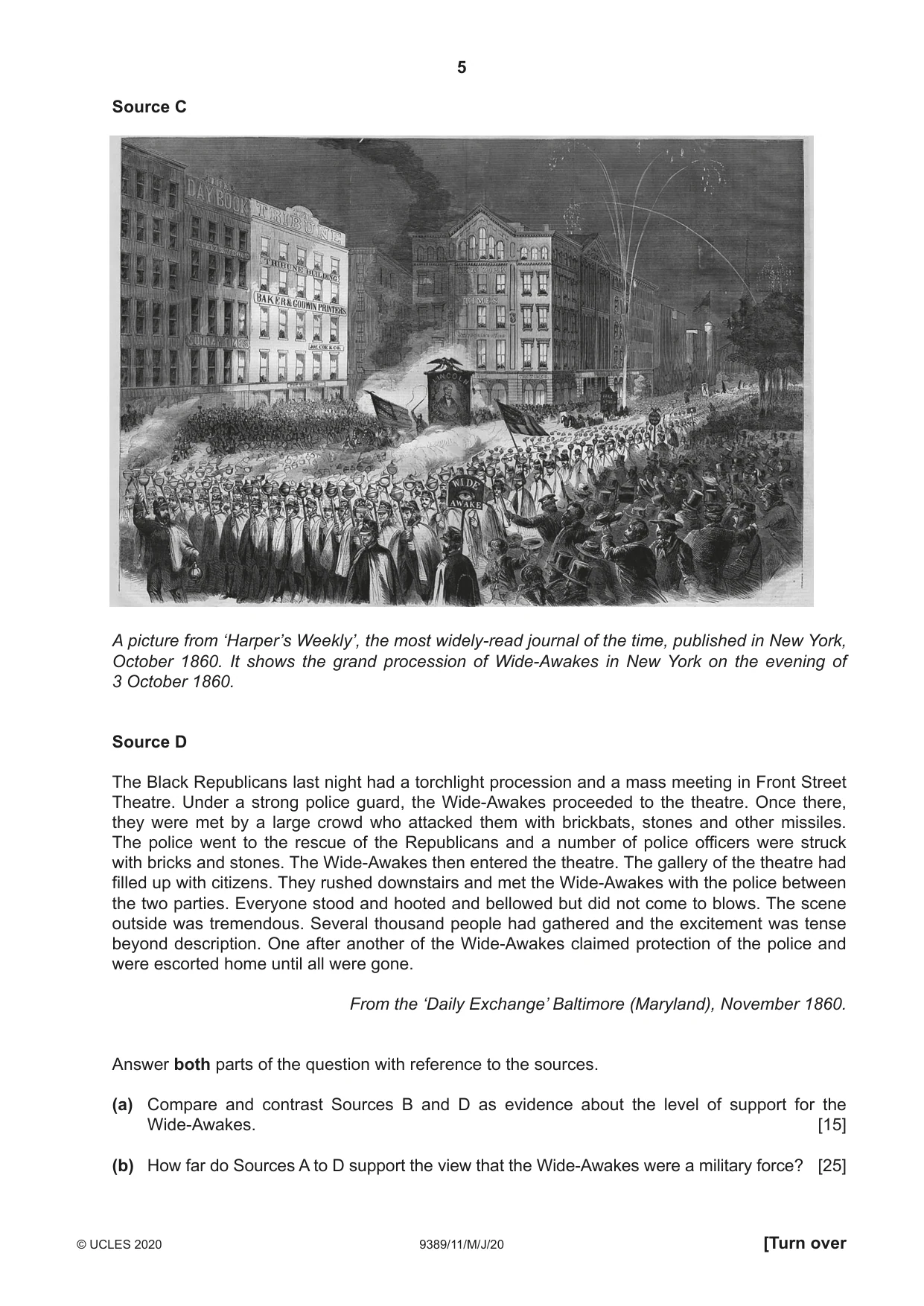
5 9389/11/M/J/20 © UCLES 2020 Source C A picture from ‘Harper’s Weekly’, the most widely-read journal of the time, published in New York, October 1860. It shows the grand procession of Wide-Awakes in New York on the evening of 3 October 1860. Source D The Black Republicans last night had a torchlight procession and a mass meeting in Front Street Theatre. Under a strong police guard, the Wide-Awakes proceeded to the theatre. Once there, they were met by a large crowd who attacked them with brickbats, stones and other missiles. The police went to the rescue of the Republicans and a number of police officers were struck with bricks and stones. The Wide-Awakes then entered the theatre. The gallery of the theatre had filled up with citizens. They rushed downstairs and met the Wide-Awakes with the police between the two parties. Everyone stood and hooted and bellowed but did not come to blows. The scene outside was tremendous. Several thousand people had gathered and the excitement was tense beyond description. One after another of the Wide-Awakes claimed protection of the police and were escorted home until all were gone. From the ‘Daily Exchange’ Baltimore (Maryland), November 1860. Answer both parts of the question with reference to the sources. (a) Compare and contrast Sources B and D as evidence about the level of support for the Wide-Awakes. [15] (b) How far do Sources A to D support the view that the Wide-Awakes were a military force? [25] [Turn over
Question paper, page 6
6 9389/11/M/J/20 © UCLES 2020 Section C: International Option The Search for International Peace and Security, 1919–1945 Was France to blame for the failure of the Disarmament Conference? 3 Read the sources and then answer both parts of the question. Source A It suits us that Germany should rearm quickly to offset France. We must try to build up ourselves so that we can look Germany in the eye whenever the need arises. If the right of rearmament is withheld, then there is no reason why Germany and other countries should stay in the League. In that case it will end with a bang. We have foreseen this; the League of Nations is only an Anglo-French club set up to maintain Anglo-French dominance. If tomorrow our economic situation has changed for the better and enables us to withstand Anglo-French economic reprisals, it is possible that Fascist Italy will walk out of Geneva. We cannot make this gesture yet, for we are unable to resist the reprisals of the wealthy few who control the greater part of the world’s economic situation. The day this danger no longer exists, the moment will have come for Italy to say to Geneva, ‘We have had enough of your pacifist democracy, and your imperialism, hiding behind your plans for peace!’ Perhaps the day is closer than we think! From an address by Mussolini to a meeting of the Fascist Grand Council, April 1932. Source B The French propose that there should be certain armaments, bombing aeroplanes of the larger type, at the service of the League of Nations. The largest type of aeroplane should be physically handed over to the League, and an intermediate type should be solemnly declared to be at the service of the League, though remaining in the physical possession and control of the states which built them. The idea behind this plan, not limited to aeroplanes, is that the League of Nations should have a force at its disposal for the purposes of enforcing the true rules of international conduct. The second proposal is for a protocol, binding those who sign it, to come to the assistance of the victims of aggression in a very definite way. I mention these things because when the discussions at Geneva are resumed, these two proposals present very grave and very controversial issues. The British Foreign Secretary, explaining to Parliament the French proposals put forward at the Disarmament Conference, May 1932. Source C After five years of preparation and six months of work, the labours of the Disarmament Conference have come to an end, having accomplished nothing. All the capitalist countries presented declarations camouflaged in pacifist phrases which defended their own specific programmes of rearmament. The most characteristic was the programme of French imperialism. France refused to agree to any limitation on armaments and proposed instead to place the most powerful instruments of warfare into the hands of a special army controlled by the League of Nations. The proposal did not aim at the limitation of armaments, but rather the legalisation by the League of Nations of all instruments of war. Only the Soviet Union presented a clear and exact programme of disarmament, pointing out that disarmament alone will safeguard the people of the world from the unheard-of calamities of modern warfare. But this proposal was rejected by all the capitalist countries. From an article in a Soviet newspaper, July 1932.
Question paper, page 7
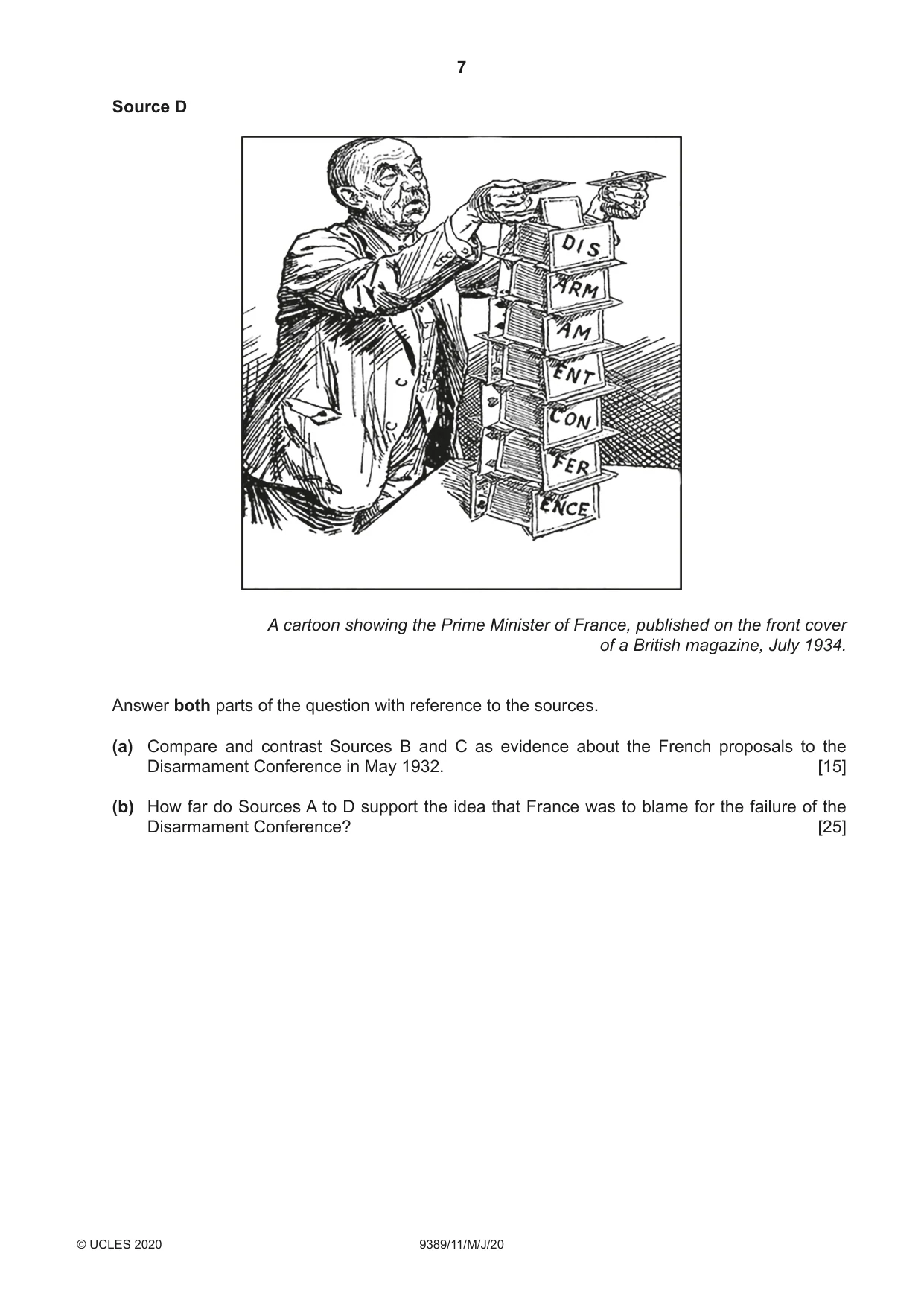
7 9389/11/M/J/20 © UCLES 2020 Source D A cartoon showing the Prime Minister of France, published on the front cover of a British magazine, July 1934. Answer both parts of the question with reference to the sources. (a) Compare and contrast Sources B and C as evidence about the French proposals to the Disarmament Conference in May 1932. [15] (b) How far do Sources A to D support the idea that France was to blame for the failure of the Disarmament Conference? [25]
Question paper, page 8
8 9389/11/M/J/20 © UCLES 2020 Permission to reproduce items where third-party owned material protected by copyright is included has been sought and cleared where possible. Every reasonable effort has been made by the publisher (UCLES) to trace copyright holders, but if any items requiring clearance have unwittingly been included, the publisher will be pleased to make amends at the earliest possible opportunity. To avoid the issue of disclosure of answer-related information to candidates, all copyright acknowledgements are reproduced online in the Cambridge Assessment International Education Copyright Acknowledgements Booklet. This is produced for each series of examinations and is freely available to download at www.cambridgeinternational.org after the live examination series. Cambridge Assessment International Education is part of the Cambridge Assessment Group. Cambridge Assessment is the brand name of the University of Cambridge Local Examinations Syndicate (UCLES), which itself is a department of the University of Cambridge. BLANK PAGE
Mark scheme, page 1
This document consists of 12 printed pages. © UCLES 2020 [Turn over Cambridge International AS & A Level HISTORY 9389/11 Paper 1 Document Question 11 May/June 2020 MARK SCHEME Maximum Mark: 40 Published Students did not sit exam papers in the June 2020 series due to the Covid-19 global pandemic. This mark scheme is published to support teachers and students and should be read together with the question paper. It shows the requirements of the exam. The answer column of the mark scheme shows the proposed basis on which Examiners would award marks for this exam. Where appropriate, this column also provides the most likely acceptable alternative responses expected from students. Examiners usually review the mark scheme after they have seen student responses and update the mark scheme if appropriate. In the June series, Examiners were unable to consider the acceptability of alternative responses, as there were no student responses to consider. Mark schemes should usually be read together with the Principal Examiner Report for Teachers. However, because students did not sit exam papers, there is no Principal Examiner Report for Teachers for the June 2020 series. Cambridge International will not enter into discussions about these mark schemes. Cambridge International is publishing the mark schemes for the June 2020 series for most Cambridge IGCSE™ and Cambridge International A & AS Level components, and some Cambridge O Level components.
Mark scheme, page 2
9389/11 Cambridge International AS & A Level – Mark Scheme PUBLISHED May/June 2020 © UCLES 2020 Page 2 of 12 Generic Marking Principles These general marking principles must be applied by all examiners when marking candidate answers. They should be applied alongside the specific content of the mark scheme or generic level descriptors for a question. Each question paper and mark scheme will also comply with these marking principles. GENERIC MARKING PRINCIPLE 1: Marks must be awarded in line with: • the specific content of the mark scheme or the generic level descriptors for the question • the specific skills defined in the mark scheme or in the generic level descriptors for the question • the standard of response required by a candidate as exemplified by the standardisation scripts. GENERIC MARKING PRINCIPLE 2: Marks awarded are always whole marks (not half marks, or other fractions). GENERIC MARKING PRINCIPLE 3: Marks must be awarded positively: • marks are awarded for correct/valid answers, as defined in the mark scheme. However, credit is given for valid answers which go beyond the scope of the syllabus and mark scheme, referring to your Team Leader as appropriate • marks are awarded when candidates clearly demonstrate what they know and can do • marks are not deducted for errors • marks are not deducted for omissions • answers should only be judged on the quality of spelling, punctuation and grammar when these features are specifically assessed by the question as indicated by the mark scheme. The meaning, however, should be unambiguous. GENERIC MARKING PRINCIPLE 4: Rules must be applied consistently e.g. in situations where candidates have not followed instructions or in the application of generic level descriptors. GENERIC MARKING PRINCIPLE 5: Marks should be awarded using the full range of marks defined in the mark scheme for the question (however; the use of the full mark range may be limited according to the quality of the candidate responses seen). GENERIC MARKING PRINCIPLE 6: Marks awarded are based solely on the requirements as defined in the mark scheme. Marks should not be awarded with grade thresholds or grade descriptors in mind.
Mark scheme, page 3
9389/11 Cambridge International AS & A Level – Mark Scheme PUBLISHED May/June 2020 © UCLES 2020 Page 3 of 12 Part(a) Generic Levels of Response: Marks Level 4: Makes a developed comparison Makes a developed comparison between the two sources, recognising points of similarity and difference. Uses knowledge to evaluate the sources and shows good contextual awareness. 12–15 Level 3: Compares views and identifies similarities and differences Compares the views expressed in the sources, identifying differences and similarities. Begins to explain and evaluate the views using the sources and knowledge. 8–11 Level 2: Compares views and identifies similarities and/or differences Identifies relevant similarities or differences between views/sources and the response may be one-sided with only one aspect explained. Alternatively, both similarities and differences may be mentioned but both aspects lack development. 4–7 Level 1: Describes content of each source Describes or paraphrases the content of the two sources. Very simple comparisons may be made (e.g. one is from a letter and the other is from a speech) but these are not developed. 1–3 Level 0: No relevant comment on the sources or the issue 0
Mark scheme, page 4
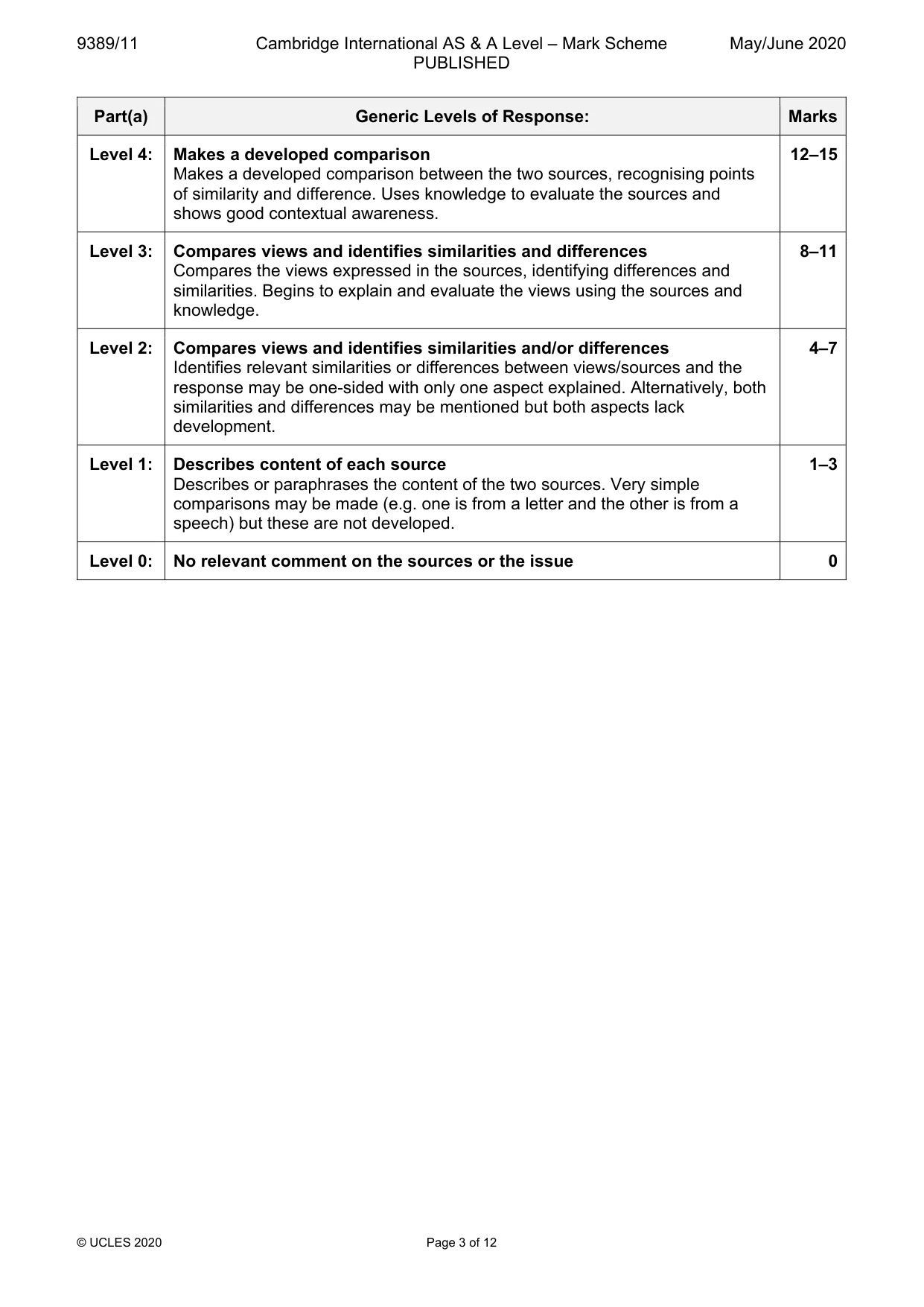
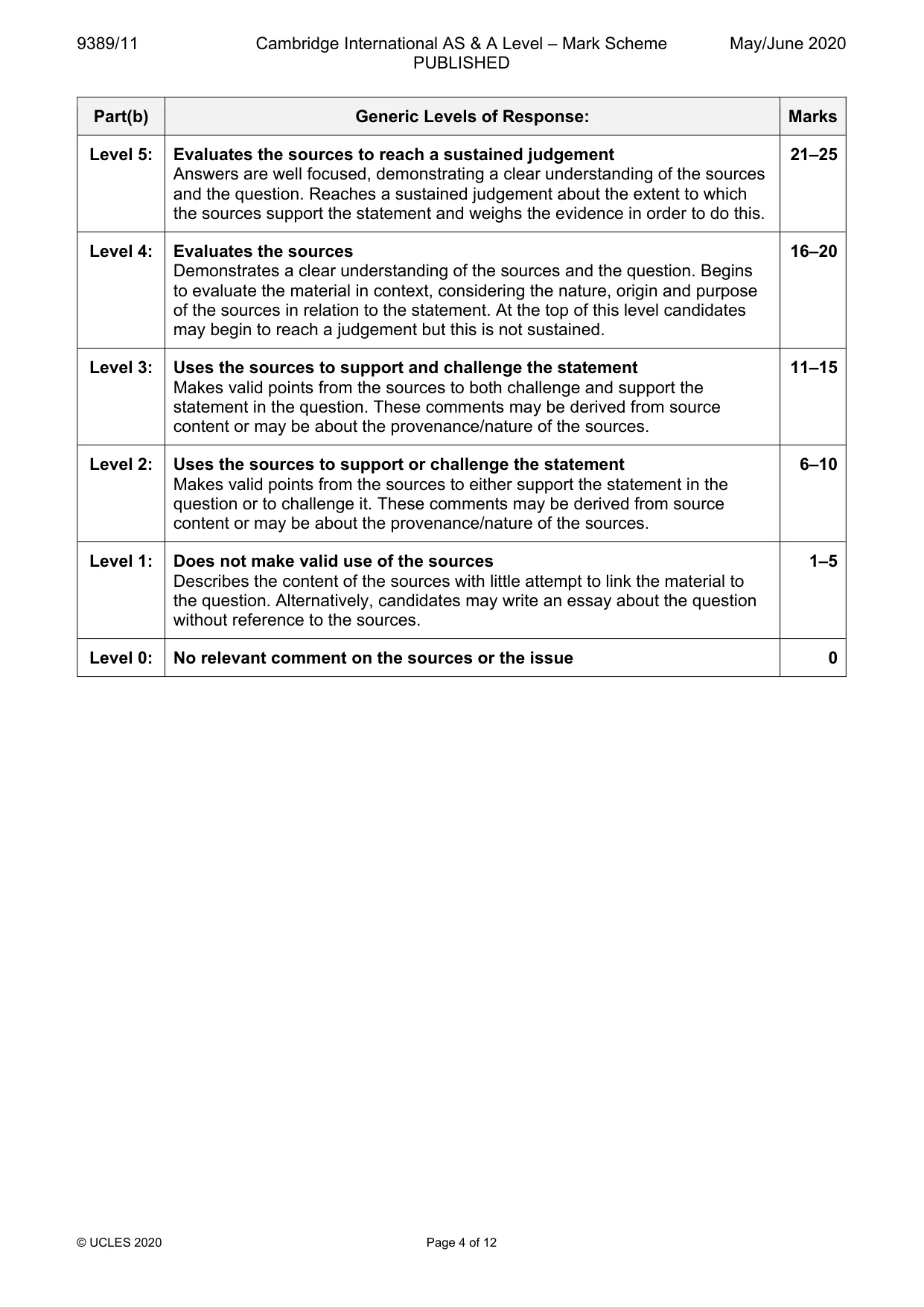
9389/11 Cambridge International AS & A Level – Mark Scheme PUBLISHED May/June 2020 © UCLES 2020 Page 4 of 12 Part(b) Generic Levels of Response: Marks Level 5: Evaluates the sources to reach a sustained judgement Answers are well focused, demonstrating a clear understanding of the sources and the question. Reaches a sustained judgement about the extent to which the sources support the statement and weighs the evidence in order to do this. 21–25 Level 4: Evaluates the sources Demonstrates a clear understanding of the sources and the question. Begins to evaluate the material in context, considering the nature, origin and purpose of the sources in relation to the statement. At the top of this level candidates may begin to reach a judgement but this is not sustained. 16–20 Level 3: Uses the sources to support and challenge the statement Makes valid points from the sources to both challenge and support the statement in the question. These comments may be derived from source content or may be about the provenance/nature of the sources. 11–15 Level 2: Uses the sources to support or challenge the statement Makes valid points from the sources to either support the statement in the question or to challenge it. These comments may be derived from source content or may be about the provenance/nature of the sources. 6–10 Level 1: Does not make valid use of the sources Describes the content of the sources with little attempt to link the material to the question. Alternatively, candidates may write an essay about the question without reference to the sources. 1–5 Level 0: No relevant comment on the sources or the issue 0
Mark scheme, page 5
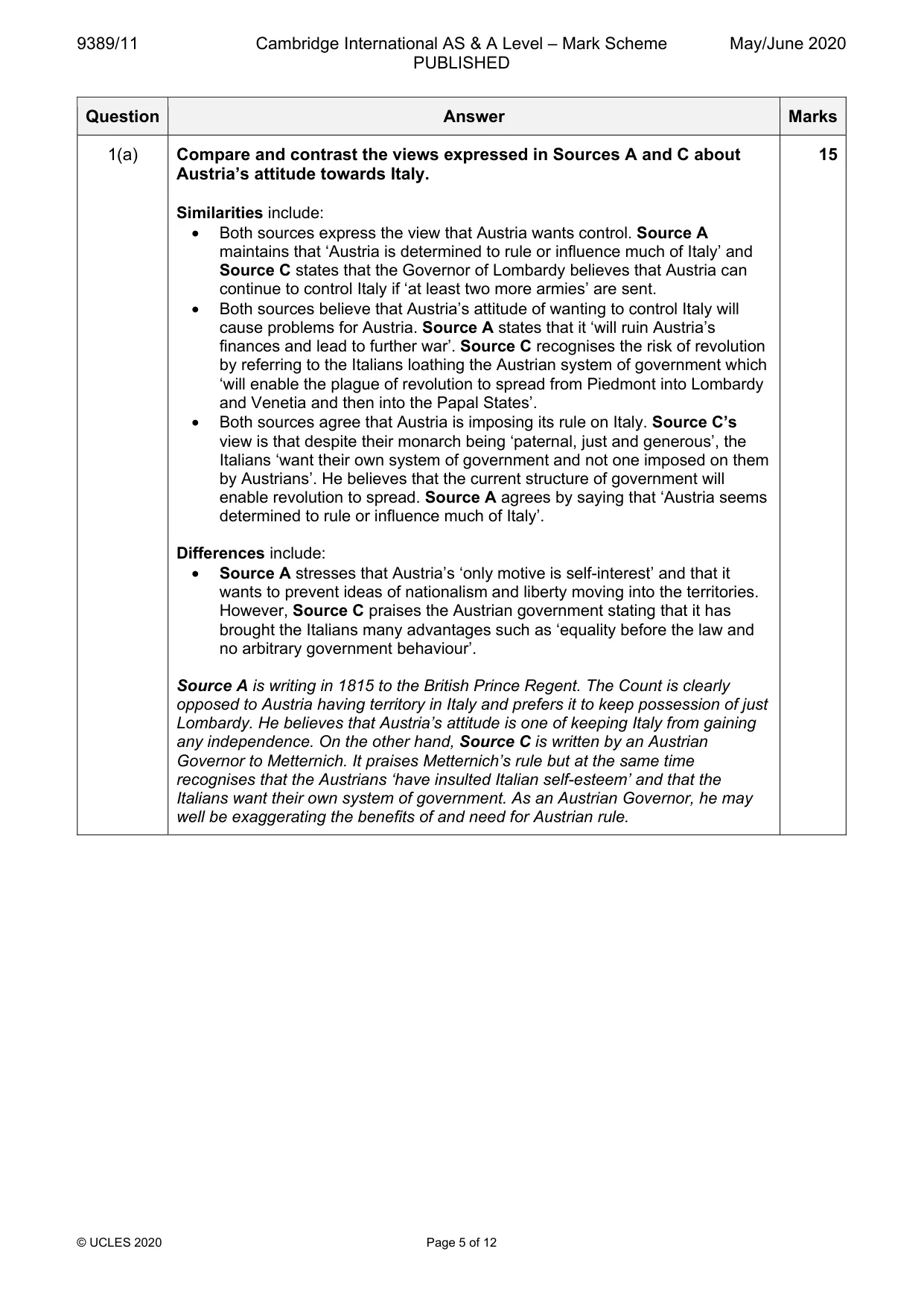
9389/11 Cambridge International AS & A Level – Mark Scheme PUBLISHED May/June 2020 © UCLES 2020 Page 5 of 12 Question Answer Marks 1(a) Compare and contrast the views expressed in Sources A and C about Austria’s attitude towards Italy. Similarities include: • Both sources express the view that Austria wants control. Source A maintains that ‘Austria is determined to rule or influence much of Italy’ and Source C states that the Governor of Lombardy believes that Austria can continue to control Italy if ‘at least two more armies’ are sent. • Both sources believe that Austria’s attitude of wanting to control Italy will cause problems for Austria. Source A states that it ‘will ruin Austria’s finances and lead to further war’. Source C recognises the risk of revolution by referring to the Italians loathing the Austrian system of government which ‘will enable the plague of revolution to spread from Piedmont into Lombardy and Venetia and then into the Papal States’. • Both sources agree that Austria is imposing its rule on Italy. Source C’s view is that despite their monarch being ‘paternal, just and generous’, the Italians ‘want their own system of government and not one imposed on them by Austrians’. He believes that the current structure of government will enable revolution to spread. Source A agrees by saying that ‘Austria seems determined to rule or influence much of Italy’. Differences include: • Source A stresses that Austria’s ‘only motive is self-interest’ and that it wants to prevent ideas of nationalism and liberty moving into the territories. However, Source C praises the Austrian government stating that it has brought the Italians many advantages such as ‘equality before the law and no arbitrary government behaviour’. Source A is writing in 1815 to the British Prince Regent. The Count is clearly opposed to Austria having territory in Italy and prefers it to keep possession of just Lombardy. He believes that Austria’s attitude is one of keeping Italy from gaining any independence. On the other hand, Source C is written by an Austrian Governor to Metternich. It praises Metternich’s rule but at the same time recognises that the Austrians ‘have insulted Italian self-esteem’ and that the Italians want their own system of government. As an Austrian Governor, he may well be exaggerating the benefits of and need for Austrian rule. 15
Mark scheme, page 6
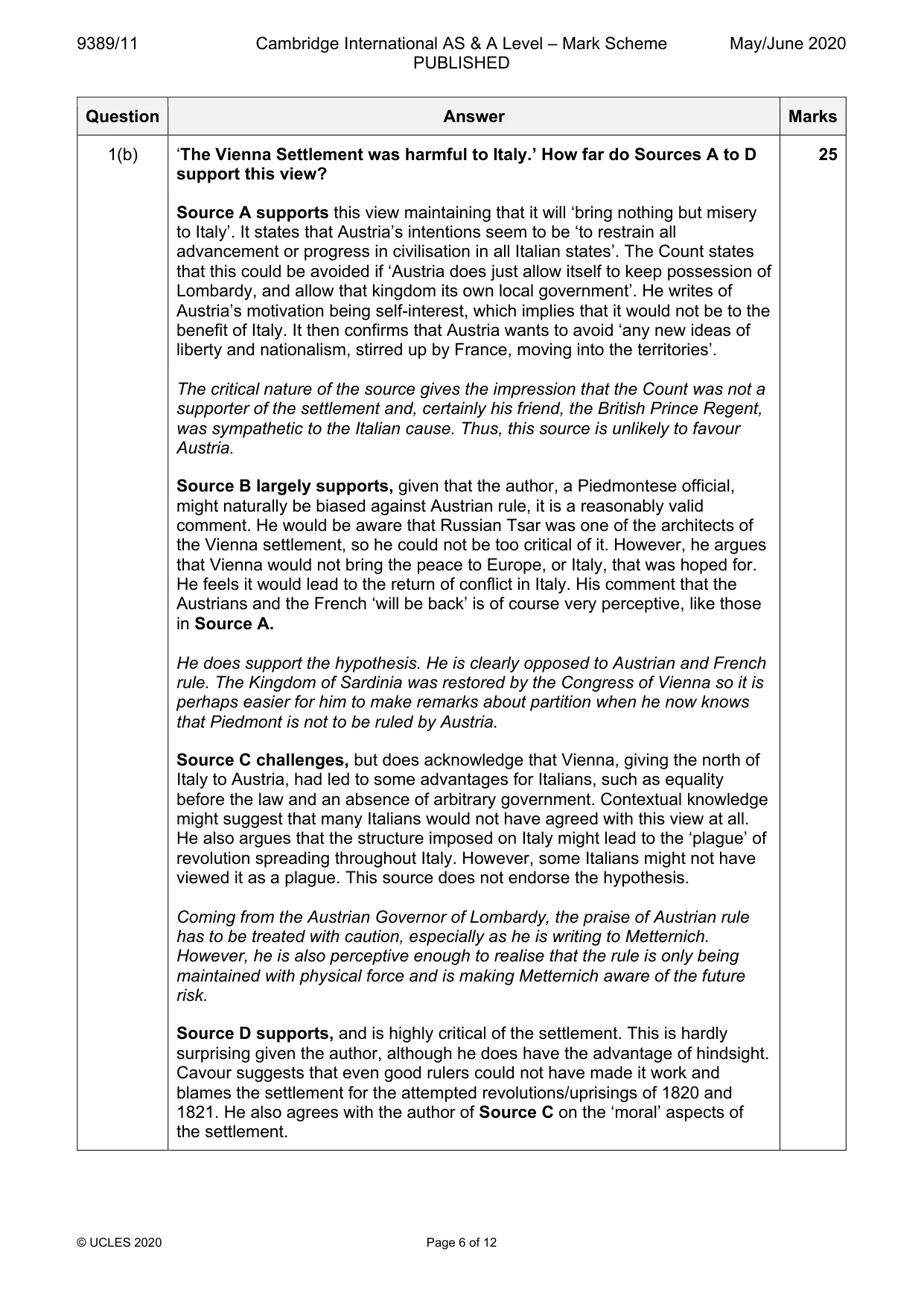
9389/11 Cambridge International AS & A Level – Mark Scheme PUBLISHED May/June 2020 © UCLES 2020 Page 6 of 12 Question Answer Marks 1(b) ‘The Vienna Settlement was harmful to Italy.’ How far do Sources A to D support this view? Source A supports this view maintaining that it will ‘bring nothing but misery to Italy’. It states that Austria’s intentions seem to be ‘to restrain all advancement or progress in civilisation in all Italian states’. The Count states that this could be avoided if ‘Austria does just allow itself to keep possession of Lombardy, and allow that kingdom its own local government’. He writes of Austria’s motivation being self-interest, which implies that it would not be to the benefit of Italy. It then confirms that Austria wants to avoid ‘any new ideas of liberty and nationalism, stirred up by France, moving into the territories’. The critical nature of the source gives the impression that the Count was not a supporter of the settlement and, certainly his friend, the British Prince Regent, was sympathetic to the Italian cause. Thus, this source is unlikely to favour Austria. Source B largely supports, given that the author, a Piedmontese official, might naturally be biased against Austrian rule, it is a reasonably valid comment. He would be aware that Russian Tsar was one of the architects of the Vienna settlement, so he could not be too critical of it. However, he argues that Vienna would not bring the peace to Europe, or Italy, that was hoped for. He feels it would lead to the return of conflict in Italy. His comment that the Austrians and the French ‘will be back’ is of course very perceptive, like those in Source A. He does support the hypothesis. He is clearly opposed to Austrian and French rule. The Kingdom of Sardinia was restored by the Congress of Vienna so it is perhaps easier for him to make remarks about partition when he now knows that Piedmont is not to be ruled by Austria. Source C challenges, but does acknowledge that Vienna, giving the north of Italy to Austria, had led to some advantages for Italians, such as equality before the law and an absence of arbitrary government. Contextual knowledge might suggest that many Italians would not have agreed with this view at all. He also argues that the structure imposed on Italy might lead to the ‘plague’ of revolution spreading throughout Italy. However, some Italians might not have viewed it as a plague. This source does not endorse the hypothesis. Coming from the Austrian Governor of Lombardy, the praise of Austrian rule has to be treated with caution, especially as he is writing to Metternich. However, he is also perceptive enough to realise that the rule is only being maintained with physical force and is making Metternich aware of the future risk. Source D supports, and is highly critical of the settlement. This is hardly surprising given the author, although he does have the advantage of hindsight. Cavour suggests that even good rulers could not have made it work and blames the settlement for the attempted revolutions/uprisings of 1820 and 1821. He also agrees with the author of Source C on the ‘moral’ aspects of the settlement. 25
Mark scheme, page 7
9389/11 Cambridge International AS & A Level – Mark Scheme PUBLISHED May/June 2020 © UCLES 2020 Page 7 of 12 Question Answer Marks 1(b) Given his history, Cavour is likely to take this stance as a keen advocate of Italian unification, but he does have the advantage of using hindsight which justifies his view. Overall the sources are agreed that the settlement brought harm to Italy, but Sources A and C contain some aspects which might be seen to be more favourable.
Mark scheme, page 8
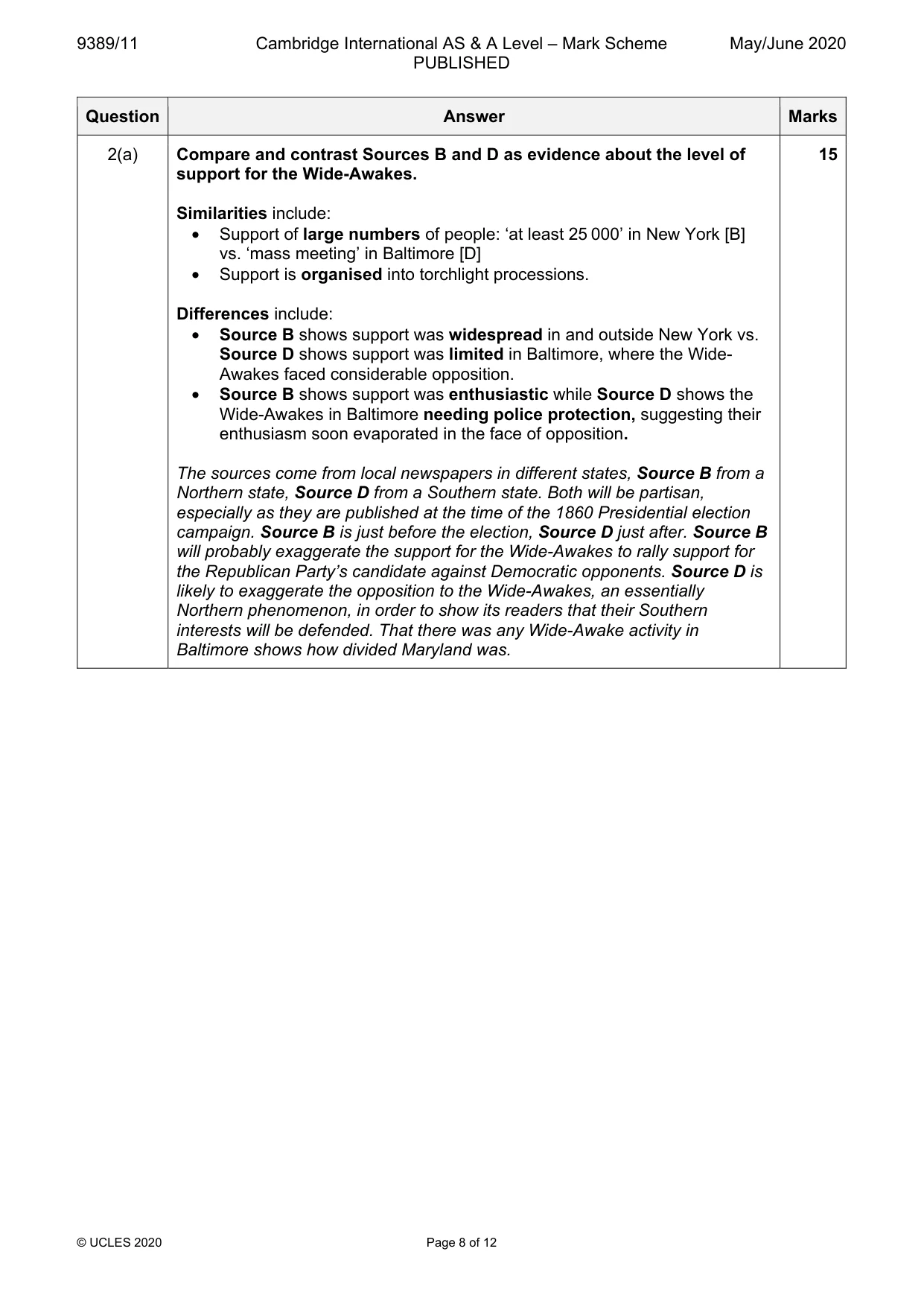
9389/11 Cambridge International AS & A Level – Mark Scheme PUBLISHED May/June 2020 © UCLES 2020 Page 8 of 12 Question Answer Marks 2(a) Compare and contrast Sources B and D as evidence about the level of support for the Wide-Awakes. Similarities include: • Support of large numbers of people: ‘at least 25 000’ in New York [B] vs. ‘mass meeting’ in Baltimore [D] • Support is organised into torchlight processions. Differences include: • Source B shows support was widespread in and outside New York vs. Source D shows support was limited in Baltimore, where the Wide- Awakes faced considerable opposition. • Source B shows support was enthusiastic while Source D shows the Wide-Awakes in Baltimore needing police protection, suggesting their enthusiasm soon evaporated in the face of opposition. The sources come from local newspapers in different states, Source B from a Northern state, Source D from a Southern state. Both will be partisan, especially as they are published at the time of the 1860 Presidential election campaign. Source B is just before the election, Source D just after. Source B will probably exaggerate the support for the Wide-Awakes to rally support for the Republican Party’s candidate against Democratic opponents. Source D is likely to exaggerate the opposition to the Wide-Awakes, an essentially Northern phenomenon, in order to show its readers that their Southern interests will be defended. That there was any Wide-Awake activity in Baltimore shows how divided Maryland was. 15
Mark scheme, page 9
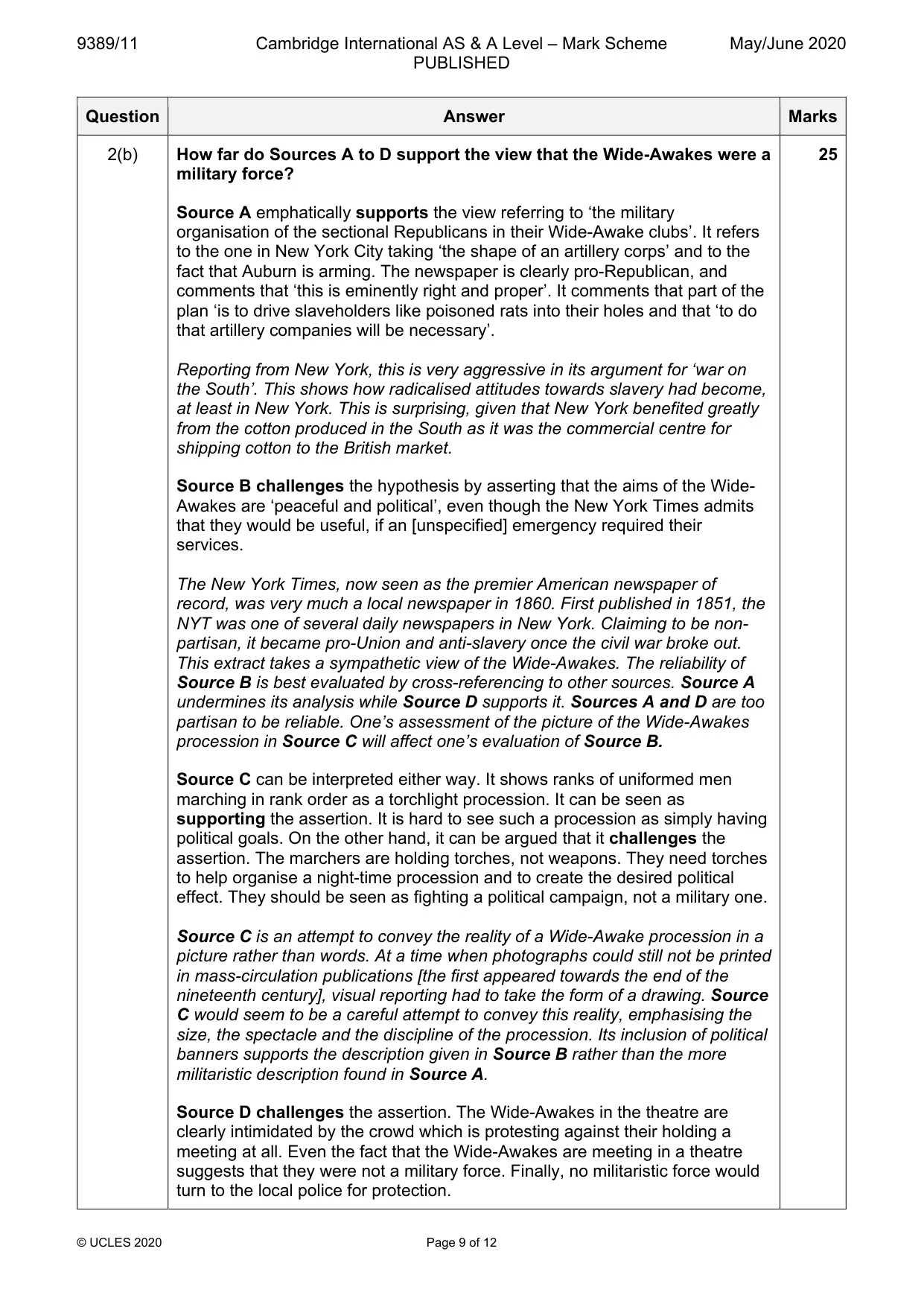
9389/11 Cambridge International AS & A Level – Mark Scheme PUBLISHED May/June 2020 © UCLES 2020 Page 9 of 12 Question Answer Marks 2(b) How far do Sources A to D support the view that the Wide-Awakes were a military force? Source A emphatically supports the view referring to ‘the military organisation of the sectional Republicans in their Wide-Awake clubs’. It refers to the one in New York City taking ‘the shape of an artillery corps’ and to the fact that Auburn is arming. The newspaper is clearly pro-Republican, and comments that ‘this is eminently right and proper’. It comments that part of the plan ‘is to drive slaveholders like poisoned rats into their holes and that ‘to do that artillery companies will be necessary’. Reporting from New York, this is very aggressive in its argument for ‘war on the South’. This shows how radicalised attitudes towards slavery had become, at least in New York. This is surprising, given that New York benefited greatly from the cotton produced in the South as it was the commercial centre for shipping cotton to the British market. Source B challenges the hypothesis by asserting that the aims of the Wide- Awakes are ‘peaceful and political’, even though the New York Times admits that they would be useful, if an [unspecified] emergency required their services. The New York Times, now seen as the premier American newspaper of record, was very much a local newspaper in 1860. First published in 1851, the NYT was one of several daily newspapers in New York. Claiming to be non- partisan, it became pro-Union and anti-slavery once the civil war broke out. This extract takes a sympathetic view of the Wide-Awakes. The reliability of Source B is best evaluated by cross-referencing to other sources. Source A undermines its analysis while Source D supports it. Sources A and D are too partisan to be reliable. One’s assessment of the picture of the Wide-Awakes procession in Source C will affect one’s evaluation of Source B. Source C can be interpreted either way. It shows ranks of uniformed men marching in rank order as a torchlight procession. It can be seen as supporting the assertion. It is hard to see such a procession as simply having political goals. On the other hand, it can be argued that it challenges the assertion. The marchers are holding torches, not weapons. They need torches to help organise a night-time procession and to create the desired political effect. They should be seen as fighting a political campaign, not a military one. Source C is an attempt to convey the reality of a Wide-Awake procession in a picture rather than words. At a time when photographs could still not be printed in mass-circulation publications [the first appeared towards the end of the nineteenth century], visual reporting had to take the form of a drawing. Source C would seem to be a careful attempt to convey this reality, emphasising the size, the spectacle and the discipline of the procession. Its inclusion of political banners supports the description given in Source B rather than the more militaristic description found in Source A. Source D challenges the assertion. The Wide-Awakes in the theatre are clearly intimidated by the crowd which is protesting against their holding a meeting at all. Even the fact that the Wide-Awakes are meeting in a theatre suggests that they were not a military force. Finally, no militaristic force would turn to the local police for protection. 25
Mark scheme, page 10
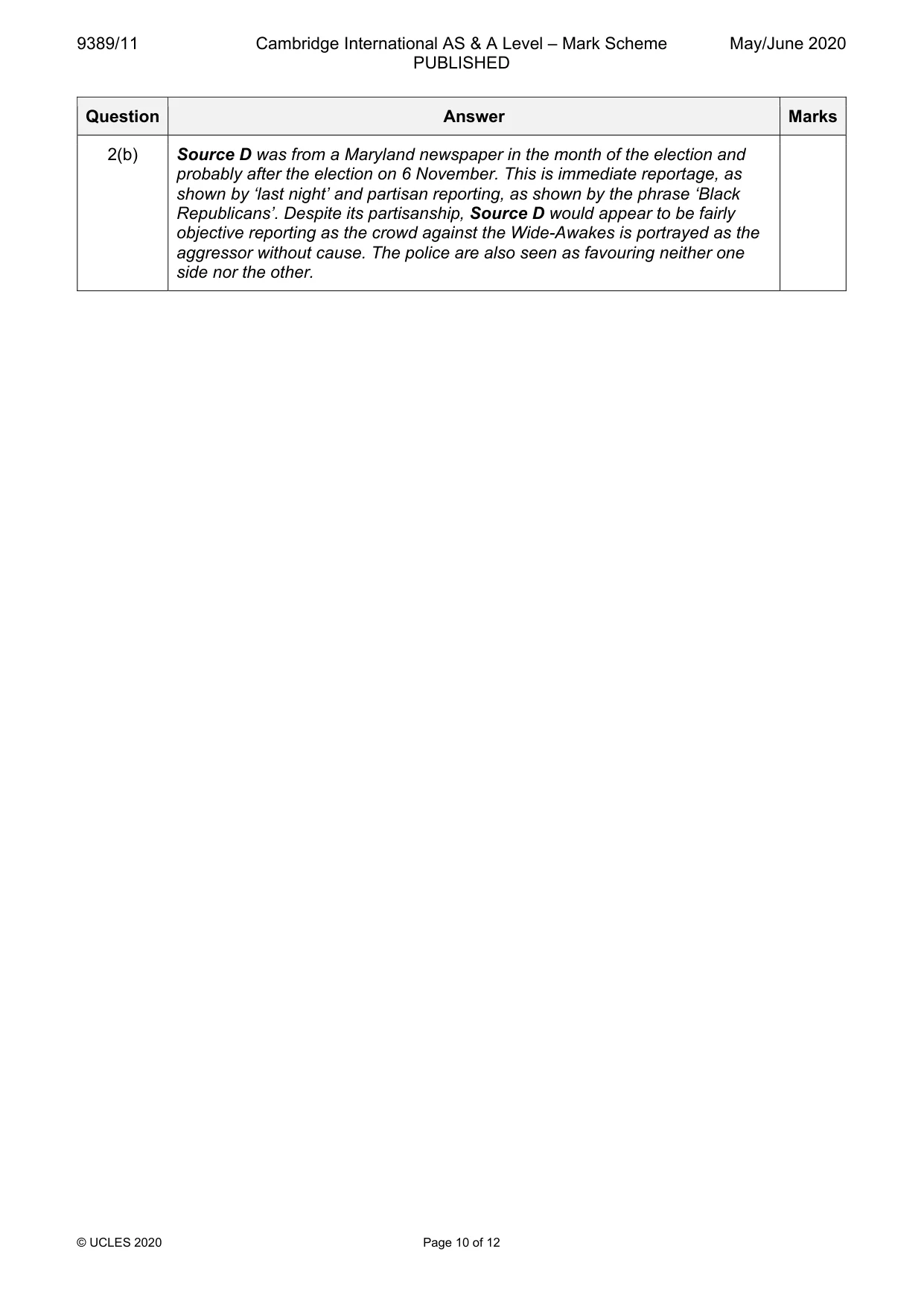
9389/11 Cambridge International AS & A Level – Mark Scheme PUBLISHED May/June 2020 © UCLES 2020 Page 10 of 12 Question Answer Marks 2(b) Source D was from a Maryland newspaper in the month of the election and probably after the election on 6 November. This is immediate reportage, as shown by ‘last night’ and partisan reporting, as shown by the phrase ‘Black Republicans’. Despite its partisanship, Source D would appear to be fairly objective reporting as the crowd against the Wide-Awakes is portrayed as the aggressor without cause. The police are also seen as favouring neither one side nor the other.
Mark scheme, page 11
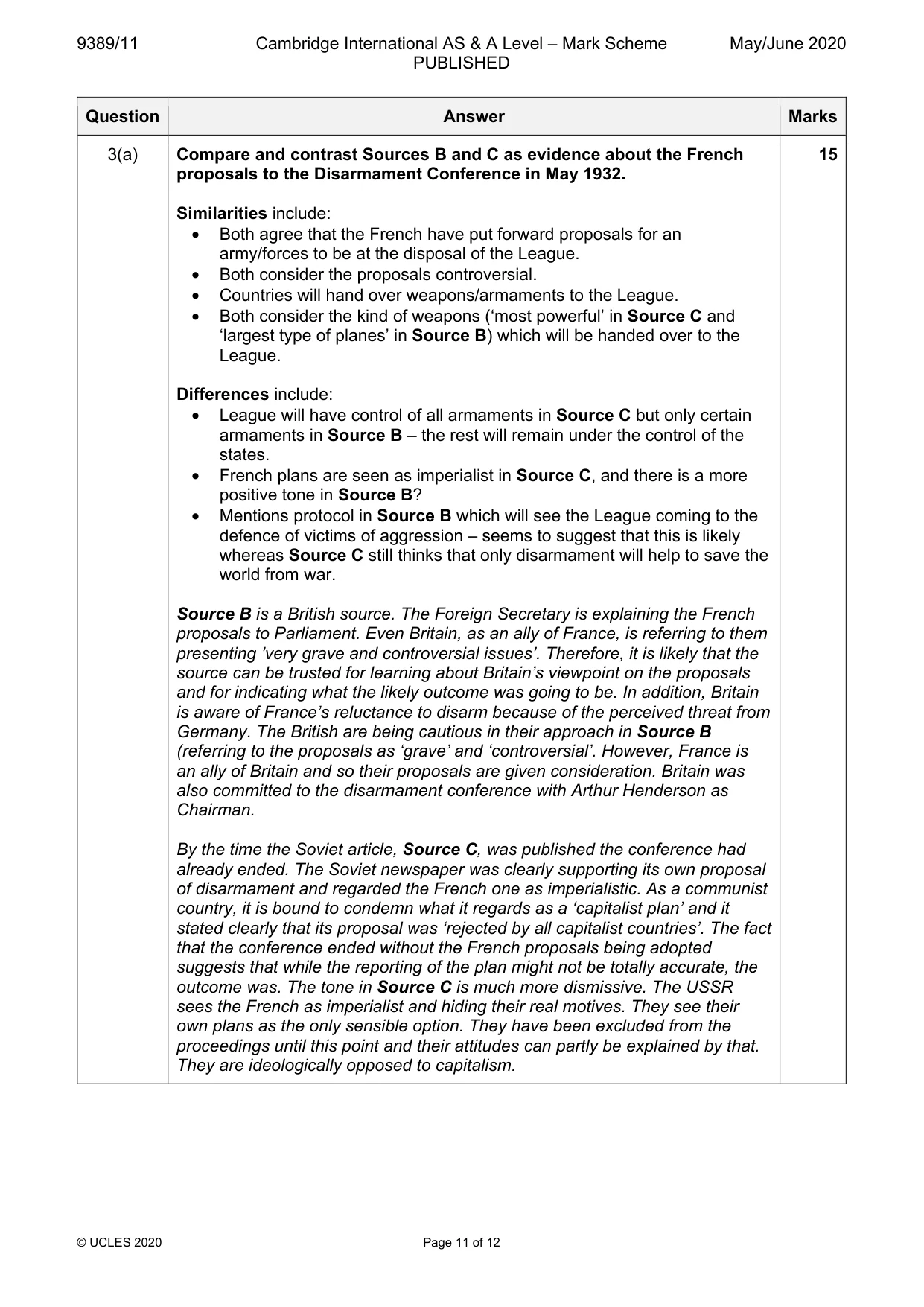
9389/11 Cambridge International AS & A Level – Mark Scheme PUBLISHED May/June 2020 © UCLES 2020 Page 11 of 12 Question Answer Marks 3(a) Compare and contrast Sources B and C as evidence about the French proposals to the Disarmament Conference in May 1932. Similarities include: • Both agree that the French have put forward proposals for an army/forces to be at the disposal of the League. • Both consider the proposals controversial. • Countries will hand over weapons/armaments to the League. • Both consider the kind of weapons (‘most powerful’ in Source C and ‘largest type of planes’ in Source B) which will be handed over to the League. Differences include: • League will have control of all armaments in Source C but only certain armaments in Source B – the rest will remain under the control of the states. • French plans are seen as imperialist in Source C, and there is a more positive tone in Source B? • Mentions protocol in Source B which will see the League coming to the defence of victims of aggression – seems to suggest that this is likely whereas Source C still thinks that only disarmament will help to save the world from war. Source B is a British source. The Foreign Secretary is explaining the French proposals to Parliament. Even Britain, as an ally of France, is referring to them presenting ’very grave and controversial issues’. Therefore, it is likely that the source can be trusted for learning about Britain’s viewpoint on the proposals and for indicating what the likely outcome was going to be. In addition, Britain is aware of France’s reluctance to disarm because of the perceived threat from Germany. The British are being cautious in their approach in Source B (referring to the proposals as ‘grave’ and ‘controversial’. However, France is an ally of Britain and so their proposals are given consideration. Britain was also committed to the disarmament conference with Arthur Henderson as Chairman. By the time the Soviet article, Source C, was published the conference had already ended. The Soviet newspaper was clearly supporting its own proposal of disarmament and regarded the French one as imperialistic. As a communist country, it is bound to condemn what it regards as a ‘capitalist plan’ and it stated clearly that its proposal was ‘rejected by all capitalist countries’. The fact that the conference ended without the French proposals being adopted suggests that while the reporting of the plan might not be totally accurate, the outcome was. The tone in Source C is much more dismissive. The USSR sees the French as imperialist and hiding their real motives. They see their own plans as the only sensible option. They have been excluded from the proceedings until this point and their attitudes can partly be explained by that. They are ideologically opposed to capitalism. 15
Mark scheme, page 12
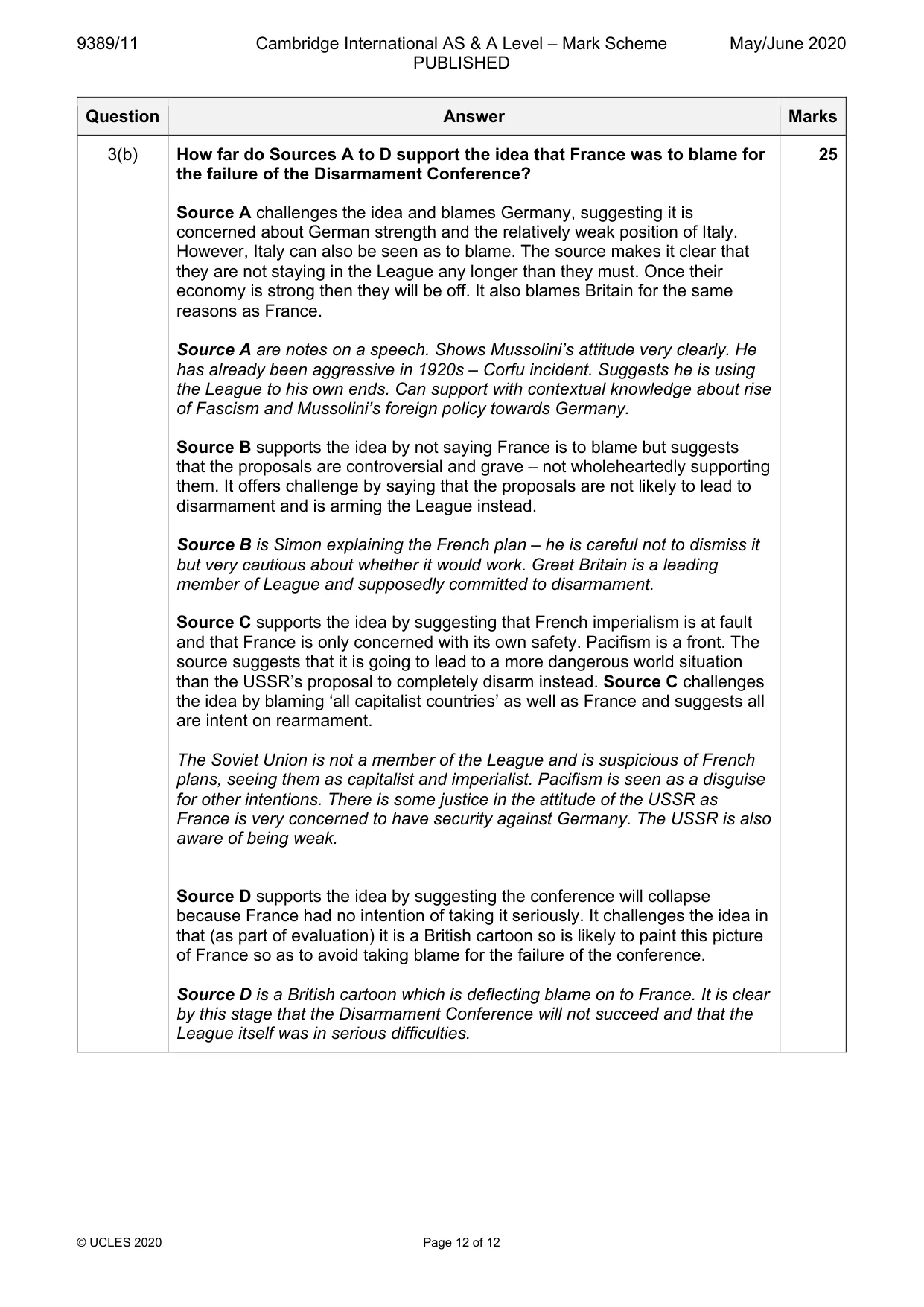
9389/11 Cambridge International AS & A Level – Mark Scheme PUBLISHED May/June 2020 © UCLES 2020 Page 12 of 12 Question Answer Marks 3(b) How far do Sources A to D support the idea that France was to blame for the failure of the Disarmament Conference? Source A challenges the idea and blames Germany, suggesting it is concerned about German strength and the relatively weak position of Italy. However, Italy can also be seen as to blame. The source makes it clear that they are not staying in the League any longer than they must. Once their economy is strong then they will be off. It also blames Britain for the same reasons as France. Source A are notes on a speech. Shows Mussolini’s attitude very clearly. He has already been aggressive in 1920s – Corfu incident. Suggests he is using the League to his own ends. Can support with contextual knowledge about rise of Fascism and Mussolini’s foreign policy towards Germany. Source B supports the idea by not saying France is to blame but suggests that the proposals are controversial and grave – not wholeheartedly supporting them. It offers challenge by saying that the proposals are not likely to lead to disarmament and is arming the League instead. Source B is Simon explaining the French plan – he is careful not to dismiss it but very cautious about whether it would work. Great Britain is a leading member of League and supposedly committed to disarmament. Source C supports the idea by suggesting that French imperialism is at fault and that France is only concerned with its own safety. Pacifism is a front. The source suggests that it is going to lead to a more dangerous world situation than the USSR’s proposal to completely disarm instead. Source C challenges the idea by blaming ‘all capitalist countries’ as well as France and suggests all are intent on rearmament. The Soviet Union is not a member of the League and is suspicious of French plans, seeing them as capitalist and imperialist. Pacifism is seen as a disguise for other intentions. There is some justice in the attitude of the USSR as France is very concerned to have security against Germany. The USSR is also aware of being weak. Source D supports the idea by suggesting the conference will collapse because France had no intention of taking it seriously. It challenges the idea in that (as part of evaluation) it is a British cartoon so is likely to paint this picture of France so as to avoid taking blame for the failure of the conference. Source D is a British cartoon which is deflecting blame on to France. It is clear by this stage that the Disarmament Conference will not succeed and that the League itself was in serious difficulties. 25