Cambridge A Level History 9389 — 2020 May/June Paper 1 · Variant 3
9389/13/M/J/20
The question paper and its mark scheme, free to read here and free to download. This is Cambridge’s own paper, exactly as it was sat.
Question paper8 pages

Mark scheme11 pages
Answers below. Sit the paper first if you are practising.
Paper as text
Question paper, page 1
Cambridge International AS & A Level DC (PQ/FC) 187886/1 © UCLES 2020 [Turn over This document has 8 pages. Blank pages are indicated. * 0 5 7 8 4 2 9 8 4 4 * HISTORY 9389/13 Paper 1 Document Question May/June 2020 1 hour You must answer on the enclosed answer booklet. You will need: Answer booklet (enclosed) INSTRUCTIONS ● Answer one question from one section only. Answer both parts of the question. Section A: European Option Section B: American Option Section C: International Option ● Follow the instructions on the front cover of the answer booklet. If you need additional answer paper, ask the invigilator for a continuation booklet. INFORMATION ● The total mark for this paper is 40. ● The number of marks for each question or part question is shown in brackets [ ].
Question paper, page 2
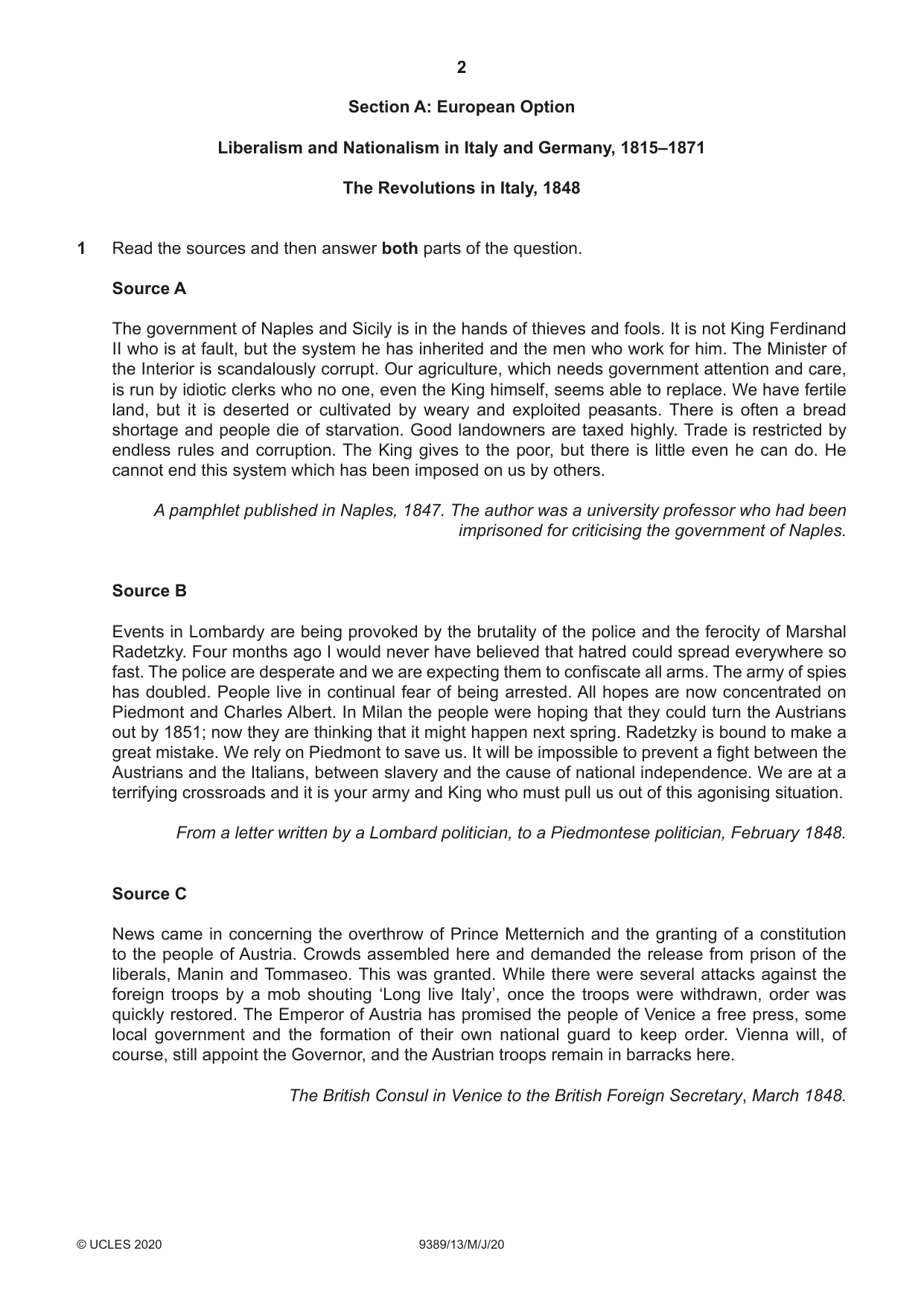
2 9389/13/M/J/20 © UCLES 2020 Section A: European Option Liberalism and Nationalism in Italy and Germany, 1815–1871 The Revolutions in Italy, 1848 1 Read the sources and then answer both parts of the question. Source A The government of Naples and Sicily is in the hands of thieves and fools. It is not King Ferdinand II who is at fault, but the system he has inherited and the men who work for him. The Minister of the Interior is scandalously corrupt. Our agriculture, which needs government attention and care, is run by idiotic clerks who no one, even the King himself, seems able to replace. We have fertile land, but it is deserted or cultivated by weary and exploited peasants. There is often a bread shortage and people die of starvation. Good landowners are taxed highly. Trade is restricted by endless rules and corruption. The King gives to the poor, but there is little even he can do. He cannot end this system which has been imposed on us by others. A pamphlet published in Naples, 1847. The author was a university professor who had been imprisoned for criticising the government of Naples. Source B Events in Lombardy are being provoked by the brutality of the police and the ferocity of Marshal Radetzky. Four months ago I would never have believed that hatred could spread everywhere so fast. The police are desperate and we are expecting them to confiscate all arms. The army of spies has doubled. People live in continual fear of being arrested. All hopes are now concentrated on Piedmont and Charles Albert. In Milan the people were hoping that they could turn the Austrians out by 1851; now they are thinking that it might happen next spring. Radetzky is bound to make a great mistake. We rely on Piedmont to save us. It will be impossible to prevent a fight between the Austrians and the Italians, between slavery and the cause of national independence. We are at a terrifying crossroads and it is your army and King who must pull us out of this agonising situation. From a letter written by a Lombard politician, to a Piedmontese politician, February 1848. Source C News came in concerning the overthrow of Prince Metternich and the granting of a constitution to the people of Austria. Crowds assembled here and demanded the release from prison of the liberals, Manin and Tommaseo. This was granted. While there were several attacks against the foreign troops by a mob shouting ‘Long live Italy’, once the troops were withdrawn, order was quickly restored. The Emperor of Austria has promised the people of Venice a free press, some local government and the formation of their own national guard to keep order. Vienna will, of course, still appoint the Governor, and the Austrian troops remain in barracks here. The British Consul in Venice to the British Foreign Secretary, March 1848.
Question paper, page 3
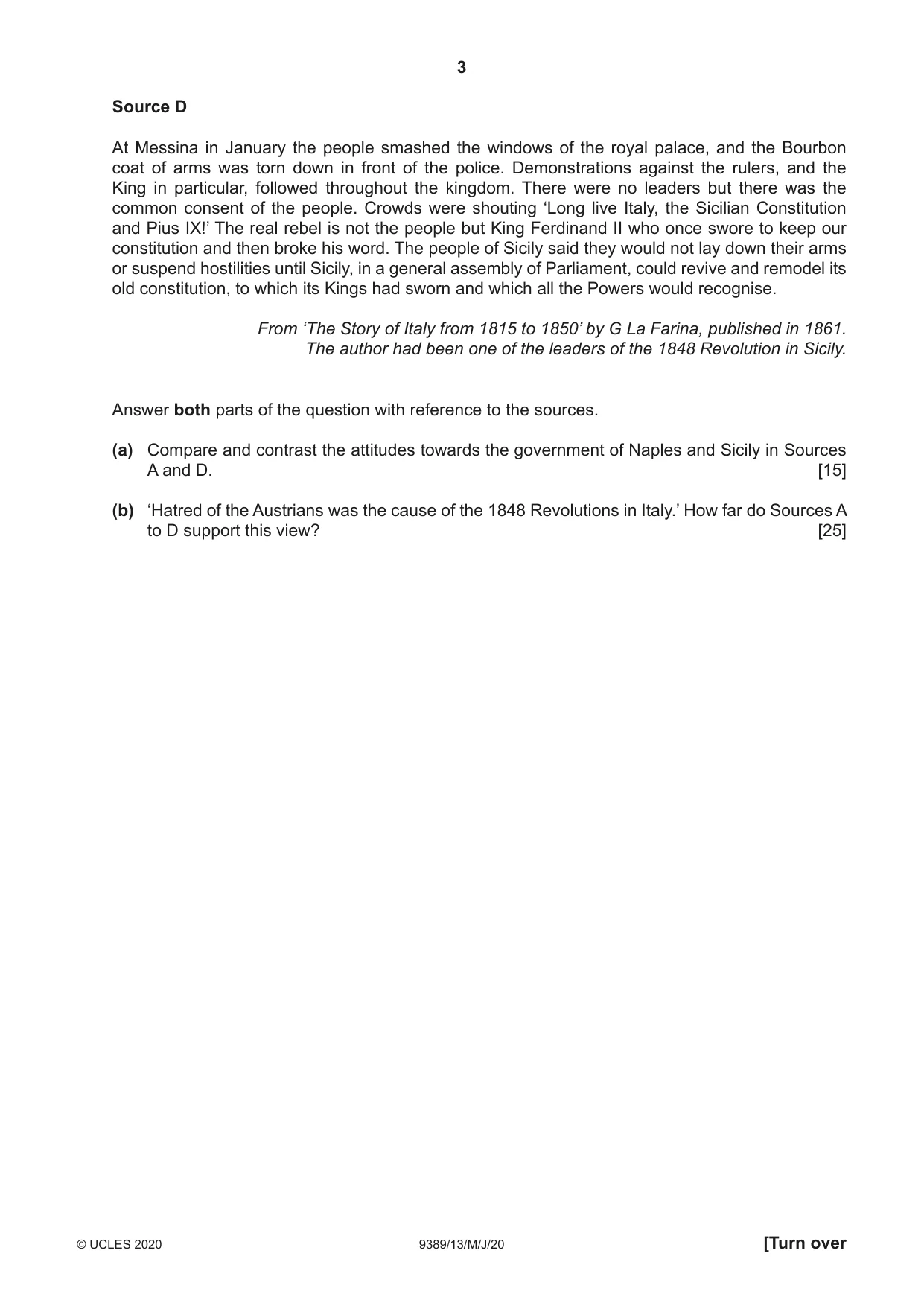
3 9389/13/M/J/20 © UCLES 2020 [Turn over Source D At Messina in January the people smashed the windows of the royal palace, and the Bourbon coat of arms was torn down in front of the police. Demonstrations against the rulers, and the King in particular, followed throughout the kingdom. There were no leaders but there was the common consent of the people. Crowds were shouting ‘Long live Italy, the Sicilian Constitution and Pius IX!’ The real rebel is not the people but King Ferdinand II who once swore to keep our constitution and then broke his word. The people of Sicily said they would not lay down their arms or suspend hostilities until Sicily, in a general assembly of Parliament, could revive and remodel its old constitution, to which its Kings had sworn and which all the Powers would recognise. From ‘The Story of Italy from 1815 to 1850’ by G La Farina, published in 1861. The author had been one of the leaders of the 1848 Revolution in Sicily. Answer both parts of the question with reference to the sources. (a) Compare and contrast the attitudes towards the government of Naples and Sicily in Sources A and D. [15] (b) ‘Hatred of the Austrians was the cause of the 1848 Revolutions in Italy.’ How far do Sources A to D support this view? [25]
Question paper, page 4
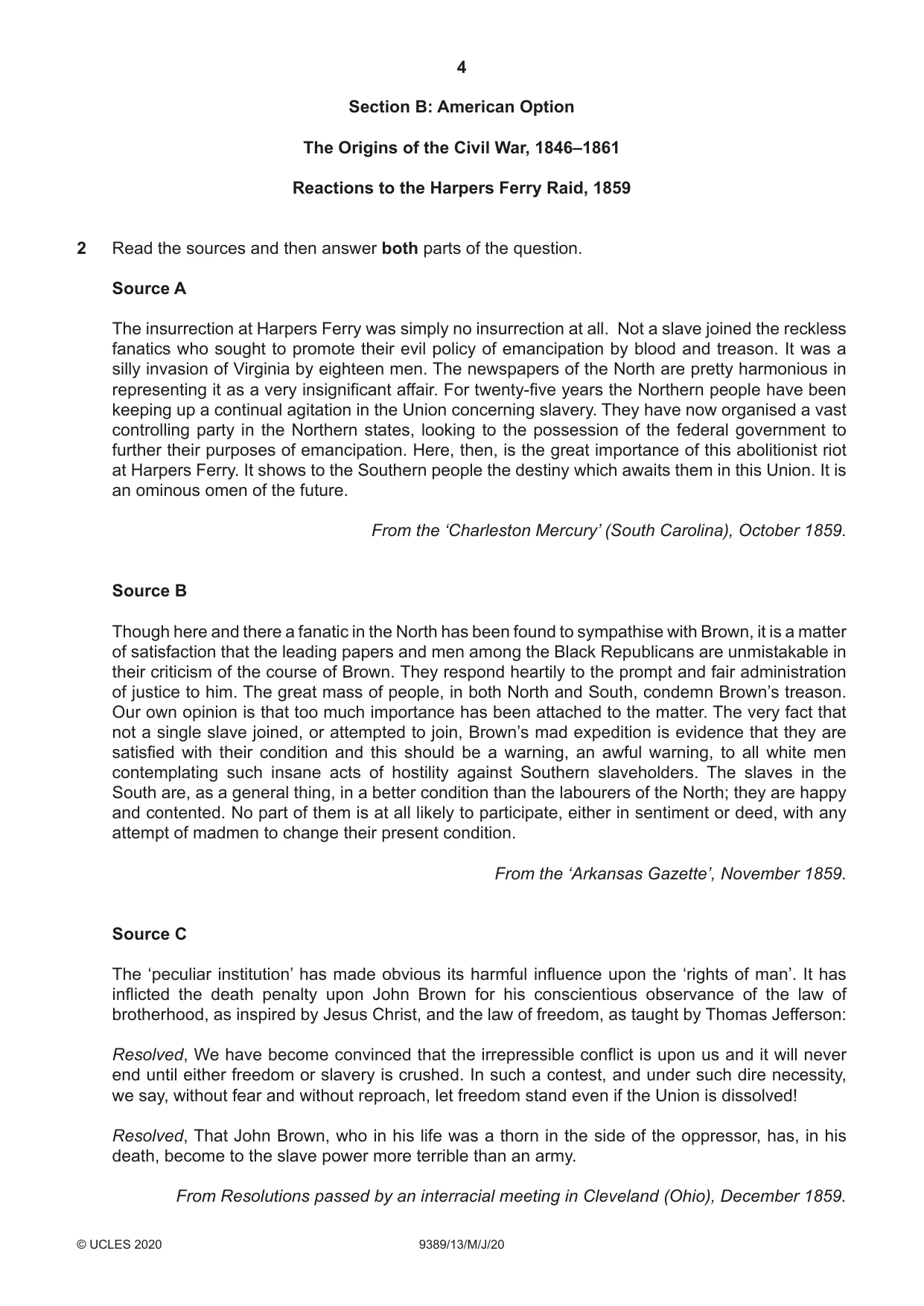
4 9389/13/M/J/20 © UCLES 2020 Section B: American Option The Origins of the Civil War, 1846–1861 Reactions to the Harpers Ferry Raid, 1859 2 Read the sources and then answer both parts of the question. Source A The insurrection at Harpers Ferry was simply no insurrection at all. Not a slave joined the reckless fanatics who sought to promote their evil policy of emancipation by blood and treason. It was a silly invasion of Virginia by eighteen men. The newspapers of the North are pretty harmonious in representing it as a very insignificant affair. For twenty-five years the Northern people have been keeping up a continual agitation in the Union concerning slavery. They have now organised a vast controlling party in the Northern states, looking to the possession of the federal government to further their purposes of emancipation. Here, then, is the great importance of this abolitionist riot at Harpers Ferry. It shows to the Southern people the destiny which awaits them in this Union. It is an ominous omen of the future. From the ‘Charleston Mercury’ (South Carolina), October 1859. Source B Though here and there a fanatic in the North has been found to sympathise with Brown, it is a matter of satisfaction that the leading papers and men among the Black Republicans are unmistakable in their criticism of the course of Brown. They respond heartily to the prompt and fair administration of justice to him. The great mass of people, in both North and South, condemn Brown’s treason. Our own opinion is that too much importance has been attached to the matter. The very fact that not a single slave joined, or attempted to join, Brown’s mad expedition is evidence that they are satisfied with their condition and this should be a warning, an awful warning, to all white men contemplating such insane acts of hostility against Southern slaveholders. The slaves in the South are, as a general thing, in a better condition than the labourers of the North; they are happy and contented. No part of them is at all likely to participate, either in sentiment or deed, with any attempt of madmen to change their present condition. From the ‘Arkansas Gazette’, November 1859. Source C The ‘peculiar institution’ has made obvious its harmful influence upon the ‘rights of man’. It has inflicted the death penalty upon John Brown for his conscientious observance of the law of brotherhood, as inspired by Jesus Christ, and the law of freedom, as taught by Thomas Jefferson: Resolved, We have become convinced that the irrepressible conflict is upon us and it will never end until either freedom or slavery is crushed. In such a contest, and under such dire necessity, we say, without fear and without reproach, let freedom stand even if the Union is dissolved! Resolved, That John Brown, who in his life was a thorn in the side of the oppressor, has, in his death, become to the slave power more terrible than an army. From Resolutions passed by an interracial meeting in Cleveland (Ohio), December 1859.
Question paper, page 5
5 9389/13/M/J/20 © UCLES 2020 [Turn over Source D Did John Brown fail? He certainly did fail to get out of Harpers Ferry before being beaten down by US soldiers. He did fail to save his own life and to lead a liberating army into Virginia. The true question is: did John Brown lose his life in vain? And to this I answer a thousand times, No! He did at least begin the war that ended slavery. If we look over the dates, places and men for which this honour is claimed, we shall find that not Carolina but Virginia, not Fort Sumter but Harpers Ferry, not Colonel Anderson but John Brown began the war that ended American slavery. Until this blow was struck, the irrepressible conflict was one of words, votes and compromises. When John Brown stretched forth his arm, the sky was cleared. The time for compromises was gone. From a speech by Frederick Douglass at Harpers Ferry, May 1881. Answer both parts of the question with reference to the sources. (a) Compare and contrast Sources A and B as evidence of Southern responses to the Harpers Ferry raid. [15] (b) How far do Sources A to D support the view that the Harpers Ferry raid was the true start of the Civil War between North and South? [25]
Question paper, page 6
6 9389/13/M/J/20 © UCLES 2020 Section C: International Option The Search for International Peace and Security, 1919–1945 The League and the Disarmament Conference 3 Read the sources and then answer both parts of the question. Source A Our proposal of a programme of complete disarmament is a great deal simpler than the schemes which have so far been used as a basis for the work of the Preparatory Commission. I confess that, on acquainting myself with the findings of this Commission, I was shocked at the complexity and confusion of the questions surrounding disarmament. Complete agreement has only been achieved about trivial points. Most of the suggestions evoked disagreements which have so far failed to be reconciled, either by the Commission or by private negotiations between the governments concerned. Even when these are addressed, the Commission will still only be at the start of its real difficulties. It will still have to agree to the satisfaction of all as to what constitutes security for each country, taking into account the extent and importance of its international obligations, before the level of its armaments can be established. From a speech by Litvinov, representative of the USSR to the Disarmament Conference Preparatory Commission, November 1927. Source B I understand the situation of my colleagues of the USSR, who are newcomers here. They have come to take part in work which is in the middle of its development. They can reasonably be tempted to think that the complexities of our problems are excuses for never bringing the work to a successful conclusion. The USSR can be assured that we have all come here in the same mood, to disarm as fully as possible. We perceived the difficulties of disarmament and were compelled to solve them one by one. Instead of this long stretch of work, the USSR proposes something very vast and very simple; indeed, too simple – complete disarmament. For centuries mankind has desired this and war has not been avoided. The value of the League of Nations is that it has started on a totally different basis. It has linked the problem of disarmament to the problem of security, and it has matched the reduction of armaments to the minimum compatible with national security. From a speech by Paul-Boncour, representative of France, in response to Litvinov’s comments at the Disarmament Conference Preparatory Commission, November 1927.
Question paper, page 7
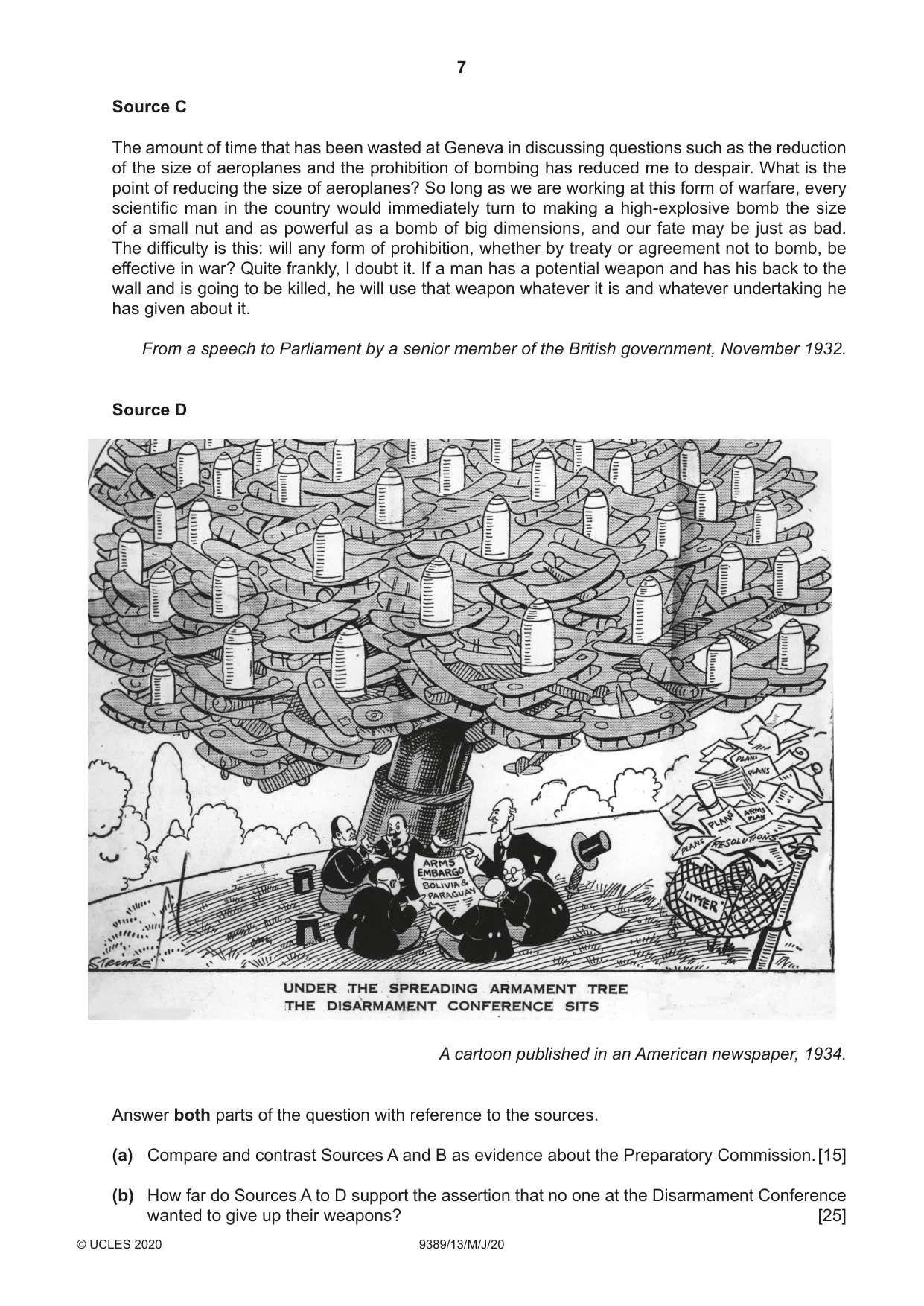
7 9389/13/M/J/20 © UCLES 2020 Source C The amount of time that has been wasted at Geneva in discussing questions such as the reduction of the size of aeroplanes and the prohibition of bombing has reduced me to despair. What is the point of reducing the size of aeroplanes? So long as we are working at this form of warfare, every scientific man in the country would immediately turn to making a high-explosive bomb the size of a small nut and as powerful as a bomb of big dimensions, and our fate may be just as bad. The difficulty is this: will any form of prohibition, whether by treaty or agreement not to bomb, be effective in war? Quite frankly, I doubt it. If a man has a potential weapon and has his back to the wall and is going to be killed, he will use that weapon whatever it is and whatever undertaking he has given about it. From a speech to Parliament by a senior member of the British government, November 1932. Source D A cartoon published in an American newspaper, 1934. Answer both parts of the question with reference to the sources. (a) Compare and contrast Sources A and B as evidence about the Preparatory Commission. [15] (b) How far do Sources A to D support the assertion that no one at the Disarmament Conference wanted to give up their weapons? [25]
Question paper, page 8
8 9389/13/M/J/20 © UCLES 2020 Permission to reproduce items where third-party owned material protected by copyright is included has been sought and cleared where possible. Every reasonable effort has been made by the publisher (UCLES) to trace copyright holders, but if any items requiring clearance have unwittingly been included, the publisher will be pleased to make amends at the earliest possible opportunity. To avoid the issue of disclosure of answer-related information to candidates, all copyright acknowledgements are reproduced online in the Cambridge Assessment International Education Copyright Acknowledgements Booklet. This is produced for each series of examinations and is freely available to download at www.cambridgeinternational.org after the live examination series. Cambridge Assessment International Education is part of the Cambridge Assessment Group. Cambridge Assessment is the brand name of the University of Cambridge Local Examinations Syndicate (UCLES), which itself is a department of the University of Cambridge. BLANK PAGE
Mark scheme, page 1
This document consists of 11 printed pages. © UCLES 2020 [Turn over Cambridge International AS & A Level HISTORY 9389/13 Paper 1 Document Question 13 May/June 2020 MARK SCHEME Maximum Mark: 40 Published Students did not sit exam papers in the June 2020 series due to the Covid-19 global pandemic. This mark scheme is published to support teachers and students and should be read together with the question paper. It shows the requirements of the exam. The answer column of the mark scheme shows the proposed basis on which Examiners would award marks for this exam. Where appropriate, this column also provides the most likely acceptable alternative responses expected from students. Examiners usually review the mark scheme after they have seen student responses and update the mark scheme if appropriate. In the June series, Examiners were unable to consider the acceptability of alternative responses, as there were no student responses to consider. Mark schemes should usually be read together with the Principal Examiner Report for Teachers. However, because students did not sit exam papers, there is no Principal Examiner Report for Teachers for the June 2020 series. Cambridge International will not enter into discussions about these mark schemes. Cambridge International is publishing the mark schemes for the June 2020 series for most Cambridge IGCSE™ and Cambridge International A & AS Level components, and some Cambridge O Level components.
Mark scheme, page 2
9389/13 Cambridge International AS & A Level – Mark Scheme PUBLISHED May/June 2020 © UCLES 2020 Page 2 of 11 Generic Marking Principles These general marking principles must be applied by all examiners when marking candidate answers. They should be applied alongside the specific content of the mark scheme or generic level descriptors for a question. Each question paper and mark scheme will also comply with these marking principles. GENERIC MARKING PRINCIPLE 1: Marks must be awarded in line with: • the specific content of the mark scheme or the generic level descriptors for the question • the specific skills defined in the mark scheme or in the generic level descriptors for the question • the standard of response required by a candidate as exemplified by the standardisation scripts. GENERIC MARKING PRINCIPLE 2: Marks awarded are always whole marks (not half marks, or other fractions). GENERIC MARKING PRINCIPLE 3: Marks must be awarded positively: • marks are awarded for correct/valid answers, as defined in the mark scheme. However, credit is given for valid answers which go beyond the scope of the syllabus and mark scheme, referring to your Team Leader as appropriate • marks are awarded when candidates clearly demonstrate what they know and can do • marks are not deducted for errors • marks are not deducted for omissions • answers should only be judged on the quality of spelling, punctuation and grammar when these features are specifically assessed by the question as indicated by the mark scheme. The meaning, however, should be unambiguous. GENERIC MARKING PRINCIPLE 4: Rules must be applied consistently e.g. in situations where candidates have not followed instructions or in the application of generic level descriptors. GENERIC MARKING PRINCIPLE 5: Marks should be awarded using the full range of marks defined in the mark scheme for the question (however; the use of the full mark range may be limited according to the quality of the candidate responses seen). GENERIC MARKING PRINCIPLE 6: Marks awarded are based solely on the requirements as defined in the mark scheme. Marks should not be awarded with grade thresholds or grade descriptors in mind.
Mark scheme, page 3
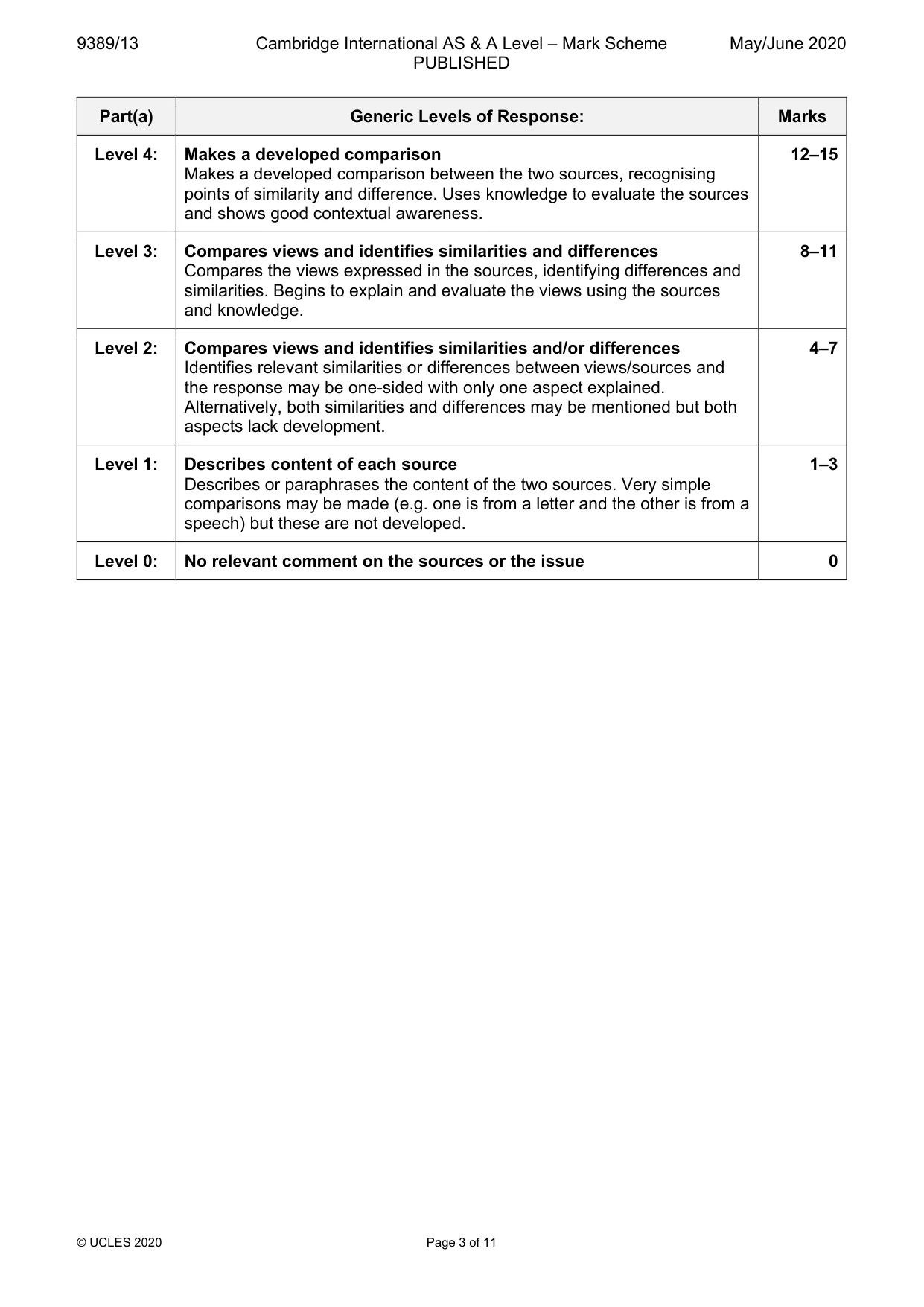
9389/13 Cambridge International AS & A Level – Mark Scheme PUBLISHED May/June 2020 © UCLES 2020 Page 3 of 11 Part(a) Generic Levels of Response: Marks Level 4: Makes a developed comparison Makes a developed comparison between the two sources, recognising points of similarity and difference. Uses knowledge to evaluate the sources and shows good contextual awareness. 12–15 Level 3: Compares views and identifies similarities and differences Compares the views expressed in the sources, identifying differences and similarities. Begins to explain and evaluate the views using the sources and knowledge. 8–11 Level 2: Compares views and identifies similarities and/or differences Identifies relevant similarities or differences between views/sources and the response may be one-sided with only one aspect explained. Alternatively, both similarities and differences may be mentioned but both aspects lack development. 4–7 Level 1: Describes content of each source Describes or paraphrases the content of the two sources. Very simple comparisons may be made (e.g. one is from a letter and the other is from a speech) but these are not developed. 1–3 Level 0: No relevant comment on the sources or the issue 0
Mark scheme, page 4
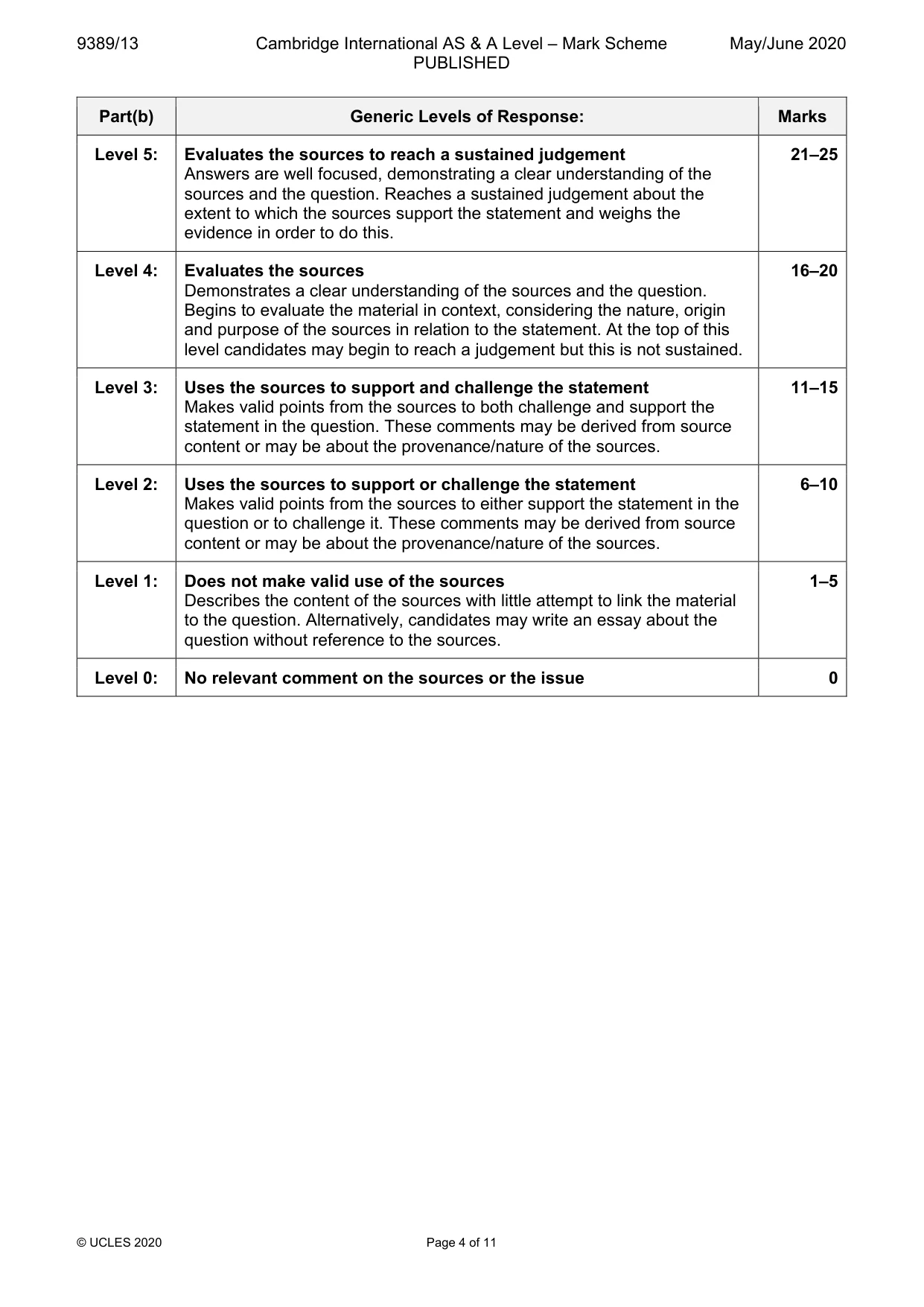
9389/13 Cambridge International AS & A Level – Mark Scheme PUBLISHED May/June 2020 © UCLES 2020 Page 4 of 11 Part(b) Generic Levels of Response: Marks Level 5: Evaluates the sources to reach a sustained judgement Answers are well focused, demonstrating a clear understanding of the sources and the question. Reaches a sustained judgement about the extent to which the sources support the statement and weighs the evidence in order to do this. 21–25 Level 4: Evaluates the sources Demonstrates a clear understanding of the sources and the question. Begins to evaluate the material in context, considering the nature, origin and purpose of the sources in relation to the statement. At the top of this level candidates may begin to reach a judgement but this is not sustained. 16–20 Level 3: Uses the sources to support and challenge the statement Makes valid points from the sources to both challenge and support the statement in the question. These comments may be derived from source content or may be about the provenance/nature of the sources. 11–15 Level 2: Uses the sources to support or challenge the statement Makes valid points from the sources to either support the statement in the question or to challenge it. These comments may be derived from source content or may be about the provenance/nature of the sources. 6–10 Level 1: Does not make valid use of the sources Describes the content of the sources with little attempt to link the material to the question. Alternatively, candidates may write an essay about the question without reference to the sources. 1–5 Level 0: No relevant comment on the sources or the issue 0
Mark scheme, page 5
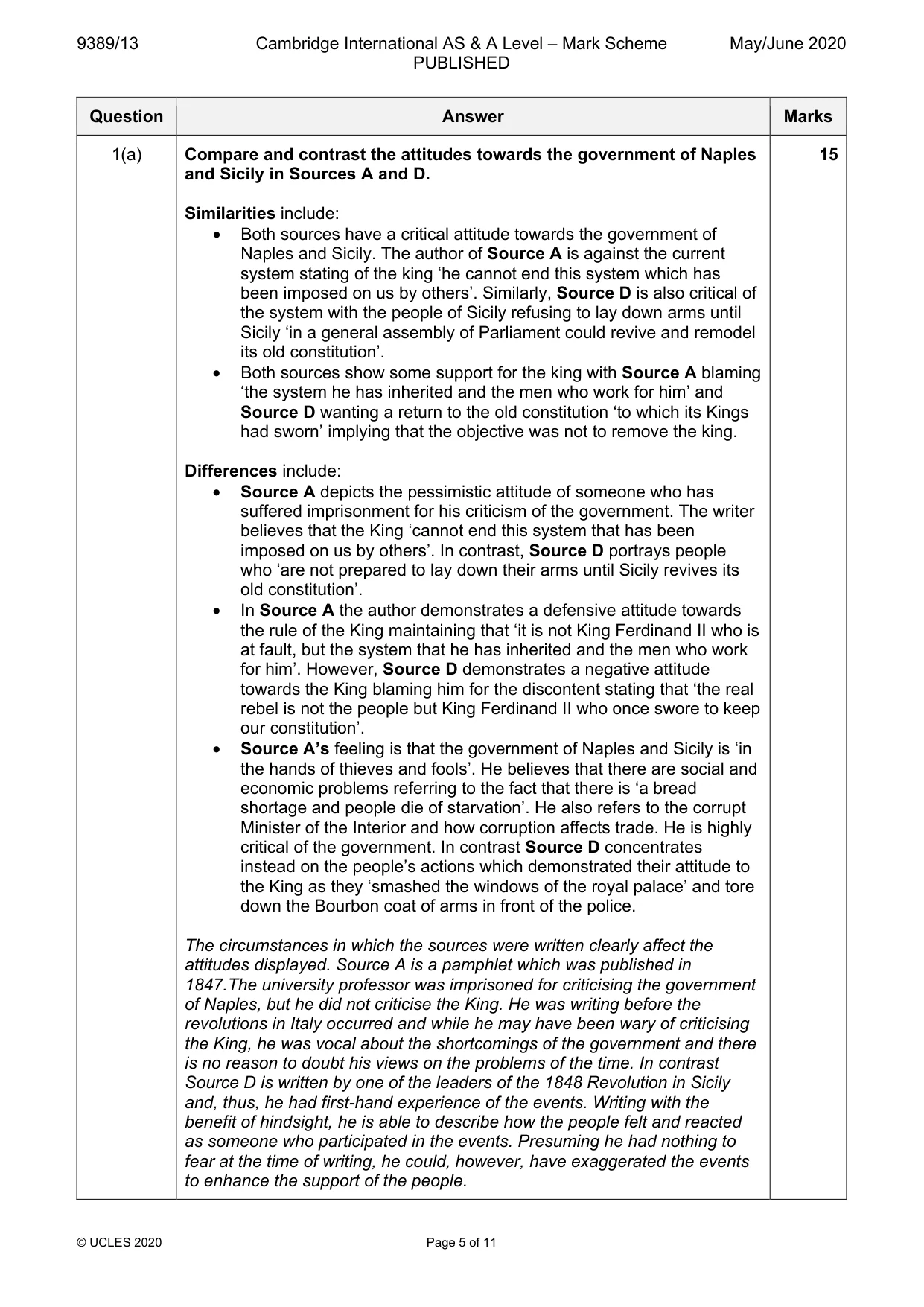
9389/13 Cambridge International AS & A Level – Mark Scheme PUBLISHED May/June 2020 © UCLES 2020 Page 5 of 11 Question Answer Marks 1(a) Compare and contrast the attitudes towards the government of Naples and Sicily in Sources A and D. Similarities include: • Both sources have a critical attitude towards the government of Naples and Sicily. The author of Source A is against the current system stating of the king ‘he cannot end this system which has been imposed on us by others’. Similarly, Source D is also critical of the system with the people of Sicily refusing to lay down arms until Sicily ‘in a general assembly of Parliament could revive and remodel its old constitution’. • Both sources show some support for the king with Source A blaming ‘the system he has inherited and the men who work for him’ and Source D wanting a return to the old constitution ‘to which its Kings had sworn’ implying that the objective was not to remove the king. Differences include: • Source A depicts the pessimistic attitude of someone who has suffered imprisonment for his criticism of the government. The writer believes that the King ‘cannot end this system that has been imposed on us by others’. In contrast, Source D portrays people who ‘are not prepared to lay down their arms until Sicily revives its old constitution’. • In Source A the author demonstrates a defensive attitude towards the rule of the King maintaining that ‘it is not King Ferdinand II who is at fault, but the system that he has inherited and the men who work for him’. However, Source D demonstrates a negative attitude towards the King blaming him for the discontent stating that ‘the real rebel is not the people but King Ferdinand II who once swore to keep our constitution’. • Source A’s feeling is that the government of Naples and Sicily is ‘in the hands of thieves and fools’. He believes that there are social and economic problems referring to the fact that there is ‘a bread shortage and people die of starvation’. He also refers to the corrupt Minister of the Interior and how corruption affects trade. He is highly critical of the government. In contrast Source D concentrates instead on the people’s actions which demonstrated their attitude to the King as they ‘smashed the windows of the royal palace’ and tore down the Bourbon coat of arms in front of the police. The circumstances in which the sources were written clearly affect the attitudes displayed. Source A is a pamphlet which was published in 1847.The university professor was imprisoned for criticising the government of Naples, but he did not criticise the King. He was writing before the revolutions in Italy occurred and while he may have been wary of criticising the King, he was vocal about the shortcomings of the government and there is no reason to doubt his views on the problems of the time. In contrast Source D is written by one of the leaders of the 1848 Revolution in Sicily and, thus, he had first-hand experience of the events. Writing with the benefit of hindsight, he is able to describe how the people felt and reacted as someone who participated in the events. Presuming he had nothing to fear at the time of writing, he could, however, have exaggerated the events to enhance the support of the people. 15
Mark scheme, page 6
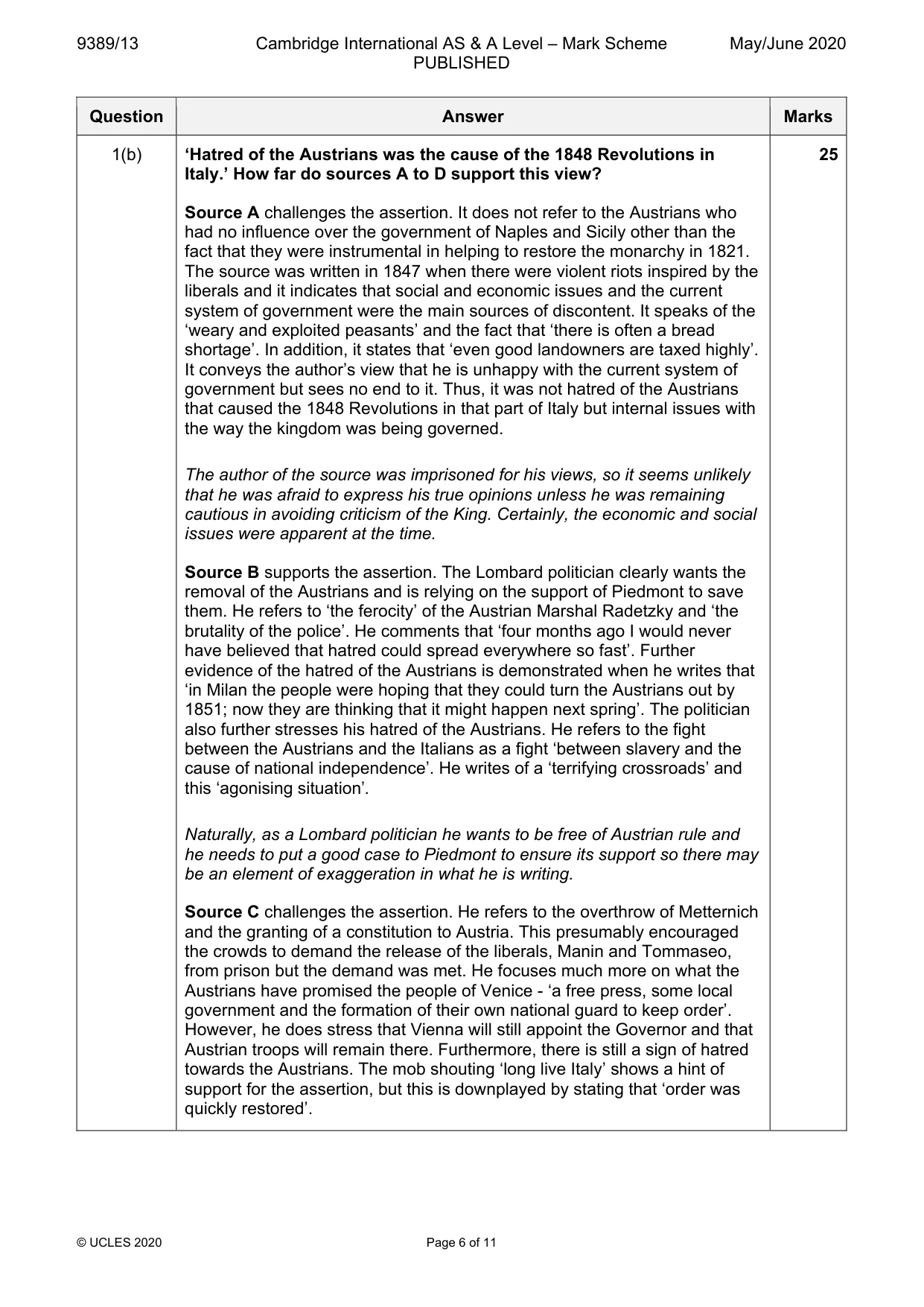
9389/13 Cambridge International AS & A Level – Mark Scheme PUBLISHED May/June 2020 © UCLES 2020 Page 6 of 11 Question Answer Marks 1(b) ‘Hatred of the Austrians was the cause of the 1848 Revolutions in Italy.’ How far do sources A to D support this view? Source A challenges the assertion. It does not refer to the Austrians who had no influence over the government of Naples and Sicily other than the fact that they were instrumental in helping to restore the monarchy in 1821. The source was written in 1847 when there were violent riots inspired by the liberals and it indicates that social and economic issues and the current system of government were the main sources of discontent. It speaks of the ‘weary and exploited peasants’ and the fact that ‘there is often a bread shortage’. In addition, it states that ‘even good landowners are taxed highly’. It conveys the author’s view that he is unhappy with the current system of government but sees no end to it. Thus, it was not hatred of the Austrians that caused the 1848 Revolutions in that part of Italy but internal issues with the way the kingdom was being governed. The author of the source was imprisoned for his views, so it seems unlikely that he was afraid to express his true opinions unless he was remaining cautious in avoiding criticism of the King. Certainly, the economic and social issues were apparent at the time. Source B supports the assertion. The Lombard politician clearly wants the removal of the Austrians and is relying on the support of Piedmont to save them. He refers to ‘the ferocity’ of the Austrian Marshal Radetzky and ‘the brutality of the police’. He comments that ‘four months ago I would never have believed that hatred could spread everywhere so fast’. Further evidence of the hatred of the Austrians is demonstrated when he writes that ‘in Milan the people were hoping that they could turn the Austrians out by 1851; now they are thinking that it might happen next spring’. The politician also further stresses his hatred of the Austrians. He refers to the fight between the Austrians and the Italians as a fight ‘between slavery and the cause of national independence’. He writes of a ‘terrifying crossroads’ and this ‘agonising situation’. Naturally, as a Lombard politician he wants to be free of Austrian rule and he needs to put a good case to Piedmont to ensure its support so there may be an element of exaggeration in what he is writing. Source C challenges the assertion. He refers to the overthrow of Metternich and the granting of a constitution to Austria. This presumably encouraged the crowds to demand the release of the liberals, Manin and Tommaseo, from prison but the demand was met. He focuses much more on what the Austrians have promised the people of Venice - ‘a free press, some local government and the formation of their own national guard to keep order’. However, he does stress that Vienna will still appoint the Governor and that Austrian troops will remain there. Furthermore, there is still a sign of hatred towards the Austrians. The mob shouting ‘long live Italy’ shows a hint of support for the assertion, but this is downplayed by stating that ‘order was quickly restored’. 25
Mark scheme, page 7
9389/13 Cambridge International AS & A Level – Mark Scheme PUBLISHED May/June 2020 © UCLES 2020 Page 7 of 11 Question Answer Marks 1(b) It is written by the British Consul in Venice to the British Foreign Secretary. He is writing the facts as he sees them. He does not need to take sides and is presumably used to reporting events as they happen in a factual way. Source D challenges the assertion. The source focuses on the discontent against the rule of the Bourbon King in Sicily as well as demonstrations against ‘rulers throughout the kingdom’. Even though the Austrians had in the past helped to restore the rule of the Bourbons, there was no hint of hatred towards them. The cry of ‘long live Italy’ suggests that they wanted the country to be free of foreign intervention and possibly support unification. However, there is also a demand for a return to the old constitution and support for Pope Pius IX. The author of the book was a leader of the revolution in Sicily. He can perhaps write more freely several years after the event and with the monarchy having fallen. He writes of ‘the consent of the people’ which shows justification for the revolution but his motives for writing the book are not clear.
Mark scheme, page 8
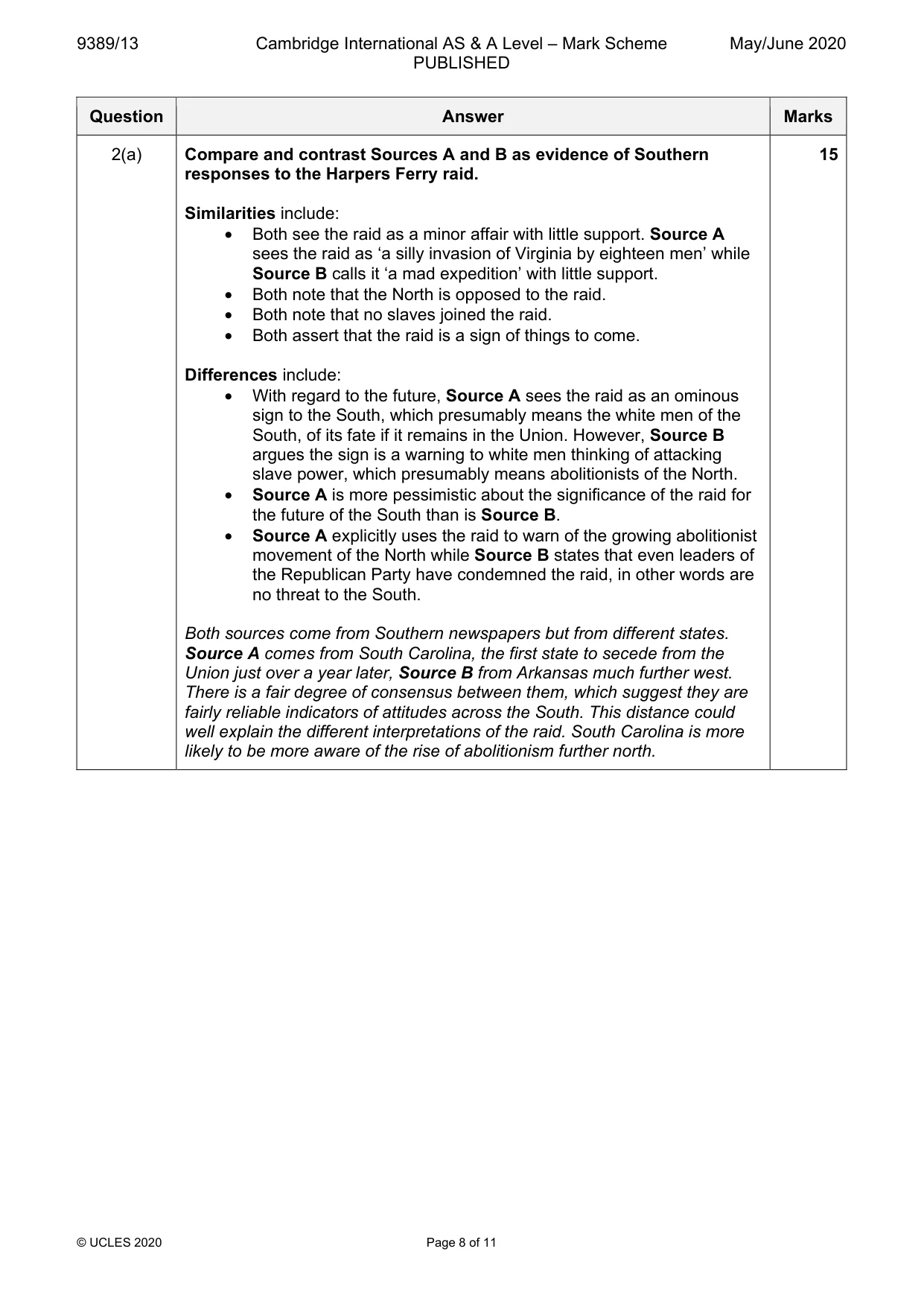
9389/13 Cambridge International AS & A Level – Mark Scheme PUBLISHED May/June 2020 © UCLES 2020 Page 8 of 11 Question Answer Marks 2(a) Compare and contrast Sources A and B as evidence of Southern responses to the Harpers Ferry raid. Similarities include: • Both see the raid as a minor affair with little support. Source A sees the raid as ‘a silly invasion of Virginia by eighteen men’ while Source B calls it ‘a mad expedition’ with little support. • Both note that the North is opposed to the raid. • Both note that no slaves joined the raid. • Both assert that the raid is a sign of things to come. Differences include: • With regard to the future, Source A sees the raid as an ominous sign to the South, which presumably means the white men of the South, of its fate if it remains in the Union. However, Source B argues the sign is a warning to white men thinking of attacking slave power, which presumably means abolitionists of the North. • Source A is more pessimistic about the significance of the raid for the future of the South than is Source B. • Source A explicitly uses the raid to warn of the growing abolitionist movement of the North while Source B states that even leaders of the Republican Party have condemned the raid, in other words are no threat to the South. Both sources come from Southern newspapers but from different states. Source A comes from South Carolina, the first state to secede from the Union just over a year later, Source B from Arkansas much further west. There is a fair degree of consensus between them, which suggest they are fairly reliable indicators of attitudes across the South. This distance could well explain the different interpretations of the raid. South Carolina is more likely to be more aware of the rise of abolitionism further north. 15
Mark scheme, page 9
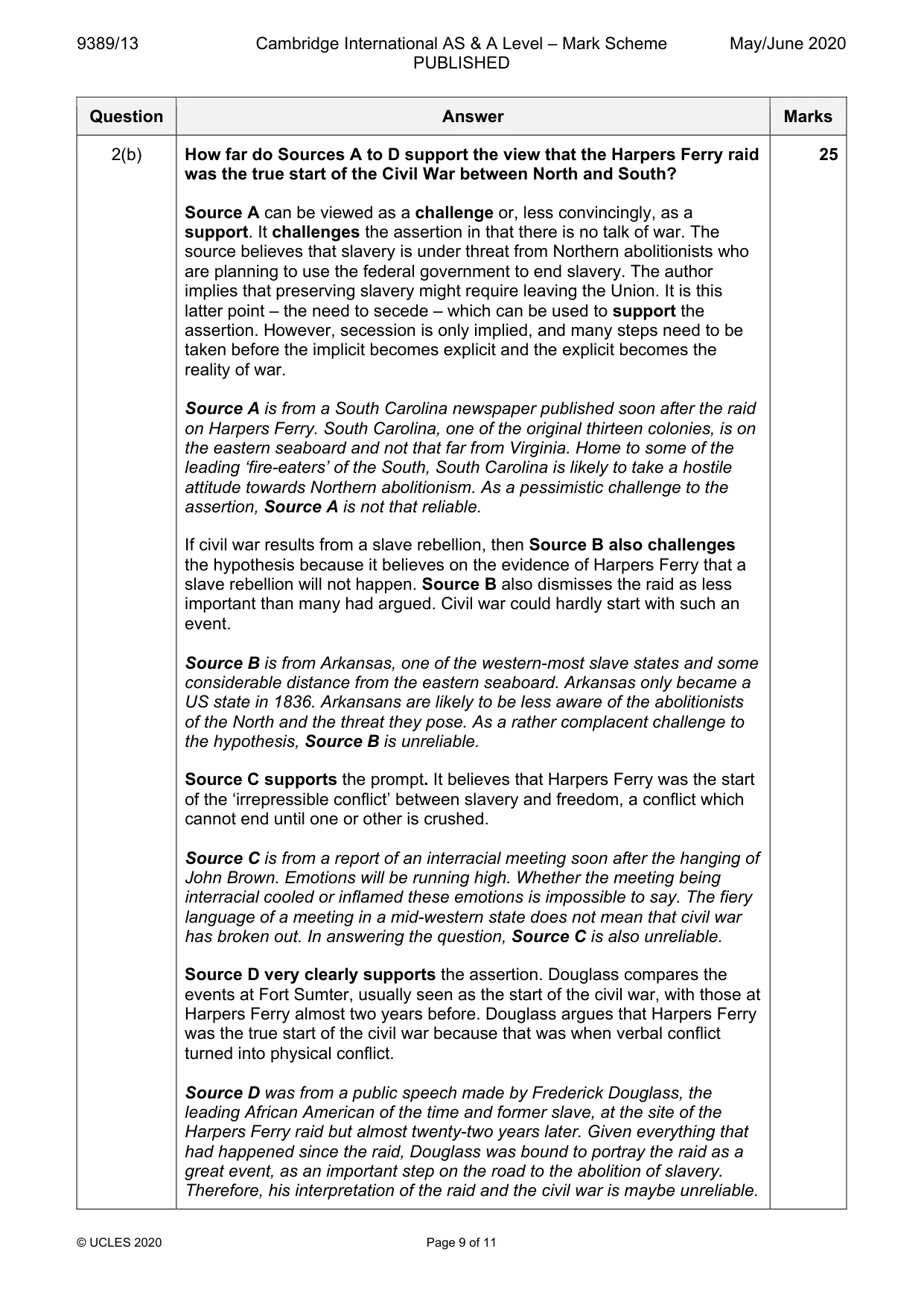
9389/13 Cambridge International AS & A Level – Mark Scheme PUBLISHED May/June 2020 © UCLES 2020 Page 9 of 11 Question Answer Marks 2(b) How far do Sources A to D support the view that the Harpers Ferry raid was the true start of the Civil War between North and South? Source A can be viewed as a challenge or, less convincingly, as a support. It challenges the assertion in that there is no talk of war. The source believes that slavery is under threat from Northern abolitionists who are planning to use the federal government to end slavery. The author implies that preserving slavery might require leaving the Union. It is this latter point – the need to secede – which can be used to support the assertion. However, secession is only implied, and many steps need to be taken before the implicit becomes explicit and the explicit becomes the reality of war. Source A is from a South Carolina newspaper published soon after the raid on Harpers Ferry. South Carolina, one of the original thirteen colonies, is on the eastern seaboard and not that far from Virginia. Home to some of the leading ‘fire-eaters’ of the South, South Carolina is likely to take a hostile attitude towards Northern abolitionism. As a pessimistic challenge to the assertion, Source A is not that reliable. If civil war results from a slave rebellion, then Source B also challenges the hypothesis because it believes on the evidence of Harpers Ferry that a slave rebellion will not happen. Source B also dismisses the raid as less important than many had argued. Civil war could hardly start with such an event. Source B is from Arkansas, one of the western-most slave states and some considerable distance from the eastern seaboard. Arkansas only became a US state in 1836. Arkansans are likely to be less aware of the abolitionists of the North and the threat they pose. As a rather complacent challenge to the hypothesis, Source B is unreliable. Source C supports the prompt. It believes that Harpers Ferry was the start of the ‘irrepressible conflict’ between slavery and freedom, a conflict which cannot end until one or other is crushed. Source C is from a report of an interracial meeting soon after the hanging of John Brown. Emotions will be running high. Whether the meeting being interracial cooled or inflamed these emotions is impossible to say. The fiery language of a meeting in a mid-western state does not mean that civil war has broken out. In answering the question, Source C is also unreliable. Source D very clearly supports the assertion. Douglass compares the events at Fort Sumter, usually seen as the start of the civil war, with those at Harpers Ferry almost two years before. Douglass argues that Harpers Ferry was the true start of the civil war because that was when verbal conflict turned into physical conflict. Source D was from a public speech made by Frederick Douglass, the leading African American of the time and former slave, at the site of the Harpers Ferry raid but almost twenty-two years later. Given everything that had happened since the raid, Douglass was bound to portray the raid as a great event, as an important step on the road to the abolition of slavery. Therefore, his interpretation of the raid and the civil war is maybe unreliable. 25
Mark scheme, page 10
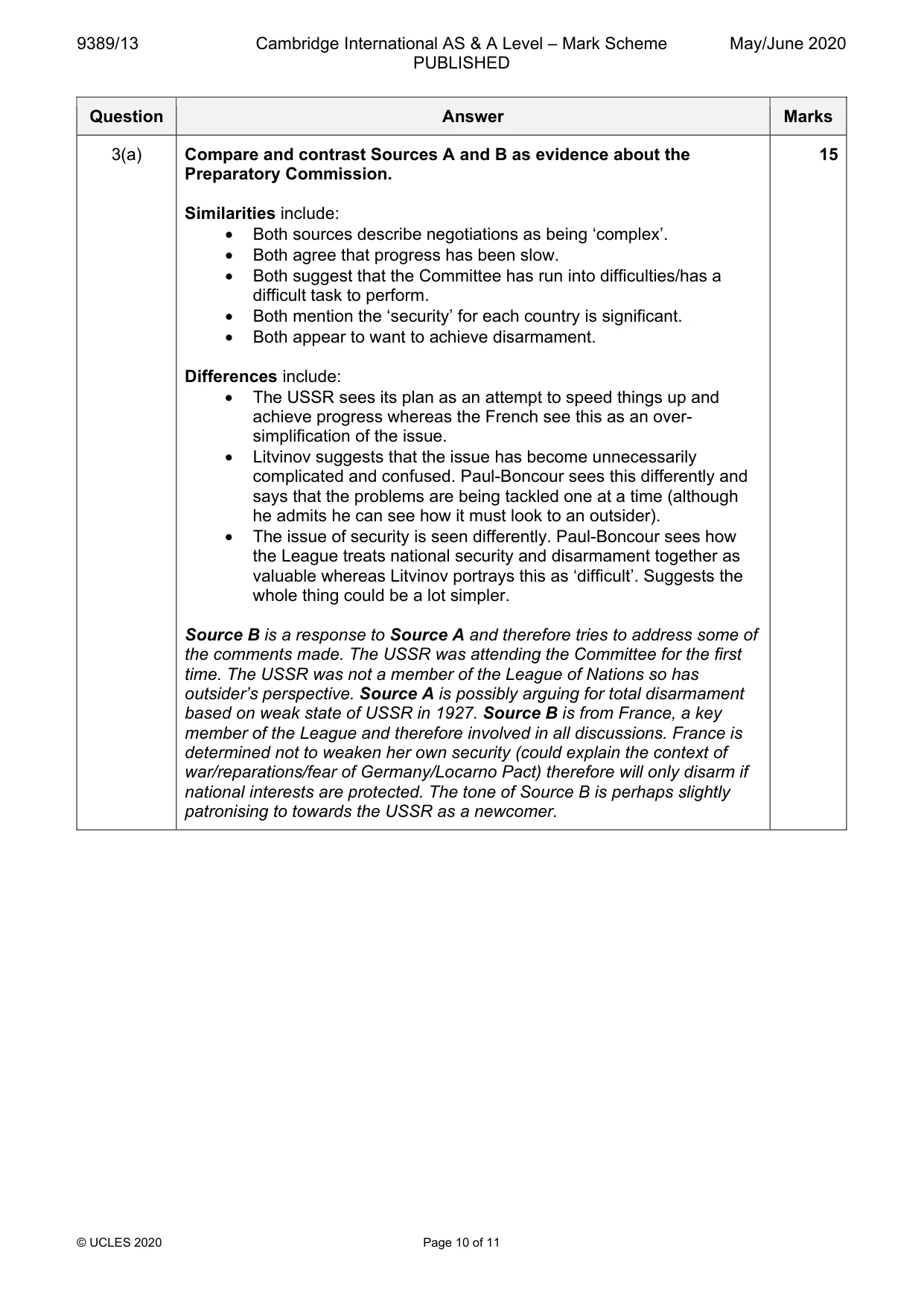
9389/13 Cambridge International AS & A Level – Mark Scheme PUBLISHED May/June 2020 © UCLES 2020 Page 10 of 11 Question Answer Marks 3(a) Compare and contrast Sources A and B as evidence about the Preparatory Commission. Similarities include: • Both sources describe negotiations as being ‘complex’. • Both agree that progress has been slow. • Both suggest that the Committee has run into difficulties/has a difficult task to perform. • Both mention the ‘security’ for each country is significant. • Both appear to want to achieve disarmament. Differences include: • The USSR sees its plan as an attempt to speed things up and achieve progress whereas the French see this as an over- simplification of the issue. • Litvinov suggests that the issue has become unnecessarily complicated and confused. Paul-Boncour sees this differently and says that the problems are being tackled one at a time (although he admits he can see how it must look to an outsider). • The issue of security is seen differently. Paul-Boncour sees how the League treats national security and disarmament together as valuable whereas Litvinov portrays this as ‘difficult’. Suggests the whole thing could be a lot simpler. Source B is a response to Source A and therefore tries to address some of the comments made. The USSR was attending the Committee for the first time. The USSR was not a member of the League of Nations so has outsider’s perspective. Source A is possibly arguing for total disarmament based on weak state of USSR in 1927. Source B is from France, a key member of the League and therefore involved in all discussions. France is determined not to weaken her own security (could explain the context of war/reparations/fear of Germany/Locarno Pact) therefore will only disarm if national interests are protected. The tone of Source B is perhaps slightly patronising to towards the USSR as a newcomer. 15
Mark scheme, page 11
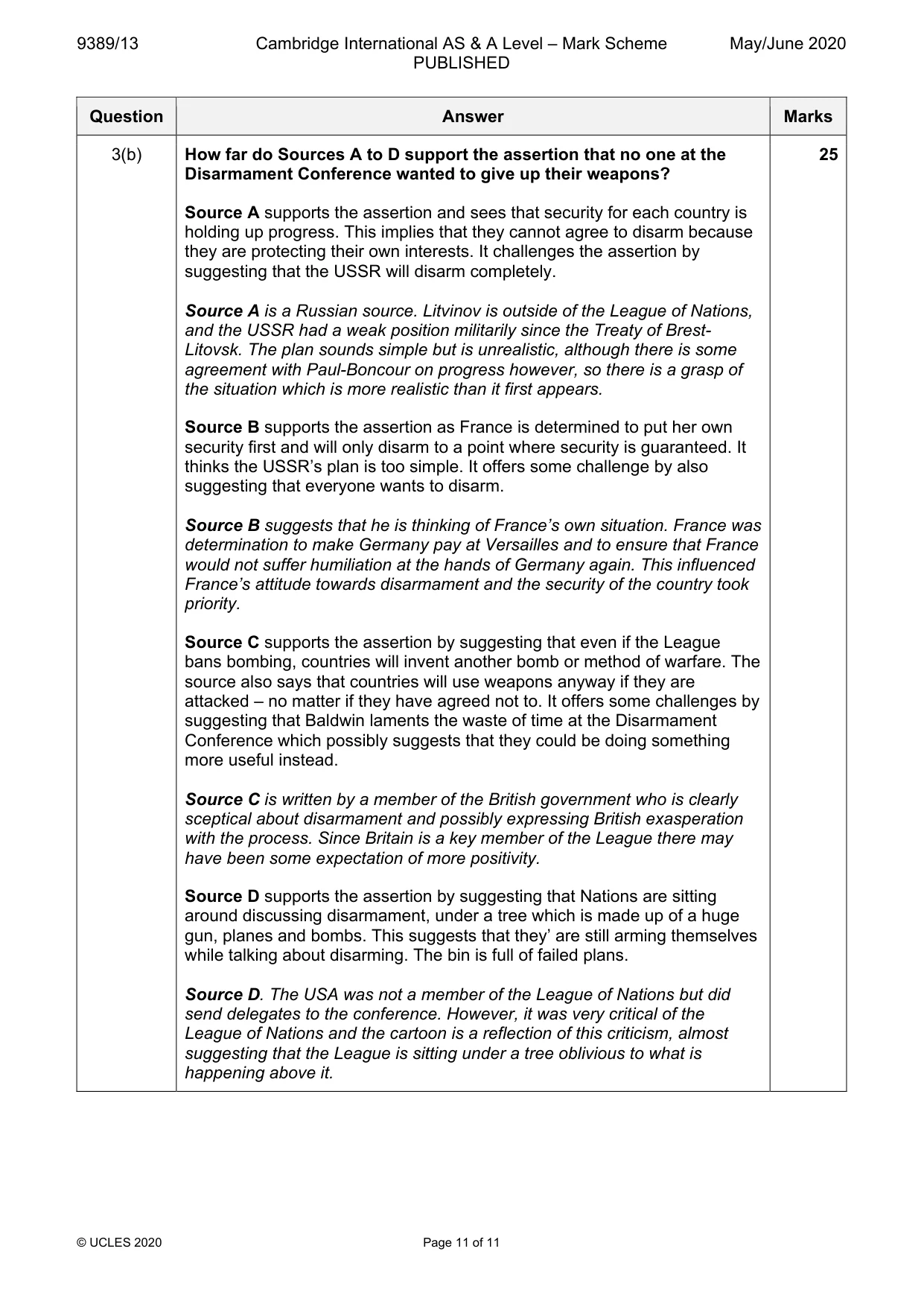
9389/13 Cambridge International AS & A Level – Mark Scheme PUBLISHED May/June 2020 © UCLES 2020 Page 11 of 11 Question Answer Marks 3(b) How far do Sources A to D support the assertion that no one at the Disarmament Conference wanted to give up their weapons? Source A supports the assertion and sees that security for each country is holding up progress. This implies that they cannot agree to disarm because they are protecting their own interests. It challenges the assertion by suggesting that the USSR will disarm completely. Source A is a Russian source. Litvinov is outside of the League of Nations, and the USSR had a weak position militarily since the Treaty of Brest- Litovsk. The plan sounds simple but is unrealistic, although there is some agreement with Paul-Boncour on progress however, so there is a grasp of the situation which is more realistic than it first appears. Source B supports the assertion as France is determined to put her own security first and will only disarm to a point where security is guaranteed. It thinks the USSR’s plan is too simple. It offers some challenge by also suggesting that everyone wants to disarm. Source B suggests that he is thinking of France’s own situation. France was determination to make Germany pay at Versailles and to ensure that France would not suffer humiliation at the hands of Germany again. This influenced France’s attitude towards disarmament and the security of the country took priority. Source C supports the assertion by suggesting that even if the League bans bombing, countries will invent another bomb or method of warfare. The source also says that countries will use weapons anyway if they are attacked – no matter if they have agreed not to. It offers some challenges by suggesting that Baldwin laments the waste of time at the Disarmament Conference which possibly suggests that they could be doing something more useful instead. Source C is written by a member of the British government who is clearly sceptical about disarmament and possibly expressing British exasperation with the process. Since Britain is a key member of the League there may have been some expectation of more positivity. Source D supports the assertion by suggesting that Nations are sitting around discussing disarmament, under a tree which is made up of a huge gun, planes and bombs. This suggests that they’ are still arming themselves while talking about disarming. The bin is full of failed plans. Source D. The USA was not a member of the League of Nations but did send delegates to the conference. However, it was very critical of the League of Nations and the cartoon is a reflection of this criticism, almost suggesting that the League is sitting under a tree oblivious to what is happening above it. 25