Cambridge A Level History 9389 — 2019 Oct/Nov Paper 1 · Variant 3
9389/13/O/N/19 · 40 marks · ≈45 min
The question paper and its mark scheme, free to read here and free to download. This is Cambridge’s own paper, exactly as it was sat.
Question paper8 pages

Mark scheme13 pages
Answers below. Sit the paper first if you are practising.
Paper as text
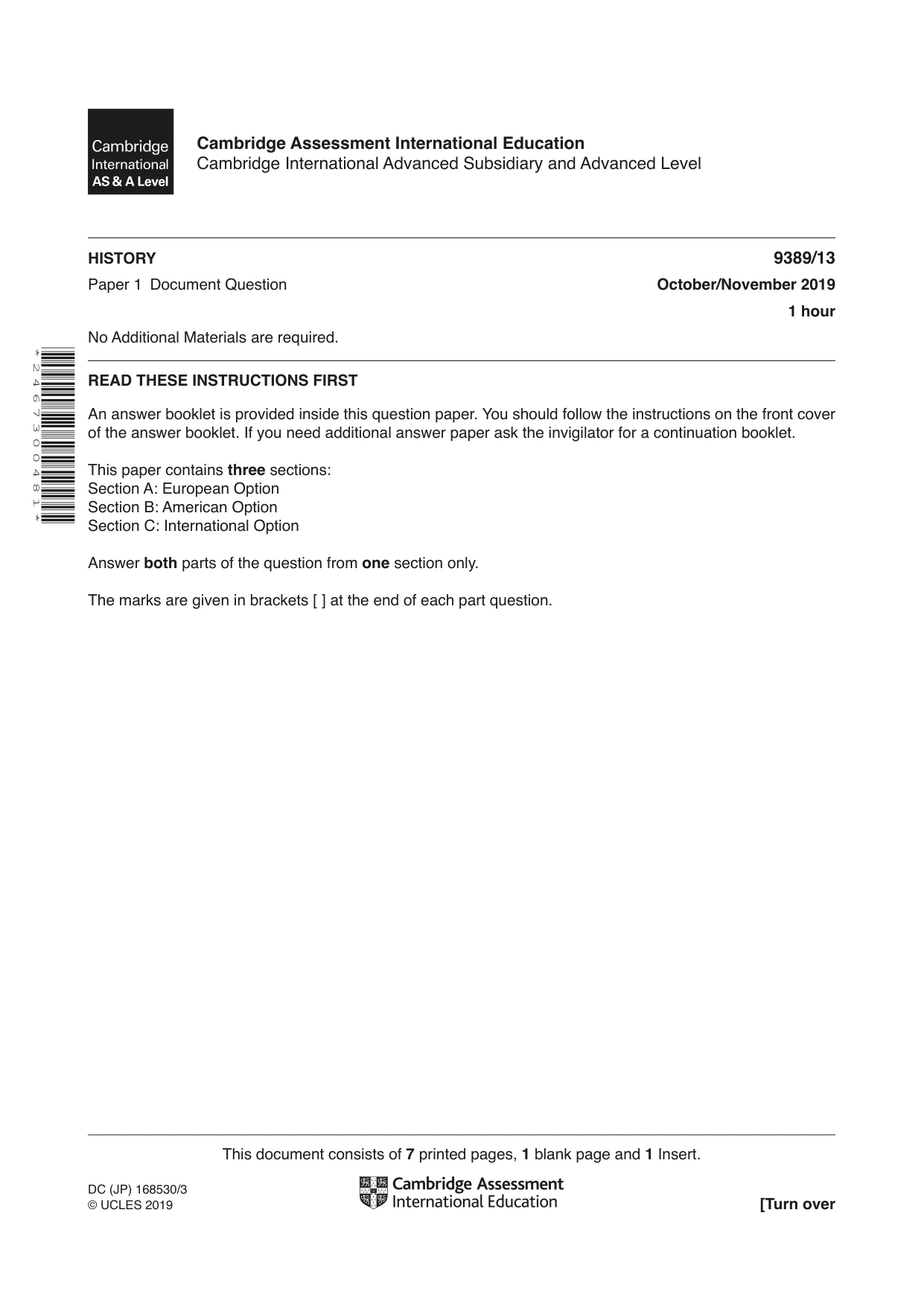
Question paper, page 1
This document consists of 7 printed pages, 1 blank page and 1 Insert. DC (JP) 168530/3 © UCLES 2019 [Turn over Cambridge Assessment International Education Cambridge International Advanced Subsidiary and Advanced Level * 2 4 6 7 3 0 0 4 8 1 * HISTORY 9389/13 Paper 1 Document Question October/November 2019 1 hour No Additional Materials are required. READ THESE INSTRUCTIONS FIRST An answer booklet is provided inside this question paper. You should follow the instructions on the front cover of the answer booklet. If you need additional answer paper ask the invigilator for a continuation booklet. This paper contains three sections: Section A: European Option Section B: American Option Section C: International Option Answer both parts of the question from one section only. The marks are given in brackets [ ] at the end of each part question.
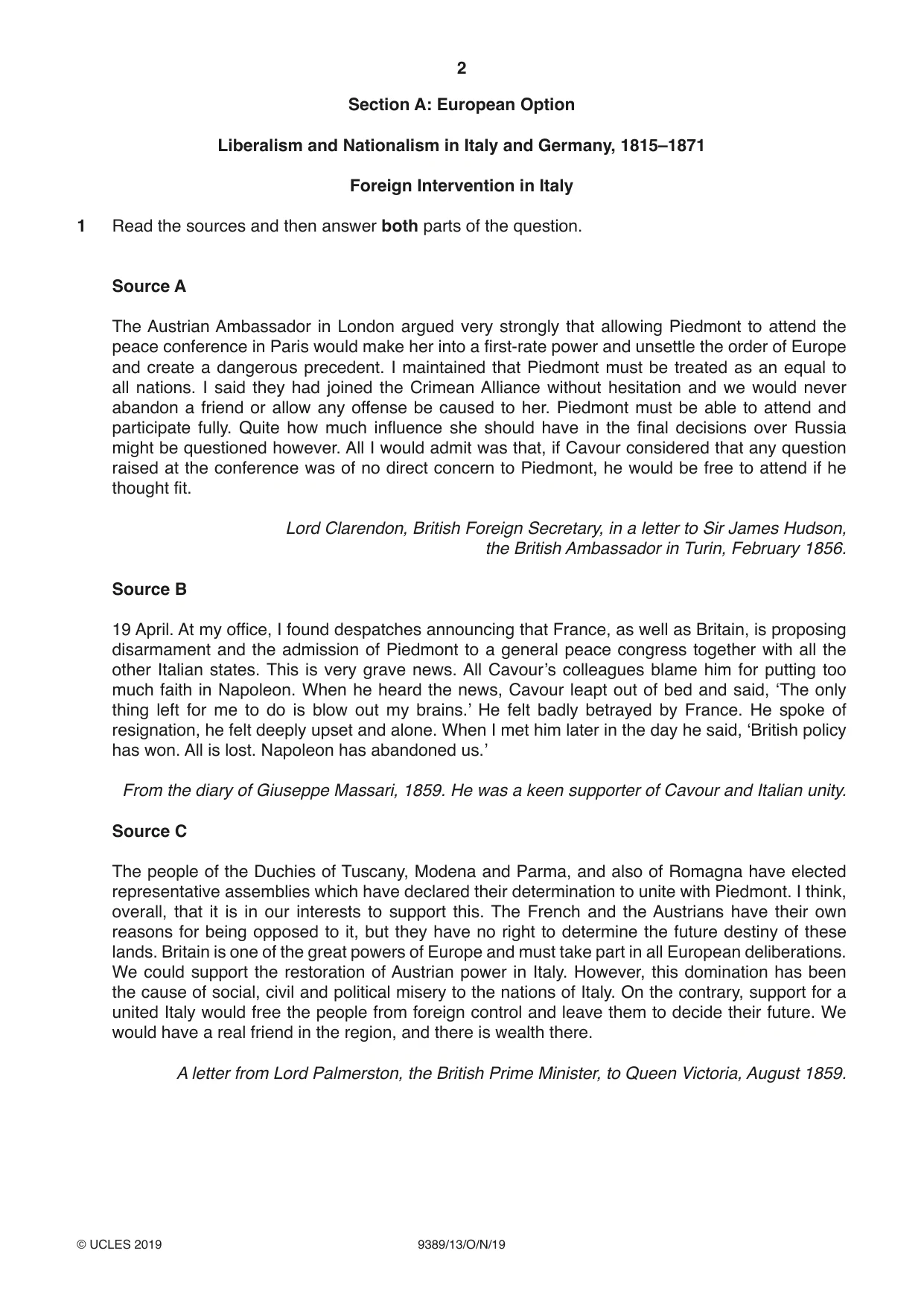
Question paper, page 2
2 9389/13/O/N/19 © UCLES 2019 Section A: European Option Liberalism and Nationalism in Italy and Germany, 1815–1871 Foreign Intervention in Italy 1 Read the sources and then answer both parts of the question. Source A The Austrian Ambassador in London argued very strongly that allowing Piedmont to attend the peace conference in Paris would make her into a first-rate power and unsettle the order of Europe and create a dangerous precedent. I maintained that Piedmont must be treated as an equal to all nations. I said they had joined the Crimean Alliance without hesitation and we would never abandon a friend or allow any offense be caused to her. Piedmont must be able to attend and participate fully. Quite how much influence she should have in the final decisions over Russia might be questioned however. All I would admit was that, if Cavour considered that any question raised at the conference was of no direct concern to Piedmont, he would be free to attend if he thought fit. Lord Clarendon, British Foreign Secretary, in a letter to Sir James Hudson, the British Ambassador in Turin, February 1856. Source B 19 April. At my office, I found despatches announcing that France, as well as Britain, is proposing disarmament and the admission of Piedmont to a general peace congress together with all the other Italian states. This is very grave news. All Cavour’s colleagues blame him for putting too much faith in Napoleon. When he heard the news, Cavour leapt out of bed and said, ‘The only thing left for me to do is blow out my brains.’ He felt badly betrayed by France. He spoke of resignation, he felt deeply upset and alone. When I met him later in the day he said, ‘British policy has won. All is lost. Napoleon has abandoned us.’ From the diary of Giuseppe Massari, 1859. He was a keen supporter of Cavour and Italian unity. Source C The people of the Duchies of Tuscany, Modena and Parma, and also of Romagna have elected representative assemblies which have declared their determination to unite with Piedmont. I think, overall, that it is in our interests to support this. The French and the Austrians have their own reasons for being opposed to it, but they have no right to determine the future destiny of these lands. Britain is one of the great powers of Europe and must take part in all European deliberations. We could support the restoration of Austrian power in Italy. However, this domination has been the cause of social, civil and political misery to the nations of Italy. On the contrary, support for a united Italy would free the people from foreign control and leave them to decide their future. We would have a real friend in the region, and there is wealth there. A letter from Lord Palmerston, the British Prime Minister, to Queen Victoria, August 1859.
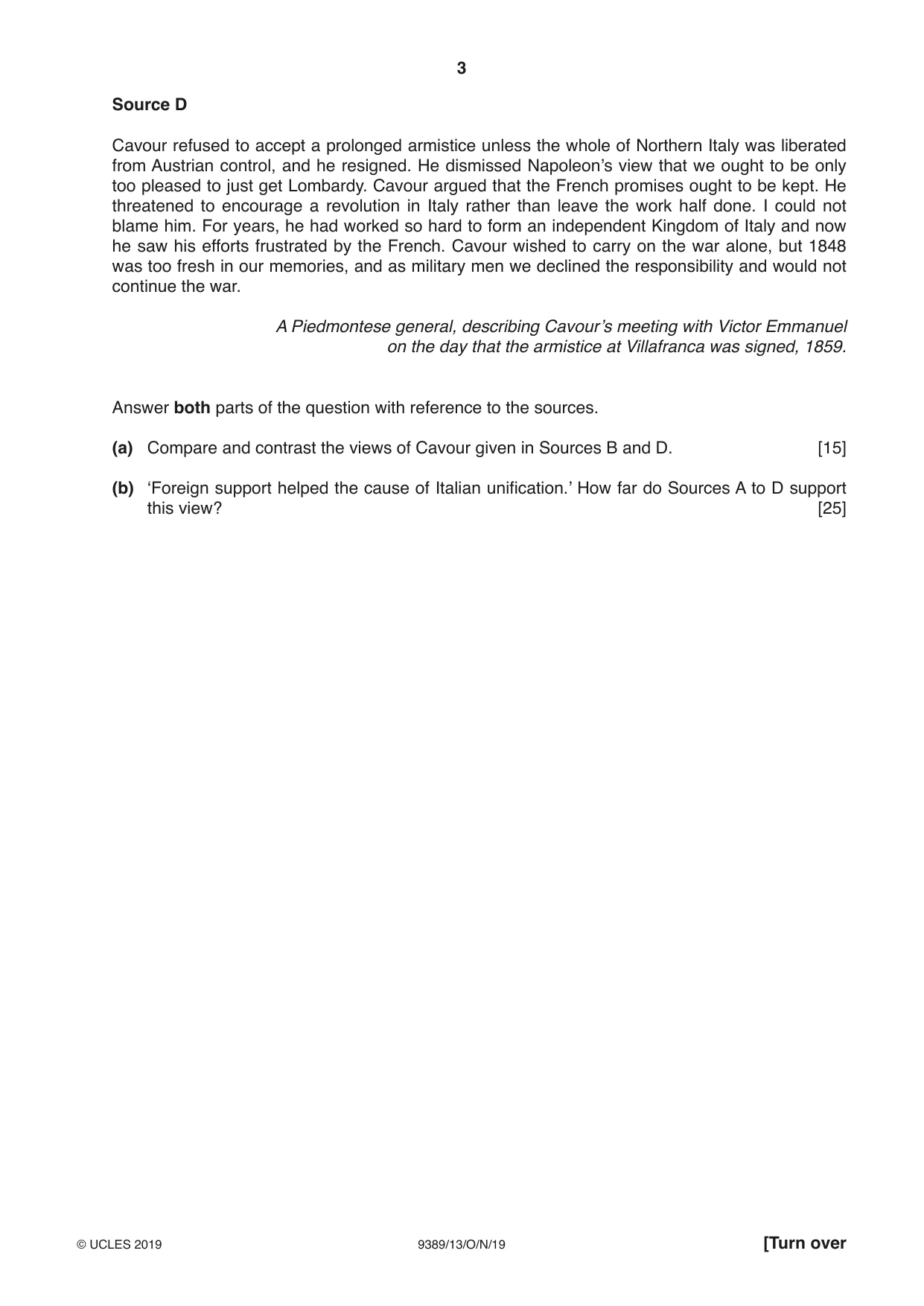
Question paper, page 3
3 9389/13/O/N/19 © UCLES 2019 [Turn over Source D Cavour refused to accept a prolonged armistice unless the whole of Northern Italy was liberated from Austrian control, and he resigned. He dismissed Napoleon’s view that we ought to be only too pleased to just get Lombardy. Cavour argued that the French promises ought to be kept. He threatened to encourage a revolution in Italy rather than leave the work half done. I could not blame him. For years, he had worked so hard to form an independent Kingdom of Italy and now he saw his efforts frustrated by the French. Cavour wished to carry on the war alone, but 1848 was too fresh in our memories, and as military men we declined the responsibility and would not continue the war. A Piedmontese general, describing Cavour’s meeting with Victor Emmanuel on the day that the armistice at Villafranca was signed, 1859. Answer both parts of the question with reference to the sources. (a) Compare and contrast the views of Cavour given in Sources B and D. [15] (b) ‘Foreign support helped the cause of Italian unification.’ How far do Sources A to D support this view? [25]
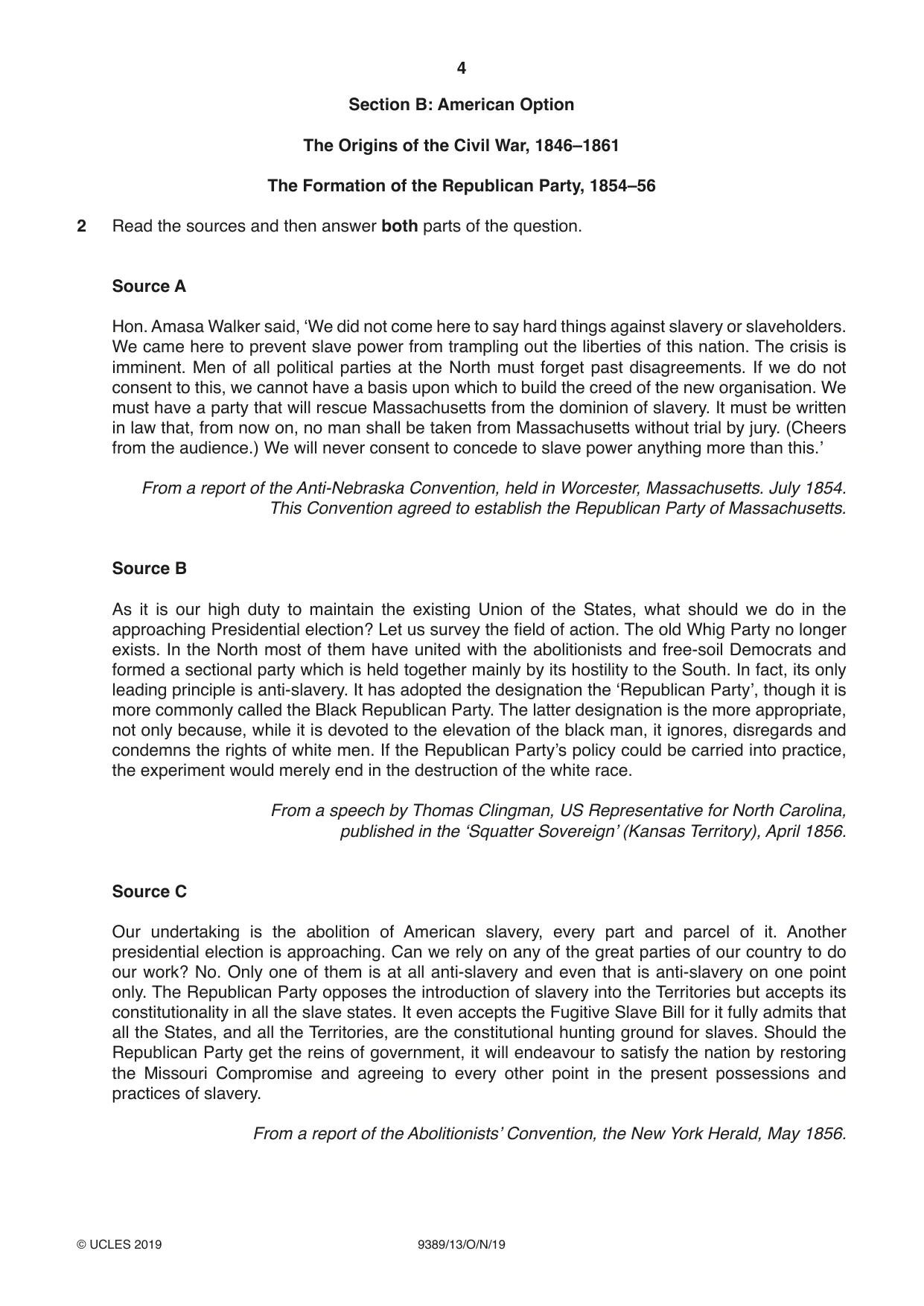
Question paper, page 4
4 9389/13/O/N/19 © UCLES 2019 Section B: American Option The Origins of the Civil War, 1846–1861 The Formation of the Republican Party, 1854–56 2 Read the sources and then answer both parts of the question. Source A Hon. Amasa Walker said, ‘We did not come here to say hard things against slavery or slaveholders. We came here to prevent slave power from trampling out the liberties of this nation. The crisis is imminent. Men of all political parties at the North must forget past disagreements. If we do not consent to this, we cannot have a basis upon which to build the creed of the new organisation. We must have a party that will rescue Massachusetts from the dominion of slavery. It must be written in law that, from now on, no man shall be taken from Massachusetts without trial by jury. (Cheers from the audience.) We will never consent to concede to slave power anything more than this.’ From a report of the Anti-Nebraska Convention, held in Worcester, Massachusetts. July 1854. This Convention agreed to establish the Republican Party of Massachusetts. Source B As it is our high duty to maintain the existing Union of the States, what should we do in the approaching Presidential election? Let us survey the field of action. The old Whig Party no longer exists. In the North most of them have united with the abolitionists and free-soil Democrats and formed a sectional party which is held together mainly by its hostility to the South. In fact, its only leading principle is anti-slavery. It has adopted the designation the ‘Republican Party’, though it is more commonly called the Black Republican Party. The latter designation is the more appropriate, not only because, while it is devoted to the elevation of the black man, it ignores, disregards and condemns the rights of white men. If the Republican Party’s policy could be carried into practice, the experiment would merely end in the destruction of the white race. From a speech by Thomas Clingman, US Representative for North Carolina, published in the ‘Squatter Sovereign’ (Kansas Territory), April 1856. Source C Our undertaking is the abolition of American slavery, every part and parcel of it. Another presidential election is approaching. Can we rely on any of the great parties of our country to do our work? No. Only one of them is at all anti-slavery and even that is anti-slavery on one point only. The Republican Party opposes the introduction of slavery into the Territories but accepts its constitutionality in all the slave states. It even accepts the Fugitive Slave Bill for it fully admits that all the States, and all the Territories, are the constitutional hunting ground for slaves. Should the Republican Party get the reins of government, it will endeavour to satisfy the nation by restoring the Missouri Compromise and agreeing to every other point in the present possessions and practices of slavery. From a report of the Abolitionists’ Convention, the New York Herald, May 1856.
Question paper, page 5
5 9389/13/O/N/19 © UCLES 2019 [Turn over Source D Since the formation of this system of government, no party has risen so quickly or with such majesty as the great Republican Party of today. It has known no infancy or youth but has towered at once in the fullness of its strength before the astonished gaze of the nation. Nor has the Republican Party appeared an hour too soon. The principles of personal liberty are rejected by the sham Democratic Party. The owners and overseers of slaves control the federal government. The people see these things and are resolved to amend them. When the government is brought back to the policy of its founders, and it is once more declared by the American people that freedom is national and slavery is sectional, the Republican Party can cease to exist as a distinct organisation. From the ‘Fremont Journal’ (Ohio), September 1856. Answer both parts of the question with reference to the sources. (a) Compare and contrast Sources A and C as evidence of Northern attitudes towards slavery. [15] (b) ‘In its first three years, the Republican Party was only concerned with protecting the interests of the Northern section.’ How far do Sources A to D support this assertion? [25]
Question paper, page 6
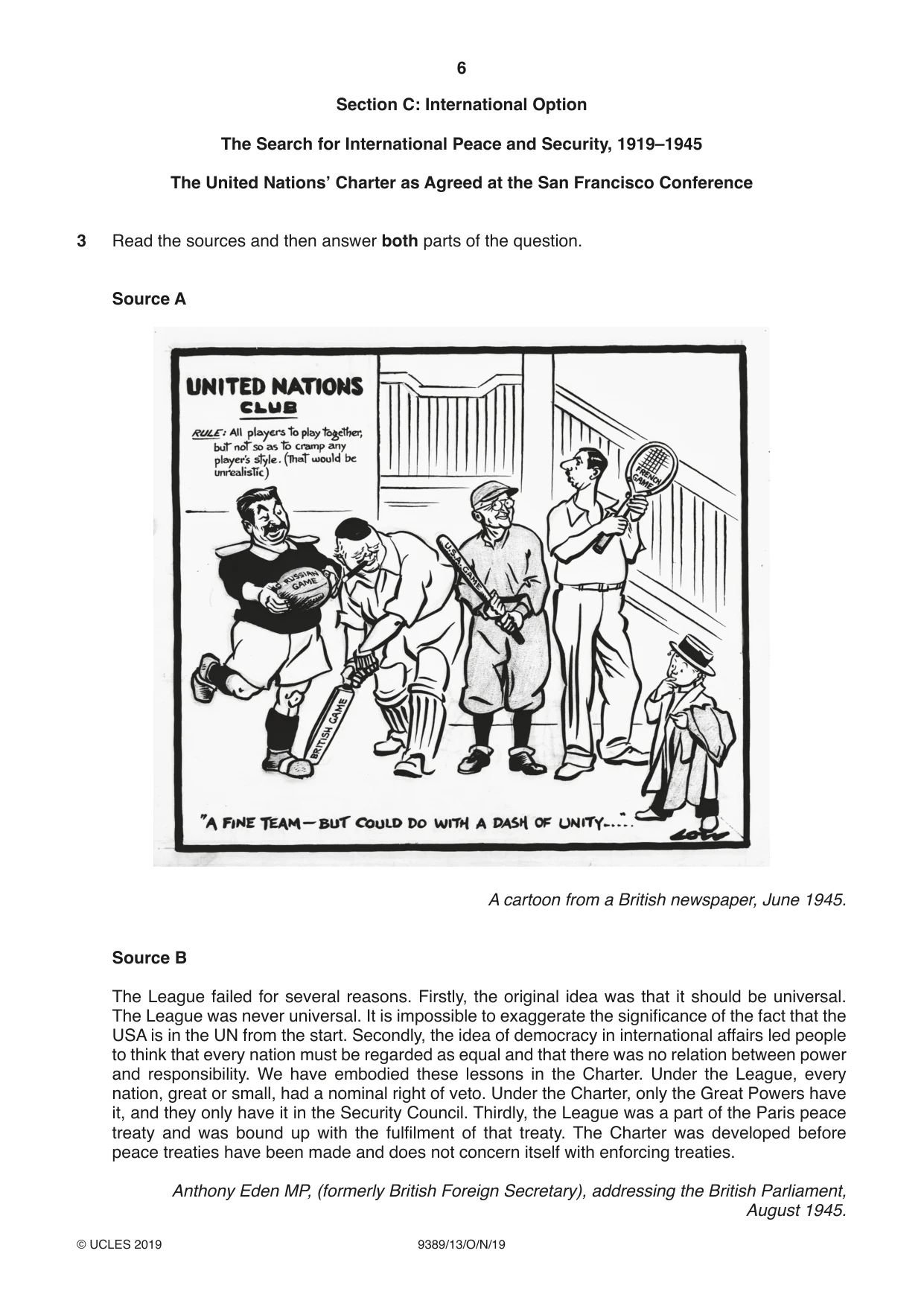
6 9389/13/O/N/19 © UCLES 2019 Section C: International Option The Search for International Peace and Security, 1919–1945 The United Nationsʼ Charter as Agreed at the San Francisco Conference 3 Read the sources and then answer both parts of the question. Source A A cartoon from a British newspaper, June 1945. Source B The League failed for several reasons. Firstly, the original idea was that it should be universal. The League was never universal. It is impossible to exaggerate the significance of the fact that the USA is in the UN from the start. Secondly, the idea of democracy in international affairs led people to think that every nation must be regarded as equal and that there was no relation between power and responsibility. We have embodied these lessons in the Charter. Under the League, every nation, great or small, had a nominal right of veto. Under the Charter, only the Great Powers have it, and they only have it in the Security Council. Thirdly, the League was a part of the Paris peace treaty and was bound up with the fulfilment of that treaty. The Charter was developed before peace treaties have been made and does not concern itself with enforcing treaties. Anthony Eden MP, (formerly British Foreign Secretary), addressing the British Parliament, August 1945.
Question paper, page 7
7 9389/13/O/N/19 © UCLES 2019 Source C The fact that the five Great Powers will become permanent members of the Security Council offers the greatest level of security against war that the world can provide at present. The Security Council has the power to act on its own initiative without having to call together all members of the UN. It is vital, in the event of the threat of war, to have prompt and decisive action. The Security Council will have military forces at its disposal and will have the power to take action with those forces if necessary. The League of Nations did not have that power. The League depended upon the disarmament of all nations, and faith in this was misplaced. The real lesson of the League was that world peace cannot be maintained unless the international organisation has power to employ armed force where necessary. An Australian politician addressing the Australian Senate, September 1945. Source D The gap separating the League and the United Nations is not large. Many of the provisions of the UN system have been taken directly from the League Covenant, though usually with changes of names and rearrangements of words. Like the League, the UN is based on the principle of the sovereign equality of all its members. Since both the UN and the League are based on the principle of voluntary cooperation, the Charter does not give the UN greater authority than was vested in the League. It is claimed that the Charter is not connected with the treaties which are being made for settling the Second World War, whereas the League was always associated with the Paris peace settlement. Just as the League was never able to overcome the problem of being a League to enforce the peace treaties, the UN will inevitably become intimately and directly associated with the peace treaties once they are finalised. From an article by a Professor of International Organisation, who had been a senior American delegate at the San Francisco Conference, February 1947. Answer both parts of the question with reference to the sources. (a) Compare and contrast the views expressed in Sources B and D regarding the League of Nations. [15] (b) ‘At the time of its formation, it was believed that the United Nations would be a success.’ How far do Sources A to D support this view? [25]
Question paper, page 8
8 9389/13/O/N/19 © UCLES 2019 BLANK PAGE Permission to reproduce items where third-party owned material protected by copyright is included has been sought and cleared where possible. Every reasonable effort has been made by the publisher (UCLES) to trace copyright holders, but if any items requiring clearance have unwittingly been included, the publisher will be pleased to make amends at the earliest possible opportunity. To avoid the issue of disclosure of answer-related information to candidates, all copyright acknowledgements are reproduced online in the Cambridge Assessment International Education Copyright Acknowledgements Booklet. This is produced for each series of examinations and is freely available to download at www.cambridgeinternational.org after the live examination series. Cambridge Assessment International Education is part of the Cambridge Assessment Group. Cambridge Assessment is the brand name of the University of Cambridge Local Examinations Syndicate (UCLES), which itself is a department of the University of Cambridge.
Mark scheme, page 1
This document consists of 13 printed pages. © UCLES 2019 [Turn over Cambridge Assessment International Education Cambridge International Advanced Subsidiary and Advanced Level HISTORY 9389/13 Paper 1 Document Question October/November 2019 MARK SCHEME Maximum Mark: 40 Published This mark scheme is published as an aid to teachers and candidates, to indicate the requirements of the examination. It shows the basis on which Examiners were instructed to award marks. It does not indicate the details of the discussions that took place at an Examiners’ meeting before marking began, which would have considered the acceptability of alternative answers. Mark schemes should be read in conjunction with the question paper and the Principal Examiner Report for Teachers. Cambridge International will not enter into discussions about these mark schemes. Cambridge International is publishing the mark schemes for the October/November 2019 series for most Cambridge IGCSE™, Cambridge International A and AS Level components and some Cambridge O Level components.
Mark scheme, page 2
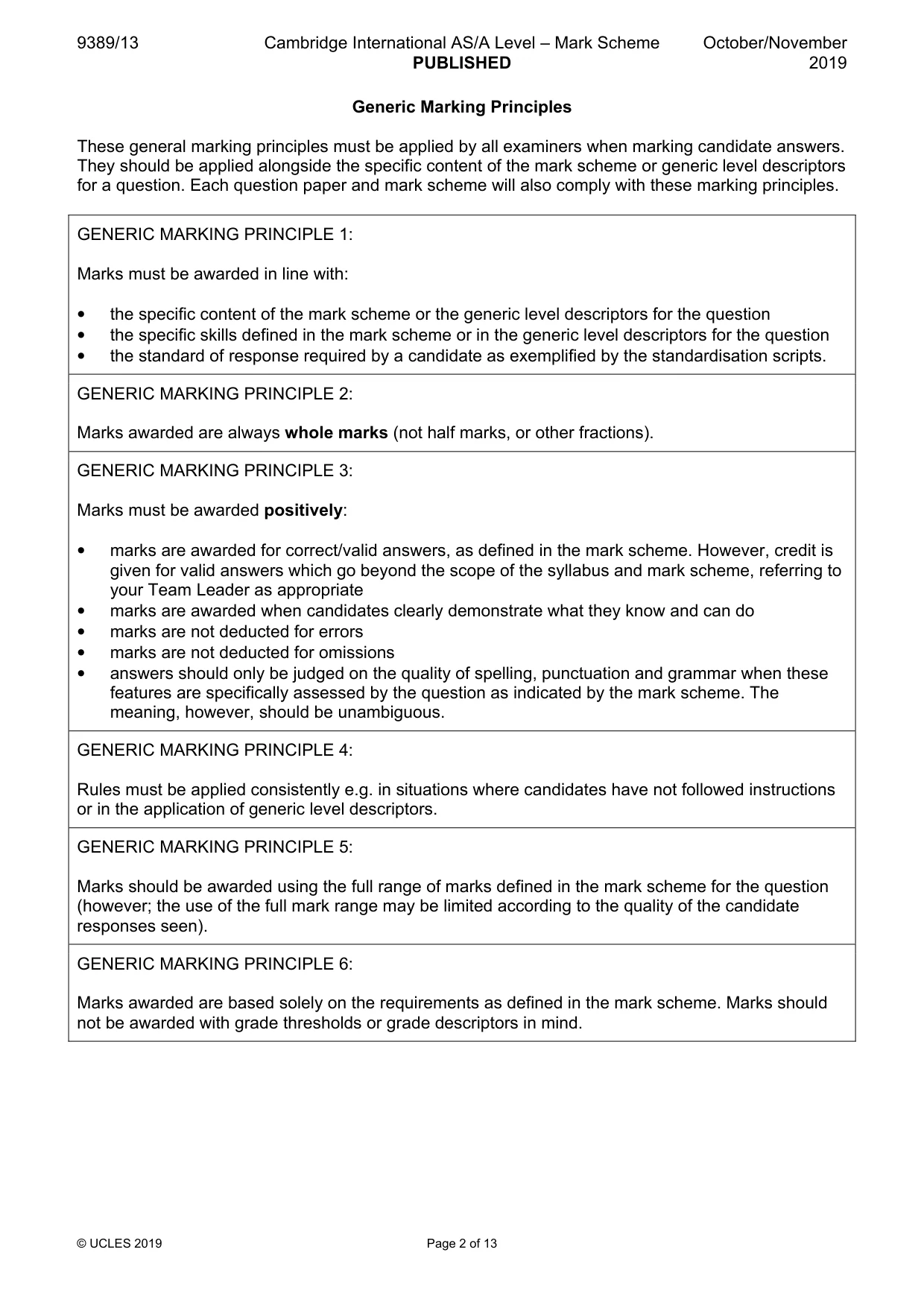
9389/13 Cambridge International AS/A Level – Mark Scheme PUBLISHED October/November 2019 © UCLES 2019 Page 2 of 13 Generic Marking Principles These general marking principles must be applied by all examiners when marking candidate answers. They should be applied alongside the specific content of the mark scheme or generic level descriptors for a question. Each question paper and mark scheme will also comply with these marking principles. GENERIC MARKING PRINCIPLE 1: Marks must be awarded in line with: • the specific content of the mark scheme or the generic level descriptors for the question • the specific skills defined in the mark scheme or in the generic level descriptors for the question • the standard of response required by a candidate as exemplified by the standardisation scripts. GENERIC MARKING PRINCIPLE 2: Marks awarded are always whole marks (not half marks, or other fractions). GENERIC MARKING PRINCIPLE 3: Marks must be awarded positively: • marks are awarded for correct/valid answers, as defined in the mark scheme. However, credit is given for valid answers which go beyond the scope of the syllabus and mark scheme, referring to your Team Leader as appropriate • marks are awarded when candidates clearly demonstrate what they know and can do • marks are not deducted for errors • marks are not deducted for omissions • answers should only be judged on the quality of spelling, punctuation and grammar when these features are specifically assessed by the question as indicated by the mark scheme. The meaning, however, should be unambiguous. GENERIC MARKING PRINCIPLE 4: Rules must be applied consistently e.g. in situations where candidates have not followed instructions or in the application of generic level descriptors. GENERIC MARKING PRINCIPLE 5: Marks should be awarded using the full range of marks defined in the mark scheme for the question (however; the use of the full mark range may be limited according to the quality of the candidate responses seen). GENERIC MARKING PRINCIPLE 6: Marks awarded are based solely on the requirements as defined in the mark scheme. Marks should not be awarded with grade thresholds or grade descriptors in mind.
Mark scheme, page 3
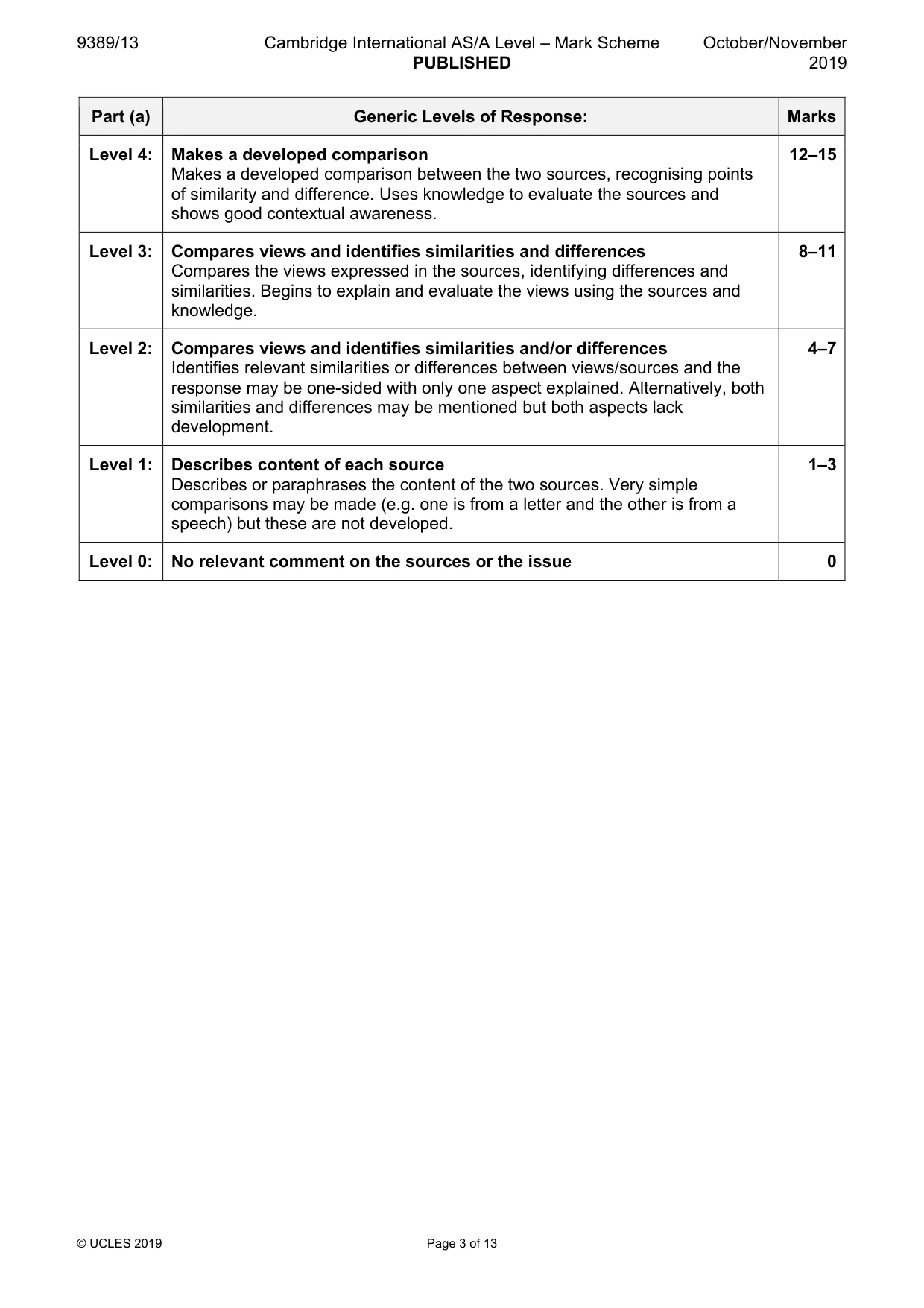
9389/13 Cambridge International AS/A Level – Mark Scheme PUBLISHED October/November 2019 © UCLES 2019 Page 3 of 13 Part (a) Generic Levels of Response: Marks Level 4: Makes a developed comparison Makes a developed comparison between the two sources, recognising points of similarity and difference. Uses knowledge to evaluate the sources and shows good contextual awareness. 12–15 Level 3: Compares views and identifies similarities and differences Compares the views expressed in the sources, identifying differences and similarities. Begins to explain and evaluate the views using the sources and knowledge. 8–11 Level 2: Compares views and identifies similarities and/or differences Identifies relevant similarities or differences between views/sources and the response may be one-sided with only one aspect explained. Alternatively, both similarities and differences may be mentioned but both aspects lack development. 4–7 Level 1: Describes content of each source Describes or paraphrases the content of the two sources. Very simple comparisons may be made (e.g. one is from a letter and the other is from a speech) but these are not developed. 1–3 Level 0: No relevant comment on the sources or the issue 0
Mark scheme, page 4
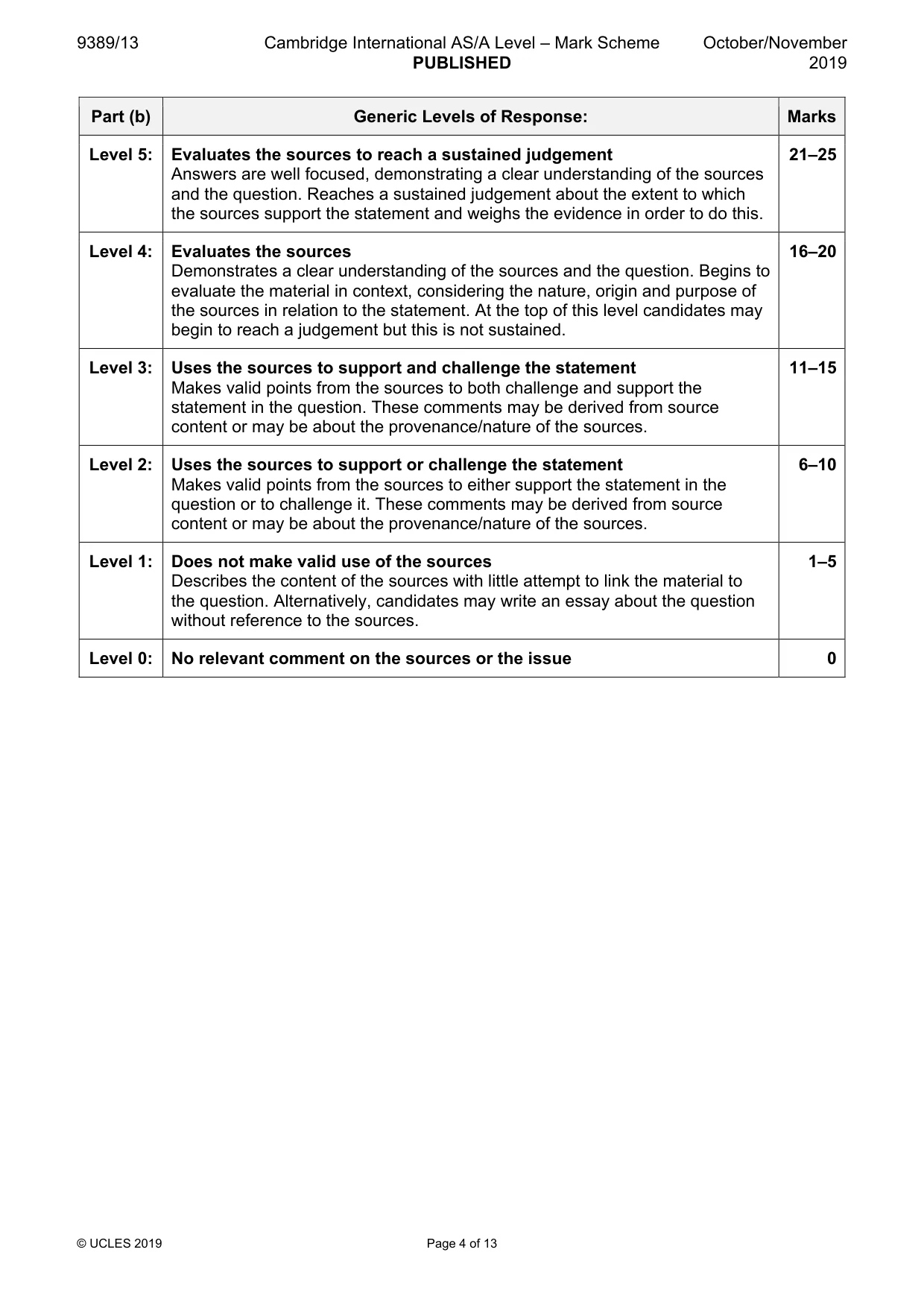
9389/13 Cambridge International AS/A Level – Mark Scheme PUBLISHED October/November 2019 © UCLES 2019 Page 4 of 13 Part (b) Generic Levels of Response: Marks Level 5: Evaluates the sources to reach a sustained judgement Answers are well focused, demonstrating a clear understanding of the sources and the question. Reaches a sustained judgement about the extent to which the sources support the statement and weighs the evidence in order to do this. 21–25 Level 4: Evaluates the sources Demonstrates a clear understanding of the sources and the question. Begins to evaluate the material in context, considering the nature, origin and purpose of the sources in relation to the statement. At the top of this level candidates may begin to reach a judgement but this is not sustained. 16–20 Level 3: Uses the sources to support and challenge the statement Makes valid points from the sources to both challenge and support the statement in the question. These comments may be derived from source content or may be about the provenance/nature of the sources. 11–15 Level 2: Uses the sources to support or challenge the statement Makes valid points from the sources to either support the statement in the question or to challenge it. These comments may be derived from source content or may be about the provenance/nature of the sources. 6–10 Level 1: Does not make valid use of the sources Describes the content of the sources with little attempt to link the material to the question. Alternatively, candidates may write an essay about the question without reference to the sources. 1–5 Level 0: No relevant comment on the sources or the issue 0
Mark scheme, page 5
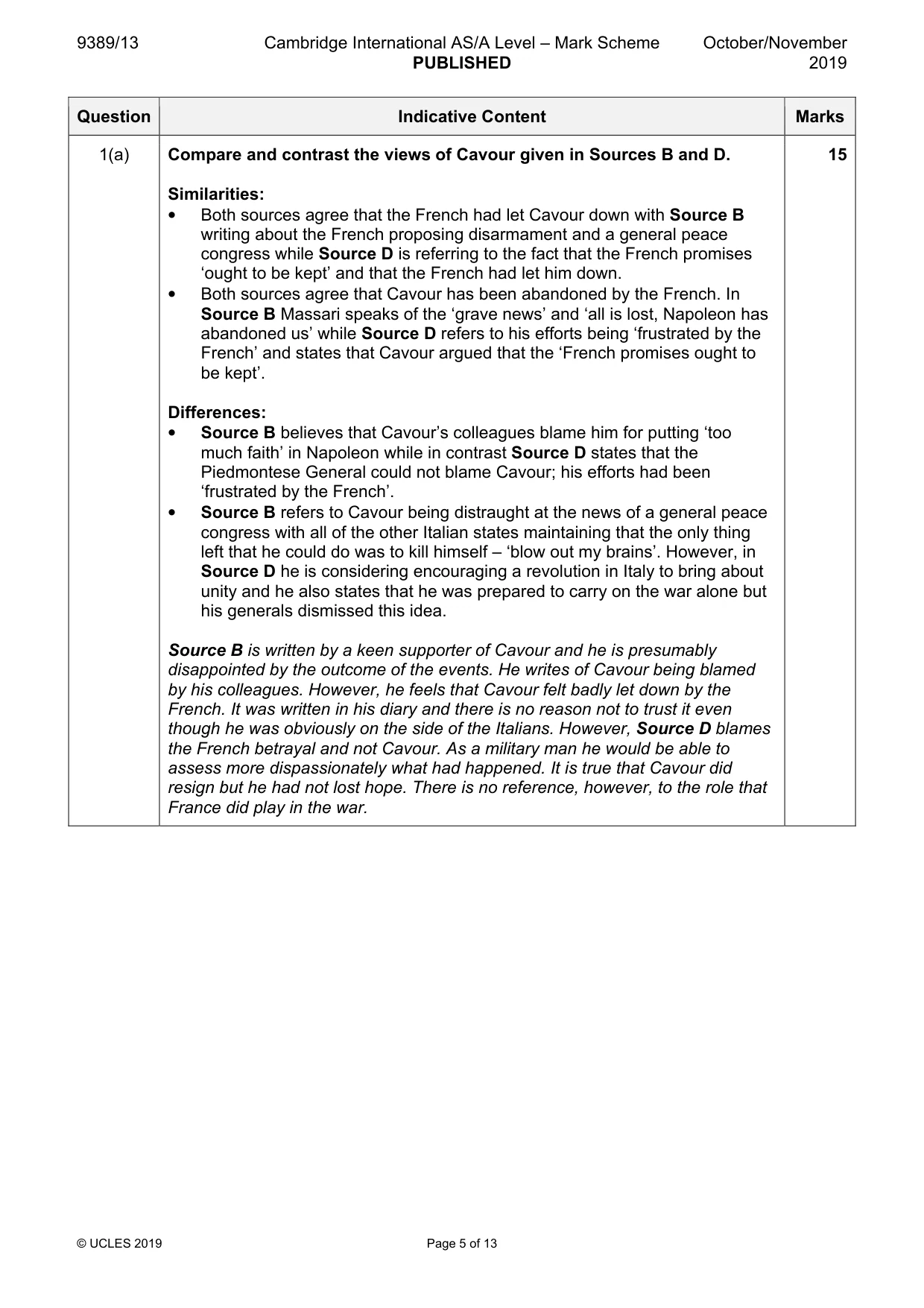
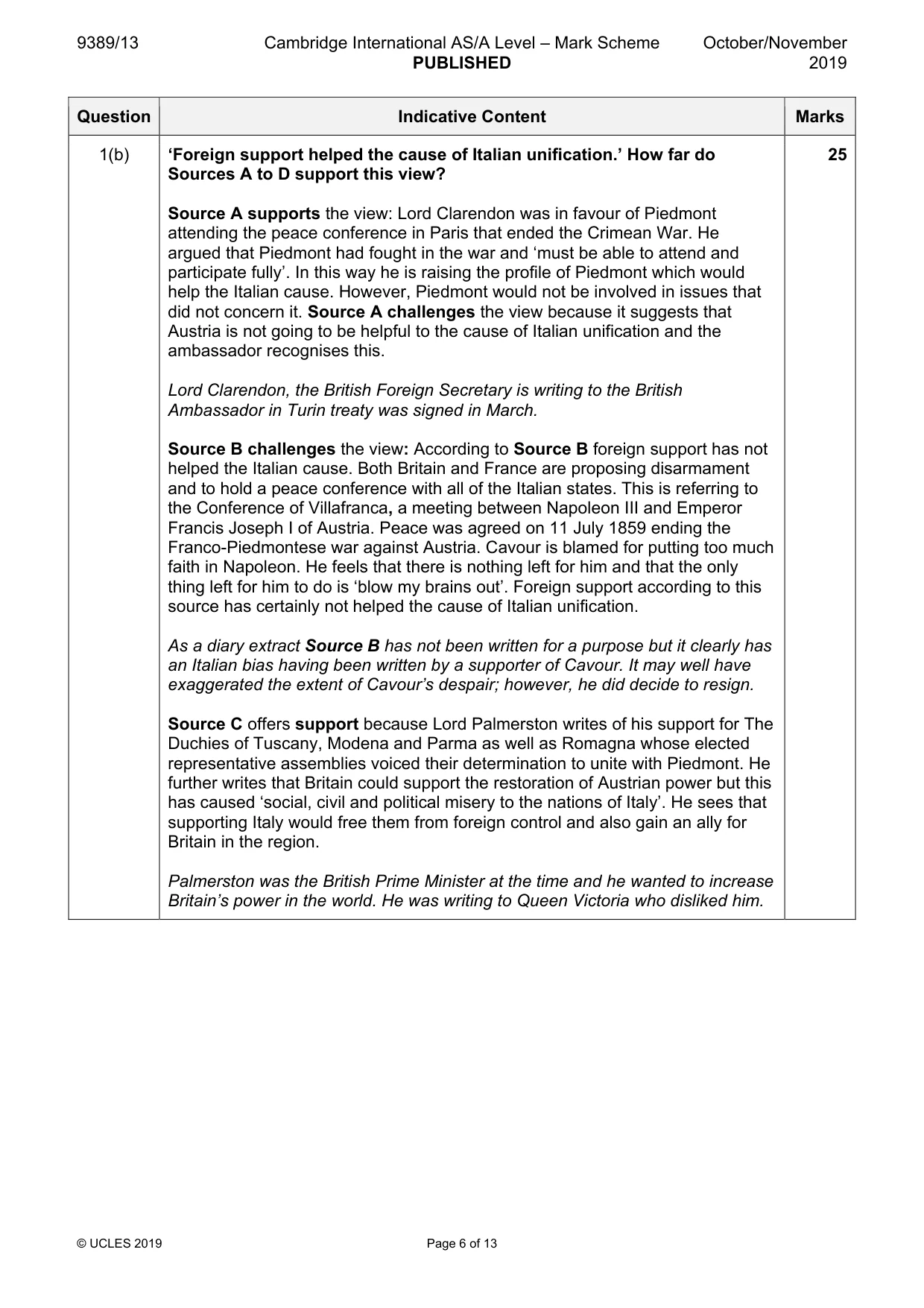
9389/13 Cambridge International AS/A Level – Mark Scheme PUBLISHED October/November 2019 © UCLES 2019 Page 5 of 13 Question Indicative Content Marks 1(a) Compare and contrast the views of Cavour given in Sources B and D. Similarities: • Both sources agree that the French had let Cavour down with Source B writing about the French proposing disarmament and a general peace congress while Source D is referring to the fact that the French promises ‘ought to be kept’ and that the French had let him down. • Both sources agree that Cavour has been abandoned by the French. In Source B Massari speaks of the ‘grave news’ and ‘all is lost, Napoleon has abandoned us’ while Source D refers to his efforts being ‘frustrated by the French’ and states that Cavour argued that the ‘French promises ought to be kept’. Differences: • Source B believes that Cavour’s colleagues blame him for putting ‘too much faith’ in Napoleon while in contrast Source D states that the Piedmontese General could not blame Cavour; his efforts had been ‘frustrated by the French’. • Source B refers to Cavour being distraught at the news of a general peace congress with all of the other Italian states maintaining that the only thing left that he could do was to kill himself – ‘blow out my brains’. However, in Source D he is considering encouraging a revolution in Italy to bring about unity and he also states that he was prepared to carry on the war alone but his generals dismissed this idea. Source B is written by a keen supporter of Cavour and he is presumably disappointed by the outcome of the events. He writes of Cavour being blamed by his colleagues. However, he feels that Cavour felt badly let down by the French. It was written in his diary and there is no reason not to trust it even though he was obviously on the side of the Italians. However, Source D blames the French betrayal and not Cavour. As a military man he would be able to assess more dispassionately what had happened. It is true that Cavour did resign but he had not lost hope. There is no reference, however, to the role that France did play in the war. 15
Mark scheme, page 6
9389/13 Cambridge International AS/A Level – Mark Scheme PUBLISHED October/November 2019 © UCLES 2019 Page 6 of 13 Question Indicative Content Marks 1(b) ‘Foreign support helped the cause of Italian unification.’ How far do Sources A to D support this view? Source A supports the view: Lord Clarendon was in favour of Piedmont attending the peace conference in Paris that ended the Crimean War. He argued that Piedmont had fought in the war and ‘must be able to attend and participate fully’. In this way he is raising the profile of Piedmont which would help the Italian cause. However, Piedmont would not be involved in issues that did not concern it. Source A challenges the view because it suggests that Austria is not going to be helpful to the cause of Italian unification and the ambassador recognises this. Lord Clarendon, the British Foreign Secretary is writing to the British Ambassador in Turin treaty was signed in March. Source B challenges the view: According to Source B foreign support has not helped the Italian cause. Both Britain and France are proposing disarmament and to hold a peace conference with all of the Italian states. This is referring to the Conference of Villafranca, a meeting between Napoleon III and Emperor Francis Joseph I of Austria. Peace was agreed on 11 July 1859 ending the Franco-Piedmontese war against Austria. Cavour is blamed for putting too much faith in Napoleon. He feels that there is nothing left for him and that the only thing left for him to do is ‘blow my brains out’. Foreign support according to this source has certainly not helped the cause of Italian unification. As a diary extract Source B has not been written for a purpose but it clearly has an Italian bias having been written by a supporter of Cavour. It may well have exaggerated the extent of Cavour’s despair; however, he did decide to resign. Source C offers support because Lord Palmerston writes of his support for The Duchies of Tuscany, Modena and Parma as well as Romagna whose elected representative assemblies voiced their determination to unite with Piedmont. He further writes that Britain could support the restoration of Austrian power but this has caused ‘social, civil and political misery to the nations of Italy’. He sees that supporting Italy would free them from foreign control and also gain an ally for Britain in the region. Palmerston was the British Prime Minister at the time and he wanted to increase Britain’s power in the world. He was writing to Queen Victoria who disliked him. 25
Mark scheme, page 7
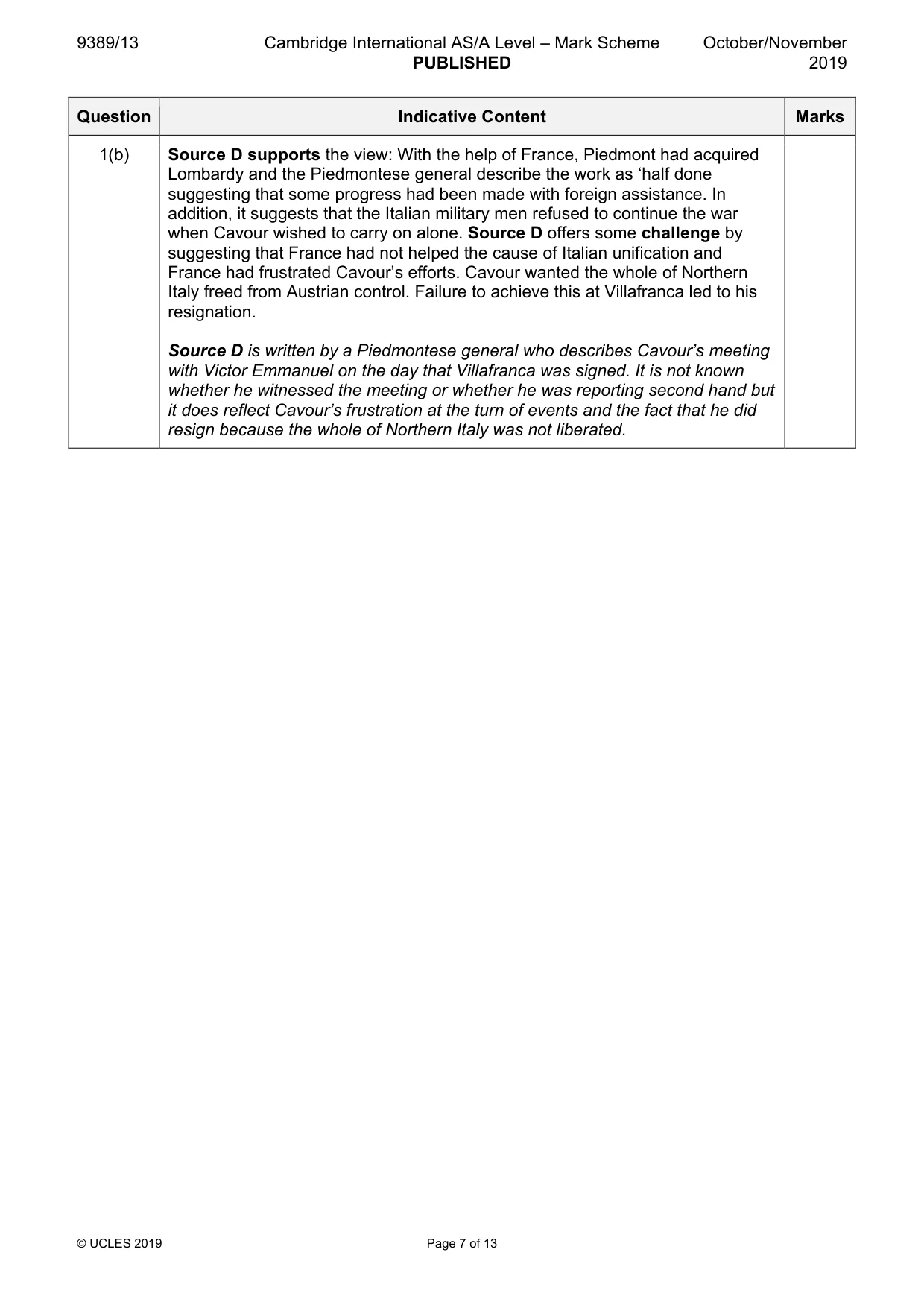
9389/13 Cambridge International AS/A Level – Mark Scheme PUBLISHED October/November 2019 © UCLES 2019 Page 7 of 13 Question Indicative Content Marks 1(b) Source D supports the view: With the help of France, Piedmont had acquired Lombardy and the Piedmontese general describe the work as ‘half done suggesting that some progress had been made with foreign assistance. In addition, it suggests that the Italian military men refused to continue the war when Cavour wished to carry on alone. Source D offers some challenge by suggesting that France had not helped the cause of Italian unification and France had frustrated Cavour’s efforts. Cavour wanted the whole of Northern Italy freed from Austrian control. Failure to achieve this at Villafranca led to his resignation. Source D is written by a Piedmontese general who describes Cavour’s meeting with Victor Emmanuel on the day that Villafranca was signed. It is not known whether he witnessed the meeting or whether he was reporting second hand but it does reflect Cavour’s frustration at the turn of events and the fact that he did resign because the whole of Northern Italy was not liberated.
Mark scheme, page 8
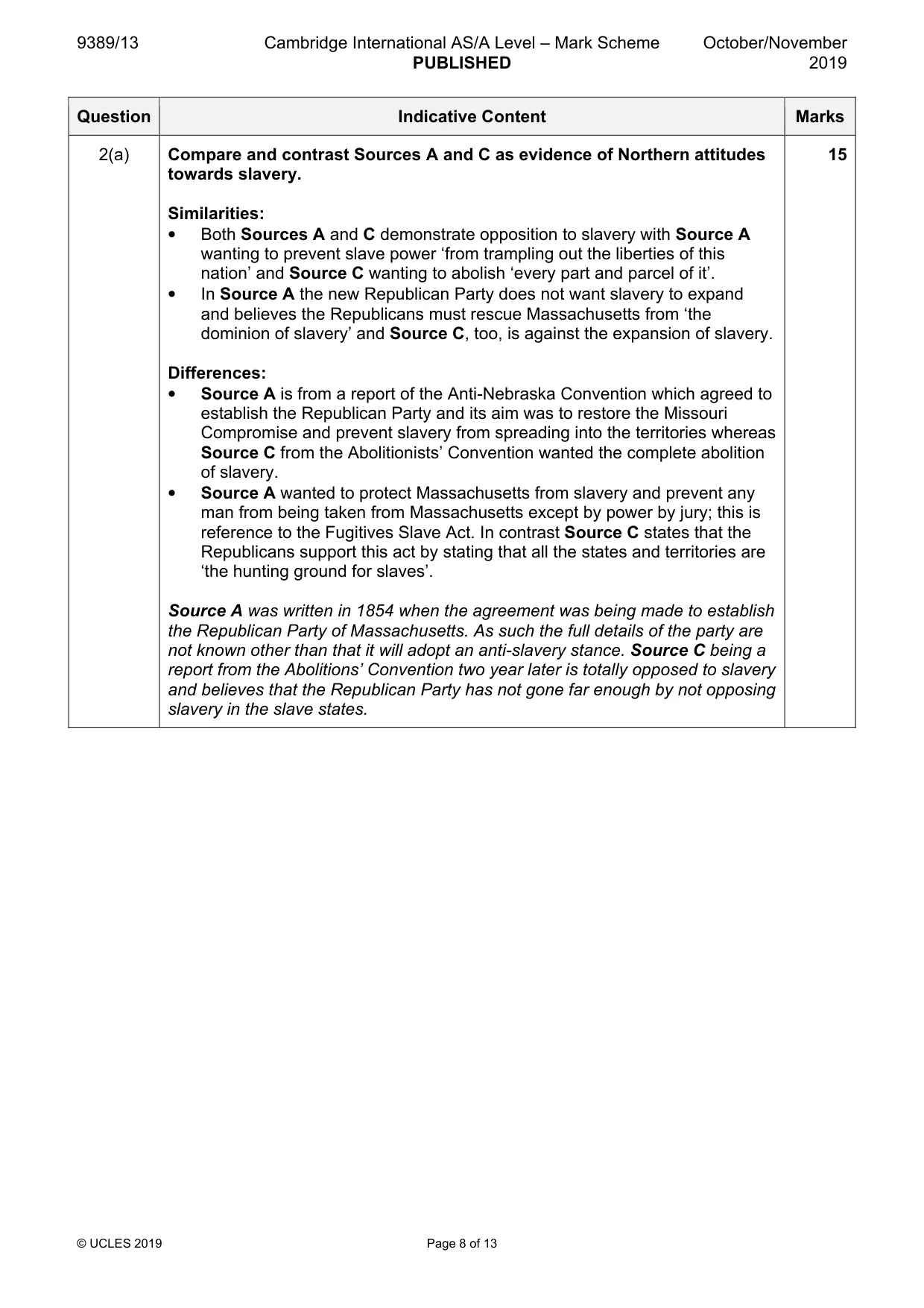
9389/13 Cambridge International AS/A Level – Mark Scheme PUBLISHED October/November 2019 © UCLES 2019 Page 8 of 13 Question Indicative Content Marks 2(a) Compare and contrast Sources A and C as evidence of Northern attitudes towards slavery. Similarities: • Both Sources A and C demonstrate opposition to slavery with Source A wanting to prevent slave power ‘from trampling out the liberties of this nation’ and Source C wanting to abolish ‘every part and parcel of it’. • In Source A the new Republican Party does not want slavery to expand and believes the Republicans must rescue Massachusetts from ‘the dominion of slavery’ and Source C, too, is against the expansion of slavery. Differences: • Source A is from a report of the Anti-Nebraska Convention which agreed to establish the Republican Party and its aim was to restore the Missouri Compromise and prevent slavery from spreading into the territories whereas Source C from the Abolitionists’ Convention wanted the complete abolition of slavery. • Source A wanted to protect Massachusetts from slavery and prevent any man from being taken from Massachusetts except by power by jury; this is reference to the Fugitives Slave Act. In contrast Source C states that the Republicans support this act by stating that all the states and territories are ‘the hunting ground for slaves’. Source A was written in 1854 when the agreement was being made to establish the Republican Party of Massachusetts. As such the full details of the party are not known other than that it will adopt an anti-slavery stance. Source C being a report from the Abolitions’ Convention two year later is totally opposed to slavery and believes that the Republican Party has not gone far enough by not opposing slavery in the slave states. 15
Mark scheme, page 9
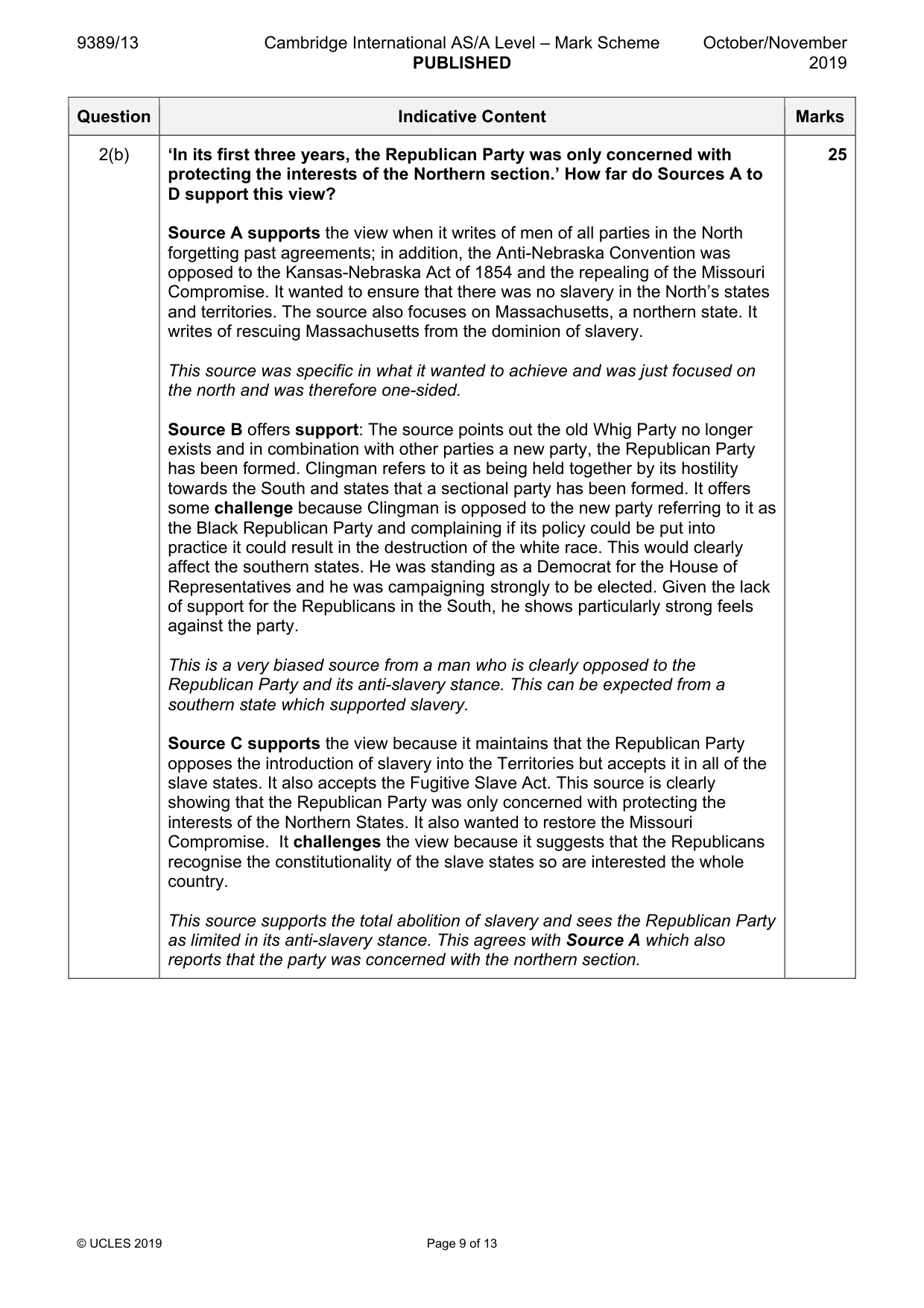
9389/13 Cambridge International AS/A Level – Mark Scheme PUBLISHED October/November 2019 © UCLES 2019 Page 9 of 13 Question Indicative Content Marks 2(b) ‘In its first three years, the Republican Party was only concerned with protecting the interests of the Northern section.’ How far do Sources A to D support this view? Source A supports the view when it writes of men of all parties in the North forgetting past agreements; in addition, the Anti-Nebraska Convention was opposed to the Kansas-Nebraska Act of 1854 and the repealing of the Missouri Compromise. It wanted to ensure that there was no slavery in the North’s states and territories. The source also focuses on Massachusetts, a northern state. It writes of rescuing Massachusetts from the dominion of slavery. This source was specific in what it wanted to achieve and was just focused on the north and was therefore one-sided. Source B offers support: The source points out the old Whig Party no longer exists and in combination with other parties a new party, the Republican Party has been formed. Clingman refers to it as being held together by its hostility towards the South and states that a sectional party has been formed. It offers some challenge because Clingman is opposed to the new party referring to it as the Black Republican Party and complaining if its policy could be put into practice it could result in the destruction of the white race. This would clearly affect the southern states. He was standing as a Democrat for the House of Representatives and he was campaigning strongly to be elected. Given the lack of support for the Republicans in the South, he shows particularly strong feels against the party. This is a very biased source from a man who is clearly opposed to the Republican Party and its anti-slavery stance. This can be expected from a southern state which supported slavery. Source C supports the view because it maintains that the Republican Party opposes the introduction of slavery into the Territories but accepts it in all of the slave states. It also accepts the Fugitive Slave Act. This source is clearly showing that the Republican Party was only concerned with protecting the interests of the Northern States. It also wanted to restore the Missouri Compromise. It challenges the view because it suggests that the Republicans recognise the constitutionality of the slave states so are interested the whole country. This source supports the total abolition of slavery and sees the Republican Party as limited in its anti-slavery stance. This agrees with Source A which also reports that the party was concerned with the northern section. 25
Mark scheme, page 10
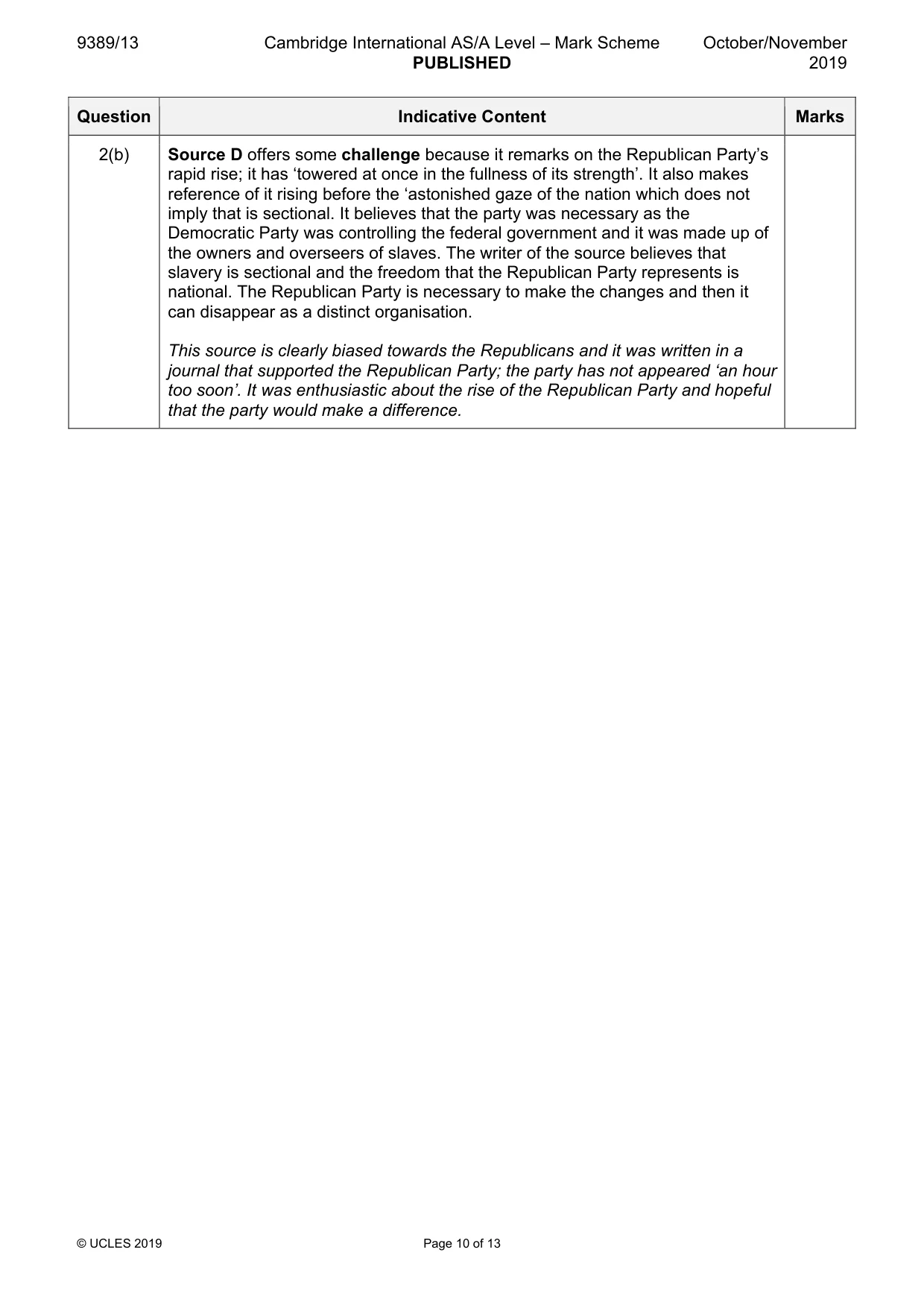
9389/13 Cambridge International AS/A Level – Mark Scheme PUBLISHED October/November 2019 © UCLES 2019 Page 10 of 13 Question Indicative Content Marks 2(b) Source D offers some challenge because it remarks on the Republican Party’s rapid rise; it has ‘towered at once in the fullness of its strength’. It also makes reference of it rising before the ‘astonished gaze of the nation which does not imply that is sectional. It believes that the party was necessary as the Democratic Party was controlling the federal government and it was made up of the owners and overseers of slaves. The writer of the source believes that slavery is sectional and the freedom that the Republican Party represents is national. The Republican Party is necessary to make the changes and then it can disappear as a distinct organisation. This source is clearly biased towards the Republicans and it was written in a journal that supported the Republican Party; the party has not appeared ‘an hour too soon’. It was enthusiastic about the rise of the Republican Party and hopeful that the party would make a difference.
Mark scheme, page 11
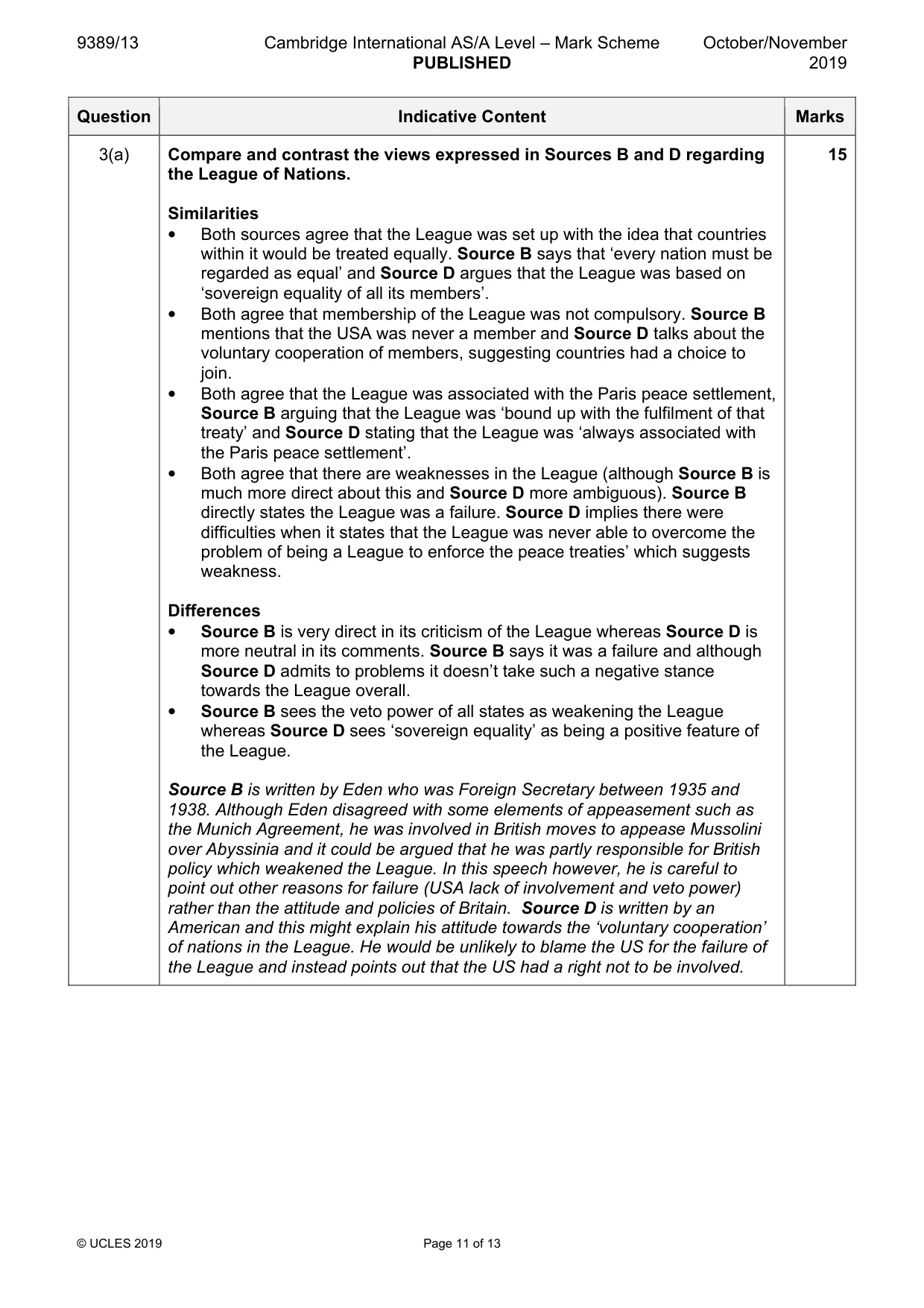
9389/13 Cambridge International AS/A Level – Mark Scheme PUBLISHED October/November 2019 © UCLES 2019 Page 11 of 13 Question Indicative Content Marks 3(a) Compare and contrast the views expressed in Sources B and D regarding the League of Nations. Similarities • Both sources agree that the League was set up with the idea that countries within it would be treated equally. Source B says that ‘every nation must be regarded as equal’ and Source D argues that the League was based on ‘sovereign equality of all its members’. • Both agree that membership of the League was not compulsory. Source B mentions that the USA was never a member and Source D talks about the voluntary cooperation of members, suggesting countries had a choice to join. • Both agree that the League was associated with the Paris peace settlement, Source B arguing that the League was ‘bound up with the fulfilment of that treaty’ and Source D stating that the League was ‘always associated with the Paris peace settlement’. • Both agree that there are weaknesses in the League (although Source B is much more direct about this and Source D more ambiguous). Source B directly states the League was a failure. Source D implies there were difficulties when it states that the League was never able to overcome the problem of being a League to enforce the peace treaties’ which suggests weakness. Differences • Source B is very direct in its criticism of the League whereas Source D is more neutral in its comments. Source B says it was a failure and although Source D admits to problems it doesn’t take such a negative stance towards the League overall. • Source B sees the veto power of all states as weakening the League whereas Source D sees ‘sovereign equality’ as being a positive feature of the League. Source B is written by Eden who was Foreign Secretary between 1935 and 1938. Although Eden disagreed with some elements of appeasement such as the Munich Agreement, he was involved in British moves to appease Mussolini over Abyssinia and it could be argued that he was partly responsible for British policy which weakened the League. In this speech however, he is careful to point out other reasons for failure (USA lack of involvement and veto power) rather than the attitude and policies of Britain. Source D is written by an American and this might explain his attitude towards the ‘voluntary cooperation’ of nations in the League. He would be unlikely to blame the US for the failure of the League and instead points out that the US had a right not to be involved. 15
Mark scheme, page 12
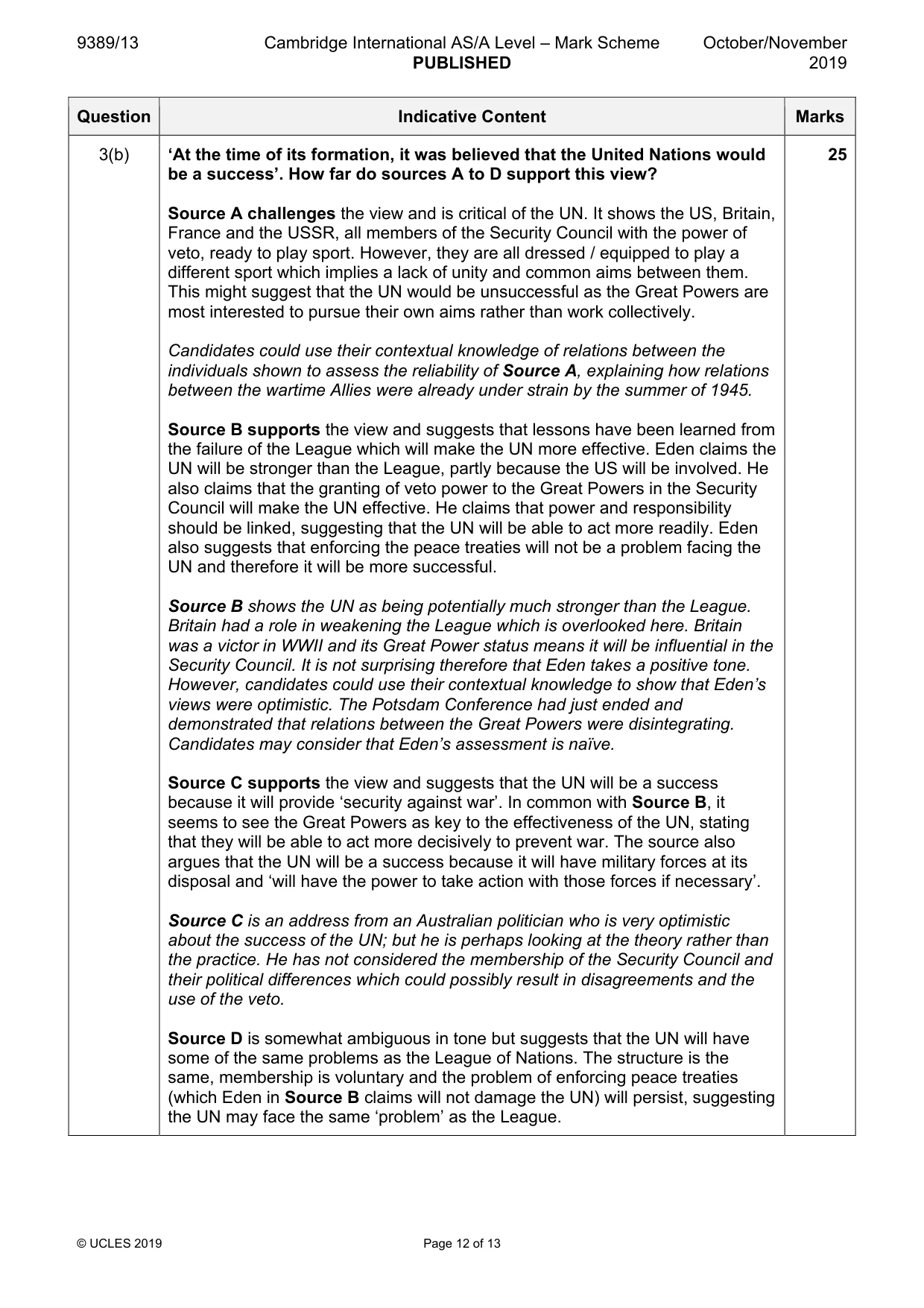
9389/13 Cambridge International AS/A Level – Mark Scheme PUBLISHED October/November 2019 © UCLES 2019 Page 12 of 13 Question Indicative Content Marks 3(b) ‘At the time of its formation, it was believed that the United Nations would be a success’. How far do sources A to D support this view? Source A challenges the view and is critical of the UN. It shows the US, Britain, France and the USSR, all members of the Security Council with the power of veto, ready to play sport. However, they are all dressed / equipped to play a different sport which implies a lack of unity and common aims between them. This might suggest that the UN would be unsuccessful as the Great Powers are most interested to pursue their own aims rather than work collectively. Candidates could use their contextual knowledge of relations between the individuals shown to assess the reliability of Source A, explaining how relations between the wartime Allies were already under strain by the summer of 1945. Source B supports the view and suggests that lessons have been learned from the failure of the League which will make the UN more effective. Eden claims the UN will be stronger than the League, partly because the US will be involved. He also claims that the granting of veto power to the Great Powers in the Security Council will make the UN effective. He claims that power and responsibility should be linked, suggesting that the UN will be able to act more readily. Eden also suggests that enforcing the peace treaties will not be a problem facing the UN and therefore it will be more successful. Source B shows the UN as being potentially much stronger than the League. Britain had a role in weakening the League which is overlooked here. Britain was a victor in WWII and its Great Power status means it will be influential in the Security Council. It is not surprising therefore that Eden takes a positive tone. However, candidates could use their contextual knowledge to show that Eden’s views were optimistic. The Potsdam Conference had just ended and demonstrated that relations between the Great Powers were disintegrating. Candidates may consider that Eden’s assessment is naïve. Source C supports the view and suggests that the UN will be a success because it will provide ‘security against war’. In common with Source B, it seems to see the Great Powers as key to the effectiveness of the UN, stating that they will be able to act more decisively to prevent war. The source also argues that the UN will be a success because it will have military forces at its disposal and ‘will have the power to take action with those forces if necessary’. Source C is an address from an Australian politician who is very optimistic about the success of the UN; but he is perhaps looking at the theory rather than the practice. He has not considered the membership of the Security Council and their political differences which could possibly result in disagreements and the use of the veto. Source D is somewhat ambiguous in tone but suggests that the UN will have some of the same problems as the League of Nations. The structure is the same, membership is voluntary and the problem of enforcing peace treaties (which Eden in Source B claims will not damage the UN) will persist, suggesting the UN may face the same ‘problem’ as the League. 25
Mark scheme, page 13
9389/13 Cambridge International AS/A Level – Mark Scheme PUBLISHED October/November 2019 © UCLES 2019 Page 13 of 13 Question Indicative Content Marks 3(b) Source D was written by someone who was involved in creating the UN Charter. Therefore, he might be expected to be more positive in his approach to the UN. By the time this article was written there had been several Soviet vetoes over new members, action against the fascist regime in Spain and involving the Greek Civil War – Molotov being known as ‘Mr Veto’. Source D was written from a less idealistic viewpoint.
What you needed in this session
Cambridge’s own grade thresholds for 2019 Oct/Nov, Paper 1 · Variant 3. A higher threshold means an easier paper — the bar moves with how the cohort did.