Cambridge A Level History 9389 — 2019 Oct/Nov Paper 1 · Variant 1
9389/11/O/N/19 · 40 marks · ≈45 min
The question paper and its mark scheme, free to read here and free to download. This is Cambridge’s own paper, exactly as it was sat.
Question paper8 pages
Mark scheme11 pages
Answers below. Sit the paper first if you are practising.
Paper as text
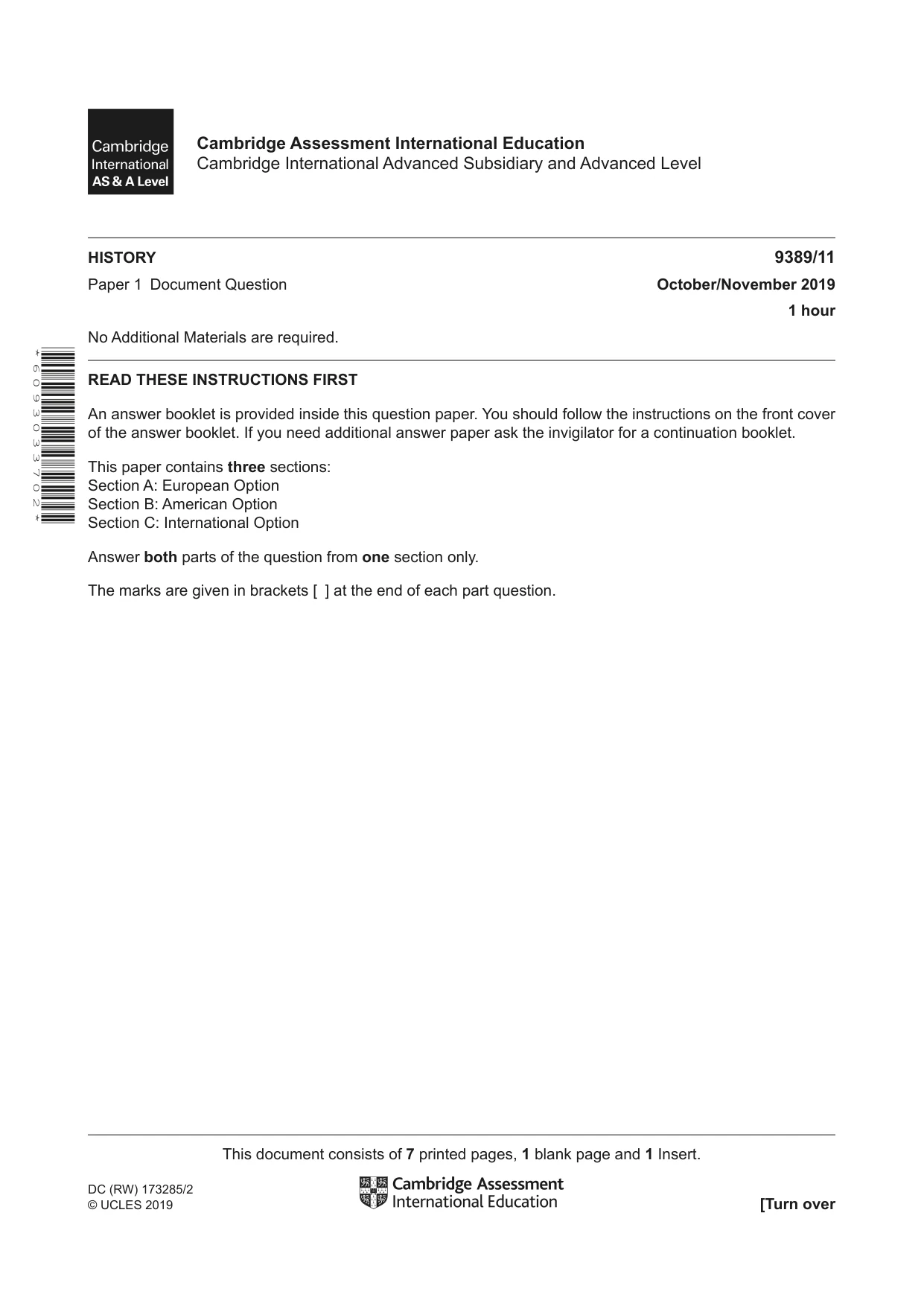
Question paper, page 1
This document consists of 7 printed pages, 1 blank page and 1 Insert. DC (RW) 173285/2 © UCLES 2019 [Turn over * 6 0 9 3 0 3 3 7 0 2 * HISTORY 9389/11 Paper 1 Document Question October/November 2019 1 hour No Additional Materials are required. READ THESE INSTRUCTIONS FIRST An answer booklet is provided inside this question paper. You should follow the instructions on the front cover of the answer booklet. If you need additional answer paper ask the invigilator for a continuation booklet. This paper contains three sections: Section A: European Option Section B: American Option Section C: International Option Answer both parts of the question from one section only. The marks are given in brackets [ ] at the end of each part question. Cambridge Assessment International Education Cambridge International Advanced Subsidiary and Advanced Level
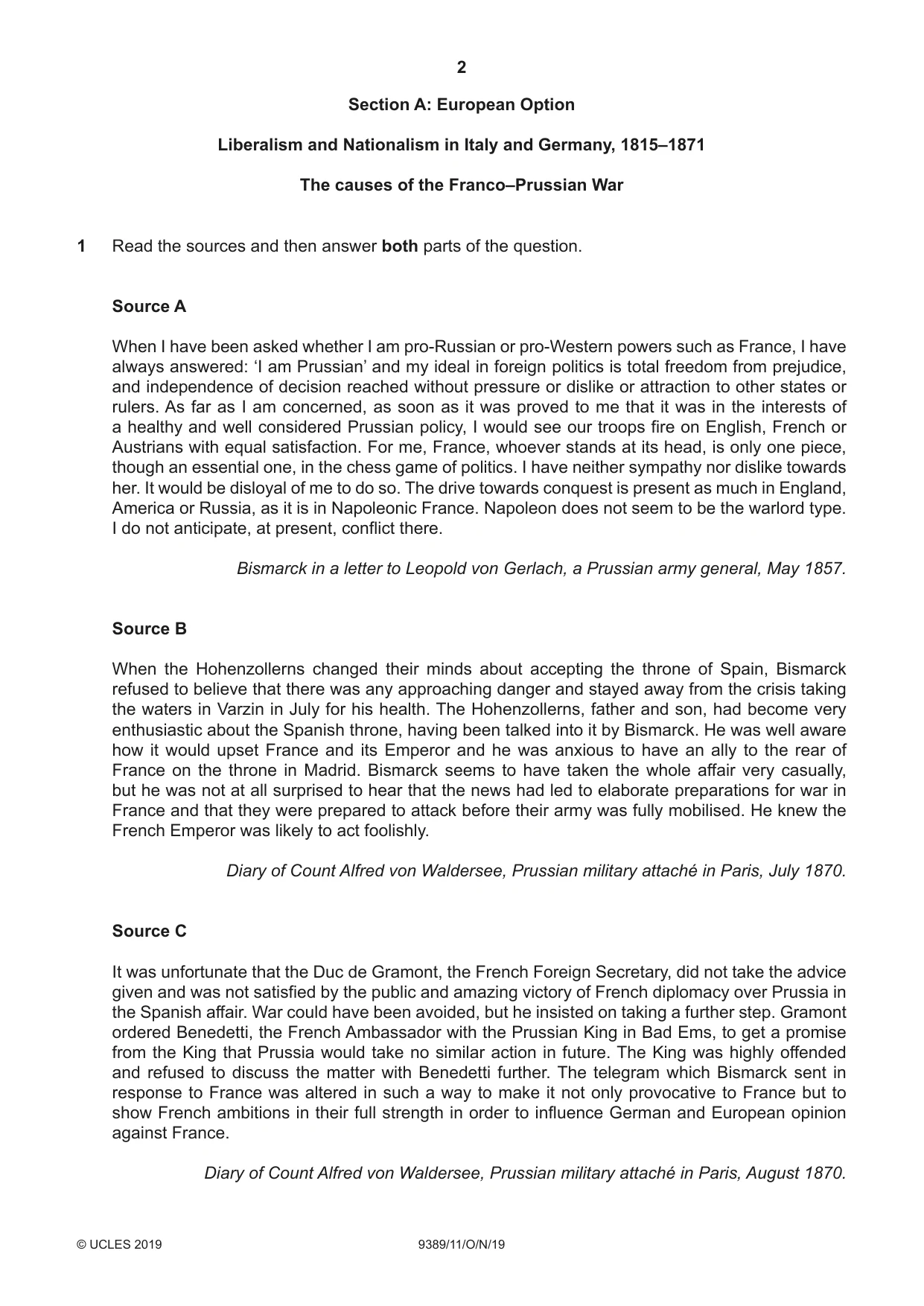
Question paper, page 2
2 9389/11/O/N/19 © UCLES 2019 Section A: European Option Liberalism and Nationalism in Italy and Germany, 1815–1871 The causes of the Franco–Prussian War 1 Read the sources and then answer both parts of the question. Source A When I have been asked whether I am pro‑Russian or pro‑Western powers such as France, I have always answered: ‘I am Prussian’ and my ideal in foreign politics is total freedom from prejudice, and independence of decision reached without pressure or dislike or attraction to other states or rulers. As far as I am concerned, as soon as it was proved to me that it was in the interests of a healthy and well considered Prussian policy, I would see our troops fire on English, French or Austrians with equal satisfaction. For me, France, whoever stands at its head, is only one piece, though an essential one, in the chess game of politics. I have neither sympathy nor dislike towards her. It would be disloyal of me to do so. The drive towards conquest is present as much in England, America or Russia, as it is in Napoleonic France. Napoleon does not seem to be the warlord type. I do not anticipate, at present, conflict there. Bismarck in a letter to Leopold von Gerlach, a Prussian army general, May 1857. Source B When the Hohenzollerns changed their minds about accepting the throne of Spain, Bismarck refused to believe that there was any approaching danger and stayed away from the crisis taking the waters in Varzin in July for his health. The Hohenzollerns, father and son, had become very enthusiastic about the Spanish throne, having been talked into it by Bismarck. He was well aware how it would upset France and its Emperor and he was anxious to have an ally to the rear of France on the throne in Madrid. Bismarck seems to have taken the whole affair very casually, but he was not at all surprised to hear that the news had led to elaborate preparations for war in France and that they were prepared to attack before their army was fully mobilised. He knew the French Emperor was likely to act foolishly. Diary of Count Alfred von Waldersee, Prussian military attaché in Paris, July 1870. Source C It was unfortunate that the Duc de Gramont, the French Foreign Secretary, did not take the advice given and was not satisfied by the public and amazing victory of French diplomacy over Prussia in the Spanish affair. War could have been avoided, but he insisted on taking a further step. Gramont ordered Benedetti, the French Ambassador with the Prussian King in Bad Ems, to get a promise from the King that Prussia would take no similar action in future. The King was highly offended and refused to discuss the matter with Benedetti further. The telegram which Bismarck sent in response to France was altered in such a way to make it not only provocative to France but to show French ambitions in their full strength in order to influence German and European opinion against France. Diary of Count Alfred von Waldersee, Prussian military attaché in Paris, August 1870.
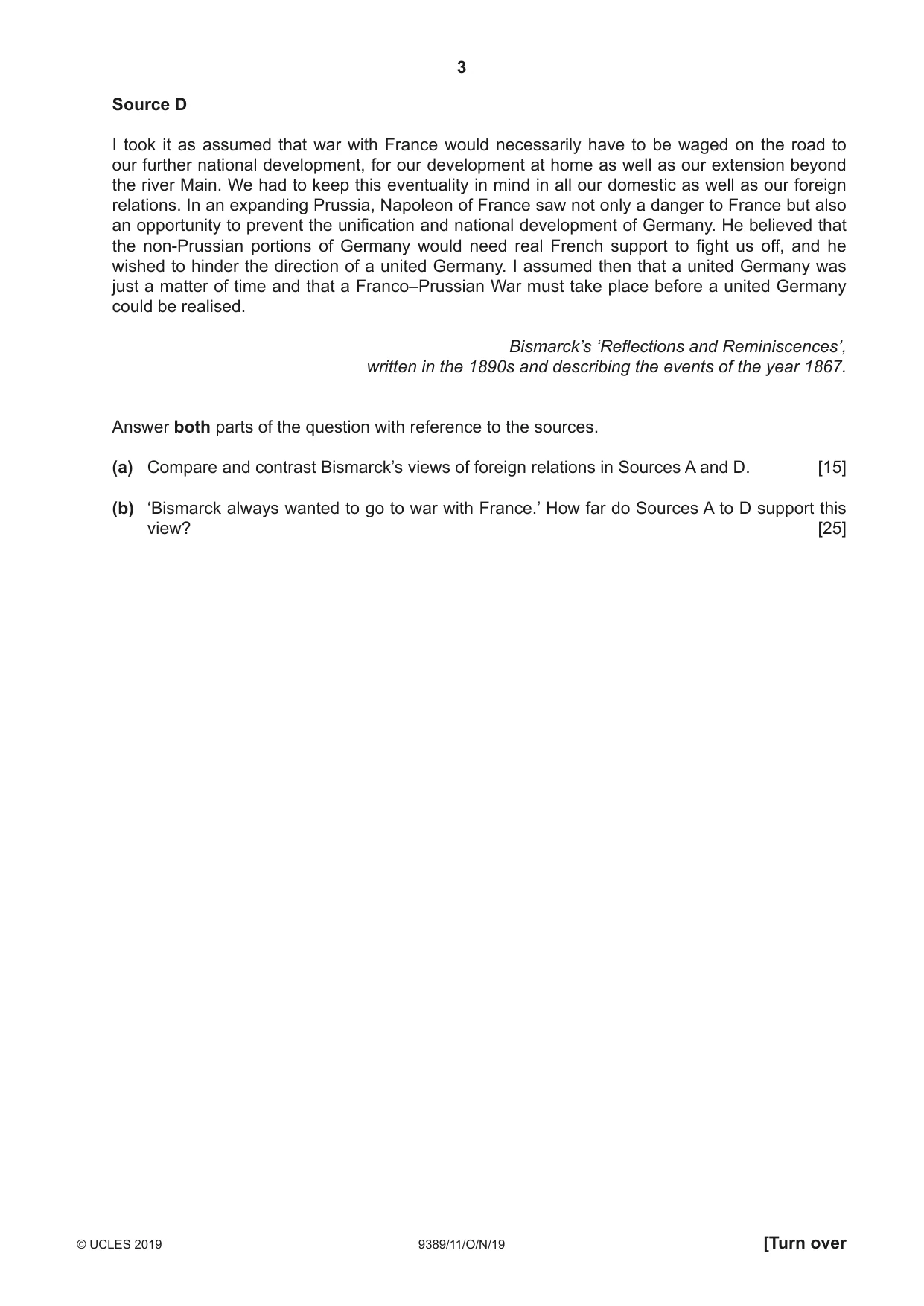
Question paper, page 3
3 9389/11/O/N/19 © UCLES 2019 [Turn over Source D I took it as assumed that war with France would necessarily have to be waged on the road to our further national development, for our development at home as well as our extension beyond the river Main. We had to keep this eventuality in mind in all our domestic as well as our foreign relations. In an expanding Prussia, Napoleon of France saw not only a danger to France but also an opportunity to prevent the unification and national development of Germany. He believed that the non‑Prussian portions of Germany would need real French support to fight us off, and he wished to hinder the direction of a united Germany. I assumed then that a united Germany was just a matter of time and that a Franco–Prussian War must take place before a united Germany could be realised. Bismarck’s ‘Reflections and Reminiscences’, written in the 1890s and describing the events of the year 1867. Answer both parts of the question with reference to the sources. (a) Compare and contrast Bismarck’s views of foreign relations in Sources A and D. [15] (b) ‘Bismarck always wanted to go to war with France.’ How far do Sources A to D support this view? [25]
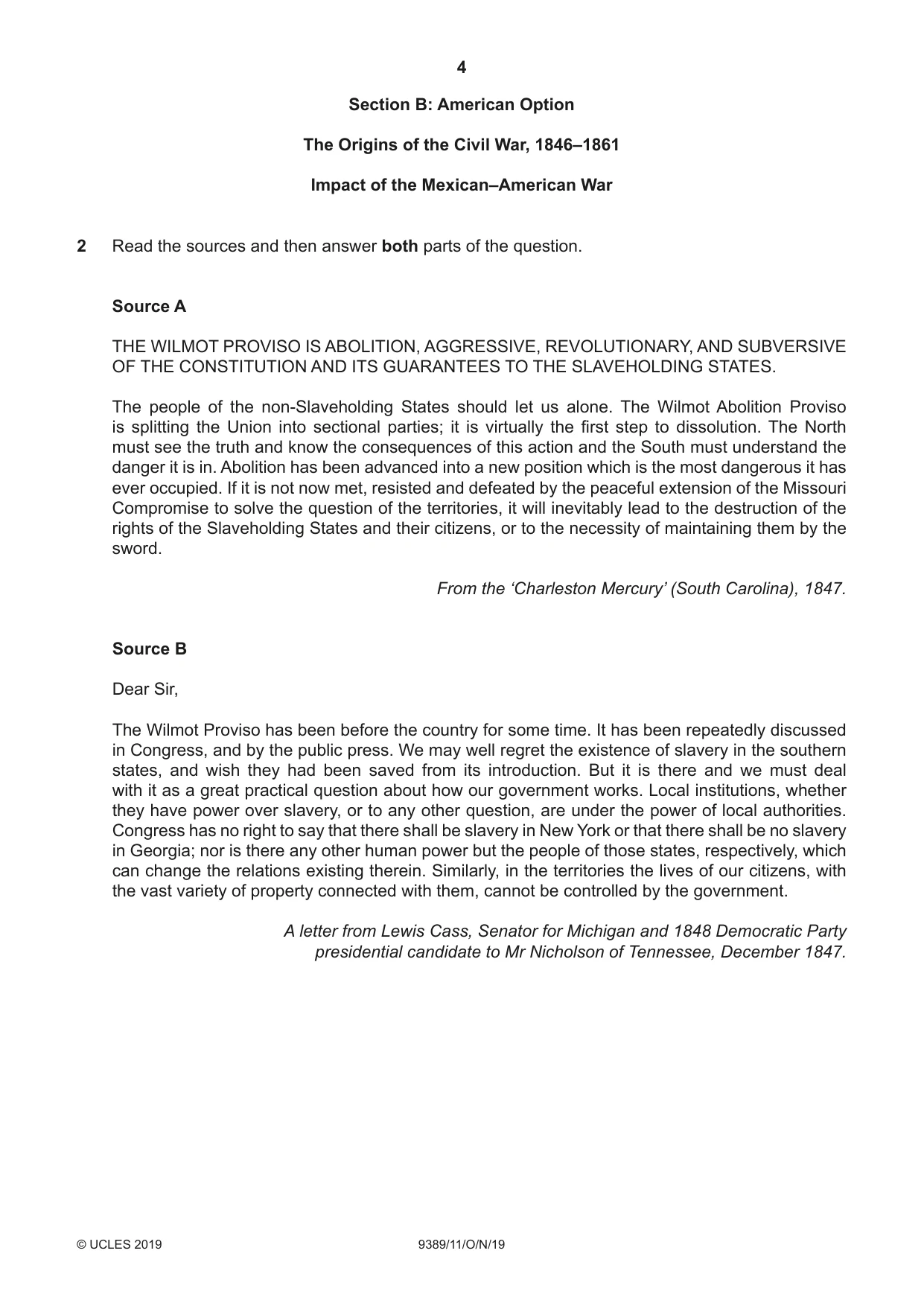
Question paper, page 4
4 9389/11/O/N/19 © UCLES 2019 Section B: American Option The Origins of the Civil War, 1846–1861 Impact of the Mexican–American War 2 Read the sources and then answer both parts of the question. Source A THE WILMOT PROVISO IS ABOLITION, AGGRESSIVE, REVOLUTIONARY, AND SUBVERSIVE OF THE CONSTITUTION AND ITS GUARANTEES TO THE SLAVEHOLDING STATES. The people of the non‑Slaveholding States should let us alone. The Wilmot Abolition Proviso is splitting the Union into sectional parties; it is virtually the first step to dissolution. The North must see the truth and know the consequences of this action and the South must understand the danger it is in. Abolition has been advanced into a new position which is the most dangerous it has ever occupied. If it is not now met, resisted and defeated by the peaceful extension of the Missouri Compromise to solve the question of the territories, it will inevitably lead to the destruction of the rights of the Slaveholding States and their citizens, or to the necessity of maintaining them by the sword. From the ‘Charleston Mercury’ (South Carolina), 1847. Source B Dear Sir, The Wilmot Proviso has been before the country for some time. It has been repeatedly discussed in Congress, and by the public press. We may well regret the existence of slavery in the southern states, and wish they had been saved from its introduction. But it is there and we must deal with it as a great practical question about how our government works. Local institutions, whether they have power over slavery, or to any other question, are under the power of local authorities. Congress has no right to say that there shall be slavery in New York or that there shall be no slavery in Georgia; nor is there any other human power but the people of those states, respectively, which can change the relations existing therein. Similarly, in the territories the lives of our citizens, with the vast variety of property connected with them, cannot be controlled by the government. A letter from Lewis Cass, Senator for Michigan and 1848 Democratic Party presidential candidate to Mr Nicholson of Tennessee, December 1847.
Question paper, page 5
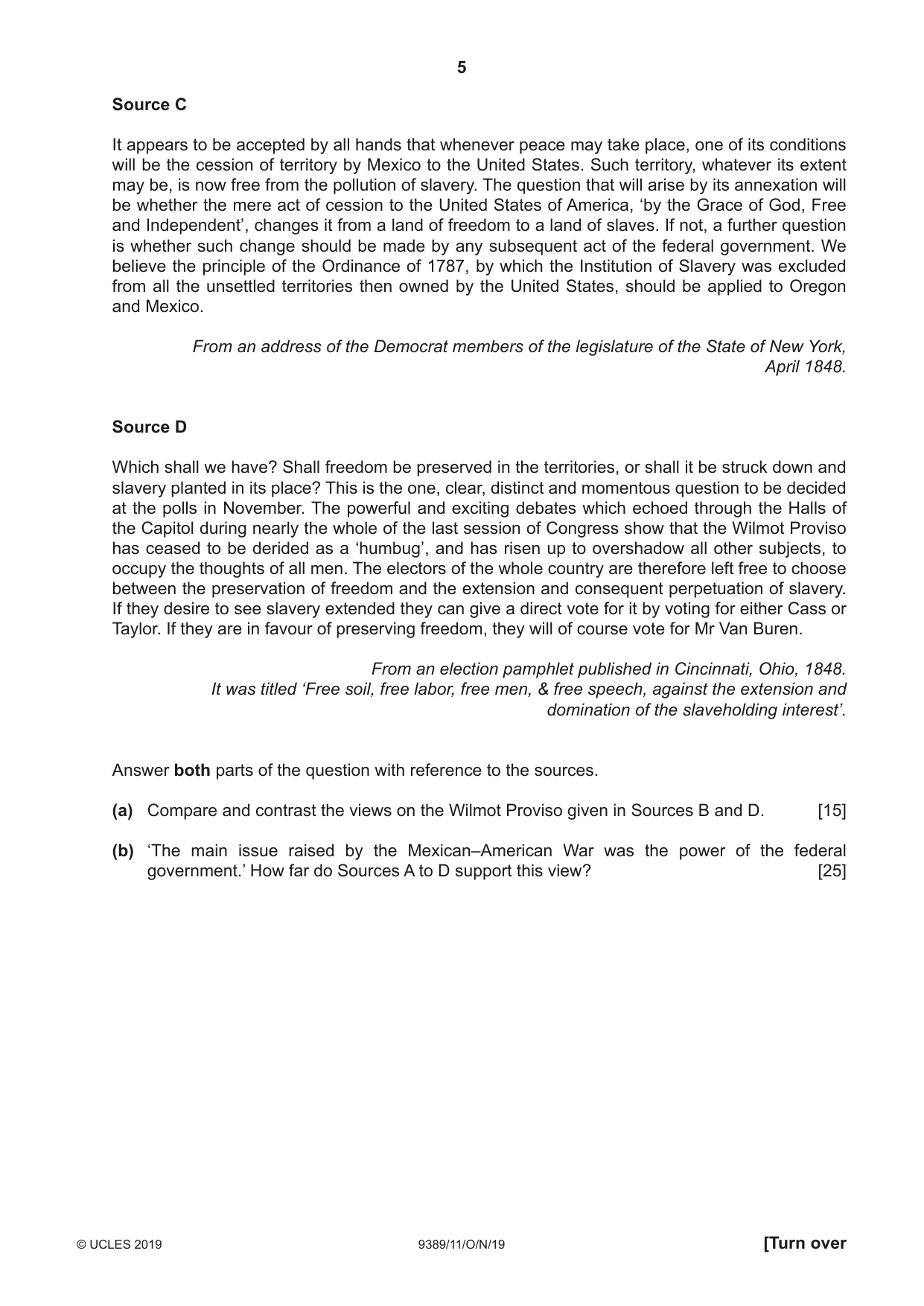
5 9389/11/O/N/19 © UCLES 2019 [Turn over Source C It appears to be accepted by all hands that whenever peace may take place, one of its conditions will be the cession of territory by Mexico to the United States. Such territory, whatever its extent may be, is now free from the pollution of slavery. The question that will arise by its annexation will be whether the mere act of cession to the United States of America, ‘by the Grace of God, Free and Independent’, changes it from a land of freedom to a land of slaves. If not, a further question is whether such change should be made by any subsequent act of the federal government. We believe the principle of the Ordinance of 1787, by which the Institution of Slavery was excluded from all the unsettled territories then owned by the United States, should be applied to Oregon and Mexico. From an address of the Democrat members of the legislature of the State of New York, April 1848. Source D Which shall we have? Shall freedom be preserved in the territories, or shall it be struck down and slavery planted in its place? This is the one, clear, distinct and momentous question to be decided at the polls in November. The powerful and exciting debates which echoed through the Halls of the Capitol during nearly the whole of the last session of Congress show that the Wilmot Proviso has ceased to be derided as a ‘humbug’, and has risen up to overshadow all other subjects, to occupy the thoughts of all men. The electors of the whole country are therefore left free to choose between the preservation of freedom and the extension and consequent perpetuation of slavery. If they desire to see slavery extended they can give a direct vote for it by voting for either Cass or Taylor. If they are in favour of preserving freedom, they will of course vote for Mr Van Buren. From an election pamphlet published in Cincinnati, Ohio, 1848. It was titled ‘Free soil, free labor, free men, & free speech, against the extension and domination of the slaveholding interest’. Answer both parts of the question with reference to the sources. (a) Compare and contrast the views on the Wilmot Proviso given in Sources B and D. [15] (b) ‘The main issue raised by the Mexican–American War was the power of the federal government.’ How far do Sources A to D support this view? [25]
Question paper, page 6
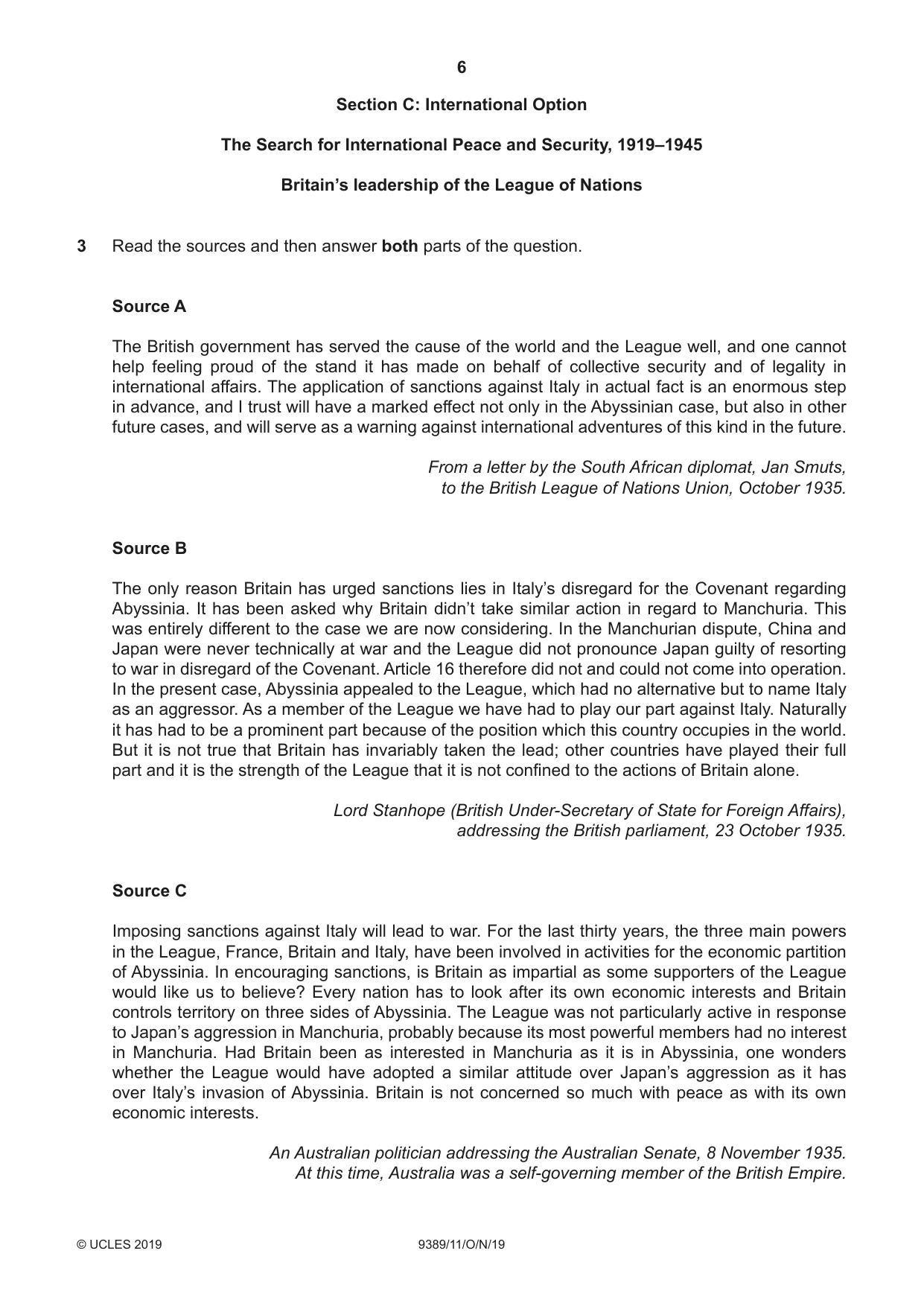
6 9389/11/O/N/19 © UCLES 2019 Section C: International Option The Search for International Peace and Security, 1919–1945 Britain’s leadership of the League of Nations 3 Read the sources and then answer both parts of the question. Source A The British government has served the cause of the world and the League well, and one cannot help feeling proud of the stand it has made on behalf of collective security and of legality in international affairs. The application of sanctions against Italy in actual fact is an enormous step in advance, and I trust will have a marked effect not only in the Abyssinian case, but also in other future cases, and will serve as a warning against international adventures of this kind in the future. From a letter by the South African diplomat, Jan Smuts, to the British League of Nations Union, October 1935. Source B The only reason Britain has urged sanctions lies in Italy’s disregard for the Covenant regarding Abyssinia. It has been asked why Britain didn’t take similar action in regard to Manchuria. This was entirely different to the case we are now considering. In the Manchurian dispute, China and Japan were never technically at war and the League did not pronounce Japan guilty of resorting to war in disregard of the Covenant. Article 16 therefore did not and could not come into operation. In the present case, Abyssinia appealed to the League, which had no alternative but to name Italy as an aggressor. As a member of the League we have had to play our part against Italy. Naturally it has had to be a prominent part because of the position which this country occupies in the world. But it is not true that Britain has invariably taken the lead; other countries have played their full part and it is the strength of the League that it is not confined to the actions of Britain alone. Lord Stanhope (British Under-Secretary of State for Foreign Affairs), addressing the British parliament, 23 October 1935. Source C Imposing sanctions against Italy will lead to war. For the last thirty years, the three main powers in the League, France, Britain and Italy, have been involved in activities for the economic partition of Abyssinia. In encouraging sanctions, is Britain as impartial as some supporters of the League would like us to believe? Every nation has to look after its own economic interests and Britain controls territory on three sides of Abyssinia. The League was not particularly active in response to Japan’s aggression in Manchuria, probably because its most powerful members had no interest in Manchuria. Had Britain been as interested in Manchuria as it is in Abyssinia, one wonders whether the League would have adopted a similar attitude over Japan’s aggression as it has over Italy’s invasion of Abyssinia. Britain is not concerned so much with peace as with its own economic interests. An Australian politician addressing the Australian Senate, 8 November 1935. At this time, Australia was a self-governing member of the British Empire.
Question paper, page 7
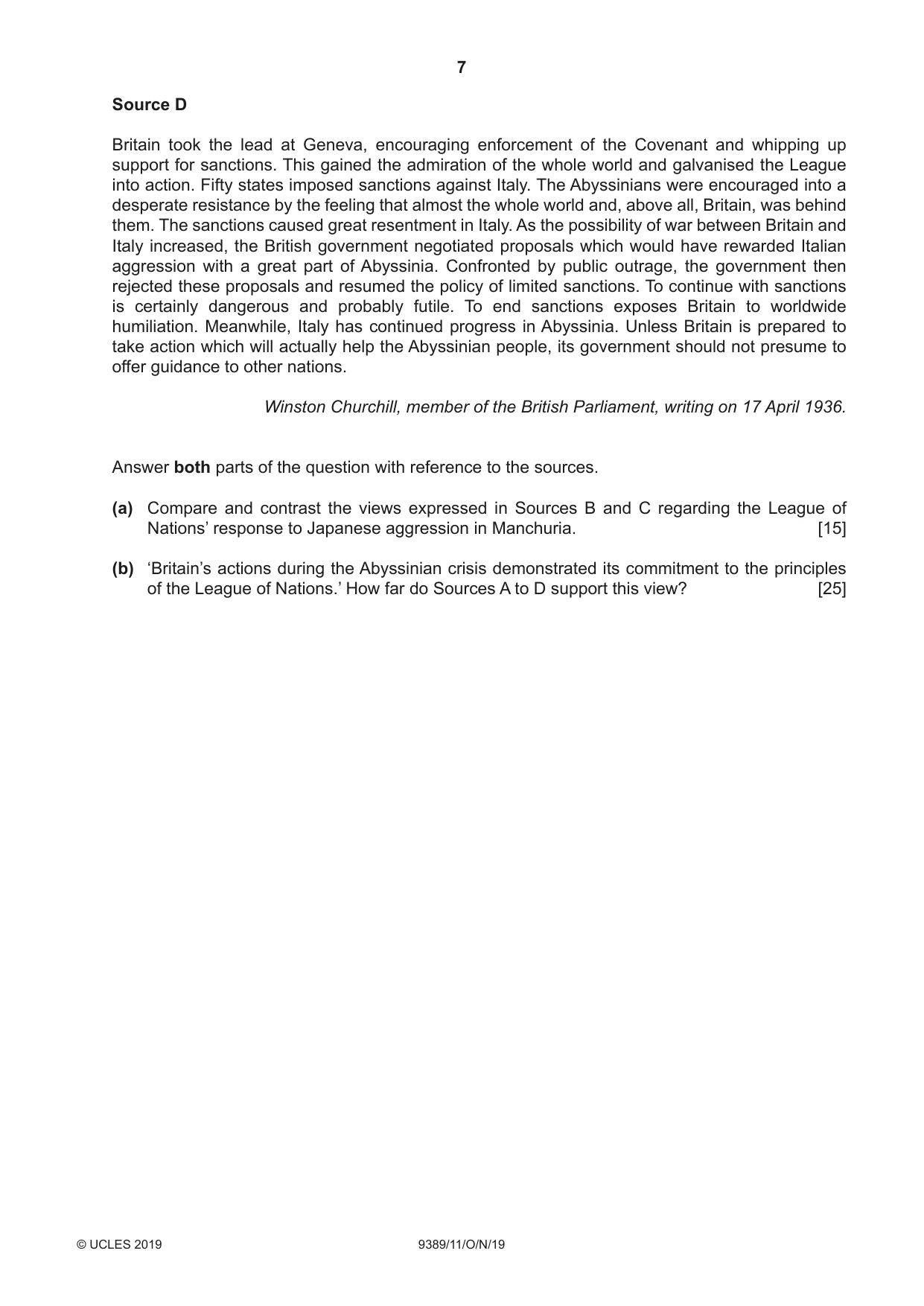
7 9389/11/O/N/19 © UCLES 2019 Source D Britain took the lead at Geneva, encouraging enforcement of the Covenant and whipping up support for sanctions. This gained the admiration of the whole world and galvanised the League into action. Fifty states imposed sanctions against Italy. The Abyssinians were encouraged into a desperate resistance by the feeling that almost the whole world and, above all, Britain, was behind them. The sanctions caused great resentment in Italy. As the possibility of war between Britain and Italy increased, the British government negotiated proposals which would have rewarded Italian aggression with a great part of Abyssinia. Confronted by public outrage, the government then rejected these proposals and resumed the policy of limited sanctions. To continue with sanctions is certainly dangerous and probably futile. To end sanctions exposes Britain to worldwide humiliation. Meanwhile, Italy has continued progress in Abyssinia. Unless Britain is prepared to take action which will actually help the Abyssinian people, its government should not presume to offer guidance to other nations. Winston Churchill, member of the British Parliament, writing on 17 April 1936. Answer both parts of the question with reference to the sources. (a) Compare and contrast the views expressed in Sources B and C regarding the League of Nations’ response to Japanese aggression in Manchuria. [15] (b) ‘Britain’s actions during the Abyssinian crisis demonstrated its commitment to the principles of the League of Nations.’ How far do Sources A to D support this view? [25]
Question paper, page 8
8 9389/11/O/N/19 © UCLES 2019 BLANK PAGE Permission to reproduce items where third‑party owned material protected by copyright is included has been sought and cleared where possible. Every reasonable effort has been made by the publisher (UCLES) to trace copyright holders, but if any items requiring clearance have unwittingly been included, the publisher will be pleased to make amends at the earliest possible opportunity. To avoid the issue of disclosure of answer‑related information to candidates, all copyright acknowledgements are reproduced online in the Cambridge Assessment International Education Copyright Acknowledgements Booklet. This is produced for each series of examinations and is freely available to download at www.cambridgeinternational.org after the live examination series. Cambridge Assessment International Education is part of the Cambridge Assessment Group. Cambridge Assessment is the brand name of the University of Cambridge Local Examinations Syndicate (UCLES), which itself is a department of the University of Cambridge.
Mark scheme, page 1
This document consists of 11 printed pages. © UCLES 2019 [Turn over Cambridge Assessment International Education Cambridge International Advanced Subsidiary and Advanced Level HISTORY 9389/11 Paper 1 Document Question October/November 2019 MARK SCHEME Maximum Mark: 40 Published This mark scheme is published as an aid to teachers and candidates, to indicate the requirements of the examination. It shows the basis on which Examiners were instructed to award marks. It does not indicate the details of the discussions that took place at an Examiners’ meeting before marking began, which would have considered the acceptability of alternative answers. Mark schemes should be read in conjunction with the question paper and the Principal Examiner Report for Teachers. Cambridge International will not enter into discussions about these mark schemes. Cambridge International is publishing the mark schemes for the October/November 2019 series for most Cambridge IGCSE™, Cambridge International A and AS Level components and some Cambridge O Level components.
Mark scheme, page 2
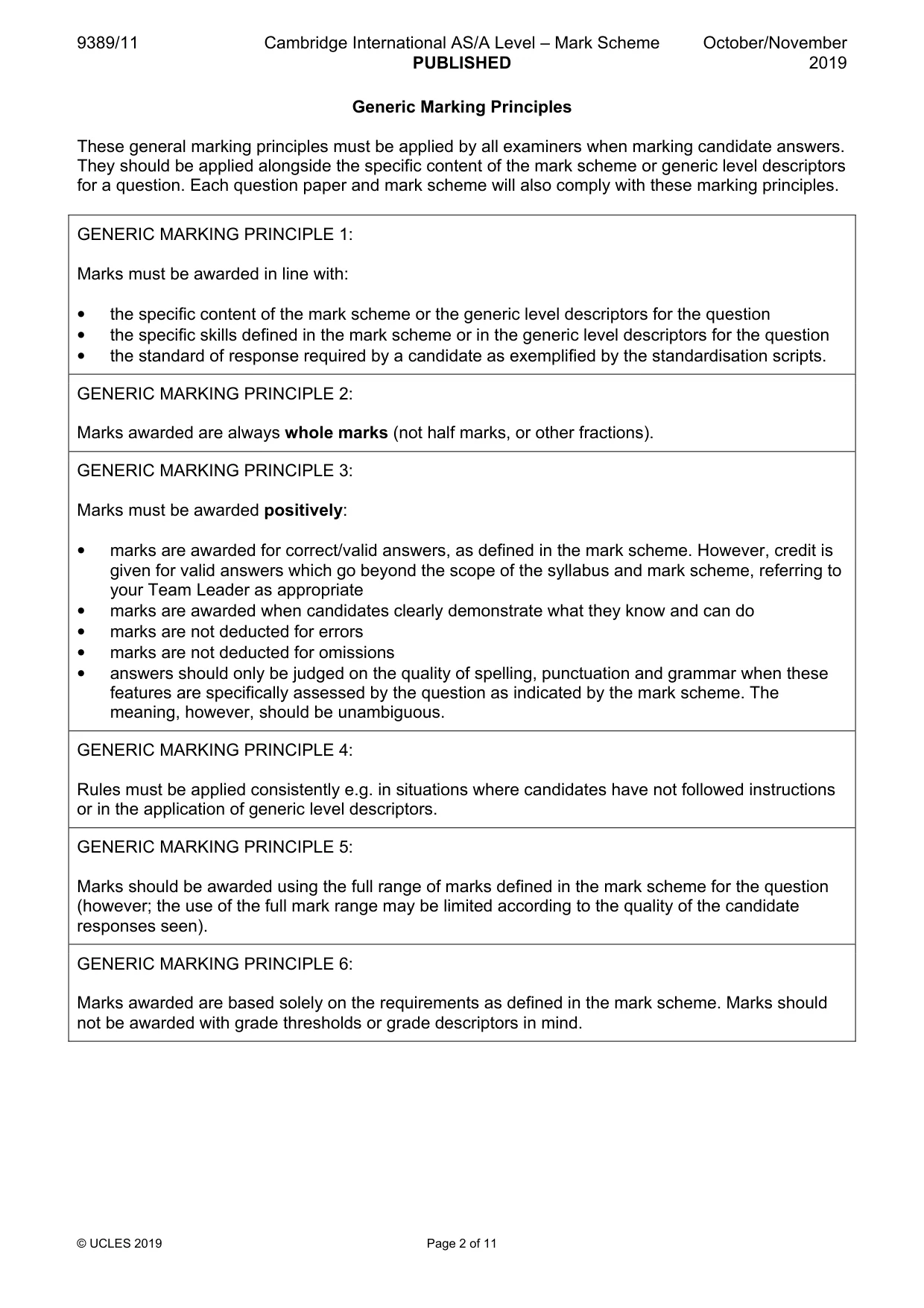
9389/11 Cambridge International AS/A Level – Mark Scheme PUBLISHED October/November 2019 © UCLES 2019 Page 2 of 11 Generic Marking Principles These general marking principles must be applied by all examiners when marking candidate answers. They should be applied alongside the specific content of the mark scheme or generic level descriptors for a question. Each question paper and mark scheme will also comply with these marking principles. GENERIC MARKING PRINCIPLE 1: Marks must be awarded in line with: • the specific content of the mark scheme or the generic level descriptors for the question • the specific skills defined in the mark scheme or in the generic level descriptors for the question • the standard of response required by a candidate as exemplified by the standardisation scripts. GENERIC MARKING PRINCIPLE 2: Marks awarded are always whole marks (not half marks, or other fractions). GENERIC MARKING PRINCIPLE 3: Marks must be awarded positively: • marks are awarded for correct/valid answers, as defined in the mark scheme. However, credit is given for valid answers which go beyond the scope of the syllabus and mark scheme, referring to your Team Leader as appropriate • marks are awarded when candidates clearly demonstrate what they know and can do • marks are not deducted for errors • marks are not deducted for omissions • answers should only be judged on the quality of spelling, punctuation and grammar when these features are specifically assessed by the question as indicated by the mark scheme. The meaning, however, should be unambiguous. GENERIC MARKING PRINCIPLE 4: Rules must be applied consistently e.g. in situations where candidates have not followed instructions or in the application of generic level descriptors. GENERIC MARKING PRINCIPLE 5: Marks should be awarded using the full range of marks defined in the mark scheme for the question (however; the use of the full mark range may be limited according to the quality of the candidate responses seen). GENERIC MARKING PRINCIPLE 6: Marks awarded are based solely on the requirements as defined in the mark scheme. Marks should not be awarded with grade thresholds or grade descriptors in mind.
Mark scheme, page 3
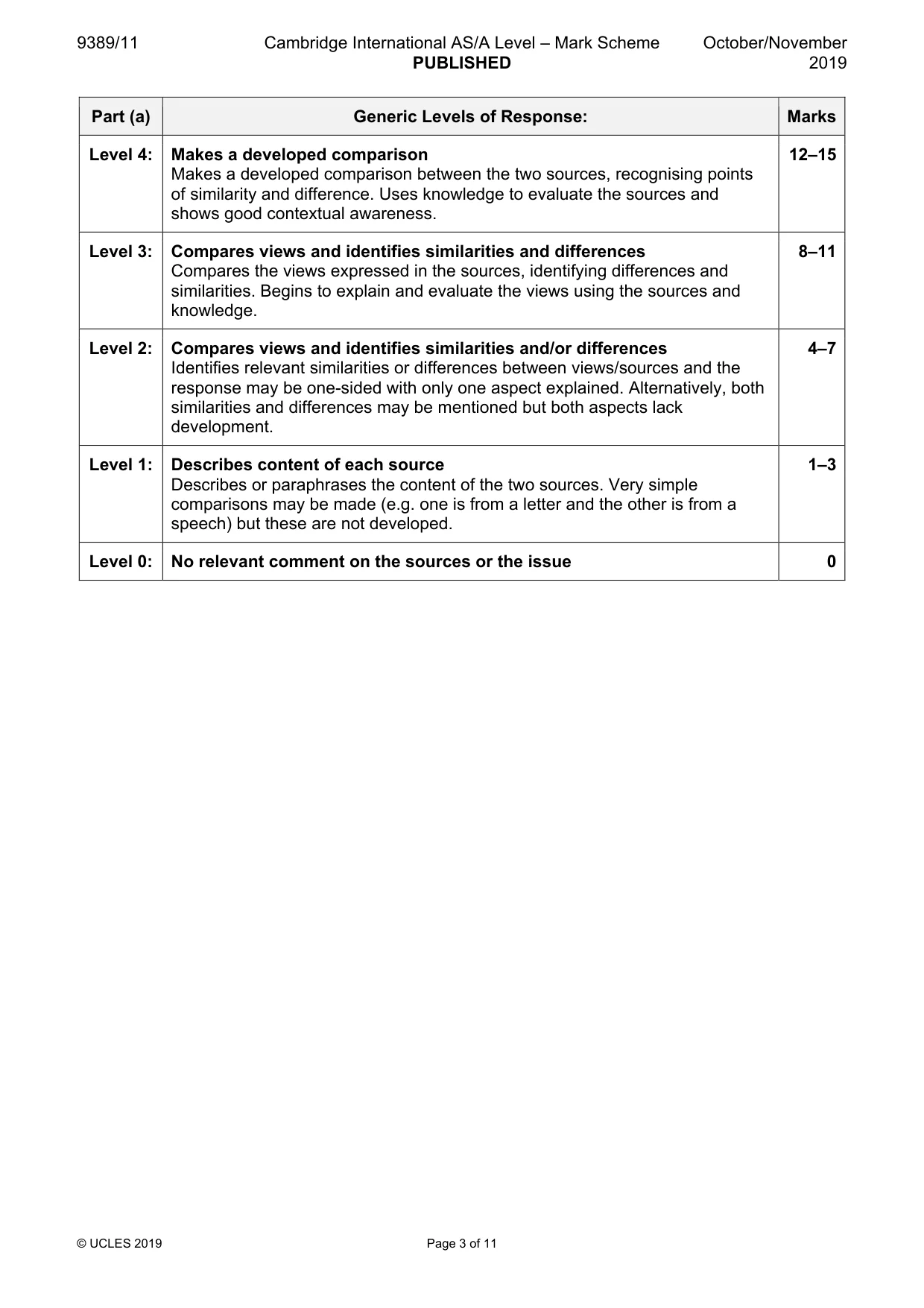
9389/11 Cambridge International AS/A Level – Mark Scheme PUBLISHED October/November 2019 © UCLES 2019 Page 3 of 11 Part (a) Generic Levels of Response: Marks Level 4: Makes a developed comparison Makes a developed comparison between the two sources, recognising points of similarity and difference. Uses knowledge to evaluate the sources and shows good contextual awareness. 12–15 Level 3: Compares views and identifies similarities and differences Compares the views expressed in the sources, identifying differences and similarities. Begins to explain and evaluate the views using the sources and knowledge. 8–11 Level 2: Compares views and identifies similarities and/or differences Identifies relevant similarities or differences between views/sources and the response may be one-sided with only one aspect explained. Alternatively, both similarities and differences may be mentioned but both aspects lack development. 4–7 Level 1: Describes content of each source Describes or paraphrases the content of the two sources. Very simple comparisons may be made (e.g. one is from a letter and the other is from a speech) but these are not developed. 1–3 Level 0: No relevant comment on the sources or the issue 0
Mark scheme, page 4
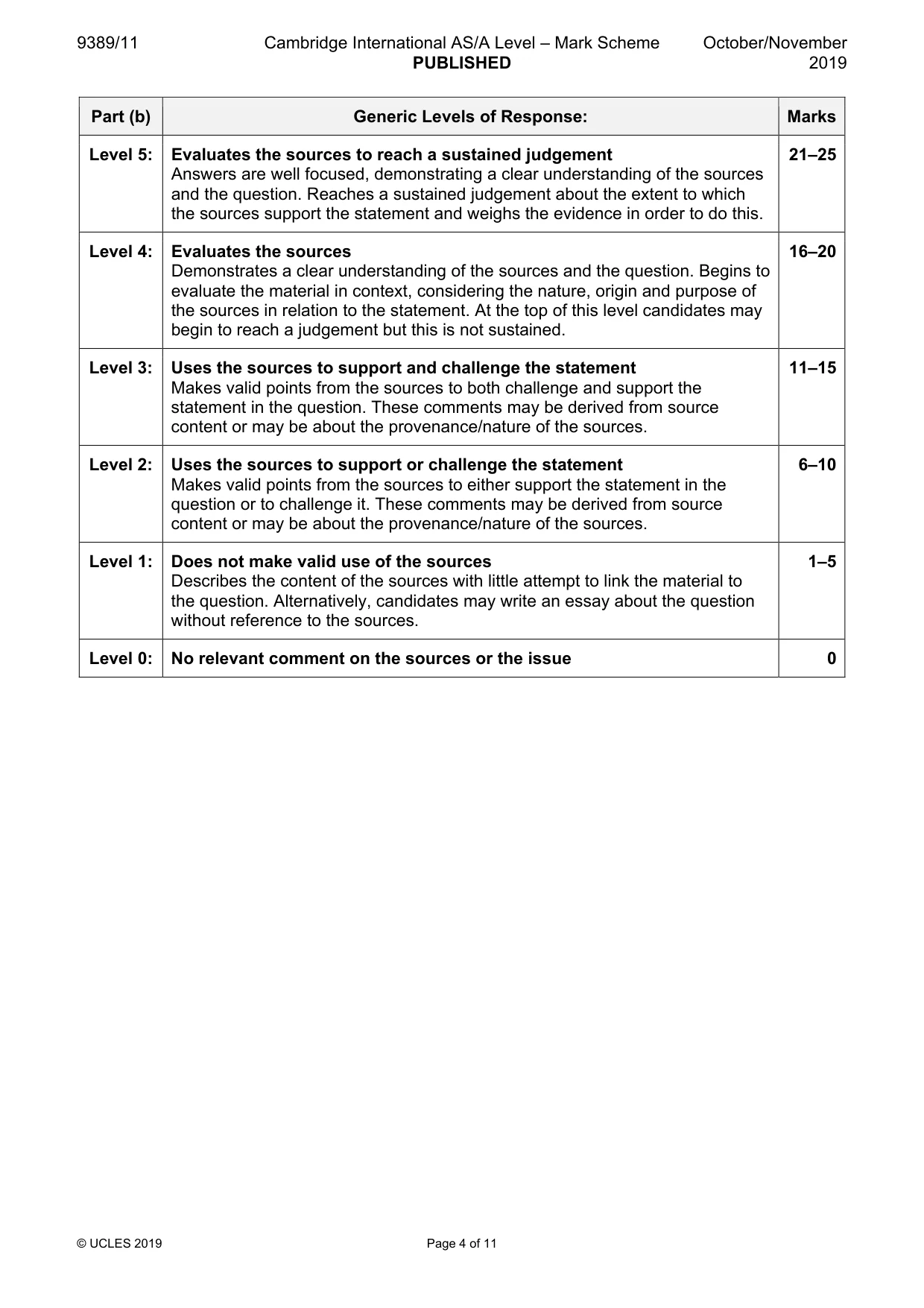
9389/11 Cambridge International AS/A Level – Mark Scheme PUBLISHED October/November 2019 © UCLES 2019 Page 4 of 11 Part (b) Generic Levels of Response: Marks Level 5: Evaluates the sources to reach a sustained judgement Answers are well focused, demonstrating a clear understanding of the sources and the question. Reaches a sustained judgement about the extent to which the sources support the statement and weighs the evidence in order to do this. 21–25 Level 4: Evaluates the sources Demonstrates a clear understanding of the sources and the question. Begins to evaluate the material in context, considering the nature, origin and purpose of the sources in relation to the statement. At the top of this level candidates may begin to reach a judgement but this is not sustained. 16–20 Level 3: Uses the sources to support and challenge the statement Makes valid points from the sources to both challenge and support the statement in the question. These comments may be derived from source content or may be about the provenance/nature of the sources. 11–15 Level 2: Uses the sources to support or challenge the statement Makes valid points from the sources to either support the statement in the question or to challenge it. These comments may be derived from source content or may be about the provenance/nature of the sources. 6–10 Level 1: Does not make valid use of the sources Describes the content of the sources with little attempt to link the material to the question. Alternatively, candidates may write an essay about the question without reference to the sources. 1–5 Level 0: No relevant comment on the sources or the issue 0
Mark scheme, page 5
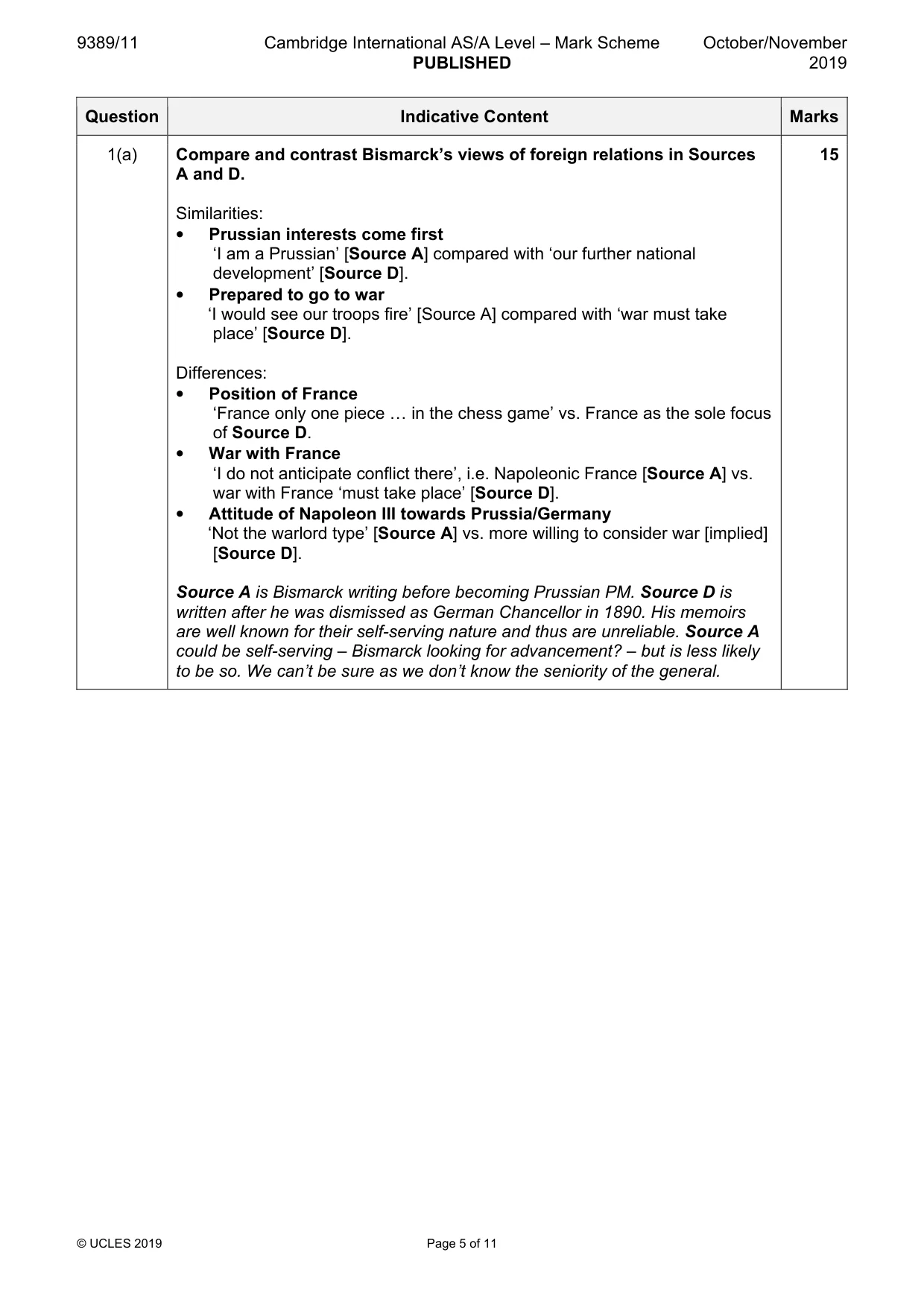
9389/11 Cambridge International AS/A Level – Mark Scheme PUBLISHED October/November 2019 © UCLES 2019 Page 5 of 11 Question Indicative Content Marks 1(a) Compare and contrast Bismarck’s views of foreign relations in Sources A and D. Similarities: • Prussian interests come first ‘I am a Prussian’ [Source A] compared with ‘our further national development’ [Source D]. • Prepared to go to war ‘I would see our troops fire’ [Source A] compared with ‘war must take place’ [Source D]. Differences: • Position of France ‘France only one piece « in the chess game’ vs. France as the sole focus of Source D. • War with France ‘I do not anticipate conflict there’, i.e. Napoleonic France [Source A] vs. war with France ‘must take place’ [Source D]. • Attitude of Napoleon III towards Prussia/Germany ‘Not the warlord type’ [Source A] vs. more willing to consider war [implied] [Source D]. Source A is Bismarck writing before becoming Prussian PM. Source D is written after he was dismissed as German Chancellor in 1890. His memoirs are well known for their self-serving nature and thus are unreliable. Source A could be self-serving – Bismarck looking for advancement? – but is less likely to be so. We can’t be sure as we don’t know the seniority of the general. 15
Mark scheme, page 6
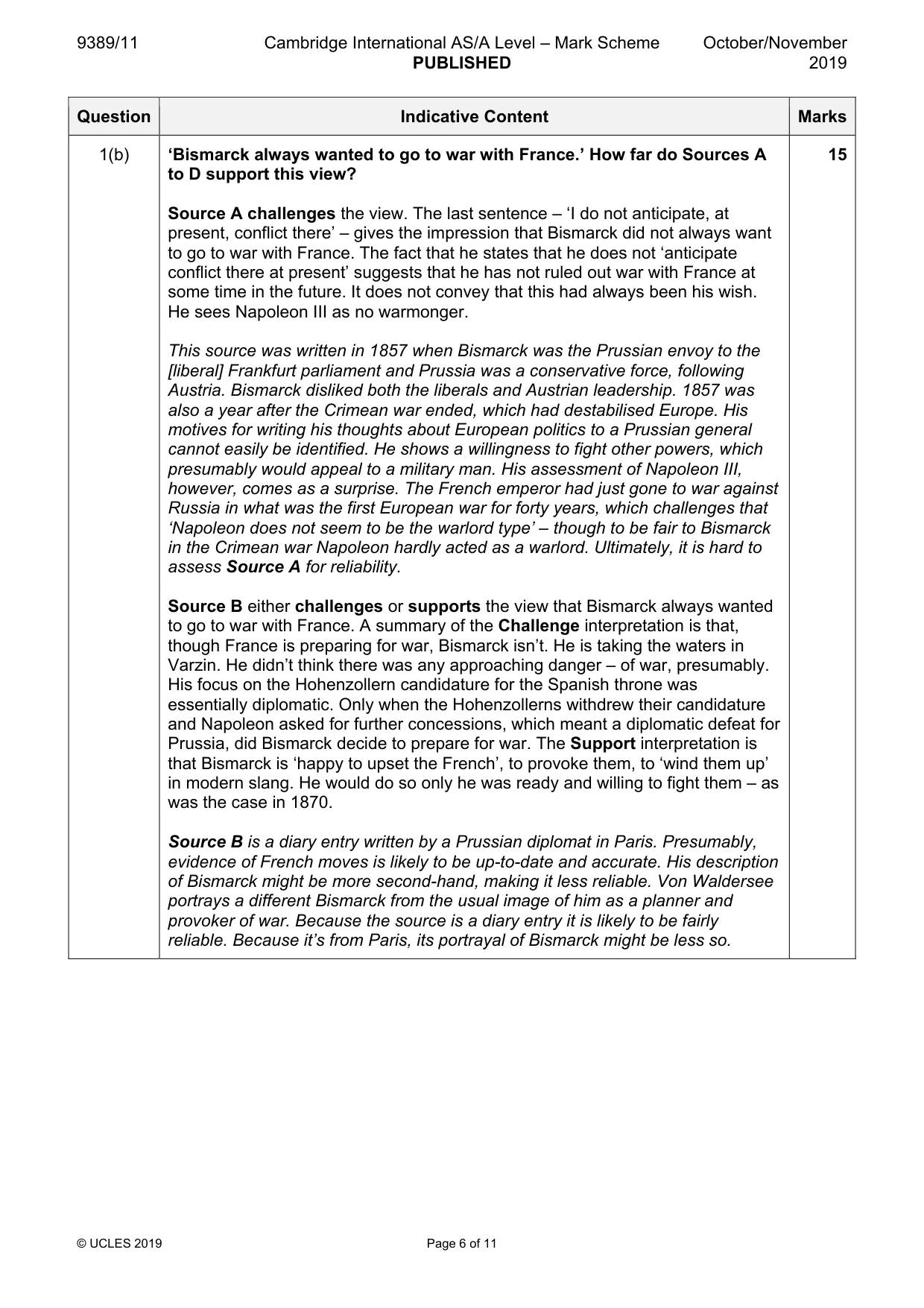
9389/11 Cambridge International AS/A Level – Mark Scheme PUBLISHED October/November 2019 © UCLES 2019 Page 6 of 11 Question Indicative Content Marks 1(b) ‘Bismarck always wanted to go to war with France.’ How far do Sources A to D support this view? Source A challenges the view. The last sentence – ‘I do not anticipate, at present, conflict there’ – gives the impression that Bismarck did not always want to go to war with France. The fact that he states that he does not ‘anticipate conflict there at present’ suggests that he has not ruled out war with France at some time in the future. It does not convey that this had always been his wish. He sees Napoleon III as no warmonger. This source was written in 1857 when Bismarck was the Prussian envoy to the [liberal] Frankfurt parliament and Prussia was a conservative force, following Austria. Bismarck disliked both the liberals and Austrian leadership. 1857 was also a year after the Crimean war ended, which had destabilised Europe. His motives for writing his thoughts about European politics to a Prussian general cannot easily be identified. He shows a willingness to fight other powers, which presumably would appeal to a military man. His assessment of Napoleon III, however, comes as a surprise. The French emperor had just gone to war against Russia in what was the first European war for forty years, which challenges that ‘Napoleon does not seem to be the warlord type’ – though to be fair to Bismarck in the Crimean war Napoleon hardly acted as a warlord. Ultimately, it is hard to assess Source A for reliability. Source B either challenges or supports the view that Bismarck always wanted to go to war with France. A summary of the Challenge interpretation is that, though France is preparing for war, Bismarck isn’t. He is taking the waters in Varzin. He didn’t think there was any approaching danger – of war, presumably. His focus on the Hohenzollern candidature for the Spanish throne was essentially diplomatic. Only when the Hohenzollerns withdrew their candidature and Napoleon asked for further concessions, which meant a diplomatic defeat for Prussia, did Bismarck decide to prepare for war. The Support interpretation is that Bismarck is ‘happy to upset the French’, to provoke them, to ‘wind them up’ in modern slang. He would do so only he was ready and willing to fight them – as was the case in 1870. Source B is a diary entry written by a Prussian diplomat in Paris. Presumably, evidence of French moves is likely to be up-to-date and accurate. His description of Bismarck might be more second-hand, making it less reliable. Von Waldersee portrays a different Bismarck from the usual image of him as a planner and provoker of war. Because the source is a diary entry it is likely to be fairly reliable. Because it’s from Paris, its portrayal of Bismarck might be less so. 15
Mark scheme, page 7
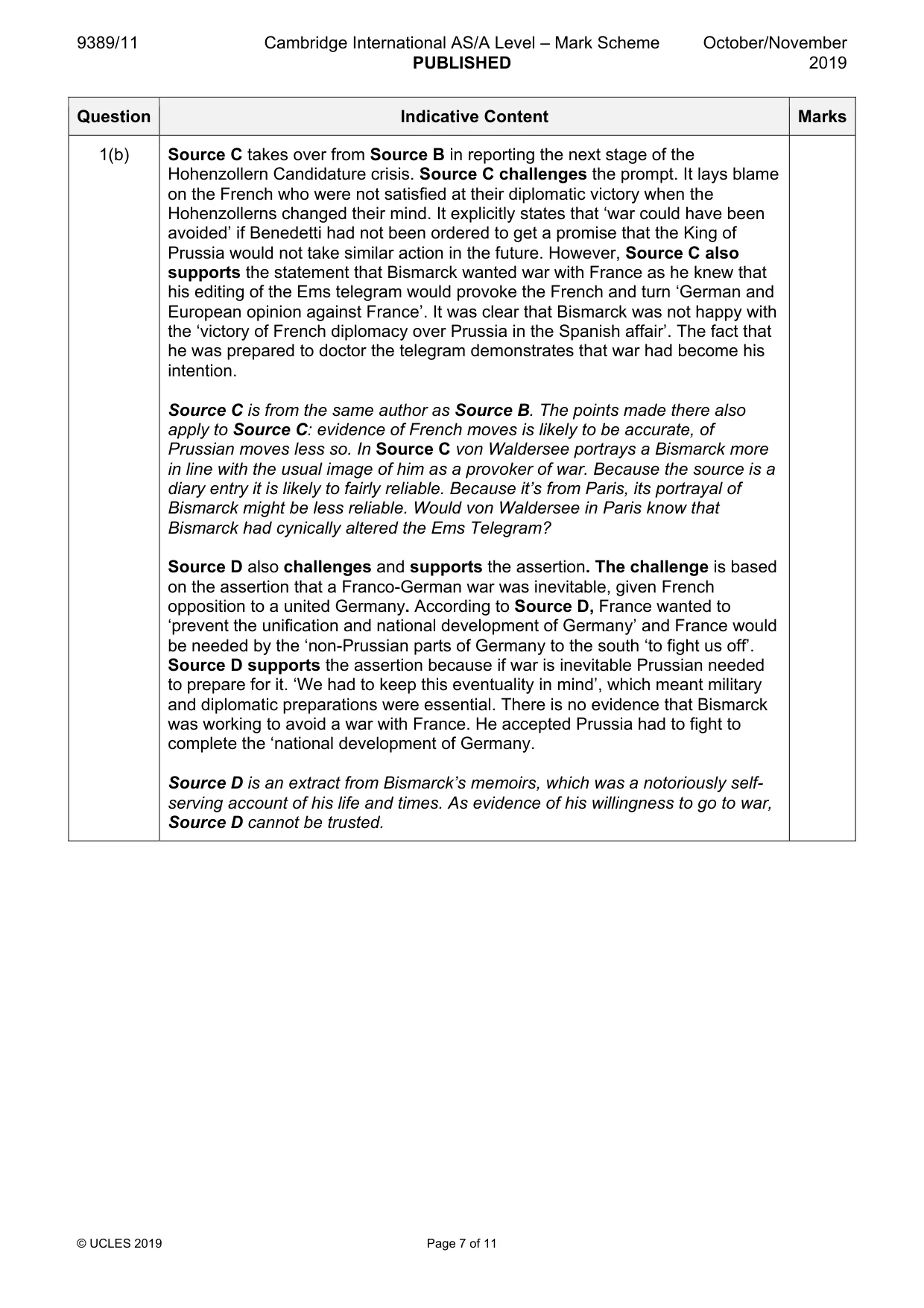
9389/11 Cambridge International AS/A Level – Mark Scheme PUBLISHED October/November 2019 © UCLES 2019 Page 7 of 11 Question Indicative Content Marks 1(b) Source C takes over from Source B in reporting the next stage of the Hohenzollern Candidature crisis. Source C challenges the prompt. It lays blame on the French who were not satisfied at their diplomatic victory when the Hohenzollerns changed their mind. It explicitly states that ‘war could have been avoided’ if Benedetti had not been ordered to get a promise that the King of Prussia would not take similar action in the future. However, Source C also supports the statement that Bismarck wanted war with France as he knew that his editing of the Ems telegram would provoke the French and turn ‘German and European opinion against France’. It was clear that Bismarck was not happy with the ‘victory of French diplomacy over Prussia in the Spanish affair’. The fact that he was prepared to doctor the telegram demonstrates that war had become his intention. Source C is from the same author as Source B. The points made there also apply to Source C: evidence of French moves is likely to be accurate, of Prussian moves less so. In Source C von Waldersee portrays a Bismarck more in line with the usual image of him as a provoker of war. Because the source is a diary entry it is likely to fairly reliable. Because it’s from Paris, its portrayal of Bismarck might be less reliable. Would von Waldersee in Paris know that Bismarck had cynically altered the Ems Telegram? Source D also challenges and supports the assertion. The challenge is based on the assertion that a Franco-German war was inevitable, given French opposition to a united Germany. According to Source D, France wanted to ‘prevent the unification and national development of Germany’ and France would be needed by the ‘non-Prussian parts of Germany to the south ‘to fight us off’. Source D supports the assertion because if war is inevitable Prussian needed to prepare for it. ‘We had to keep this eventuality in mind’, which meant military and diplomatic preparations were essential. There is no evidence that Bismarck was working to avoid a war with France. He accepted Prussia had to fight to complete the ‘national development of Germany. Source D is an extract from Bismarck’s memoirs, which was a notoriously self- serving account of his life and times. As evidence of his willingness to go to war, Source D cannot be trusted.
Mark scheme, page 8
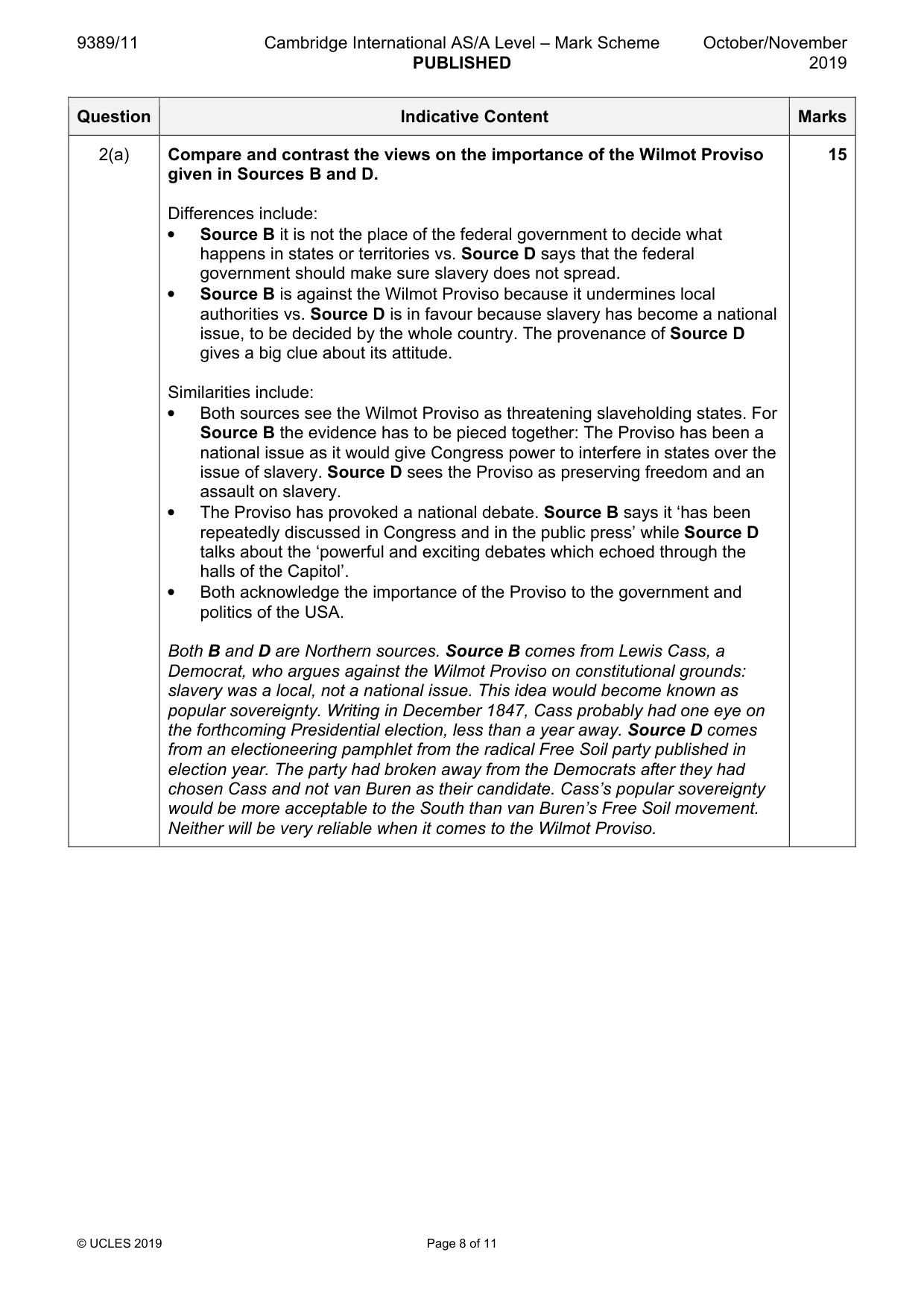
9389/11 Cambridge International AS/A Level – Mark Scheme PUBLISHED October/November 2019 © UCLES 2019 Page 8 of 11 Question Indicative Content Marks 2(a) Compare and contrast the views on the importance of the Wilmot Proviso given in Sources B and D. Differences include: • Source B it is not the place of the federal government to decide what happens in states or territories vs. Source D says that the federal government should make sure slavery does not spread. • Source B is against the Wilmot Proviso because it undermines local authorities vs. Source D is in favour because slavery has become a national issue, to be decided by the whole country. The provenance of Source D gives a big clue about its attitude. Similarities include: • Both sources see the Wilmot Proviso as threatening slaveholding states. For Source B the evidence has to be pieced together: The Proviso has been a national issue as it would give Congress power to interfere in states over the issue of slavery. Source D sees the Proviso as preserving freedom and an assault on slavery. • The Proviso has provoked a national debate. Source B says it ‘has been repeatedly discussed in Congress and in the public press’ while Source D talks about the ‘powerful and exciting debates which echoed through the halls of the Capitol’. • Both acknowledge the importance of the Proviso to the government and politics of the USA. Both B and D are Northern sources. Source B comes from Lewis Cass, a Democrat, who argues against the Wilmot Proviso on constitutional grounds: slavery was a local, not a national issue. This idea would become known as popular sovereignty. Writing in December 1847, Cass probably had one eye on the forthcoming Presidential election, less than a year away. Source D comes from an electioneering pamphlet from the radical Free Soil party published in election year. The party had broken away from the Democrats after they had chosen Cass and not van Buren as their candidate. Cass’s popular sovereignty would be more acceptable to the South than van Buren’s Free Soil movement. Neither will be very reliable when it comes to the Wilmot Proviso. 15
Mark scheme, page 9
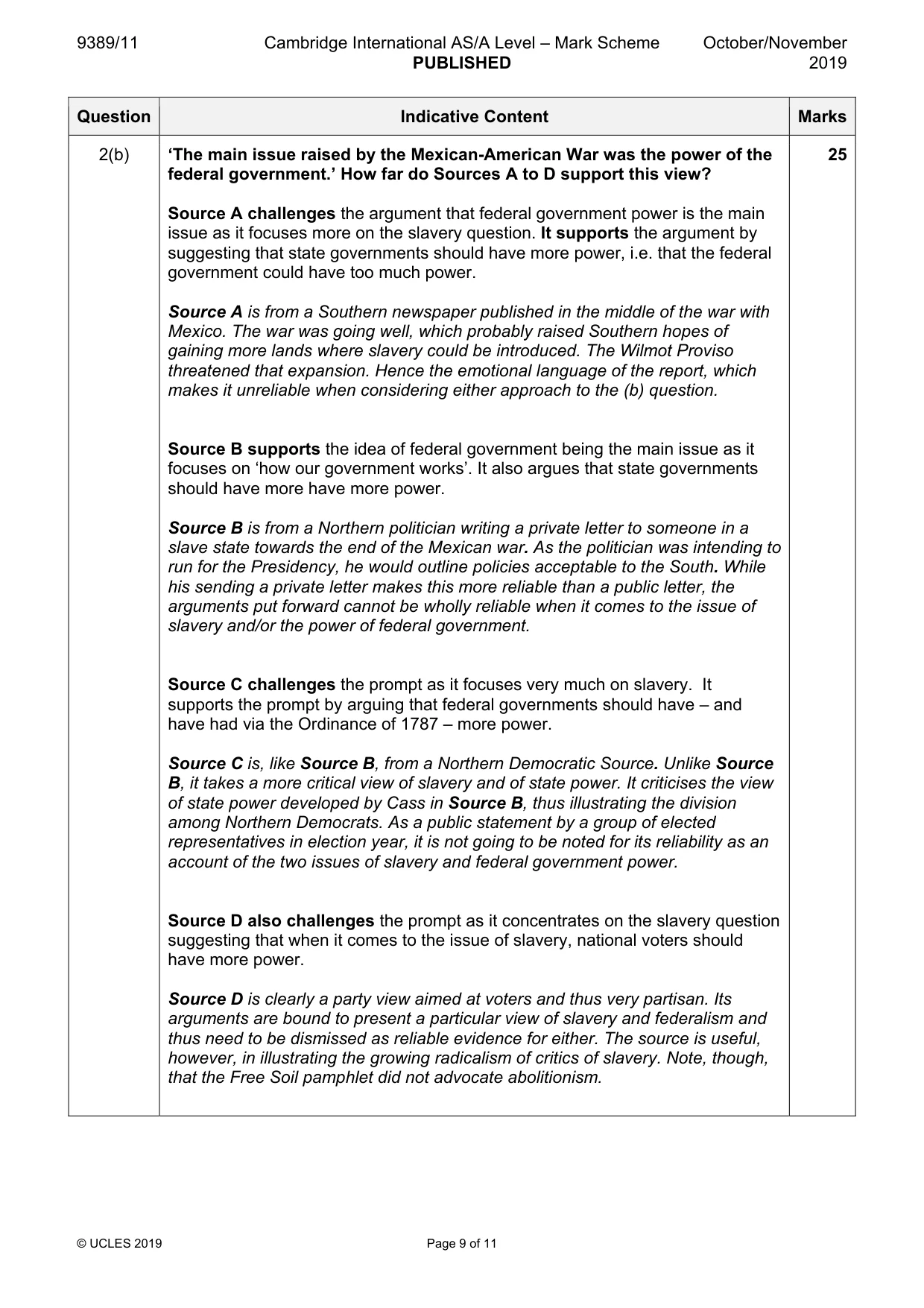
9389/11 Cambridge International AS/A Level – Mark Scheme PUBLISHED October/November 2019 © UCLES 2019 Page 9 of 11 Question Indicative Content Marks 2(b) ‘The main issue raised by the Mexican-American War was the power of the federal government.’ How far do Sources A to D support this view? Source A challenges the argument that federal government power is the main issue as it focuses more on the slavery question. It supports the argument by suggesting that state governments should have more power, i.e. that the federal government could have too much power. Source A is from a Southern newspaper published in the middle of the war with Mexico. The war was going well, which probably raised Southern hopes of gaining more lands where slavery could be introduced. The Wilmot Proviso threatened that expansion. Hence the emotional language of the report, which makes it unreliable when considering either approach to the (b) question. Source B supports the idea of federal government being the main issue as it focuses on ‘how our government works’. It also argues that state governments should have more have more power. Source B is from a Northern politician writing a private letter to someone in a slave state towards the end of the Mexican war. As the politician was intending to run for the Presidency, he would outline policies acceptable to the South. While his sending a private letter makes this more reliable than a public letter, the arguments put forward cannot be wholly reliable when it comes to the issue of slavery and/or the power of federal government. Source C challenges the prompt as it focuses very much on slavery. It supports the prompt by arguing that federal governments should have – and have had via the Ordinance of 1787 – more power. Source C is, like Source B, from a Northern Democratic Source. Unlike Source B, it takes a more critical view of slavery and of state power. It criticises the view of state power developed by Cass in Source B, thus illustrating the division among Northern Democrats. As a public statement by a group of elected representatives in election year, it is not going to be noted for its reliability as an account of the two issues of slavery and federal government power. Source D also challenges the prompt as it concentrates on the slavery question suggesting that when it comes to the issue of slavery, national voters should have more power. Source D is clearly a party view aimed at voters and thus very partisan. Its arguments are bound to present a particular view of slavery and federalism and thus need to be dismissed as reliable evidence for either. The source is useful, however, in illustrating the growing radicalism of critics of slavery. Note, though, that the Free Soil pamphlet did not advocate abolitionism. 25
Mark scheme, page 10
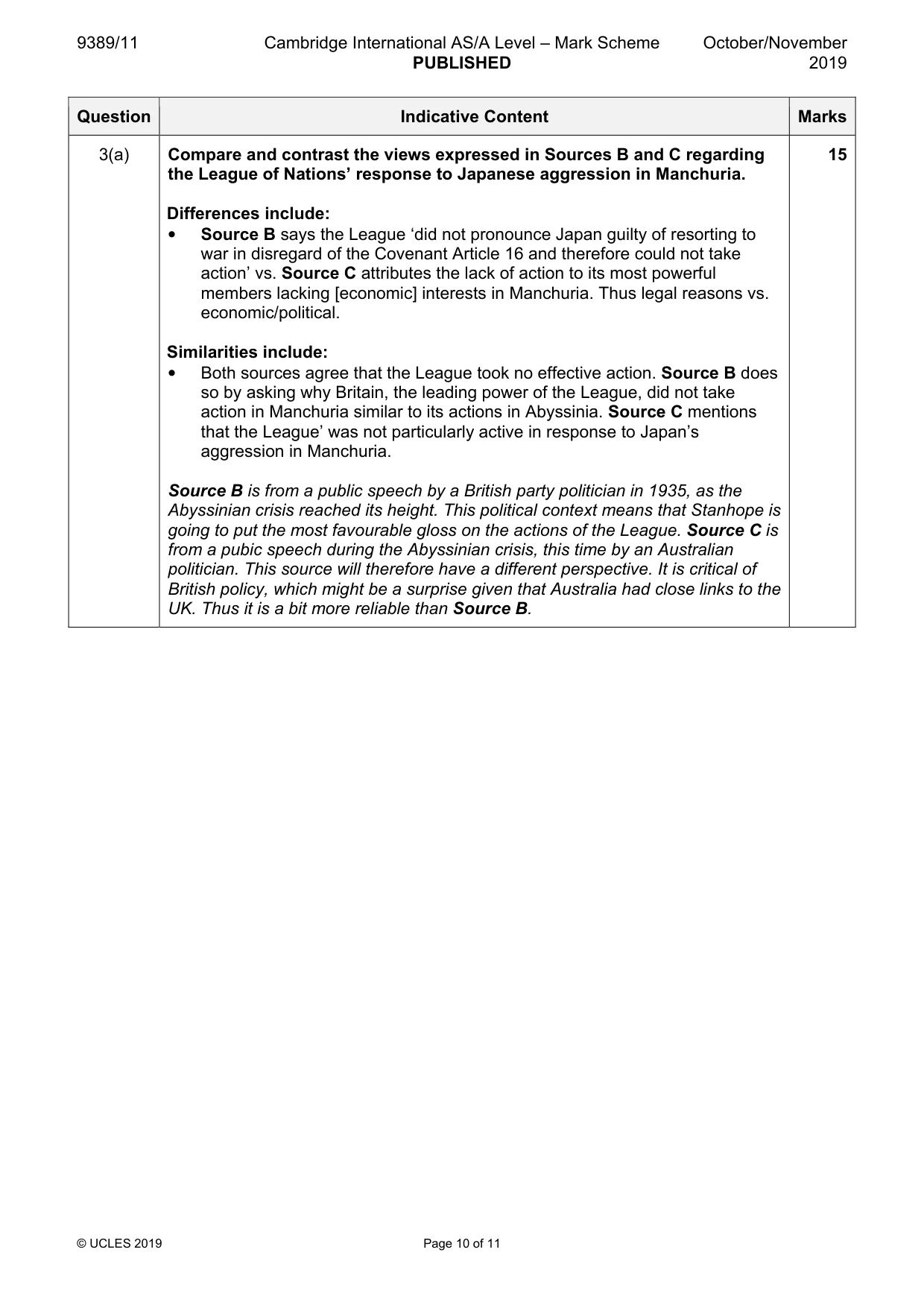
9389/11 Cambridge International AS/A Level – Mark Scheme PUBLISHED October/November 2019 © UCLES 2019 Page 10 of 11 Question Indicative Content Marks 3(a) Compare and contrast the views expressed in Sources B and C regarding the League of Nations’ response to Japanese aggression in Manchuria. Differences include: • Source B says the League ‘did not pronounce Japan guilty of resorting to war in disregard of the Covenant Article 16 and therefore could not take action’ vs. Source C attributes the lack of action to its most powerful members lacking [economic] interests in Manchuria. Thus legal reasons vs. economic/political. Similarities include: • Both sources agree that the League took no effective action. Source B does so by asking why Britain, the leading power of the League, did not take action in Manchuria similar to its actions in Abyssinia. Source C mentions that the League’ was not particularly active in response to Japan’s aggression in Manchuria. Source B is from a public speech by a British party politician in 1935, as the Abyssinian crisis reached its height. This political context means that Stanhope is going to put the most favourable gloss on the actions of the League. Source C is from a pubic speech during the Abyssinian crisis, this time by an Australian politician. This source will therefore have a different perspective. It is critical of British policy, which might be a surprise given that Australia had close links to the UK. Thus it is a bit more reliable than Source B. 15
Mark scheme, page 11
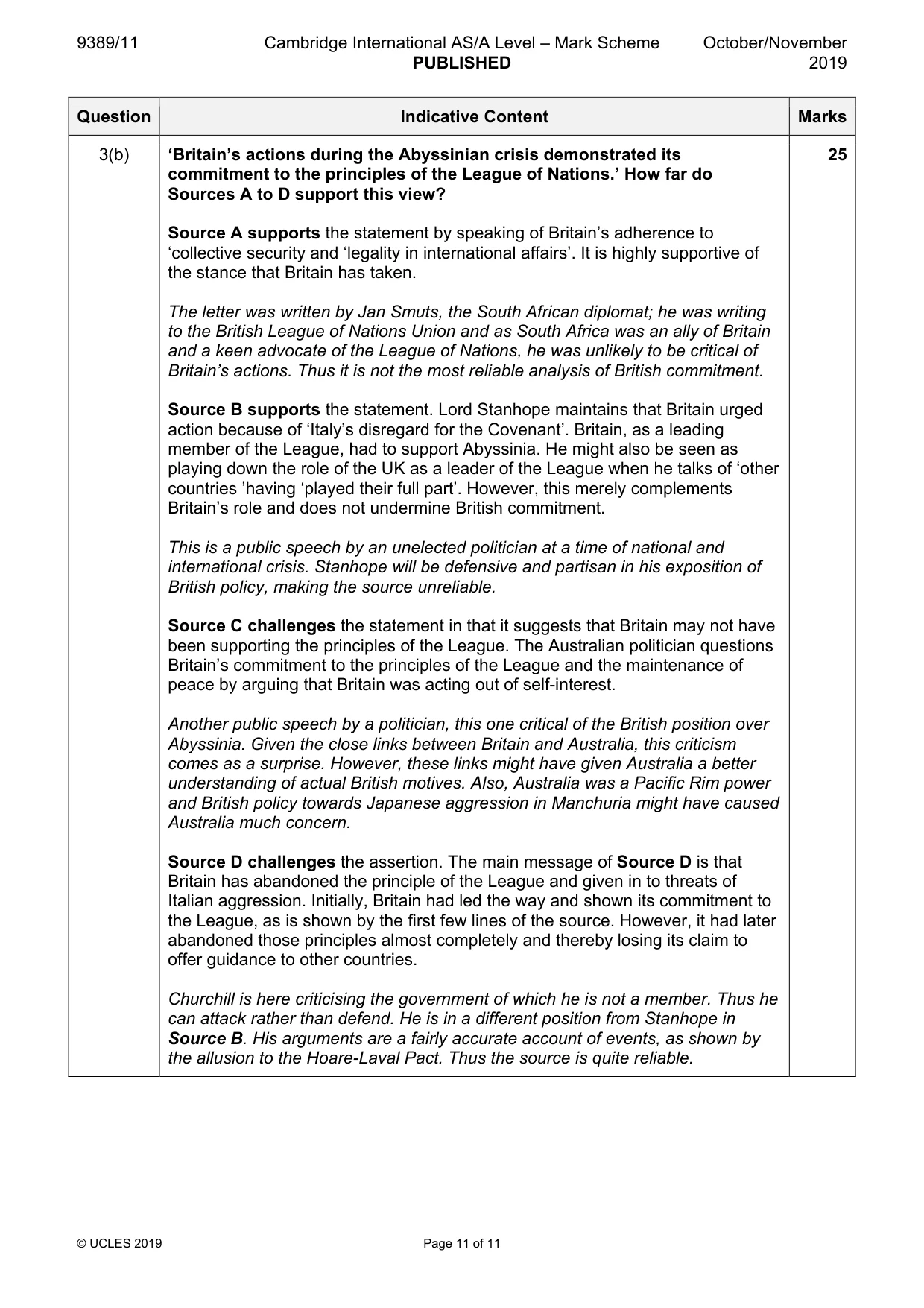
9389/11 Cambridge International AS/A Level – Mark Scheme PUBLISHED October/November 2019 © UCLES 2019 Page 11 of 11 Question Indicative Content Marks 3(b) ‘Britain’s actions during the Abyssinian crisis demonstrated its commitment to the principles of the League of Nations.’ How far do Sources A to D support this view? Source A supports the statement by speaking of Britain’s adherence to ‘collective security and ‘legality in international affairs’. It is highly supportive of the stance that Britain has taken. The letter was written by Jan Smuts, the South African diplomat; he was writing to the British League of Nations Union and as South Africa was an ally of Britain and a keen advocate of the League of Nations, he was unlikely to be critical of Britain’s actions. Thus it is not the most reliable analysis of British commitment. Source B supports the statement. Lord Stanhope maintains that Britain urged action because of ‘Italy’s disregard for the Covenant’. Britain, as a leading member of the League, had to support Abyssinia. He might also be seen as playing down the role of the UK as a leader of the League when he talks of ‘other countries ’having ‘played their full part’. However, this merely complements Britain’s role and does not undermine British commitment. This is a public speech by an unelected politician at a time of national and international crisis. Stanhope will be defensive and partisan in his exposition of British policy, making the source unreliable. Source C challenges the statement in that it suggests that Britain may not have been supporting the principles of the League. The Australian politician questions Britain’s commitment to the principles of the League and the maintenance of peace by arguing that Britain was acting out of self-interest. Another public speech by a politician, this one critical of the British position over Abyssinia. Given the close links between Britain and Australia, this criticism comes as a surprise. However, these links might have given Australia a better understanding of actual British motives. Also, Australia was a Pacific Rim power and British policy towards Japanese aggression in Manchuria might have caused Australia much concern. Source D challenges the assertion. The main message of Source D is that Britain has abandoned the principle of the League and given in to threats of Italian aggression. Initially, Britain had led the way and shown its commitment to the League, as is shown by the first few lines of the source. However, it had later abandoned those principles almost completely and thereby losing its claim to offer guidance to other countries. Churchill is here criticising the government of which he is not a member. Thus he can attack rather than defend. He is in a different position from Stanhope in Source B. His arguments are a fairly accurate account of events, as shown by the allusion to the Hoare-Laval Pact. Thus the source is quite reliable. 25
What you needed in this session
Cambridge’s own grade thresholds for 2019 Oct/Nov, Paper 1 · Variant 1. A higher threshold means an easier paper — the bar moves with how the cohort did.