Cambridge A Level History 9389 — 2018 May/June Paper 1 · Variant 1
9389/11/M/J/18 · 40 marks · ≈45 min
The question paper and its mark scheme, free to read here and free to download. This is Cambridge’s own paper, exactly as it was sat.
Question paper8 pages

Mark scheme14 pages
Answers below. Sit the paper first if you are practising.
Paper as text
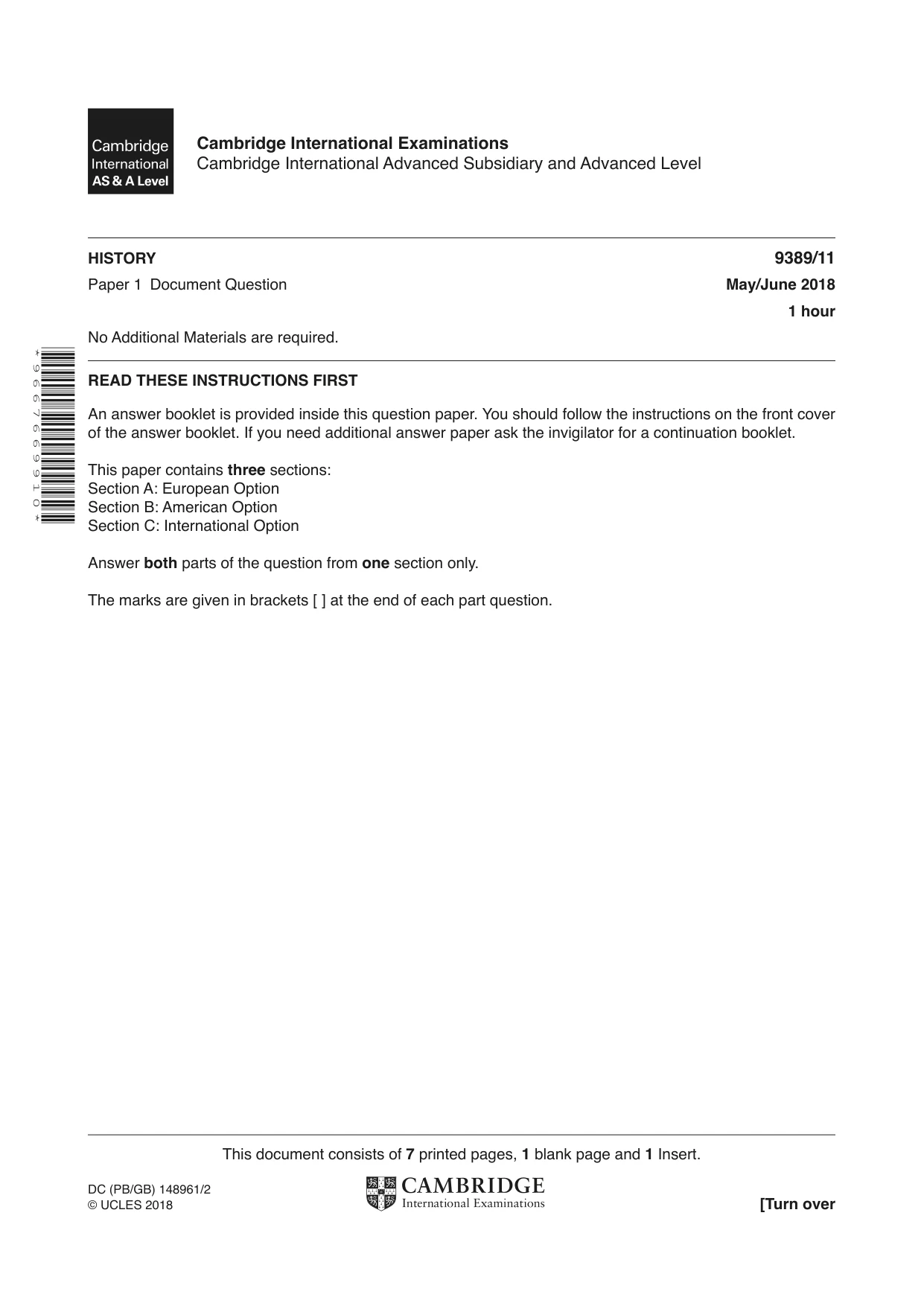
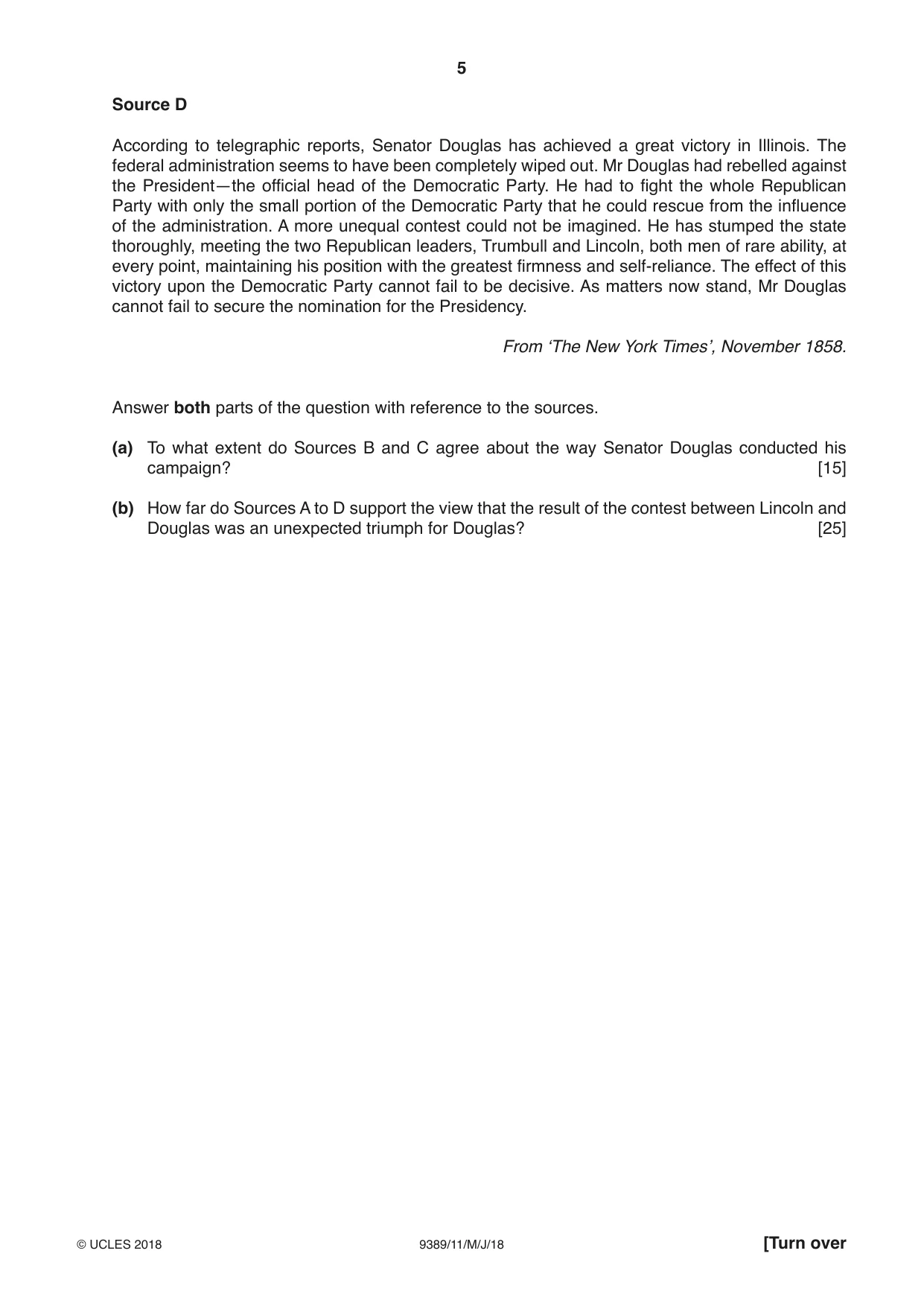
Question paper, page 1
This document consists of 7 printed pages, 1 blank page and 1 Insert. DC (PB/GB) 148961/2 © UCLES 2018 [Turn over Cambridge International Examinations Cambridge International Advanced Subsidiary and Advanced Level * 9 6 6 7 6 6 9 9 1 0 * HISTORY 9389/11 Paper 1 Document Question May/June 2018 1 hour No Additional Materials are required. READ THESE INSTRUCTIONS FIRST An answer booklet is provided inside this question paper. You should follow the instructions on the front cover of the answer booklet. If you need additional answer paper ask the invigilator for a continuation booklet. This paper contains three sections: Section A: European Option Section B: American Option Section C: International Option Answer both parts of the question from one section only. The marks are given in brackets [ ] at the end of each part question.
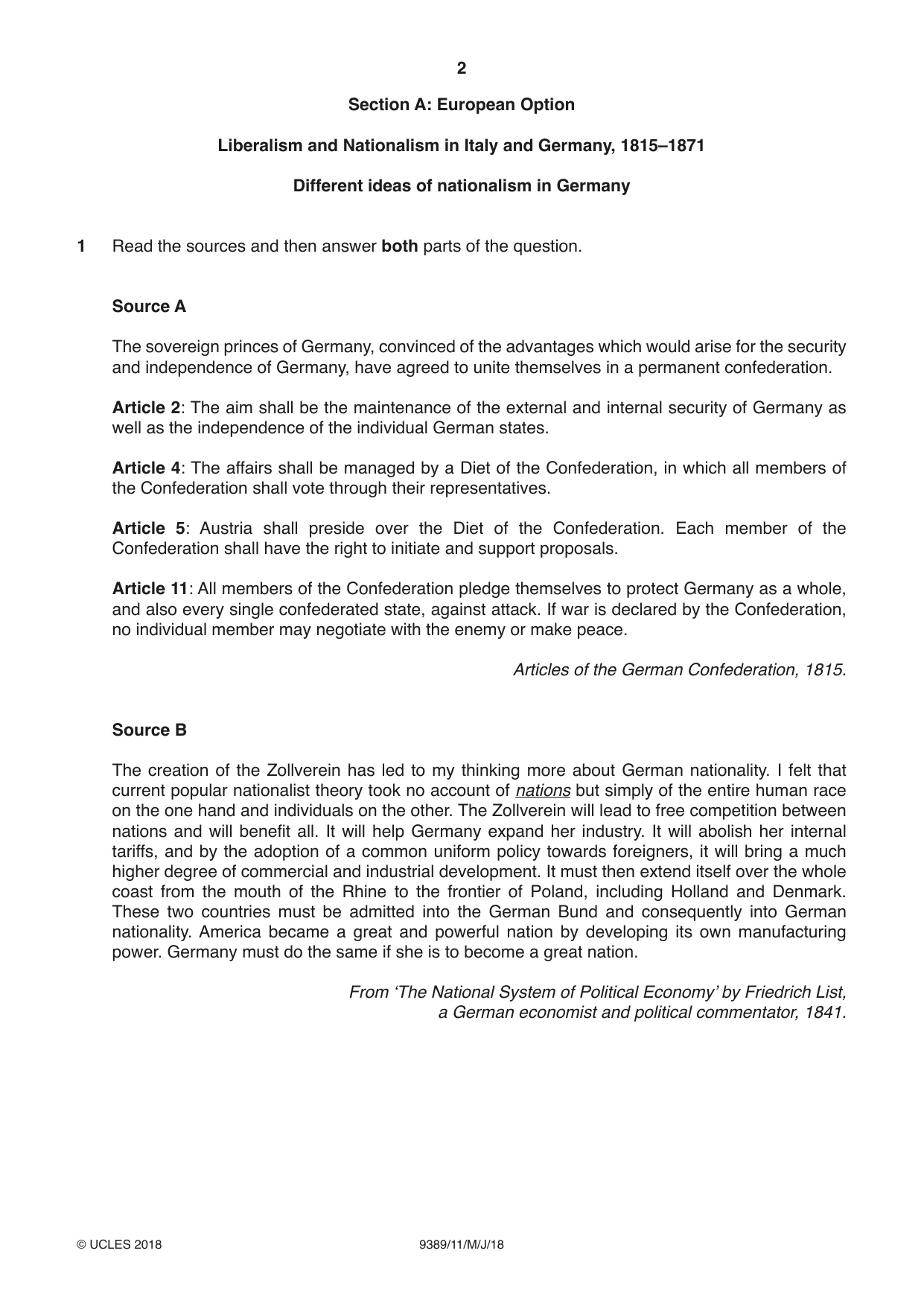
Question paper, page 2
2 9389/11/M/J/18 © UCLES 2018 Section A: European Option Liberalism and Nationalism in Italy and Germany, 1815–1871 Different ideas of nationalism in Germany 1 Read the sources and then answer both parts of the question. Source A The sovereign princes of Germany, convinced of the advantages which would arise for the security and independence of Germany, have agreed to unite themselves in a permanent confederation. Article 2: The aim shall be the maintenance of the external and internal security of Germany as well as the independence of the individual German states. Article 4: The affairs shall be managed by a Diet of the Confederation, in which all members of the Confederation shall vote through their representatives. Article 5: Austria shall preside over the Diet of the Confederation. Each member of the Confederation shall have the right to initiate and support proposals. Article 11: All members of the Confederation pledge themselves to protect Germany as a whole, and also every single confederated state, against attack. If war is declared by the Confederation, no individual member may negotiate with the enemy or make peace. Articles of the German Confederation, 1815. Source B The creation of the Zollverein has led to my thinking more about German nationality. I felt that current popular nationalist theory took no account of nations but simply of the entire human race on the one hand and individuals on the other. The Zollverein will lead to free competition between nations and will benefit all. It will help Germany expand her industry. It will abolish her internal tariffs, and by the adoption of a common uniform policy towards foreigners, it will bring a much higher degree of commercial and industrial development. It must then extend itself over the whole coast from the mouth of the Rhine to the frontier of Poland, including Holland and Denmark. These two countries must be admitted into the German Bund and consequently into German nationality. America became a great and powerful nation by developing its own manufacturing power. Germany must do the same if she is to become a great nation. From ‘The National System of Political Economy’ by Friedrich List, a German economist and political commentator, 1841.
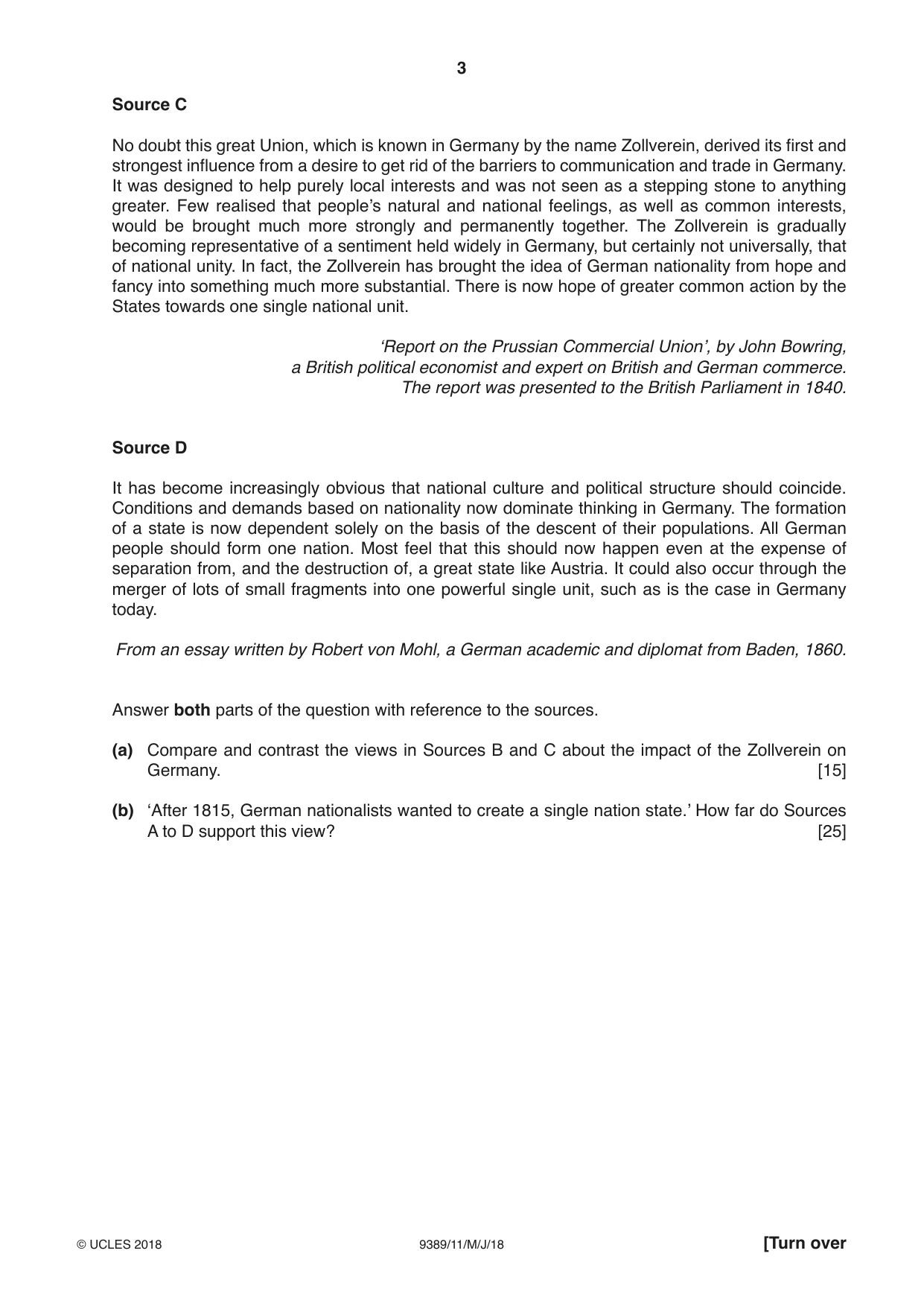
Question paper, page 3
3 9389/11/M/J/18 © UCLES 2018 [Turn over Source C No doubt this great Union, which is known in Germany by the name Zollverein, derived its first and strongest influence from a desire to get rid of the barriers to communication and trade in Germany. It was designed to help purely local interests and was not seen as a stepping stone to anything greater. Few realised that people’s natural and national feelings, as well as common interests, would be brought much more strongly and permanently together. The Zollverein is gradually becoming representative of a sentiment held widely in Germany, but certainly not universally, that of national unity. In fact, the Zollverein has brought the idea of German nationality from hope and fancy into something much more substantial. There is now hope of greater common action by the States towards one single national unit. ‘Report on the Prussian Commercial Union’, by John Bowring, a British political economist and expert on British and German commerce. The report was presented to the British Parliament in 1840. Source D It has become increasingly obvious that national culture and political structure should coincide. Conditions and demands based on nationality now dominate thinking in Germany. The formation of a state is now dependent solely on the basis of the descent of their populations. All German people should form one nation. Most feel that this should now happen even at the expense of separation from, and the destruction of, a great state like Austria. It could also occur through the merger of lots of small fragments into one powerful single unit, such as is the case in Germany today. From an essay written by Robert von Mohl, a German academic and diplomat from Baden, 1860. Answer both parts of the question with reference to the sources. (a) Compare and contrast the views in Sources B and C about the impact of the Zollverein on Germany. [15] (b) ‘After 1815, German nationalists wanted to create a single nation state.’ How far do Sources A to D support this view? [25]
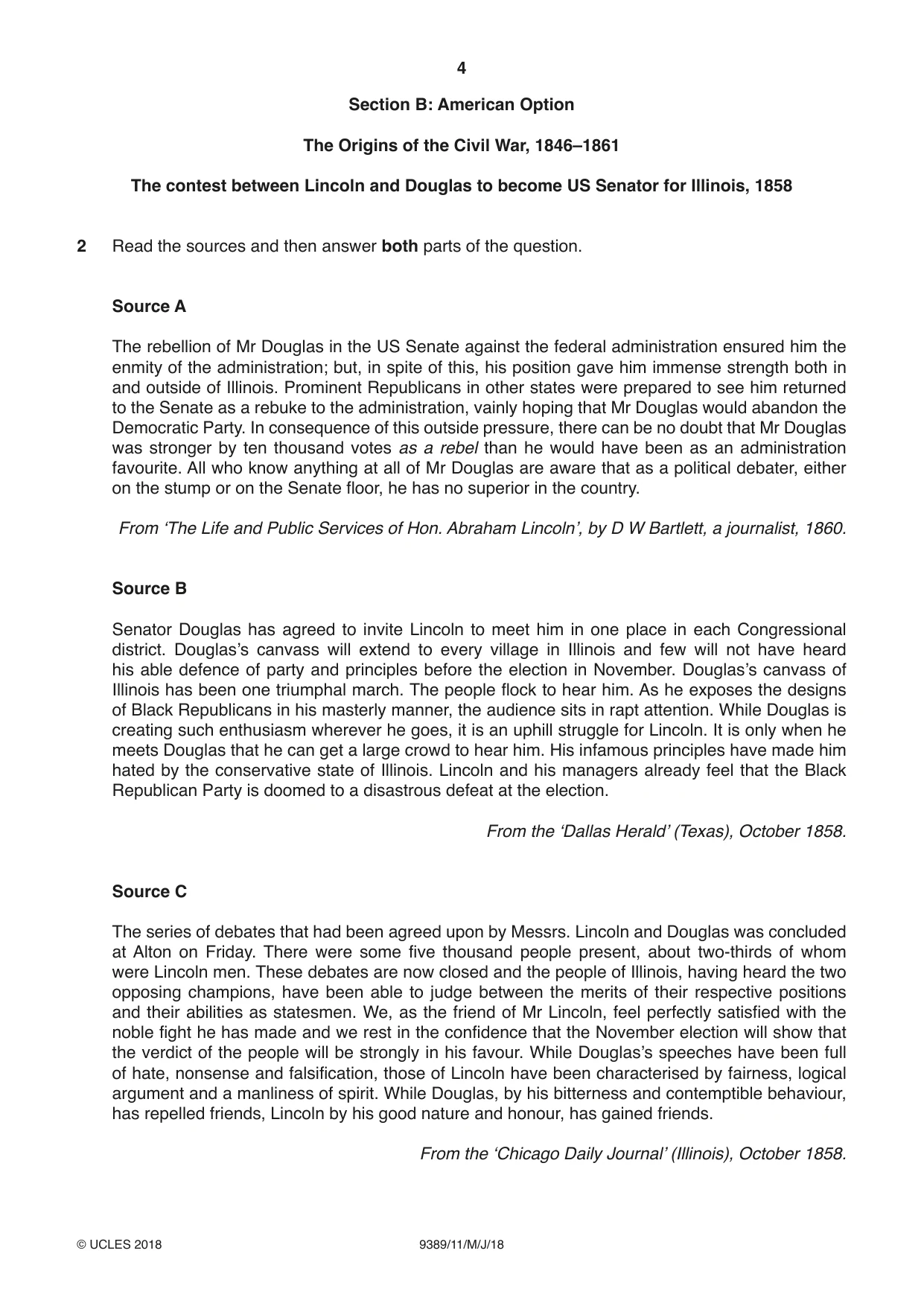
Question paper, page 4
4 9389/11/M/J/18 © UCLES 2018 Section B: American Option The Origins of the Civil War, 1846–1861 The contest between Lincoln and Douglas to become US Senator for Illinois, 1858 2 Read the sources and then answer both parts of the question. Source A The rebellion of Mr Douglas in the US Senate against the federal administration ensured him the enmity of the administration; but, in spite of this, his position gave him immense strength both in and outside of Illinois. Prominent Republicans in other states were prepared to see him returned to the Senate as a rebuke to the administration, vainly hoping that Mr Douglas would abandon the Democratic Party. In consequence of this outside pressure, there can be no doubt that Mr Douglas was stronger by ten thousand votes as a rebel than he would have been as an administration favourite. All who know anything at all of Mr Douglas are aware that as a political debater, either on the stump or on the Senate floor, he has no superior in the country. From ‘The Life and Public Services of Hon. Abraham Lincoln’, by D W Bartlett, a journalist, 1860. Source B Senator Douglas has agreed to invite Lincoln to meet him in one place in each Congressional district. Douglas’s canvass will extend to every village in Illinois and few will not have heard his able defence of party and principles before the election in November. Douglas’s canvass of Illinois has been one triumphal march. The people flock to hear him. As he exposes the designs of Black Republicans in his masterly manner, the audience sits in rapt attention. While Douglas is creating such enthusiasm wherever he goes, it is an uphill struggle for Lincoln. It is only when he meets Douglas that he can get a large crowd to hear him. His infamous principles have made him hated by the conservative state of Illinois. Lincoln and his managers already feel that the Black Republican Party is doomed to a disastrous defeat at the election. From the ‘Dallas Herald’ (Texas), October 1858. Source C The series of debates that had been agreed upon by Messrs. Lincoln and Douglas was concluded at Alton on Friday. There were some five thousand people present, about two-thirds of whom were Lincoln men. These debates are now closed and the people of Illinois, having heard the two opposing champions, have been able to judge between the merits of their respective positions and their abilities as statesmen. We, as the friend of Mr Lincoln, feel perfectly satisfied with the noble fight he has made and we rest in the confidence that the November election will show that the verdict of the people will be strongly in his favour. While Douglas’s speeches have been full of hate, nonsense and falsification, those of Lincoln have been characterised by fairness, logical argument and a manliness of spirit. While Douglas, by his bitterness and contemptible behaviour, has repelled friends, Lincoln by his good nature and honour, has gained friends. From the ‘Chicago Daily Journal’ (Illinois), October 1858.
Question paper, page 5
5 9389/11/M/J/18 © UCLES 2018 [Turn over Source D According to telegraphic reports, Senator Douglas has achieved a great victory in Illinois. The federal administration seems to have been completely wiped out. Mr Douglas had rebelled against the President—the official head of the Democratic Party. He had to fight the whole Republican Party with only the small portion of the Democratic Party that he could rescue from the influence of the administration. A more unequal contest could not be imagined. He has stumped the state thoroughly, meeting the two Republican leaders, Trumbull and Lincoln, both men of rare ability, at every point, maintaining his position with the greatest firmness and self-reliance. The effect of this victory upon the Democratic Party cannot fail to be decisive. As matters now stand, Mr Douglas cannot fail to secure the nomination for the Presidency. From ‘The New York Times’, November 1858. Answer both parts of the question with reference to the sources. (a) To what extent do Sources B and C agree about the way Senator Douglas conducted his campaign? [15] (b) How far do Sources A to D support the view that the result of the contest between Lincoln and Douglas was an unexpected triumph for Douglas? [25]
Question paper, page 6
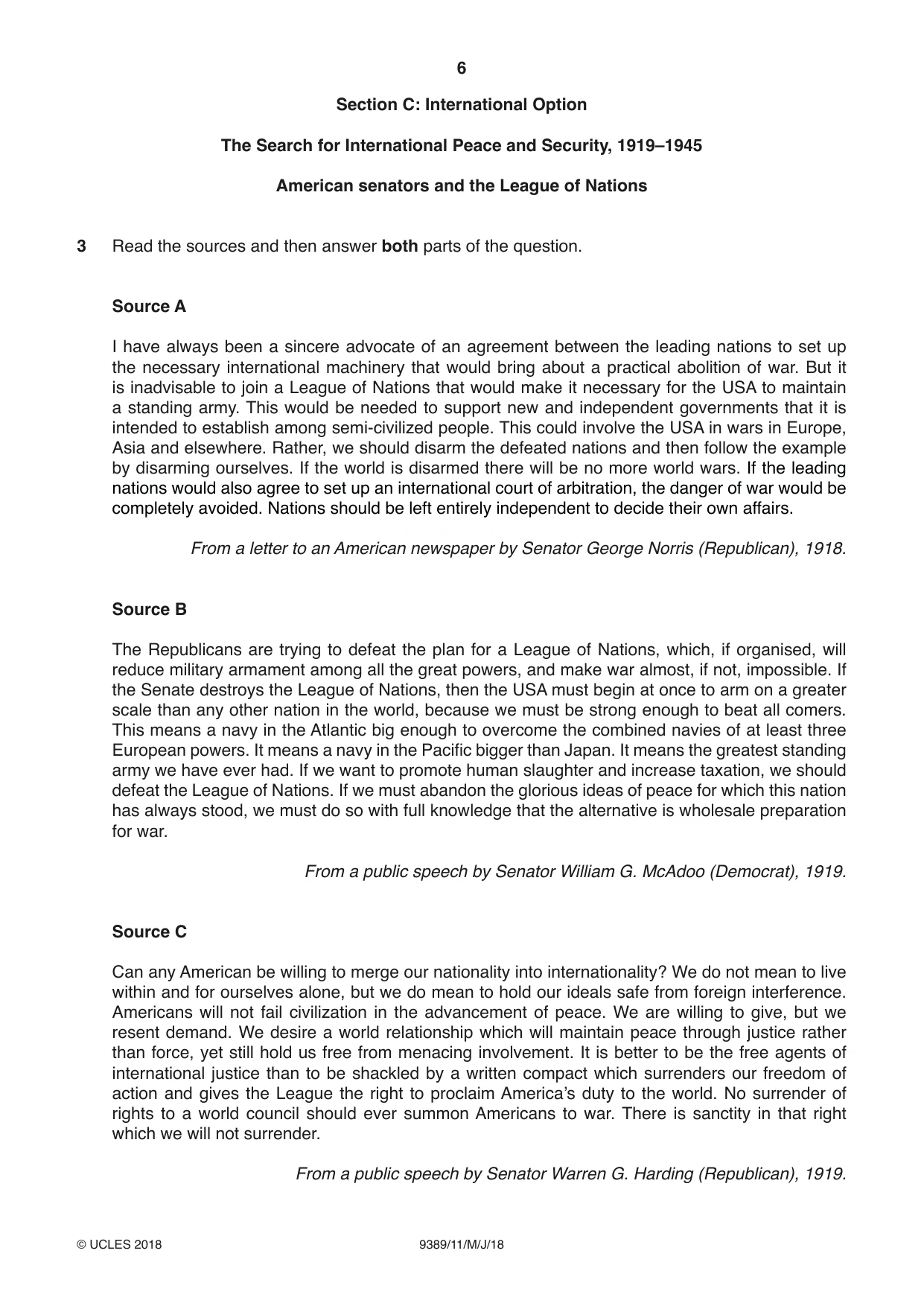
6 9389/11/M/J/18 © UCLES 2018 Section C: International Option The Search for International Peace and Security, 1919–1945 American senators and the League of Nations 3 Read the sources and then answer both parts of the question. Source A I have always been a sincere advocate of an agreement between the leading nations to set up the necessary international machinery that would bring about a practical abolition of war. But it is inadvisable to join a League of Nations that would make it necessary for the USA to maintain a standing army. This would be needed to support new and independent governments that it is intended to establish among semi-civilized people. This could involve the USA in wars in Europe, Asia and elsewhere. Rather, we should disarm the defeated nations and then follow the example by disarming ourselves. If the world is disarmed there will be no more world wars. If the leading nations would also agree to set up an international court of arbitration, the danger of war would be completely avoided. Nations should be left entirely independent to decide their own affairs. From a letter to an American newspaper by Senator George Norris (Republican), 1918. Source B The Republicans are trying to defeat the plan for a League of Nations, which, if organised, will reduce military armament among all the great powers, and make war almost, if not, impossible. If the Senate destroys the League of Nations, then the USA must begin at once to arm on a greater scale than any other nation in the world, because we must be strong enough to beat all comers. This means a navy in the Atlantic big enough to overcome the combined navies of at least three European powers. It means a navy in the Pacific bigger than Japan. It means the greatest standing army we have ever had. If we want to promote human slaughter and increase taxation, we should defeat the League of Nations. If we must abandon the glorious ideas of peace for which this nation has always stood, we must do so with full knowledge that the alternative is wholesale preparation for war. From a public speech by Senator William G. McAdoo (Democrat), 1919. Source C Can any American be willing to merge our nationality into internationality? We do not mean to live within and for ourselves alone, but we do mean to hold our ideals safe from foreign interference. Americans will not fail civilization in the advancement of peace. We are willing to give, but we resent demand. We desire a world relationship which will maintain peace through justice rather than force, yet still hold us free from menacing involvement. It is better to be the free agents of international justice than to be shackled by a written compact which surrenders our freedom of action and gives the League the right to proclaim America’s duty to the world. No surrender of rights to a world council should ever summon Americans to war. There is sanctity in that right which we will not surrender. From a public speech by Senator Warren G. Harding (Republican), 1919.
Question paper, page 7
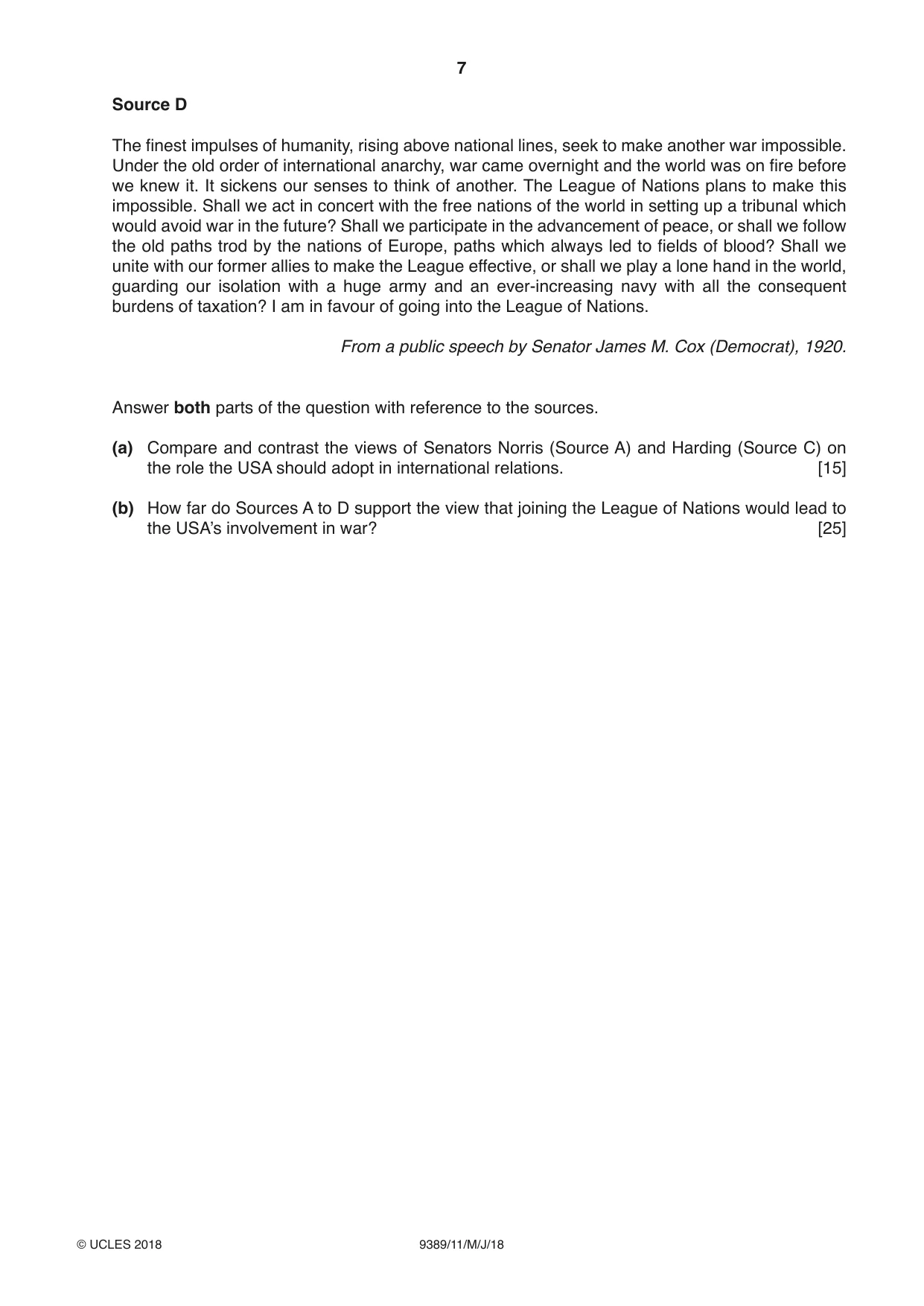
7 9389/11/M/J/18 © UCLES 2018 Source D The finest impulses of humanity, rising above national lines, seek to make another war impossible. Under the old order of international anarchy, war came overnight and the world was on fire before we knew it. It sickens our senses to think of another. The League of Nations plans to make this impossible. Shall we act in concert with the free nations of the world in setting up a tribunal which would avoid war in the future? Shall we participate in the advancement of peace, or shall we follow the old paths trod by the nations of Europe, paths which always led to fields of blood? Shall we unite with our former allies to make the League effective, or shall we play a lone hand in the world, guarding our isolation with a huge army and an ever-increasing navy with all the consequent burdens of taxation? I am in favour of going into the League of Nations. From a public speech by Senator James M. Cox (Democrat), 1920. Answer both parts of the question with reference to the sources. (a) Compare and contrast the views of Senators Norris (Source A) and Harding (Source C) on the role the USA should adopt in international relations. [15] (b) How far do Sources A to D support the view that joining the League of Nations would lead to the USA’s involvement in war? [25]
Question paper, page 8
8 9389/11/M/J/18 © UCLES 2018 BLANK PAGE Permission to reproduce items where third-party owned material protected by copyright is included has been sought and cleared where possible. Every reasonable effort has been made by the publisher (UCLES) to trace copyright holders, but if any items requiring clearance have unwittingly been included, the publisher will be pleased to make amends at the earliest possible opportunity. To avoid the issue of disclosure of answer-related information to candidates, all copyright acknowledgements are reproduced online in the Cambridge International Examinations Copyright Acknowledgements Booklet. This is produced for each series of examinations and is freely available to download at www.cie.org.uk after the live examination series. Cambridge International Examinations is part of the Cambridge Assessment Group. Cambridge Assessment is the brand name of University of Cambridge Local Examinations Syndicate (UCLES), which is itself a department of the University of Cambridge.
Mark scheme, page 1
IGCSE™ is a registered trademark. This document consists of 14 printed pages. © UCLES 2018 [Turn over Cambridge Assessment International Education Cambridge International Advanced Subsidiary and Advanced Level HISTORY 9389/11 Paper 1 Document Question May/June 2018 MARK SCHEME Maximum Mark: 40 Published This mark scheme is published as an aid to teachers and candidates, to indicate the requirements of the examination. It shows the basis on which Examiners were instructed to award marks. It does not indicate the details of the discussions that took place at an Examiners’ meeting before marking began, which would have considered the acceptability of alternative answers. Mark schemes should be read in conjunction with the question paper and the Principal Examiner Report for Teachers. Cambridge International will not enter into discussions about these mark schemes. Cambridge International is publishing the mark schemes for the May/June 2018 series for most Cambridge IGCSE™, Cambridge International A and AS Level and Cambridge Pre-U components, and some Cambridge O Level components.
Mark scheme, page 2
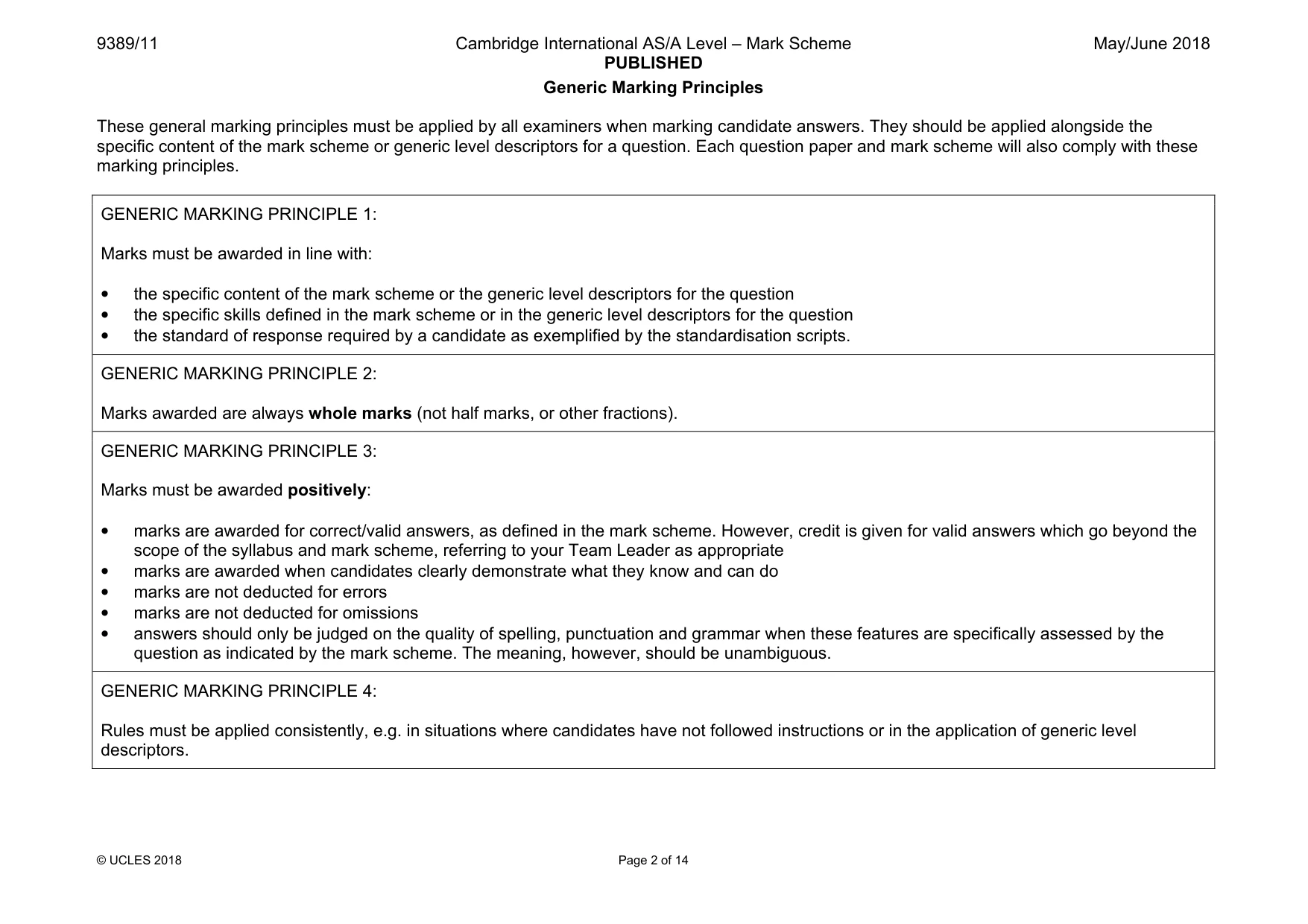
9389/11 Cambridge International AS/A Level – Mark Scheme PUBLISHED May/June 2018 © UCLES 2018 Page 2 of 14 Generic Marking Principles These general marking principles must be applied by all examiners when marking candidate answers. They should be applied alongside the specific content of the mark scheme or generic level descriptors for a question. Each question paper and mark scheme will also comply with these marking principles. GENERIC MARKING PRINCIPLE 1: Marks must be awarded in line with: • the specific content of the mark scheme or the generic level descriptors for the question • the specific skills defined in the mark scheme or in the generic level descriptors for the question • the standard of response required by a candidate as exemplified by the standardisation scripts. GENERIC MARKING PRINCIPLE 2: Marks awarded are always whole marks (not half marks, or other fractions). GENERIC MARKING PRINCIPLE 3: Marks must be awarded positively: • marks are awarded for correct/valid answers, as defined in the mark scheme. However, credit is given for valid answers which go beyond the scope of the syllabus and mark scheme, referring to your Team Leader as appropriate • marks are awarded when candidates clearly demonstrate what they know and can do • marks are not deducted for errors • marks are not deducted for omissions • answers should only be judged on the quality of spelling, punctuation and grammar when these features are specifically assessed by the question as indicated by the mark scheme. The meaning, however, should be unambiguous. GENERIC MARKING PRINCIPLE 4: Rules must be applied consistently, e.g. in situations where candidates have not followed instructions or in the application of generic level descriptors.
Mark scheme, page 3
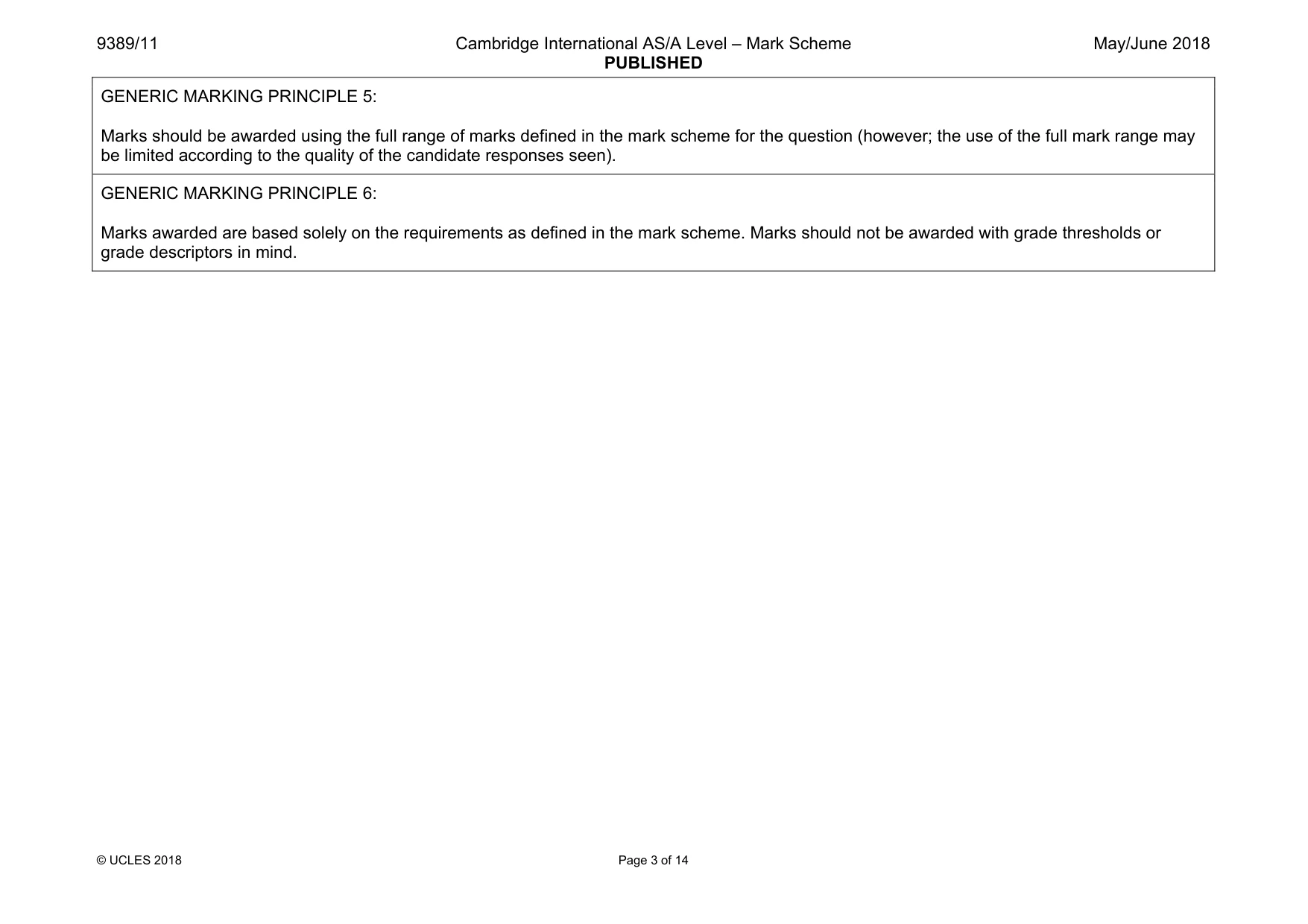
9389/11 Cambridge International AS/A Level – Mark Scheme PUBLISHED May/June 2018 © UCLES 2018 Page 3 of 14 GENERIC MARKING PRINCIPLE 5: Marks should be awarded using the full range of marks defined in the mark scheme for the question (however; the use of the full mark range may be limited according to the quality of the candidate responses seen). GENERIC MARKING PRINCIPLE 6: Marks awarded are based solely on the requirements as defined in the mark scheme. Marks should not be awarded with grade thresholds or grade descriptors in mind.
Mark scheme, page 4
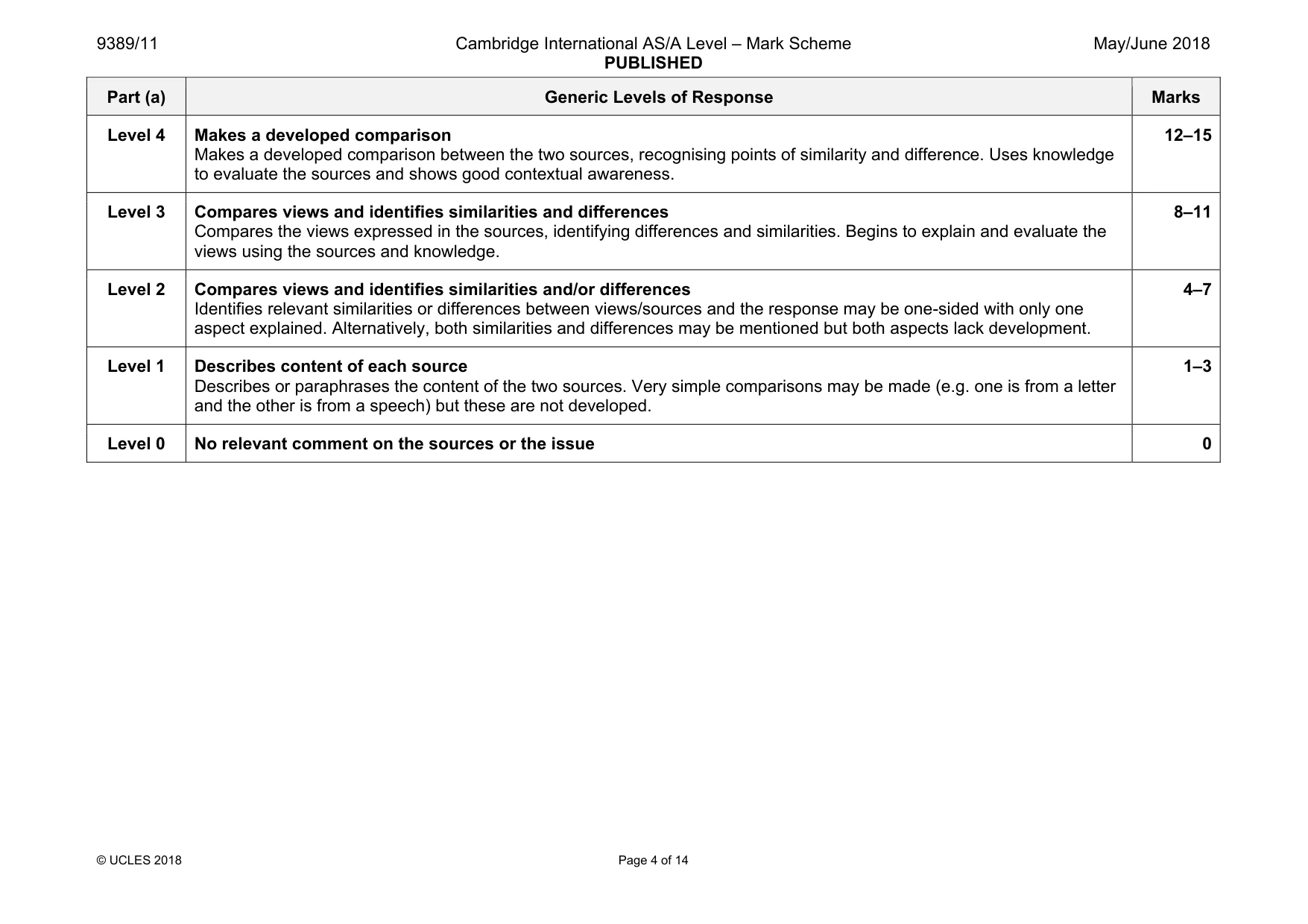
9389/11 Cambridge International AS/A Level – Mark Scheme PUBLISHED May/June 2018 © UCLES 2018 Page 4 of 14 Part (a) Generic Levels of Response Marks Level 4 Makes a developed comparison Makes a developed comparison between the two sources, recognising points of similarity and difference. Uses knowledge to evaluate the sources and shows good contextual awareness. 12–15 Level 3 Compares views and identifies similarities and differences Compares the views expressed in the sources, identifying differences and similarities. Begins to explain and evaluate the views using the sources and knowledge. 8–11 Level 2 Compares views and identifies similarities and/or differences Identifies relevant similarities or differences between views/sources and the response may be one-sided with only one aspect explained. Alternatively, both similarities and differences may be mentioned but both aspects lack development. 4–7 Level 1 Describes content of each source Describes or paraphrases the content of the two sources. Very simple comparisons may be made (e.g. one is from a letter and the other is from a speech) but these are not developed. 1–3 Level 0 No relevant comment on the sources or the issue 0
Mark scheme, page 5
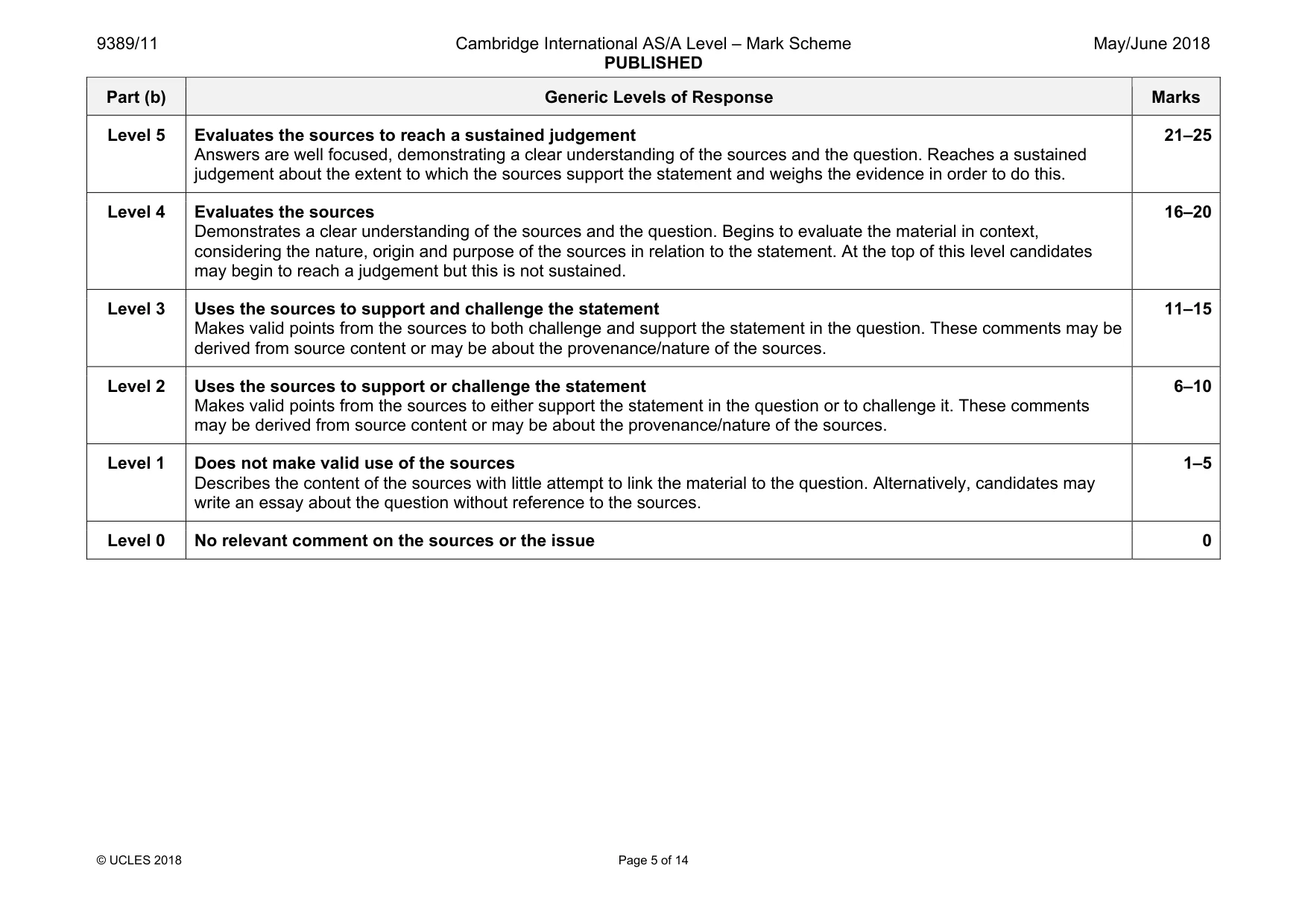
9389/11 Cambridge International AS/A Level – Mark Scheme PUBLISHED May/June 2018 © UCLES 2018 Page 5 of 14 Part (b) Generic Levels of Response Marks Level 5 Evaluates the sources to reach a sustained judgement Answers are well focused, demonstrating a clear understanding of the sources and the question. Reaches a sustained judgement about the extent to which the sources support the statement and weighs the evidence in order to do this. 21–25 Level 4 Evaluates the sources Demonstrates a clear understanding of the sources and the question. Begins to evaluate the material in context, considering the nature, origin and purpose of the sources in relation to the statement. At the top of this level candidates may begin to reach a judgement but this is not sustained. 16–20 Level 3 Uses the sources to support and challenge the statement Makes valid points from the sources to both challenge and support the statement in the question. These comments may be derived from source content or may be about the provenance/nature of the sources. 11–15 Level 2 Uses the sources to support or challenge the statement Makes valid points from the sources to either support the statement in the question or to challenge it. These comments may be derived from source content or may be about the provenance/nature of the sources. 6–10 Level 1 Does not make valid use of the sources Describes the content of the sources with little attempt to link the material to the question. Alternatively, candidates may write an essay about the question without reference to the sources. 1–5 Level 0 No relevant comment on the sources or the issue 0
Mark scheme, page 6
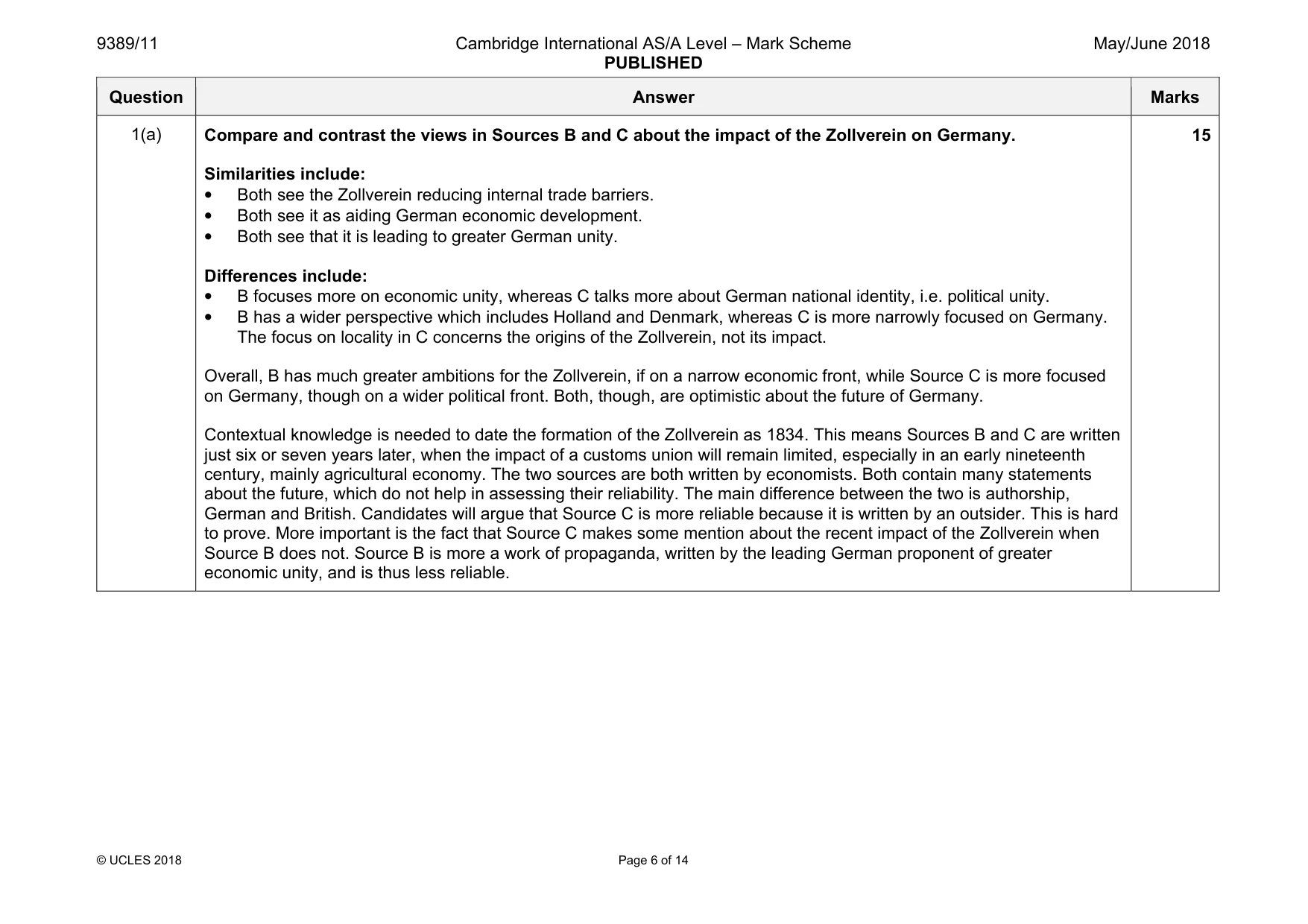
9389/11 Cambridge International AS/A Level – Mark Scheme PUBLISHED May/June 2018 © UCLES 2018 Page 6 of 14 Question Answer Marks 1(a) Compare and contrast the views in Sources B and C about the impact of the Zollverein on Germany. Similarities include: • Both see the Zollverein reducing internal trade barriers. • Both see it as aiding German economic development. • Both see that it is leading to greater German unity. Differences include: • B focuses more on economic unity, whereas C talks more about German national identity, i.e. political unity. • B has a wider perspective which includes Holland and Denmark, whereas C is more narrowly focused on Germany. The focus on locality in C concerns the origins of the Zollverein, not its impact. Overall, B has much greater ambitions for the Zollverein, if on a narrow economic front, while Source C is more focused on Germany, though on a wider political front. Both, though, are optimistic about the future of Germany. Contextual knowledge is needed to date the formation of the Zollverein as 1834. This means Sources B and C are written just six or seven years later, when the impact of a customs union will remain limited, especially in an early nineteenth century, mainly agricultural economy. The two sources are both written by economists. Both contain many statements about the future, which do not help in assessing their reliability. The main difference between the two is authorship, German and British. Candidates will argue that Source C is more reliable because it is written by an outsider. This is hard to prove. More important is the fact that Source C makes some mention about the recent impact of the Zollverein when Source B does not. Source B is more a work of propaganda, written by the leading German proponent of greater economic unity, and is thus less reliable. 15
Mark scheme, page 7
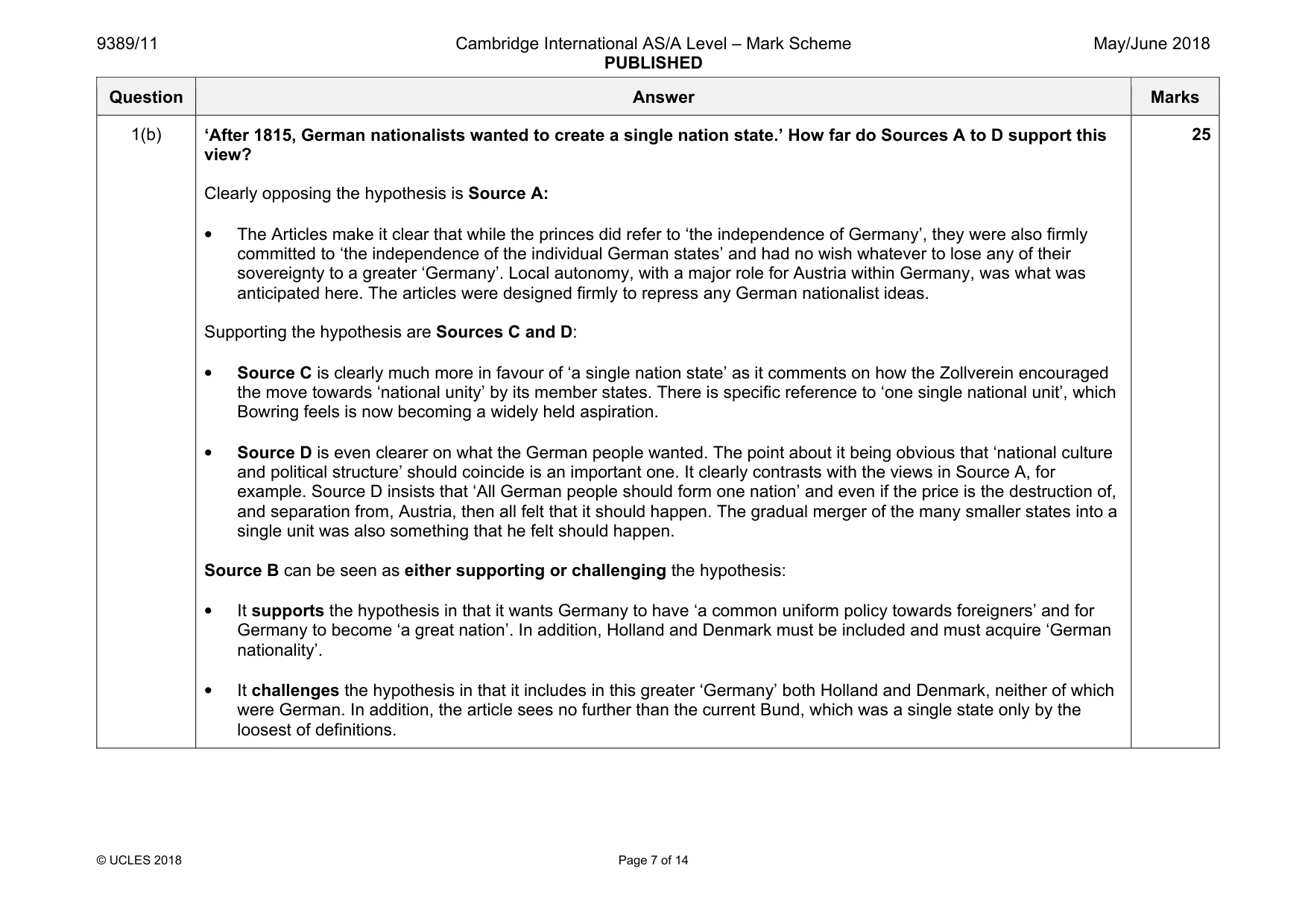
9389/11 Cambridge International AS/A Level – Mark Scheme PUBLISHED May/June 2018 © UCLES 2018 Page 7 of 14 Question Answer Marks 1(b) ‘After 1815, German nationalists wanted to create a single nation state.’ How far do Sources A to D support this view? Clearly opposing the hypothesis is Source A: • The Articles make it clear that while the princes did refer to ‘the independence of Germany’, they were also firmly committed to ‘the independence of the individual German states’ and had no wish whatever to lose any of their sovereignty to a greater ‘Germany’. Local autonomy, with a major role for Austria within Germany, was what was anticipated here. The articles were designed firmly to repress any German nationalist ideas. Supporting the hypothesis are Sources C and D: • Source C is clearly much more in favour of ‘a single nation state’ as it comments on how the Zollverein encouraged the move towards ‘national unity’ by its member states. There is specific reference to ‘one single national unit’, which Bowring feels is now becoming a widely held aspiration. • Source D is even clearer on what the German people wanted. The point about it being obvious that ‘national culture and political structure’ should coincide is an important one. It clearly contrasts with the views in Source A, for example. Source D insists that ‘All German people should form one nation’ and even if the price is the destruction of, and separation from, Austria, then all felt that it should happen. The gradual merger of the many smaller states into a single unit was also something that he felt should happen. Source B can be seen as either supporting or challenging the hypothesis: • It supports the hypothesis in that it wants Germany to have ‘a common uniform policy towards foreigners’ and for Germany to become ‘a great nation’. In addition, Holland and Denmark must be included and must acquire ‘German nationality’. • It challenges the hypothesis in that it includes in this greater ‘Germany’ both Holland and Denmark, neither of which were German. In addition, the article sees no further than the current Bund, which was a single state only by the loosest of definitions. 25
Mark scheme, page 8
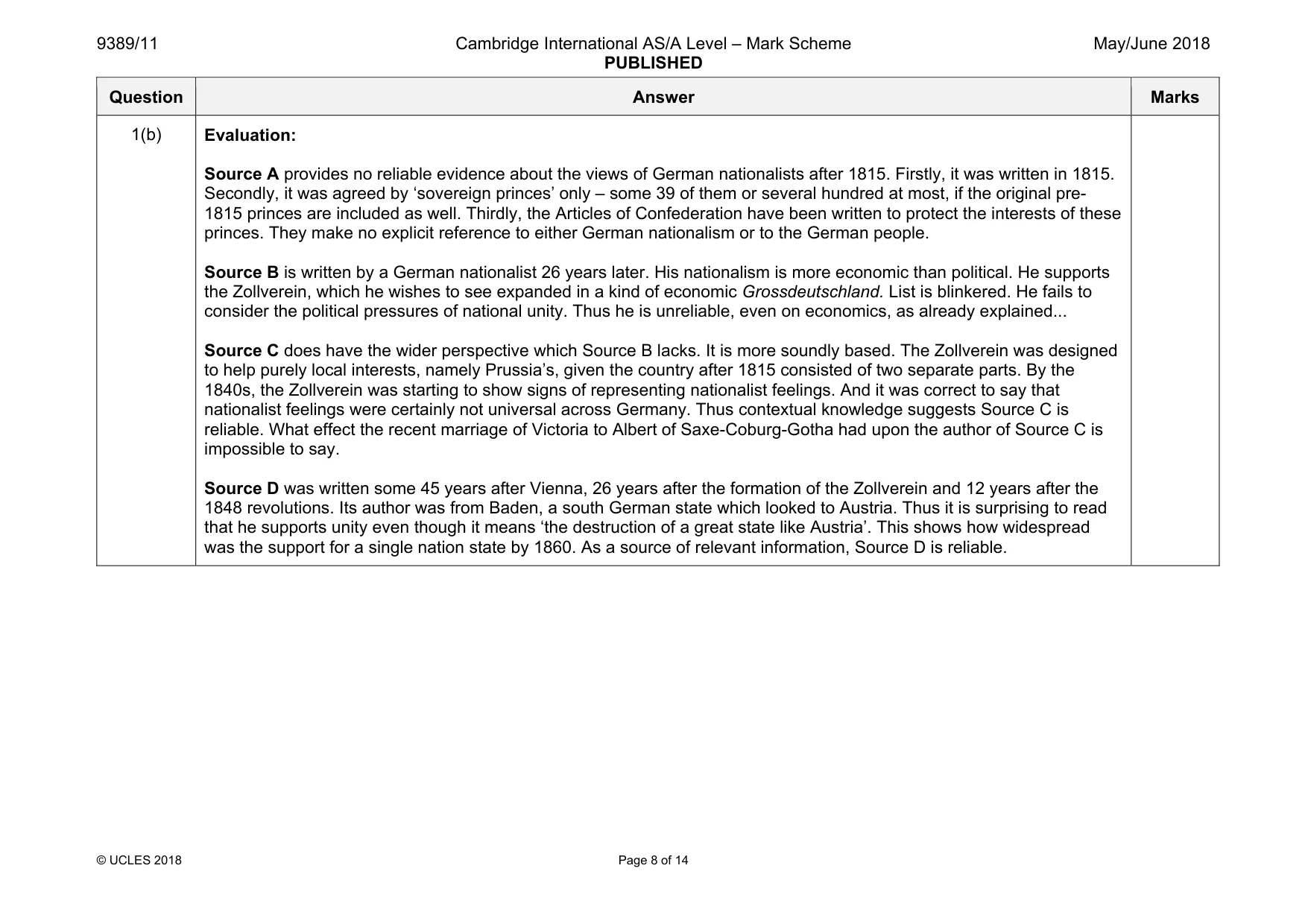
9389/11 Cambridge International AS/A Level – Mark Scheme PUBLISHED May/June 2018 © UCLES 2018 Page 8 of 14 Question Answer Marks 1(b) Evaluation: Source A provides no reliable evidence about the views of German nationalists after 1815. Firstly, it was written in 1815. Secondly, it was agreed by ‘sovereign princes’ only – some 39 of them or several hundred at most, if the original pre- 1815 princes are included as well. Thirdly, the Articles of Confederation have been written to protect the interests of these princes. They make no explicit reference to either German nationalism or to the German people. Source B is written by a German nationalist 26 years later. His nationalism is more economic than political. He supports the Zollverein, which he wishes to see expanded in a kind of economic Grossdeutschland. List is blinkered. He fails to consider the political pressures of national unity. Thus he is unreliable, even on economics, as already explained... Source C does have the wider perspective which Source B lacks. It is more soundly based. The Zollverein was designed to help purely local interests, namely Prussia’s, given the country after 1815 consisted of two separate parts. By the 1840s, the Zollverein was starting to show signs of representing nationalist feelings. And it was correct to say that nationalist feelings were certainly not universal across Germany. Thus contextual knowledge suggests Source C is reliable. What effect the recent marriage of Victoria to Albert of Saxe-Coburg-Gotha had upon the author of Source C is impossible to say. Source D was written some 45 years after Vienna, 26 years after the formation of the Zollverein and 12 years after the 1848 revolutions. Its author was from Baden, a south German state which looked to Austria. Thus it is surprising to read that he supports unity even though it means ‘the destruction of a great state like Austria’. This shows how widespread was the support for a single nation state by 1860. As a source of relevant information, Source D is reliable.
Mark scheme, page 9
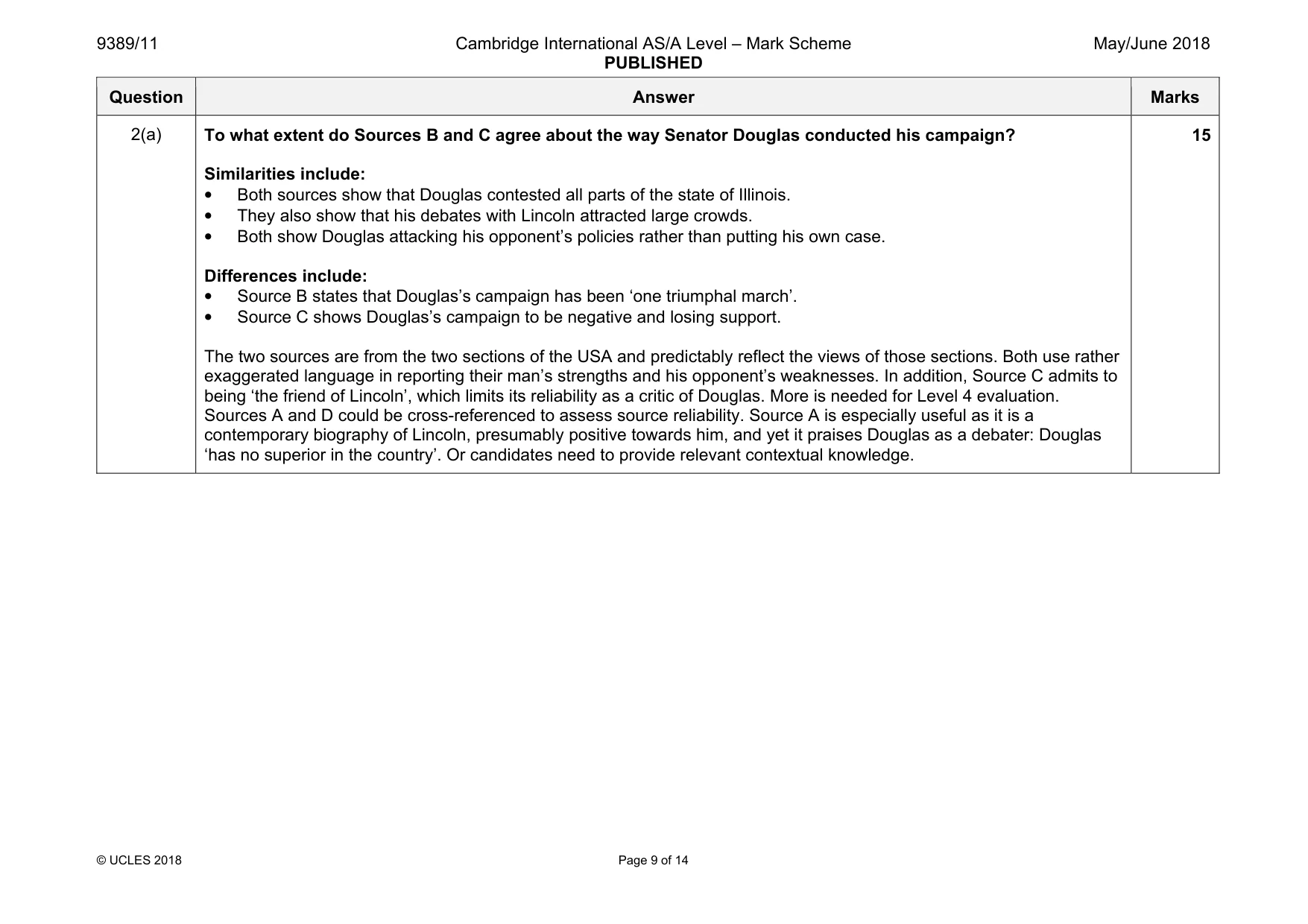
9389/11 Cambridge International AS/A Level – Mark Scheme PUBLISHED May/June 2018 © UCLES 2018 Page 9 of 14 Question Answer Marks 2(a) To what extent do Sources B and C agree about the way Senator Douglas conducted his campaign? Similarities include: • Both sources show that Douglas contested all parts of the state of Illinois. • They also show that his debates with Lincoln attracted large crowds. • Both show Douglas attacking his opponent’s policies rather than putting his own case. Differences include: • Source B states that Douglas’s campaign has been ‘one triumphal march’. • Source C shows Douglas’s campaign to be negative and losing support. The two sources are from the two sections of the USA and predictably reflect the views of those sections. Both use rather exaggerated language in reporting their man’s strengths and his opponent’s weaknesses. In addition, Source C admits to being ‘the friend of Lincoln’, which limits its reliability as a critic of Douglas. More is needed for Level 4 evaluation. Sources A and D could be cross-referenced to assess source reliability. Source A is especially useful as it is a contemporary biography of Lincoln, presumably positive towards him, and yet it praises Douglas as a debater: Douglas ‘has no superior in the country’. Or candidates need to provide relevant contextual knowledge. 15
Mark scheme, page 10
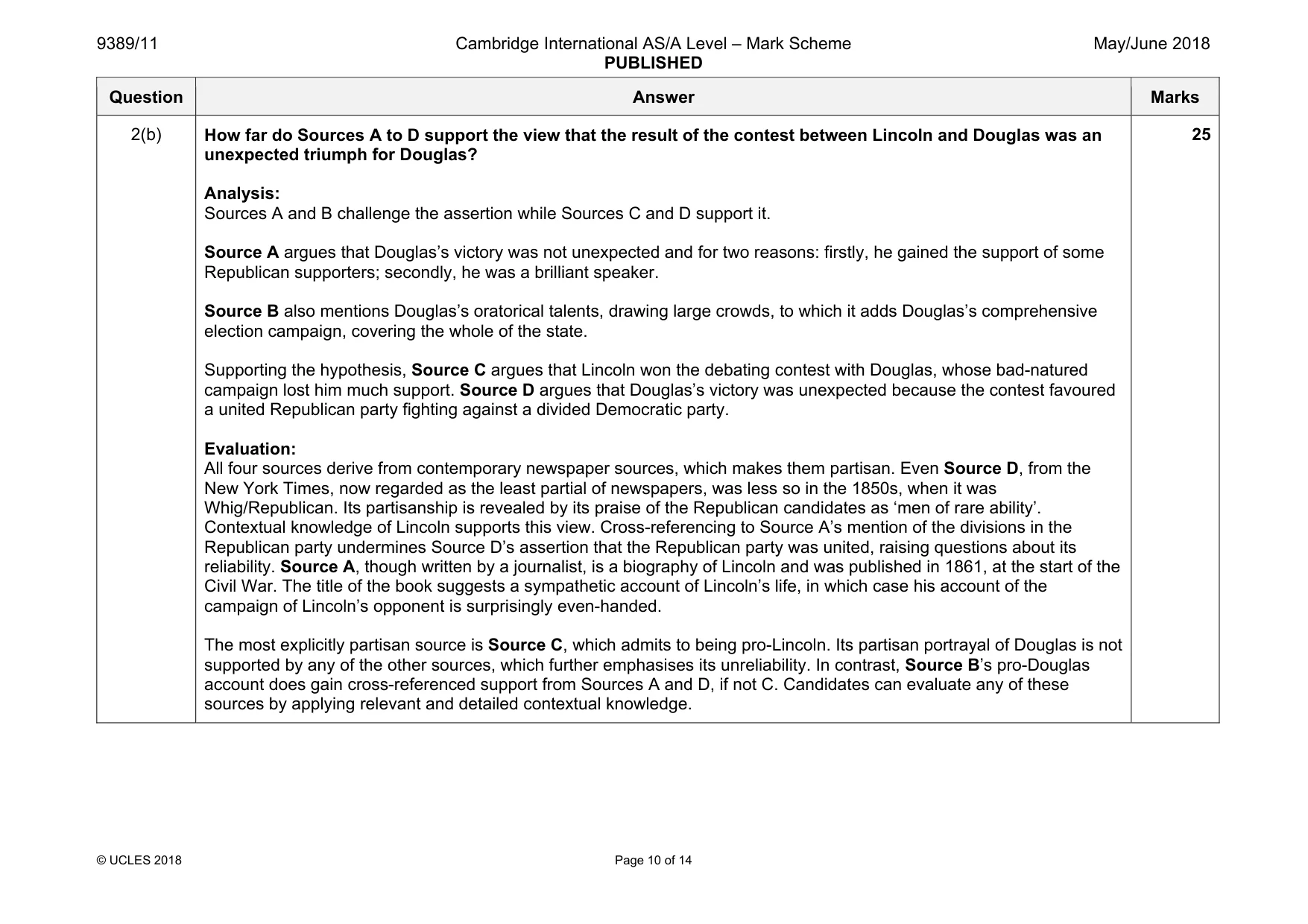
9389/11 Cambridge International AS/A Level – Mark Scheme PUBLISHED May/June 2018 © UCLES 2018 Page 10 of 14 Question Answer Marks 2(b) How far do Sources A to D support the view that the result of the contest between Lincoln and Douglas was an unexpected triumph for Douglas? Analysis: Sources A and B challenge the assertion while Sources C and D support it. Source A argues that Douglas’s victory was not unexpected and for two reasons: firstly, he gained the support of some Republican supporters; secondly, he was a brilliant speaker. Source B also mentions Douglas’s oratorical talents, drawing large crowds, to which it adds Douglas’s comprehensive election campaign, covering the whole of the state. Supporting the hypothesis, Source C argues that Lincoln won the debating contest with Douglas, whose bad-natured campaign lost him much support. Source D argues that Douglas’s victory was unexpected because the contest favoured a united Republican party fighting against a divided Democratic party. Evaluation: All four sources derive from contemporary newspaper sources, which makes them partisan. Even Source D, from the New York Times, now regarded as the least partial of newspapers, was less so in the 1850s, when it was Whig/Republican. Its partisanship is revealed by its praise of the Republican candidates as ‘men of rare ability’. Contextual knowledge of Lincoln supports this view. Cross-referencing to Source A’s mention of the divisions in the Republican party undermines Source D’s assertion that the Republican party was united, raising questions about its reliability. Source A, though written by a journalist, is a biography of Lincoln and was published in 1861, at the start of the Civil War. The title of the book suggests a sympathetic account of Lincoln’s life, in which case his account of the campaign of Lincoln’s opponent is surprisingly even-handed. The most explicitly partisan source is Source C, which admits to being pro-Lincoln. Its partisan portrayal of Douglas is not supported by any of the other sources, which further emphasises its unreliability. In contrast, Source B’s pro-Douglas account does gain cross-referenced support from Sources A and D, if not C. Candidates can evaluate any of these sources by applying relevant and detailed contextual knowledge. 25
Mark scheme, page 11
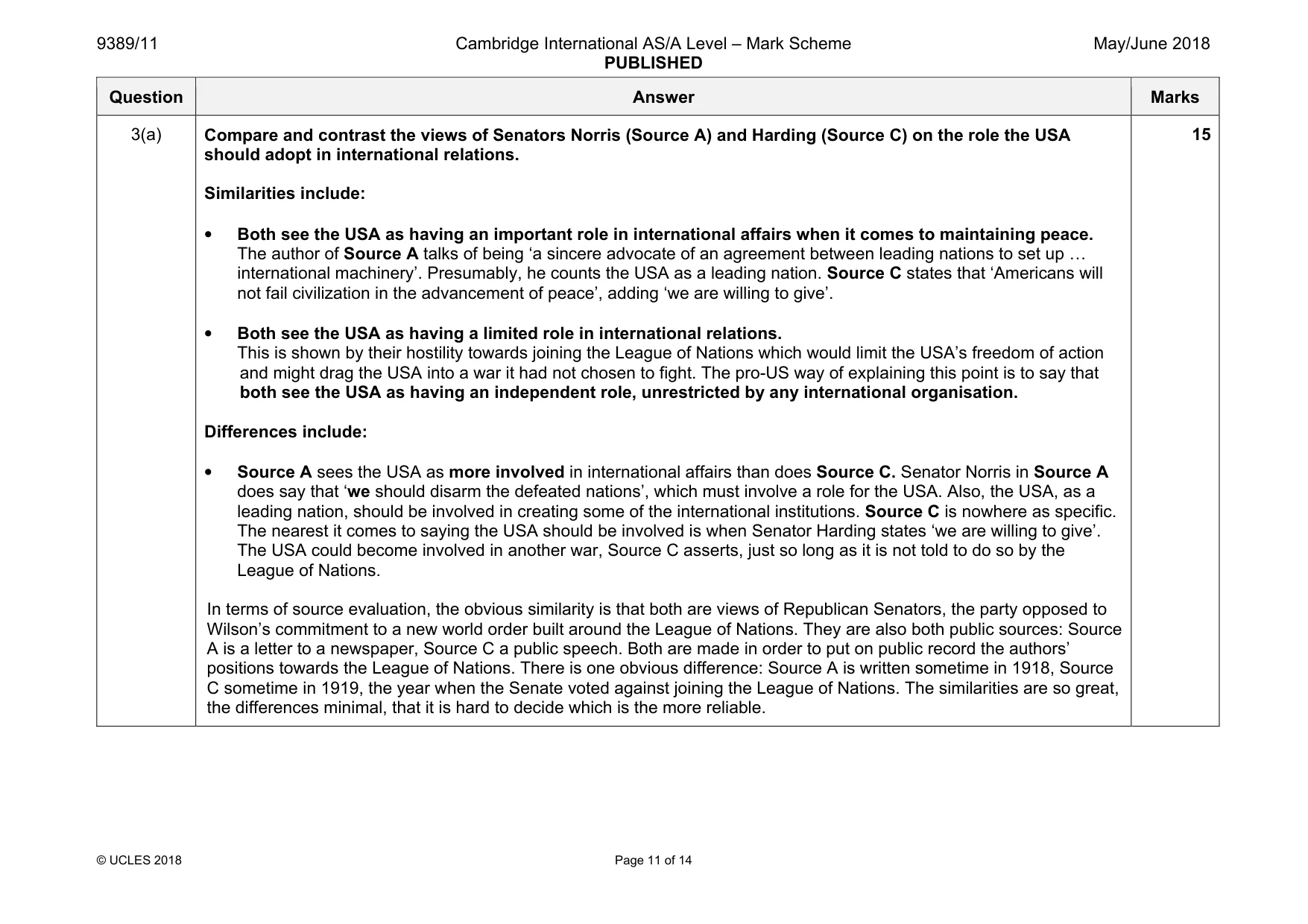
9389/11 Cambridge International AS/A Level – Mark Scheme PUBLISHED May/June 2018 © UCLES 2018 Page 11 of 14 Question Answer Marks 3(a) Compare and contrast the views of Senators Norris (Source A) and Harding (Source C) on the role the USA should adopt in international relations. Similarities include: • Both see the USA as having an important role in international affairs when it comes to maintaining peace. The author of Source A talks of being ‘a sincere advocate of an agreement between leading nations to set up « international machinery’. Presumably, he counts the USA as a leading nation. Source C states that ‘Americans will not fail civilization in the advancement of peace’, adding ‘we are willing to give’. • Both see the USA as having a limited role in international relations. This is shown by their hostility towards joining the League of Nations which would limit the USA’s freedom of action and might drag the USA into a war it had not chosen to fight. The pro-US way of explaining this point is to say that both see the USA as having an independent role, unrestricted by any international organisation. Differences include: • Source A sees the USA as more involved in international affairs than does Source C. Senator Norris in Source A does say that ‘we should disarm the defeated nations’, which must involve a role for the USA. Also, the USA, as a leading nation, should be involved in creating some of the international institutions. Source C is nowhere as specific. The nearest it comes to saying the USA should be involved is when Senator Harding states ‘we are willing to give’. The USA could become involved in another war, Source C asserts, just so long as it is not told to do so by the League of Nations. In terms of source evaluation, the obvious similarity is that both are views of Republican Senators, the party opposed to Wilson’s commitment to a new world order built around the League of Nations. They are also both public sources: Source A is a letter to a newspaper, Source C a public speech. Both are made in order to put on public record the authors’ positions towards the League of Nations. There is one obvious difference: Source A is written sometime in 1918, Source C sometime in 1919, the year when the Senate voted against joining the League of Nations. The similarities are so great, the differences minimal, that it is hard to decide which is the more reliable. 15
Mark scheme, page 12
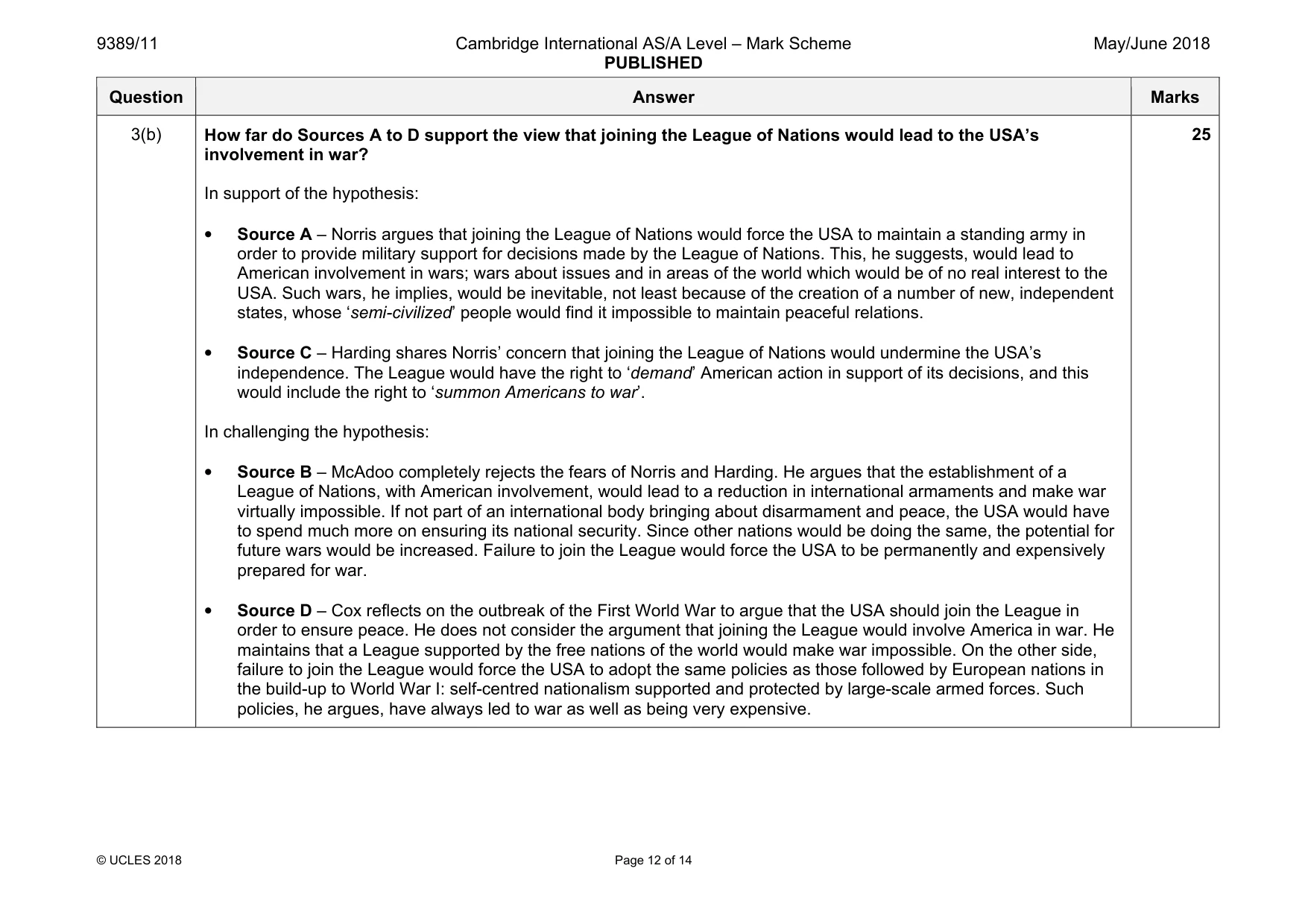
9389/11 Cambridge International AS/A Level – Mark Scheme PUBLISHED May/June 2018 © UCLES 2018 Page 12 of 14 Question Answer Marks 3(b) How far do Sources A to D support the view that joining the League of Nations would lead to the USA’s involvement in war? In support of the hypothesis: • Source A – Norris argues that joining the League of Nations would force the USA to maintain a standing army in order to provide military support for decisions made by the League of Nations. This, he suggests, would lead to American involvement in wars; wars about issues and in areas of the world which would be of no real interest to the USA. Such wars, he implies, would be inevitable, not least because of the creation of a number of new, independent states, whose ‘semi-civilized’ people would find it impossible to maintain peaceful relations. • Source C – Harding shares Norris’ concern that joining the League of Nations would undermine the USA’s independence. The League would have the right to ‘demand’ American action in support of its decisions, and this would include the right to ‘summon Americans to war’. In challenging the hypothesis: • Source B – McAdoo completely rejects the fears of Norris and Harding. He argues that the establishment of a League of Nations, with American involvement, would lead to a reduction in international armaments and make war virtually impossible. If not part of an international body bringing about disarmament and peace, the USA would have to spend much more on ensuring its national security. Since other nations would be doing the same, the potential for future wars would be increased. Failure to join the League would force the USA to be permanently and expensively prepared for war. • Source D – Cox reflects on the outbreak of the First World War to argue that the USA should join the League in order to ensure peace. He does not consider the argument that joining the League would involve America in war. He maintains that a League supported by the free nations of the world would make war impossible. On the other side, failure to join the League would force the USA to adopt the same policies as those followed by European nations in the build-up to World War I: self-centred nationalism supported and protected by large-scale armed forces. Such policies, he argues, have always led to war as well as being very expensive. 25
Mark scheme, page 13
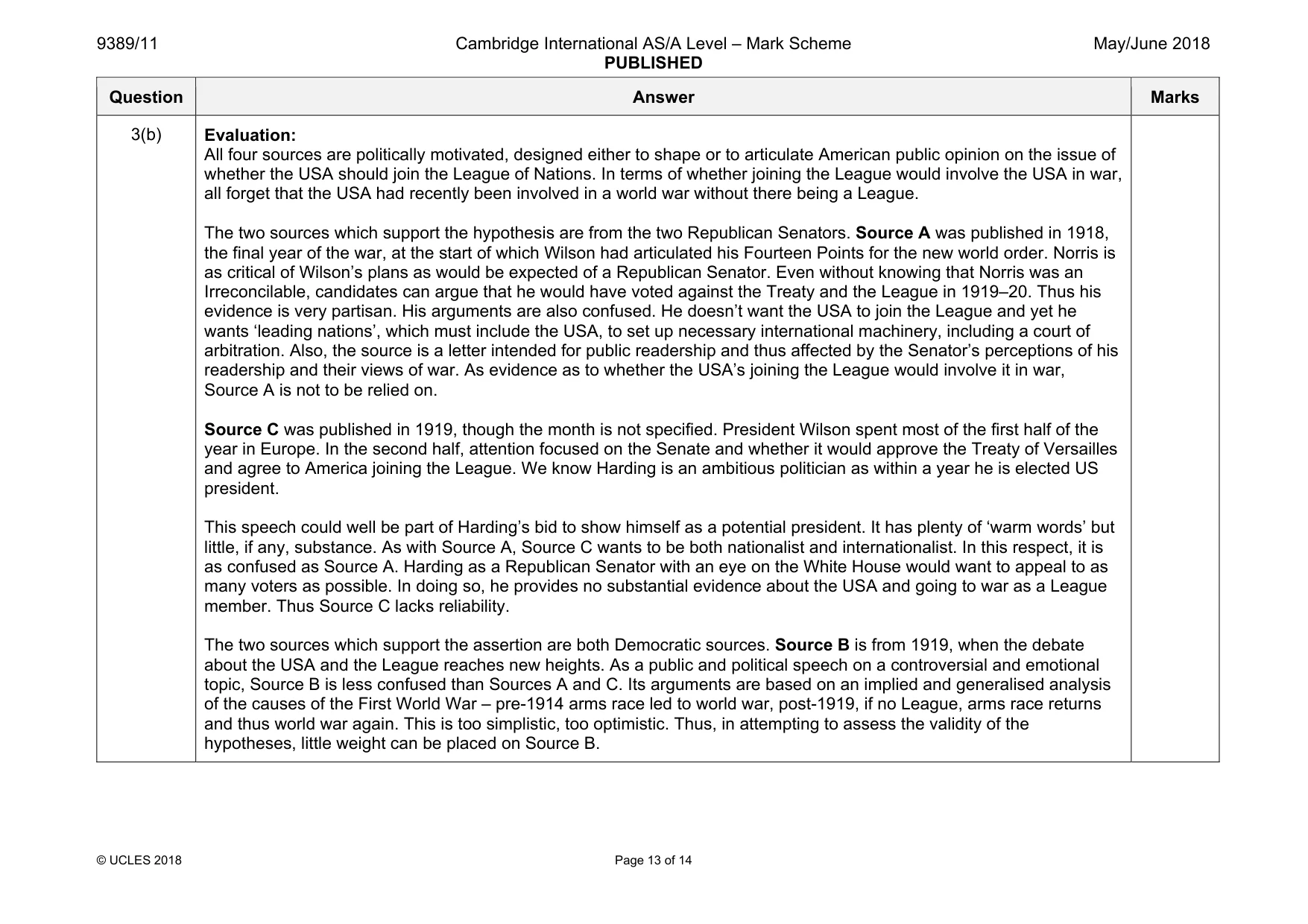
9389/11 Cambridge International AS/A Level – Mark Scheme PUBLISHED May/June 2018 © UCLES 2018 Page 13 of 14 Question Answer Marks 3(b) Evaluation: All four sources are politically motivated, designed either to shape or to articulate American public opinion on the issue of whether the USA should join the League of Nations. In terms of whether joining the League would involve the USA in war, all forget that the USA had recently been involved in a world war without there being a League. The two sources which support the hypothesis are from the two Republican Senators. Source A was published in 1918, the final year of the war, at the start of which Wilson had articulated his Fourteen Points for the new world order. Norris is as critical of Wilson’s plans as would be expected of a Republican Senator. Even without knowing that Norris was an Irreconcilable, candidates can argue that he would have voted against the Treaty and the League in 1919–20. Thus his evidence is very partisan. His arguments are also confused. He doesn’t want the USA to join the League and yet he wants ‘leading nations’, which must include the USA, to set up necessary international machinery, including a court of arbitration. Also, the source is a letter intended for public readership and thus affected by the Senator’s perceptions of his readership and their views of war. As evidence as to whether the USA’s joining the League would involve it in war, Source A is not to be relied on. Source C was published in 1919, though the month is not specified. President Wilson spent most of the first half of the year in Europe. In the second half, attention focused on the Senate and whether it would approve the Treaty of Versailles and agree to America joining the League. We know Harding is an ambitious politician as within a year he is elected US president. This speech could well be part of Harding’s bid to show himself as a potential president. It has plenty of ‘warm words’ but little, if any, substance. As with Source A, Source C wants to be both nationalist and internationalist. In this respect, it is as confused as Source A. Harding as a Republican Senator with an eye on the White House would want to appeal to as many voters as possible. In doing so, he provides no substantial evidence about the USA and going to war as a League member. Thus Source C lacks reliability. The two sources which support the assertion are both Democratic sources. Source B is from 1919, when the debate about the USA and the League reaches new heights. As a public and political speech on a controversial and emotional topic, Source B is less confused than Sources A and C. Its arguments are based on an implied and generalised analysis of the causes of the First World War – pre-1914 arms race led to world war, post-1919, if no League, arms race returns and thus world war again. This is too simplistic, too optimistic. Thus, in attempting to assess the validity of the hypotheses, little weight can be placed on Source B.
Mark scheme, page 14
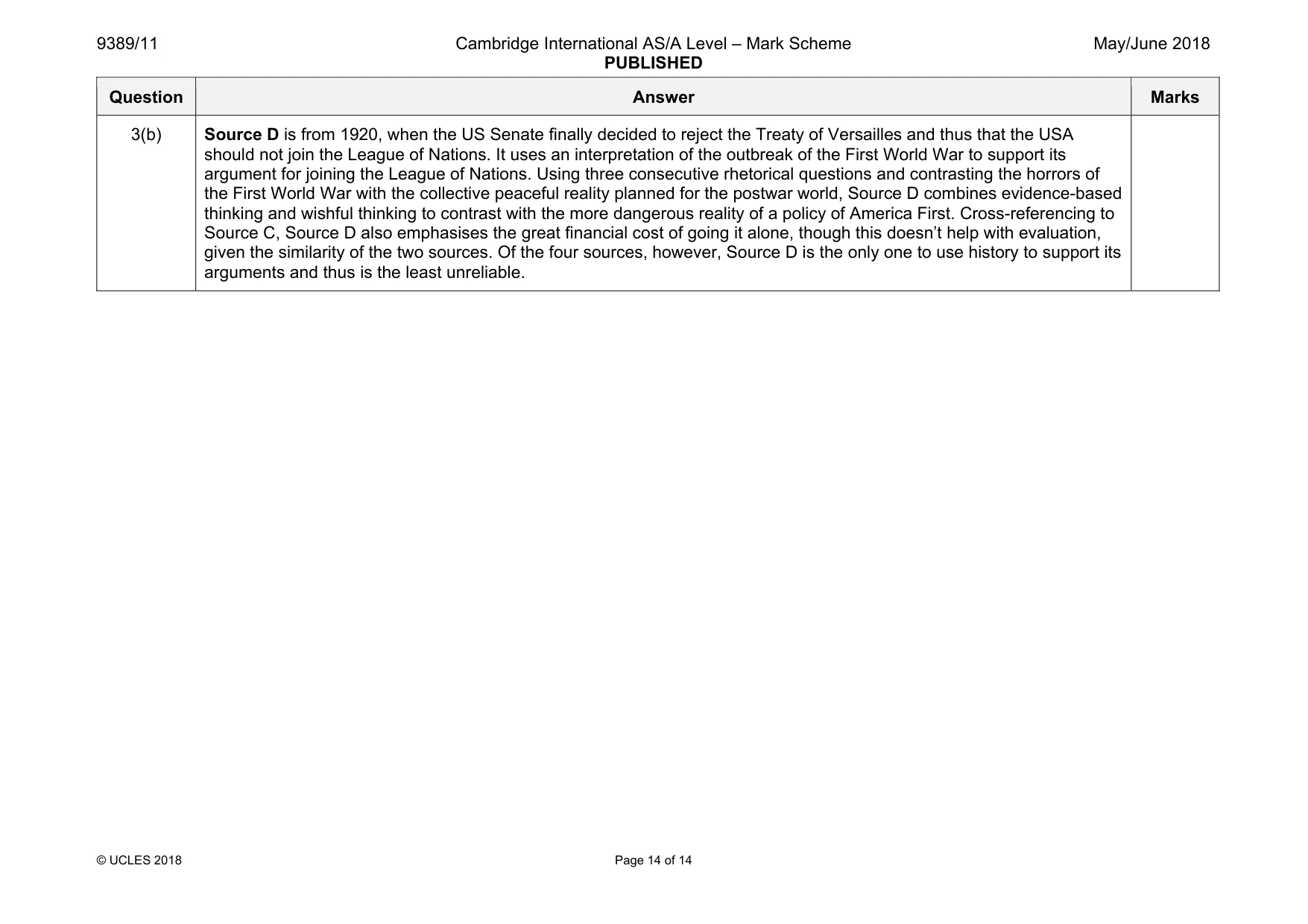
9389/11 Cambridge International AS/A Level – Mark Scheme PUBLISHED May/June 2018 © UCLES 2018 Page 14 of 14 Question Answer Marks 3(b) Source D is from 1920, when the US Senate finally decided to reject the Treaty of Versailles and thus that the USA should not join the League of Nations. It uses an interpretation of the outbreak of the First World War to support its argument for joining the League of Nations. Using three consecutive rhetorical questions and contrasting the horrors of the First World War with the collective peaceful reality planned for the postwar world, Source D combines evidence-based thinking and wishful thinking to contrast with the more dangerous reality of a policy of America First. Cross-referencing to Source C, Source D also emphasises the great financial cost of going it alone, though this doesn’t help with evaluation, given the similarity of the two sources. Of the four sources, however, Source D is the only one to use history to support its arguments and thus is the least unreliable.
What you needed in this session
Cambridge’s own grade thresholds for 2018 May/June, Paper 1 · Variant 1. A higher threshold means an easier paper — the bar moves with how the cohort did.