Cambridge A Level History 9389 — 2018 May/June Paper 1 · Variant 3
9389/13/M/J/18 · 40 marks · ≈45 min
The question paper and its mark scheme, free to read here and free to download. This is Cambridge’s own paper, exactly as it was sat.
Question paper8 pages

Mark scheme12 pages
Answers below. Sit the paper first if you are practising.
Paper as text
Question paper, page 1
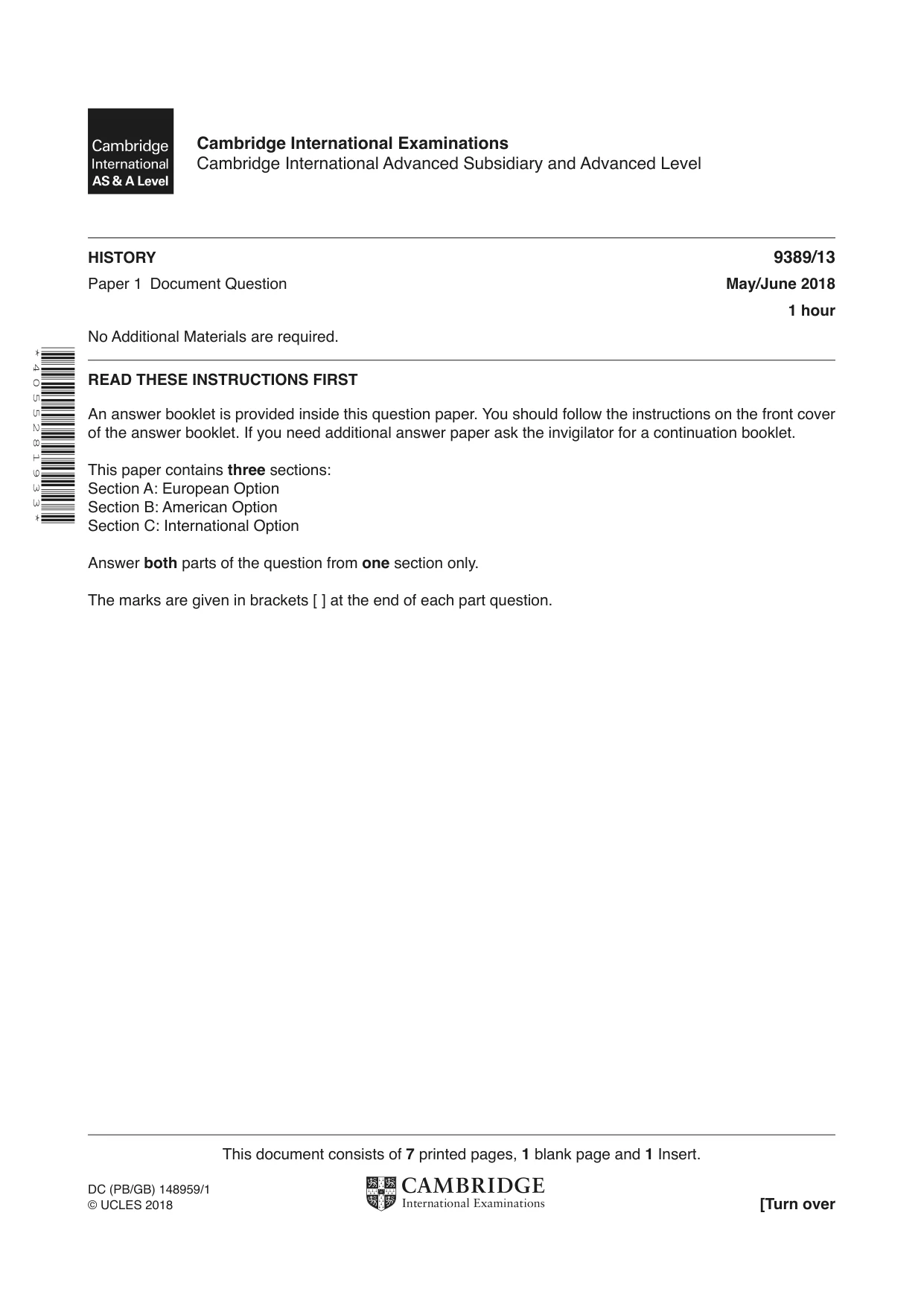
This document consists of 7 printed pages, 1 blank page and 1 Insert. DC (PB/GB) 148959/1 © UCLES 2018 [Turn over Cambridge International Examinations Cambridge International Advanced Subsidiary and Advanced Level * 4 0 5 5 2 8 1 9 3 3 * HISTORY 9389/13 Paper 1 Document Question May/June 2018 1 hour No Additional Materials are required. READ THESE INSTRUCTIONS FIRST An answer booklet is provided inside this question paper. You should follow the instructions on the front cover of the answer booklet. If you need additional answer paper ask the invigilator for a continuation booklet. This paper contains three sections: Section A: European Option Section B: American Option Section C: International Option Answer both parts of the question from one section only. The marks are given in brackets [ ] at the end of each part question.
Question paper, page 2
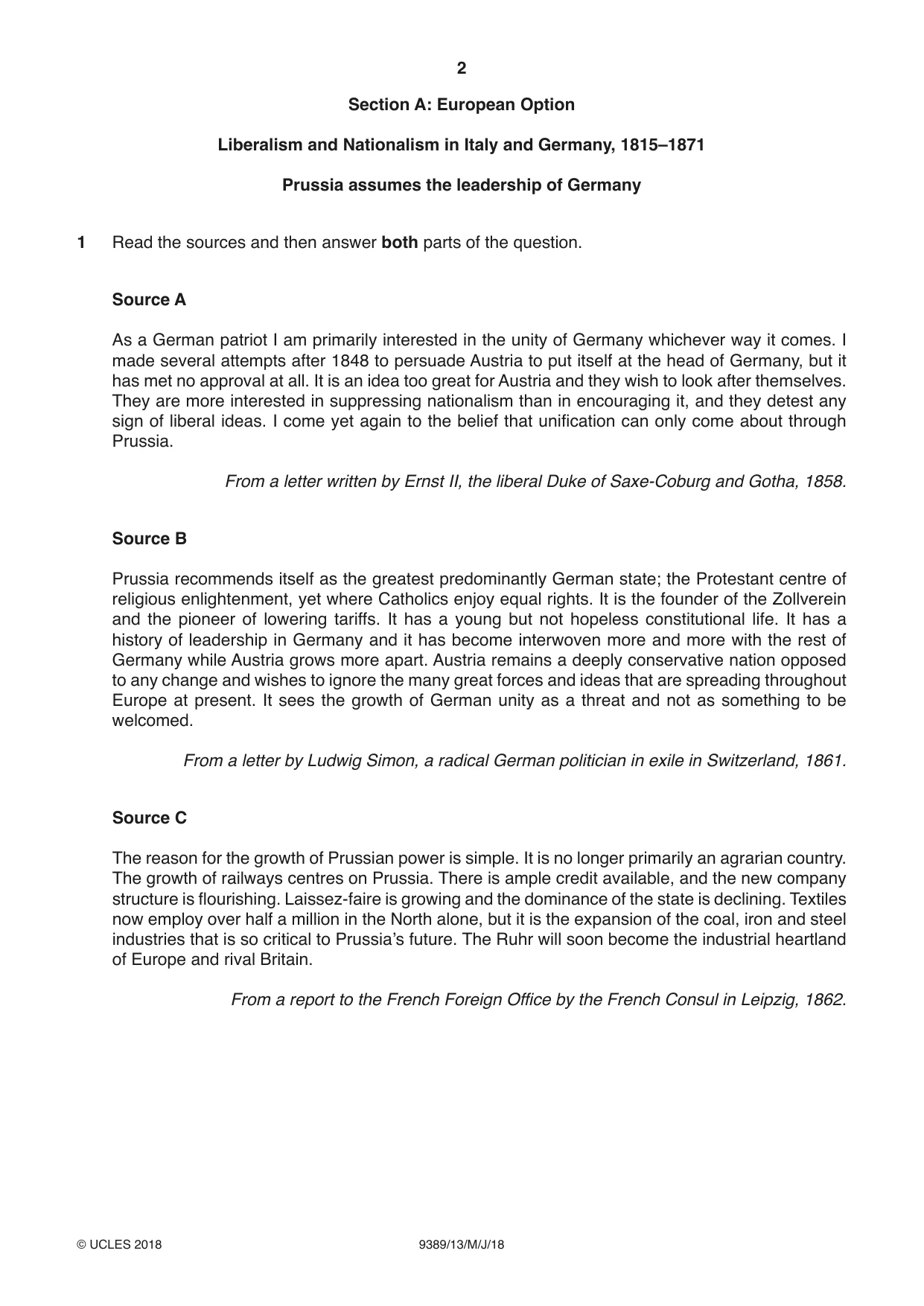
2 9389/13/M/J/18 © UCLES 2018 Section A: European Option Liberalism and Nationalism in Italy and Germany, 1815–1871 Prussia assumes the leadership of Germany 1 Read the sources and then answer both parts of the question. Source A As a German patriot I am primarily interested in the unity of Germany whichever way it comes. I made several attempts after 1848 to persuade Austria to put itself at the head of Germany, but it has met no approval at all. It is an idea too great for Austria and they wish to look after themselves. They are more interested in suppressing nationalism than in encouraging it, and they detest any sign of liberal ideas. I come yet again to the belief that unification can only come about through Prussia. From a letter written by Ernst II, the liberal Duke of Saxe-Coburg and Gotha, 1858. Source B Prussia recommends itself as the greatest predominantly German state; the Protestant centre of religious enlightenment, yet where Catholics enjoy equal rights. It is the founder of the Zollverein and the pioneer of lowering tariffs. It has a young but not hopeless constitutional life. It has a history of leadership in Germany and it has become interwoven more and more with the rest of Germany while Austria grows more apart. Austria remains a deeply conservative nation opposed to any change and wishes to ignore the many great forces and ideas that are spreading throughout Europe at present. It sees the growth of German unity as a threat and not as something to be welcomed. From a letter by Ludwig Simon, a radical German politician in exile in Switzerland, 1861. Source C The reason for the growth of Prussian power is simple. It is no longer primarily an agrarian country. The growth of railways centres on Prussia. There is ample credit available, and the new company structure is flourishing. Laissez-faire is growing and the dominance of the state is declining. Textiles now employ over half a million in the North alone, but it is the expansion of the coal, iron and steel industries that is so critical to Prussia’s future. The Ruhr will soon become the industrial heartland of Europe and rival Britain. From a report to the French Foreign Office by the French Consul in Leipzig, 1862.
Question paper, page 3
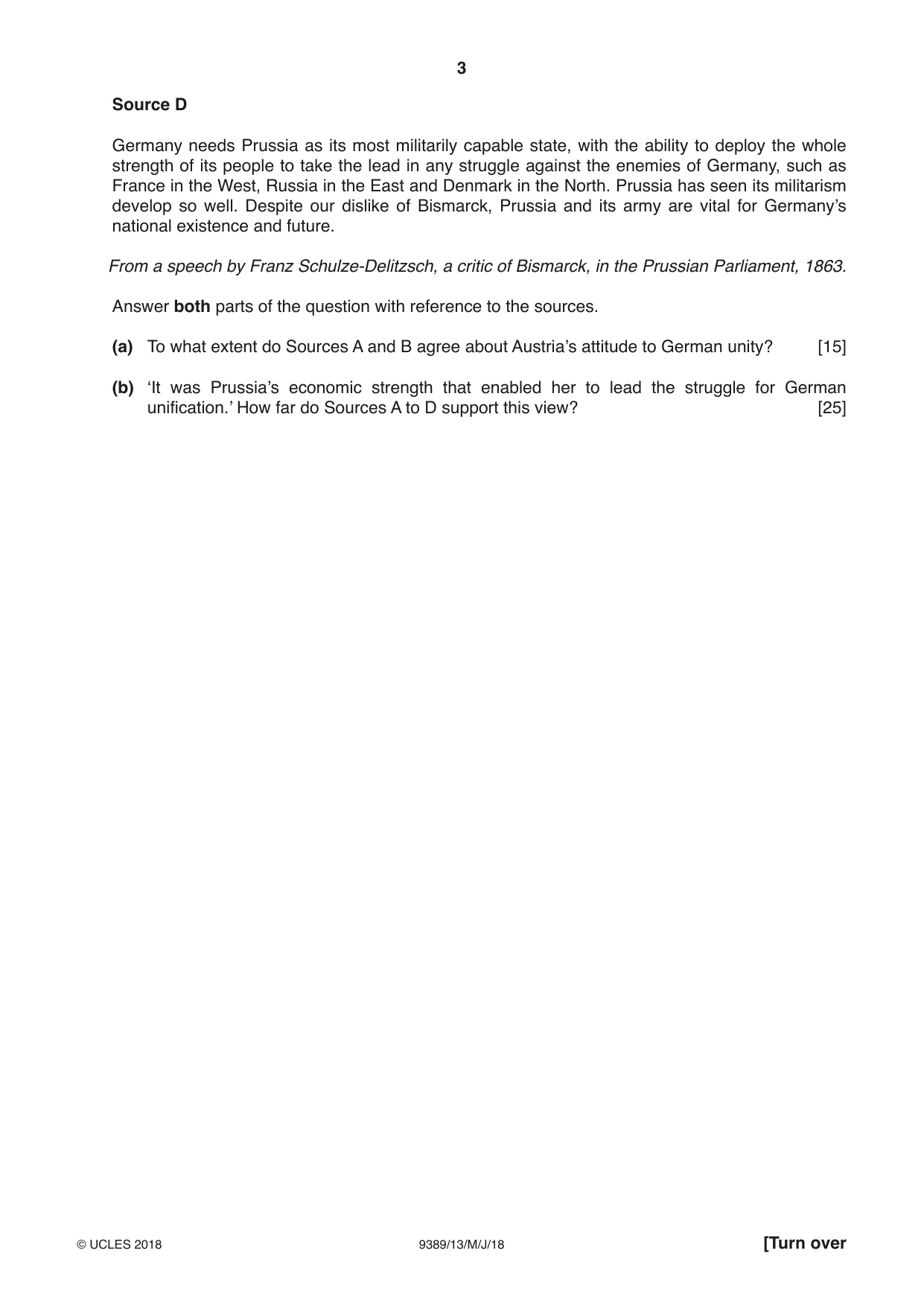
3 9389/13/M/J/18 © UCLES 2018 [Turn over Source D Germany needs Prussia as its most militarily capable state, with the ability to deploy the whole strength of its people to take the lead in any struggle against the enemies of Germany, such as France in the West, Russia in the East and Denmark in the North. Prussia has seen its militarism develop so well. Despite our dislike of Bismarck, Prussia and its army are vital for Germany’s national existence and future. From a speech by Franz Schulze-Delitzsch, a critic of Bismarck, in the Prussian Parliament, 1863. Answer both parts of the question with reference to the sources. (a) To what extent do Sources A and B agree about Austria’s attitude to German unity? [15] (b) ‘It was Prussia’s economic strength that enabled her to lead the struggle for German unification.’ How far do Sources A to D support this view? [25]
Question paper, page 4
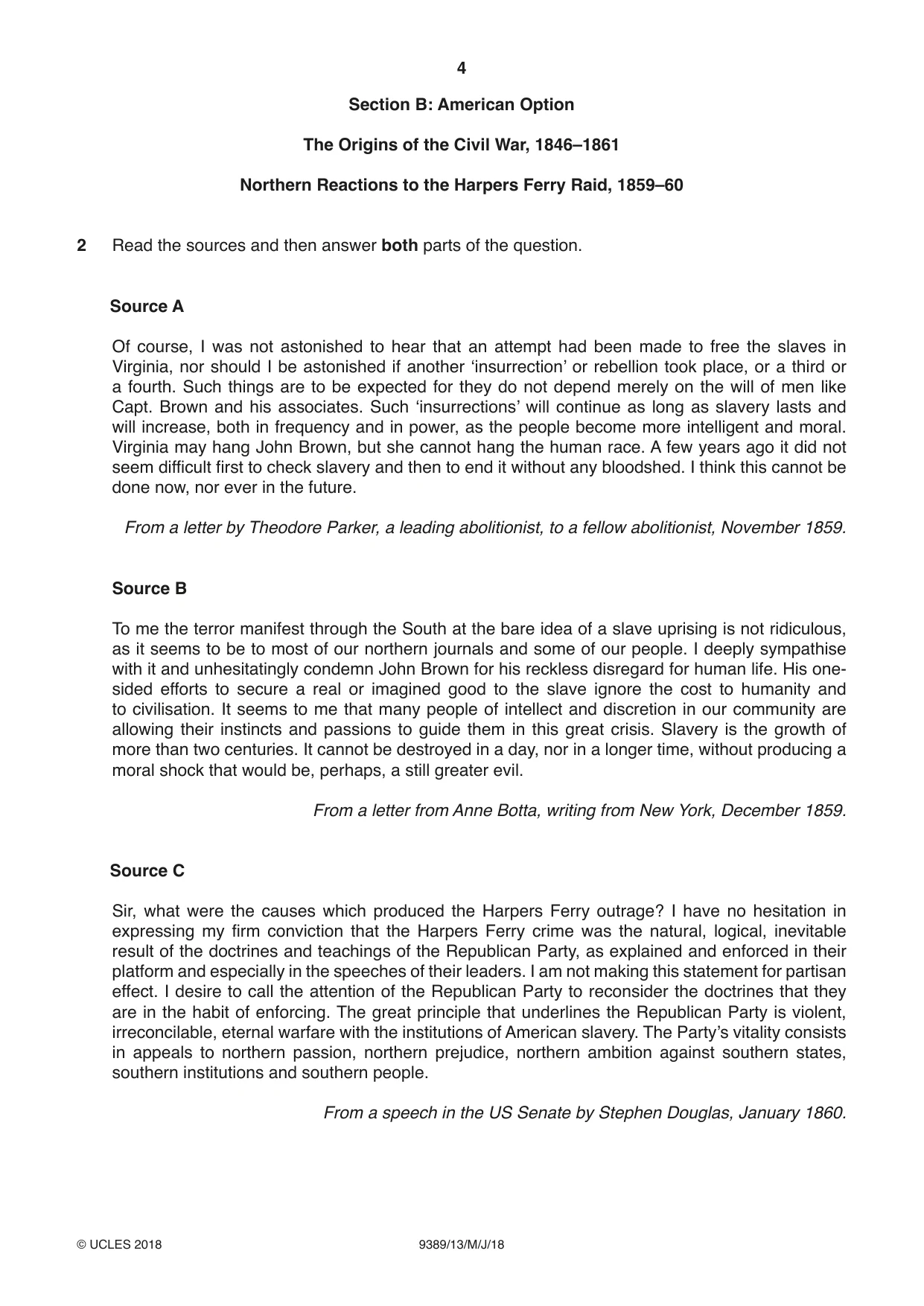
4 9389/13/M/J/18 © UCLES 2018 Section B: American Option The Origins of the Civil War, 1846–1861 Northern Reactions to the Harpers Ferry Raid, 1859–60 2 Read the sources and then answer both parts of the question. Source A Of course, I was not astonished to hear that an attempt had been made to free the slaves in Virginia, nor should I be astonished if another ‘insurrection’ or rebellion took place, or a third or a fourth. Such things are to be expected for they do not depend merely on the will of men like Capt. Brown and his associates. Such ‘insurrections’ will continue as long as slavery lasts and will increase, both in frequency and in power, as the people become more intelligent and moral. Virginia may hang John Brown, but she cannot hang the human race. A few years ago it did not seem difficult first to check slavery and then to end it without any bloodshed. I think this cannot be done now, nor ever in the future. From a letter by Theodore Parker, a leading abolitionist, to a fellow abolitionist, November 1859. Source B To me the terror manifest through the South at the bare idea of a slave uprising is not ridiculous, as it seems to be to most of our northern journals and some of our people. I deeply sympathise with it and unhesitatingly condemn John Brown for his reckless disregard for human life. His one- sided efforts to secure a real or imagined good to the slave ignore the cost to humanity and to civilisation. It seems to me that many people of intellect and discretion in our community are allowing their instincts and passions to guide them in this great crisis. Slavery is the growth of more than two centuries. It cannot be destroyed in a day, nor in a longer time, without producing a moral shock that would be, perhaps, a still greater evil. From a letter from Anne Botta, writing from New York, December 1859. Source C Sir, what were the causes which produced the Harpers Ferry outrage? I have no hesitation in expressing my firm conviction that the Harpers Ferry crime was the natural, logical, inevitable result of the doctrines and teachings of the Republican Party, as explained and enforced in their platform and especially in the speeches of their leaders. I am not making this statement for partisan effect. I desire to call the attention of the Republican Party to reconsider the doctrines that they are in the habit of enforcing. The great principle that underlines the Republican Party is violent, irreconcilable, eternal warfare with the institutions of American slavery. The Party’s vitality consists in appeals to northern passion, northern prejudice, northern ambition against southern states, southern institutions and southern people. From a speech in the US Senate by Stephen Douglas, January 1860.
Question paper, page 5
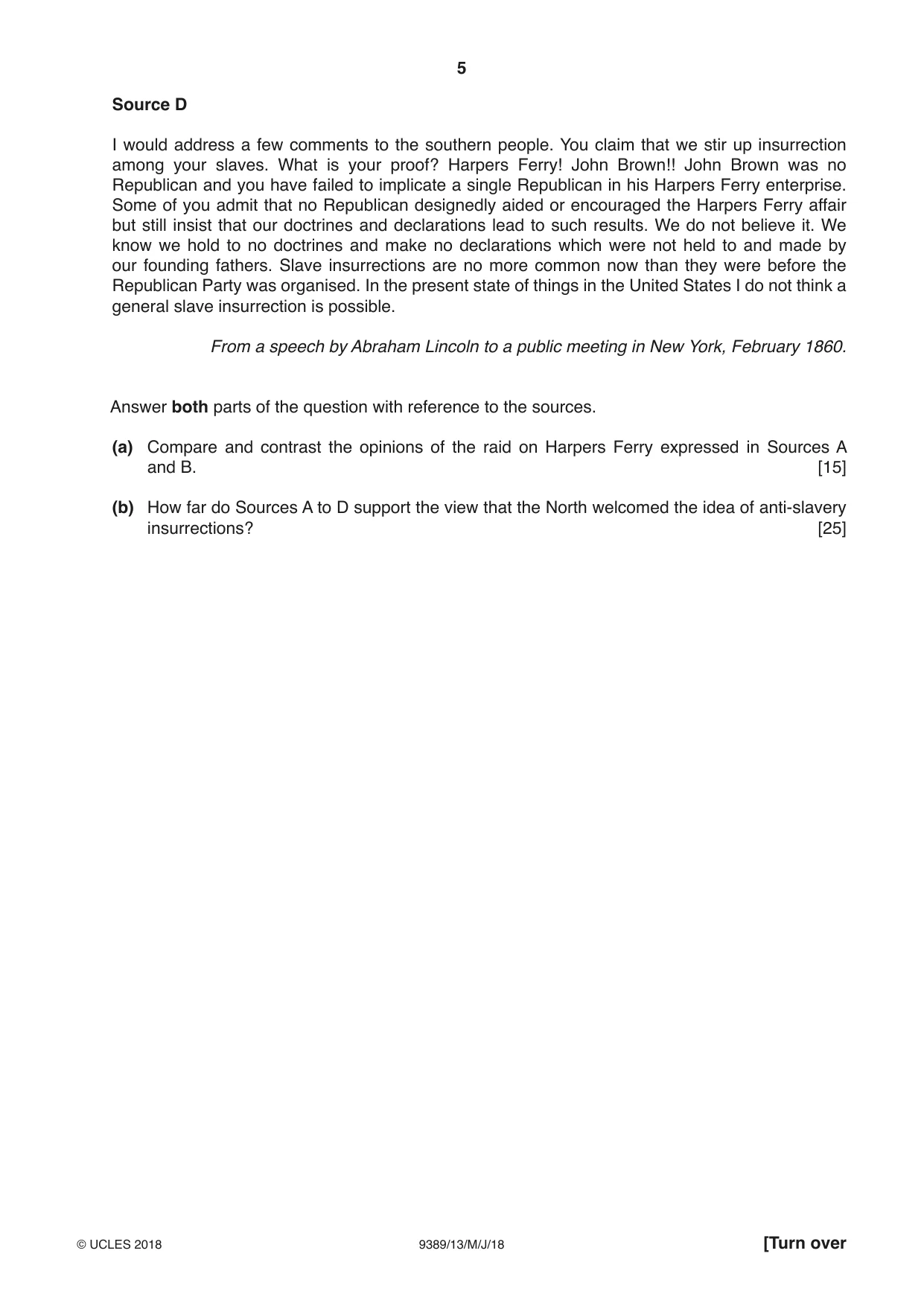
5 9389/13/M/J/18 © UCLES 2018 [Turn over Source D I would address a few comments to the southern people. You claim that we stir up insurrection among your slaves. What is your proof? Harpers Ferry! John Brown!! John Brown was no Republican and you have failed to implicate a single Republican in his Harpers Ferry enterprise. Some of you admit that no Republican designedly aided or encouraged the Harpers Ferry affair but still insist that our doctrines and declarations lead to such results. We do not believe it. We know we hold to no doctrines and make no declarations which were not held to and made by our founding fathers. Slave insurrections are no more common now than they were before the Republican Party was organised. In the present state of things in the United States I do not think a general slave insurrection is possible. From a speech by Abraham Lincoln to a public meeting in New York, February 1860. Answer both parts of the question with reference to the sources. (a) Compare and contrast the opinions of the raid on Harpers Ferry expressed in Sources A and B. [15] (b) How far do Sources A to D support the view that the North welcomed the idea of anti-slavery insurrections? [25]
Question paper, page 6
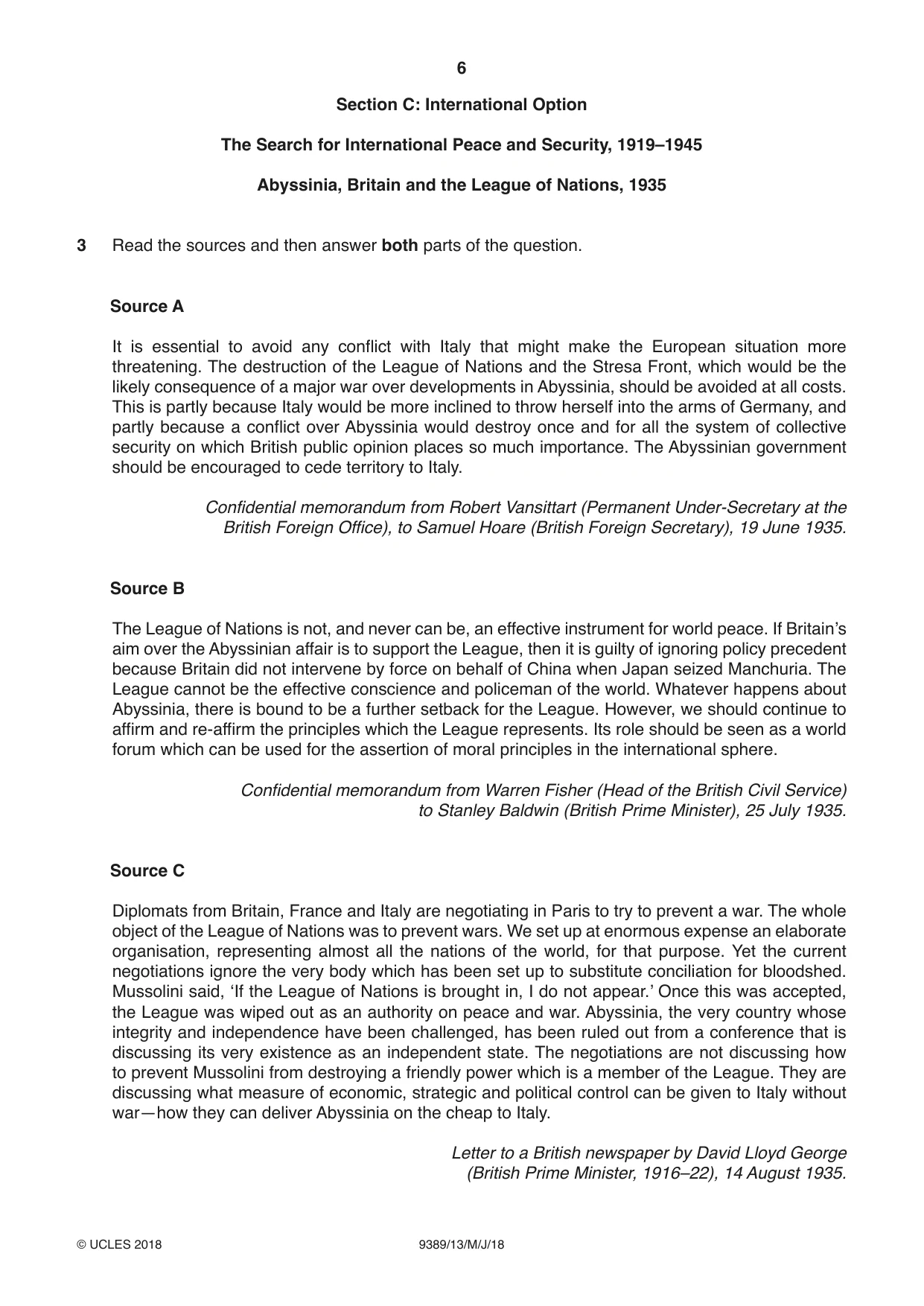
6 9389/13/M/J/18 © UCLES 2018 Section C: International Option The Search for International Peace and Security, 1919–1945 Abyssinia, Britain and the League of Nations, 1935 3 Read the sources and then answer both parts of the question. Source A It is essential to avoid any conflict with Italy that might make the European situation more threatening. The destruction of the League of Nations and the Stresa Front, which would be the likely consequence of a major war over developments in Abyssinia, should be avoided at all costs. This is partly because Italy would be more inclined to throw herself into the arms of Germany, and partly because a conflict over Abyssinia would destroy once and for all the system of collective security on which British public opinion places so much importance. The Abyssinian government should be encouraged to cede territory to Italy. Confidential memorandum from Robert Vansittart (Permanent Under-Secretary at the British Foreign Office), to Samuel Hoare (British Foreign Secretary), 19 June 1935. Source B The League of Nations is not, and never can be, an effective instrument for world peace. If Britain’s aim over the Abyssinian affair is to support the League, then it is guilty of ignoring policy precedent because Britain did not intervene by force on behalf of China when Japan seized Manchuria. The League cannot be the effective conscience and policeman of the world. Whatever happens about Abyssinia, there is bound to be a further setback for the League. However, we should continue to affirm and re-affirm the principles which the League represents. Its role should be seen as a world forum which can be used for the assertion of moral principles in the international sphere. Confidential memorandum from Warren Fisher (Head of the British Civil Service) to Stanley Baldwin (British Prime Minister), 25 July 1935. Source C Diplomats from Britain, France and Italy are negotiating in Paris to try to prevent a war. The whole object of the League of Nations was to prevent wars. We set up at enormous expense an elaborate organisation, representing almost all the nations of the world, for that purpose. Yet the current negotiations ignore the very body which has been set up to substitute conciliation for bloodshed. Mussolini said, ‘If the League of Nations is brought in, I do not appear.’ Once this was accepted, the League was wiped out as an authority on peace and war. Abyssinia, the very country whose integrity and independence have been challenged, has been ruled out from a conference that is discussing its very existence as an independent state. The negotiations are not discussing how to prevent Mussolini from destroying a friendly power which is a member of the League. They are discussing what measure of economic, strategic and political control can be given to Italy without war—how they can deliver Abyssinia on the cheap to Italy. Letter to a British newspaper by David Lloyd George (British Prime Minister, 1916–22), 14 August 1935.
Question paper, page 7
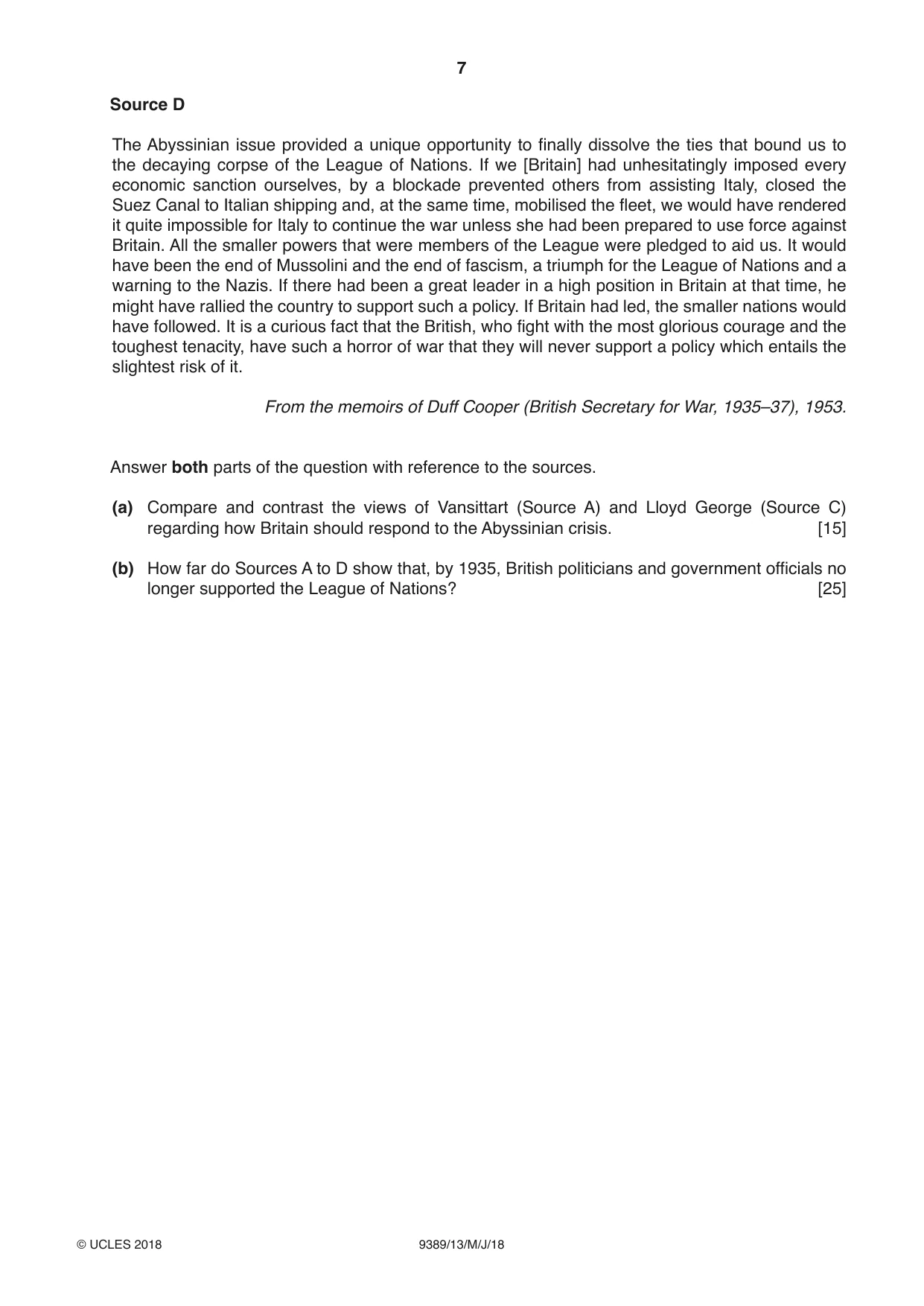
7 9389/13/M/J/18 © UCLES 2018 Source D The Abyssinian issue provided a unique opportunity to finally dissolve the ties that bound us to the decaying corpse of the League of Nations. If we [Britain] had unhesitatingly imposed every economic sanction ourselves, by a blockade prevented others from assisting Italy, closed the Suez Canal to Italian shipping and, at the same time, mobilised the fleet, we would have rendered it quite impossible for Italy to continue the war unless she had been prepared to use force against Britain. All the smaller powers that were members of the League were pledged to aid us. It would have been the end of Mussolini and the end of fascism, a triumph for the League of Nations and a warning to the Nazis. If there had been a great leader in a high position in Britain at that time, he might have rallied the country to support such a policy. If Britain had led, the smaller nations would have followed. It is a curious fact that the British, who fight with the most glorious courage and the toughest tenacity, have such a horror of war that they will never support a policy which entails the slightest risk of it. From the memoirs of Duff Cooper (British Secretary for War, 1935–37), 1953. Answer both parts of the question with reference to the sources. (a) Compare and contrast the views of Vansittart (Source A) and Lloyd George (Source C) regarding how Britain should respond to the Abyssinian crisis. [15] (b) How far do Sources A to D show that, by 1935, British politicians and government officials no longer supported the League of Nations? [25]
Question paper, page 8
8 9389/13/M/J/18 © UCLES 2018 BLANK PAGE Permission to reproduce items where third-party owned material protected by copyright is included has been sought and cleared where possible. Every reasonable effort has been made by the publisher (UCLES) to trace copyright holders, but if any items requiring clearance have unwittingly been included, the publisher will be pleased to make amends at the earliest possible opportunity. To avoid the issue of disclosure of answer-related information to candidates, all copyright acknowledgements are reproduced online in the Cambridge International Examinations Copyright Acknowledgements Booklet. This is produced for each series of examinations and is freely available to download at www.cie.org.uk after the live examination series. Cambridge International Examinations is part of the Cambridge Assessment Group. Cambridge Assessment is the brand name of University of Cambridge Local Examinations Syndicate (UCLES), which is itself a department of the University of Cambridge.
Mark scheme, page 1
IGCSE™ is a registered trademark. This document consists of 12 printed pages. © UCLES 2018 [Turn over Cambridge Assessment International Education Cambridge International Advanced Subsidiary and Advanced Level HISTORY 9389/13 Paper 1 Document Question May/June 2018 MARK SCHEME Maximum Mark: 40 Published This mark scheme is published as an aid to teachers and candidates, to indicate the requirements of the examination. It shows the basis on which Examiners were instructed to award marks. It does not indicate the details of the discussions that took place at an Examiners’ meeting before marking began, which would have considered the acceptability of alternative answers. Mark schemes should be read in conjunction with the question paper and the Principal Examiner Report for Teachers. Cambridge International will not enter into discussions about these mark schemes. Cambridge International is publishing the mark schemes for the May/June 2018 series for most Cambridge IGCSE™, Cambridge International A and AS Level and Cambridge Pre-U components, and some Cambridge O Level components.
Mark scheme, page 2
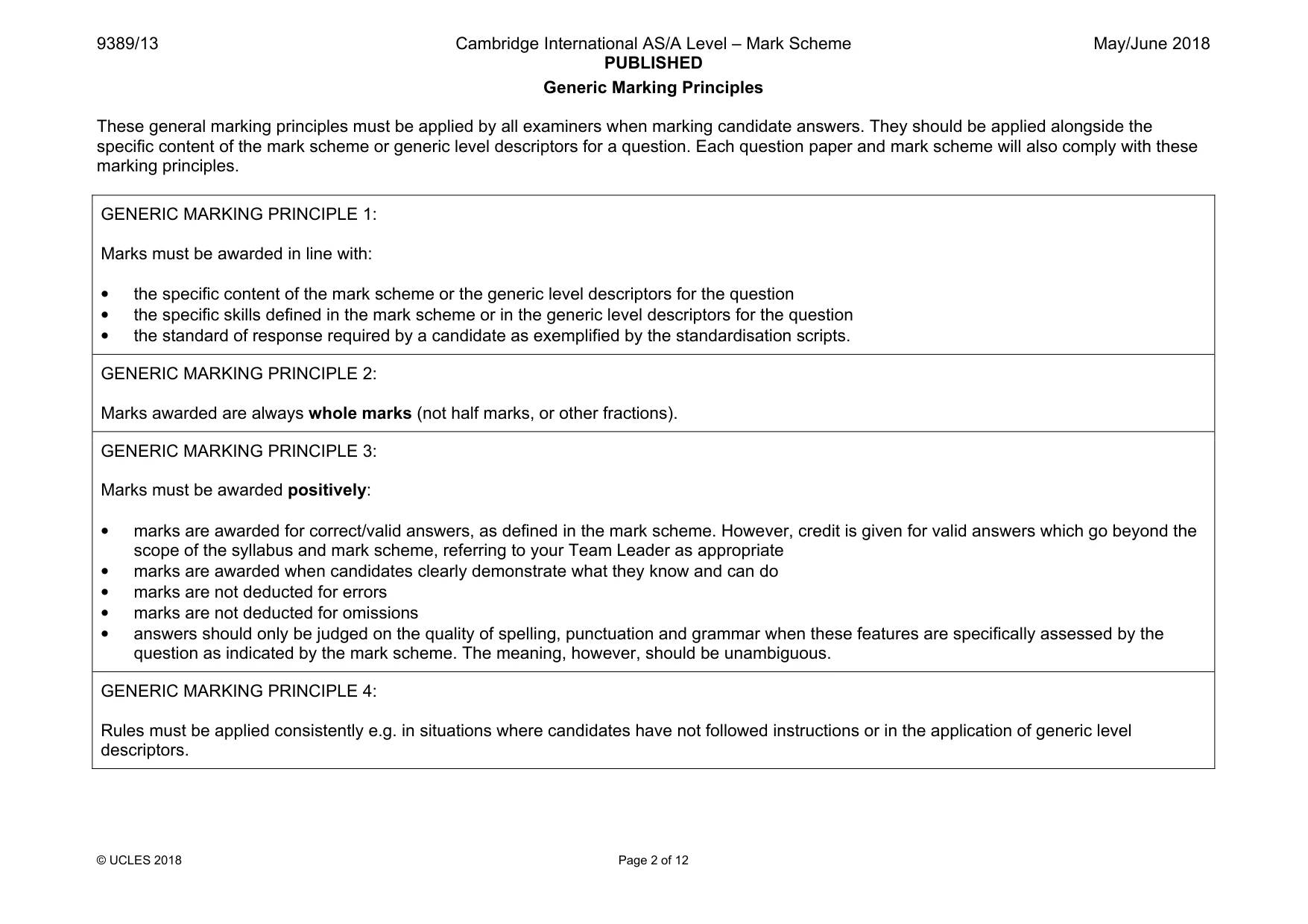
9389/13 Cambridge International AS/A Level – Mark Scheme PUBLISHED May/June 2018 © UCLES 2018 Page 2 of 12 Generic Marking Principles These general marking principles must be applied by all examiners when marking candidate answers. They should be applied alongside the specific content of the mark scheme or generic level descriptors for a question. Each question paper and mark scheme will also comply with these marking principles. GENERIC MARKING PRINCIPLE 1: Marks must be awarded in line with: • the specific content of the mark scheme or the generic level descriptors for the question • the specific skills defined in the mark scheme or in the generic level descriptors for the question • the standard of response required by a candidate as exemplified by the standardisation scripts. GENERIC MARKING PRINCIPLE 2: Marks awarded are always whole marks (not half marks, or other fractions). GENERIC MARKING PRINCIPLE 3: Marks must be awarded positively: • marks are awarded for correct/valid answers, as defined in the mark scheme. However, credit is given for valid answers which go beyond the scope of the syllabus and mark scheme, referring to your Team Leader as appropriate • marks are awarded when candidates clearly demonstrate what they know and can do • marks are not deducted for errors • marks are not deducted for omissions • answers should only be judged on the quality of spelling, punctuation and grammar when these features are specifically assessed by the question as indicated by the mark scheme. The meaning, however, should be unambiguous. GENERIC MARKING PRINCIPLE 4: Rules must be applied consistently e.g. in situations where candidates have not followed instructions or in the application of generic level descriptors.
Mark scheme, page 3
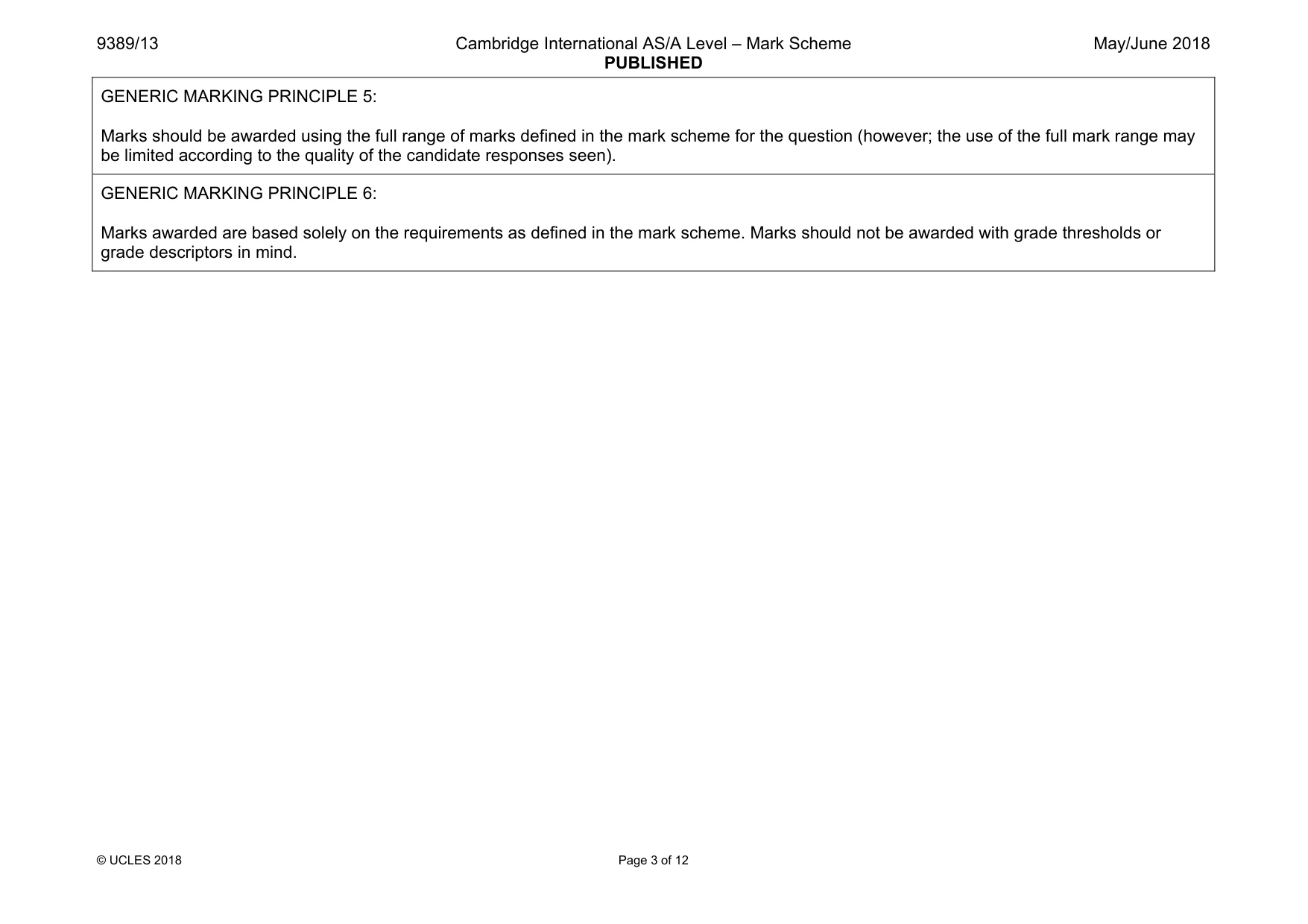
9389/13 Cambridge International AS/A Level – Mark Scheme PUBLISHED May/June 2018 © UCLES 2018 Page 3 of 12 GENERIC MARKING PRINCIPLE 5: Marks should be awarded using the full range of marks defined in the mark scheme for the question (however; the use of the full mark range may be limited according to the quality of the candidate responses seen). GENERIC MARKING PRINCIPLE 6: Marks awarded are based solely on the requirements as defined in the mark scheme. Marks should not be awarded with grade thresholds or grade descriptors in mind.
Mark scheme, page 4
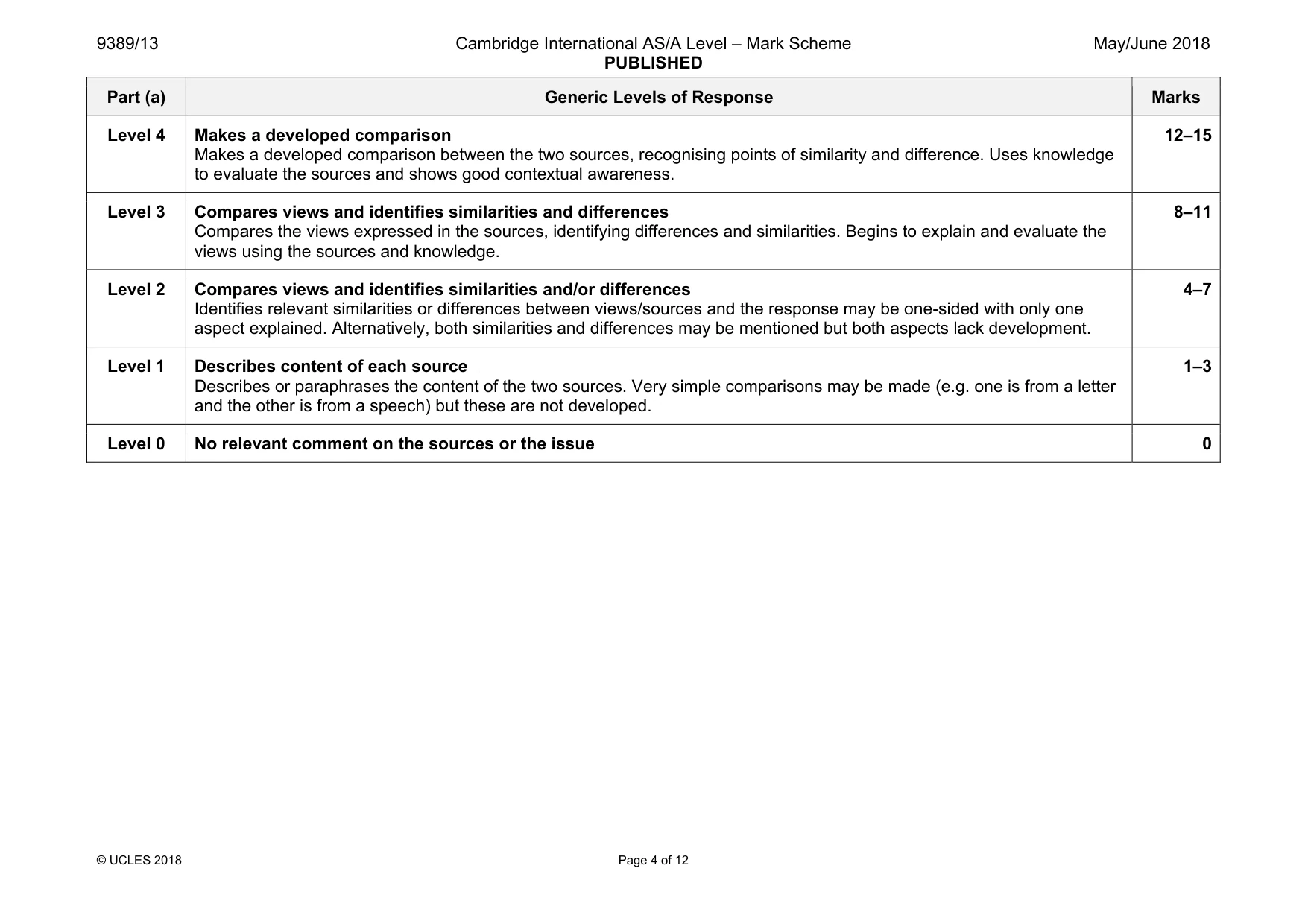
9389/13 Cambridge International AS/A Level – Mark Scheme PUBLISHED May/June 2018 © UCLES 2018 Page 4 of 12 Part (a) Generic Levels of Response Marks Level 4 Makes a developed comparison Makes a developed comparison between the two sources, recognising points of similarity and difference. Uses knowledge to evaluate the sources and shows good contextual awareness. 12–15 Level 3 Compares views and identifies similarities and differences Compares the views expressed in the sources, identifying differences and similarities. Begins to explain and evaluate the views using the sources and knowledge. 8–11 Level 2 Compares views and identifies similarities and/or differences Identifies relevant similarities or differences between views/sources and the response may be one-sided with only one aspect explained. Alternatively, both similarities and differences may be mentioned but both aspects lack development. 4–7 Level 1 Describes content of each source Describes or paraphrases the content of the two sources. Very simple comparisons may be made (e.g. one is from a letter and the other is from a speech) but these are not developed. 1–3 Level 0 No relevant comment on the sources or the issue 0
Mark scheme, page 5
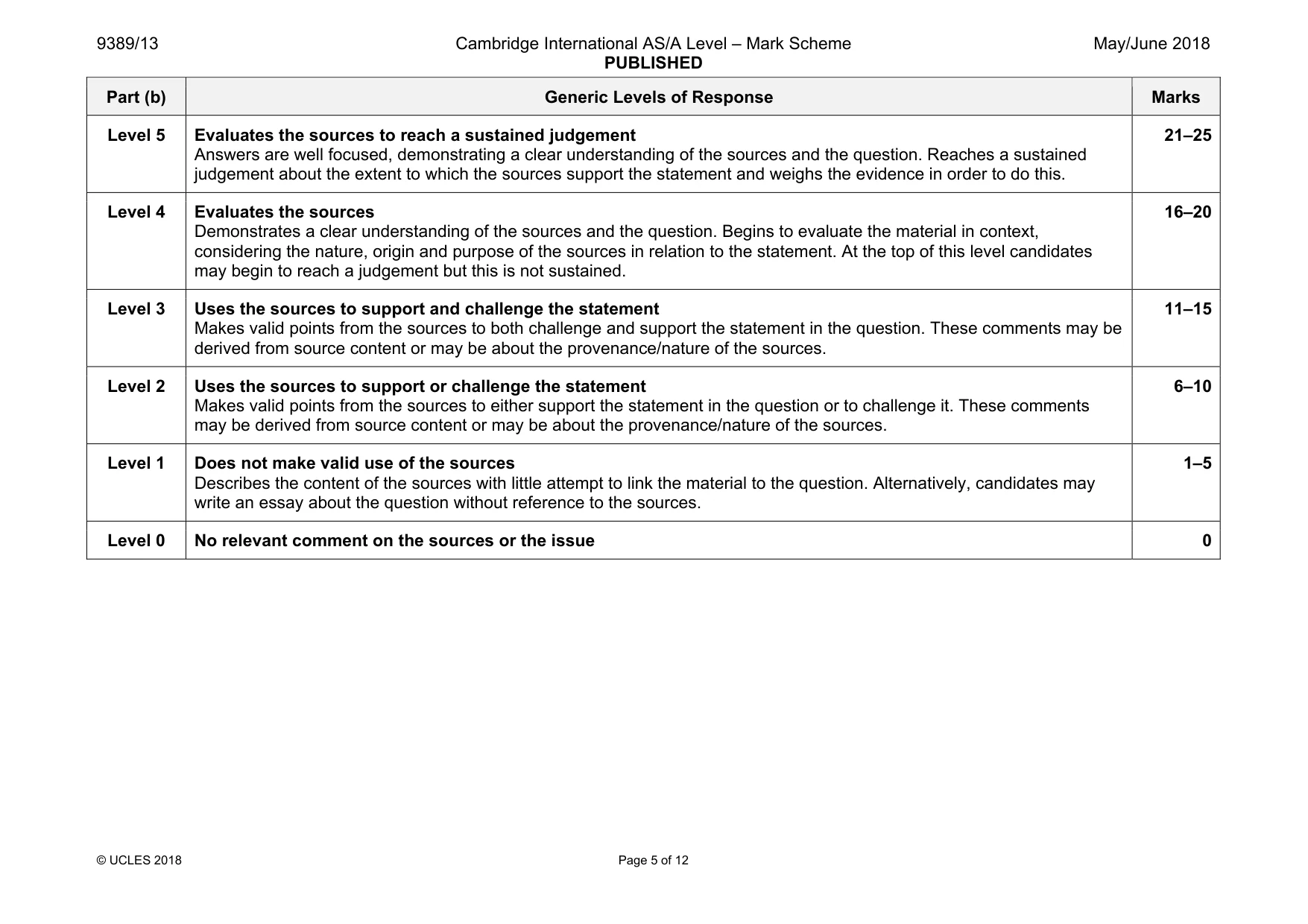
9389/13 Cambridge International AS/A Level – Mark Scheme PUBLISHED May/June 2018 © UCLES 2018 Page 5 of 12 Part (b) Generic Levels of Response Marks Level 5 Evaluates the sources to reach a sustained judgement Answers are well focused, demonstrating a clear understanding of the sources and the question. Reaches a sustained judgement about the extent to which the sources support the statement and weighs the evidence in order to do this. 21–25 Level 4 Evaluates the sources Demonstrates a clear understanding of the sources and the question. Begins to evaluate the material in context, considering the nature, origin and purpose of the sources in relation to the statement. At the top of this level candidates may begin to reach a judgement but this is not sustained. 16–20 Level 3 Uses the sources to support and challenge the statement Makes valid points from the sources to both challenge and support the statement in the question. These comments may be derived from source content or may be about the provenance/nature of the sources. 11–15 Level 2 Uses the sources to support or challenge the statement Makes valid points from the sources to either support the statement in the question or to challenge it. These comments may be derived from source content or may be about the provenance/nature of the sources. 6–10 Level 1 Does not make valid use of the sources Describes the content of the sources with little attempt to link the material to the question. Alternatively, candidates may write an essay about the question without reference to the sources. 1–5 Level 0 No relevant comment on the sources or the issue 0
Mark scheme, page 6
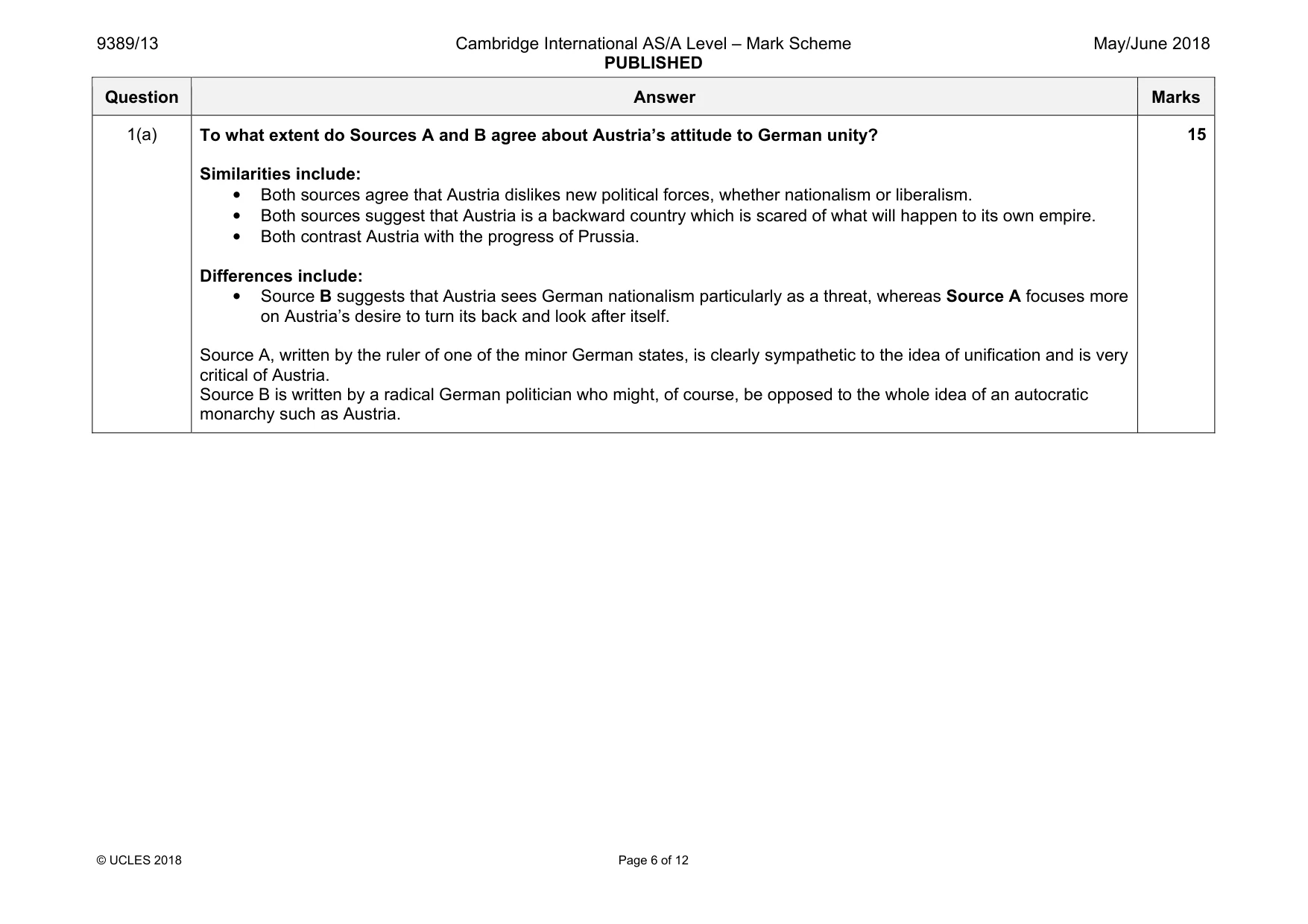
9389/13 Cambridge International AS/A Level – Mark Scheme PUBLISHED May/June 2018 © UCLES 2018 Page 6 of 12 Question Answer Marks 1(a) To what extent do Sources A and B agree about Austria’s attitude to German unity? Similarities include: • Both sources agree that Austria dislikes new political forces, whether nationalism or liberalism. • Both sources suggest that Austria is a backward country which is scared of what will happen to its own empire. • Both contrast Austria with the progress of Prussia. Differences include: • Source B suggests that Austria sees German nationalism particularly as a threat, whereas Source A focuses more on Austria’s desire to turn its back and look after itself. Source A, written by the ruler of one of the minor German states, is clearly sympathetic to the idea of unification and is very critical of Austria. Source B is written by a radical German politician who might, of course, be opposed to the whole idea of an autocratic monarchy such as Austria. 15
Mark scheme, page 7
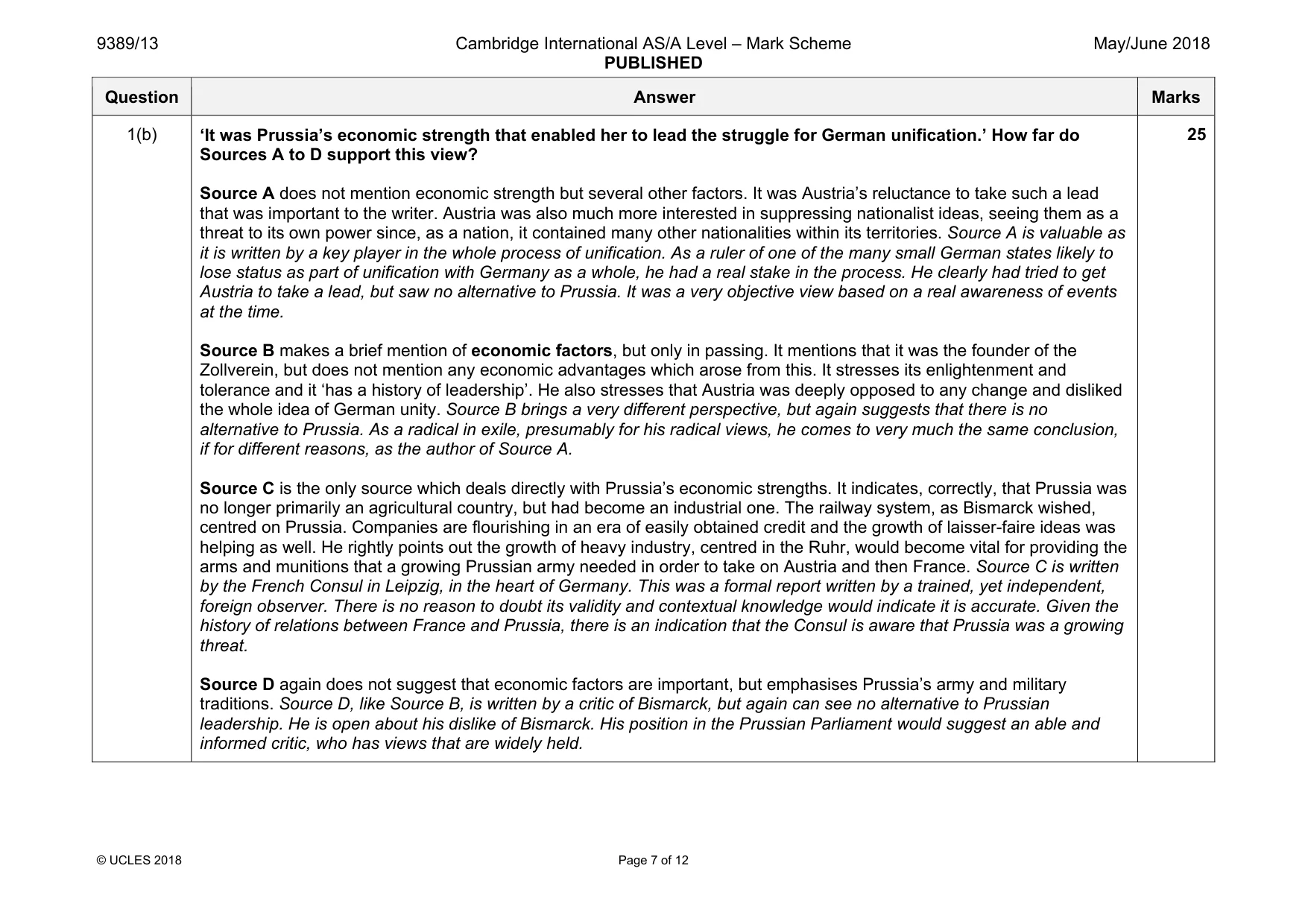
9389/13 Cambridge International AS/A Level – Mark Scheme PUBLISHED May/June 2018 © UCLES 2018 Page 7 of 12 Question Answer Marks 1(b) ‘It was Prussia’s economic strength that enabled her to lead the struggle for German unification.’ How far do Sources A to D support this view? Source A does not mention economic strength but several other factors. It was Austria’s reluctance to take such a lead that was important to the writer. Austria was also much more interested in suppressing nationalist ideas, seeing them as a threat to its own power since, as a nation, it contained many other nationalities within its territories. Source A is valuable as it is written by a key player in the whole process of unification. As a ruler of one of the many small German states likely to lose status as part of unification with Germany as a whole, he had a real stake in the process. He clearly had tried to get Austria to take a lead, but saw no alternative to Prussia. It was a very objective view based on a real awareness of events at the time. Source B makes a brief mention of economic factors, but only in passing. It mentions that it was the founder of the Zollverein, but does not mention any economic advantages which arose from this. It stresses its enlightenment and tolerance and it ‘has a history of leadership’. He also stresses that Austria was deeply opposed to any change and disliked the whole idea of German unity. Source B brings a very different perspective, but again suggests that there is no alternative to Prussia. As a radical in exile, presumably for his radical views, he comes to very much the same conclusion, if for different reasons, as the author of Source A. Source C is the only source which deals directly with Prussia’s economic strengths. It indicates, correctly, that Prussia was no longer primarily an agricultural country, but had become an industrial one. The railway system, as Bismarck wished, centred on Prussia. Companies are flourishing in an era of easily obtained credit and the growth of laisser-faire ideas was helping as well. He rightly points out the growth of heavy industry, centred in the Ruhr, would become vital for providing the arms and munitions that a growing Prussian army needed in order to take on Austria and then France. Source C is written by the French Consul in Leipzig, in the heart of Germany. This was a formal report written by a trained, yet independent, foreign observer. There is no reason to doubt its validity and contextual knowledge would indicate it is accurate. Given the history of relations between France and Prussia, there is an indication that the Consul is aware that Prussia was a growing threat. Source D again does not suggest that economic factors are important, but emphasises Prussia’s army and military traditions. Source D, like Source B, is written by a critic of Bismarck, but again can see no alternative to Prussian leadership. He is open about his dislike of Bismarck. His position in the Prussian Parliament would suggest an able and informed critic, who has views that are widely held. 25
Mark scheme, page 8
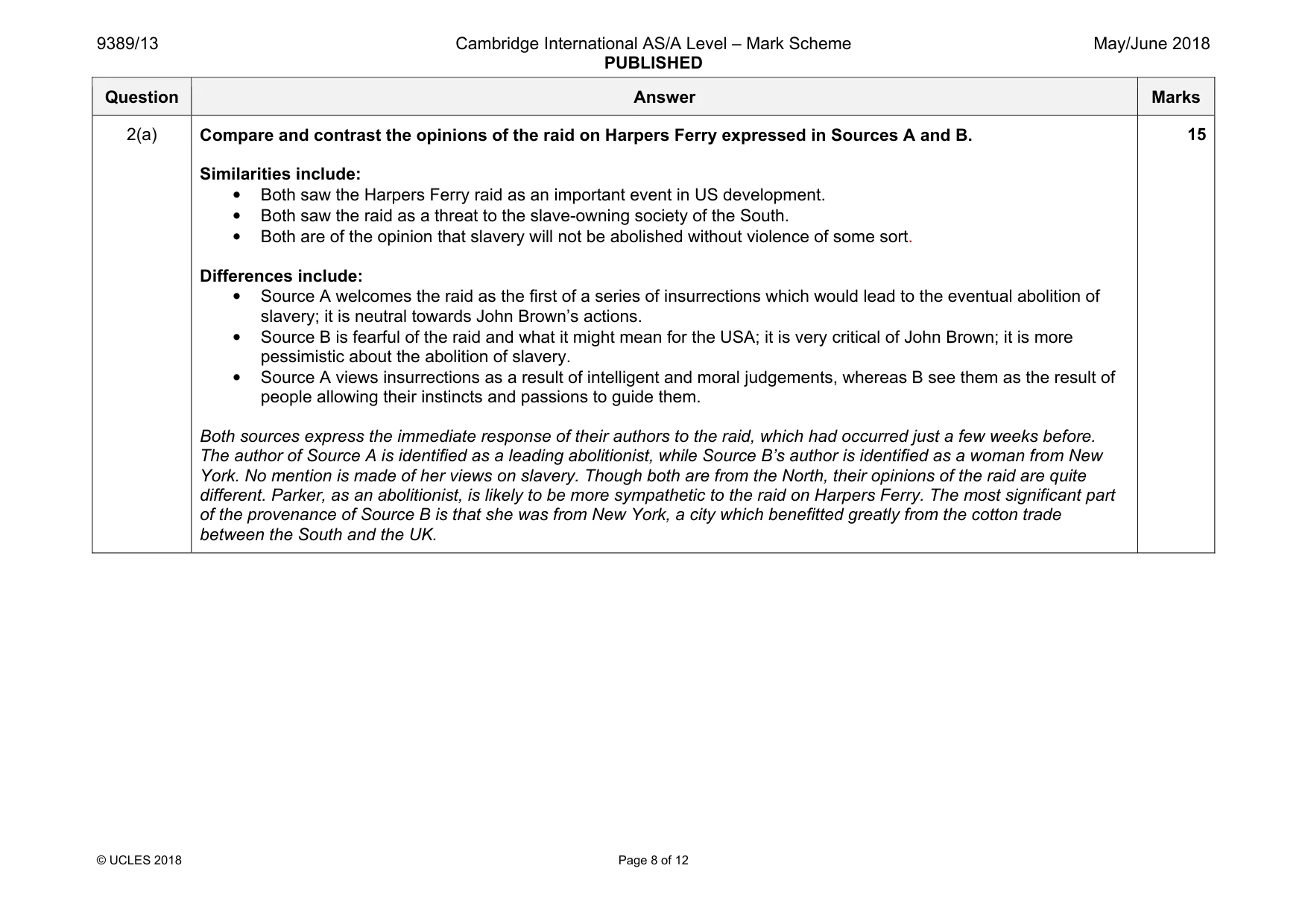
9389/13 Cambridge International AS/A Level – Mark Scheme PUBLISHED May/June 2018 © UCLES 2018 Page 8 of 12 Question Answer Marks 2(a) Compare and contrast the opinions of the raid on Harpers Ferry expressed in Sources A and B. Similarities include: • Both saw the Harpers Ferry raid as an important event in US development. • Both saw the raid as a threat to the slave-owning society of the South. • Both are of the opinion that slavery will not be abolished without violence of some sort. Differences include: • Source A welcomes the raid as the first of a series of insurrections which would lead to the eventual abolition of slavery; it is neutral towards John Brown’s actions. • Source B is fearful of the raid and what it might mean for the USA; it is very critical of John Brown; it is more pessimistic about the abolition of slavery. • Source A views insurrections as a result of intelligent and moral judgements, whereas B see them as the result of people allowing their instincts and passions to guide them. Both sources express the immediate response of their authors to the raid, which had occurred just a few weeks before. The author of Source A is identified as a leading abolitionist, while Source B’s author is identified as a woman from New York. No mention is made of her views on slavery. Though both are from the North, their opinions of the raid are quite different. Parker, as an abolitionist, is likely to be more sympathetic to the raid on Harpers Ferry. The most significant part of the provenance of Source B is that she was from New York, a city which benefitted greatly from the cotton trade between the South and the UK. 15
Mark scheme, page 9
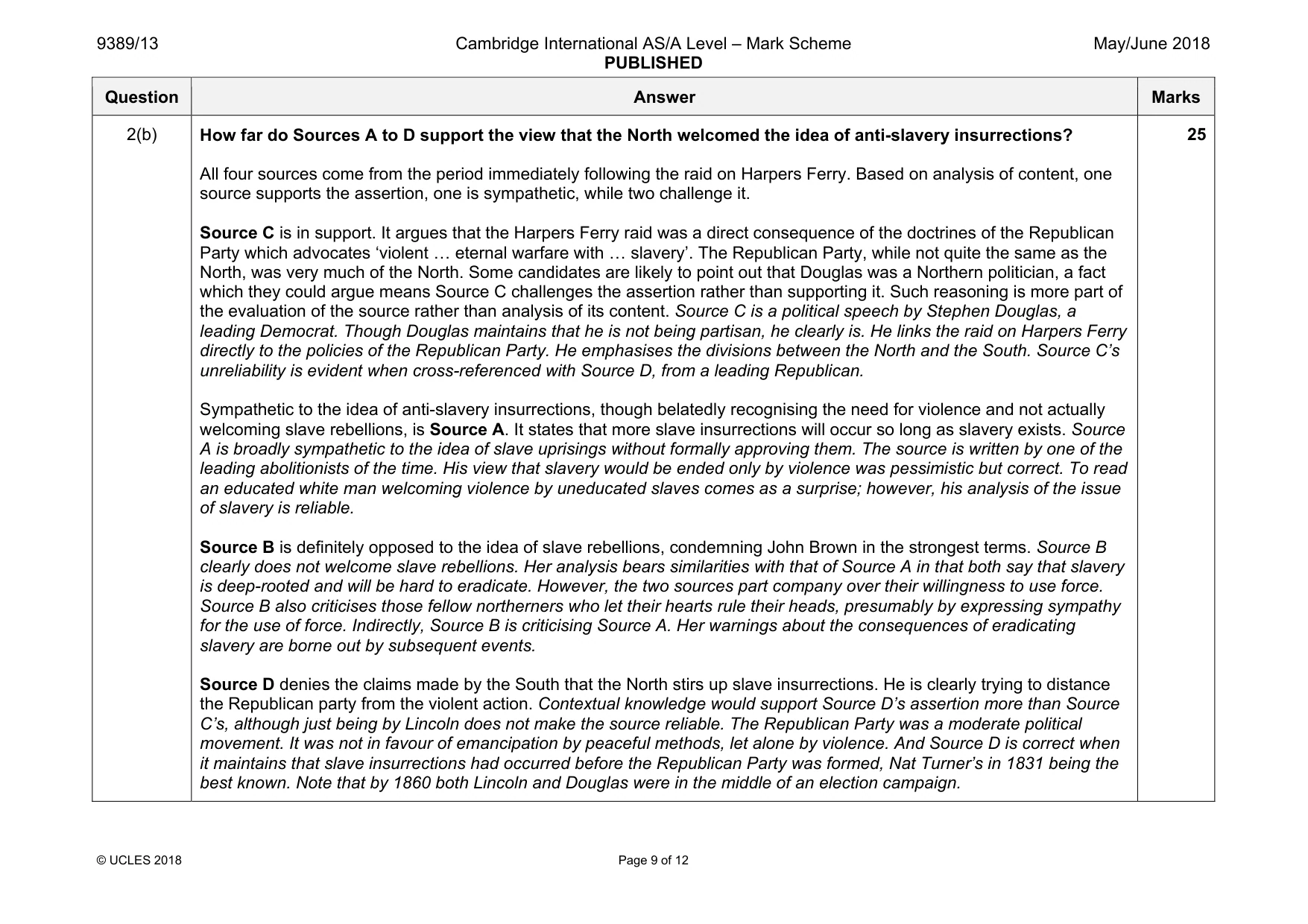
9389/13 Cambridge International AS/A Level – Mark Scheme PUBLISHED May/June 2018 © UCLES 2018 Page 9 of 12 Question Answer Marks 2(b) How far do Sources A to D support the view that the North welcomed the idea of anti-slavery insurrections? All four sources come from the period immediately following the raid on Harpers Ferry. Based on analysis of content, one source supports the assertion, one is sympathetic, while two challenge it. Source C is in support. It argues that the Harpers Ferry raid was a direct consequence of the doctrines of the Republican Party which advocates ‘violent « eternal warfare with « slavery’. The Republican Party, while not quite the same as the North, was very much of the North. Some candidates are likely to point out that Douglas was a Northern politician, a fact which they could argue means Source C challenges the assertion rather than supporting it. Such reasoning is more part of the evaluation of the source rather than analysis of its content. Source C is a political speech by Stephen Douglas, a leading Democrat. Though Douglas maintains that he is not being partisan, he clearly is. He links the raid on Harpers Ferry directly to the policies of the Republican Party. He emphasises the divisions between the North and the South. Source C’s unreliability is evident when cross-referenced with Source D, from a leading Republican. Sympathetic to the idea of anti-slavery insurrections, though belatedly recognising the need for violence and not actually welcoming slave rebellions, is Source A. It states that more slave insurrections will occur so long as slavery exists. Source A is broadly sympathetic to the idea of slave uprisings without formally approving them. The source is written by one of the leading abolitionists of the time. His view that slavery would be ended only by violence was pessimistic but correct. To read an educated white man welcoming violence by uneducated slaves comes as a surprise; however, his analysis of the issue of slavery is reliable. Source B is definitely opposed to the idea of slave rebellions, condemning John Brown in the strongest terms. Source B clearly does not welcome slave rebellions. Her analysis bears similarities with that of Source A in that both say that slavery is deep-rooted and will be hard to eradicate. However, the two sources part company over their willingness to use force. Source B also criticises those fellow northerners who let their hearts rule their heads, presumably by expressing sympathy for the use of force. Indirectly, Source B is criticising Source A. Her warnings about the consequences of eradicating slavery are borne out by subsequent events. Source D denies the claims made by the South that the North stirs up slave insurrections. He is clearly trying to distance the Republican party from the violent action. Contextual knowledge would support Source D’s assertion more than Source C’s, although just being by Lincoln does not make the source reliable. The Republican Party was a moderate political movement. It was not in favour of emancipation by peaceful methods, let alone by violence. And Source D is correct when it maintains that slave insurrections had occurred before the Republican Party was formed, Nat Turner’s in 1831 being the best known. Note that by 1860 both Lincoln and Douglas were in the middle of an election campaign. 25
Mark scheme, page 10
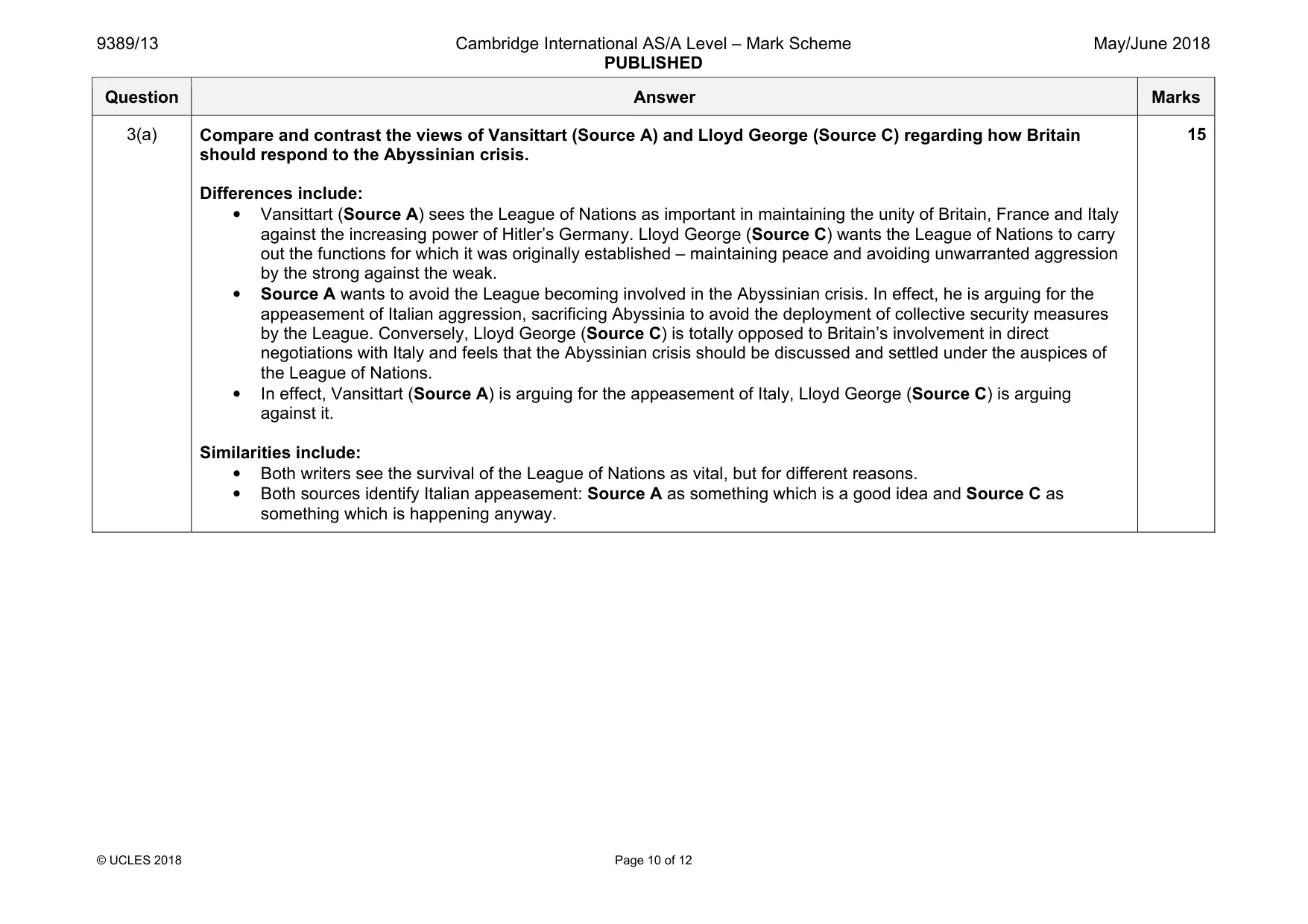
9389/13 Cambridge International AS/A Level – Mark Scheme PUBLISHED May/June 2018 © UCLES 2018 Page 10 of 12 Question Answer Marks 3(a) Compare and contrast the views of Vansittart (Source A) and Lloyd George (Source C) regarding how Britain should respond to the Abyssinian crisis. Differences include: • Vansittart (Source A) sees the League of Nations as important in maintaining the unity of Britain, France and Italy against the increasing power of Hitler’s Germany. Lloyd George (Source C) wants the League of Nations to carry out the functions for which it was originally established – maintaining peace and avoiding unwarranted aggression by the strong against the weak. • Source A wants to avoid the League becoming involved in the Abyssinian crisis. In effect, he is arguing for the appeasement of Italian aggression, sacrificing Abyssinia to avoid the deployment of collective security measures by the League. Conversely, Lloyd George (Source C) is totally opposed to Britain’s involvement in direct negotiations with Italy and feels that the Abyssinian crisis should be discussed and settled under the auspices of the League of Nations. • In effect, Vansittart (Source A) is arguing for the appeasement of Italy, Lloyd George (Source C) is arguing against it. Similarities include: • Both writers see the survival of the League of Nations as vital, but for different reasons. • Both sources identify Italian appeasement: Source A as something which is a good idea and Source C as something which is happening anyway. 15
Mark scheme, page 11
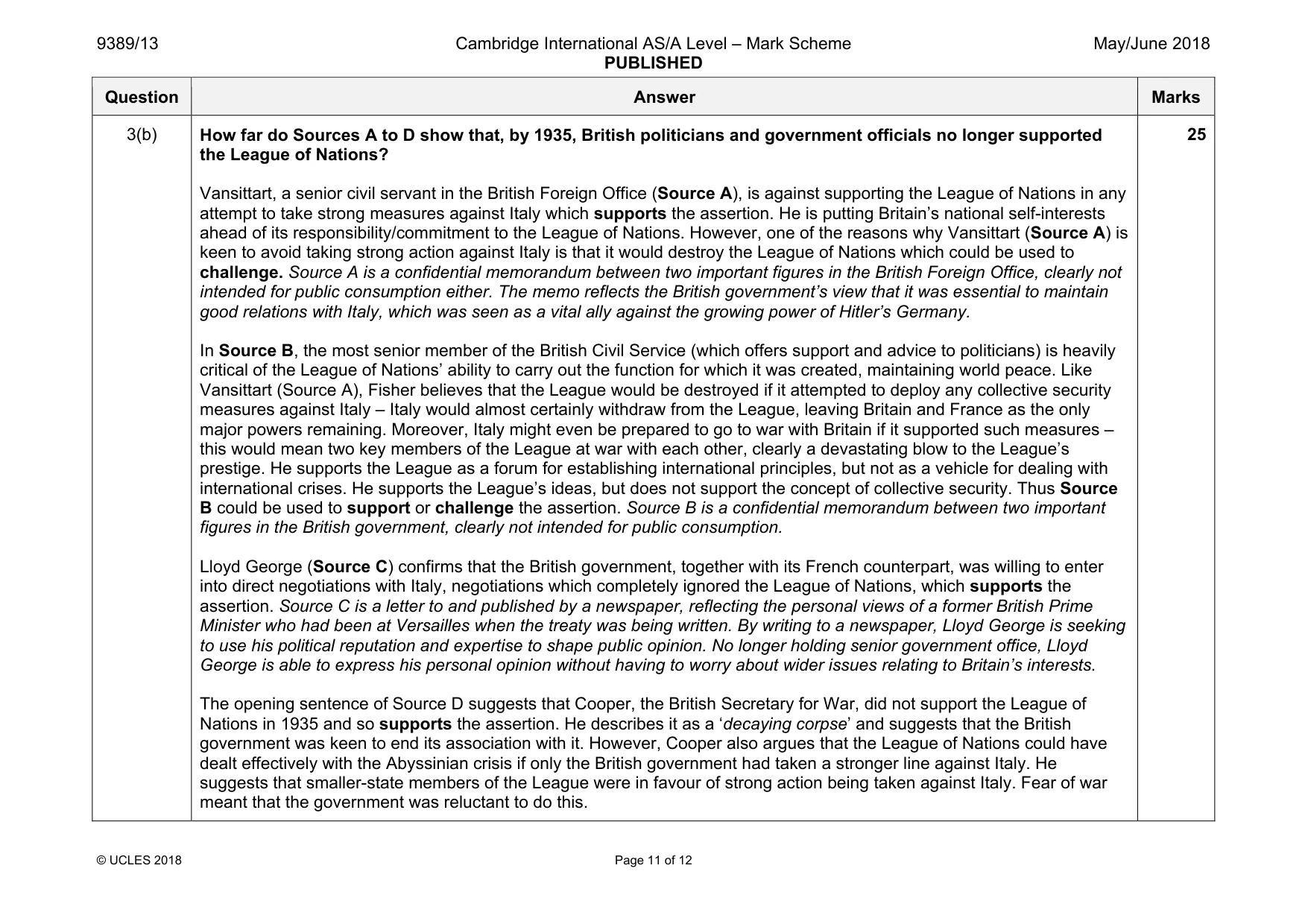
9389/13 Cambridge International AS/A Level – Mark Scheme PUBLISHED May/June 2018 © UCLES 2018 Page 11 of 12 Question Answer Marks 3(b) How far do Sources A to D show that, by 1935, British politicians and government officials no longer supported the League of Nations? Vansittart, a senior civil servant in the British Foreign Office (Source A), is against supporting the League of Nations in any attempt to take strong measures against Italy which supports the assertion. He is putting Britain’s national self-interests ahead of its responsibility/commitment to the League of Nations. However, one of the reasons why Vansittart (Source A) is keen to avoid taking strong action against Italy is that it would destroy the League of Nations which could be used to challenge. Source A is a confidential memorandum between two important figures in the British Foreign Office, clearly not intended for public consumption either. The memo reflects the British government’s view that it was essential to maintain good relations with Italy, which was seen as a vital ally against the growing power of Hitler’s Germany. In Source B, the most senior member of the British Civil Service (which offers support and advice to politicians) is heavily critical of the League of Nations’ ability to carry out the function for which it was created, maintaining world peace. Like Vansittart (Source A), Fisher believes that the League would be destroyed if it attempted to deploy any collective security measures against Italy – Italy would almost certainly withdraw from the League, leaving Britain and France as the only major powers remaining. Moreover, Italy might even be prepared to go to war with Britain if it supported such measures – this would mean two key members of the League at war with each other, clearly a devastating blow to the League’s prestige. He supports the League as a forum for establishing international principles, but not as a vehicle for dealing with international crises. He supports the League’s ideas, but does not support the concept of collective security. Thus Source B could be used to support or challenge the assertion. Source B is a confidential memorandum between two important figures in the British government, clearly not intended for public consumption. Lloyd George (Source C) confirms that the British government, together with its French counterpart, was willing to enter into direct negotiations with Italy, negotiations which completely ignored the League of Nations, which supports the assertion. Source C is a letter to and published by a newspaper, reflecting the personal views of a former British Prime Minister who had been at Versailles when the treaty was being written. By writing to a newspaper, Lloyd George is seeking to use his political reputation and expertise to shape public opinion. No longer holding senior government office, Lloyd George is able to express his personal opinion without having to worry about wider issues relating to Britain’s interests. The opening sentence of Source D suggests that Cooper, the British Secretary for War, did not support the League of Nations in 1935 and so supports the assertion. He describes it as a ‘decaying corpse’ and suggests that the British government was keen to end its association with it. However, Cooper also argues that the League of Nations could have dealt effectively with the Abyssinian crisis if only the British government had taken a stronger line against Italy. He suggests that smaller-state members of the League were in favour of strong action being taken against Italy. Fear of war meant that the government was reluctant to do this. 25
Mark scheme, page 12
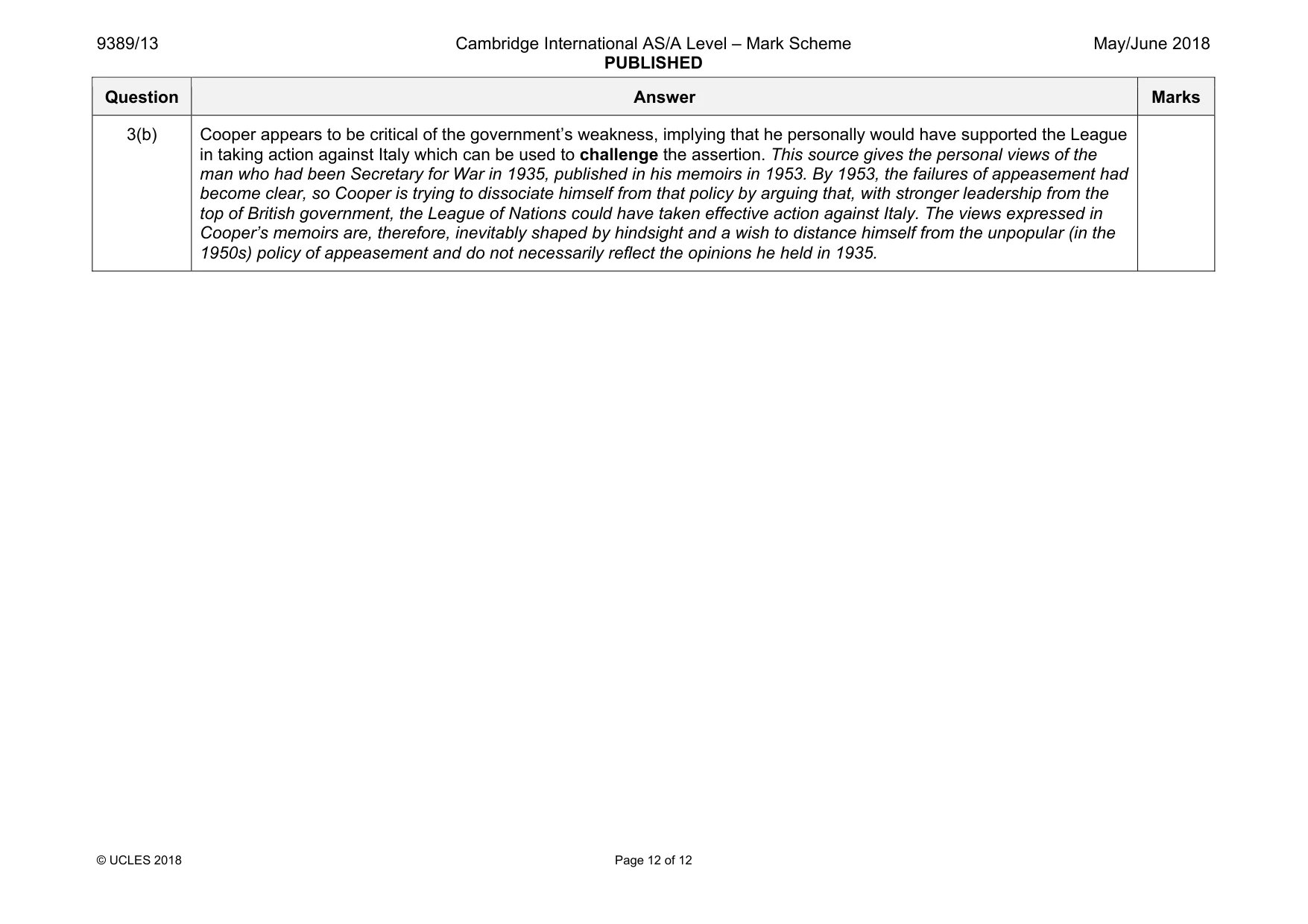
9389/13 Cambridge International AS/A Level – Mark Scheme PUBLISHED May/June 2018 © UCLES 2018 Page 12 of 12 Question Answer Marks 3(b) Cooper appears to be critical of the government’s weakness, implying that he personally would have supported the League in taking action against Italy which can be used to challenge the assertion. This source gives the personal views of the man who had been Secretary for War in 1935, published in his memoirs in 1953. By 1953, the failures of appeasement had become clear, so Cooper is trying to dissociate himself from that policy by arguing that, with stronger leadership from the top of British government, the League of Nations could have taken effective action against Italy. The views expressed in Cooper’s memoirs are, therefore, inevitably shaped by hindsight and a wish to distance himself from the unpopular (in the 1950s) policy of appeasement and do not necessarily reflect the opinions he held in 1935.
What you needed in this session
Cambridge’s own grade thresholds for 2018 May/June, Paper 1 · Variant 3. A higher threshold means an easier paper — the bar moves with how the cohort did.