Cambridge A Level History 9389 — 2017 May/June Paper 4 · Variant 3
9389/43/M/J/17 · 12 questions · 60 marks · ≈68 min
The question paper and its mark scheme, free to read here and free to download. This is Cambridge’s own paper, exactly as it was sat.
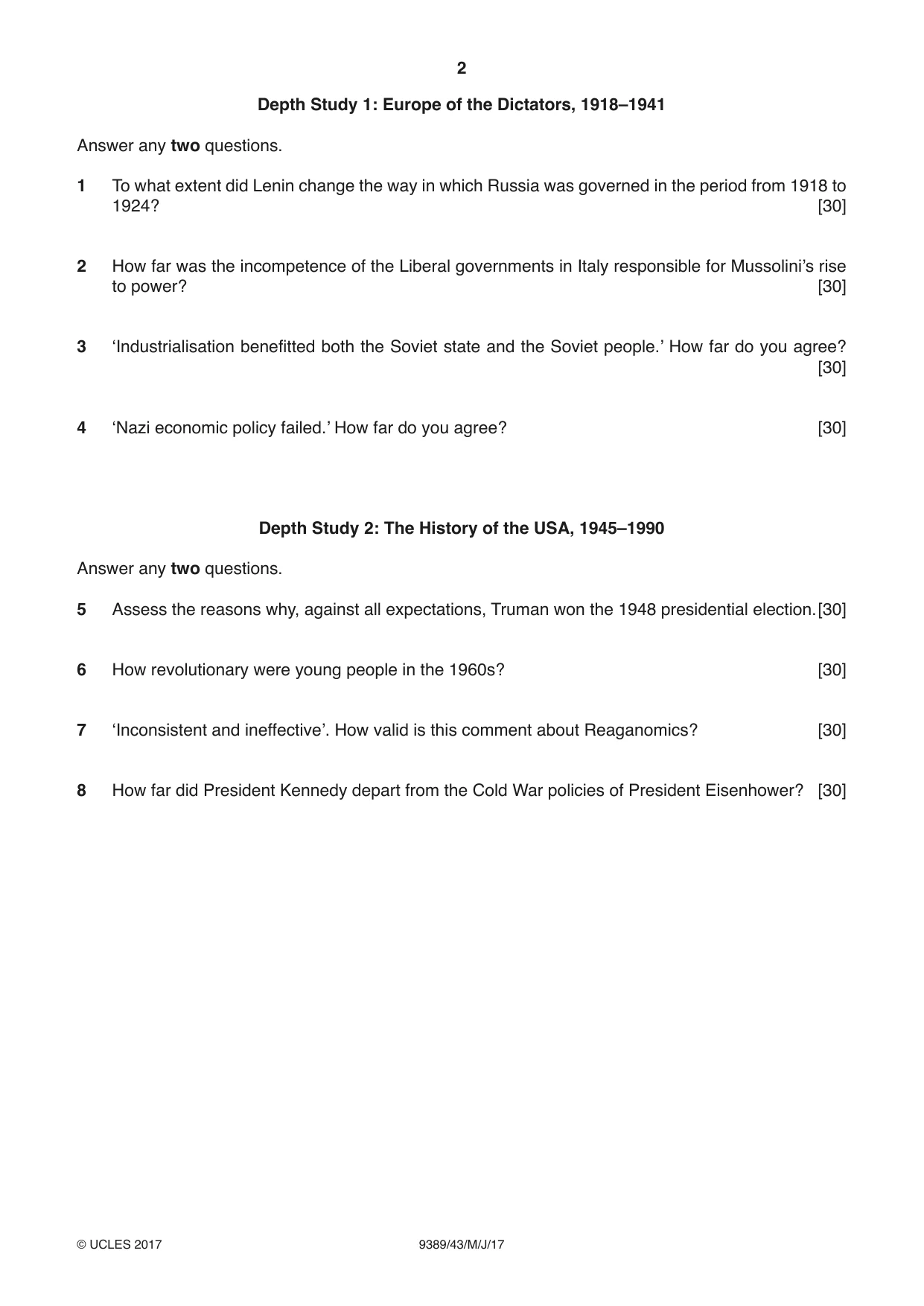
Question paper4 pages
Mark scheme18 pages
Answers below. Sit the paper first if you are practising.
Questions as text
Q1 · To what extent did Lenin change the way in which Russia was governed in the period from…
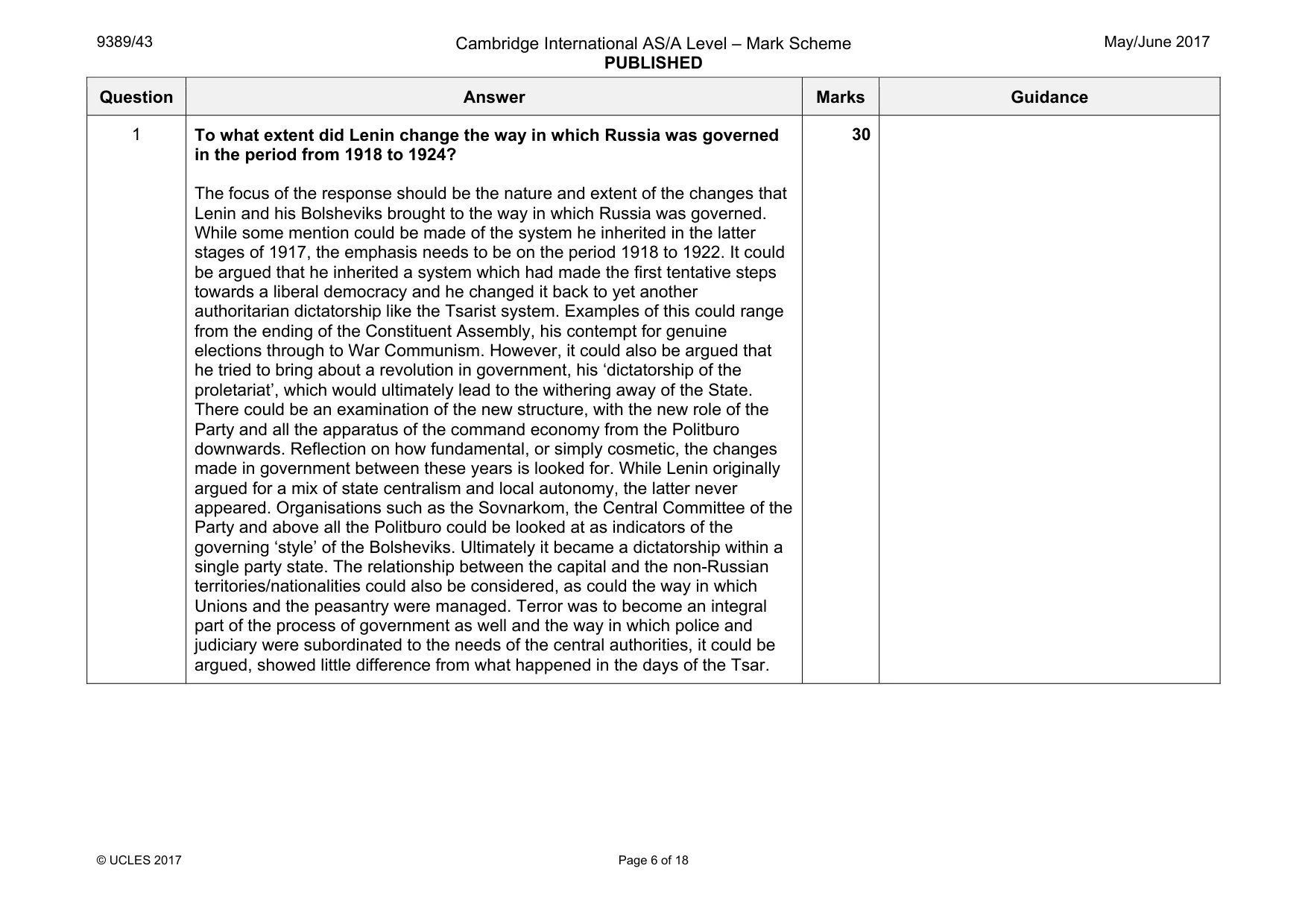
1 To what extent did Lenin change the way in which Russia was governed in the period from 1918 to 1924? [30]
Mark scheme: 1 To what extent did Lenin change the way in which Russia was governed in the period from 1918 to 1924? The focus of the response should be the nature and extent of the changes that Lenin and his Bolsheviks brought to the way in which Russia was governed. While some mention could be made of the system he inherited in the latter stages of 1917, the emphasis needs to be on the period 1918 to 1922. It could be argued that he inherited a system which had made the first tentative steps towards a liberal democracy and he changed it back to yet another authoritarian dictatorship like the Tsarist system. Examples of this could range from the ending of the Constituent Assembly, his contempt for genuine elections through to War Communism. However, it could also be argued that he tried to bring about a revolution in government, his ‘dictatorship of the proletariat’, which would ultimately lead to the withering away of the State. There could be an examination of the new structure, with the new role of the Party and all the apparatus of the command economy from the Politburo downwards. Reflection on how fundamental, or simply cosmetic, the changes made in government between these years is looked for. While Lenin originally argued for a mix of state centralism and local autonomy, the latter never appeared. Organisations such as the Sovnarkom, the Central Committee of the Party and above all the Politburo could be looked at as indicators of the governing ‘style’ of the Bolsheviks. Ultimately it became a dictatorship within a single party state. The relationship between the capital and the non-Russian territories/nationalities could also be considered, as could the way in which Unions and the peasantry were managed. Terror was to become an integral part of the process of government as well and the way in which police and judiciary were subordinated to the needs of the central authorities, it could be argued, showed little difference from what happened in the days of the Tsar. 30
Q2 · How far was the incompetence of the Liberal governments in Italy responsible for…
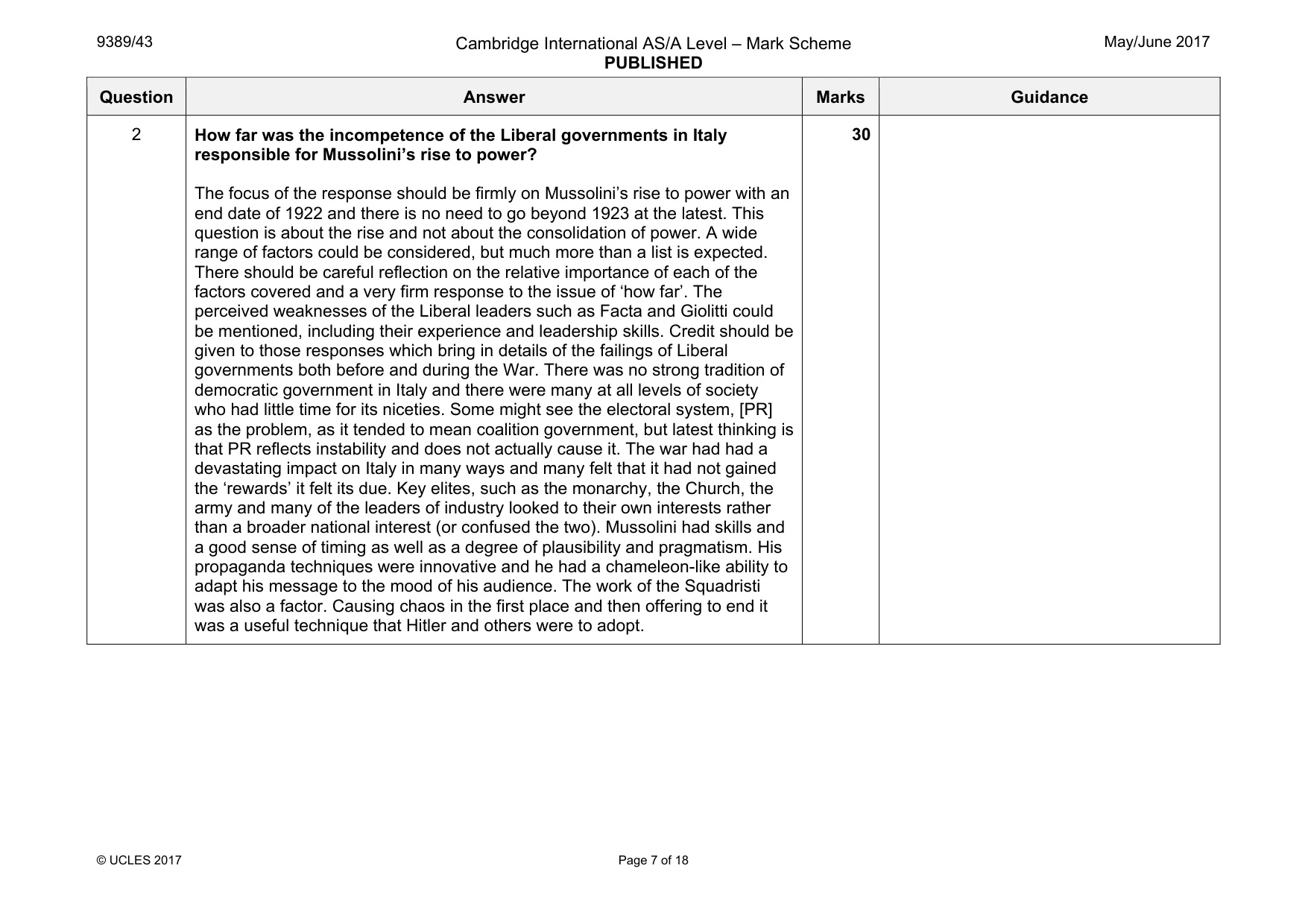
2 How far was the incompetence of the Liberal governments in Italy responsible for Mussolini’s rise to power? [30]
Mark scheme: 2 How far was the incompetence of the Liberal governments in Italy responsible for Mussolini’s rise to power? The focus of the response should be firmly on Mussolini’s rise to power with an end date of 1922 and there is no need to go beyond 1923 at the latest. This question is about the rise and not about the consolidation of power. A wide range of factors could be considered, but much more than a list is expected. There should be careful reflection on the relative importance of each of the factors covered and a very firm response to the issue of ‘how far’. The perceived weaknesses of the Liberal leaders such as Facta and Giolitti could be mentioned, including their experience and leadership skills. Credit should be given to those responses which bring in details of the failings of Liberal governments both before and during the War. There was no strong tradition of democratic government in Italy and there were many at all levels of society who had little time for its niceties. Some might see the electoral system, [PR] as the problem, as it tended to mean coalition government, but latest thinking is that PR reflects instability and does not actually cause it. The war had had a devastating impact on Italy in many ways and many felt that it had not gained the ‘rewards’ it felt its due. Key elites, such as the monarchy, the Church, the army and many of the leaders of industry looked to their own interests rather than a broader national interest (or confused the two). Mussolini had skills and a good sense of timing as well as a degree of plausibility and pragmatism. His propaganda techniques were innovative and he had a chameleon-like ability to adapt his message to the mood of his audience. The work of the Squadristi was also a factor. Causing chaos in the first place and then offering to end it was a useful technique that Hitler and others were to adopt. 30
Q3 · ‘Industrialisation benefitted both the Soviet state and the Soviet people.’ How far do…
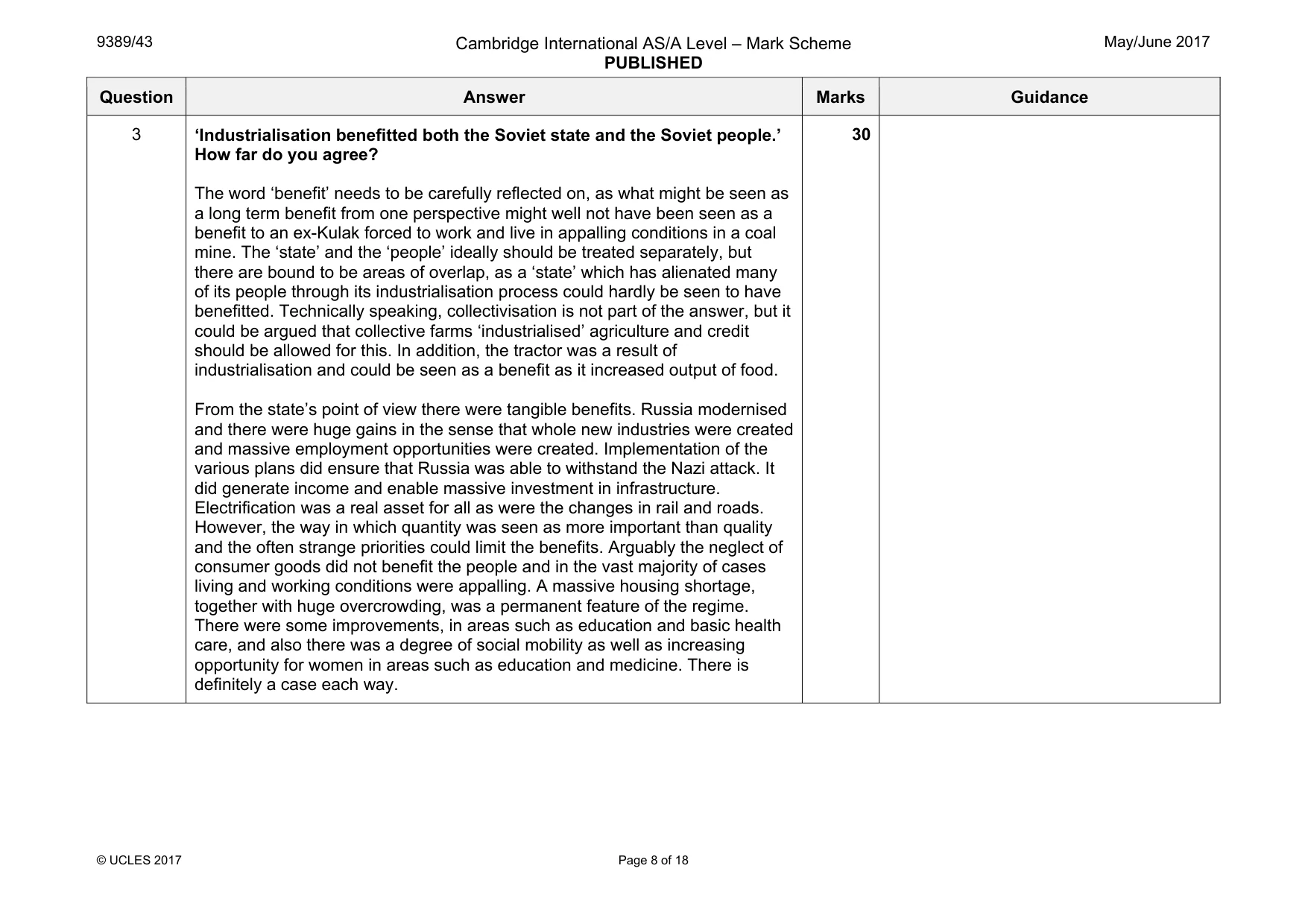
3 ‘Industrialisation benefitted both the Soviet state and the Soviet people.’ How far do you agree? [30]
Mark scheme: 3 ‘Industrialisation benefitted both the Soviet state and the Soviet people.’ How far do you agree? The word ‘benefit’ needs to be carefully reflected on, as what might be seen as a long term benefit from one perspective might well not have been seen as a benefit to an ex-Kulak forced to work and live in appalling conditions in a coal mine. The ‘state’ and the ‘people’ ideally should be treated separately, but there are bound to be areas of overlap, as a ‘state’ which has alienated many of its people through its industrialisation process could hardly be seen to have benefitted. Technically speaking, collectivisation is not part of the answer, but it could be argued that collective farms ‘industrialised’ agriculture and credit should be allowed for this. In addition, the tractor was a result of industrialisation and could be seen as a benefit as it increased output of food. From the state’s point of view there were tangible benefits. Russia modernised and there were huge gains in the sense that whole new industries were created and massive employment opportunities were created. Implementation of the various plans did ensure that Russia was able to withstand the Nazi attack. It did generate income and enable massive investment in infrastructure. Electrification was a real asset for all as were the changes in rail and roads. However, the way in which quantity was seen as more important than quality and the often strange priorities could limit the benefits. Arguably the neglect of consumer goods did not benefit the people and in the vast majority of cases living and working conditions were appalling. A massive housing shortage, together with huge overcrowding, was a permanent feature of the regime. There were some improvements, in areas such as education and basic health care, and also there was a degree of social mobility as well as increasing opportunity for women in areas such as education and medicine. There is definitely a case each way. 30
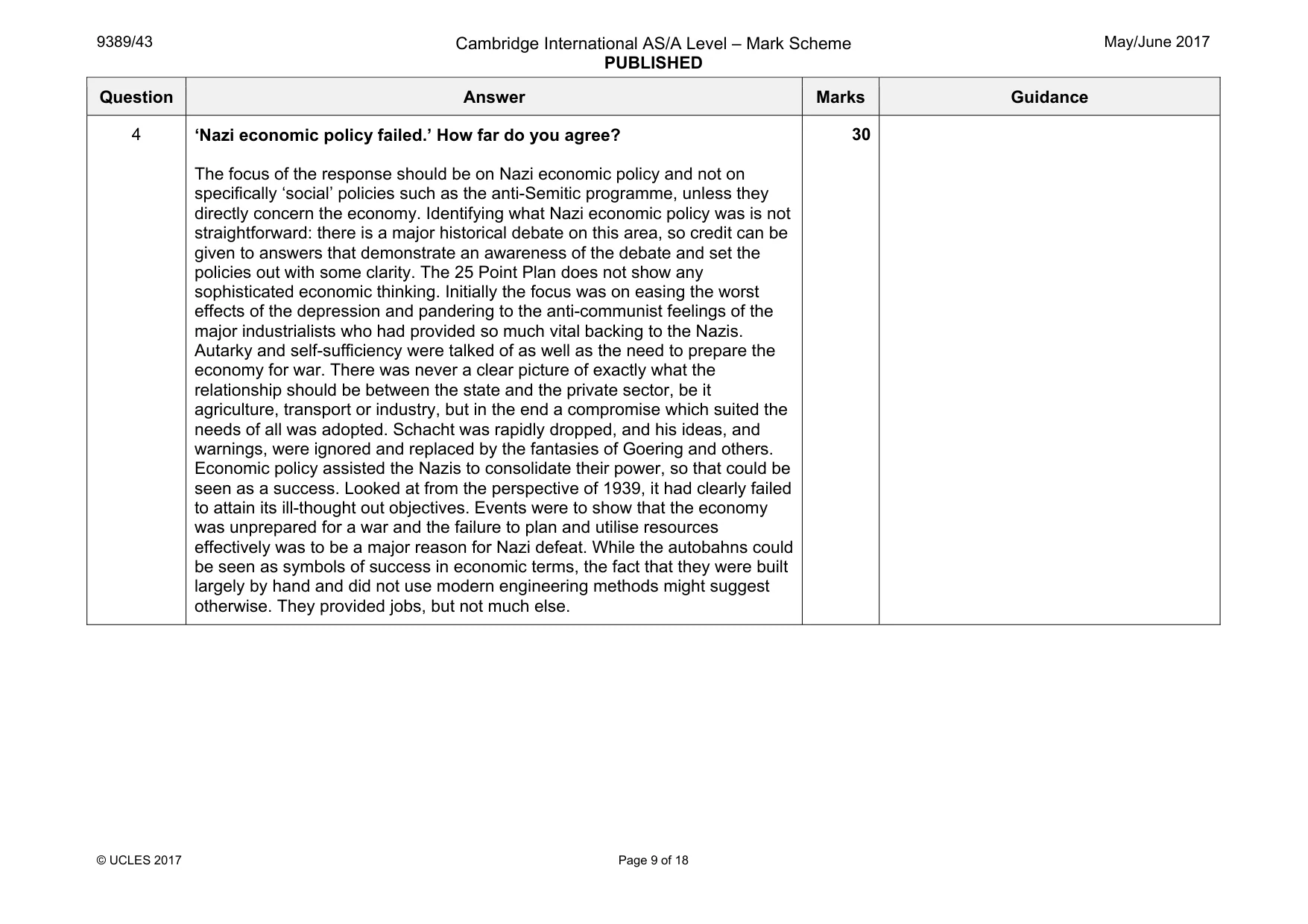
Q4 · ‘Nazi economic policy failed.’ How far do you agree?
4 ‘Nazi economic policy failed.’ How far do you agree? [30] Depth Study 2: The History of the USA, 1945–1990 Answer any two questions.
Mark scheme: 4 ‘Nazi economic policy failed.’ How far do you agree? The focus of the response should be on Nazi economic policy and not on specifically ‘social’ policies such as the anti-Semitic programme, unless they directly concern the economy. Identifying what Nazi economic policy was is not straightforward: there is a major historical debate on this area, so credit can be given to answers that demonstrate an awareness of the debate and set the policies out with some clarity. The 25 Point Plan does not show any sophisticated economic thinking. Initially the focus was on easing the worst effects of the depression and pandering to the anti-communist feelings of the major industrialists who had provided so much vital backing to the Nazis. Autarky and self-sufficiency were talked of as well as the need to prepare the economy for war. There was never a clear picture of exactly what the relationship should be between the state and the private sector, be it agriculture, transport or industry, but in the end a compromise which suited the needs of all was adopted. Schacht was rapidly dropped, and his ideas, and warnings, were ignored and replaced by the fantasies of Goering and others. Economic policy assisted the Nazis to consolidate their power, so that could be seen as a success. Looked at from the perspective of 1939, it had clearly failed to attain its ill-thought out objectives. Events were to show that the economy was unprepared for a war and the failure to plan and utilise resources effectively was to be a major reason for Nazi defeat. While the autobahns could be seen as symbols of success in economic terms, the fact that they were built largely by hand and did not use modern engineering methods might suggest otherwise. They provided jobs, but not much else. 30
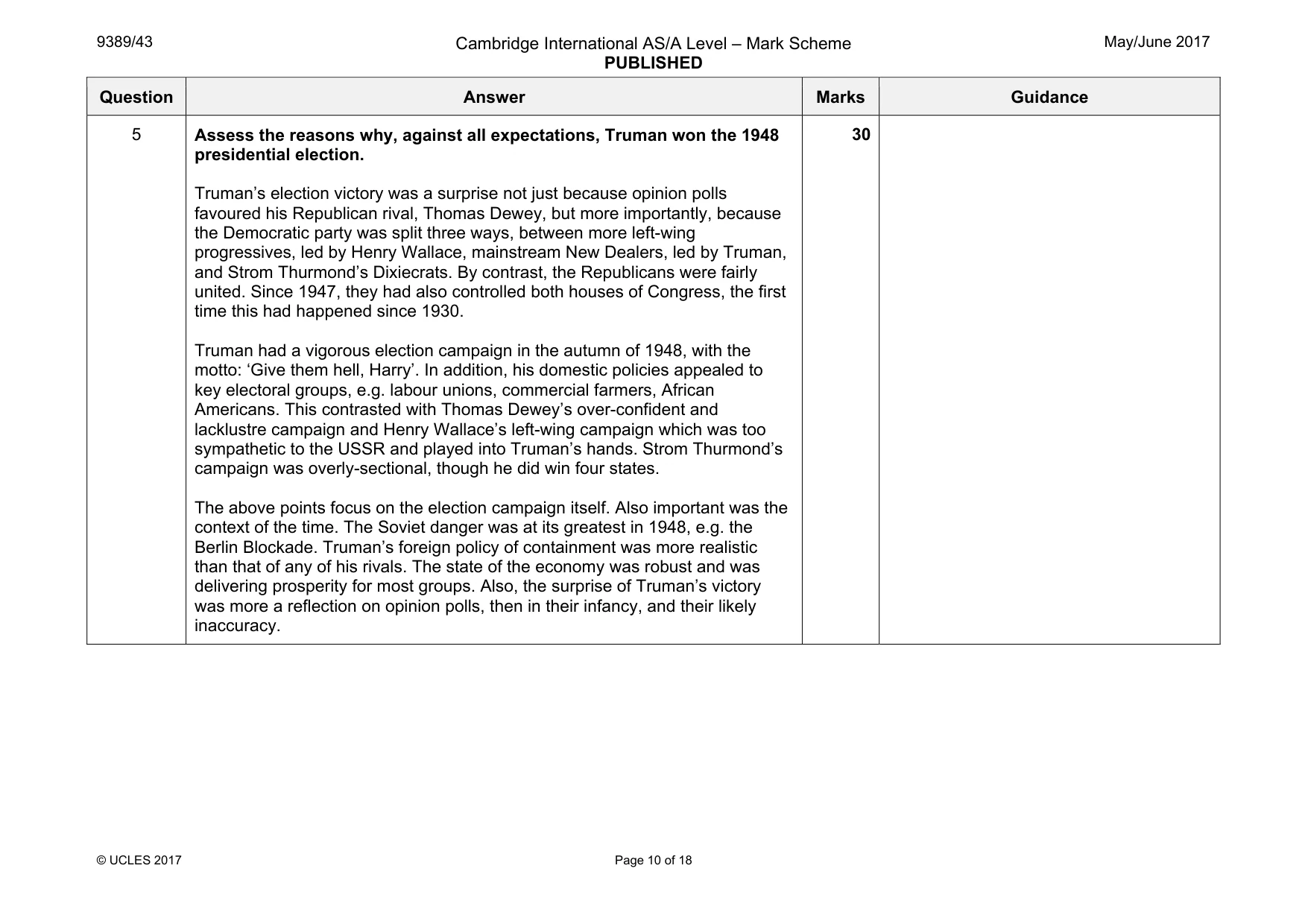
Q5 · Assess the reasons why, against all expectations, Truman won the 1948 presidential…
5 Assess the reasons why, against all expectations, Truman won the 1948 presidential election. [30]
Mark scheme: 5 Assess the reasons why, against all expectations, Truman won the 1948 presidential election. Truman’s election victory was a surprise not just because opinion polls favoured his Republican rival, Thomas Dewey, but more importantly, because the Democratic party was split three ways, between more left-wing progressives, led by Henry Wallace, mainstream New Dealers, led by Truman, and Strom Thurmond’s Dixiecrats. By contrast, the Republicans were fairly united. Since 1947, they had also controlled both houses of Congress, the first time this had happened since 1930. Truman had a vigorous election campaign in the autumn of 1948, with the motto: ‘Give them hell, Harry’. In addition, his domestic policies appealed to key electoral groups, e.g. labour unions, commercial farmers, African Americans. This contrasted with Thomas Dewey’s over-confident and lacklustre campaign and Henry Wallace’s left-wing campaign which was too sympathetic to the USSR and played into Truman’s hands. Strom Thurmond’s campaign was overly-sectional, though he did win four states. The above points focus on the election campaign itself. Also important was the context of the time. The Soviet danger was at its greatest in 1948, e.g. the Berlin Blockade. Truman’s foreign policy of containment was more realistic than that of any of his rivals. The state of the economy was robust and was delivering prosperity for most groups. Also, the surprise of Truman’s victory was more a reflection on opinion polls, then in their infancy, and their likely inaccuracy. 30
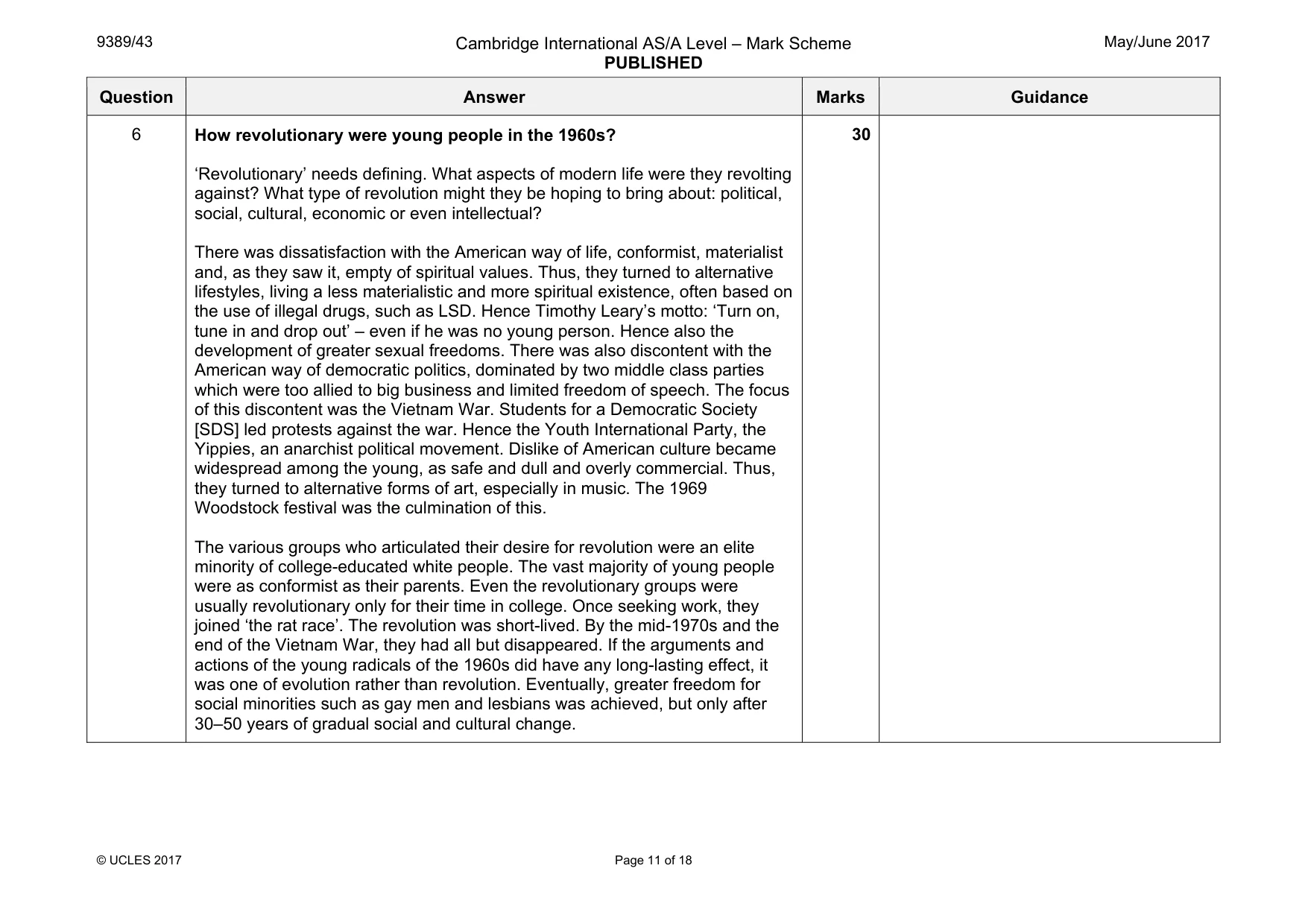
Q6 · How revolutionary were young people in the 1960s?
6 How revolutionary were young people in the 1960s? [30]
Mark scheme: 6 How revolutionary were young people in the 1960s? ‘Revolutionary’ needs defining. What aspects of modern life were they revolting against? What type of revolution might they be hoping to bring about: political, social, cultural, economic or even intellectual? There was dissatisfaction with the American way of life, conformist, materialist and, as they saw it, empty of spiritual values. Thus, they turned to alternative lifestyles, living a less materialistic and more spiritual existence, often based on the use of illegal drugs, such as LSD. Hence Timothy Leary’s motto: ‘Turn on, tune in and drop out’ – even if he was no young person. Hence also the development of greater sexual freedoms. There was also discontent with the American way of democratic politics, dominated by two middle class parties which were too allied to big business and limited freedom of speech. The focus of this discontent was the Vietnam War. Students for a Democratic Society [SDS] led protests against the war. Hence the Youth International Party, the Yippies, an anarchist political movement. Dislike of American culture became widespread among the young, as safe and dull and overly commercial. Thus, they turned to alternative forms of art, especially in music. The 1969 Woodstock festival was the culmination of this. The various groups who articulated their desire for revolution were an elite minority of college-educated white people. The vast majority of young people were as conformist as their parents. Even the revolutionary groups were usually revolutionary only for their time in college. Once seeking work, they joined ‘the rat race’. The revolution was short-lived. By the mid-1970s and the end of the Vietnam War, they had all but disappeared. If the arguments and actions of the young radicals of the 1960s did have any long-lasting effect, it was one of evolution rather than revolution. Eventually, greater freedom for social minorities such as gay men and lesbians was achieved, but only after 30–50 years of gradual social and cultural change. 30
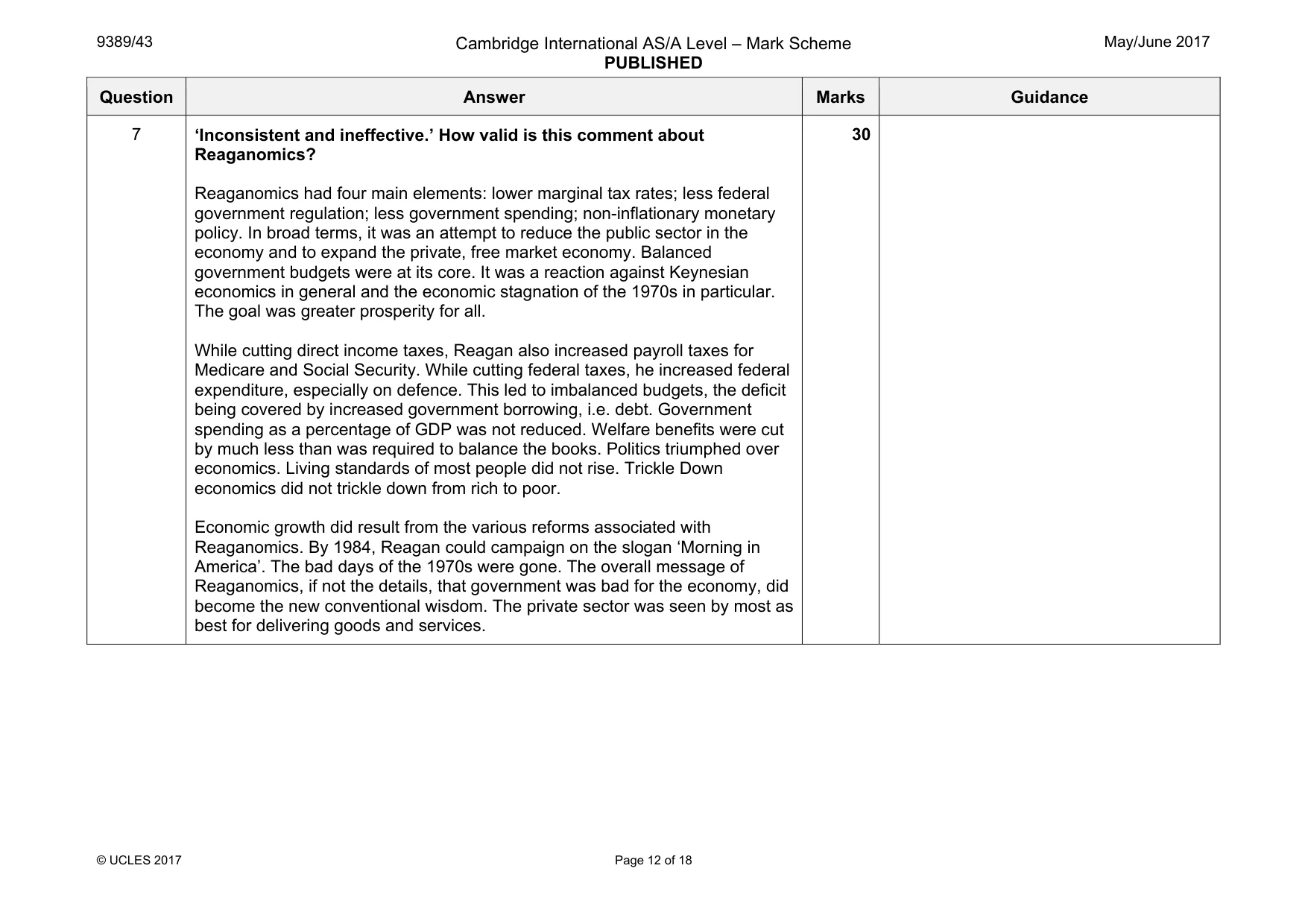
Question 7
7 ‘Inconsistent and ineffective’. How valid is this comment about Reaganomics? [30]
Mark scheme: 7 ‘Inconsistent and ineffective.’ How valid is this comment about Reaganomics? Reaganomics had four main elements: lower marginal tax rates; less federal government regulation; less government spending; non-inflationary monetary policy. In broad terms, it was an attempt to reduce the public sector in the economy and to expand the private, free market economy. Balanced government budgets were at its core. It was a reaction against Keynesian economics in general and the economic stagnation of the 1970s in particular. The goal was greater prosperity for all. While cutting direct income taxes, Reagan also increased payroll taxes for Medicare and Social Security. While cutting federal taxes, he increased federal expenditure, especially on defence. This led to imbalanced budgets, the deficit being covered by increased government borrowing, i.e. debt. Government spending as a percentage of GDP was not reduced. Welfare benefits were cut by much less than was required to balance the books. Politics triumphed over economics. Living standards of most people did not rise. Trickle Down economics did not trickle down from rich to poor. Economic growth did result from the various reforms associated with Reaganomics. By 1984, Reagan could campaign on the slogan ‘Morning in America’. The bad days of the 1970s were gone. The overall message of Reaganomics, if not the details, that government was bad for the economy, did become the new conventional wisdom. The private sector was seen by most as best for delivering goods and services. 30
Q8 · Depth Study 3: International History, 1945–1991 Answer any two questions
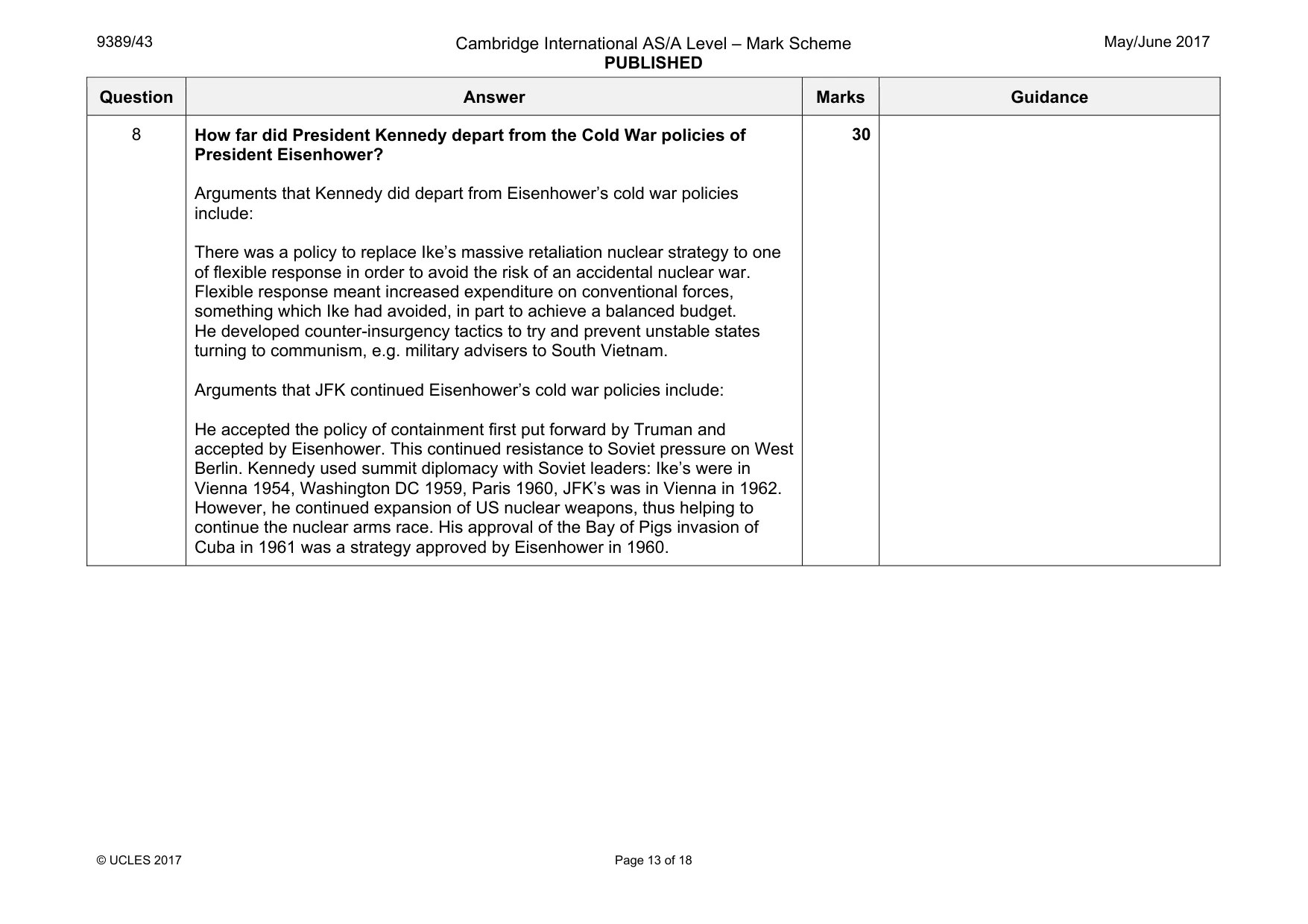
Depth Study 3: International History, 1945–1991 Answer any two questions.
Mark scheme: 8 How far did President Kennedy depart from the Cold War policies of President Eisenhower? Arguments that Kennedy did depart from Eisenhower’s cold war policies include: There was a policy to replace Ike’s massive retaliation nuclear strategy to one of flexible response in order to avoid the risk of an accidental nuclear war. Flexible response meant increased expenditure on conventional forces, something which Ike had avoided, in part to achieve a balanced budget. He developed counter-insurgency tactics to try and prevent unstable states turning to communism, e.g. military advisers to South Vietnam. Arguments that JFK continued Eisenhower’s cold war policies include: He accepted the policy of containment first put forward by Truman and accepted by Eisenhower. This continued resistance to Soviet pressure on West Berlin. Kennedy used summit diplomacy with Soviet leaders: Ike’s were in Vienna 1954, Washington DC 1959, Paris 1960, JFK’s was in Vienna in 1962. However, he continued expansion of US nuclear weapons, thus helping to continue the nuclear arms race. His approval of the Bay of Pigs invasion of Cuba in 1961 was a strategy approved by Eisenhower in 1960. 30
Q9 · ‘The USA lost the Vietnam War because of its own mistakes.’ How far do you agree?
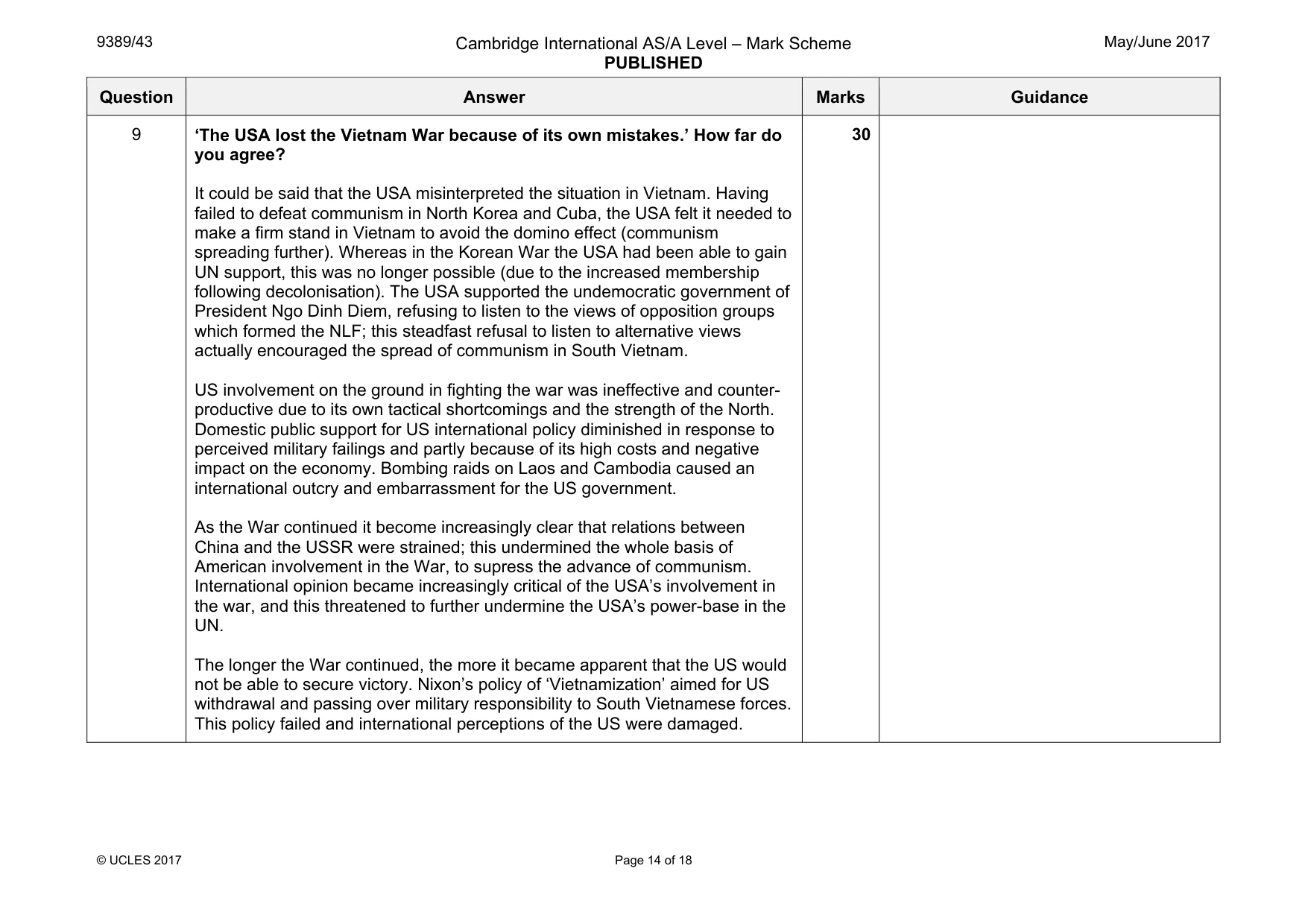
9 ‘The USA lost the Vietnam War because of its own mistakes.’ How far do you agree? [30]
Mark scheme: 9 ‘The USA lost the Vietnam War because of its own mistakes.’ How far do you agree? It could be said that the USA misinterpreted the situation in Vietnam. Having failed to defeat communism in North Korea and Cuba, the USA felt it needed to make a firm stand in Vietnam to avoid the domino effect (communism spreading further). Whereas in the Korean War the USA had been able to gain UN support, this was no longer possible (due to the increased membership following decolonisation). The USA supported the undemocratic government of President Ngo Dinh Diem, refusing to listen to the views of opposition groups which formed the NLF; this steadfast refusal to listen to alternative views actually encouraged the spread of communism in South Vietnam. US involvement on the ground in fighting the war was ineffective and counter- productive due to its own tactical shortcomings and the strength of the North. Domestic public support for US international policy diminished in response to perceived military failings and partly because of its high costs and negative impact on the economy. Bombing raids on Laos and Cambodia caused an international outcry and embarrassment for the US government. As the War continued it become increasingly clear that relations between China and the USSR were strained; this undermined the whole basis of American involvement in the War, to supress the advance of communism. International opinion became increasingly critical of the USA’s involvement in the war, and this threatened to further undermine the USA’s power-base in the UN. The longer the War continued, the more it became apparent that the US would not be able to secure victory. Nixon’s policy of ‘Vietnamization’ aimed for US withdrawal and passing over military responsibility to South Vietnamese forces. This policy failed and international perceptions of the US were damaged. 30
Q10 · To what extent was the collapse of the Soviet Union caused by pressure imposed upon it by…
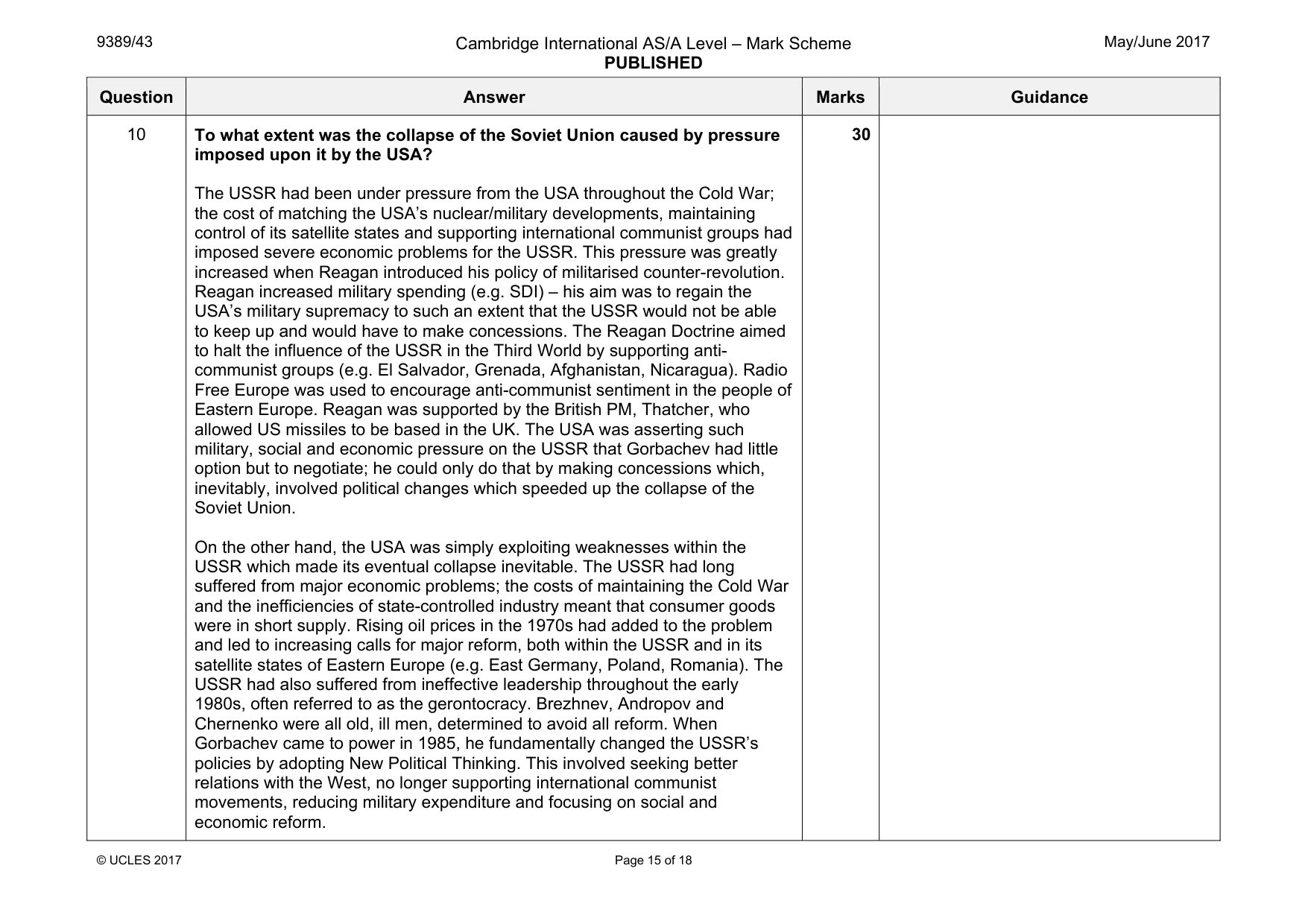
10 To what extent was the collapse of the Soviet Union caused by pressure imposed upon it by the USA? [30]
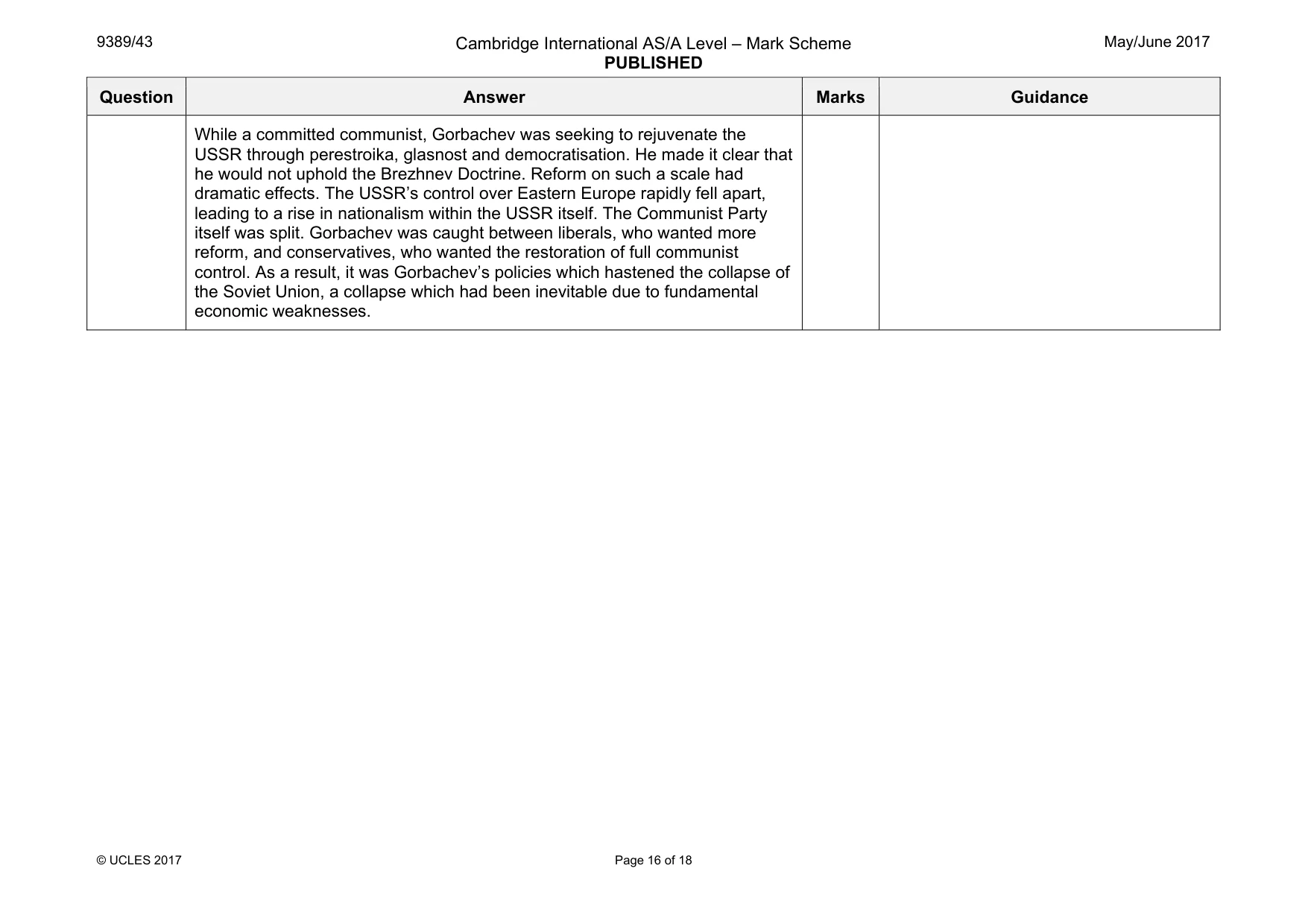
Mark scheme: 10 To what extent was the collapse of the Soviet Union caused by pressure imposed upon it by the USA? The USSR had been under pressure from the USA throughout the Cold War; the cost of matching the USA’s nuclear/military developments, maintaining control of its satellite states and supporting international communist groups had imposed severe economic problems for the USSR. This pressure was greatly increased when Reagan introduced his policy of militarised counter-revolution. Reagan increased military spending (e.g. SDI) – his aim was to regain the USA’s military supremacy to such an extent that the USSR would not be able to keep up and would have to make concessions. The Reagan Doctrine aimed to halt the influence of the USSR in the Third World by supporting anti- communist groups (e.g. El Salvador, Grenada, Afghanistan, Nicaragua). Radio Free Europe was used to encourage anti-communist sentiment in the people of Eastern Europe. Reagan was supported by the British PM, Thatcher, who allowed US missiles to be based in the UK. The USA was asserting such military, social and economic pressure on the USSR that Gorbachev had little option but to negotiate; he could only do that by making concessions which, inevitably, involved political changes which speeded up the collapse of the Soviet Union. On the other hand, the USA was simply exploiting weaknesses within the USSR which made its eventual collapse inevitable. The USSR had long suffered from major economic problems; the costs of maintaining the Cold War and the inefficiencies of state-controlled industry meant that consumer goods were in short supply. Rising oil prices in the 1970s had added to the problem and led to increasing calls for major reform, both within the USSR and in its satellite states of Eastern Europe (e.g. East Germany, Poland, Romania). The USSR had also suffered from ineffective leadership throughout the early 1980s, often referred to as the gerontocracy. Brezhnev, Andropov and Chernenko were all old, ill men, determined to avoid all reform. When Gorbachev came to power in 1985, he fundamentally changed the USSR’s policies by adopting New Political Thinking. This involved seeking better relations with the West, no longer supporting international communist movements, reducing military expenditure and focusing on social and economic reform. 30 Question Answer Marks Guidance While a committed communist, Gorbachev was seeking to rejuvenate the USSR through perestroika, glasnost and democratisation. He made it clear that he would not uphold the Brezhnev Doctrine. Reform on such a scale had dramatic effects. The USSR’s control over Eastern Europe rapidly fell apart, leading to a rise in nationalism within the USSR itself. The Communist Party itself was split. Gorbachev was caught between liberals, who wanted more reform, and conservatives, who wanted the restoration of full communist control. As a result, it was Gorbachev’s policies which hastened the collapse of the Soviet Union, a collapse which had been inevitable due to fundamental economic weaknesses.
Q11 · ‘Deng Xiaoping’s priority was to modernise China’s economy.’ How far do you agree?
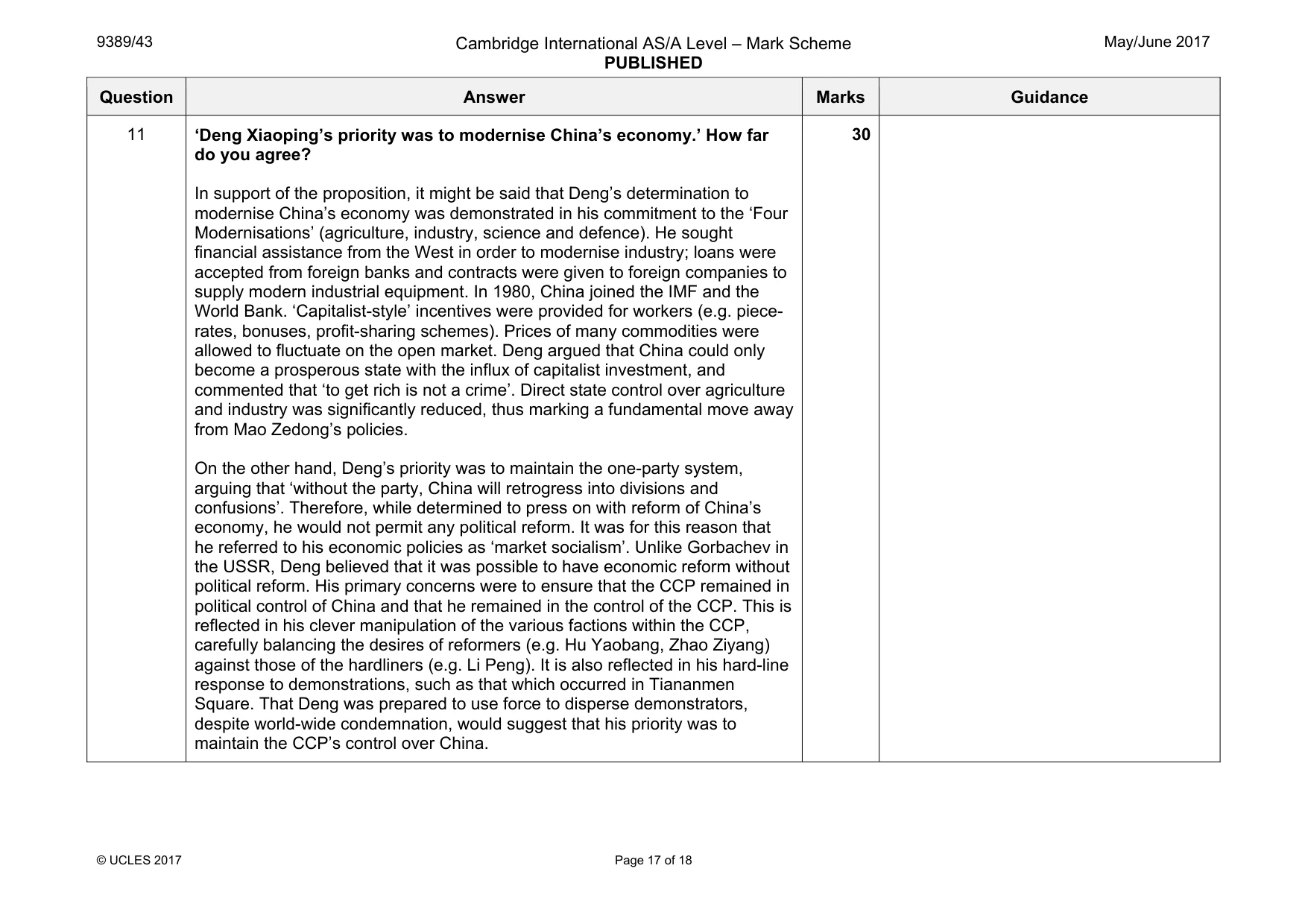
11 ‘Deng Xiaoping’s priority was to modernise China’s economy.’ How far do you agree? [30]
Mark scheme: 11 ‘Deng Xiaoping’s priority was to modernise China’s economy.’ How far do you agree? In support of the proposition, it might be said that Deng’s determination to modernise China’s economy was demonstrated in his commitment to the ‘Four Modernisations’ (agriculture, industry, science and defence). He sought financial assistance from the West in order to modernise industry; loans were accepted from foreign banks and contracts were given to foreign companies to supply modern industrial equipment. In 1980, China joined the IMF and the World Bank. ‘Capitalist-style’ incentives were provided for workers (e.g. piece- rates, bonuses, profit-sharing schemes). Prices of many commodities were allowed to fluctuate on the open market. Deng argued that China could only become a prosperous state with the influx of capitalist investment, and commented that ‘to get rich is not a crime’. Direct state control over agriculture and industry was significantly reduced, thus marking a fundamental move away from Mao Zedong’s policies. On the other hand, Deng’s priority was to maintain the one-party system, arguing that ‘without the party, China will retrogress into divisions and confusions’. Therefore, while determined to press on with reform of China’s economy, he would not permit any political reform. It was for this reason that he referred to his economic policies as ‘market socialism’. Unlike Gorbachev in the USSR, Deng believed that it was possible to have economic reform without political reform. His primary concerns were to ensure that the CCP remained in political control of China and that he remained in the control of the CCP. This is reflected in his clever manipulation of the various factions within the CCP, carefully balancing the desires of reformers (e.g. Hu Yaobang, Zhao Ziyang) against those of the hardliners (e.g. Li Peng). It is also reflected in his hard-line response to demonstrations, such as that which occurred in Tiananmen Square. That Deng was prepared to use force to disperse demonstrators, despite world-wide condemnation, would suggest that his priority was to maintain the CCP’s control over China. 30
Q12 · ‘Fear of militant Islam was the main reason why Saddam Hussein invaded Iran in 1980.’ How…
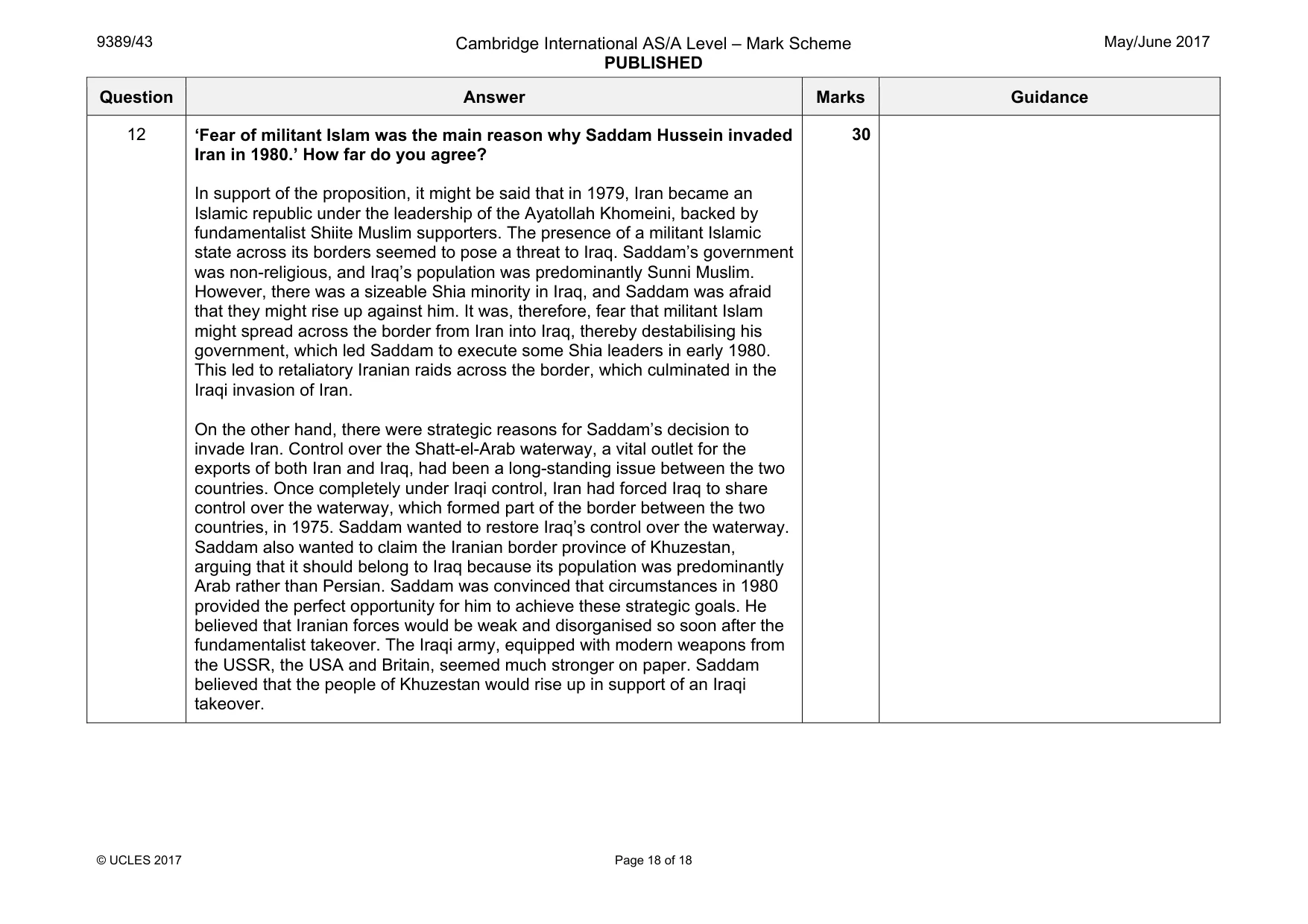
12 ‘Fear of militant Islam was the main reason why Saddam Hussein invaded Iran in 1980.’ How far do you agree? [30]
Mark scheme: 12 ‘Fear of militant Islam was the main reason why Saddam Hussein invaded Iran in 1980.’ How far do you agree? In support of the proposition, it might be said that in 1979, Iran became an Islamic republic under the leadership of the Ayatollah Khomeini, backed by fundamentalist Shiite Muslim supporters. The presence of a militant Islamic state across its borders seemed to pose a threat to Iraq. Saddam’s government was non-religious, and Iraq’s population was predominantly Sunni Muslim. However, there was a sizeable Shia minority in Iraq, and Saddam was afraid that they might rise up against him. It was, therefore, fear that militant Islam might spread across the border from Iran into Iraq, thereby destabilising his government, which led Saddam to execute some Shia leaders in early 1980. This led to retaliatory Iranian raids across the border, which culminated in the Iraqi invasion of Iran. On the other hand, there were strategic reasons for Saddam’s decision to invade Iran. Control over the Shatt-el-Arab waterway, a vital outlet for the exports of both Iran and Iraq, had been a long-standing issue between the two countries. Once completely under Iraqi control, Iran had forced Iraq to share control over the waterway, which formed part of the border between the two countries, in 1975. Saddam wanted to restore Iraq’s control over the waterway. Saddam also wanted to claim the Iranian border province of Khuzestan, arguing that it should belong to Iraq because its population was predominantly Arab rather than Persian. Saddam was convinced that circumstances in 1980 provided the perfect opportunity for him to achieve these strategic goals. He believed that Iranian forces would be weak and disorganised so soon after the fundamentalist takeover. The Iraqi army, equipped with modern weapons from the USSR, the USA and Britain, seemed much stronger on paper. Saddam believed that the people of Khuzestan would rise up in support of an Iraqi takeover. 30
What you needed in this session
Cambridge’s own grade thresholds for 2017 May/June, Paper 4 · Variant 3. A higher threshold means an easier paper — the bar moves with how the cohort did.