Cambridge A Level History 9389 — 2020 Oct/Nov Paper 4 · Variant 3
9389/43/O/N/20 · 60 marks · ≈68 min
The question paper and its mark scheme, free to read here and free to download. This is Cambridge’s own paper, exactly as it was sat.
Question paper4 pages
Mark scheme24 pages
Answers below. Sit the paper first if you are practising.

Paper as text
Question paper, page 1
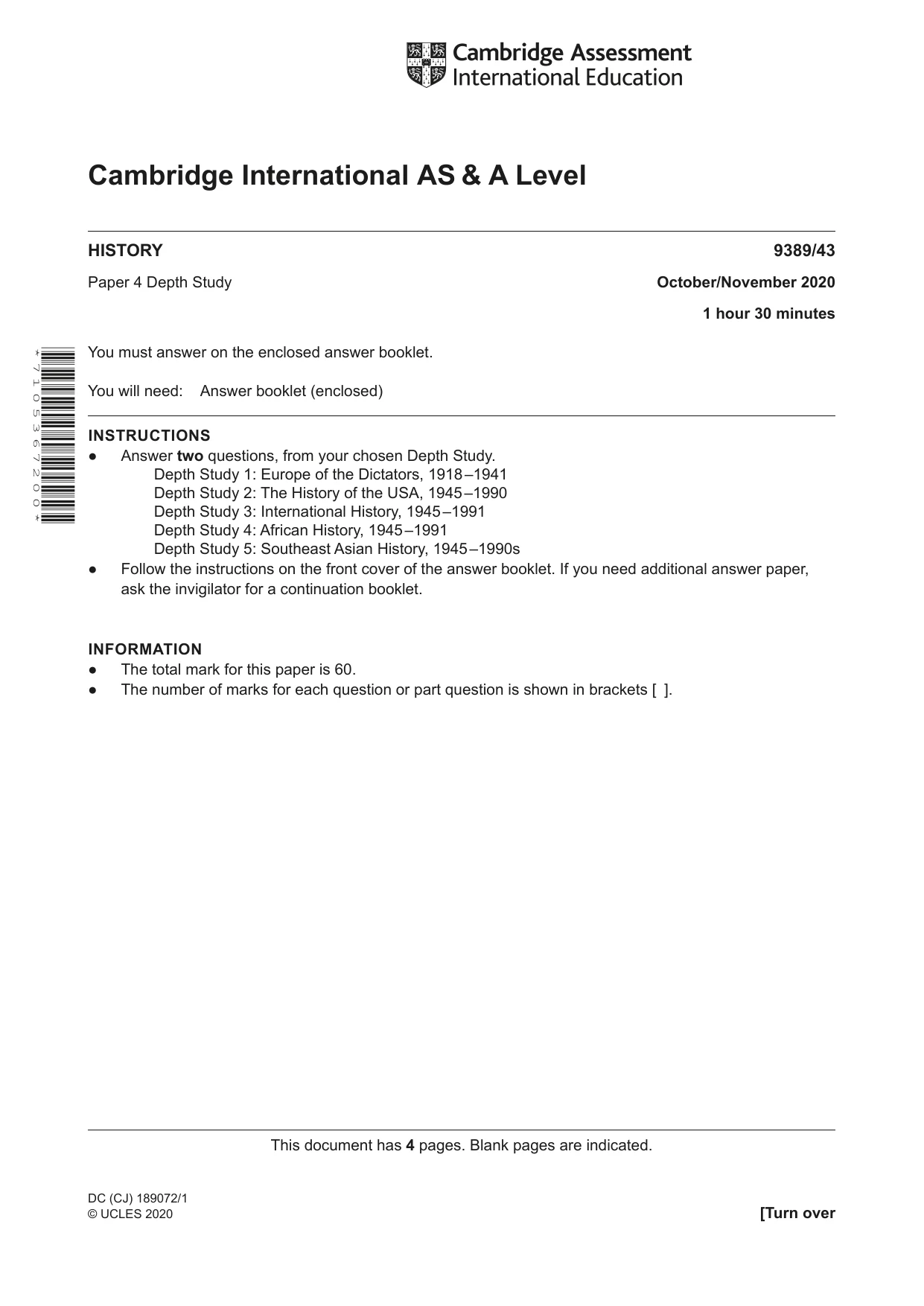
Cambridge International AS & A Level This document has 4 pages. Blank pages are indicated. HISTORY 9389/43 Paper 4 Depth Study October/November 2020 1 hour 30 minutes You must answer on the enclosed answer booklet. You will need: Answer booklet (enclosed) INSTRUCTIONS ● Answer two questions, from your chosen Depth Study. Depth Study 1: Europe of the Dictators, 1918 –1941 Depth Study 2: The History of the USA, 1945 –1990 Depth Study 3: International History, 1945 –1991 Depth Study 4: African History, 1945 –1991 Depth Study 5: Southeast Asian History, 1945 –1990s ● Follow the instructions on the front cover of the answer booklet. If you need additional answer paper, ask the invigilator for a continuation booklet. INFORMATION ● The total mark for this paper is 60. ● The number of marks for each question or part question is shown in brackets [ ]. * 7 1 0 5 3 6 7 2 0 0 * DC (CJ) 189072/1 © UCLES 2020 [Turn over
Question paper, page 2
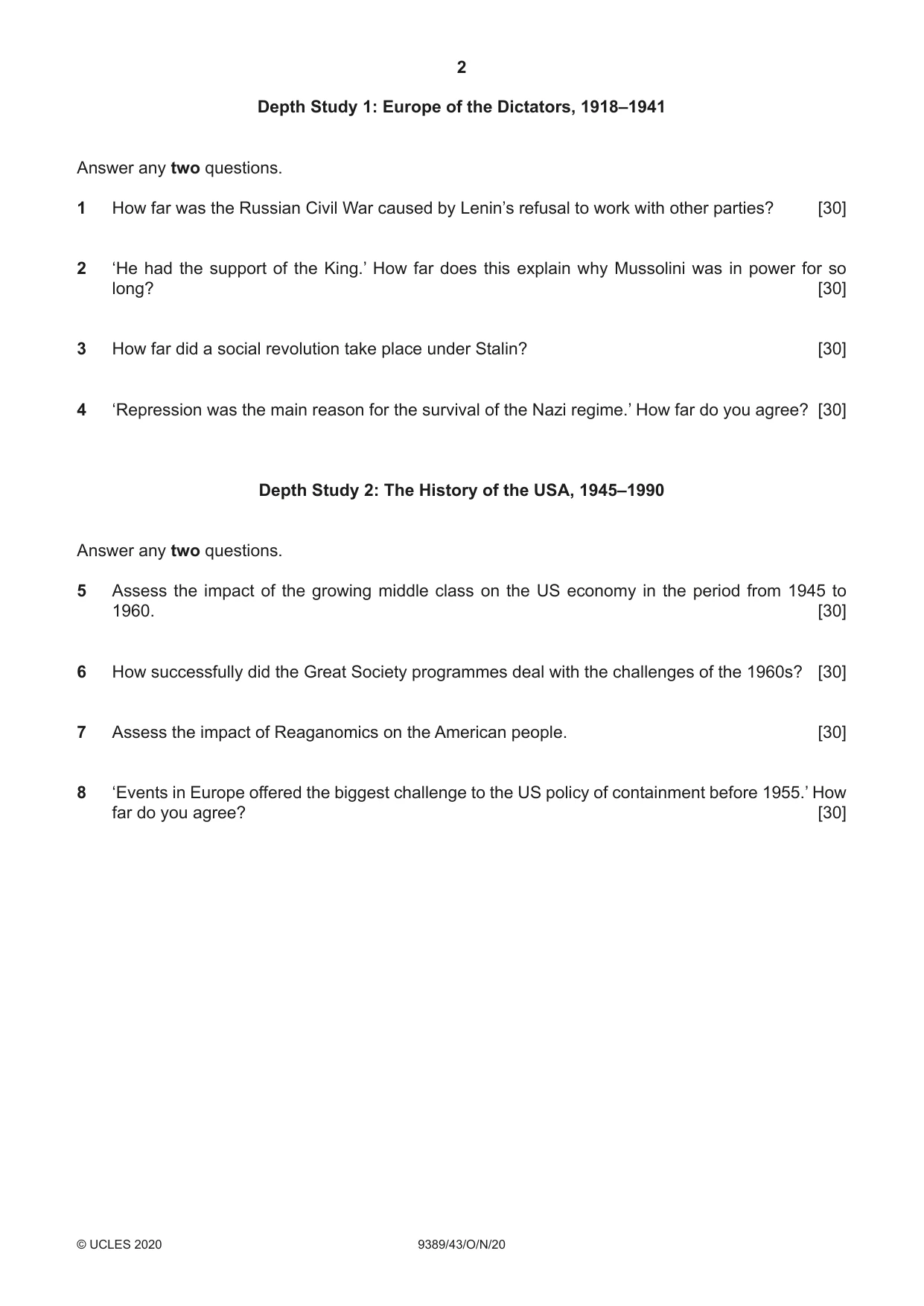
2 9389/43/O/N/20 © UCLES 2020 Depth Study 1: Europe of the Dictators, 1918–1941 Answer any two questions. 1 How far was the Russian Civil War caused by Lenin’s refusal to work with other parties? [30] 2 ‘He had the support of the King.’ How far does this explain why Mussolini was in power for so long? [30] 3 How far did a social revolution take place under Stalin? [30] 4 ‘Repression was the main reason for the survival of the Nazi regime.’ How far do you agree? [30] Depth Study 2: The History of the USA, 1945–1990 Answer any two questions. 5 Assess the impact of the growing middle class on the US economy in the period from 1945 to 1960. [30] 6 How successfully did the Great Society programmes deal with the challenges of the 1960s? [30] 7 Assess the impact of Reaganomics on the American people. [30] 8 ‘Events in Europe offered the biggest challenge to the US policy of containment before 1955.’ How far do you agree? [30]
Question paper, page 3
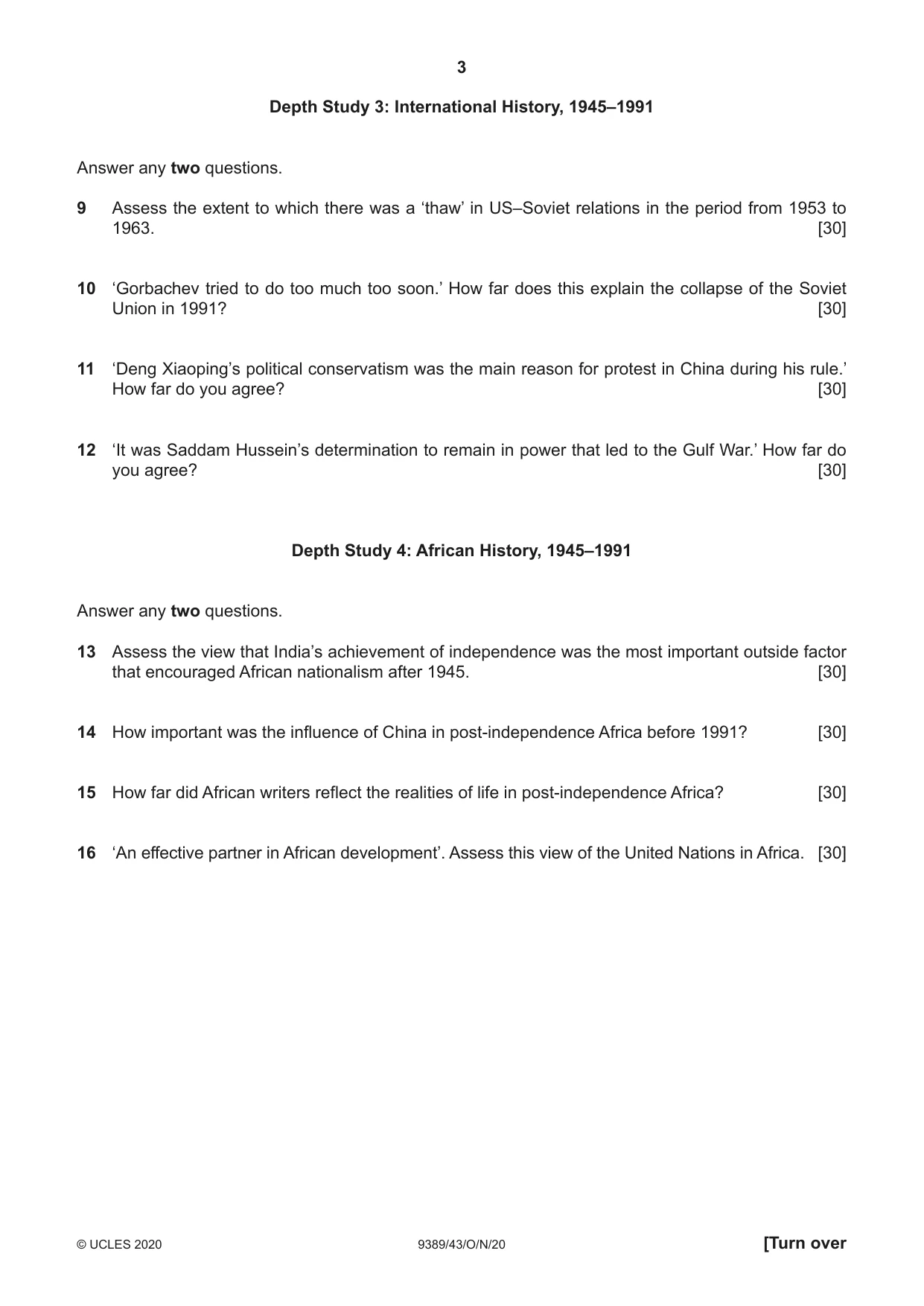
3 9389/43/O/N/20 © UCLES 2020 [Turn over Depth Study 3: International History, 1945–1991 Answer any two questions. 9 Assess the extent to which there was a ‘thaw’ in US–Soviet relations in the period from 1953 to 1963. [30] 10 ‘Gorbachev tried to do too much too soon.’ How far does this explain the collapse of the Soviet Union in 1991? [30] 11 ‘Deng Xiaoping’s political conservatism was the main reason for protest in China during his rule.’ How far do you agree? [30] 12 ‘It was Saddam Hussein’s determination to remain in power that led to the Gulf War.’ How far do you agree? [30] Depth Study 4: African History, 1945–1991 Answer any two questions. 13 Assess the view that India’s achievement of independence was the most important outside factor that encouraged African nationalism after 1945. [30] 14 How important was the influence of China in post-independence Africa before 1991? [30] 15 How far did African writers reflect the realities of life in post-independence Africa? [30] 16 ‘An effective partner in African development’. Assess this view of the United Nations in Africa. [30]
Question paper, page 4
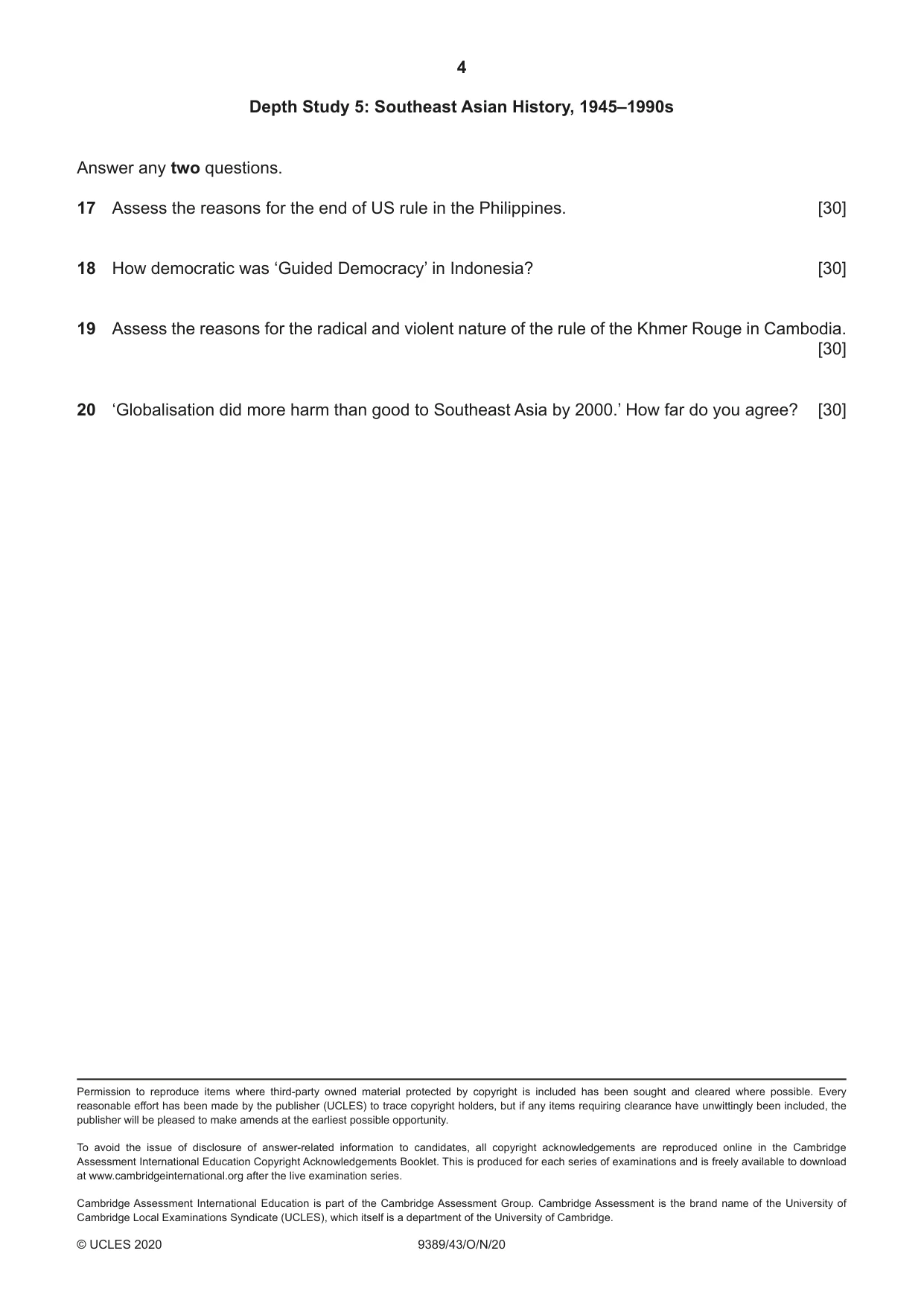
4 9389/43/O/N/20 © UCLES 2020 Permission to reproduce items where third-party owned material protected by copyright is included has been sought and cleared where possible. Every reasonable effort has been made by the publisher (UCLES) to trace copyright holders, but if any items requiring clearance have unwittingly been included, the publisher will be pleased to make amends at the earliest possible opportunity. To avoid the issue of disclosure of answer-related information to candidates, all copyright acknowledgements are reproduced online in the Cambridge Assessment International Education Copyright Acknowledgements Booklet. This is produced for each series of examinations and is freely available to download at www.cambridgeinternational.org after the live examination series. Cambridge Assessment International Education is part of the Cambridge Assessment Group. Cambridge Assessment is the brand name of the University of Cambridge Local Examinations Syndicate (UCLES), which itself is a department of the University of Cambridge. Depth Study 5: Southeast Asian History, 1945–1990s Answer any two questions. 17 Assess the reasons for the end of US rule in the Philippines. [30] 18 How democratic was ‘Guided Democracy’ in Indonesia? [30] 19 Assess the reasons for the radical and violent nature of the rule of the Khmer Rouge in Cambodia. [30] 20 ‘Globalisation did more harm than good to Southeast Asia by 2000.’ How far do you agree? [30]
Mark scheme, page 1
This document consists of 24 printed pages. © UCLES 2020 [Turn over Cambridge International AS & A Level HISTORY 9389/43 Paper 4 Depth Study October/November 2020 MARK SCHEME Maximum Mark: 60 Published This mark scheme is published as an aid to teachers and candidates, to indicate the requirements of the examination. It shows the basis on which Examiners were instructed to award marks. It does not indicate the details of the discussions that took place at an Examiners’ meeting before marking began, which would have considered the acceptability of alternative answers. Mark schemes should be read in conjunction with the question paper and the Principal Examiner Report for Teachers. Cambridge International will not enter into discussions about these mark schemes. Cambridge International is publishing the mark schemes for the October/November 2020 series for most Cambridge IGCSE™, Cambridge International A and AS Level and Cambridge Pre-U components, and some Cambridge O Level components.
Mark scheme, page 2
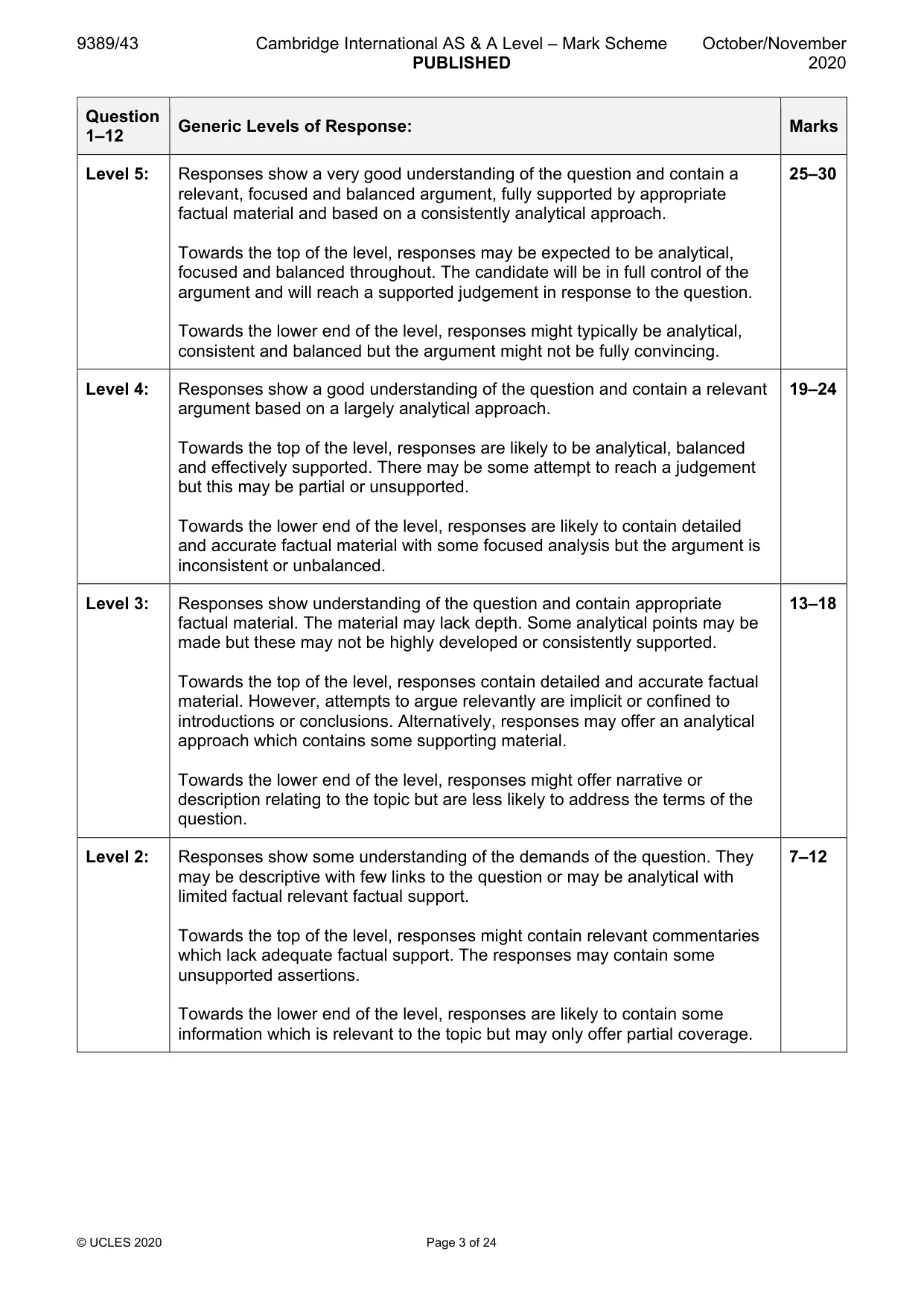
9389/43 Cambridge International AS & A Level – Mark Scheme PUBLISHED October/November 2020 © UCLES 2020 Page 2 of 24 Generic Marking Principles These general marking principles must be applied by all examiners when marking candidate answers. They should be applied alongside the specific content of the mark scheme or generic level descriptors for a question. Each question paper and mark scheme will also comply with these marking principles. GENERIC MARKING PRINCIPLE 1: Marks must be awarded in line with: • the specific content of the mark scheme or the generic level descriptors for the question • the specific skills defined in the mark scheme or in the generic level descriptors for the question • the standard of response required by a candidate as exemplified by the standardisation scripts. GENERIC MARKING PRINCIPLE 2: Marks awarded are always whole marks (not half marks, or other fractions). GENERIC MARKING PRINCIPLE 3: Marks must be awarded positively: • marks are awarded for correct/valid answers, as defined in the mark scheme. However, credit is given for valid answers which go beyond the scope of the syllabus and mark scheme, referring to your Team Leader as appropriate • marks are awarded when candidates clearly demonstrate what they know and can do • marks are not deducted for errors • marks are not deducted for omissions • answers should only be judged on the quality of spelling, punctuation and grammar when these features are specifically assessed by the question as indicated by the mark scheme. The meaning, however, should be unambiguous. GENERIC MARKING PRINCIPLE 4: Rules must be applied consistently, e.g. in situations where candidates have not followed instructions or in the application of generic level descriptors. GENERIC MARKING PRINCIPLE 5: Marks should be awarded using the full range of marks defined in the mark scheme for the question (however; the use of the full mark range may be limited according to the quality of the candidate responses seen). GENERIC MARKING PRINCIPLE 6: Marks awarded are based solely on the requirements as defined in the mark scheme. Marks should not be awarded with grade thresholds or grade descriptors in mind.
Mark scheme, page 3
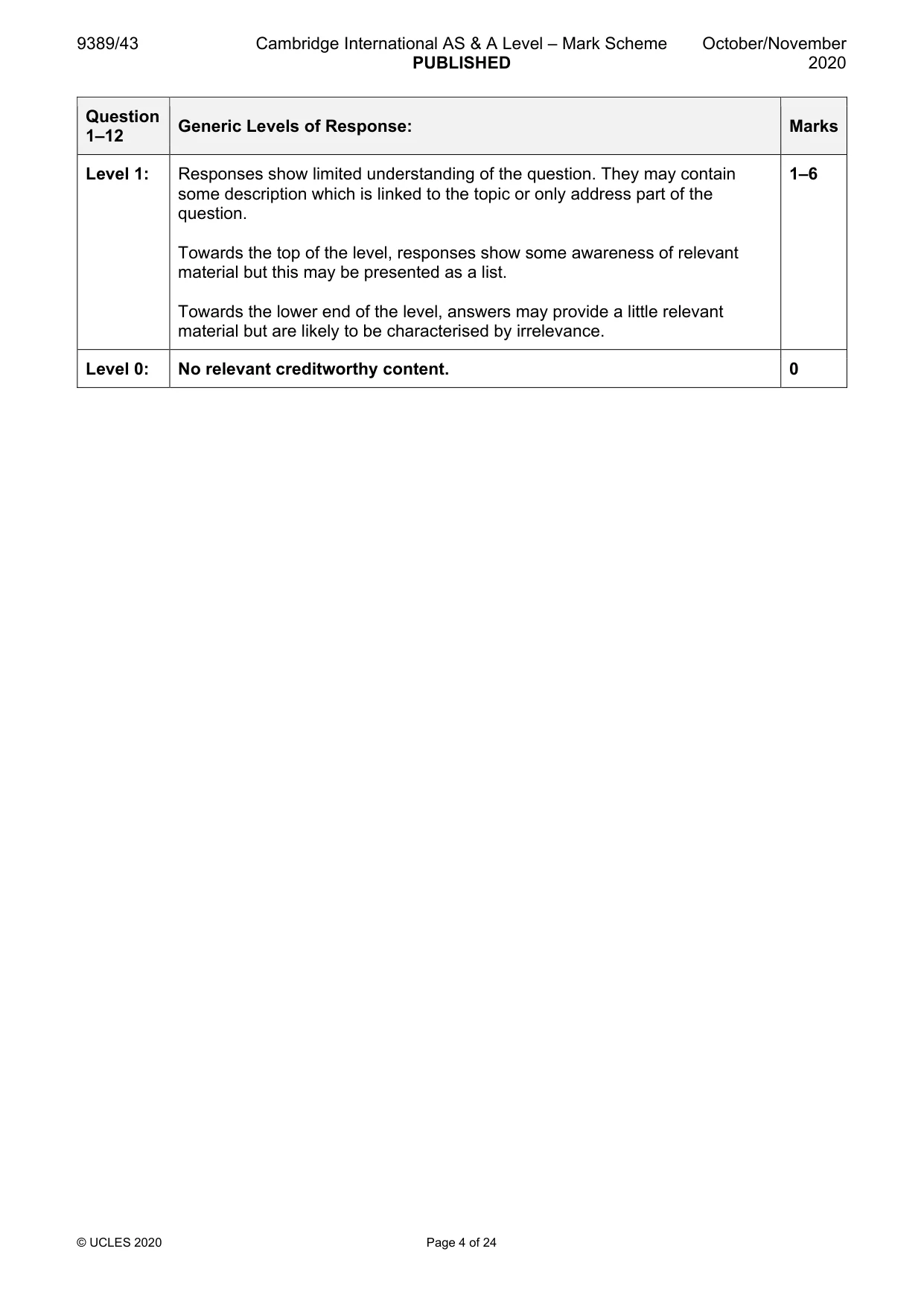
9389/43 Cambridge International AS & A Level – Mark Scheme PUBLISHED October/November 2020 © UCLES 2020 Page 3 of 24 Question 1–12 Generic Levels of Response: Marks Level 5: Responses show a very good understanding of the question and contain a relevant, focused and balanced argument, fully supported by appropriate factual material and based on a consistently analytical approach. Towards the top of the level, responses may be expected to be analytical, focused and balanced throughout. The candidate will be in full control of the argument and will reach a supported judgement in response to the question. Towards the lower end of the level, responses might typically be analytical, consistent and balanced but the argument might not be fully convincing. 25–30 Level 4: Responses show a good understanding of the question and contain a relevant argument based on a largely analytical approach. Towards the top of the level, responses are likely to be analytical, balanced and effectively supported. There may be some attempt to reach a judgement but this may be partial or unsupported. Towards the lower end of the level, responses are likely to contain detailed and accurate factual material with some focused analysis but the argument is inconsistent or unbalanced. 19–24 Level 3: Responses show understanding of the question and contain appropriate factual material. The material may lack depth. Some analytical points may be made but these may not be highly developed or consistently supported. Towards the top of the level, responses contain detailed and accurate factual material. However, attempts to argue relevantly are implicit or confined to introductions or conclusions. Alternatively, responses may offer an analytical approach which contains some supporting material. Towards the lower end of the level, responses might offer narrative or description relating to the topic but are less likely to address the terms of the question. 13–18 Level 2: Responses show some understanding of the demands of the question. They may be descriptive with few links to the question or may be analytical with limited factual relevant factual support. Towards the top of the level, responses might contain relevant commentaries which lack adequate factual support. The responses may contain some unsupported assertions. Towards the lower end of the level, responses are likely to contain some information which is relevant to the topic but may only offer partial coverage. 7–12
Mark scheme, page 4
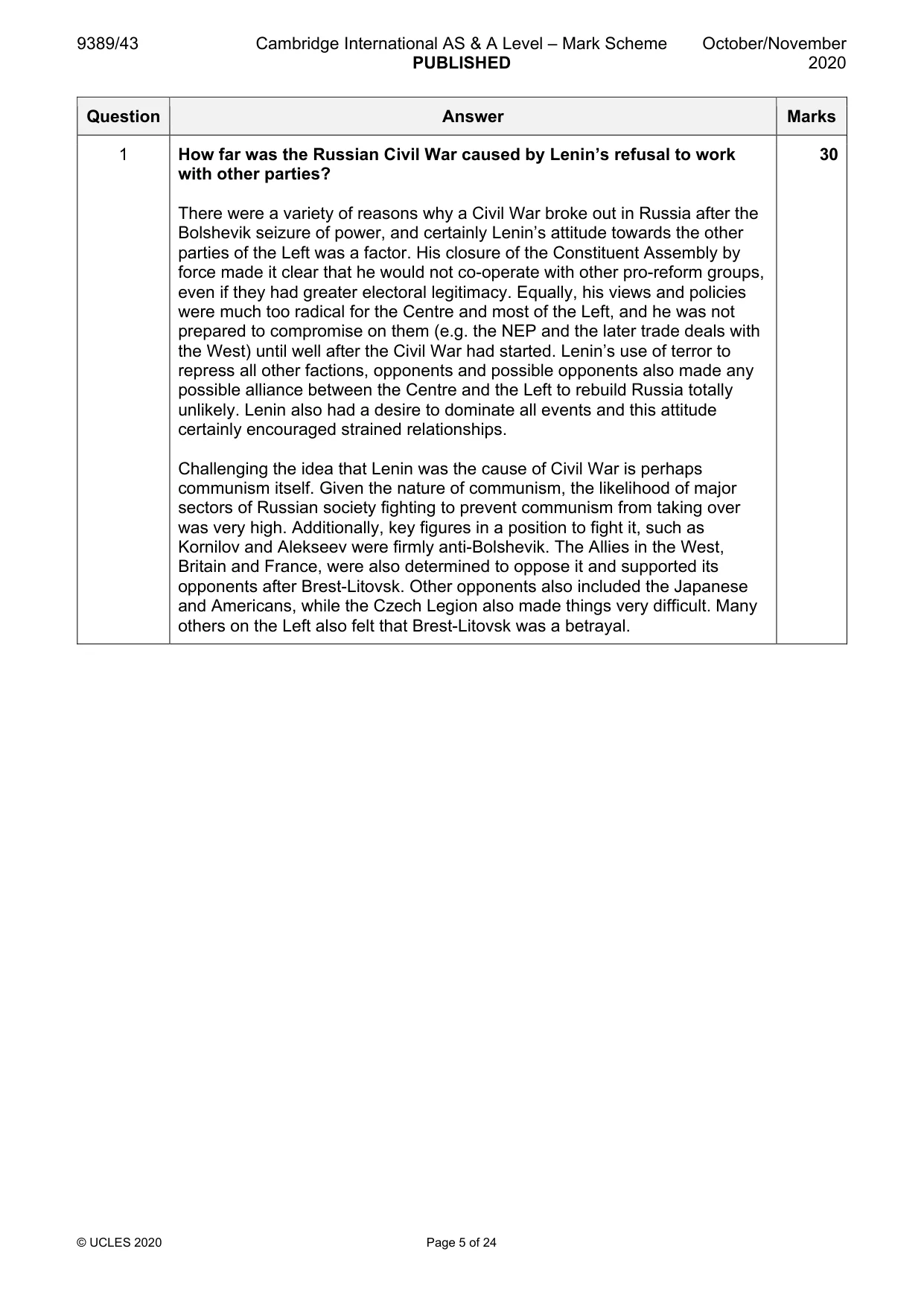
9389/43 Cambridge International AS & A Level – Mark Scheme PUBLISHED October/November 2020 © UCLES 2020 Page 4 of 24 Question 1–12 Generic Levels of Response: Marks Level 1: Responses show limited understanding of the question. They may contain some description which is linked to the topic or only address part of the question. Towards the top of the level, responses show some awareness of relevant material but this may be presented as a list. Towards the lower end of the level, answers may provide a little relevant material but are likely to be characterised by irrelevance. 1–6 Level 0: No relevant creditworthy content. 0
Mark scheme, page 5
9389/43 Cambridge International AS & A Level – Mark Scheme PUBLISHED October/November 2020 © UCLES 2020 Page 5 of 24 Question Answer Marks 1 How far was the Russian Civil War caused by Lenin’s refusal to work with other parties? There were a variety of reasons why a Civil War broke out in Russia after the Bolshevik seizure of power, and certainly Lenin’s attitude towards the other parties of the Left was a factor. His closure of the Constituent Assembly by force made it clear that he would not co-operate with other pro-reform groups, even if they had greater electoral legitimacy. Equally, his views and policies were much too radical for the Centre and most of the Left, and he was not prepared to compromise on them (e.g. the NEP and the later trade deals with the West) until well after the Civil War had started. Lenin’s use of terror to repress all other factions, opponents and possible opponents also made any possible alliance between the Centre and the Left to rebuild Russia totally unlikely. Lenin also had a desire to dominate all events and this attitude certainly encouraged strained relationships. Challenging the idea that Lenin was the cause of Civil War is perhaps communism itself. Given the nature of communism, the likelihood of major sectors of Russian society fighting to prevent communism from taking over was very high. Additionally, key figures in a position to fight it, such as Kornilov and Alekseev were firmly anti-Bolshevik. The Allies in the West, Britain and France, were also determined to oppose it and supported its opponents after Brest-Litovsk. Other opponents also included the Japanese and Americans, while the Czech Legion also made things very difficult. Many others on the Left also felt that Brest-Litovsk was a betrayal. 30
Mark scheme, page 6
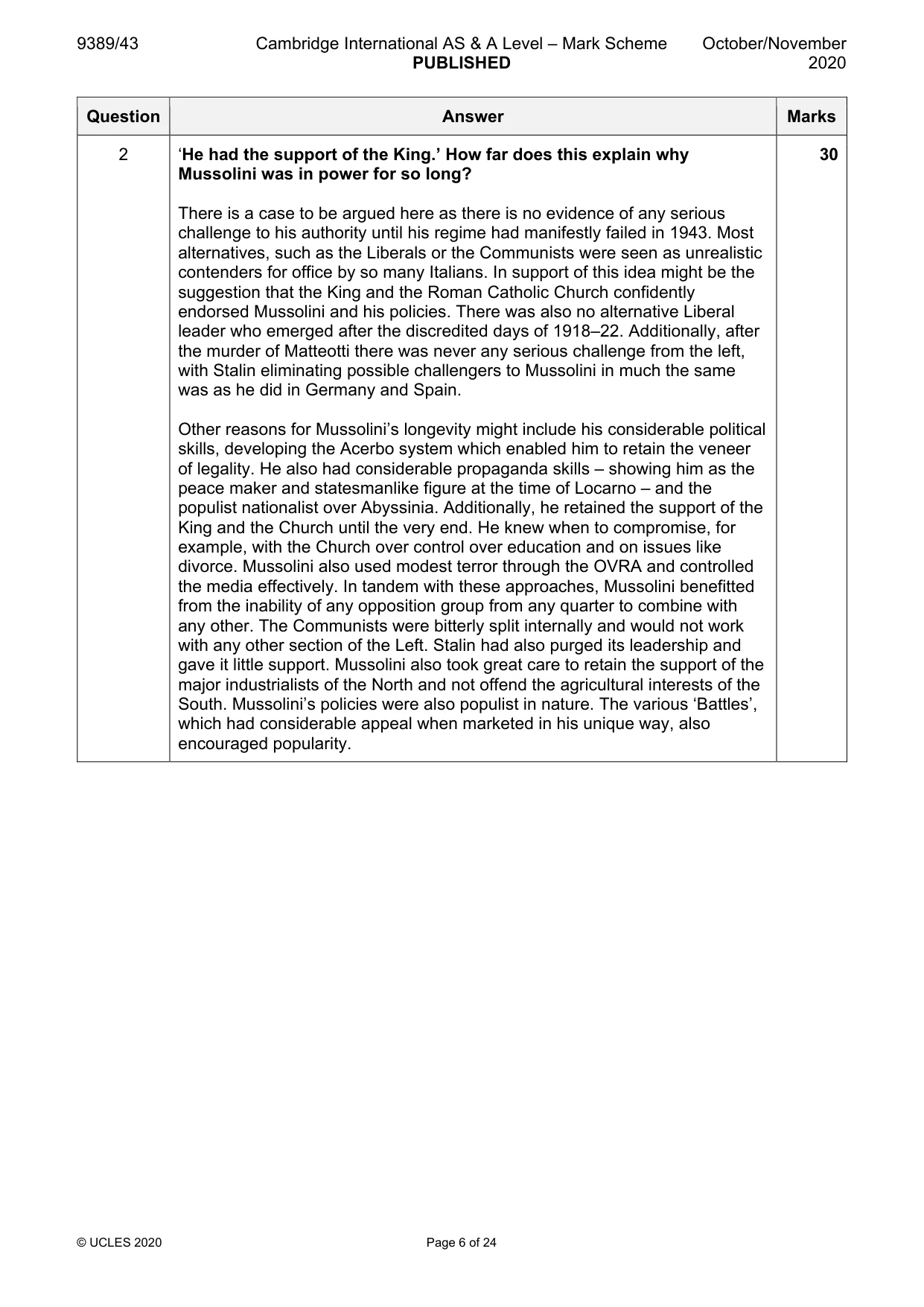
9389/43 Cambridge International AS & A Level – Mark Scheme PUBLISHED October/November 2020 © UCLES 2020 Page 6 of 24 Question Answer Marks 2 ‘He had the support of the King.’ How far does this explain why Mussolini was in power for so long? There is a case to be argued here as there is no evidence of any serious challenge to his authority until his regime had manifestly failed in 1943. Most alternatives, such as the Liberals or the Communists were seen as unrealistic contenders for office by so many Italians. In support of this idea might be the suggestion that the King and the Roman Catholic Church confidently endorsed Mussolini and his policies. There was also no alternative Liberal leader who emerged after the discredited days of 1918–22. Additionally, after the murder of Matteotti there was never any serious challenge from the left, with Stalin eliminating possible challengers to Mussolini in much the same was as he did in Germany and Spain. Other reasons for Mussolini’s longevity might include his considerable political skills, developing the Acerbo system which enabled him to retain the veneer of legality. He also had considerable propaganda skills – showing him as the peace maker and statesmanlike figure at the time of Locarno – and the populist nationalist over Abyssinia. Additionally, he retained the support of the King and the Church until the very end. He knew when to compromise, for example, with the Church over control over education and on issues like divorce. Mussolini also used modest terror through the OVRA and controlled the media effectively. In tandem with these approaches, Mussolini benefitted from the inability of any opposition group from any quarter to combine with any other. The Communists were bitterly split internally and would not work with any other section of the Left. Stalin had also purged its leadership and gave it little support. Mussolini also took great care to retain the support of the major industrialists of the North and not offend the agricultural interests of the South. Mussolini’s policies were also populist in nature. The various ‘Battles’, which had considerable appeal when marketed in his unique way, also encouraged popularity. 30
Mark scheme, page 7
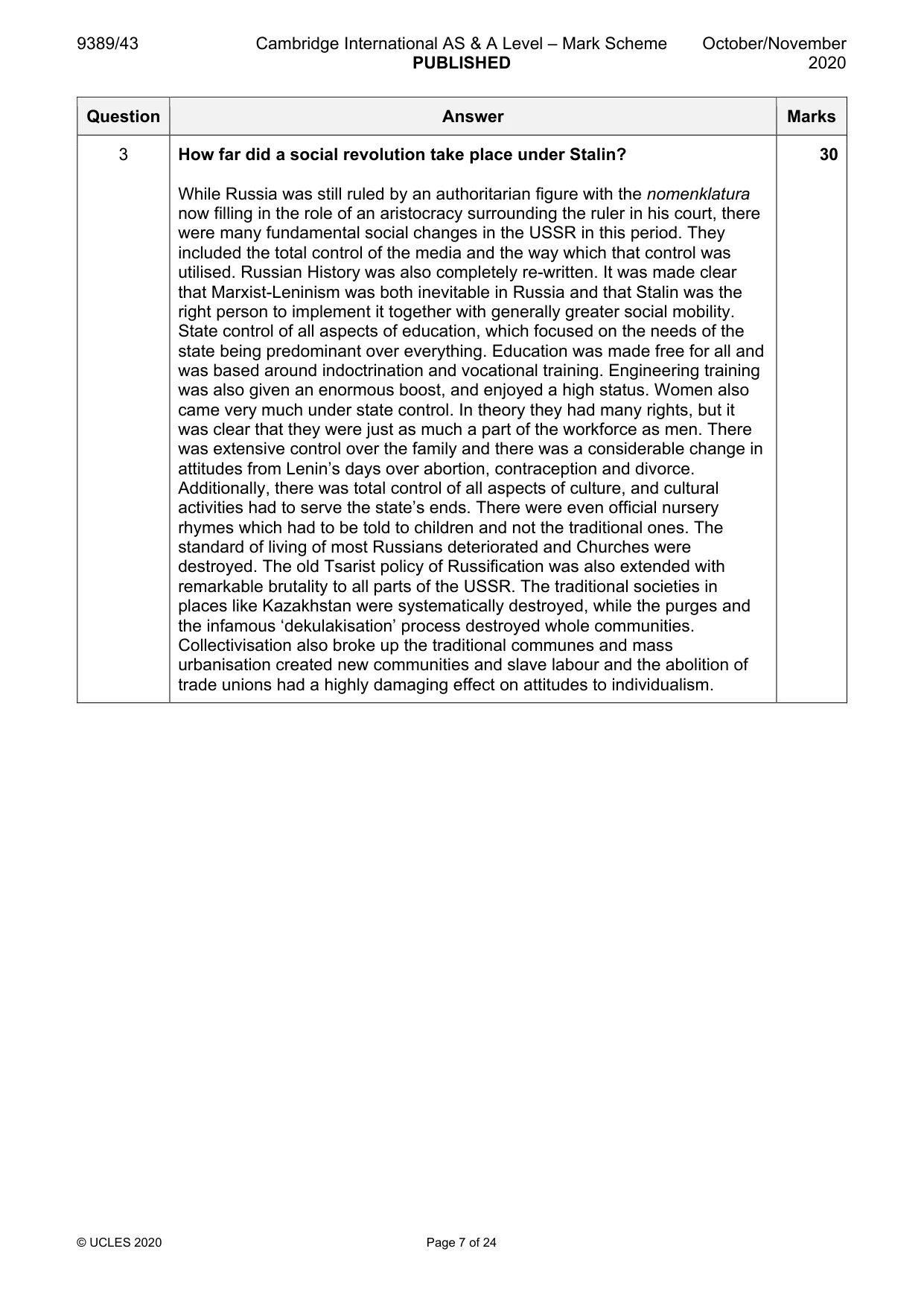
9389/43 Cambridge International AS & A Level – Mark Scheme PUBLISHED October/November 2020 © UCLES 2020 Page 7 of 24 Question Answer Marks 3 How far did a social revolution take place under Stalin? While Russia was still ruled by an authoritarian figure with the nomenklatura now filling in the role of an aristocracy surrounding the ruler in his court, there were many fundamental social changes in the USSR in this period. They included the total control of the media and the way which that control was utilised. Russian History was also completely re-written. It was made clear that Marxist-Leninism was both inevitable in Russia and that Stalin was the right person to implement it together with generally greater social mobility. State control of all aspects of education, which focused on the needs of the state being predominant over everything. Education was made free for all and was based around indoctrination and vocational training. Engineering training was also given an enormous boost, and enjoyed a high status. Women also came very much under state control. In theory they had many rights, but it was clear that they were just as much a part of the workforce as men. There was extensive control over the family and there was a considerable change in attitudes from Lenin’s days over abortion, contraception and divorce. Additionally, there was total control of all aspects of culture, and cultural activities had to serve the state’s ends. There were even official nursery rhymes which had to be told to children and not the traditional ones. The standard of living of most Russians deteriorated and Churches were destroyed. The old Tsarist policy of Russification was also extended with remarkable brutality to all parts of the USSR. The traditional societies in places like Kazakhstan were systematically destroyed, while the purges and the infamous ‘dekulakisation’ process destroyed whole communities. Collectivisation also broke up the traditional communes and mass urbanisation created new communities and slave labour and the abolition of trade unions had a highly damaging effect on attitudes to individualism. 30
Mark scheme, page 8
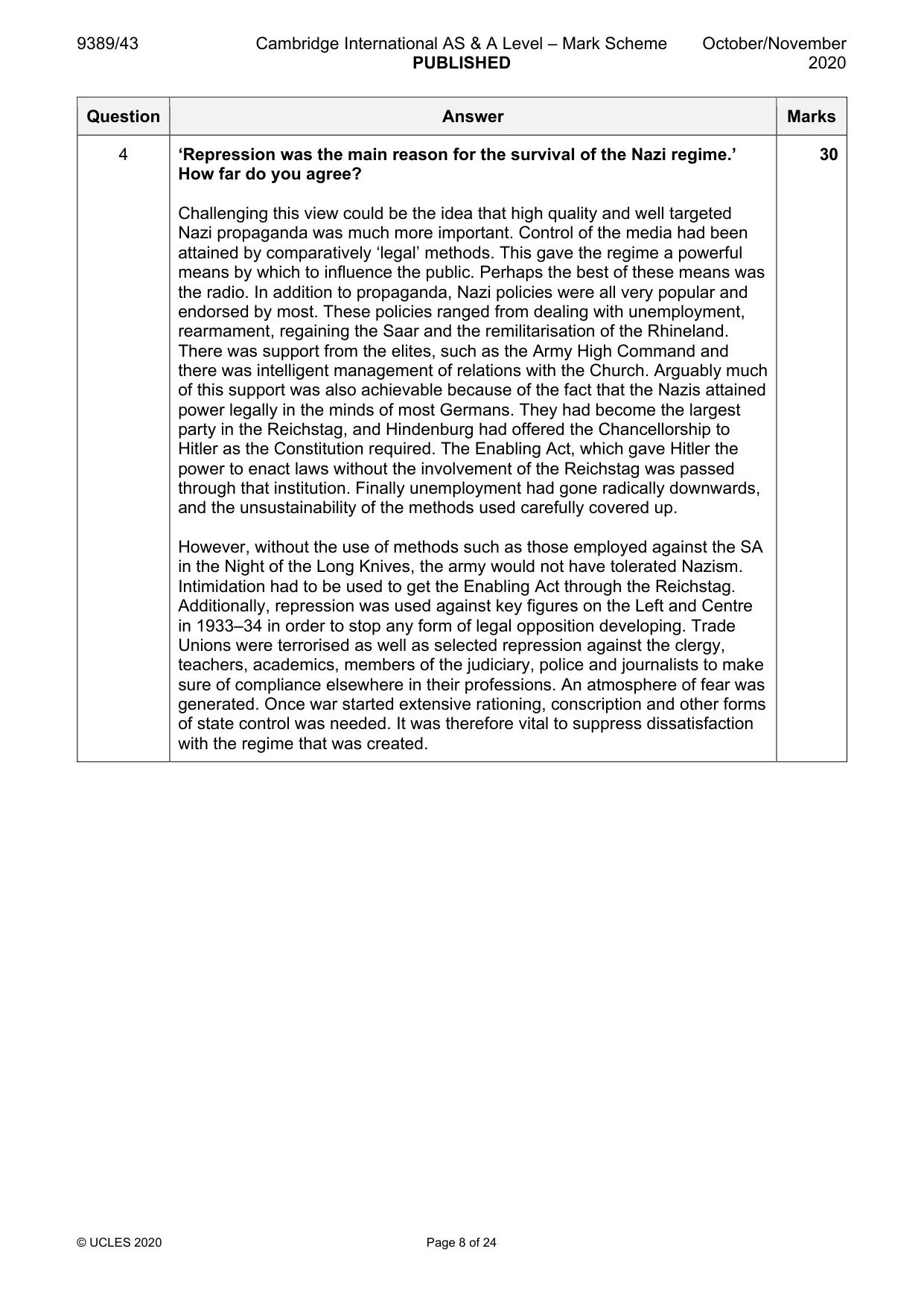
9389/43 Cambridge International AS & A Level – Mark Scheme PUBLISHED October/November 2020 © UCLES 2020 Page 8 of 24 Question Answer Marks 4 ‘Repression was the main reason for the survival of the Nazi regime.’ How far do you agree? Challenging this view could be the idea that high quality and well targeted Nazi propaganda was much more important. Control of the media had been attained by comparatively ‘legal’ methods. This gave the regime a powerful means by which to influence the public. Perhaps the best of these means was the radio. In addition to propaganda, Nazi policies were all very popular and endorsed by most. These policies ranged from dealing with unemployment, rearmament, regaining the Saar and the remilitarisation of the Rhineland. There was support from the elites, such as the Army High Command and there was intelligent management of relations with the Church. Arguably much of this support was also achievable because of the fact that the Nazis attained power legally in the minds of most Germans. They had become the largest party in the Reichstag, and Hindenburg had offered the Chancellorship to Hitler as the Constitution required. The Enabling Act, which gave Hitler the power to enact laws without the involvement of the Reichstag was passed through that institution. Finally unemployment had gone radically downwards, and the unsustainability of the methods used carefully covered up. However, without the use of methods such as those employed against the SA in the Night of the Long Knives, the army would not have tolerated Nazism. Intimidation had to be used to get the Enabling Act through the Reichstag. Additionally, repression was used against key figures on the Left and Centre in 1933–34 in order to stop any form of legal opposition developing. Trade Unions were terrorised as well as selected repression against the clergy, teachers, academics, members of the judiciary, police and journalists to make sure of compliance elsewhere in their professions. An atmosphere of fear was generated. Once war started extensive rationing, conscription and other forms of state control was needed. It was therefore vital to suppress dissatisfaction with the regime that was created. 30
Mark scheme, page 9
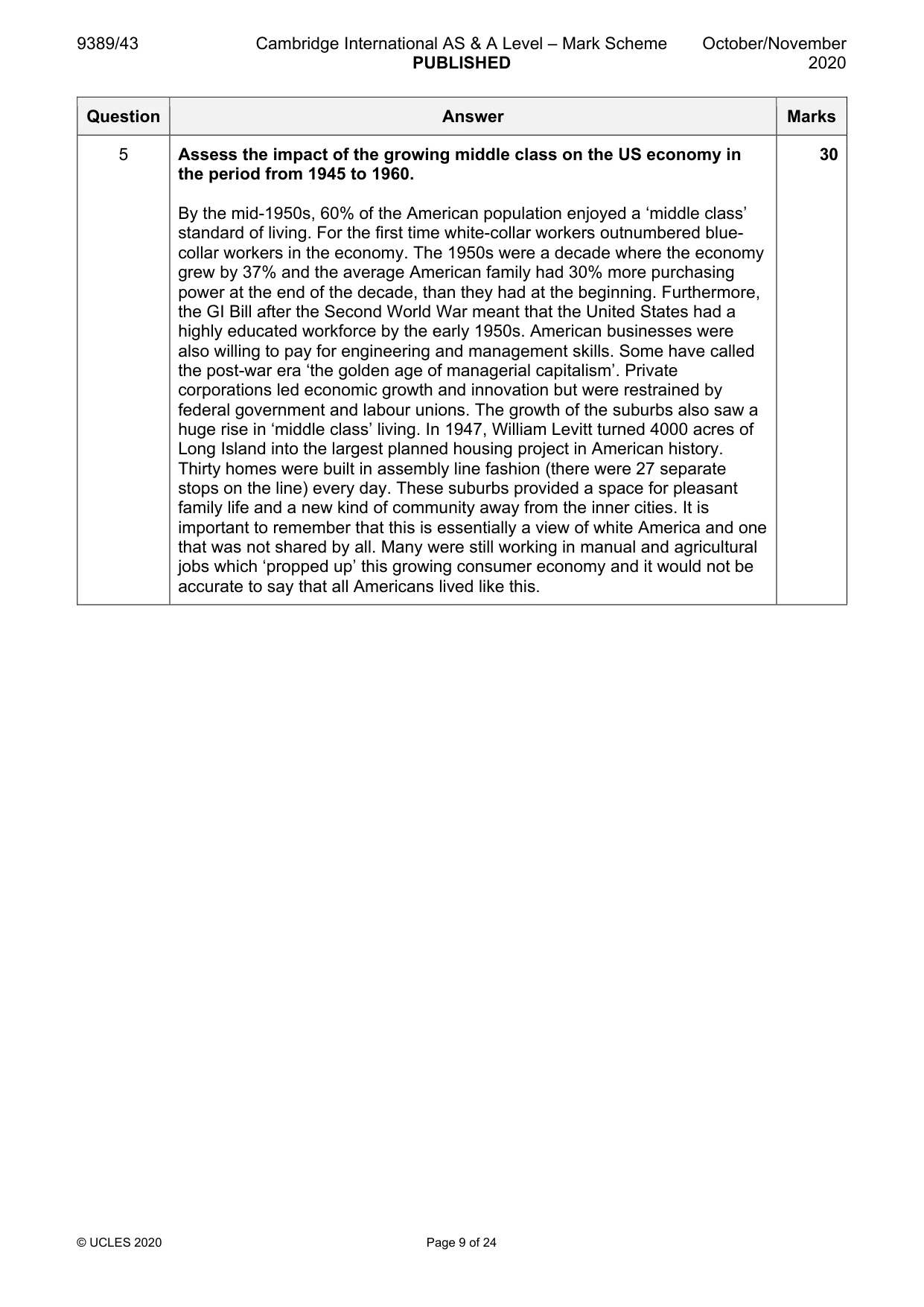
9389/43 Cambridge International AS & A Level – Mark Scheme PUBLISHED October/November 2020 © UCLES 2020 Page 9 of 24 Question Answer Marks 5 Assess the impact of the growing middle class on the US economy in the period from 1945 to 1960. By the mid-1950s, 60% of the American population enjoyed a ‘middle class’ standard of living. For the first time white-collar workers outnumbered blue- collar workers in the economy. The 1950s were a decade where the economy grew by 37% and the average American family had 30% more purchasing power at the end of the decade, than they had at the beginning. Furthermore, the GI Bill after the Second World War meant that the United States had a highly educated workforce by the early 1950s. American businesses were also willing to pay for engineering and management skills. Some have called the post-war era ‘the golden age of managerial capitalism’. Private corporations led economic growth and innovation but were restrained by federal government and labour unions. The growth of the suburbs also saw a huge rise in ‘middle class’ living. In 1947, William Levitt turned 4000 acres of Long Island into the largest planned housing project in American history. Thirty homes were built in assembly line fashion (there were 27 separate stops on the line) every day. These suburbs provided a space for pleasant family life and a new kind of community away from the inner cities. It is important to remember that this is essentially a view of white America and one that was not shared by all. Many were still working in manual and agricultural jobs which ‘propped up’ this growing consumer economy and it would not be accurate to say that all Americans lived like this. 30
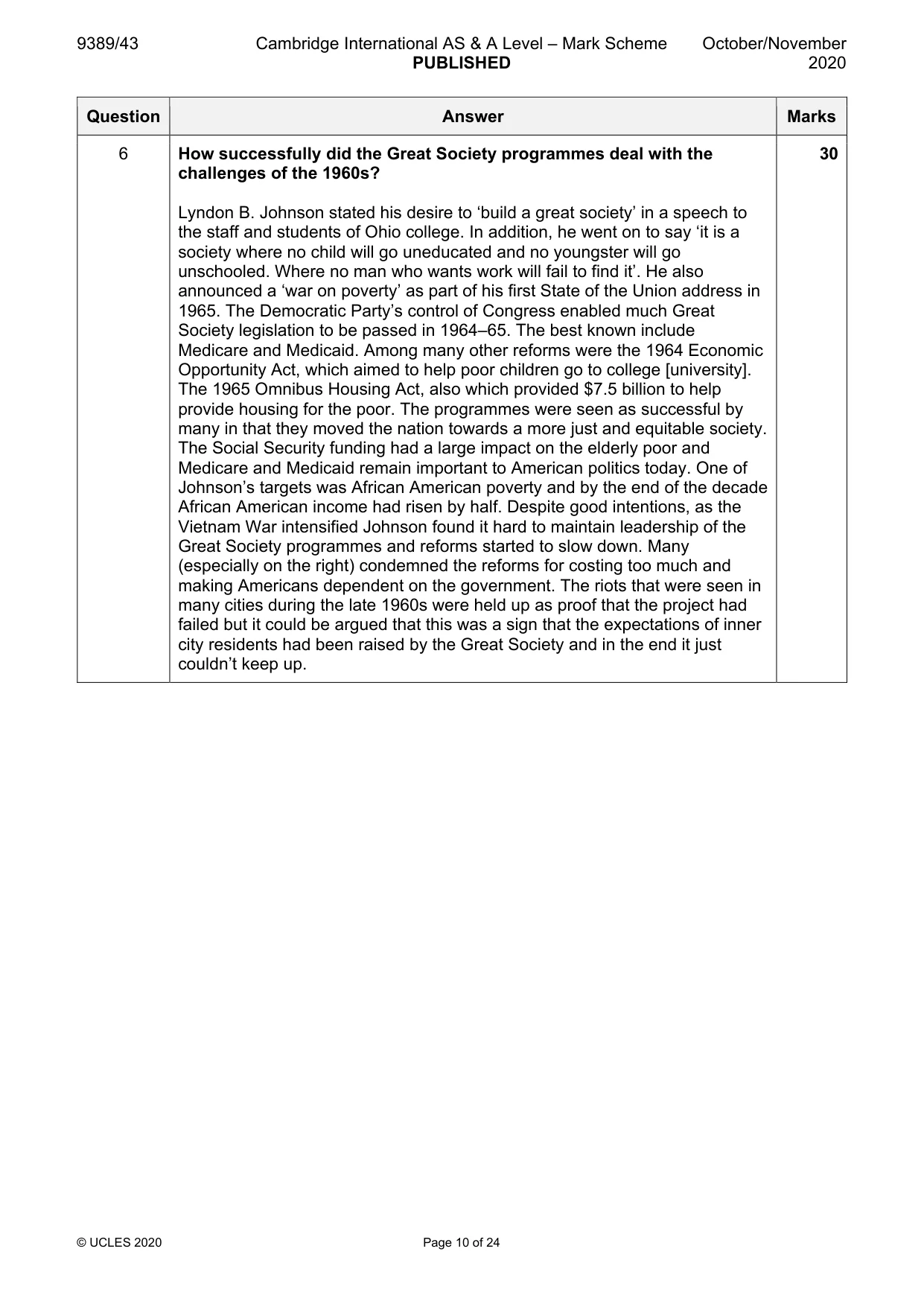
Mark scheme, page 10
9389/43 Cambridge International AS & A Level – Mark Scheme PUBLISHED October/November 2020 © UCLES 2020 Page 10 of 24 Question Answer Marks 6 How successfully did the Great Society programmes deal with the challenges of the 1960s? Lyndon B. Johnson stated his desire to ‘build a great society’ in a speech to the staff and students of Ohio college. In addition, he went on to say ‘it is a society where no child will go uneducated and no youngster will go unschooled. Where no man who wants work will fail to find it’. He also announced a ‘war on poverty’ as part of his first State of the Union address in 1965. The Democratic Party’s control of Congress enabled much Great Society legislation to be passed in 1964–65. The best known include Medicare and Medicaid. Among many other reforms were the 1964 Economic Opportunity Act, which aimed to help poor children go to college [university]. The 1965 Omnibus Housing Act, also which provided $7.5 billion to help provide housing for the poor. The programmes were seen as successful by many in that they moved the nation towards a more just and equitable society. The Social Security funding had a large impact on the elderly poor and Medicare and Medicaid remain important to American politics today. One of Johnson’s targets was African American poverty and by the end of the decade African American income had risen by half. Despite good intentions, as the Vietnam War intensified Johnson found it hard to maintain leadership of the Great Society programmes and reforms started to slow down. Many (especially on the right) condemned the reforms for costing too much and making Americans dependent on the government. The riots that were seen in many cities during the late 1960s were held up as proof that the project had failed but it could be argued that this was a sign that the expectations of inner city residents had been raised by the Great Society and in the end it just couldn’t keep up. 30
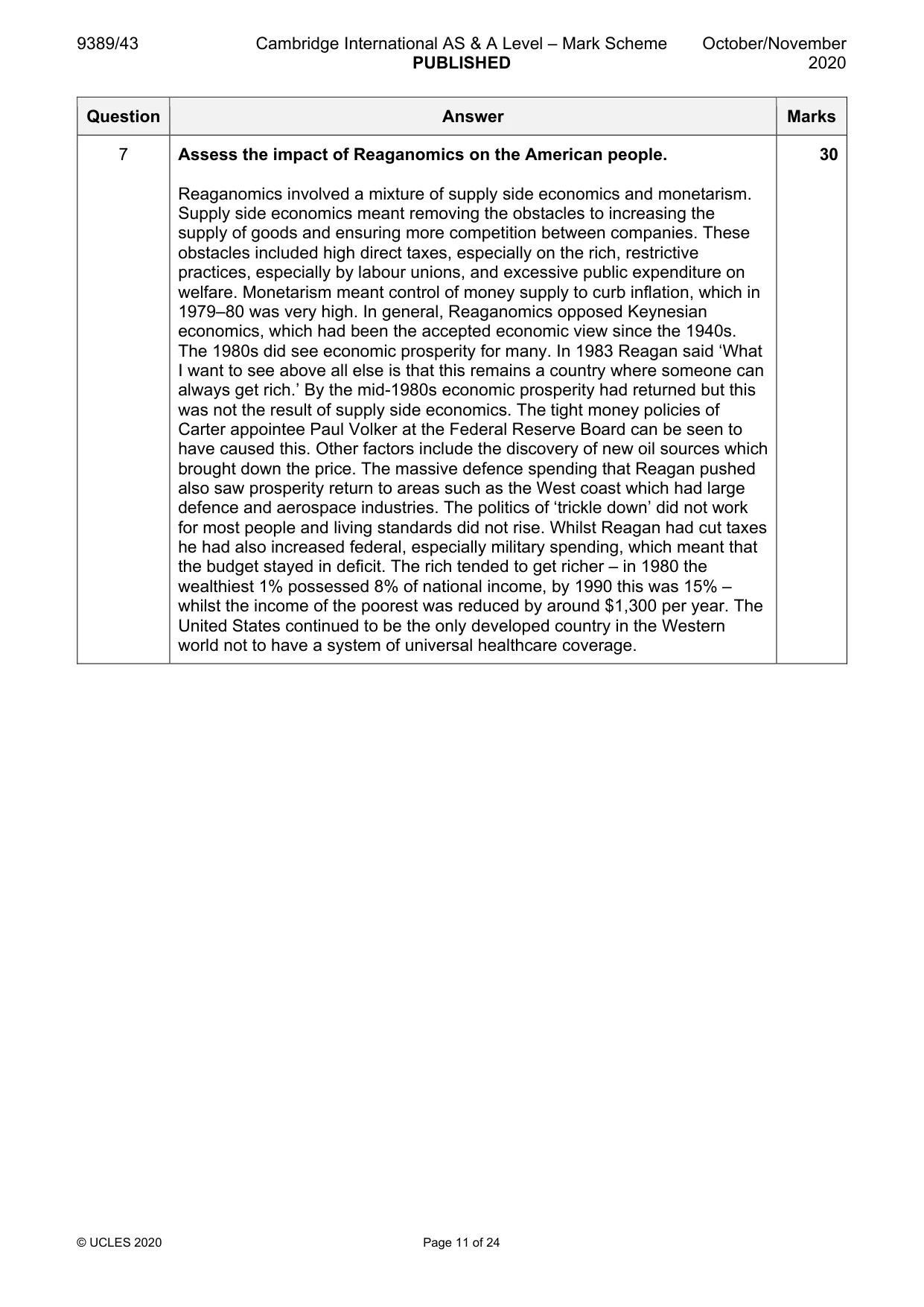
Mark scheme, page 11
9389/43 Cambridge International AS & A Level – Mark Scheme PUBLISHED October/November 2020 © UCLES 2020 Page 11 of 24 Question Answer Marks 7 Assess the impact of Reaganomics on the American people. Reaganomics involved a mixture of supply side economics and monetarism. Supply side economics meant removing the obstacles to increasing the supply of goods and ensuring more competition between companies. These obstacles included high direct taxes, especially on the rich, restrictive practices, especially by labour unions, and excessive public expenditure on welfare. Monetarism meant control of money supply to curb inflation, which in 1979–80 was very high. In general, Reaganomics opposed Keynesian economics, which had been the accepted economic view since the 1940s. The 1980s did see economic prosperity for many. In 1983 Reagan said ‘What I want to see above all else is that this remains a country where someone can always get rich.’ By the mid-1980s economic prosperity had returned but this was not the result of supply side economics. The tight money policies of Carter appointee Paul Volker at the Federal Reserve Board can be seen to have caused this. Other factors include the discovery of new oil sources which brought down the price. The massive defence spending that Reagan pushed also saw prosperity return to areas such as the West coast which had large defence and aerospace industries. The politics of ‘trickle down’ did not work for most people and living standards did not rise. Whilst Reagan had cut taxes he had also increased federal, especially military spending, which meant that the budget stayed in deficit. The rich tended to get richer – in 1980 the wealthiest 1% possessed 8% of national income, by 1990 this was 15% – whilst the income of the poorest was reduced by around $1,300 per year. The United States continued to be the only developed country in the Western world not to have a system of universal healthcare coverage. 30
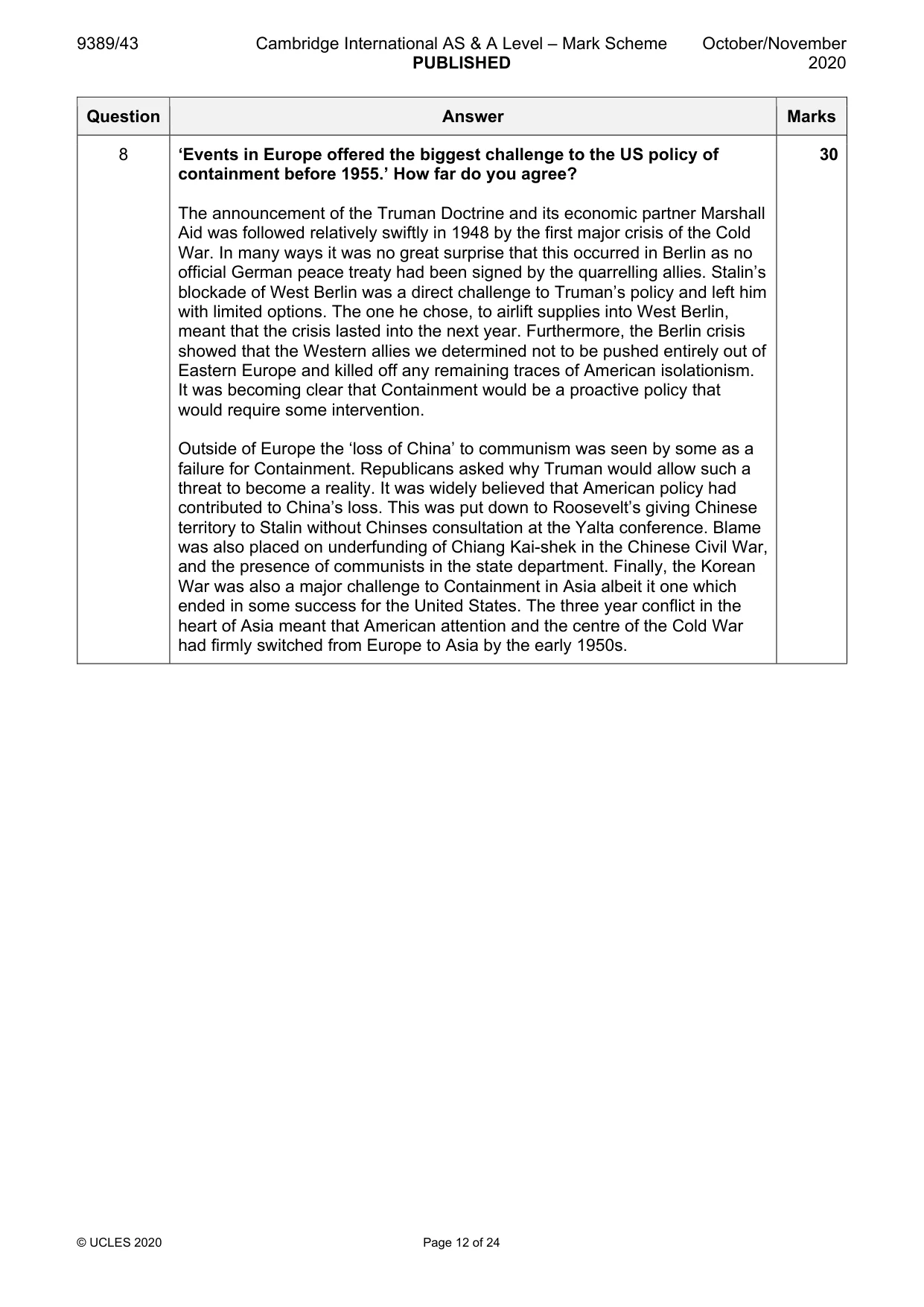
Mark scheme, page 12
9389/43 Cambridge International AS & A Level – Mark Scheme PUBLISHED October/November 2020 © UCLES 2020 Page 12 of 24 Question Answer Marks 8 ‘Events in Europe offered the biggest challenge to the US policy of containment before 1955.’ How far do you agree? The announcement of the Truman Doctrine and its economic partner Marshall Aid was followed relatively swiftly in 1948 by the first major crisis of the Cold War. In many ways it was no great surprise that this occurred in Berlin as no official German peace treaty had been signed by the quarrelling allies. Stalin’s blockade of West Berlin was a direct challenge to Truman’s policy and left him with limited options. The one he chose, to airlift supplies into West Berlin, meant that the crisis lasted into the next year. Furthermore, the Berlin crisis showed that the Western allies we determined not to be pushed entirely out of Eastern Europe and killed off any remaining traces of American isolationism. It was becoming clear that Containment would be a proactive policy that would require some intervention. Outside of Europe the ‘loss of China’ to communism was seen by some as a failure for Containment. Republicans asked why Truman would allow such a threat to become a reality. It was widely believed that American policy had contributed to China’s loss. This was put down to Roosevelt’s giving Chinese territory to Stalin without Chinses consultation at the Yalta conference. Blame was also placed on underfunding of Chiang Kai-shek in the Chinese Civil War, and the presence of communists in the state department. Finally, the Korean War was also a major challenge to Containment in Asia albeit it one which ended in some success for the United States. The three year conflict in the heart of Asia meant that American attention and the centre of the Cold War had firmly switched from Europe to Asia by the early 1950s. 30
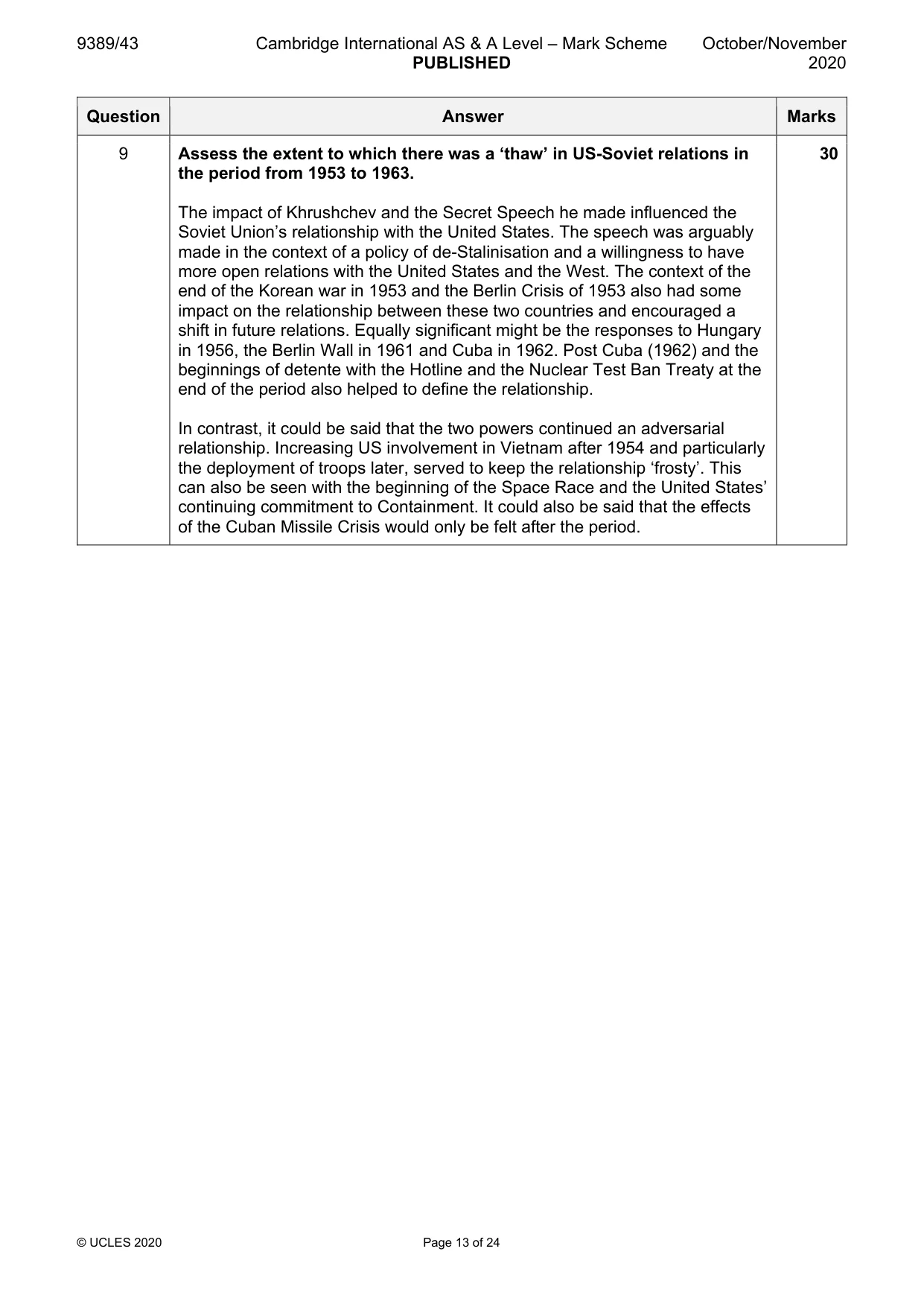
Mark scheme, page 13
9389/43 Cambridge International AS & A Level – Mark Scheme PUBLISHED October/November 2020 © UCLES 2020 Page 13 of 24 Question Answer Marks 9 Assess the extent to which there was a ‘thaw’ in US-Soviet relations in the period from 1953 to 1963. The impact of Khrushchev and the Secret Speech he made influenced the Soviet Union’s relationship with the United States. The speech was arguably made in the context of a policy of de-Stalinisation and a willingness to have more open relations with the United States and the West. The context of the end of the Korean war in 1953 and the Berlin Crisis of 1953 also had some impact on the relationship between these two countries and encouraged a shift in future relations. Equally significant might be the responses to Hungary in 1956, the Berlin Wall in 1961 and Cuba in 1962. Post Cuba (1962) and the beginnings of detente with the Hotline and the Nuclear Test Ban Treaty at the end of the period also helped to define the relationship. In contrast, it could be said that the two powers continued an adversarial relationship. Increasing US involvement in Vietnam after 1954 and particularly the deployment of troops later, served to keep the relationship ‘frosty’. This can also be seen with the beginning of the Space Race and the United States’ continuing commitment to Containment. It could also be said that the effects of the Cuban Missile Crisis would only be felt after the period. 30
Mark scheme, page 14
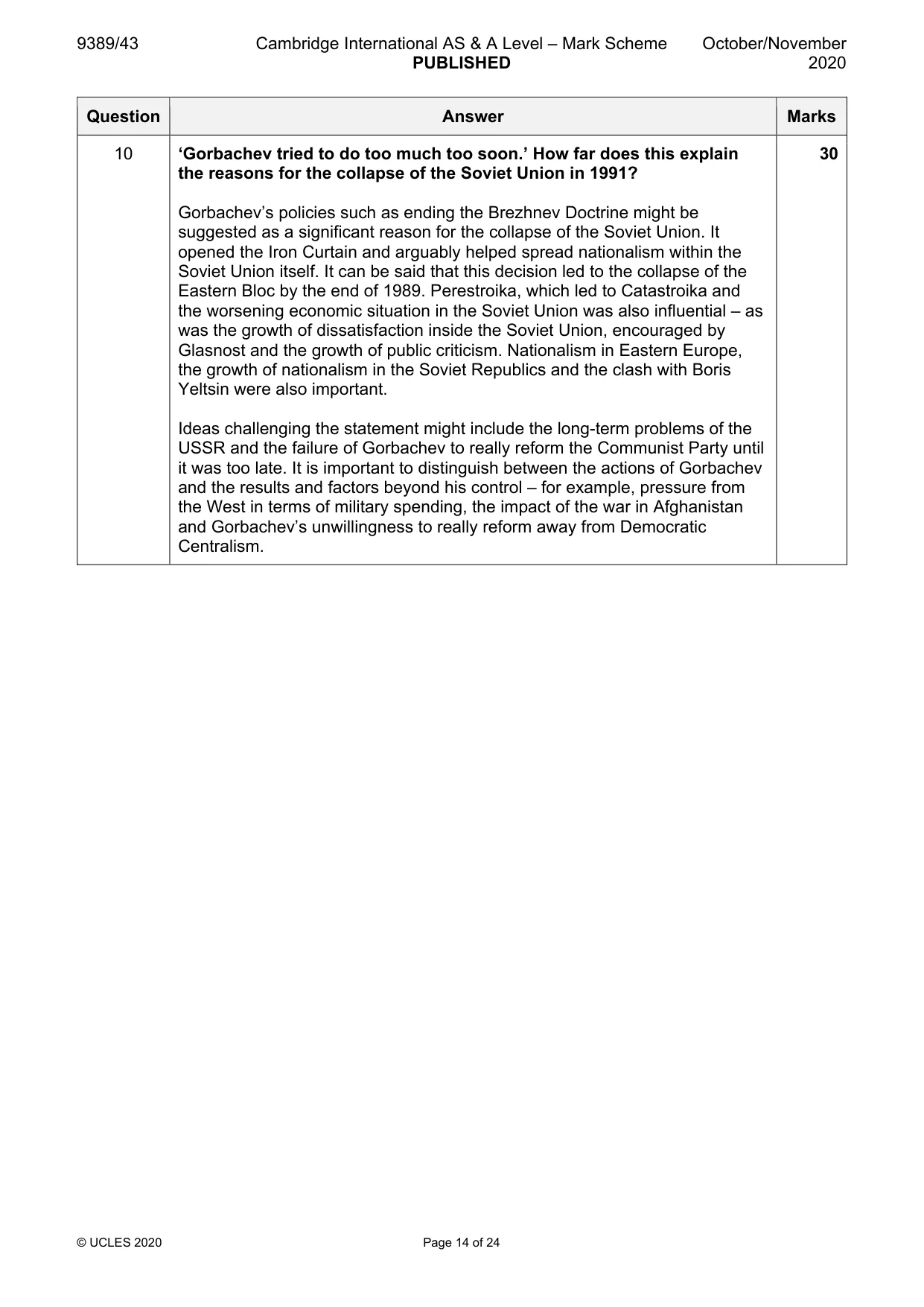
9389/43 Cambridge International AS & A Level – Mark Scheme PUBLISHED October/November 2020 © UCLES 2020 Page 14 of 24 Question Answer Marks 10 ‘Gorbachev tried to do too much too soon.’ How far does this explain the reasons for the collapse of the Soviet Union in 1991? Gorbachev’s policies such as ending the Brezhnev Doctrine might be suggested as a significant reason for the collapse of the Soviet Union. It opened the Iron Curtain and arguably helped spread nationalism within the Soviet Union itself. It can be said that this decision led to the collapse of the Eastern Bloc by the end of 1989. Perestroika, which led to Catastroika and the worsening economic situation in the Soviet Union was also influential – as was the growth of dissatisfaction inside the Soviet Union, encouraged by Glasnost and the growth of public criticism. Nationalism in Eastern Europe, the growth of nationalism in the Soviet Republics and the clash with Boris Yeltsin were also important. Ideas challenging the statement might include the long-term problems of the USSR and the failure of Gorbachev to really reform the Communist Party until it was too late. It is important to distinguish between the actions of Gorbachev and the results and factors beyond his control – for example, pressure from the West in terms of military spending, the impact of the war in Afghanistan and Gorbachev’s unwillingness to really reform away from Democratic Centralism. 30
Mark scheme, page 15
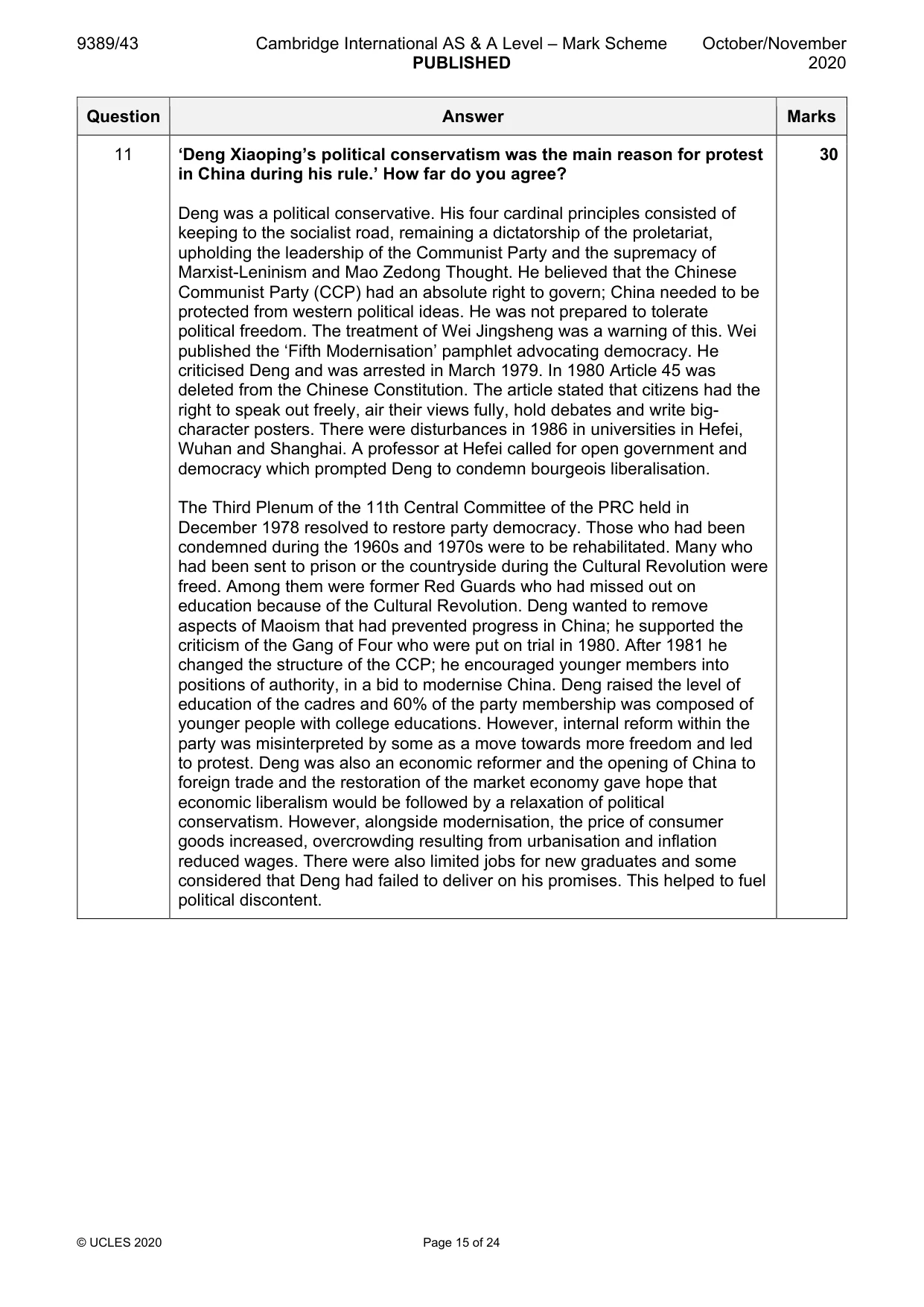
9389/43 Cambridge International AS & A Level – Mark Scheme PUBLISHED October/November 2020 © UCLES 2020 Page 15 of 24 Question Answer Marks 11 ‘Deng Xiaoping’s political conservatism was the main reason for protest in China during his rule.’ How far do you agree? Deng was a political conservative. His four cardinal principles consisted of keeping to the socialist road, remaining a dictatorship of the proletariat, upholding the leadership of the Communist Party and the supremacy of Marxist-Leninism and Mao Zedong Thought. He believed that the Chinese Communist Party (CCP) had an absolute right to govern; China needed to be protected from western political ideas. He was not prepared to tolerate political freedom. The treatment of Wei Jingsheng was a warning of this. Wei published the ‘Fifth Modernisation’ pamphlet advocating democracy. He criticised Deng and was arrested in March 1979. In 1980 Article 45 was deleted from the Chinese Constitution. The article stated that citizens had the right to speak out freely, air their views fully, hold debates and write big- character posters. There were disturbances in 1986 in universities in Hefei, Wuhan and Shanghai. A professor at Hefei called for open government and democracy which prompted Deng to condemn bourgeois liberalisation. The Third Plenum of the 11th Central Committee of the PRC held in December 1978 resolved to restore party democracy. Those who had been condemned during the 1960s and 1970s were to be rehabilitated. Many who had been sent to prison or the countryside during the Cultural Revolution were freed. Among them were former Red Guards who had missed out on education because of the Cultural Revolution. Deng wanted to remove aspects of Maoism that had prevented progress in China; he supported the criticism of the Gang of Four who were put on trial in 1980. After 1981 he changed the structure of the CCP; he encouraged younger members into positions of authority, in a bid to modernise China. Deng raised the level of education of the cadres and 60% of the party membership was composed of younger people with college educations. However, internal reform within the party was misinterpreted by some as a move towards more freedom and led to protest. Deng was also an economic reformer and the opening of China to foreign trade and the restoration of the market economy gave hope that economic liberalism would be followed by a relaxation of political conservatism. However, alongside modernisation, the price of consumer goods increased, overcrowding resulting from urbanisation and inflation reduced wages. There were also limited jobs for new graduates and some considered that Deng had failed to deliver on his promises. This helped to fuel political discontent. 30
Mark scheme, page 16
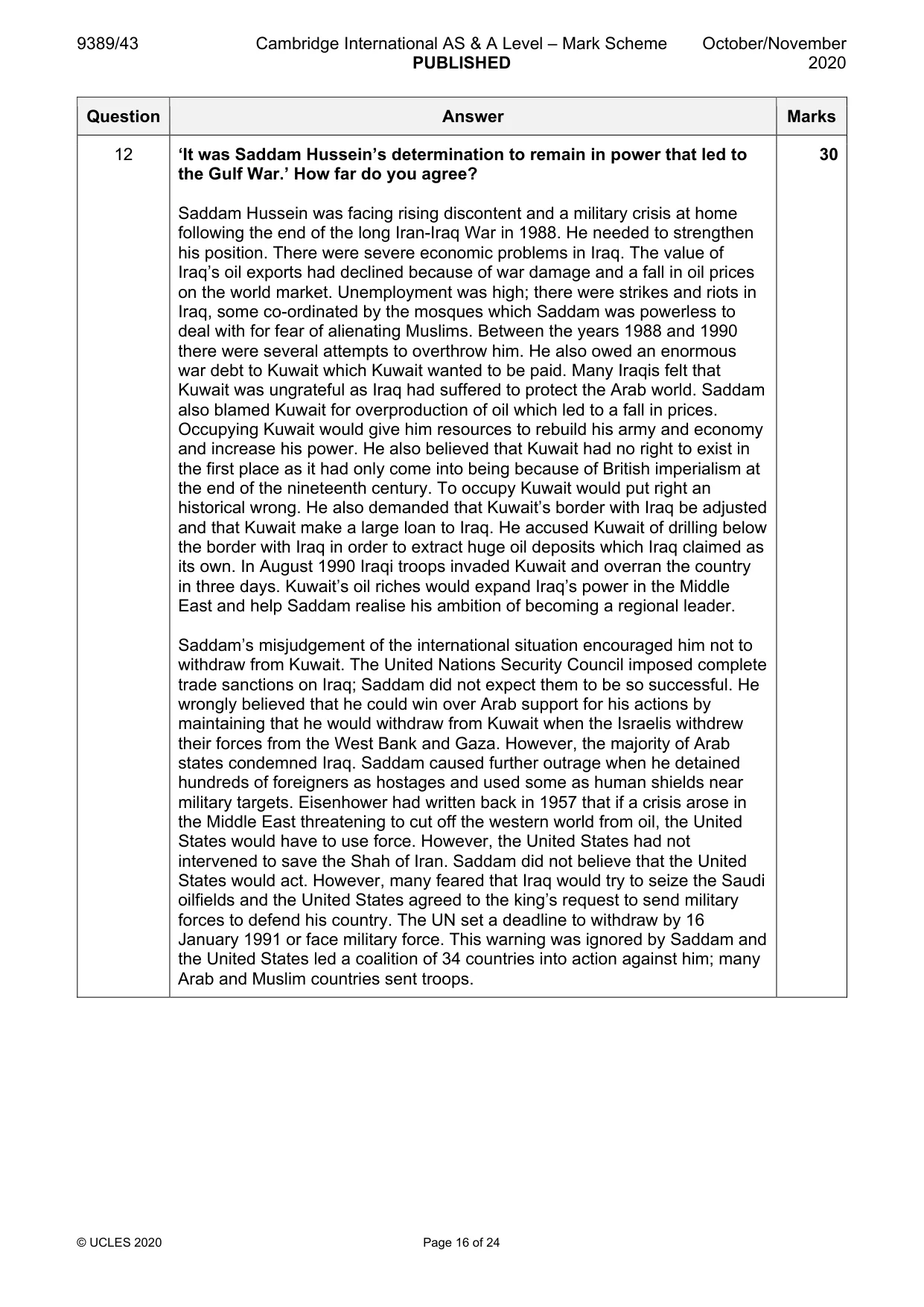
9389/43 Cambridge International AS & A Level – Mark Scheme PUBLISHED October/November 2020 © UCLES 2020 Page 16 of 24 Question Answer Marks 12 ‘It was Saddam Hussein’s determination to remain in power that led to the Gulf War.’ How far do you agree? Saddam Hussein was facing rising discontent and a military crisis at home following the end of the long Iran-Iraq War in 1988. He needed to strengthen his position. There were severe economic problems in Iraq. The value of Iraq’s oil exports had declined because of war damage and a fall in oil prices on the world market. Unemployment was high; there were strikes and riots in Iraq, some co-ordinated by the mosques which Saddam was powerless to deal with for fear of alienating Muslims. Between the years 1988 and 1990 there were several attempts to overthrow him. He also owed an enormous war debt to Kuwait which Kuwait wanted to be paid. Many Iraqis felt that Kuwait was ungrateful as Iraq had suffered to protect the Arab world. Saddam also blamed Kuwait for overproduction of oil which led to a fall in prices. Occupying Kuwait would give him resources to rebuild his army and economy and increase his power. He also believed that Kuwait had no right to exist in the first place as it had only come into being because of British imperialism at the end of the nineteenth century. To occupy Kuwait would put right an historical wrong. He also demanded that Kuwait’s border with Iraq be adjusted and that Kuwait make a large loan to Iraq. He accused Kuwait of drilling below the border with Iraq in order to extract huge oil deposits which Iraq claimed as its own. In August 1990 Iraqi troops invaded Kuwait and overran the country in three days. Kuwait’s oil riches would expand Iraq’s power in the Middle East and help Saddam realise his ambition of becoming a regional leader. Saddam’s misjudgement of the international situation encouraged him not to withdraw from Kuwait. The United Nations Security Council imposed complete trade sanctions on Iraq; Saddam did not expect them to be so successful. He wrongly believed that he could win over Arab support for his actions by maintaining that he would withdraw from Kuwait when the Israelis withdrew their forces from the West Bank and Gaza. However, the majority of Arab states condemned Iraq. Saddam caused further outrage when he detained hundreds of foreigners as hostages and used some as human shields near military targets. Eisenhower had written back in 1957 that if a crisis arose in the Middle East threatening to cut off the western world from oil, the United States would have to use force. However, the United States had not intervened to save the Shah of Iran. Saddam did not believe that the United States would act. However, many feared that Iraq would try to seize the Saudi oilfields and the United States agreed to the king’s request to send military forces to defend his country. The UN set a deadline to withdraw by 16 January 1991 or face military force. This warning was ignored by Saddam and the United States led a coalition of 34 countries into action against him; many Arab and Muslim countries sent troops. 30
Mark scheme, page 17
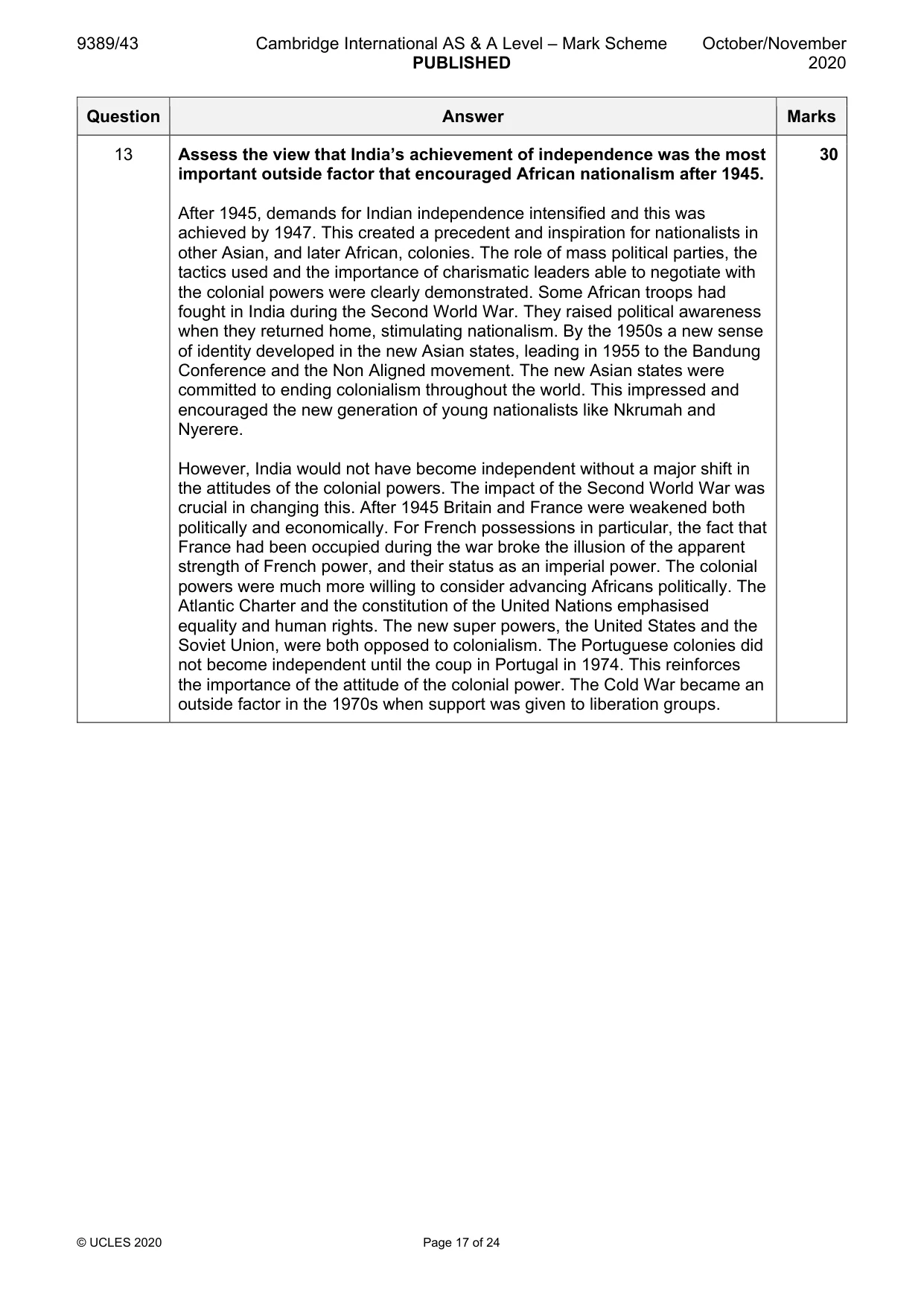
9389/43 Cambridge International AS & A Level – Mark Scheme PUBLISHED October/November 2020 © UCLES 2020 Page 17 of 24 Question Answer Marks 13 Assess the view that India’s achievement of independence was the most important outside factor that encouraged African nationalism after 1945. After 1945, demands for Indian independence intensified and this was achieved by 1947. This created a precedent and inspiration for nationalists in other Asian, and later African, colonies. The role of mass political parties, the tactics used and the importance of charismatic leaders able to negotiate with the colonial powers were clearly demonstrated. Some African troops had fought in India during the Second World War. They raised political awareness when they returned home, stimulating nationalism. By the 1950s a new sense of identity developed in the new Asian states, leading in 1955 to the Bandung Conference and the Non Aligned movement. The new Asian states were committed to ending colonialism throughout the world. This impressed and encouraged the new generation of young nationalists like Nkrumah and Nyerere. However, India would not have become independent without a major shift in the attitudes of the colonial powers. The impact of the Second World War was crucial in changing this. After 1945 Britain and France were weakened both politically and economically. For French possessions in particular, the fact that France had been occupied during the war broke the illusion of the apparent strength of French power, and their status as an imperial power. The colonial powers were much more willing to consider advancing Africans politically. The Atlantic Charter and the constitution of the United Nations emphasised equality and human rights. The new super powers, the United States and the Soviet Union, were both opposed to colonialism. The Portuguese colonies did not become independent until the coup in Portugal in 1974. This reinforces the importance of the attitude of the colonial power. The Cold War became an outside factor in the 1970s when support was given to liberation groups. 30
Mark scheme, page 18
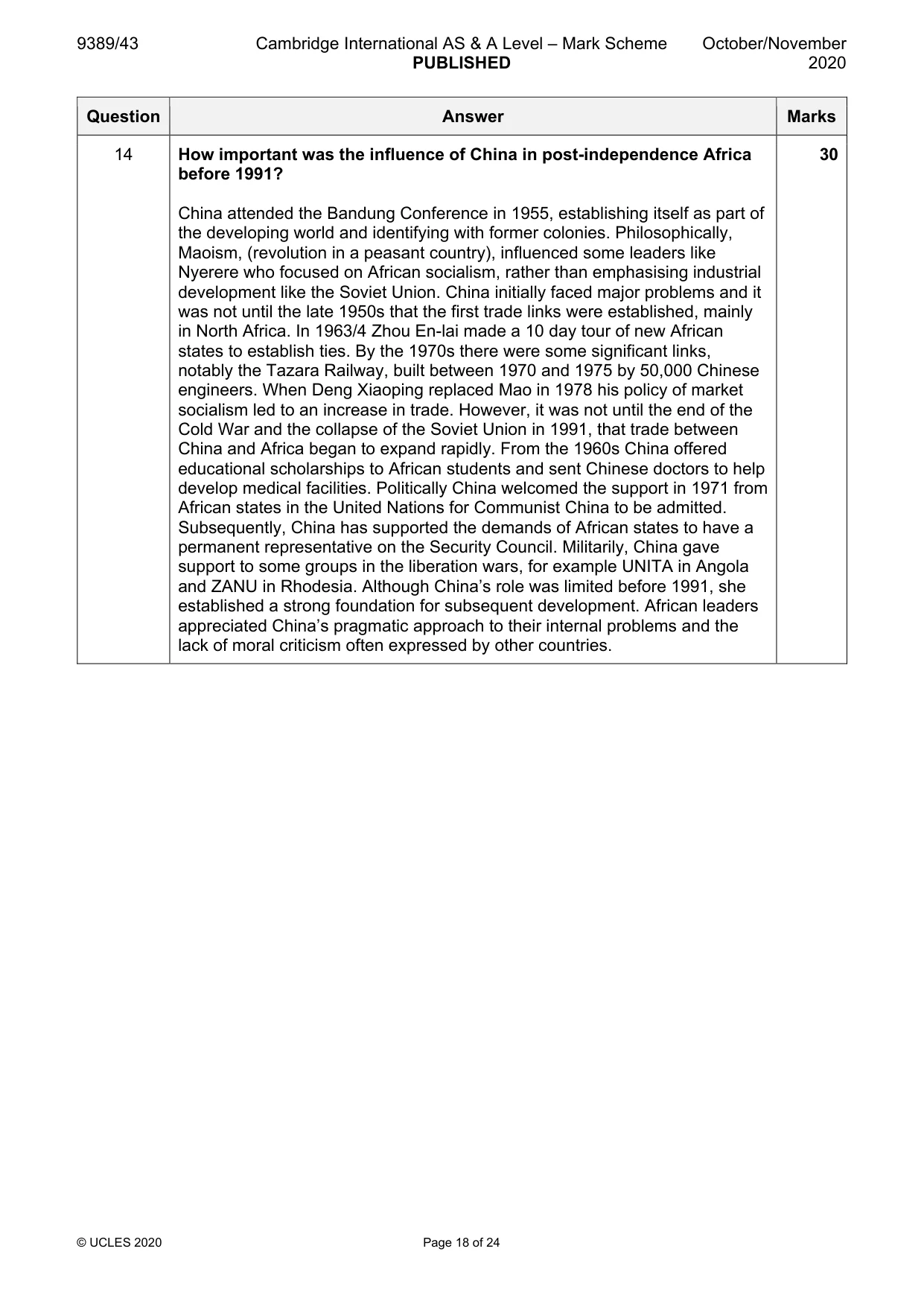
9389/43 Cambridge International AS & A Level – Mark Scheme PUBLISHED October/November 2020 © UCLES 2020 Page 18 of 24 Question Answer Marks 14 How important was the influence of China in post-independence Africa before 1991? China attended the Bandung Conference in 1955, establishing itself as part of the developing world and identifying with former colonies. Philosophically, Maoism, (revolution in a peasant country), influenced some leaders like Nyerere who focused on African socialism, rather than emphasising industrial development like the Soviet Union. China initially faced major problems and it was not until the late 1950s that the first trade links were established, mainly in North Africa. In 1963/4 Zhou En-lai made a 10 day tour of new African states to establish ties. By the 1970s there were some significant links, notably the Tazara Railway, built between 1970 and 1975 by 50,000 Chinese engineers. When Deng Xiaoping replaced Mao in 1978 his policy of market socialism led to an increase in trade. However, it was not until the end of the Cold War and the collapse of the Soviet Union in 1991, that trade between China and Africa began to expand rapidly. From the 1960s China offered educational scholarships to African students and sent Chinese doctors to help develop medical facilities. Politically China welcomed the support in 1971 from African states in the United Nations for Communist China to be admitted. Subsequently, China has supported the demands of African states to have a permanent representative on the Security Council. Militarily, China gave support to some groups in the liberation wars, for example UNITA in Angola and ZANU in Rhodesia. Although China’s role was limited before 1991, she established a strong foundation for subsequent development. African leaders appreciated China’s pragmatic approach to their internal problems and the lack of moral criticism often expressed by other countries. 30
Mark scheme, page 19
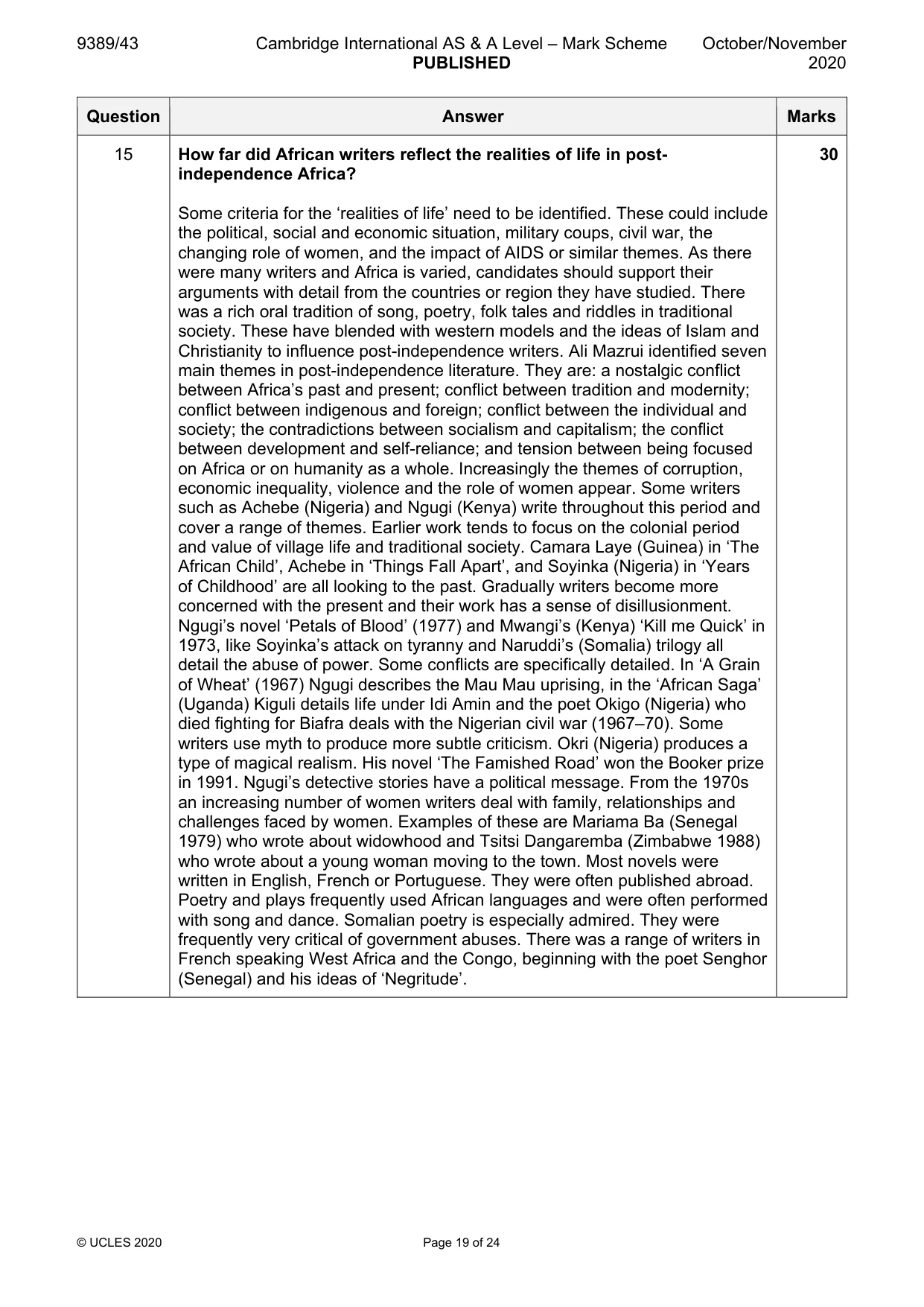
9389/43 Cambridge International AS & A Level – Mark Scheme PUBLISHED October/November 2020 © UCLES 2020 Page 19 of 24 Question Answer Marks 15 How far did African writers reflect the realities of life in post- independence Africa? Some criteria for the ‘realities of life’ need to be identified. These could include the political, social and economic situation, military coups, civil war, the changing role of women, and the impact of AIDS or similar themes. As there were many writers and Africa is varied, candidates should support their arguments with detail from the countries or region they have studied. There was a rich oral tradition of song, poetry, folk tales and riddles in traditional society. These have blended with western models and the ideas of Islam and Christianity to influence post-independence writers. Ali Mazrui identified seven main themes in post-independence literature. They are: a nostalgic conflict between Africa’s past and present; conflict between tradition and modernity; conflict between indigenous and foreign; conflict between the individual and society; the contradictions between socialism and capitalism; the conflict between development and self-reliance; and tension between being focused on Africa or on humanity as a whole. Increasingly the themes of corruption, economic inequality, violence and the role of women appear. Some writers such as Achebe (Nigeria) and Ngugi (Kenya) write throughout this period and cover a range of themes. Earlier work tends to focus on the colonial period and value of village life and traditional society. Camara Laye (Guinea) in ‘The African Child’, Achebe in ‘Things Fall Apart’, and Soyinka (Nigeria) in ‘Years of Childhood’ are all looking to the past. Gradually writers become more concerned with the present and their work has a sense of disillusionment. Ngugi’s novel ‘Petals of Blood’ (1977) and Mwangi’s (Kenya) ‘Kill me Quick’ in 1973, like Soyinka’s attack on tyranny and Naruddi’s (Somalia) trilogy all detail the abuse of power. Some conflicts are specifically detailed. In ‘A Grain of Wheat’ (1967) Ngugi describes the Mau Mau uprising, in the ‘African Saga’ (Uganda) Kiguli details life under Idi Amin and the poet Okigo (Nigeria) who died fighting for Biafra deals with the Nigerian civil war (1967–70). Some writers use myth to produce more subtle criticism. Okri (Nigeria) produces a type of magical realism. His novel ‘The Famished Road’ won the Booker prize in 1991. Ngugi’s detective stories have a political message. From the 1970s an increasing number of women writers deal with family, relationships and challenges faced by women. Examples of these are Mariama Ba (Senegal 1979) who wrote about widowhood and Tsitsi Dangaremba (Zimbabwe 1988) who wrote about a young woman moving to the town. Most novels were written in English, French or Portuguese. They were often published abroad. Poetry and plays frequently used African languages and were often performed with song and dance. Somalian poetry is especially admired. They were frequently very critical of government abuses. There was a range of writers in French speaking West Africa and the Congo, beginning with the poet Senghor (Senegal) and his ideas of ‘Negritude’. 30
Mark scheme, page 20
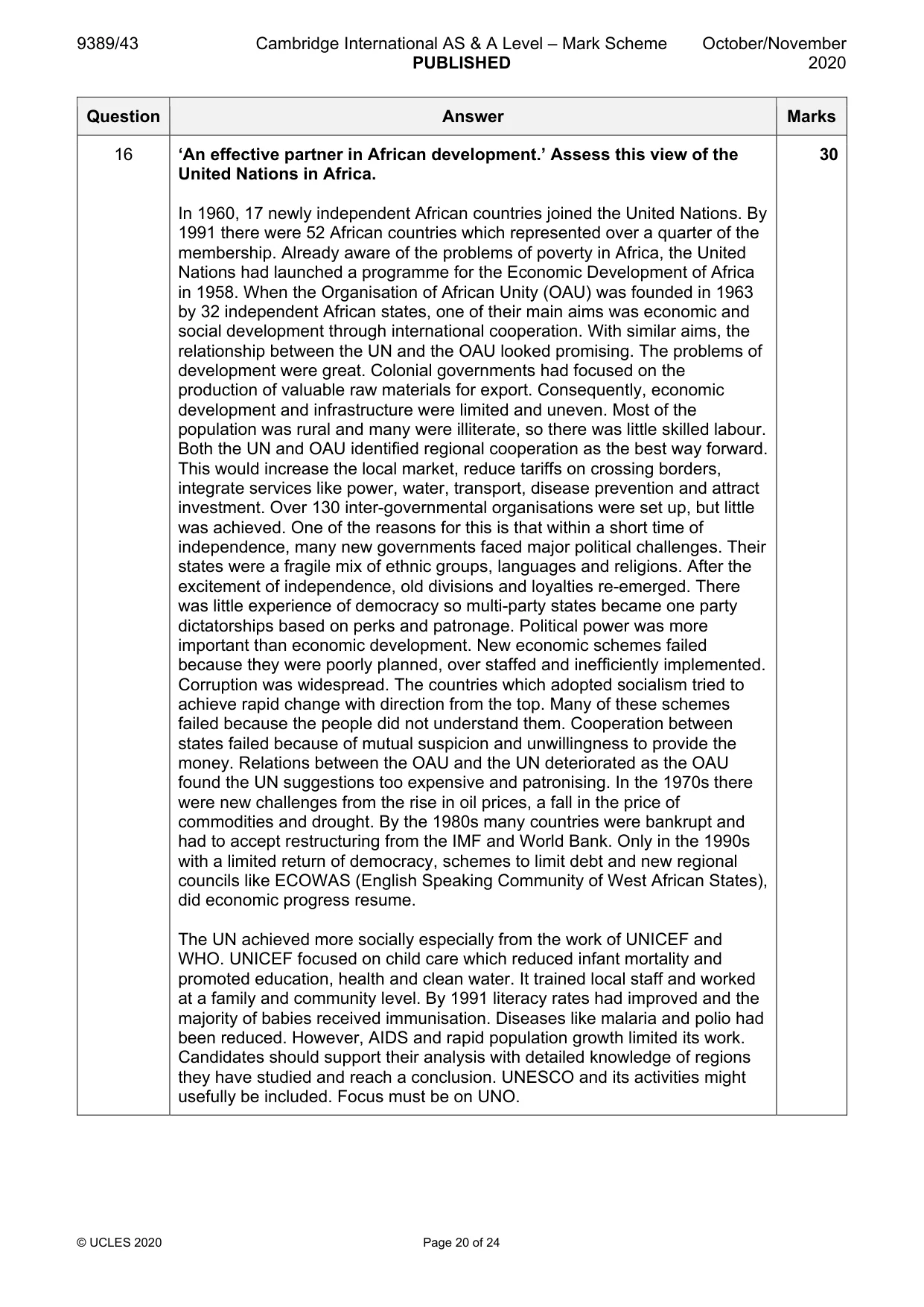
9389/43 Cambridge International AS & A Level – Mark Scheme PUBLISHED October/November 2020 © UCLES 2020 Page 20 of 24 Question Answer Marks 16 ‘An effective partner in African development.’ Assess this view of the United Nations in Africa. In 1960, 17 newly independent African countries joined the United Nations. By 1991 there were 52 African countries which represented over a quarter of the membership. Already aware of the problems of poverty in Africa, the United Nations had launched a programme for the Economic Development of Africa in 1958. When the Organisation of African Unity (OAU) was founded in 1963 by 32 independent African states, one of their main aims was economic and social development through international cooperation. With similar aims, the relationship between the UN and the OAU looked promising. The problems of development were great. Colonial governments had focused on the production of valuable raw materials for export. Consequently, economic development and infrastructure were limited and uneven. Most of the population was rural and many were illiterate, so there was little skilled labour. Both the UN and OAU identified regional cooperation as the best way forward. This would increase the local market, reduce tariffs on crossing borders, integrate services like power, water, transport, disease prevention and attract investment. Over 130 inter-governmental organisations were set up, but little was achieved. One of the reasons for this is that within a short time of independence, many new governments faced major political challenges. Their states were a fragile mix of ethnic groups, languages and religions. After the excitement of independence, old divisions and loyalties re-emerged. There was little experience of democracy so multi-party states became one party dictatorships based on perks and patronage. Political power was more important than economic development. New economic schemes failed because they were poorly planned, over staffed and inefficiently implemented. Corruption was widespread. The countries which adopted socialism tried to achieve rapid change with direction from the top. Many of these schemes failed because the people did not understand them. Cooperation between states failed because of mutual suspicion and unwillingness to provide the money. Relations between the OAU and the UN deteriorated as the OAU found the UN suggestions too expensive and patronising. In the 1970s there were new challenges from the rise in oil prices, a fall in the price of commodities and drought. By the 1980s many countries were bankrupt and had to accept restructuring from the IMF and World Bank. Only in the 1990s with a limited return of democracy, schemes to limit debt and new regional councils like ECOWAS (English Speaking Community of West African States), did economic progress resume. The UN achieved more socially especially from the work of UNICEF and WHO. UNICEF focused on child care which reduced infant mortality and promoted education, health and clean water. It trained local staff and worked at a family and community level. By 1991 literacy rates had improved and the majority of babies received immunisation. Diseases like malaria and polio had been reduced. However, AIDS and rapid population growth limited its work. Candidates should support their analysis with detailed knowledge of regions they have studied and reach a conclusion. UNESCO and its activities might usefully be included. Focus must be on UNO. 30
Mark scheme, page 21
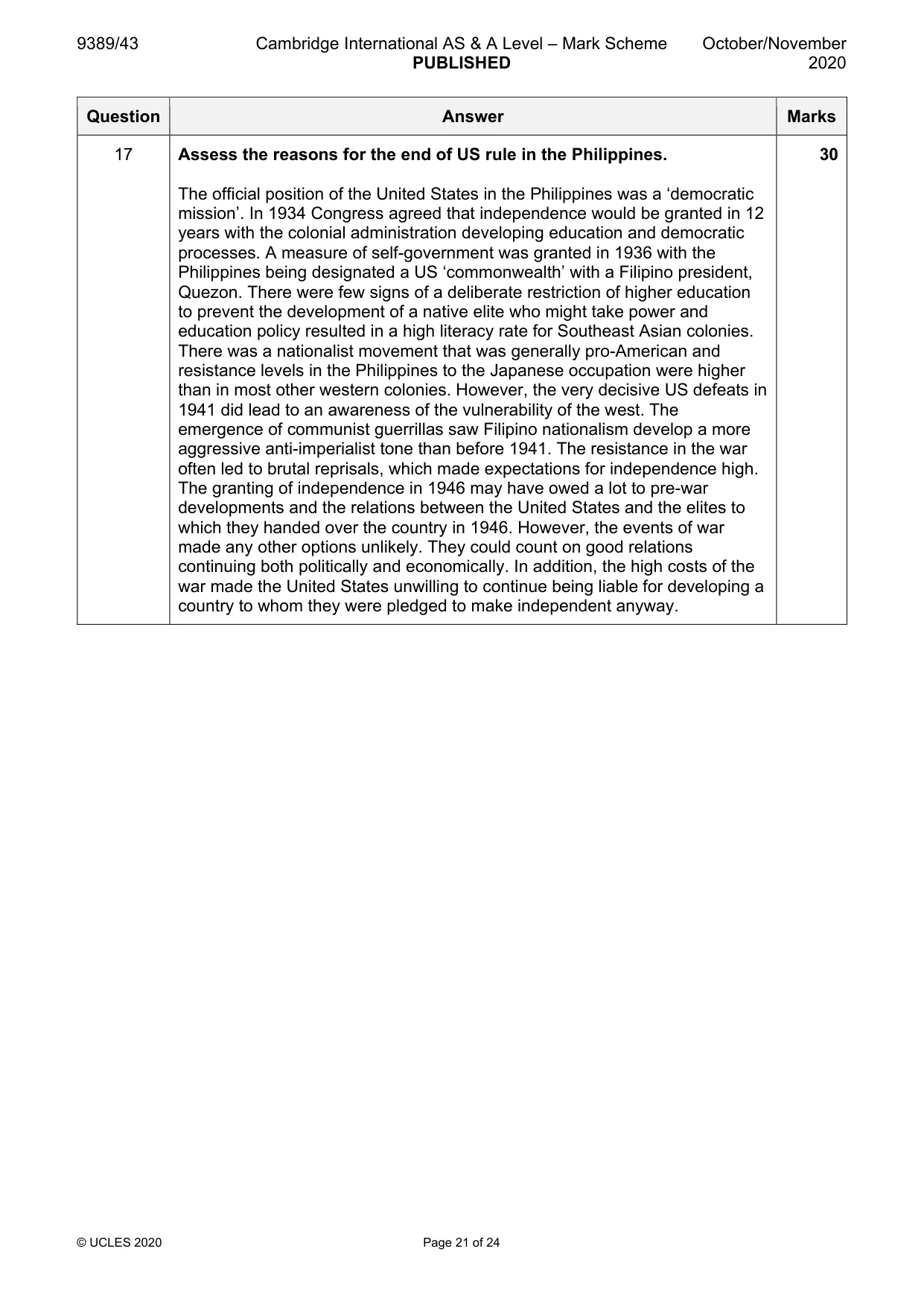
9389/43 Cambridge International AS & A Level – Mark Scheme PUBLISHED October/November 2020 © UCLES 2020 Page 21 of 24 Question Answer Marks 17 Assess the reasons for the end of US rule in the Philippines. The official position of the United States in the Philippines was a ‘democratic mission’. In 1934 Congress agreed that independence would be granted in 12 years with the colonial administration developing education and democratic processes. A measure of self-government was granted in 1936 with the Philippines being designated a US ‘commonwealth’ with a Filipino president, Quezon. There were few signs of a deliberate restriction of higher education to prevent the development of a native elite who might take power and education policy resulted in a high literacy rate for Southeast Asian colonies. There was a nationalist movement that was generally pro-American and resistance levels in the Philippines to the Japanese occupation were higher than in most other western colonies. However, the very decisive US defeats in 1941 did lead to an awareness of the vulnerability of the west. The emergence of communist guerrillas saw Filipino nationalism develop a more aggressive anti-imperialist tone than before 1941. The resistance in the war often led to brutal reprisals, which made expectations for independence high. The granting of independence in 1946 may have owed a lot to pre-war developments and the relations between the United States and the elites to which they handed over the country in 1946. However, the events of war made any other options unlikely. They could count on good relations continuing both politically and economically. In addition, the high costs of the war made the United States unwilling to continue being liable for developing a country to whom they were pledged to make independent anyway. 30
Mark scheme, page 22
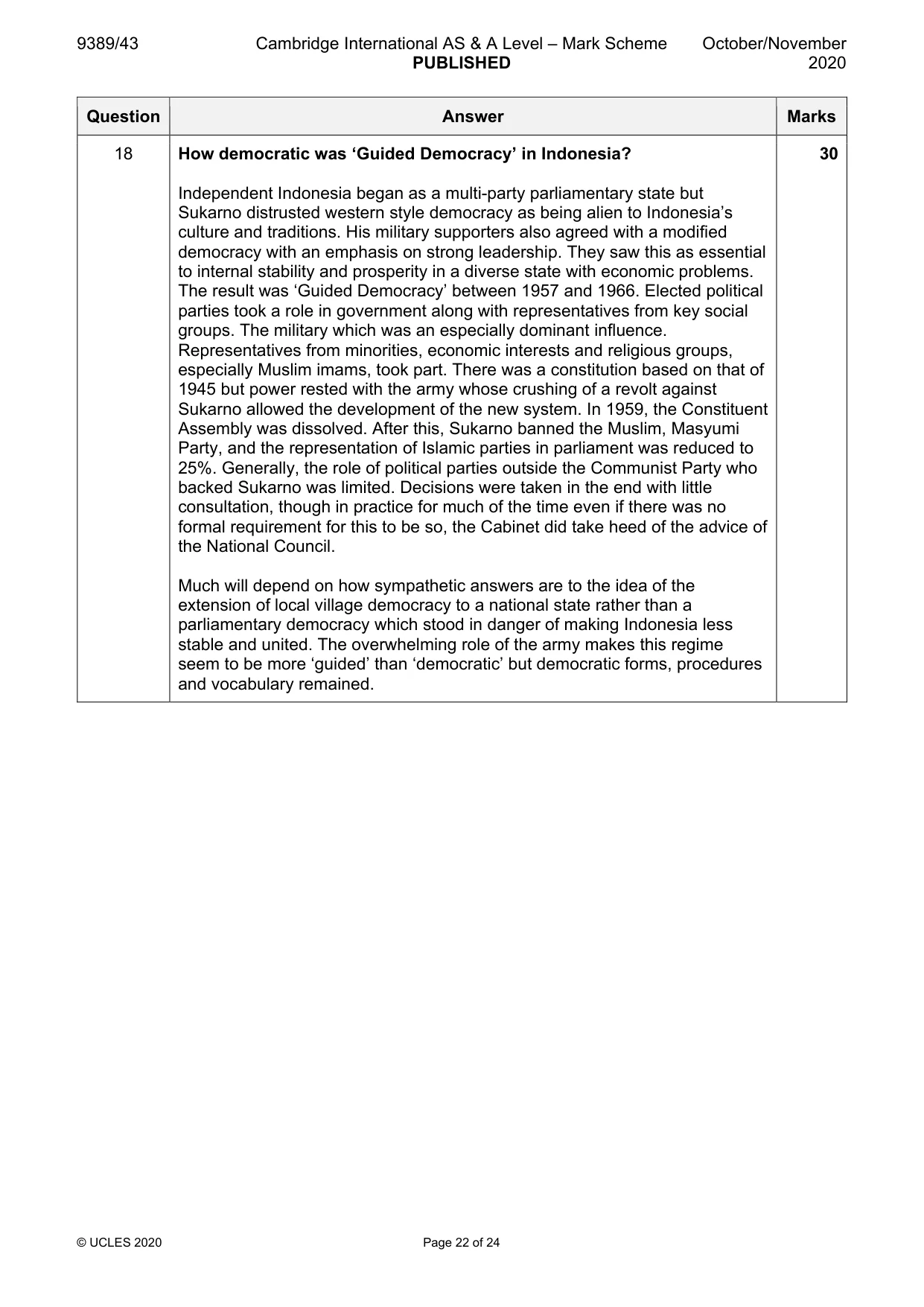
9389/43 Cambridge International AS & A Level – Mark Scheme PUBLISHED October/November 2020 © UCLES 2020 Page 22 of 24 Question Answer Marks 18 How democratic was ‘Guided Democracy’ in Indonesia? Independent Indonesia began as a multi-party parliamentary state but Sukarno distrusted western style democracy as being alien to Indonesia’s culture and traditions. His military supporters also agreed with a modified democracy with an emphasis on strong leadership. They saw this as essential to internal stability and prosperity in a diverse state with economic problems. The result was ‘Guided Democracy’ between 1957 and 1966. Elected political parties took a role in government along with representatives from key social groups. The military which was an especially dominant influence. Representatives from minorities, economic interests and religious groups, especially Muslim imams, took part. There was a constitution based on that of 1945 but power rested with the army whose crushing of a revolt against Sukarno allowed the development of the new system. In 1959, the Constituent Assembly was dissolved. After this, Sukarno banned the Muslim, Masyumi Party, and the representation of Islamic parties in parliament was reduced to 25%. Generally, the role of political parties outside the Communist Party who backed Sukarno was limited. Decisions were taken in the end with little consultation, though in practice for much of the time even if there was no formal requirement for this to be so, the Cabinet did take heed of the advice of the National Council. Much will depend on how sympathetic answers are to the idea of the extension of local village democracy to a national state rather than a parliamentary democracy which stood in danger of making Indonesia less stable and united. The overwhelming role of the army makes this regime seem to be more ‘guided’ than ‘democratic’ but democratic forms, procedures and vocabulary remained. 30
Mark scheme, page 23
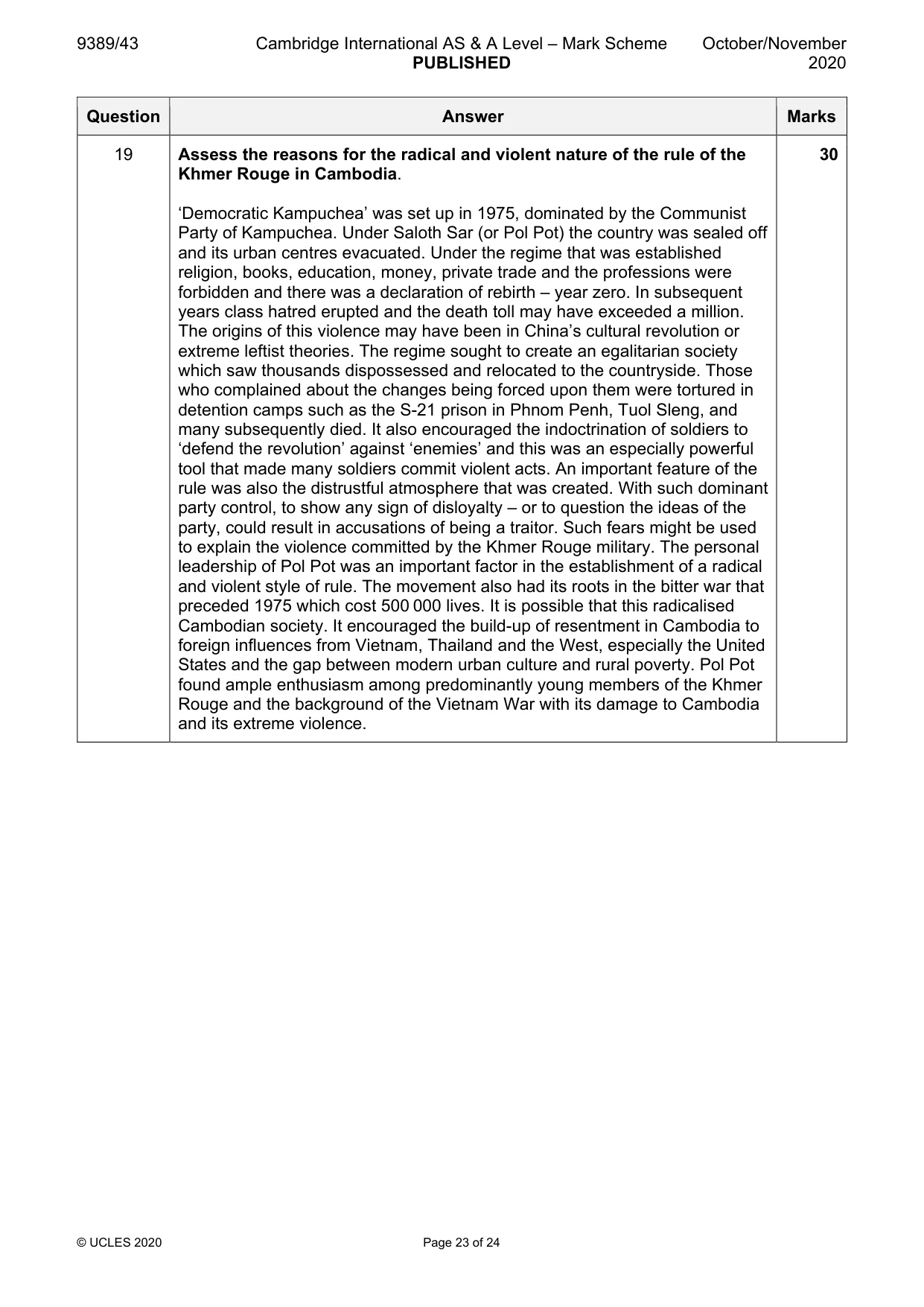
9389/43 Cambridge International AS & A Level – Mark Scheme PUBLISHED October/November 2020 © UCLES 2020 Page 23 of 24 Question Answer Marks 19 Assess the reasons for the radical and violent nature of the rule of the Khmer Rouge in Cambodia. ‘Democratic Kampuchea’ was set up in 1975, dominated by the Communist Party of Kampuchea. Under Saloth Sar (or Pol Pot) the country was sealed off and its urban centres evacuated. Under the regime that was established religion, books, education, money, private trade and the professions were forbidden and there was a declaration of rebirth – year zero. In subsequent years class hatred erupted and the death toll may have exceeded a million. The origins of this violence may have been in China’s cultural revolution or extreme leftist theories. The regime sought to create an egalitarian society which saw thousands dispossessed and relocated to the countryside. Those who complained about the changes being forced upon them were tortured in detention camps such as the S-21 prison in Phnom Penh, Tuol Sleng, and many subsequently died. It also encouraged the indoctrination of soldiers to ‘defend the revolution’ against ‘enemies’ and this was an especially powerful tool that made many soldiers commit violent acts. An important feature of the rule was also the distrustful atmosphere that was created. With such dominant party control, to show any sign of disloyalty – or to question the ideas of the party, could result in accusations of being a traitor. Such fears might be used to explain the violence committed by the Khmer Rouge military. The personal leadership of Pol Pot was an important factor in the establishment of a radical and violent style of rule. The movement also had its roots in the bitter war that preceded 1975 which cost 500 000 lives. It is possible that this radicalised Cambodian society. It encouraged the build-up of resentment in Cambodia to foreign influences from Vietnam, Thailand and the West, especially the United States and the gap between modern urban culture and rural poverty. Pol Pot found ample enthusiasm among predominantly young members of the Khmer Rouge and the background of the Vietnam War with its damage to Cambodia and its extreme violence. 30
Mark scheme, page 24
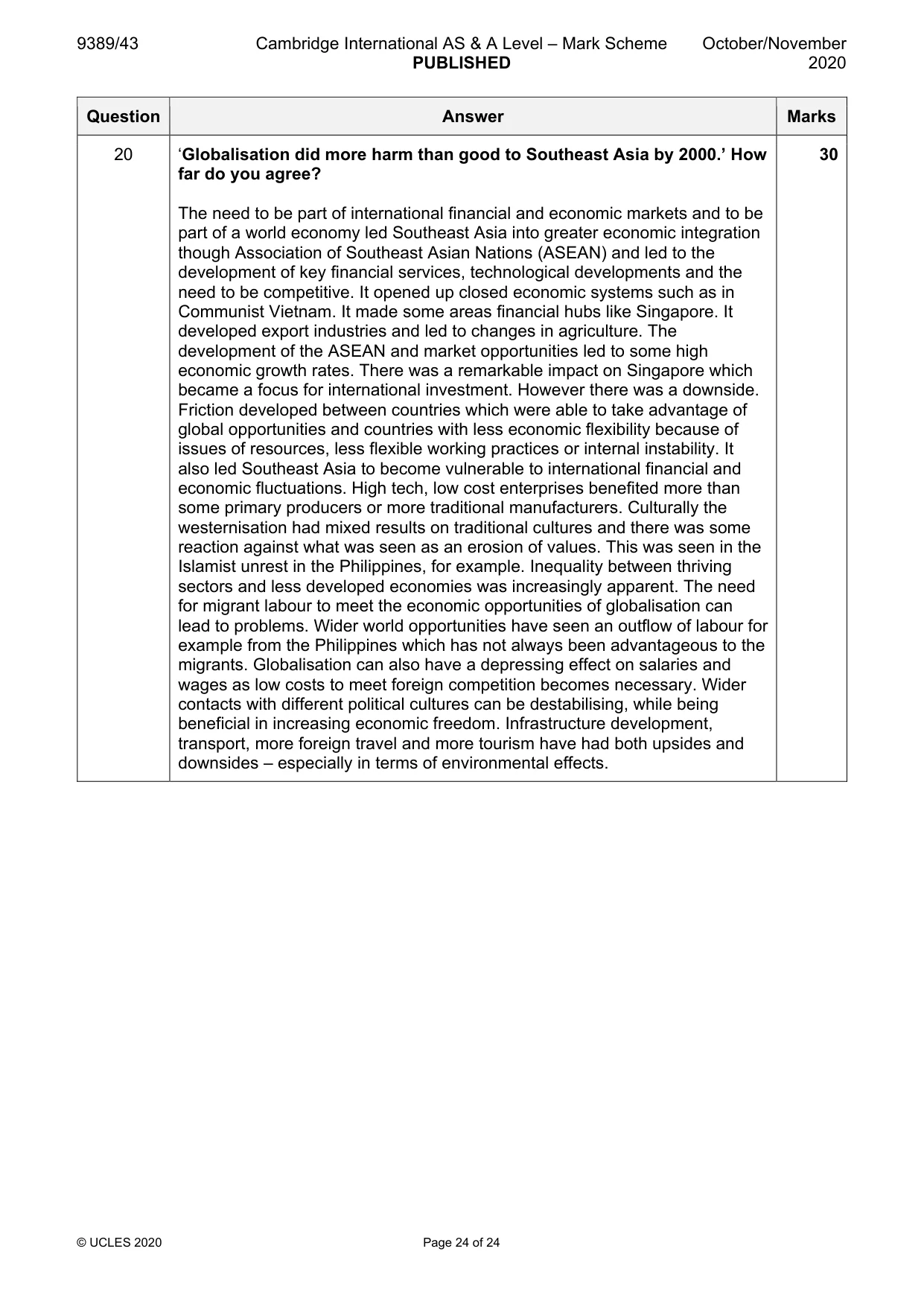
9389/43 Cambridge International AS & A Level – Mark Scheme PUBLISHED October/November 2020 © UCLES 2020 Page 24 of 24 Question Answer Marks 20 ‘Globalisation did more harm than good to Southeast Asia by 2000.’ How far do you agree? The need to be part of international financial and economic markets and to be part of a world economy led Southeast Asia into greater economic integration though Association of Southeast Asian Nations (ASEAN) and led to the development of key financial services, technological developments and the need to be competitive. It opened up closed economic systems such as in Communist Vietnam. It made some areas financial hubs like Singapore. It developed export industries and led to changes in agriculture. The development of the ASEAN and market opportunities led to some high economic growth rates. There was a remarkable impact on Singapore which became a focus for international investment. However there was a downside. Friction developed between countries which were able to take advantage of global opportunities and countries with less economic flexibility because of issues of resources, less flexible working practices or internal instability. It also led Southeast Asia to become vulnerable to international financial and economic fluctuations. High tech, low cost enterprises benefited more than some primary producers or more traditional manufacturers. Culturally the westernisation had mixed results on traditional cultures and there was some reaction against what was seen as an erosion of values. This was seen in the Islamist unrest in the Philippines, for example. Inequality between thriving sectors and less developed economies was increasingly apparent. The need for migrant labour to meet the economic opportunities of globalisation can lead to problems. Wider world opportunities have seen an outflow of labour for example from the Philippines which has not always been advantageous to the migrants. Globalisation can also have a depressing effect on salaries and wages as low costs to meet foreign competition becomes necessary. Wider contacts with different political cultures can be destabilising, while being beneficial in increasing economic freedom. Infrastructure development, transport, more foreign travel and more tourism have had both upsides and downsides – especially in terms of environmental effects. 30
What you needed in this session
Cambridge’s own grade thresholds for 2020 Oct/Nov, Paper 4 · Variant 3. A higher threshold means an easier paper — the bar moves with how the cohort did.