Cambridge A Level History 9389 — 2017 May/June Paper 4 · Variant 2
9389/42/M/J/17 · 12 questions · 60 marks · ≈68 min
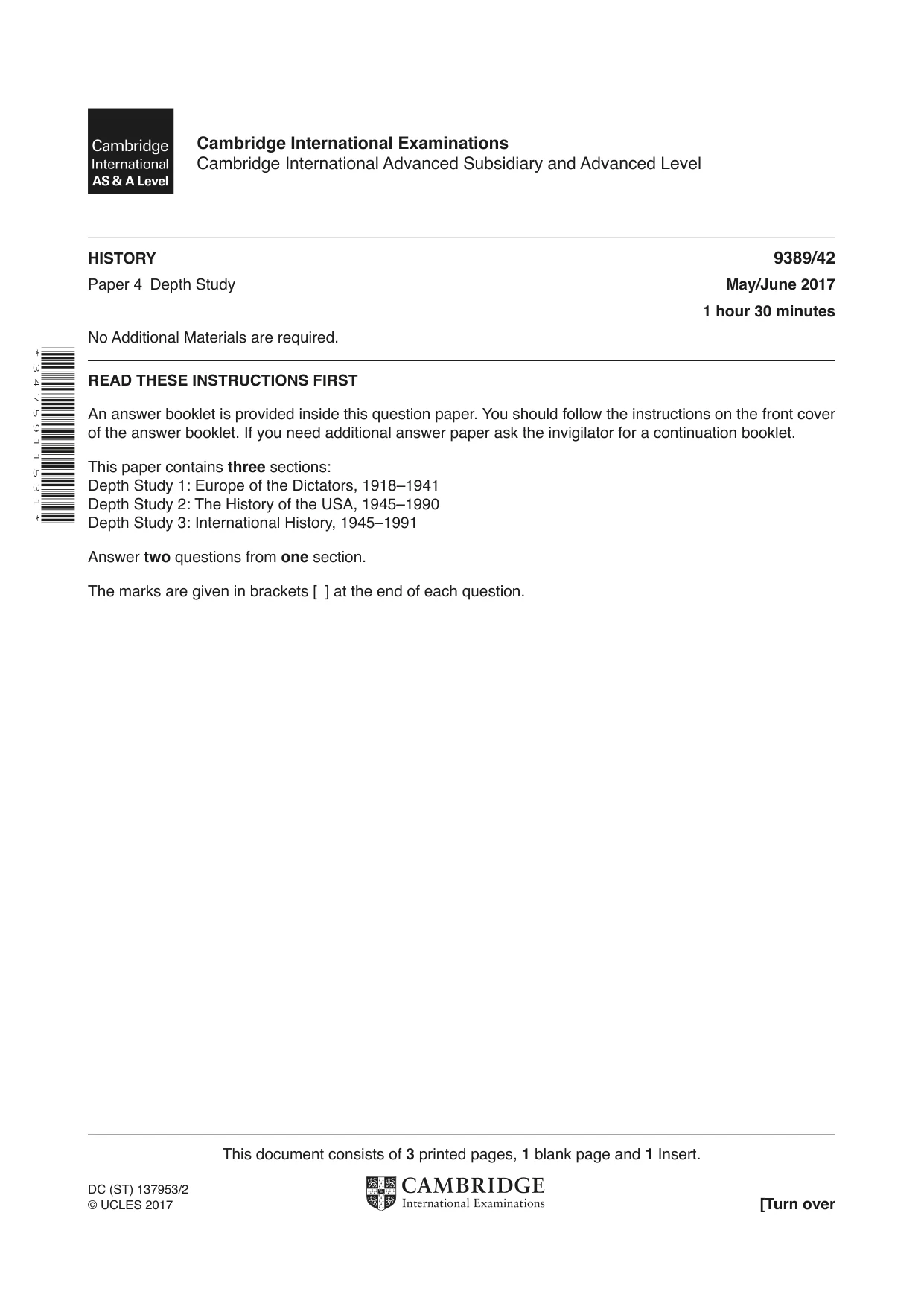
The question paper and its mark scheme, free to read here and free to download. This is Cambridge’s own paper, exactly as it was sat.
Question paper4 pages
Mark scheme20 pages
Answers below. Sit the paper first if you are practising.
Questions as text
Q1 · ‘The introduction of War Communism was the main reason for the Bolshevik victory in the…
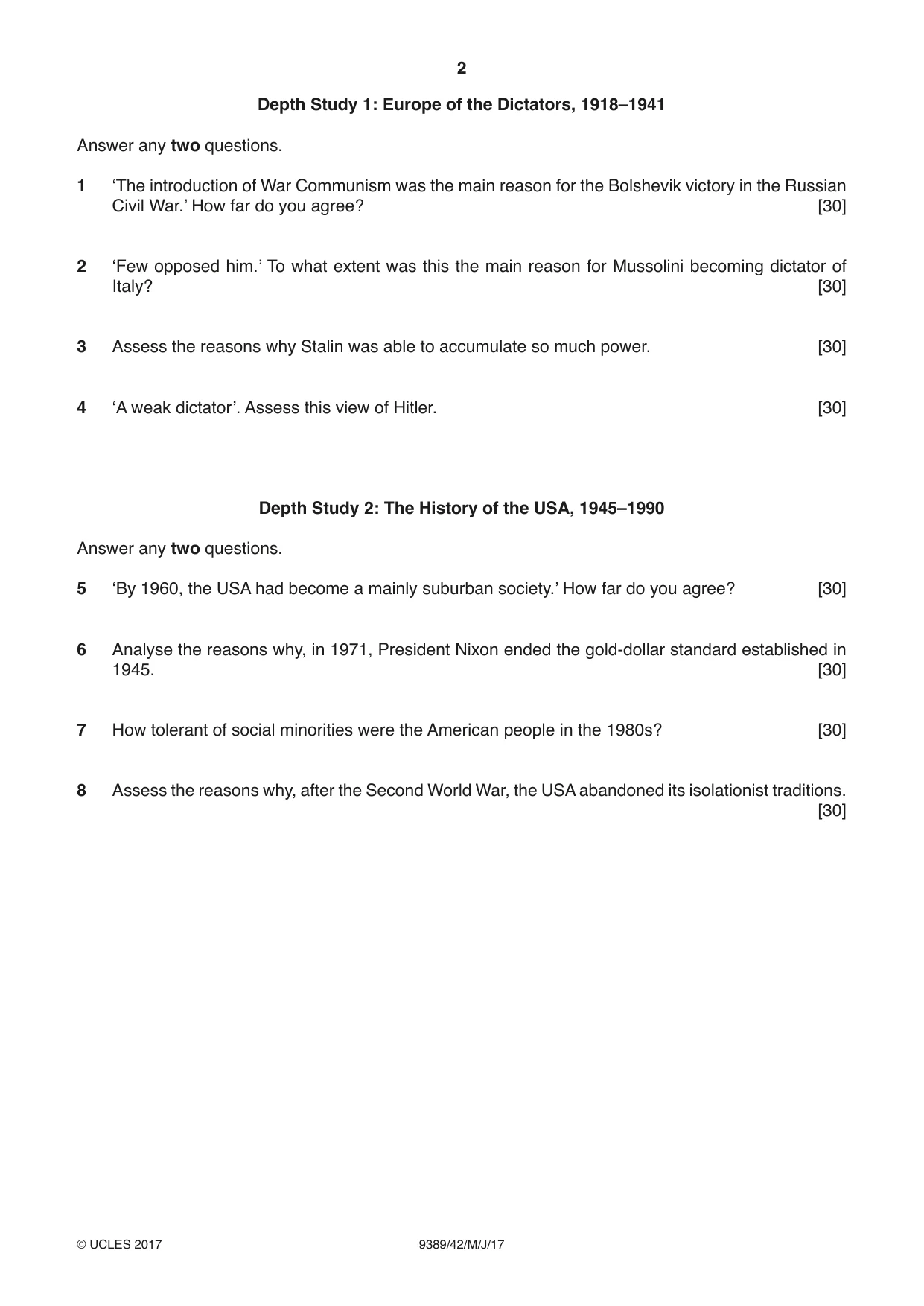
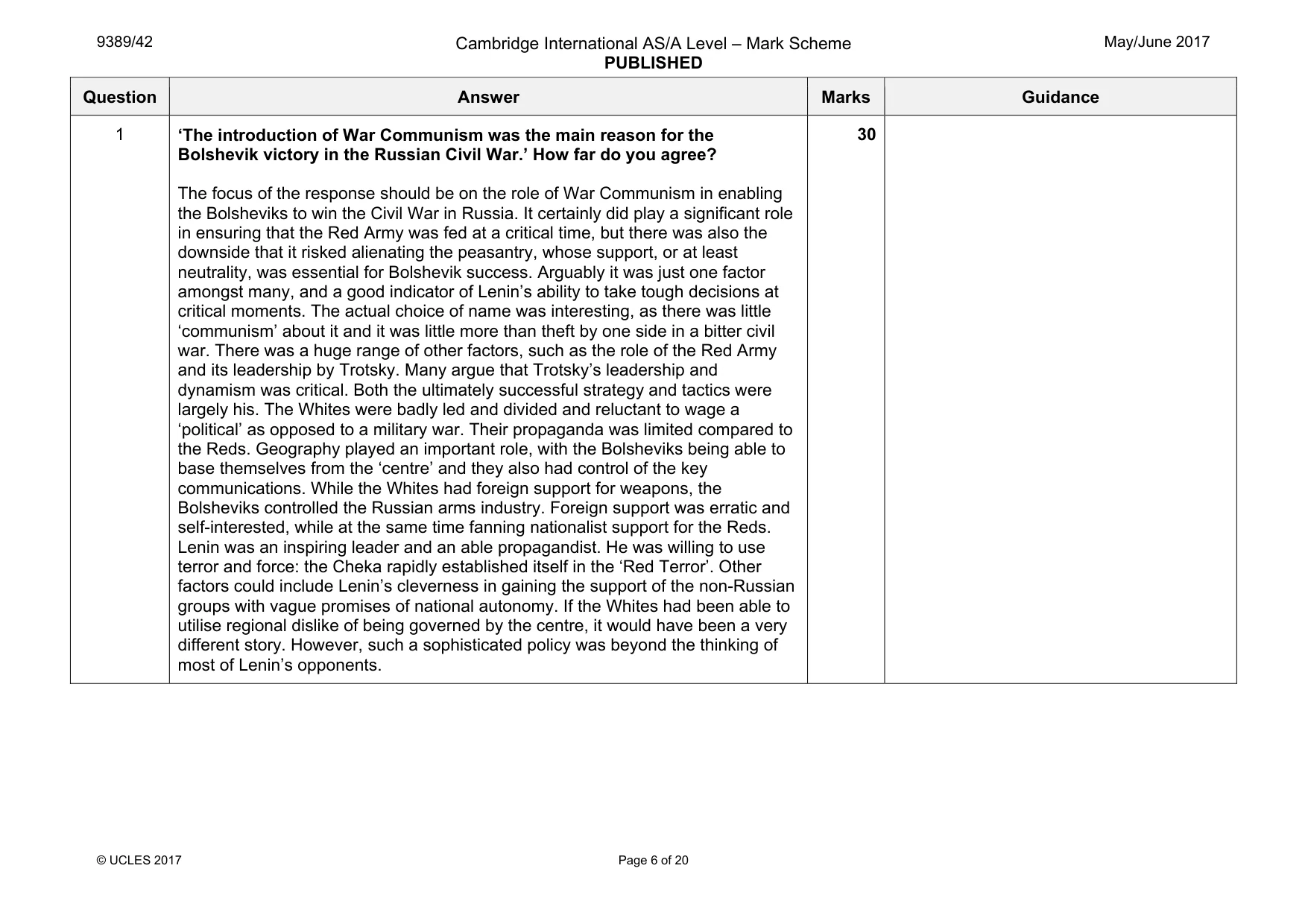
1 ‘The introduction of War Communism was the main reason for the Bolshevik victory in the Russian Civil War.’ How far do you agree? [30]
Mark scheme: 1 ‘The introduction of War Communism was the main reason for the Bolshevik victory in the Russian Civil War.’ How far do you agree? The focus of the response should be on the role of War Communism in enabling the Bolsheviks to win the Civil War in Russia. It certainly did play a significant role in ensuring that the Red Army was fed at a critical time, but there was also the downside that it risked alienating the peasantry, whose support, or at least neutrality, was essential for Bolshevik success. Arguably it was just one factor amongst many, and a good indicator of Lenin’s ability to take tough decisions at critical moments. The actual choice of name was interesting, as there was little ‘communism’ about it and it was little more than theft by one side in a bitter civil war. There was a huge range of other factors, such as the role of the Red Army and its leadership by Trotsky. Many argue that Trotsky’s leadership and dynamism was critical. Both the ultimately successful strategy and tactics were largely his. The Whites were badly led and divided and reluctant to wage a ‘political’ as opposed to a military war. Their propaganda was limited compared to the Reds. Geography played an important role, with the Bolsheviks being able to base themselves from the ‘centre’ and they also had control of the key communications. While the Whites had foreign support for weapons, the Bolsheviks controlled the Russian arms industry. Foreign support was erratic and self-interested, while at the same time fanning nationalist support for the Reds. Lenin was an inspiring leader and an able propagandist. He was willing to use terror and force: the Cheka rapidly established itself in the ‘Red Terror’. Other factors could include Lenin’s cleverness in gaining the support of the non-Russian groups with vague promises of national autonomy. If the Whites had been able to utilise regional dislike of being governed by the centre, it would have been a very different story. However, such a sophisticated policy was beyond the thinking of most of Lenin’s opponents. 30
Q2 · ‘Few opposed him.’ To what extent was this the main reason for Mussolini becoming…
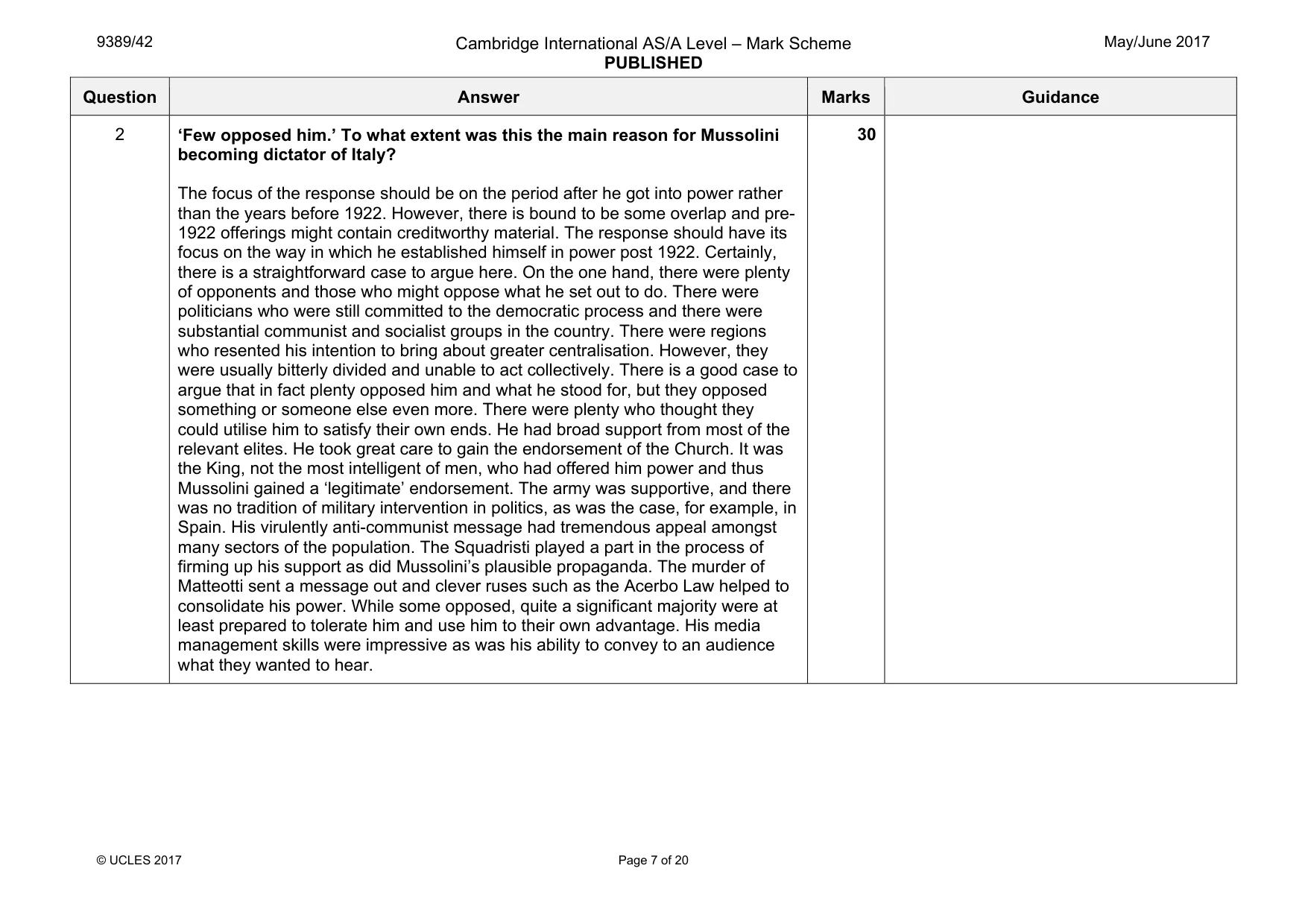
2 ‘Few opposed him.’ To what extent was this the main reason for Mussolini becoming dictator of Italy? [30]
Mark scheme: 2 ‘Few opposed him.’ To what extent was this the main reason for Mussolini becoming dictator of Italy? The focus of the response should be on the period after he got into power rather than the years before 1922. However, there is bound to be some overlap and pre- 1922 offerings might contain creditworthy material. The response should have its focus on the way in which he established himself in power post 1922. Certainly, there is a straightforward case to argue here. On the one hand, there were plenty of opponents and those who might oppose what he set out to do. There were politicians who were still committed to the democratic process and there were substantial communist and socialist groups in the country. There were regions who resented his intention to bring about greater centralisation. However, they were usually bitterly divided and unable to act collectively. There is a good case to argue that in fact plenty opposed him and what he stood for, but they opposed something or someone else even more. There were plenty who thought they could utilise him to satisfy their own ends. He had broad support from most of the relevant elites. He took great care to gain the endorsement of the Church. It was the King, not the most intelligent of men, who had offered him power and thus Mussolini gained a ‘legitimate’ endorsement. The army was supportive, and there was no tradition of military intervention in politics, as was the case, for example, in Spain. His virulently anti-communist message had tremendous appeal amongst many sectors of the population. The Squadristi played a part in the process of firming up his support as did Mussolini’s plausible propaganda. The murder of Matteotti sent a message out and clever ruses such as the Acerbo Law helped to consolidate his power. While some opposed, quite a significant majority were at least prepared to tolerate him and use him to their own advantage. His media management skills were impressive as was his ability to convey to an audience what they wanted to hear. 30
Q3 · Assess the reasons why Stalin was able to accumulate so much power
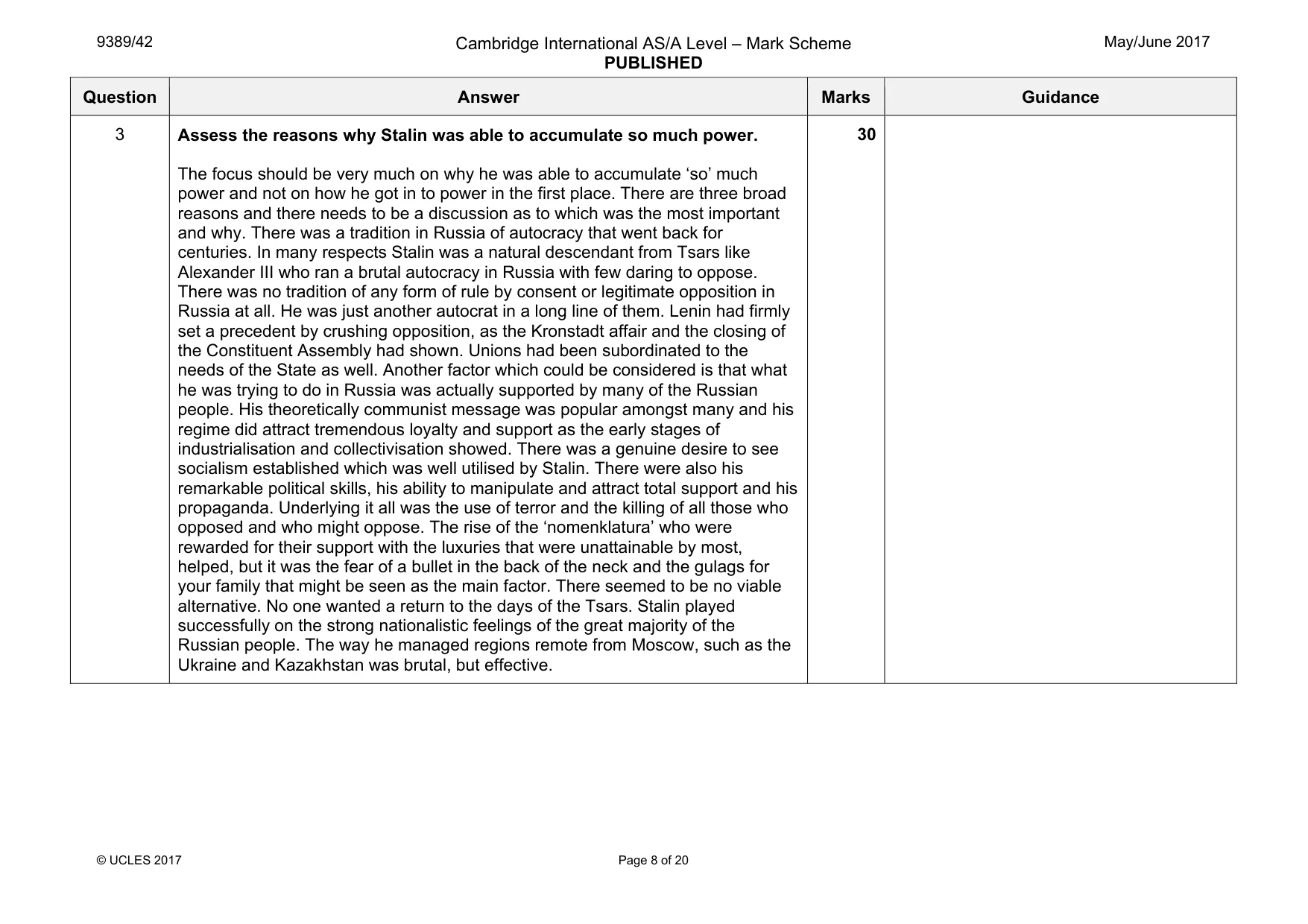
3 Assess the reasons why Stalin was able to accumulate so much power. [30]
Mark scheme: 3 Assess the reasons why Stalin was able to accumulate so much power. The focus should be very much on why he was able to accumulate ‘so’ much power and not on how he got in to power in the first place. There are three broad reasons and there needs to be a discussion as to which was the most important and why. There was a tradition in Russia of autocracy that went back for centuries. In many respects Stalin was a natural descendant from Tsars like Alexander III who ran a brutal autocracy in Russia with few daring to oppose. There was no tradition of any form of rule by consent or legitimate opposition in Russia at all. He was just another autocrat in a long line of them. Lenin had firmly set a precedent by crushing opposition, as the Kronstadt affair and the closing of the Constituent Assembly had shown. Unions had been subordinated to the needs of the State as well. Another factor which could be considered is that what he was trying to do in Russia was actually supported by many of the Russian people. His theoretically communist message was popular amongst many and his regime did attract tremendous loyalty and support as the early stages of industrialisation and collectivisation showed. There was a genuine desire to see socialism established which was well utilised by Stalin. There were also his remarkable political skills, his ability to manipulate and attract total support and his propaganda. Underlying it all was the use of terror and the killing of all those who opposed and who might oppose. The rise of the ‘nomenklatura’ who were rewarded for their support with the luxuries that were unattainable by most, helped, but it was the fear of a bullet in the back of the neck and the gulags for your family that might be seen as the main factor. There seemed to be no viable alternative. No one wanted a return to the days of the Tsars. Stalin played successfully on the strong nationalistic feelings of the great majority of the Russian people. The way he managed regions remote from Moscow, such as the Ukraine and Kazakhstan was brutal, but effective. 30
Question 4
4 ‘A weak dictator’. Assess this view of Hitler. [30] Depth Study 2: The History of the USA, 1945–1990 Answer any two questions.
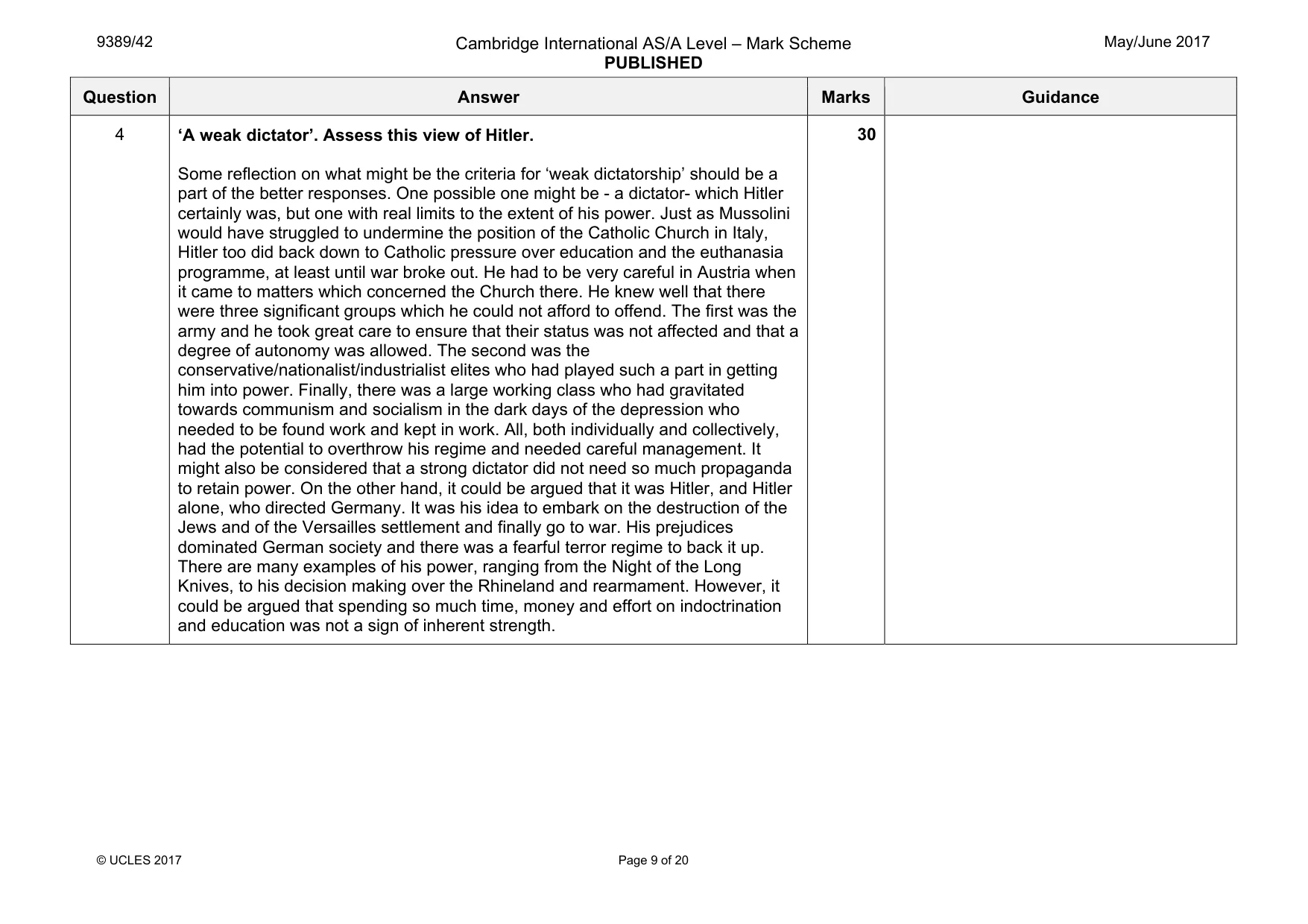
Mark scheme: 4 ‘A weak dictator’. Assess this view of Hitler. Some reflection on what might be the criteria for ‘weak dictatorship’ should be a part of the better responses. One possible one might be - a dictator- which Hitler certainly was, but one with real limits to the extent of his power. Just as Mussolini would have struggled to undermine the position of the Catholic Church in Italy, Hitler too did back down to Catholic pressure over education and the euthanasia programme, at least until war broke out. He had to be very careful in Austria when it came to matters which concerned the Church there. He knew well that there were three significant groups which he could not afford to offend. The first was the army and he took great care to ensure that their status was not affected and that a degree of autonomy was allowed. The second was the conservative/nationalist/industrialist elites who had played such a part in getting him into power. Finally, there was a large working class who had gravitated towards communism and socialism in the dark days of the depression who needed to be found work and kept in work. All, both individually and collectively, had the potential to overthrow his regime and needed careful management. It might also be considered that a strong dictator did not need so much propaganda to retain power. On the other hand, it could be argued that it was Hitler, and Hitler alone, who directed Germany. It was his idea to embark on the destruction of the Jews and of the Versailles settlement and finally go to war. His prejudices dominated German society and there was a fearful terror regime to back it up. There are many examples of his power, ranging from the Night of the Long Knives, to his decision making over the Rhineland and rearmament. However, it could be argued that spending so much time, money and effort on indoctrination and education was not a sign of inherent strength. 30
Q5 · ‘By 1960, the USA had become a mainly suburban society.’ How far do you agree?
5 ‘By 1960, the USA had become a mainly suburban society.’ How far do you agree? [30]
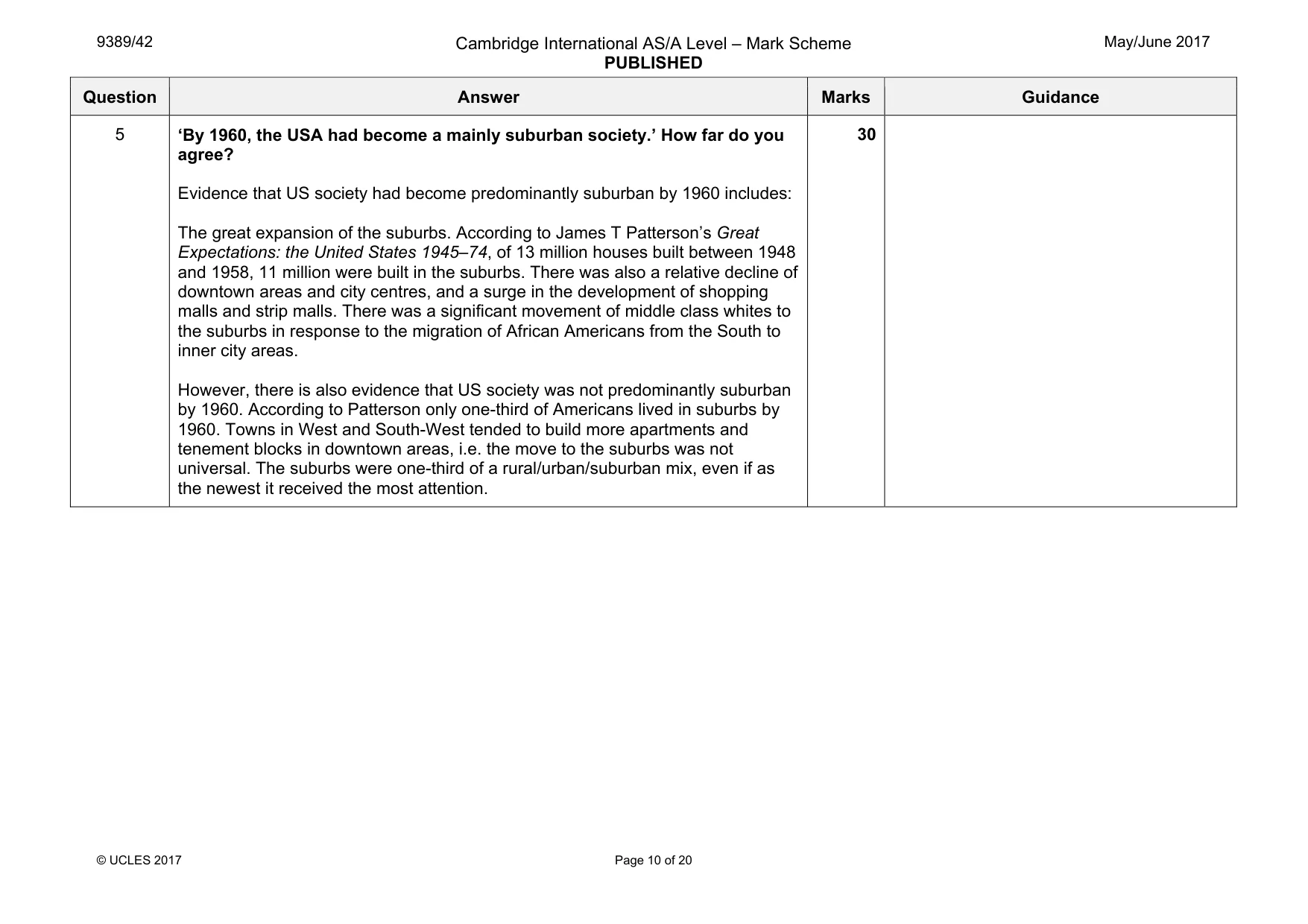
Mark scheme: 5 ‘By 1960, the USA had become a mainly suburban society.’ How far do you agree? Evidence that US society had become predominantly suburban by 1960 includes: The great expansion of the suburbs. According to James T Patterson’s Great Expectations: the United States 1945–74, of 13 million houses built between 1948 and 1958, 11 million were built in the suburbs. There was also a relative decline of downtown areas and city centres, and a surge in the development of shopping malls and strip malls. There was a significant movement of middle class whites to the suburbs in response to the migration of African Americans from the South to inner city areas. However, there is also evidence that US society was not predominantly suburban by 1960. According to Patterson only one-third of Americans lived in suburbs by 1960. Towns in West and South-West tended to build more apartments and tenement blocks in downtown areas, i.e. the move to the suburbs was not universal. The suburbs were one-third of a rural/urban/suburban mix, even if as the newest it received the most attention. 30
Q6 · Analyse the reasons why, in 1971, President Nixon ended the gold-dollar standard…
6 Analyse the reasons why, in 1971, President Nixon ended the gold-dollar standard established in 1945. [30]
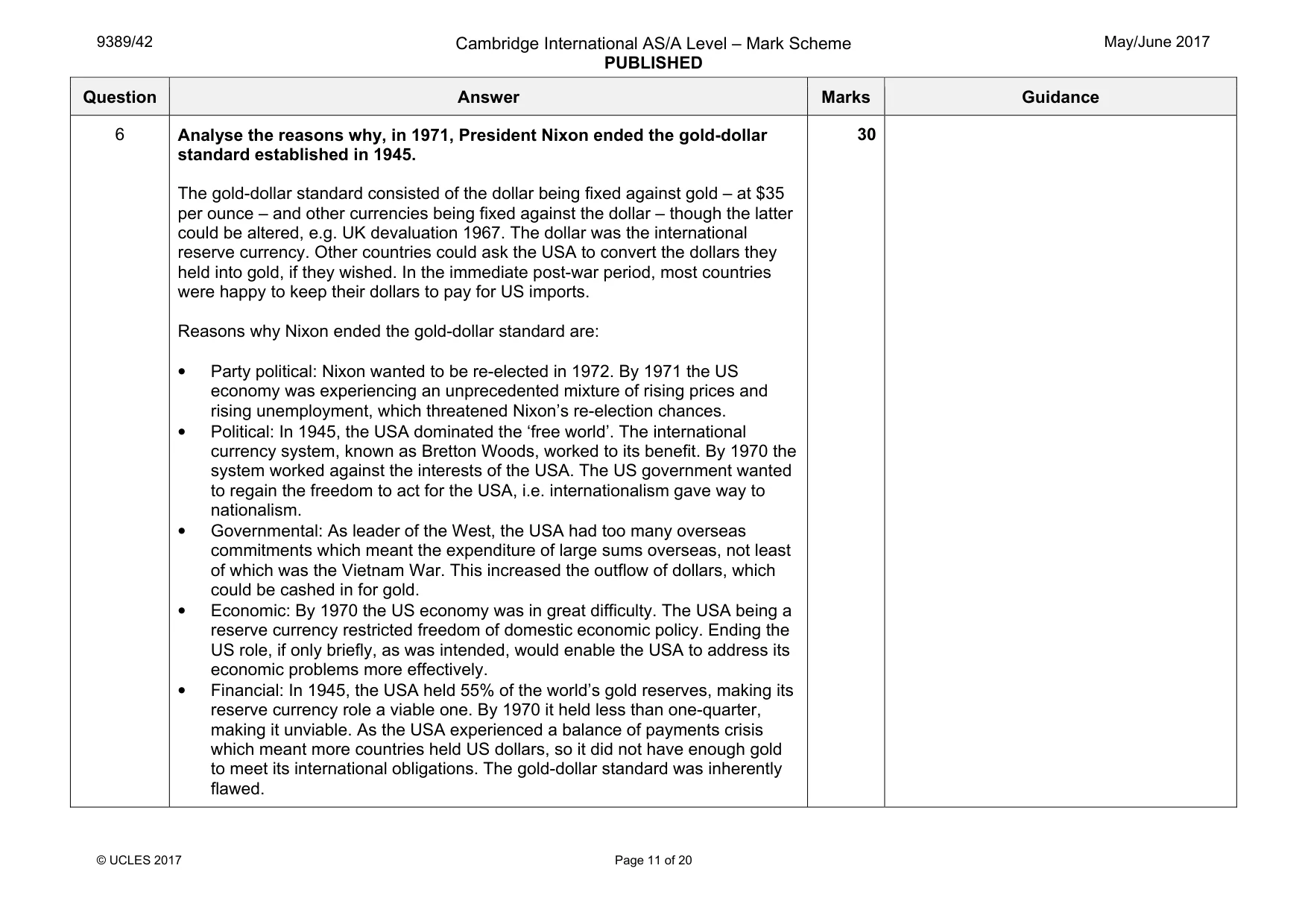
Mark scheme: 6 Analyse the reasons why, in 1971, President Nixon ended the gold-dollar standard established in 1945. The gold-dollar standard consisted of the dollar being fixed against gold – at $35 per ounce – and other currencies being fixed against the dollar – though the latter could be altered, e.g. UK devaluation 1967. The dollar was the international reserve currency. Other countries could ask the USA to convert the dollars they held into gold, if they wished. In the immediate post-war period, most countries were happy to keep their dollars to pay for US imports. Reasons why Nixon ended the gold-dollar standard are: • Party political: Nixon wanted to be re-elected in 1972. By 1971 the US economy was experiencing an unprecedented mixture of rising prices and rising unemployment, which threatened Nixon’s re-election chances. • Political: In 1945, the USA dominated the ‘free world’. The international currency system, known as Bretton Woods, worked to its benefit. By 1970 the system worked against the interests of the USA. The US government wanted to regain the freedom to act for the USA, i.e. internationalism gave way to nationalism. • Governmental: As leader of the West, the USA had too many overseas commitments which meant the expenditure of large sums overseas, not least of which was the Vietnam War. This increased the outflow of dollars, which could be cashed in for gold. • Economic: By 1970 the US economy was in great difficulty. The USA being a reserve currency restricted freedom of domestic economic policy. Ending the US role, if only briefly, as was intended, would enable the USA to address its economic problems more effectively. • Financial: In 1945, the USA held 55% of the world’s gold reserves, making its reserve currency role a viable one. By 1970 it held less than one-quarter, making it unviable. As the USA experienced a balance of payments crisis which meant more countries held US dollars, so it did not have enough gold to meet its international obligations. The gold-dollar standard was inherently flawed. 30 Question Answer Marks Guidance Thus, in August 1971, in what became known as ‘the Nixon shock’, and without consulting America’s allies, President Nixon announced the suspension of the convertibility of dollars into gold. This was meant to be a temporary move. It proved not to be. The era of fixed exchange rates had come to an end.
Q7 · How tolerant of social minorities were the American people in the 1980s?
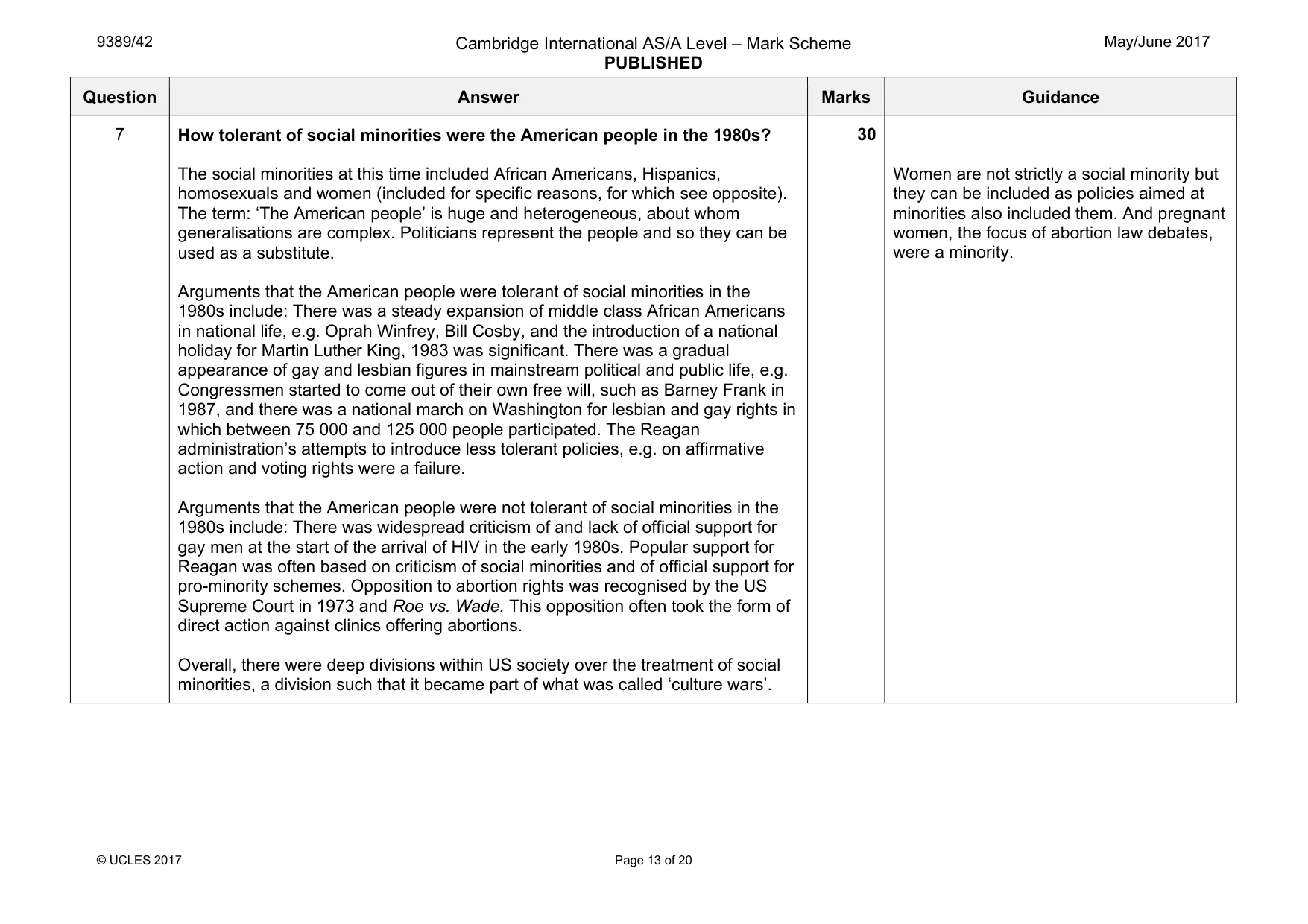
7 How tolerant of social minorities were the American people in the 1980s? [30]
Mark scheme: 7 How tolerant of social minorities were the American people in the 1980s? The social minorities at this time included African Americans, Hispanics, homosexuals and women (included for specific reasons, for which see opposite). The term: ‘The American people’ is huge and heterogeneous, about whom generalisations are complex. Politicians represent the people and so they can be used as a substitute. Arguments that the American people were tolerant of social minorities in the 1980s include: There was a steady expansion of middle class African Americans in national life, e.g. Oprah Winfrey, Bill Cosby, and the introduction of a national holiday for Martin Luther King, 1983 was significant. There was a gradual appearance of gay and lesbian figures in mainstream political and public life, e.g. Congressmen started to come out of their own free will, such as Barney Frank in 1987, and there was a national march on Washington for lesbian and gay rights in which between 75 000 and 125 000 people participated. The Reagan administration’s attempts to introduce less tolerant policies, e.g. on affirmative action and voting rights were a failure. Arguments that the American people were not tolerant of social minorities in the 1980s include: There was widespread criticism of and lack of official support for gay men at the start of the arrival of HIV in the early 1980s. Popular support for Reagan was often based on criticism of social minorities and of official support for pro-minority schemes. Opposition to abortion rights was recognised by the US Supreme Court in 1973 and Roe vs. Wade. This opposition often took the form of direct action against clinics offering abortions. Overall, there were deep divisions within US society over the treatment of social minorities, a division such that it became part of what was called ‘culture wars’. 30 Women are not strictly a social minority but they can be included as policies aimed at minorities also included them. And pregnant women, the focus of abortion law debates, were a minority.
Q8 · Assess the reasons why, after the Second World War, the USA abandoned its isolationist…
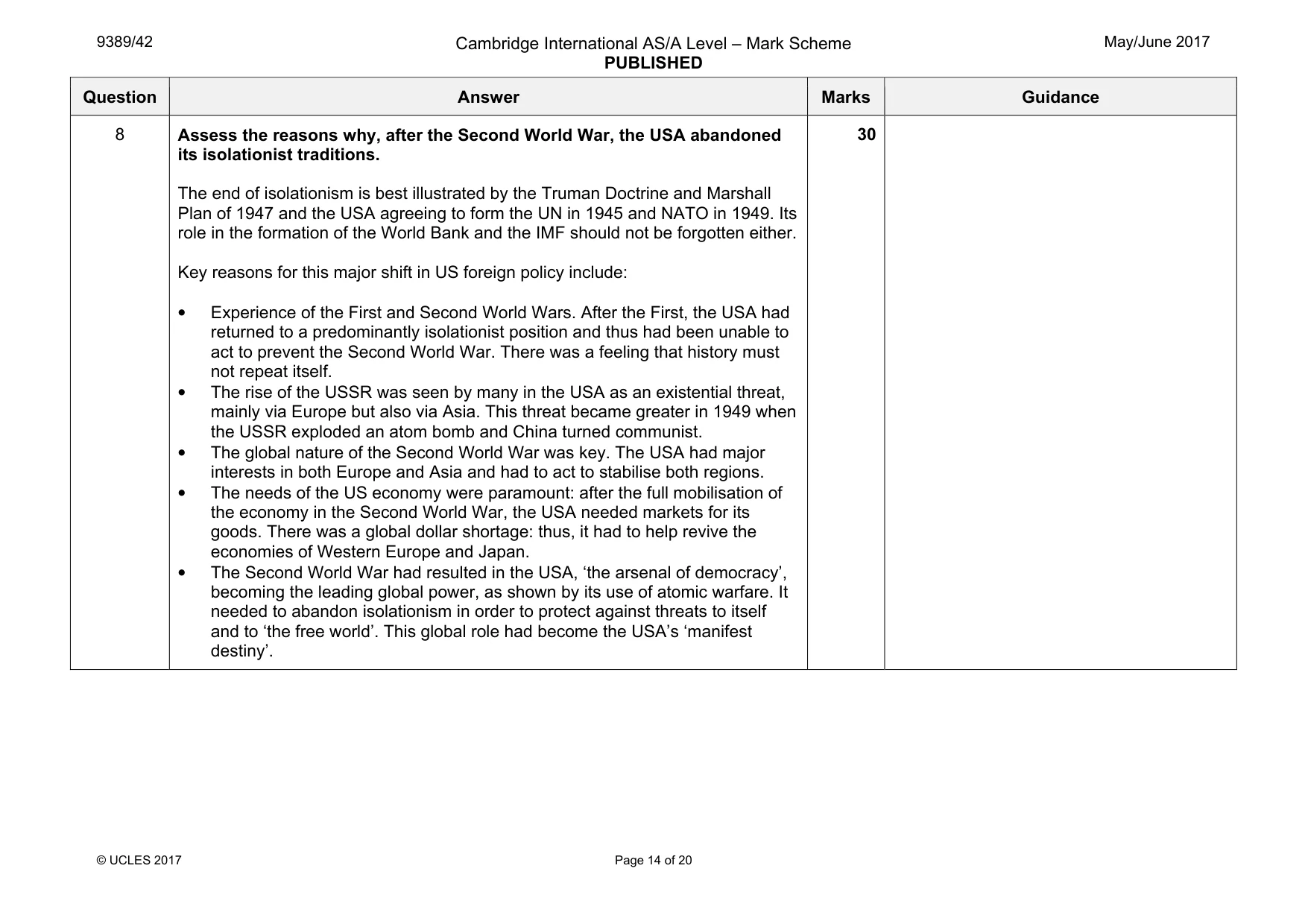
8 Assess the reasons why, after the Second World War, the USA abandoned its isolationist traditions. [30] Depth Study 3: International History, 1945–1991 Answer any two questions.
Mark scheme: 8 Assess the reasons why, after the Second World War, the USA abandoned its isolationist traditions. The end of isolationism is best illustrated by the Truman Doctrine and Marshall Plan of 1947 and the USA agreeing to form the UN in 1945 and NATO in 1949. Its role in the formation of the World Bank and the IMF should not be forgotten either. Key reasons for this major shift in US foreign policy include: • Experience of the First and Second World Wars. After the First, the USA had returned to a predominantly isolationist position and thus had been unable to act to prevent the Second World War. There was a feeling that history must not repeat itself. • The rise of the USSR was seen by many in the USA as an existential threat, mainly via Europe but also via Asia. This threat became greater in 1949 when the USSR exploded an atom bomb and China turned communist. • The global nature of the Second World War was key. The USA had major interests in both Europe and Asia and had to act to stabilise both regions. • The needs of the US economy were paramount: after the full mobilisation of the economy in the Second World War, the USA needed markets for its goods. There was a global dollar shortage: thus, it had to help revive the economies of Western Europe and Japan. • The Second World War had resulted in the USA, ‘the arsenal of democracy’, becoming the leading global power, as shown by its use of atomic warfare. It needed to abandon isolationism in order to protect against threats to itself and to ‘the free world’. This global role had become the USA’s ‘manifest destiny’. 30
Q9 · To what extent was the move towards détente in the 1970s caused by fear of nuclear war?
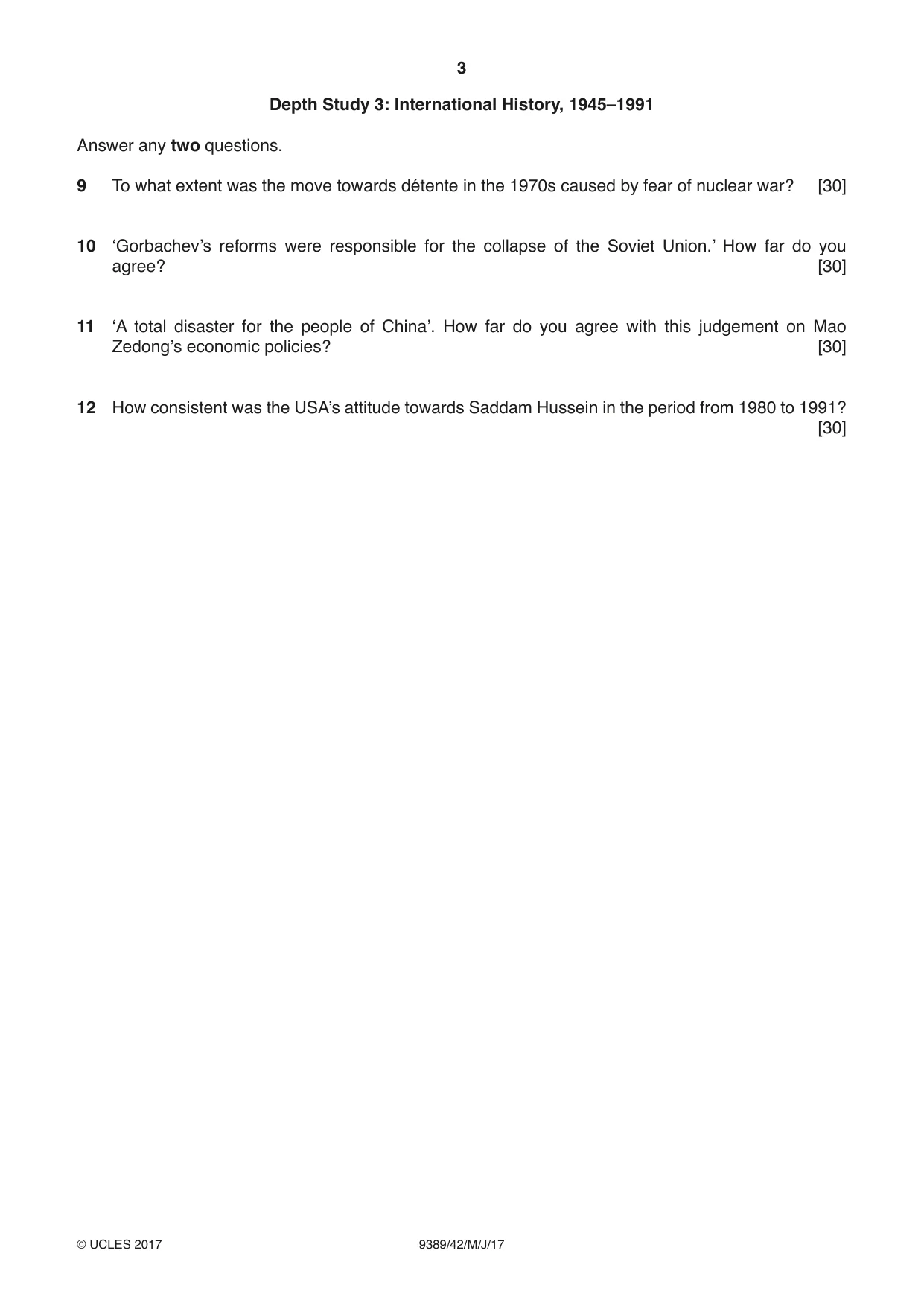
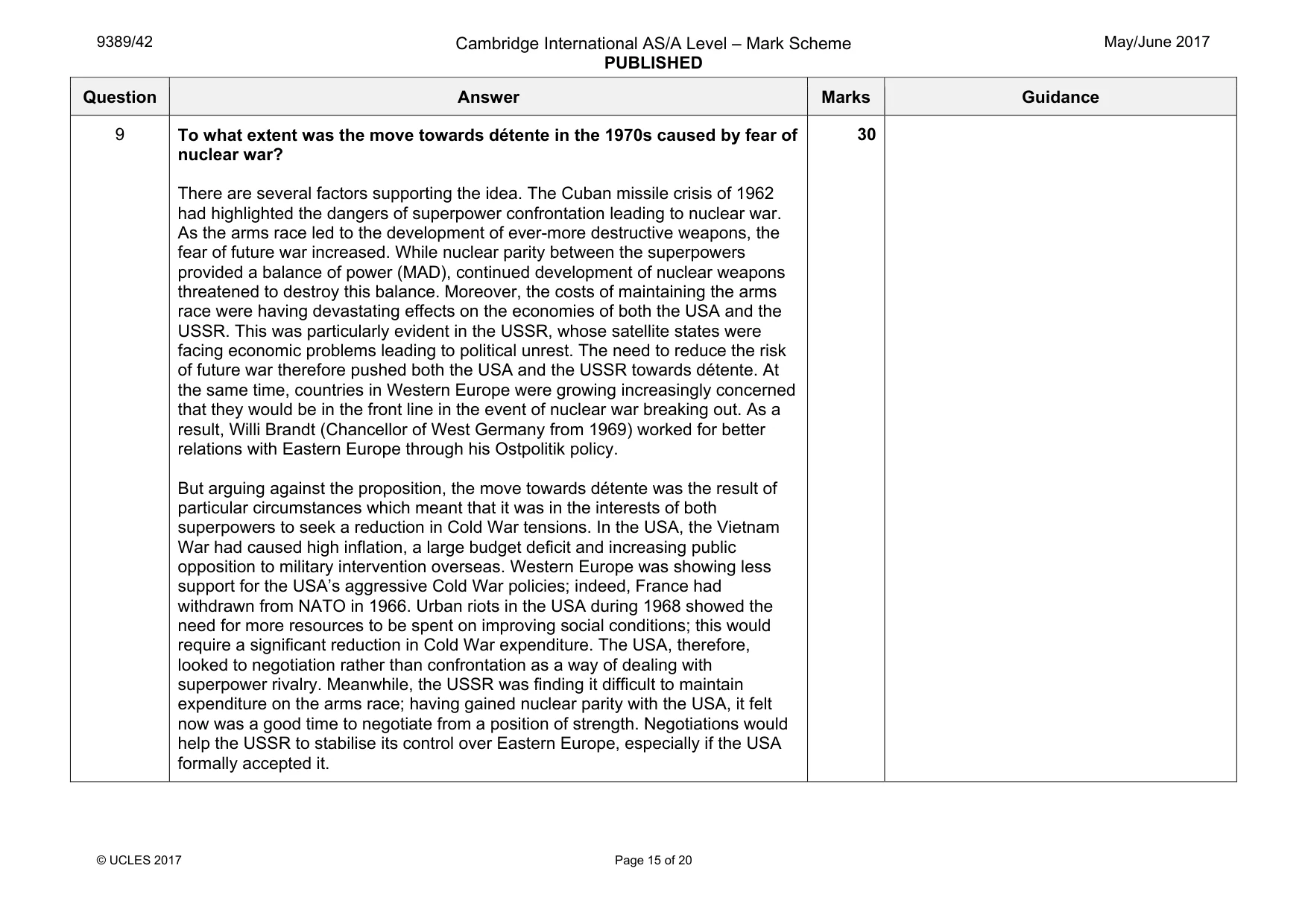
9 To what extent was the move towards détente in the 1970s caused by fear of nuclear war? [30]
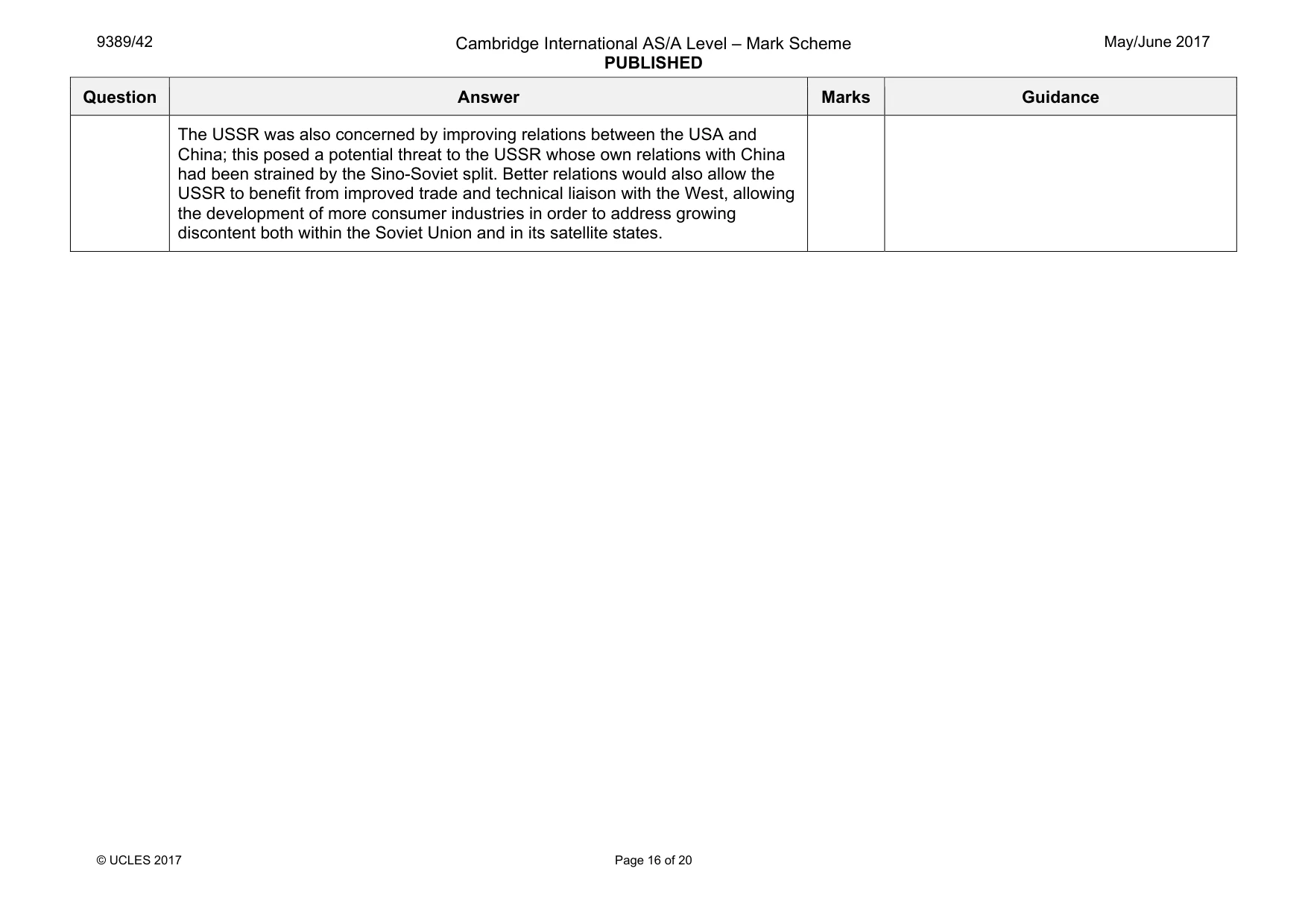
Mark scheme: 9 To what extent was the move towards détente in the 1970s caused by fear of nuclear war? There are several factors supporting the idea. The Cuban missile crisis of 1962 had highlighted the dangers of superpower confrontation leading to nuclear war. As the arms race led to the development of ever-more destructive weapons, the fear of future war increased. While nuclear parity between the superpowers provided a balance of power (MAD), continued development of nuclear weapons threatened to destroy this balance. Moreover, the costs of maintaining the arms race were having devastating effects on the economies of both the USA and the USSR. This was particularly evident in the USSR, whose satellite states were facing economic problems leading to political unrest. The need to reduce the risk of future war therefore pushed both the USA and the USSR towards détente. At the same time, countries in Western Europe were growing increasingly concerned that they would be in the front line in the event of nuclear war breaking out. As a result, Willi Brandt (Chancellor of West Germany from 1969) worked for better relations with Eastern Europe through his Ostpolitik policy. But arguing against the proposition, the move towards détente was the result of particular circumstances which meant that it was in the interests of both superpowers to seek a reduction in Cold War tensions. In the USA, the Vietnam War had caused high inflation, a large budget deficit and increasing public opposition to military intervention overseas. Western Europe was showing less support for the USA’s aggressive Cold War policies; indeed, France had withdrawn from NATO in 1966. Urban riots in the USA during 1968 showed the need for more resources to be spent on improving social conditions; this would require a significant reduction in Cold War expenditure. The USA, therefore, looked to negotiation rather than confrontation as a way of dealing with superpower rivalry. Meanwhile, the USSR was finding it difficult to maintain expenditure on the arms race; having gained nuclear parity with the USA, it felt now was a good time to negotiate from a position of strength. Negotiations would help the USSR to stabilise its control over Eastern Europe, especially if the USA formally accepted it. 30 Question Answer Marks Guidance The USSR was also concerned by improving relations between the USA and China; this posed a potential threat to the USSR whose own relations with China had been strained by the Sino-Soviet split. Better relations would also allow the USSR to benefit from improved trade and technical liaison with the West, allowing the development of more consumer industries in order to address growing discontent both within the Soviet Union and in its satellite states.
Q10 · ‘Gorbachev’s reforms were responsible for the collapse of the Soviet Union.’ How far do…
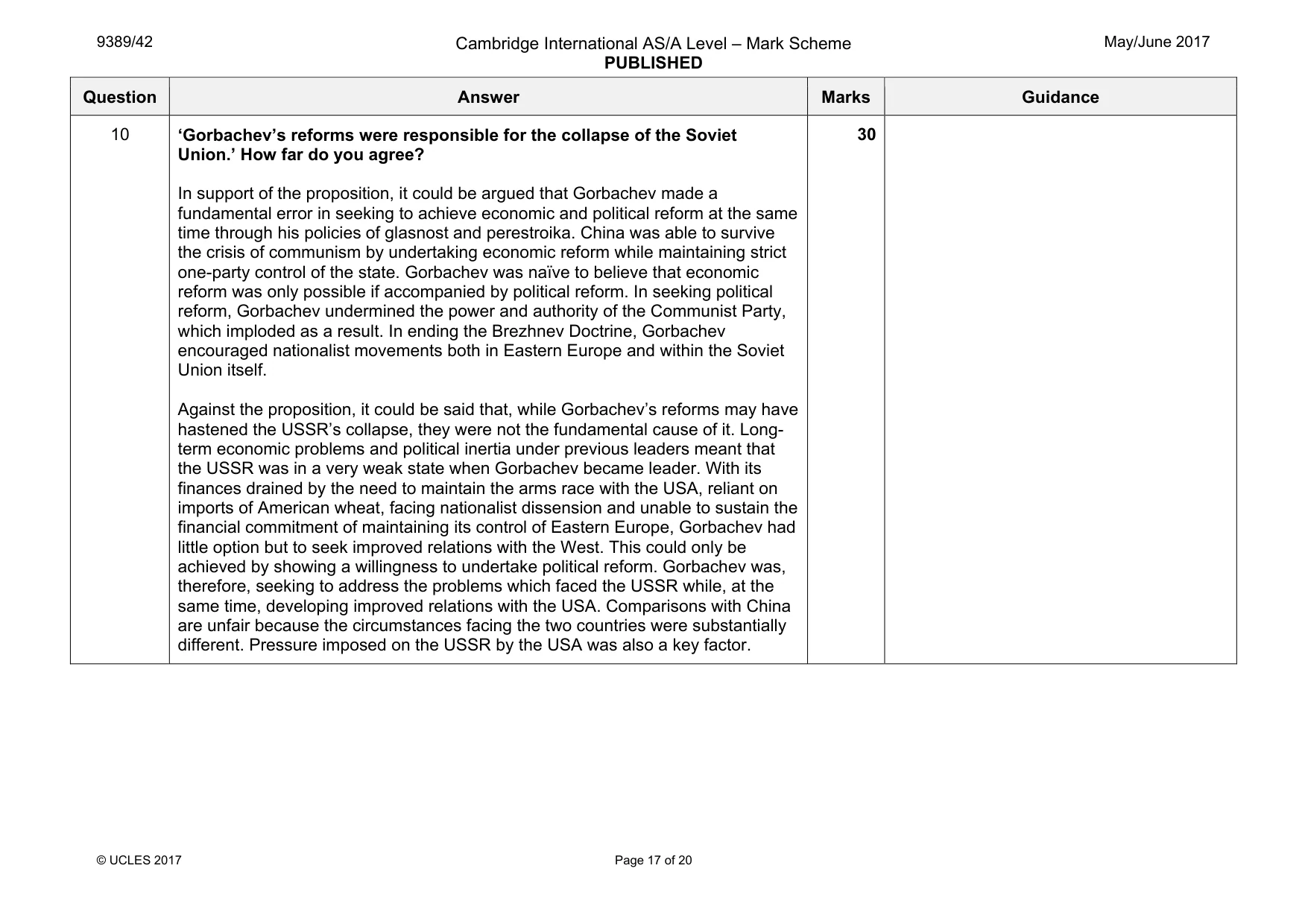
10 ‘Gorbachev’s reforms were responsible for the collapse of the Soviet Union.’ How far do you agree? [30]
Mark scheme: 10 ‘Gorbachev’s reforms were responsible for the collapse of the Soviet Union.’ How far do you agree? In support of the proposition, it could be argued that Gorbachev made a fundamental error in seeking to achieve economic and political reform at the same time through his policies of glasnost and perestroika. China was able to survive the crisis of communism by undertaking economic reform while maintaining strict one-party control of the state. Gorbachev was naïve to believe that economic reform was only possible if accompanied by political reform. In seeking political reform, Gorbachev undermined the power and authority of the Communist Party, which imploded as a result. In ending the Brezhnev Doctrine, Gorbachev encouraged nationalist movements both in Eastern Europe and within the Soviet Union itself. Against the proposition, it could be said that, while Gorbachev’s reforms may have hastened the USSR’s collapse, they were not the fundamental cause of it. Long- term economic problems and political inertia under previous leaders meant that the USSR was in a very weak state when Gorbachev became leader. With its finances drained by the need to maintain the arms race with the USA, reliant on imports of American wheat, facing nationalist dissension and unable to sustain the financial commitment of maintaining its control of Eastern Europe, Gorbachev had little option but to seek improved relations with the West. This could only be achieved by showing a willingness to undertake political reform. Gorbachev was, therefore, seeking to address the problems which faced the USSR while, at the same time, developing improved relations with the USA. Comparisons with China are unfair because the circumstances facing the two countries were substantially different. Pressure imposed on the USSR by the USA was also a key factor. 30
Q11 · ‘A total disaster for the people of China’
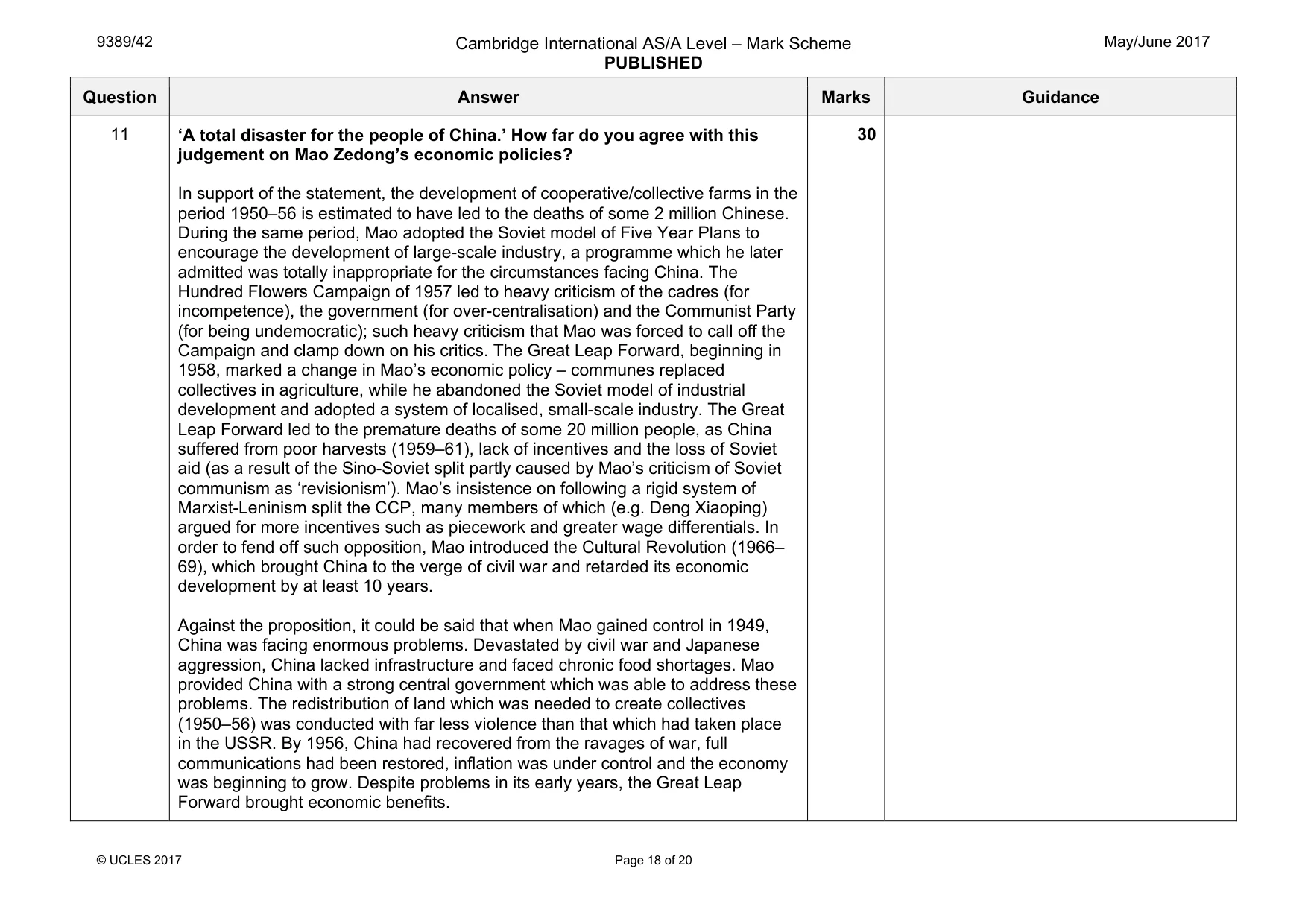
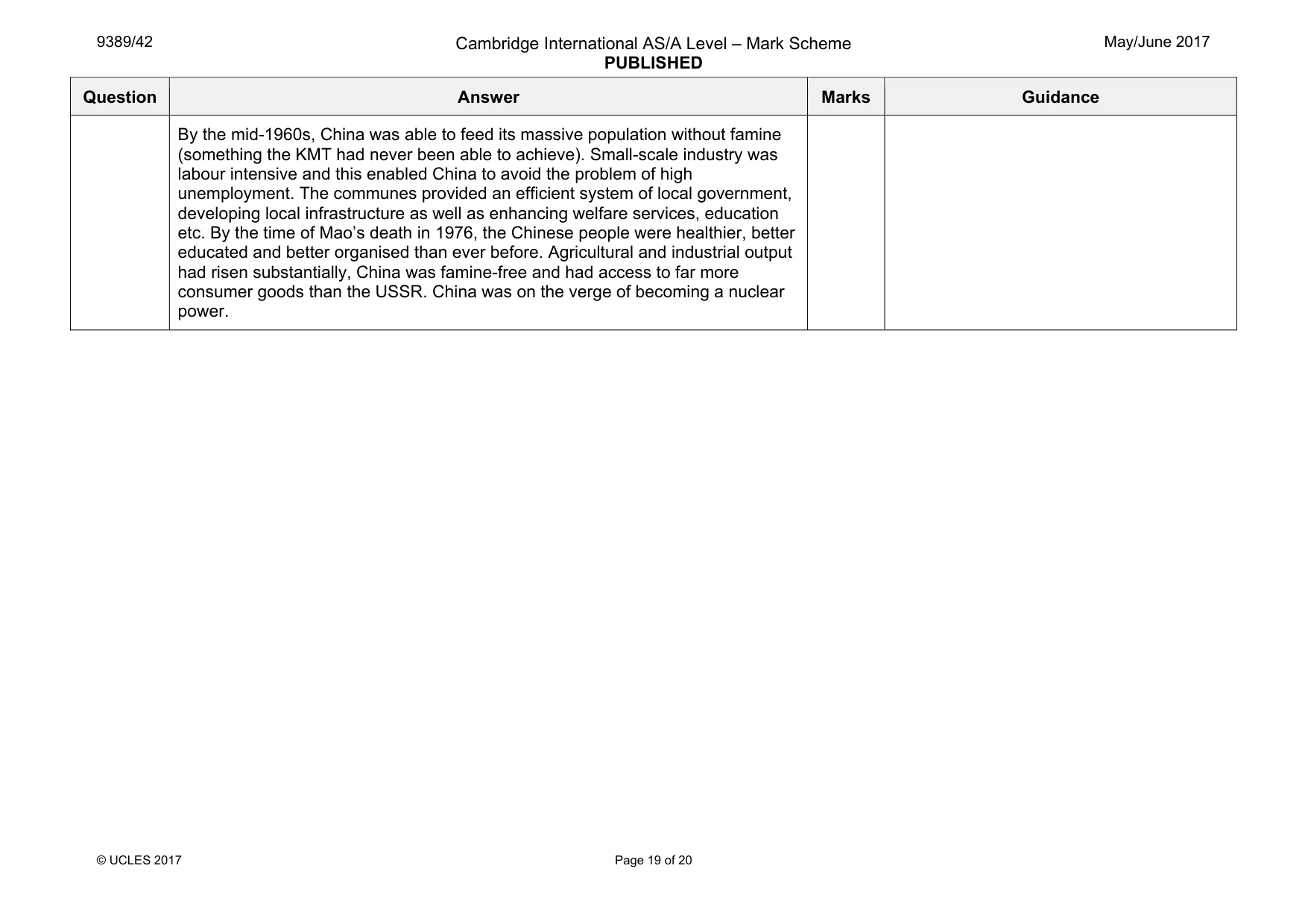
11 ‘A total disaster for the people of China’. How far do you agree with this judgement on Mao Zedong’s economic policies? [30]
Mark scheme: 11 ‘A total disaster for the people of China.’ How far do you agree with this judgement on Mao Zedong’s economic policies? In support of the statement, the development of cooperative/collective farms in the period 1950–56 is estimated to have led to the deaths of some 2 million Chinese. During the same period, Mao adopted the Soviet model of Five Year Plans to encourage the development of large-scale industry, a programme which he later admitted was totally inappropriate for the circumstances facing China. The Hundred Flowers Campaign of 1957 led to heavy criticism of the cadres (for incompetence), the government (for over-centralisation) and the Communist Party (for being undemocratic); such heavy criticism that Mao was forced to call off the Campaign and clamp down on his critics. The Great Leap Forward, beginning in 1958, marked a change in Mao’s economic policy – communes replaced collectives in agriculture, while he abandoned the Soviet model of industrial development and adopted a system of localised, small-scale industry. The Great Leap Forward led to the premature deaths of some 20 million people, as China suffered from poor harvests (1959–61), lack of incentives and the loss of Soviet aid (as a result of the Sino-Soviet split partly caused by Mao’s criticism of Soviet communism as ‘revisionism’). Mao’s insistence on following a rigid system of Marxist-Leninism split the CCP, many members of which (e.g. Deng Xiaoping) argued for more incentives such as piecework and greater wage differentials. In order to fend off such opposition, Mao introduced the Cultural Revolution (1966– 69), which brought China to the verge of civil war and retarded its economic development by at least 10 years. Against the proposition, it could be said that when Mao gained control in 1949, China was facing enormous problems. Devastated by civil war and Japanese aggression, China lacked infrastructure and faced chronic food shortages. Mao provided China with a strong central government which was able to address these problems. The redistribution of land which was needed to create collectives (1950–56) was conducted with far less violence than that which had taken place in the USSR. By 1956, China had recovered from the ravages of war, full communications had been restored, inflation was under control and the economy was beginning to grow. Despite problems in its early years, the Great Leap Forward brought economic benefits. 30 Question Answer Marks Guidance By the mid-1960s, China was able to feed its massive population without famine (something the KMT had never been able to achieve). Small-scale industry was labour intensive and this enabled China to avoid the problem of high unemployment. The communes provided an efficient system of local government, developing local infrastructure as well as enhancing welfare services, education etc. By the time of Mao’s death in 1976, the Chinese people were healthier, better educated and better organised than ever before. Agricultural and industrial output had risen substantially, China was famine-free and had access to far more consumer goods than the USSR. China was on the verge of becoming a nuclear power.
Q12 · How consistent was the USA’s attitude towards Saddam Hussein in the period from 1980 to…
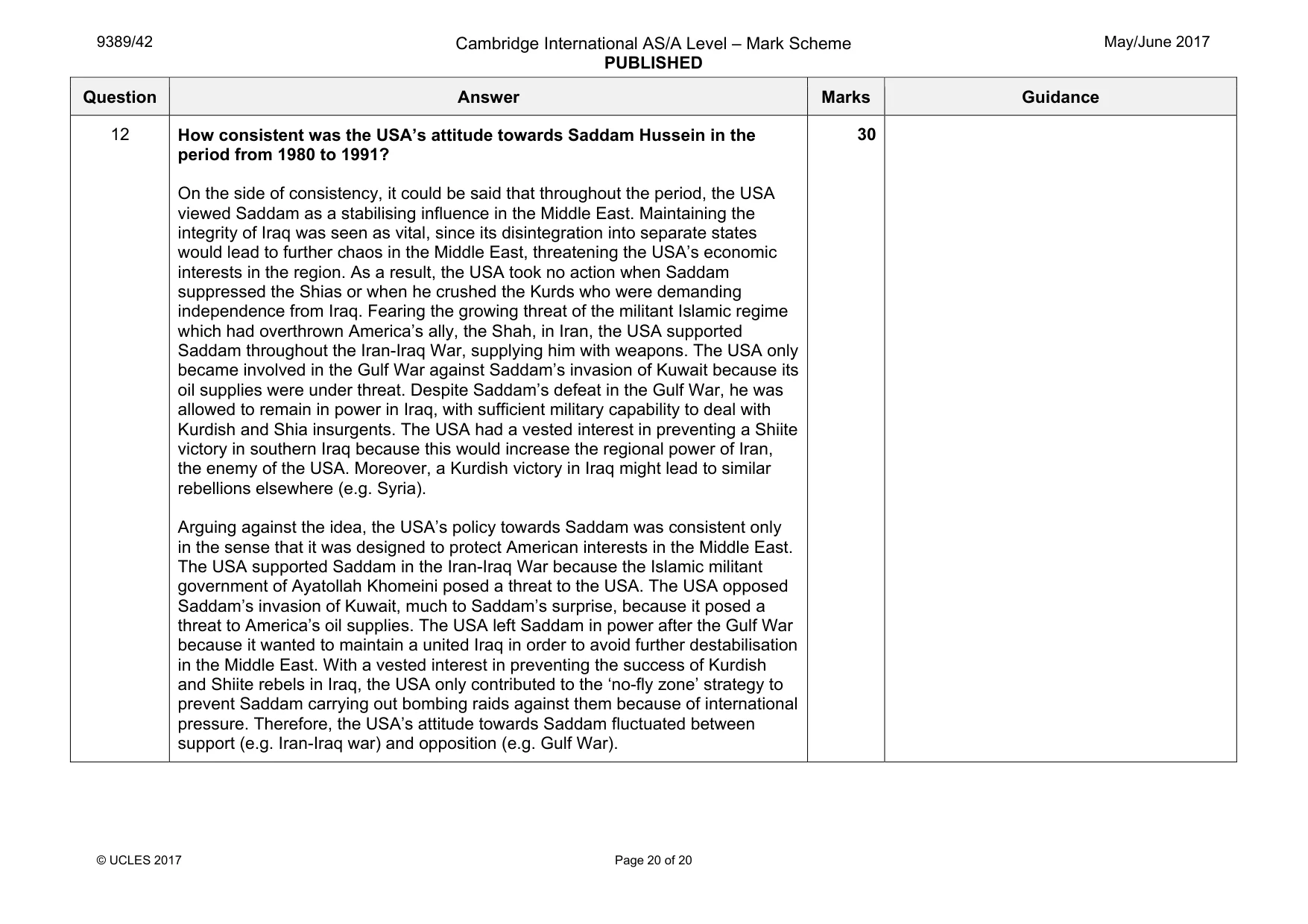
12 How consistent was the USA’s attitude towards Saddam Hussein in the period from 1980 to 1991? [30]
Mark scheme: 12 How consistent was the USA’s attitude towards Saddam Hussein in the period from 1980 to 1991? On the side of consistency, it could be said that throughout the period, the USA viewed Saddam as a stabilising influence in the Middle East. Maintaining the integrity of Iraq was seen as vital, since its disintegration into separate states would lead to further chaos in the Middle East, threatening the USA’s economic interests in the region. As a result, the USA took no action when Saddam suppressed the Shias or when he crushed the Kurds who were demanding independence from Iraq. Fearing the growing threat of the militant Islamic regime which had overthrown America’s ally, the Shah, in Iran, the USA supported Saddam throughout the Iran-Iraq War, supplying him with weapons. The USA only became involved in the Gulf War against Saddam’s invasion of Kuwait because its oil supplies were under threat. Despite Saddam’s defeat in the Gulf War, he was allowed to remain in power in Iraq, with sufficient military capability to deal with Kurdish and Shia insurgents. The USA had a vested interest in preventing a Shiite victory in southern Iraq because this would increase the regional power of Iran, the enemy of the USA. Moreover, a Kurdish victory in Iraq might lead to similar rebellions elsewhere (e.g. Syria). Arguing against the idea, the USA’s policy towards Saddam was consistent only in the sense that it was designed to protect American interests in the Middle East. The USA supported Saddam in the Iran-Iraq War because the Islamic militant government of Ayatollah Khomeini posed a threat to the USA. The USA opposed Saddam’s invasion of Kuwait, much to Saddam’s surprise, because it posed a threat to America’s oil supplies. The USA left Saddam in power after the Gulf War because it wanted to maintain a united Iraq in order to avoid further destabilisation in the Middle East. With a vested interest in preventing the success of Kurdish and Shiite rebels in Iraq, the USA only contributed to the ‘no-fly zone’ strategy to prevent Saddam carrying out bombing raids against them because of international pressure. Therefore, the USA’s attitude towards Saddam fluctuated between support (e.g. Iran-Iraq war) and opposition (e.g. Gulf War). 30
What you needed in this session
Cambridge’s own grade thresholds for 2017 May/June, Paper 4 · Variant 2. A higher threshold means an easier paper — the bar moves with how the cohort did.