Cambridge A Level History 9389 — 2019 Oct/Nov Paper 4 · Variant 3
9389/43/O/N/19 · 60 marks · ≈68 min
The question paper and its mark scheme, free to read here and free to download. This is Cambridge’s own paper, exactly as it was sat.
Question paper4 pages
Mark scheme23 pages
Answers below. Sit the paper first if you are practising.

Paper as text
Question paper, page 1
This document consists of 4 printed pages and 1 Insert. DC (LK) 171596/2 © UCLES 2019 [Turn over * 5 3 5 6 9 8 6 8 5 1 * HISTORY 9389/43 Paper 4 Depth Study October/November 2019 1 hour 30 minutes No Additional Materials are required. READ THESE INSTRUCTIONS FIRST An answer booklet is provided inside this question paper. You should follow the instructions on the front cover of the answer booklet. If you need additional answer paper ask the invigilator for a continuation booklet. This paper contains five sections: Depth Study 1: Europe of the Dictators, 1918–1941 Depth Study 2: The History of the USA, 1945–1990 Depth Study 3: International History, 1945–1991 Depth Study 4: African History, 1945–1991 Depth Study 5: Southeast Asian History, 1945–1990s Answer two questions from one section. The marks are given in brackets [ ] at the end of each question. Cambridge Assessment International Education Cambridge International Advanced Subsidiary and Advanced Level
Question paper, page 2
2 9389/43/O/N/19 © UCLES 2019 Depth Study 1: Europe of the Dictators, 1918–1941 Answer any two questions. 1 Evaluate the effectiveness of Lenin’s leadership of the USSR. [30] 2 ‘Mussolini’s relations with the Church were his only domestic success.’ How far do you agree? [30] 3 Analyse the reasons why Trotsky was unable to win the struggle for power with Stalin. [30] 4 ‘The “Führer Principle” was the most important principle in Nazism.’ How far do you agree? [30] Depth Study 2: The History of the USA, 1945–1990 Answer any two questions. 5 Analyse the reasons why the civil rights movement of the 1950s attracted widespread support. [30] 6 ‘Little more than a political battle against an unpopular president.’ How justified is this view of the Watergate crisis of 1972–74? [30] 7 How far did the living standards of the American people improve in the 1980s? [30] 8 ‘Reagan’s victory in the 1980 presidential election meant the end of the policy of détente.’ How far do you agree? [30]
Question paper, page 3
3 9389/43/O/N/19 © UCLES 2019 [Turn over Depth Study 3: International History, 1945–1991 Answer any two questions. 9 To what extent was the globalisation of the Cold War caused by the Soviet Union’s determination to increase its international influence? [30] 10 ‘The inability to cope with national uprisings, both in Eastern Europe and within the Soviet Union, was the main reason why the USSR collapsed by 1991.’ How far do you agree? [30] 11 How far can Mao Zedong be regarded as the ‘saviour of China’ during his rule? [30] 12 How far was the USA responsible for causing the Suez crisis in 1956? [30] Depth Study 4: African History, 1945–1991 Answer any two questions. 13 Which had the greater impact on African nationalist movements: the Atlantic Charter or the Bandung Conference? [30] 14 Assess the reasons for the problem of corruption in independent African states in this period. [30] 15 Assess the impact of independence on education in African states in this period. [30] 16 Assess the effectiveness of United Nations involvement in flashpoint situations in Africa in this period. [30]
Question paper, page 4
4 9389/43/O/N/19 © UCLES 2019 Depth Study 5: Southeast Asian History, 1945–1990s Answer any two questions. 17 Evaluate the impact of the Second World War in bringing about the end of Dutch colonial rule in Southeast Asia. [30] 18 Evaluate the reasons why Singapore separated from Malaysia. [30] 19 Assess the reasons why Thai politics was dominated by military strongmen during this period. [30] 20 ‘Rising living standards were the most important consequence of economic growth in Southeast Asia after 1991.’ Assess this view. [30] Permission to reproduce items where third-party owned material protected by copyright is included has been sought and cleared where possible. Every reasonable effort has been made by the publisher (UCLES) to trace copyright holders, but if any items requiring clearance have unwittingly been included, the publisher will be pleased to make amends at the earliest possible opportunity. To avoid the issue of disclosure of answer-related information to candidates, all copyright acknowledgements are reproduced online in the Cambridge Assessment International Education Copyright Acknowledgements Booklet. This is produced for each series of examinations and is freely available to download at www.cambridgeinternational.org after the live examination series. Cambridge Assessment International Education is part of the Cambridge Assessment Group. Cambridge Assessment is the brand name of the University of Cambridge Local Examinations Syndicate (UCLES), which itself is a department of the University of Cambridge.
Mark scheme, page 1
This document consists of 23 printed pages. © UCLES 2019 [Turn over Cambridge Assessment International Education Cambridge International Advanced Subsidiary and Advanced Level HISTORY 9389/43 Paper 4 Depth Study October/November 2019 MARK SCHEME Maximum Mark: 60 Published This mark scheme is published as an aid to teachers and candidates, to indicate the requirements of the examination. It shows the basis on which Examiners were instructed to award marks. It does not indicate the details of the discussions that took place at an Examiners’ meeting before marking began, which would have considered the acceptability of alternative answers. Mark schemes should be read in conjunction with the question paper and the Principal Examiner Report for Teachers. Cambridge International will not enter into discussions about these mark schemes. Cambridge International is publishing the mark schemes for the October/November 2019 series for most Cambridge IGCSE™, Cambridge International A and AS Level components and some Cambridge O Level components.
Mark scheme, page 2
9389/43 Cambridge International AS/A Level – Mark Scheme PUBLISHED October/November 2019 © UCLES 2019 Page 2 of 23 Generic Marking Principles These general marking principles must be applied by all examiners when marking candidate answers. They should be applied alongside the specific content of the mark scheme or generic level descriptors for a question. Each question paper and mark scheme will also comply with these marking principles. GENERIC MARKING PRINCIPLE 1: Marks must be awarded in line with: • the specific content of the mark scheme or the generic level descriptors for the question • the specific skills defined in the mark scheme or in the generic level descriptors for the question • the standard of response required by a candidate as exemplified by the standardisation scripts. GENERIC MARKING PRINCIPLE 2: Marks awarded are always whole marks (not half marks, or other fractions). GENERIC MARKING PRINCIPLE 3: Marks must be awarded positively: • marks are awarded for correct/valid answers, as defined in the mark scheme. However, credit is given for valid answers which go beyond the scope of the syllabus and mark scheme, referring to your Team Leader as appropriate • marks are awarded when candidates clearly demonstrate what they know and can do • marks are not deducted for errors • marks are not deducted for omissions • answers should only be judged on the quality of spelling, punctuation and grammar when these features are specifically assessed by the question as indicated by the mark scheme. The meaning, however, should be unambiguous. GENERIC MARKING PRINCIPLE 4: Rules must be applied consistently e.g. in situations where candidates have not followed instructions or in the application of generic level descriptors. GENERIC MARKING PRINCIPLE 5: Marks should be awarded using the full range of marks defined in the mark scheme for the question (however; the use of the full mark range may be limited according to the quality of the candidate responses seen). GENERIC MARKING PRINCIPLE 6: Marks awarded are based solely on the requirements as defined in the mark scheme. Marks should not be awarded with grade thresholds or grade descriptors in mind.
Mark scheme, page 3
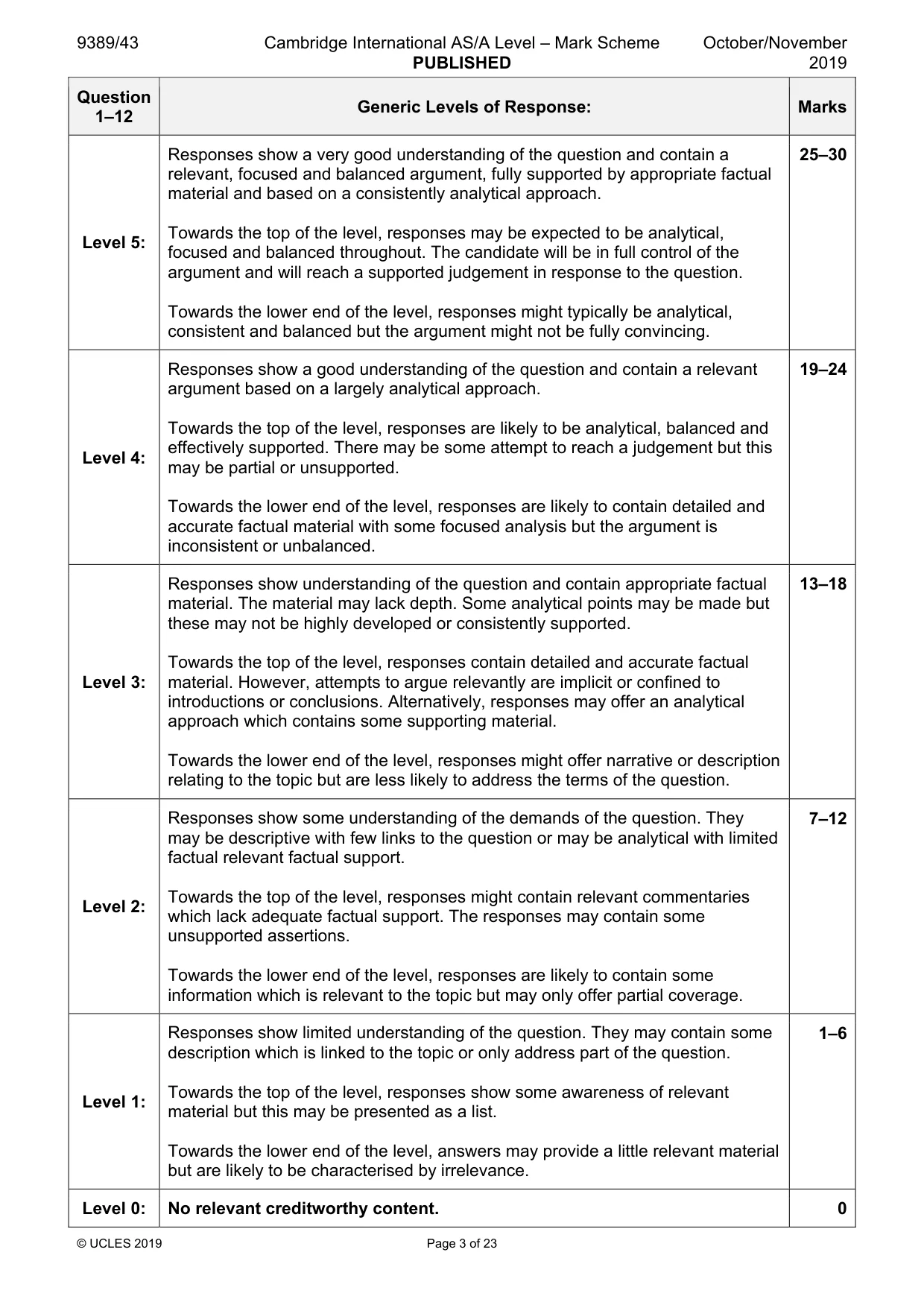
9389/43 Cambridge International AS/A Level – Mark Scheme PUBLISHED October/November 2019 © UCLES 2019 Page 3 of 23 Question 1–12 Generic Levels of Response: Marks Level 5: Responses show a very good understanding of the question and contain a relevant, focused and balanced argument, fully supported by appropriate factual material and based on a consistently analytical approach. Towards the top of the level, responses may be expected to be analytical, focused and balanced throughout. The candidate will be in full control of the argument and will reach a supported judgement in response to the question. Towards the lower end of the level, responses might typically be analytical, consistent and balanced but the argument might not be fully convincing. 25–30 Level 4: Responses show a good understanding of the question and contain a relevant argument based on a largely analytical approach. Towards the top of the level, responses are likely to be analytical, balanced and effectively supported. There may be some attempt to reach a judgement but this may be partial or unsupported. Towards the lower end of the level, responses are likely to contain detailed and accurate factual material with some focused analysis but the argument is inconsistent or unbalanced. 19–24 Level 3: Responses show understanding of the question and contain appropriate factual material. The material may lack depth. Some analytical points may be made but these may not be highly developed or consistently supported. Towards the top of the level, responses contain detailed and accurate factual material. However, attempts to argue relevantly are implicit or confined to introductions or conclusions. Alternatively, responses may offer an analytical approach which contains some supporting material. Towards the lower end of the level, responses might offer narrative or description relating to the topic but are less likely to address the terms of the question. 13–18 Level 2: Responses show some understanding of the demands of the question. They may be descriptive with few links to the question or may be analytical with limited factual relevant factual support. Towards the top of the level, responses might contain relevant commentaries which lack adequate factual support. The responses may contain some unsupported assertions. Towards the lower end of the level, responses are likely to contain some information which is relevant to the topic but may only offer partial coverage. 7–12 Level 1: Responses show limited understanding of the question. They may contain some description which is linked to the topic or only address part of the question. Towards the top of the level, responses show some awareness of relevant material but this may be presented as a list. Towards the lower end of the level, answers may provide a little relevant material but are likely to be characterised by irrelevance. 1–6 Level 0: No relevant creditworthy content. 0
Mark scheme, page 4
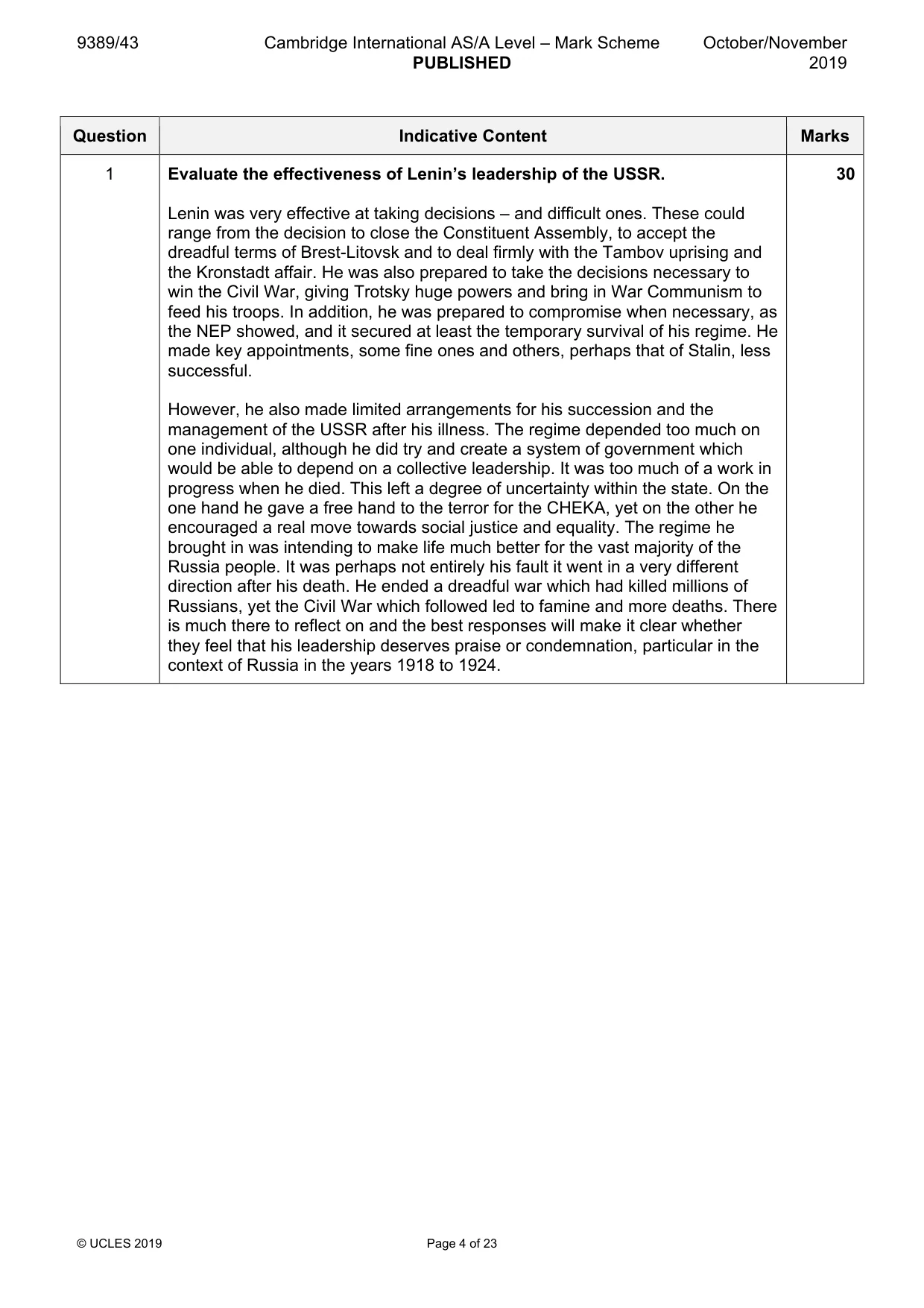
9389/43 Cambridge International AS/A Level – Mark Scheme PUBLISHED October/November 2019 © UCLES 2019 Page 4 of 23 Question Indicative Content Marks 1 Evaluate the effectiveness of Lenin’s leadership of the USSR. Lenin was very effective at taking decisions – and difficult ones. These could range from the decision to close the Constituent Assembly, to accept the dreadful terms of Brest-Litovsk and to deal firmly with the Tambov uprising and the Kronstadt affair. He was also prepared to take the decisions necessary to win the Civil War, giving Trotsky huge powers and bring in War Communism to feed his troops. In addition, he was prepared to compromise when necessary, as the NEP showed, and it secured at least the temporary survival of his regime. He made key appointments, some fine ones and others, perhaps that of Stalin, less successful. However, he also made limited arrangements for his succession and the management of the USSR after his illness. The regime depended too much on one individual, although he did try and create a system of government which would be able to depend on a collective leadership. It was too much of a work in progress when he died. This left a degree of uncertainty within the state. On the one hand he gave a free hand to the terror for the CHEKA, yet on the other he encouraged a real move towards social justice and equality. The regime he brought in was intending to make life much better for the vast majority of the Russia people. It was perhaps not entirely his fault it went in a very different direction after his death. He ended a dreadful war which had killed millions of Russians, yet the Civil War which followed led to famine and more deaths. There is much there to reflect on and the best responses will make it clear whether they feel that his leadership deserves praise or condemnation, particular in the context of Russia in the years 1918 to 1924. 30
Mark scheme, page 5
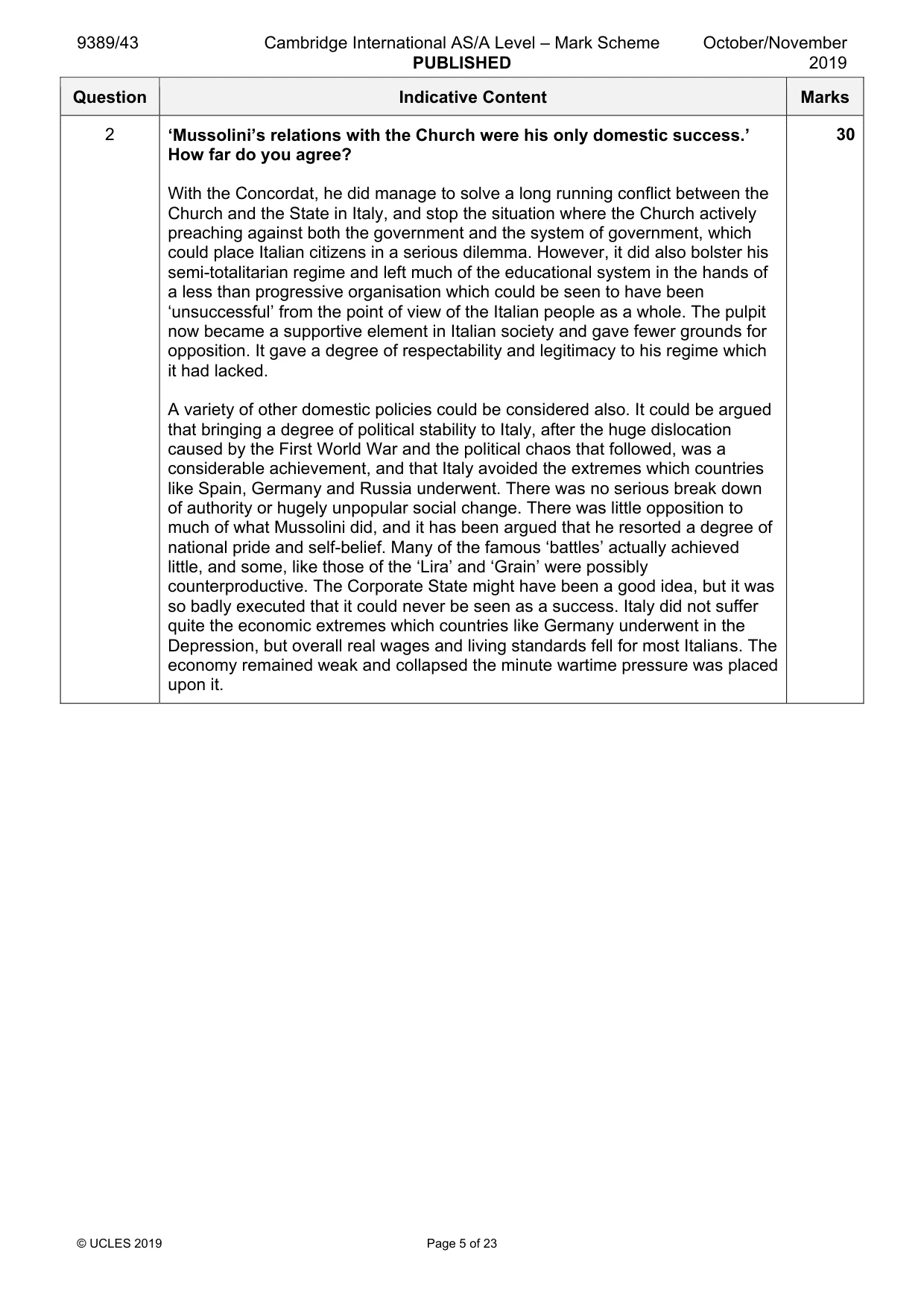
9389/43 Cambridge International AS/A Level – Mark Scheme PUBLISHED October/November 2019 © UCLES 2019 Page 5 of 23 Question Indicative Content Marks 2 ‘Mussolini’s relations with the Church were his only domestic success.’ How far do you agree? With the Concordat, he did manage to solve a long running conflict between the Church and the State in Italy, and stop the situation where the Church actively preaching against both the government and the system of government, which could place Italian citizens in a serious dilemma. However, it did also bolster his semi-totalitarian regime and left much of the educational system in the hands of a less than progressive organisation which could be seen to have been ‘unsuccessful’ from the point of view of the Italian people as a whole. The pulpit now became a supportive element in Italian society and gave fewer grounds for opposition. It gave a degree of respectability and legitimacy to his regime which it had lacked. A variety of other domestic policies could be considered also. It could be argued that bringing a degree of political stability to Italy, after the huge dislocation caused by the First World War and the political chaos that followed, was a considerable achievement, and that Italy avoided the extremes which countries like Spain, Germany and Russia underwent. There was no serious break down of authority or hugely unpopular social change. There was little opposition to much of what Mussolini did, and it has been argued that he resorted a degree of national pride and self-belief. Many of the famous ‘battles’ actually achieved little, and some, like those of the ‘Lira’ and ‘Grain’ were possibly counterproductive. The Corporate State might have been a good idea, but it was so badly executed that it could never be seen as a success. Italy did not suffer quite the economic extremes which countries like Germany underwent in the Depression, but overall real wages and living standards fell for most Italians. The economy remained weak and collapsed the minute wartime pressure was placed upon it. 30
Mark scheme, page 6
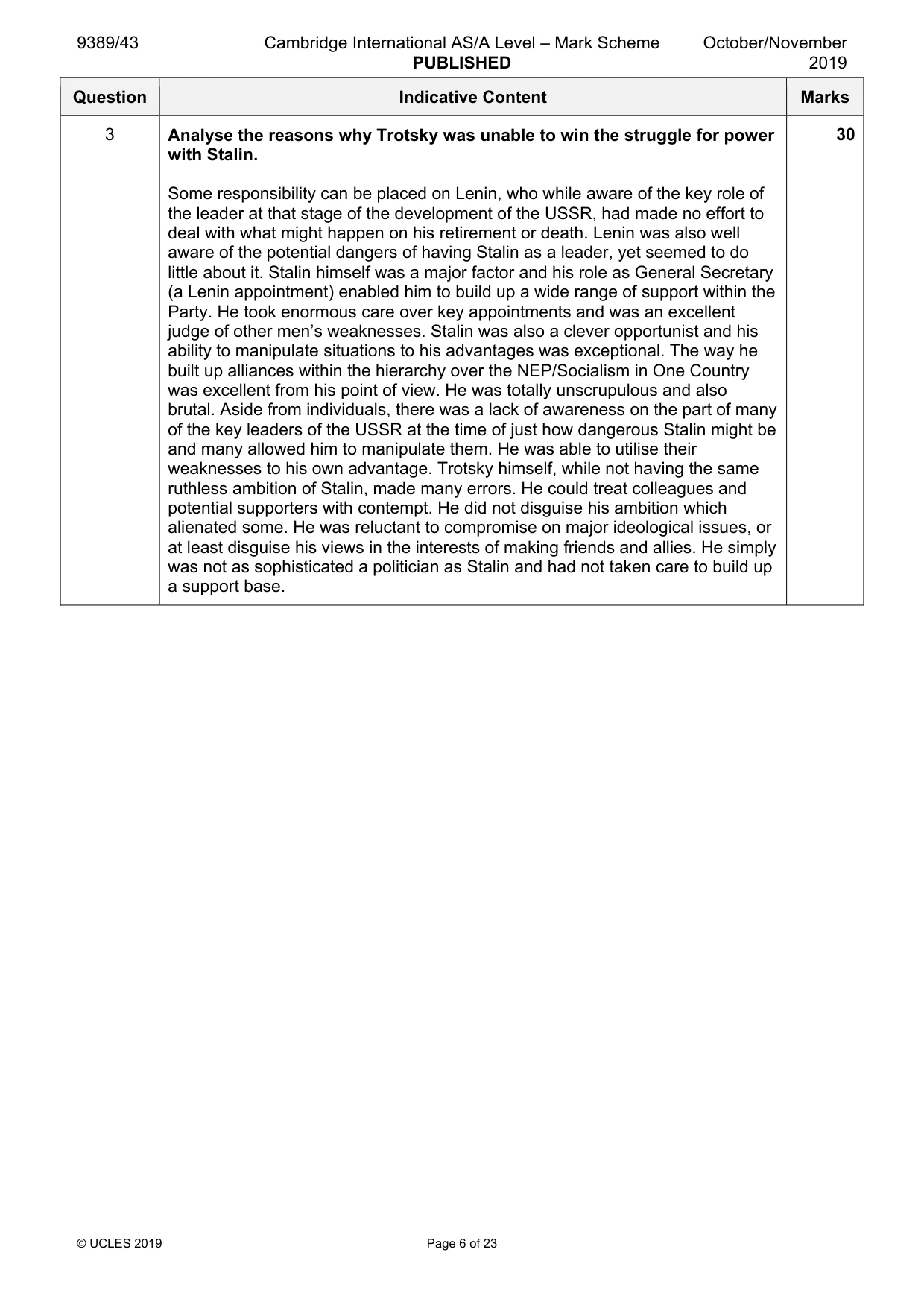
9389/43 Cambridge International AS/A Level – Mark Scheme PUBLISHED October/November 2019 © UCLES 2019 Page 6 of 23 Question Indicative Content Marks 3 Analyse the reasons why Trotsky was unable to win the struggle for power with Stalin. Some responsibility can be placed on Lenin, who while aware of the key role of the leader at that stage of the development of the USSR, had made no effort to deal with what might happen on his retirement or death. Lenin was also well aware of the potential dangers of having Stalin as a leader, yet seemed to do little about it. Stalin himself was a major factor and his role as General Secretary (a Lenin appointment) enabled him to build up a wide range of support within the Party. He took enormous care over key appointments and was an excellent judge of other men’s weaknesses. Stalin was also a clever opportunist and his ability to manipulate situations to his advantages was exceptional. The way he built up alliances within the hierarchy over the NEP/Socialism in One Country was excellent from his point of view. He was totally unscrupulous and also brutal. Aside from individuals, there was a lack of awareness on the part of many of the key leaders of the USSR at the time of just how dangerous Stalin might be and many allowed him to manipulate them. He was able to utilise their weaknesses to his own advantage. Trotsky himself, while not having the same ruthless ambition of Stalin, made many errors. He could treat colleagues and potential supporters with contempt. He did not disguise his ambition which alienated some. He was reluctant to compromise on major ideological issues, or at least disguise his views in the interests of making friends and allies. He simply was not as sophisticated a politician as Stalin and had not taken care to build up a support base. 30
Mark scheme, page 7
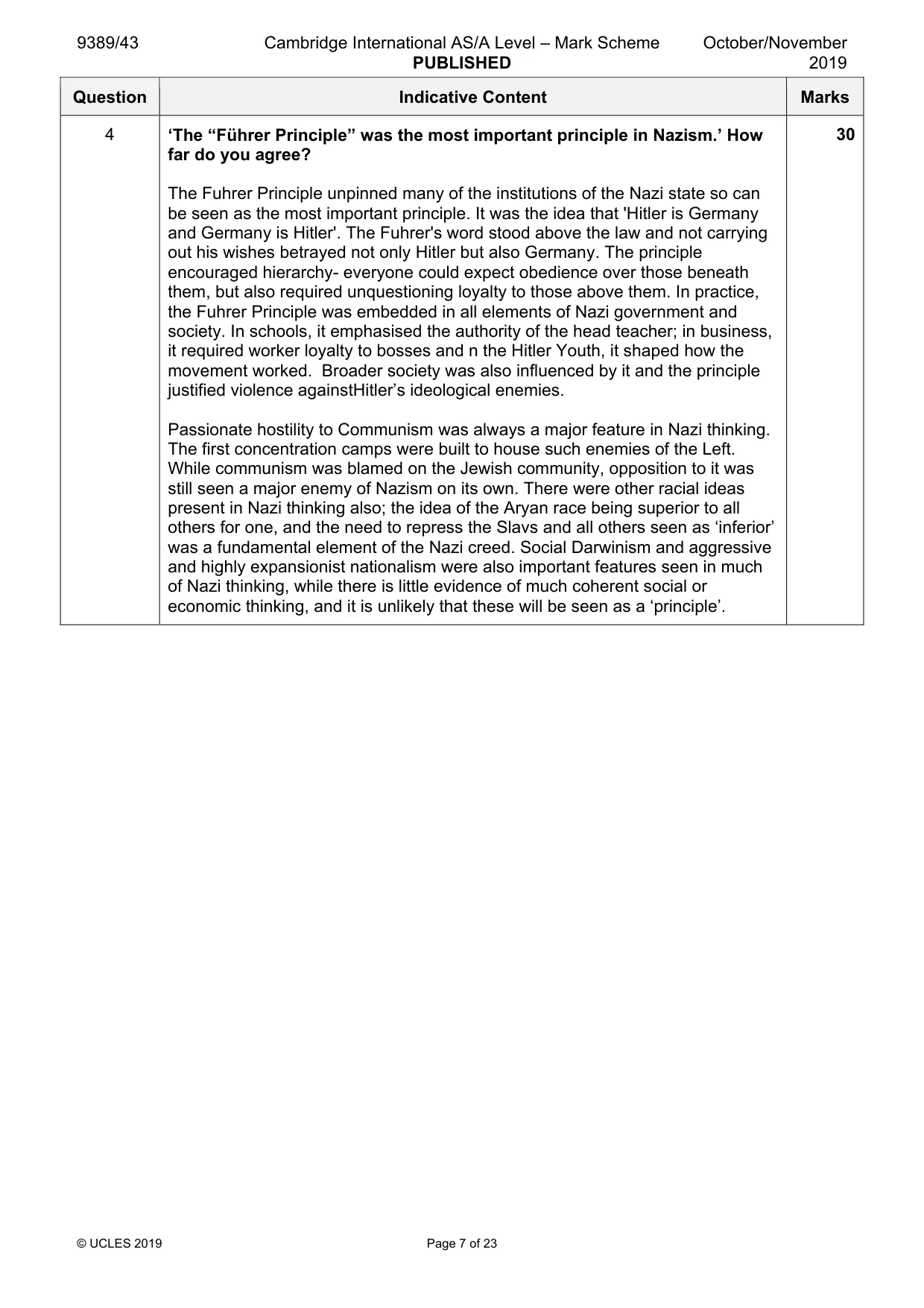
9389/43 Cambridge International AS/A Level – Mark Scheme PUBLISHED October/November 2019 © UCLES 2019 Page 7 of 23 Question Indicative Content Marks 4 ‘The “Führer Principle” was the most important principle in Nazism.’ How far do you agree? The Fuhrer Principle unpinned many of the institutions of the Nazi state so can be seen as the most important principle. It was the idea that 'Hitler is Germany and Germany is Hitler'. The Fuhrer's word stood above the law and not carrying out his wishes betrayed not only Hitler but also Germany. The principle encouraged hierarchy- everyone could expect obedience over those beneath them, but also required unquestioning loyalty to those above them. In practice, the Fuhrer Principle was embedded in all elements of Nazi government and society. In schools, it emphasised the authority of the head teacher; in business, it required worker loyalty to bosses and n the Hitler Youth, it shaped how the movement worked. Broader society was also influenced by it and the principle justified violence againstHitler’s ideological enemies. Passionate hostility to Communism was always a major feature in Nazi thinking. The first concentration camps were built to house such enemies of the Left. While communism was blamed on the Jewish community, opposition to it was still seen a major enemy of Nazism on its own. There were other racial ideas present in Nazi thinking also; the idea of the Aryan race being superior to all others for one, and the need to repress the Slavs and all others seen as ‘inferior’ was a fundamental element of the Nazi creed. Social Darwinism and aggressive and highly expansionist nationalism were also important features seen in much of Nazi thinking, while there is little evidence of much coherent social or economic thinking, and it is unlikely that these will be seen as a ‘principle’. 30
Mark scheme, page 8
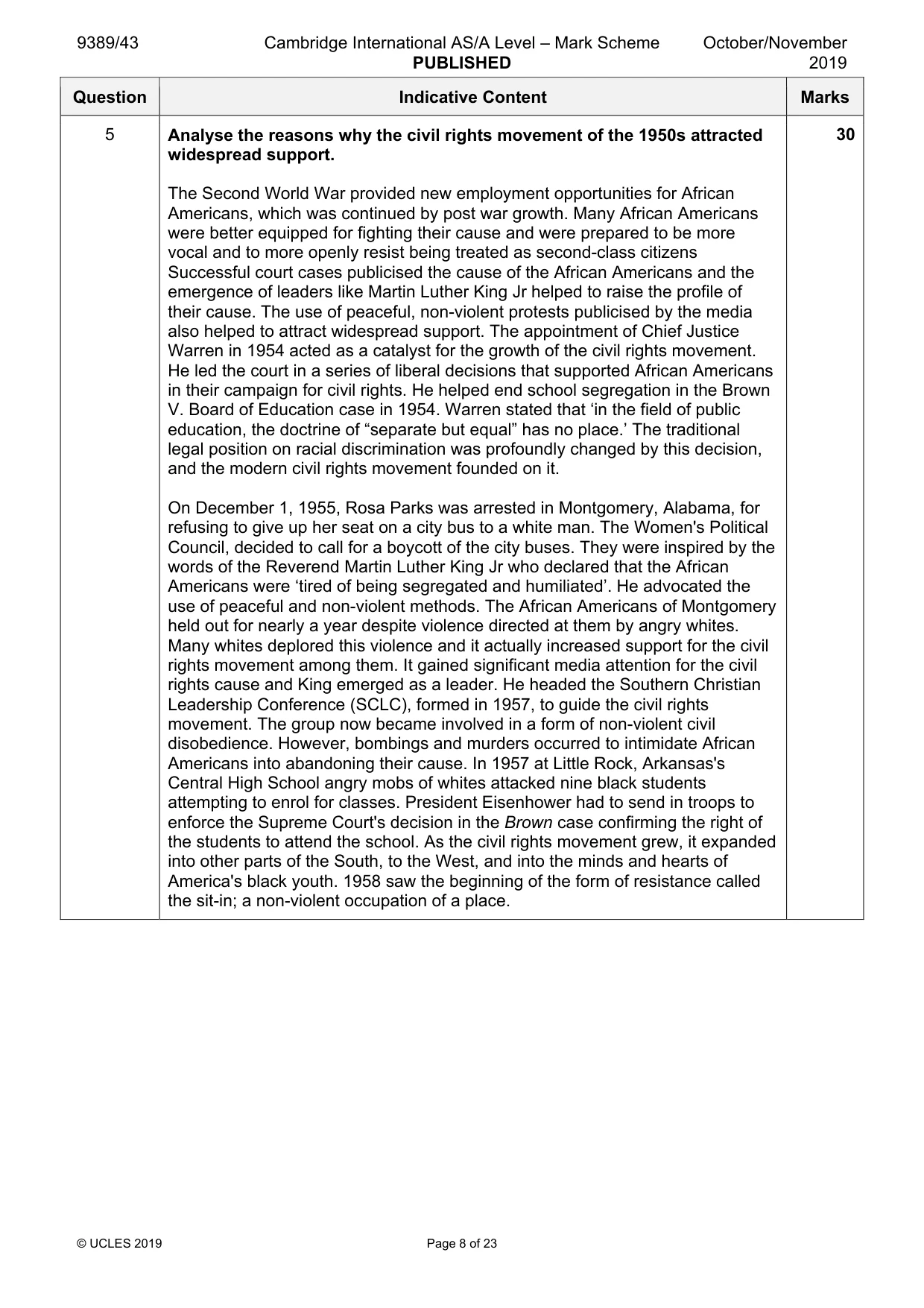
9389/43 Cambridge International AS/A Level – Mark Scheme PUBLISHED October/November 2019 © UCLES 2019 Page 8 of 23 Question Indicative Content Marks 5 Analyse the reasons why the civil rights movement of the 1950s attracted widespread support. The Second World War provided new employment opportunities for African Americans, which was continued by post war growth. Many African Americans were better equipped for fighting their cause and were prepared to be more vocal and to more openly resist being treated as second-class citizens Successful court cases publicised the cause of the African Americans and the emergence of leaders like Martin Luther King Jr helped to raise the profile of their cause. The use of peaceful, non-violent protests publicised by the media also helped to attract widespread support. The appointment of Chief Justice Warren in 1954 acted as a catalyst for the growth of the civil rights movement. He led the court in a series of liberal decisions that supported African Americans in their campaign for civil rights. He helped end school segregation in the Brown V. Board of Education case in 1954. Warren stated that ‘in the field of public education, the doctrine of “separate but equal” has no place.’ The traditional legal position on racial discrimination was profoundly changed by this decision, and the modern civil rights movement founded on it. On December 1, 1955, Rosa Parks was arrested in Montgomery, Alabama, for refusing to give up her seat on a city bus to a white man. The Women's Political Council, decided to call for a boycott of the city buses. They were inspired by the words of the Reverend Martin Luther King Jr who declared that the African Americans were ‘tired of being segregated and humiliated’. He advocated the use of peaceful and non-violent methods. The African Americans of Montgomery held out for nearly a year despite violence directed at them by angry whites. Many whites deplored this violence and it actually increased support for the civil rights movement among them. It gained significant media attention for the civil rights cause and King emerged as a leader. He headed the Southern Christian Leadership Conference (SCLC), formed in 1957, to guide the civil rights movement. The group now became involved in a form of non-violent civil disobedience. However, bombings and murders occurred to intimidate African Americans into abandoning their cause. In 1957 at Little Rock, Arkansas's Central High School angry mobs of whites attacked nine black students attempting to enrol for classes. President Eisenhower had to send in troops to enforce the Supreme Court's decision in the Brown case confirming the right of the students to attend the school. As the civil rights movement grew, it expanded into other parts of the South, to the West, and into the minds and hearts of America's black youth. 1958 saw the beginning of the form of resistance called the sit-in; a non-violent occupation of a place. 30
Mark scheme, page 9
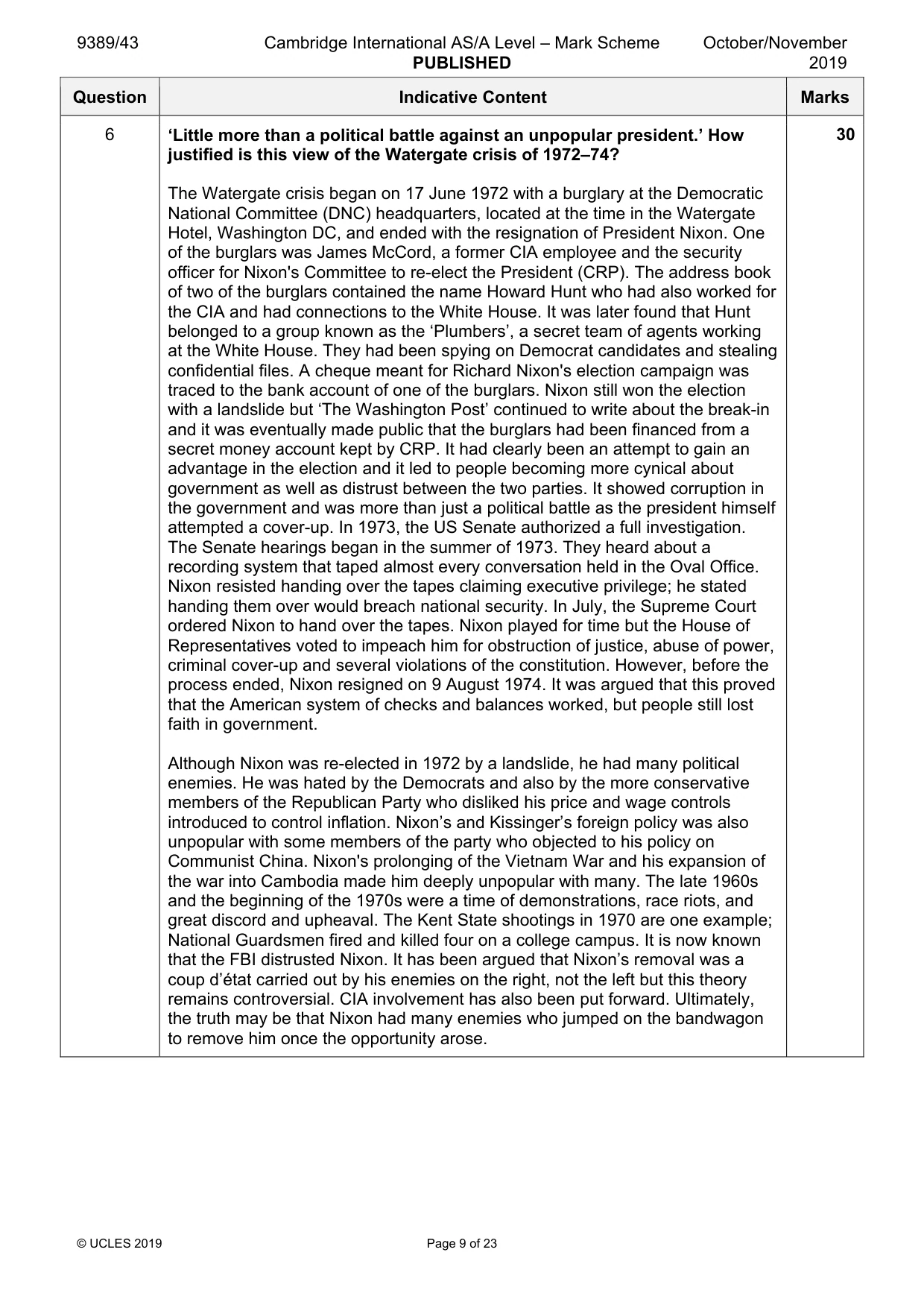
9389/43 Cambridge International AS/A Level – Mark Scheme PUBLISHED October/November 2019 © UCLES 2019 Page 9 of 23 Question Indicative Content Marks 6 ‘Little more than a political battle against an unpopular president.’ How justified is this view of the Watergate crisis of 1972–74? The Watergate crisis began on 17 June 1972 with a burglary at the Democratic National Committee (DNC) headquarters, located at the time in the Watergate Hotel, Washington DC, and ended with the resignation of President Nixon. One of the burglars was James McCord, a former CIA employee and the security officer for Nixon's Committee to re-elect the President (CRP). The address book of two of the burglars contained the name Howard Hunt who had also worked for the CIA and had connections to the White House. It was later found that Hunt belonged to a group known as the ‘Plumbers’, a secret team of agents working at the White House. They had been spying on Democrat candidates and stealing confidential files. A cheque meant for Richard Nixon's election campaign was traced to the bank account of one of the burglars. Nixon still won the election with a landslide but ‘The Washington Post’ continued to write about the break-in and it was eventually made public that the burglars had been financed from a secret money account kept by CRP. It had clearly been an attempt to gain an advantage in the election and it led to people becoming more cynical about government as well as distrust between the two parties. It showed corruption in the government and was more than just a political battle as the president himself attempted a cover-up. In 1973, the US Senate authorized a full investigation. The Senate hearings began in the summer of 1973. They heard about a recording system that taped almost every conversation held in the Oval Office. Nixon resisted handing over the tapes claiming executive privilege; he stated handing them over would breach national security. In July, the Supreme Court ordered Nixon to hand over the tapes. Nixon played for time but the House of Representatives voted to impeach him for obstruction of justice, abuse of power, criminal cover-up and several violations of the constitution. However, before the process ended, Nixon resigned on 9 August 1974. It was argued that this proved that the American system of checks and balances worked, but people still lost faith in government. Although Nixon was re-elected in 1972 by a landslide, he had many political enemies. He was hated by the Democrats and also by the more conservative members of the Republican Party who disliked his price and wage controls introduced to control inflation. Nixon’s and Kissinger’s foreign policy was also unpopular with some members of the party who objected to his policy on Communist China. Nixon's prolonging of the Vietnam War and his expansion of the war into Cambodia made him deeply unpopular with many. The late 1960s and the beginning of the 1970s were a time of demonstrations, race riots, and great discord and upheaval. The Kent State shootings in 1970 are one example; National Guardsmen fired and killed four on a college campus. It is now known that the FBI distrusted Nixon. It has been argued that Nixon’s removal was a coup d’état carried out by his enemies on the right, not the left but this theory remains controversial. CIA involvement has also been put forward. Ultimately, the truth may be that Nixon had many enemies who jumped on the bandwagon to remove him once the opportunity arose. 30
Mark scheme, page 10
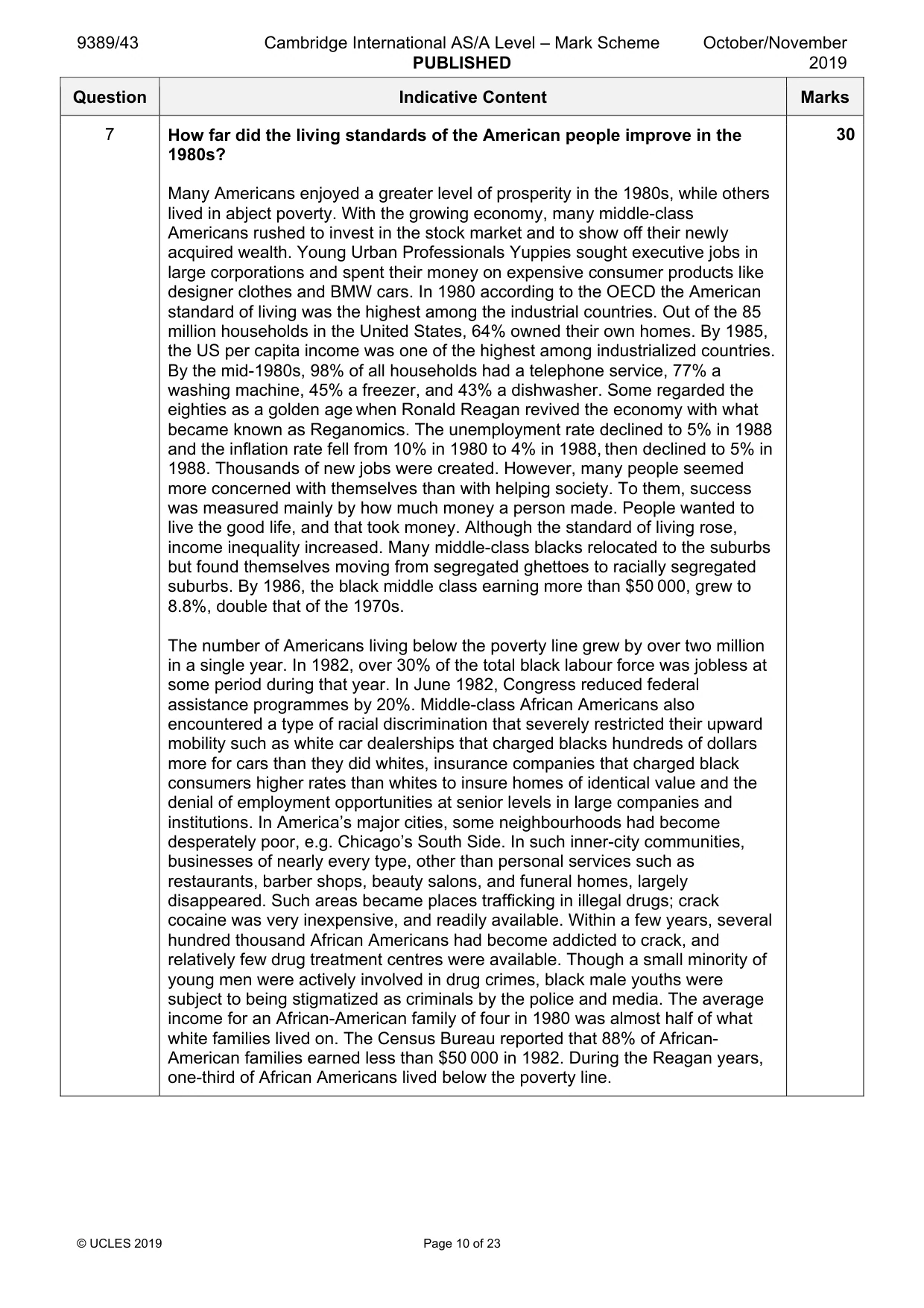
9389/43 Cambridge International AS/A Level – Mark Scheme PUBLISHED October/November 2019 © UCLES 2019 Page 10 of 23 Question Indicative Content Marks 7 How far did the living standards of the American people improve in the 1980s? Many Americans enjoyed a greater level of prosperity in the 1980s, while others lived in abject poverty. With the growing economy, many middle-class Americans rushed to invest in the stock market and to show off their newly acquired wealth. Young Urban Professionals Yuppies sought executive jobs in large corporations and spent their money on expensive consumer products like designer clothes and BMW cars. In 1980 according to the OECD the American standard of living was the highest among the industrial countries. Out of the 85 million households in the United States, 64% owned their own homes. By 1985, the US per capita income was one of the highest among industrialized countries. By the mid-1980s, 98% of all households had a telephone service, 77% a washing machine, 45% a freezer, and 43% a dishwasher. Some regarded the eighties as a golden age when Ronald Reagan revived the economy with what became known as Reganomics. The unemployment rate declined to 5% in 1988 and the inflation rate fell from 10% in 1980 to 4% in 1988, then declined to 5% in 1988. Thousands of new jobs were created. However, many people seemed more concerned with themselves than with helping society. To them, success was measured mainly by how much money a person made. People wanted to live the good life, and that took money. Although the standard of living rose, income inequality increased. Many middle-class blacks relocated to the suburbs but found themselves moving from segregated ghettoes to racially segregated suburbs. By 1986, the black middle class earning more than $50 000, grew to 8.8%, double that of the 1970s. The number of Americans living below the poverty line grew by over two million in a single year. In 1982, over 30% of the total black labour force was jobless at some period during that year. In June 1982, Congress reduced federal assistance programmes by 20%. Middle-class African Americans also encountered a type of racial discrimination that severely restricted their upward mobility such as white car dealerships that charged blacks hundreds of dollars more for cars than they did whites, insurance companies that charged black consumers higher rates than whites to insure homes of identical value and the denial of employment opportunities at senior levels in large companies and institutions. In America’s major cities, some neighbourhoods had become desperately poor, e.g. Chicago’s South Side. In such inner-city communities, businesses of nearly every type, other than personal services such as restaurants, barber shops, beauty salons, and funeral homes, largely disappeared. Such areas became places trafficking in illegal drugs; crack cocaine was very inexpensive, and readily available. Within a few years, several hundred thousand African Americans had become addicted to crack, and relatively few drug treatment centres were available. Though a small minority of young men were actively involved in drug crimes, black male youths were subject to being stigmatized as criminals by the police and media. The average income for an African-American family of four in 1980 was almost half of what white families lived on. The Census Bureau reported that 88% of African- American families earned less than $50 000 in 1982. During the Reagan years, one-third of African Americans lived below the poverty line. 30
Mark scheme, page 11
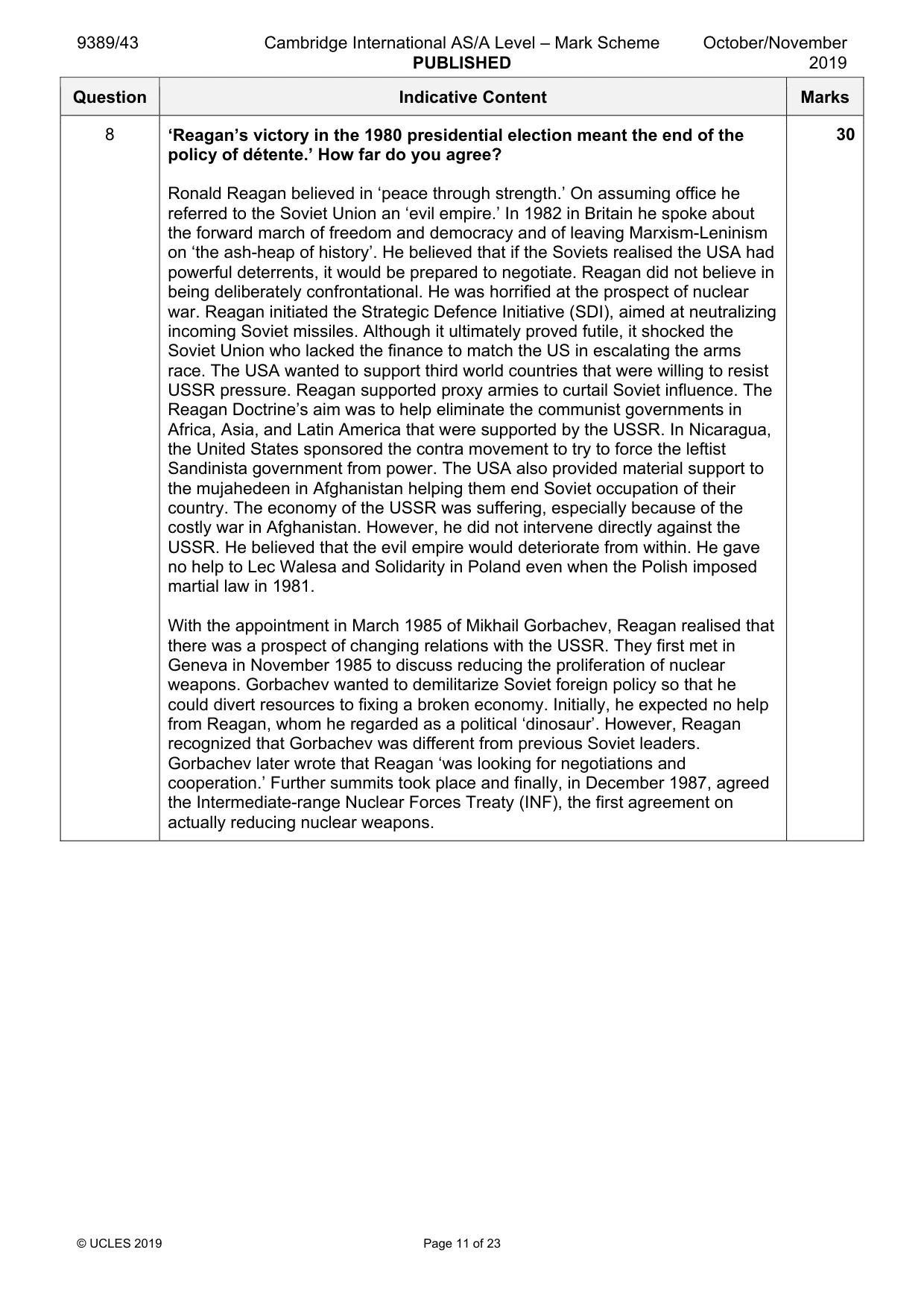
9389/43 Cambridge International AS/A Level – Mark Scheme PUBLISHED October/November 2019 © UCLES 2019 Page 11 of 23 Question Indicative Content Marks 8 ‘Reagan’s victory in the 1980 presidential election meant the end of the policy of détente.’ How far do you agree? Ronald Reagan believed in ‘peace through strength.’ On assuming office he referred to the Soviet Union an ‘evil empire.’ In 1982 in Britain he spoke about the forward march of freedom and democracy and of leaving Marxism-Leninism on ‘the ash-heap of history’. He believed that if the Soviets realised the USA had powerful deterrents, it would be prepared to negotiate. Reagan did not believe in being deliberately confrontational. He was horrified at the prospect of nuclear war. Reagan initiated the Strategic Defence Initiative (SDI), aimed at neutralizing incoming Soviet missiles. Although it ultimately proved futile, it shocked the Soviet Union who lacked the finance to match the US in escalating the arms race. The USA wanted to support third world countries that were willing to resist USSR pressure. Reagan supported proxy armies to curtail Soviet influence. The Reagan Doctrine’s aim was to help eliminate the communist governments in Africa, Asia, and Latin America that were supported by the USSR. In Nicaragua, the United States sponsored the contra movement to try to force the leftist Sandinista government from power. The USA also provided material support to the mujahedeen in Afghanistan helping them end Soviet occupation of their country. The economy of the USSR was suffering, especially because of the costly war in Afghanistan. However, he did not intervene directly against the USSR. He believed that the evil empire would deteriorate from within. He gave no help to Lec Walesa and Solidarity in Poland even when the Polish imposed martial law in 1981. With the appointment in March 1985 of Mikhail Gorbachev, Reagan realised that there was a prospect of changing relations with the USSR. They first met in Geneva in November 1985 to discuss reducing the proliferation of nuclear weapons. Gorbachev wanted to demilitarize Soviet foreign policy so that he could divert resources to fixing a broken economy. Initially, he expected no help from Reagan, whom he regarded as a political ‘dinosaur’. However, Reagan recognized that Gorbachev was different from previous Soviet leaders. Gorbachev later wrote that Reagan ‘was looking for negotiations and cooperation.’ Further summits took place and finally, in December 1987, agreed the Intermediate-range Nuclear Forces Treaty (INF), the first agreement on actually reducing nuclear weapons. 30
Mark scheme, page 12
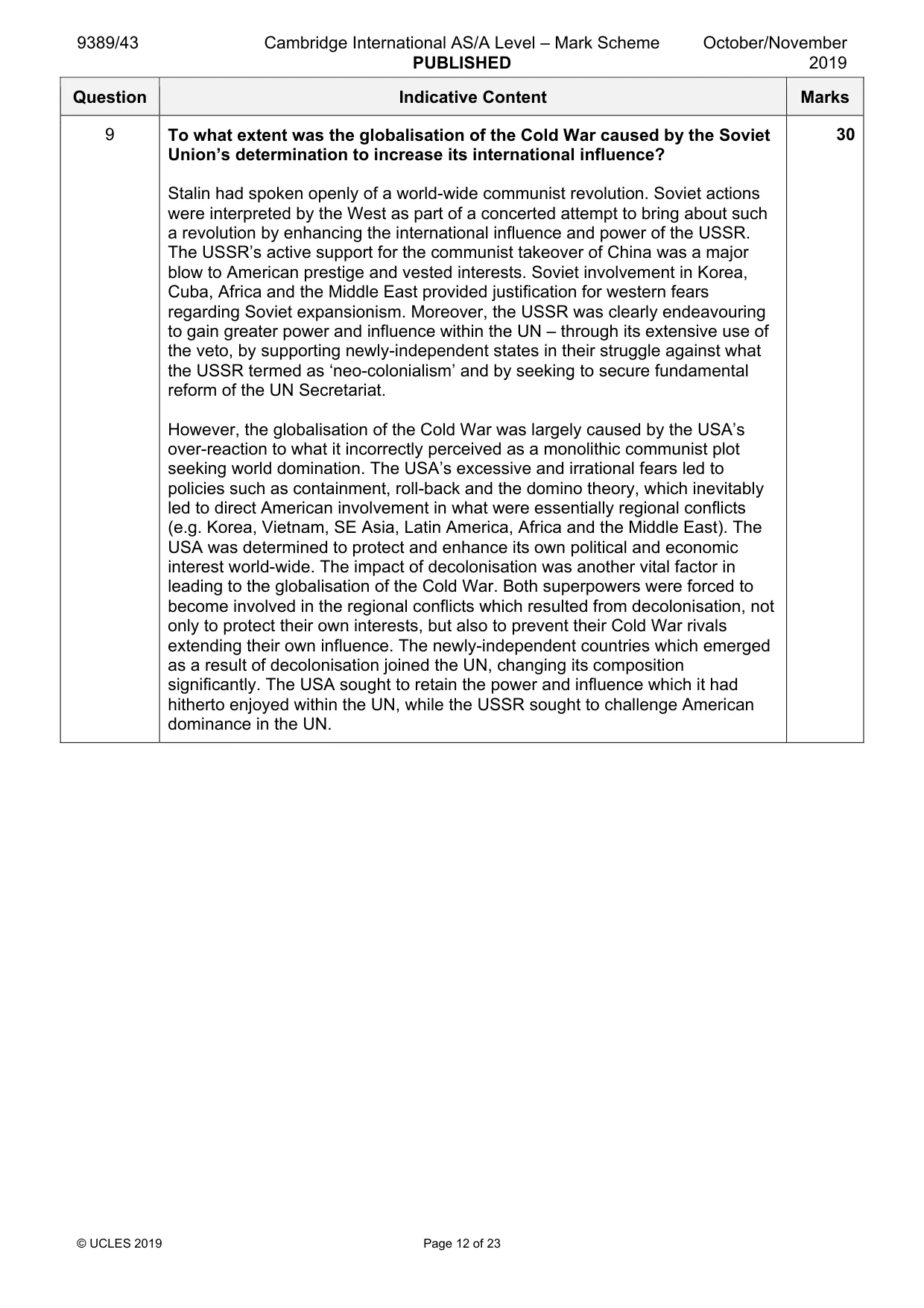
9389/43 Cambridge International AS/A Level – Mark Scheme PUBLISHED October/November 2019 © UCLES 2019 Page 12 of 23 Question Indicative Content Marks 9 To what extent was the globalisation of the Cold War caused by the Soviet Union’s determination to increase its international influence? Stalin had spoken openly of a world-wide communist revolution. Soviet actions were interpreted by the West as part of a concerted attempt to bring about such a revolution by enhancing the international influence and power of the USSR. The USSR’s active support for the communist takeover of China was a major blow to American prestige and vested interests. Soviet involvement in Korea, Cuba, Africa and the Middle East provided justification for western fears regarding Soviet expansionism. Moreover, the USSR was clearly endeavouring to gain greater power and influence within the UN – through its extensive use of the veto, by supporting newly-independent states in their struggle against what the USSR termed as ‘neo-colonialism’ and by seeking to secure fundamental reform of the UN Secretariat. However, the globalisation of the Cold War was largely caused by the USA’s over-reaction to what it incorrectly perceived as a monolithic communist plot seeking world domination. The USA’s excessive and irrational fears led to policies such as containment, roll-back and the domino theory, which inevitably led to direct American involvement in what were essentially regional conflicts (e.g. Korea, Vietnam, SE Asia, Latin America, Africa and the Middle East). The USA was determined to protect and enhance its own political and economic interest world-wide. The impact of decolonisation was another vital factor in leading to the globalisation of the Cold War. Both superpowers were forced to become involved in the regional conflicts which resulted from decolonisation, not only to protect their own interests, but also to prevent their Cold War rivals extending their own influence. The newly-independent countries which emerged as a result of decolonisation joined the UN, changing its composition significantly. The USA sought to retain the power and influence which it had hitherto enjoyed within the UN, while the USSR sought to challenge American dominance in the UN. 30
Mark scheme, page 13
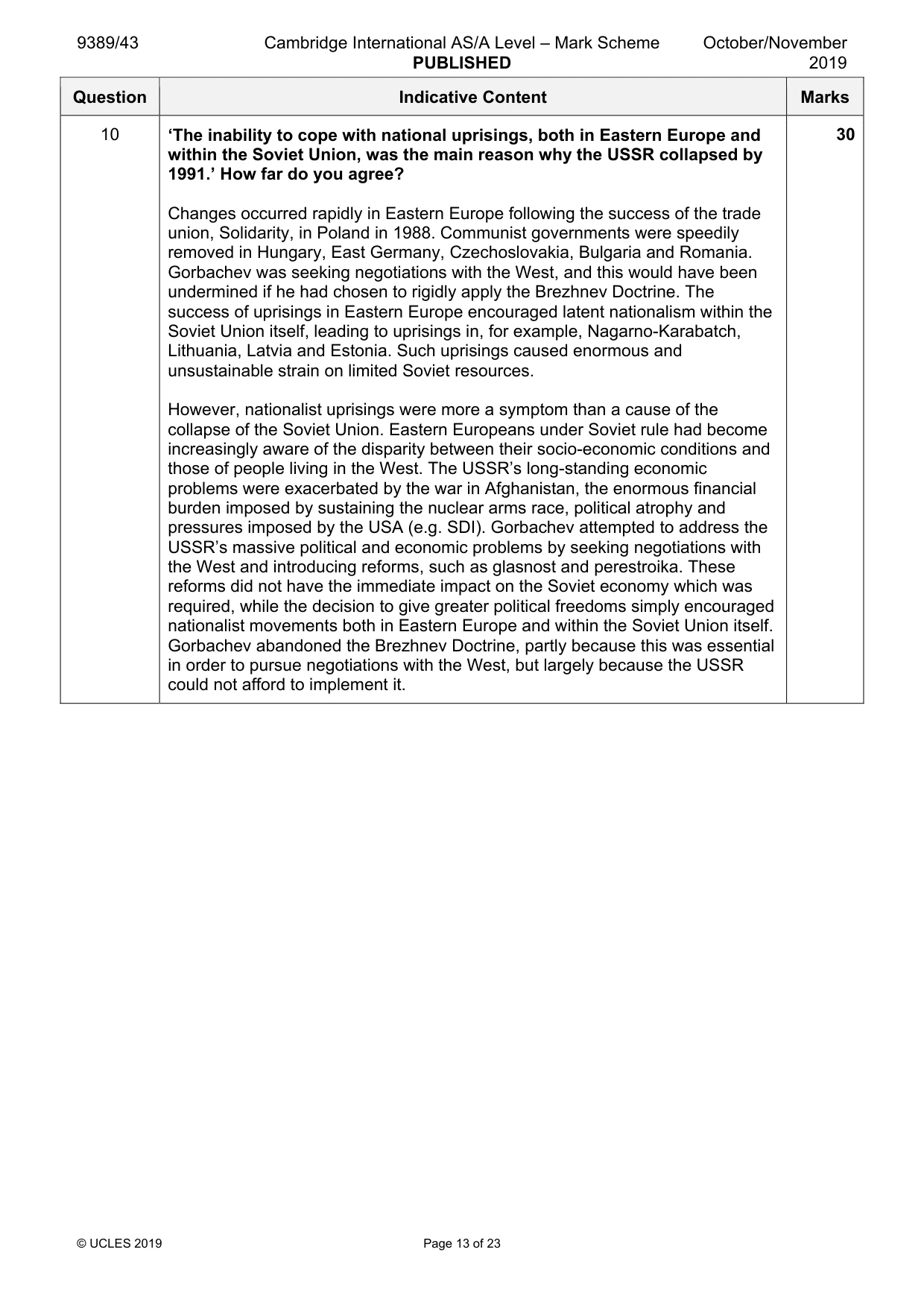
9389/43 Cambridge International AS/A Level – Mark Scheme PUBLISHED October/November 2019 © UCLES 2019 Page 13 of 23 Question Indicative Content Marks 10 ‘The inability to cope with national uprisings, both in Eastern Europe and within the Soviet Union, was the main reason why the USSR collapsed by 1991.’ How far do you agree? Changes occurred rapidly in Eastern Europe following the success of the trade union, Solidarity, in Poland in 1988. Communist governments were speedily removed in Hungary, East Germany, Czechoslovakia, Bulgaria and Romania. Gorbachev was seeking negotiations with the West, and this would have been undermined if he had chosen to rigidly apply the Brezhnev Doctrine. The success of uprisings in Eastern Europe encouraged latent nationalism within the Soviet Union itself, leading to uprisings in, for example, Nagarno-Karabatch, Lithuania, Latvia and Estonia. Such uprisings caused enormous and unsustainable strain on limited Soviet resources. However, nationalist uprisings were more a symptom than a cause of the collapse of the Soviet Union. Eastern Europeans under Soviet rule had become increasingly aware of the disparity between their socio-economic conditions and those of people living in the West. The USSR’s long-standing economic problems were exacerbated by the war in Afghanistan, the enormous financial burden imposed by sustaining the nuclear arms race, political atrophy and pressures imposed by the USA (e.g. SDI). Gorbachev attempted to address the USSR’s massive political and economic problems by seeking negotiations with the West and introducing reforms, such as glasnost and perestroika. These reforms did not have the immediate impact on the Soviet economy which was required, while the decision to give greater political freedoms simply encouraged nationalist movements both in Eastern Europe and within the Soviet Union itself. Gorbachev abandoned the Brezhnev Doctrine, partly because this was essential in order to pursue negotiations with the West, but largely because the USSR could not afford to implement it. 30
Mark scheme, page 14
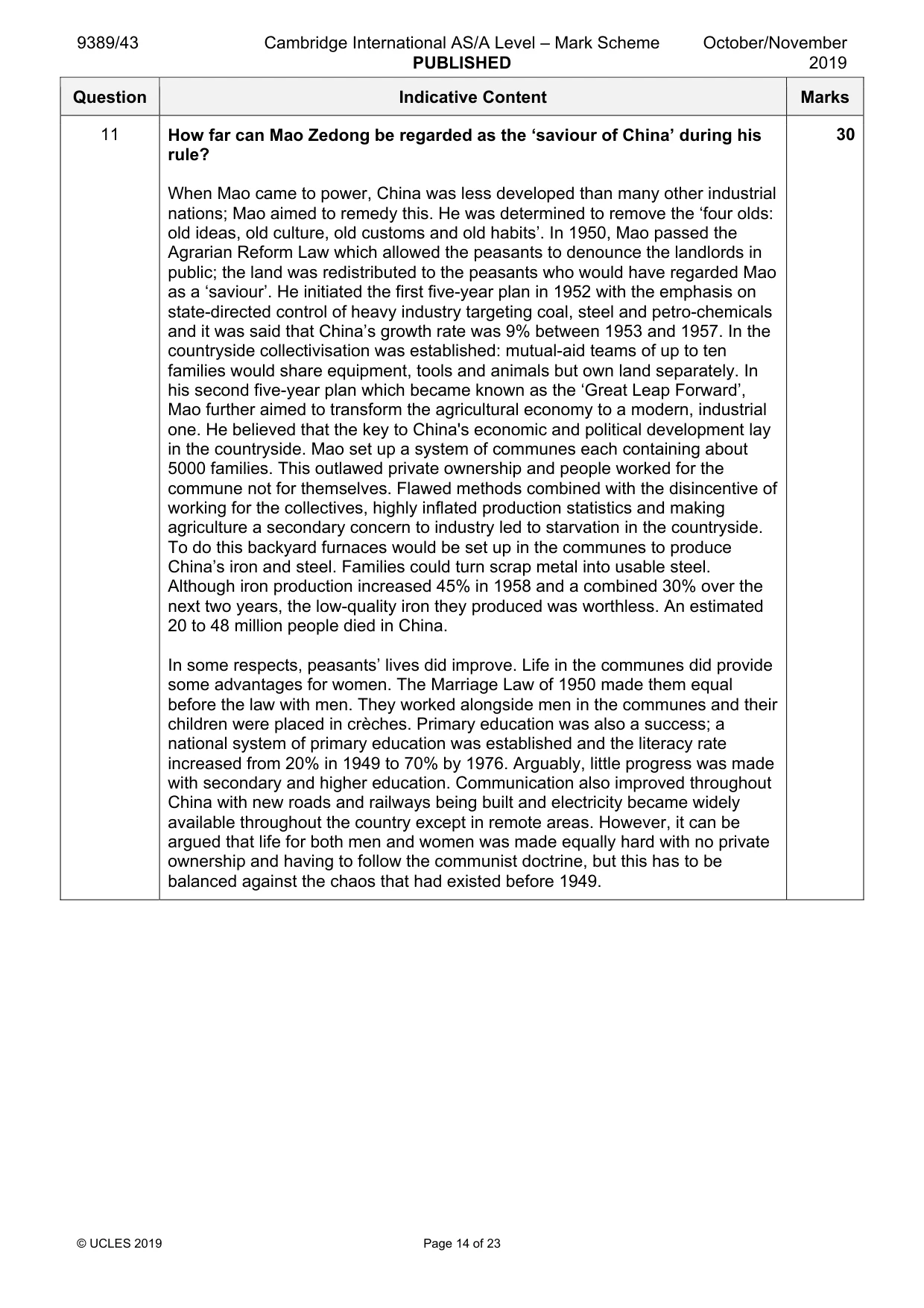
9389/43 Cambridge International AS/A Level – Mark Scheme PUBLISHED October/November 2019 © UCLES 2019 Page 14 of 23 Question Indicative Content Marks 11 How far can Mao Zedong be regarded as the ‘saviour of China’ during his rule? When Mao came to power, China was less developed than many other industrial nations; Mao aimed to remedy this. He was determined to remove the ‘four olds: old ideas, old culture, old customs and old habits’. In 1950, Mao passed the Agrarian Reform Law which allowed the peasants to denounce the landlords in public; the land was redistributed to the peasants who would have regarded Mao as a ‘saviour’. He initiated the first five-year plan in 1952 with the emphasis on state-directed control of heavy industry targeting coal, steel and petro-chemicals and it was said that China’s growth rate was 9% between 1953 and 1957. In the countryside collectivisation was established: mutual-aid teams of up to ten families would share equipment, tools and animals but own land separately. In his second five-year plan which became known as the ‘Great Leap Forward’, Mao further aimed to transform the agricultural economy to a modern, industrial one. He believed that the key to China's economic and political development lay in the countryside. Mao set up a system of communes each containing about 5000 families. This outlawed private ownership and people worked for the commune not for themselves. Flawed methods combined with the disincentive of working for the collectives, highly inflated production statistics and making agriculture a secondary concern to industry led to starvation in the countryside. To do this backyard furnaces would be set up in the communes to produce China’s iron and steel. Families could turn scrap metal into usable steel. Although iron production increased 45% in 1958 and a combined 30% over the next two years, the low-quality iron they produced was worthless. An estimated 20 to 48 million people died in China. In some respects, peasants’ lives did improve. Life in the communes did provide some advantages for women. The Marriage Law of 1950 made them equal before the law with men. They worked alongside men in the communes and their children were placed in crèches. Primary education was also a success; a national system of primary education was established and the literacy rate increased from 20% in 1949 to 70% by 1976. Arguably, little progress was made with secondary and higher education. Communication also improved throughout China with new roads and railways being built and electricity became widely available throughout the country except in remote areas. However, it can be argued that life for both men and women was made equally hard with no private ownership and having to follow the communist doctrine, but this has to be balanced against the chaos that had existed before 1949. 30
Mark scheme, page 15
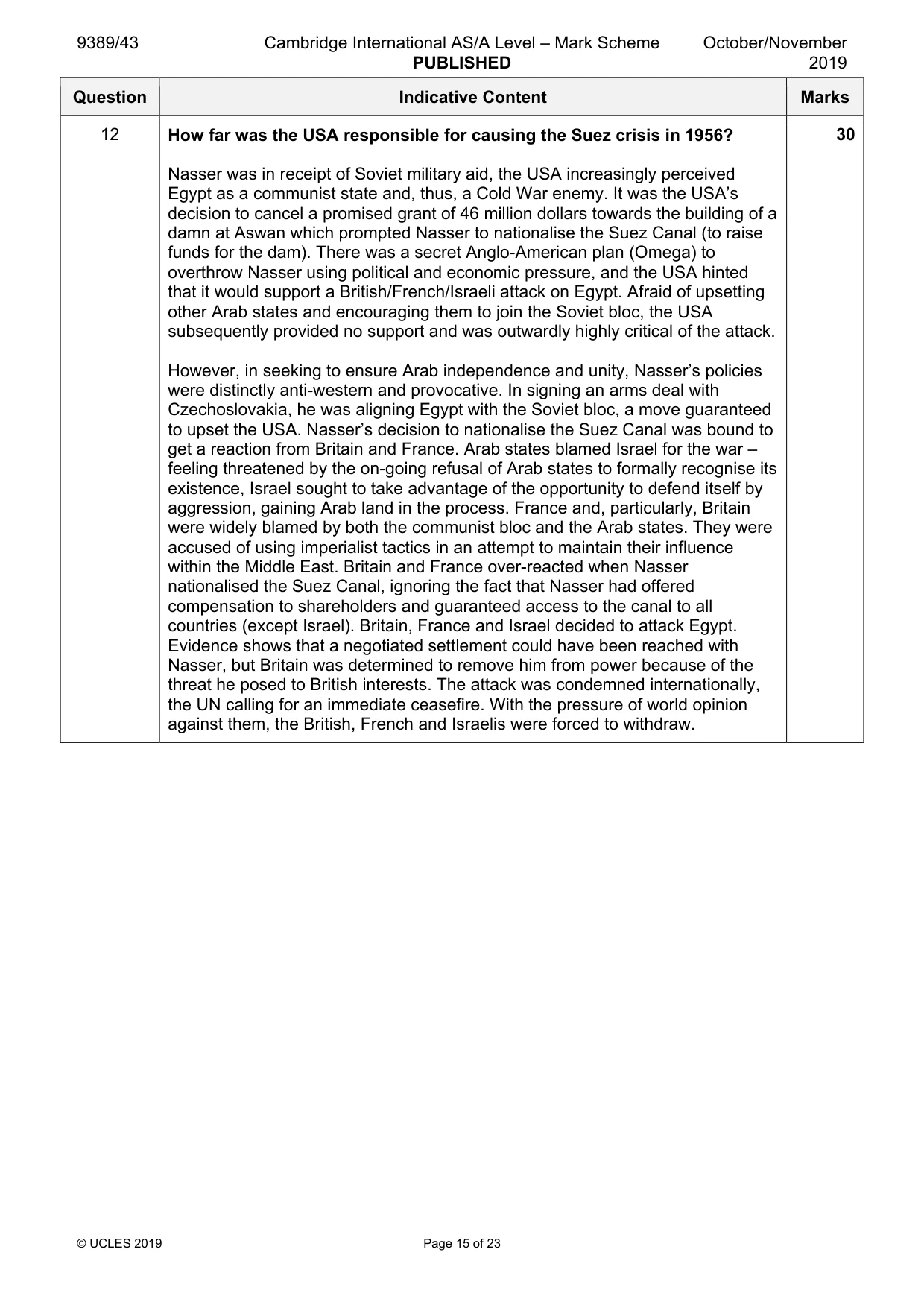
9389/43 Cambridge International AS/A Level – Mark Scheme PUBLISHED October/November 2019 © UCLES 2019 Page 15 of 23 Question Indicative Content Marks 12 How far was the USA responsible for causing the Suez crisis in 1956? Nasser was in receipt of Soviet military aid, the USA increasingly perceived Egypt as a communist state and, thus, a Cold War enemy. It was the USA’s decision to cancel a promised grant of 46 million dollars towards the building of a damn at Aswan which prompted Nasser to nationalise the Suez Canal (to raise funds for the dam). There was a secret Anglo-American plan (Omega) to overthrow Nasser using political and economic pressure, and the USA hinted that it would support a British/French/Israeli attack on Egypt. Afraid of upsetting other Arab states and encouraging them to join the Soviet bloc, the USA subsequently provided no support and was outwardly highly critical of the attack. However, in seeking to ensure Arab independence and unity, Nasser’s policies were distinctly anti-western and provocative. In signing an arms deal with Czechoslovakia, he was aligning Egypt with the Soviet bloc, a move guaranteed to upset the USA. Nasser’s decision to nationalise the Suez Canal was bound to get a reaction from Britain and France. Arab states blamed Israel for the war – feeling threatened by the on-going refusal of Arab states to formally recognise its existence, Israel sought to take advantage of the opportunity to defend itself by aggression, gaining Arab land in the process. France and, particularly, Britain were widely blamed by both the communist bloc and the Arab states. They were accused of using imperialist tactics in an attempt to maintain their influence within the Middle East. Britain and France over-reacted when Nasser nationalised the Suez Canal, ignoring the fact that Nasser had offered compensation to shareholders and guaranteed access to the canal to all countries (except Israel). Britain, France and Israel decided to attack Egypt. Evidence shows that a negotiated settlement could have been reached with Nasser, but Britain was determined to remove him from power because of the threat he posed to British interests. The attack was condemned internationally, the UN calling for an immediate ceasefire. With the pressure of world opinion against them, the British, French and Israelis were forced to withdraw. 30
Mark scheme, page 16
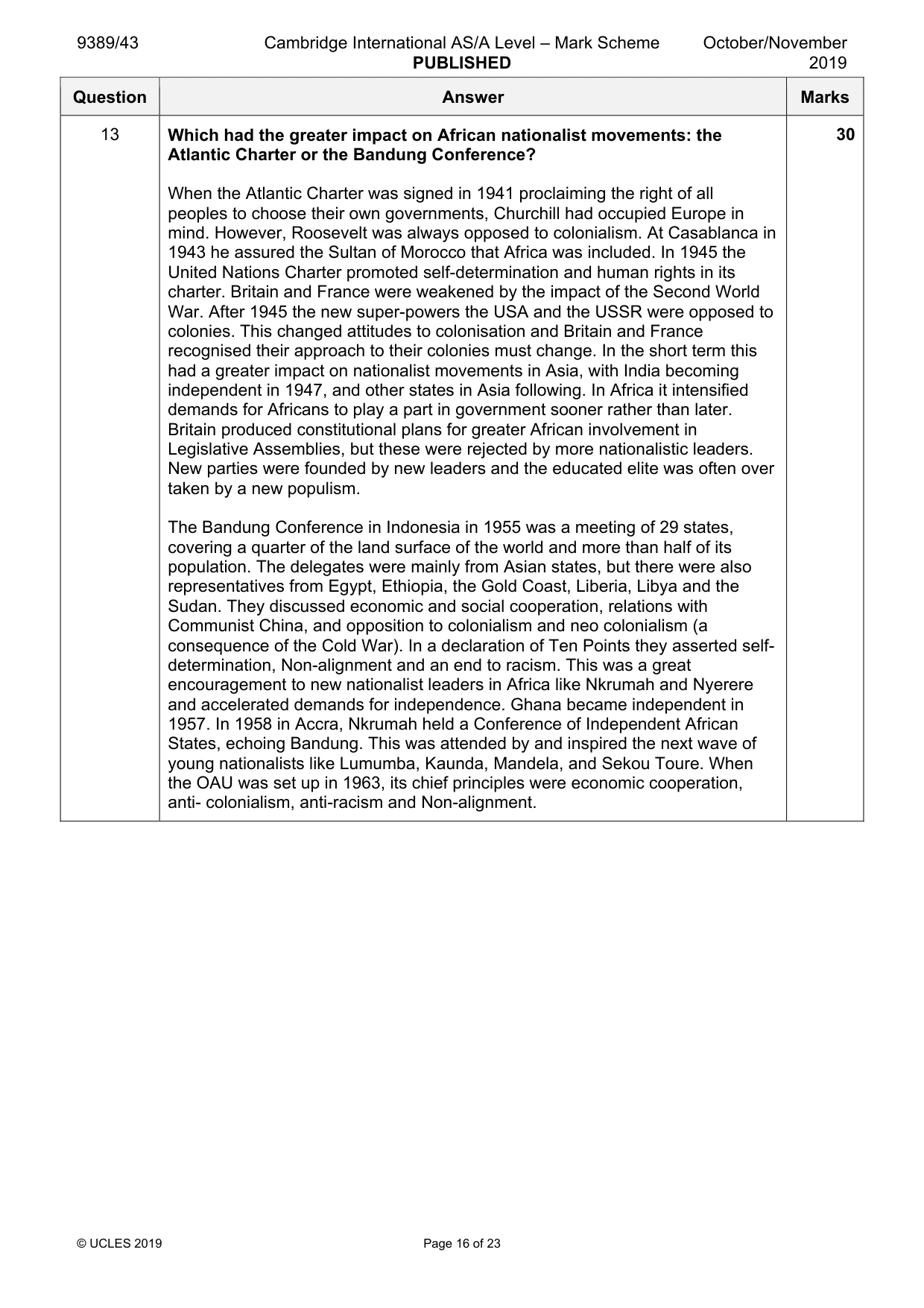
9389/43 Cambridge International AS/A Level – Mark Scheme PUBLISHED October/November 2019 © UCLES 2019 Page 16 of 23 Question Answer Marks 13 Which had the greater impact on African nationalist movements: the Atlantic Charter or the Bandung Conference? When the Atlantic Charter was signed in 1941 proclaiming the right of all peoples to choose their own governments, Churchill had occupied Europe in mind. However, Roosevelt was always opposed to colonialism. At Casablanca in 1943 he assured the Sultan of Morocco that Africa was included. In 1945 the United Nations Charter promoted self-determination and human rights in its charter. Britain and France were weakened by the impact of the Second World War. After 1945 the new super-powers the USA and the USSR were opposed to colonies. This changed attitudes to colonisation and Britain and France recognised their approach to their colonies must change. In the short term this had a greater impact on nationalist movements in Asia, with India becoming independent in 1947, and other states in Asia following. In Africa it intensified demands for Africans to play a part in government sooner rather than later. Britain produced constitutional plans for greater African involvement in Legislative Assemblies, but these were rejected by more nationalistic leaders. New parties were founded by new leaders and the educated elite was often over taken by a new populism. The Bandung Conference in Indonesia in 1955 was a meeting of 29 states, covering a quarter of the land surface of the world and more than half of its population. The delegates were mainly from Asian states, but there were also representatives from Egypt, Ethiopia, the Gold Coast, Liberia, Libya and the Sudan. They discussed economic and social cooperation, relations with Communist China, and opposition to colonialism and neo colonialism (a consequence of the Cold War). In a declaration of Ten Points they asserted self- determination, Non-alignment and an end to racism. This was a great encouragement to new nationalist leaders in Africa like Nkrumah and Nyerere and accelerated demands for independence. Ghana became independent in 1957. In 1958 in Accra, Nkrumah held a Conference of Independent African States, echoing Bandung. This was attended by and inspired the next wave of young nationalists like Lumumba, Kaunda, Mandela, and Sekou Toure. When the OAU was set up in 1963, its chief principles were economic cooperation, anti- colonialism, anti-racism and Non-alignment. 30
Mark scheme, page 17
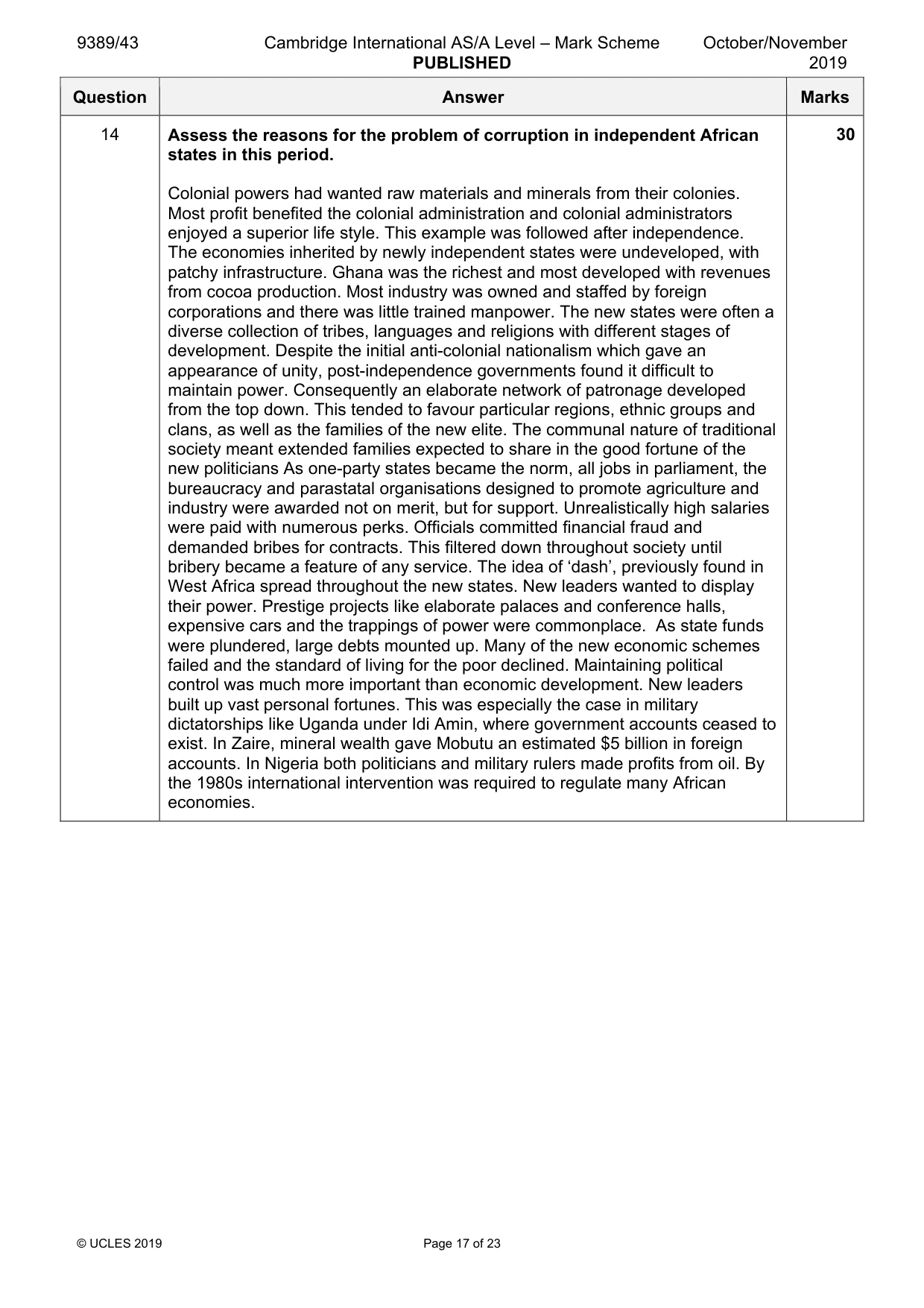
9389/43 Cambridge International AS/A Level – Mark Scheme PUBLISHED October/November 2019 © UCLES 2019 Page 17 of 23 Question Answer Marks 14 Assess the reasons for the problem of corruption in independent African states in this period. Colonial powers had wanted raw materials and minerals from their colonies. Most profit benefited the colonial administration and colonial administrators enjoyed a superior life style. This example was followed after independence. The economies inherited by newly independent states were undeveloped, with patchy infrastructure. Ghana was the richest and most developed with revenues from cocoa production. Most industry was owned and staffed by foreign corporations and there was little trained manpower. The new states were often a diverse collection of tribes, languages and religions with different stages of development. Despite the initial anti-colonial nationalism which gave an appearance of unity, post-independence governments found it difficult to maintain power. Consequently an elaborate network of patronage developed from the top down. This tended to favour particular regions, ethnic groups and clans, as well as the families of the new elite. The communal nature of traditional society meant extended families expected to share in the good fortune of the new politicians As one-party states became the norm, all jobs in parliament, the bureaucracy and parastatal organisations designed to promote agriculture and industry were awarded not on merit, but for support. Unrealistically high salaries were paid with numerous perks. Officials committed financial fraud and demanded bribes for contracts. This filtered down throughout society until bribery became a feature of any service. The idea of ‘dash’, previously found in West Africa spread throughout the new states. New leaders wanted to display their power. Prestige projects like elaborate palaces and conference halls, expensive cars and the trappings of power were commonplace. As state funds were plundered, large debts mounted up. Many of the new economic schemes failed and the standard of living for the poor declined. Maintaining political control was much more important than economic development. New leaders built up vast personal fortunes. This was especially the case in military dictatorships like Uganda under Idi Amin, where government accounts ceased to exist. In Zaire, mineral wealth gave Mobutu an estimated $5 billion in foreign accounts. In Nigeria both politicians and military rulers made profits from oil. By the 1980s international intervention was required to regulate many African economies. 30
Mark scheme, page 18
9389/43 Cambridge International AS/A Level – Mark Scheme PUBLISHED October/November 2019 © UCLES 2019 Page 18 of 23 Question Answer Marks 15 Assess the impact of independence on education in African states in this period. There was great variation in education between different countries and between different regions within countries. British West Africa had the most developed education. By the late 1950s only 16% of Africans were literate and 3% had experience of secondary education. There were approximately 8000 secondary school graduates, almost half of whom came from Ghana and Nigeria. Britain had established 3 universities in Ibadan, Accra and Uganda. There were no universities in French Africa. Education had primarily been provided by Christian missionaries, which was why west and east Nigeria were far in advance of the conservative, Islamic north. In much of Africa administration and the professions were staffed by the colonial powers. The leaders of the newly independent states fully understood the importance of education and saw it as essential to both national and personal advancement. They all considered it a priority. For the examples discussed, detailed knowledge of the development of primary, secondary and tertiary education is required, so a meaningful comparison can be made. Education is expensive. In many countries there was more expansion in the early years. In the 1970s, some countries faced major economic problems exacerbated by drought, falling commodity prices, and the oil crisis. By the 1980s many experienced restructuring by the IMF. There was less money for education. Rapid population growth was also a problem as new schools had to be built and equipped, and extra teachers trained. In the former French colonies, teachers from France continued to arrive as part of French economic help. Civil War damaged progress in some areas. Additionally, socialist leaders were more concerned with equality and the expansion of the primary sector. In Tanzania, Nyerere (a former teacher) linked it with his ideas of Ujamaa. Although his economic policies failed, adult literacy rose from 10–75% and 95% of children were enrolled in primary school. There was an emphasis on arts based higher education in some countries, but the real need was for technical training. Training abroad continued to be offered in Britain and France and increasingly in the USSR and China. There were fewer educational opportunities for girls than boys; urban children had more opportunities than those in rural areas. 30
Mark scheme, page 19
9389/43 Cambridge International AS/A Level – Mark Scheme PUBLISHED October/November 2019 © UCLES 2019 Page 19 of 23 Question Answer Marks 16 Assess the effectiveness of United Nations involvement in flashpoint situations in Africa in this period. When the United nations was set up in 1945, its constitution identified political neutrality. Consequently, it would not intervene in civil wars. Non-intervention in the internal affairs of member states was also in the constitution of the OAU. This led to inaction in many flashpoint situations. Knowledge and understanding of United Nations action are required on such issues as Togo, Cameroon, Congo, Eritrea and Biafra/Nigeria. Togo and Cameroon were former German colonies handed over to Britain and France as mandates after WWI. After 1945 they became UN trust territories and the UN organised the transition to independence. The future of Eritrea was decided by the UN (it was given to Ethiopia), but the UN kept out of later flashpoints caused by Haile Selassie and Mengistu because they were internal issues. They did not act in the case of Biafra, despite appeals from the Biafran leader, Ojukwu, because it was a civil war. Military intervention took place only in the Congo 1961–64. Not only was Lumumba murdered in this time, but UN troops were used against Katanga, thus compromising neutrality. However, the Congo was preserved as a unified state, discouraging separatists in other countries. This will probably be the main focus of the answer. The context of the Cold War is important as both the USA and the USSR could veto decisions in the Security Council. The UN became much more involved in the 1990s, after the Cold War had ended. Other factors could involve the background to the conflict, the strength of the forces within the country, other agencies acting as mediators, economic considerations, and the quality of leadership on both sides of the conflict. 30
Mark scheme, page 20
9389/43 Cambridge International AS/A Level – Mark Scheme PUBLISHED October/November 2019 © UCLES 2019 Page 20 of 23 Question Answer Marks 17 Evaluate the impact of the Second World War in bringing about the end of Dutch colonial rule in Southeast Asia. Though the Dutch had been successful in suppressing the relatively small Indonesian nationalist movement before 1942, nevertheless, there was the basis of nationalist opposition with the formation of the Indonesian Communist party and the Sarekat Islam party. However without the Second World War it is unlikely that these groups would have had enough support to end Dutch rule. The war transformed the situation with Dutch administrators interned and Japanese support for nationalism and the creation of new institutions and the emergence of nationalist leaders like Sukarno who gained experience of power, albeit under Japanese control. The loss of prestige when European forces surrendered to an Asian power in 1942 was important and the idea of ‘Asia for the Asians’ however flawed in practice by Japanese imperialism was important. What was also important was the change in the support for imperialism brought about by the war. Though the Netherlands were able to regain military control after the war, the war had changed the whole context with the USA opposed to empires and the British having to quit India which challenged the whole idea of Asian empire. The war also reduced Dutch resources and created more divisions about the ethics of maintaining Indonesia as a colony. 30
Mark scheme, page 21
9389/43 Cambridge International AS/A Level – Mark Scheme PUBLISHED October/November 2019 © UCLES 2019 Page 21 of 23 Question Answer Marks 18 Evaluate the reasons why Singapore separated from the Malaysia. The formation of Malaysia was agreed on 9 July 1963 and included Singapore, Malaya, Sarawak and North Borneo. Previous talks between Tunku Abdul Rahman and Lee Kwan Yew had established the terms on which Singapore joined – how much revenue would be contributed, trade agreements and the status of Singapore’s autonomy. However issues of a single market and protection for Singapore’s industries caused dissent and the issue of taxation was aggravated by Malaysia’s need for extra money for the Confrontation with Indonesia and money to develop the less developed North Borneo and Sarawak. The underlying problem was the balance in Singapore and Malaya between the Chinese and Malay populations. Malays dominated in Malaya and Chinese in Singapore. Accusations of discrimination led to racial violence in Singapore in the form of riots in July and September 1964. The Malay dominated United Malay National Organisation clashed with the Singapore based People’s Action Party. By August 1965 the dangers of further communal violence had led the Malayan leader to see separation as the only way forward. It was his influence that propelled the final separation. The prestige and authority of Lee together with his obvious sadness at the failure of the federation ensured that the separation went smoothly. Discussion might focus on whether the underlying issues were too great for the federation to have been a realistic option and whether the economic issues or the dangers of communal violence were the key element in the separation. 30
Mark scheme, page 22
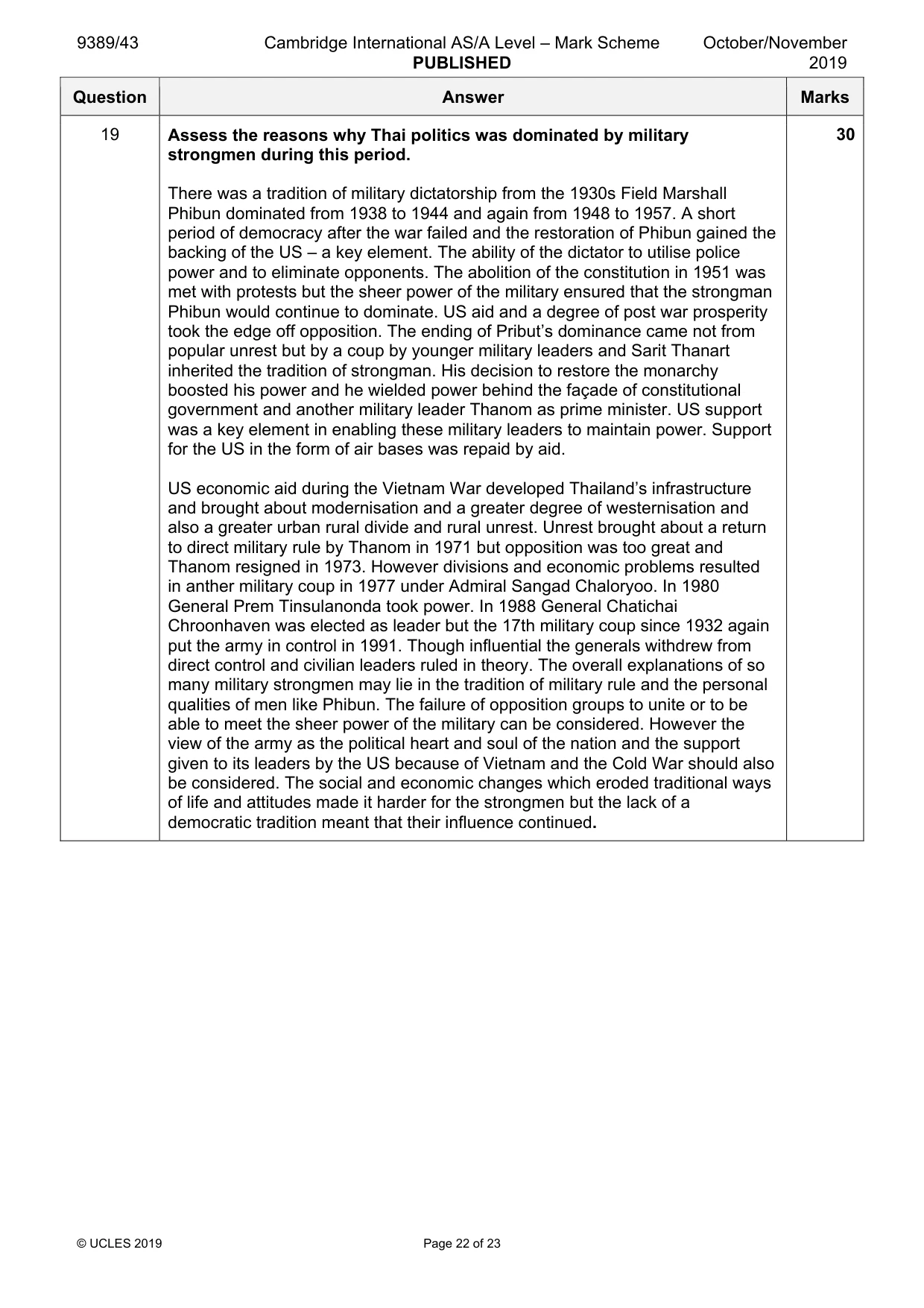
9389/43 Cambridge International AS/A Level – Mark Scheme PUBLISHED October/November 2019 © UCLES 2019 Page 22 of 23 Question Answer Marks 19 Assess the reasons why Thai politics was dominated by military strongmen during this period. There was a tradition of military dictatorship from the 1930s Field Marshall Phibun dominated from 1938 to 1944 and again from 1948 to 1957. A short period of democracy after the war failed and the restoration of Phibun gained the backing of the US – a key element. The ability of the dictator to utilise police power and to eliminate opponents. The abolition of the constitution in 1951 was met with protests but the sheer power of the military ensured that the strongman Phibun would continue to dominate. US aid and a degree of post war prosperity took the edge off opposition. The ending of Pribut’s dominance came not from popular unrest but by a coup by younger military leaders and Sarit Thanart inherited the tradition of strongman. His decision to restore the monarchy boosted his power and he wielded power behind the façade of constitutional government and another military leader Thanom as prime minister. US support was a key element in enabling these military leaders to maintain power. Support for the US in the form of air bases was repaid by aid. US economic aid during the Vietnam War developed Thailand’s infrastructure and brought about modernisation and a greater degree of westernisation and also a greater urban rural divide and rural unrest. Unrest brought about a return to direct military rule by Thanom in 1971 but opposition was too great and Thanom resigned in 1973. However divisions and economic problems resulted in anther military coup in 1977 under Admiral Sangad Chaloryoo. In 1980 General Prem Tinsulanonda took power. In 1988 General Chatichai Chroonhaven was elected as leader but the 17th military coup since 1932 again put the army in control in 1991. Though influential the generals withdrew from direct control and civilian leaders ruled in theory. The overall explanations of so many military strongmen may lie in the tradition of military rule and the personal qualities of men like Phibun. The failure of opposition groups to unite or to be able to meet the sheer power of the military can be considered. However the view of the army as the political heart and soul of the nation and the support given to its leaders by the US because of Vietnam and the Cold War should also be considered. The social and economic changes which eroded traditional ways of life and attitudes made it harder for the strongmen but the lack of a democratic tradition meant that their influence continued. 30
Mark scheme, page 23
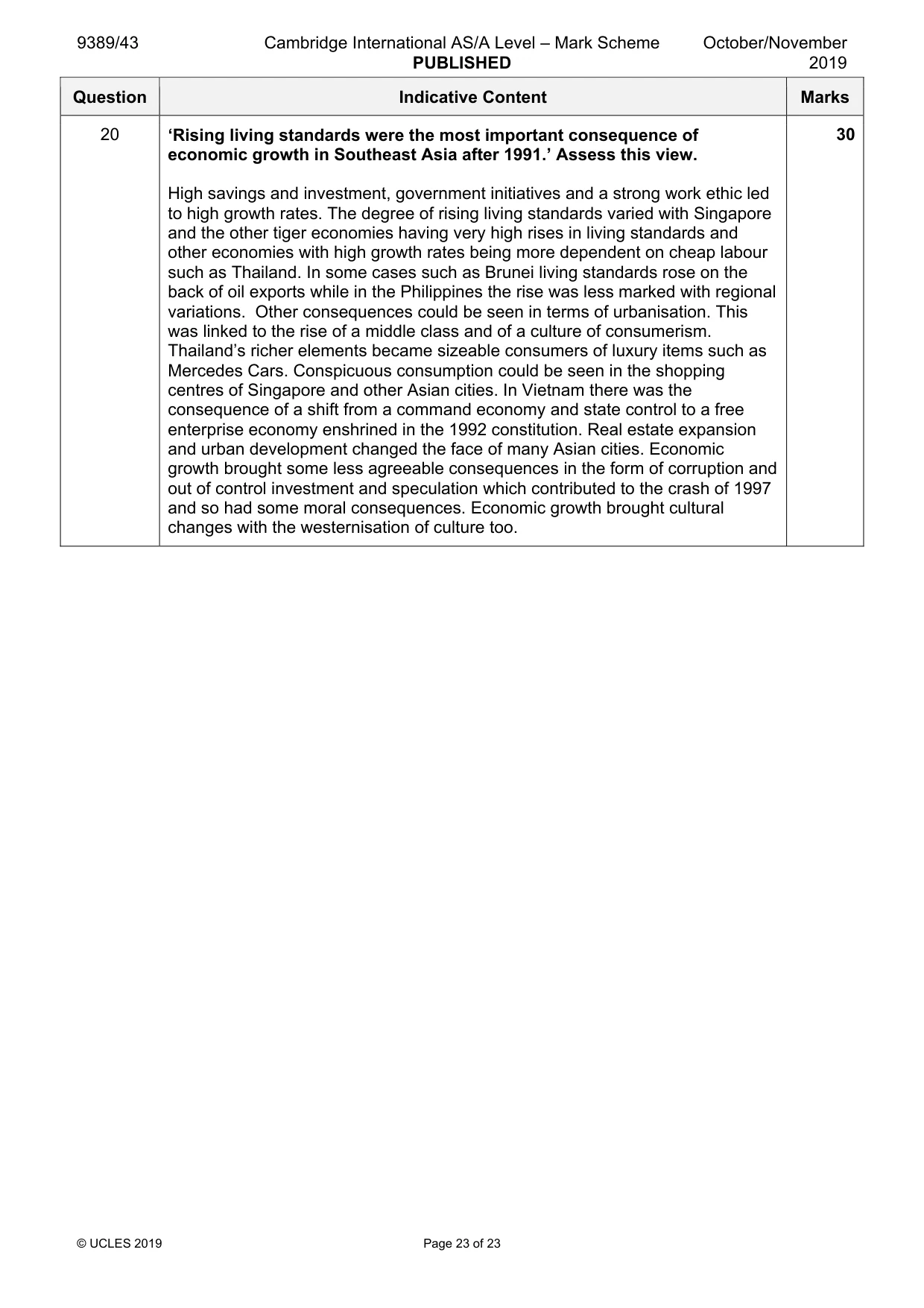
9389/43 Cambridge International AS/A Level – Mark Scheme PUBLISHED October/November 2019 © UCLES 2019 Page 23 of 23 Question Indicative Content Marks 20 ‘Rising living standards were the most important consequence of economic growth in Southeast Asia after 1991.’ Assess this view. High savings and investment, government initiatives and a strong work ethic led to high growth rates. The degree of rising living standards varied with Singapore and the other tiger economies having very high rises in living standards and other economies with high growth rates being more dependent on cheap labour such as Thailand. In some cases such as Brunei living standards rose on the back of oil exports while in the Philippines the rise was less marked with regional variations. Other consequences could be seen in terms of urbanisation. This was linked to the rise of a middle class and of a culture of consumerism. Thailand’s richer elements became sizeable consumers of luxury items such as Mercedes Cars. Conspicuous consumption could be seen in the shopping centres of Singapore and other Asian cities. In Vietnam there was the consequence of a shift from a command economy and state control to a free enterprise economy enshrined in the 1992 constitution. Real estate expansion and urban development changed the face of many Asian cities. Economic growth brought some less agreeable consequences in the form of corruption and out of control investment and speculation which contributed to the crash of 1997 and so had some moral consequences. Economic growth brought cultural changes with the westernisation of culture too. 30
What you needed in this session
Cambridge’s own grade thresholds for 2019 Oct/Nov, Paper 4 · Variant 3. A higher threshold means an easier paper — the bar moves with how the cohort did.