Cambridge A Level History 9389 — 2017 May/June Paper 4 · Variant 1
9389/41/M/J/17 · 11 questions · 60 marks · ≈68 min
The question paper and its mark scheme, free to read here and free to download. This is Cambridge’s own paper, exactly as it was sat.
Question paper4 pages
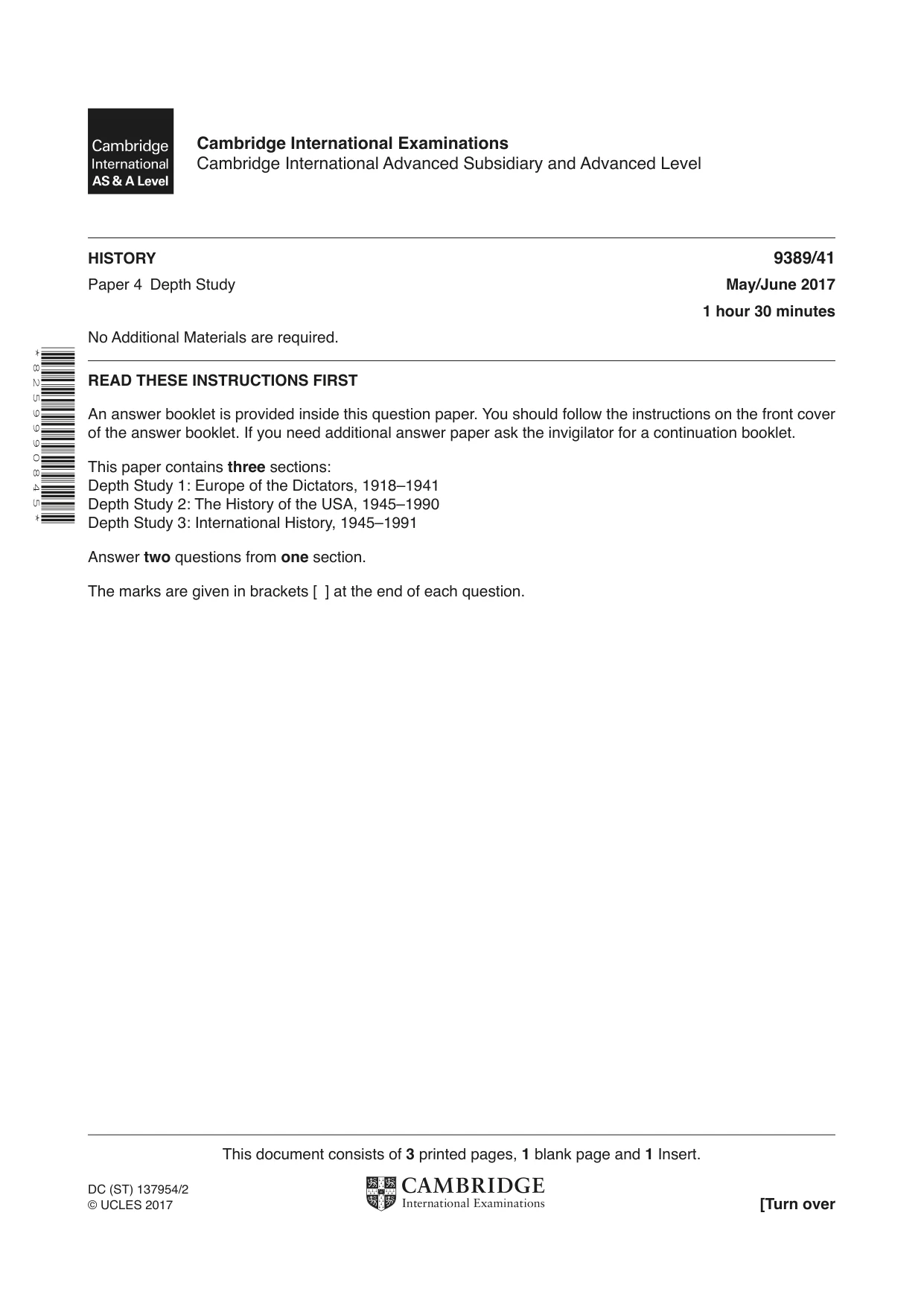
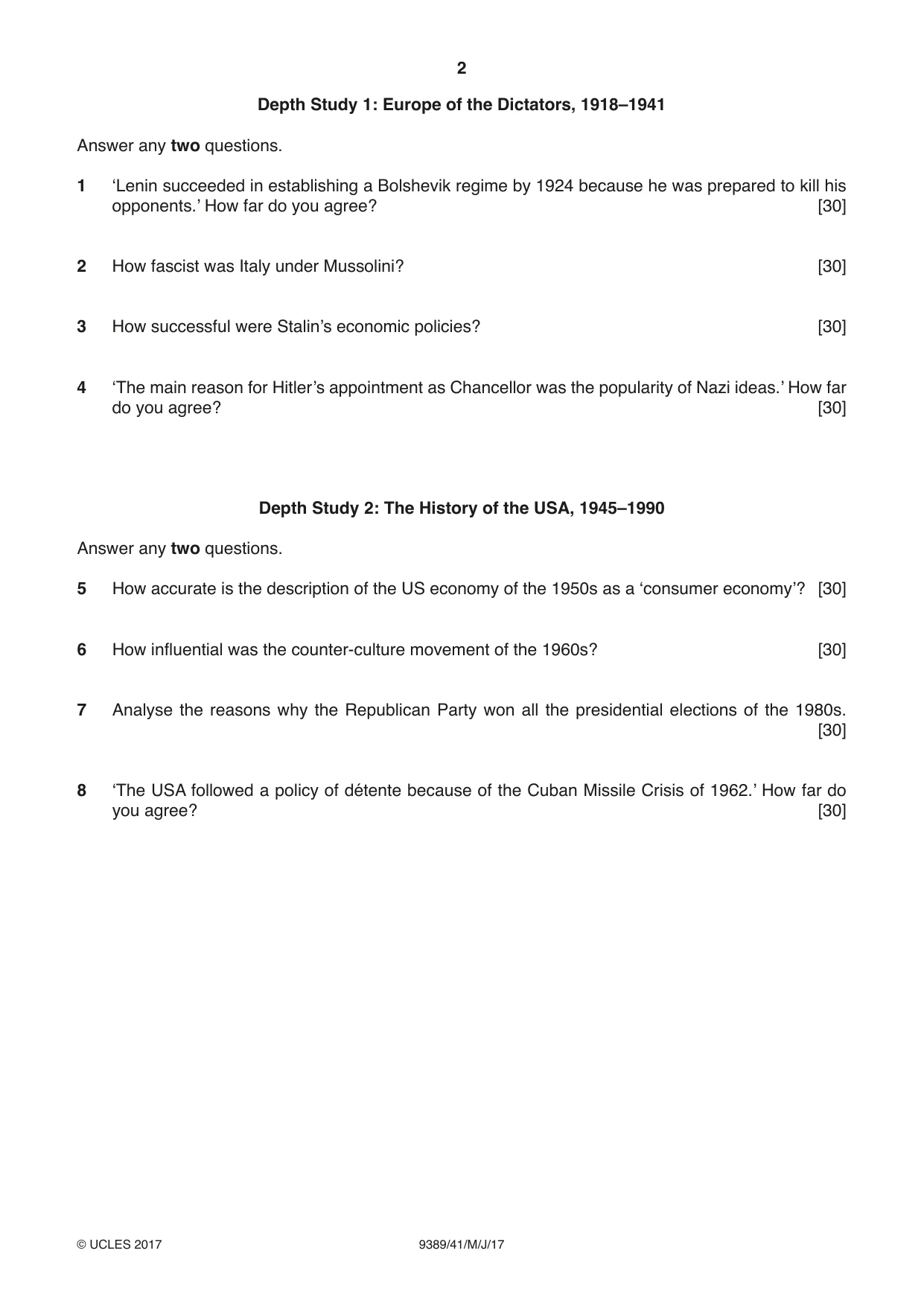
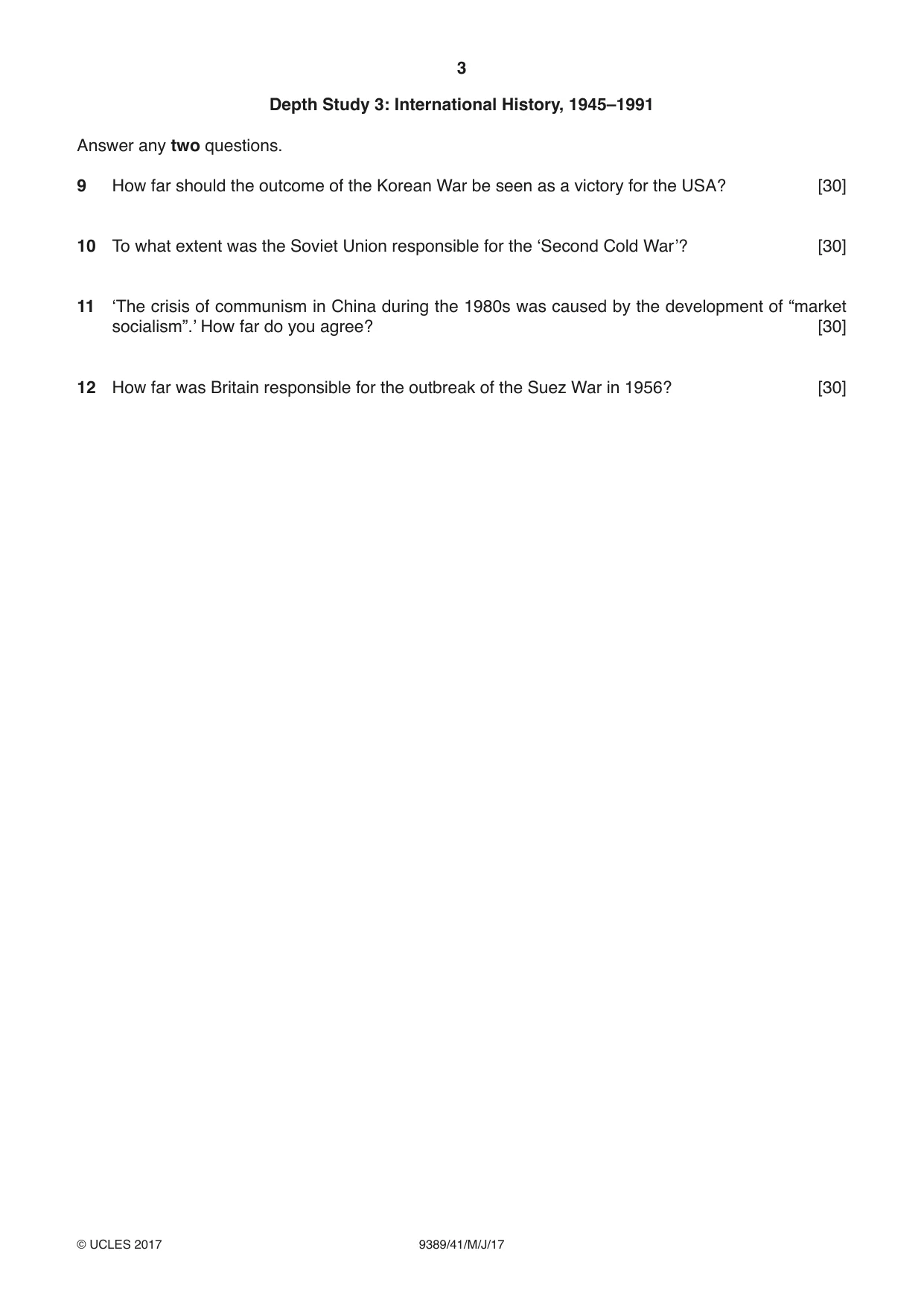
Mark scheme20 pages
Answers below. Sit the paper first if you are practising.
Questions as text
Q1 · ‘Lenin succeeded in establishing a Bolshevik regime by 1924 because he was prepared to…
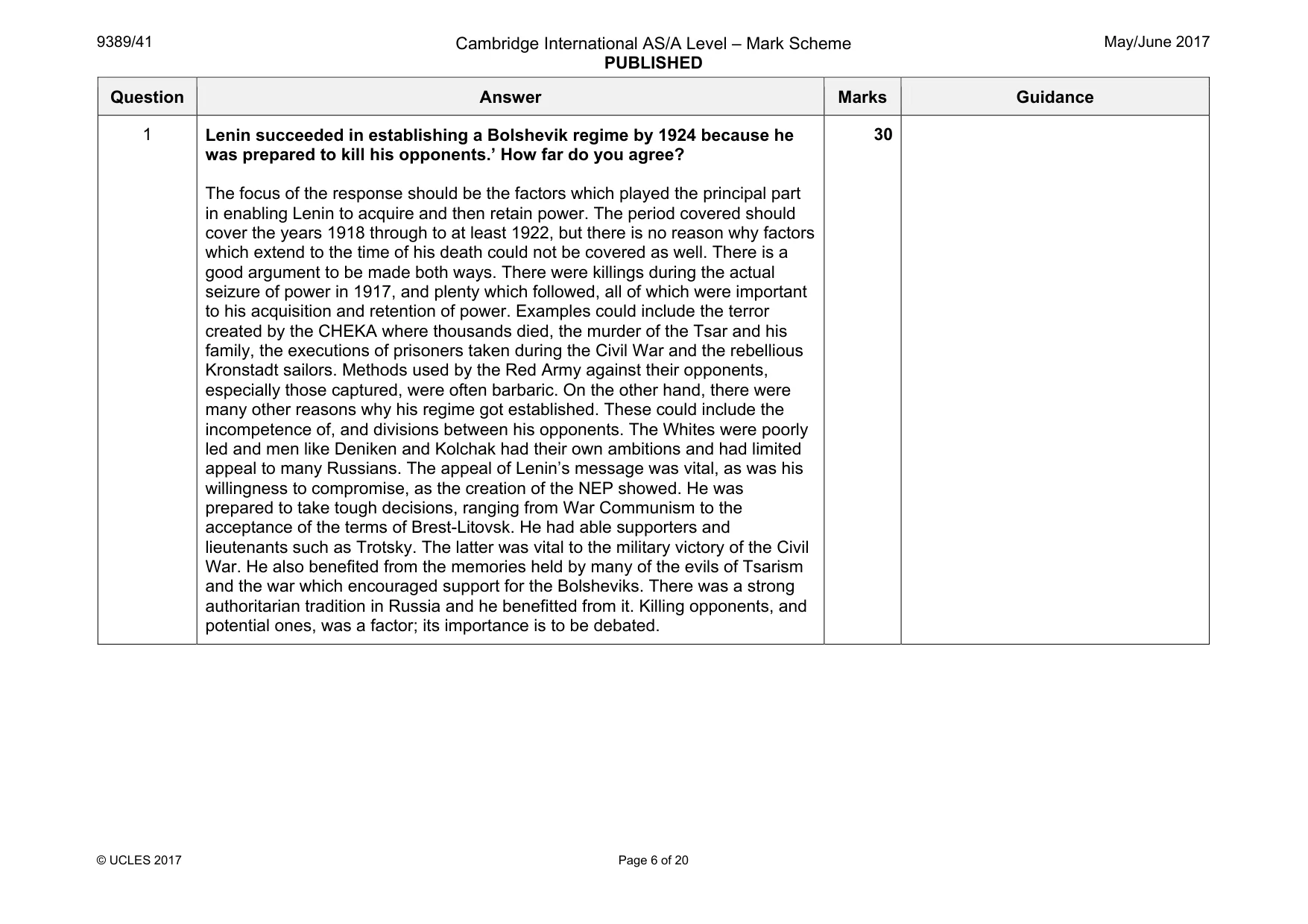
1 ‘Lenin succeeded in establishing a Bolshevik regime by 1924 because he was prepared to kill his opponents.’ How far do you agree? [30]
Mark scheme: 1 Lenin succeeded in establishing a Bolshevik regime by 1924 because he was prepared to kill his opponents.’ How far do you agree? The focus of the response should be the factors which played the principal part in enabling Lenin to acquire and then retain power. The period covered should cover the years 1918 through to at least 1922, but there is no reason why factors which extend to the time of his death could not be covered as well. There is a good argument to be made both ways. There were killings during the actual seizure of power in 1917, and plenty which followed, all of which were important to his acquisition and retention of power. Examples could include the terror created by the CHEKA where thousands died, the murder of the Tsar and his family, the executions of prisoners taken during the Civil War and the rebellious Kronstadt sailors. Methods used by the Red Army against their opponents, especially those captured, were often barbaric. On the other hand, there were many other reasons why his regime got established. These could include the incompetence of, and divisions between his opponents. The Whites were poorly led and men like Deniken and Kolchak had their own ambitions and had limited appeal to many Russians. The appeal of Lenin’s message was vital, as was his willingness to compromise, as the creation of the NEP showed. He was prepared to take tough decisions, ranging from War Communism to the acceptance of the terms of Brest-Litovsk. He had able supporters and lieutenants such as Trotsky. The latter was vital to the military victory of the Civil War. He also benefited from the memories held by many of the evils of Tsarism and the war which encouraged support for the Bolsheviks. There was a strong authoritarian tradition in Russia and he benefitted from it. Killing opponents, and potential ones, was a factor; its importance is to be debated. 30
Q2 · How fascist was Italy under Mussolini?
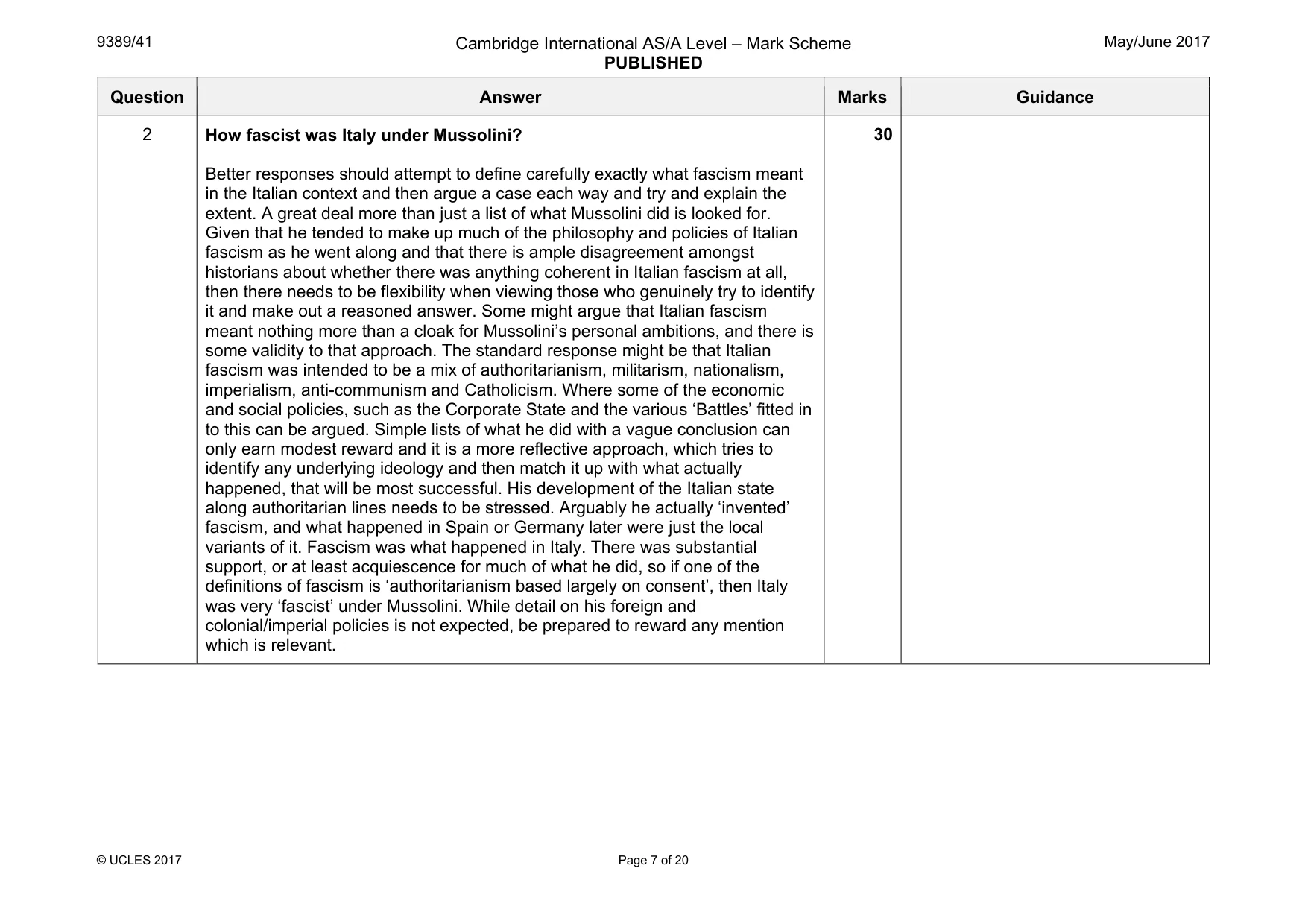
2 How fascist was Italy under Mussolini? [30]
Mark scheme: 2 How fascist was Italy under Mussolini? Better responses should attempt to define carefully exactly what fascism meant in the Italian context and then argue a case each way and try and explain the extent. A great deal more than just a list of what Mussolini did is looked for. Given that he tended to make up much of the philosophy and policies of Italian fascism as he went along and that there is ample disagreement amongst historians about whether there was anything coherent in Italian fascism at all, then there needs to be flexibility when viewing those who genuinely try to identify it and make out a reasoned answer. Some might argue that Italian fascism meant nothing more than a cloak for Mussolini’s personal ambitions, and there is some validity to that approach. The standard response might be that Italian fascism was intended to be a mix of authoritarianism, militarism, nationalism, imperialism, anti-communism and Catholicism. Where some of the economic and social policies, such as the Corporate State and the various ‘Battles’ fitted in to this can be argued. Simple lists of what he did with a vague conclusion can only earn modest reward and it is a more reflective approach, which tries to identify any underlying ideology and then match it up with what actually happened, that will be most successful. His development of the Italian state along authoritarian lines needs to be stressed. Arguably he actually ‘invented’ fascism, and what happened in Spain or Germany later were just the local variants of it. Fascism was what happened in Italy. There was substantial support, or at least acquiescence for much of what he did, so if one of the definitions of fascism is ‘authoritarianism based largely on consent’, then Italy was very ‘fascist’ under Mussolini. While detail on his foreign and colonial/imperial policies is not expected, be prepared to reward any mention which is relevant. 30
Q3 · How successful were Stalin’s economic policies?
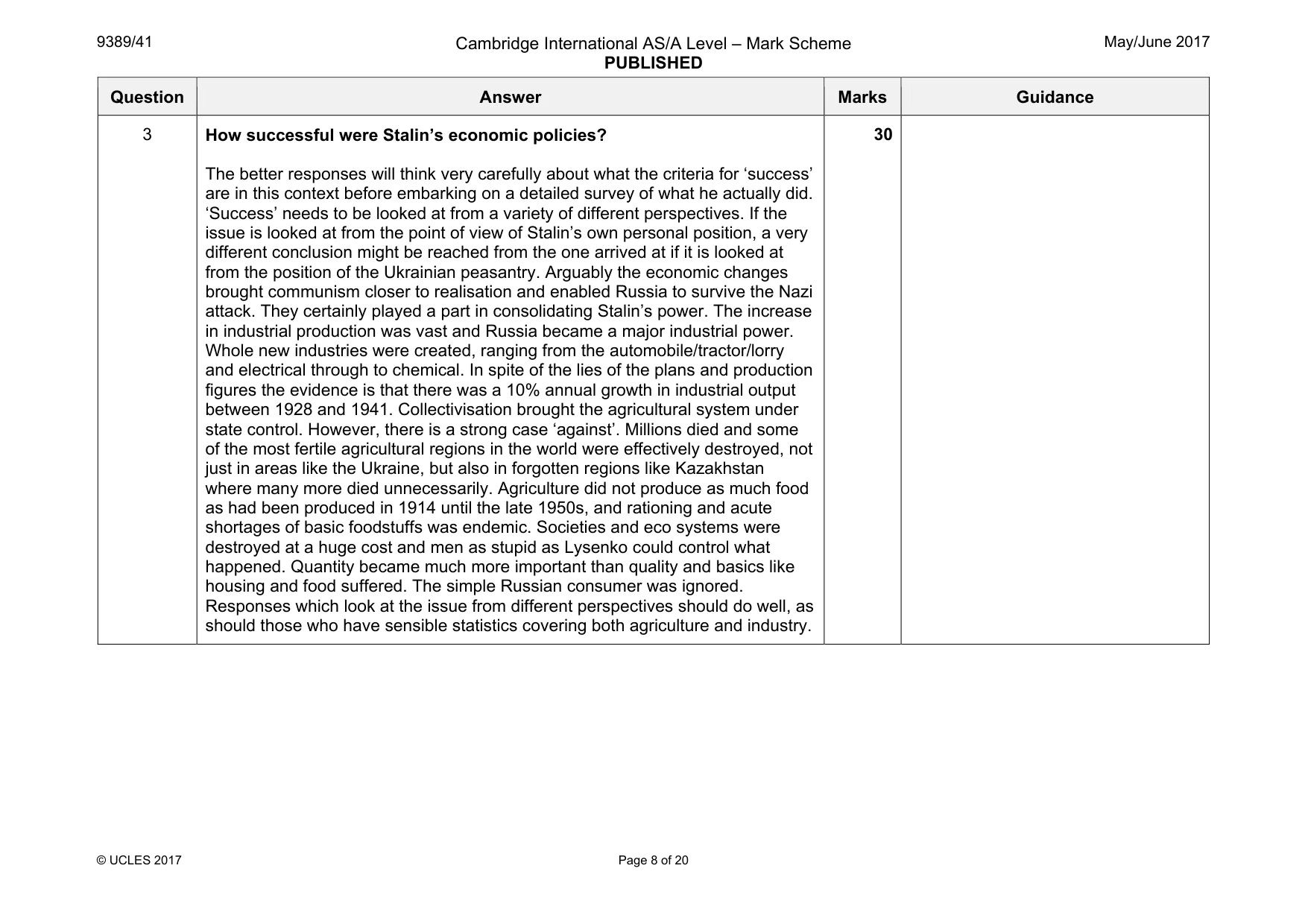
3 How successful were Stalin’s economic policies? [30]
Mark scheme: 3 How successful were Stalin’s economic policies? The better responses will think very carefully about what the criteria for ‘success’ are in this context before embarking on a detailed survey of what he actually did. ‘Success’ needs to be looked at from a variety of different perspectives. If the issue is looked at from the point of view of Stalin’s own personal position, a very different conclusion might be reached from the one arrived at if it is looked at from the position of the Ukrainian peasantry. Arguably the economic changes brought communism closer to realisation and enabled Russia to survive the Nazi attack. They certainly played a part in consolidating Stalin’s power. The increase in industrial production was vast and Russia became a major industrial power. Whole new industries were created, ranging from the automobile/tractor/lorry and electrical through to chemical. In spite of the lies of the plans and production figures the evidence is that there was a 10% annual growth in industrial output between 1928 and 1941. Collectivisation brought the agricultural system under state control. However, there is a strong case ‘against’. Millions died and some of the most fertile agricultural regions in the world were effectively destroyed, not just in areas like the Ukraine, but also in forgotten regions like Kazakhstan where many more died unnecessarily. Agriculture did not produce as much food as had been produced in 1914 until the late 1950s, and rationing and acute shortages of basic foodstuffs was endemic. Societies and eco systems were destroyed at a huge cost and men as stupid as Lysenko could control what happened. Quantity became much more important than quality and basics like housing and food suffered. The simple Russian consumer was ignored. Responses which look at the issue from different perspectives should do well, as should those who have sensible statistics covering both agriculture and industry. 30
Q4 · ‘The main reason for Hitler’s appointment as Chancellor was the popularity of Nazi…
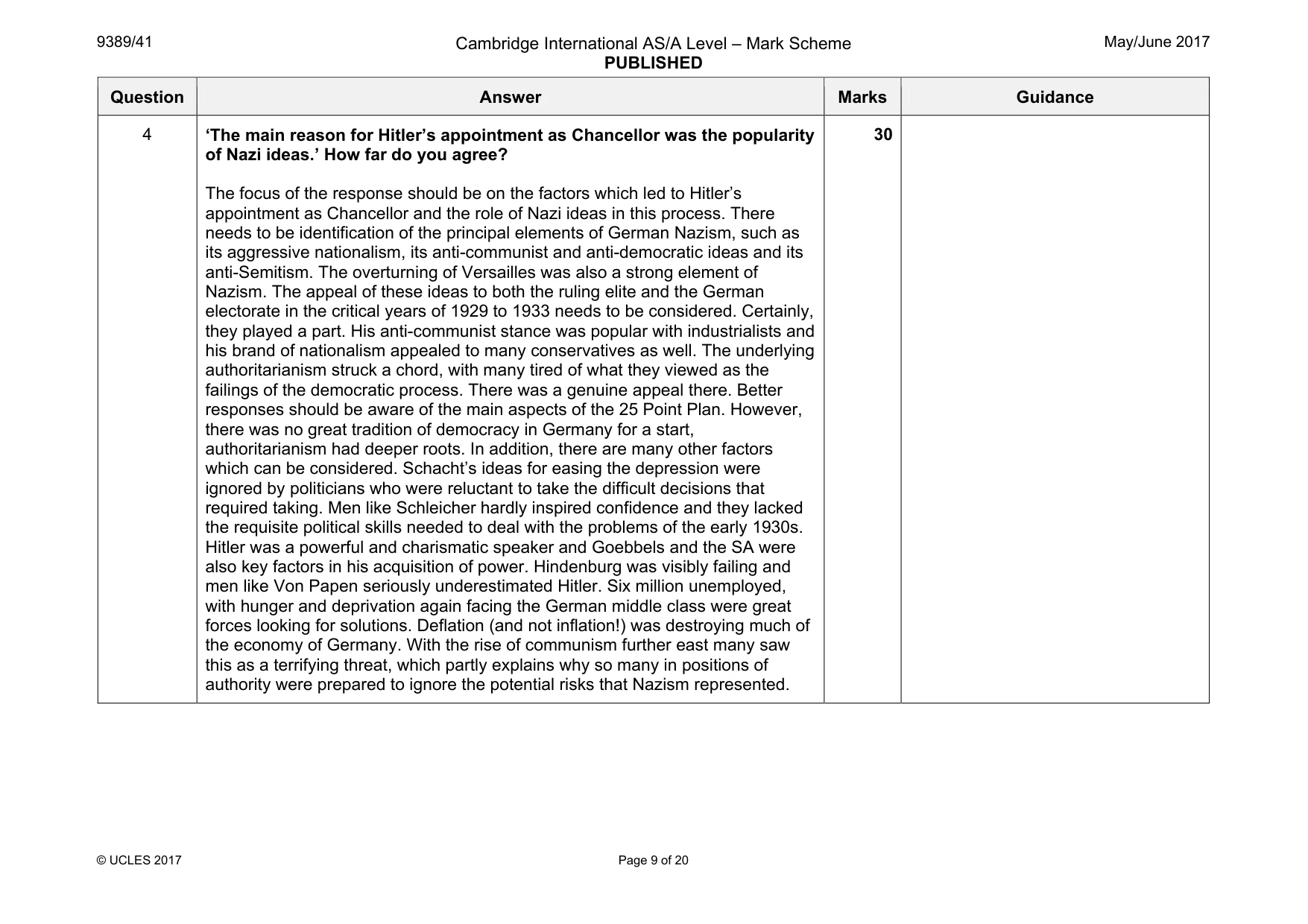
4 ‘The main reason for Hitler’s appointment as Chancellor was the popularity of Nazi ideas.’ How far do you agree? [30] Depth Study 2: The History of the USA, 1945–1990 Answer any two questions.
Mark scheme: 4 ‘The main reason for Hitler’s appointment as Chancellor was the popularity of Nazi ideas.’ How far do you agree? The focus of the response should be on the factors which led to Hitler’s appointment as Chancellor and the role of Nazi ideas in this process. There needs to be identification of the principal elements of German Nazism, such as its aggressive nationalism, its anti-communist and anti-democratic ideas and its anti-Semitism. The overturning of Versailles was also a strong element of Nazism. The appeal of these ideas to both the ruling elite and the German electorate in the critical years of 1929 to 1933 needs to be considered. Certainly, they played a part. His anti-communist stance was popular with industrialists and his brand of nationalism appealed to many conservatives as well. The underlying authoritarianism struck a chord, with many tired of what they viewed as the failings of the democratic process. There was a genuine appeal there. Better responses should be aware of the main aspects of the 25 Point Plan. However, there was no great tradition of democracy in Germany for a start, authoritarianism had deeper roots. In addition, there are many other factors which can be considered. Schacht’s ideas for easing the depression were ignored by politicians who were reluctant to take the difficult decisions that required taking. Men like Schleicher hardly inspired confidence and they lacked the requisite political skills needed to deal with the problems of the early 1930s. Hitler was a powerful and charismatic speaker and Goebbels and the SA were also key factors in his acquisition of power. Hindenburg was visibly failing and men like Von Papen seriously underestimated Hitler. Six million unemployed, with hunger and deprivation again facing the German middle class were great forces looking for solutions. Deflation (and not inflation!) was destroying much of the economy of Germany. With the rise of communism further east many saw this as a terrifying threat, which partly explains why so many in positions of authority were prepared to ignore the potential risks that Nazism represented. 30
Q5 · How accurate is the description of the US economy of the 1950s as a ‘consumer economy’?
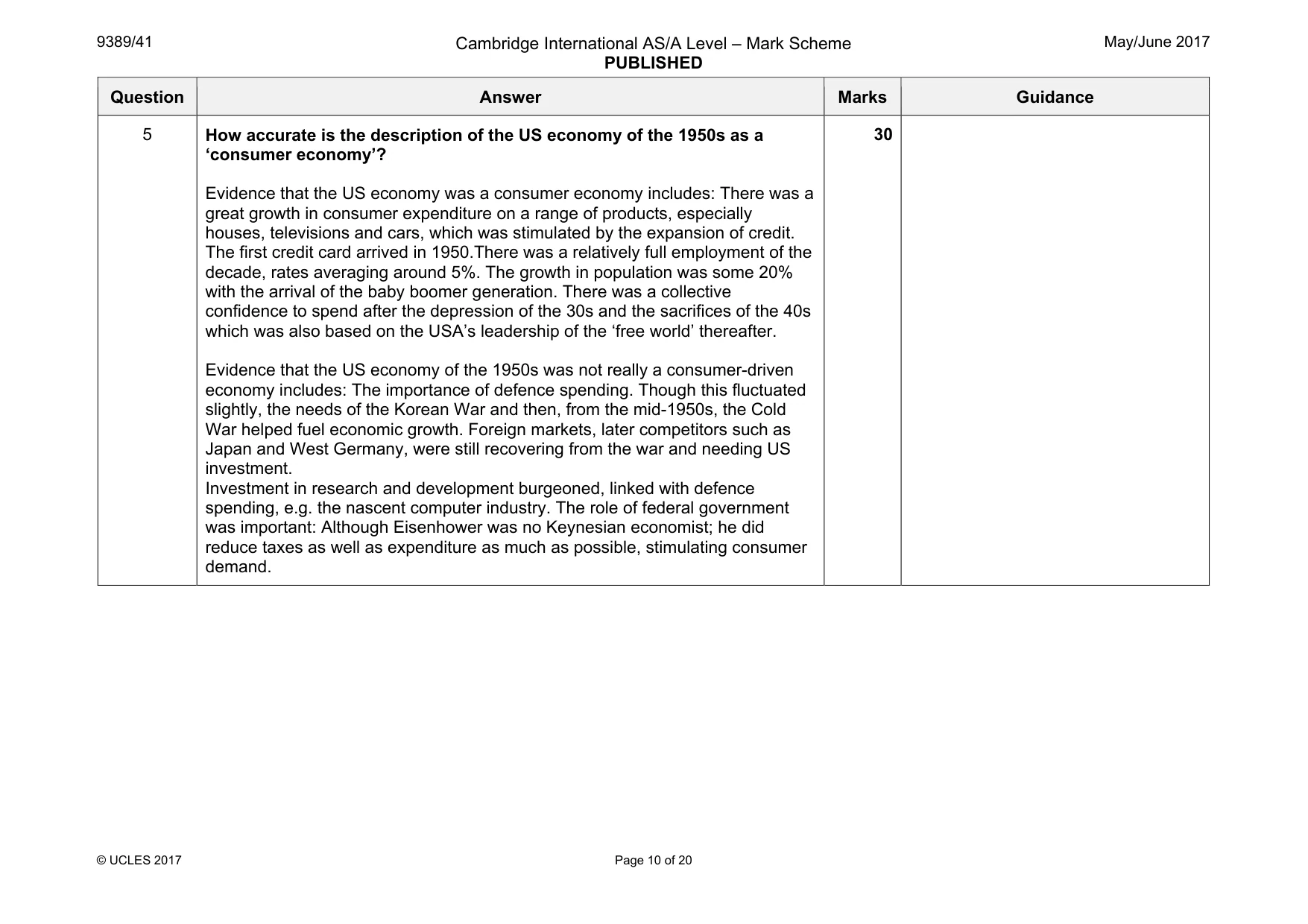
5 How accurate is the description of the US economy of the 1950s as a ‘consumer economy’? [30]
Mark scheme: 5 How accurate is the description of the US economy of the 1950s as a ‘consumer economy’? Evidence that the US economy was a consumer economy includes: There was a great growth in consumer expenditure on a range of products, especially houses, televisions and cars, which was stimulated by the expansion of credit. The first credit card arrived in 1950.There was a relatively full employment of the decade, rates averaging around 5%. The growth in population was some 20% with the arrival of the baby boomer generation. There was a collective confidence to spend after the depression of the 30s and the sacrifices of the 40s which was also based on the USA’s leadership of the ‘free world’ thereafter. Evidence that the US economy of the 1950s was not really a consumer-driven economy includes: The importance of defence spending. Though this fluctuated slightly, the needs of the Korean War and then, from the mid-1950s, the Cold War helped fuel economic growth. Foreign markets, later competitors such as Japan and West Germany, were still recovering from the war and needing US investment. Investment in research and development burgeoned, linked with defence spending, e.g. the nascent computer industry. The role of federal government was important: Although Eisenhower was no Keynesian economist; he did reduce taxes as well as expenditure as much as possible, stimulating consumer demand. 30
Q6 · How influential was the counter-culture movement of the 1960s?
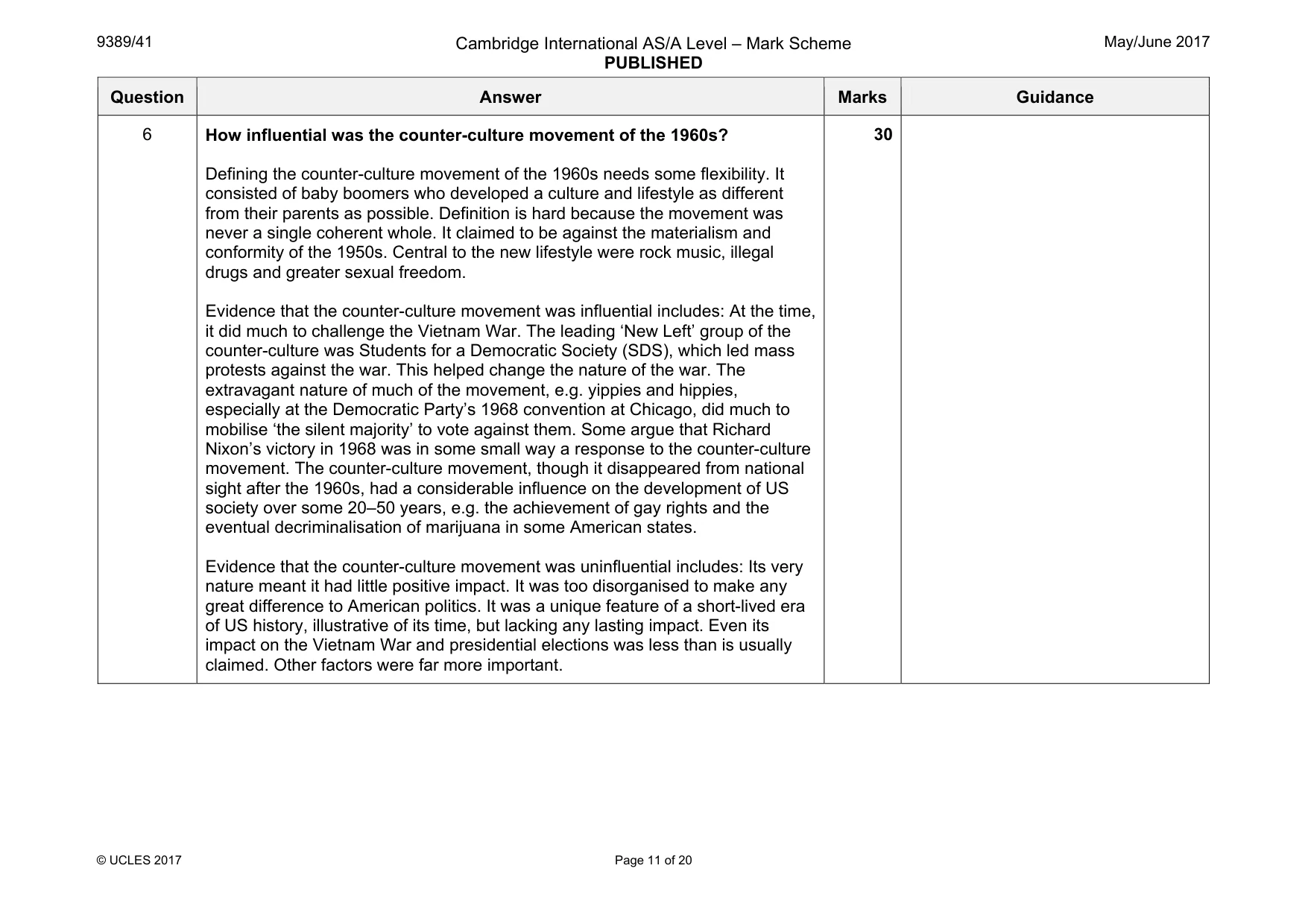
6 How influential was the counter-culture movement of the 1960s? [30]
Mark scheme: 6 How influential was the counter-culture movement of the 1960s? Defining the counter-culture movement of the 1960s needs some flexibility. It consisted of baby boomers who developed a culture and lifestyle as different from their parents as possible. Definition is hard because the movement was never a single coherent whole. It claimed to be against the materialism and conformity of the 1950s. Central to the new lifestyle were rock music, illegal drugs and greater sexual freedom. Evidence that the counter-culture movement was influential includes: At the time, it did much to challenge the Vietnam War. The leading ‘New Left’ group of the counter-culture was Students for a Democratic Society (SDS), which led mass protests against the war. This helped change the nature of the war. The extravagant nature of much of the movement, e.g. yippies and hippies, especially at the Democratic Party’s 1968 convention at Chicago, did much to mobilise ‘the silent majority’ to vote against them. Some argue that Richard Nixon’s victory in 1968 was in some small way a response to the counter-culture movement. The counter-culture movement, though it disappeared from national sight after the 1960s, had a considerable influence on the development of US society over some 20–50 years, e.g. the achievement of gay rights and the eventual decriminalisation of marijuana in some American states. Evidence that the counter-culture movement was uninfluential includes: Its very nature meant it had little positive impact. It was too disorganised to make any great difference to American politics. It was a unique feature of a short-lived era of US history, illustrative of its time, but lacking any lasting impact. Even its impact on the Vietnam War and presidential elections was less than is usually claimed. Other factors were far more important. 30
Q7 · Analyse the reasons why the Republican Party won all the presidential elections of the…
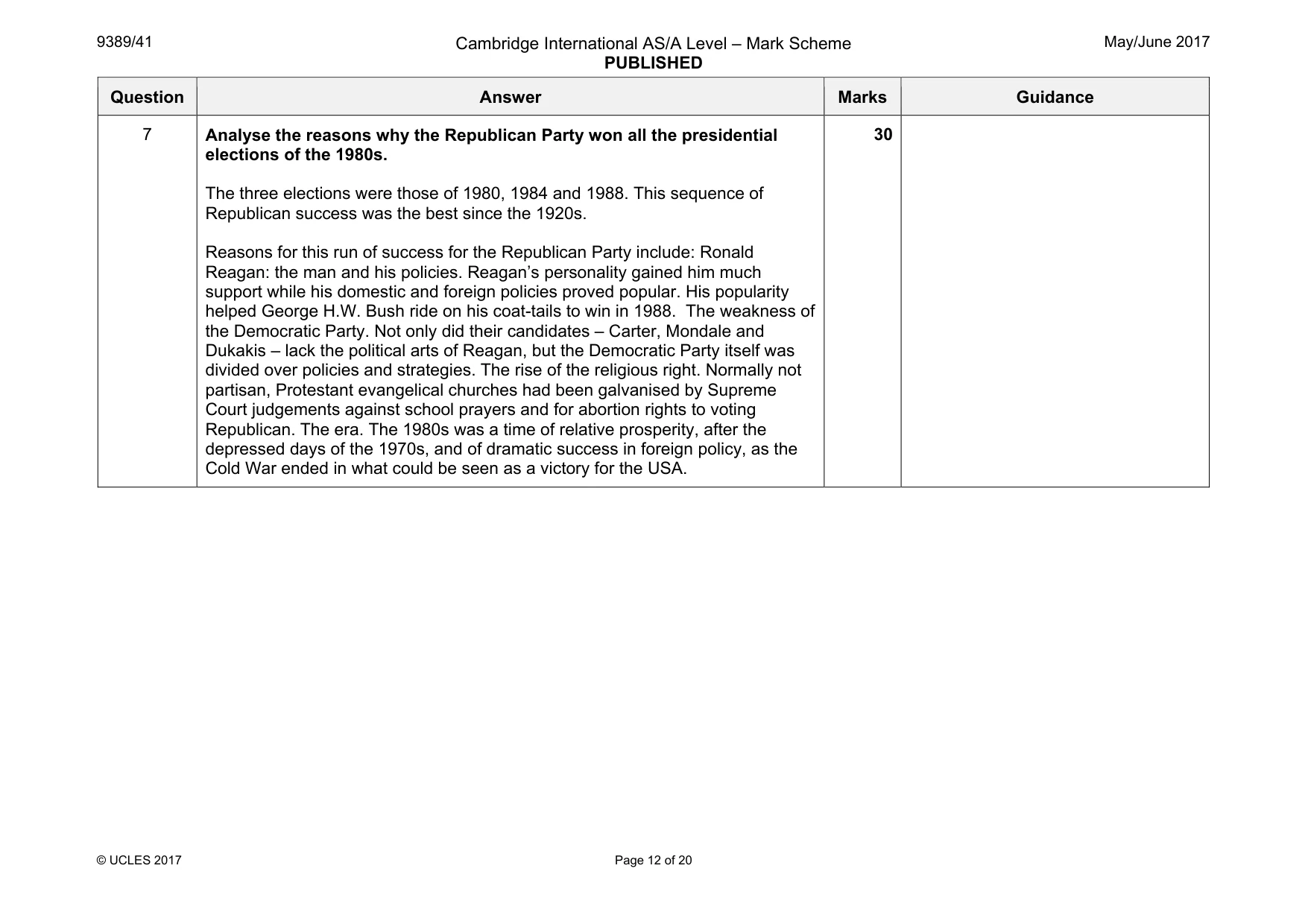
7 Analyse the reasons why the Republican Party won all the presidential elections of the 1980s. [30]
Mark scheme: 7 Analyse the reasons why the Republican Party won all the presidential elections of the 1980s. The three elections were those of 1980, 1984 and 1988. This sequence of Republican success was the best since the 1920s. Reasons for this run of success for the Republican Party include: Ronald Reagan: the man and his policies. Reagan’s personality gained him much support while his domestic and foreign policies proved popular. His popularity helped George H.W. Bush ride on his coat-tails to win in 1988. The weakness of the Democratic Party. Not only did their candidates – Carter, Mondale and Dukakis – lack the political arts of Reagan, but the Democratic Party itself was divided over policies and strategies. The rise of the religious right. Normally not partisan, Protestant evangelical churches had been galvanised by Supreme Court judgements against school prayers and for abortion rights to voting Republican. The era. The 1980s was a time of relative prosperity, after the depressed days of the 1970s, and of dramatic success in foreign policy, as the Cold War ended in what could be seen as a victory for the USA. 30
Q8 · ‘The USA followed a policy of détente because of the Cuban Missile Crisis of 1962.’ How…
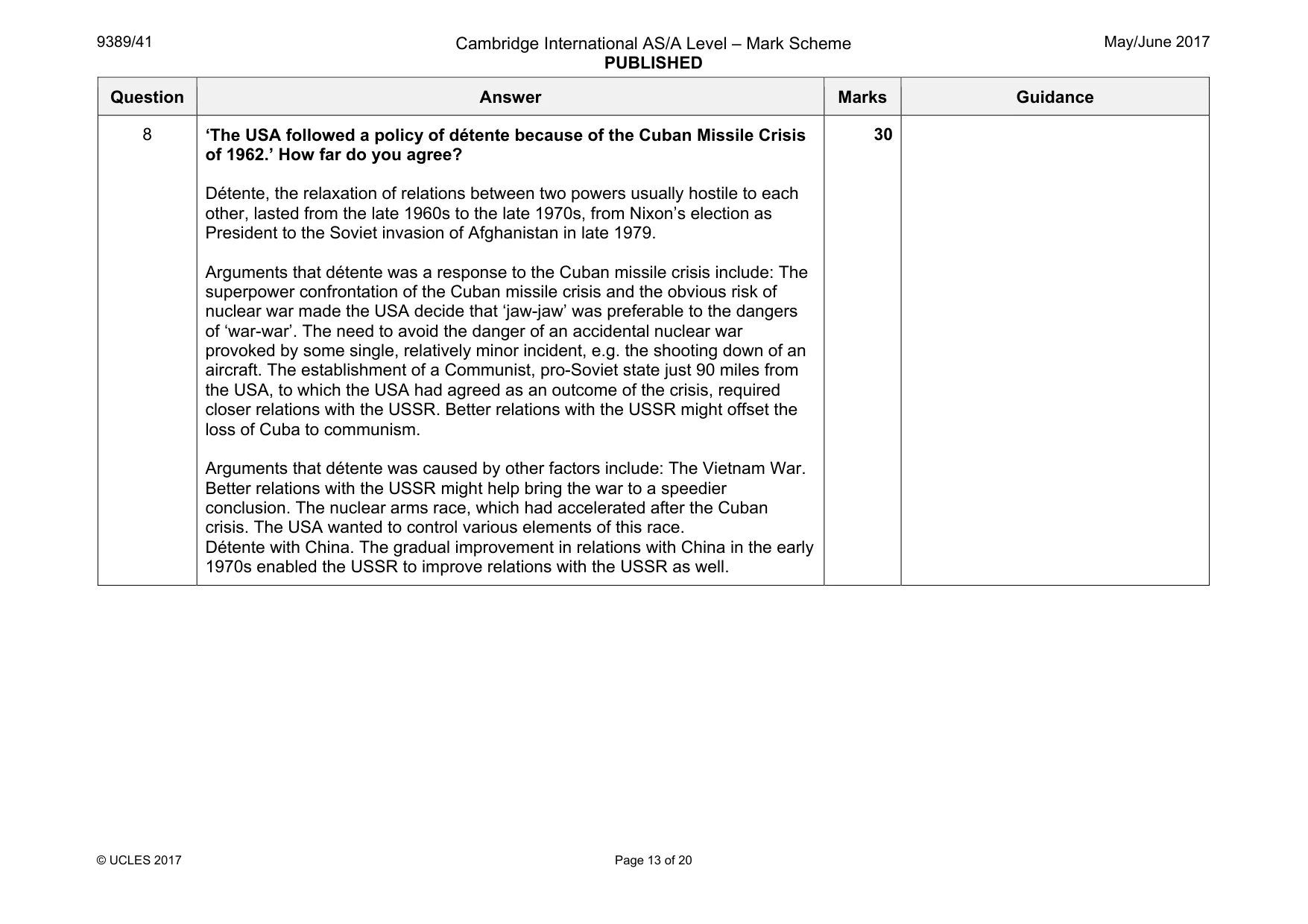
8 ‘The USA followed a policy of détente because of the Cuban Missile Crisis of 1962.’ How far do you agree? [30] Depth Study 3: International History, 1945–1991 Answer any two questions.
Mark scheme: 8 ‘The USA followed a policy of détente because of the Cuban Missile Crisis of 1962.’ How far do you agree? Détente, the relaxation of relations between two powers usually hostile to each other, lasted from the late 1960s to the late 1970s, from Nixon’s election as President to the Soviet invasion of Afghanistan in late 1979. Arguments that détente was a response to the Cuban missile crisis include: The superpower confrontation of the Cuban missile crisis and the obvious risk of nuclear war made the USA decide that ‘jaw-jaw’ was preferable to the dangers of ‘war-war’. The need to avoid the danger of an accidental nuclear war provoked by some single, relatively minor incident, e.g. the shooting down of an aircraft. The establishment of a Communist, pro-Soviet state just 90 miles from the USA, to which the USA had agreed as an outcome of the crisis, required closer relations with the USSR. Better relations with the USSR might offset the loss of Cuba to communism. Arguments that détente was caused by other factors include: The Vietnam War. Better relations with the USSR might help bring the war to a speedier conclusion. The nuclear arms race, which had accelerated after the Cuban crisis. The USA wanted to control various elements of this race. Détente with China. The gradual improvement in relations with China in the early 1970s enabled the USSR to improve relations with the USSR as well. 30
Q9 · How far should the outcome of the Korean War be seen as a victory for the USA?
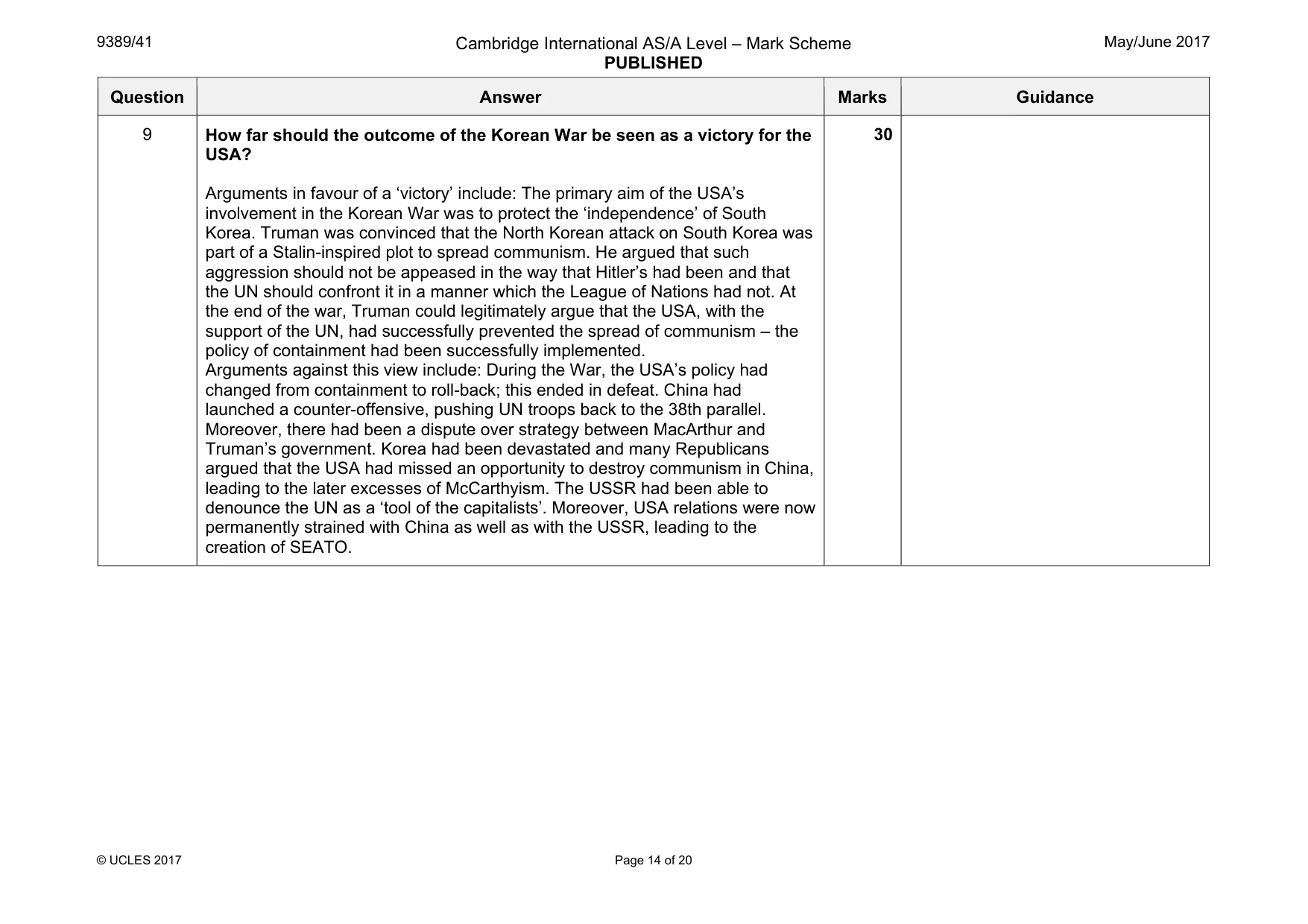
9 How far should the outcome of the Korean War be seen as a victory for the USA? [30]
Mark scheme: 9 How far should the outcome of the Korean War be seen as a victory for the USA? Arguments in favour of a ‘victory’ include: The primary aim of the USA’s involvement in the Korean War was to protect the ‘independence’ of South Korea. Truman was convinced that the North Korean attack on South Korea was part of a Stalin-inspired plot to spread communism. He argued that such aggression should not be appeased in the way that Hitler’s had been and that the UN should confront it in a manner which the League of Nations had not. At the end of the war, Truman could legitimately argue that the USA, with the support of the UN, had successfully prevented the spread of communism – the policy of containment had been successfully implemented. Arguments against this view include: During the War, the USA’s policy had changed from containment to roll-back; this ended in defeat. China had launched a counter-offensive, pushing UN troops back to the 38th parallel. Moreover, there had been a dispute over strategy between MacArthur and Truman’s government. Korea had been devastated and many Republicans argued that the USA had missed an opportunity to destroy communism in China, leading to the later excesses of McCarthyism. The USSR had been able to denounce the UN as a ‘tool of the capitalists’. Moreover, USA relations were now permanently strained with China as well as with the USSR, leading to the creation of SEATO. 30
Q10 · To what extent was the Soviet Union responsible for the ‘Second Cold War’?
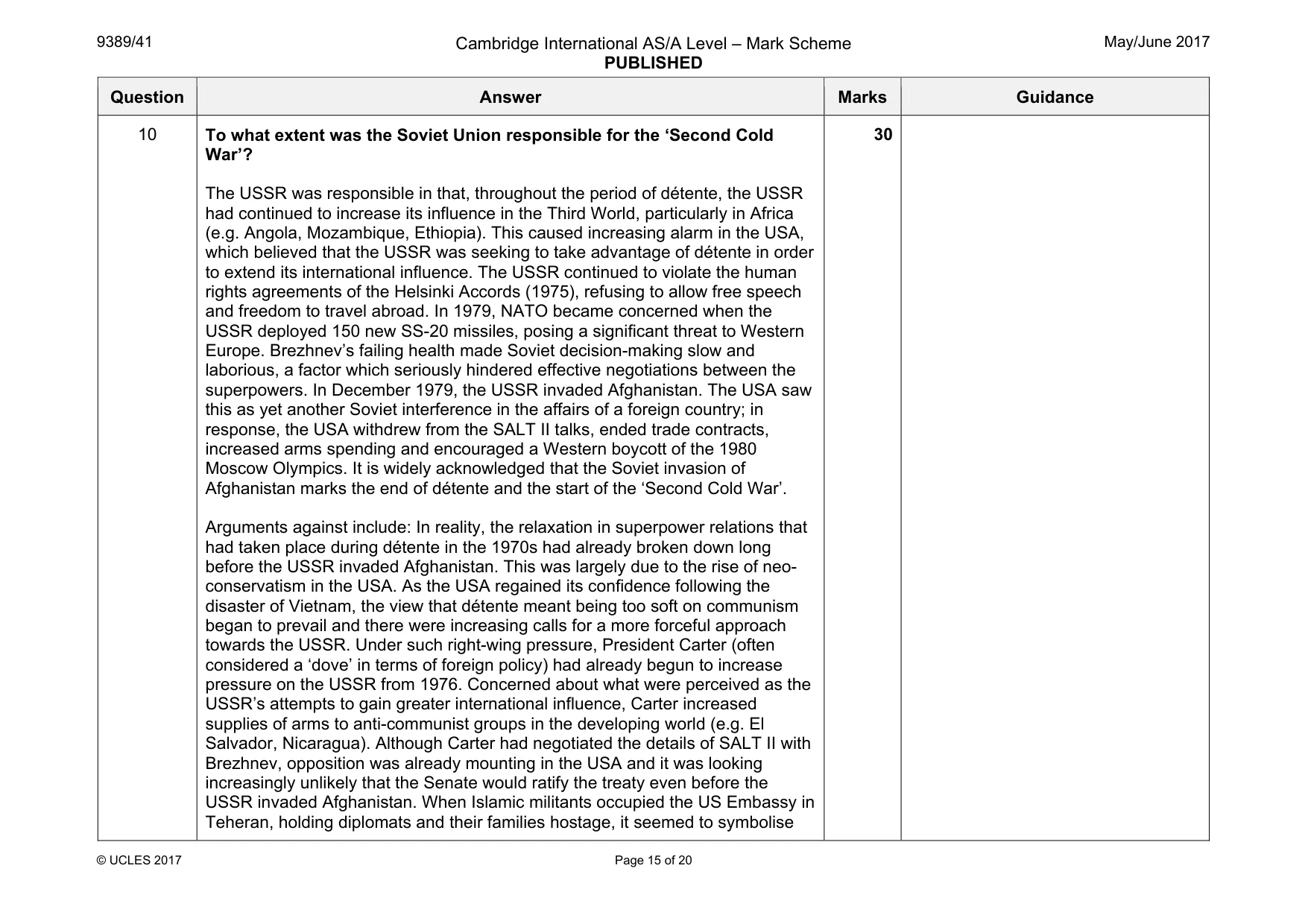
10 To what extent was the Soviet Union responsible for the ‘Second Cold War’? [30]
Mark scheme: 10 To what extent was the Soviet Union responsible for the ‘Second Cold War’? The USSR was responsible in that, throughout the period of détente, the USSR had continued to increase its influence in the Third World, particularly in Africa (e.g. Angola, Mozambique, Ethiopia). This caused increasing alarm in the USA, which believed that the USSR was seeking to take advantage of détente in order to extend its international influence. The USSR continued to violate the human rights agreements of the Helsinki Accords (1975), refusing to allow free speech and freedom to travel abroad. In 1979, NATO became concerned when the USSR deployed 150 new SS-20 missiles, posing a significant threat to Western Europe. Brezhnev’s failing health made Soviet decision-making slow and laborious, a factor which seriously hindered effective negotiations between the superpowers. In December 1979, the USSR invaded Afghanistan. The USA saw this as yet another Soviet interference in the affairs of a foreign country; in response, the USA withdrew from the SALT II talks, ended trade contracts, increased arms spending and encouraged a Western boycott of the 1980 Moscow Olympics. It is widely acknowledged that the Soviet invasion of Afghanistan marks the end of détente and the start of the ‘Second Cold War’. Arguments against include: In reality, the relaxation in superpower relations that had taken place during détente in the 1970s had already broken down long before the USSR invaded Afghanistan. This was largely due to the rise of neo- conservatism in the USA. As the USA regained its confidence following the disaster of Vietnam, the view that détente meant being too soft on communism began to prevail and there were increasing calls for a more forceful approach towards the USSR. Under such right-wing pressure, President Carter (often considered a ‘dove’ in terms of foreign policy) had already begun to increase pressure on the USSR from 1976. Concerned about what were perceived as the USSR’s attempts to gain greater international influence, Carter increased supplies of arms to anti-communist groups in the developing world (e.g. El Salvador, Nicaragua). Although Carter had negotiated the details of SALT II with Brezhnev, opposition was already mounting in the USA and it was looking increasingly unlikely that the Senate would ratify the treaty even before the USSR invaded Afghanistan. When Islamic militants occupied the US Embassy in Teheran, holding diplomats and their families hostage, it seemed to symbolise 30 Question Answer Marks Guidance the USA’s growing international impotence. This added weight to the neo- conservative demands for a stronger stance against the enemies of the USA including the USSR. Therefore, prevailing opinions in the USA were moving towards the re-establishment of a more forceful approach to the USSR.
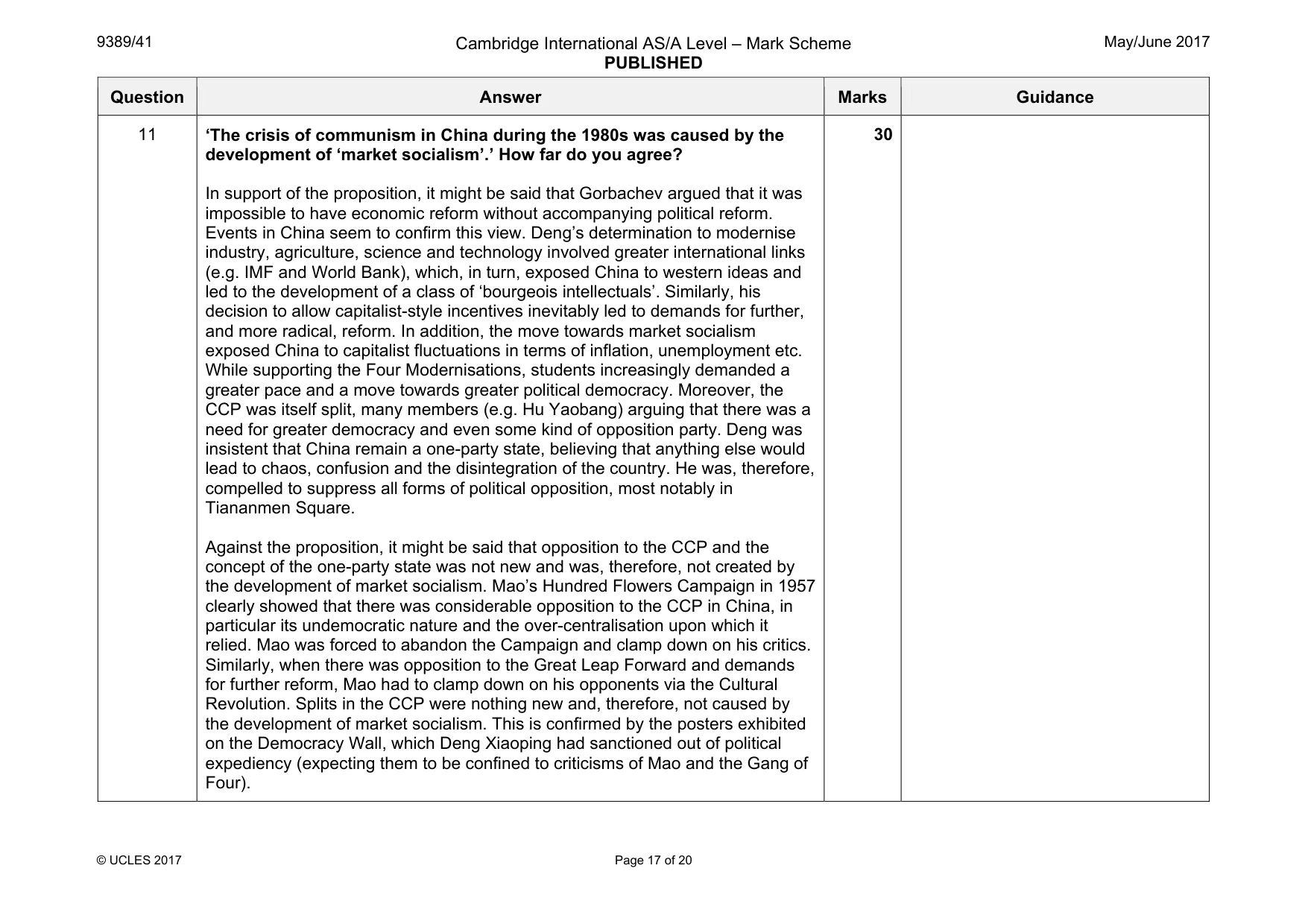
Q11 · ‘The crisis of communism in China during the 1980s was caused by the development of…
11 ‘The crisis of communism in China during the 1980s was caused by the development of “market socialism”.’ How far do you agree? [30]
Mark scheme: 11 ‘The crisis of communism in China during the 1980s was caused by the development of ‘market socialism’.’ How far do you agree? In support of the proposition, it might be said that Gorbachev argued that it was impossible to have economic reform without accompanying political reform. Events in China seem to confirm this view. Deng’s determination to modernise industry, agriculture, science and technology involved greater international links (e.g. IMF and World Bank), which, in turn, exposed China to western ideas and led to the development of a class of ‘bourgeois intellectuals’. Similarly, his decision to allow capitalist-style incentives inevitably led to demands for further, and more radical, reform. In addition, the move towards market socialism exposed China to capitalist fluctuations in terms of inflation, unemployment etc. While supporting the Four Modernisations, students increasingly demanded a greater pace and a move towards greater political democracy. Moreover, the CCP was itself split, many members (e.g. Hu Yaobang) arguing that there was a need for greater democracy and even some kind of opposition party. Deng was insistent that China remain a one-party state, believing that anything else would lead to chaos, confusion and the disintegration of the country. He was, therefore, compelled to suppress all forms of political opposition, most notably in Tiananmen Square. Against the proposition, it might be said that opposition to the CCP and the concept of the one-party state was not new and was, therefore, not created by the development of market socialism. Mao’s Hundred Flowers Campaign in 1957 clearly showed that there was considerable opposition to the CCP in China, in particular its undemocratic nature and the over-centralisation upon which it relied. Mao was forced to abandon the Campaign and clamp down on his critics. Similarly, when there was opposition to the Great Leap Forward and demands for further reform, Mao had to clamp down on his opponents via the Cultural Revolution. Splits in the CCP were nothing new and, therefore, not caused by the development of market socialism. This is confirmed by the posters exhibited on the Democracy Wall, which Deng Xiaoping had sanctioned out of political expediency (expecting them to be confined to criticisms of Mao and the Gang of Four). 30 Question Answer Marks Guidance Posters increasingly called for the right to criticise the government openly, for representation of non-communist parties in the National People’s Congress, greater human rights (such as free expression and the right to travel freely abroad). Deng was forced to abandon the Democracy Wall and suppress opposition.
What you needed in this session
Cambridge’s own grade thresholds for 2017 May/June, Paper 4 · Variant 1. A higher threshold means an easier paper — the bar moves with how the cohort did.