Cambridge A Level History 9389 — 2020 May/June Paper 4 · Variant 3
9389/43/M/J/20 · 12 questions · 360 marks · ≈405 min
The question paper and its mark scheme, free to read here and free to download. This is Cambridge’s own paper, exactly as it was sat.
Question paper4 pages
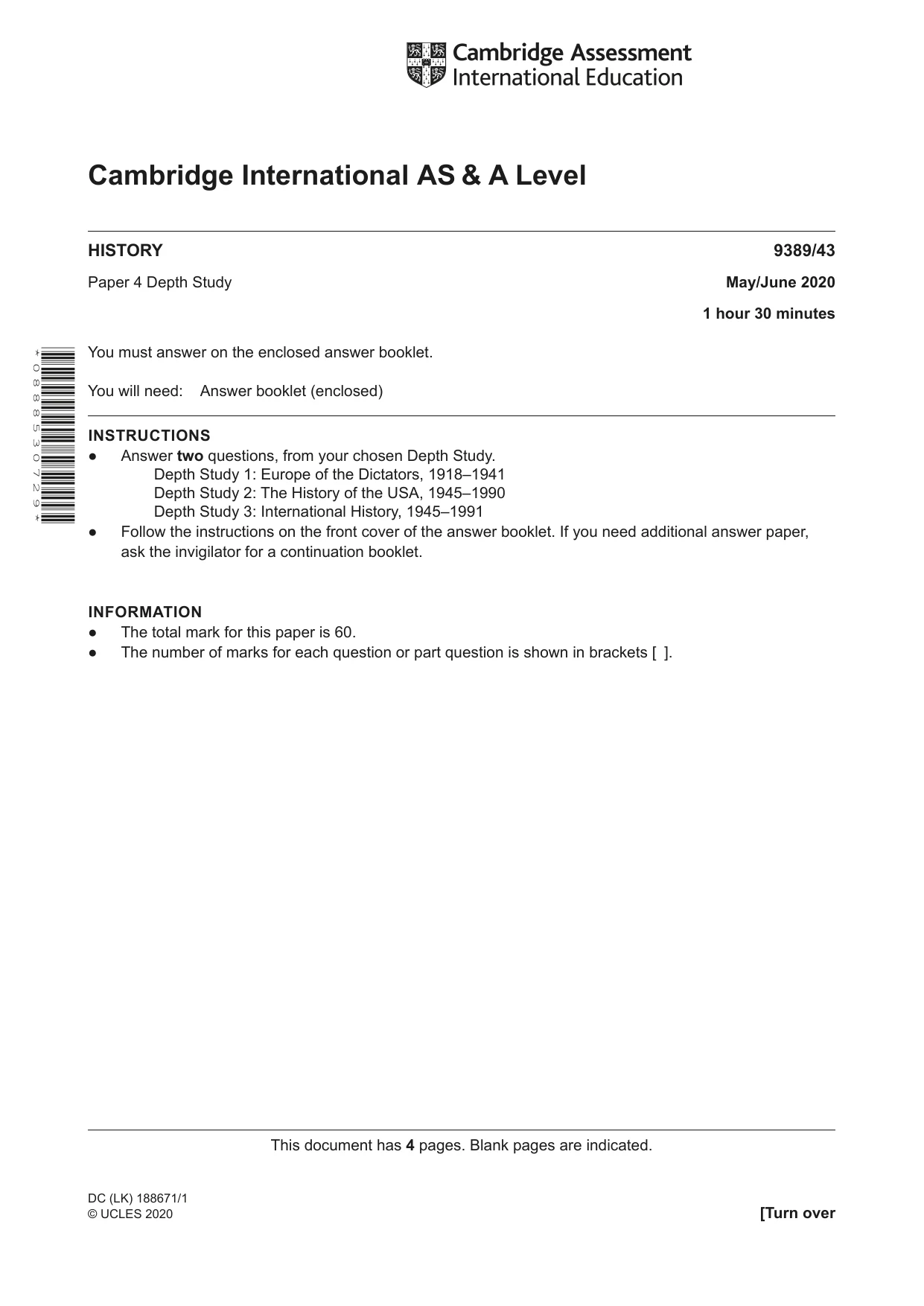
Mark scheme18 pages
Answers below. Sit the paper first if you are practising.

Questions as text
Q1 · ‘The Bolsheviks were able to survive from 1918 to 1922 because of the ineffectiveness of…
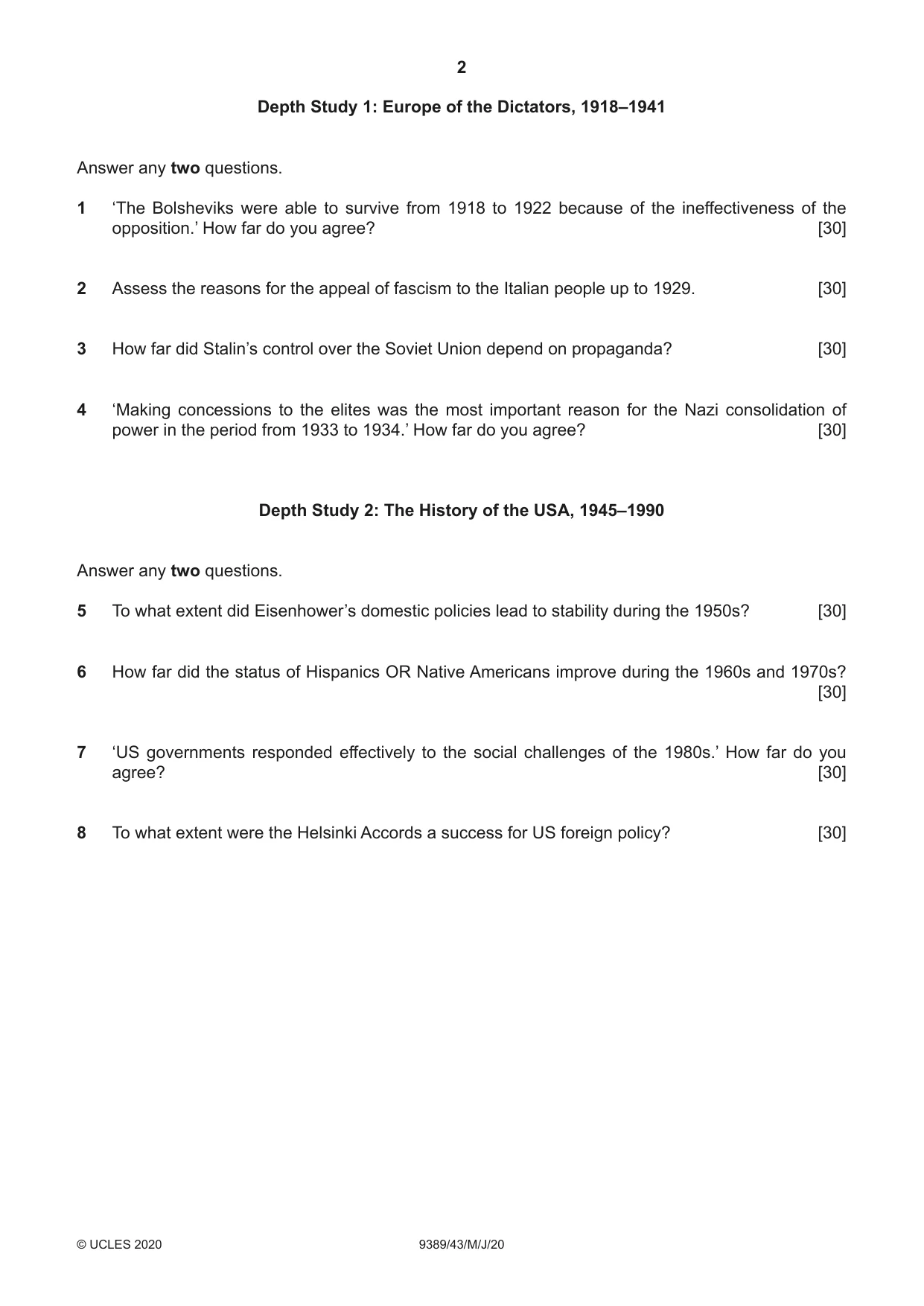
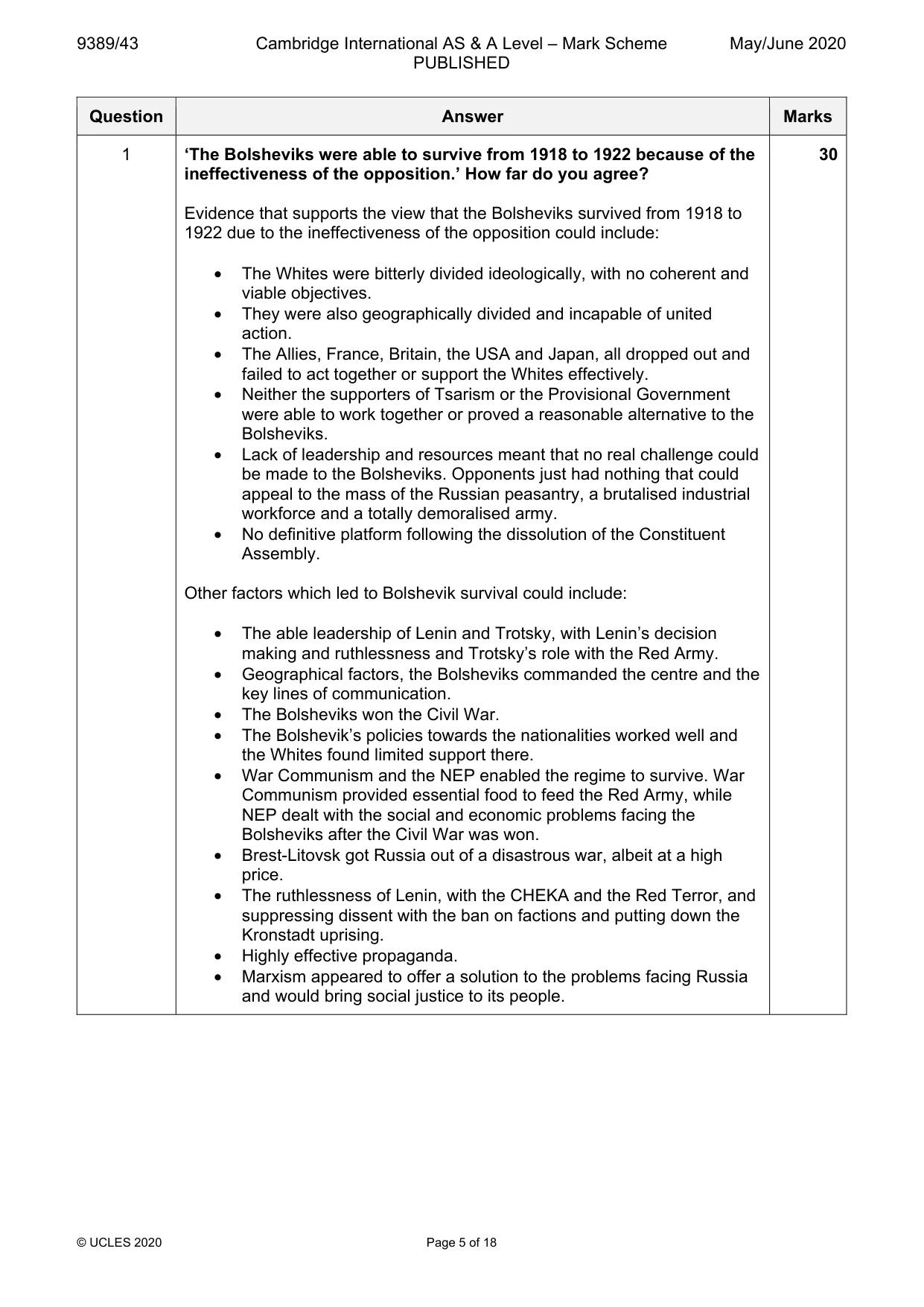
1 ‘The Bolsheviks were able to survive from 1918 to 1922 because of the ineffectiveness of the opposition.’ How far do you agree? [30]
Mark scheme: Question Answer Marks 1 ‘The Bolsheviks were able to survive from 1918 to 1922 because of the 30 ineffectiveness of the opposition.’ How far do you agree? Evidence that supports the view that the Bolsheviks survived from 1918 to 1922 due to the ineffectiveness of the opposition could include: • The Whites were bitterly divided ideologically, with no coherent and viable objectives. • They were also geographically divided and incapable of united action. • The Allies, France, Britain, the USA and Japan, all dropped out and failed to act together or support the Whites effectively. • Neither the supporters of Tsarism or the Provisional Government were able to work together or proved a reasonable alternative to the Bolsheviks. • Lack of leadership and resources meant that no real challenge could be made to the Bolsheviks. Opponents just had nothing that could appeal to the mass of the Russian peasantry, a brutalised industrial workforce and a totally demoralised army. • No definitive platform following the dissolution of the Constituent Assembly. Other factors which led to Bolshevik survival could include: • The able leadership of Lenin and Trotsky, with Lenin’s decision making and ruthlessness and Trotsky’s role with the Red Army. • Geographical factors, the Bolsheviks commanded the centre and the key lines of communication. • The Bolsheviks won the Civil War. • The Bolshevik’s policies towards the nationalities worked well and the Whites found limited support there. • War Communism and the NEP enabled the regime to survive. War Communism provided essential food to feed the Red Army, while NEP dealt with the social and economic problems facing the Bolsheviks after the Civil War was won. • Brest-Litovsk got Russia out of a disastrous war, albeit at a high price. • The ruthlessness of Lenin, with the CHEKA and the Red Terror, and suppressing dissent with the ban on factions and putting down the Kronstadt uprising. • Highly effective propaganda. • Marxism appeared to offer a solution to the problems facing Russia and would bring social justice to its people.
Q2 · Assess the reasons for the appeal of fascism to the Italian people up to 1929
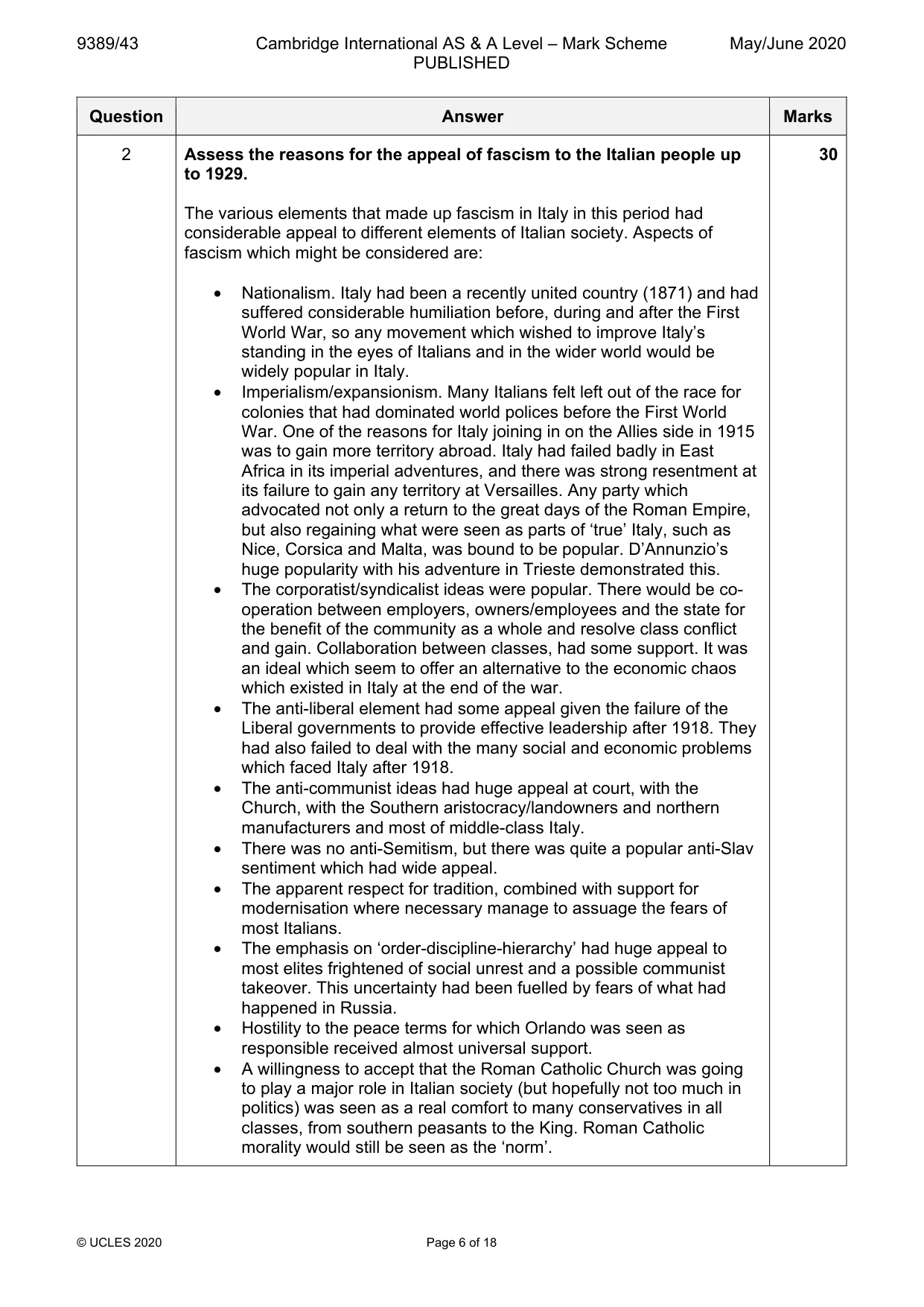
2 Assess the reasons for the appeal of fascism to the Italian people up to 1929. [30]
Mark scheme: 2 Assess the reasons for the appeal of fascism to the Italian people up 30 to 1929. The various elements that made up fascism in Italy in this period had considerable appeal to different elements of Italian society. Aspects of fascism which might be considered are: • Nationalism. Italy had been a recently united country (1871) and had suffered considerable humiliation before, during and after the First World War, so any movement which wished to improve Italy’s standing in the eyes of Italians and in the wider world would be widely popular in Italy. • Imperialism/expansionism. Many Italians felt left out of the race for colonies that had dominated world polices before the First World War. One of the reasons for Italy joining in on the Allies side in 1915 was to gain more territory abroad. Italy had failed badly in East Africa in its imperial adventures, and there was strong resentment at its failure to gain any territory at Versailles. Any party which advocated not only a return to the great days of the Roman Empire, but also regaining what were seen as parts of ‘true’ Italy, such as Nice, Corsica and Malta, was bound to be popular. D’Annunzio’s huge popularity with his adventure in Trieste demonstrated this. • The corporatist/syndicalist ideas were popular. There would be co- operation between employers, owners/employees and the state for the benefit of the community as a whole and resolve class conflict and gain. Collaboration between classes, had some support. It was an ideal which seem to offer an alternative to the economic chaos which existed in Italy at the end of the war. • The anti-liberal element had some appeal given the failure of the Liberal governments to provide effective leadership after 1918. They had also failed to deal with the many social and economic problems which faced Italy after 1918. • The anti-communist ideas had huge appeal at court, with the Church, with the Southern aristocracy/landowners and northern manufacturers and most of middle-class Italy. • There was no anti-Semitism, but there was quite a popular anti-Slav sentiment which had wide appeal. • The apparent respect for tradition, combined with support for modernisation where necessary manage to assuage the fears of most Italians. • The emphasis on ‘order-discipline-hierarchy’ had huge appeal to most elites frightened of social unrest and a possible communist takeover. This uncertainty had been fuelled by fears of what had happened in Russia. • Hostility to the peace terms for which Orlando was seen as responsible received almost universal support. • A willingness to accept that the Roman Catholic Church was going to play a major role in Italian society (but hopefully not too much in politics) was seen as a real comfort to many conservatives in all classes, from southern peasants to the King. Roman Catholic morality would still be seen as the ‘norm’.
Q3 · How far did Stalin’s control over the Soviet Union depend on propaganda?
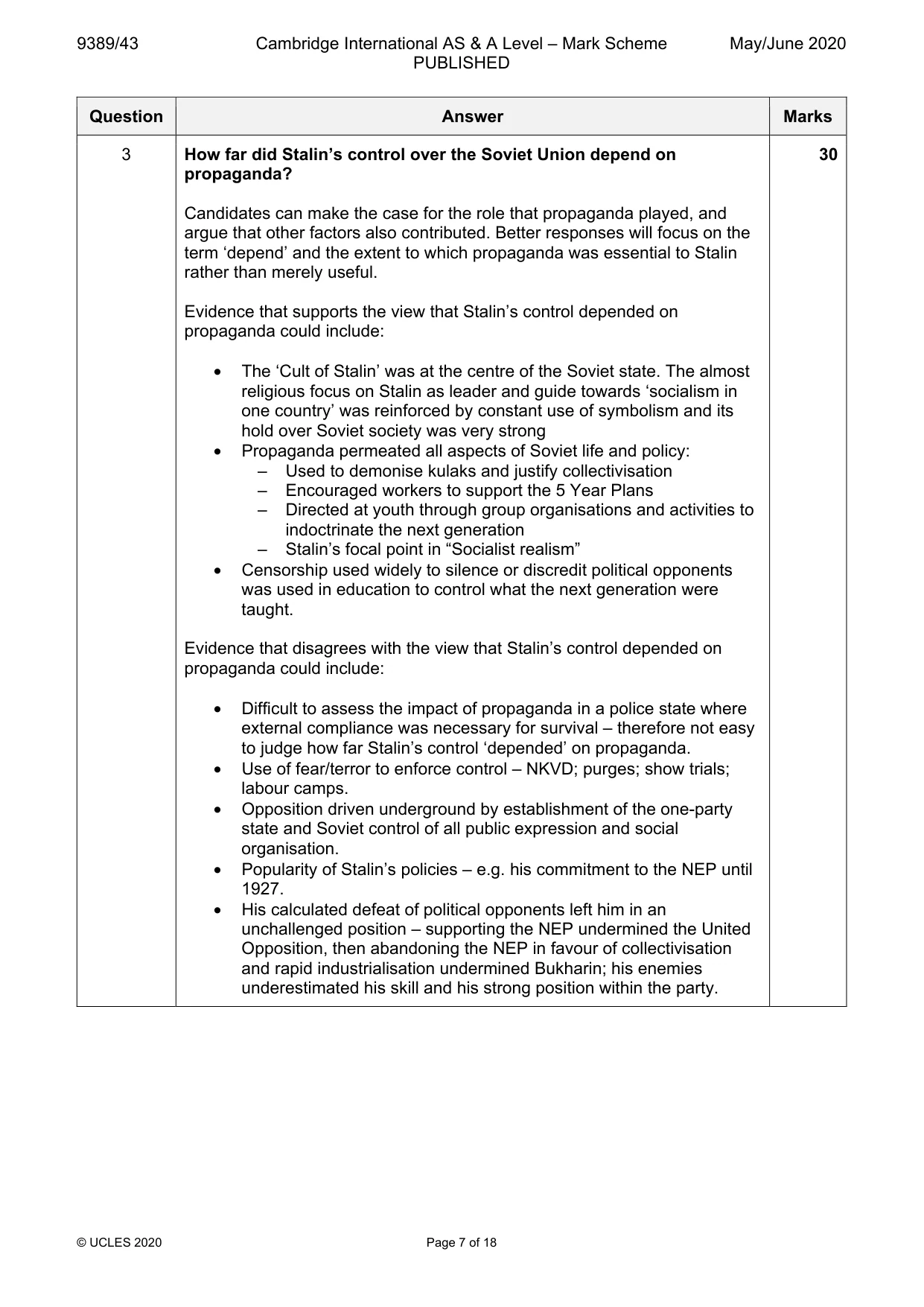
3 How far did Stalin’s control over the Soviet Union depend on propaganda? [30]
Mark scheme: 3 How far did Stalin’s control over the Soviet Union depend on 30 propaganda? Candidates can make the case for the role that propaganda played, and argue that other factors also contributed. Better responses will focus on the term ‘depend’ and the extent to which propaganda was essential to Stalin rather than merely useful. Evidence that supports the view that Stalin’s control depended on propaganda could include: • The ‘Cult of Stalin’ was at the centre of the Soviet state. The almost religious focus on Stalin as leader and guide towards ‘socialism in one country’ was reinforced by constant use of symbolism and its hold over Soviet society was very strong • Propaganda permeated all aspects of Soviet life and policy: – Used to demonise kulaks and justify collectivisation – Encouraged workers to support the 5 Year Plans – Directed at youth through group organisations and activities to indoctrinate the next generation – Stalin’s focal point in “Socialist realism” • Censorship used widely to silence or discredit political opponents was used in education to control what the next generation were taught. Evidence that disagrees with the view that Stalin’s control depended on propaganda could include: • Difficult to assess the impact of propaganda in a police state where external compliance was necessary for survival – therefore not easy to judge how far Stalin’s control ‘depended’ on propaganda. • Use of fear/terror to enforce control – NKVD; purges; show trials; labour camps. • Opposition driven underground by establishment of the one-party state and Soviet control of all public expression and social organisation. • Popularity of Stalin’s policies – e.g. his commitment to the NEP until 1927. • His calculated defeat of political opponents left him in an unchallenged position – supporting the NEP undermined the United Opposition, then abandoning the NEP in favour of collectivisation and rapid industrialisation undermined Bukharin; his enemies underestimated his skill and his strong position within the party.
Q4 · ‘Making concessions to the elites was the most important reason for the Nazi…
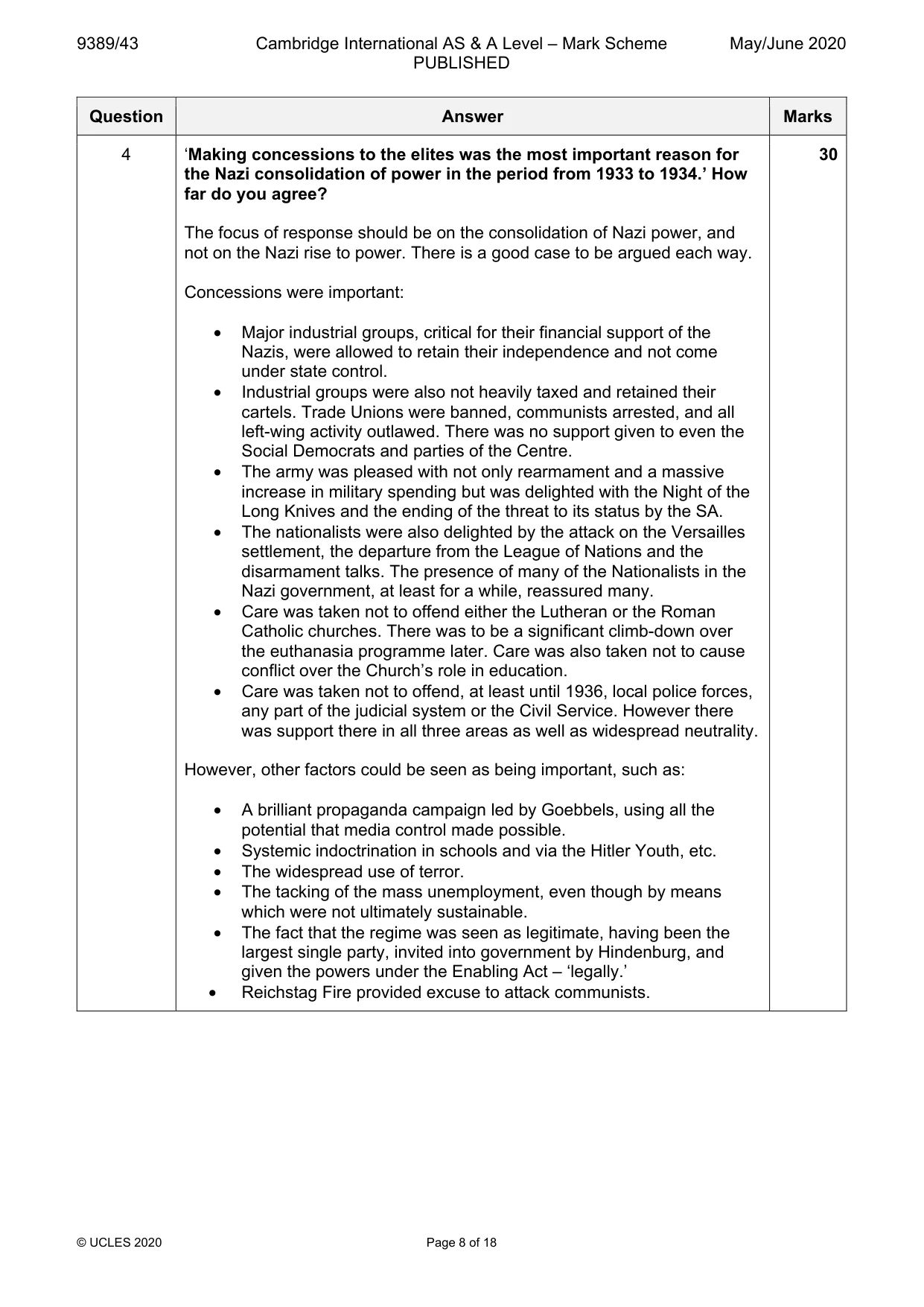
4 ‘Making concessions to the elites was the most important reason for the Nazi consolidation of power in the period from 1933 to 1934.’ How far do you agree? [30] Depth Study 2: The History of the USA, 1945–1990 Answer any two questions.
Mark scheme: 4 ‘Making concessions to the elites was the most important reason for 30 the Nazi consolidation of power in the period from 1933 to 1934.’ How far do you agree? The focus of response should be on the consolidation of Nazi power, and not on the Nazi rise to power. There is a good case to be argued each way. Concessions were important: • Major industrial groups, critical for their financial support of the Nazis, were allowed to retain their independence and not come under state control. • Industrial groups were also not heavily taxed and retained their cartels. Trade Unions were banned, communists arrested, and all left-wing activity outlawed. There was no support given to even the Social Democrats and parties of the Centre. • The army was pleased with not only rearmament and a massive increase in military spending but was delighted with the Night of the Long Knives and the ending of the threat to its status by the SA. • The nationalists were also delighted by the attack on the Versailles settlement, the departure from the League of Nations and the disarmament talks. The presence of many of the Nationalists in the Nazi government, at least for a while, reassured many. • Care was taken not to offend either the Lutheran or the Roman Catholic churches. There was to be a significant climb-down over the euthanasia programme later. Care was also taken not to cause conflict over the Church’s role in education. • Care was taken not to offend, at least until 1936, local police forces, any part of the judicial system or the Civil Service. However there was support there in all three areas as well as widespread neutrality. However, other factors could be seen as being important, such as: • A brilliant propaganda campaign led by Goebbels, using all the potential that media control made possible. • Systemic indoctrination in schools and via the Hitler Youth, etc. • The widespread use of terror. • The tacking of the mass unemployment, even though by means which were not ultimately sustainable. • The fact that the regime was seen as legitimate, having been the largest single party, invited into government by Hindenburg, and given the powers under the Enabling Act – ‘legally.’ • Reichstag Fire provided excuse to attack communists.
Q5 · To what extent did Eisenhower’s domestic policies lead to stability during the 1950s?
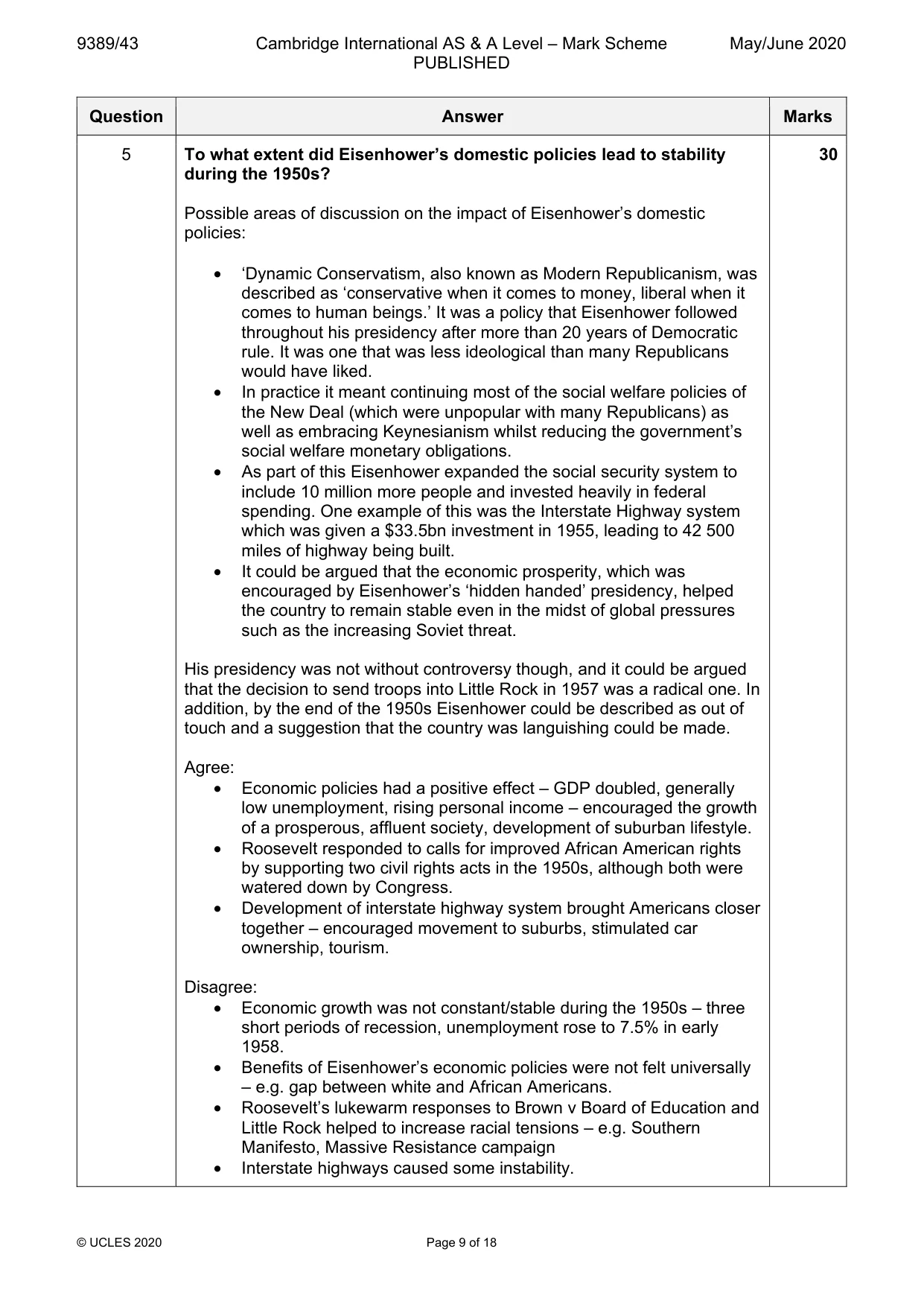
5 To what extent did Eisenhower’s domestic policies lead to stability during the 1950s? [30]
Mark scheme: 5 To what extent did Eisenhower’s domestic policies lead to stability 30 during the 1950s? Possible areas of discussion on the impact of Eisenhower’s domestic policies: • ‘Dynamic Conservatism, also known as Modern Republicanism, was described as ‘conservative when it comes to money, liberal when it comes to human beings.’ It was a policy that Eisenhower followed throughout his presidency after more than 20 years of Democratic rule. It was one that was less ideological than many Republicans would have liked. • In practice it meant continuing most of the social welfare policies of the New Deal (which were unpopular with many Republicans) as well as embracing Keynesianism whilst reducing the government’s social welfare monetary obligations. • As part of this Eisenhower expanded the social security system to include 10 million more people and invested heavily in federal spending. One example of this was the Interstate Highway system which was given a $33.5bn investment in 1955, leading to 42 500 miles of highway being built. • It could be argued that the economic prosperity, which was encouraged by Eisenhower’s ‘hidden handed’ presidency, helped the country to remain stable even in the midst of global pressures such as the increasing Soviet threat. His presidency was not without controversy though, and it could be argued that the decision to send troops into Little Rock in 1957 was a radical one. In addition, by the end of the 1950s Eisenhower could be described as out of touch and a suggestion that the country was languishing could be made. Agree: • Economic policies had a positive effect – GDP doubled, generally low unemployment, rising personal income – encouraged the growth of a prosperous, affluent society, development of suburban lifestyle. • Roosevelt responded to calls for improved African American rights by supporting two civil rights acts in the 1950s, although both were watered down by Congress. • Development of interstate highway system brought Americans closer together – encouraged movement to suburbs, stimulated car ownership, tourism. Disagree: • Economic growth was not constant/stable during the 1950s – three short periods of recession, unemployment rose to 7.5% in early 1958. • Benefits of Eisenhower’s economic policies were not felt universally – e.g. gap between white and African Americans. • Roosevelt’s lukewarm responses to Brown v Board of Education and Little Rock helped to increase racial tensions – e.g. Southern Manifesto, Massive Resistance campaign • Interstate highways caused some instability.
Q6 · How far did the status of Hispanics OR Native Americans improve during the 1960s and…
6 How far did the status of Hispanics OR Native Americans improve during the 1960s and 1970s? [30]
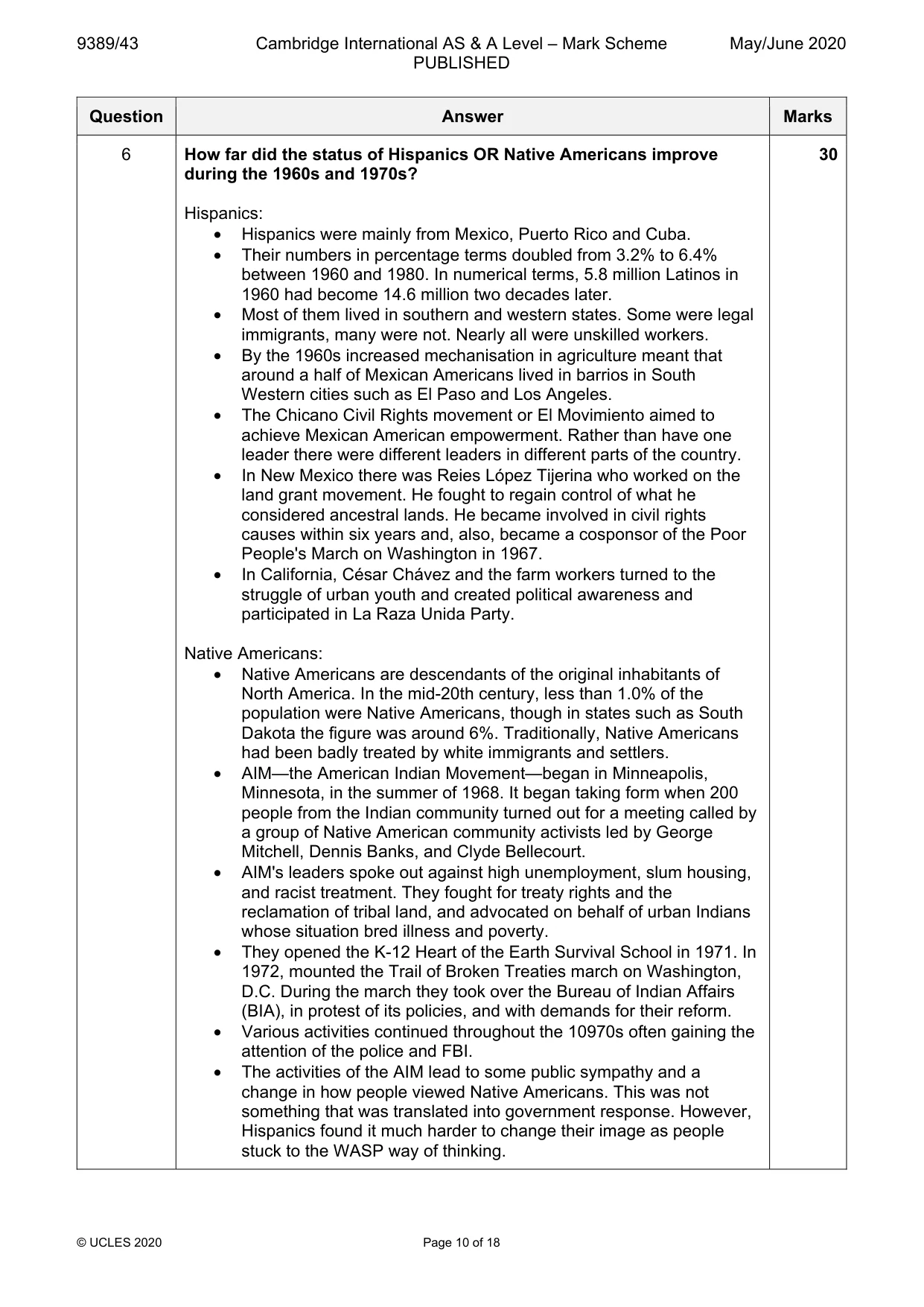
Mark scheme: 6 How far did the status of Hispanics OR Native Americans improve 30 during the 1960s and 1970s? Hispanics: • Hispanics were mainly from Mexico, Puerto Rico and Cuba. • Their numbers in percentage terms doubled from 3.2% to 6.4% between 1960 and 1980. In numerical terms, 5.8 million Latinos in 1960 had become 14.6 million two decades later. • Most of them lived in southern and western states. Some were legal immigrants, many were not. Nearly all were unskilled workers. • By the 1960s increased mechanisation in agriculture meant that around a half of Mexican Americans lived in barrios in South Western cities such as El Paso and Los Angeles. • The Chicano Civil Rights movement or El Movimiento aimed to achieve Mexican American empowerment. Rather than have one leader there were different leaders in different parts of the country. • In New Mexico there was Reies López Tijerina who worked on the land grant movement. He fought to regain control of what he considered ancestral lands. He became involved in civil rights causes within six years and, also, became a cosponsor of the Poor People's March on Washington in 1967. • In California, César Chávez and the farm workers turned to the struggle of urban youth and created political awareness and participated in La Raza Unida Party. Native Americans: • Native Americans are descendants of the original inhabitants of North America. In the mid-20th century, less than 1.0% of the population were Native Americans, though in states such as South Dakota the figure was around 6%. Traditionally, Native Americans had been badly treated by white immigrants and settlers. • AIM—the American Indian Movement—began in Minneapolis, Minnesota, in the summer of 1968. It began taking form when 200 people from the Indian community turned out for a meeting called by a group of Native American community activists led by George Mitchell, Dennis Banks, and Clyde Bellecourt. • AIM's leaders spoke out against high unemployment, slum housing, and racist treatment. They fought for treaty rights and the reclamation of tribal land, and advocated on behalf of urban Indians whose situation bred illness and poverty. • They opened the K-12 Heart of the Earth Survival School in 1971. In 1972, mounted the Trail of Broken Treaties march on Washington, D.C. During the march they took over the Bureau of Indian Affairs (BIA), in protest of its policies, and with demands for their reform. • Various activities continued throughout the 10970s often gaining the attention of the police and FBI. • The activities of the AIM lead to some public sympathy and a change in how people viewed Native Americans. This was not something that was translated into government response. However, Hispanics found it much harder to change their image as people stuck to the WASP way of thinking.
Q7 · ‘US governments responded effectively to the social challenges of the 1980s.’ How far do…
7 ‘US governments responded effectively to the social challenges of the 1980s.’ How far do you agree? [30]
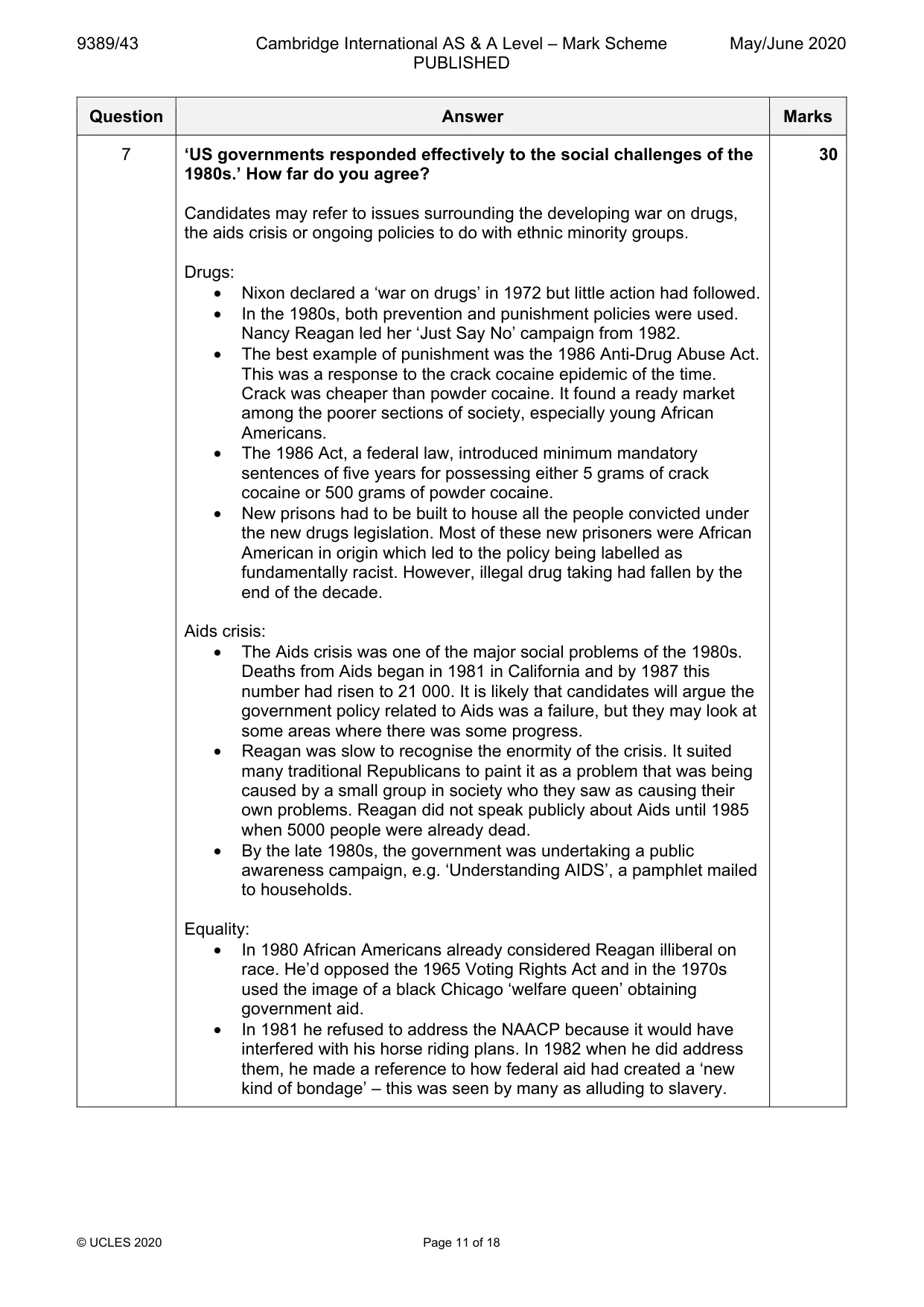
Mark scheme: 7 ‘US governments responded effectively to the social challenges of the 30 1980s.’ How far do you agree? Candidates may refer to issues surrounding the developing war on drugs, the aids crisis or ongoing policies to do with ethnic minority groups. Drugs: • Nixon declared a ‘war on drugs’ in 1972 but little action had followed. • In the 1980s, both prevention and punishment policies were used. Nancy Reagan led her ‘Just Say No’ campaign from 1982. • The best example of punishment was the 1986 Anti-Drug Abuse Act. This was a response to the crack cocaine epidemic of the time. Crack was cheaper than powder cocaine. It found a ready market among the poorer sections of society, especially young African Americans. • The 1986 Act, a federal law, introduced minimum mandatory sentences of five years for possessing either 5 grams of crack cocaine or 500 grams of powder cocaine. • New prisons had to be built to house all the people convicted under the new drugs legislation. Most of these new prisoners were African American in origin which led to the policy being labelled as fundamentally racist. However, illegal drug taking had fallen by the end of the decade. Aids crisis: • The Aids crisis was one of the major social problems of the 1980s. Deaths from Aids began in 1981 in California and by 1987 this number had risen to 21 000. It is likely that candidates will argue the government policy related to Aids was a failure, but they may look at some areas where there was some progress. • Reagan was slow to recognise the enormity of the crisis. It suited many traditional Republicans to paint it as a problem that was being caused by a small group in society who they saw as causing their own problems. Reagan did not speak publicly about Aids until 1985 when 5000 people were already dead. • By the late 1980s, the government was undertaking a public awareness campaign, e.g. ‘Understanding AIDS’, a pamphlet mailed to households. Equality: • In 1980 African Americans already considered Reagan illiberal on race. He’d opposed the 1965 Voting Rights Act and in the 1970s used the image of a black Chicago ‘welfare queen’ obtaining government aid. • In 1981 he refused to address the NAACP because it would have interfered with his horse riding plans. In 1982 when he did address them, he made a reference to how federal aid had created a ‘new kind of bondage’ – this was seen by many as alluding to slavery. 7 • Ghetto schools remained poor and segregated whilst Reagan supported a constitutional amendment to outlaw busing. Although this ultimately failed, this, and similar moves, led to people believing that not all living standards mattered as much to Reagan. • In 1983, despite Reagan’s opposition, the third Monday in January was made into Martin Luther King Day.
Q8 · Depth Study 3: International History, 1945–1991 Answer any two questions
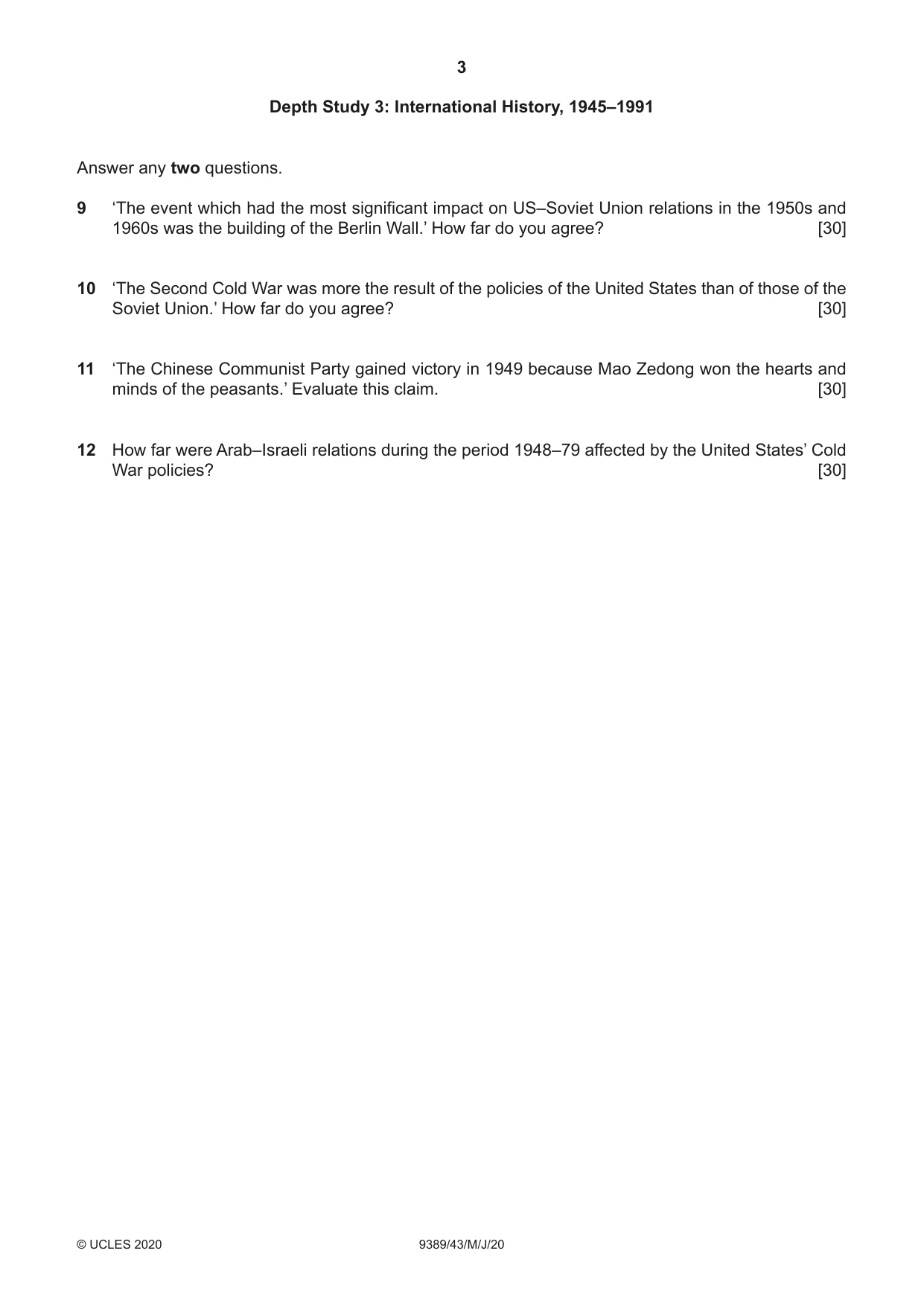
Depth Study 3: International History, 1945–1991 Answer any two questions.
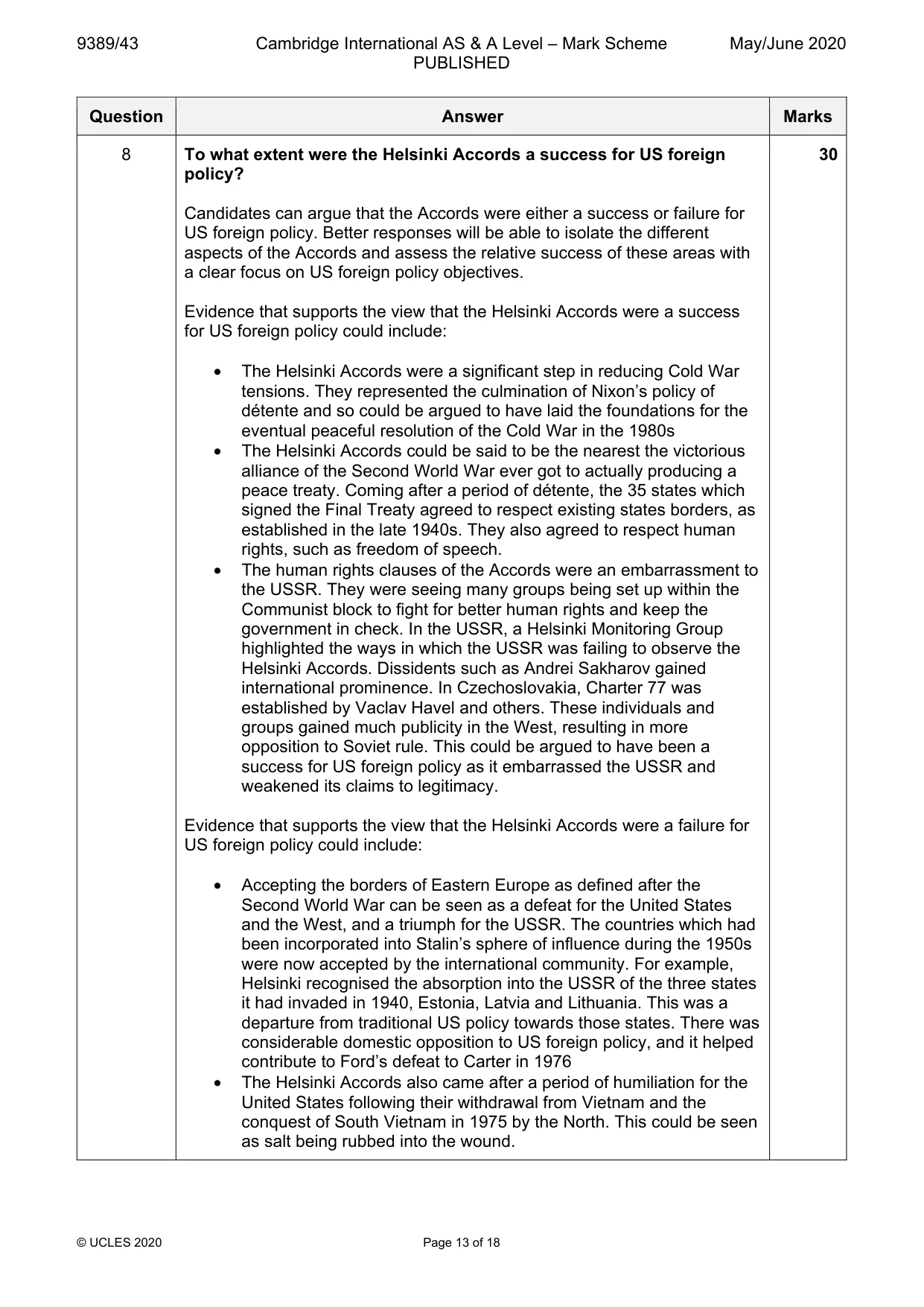
Mark scheme: 8 To what extent were the Helsinki Accords a success for US foreign 30 policy? Candidates can argue that the Accords were either a success or failure for US foreign policy. Better responses will be able to isolate the different aspects of the Accords and assess the relative success of these areas with a clear focus on US foreign policy objectives. Evidence that supports the view that the Helsinki Accords were a success for US foreign policy could include: • The Helsinki Accords were a significant step in reducing Cold War tensions. They represented the culmination of Nixon’s policy of détente and so could be argued to have laid the foundations for the eventual peaceful resolution of the Cold War in the 1980s • The Helsinki Accords could be said to be the nearest the victorious alliance of the Second World War ever got to actually producing a peace treaty. Coming after a period of détente, the 35 states which signed the Final Treaty agreed to respect existing states borders, as established in the late 1940s. They also agreed to respect human rights, such as freedom of speech. • The human rights clauses of the Accords were an embarrassment to the USSR. They were seeing many groups being set up within the Communist block to fight for better human rights and keep the government in check. In the USSR, a Helsinki Monitoring Group highlighted the ways in which the USSR was failing to observe the Helsinki Accords. Dissidents such as Andrei Sakharov gained international prominence. In Czechoslovakia, Charter 77 was established by Vaclav Havel and others. These individuals and groups gained much publicity in the West, resulting in more opposition to Soviet rule. This could be argued to have been a success for US foreign policy as it embarrassed the USSR and weakened its claims to legitimacy. Evidence that supports the view that the Helsinki Accords were a failure for US foreign policy could include: • Accepting the borders of Eastern Europe as defined after the Second World War can be seen as a defeat for the United States and the West, and a triumph for the USSR. The countries which had been incorporated into Stalin’s sphere of influence during the 1950s were now accepted by the international community. For example, Helsinki recognised the absorption into the USSR of the three states it had invaded in 1940, Estonia, Latvia and Lithuania. This was a departure from traditional US policy towards those states. There was considerable domestic opposition to US foreign policy, and it helped contribute to Ford’s defeat to Carter in 1976 • The Helsinki Accords also came after a period of humiliation for the United States following their withdrawal from Vietnam and the conquest of South Vietnam in 1975 by the North. This could be seen as salt being rubbed into the wound.
Q9 · ‘The event which had the most significant impact on US–Soviet Union relations in the…
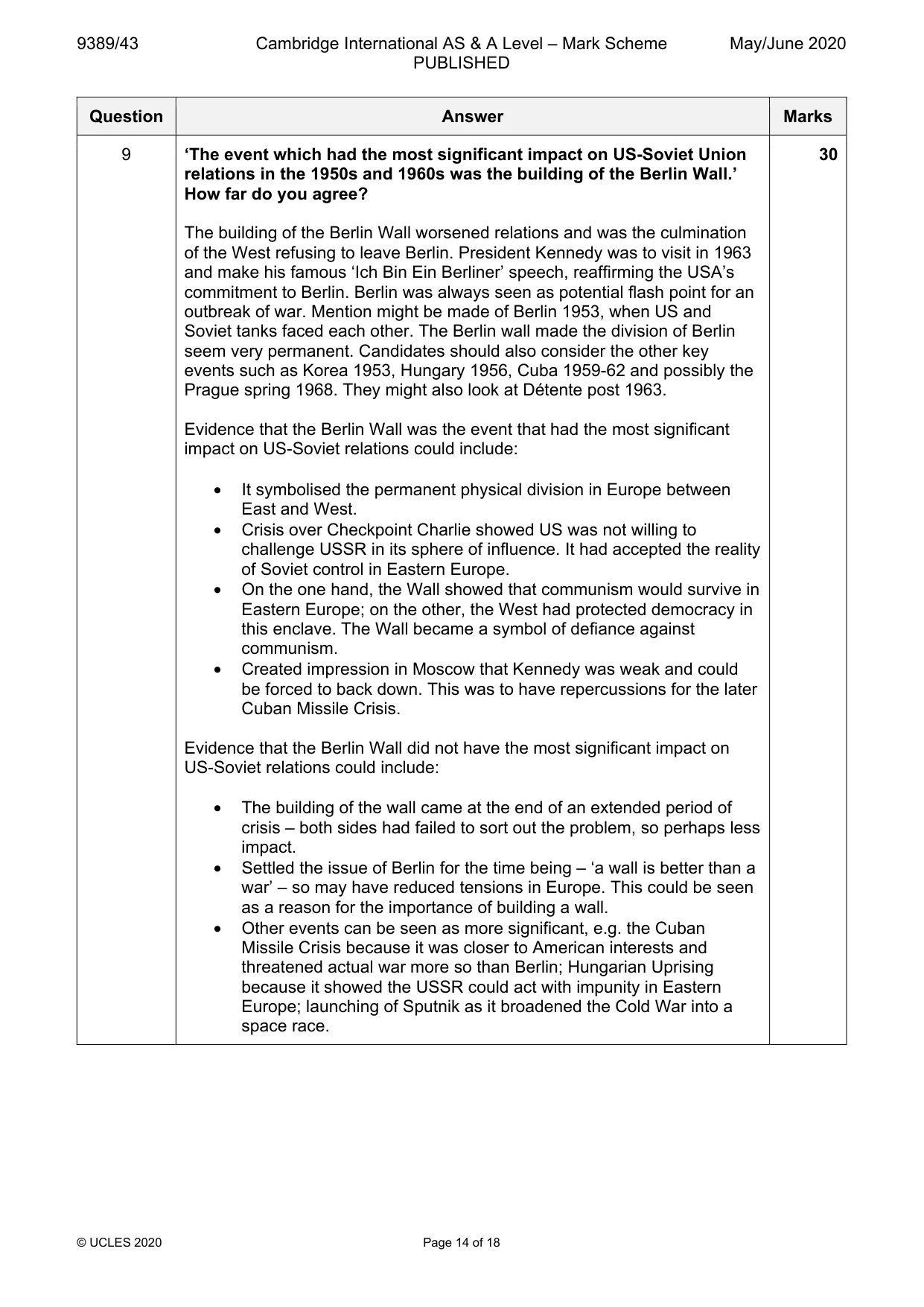
9 ‘The event which had the most significant impact on US–Soviet Union relations in the 1950s and 1960s was the building of the Berlin Wall.’ How far do you agree? [30]
Mark scheme: 9 ‘The event which had the most significant impact on US-Soviet Union 30 relations in the 1950s and 1960s was the building of the Berlin Wall.’ How far do you agree? The building of the Berlin Wall worsened relations and was the culmination of the West refusing to leave Berlin. President Kennedy was to visit in 1963 and make his famous ‘Ich Bin Ein Berliner’ speech, reaffirming the USA’s commitment to Berlin. Berlin was always seen as potential flash point for an outbreak of war. Mention might be made of Berlin 1953, when US and Soviet tanks faced each other. The Berlin wall made the division of Berlin seem very permanent. Candidates should also consider the other key events such as Korea 1953, Hungary 1956, Cuba 1959-62 and possibly the Prague spring 1968. They might also look at Détente post 1963. Evidence that the Berlin Wall was the event that had the most significant impact on US-Soviet relations could include: • It symbolised the permanent physical division in Europe between East and West. • Crisis over Checkpoint Charlie showed US was not willing to challenge USSR in its sphere of influence. It had accepted the reality of Soviet control in Eastern Europe. • On the one hand, the Wall showed that communism would survive in Eastern Europe; on the other, the West had protected democracy in this enclave. The Wall became a symbol of defiance against communism. • Created impression in Moscow that Kennedy was weak and could be forced to back down. This was to have repercussions for the later Cuban Missile Crisis. Evidence that the Berlin Wall did not have the most significant impact on US-Soviet relations could include: • The building of the wall came at the end of an extended period of crisis – both sides had failed to sort out the problem, so perhaps less impact. • Settled the issue of Berlin for the time being – ‘a wall is better than a war’ – so may have reduced tensions in Europe. This could be seen as a reason for the importance of building a wall. • Other events can be seen as more significant, e.g. the Cuban Missile Crisis because it was closer to American interests and threatened actual war more so than Berlin; Hungarian Uprising because it showed the USSR could act with impunity in Eastern Europe; launching of Sputnik as it broadened the Cold War into a space race.
Q10 · ‘The Second Cold War was more the result of the policies of the United States than of…
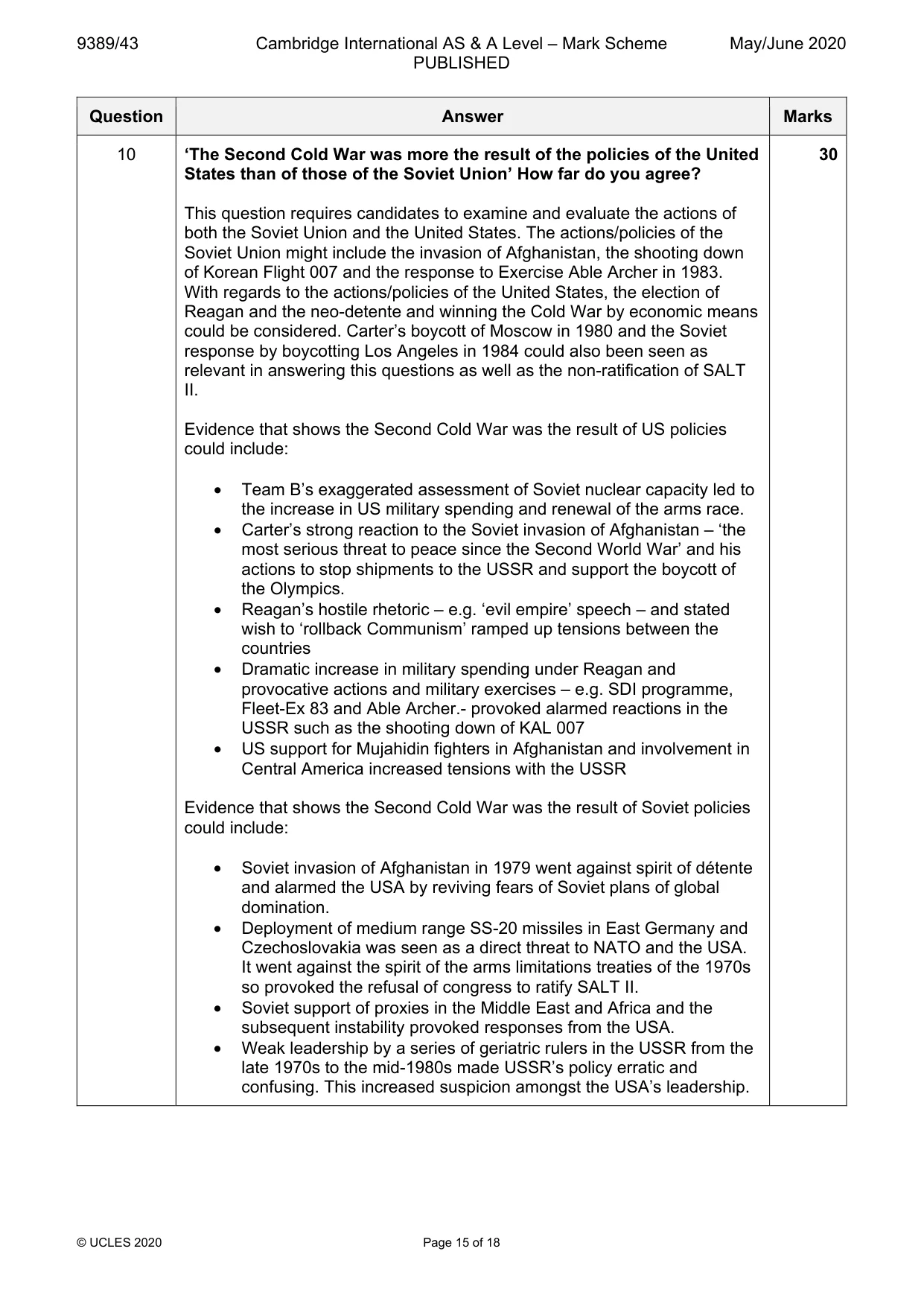
10 ‘The Second Cold War was more the result of the policies of the United States than of those of the Soviet Union.’ How far do you agree? [30]
Mark scheme: 10 ‘The Second Cold War was more the result of the policies of the United 30 States than of those of the Soviet Union’ How far do you agree? This question requires candidates to examine and evaluate the actions of both the Soviet Union and the United States. The actions/policies of the Soviet Union might include the invasion of Afghanistan, the shooting down of Korean Flight 007 and the response to Exercise Able Archer in 1983. With regards to the actions/policies of the United States, the election of Reagan and the neo-detente and winning the Cold War by economic means could be considered. Carter’s boycott of Moscow in 1980 and the Soviet response by boycotting Los Angeles in 1984 could also been seen as relevant in answering this questions as well as the non-ratification of SALT II. Evidence that shows the Second Cold War was the result of US policies could include: • Team B’s exaggerated assessment of Soviet nuclear capacity led to the increase in US military spending and renewal of the arms race. • Carter’s strong reaction to the Soviet invasion of Afghanistan – ‘the most serious threat to peace since the Second World War’ and his actions to stop shipments to the USSR and support the boycott of the Olympics. • Reagan’s hostile rhetoric – e.g. ‘evil empire’ speech – and stated wish to ‘rollback Communism’ ramped up tensions between the countries • Dramatic increase in military spending under Reagan and provocative actions and military exercises – e.g. SDI programme, Fleet-Ex 83 and Able Archer.- provoked alarmed reactions in the USSR such as the shooting down of KAL 007 • US support for Mujahidin fighters in Afghanistan and involvement in Central America increased tensions with the USSR Evidence that shows the Second Cold War was the result of Soviet policies could include: • Soviet invasion of Afghanistan in 1979 went against spirit of détente and alarmed the USA by reviving fears of Soviet plans of global domination. • Deployment of medium range SS-20 missiles in East Germany and Czechoslovakia was seen as a direct threat to NATO and the USA. It went against the spirit of the arms limitations treaties of the 1970s so provoked the refusal of congress to ratify SALT II. • Soviet support of proxies in the Middle East and Africa and the subsequent instability provoked responses from the USA. • Weak leadership by a series of geriatric rulers in the USSR from the late 1970s to the mid-1980s made USSR’s policy erratic and confusing. This increased suspicion amongst the USA’s leadership.
Q11 · ‘The Chinese Communist Party gained victory in 1949 because Mao Zedong won the hearts and…
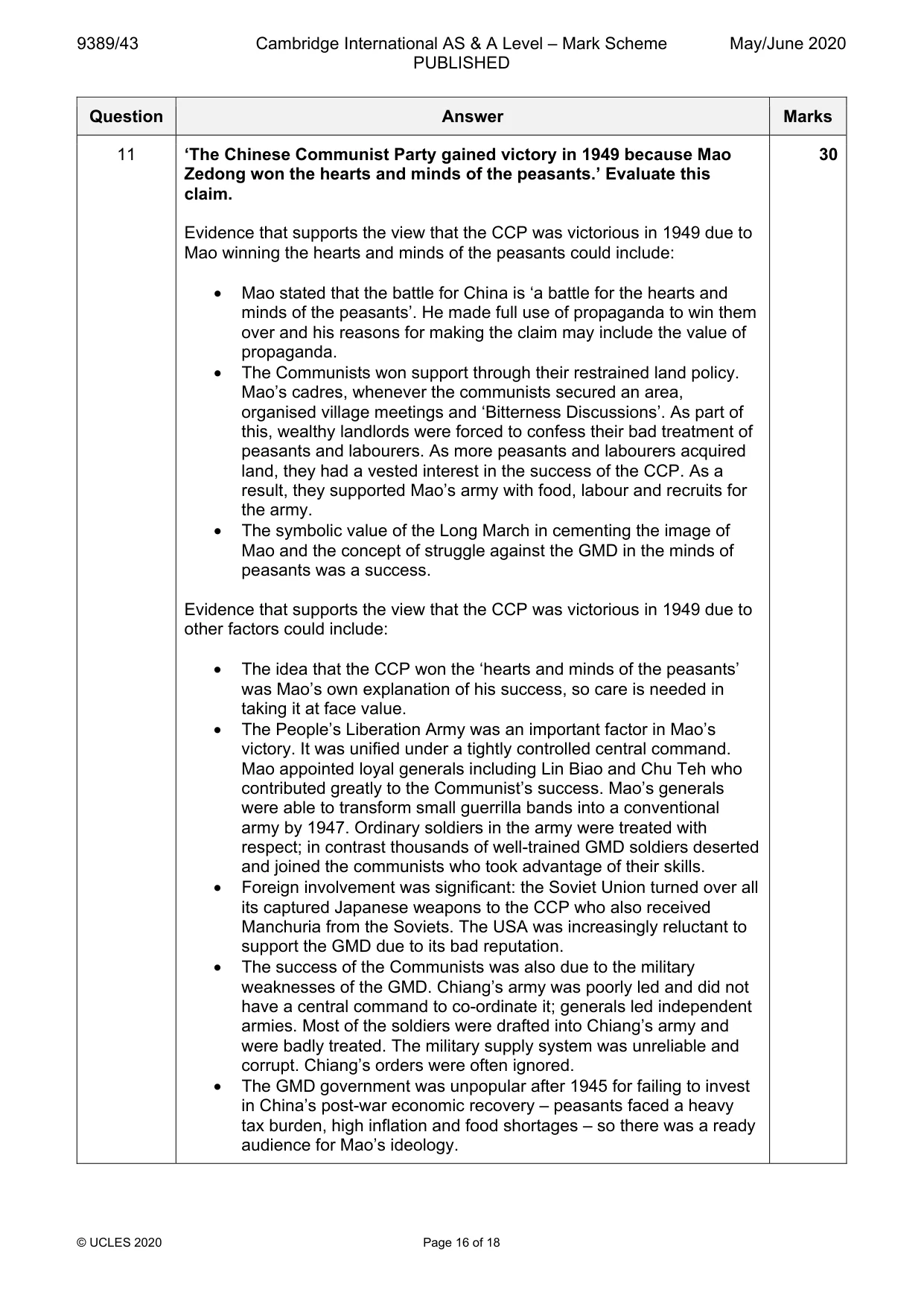
11 ‘The Chinese Communist Party gained victory in 1949 because Mao Zedong won the hearts and minds of the peasants.’ Evaluate this claim. [30]
Mark scheme: 11 ‘The Chinese Communist Party gained victory in 1949 because Mao 30 Zedong won the hearts and minds of the peasants.’ Evaluate this claim. Evidence that supports the view that the CCP was victorious in 1949 due to Mao winning the hearts and minds of the peasants could include: • Mao stated that the battle for China is ‘a battle for the hearts and minds of the peasants’. He made full use of propaganda to win them over and his reasons for making the claim may include the value of propaganda. • The Communists won support through their restrained land policy. Mao’s cadres, whenever the communists secured an area, organised village meetings and ‘Bitterness Discussions’. As part of this, wealthy landlords were forced to confess their bad treatment of peasants and labourers. As more peasants and labourers acquired land, they had a vested interest in the success of the CCP. As a result, they supported Mao’s army with food, labour and recruits for the army. • The symbolic value of the Long March in cementing the image of Mao and the concept of struggle against the GMD in the minds of peasants was a success. Evidence that supports the view that the CCP was victorious in 1949 due to other factors could include: • The idea that the CCP won the ‘hearts and minds of the peasants’ was Mao’s own explanation of his success, so care is needed in taking it at face value. • The People’s Liberation Army was an important factor in Mao’s victory. It was unified under a tightly controlled central command. Mao appointed loyal generals including Lin Biao and Chu Teh who contributed greatly to the Communist’s success. Mao’s generals were able to transform small guerrilla bands into a conventional army by 1947. Ordinary soldiers in the army were treated with respect; in contrast thousands of well-trained GMD soldiers deserted and joined the communists who took advantage of their skills. • Foreign involvement was significant: the Soviet Union turned over all its captured Japanese weapons to the CCP who also received Manchuria from the Soviets. The USA was increasingly reluctant to support the GMD due to its bad reputation. • The success of the Communists was also due to the military weaknesses of the GMD. Chiang’s army was poorly led and did not have a central command to co-ordinate it; generals led independent armies. Most of the soldiers were drafted into Chiang’s army and were badly treated. The military supply system was unreliable and corrupt. Chiang’s orders were often ignored. • The GMD government was unpopular after 1945 for failing to invest in China’s post-war economic recovery – peasants faced a heavy tax burden, high inflation and food shortages – so there was a ready audience for Mao’s ideology.
Q12 · How far were Arab–Israeli relations during the period 1948–79 affected by the United…
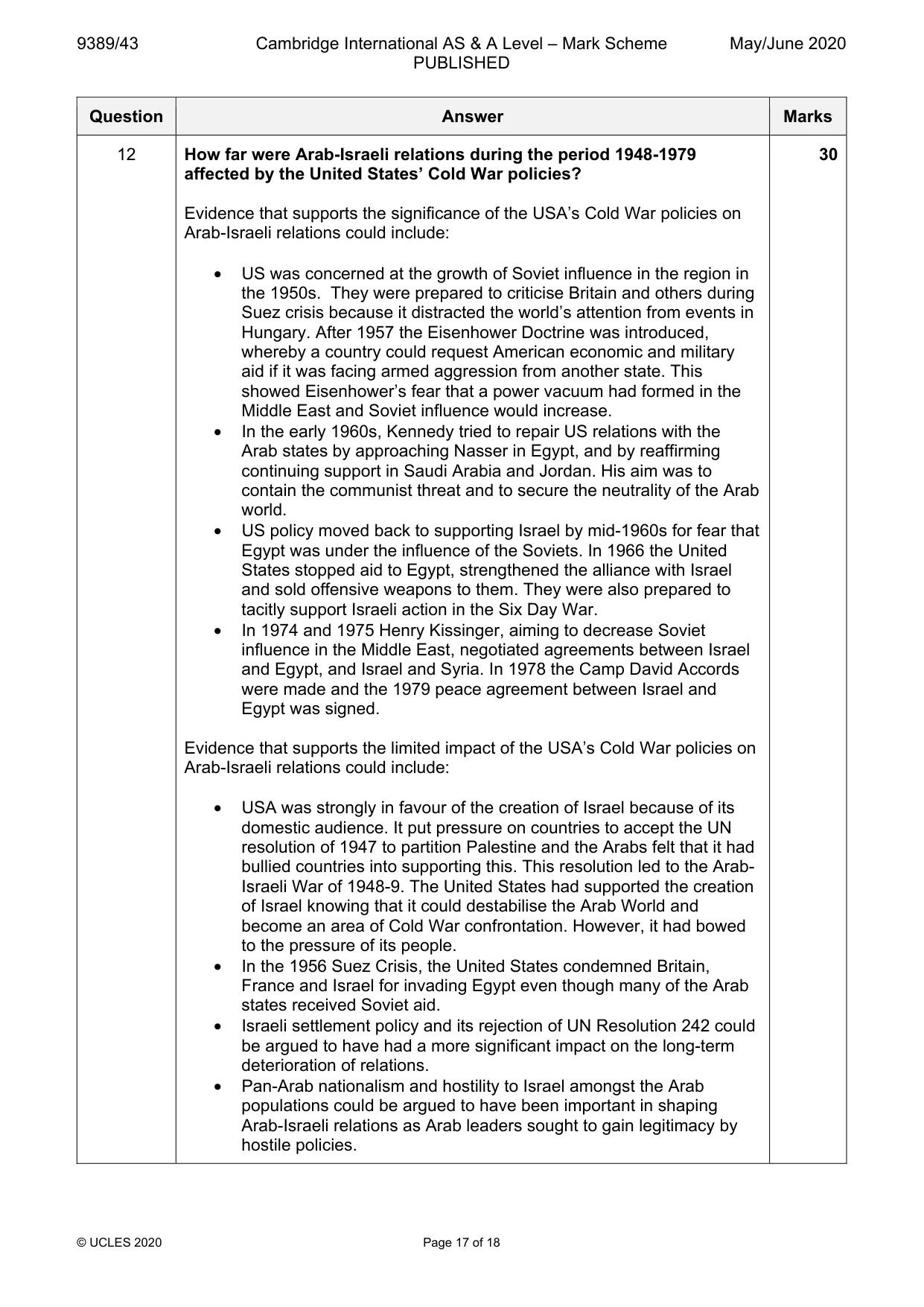
12 How far were Arab–Israeli relations during the period 1948–79 affected by the United States’ Cold War policies? [30]
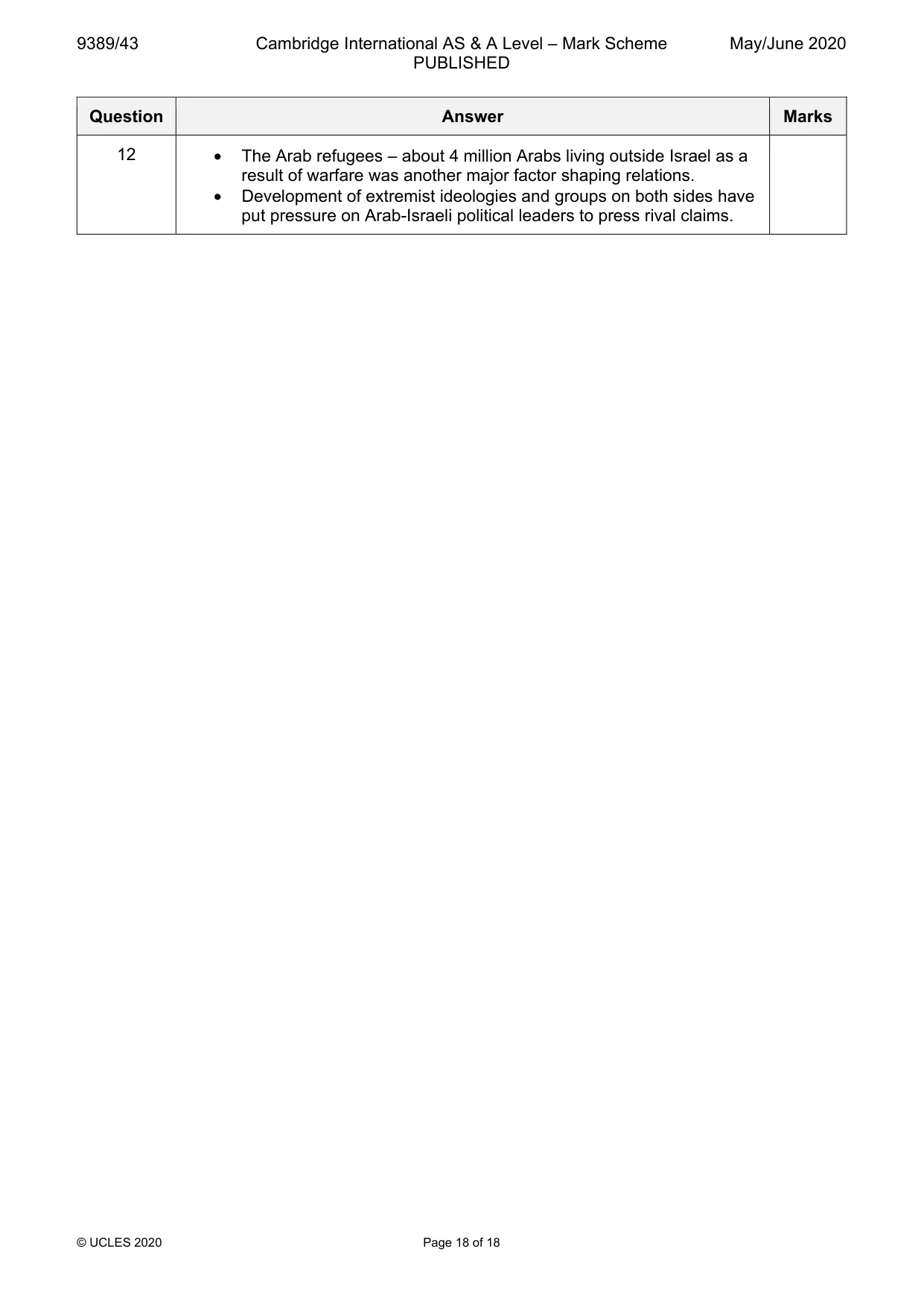
Mark scheme: 12 How far were Arab-Israeli relations during the period 1948-1979 30 affected by the United States’ Cold War policies? Evidence that supports the significance of the USA’s Cold War policies on Arab-Israeli relations could include: • US was concerned at the growth of Soviet influence in the region in the 1950s. They were prepared to criticise Britain and others during Suez crisis because it distracted the world’s attention from events in Hungary. After 1957 the Eisenhower Doctrine was introduced, whereby a country could request American economic and military aid if it was facing armed aggression from another state. This showed Eisenhower’s fear that a power vacuum had formed in the Middle East and Soviet influence would increase. • In the early 1960s, Kennedy tried to repair US relations with the Arab states by approaching Nasser in Egypt, and by reaffirming continuing support in Saudi Arabia and Jordan. His aim was to contain the communist threat and to secure the neutrality of the Arab world. • US policy moved back to supporting Israel by mid-1960s for fear that Egypt was under the influence of the Soviets. In 1966 the United States stopped aid to Egypt, strengthened the alliance with Israel and sold offensive weapons to them. They were also prepared to tacitly support Israeli action in the Six Day War. • In 1974 and 1975 Henry Kissinger, aiming to decrease Soviet influence in the Middle East, negotiated agreements between Israel and Egypt, and Israel and Syria. In 1978 the Camp David Accords were made and the 1979 peace agreement between Israel and Egypt was signed. Evidence that supports the limited impact of the USA’s Cold War policies on Arab-Israeli relations could include: • USA was strongly in favour of the creation of Israel because of its domestic audience. It put pressure on countries to accept the UN resolution of 1947 to partition Palestine and the Arabs felt that it had bullied countries into supporting this. This resolution led to the Arab- Israeli War of 1948-9. The United States had supported the creation of Israel knowing that it could destabilise the Arab World and become an area of Cold War confrontation. However, it had bowed to the pressure of its people. • In the 1956 Suez Crisis, the United States condemned Britain, France and Israel for invading Egypt even though many of the Arab states received Soviet aid. • Israeli settlement policy and its rejection of UN Resolution 242 could be argued to have had a more significant impact on the long-term deterioration of relations. • Pan-Arab nationalism and hostility to Israel amongst the Arab populations could be argued to have been important in shaping Arab-Israeli relations as Arab leaders sought to gain legitimacy by hostile policies. 12 • The Arab refugees – about 4 million Arabs living outside Israel as a result of warfare was another major factor shaping relations. • Development of extremist ideologies and groups on both sides have put pressure on Arab-Israeli political leaders to press rival claims.