Cambridge A Level History 9389 — 2021 Oct/Nov Paper 4 · Variant 3
9389/43/O/N/21 · 20 questions · 60 marks · ≈68 min
The question paper and its mark scheme, free to read here and free to download. This is Cambridge’s own paper, exactly as it was sat.
Question paper4 pages
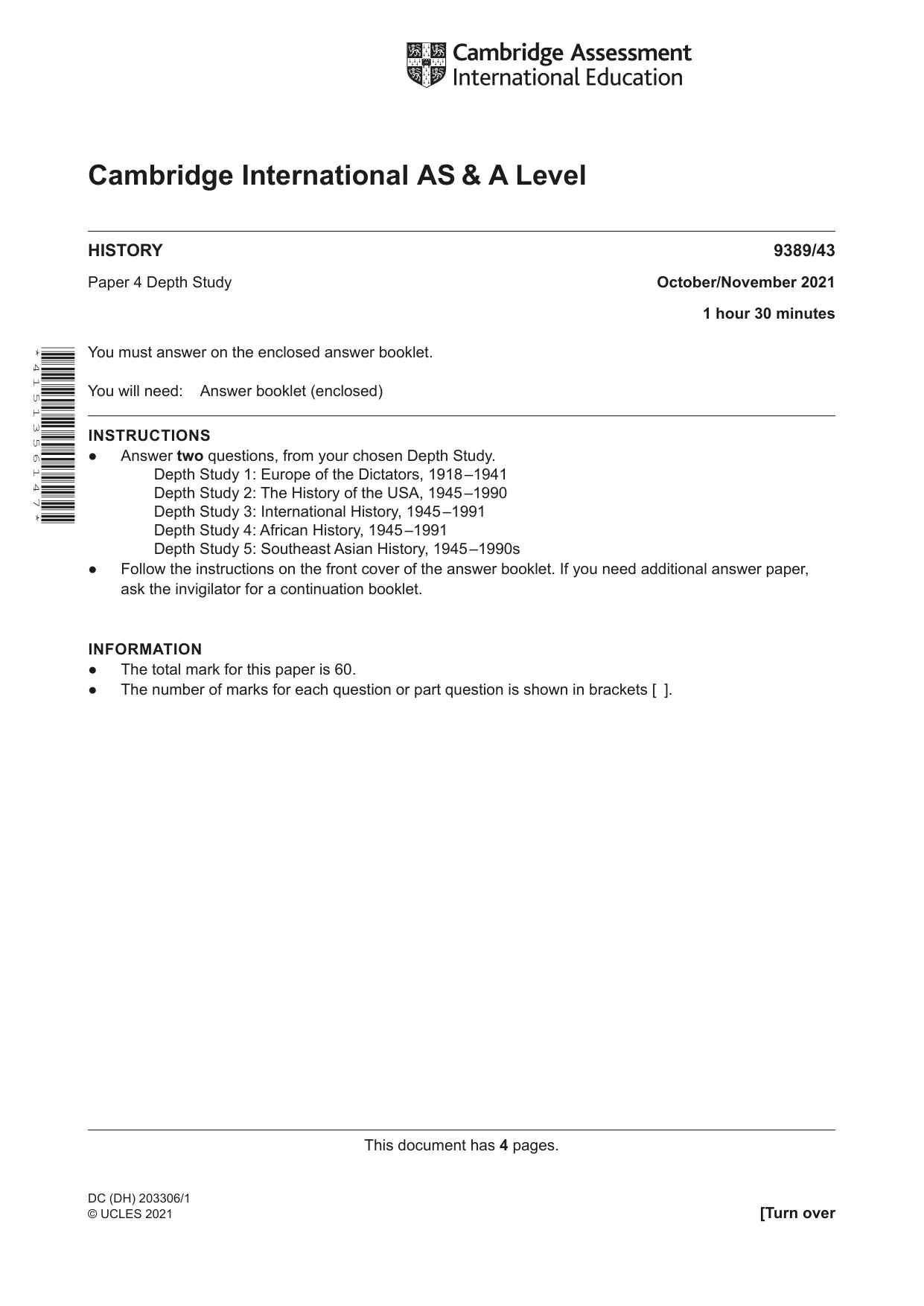
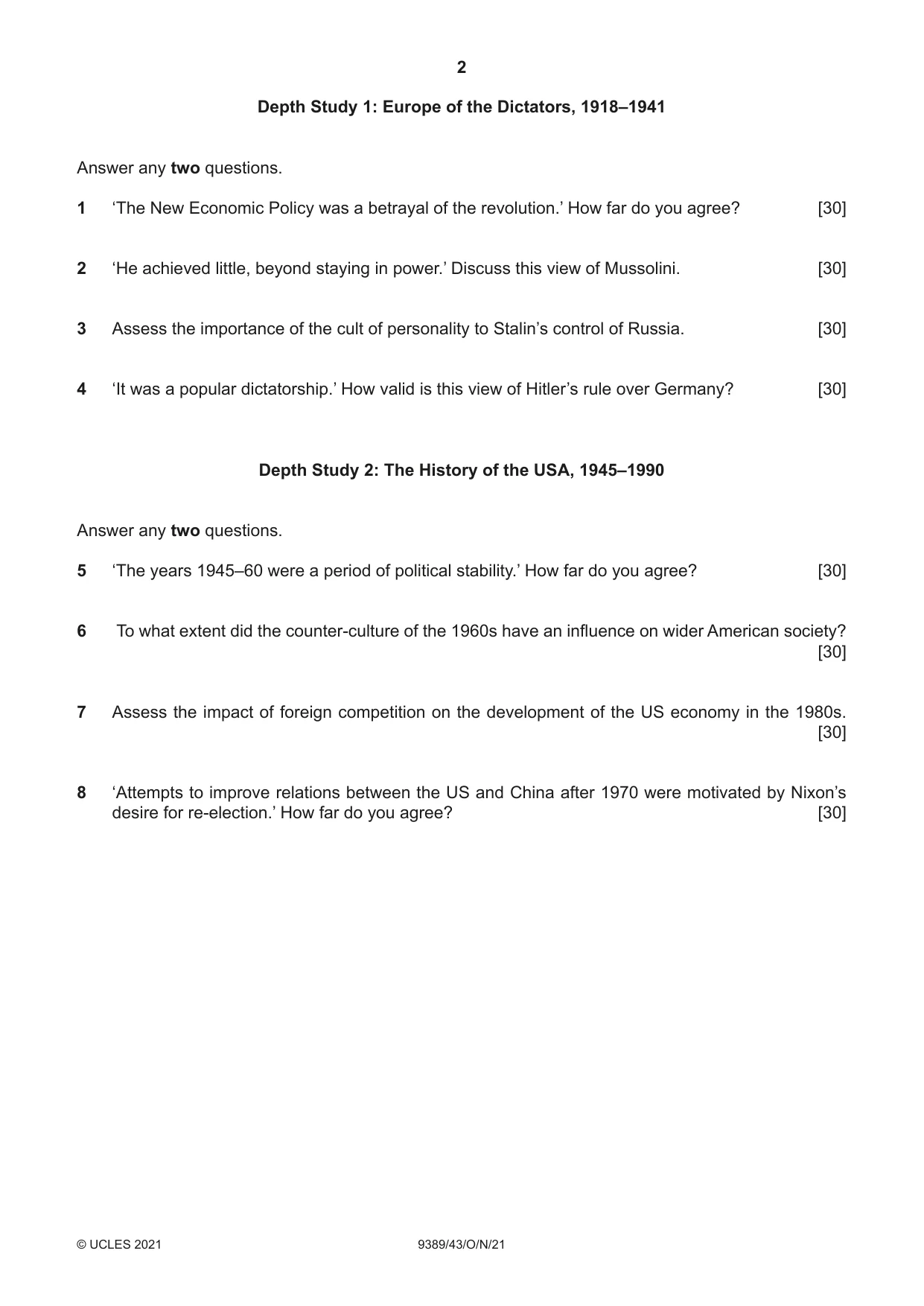
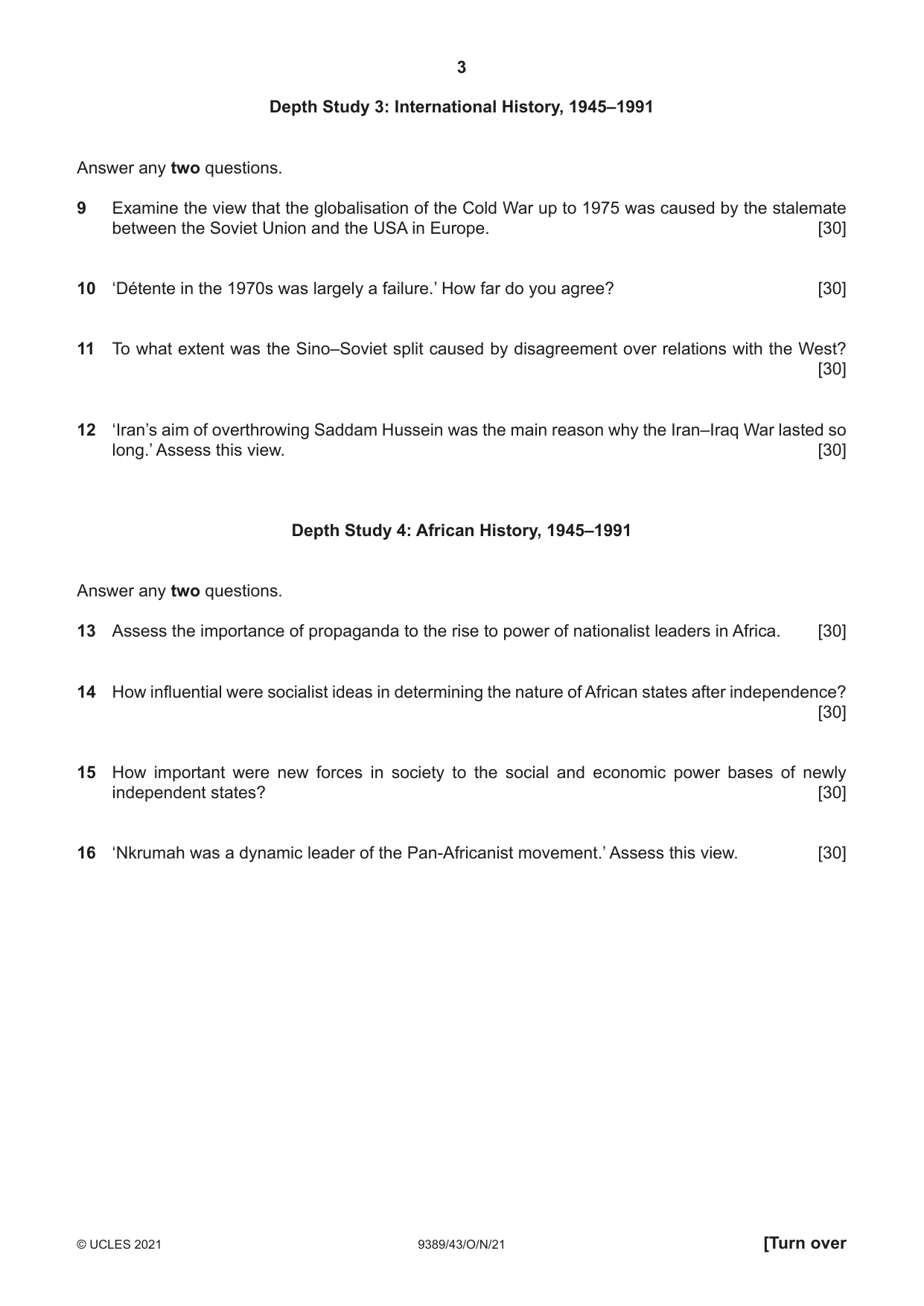
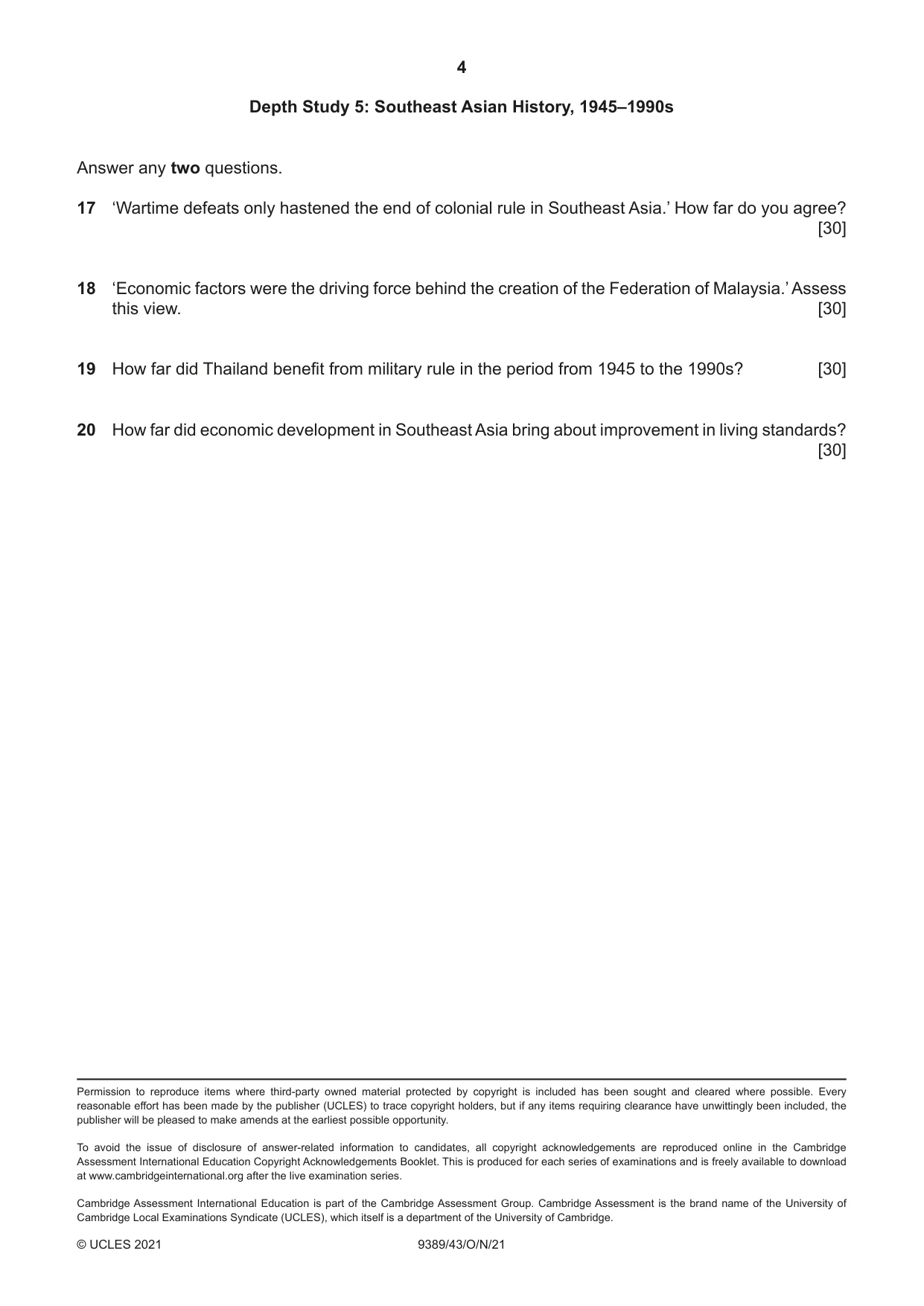
Mark scheme24 pages
Answers below. Sit the paper first if you are practising.

Questions as text
Q1 · ‘The New Economic Policy was a betrayal of the revolution.’ How far do you agree?
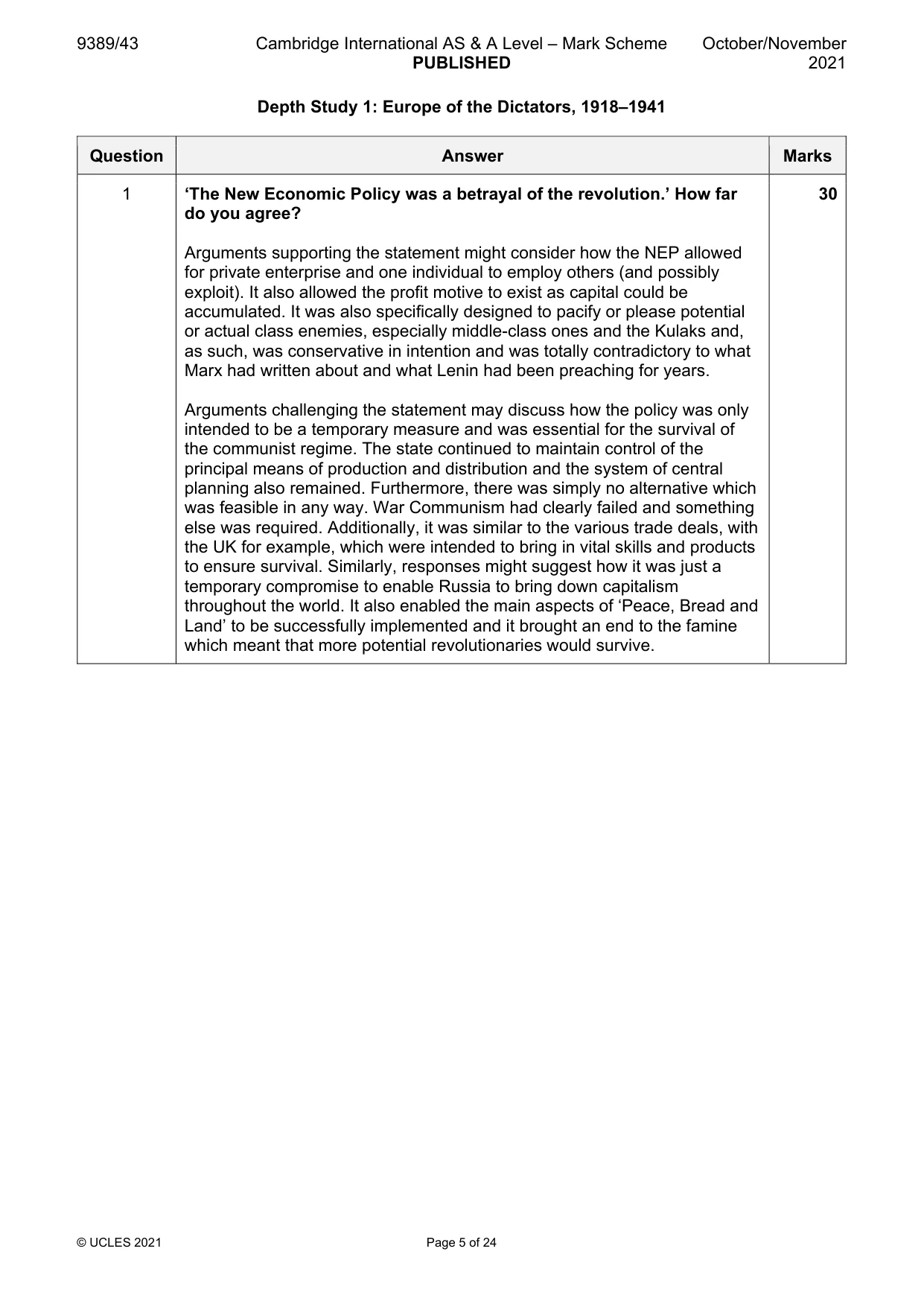
1 ‘The New Economic Policy was a betrayal of the revolution.’ How far do you agree? [30]
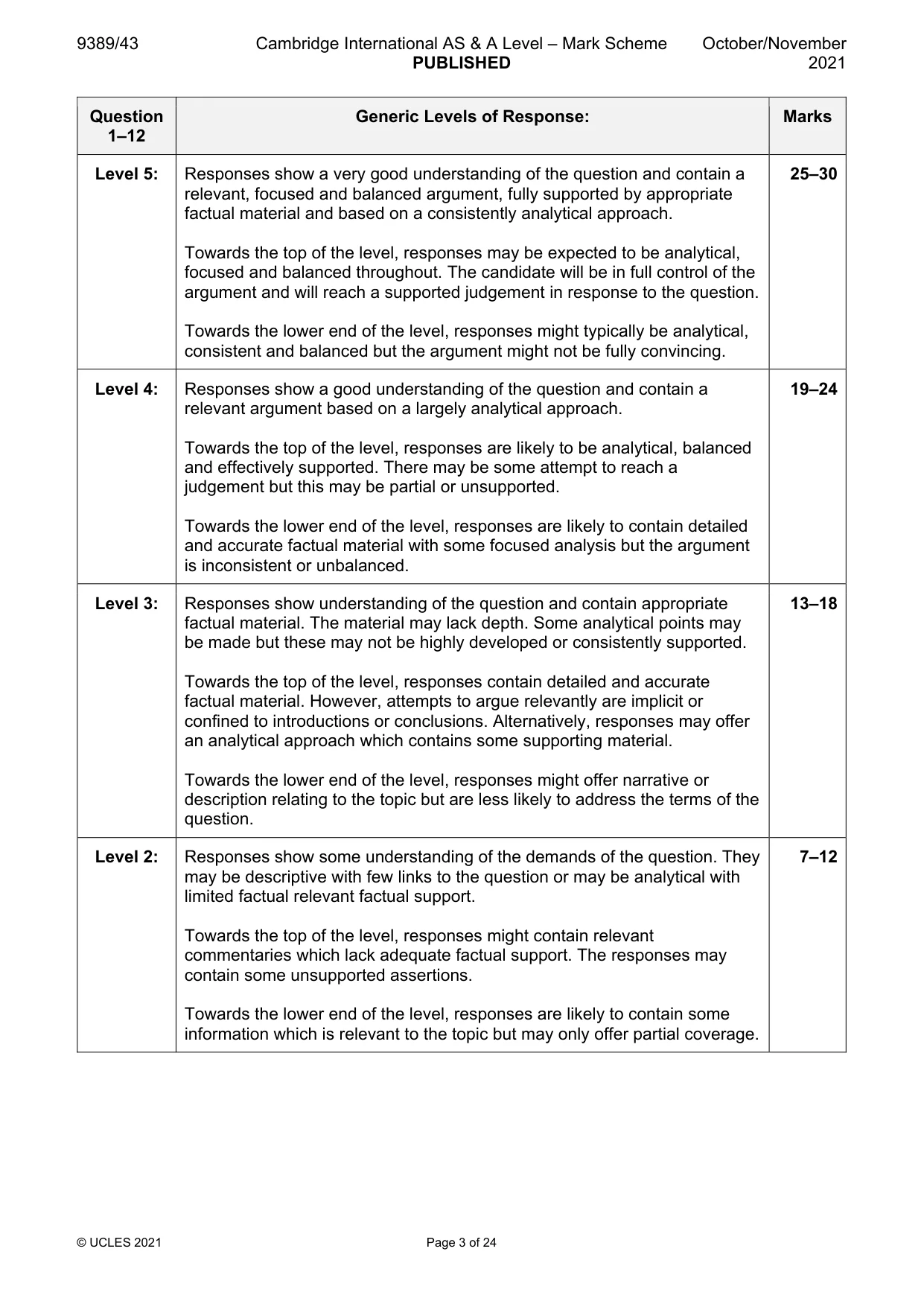
Mark scheme: Question Answer Marks 1 ‘The New Economic Policy was a betrayal of the revolution.’ How far 30 do you agree? Arguments supporting the statement might consider how the NEP allowed for private enterprise and one individual to employ others (and possibly exploit). It also allowed the profit motive to exist as capital could be accumulated. It was also specifically designed to pacify or please potential or actual class enemies, especially middle-class ones and the Kulaks and, as such, was conservative in intention and was totally contradictory to what Marx had written about and what Lenin had been preaching for years. Arguments challenging the statement may discuss how the policy was only intended to be a temporary measure and was essential for the survival of the communist regime. The state continued to maintain control of the principal means of production and distribution and the system of central planning also remained. Furthermore, there was simply no alternative which was feasible in any way. War Communism had clearly failed and something else was required. Additionally, it was similar to the various trade deals, with the UK for example, which were intended to bring in vital skills and products to ensure survival. Similarly, responses might suggest how it was just a temporary compromise to enable Russia to bring down capitalism throughout the world. It also enabled the main aspects of ‘Peace, Bread and Land’ to be successfully implemented and it brought an end to the famine which meant that more potential revolutionaries would survive.
Q2 · ‘He achieved little, beyond staying in power.’ Discuss this view of Mussolini
2 ‘He achieved little, beyond staying in power.’ Discuss this view of Mussolini. [30]
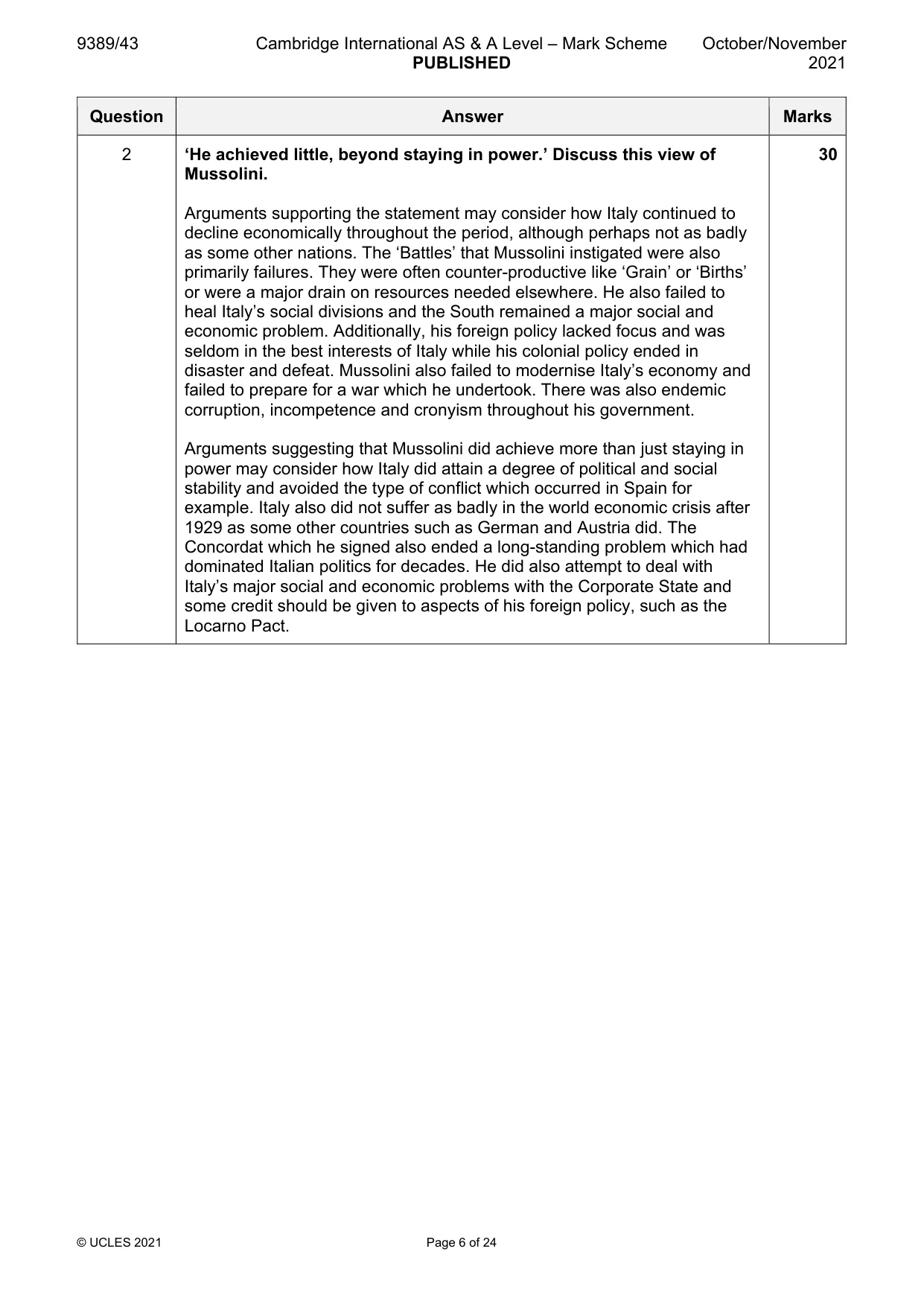
Mark scheme: 2 ‘He achieved little, beyond staying in power.’ Discuss this view of 30 Mussolini. Arguments supporting the statement may consider how Italy continued to decline economically throughout the period, although perhaps not as badly as some other nations. The ‘Battles’ that Mussolini instigated were also primarily failures. They were often counter-productive like ‘Grain’ or ‘Births’ or were a major drain on resources needed elsewhere. He also failed to heal Italy’s social divisions and the South remained a major social and economic problem. Additionally, his foreign policy lacked focus and was seldom in the best interests of Italy while his colonial policy ended in disaster and defeat. Mussolini also failed to modernise Italy’s economy and failed to prepare for a war which he undertook. There was also endemic corruption, incompetence and cronyism throughout his government. Arguments suggesting that Mussolini did achieve more than just staying in power may consider how Italy did attain a degree of political and social stability and avoided the type of conflict which occurred in Spain for example. Italy also did not suffer as badly in the world economic crisis after 1929 as some other countries such as German and Austria did. The Concordat which he signed also ended a long-standing problem which had dominated Italian politics for decades. He did also attempt to deal with Italy’s major social and economic problems with the Corporate State and some credit should be given to aspects of his foreign policy, such as the Locarno Pact.
Q3 · Assess the importance of the cult of personality to Stalin’s control of Russia
3 Assess the importance of the cult of personality to Stalin’s control of Russia. [30]
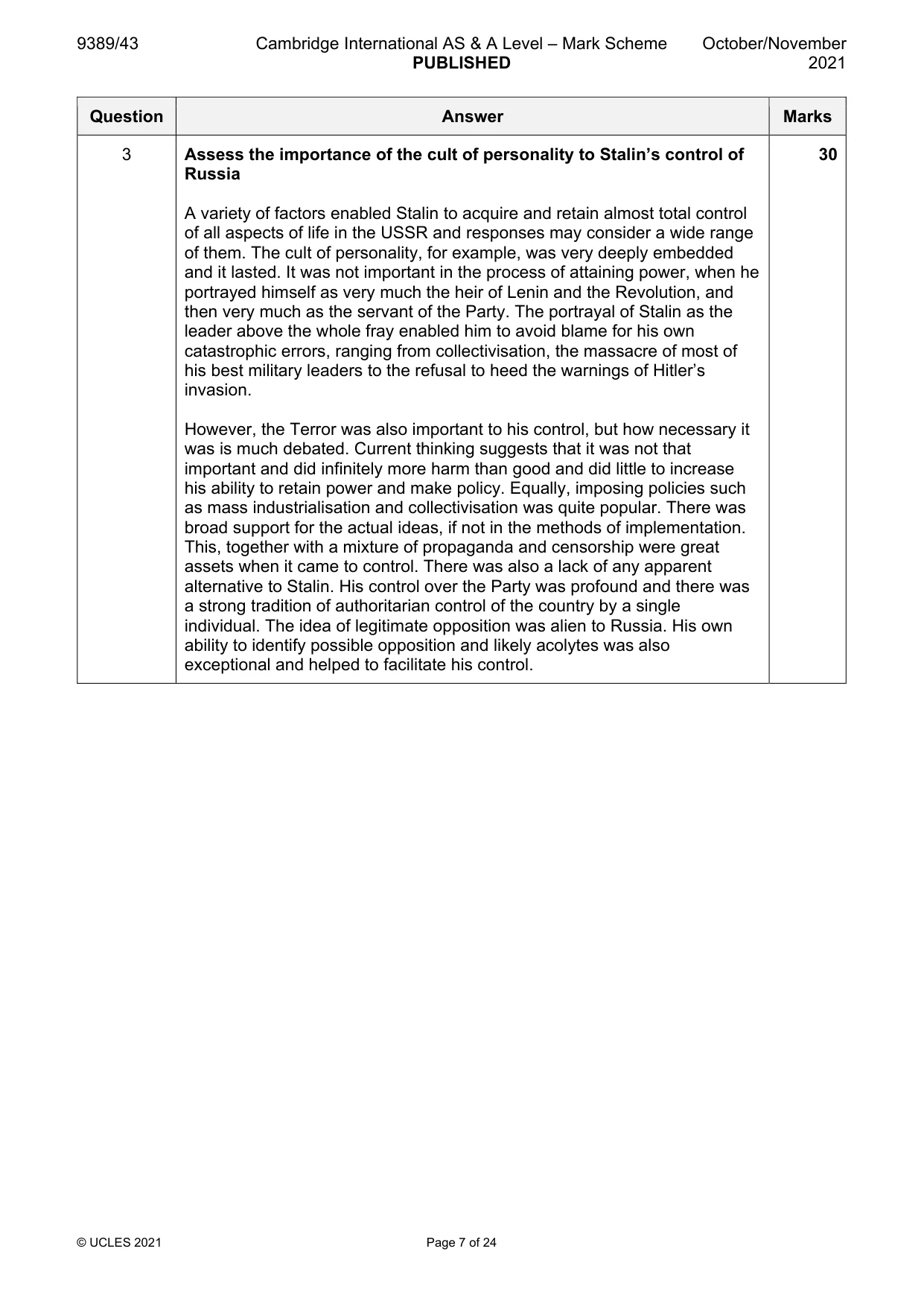
Mark scheme: 3 Assess the importance of the cult of personality to Stalin’s control of 30 Russia A variety of factors enabled Stalin to acquire and retain almost total control of all aspects of life in the USSR and responses may consider a wide range of them. The cult of personality, for example, was very deeply embedded and it lasted. It was not important in the process of attaining power, when he portrayed himself as very much the heir of Lenin and the Revolution, and then very much as the servant of the Party. The portrayal of Stalin as the leader above the whole fray enabled him to avoid blame for his own catastrophic errors, ranging from collectivisation, the massacre of most of his best military leaders to the refusal to heed the warnings of Hitler’s invasion. However, the Terror was also important to his control, but how necessary it was is much debated. Current thinking suggests that it was not that important and did infinitely more harm than good and did little to increase his ability to retain power and make policy. Equally, imposing policies such as mass industrialisation and collectivisation was quite popular. There was broad support for the actual ideas, if not in the methods of implementation. This, together with a mixture of propaganda and censorship were great assets when it came to control. There was also a lack of any apparent alternative to Stalin. His control over the Party was profound and there was a strong tradition of authoritarian control of the country by a single individual. The idea of legitimate opposition was alien to Russia. His own ability to identify possible opposition and likely acolytes was also exceptional and helped to facilitate his control.
Q4 · ‘It was a popular dictatorship.’ How valid is this view of Hitler’s rule over Germany?
4 ‘It was a popular dictatorship.’ How valid is this view of Hitler’s rule over Germany? [30] Depth Study 2: The History of the USA, 1945–1990 Answer any two questions.
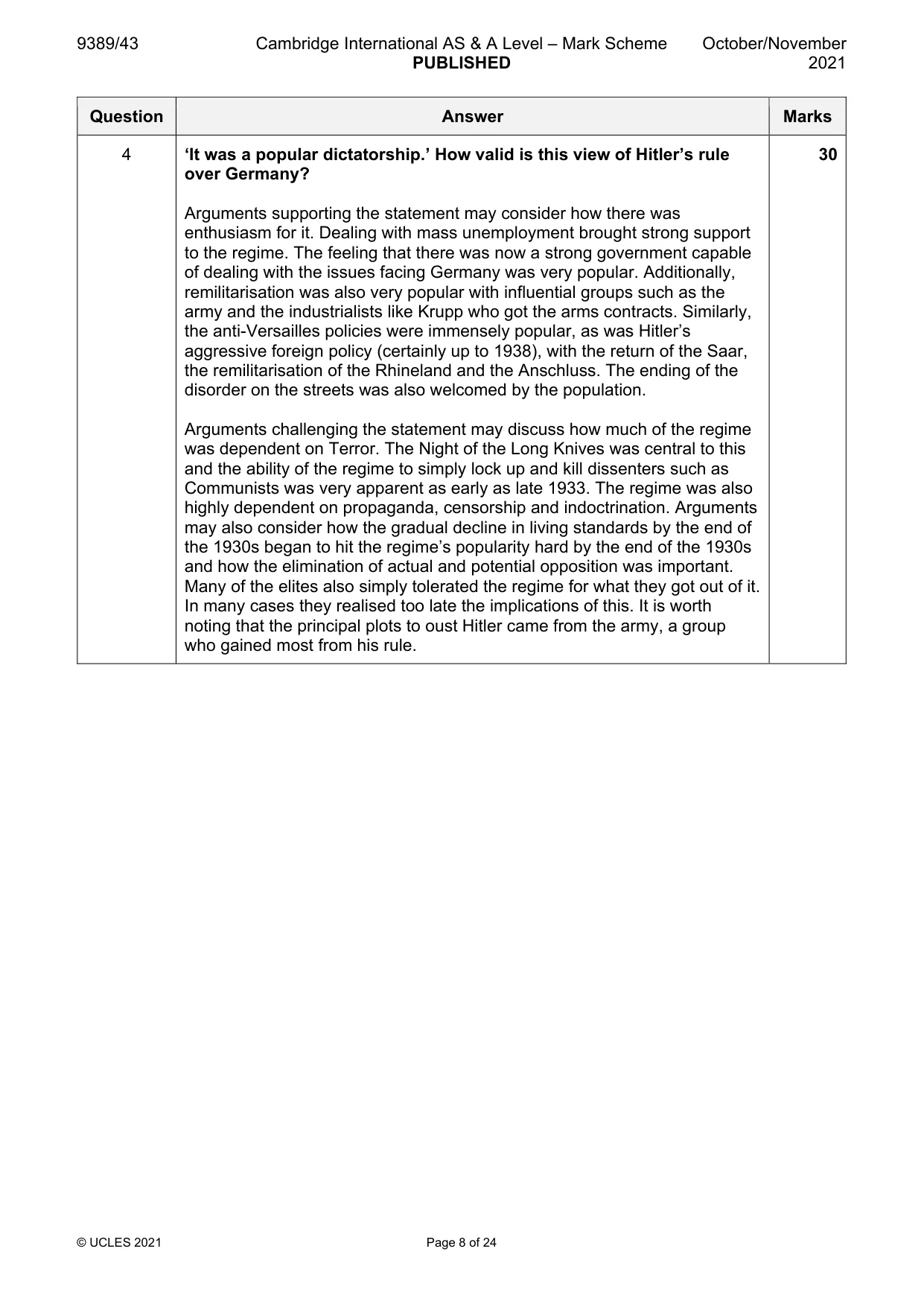
Mark scheme: 4 ‘It was a popular dictatorship.’ How valid is this view of Hitler’s rule 30 over Germany? Arguments supporting the statement may consider how there was enthusiasm for it. Dealing with mass unemployment brought strong support to the regime. The feeling that there was now a strong government capable of dealing with the issues facing Germany was very popular. Additionally, remilitarisation was also very popular with influential groups such as the army and the industrialists like Krupp who got the arms contracts. Similarly, the anti-Versailles policies were immensely popular, as was Hitler’s aggressive foreign policy (certainly up to 1938), with the return of the Saar, the remilitarisation of the Rhineland and the Anschluss. The ending of the disorder on the streets was also welcomed by the population. Arguments challenging the statement may discuss how much of the regime was dependent on Terror. The Night of the Long Knives was central to this and the ability of the regime to simply lock up and kill dissenters such as Communists was very apparent as early as late 1933. The regime was also highly dependent on propaganda, censorship and indoctrination. Arguments may also consider how the gradual decline in living standards by the end of the 1930s began to hit the regime’s popularity hard by the end of the 1930s and how the elimination of actual and potential opposition was important. Many of the elites also simply tolerated the regime for what they got out of it. In many cases they realised too late the implications of this. It is worth noting that the principal plots to oust Hitler came from the army, a group who gained most from his rule. Depth Study 2: The History of the USA, 1945–1990
Q5 · ‘The years 1945–60 were a period of political stability.’ How far do you agree?
5 ‘The years 1945–60 were a period of political stability.’ How far do you agree? [30]
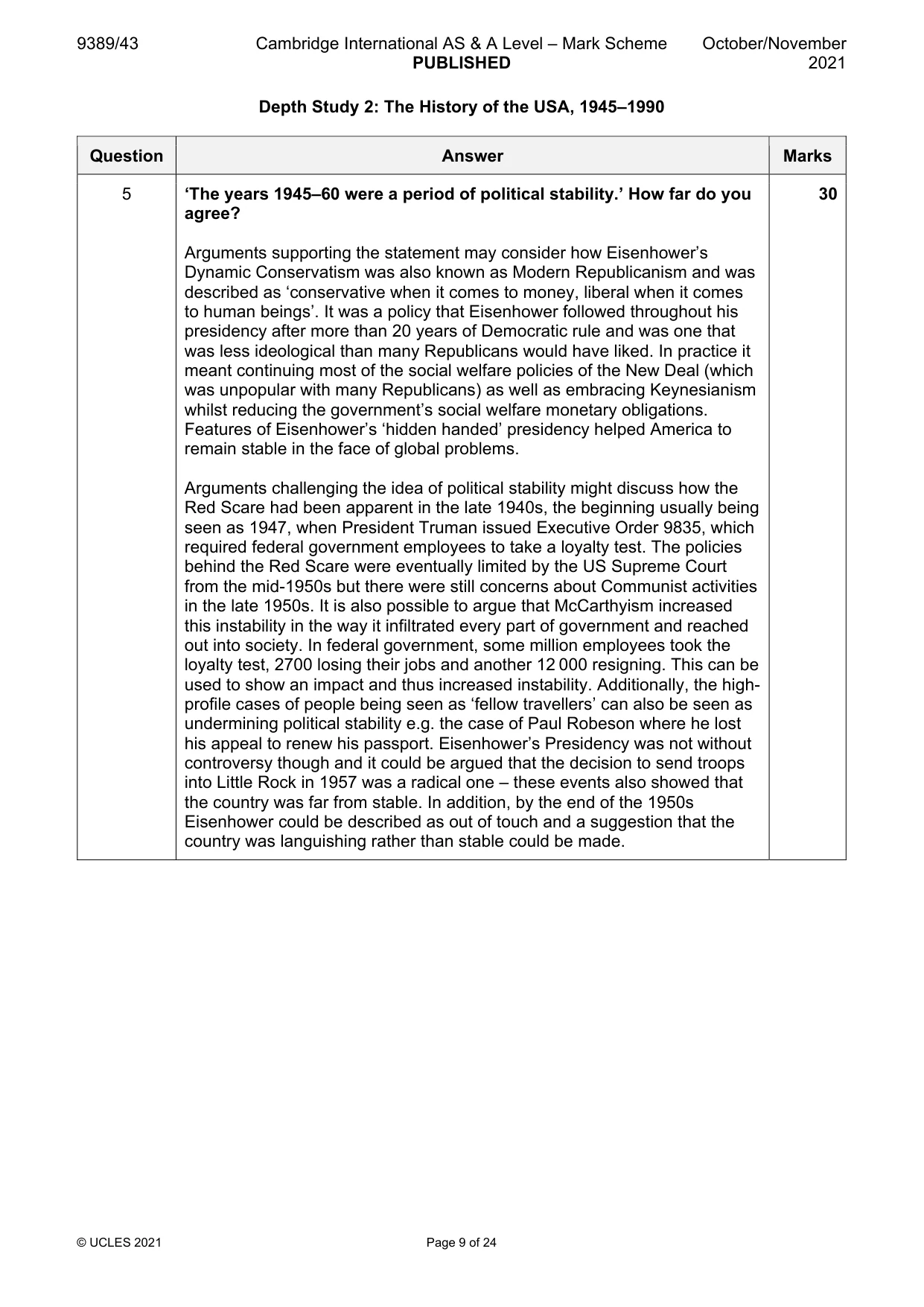
Mark scheme: 5 ‘The years 1945–60 were a period of political stability.’ How far do you 30 agree? Arguments supporting the statement may consider how Eisenhower’s Dynamic Conservatism was also known as Modern Republicanism and was described as ‘conservative when it comes to money, liberal when it comes to human beings’. It was a policy that Eisenhower followed throughout his presidency after more than 20 years of Democratic rule and was one that was less ideological than many Republicans would have liked. In practice it meant continuing most of the social welfare policies of the New Deal (which was unpopular with many Republicans) as well as embracing Keynesianism whilst reducing the government’s social welfare monetary obligations. Features of Eisenhower’s ‘hidden handed’ presidency helped America to remain stable in the face of global problems. Arguments challenging the idea of political stability might discuss how the Red Scare had been apparent in the late 1940s, the beginning usually being seen as 1947, when President Truman issued Executive Order 9835, which required federal government employees to take a loyalty test. The policies behind the Red Scare were eventually limited by the US Supreme Court from the mid-1950s but there were still concerns about Communist activities in the late 1950s. It is also possible to argue that McCarthyism increased this instability in the way it infiltrated every part of government and reached out into society. In federal government, some million employees took the loyalty test, 2700 losing their jobs and another 12 000 resigning. This can be used to show an impact and thus increased instability. Additionally, the high- profile cases of people being seen as ‘fellow travellers’ can also be seen as undermining political stability e.g. the case of Paul Robeson where he lost his appeal to renew his passport. Eisenhower’s Presidency was not without controversy though and it could be argued that the decision to send troops into Little Rock in 1957 was a radical one – these events also showed that the country was far from stable. In addition, by the end of the 1950s Eisenhower could be described as out of touch and a suggestion that the country was languishing rather than stable could be made.
Q6 · To what extent did the counter-culture of the 1960s have an influence on wider American…
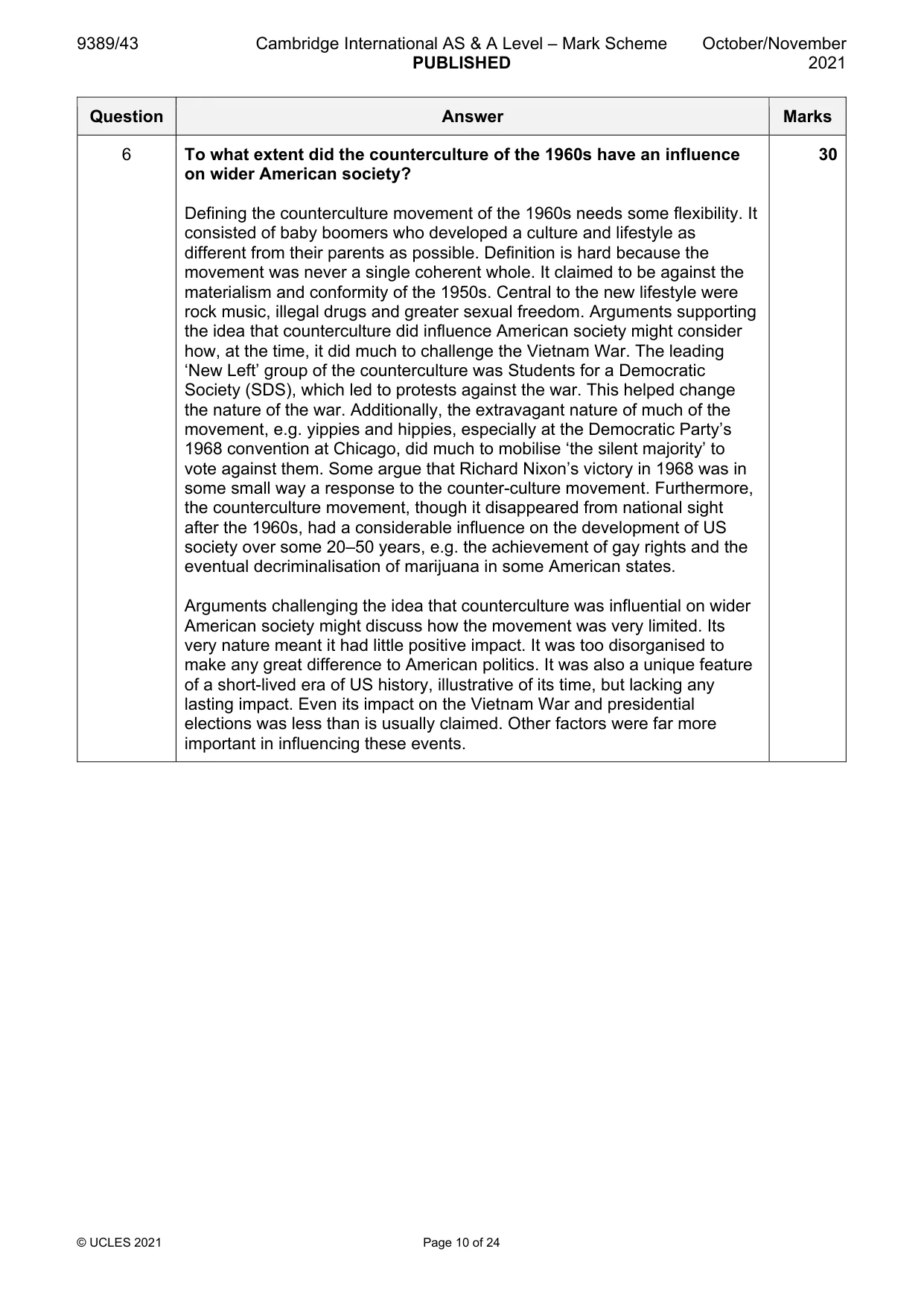
6 To what extent did the counter-culture of the 1960s have an influence on wider American society? [30]
Mark scheme: 6 To what extent did the counterculture of the 1960s have an influence 30 on wider American society? Defining the counterculture movement of the 1960s needs some flexibility. It consisted of baby boomers who developed a culture and lifestyle as different from their parents as possible. Definition is hard because the movement was never a single coherent whole. It claimed to be against the materialism and conformity of the 1950s. Central to the new lifestyle were rock music, illegal drugs and greater sexual freedom. Arguments supporting the idea that counterculture did influence American society might consider how, at the time, it did much to challenge the Vietnam War. The leading ‘New Left’ group of the counterculture was Students for a Democratic Society (SDS), which led to protests against the war. This helped change the nature of the war. Additionally, the extravagant nature of much of the movement, e.g. yippies and hippies, especially at the Democratic Party’s 1968 convention at Chicago, did much to mobilise ‘the silent majority’ to vote against them. Some argue that Richard Nixon’s victory in 1968 was in some small way a response to the counter-culture movement. Furthermore, the counterculture movement, though it disappeared from national sight after the 1960s, had a considerable influence on the development of US society over some 20–50 years, e.g. the achievement of gay rights and the eventual decriminalisation of marijuana in some American states. Arguments challenging the idea that counterculture was influential on wider American society might discuss how the movement was very limited. Its very nature meant it had little positive impact. It was too disorganised to make any great difference to American politics. It was also a unique feature of a short-lived era of US history, illustrative of its time, but lacking any lasting impact. Even its impact on the Vietnam War and presidential elections was less than is usually claimed. Other factors were far more important in influencing these events.
Q7 · Assess the impact of foreign competition on the development of the US economy in the 1980s
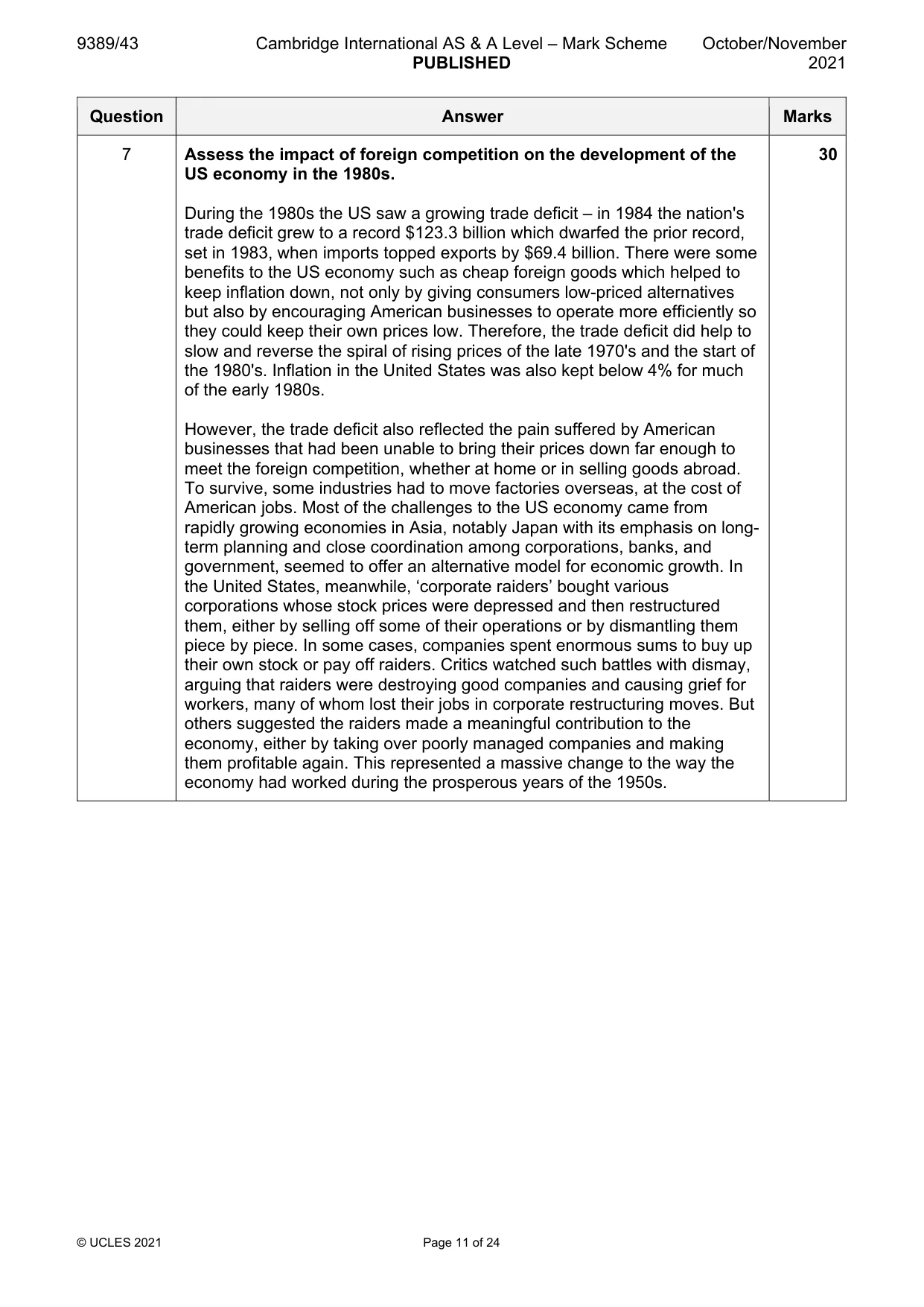
7 Assess the impact of foreign competition on the development of the US economy in the 1980s. [30]
Mark scheme: 7 Assess the impact of foreign competition on the development of the 30 US economy in the 1980s. During the 1980s the US saw a growing trade deficit – in 1984 the nation's trade deficit grew to a record $123.3 billion which dwarfed the prior record, set in 1983, when imports topped exports by $69.4 billion. There were some benefits to the US economy such as cheap foreign goods which helped to keep inflation down, not only by giving consumers low-priced alternatives but also by encouraging American businesses to operate more efficiently so they could keep their own prices low. Therefore, the trade deficit did help to slow and reverse the spiral of rising prices of the late 1970's and the start of the 1980's. Inflation in the United States was also kept below 4% for much of the early 1980s. However, the trade deficit also reflected the pain suffered by American businesses that had been unable to bring their prices down far enough to meet the foreign competition, whether at home or in selling goods abroad. To survive, some industries had to move factories overseas, at the cost of American jobs. Most of the challenges to the US economy came from rapidly growing economies in Asia, notably Japan with its emphasis on long- term planning and close coordination among corporations, banks, and government, seemed to offer an alternative model for economic growth. In the United States, meanwhile, ‘corporate raiders’ bought various corporations whose stock prices were depressed and then restructured them, either by selling off some of their operations or by dismantling them piece by piece. In some cases, companies spent enormous sums to buy up their own stock or pay off raiders. Critics watched such battles with dismay, arguing that raiders were destroying good companies and causing grief for workers, many of whom lost their jobs in corporate restructuring moves. But others suggested the raiders made a meaningful contribution to the economy, either by taking over poorly managed companies and making them profitable again. This represented a massive change to the way the economy had worked during the prosperous years of the 1950s.
Q8 · ‘Attempts to improve relations between the US and China after 1970 were motivated by…
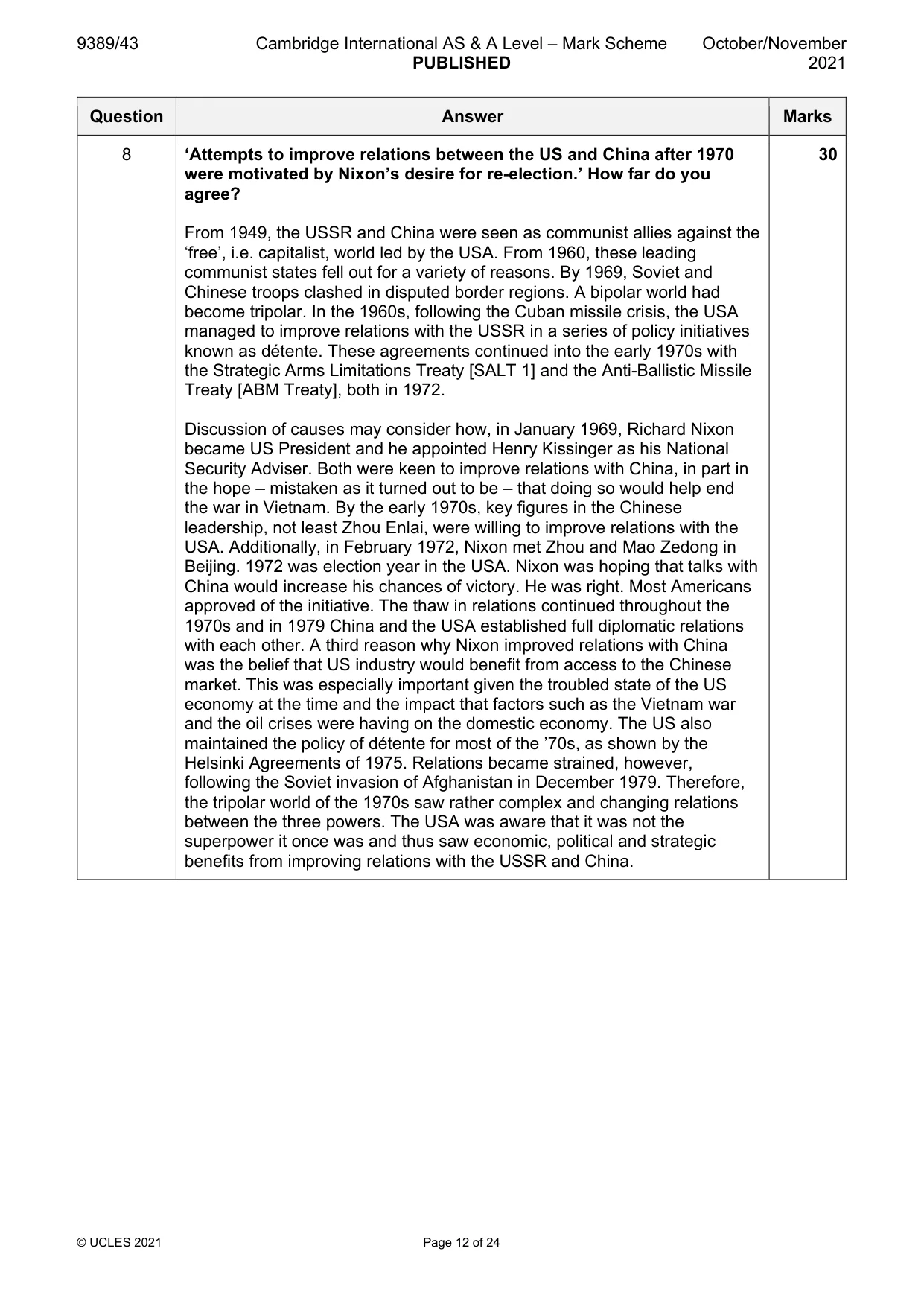
8 ‘Attempts to improve relations between the US and China after 1970 were motivated by Nixon’s desire for re-election.’ How far do you agree? [30] Depth Study 3: International History, 1945–1991 Answer any two questions.
Mark scheme: 8 ‘Attempts to improve relations between the US and China after 1970 30 were motivated by Nixon’s desire for re-election.’ How far do you agree? From 1949, the USSR and China were seen as communist allies against the ‘free’, i.e. capitalist, world led by the USA. From 1960, these leading communist states fell out for a variety of reasons. By 1969, Soviet and Chinese troops clashed in disputed border regions. A bipolar world had become tripolar. In the 1960s, following the Cuban missile crisis, the USA managed to improve relations with the USSR in a series of policy initiatives known as détente. These agreements continued into the early 1970s with the Strategic Arms Limitations Treaty [SALT 1] and the Anti-Ballistic Missile Treaty [ABM Treaty], both in 1972. Discussion of causes may consider how, in January 1969, Richard Nixon became US President and he appointed Henry Kissinger as his National Security Adviser. Both were keen to improve relations with China, in part in the hope – mistaken as it turned out to be – that doing so would help end the war in Vietnam. By the early 1970s, key figures in the Chinese leadership, not least Zhou Enlai, were willing to improve relations with the USA. Additionally, in February 1972, Nixon met Zhou and Mao Zedong in Beijing. 1972 was election year in the USA. Nixon was hoping that talks with China would increase his chances of victory. He was right. Most Americans approved of the initiative. The thaw in relations continued throughout the 1970s and in 1979 China and the USA established full diplomatic relations with each other. A third reason why Nixon improved relations with China was the belief that US industry would benefit from access to the Chinese market. This was especially important given the troubled state of the US economy at the time and the impact that factors such as the Vietnam war and the oil crises were having on the domestic economy. The US also maintained the policy of détente for most of the ’70s, as shown by the Helsinki Agreements of 1975. Relations became strained, however, following the Soviet invasion of Afghanistan in December 1979. Therefore, the tripolar world of the 1970s saw rather complex and changing relations between the three powers. The USA was aware that it was not the superpower it once was and thus saw economic, political and strategic benefits from improving relations with the USSR and China. Depth Study 3: International History, 1945–1991
Q9 · Examine the view that the globalisation of the Cold War up to 1975 was caused by the…
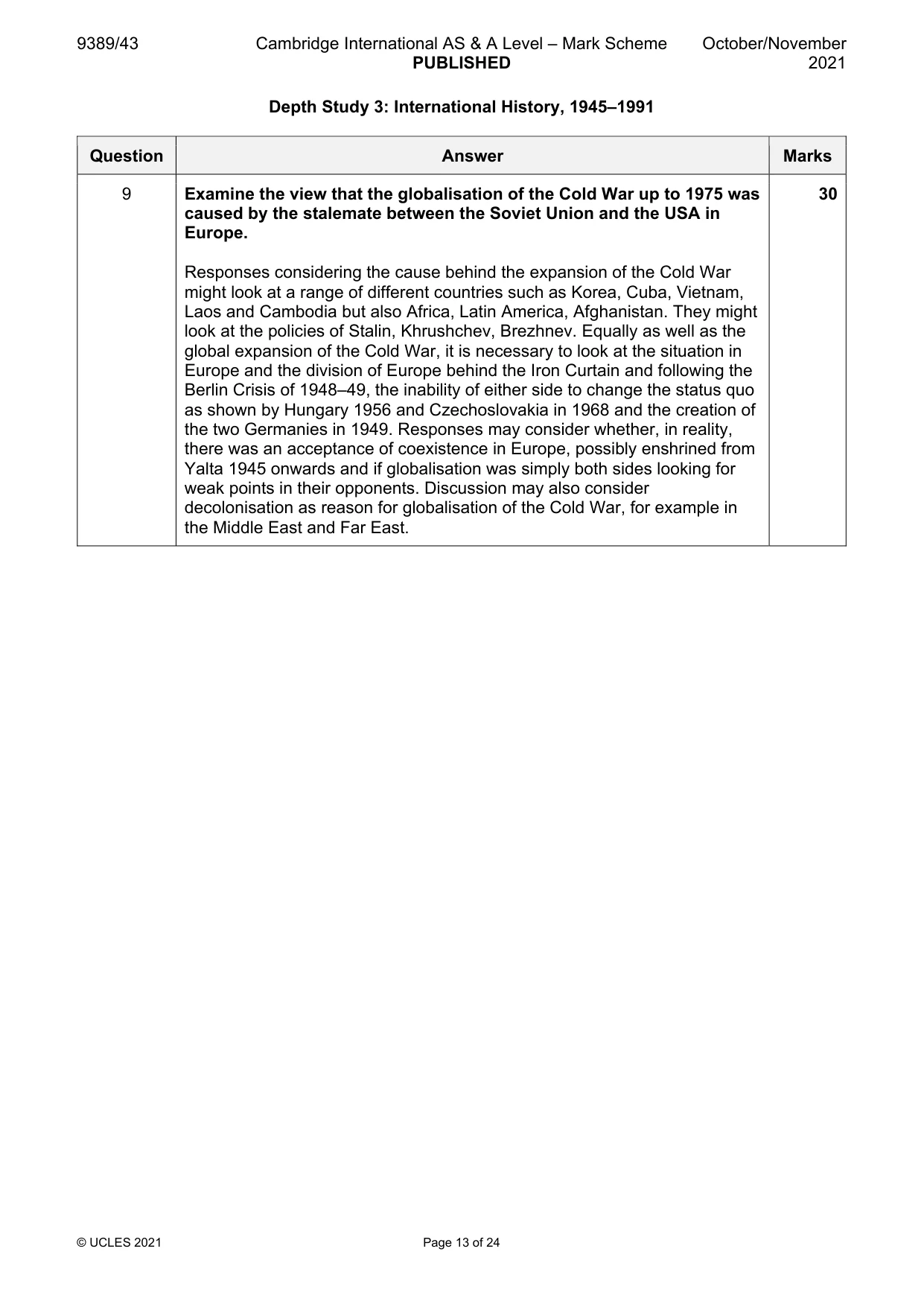
9 Examine the view that the globalisation of the Cold War up to 1975 was caused by the stalemate between the Soviet Union and the USA in Europe. [30]
Mark scheme: 9 Examine the view that the globalisation of the Cold War up to 1975 was 30 caused by the stalemate between the Soviet Union and the USA in Europe. Responses considering the cause behind the expansion of the Cold War might look at a range of different countries such as Korea, Cuba, Vietnam, Laos and Cambodia but also Africa, Latin America, Afghanistan. They might look at the policies of Stalin, Khrushchev, Brezhnev. Equally as well as the global expansion of the Cold War, it is necessary to look at the situation in Europe and the division of Europe behind the Iron Curtain and following the Berlin Crisis of 1948–49, the inability of either side to change the status quo as shown by Hungary 1956 and Czechoslovakia in 1968 and the creation of the two Germanies in 1949. Responses may consider whether, in reality, there was an acceptance of coexistence in Europe, possibly enshrined from Yalta 1945 onwards and if globalisation was simply both sides looking for weak points in their opponents. Discussion may also consider decolonisation as reason for globalisation of the Cold War, for example in the Middle East and Far East.
Q10 · ‘Détente in the 1970s was largely a failure.’ How far do you agree?
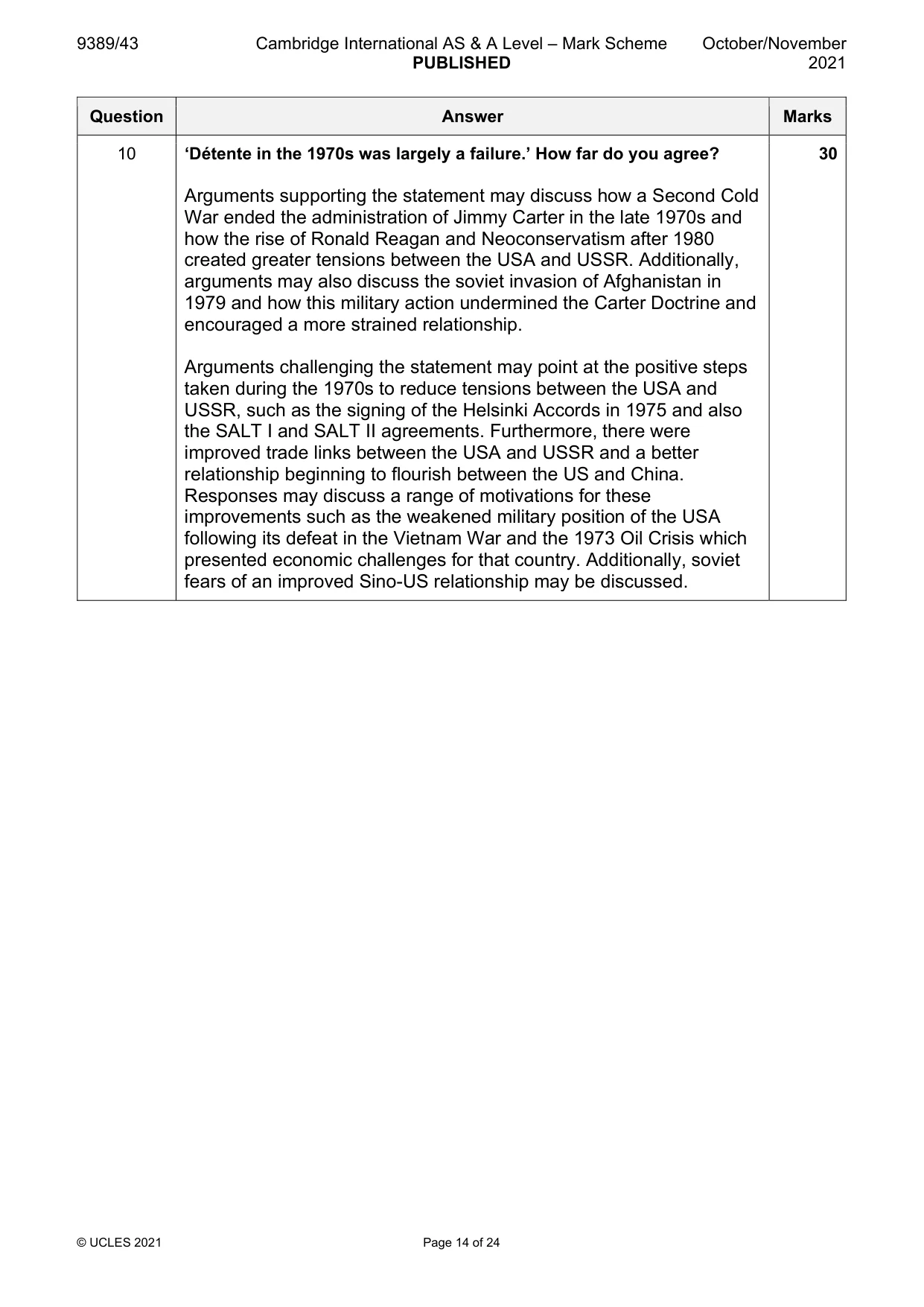
10 ‘Détente in the 1970s was largely a failure.’ How far do you agree? [30]
Mark scheme: 10 ‘Détente in the 1970s was largely a failure.’ How far do you agree? 30 Arguments supporting the statement may discuss how a Second Cold War ended the administration of Jimmy Carter in the late 1970s and how the rise of Ronald Reagan and Neoconservatism after 1980 created greater tensions between the USA and USSR. Additionally, arguments may also discuss the soviet invasion of Afghanistan in 1979 and how this military action undermined the Carter Doctrine and encouraged a more strained relationship. Arguments challenging the statement may point at the positive steps taken during the 1970s to reduce tensions between the USA and USSR, such as the signing of the Helsinki Accords in 1975 and also the SALT I and SALT II agreements. Furthermore, there were improved trade links between the USA and USSR and a better relationship beginning to flourish between the US and China. Responses may discuss a range of motivations for these improvements such as the weakened military position of the USA following its defeat in the Vietnam War and the 1973 Oil Crisis which presented economic challenges for that country. Additionally, soviet fears of an improved Sino-US relationship may be discussed.
Q11 · To what extent was the Sino–Soviet split caused by disagreement over relations with the…
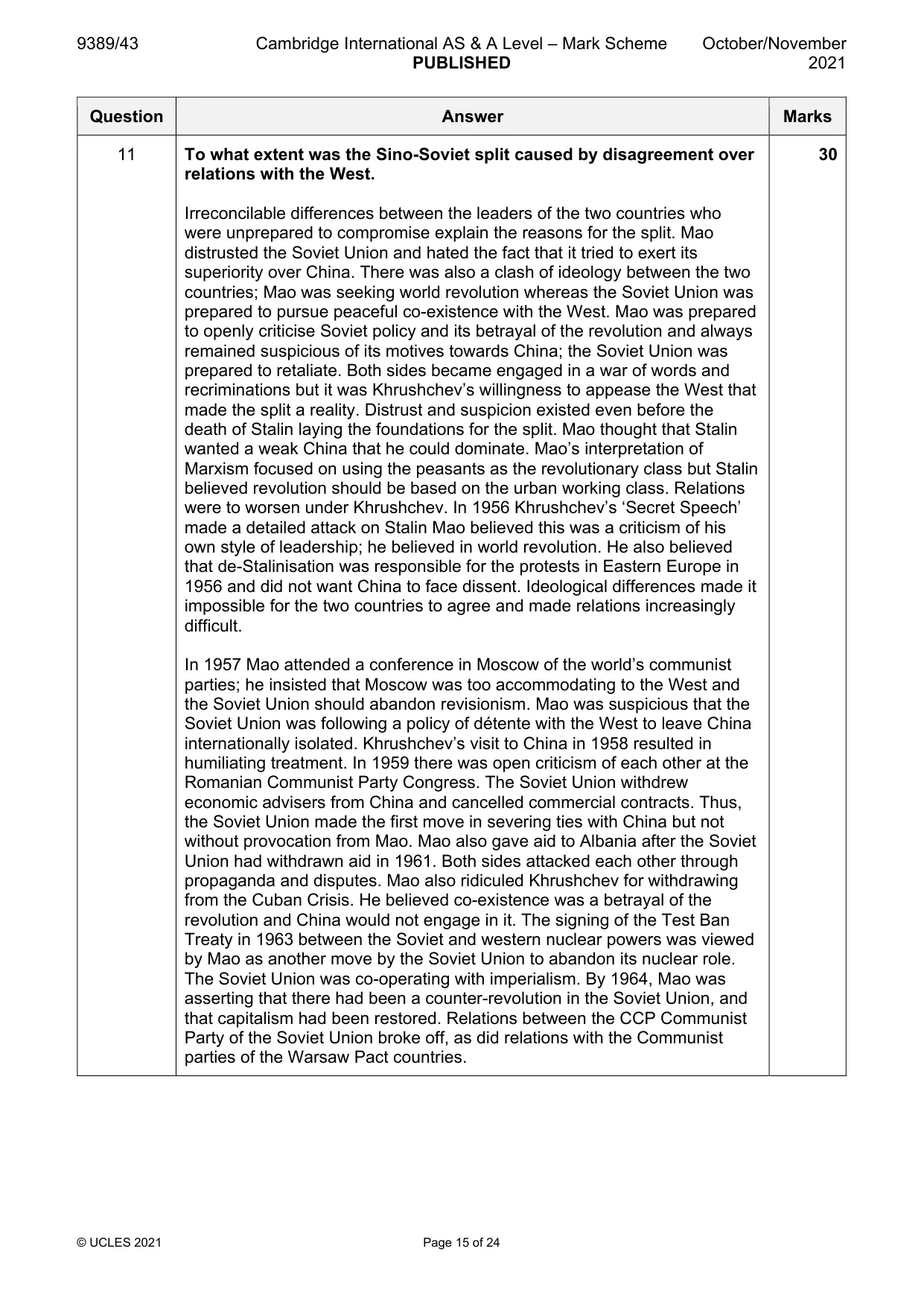
11 To what extent was the Sino–Soviet split caused by disagreement over relations with the West? [30]
Mark scheme: 11 To what extent was the Sino-Soviet split caused by disagreement over 30 relations with the West. Irreconcilable differences between the leaders of the two countries who were unprepared to compromise explain the reasons for the split. Mao distrusted the Soviet Union and hated the fact that it tried to exert its superiority over China. There was also a clash of ideology between the two countries; Mao was seeking world revolution whereas the Soviet Union was prepared to pursue peaceful co-existence with the West. Mao was prepared to openly criticise Soviet policy and its betrayal of the revolution and always remained suspicious of its motives towards China; the Soviet Union was prepared to retaliate. Both sides became engaged in a war of words and recriminations but it was Khrushchev’s willingness to appease the West that made the split a reality. Distrust and suspicion existed even before the death of Stalin laying the foundations for the split. Mao thought that Stalin wanted a weak China that he could dominate. Mao’s interpretation of Marxism focused on using the peasants as the revolutionary class but Stalin believed revolution should be based on the urban working class. Relations were to worsen under Khrushchev. In 1956 Khrushchev’s ‘Secret Speech’ made a detailed attack on Stalin Mao believed this was a criticism of his own style of leadership; he believed in world revolution. He also believed that de-Stalinisation was responsible for the protests in Eastern Europe in 1956 and did not want China to face dissent. Ideological differences made it impossible for the two countries to agree and made relations increasingly difficult. In 1957 Mao attended a conference in Moscow of the world’s communist parties; he insisted that Moscow was too accommodating to the West and the Soviet Union should abandon revisionism. Mao was suspicious that the Soviet Union was following a policy of détente with the West to leave China internationally isolated. Khrushchev’s visit to China in 1958 resulted in humiliating treatment. In 1959 there was open criticism of each other at the Romanian Communist Party Congress. The Soviet Union withdrew economic advisers from China and cancelled commercial contracts. Thus, the Soviet Union made the first move in severing ties with China but not without provocation from Mao. Mao also gave aid to Albania after the Soviet Union had withdrawn aid in 1961. Both sides attacked each other through propaganda and disputes. Mao also ridiculed Khrushchev for withdrawing from the Cuban Crisis. He believed co-existence was a betrayal of the revolution and China would not engage in it. The signing of the Test Ban Treaty in 1963 between the Soviet and western nuclear powers was viewed by Mao as another move by the Soviet Union to abandon its nuclear role. The Soviet Union was co-operating with imperialism. By 1964, Mao was asserting that there had been a counter-revolution in the Soviet Union, and that capitalism had been restored. Relations between the CCP Communist Party of the Soviet Union broke off, as did relations with the Communist parties of the Warsaw Pact countries.
Q12 · ‘Iran’s aim of overthrowing Saddam Hussein was the main reason why the Iran–Iraq War…
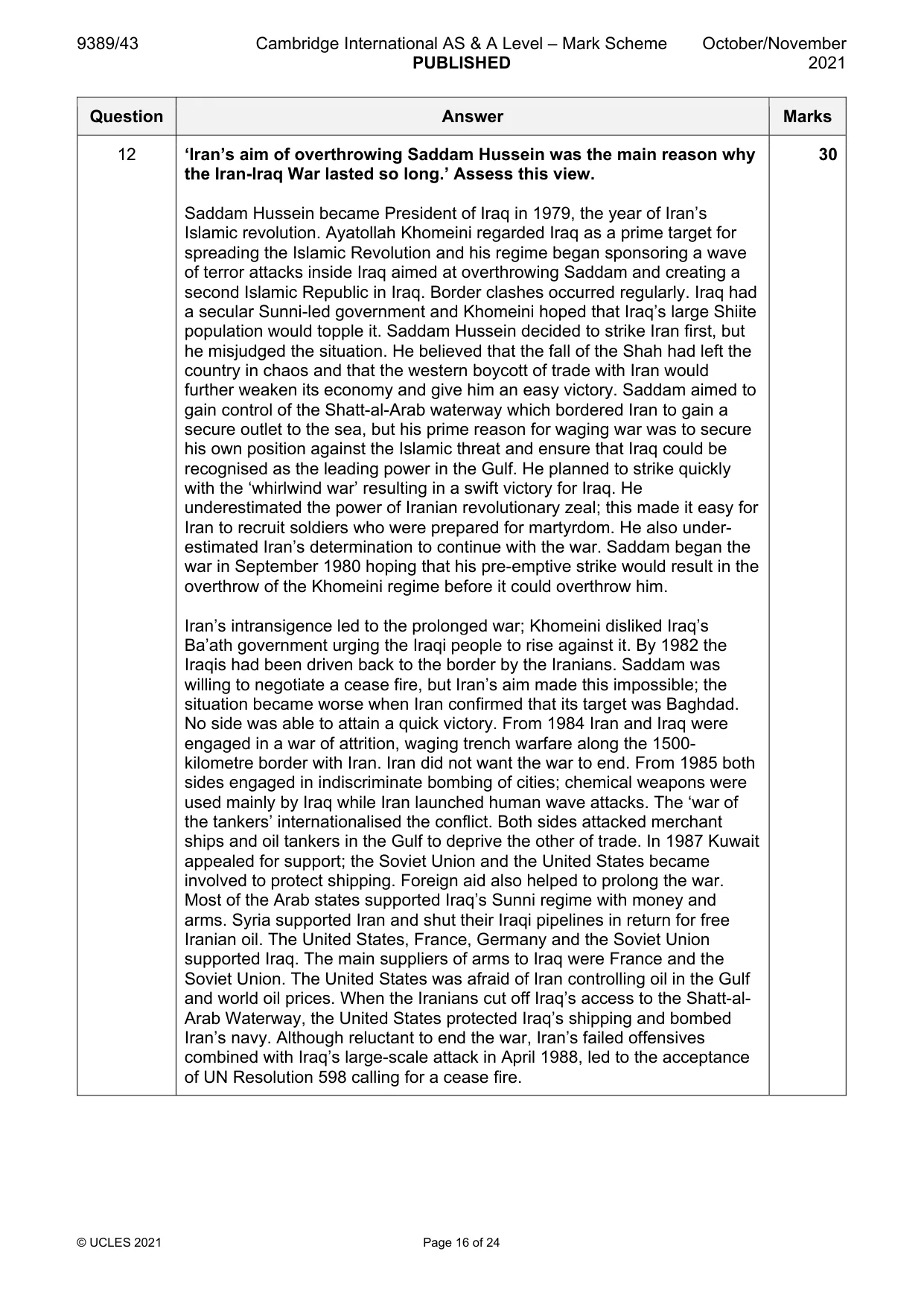
12 ‘Iran’s aim of overthrowing Saddam Hussein was the main reason why the Iran–Iraq War lasted so long.’ Assess this view. [30] Depth Study 4: African History, 1945–1991 Answer any two questions.
Mark scheme: 12 ‘Iran’s aim of overthrowing Saddam Hussein was the main reason why 30 the Iran-Iraq War lasted so long.’ Assess this view. Saddam Hussein became President of Iraq in 1979, the year of Iran’s Islamic revolution. Ayatollah Khomeini regarded Iraq as a prime target for spreading the Islamic Revolution and his regime began sponsoring a wave of terror attacks inside Iraq aimed at overthrowing Saddam and creating a second Islamic Republic in Iraq. Border clashes occurred regularly. Iraq had a secular Sunni-led government and Khomeini hoped that Iraq’s large Shiite population would topple it. Saddam Hussein decided to strike Iran first, but he misjudged the situation. He believed that the fall of the Shah had left the country in chaos and that the western boycott of trade with Iran would further weaken its economy and give him an easy victory. Saddam aimed to gain control of the Shatt-al-Arab waterway which bordered Iran to gain a secure outlet to the sea, but his prime reason for waging war was to secure his own position against the Islamic threat and ensure that Iraq could be recognised as the leading power in the Gulf. He planned to strike quickly with the ‘whirlwind war’ resulting in a swift victory for Iraq. He underestimated the power of Iranian revolutionary zeal; this made it easy for Iran to recruit soldiers who were prepared for martyrdom. He also under- estimated Iran’s determination to continue with the war. Saddam began the war in September 1980 hoping that his pre-emptive strike would result in the overthrow of the Khomeini regime before it could overthrow him. Iran’s intransigence led to the prolonged war; Khomeini disliked Iraq’s Ba’ath government urging the Iraqi people to rise against it. By 1982 the Iraqis had been driven back to the border by the Iranians. Saddam was willing to negotiate a cease fire, but Iran’s aim made this impossible; the situation became worse when Iran confirmed that its target was Baghdad. No side was able to attain a quick victory. From 1984 Iran and Iraq were engaged in a war of attrition, waging trench warfare along the 1500- kilometre border with Iran. Iran did not want the war to end. From 1985 both sides engaged in indiscriminate bombing of cities; chemical weapons were used mainly by Iraq while Iran launched human wave attacks. The ‘war of the tankers’ internationalised the conflict. Both sides attacked merchant ships and oil tankers in the Gulf to deprive the other of trade. In 1987 Kuwait appealed for support; the Soviet Union and the United States became involved to protect shipping. Foreign aid also helped to prolong the war. Most of the Arab states supported Iraq’s Sunni regime with money and arms. Syria supported Iran and shut their Iraqi pipelines in return for free Iranian oil. The United States, France, Germany and the Soviet Union supported Iraq. The main suppliers of arms to Iraq were France and the Soviet Union. The United States was afraid of Iran controlling oil in the Gulf and world oil prices. When the Iranians cut off Iraq’s access to the Shatt-al- Arab Waterway, the United States protected Iraq’s shipping and bombed Iran’s navy. Although reluctant to end the war, Iran’s failed offensives combined with Iraq’s large-scale attack in April 1988, led to the acceptance of UN Resolution 598 calling for a cease fire. Depth Study 4: African History, 1945–1991
Q13 · Assess the importance of propaganda to the rise to power of nationalist leaders in Africa
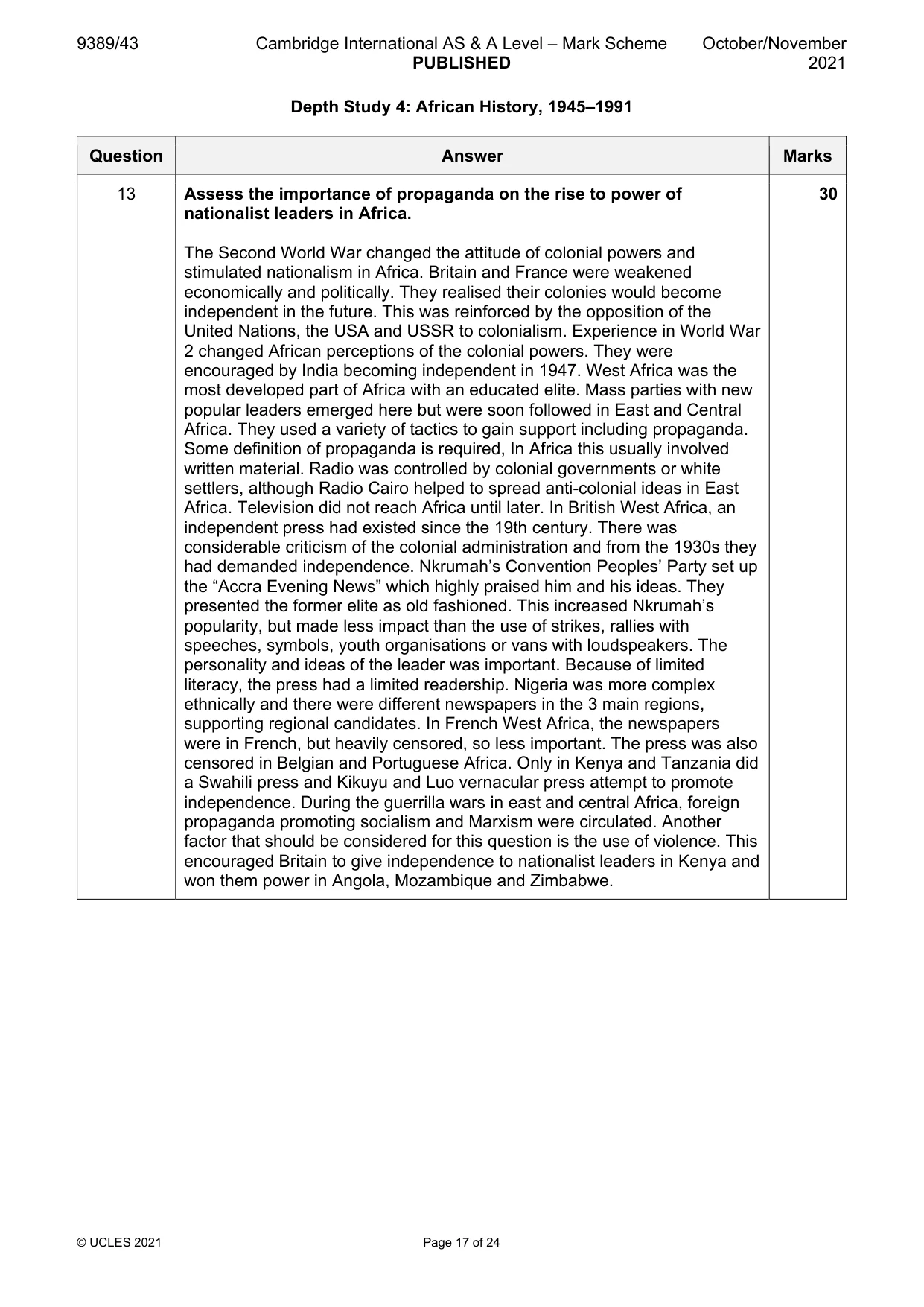
13 Assess the importance of propaganda to the rise to power of nationalist leaders in Africa. [30]
Mark scheme: 13 Assess the importance of propaganda on the rise to power of 30 nationalist leaders in Africa. The Second World War changed the attitude of colonial powers and stimulated nationalism in Africa. Britain and France were weakened economically and politically. They realised their colonies would become independent in the future. This was reinforced by the opposition of the United Nations, the USA and USSR to colonialism. Experience in World War 2 changed African perceptions of the colonial powers. They were encouraged by India becoming independent in 1947. West Africa was the most developed part of Africa with an educated elite. Mass parties with new popular leaders emerged here but were soon followed in East and Central Africa. They used a variety of tactics to gain support including propaganda. Some definition of propaganda is required, In Africa this usually involved written material. Radio was controlled by colonial governments or white settlers, although Radio Cairo helped to spread anti-colonial ideas in East Africa. Television did not reach Africa until later. In British West Africa, an independent press had existed since the 19th century. There was considerable criticism of the colonial administration and from the 1930s they had demanded independence. Nkrumah’s Convention Peoples’ Party set up the “Accra Evening News” which highly praised him and his ideas. They presented the former elite as old fashioned. This increased Nkrumah’s popularity, but made less impact than the use of strikes, rallies with speeches, symbols, youth organisations or vans with loudspeakers. The personality and ideas of the leader was important. Because of limited literacy, the press had a limited readership. Nigeria was more complex ethnically and there were different newspapers in the 3 main regions, supporting regional candidates. In French West Africa, the newspapers were in French, but heavily censored, so less important. The press was also censored in Belgian and Portuguese Africa. Only in Kenya and Tanzania did a Swahili press and Kikuyu and Luo vernacular press attempt to promote independence. During the guerrilla wars in east and central Africa, foreign propaganda promoting socialism and Marxism were circulated. Another factor that should be considered for this question is the use of violence. This encouraged Britain to give independence to nationalist leaders in Kenya and won them power in Angola, Mozambique and Zimbabwe.
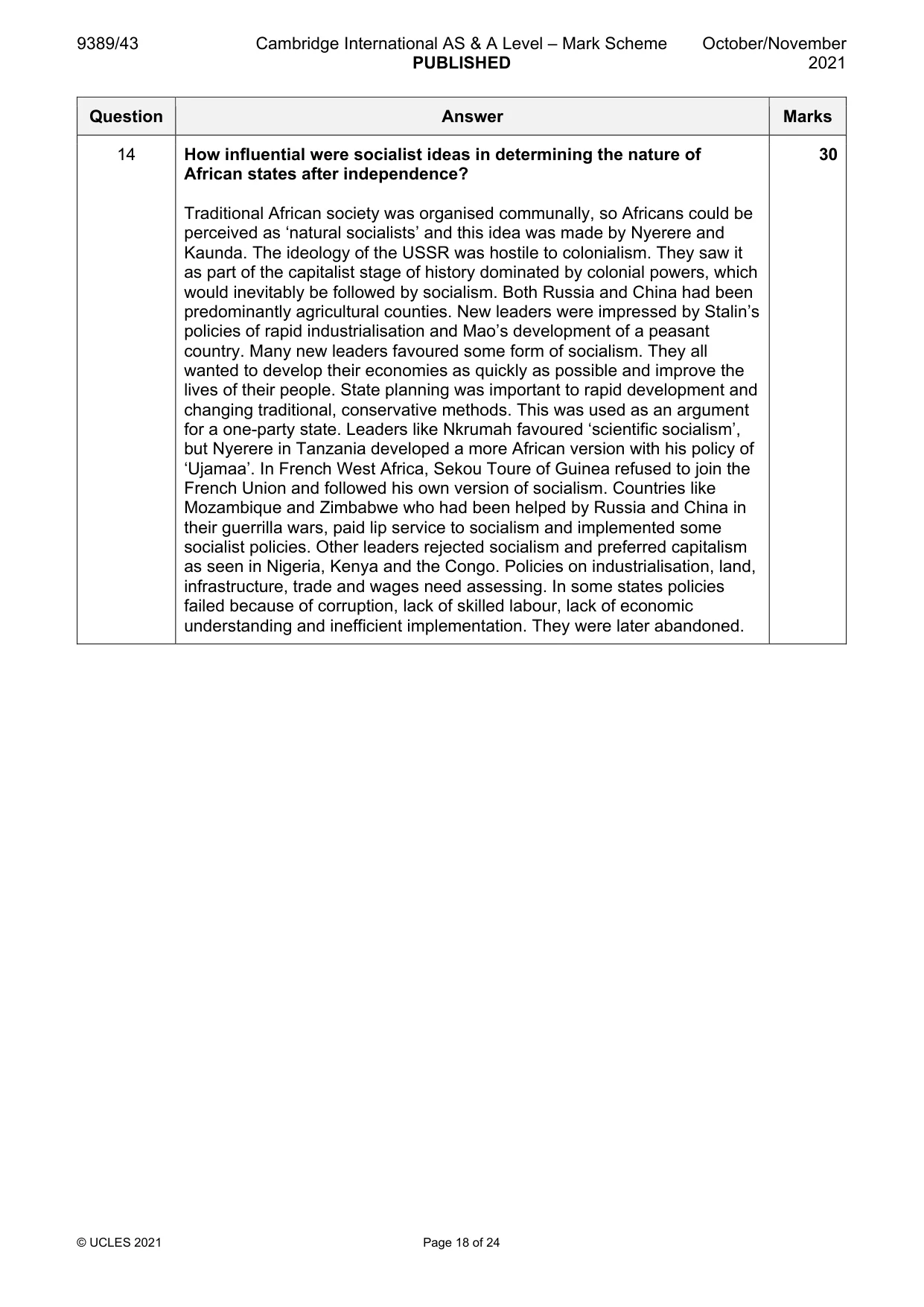
Q14 · How influential were socialist ideas in determining the nature of African states after…
14 How influential were socialist ideas in determining the nature of African states after independence? [30]
Mark scheme: 14 How influential were socialist ideas in determining the nature of 30 African states after independence? Traditional African society was organised communally, so Africans could be perceived as ‘natural socialists’ and this idea was made by Nyerere and Kaunda. The ideology of the USSR was hostile to colonialism. They saw it as part of the capitalist stage of history dominated by colonial powers, which would inevitably be followed by socialism. Both Russia and China had been predominantly agricultural counties. New leaders were impressed by Stalin’s policies of rapid industrialisation and Mao’s development of a peasant country. Many new leaders favoured some form of socialism. They all wanted to develop their economies as quickly as possible and improve the lives of their people. State planning was important to rapid development and changing traditional, conservative methods. This was used as an argument for a one-party state. Leaders like Nkrumah favoured ‘scientific socialism’, but Nyerere in Tanzania developed a more African version with his policy of ‘Ujamaa’. In French West Africa, Sekou Toure of Guinea refused to join the French Union and followed his own version of socialism. Countries like Mozambique and Zimbabwe who had been helped by Russia and China in their guerrilla wars, paid lip service to socialism and implemented some socialist policies. Other leaders rejected socialism and preferred capitalism as seen in Nigeria, Kenya and the Congo. Policies on industrialisation, land, infrastructure, trade and wages need assessing. In some states policies failed because of corruption, lack of skilled labour, lack of economic understanding and inefficient implementation. They were later abandoned.
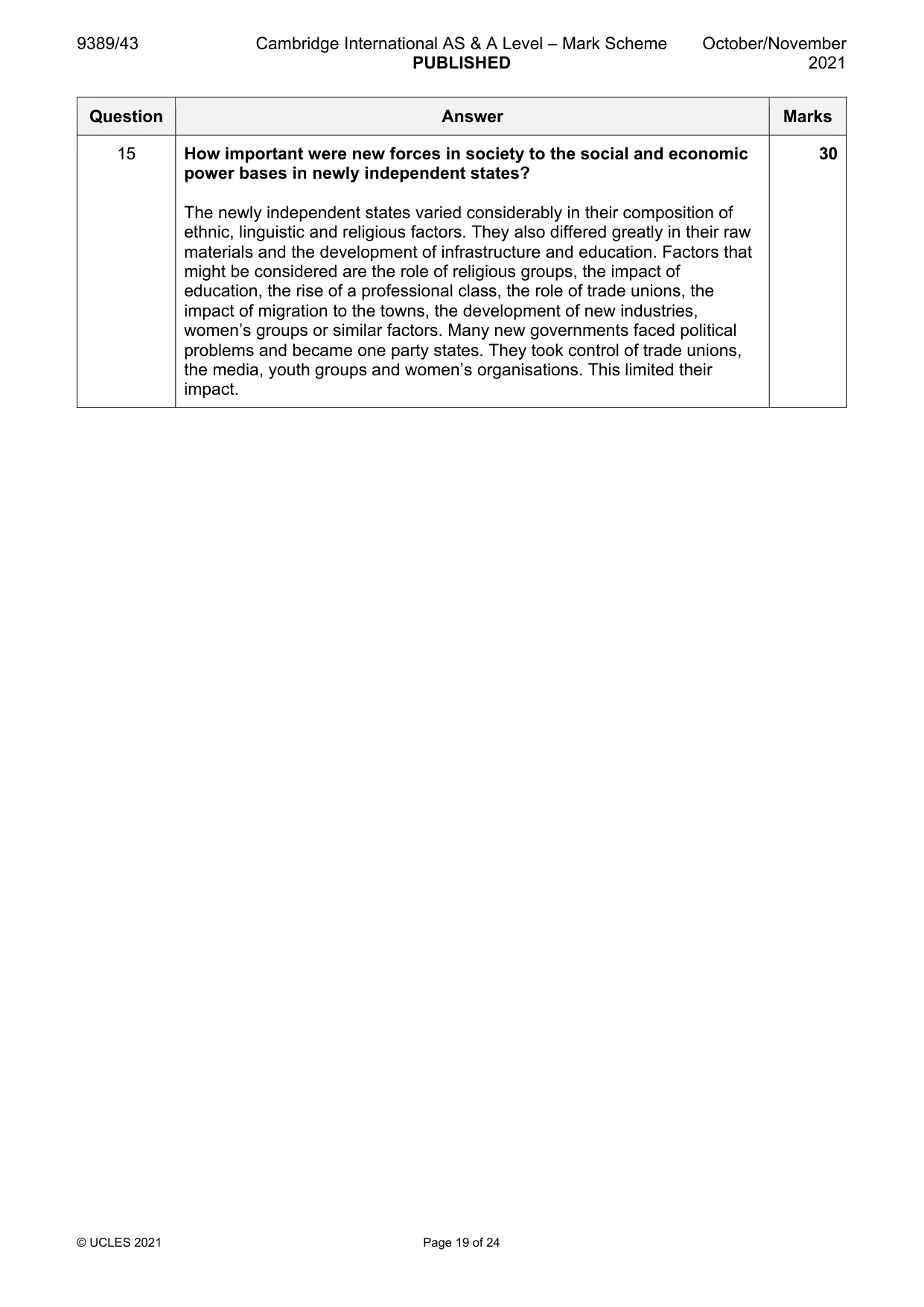
Q15 · How important were new forces in society to the social and economic power bases of newly…
15 How important were new forces in society to the social and economic power bases of newly independent states? [30]
Mark scheme: 15 How important were new forces in society to the social and economic 30 power bases in newly independent states? The newly independent states varied considerably in their composition of ethnic, linguistic and religious factors. They also differed greatly in their raw materials and the development of infrastructure and education. Factors that might be considered are the role of religious groups, the impact of education, the rise of a professional class, the role of trade unions, the impact of migration to the towns, the development of new industries, women’s groups or similar factors. Many new governments faced political problems and became one party states. They took control of trade unions, the media, youth groups and women’s organisations. This limited their impact.
Q16 · Depth Study 5: Southeast Asian History, 1945–1990s Answer any two questions
Depth Study 5: Southeast Asian History, 1945–1990s Answer any two questions.
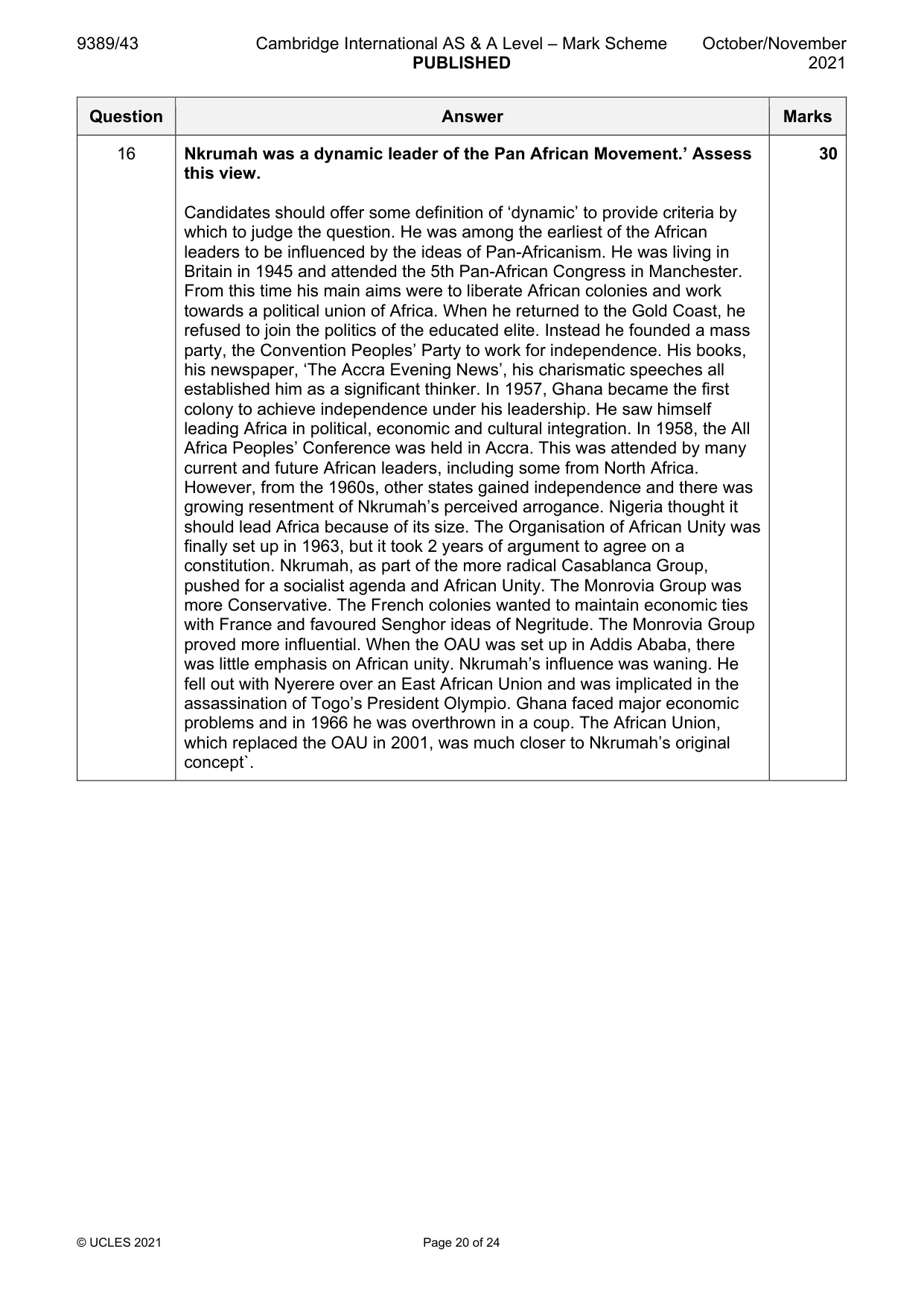
Mark scheme: 16 Nkrumah was a dynamic leader of the Pan African Movement.’ Assess 30 this view. Candidates should offer some definition of ‘dynamic’ to provide criteria by which to judge the question. He was among the earliest of the African leaders to be influenced by the ideas of Pan-Africanism. He was living in Britain in 1945 and attended the 5th Pan-African Congress in Manchester. From this time his main aims were to liberate African colonies and work towards a political union of Africa. When he returned to the Gold Coast, he refused to join the politics of the educated elite. Instead he founded a mass party, the Convention Peoples’ Party to work for independence. His books, his newspaper, ‘The Accra Evening News’, his charismatic speeches all established him as a significant thinker. In 1957, Ghana became the first colony to achieve independence under his leadership. He saw himself leading Africa in political, economic and cultural integration. In 1958, the All Africa Peoples’ Conference was held in Accra. This was attended by many current and future African leaders, including some from North Africa. However, from the 1960s, other states gained independence and there was growing resentment of Nkrumah’s perceived arrogance. Nigeria thought it should lead Africa because of its size. The Organisation of African Unity was finally set up in 1963, but it took 2 years of argument to agree on a constitution. Nkrumah, as part of the more radical Casablanca Group, pushed for a socialist agenda and African Unity. The Monrovia Group was more Conservative. The French colonies wanted to maintain economic ties with France and favoured Senghor ideas of Negritude. The Monrovia Group proved more influential. When the OAU was set up in Addis Ababa, there was little emphasis on African unity. Nkrumah’s influence was waning. He fell out with Nyerere over an East African Union and was implicated in the assassination of Togo’s President Olympio. Ghana faced major economic problems and in 1966 he was overthrown in a coup. The African Union, which replaced the OAU in 2001, was much closer to Nkrumah’s original concept`. Depth Study 5: Southeast Asian History, 1945–1990s
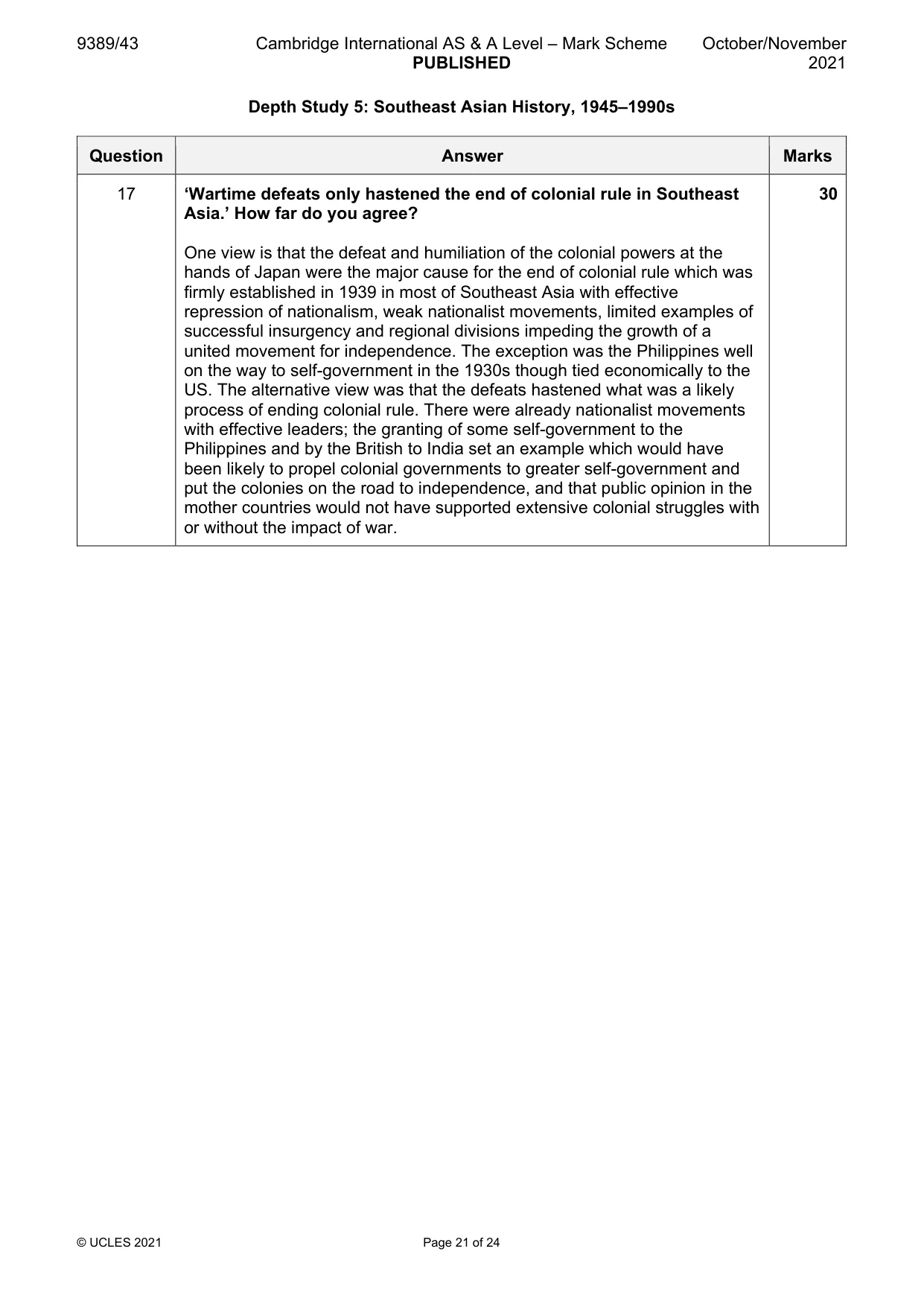
Q17 · ‘Wartime defeats only hastened the end of colonial rule in Southeast Asia.’ How far do…
17 ‘Wartime defeats only hastened the end of colonial rule in Southeast Asia.’ How far do you agree? [30]
Mark scheme: 17 ‘Wartime defeats only hastened the end of colonial rule in Southeast 30 Asia.’ How far do you agree? One view is that the defeat and humiliation of the colonial powers at the hands of Japan were the major cause for the end of colonial rule which was firmly established in 1939 in most of Southeast Asia with effective repression of nationalism, weak nationalist movements, limited examples of successful insurgency and regional divisions impeding the growth of a united movement for independence. The exception was the Philippines well on the way to self-government in the 1930s though tied economically to the US. The alternative view was that the defeats hastened what was a likely process of ending colonial rule. There were already nationalist movements with effective leaders; the granting of some self-government to the Philippines and by the British to India set an example which would have been likely to propel colonial governments to greater self-government and put the colonies on the road to independence, and that public opinion in the mother countries would not have supported extensive colonial struggles with or without the impact of war.
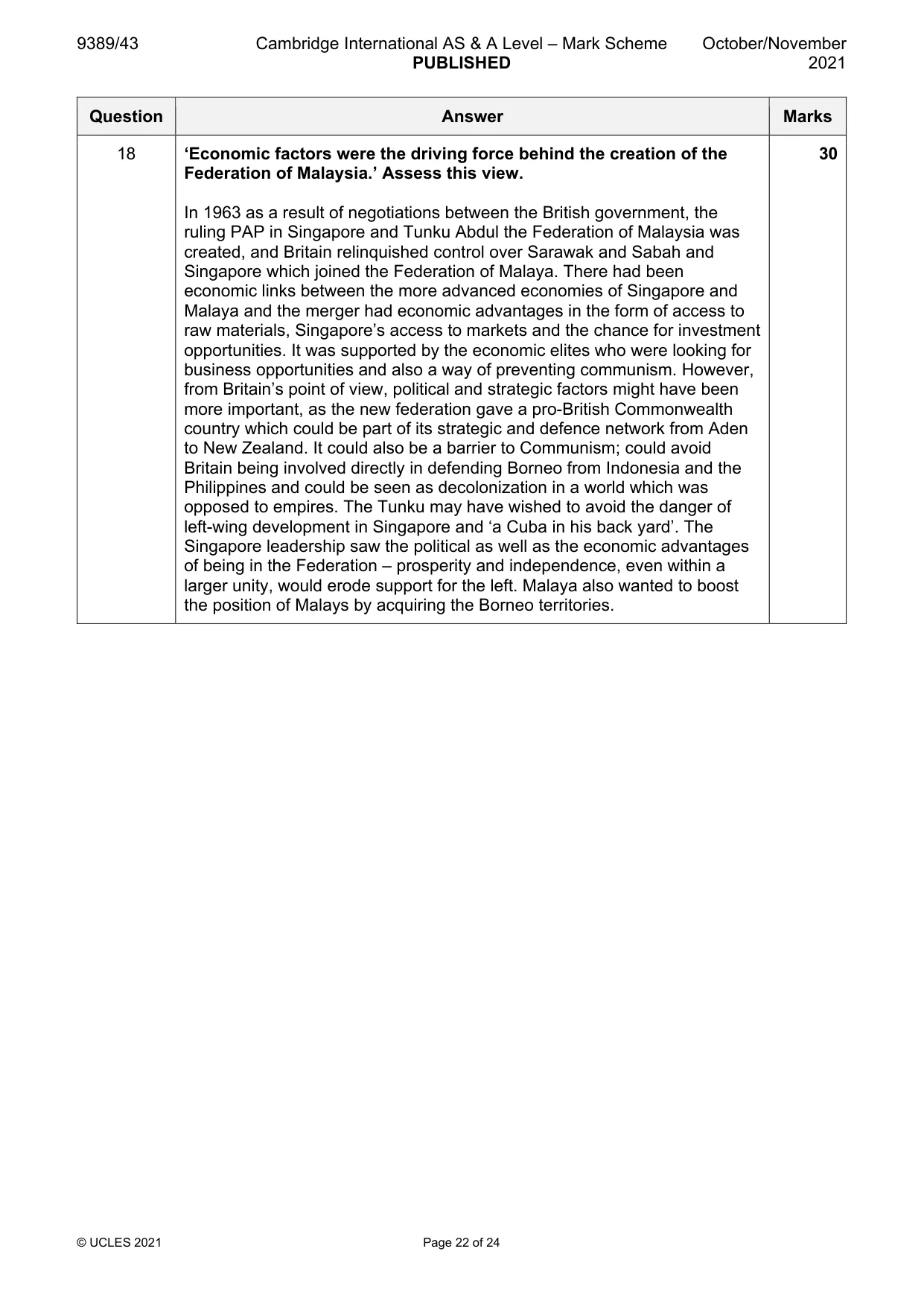
Q18 · ‘Economic factors were the driving force behind the creation of the Federation of…
18 ‘Economic factors were the driving force behind the creation of the Federation of Malaysia.’ Assess this view. [30]
Mark scheme: 18 ‘Economic factors were the driving force behind the creation of the 30 Federation of Malaysia.’ Assess this view. In 1963 as a result of negotiations between the British government, the ruling PAP in Singapore and Tunku Abdul the Federation of Malaysia was created, and Britain relinquished control over Sarawak and Sabah and Singapore which joined the Federation of Malaya. There had been economic links between the more advanced economies of Singapore and Malaya and the merger had economic advantages in the form of access to raw materials, Singapore’s access to markets and the chance for investment opportunities. It was supported by the economic elites who were looking for business opportunities and also a way of preventing communism. However, from Britain’s point of view, political and strategic factors might have been more important, as the new federation gave a pro-British Commonwealth country which could be part of its strategic and defence network from Aden to New Zealand. It could also be a barrier to Communism; could avoid Britain being involved directly in defending Borneo from Indonesia and the Philippines and could be seen as decolonization in a world which was opposed to empires. The Tunku may have wished to avoid the danger of left-wing development in Singapore and ‘a Cuba in his back yard’. The Singapore leadership saw the political as well as the economic advantages of being in the Federation – prosperity and independence, even within a larger unity, would erode support for the left. Malaya also wanted to boost the position of Malays by acquiring the Borneo territories.
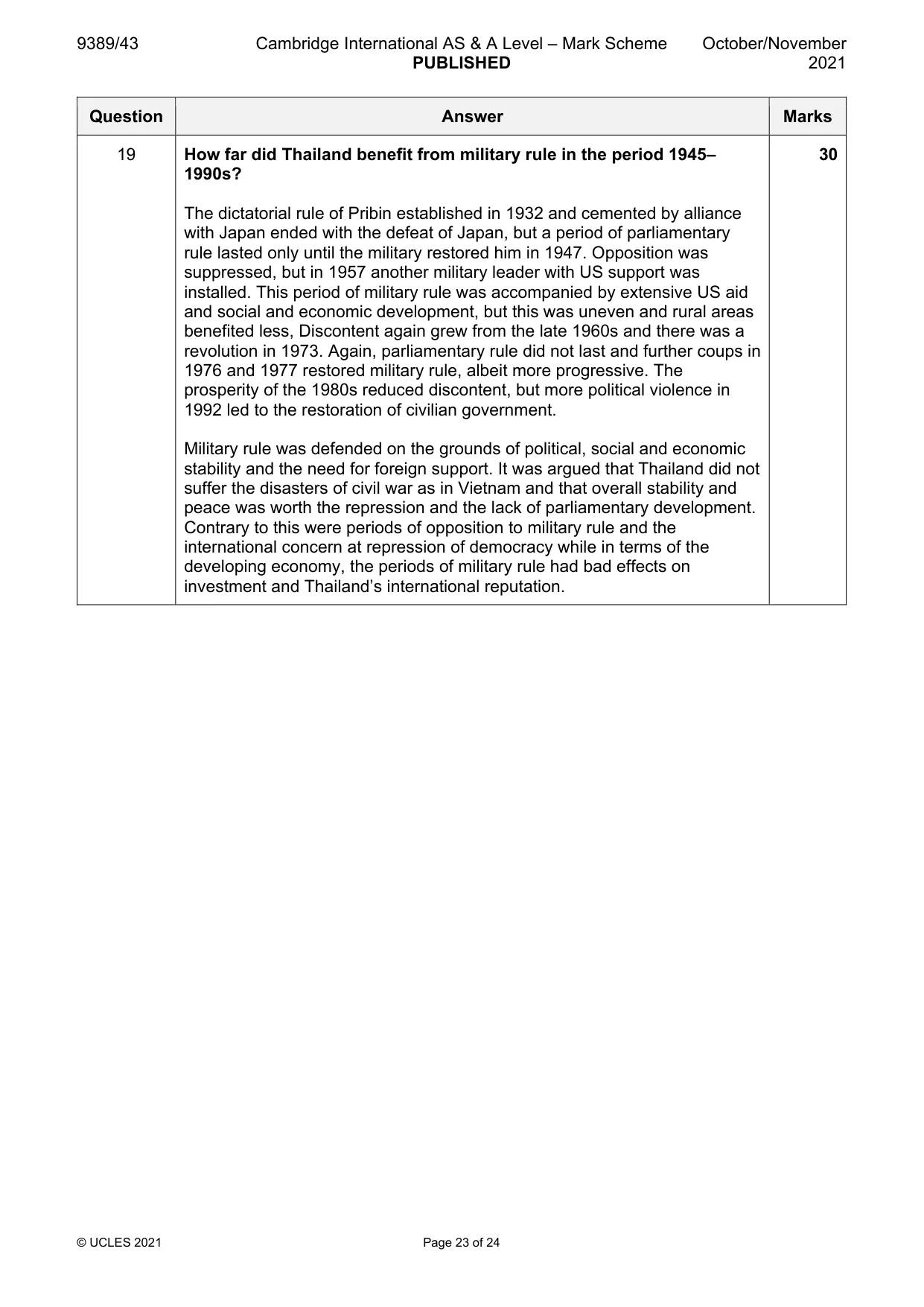
Q19 · How far did Thailand benefit from military rule in the period from 1945 to the 1990s?
19 How far did Thailand benefit from military rule in the period from 1945 to the 1990s? [30]
Mark scheme: 19 How far did Thailand benefit from military rule in the period 1945– 30 1990s? The dictatorial rule of Pribin established in 1932 and cemented by alliance with Japan ended with the defeat of Japan, but a period of parliamentary rule lasted only until the military restored him in 1947. Opposition was suppressed, but in 1957 another military leader with US support was installed. This period of military rule was accompanied by extensive US aid and social and economic development, but this was uneven and rural areas benefited less, Discontent again grew from the late 1960s and there was a revolution in 1973. Again, parliamentary rule did not last and further coups in 1976 and 1977 restored military rule, albeit more progressive. The prosperity of the 1980s reduced discontent, but more political violence in 1992 led to the restoration of civilian government. Military rule was defended on the grounds of political, social and economic stability and the need for foreign support. It was argued that Thailand did not suffer the disasters of civil war as in Vietnam and that overall stability and peace was worth the repression and the lack of parliamentary development. Contrary to this were periods of opposition to military rule and the international concern at repression of democracy while in terms of the developing economy, the periods of military rule had bad effects on investment and Thailand’s international reputation.
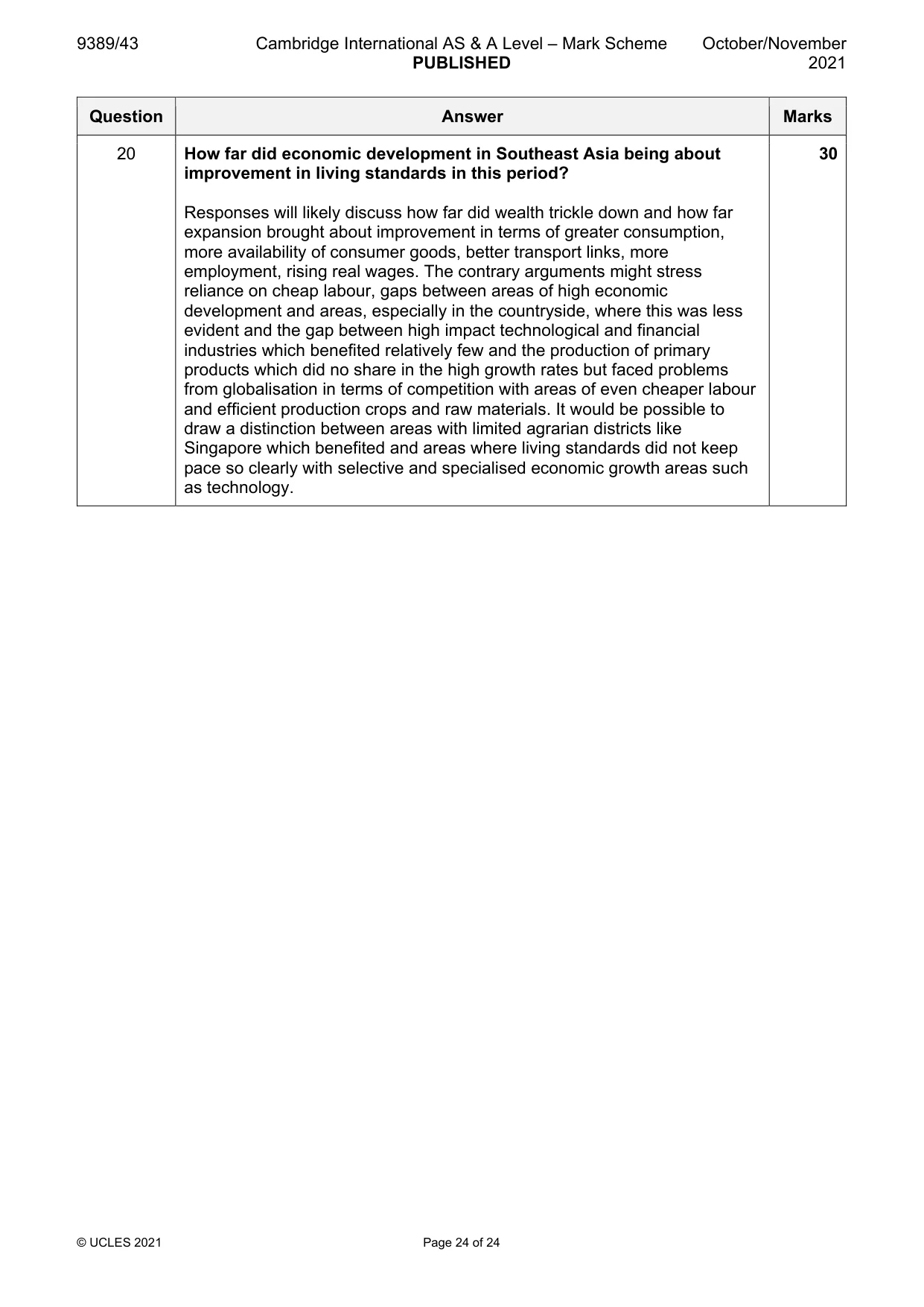
Q20 · How far did economic development in Southeast Asia bring about improvement in living…
20 How far did economic development in Southeast Asia bring about improvement in living standards? [30]
Mark scheme: 20 How far did economic development in Southeast Asia being about 30 improvement in living standards in this period? Responses will likely discuss how far did wealth trickle down and how far expansion brought about improvement in terms of greater consumption, more availability of consumer goods, better transport links, more employment, rising real wages. The contrary arguments might stress reliance on cheap labour, gaps between areas of high economic development and areas, especially in the countryside, where this was less evident and the gap between high impact technological and financial industries which benefited relatively few and the production of primary products which did no share in the high growth rates but faced problems from globalisation in terms of competition with areas of even cheaper labour and efficient production crops and raw materials. It would be possible to draw a distinction between areas with limited agrarian districts like Singapore which benefited and areas where living standards did not keep pace so clearly with selective and specialised economic growth areas such as technology.
What you needed in this session
Cambridge’s own grade thresholds for 2021 Oct/Nov, Paper 4 · Variant 3. A higher threshold means an easier paper — the bar moves with how the cohort did.