Cambridge A Level History 9389 — 2018 May/June Paper 4 · Variant 3
9389/43/M/J/18 · 11 questions · 60 marks · ≈68 min
The question paper and its mark scheme, free to read here and free to download. This is Cambridge’s own paper, exactly as it was sat.
Question paper4 pages
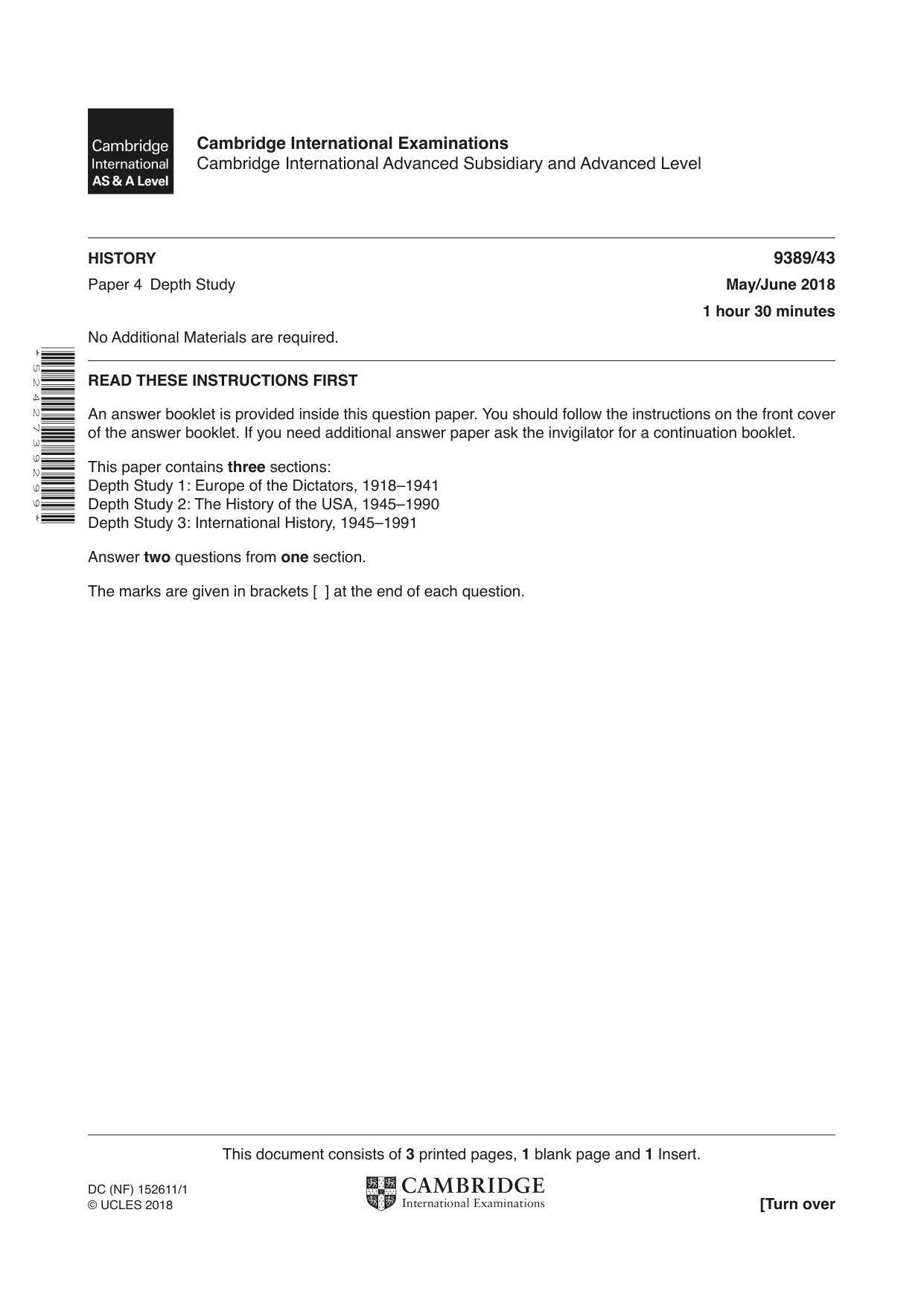
Mark scheme16 pages
Answers below. Sit the paper first if you are practising.
Questions as text
Q1 · ‘The Bolsheviks were responsible for causing the Civil War in Russia.’ How far do you…
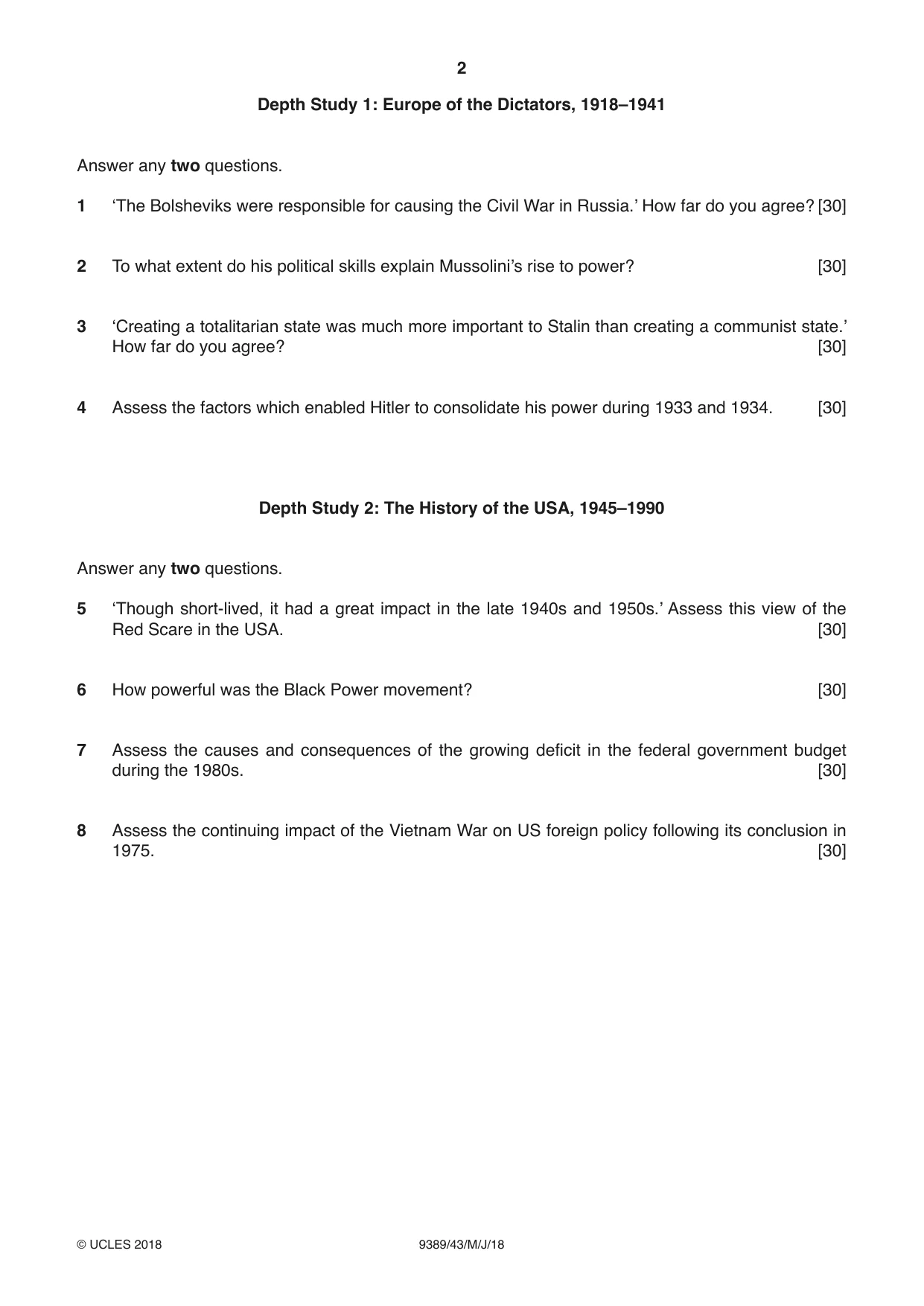
1 ‘The Bolsheviks were responsible for causing the Civil War in Russia.’ How far do you agree? [30]
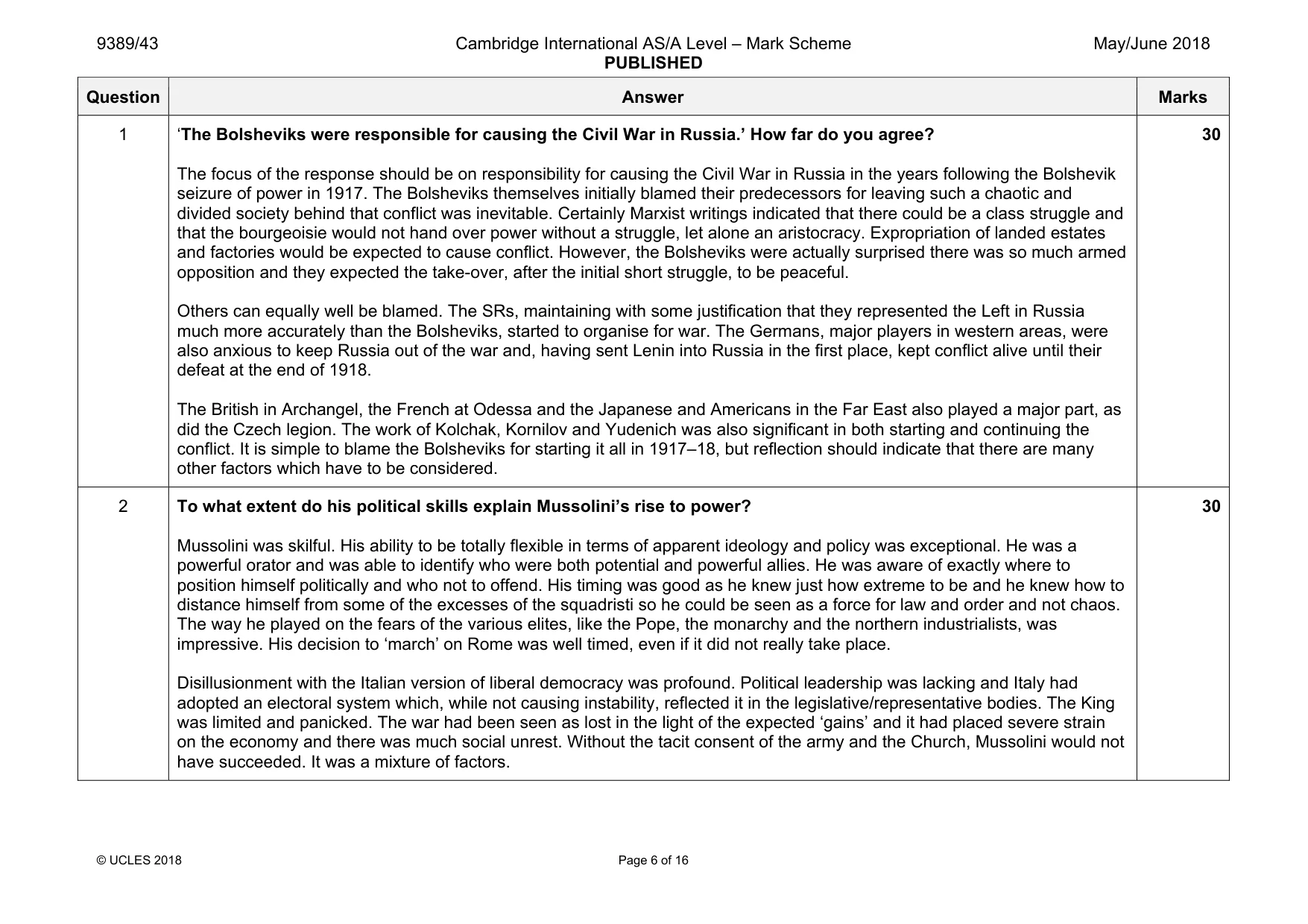
Mark scheme: 1 ‘The Bolsheviks were responsible for causing the Civil War in Russia.’ How far do you agree? The focus of the response should be on responsibility for causing the Civil War in Russia in the years following the Bolshevik seizure of power in 1917. The Bolsheviks themselves initially blamed their predecessors for leaving such a chaotic and divided society behind that conflict was inevitable. Certainly Marxist writings indicated that there could be a class struggle and that the bourgeoisie would not hand over power without a struggle, let alone an aristocracy. Expropriation of landed estates and factories would be expected to cause conflict. However, the Bolsheviks were actually surprised there was so much armed opposition and they expected the take-over, after the initial short struggle, to be peaceful. Others can equally well be blamed. The SRs, maintaining with some justification that they represented the Left in Russia much more accurately than the Bolsheviks, started to organise for war. The Germans, major players in western areas, were also anxious to keep Russia out of the war and, having sent Lenin into Russia in the first place, kept conflict alive until their defeat at the end of 1918. The British in Archangel, the French at Odessa and the Japanese and Americans in the Far East also played a major part, as did the Czech legion. The work of Kolchak, Kornilov and Yudenich was also significant in both starting and continuing the conflict. It is simple to blame the Bolsheviks for starting it all in 1917–18, but reflection should indicate that there are many other factors which have to be considered. 30
Q2 · To what extent do his political skills explain Mussolini’s rise to power?
2 To what extent do his political skills explain Mussolini’s rise to power? [30]
Mark scheme: 2 To what extent do his political skills explain Mussolini’s rise to power? Mussolini was skilful. His ability to be totally flexible in terms of apparent ideology and policy was exceptional. He was a powerful orator and was able to identify who were both potential and powerful allies. He was aware of exactly where to position himself politically and who not to offend. His timing was good as he knew just how extreme to be and he knew how to distance himself from some of the excesses of the squadristi so he could be seen as a force for law and order and not chaos. The way he played on the fears of the various elites, like the Pope, the monarchy and the northern industrialists, was impressive. His decision to ‘march’ on Rome was well timed, even if it did not really take place. Disillusionment with the Italian version of liberal democracy was profound. Political leadership was lacking and Italy had adopted an electoral system which, while not causing instability, reflected it in the legislative/representative bodies. The King was limited and panicked. The war had been seen as lost in the light of the expected ‘gains’ and it had placed severe strain on the economy and there was much social unrest. Without the tacit consent of the army and the Church, Mussolini would not have succeeded. It was a mixture of factors. 30
Q3 · ‘Creating a totalitarian state was much more important to Stalin than creating a…
3 ‘Creating a totalitarian state was much more important to Stalin than creating a communist state.’ How far do you agree? [30]
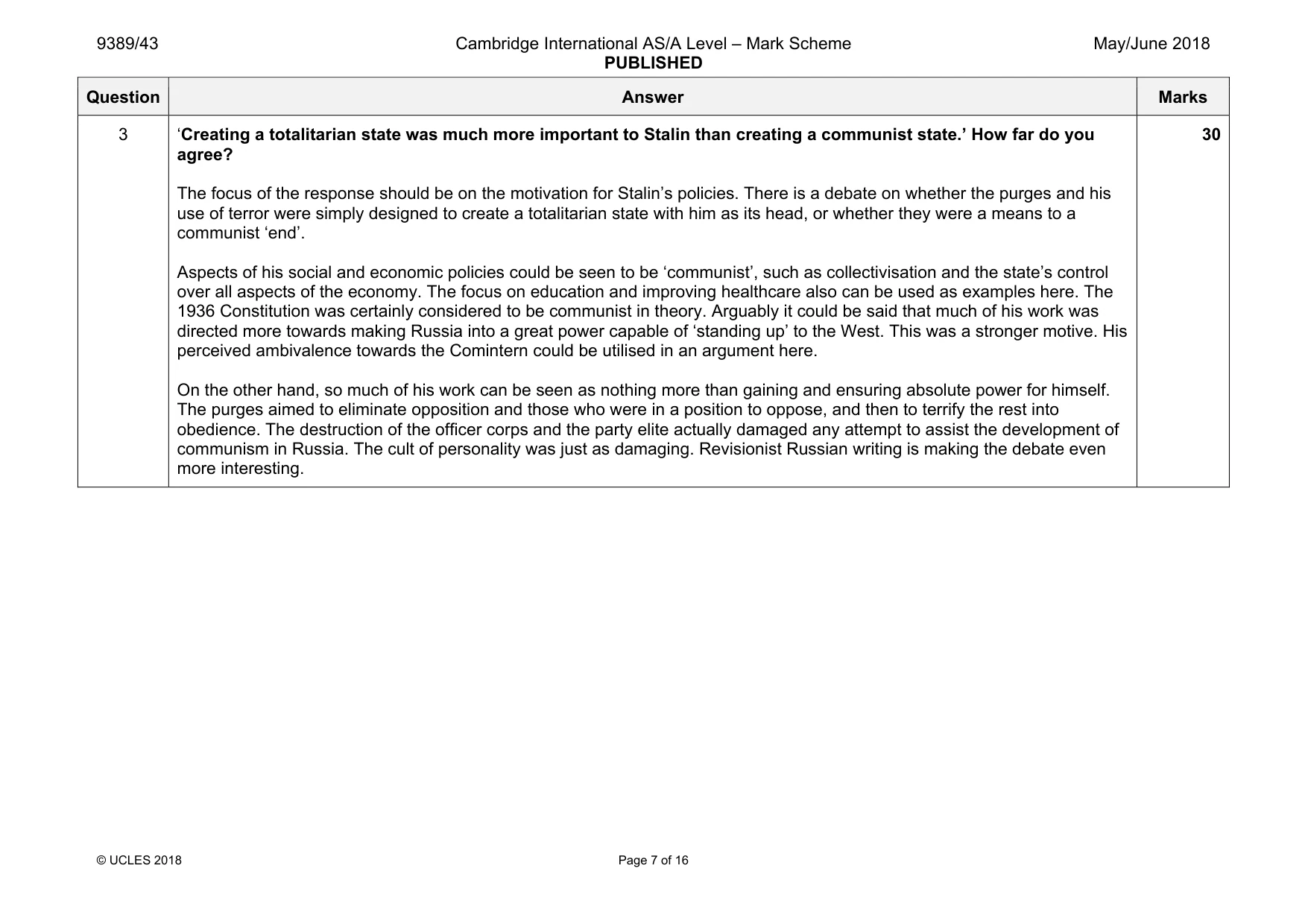
Mark scheme: 3 ‘Creating a totalitarian state was much more important to Stalin than creating a communist state.’ How far do you agree? The focus of the response should be on the motivation for Stalin’s policies. There is a debate on whether the purges and his use of terror were simply designed to create a totalitarian state with him as its head, or whether they were a means to a communist ‘end’. Aspects of his social and economic policies could be seen to be ‘communist’, such as collectivisation and the state’s control over all aspects of the economy. The focus on education and improving healthcare also can be used as examples here. The 1936 Constitution was certainly considered to be communist in theory. Arguably it could be said that much of his work was directed more towards making Russia into a great power capable of ‘standing up’ to the West. This was a stronger motive. His perceived ambivalence towards the Comintern could be utilised in an argument here. On the other hand, so much of his work can be seen as nothing more than gaining and ensuring absolute power for himself. The purges aimed to eliminate opposition and those who were in a position to oppose, and then to terrify the rest into obedience. The destruction of the officer corps and the party elite actually damaged any attempt to assist the development of communism in Russia. The cult of personality was just as damaging. Revisionist Russian writing is making the debate even more interesting. 30
Q4 · Assess the factors which enabled Hitler to consolidate his power during 1933 and 1934
4 Assess the factors which enabled Hitler to consolidate his power during 1933 and 1934. [30] Depth Study 2: The History of the USA, 1945–1990 Answer any two questions.
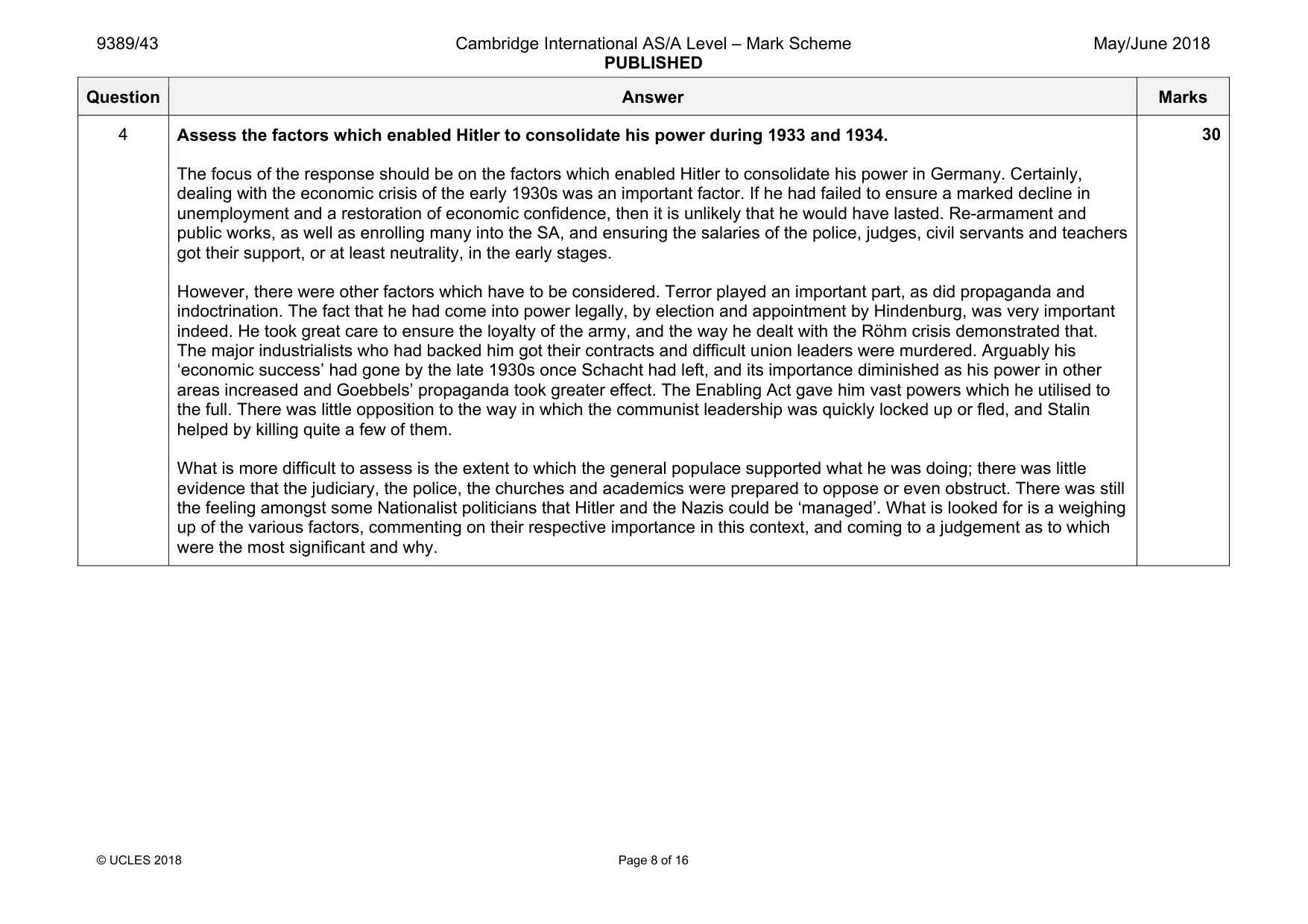
Mark scheme: 4 Assess the factors which enabled Hitler to consolidate his power during 1933 and 1934. The focus of the response should be on the factors which enabled Hitler to consolidate his power in Germany. Certainly, dealing with the economic crisis of the early 1930s was an important factor. If he had failed to ensure a marked decline in unemployment and a restoration of economic confidence, then it is unlikely that he would have lasted. Re-armament and public works, as well as enrolling many into the SA, and ensuring the salaries of the police, judges, civil servants and teachers got their support, or at least neutrality, in the early stages. However, there were other factors which have to be considered. Terror played an important part, as did propaganda and indoctrination. The fact that he had come into power legally, by election and appointment by Hindenburg, was very important indeed. He took great care to ensure the loyalty of the army, and the way he dealt with the Röhm crisis demonstrated that. The major industrialists who had backed him got their contracts and difficult union leaders were murdered. Arguably his ‘economic success’ had gone by the late 1930s once Schacht had left, and its importance diminished as his power in other areas increased and Goebbels’ propaganda took greater effect. The Enabling Act gave him vast powers which he utilised to the full. There was little opposition to the way in which the communist leadership was quickly locked up or fled, and Stalin helped by killing quite a few of them. What is more difficult to assess is the extent to which the general populace supported what he was doing; there was little evidence that the judiciary, the police, the churches and academics were prepared to oppose or even obstruct. There was still the feeling amongst some Nationalist politicians that Hitler and the Nazis could be ‘managed’. What is looked for is a weighing up of the various factors, commenting on their respective importance in this context, and coming to a judgement as to which were the most significant and why. 30
Q5 · ‘Though short-lived, it had a great impact in the late 1940s and 1950s.’ Assess this view…
5 ‘Though short-lived, it had a great impact in the late 1940s and 1950s.’ Assess this view of the Red Scare in the USA. [30]
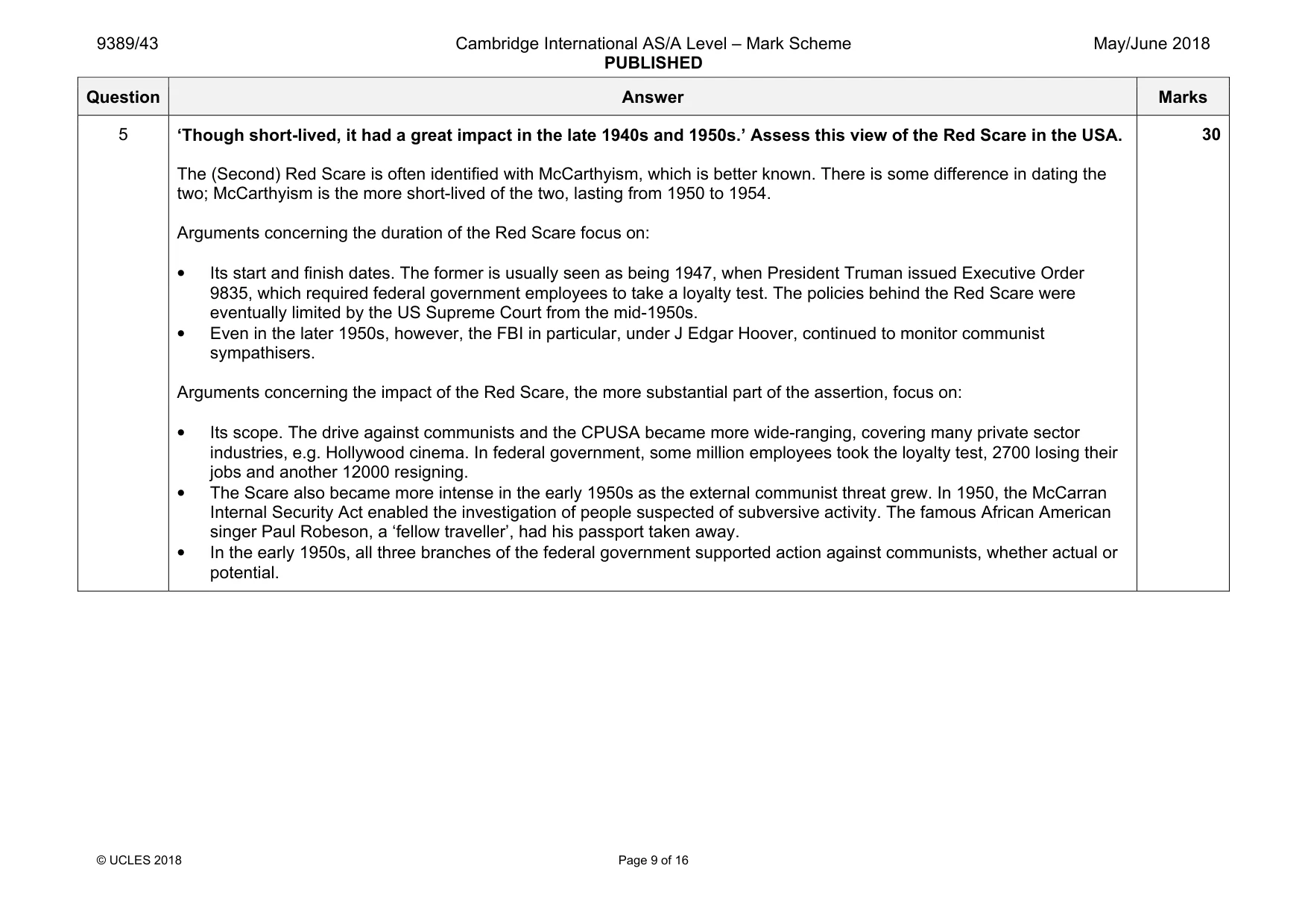
Mark scheme: 5 ‘Though short-lived, it had a great impact in the late 1940s and 1950s.’ Assess this view of the Red Scare in the USA. The (Second) Red Scare is often identified with McCarthyism, which is better known. There is some difference in dating the two; McCarthyism is the more short-lived of the two, lasting from 1950 to 1954. Arguments concerning the duration of the Red Scare focus on: • Its start and finish dates. The former is usually seen as being 1947, when President Truman issued Executive Order 9835, which required federal government employees to take a loyalty test. The policies behind the Red Scare were eventually limited by the US Supreme Court from the mid-1950s. • Even in the later 1950s, however, the FBI in particular, under J Edgar Hoover, continued to monitor communist sympathisers. Arguments concerning the impact of the Red Scare, the more substantial part of the assertion, focus on: • Its scope. The drive against communists and the CPUSA became more wide-ranging, covering many private sector industries, e.g. Hollywood cinema. In federal government, some million employees took the loyalty test, 2700 losing their jobs and another 12000 resigning. • The Scare also became more intense in the early 1950s as the external communist threat grew. In 1950, the McCarran Internal Security Act enabled the investigation of people suspected of subversive activity. The famous African American singer Paul Robeson, a ‘fellow traveller’, had his passport taken away. • In the early 1950s, all three branches of the federal government supported action against communists, whether actual or potential. 30
Q6 · How powerful was the Black Power movement?
6 How powerful was the Black Power movement? [30]
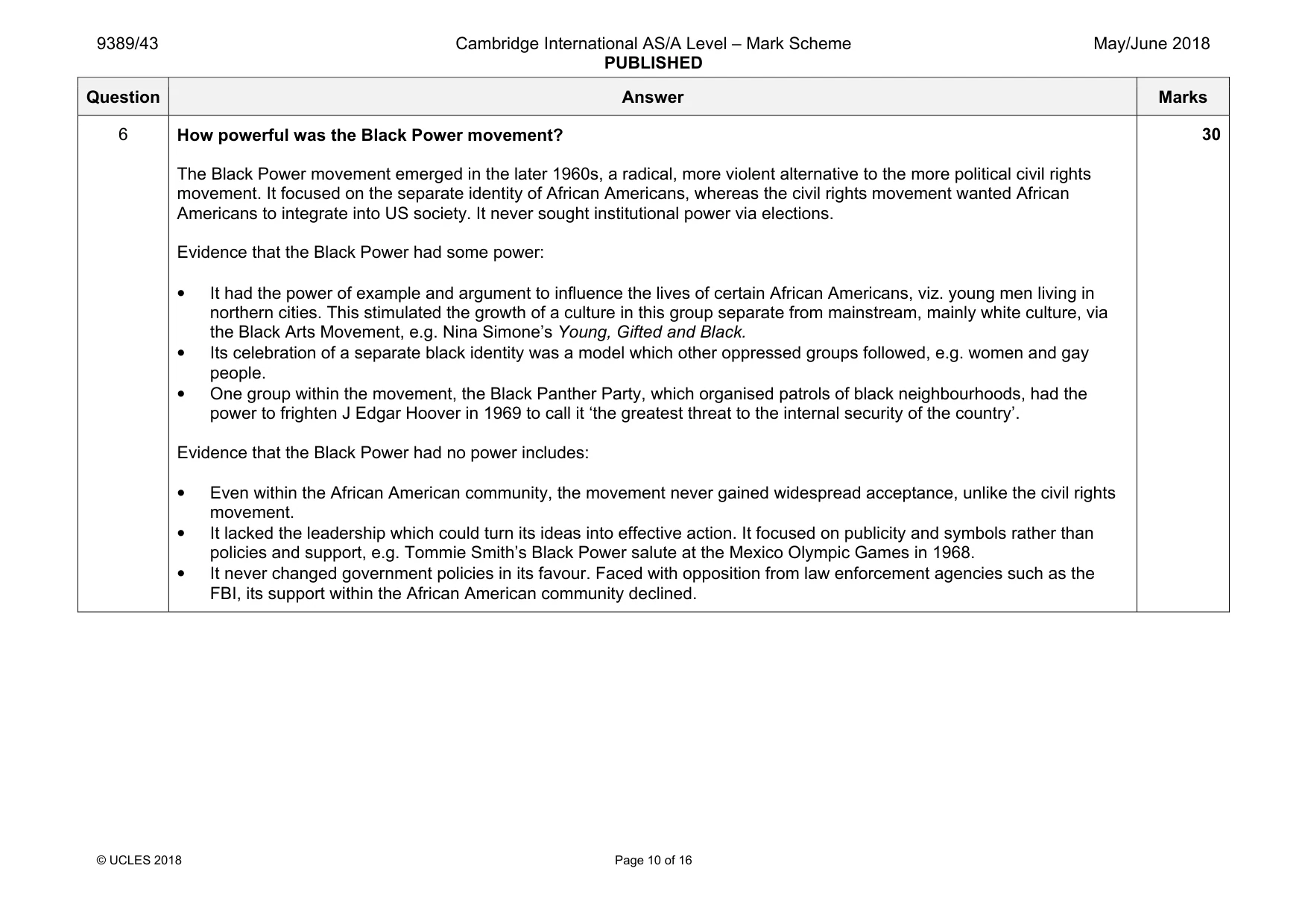
Mark scheme: 6 How powerful was the Black Power movement? The Black Power movement emerged in the later 1960s, a radical, more violent alternative to the more political civil rights movement. It focused on the separate identity of African Americans, whereas the civil rights movement wanted African Americans to integrate into US society. It never sought institutional power via elections. Evidence that the Black Power had some power: • It had the power of example and argument to influence the lives of certain African Americans, viz. young men living in northern cities. This stimulated the growth of a culture in this group separate from mainstream, mainly white culture, via the Black Arts Movement, e.g. Nina Simone’s Young, Gifted and Black. • Its celebration of a separate black identity was a model which other oppressed groups followed, e.g. women and gay people. • One group within the movement, the Black Panther Party, which organised patrols of black neighbourhoods, had the power to frighten J Edgar Hoover in 1969 to call it ‘the greatest threat to the internal security of the country’. Evidence that the Black Power had no power includes: • Even within the African American community, the movement never gained widespread acceptance, unlike the civil rights movement. • It lacked the leadership which could turn its ideas into effective action. It focused on publicity and symbols rather than policies and support, e.g. Tommie Smith’s Black Power salute at the Mexico Olympic Games in 1968. • It never changed government policies in its favour. Faced with opposition from law enforcement agencies such as the FBI, its support within the African American community declined. 30
Q7 · Assess the causes and consequences of the growing deficit in the federal government…
7 Assess the causes and consequences of the growing deficit in the federal government budget during the 1980s. [30]
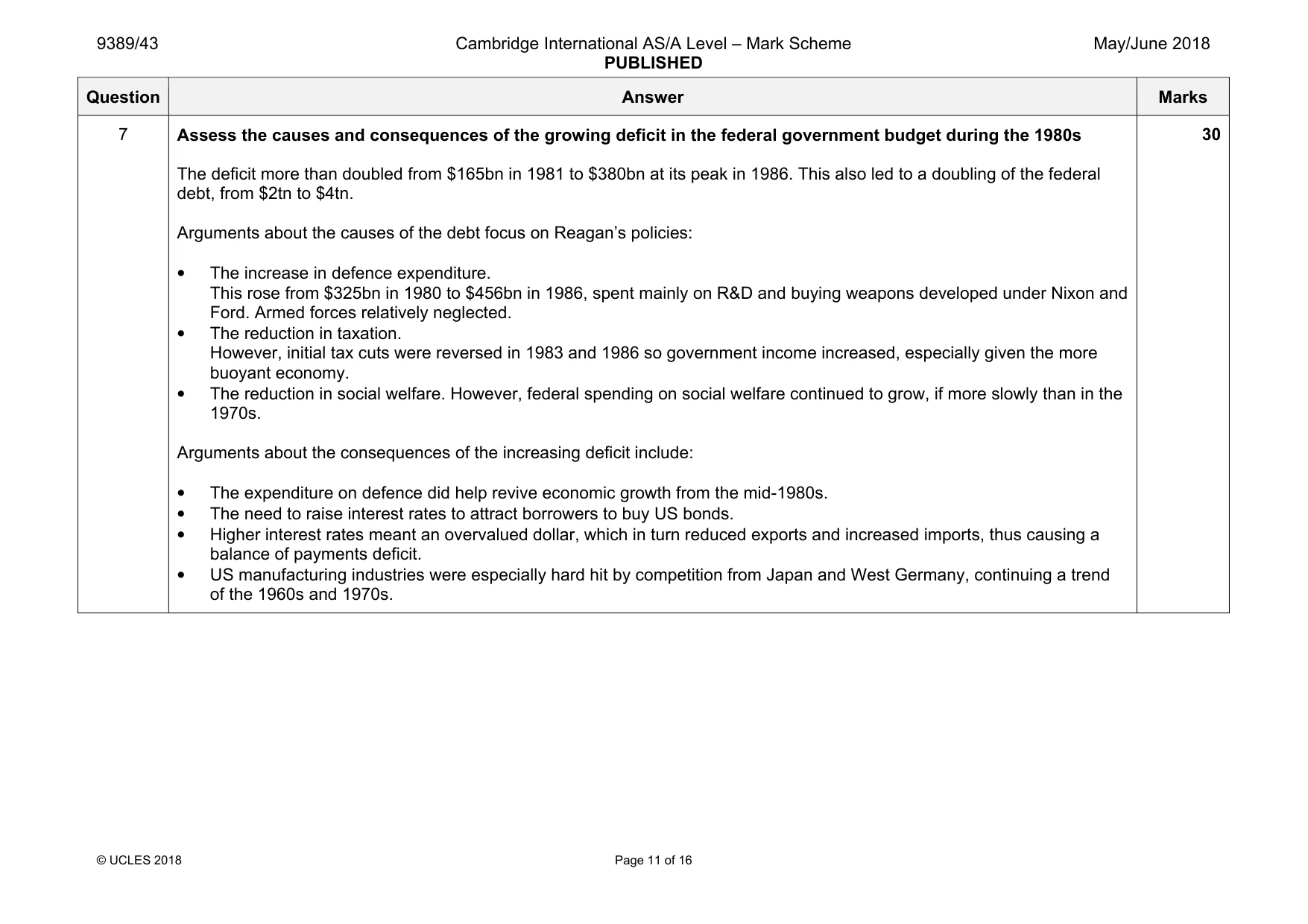
Mark scheme: 7 Assess the causes and consequences of the growing deficit in the federal government budget during the 1980s The deficit more than doubled from $165bn in 1981 to $380bn at its peak in 1986. This also led to a doubling of the federal debt, from $2tn to $4tn. Arguments about the causes of the debt focus on Reagan’s policies: • The increase in defence expenditure. This rose from $325bn in 1980 to $456bn in 1986, spent mainly on R&D and buying weapons developed under Nixon and Ford. Armed forces relatively neglected. • The reduction in taxation. However, initial tax cuts were reversed in 1983 and 1986 so government income increased, especially given the more buoyant economy. • The reduction in social welfare. However, federal spending on social welfare continued to grow, if more slowly than in the 1970s. Arguments about the consequences of the increasing deficit include: • The expenditure on defence did help revive economic growth from the mid-1980s. • The need to raise interest rates to attract borrowers to buy US bonds. • Higher interest rates meant an overvalued dollar, which in turn reduced exports and increased imports, thus causing a balance of payments deficit. • US manufacturing industries were especially hard hit by competition from Japan and West Germany, continuing a trend of the 1960s and 1970s. 30
Q8 · Assess the continuing impact of the Vietnam War on US foreign policy following its…
8 Assess the continuing impact of the Vietnam War on US foreign policy following its conclusion in 1975. [30] Depth Study 3: International History, 1945–1991 Answer any two questions.
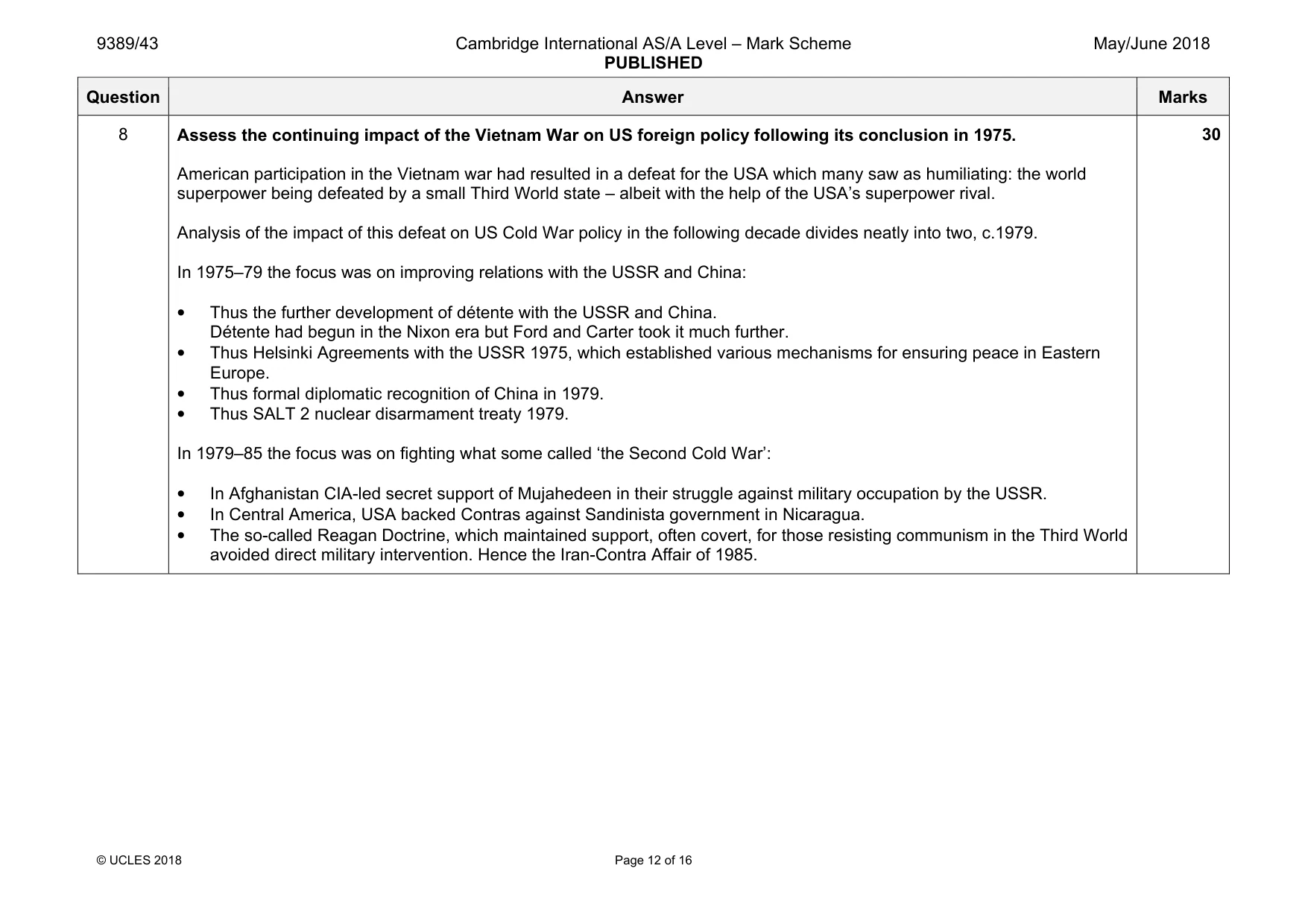
Mark scheme: 8 Assess the continuing impact of the Vietnam War on US foreign policy following its conclusion in 1975. American participation in the Vietnam war had resulted in a defeat for the USA which many saw as humiliating: the world superpower being defeated by a small Third World state – albeit with the help of the USA’s superpower rival. Analysis of the impact of this defeat on US Cold War policy in the following decade divides neatly into two, c.1979. In 1975–79 the focus was on improving relations with the USSR and China: • Thus the further development of détente with the USSR and China. Détente had begun in the Nixon era but Ford and Carter took it much further. • Thus Helsinki Agreements with the USSR 1975, which established various mechanisms for ensuring peace in Eastern Europe. • Thus formal diplomatic recognition of China in 1979. • Thus SALT 2 nuclear disarmament treaty 1979. In 1979–85 the focus was on fighting what some called ‘the Second Cold War’: • In Afghanistan CIA-led secret support of Mujahedeen in their struggle against military occupation by the USSR. • In Central America, USA backed Contras against Sandinista government in Nicaragua. • The so-called Reagan Doctrine, which maintained support, often covert, for those resisting communism in the Third World avoided direct military intervention. Hence the Iran-Contra Affair of 1985. 30
Q9 · ‘The Cuban Missile Crisis brought the world close to nuclear war.’ How far do you agree?
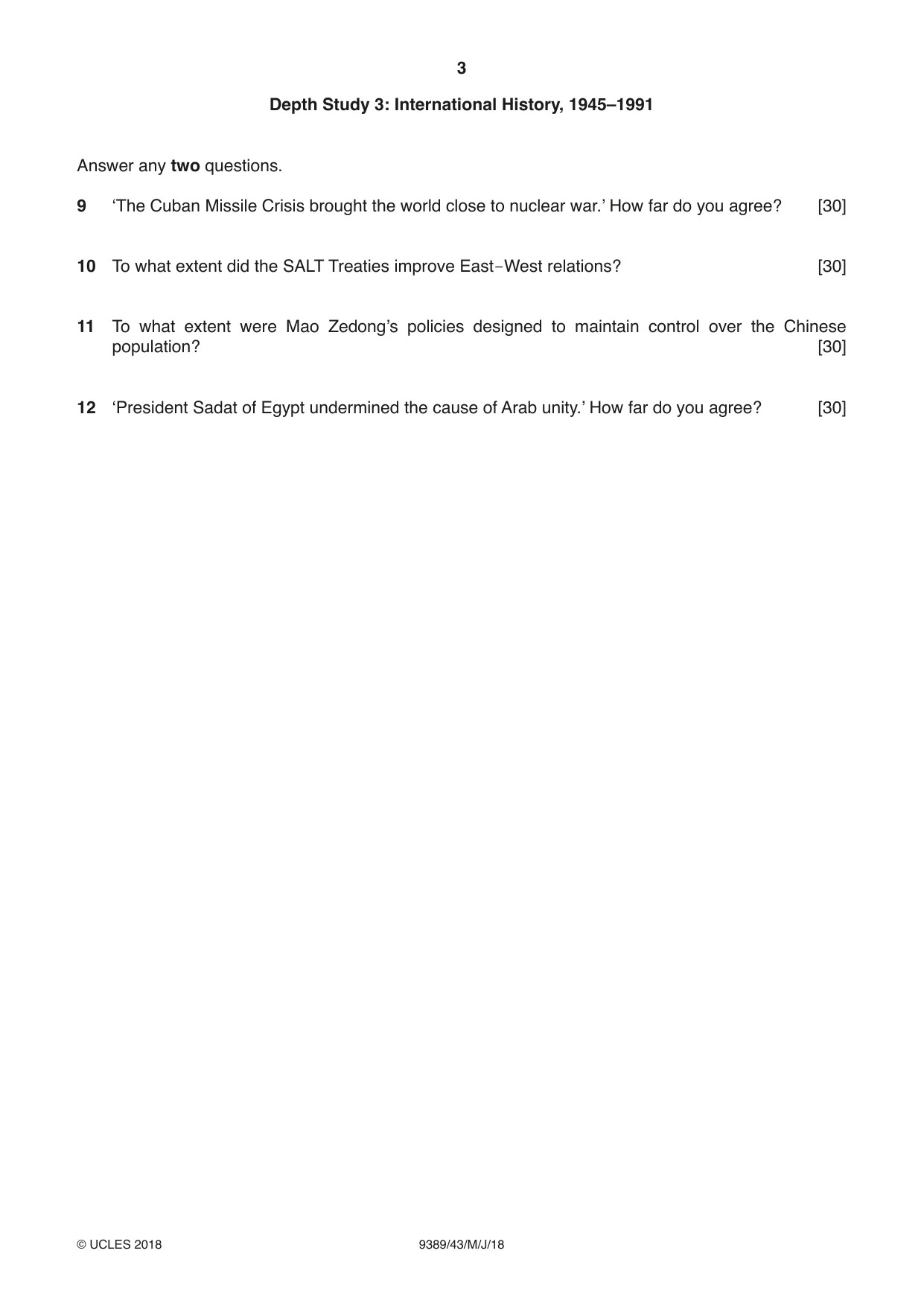
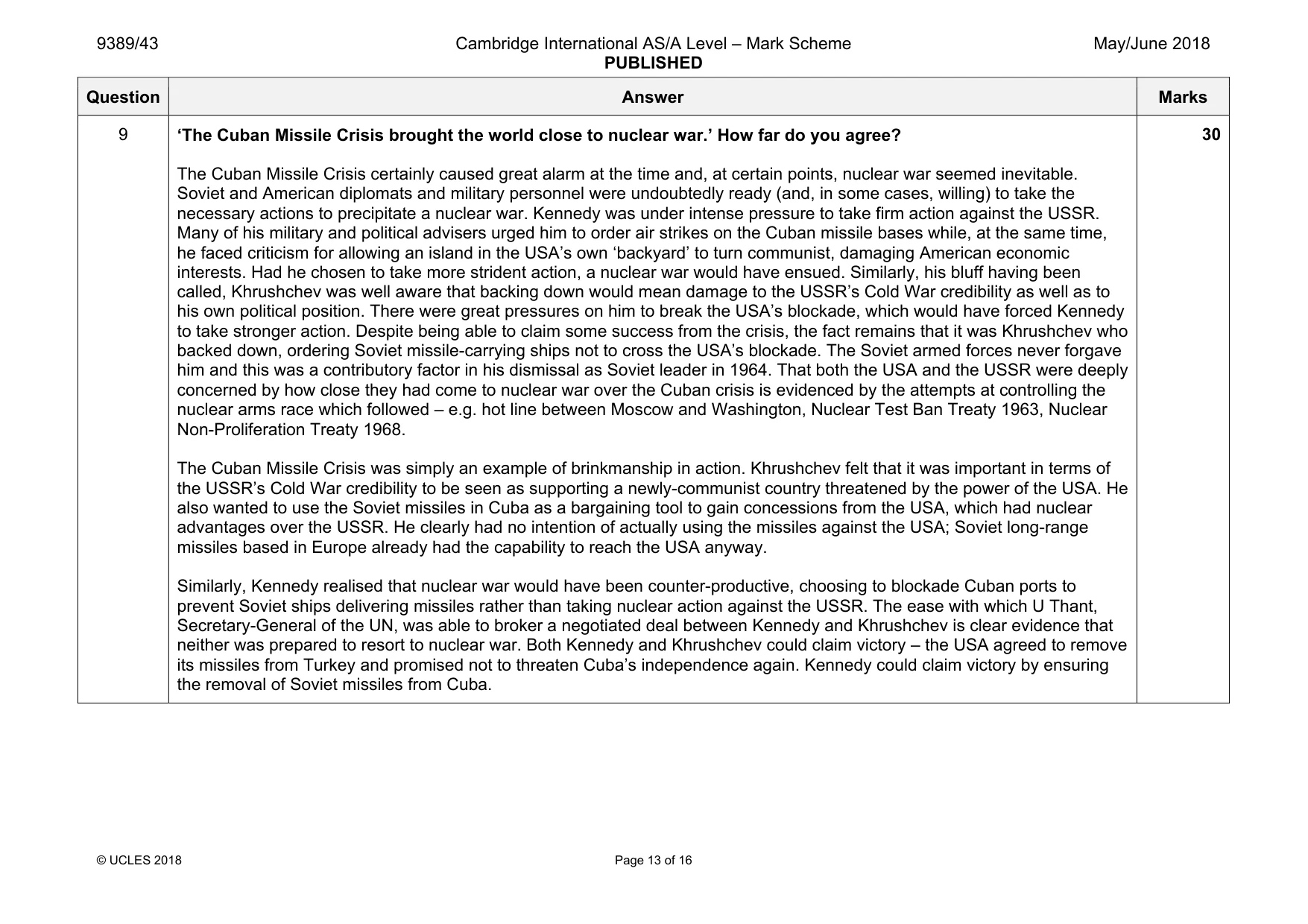
9 ‘The Cuban Missile Crisis brought the world close to nuclear war.’ How far do you agree? [30]
Mark scheme: 9 ‘The Cuban Missile Crisis brought the world close to nuclear war.’ How far do you agree? The Cuban Missile Crisis certainly caused great alarm at the time and, at certain points, nuclear war seemed inevitable. Soviet and American diplomats and military personnel were undoubtedly ready (and, in some cases, willing) to take the necessary actions to precipitate a nuclear war. Kennedy was under intense pressure to take firm action against the USSR. Many of his military and political advisers urged him to order air strikes on the Cuban missile bases while, at the same time, he faced criticism for allowing an island in the USA’s own ‘backyard’ to turn communist, damaging American economic interests. Had he chosen to take more strident action, a nuclear war would have ensued. Similarly, his bluff having been called, Khrushchev was well aware that backing down would mean damage to the USSR’s Cold War credibility as well as to his own political position. There were great pressures on him to break the USA’s blockade, which would have forced Kennedy to take stronger action. Despite being able to claim some success from the crisis, the fact remains that it was Khrushchev who backed down, ordering Soviet missile-carrying ships not to cross the USA’s blockade. The Soviet armed forces never forgave him and this was a contributory factor in his dismissal as Soviet leader in 1964. That both the USA and the USSR were deeply concerned by how close they had come to nuclear war over the Cuban crisis is evidenced by the attempts at controlling the nuclear arms race which followed – e.g. hot line between Moscow and Washington, Nuclear Test Ban Treaty 1963, Nuclear Non-Proliferation Treaty 1968. The Cuban Missile Crisis was simply an example of brinkmanship in action. Khrushchev felt that it was important in terms of the USSR’s Cold War credibility to be seen as supporting a newly-communist country threatened by the power of the USA. He also wanted to use the Soviet missiles in Cuba as a bargaining tool to gain concessions from the USA, which had nuclear advantages over the USSR. He clearly had no intention of actually using the missiles against the USA; Soviet long-range missiles based in Europe already had the capability to reach the USA anyway. Similarly, Kennedy realised that nuclear war would have been counter-productive, choosing to blockade Cuban ports to prevent Soviet ships delivering missiles rather than taking nuclear action against the USSR. The ease with which U Thant, Secretary-General of the UN, was able to broker a negotiated deal between Kennedy and Khrushchev is clear evidence that neither was prepared to resort to nuclear war. Both Kennedy and Khrushchev could claim victory – the USA agreed to remove its missiles from Turkey and promised not to threaten Cuba’s independence again. Kennedy could claim victory by ensuring the removal of Soviet missiles from Cuba. 30
Q10 · To what extent did the SALT Treaties improve East-West relations?
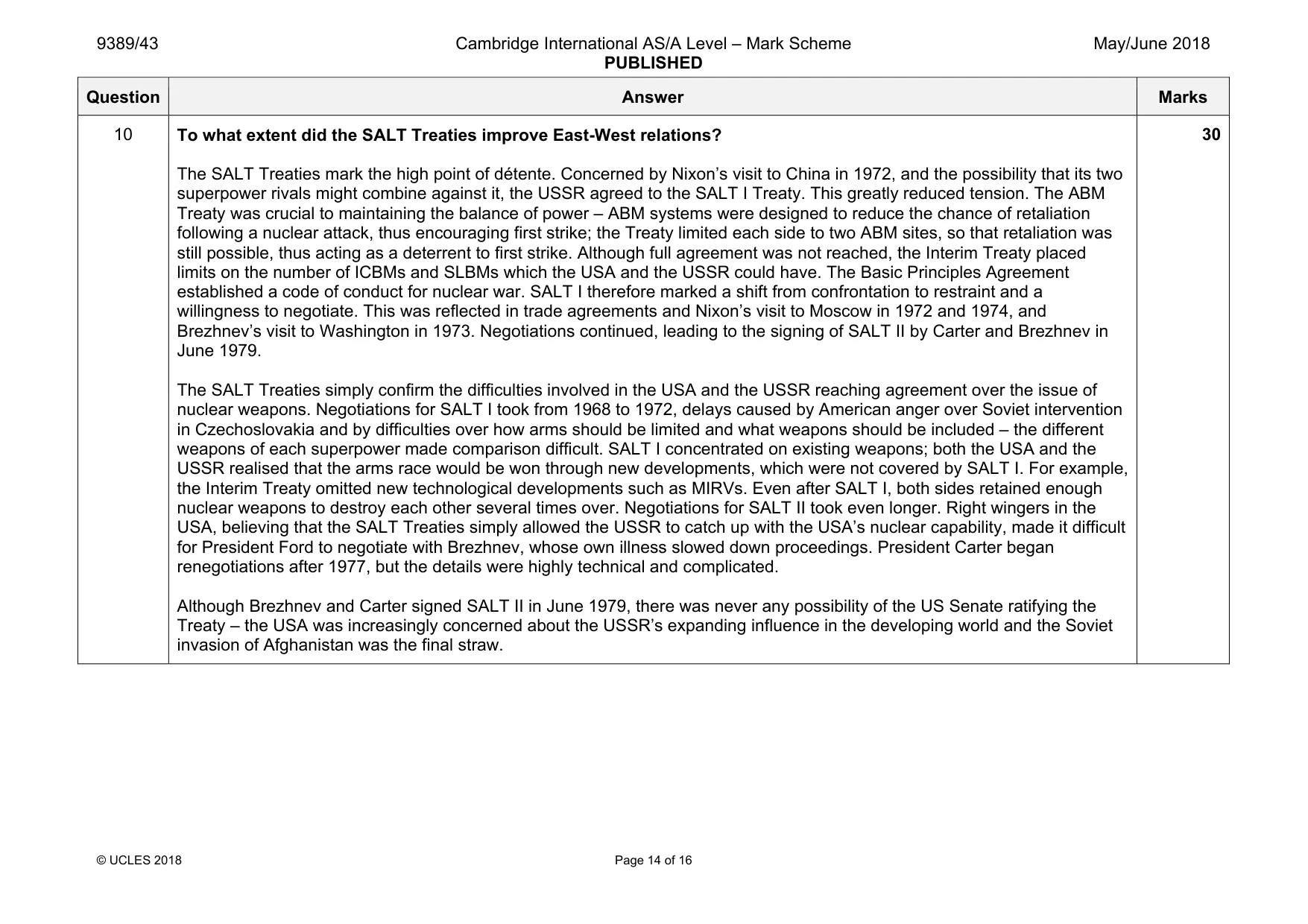
10 To what extent did the SALT Treaties improve East-West relations? [30]
Mark scheme: 10 To what extent did the SALT Treaties improve East-West relations? The SALT Treaties mark the high point of détente. Concerned by Nixon’s visit to China in 1972, and the possibility that its two superpower rivals might combine against it, the USSR agreed to the SALT I Treaty. This greatly reduced tension. The ABM Treaty was crucial to maintaining the balance of power – ABM systems were designed to reduce the chance of retaliation following a nuclear attack, thus encouraging first strike; the Treaty limited each side to two ABM sites, so that retaliation was still possible, thus acting as a deterrent to first strike. Although full agreement was not reached, the Interim Treaty placed limits on the number of ICBMs and SLBMs which the USA and the USSR could have. The Basic Principles Agreement established a code of conduct for nuclear war. SALT I therefore marked a shift from confrontation to restraint and a willingness to negotiate. This was reflected in trade agreements and Nixon’s visit to Moscow in 1972 and 1974, and Brezhnev’s visit to Washington in 1973. Negotiations continued, leading to the signing of SALT II by Carter and Brezhnev in June 1979. The SALT Treaties simply confirm the difficulties involved in the USA and the USSR reaching agreement over the issue of nuclear weapons. Negotiations for SALT I took from 1968 to 1972, delays caused by American anger over Soviet intervention in Czechoslovakia and by difficulties over how arms should be limited and what weapons should be included – the different weapons of each superpower made comparison difficult. SALT I concentrated on existing weapons; both the USA and the USSR realised that the arms race would be won through new developments, which were not covered by SALT I. For example, the Interim Treaty omitted new technological developments such as MIRVs. Even after SALT I, both sides retained enough nuclear weapons to destroy each other several times over. Negotiations for SALT II took even longer. Right wingers in the USA, believing that the SALT Treaties simply allowed the USSR to catch up with the USA’s nuclear capability, made it difficult for President Ford to negotiate with Brezhnev, whose own illness slowed down proceedings. President Carter began renegotiations after 1977, but the details were highly technical and complicated. Although Brezhnev and Carter signed SALT II in June 1979, there was never any possibility of the US Senate ratifying the Treaty – the USA was increasingly concerned about the USSR’s expanding influence in the developing world and the Soviet invasion of Afghanistan was the final straw. 30
Q11 · To what extent were Mao Zedong’s policies designed to maintain control over the Chinese…
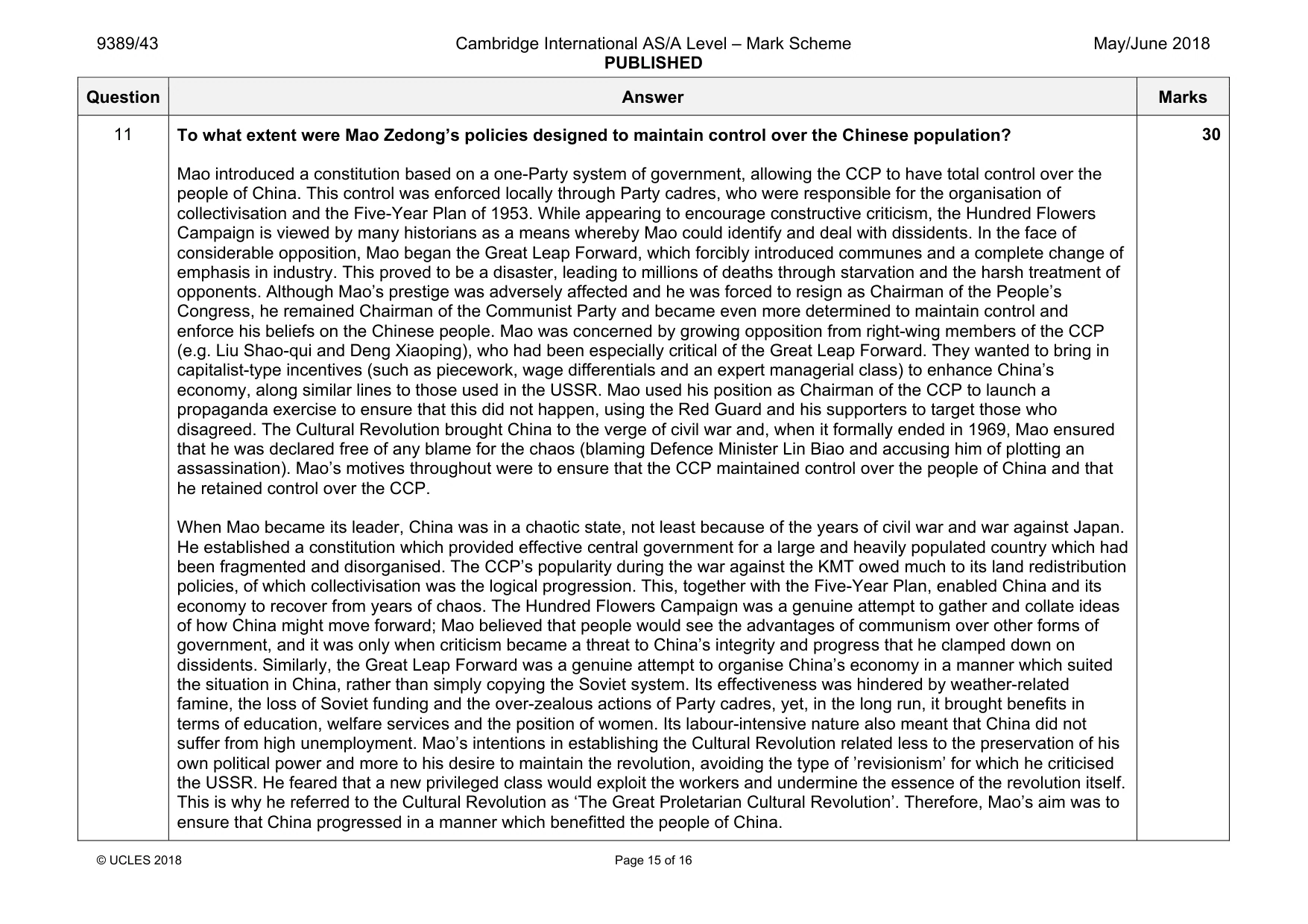
11 To what extent were Mao Zedong’s policies designed to maintain control over the Chinese population? [30]
Mark scheme: 11 To what extent were Mao Zedong’s policies designed to maintain control over the Chinese population? Mao introduced a constitution based on a one-Party system of government, allowing the CCP to have total control over the people of China. This control was enforced locally through Party cadres, who were responsible for the organisation of collectivisation and the Five-Year Plan of 1953. While appearing to encourage constructive criticism, the Hundred Flowers Campaign is viewed by many historians as a means whereby Mao could identify and deal with dissidents. In the face of considerable opposition, Mao began the Great Leap Forward, which forcibly introduced communes and a complete change of emphasis in industry. This proved to be a disaster, leading to millions of deaths through starvation and the harsh treatment of opponents. Although Mao’s prestige was adversely affected and he was forced to resign as Chairman of the People’s Congress, he remained Chairman of the Communist Party and became even more determined to maintain control and enforce his beliefs on the Chinese people. Mao was concerned by growing opposition from right-wing members of the CCP (e.g. Liu Shao-qui and Deng Xiaoping), who had been especially critical of the Great Leap Forward. They wanted to bring in capitalist-type incentives (such as piecework, wage differentials and an expert managerial class) to enhance China’s economy, along similar lines to those used in the USSR. Mao used his position as Chairman of the CCP to launch a propaganda exercise to ensure that this did not happen, using the Red Guard and his supporters to target those who disagreed. The Cultural Revolution brought China to the verge of civil war and, when it formally ended in 1969, Mao ensured that he was declared free of any blame for the chaos (blaming Defence Minister Lin Biao and accusing him of plotting an assassination). Mao’s motives throughout were to ensure that the CCP maintained control over the people of China and that he retained control over the CCP. When Mao became its leader, China was in a chaotic state, not least because of the years of civil war and war against Japan. He established a constitution which provided effective central government for a large and heavily populated country which had been fragmented and disorganised. The CCP’s popularity during the war against the KMT owed much to its land redistribution policies, of which collectivisation was the logical progression. This, together with the Five-Year Plan, enabled China and its economy to recover from years of chaos. The Hundred Flowers Campaign was a genuine attempt to gather and collate ideas of how China might move forward; Mao believed that people would see the advantages of communism over other forms of government, and it was only when criticism became a threat to China’s integrity and progress that he clamped down on dissidents. Similarly, the Great Leap Forward was a genuine attempt to organise China’s economy in a manner which suited the situation in China, rather than simply copying the Soviet system. Its effectiveness was hindered by weather-related famine, the loss of Soviet funding and the over-zealous actions of Party cadres, yet, in the long run, it brought benefits in terms of education, welfare services and the position of women. Its labour-intensive nature also meant that China did not suffer from high unemployment. Mao’s intentions in establishing the Cultural Revolution related less to the preservation of his own political power and more to his desire to maintain the revolution, avoiding the type of ’revisionism’ for which he criticised the USSR. He feared that a new privileged class would exploit the workers and undermine the essence of the revolution itself. This is why he referred to the Cultural Revolution as ‘The Great Proletarian Cultural Revolution’. Therefore, Mao’s aim was to ensure that China progressed in a manner which benefitted the people of China. 30
What you needed in this session
Cambridge’s own grade thresholds for 2018 May/June, Paper 4 · Variant 3. A higher threshold means an easier paper — the bar moves with how the cohort did.