Cambridge A Level History 9389 — 2017 May/June Paper 2 · Variant 2
9389/22/M/J/17 · 12 questions · 60 marks · ≈68 min
The question paper and its mark scheme, free to read here and free to download. This is Cambridge’s own paper, exactly as it was sat.
Question paper4 pages
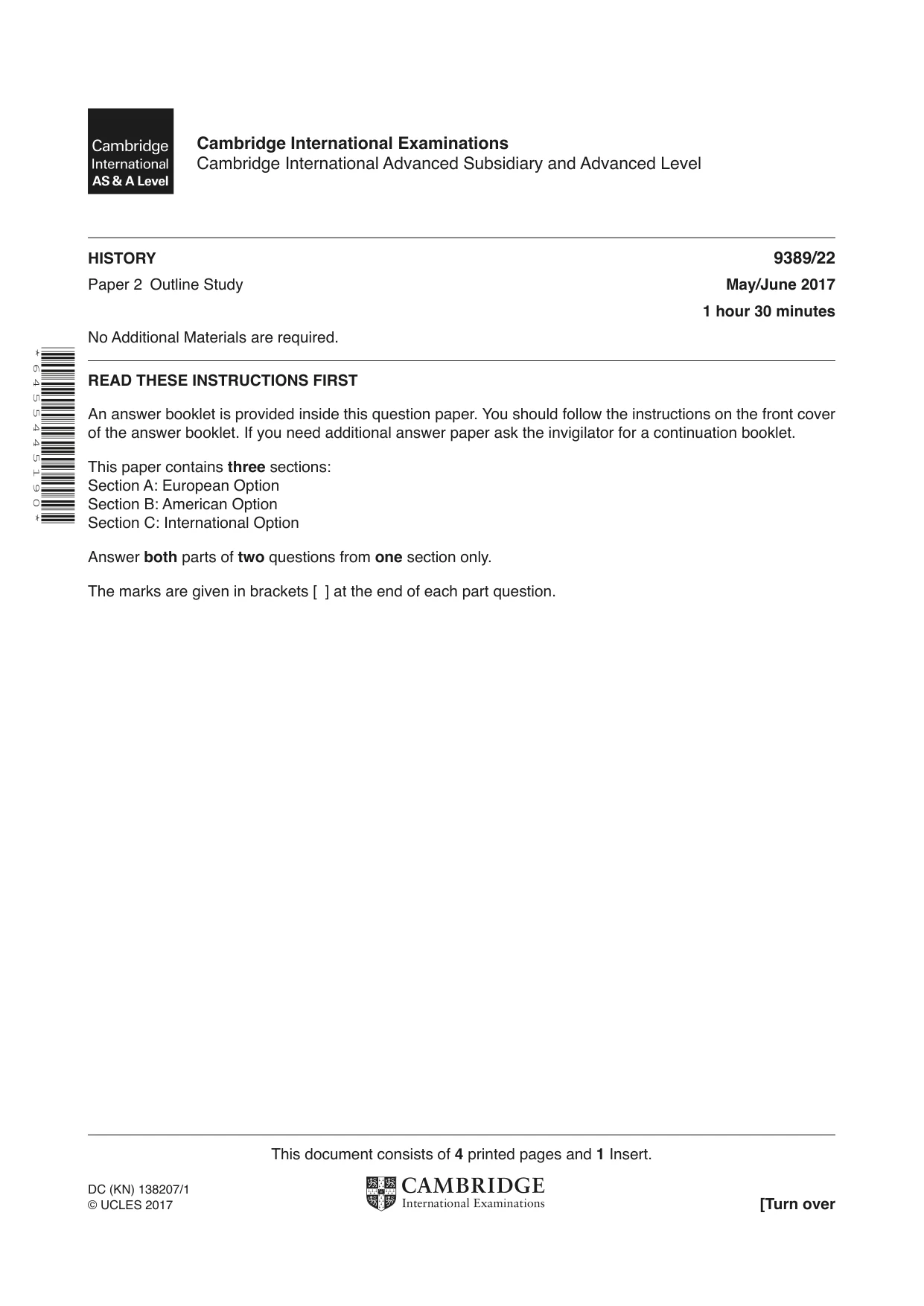
Mark scheme28 pages
Answers below. Sit the paper first if you are practising.
Questions as text
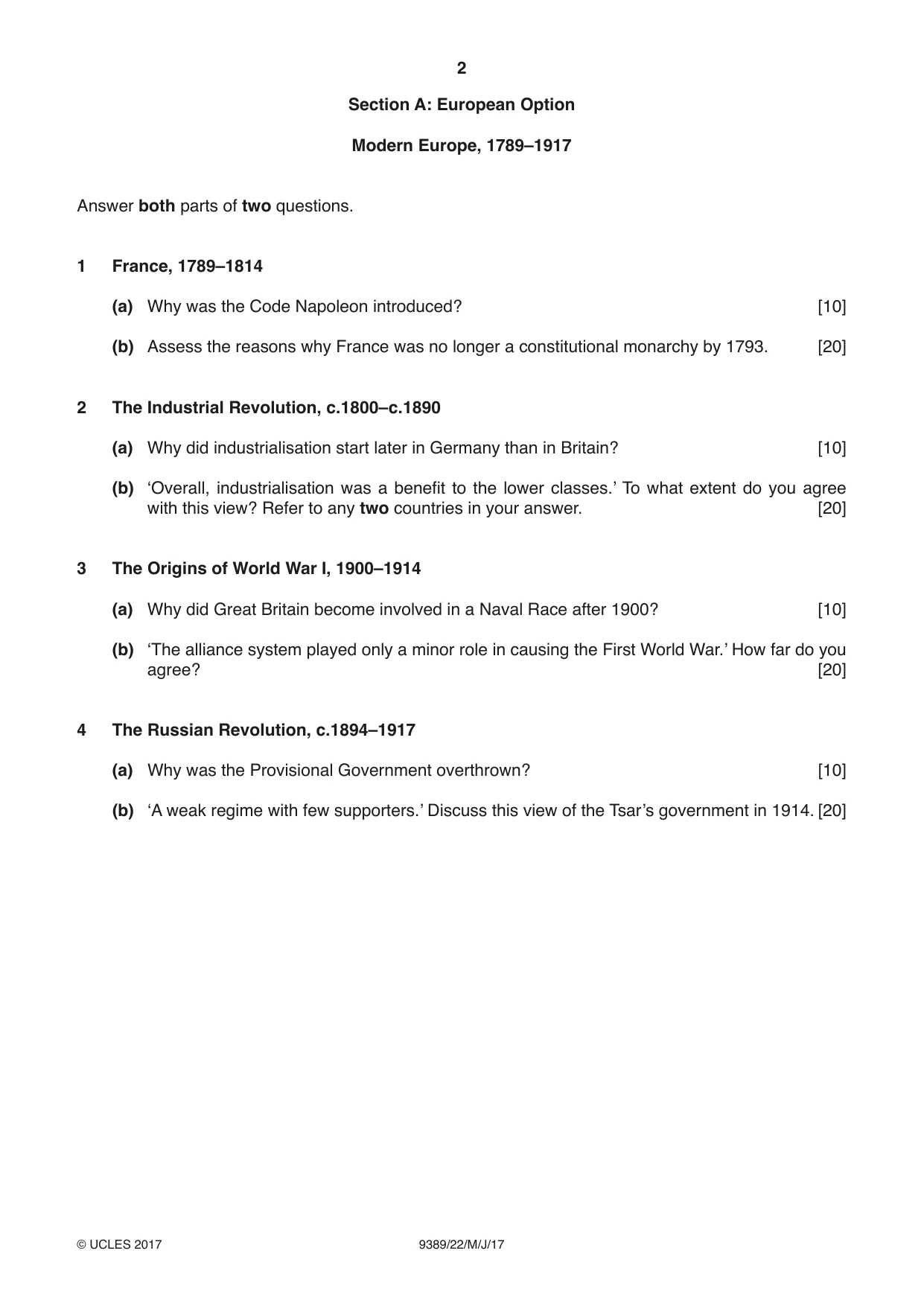
Q1 · France, 1789–1814 (a) Why was the Code Napoleon introduced?
1 France, 1789–1814 (a) Why was the Code Napoleon introduced? [10] (b) Assess the reasons why France was no longer a constitutional monarchy by 1793. [20]
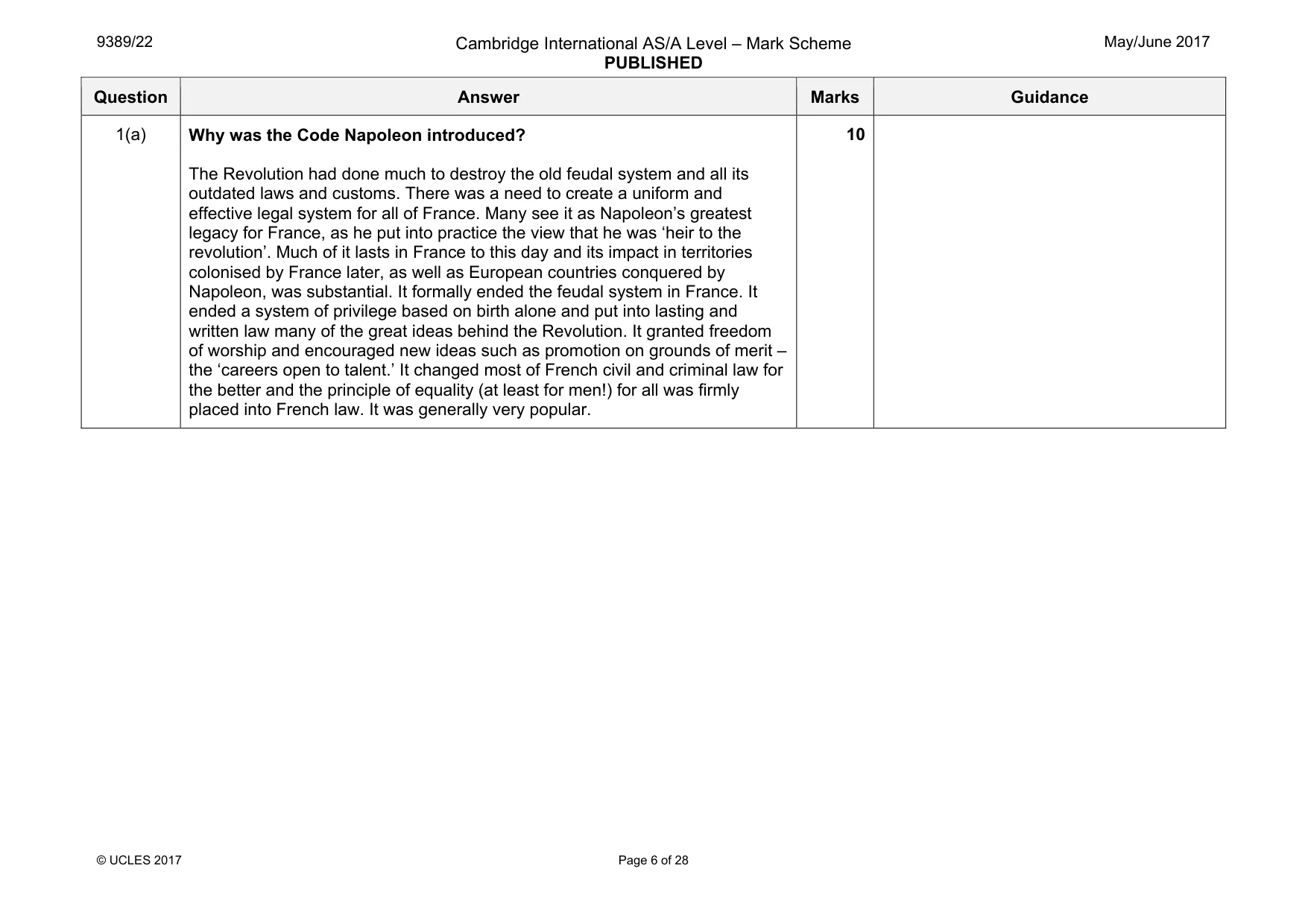
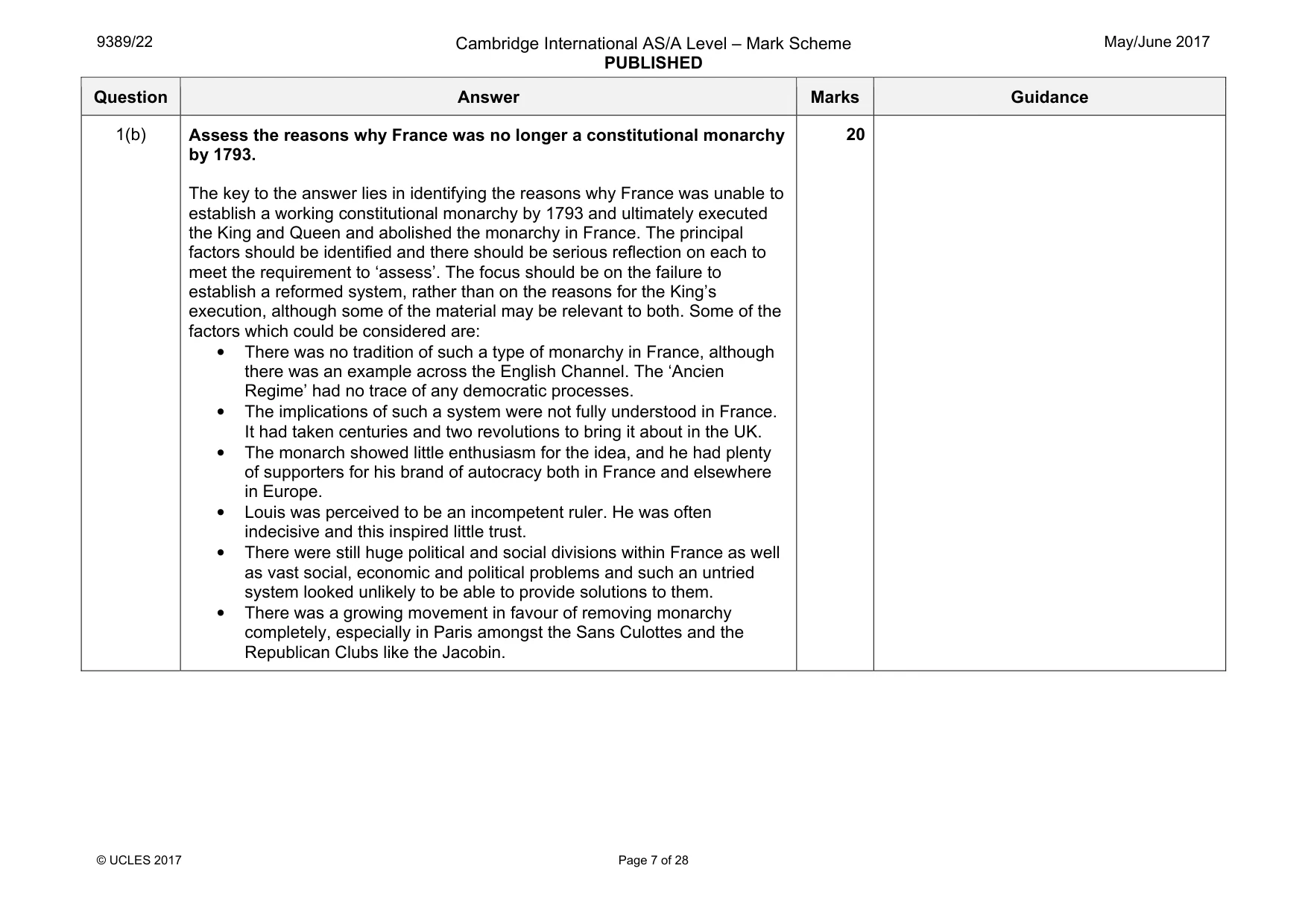
Mark scheme: 1(a) Why was the Code Napoleon introduced? The Revolution had done much to destroy the old feudal system and all its outdated laws and customs. There was a need to create a uniform and effective legal system for all of France. Many see it as Napoleon’s greatest legacy for France, as he put into practice the view that he was ‘heir to the revolution’. Much of it lasts in France to this day and its impact in territories colonised by France later, as well as European countries conquered by Napoleon, was substantial. It formally ended the feudal system in France. It ended a system of privilege based on birth alone and put into lasting and written law many of the great ideas behind the Revolution. It granted freedom of worship and encouraged new ideas such as promotion on grounds of merit – the ‘careers open to talent.’ It changed most of French civil and criminal law for the better and the principle of equality (at least for men!) for all was firmly placed into French law. It was generally very popular. 10 Question Answer Marks Guidance 1(b) Assess the reasons why France was no longer a constitutional monarchy by 1793. The key to the answer lies in identifying the reasons why France was unable to establish a working constitutional monarchy by 1793 and ultimately executed the King and Queen and abolished the monarchy in France. The principal factors should be identified and there should be serious reflection on each to meet the requirement to ‘assess’. The focus should be on the failure to establish a reformed system, rather than on the reasons for the King’s execution, although some of the material may be relevant to both. Some of the factors which could be considered are: • There was no tradition of such a type of monarchy in France, although there was an example across the English Channel. The ‘Ancien Regime’ had no trace of any democratic processes. • The implications of such a system were not fully understood in France. It had taken centuries and two revolutions to bring it about in the UK. • The monarch showed little enthusiasm for the idea, and he had plenty of supporters for his brand of autocracy both in France and elsewhere in Europe. • Louis was perceived to be an incompetent ruler. He was often indecisive and this inspired little trust. • There were still huge political and social divisions within France as well as vast social, economic and political problems and such an untried system looked unlikely to be able to provide solutions to them. • There was a growing movement in favour of removing monarchy completely, especially in Paris amongst the Sans Culottes and the Republican Clubs like the Jacobin. 20
Q2 · The Industrial Revolution, c.1800–c.1890 (a) Why did industrialisation start later in…
2 The Industrial Revolution, c.1800–c.1890 (a) Why did industrialisation start later in Germany than in Britain? [10] (b) ‘Overall, industrialisation was a benefit to the lower classes.’ To what extent do you agree with this view? Refer to any two countries in your answer. [20]
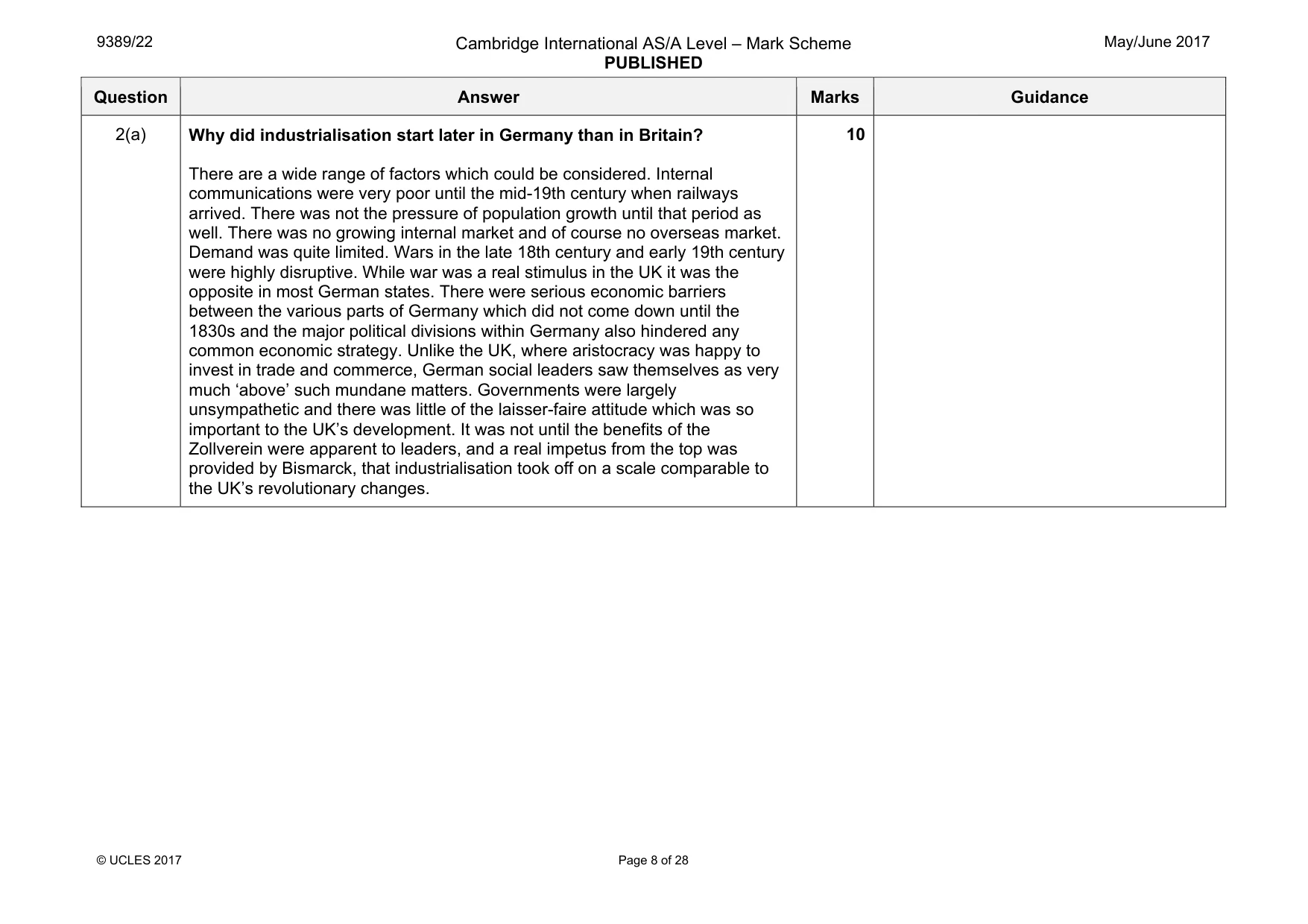
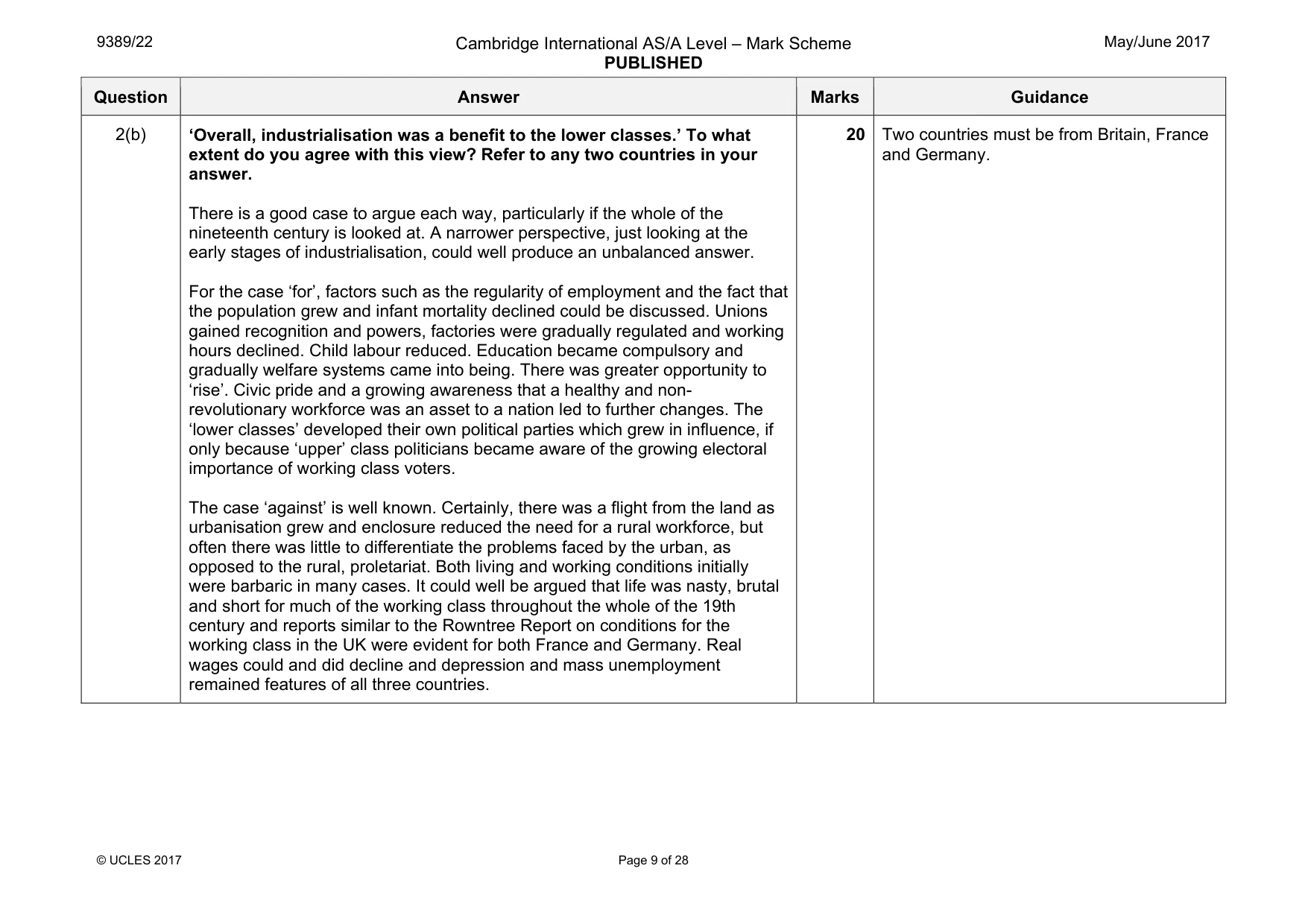
Mark scheme: 2(a) Why did industrialisation start later in Germany than in Britain? There are a wide range of factors which could be considered. Internal communications were very poor until the mid-19th century when railways arrived. There was not the pressure of population growth until that period as well. There was no growing internal market and of course no overseas market. Demand was quite limited. Wars in the late 18th century and early 19th century were highly disruptive. While war was a real stimulus in the UK it was the opposite in most German states. There were serious economic barriers between the various parts of Germany which did not come down until the 1830s and the major political divisions within Germany also hindered any common economic strategy. Unlike the UK, where aristocracy was happy to invest in trade and commerce, German social leaders saw themselves as very much ‘above’ such mundane matters. Governments were largely unsympathetic and there was little of the laisser-faire attitude which was so important to the UK’s development. It was not until the benefits of the Zollverein were apparent to leaders, and a real impetus from the top was provided by Bismarck, that industrialisation took off on a scale comparable to the UK’s revolutionary changes. 10 Question Answer Marks Guidance 2(b) ‘Overall, industrialisation was a benefit to the lower classes.’ To what extent do you agree with this view? Refer to any two countries in your answer. There is a good case to argue each way, particularly if the whole of the nineteenth century is looked at. A narrower perspective, just looking at the early stages of industrialisation, could well produce an unbalanced answer. For the case ‘for’, factors such as the regularity of employment and the fact that the population grew and infant mortality declined could be discussed. Unions gained recognition and powers, factories were gradually regulated and working hours declined. Child labour reduced. Education became compulsory and gradually welfare systems came into being. There was greater opportunity to ‘rise’. Civic pride and a growing awareness that a healthy and non- revolutionary workforce was an asset to a nation led to further changes. The ‘lower classes’ developed their own political parties which grew in influence, if only because ‘upper’ class politicians became aware of the growing electoral importance of working class voters. The case ‘against’ is well known. Certainly, there was a flight from the land as urbanisation grew and enclosure reduced the need for a rural workforce, but often there was little to differentiate the problems faced by the urban, as opposed to the rural, proletariat. Both living and working conditions initially were barbaric in many cases. It could well be argued that life was nasty, brutal and short for much of the working class throughout the whole of the 19th century and reports similar to the Rowntree Report on conditions for the working class in the UK were evident for both France and Germany. Real wages could and did decline and depression and mass unemployment remained features of all three countries. 20 Two countries must be from Britain, France and Germany.
Q3 · The Origins of World War I, 1900–1914 (a) Why did Great Britain become involved in a…
3 The Origins of World War I, 1900–1914 (a) Why did Great Britain become involved in a Naval Race after 1900? [10] (b) ‘The alliance system played only a minor role in causing the First World War.’ How far do you agree? [20]
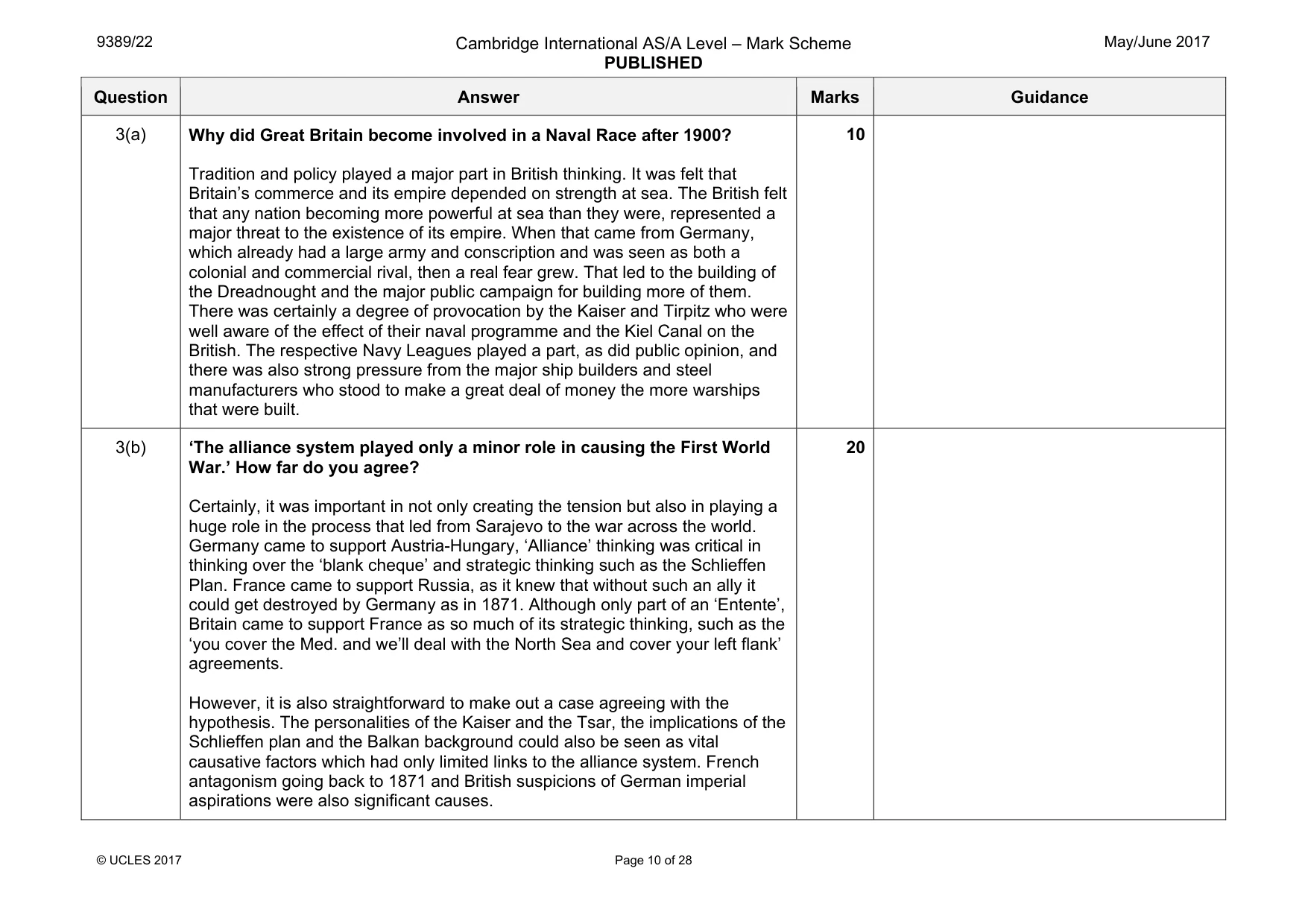
Mark scheme: 3(a) Why did Great Britain become involved in a Naval Race after 1900? Tradition and policy played a major part in British thinking. It was felt that Britain’s commerce and its empire depended on strength at sea. The British felt that any nation becoming more powerful at sea than they were, represented a major threat to the existence of its empire. When that came from Germany, which already had a large army and conscription and was seen as both a colonial and commercial rival, then a real fear grew. That led to the building of the Dreadnought and the major public campaign for building more of them. There was certainly a degree of provocation by the Kaiser and Tirpitz who were well aware of the effect of their naval programme and the Kiel Canal on the British. The respective Navy Leagues played a part, as did public opinion, and there was also strong pressure from the major ship builders and steel manufacturers who stood to make a great deal of money the more warships that were built. 10 3(b) ‘The alliance system played only a minor role in causing the First World War.’ How far do you agree? Certainly, it was important in not only creating the tension but also in playing a huge role in the process that led from Sarajevo to the war across the world. Germany came to support Austria-Hungary, ‘Alliance’ thinking was critical in thinking over the ‘blank cheque’ and strategic thinking such as the Schlieffen Plan. France came to support Russia, as it knew that without such an ally it could get destroyed by Germany as in 1871. Although only part of an ‘Entente’, Britain came to support France as so much of its strategic thinking, such as the ‘you cover the Med. and we’ll deal with the North Sea and cover your left flank’ agreements. However, it is also straightforward to make out a case agreeing with the hypothesis. The personalities of the Kaiser and the Tsar, the implications of the Schlieffen plan and the Balkan background could also be seen as vital causative factors which had only limited links to the alliance system. French antagonism going back to 1871 and British suspicions of German imperial aspirations were also significant causes. 20
Q4 · The Russian Revolution, c.1894–1917 (a) Why was the Provisional Government overthrown?
4 The Russian Revolution, c.1894–1917 (a) Why was the Provisional Government overthrown? [10] (b) ‘A weak regime with few supporters.’ Discuss this view of the Tsar’s government in 1914. [20]
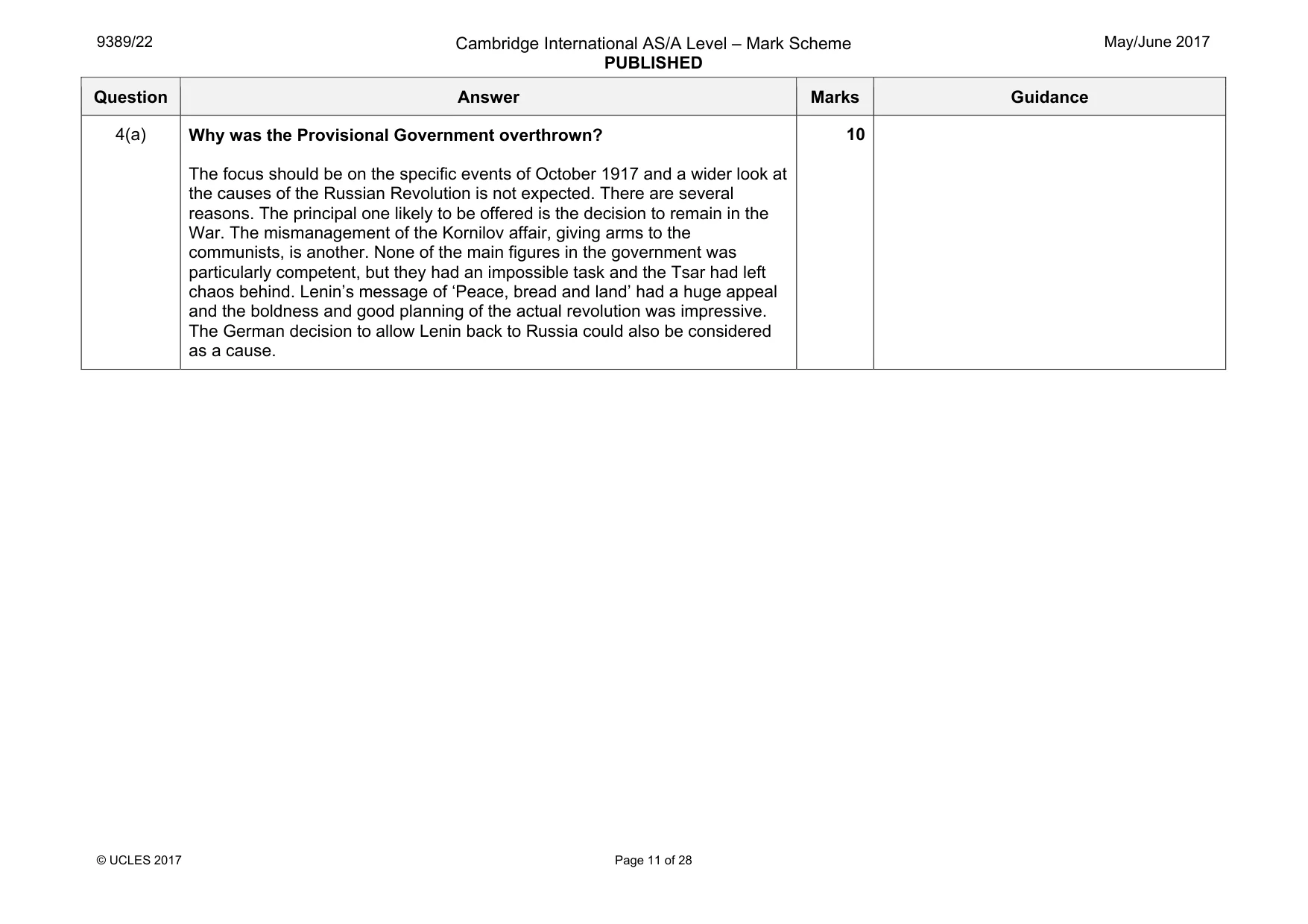
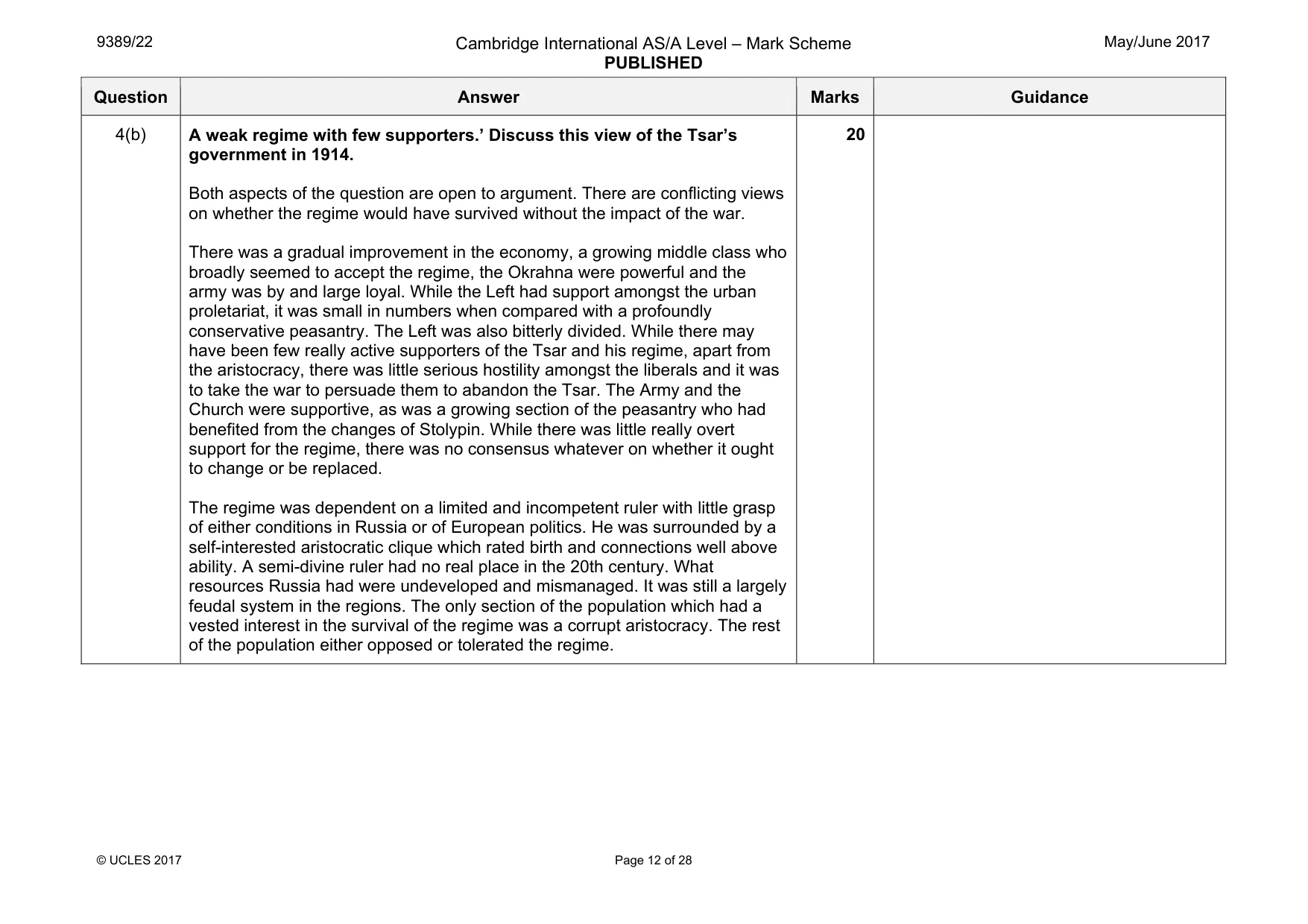
Mark scheme: 4(a) Why was the Provisional Government overthrown? The focus should be on the specific events of October 1917 and a wider look at the causes of the Russian Revolution is not expected. There are several reasons. The principal one likely to be offered is the decision to remain in the War. The mismanagement of the Kornilov affair, giving arms to the communists, is another. None of the main figures in the government was particularly competent, but they had an impossible task and the Tsar had left chaos behind. Lenin’s message of ‘Peace, bread and land’ had a huge appeal and the boldness and good planning of the actual revolution was impressive. The German decision to allow Lenin back to Russia could also be considered as a cause. 10 Question Answer Marks Guidance 4(b) A weak regime with few supporters.’ Discuss this view of the Tsar’s government in 1914. Both aspects of the question are open to argument. There are conflicting views on whether the regime would have survived without the impact of the war. There was a gradual improvement in the economy, a growing middle class who broadly seemed to accept the regime, the Okrahna were powerful and the army was by and large loyal. While the Left had support amongst the urban proletariat, it was small in numbers when compared with a profoundly conservative peasantry. The Left was also bitterly divided. While there may have been few really active supporters of the Tsar and his regime, apart from the aristocracy, there was little serious hostility amongst the liberals and it was to take the war to persuade them to abandon the Tsar. The Army and the Church were supportive, as was a growing section of the peasantry who had benefited from the changes of Stolypin. While there was little really overt support for the regime, there was no consensus whatever on whether it ought to change or be replaced. The regime was dependent on a limited and incompetent ruler with little grasp of either conditions in Russia or of European politics. He was surrounded by a self-interested aristocratic clique which rated birth and connections well above ability. A semi-divine ruler had no real place in the 20th century. What resources Russia had were undeveloped and mismanaged. It was still a largely feudal system in the regions. The only section of the population which had a vested interest in the survival of the regime was a corrupt aristocracy. The rest of the population either opposed or tolerated the regime. 20
Q5 · The Expansion of US Power from the 1840s to the 1930s (a) Why did President Taft…
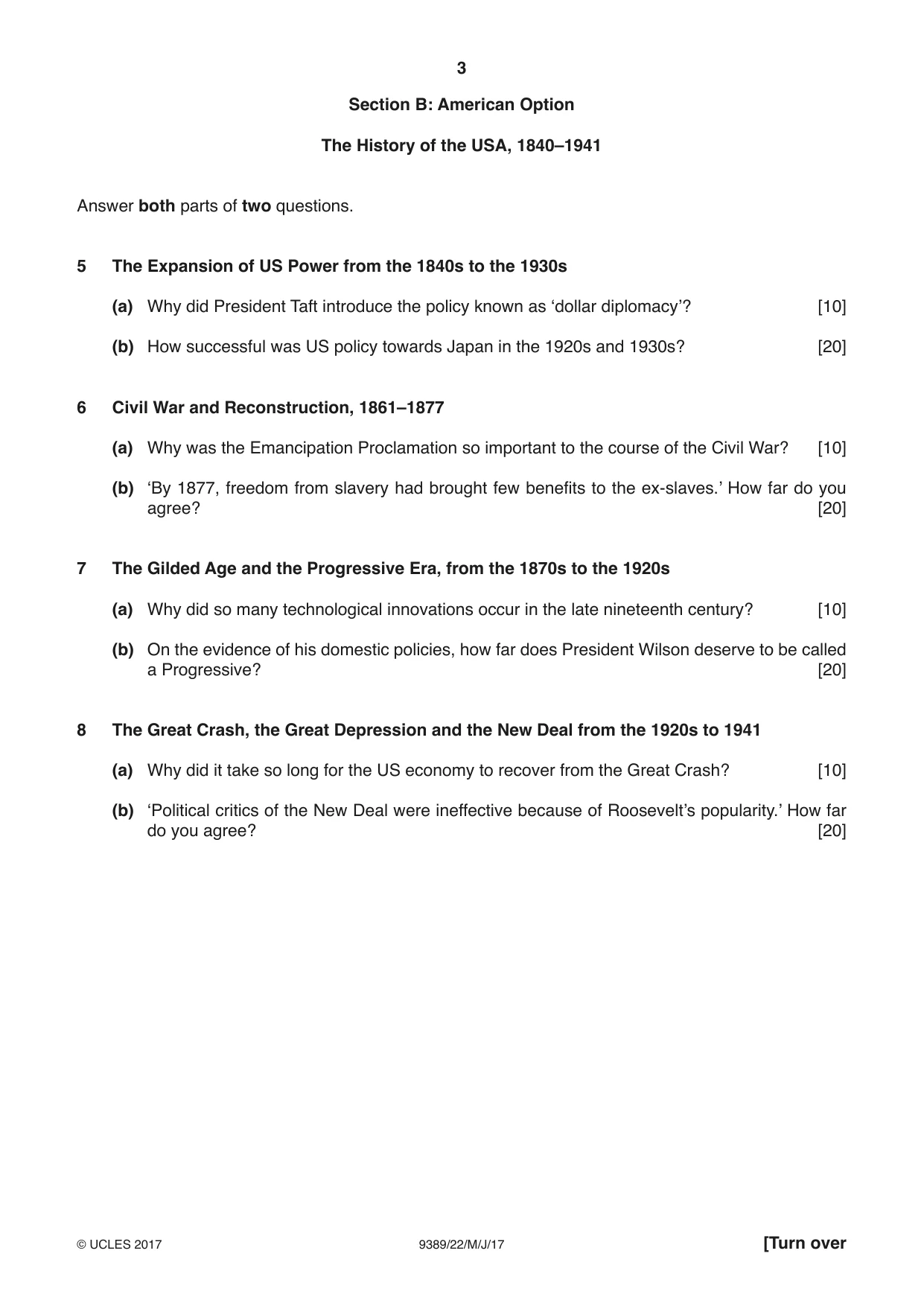
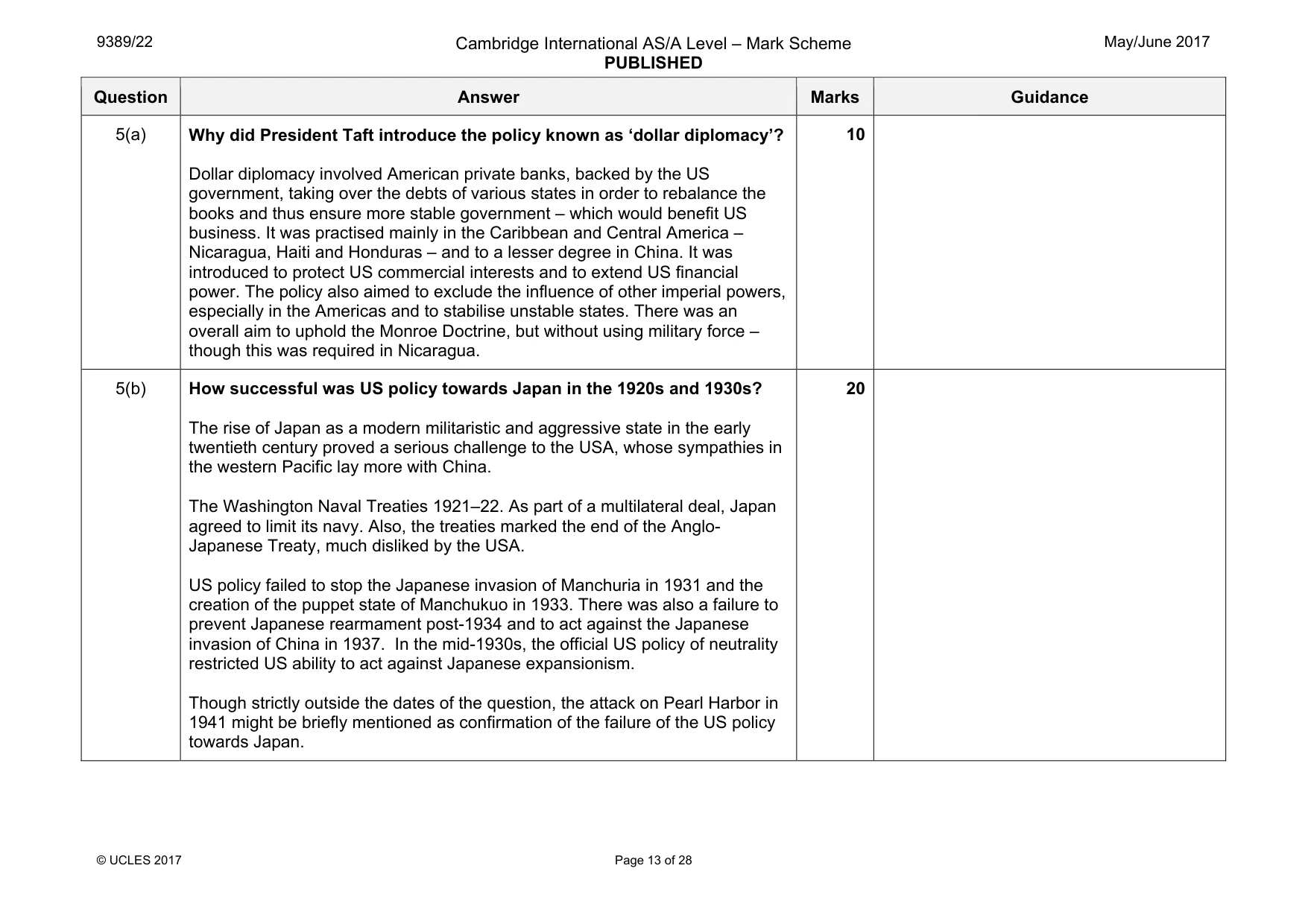
5 The Expansion of US Power from the 1840s to the 1930s (a) Why did President Taft introduce the policy known as ‘dollar diplomacy’? [10] (b) How successful was US policy towards Japan in the 1920s and 1930s? [20]
Mark scheme: 5(a) Why did President Taft introduce the policy known as ‘dollar diplomacy’? Dollar diplomacy involved American private banks, backed by the US government, taking over the debts of various states in order to rebalance the books and thus ensure more stable government – which would benefit US business. It was practised mainly in the Caribbean and Central America – Nicaragua, Haiti and Honduras – and to a lesser degree in China. It was introduced to protect US commercial interests and to extend US financial power. The policy also aimed to exclude the influence of other imperial powers, especially in the Americas and to stabilise unstable states. There was an overall aim to uphold the Monroe Doctrine, but without using military force – though this was required in Nicaragua. 10 5(b) How successful was US policy towards Japan in the 1920s and 1930s? The rise of Japan as a modern militaristic and aggressive state in the early twentieth century proved a serious challenge to the USA, whose sympathies in the western Pacific lay more with China. The Washington Naval Treaties 1921–22. As part of a multilateral deal, Japan agreed to limit its navy. Also, the treaties marked the end of the Anglo- Japanese Treaty, much disliked by the USA. US policy failed to stop the Japanese invasion of Manchuria in 1931 and the creation of the puppet state of Manchukuo in 1933. There was also a failure to prevent Japanese rearmament post-1934 and to act against the Japanese invasion of China in 1937. In the mid-1930s, the official US policy of neutrality restricted US ability to act against Japanese expansionism. Though strictly outside the dates of the question, the attack on Pearl Harbor in 1941 might be briefly mentioned as confirmation of the failure of the US policy towards Japan. 20
Q6 · Civil War and Reconstruction, 1861–1877 (a) Why was the Emancipation Proclamation so…
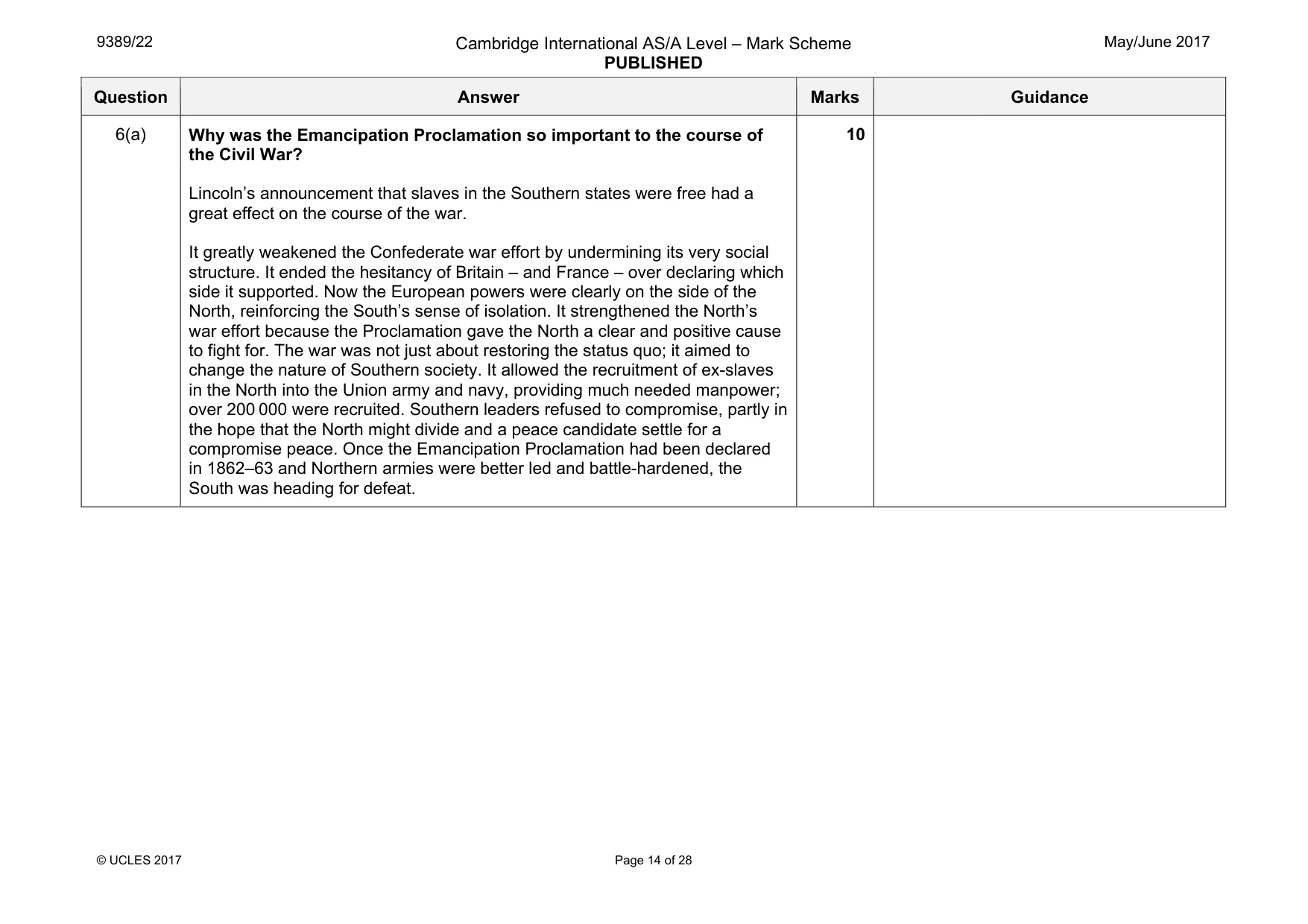
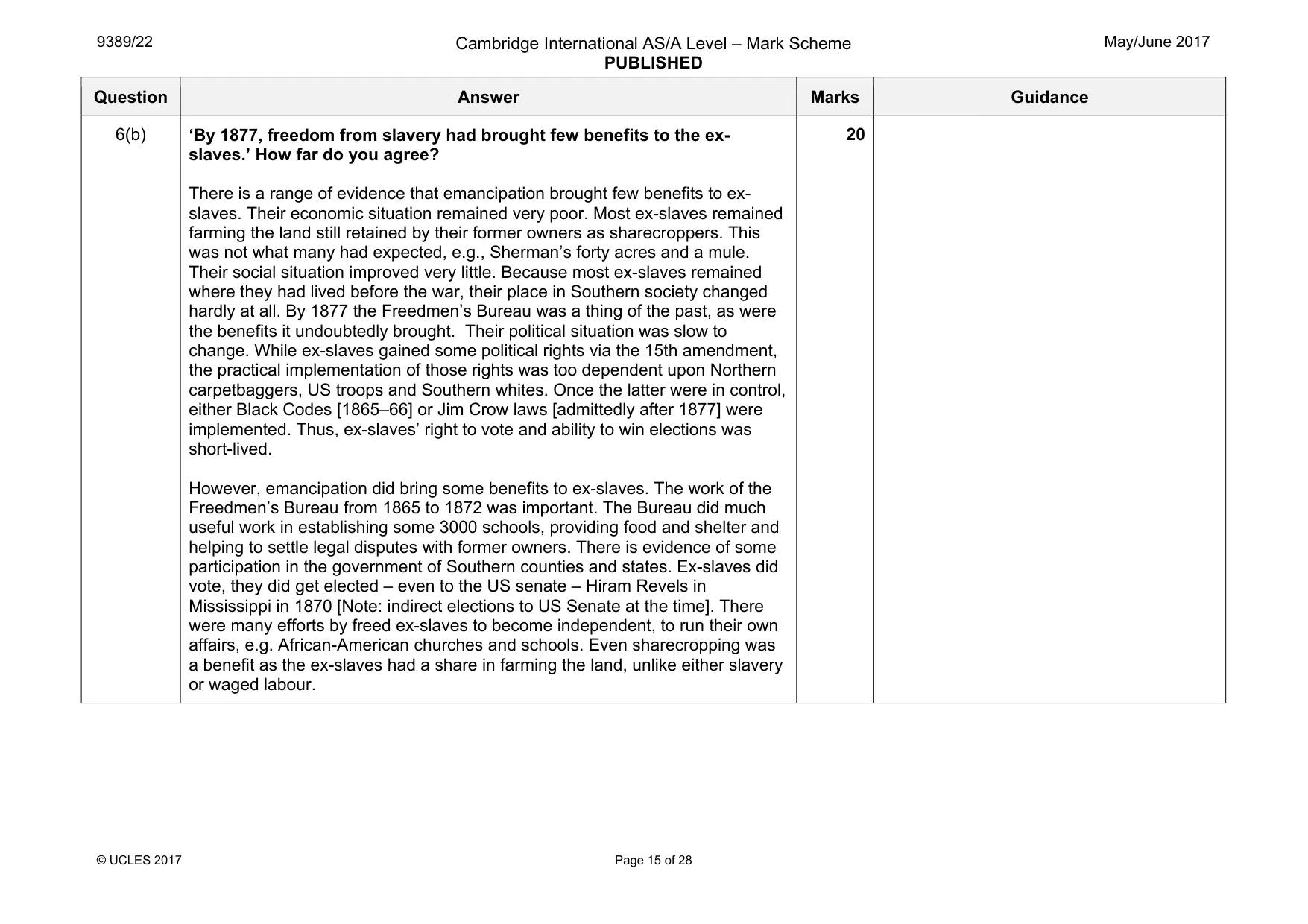
6 Civil War and Reconstruction, 1861–1877 (a) Why was the Emancipation Proclamation so important to the course of the Civil War? [10] (b) ‘By 1877, freedom from slavery had brought few benefits to the ex-slaves.’ How far do you agree? [20]
Mark scheme: 6(a) Why was the Emancipation Proclamation so important to the course of the Civil War? Lincoln’s announcement that slaves in the Southern states were free had a great effect on the course of the war. It greatly weakened the Confederate war effort by undermining its very social structure. It ended the hesitancy of Britain – and France – over declaring which side it supported. Now the European powers were clearly on the side of the North, reinforcing the South’s sense of isolation. It strengthened the North’s war effort because the Proclamation gave the North a clear and positive cause to fight for. The war was not just about restoring the status quo; it aimed to change the nature of Southern society. It allowed the recruitment of ex-slaves in the North into the Union army and navy, providing much needed manpower; over 200 000 were recruited. Southern leaders refused to compromise, partly in the hope that the North might divide and a peace candidate settle for a compromise peace. Once the Emancipation Proclamation had been declared in 1862–63 and Northern armies were better led and battle-hardened, the South was heading for defeat. 10 Question Answer Marks Guidance 6(b) ‘By 1877, freedom from slavery had brought few benefits to the ex- slaves.’ How far do you agree? There is a range of evidence that emancipation brought few benefits to ex- slaves. Their economic situation remained very poor. Most ex-slaves remained farming the land still retained by their former owners as sharecroppers. This was not what many had expected, e.g., Sherman’s forty acres and a mule. Their social situation improved very little. Because most ex-slaves remained where they had lived before the war, their place in Southern society changed hardly at all. By 1877 the Freedmen’s Bureau was a thing of the past, as were the benefits it undoubtedly brought. Their political situation was slow to change. While ex-slaves gained some political rights via the 15th amendment, the practical implementation of those rights was too dependent upon Northern carpetbaggers, US troops and Southern whites. Once the latter were in control, either Black Codes [1865–66] or Jim Crow laws [admittedly after 1877] were implemented. Thus, ex-slaves’ right to vote and ability to win elections was short-lived. However, emancipation did bring some benefits to ex-slaves. The work of the Freedmen’s Bureau from 1865 to 1872 was important. The Bureau did much useful work in establishing some 3000 schools, providing food and shelter and helping to settle legal disputes with former owners. There is evidence of some participation in the government of Southern counties and states. Ex-slaves did vote, they did get elected – even to the US senate – Hiram Revels in Mississippi in 1870 [Note: indirect elections to US Senate at the time]. There were many efforts by freed ex-slaves to become independent, to run their own affairs, e.g. African-American churches and schools. Even sharecropping was a benefit as the ex-slaves had a share in farming the land, unlike either slavery or waged labour. 20
Q7 · The Gilded Age and the Progressive Era, from the 1870s to the 1920s (a) Why did so many…
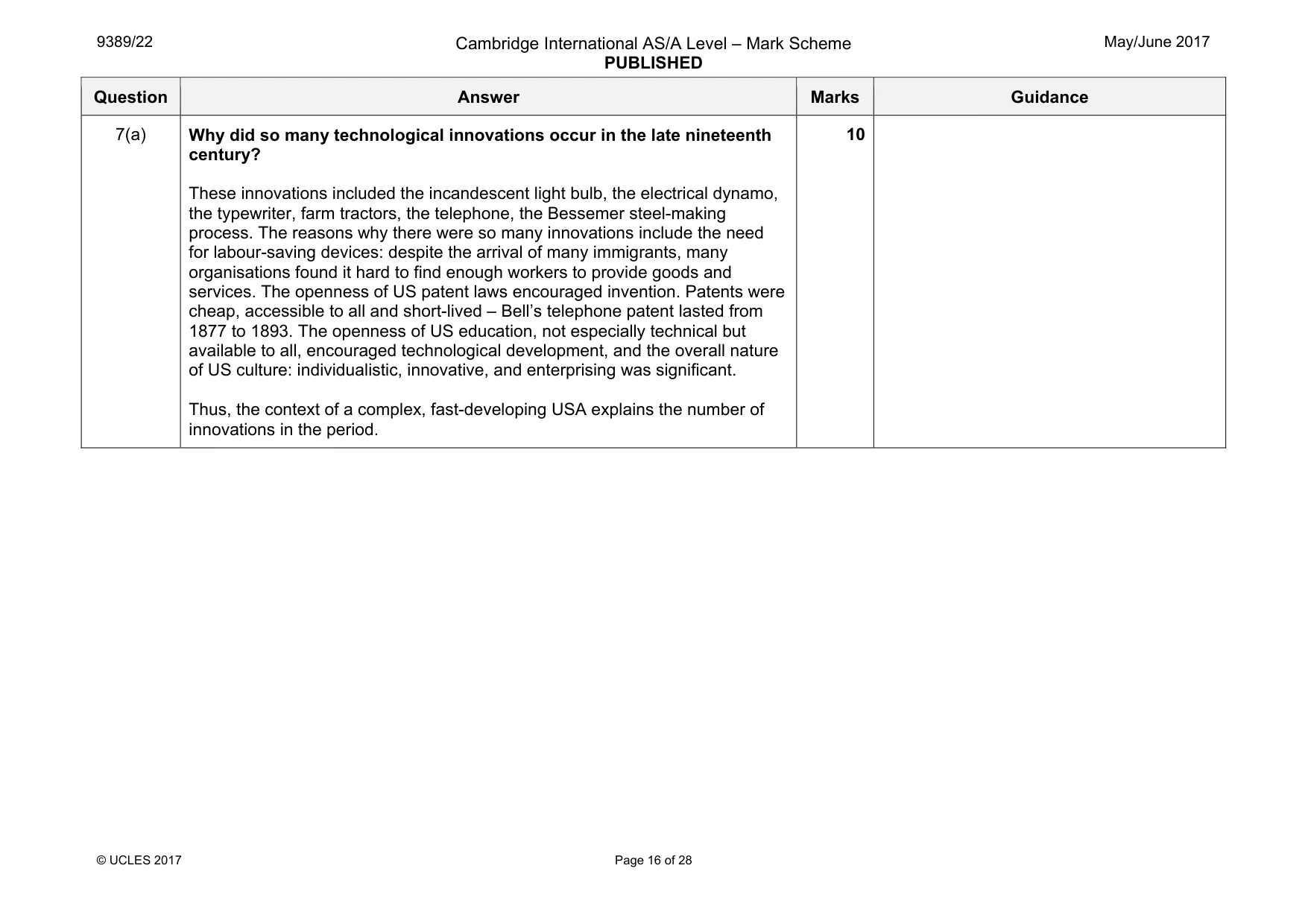
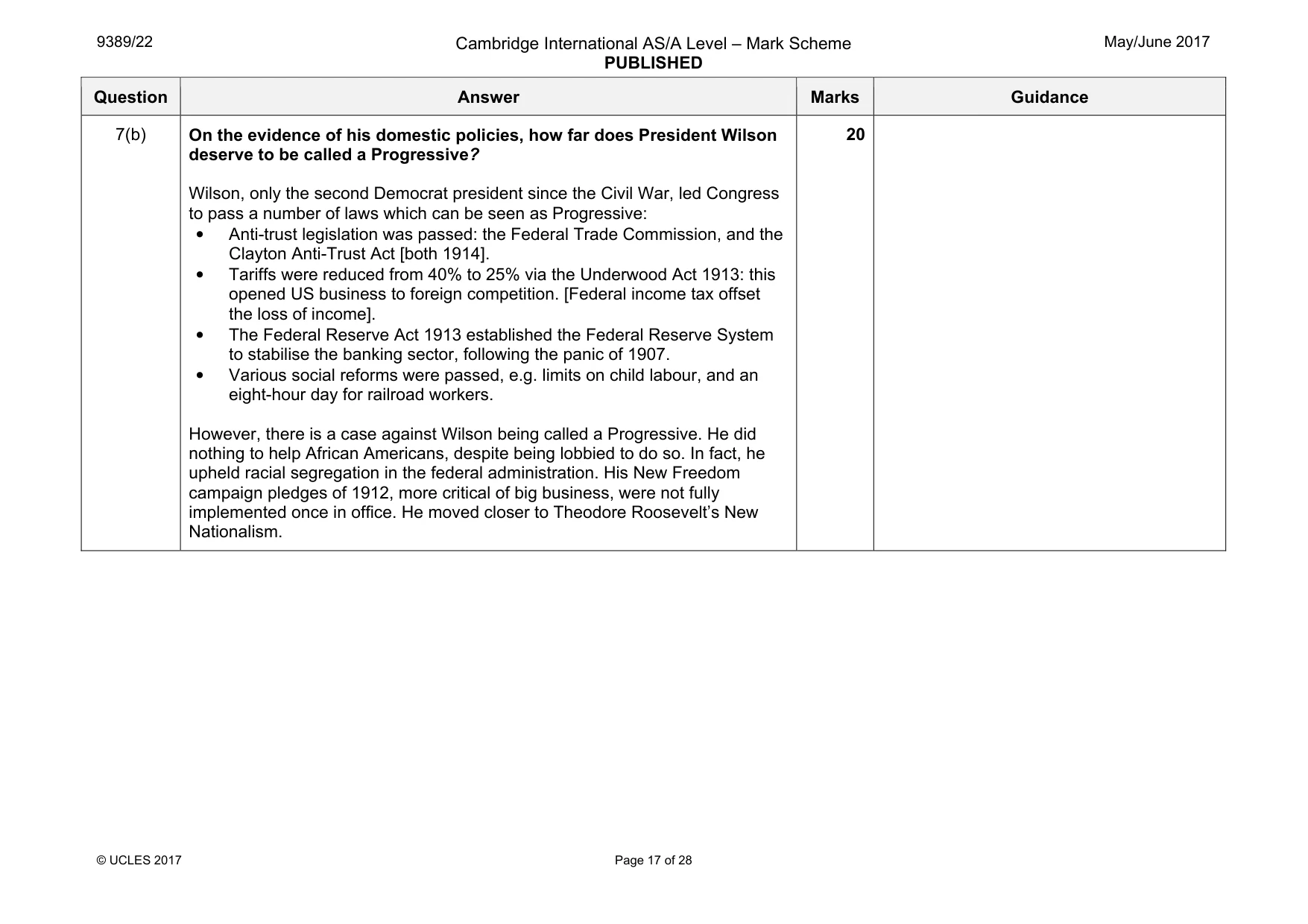
7 The Gilded Age and the Progressive Era, from the 1870s to the 1920s (a) Why did so many technological innovations occur in the late nineteenth century? [10] (b) On the evidence of his domestic policies, how far does President Wilson deserve to be called a Progressive? [20]
Mark scheme: 7(a) Why did so many technological innovations occur in the late nineteenth century? These innovations included the incandescent light bulb, the electrical dynamo, the typewriter, farm tractors, the telephone, the Bessemer steel-making process. The reasons why there were so many innovations include the need for labour-saving devices: despite the arrival of many immigrants, many organisations found it hard to find enough workers to provide goods and services. The openness of US patent laws encouraged invention. Patents were cheap, accessible to all and short-lived – Bell’s telephone patent lasted from 1877 to 1893. The openness of US education, not especially technical but available to all, encouraged technological development, and the overall nature of US culture: individualistic, innovative, and enterprising was significant. Thus, the context of a complex, fast-developing USA explains the number of innovations in the period. 10 Question Answer Marks Guidance 7(b) On the evidence of his domestic policies, how far does President Wilson deserve to be called a Progressive? Wilson, only the second Democrat president since the Civil War, led Congress to pass a number of laws which can be seen as Progressive: • Anti-trust legislation was passed: the Federal Trade Commission, and the Clayton Anti-Trust Act [both 1914]. • Tariffs were reduced from 40% to 25% via the Underwood Act 1913: this opened US business to foreign competition. [Federal income tax offset the loss of income]. • The Federal Reserve Act 1913 established the Federal Reserve System to stabilise the banking sector, following the panic of 1907. • Various social reforms were passed, e.g. limits on child labour, and an eight-hour day for railroad workers. However, there is a case against Wilson being called a Progressive. He did nothing to help African Americans, despite being lobbied to do so. In fact, he upheld racial segregation in the federal administration. His New Freedom campaign pledges of 1912, more critical of big business, were not fully implemented once in office. He moved closer to Theodore Roosevelt’s New Nationalism. 20
Q8 · The Great Crash, the Great Depression and the New Deal from the 1920s to 1941 (a) Why did…
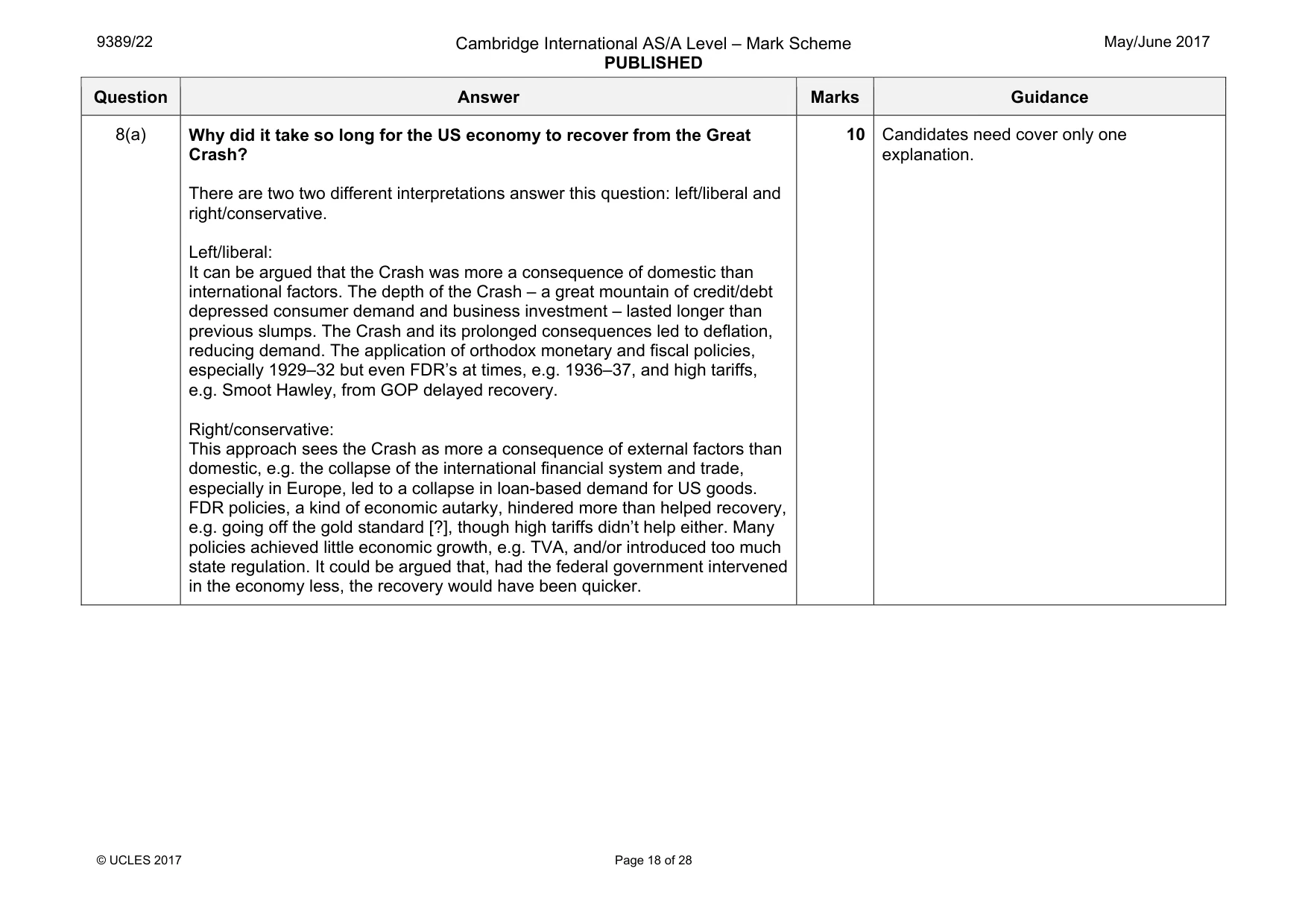
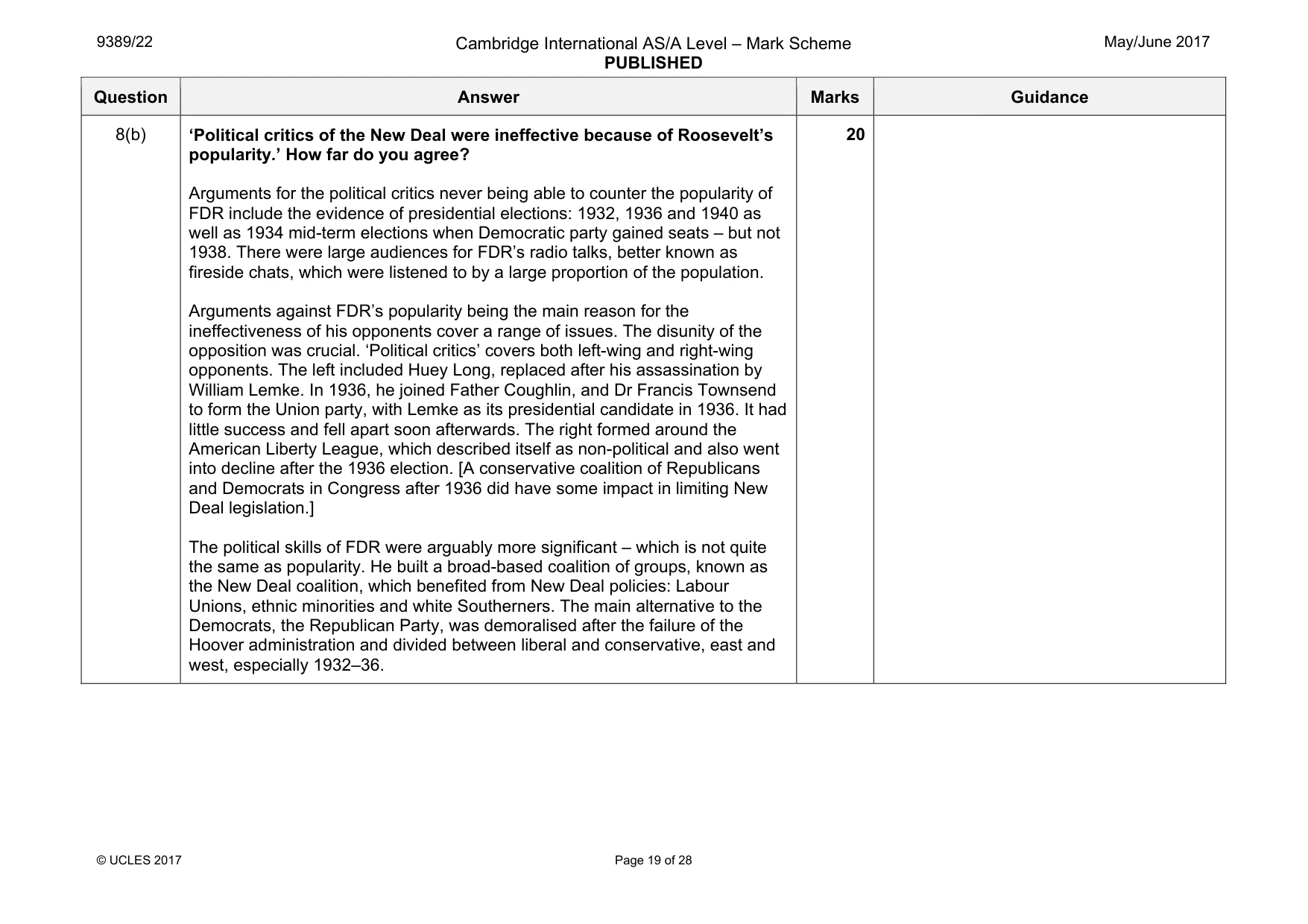
8 The Great Crash, the Great Depression and the New Deal from the 1920s to 1941 (a) Why did it take so long for the US economy to recover from the Great Crash? [10] (b) ‘Political critics of the New Deal were ineffective because of Roosevelt’s popularity.’ How far do you agree? [20] Section C: International Option International Relations, 1871–1945 Answer both parts of two questions.
Mark scheme: 8(a) Why did it take so long for the US economy to recover from the Great Crash? There are two two different interpretations answer this question: left/liberal and right/conservative. Left/liberal: It can be argued that the Crash was more a consequence of domestic than international factors. The depth of the Crash – a great mountain of credit/debt depressed consumer demand and business investment – lasted longer than previous slumps. The Crash and its prolonged consequences led to deflation, reducing demand. The application of orthodox monetary and fiscal policies, especially 1929–32 but even FDR’s at times, e.g. 1936–37, and high tariffs, e.g. Smoot Hawley, from GOP delayed recovery. Right/conservative: This approach sees the Crash as more a consequence of external factors than domestic, e.g. the collapse of the international financial system and trade, especially in Europe, led to a collapse in loan-based demand for US goods. FDR policies, a kind of economic autarky, hindered more than helped recovery, e.g. going off the gold standard [?], though high tariffs didn’t help either. Many policies achieved little economic growth, e.g. TVA, and/or introduced too much state regulation. It could be argued that, had the federal government intervened in the economy less, the recovery would have been quicker. 10 explanation. Question Answer Marks Guidance 8(b) ‘Political critics of the New Deal were ineffective because of Roosevelt’s popularity.’ How far do you agree? Arguments for the political critics never being able to counter the popularity of FDR include the evidence of presidential elections: 1932, 1936 and 1940 as well as 1934 mid-term elections when Democratic party gained seats – but not 1938. There were large audiences for FDR’s radio talks, better known as fireside chats, which were listened to by a large proportion of the population. Arguments against FDR’s popularity being the main reason for the ineffectiveness of his opponents cover a range of issues. The disunity of the opposition was crucial. ‘Political critics’ covers both left-wing and right-wing opponents. The left included Huey Long, replaced after his assassination by William Lemke. In 1936, he joined Father Coughlin, and Dr Francis Townsend to form the Union party, with Lemke as its presidential candidate in 1936. It had little success and fell apart soon afterwards. The right formed around the American Liberty League, which described itself as non-political and also went into decline after the 1936 election. [A conservative coalition of Republicans and Democrats in Congress after 1936 did have some impact in limiting New Deal legislation.] The political skills of FDR were arguably more significant – which is not quite the same as popularity. He built a broad-based coalition of groups, known as the New Deal coalition, which benefited from New Deal policies: Labour Unions, ethnic minorities and white Southerners. The main alternative to the Democrats, the Republican Party, was demoralised after the failure of the Hoover administration and divided between liberal and conservative, east and west, especially 1932–36. 20
Q9 · International Relations, 1871–1918 (a) Why did the USA’s involvement in world affairs…
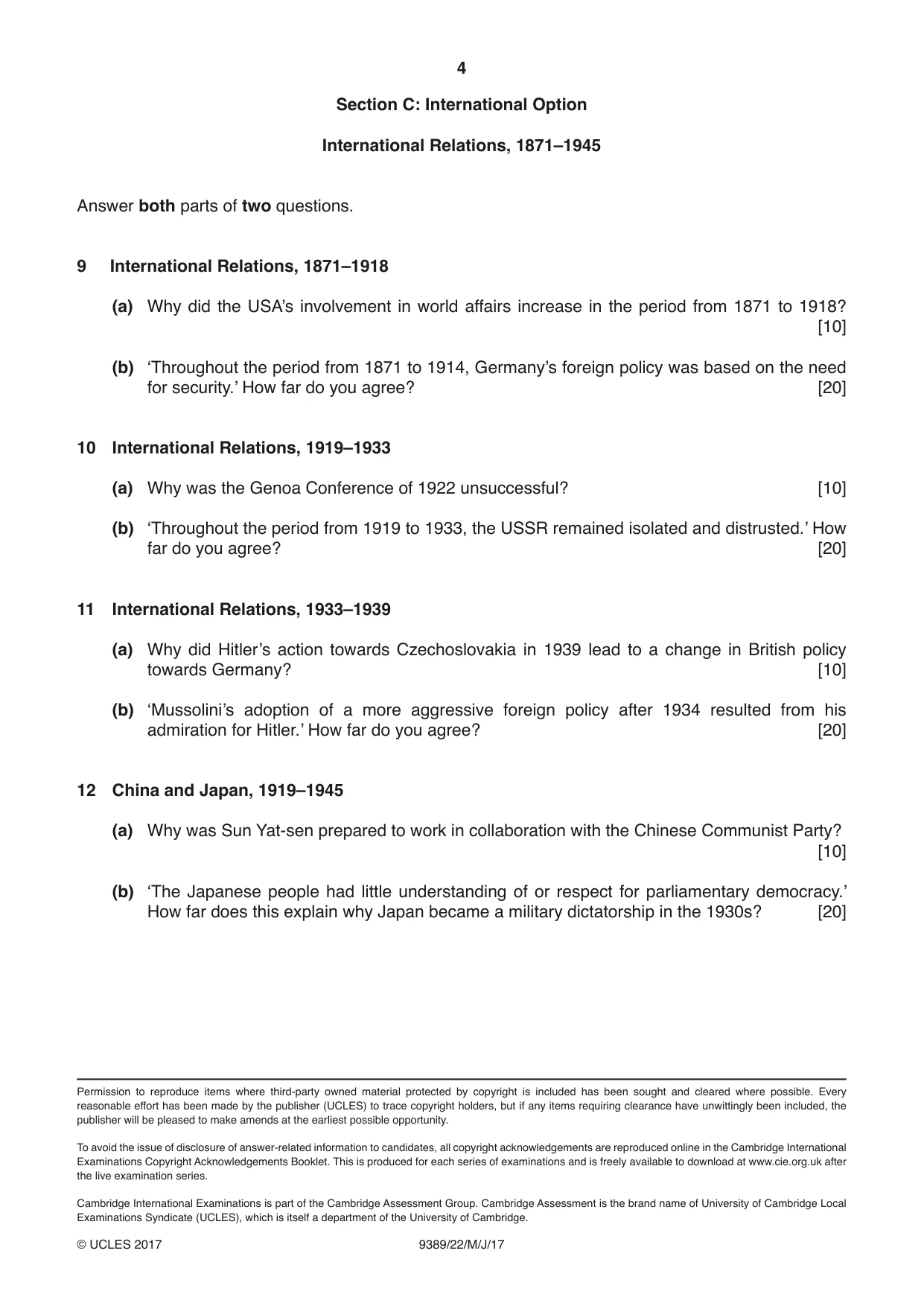
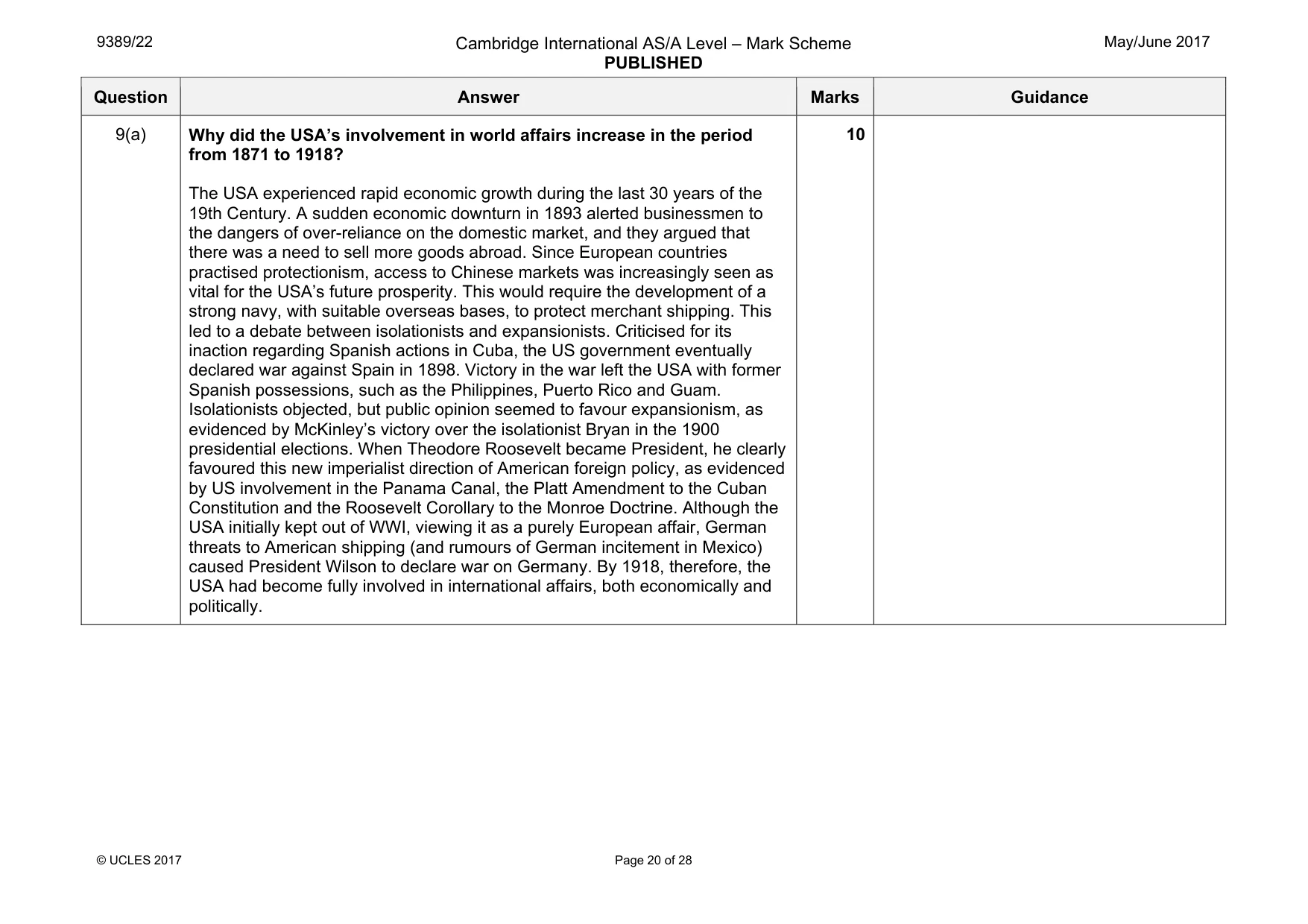
9 International Relations, 1871–1918 (a) Why did the USA’s involvement in world affairs increase in the period from 1871 to 1918? [10] (b) ‘Throughout the period from 1871 to 1914, Germany’s foreign policy was based on the need for security.’ How far do you agree? [20]
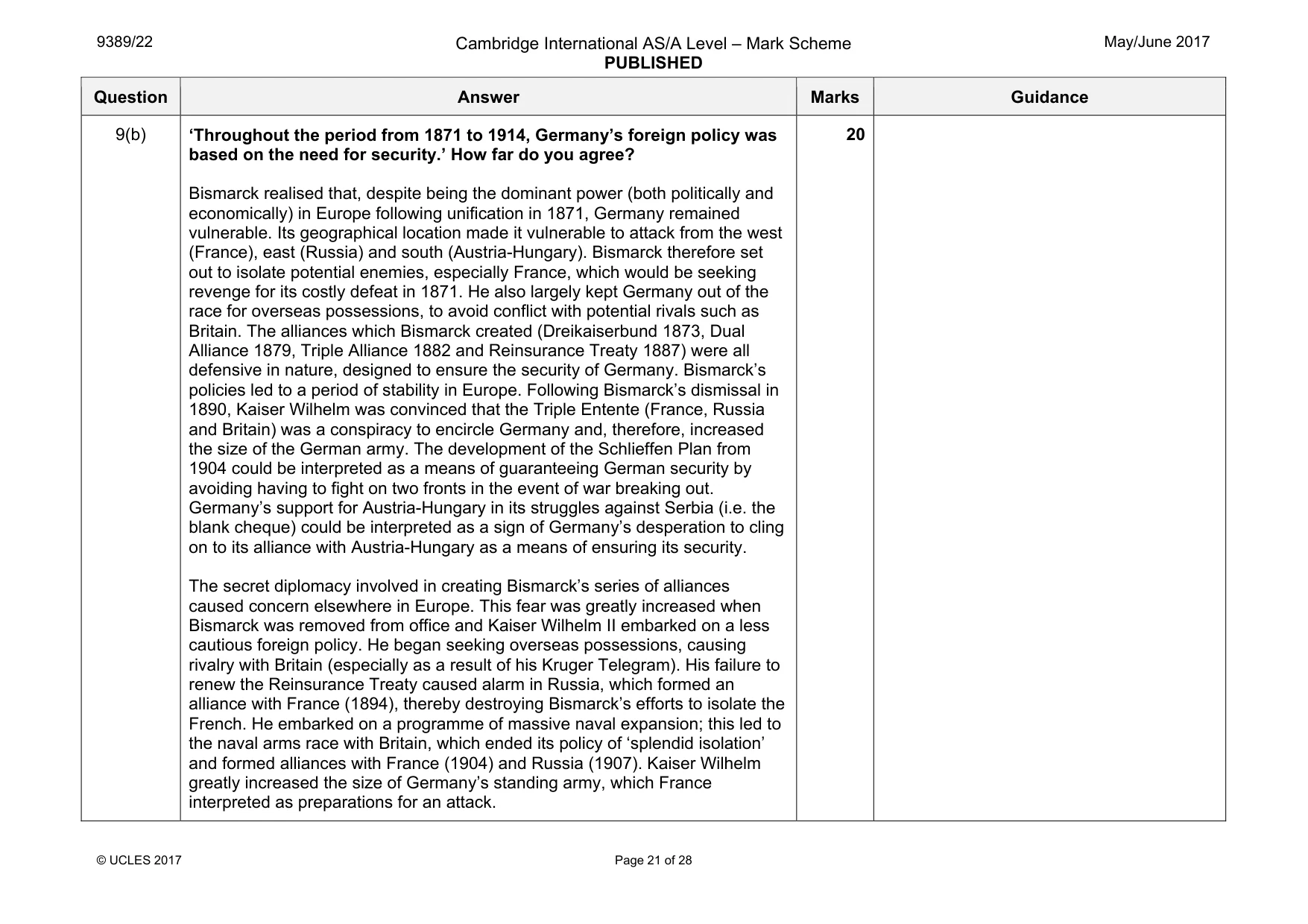
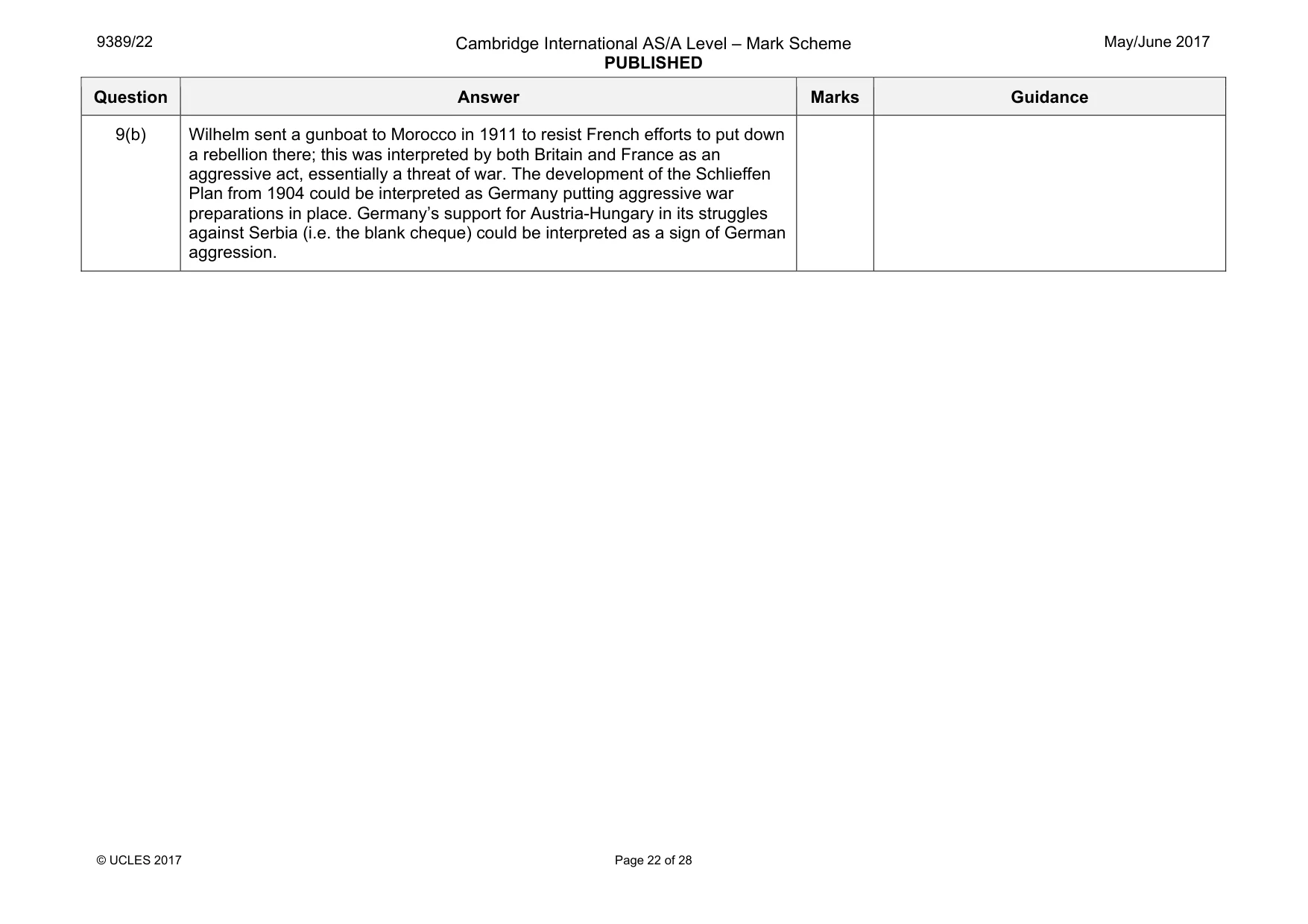
Mark scheme: 9(a) Why did the USA’s involvement in world affairs increase in the period from 1871 to 1918? The USA experienced rapid economic growth during the last 30 years of the 19th Century. A sudden economic downturn in 1893 alerted businessmen to the dangers of over-reliance on the domestic market, and they argued that there was a need to sell more goods abroad. Since European countries practised protectionism, access to Chinese markets was increasingly seen as vital for the USA’s future prosperity. This would require the development of a strong navy, with suitable overseas bases, to protect merchant shipping. This led to a debate between isolationists and expansionists. Criticised for its inaction regarding Spanish actions in Cuba, the US government eventually declared war against Spain in 1898. Victory in the war left the USA with former Spanish possessions, such as the Philippines, Puerto Rico and Guam. Isolationists objected, but public opinion seemed to favour expansionism, as evidenced by McKinley’s victory over the isolationist Bryan in the 1900 presidential elections. When Theodore Roosevelt became President, he clearly favoured this new imperialist direction of American foreign policy, as evidenced by US involvement in the Panama Canal, the Platt Amendment to the Cuban Constitution and the Roosevelt Corollary to the Monroe Doctrine. Although the USA initially kept out of WWI, viewing it as a purely European affair, German threats to American shipping (and rumours of German incitement in Mexico) caused President Wilson to declare war on Germany. By 1918, therefore, the USA had become fully involved in international affairs, both economically and politically. 10 Question Answer Marks Guidance 9(b) ‘Throughout the period from 1871 to 1914, Germany’s foreign policy was based on the need for security.’ How far do you agree? Bismarck realised that, despite being the dominant power (both politically and economically) in Europe following unification in 1871, Germany remained vulnerable. Its geographical location made it vulnerable to attack from the west (France), east (Russia) and south (Austria-Hungary). Bismarck therefore set out to isolate potential enemies, especially France, which would be seeking revenge for its costly defeat in 1871. He also largely kept Germany out of the race for overseas possessions, to avoid conflict with potential rivals such as Britain. The alliances which Bismarck created (Dreikaiserbund 1873, Dual Alliance 1879, Triple Alliance 1882 and Reinsurance Treaty 1887) were all defensive in nature, designed to ensure the security of Germany. Bismarck’s policies led to a period of stability in Europe. Following Bismarck’s dismissal in 1890, Kaiser Wilhelm was convinced that the Triple Entente (France, Russia and Britain) was a conspiracy to encircle Germany and, therefore, increased the size of the German army. The development of the Schlieffen Plan from 1904 could be interpreted as a means of guaranteeing German security by avoiding having to fight on two fronts in the event of war breaking out. Germany’s support for Austria-Hungary in its struggles against Serbia (i.e. the blank cheque) could be interpreted as a sign of Germany’s desperation to cling on to its alliance with Austria-Hungary as a means of ensuring its security. The secret diplomacy involved in creating Bismarck’s series of alliances caused concern elsewhere in Europe. This fear was greatly increased when Bismarck was removed from office and Kaiser Wilhelm II embarked on a less cautious foreign policy. He began seeking overseas possessions, causing rivalry with Britain (especially as a result of his Kruger Telegram). His failure to renew the Reinsurance Treaty caused alarm in Russia, which formed an alliance with France (1894), thereby destroying Bismarck’s efforts to isolate the French. He embarked on a programme of massive naval expansion; this led to the naval arms race with Britain, which ended its policy of ‘splendid isolation’ and formed alliances with France (1904) and Russia (1907). Kaiser Wilhelm greatly increased the size of Germany’s standing army, which France interpreted as preparations for an attack. 20 Question Answer Marks Guidance 9(b) Wilhelm sent a gunboat to Morocco in 1911 to resist French efforts to put down a rebellion there; this was interpreted by both Britain and France as an aggressive act, essentially a threat of war. The development of the Schlieffen Plan from 1904 could be interpreted as Germany putting aggressive war preparations in place. Germany’s support for Austria-Hungary in its struggles against Serbia (i.e. the blank cheque) could be interpreted as a sign of German aggression.
Q10 · International Relations, 1919–1933 (a) Why was the Genoa Conference of 1922 unsuccessful?
10 International Relations, 1919–1933 (a) Why was the Genoa Conference of 1922 unsuccessful? [10] (b) ‘Throughout the period from 1919 to 1933, the USSR remained isolated and distrusted.’ How far do you agree? [20]
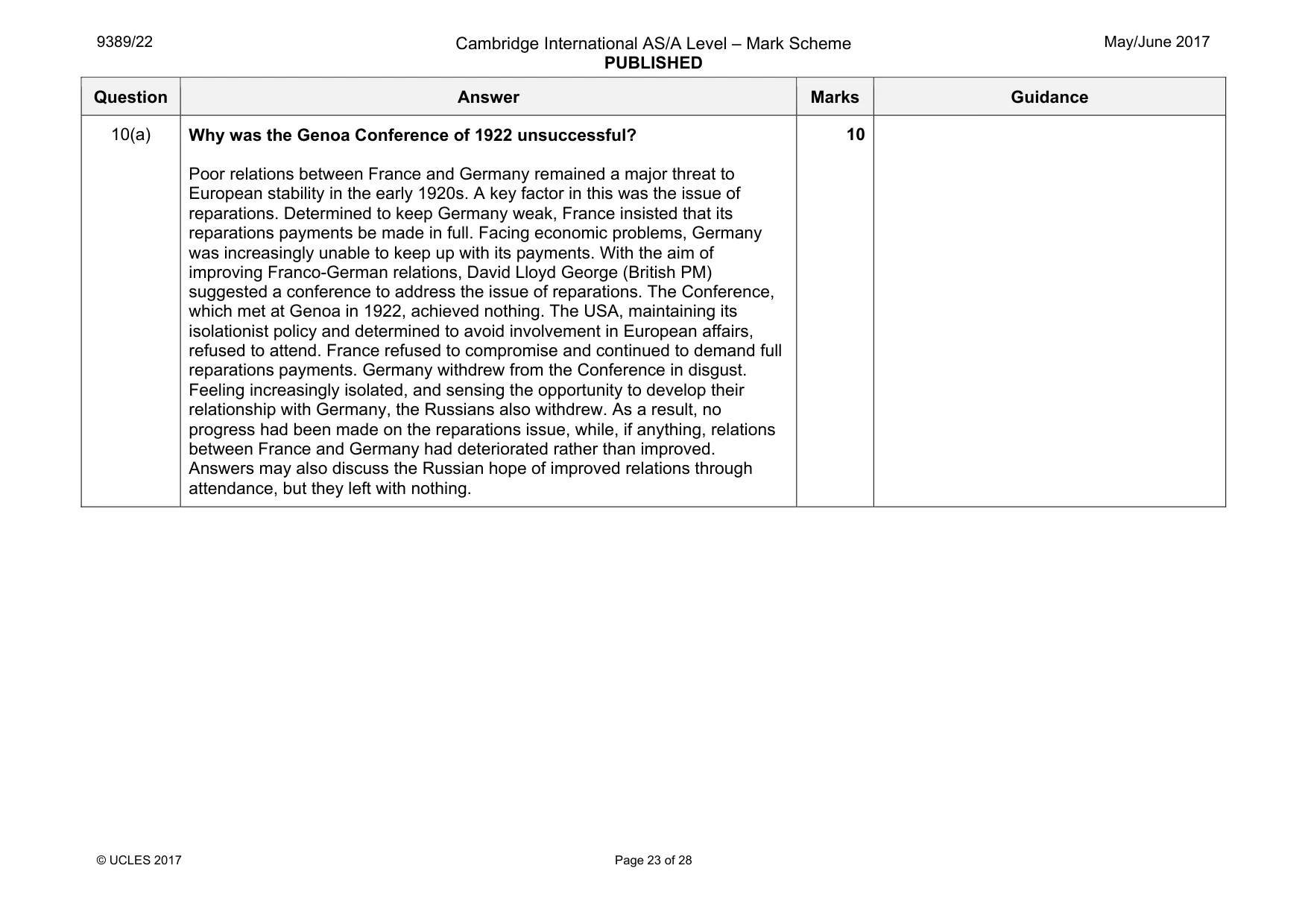
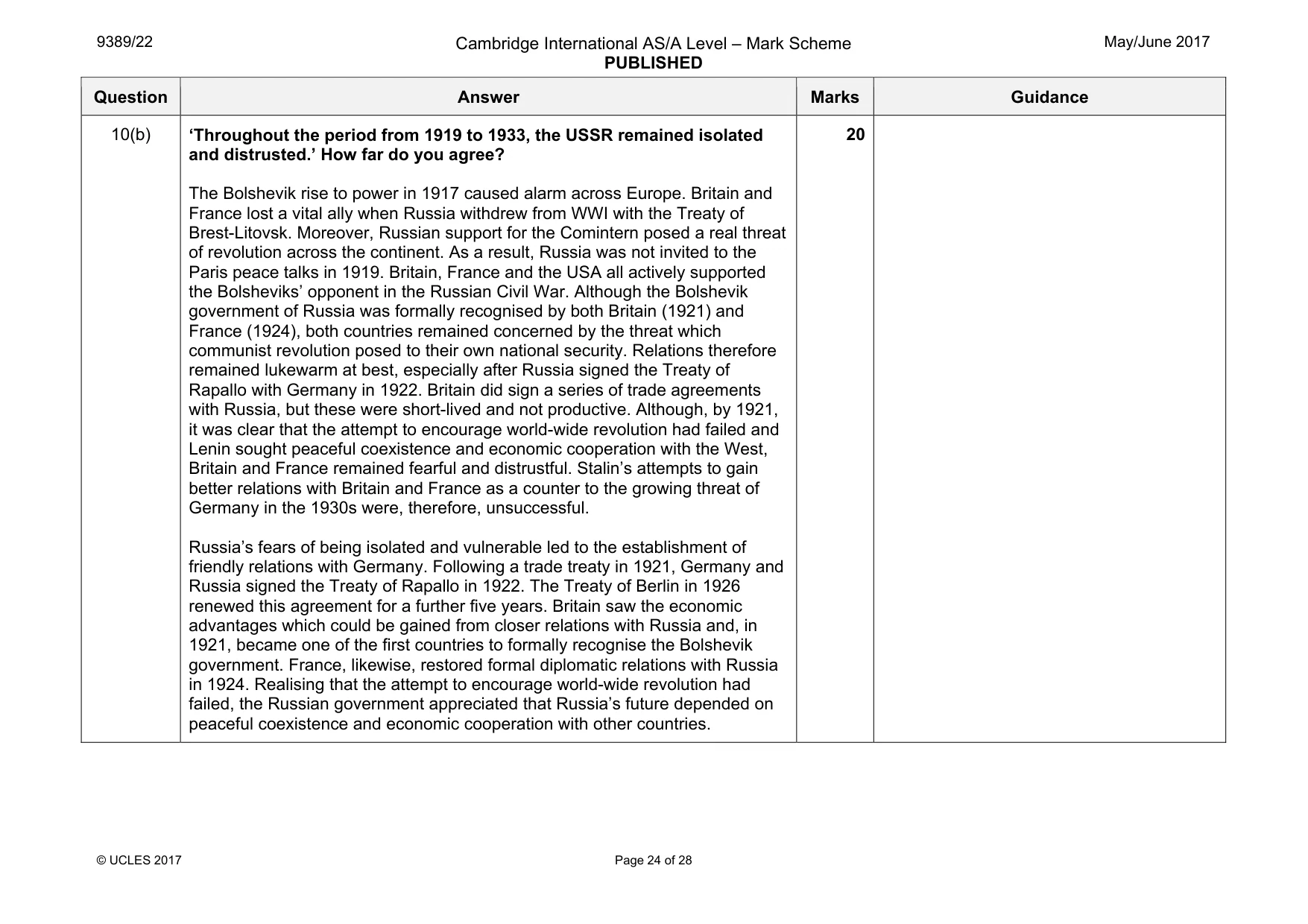
Mark scheme: 10(a) Why was the Genoa Conference of 1922 unsuccessful? Poor relations between France and Germany remained a major threat to European stability in the early 1920s. A key factor in this was the issue of reparations. Determined to keep Germany weak, France insisted that its reparations payments be made in full. Facing economic problems, Germany was increasingly unable to keep up with its payments. With the aim of improving Franco-German relations, David Lloyd George (British PM) suggested a conference to address the issue of reparations. The Conference, which met at Genoa in 1922, achieved nothing. The USA, maintaining its isolationist policy and determined to avoid involvement in European affairs, refused to attend. France refused to compromise and continued to demand full reparations payments. Germany withdrew from the Conference in disgust. Feeling increasingly isolated, and sensing the opportunity to develop their relationship with Germany, the Russians also withdrew. As a result, no progress had been made on the reparations issue, while, if anything, relations between France and Germany had deteriorated rather than improved. Answers may also discuss the Russian hope of improved relations through attendance, but they left with nothing. 10 Question Answer Marks Guidance 10(b) ‘Throughout the period from 1919 to 1933, the USSR remained isolated and distrusted.’ How far do you agree? The Bolshevik rise to power in 1917 caused alarm across Europe. Britain and France lost a vital ally when Russia withdrew from WWI with the Treaty of Brest-Litovsk. Moreover, Russian support for the Comintern posed a real threat of revolution across the continent. As a result, Russia was not invited to the Paris peace talks in 1919. Britain, France and the USA all actively supported the Bolsheviks’ opponent in the Russian Civil War. Although the Bolshevik government of Russia was formally recognised by both Britain (1921) and France (1924), both countries remained concerned by the threat which communist revolution posed to their own national security. Relations therefore remained lukewarm at best, especially after Russia signed the Treaty of Rapallo with Germany in 1922. Britain did sign a series of trade agreements with Russia, but these were short-lived and not productive. Although, by 1921, it was clear that the attempt to encourage world-wide revolution had failed and Lenin sought peaceful coexistence and economic cooperation with the West, Britain and France remained fearful and distrustful. Stalin’s attempts to gain better relations with Britain and France as a counter to the growing threat of Germany in the 1930s were, therefore, unsuccessful. Russia’s fears of being isolated and vulnerable led to the establishment of friendly relations with Germany. Following a trade treaty in 1921, Germany and Russia signed the Treaty of Rapallo in 1922. The Treaty of Berlin in 1926 renewed this agreement for a further five years. Britain saw the economic advantages which could be gained from closer relations with Russia and, in 1921, became one of the first countries to formally recognise the Bolshevik government. France, likewise, restored formal diplomatic relations with Russia in 1924. Realising that the attempt to encourage world-wide revolution had failed, the Russian government appreciated that Russia’s future depended on peaceful coexistence and economic cooperation with other countries. 20
Q11 · International Relations, 1933–1939 (a) Why did Hitler’s action towards Czechoslovakia in…
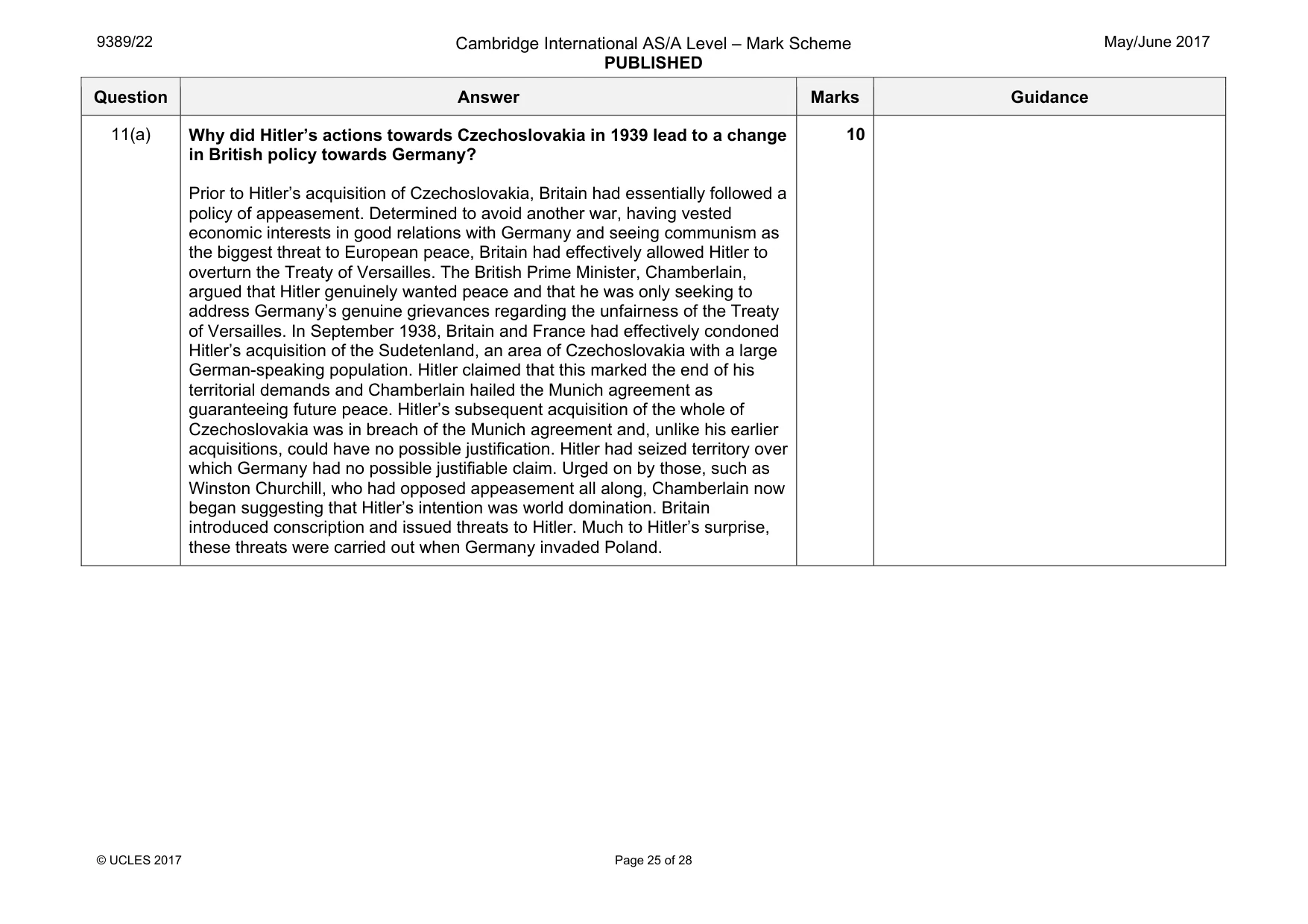
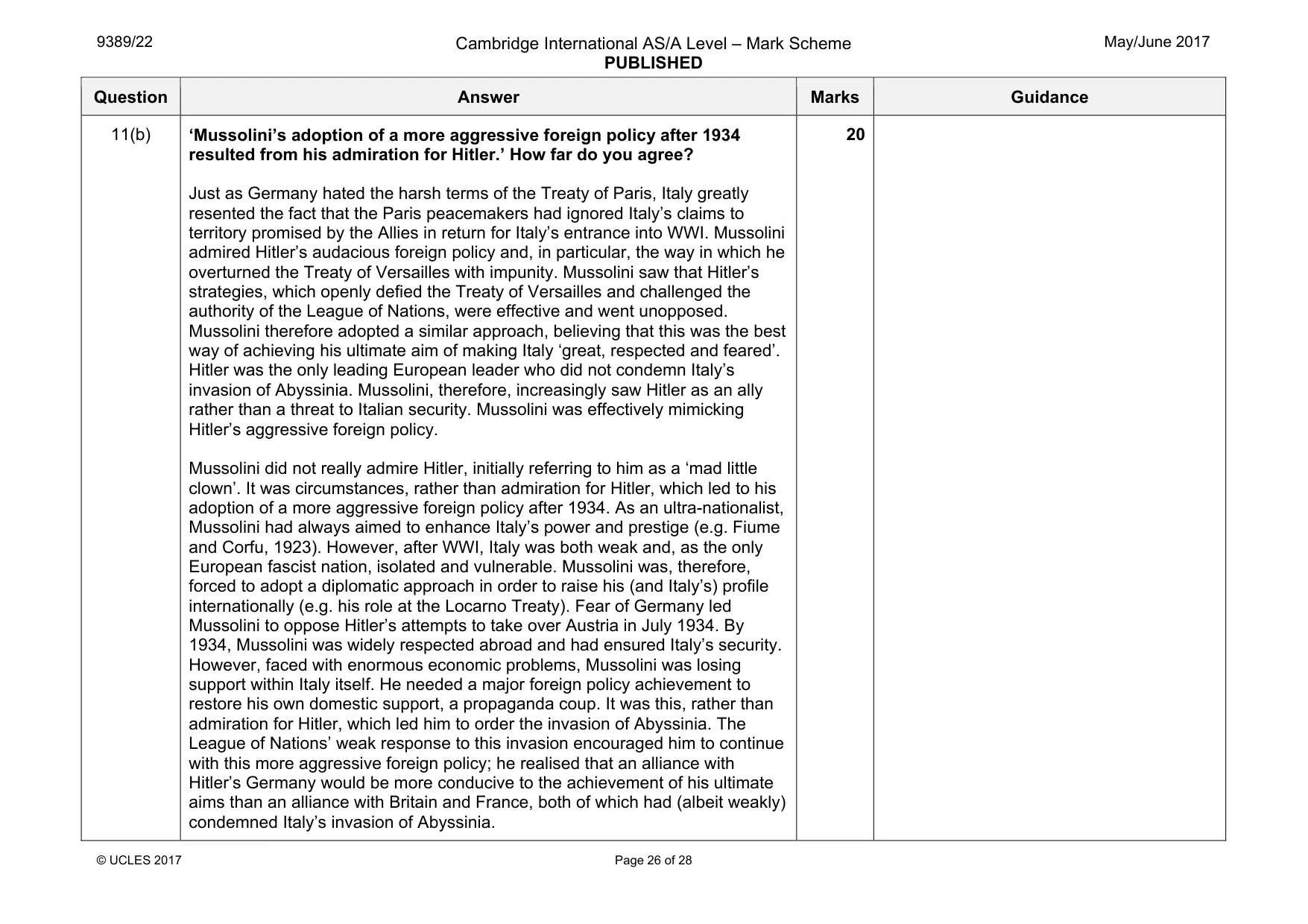
11 International Relations, 1933–1939 (a) Why did Hitler’s action towards Czechoslovakia in 1939 lead to a change in British policy towards Germany? [10] (b) ‘Mussolini’s adoption of a more aggressive foreign policy after 1934 resulted from his admiration for Hitler.’ How far do you agree? [20]
Mark scheme: 11(a) Why did Hitler’s actions towards Czechoslovakia in 1939 lead to a change in British policy towards Germany? Prior to Hitler’s acquisition of Czechoslovakia, Britain had essentially followed a policy of appeasement. Determined to avoid another war, having vested economic interests in good relations with Germany and seeing communism as the biggest threat to European peace, Britain had effectively allowed Hitler to overturn the Treaty of Versailles. The British Prime Minister, Chamberlain, argued that Hitler genuinely wanted peace and that he was only seeking to address Germany’s genuine grievances regarding the unfairness of the Treaty of Versailles. In September 1938, Britain and France had effectively condoned Hitler’s acquisition of the Sudetenland, an area of Czechoslovakia with a large German-speaking population. Hitler claimed that this marked the end of his territorial demands and Chamberlain hailed the Munich agreement as guaranteeing future peace. Hitler’s subsequent acquisition of the whole of Czechoslovakia was in breach of the Munich agreement and, unlike his earlier acquisitions, could have no possible justification. Hitler had seized territory over which Germany had no possible justifiable claim. Urged on by those, such as Winston Churchill, who had opposed appeasement all along, Chamberlain now began suggesting that Hitler’s intention was world domination. Britain introduced conscription and issued threats to Hitler. Much to Hitler’s surprise, these threats were carried out when Germany invaded Poland. 10 Question Answer Marks Guidance 11(b) ‘Mussolini’s adoption of a more aggressive foreign policy after 1934 resulted from his admiration for Hitler.’ How far do you agree? Just as Germany hated the harsh terms of the Treaty of Paris, Italy greatly resented the fact that the Paris peacemakers had ignored Italy’s claims to territory promised by the Allies in return for Italy’s entrance into WWI. Mussolini admired Hitler’s audacious foreign policy and, in particular, the way in which he overturned the Treaty of Versailles with impunity. Mussolini saw that Hitler’s strategies, which openly defied the Treaty of Versailles and challenged the authority of the League of Nations, were effective and went unopposed. Mussolini therefore adopted a similar approach, believing that this was the best way of achieving his ultimate aim of making Italy ‘great, respected and feared’. Hitler was the only leading European leader who did not condemn Italy’s invasion of Abyssinia. Mussolini, therefore, increasingly saw Hitler as an ally rather than a threat to Italian security. Mussolini was effectively mimicking Hitler’s aggressive foreign policy. Mussolini did not really admire Hitler, initially referring to him as a ‘mad little clown’. It was circumstances, rather than admiration for Hitler, which led to his adoption of a more aggressive foreign policy after 1934. As an ultra-nationalist, Mussolini had always aimed to enhance Italy’s power and prestige (e.g. Fiume and Corfu, 1923). However, after WWI, Italy was both weak and, as the only European fascist nation, isolated and vulnerable. Mussolini was, therefore, forced to adopt a diplomatic approach in order to raise his (and Italy’s) profile internationally (e.g. his role at the Locarno Treaty). Fear of Germany led Mussolini to oppose Hitler’s attempts to take over Austria in July 1934. By 1934, Mussolini was widely respected abroad and had ensured Italy’s security. However, faced with enormous economic problems, Mussolini was losing support within Italy itself. He needed a major foreign policy achievement to restore his own domestic support, a propaganda coup. It was this, rather than admiration for Hitler, which led him to order the invasion of Abyssinia. The League of Nations’ weak response to this invasion encouraged him to continue with this more aggressive foreign policy; he realised that an alliance with Hitler’s Germany would be more conducive to the achievement of his ultimate aims than an alliance with Britain and France, both of which had (albeit weakly) condemned Italy’s invasion of Abyssinia. 20
Q12 · China and Japan, 1919–1945 (a) Why was Sun Yat-sen prepared to work in collaboration with…
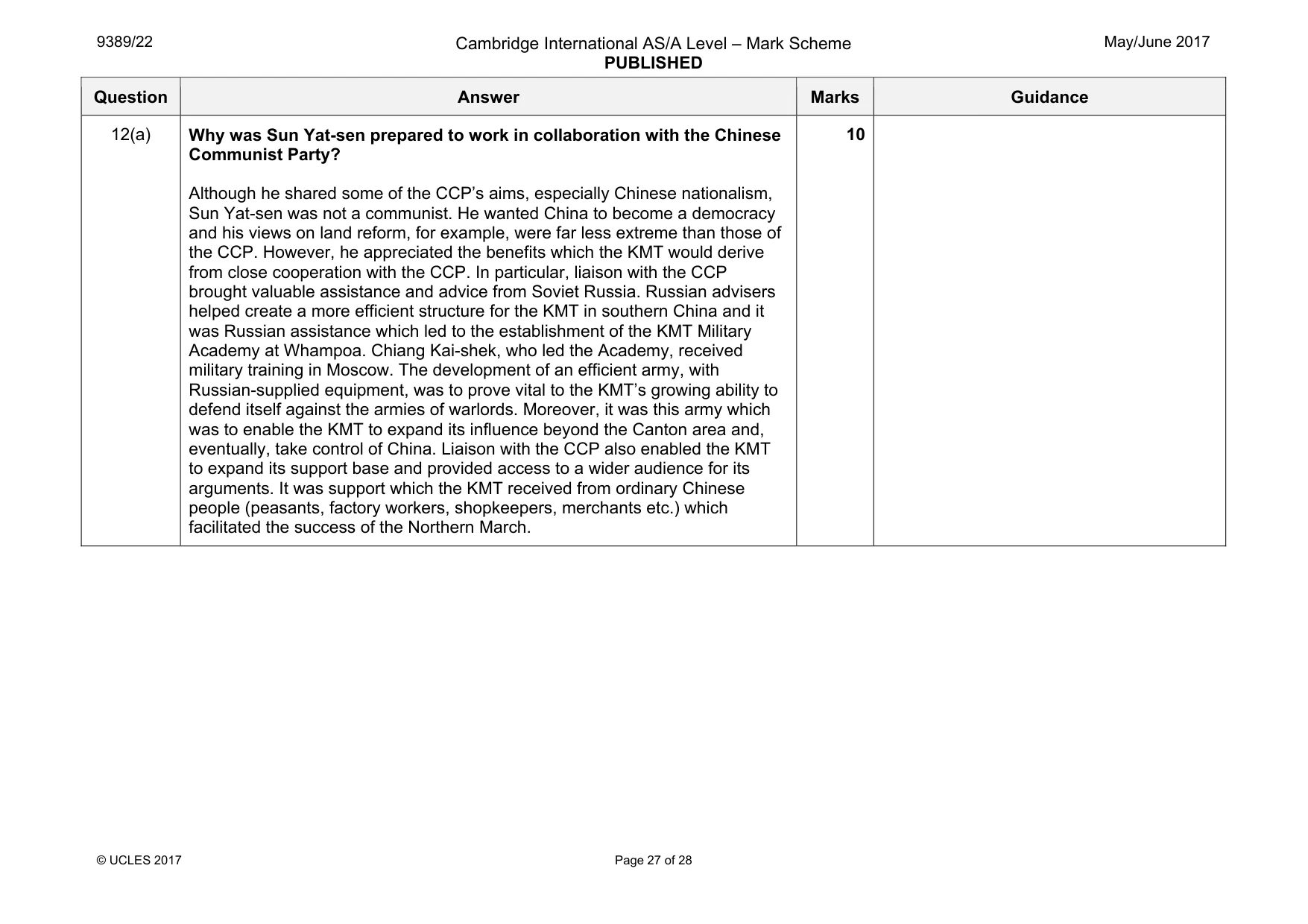
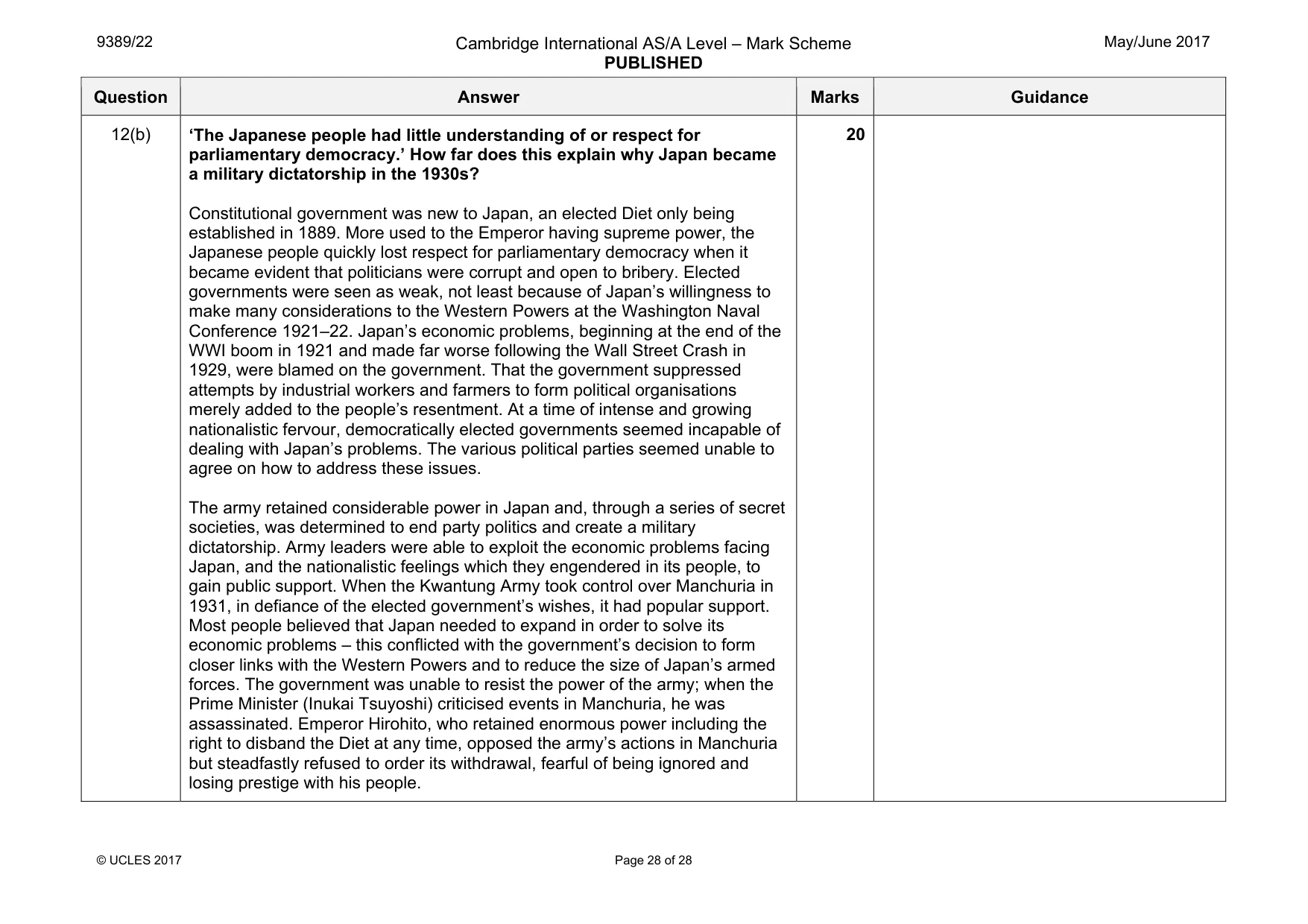
12 China and Japan, 1919–1945 (a) Why was Sun Yat-sen prepared to work in collaboration with the Chinese Communist Party? [10] (b) ‘The Japanese people had little understanding of or respect for parliamentary democracy.’ How far does this explain why Japan became a military dictatorship in the 1930s? [20]
Mark scheme: 12(a) Why was Sun Yat-sen prepared to work in collaboration with the Chinese Communist Party? Although he shared some of the CCP’s aims, especially Chinese nationalism, Sun Yat-sen was not a communist. He wanted China to become a democracy and his views on land reform, for example, were far less extreme than those of the CCP. However, he appreciated the benefits which the KMT would derive from close cooperation with the CCP. In particular, liaison with the CCP brought valuable assistance and advice from Soviet Russia. Russian advisers helped create a more efficient structure for the KMT in southern China and it was Russian assistance which led to the establishment of the KMT Military Academy at Whampoa. Chiang Kai-shek, who led the Academy, received military training in Moscow. The development of an efficient army, with Russian-supplied equipment, was to prove vital to the KMT’s growing ability to defend itself against the armies of warlords. Moreover, it was this army which was to enable the KMT to expand its influence beyond the Canton area and, eventually, take control of China. Liaison with the CCP also enabled the KMT to expand its support base and provided access to a wider audience for its arguments. It was support which the KMT received from ordinary Chinese people (peasants, factory workers, shopkeepers, merchants etc.) which facilitated the success of the Northern March. 10 Question Answer Marks Guidance 12(b) ‘The Japanese people had little understanding of or respect for parliamentary democracy.’ How far does this explain why Japan became a military dictatorship in the 1930s? Constitutional government was new to Japan, an elected Diet only being established in 1889. More used to the Emperor having supreme power, the Japanese people quickly lost respect for parliamentary democracy when it became evident that politicians were corrupt and open to bribery. Elected governments were seen as weak, not least because of Japan’s willingness to make many considerations to the Western Powers at the Washington Naval Conference 1921–22. Japan’s economic problems, beginning at the end of the WWI boom in 1921 and made far worse following the Wall Street Crash in 1929, were blamed on the government. That the government suppressed attempts by industrial workers and farmers to form political organisations merely added to the people’s resentment. At a time of intense and growing nationalistic fervour, democratically elected governments seemed incapable of dealing with Japan’s problems. The various political parties seemed unable to agree on how to address these issues. The army retained considerable power in Japan and, through a series of secret societies, was determined to end party politics and create a military dictatorship. Army leaders were able to exploit the economic problems facing Japan, and the nationalistic feelings which they engendered in its people, to gain public support. When the Kwantung Army took control over Manchuria in 1931, in defiance of the elected government’s wishes, it had popular support. Most people believed that Japan needed to expand in order to solve its economic problems – this conflicted with the government’s decision to form closer links with the Western Powers and to reduce the size of Japan’s armed forces. The government was unable to resist the power of the army; when the Prime Minister (Inukai Tsuyoshi) criticised events in Manchuria, he was assassinated. Emperor Hirohito, who retained enormous power including the right to disband the Diet at any time, opposed the army’s actions in Manchuria but steadfastly refused to order its withdrawal, fearful of being ignored and losing prestige with his people. 20
What you needed in this session
Cambridge’s own grade thresholds for 2017 May/June, Paper 2 · Variant 2. A higher threshold means an easier paper — the bar moves with how the cohort did.