Cambridge A Level History 9389 — 2017 May/June Paper 2 · Variant 1
9389/21/M/J/17 · 12 questions · 60 marks · ≈68 min
The question paper and its mark scheme, free to read here and free to download. This is Cambridge’s own paper, exactly as it was sat.
Question paper4 pages
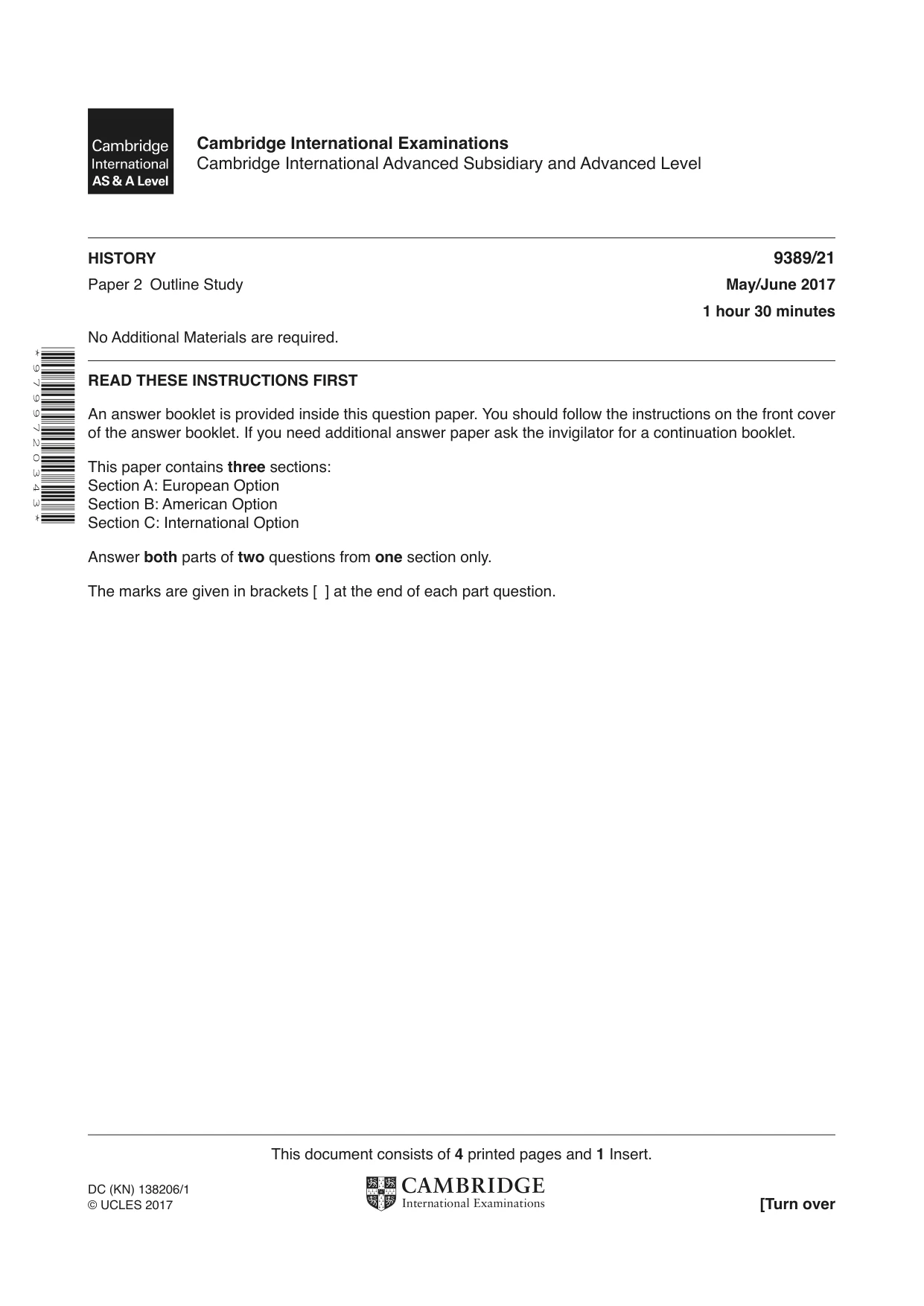
Mark scheme35 pages
Answers below. Sit the paper first if you are practising.
Questions as text
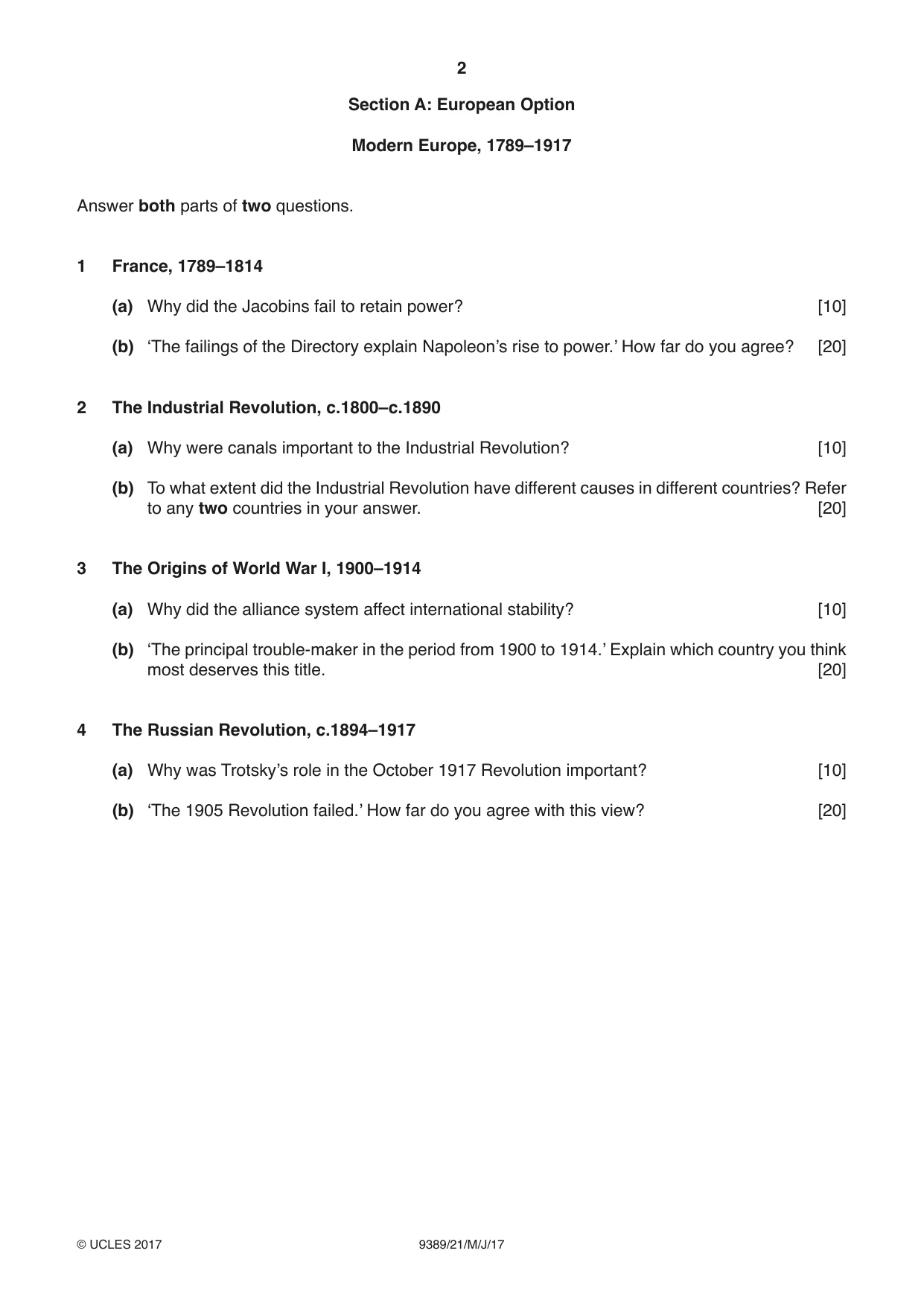
Q1 · France, 1789–1814 (a) Why did the Jacobins fail to retain power?
1 France, 1789–1814 (a) Why did the Jacobins fail to retain power? [10] (b) ‘The failings of the Directory explain Napoleon’s rise to power.’ How far do you agree? [20]
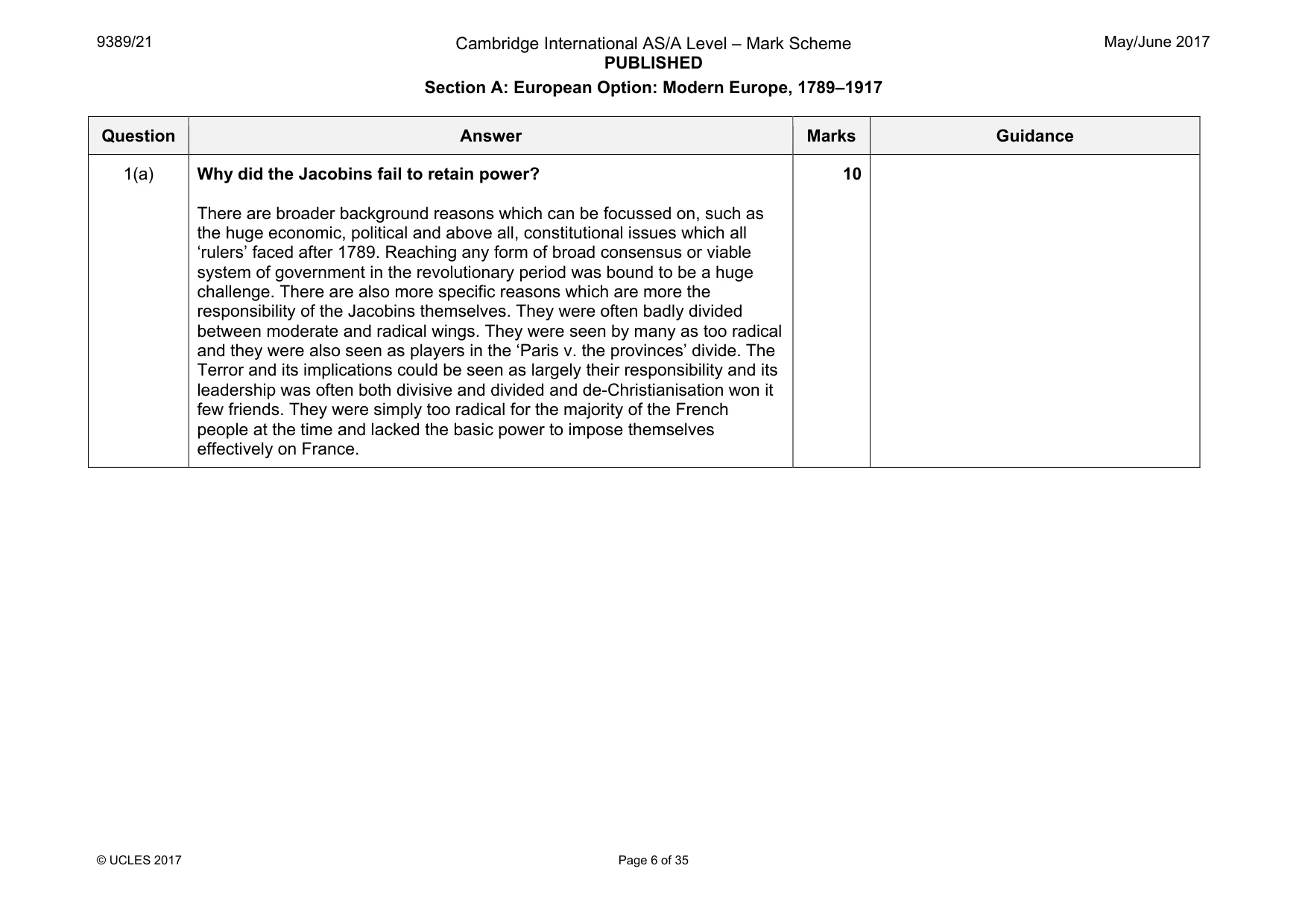
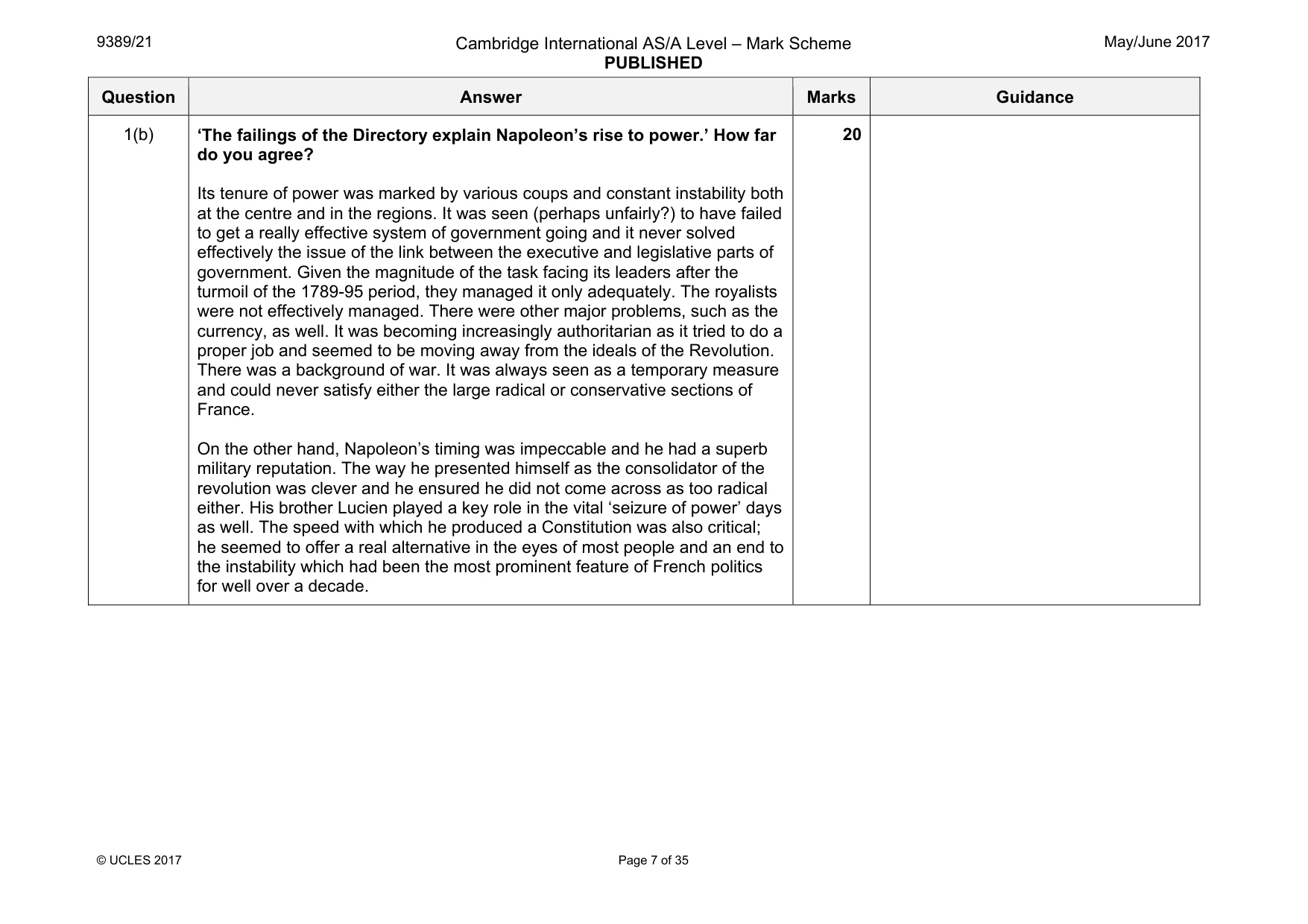
Mark scheme: 1(a) Why did the Jacobins fail to retain power? There are broader background reasons which can be focussed on, such as the huge economic, political and above all, constitutional issues which all ‘rulers’ faced after 1789. Reaching any form of broad consensus or viable system of government in the revolutionary period was bound to be a huge challenge. There are also more specific reasons which are more the responsibility of the Jacobins themselves. They were often badly divided between moderate and radical wings. They were seen by many as too radical and they were also seen as players in the ‘Paris v. the provinces’ divide. The Terror and its implications could be seen as largely their responsibility and its leadership was often both divisive and divided and de-Christianisation won it few friends. They were simply too radical for the majority of the French people at the time and lacked the basic power to impose themselves effectively on France. 10 Question Answer Marks Guidance 1(b) ‘The failings of the Directory explain Napoleon’s rise to power.’ How far do you agree? Its tenure of power was marked by various coups and constant instability both at the centre and in the regions. It was seen (perhaps unfairly?) to have failed to get a really effective system of government going and it never solved effectively the issue of the link between the executive and legislative parts of government. Given the magnitude of the task facing its leaders after the turmoil of the 1789-95 period, they managed it only adequately. The royalists were not effectively managed. There were other major problems, such as the currency, as well. It was becoming increasingly authoritarian as it tried to do a proper job and seemed to be moving away from the ideals of the Revolution. There was a background of war. It was always seen as a temporary measure and could never satisfy either the large radical or conservative sections of France. On the other hand, Napoleon’s timing was impeccable and he had a superb military reputation. The way he presented himself as the consolidator of the revolution was clever and he ensured he did not come across as too radical either. His brother Lucien played a key role in the vital ‘seizure of power’ days as well. The speed with which he produced a Constitution was also critical; he seemed to offer a real alternative in the eyes of most people and an end to the instability which had been the most prominent feature of French politics for well over a decade. 20
Q2 · The Industrial Revolution, c.1800–c.1890 (a) Why were canals important to the Industrial…
2 The Industrial Revolution, c.1800–c.1890 (a) Why were canals important to the Industrial Revolution? [10] (b) To what extent did the Industrial Revolution have different causes in different countries? Refer to any two countries in your answer. [20]
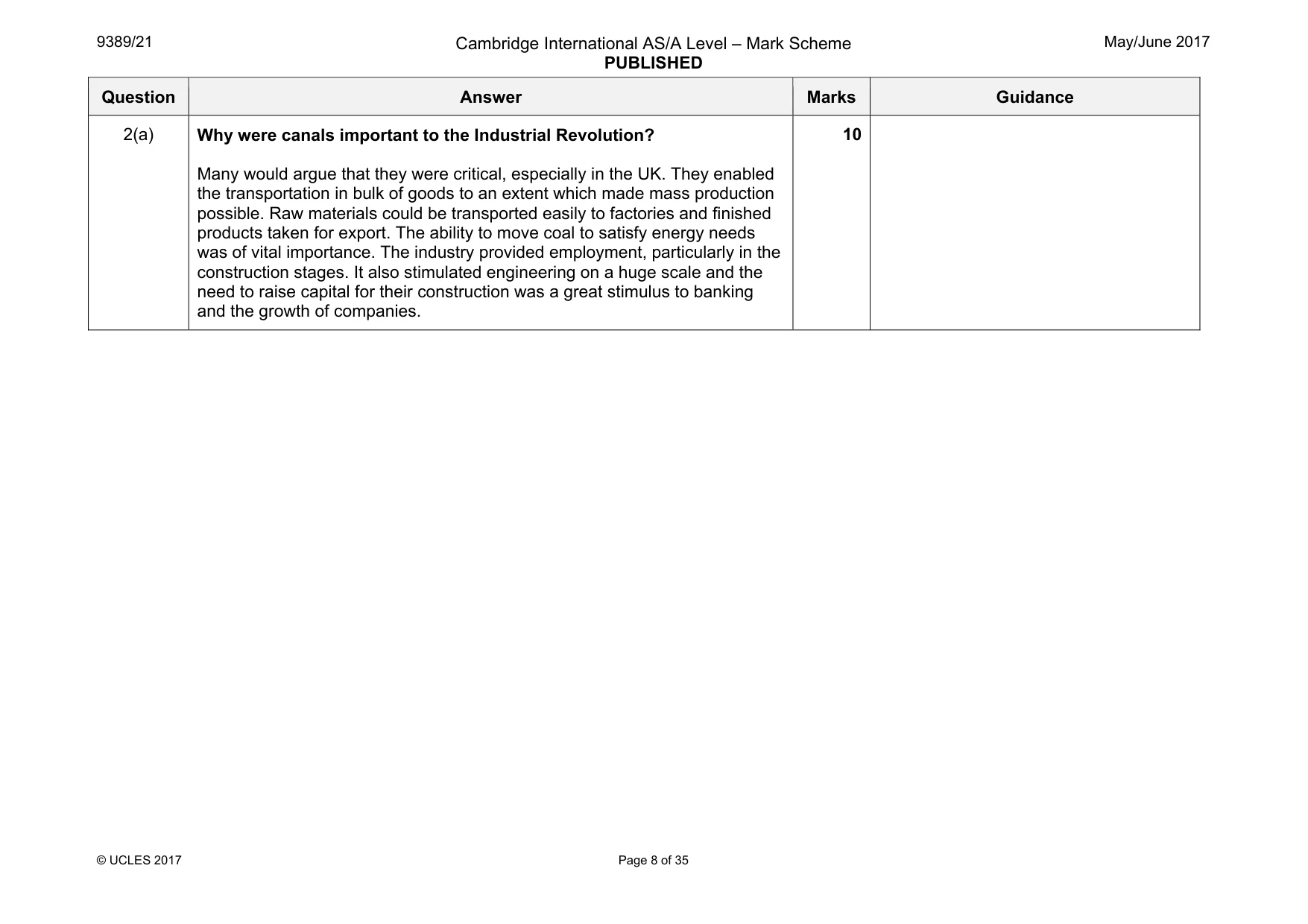
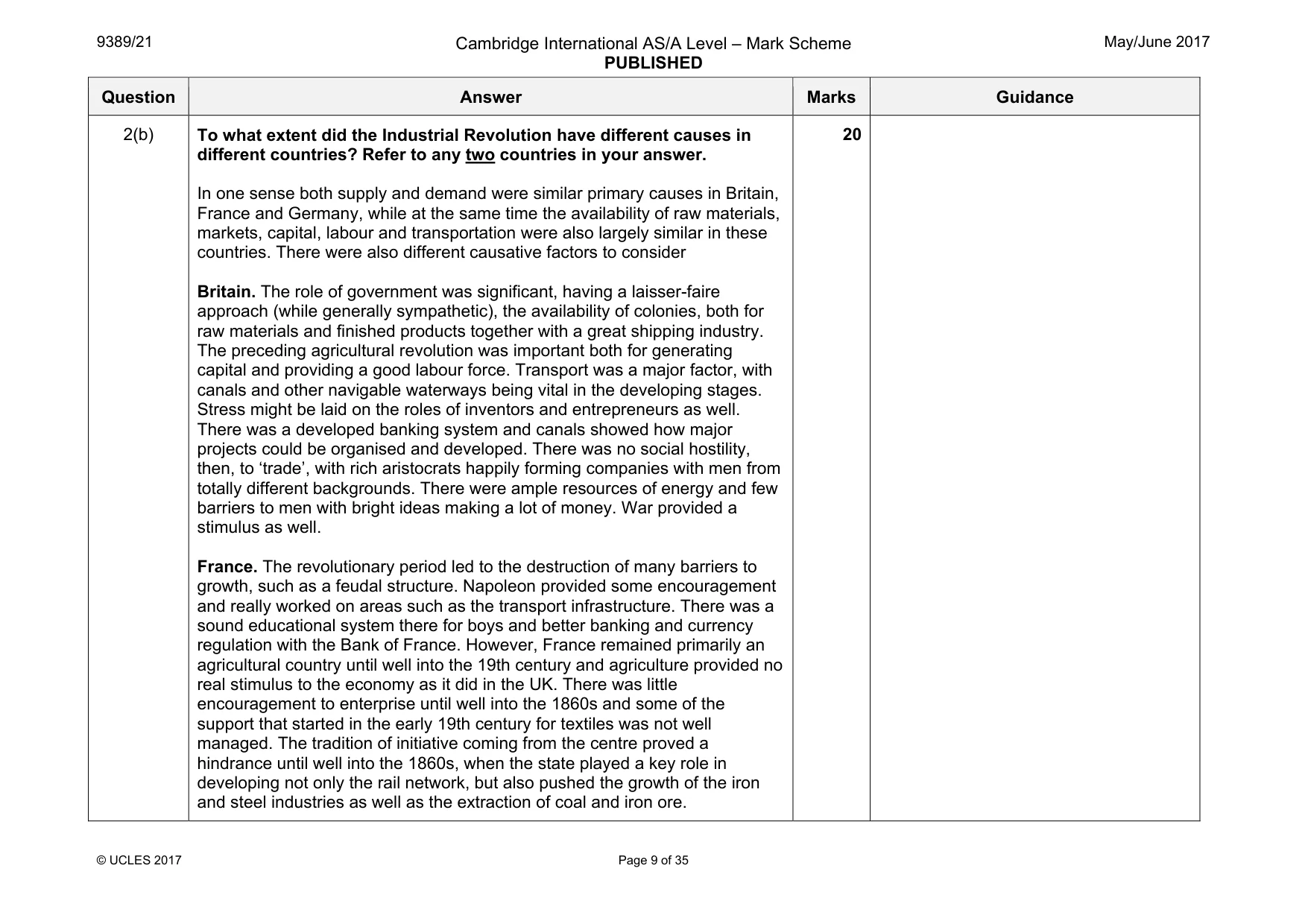
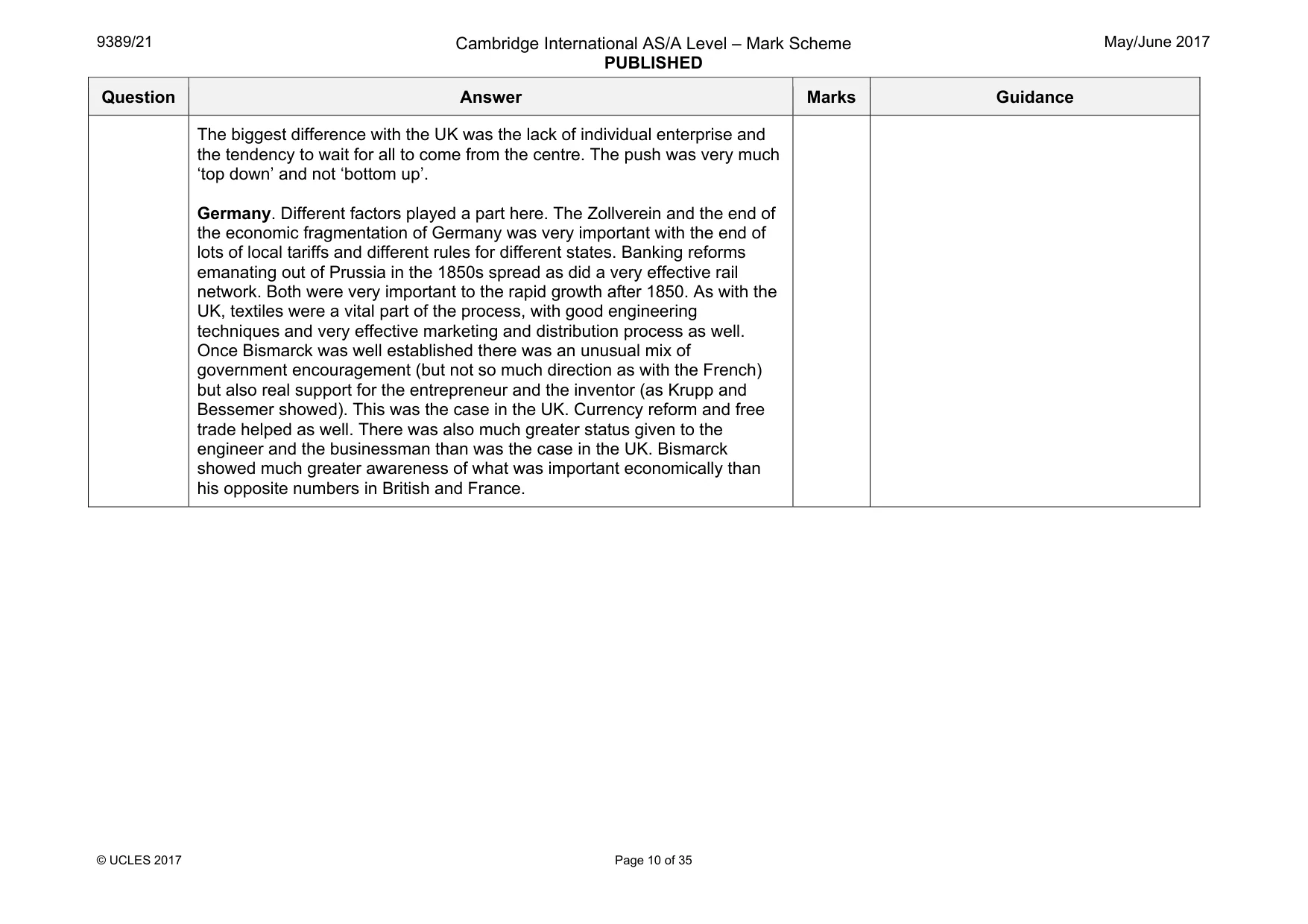
Mark scheme: 2(a) Why were canals important to the Industrial Revolution? Many would argue that they were critical, especially in the UK. They enabled the transportation in bulk of goods to an extent which made mass production possible. Raw materials could be transported easily to factories and finished products taken for export. The ability to move coal to satisfy energy needs was of vital importance. The industry provided employment, particularly in the construction stages. It also stimulated engineering on a huge scale and the need to raise capital for their construction was a great stimulus to banking and the growth of companies. 10 Question Answer Marks Guidance 2(b) To what extent did the Industrial Revolution have different causes in different countries? Refer to any two countries in your answer. In one sense both supply and demand were similar primary causes in Britain, France and Germany, while at the same time the availability of raw materials, markets, capital, labour and transportation were also largely similar in these countries. There were also different causative factors to consider Britain. The role of government was significant, having a laisser-faire approach (while generally sympathetic), the availability of colonies, both for raw materials and finished products together with a great shipping industry. The preceding agricultural revolution was important both for generating capital and providing a good labour force. Transport was a major factor, with canals and other navigable waterways being vital in the developing stages. Stress might be laid on the roles of inventors and entrepreneurs as well. There was a developed banking system and canals showed how major projects could be organised and developed. There was no social hostility, then, to ‘trade’, with rich aristocrats happily forming companies with men from totally different backgrounds. There were ample resources of energy and few barriers to men with bright ideas making a lot of money. War provided a stimulus as well. France. The revolutionary period led to the destruction of many barriers to growth, such as a feudal structure. Napoleon provided some encouragement and really worked on areas such as the transport infrastructure. There was a sound educational system there for boys and better banking and currency regulation with the Bank of France. However, France remained primarily an agricultural country until well into the 19th century and agriculture provided no real stimulus to the economy as it did in the UK. There was little encouragement to enterprise until well into the 1860s and some of the support that started in the early 19th century for textiles was not well managed. The tradition of initiative coming from the centre proved a hindrance until well into the 1860s, when the state played a key role in developing not only the rail network, but also pushed the growth of the iron and steel industries as well as the extraction of coal and iron ore. 20 Question Answer Marks Guidance The biggest difference with the UK was the lack of individual enterprise and the tendency to wait for all to come from the centre. The push was very much ‘top down’ and not ‘bottom up’. Germany. Different factors played a part here. The Zollverein and the end of the economic fragmentation of Germany was very important with the end of lots of local tariffs and different rules for different states. Banking reforms emanating out of Prussia in the 1850s spread as did a very effective rail network. Both were very important to the rapid growth after 1850. As with the UK, textiles were a vital part of the process, with good engineering techniques and very effective marketing and distribution process as well. Once Bismarck was well established there was an unusual mix of government encouragement (but not so much direction as with the French) but also real support for the entrepreneur and the inventor (as Krupp and Bessemer showed). This was the case in the UK. Currency reform and free trade helped as well. There was also much greater status given to the engineer and the businessman than was the case in the UK. Bismarck showed much greater awareness of what was important economically than his opposite numbers in British and France.
Q3 · The Origins of World War I, 1900–1914 (a) Why did the alliance system affect…
3 The Origins of World War I, 1900–1914 (a) Why did the alliance system affect international stability? [10] (b) ‘The principal trouble-maker in the period from 1900 to 1914.’ Explain which country you think most deserves this title. [20]
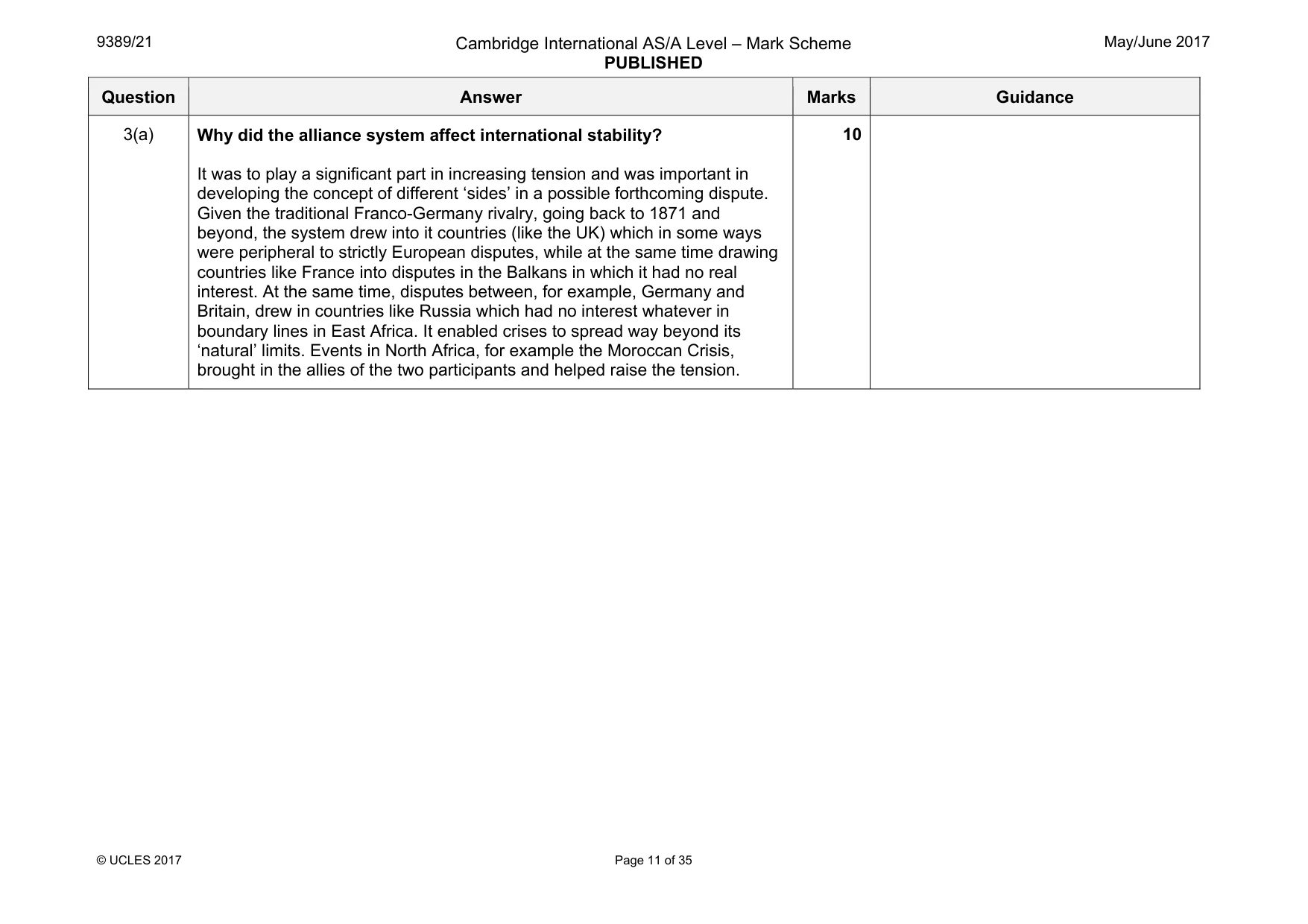
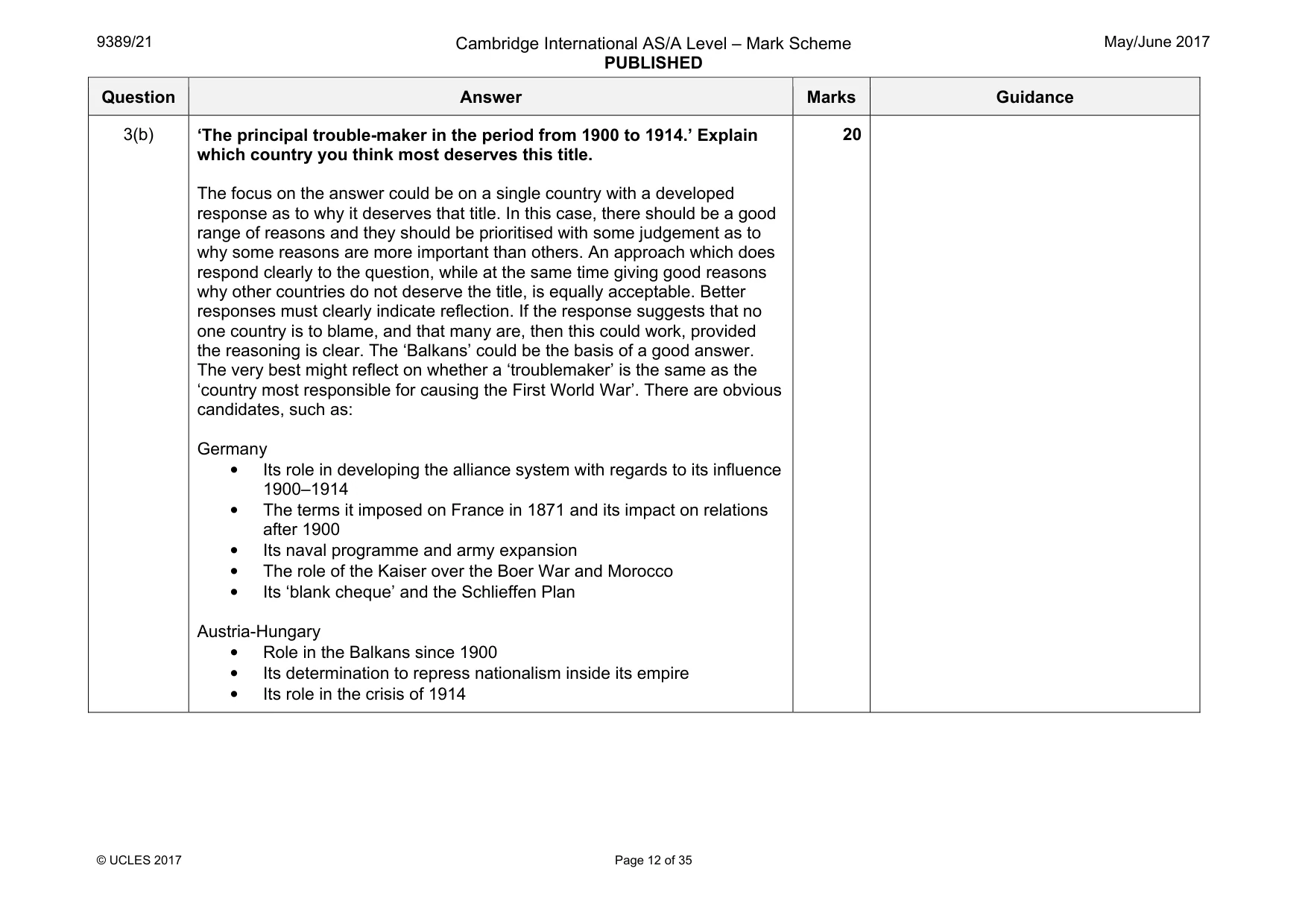
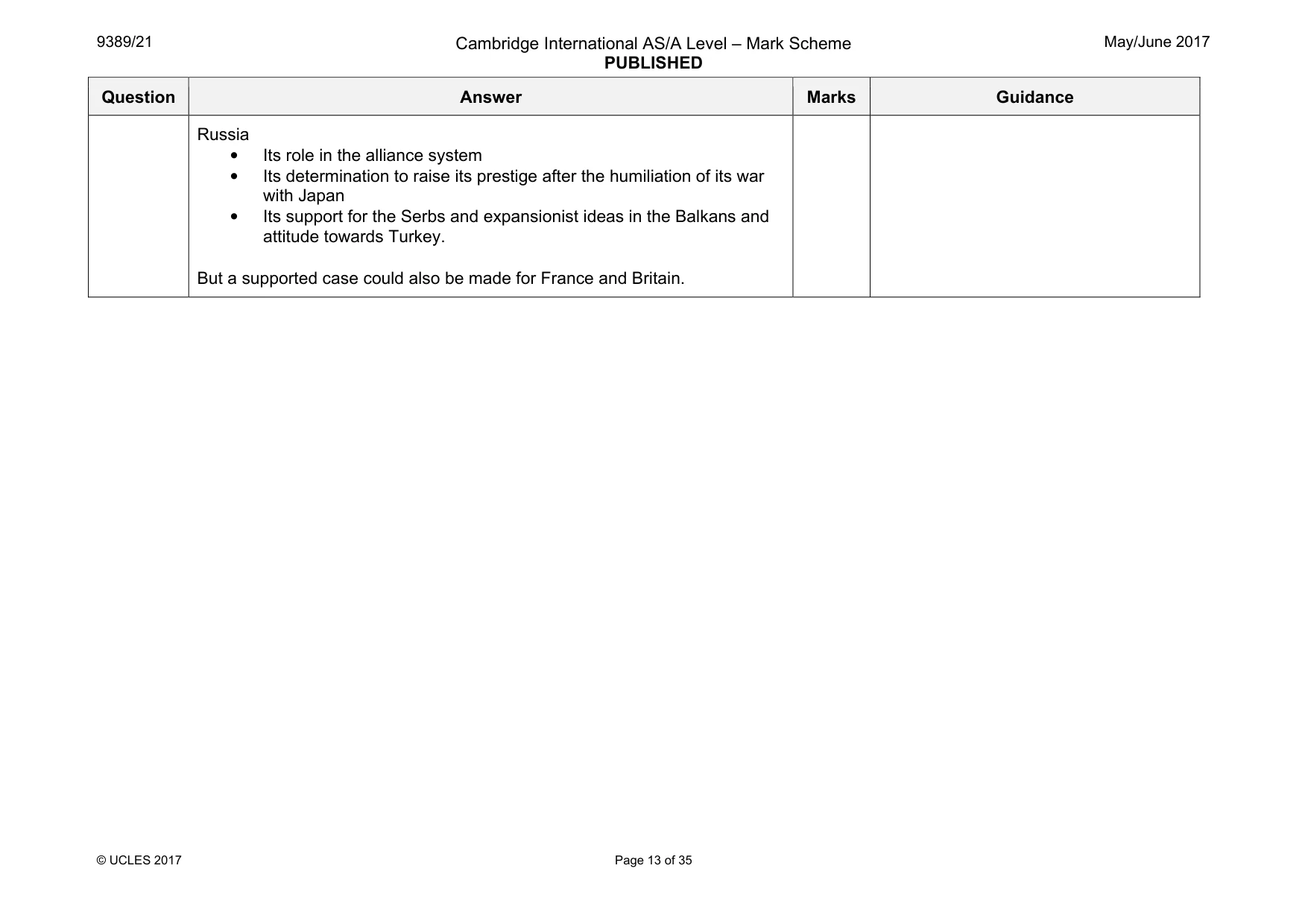
Mark scheme: 3(a) Why did the alliance system affect international stability? It was to play a significant part in increasing tension and was important in developing the concept of different ‘sides’ in a possible forthcoming dispute. Given the traditional Franco-Germany rivalry, going back to 1871 and beyond, the system drew into it countries (like the UK) which in some ways were peripheral to strictly European disputes, while at the same time drawing countries like France into disputes in the Balkans in which it had no real interest. At the same time, disputes between, for example, Germany and Britain, drew in countries like Russia which had no interest whatever in boundary lines in East Africa. It enabled crises to spread way beyond its ‘natural’ limits. Events in North Africa, for example the Moroccan Crisis, brought in the allies of the two participants and helped raise the tension. 10 Question Answer Marks Guidance 3(b) ‘The principal trouble-maker in the period from 1900 to 1914.’ Explain which country you think most deserves this title. The focus on the answer could be on a single country with a developed response as to why it deserves that title. In this case, there should be a good range of reasons and they should be prioritised with some judgement as to why some reasons are more important than others. An approach which does respond clearly to the question, while at the same time giving good reasons why other countries do not deserve the title, is equally acceptable. Better responses must clearly indicate reflection. If the response suggests that no one country is to blame, and that many are, then this could work, provided the reasoning is clear. The ‘Balkans’ could be the basis of a good answer. The very best might reflect on whether a ‘troublemaker’ is the same as the ‘country most responsible for causing the First World War’. There are obvious candidates, such as: Germany • Its role in developing the alliance system with regards to its influence 1900–1914 • The terms it imposed on France in 1871 and its impact on relations after 1900 • Its naval programme and army expansion • The role of the Kaiser over the Boer War and Morocco • Its ‘blank cheque’ and the Schlieffen Plan Austria-Hungary • Role in the Balkans since 1900 • Its determination to repress nationalism inside its empire • Its role in the crisis of 1914 20 Question Answer Marks Guidance Russia • Its role in the alliance system • Its determination to raise its prestige after the humiliation of its war with Japan • Its support for the Serbs and expansionist ideas in the Balkans and attitude towards Turkey. But a supported case could also be made for France and Britain.
Q4 · The Russian Revolution, c.1894–1917 (a) Why was Trotsky’s role in the October 1917…
4 The Russian Revolution, c.1894–1917 (a) Why was Trotsky’s role in the October 1917 Revolution important? [10] (b) ‘The 1905 Revolution failed.’ How far do you agree with this view? [20]
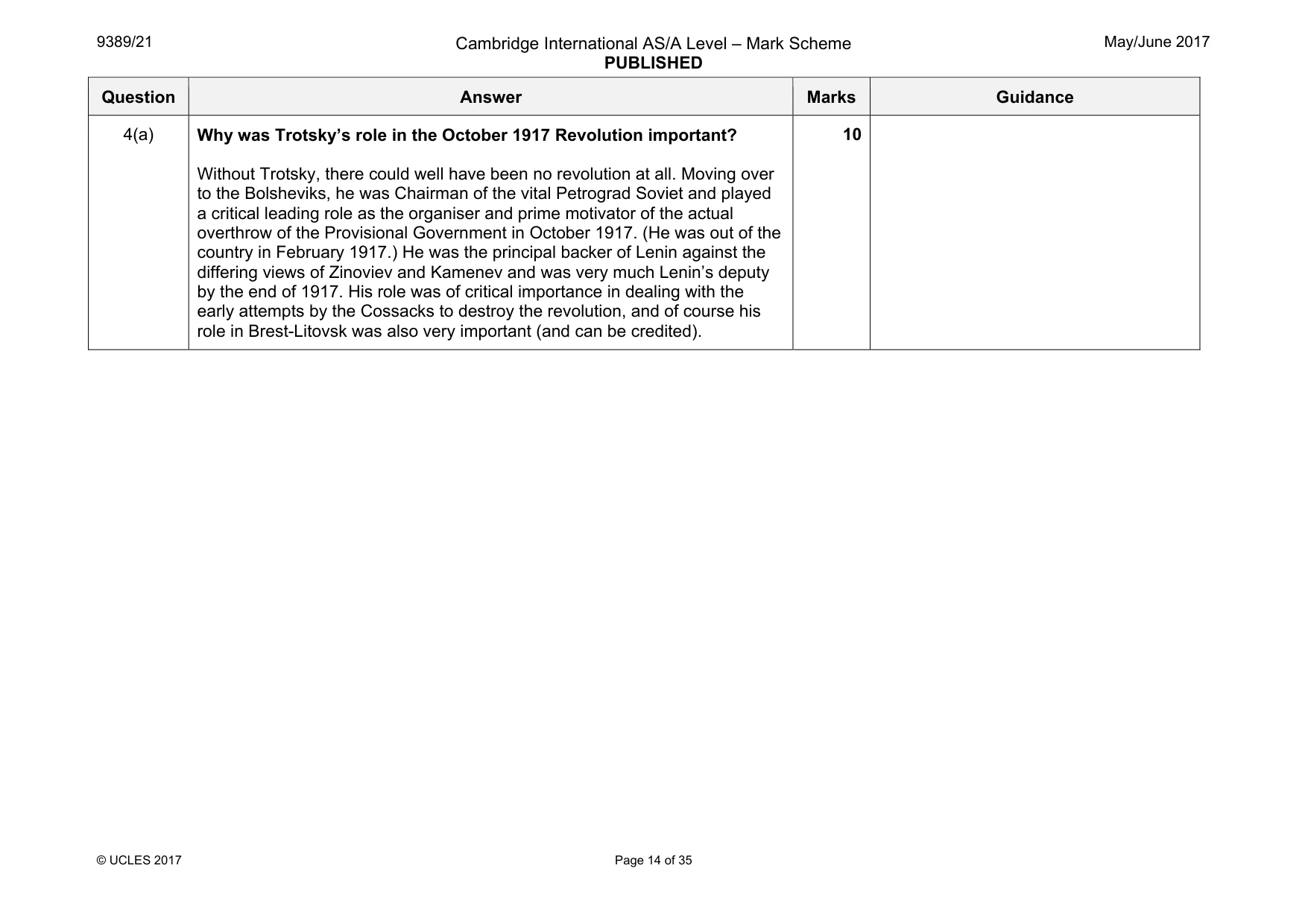
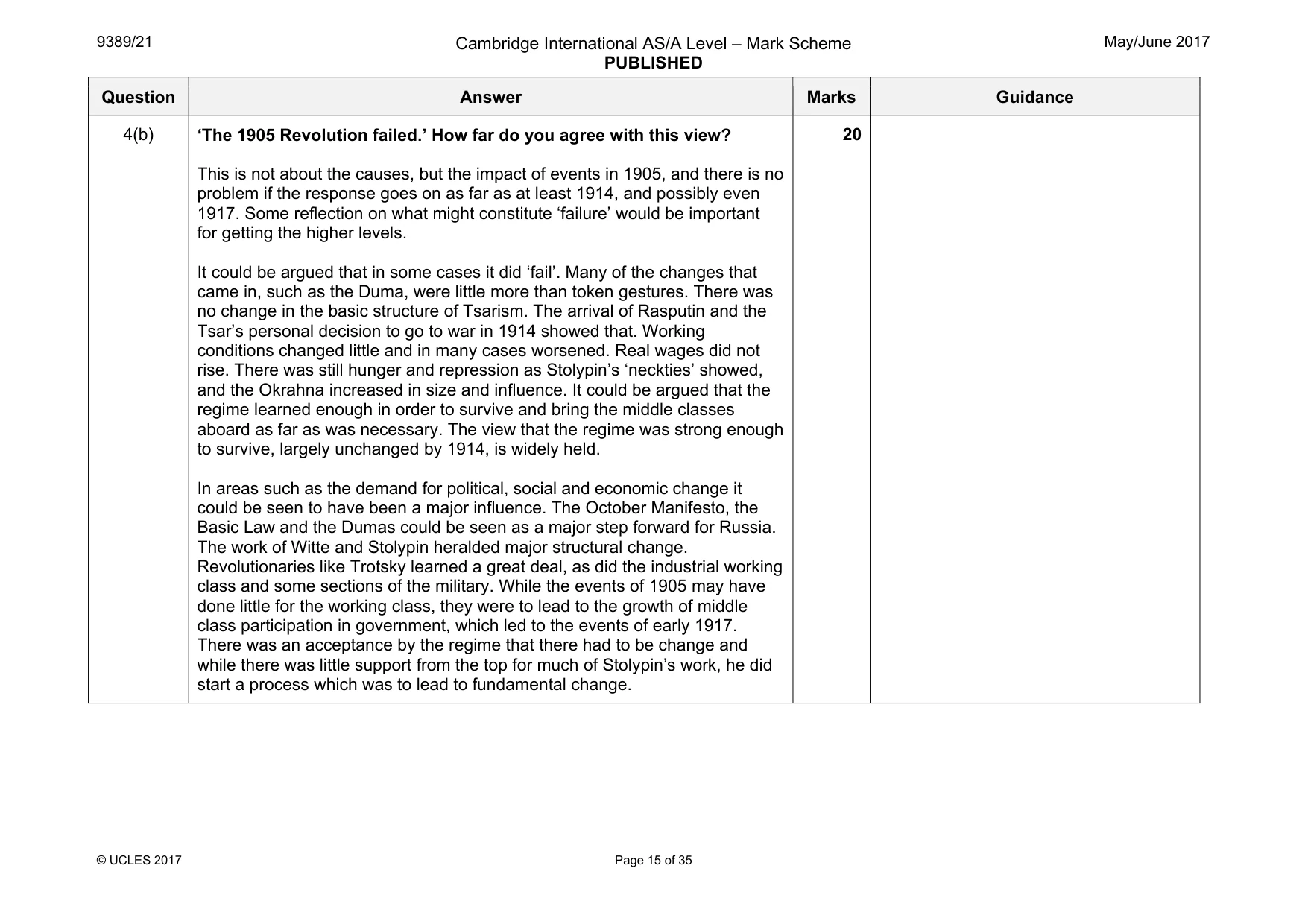
Mark scheme: 4(a) Why was Trotsky’s role in the October 1917 Revolution important? Without Trotsky, there could well have been no revolution at all. Moving over to the Bolsheviks, he was Chairman of the vital Petrograd Soviet and played a critical leading role as the organiser and prime motivator of the actual overthrow of the Provisional Government in October 1917. (He was out of the country in February 1917.) He was the principal backer of Lenin against the differing views of Zinoviev and Kamenev and was very much Lenin’s deputy by the end of 1917. His role was of critical importance in dealing with the early attempts by the Cossacks to destroy the revolution, and of course his role in Brest-Litovsk was also very important (and can be credited). 10 Question Answer Marks Guidance 4(b) ‘The 1905 Revolution failed.’ How far do you agree with this view? This is not about the causes, but the impact of events in 1905, and there is no problem if the response goes on as far as at least 1914, and possibly even 1917. Some reflection on what might constitute ‘failure’ would be important for getting the higher levels. It could be argued that in some cases it did ‘fail’. Many of the changes that came in, such as the Duma, were little more than token gestures. There was no change in the basic structure of Tsarism. The arrival of Rasputin and the Tsar’s personal decision to go to war in 1914 showed that. Working conditions changed little and in many cases worsened. Real wages did not rise. There was still hunger and repression as Stolypin’s ‘neckties’ showed, and the Okrahna increased in size and influence. It could be argued that the regime learned enough in order to survive and bring the middle classes aboard as far as was necessary. The view that the regime was strong enough to survive, largely unchanged by 1914, is widely held. In areas such as the demand for political, social and economic change it could be seen to have been a major influence. The October Manifesto, the Basic Law and the Dumas could be seen as a major step forward for Russia. The work of Witte and Stolypin heralded major structural change. Revolutionaries like Trotsky learned a great deal, as did the industrial working class and some sections of the military. While the events of 1905 may have done little for the working class, they were to lead to the growth of middle class participation in government, which led to the events of early 1917. There was an acceptance by the regime that there had to be change and while there was little support from the top for much of Stolypin’s work, he did start a process which was to lead to fundamental change. 20
Q5 · The Expansion of US Power from the 1840s to the 1930s (a) Why did the concept of Manifest…
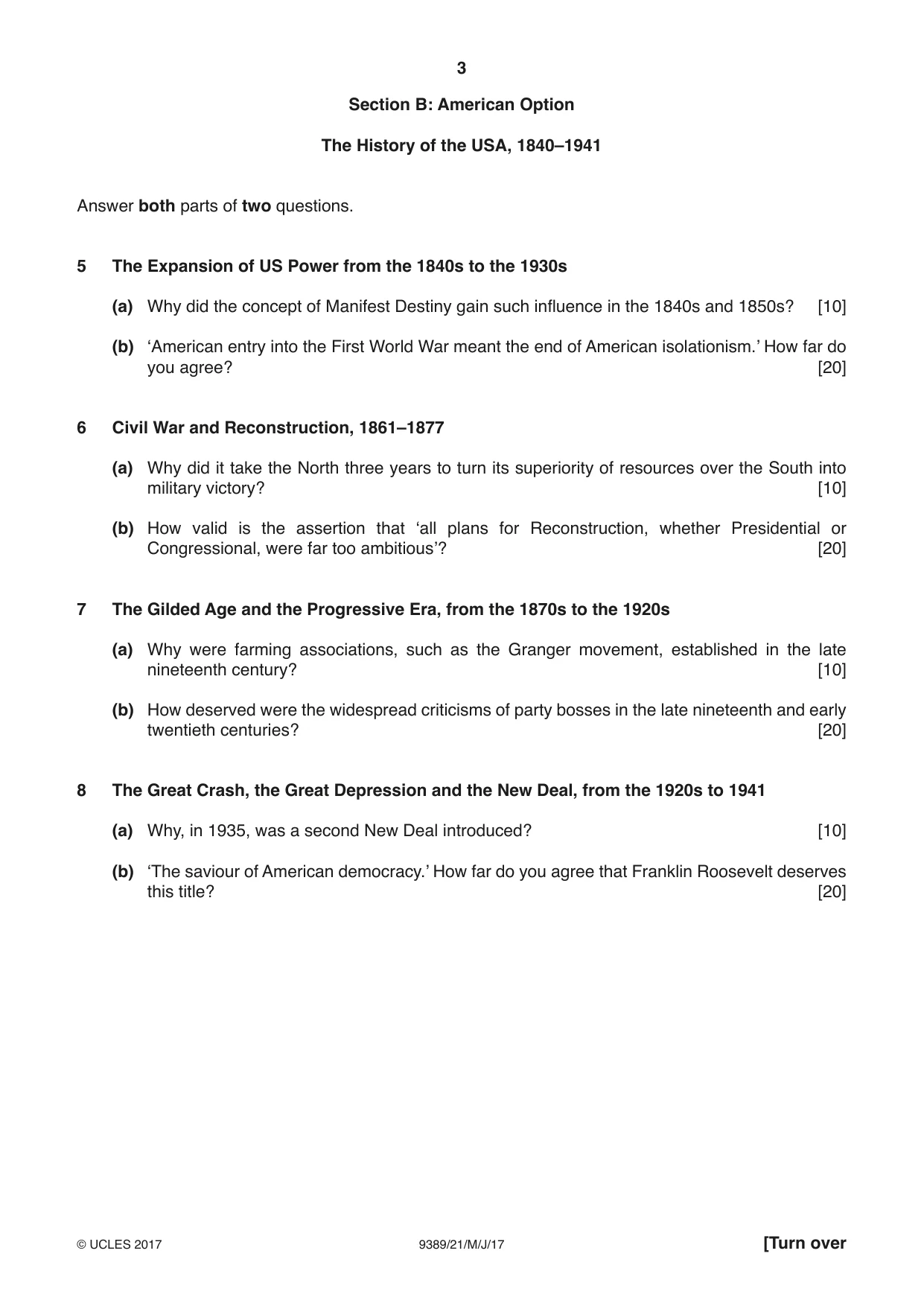
5 The Expansion of US Power from the 1840s to the 1930s (a) Why did the concept of Manifest Destiny gain such influence in the 1840s and 1850s? [10] (b) ‘American entry into the First World War meant the end of American isolationism.’ How far do you agree? [20]
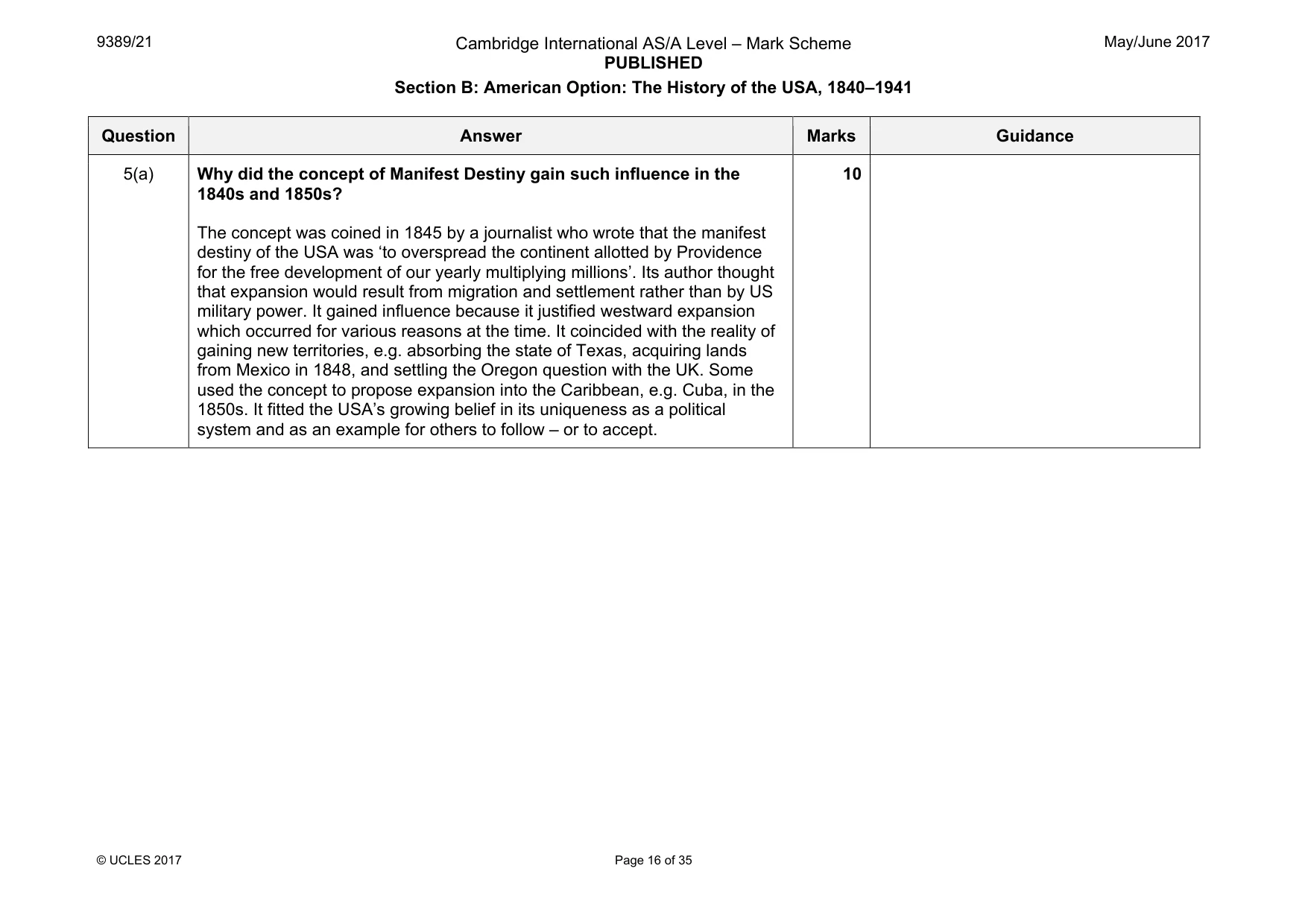
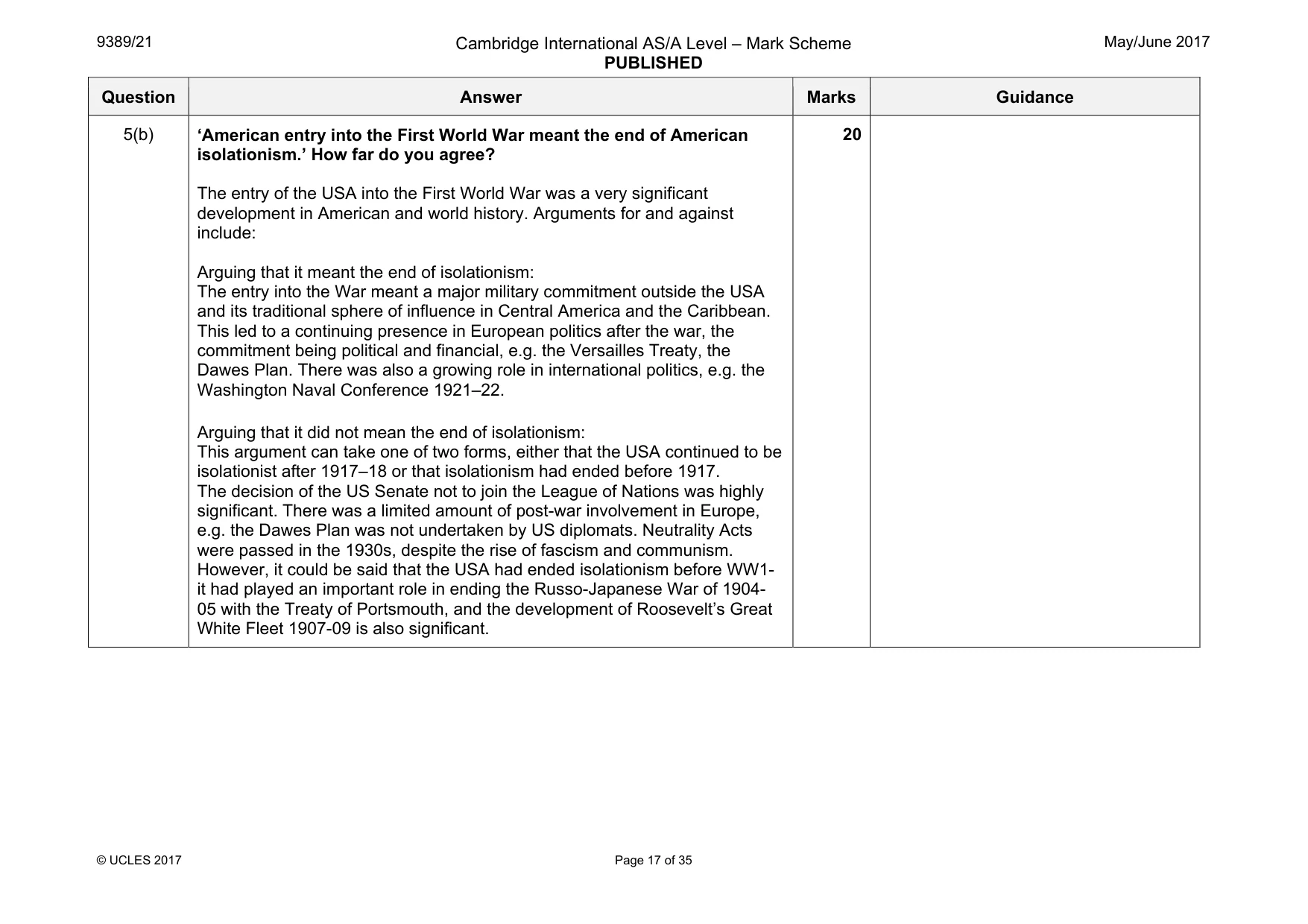
Mark scheme: 5(a) Why did the concept of Manifest Destiny gain such influence in the 1840s and 1850s? The concept was coined in 1845 by a journalist who wrote that the manifest destiny of the USA was ‘to overspread the continent allotted by Providence for the free development of our yearly multiplying millions’. Its author thought that expansion would result from migration and settlement rather than by US military power. It gained influence because it justified westward expansion which occurred for various reasons at the time. It coincided with the reality of gaining new territories, e.g. absorbing the state of Texas, acquiring lands from Mexico in 1848, and settling the Oregon question with the UK. Some used the concept to propose expansion into the Caribbean, e.g. Cuba, in the 1850s. It fitted the USA’s growing belief in its uniqueness as a political system and as an example for others to follow – or to accept. 10 Question Answer Marks Guidance 5(b) ‘American entry into the First World War meant the end of American isolationism.’ How far do you agree? The entry of the USA into the First World War was a very significant development in American and world history. Arguments for and against include: Arguing that it meant the end of isolationism: The entry into the War meant a major military commitment outside the USA and its traditional sphere of influence in Central America and the Caribbean. This led to a continuing presence in European politics after the war, the commitment being political and financial, e.g. the Versailles Treaty, the Dawes Plan. There was also a growing role in international politics, e.g. the Washington Naval Conference 1921–22. Arguing that it did not mean the end of isolationism: This argument can take one of two forms, either that the USA continued to be isolationist after 1917–18 or that isolationism had ended before 1917. The decision of the US Senate not to join the League of Nations was highly significant. There was a limited amount of post-war involvement in Europe, e.g. the Dawes Plan was not undertaken by US diplomats. Neutrality Acts were passed in the 1930s, despite the rise of fascism and communism. However, it could be said that the USA had ended isolationism before WW1- it had played an important role in ending the Russo-Japanese War of 1904- 05 with the Treaty of Portsmouth, and the development of Roosevelt’s Great White Fleet 1907-09 is also significant. 20
Q6 · Civil War and Reconstruction, 1861–1877 (a) Why did it take the North three years to turn…
6 Civil War and Reconstruction, 1861–1877 (a) Why did it take the North three years to turn its superiority of resources over the South into military victory? [10] (b) How valid is the assertion that ‘all plans for Reconstruction, whether Presidential or Congressional, were far too ambitious’? [20]
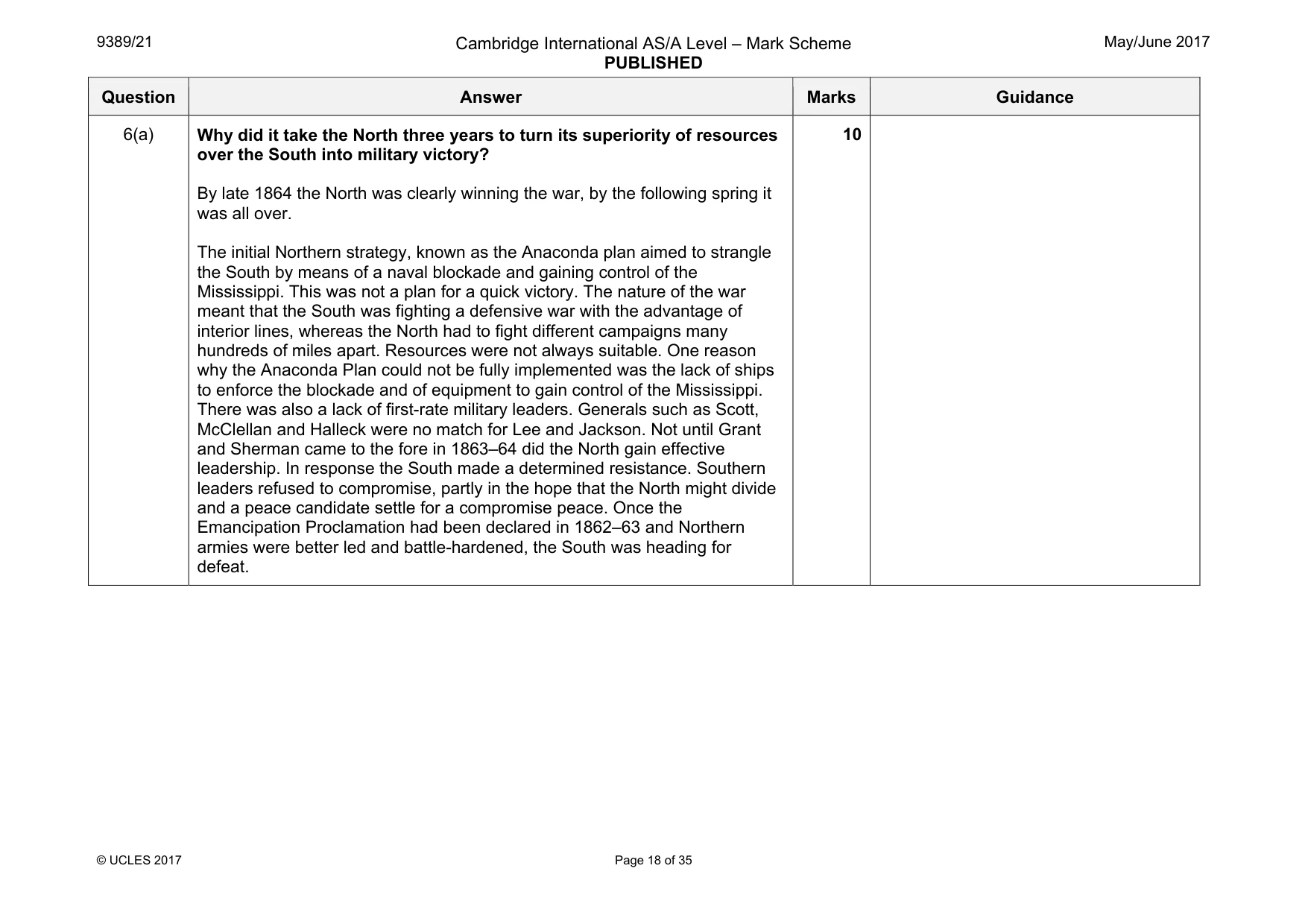
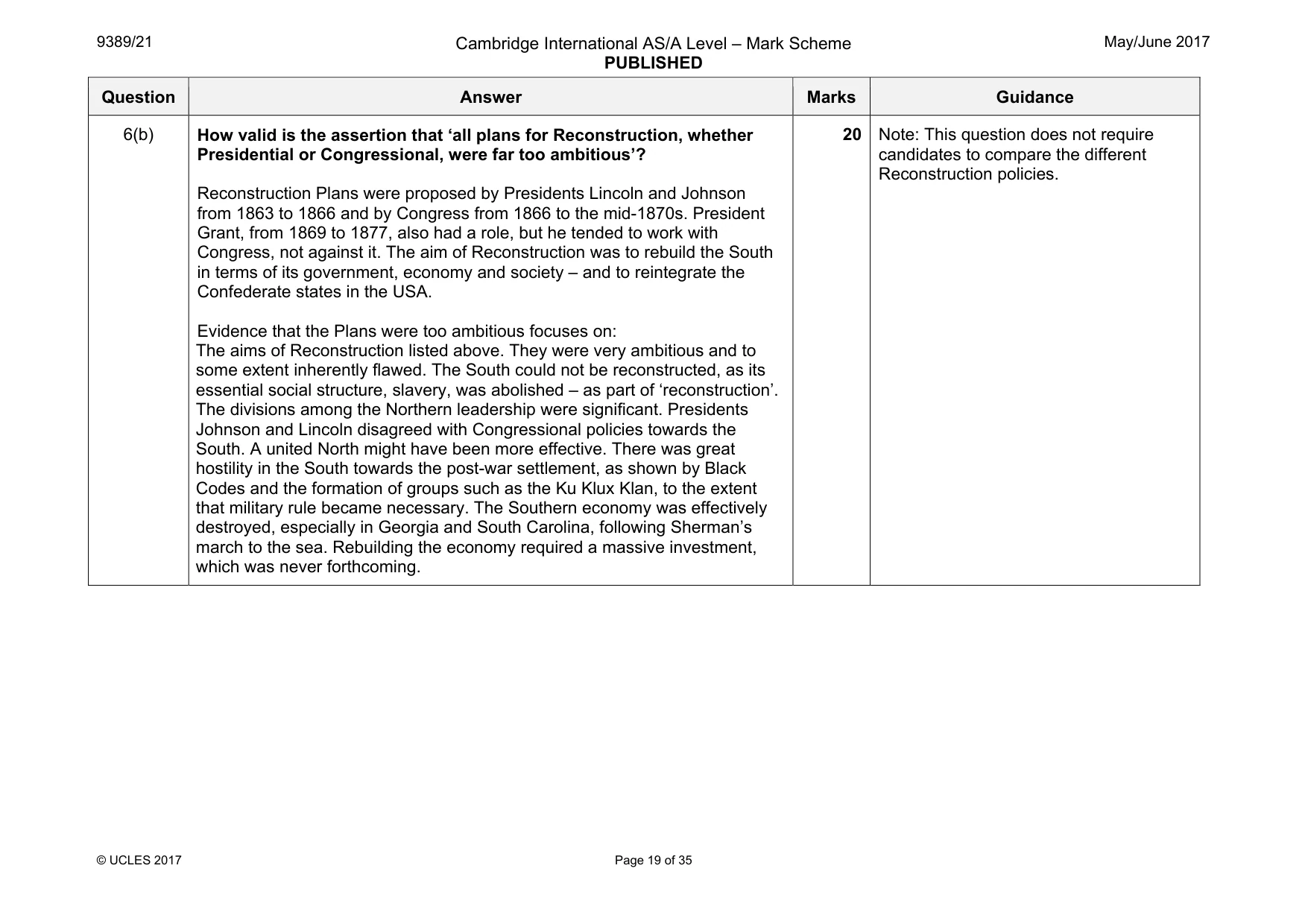
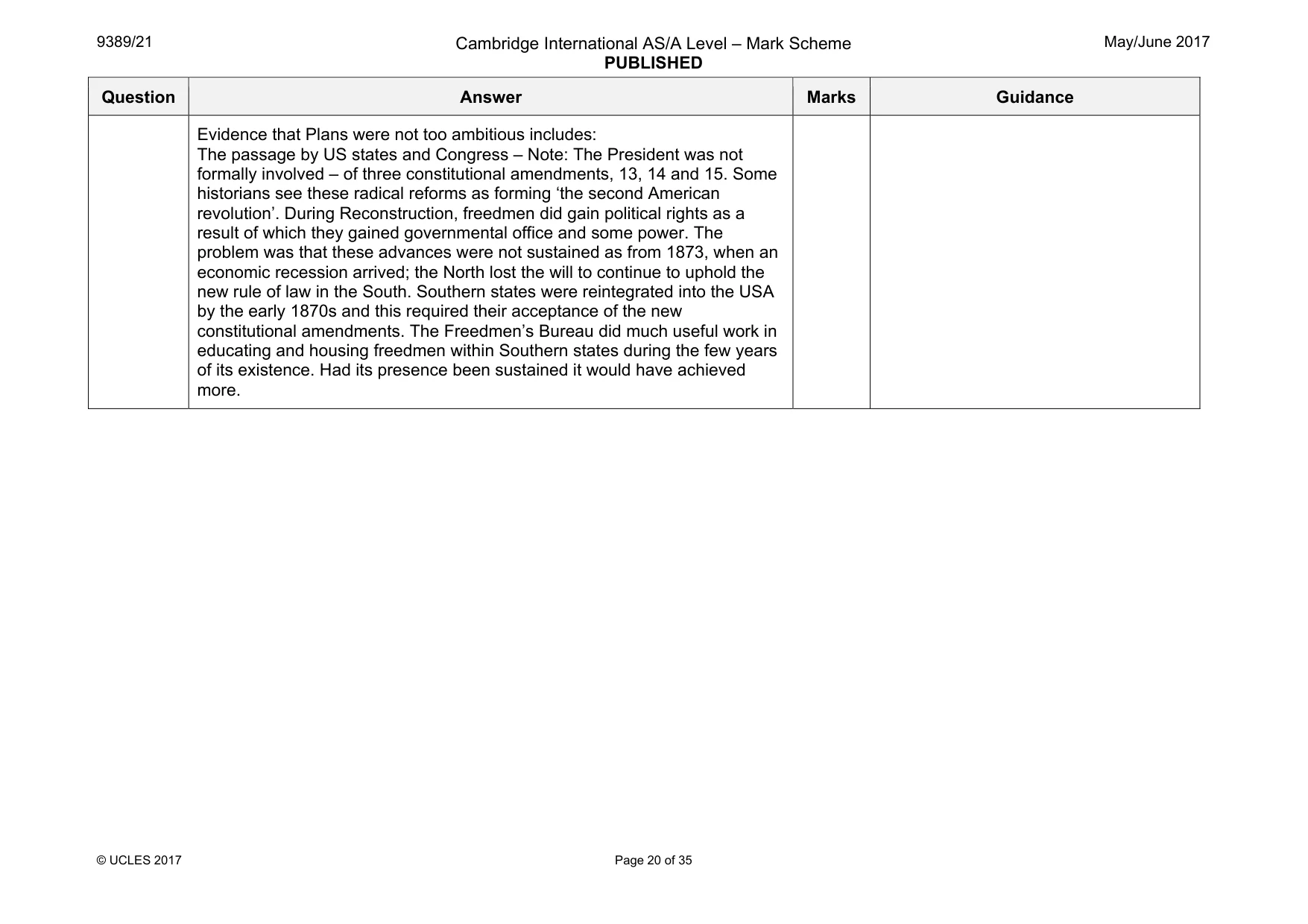
Mark scheme: 6(a) Why did it take the North three years to turn its superiority of resources over the South into military victory? By late 1864 the North was clearly winning the war, by the following spring it was all over. The initial Northern strategy, known as the Anaconda plan aimed to strangle the South by means of a naval blockade and gaining control of the Mississippi. This was not a plan for a quick victory. The nature of the war meant that the South was fighting a defensive war with the advantage of interior lines, whereas the North had to fight different campaigns many hundreds of miles apart. Resources were not always suitable. One reason why the Anaconda Plan could not be fully implemented was the lack of ships to enforce the blockade and of equipment to gain control of the Mississippi. There was also a lack of first-rate military leaders. Generals such as Scott, McClellan and Halleck were no match for Lee and Jackson. Not until Grant and Sherman came to the fore in 1863–64 did the North gain effective leadership. In response the South made a determined resistance. Southern leaders refused to compromise, partly in the hope that the North might divide and a peace candidate settle for a compromise peace. Once the Emancipation Proclamation had been declared in 1862–63 and Northern armies were better led and battle-hardened, the South was heading for defeat. 10 Question Answer Marks Guidance 6(b) How valid is the assertion that ‘all plans for Reconstruction, whether Presidential or Congressional, were far too ambitious’? Reconstruction Plans were proposed by Presidents Lincoln and Johnson from 1863 to 1866 and by Congress from 1866 to the mid-1870s. President Grant, from 1869 to 1877, also had a role, but he tended to work with Congress, not against it. The aim of Reconstruction was to rebuild the South in terms of its government, economy and society – and to reintegrate the Confederate states in the USA. Evidence that the Plans were too ambitious focuses on: The aims of Reconstruction listed above. They were very ambitious and to some extent inherently flawed. The South could not be reconstructed, as its essential social structure, slavery, was abolished – as part of ‘reconstruction’. The divisions among the Northern leadership were significant. Presidents Johnson and Lincoln disagreed with Congressional policies towards the South. A united North might have been more effective. There was great hostility in the South towards the post-war settlement, as shown by Black Codes and the formation of groups such as the Ku Klux Klan, to the extent that military rule became necessary. The Southern economy was effectively destroyed, especially in Georgia and South Carolina, following Sherman’s march to the sea. Rebuilding the economy required a massive investment, which was never forthcoming. 20 Note: This question does not require candidates to compare the different Reconstruction policies. Question Answer Marks Guidance Evidence that Plans were not too ambitious includes: The passage by US states and Congress – Note: The President was not formally involved – of three constitutional amendments, 13, 14 and 15. Some historians see these radical reforms as forming ‘the second American revolution’. During Reconstruction, freedmen did gain political rights as a result of which they gained governmental office and some power. The problem was that these advances were not sustained as from 1873, when an economic recession arrived; the North lost the will to continue to uphold the new rule of law in the South. Southern states were reintegrated into the USA by the early 1870s and this required their acceptance of the new constitutional amendments. The Freedmen’s Bureau did much useful work in educating and housing freedmen within Southern states during the few years of its existence. Had its presence been sustained it would have achieved more.
Q7 · The Gilded Age and the Progressive Era, from the 1870s to the 1920s (a) Why were farming…
7 The Gilded Age and the Progressive Era, from the 1870s to the 1920s (a) Why were farming associations, such as the Granger movement, established in the late nineteenth century? [10] (b) How deserved were the widespread criticisms of party bosses in the late nineteenth and early twentieth centuries? [20]
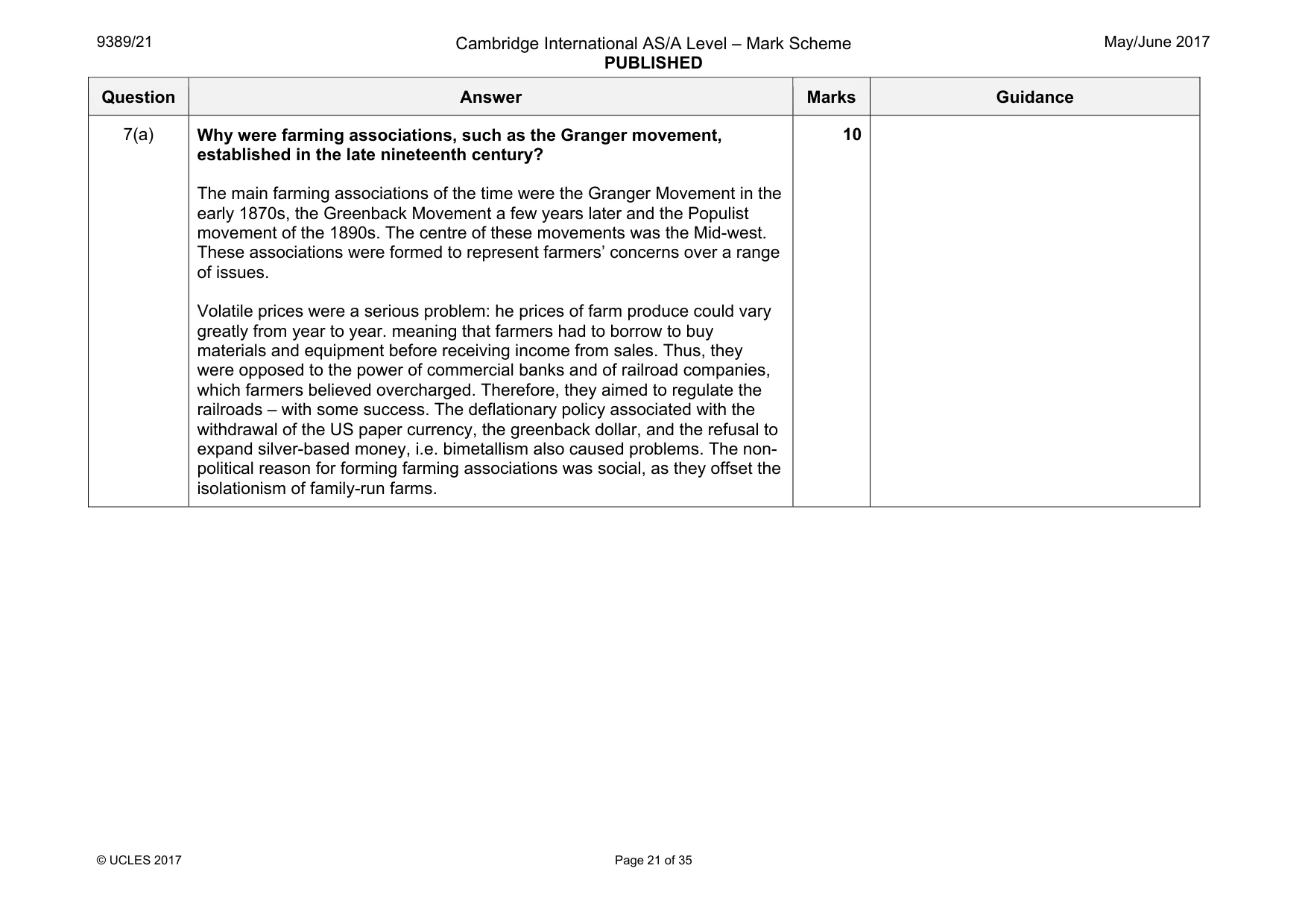
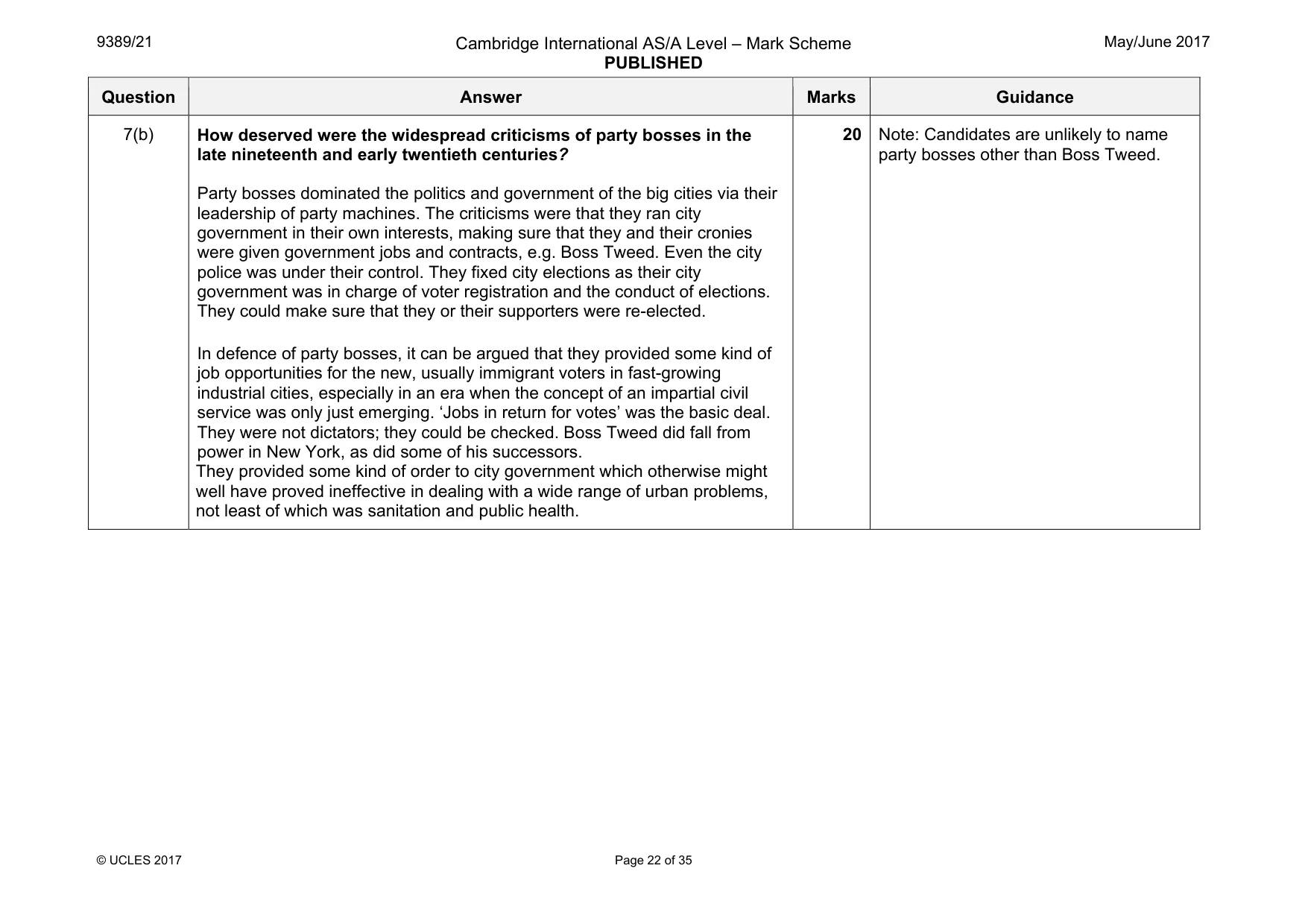
Mark scheme: 7(a) Why were farming associations, such as the Granger movement, established in the late nineteenth century? The main farming associations of the time were the Granger Movement in the early 1870s, the Greenback Movement a few years later and the Populist movement of the 1890s. The centre of these movements was the Mid-west. These associations were formed to represent farmers’ concerns over a range of issues. Volatile prices were a serious problem: he prices of farm produce could vary greatly from year to year. meaning that farmers had to borrow to buy materials and equipment before receiving income from sales. Thus, they were opposed to the power of commercial banks and of railroad companies, which farmers believed overcharged. Therefore, they aimed to regulate the railroads – with some success. The deflationary policy associated with the withdrawal of the US paper currency, the greenback dollar, and the refusal to expand silver-based money, i.e. bimetallism also caused problems. The non- political reason for forming farming associations was social, as they offset the isolationism of family-run farms. 10 Question Answer Marks Guidance 7(b) How deserved were the widespread criticisms of party bosses in the late nineteenth and early twentieth centuries? Party bosses dominated the politics and government of the big cities via their leadership of party machines. The criticisms were that they ran city government in their own interests, making sure that they and their cronies were given government jobs and contracts, e.g. Boss Tweed. Even the city police was under their control. They fixed city elections as their city government was in charge of voter registration and the conduct of elections. They could make sure that they or their supporters were re-elected. In defence of party bosses, it can be argued that they provided some kind of job opportunities for the new, usually immigrant voters in fast-growing industrial cities, especially in an era when the concept of an impartial civil service was only just emerging. ‘Jobs in return for votes’ was the basic deal. They were not dictators; they could be checked. Boss Tweed did fall from power in New York, as did some of his successors. They provided some kind of order to city government which otherwise might well have proved ineffective in dealing with a wide range of urban problems, not least of which was sanitation and public health. 20 Note: Candidates are unlikely to name party bosses other than Boss Tweed.
Q8 · The Great Crash, the Great Depression and the New Deal, from the 1920s to 1941 (a) Why…
8 The Great Crash, the Great Depression and the New Deal, from the 1920s to 1941 (a) Why, in 1935, was a second New Deal introduced? [10] (b) ‘The saviour of American democracy.’ How far do you agree that Franklin Roosevelt deserves this title? [20] Section C: International Option International Relations, 1871–1945 Answer both parts of two questions.
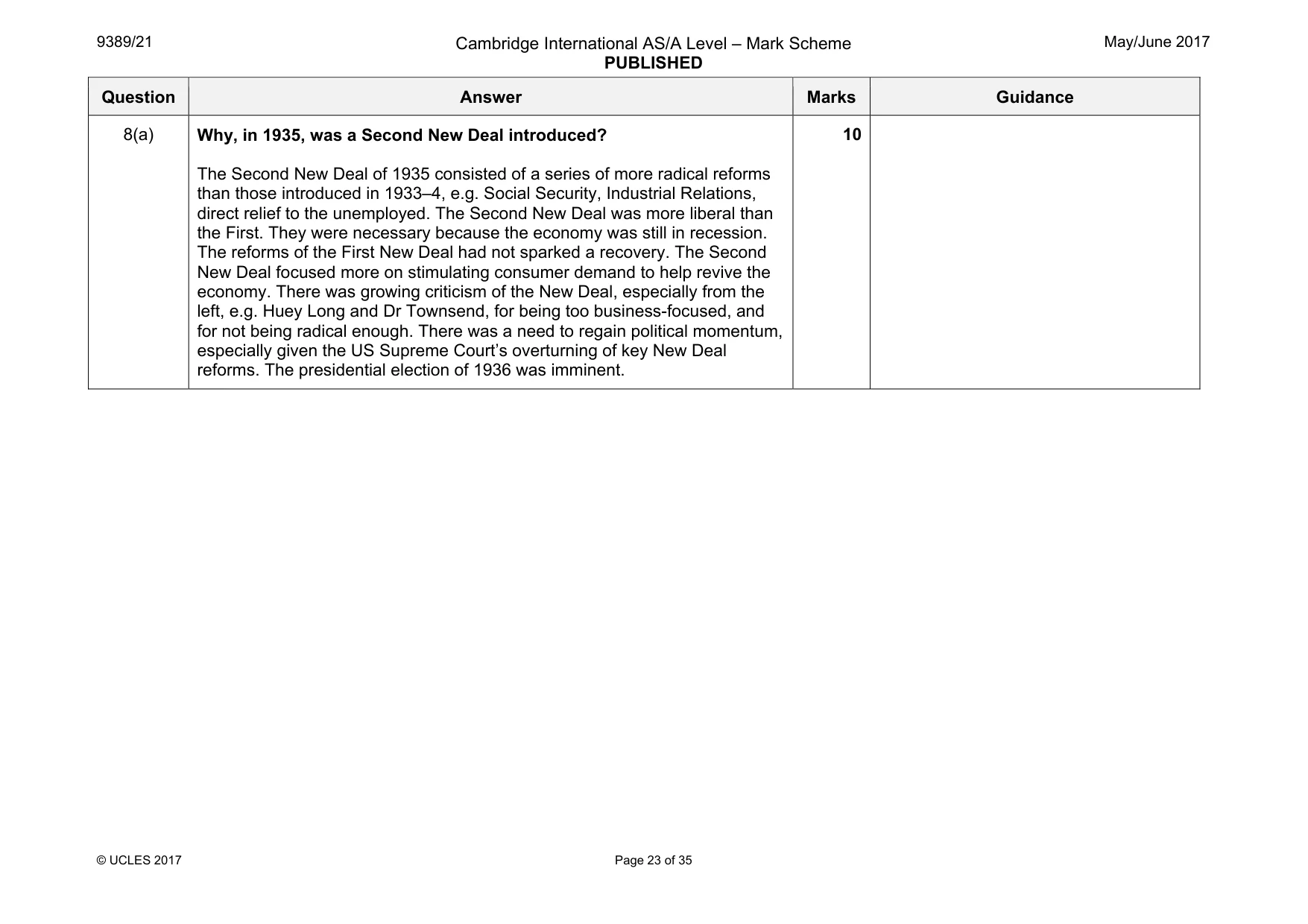
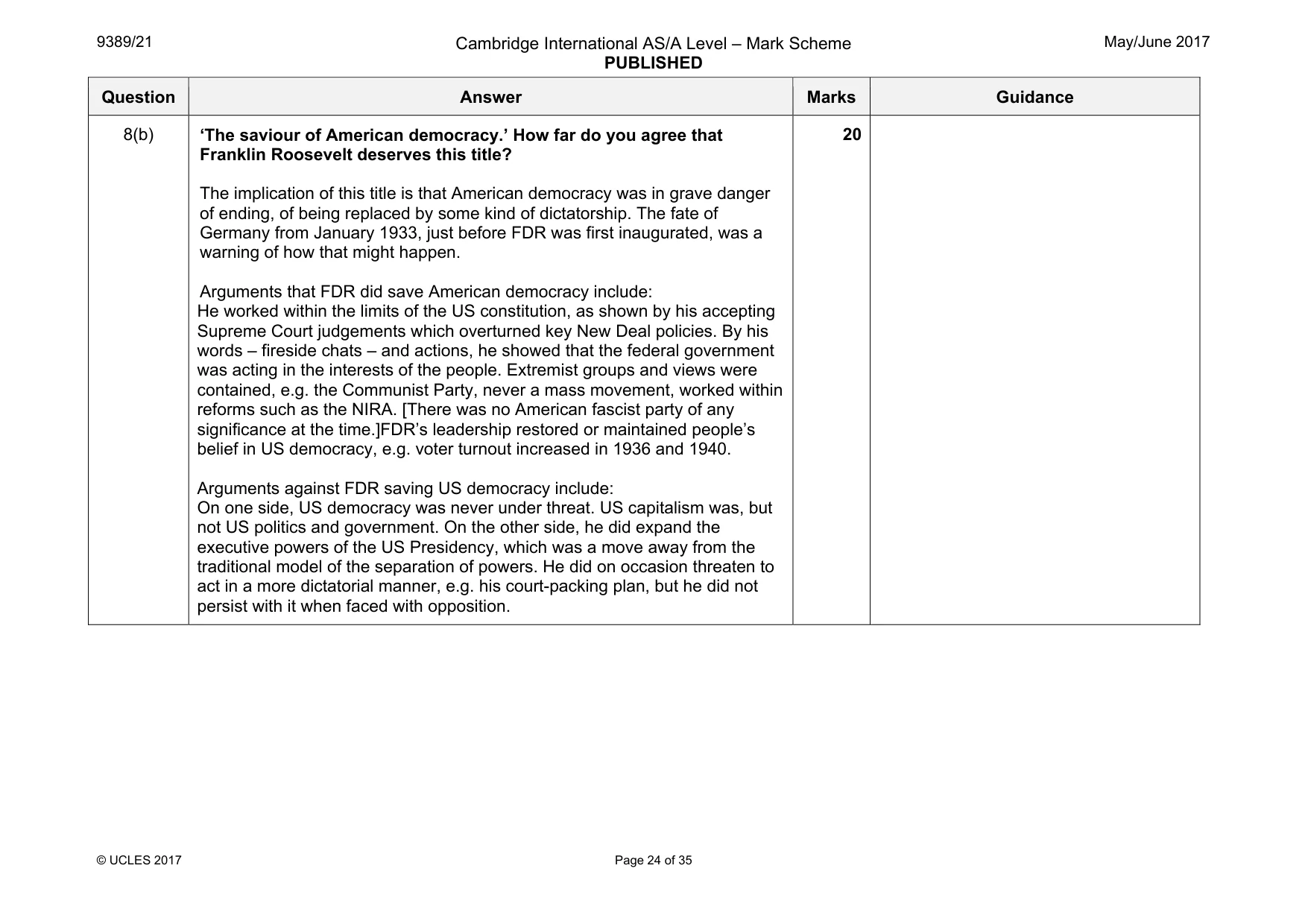
Mark scheme: 8(a) Why, in 1935, was a Second New Deal introduced? The Second New Deal of 1935 consisted of a series of more radical reforms than those introduced in 1933–4, e.g. Social Security, Industrial Relations, direct relief to the unemployed. The Second New Deal was more liberal than the First. They were necessary because the economy was still in recession. The reforms of the First New Deal had not sparked a recovery. The Second New Deal focused more on stimulating consumer demand to help revive the economy. There was growing criticism of the New Deal, especially from the left, e.g. Huey Long and Dr Townsend, for being too business-focused, and for not being radical enough. There was a need to regain political momentum, especially given the US Supreme Court’s overturning of key New Deal reforms. The presidential election of 1936 was imminent. 10 Question Answer Marks Guidance 8(b) ‘The saviour of American democracy.’ How far do you agree that Franklin Roosevelt deserves this title? The implication of this title is that American democracy was in grave danger of ending, of being replaced by some kind of dictatorship. The fate of Germany from January 1933, just before FDR was first inaugurated, was a warning of how that might happen. Arguments that FDR did save American democracy include: He worked within the limits of the US constitution, as shown by his accepting Supreme Court judgements which overturned key New Deal policies. By his words – fireside chats – and actions, he showed that the federal government was acting in the interests of the people. Extremist groups and views were contained, e.g. the Communist Party, never a mass movement, worked within reforms such as the NIRA. [There was no American fascist party of any significance at the time.]FDR’s leadership restored or maintained people’s belief in US democracy, e.g. voter turnout increased in 1936 and 1940. Arguments against FDR saving US democracy include: On one side, US democracy was never under threat. US capitalism was, but not US politics and government. On the other side, he did expand the executive powers of the US Presidency, which was a move away from the traditional model of the separation of powers. He did on occasion threaten to act in a more dictatorial manner, e.g. his court-packing plan, but he did not persist with it when faced with opposition. 20
Q9 · International Relations, 1871–1918 (a) Why was Japan stronger in 1918 than it had been in…
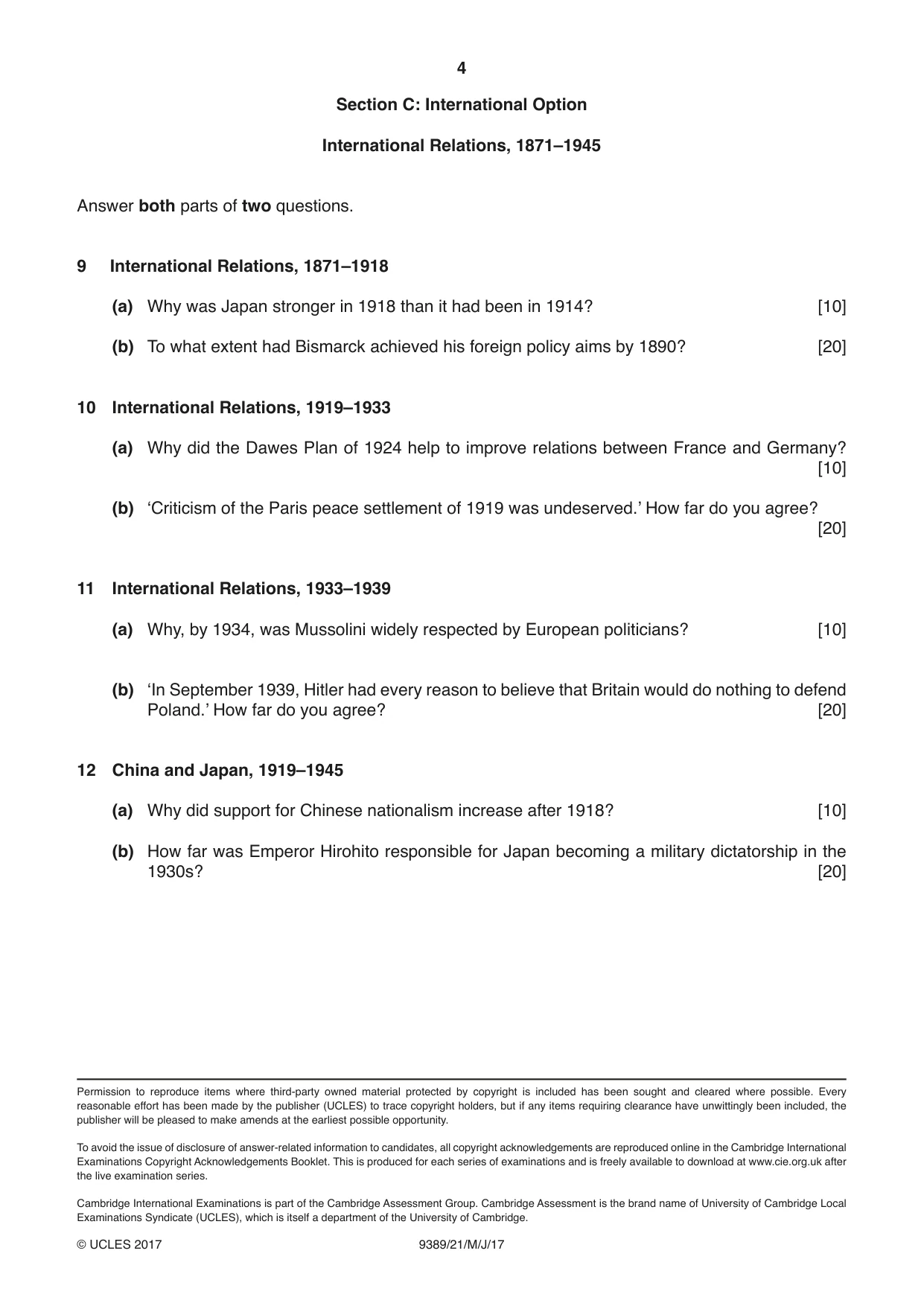
9 International Relations, 1871–1918 (a) Why was Japan stronger in 1918 than it had been in 1914? [10] (b) To what extent had Bismarck achieved his foreign policy aims by 1890? [20]
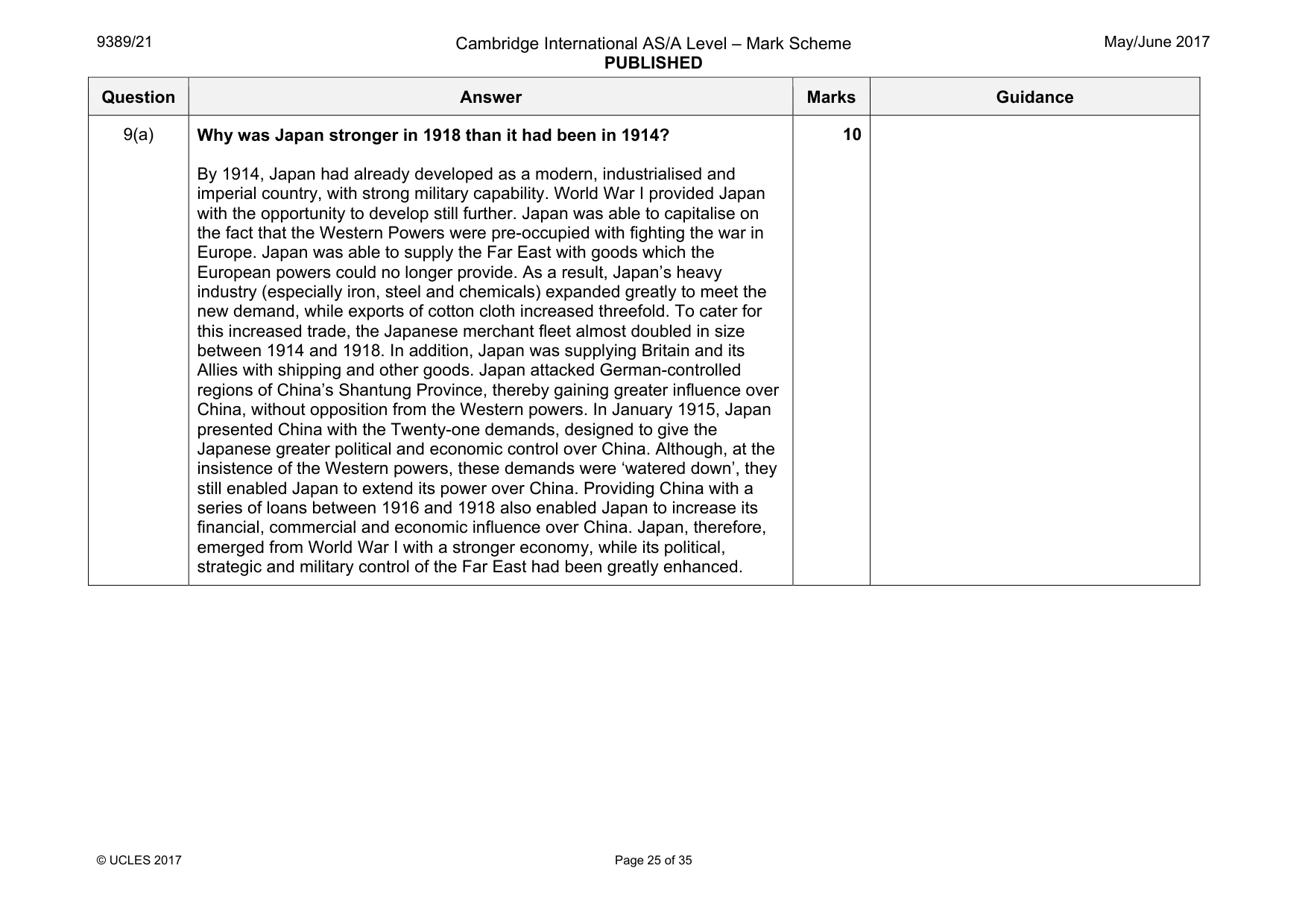
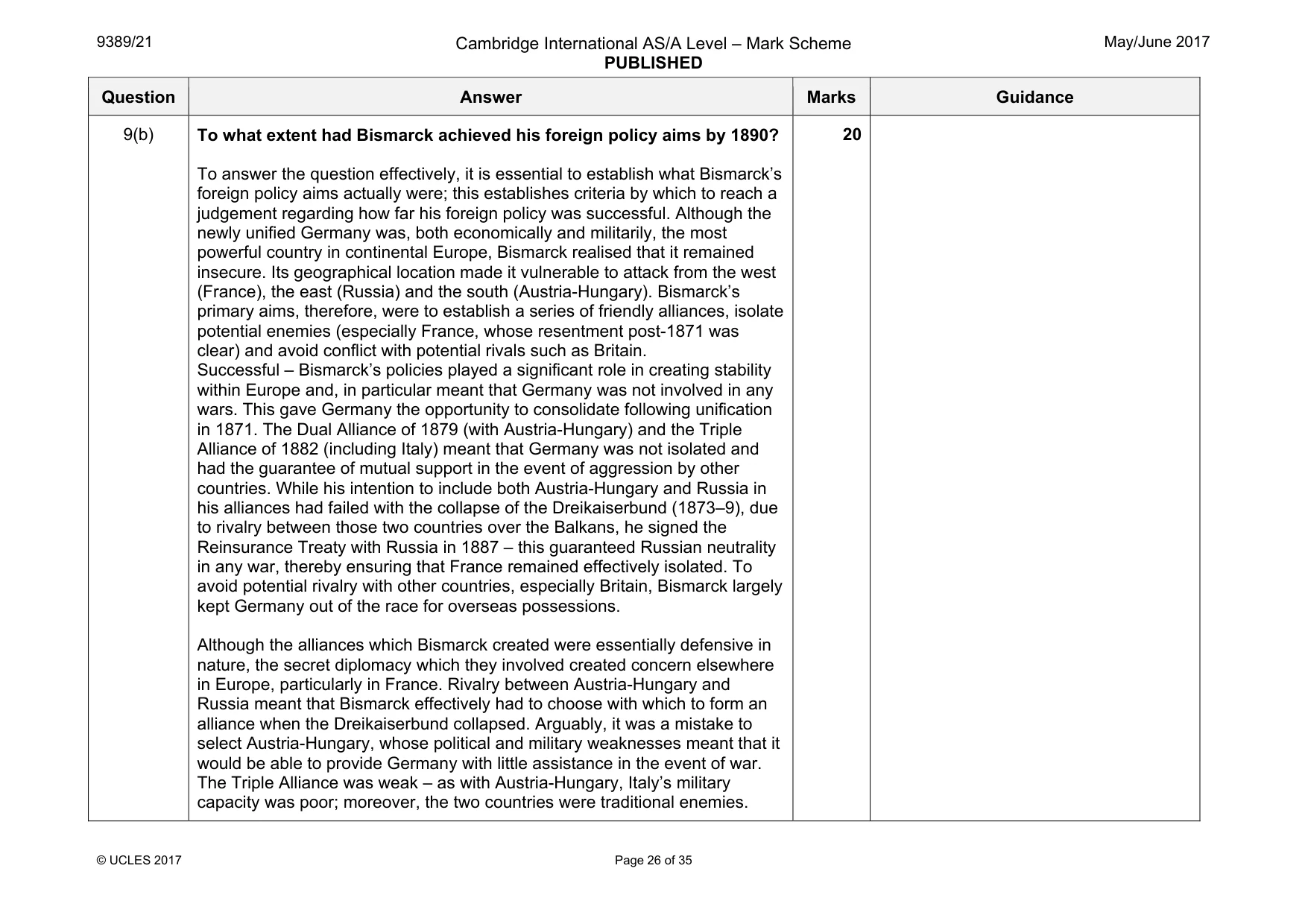
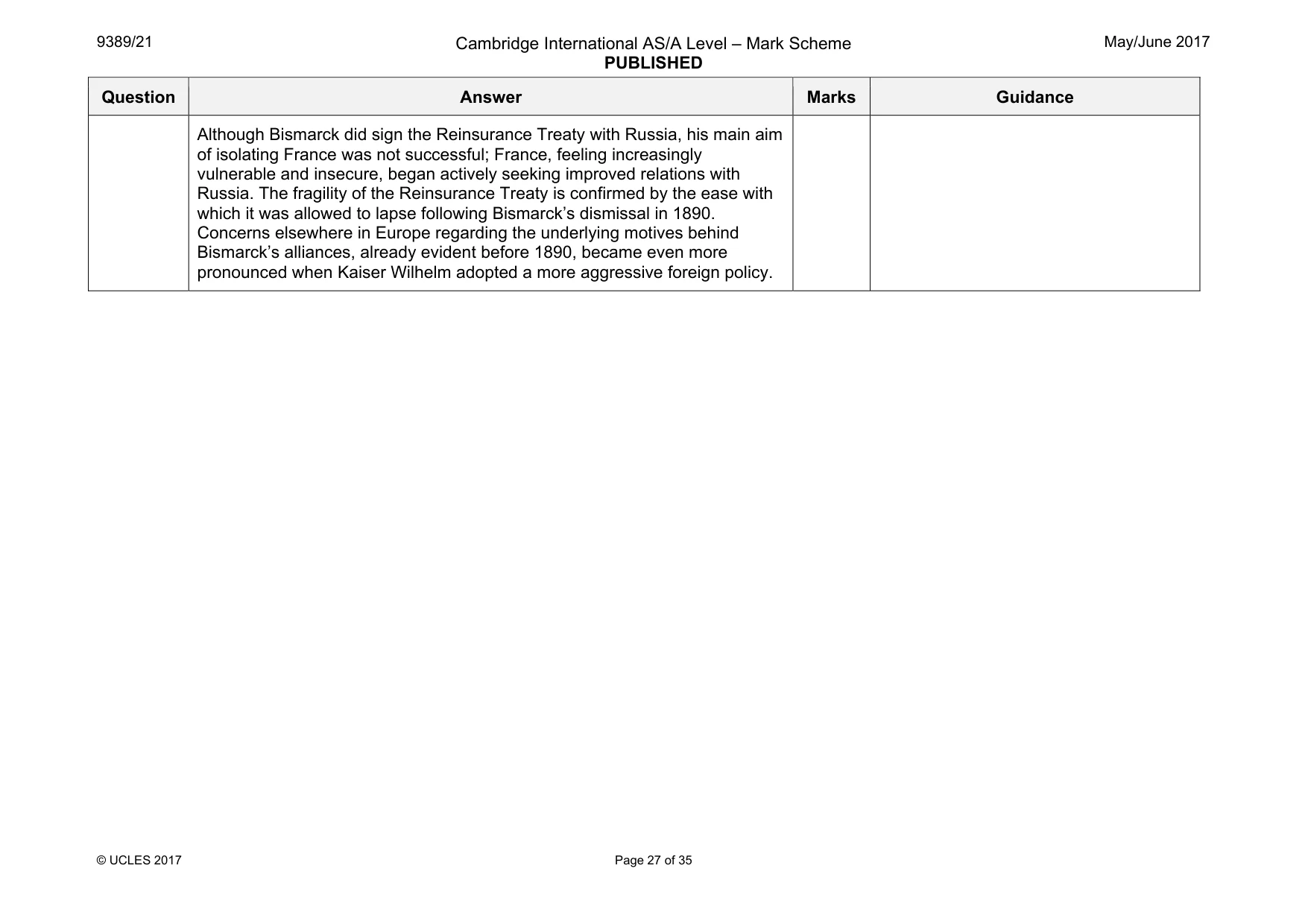
Mark scheme: 9(a) Why was Japan stronger in 1918 than it had been in 1914? By 1914, Japan had already developed as a modern, industrialised and imperial country, with strong military capability. World War I provided Japan with the opportunity to develop still further. Japan was able to capitalise on the fact that the Western Powers were pre-occupied with fighting the war in Europe. Japan was able to supply the Far East with goods which the European powers could no longer provide. As a result, Japan’s heavy industry (especially iron, steel and chemicals) expanded greatly to meet the new demand, while exports of cotton cloth increased threefold. To cater for this increased trade, the Japanese merchant fleet almost doubled in size between 1914 and 1918. In addition, Japan was supplying Britain and its Allies with shipping and other goods. Japan attacked German-controlled regions of China’s Shantung Province, thereby gaining greater influence over China, without opposition from the Western powers. In January 1915, Japan presented China with the Twenty-one demands, designed to give the Japanese greater political and economic control over China. Although, at the insistence of the Western powers, these demands were ‘watered down’, they still enabled Japan to extend its power over China. Providing China with a series of loans between 1916 and 1918 also enabled Japan to increase its financial, commercial and economic influence over China. Japan, therefore, emerged from World War I with a stronger economy, while its political, strategic and military control of the Far East had been greatly enhanced. 10 Question Answer Marks Guidance 9(b) To what extent had Bismarck achieved his foreign policy aims by 1890? To answer the question effectively, it is essential to establish what Bismarck’s foreign policy aims actually were; this establishes criteria by which to reach a judgement regarding how far his foreign policy was successful. Although the newly unified Germany was, both economically and militarily, the most powerful country in continental Europe, Bismarck realised that it remained insecure. Its geographical location made it vulnerable to attack from the west (France), the east (Russia) and the south (Austria-Hungary). Bismarck’s primary aims, therefore, were to establish a series of friendly alliances, isolate potential enemies (especially France, whose resentment post-1871 was clear) and avoid conflict with potential rivals such as Britain. Successful – Bismarck’s policies played a significant role in creating stability within Europe and, in particular meant that Germany was not involved in any wars. This gave Germany the opportunity to consolidate following unification in 1871. The Dual Alliance of 1879 (with Austria-Hungary) and the Triple Alliance of 1882 (including Italy) meant that Germany was not isolated and had the guarantee of mutual support in the event of aggression by other countries. While his intention to include both Austria-Hungary and Russia in his alliances had failed with the collapse of the Dreikaiserbund (1873–9), due to rivalry between those two countries over the Balkans, he signed the Reinsurance Treaty with Russia in 1887 – this guaranteed Russian neutrality in any war, thereby ensuring that France remained effectively isolated. To avoid potential rivalry with other countries, especially Britain, Bismarck largely kept Germany out of the race for overseas possessions. Although the alliances which Bismarck created were essentially defensive in nature, the secret diplomacy which they involved created concern elsewhere in Europe, particularly in France. Rivalry between Austria-Hungary and Russia meant that Bismarck effectively had to choose with which to form an alliance when the Dreikaiserbund collapsed. Arguably, it was a mistake to select Austria-Hungary, whose political and military weaknesses meant that it would be able to provide Germany with little assistance in the event of war. The Triple Alliance was weak – as with Austria-Hungary, Italy’s military capacity was poor; moreover, the two countries were traditional enemies. 20 Question Answer Marks Guidance Although Bismarck did sign the Reinsurance Treaty with Russia, his main aim of isolating France was not successful; France, feeling increasingly vulnerable and insecure, began actively seeking improved relations with Russia. The fragility of the Reinsurance Treaty is confirmed by the ease with which it was allowed to lapse following Bismarck’s dismissal in 1890. Concerns elsewhere in Europe regarding the underlying motives behind Bismarck’s alliances, already evident before 1890, became even more pronounced when Kaiser Wilhelm adopted a more aggressive foreign policy.
Q10 · International Relations, 1919–1933 (a) Why did the Dawes Plan of 1924 help to improve…
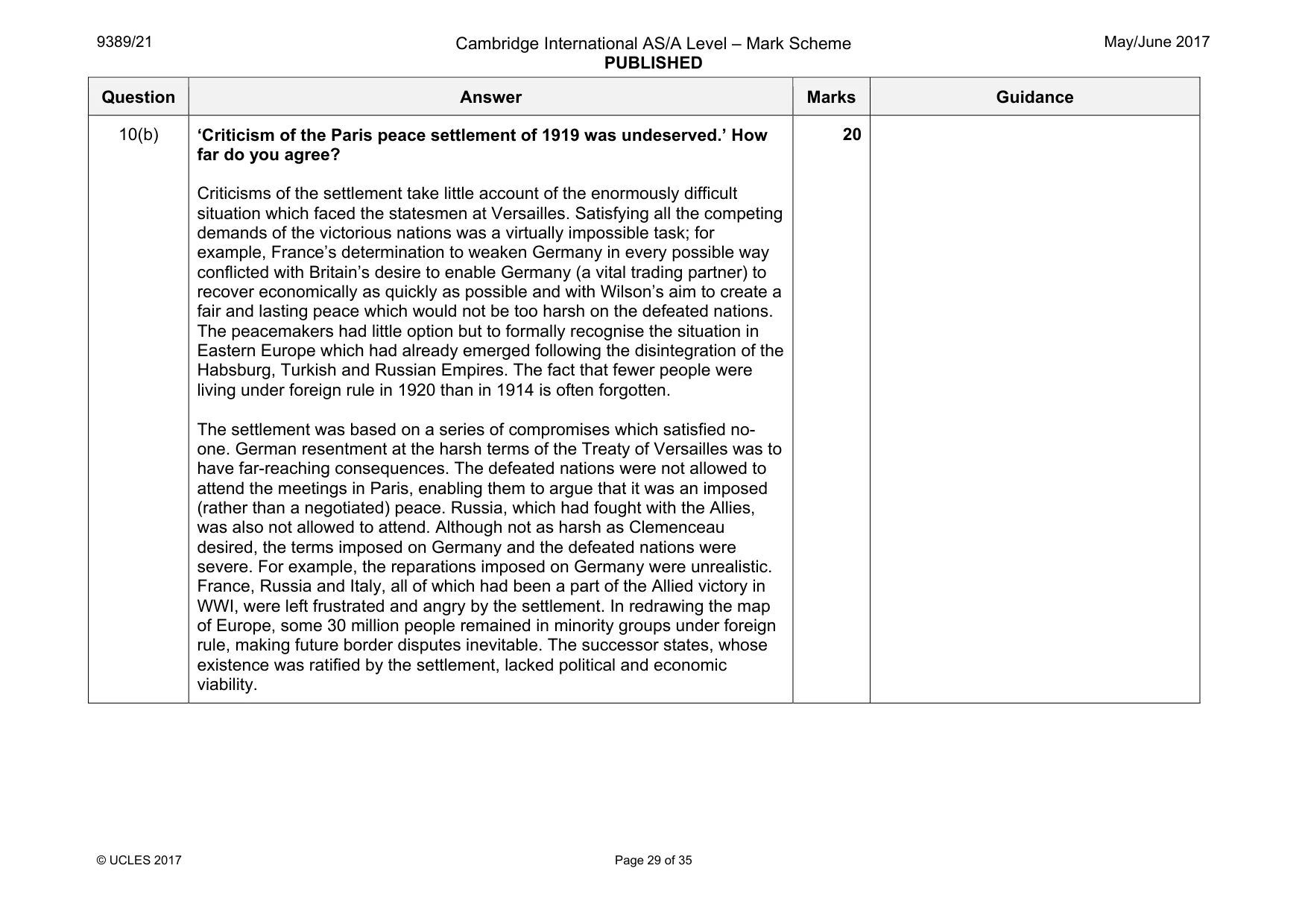
10 International Relations, 1919–1933 (a) Why did the Dawes Plan of 1924 help to improve relations between France and Germany? [10] (b) ‘Criticism of the Paris peace settlement of 1919 was undeserved.’ How far do you agree? [20]
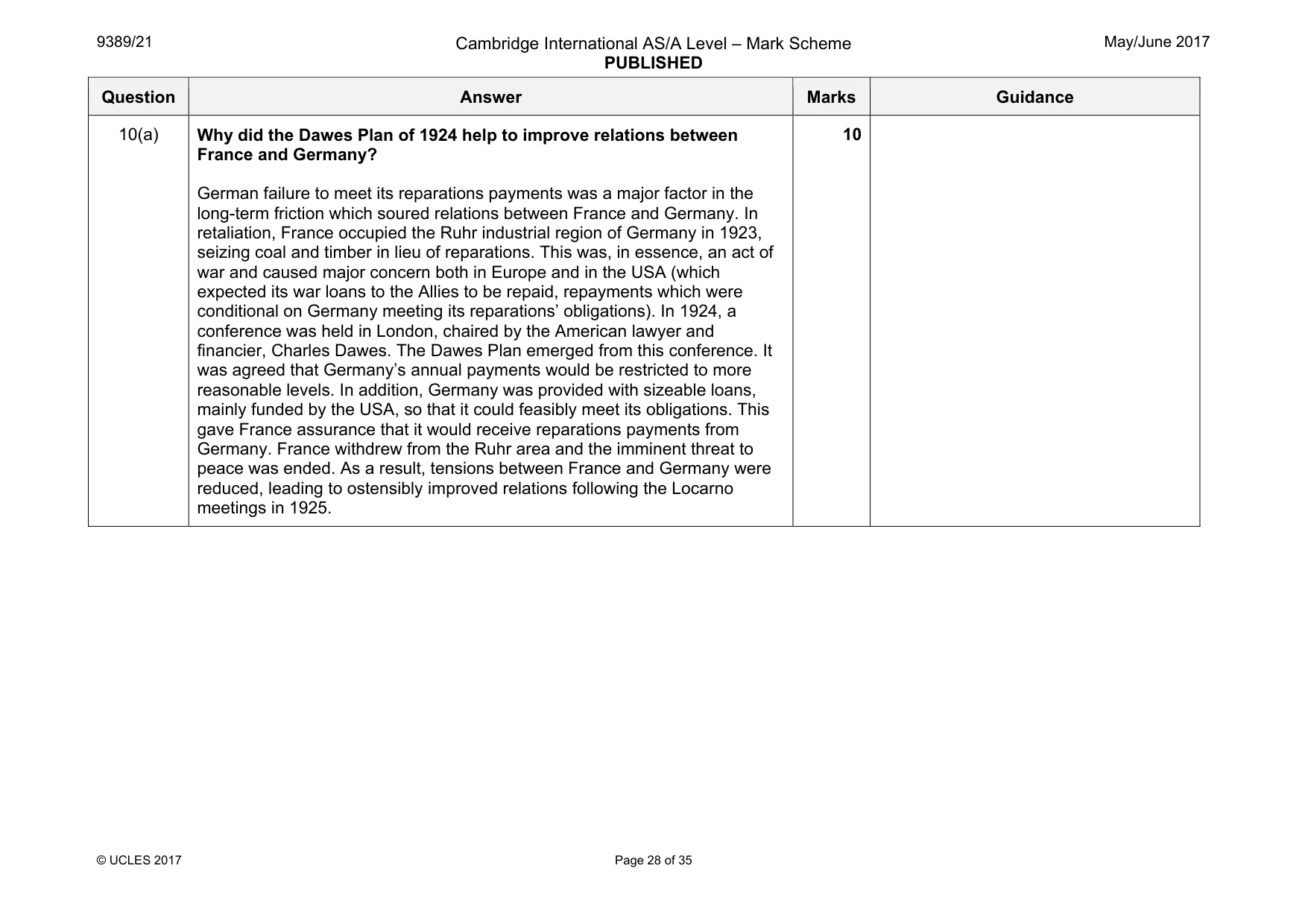
Mark scheme: 10(a) Why did the Dawes Plan of 1924 help to improve relations between France and Germany? German failure to meet its reparations payments was a major factor in the long-term friction which soured relations between France and Germany. In retaliation, France occupied the Ruhr industrial region of Germany in 1923, seizing coal and timber in lieu of reparations. This was, in essence, an act of war and caused major concern both in Europe and in the USA (which expected its war loans to the Allies to be repaid, repayments which were conditional on Germany meeting its reparations’ obligations). In 1924, a conference was held in London, chaired by the American lawyer and financier, Charles Dawes. The Dawes Plan emerged from this conference. It was agreed that Germany’s annual payments would be restricted to more reasonable levels. In addition, Germany was provided with sizeable loans, mainly funded by the USA, so that it could feasibly meet its obligations. This gave France assurance that it would receive reparations payments from Germany. France withdrew from the Ruhr area and the imminent threat to peace was ended. As a result, tensions between France and Germany were reduced, leading to ostensibly improved relations following the Locarno meetings in 1925. 10 Question Answer Marks Guidance 10(b) ‘Criticism of the Paris peace settlement of 1919 was undeserved.’ How far do you agree? Criticisms of the settlement take little account of the enormously difficult situation which faced the statesmen at Versailles. Satisfying all the competing demands of the victorious nations was a virtually impossible task; for example, France’s determination to weaken Germany in every possible way conflicted with Britain’s desire to enable Germany (a vital trading partner) to recover economically as quickly as possible and with Wilson’s aim to create a fair and lasting peace which would not be too harsh on the defeated nations. The peacemakers had little option but to formally recognise the situation in Eastern Europe which had already emerged following the disintegration of the Habsburg, Turkish and Russian Empires. The fact that fewer people were living under foreign rule in 1920 than in 1914 is often forgotten. The settlement was based on a series of compromises which satisfied no- one. German resentment at the harsh terms of the Treaty of Versailles was to have far-reaching consequences. The defeated nations were not allowed to attend the meetings in Paris, enabling them to argue that it was an imposed (rather than a negotiated) peace. Russia, which had fought with the Allies, was also not allowed to attend. Although not as harsh as Clemenceau desired, the terms imposed on Germany and the defeated nations were severe. For example, the reparations imposed on Germany were unrealistic. France, Russia and Italy, all of which had been a part of the Allied victory in WWI, were left frustrated and angry by the settlement. In redrawing the map of Europe, some 30 million people remained in minority groups under foreign rule, making future border disputes inevitable. The successor states, whose existence was ratified by the settlement, lacked political and economic viability. 20
Q11 · International Relations, 1933–1939 (a) Why, by 1934, was Mussolini widely respected by…
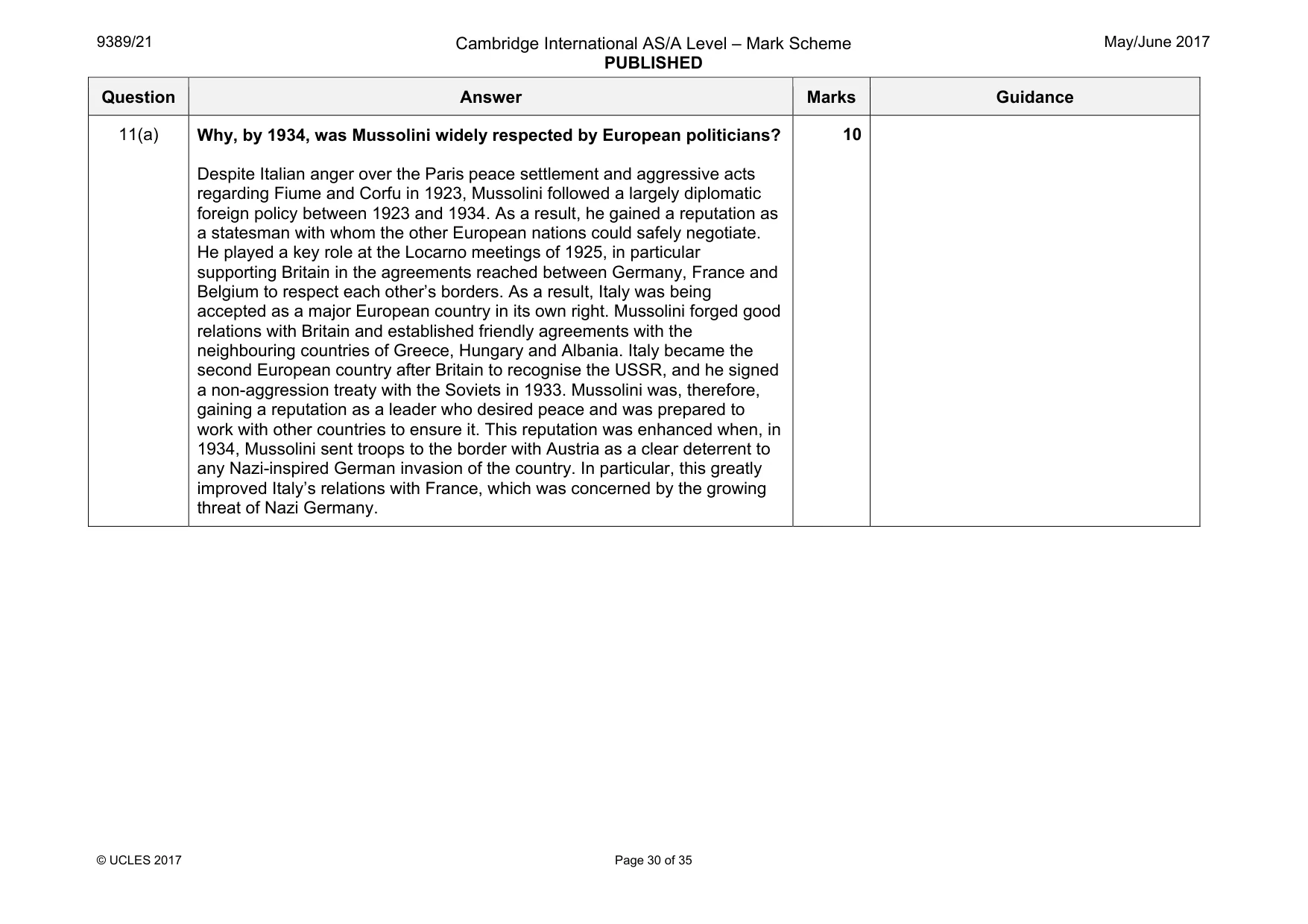
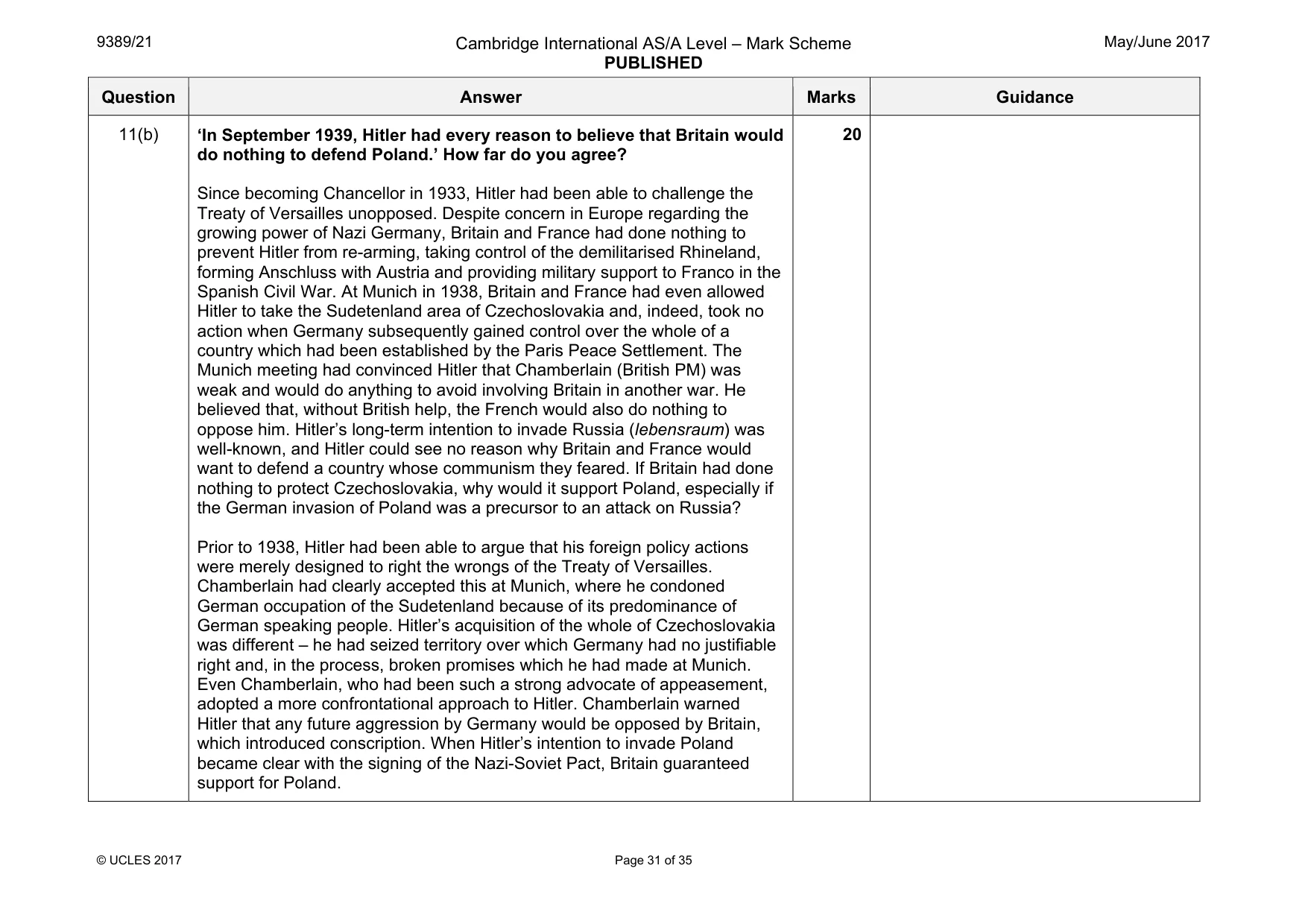
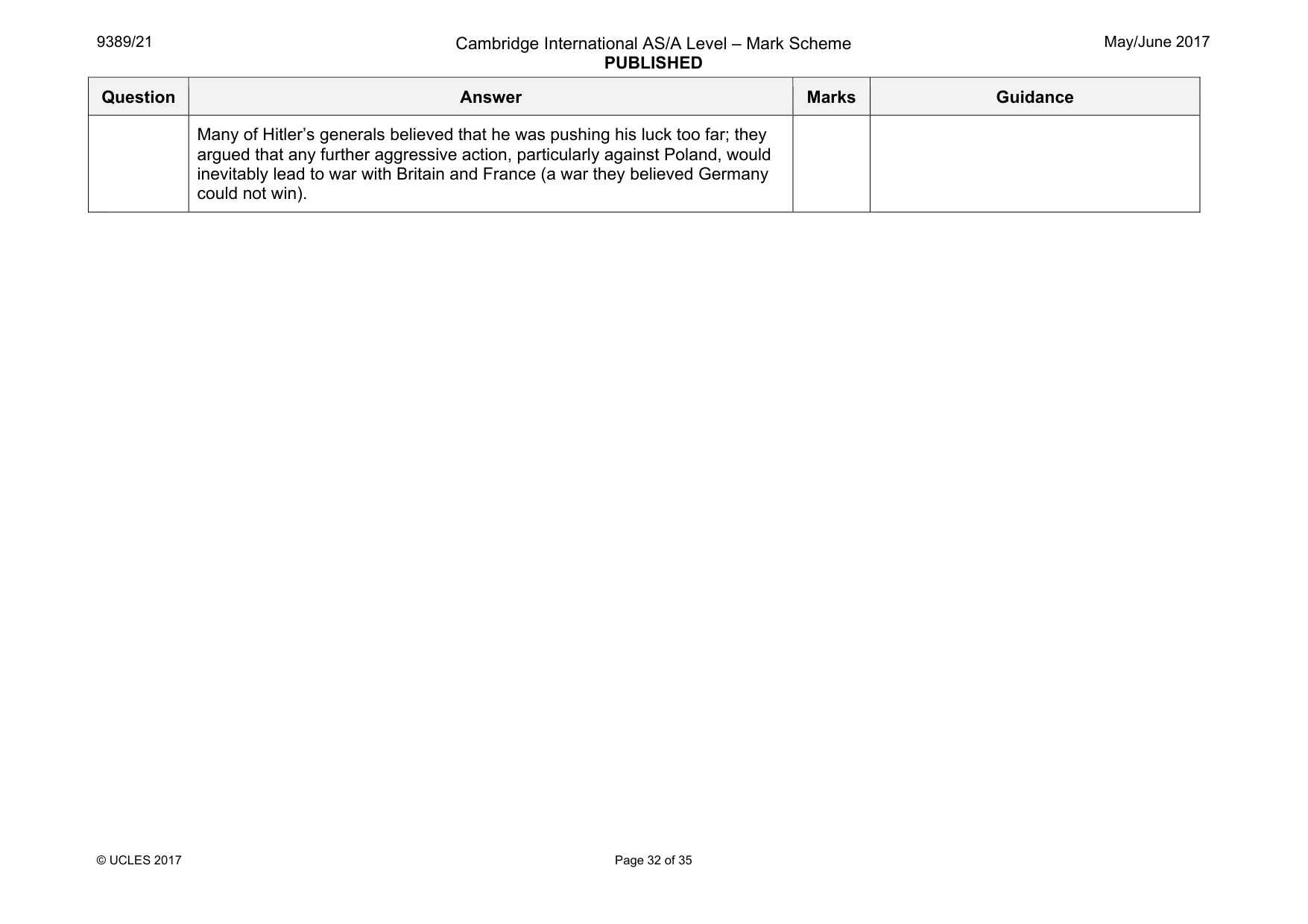
11 International Relations, 1933–1939 (a) Why, by 1934, was Mussolini widely respected by European politicians? [10] (b) ‘In September 1939, Hitler had every reason to believe that Britain would do nothing to defend Poland.’ How far do you agree? [20]
Mark scheme: 11(a) Why, by 1934, was Mussolini widely respected by European politicians? Despite Italian anger over the Paris peace settlement and aggressive acts regarding Fiume and Corfu in 1923, Mussolini followed a largely diplomatic foreign policy between 1923 and 1934. As a result, he gained a reputation as a statesman with whom the other European nations could safely negotiate. He played a key role at the Locarno meetings of 1925, in particular supporting Britain in the agreements reached between Germany, France and Belgium to respect each other’s borders. As a result, Italy was being accepted as a major European country in its own right. Mussolini forged good relations with Britain and established friendly agreements with the neighbouring countries of Greece, Hungary and Albania. Italy became the second European country after Britain to recognise the USSR, and he signed a non-aggression treaty with the Soviets in 1933. Mussolini was, therefore, gaining a reputation as a leader who desired peace and was prepared to work with other countries to ensure it. This reputation was enhanced when, in 1934, Mussolini sent troops to the border with Austria as a clear deterrent to any Nazi-inspired German invasion of the country. In particular, this greatly improved Italy’s relations with France, which was concerned by the growing threat of Nazi Germany. 10 Question Answer Marks Guidance 11(b) ‘In September 1939, Hitler had every reason to believe that Britain would do nothing to defend Poland.’ How far do you agree? Since becoming Chancellor in 1933, Hitler had been able to challenge the Treaty of Versailles unopposed. Despite concern in Europe regarding the growing power of Nazi Germany, Britain and France had done nothing to prevent Hitler from re-arming, taking control of the demilitarised Rhineland, forming Anschluss with Austria and providing military support to Franco in the Spanish Civil War. At Munich in 1938, Britain and France had even allowed Hitler to take the Sudetenland area of Czechoslovakia and, indeed, took no action when Germany subsequently gained control over the whole of a country which had been established by the Paris Peace Settlement. The Munich meeting had convinced Hitler that Chamberlain (British PM) was weak and would do anything to avoid involving Britain in another war. He believed that, without British help, the French would also do nothing to oppose him. Hitler’s long-term intention to invade Russia (lebensraum) was well-known, and Hitler could see no reason why Britain and France would want to defend a country whose communism they feared. If Britain had done nothing to protect Czechoslovakia, why would it support Poland, especially if the German invasion of Poland was a precursor to an attack on Russia? Prior to 1938, Hitler had been able to argue that his foreign policy actions were merely designed to right the wrongs of the Treaty of Versailles. Chamberlain had clearly accepted this at Munich, where he condoned German occupation of the Sudetenland because of its predominance of German speaking people. Hitler’s acquisition of the whole of Czechoslovakia was different – he had seized territory over which Germany had no justifiable right and, in the process, broken promises which he had made at Munich. Even Chamberlain, who had been such a strong advocate of appeasement, adopted a more confrontational approach to Hitler. Chamberlain warned Hitler that any future aggression by Germany would be opposed by Britain, which introduced conscription. When Hitler’s intention to invade Poland became clear with the signing of the Nazi-Soviet Pact, Britain guaranteed support for Poland. 20 Question Answer Marks Guidance Many of Hitler’s generals believed that he was pushing his luck too far; they argued that any further aggressive action, particularly against Poland, would inevitably lead to war with Britain and France (a war they believed Germany could not win).
Q12 · China and Japan, 1919–1945 (a) Why did support for Chinese nationalism increase after…
12 China and Japan, 1919–1945 (a) Why did support for Chinese nationalism increase after 1918? [10] (b) How far was Emperor Hirohito responsible for Japan becoming a military dictatorship in the 1930s? [20]
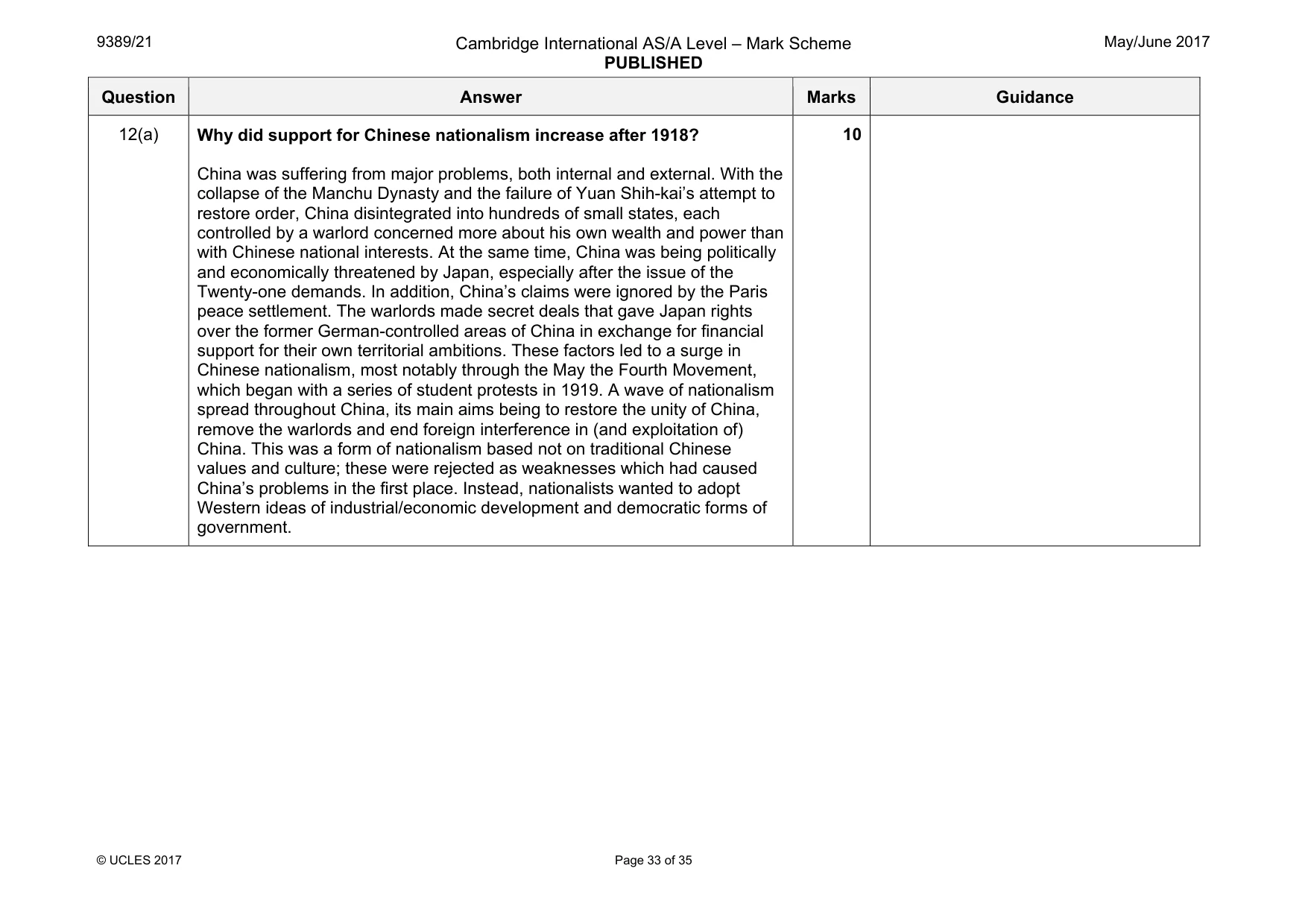
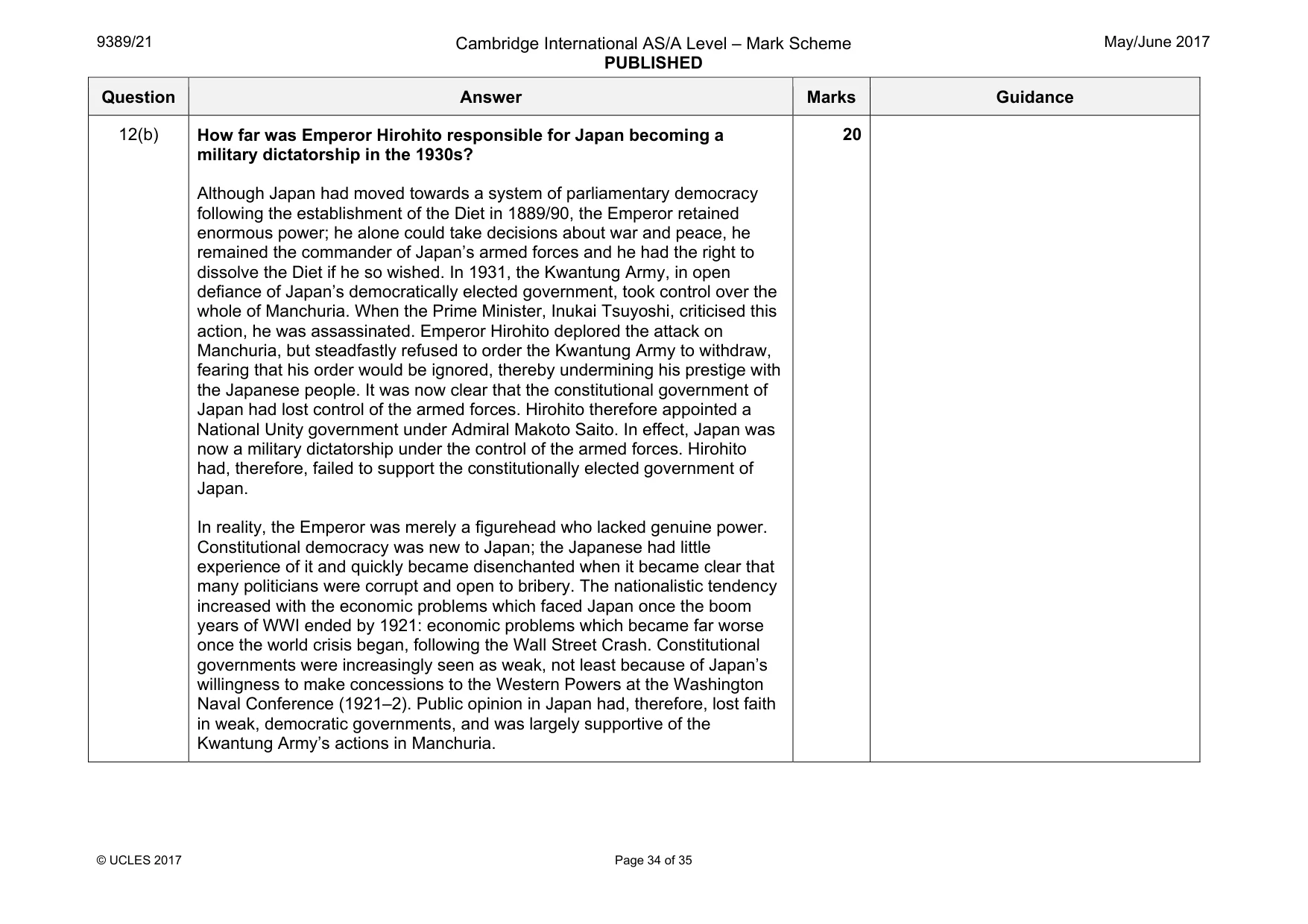
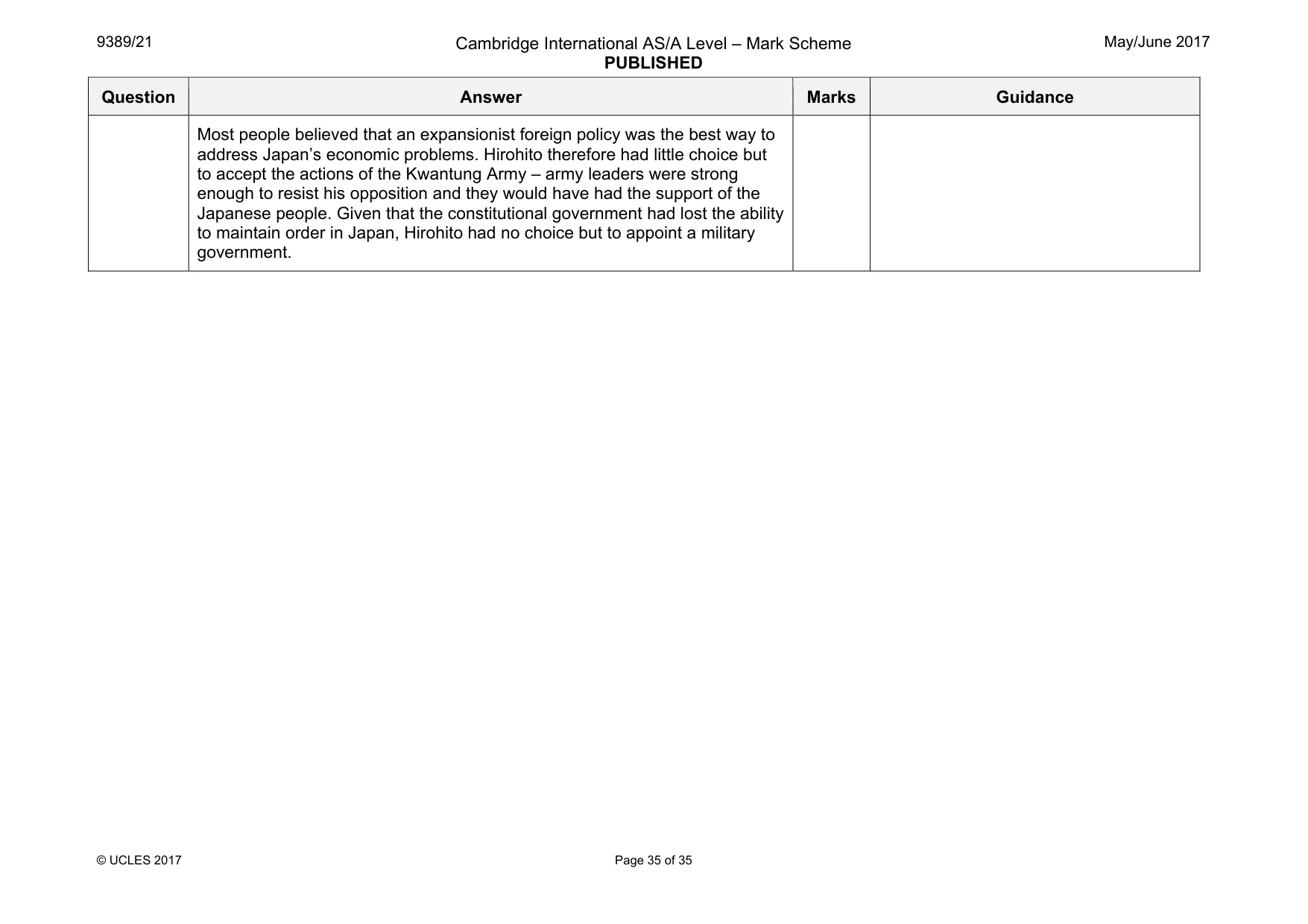
Mark scheme: 12(a) Why did support for Chinese nationalism increase after 1918? China was suffering from major problems, both internal and external. With the collapse of the Manchu Dynasty and the failure of Yuan Shih-kai’s attempt to restore order, China disintegrated into hundreds of small states, each controlled by a warlord concerned more about his own wealth and power than with Chinese national interests. At the same time, China was being politically and economically threatened by Japan, especially after the issue of the Twenty-one demands. In addition, China’s claims were ignored by the Paris peace settlement. The warlords made secret deals that gave Japan rights over the former German-controlled areas of China in exchange for financial support for their own territorial ambitions. These factors led to a surge in Chinese nationalism, most notably through the May the Fourth Movement, which began with a series of student protests in 1919. A wave of nationalism spread throughout China, its main aims being to restore the unity of China, remove the warlords and end foreign interference in (and exploitation of) China. This was a form of nationalism based not on traditional Chinese values and culture; these were rejected as weaknesses which had caused China’s problems in the first place. Instead, nationalists wanted to adopt Western ideas of industrial/economic development and democratic forms of government. 10 Question Answer Marks Guidance 12(b) How far was Emperor Hirohito responsible for Japan becoming a military dictatorship in the 1930s? Although Japan had moved towards a system of parliamentary democracy following the establishment of the Diet in 1889/90, the Emperor retained enormous power; he alone could take decisions about war and peace, he remained the commander of Japan’s armed forces and he had the right to dissolve the Diet if he so wished. In 1931, the Kwantung Army, in open defiance of Japan’s democratically elected government, took control over the whole of Manchuria. When the Prime Minister, Inukai Tsuyoshi, criticised this action, he was assassinated. Emperor Hirohito deplored the attack on Manchuria, but steadfastly refused to order the Kwantung Army to withdraw, fearing that his order would be ignored, thereby undermining his prestige with the Japanese people. It was now clear that the constitutional government of Japan had lost control of the armed forces. Hirohito therefore appointed a National Unity government under Admiral Makoto Saito. In effect, Japan was now a military dictatorship under the control of the armed forces. Hirohito had, therefore, failed to support the constitutionally elected government of Japan. In reality, the Emperor was merely a figurehead who lacked genuine power. Constitutional democracy was new to Japan; the Japanese had little experience of it and quickly became disenchanted when it became clear that many politicians were corrupt and open to bribery. The nationalistic tendency increased with the economic problems which faced Japan once the boom years of WWI ended by 1921: economic problems which became far worse once the world crisis began, following the Wall Street Crash. Constitutional governments were increasingly seen as weak, not least because of Japan’s willingness to make concessions to the Western Powers at the Washington Naval Conference (1921–2). Public opinion in Japan had, therefore, lost faith in weak, democratic governments, and was largely supportive of the Kwantung Army’s actions in Manchuria. 20 Question Answer Marks Guidance Most people believed that an expansionist foreign policy was the best way to address Japan’s economic problems. Hirohito therefore had little choice but to accept the actions of the Kwantung Army – army leaders were strong enough to resist his opposition and they would have had the support of the Japanese people. Given that the constitutional government had lost the ability to maintain order in Japan, Hirohito had no choice but to appoint a military government.
What you needed in this session
Cambridge’s own grade thresholds for 2017 May/June, Paper 2 · Variant 1. A higher threshold means an easier paper — the bar moves with how the cohort did.