Cambridge A Level History 9389 — 2020 Oct/Nov Paper 2 · Variant 2
9389/22/O/N/20 · 12 questions · 60 marks · ≈68 min
The question paper and its mark scheme, free to read here and free to download. This is Cambridge’s own paper, exactly as it was sat.
Question paper4 pages
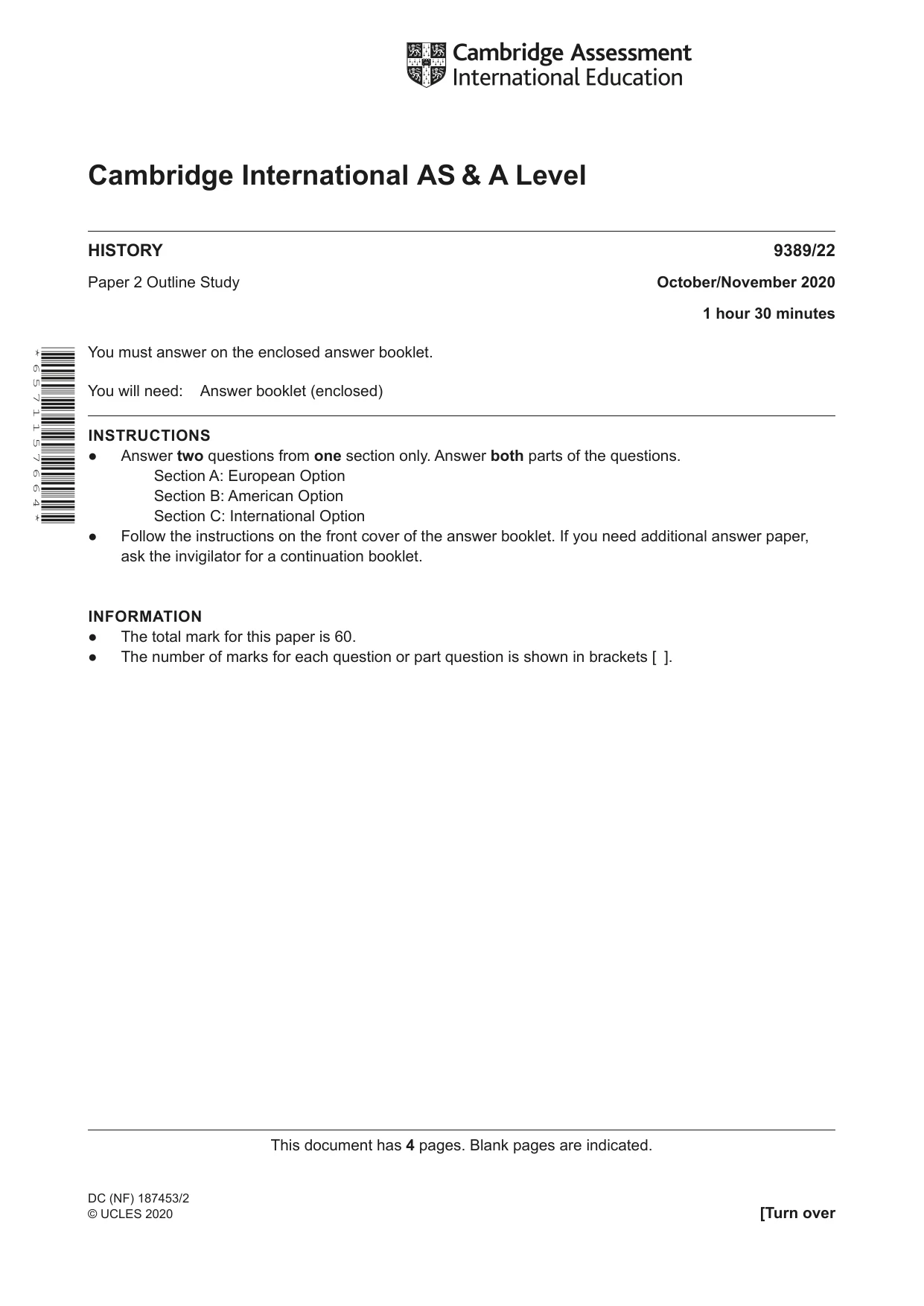
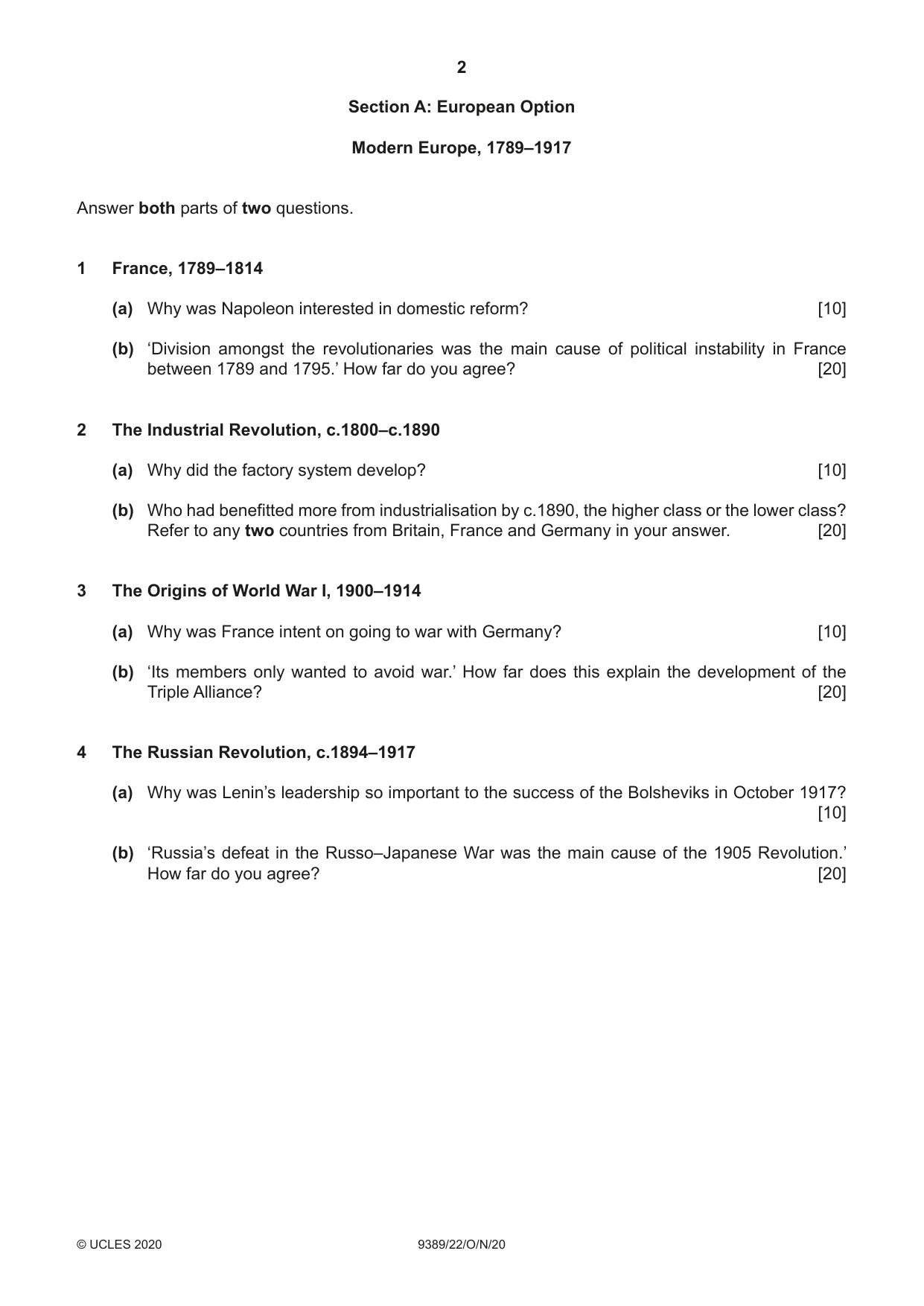
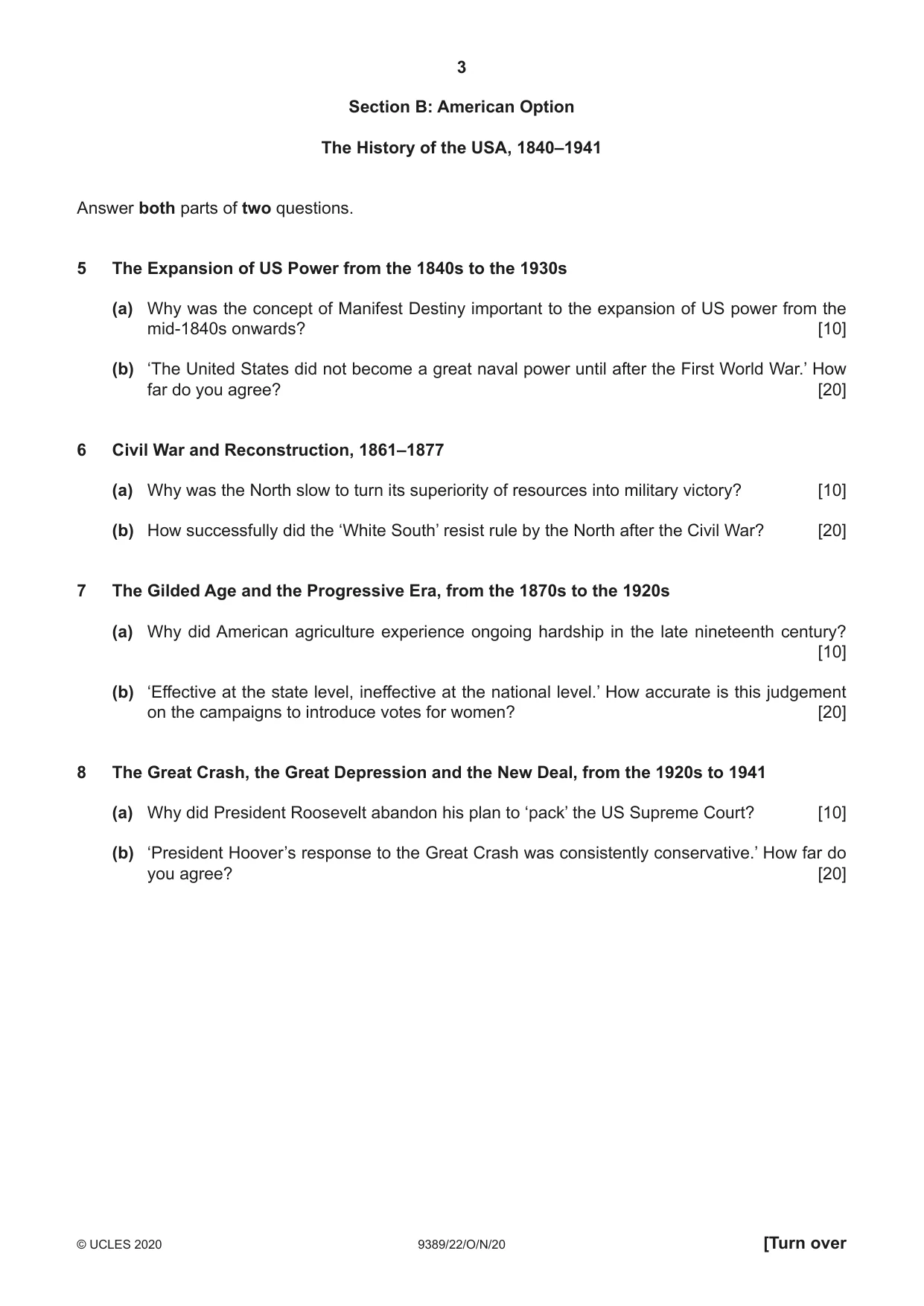
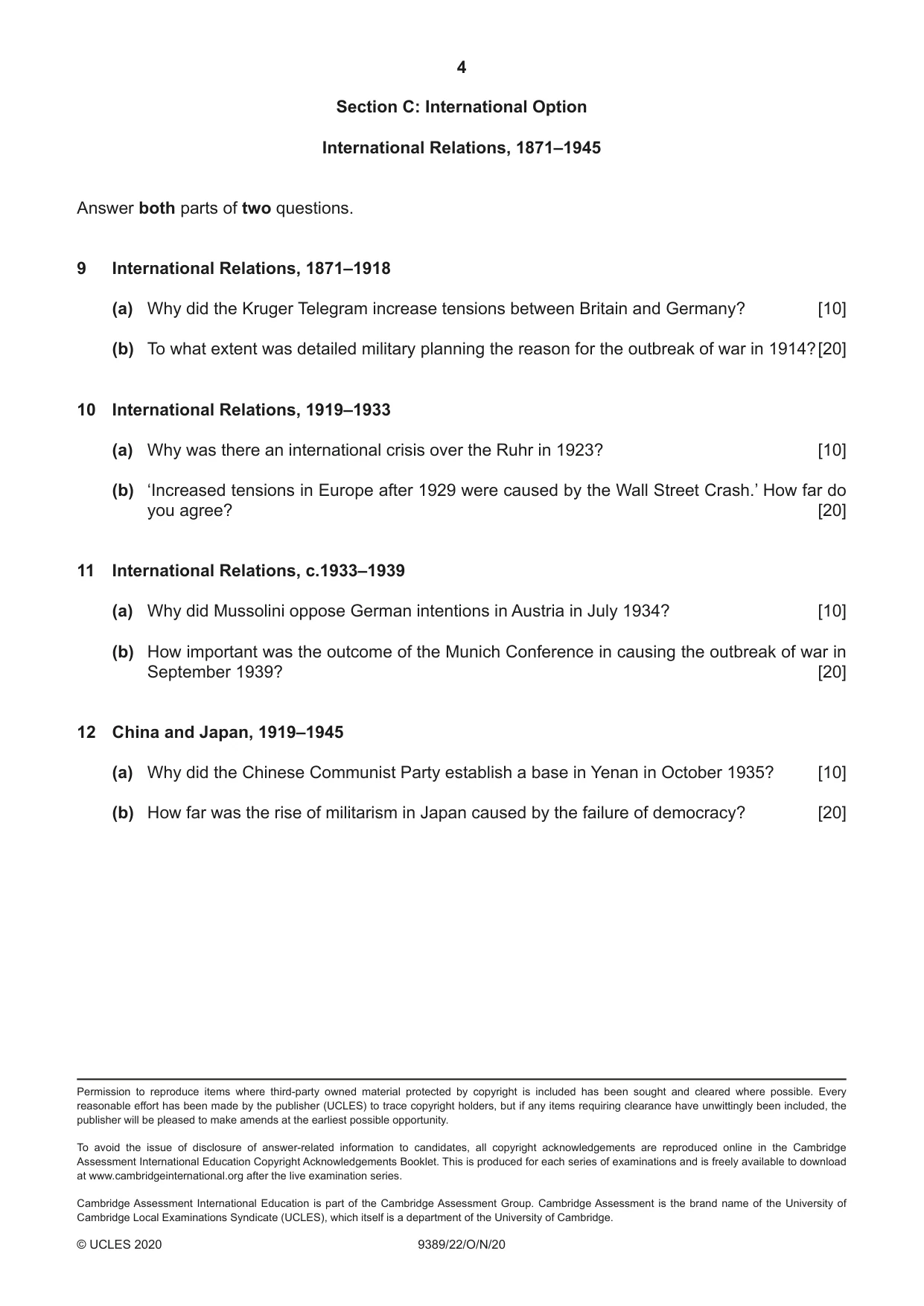
Mark scheme16 pages
Answers below. Sit the paper first if you are practising.

Questions as text
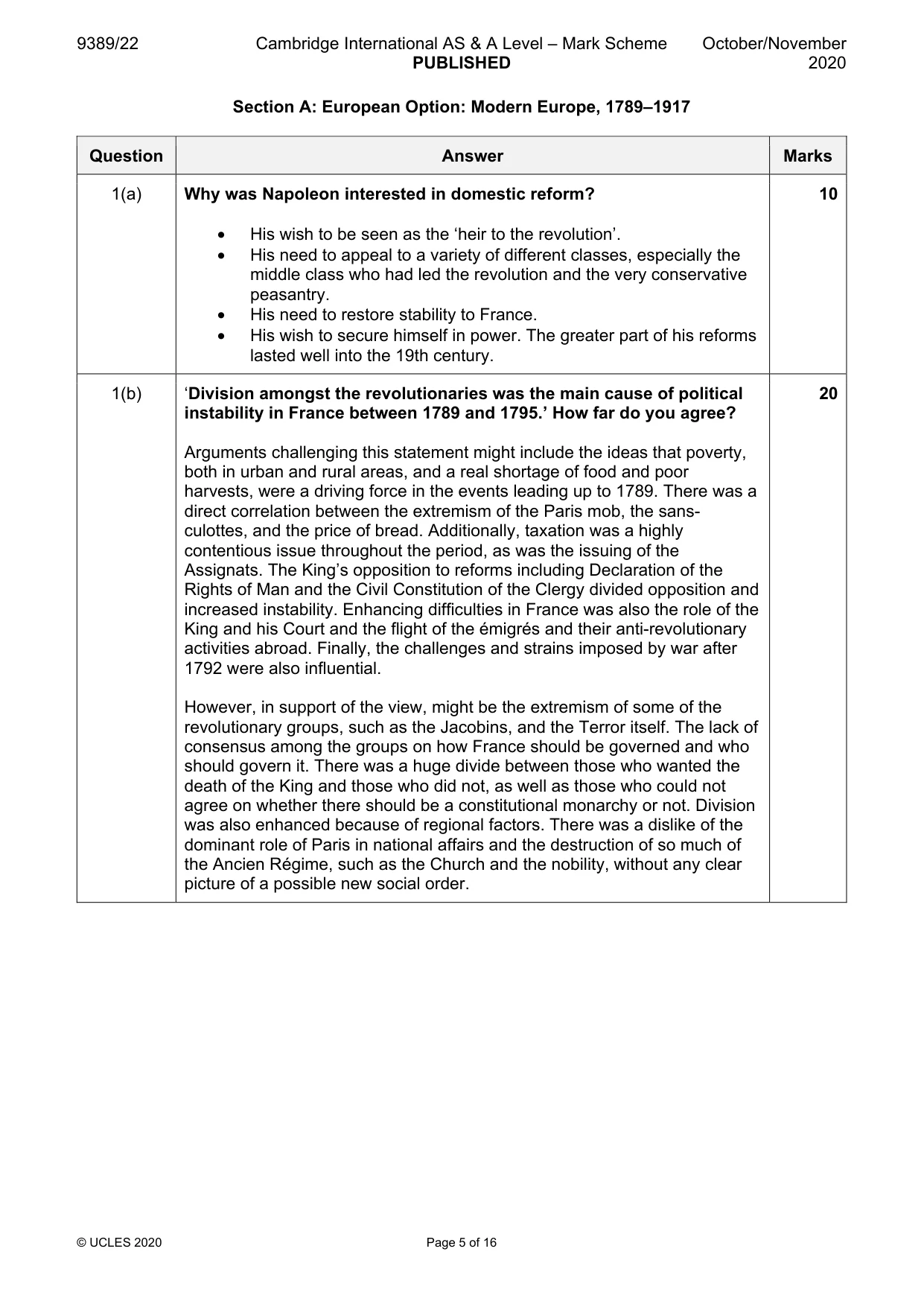
Q1 · France, 1789–1814 (a) Why was Napoleon interested in domestic reform?
1 France, 1789–1814 (a) Why was Napoleon interested in domestic reform? [10] (b) ‘Division amongst the revolutionaries was the main cause of political instability in France between 1789 and 1795.’ How far do you agree? [20]
Mark scheme: Question Answer Marks 1(a) Why was Napoleon interested in domestic reform? 10 • His wish to be seen as the ‘heir to the revolution’. • His need to appeal to a variety of different classes, especially the middle class who had led the revolution and the very conservative peasantry. • His need to restore stability to France. • His wish to secure himself in power. The greater part of his reforms lasted well into the 19th century. 1(b) ‘Division amongst the revolutionaries was the main cause of political 20 instability in France between 1789 and 1795.’ How far do you agree? Arguments challenging this statement might include the ideas that poverty, both in urban and rural areas, and a real shortage of food and poor harvests, were a driving force in the events leading up to 1789. There was a direct correlation between the extremism of the Paris mob, the sans- culottes, and the price of bread. Additionally, taxation was a highly contentious issue throughout the period, as was the issuing of the Assignats. The King’s opposition to reforms including Declaration of the Rights of Man and the Civil Constitution of the Clergy divided opposition and increased instability. Enhancing difficulties in France was also the role of the King and his Court and the flight of the émigrés and their anti-revolutionary activities abroad. Finally, the challenges and strains imposed by war after 1792 were also influential. However, in support of the view, might be the extremism of some of the revolutionary groups, such as the Jacobins, and the Terror itself. The lack of consensus among the groups on how France should be governed and who should govern it. There was a huge divide between those who wanted the death of the King and those who did not, as well as those who could not agree on whether there should be a constitutional monarchy or not. Division was also enhanced because of regional factors. There was a dislike of the dominant role of Paris in national affairs and the destruction of so much of the Ancien Régime, such as the Church and the nobility, without any clear picture of a possible new social order.
Q2 · The Industrial Revolution, c.1800–c.1890 (a) Why did the factory system develop?
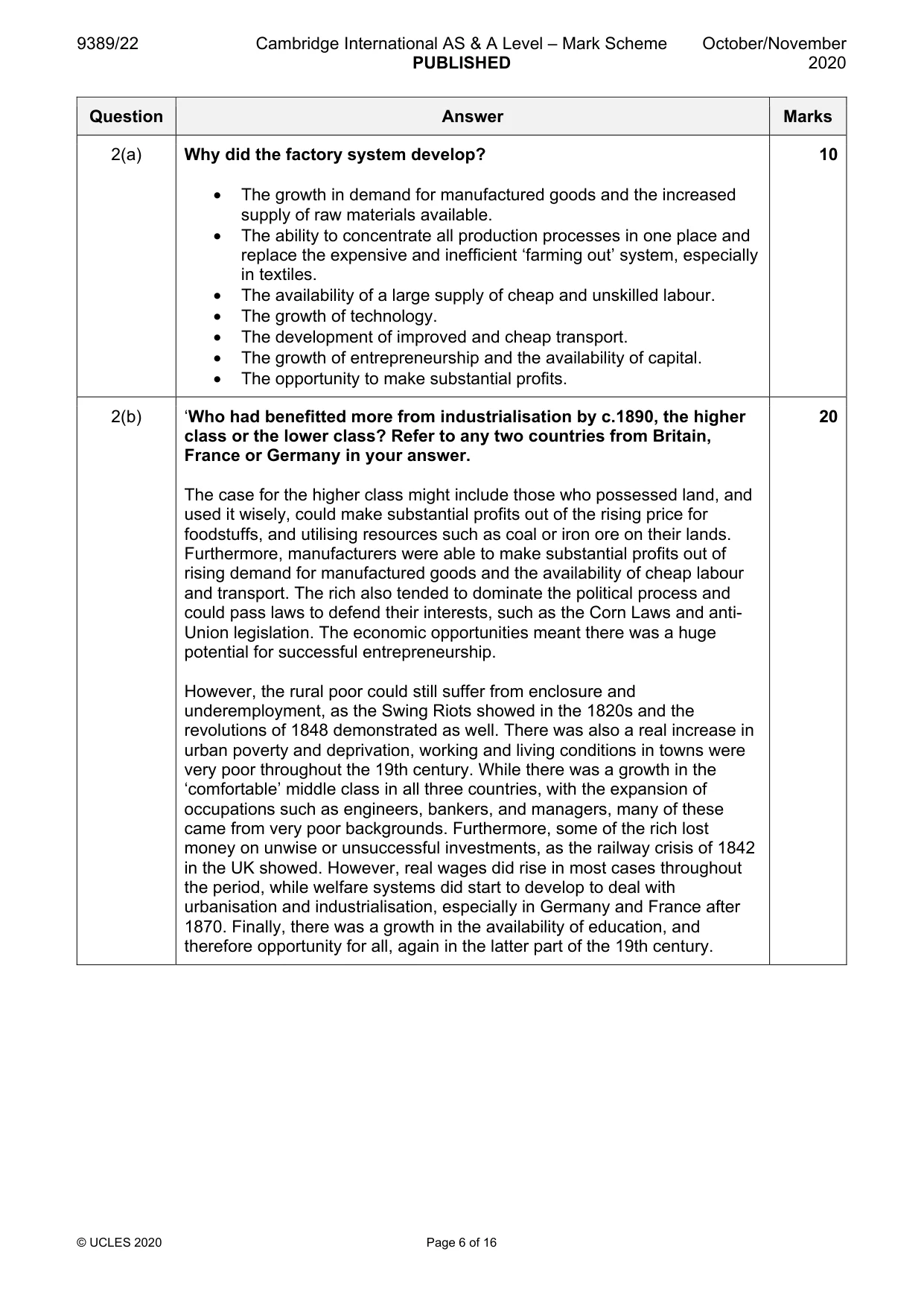
2 The Industrial Revolution, c.1800–c.1890 (a) Why did the factory system develop? [10] (b) Who had benefitted more from industrialisation by c.1890, the higher class or the lower class? Refer to any two countries from Britain, France and Germany in your answer. [20]
Mark scheme: 2(a) Why did the factory system develop? 10 • The growth in demand for manufactured goods and the increased supply of raw materials available. • The ability to concentrate all production processes in one place and replace the expensive and inefficient ‘farming out’ system, especially in textiles. • The availability of a large supply of cheap and unskilled labour. • The growth of technology. • The development of improved and cheap transport. • The growth of entrepreneurship and the availability of capital. • The opportunity to make substantial profits. 2(b) ‘Who had benefitted more from industrialisation by c.1890, the higher 20 class or the lower class? Refer to any two countries from Britain, France or Germany in your answer. The case for the higher class might include those who possessed land, and used it wisely, could make substantial profits out of the rising price for foodstuffs, and utilising resources such as coal or iron ore on their lands. Furthermore, manufacturers were able to make substantial profits out of rising demand for manufactured goods and the availability of cheap labour and transport. The rich also tended to dominate the political process and could pass laws to defend their interests, such as the Corn Laws and anti- Union legislation. The economic opportunities meant there was a huge potential for successful entrepreneurship. However, the rural poor could still suffer from enclosure and underemployment, as the Swing Riots showed in the 1820s and the revolutions of 1848 demonstrated as well. There was also a real increase in urban poverty and deprivation, working and living conditions in towns were very poor throughout the 19th century. While there was a growth in the ‘comfortable’ middle class in all three countries, with the expansion of occupations such as engineers, bankers, and managers, many of these came from very poor backgrounds. Furthermore, some of the rich lost money on unwise or unsuccessful investments, as the railway crisis of 1842 in the UK showed. However, real wages did rise in most cases throughout the period, while welfare systems did start to develop to deal with urbanisation and industrialisation, especially in Germany and France after 1870. Finally, there was a growth in the availability of education, and therefore opportunity for all, again in the latter part of the 19th century.
Q3 · The Origins of World War I, 1900–1914 (a) Why was France intent on going to war with…
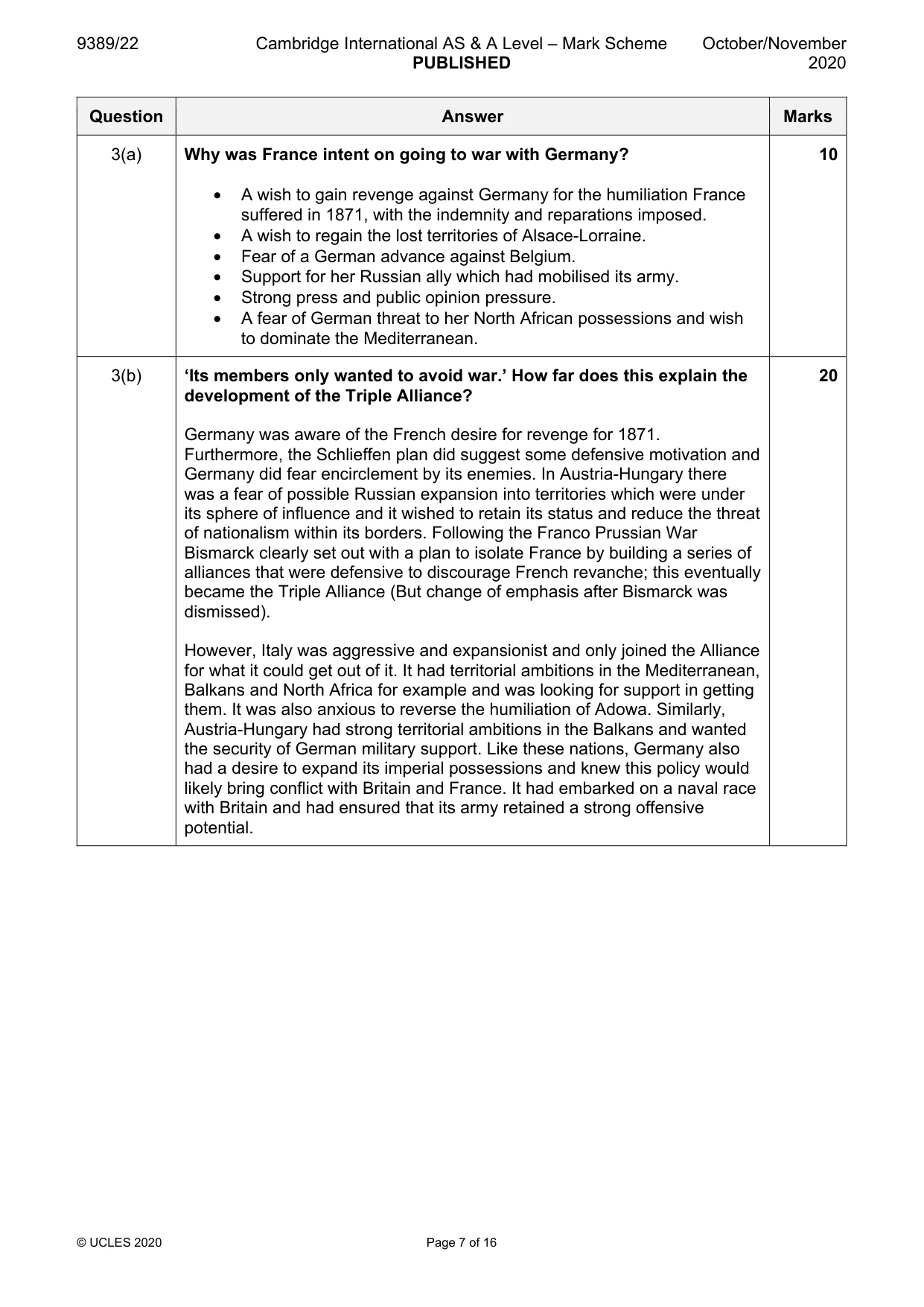
3 The Origins of World War I, 1900–1914 (a) Why was France intent on going to war with Germany? [10] (b) ‘Its members only wanted to avoid war.’ How far does this explain the development of the Triple Alliance? [20]
Mark scheme: 3(a) Why was France intent on going to war with Germany? 10 • A wish to gain revenge against Germany for the humiliation France suffered in 1871, with the indemnity and reparations imposed. • A wish to regain the lost territories of Alsace-Lorraine. • Fear of a German advance against Belgium. • Support for her Russian ally which had mobilised its army. • Strong press and public opinion pressure. • A fear of German threat to her North African possessions and wish to dominate the Mediterranean. 3(b) ‘Its members only wanted to avoid war.’ How far does this explain the 20 development of the Triple Alliance? Germany was aware of the French desire for revenge for 1871. Furthermore, the Schlieffen plan did suggest some defensive motivation and Germany did fear encirclement by its enemies. In Austria-Hungary there was a fear of possible Russian expansion into territories which were under its sphere of influence and it wished to retain its status and reduce the threat of nationalism within its borders. Following the Franco Prussian War Bismarck clearly set out with a plan to isolate France by building a series of alliances that were defensive to discourage French revanche; this eventually became the Triple Alliance (But change of emphasis after Bismarck was dismissed). However, Italy was aggressive and expansionist and only joined the Alliance for what it could get out of it. It had territorial ambitions in the Mediterranean, Balkans and North Africa for example and was looking for support in getting them. It was also anxious to reverse the humiliation of Adowa. Similarly, Austria-Hungary had strong territorial ambitions in the Balkans and wanted the security of German military support. Like these nations, Germany also had a desire to expand its imperial possessions and knew this policy would likely bring conflict with Britain and France. It had embarked on a naval race with Britain and had ensured that its army retained a strong offensive potential.
Q4 · The Russian Revolution, c.1894–1917 (a) Why was Lenin’s leadership so important to the…
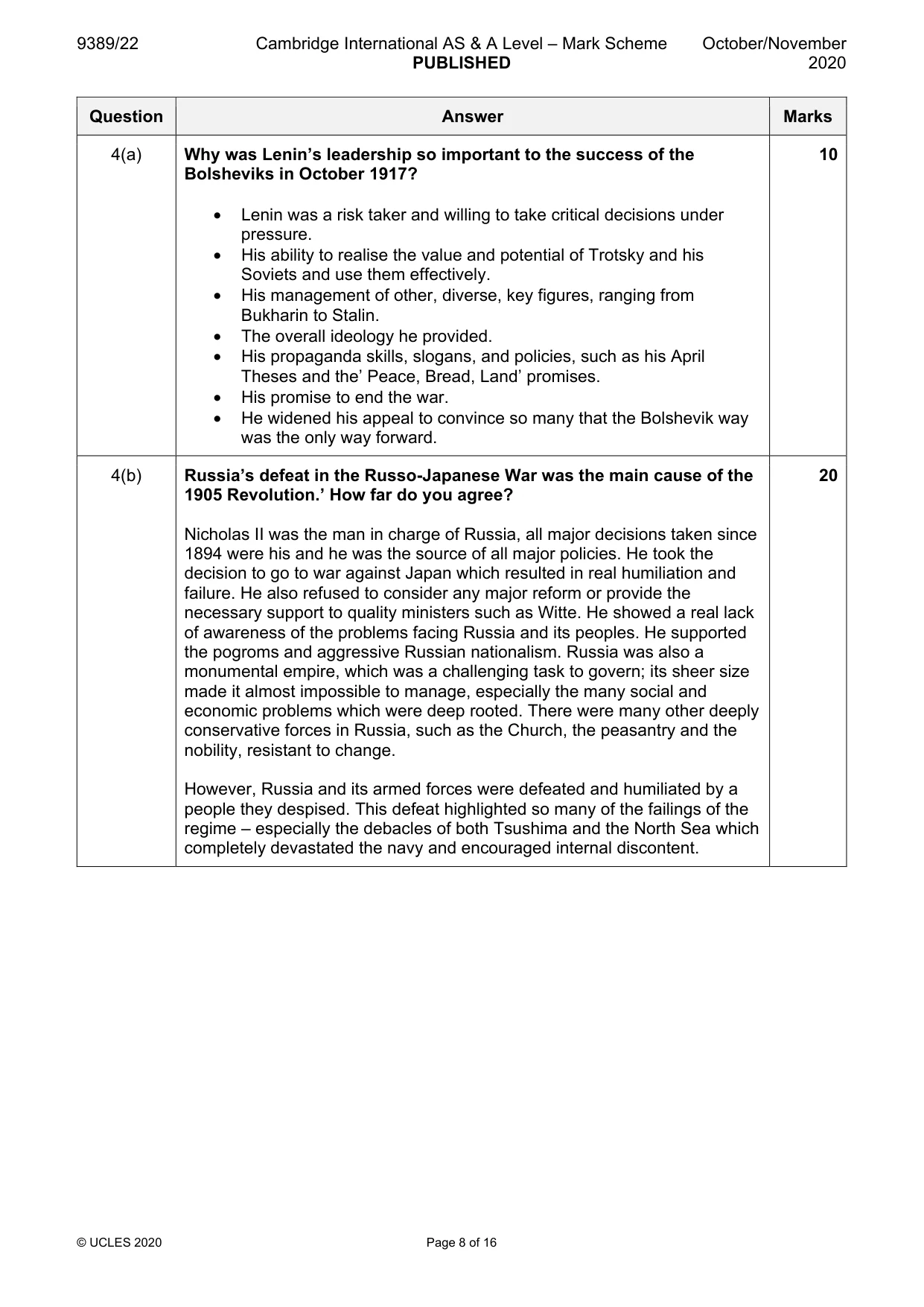
4 The Russian Revolution, c.1894–1917 (a) Why was Lenin’s leadership so important to the success of the Bolsheviks in October 1917? [10] (b) ‘Russia’s defeat in the Russo–Japanese War was the main cause of the 1905 Revolution.’ How far do you agree? [20]
Mark scheme: 4(a) Why was Lenin’s leadership so important to the success of the 10 Bolsheviks in October 1917? • Lenin was a risk taker and willing to take critical decisions under pressure. • His ability to realise the value and potential of Trotsky and his Soviets and use them effectively. • His management of other, diverse, key figures, ranging from Bukharin to Stalin. • The overall ideology he provided. • His propaganda skills, slogans, and policies, such as his April Theses and the’ Peace, Bread, Land’ promises. • His promise to end the war. • He widened his appeal to convince so many that the Bolshevik way was the only way forward. 4(b) Russia’s defeat in the Russo-Japanese War was the main cause of the 20 1905 Revolution.’ How far do you agree? Nicholas II was the man in charge of Russia, all major decisions taken since 1894 were his and he was the source of all major policies. He took the decision to go to war against Japan which resulted in real humiliation and failure. He also refused to consider any major reform or provide the necessary support to quality ministers such as Witte. He showed a real lack of awareness of the problems facing Russia and its peoples. He supported the pogroms and aggressive Russian nationalism. Russia was also a monumental empire, which was a challenging task to govern; its sheer size made it almost impossible to manage, especially the many social and economic problems which were deep rooted. There were many other deeply conservative forces in Russia, such as the Church, the peasantry and the nobility, resistant to change. However, Russia and its armed forces were defeated and humiliated by a people they despised. This defeat highlighted so many of the failings of the regime – especially the debacles of both Tsushima and the North Sea which completely devastated the navy and encouraged internal discontent. Section B: American Option: The History of the USA, 1840–1941
Q5 · The Expansion of US Power from the 1840s to the 1930s (a) Why was the concept of Manifest…
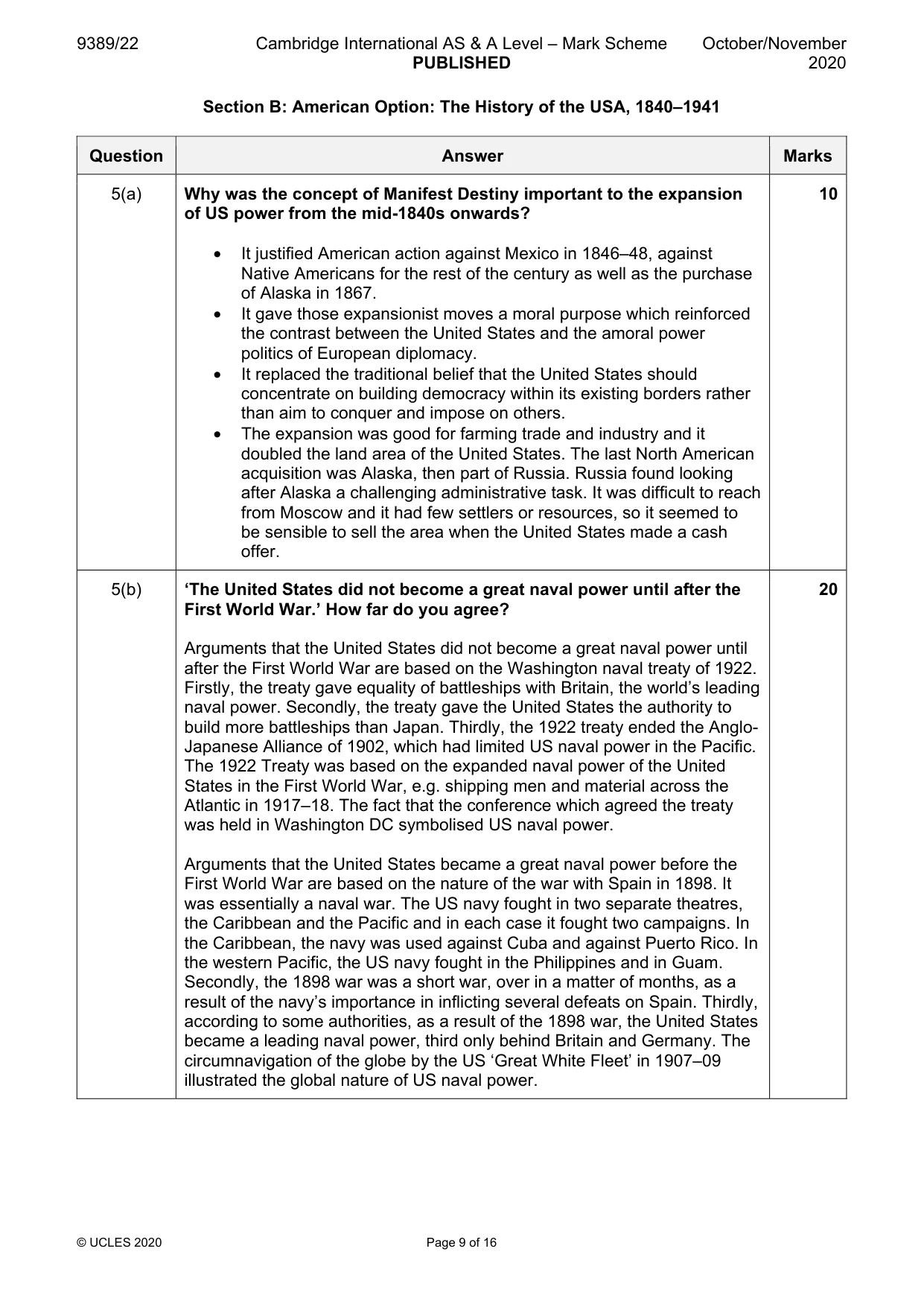
5 The Expansion of US Power from the 1840s to the 1930s (a) Why was the concept of Manifest Destiny important to the expansion of US power from the mid-1840s onwards? [10] (b) ‘The United States did not become a great naval power until after the First World War.’ How far do you agree? [20]
Mark scheme: 5(a) Why was the concept of Manifest Destiny important to the expansion 10 of US power from the mid-1840s onwards? • It justified American action against Mexico in 1846–48, against Native Americans for the rest of the century as well as the purchase of Alaska in 1867. • It gave those expansionist moves a moral purpose which reinforced the contrast between the United States and the amoral power politics of European diplomacy. • It replaced the traditional belief that the United States should concentrate on building democracy within its existing borders rather than aim to conquer and impose on others. • The expansion was good for farming trade and industry and it doubled the land area of the United States. The last North American acquisition was Alaska, then part of Russia. Russia found looking after Alaska a challenging administrative task. It was difficult to reach from Moscow and it had few settlers or resources, so it seemed to be sensible to sell the area when the United States made a cash offer. 5(b) ‘The United States did not become a great naval power until after the 20 First World War.’ How far do you agree? Arguments that the United States did not become a great naval power until after the First World War are based on the Washington naval treaty of 1922. Firstly, the treaty gave equality of battleships with Britain, the world’s leading naval power. Secondly, the treaty gave the United States the authority to build more battleships than Japan. Thirdly, the 1922 treaty ended the Anglo- Japanese Alliance of 1902, which had limited US naval power in the Pacific. The 1922 Treaty was based on the expanded naval power of the United States in the First World War, e.g. shipping men and material across the Atlantic in 1917–18. The fact that the conference which agreed the treaty was held in Washington DC symbolised US naval power. Arguments that the United States became a great naval power before the First World War are based on the nature of the war with Spain in 1898. It was essentially a naval war. The US navy fought in two separate theatres, the Caribbean and the Pacific and in each case it fought two campaigns. In the Caribbean, the navy was used against Cuba and against Puerto Rico. In the western Pacific, the US navy fought in the Philippines and in Guam. Secondly, the 1898 war was a short war, over in a matter of months, as a result of the navy’s importance in inflicting several defeats on Spain. Thirdly, according to some authorities, as a result of the 1898 war, the United States became a leading naval power, third only behind Britain and Germany. The circumnavigation of the globe by the US ‘Great White Fleet’ in 1907–09 illustrated the global nature of US naval power.
Q6 · Civil War and Reconstruction, 1861–1877 (a) Why was the North slow to turn its…
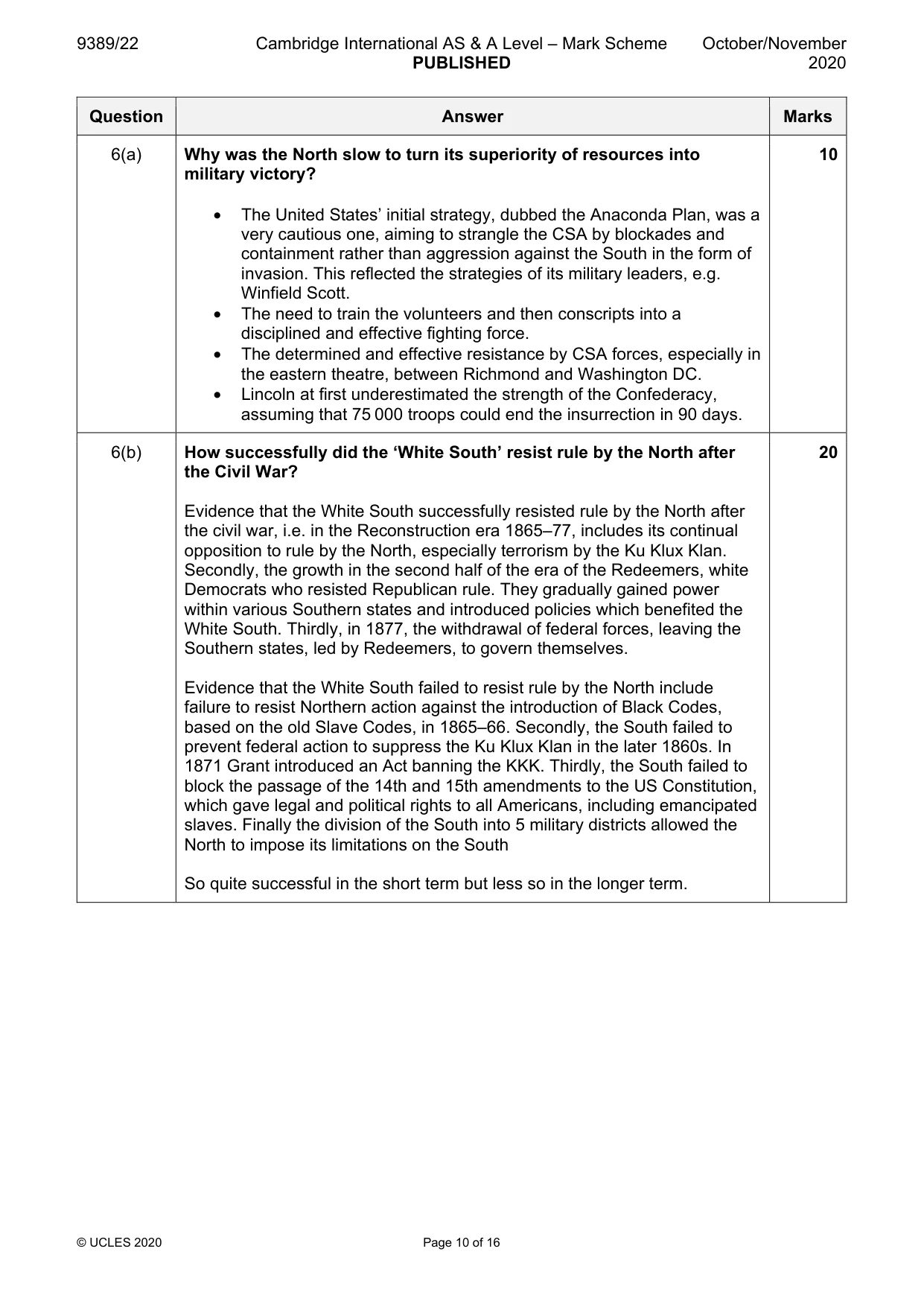
6 Civil War and Reconstruction, 1861–1877 (a) Why was the North slow to turn its superiority of resources into military victory? [10] (b) How successfully did the ‘White South’ resist rule by the North after the Civil War? [20]
Mark scheme: 6(a) Why was the North slow to turn its superiority of resources into 10 military victory? • The United States’ initial strategy, dubbed the Anaconda Plan, was a very cautious one, aiming to strangle the CSA by blockades and containment rather than aggression against the South in the form of invasion. This reflected the strategies of its military leaders, e.g. Winfield Scott. • The need to train the volunteers and then conscripts into a disciplined and effective fighting force. • The determined and effective resistance by CSA forces, especially in the eastern theatre, between Richmond and Washington DC. • Lincoln at first underestimated the strength of the Confederacy, assuming that 75 000 troops could end the insurrection in 90 days. 6(b) How successfully did the ‘White South’ resist rule by the North after 20 the Civil War? Evidence that the White South successfully resisted rule by the North after the civil war, i.e. in the Reconstruction era 1865–77, includes its continual opposition to rule by the North, especially terrorism by the Ku Klux Klan. Secondly, the growth in the second half of the era of the Redeemers, white Democrats who resisted Republican rule. They gradually gained power within various Southern states and introduced policies which benefited the White South. Thirdly, in 1877, the withdrawal of federal forces, leaving the Southern states, led by Redeemers, to govern themselves. Evidence that the White South failed to resist rule by the North include failure to resist Northern action against the introduction of Black Codes, based on the old Slave Codes, in 1865–66. Secondly, the South failed to prevent federal action to suppress the Ku Klux Klan in the later 1860s. In 1871 Grant introduced an Act banning the KKK. Thirdly, the South failed to block the passage of the 14th and 15th amendments to the US Constitution, which gave legal and political rights to all Americans, including emancipated slaves. Finally the division of the South into 5 military districts allowed the North to impose its limitations on the South So quite successful in the short term but less so in the longer term.
Q7 · The Gilded Age and the Progressive Era, from the 1870s to the 1920s (a) Why did American…
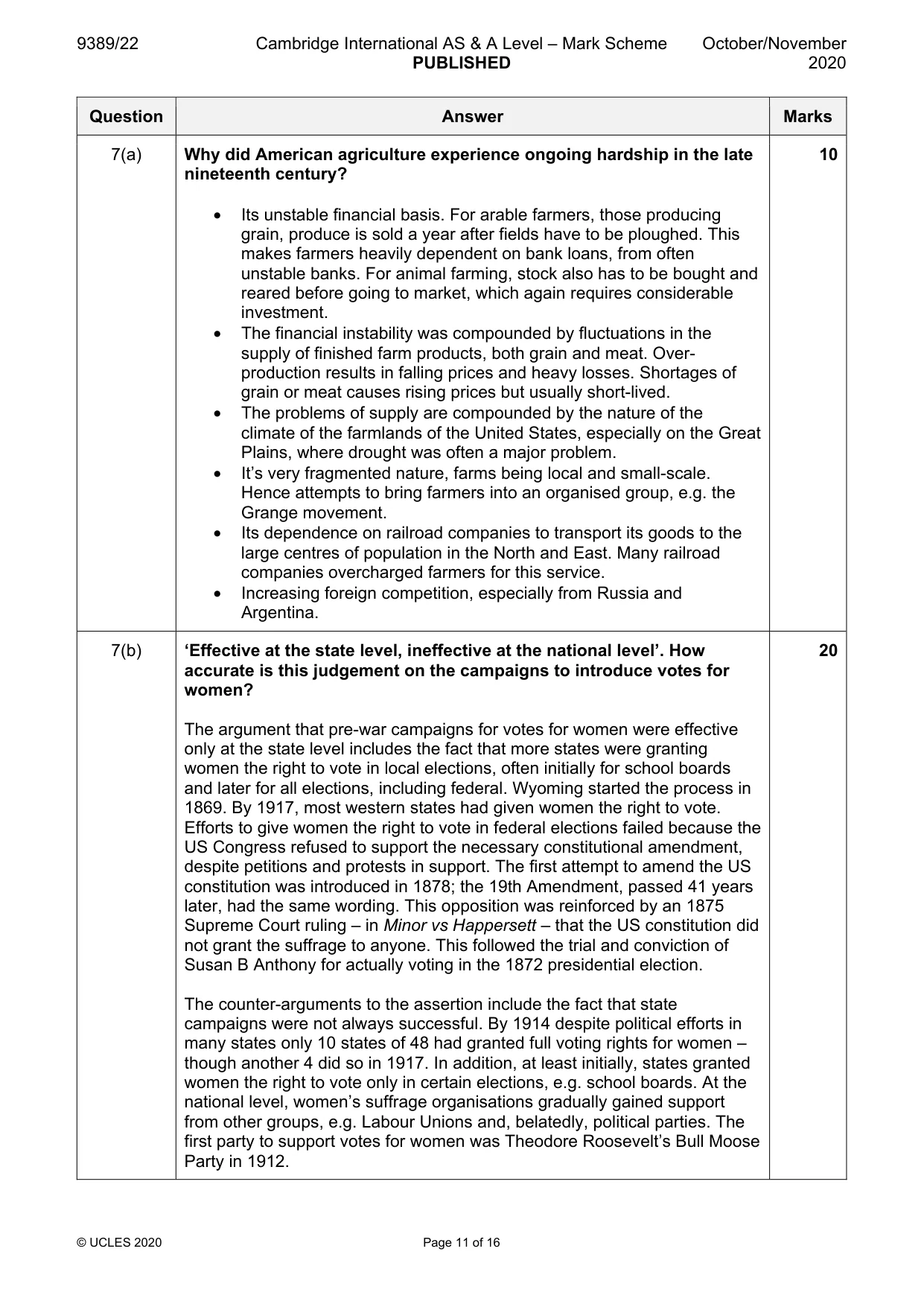
7 The Gilded Age and the Progressive Era, from the 1870s to the 1920s (a) Why did American agriculture experience ongoing hardship in the late nineteenth century? [10] (b) ‘Effective at the state level, ineffective at the national level.’ How accurate is this judgement on the campaigns to introduce votes for women? [20]
Mark scheme: 7(a) Why did American agriculture experience ongoing hardship in the late 10 nineteenth century? • Its unstable financial basis. For arable farmers, those producing grain, produce is sold a year after fields have to be ploughed. This makes farmers heavily dependent on bank loans, from often unstable banks. For animal farming, stock also has to be bought and reared before going to market, which again requires considerable investment. • The financial instability was compounded by fluctuations in the supply of finished farm products, both grain and meat. Over- production results in falling prices and heavy losses. Shortages of grain or meat causes rising prices but usually short-lived. • The problems of supply are compounded by the nature of the climate of the farmlands of the United States, especially on the Great Plains, where drought was often a major problem. • It’s very fragmented nature, farms being local and small-scale. Hence attempts to bring farmers into an organised group, e.g. the Grange movement. • Its dependence on railroad companies to transport its goods to the large centres of population in the North and East. Many railroad companies overcharged farmers for this service. • Increasing foreign competition, especially from Russia and Argentina. 7(b) ‘Effective at the state level, ineffective at the national level’. How 20 accurate is this judgement on the campaigns to introduce votes for women? The argument that pre-war campaigns for votes for women were effective only at the state level includes the fact that more states were granting women the right to vote in local elections, often initially for school boards and later for all elections, including federal. Wyoming started the process in 1869. By 1917, most western states had given women the right to vote. Efforts to give women the right to vote in federal elections failed because the US Congress refused to support the necessary constitutional amendment, despite petitions and protests in support. The first attempt to amend the US constitution was introduced in 1878; the 19th Amendment, passed 41 years later, had the same wording. This opposition was reinforced by an 1875 Supreme Court ruling – in Minor vs Happersett – that the US constitution did not grant the suffrage to anyone. This followed the trial and conviction of Susan B Anthony for actually voting in the 1872 presidential election. The counter-arguments to the assertion include the fact that state campaigns were not always successful. By 1914 despite political efforts in many states only 10 states of 48 had granted full voting rights for women – though another 4 did so in 1917. In addition, at least initially, states granted women the right to vote only in certain elections, e.g. school boards. At the national level, women’s suffrage organisations gradually gained support from other groups, e.g. Labour Unions and, belatedly, political parties. The first party to support votes for women was Theodore Roosevelt’s Bull Moose Party in 1912.
Q8 · The Great Crash, the Great Depression and the New Deal, from the 1920s to 1941 (a) Why…
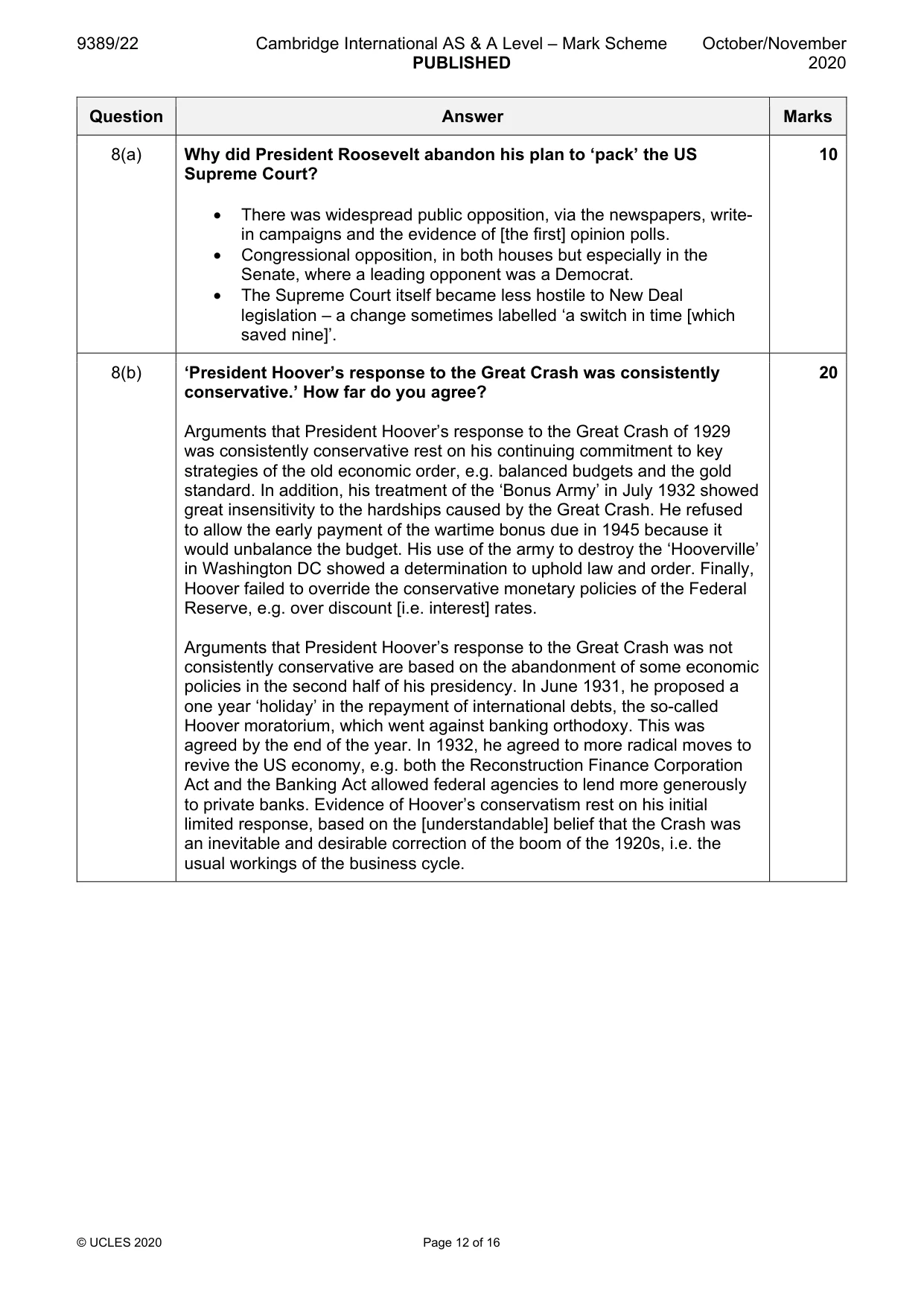
8 The Great Crash, the Great Depression and the New Deal, from the 1920s to 1941 (a) Why did President Roosevelt abandon his plan to ‘pack’ the US Supreme Court? [10] (b) ‘President Hoover’s response to the Great Crash was consistently conservative.’ How far do you agree? [20] Section C: International Option International Relations, 1871–1945 Answer both parts of two questions.
Mark scheme: 8(a) Why did President Roosevelt abandon his plan to ‘pack’ the US 10 Supreme Court? • There was widespread public opposition, via the newspapers, write- in campaigns and the evidence of [the first] opinion polls. • Congressional opposition, in both houses but especially in the Senate, where a leading opponent was a Democrat. • The Supreme Court itself became less hostile to New Deal legislation – a change sometimes labelled ‘a switch in time [which saved nine]’. 8(b) ‘President Hoover’s response to the Great Crash was consistently 20 conservative.’ How far do you agree? Arguments that President Hoover’s response to the Great Crash of 1929 was consistently conservative rest on his continuing commitment to key strategies of the old economic order, e.g. balanced budgets and the gold standard. In addition, his treatment of the ‘Bonus Army’ in July 1932 showed great insensitivity to the hardships caused by the Great Crash. He refused to allow the early payment of the wartime bonus due in 1945 because it would unbalance the budget. His use of the army to destroy the ‘Hooverville’ in Washington DC showed a determination to uphold law and order. Finally, Hoover failed to override the conservative monetary policies of the Federal Reserve, e.g. over discount [i.e. interest] rates. Arguments that President Hoover’s response to the Great Crash was not consistently conservative are based on the abandonment of some economic policies in the second half of his presidency. In June 1931, he proposed a one year ‘holiday’ in the repayment of international debts, the so-called Hoover moratorium, which went against banking orthodoxy. This was agreed by the end of the year. In 1932, he agreed to more radical moves to revive the US economy, e.g. both the Reconstruction Finance Corporation Act and the Banking Act allowed federal agencies to lend more generously to private banks. Evidence of Hoover’s conservatism rest on his initial limited response, based on the [understandable] belief that the Crash was an inevitable and desirable correction of the boom of the 1920s, i.e. the usual workings of the business cycle. Section C: International Option: International Relations, 1871–1945
Q9 · International Relations, 1871–1918 (a) Why did the Kruger Telegram increase tensions…
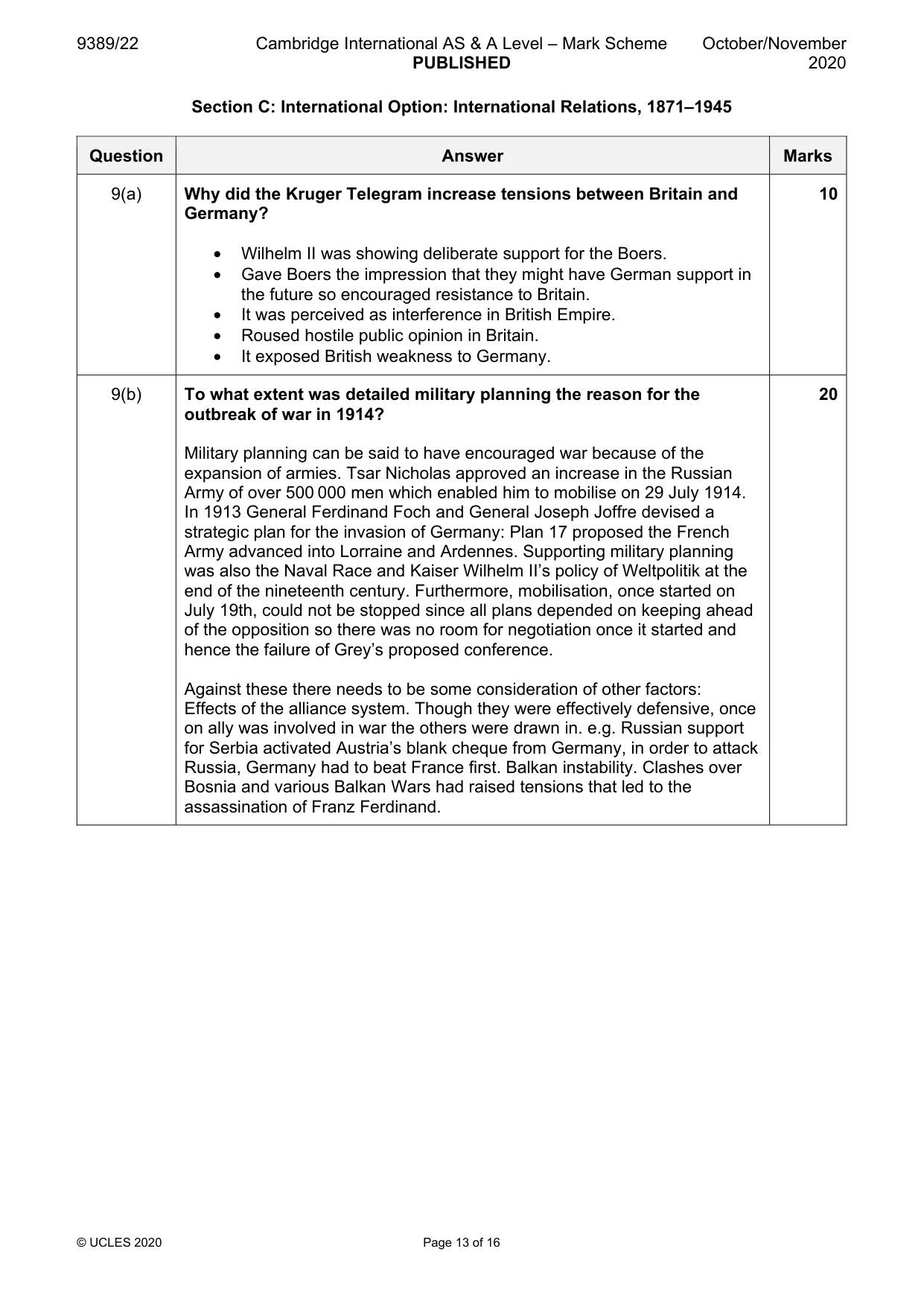
9 International Relations, 1871–1918 (a) Why did the Kruger Telegram increase tensions between Britain and Germany? [10] (b) To what extent was detailed military planning the reason for the outbreak of war in 1914? [20]
Mark scheme: 9(a) Why did the Kruger Telegram increase tensions between Britain and 10 Germany? • Wilhelm II was showing deliberate support for the Boers. • Gave Boers the impression that they might have German support in the future so encouraged resistance to Britain. • It was perceived as interference in British Empire. • Roused hostile public opinion in Britain. • It exposed British weakness to Germany. 9(b) To what extent was detailed military planning the reason for the 20 outbreak of war in 1914? Military planning can be said to have encouraged war because of the expansion of armies. Tsar Nicholas approved an increase in the Russian Army of over 500 000 men which enabled him to mobilise on 29 July 1914. In 1913 General Ferdinand Foch and General Joseph Joffre devised a strategic plan for the invasion of Germany: Plan 17 proposed the French Army advanced into Lorraine and Ardennes. Supporting military planning was also the Naval Race and Kaiser Wilhelm II’s policy of Weltpolitik at the end of the nineteenth century. Furthermore, mobilisation, once started on July 19th, could not be stopped since all plans depended on keeping ahead of the opposition so there was no room for negotiation once it started and hence the failure of Grey’s proposed conference. Against these there needs to be some consideration of other factors: Effects of the alliance system. Though they were effectively defensive, once on ally was involved in war the others were drawn in. e.g. Russian support for Serbia activated Austria’s blank cheque from Germany, in order to attack Russia, Germany had to beat France first. Balkan instability. Clashes over Bosnia and various Balkan Wars had raised tensions that led to the assassination of Franz Ferdinand.
Q10 · International Relations, 1919–1933 (a) Why was there an international crisis over the…
10 International Relations, 1919–1933 (a) Why was there an international crisis over the Ruhr in 1923? [10] (b) ‘Increased tensions in Europe after 1929 were caused by the Wall Street Crash.’ How far do you agree? [20]
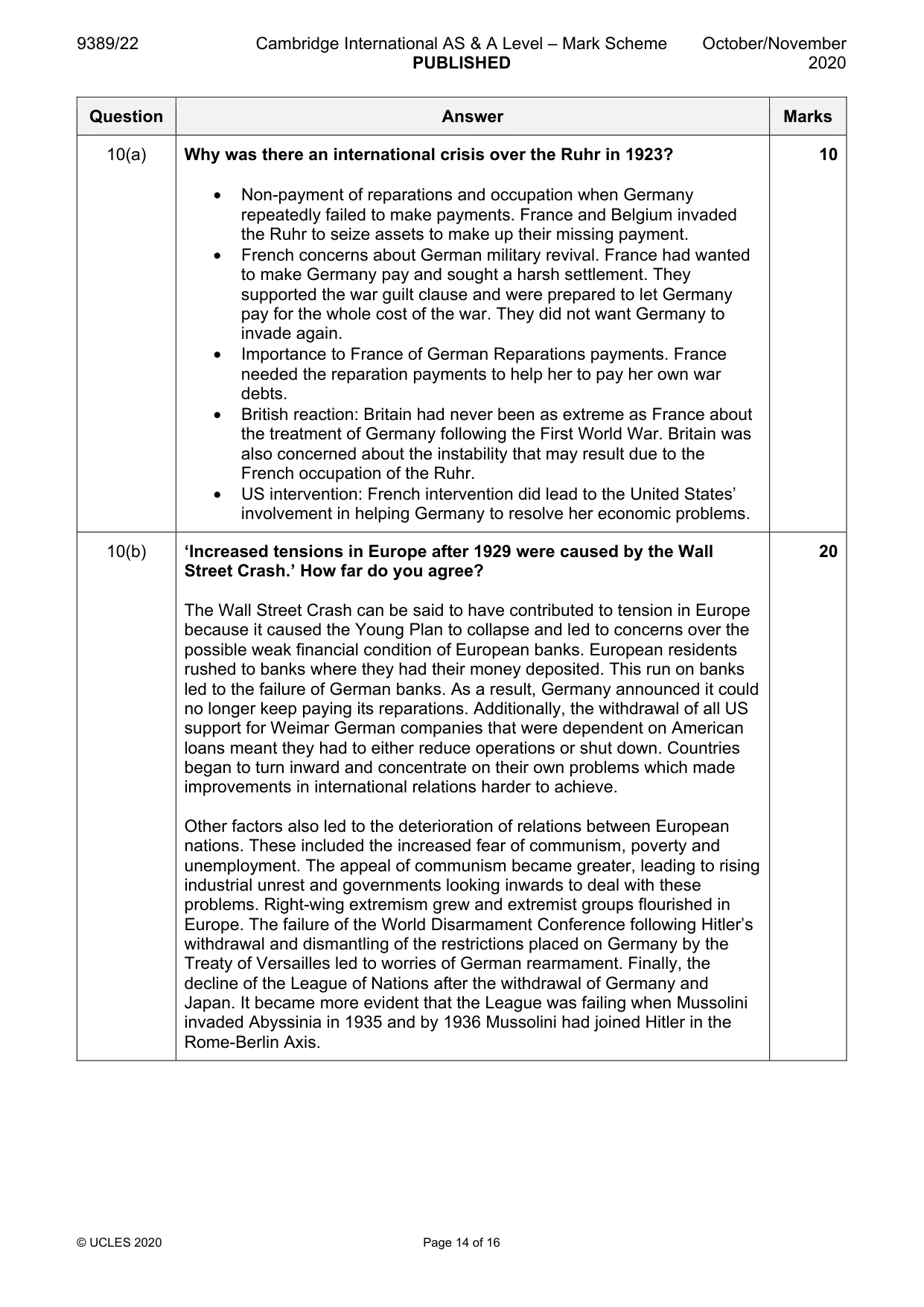
Mark scheme: 10(a) Why was there an international crisis over the Ruhr in 1923? 10 • Non-payment of reparations and occupation when Germany repeatedly failed to make payments. France and Belgium invaded the Ruhr to seize assets to make up their missing payment. • French concerns about German military revival. France had wanted to make Germany pay and sought a harsh settlement. They supported the war guilt clause and were prepared to let Germany pay for the whole cost of the war. They did not want Germany to invade again. • Importance to France of German Reparations payments. France needed the reparation payments to help her to pay her own war debts. • British reaction: Britain had never been as extreme as France about the treatment of Germany following the First World War. Britain was also concerned about the instability that may result due to the French occupation of the Ruhr. • US intervention: French intervention did lead to the United States’ involvement in helping Germany to resolve her economic problems. 10(b) ‘Increased tensions in Europe after 1929 were caused by the Wall 20 Street Crash.’ How far do you agree? The Wall Street Crash can be said to have contributed to tension in Europe because it caused the Young Plan to collapse and led to concerns over the possible weak financial condition of European banks. European residents rushed to banks where they had their money deposited. This run on banks led to the failure of German banks. As a result, Germany announced it could no longer keep paying its reparations. Additionally, the withdrawal of all US support for Weimar German companies that were dependent on American loans meant they had to either reduce operations or shut down. Countries began to turn inward and concentrate on their own problems which made improvements in international relations harder to achieve. Other factors also led to the deterioration of relations between European nations. These included the increased fear of communism, poverty and unemployment. The appeal of communism became greater, leading to rising industrial unrest and governments looking inwards to deal with these problems. Right-wing extremism grew and extremist groups flourished in Europe. The failure of the World Disarmament Conference following Hitler’s withdrawal and dismantling of the restrictions placed on Germany by the Treaty of Versailles led to worries of German rearmament. Finally, the decline of the League of Nations after the withdrawal of Germany and Japan. It became more evident that the League was failing when Mussolini invaded Abyssinia in 1935 and by 1936 Mussolini had joined Hitler in the Rome-Berlin Axis.
Q11 · International Relations, c.1933–1939 (a) Why did Mussolini oppose German intentions in…
11 International Relations, c.1933–1939 (a) Why did Mussolini oppose German intentions in Austria in July 1934? [10] (b) How important was the outcome of the Munich Conference in causing the outbreak of war in September 1939? [20]
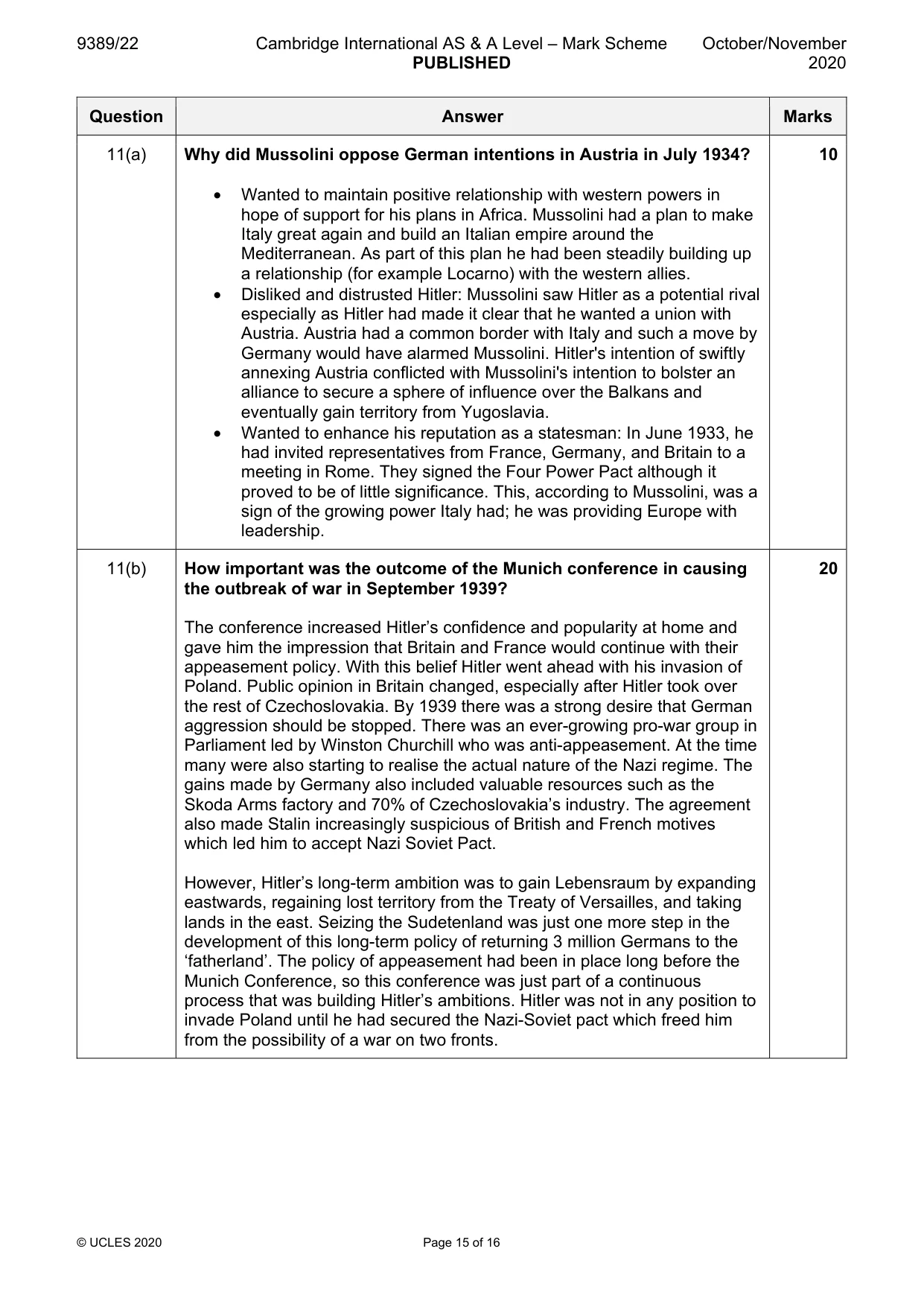
Mark scheme: 11(a) Why did Mussolini oppose German intentions in Austria in July 1934? 10 • Wanted to maintain positive relationship with western powers in hope of support for his plans in Africa. Mussolini had a plan to make Italy great again and build an Italian empire around the Mediterranean. As part of this plan he had been steadily building up a relationship (for example Locarno) with the western allies. • Disliked and distrusted Hitler: Mussolini saw Hitler as a potential rival especially as Hitler had made it clear that he wanted a union with Austria. Austria had a common border with Italy and such a move by Germany would have alarmed Mussolini. Hitler's intention of swiftly annexing Austria conflicted with Mussolini's intention to bolster an alliance to secure a sphere of influence over the Balkans and eventually gain territory from Yugoslavia. • Wanted to enhance his reputation as a statesman: In June 1933, he had invited representatives from France, Germany, and Britain to a meeting in Rome. They signed the Four Power Pact although it proved to be of little significance. This, according to Mussolini, was a sign of the growing power Italy had; he was providing Europe with leadership. 11(b) How important was the outcome of the Munich conference in causing 20 the outbreak of war in September 1939? The conference increased Hitler’s confidence and popularity at home and gave him the impression that Britain and France would continue with their appeasement policy. With this belief Hitler went ahead with his invasion of Poland. Public opinion in Britain changed, especially after Hitler took over the rest of Czechoslovakia. By 1939 there was a strong desire that German aggression should be stopped. There was an ever-growing pro-war group in Parliament led by Winston Churchill who was anti-appeasement. At the time many were also starting to realise the actual nature of the Nazi regime. The gains made by Germany also included valuable resources such as the Skoda Arms factory and 70% of Czechoslovakia’s industry. The agreement also made Stalin increasingly suspicious of British and French motives which led him to accept Nazi Soviet Pact. However, Hitler’s long-term ambition was to gain Lebensraum by expanding eastwards, regaining lost territory from the Treaty of Versailles, and taking lands in the east. Seizing the Sudetenland was just one more step in the development of this long-term policy of returning 3 million Germans to the ‘fatherland’. The policy of appeasement had been in place long before the Munich Conference, so this conference was just part of a continuous process that was building Hitler’s ambitions. Hitler was not in any position to invade Poland until he had secured the Nazi-Soviet pact which freed him from the possibility of a war on two fronts.
Q12 · China and Japan, 1919–1945 (a) Why did the Chinese Communist Party establish a base in…
12 China and Japan, 1919–1945 (a) Why did the Chinese Communist Party establish a base in Yenan in October 1935? [10] (b) How far was the rise of militarism in Japan caused by the failure of democracy? [20]
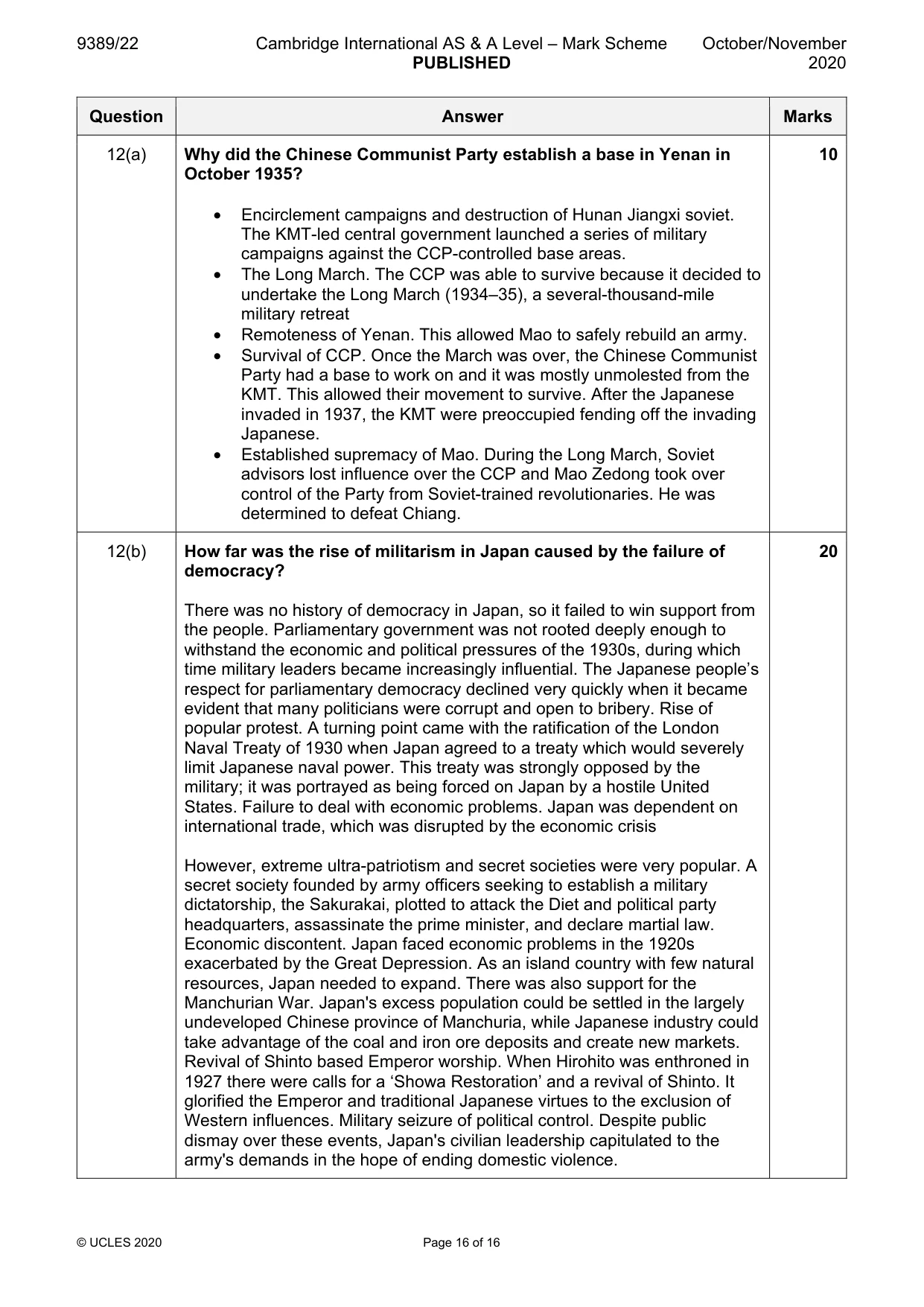
Mark scheme: 12(a) Why did the Chinese Communist Party establish a base in Yenan in 10 October 1935? • Encirclement campaigns and destruction of Hunan Jiangxi soviet. The KMT-led central government launched a series of military campaigns against the CCP-controlled base areas. • The Long March. The CCP was able to survive because it decided to undertake the Long March (1934–35), a several-thousand-mile military retreat • Remoteness of Yenan. This allowed Mao to safely rebuild an army. • Survival of CCP. Once the March was over, the Chinese Communist Party had a base to work on and it was mostly unmolested from the KMT. This allowed their movement to survive. After the Japanese invaded in 1937, the KMT were preoccupied fending off the invading Japanese. • Established supremacy of Mao. During the Long March, Soviet advisors lost influence over the CCP and Mao Zedong took over control of the Party from Soviet-trained revolutionaries. He was determined to defeat Chiang. 12(b) How far was the rise of militarism in Japan caused by the failure of 20 democracy? There was no history of democracy in Japan, so it failed to win support from the people. Parliamentary government was not rooted deeply enough to withstand the economic and political pressures of the 1930s, during which time military leaders became increasingly influential. The Japanese people’s respect for parliamentary democracy declined very quickly when it became evident that many politicians were corrupt and open to bribery. Rise of popular protest. A turning point came with the ratification of the London Naval Treaty of 1930 when Japan agreed to a treaty which would severely limit Japanese naval power. This treaty was strongly opposed by the military; it was portrayed as being forced on Japan by a hostile United States. Failure to deal with economic problems. Japan was dependent on international trade, which was disrupted by the economic crisis However, extreme ultra-patriotism and secret societies were very popular. A secret society founded by army officers seeking to establish a military dictatorship, the Sakurakai, plotted to attack the Diet and political party headquarters, assassinate the prime minister, and declare martial law. Economic discontent. Japan faced economic problems in the 1920s exacerbated by the Great Depression. As an island country with few natural resources, Japan needed to expand. There was also support for the Manchurian War. Japan's excess population could be settled in the largely undeveloped Chinese province of Manchuria, while Japanese industry could take advantage of the coal and iron ore deposits and create new markets. Revival of Shinto based Emperor worship. When Hirohito was enthroned in 1927 there were calls for a ‘Showa Restoration’ and a revival of Shinto. It glorified the Emperor and traditional Japanese virtues to the exclusion of Western influences. Military seizure of political control. Despite public dismay over these events, Japan's civilian leadership capitulated to the army's demands in the hope of ending domestic violence.
What you needed in this session
Cambridge’s own grade thresholds for 2020 Oct/Nov, Paper 2 · Variant 2. A higher threshold means an easier paper — the bar moves with how the cohort did.