Cambridge A Level History 9389 — 2019 Oct/Nov Paper 2 · Variant 2
9389/22/O/N/19 · 12 questions · 60 marks · ≈68 min
The question paper and its mark scheme, free to read here and free to download. This is Cambridge’s own paper, exactly as it was sat.
Question paper4 pages
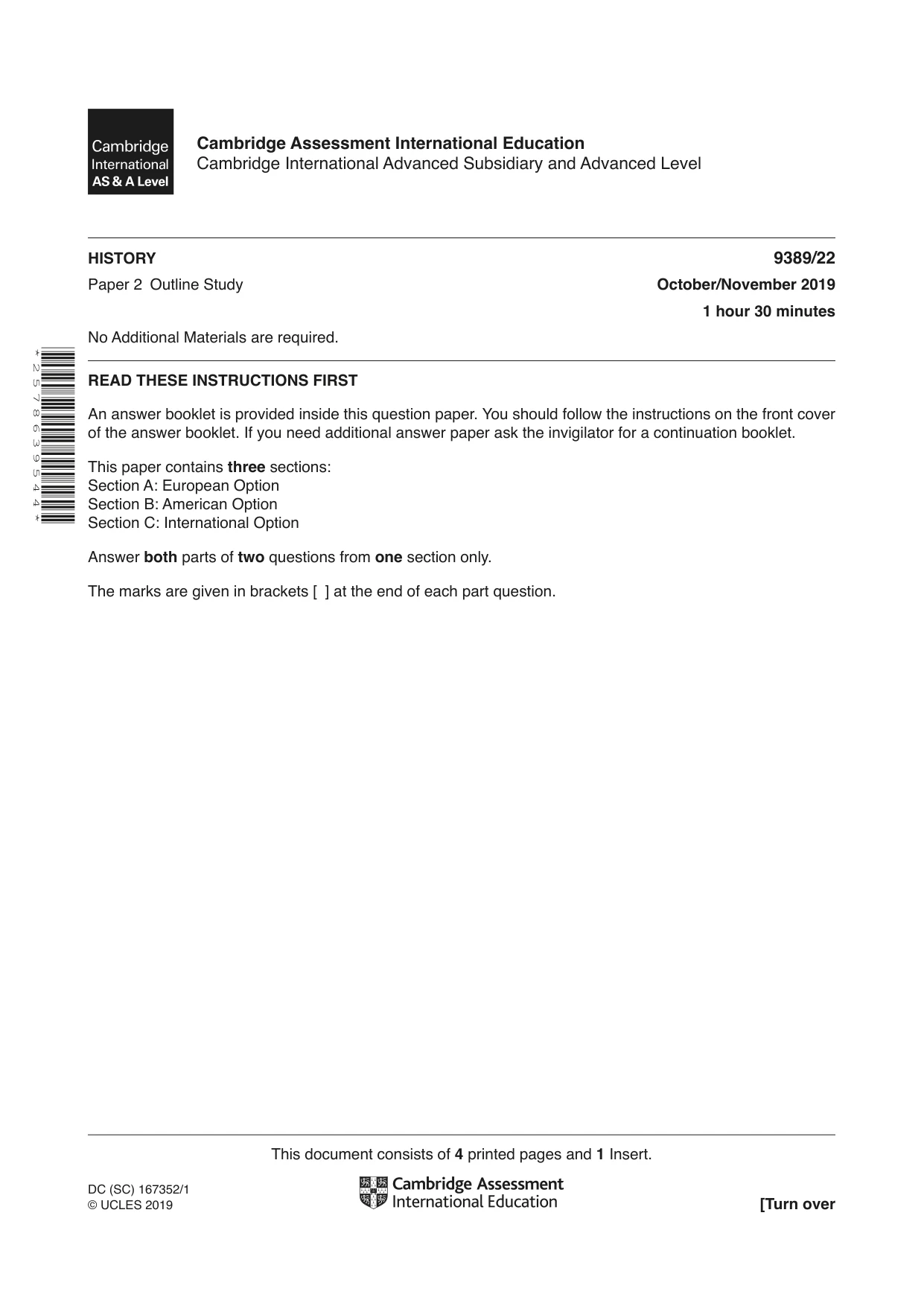
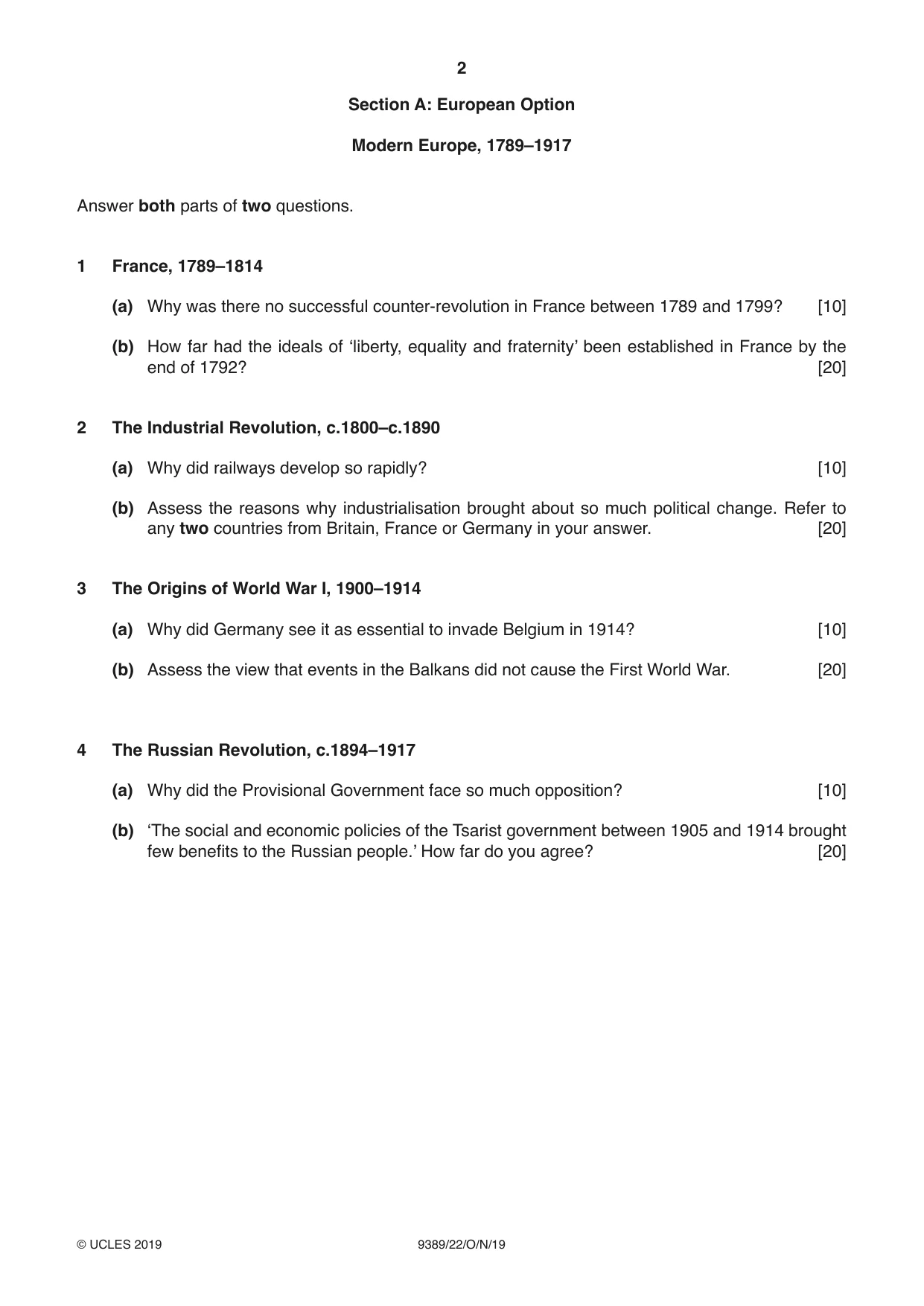
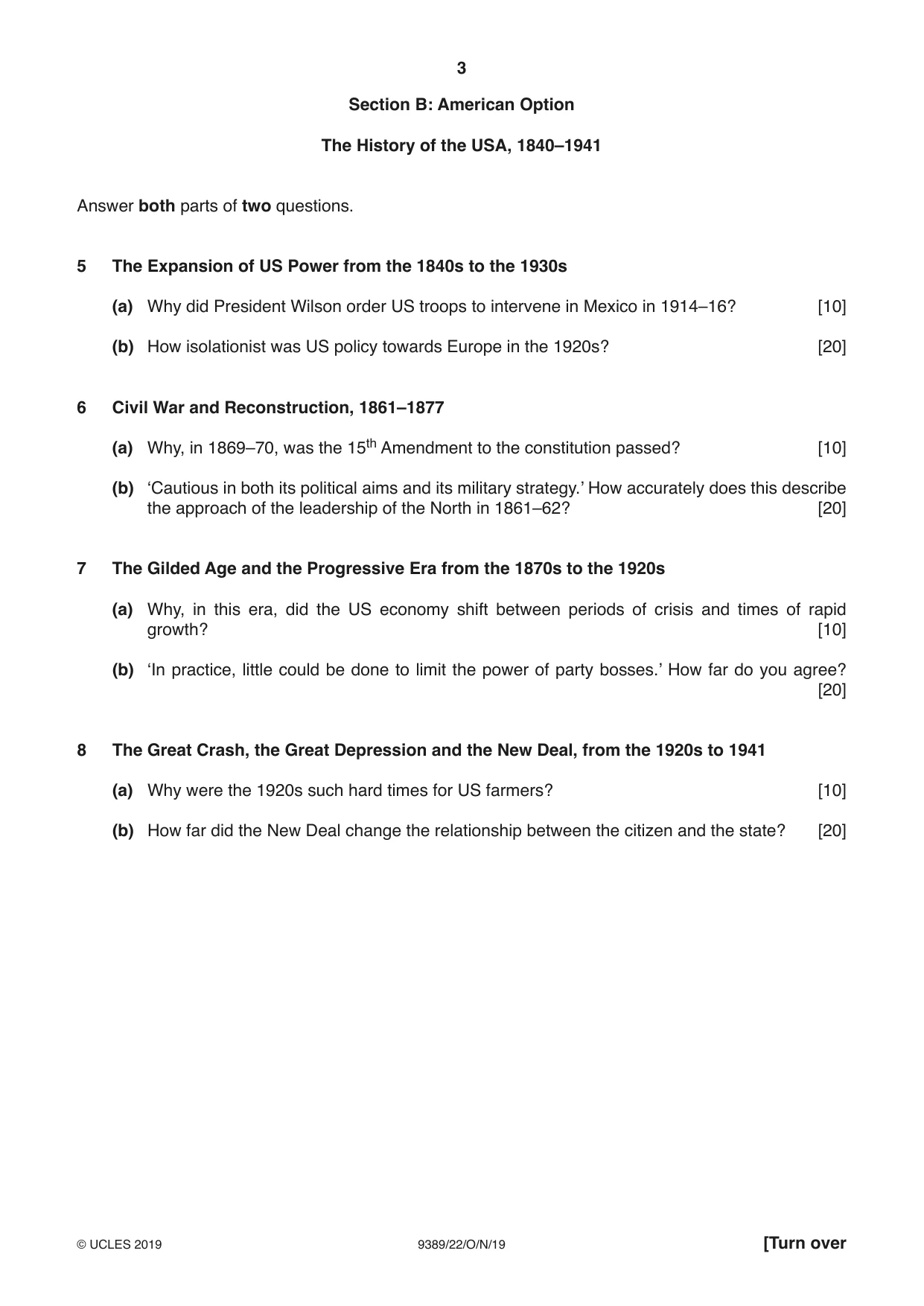
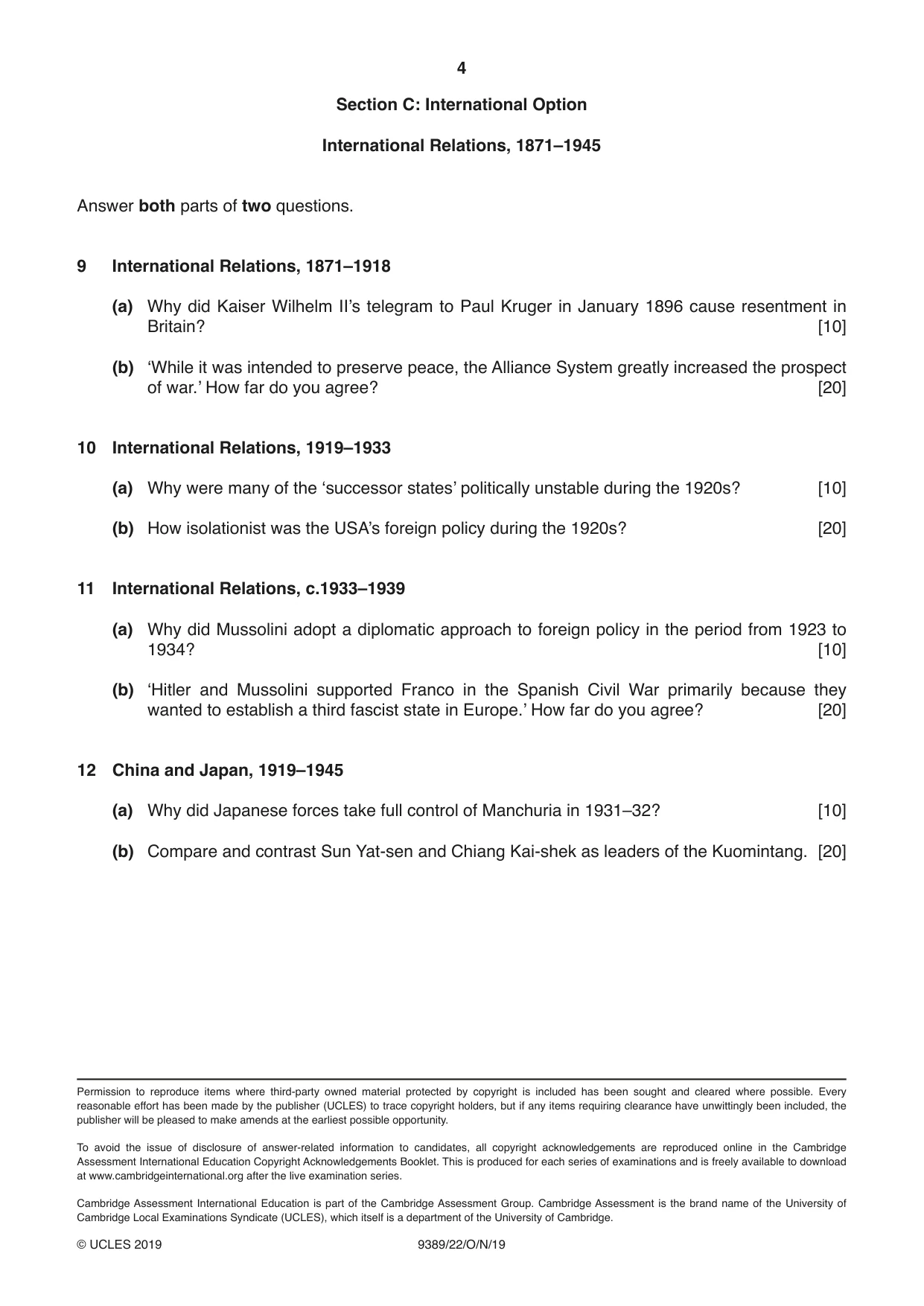
Mark scheme28 pages
Answers below. Sit the paper first if you are practising.
Questions as text
Q1 · France, 1789–1814 (a) Why was there no successful counter-revolution in France between…
1 France, 1789–1814 (a) Why was there no successful counter-revolution in France between 1789 and 1799? [10] (b) How far had the ideals of ‘liberty, equality and fraternity’ been established in France by the end of 1792? [20]
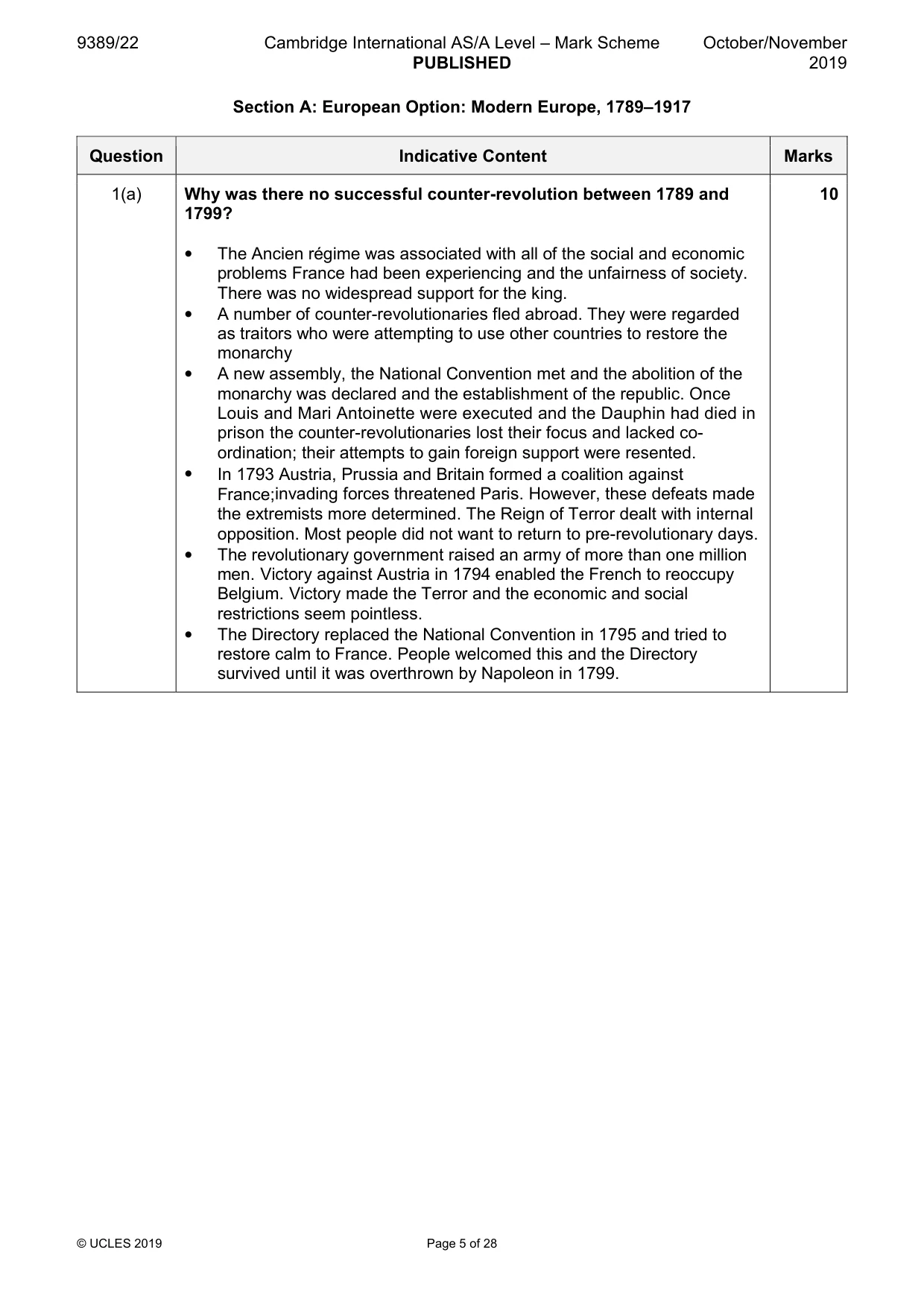
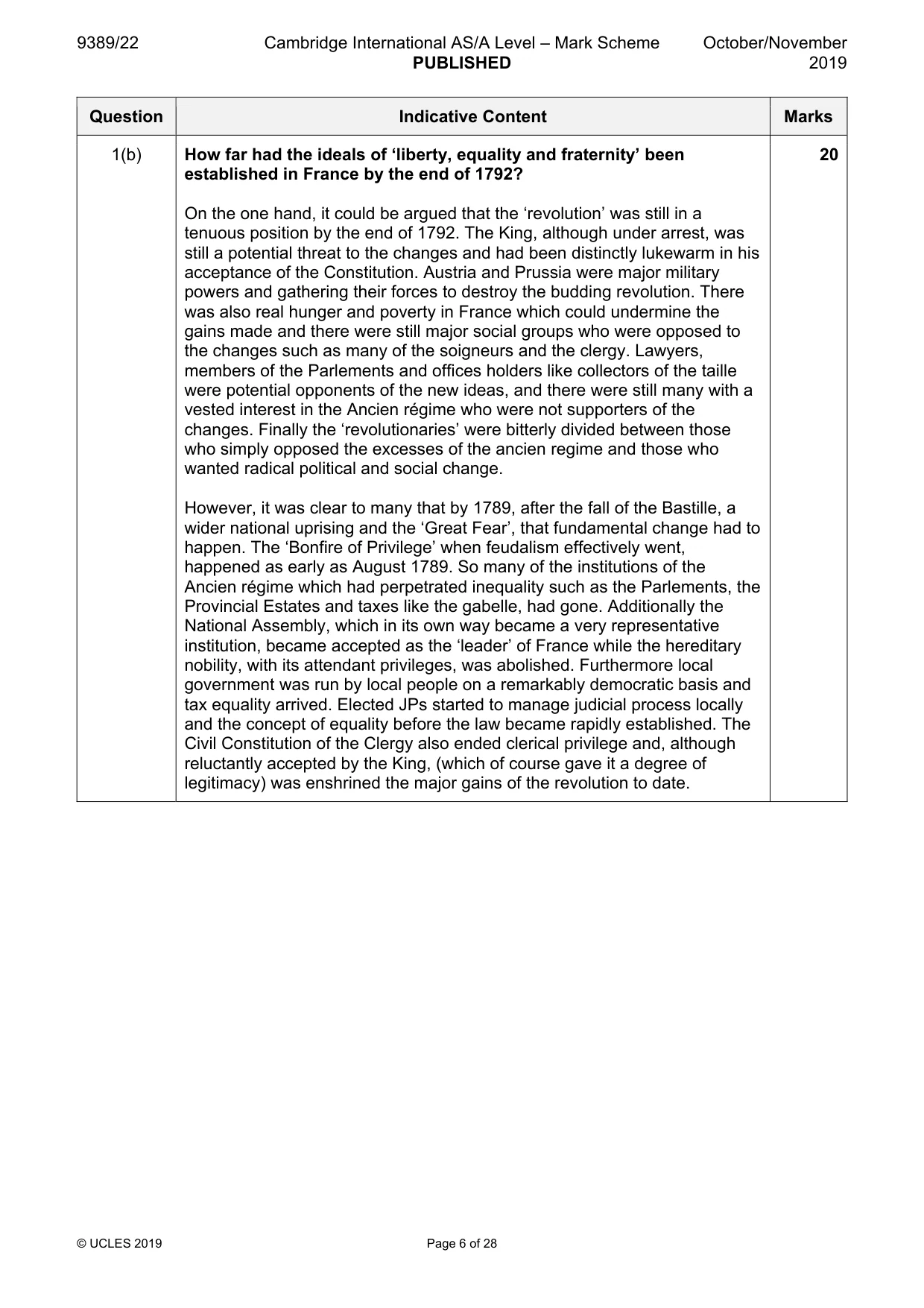
Mark scheme: Question Indicative Content Marks 1(a) Why was there no successful counter-revolution between 1789 and 10 1799? • The Ancien régime was associated with all of the social and economic problems France had been experiencing and the unfairness of society. There was no widespread support for the king. • A number of counter-revolutionaries fled abroad. They were regarded as traitors who were attempting to use other countries to restore the monarchy • A new assembly, the National Convention met and the abolition of the monarchy was declared and the establishment of the republic. Once Louis and Mari Antoinette were executed and the Dauphin had died in prison the counter-revolutionaries lost their focus and lacked co- ordination; their attempts to gain foreign support were resented. • In 1793 Austria, Prussia and Britain formed a coalition against France;invading forces threatened Paris. However, these defeats made the extremists more determined. The Reign of Terror dealt with internal opposition. Most people did not want to return to pre-revolutionary days. • The revolutionary government raised an army of more than one million men. Victory against Austria in 1794 enabled the French to reoccupy Belgium. Victory made the Terror and the economic and social restrictions seem pointless. • The Directory replaced the National Convention in 1795 and tried to restore calm to France. People welcomed this and the Directory survived until it was overthrown by Napoleon in 1799. 1(b) How far had the ideals of ‘liberty, equality and fraternity’ been 20 established in France by the end of 1792? On the one hand, it could be argued that the ‘revolution’ was still in a tenuous position by the end of 1792. The King, although under arrest, was still a potential threat to the changes and had been distinctly lukewarm in his acceptance of the Constitution. Austria and Prussia were major military powers and gathering their forces to destroy the budding revolution. There was also real hunger and poverty in France which could undermine the gains made and there were still major social groups who were opposed to the changes such as many of the soigneurs and the clergy. Lawyers, members of the Parlements and offices holders like collectors of the taille were potential opponents of the new ideas, and there were still many with a vested interest in the Ancien régime who were not supporters of the changes. Finally the ‘revolutionaries’ were bitterly divided between those who simply opposed the excesses of the ancien regime and those who wanted radical political and social change. However, it was clear to many that by 1789, after the fall of the Bastille, a wider national uprising and the ‘Great Fear’, that fundamental change had to happen. The ‘Bonfire of Privilege’ when feudalism effectively went, happened as early as August 1789. So many of the institutions of the Ancien régime which had perpetrated inequality such as the Parlements, the Provincial Estates and taxes like the gabelle, had gone. Additionally the National Assembly, which in its own way became a very representative institution, became accepted as the ‘leader’ of France while the hereditary nobility, with its attendant privileges, was abolished. Furthermore local government was run by local people on a remarkably democratic basis and tax equality arrived. Elected JPs started to manage judicial process locally and the concept of equality before the law became rapidly established. The Civil Constitution of the Clergy also ended clerical privilege and, although reluctantly accepted by the King, (which of course gave it a degree of legitimacy) was enshrined the major gains of the revolution to date.
Q2 · The Industrial Revolution, c.1800–c.1890 (a) Why did railways develop so rapidly?
2 The Industrial Revolution, c.1800–c.1890 (a) Why did railways develop so rapidly? [10] (b) Assess the reasons why industrialisation brought about so much political change. Refer to any two countries from Britain, France or Germany in your answer. [20]
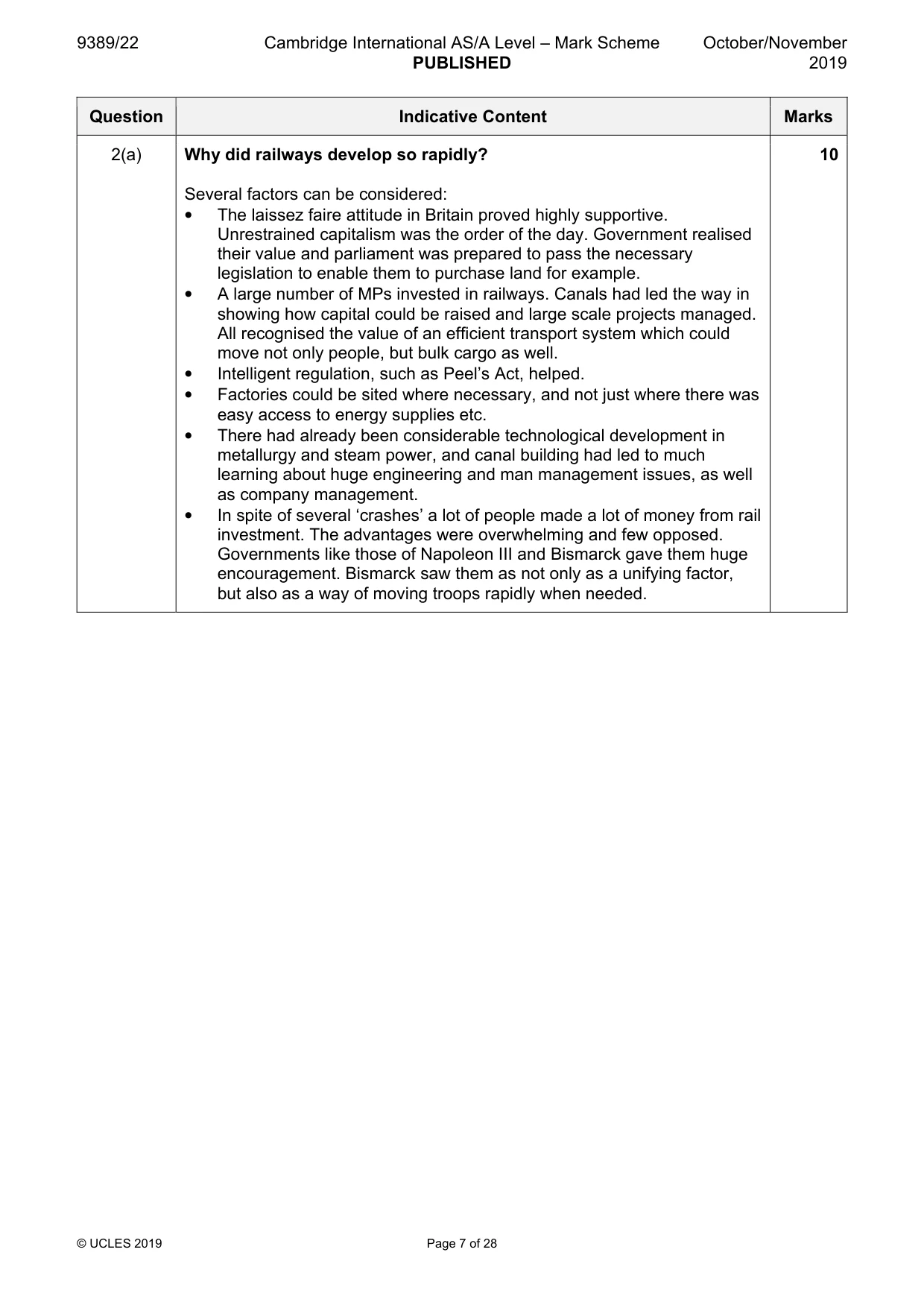
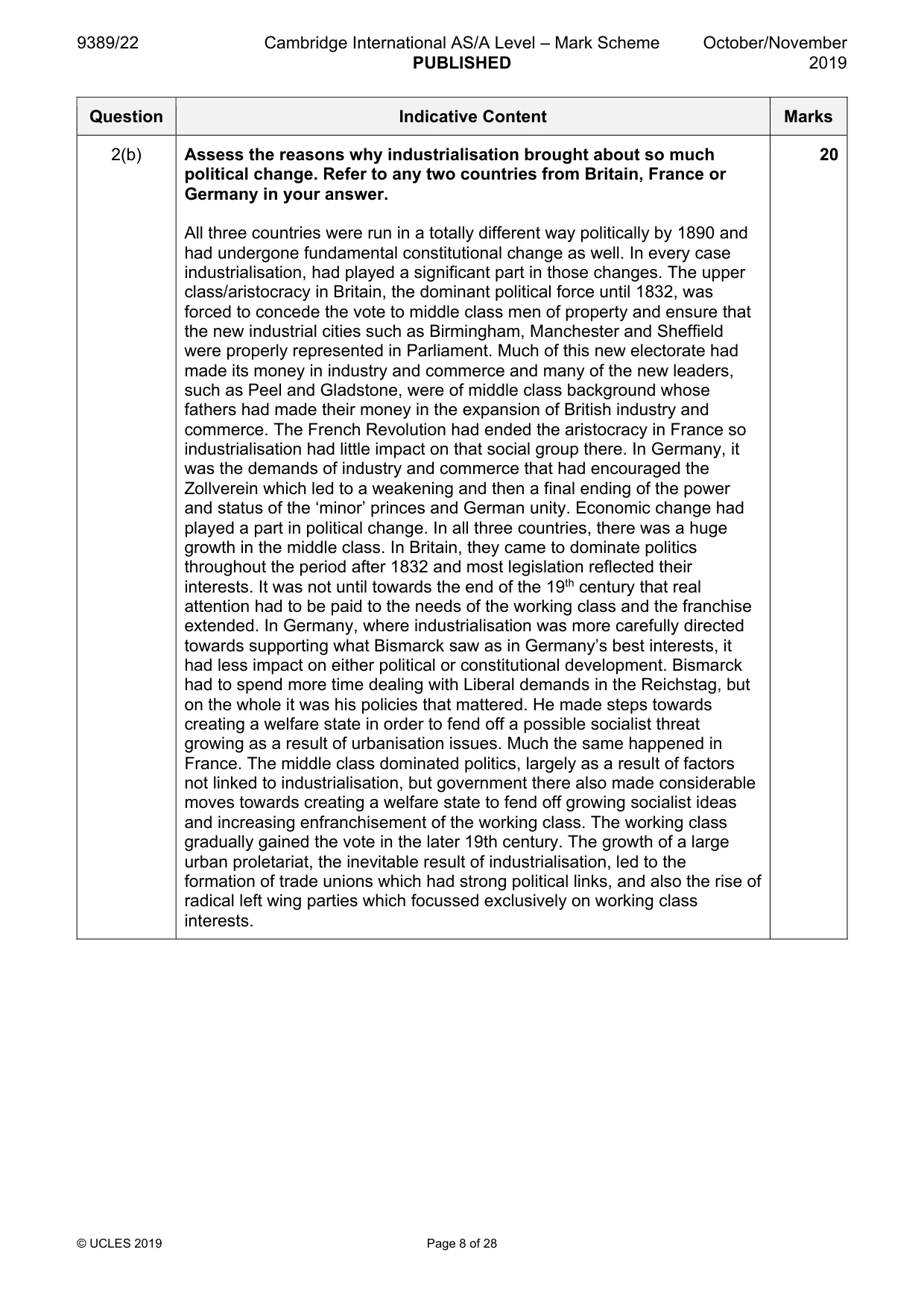
Mark scheme: 2(a) Why did railways develop so rapidly? 10 Several factors can be considered: • The laissez faire attitude in Britain proved highly supportive. Unrestrained capitalism was the order of the day. Government realised their value and parliament was prepared to pass the necessary legislation to enable them to purchase land for example. • A large number of MPs invested in railways. Canals had led the way in showing how capital could be raised and large scale projects managed. All recognised the value of an efficient transport system which could move not only people, but bulk cargo as well. • Intelligent regulation, such as Peel’s Act, helped. • Factories could be sited where necessary, and not just where there was easy access to energy supplies etc. • There had already been considerable technological development in metallurgy and steam power, and canal building had led to much learning about huge engineering and man management issues, as well as company management. • In spite of several ‘crashes’ a lot of people made a lot of money from rail investment. The advantages were overwhelming and few opposed. Governments like those of Napoleon III and Bismarck gave them huge encouragement. Bismarck saw them as not only as a unifying factor, but also as a way of moving troops rapidly when needed. 2(b) Assess the reasons why industrialisation brought about so much 20 political change. Refer to any two countries from Britain, France or Germany in your answer. All three countries were run in a totally different way politically by 1890 and had undergone fundamental constitutional change as well. In every case industrialisation, had played a significant part in those changes. The upper class/aristocracy in Britain, the dominant political force until 1832, was forced to concede the vote to middle class men of property and ensure that the new industrial cities such as Birmingham, Manchester and Sheffield were properly represented in Parliament. Much of this new electorate had made its money in industry and commerce and many of the new leaders, such as Peel and Gladstone, were of middle class background whose fathers had made their money in the expansion of British industry and commerce. The French Revolution had ended the aristocracy in France so industrialisation had little impact on that social group there. In Germany, it was the demands of industry and commerce that had encouraged the Zollverein which led to a weakening and then a final ending of the power and status of the ‘minor’ princes and German unity. Economic change had played a part in political change. In all three countries, there was a huge growth in the middle class. In Britain, they came to dominate politics throughout the period after 1832 and most legislation reflected their interests. It was not until towards the end of the 19th century that real attention had to be paid to the needs of the working class and the franchise extended. In Germany, where industrialisation was more carefully directed towards supporting what Bismarck saw as in Germany’s best interests, it had less impact on either political or constitutional development. Bismarck had to spend more time dealing with Liberal demands in the Reichstag, but on the whole it was his policies that mattered. He made steps towards creating a welfare state in order to fend off a possible socialist threat growing as a result of urbanisation issues. Much the same happened in France. The middle class dominated politics, largely as a result of factors not linked to industrialisation, but government there also made considerable moves towards creating a welfare state to fend off growing socialist ideas and increasing enfranchisement of the working class. The working class gradually gained the vote in the later 19th century. The growth of a large urban proletariat, the inevitable result of industrialisation, led to the formation of trade unions which had strong political links, and also the rise of radical left wing parties which focussed exclusively on working class interests.
Q3 · The Origins of World War I, 1900–1914 (a) Why did Germany see it as essential to invade…
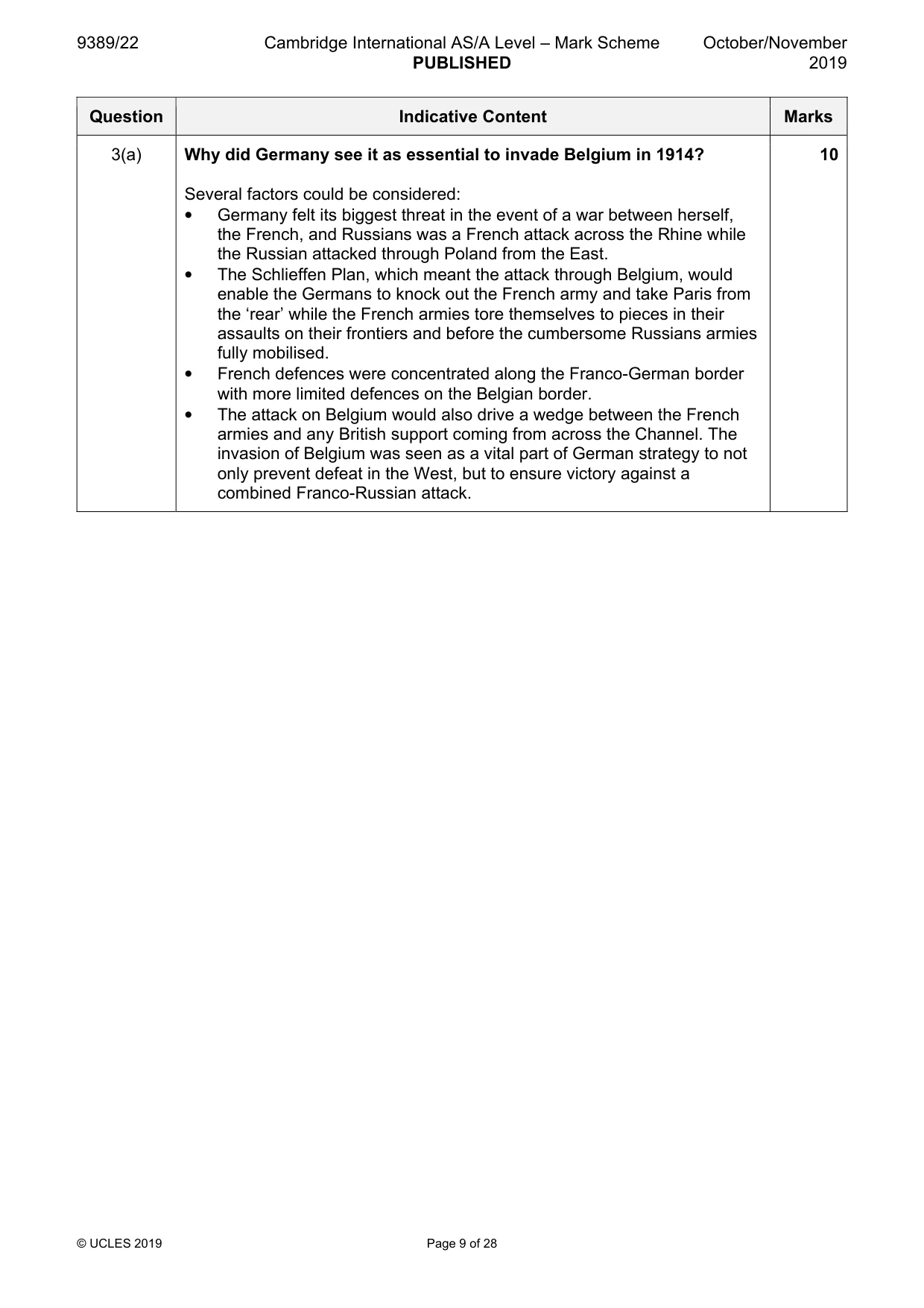
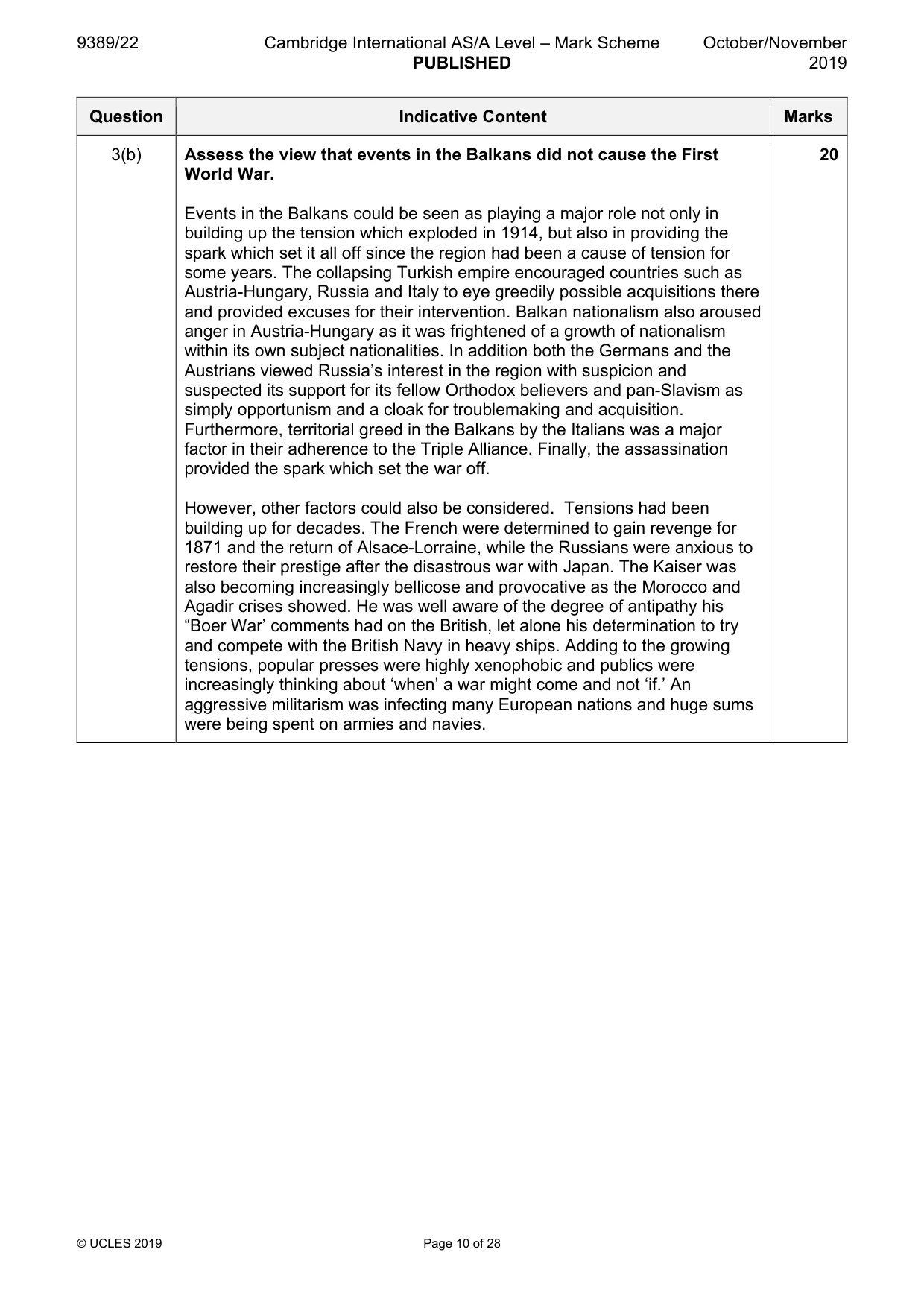
3 The Origins of World War I, 1900–1914 (a) Why did Germany see it as essential to invade Belgium in 1914? [10] (b) Assess the view that events in the Balkans did not cause the First World War. [20]
Mark scheme: 3(a) Why did Germany see it as essential to invade Belgium in 1914? 10 Several factors could be considered: • Germany felt its biggest threat in the event of a war between herself, the French, and Russians was a French attack across the Rhine while the Russian attacked through Poland from the East. • The Schlieffen Plan, which meant the attack through Belgium, would enable the Germans to knock out the French army and take Paris from the ‘rear’ while the French armies tore themselves to pieces in their assaults on their frontiers and before the cumbersome Russians armies fully mobilised. • French defences were concentrated along the Franco-German border with more limited defences on the Belgian border. • The attack on Belgium would also drive a wedge between the French armies and any British support coming from across the Channel. The invasion of Belgium was seen as a vital part of German strategy to not only prevent defeat in the West, but to ensure victory against a combined Franco-Russian attack. 3(b) Assess the view that events in the Balkans did not cause the First 20 World War. Events in the Balkans could be seen as playing a major role not only in building up the tension which exploded in 1914, but also in providing the spark which set it all off since the region had been a cause of tension for some years. The collapsing Turkish empire encouraged countries such as Austria-Hungary, Russia and Italy to eye greedily possible acquisitions there and provided excuses for their intervention. Balkan nationalism also aroused anger in Austria-Hungary as it was frightened of a growth of nationalism within its own subject nationalities. In addition both the Germans and the Austrians viewed Russia’s interest in the region with suspicion and suspected its support for its fellow Orthodox believers and pan-Slavism as simply opportunism and a cloak for troublemaking and acquisition. Furthermore, territorial greed in the Balkans by the Italians was a major factor in their adherence to the Triple Alliance. Finally, the assassination provided the spark which set the war off. However, other factors could also be considered. Tensions had been building up for decades. The French were determined to gain revenge for 1871 and the return of Alsace-Lorraine, while the Russians were anxious to restore their prestige after the disastrous war with Japan. The Kaiser was also becoming increasingly bellicose and provocative as the Morocco and Agadir crises showed. He was well aware of the degree of antipathy his “Boer War’ comments had on the British, let alone his determination to try and compete with the British Navy in heavy ships. Adding to the growing tensions, popular presses were highly xenophobic and publics were increasingly thinking about ‘when’ a war might come and not ‘if.’ An aggressive militarism was infecting many European nations and huge sums were being spent on armies and navies.
Q4 · The Russian Revolution, c.1894–1917 (a) Why did the Provisional Government face so much…
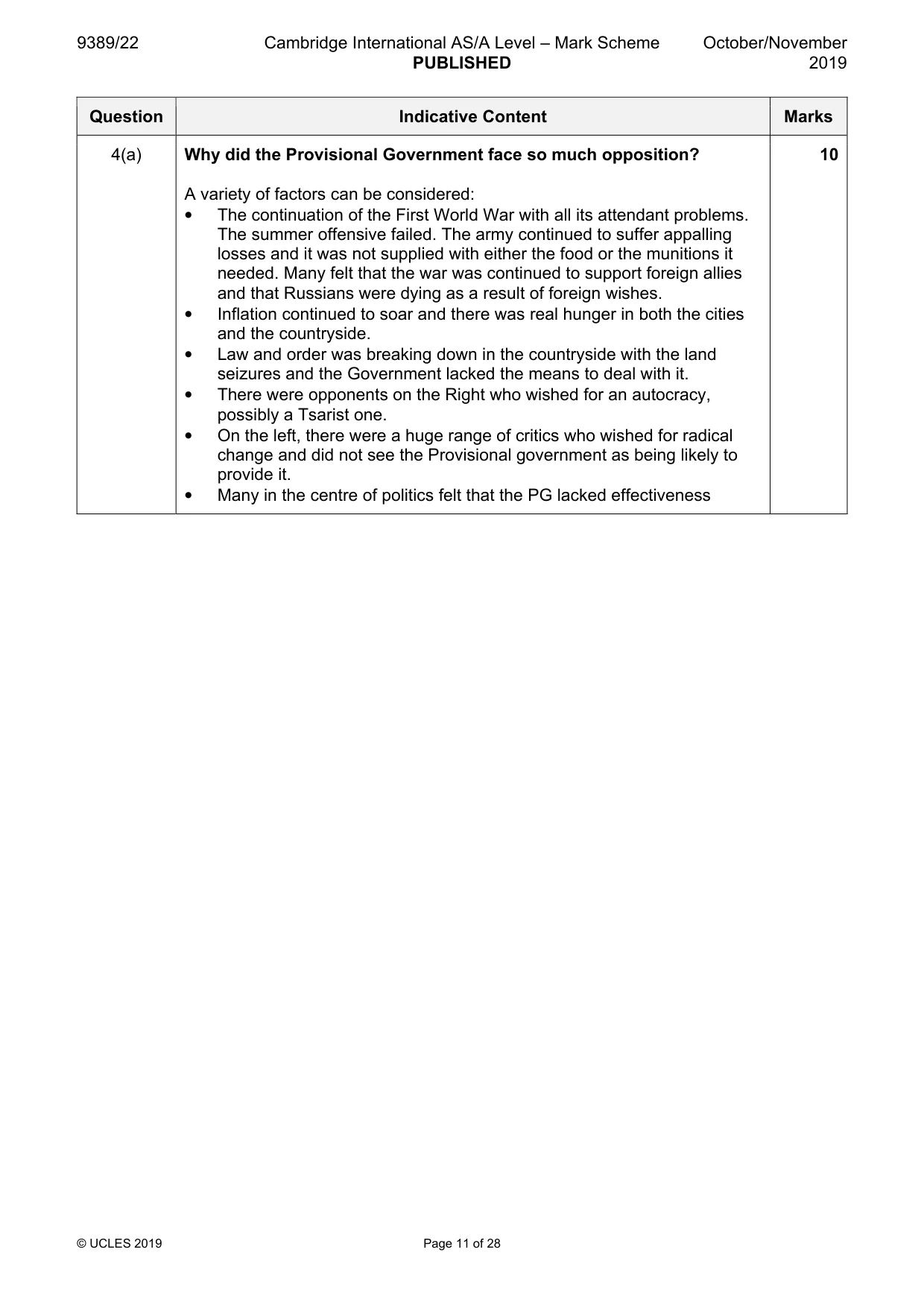
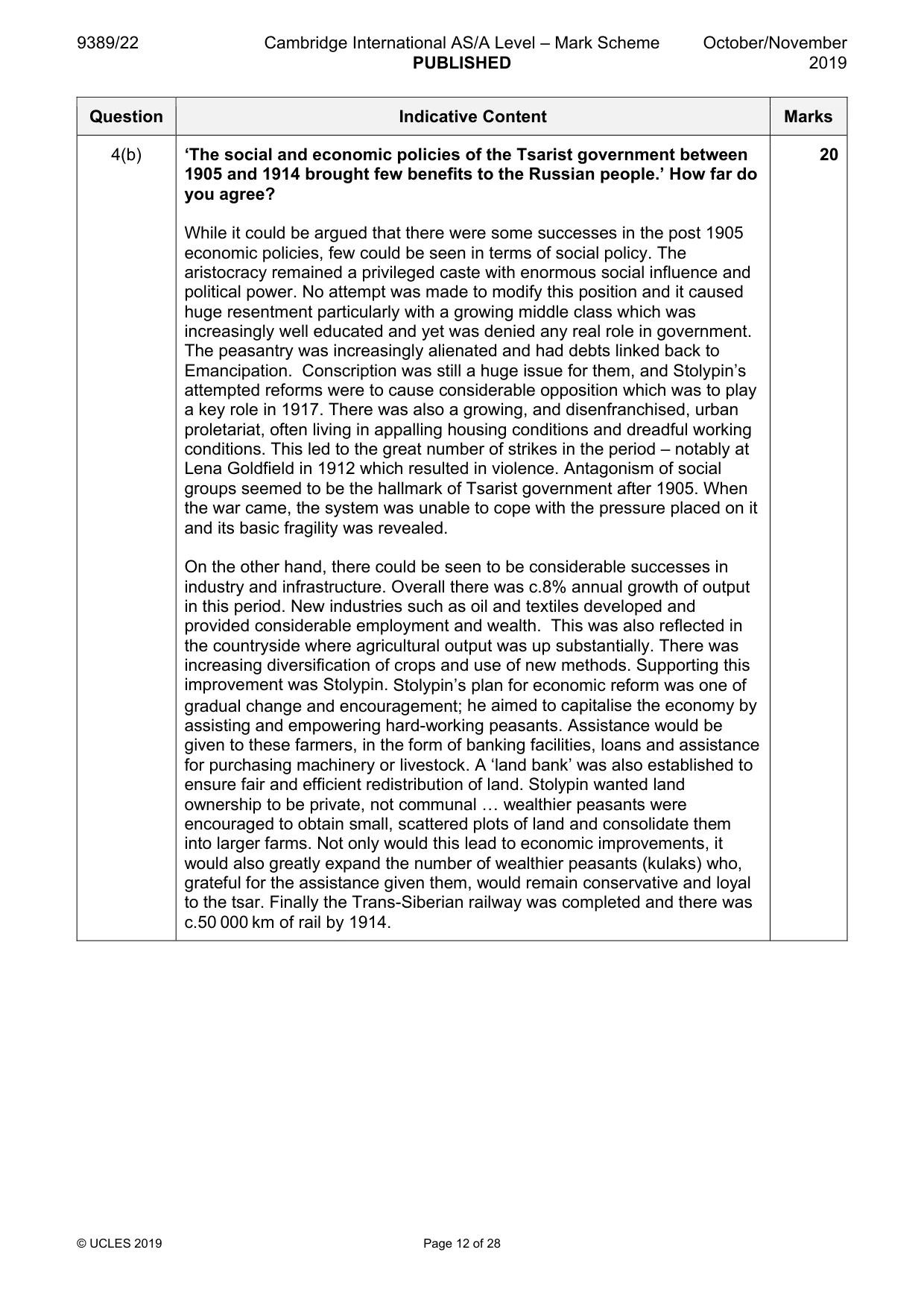
4 The Russian Revolution, c.1894–1917 (a) Why did the Provisional Government face so much opposition? [10] (b) ‘The social and economic policies of the Tsarist government between 1905 and 1914 brought few benefits to the Russian people.’ How far do you agree? [20]
Mark scheme: 4(a) Why did the Provisional Government face so much opposition? 10 A variety of factors can be considered: • The continuation of the First World War with all its attendant problems. The summer offensive failed. The army continued to suffer appalling losses and it was not supplied with either the food or the munitions it needed. Many felt that the war was continued to support foreign allies and that Russians were dying as a result of foreign wishes. • Inflation continued to soar and there was real hunger in both the cities and the countryside. • Law and order was breaking down in the countryside with the land seizures and the Government lacked the means to deal with it. • There were opponents on the Right who wished for an autocracy, possibly a Tsarist one. • On the left, there were a huge range of critics who wished for radical change and did not see the Provisional government as being likely to provide it. • Many in the centre of politics felt that the PG lacked effectiveness 4(b) ‘The social and economic policies of the Tsarist government between 20 1905 and 1914 brought few benefits to the Russian people.’ How far do you agree? While it could be argued that there were some successes in the post 1905 economic policies, few could be seen in terms of social policy. The aristocracy remained a privileged caste with enormous social influence and political power. No attempt was made to modify this position and it caused huge resentment particularly with a growing middle class which was increasingly well educated and yet was denied any real role in government. The peasantry was increasingly alienated and had debts linked back to Emancipation. Conscription was still a huge issue for them, and Stolypin’s attempted reforms were to cause considerable opposition which was to play a key role in 1917. There was also a growing, and disenfranchised, urban proletariat, often living in appalling housing conditions and dreadful working conditions. This led to the great number of strikes in the period – notably at Lena Goldfield in 1912 which resulted in violence. Antagonism of social groups seemed to be the hallmark of Tsarist government after 1905. When the war came, the system was unable to cope with the pressure placed on it and its basic fragility was revealed. On the other hand, there could be seen to be considerable successes in industry and infrastructure. Overall there was c.8% annual growth of output in this period. New industries such as oil and textiles developed and provided considerable employment and wealth. This was also reflected in the countryside where agricultural output was up substantially. There was increasing diversification of crops and use of new methods. Supporting this improvement was Stolypin. Stolypin’s plan for economic reform was one of gradual change and encouragement; he aimed to capitalise the economy by assisting and empowering hard-working peasants. Assistance would be given to these farmers, in the form of banking facilities, loans and assistance for purchasing machinery or livestock. A ‘land bank’ was also established to ensure fair and efficient redistribution of land. Stolypin wanted land ownership to be private, not communal « wealthier peasants were encouraged to obtain small, scattered plots of land and consolidate them into larger farms. Not only would this lead to economic improvements, it would also greatly expand the number of wealthier peasants (kulaks) who, grateful for the assistance given them, would remain conservative and loyal to the tsar. Finally the Trans-Siberian railway was completed and there was c.50 000 km of rail by 1914. Section B: American Option: The History of the USA, 1840–1941
Q5 · The Expansion of US Power from the 1840s to the 1930s (a) Why did President Wilson order…
5 The Expansion of US Power from the 1840s to the 1930s (a) Why did President Wilson order US troops to intervene in Mexico in 1914–16? [10] (b) How isolationist was US policy towards Europe in the 1920s? [20]
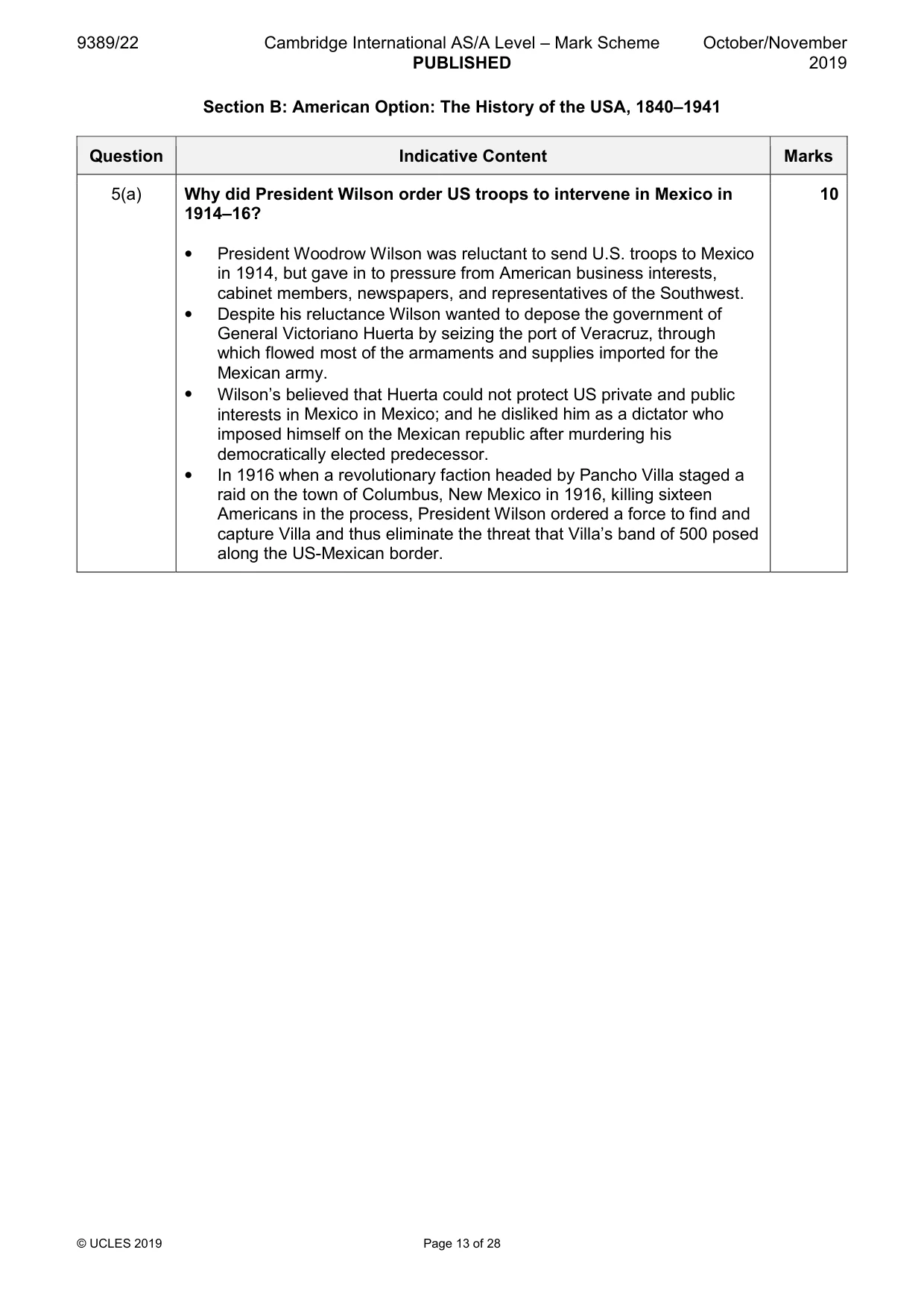
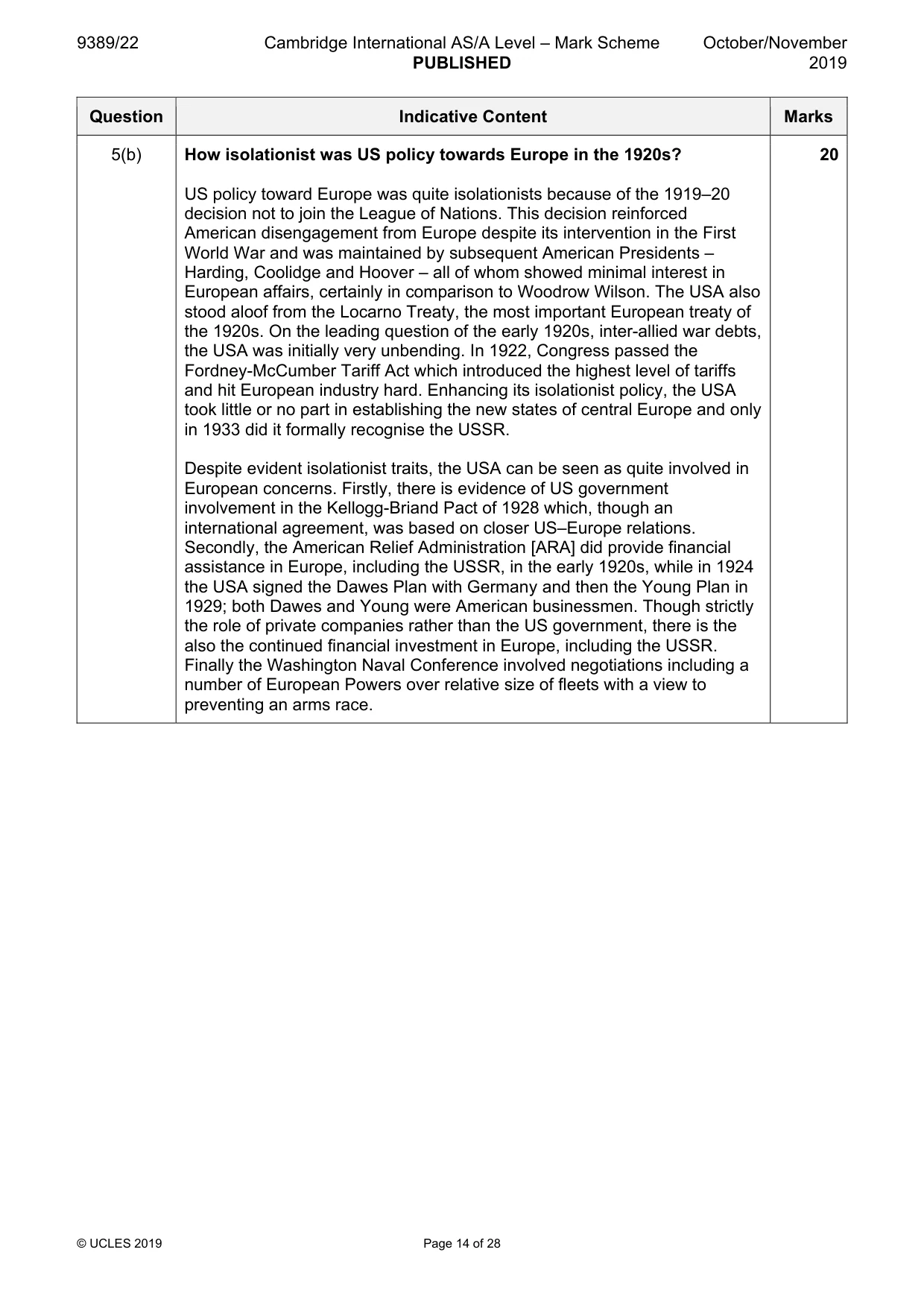
Mark scheme: 5(a) Why did President Wilson order US troops to intervene in Mexico in 10 1914–16? • President Woodrow Wilson was reluctant to send U.S. troops to Mexico in 1914, but gave in to pressure from American business interests, cabinet members, newspapers, and representatives of the Southwest. • Despite his reluctance Wilson wanted to depose the government of General Victoriano Huerta by seizing the port of Veracruz, through which flowed most of the armaments and supplies imported for the Mexican army. • Wilson’s believed that Huerta could not protect US private and public interests in Mexico in Mexico; and he disliked him as a dictator who imposed himself on the Mexican republic after murdering his democratically elected predecessor. • In 1916 when a revolutionary faction headed by Pancho Villa staged a raid on the town of Columbus, New Mexico in 1916, killing sixteen Americans in the process, President Wilson ordered a force to find and capture Villa and thus eliminate the threat that Villa’s band of 500 posed along the US-Mexican border. 5(b) How isolationist was US policy towards Europe in the 1920s? 20 US policy toward Europe was quite isolationists because of the 1919–20 decision not to join the League of Nations. This decision reinforced American disengagement from Europe despite its intervention in the First World War and was maintained by subsequent American Presidents – Harding, Coolidge and Hoover – all of whom showed minimal interest in European affairs, certainly in comparison to Woodrow Wilson. The USA also stood aloof from the Locarno Treaty, the most important European treaty of the 1920s. On the leading question of the early 1920s, inter-allied war debts, the USA was initially very unbending. In 1922, Congress passed the Fordney-McCumber Tariff Act which introduced the highest level of tariffs and hit European industry hard. Enhancing its isolationist policy, the USA took little or no part in establishing the new states of central Europe and only in 1933 did it formally recognise the USSR. Despite evident isolationist traits, the USA can be seen as quite involved in European concerns. Firstly, there is evidence of US government involvement in the Kellogg-Briand Pact of 1928 which, though an international agreement, was based on closer US–Europe relations. Secondly, the American Relief Administration [ARA] did provide financial assistance in Europe, including the USSR, in the early 1920s, while in 1924 the USA signed the Dawes Plan with Germany and then the Young Plan in 1929; both Dawes and Young were American businessmen. Though strictly the role of private companies rather than the US government, there is the also the continued financial investment in Europe, including the USSR. Finally the Washington Naval Conference involved negotiations including a number of European Powers over relative size of fleets with a view to preventing an arms race.
Q6 · Civil War and Reconstruction, 1861–1877 (a) Why, in 1869–70, was the 15th Amendment to…
6 Civil War and Reconstruction, 1861–1877 (a) Why, in 1869–70, was the 15th Amendment to the constitution passed? [10] (b) ‘Cautious in both its political aims and its military strategy.’ How accurately does this describe the approach of the leadership of the North in 1861–62? [20]
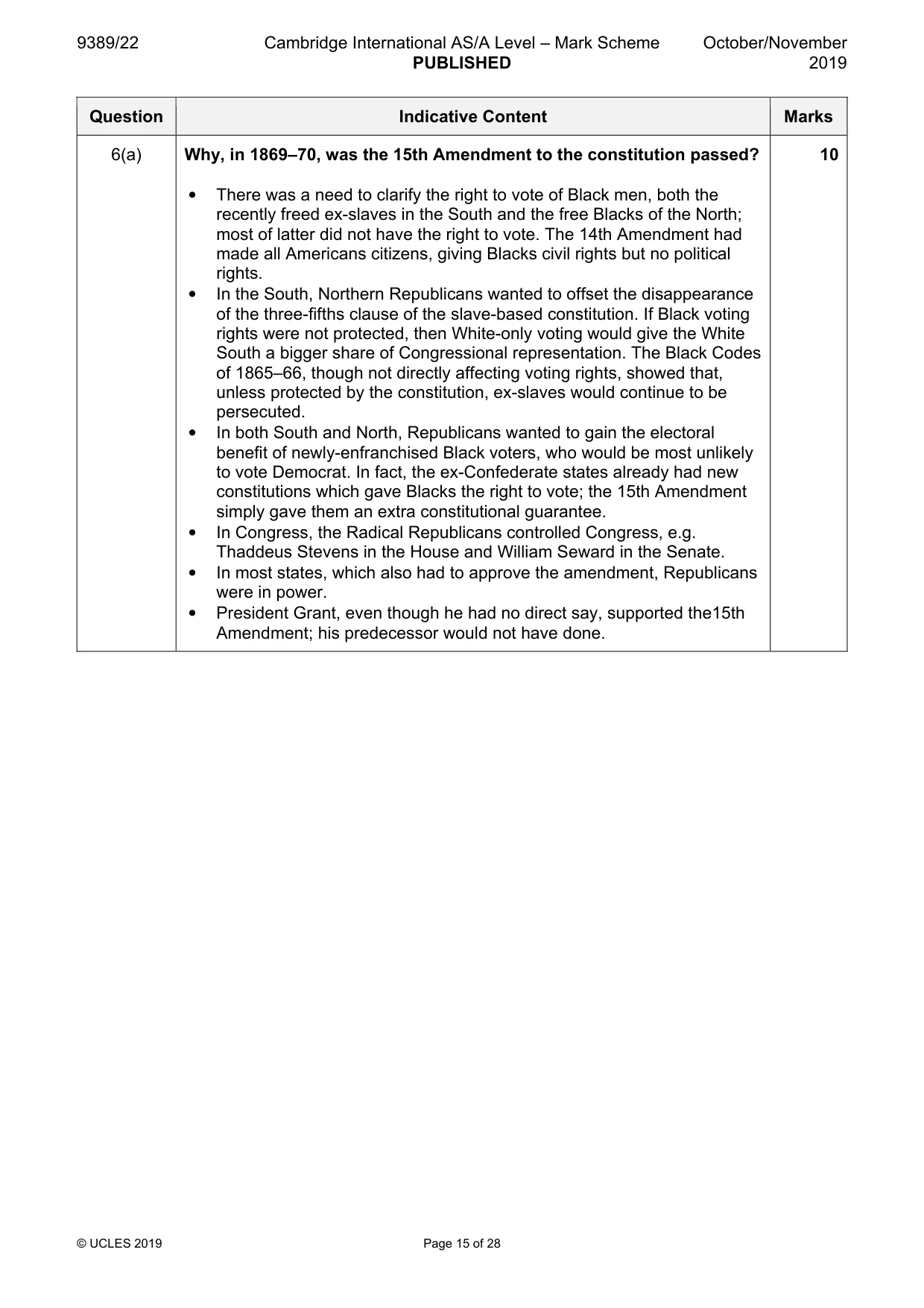
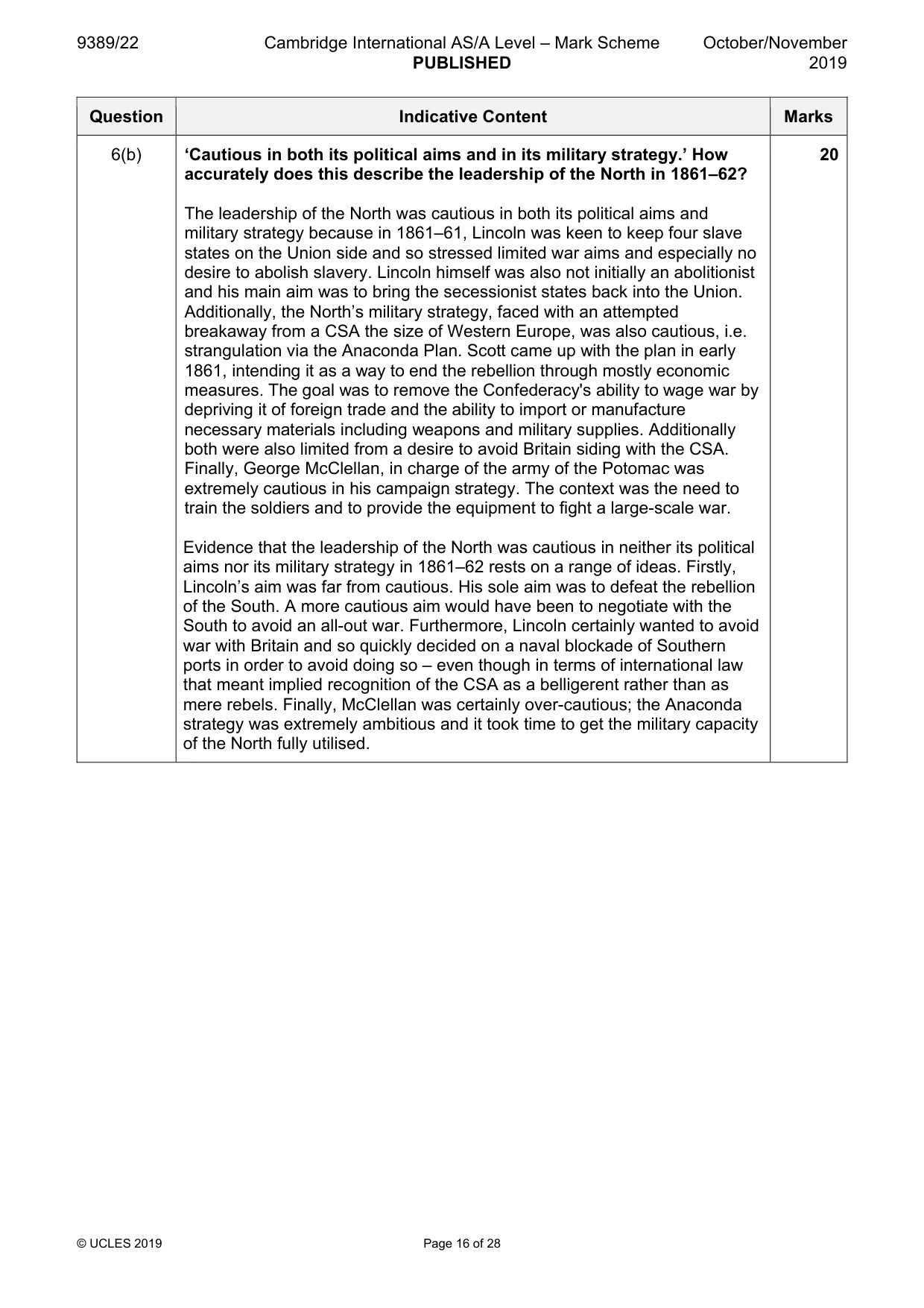
Mark scheme: 6(a) Why, in 1869–70, was the 15th Amendment to the constitution passed? 10 • There was a need to clarify the right to vote of Black men, both the recently freed ex-slaves in the South and the free Blacks of the North; most of latter did not have the right to vote. The 14th Amendment had made all Americans citizens, giving Blacks civil rights but no political rights. • In the South, Northern Republicans wanted to offset the disappearance of the three-fifths clause of the slave-based constitution. If Black voting rights were not protected, then White-only voting would give the White South a bigger share of Congressional representation. The Black Codes of 1865–66, though not directly affecting voting rights, showed that, unless protected by the constitution, ex-slaves would continue to be persecuted. • In both South and North, Republicans wanted to gain the electoral benefit of newly-enfranchised Black voters, who would be most unlikely to vote Democrat. In fact, the ex-Confederate states already had new constitutions which gave Blacks the right to vote; the 15th Amendment simply gave them an extra constitutional guarantee. • In Congress, the Radical Republicans controlled Congress, e.g. Thaddeus Stevens in the House and William Seward in the Senate. • In most states, which also had to approve the amendment, Republicans were in power. • President Grant, even though he had no direct say, supported the15th Amendment; his predecessor would not have done. 6(b) ‘Cautious in both its political aims and in its military strategy.’ How 20 accurately does this describe the leadership of the North in 1861–62? The leadership of the North was cautious in both its political aims and military strategy because in 1861–61, Lincoln was keen to keep four slave states on the Union side and so stressed limited war aims and especially no desire to abolish slavery. Lincoln himself was also not initially an abolitionist and his main aim was to bring the secessionist states back into the Union. Additionally, the North’s military strategy, faced with an attempted breakaway from a CSA the size of Western Europe, was also cautious, i.e. strangulation via the Anaconda Plan. Scott came up with the plan in early 1861, intending it as a way to end the rebellion through mostly economic measures. The goal was to remove the Confederacy's ability to wage war by depriving it of foreign trade and the ability to import or manufacture necessary materials including weapons and military supplies. Additionally both were also limited from a desire to avoid Britain siding with the CSA. Finally, George McClellan, in charge of the army of the Potomac was extremely cautious in his campaign strategy. The context was the need to train the soldiers and to provide the equipment to fight a large-scale war. Evidence that the leadership of the North was cautious in neither its political aims nor its military strategy in 1861–62 rests on a range of ideas. Firstly, Lincoln’s aim was far from cautious. His sole aim was to defeat the rebellion of the South. A more cautious aim would have been to negotiate with the South to avoid an all-out war. Furthermore, Lincoln certainly wanted to avoid war with Britain and so quickly decided on a naval blockade of Southern ports in order to avoid doing so – even though in terms of international law that meant implied recognition of the CSA as a belligerent rather than as mere rebels. Finally, McClellan was certainly over-cautious; the Anaconda strategy was extremely ambitious and it took time to get the military capacity of the North fully utilised.
Q7 · The Gilded Age and the Progressive Era from the 1870s to the 1920s (a) Why, in this era…
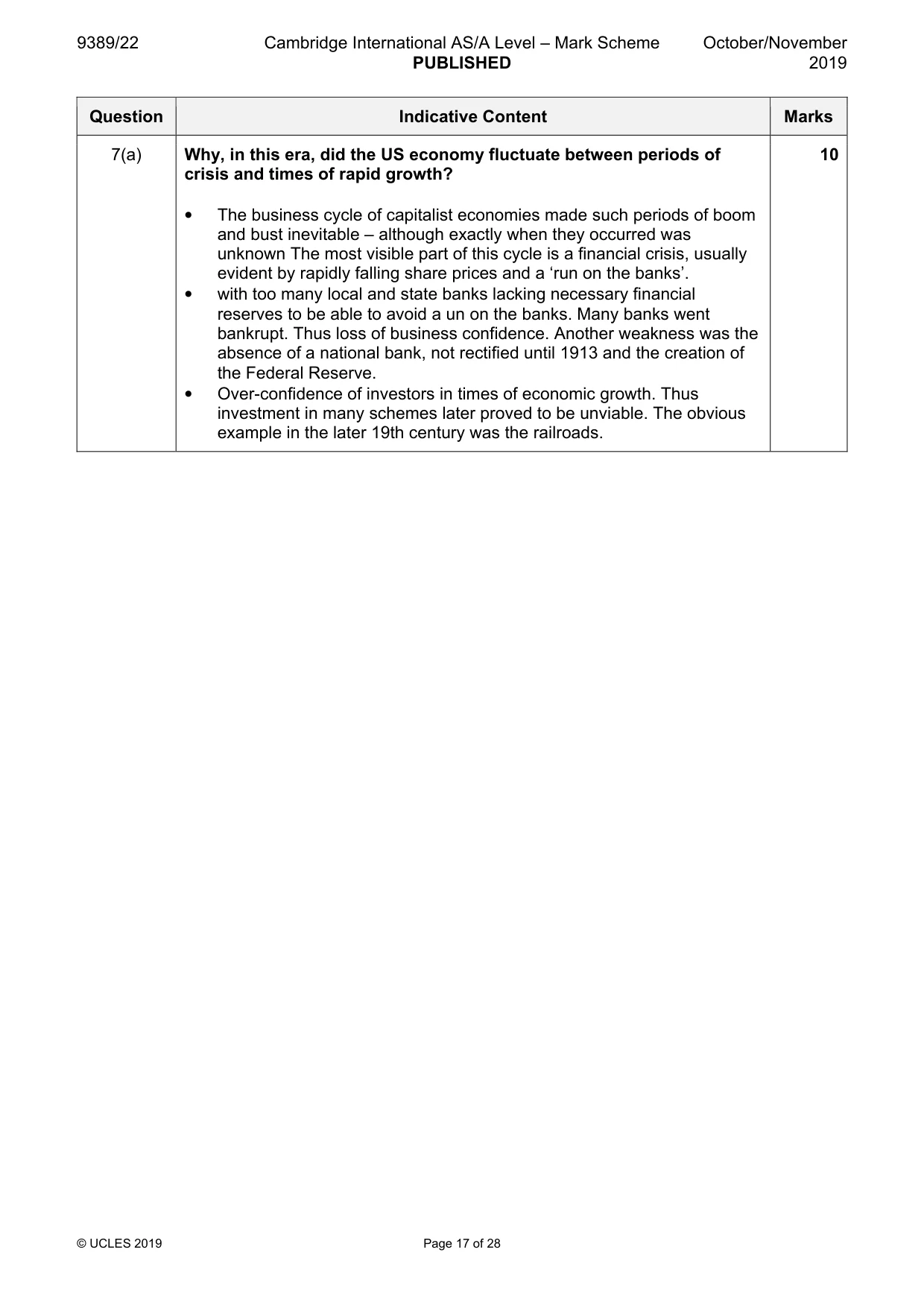
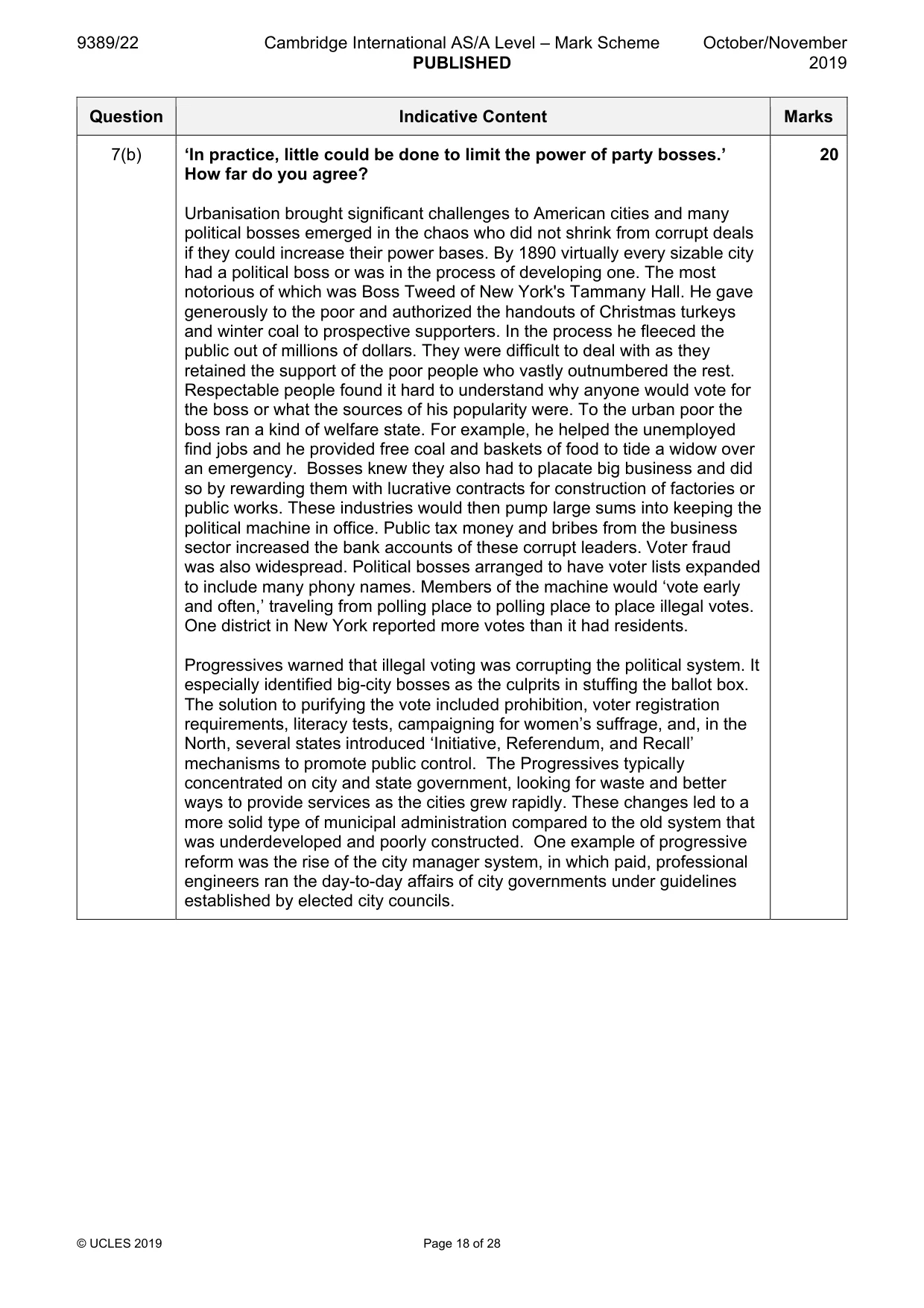
7 The Gilded Age and the Progressive Era from the 1870s to the 1920s (a) Why, in this era, did the US economy shift between periods of crisis and times of rapid growth? [10] (b) ‘In practice, little could be done to limit the power of party bosses.’ How far do you agree? [20]
Mark scheme: 7(a) Why, in this era, did the US economy fluctuate between periods of 10 crisis and times of rapid growth? • The business cycle of capitalist economies made such periods of boom and bust inevitable – although exactly when they occurred was unknown The most visible part of this cycle is a financial crisis, usually evident by rapidly falling share prices and a ‘run on the banks’. • with too many local and state banks lacking necessary financial reserves to be able to avoid a un on the banks. Many banks went bankrupt. Thus loss of business confidence. Another weakness was the absence of a national bank, not rectified until 1913 and the creation of the Federal Reserve. • Over-confidence of investors in times of economic growth. Thus investment in many schemes later proved to be unviable. The obvious example in the later 19th century was the railroads. 7(b) ‘In practice, little could be done to limit the power of party bosses.’ 20 How far do you agree? Urbanisation brought significant challenges to American cities and many political bosses emerged in the chaos who did not shrink from corrupt deals if they could increase their power bases. By 1890 virtually every sizable city had a political boss or was in the process of developing one. The most notorious of which was Boss Tweed of New York's Tammany Hall. He gave generously to the poor and authorized the handouts of Christmas turkeys and winter coal to prospective supporters. In the process he fleeced the public out of millions of dollars. They were difficult to deal with as they retained the support of the poor people who vastly outnumbered the rest. Respectable people found it hard to understand why anyone would vote for the boss or what the sources of his popularity were. To the urban poor the boss ran a kind of welfare state. For example, he helped the unemployed find jobs and he provided free coal and baskets of food to tide a widow over an emergency. Bosses knew they also had to placate big business and did so by rewarding them with lucrative contracts for construction of factories or public works. These industries would then pump large sums into keeping the political machine in office. Public tax money and bribes from the business sector increased the bank accounts of these corrupt leaders. Voter fraud was also widespread. Political bosses arranged to have voter lists expanded to include many phony names. Members of the machine would ‘vote early and often,’ traveling from polling place to polling place to place illegal votes. One district in New York reported more votes than it had residents. Progressives warned that illegal voting was corrupting the political system. It especially identified big-city bosses as the culprits in stuffing the ballot box. The solution to purifying the vote included prohibition, voter registration requirements, literacy tests, campaigning for women’s suffrage, and, in the North, several states introduced ‘Initiative, Referendum, and Recall’ mechanisms to promote public control. The Progressives typically concentrated on city and state government, looking for waste and better ways to provide services as the cities grew rapidly. These changes led to a more solid type of municipal administration compared to the old system that was underdeveloped and poorly constructed. One example of progressive reform was the rise of the city manager system, in which paid, professional engineers ran the day-to-day affairs of city governments under guidelines established by elected city councils.
Q8 · The Great Crash, the Great Depression and the New Deal, from the 1920s to 1941 (a) Why…
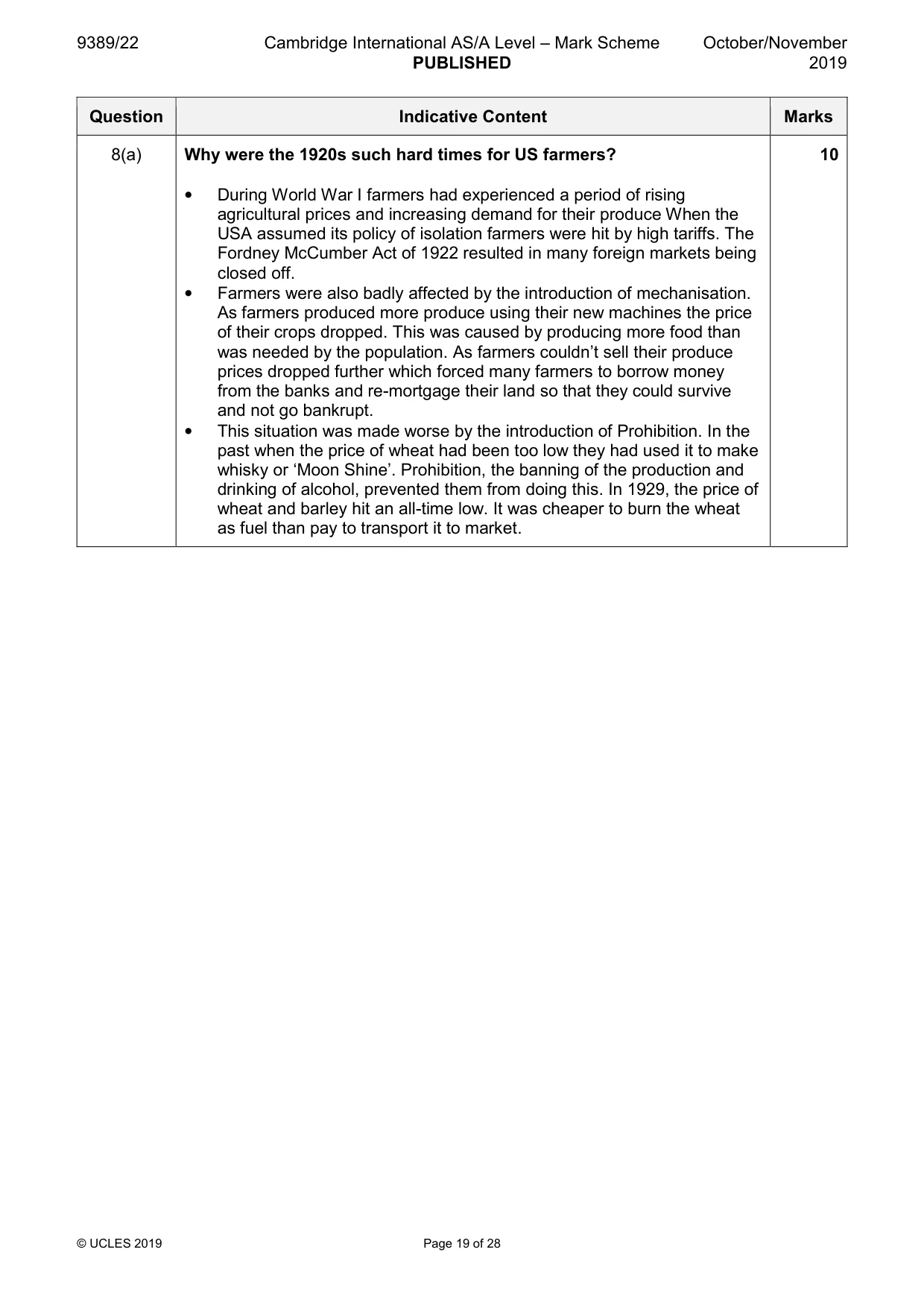
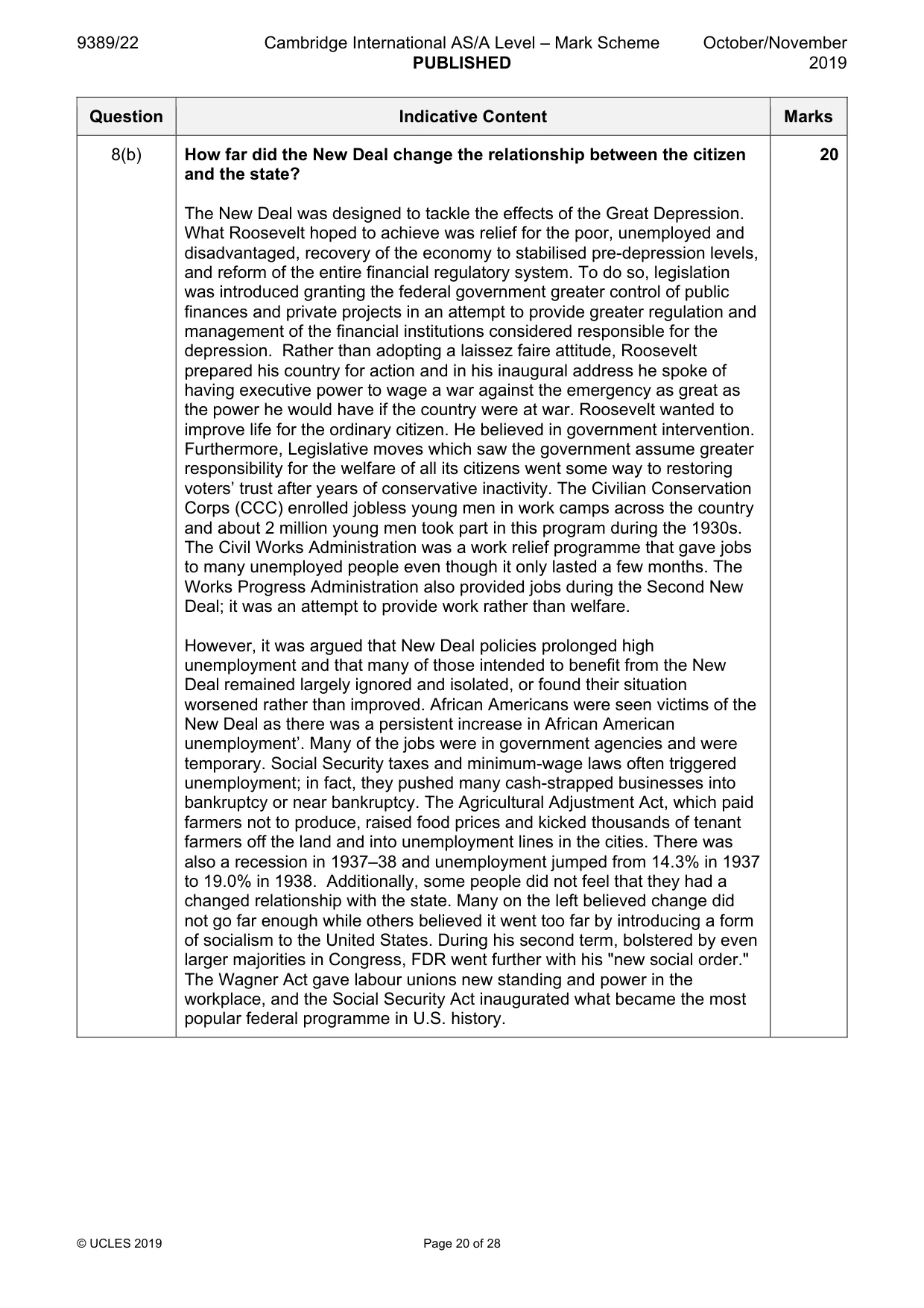
8 The Great Crash, the Great Depression and the New Deal, from the 1920s to 1941 (a) Why were the 1920s such hard times for US farmers? [10] (b) How far did the New Deal change the relationship between the citizen and the state? [20] Section C: International Option International Relations, 1871–1945 Answer both parts of two questions.
Mark scheme: 8(a) Why were the 1920s such hard times for US farmers? 10 • During World War I farmers had experienced a period of rising agricultural prices and increasing demand for their produce When the USA assumed its policy of isolation farmers were hit by high tariffs. The Fordney McCumber Act of 1922 resulted in many foreign markets being closed off. • Farmers were also badly affected by the introduction of mechanisation. As farmers produced more produce using their new machines the price of their crops dropped. This was caused by producing more food than was needed by the population. As farmers couldn’t sell their produce prices dropped further which forced many farmers to borrow money from the banks and re-mortgage their land so that they could survive and not go bankrupt. • This situation was made worse by the introduction of Prohibition. In the past when the price of wheat had been too low they had used it to make whisky or ‘Moon Shine’. Prohibition, the banning of the production and drinking of alcohol, prevented them from doing this. In 1929, the price of wheat and barley hit an all-time low. It was cheaper to burn the wheat as fuel than pay to transport it to market. 8(b) How far did the New Deal change the relationship between the citizen 20 and the state? The New Deal was designed to tackle the effects of the Great Depression. What Roosevelt hoped to achieve was relief for the poor, unemployed and disadvantaged, recovery of the economy to stabilised pre-depression levels, and reform of the entire financial regulatory system. To do so, legislation was introduced granting the federal government greater control of public finances and private projects in an attempt to provide greater regulation and management of the financial institutions considered responsible for the depression. Rather than adopting a laissez faire attitude, Roosevelt prepared his country for action and in his inaugural address he spoke of having executive power to wage a war against the emergency as great as the power he would have if the country were at war. Roosevelt wanted to improve life for the ordinary citizen. He believed in government intervention. Furthermore, Legislative moves which saw the government assume greater responsibility for the welfare of all its citizens went some way to restoring voters’ trust after years of conservative inactivity. The Civilian Conservation Corps (CCC) enrolled jobless young men in work camps across the country and about 2 million young men took part in this program during the 1930s. The Civil Works Administration was a work relief programme that gave jobs to many unemployed people even though it only lasted a few months. The Works Progress Administration also provided jobs during the Second New Deal; it was an attempt to provide work rather than welfare. However, it was argued that New Deal policies prolonged high unemployment and that many of those intended to benefit from the New Deal remained largely ignored and isolated, or found their situation worsened rather than improved. African Americans were seen victims of the New Deal as there was a persistent increase in African American unemployment’. Many of the jobs were in government agencies and were temporary. Social Security taxes and minimum-wage laws often triggered unemployment; in fact, they pushed many cash-strapped businesses into bankruptcy or near bankruptcy. The Agricultural Adjustment Act, which paid farmers not to produce, raised food prices and kicked thousands of tenant farmers off the land and into unemployment lines in the cities. There was also a recession in 1937–38 and unemployment jumped from 14.3% in 1937 to 19.0% in 1938. Additionally, some people did not feel that they had a changed relationship with the state. Many on the left believed change did not go far enough while others believed it went too far by introducing a form of socialism to the United States. During his second term, bolstered by even larger majorities in Congress, FDR went further with his "new social order." The Wagner Act gave labour unions new standing and power in the workplace, and the Social Security Act inaugurated what became the most popular federal programme in U.S. history.
Q9 · International Relations, 1871–1918 (a) Why did Kaiser Wilhelm II’s telegram to Paul…
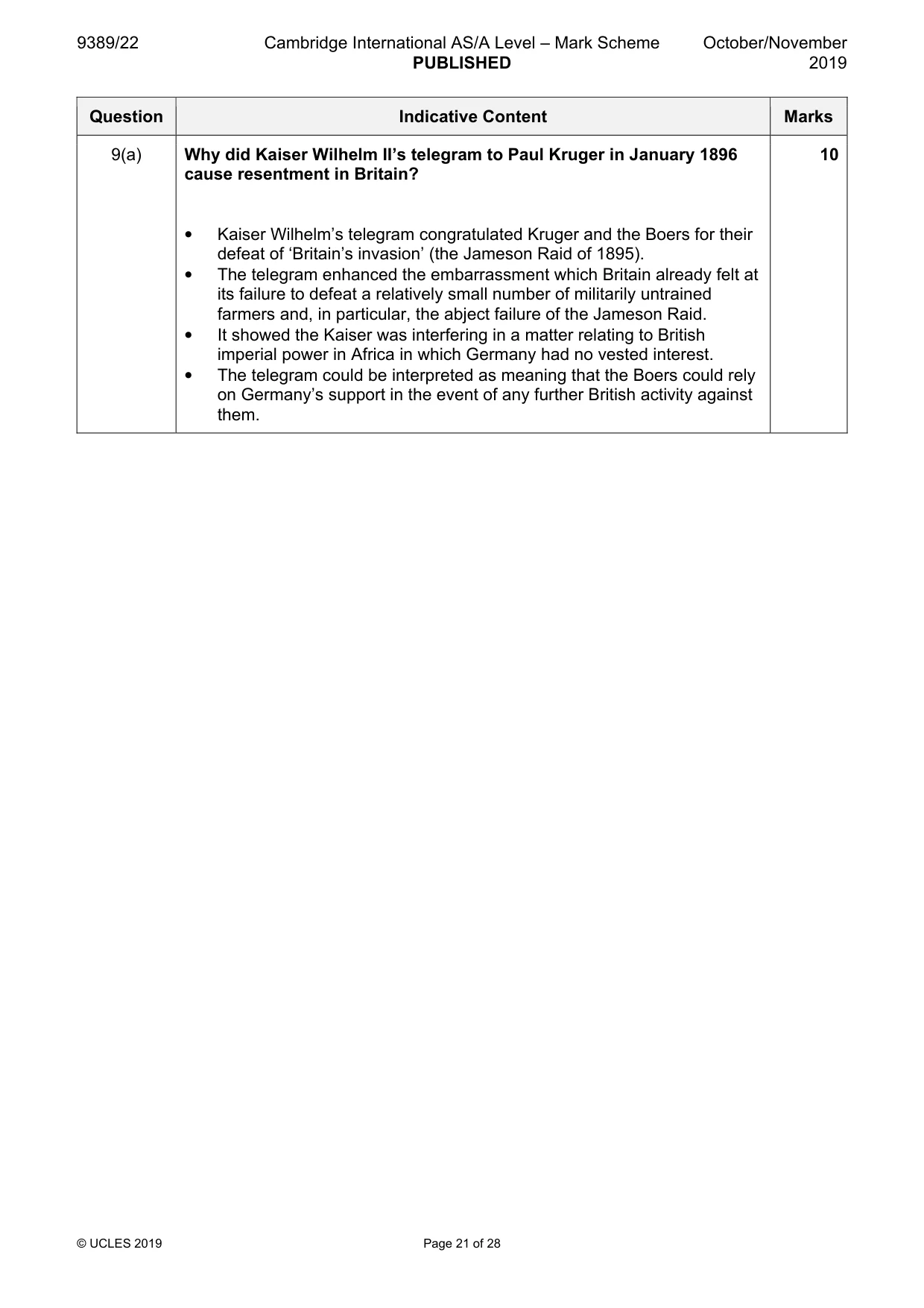
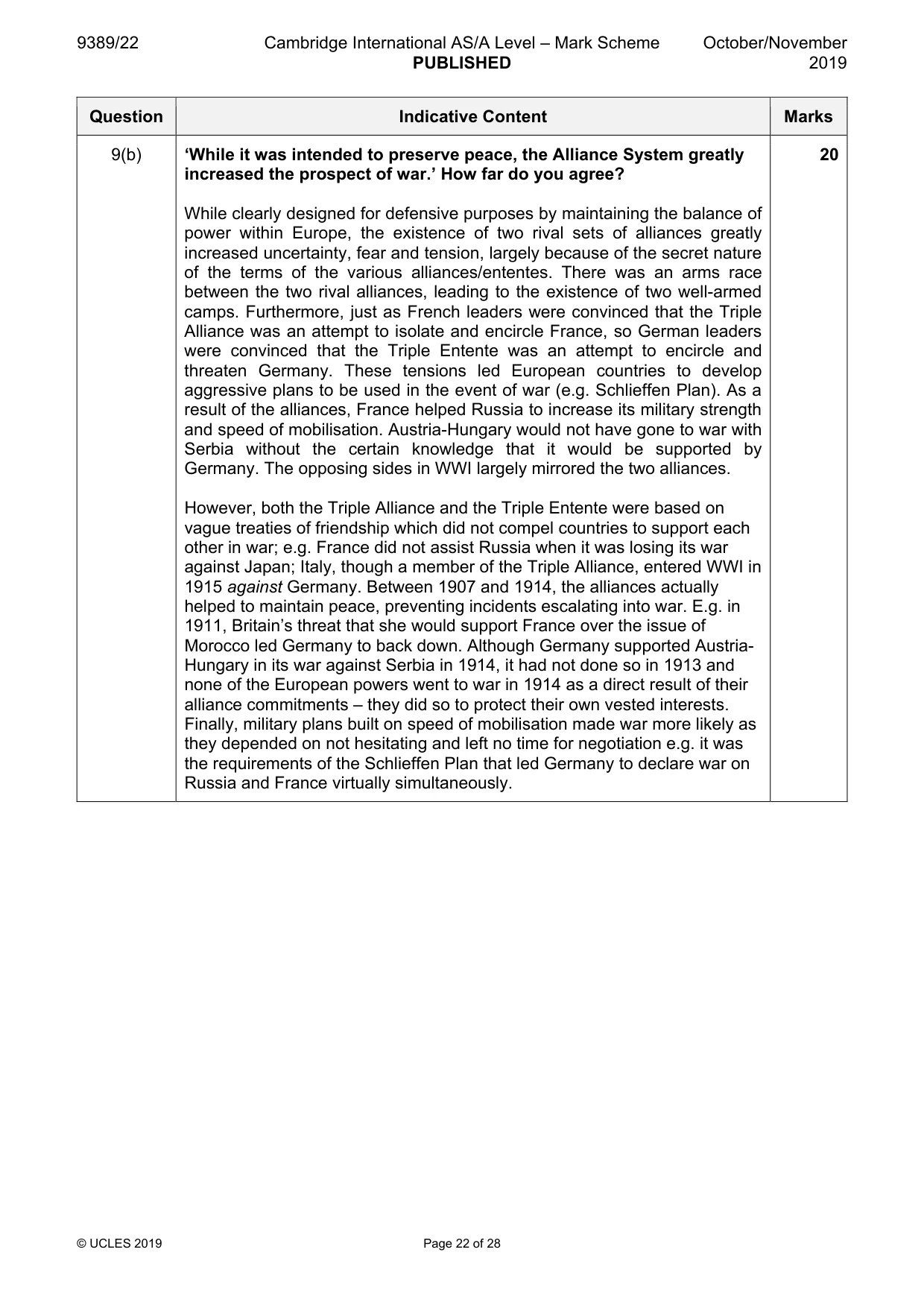
9 International Relations, 1871–1918 (a) Why did Kaiser Wilhelm II’s telegram to Paul Kruger in January 1896 cause resentment in Britain? [10] (b) ‘While it was intended to preserve peace, the Alliance System greatly increased the prospect of war.’ How far do you agree? [20]
Mark scheme: 9(a) Why did Kaiser Wilhelm II’s telegram to Paul Kruger in January 1896 10 cause resentment in Britain? • Kaiser Wilhelm’s telegram congratulated Kruger and the Boers for their defeat of ‘Britain’s invasion’ (the Jameson Raid of 1895). • The telegram enhanced the embarrassment which Britain already felt at its failure to defeat a relatively small number of militarily untrained farmers and, in particular, the abject failure of the Jameson Raid. • It showed the Kaiser was interfering in a matter relating to British imperial power in Africa in which Germany had no vested interest. • The telegram could be interpreted as meaning that the Boers could rely on Germany’s support in the event of any further British activity against them. 9(b) ‘While it was intended to preserve peace, the Alliance System greatly 20 increased the prospect of war.’ How far do you agree? While clearly designed for defensive purposes by maintaining the balance of power within Europe, the existence of two rival sets of alliances greatly increased uncertainty, fear and tension, largely because of the secret nature of the terms of the various alliances/ententes. There was an arms race between the two rival alliances, leading to the existence of two well-armed camps. Furthermore, just as French leaders were convinced that the Triple Alliance was an attempt to isolate and encircle France, so German leaders were convinced that the Triple Entente was an attempt to encircle and threaten Germany. These tensions led European countries to develop aggressive plans to be used in the event of war (e.g. Schlieffen Plan). As a result of the alliances, France helped Russia to increase its military strength and speed of mobilisation. Austria-Hungary would not have gone to war with Serbia without the certain knowledge that it would be supported by Germany. The opposing sides in WWI largely mirrored the two alliances. However, both the Triple Alliance and the Triple Entente were based on vague treaties of friendship which did not compel countries to support each other in war; e.g. France did not assist Russia when it was losing its war against Japan; Italy, though a member of the Triple Alliance, entered WWI in 1915 against Germany. Between 1907 and 1914, the alliances actually helped to maintain peace, preventing incidents escalating into war. E.g. in 1911, Britain’s threat that she would support France over the issue of Morocco led Germany to back down. Although Germany supported Austria- Hungary in its war against Serbia in 1914, it had not done so in 1913 and none of the European powers went to war in 1914 as a direct result of their alliance commitments – they did so to protect their own vested interests. Finally, military plans built on speed of mobilisation made war more likely as they depended on not hesitating and left no time for negotiation e.g. it was the requirements of the Schlieffen Plan that led Germany to declare war on Russia and France virtually simultaneously.
Q10 · International Relations, 1919–1933 (a) Why were many of the ‘successor states’…
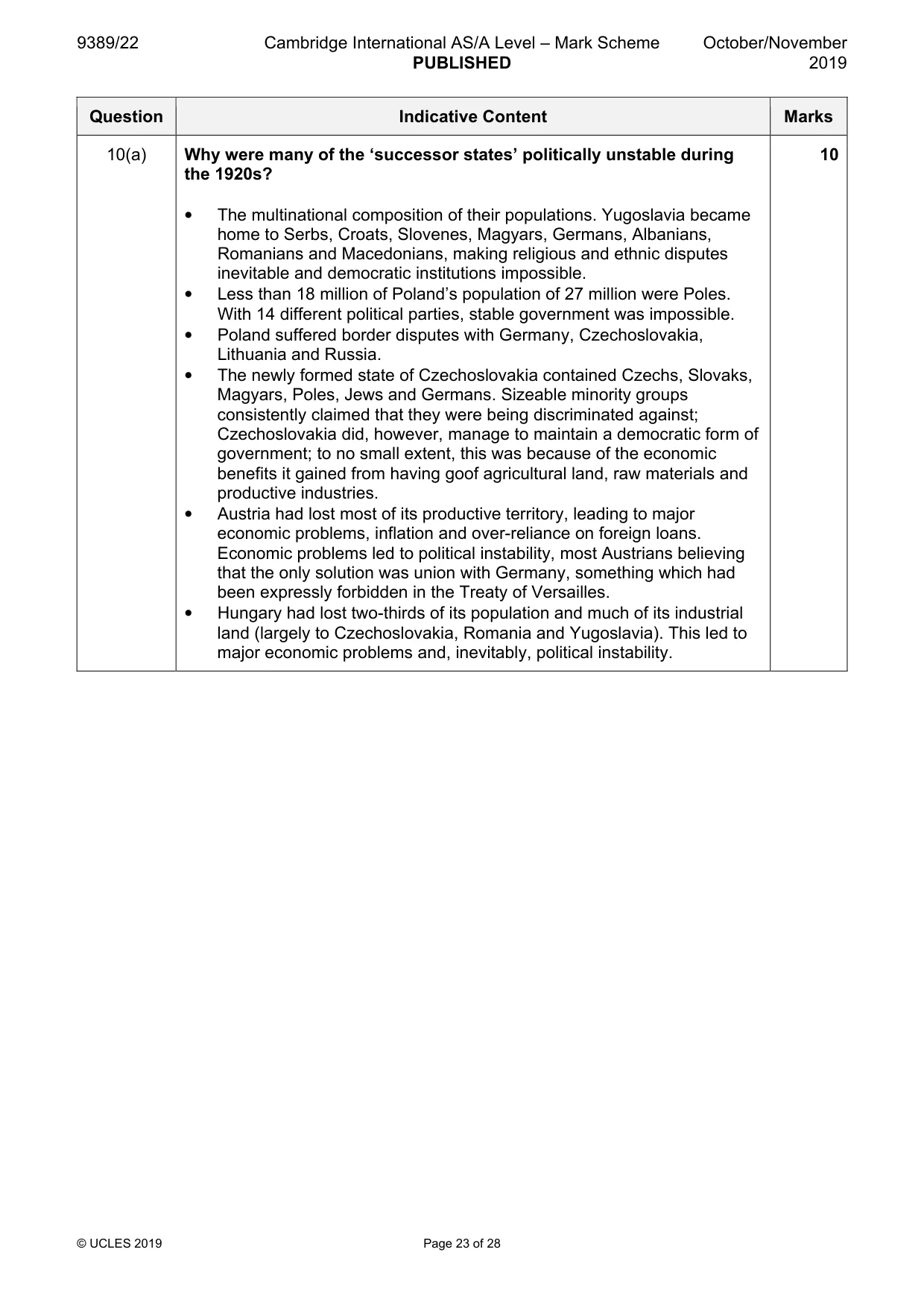
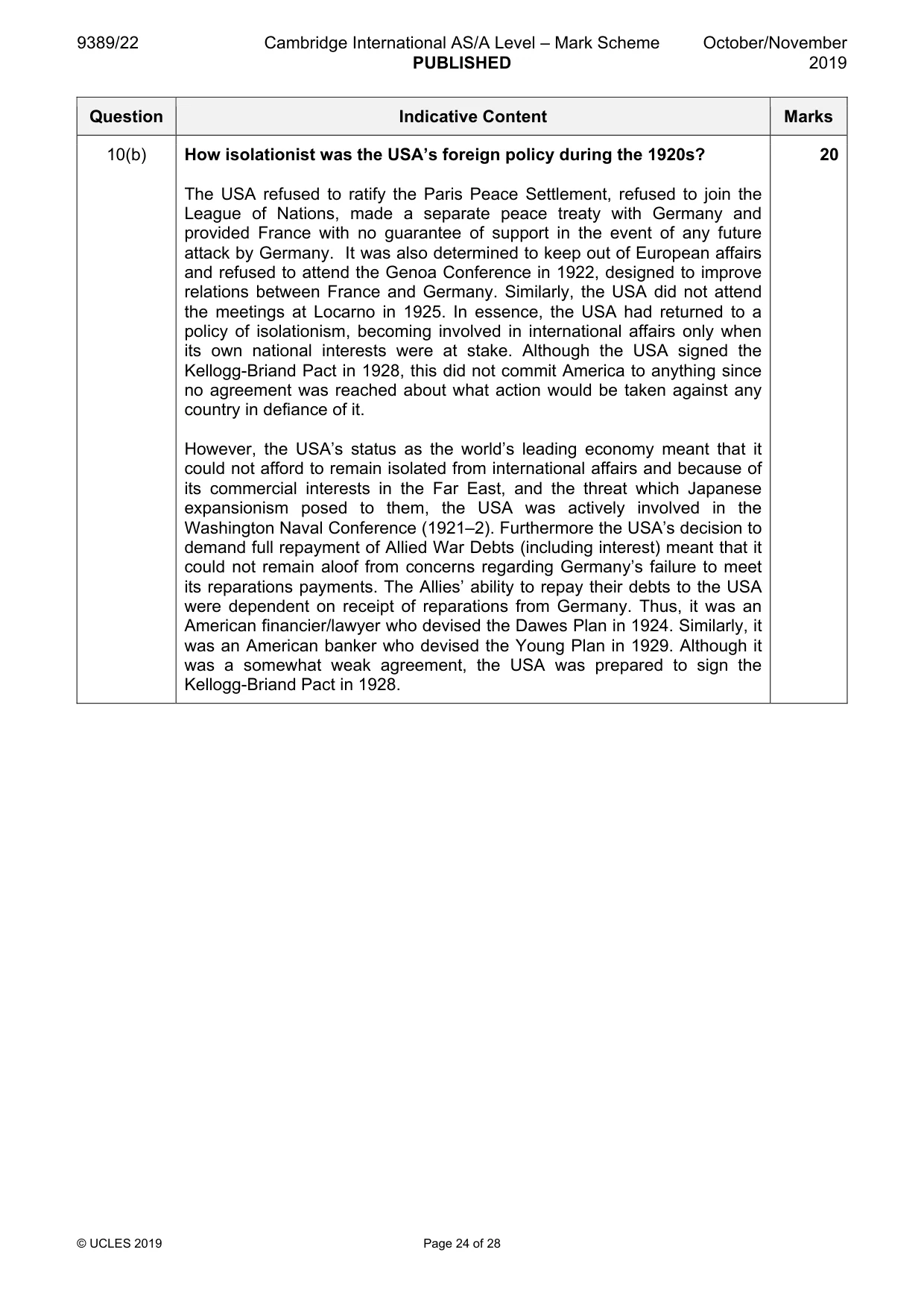
10 International Relations, 1919–1933 (a) Why were many of the ‘successor states’ politically unstable during the 1920s? [10] (b) How isolationist was the USA’s foreign policy during the 1920s? [20]
Mark scheme: 10(a) Why were many of the ‘successor states’ politically unstable during 10 the 1920s? • The multinational composition of their populations. Yugoslavia became home to Serbs, Croats, Slovenes, Magyars, Germans, Albanians, Romanians and Macedonians, making religious and ethnic disputes inevitable and democratic institutions impossible. • Less than 18 million of Poland’s population of 27 million were Poles. With 14 different political parties, stable government was impossible. • Poland suffered border disputes with Germany, Czechoslovakia, Lithuania and Russia. • The newly formed state of Czechoslovakia contained Czechs, Slovaks, Magyars, Poles, Jews and Germans. Sizeable minority groups consistently claimed that they were being discriminated against; Czechoslovakia did, however, manage to maintain a democratic form of government; to no small extent, this was because of the economic benefits it gained from having goof agricultural land, raw materials and productive industries. • Austria had lost most of its productive territory, leading to major economic problems, inflation and over-reliance on foreign loans. Economic problems led to political instability, most Austrians believing that the only solution was union with Germany, something which had been expressly forbidden in the Treaty of Versailles. • Hungary had lost two-thirds of its population and much of its industrial land (largely to Czechoslovakia, Romania and Yugoslavia). This led to major economic problems and, inevitably, political instability. 10(b) How isolationist was the USA’s foreign policy during the 1920s? 20 The USA refused to ratify the Paris Peace Settlement, refused to join the League of Nations, made a separate peace treaty with Germany and provided France with no guarantee of support in the event of any future attack by Germany. It was also determined to keep out of European affairs and refused to attend the Genoa Conference in 1922, designed to improve relations between France and Germany. Similarly, the USA did not attend the meetings at Locarno in 1925. In essence, the USA had returned to a policy of isolationism, becoming involved in international affairs only when its own national interests were at stake. Although the USA signed the Kellogg-Briand Pact in 1928, this did not commit America to anything since no agreement was reached about what action would be taken against any country in defiance of it. However, the USA’s status as the world’s leading economy meant that it could not afford to remain isolated from international affairs and because of its commercial interests in the Far East, and the threat which Japanese expansionism posed to them, the USA was actively involved in the Washington Naval Conference (1921–2). Furthermore the USA’s decision to demand full repayment of Allied War Debts (including interest) meant that it could not remain aloof from concerns regarding Germany’s failure to meet its reparations payments. The Allies’ ability to repay their debts to the USA were dependent on receipt of reparations from Germany. Thus, it was an American financier/lawyer who devised the Dawes Plan in 1924. Similarly, it was an American banker who devised the Young Plan in 1929. Although it was a somewhat weak agreement, the USA was prepared to sign the Kellogg-Briand Pact in 1928.
Q11 · International Relations, c.1933–1939 (a) Why did Mussolini adopt a diplomatic approach to…
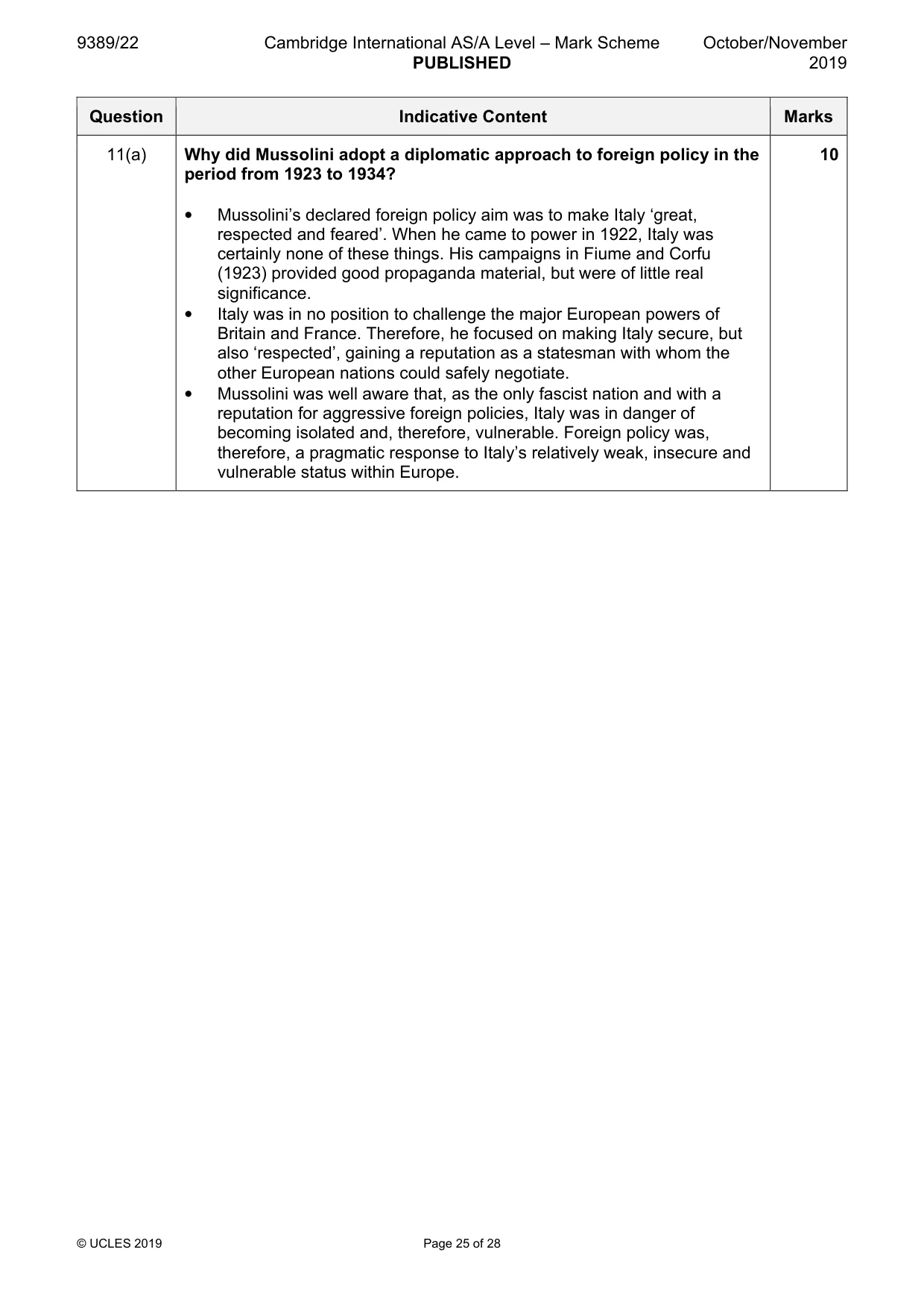
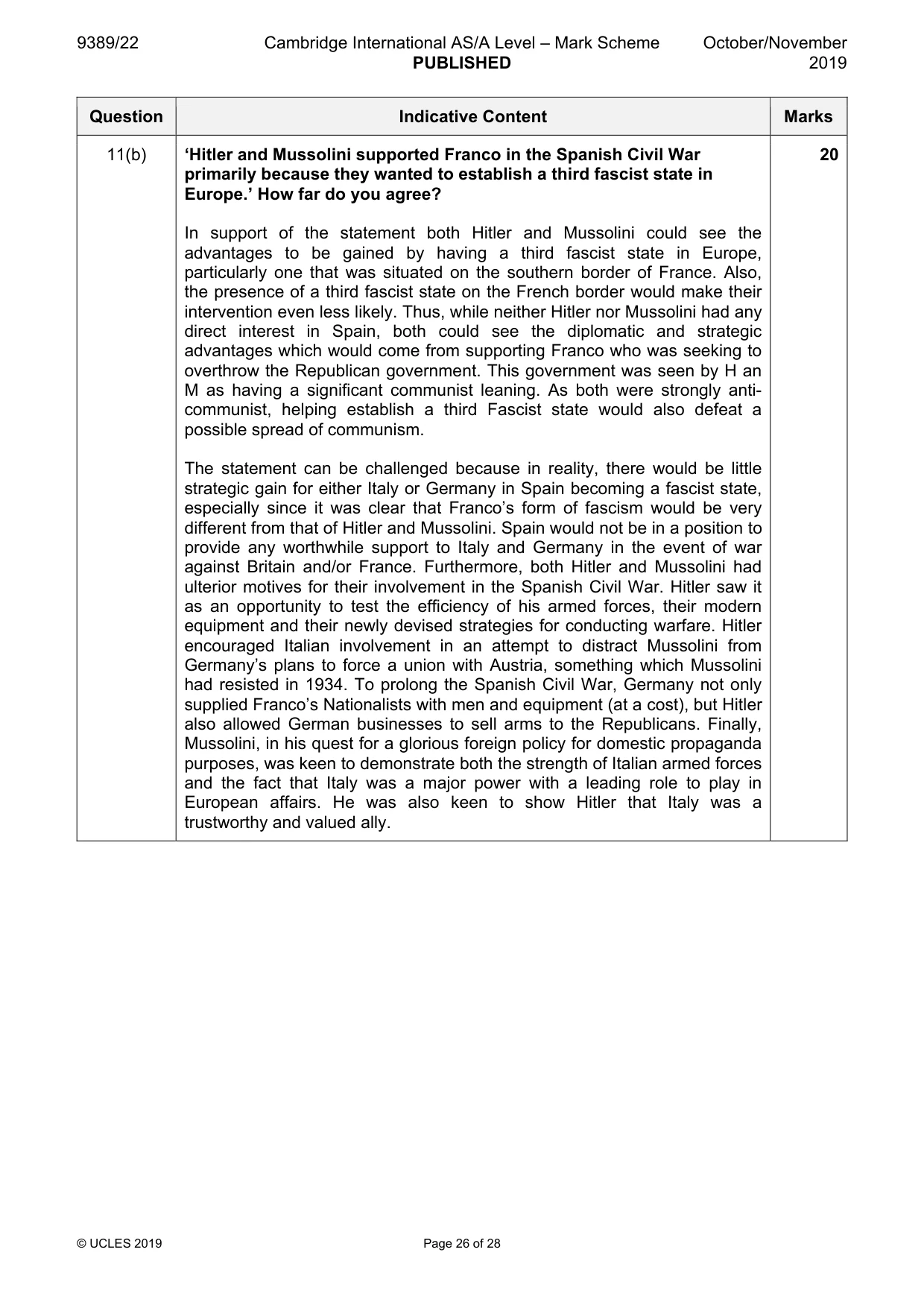
11 International Relations, c.1933–1939 (a) Why did Mussolini adopt a diplomatic approach to foreign policy in the period from 1923 to 1934? [10] (b) ‘Hitler and Mussolini supported Franco in the Spanish Civil War primarily because they wanted to establish a third fascist state in Europe.’ How far do you agree? [20]
Mark scheme: 11(a) Why did Mussolini adopt a diplomatic approach to foreign policy in the 10 period from 1923 to 1934? • Mussolini’s declared foreign policy aim was to make Italy ‘great, respected and feared’. When he came to power in 1922, Italy was certainly none of these things. His campaigns in Fiume and Corfu (1923) provided good propaganda material, but were of little real significance. • Italy was in no position to challenge the major European powers of Britain and France. Therefore, he focused on making Italy secure, but also ‘respected’, gaining a reputation as a statesman with whom the other European nations could safely negotiate. • Mussolini was well aware that, as the only fascist nation and with a reputation for aggressive foreign policies, Italy was in danger of becoming isolated and, therefore, vulnerable. Foreign policy was, therefore, a pragmatic response to Italy’s relatively weak, insecure and vulnerable status within Europe. 11(b) ‘Hitler and Mussolini supported Franco in the Spanish Civil War 20 primarily because they wanted to establish a third fascist state in Europe.’ How far do you agree? In support of the statement both Hitler and Mussolini could see the advantages to be gained by having a third fascist state in Europe, particularly one that was situated on the southern border of France. Also, the presence of a third fascist state on the French border would make their intervention even less likely. Thus, while neither Hitler nor Mussolini had any direct interest in Spain, both could see the diplomatic and strategic advantages which would come from supporting Franco who was seeking to overthrow the Republican government. This government was seen by H an M as having a significant communist leaning. As both were strongly anti- communist, helping establish a third Fascist state would also defeat a possible spread of communism. The statement can be challenged because in reality, there would be little strategic gain for either Italy or Germany in Spain becoming a fascist state, especially since it was clear that Franco’s form of fascism would be very different from that of Hitler and Mussolini. Spain would not be in a position to provide any worthwhile support to Italy and Germany in the event of war against Britain and/or France. Furthermore, both Hitler and Mussolini had ulterior motives for their involvement in the Spanish Civil War. Hitler saw it as an opportunity to test the efficiency of his armed forces, their modern equipment and their newly devised strategies for conducting warfare. Hitler encouraged Italian involvement in an attempt to distract Mussolini from Germany’s plans to force a union with Austria, something which Mussolini had resisted in 1934. To prolong the Spanish Civil War, Germany not only supplied Franco’s Nationalists with men and equipment (at a cost), but Hitler also allowed German businesses to sell arms to the Republicans. Finally, Mussolini, in his quest for a glorious foreign policy for domestic propaganda purposes, was keen to demonstrate both the strength of Italian armed forces and the fact that Italy was a major power with a leading role to play in European affairs. He was also keen to show Hitler that Italy was a trustworthy and valued ally.
Q12 · China and Japan, 1919–1945 (a) Why did Japanese forces take full control of Manchuria in…
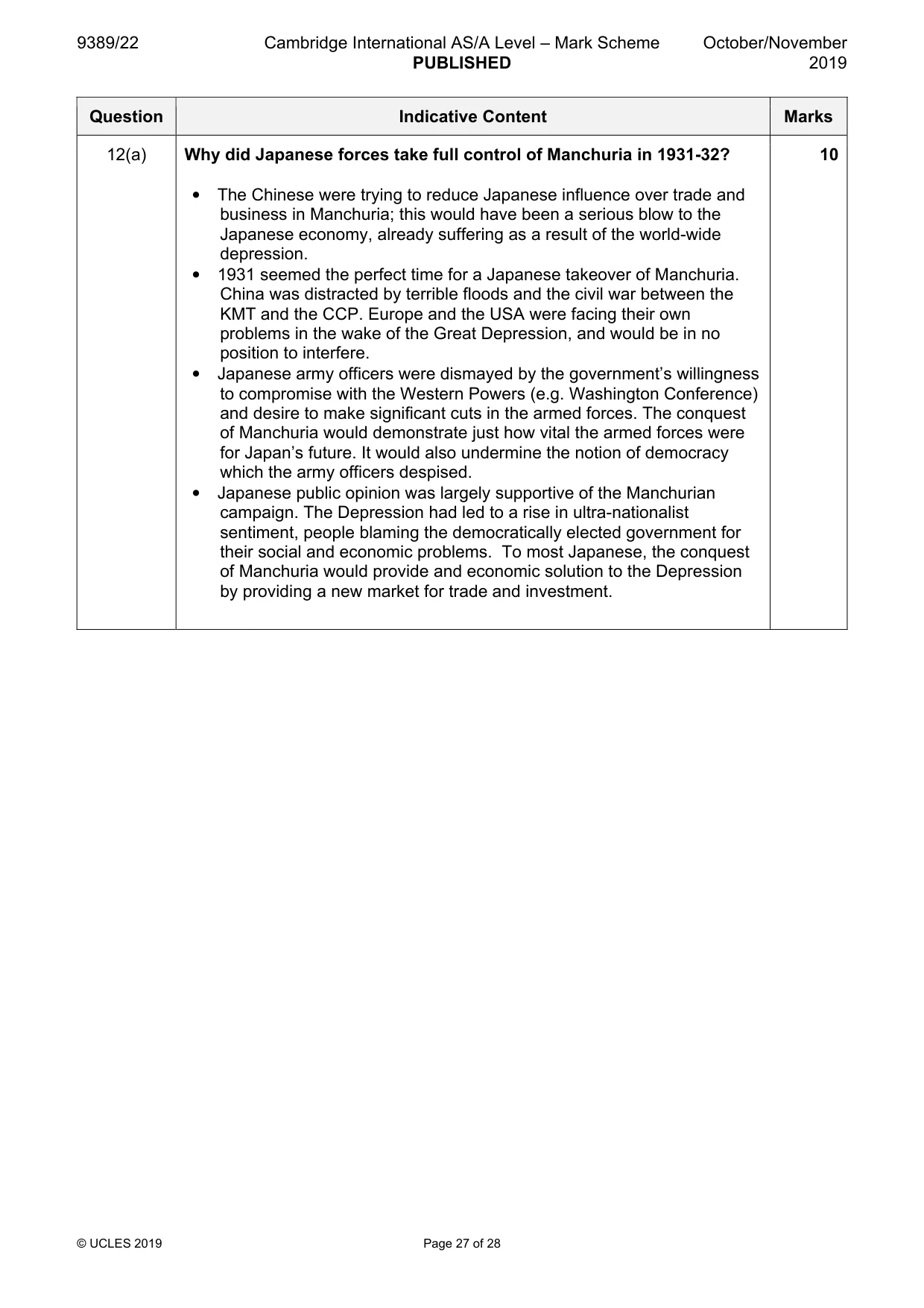
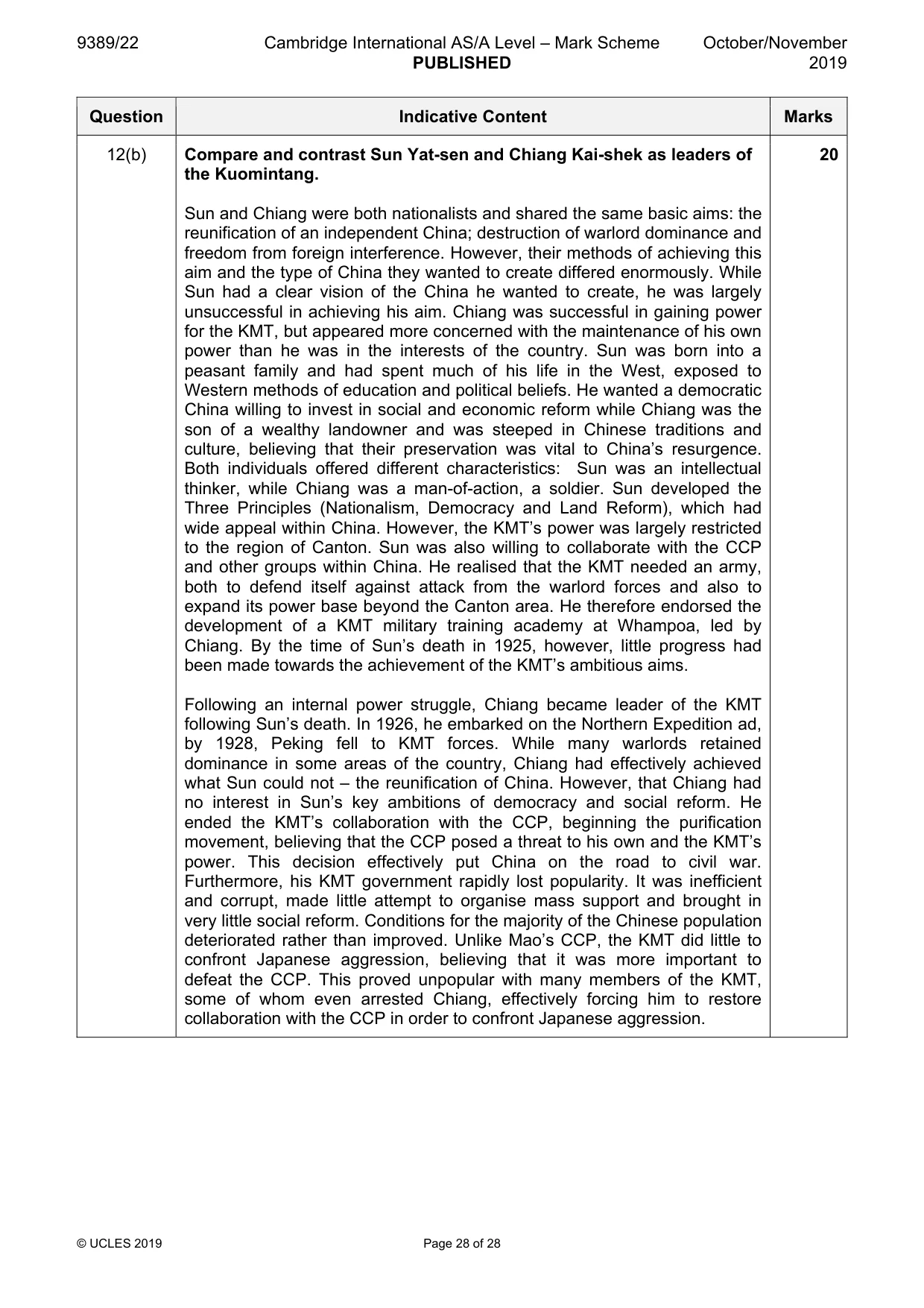
12 China and Japan, 1919–1945 (a) Why did Japanese forces take full control of Manchuria in 1931–32? [10] (b) Compare and contrast Sun Yat-sen and Chiang Kai-shek as leaders of the Kuomintang. [20]
Mark scheme: 12(a) Why did Japanese forces take full control of Manchuria in 1931-32? 10 • The Chinese were trying to reduce Japanese influence over trade and business in Manchuria; this would have been a serious blow to the Japanese economy, already suffering as a result of the world-wide depression. • 1931 seemed the perfect time for a Japanese takeover of Manchuria. China was distracted by terrible floods and the civil war between the KMT and the CCP. Europe and the USA were facing their own problems in the wake of the Great Depression, and would be in no position to interfere. • Japanese army officers were dismayed by the government’s willingness to compromise with the Western Powers (e.g. Washington Conference) and desire to make significant cuts in the armed forces. The conquest of Manchuria would demonstrate just how vital the armed forces were for Japan’s future. It would also undermine the notion of democracy which the army officers despised. • Japanese public opinion was largely supportive of the Manchurian campaign. The Depression had led to a rise in ultra-nationalist sentiment, people blaming the democratically elected government for their social and economic problems. To most Japanese, the conquest of Manchuria would provide and economic solution to the Depression by providing a new market for trade and investment. 12(b) Compare and contrast Sun Yat-sen and Chiang Kai-shek as leaders of 20 the Kuomintang. Sun and Chiang were both nationalists and shared the same basic aims: the reunification of an independent China; destruction of warlord dominance and freedom from foreign interference. However, their methods of achieving this aim and the type of China they wanted to create differed enormously. While Sun had a clear vision of the China he wanted to create, he was largely unsuccessful in achieving his aim. Chiang was successful in gaining power for the KMT, but appeared more concerned with the maintenance of his own power than he was in the interests of the country. Sun was born into a peasant family and had spent much of his life in the West, exposed to Western methods of education and political beliefs. He wanted a democratic China willing to invest in social and economic reform while Chiang was the son of a wealthy landowner and was steeped in Chinese traditions and culture, believing that their preservation was vital to China’s resurgence. Both individuals offered different characteristics: Sun was an intellectual thinker, while Chiang was a man-of-action, a soldier. Sun developed the Three Principles (Nationalism, Democracy and Land Reform), which had wide appeal within China. However, the KMT’s power was largely restricted to the region of Canton. Sun was also willing to collaborate with the CCP and other groups within China. He realised that the KMT needed an army, both to defend itself against attack from the warlord forces and also to expand its power base beyond the Canton area. He therefore endorsed the development of a KMT military training academy at Whampoa, led by Chiang. By the time of Sun’s death in 1925, however, little progress had been made towards the achievement of the KMT’s ambitious aims. Following an internal power struggle, Chiang became leader of the KMT following Sun’s death. In 1926, he embarked on the Northern Expedition ad, by 1928, Peking fell to KMT forces. While many warlords retained dominance in some areas of the country, Chiang had effectively achieved what Sun could not – the reunification of China. However, that Chiang had no interest in Sun’s key ambitions of democracy and social reform. He ended the KMT’s collaboration with the CCP, beginning the purification movement, believing that the CCP posed a threat to his own and the KMT’s power. This decision effectively put China on the road to civil war. Furthermore, his KMT government rapidly lost popularity. It was inefficient and corrupt, made little attempt to organise mass support and brought in very little social reform. Conditions for the majority of the Chinese population deteriorated rather than improved. Unlike Mao’s CCP, the KMT did little to confront Japanese aggression, believing that it was more important to defeat the CCP. This proved unpopular with many members of the KMT, some of whom even arrested Chiang, effectively forcing him to restore collaboration with the CCP in order to confront Japanese aggression.
What you needed in this session
Cambridge’s own grade thresholds for 2019 Oct/Nov, Paper 2 · Variant 2. A higher threshold means an easier paper — the bar moves with how the cohort did.