Cambridge A Level History 9389 — 2017 May/June Paper 2 · Variant 3
9389/23/M/J/17 · 12 questions · 60 marks · ≈68 min
The question paper and its mark scheme, free to read here and free to download. This is Cambridge’s own paper, exactly as it was sat.
Question paper4 pages
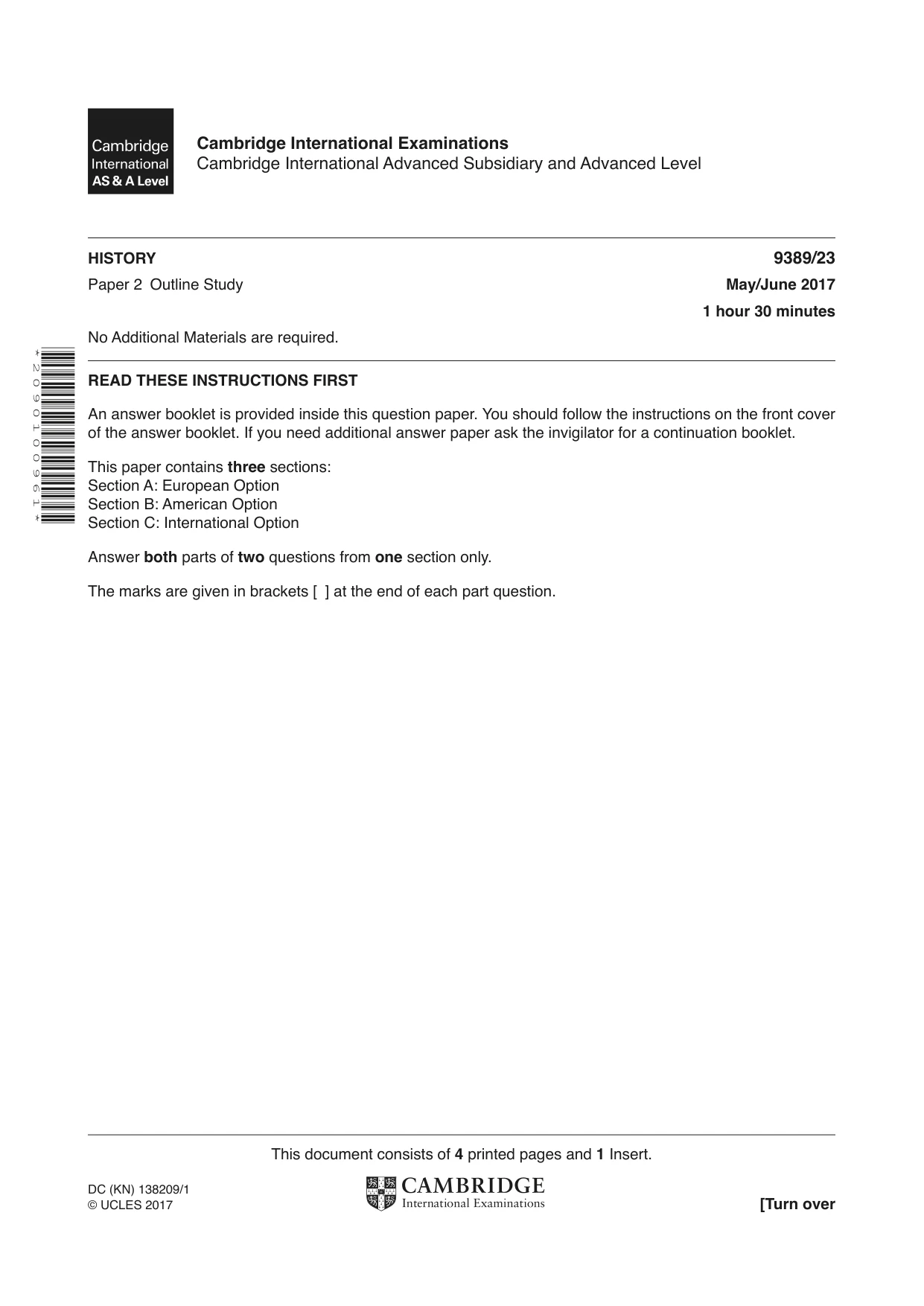
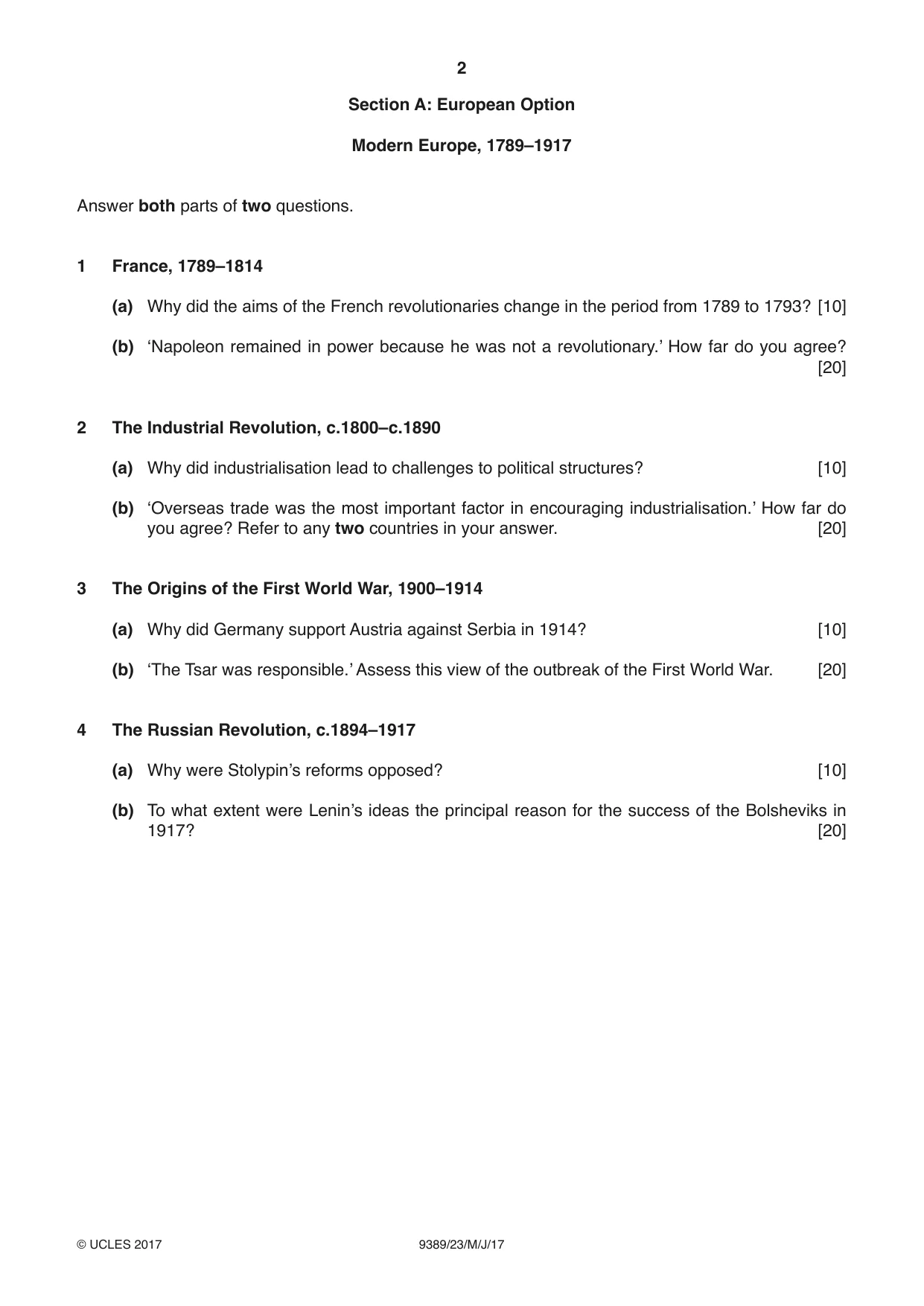
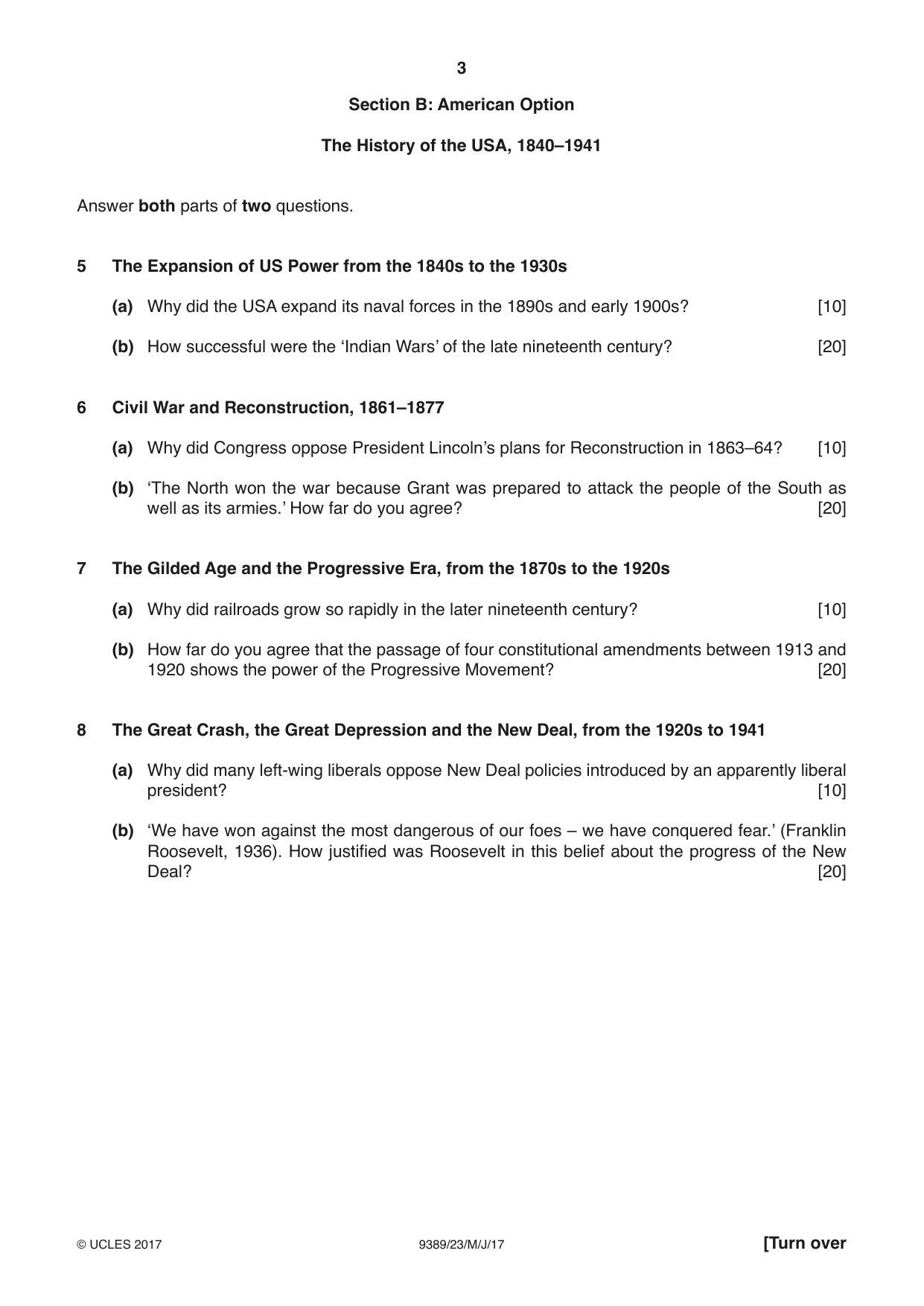
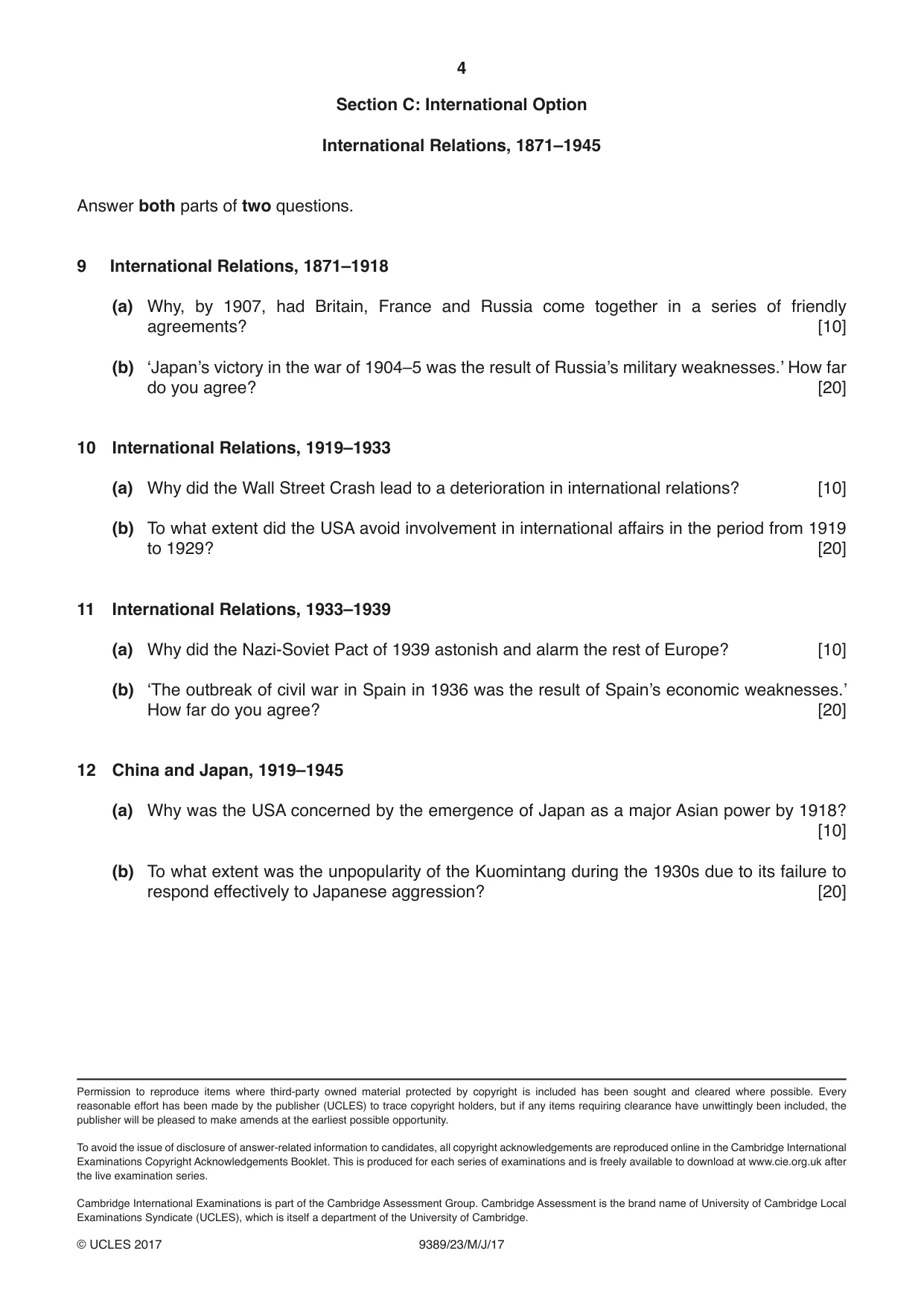
Mark scheme24 pages
Answers below. Sit the paper first if you are practising.
Questions as text
Q1 · France, 1789–1814 (a) Why did the aims of the French revolutionaries change in the period…
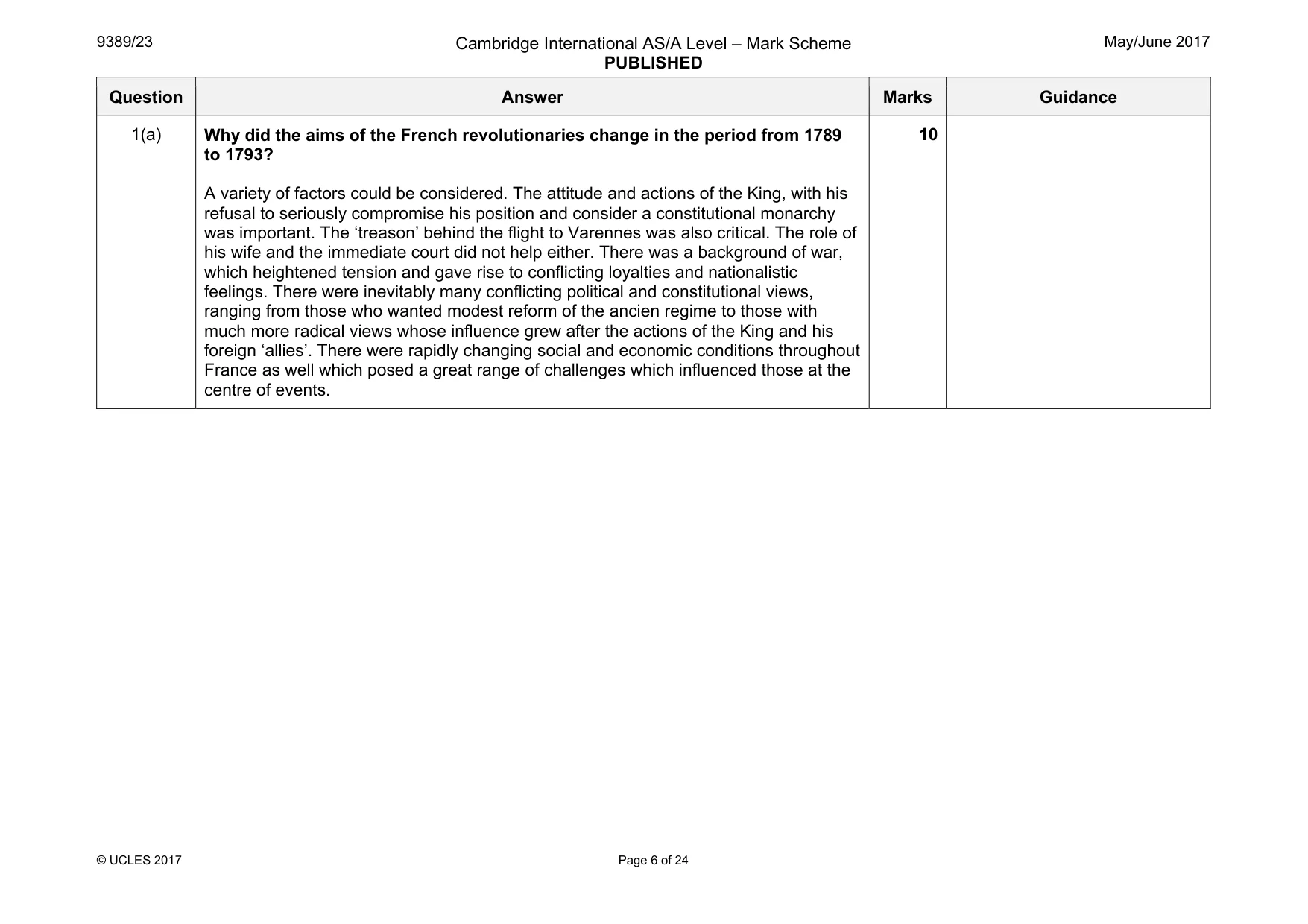
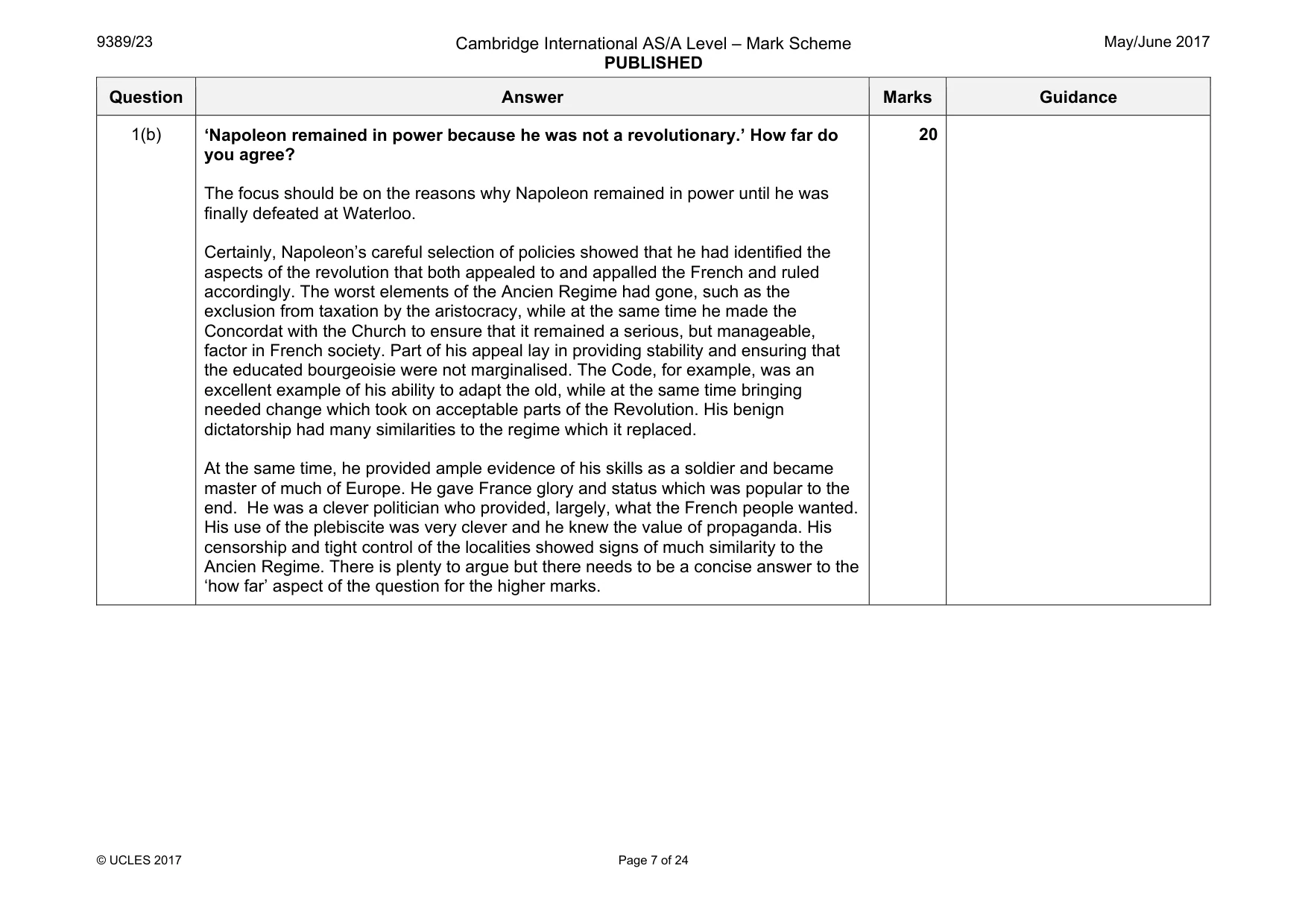
1 France, 1789–1814 (a) Why did the aims of the French revolutionaries change in the period from 1789 to 1793? [10] (b) ‘Napoleon remained in power because he was not a revolutionary.’ How far do you agree? [20]
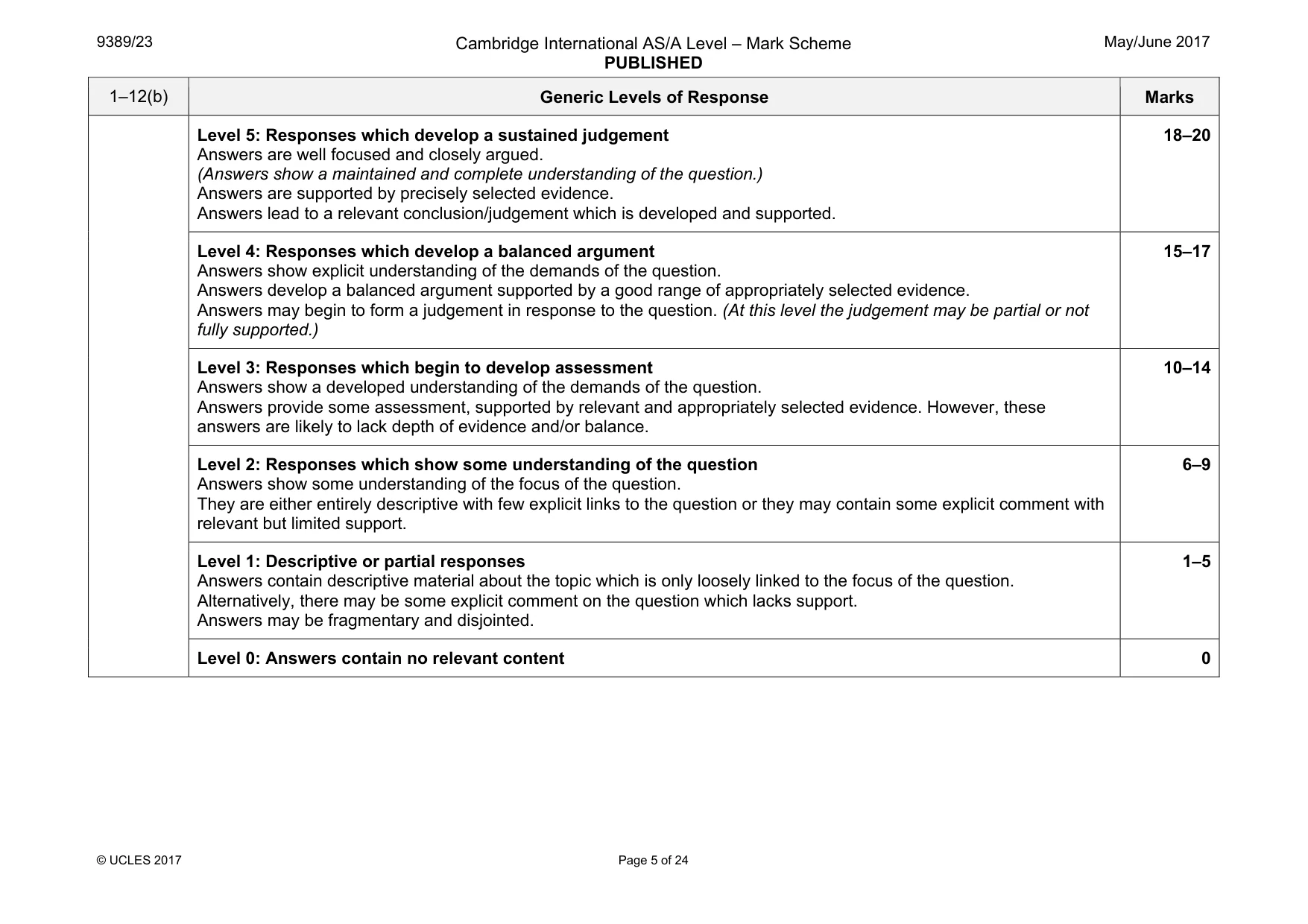
Mark scheme: 1(a) Why did the aims of the French revolutionaries change in the period from 1789 to 1793? A variety of factors could be considered. The attitude and actions of the King, with his refusal to seriously compromise his position and consider a constitutional monarchy was important. The ‘treason’ behind the flight to Varennes was also critical. The role of his wife and the immediate court did not help either. There was a background of war, which heightened tension and gave rise to conflicting loyalties and nationalistic feelings. There were inevitably many conflicting political and constitutional views, ranging from those who wanted modest reform of the ancien regime to those with much more radical views whose influence grew after the actions of the King and his foreign ‘allies’. There were rapidly changing social and economic conditions throughout France as well which posed a great range of challenges which influenced those at the centre of events. 10 Question Answer Marks Guidance 1(b) ‘Napoleon remained in power because he was not a revolutionary.’ How far do you agree? The focus should be on the reasons why Napoleon remained in power until he was finally defeated at Waterloo. Certainly, Napoleon’s careful selection of policies showed that he had identified the aspects of the revolution that both appealed to and appalled the French and ruled accordingly. The worst elements of the Ancien Regime had gone, such as the exclusion from taxation by the aristocracy, while at the same time he made the Concordat with the Church to ensure that it remained a serious, but manageable, factor in French society. Part of his appeal lay in providing stability and ensuring that the educated bourgeoisie were not marginalised. The Code, for example, was an excellent example of his ability to adapt the old, while at the same time bringing needed change which took on acceptable parts of the Revolution. His benign dictatorship had many similarities to the regime which it replaced. At the same time, he provided ample evidence of his skills as a soldier and became master of much of Europe. He gave France glory and status which was popular to the end. He was a clever politician who provided, largely, what the French people wanted. His use of the plebiscite was very clever and he knew the value of propaganda. His censorship and tight control of the localities showed signs of much similarity to the Ancien Regime. There is plenty to argue but there needs to be a concise answer to the ‘how far’ aspect of the question for the higher marks. 20
Q2 · The Industrial Revolution, c.1800–c.1890 (a) Why did industrialisation lead to challenges…
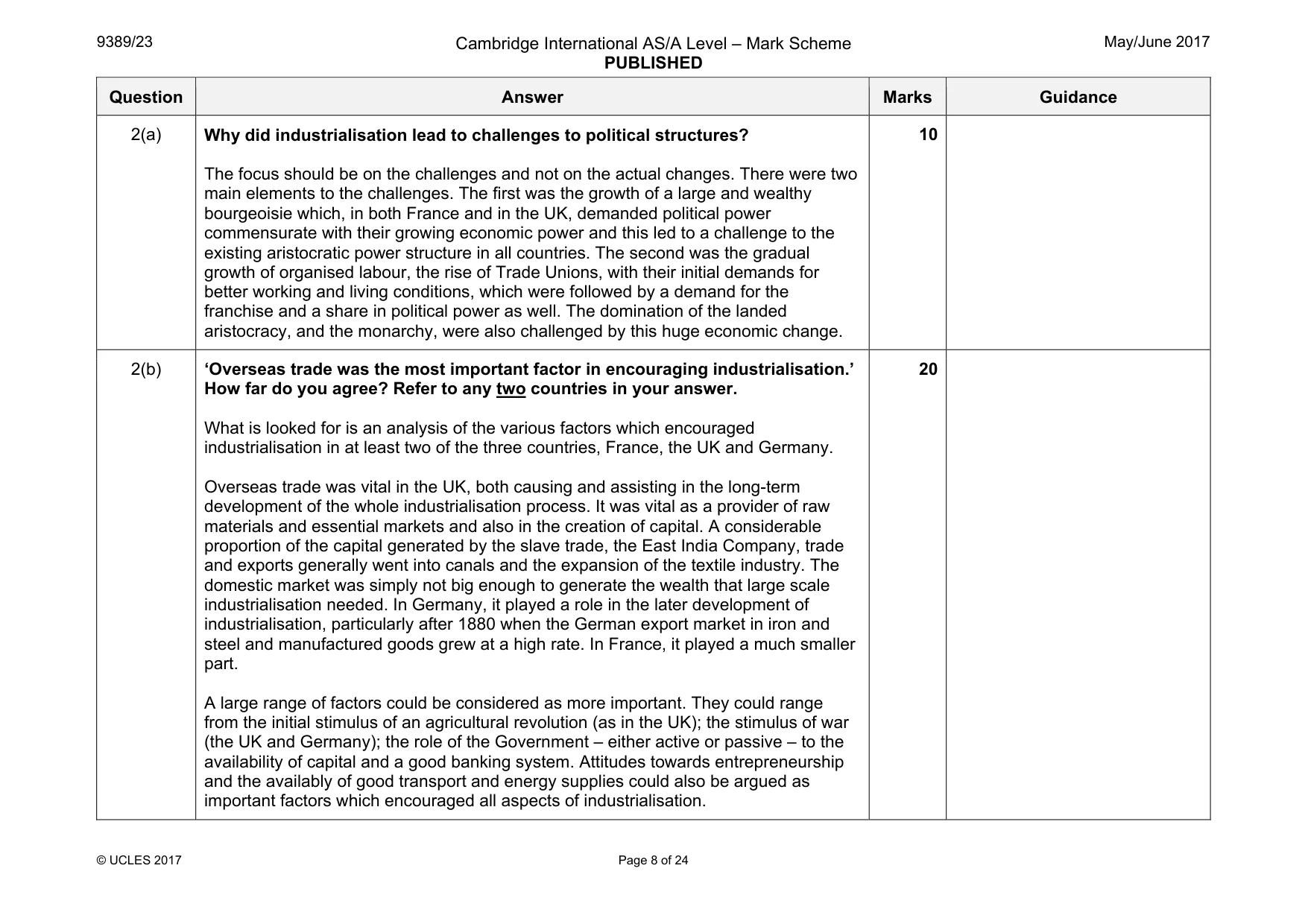
2 The Industrial Revolution, c.1800–c.1890 (a) Why did industrialisation lead to challenges to political structures? [10] (b) ‘Overseas trade was the most important factor in encouraging industrialisation.’ How far do you agree? Refer to any two countries in your answer. [20]
Mark scheme: 2(a) Why did industrialisation lead to challenges to political structures? The focus should be on the challenges and not on the actual changes. There were two main elements to the challenges. The first was the growth of a large and wealthy bourgeoisie which, in both France and in the UK, demanded political power commensurate with their growing economic power and this led to a challenge to the existing aristocratic power structure in all countries. The second was the gradual growth of organised labour, the rise of Trade Unions, with their initial demands for better working and living conditions, which were followed by a demand for the franchise and a share in political power as well. The domination of the landed aristocracy, and the monarchy, were also challenged by this huge economic change. 10 2(b) ‘Overseas trade was the most important factor in encouraging industrialisation.’ How far do you agree? Refer to any two countries in your answer. What is looked for is an analysis of the various factors which encouraged industrialisation in at least two of the three countries, France, the UK and Germany. Overseas trade was vital in the UK, both causing and assisting in the long-term development of the whole industrialisation process. It was vital as a provider of raw materials and essential markets and also in the creation of capital. A considerable proportion of the capital generated by the slave trade, the East India Company, trade and exports generally went into canals and the expansion of the textile industry. The domestic market was simply not big enough to generate the wealth that large scale industrialisation needed. In Germany, it played a role in the later development of industrialisation, particularly after 1880 when the German export market in iron and steel and manufactured goods grew at a high rate. In France, it played a much smaller part. A large range of factors could be considered as more important. They could range from the initial stimulus of an agricultural revolution (as in the UK); the stimulus of war (the UK and Germany); the role of the Government – either active or passive – to the availability of capital and a good banking system. Attitudes towards entrepreneurship and the availably of good transport and energy supplies could also be argued as important factors which encouraged all aspects of industrialisation. 20
Q3 · The Origins of the First World War, 1900–1914 (a) Why did Germany support Austria against…
3 The Origins of the First World War, 1900–1914 (a) Why did Germany support Austria against Serbia in 1914? [10] (b) ‘The Tsar was responsible.’ Assess this view of the outbreak of the First World War. [20]
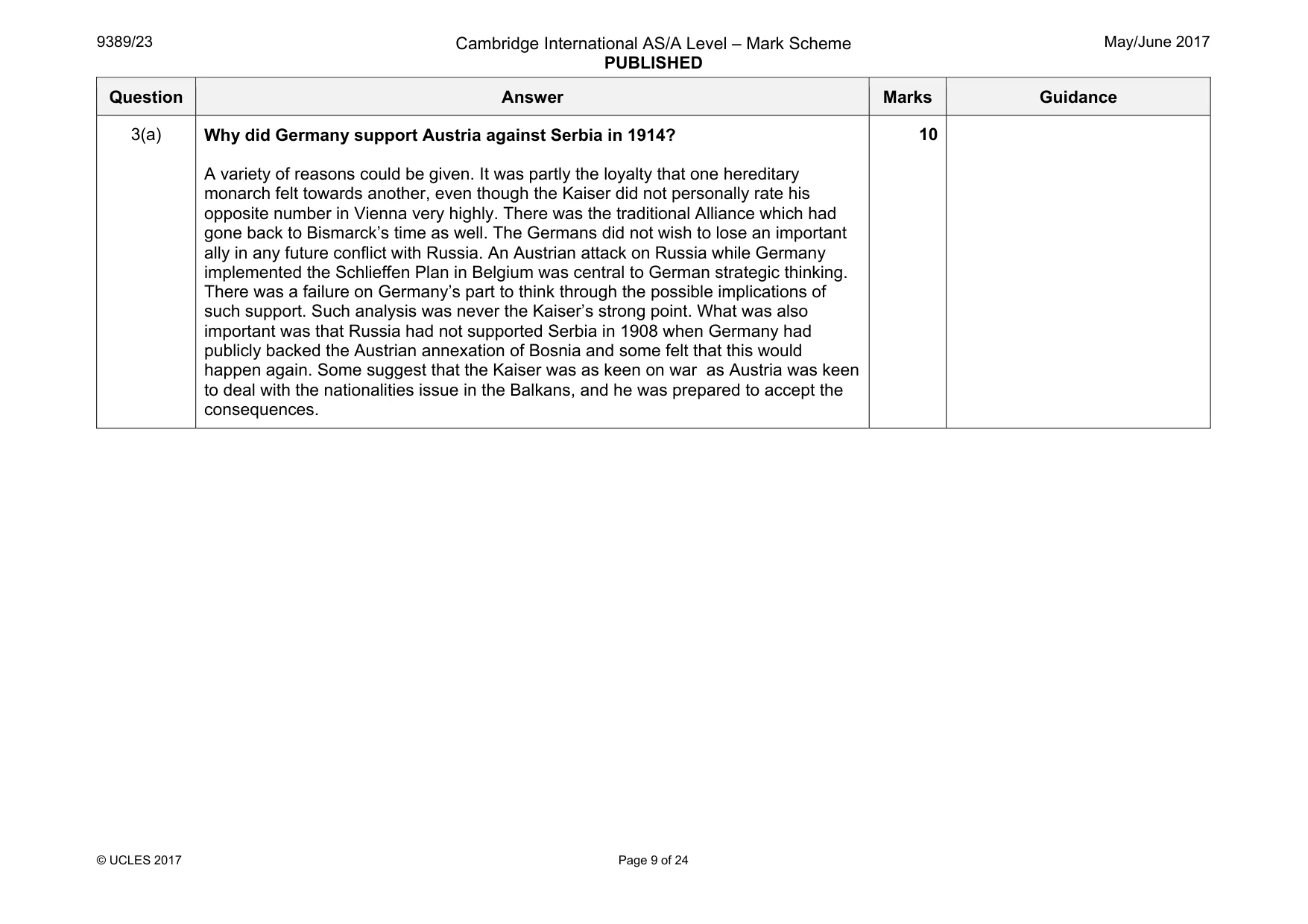
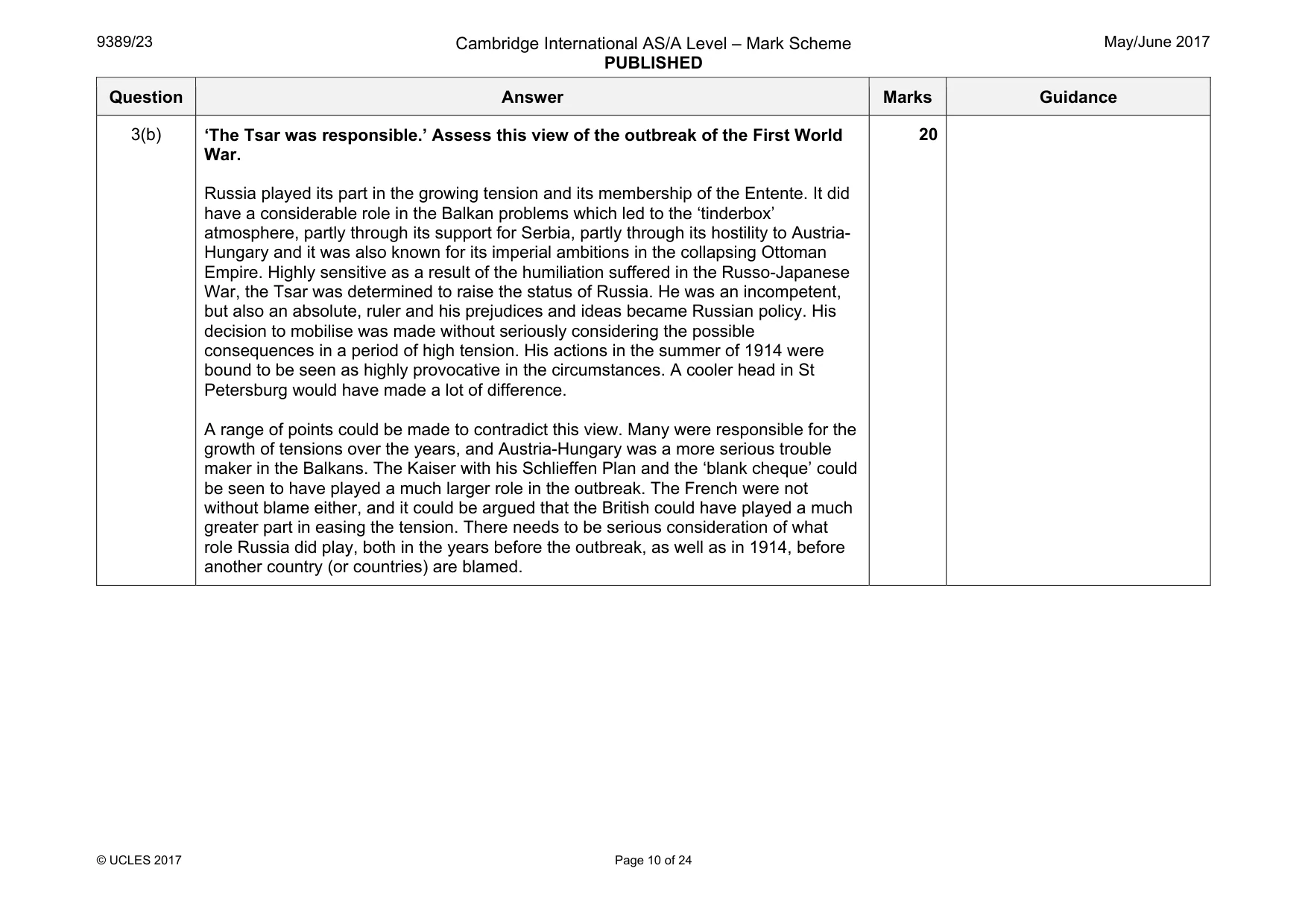
Mark scheme: 3(a) Why did Germany support Austria against Serbia in 1914? A variety of reasons could be given. It was partly the loyalty that one hereditary monarch felt towards another, even though the Kaiser did not personally rate his opposite number in Vienna very highly. There was the traditional Alliance which had gone back to Bismarck’s time as well. The Germans did not wish to lose an important ally in any future conflict with Russia. An Austrian attack on Russia while Germany implemented the Schlieffen Plan in Belgium was central to German strategic thinking. There was a failure on Germany’s part to think through the possible implications of such support. Such analysis was never the Kaiser’s strong point. What was also important was that Russia had not supported Serbia in 1908 when Germany had publicly backed the Austrian annexation of Bosnia and some felt that this would happen again. Some suggest that the Kaiser was as keen on war as Austria was keen to deal with the nationalities issue in the Balkans, and he was prepared to accept the consequences. 10 Question Answer Marks Guidance 3(b) ‘The Tsar was responsible.’ Assess this view of the outbreak of the First World War. Russia played its part in the growing tension and its membership of the Entente. It did have a considerable role in the Balkan problems which led to the ‘tinderbox’ atmosphere, partly through its support for Serbia, partly through its hostility to Austria- Hungary and it was also known for its imperial ambitions in the collapsing Ottoman Empire. Highly sensitive as a result of the humiliation suffered in the Russo-Japanese War, the Tsar was determined to raise the status of Russia. He was an incompetent, but also an absolute, ruler and his prejudices and ideas became Russian policy. His decision to mobilise was made without seriously considering the possible consequences in a period of high tension. His actions in the summer of 1914 were bound to be seen as highly provocative in the circumstances. A cooler head in St Petersburg would have made a lot of difference. A range of points could be made to contradict this view. Many were responsible for the growth of tensions over the years, and Austria-Hungary was a more serious trouble maker in the Balkans. The Kaiser with his Schlieffen Plan and the ‘blank cheque’ could be seen to have played a much larger role in the outbreak. The French were not without blame either, and it could be argued that the British could have played a much greater part in easing the tension. There needs to be serious consideration of what role Russia did play, both in the years before the outbreak, as well as in 1914, before another country (or countries) are blamed. 20
Q4 · The Russian Revolution, c.1894–1917 (a) Why were Stolypin’s reforms opposed?
4 The Russian Revolution, c.1894–1917 (a) Why were Stolypin’s reforms opposed? [10] (b) To what extent were Lenin’s ideas the principal reason for the success of the Bolsheviks in 1917? [20]
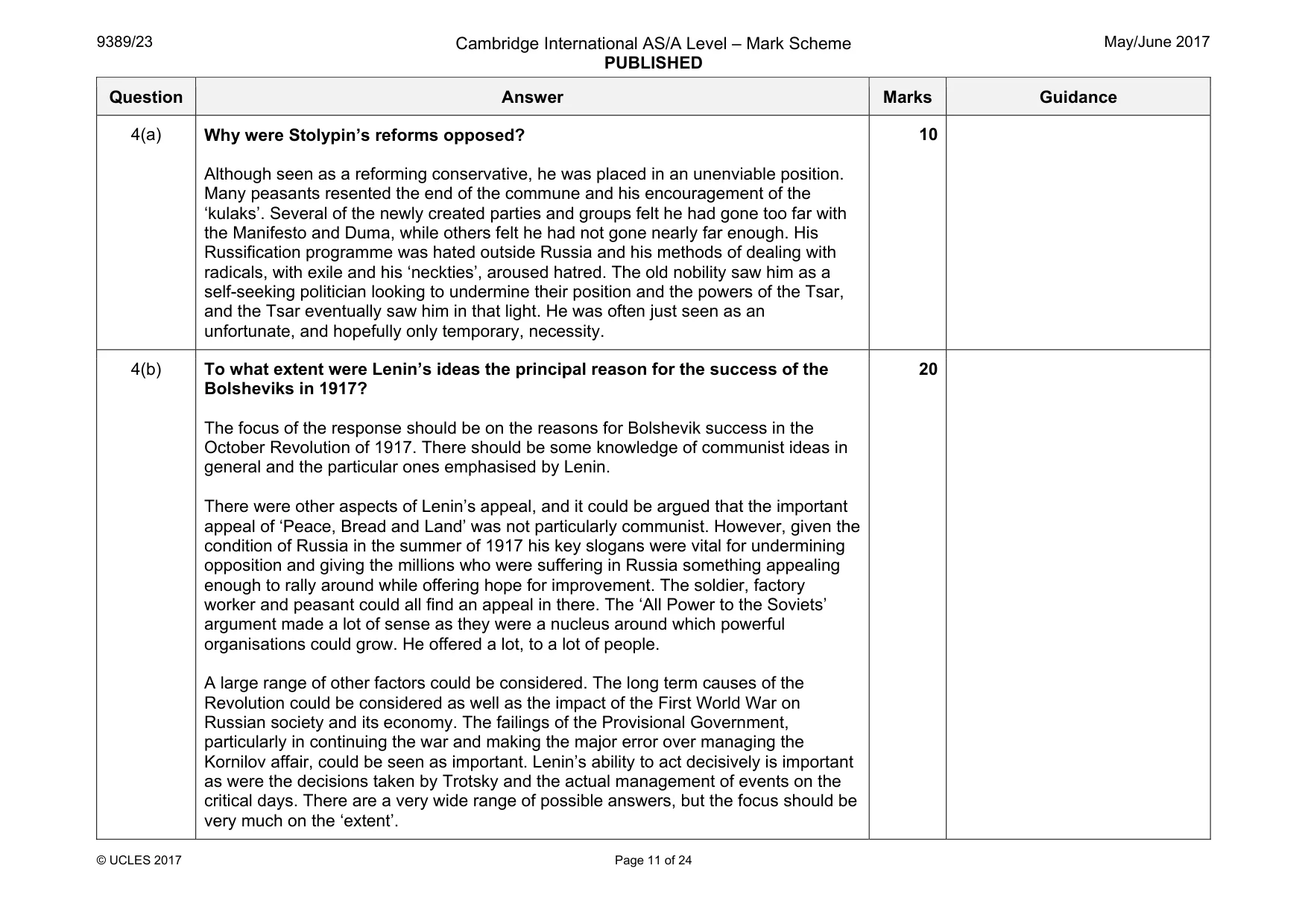
Mark scheme: 4(a) Why were Stolypin’s reforms opposed? Although seen as a reforming conservative, he was placed in an unenviable position. Many peasants resented the end of the commune and his encouragement of the ‘kulaks’. Several of the newly created parties and groups felt he had gone too far with the Manifesto and Duma, while others felt he had not gone nearly far enough. His Russification programme was hated outside Russia and his methods of dealing with radicals, with exile and his ‘neckties’, aroused hatred. The old nobility saw him as a self-seeking politician looking to undermine their position and the powers of the Tsar, and the Tsar eventually saw him in that light. He was often just seen as an unfortunate, and hopefully only temporary, necessity. 10 4(b) To what extent were Lenin’s ideas the principal reason for the success of the Bolsheviks in 1917? The focus of the response should be on the reasons for Bolshevik success in the October Revolution of 1917. There should be some knowledge of communist ideas in general and the particular ones emphasised by Lenin. There were other aspects of Lenin’s appeal, and it could be argued that the important appeal of ‘Peace, Bread and Land’ was not particularly communist. However, given the condition of Russia in the summer of 1917 his key slogans were vital for undermining opposition and giving the millions who were suffering in Russia something appealing enough to rally around while offering hope for improvement. The soldier, factory worker and peasant could all find an appeal in there. The ‘All Power to the Soviets’ argument made a lot of sense as they were a nucleus around which powerful organisations could grow. He offered a lot, to a lot of people. A large range of other factors could be considered. The long term causes of the Revolution could be considered as well as the impact of the First World War on Russian society and its economy. The failings of the Provisional Government, particularly in continuing the war and making the major error over managing the Kornilov affair, could be seen as important. Lenin’s ability to act decisively is important as were the decisions taken by Trotsky and the actual management of events on the critical days. There are a very wide range of possible answers, but the focus should be very much on the ‘extent’. 20
Q5 · The Expansion of US Power from the 1840s to the 1930s (a) Why did the USA expand its…
5 The Expansion of US Power from the 1840s to the 1930s (a) Why did the USA expand its naval forces in the 1890s and early 1900s? [10] (b) How successful were the ‘Indian Wars’ of the late nineteenth century? [20]
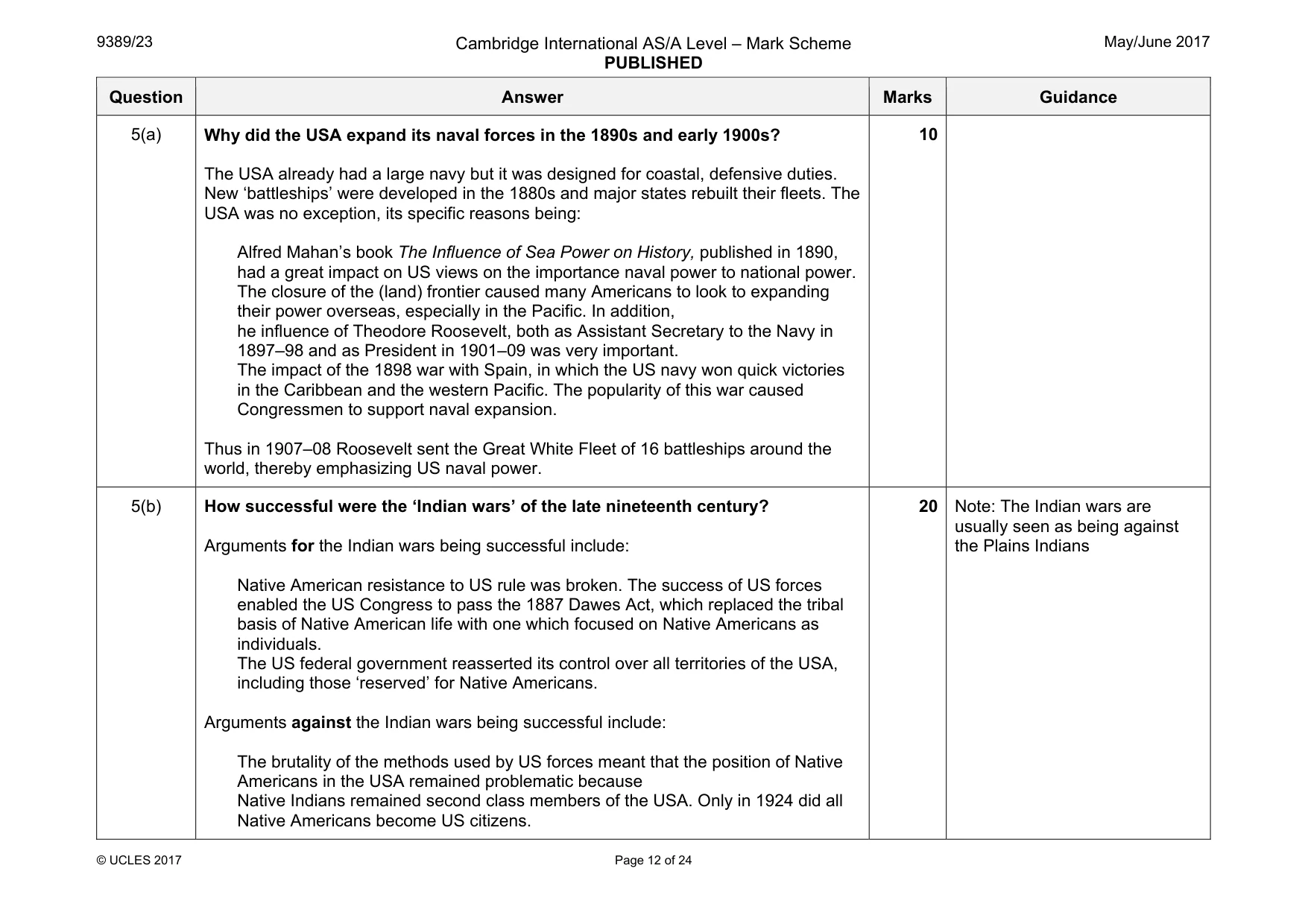
Mark scheme: 5(a) Why did the USA expand its naval forces in the 1890s and early 1900s? The USA already had a large navy but it was designed for coastal, defensive duties. New ‘battleships’ were developed in the 1880s and major states rebuilt their fleets. The USA was no exception, its specific reasons being: Alfred Mahan’s book The Influence of Sea Power on History, published in 1890, had a great impact on US views on the importance naval power to national power. The closure of the (land) frontier caused many Americans to look to expanding their power overseas, especially in the Pacific. In addition, he influence of Theodore Roosevelt, both as Assistant Secretary to the Navy in 1897–98 and as President in 1901–09 was very important. The impact of the 1898 war with Spain, in which the US navy won quick victories in the Caribbean and the western Pacific. The popularity of this war caused Congressmen to support naval expansion. Thus in 1907–08 Roosevelt sent the Great White Fleet of 16 battleships around the world, thereby emphasizing US naval power. 10 5(b) How successful were the ‘Indian wars’ of the late nineteenth century? Arguments for the Indian wars being successful include: Native American resistance to US rule was broken. The success of US forces enabled the US Congress to pass the 1887 Dawes Act, which replaced the tribal basis of Native American life with one which focused on Native Americans as individuals. The US federal government reasserted its control over all territories of the USA, including those ‘reserved’ for Native Americans. Arguments against the Indian wars being successful include: The brutality of the methods used by US forces meant that the position of Native Americans in the USA remained problematic because Native Indians remained second class members of the USA. Only in 1924 did all Native Americans become US citizens. 20 Note: The Indian wars are usually seen as being against the Plains Indians
Q6 · Civil War and Reconstruction, 1861–1877 (a) Why did Congress oppose President Lincoln’s…
6 Civil War and Reconstruction, 1861–1877 (a) Why did Congress oppose President Lincoln’s plans for Reconstruction in 1863–64? [10] (b) ‘The North won the war because Grant was prepared to attack the people of the South as well as its armies.’ How far do you agree? [20]
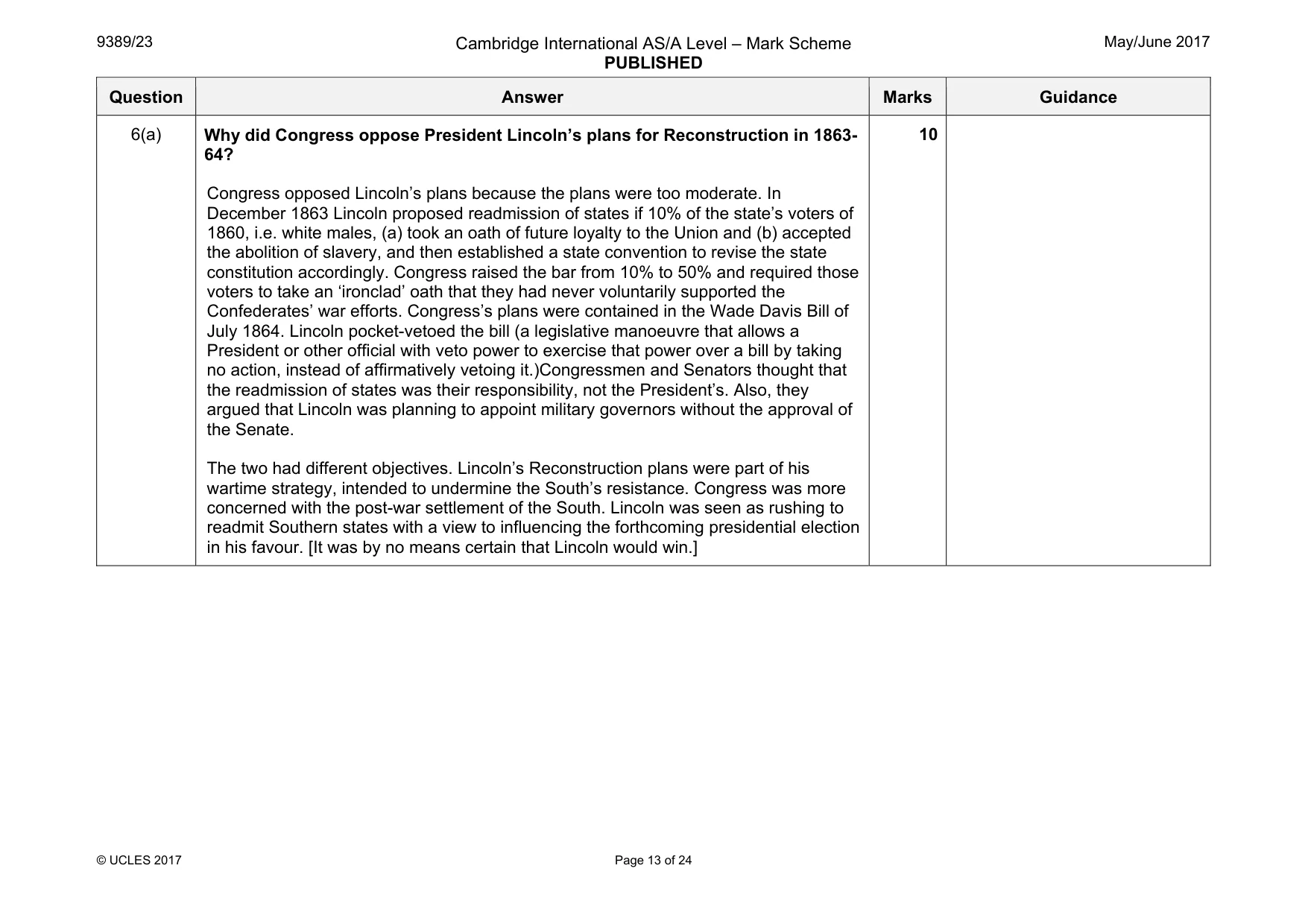
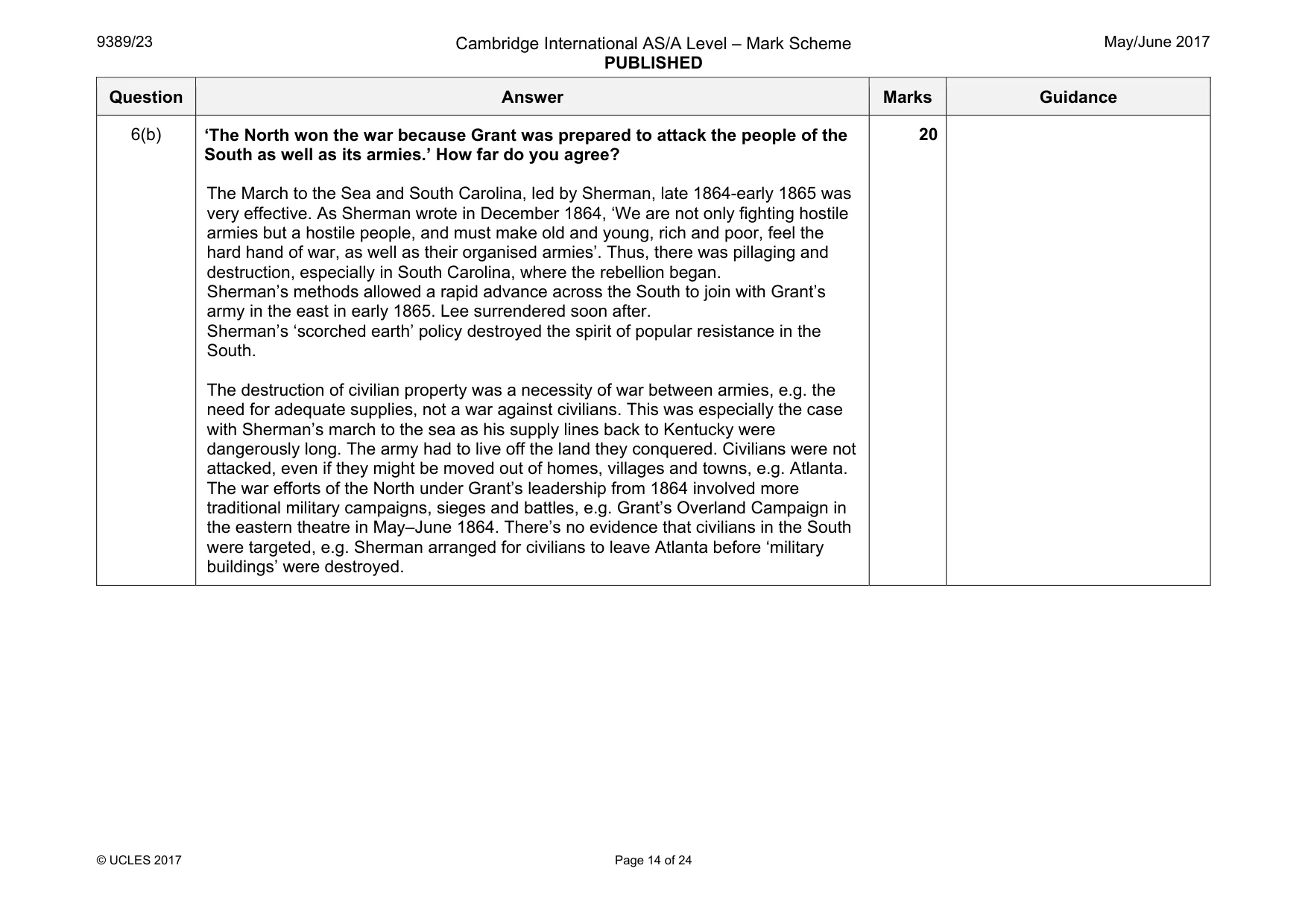
Mark scheme: 6(a) Why did Congress oppose President Lincoln’s plans for Reconstruction in 1863- 64? Congress opposed Lincoln’s plans because the plans were too moderate. In December 1863 Lincoln proposed readmission of states if 10% of the state’s voters of 1860, i.e. white males, (a) took an oath of future loyalty to the Union and (b) accepted the abolition of slavery, and then established a state convention to revise the state constitution accordingly. Congress raised the bar from 10% to 50% and required those voters to take an ‘ironclad’ oath that they had never voluntarily supported the Confederates’ war efforts. Congress’s plans were contained in the Wade Davis Bill of July 1864. Lincoln pocket-vetoed the bill (a legislative manoeuvre that allows a President or other official with veto power to exercise that power over a bill by taking no action, instead of affirmatively vetoing it.)Congressmen and Senators thought that the readmission of states was their responsibility, not the President’s. Also, they argued that Lincoln was planning to appoint military governors without the approval of the Senate. The two had different objectives. Lincoln’s Reconstruction plans were part of his wartime strategy, intended to undermine the South’s resistance. Congress was more concerned with the post-war settlement of the South. Lincoln was seen as rushing to readmit Southern states with a view to influencing the forthcoming presidential election in his favour. [It was by no means certain that Lincoln would win.] 10 Question Answer Marks Guidance 6(b) ‘The North won the war because Grant was prepared to attack the people of the South as well as its armies.’ How far do you agree? The March to the Sea and South Carolina, led by Sherman, late 1864-early 1865 was very effective. As Sherman wrote in December 1864, ‘We are not only fighting hostile armies but a hostile people, and must make old and young, rich and poor, feel the hard hand of war, as well as their organised armies’. Thus, there was pillaging and destruction, especially in South Carolina, where the rebellion began. Sherman’s methods allowed a rapid advance across the South to join with Grant’s army in the east in early 1865. Lee surrendered soon after. Sherman’s ‘scorched earth’ policy destroyed the spirit of popular resistance in the South. The destruction of civilian property was a necessity of war between armies, e.g. the need for adequate supplies, not a war against civilians. This was especially the case with Sherman’s march to the sea as his supply lines back to Kentucky were dangerously long. The army had to live off the land they conquered. Civilians were not attacked, even if they might be moved out of homes, villages and towns, e.g. Atlanta. The war efforts of the North under Grant’s leadership from 1864 involved more traditional military campaigns, sieges and battles, e.g. Grant’s Overland Campaign in the eastern theatre in May–June 1864. There’s no evidence that civilians in the South were targeted, e.g. Sherman arranged for civilians to leave Atlanta before ‘military buildings’ were destroyed. 20
Q7 · The Gilded Age and the Progressive Era, from the 1870s to the 1920s (a) Why did railroads…
7 The Gilded Age and the Progressive Era, from the 1870s to the 1920s (a) Why did railroads grow so rapidly in the later nineteenth century? [10] (b) How far do you agree that the passage of four constitutional amendments between 1913 and 1920 shows the power of the Progressive Movement? [20]
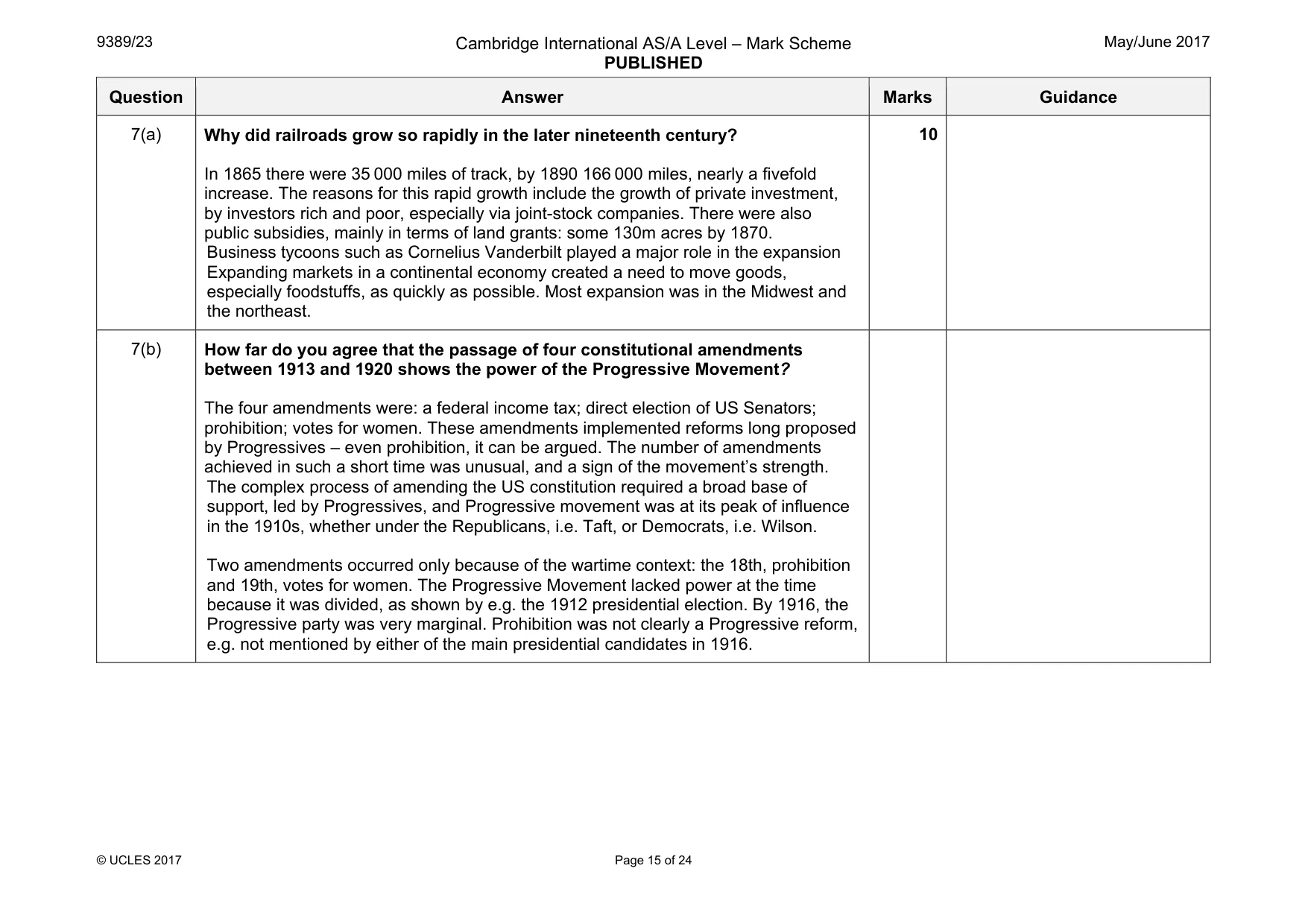
Mark scheme: 7(a) Why did railroads grow so rapidly in the later nineteenth century? In 1865 there were 35 000 miles of track, by 1890 166 000 miles, nearly a fivefold increase. The reasons for this rapid growth include the growth of private investment, by investors rich and poor, especially via joint-stock companies. There were also public subsidies, mainly in terms of land grants: some 130m acres by 1870. Business tycoons such as Cornelius Vanderbilt played a major role in the expansion Expanding markets in a continental economy created a need to move goods, especially foodstuffs, as quickly as possible. Most expansion was in the Midwest and the northeast. 10 7(b) How far do you agree that the passage of four constitutional amendments between 1913 and 1920 shows the power of the Progressive Movement? The four amendments were: a federal income tax; direct election of US Senators; prohibition; votes for women. These amendments implemented reforms long proposed by Progressives – even prohibition, it can be argued. The number of amendments achieved in such a short time was unusual, and a sign of the movement’s strength. The complex process of amending the US constitution required a broad base of support, led by Progressives, and Progressive movement was at its peak of influence in the 1910s, whether under the Republicans, i.e. Taft, or Democrats, i.e. Wilson. Two amendments occurred only because of the wartime context: the 18th, prohibition and 19th, votes for women. The Progressive Movement lacked power at the time because it was divided, as shown by e.g. the 1912 presidential election. By 1916, the Progressive party was very marginal. Prohibition was not clearly a Progressive reform, e.g. not mentioned by either of the main presidential candidates in 1916. Question Answer Marks Guidance 8(a) Why did many left-wing liberals oppose New Deal policies introduced by an apparently liberal president? Left-wing liberals opposed some of the New Deal reforms because New Deal policies were not always liberal in that they involved the creation of federal government agencies. Some did little to help the ordinary people, which was the main concern of many liberals. They were too ‘gradualist’ when many liberals expected more radical reforms to take effect more quickly. The economic recovery which FDR was meant to bring about was slow to happen. ‘liberal’ in the USA means freedom from state control as well as freedom of the individual. 8(b) ‘We have won against the most dangerous of our foes – we have conquered fear.’ (Franklin Roosevelt, 1936). How justified was Roosevelt in this belief about the progress of the New Deal? There was a more positive mood in 1936 compared with 1932–23, which had been the depth of the depression and a dark time. Note: in 1933 FDR had famously said, ‘We have nothing to fear except fear itself’. FDR achieved a second victory; was this said during the election campaign or after? There is some debate here. Fear is an emotion, a state of mind, negative and nothing material. FDR was not saying that material life had improved but that negative feelings had given way to something more positive, more hope. Action was being taken. Fear in the sense of a lack of optimism was still widespread and mainly because the economy was still in recession and unemployment was still high. Opposition to the New Deal, both political and judicial, meant that there were still anxieties around whether the New Deal was sustainable. The international context also added to a sense of pessimism, especially considering the success of one-party dictatorships in Europe. By comparison, American democracy was less successful.
Q8 · The Great Crash, the Great Depression and the New Deal, from the 1920s to 1941 (a) Why…
8 The Great Crash, the Great Depression and the New Deal, from the 1920s to 1941 (a) Why did many left-wing liberals oppose New Deal policies introduced by an apparently liberal president? [10] (b) ‘We have won against the most dangerous of our foes – we have conquered fear.’ (Franklin Roosevelt, 1936). How justified was Roosevelt in this belief about the progress of the New Deal? [20] Section C: International Option International Relations, 1871–1945 Answer both parts of two questions.
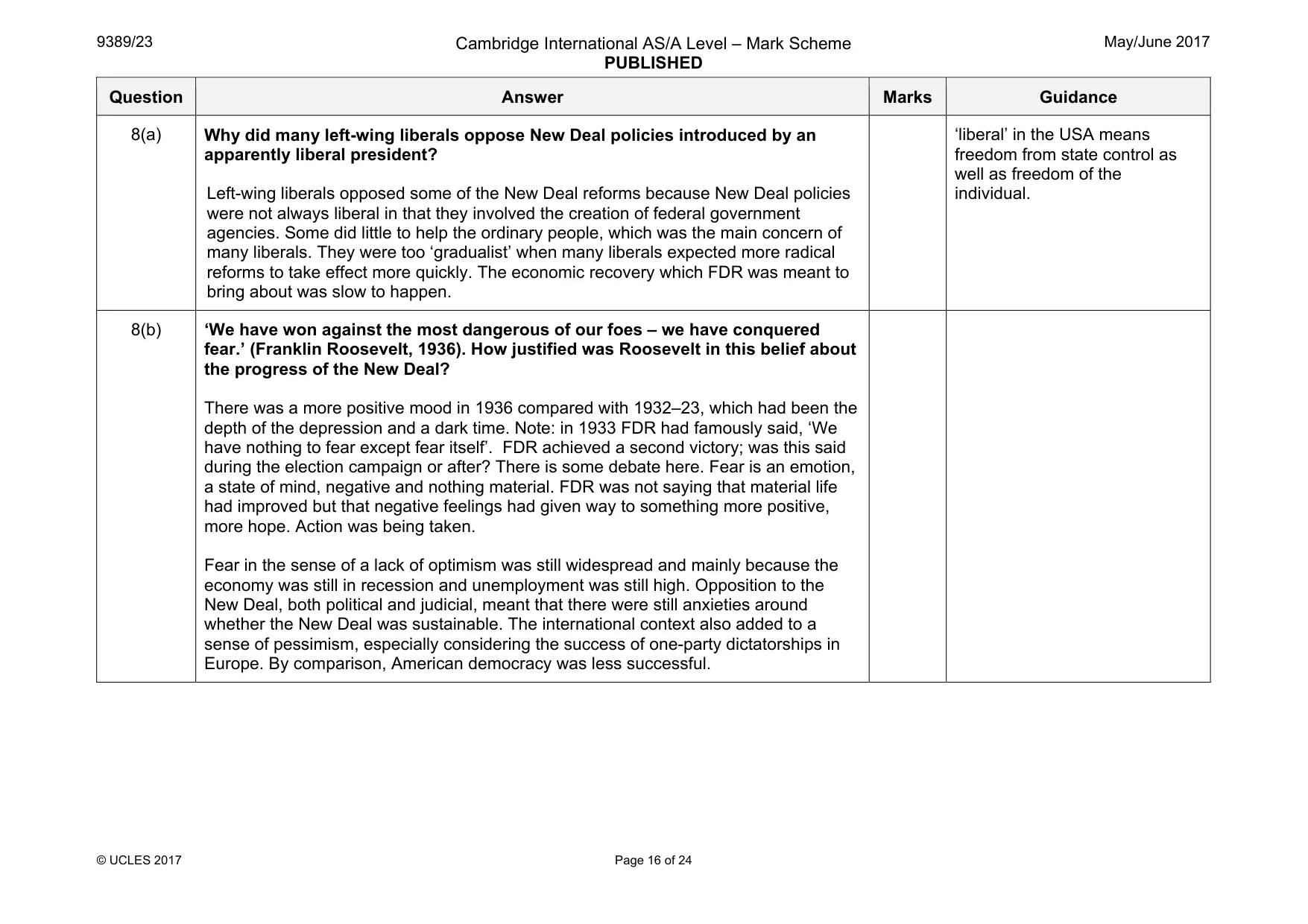
Mark scheme: 8(a) Why did many left-wing liberals oppose New Deal policies introduced by an apparently liberal president? Left-wing liberals opposed some of the New Deal reforms because New Deal policies were not always liberal in that they involved the creation of federal government agencies. Some did little to help the ordinary people, which was the main concern of many liberals. They were too ‘gradualist’ when many liberals expected more radical reforms to take effect more quickly. The economic recovery which FDR was meant to bring about was slow to happen. freedom from state control as well as freedom of the individual. 8(b) ‘We have won against the most dangerous of our foes – we have conquered fear.’ (Franklin Roosevelt, 1936). How justified was Roosevelt in this belief about the progress of the New Deal? There was a more positive mood in 1936 compared with 1932–23, which had been the depth of the depression and a dark time. Note: in 1933 FDR had famously said, ‘We have nothing to fear except fear itself’. FDR achieved a second victory; was this said during the election campaign or after? There is some debate here. Fear is an emotion, a state of mind, negative and nothing material. FDR was not saying that material life had improved but that negative feelings had given way to something more positive, more hope. Action was being taken. Fear in the sense of a lack of optimism was still widespread and mainly because the economy was still in recession and unemployment was still high. Opposition to the New Deal, both political and judicial, meant that there were still anxieties around whether the New Deal was sustainable. The international context also added to a sense of pessimism, especially considering the success of one-party dictatorships in Europe. By comparison, American democracy was less successful.
Q9 · International Relations, 1871–1918 (a) Why, by 1907, had Britain, France and Russia come…
9 International Relations, 1871–1918 (a) Why, by 1907, had Britain, France and Russia come together in a series of friendly agreements? [10] (b) ‘Japan’s victory in the war of 1904–5 was the result of Russia’s military weaknesses.’ How far do you agree? [20]
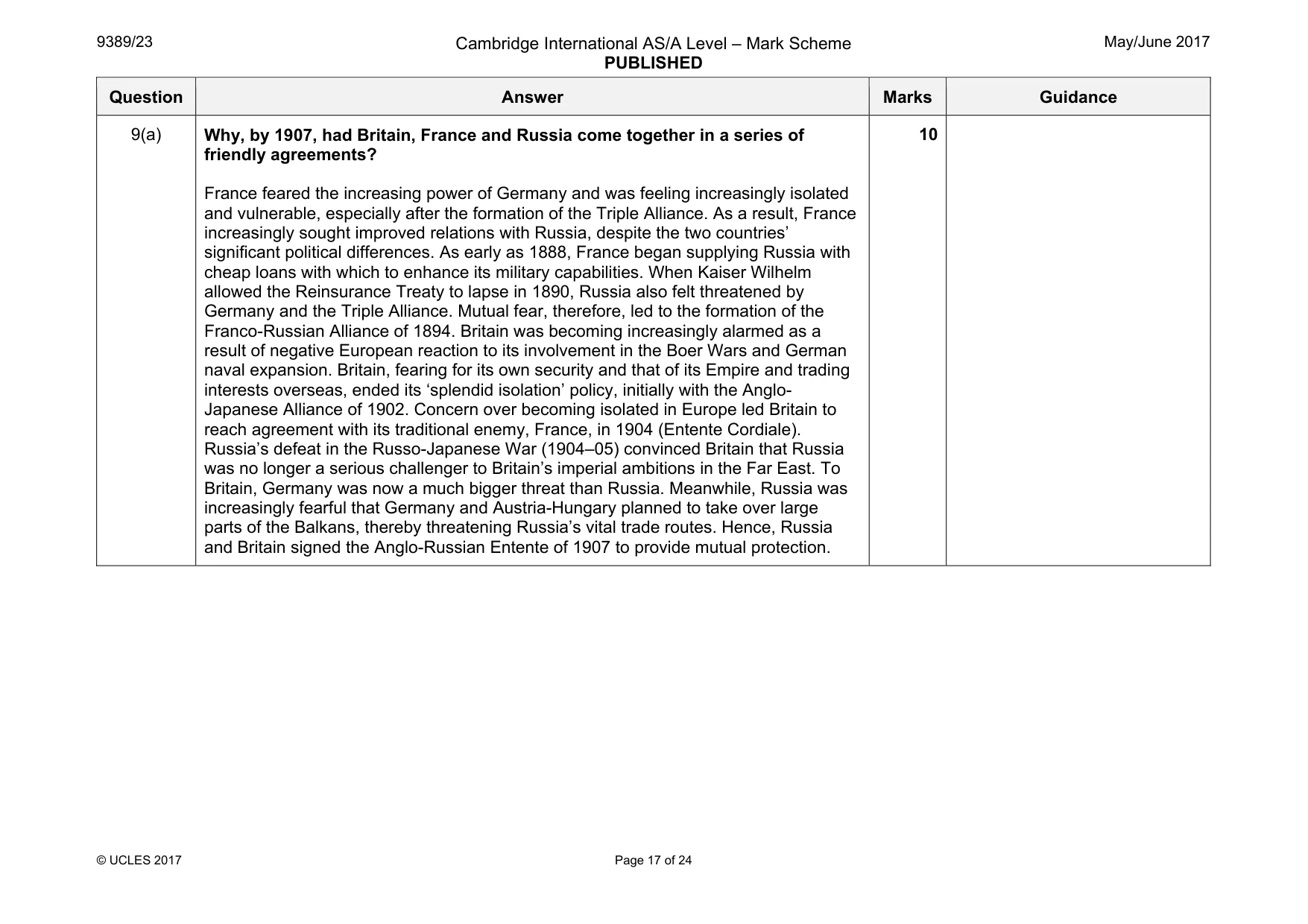
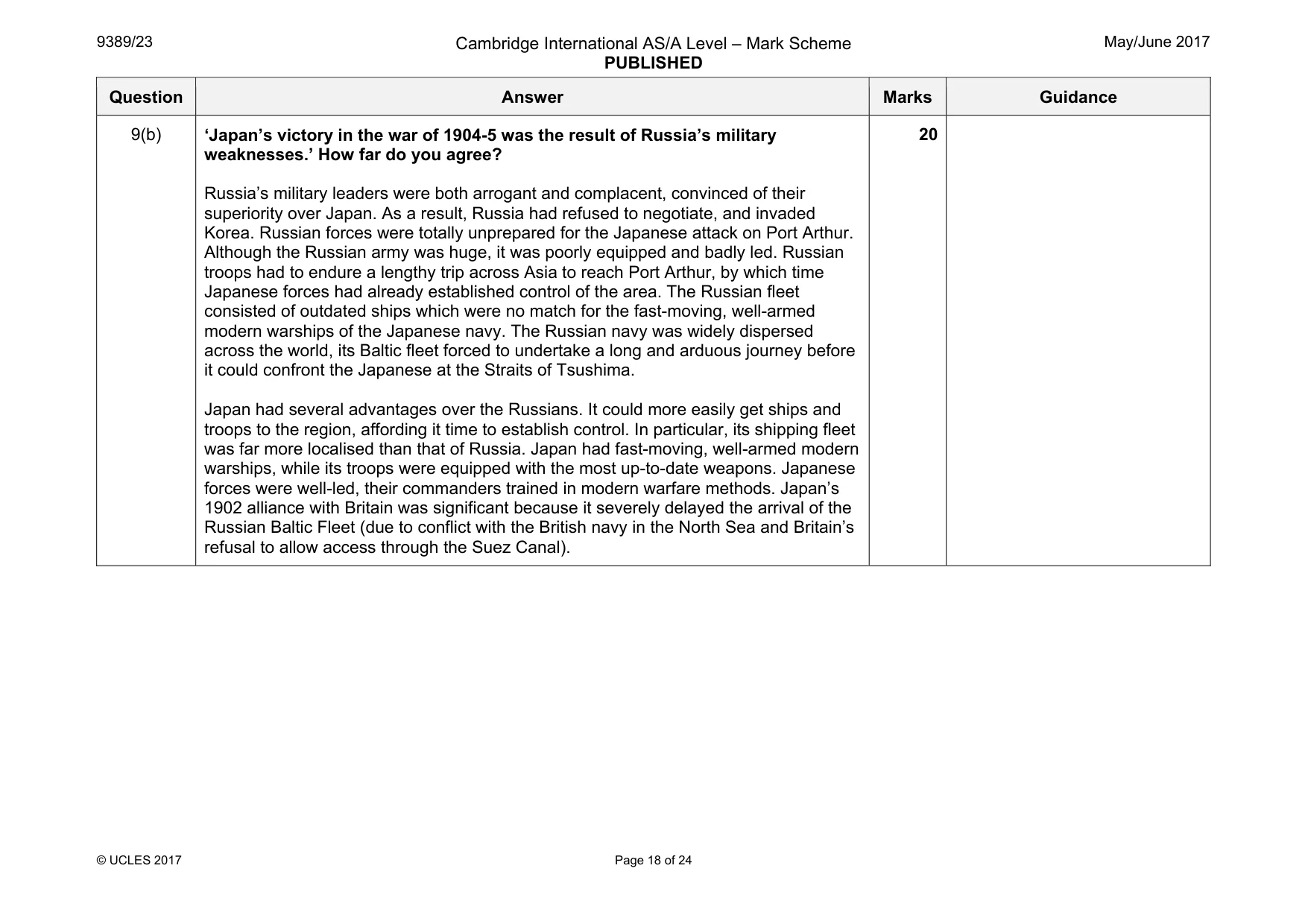
Mark scheme: 9(a) Why, by 1907, had Britain, France and Russia come together in a series of friendly agreements? France feared the increasing power of Germany and was feeling increasingly isolated and vulnerable, especially after the formation of the Triple Alliance. As a result, France increasingly sought improved relations with Russia, despite the two countries’ significant political differences. As early as 1888, France began supplying Russia with cheap loans with which to enhance its military capabilities. When Kaiser Wilhelm allowed the Reinsurance Treaty to lapse in 1890, Russia also felt threatened by Germany and the Triple Alliance. Mutual fear, therefore, led to the formation of the Franco-Russian Alliance of 1894. Britain was becoming increasingly alarmed as a result of negative European reaction to its involvement in the Boer Wars and German naval expansion. Britain, fearing for its own security and that of its Empire and trading interests overseas, ended its ‘splendid isolation’ policy, initially with the Anglo- Japanese Alliance of 1902. Concern over becoming isolated in Europe led Britain to reach agreement with its traditional enemy, France, in 1904 (Entente Cordiale). Russia’s defeat in the Russo-Japanese War (1904–05) convinced Britain that Russia was no longer a serious challenger to Britain’s imperial ambitions in the Far East. To Britain, Germany was now a much bigger threat than Russia. Meanwhile, Russia was increasingly fearful that Germany and Austria-Hungary planned to take over large parts of the Balkans, thereby threatening Russia’s vital trade routes. Hence, Russia and Britain signed the Anglo-Russian Entente of 1907 to provide mutual protection. 10 Question Answer Marks Guidance 9(b) ‘Japan’s victory in the war of 1904-5 was the result of Russia’s military weaknesses.’ How far do you agree? Russia’s military leaders were both arrogant and complacent, convinced of their superiority over Japan. As a result, Russia had refused to negotiate, and invaded Korea. Russian forces were totally unprepared for the Japanese attack on Port Arthur. Although the Russian army was huge, it was poorly equipped and badly led. Russian troops had to endure a lengthy trip across Asia to reach Port Arthur, by which time Japanese forces had already established control of the area. The Russian fleet consisted of outdated ships which were no match for the fast-moving, well-armed modern warships of the Japanese navy. The Russian navy was widely dispersed across the world, its Baltic fleet forced to undertake a long and arduous journey before it could confront the Japanese at the Straits of Tsushima. Japan had several advantages over the Russians. It could more easily get ships and troops to the region, affording it time to establish control. In particular, its shipping fleet was far more localised than that of Russia. Japan had fast-moving, well-armed modern warships, while its troops were equipped with the most up-to-date weapons. Japanese forces were well-led, their commanders trained in modern warfare methods. Japan’s 1902 alliance with Britain was significant because it severely delayed the arrival of the Russian Baltic Fleet (due to conflict with the British navy in the North Sea and Britain’s refusal to allow access through the Suez Canal). 20
Q10 · International Relations, 1919–1933 (a) Why did the Wall Street Crash lead to a…
10 International Relations, 1919–1933 (a) Why did the Wall Street Crash lead to a deterioration in international relations? [10] (b) To what extent did the USA avoid involvement in international affairs in the period from 1919 to 1929? [20]
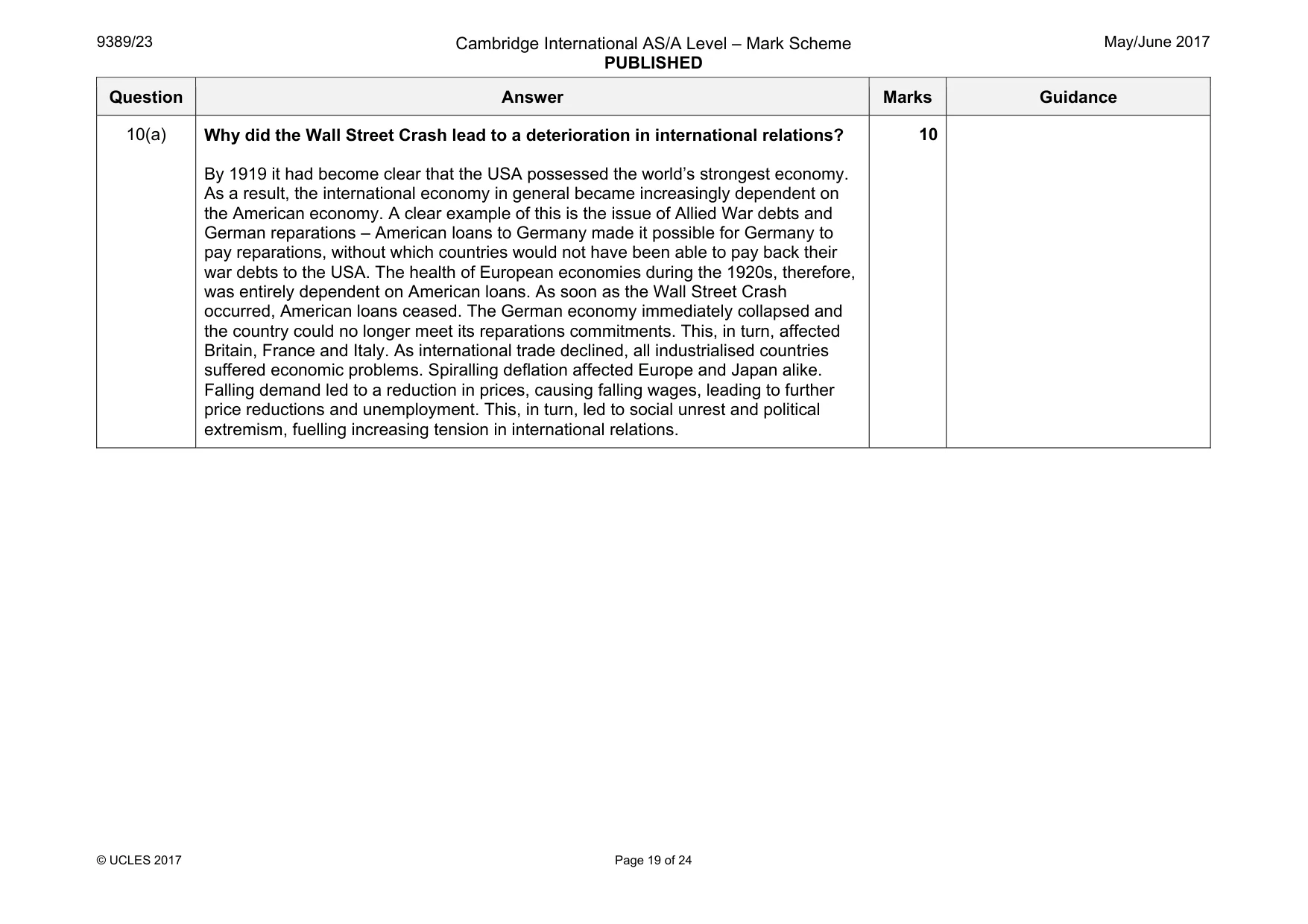
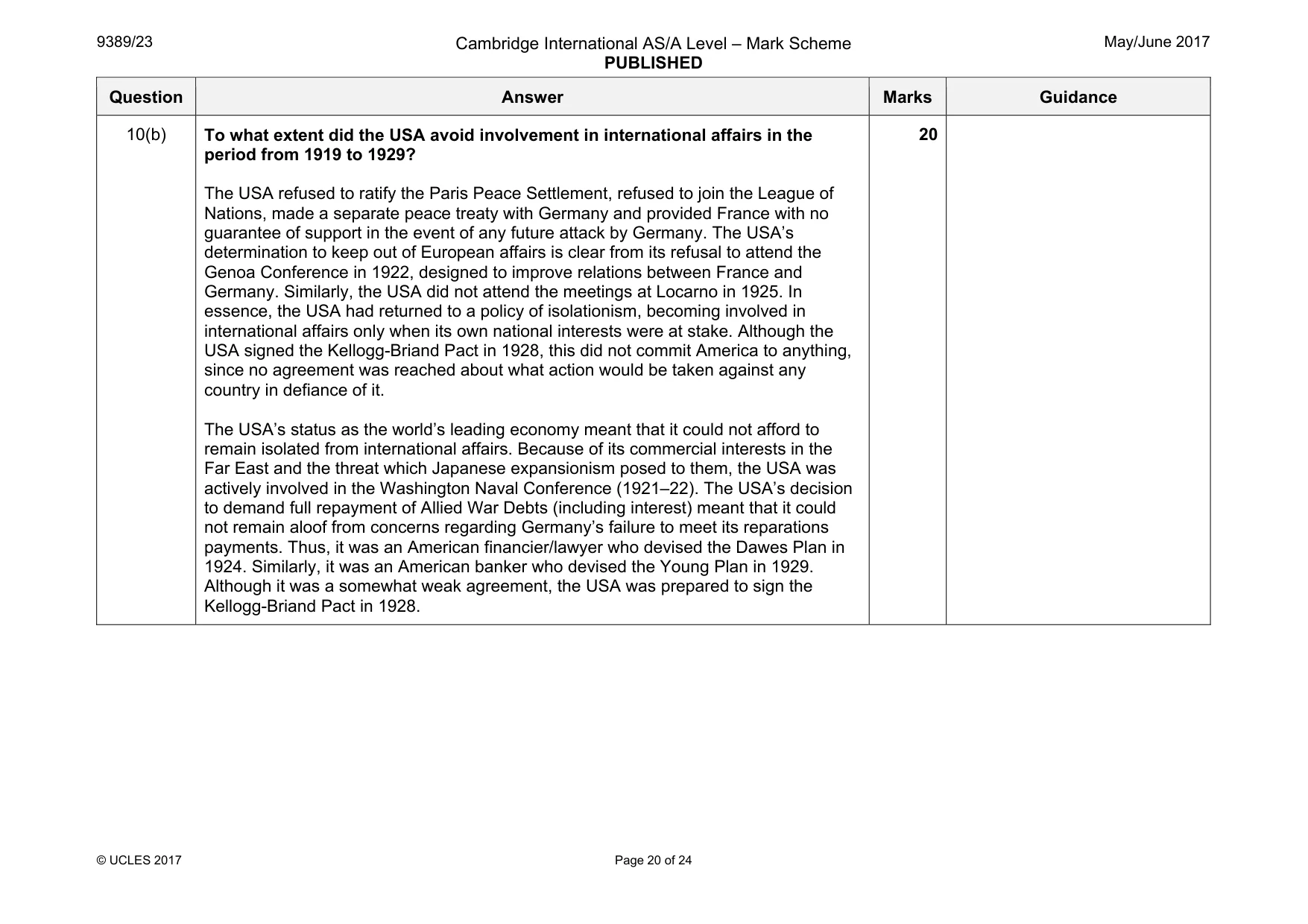
Mark scheme: 10(a) Why did the Wall Street Crash lead to a deterioration in international relations? By 1919 it had become clear that the USA possessed the world’s strongest economy. As a result, the international economy in general became increasingly dependent on the American economy. A clear example of this is the issue of Allied War debts and German reparations – American loans to Germany made it possible for Germany to pay reparations, without which countries would not have been able to pay back their war debts to the USA. The health of European economies during the 1920s, therefore, was entirely dependent on American loans. As soon as the Wall Street Crash occurred, American loans ceased. The German economy immediately collapsed and the country could no longer meet its reparations commitments. This, in turn, affected Britain, France and Italy. As international trade declined, all industrialised countries suffered economic problems. Spiralling deflation affected Europe and Japan alike. Falling demand led to a reduction in prices, causing falling wages, leading to further price reductions and unemployment. This, in turn, led to social unrest and political extremism, fuelling increasing tension in international relations. 10 Question Answer Marks Guidance 10(b) To what extent did the USA avoid involvement in international affairs in the period from 1919 to 1929? The USA refused to ratify the Paris Peace Settlement, refused to join the League of Nations, made a separate peace treaty with Germany and provided France with no guarantee of support in the event of any future attack by Germany. The USA’s determination to keep out of European affairs is clear from its refusal to attend the Genoa Conference in 1922, designed to improve relations between France and Germany. Similarly, the USA did not attend the meetings at Locarno in 1925. In essence, the USA had returned to a policy of isolationism, becoming involved in international affairs only when its own national interests were at stake. Although the USA signed the Kellogg-Briand Pact in 1928, this did not commit America to anything, since no agreement was reached about what action would be taken against any country in defiance of it. The USA’s status as the world’s leading economy meant that it could not afford to remain isolated from international affairs. Because of its commercial interests in the Far East and the threat which Japanese expansionism posed to them, the USA was actively involved in the Washington Naval Conference (1921–22). The USA’s decision to demand full repayment of Allied War Debts (including interest) meant that it could not remain aloof from concerns regarding Germany’s failure to meet its reparations payments. Thus, it was an American financier/lawyer who devised the Dawes Plan in 1924. Similarly, it was an American banker who devised the Young Plan in 1929. Although it was a somewhat weak agreement, the USA was prepared to sign the Kellogg-Briand Pact in 1928. 20
Q11 · International Relations, 1933–1939 (a) Why did the Nazi-Soviet Pact of 1939 astonish and…
11 International Relations, 1933–1939 (a) Why did the Nazi-Soviet Pact of 1939 astonish and alarm the rest of Europe? [10] (b) ‘The outbreak of civil war in Spain in 1936 was the result of Spain’s economic weaknesses.’ How far do you agree? [20]
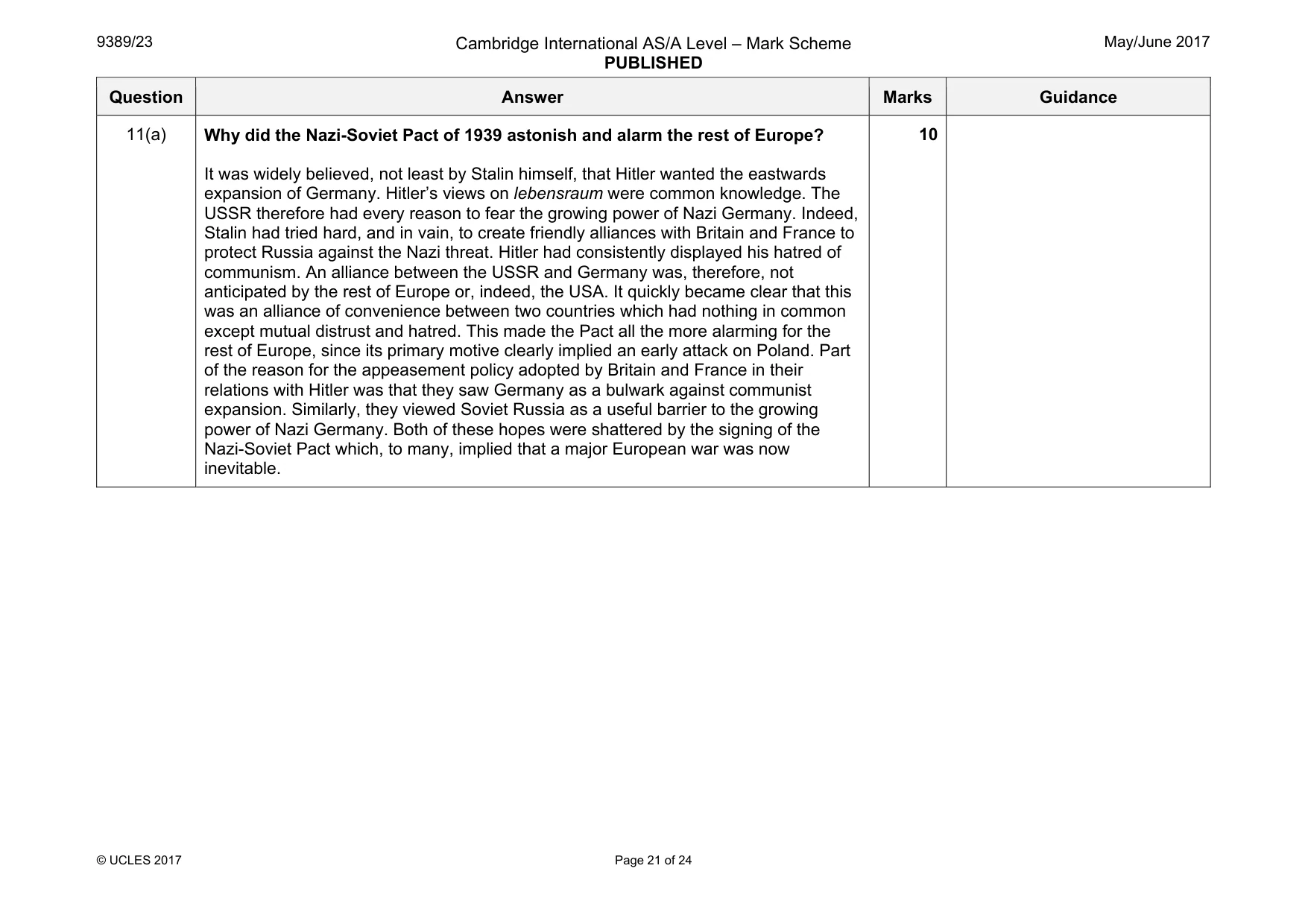
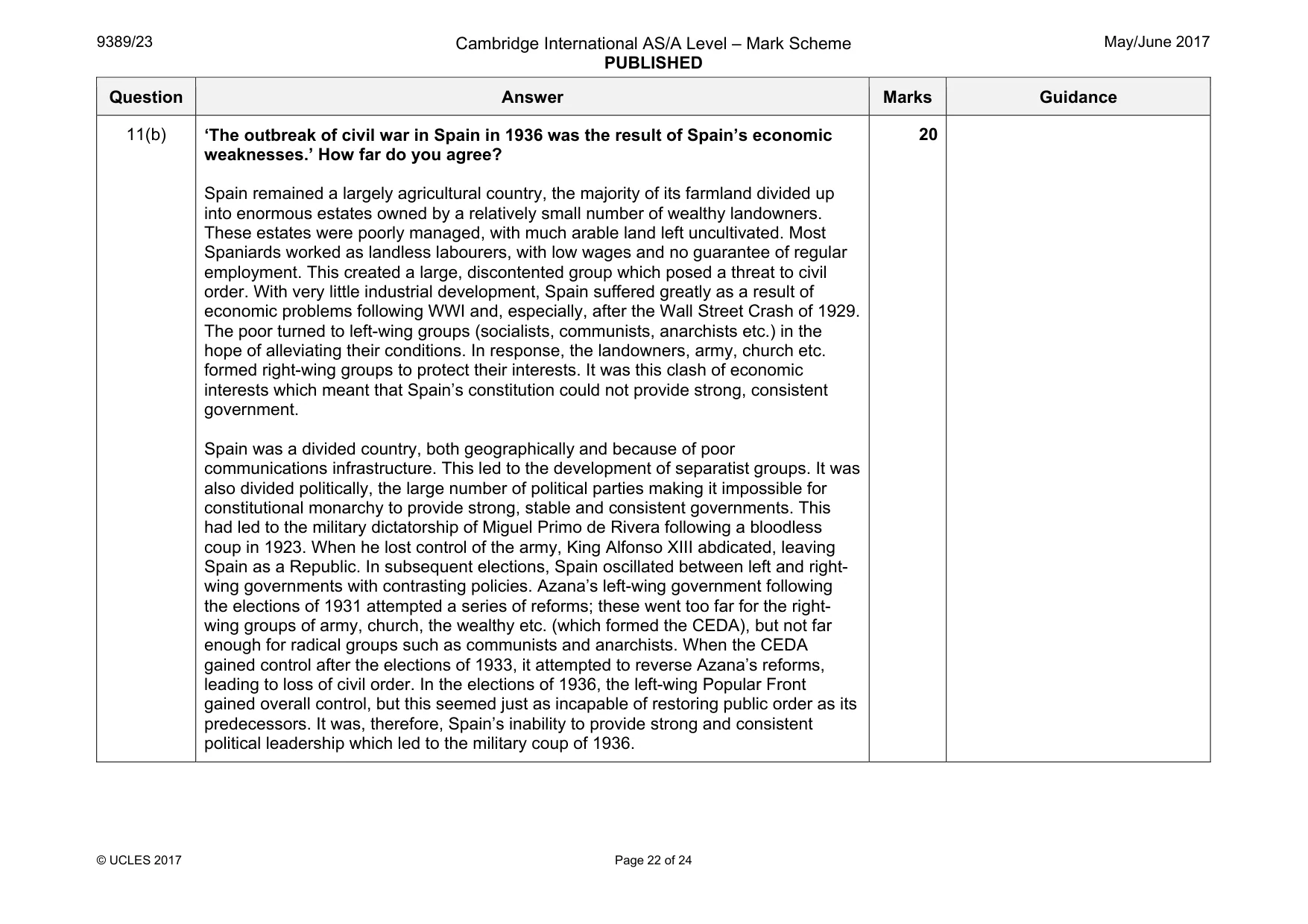
Mark scheme: 11(a) Why did the Nazi-Soviet Pact of 1939 astonish and alarm the rest of Europe? It was widely believed, not least by Stalin himself, that Hitler wanted the eastwards expansion of Germany. Hitler’s views on lebensraum were common knowledge. The USSR therefore had every reason to fear the growing power of Nazi Germany. Indeed, Stalin had tried hard, and in vain, to create friendly alliances with Britain and France to protect Russia against the Nazi threat. Hitler had consistently displayed his hatred of communism. An alliance between the USSR and Germany was, therefore, not anticipated by the rest of Europe or, indeed, the USA. It quickly became clear that this was an alliance of convenience between two countries which had nothing in common except mutual distrust and hatred. This made the Pact all the more alarming for the rest of Europe, since its primary motive clearly implied an early attack on Poland. Part of the reason for the appeasement policy adopted by Britain and France in their relations with Hitler was that they saw Germany as a bulwark against communist expansion. Similarly, they viewed Soviet Russia as a useful barrier to the growing power of Nazi Germany. Both of these hopes were shattered by the signing of the Nazi-Soviet Pact which, to many, implied that a major European war was now inevitable. 10 Question Answer Marks Guidance 11(b) ‘The outbreak of civil war in Spain in 1936 was the result of Spain’s economic weaknesses.’ How far do you agree? Spain remained a largely agricultural country, the majority of its farmland divided up into enormous estates owned by a relatively small number of wealthy landowners. These estates were poorly managed, with much arable land left uncultivated. Most Spaniards worked as landless labourers, with low wages and no guarantee of regular employment. This created a large, discontented group which posed a threat to civil order. With very little industrial development, Spain suffered greatly as a result of economic problems following WWI and, especially, after the Wall Street Crash of 1929. The poor turned to left-wing groups (socialists, communists, anarchists etc.) in the hope of alleviating their conditions. In response, the landowners, army, church etc. formed right-wing groups to protect their interests. It was this clash of economic interests which meant that Spain’s constitution could not provide strong, consistent government. Spain was a divided country, both geographically and because of poor communications infrastructure. This led to the development of separatist groups. It was also divided politically, the large number of political parties making it impossible for constitutional monarchy to provide strong, stable and consistent governments. This had led to the military dictatorship of Miguel Primo de Rivera following a bloodless coup in 1923. When he lost control of the army, King Alfonso XIII abdicated, leaving Spain as a Republic. In subsequent elections, Spain oscillated between left and right- wing governments with contrasting policies. Azana’s left-wing government following the elections of 1931 attempted a series of reforms; these went too far for the right- wing groups of army, church, the wealthy etc. (which formed the CEDA), but not far enough for radical groups such as communists and anarchists. When the CEDA gained control after the elections of 1933, it attempted to reverse Azana’s reforms, leading to loss of civil order. In the elections of 1936, the left-wing Popular Front gained overall control, but this seemed just as incapable of restoring public order as its predecessors. It was, therefore, Spain’s inability to provide strong and consistent political leadership which led to the military coup of 1936. 20
Q12 · China and Japan, 1919–1945 (a) Why was the USA concerned by the emergence of Japan as a…
12 China and Japan, 1919–1945 (a) Why was the USA concerned by the emergence of Japan as a major Asian power by 1918? [10] (b) To what extent was the unpopularity of the Kuomintang during the 1930s due to its failure to respond effectively to Japanese aggression? [20]
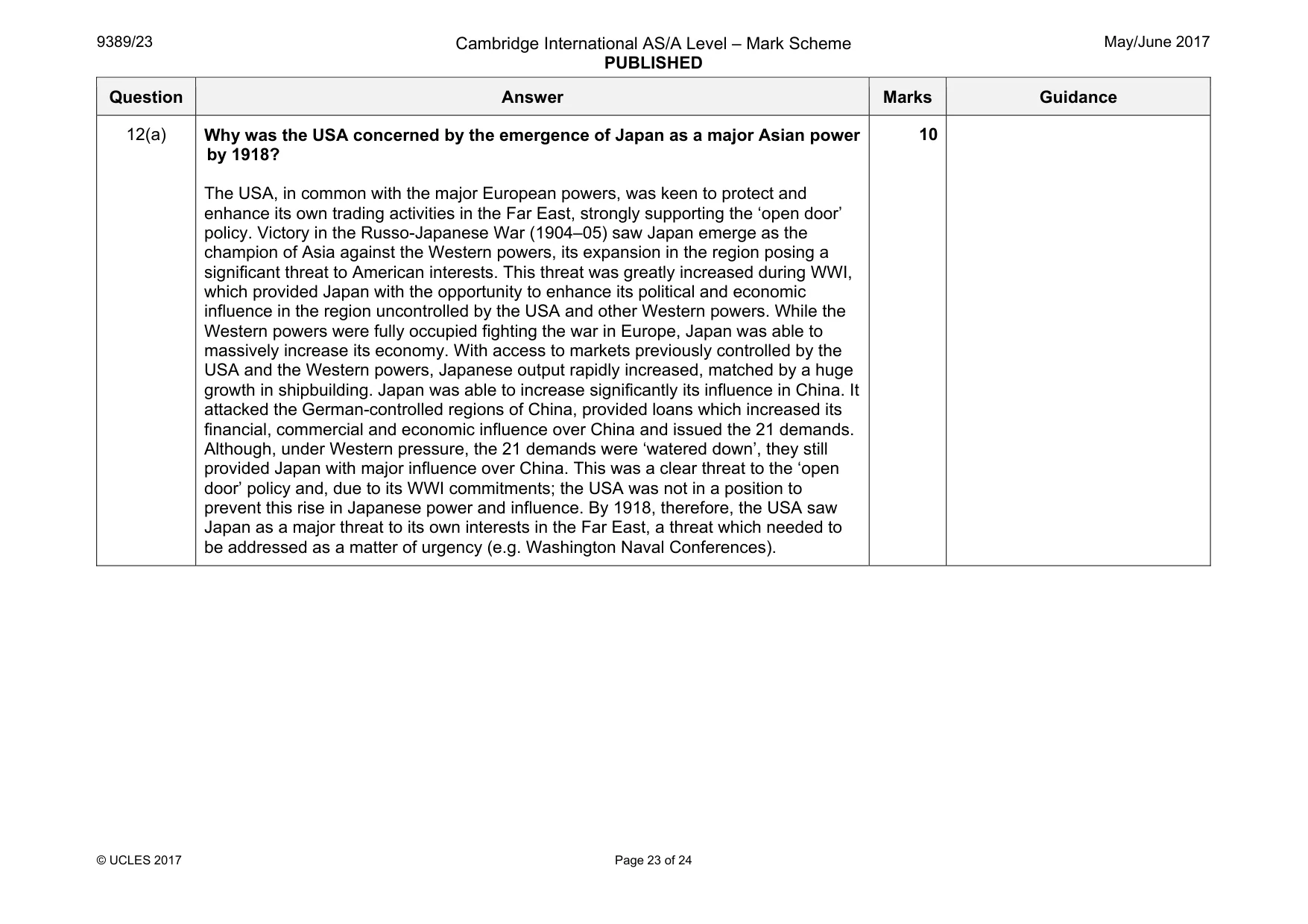
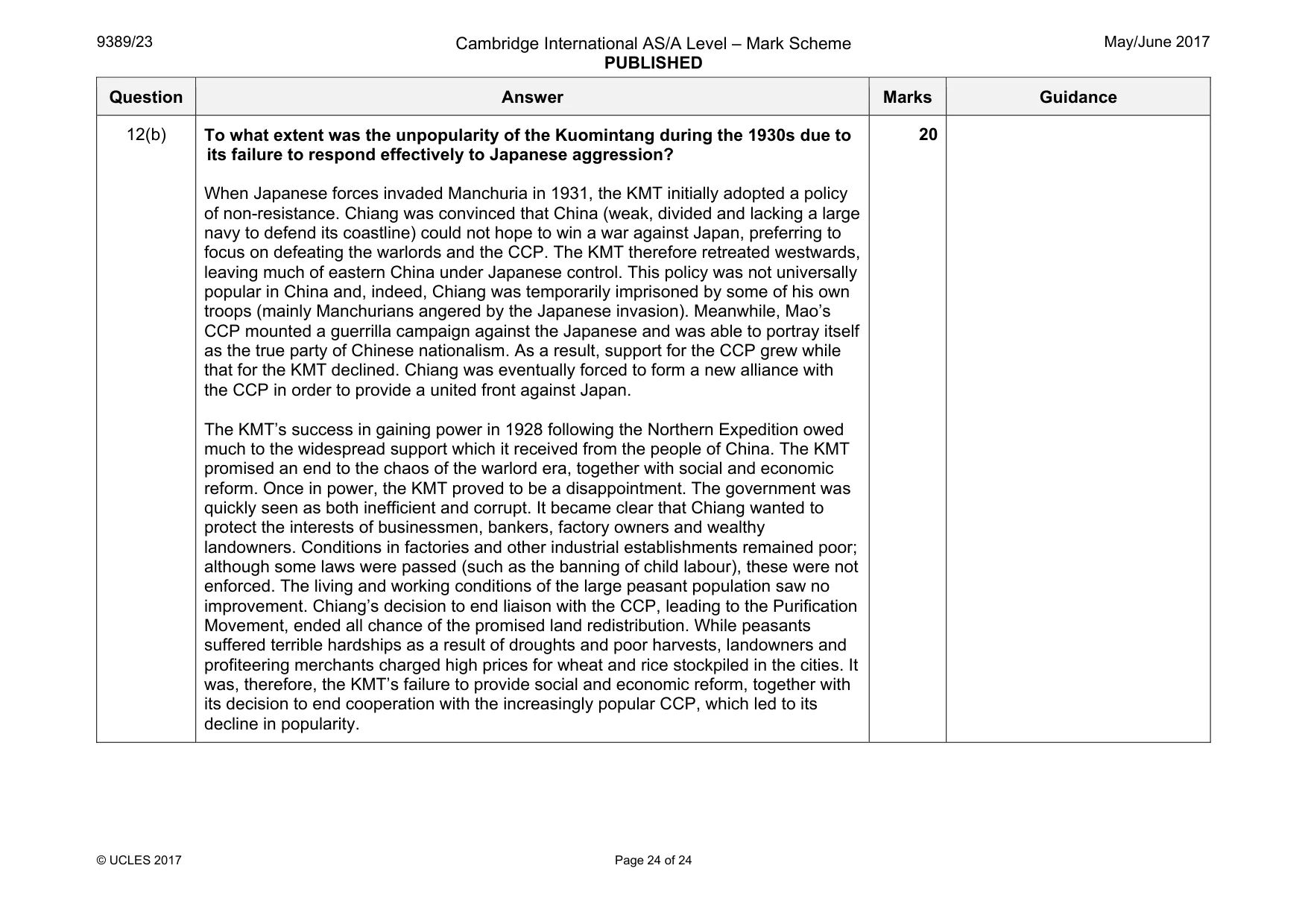
Mark scheme: 12(a) Why was the USA concerned by the emergence of Japan as a major Asian power by 1918? The USA, in common with the major European powers, was keen to protect and enhance its own trading activities in the Far East, strongly supporting the ‘open door’ policy. Victory in the Russo-Japanese War (1904–05) saw Japan emerge as the champion of Asia against the Western powers, its expansion in the region posing a significant threat to American interests. This threat was greatly increased during WWI, which provided Japan with the opportunity to enhance its political and economic influence in the region uncontrolled by the USA and other Western powers. While the Western powers were fully occupied fighting the war in Europe, Japan was able to massively increase its economy. With access to markets previously controlled by the USA and the Western powers, Japanese output rapidly increased, matched by a huge growth in shipbuilding. Japan was able to increase significantly its influence in China. It attacked the German-controlled regions of China, provided loans which increased its financial, commercial and economic influence over China and issued the 21 demands. Although, under Western pressure, the 21 demands were ‘watered down’, they still provided Japan with major influence over China. This was a clear threat to the ‘open door’ policy and, due to its WWI commitments; the USA was not in a position to prevent this rise in Japanese power and influence. By 1918, therefore, the USA saw Japan as a major threat to its own interests in the Far East, a threat which needed to be addressed as a matter of urgency (e.g. Washington Naval Conferences). 10 Question Answer Marks Guidance 12(b) To what extent was the unpopularity of the Kuomintang during the 1930s due to its failure to respond effectively to Japanese aggression? When Japanese forces invaded Manchuria in 1931, the KMT initially adopted a policy of non-resistance. Chiang was convinced that China (weak, divided and lacking a large navy to defend its coastline) could not hope to win a war against Japan, preferring to focus on defeating the warlords and the CCP. The KMT therefore retreated westwards, leaving much of eastern China under Japanese control. This policy was not universally popular in China and, indeed, Chiang was temporarily imprisoned by some of his own troops (mainly Manchurians angered by the Japanese invasion). Meanwhile, Mao’s CCP mounted a guerrilla campaign against the Japanese and was able to portray itself as the true party of Chinese nationalism. As a result, support for the CCP grew while that for the KMT declined. Chiang was eventually forced to form a new alliance with the CCP in order to provide a united front against Japan. The KMT’s success in gaining power in 1928 following the Northern Expedition owed much to the widespread support which it received from the people of China. The KMT promised an end to the chaos of the warlord era, together with social and economic reform. Once in power, the KMT proved to be a disappointment. The government was quickly seen as both inefficient and corrupt. It became clear that Chiang wanted to protect the interests of businessmen, bankers, factory owners and wealthy landowners. Conditions in factories and other industrial establishments remained poor; although some laws were passed (such as the banning of child labour), these were not enforced. The living and working conditions of the large peasant population saw no improvement. Chiang’s decision to end liaison with the CCP, leading to the Purification Movement, ended all chance of the promised land redistribution. While peasants suffered terrible hardships as a result of droughts and poor harvests, landowners and profiteering merchants charged high prices for wheat and rice stockpiled in the cities. It was, therefore, the KMT’s failure to provide social and economic reform, together with its decision to end cooperation with the increasingly popular CCP, which led to its decline in popularity. 20
What you needed in this session
Cambridge’s own grade thresholds for 2017 May/June, Paper 2 · Variant 3. A higher threshold means an easier paper — the bar moves with how the cohort did.