Cambridge A Level History 9389 — 2018 May/June Paper 2 · Variant 2
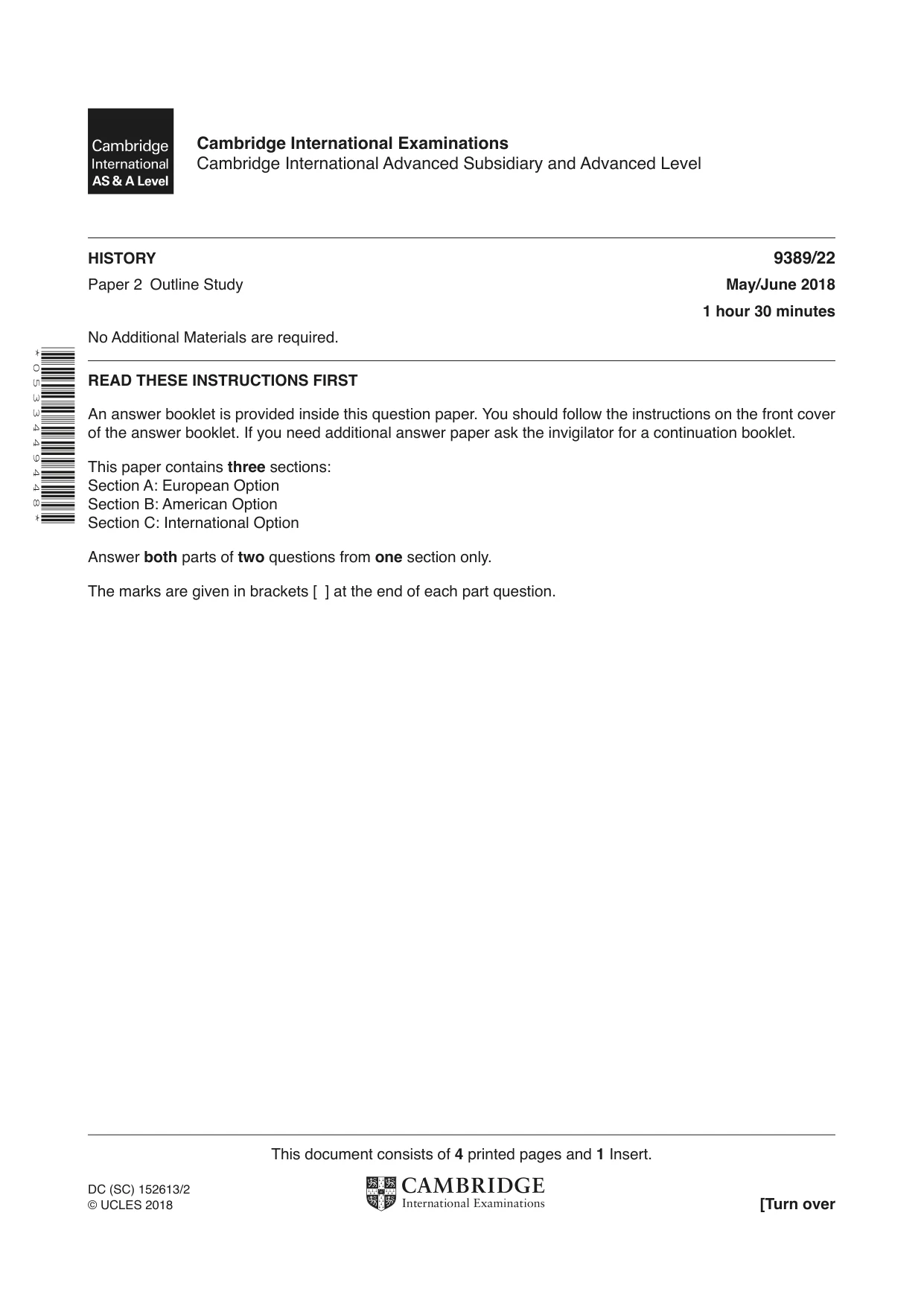
9389/22/M/J/18 · 12 questions · 60 marks · ≈68 min
The question paper and its mark scheme, free to read here and free to download. This is Cambridge’s own paper, exactly as it was sat.
Question paper4 pages
Mark scheme24 pages
Answers below. Sit the paper first if you are practising.
Questions as text
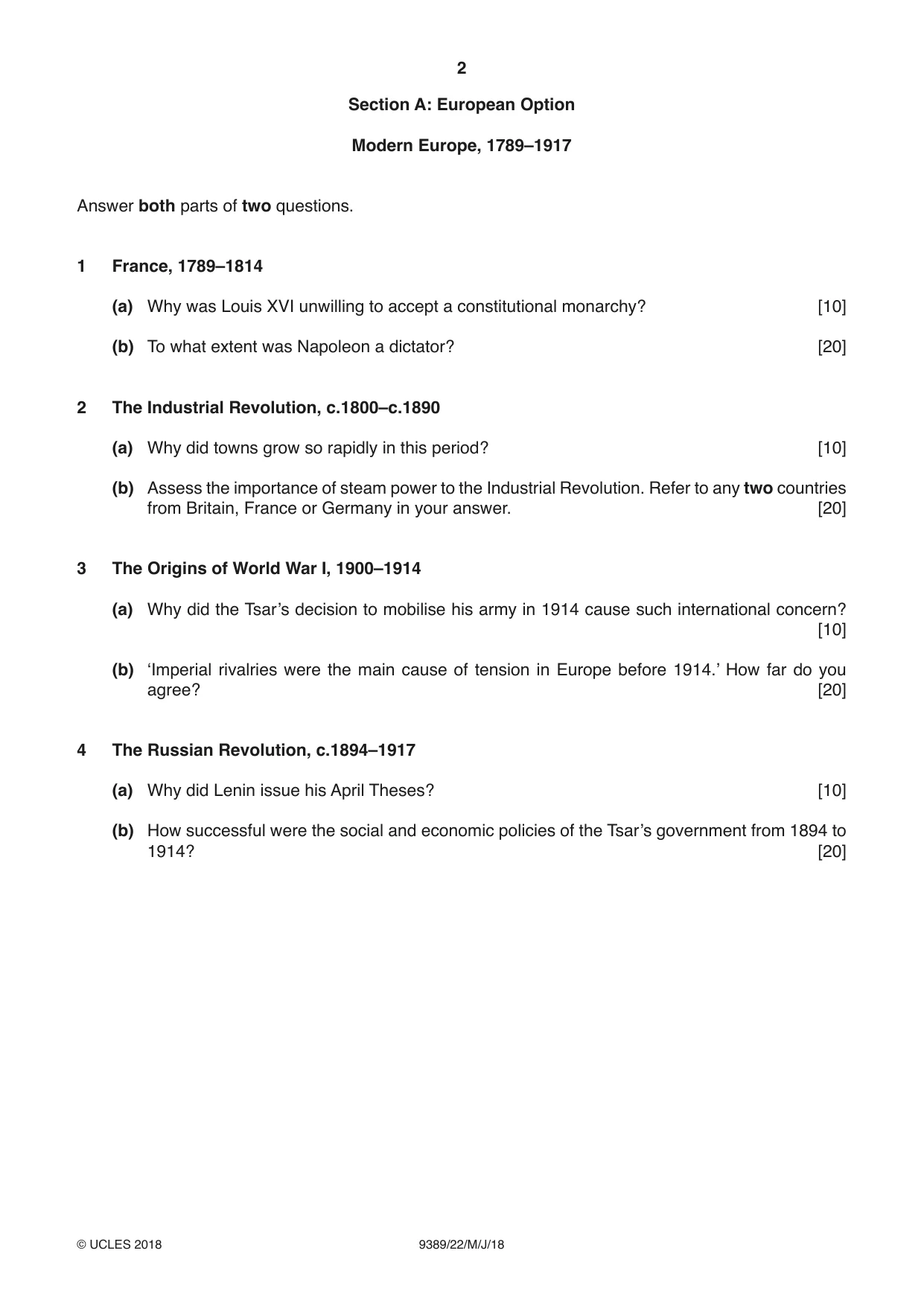
Q1 · France, 1789–1814 (a) Why was Louis XVI unwilling to accept a constitutional monarchy?
1 France, 1789–1814 (a) Why was Louis XVI unwilling to accept a constitutional monarchy? [10] (b) To what extent was Napoleon a dictator? [20]
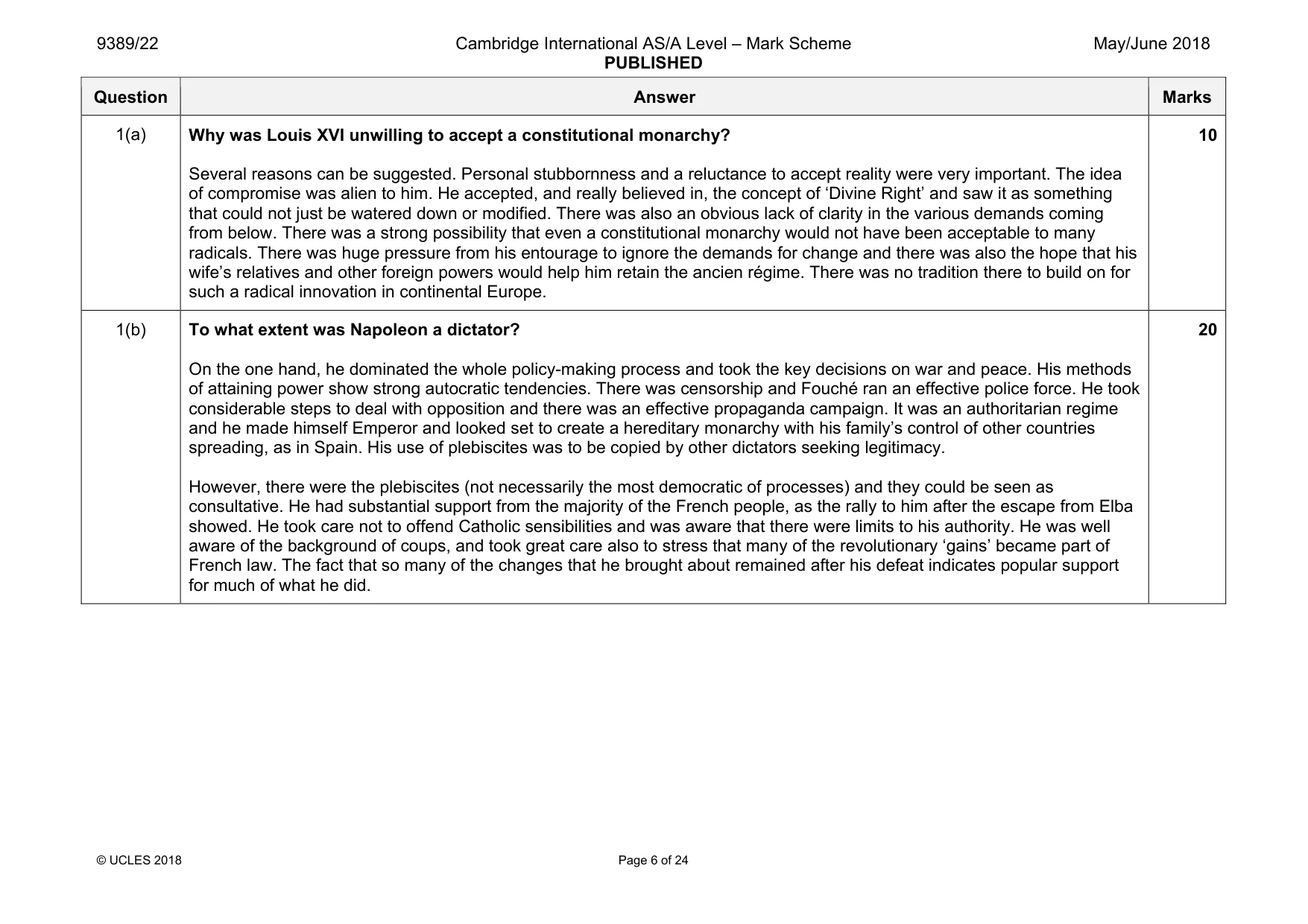
Mark scheme: 1(a) Why was Louis XVI unwilling to accept a constitutional monarchy? Several reasons can be suggested. Personal stubbornness and a reluctance to accept reality were very important. The idea of compromise was alien to him. He accepted, and really believed in, the concept of ‘Divine Right’ and saw it as something that could not just be watered down or modified. There was also an obvious lack of clarity in the various demands coming from below. There was a strong possibility that even a constitutional monarchy would not have been acceptable to many radicals. There was huge pressure from his entourage to ignore the demands for change and there was also the hope that his wife’s relatives and other foreign powers would help him retain the ancien régime. There was no tradition there to build on for such a radical innovation in continental Europe. 10 1(b) To what extent was Napoleon a dictator? On the one hand, he dominated the whole policy-making process and took the key decisions on war and peace. His methods of attaining power show strong autocratic tendencies. There was censorship and Fouché ran an effective police force. He took considerable steps to deal with opposition and there was an effective propaganda campaign. It was an authoritarian regime and he made himself Emperor and looked set to create a hereditary monarchy with his family’s control of other countries spreading, as in Spain. His use of plebiscites was to be copied by other dictators seeking legitimacy. However, there were the plebiscites (not necessarily the most democratic of processes) and they could be seen as consultative. He had substantial support from the majority of the French people, as the rally to him after the escape from Elba showed. He took care not to offend Catholic sensibilities and was aware that there were limits to his authority. He was well aware of the background of coups, and took great care also to stress that many of the revolutionary ‘gains’ became part of French law. The fact that so many of the changes that he brought about remained after his defeat indicates popular support for much of what he did. 20
Q2 · The Industrial Revolution, c.1800–c.1890 (a) Why did towns grow so rapidly in this period?
2 The Industrial Revolution, c.1800–c.1890 (a) Why did towns grow so rapidly in this period? [10] (b) Assess the importance of steam power to the Industrial Revolution. Refer to any two countries from Britain, France or Germany in your answer. [20]
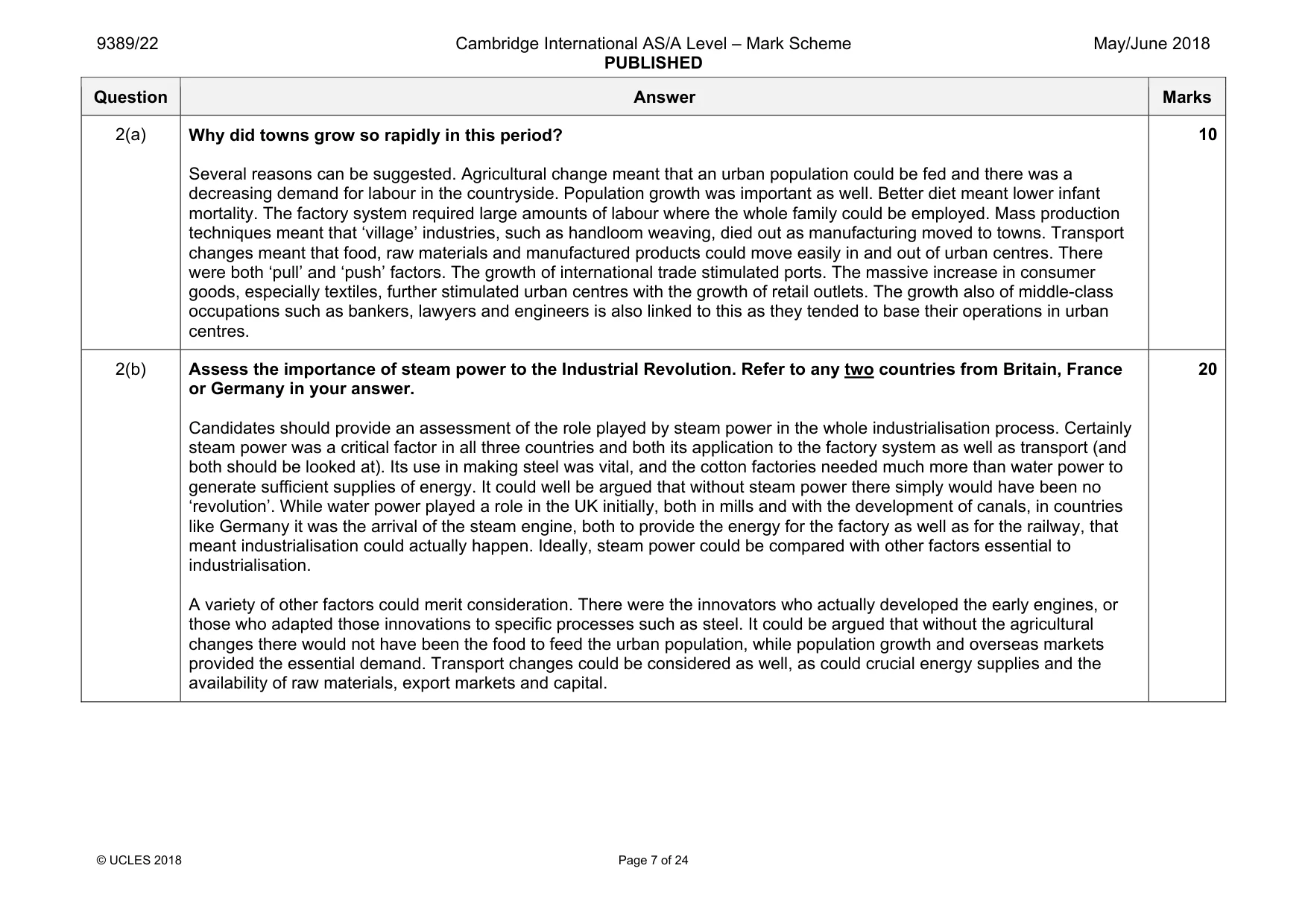
Mark scheme: 2(a) Why did towns grow so rapidly in this period? Several reasons can be suggested. Agricultural change meant that an urban population could be fed and there was a decreasing demand for labour in the countryside. Population growth was important as well. Better diet meant lower infant mortality. The factory system required large amounts of labour where the whole family could be employed. Mass production techniques meant that ‘village’ industries, such as handloom weaving, died out as manufacturing moved to towns. Transport changes meant that food, raw materials and manufactured products could move easily in and out of urban centres. There were both ‘pull’ and ‘push’ factors. The growth of international trade stimulated ports. The massive increase in consumer goods, especially textiles, further stimulated urban centres with the growth of retail outlets. The growth also of middle-class occupations such as bankers, lawyers and engineers is also linked to this as they tended to base their operations in urban centres. 10 2(b) Assess the importance of steam power to the Industrial Revolution. Refer to any two countries from Britain, France or Germany in your answer. Candidates should provide an assessment of the role played by steam power in the whole industrialisation process. Certainly steam power was a critical factor in all three countries and both its application to the factory system as well as transport (and both should be looked at). Its use in making steel was vital, and the cotton factories needed much more than water power to generate sufficient supplies of energy. It could well be argued that without steam power there simply would have been no ‘revolution’. While water power played a role in the UK initially, both in mills and with the development of canals, in countries like Germany it was the arrival of the steam engine, both to provide the energy for the factory as well as for the railway, that meant industrialisation could actually happen. Ideally, steam power could be compared with other factors essential to industrialisation. A variety of other factors could merit consideration. There were the innovators who actually developed the early engines, or those who adapted those innovations to specific processes such as steel. It could be argued that without the agricultural changes there would not have been the food to feed the urban population, while population growth and overseas markets provided the essential demand. Transport changes could be considered as well, as could crucial energy supplies and the availability of raw materials, export markets and capital. 20
Q3 · The Origins of World War I, 1900–1914 (a) Why did the Tsar’s decision to mobilise his…
3 The Origins of World War I, 1900–1914 (a) Why did the Tsar’s decision to mobilise his army in 1914 cause such international concern? [10] (b) ‘Imperial rivalries were the main cause of tension in Europe before 1914.’ How far do you agree? [20]
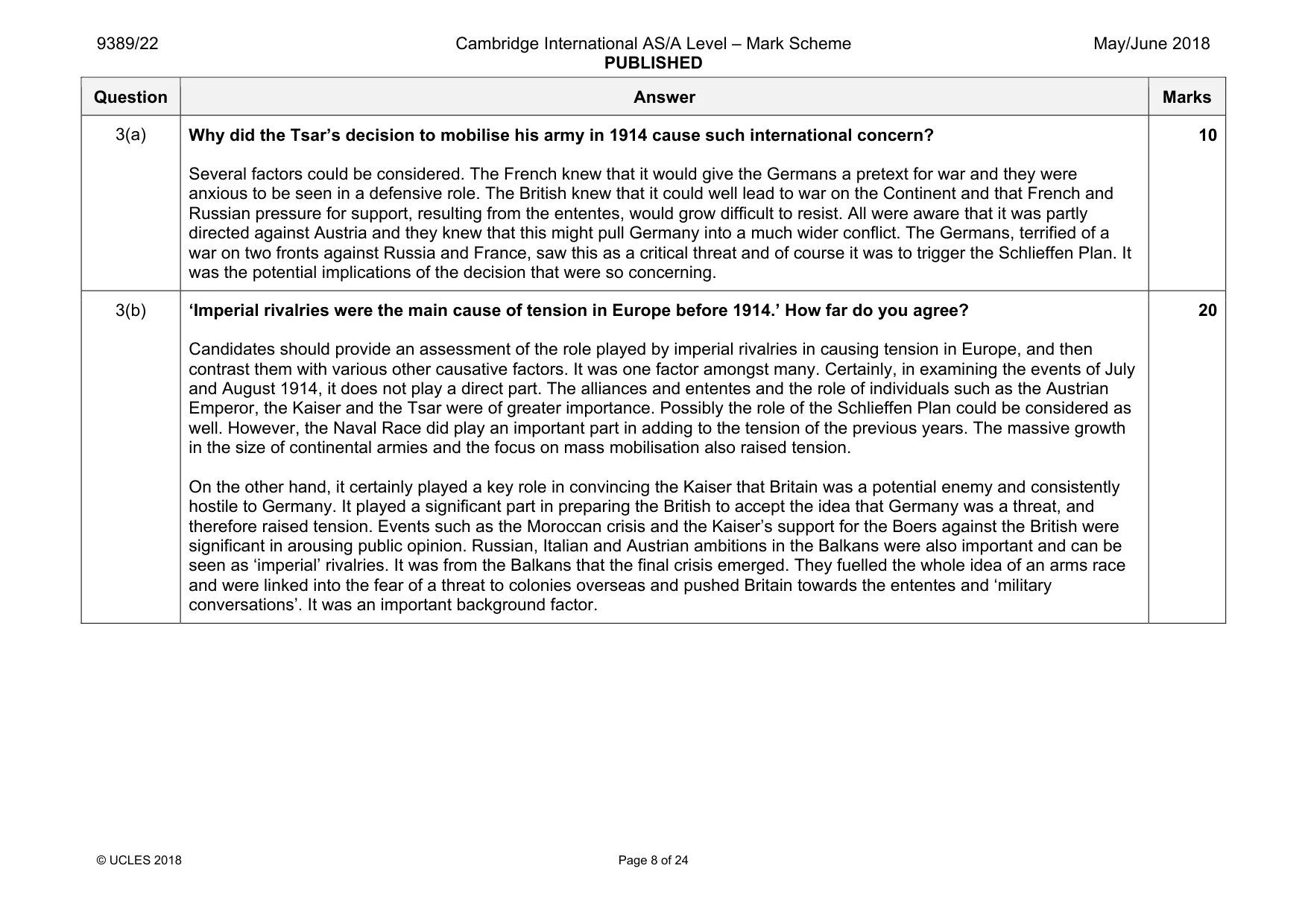
Mark scheme: 3(a) Why did the Tsar’s decision to mobilise his army in 1914 cause such international concern? Several factors could be considered. The French knew that it would give the Germans a pretext for war and they were anxious to be seen in a defensive role. The British knew that it could well lead to war on the Continent and that French and Russian pressure for support, resulting from the ententes, would grow difficult to resist. All were aware that it was partly directed against Austria and they knew that this might pull Germany into a much wider conflict. The Germans, terrified of a war on two fronts against Russia and France, saw this as a critical threat and of course it was to trigger the Schlieffen Plan. It was the potential implications of the decision that were so concerning. 10 3(b) ‘Imperial rivalries were the main cause of tension in Europe before 1914.’ How far do you agree? Candidates should provide an assessment of the role played by imperial rivalries in causing tension in Europe, and then contrast them with various other causative factors. It was one factor amongst many. Certainly, in examining the events of July and August 1914, it does not play a direct part. The alliances and ententes and the role of individuals such as the Austrian Emperor, the Kaiser and the Tsar were of greater importance. Possibly the role of the Schlieffen Plan could be considered as well. However, the Naval Race did play an important part in adding to the tension of the previous years. The massive growth in the size of continental armies and the focus on mass mobilisation also raised tension. On the other hand, it certainly played a key role in convincing the Kaiser that Britain was a potential enemy and consistently hostile to Germany. It played a significant part in preparing the British to accept the idea that Germany was a threat, and therefore raised tension. Events such as the Moroccan crisis and the Kaiser’s support for the Boers against the British were significant in arousing public opinion. Russian, Italian and Austrian ambitions in the Balkans were also important and can be seen as ‘imperial’ rivalries. It was from the Balkans that the final crisis emerged. They fuelled the whole idea of an arms race and were linked into the fear of a threat to colonies overseas and pushed Britain towards the ententes and ‘military conversations’. It was an important background factor. 20
Q4 · The Russian Revolution, c.1894–1917 (a) Why did Lenin issue his April Theses?
4 The Russian Revolution, c.1894–1917 (a) Why did Lenin issue his April Theses? [10] (b) How successful were the social and economic policies of the Tsar’s government from 1894 to 1914? [20]
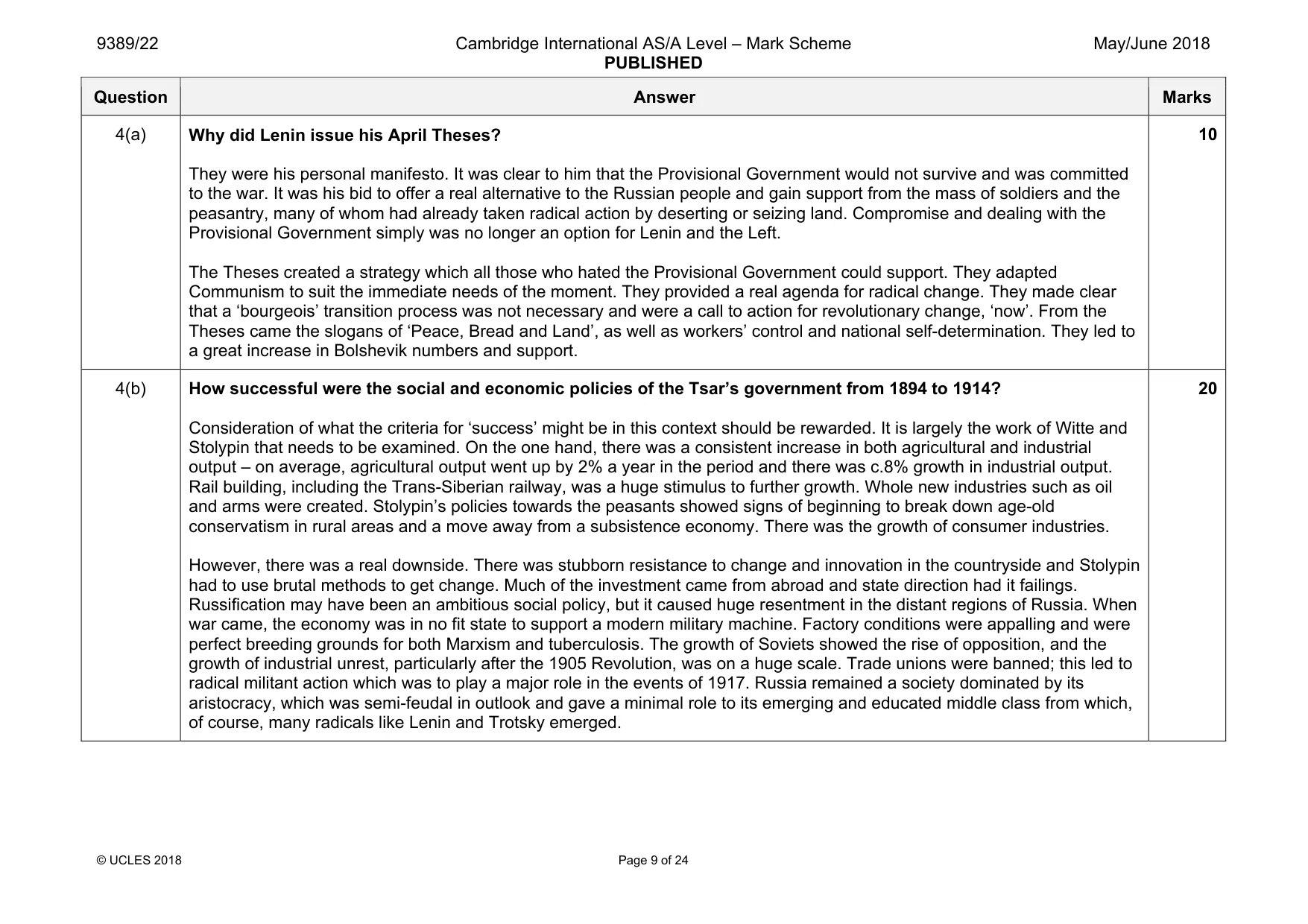
Mark scheme: 4(a) Why did Lenin issue his April Theses? They were his personal manifesto. It was clear to him that the Provisional Government would not survive and was committed to the war. It was his bid to offer a real alternative to the Russian people and gain support from the mass of soldiers and the peasantry, many of whom had already taken radical action by deserting or seizing land. Compromise and dealing with the Provisional Government simply was no longer an option for Lenin and the Left. The Theses created a strategy which all those who hated the Provisional Government could support. They adapted Communism to suit the immediate needs of the moment. They provided a real agenda for radical change. They made clear that a ‘bourgeois’ transition process was not necessary and were a call to action for revolutionary change, ‘now’. From the Theses came the slogans of ‘Peace, Bread and Land’, as well as workers’ control and national self-determination. They led to a great increase in Bolshevik numbers and support. 10 4(b) How successful were the social and economic policies of the Tsar’s government from 1894 to 1914? Consideration of what the criteria for ‘success’ might be in this context should be rewarded. It is largely the work of Witte and Stolypin that needs to be examined. On the one hand, there was a consistent increase in both agricultural and industrial output – on average, agricultural output went up by 2% a year in the period and there was c.8% growth in industrial output. Rail building, including the Trans-Siberian railway, was a huge stimulus to further growth. Whole new industries such as oil and arms were created. Stolypin’s policies towards the peasants showed signs of beginning to break down age-old conservatism in rural areas and a move away from a subsistence economy. There was the growth of consumer industries. However, there was a real downside. There was stubborn resistance to change and innovation in the countryside and Stolypin had to use brutal methods to get change. Much of the investment came from abroad and state direction had it failings. Russification may have been an ambitious social policy, but it caused huge resentment in the distant regions of Russia. When war came, the economy was in no fit state to support a modern military machine. Factory conditions were appalling and were perfect breeding grounds for both Marxism and tuberculosis. The growth of Soviets showed the rise of opposition, and the growth of industrial unrest, particularly after the 1905 Revolution, was on a huge scale. Trade unions were banned; this led to radical militant action which was to play a major role in the events of 1917. Russia remained a society dominated by its aristocracy, which was semi-feudal in outlook and gave a minimal role to its emerging and educated middle class from which, of course, many radicals like Lenin and Trotsky emerged. 20
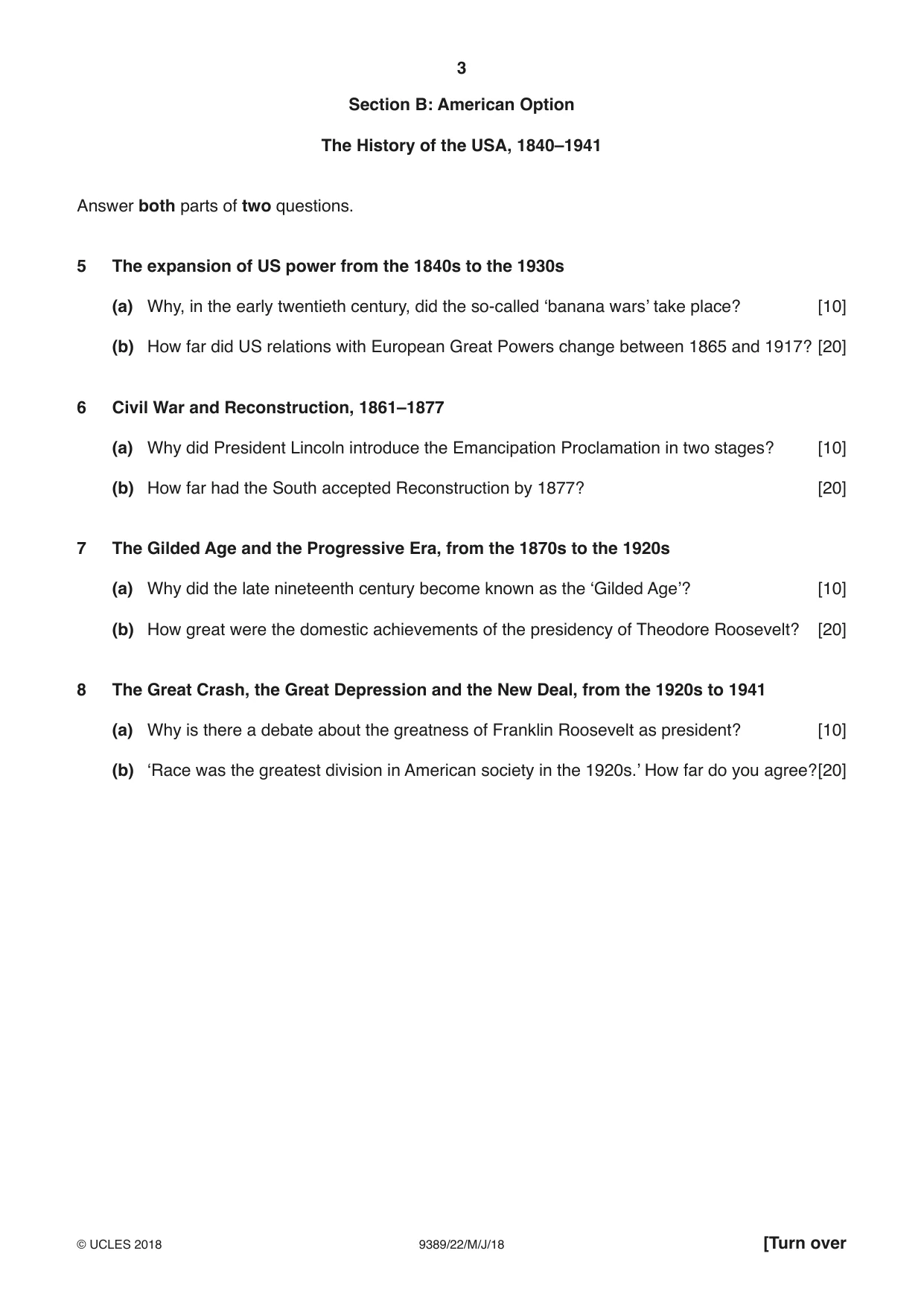
Q5 · The expansion of US power from the 1840s to the 1930s (a) Why, in the early twentieth…
5 The expansion of US power from the 1840s to the 1930s (a) Why, in the early twentieth century, did the so-called ‘banana wars’ take place? [10] (b) How far did US relations with European Great Powers change between 1865 and 1917? [20]
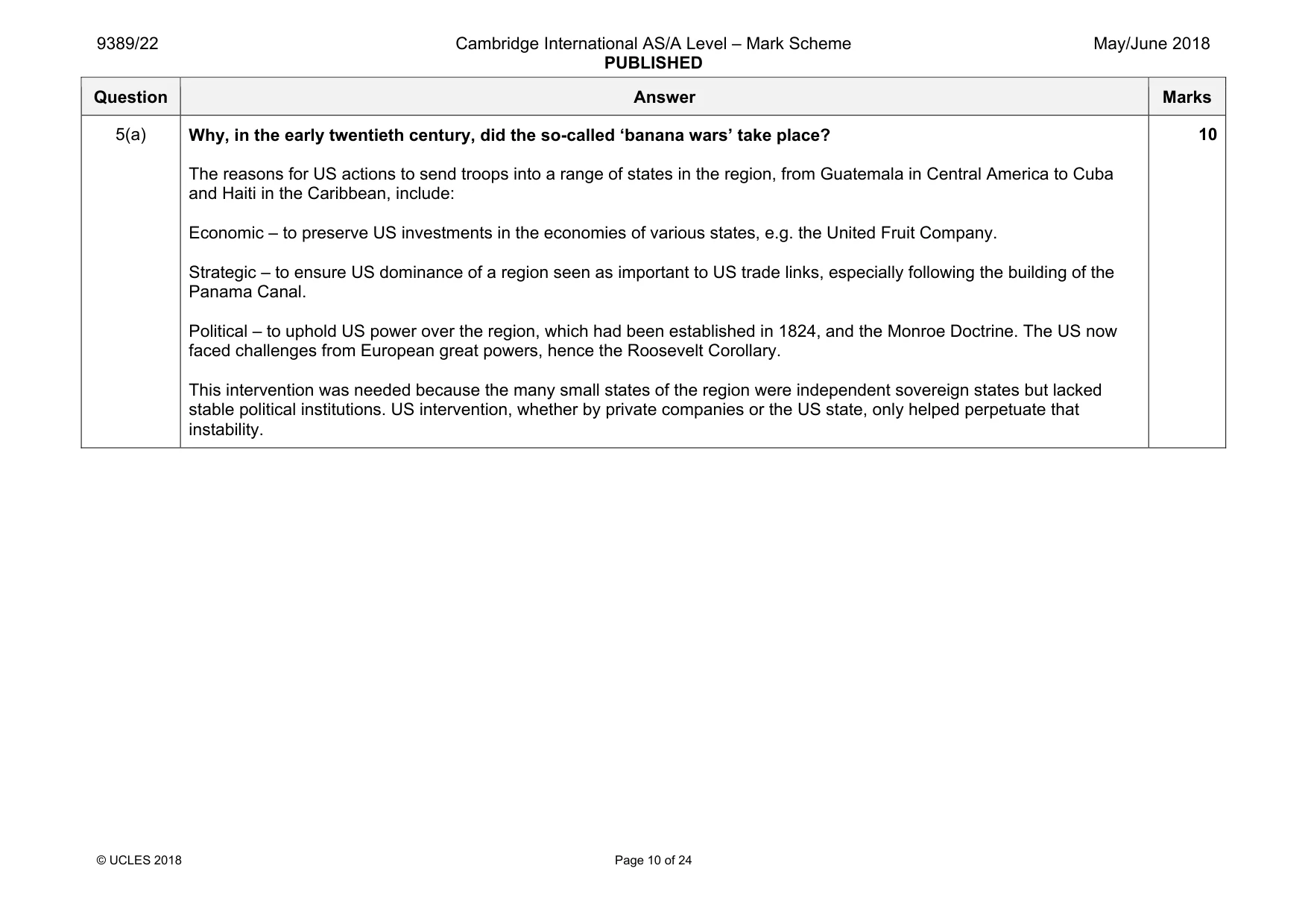
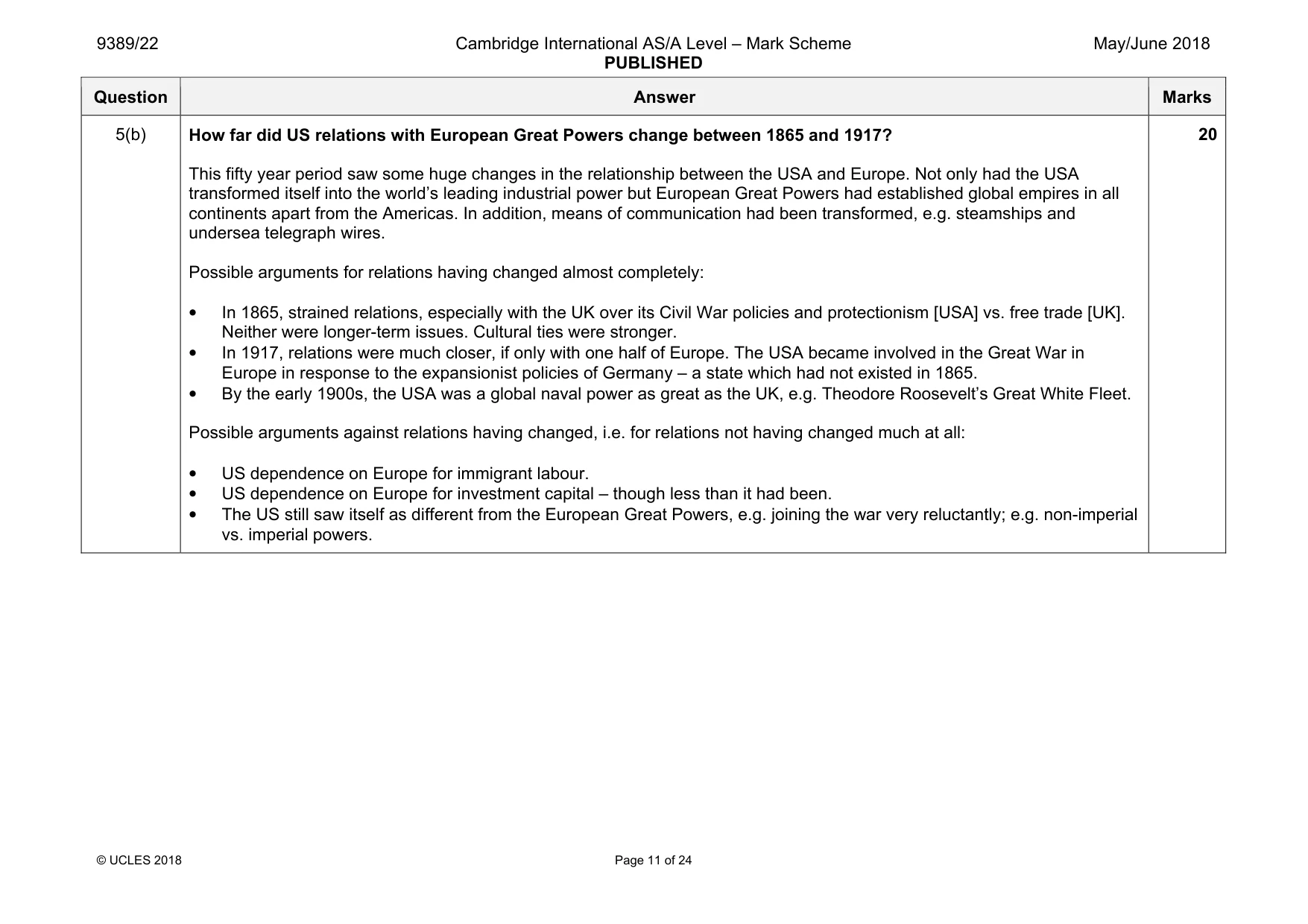
Mark scheme: 5(a) Why, in the early twentieth century, did the so-called ‘banana wars’ take place? The reasons for US actions to send troops into a range of states in the region, from Guatemala in Central America to Cuba and Haiti in the Caribbean, include: Economic – to preserve US investments in the economies of various states, e.g. the United Fruit Company. Strategic – to ensure US dominance of a region seen as important to US trade links, especially following the building of the Panama Canal. Political – to uphold US power over the region, which had been established in 1824, and the Monroe Doctrine. The US now faced challenges from European great powers, hence the Roosevelt Corollary. This intervention was needed because the many small states of the region were independent sovereign states but lacked stable political institutions. US intervention, whether by private companies or the US state, only helped perpetuate that instability. 10 Question Answer Marks 5(b) How far did US relations with European Great Powers change between 1865 and 1917? This fifty year period saw some huge changes in the relationship between the USA and Europe. Not only had the USA transformed itself into the world’s leading industrial power but European Great Powers had established global empires in all continents apart from the Americas. In addition, means of communication had been transformed, e.g. steamships and undersea telegraph wires. Possible arguments for relations having changed almost completely: • In 1865, strained relations, especially with the UK over its Civil War policies and protectionism [USA] vs. free trade [UK]. Neither were longer-term issues. Cultural ties were stronger. • In 1917, relations were much closer, if only with one half of Europe. The USA became involved in the Great War in Europe in response to the expansionist policies of Germany – a state which had not existed in 1865. • By the early 1900s, the USA was a global naval power as great as the UK, e.g. Theodore Roosevelt’s Great White Fleet. Possible arguments against relations having changed, i.e. for relations not having changed much at all: • US dependence on Europe for immigrant labour. • US dependence on Europe for investment capital – though less than it had been. • The US still saw itself as different from the European Great Powers, e.g. joining the war very reluctantly; e.g. non-imperial vs. imperial powers. 20
Q6 · Civil War and Reconstruction, 1861–1877 (a) Why did President Lincoln introduce the…
6 Civil War and Reconstruction, 1861–1877 (a) Why did President Lincoln introduce the Emancipation Proclamation in two stages? [10] (b) How far had the South accepted Reconstruction by 1877? [20]
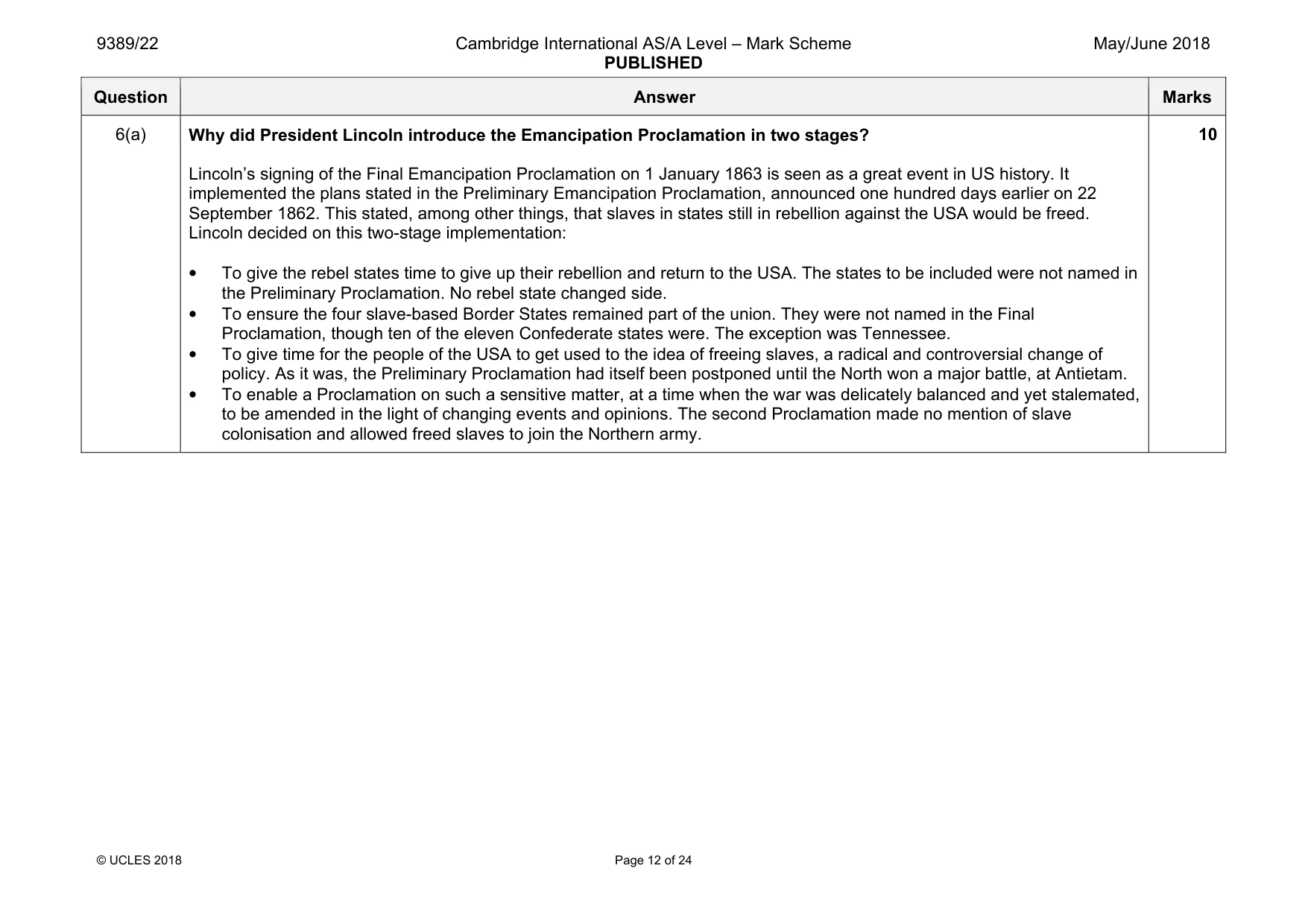
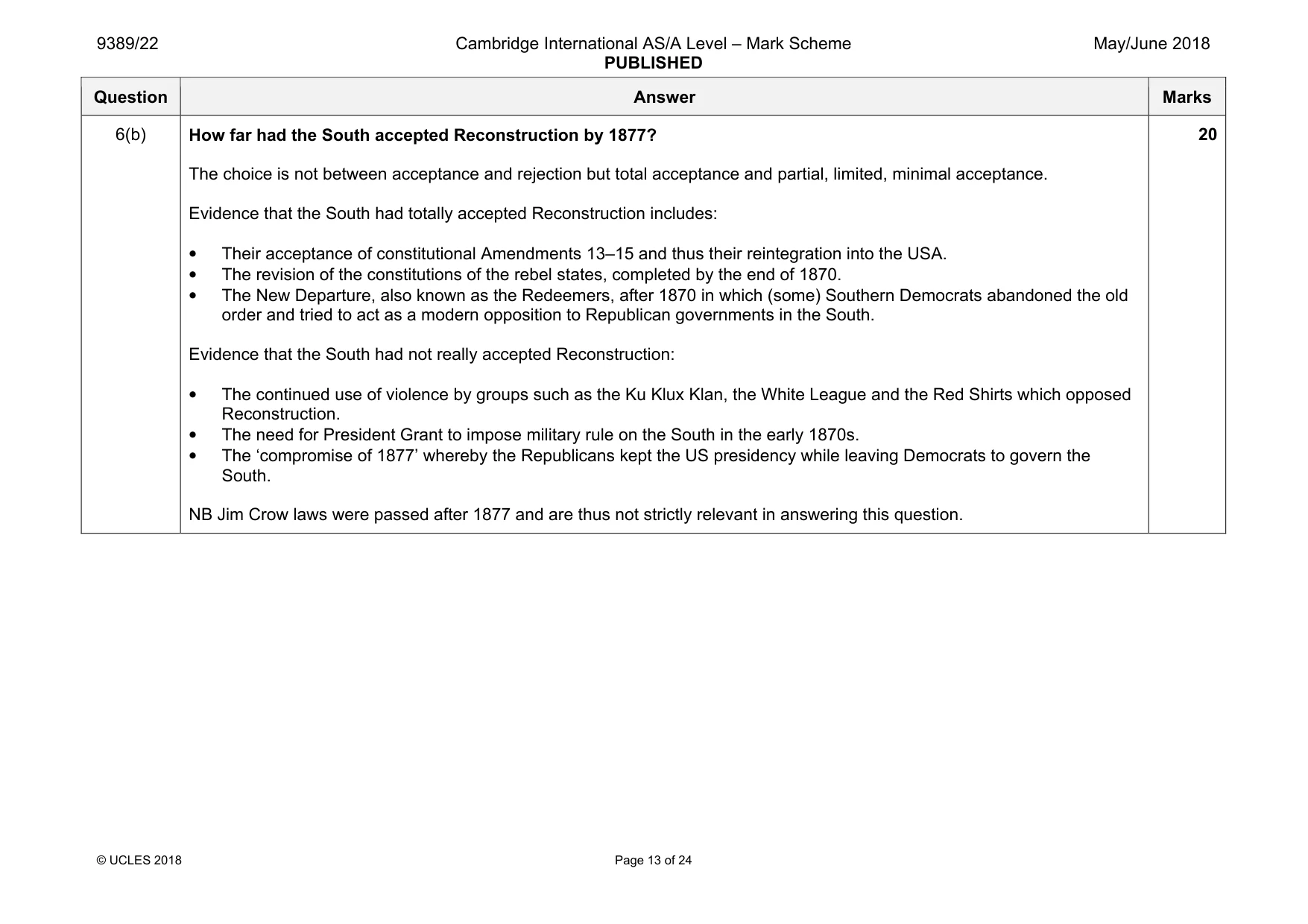
Mark scheme: 6(a) Why did President Lincoln introduce the Emancipation Proclamation in two stages? Lincoln’s signing of the Final Emancipation Proclamation on 1 January 1863 is seen as a great event in US history. It implemented the plans stated in the Preliminary Emancipation Proclamation, announced one hundred days earlier on 22 September 1862. This stated, among other things, that slaves in states still in rebellion against the USA would be freed. Lincoln decided on this two-stage implementation: • To give the rebel states time to give up their rebellion and return to the USA. The states to be included were not named in the Preliminary Proclamation. No rebel state changed side. • To ensure the four slave-based Border States remained part of the union. They were not named in the Final Proclamation, though ten of the eleven Confederate states were. The exception was Tennessee. • To give time for the people of the USA to get used to the idea of freeing slaves, a radical and controversial change of policy. As it was, the Preliminary Proclamation had itself been postponed until the North won a major battle, at Antietam. • To enable a Proclamation on such a sensitive matter, at a time when the war was delicately balanced and yet stalemated, to be amended in the light of changing events and opinions. The second Proclamation made no mention of slave colonisation and allowed freed slaves to join the Northern army. 10 Question Answer Marks 6(b) How far had the South accepted Reconstruction by 1877? The choice is not between acceptance and rejection but total acceptance and partial, limited, minimal acceptance. Evidence that the South had totally accepted Reconstruction includes: • Their acceptance of constitutional Amendments 13–15 and thus their reintegration into the USA. • The revision of the constitutions of the rebel states, completed by the end of 1870. • The New Departure, also known as the Redeemers, after 1870 in which (some) Southern Democrats abandoned the old order and tried to act as a modern opposition to Republican governments in the South. Evidence that the South had not really accepted Reconstruction: • The continued use of violence by groups such as the Ku Klux Klan, the White League and the Red Shirts which opposed Reconstruction. • The need for President Grant to impose military rule on the South in the early 1870s. • The ‘compromise of 1877’ whereby the Republicans kept the US presidency while leaving Democrats to govern the South. NB Jim Crow laws were passed after 1877 and are thus not strictly relevant in answering this question. 20
Q7 · The Gilded Age and the Progressive Era, from the 1870s to the 1920s (a) Why did the late…
7 The Gilded Age and the Progressive Era, from the 1870s to the 1920s (a) Why did the late nineteenth century become known as the ‘Gilded Age’? [10] (b) How great were the domestic achievements of the presidency of Theodore Roosevelt? [20]
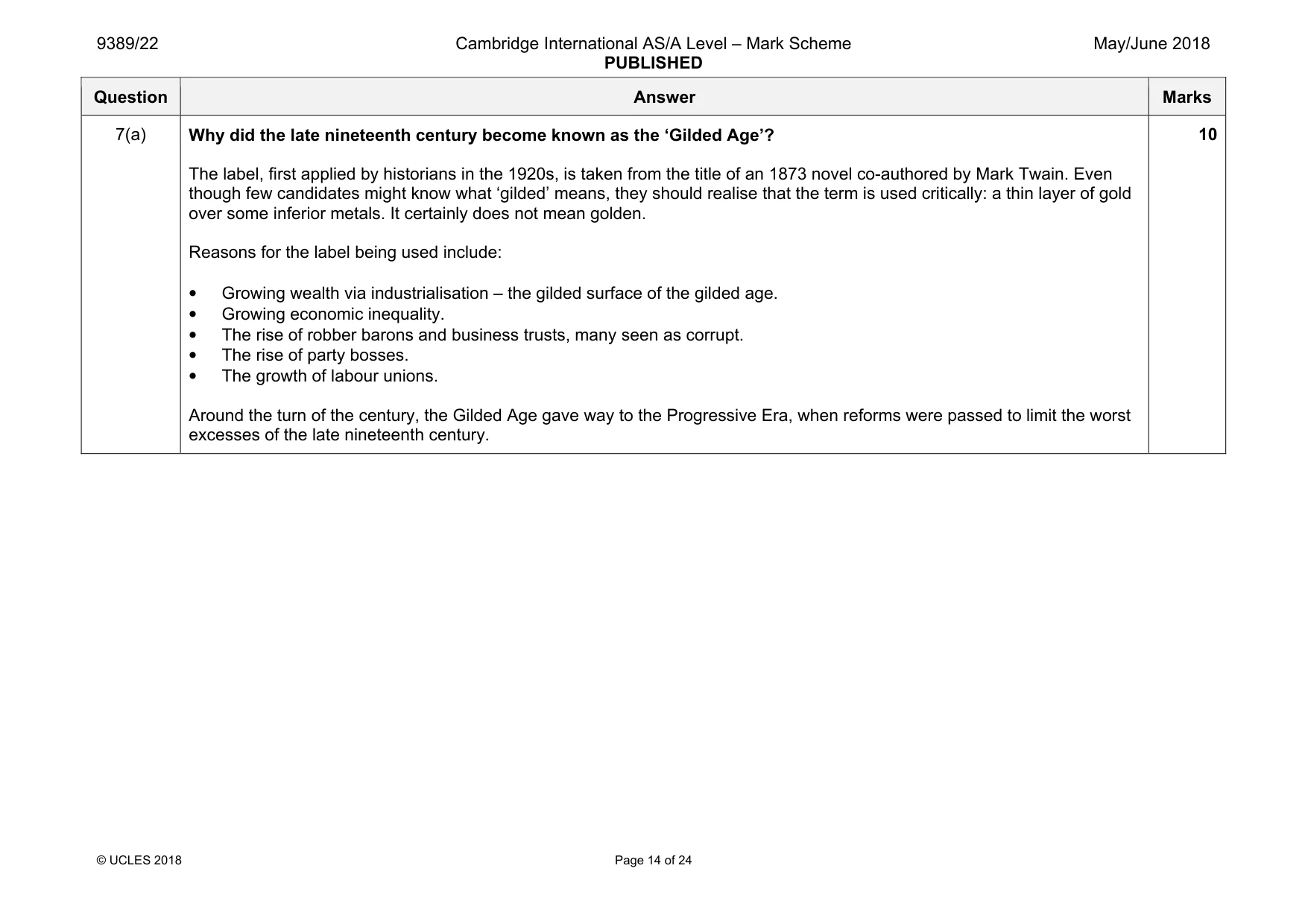
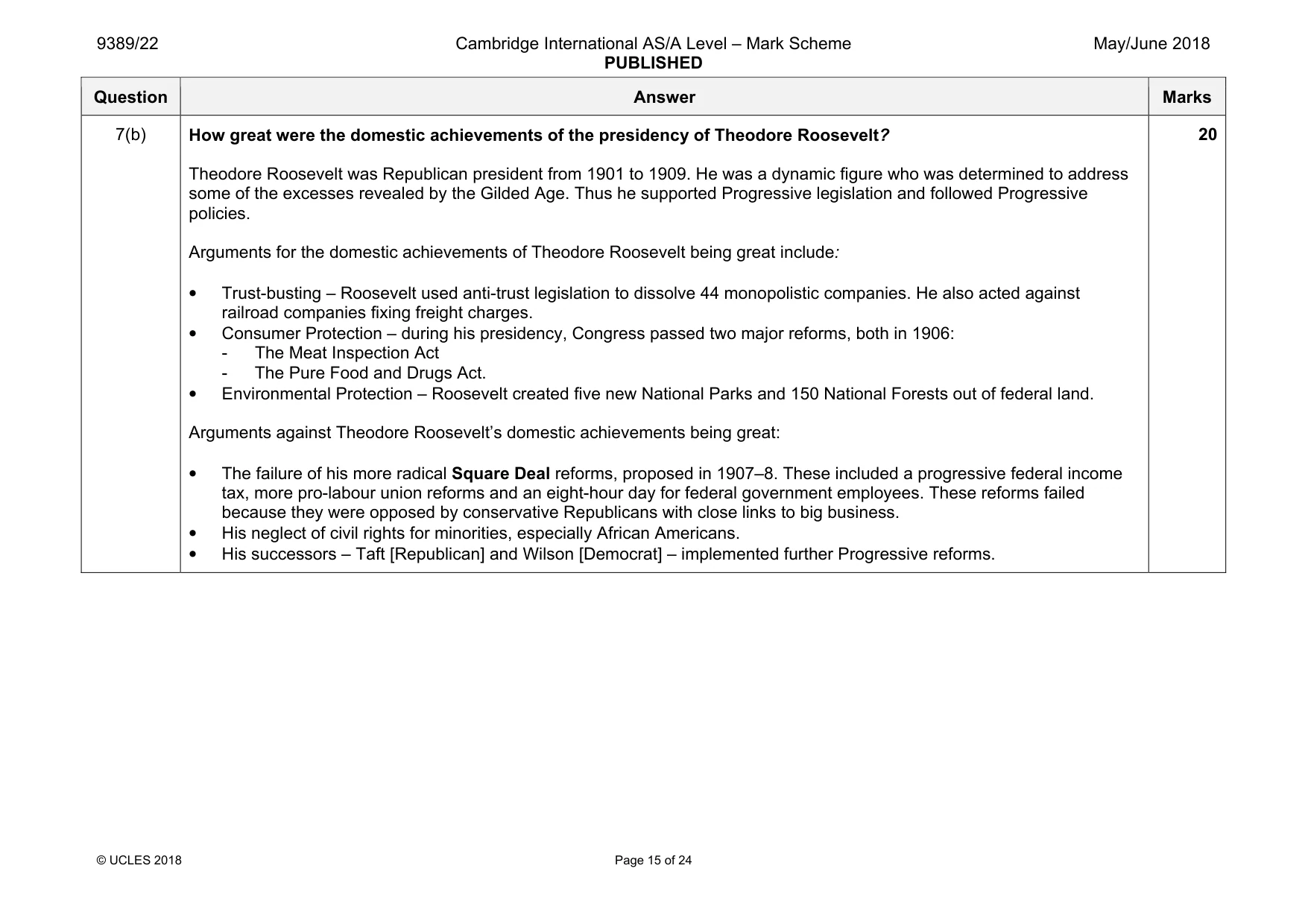
Mark scheme: 7(a) Why did the late nineteenth century become known as the ‘Gilded Age’? The label, first applied by historians in the 1920s, is taken from the title of an 1873 novel co-authored by Mark Twain. Even though few candidates might know what ‘gilded’ means, they should realise that the term is used critically: a thin layer of gold over some inferior metals. It certainly does not mean golden. Reasons for the label being used include: • Growing wealth via industrialisation – the gilded surface of the gilded age. • Growing economic inequality. • The rise of robber barons and business trusts, many seen as corrupt. • The rise of party bosses. • The growth of labour unions. Around the turn of the century, the Gilded Age gave way to the Progressive Era, when reforms were passed to limit the worst excesses of the late nineteenth century. 10 Question Answer Marks 7(b) How great were the domestic achievements of the presidency of Theodore Roosevelt? Theodore Roosevelt was Republican president from 1901 to 1909. He was a dynamic figure who was determined to address some of the excesses revealed by the Gilded Age. Thus he supported Progressive legislation and followed Progressive policies. Arguments for the domestic achievements of Theodore Roosevelt being great include: • Trust-busting – Roosevelt used anti-trust legislation to dissolve 44 monopolistic companies. He also acted against railroad companies fixing freight charges. • Consumer Protection – during his presidency, Congress passed two major reforms, both in 1906: - The Meat Inspection Act - The Pure Food and Drugs Act. • Environmental Protection – Roosevelt created five new National Parks and 150 National Forests out of federal land. Arguments against Theodore Roosevelt’s domestic achievements being great: • The failure of his more radical Square Deal reforms, proposed in 1907–8. These included a progressive federal income tax, more pro-labour union reforms and an eight-hour day for federal government employees. These reforms failed because they were opposed by conservative Republicans with close links to big business. • His neglect of civil rights for minorities, especially African Americans. • His successors – Taft [Republican] and Wilson [Democrat] – implemented further Progressive reforms. 20
Q8 · The Great Crash, the Great Depression and the New Deal, from the 1920s to 1941 (a) Why is…
8 The Great Crash, the Great Depression and the New Deal, from the 1920s to 1941 (a) Why is there a debate about the greatness of Franklin Roosevelt as president? [10] (b) ‘Race was the greatest division in American society in the 1920s.’ How far do you agree? [20] Section C: International Option International Relations, 1871–1945 Answer both parts of two questions.
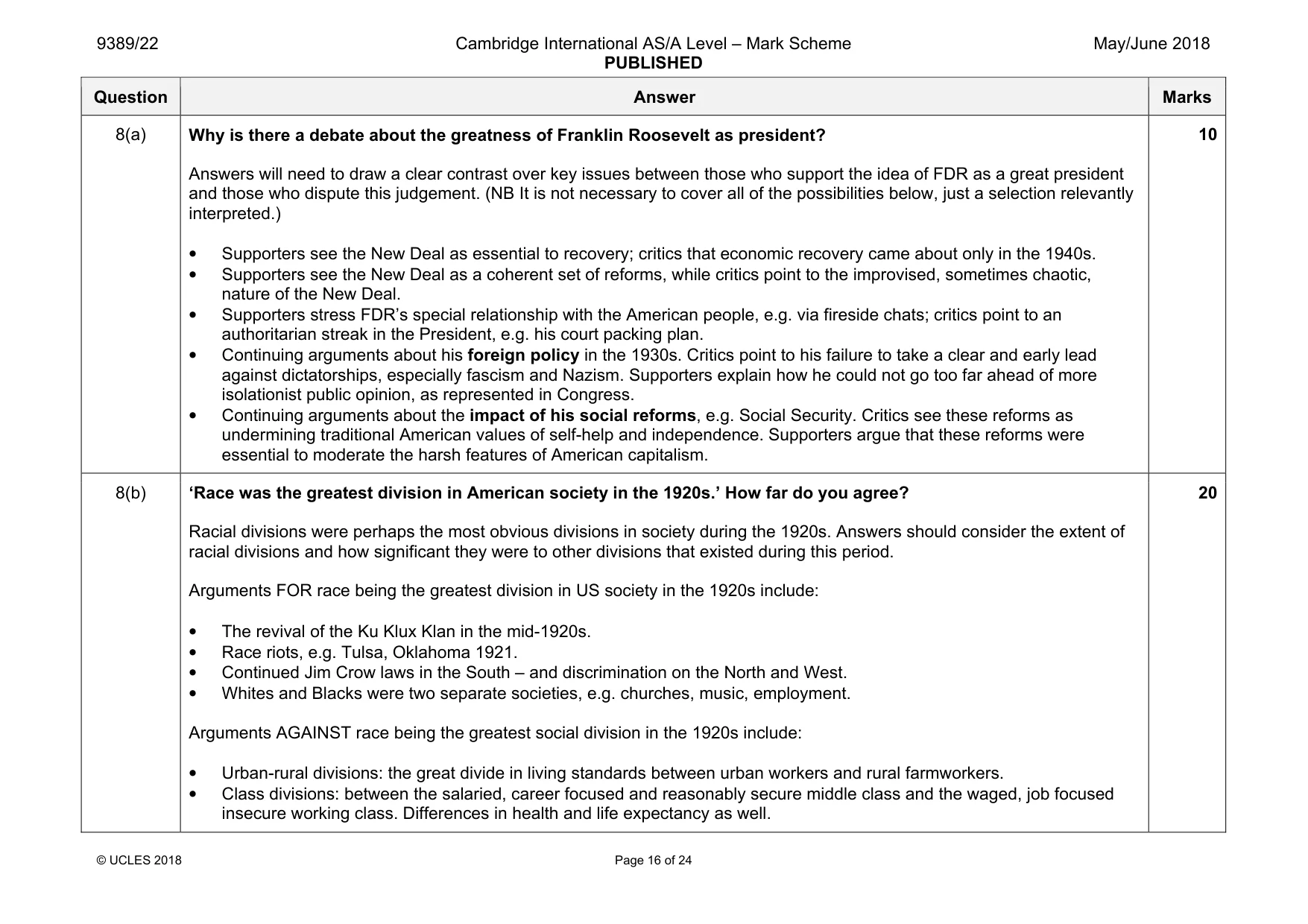
Mark scheme: 8(a) Why is there a debate about the greatness of Franklin Roosevelt as president? Answers will need to draw a clear contrast over key issues between those who support the idea of FDR as a great president and those who dispute this judgement. (NB It is not necessary to cover all of the possibilities below, just a selection relevantly interpreted.) • Supporters see the New Deal as essential to recovery; critics that economic recovery came about only in the 1940s. • Supporters see the New Deal as a coherent set of reforms, while critics point to the improvised, sometimes chaotic, nature of the New Deal. • Supporters stress FDR’s special relationship with the American people, e.g. via fireside chats; critics point to an authoritarian streak in the President, e.g. his court packing plan. • Continuing arguments about his foreign policy in the 1930s. Critics point to his failure to take a clear and early lead against dictatorships, especially fascism and Nazism. Supporters explain how he could not go too far ahead of more isolationist public opinion, as represented in Congress. • Continuing arguments about the impact of his social reforms, e.g. Social Security. Critics see these reforms as undermining traditional American values of self-help and independence. Supporters argue that these reforms were essential to moderate the harsh features of American capitalism. 10 8(b) ‘Race was the greatest division in American society in the 1920s.’ How far do you agree? Racial divisions were perhaps the most obvious divisions in society during the 1920s. Answers should consider the extent of racial divisions and how significant they were to other divisions that existed during this period. Arguments FOR race being the greatest division in US society in the 1920s include: • The revival of the Ku Klux Klan in the mid-1920s. • Race riots, e.g. Tulsa, Oklahoma 1921. • Continued Jim Crow laws in the South – and discrimination on the North and West. • Whites and Blacks were two separate societies, e.g. churches, music, employment. Arguments AGAINST race being the greatest social division in the 1920s include: • Urban-rural divisions: the great divide in living standards between urban workers and rural farmworkers. • Class divisions: between the salaried, career focused and reasonably secure middle class and the waged, job focused insecure working class. Differences in health and life expectancy as well. 20
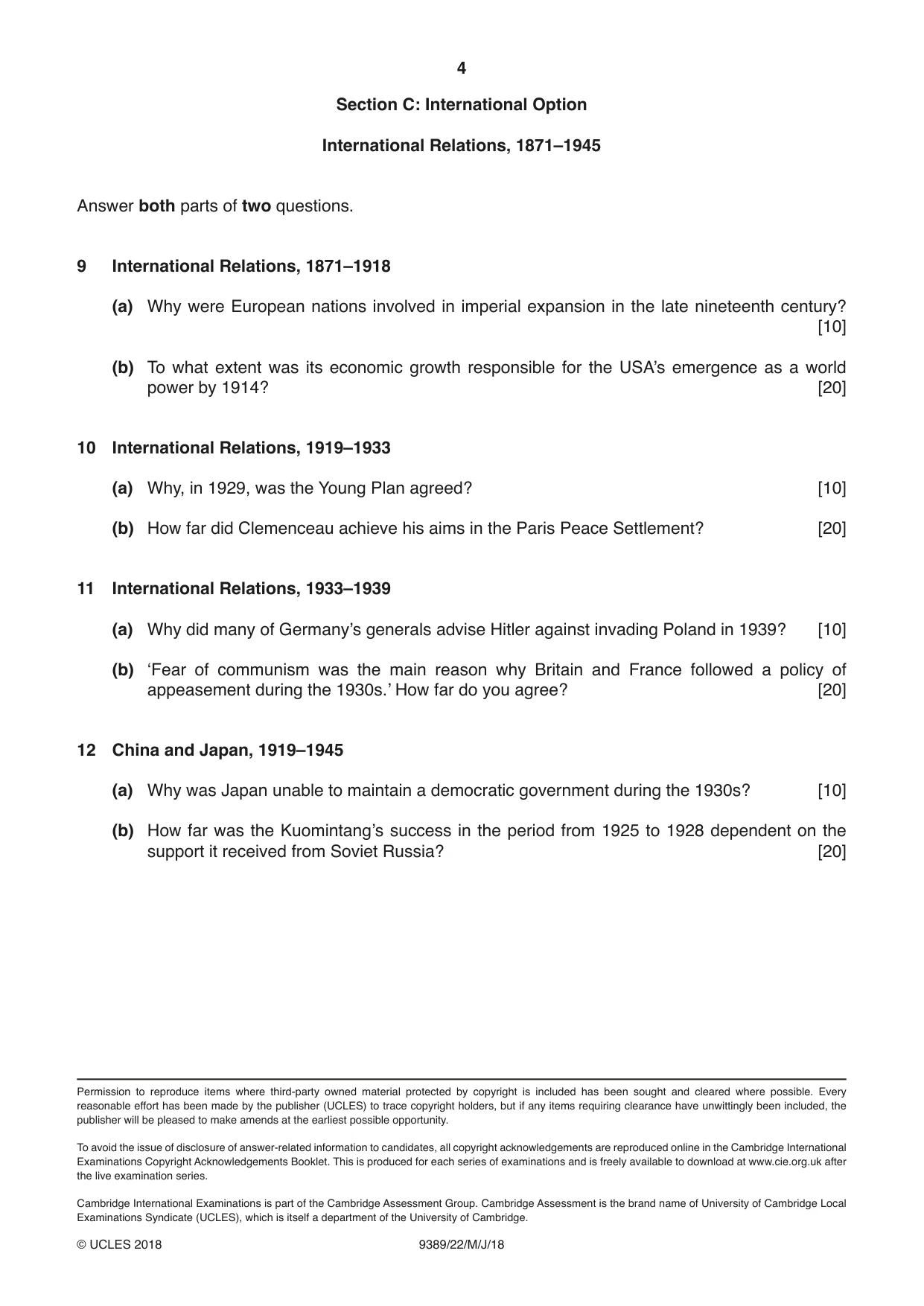
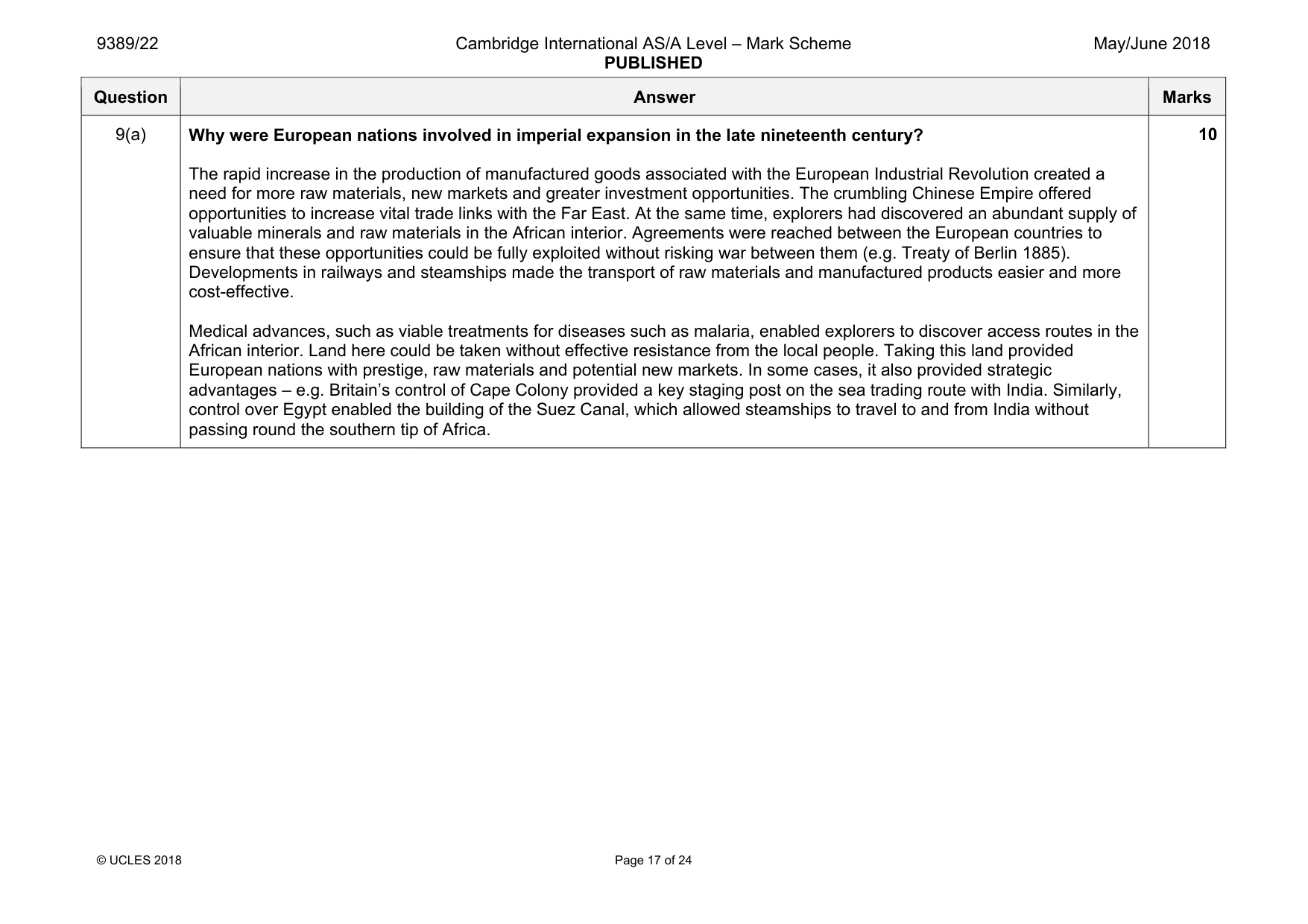
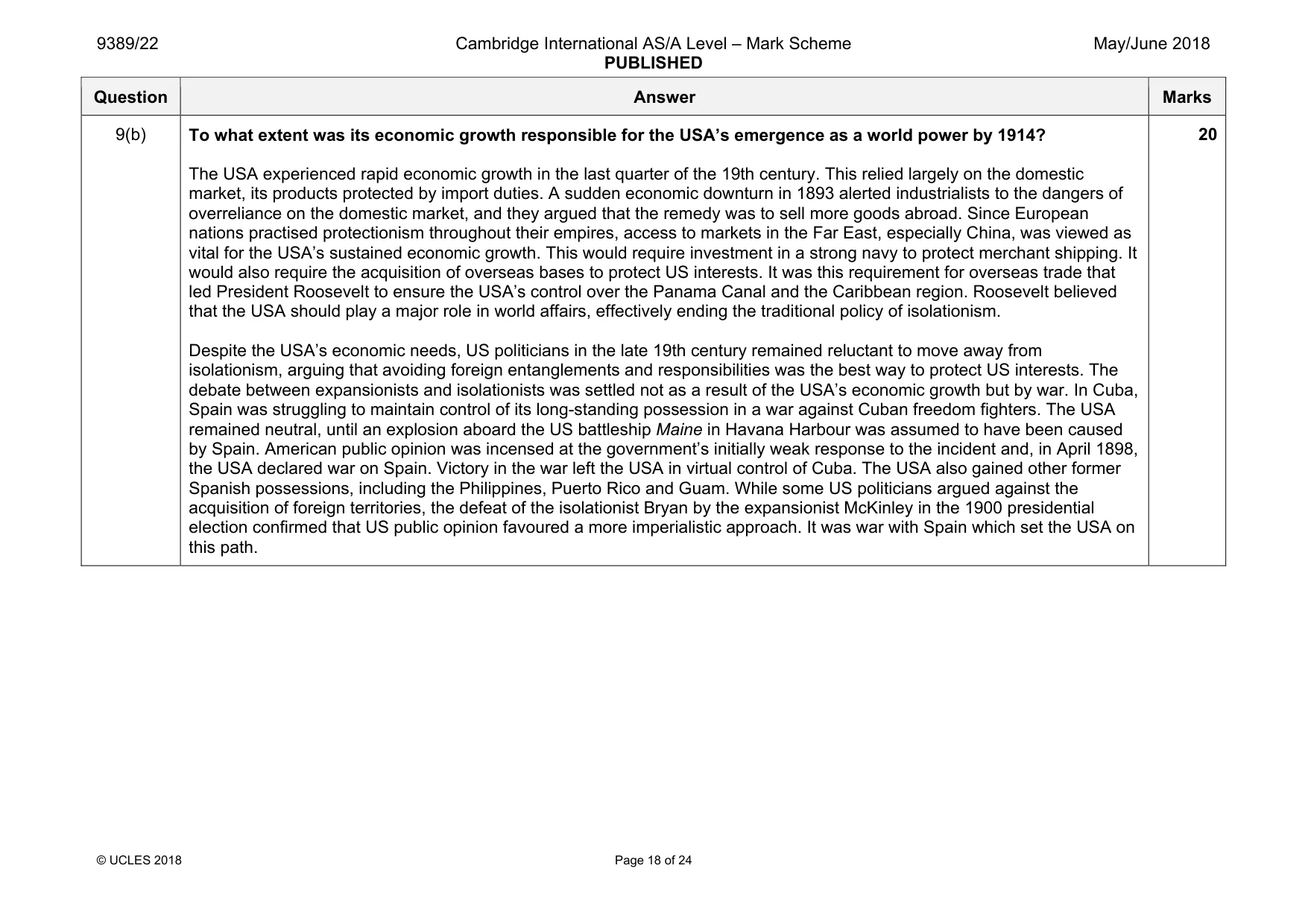
Q9 · International Relations, 1871–1918 (a) Why were European nations involved in imperial…
9 International Relations, 1871–1918 (a) Why were European nations involved in imperial expansion in the late nineteenth century? [10] (b) To what extent was its economic growth responsible for the USA’s emergence as a world power by 1914? [20]
Mark scheme: 9(a) Why were European nations involved in imperial expansion in the late nineteenth century? The rapid increase in the production of manufactured goods associated with the European Industrial Revolution created a need for more raw materials, new markets and greater investment opportunities. The crumbling Chinese Empire offered opportunities to increase vital trade links with the Far East. At the same time, explorers had discovered an abundant supply of valuable minerals and raw materials in the African interior. Agreements were reached between the European countries to ensure that these opportunities could be fully exploited without risking war between them (e.g. Treaty of Berlin 1885). Developments in railways and steamships made the transport of raw materials and manufactured products easier and more cost-effective. Medical advances, such as viable treatments for diseases such as malaria, enabled explorers to discover access routes in the African interior. Land here could be taken without effective resistance from the local people. Taking this land provided European nations with prestige, raw materials and potential new markets. In some cases, it also provided strategic advantages – e.g. Britain’s control of Cape Colony provided a key staging post on the sea trading route with India. Similarly, control over Egypt enabled the building of the Suez Canal, which allowed steamships to travel to and from India without passing round the southern tip of Africa. 10 Question Answer Marks 9(b) To what extent was its economic growth responsible for the USA’s emergence as a world power by 1914? The USA experienced rapid economic growth in the last quarter of the 19th century. This relied largely on the domestic market, its products protected by import duties. A sudden economic downturn in 1893 alerted industrialists to the dangers of overreliance on the domestic market, and they argued that the remedy was to sell more goods abroad. Since European nations practised protectionism throughout their empires, access to markets in the Far East, especially China, was viewed as vital for the USA’s sustained economic growth. This would require investment in a strong navy to protect merchant shipping. It would also require the acquisition of overseas bases to protect US interests. It was this requirement for overseas trade that led President Roosevelt to ensure the USA’s control over the Panama Canal and the Caribbean region. Roosevelt believed that the USA should play a major role in world affairs, effectively ending the traditional policy of isolationism. Despite the USA’s economic needs, US politicians in the late 19th century remained reluctant to move away from isolationism, arguing that avoiding foreign entanglements and responsibilities was the best way to protect US interests. The debate between expansionists and isolationists was settled not as a result of the USA’s economic growth but by war. In Cuba, Spain was struggling to maintain control of its long-standing possession in a war against Cuban freedom fighters. The USA remained neutral, until an explosion aboard the US battleship Maine in Havana Harbour was assumed to have been caused by Spain. American public opinion was incensed at the government’s initially weak response to the incident and, in April 1898, the USA declared war on Spain. Victory in the war left the USA in virtual control of Cuba. The USA also gained other former Spanish possessions, including the Philippines, Puerto Rico and Guam. While some US politicians argued against the acquisition of foreign territories, the defeat of the isolationist Bryan by the expansionist McKinley in the 1900 presidential election confirmed that US public opinion favoured a more imperialistic approach. It was war with Spain which set the USA on this path. 20
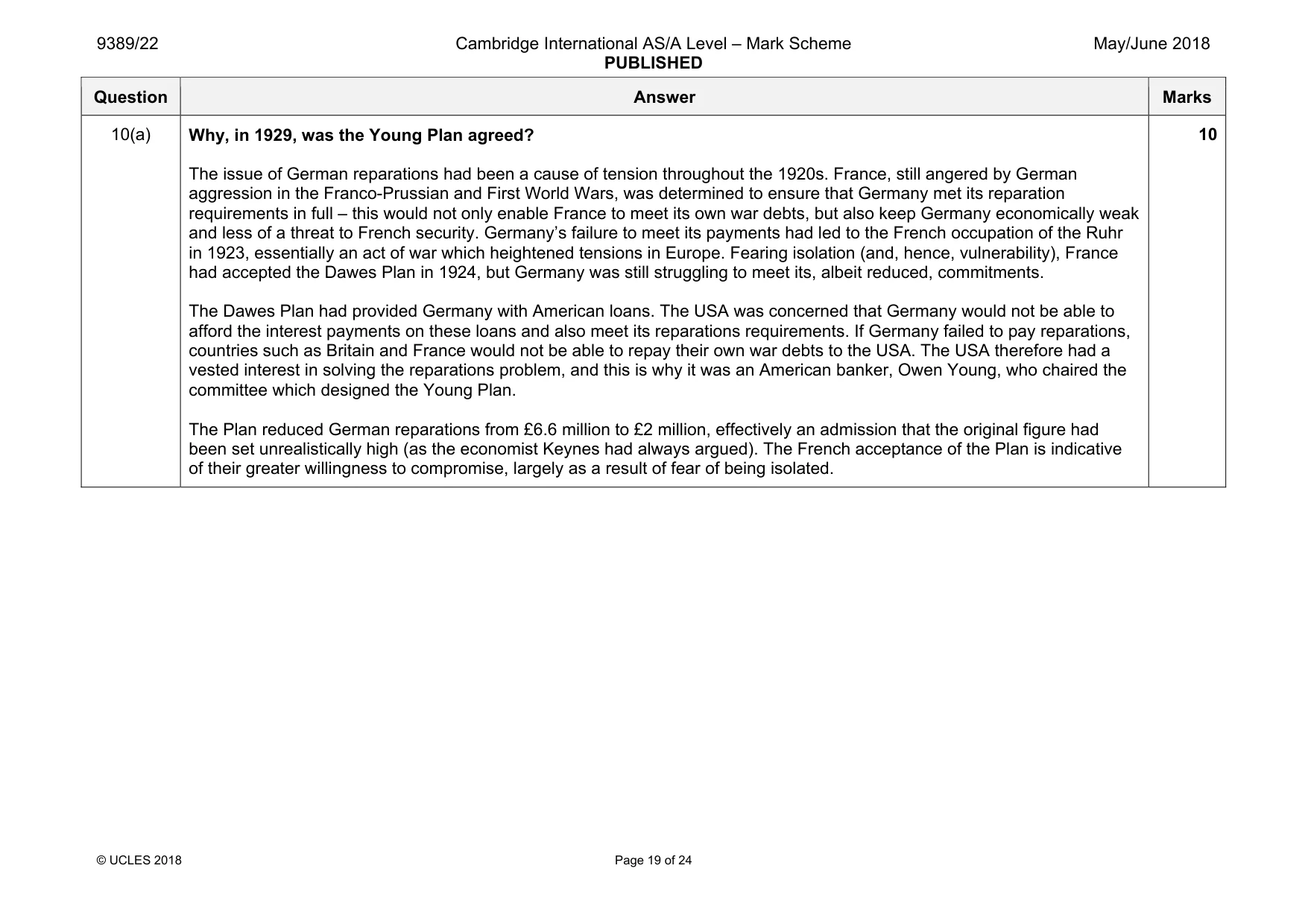
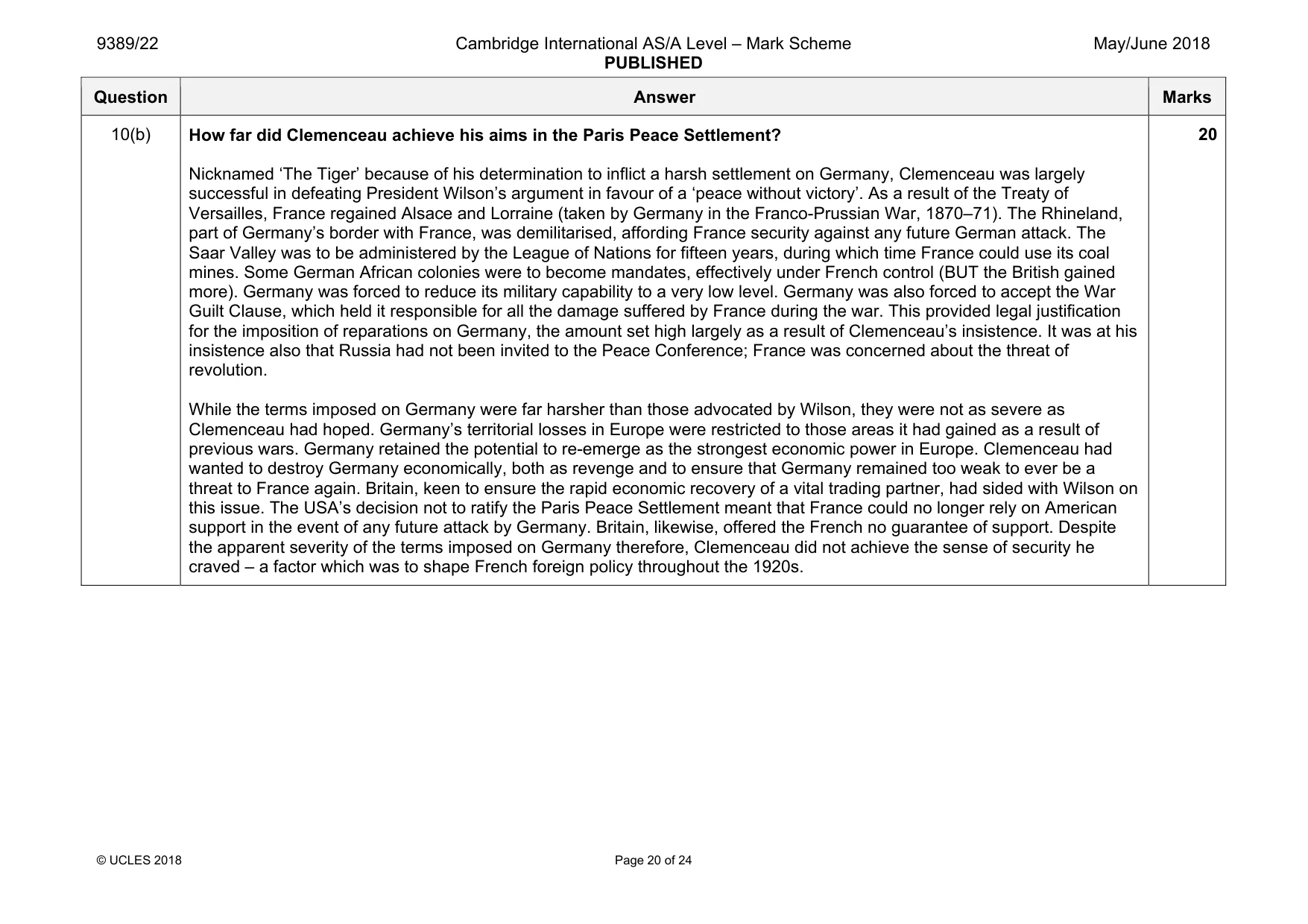
Q10 · International Relations, 1919–1933 (a) Why, in 1929, was the Young Plan agreed?
10 International Relations, 1919–1933 (a) Why, in 1929, was the Young Plan agreed? [10] (b) How far did Clemenceau achieve his aims in the Paris Peace Settlement? [20]
Mark scheme: 10(a) Why, in 1929, was the Young Plan agreed? The issue of German reparations had been a cause of tension throughout the 1920s. France, still angered by German aggression in the Franco-Prussian and First World Wars, was determined to ensure that Germany met its reparation requirements in full – this would not only enable France to meet its own war debts, but also keep Germany economically weak and less of a threat to French security. Germany’s failure to meet its payments had led to the French occupation of the Ruhr in 1923, essentially an act of war which heightened tensions in Europe. Fearing isolation (and, hence, vulnerability), France had accepted the Dawes Plan in 1924, but Germany was still struggling to meet its, albeit reduced, commitments. The Dawes Plan had provided Germany with American loans. The USA was concerned that Germany would not be able to afford the interest payments on these loans and also meet its reparations requirements. If Germany failed to pay reparations, countries such as Britain and France would not be able to repay their own war debts to the USA. The USA therefore had a vested interest in solving the reparations problem, and this is why it was an American banker, Owen Young, who chaired the committee which designed the Young Plan. The Plan reduced German reparations from £6.6 million to £2 million, effectively an admission that the original figure had been set unrealistically high (as the economist Keynes had always argued). The French acceptance of the Plan is indicative of their greater willingness to compromise, largely as a result of fear of being isolated. 10 Question Answer Marks 10(b) How far did Clemenceau achieve his aims in the Paris Peace Settlement? Nicknamed ‘The Tiger’ because of his determination to inflict a harsh settlement on Germany, Clemenceau was largely successful in defeating President Wilson’s argument in favour of a ‘peace without victory’. As a result of the Treaty of Versailles, France regained Alsace and Lorraine (taken by Germany in the Franco-Prussian War, 1870–71). The Rhineland, part of Germany’s border with France, was demilitarised, affording France security against any future German attack. The Saar Valley was to be administered by the League of Nations for fifteen years, during which time France could use its coal mines. Some German African colonies were to become mandates, effectively under French control (BUT the British gained more). Germany was forced to reduce its military capability to a very low level. Germany was also forced to accept the War Guilt Clause, which held it responsible for all the damage suffered by France during the war. This provided legal justification for the imposition of reparations on Germany, the amount set high largely as a result of Clemenceau’s insistence. It was at his insistence also that Russia had not been invited to the Peace Conference; France was concerned about the threat of revolution. While the terms imposed on Germany were far harsher than those advocated by Wilson, they were not as severe as Clemenceau had hoped. Germany’s territorial losses in Europe were restricted to those areas it had gained as a result of previous wars. Germany retained the potential to re-emerge as the strongest economic power in Europe. Clemenceau had wanted to destroy Germany economically, both as revenge and to ensure that Germany remained too weak to ever be a threat to France again. Britain, keen to ensure the rapid economic recovery of a vital trading partner, had sided with Wilson on this issue. The USA’s decision not to ratify the Paris Peace Settlement meant that France could no longer rely on American support in the event of any future attack by Germany. Britain, likewise, offered the French no guarantee of support. Despite the apparent severity of the terms imposed on Germany therefore, Clemenceau did not achieve the sense of security he craved – a factor which was to shape French foreign policy throughout the 1920s. 20
Q11 · International Relations, 1933–1939 (a) Why did many of Germany’s generals advise Hitler…
11 International Relations, 1933–1939 (a) Why did many of Germany’s generals advise Hitler against invading Poland in 1939? [10] (b) ‘Fear of communism was the main reason why Britain and France followed a policy of appeasement during the 1930s.’ How far do you agree? [20]
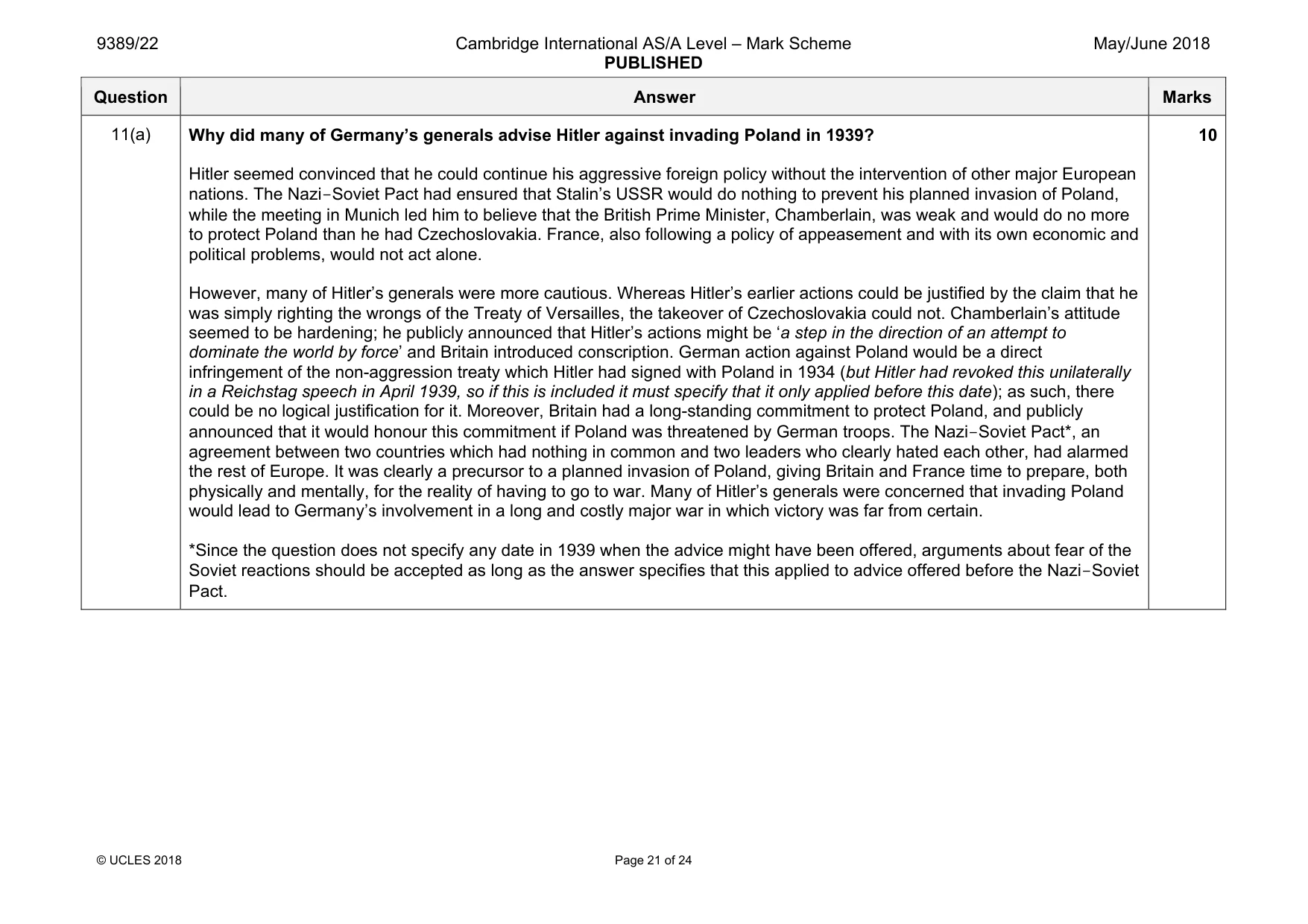
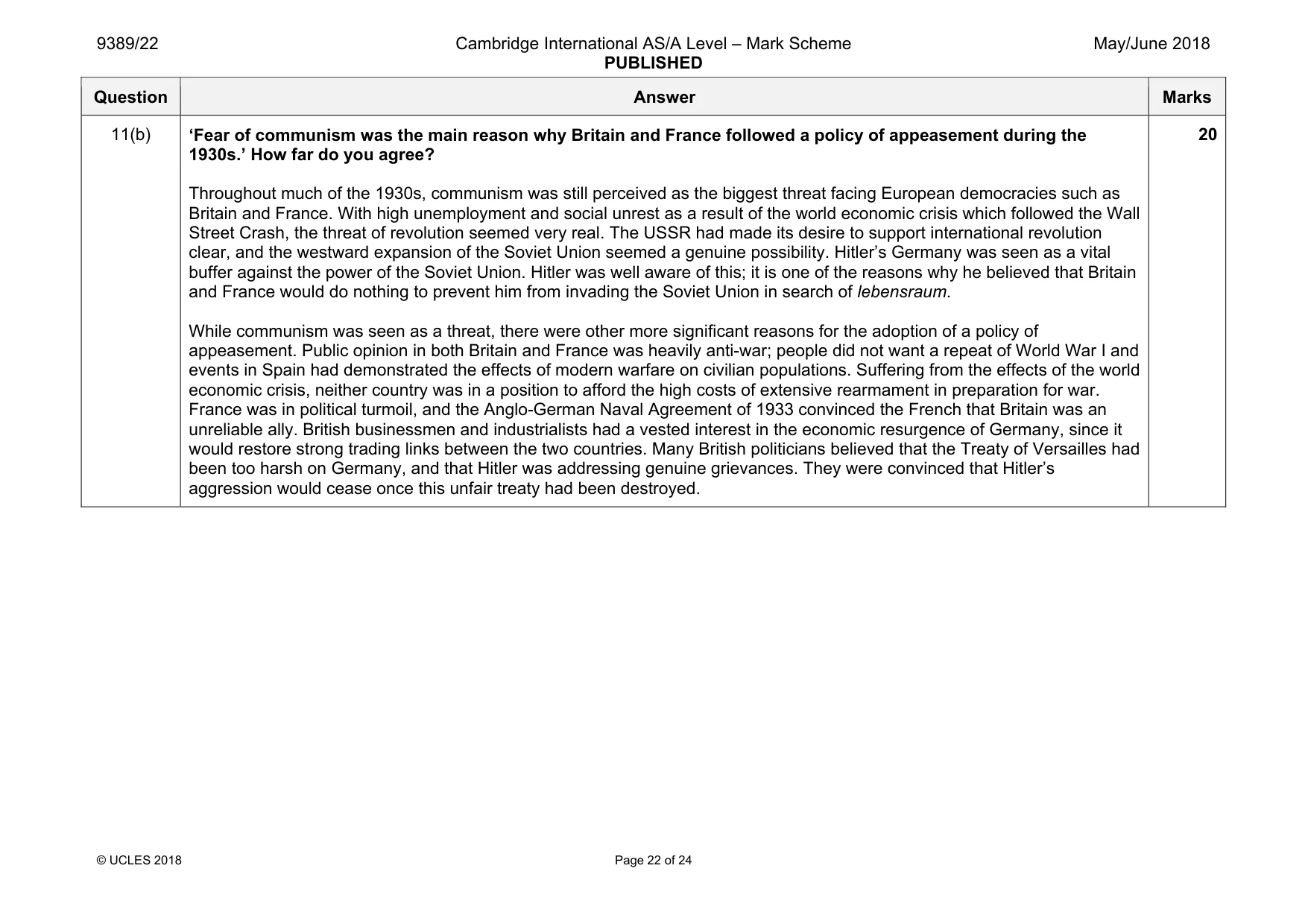
Mark scheme: 11(a) Why did many of Germany’s generals advise Hitler against invading Poland in 1939? Hitler seemed convinced that he could continue his aggressive foreign policy without the intervention of other major European nations. The Nazi-Soviet Pact had ensured that Stalin’s USSR would do nothing to prevent his planned invasion of Poland, while the meeting in Munich led him to believe that the British Prime Minister, Chamberlain, was weak and would do no more to protect Poland than he had Czechoslovakia. France, also following a policy of appeasement and with its own economic and political problems, would not act alone. However, many of Hitler’s generals were more cautious. Whereas Hitler’s earlier actions could be justified by the claim that he was simply righting the wrongs of the Treaty of Versailles, the takeover of Czechoslovakia could not. Chamberlain’s attitude seemed to be hardening; he publicly announced that Hitler’s actions might be ‘a step in the direction of an attempt to dominate the world by force’ and Britain introduced conscription. German action against Poland would be a direct infringement of the non-aggression treaty which Hitler had signed with Poland in 1934 (but Hitler had revoked this unilaterally in a Reichstag speech in April 1939, so if this is included it must specify that it only applied before this date); as such, there could be no logical justification for it. Moreover, Britain had a long-standing commitment to protect Poland, and publicly announced that it would honour this commitment if Poland was threatened by German troops. The Nazi-Soviet Pact*, an agreement between two countries which had nothing in common and two leaders who clearly hated each other, had alarmed the rest of Europe. It was clearly a precursor to a planned invasion of Poland, giving Britain and France time to prepare, both physically and mentally, for the reality of having to go to war. Many of Hitler’s generals were concerned that invading Poland would lead to Germany’s involvement in a long and costly major war in which victory was far from certain. *Since the question does not specify any date in 1939 when the advice might have been offered, arguments about fear of the Soviet reactions should be accepted as long as the answer specifies that this applied to advice offered before the Nazi-Soviet Pact. 10 Question Answer Marks 11(b) ‘Fear of communism was the main reason why Britain and France followed a policy of appeasement during the 1930s.’ How far do you agree? Throughout much of the 1930s, communism was still perceived as the biggest threat facing European democracies such as Britain and France. With high unemployment and social unrest as a result of the world economic crisis which followed the Wall Street Crash, the threat of revolution seemed very real. The USSR had made its desire to support international revolution clear, and the westward expansion of the Soviet Union seemed a genuine possibility. Hitler’s Germany was seen as a vital buffer against the power of the Soviet Union. Hitler was well aware of this; it is one of the reasons why he believed that Britain and France would do nothing to prevent him from invading the Soviet Union in search of lebensraum. While communism was seen as a threat, there were other more significant reasons for the adoption of a policy of appeasement. Public opinion in both Britain and France was heavily anti-war; people did not want a repeat of World War I and events in Spain had demonstrated the effects of modern warfare on civilian populations. Suffering from the effects of the world economic crisis, neither country was in a position to afford the high costs of extensive rearmament in preparation for war. France was in political turmoil, and the Anglo-German Naval Agreement of 1933 convinced the French that Britain was an unreliable ally. British businessmen and industrialists had a vested interest in the economic resurgence of Germany, since it would restore strong trading links between the two countries. Many British politicians believed that the Treaty of Versailles had been too harsh on Germany, and that Hitler was addressing genuine grievances. They were convinced that Hitler’s aggression would cease once this unfair treaty had been destroyed. 20
Q12 · China and Japan, 1919–1945 (a) Why was Japan unable to maintain a democratic government…
12 China and Japan, 1919–1945 (a) Why was Japan unable to maintain a democratic government during the 1930s? [10] (b) How far was the Kuomintang’s success in the period from 1925 to 1928 dependent on the support it received from Soviet Russia? [20]
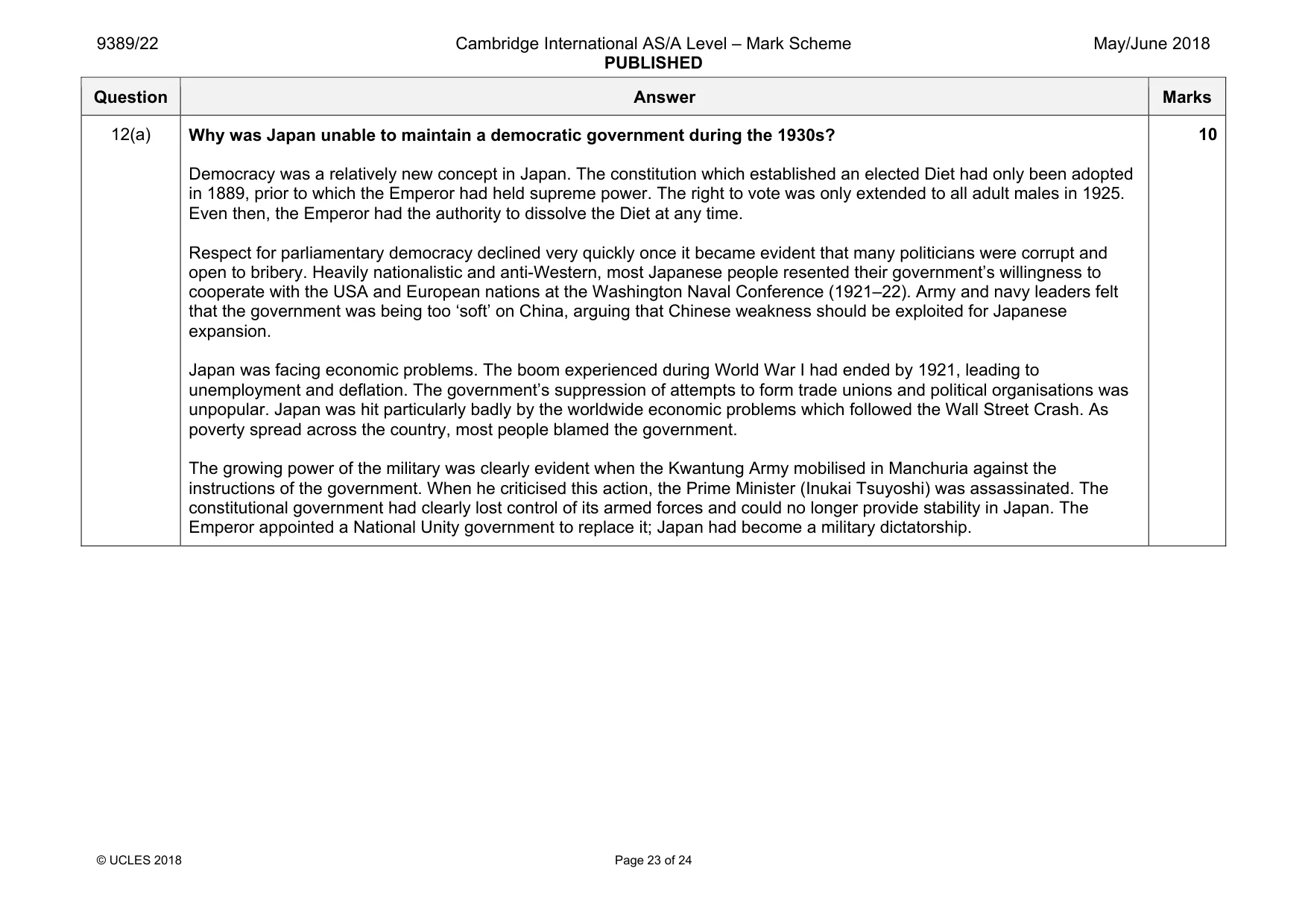
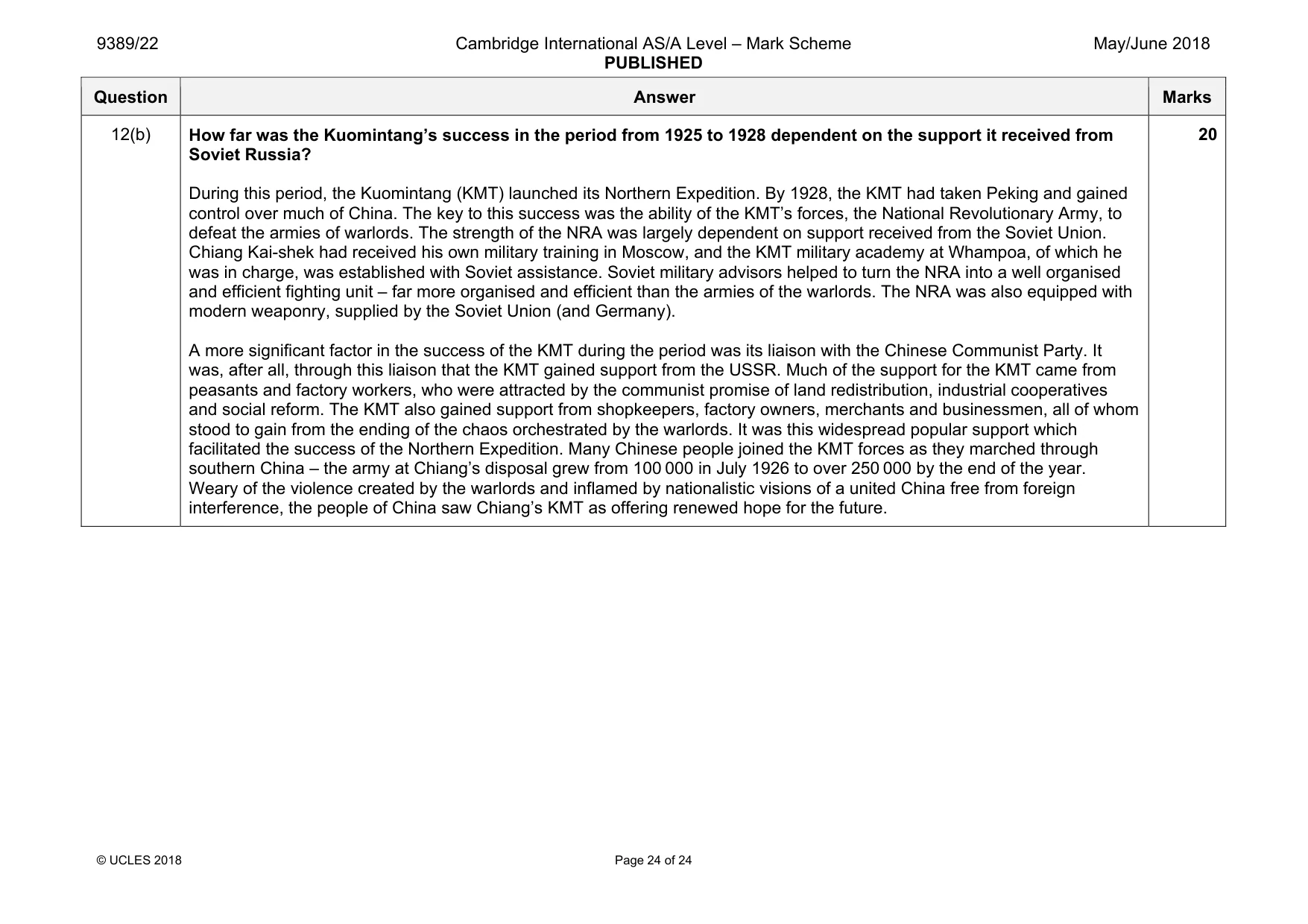
Mark scheme: 12(a) Why was Japan unable to maintain a democratic government during the 1930s? Democracy was a relatively new concept in Japan. The constitution which established an elected Diet had only been adopted in 1889, prior to which the Emperor had held supreme power. The right to vote was only extended to all adult males in 1925. Even then, the Emperor had the authority to dissolve the Diet at any time. Respect for parliamentary democracy declined very quickly once it became evident that many politicians were corrupt and open to bribery. Heavily nationalistic and anti-Western, most Japanese people resented their government’s willingness to cooperate with the USA and European nations at the Washington Naval Conference (1921–22). Army and navy leaders felt that the government was being too ‘soft’ on China, arguing that Chinese weakness should be exploited for Japanese expansion. Japan was facing economic problems. The boom experienced during World War I had ended by 1921, leading to unemployment and deflation. The government’s suppression of attempts to form trade unions and political organisations was unpopular. Japan was hit particularly badly by the worldwide economic problems which followed the Wall Street Crash. As poverty spread across the country, most people blamed the government. The growing power of the military was clearly evident when the Kwantung Army mobilised in Manchuria against the instructions of the government. When he criticised this action, the Prime Minister (Inukai Tsuyoshi) was assassinated. The constitutional government had clearly lost control of its armed forces and could no longer provide stability in Japan. The Emperor appointed a National Unity government to replace it; Japan had become a military dictatorship. 10 Question Answer Marks 12(b) How far was the Kuomintang’s success in the period from 1925 to 1928 dependent on the support it received from Soviet Russia? During this period, the Kuomintang (KMT) launched its Northern Expedition. By 1928, the KMT had taken Peking and gained control over much of China. The key to this success was the ability of the KMT’s forces, the National Revolutionary Army, to defeat the armies of warlords. The strength of the NRA was largely dependent on support received from the Soviet Union. Chiang Kai-shek had received his own military training in Moscow, and the KMT military academy at Whampoa, of which he was in charge, was established with Soviet assistance. Soviet military advisors helped to turn the NRA into a well organised and efficient fighting unit – far more organised and efficient than the armies of the warlords. The NRA was also equipped with modern weaponry, supplied by the Soviet Union (and Germany). A more significant factor in the success of the KMT during the period was its liaison with the Chinese Communist Party. It was, after all, through this liaison that the KMT gained support from the USSR. Much of the support for the KMT came from peasants and factory workers, who were attracted by the communist promise of land redistribution, industrial cooperatives and social reform. The KMT also gained support from shopkeepers, factory owners, merchants and businessmen, all of whom stood to gain from the ending of the chaos orchestrated by the warlords. It was this widespread popular support which facilitated the success of the Northern Expedition. Many Chinese people joined the KMT forces as they marched through southern China – the army at Chiang’s disposal grew from 100 000 in July 1926 to over 250 000 by the end of the year. Weary of the violence created by the warlords and inflamed by nationalistic visions of a united China free from foreign interference, the people of China saw Chiang’s KMT as offering renewed hope for the future. 20
What you needed in this session
Cambridge’s own grade thresholds for 2018 May/June, Paper 2 · Variant 2. A higher threshold means an easier paper — the bar moves with how the cohort did.