Cambridge A Level History 9389 — 2021 Oct/Nov Paper 2 · Variant 2
9389/22/O/N/21 · 12 questions · 60 marks · ≈68 min
The question paper and its mark scheme, free to read here and free to download. This is Cambridge’s own paper, exactly as it was sat.
Question paper4 pages
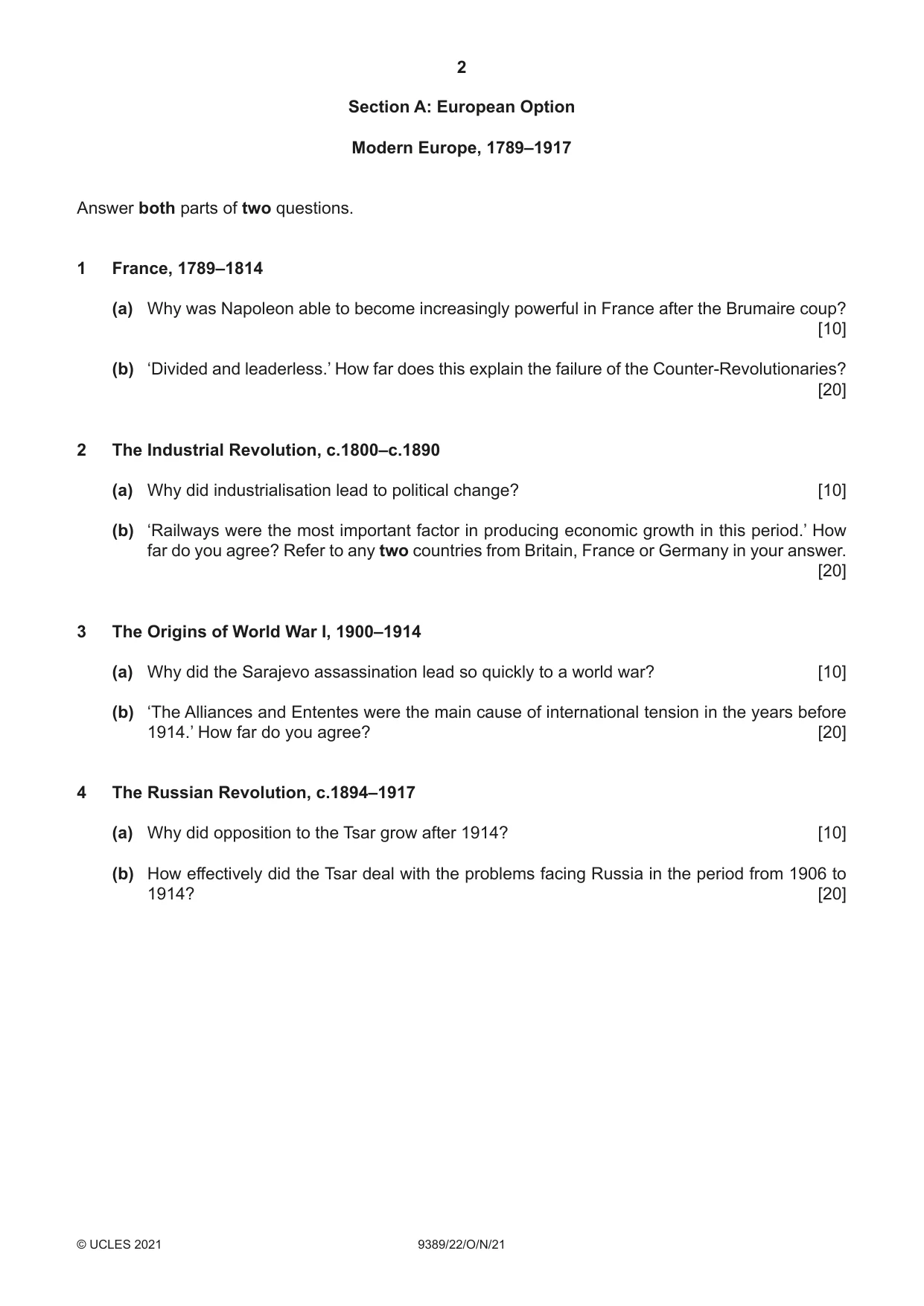
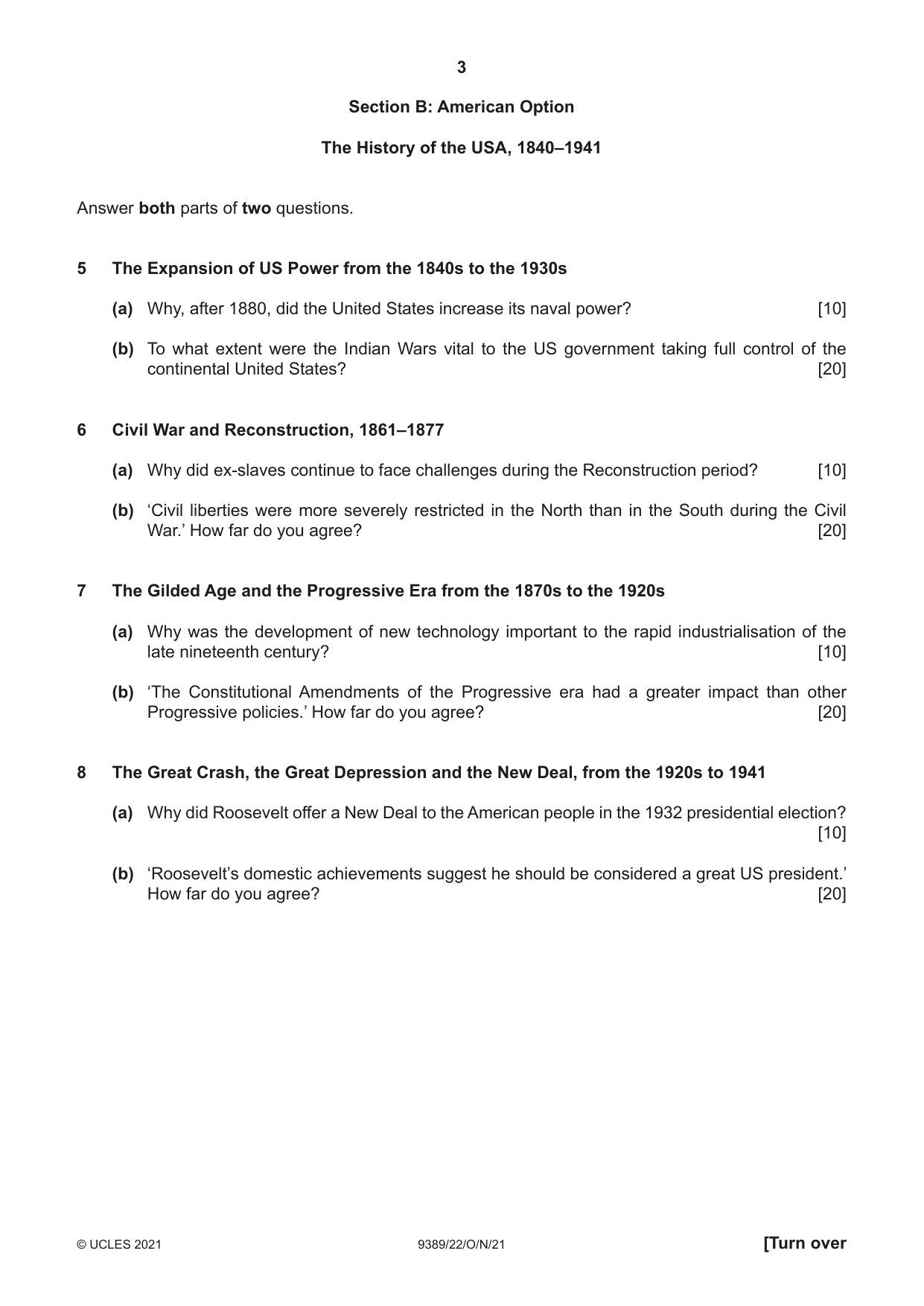
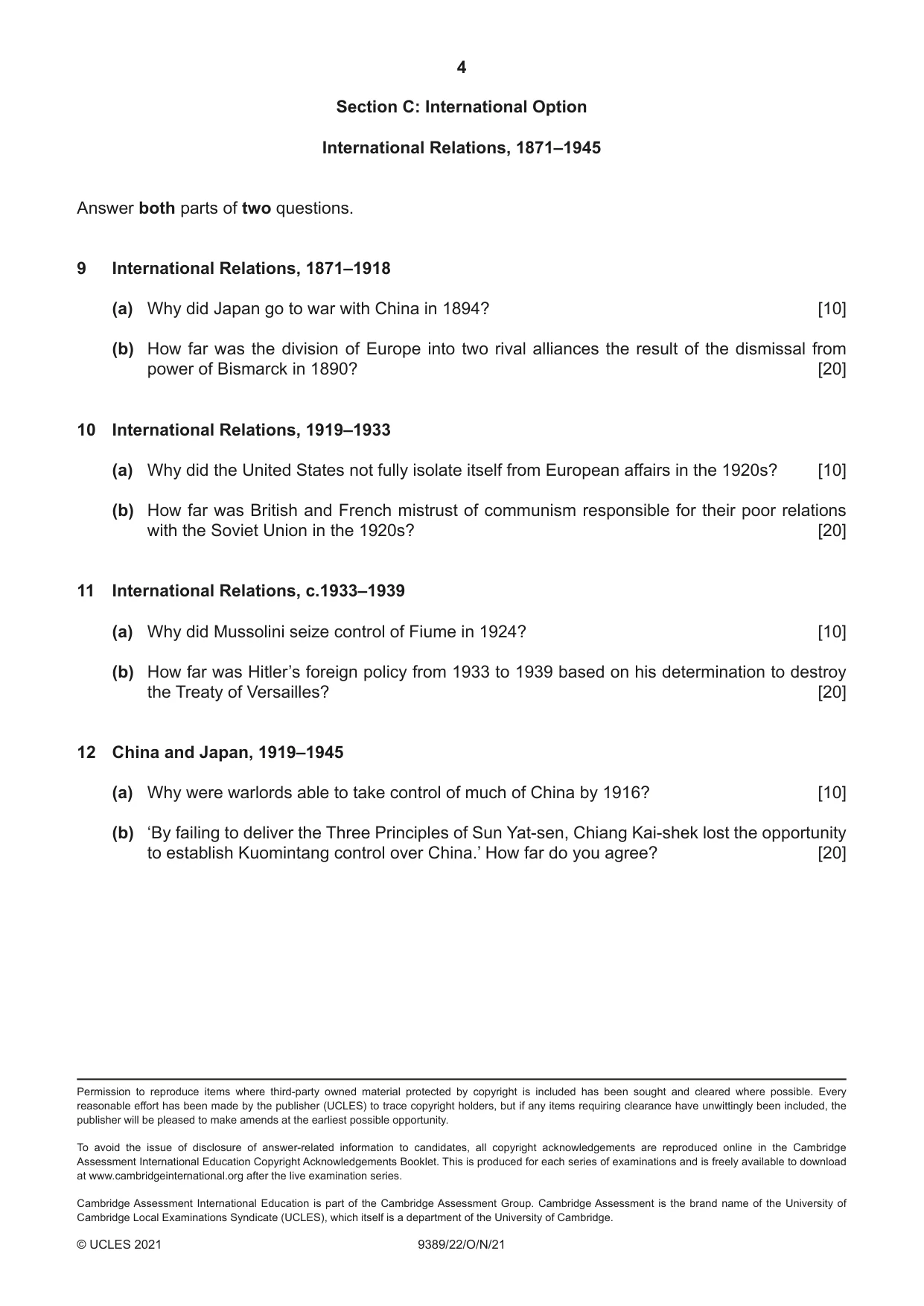
Mark scheme18 pages
Answers below. Sit the paper first if you are practising.

Questions as text
Q1 · France, 1789–1814 (a) Why was Napoleon able to become increasingly powerful in France…
1 France, 1789–1814 (a) Why was Napoleon able to become increasingly powerful in France after the Brumaire coup? [10] (b) ‘Divided and leaderless.’ How far does this explain the failure of the Counter-Revolutionaries? [20]
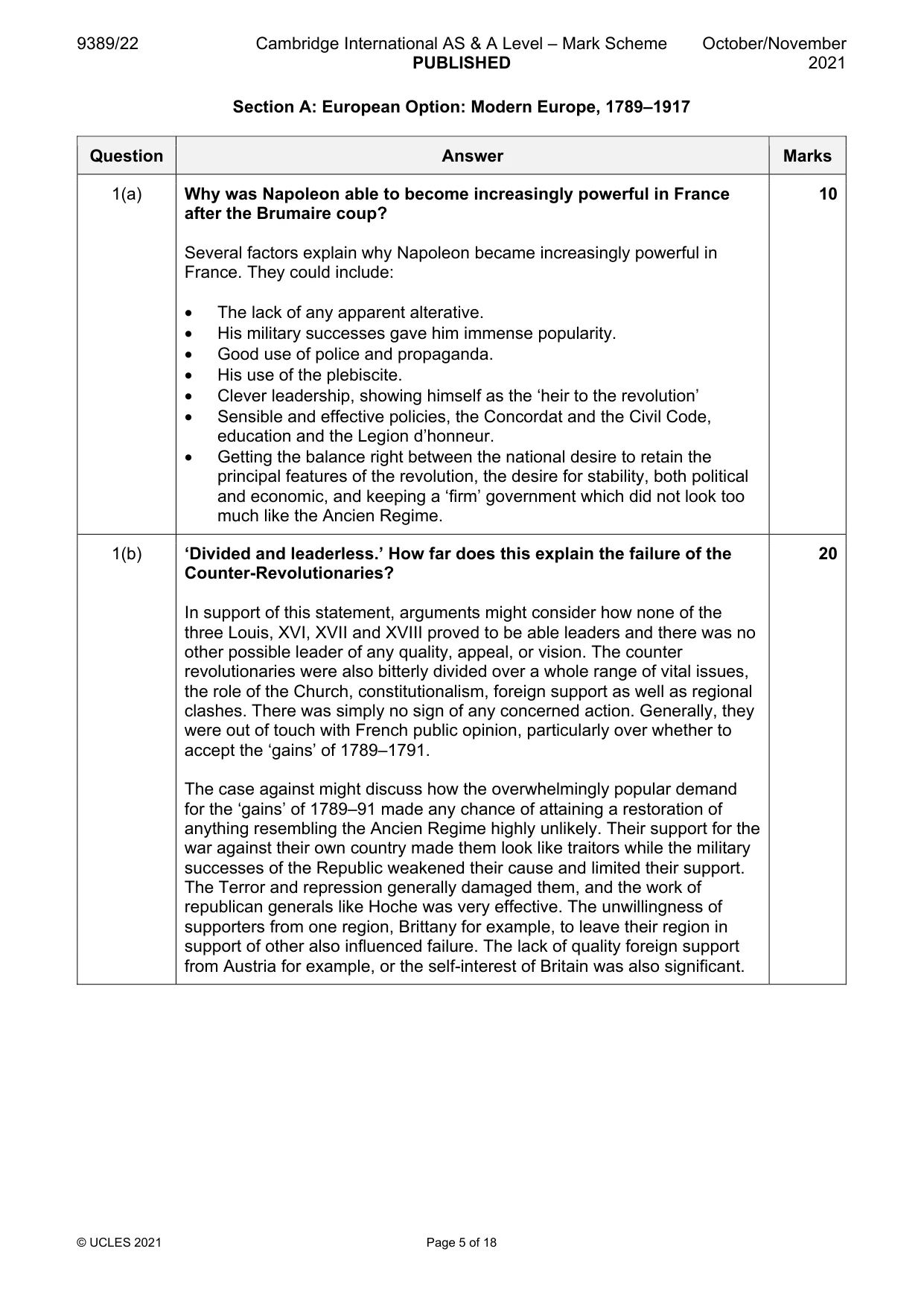
Mark scheme: Question Answer Marks 1(a) Why was Napoleon able to become increasingly powerful in France 10 after the Brumaire coup? Several factors explain why Napoleon became increasingly powerful in France. They could include: • The lack of any apparent alterative. • His military successes gave him immense popularity. • Good use of police and propaganda. • His use of the plebiscite. • Clever leadership, showing himself as the ‘heir to the revolution’ • Sensible and effective policies, the Concordat and the Civil Code, education and the Legion d’honneur. • Getting the balance right between the national desire to retain the principal features of the revolution, the desire for stability, both political and economic, and keeping a ‘firm’ government which did not look too much like the Ancien Regime. 1(b) ‘Divided and leaderless.’ How far does this explain the failure of the 20 Counter-Revolutionaries? In support of this statement, arguments might consider how none of the three Louis, XVI, XVII and XVIII proved to be able leaders and there was no other possible leader of any quality, appeal, or vision. The counter revolutionaries were also bitterly divided over a whole range of vital issues, the role of the Church, constitutionalism, foreign support as well as regional clashes. There was simply no sign of any concerned action. Generally, they were out of touch with French public opinion, particularly over whether to accept the ‘gains’ of 1789–1791. The case against might discuss how the overwhelmingly popular demand for the ‘gains’ of 1789–91 made any chance of attaining a restoration of anything resembling the Ancien Regime highly unlikely. Their support for the war against their own country made them look like traitors while the military successes of the Republic weakened their cause and limited their support. The Terror and repression generally damaged them, and the work of republican generals like Hoche was very effective. The unwillingness of supporters from one region, Brittany for example, to leave their region in support of other also influenced failure. The lack of quality foreign support from Austria for example, or the self-interest of Britain was also significant.
Q2 · The Industrial Revolution, c.1800–c.1890 (a) Why did industrialisation lead to political…
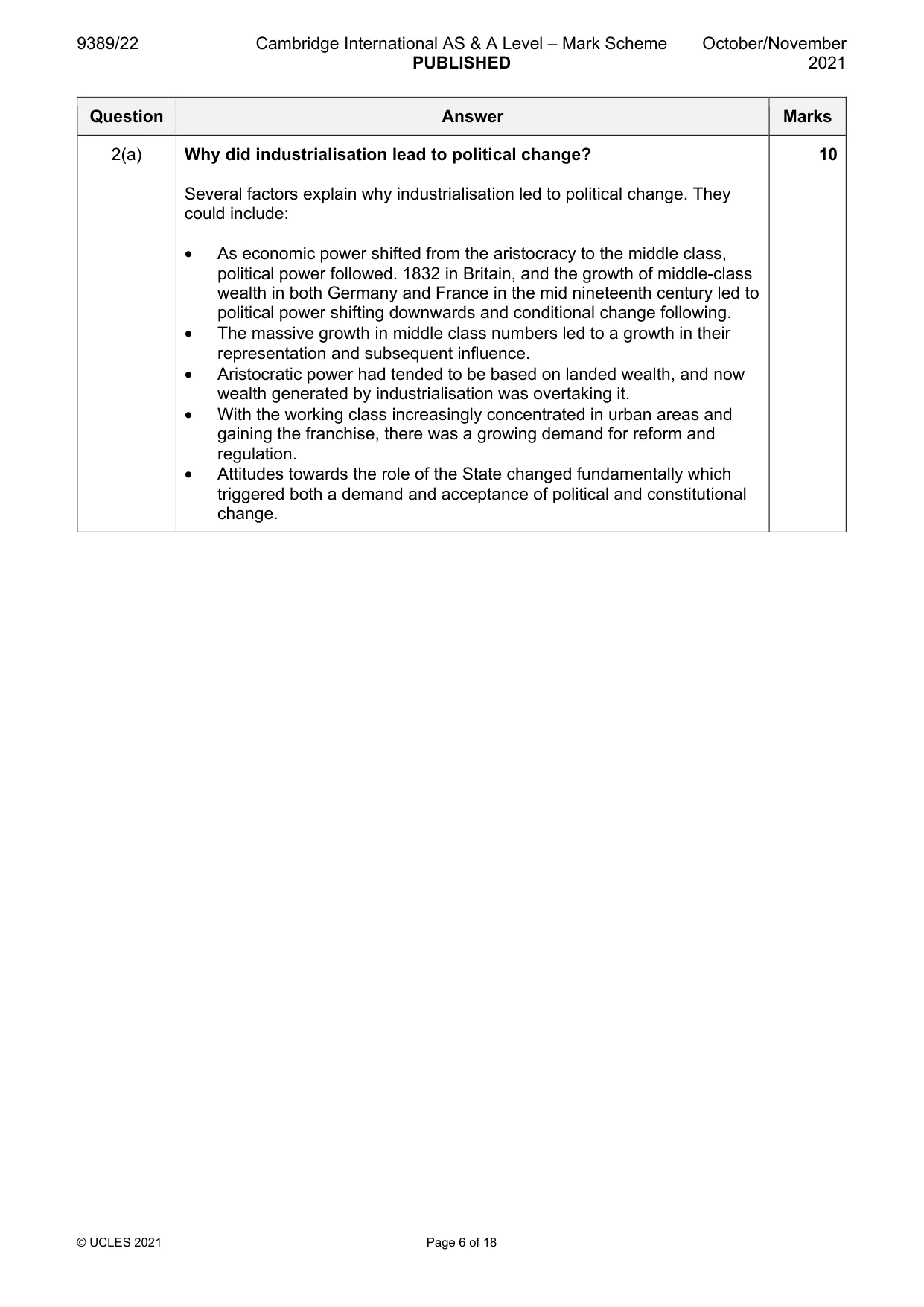
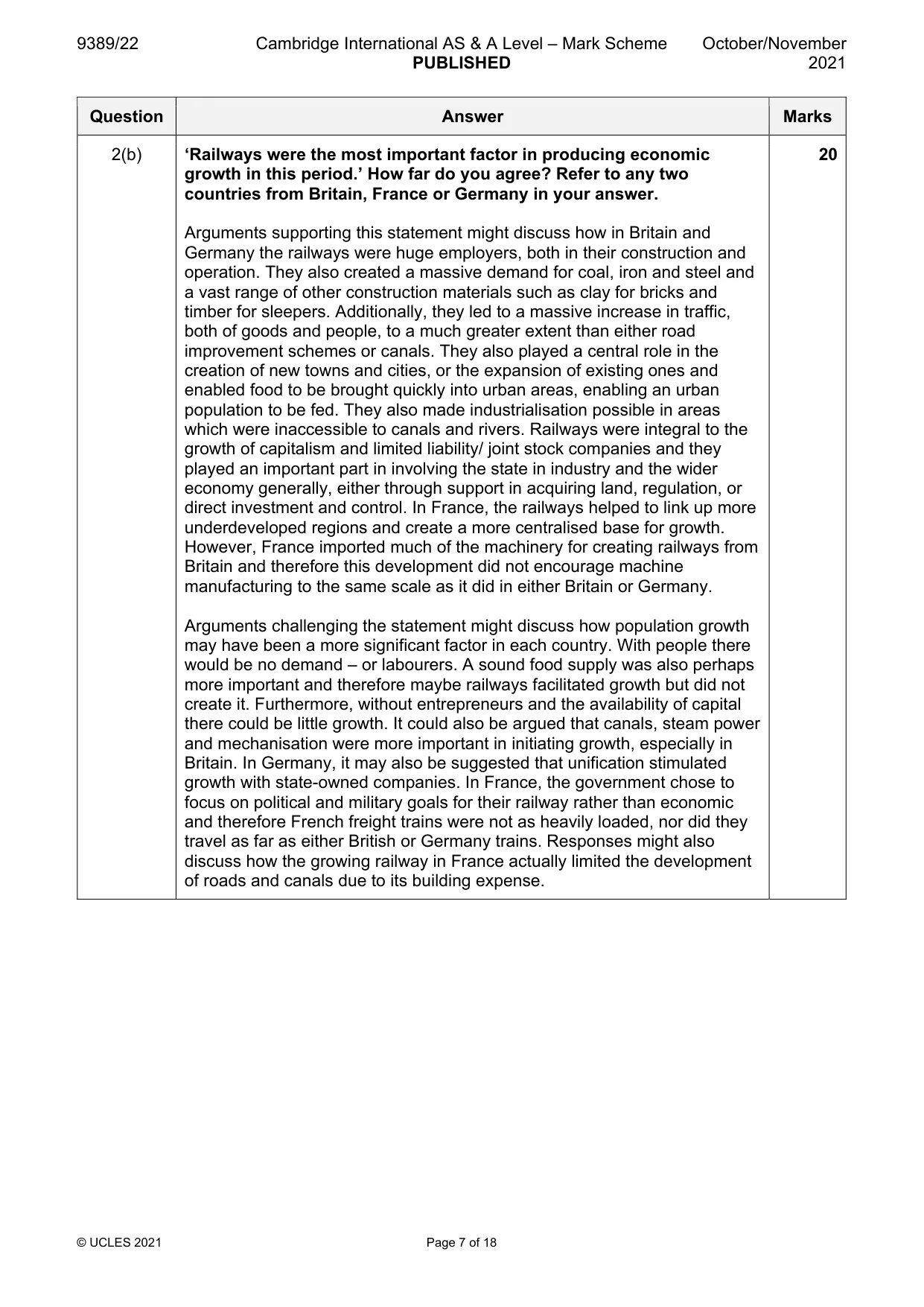
2 The Industrial Revolution, c.1800–c.1890 (a) Why did industrialisation lead to political change? [10] (b) ‘Railways were the most important factor in producing economic growth in this period.’ How far do you agree? Refer to any two countries from Britain, France or Germany in your answer. [20]
Mark scheme: 2(a) Why did industrialisation lead to political change? 10 Several factors explain why industrialisation led to political change. They could include: • As economic power shifted from the aristocracy to the middle class, political power followed. 1832 in Britain, and the growth of middle-class wealth in both Germany and France in the mid nineteenth century led to political power shifting downwards and conditional change following. • The massive growth in middle class numbers led to a growth in their representation and subsequent influence. • Aristocratic power had tended to be based on landed wealth, and now wealth generated by industrialisation was overtaking it. • With the working class increasingly concentrated in urban areas and gaining the franchise, there was a growing demand for reform and regulation. • Attitudes towards the role of the State changed fundamentally which triggered both a demand and acceptance of political and constitutional change. 2(b) ‘Railways were the most important factor in producing economic 20 growth in this period.’ How far do you agree? Refer to any two countries from Britain, France or Germany in your answer. Arguments supporting this statement might discuss how in Britain and Germany the railways were huge employers, both in their construction and operation. They also created a massive demand for coal, iron and steel and a vast range of other construction materials such as clay for bricks and timber for sleepers. Additionally, they led to a massive increase in traffic, both of goods and people, to a much greater extent than either road improvement schemes or canals. They also played a central role in the creation of new towns and cities, or the expansion of existing ones and enabled food to be brought quickly into urban areas, enabling an urban population to be fed. They also made industrialisation possible in areas which were inaccessible to canals and rivers. Railways were integral to the growth of capitalism and limited liability/ joint stock companies and they played an important part in involving the state in industry and the wider economy generally, either through support in acquiring land, regulation, or direct investment and control. In France, the railways helped to link up more underdeveloped regions and create a more centralised base for growth. However, France imported much of the machinery for creating railways from Britain and therefore this development did not encourage machine manufacturing to the same scale as it did in either Britain or Germany. Arguments challenging the statement might discuss how population growth may have been a more significant factor in each country. With people there would be no demand – or labourers. A sound food supply was also perhaps more important and therefore maybe railways facilitated growth but did not create it. Furthermore, without entrepreneurs and the availability of capital there could be little growth. It could also be argued that canals, steam power and mechanisation were more important in initiating growth, especially in Britain. In Germany, it may also be suggested that unification stimulated growth with state-owned companies. In France, the government chose to focus on political and military goals for their railway rather than economic and therefore French freight trains were not as heavily loaded, nor did they travel as far as either British or Germany trains. Responses might also discuss how the growing railway in France actually limited the development of roads and canals due to its building expense.
Q3 · The Origins of World War I, 1900–1914 (a) Why did the Sarajevo assassination lead so…
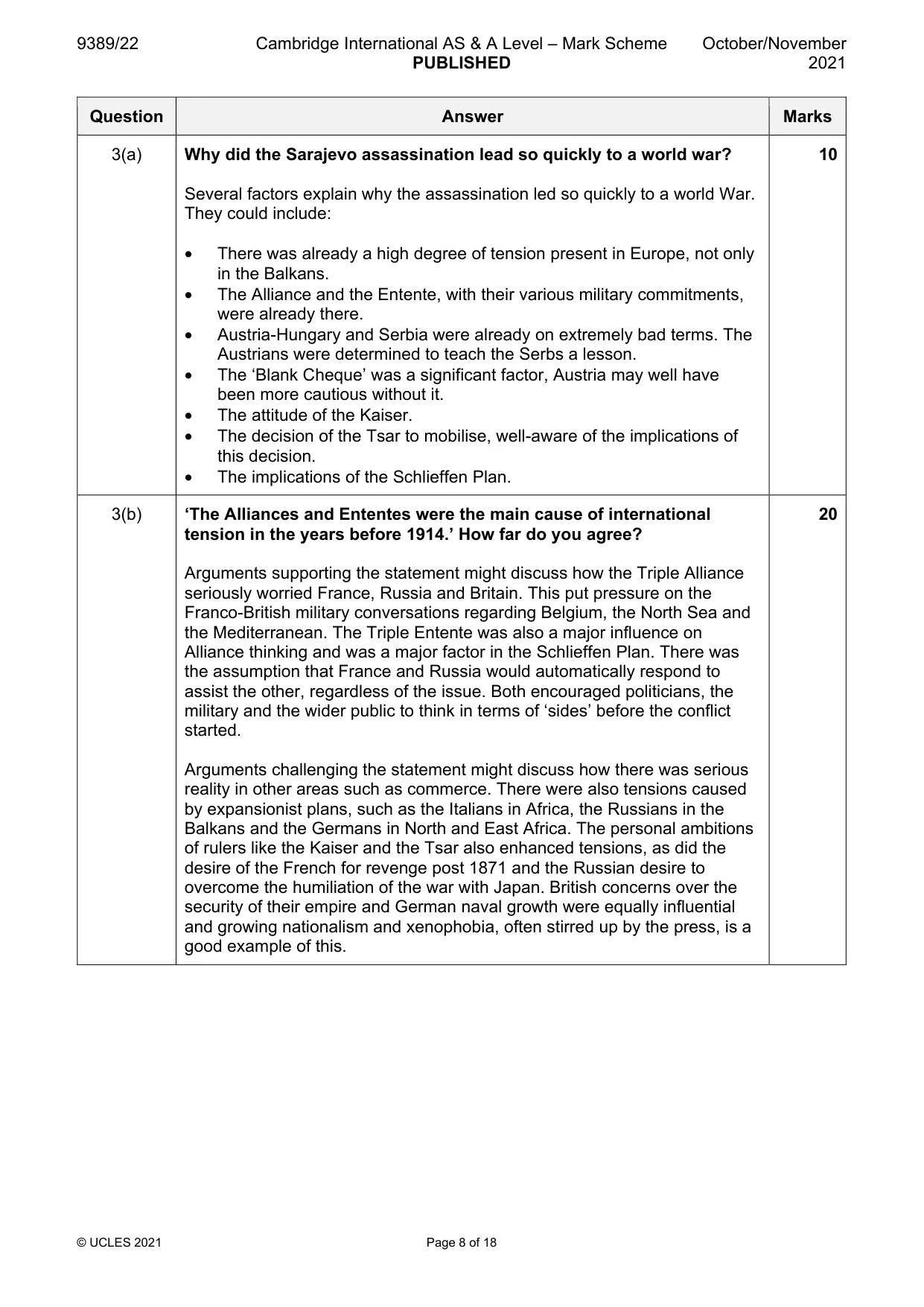
3 The Origins of World War I, 1900–1914 (a) Why did the Sarajevo assassination lead so quickly to a world war? [10] (b) ‘The Alliances and Ententes were the main cause of international tension in the years before 1914.’ How far do you agree? [20]
Mark scheme: 3(a) Why did the Sarajevo assassination lead so quickly to a world war? 10 Several factors explain why the assassination led so quickly to a world War. They could include: • There was already a high degree of tension present in Europe, not only in the Balkans. • The Alliance and the Entente, with their various military commitments, were already there. • Austria-Hungary and Serbia were already on extremely bad terms. The Austrians were determined to teach the Serbs a lesson. • The ‘Blank Cheque’ was a significant factor, Austria may well have been more cautious without it. • The attitude of the Kaiser. • The decision of the Tsar to mobilise, well-aware of the implications of this decision. • The implications of the Schlieffen Plan. 3(b) ‘The Alliances and Ententes were the main cause of international 20 tension in the years before 1914.’ How far do you agree? Arguments supporting the statement might discuss how the Triple Alliance seriously worried France, Russia and Britain. This put pressure on the Franco-British military conversations regarding Belgium, the North Sea and the Mediterranean. The Triple Entente was also a major influence on Alliance thinking and was a major factor in the Schlieffen Plan. There was the assumption that France and Russia would automatically respond to assist the other, regardless of the issue. Both encouraged politicians, the military and the wider public to think in terms of ‘sides’ before the conflict started. Arguments challenging the statement might discuss how there was serious reality in other areas such as commerce. There were also tensions caused by expansionist plans, such as the Italians in Africa, the Russians in the Balkans and the Germans in North and East Africa. The personal ambitions of rulers like the Kaiser and the Tsar also enhanced tensions, as did the desire of the French for revenge post 1871 and the Russian desire to overcome the humiliation of the war with Japan. British concerns over the security of their empire and German naval growth were equally influential and growing nationalism and xenophobia, often stirred up by the press, is a good example of this.
Q4 · The Russian Revolution, c.1894–1917 (a) Why did opposition to the Tsar grow after 1914?
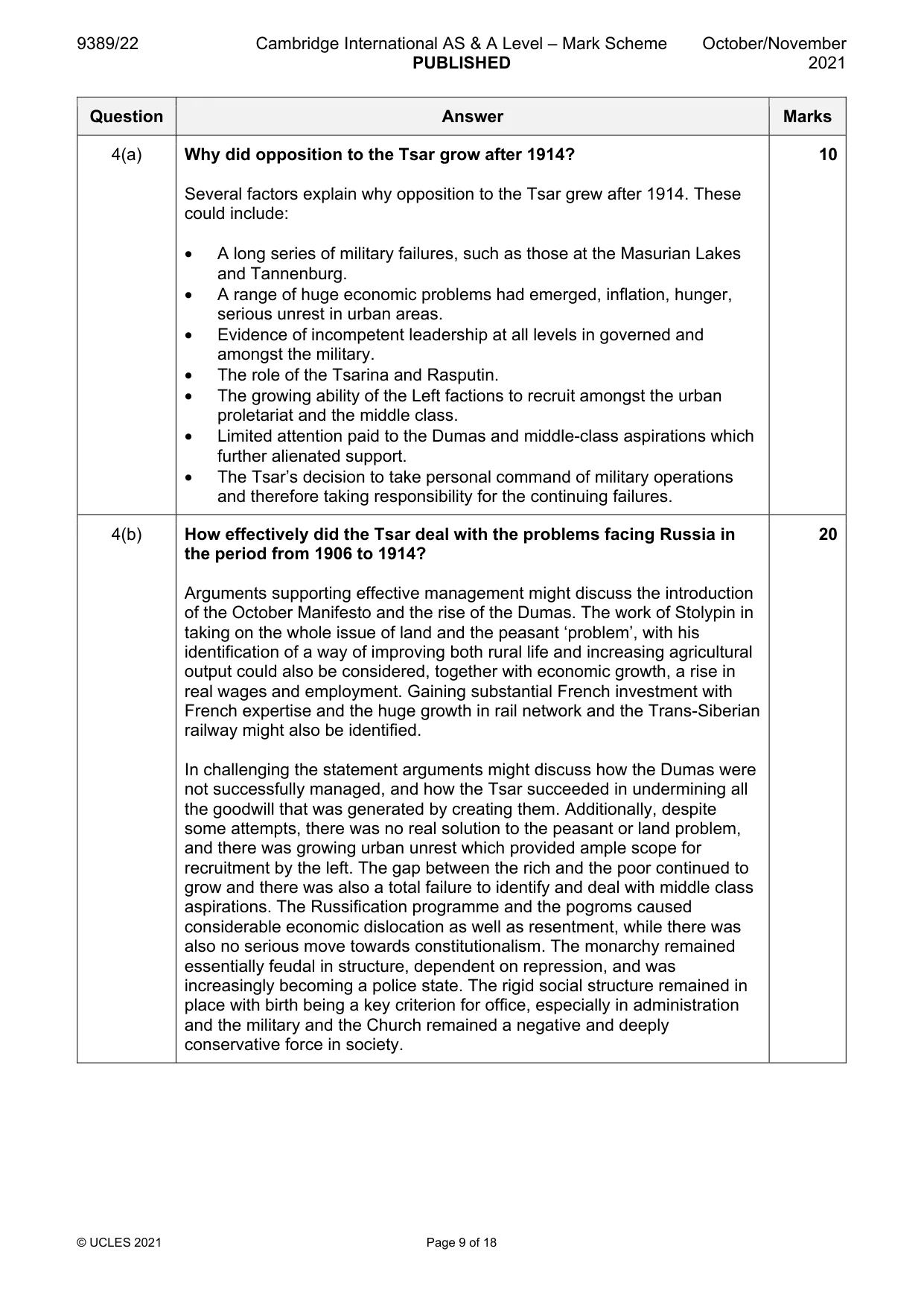
4 The Russian Revolution, c.1894–1917 (a) Why did opposition to the Tsar grow after 1914? [10] (b) How effectively did the Tsar deal with the problems facing Russia in the period from 1906 to 1914? [20]
Mark scheme: 4(a) Why did opposition to the Tsar grow after 1914? 10 Several factors explain why opposition to the Tsar grew after 1914. These could include: • A long series of military failures, such as those at the Masurian Lakes and Tannenburg. • A range of huge economic problems had emerged, inflation, hunger, serious unrest in urban areas. • Evidence of incompetent leadership at all levels in governed and amongst the military. • The role of the Tsarina and Rasputin. • The growing ability of the Left factions to recruit amongst the urban proletariat and the middle class. • Limited attention paid to the Dumas and middle-class aspirations which further alienated support. • The Tsar’s decision to take personal command of military operations and therefore taking responsibility for the continuing failures. 4(b) How effectively did the Tsar deal with the problems facing Russia in 20 the period from 1906 to 1914? Arguments supporting effective management might discuss the introduction of the October Manifesto and the rise of the Dumas. The work of Stolypin in taking on the whole issue of land and the peasant ‘problem’, with his identification of a way of improving both rural life and increasing agricultural output could also be considered, together with economic growth, a rise in real wages and employment. Gaining substantial French investment with French expertise and the huge growth in rail network and the Trans-Siberian railway might also be identified. In challenging the statement arguments might discuss how the Dumas were not successfully managed, and how the Tsar succeeded in undermining all the goodwill that was generated by creating them. Additionally, despite some attempts, there was no real solution to the peasant or land problem, and there was growing urban unrest which provided ample scope for recruitment by the left. The gap between the rich and the poor continued to grow and there was also a total failure to identify and deal with middle class aspirations. The Russification programme and the pogroms caused considerable economic dislocation as well as resentment, while there was also no serious move towards constitutionalism. The monarchy remained essentially feudal in structure, dependent on repression, and was increasingly becoming a police state. The rigid social structure remained in place with birth being a key criterion for office, especially in administration and the military and the Church remained a negative and deeply conservative force in society. Section B: American Option: The History of the USA, 1840–1941
Q5 · The Expansion of US Power from the 1840s to the 1930s (a) Why, after 1880, did the United…
5 The Expansion of US Power from the 1840s to the 1930s (a) Why, after 1880, did the United States increase its naval power? [10] (b) To what extent were the Indian Wars vital to the US government taking full control of the continental United States? [20]
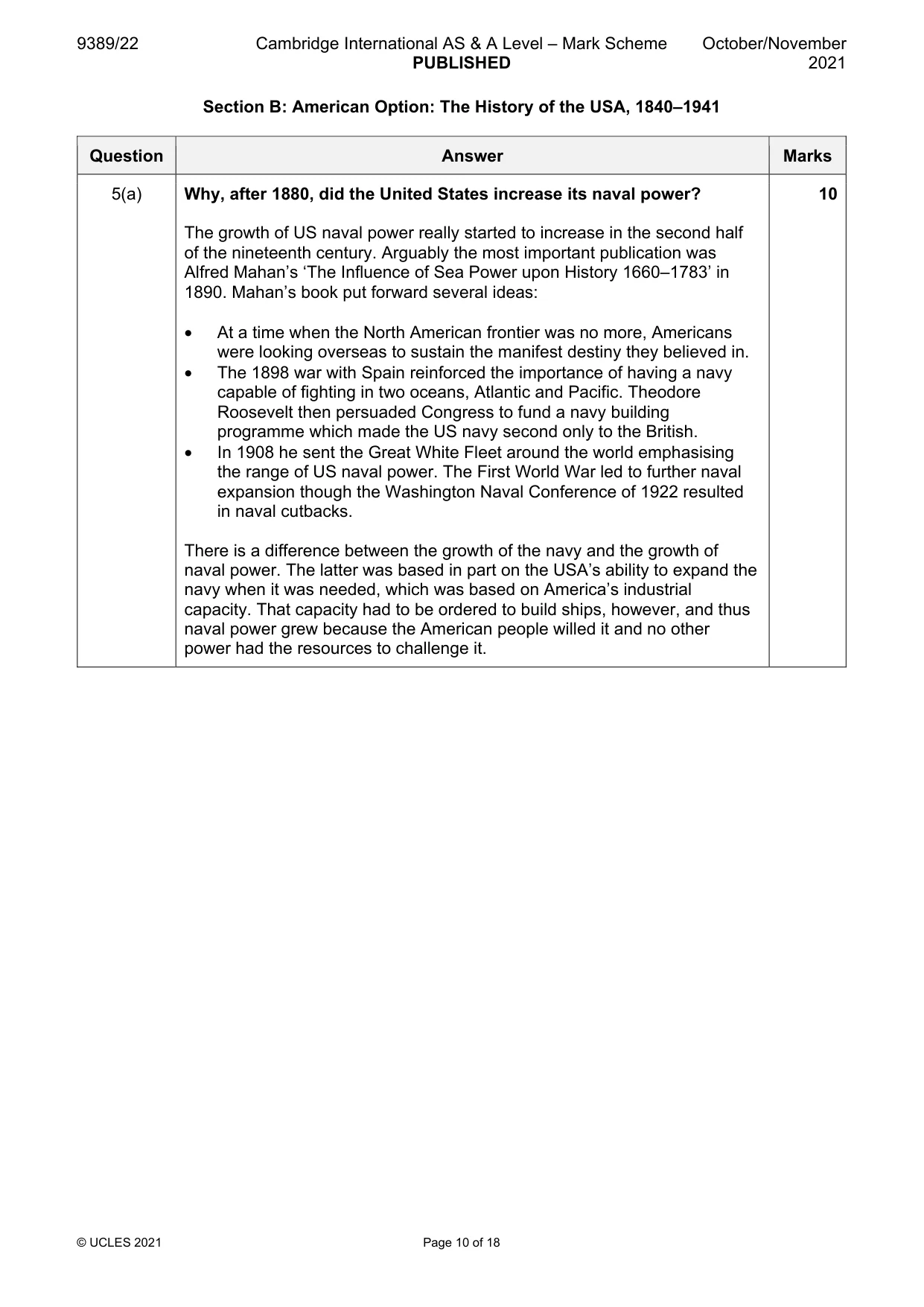
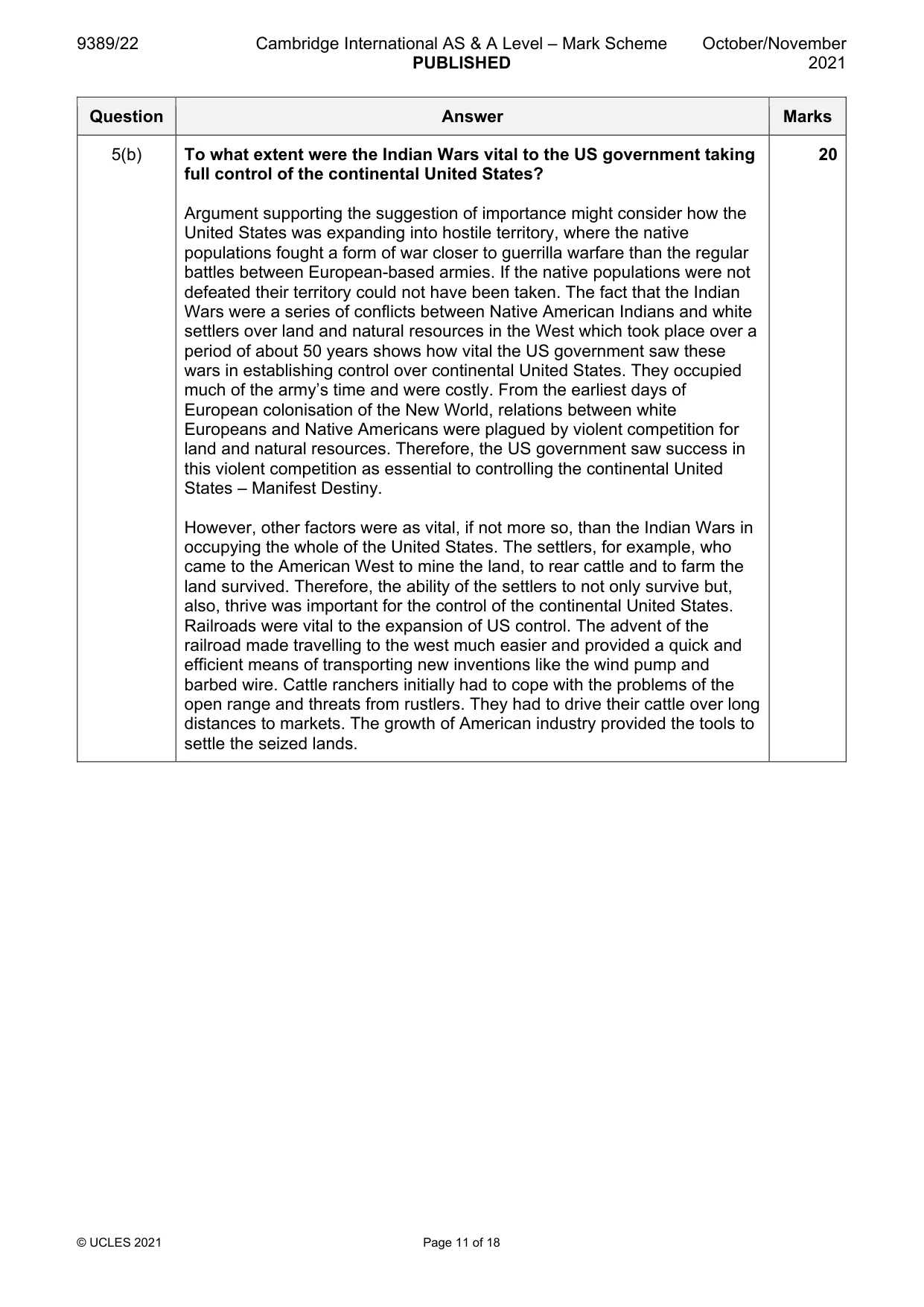
Mark scheme: 5(a) Why, after 1880, did the United States increase its naval power? 10 The growth of US naval power really started to increase in the second half of the nineteenth century. Arguably the most important publication was Alfred Mahan’s ‘The Influence of Sea Power upon History 1660–1783’ in 1890. Mahan’s book put forward several ideas: • At a time when the North American frontier was no more, Americans were looking overseas to sustain the manifest destiny they believed in. • The 1898 war with Spain reinforced the importance of having a navy capable of fighting in two oceans, Atlantic and Pacific. Theodore Roosevelt then persuaded Congress to fund a navy building programme which made the US navy second only to the British. • In 1908 he sent the Great White Fleet around the world emphasising the range of US naval power. The First World War led to further naval expansion though the Washington Naval Conference of 1922 resulted in naval cutbacks. There is a difference between the growth of the navy and the growth of naval power. The latter was based in part on the USA’s ability to expand the navy when it was needed, which was based on America’s industrial capacity. That capacity had to be ordered to build ships, however, and thus naval power grew because the American people willed it and no other power had the resources to challenge it. 5(b) To what extent were the Indian Wars vital to the US government taking 20 full control of the continental United States? Argument supporting the suggestion of importance might consider how the United States was expanding into hostile territory, where the native populations fought a form of war closer to guerrilla warfare than the regular battles between European-based armies. If the native populations were not defeated their territory could not have been taken. The fact that the Indian Wars were a series of conflicts between Native American Indians and white settlers over land and natural resources in the West which took place over a period of about 50 years shows how vital the US government saw these wars in establishing control over continental United States. They occupied much of the army’s time and were costly. From the earliest days of European colonisation of the New World, relations between white Europeans and Native Americans were plagued by violent competition for land and natural resources. Therefore, the US government saw success in this violent competition as essential to controlling the continental United States – Manifest Destiny. However, other factors were as vital, if not more so, than the Indian Wars in occupying the whole of the United States. The settlers, for example, who came to the American West to mine the land, to rear cattle and to farm the land survived. Therefore, the ability of the settlers to not only survive but, also, thrive was important for the control of the continental United States. Railroads were vital to the expansion of US control. The advent of the railroad made travelling to the west much easier and provided a quick and efficient means of transporting new inventions like the wind pump and barbed wire. Cattle ranchers initially had to cope with the problems of the open range and threats from rustlers. They had to drive their cattle over long distances to markets. The growth of American industry provided the tools to settle the seized lands.
Q6 · Civil War and Reconstruction, 1861–1877 (a) Why did ex-slaves continue to face challenges…
6 Civil War and Reconstruction, 1861–1877 (a) Why did ex-slaves continue to face challenges during the Reconstruction period? [10] (b) ‘Civil liberties were more severely restricted in the North than in the South during the Civil War.’ How far do you agree? [20]
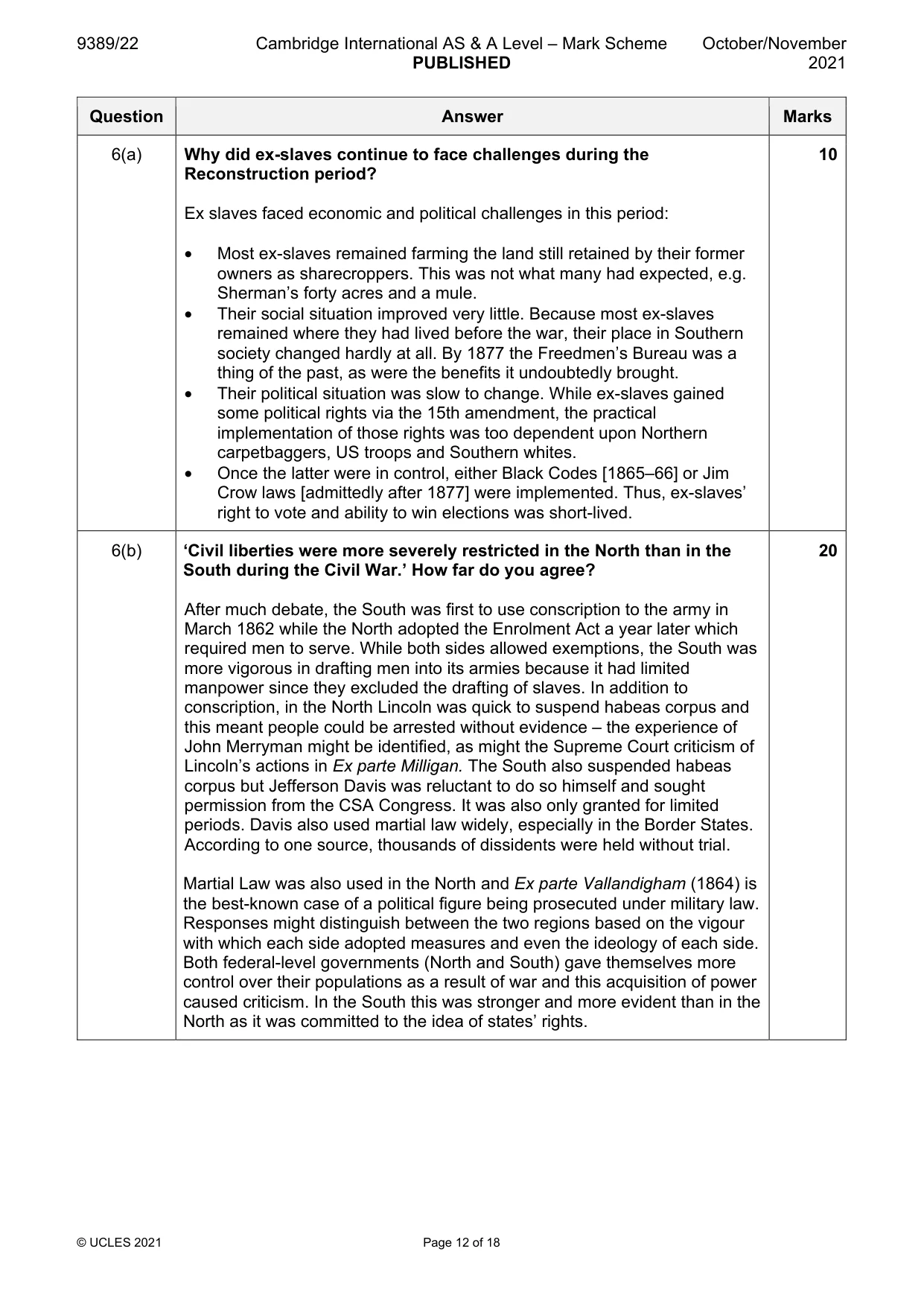
Mark scheme: 6(a) Why did ex-slaves continue to face challenges during the 10 Reconstruction period? Ex slaves faced economic and political challenges in this period: • Most ex-slaves remained farming the land still retained by their former owners as sharecroppers. This was not what many had expected, e.g. Sherman’s forty acres and a mule. • Their social situation improved very little. Because most ex-slaves remained where they had lived before the war, their place in Southern society changed hardly at all. By 1877 the Freedmen’s Bureau was a thing of the past, as were the benefits it undoubtedly brought. • Their political situation was slow to change. While ex-slaves gained some political rights via the 15th amendment, the practical implementation of those rights was too dependent upon Northern carpetbaggers, US troops and Southern whites. • Once the latter were in control, either Black Codes [1865–66] or Jim Crow laws [admittedly after 1877] were implemented. Thus, ex-slaves’ right to vote and ability to win elections was short-lived. 6(b) ‘Civil liberties were more severely restricted in the North than in the 20 South during the Civil War.’ How far do you agree? After much debate, the South was first to use conscription to the army in March 1862 while the North adopted the Enrolment Act a year later which required men to serve. While both sides allowed exemptions, the South was more vigorous in drafting men into its armies because it had limited manpower since they excluded the drafting of slaves. In addition to conscription, in the North Lincoln was quick to suspend habeas corpus and this meant people could be arrested without evidence – the experience of John Merryman might be identified, as might the Supreme Court criticism of Lincoln’s actions in Ex parte Milligan. The South also suspended habeas corpus but Jefferson Davis was reluctant to do so himself and sought permission from the CSA Congress. It was also only granted for limited periods. Davis also used martial law widely, especially in the Border States. According to one source, thousands of dissidents were held without trial. Martial Law was also used in the North and Ex parte Vallandigham (1864) is the best-known case of a political figure being prosecuted under military law. Responses might distinguish between the two regions based on the vigour with which each side adopted measures and even the ideology of each side. Both federal-level governments (North and South) gave themselves more control over their populations as a result of war and this acquisition of power caused criticism. In the South this was stronger and more evident than in the North as it was committed to the idea of states’ rights.
Q7 · The Gilded Age and the Progressive Era from the 1870s to the 1920s (a) Why was the…
7 The Gilded Age and the Progressive Era from the 1870s to the 1920s (a) Why was the development of new technology important to the rapid industrialisation of the late nineteenth century? [10] (b) ‘The Constitutional Amendments of the Progressive era had a greater impact than other Progressive policies.’ How far do you agree? [20]
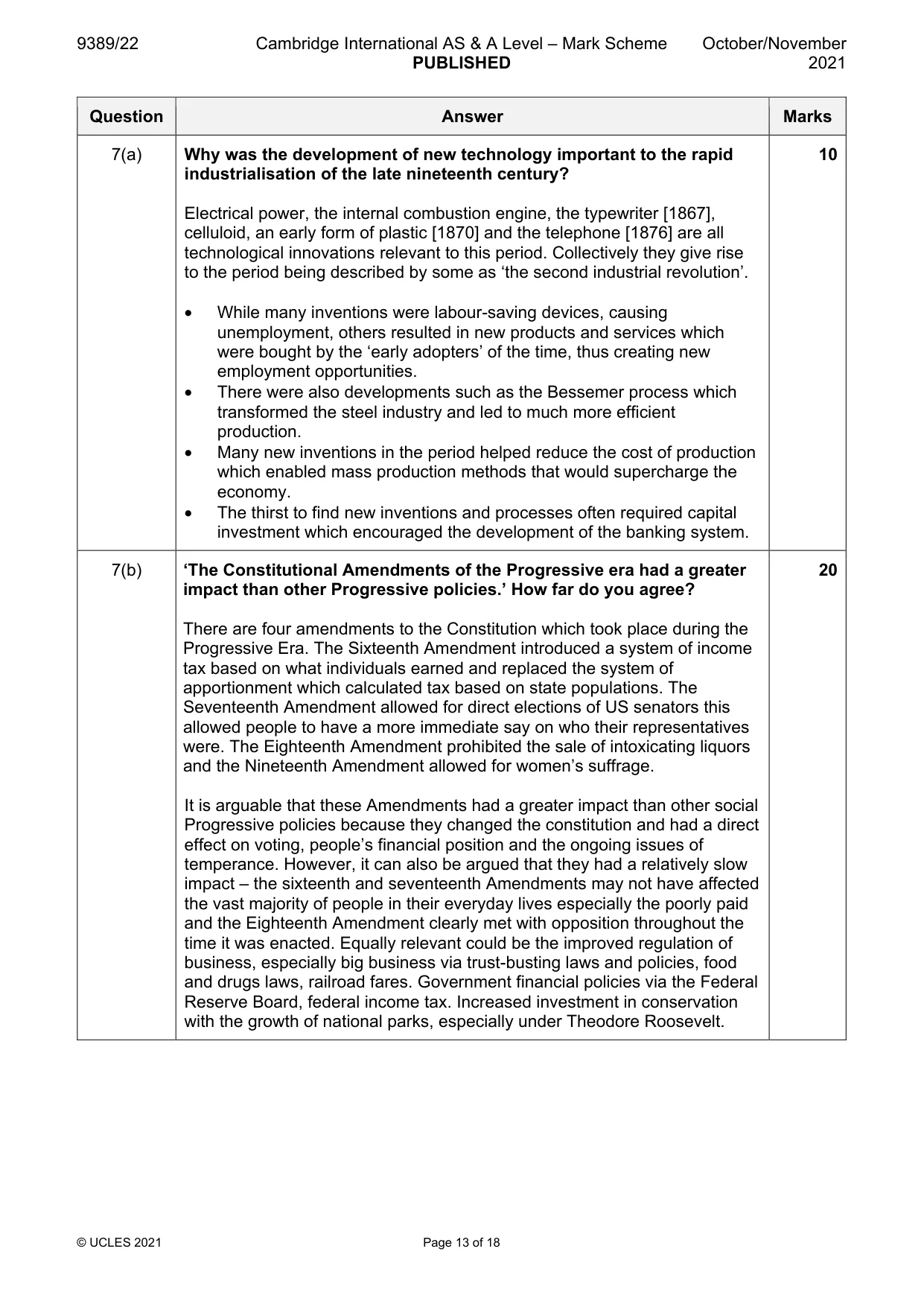
Mark scheme: 7(a) Why was the development of new technology important to the rapid 10 industrialisation of the late nineteenth century? Electrical power, the internal combustion engine, the typewriter [1867], celluloid, an early form of plastic [1870] and the telephone [1876] are all technological innovations relevant to this period. Collectively they give rise to the period being described by some as ‘the second industrial revolution’. • While many inventions were labour-saving devices, causing unemployment, others resulted in new products and services which were bought by the ‘early adopters’ of the time, thus creating new employment opportunities. • There were also developments such as the Bessemer process which transformed the steel industry and led to much more efficient production. • Many new inventions in the period helped reduce the cost of production which enabled mass production methods that would supercharge the economy. • The thirst to find new inventions and processes often required capital investment which encouraged the development of the banking system. 7(b) ‘The Constitutional Amendments of the Progressive era had a greater 20 impact than other Progressive policies.’ How far do you agree? There are four amendments to the Constitution which took place during the Progressive Era. The Sixteenth Amendment introduced a system of income tax based on what individuals earned and replaced the system of apportionment which calculated tax based on state populations. The Seventeenth Amendment allowed for direct elections of US senators this allowed people to have a more immediate say on who their representatives were. The Eighteenth Amendment prohibited the sale of intoxicating liquors and the Nineteenth Amendment allowed for women’s suffrage. It is arguable that these Amendments had a greater impact than other social Progressive policies because they changed the constitution and had a direct effect on voting, people’s financial position and the ongoing issues of temperance. However, it can also be argued that they had a relatively slow impact – the sixteenth and seventeenth Amendments may not have affected the vast majority of people in their everyday lives especially the poorly paid and the Eighteenth Amendment clearly met with opposition throughout the time it was enacted. Equally relevant could be the improved regulation of business, especially big business via trust-busting laws and policies, food and drugs laws, railroad fares. Government financial policies via the Federal Reserve Board, federal income tax. Increased investment in conservation with the growth of national parks, especially under Theodore Roosevelt.
Q8 · The Great Crash, the Great Depression and the New Deal, from the 1920s to 1941 (a) Why…
8 The Great Crash, the Great Depression and the New Deal, from the 1920s to 1941 (a) Why did Roosevelt offer a New Deal to the American people in the 1932 presidential election? [10] (b) ‘Roosevelt’s domestic achievements suggest he should be considered a great US president.’ How far do you agree? [20] Section C: International Option International Relations, 1871–1945 Answer both parts of two questions.
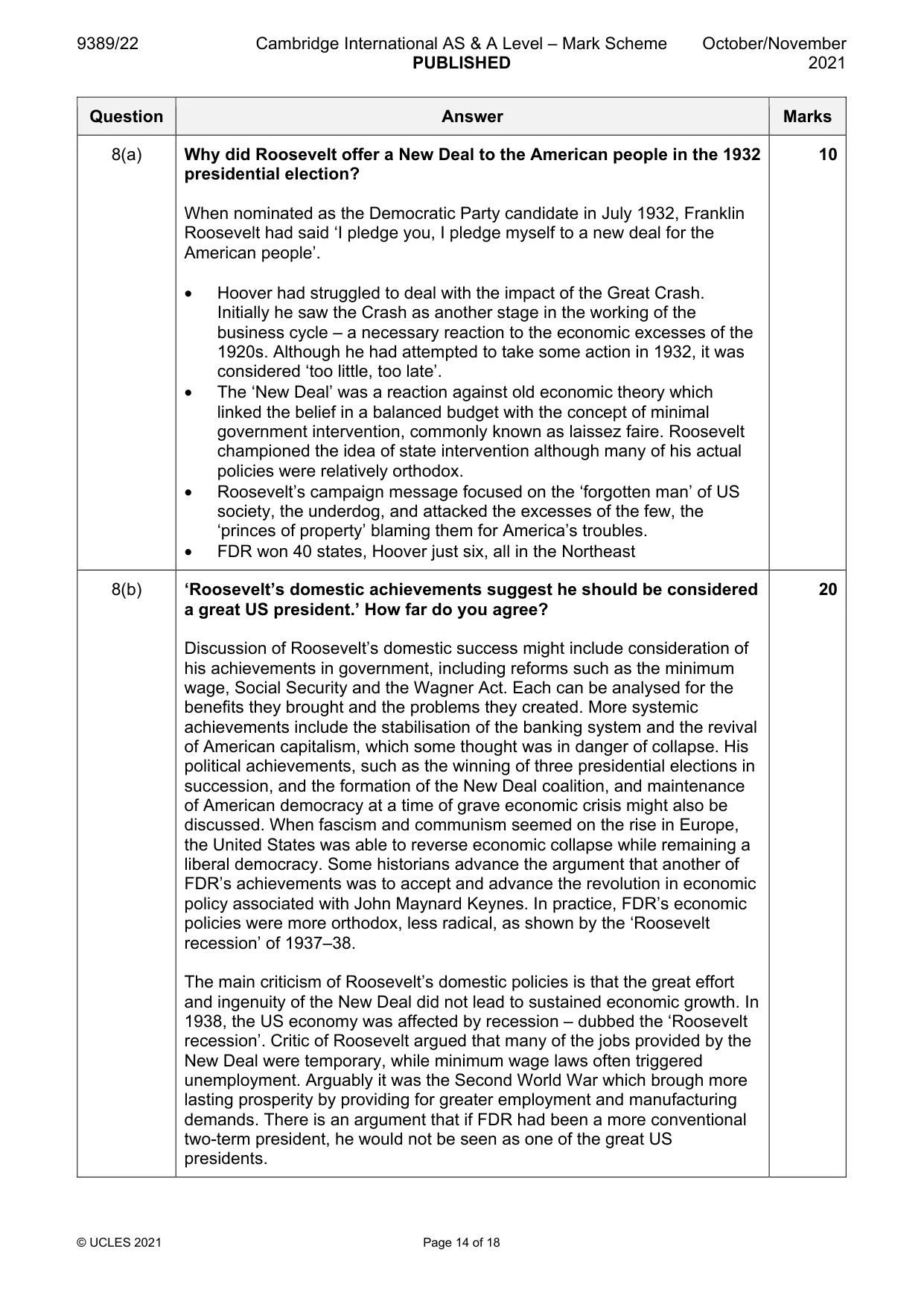
Mark scheme: 8(a) Why did Roosevelt offer a New Deal to the American people in the 1932 10 presidential election? When nominated as the Democratic Party candidate in July 1932, Franklin Roosevelt had said ‘I pledge you, I pledge myself to a new deal for the American people’. • Hoover had struggled to deal with the impact of the Great Crash. Initially he saw the Crash as another stage in the working of the business cycle – a necessary reaction to the economic excesses of the 1920s. Although he had attempted to take some action in 1932, it was considered ‘too little, too late’. • The ‘New Deal’ was a reaction against old economic theory which linked the belief in a balanced budget with the concept of minimal government intervention, commonly known as laissez faire. Roosevelt championed the idea of state intervention although many of his actual policies were relatively orthodox. • Roosevelt’s campaign message focused on the ‘forgotten man’ of US society, the underdog, and attacked the excesses of the few, the ‘princes of property’ blaming them for America’s troubles. • FDR won 40 states, Hoover just six, all in the Northeast 8(b) ‘Roosevelt’s domestic achievements suggest he should be considered 20 a great US president.’ How far do you agree? Discussion of Roosevelt’s domestic success might include consideration of his achievements in government, including reforms such as the minimum wage, Social Security and the Wagner Act. Each can be analysed for the benefits they brought and the problems they created. More systemic achievements include the stabilisation of the banking system and the revival of American capitalism, which some thought was in danger of collapse. His political achievements, such as the winning of three presidential elections in succession, and the formation of the New Deal coalition, and maintenance of American democracy at a time of grave economic crisis might also be discussed. When fascism and communism seemed on the rise in Europe, the United States was able to reverse economic collapse while remaining a liberal democracy. Some historians advance the argument that another of FDR’s achievements was to accept and advance the revolution in economic policy associated with John Maynard Keynes. In practice, FDR’s economic policies were more orthodox, less radical, as shown by the ‘Roosevelt recession’ of 1937–38. The main criticism of Roosevelt’s domestic policies is that the great effort and ingenuity of the New Deal did not lead to sustained economic growth. In 1938, the US economy was affected by recession – dubbed the ‘Roosevelt recession’. Critic of Roosevelt argued that many of the jobs provided by the New Deal were temporary, while minimum wage laws often triggered unemployment. Arguably it was the Second World War which brough more lasting prosperity by providing for greater employment and manufacturing demands. There is an argument that if FDR had been a more conventional two-term president, he would not be seen as one of the great US presidents. Section C: International Option: International Relations, 1871–1945
Q9 · International Relations, 1871–1918 (a) Why did Japan go to war with China in 1894?
9 International Relations, 1871–1918 (a) Why did Japan go to war with China in 1894? [10] (b) How far was the division of Europe into two rival alliances the result of the dismissal from power of Bismarck in 1890? [20]
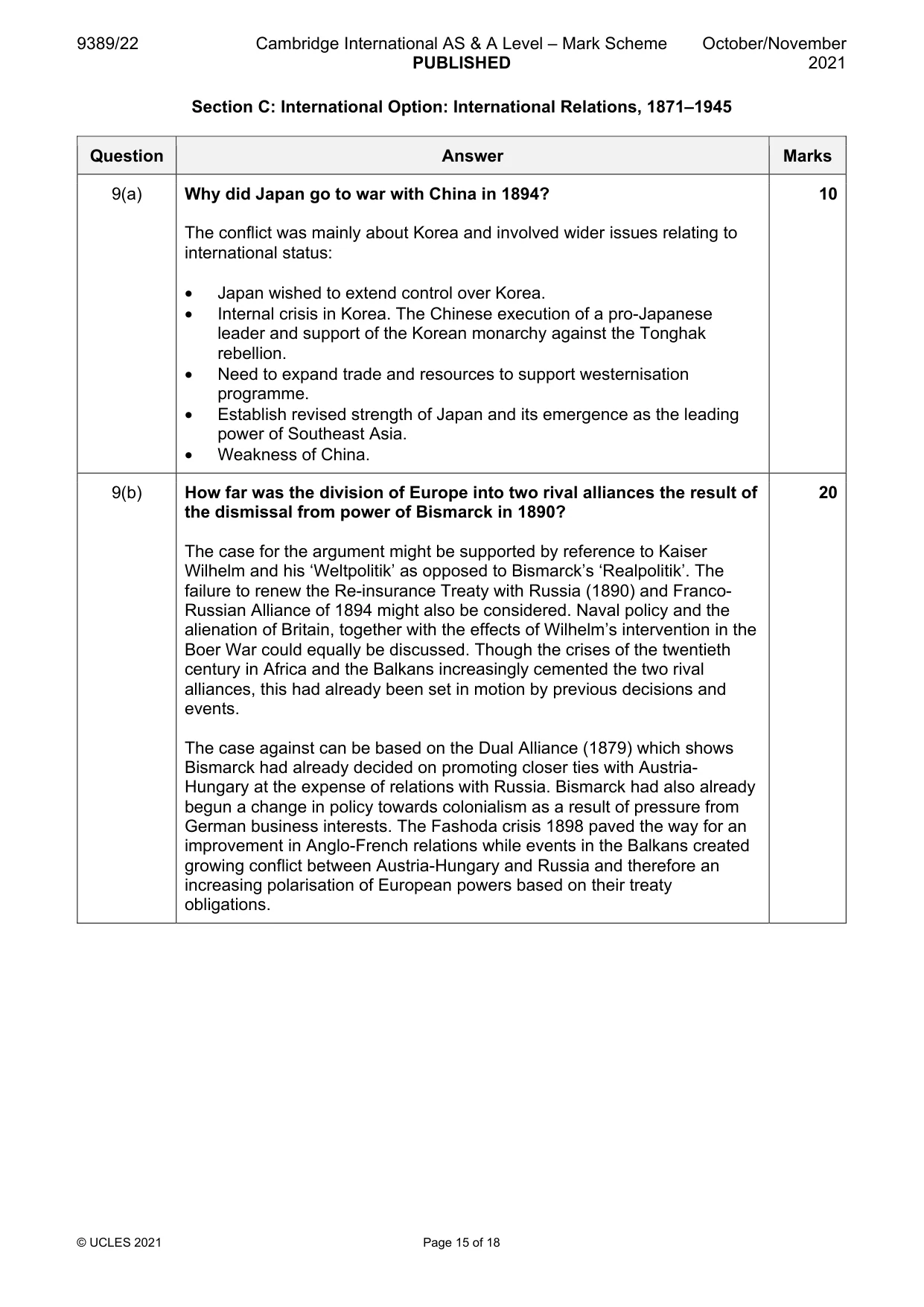
Mark scheme: 9(a) Why did Japan go to war with China in 1894? 10 The conflict was mainly about Korea and involved wider issues relating to international status: • Japan wished to extend control over Korea. • Internal crisis in Korea. The Chinese execution of a pro-Japanese leader and support of the Korean monarchy against the Tonghak rebellion. • Need to expand trade and resources to support westernisation programme. • Establish revised strength of Japan and its emergence as the leading power of Southeast Asia. • Weakness of China. 9(b) How far was the division of Europe into two rival alliances the result of 20 the dismissal from power of Bismarck in 1890? The case for the argument might be supported by reference to Kaiser Wilhelm and his ‘Weltpolitik’ as opposed to Bismarck’s ‘Realpolitik’. The failure to renew the Re-insurance Treaty with Russia (1890) and Franco- Russian Alliance of 1894 might also be considered. Naval policy and the alienation of Britain, together with the effects of Wilhelm’s intervention in the Boer War could equally be discussed. Though the crises of the twentieth century in Africa and the Balkans increasingly cemented the two rival alliances, this had already been set in motion by previous decisions and events. The case against can be based on the Dual Alliance (1879) which shows Bismarck had already decided on promoting closer ties with Austria- Hungary at the expense of relations with Russia. Bismarck had also already begun a change in policy towards colonialism as a result of pressure from German business interests. The Fashoda crisis 1898 paved the way for an improvement in Anglo-French relations while events in the Balkans created growing conflict between Austria-Hungary and Russia and therefore an increasing polarisation of European powers based on their treaty obligations.
Q10 · International Relations, 1919–1933 (a) Why did the United States not fully isolate itself…
10 International Relations, 1919–1933 (a) Why did the United States not fully isolate itself from European affairs in the 1920s? [10] (b) How far was British and French mistrust of communism responsible for their poor relations with the Soviet Union in the 1920s? [20]
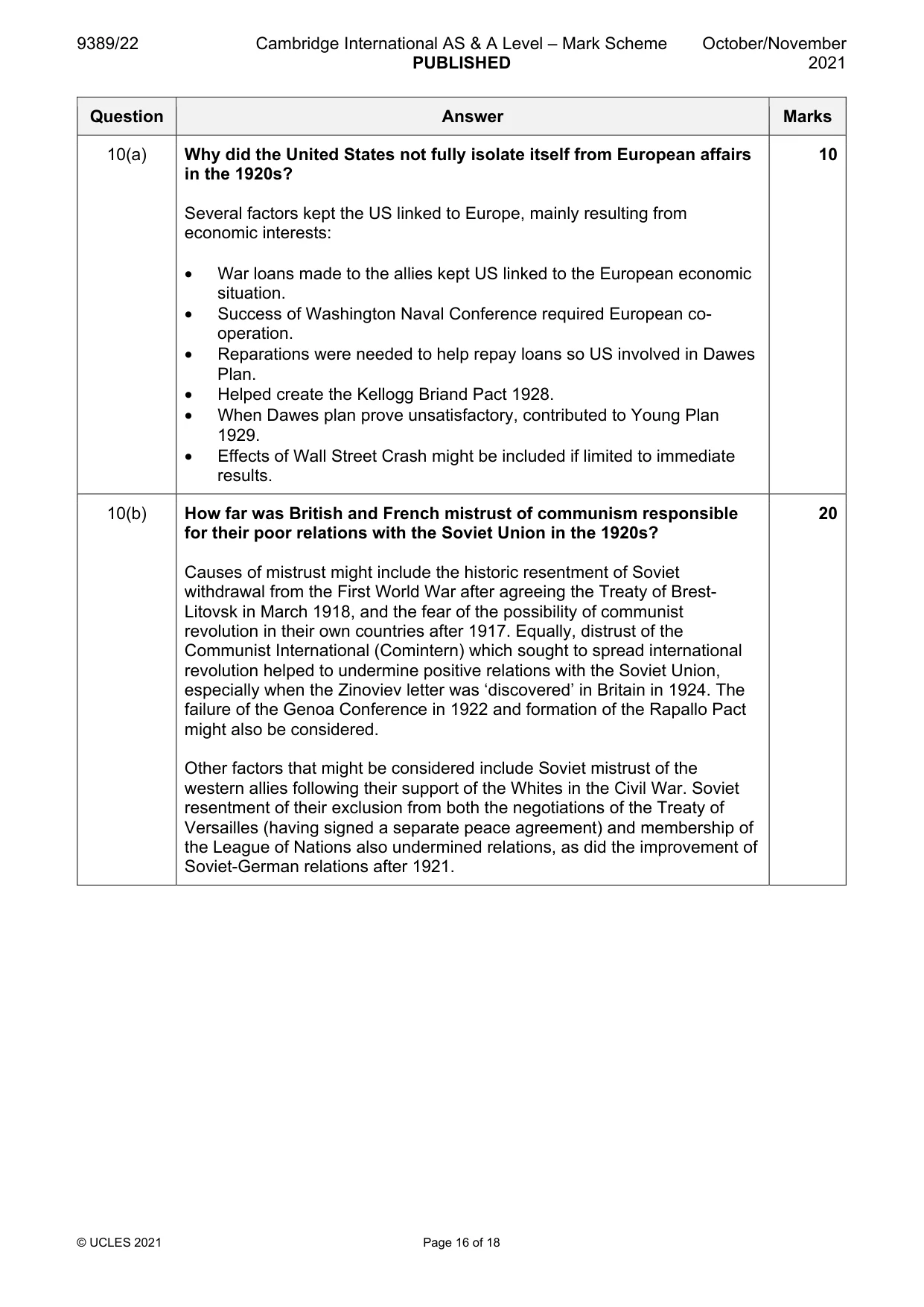
Mark scheme: 10(a) Why did the United States not fully isolate itself from European affairs 10 in the 1920s? Several factors kept the US linked to Europe, mainly resulting from economic interests: • War loans made to the allies kept US linked to the European economic situation. • Success of Washington Naval Conference required European co- operation. • Reparations were needed to help repay loans so US involved in Dawes Plan. • Helped create the Kellogg Briand Pact 1928. • When Dawes plan prove unsatisfactory, contributed to Young Plan 1929. • Effects of Wall Street Crash might be included if limited to immediate results. 10(b) How far was British and French mistrust of communism responsible 20 for their poor relations with the Soviet Union in the 1920s? Causes of mistrust might include the historic resentment of Soviet withdrawal from the First World War after agreeing the Treaty of Brest- Litovsk in March 1918, and the fear of the possibility of communist revolution in their own countries after 1917. Equally, distrust of the Communist International (Comintern) which sought to spread international revolution helped to undermine positive relations with the Soviet Union, especially when the Zinoviev letter was ‘discovered’ in Britain in 1924. The failure of the Genoa Conference in 1922 and formation of the Rapallo Pact might also be considered. Other factors that might be considered include Soviet mistrust of the western allies following their support of the Whites in the Civil War. Soviet resentment of their exclusion from both the negotiations of the Treaty of Versailles (having signed a separate peace agreement) and membership of the League of Nations also undermined relations, as did the improvement of Soviet-German relations after 1921.
Q11 · International Relations, c.1933–1939 (a) Why did Mussolini seize control of Fiume in 1924?
11 International Relations, c.1933–1939 (a) Why did Mussolini seize control of Fiume in 1924? [10] (b) How far was Hitler’s foreign policy from 1933 to 1939 based on his determination to destroy the Treaty of Versailles? [20]
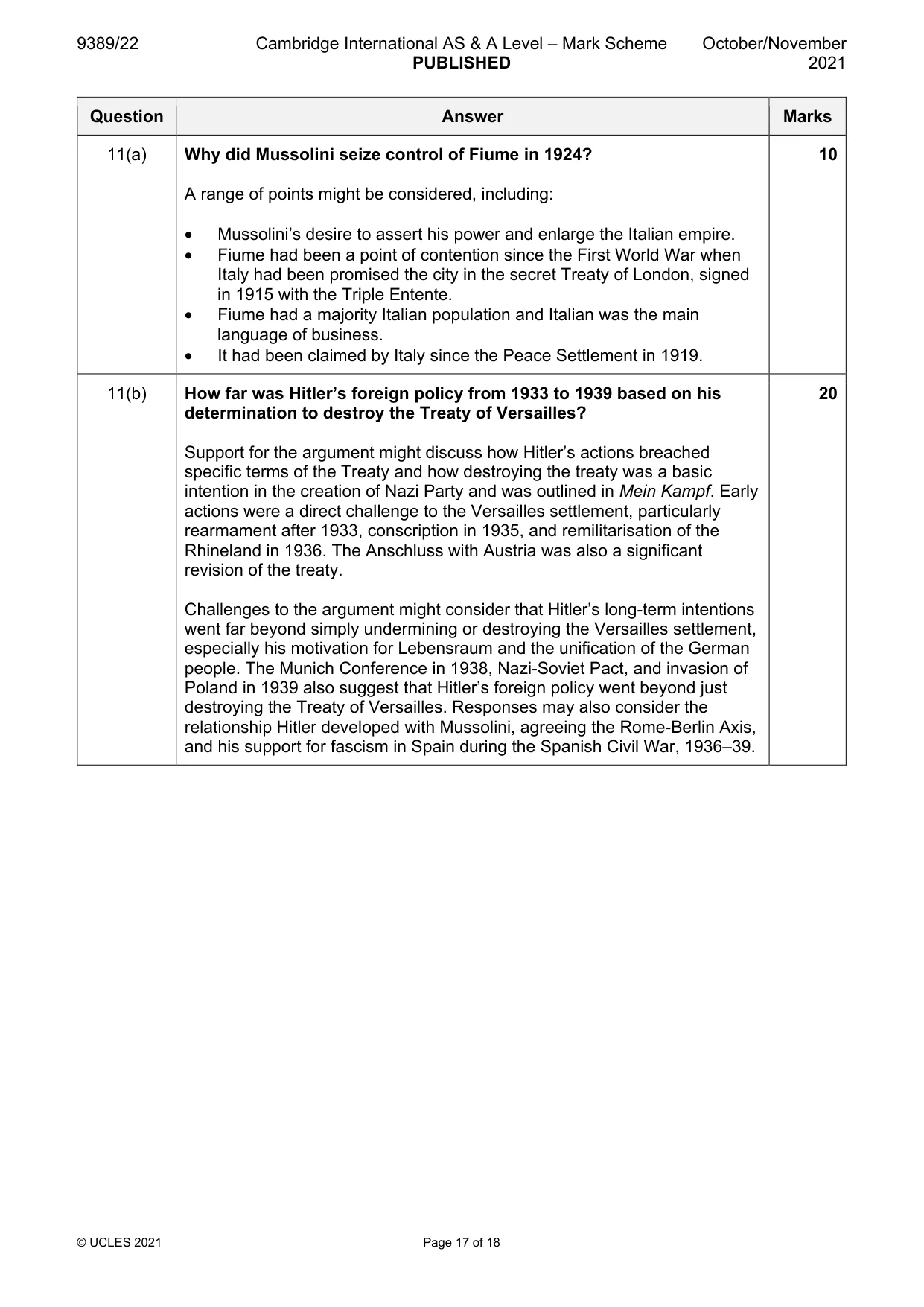
Mark scheme: 11(a) Why did Mussolini seize control of Fiume in 1924? 10 A range of points might be considered, including: • Mussolini’s desire to assert his power and enlarge the Italian empire. • Fiume had been a point of contention since the First World War when Italy had been promised the city in the secret Treaty of London, signed in 1915 with the Triple Entente. • Fiume had a majority Italian population and Italian was the main language of business. • It had been claimed by Italy since the Peace Settlement in 1919. 11(b) How far was Hitler’s foreign policy from 1933 to 1939 based on his 20 determination to destroy the Treaty of Versailles? Support for the argument might discuss how Hitler’s actions breached specific terms of the Treaty and how destroying the treaty was a basic intention in the creation of Nazi Party and was outlined in Mein Kampf. Early actions were a direct challenge to the Versailles settlement, particularly rearmament after 1933, conscription in 1935, and remilitarisation of the Rhineland in 1936. The Anschluss with Austria was also a significant revision of the treaty. Challenges to the argument might consider that Hitler’s long-term intentions went far beyond simply undermining or destroying the Versailles settlement, especially his motivation for Lebensraum and the unification of the German people. The Munich Conference in 1938, Nazi-Soviet Pact, and invasion of Poland in 1939 also suggest that Hitler’s foreign policy went beyond just destroying the Treaty of Versailles. Responses may also consider the relationship Hitler developed with Mussolini, agreeing the Rome-Berlin Axis, and his support for fascism in Spain during the Spanish Civil War, 1936–39.
Q12 · China and Japan, 1919–1945 (a) Why were warlords able to take control of much of China by…
12 China and Japan, 1919–1945 (a) Why were warlords able to take control of much of China by 1916? [10] (b) ‘By failing to deliver the Three Principles of Sun Yat-sen, Chiang Kai-shek lost the opportunity to establish Kuomintang control over China.’ How far do you agree? [20]
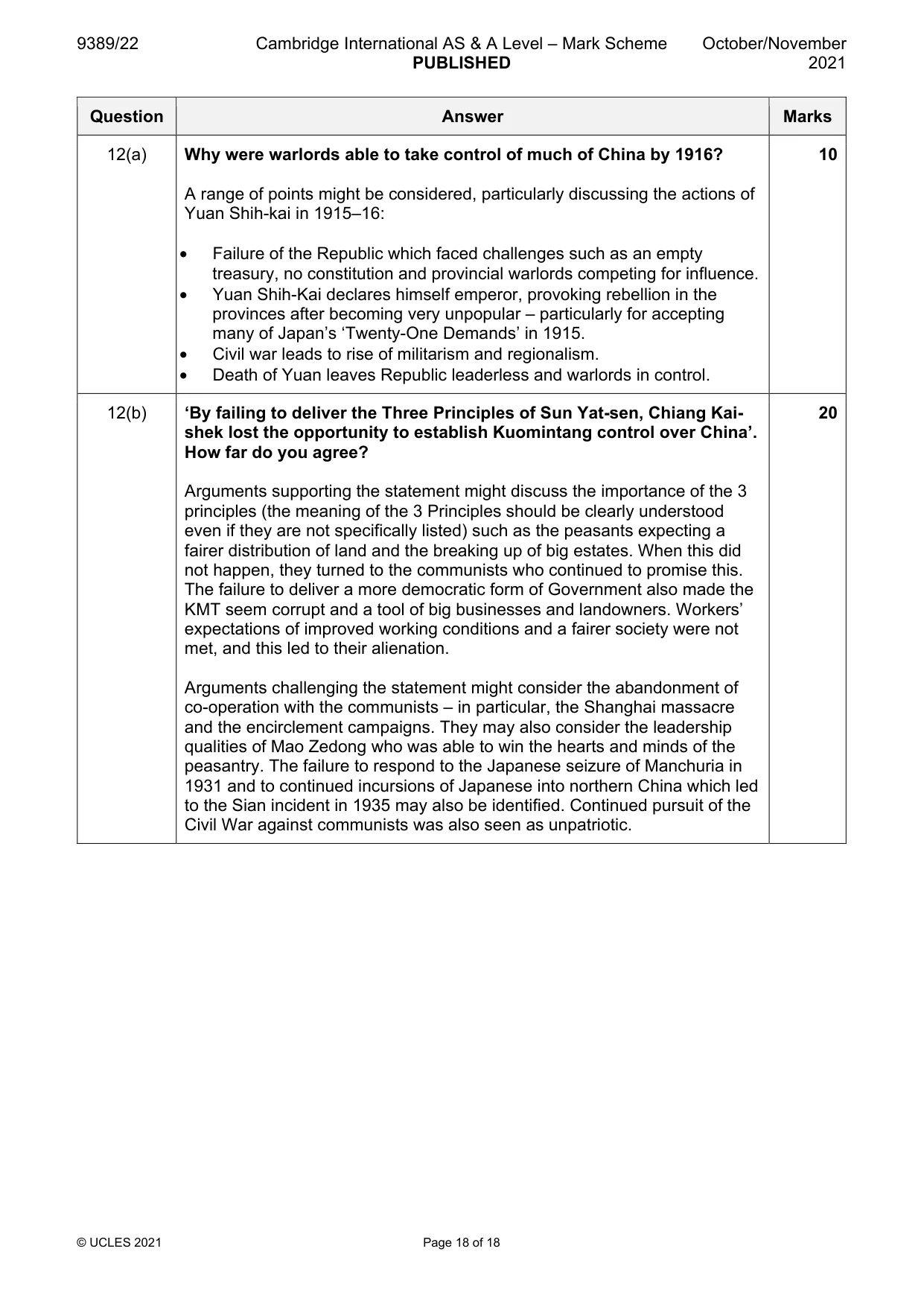
Mark scheme: 12(a) Why were warlords able to take control of much of China by 1916? 10 A range of points might be considered, particularly discussing the actions of Yuan Shih-kai in 1915–16: • Failure of the Republic which faced challenges such as an empty treasury, no constitution and provincial warlords competing for influence. • Yuan Shih-Kai declares himself emperor, provoking rebellion in the provinces after becoming very unpopular – particularly for accepting many of Japan’s ‘Twenty-One Demands’ in 1915. • Civil war leads to rise of militarism and regionalism. • Death of Yuan leaves Republic leaderless and warlords in control. 12(b) ‘By failing to deliver the Three Principles of Sun Yat-sen, Chiang Kai- 20 shek lost the opportunity to establish Kuomintang control over China’. How far do you agree? Arguments supporting the statement might discuss the importance of the 3 principles (the meaning of the 3 Principles should be clearly understood even if they are not specifically listed) such as the peasants expecting a fairer distribution of land and the breaking up of big estates. When this did not happen, they turned to the communists who continued to promise this. The failure to deliver a more democratic form of Government also made the KMT seem corrupt and a tool of big businesses and landowners. Workers’ expectations of improved working conditions and a fairer society were not met, and this led to their alienation. Arguments challenging the statement might consider the abandonment of co-operation with the communists – in particular, the Shanghai massacre and the encirclement campaigns. They may also consider the leadership qualities of Mao Zedong who was able to win the hearts and minds of the peasantry. The failure to respond to the Japanese seizure of Manchuria in 1931 and to continued incursions of Japanese into northern China which led to the Sian incident in 1935 may also be identified. Continued pursuit of the Civil War against communists was also seen as unpatriotic.
What you needed in this session
Cambridge’s own grade thresholds for 2021 Oct/Nov, Paper 2 · Variant 2. A higher threshold means an easier paper — the bar moves with how the cohort did.