Cambridge A Level History 9389 — 2019 May/June Paper 2 · Variant 2
9389/22/M/J/19 · 12 questions · 60 marks · ≈68 min
The question paper and its mark scheme, free to read here and free to download. This is Cambridge’s own paper, exactly as it was sat.
Question paper4 pages
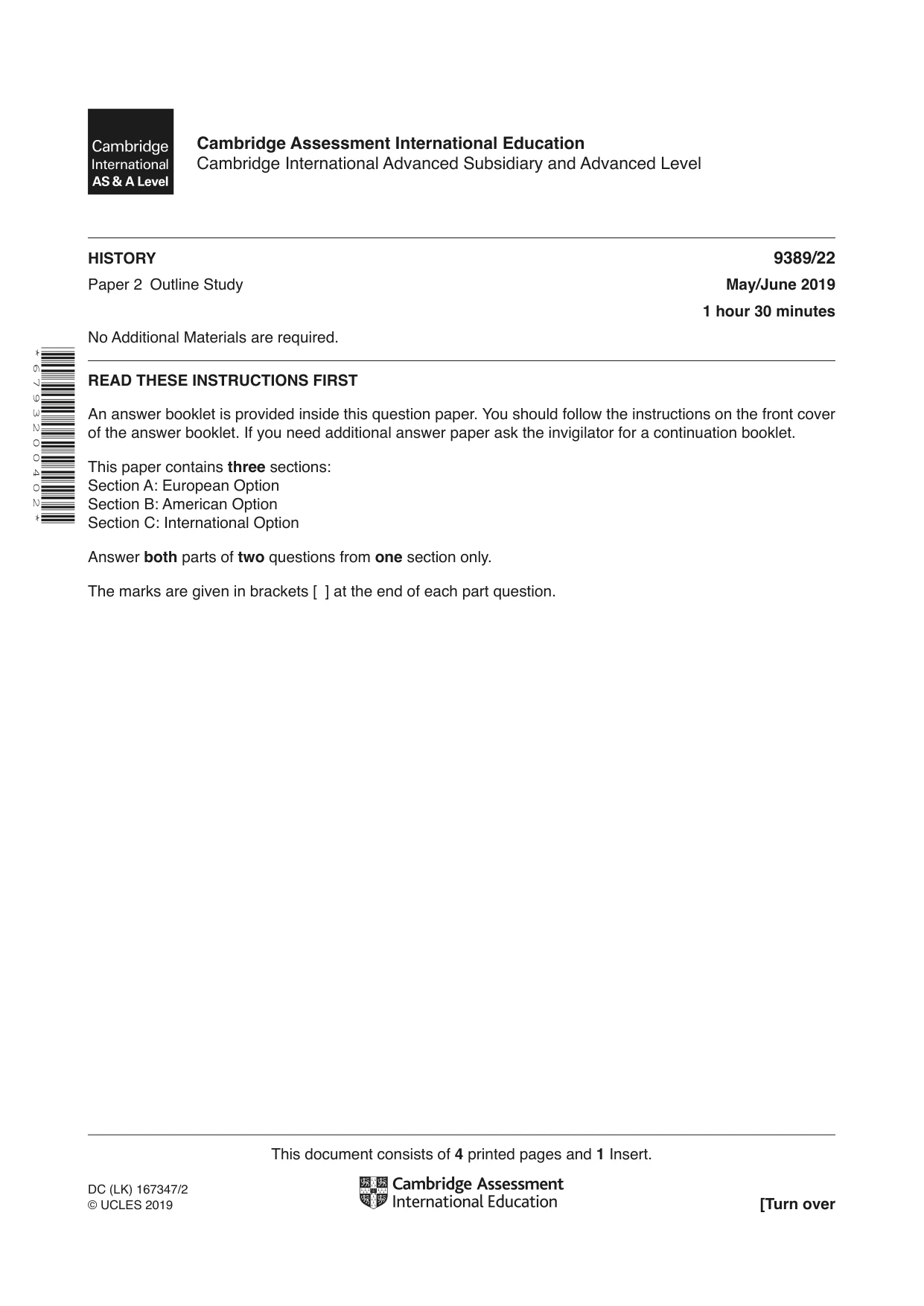
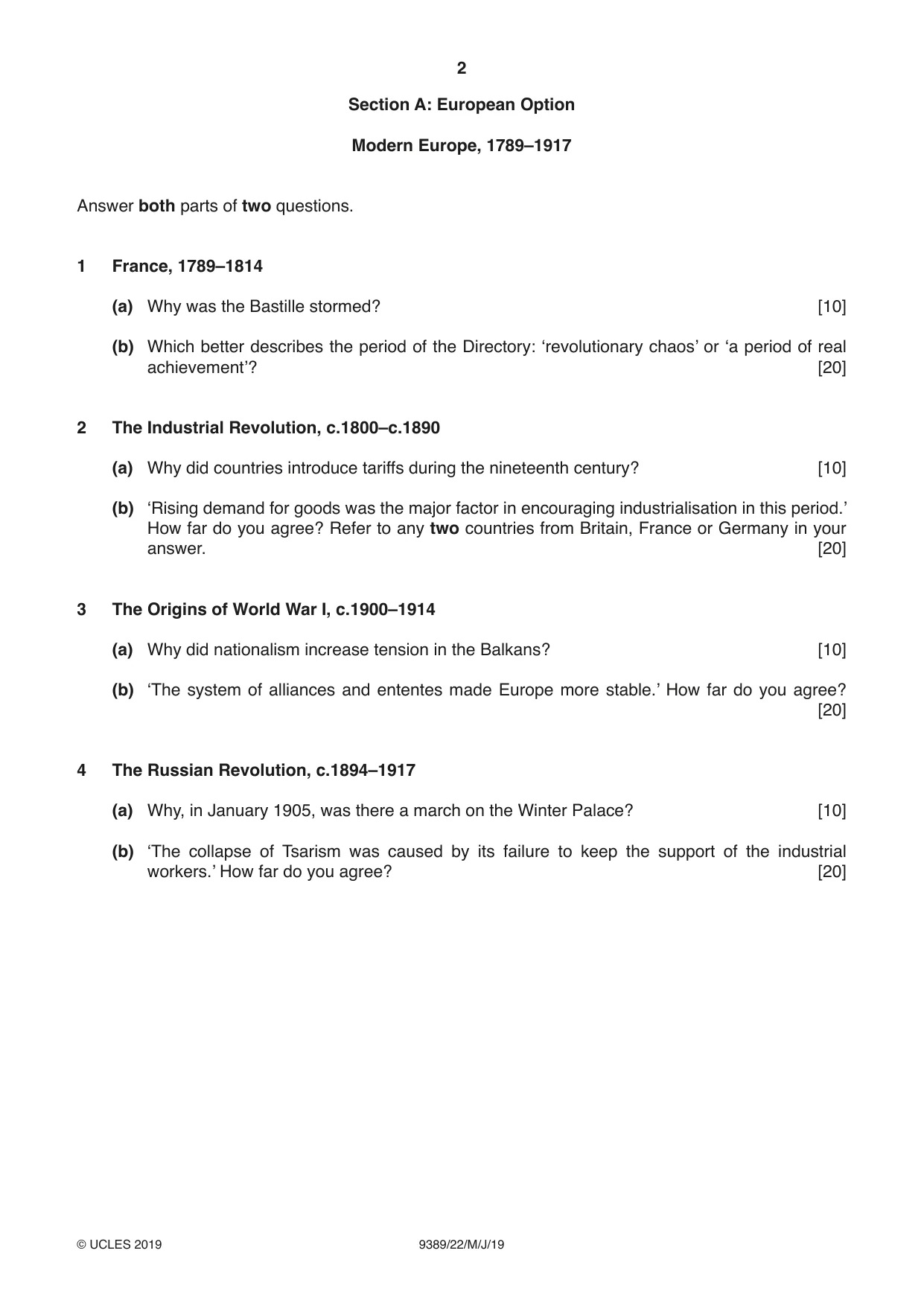
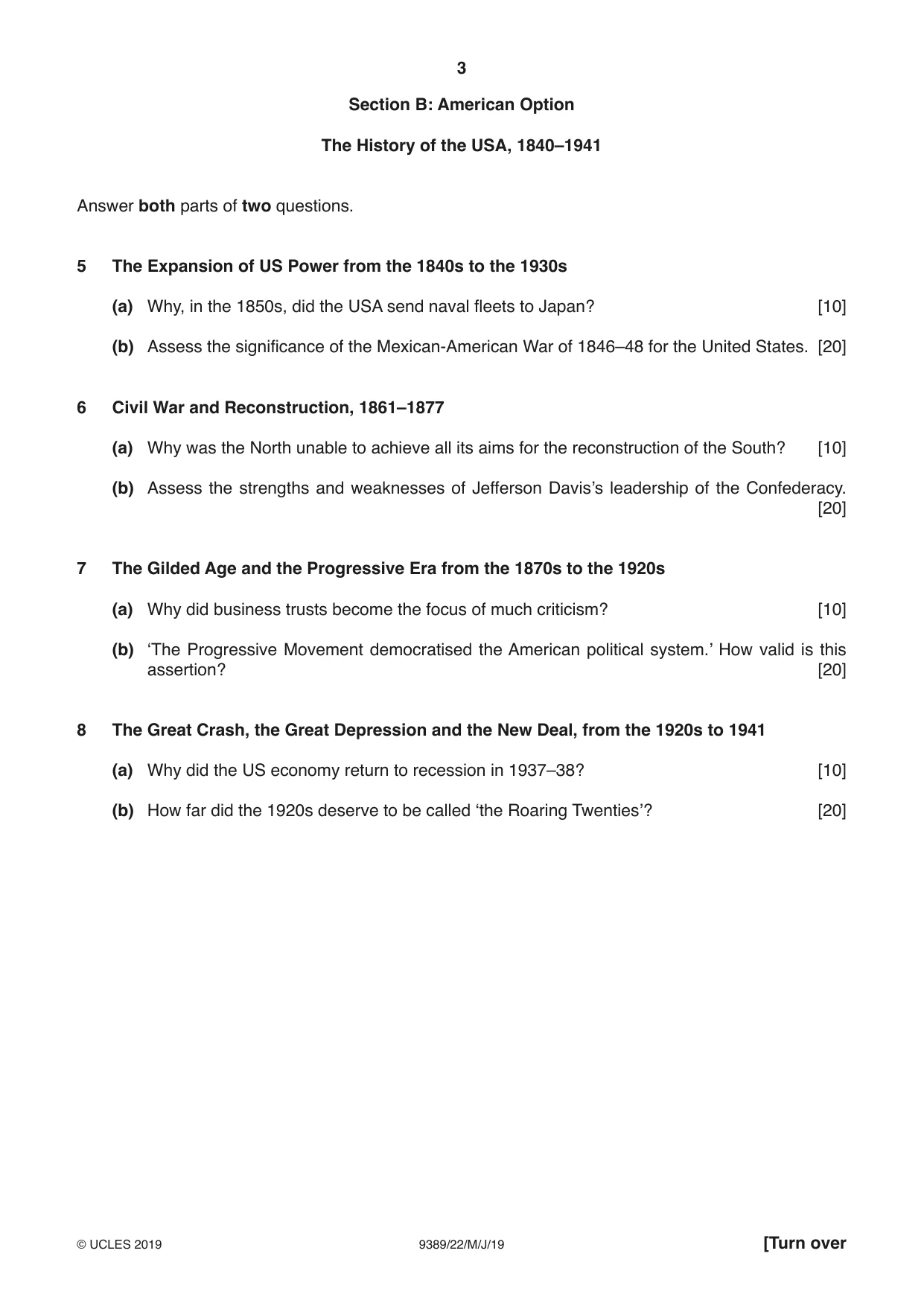
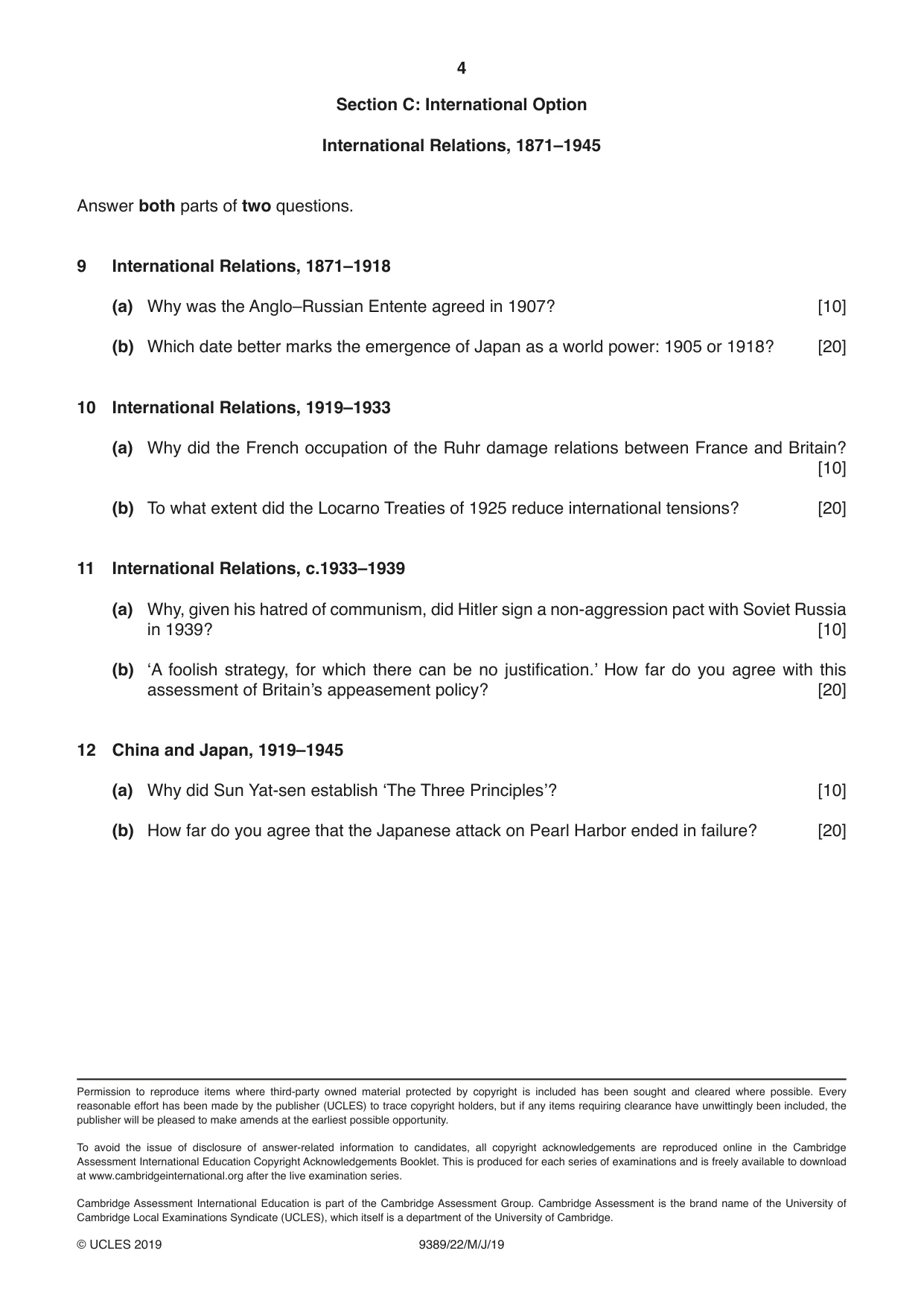
Mark scheme27 pages
Answers below. Sit the paper first if you are practising.
Questions as text
Q1 · France, 1789–1814 (a) Why was the Bastille stormed?
1 France, 1789–1814 (a) Why was the Bastille stormed? [10] (b) Which better describes the period of the Directory: ‘revolutionary chaos’ or ‘a period of real achievement’? [20]
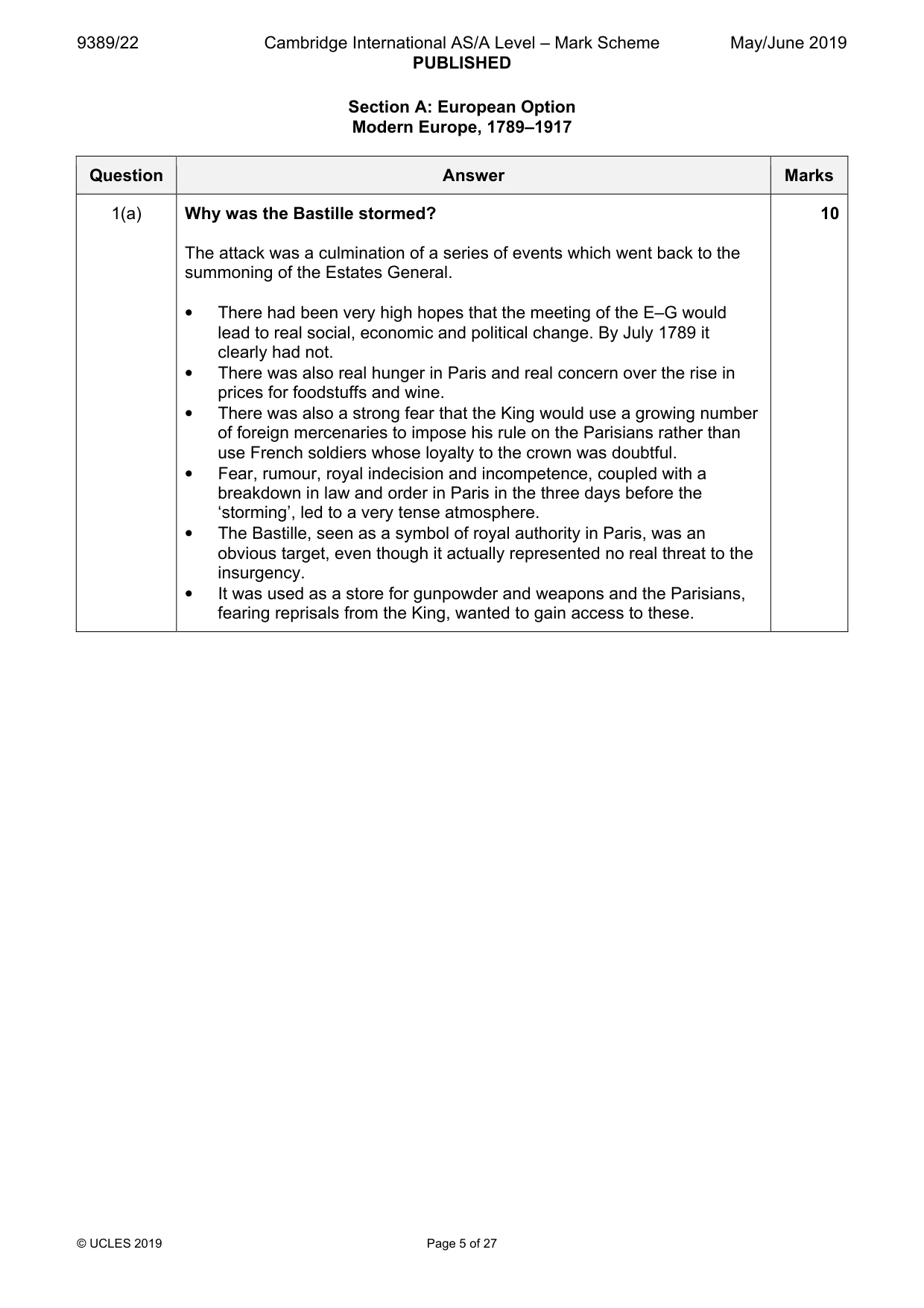
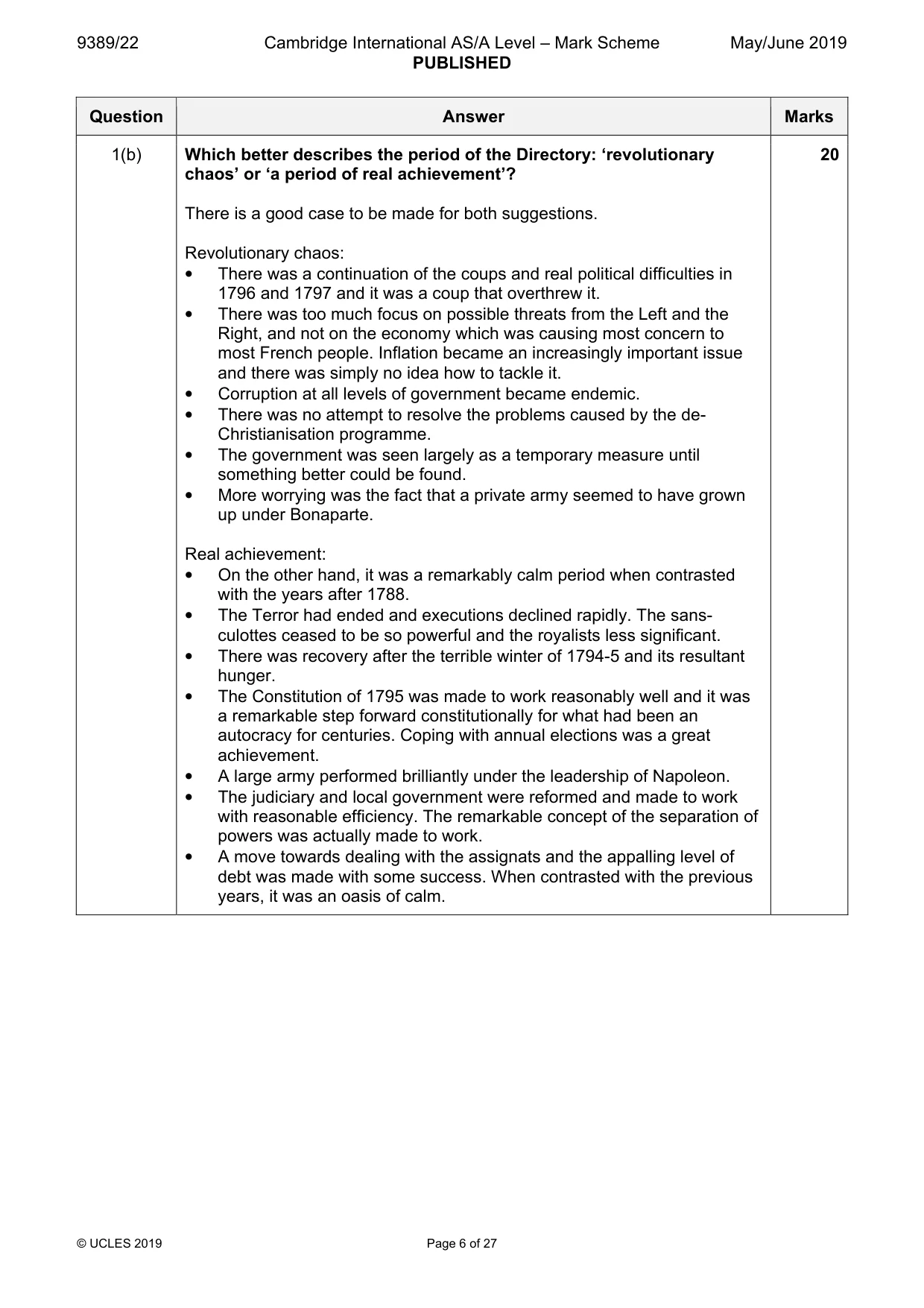
Mark scheme: Question Answer Marks 1(a) Why was the Bastille stormed? 10 The attack was a culmination of a series of events which went back to the summoning of the Estates General. • There had been very high hopes that the meeting of the E–G would lead to real social, economic and political change. By July 1789 it clearly had not. • There was also real hunger in Paris and real concern over the rise in prices for foodstuffs and wine. • There was also a strong fear that the King would use a growing number of foreign mercenaries to impose his rule on the Parisians rather than use French soldiers whose loyalty to the crown was doubtful. • Fear, rumour, royal indecision and incompetence, coupled with a breakdown in law and order in Paris in the three days before the ‘storming’, led to a very tense atmosphere. • The Bastille, seen as a symbol of royal authority in Paris, was an obvious target, even though it actually represented no real threat to the insurgency. • It was used as a store for gunpowder and weapons and the Parisians, fearing reprisals from the King, wanted to gain access to these. 1(b) Which better describes the period of the Directory: ‘revolutionary 20 chaos’ or ‘a period of real achievement’? There is a good case to be made for both suggestions. Revolutionary chaos: • There was a continuation of the coups and real political difficulties in 1796 and 1797 and it was a coup that overthrew it. • There was too much focus on possible threats from the Left and the Right, and not on the economy which was causing most concern to most French people. Inflation became an increasingly important issue and there was simply no idea how to tackle it. • Corruption at all levels of government became endemic. • There was no attempt to resolve the problems caused by the de- Christianisation programme. • The government was seen largely as a temporary measure until something better could be found. • More worrying was the fact that a private army seemed to have grown up under Bonaparte. Real achievement: • On the other hand, it was a remarkably calm period when contrasted with the years after 1788. • The Terror had ended and executions declined rapidly. The sans- culottes ceased to be so powerful and the royalists less significant. • There was recovery after the terrible winter of 1794-5 and its resultant hunger. • The Constitution of 1795 was made to work reasonably well and it was a remarkable step forward constitutionally for what had been an autocracy for centuries. Coping with annual elections was a great achievement. • A large army performed brilliantly under the leadership of Napoleon. • The judiciary and local government were reformed and made to work with reasonable efficiency. The remarkable concept of the separation of powers was actually made to work. • A move towards dealing with the assignats and the appalling level of debt was made with some success. When contrasted with the previous years, it was an oasis of calm.
Q2 · The Industrial Revolution, c.1800–c.1890 (a) Why did countries introduce tariffs during…
2 The Industrial Revolution, c.1800–c.1890 (a) Why did countries introduce tariffs during the nineteenth century? [10] (b) ‘Rising demand for goods was the major factor in encouraging industrialisation in this period.’ How far do you agree? Refer to any two countries from Britain, France or Germany in your answer. [20]
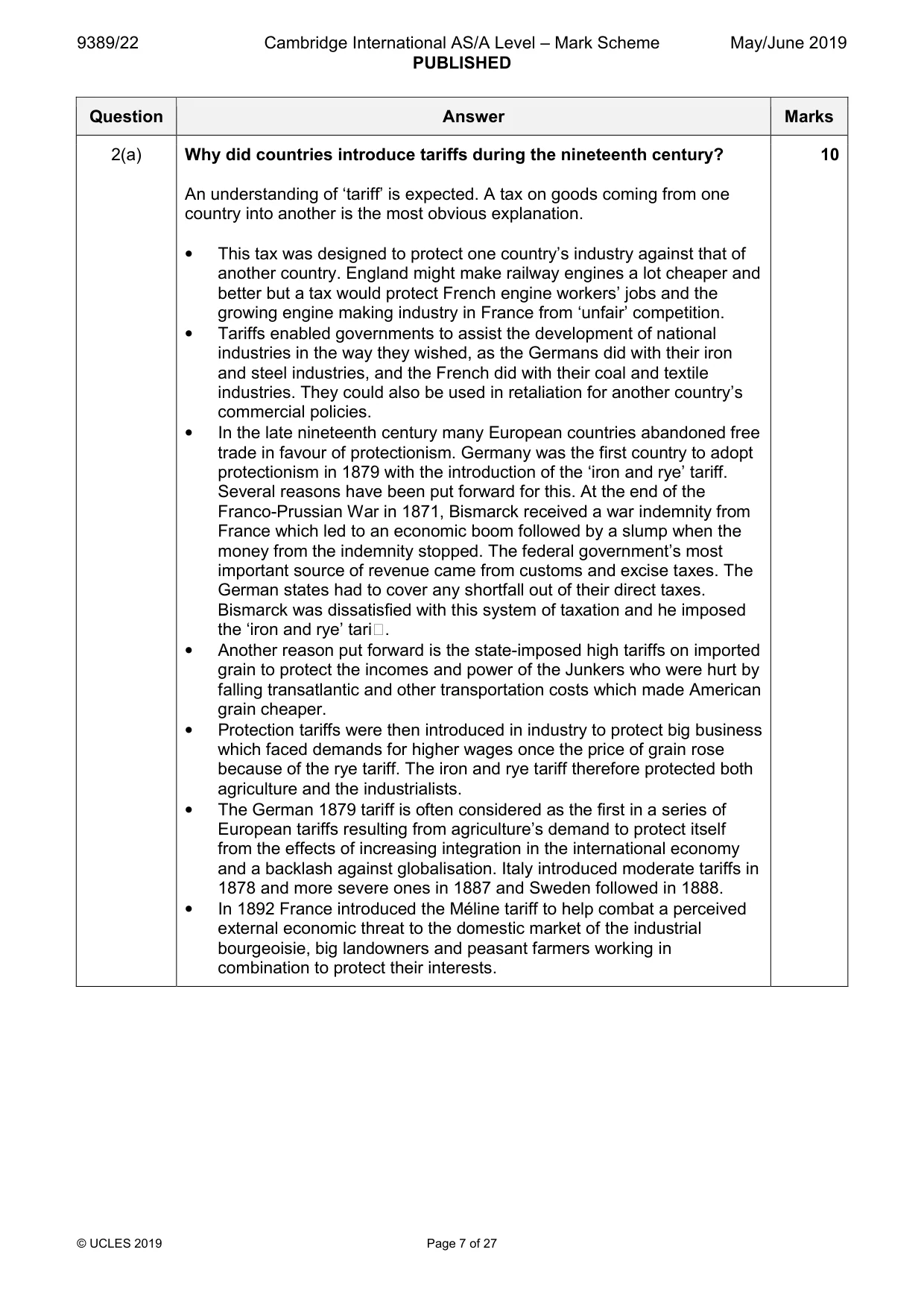
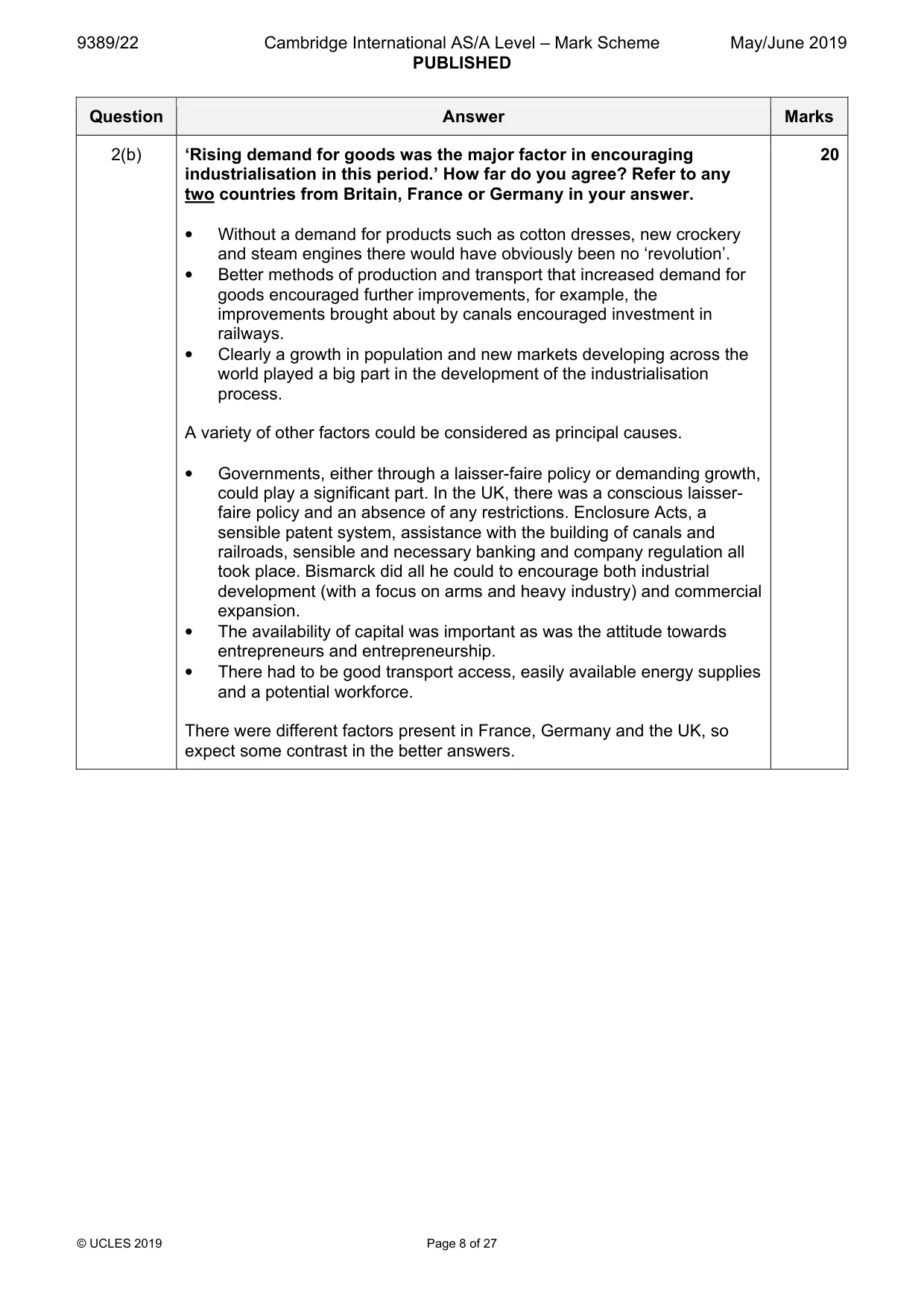
Mark scheme: 2(a) Why did countries introduce tariffs during the nineteenth century? 10 An understanding of ‘tariff’ is expected. A tax on goods coming from one country into another is the most obvious explanation. • This tax was designed to protect one country’s industry against that of another country. England might make railway engines a lot cheaper and better but a tax would protect French engine workers’ jobs and the growing engine making industry in France from ‘unfair’ competition. • Tariffs enabled governments to assist the development of national industries in the way they wished, as the Germans did with their iron and steel industries, and the French did with their coal and textile industries. They could also be used in retaliation for another country’s commercial policies. • In the late nineteenth century many European countries abandoned free trade in favour of protectionism. Germany was the first country to adopt protectionism in 1879 with the introduction of the ‘iron and rye’ tariff. Several reasons have been put forward for this. At the end of the Franco-Prussian War in 1871, Bismarck received a war indemnity from France which led to an economic boom followed by a slump when the money from the indemnity stopped. The federal government’s most important source of revenue came from customs and excise taxes. The German states had to cover any shortfall out of their direct taxes. Bismarck was dissatisfied with this system of taxation and he imposed the ‘iron and rye’ tari . • Another reason put forward is the state-imposed high tariffs on imported grain to protect the incomes and power of the Junkers who were hurt by falling transatlantic and other transportation costs which made American grain cheaper. • Protection tariffs were then introduced in industry to protect big business which faced demands for higher wages once the price of grain rose because of the rye tariff. The iron and rye tariff therefore protected both agriculture and the industrialists. • The German 1879 tariff is often considered as the first in a series of European tariffs resulting from agriculture’s demand to protect itself from the effects of increasing integration in the international economy and a backlash against globalisation. Italy introduced moderate tariffs in 1878 and more severe ones in 1887 and Sweden followed in 1888. • In 1892 France introduced the Méline tariff to help combat a perceived external economic threat to the domestic market of the industrial bourgeoisie, big landowners and peasant farmers working in combination to protect their interests. 2(b) ‘Rising demand for goods was the major factor in encouraging 20 industrialisation in this period.’ How far do you agree? Refer to any two countries from Britain, France or Germany in your answer. • Without a demand for products such as cotton dresses, new crockery and steam engines there would have obviously been no ‘revolution’. • Better methods of production and transport that increased demand for goods encouraged further improvements, for example, the improvements brought about by canals encouraged investment in railways. • Clearly a growth in population and new markets developing across the world played a big part in the development of the industrialisation process. A variety of other factors could be considered as principal causes. • Governments, either through a laisser-faire policy or demanding growth, could play a significant part. In the UK, there was a conscious laisser- faire policy and an absence of any restrictions. Enclosure Acts, a sensible patent system, assistance with the building of canals and railroads, sensible and necessary banking and company regulation all took place. Bismarck did all he could to encourage both industrial development (with a focus on arms and heavy industry) and commercial expansion. • The availability of capital was important as was the attitude towards entrepreneurs and entrepreneurship. • There had to be good transport access, easily available energy supplies and a potential workforce. There were different factors present in France, Germany and the UK, so expect some contrast in the better answers.
Q3 · The Origins of World War I, c.1900–1914 (a) Why did nationalism increase tension in the…
3 The Origins of World War I, c.1900–1914 (a) Why did nationalism increase tension in the Balkans? [10] (b) ‘The system of alliances and ententes made Europe more stable.’ How far do you agree? [20]
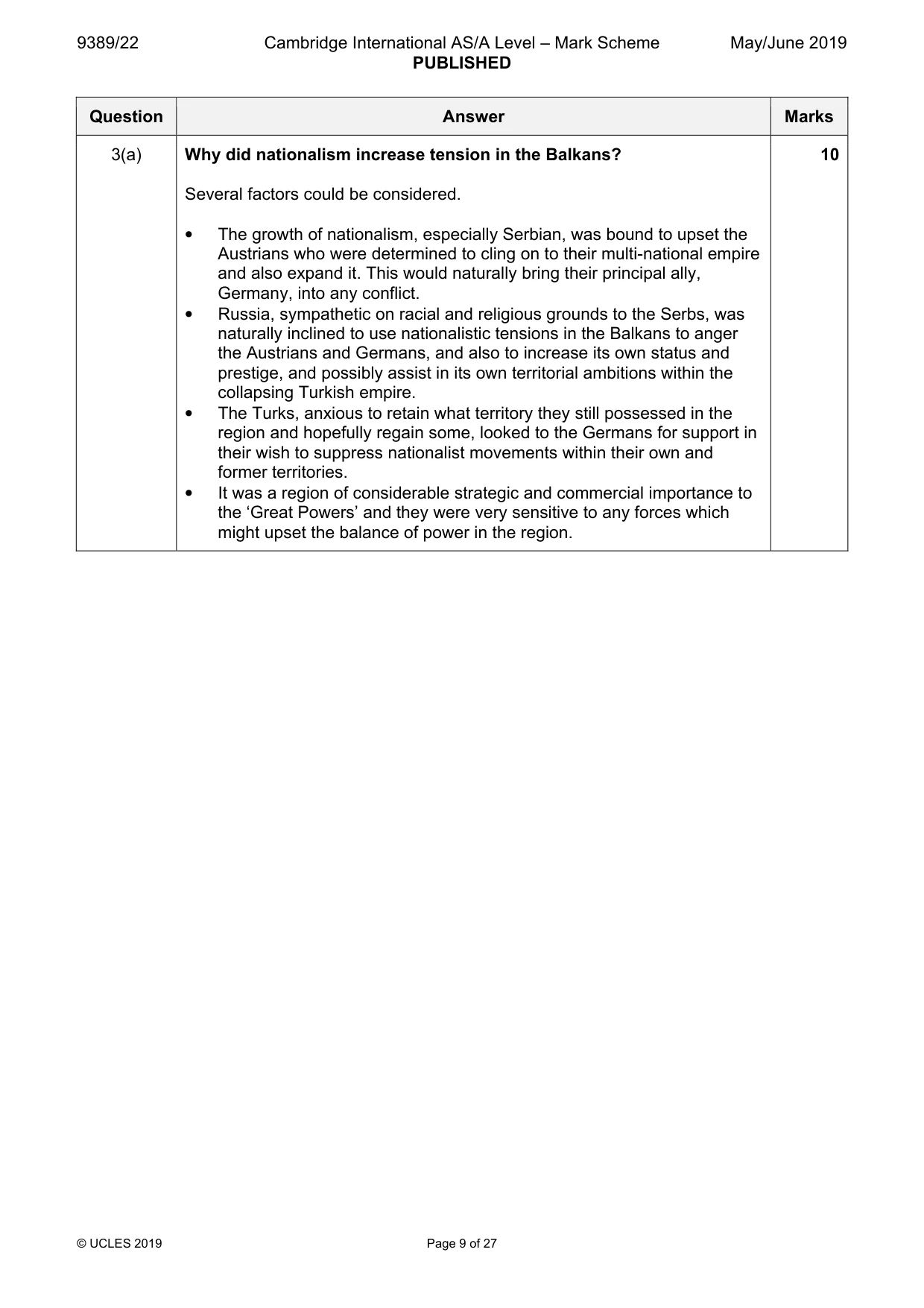
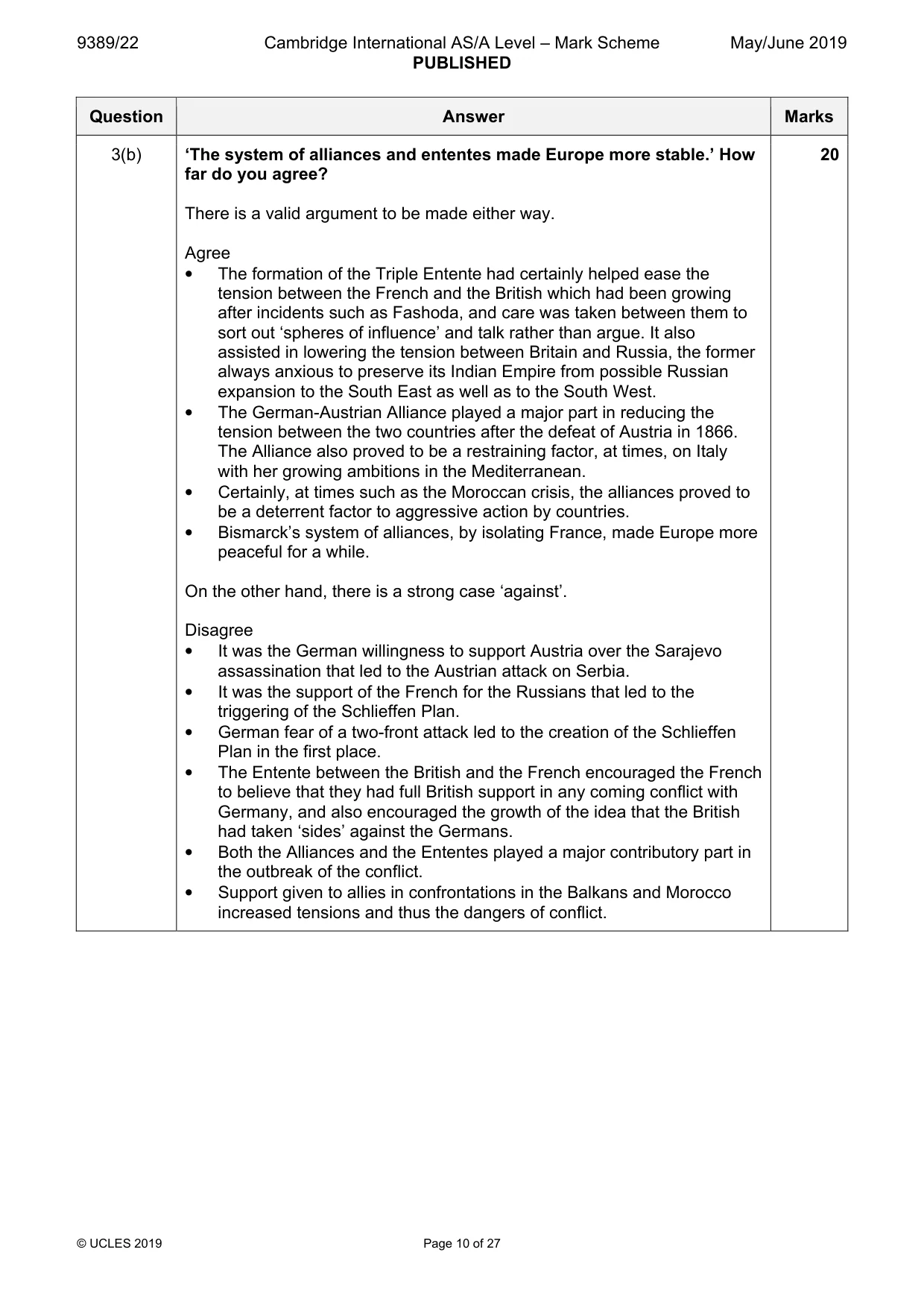
Mark scheme: 3(a) Why did nationalism increase tension in the Balkans? 10 Several factors could be considered. • The growth of nationalism, especially Serbian, was bound to upset the Austrians who were determined to cling on to their multi-national empire and also expand it. This would naturally bring their principal ally, Germany, into any conflict. • Russia, sympathetic on racial and religious grounds to the Serbs, was naturally inclined to use nationalistic tensions in the Balkans to anger the Austrians and Germans, and also to increase its own status and prestige, and possibly assist in its own territorial ambitions within the collapsing Turkish empire. • The Turks, anxious to retain what territory they still possessed in the region and hopefully regain some, looked to the Germans for support in their wish to suppress nationalist movements within their own and former territories. • It was a region of considerable strategic and commercial importance to the ‘Great Powers’ and they were very sensitive to any forces which might upset the balance of power in the region. 3(b) ‘The system of alliances and ententes made Europe more stable.’ How 20 far do you agree? There is a valid argument to be made either way. Agree • The formation of the Triple Entente had certainly helped ease the tension between the French and the British which had been growing after incidents such as Fashoda, and care was taken between them to sort out ‘spheres of influence’ and talk rather than argue. It also assisted in lowering the tension between Britain and Russia, the former always anxious to preserve its Indian Empire from possible Russian expansion to the South East as well as to the South West. • The German-Austrian Alliance played a major part in reducing the tension between the two countries after the defeat of Austria in 1866. The Alliance also proved to be a restraining factor, at times, on Italy with her growing ambitions in the Mediterranean. • Certainly, at times such as the Moroccan crisis, the alliances proved to be a deterrent factor to aggressive action by countries. • Bismarck’s system of alliances, by isolating France, made Europe more peaceful for a while. On the other hand, there is a strong case ‘against’. Disagree • It was the German willingness to support Austria over the Sarajevo assassination that led to the Austrian attack on Serbia. • It was the support of the French for the Russians that led to the triggering of the Schlieffen Plan. • German fear of a two-front attack led to the creation of the Schlieffen Plan in the first place. • The Entente between the British and the French encouraged the French to believe that they had full British support in any coming conflict with Germany, and also encouraged the growth of the idea that the British had taken ‘sides’ against the Germans. • Both the Alliances and the Ententes played a major contributory part in the outbreak of the conflict. • Support given to allies in confrontations in the Balkans and Morocco increased tensions and thus the dangers of conflict.
Q4 · The Russian Revolution, c.1894–1917 (a) Why, in January 1905, was there a march on the…
4 The Russian Revolution, c.1894–1917 (a) Why, in January 1905, was there a march on the Winter Palace? [10] (b) ‘The collapse of Tsarism was caused by its failure to keep the support of the industrial workers.’ How far do you agree? [20]
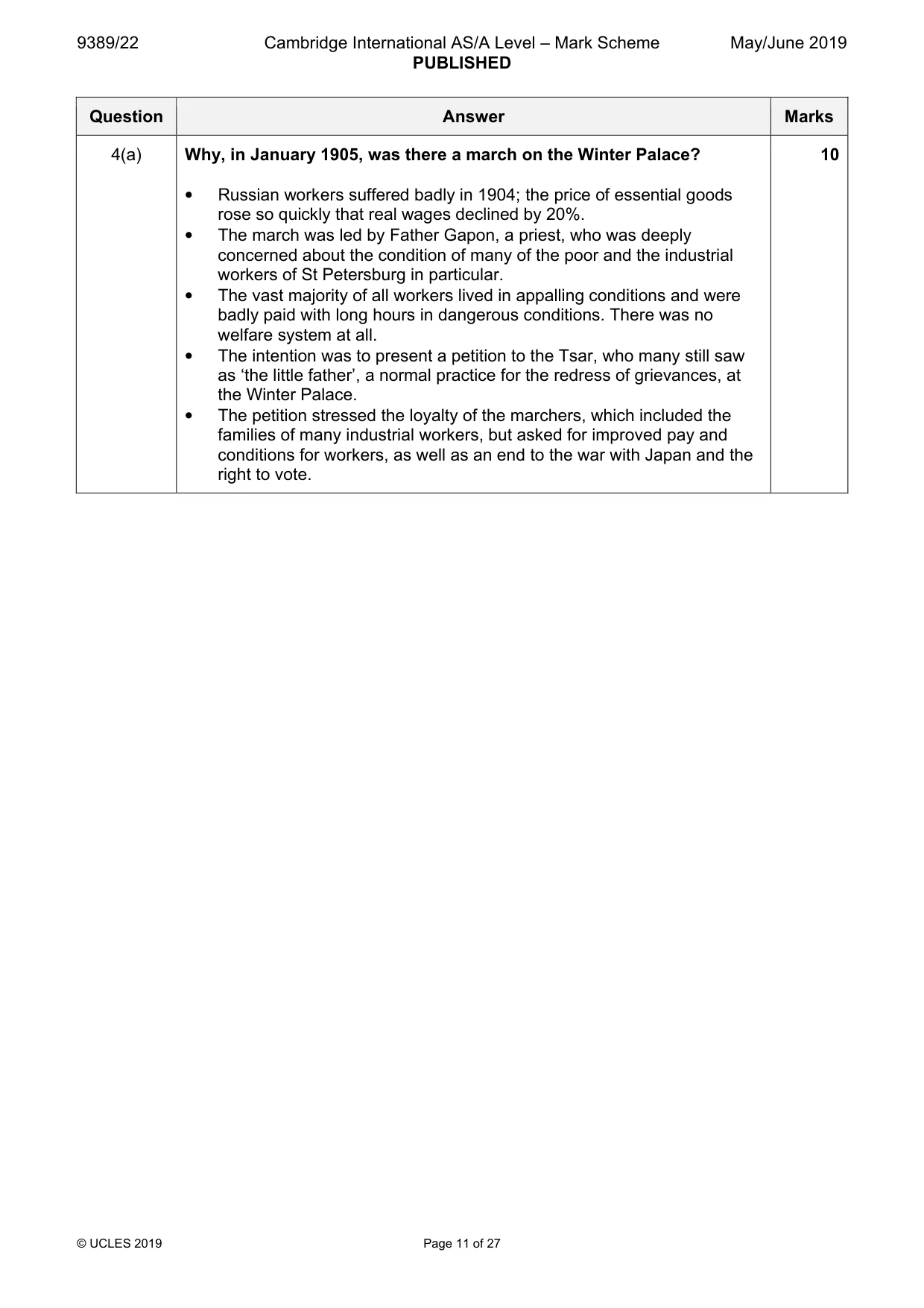
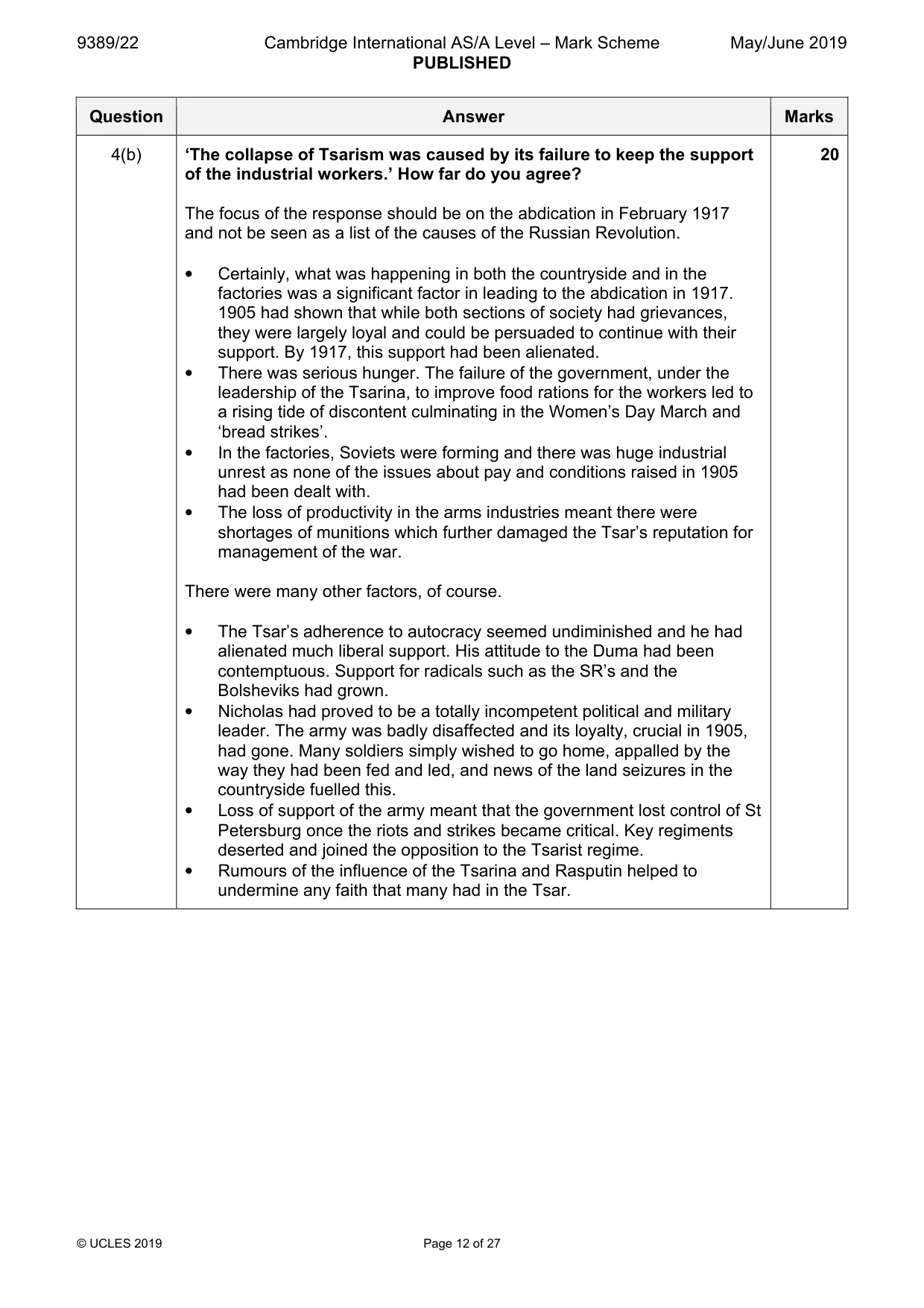
Mark scheme: 4(a) Why, in January 1905, was there a march on the Winter Palace? 10 • Russian workers suffered badly in 1904; the price of essential goods rose so quickly that real wages declined by 20%. • The march was led by Father Gapon, a priest, who was deeply concerned about the condition of many of the poor and the industrial workers of St Petersburg in particular. • The vast majority of all workers lived in appalling conditions and were badly paid with long hours in dangerous conditions. There was no welfare system at all. • The intention was to present a petition to the Tsar, who many still saw as ‘the little father’, a normal practice for the redress of grievances, at the Winter Palace. • The petition stressed the loyalty of the marchers, which included the families of many industrial workers, but asked for improved pay and conditions for workers, as well as an end to the war with Japan and the right to vote. 4(b) ‘The collapse of Tsarism was caused by its failure to keep the support 20 of the industrial workers.’ How far do you agree? The focus of the response should be on the abdication in February 1917 and not be seen as a list of the causes of the Russian Revolution. • Certainly, what was happening in both the countryside and in the factories was a significant factor in leading to the abdication in 1917. 1905 had shown that while both sections of society had grievances, they were largely loyal and could be persuaded to continue with their support. By 1917, this support had been alienated. • There was serious hunger. The failure of the government, under the leadership of the Tsarina, to improve food rations for the workers led to a rising tide of discontent culminating in the Women’s Day March and ‘bread strikes’. • In the factories, Soviets were forming and there was huge industrial unrest as none of the issues about pay and conditions raised in 1905 had been dealt with. • The loss of productivity in the arms industries meant there were shortages of munitions which further damaged the Tsar’s reputation for management of the war. There were many other factors, of course. • The Tsar’s adherence to autocracy seemed undiminished and he had alienated much liberal support. His attitude to the Duma had been contemptuous. Support for radicals such as the SR’s and the Bolsheviks had grown. • Nicholas had proved to be a totally incompetent political and military leader. The army was badly disaffected and its loyalty, crucial in 1905, had gone. Many soldiers simply wished to go home, appalled by the way they had been fed and led, and news of the land seizures in the countryside fuelled this. • Loss of support of the army meant that the government lost control of St Petersburg once the riots and strikes became critical. Key regiments deserted and joined the opposition to the Tsarist regime. • Rumours of the influence of the Tsarina and Rasputin helped to undermine any faith that many had in the Tsar. Section B: American Option The History of the USA, 1840–1941
Q5 · The Expansion of US Power from the 1840s to the 1930s (a) Why, in the 1850s, did the USA…
5 The Expansion of US Power from the 1840s to the 1930s (a) Why, in the 1850s, did the USA send naval fleets to Japan? [10] (b) Assess the significance of the Mexican-American War of 1846–48 for the United States. [20]
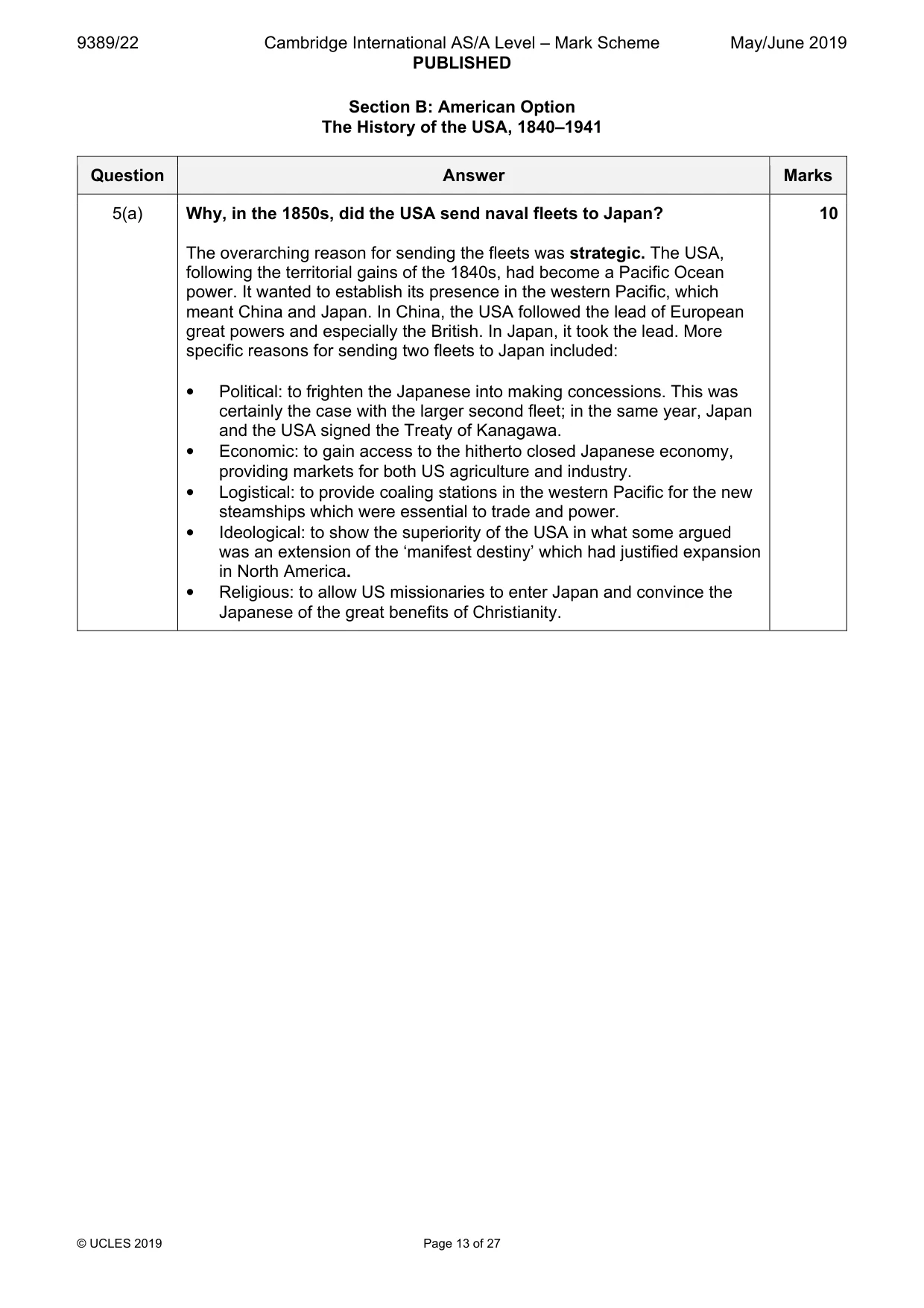
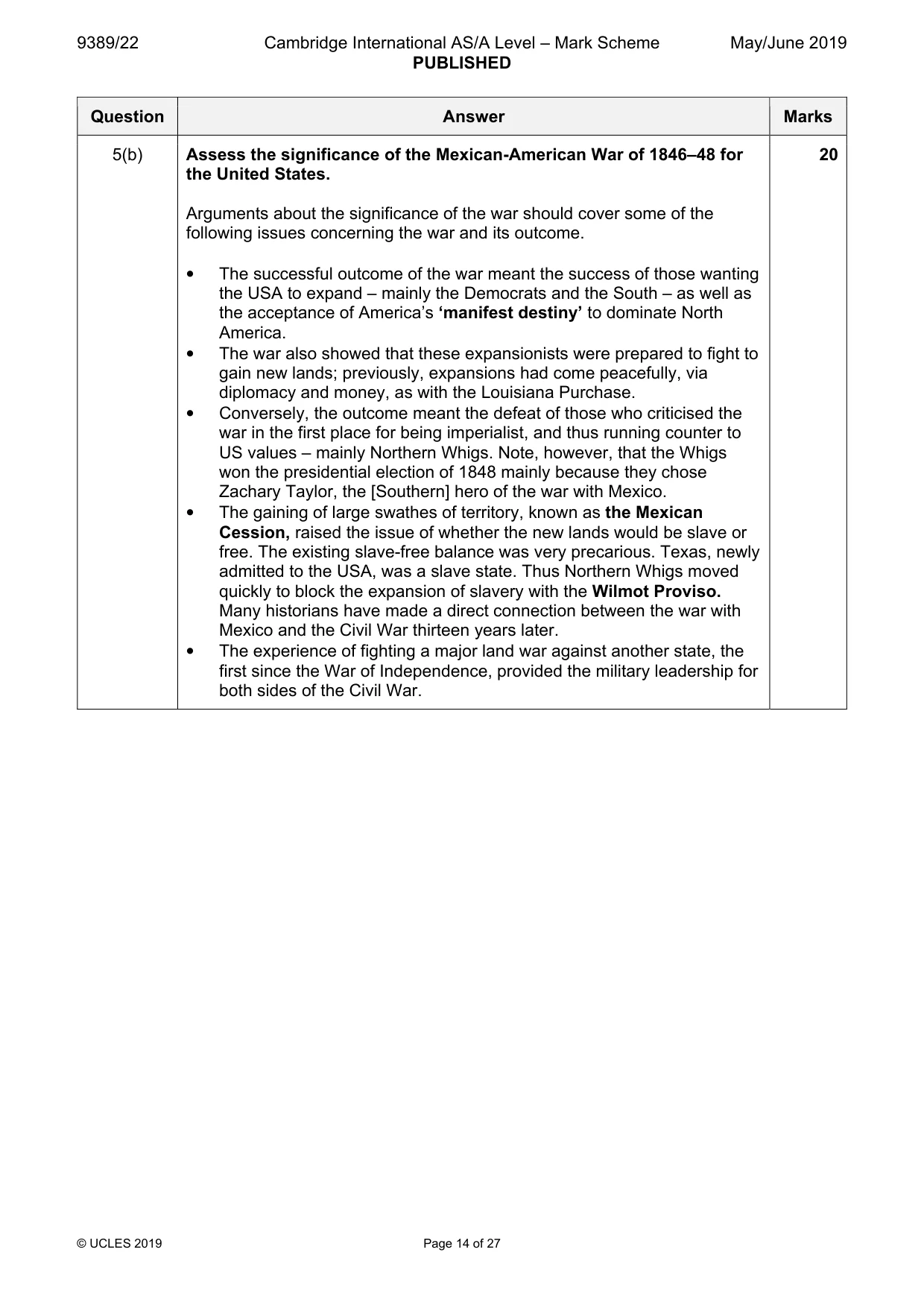
Mark scheme: 5(a) Why, in the 1850s, did the USA send naval fleets to Japan? 10 The overarching reason for sending the fleets was strategic. The USA, following the territorial gains of the 1840s, had become a Pacific Ocean power. It wanted to establish its presence in the western Pacific, which meant China and Japan. In China, the USA followed the lead of European great powers and especially the British. In Japan, it took the lead. More specific reasons for sending two fleets to Japan included: • Political: to frighten the Japanese into making concessions. This was certainly the case with the larger second fleet; in the same year, Japan and the USA signed the Treaty of Kanagawa. • Economic: to gain access to the hitherto closed Japanese economy, providing markets for both US agriculture and industry. • Logistical: to provide coaling stations in the western Pacific for the new steamships which were essential to trade and power. • Ideological: to show the superiority of the USA in what some argued was an extension of the ‘manifest destiny’ which had justified expansion in North America. • Religious: to allow US missionaries to enter Japan and convince the Japanese of the great benefits of Christianity. 5(b) Assess the significance of the Mexican-American War of 1846–48 for 20 the United States. Arguments about the significance of the war should cover some of the following issues concerning the war and its outcome. • The successful outcome of the war meant the success of those wanting the USA to expand – mainly the Democrats and the South – as well as the acceptance of America’s ‘manifest destiny’ to dominate North America. • The war also showed that these expansionists were prepared to fight to gain new lands; previously, expansions had come peacefully, via diplomacy and money, as with the Louisiana Purchase. • Conversely, the outcome meant the defeat of those who criticised the war in the first place for being imperialist, and thus running counter to US values – mainly Northern Whigs. Note, however, that the Whigs won the presidential election of 1848 mainly because they chose Zachary Taylor, the [Southern] hero of the war with Mexico. • The gaining of large swathes of territory, known as the Mexican Cession, raised the issue of whether the new lands would be slave or free. The existing slave-free balance was very precarious. Texas, newly admitted to the USA, was a slave state. Thus Northern Whigs moved quickly to block the expansion of slavery with the Wilmot Proviso. Many historians have made a direct connection between the war with Mexico and the Civil War thirteen years later. • The experience of fighting a major land war against another state, the first since the War of Independence, provided the military leadership for both sides of the Civil War.
Q6 · Civil War and Reconstruction, 1861–1877 (a) Why was the North unable to achieve all its…
6 Civil War and Reconstruction, 1861–1877 (a) Why was the North unable to achieve all its aims for the reconstruction of the South? [10] (b) Assess the strengths and weaknesses of Jefferson Davis’s leadership of the Confederacy. [20]
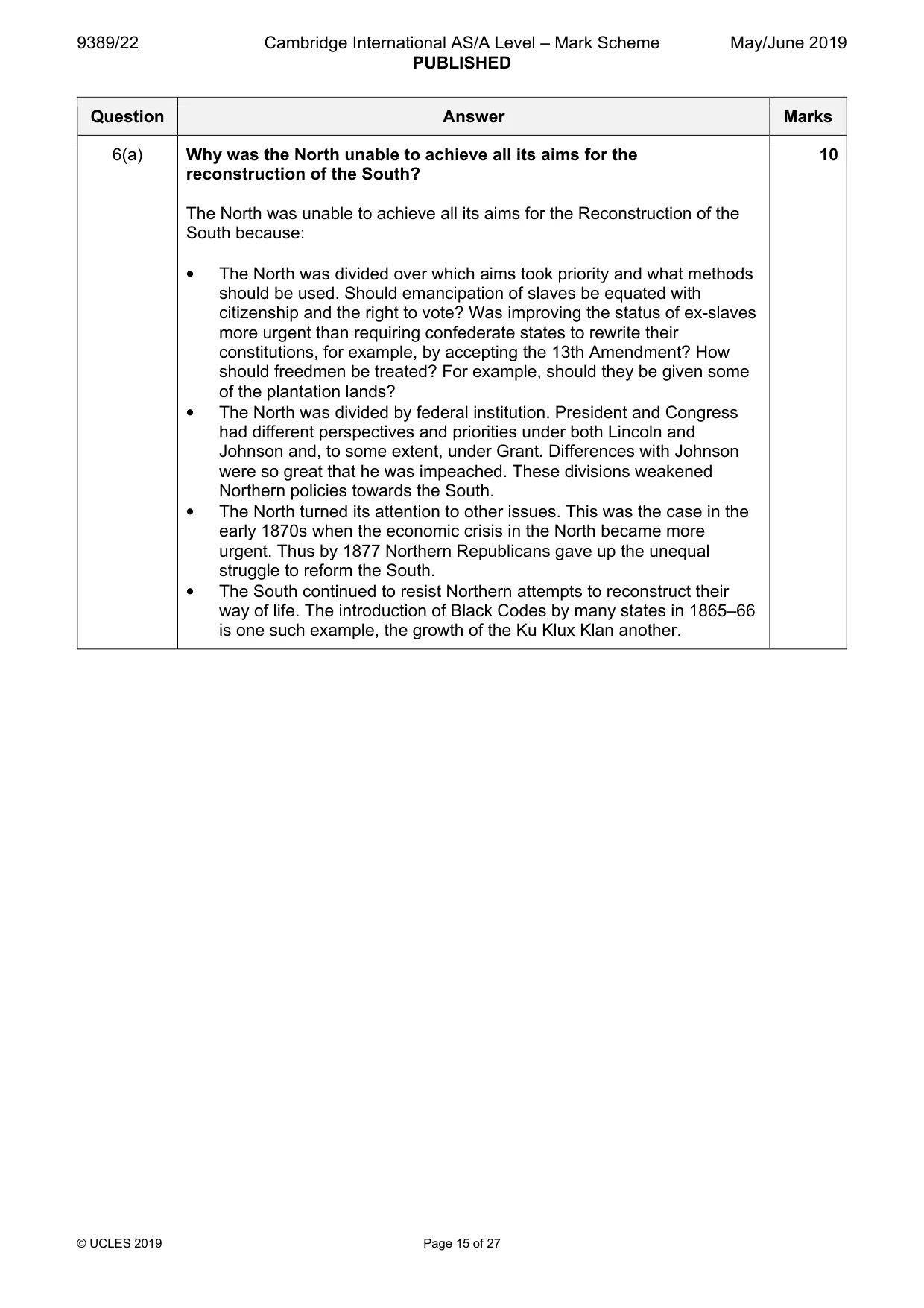
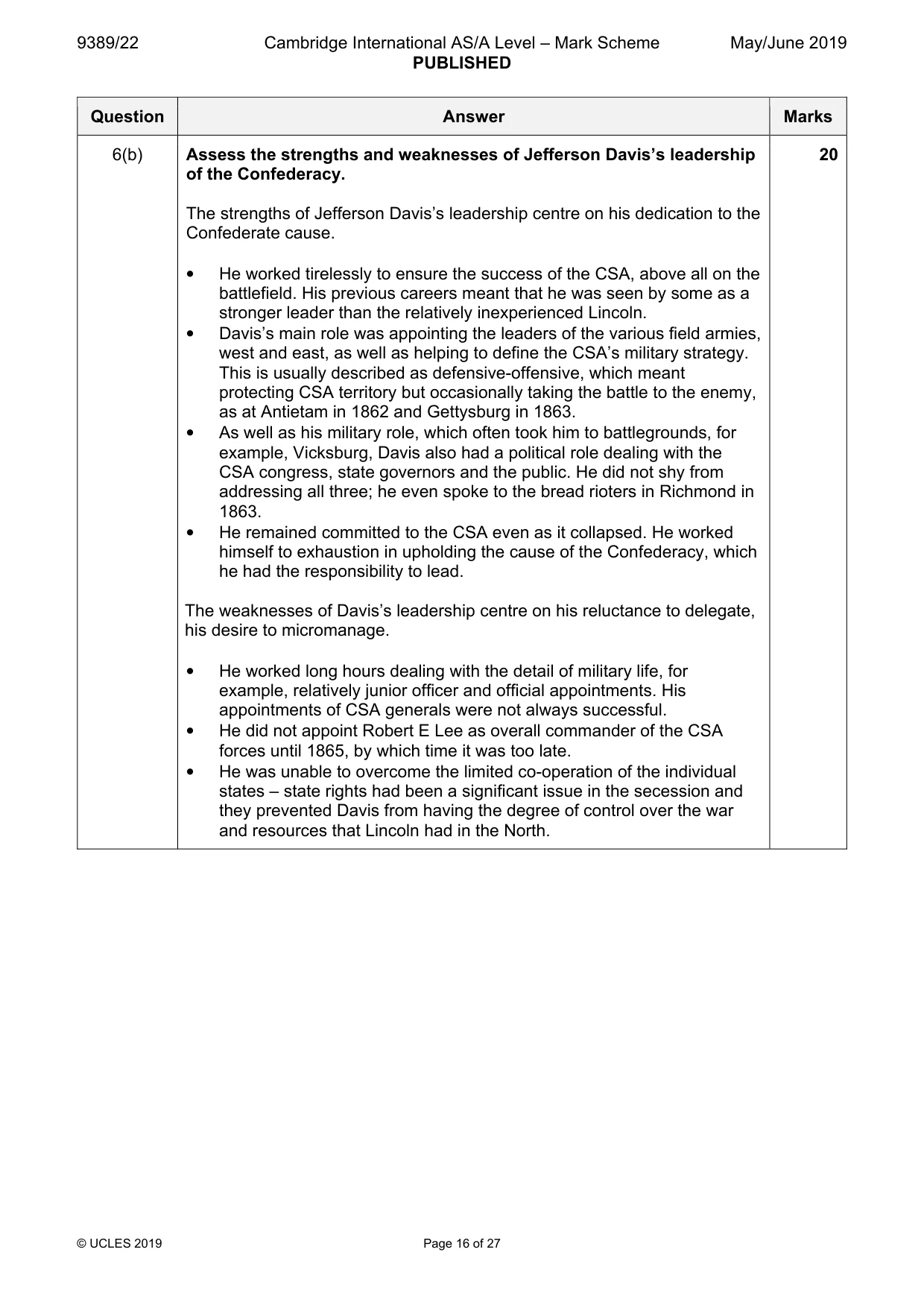
Mark scheme: 6(a) Why was the North unable to achieve all its aims for the 10 reconstruction of the South? The North was unable to achieve all its aims for the Reconstruction of the South because: • The North was divided over which aims took priority and what methods should be used. Should emancipation of slaves be equated with citizenship and the right to vote? Was improving the status of ex-slaves more urgent than requiring confederate states to rewrite their constitutions, for example, by accepting the 13th Amendment? How should freedmen be treated? For example, should they be given some of the plantation lands? • The North was divided by federal institution. President and Congress had different perspectives and priorities under both Lincoln and Johnson and, to some extent, under Grant. Differences with Johnson were so great that he was impeached. These divisions weakened Northern policies towards the South. • The North turned its attention to other issues. This was the case in the early 1870s when the economic crisis in the North became more urgent. Thus by 1877 Northern Republicans gave up the unequal struggle to reform the South. • The South continued to resist Northern attempts to reconstruct their way of life. The introduction of Black Codes by many states in 1865–66 is one such example, the growth of the Ku Klux Klan another. 6(b) Assess the strengths and weaknesses of Jefferson Davis’s leadership 20 of the Confederacy. The strengths of Jefferson Davis’s leadership centre on his dedication to the Confederate cause. • He worked tirelessly to ensure the success of the CSA, above all on the battlefield. His previous careers meant that he was seen by some as a stronger leader than the relatively inexperienced Lincoln. • Davis’s main role was appointing the leaders of the various field armies, west and east, as well as helping to define the CSA’s military strategy. This is usually described as defensive-offensive, which meant protecting CSA territory but occasionally taking the battle to the enemy, as at Antietam in 1862 and Gettysburg in 1863. • As well as his military role, which often took him to battlegrounds, for example, Vicksburg, Davis also had a political role dealing with the CSA congress, state governors and the public. He did not shy from addressing all three; he even spoke to the bread rioters in Richmond in 1863. • He remained committed to the CSA even as it collapsed. He worked himself to exhaustion in upholding the cause of the Confederacy, which he had the responsibility to lead. The weaknesses of Davis’s leadership centre on his reluctance to delegate, his desire to micromanage. • He worked long hours dealing with the detail of military life, for example, relatively junior officer and official appointments. His appointments of CSA generals were not always successful. • He did not appoint Robert E Lee as overall commander of the CSA forces until 1865, by which time it was too late. • He was unable to overcome the limited co-operation of the individual states – state rights had been a significant issue in the secession and they prevented Davis from having the degree of control over the war and resources that Lincoln had in the North.
Q7 · The Gilded Age and the Progressive Era from the 1870s to the 1920s (a) Why did business…
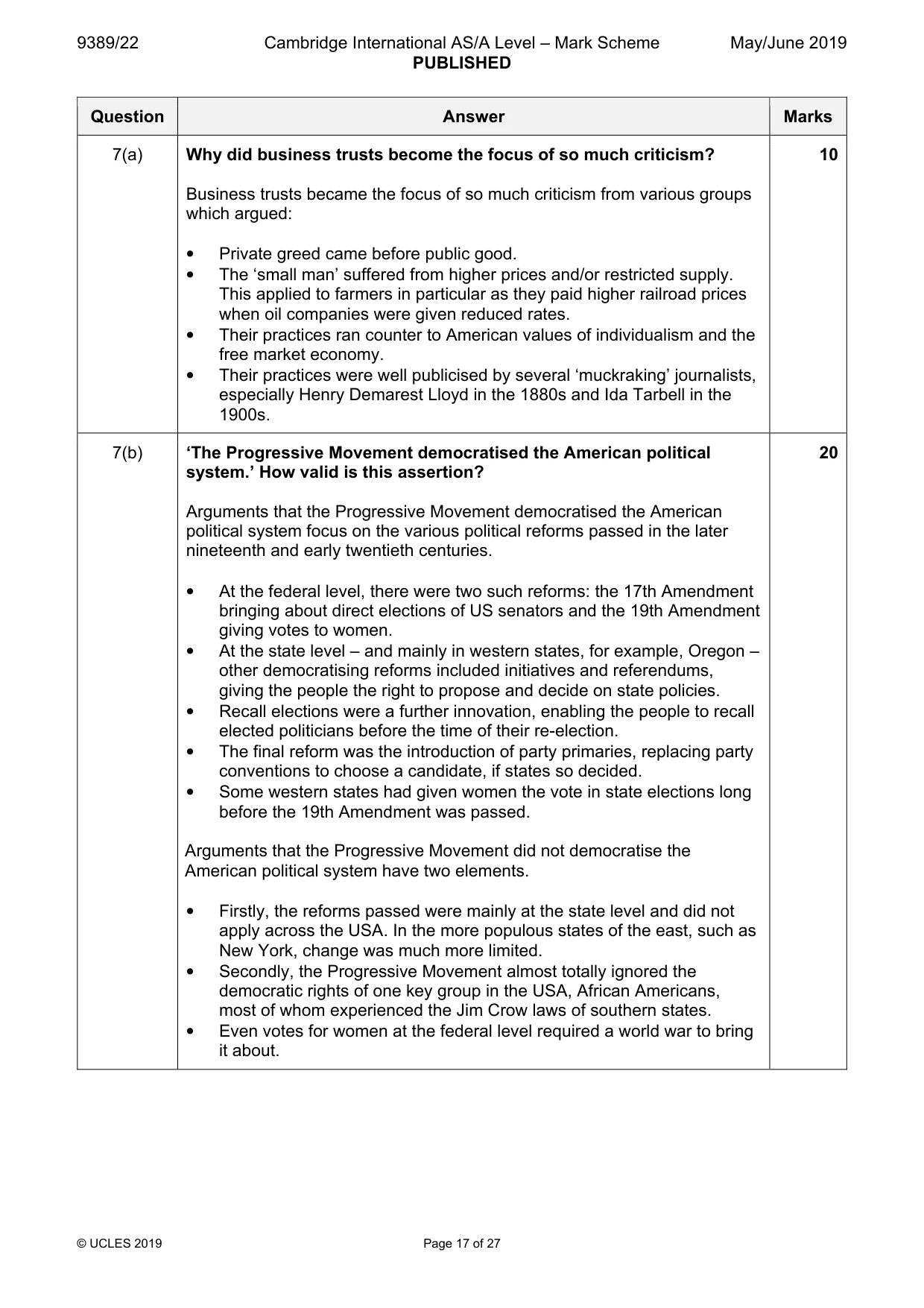
7 The Gilded Age and the Progressive Era from the 1870s to the 1920s (a) Why did business trusts become the focus of much criticism? [10] (b) ‘The Progressive Movement democratised the American political system.’ How valid is this assertion? [20]
Mark scheme: 7(a) Why did business trusts become the focus of so much criticism? 10 Business trusts became the focus of so much criticism from various groups which argued: • Private greed came before public good. • The ‘small man’ suffered from higher prices and/or restricted supply. This applied to farmers in particular as they paid higher railroad prices when oil companies were given reduced rates. • Their practices ran counter to American values of individualism and the free market economy. • Their practices were well publicised by several ‘muckraking’ journalists, especially Henry Demarest Lloyd in the 1880s and Ida Tarbell in the 1900s. 7(b) ‘The Progressive Movement democratised the American political 20 system.’ How valid is this assertion? Arguments that the Progressive Movement democratised the American political system focus on the various political reforms passed in the later nineteenth and early twentieth centuries. • At the federal level, there were two such reforms: the 17th Amendment bringing about direct elections of US senators and the 19th Amendment giving votes to women. • At the state level – and mainly in western states, for example, Oregon – other democratising reforms included initiatives and referendums, giving the people the right to propose and decide on state policies. • Recall elections were a further innovation, enabling the people to recall elected politicians before the time of their re-election. • The final reform was the introduction of party primaries, replacing party conventions to choose a candidate, if states so decided. • Some western states had given women the vote in state elections long before the 19th Amendment was passed. Arguments that the Progressive Movement did not democratise the American political system have two elements. • Firstly, the reforms passed were mainly at the state level and did not apply across the USA. In the more populous states of the east, such as New York, change was much more limited. • Secondly, the Progressive Movement almost totally ignored the democratic rights of one key group in the USA, African Americans, most of whom experienced the Jim Crow laws of southern states. • Even votes for women at the federal level required a world war to bring it about.
Q8 · The Great Crash, the Great Depression and the New Deal, from the 1920s to 1941 (a) Why…
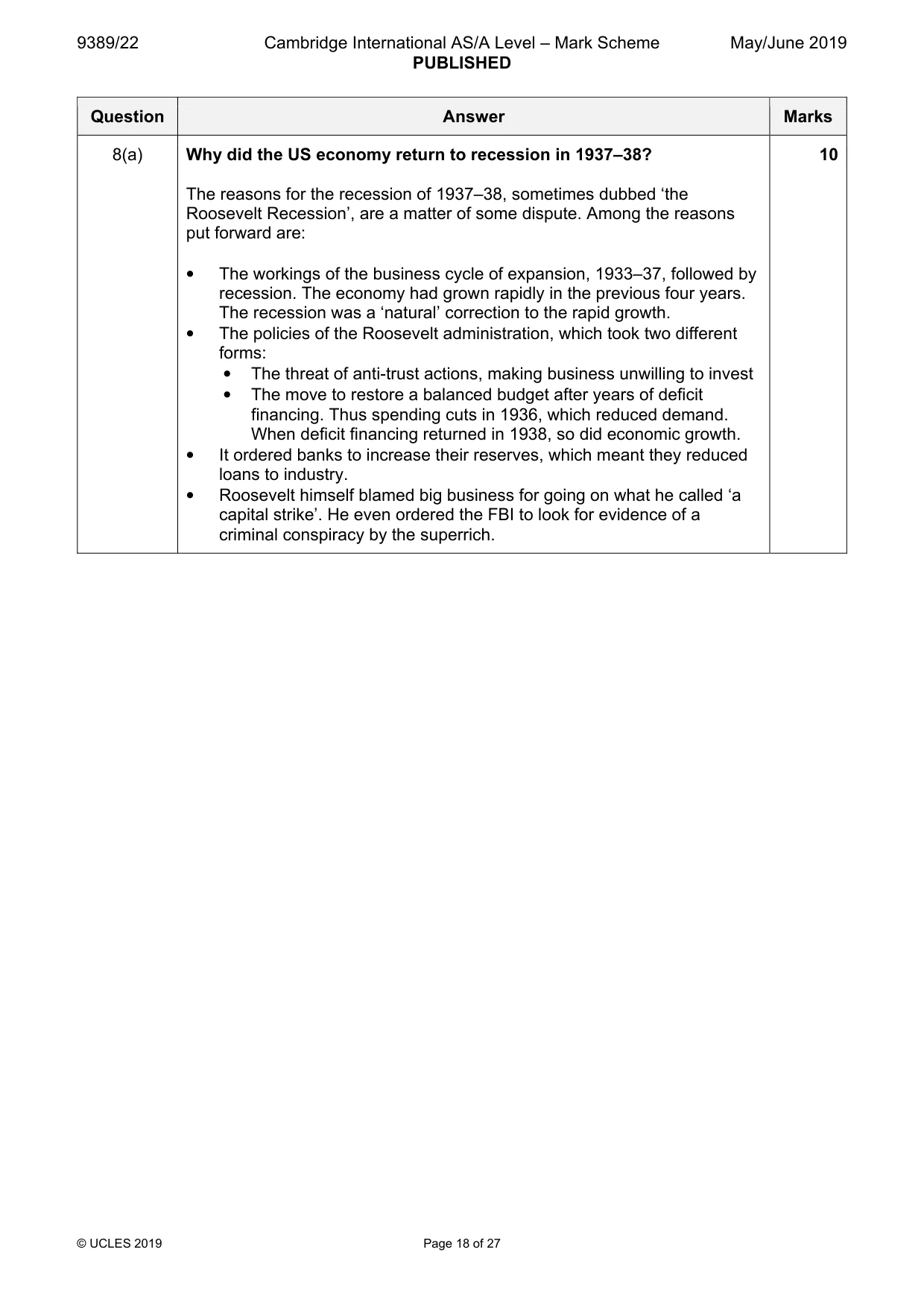
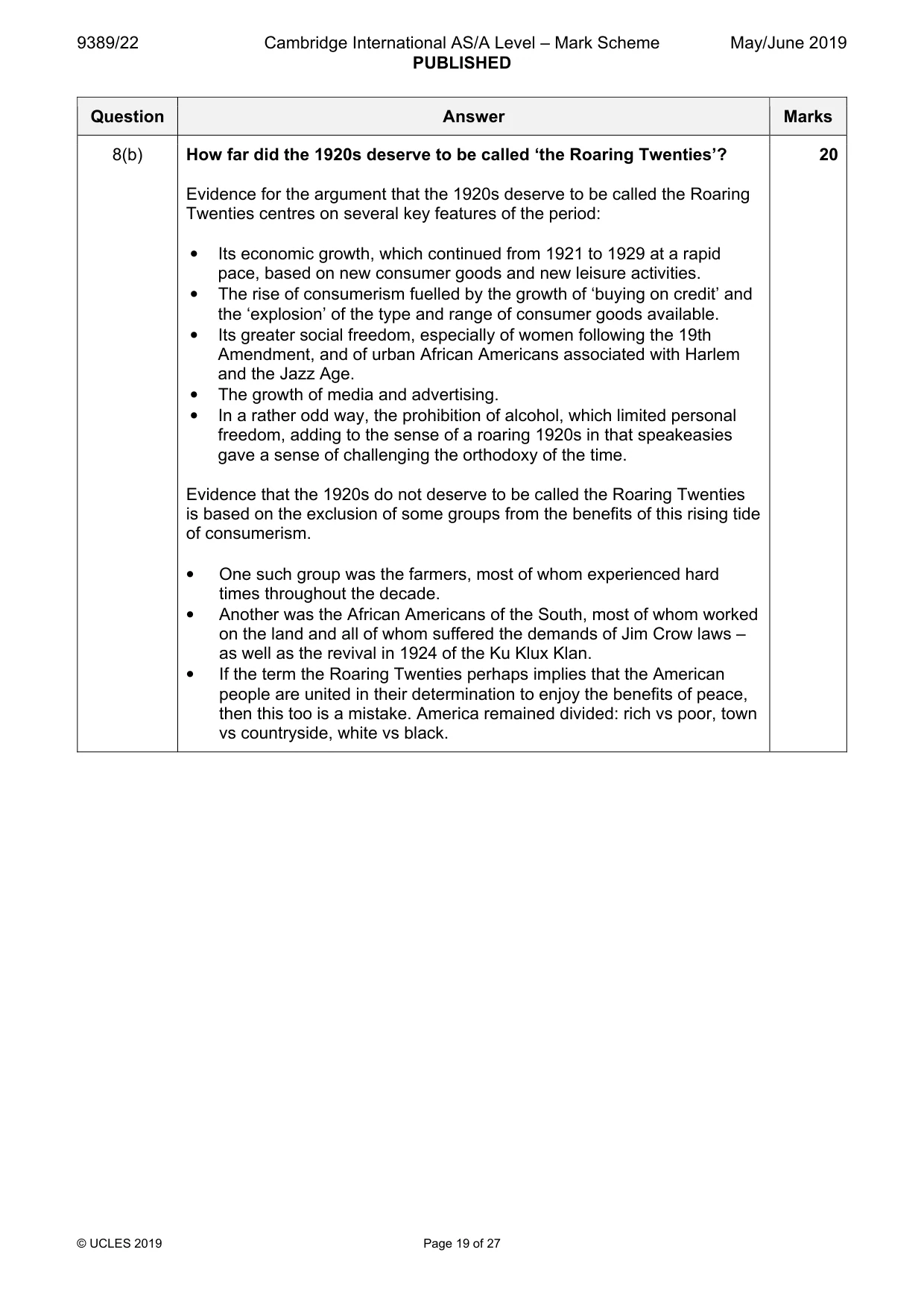
8 The Great Crash, the Great Depression and the New Deal, from the 1920s to 1941 (a) Why did the US economy return to recession in 1937–38? [10] (b) How far did the 1920s deserve to be called ‘the Roaring Twenties’? [20] Section C: International Option International Relations, 1871–1945 Answer both parts of two questions.
Mark scheme: 8(a) Why did the US economy return to recession in 1937–38? 10 The reasons for the recession of 1937–38, sometimes dubbed ‘the Roosevelt Recession’, are a matter of some dispute. Among the reasons put forward are: • The workings of the business cycle of expansion, 1933–37, followed by recession. The economy had grown rapidly in the previous four years. The recession was a ‘natural’ correction to the rapid growth. • The policies of the Roosevelt administration, which took two different forms: • The threat of anti-trust actions, making business unwilling to invest • The move to restore a balanced budget after years of deficit financing. Thus spending cuts in 1936, which reduced demand. When deficit financing returned in 1938, so did economic growth. • It ordered banks to increase their reserves, which meant they reduced loans to industry. • Roosevelt himself blamed big business for going on what he called ‘a capital strike’. He even ordered the FBI to look for evidence of a criminal conspiracy by the superrich. 8(b) How far did the 1920s deserve to be called ‘the Roaring Twenties’? 20 Evidence for the argument that the 1920s deserve to be called the Roaring Twenties centres on several key features of the period: • Its economic growth, which continued from 1921 to 1929 at a rapid pace, based on new consumer goods and new leisure activities. • The rise of consumerism fuelled by the growth of ‘buying on credit’ and the ‘explosion’ of the type and range of consumer goods available. • Its greater social freedom, especially of women following the 19th Amendment, and of urban African Americans associated with Harlem and the Jazz Age. • The growth of media and advertising. • In a rather odd way, the prohibition of alcohol, which limited personal freedom, adding to the sense of a roaring 1920s in that speakeasies gave a sense of challenging the orthodoxy of the time. Evidence that the 1920s do not deserve to be called the Roaring Twenties is based on the exclusion of some groups from the benefits of this rising tide of consumerism. • One such group was the farmers, most of whom experienced hard times throughout the decade. • Another was the African Americans of the South, most of whom worked on the land and all of whom suffered the demands of Jim Crow laws – as well as the revival in 1924 of the Ku Klux Klan. • If the term the Roaring Twenties perhaps implies that the American people are united in their determination to enjoy the benefits of peace, then this too is a mistake. America remained divided: rich vs poor, town vs countryside, white vs black. Section C: International Option International Relations, 1871–1945
Q9 · International Relations, 1871–1918 (a) Why was the Anglo–Russian Entente agreed in 1907?
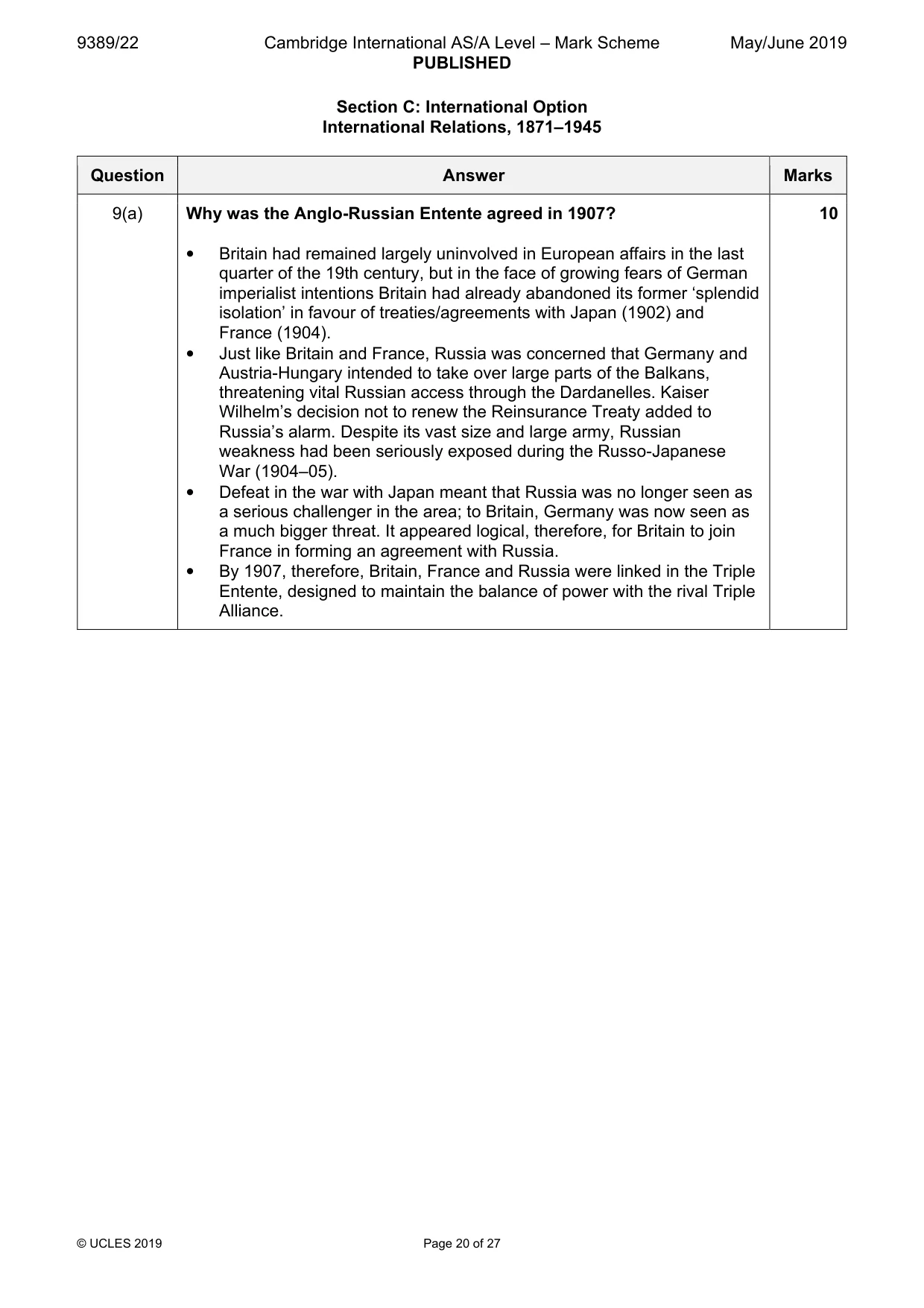
9 International Relations, 1871–1918 (a) Why was the Anglo–Russian Entente agreed in 1907? [10] (b) Which date better marks the emergence of Japan as a world power: 1905 or 1918? [20]
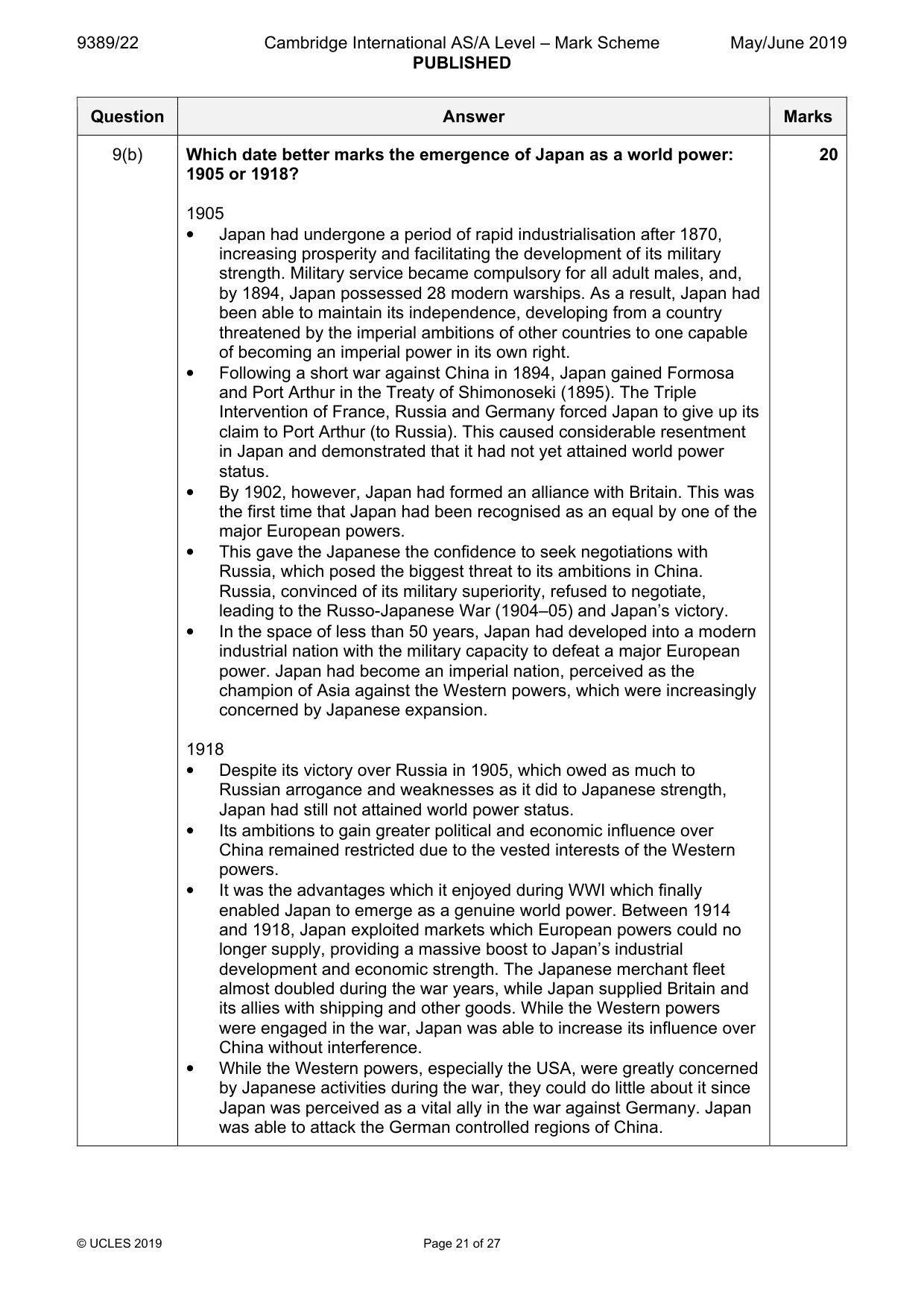
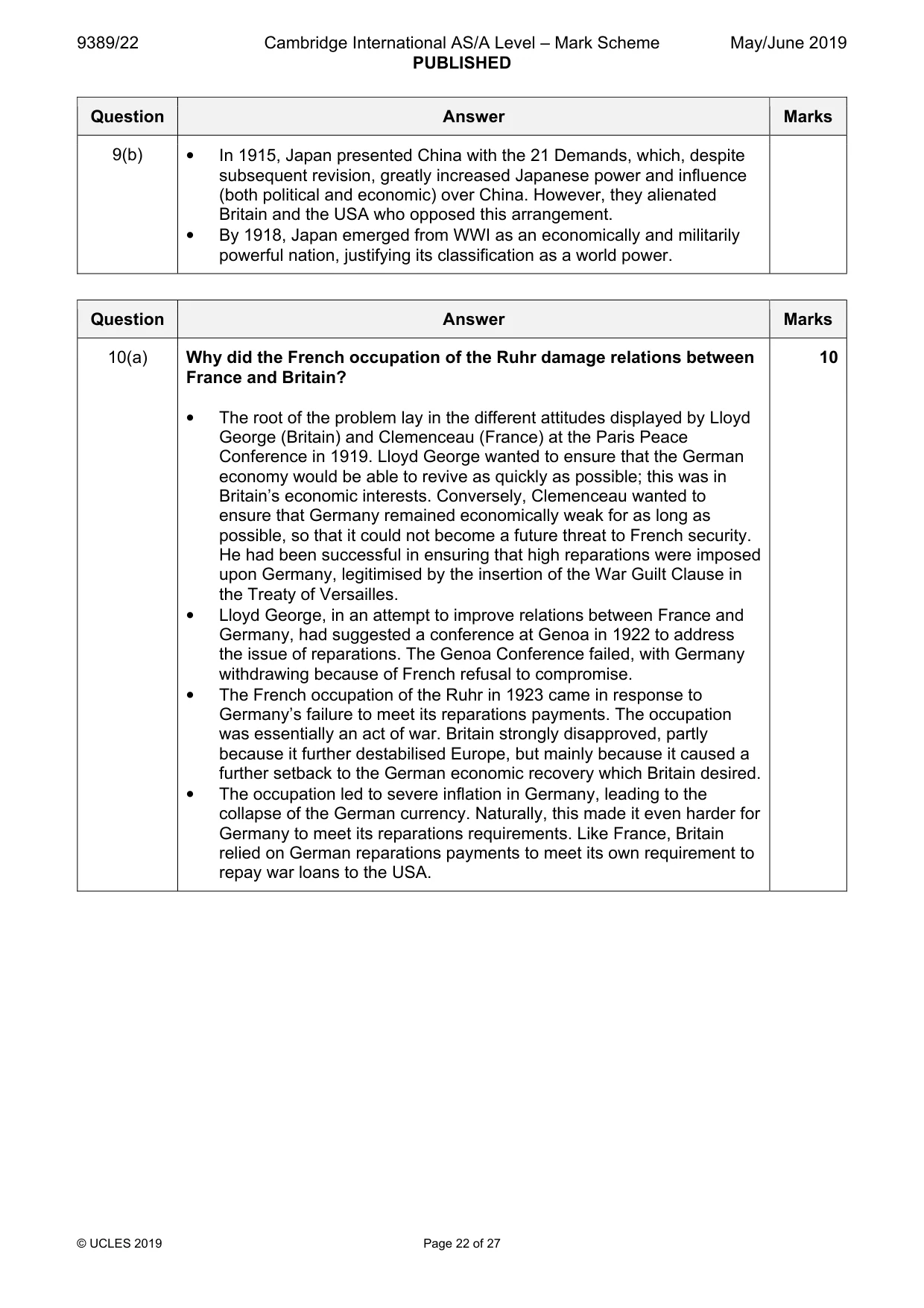
Mark scheme: 9(a) Why was the Anglo-Russian Entente agreed in 1907? 10 • Britain had remained largely uninvolved in European affairs in the last quarter of the 19th century, but in the face of growing fears of German imperialist intentions Britain had already abandoned its former ‘splendid isolation’ in favour of treaties/agreements with Japan (1902) and France (1904). • Just like Britain and France, Russia was concerned that Germany and Austria-Hungary intended to take over large parts of the Balkans, threatening vital Russian access through the Dardanelles. Kaiser Wilhelm’s decision not to renew the Reinsurance Treaty added to Russia’s alarm. Despite its vast size and large army, Russian weakness had been seriously exposed during the Russo-Japanese War (1904–05). • Defeat in the war with Japan meant that Russia was no longer seen as a serious challenger in the area; to Britain, Germany was now seen as a much bigger threat. It appeared logical, therefore, for Britain to join France in forming an agreement with Russia. • By 1907, therefore, Britain, France and Russia were linked in the Triple Entente, designed to maintain the balance of power with the rival Triple Alliance. 9(b) Which date better marks the emergence of Japan as a world power: 20 1905 or 1918? 1905 • Japan had undergone a period of rapid industrialisation after 1870, increasing prosperity and facilitating the development of its military strength. Military service became compulsory for all adult males, and, by 1894, Japan possessed 28 modern warships. As a result, Japan had been able to maintain its independence, developing from a country threatened by the imperial ambitions of other countries to one capable of becoming an imperial power in its own right. • Following a short war against China in 1894, Japan gained Formosa and Port Arthur in the Treaty of Shimonoseki (1895). The Triple Intervention of France, Russia and Germany forced Japan to give up its claim to Port Arthur (to Russia). This caused considerable resentment in Japan and demonstrated that it had not yet attained world power status. • By 1902, however, Japan had formed an alliance with Britain. This was the first time that Japan had been recognised as an equal by one of the major European powers. • This gave the Japanese the confidence to seek negotiations with Russia, which posed the biggest threat to its ambitions in China. Russia, convinced of its military superiority, refused to negotiate, leading to the Russo-Japanese War (1904–05) and Japan’s victory. • In the space of less than 50 years, Japan had developed into a modern industrial nation with the military capacity to defeat a major European power. Japan had become an imperial nation, perceived as the champion of Asia against the Western powers, which were increasingly concerned by Japanese expansion. 1918 • Despite its victory over Russia in 1905, which owed as much to Russian arrogance and weaknesses as it did to Japanese strength, Japan had still not attained world power status. • Its ambitions to gain greater political and economic influence over China remained restricted due to the vested interests of the Western powers. • It was the advantages which it enjoyed during WWI which finally enabled Japan to emerge as a genuine world power. Between 1914 and 1918, Japan exploited markets which European powers could no longer supply, providing a massive boost to Japan’s industrial development and economic strength. The Japanese merchant fleet almost doubled during the war years, while Japan supplied Britain and its allies with shipping and other goods. While the Western powers were engaged in the war, Japan was able to increase its influence over China without interference. • While the Western powers, especially the USA, were greatly concerned by Japanese activities during the war, they could do little about it since Japan was perceived as a vital ally in the war against Germany. Japan was able to attack the German controlled regions of China.
Q10 · International Relations, 1919–1933 (a) Why did the French occupation of the Ruhr damage…
10 International Relations, 1919–1933 (a) Why did the French occupation of the Ruhr damage relations between France and Britain? [10] (b) To what extent did the Locarno Treaties of 1925 reduce international tensions? [20]
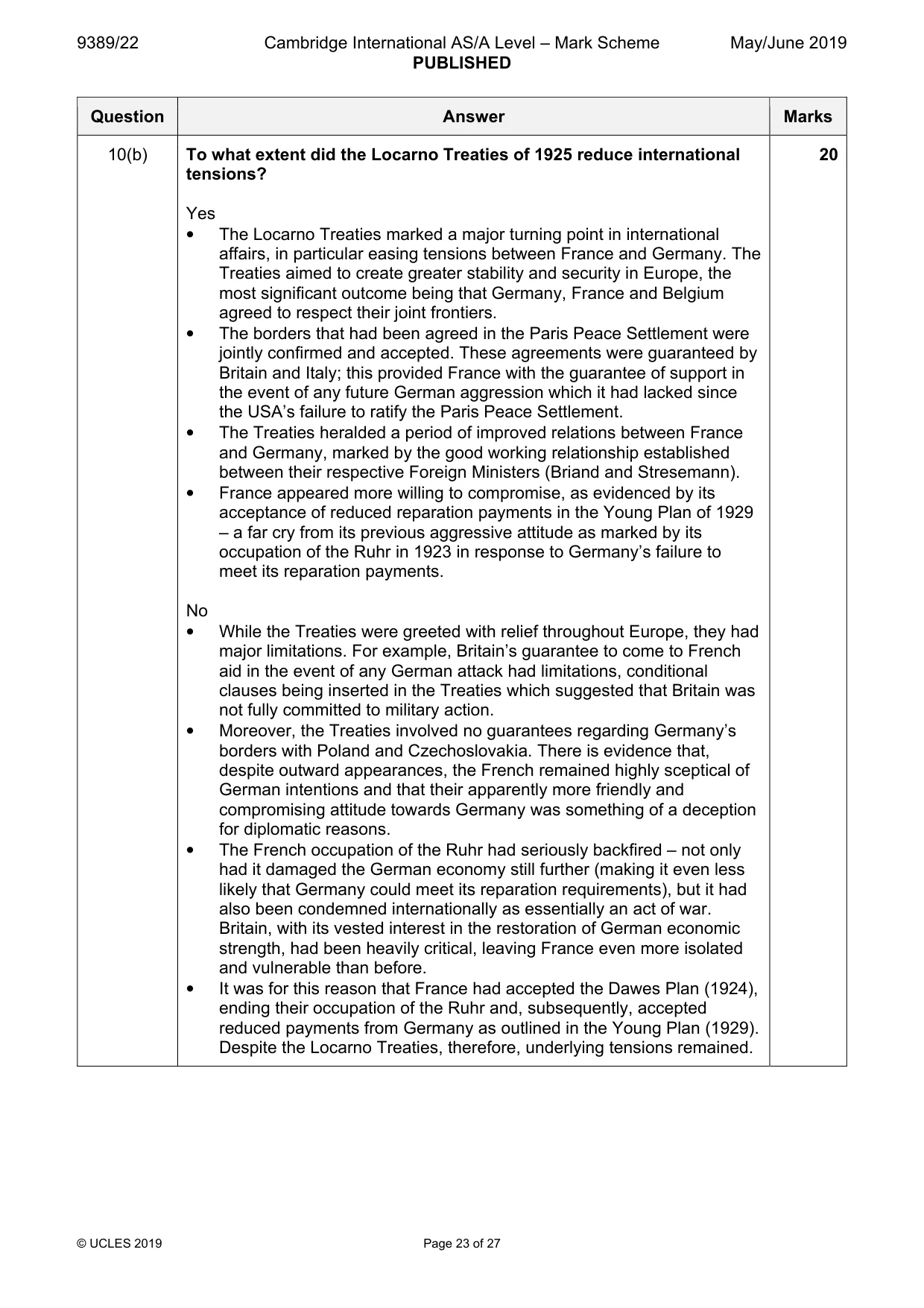
Mark scheme: 10(a) Why did the French occupation of the Ruhr damage relations between 10 France and Britain? • The root of the problem lay in the different attitudes displayed by Lloyd George (Britain) and Clemenceau (France) at the Paris Peace Conference in 1919. Lloyd George wanted to ensure that the German economy would be able to revive as quickly as possible; this was in Britain’s economic interests. Conversely, Clemenceau wanted to ensure that Germany remained economically weak for as long as possible, so that it could not become a future threat to French security. He had been successful in ensuring that high reparations were imposed upon Germany, legitimised by the insertion of the War Guilt Clause in the Treaty of Versailles. • Lloyd George, in an attempt to improve relations between France and Germany, had suggested a conference at Genoa in 1922 to address the issue of reparations. The Genoa Conference failed, with Germany withdrawing because of French refusal to compromise. • The French occupation of the Ruhr in 1923 came in response to Germany’s failure to meet its reparations payments. The occupation was essentially an act of war. Britain strongly disapproved, partly because it further destabilised Europe, but mainly because it caused a further setback to the German economic recovery which Britain desired. • The occupation led to severe inflation in Germany, leading to the collapse of the German currency. Naturally, this made it even harder for Germany to meet its reparations requirements. Like France, Britain relied on German reparations payments to meet its own requirement to repay war loans to the USA. 10(b) To what extent did the Locarno Treaties of 1925 reduce international 20 tensions? Yes • The Locarno Treaties marked a major turning point in international affairs, in particular easing tensions between France and Germany. The Treaties aimed to create greater stability and security in Europe, the most significant outcome being that Germany, France and Belgium agreed to respect their joint frontiers. • The borders that had been agreed in the Paris Peace Settlement were jointly confirmed and accepted. These agreements were guaranteed by Britain and Italy; this provided France with the guarantee of support in the event of any future German aggression which it had lacked since the USA’s failure to ratify the Paris Peace Settlement. • The Treaties heralded a period of improved relations between France and Germany, marked by the good working relationship established between their respective Foreign Ministers (Briand and Stresemann). • France appeared more willing to compromise, as evidenced by its acceptance of reduced reparation payments in the Young Plan of 1929 – a far cry from its previous aggressive attitude as marked by its occupation of the Ruhr in 1923 in response to Germany’s failure to meet its reparation payments. No • While the Treaties were greeted with relief throughout Europe, they had major limitations. For example, Britain’s guarantee to come to French aid in the event of any German attack had limitations, conditional clauses being inserted in the Treaties which suggested that Britain was not fully committed to military action. • Moreover, the Treaties involved no guarantees regarding Germany’s borders with Poland and Czechoslovakia. There is evidence that, despite outward appearances, the French remained highly sceptical of German intentions and that their apparently more friendly and compromising attitude towards Germany was something of a deception for diplomatic reasons. • The French occupation of the Ruhr had seriously backfired – not only had it damaged the German economy still further (making it even less likely that Germany could meet its reparation requirements), but it had also been condemned internationally as essentially an act of war. Britain, with its vested interest in the restoration of German economic strength, had been heavily critical, leaving France even more isolated and vulnerable than before. • It was for this reason that France had accepted the Dawes Plan (1924), ending their occupation of the Ruhr and, subsequently, accepted reduced payments from Germany as outlined in the Young Plan (1929). Despite the Locarno Treaties, therefore, underlying tensions remained.
Q11 · International Relations, c.1933–1939 (a) Why, given his hatred of communism, did Hitler…
11 International Relations, c.1933–1939 (a) Why, given his hatred of communism, did Hitler sign a non-aggression pact with Soviet Russia in 1939? [10] (b) ‘A foolish strategy, for which there can be no justification.’ How far do you agree with this assessment of Britain’s appeasement policy? [20]
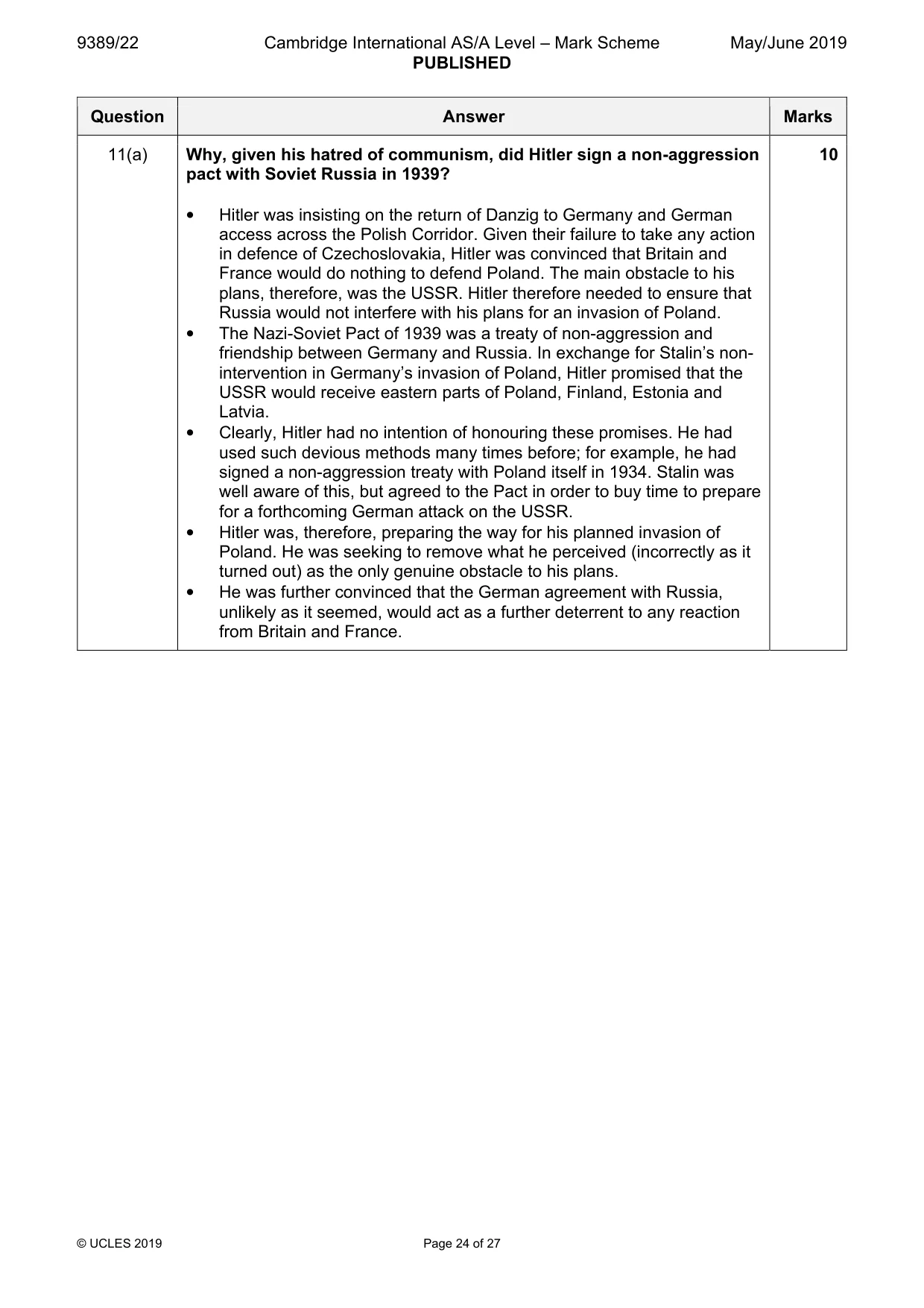
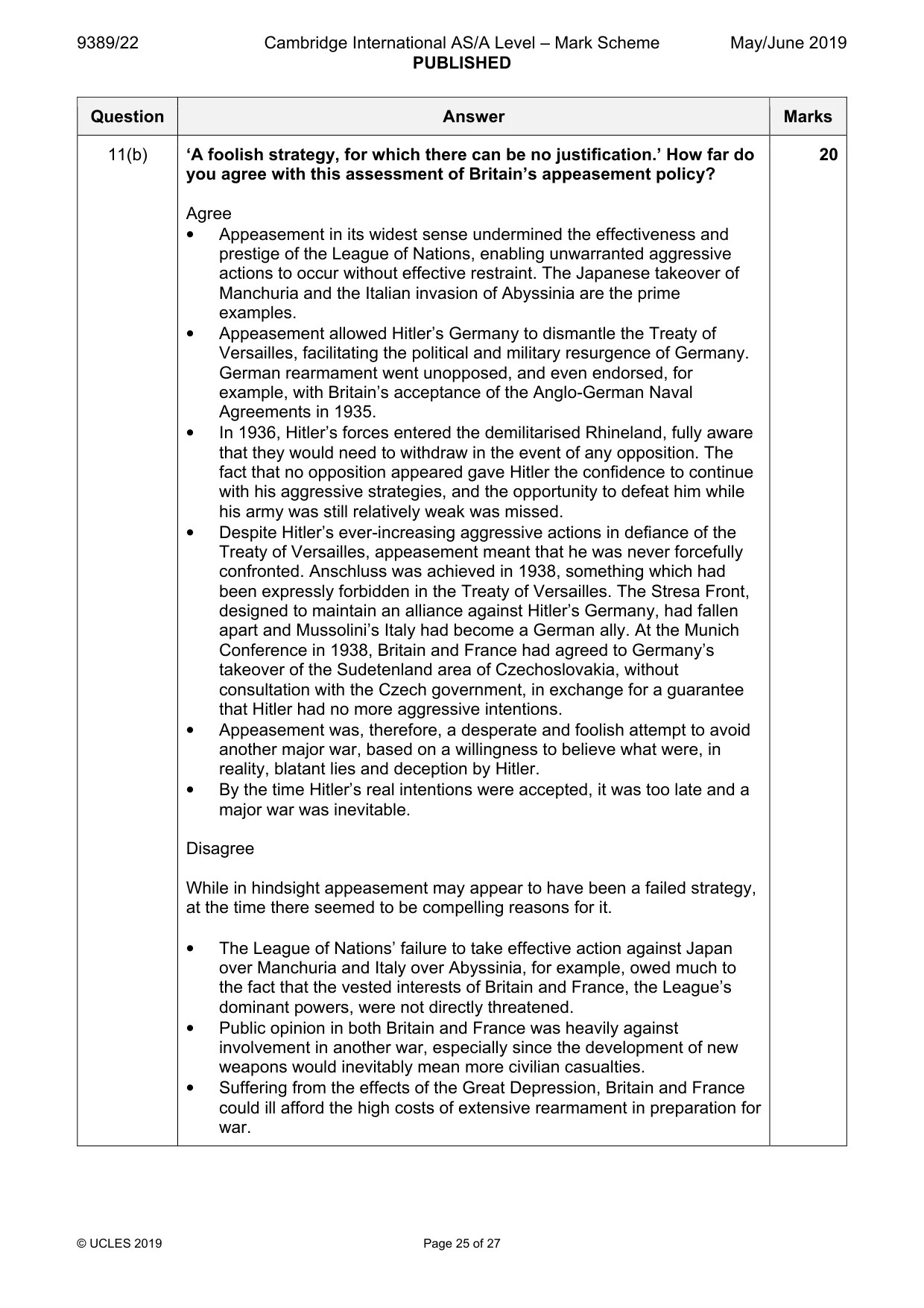
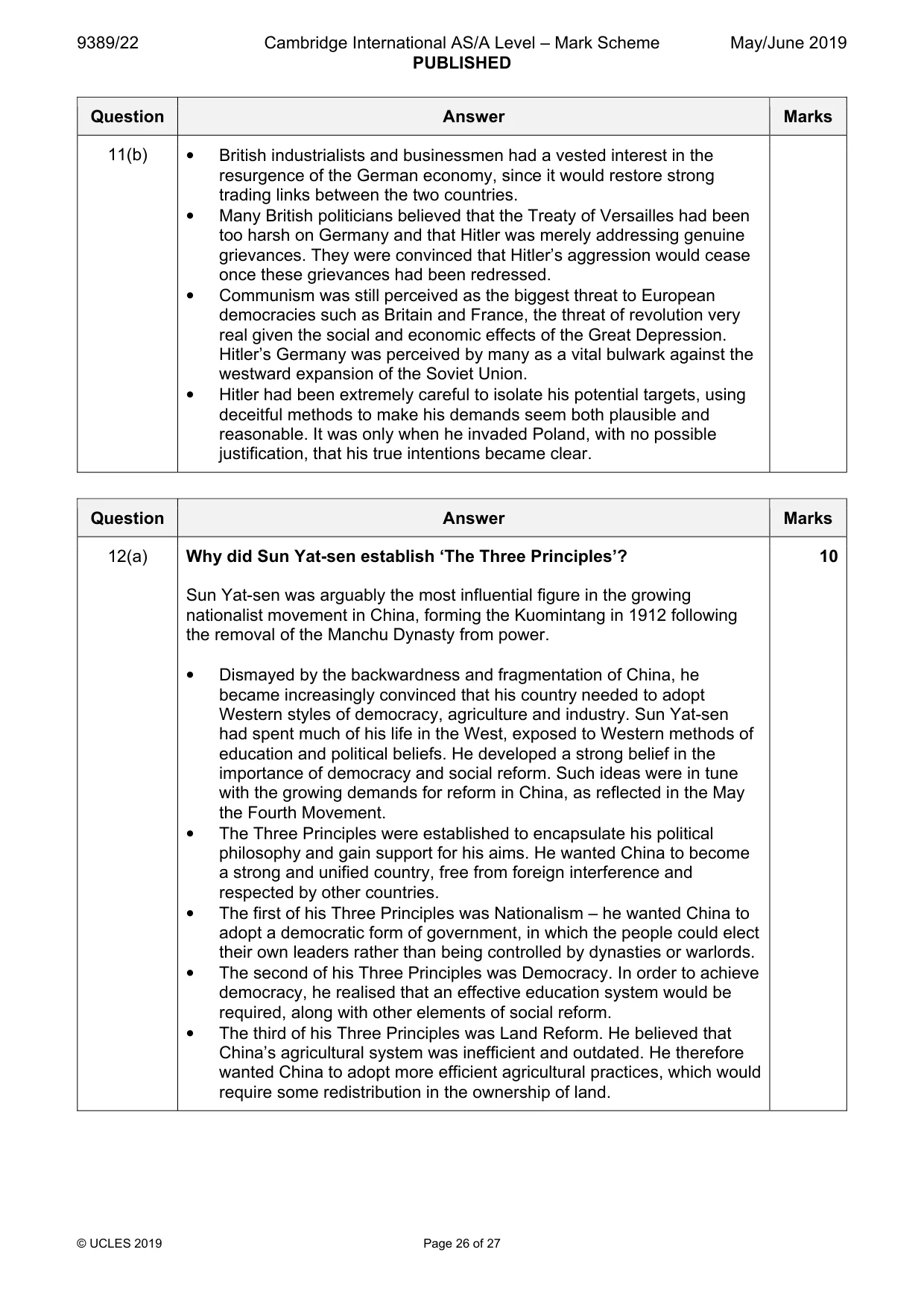
Mark scheme: 11(a) Why, given his hatred of communism, did Hitler sign a non-aggression 10 pact with Soviet Russia in 1939? • Hitler was insisting on the return of Danzig to Germany and German access across the Polish Corridor. Given their failure to take any action in defence of Czechoslovakia, Hitler was convinced that Britain and France would do nothing to defend Poland. The main obstacle to his plans, therefore, was the USSR. Hitler therefore needed to ensure that Russia would not interfere with his plans for an invasion of Poland. • The Nazi-Soviet Pact of 1939 was a treaty of non-aggression and friendship between Germany and Russia. In exchange for Stalin’s non- intervention in Germany’s invasion of Poland, Hitler promised that the USSR would receive eastern parts of Poland, Finland, Estonia and Latvia. • Clearly, Hitler had no intention of honouring these promises. He had used such devious methods many times before; for example, he had signed a non-aggression treaty with Poland itself in 1934. Stalin was well aware of this, but agreed to the Pact in order to buy time to prepare for a forthcoming German attack on the USSR. • Hitler was, therefore, preparing the way for his planned invasion of Poland. He was seeking to remove what he perceived (incorrectly as it turned out) as the only genuine obstacle to his plans. • He was further convinced that the German agreement with Russia, unlikely as it seemed, would act as a further deterrent to any reaction from Britain and France. 11(b) ‘A foolish strategy, for which there can be no justification.’ How far do 20 you agree with this assessment of Britain’s appeasement policy? Agree • Appeasement in its widest sense undermined the effectiveness and prestige of the League of Nations, enabling unwarranted aggressive actions to occur without effective restraint. The Japanese takeover of Manchuria and the Italian invasion of Abyssinia are the prime examples. • Appeasement allowed Hitler’s Germany to dismantle the Treaty of Versailles, facilitating the political and military resurgence of Germany. German rearmament went unopposed, and even endorsed, for example, with Britain’s acceptance of the Anglo-German Naval Agreements in 1935. • In 1936, Hitler’s forces entered the demilitarised Rhineland, fully aware that they would need to withdraw in the event of any opposition. The fact that no opposition appeared gave Hitler the confidence to continue with his aggressive strategies, and the opportunity to defeat him while his army was still relatively weak was missed. • Despite Hitler’s ever-increasing aggressive actions in defiance of the Treaty of Versailles, appeasement meant that he was never forcefully confronted. Anschluss was achieved in 1938, something which had been expressly forbidden in the Treaty of Versailles. The Stresa Front, designed to maintain an alliance against Hitler’s Germany, had fallen apart and Mussolini’s Italy had become a German ally. At the Munich Conference in 1938, Britain and France had agreed to Germany’s takeover of the Sudetenland area of Czechoslovakia, without consultation with the Czech government, in exchange for a guarantee that Hitler had no more aggressive intentions. • Appeasement was, therefore, a desperate and foolish attempt to avoid another major war, based on a willingness to believe what were, in reality, blatant lies and deception by Hitler. • By the time Hitler’s real intentions were accepted, it was too late and a major war was inevitable. Disagree While in hindsight appeasement may appear to have been a failed strategy, at the time there seemed to be compelling reasons for it. • The League of Nations’ failure to take effective action against Japan over Manchuria and Italy over Abyssinia, for example, owed much to the fact that the vested interests of Britain and France, the League’s dominant powers, were not directly threatened. • Public opinion in both Britain and France was heavily against involvement in another war, especially since the development of new weapons would inevitably mean more civilian casualties. • Suffering from the effects of the Great Depression, Britain and France could ill afford the high costs of extensive rearmament in preparation for war.
Q12 · China and Japan, 1919–1945 (a) Why did Sun Yat-sen establish ‘The Three Principles’?
12 China and Japan, 1919–1945 (a) Why did Sun Yat-sen establish ‘The Three Principles’? [10] (b) How far do you agree that the Japanese attack on Pearl Harbor ended in failure? [20]
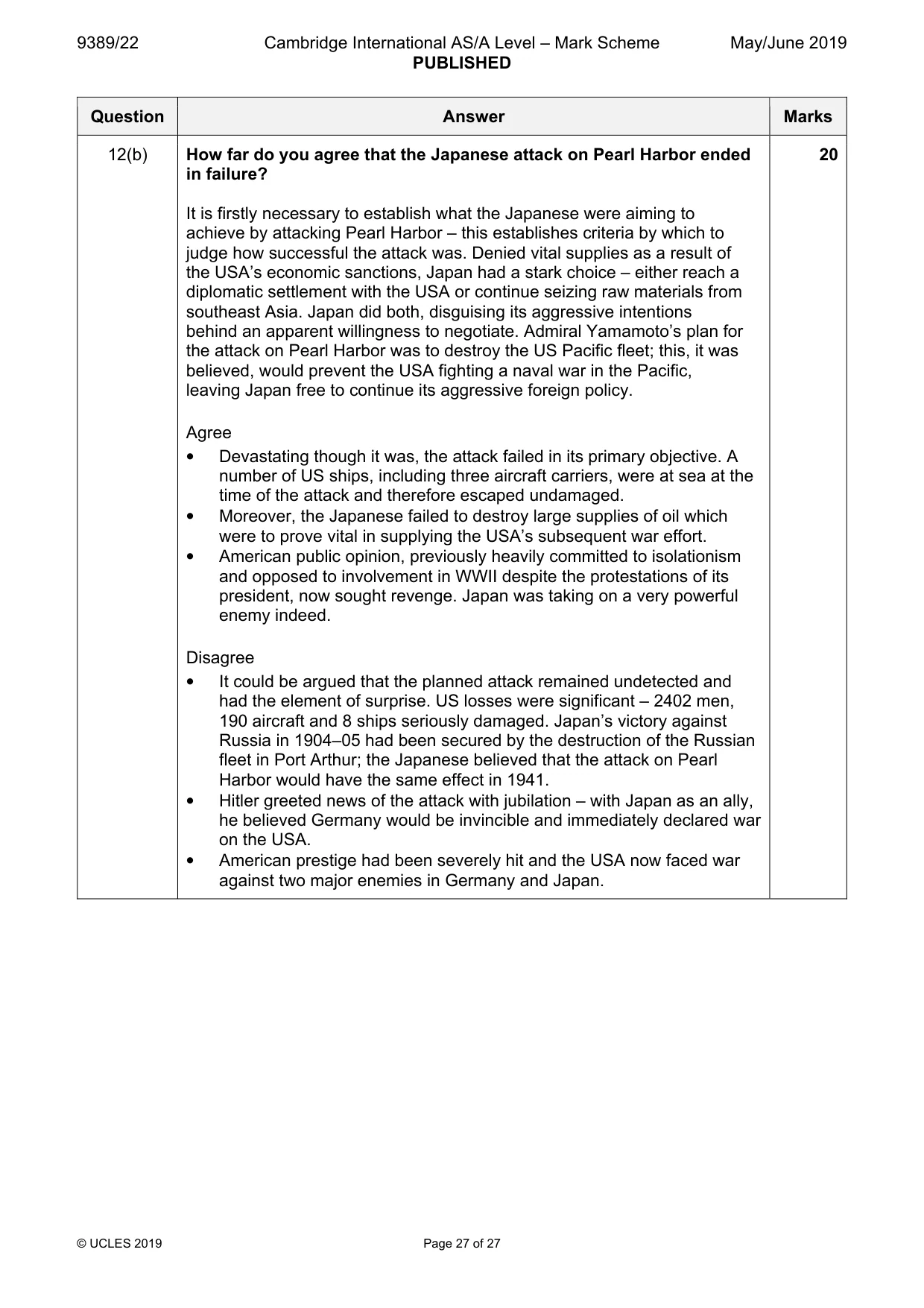
Mark scheme: 12(a) Why did Sun Yat-sen establish ‘The Three Principles’? 10 Sun Yat-sen was arguably the most influential figure in the growing nationalist movement in China, forming the Kuomintang in 1912 following the removal of the Manchu Dynasty from power. • Dismayed by the backwardness and fragmentation of China, he became increasingly convinced that his country needed to adopt Western styles of democracy, agriculture and industry. Sun Yat-sen had spent much of his life in the West, exposed to Western methods of education and political beliefs. He developed a strong belief in the importance of democracy and social reform. Such ideas were in tune with the growing demands for reform in China, as reflected in the May the Fourth Movement. • The Three Principles were established to encapsulate his political philosophy and gain support for his aims. He wanted China to become a strong and unified country, free from foreign interference and respected by other countries. • The first of his Three Principles was Nationalism – he wanted China to adopt a democratic form of government, in which the people could elect their own leaders rather than being controlled by dynasties or warlords. • The second of his Three Principles was Democracy. In order to achieve democracy, he realised that an effective education system would be required, along with other elements of social reform. • The third of his Three Principles was Land Reform. He believed that China’s agricultural system was inefficient and outdated. He therefore wanted China to adopt more efficient agricultural practices, which would require some redistribution in the ownership of land. 12(b) How far do you agree that the Japanese attack on Pearl Harbor ended 20 in failure? It is firstly necessary to establish what the Japanese were aiming to achieve by attacking Pearl Harbor – this establishes criteria by which to judge how successful the attack was. Denied vital supplies as a result of the USA’s economic sanctions, Japan had a stark choice – either reach a diplomatic settlement with the USA or continue seizing raw materials from southeast Asia. Japan did both, disguising its aggressive intentions behind an apparent willingness to negotiate. Admiral Yamamoto’s plan for the attack on Pearl Harbor was to destroy the US Pacific fleet; this, it was believed, would prevent the USA fighting a naval war in the Pacific, leaving Japan free to continue its aggressive foreign policy. Agree • Devastating though it was, the attack failed in its primary objective. A number of US ships, including three aircraft carriers, were at sea at the time of the attack and therefore escaped undamaged. • Moreover, the Japanese failed to destroy large supplies of oil which were to prove vital in supplying the USA’s subsequent war effort. • American public opinion, previously heavily committed to isolationism and opposed to involvement in WWII despite the protestations of its president, now sought revenge. Japan was taking on a very powerful enemy indeed. Disagree • It could be argued that the planned attack remained undetected and had the element of surprise. US losses were significant – 2402 men, 190 aircraft and 8 ships seriously damaged. Japan’s victory against Russia in 1904–05 had been secured by the destruction of the Russian fleet in Port Arthur; the Japanese believed that the attack on Pearl Harbor would have the same effect in 1941. • Hitler greeted news of the attack with jubilation – with Japan as an ally, he believed Germany would be invincible and immediately declared war on the USA. • American prestige had been severely hit and the USA now faced war against two major enemies in Germany and Japan.
What you needed in this session
Cambridge’s own grade thresholds for 2019 May/June, Paper 2 · Variant 2. A higher threshold means an easier paper — the bar moves with how the cohort did.