Cambridge A Level History 9389 — 2020 May/June Paper 2 · Variant 2
9389/22/M/J/20 · 12 questions · 360 marks · ≈405 min
The question paper and its mark scheme, free to read here and free to download. This is Cambridge’s own paper, exactly as it was sat.
Question paper4 pages
Mark scheme17 pages
Answers below. Sit the paper first if you are practising.
Questions as text
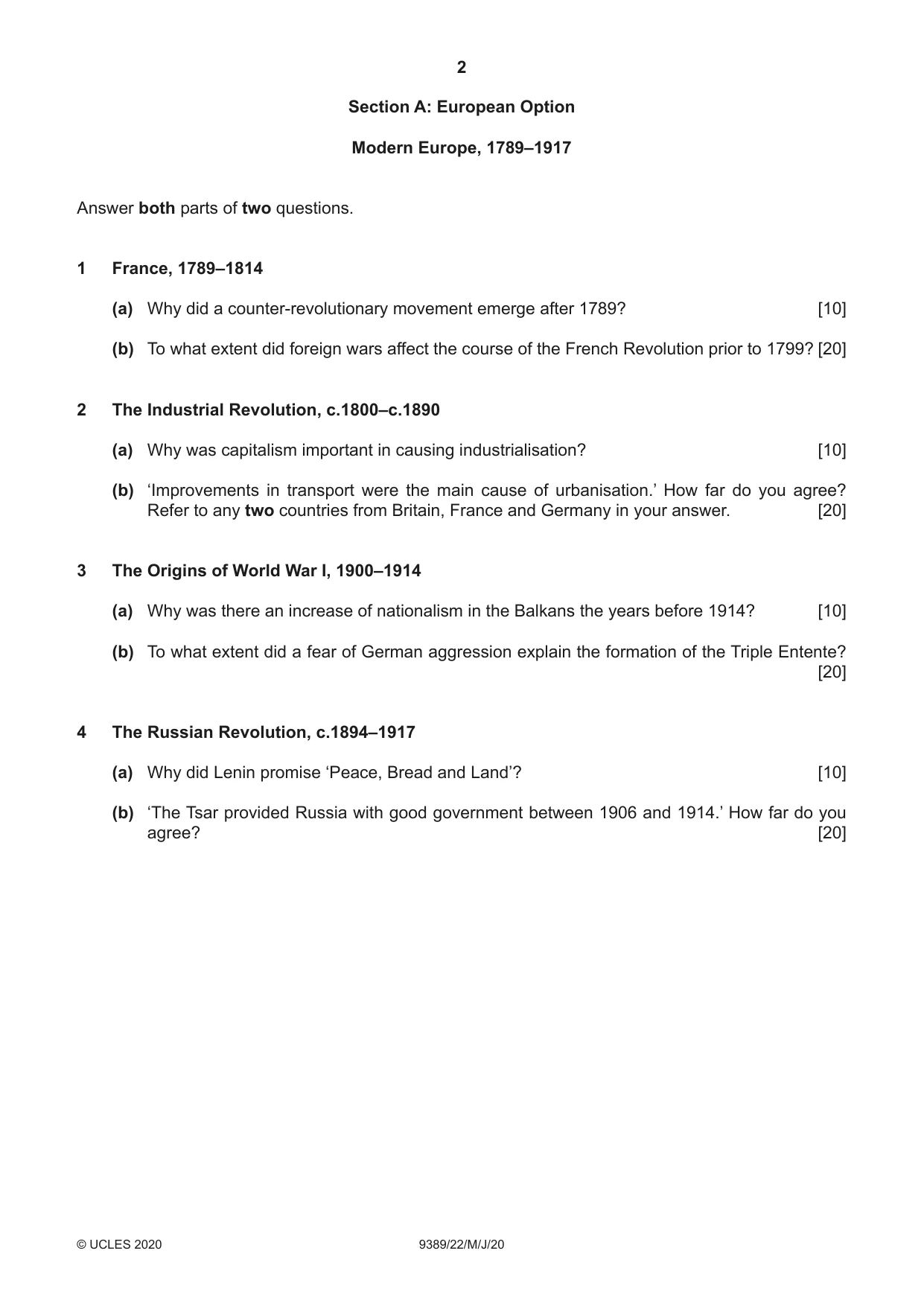
Q1 · France, 1789–1814 (a) Why did a counter-revolutionary movement emerge after 1789?
1 France, 1789–1814 (a) Why did a counter-revolutionary movement emerge after 1789? [10] (b) To what extent did foreign wars affect the course of the French Revolution prior to 1799? [20]
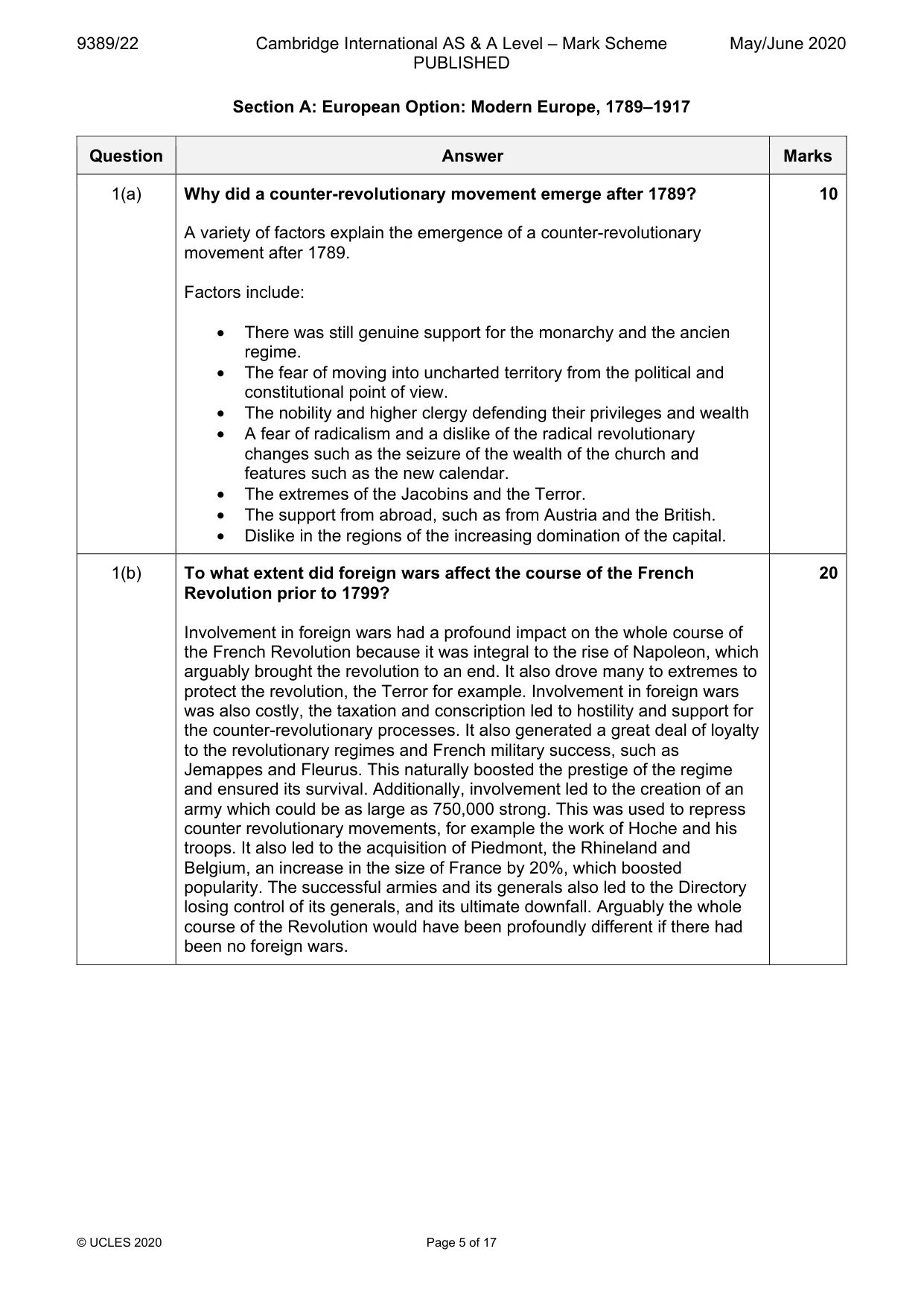
Mark scheme: Question Answer Marks 1(a) Why did a counter-revolutionary movement emerge after 1789? 10 A variety of factors explain the emergence of a counter-revolutionary movement after 1789. Factors include: • There was still genuine support for the monarchy and the ancien regime. • The fear of moving into uncharted territory from the political and constitutional point of view. • The nobility and higher clergy defending their privileges and wealth • A fear of radicalism and a dislike of the radical revolutionary changes such as the seizure of the wealth of the church and features such as the new calendar. • The extremes of the Jacobins and the Terror. • The support from abroad, such as from Austria and the British. • Dislike in the regions of the increasing domination of the capital. 1(b) To what extent did foreign wars affect the course of the French 20 Revolution prior to 1799? Involvement in foreign wars had a profound impact on the whole course of the French Revolution because it was integral to the rise of Napoleon, which arguably brought the revolution to an end. It also drove many to extremes to protect the revolution, the Terror for example. Involvement in foreign wars was also costly, the taxation and conscription led to hostility and support for the counter-revolutionary processes. It also generated a great deal of loyalty to the revolutionary regimes and French military success, such as Jemappes and Fleurus. This naturally boosted the prestige of the regime and ensured its survival. Additionally, involvement led to the creation of an army which could be as large as 750,000 strong. This was used to repress counter revolutionary movements, for example the work of Hoche and his troops. It also led to the acquisition of Piedmont, the Rhineland and Belgium, an increase in the size of France by 20%, which boosted popularity. The successful armies and its generals also led to the Directory losing control of its generals, and its ultimate downfall. Arguably the whole course of the Revolution would have been profoundly different if there had been no foreign wars.
Q2 · The Industrial Revolution, c.1800–c.1890 (a) Why was capitalism important in causing…
2 The Industrial Revolution, c.1800–c.1890 (a) Why was capitalism important in causing industrialisation? [10] (b) ‘Improvements in transport were the main cause of urbanisation.’ How far do you agree? Refer to any two countries from Britain, France and Germany in your answer. [20]
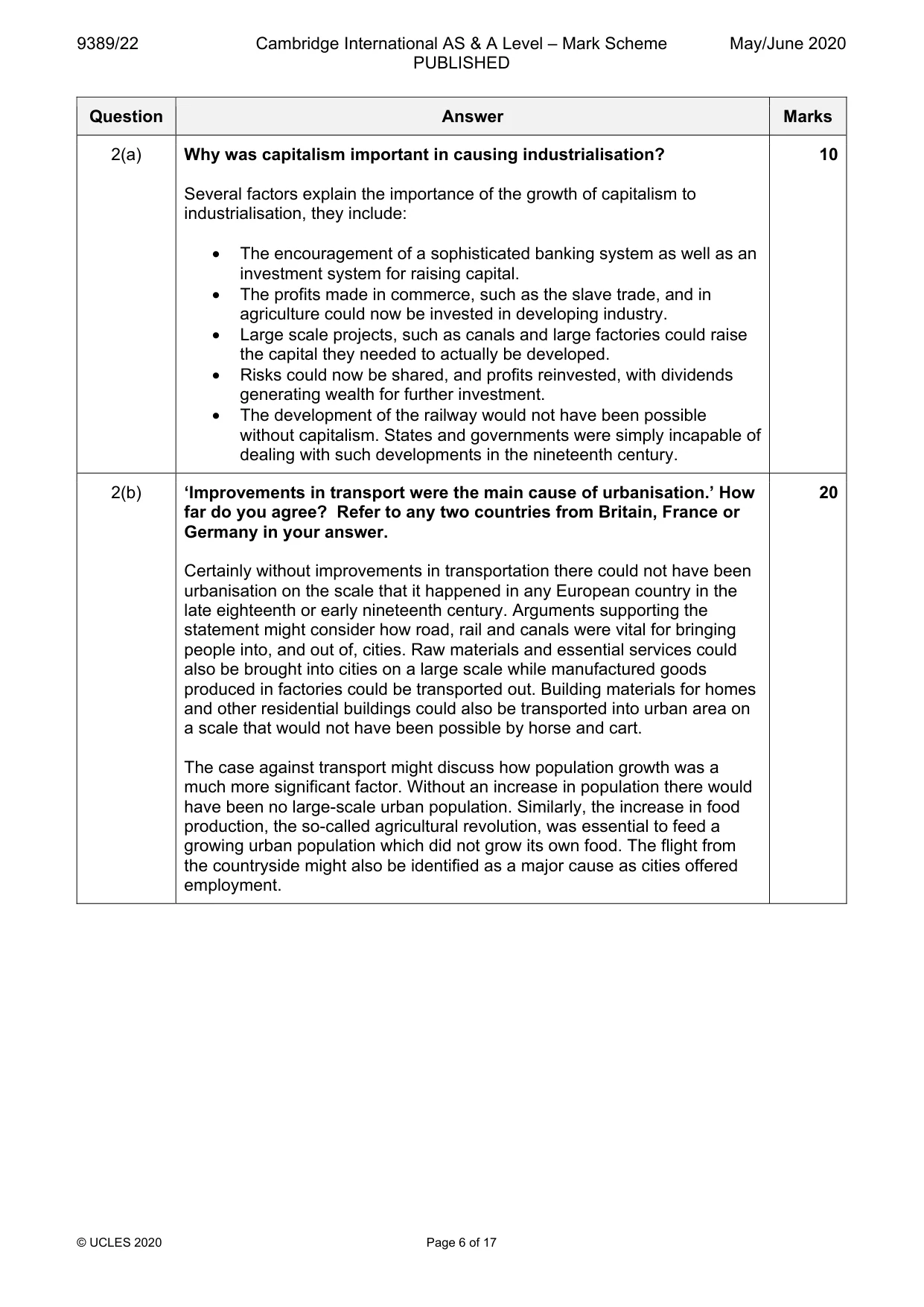
Mark scheme: 2(a) Why was capitalism important in causing industrialisation? 10 Several factors explain the importance of the growth of capitalism to industrialisation, they include: • The encouragement of a sophisticated banking system as well as an investment system for raising capital. • The profits made in commerce, such as the slave trade, and in agriculture could now be invested in developing industry. • Large scale projects, such as canals and large factories could raise the capital they needed to actually be developed. • Risks could now be shared, and profits reinvested, with dividends generating wealth for further investment. • The development of the railway would not have been possible without capitalism. States and governments were simply incapable of dealing with such developments in the nineteenth century. 2(b) ‘Improvements in transport were the main cause of urbanisation.’ How 20 far do you agree? Refer to any two countries from Britain, France or Germany in your answer. Certainly without improvements in transportation there could not have been urbanisation on the scale that it happened in any European country in the late eighteenth or early nineteenth century. Arguments supporting the statement might consider how road, rail and canals were vital for bringing people into, and out of, cities. Raw materials and essential services could also be brought into cities on a large scale while manufactured goods produced in factories could be transported out. Building materials for homes and other residential buildings could also be transported into urban area on a scale that would not have been possible by horse and cart. The case against transport might discuss how population growth was a much more significant factor. Without an increase in population there would have been no large-scale urban population. Similarly, the increase in food production, the so-called agricultural revolution, was essential to feed a growing urban population which did not grow its own food. The flight from the countryside might also be identified as a major cause as cities offered employment.
Q3 · The Origins of World War I, 1900–1914 (a) Why was there an increase of nationalism in the…
3 The Origins of World War I, 1900–1914 (a) Why was there an increase of nationalism in the Balkans the years before 1914? [10] (b) To what extent did a fear of German aggression explain the formation of the Triple Entente? [20]
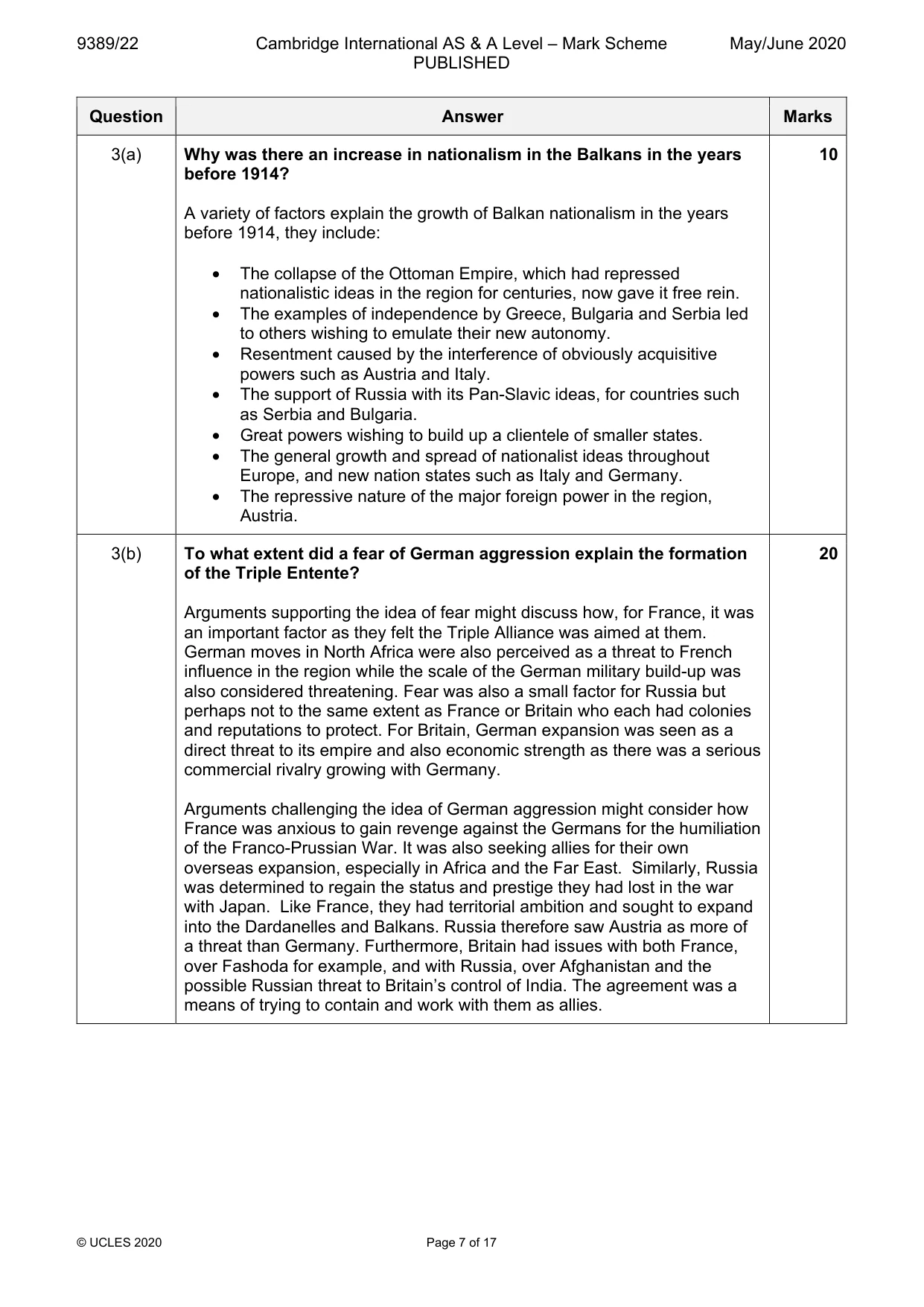
Mark scheme: 3(a) Why was there an increase in nationalism in the Balkans in the years 10 before 1914? A variety of factors explain the growth of Balkan nationalism in the years before 1914, they include: • The collapse of the Ottoman Empire, which had repressed nationalistic ideas in the region for centuries, now gave it free rein. • The examples of independence by Greece, Bulgaria and Serbia led to others wishing to emulate their new autonomy. • Resentment caused by the interference of obviously acquisitive powers such as Austria and Italy. • The support of Russia with its Pan-Slavic ideas, for countries such as Serbia and Bulgaria. • Great powers wishing to build up a clientele of smaller states. • The general growth and spread of nationalist ideas throughout Europe, and new nation states such as Italy and Germany. • The repressive nature of the major foreign power in the region, Austria. 3(b) To what extent did a fear of German aggression explain the formation 20 of the Triple Entente? Arguments supporting the idea of fear might discuss how, for France, it was an important factor as they felt the Triple Alliance was aimed at them. German moves in North Africa were also perceived as a threat to French influence in the region while the scale of the German military build-up was also considered threatening. Fear was also a small factor for Russia but perhaps not to the same extent as France or Britain who each had colonies and reputations to protect. For Britain, German expansion was seen as a direct threat to its empire and also economic strength as there was a serious commercial rivalry growing with Germany. Arguments challenging the idea of German aggression might consider how France was anxious to gain revenge against the Germans for the humiliation of the Franco-Prussian War. It was also seeking allies for their own overseas expansion, especially in Africa and the Far East. Similarly, Russia was determined to regain the status and prestige they had lost in the war with Japan. Like France, they had territorial ambition and sought to expand into the Dardanelles and Balkans. Russia therefore saw Austria as more of a threat than Germany. Furthermore, Britain had issues with both France, over Fashoda for example, and with Russia, over Afghanistan and the possible Russian threat to Britain’s control of India. The agreement was a means of trying to contain and work with them as allies.
Q4 · The Russian Revolution, c.1894–1917 (a) Why did Lenin promise ‘Peace, Bread and Land’?
4 The Russian Revolution, c.1894–1917 (a) Why did Lenin promise ‘Peace, Bread and Land’? [10] (b) ‘The Tsar provided Russia with good government between 1906 and 1914.’ How far do you agree? [20]
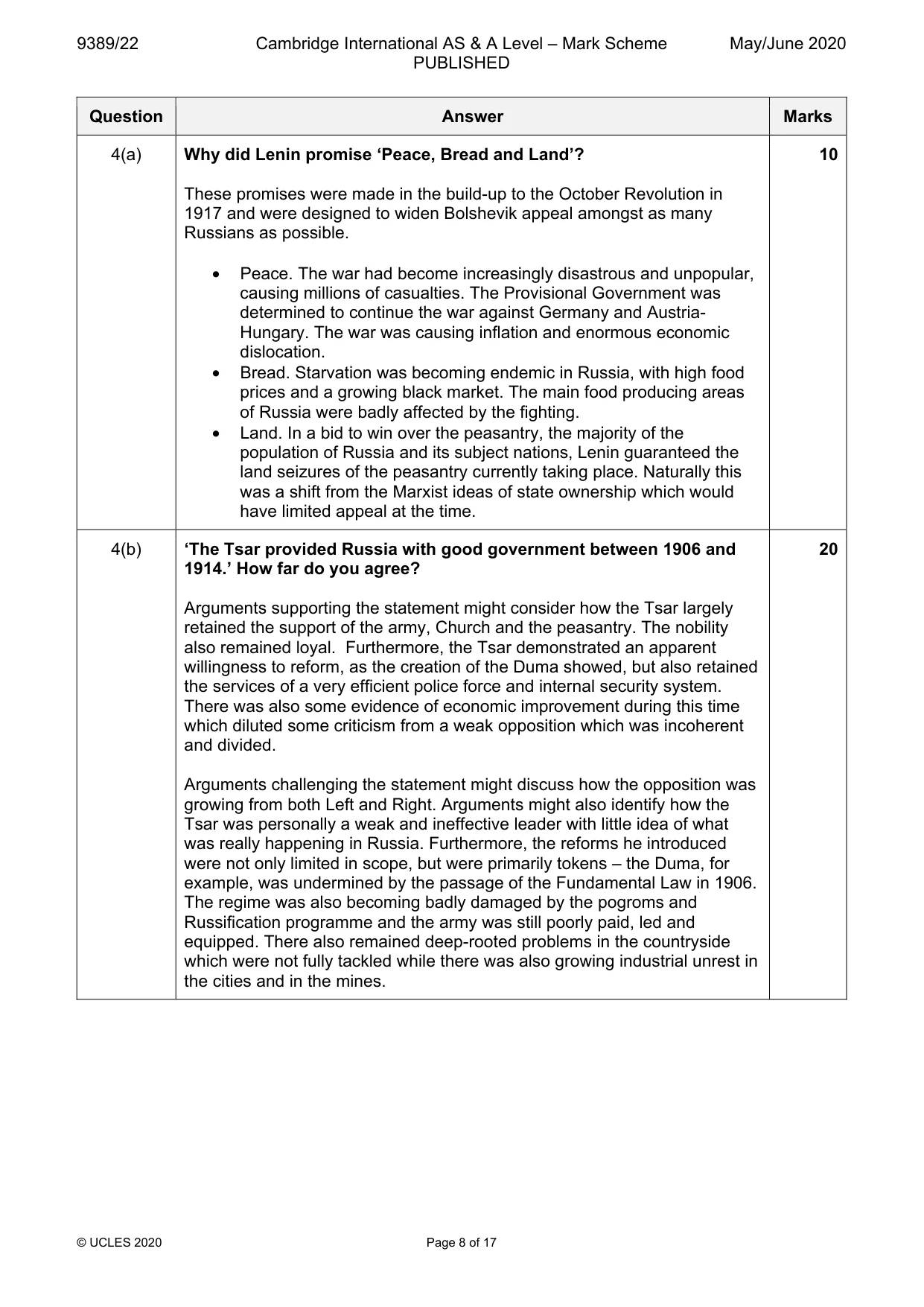
Mark scheme: 4(a) Why did Lenin promise ‘Peace, Bread and Land’? 10 These promises were made in the build-up to the October Revolution in 1917 and were designed to widen Bolshevik appeal amongst as many Russians as possible. • Peace. The war had become increasingly disastrous and unpopular, causing millions of casualties. The Provisional Government was determined to continue the war against Germany and Austria- Hungary. The war was causing inflation and enormous economic dislocation. • Bread. Starvation was becoming endemic in Russia, with high food prices and a growing black market. The main food producing areas of Russia were badly affected by the fighting. • Land. In a bid to win over the peasantry, the majority of the population of Russia and its subject nations, Lenin guaranteed the land seizures of the peasantry currently taking place. Naturally this was a shift from the Marxist ideas of state ownership which would have limited appeal at the time. 4(b) ‘The Tsar provided Russia with good government between 1906 and 20 1914.’ How far do you agree? Arguments supporting the statement might consider how the Tsar largely retained the support of the army, Church and the peasantry. The nobility also remained loyal. Furthermore, the Tsar demonstrated an apparent willingness to reform, as the creation of the Duma showed, but also retained the services of a very efficient police force and internal security system. There was also some evidence of economic improvement during this time which diluted some criticism from a weak opposition which was incoherent and divided. Arguments challenging the statement might discuss how the opposition was growing from both Left and Right. Arguments might also identify how the Tsar was personally a weak and ineffective leader with little idea of what was really happening in Russia. Furthermore, the reforms he introduced were not only limited in scope, but were primarily tokens – the Duma, for example, was undermined by the passage of the Fundamental Law in 1906. The regime was also becoming badly damaged by the pogroms and Russification programme and the army was still poorly paid, led and equipped. There also remained deep-rooted problems in the countryside which were not fully tackled while there was also growing industrial unrest in the cities and in the mines. Section B: American Option: The History of the USA, 1840–1941
Q5 · The Expansion of US Power from the 1840s to the 1930s (a) Why did going to war with…
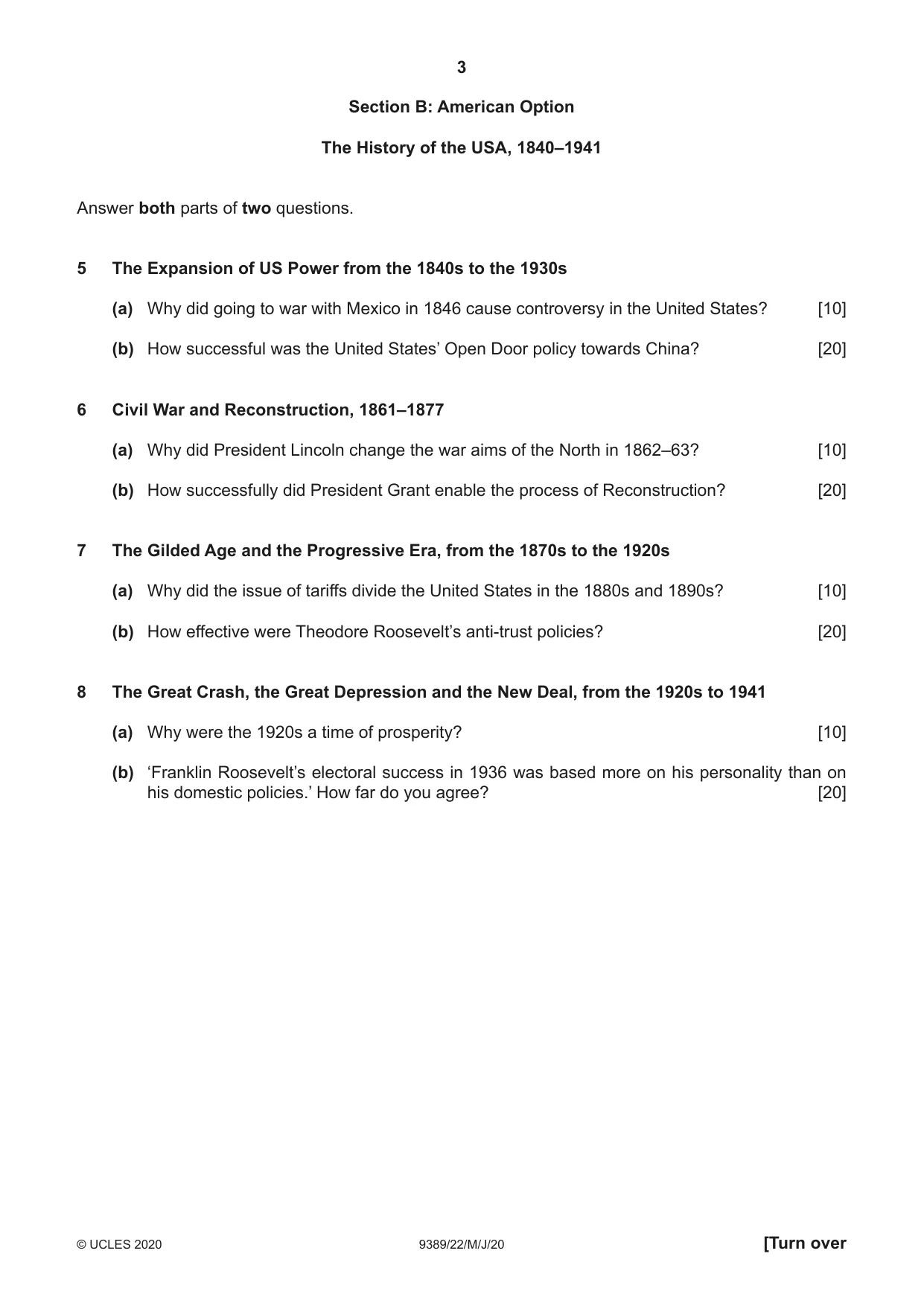
5 The Expansion of US Power from the 1840s to the 1930s (a) Why did going to war with Mexico in 1846 cause controversy in the United States? [10] (b) How successful was the United States’ Open Door policy towards China? [20]
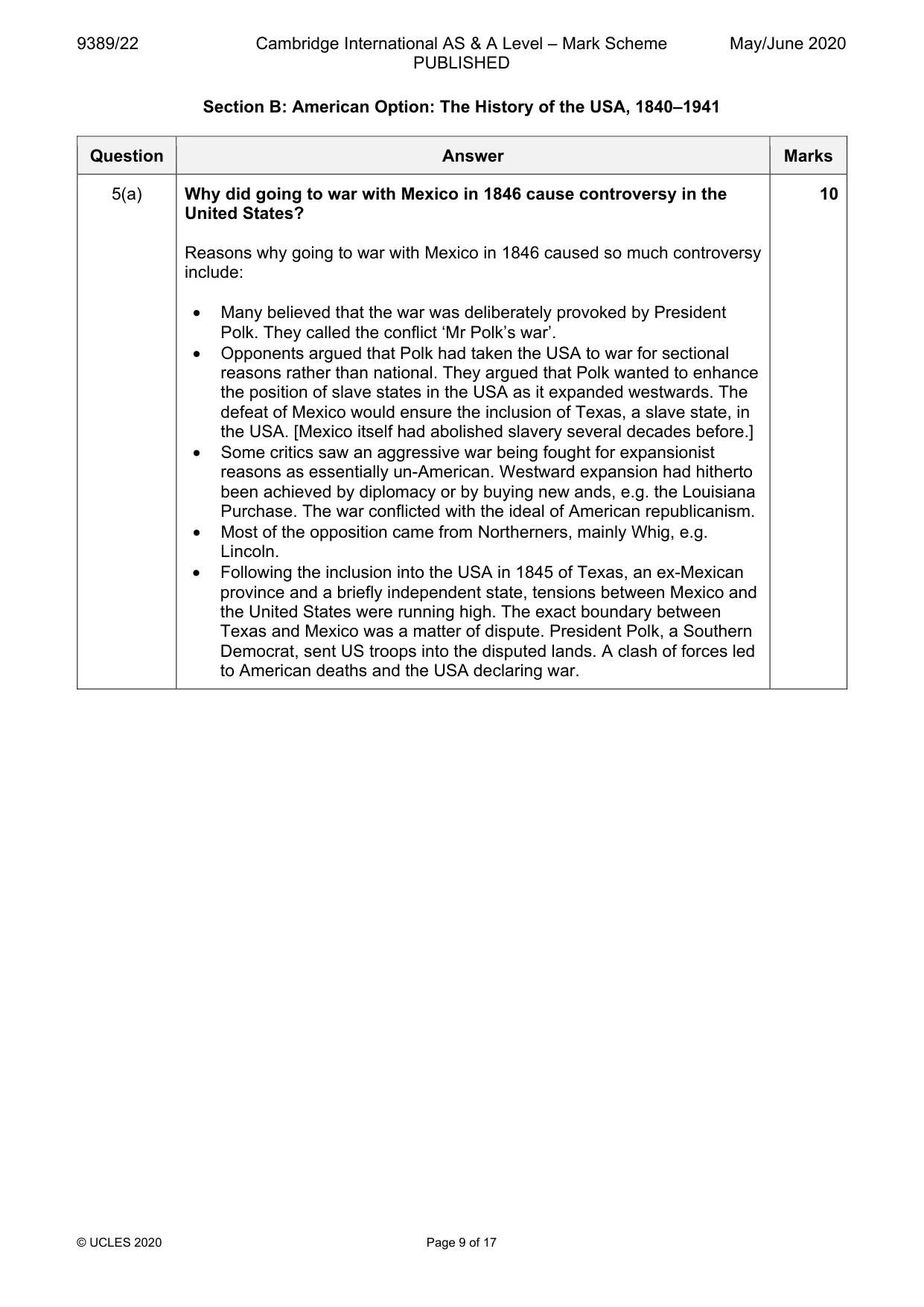
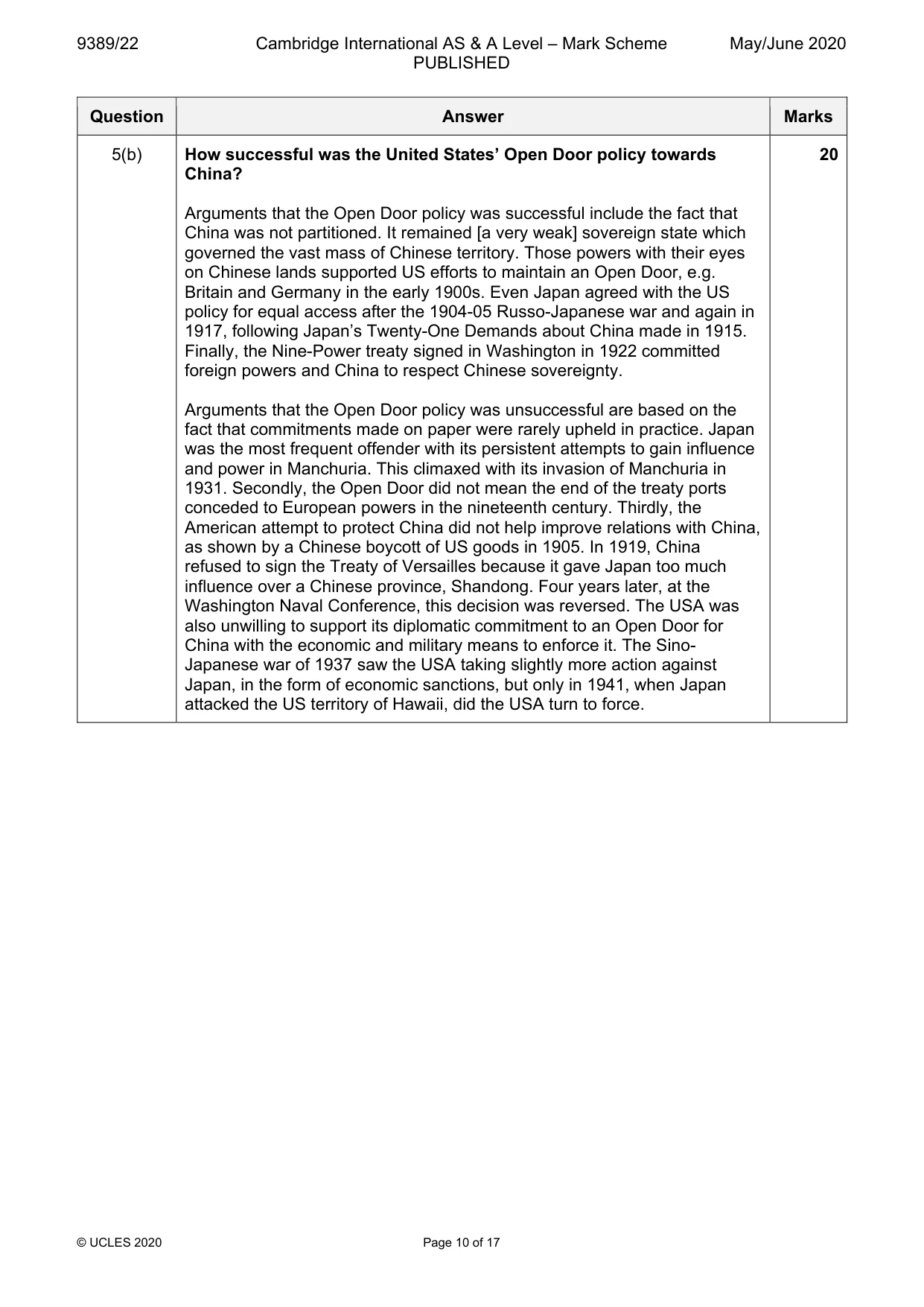
Mark scheme: 5(a) Why did going to war with Mexico in 1846 cause controversy in the 10 United States? Reasons why going to war with Mexico in 1846 caused so much controversy include: • Many believed that the war was deliberately provoked by President Polk. They called the conflict ‘Mr Polk’s war’. • Opponents argued that Polk had taken the USA to war for sectional reasons rather than national. They argued that Polk wanted to enhance the position of slave states in the USA as it expanded westwards. The defeat of Mexico would ensure the inclusion of Texas, a slave state, in the USA. [Mexico itself had abolished slavery several decades before.] • Some critics saw an aggressive war being fought for expansionist reasons as essentially un-American. Westward expansion had hitherto been achieved by diplomacy or by buying new ands, e.g. the Louisiana Purchase. The war conflicted with the ideal of American republicanism. • Most of the opposition came from Northerners, mainly Whig, e.g. Lincoln. • Following the inclusion into the USA in 1845 of Texas, an ex-Mexican province and a briefly independent state, tensions between Mexico and the United States were running high. The exact boundary between Texas and Mexico was a matter of dispute. President Polk, a Southern Democrat, sent US troops into the disputed lands. A clash of forces led to American deaths and the USA declaring war. 5(b) How successful was the United States’ Open Door policy towards 20 China? Arguments that the Open Door policy was successful include the fact that China was not partitioned. It remained [a very weak] sovereign state which governed the vast mass of Chinese territory. Those powers with their eyes on Chinese lands supported US efforts to maintain an Open Door, e.g. Britain and Germany in the early 1900s. Even Japan agreed with the US policy for equal access after the 1904-05 Russo-Japanese war and again in 1917, following Japan’s Twenty-One Demands about China made in 1915. Finally, the Nine-Power treaty signed in Washington in 1922 committed foreign powers and China to respect Chinese sovereignty. Arguments that the Open Door policy was unsuccessful are based on the fact that commitments made on paper were rarely upheld in practice. Japan was the most frequent offender with its persistent attempts to gain influence and power in Manchuria. This climaxed with its invasion of Manchuria in 1931. Secondly, the Open Door did not mean the end of the treaty ports conceded to European powers in the nineteenth century. Thirdly, the American attempt to protect China did not help improve relations with China, as shown by a Chinese boycott of US goods in 1905. In 1919, China refused to sign the Treaty of Versailles because it gave Japan too much influence over a Chinese province, Shandong. Four years later, at the Washington Naval Conference, this decision was reversed. The USA was also unwilling to support its diplomatic commitment to an Open Door for China with the economic and military means to enforce it. The Sino- Japanese war of 1937 saw the USA taking slightly more action against Japan, in the form of economic sanctions, but only in 1941, when Japan attacked the US territory of Hawaii, did the USA turn to force.
Q6 · Civil War and Reconstruction, 1861–1877 (a) Why did President Lincoln change the war aims…
6 Civil War and Reconstruction, 1861–1877 (a) Why did President Lincoln change the war aims of the North in 1862–63? [10] (b) How successfully did President Grant enable the process of Reconstruction? [20]
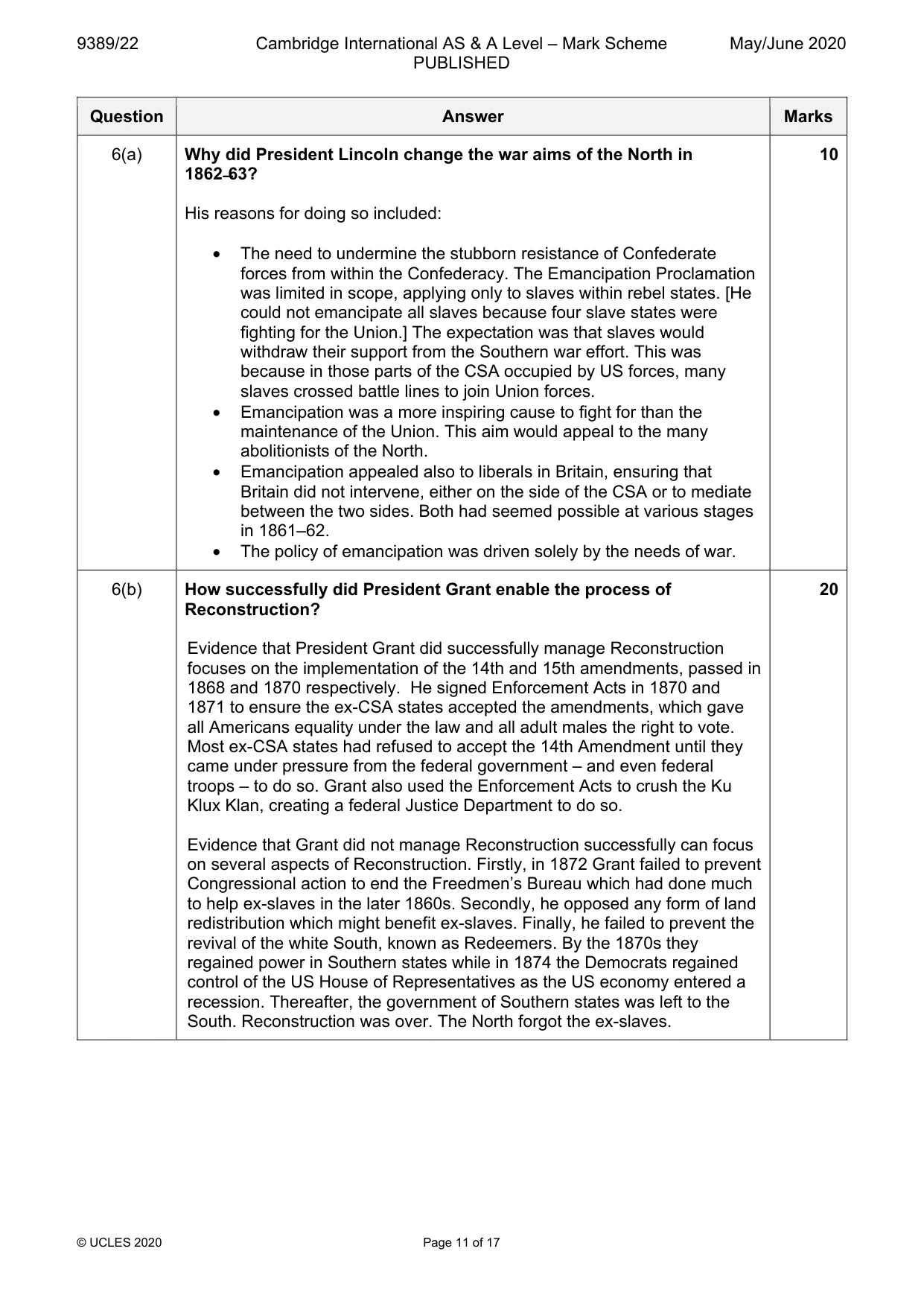
Mark scheme: 6(a) Why did President Lincoln change the war aims of the North in 10 1862˗̶63? His reasons for doing so included: • The need to undermine the stubborn resistance of Confederate forces from within the Confederacy. The Emancipation Proclamation was limited in scope, applying only to slaves within rebel states. [He could not emancipate all slaves because four slave states were fighting for the Union.] The expectation was that slaves would withdraw their support from the Southern war effort. This was because in those parts of the CSA occupied by US forces, many slaves crossed battle lines to join Union forces. • Emancipation was a more inspiring cause to fight for than the maintenance of the Union. This aim would appeal to the many abolitionists of the North. • Emancipation appealed also to liberals in Britain, ensuring that Britain did not intervene, either on the side of the CSA or to mediate between the two sides. Both had seemed possible at various stages in 1861–62. • The policy of emancipation was driven solely by the needs of war. 6(b) How successfully did President Grant enable the process of 20 Reconstruction? Evidence that President Grant did successfully manage Reconstruction focuses on the implementation of the 14th and 15th amendments, passed in 1868 and 1870 respectively. He signed Enforcement Acts in 1870 and 1871 to ensure the ex-CSA states accepted the amendments, which gave all Americans equality under the law and all adult males the right to vote. Most ex-CSA states had refused to accept the 14th Amendment until they came under pressure from the federal government – and even federal troops – to do so. Grant also used the Enforcement Acts to crush the Ku Klux Klan, creating a federal Justice Department to do so. Evidence that Grant did not manage Reconstruction successfully can focus on several aspects of Reconstruction. Firstly, in 1872 Grant failed to prevent Congressional action to end the Freedmen’s Bureau which had done much to help ex-slaves in the later 1860s. Secondly, he opposed any form of land redistribution which might benefit ex-slaves. Finally, he failed to prevent the revival of the white South, known as Redeemers. By the 1870s they regained power in Southern states while in 1874 the Democrats regained control of the US House of Representatives as the US economy entered a recession. Thereafter, the government of Southern states was left to the South. Reconstruction was over. The North forgot the ex-slaves.
Q7 · The Gilded Age and the Progressive Era, from the 1870s to the 1920s (a) Why did the issue…
7 The Gilded Age and the Progressive Era, from the 1870s to the 1920s (a) Why did the issue of tariffs divide the United States in the 1880s and 1890s? [10] (b) How effective were Theodore Roosevelt’s anti-trust policies? [20]
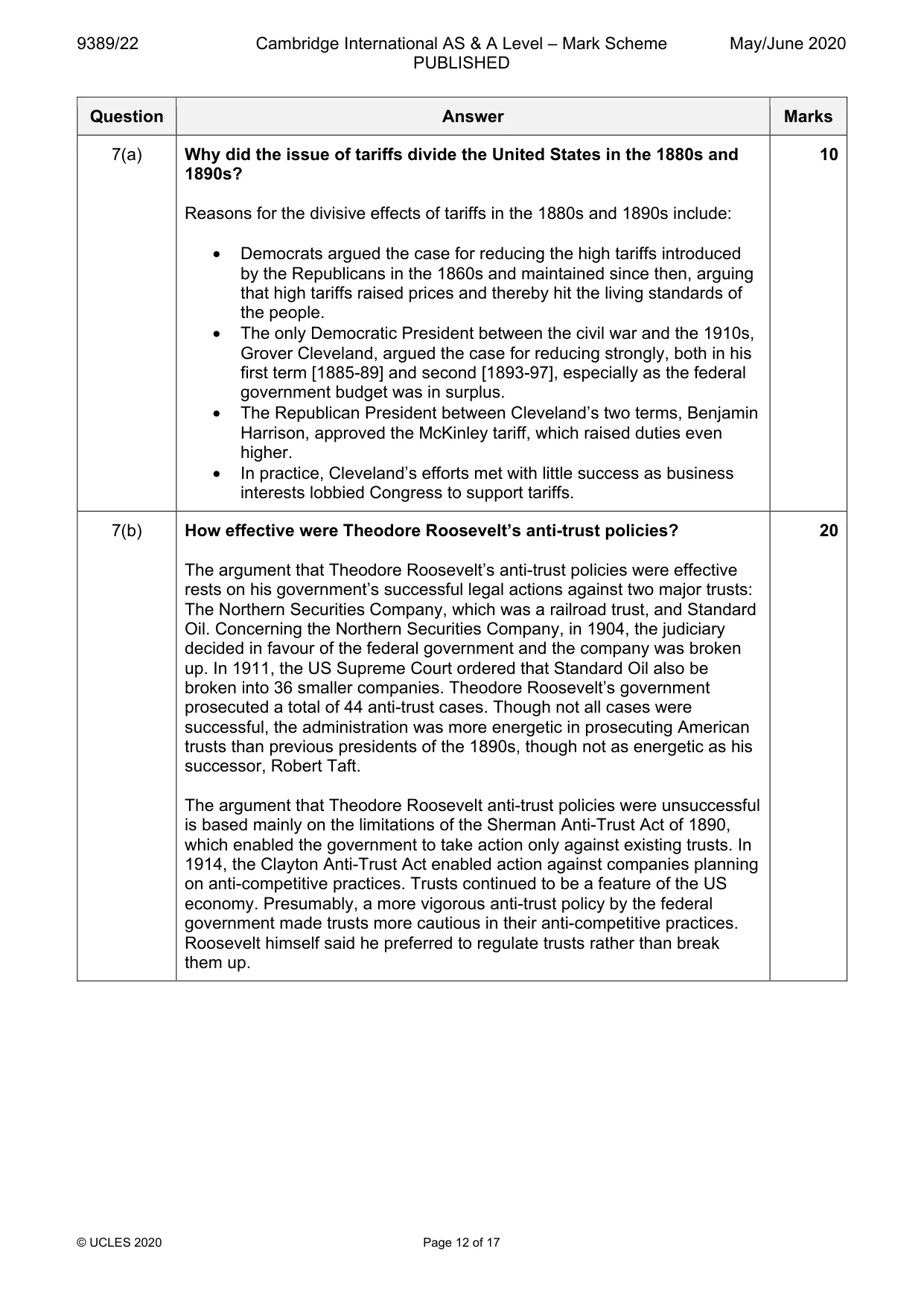
Mark scheme: 7(a) Why did the issue of tariffs divide the United States in the 1880s and 10 1890s? Reasons for the divisive effects of tariffs in the 1880s and 1890s include: • Democrats argued the case for reducing the high tariffs introduced by the Republicans in the 1860s and maintained since then, arguing that high tariffs raised prices and thereby hit the living standards of the people. • The only Democratic President between the civil war and the 1910s, Grover Cleveland, argued the case for reducing strongly, both in his first term [1885-89] and second [1893-97], especially as the federal government budget was in surplus. • The Republican President between Cleveland’s two terms, Benjamin Harrison, approved the McKinley tariff, which raised duties even higher. • In practice, Cleveland’s efforts met with little success as business interests lobbied Congress to support tariffs. 7(b) How effective were Theodore Roosevelt’s anti-trust policies? 20 The argument that Theodore Roosevelt’s anti-trust policies were effective rests on his government’s successful legal actions against two major trusts: The Northern Securities Company, which was a railroad trust, and Standard Oil. Concerning the Northern Securities Company, in 1904, the judiciary decided in favour of the federal government and the company was broken up. In 1911, the US Supreme Court ordered that Standard Oil also be broken into 36 smaller companies. Theodore Roosevelt’s government prosecuted a total of 44 anti-trust cases. Though not all cases were successful, the administration was more energetic in prosecuting American trusts than previous presidents of the 1890s, though not as energetic as his successor, Robert Taft. The argument that Theodore Roosevelt anti-trust policies were unsuccessful is based mainly on the limitations of the Sherman Anti-Trust Act of 1890, which enabled the government to take action only against existing trusts. In 1914, the Clayton Anti-Trust Act enabled action against companies planning on anti-competitive practices. Trusts continued to be a feature of the US economy. Presumably, a more vigorous anti-trust policy by the federal government made trusts more cautious in their anti-competitive practices. Roosevelt himself said he preferred to regulate trusts rather than break them up.
Q8 · The Great Crash, the Great Depression and the New Deal, from the 1920s to 1941 (a) Why…
8 The Great Crash, the Great Depression and the New Deal, from the 1920s to 1941 (a) Why were the 1920s a time of prosperity? [10] (b) ‘Franklin Roosevelt’s electoral success in 1936 was based more on his personality than on his domestic policies.’ How far do you agree? [20] Section C: International Option International Relations, 1871–1945 Answer both parts of two questions.
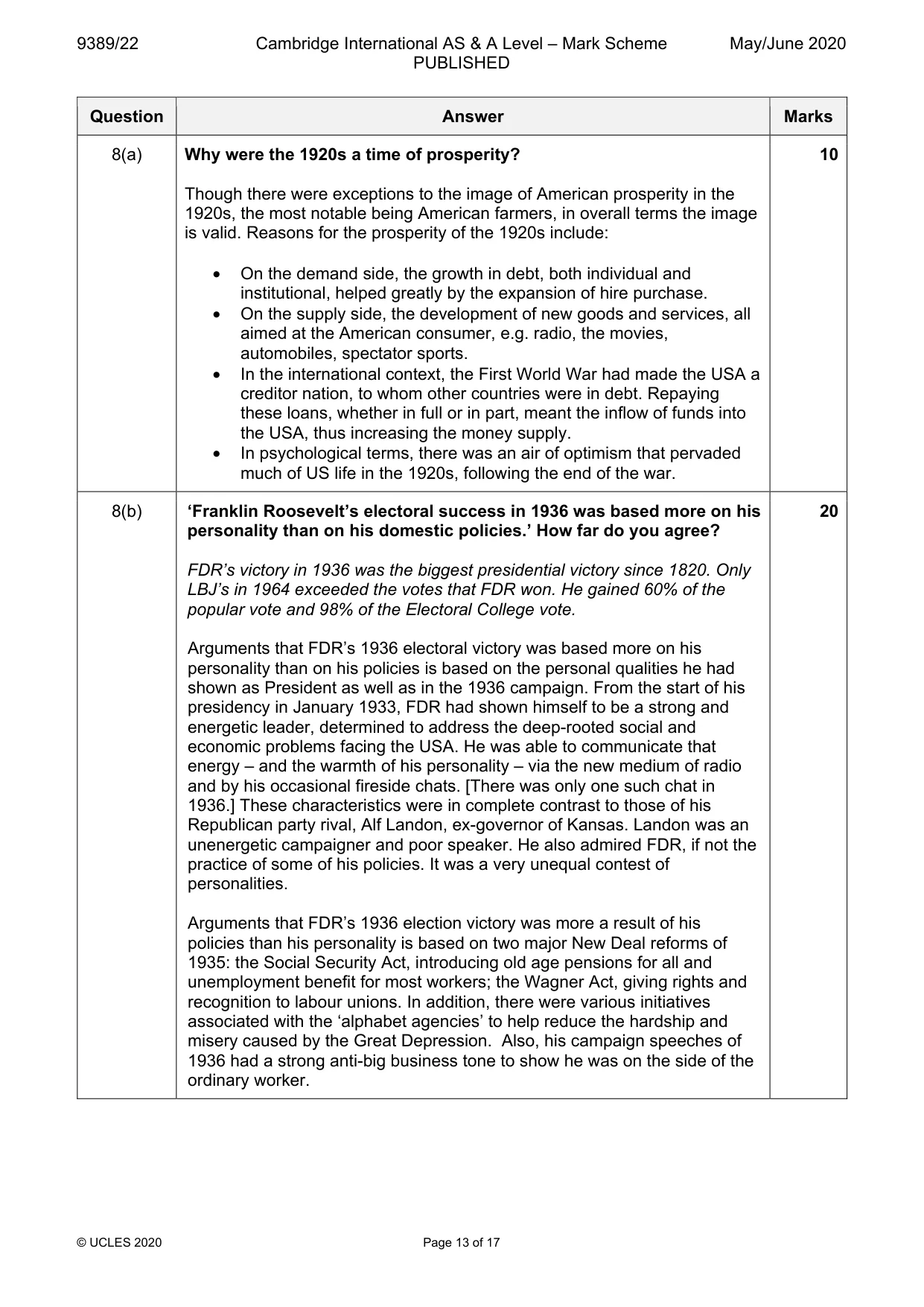
Mark scheme: 8(a) Why were the 1920s a time of prosperity? 10 Though there were exceptions to the image of American prosperity in the 1920s, the most notable being American farmers, in overall terms the image is valid. Reasons for the prosperity of the 1920s include: • On the demand side, the growth in debt, both individual and institutional, helped greatly by the expansion of hire purchase. • On the supply side, the development of new goods and services, all aimed at the American consumer, e.g. radio, the movies, automobiles, spectator sports. • In the international context, the First World War had made the USA a creditor nation, to whom other countries were in debt. Repaying these loans, whether in full or in part, meant the inflow of funds into the USA, thus increasing the money supply. • In psychological terms, there was an air of optimism that pervaded much of US life in the 1920s, following the end of the war. 8(b) ‘Franklin Roosevelt’s electoral success in 1936 was based more on his 20 personality than on his domestic policies.’ How far do you agree? FDR’s victory in 1936 was the biggest presidential victory since 1820. Only LBJ’s in 1964 exceeded the votes that FDR won. He gained 60% of the popular vote and 98% of the Electoral College vote. Arguments that FDR’s 1936 electoral victory was based more on his personality than on his policies is based on the personal qualities he had shown as President as well as in the 1936 campaign. From the start of his presidency in January 1933, FDR had shown himself to be a strong and energetic leader, determined to address the deep-rooted social and economic problems facing the USA. He was able to communicate that energy – and the warmth of his personality – via the new medium of radio and by his occasional fireside chats. [There was only one such chat in 1936.] These characteristics were in complete contrast to those of his Republican party rival, Alf Landon, ex-governor of Kansas. Landon was an unenergetic campaigner and poor speaker. He also admired FDR, if not the practice of some of his policies. It was a very unequal contest of personalities. Arguments that FDR’s 1936 election victory was more a result of his policies than his personality is based on two major New Deal reforms of 1935: the Social Security Act, introducing old age pensions for all and unemployment benefit for most workers; the Wagner Act, giving rights and recognition to labour unions. In addition, there were various initiatives associated with the ‘alphabet agencies’ to help reduce the hardship and misery caused by the Great Depression. Also, his campaign speeches of 1936 had a strong anti-big business tone to show he was on the side of the ordinary worker. Section C: International Option: International Relations, 1871–1945
Q9 · International Relations, 1871–1918 (a) Why did US policy towards overseas expansion…
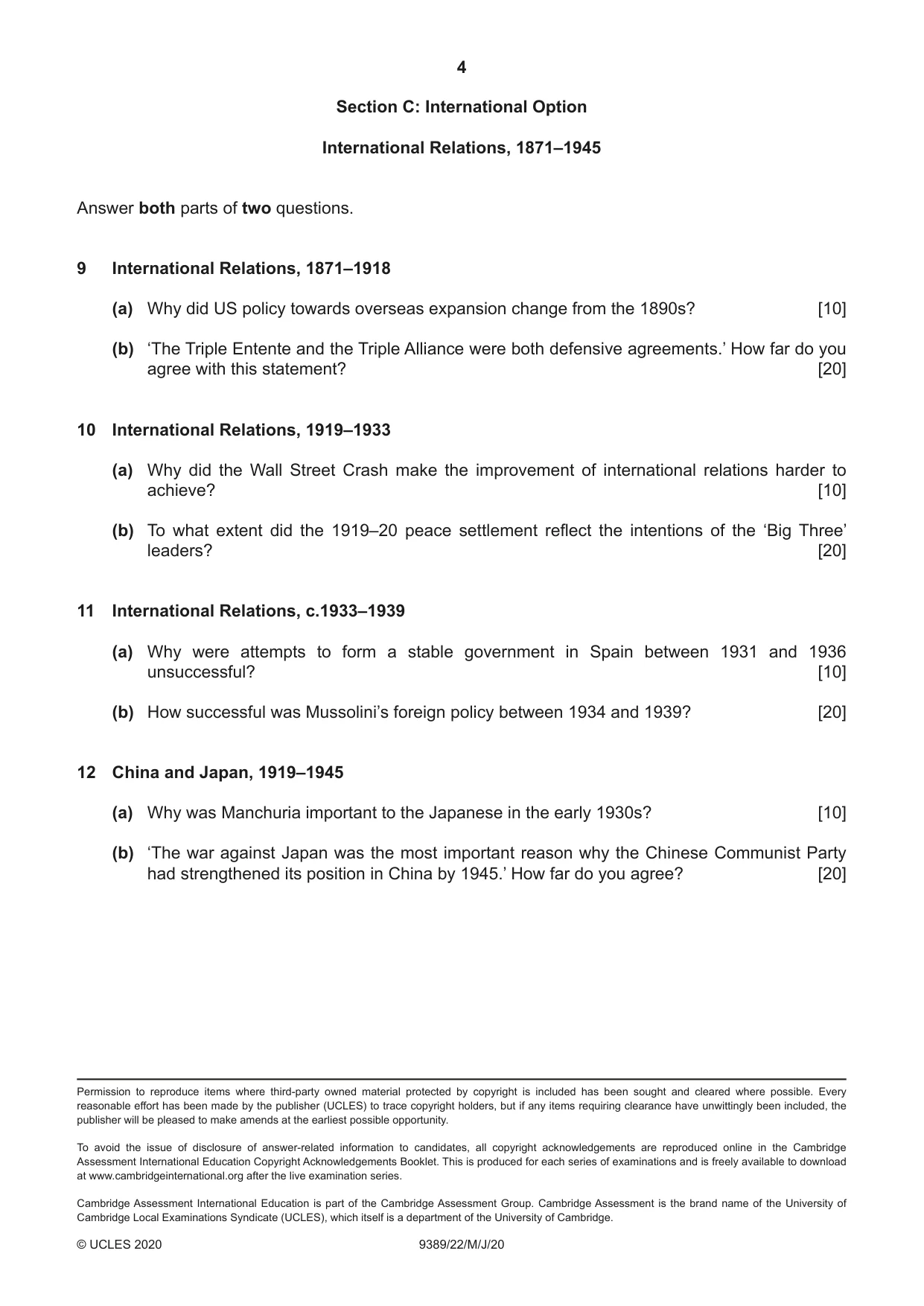
9 International Relations, 1871–1918 (a) Why did US policy towards overseas expansion change from the 1890s? [10] (b) ‘The Triple Entente and the Triple Alliance were both defensive agreements.’ How far do you agree with this statement? [20]
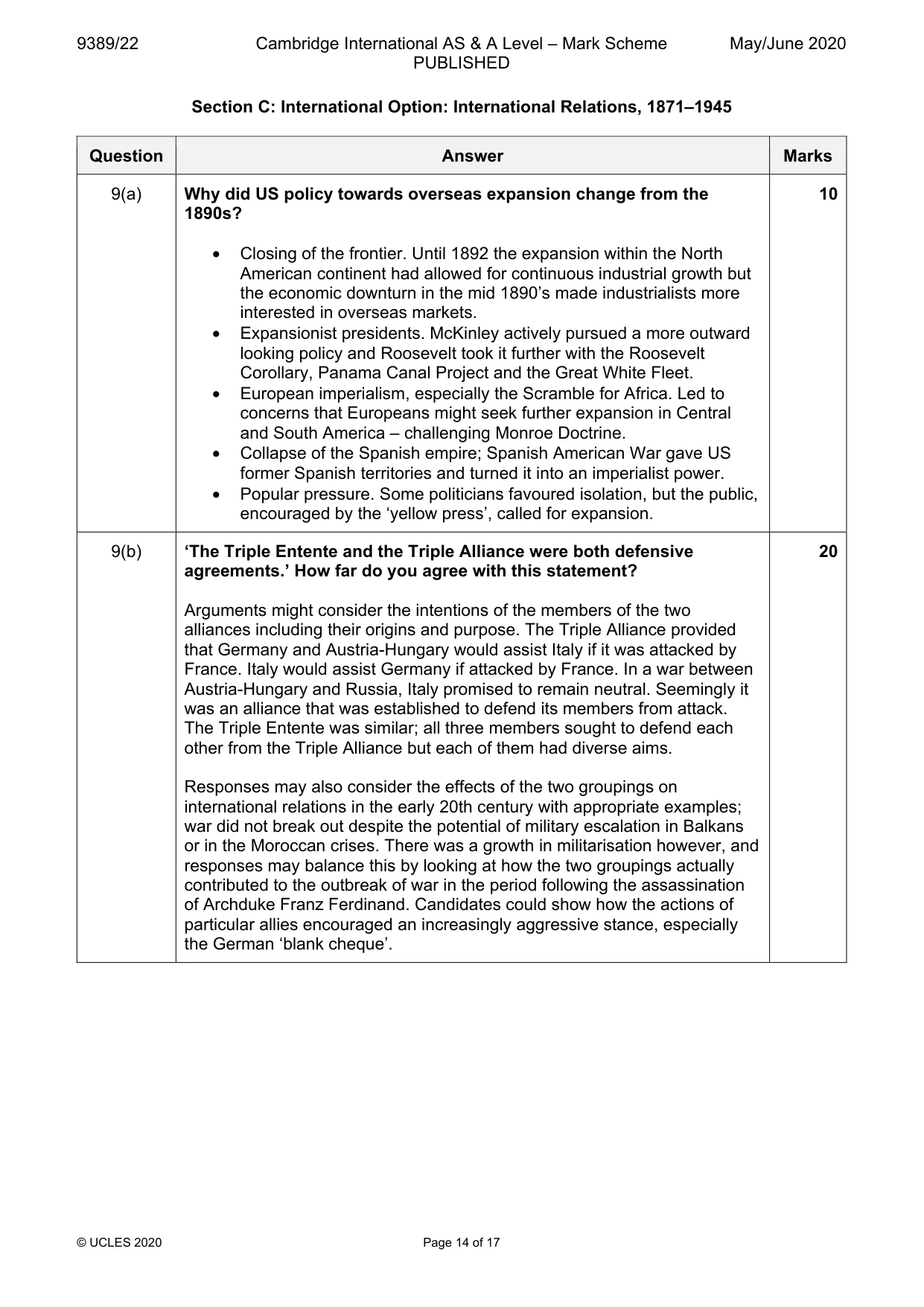
Mark scheme: 9(a) Why did US policy towards overseas expansion change from the 10 1890s? • Closing of the frontier. Until 1892 the expansion within the North American continent had allowed for continuous industrial growth but the economic downturn in the mid 1890’s made industrialists more interested in overseas markets. • Expansionist presidents. McKinley actively pursued a more outward looking policy and Roosevelt took it further with the Roosevelt Corollary, Panama Canal Project and the Great White Fleet. • European imperialism, especially the Scramble for Africa. Led to concerns that Europeans might seek further expansion in Central and South America – challenging Monroe Doctrine. • Collapse of the Spanish empire; Spanish American War gave US former Spanish territories and turned it into an imperialist power. • Popular pressure. Some politicians favoured isolation, but the public, encouraged by the ‘yellow press’, called for expansion. 9(b) ‘The Triple Entente and the Triple Alliance were both defensive 20 agreements.’ How far do you agree with this statement? Arguments might consider the intentions of the members of the two alliances including their origins and purpose. The Triple Alliance provided that Germany and Austria-Hungary would assist Italy if it was attacked by France. Italy would assist Germany if attacked by France. In a war between Austria-Hungary and Russia, Italy promised to remain neutral. Seemingly it was an alliance that was established to defend its members from attack. The Triple Entente was similar; all three members sought to defend each other from the Triple Alliance but each of them had diverse aims. Responses may also consider the effects of the two groupings on international relations in the early 20th century with appropriate examples; war did not break out despite the potential of military escalation in Balkans or in the Moroccan crises. There was a growth in militarisation however, and responses may balance this by looking at how the two groupings actually contributed to the outbreak of war in the period following the assassination of Archduke Franz Ferdinand. Candidates could show how the actions of particular allies encouraged an increasingly aggressive stance, especially the German ‘blank cheque’.
Q10 · International Relations, 1919–1933 (a) Why did the Wall Street Crash make the improvement…
10 International Relations, 1919–1933 (a) Why did the Wall Street Crash make the improvement of international relations harder to achieve? [10] (b) To what extent did the 1919–20 peace settlement reflect the intentions of the ‘Big Three’ leaders? [20]
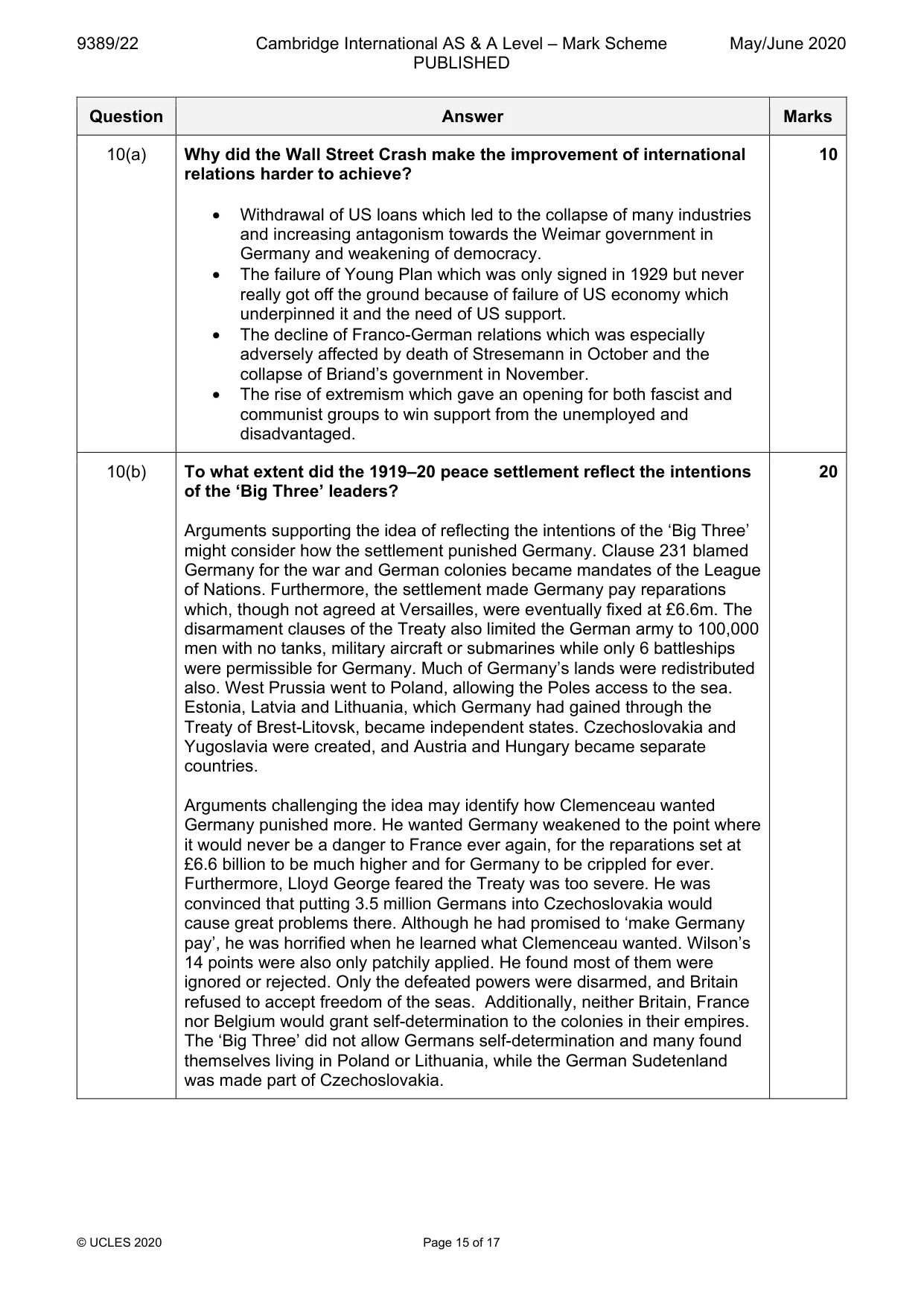
Mark scheme: 10(a) Why did the Wall Street Crash make the improvement of international 10 relations harder to achieve? • Withdrawal of US loans which led to the collapse of many industries and increasing antagonism towards the Weimar government in Germany and weakening of democracy. • The failure of Young Plan which was only signed in 1929 but never really got off the ground because of failure of US economy which underpinned it and the need of US support. • The decline of Franco-German relations which was especially adversely affected by death of Stresemann in October and the collapse of Briand’s government in November. • The rise of extremism which gave an opening for both fascist and communist groups to win support from the unemployed and disadvantaged. 10(b) To what extent did the 1919–20 peace settlement reflect the intentions 20 of the ‘Big Three’ leaders? Arguments supporting the idea of reflecting the intentions of the ‘Big Three’ might consider how the settlement punished Germany. Clause 231 blamed Germany for the war and German colonies became mandates of the League of Nations. Furthermore, the settlement made Germany pay reparations which, though not agreed at Versailles, were eventually fixed at £6.6m. The disarmament clauses of the Treaty also limited the German army to 100,000 men with no tanks, military aircraft or submarines while only 6 battleships were permissible for Germany. Much of Germany’s lands were redistributed also. West Prussia went to Poland, allowing the Poles access to the sea. Estonia, Latvia and Lithuania, which Germany had gained through the Treaty of Brest-Litovsk, became independent states. Czechoslovakia and Yugoslavia were created, and Austria and Hungary became separate countries. Arguments challenging the idea may identify how Clemenceau wanted Germany punished more. He wanted Germany weakened to the point where it would never be a danger to France ever again, for the reparations set at £6.6 billion to be much higher and for Germany to be crippled for ever. Furthermore, Lloyd George feared the Treaty was too severe. He was convinced that putting 3.5 million Germans into Czechoslovakia would cause great problems there. Although he had promised to ‘make Germany pay’, he was horrified when he learned what Clemenceau wanted. Wilson’s 14 points were also only patchily applied. He found most of them were ignored or rejected. Only the defeated powers were disarmed, and Britain refused to accept freedom of the seas. Additionally, neither Britain, France nor Belgium would grant self-determination to the colonies in their empires. The ‘Big Three’ did not allow Germans self-determination and many found themselves living in Poland or Lithuania, while the German Sudetenland was made part of Czechoslovakia.
Q11 · International Relations, c.1933–1939 (a) Why were attempts to form a stable government in…
11 International Relations, c.1933–1939 (a) Why were attempts to form a stable government in Spain between 1931 and 1936 unsuccessful? [10] (b) How successful was Mussolini’s foreign policy between 1934 and 1939? [20]
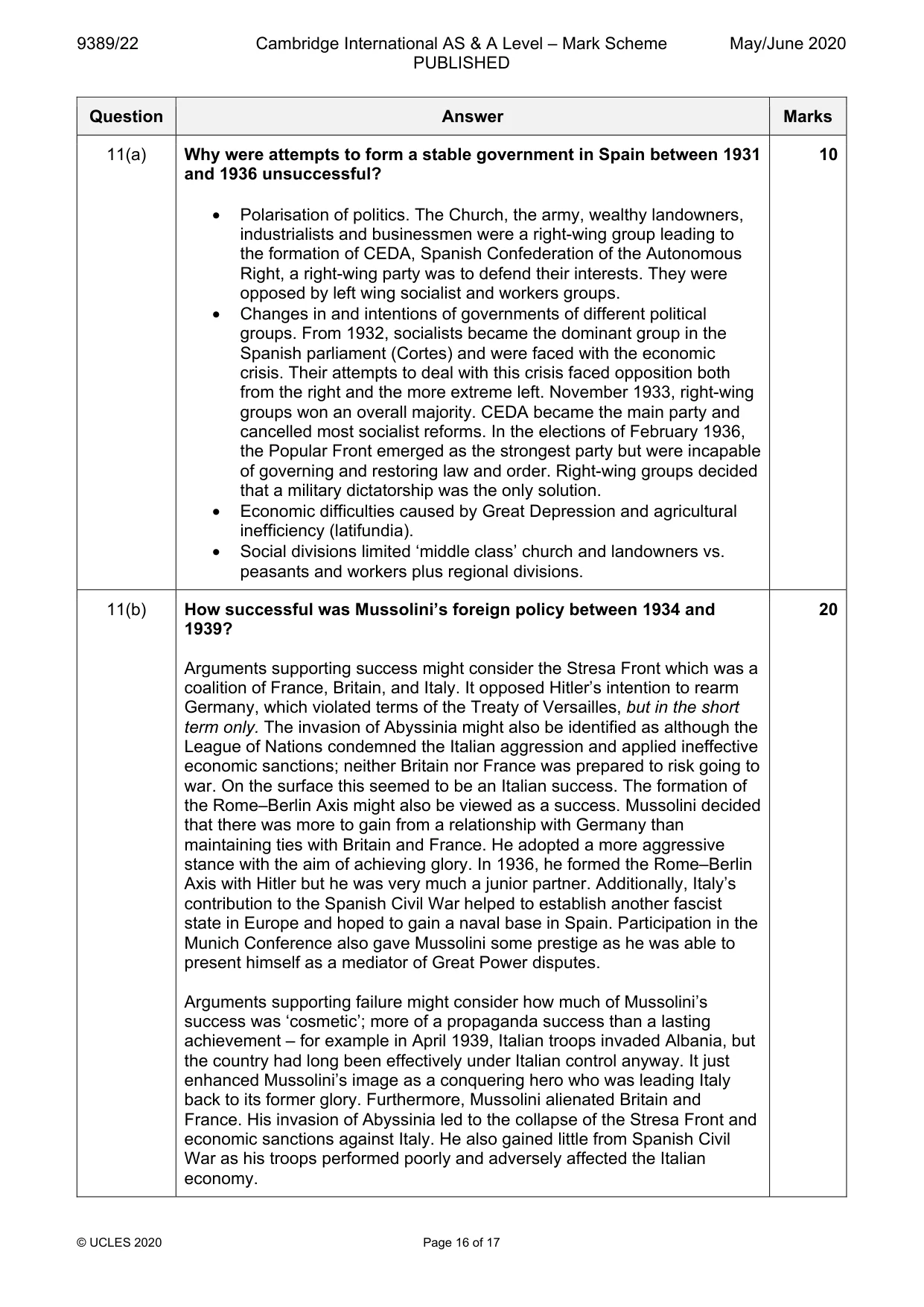
Mark scheme: 11(a) Why were attempts to form a stable government in Spain between 1931 10 and 1936 unsuccessful? • Polarisation of politics. The Church, the army, wealthy landowners, industrialists and businessmen were a right-wing group leading to the formation of CEDA, Spanish Confederation of the Autonomous Right, a right-wing party was to defend their interests. They were opposed by left wing socialist and workers groups. • Changes in and intentions of governments of different political groups. From 1932, socialists became the dominant group in the Spanish parliament (Cortes) and were faced with the economic crisis. Their attempts to deal with this crisis faced opposition both from the right and the more extreme left. November 1933, right-wing groups won an overall majority. CEDA became the main party and cancelled most socialist reforms. In the elections of February 1936, the Popular Front emerged as the strongest party but were incapable of governing and restoring law and order. Right-wing groups decided that a military dictatorship was the only solution. • Economic difficulties caused by Great Depression and agricultural inefficiency (latifundia). • Social divisions limited ‘middle class’ church and landowners vs. peasants and workers plus regional divisions. 11(b) How successful was Mussolini’s foreign policy between 1934 and 20 1939? Arguments supporting success might consider the Stresa Front which was a coalition of France, Britain, and Italy. It opposed Hitler’s intention to rearm Germany, which violated terms of the Treaty of Versailles, but in the short term only. The invasion of Abyssinia might also be identified as although the League of Nations condemned the Italian aggression and applied ineffective economic sanctions; neither Britain nor France was prepared to risk going to war. On the surface this seemed to be an Italian success. The formation of the Rome–Berlin Axis might also be viewed as a success. Mussolini decided that there was more to gain from a relationship with Germany than maintaining ties with Britain and France. He adopted a more aggressive stance with the aim of achieving glory. In 1936, he formed the Rome–Berlin Axis with Hitler but he was very much a junior partner. Additionally, Italy’s contribution to the Spanish Civil War helped to establish another fascist state in Europe and hoped to gain a naval base in Spain. Participation in the Munich Conference also gave Mussolini some prestige as he was able to present himself as a mediator of Great Power disputes. Arguments supporting failure might consider how much of Mussolini’s success was ‘cosmetic’; more of a propaganda success than a lasting achievement – for example in April 1939, Italian troops invaded Albania, but the country had long been effectively under Italian control anyway. It just enhanced Mussolini’s image as a conquering hero who was leading Italy back to its former glory. Furthermore, Mussolini alienated Britain and France. His invasion of Abyssinia led to the collapse of the Stresa Front and economic sanctions against Italy. He also gained little from Spanish Civil War as his troops performed poorly and adversely affected the Italian economy.
Q12 · China and Japan, 1919–1945 (a) Why was Manchuria important to the Japanese in the early…
12 China and Japan, 1919–1945 (a) Why was Manchuria important to the Japanese in the early 1930s? [10] (b) ‘The war against Japan was the most important reason why the Chinese Communist Party had strengthened its position in China by 1945.’ How far do you agree? [20]
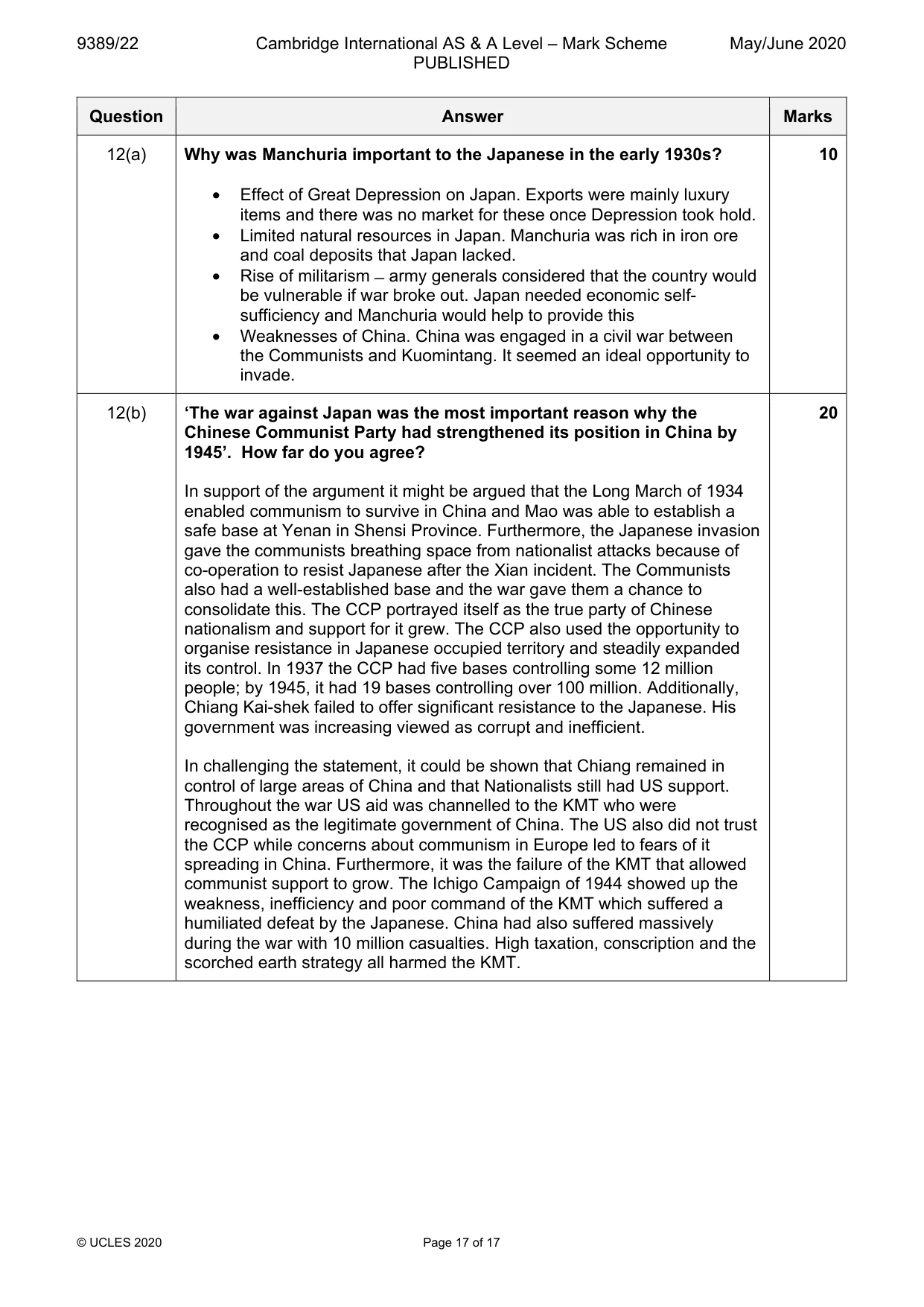
Mark scheme: 12(a) Why was Manchuria important to the Japanese in the early 1930s? 10 • Effect of Great Depression on Japan. Exports were mainly luxury items and there was no market for these once Depression took hold. • Limited natural resources in Japan. Manchuria was rich in iron ore and coal deposits that Japan lacked. • Rise of militarism army generals considered that the country would be vulnerable if war broke out. Japan needed economic self- sufficiency and Manchuria would help to provide this • Weaknesses of China. China was engaged in a civil war between the Communists and Kuomintang. It seemed an ideal opportunity to invade. 12(b) ‘The war against Japan was the most important reason why the 20 Chinese Communist Party had strengthened its position in China by 1945’. How far do you agree? In support of the argument it might be argued that the Long March of 1934 enabled communism to survive in China and Mao was able to establish a safe base at Yenan in Shensi Province. Furthermore, the Japanese invasion gave the communists breathing space from nationalist attacks because of co-operation to resist Japanese after the Xian incident. The Communists also had a well-established base and the war gave them a chance to consolidate this. The CCP portrayed itself as the true party of Chinese nationalism and support for it grew. The CCP also used the opportunity to organise resistance in Japanese occupied territory and steadily expanded its control. In 1937 the CCP had five bases controlling some 12 million people; by 1945, it had 19 bases controlling over 100 million. Additionally, Chiang Kai-shek failed to offer significant resistance to the Japanese. His government was increasing viewed as corrupt and inefficient. In challenging the statement, it could be shown that Chiang remained in control of large areas of China and that Nationalists still had US support. Throughout the war US aid was channelled to the KMT who were recognised as the legitimate government of China. The US also did not trust the CCP while concerns about communism in Europe led to fears of it spreading in China. Furthermore, it was the failure of the KMT that allowed communist support to grow. The Ichigo Campaign of 1944 showed up the weakness, inefficiency and poor command of the KMT which suffered a humiliated defeat by the Japanese. China had also suffered massively during the war with 10 million casualties. High taxation, conscription and the scorched earth strategy all harmed the KMT.