Cambridge A Level History 9389 — 2017 May/June Paper 1 · Variant 2
9389/12/M/J/17 · 40 marks · ≈45 min
The question paper and its mark scheme, free to read here and free to download. This is Cambridge’s own paper, exactly as it was sat.
Question paper8 pages
Mark scheme12 pages
Answers below. Sit the paper first if you are practising.
Paper as text
Question paper, page 1
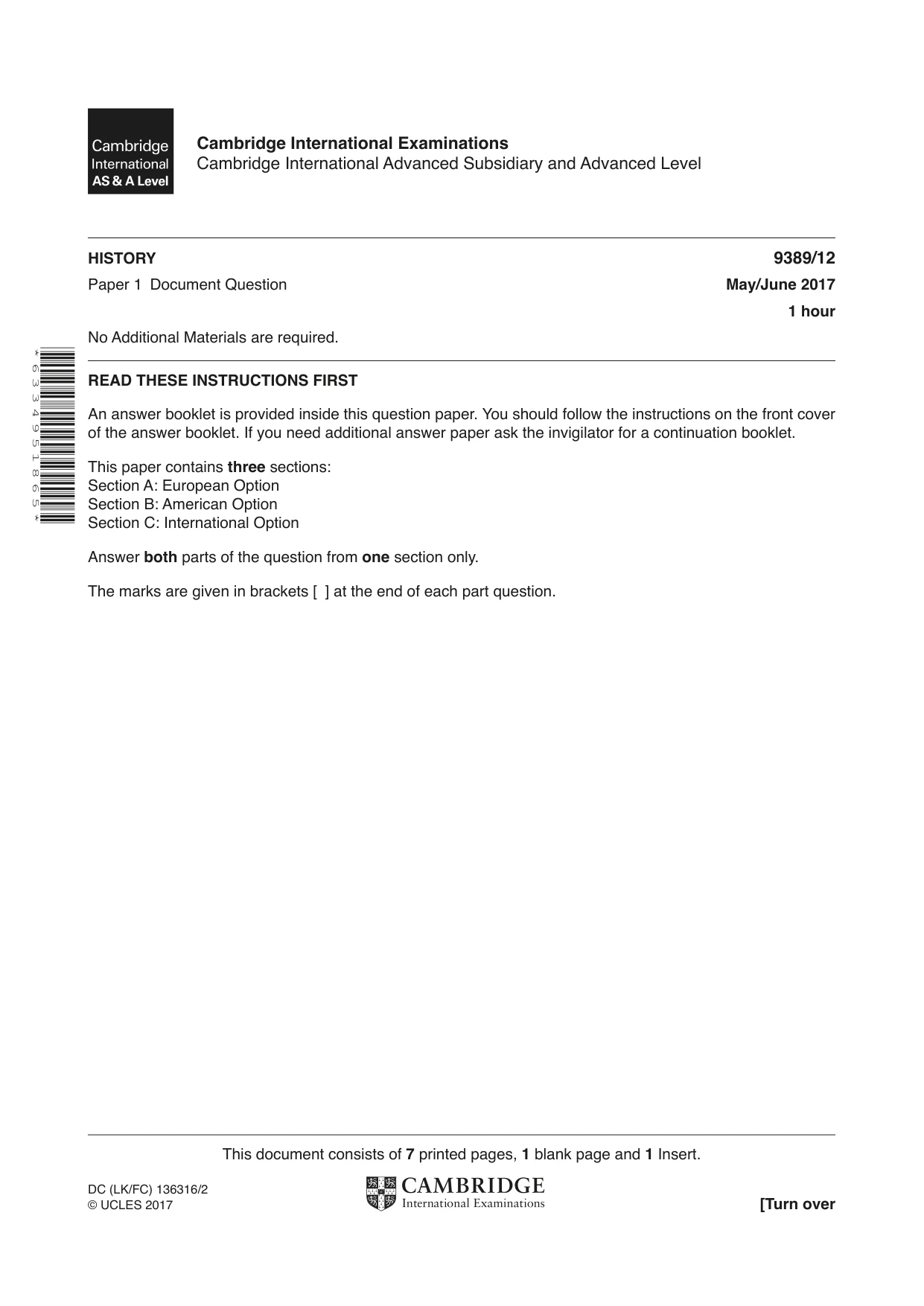
* 6 3 3 4 9 5 1 8 6 5 * This document consists of 7 printed pages, 1 blank page and 1 Insert. DC (LK/FC) 136316/2 © UCLES 2017 [Turn over Cambridge International Examinations Cambridge International Advanced Subsidiary and Advanced Level HISTORY 9389/12 Paper 1 Document Question May/June 2017 1 hour No Additional Materials are required. READ THESE INSTRUCTIONS FIRST An answer booklet is provided inside this question paper. You should follow the instructions on the front cover of the answer booklet. If you need additional answer paper ask the invigilator for a continuation booklet. This paper contains three sections: Section A: European Option Section B: American Option Section C: International Option Answer both parts of the question from one section only. The marks are given in brackets [ ] at the end of each part question.
Question paper, page 2
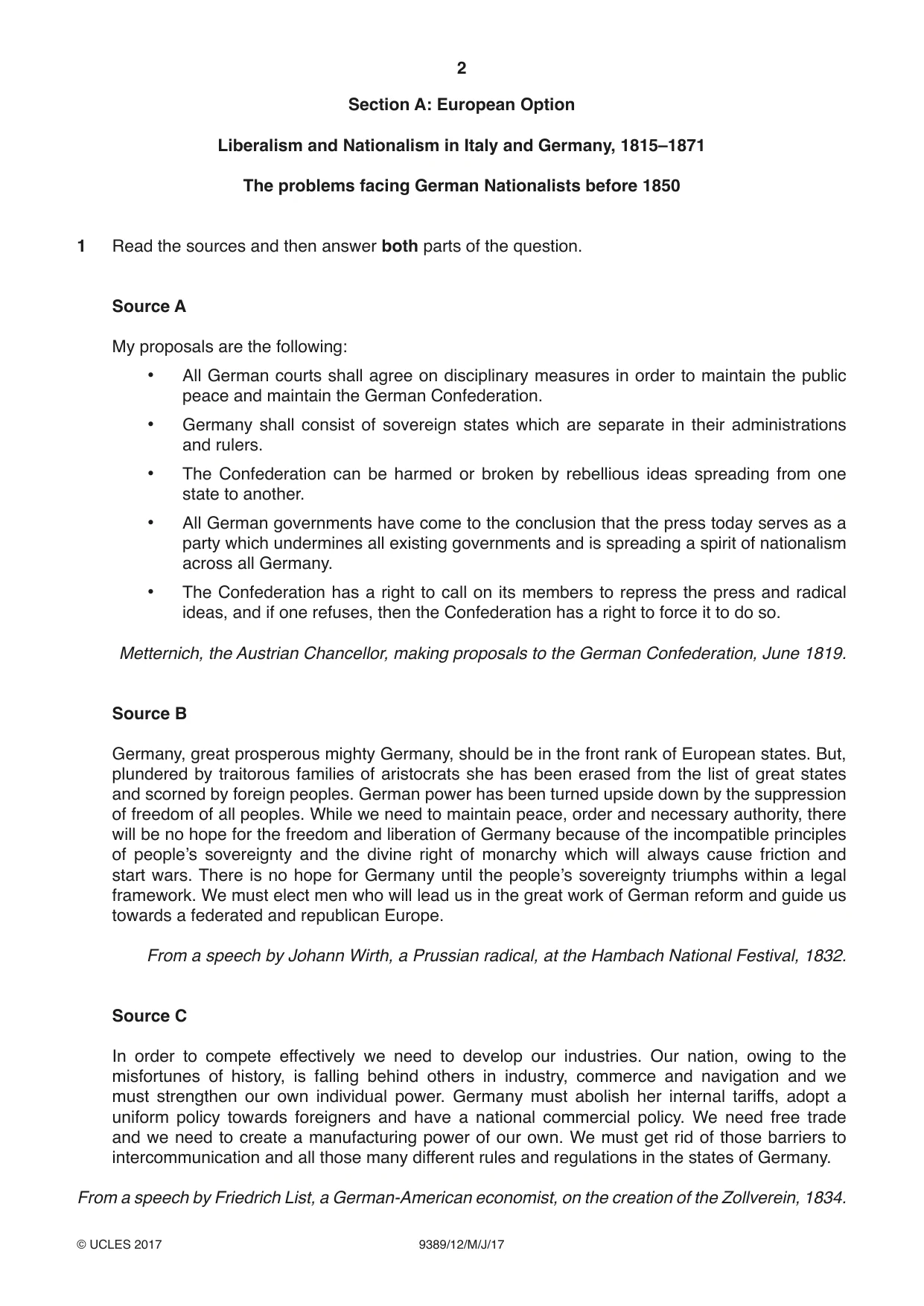
2 9389/12/M/J/17 © UCLES 2017 Section A: European Option Liberalism and Nationalism in Italy and Germany, 1815–1871 The problems facing German Nationalists before 1850 1 Read the sources and then answer both parts of the question. Source A My proposals are the following: • All German courts shall agree on disciplinary measures in order to maintain the public peace and maintain the German Confederation. • Germany shall consist of sovereign states which are separate in their administrations and rulers. • The Confederation can be harmed or broken by rebellious ideas spreading from one state to another. • All German governments have come to the conclusion that the press today serves as a party which undermines all existing governments and is spreading a spirit of nationalism across all Germany. • The Confederation has a right to call on its members to repress the press and radical ideas, and if one refuses, then the Confederation has a right to force it to do so. Metternich, the Austrian Chancellor, making proposals to the German Confederation, June 1819. Source B Germany, great prosperous mighty Germany, should be in the front rank of European states. But, plundered by traitorous families of aristocrats she has been erased from the list of great states and scorned by foreign peoples. German power has been turned upside down by the suppression of freedom of all peoples. While we need to maintain peace, order and necessary authority, there will be no hope for the freedom and liberation of Germany because of the incompatible principles of people’s sovereignty and the divine right of monarchy which will always cause friction and start wars. There is no hope for Germany until the people’s sovereignty triumphs within a legal framework. We must elect men who will lead us in the great work of German reform and guide us towards a federated and republican Europe. From a speech by Johann Wirth, a Prussian radical, at the Hambach National Festival, 1832. Source C In order to compete effectively we need to develop our industries. Our nation, owing to the misfortunes of history, is falling behind others in industry, commerce and navigation and we must strengthen our own individual power. Germany must abolish her internal tariffs, adopt a uniform policy towards foreigners and have a national commercial policy. We need free trade and we need to create a manufacturing power of our own. We must get rid of those barriers to intercommunication and all those many different rules and regulations in the states of Germany. From a speech by Friedrich List, a German-American economist, on the creation of the Zollverein, 1834.
Question paper, page 3
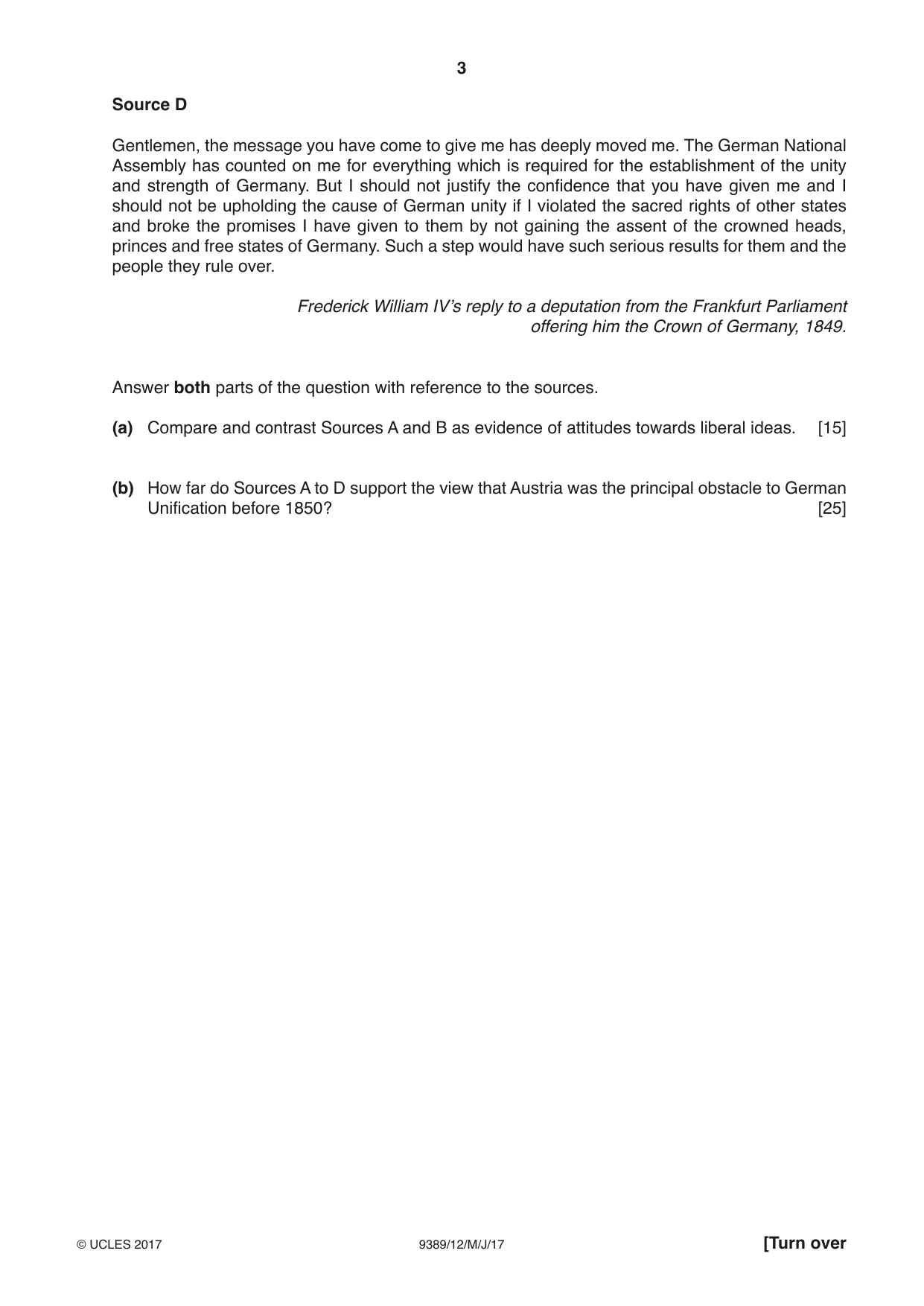
3 9389/12/M/J/17 © UCLES 2017 [Turn over Source D Gentlemen, the message you have come to give me has deeply moved me. The German National Assembly has counted on me for everything which is required for the establishment of the unity and strength of Germany. But I should not justify the confidence that you have given me and I should not be upholding the cause of German unity if I violated the sacred rights of other states and broke the promises I have given to them by not gaining the assent of the crowned heads, princes and free states of Germany. Such a step would have such serious results for them and the people they rule over. Frederick William IV’s reply to a deputation from the Frankfurt Parliament offering him the Crown of Germany, 1849. Answer both parts of the question with reference to the sources. (a) Compare and contrast Sources A and B as evidence of attitudes towards liberal ideas. [15] (b) How far do Sources A to D support the view that Austria was the principal obstacle to German Unification before 1850? [25]
Question paper, page 4
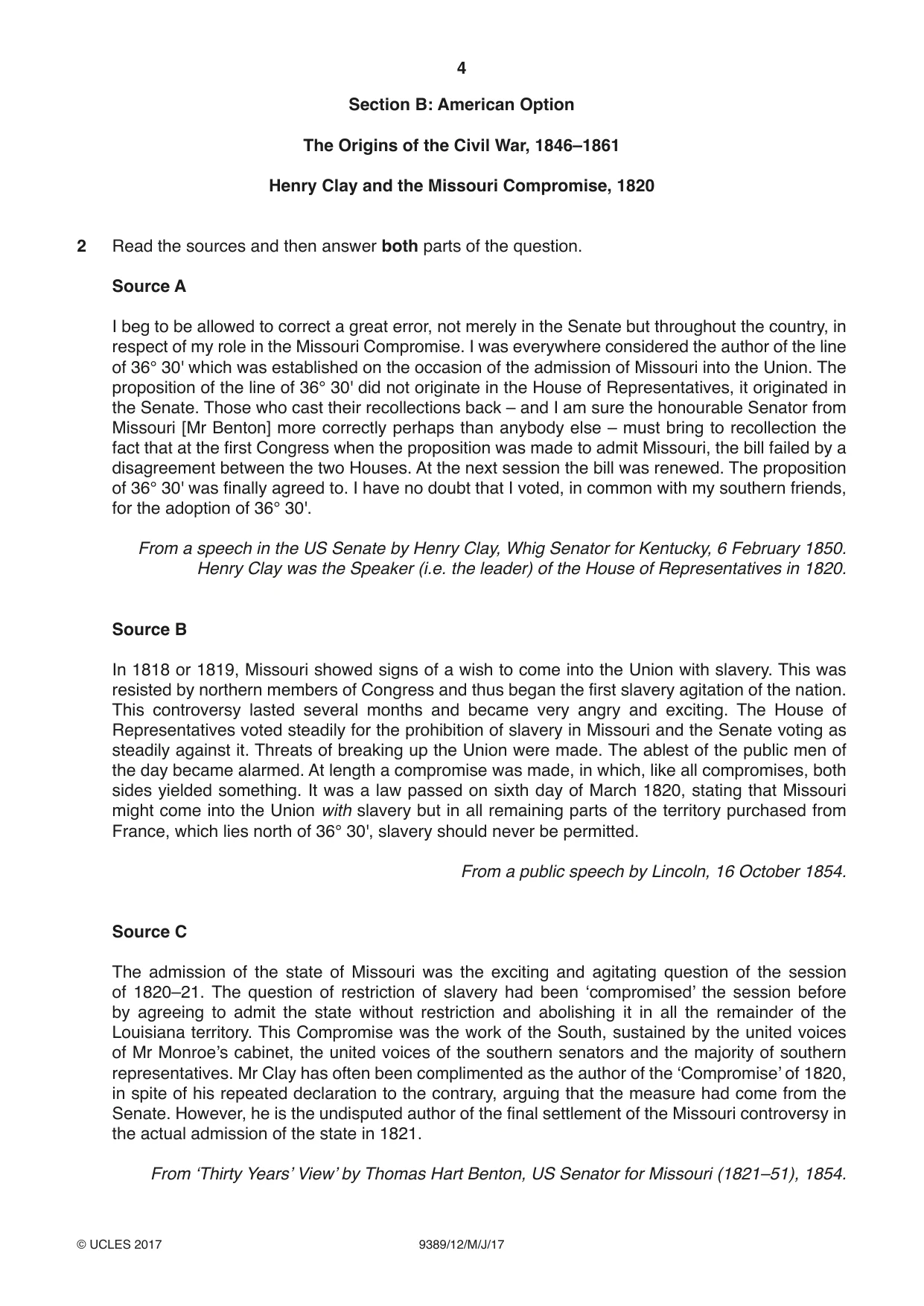
4 9389/12/M/J/17 © UCLES 2017 Section B: American Option The Origins of the Civil War, 1846–1861 Henry Clay and the Missouri Compromise, 1820 2 Read the sources and then answer both parts of the question. Source A I beg to be allowed to correct a great error, not merely in the Senate but throughout the country, in respect of my role in the Missouri Compromise. I was everywhere considered the author of the line of 36° 30' which was established on the occasion of the admission of Missouri into the Union. The proposition of the line of 36° 30' did not originate in the House of Representatives, it originated in the Senate. Those who cast their recollections back – and I am sure the honourable Senator from Missouri [Mr Benton] more correctly perhaps than anybody else – must bring to recollection the fact that at the first Congress when the proposition was made to admit Missouri, the bill failed by a disagreement between the two Houses. At the next session the bill was renewed. The proposition of 36° 30' was finally agreed to. I have no doubt that I voted, in common with my southern friends, for the adoption of 36° 30'. From a speech in the US Senate by Henry Clay, Whig Senator for Kentucky, 6 February 1850. Henry Clay was the Speaker (i.e. the leader) of the House of Representatives in 1820. Source B In 1818 or 1819, Missouri showed signs of a wish to come into the Union with slavery. This was resisted by northern members of Congress and thus began the first slavery agitation of the nation. This controversy lasted several months and became very angry and exciting. The House of Representatives voted steadily for the prohibition of slavery in Missouri and the Senate voting as steadily against it. Threats of breaking up the Union were made. The ablest of the public men of the day became alarmed. At length a compromise was made, in which, like all compromises, both sides yielded something. It was a law passed on sixth day of March 1820, stating that Missouri might come into the Union with slavery but in all remaining parts of the territory purchased from France, which lies north of 36° 30', slavery should never be permitted. From a public speech by Lincoln, 16 October 1854. Source C The admission of the state of Missouri was the exciting and agitating question of the session of 1820–21. The question of restriction of slavery had been ‘compromised’ the session before by agreeing to admit the state without restriction and abolishing it in all the remainder of the Louisiana territory. This Compromise was the work of the South, sustained by the united voices of Mr Monroe’s cabinet, the united voices of the southern senators and the majority of southern representatives. Mr Clay has often been complimented as the author of the ‘Compromise’ of 1820, in spite of his repeated declaration to the contrary, arguing that the measure had come from the Senate. However, he is the undisputed author of the final settlement of the Missouri controversy in the actual admission of the state in 1821. From ‘Thirty Years’ View’ by Thomas Hart Benton, US Senator for Missouri (1821–51), 1854.
Question paper, page 5
5 9389/12/M/J/17 © UCLES 2017 [Turn over Source D Henry Clay took a leading part, from time to time, in the great ‘Missouri Compromise’ debate. Indeed to him more than any man has been ascribed the passage of that memorable measure – one of the landmarks of American history – which limited slavery to the latitude of 36° 30'. It was the first great controversy which threatened to bring about the establishment of geographical parties, parties divided by a slavery and anti-slavery line. It implied the dissolution of the Union or an attempt to dissolve it by civil war. It is a most striking fact in our subsequent political history that the Compromise, which was strongly opposed by the great majority of northern people, came to be counted as one of the safeguards of the Free States against the unlimited extension of slavery. From ‘Memoir of Henry Clay’ by Robert Winthrop, Whig politician, 1880. Answer both parts of the question with reference to the sources. (a) To what extent do Sources A and C agree about the role of Henry Clay in achieving Congressional approval for the Missouri Compromise? [15] (b) ‘The passage of the Missouri Compromise in 1820 highlighted the dominance of the South over US politics.’ How far do Sources A to D support this view? [25]
Question paper, page 6
6 9389/12/M/J/17 © UCLES 2017 Section C: International Option The Search for International Security, 1919–1945 The origins of the United Nations 3 Read the sources and then answer both parts of the question. Source A The League of Nations today is not the League conceived by Woodrow Wilson. Too often through these years its major function has been not the overwhelming purpose of world peace, but rather a mere meeting place for the political discussions of strictly European national difficulties. In these, the United States should have no part. The League has not developed along the course contemplated by its founder, nor have the principal members shown any willingness to avoid the huge sums spent on armaments. American participation in the League would not serve the highest purpose of the prevention of war and settlement of international difficulties in accordance with fundamental American ideals. Therefore, I do not favour American participation. From a presidential election campaign speech by F. D. Roosevelt,1932. Source B The Dumbarton Oaks discussions between delegates of the USA, the United Kingdom, the Soviet Union and China on plans for an international organisation for the maintenance of peace and security have been completed. My first impression is one of extreme satisfaction that so much could have been accomplished on so difficult a subject in so short a time. The projected international organisation has for its primary purpose the maintenance of international peace and the creation of conditions that make for peace. We now know the need for such an organisation of all the peace-loving nations and the spirit of unity which will be required to maintain it. We are determined first to defeat the enemy and then so organise the peace-loving nations that they may, through unity of desire, unity of will and unity of strength, be in a position to assure that no other would-be aggressor shall even get started. The task of planning the great design of security and peace has been well begun. It now remains for the nations to complete the structure in a spirit of constructive purpose and mutual confidence. President F. D. Roosevelt, addressing Congress in October 1944. Source C The proposals for a United Nations published after the conference at Dumbarton Oaks have been welcomed in Britain. It is unfortunate that the title of ‘The League of Nations’ should have acquired in the United States, and to some extent also in Great Britain, such controversial associations as to necessitate calling the same thing by a different name. It is even more regrettable that the name now proposed should suggest such arrogant implications as ‘The United Nations’. It is to be hoped that some less provocative title will eventually be devised. President Wilson’s scheme was based upon a conception of human nature which assumed that reason would overcome force. Although some will be disappointed that there is still to be no standing army, the Dumbarton Oaks proposals are more realistic. Drafted as they were by men who for twenty years have watched the old League functioning, they are based, as the 1919 plan could never have been based, upon practical experience of international affairs. Instead of assuming a world of universal reason and peacefulness, they understand a world in which conflicting passions, prejudices and selfishness will have to be directed and controlled. From an article in a British magazine, October 1944.
Question paper, page 7
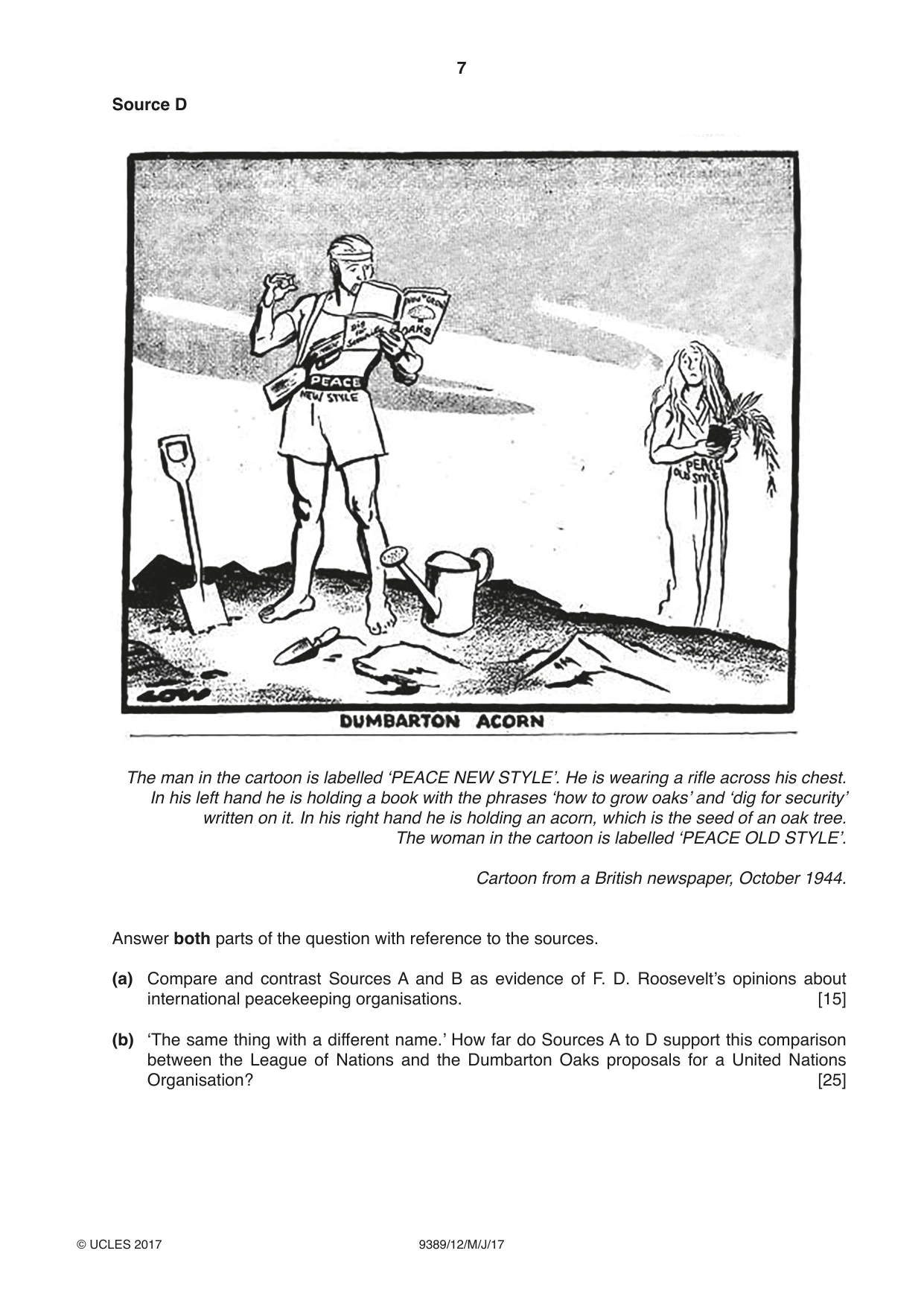
7 9389/12/M/J/17 © UCLES 2017 Source D The man in the cartoon is labelled ‘PEACE NEW STYLE’. He is wearing a rifle across his chest. In his left hand he is holding a book with the phrases ‘how to grow oaks’ and ‘dig for security’ written on it. In his right hand he is holding an acorn, which is the seed of an oak tree. The woman in the cartoon is labelled ‘PEACE OLD STYLE’. Cartoon from a British newspaper, October 1944. Answer both parts of the question with reference to the sources. (a) Compare and contrast Sources A and B as evidence of F. D. Roosevelt’s opinions about international peacekeeping organisations. [15] (b) ‘The same thing with a different name.’ How far do Sources A to D support this comparison between the League of Nations and the Dumbarton Oaks proposals for a United Nations Organisation? [25]
Question paper, page 8
8 9389/12/M/J/17 © UCLES 2017 Permission to reproduce items where third-party owned material protected by copyright is included has been sought and cleared where possible. Every reasonable effort has been made by the publisher (UCLES) to trace copyright holders, but if any items requiring clearance have unwittingly been included, the publisher will be pleased to make amends at the earliest possible opportunity. To avoid the issue of disclosure of answer-related information to candidates, all copyright acknowledgements are reproduced online in the Cambridge International Examinations Copyright Acknowledgements Booklet. This is produced for each series of examinations and is freely available to download at www.cie.org.uk after the live examination series. Cambridge International Examinations is part of the Cambridge Assessment Group. Cambridge Assessment is the brand name of University of Cambridge Local Examinations Syndicate (UCLES), which is itself a department of the University of Cambridge. BLANK PAGE
Mark scheme, page 1
® IGCSE is a registered trademark. This document consists of 12 printed pages. © UCLES 2017 [Turn over Cambridge International Examinations Cambridge International Advanced Subsidiary and Advanced Level HISTORY 9389/12 Paper 1 May/June 2017 MARK SCHEME Maximum Mark: 40 Published This mark scheme is published as an aid to teachers and candidates, to indicate the requirements of the examination. It shows the basis on which Examiners were instructed to award marks. It does not indicate the details of the discussions that took place at an Examiners’ meeting before marking began, which would have considered the acceptability of alternative answers. Mark schemes should be read in conjunction with the question paper and the Principal Examiner Report for Teachers. Cambridge will not enter into discussions about these mark schemes. Cambridge is publishing the mark schemes for the May/June 2017 series for most Cambridge IGCSE®, Cambridge International A and AS Level and Cambridge Pre-U components, and some Cambridge O Level components.
Mark scheme, page 2
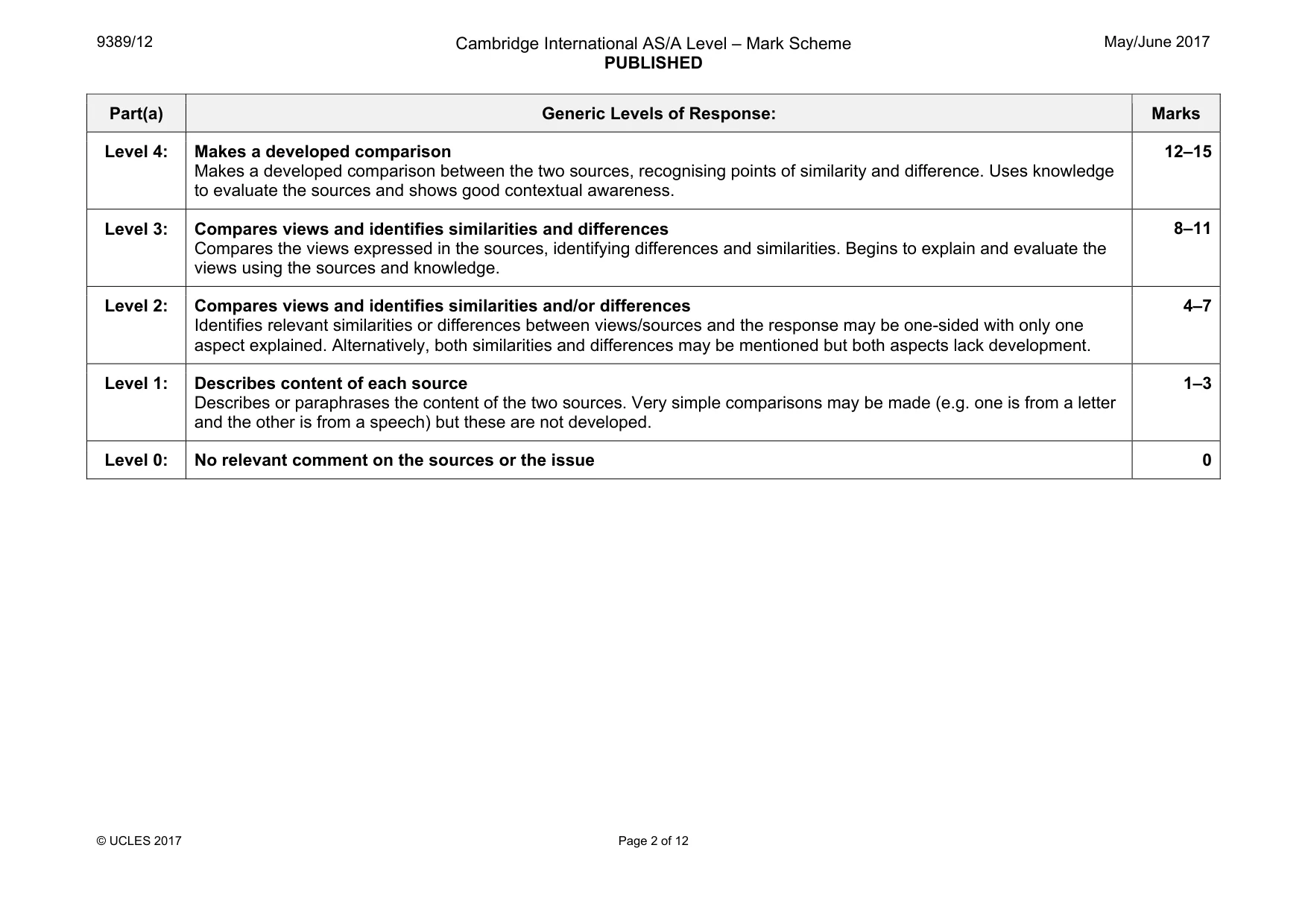
9389/12 Cambridge International AS/A Level – Mark Scheme PUBLISHED May/June 2017 © UCLES 2017 Page 2 of 12 Part(a) Generic Levels of Response: Marks Level 4: Makes a developed comparison Makes a developed comparison between the two sources, recognising points of similarity and difference. Uses knowledge to evaluate the sources and shows good contextual awareness. 12–15 Level 3: Compares views and identifies similarities and differences Compares the views expressed in the sources, identifying differences and similarities. Begins to explain and evaluate the views using the sources and knowledge. 8–11 Level 2: Compares views and identifies similarities and/or differences Identifies relevant similarities or differences between views/sources and the response may be one-sided with only one aspect explained. Alternatively, both similarities and differences may be mentioned but both aspects lack development. 4–7 Level 1: Describes content of each source Describes or paraphrases the content of the two sources. Very simple comparisons may be made (e.g. one is from a letter and the other is from a speech) but these are not developed. 1–3 Level 0: No relevant comment on the sources or the issue 0
Mark scheme, page 3
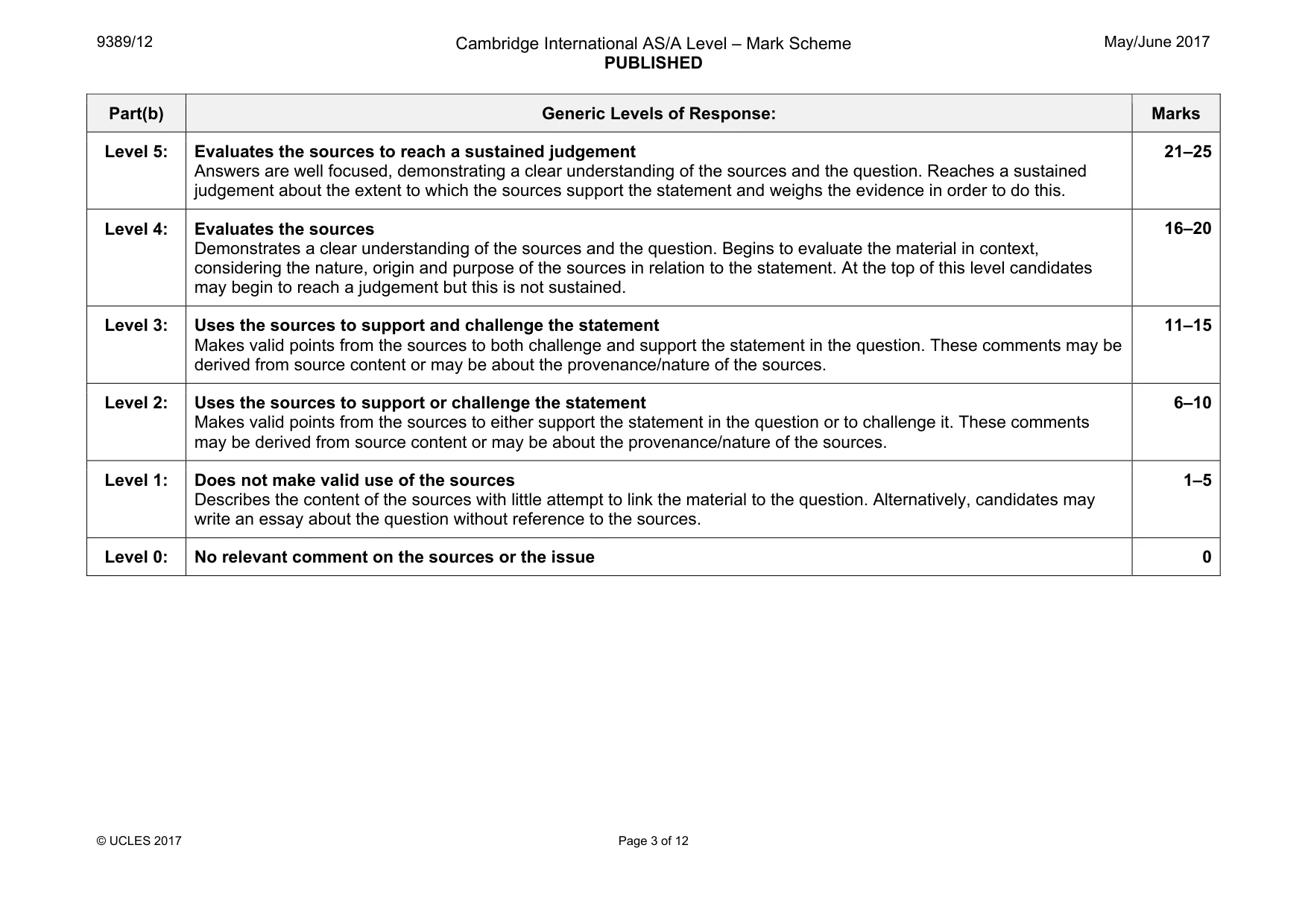
9389/12 Cambridge International AS/A Level – Mark Scheme PUBLISHED May/June 2017 © UCLES 2017 Page 3 of 12 Part(b) Generic Levels of Response: Marks Level 5: Evaluates the sources to reach a sustained judgement Answers are well focused, demonstrating a clear understanding of the sources and the question. Reaches a sustained judgement about the extent to which the sources support the statement and weighs the evidence in order to do this. 21–25 Level 4: Evaluates the sources Demonstrates a clear understanding of the sources and the question. Begins to evaluate the material in context, considering the nature, origin and purpose of the sources in relation to the statement. At the top of this level candidates may begin to reach a judgement but this is not sustained. 16–20 Level 3: Uses the sources to support and challenge the statement Makes valid points from the sources to both challenge and support the statement in the question. These comments may be derived from source content or may be about the provenance/nature of the sources. 11–15 Level 2: Uses the sources to support or challenge the statement Makes valid points from the sources to either support the statement in the question or to challenge it. These comments may be derived from source content or may be about the provenance/nature of the sources. 6–10 Level 1: Does not make valid use of the sources Describes the content of the sources with little attempt to link the material to the question. Alternatively, candidates may write an essay about the question without reference to the sources. 1–5 Level 0: No relevant comment on the sources or the issue 0
Mark scheme, page 4
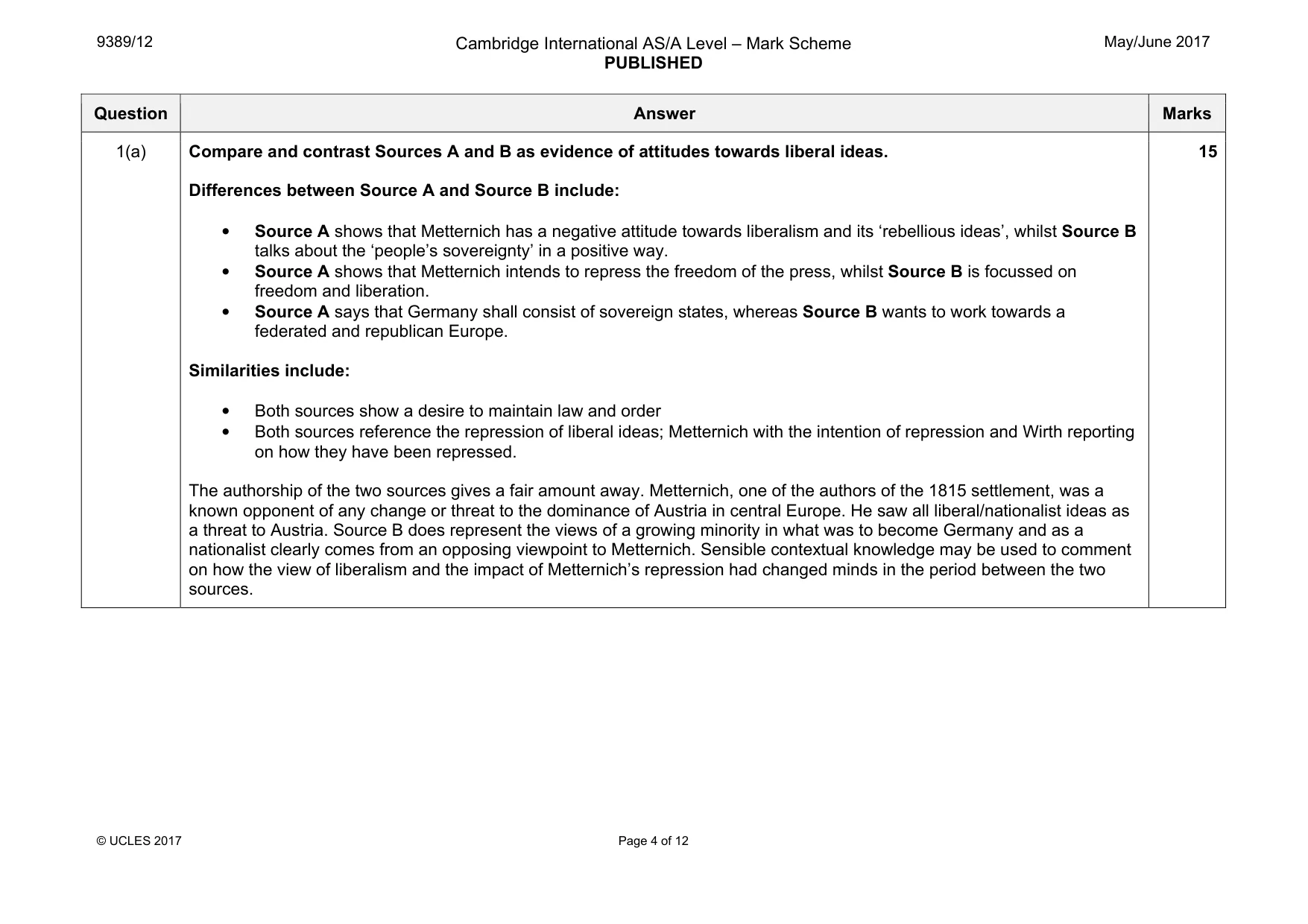
9389/12 Cambridge International AS/A Level – Mark Scheme PUBLISHED May/June 2017 © UCLES 2017 Page 4 of 12 Question Answer Marks 1(a) Compare and contrast Sources A and B as evidence of attitudes towards liberal ideas. Differences between Source A and Source B include: • Source A shows that Metternich has a negative attitude towards liberalism and its ‘rebellious ideas’, whilst Source B talks about the ‘people’s sovereignty’ in a positive way. • Source A shows that Metternich intends to repress the freedom of the press, whilst Source B is focussed on freedom and liberation. • Source A says that Germany shall consist of sovereign states, whereas Source B wants to work towards a federated and republican Europe. Similarities include: • Both sources show a desire to maintain law and order • Both sources reference the repression of liberal ideas; Metternich with the intention of repression and Wirth reporting on how they have been repressed. The authorship of the two sources gives a fair amount away. Metternich, one of the authors of the 1815 settlement, was a known opponent of any change or threat to the dominance of Austria in central Europe. He saw all liberal/nationalist ideas as a threat to Austria. Source B does represent the views of a growing minority in what was to become Germany and as a nationalist clearly comes from an opposing viewpoint to Metternich. Sensible contextual knowledge may be used to comment on how the view of liberalism and the impact of Metternich’s repression had changed minds in the period between the two sources. 15
Mark scheme, page 5
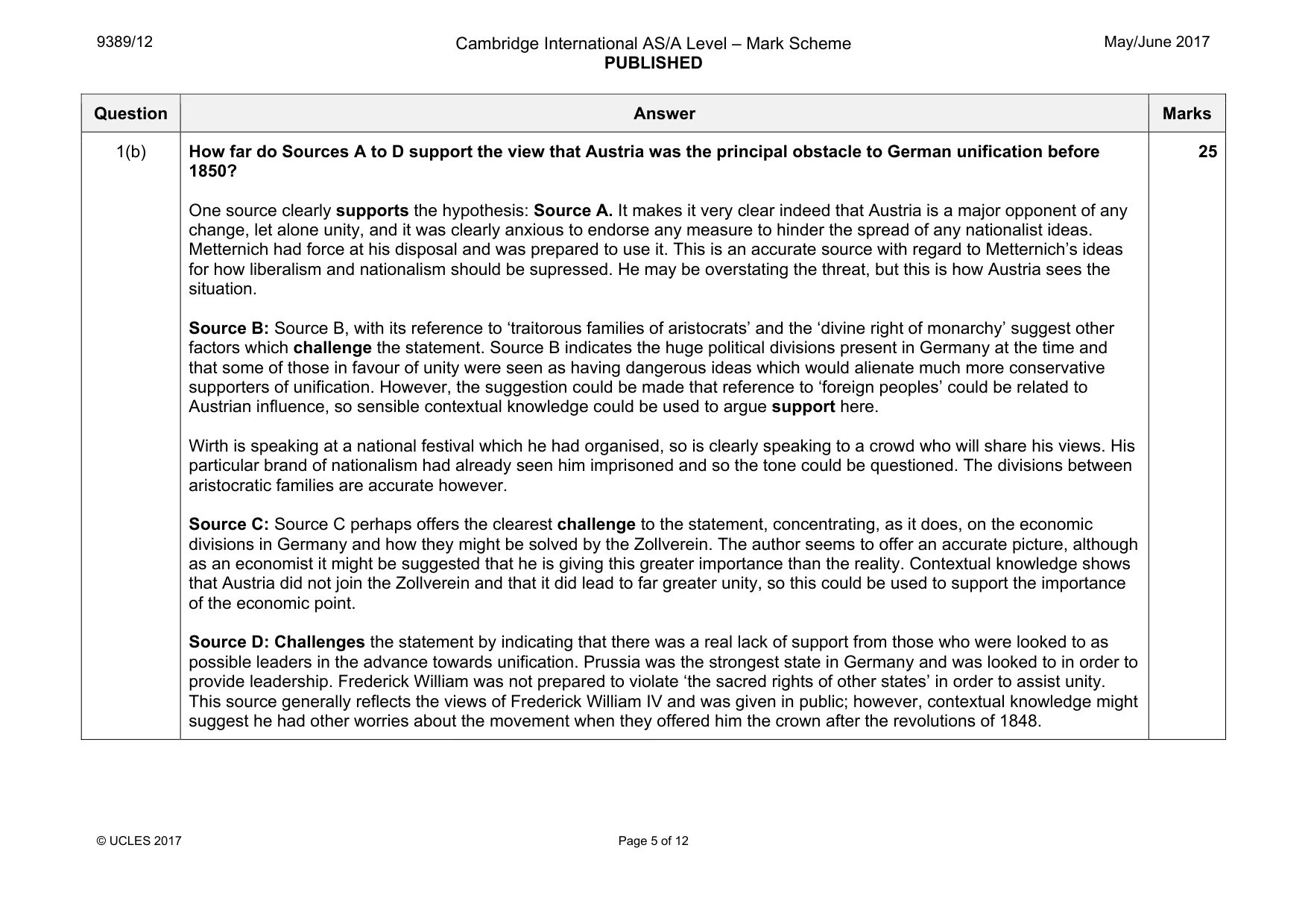
9389/12 Cambridge International AS/A Level – Mark Scheme PUBLISHED May/June 2017 © UCLES 2017 Page 5 of 12 Question Answer Marks 1(b) How far do Sources A to D support the view that Austria was the principal obstacle to German unification before 1850? One source clearly supports the hypothesis: Source A. It makes it very clear indeed that Austria is a major opponent of any change, let alone unity, and it was clearly anxious to endorse any measure to hinder the spread of any nationalist ideas. Metternich had force at his disposal and was prepared to use it. This is an accurate source with regard to Metternich’s ideas for how liberalism and nationalism should be supressed. He may be overstating the threat, but this is how Austria sees the situation. Source B: Source B, with its reference to ‘traitorous families of aristocrats’ and the ‘divine right of monarchy’ suggest other factors which challenge the statement. Source B indicates the huge political divisions present in Germany at the time and that some of those in favour of unity were seen as having dangerous ideas which would alienate much more conservative supporters of unification. However, the suggestion could be made that reference to ‘foreign peoples’ could be related to Austrian influence, so sensible contextual knowledge could be used to argue support here. Wirth is speaking at a national festival which he had organised, so is clearly speaking to a crowd who will share his views. His particular brand of nationalism had already seen him imprisoned and so the tone could be questioned. The divisions between aristocratic families are accurate however. Source C: Source C perhaps offers the clearest challenge to the statement, concentrating, as it does, on the economic divisions in Germany and how they might be solved by the Zollverein. The author seems to offer an accurate picture, although as an economist it might be suggested that he is giving this greater importance than the reality. Contextual knowledge shows that Austria did not join the Zollverein and that it did lead to far greater unity, so this could be used to support the importance of the economic point. Source D: Challenges the statement by indicating that there was a real lack of support from those who were looked to as possible leaders in the advance towards unification. Prussia was the strongest state in Germany and was looked to in order to provide leadership. Frederick William was not prepared to violate ‘the sacred rights of other states’ in order to assist unity. This source generally reflects the views of Frederick William IV and was given in public; however, contextual knowledge might suggest he had other worries about the movement when they offered him the crown after the revolutions of 1848. 25
Mark scheme, page 6
9389/12 Cambridge International AS/A Level – Mark Scheme PUBLISHED May/June 2017 © UCLES 2017 Page 6 of 12 Question Answer Marks Note: the Context of Austria and German Nationalism: The liberal and nationalistic ideas which had followed Napoleon into Germany were firmly repressed after the Vienna settlement of 1815 had restored Germany into its many different, independent, sovereign states. The Austrian Chancellor, Metternich, was determined to retain both Austrian domination of Germany and repress any liberal or nationalist ideas which might threaten this. He was a strong ideological conservative who had played an important role in defeating Napoleon and his revolutionary ideas. While Austria was a major barrier to the development of German unity, there were many other obstacles as well. Many of the German rulers, as well as their subjects, had no wish to give up their independence, and often entertained a strong dislike of each other.
Mark scheme, page 7
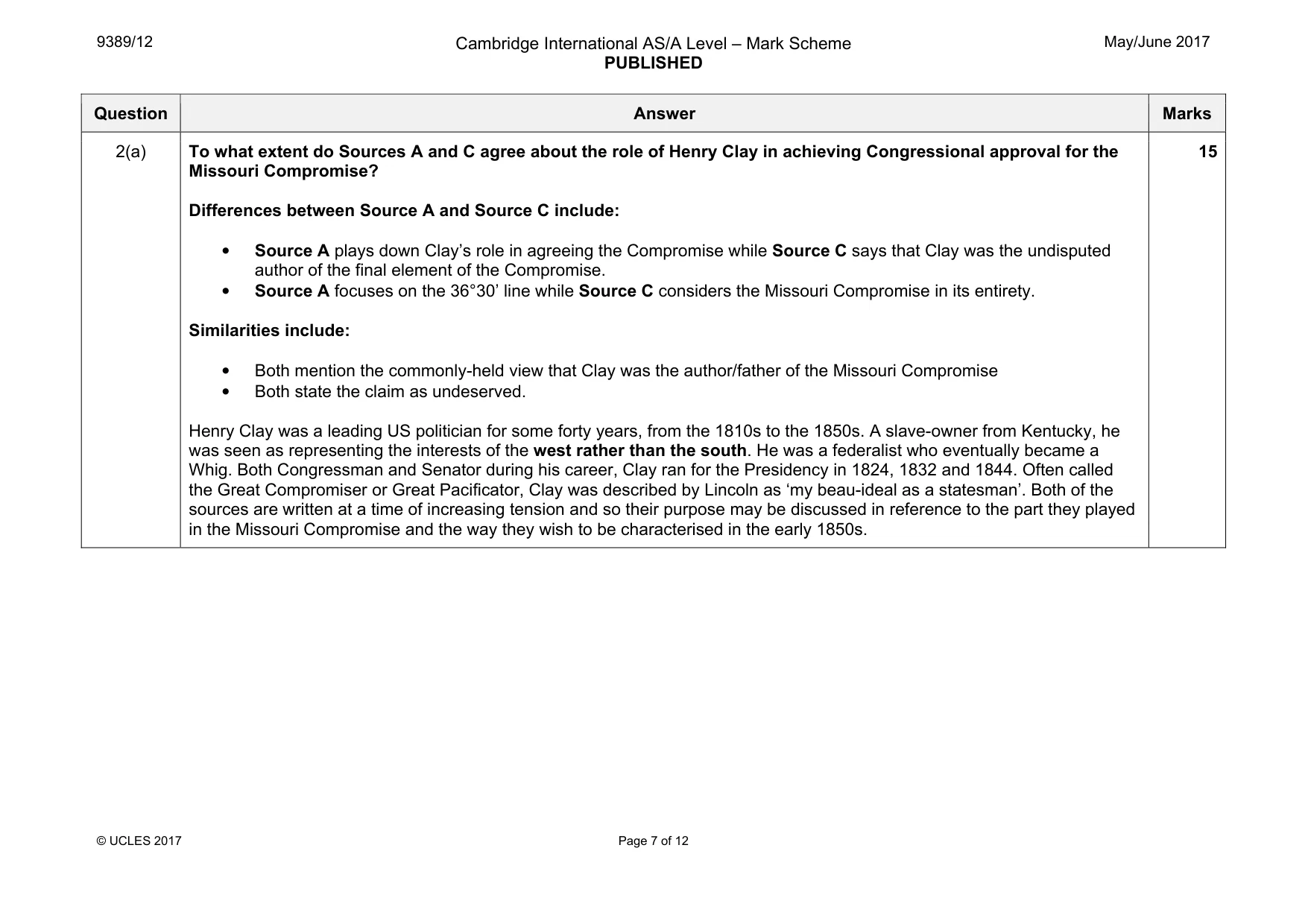
9389/12 Cambridge International AS/A Level – Mark Scheme PUBLISHED May/June 2017 © UCLES 2017 Page 7 of 12 Question Answer Marks 2(a) To what extent do Sources A and C agree about the role of Henry Clay in achieving Congressional approval for the Missouri Compromise? Differences between Source A and Source C include: • Source A plays down Clay’s role in agreeing the Compromise while Source C says that Clay was the undisputed author of the final element of the Compromise. • Source A focuses on the 36°30’ line while Source C considers the Missouri Compromise in its entirety. Similarities include: • Both mention the commonly-held view that Clay was the author/father of the Missouri Compromise • Both state the claim as undeserved. Henry Clay was a leading US politician for some forty years, from the 1810s to the 1850s. A slave-owner from Kentucky, he was seen as representing the interests of the west rather than the south. He was a federalist who eventually became a Whig. Both Congressman and Senator during his career, Clay ran for the Presidency in 1824, 1832 and 1844. Often called the Great Compromiser or Great Pacificator, Clay was described by Lincoln as ‘my beau-ideal as a statesman’. Both of the sources are written at a time of increasing tension and so their purpose may be discussed in reference to the part they played in the Missouri Compromise and the way they wish to be characterised in the early 1850s. 15
Mark scheme, page 8
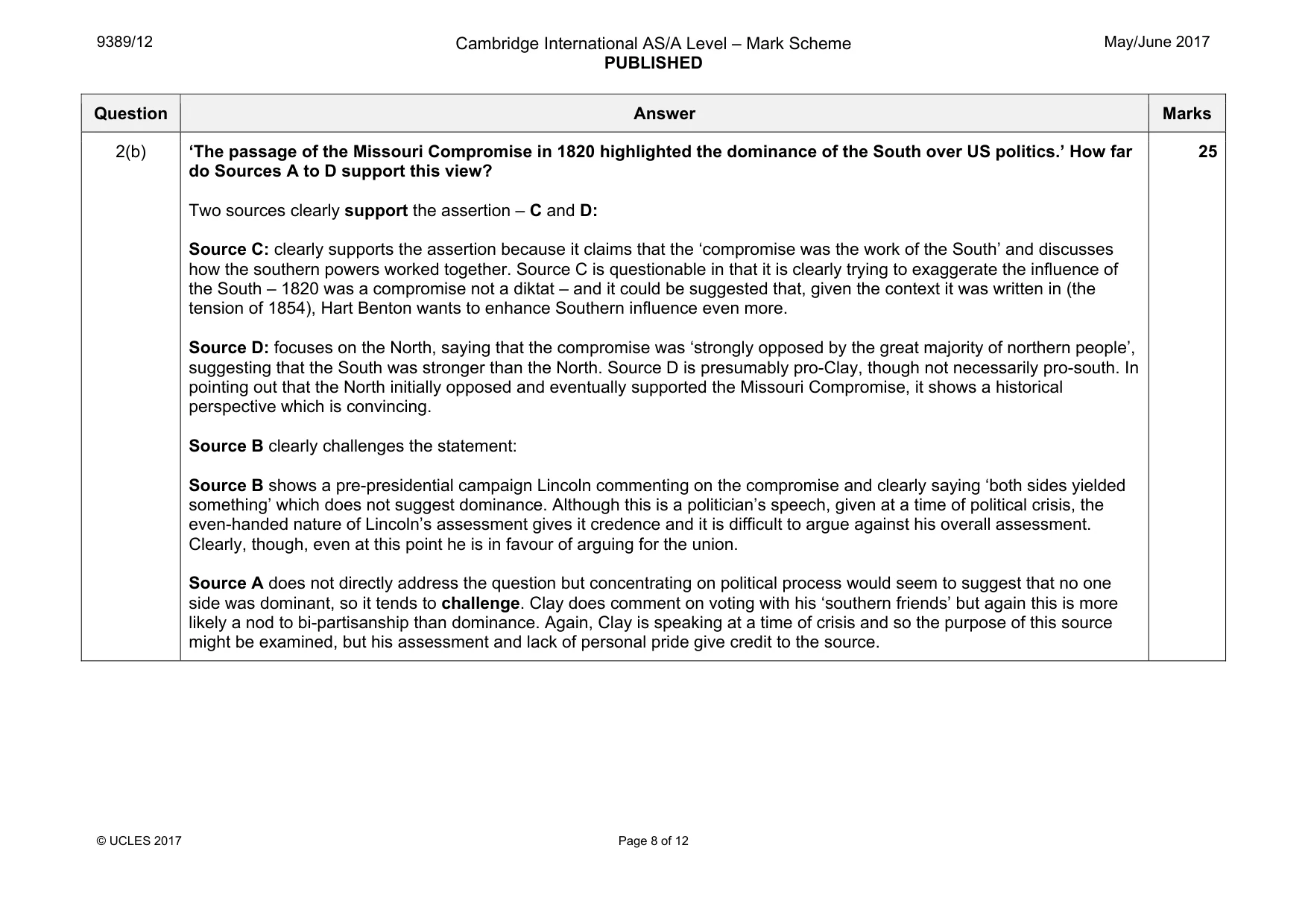
9389/12 Cambridge International AS/A Level – Mark Scheme PUBLISHED May/June 2017 © UCLES 2017 Page 8 of 12 Question Answer Marks 2(b) ‘The passage of the Missouri Compromise in 1820 highlighted the dominance of the South over US politics.’ How far do Sources A to D support this view? Two sources clearly support the assertion – C and D: Source C: clearly supports the assertion because it claims that the ‘compromise was the work of the South’ and discusses how the southern powers worked together. Source C is questionable in that it is clearly trying to exaggerate the influence of the South – 1820 was a compromise not a diktat – and it could be suggested that, given the context it was written in (the tension of 1854), Hart Benton wants to enhance Southern influence even more. Source D: focuses on the North, saying that the compromise was ‘strongly opposed by the great majority of northern people’, suggesting that the South was stronger than the North. Source D is presumably pro-Clay, though not necessarily pro-south. In pointing out that the North initially opposed and eventually supported the Missouri Compromise, it shows a historical perspective which is convincing. Source B clearly challenges the statement: Source B shows a pre-presidential campaign Lincoln commenting on the compromise and clearly saying ‘both sides yielded something’ which does not suggest dominance. Although this is a politician’s speech, given at a time of political crisis, the even-handed nature of Lincoln’s assessment gives it credence and it is difficult to argue against his overall assessment. Clearly, though, even at this point he is in favour of arguing for the union. Source A does not directly address the question but concentrating on political process would seem to suggest that no one side was dominant, so it tends to challenge. Clay does comment on voting with his ‘southern friends’ but again this is more likely a nod to bi-partisanship than dominance. Again, Clay is speaking at a time of crisis and so the purpose of this source might be examined, but his assessment and lack of personal pride give credit to the source. 25
Mark scheme, page 9
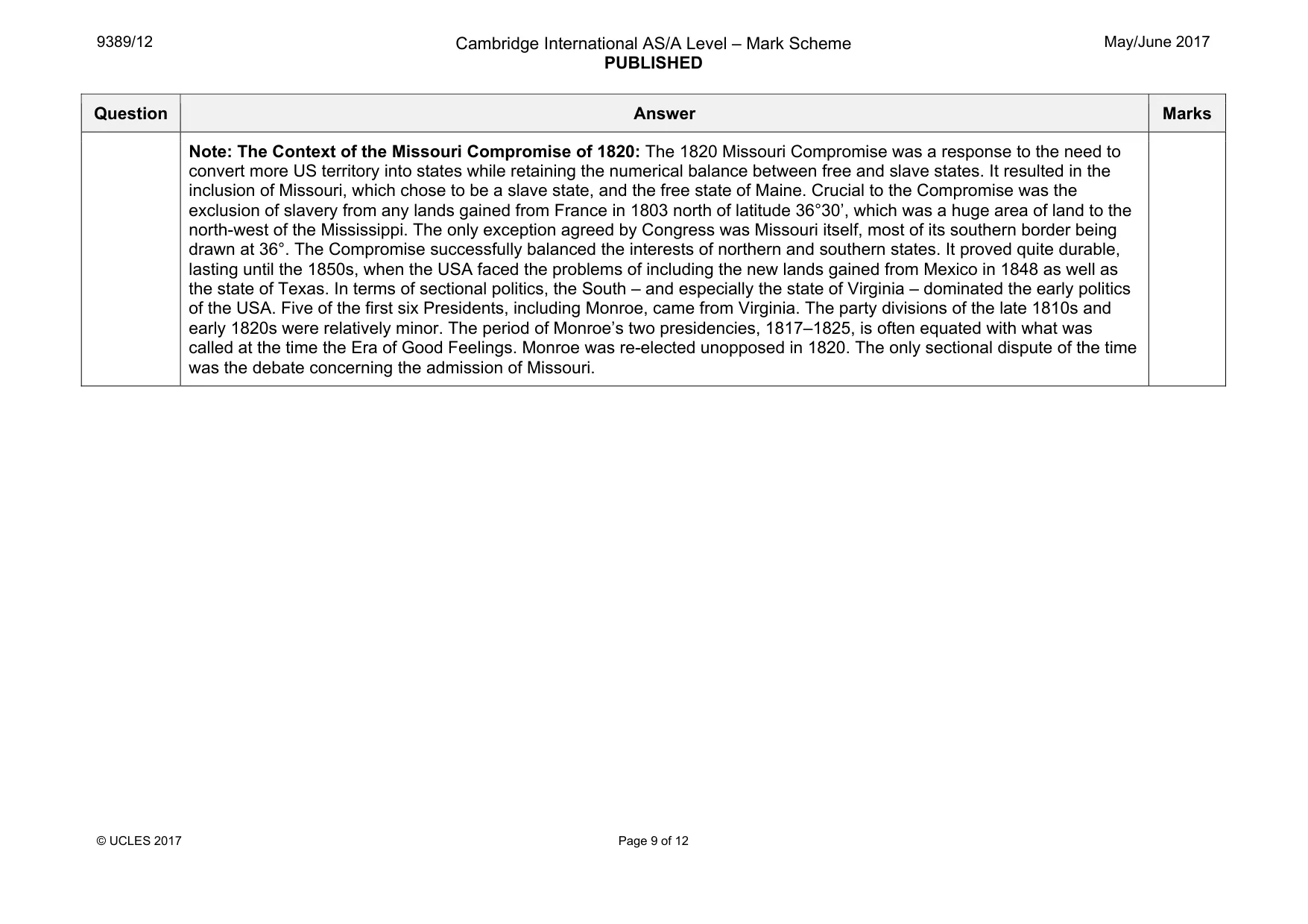
9389/12 Cambridge International AS/A Level – Mark Scheme PUBLISHED May/June 2017 © UCLES 2017 Page 9 of 12 Question Answer Marks Note: The Context of the Missouri Compromise of 1820: The 1820 Missouri Compromise was a response to the need to convert more US territory into states while retaining the numerical balance between free and slave states. It resulted in the inclusion of Missouri, which chose to be a slave state, and the free state of Maine. Crucial to the Compromise was the exclusion of slavery from any lands gained from France in 1803 north of latitude 36°30’, which was a huge area of land to the north-west of the Mississippi. The only exception agreed by Congress was Missouri itself, most of its southern border being drawn at 36°. The Compromise successfully balanced the interests of northern and southern states. It proved quite durable, lasting until the 1850s, when the USA faced the problems of including the new lands gained from Mexico in 1848 as well as the state of Texas. In terms of sectional politics, the South – and especially the state of Virginia – dominated the early politics of the USA. Five of the first six Presidents, including Monroe, came from Virginia. The party divisions of the late 1810s and early 1820s were relatively minor. The period of Monroe’s two presidencies, 1817–1825, is often equated with what was called at the time the Era of Good Feelings. Monroe was re-elected unopposed in 1820. The only sectional dispute of the time was the debate concerning the admission of Missouri.
Mark scheme, page 10
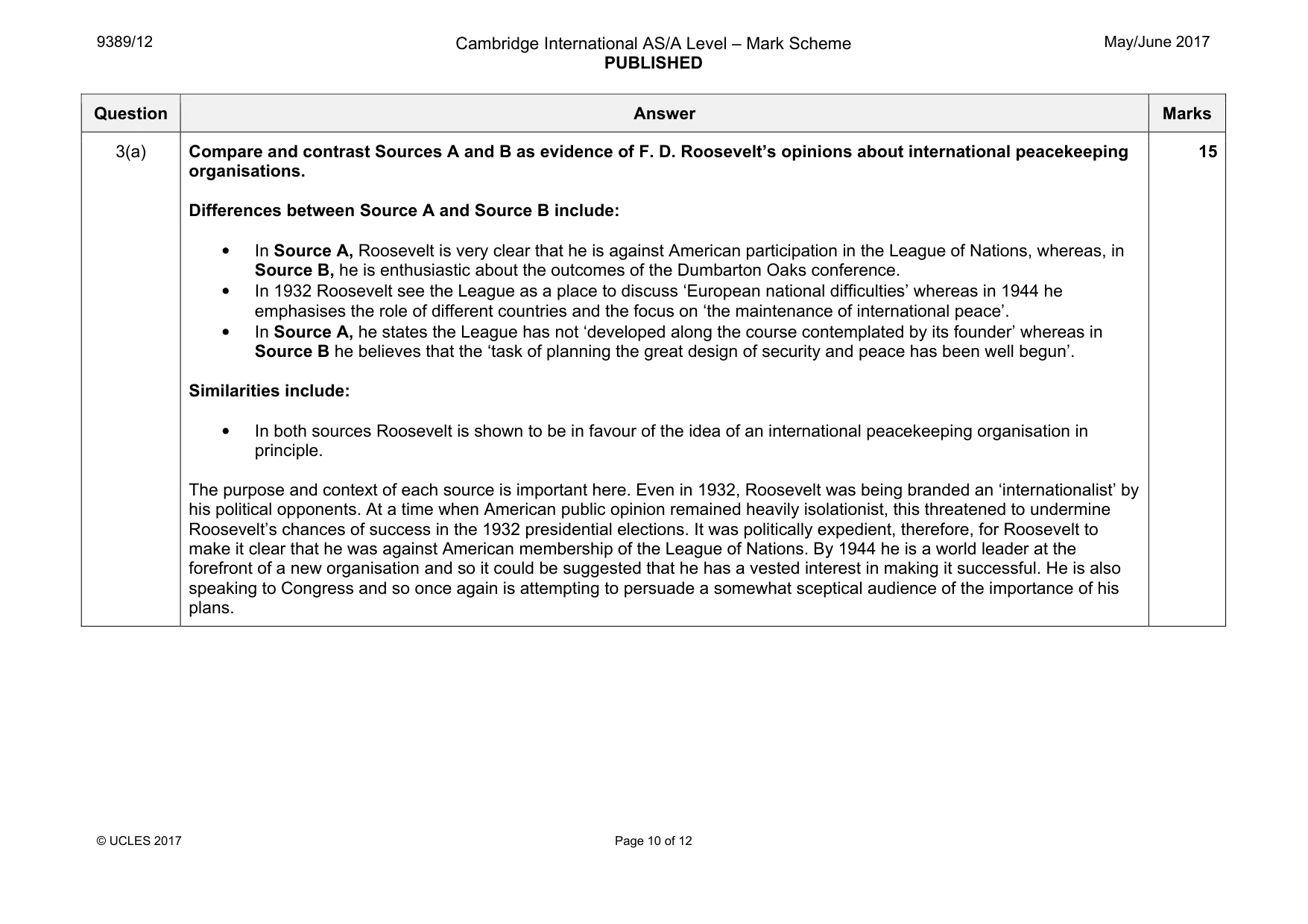
9389/12 Cambridge International AS/A Level – Mark Scheme PUBLISHED May/June 2017 © UCLES 2017 Page 10 of 12 Question Answer Marks 3(a) Compare and contrast Sources A and B as evidence of F. D. Roosevelt’s opinions about international peacekeeping organisations. Differences between Source A and Source B include: • In Source A, Roosevelt is very clear that he is against American participation in the League of Nations, whereas, in Source B, he is enthusiastic about the outcomes of the Dumbarton Oaks conference. • In 1932 Roosevelt see the League as a place to discuss ‘European national difficulties’ whereas in 1944 he emphasises the role of different countries and the focus on ‘the maintenance of international peace’. • In Source A, he states the League has not ‘developed along the course contemplated by its founder’ whereas in Source B he believes that the ‘task of planning the great design of security and peace has been well begun’. Similarities include: • In both sources Roosevelt is shown to be in favour of the idea of an international peacekeeping organisation in principle. The purpose and context of each source is important here. Even in 1932, Roosevelt was being branded an ‘internationalist’ by his political opponents. At a time when American public opinion remained heavily isolationist, this threatened to undermine Roosevelt’s chances of success in the 1932 presidential elections. It was politically expedient, therefore, for Roosevelt to make it clear that he was against American membership of the League of Nations. By 1944 he is a world leader at the forefront of a new organisation and so it could be suggested that he has a vested interest in making it successful. He is also speaking to Congress and so once again is attempting to persuade a somewhat sceptical audience of the importance of his plans. 15
Mark scheme, page 11
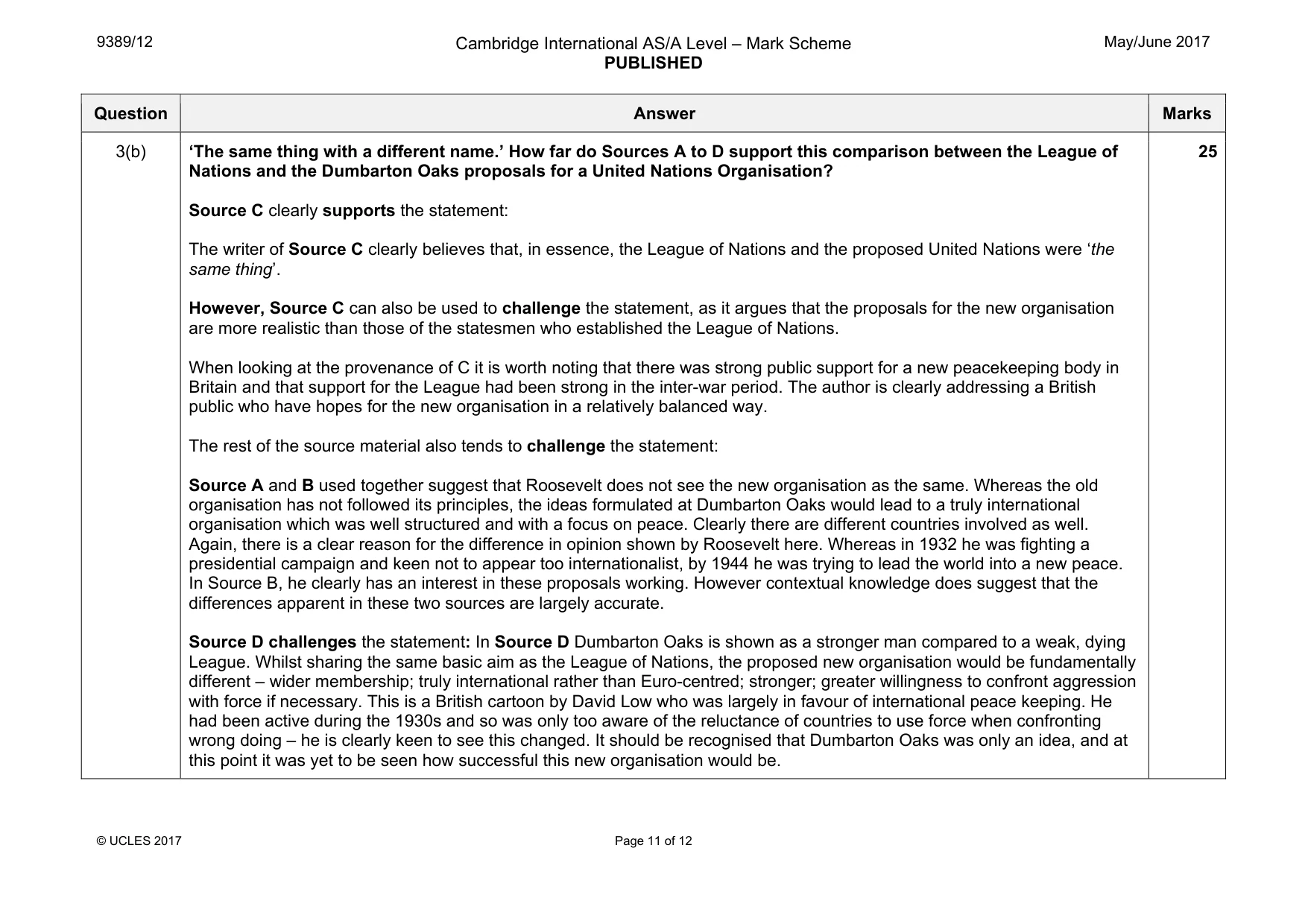
9389/12 Cambridge International AS/A Level – Mark Scheme PUBLISHED May/June 2017 © UCLES 2017 Page 11 of 12 Question Answer Marks 3(b) ‘The same thing with a different name.’ How far do Sources A to D support this comparison between the League of Nations and the Dumbarton Oaks proposals for a United Nations Organisation? Source C clearly supports the statement: The writer of Source C clearly believes that, in essence, the League of Nations and the proposed United Nations were ‘the same thing’. However, Source C can also be used to challenge the statement, as it argues that the proposals for the new organisation are more realistic than those of the statesmen who established the League of Nations. When looking at the provenance of C it is worth noting that there was strong public support for a new peacekeeping body in Britain and that support for the League had been strong in the inter-war period. The author is clearly addressing a British public who have hopes for the new organisation in a relatively balanced way. The rest of the source material also tends to challenge the statement: Source A and B used together suggest that Roosevelt does not see the new organisation as the same. Whereas the old organisation has not followed its principles, the ideas formulated at Dumbarton Oaks would lead to a truly international organisation which was well structured and with a focus on peace. Clearly there are different countries involved as well. Again, there is a clear reason for the difference in opinion shown by Roosevelt here. Whereas in 1932 he was fighting a presidential campaign and keen not to appear too internationalist, by 1944 he was trying to lead the world into a new peace. In Source B, he clearly has an interest in these proposals working. However contextual knowledge does suggest that the differences apparent in these two sources are largely accurate. Source D challenges the statement: In Source D Dumbarton Oaks is shown as a stronger man compared to a weak, dying League. Whilst sharing the same basic aim as the League of Nations, the proposed new organisation would be fundamentally different – wider membership; truly international rather than Euro-centred; stronger; greater willingness to confront aggression with force if necessary. This is a British cartoon by David Low who was largely in favour of international peace keeping. He had been active during the 1930s and so was only too aware of the reluctance of countries to use force when confronting wrong doing – he is clearly keen to see this changed. It should be recognised that Dumbarton Oaks was only an idea, and at this point it was yet to be seen how successful this new organisation would be. 25
Mark scheme, page 12
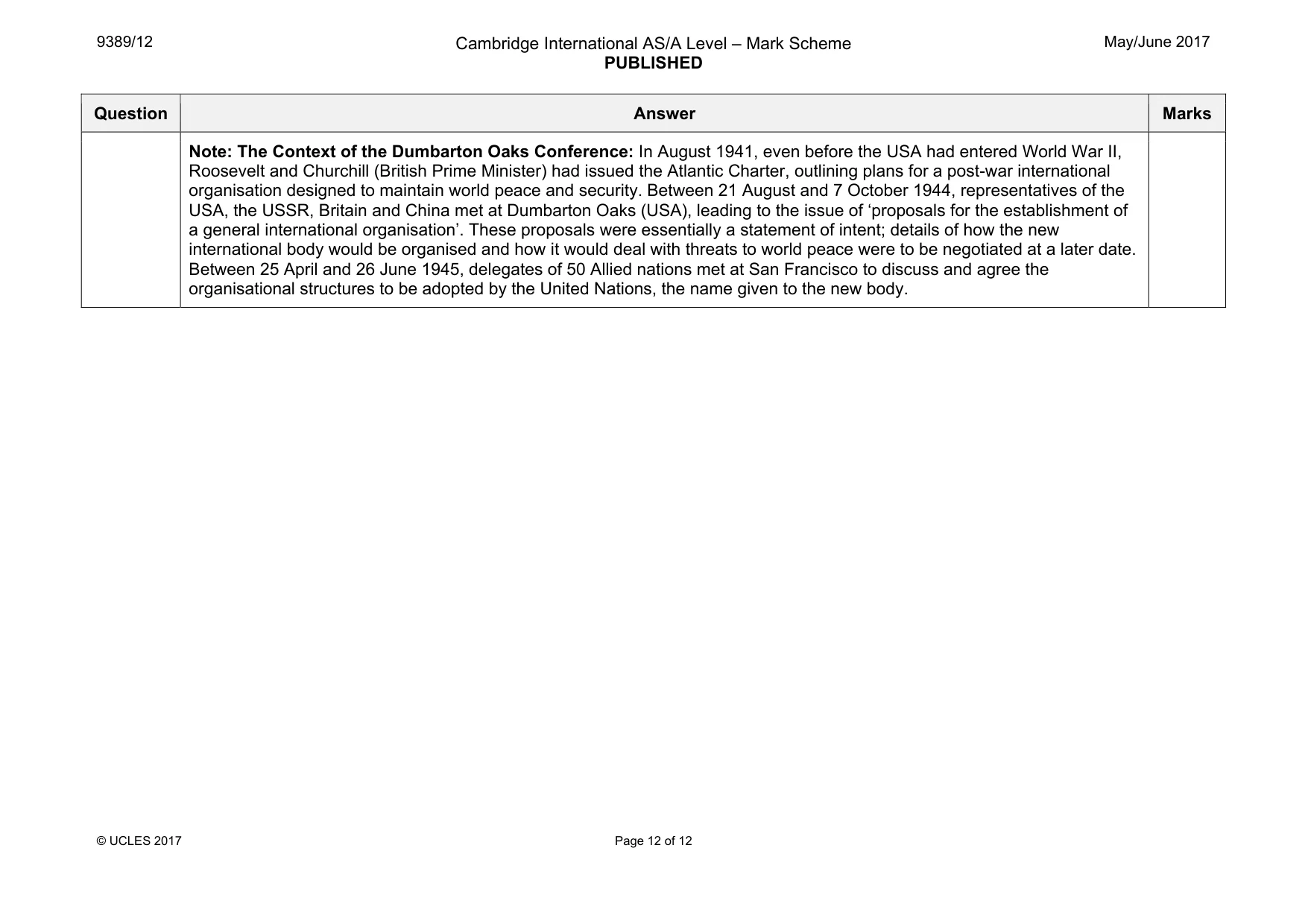
9389/12 Cambridge International AS/A Level – Mark Scheme PUBLISHED May/June 2017 © UCLES 2017 Page 12 of 12 Question Answer Marks Note: The Context of the Dumbarton Oaks Conference: In August 1941, even before the USA had entered World War II, Roosevelt and Churchill (British Prime Minister) had issued the Atlantic Charter, outlining plans for a post-war international organisation designed to maintain world peace and security. Between 21 August and 7 October 1944, representatives of the USA, the USSR, Britain and China met at Dumbarton Oaks (USA), leading to the issue of ‘proposals for the establishment of a general international organisation’. These proposals were essentially a statement of intent; details of how the new international body would be organised and how it would deal with threats to world peace were to be negotiated at a later date. Between 25 April and 26 June 1945, delegates of 50 Allied nations met at San Francisco to discuss and agree the organisational structures to be adopted by the United Nations, the name given to the new body.
What you needed in this session
Cambridge’s own grade thresholds for 2017 May/June, Paper 1 · Variant 2. A higher threshold means an easier paper — the bar moves with how the cohort did.