Cambridge A Level History 9389 — 2017 May/June Paper 1 · Variant 3
9389/13/M/J/17 · 40 marks · ≈45 min
The question paper and its mark scheme, free to read here and free to download. This is Cambridge’s own paper, exactly as it was sat.
Question paper8 pages
Mark scheme10 pages
Answers below. Sit the paper first if you are practising.
Paper as text
Question paper, page 1
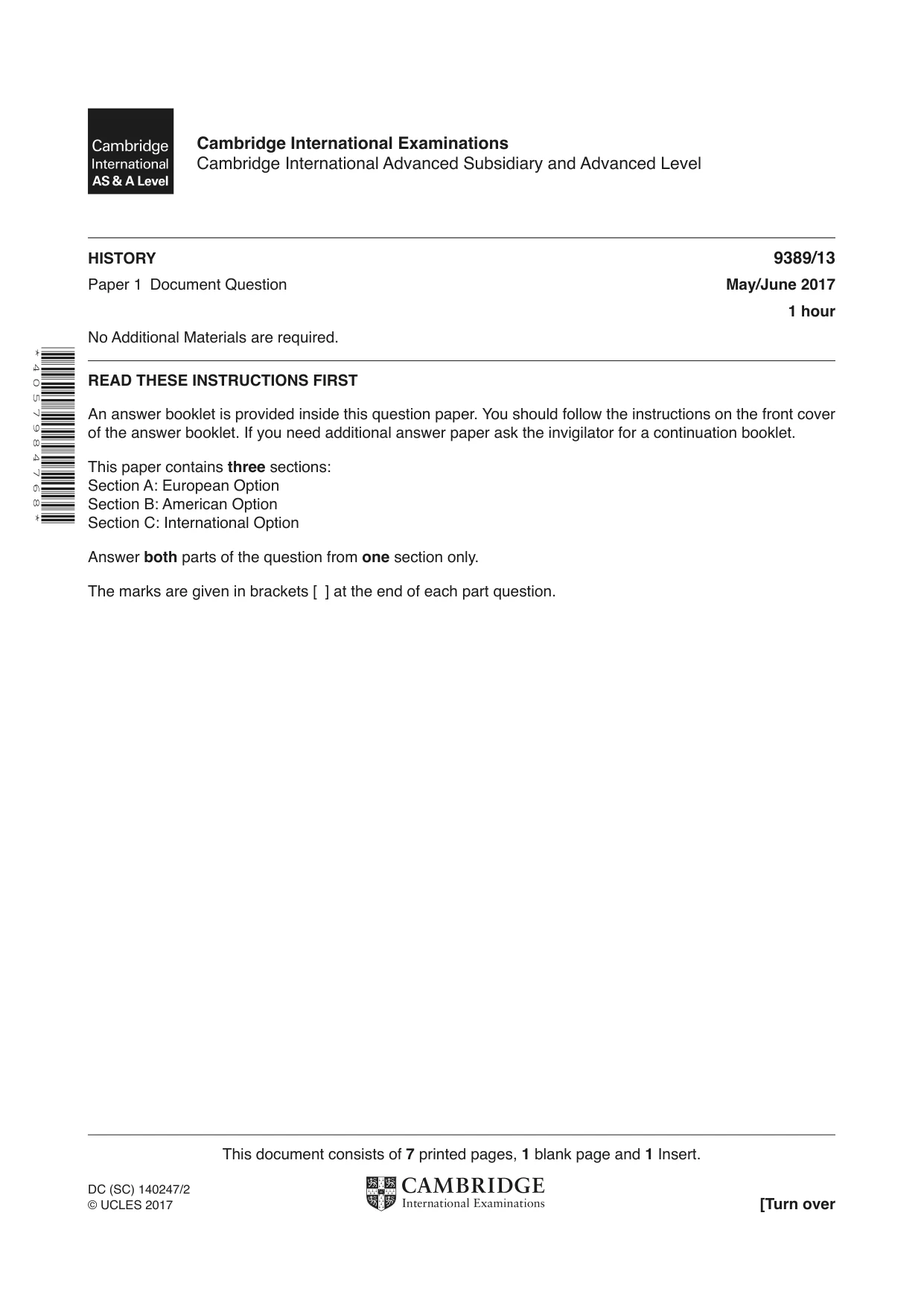
* 4 0 5 7 9 8 4 7 6 8 * This document consists of 7 printed pages, 1 blank page and 1 Insert. DC (SC) 140247/2 © UCLES 2017 [Turn over Cambridge International Examinations Cambridge International Advanced Subsidiary and Advanced Level HISTORY 9389/13 Paper 1 Document Question May/June 2017 1 hour No Additional Materials are required. READ THESE INSTRUCTIONS FIRST An answer booklet is provided inside this question paper. You should follow the instructions on the front cover of the answer booklet. If you need additional answer paper ask the invigilator for a continuation booklet. This paper contains three sections: Section A: European Option Section B: American Option Section C: International Option Answer both parts of the question from one section only. The marks are given in brackets [ ] at the end of each part question.
Question paper, page 2
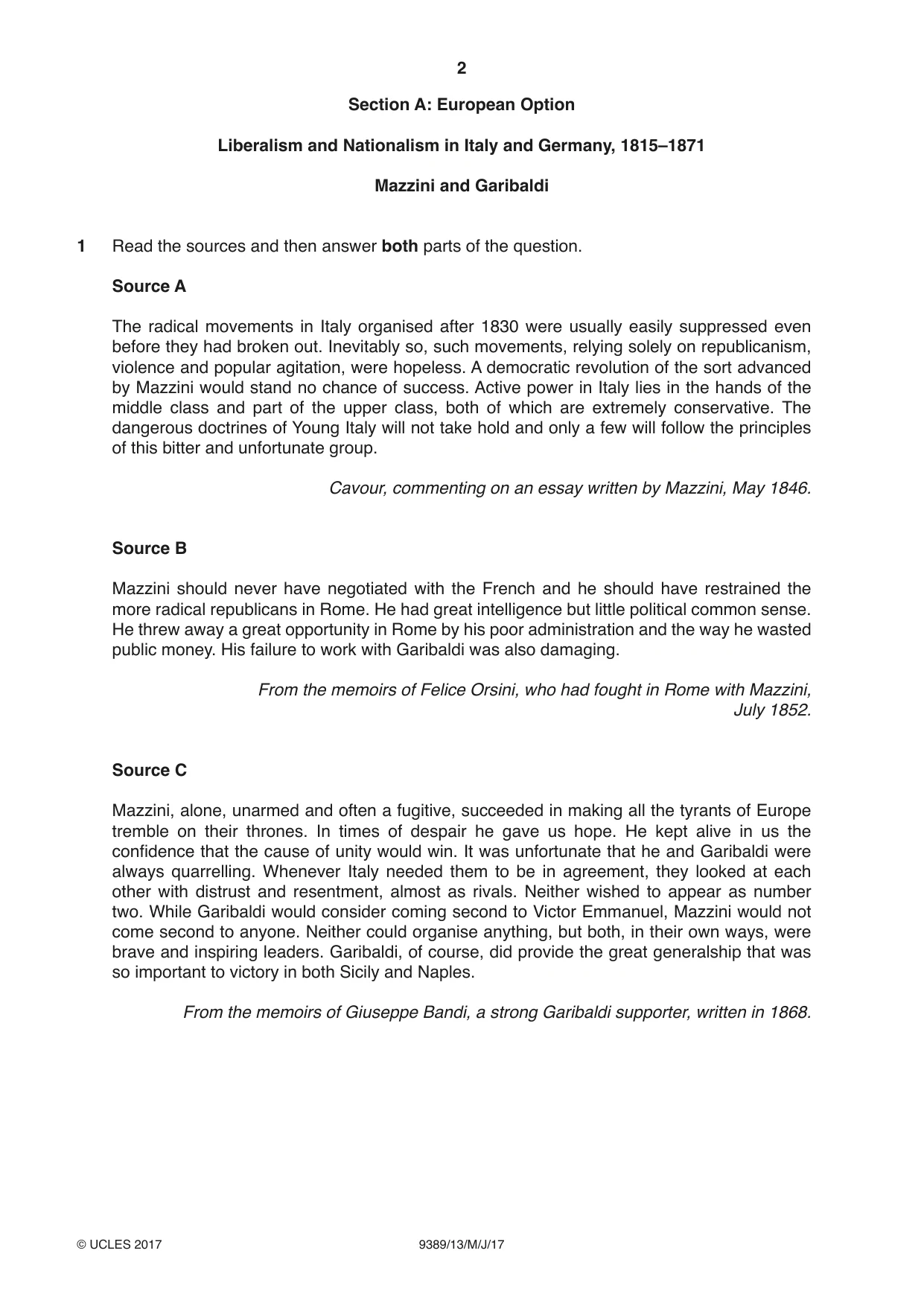
2 9389/13/M/J/17 © UCLES 2017 Section A: European Option Liberalism and Nationalism in Italy and Germany, 1815–1871 Mazzini and Garibaldi 1 Read the sources and then answer both parts of the question. Source A The radical movements in Italy organised after 1830 were usually easily suppressed even before they had broken out. Inevitably so, such movements, relying solely on republicanism, violence and popular agitation, were hopeless. A democratic revolution of the sort advanced by Mazzini would stand no chance of success. Active power in Italy lies in the hands of the middle class and part of the upper class, both of which are extremely conservative. The dangerous doctrines of Young Italy will not take hold and only a few will follow the principles of this bitter and unfortunate group. Cavour, commenting on an essay written by Mazzini, May 1846. Source B Mazzini should never have negotiated with the French and he should have restrained the more radical republicans in Rome. He had great intelligence but little political common sense. He threw away a great opportunity in Rome by his poor administration and the way he wasted public money. His failure to work with Garibaldi was also damaging. From the memoirs of Felice Orsini, who had fought in Rome with Mazzini, July 1852. Source C Mazzini, alone, unarmed and often a fugitive, succeeded in making all the tyrants of Europe tremble on their thrones. In times of despair he gave us hope. He kept alive in us the confidence that the cause of unity would win. It was unfortunate that he and Garibaldi were always quarrelling. Whenever Italy needed them to be in agreement, they looked at each other with distrust and resentment, almost as rivals. Neither wished to appear as number two. While Garibaldi would consider coming second to Victor Emmanuel, Mazzini would not come second to anyone. Neither could organise anything, but both, in their own ways, were brave and inspiring leaders. Garibaldi, of course, did provide the great generalship that was so important to victory in both Sicily and Naples. From the memoirs of Giuseppe Bandi, a strong Garibaldi supporter, written in 1868.
Question paper, page 3
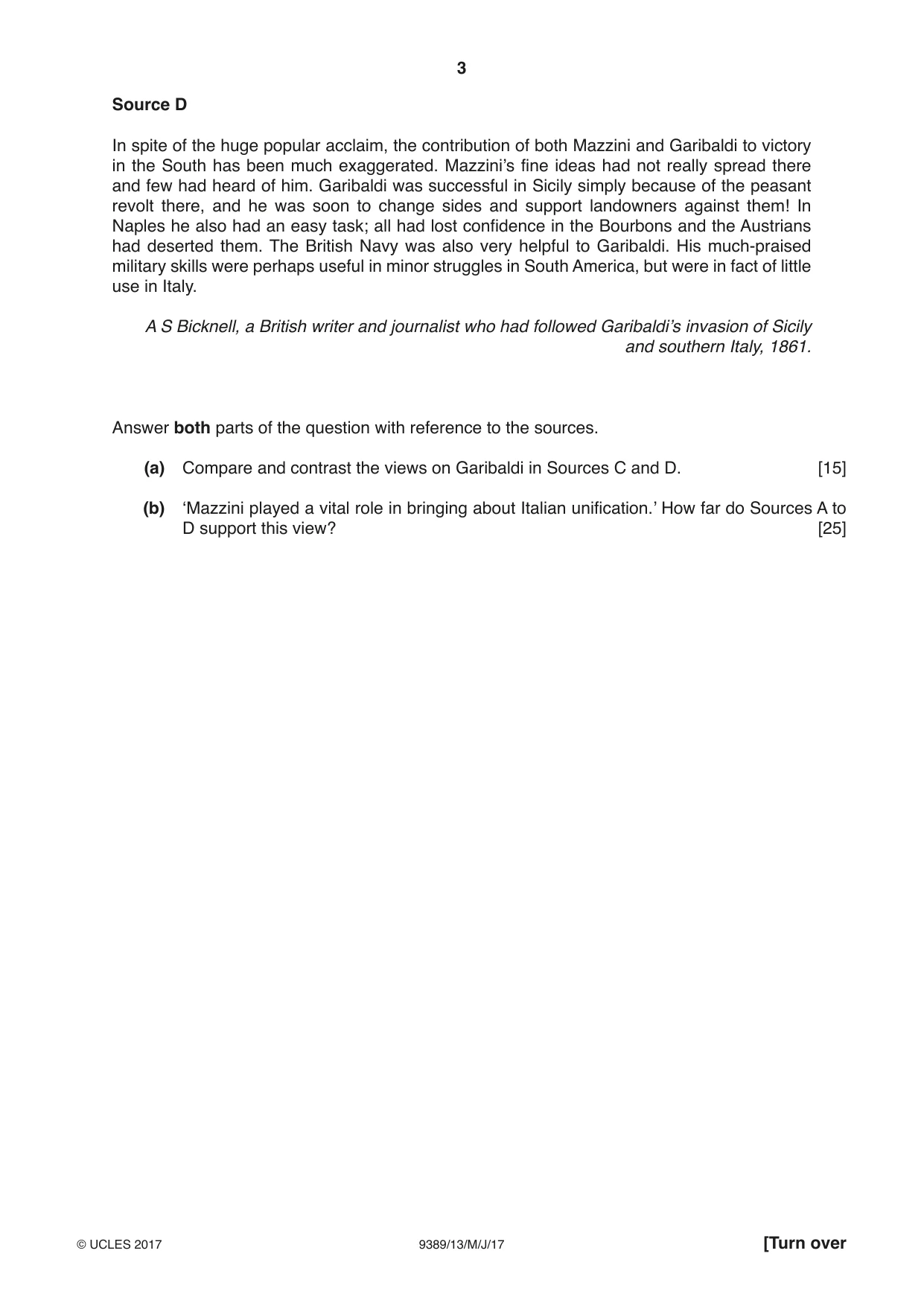
3 9389/13/M/J/17 © UCLES 2017 [Turn over Source D In spite of the huge popular acclaim, the contribution of both Mazzini and Garibaldi to victory in the South has been much exaggerated. Mazzini’s fine ideas had not really spread there and few had heard of him. Garibaldi was successful in Sicily simply because of the peasant revolt there, and he was soon to change sides and support landowners against them! In Naples he also had an easy task; all had lost confidence in the Bourbons and the Austrians had deserted them. The British Navy was also very helpful to Garibaldi. His much-praised military skills were perhaps useful in minor struggles in South America, but were in fact of little use in Italy. A S Bicknell, a British writer and journalist who had followed Garibaldi’s invasion of Sicily and southern Italy, 1861. Answer both parts of the question with reference to the sources. (a) Compare and contrast the views on Garibaldi in Sources C and D. [15] (b) ‘Mazzini played a vital role in bringing about Italian unification.’ How far do Sources A to D support this view? [25]
Question paper, page 4
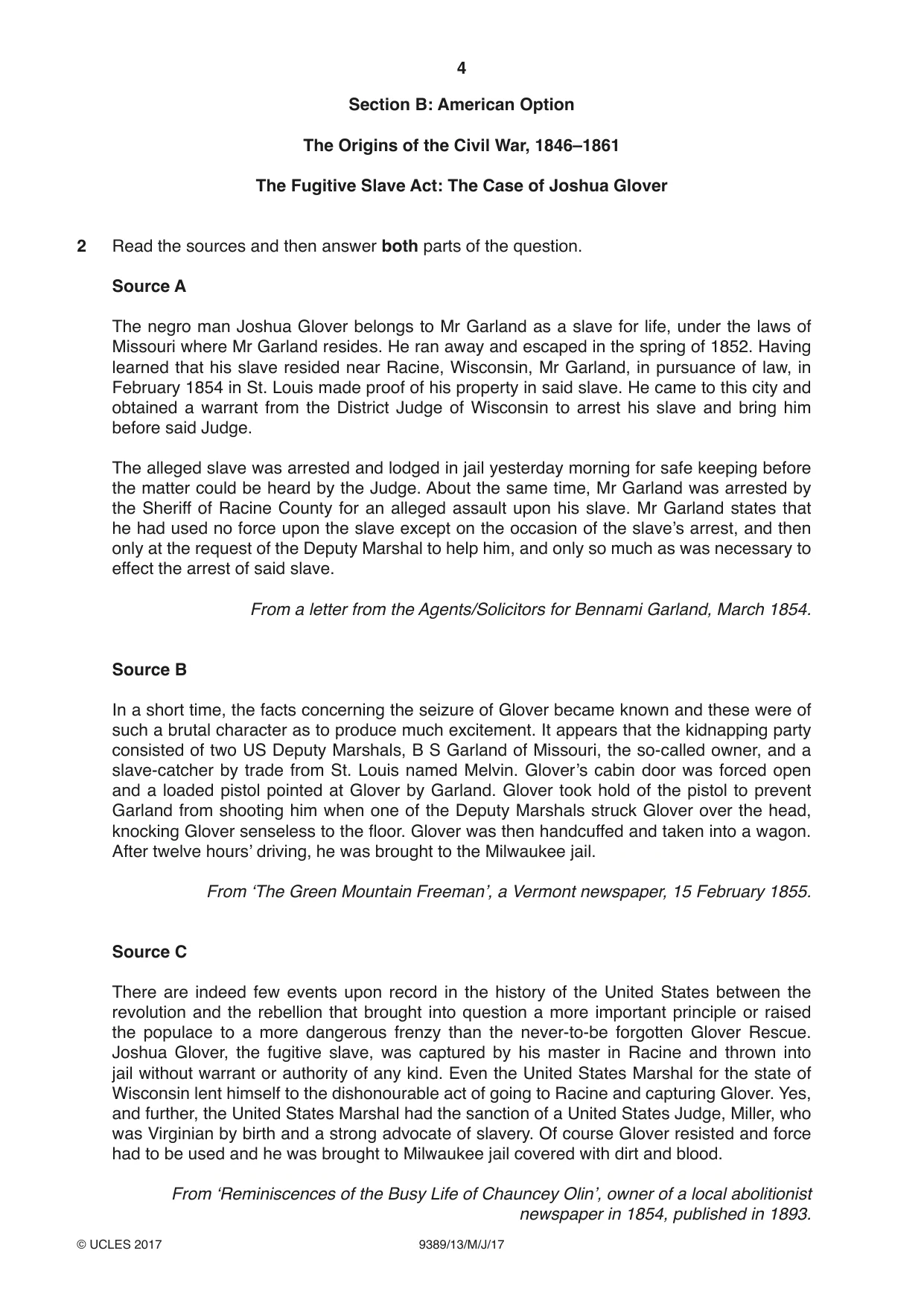
4 9389/13/M/J/17 © UCLES 2017 Section B: American Option The Origins of the Civil War, 1846–1861 The Fugitive Slave Act: The Case of Joshua Glover 2 Read the sources and then answer both parts of the question. Source A The negro man Joshua Glover belongs to Mr Garland as a slave for life, under the laws of Missouri where Mr Garland resides. He ran away and escaped in the spring of 1852. Having learned that his slave resided near Racine, Wisconsin, Mr Garland, in pursuance of law, in February 1854 in St. Louis made proof of his property in said slave. He came to this city and obtained a warrant from the District Judge of Wisconsin to arrest his slave and bring him before said Judge. The alleged slave was arrested and lodged in jail yesterday morning for safe keeping before the matter could be heard by the Judge. About the same time, Mr Garland was arrested by the Sheriff of Racine County for an alleged assault upon his slave. Mr Garland states that he had used no force upon the slave except on the occasion of the slave’s arrest, and then only at the request of the Deputy Marshal to help him, and only so much as was necessary to effect the arrest of said slave. From a letter from the Agents/Solicitors for Bennami Garland, March 1854. Source B In a short time, the facts concerning the seizure of Glover became known and these were of such a brutal character as to produce much excitement. It appears that the kidnapping party consisted of two US Deputy Marshals, B S Garland of Missouri, the so-called owner, and a slave-catcher by trade from St. Louis named Melvin. Glover’s cabin door was forced open and a loaded pistol pointed at Glover by Garland. Glover took hold of the pistol to prevent Garland from shooting him when one of the Deputy Marshals struck Glover over the head, knocking Glover senseless to the floor. Glover was then handcuffed and taken into a wagon. After twelve hours’ driving, he was brought to the Milwaukee jail. From ‘The Green Mountain Freeman’, a Vermont newspaper, 15 February 1855. Source C There are indeed few events upon record in the history of the United States between the revolution and the rebellion that brought into question a more important principle or raised the populace to a more dangerous frenzy than the never-to-be forgotten Glover Rescue. Joshua Glover, the fugitive slave, was captured by his master in Racine and thrown into jail without warrant or authority of any kind. Even the United States Marshal for the state of Wisconsin lent himself to the dishonourable act of going to Racine and capturing Glover. Yes, and further, the United States Marshal had the sanction of a United States Judge, Miller, who was Virginian by birth and a strong advocate of slavery. Of course Glover resisted and force had to be used and he was brought to Milwaukee jail covered with dirt and blood. From ‘Reminiscences of the Busy Life of Chauncey Olin’, owner of a local abolitionist newspaper in 1854, published in 1893.
Question paper, page 5
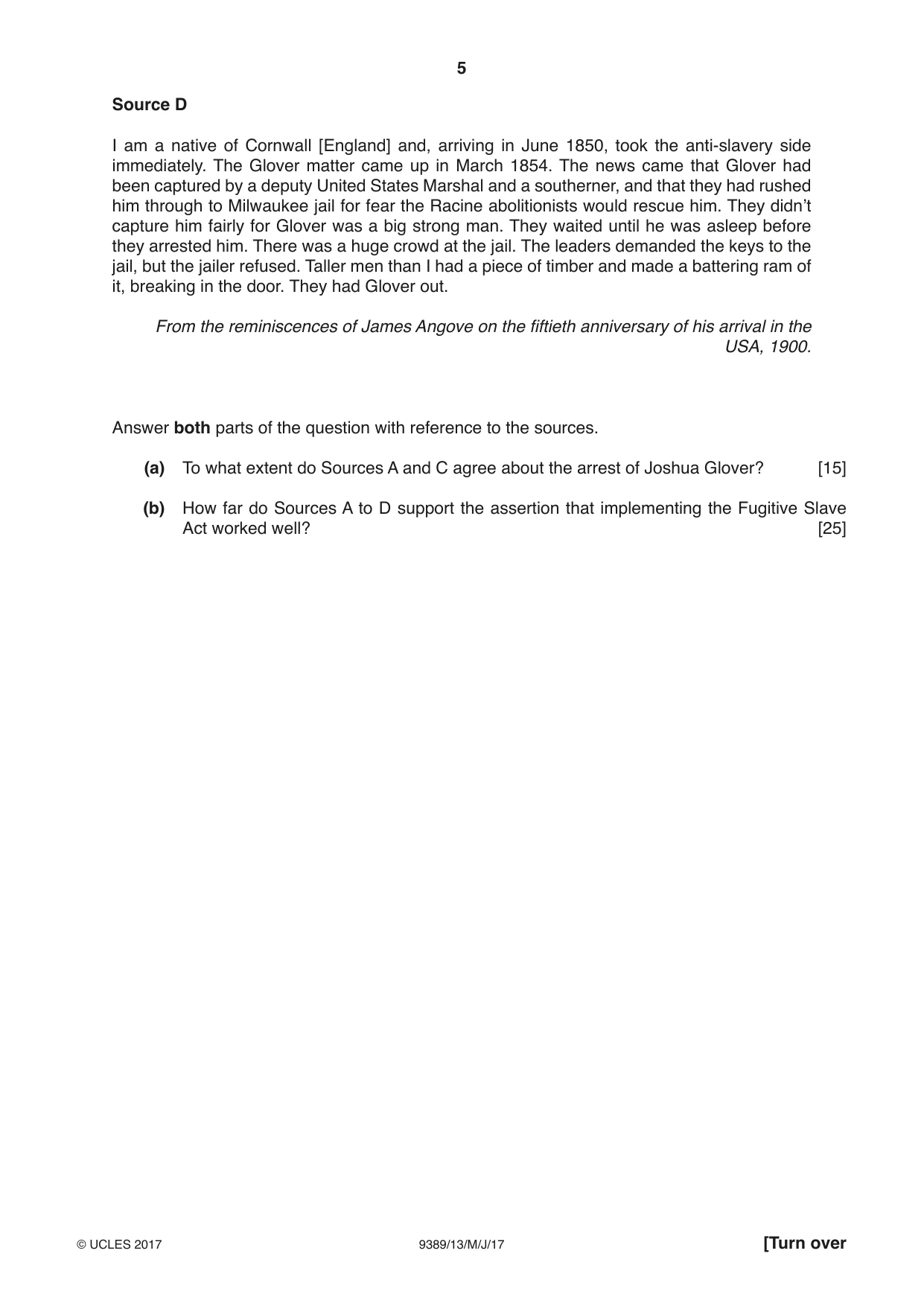
5 9389/13/M/J/17 © UCLES 2017 [Turn over Source D I am a native of Cornwall [England] and, arriving in June 1850, took the anti-slavery side immediately. The Glover matter came up in March 1854. The news came that Glover had been captured by a deputy United States Marshal and a southerner, and that they had rushed him through to Milwaukee jail for fear the Racine abolitionists would rescue him. They didn’t capture him fairly for Glover was a big strong man. They waited until he was asleep before they arrested him. There was a huge crowd at the jail. The leaders demanded the keys to the jail, but the jailer refused. Taller men than I had a piece of timber and made a battering ram of it, breaking in the door. They had Glover out. From the reminiscences of James Angove on the fiftieth anniversary of his arrival in the USA, 1900. Answer both parts of the question with reference to the sources. (a) To what extent do Sources A and C agree about the arrest of Joshua Glover? [15] (b) How far do Sources A to D support the assertion that implementing the Fugitive Slave Act worked well? [25]
Question paper, page 6
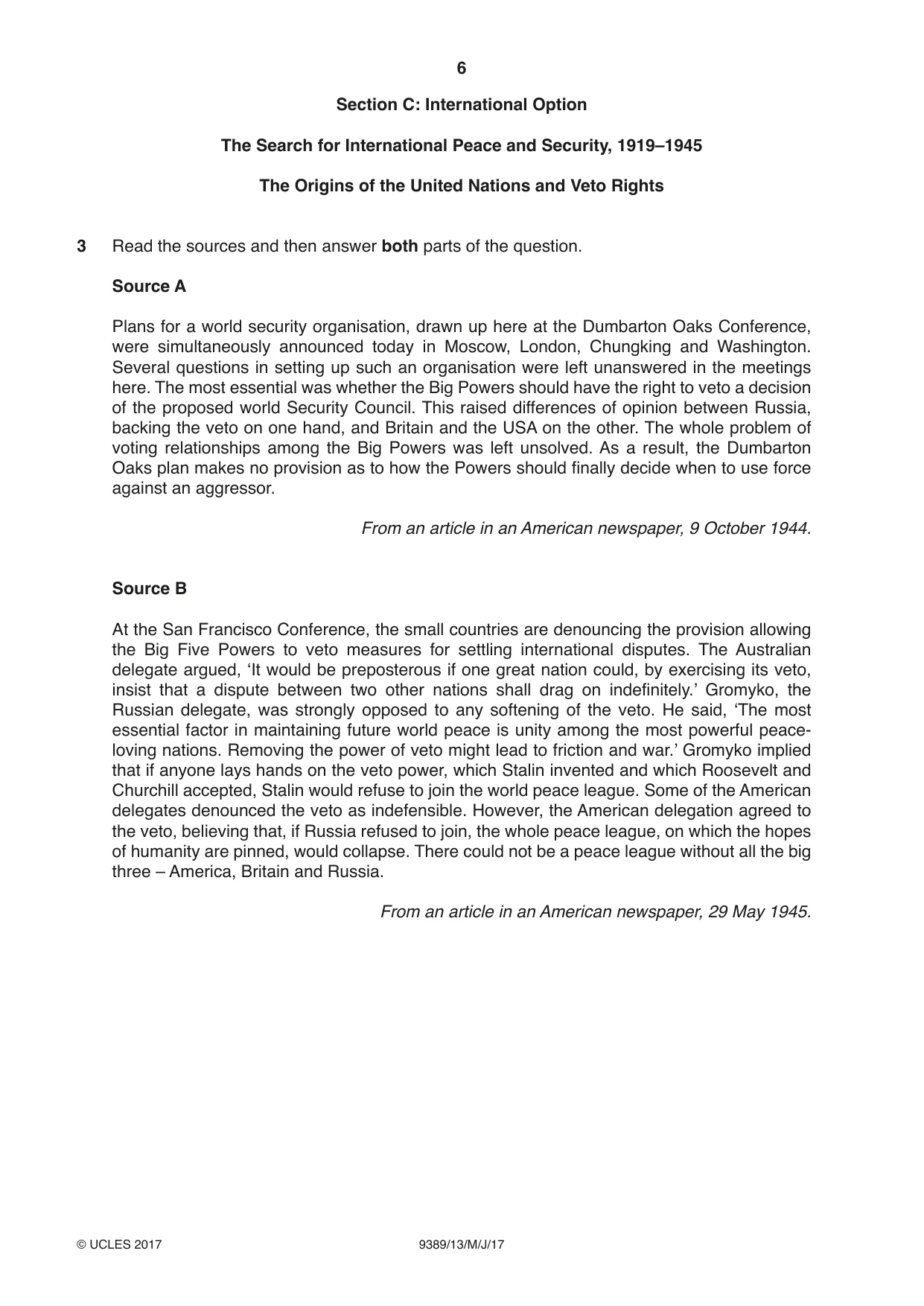
6 9389/13/M/J/17 © UCLES 2017 Section C: International Option The Search for International Peace and Security, 1919–1945 The Origins of the United Nations and Veto Rights 3 Read the sources and then answer both parts of the question. Source A Plans for a world security organisation, drawn up here at the Dumbarton Oaks Conference, were simultaneously announced today in Moscow, London, Chungking and Washington. Several questions in setting up such an organisation were left unanswered in the meetings here. The most essential was whether the Big Powers should have the right to veto a decision of the proposed world Security Council. This raised differences of opinion between Russia, backing the veto on one hand, and Britain and the USA on the other. The whole problem of voting relationships among the Big Powers was left unsolved. As a result, the Dumbarton Oaks plan makes no provision as to how the Powers should finally decide when to use force against an aggressor. From an article in an American newspaper, 9 October 1944. Source B At the San Francisco Conference, the small countries are denouncing the provision allowing the Big Five Powers to veto measures for settling international disputes. The Australian delegate argued, ‘It would be preposterous if one great nation could, by exercising its veto, insist that a dispute between two other nations shall drag on indefinitely.’ Gromyko, the Russian delegate, was strongly opposed to any softening of the veto. He said, ‘The most essential factor in maintaining future world peace is unity among the most powerful peace- loving nations. Removing the power of veto might lead to friction and war.’ Gromyko implied that if anyone lays hands on the veto power, which Stalin invented and which Roosevelt and Churchill accepted, Stalin would refuse to join the world peace league. Some of the American delegates denounced the veto as indefensible. However, the American delegation agreed to the veto, believing that, if Russia refused to join, the whole peace league, on which the hopes of humanity are pinned, would collapse. There could not be a peace league without all the big three – America, Britain and Russia. From an article in an American newspaper, 29 May 1945.
Question paper, page 7
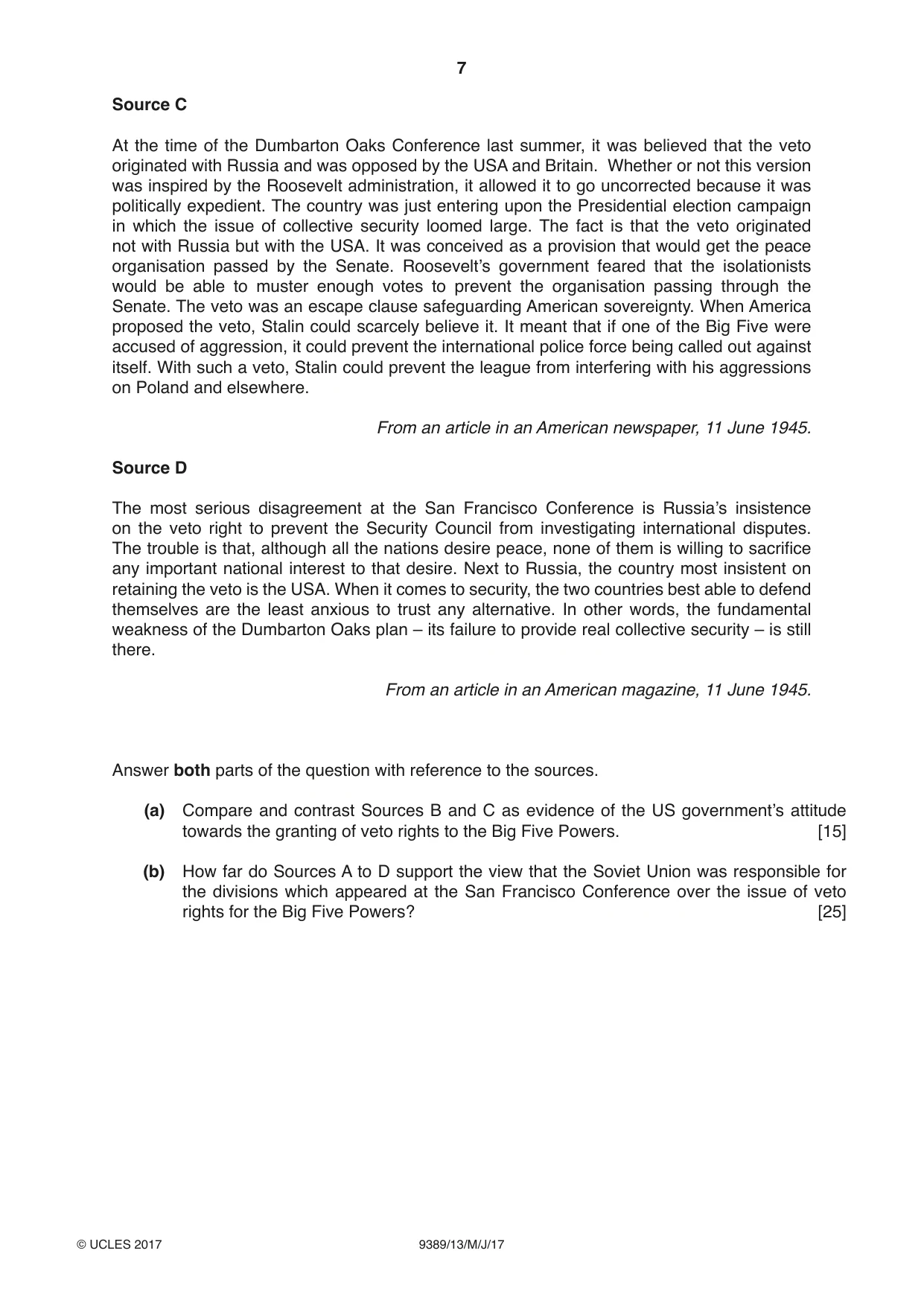
7 9389/13/M/J/17 © UCLES 2017 Source C At the time of the Dumbarton Oaks Conference last summer, it was believed that the veto originated with Russia and was opposed by the USA and Britain. Whether or not this version was inspired by the Roosevelt administration, it allowed it to go uncorrected because it was politically expedient. The country was just entering upon the Presidential election campaign in which the issue of collective security loomed large. The fact is that the veto originated not with Russia but with the USA. It was conceived as a provision that would get the peace organisation passed by the Senate. Roosevelt’s government feared that the isolationists would be able to muster enough votes to prevent the organisation passing through the Senate. The veto was an escape clause safeguarding American sovereignty. When America proposed the veto, Stalin could scarcely believe it. It meant that if one of the Big Five were accused of aggression, it could prevent the international police force being called out against itself. With such a veto, Stalin could prevent the league from interfering with his aggressions on Poland and elsewhere. From an article in an American newspaper, 11 June 1945. Source D The most serious disagreement at the San Francisco Conference is Russia’s insistence on the veto right to prevent the Security Council from investigating international disputes. The trouble is that, although all the nations desire peace, none of them is willing to sacrifice any important national interest to that desire. Next to Russia, the country most insistent on retaining the veto is the USA. When it comes to security, the two countries best able to defend themselves are the least anxious to trust any alternative. In other words, the fundamental weakness of the Dumbarton Oaks plan – its failure to provide real collective security – is still there. From an article in an American magazine, 11 June 1945. Answer both parts of the question with reference to the sources. (a) Compare and contrast Sources B and C as evidence of the US government’s attitude towards the granting of veto rights to the Big Five Powers. [15] (b) How far do Sources A to D support the view that the Soviet Union was responsible for the divisions which appeared at the San Francisco Conference over the issue of veto rights for the Big Five Powers? [25]
Question paper, page 8
8 9389/13/M/J/17 © UCLES 2017 BLANK PAGE Permission to reproduce items where third-party owned material protected by copyright is included has been sought and cleared where possible. Every reasonable effort has been made by the publisher (UCLES) to trace copyright holders, but if any items requiring clearance have unwittingly been included, the publisher will be pleased to make amends at the earliest possible opportunity. To avoid the issue of disclosure of answer-related information to candidates, all copyright acknowledgements are reproduced online in the Cambridge International Examinations Copyright Acknowledgements Booklet. This is produced for each series of examinations and is freely available to download at www.cie.org.uk after the live examination series. Cambridge International Examinations is part of the Cambridge Assessment Group. Cambridge Assessment is the brand name of University of Cambridge Local Examinations Syndicate (UCLES), which is itself a department of the University of Cambridge.
Mark scheme, page 1
® IGCSE is a registered trademark. This document consists of 10 printed pages. © UCLES 2017 [Turn over Cambridge International Examinations Cambridge International Advanced Subsidiary and Advanced Level HISTORY 9389/13 Paper 1 Document Question 13 May/June 2017 MARK SCHEME Maximum Mark: 40 Published This mark scheme is published as an aid to teachers and candidates, to indicate the requirements of the examination. It shows the basis on which Examiners were instructed to award marks. It does not indicate the details of the discussions that took place at an Examiners’ meeting before marking began, which would have considered the acceptability of alternative answers. Mark schemes should be read in conjunction with the question paper and the Principal Examiner Report for Teachers. Cambridge will not enter into discussions about these mark schemes. Cambridge is publishing the mark schemes for the May/June 2017 series for most Cambridge IGCSE®, Cambridge International A and AS Level and Cambridge Pre-U components, and some Cambridge O Level components.
Mark scheme, page 2
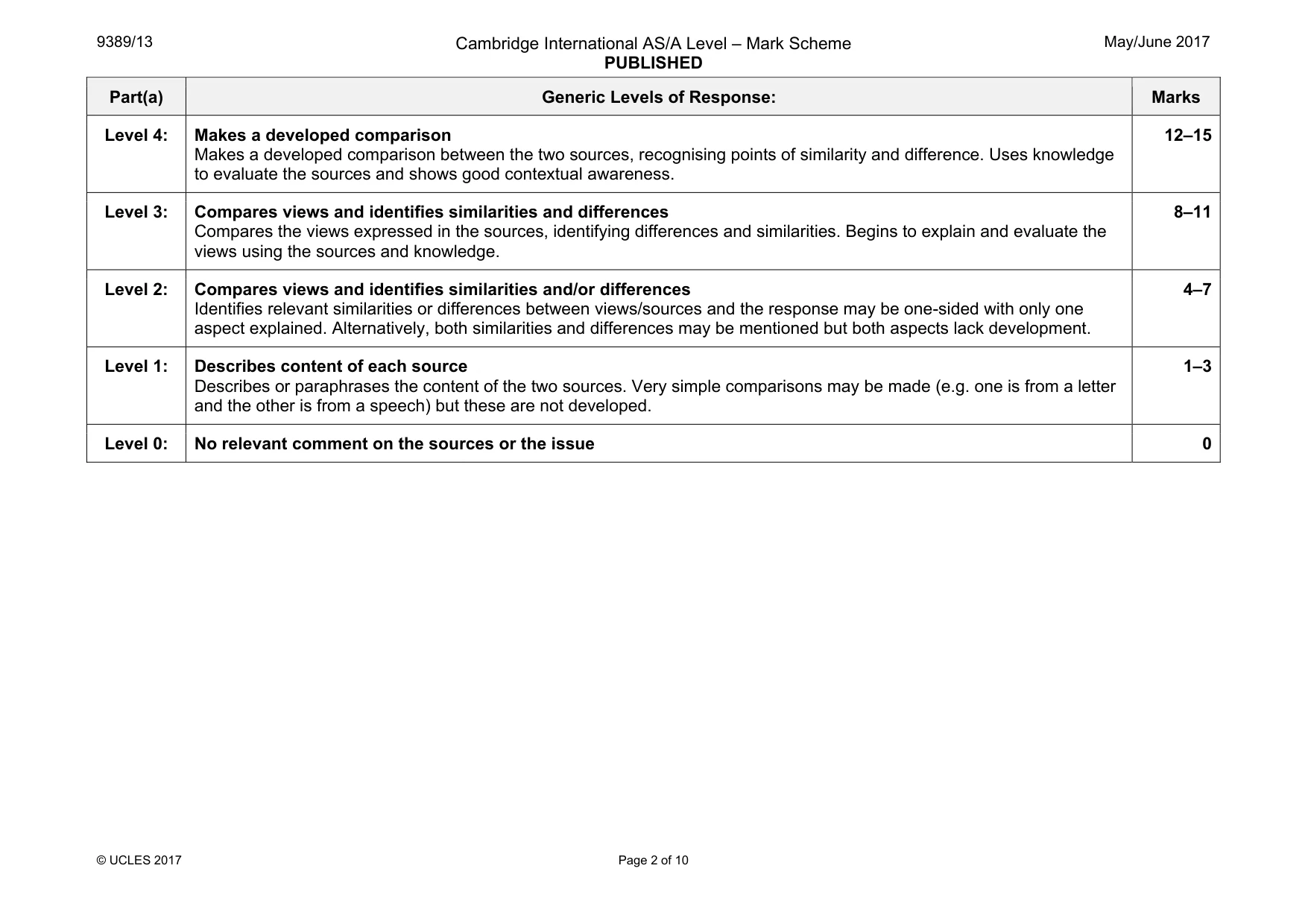
9389/13 Cambridge International AS/A Level – Mark Scheme PUBLISHED May/June 2017 © UCLES 2017 Page 2 of 10 Part(a) Generic Levels of Response: Marks Level 4: Makes a developed comparison Makes a developed comparison between the two sources, recognising points of similarity and difference. Uses knowledge to evaluate the sources and shows good contextual awareness. 12–15 Level 3: Compares views and identifies similarities and differences Compares the views expressed in the sources, identifying differences and similarities. Begins to explain and evaluate the views using the sources and knowledge. 8–11 Level 2: Compares views and identifies similarities and/or differences Identifies relevant similarities or differences between views/sources and the response may be one-sided with only one aspect explained. Alternatively, both similarities and differences may be mentioned but both aspects lack development. 4–7 Level 1: Describes content of each source Describes or paraphrases the content of the two sources. Very simple comparisons may be made (e.g. one is from a letter and the other is from a speech) but these are not developed. 1–3 Level 0: No relevant comment on the sources or the issue 0
Mark scheme, page 3
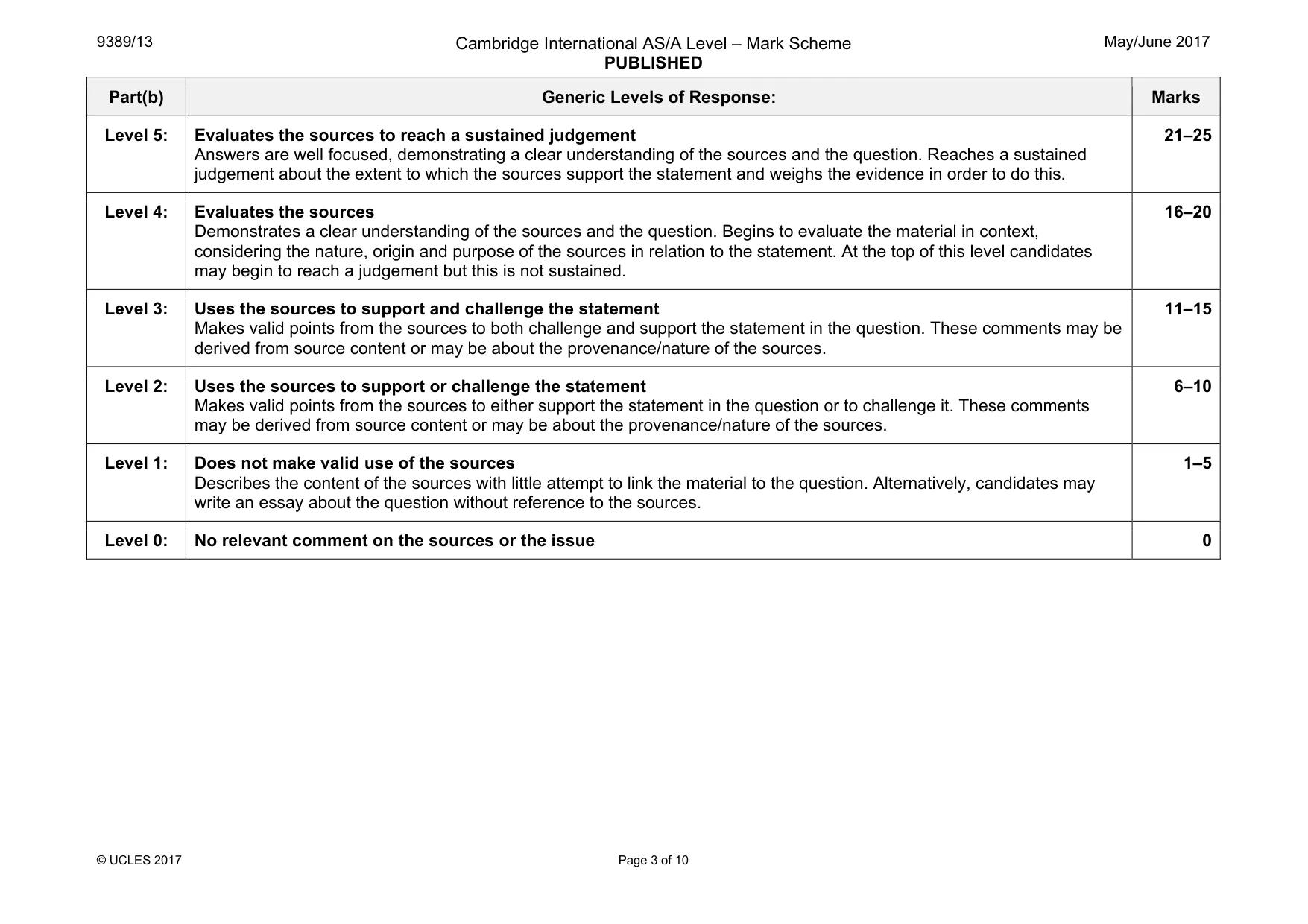
9389/13 Cambridge International AS/A Level – Mark Scheme PUBLISHED May/June 2017 © UCLES 2017 Page 3 of 10 Part(b) Generic Levels of Response: Marks Level 5: Evaluates the sources to reach a sustained judgement Answers are well focused, demonstrating a clear understanding of the sources and the question. Reaches a sustained judgement about the extent to which the sources support the statement and weighs the evidence in order to do this. 21–25 Level 4: Evaluates the sources Demonstrates a clear understanding of the sources and the question. Begins to evaluate the material in context, considering the nature, origin and purpose of the sources in relation to the statement. At the top of this level candidates may begin to reach a judgement but this is not sustained. 16–20 Level 3: Uses the sources to support and challenge the statement Makes valid points from the sources to both challenge and support the statement in the question. These comments may be derived from source content or may be about the provenance/nature of the sources. 11–15 Level 2: Uses the sources to support or challenge the statement Makes valid points from the sources to either support the statement in the question or to challenge it. These comments may be derived from source content or may be about the provenance/nature of the sources. 6–10 Level 1: Does not make valid use of the sources Describes the content of the sources with little attempt to link the material to the question. Alternatively, candidates may write an essay about the question without reference to the sources. 1–5 Level 0: No relevant comment on the sources or the issue 0
Mark scheme, page 4
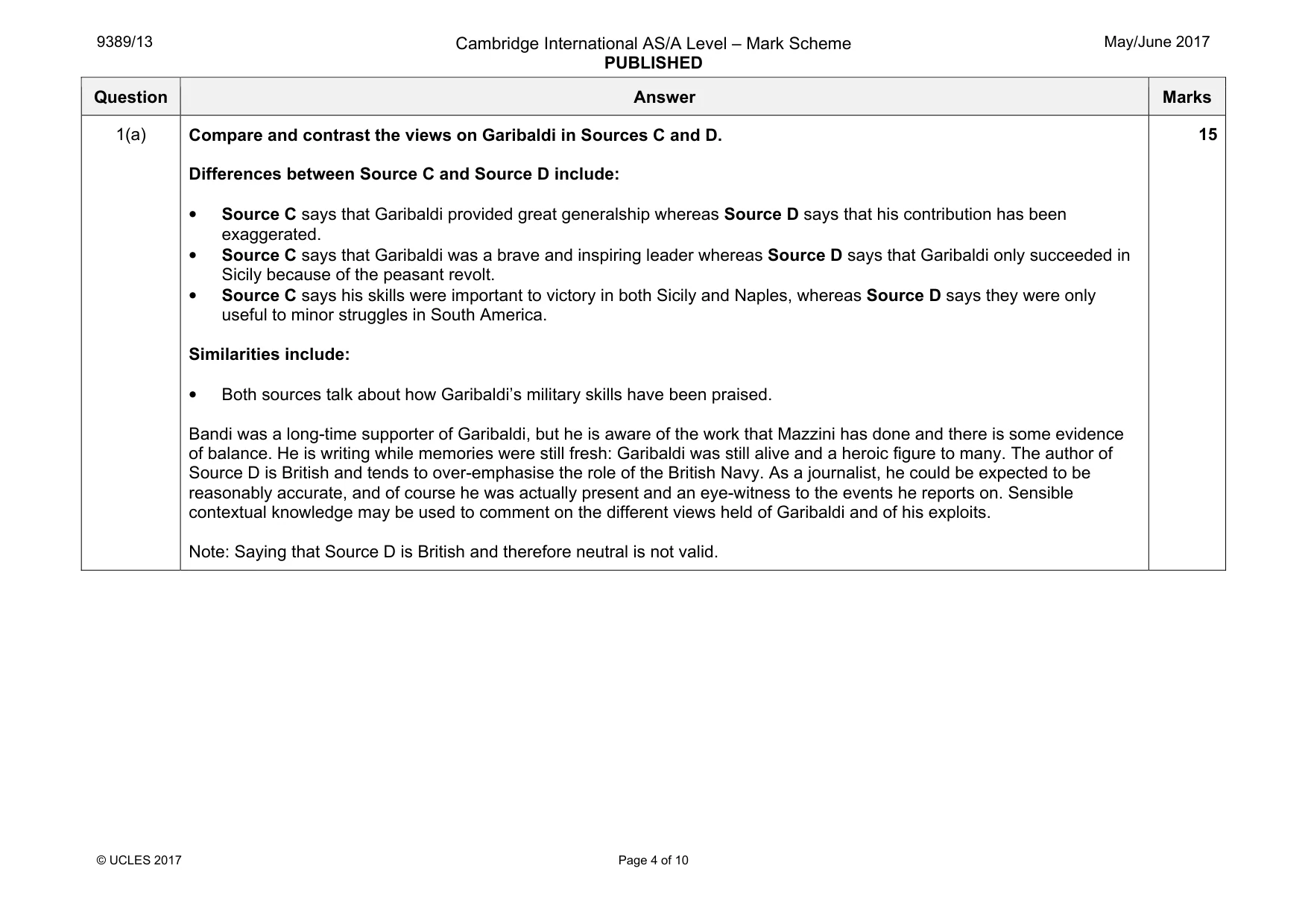
9389/13 Cambridge International AS/A Level – Mark Scheme PUBLISHED May/June 2017 © UCLES 2017 Page 4 of 10 Question Answer Marks 1(a) Compare and contrast the views on Garibaldi in Sources C and D. Differences between Source C and Source D include: • Source C says that Garibaldi provided great generalship whereas Source D says that his contribution has been exaggerated. • Source C says that Garibaldi was a brave and inspiring leader whereas Source D says that Garibaldi only succeeded in Sicily because of the peasant revolt. • Source C says his skills were important to victory in both Sicily and Naples, whereas Source D says they were only useful to minor struggles in South America. Similarities include: • Both sources talk about how Garibaldi’s military skills have been praised. Bandi was a long-time supporter of Garibaldi, but he is aware of the work that Mazzini has done and there is some evidence of balance. He is writing while memories were still fresh: Garibaldi was still alive and a heroic figure to many. The author of Source D is British and tends to over-emphasise the role of the British Navy. As a journalist, he could be expected to be reasonably accurate, and of course he was actually present and an eye-witness to the events he reports on. Sensible contextual knowledge may be used to comment on the different views held of Garibaldi and of his exploits. Note: Saying that Source D is British and therefore neutral is not valid. 15
Mark scheme, page 5
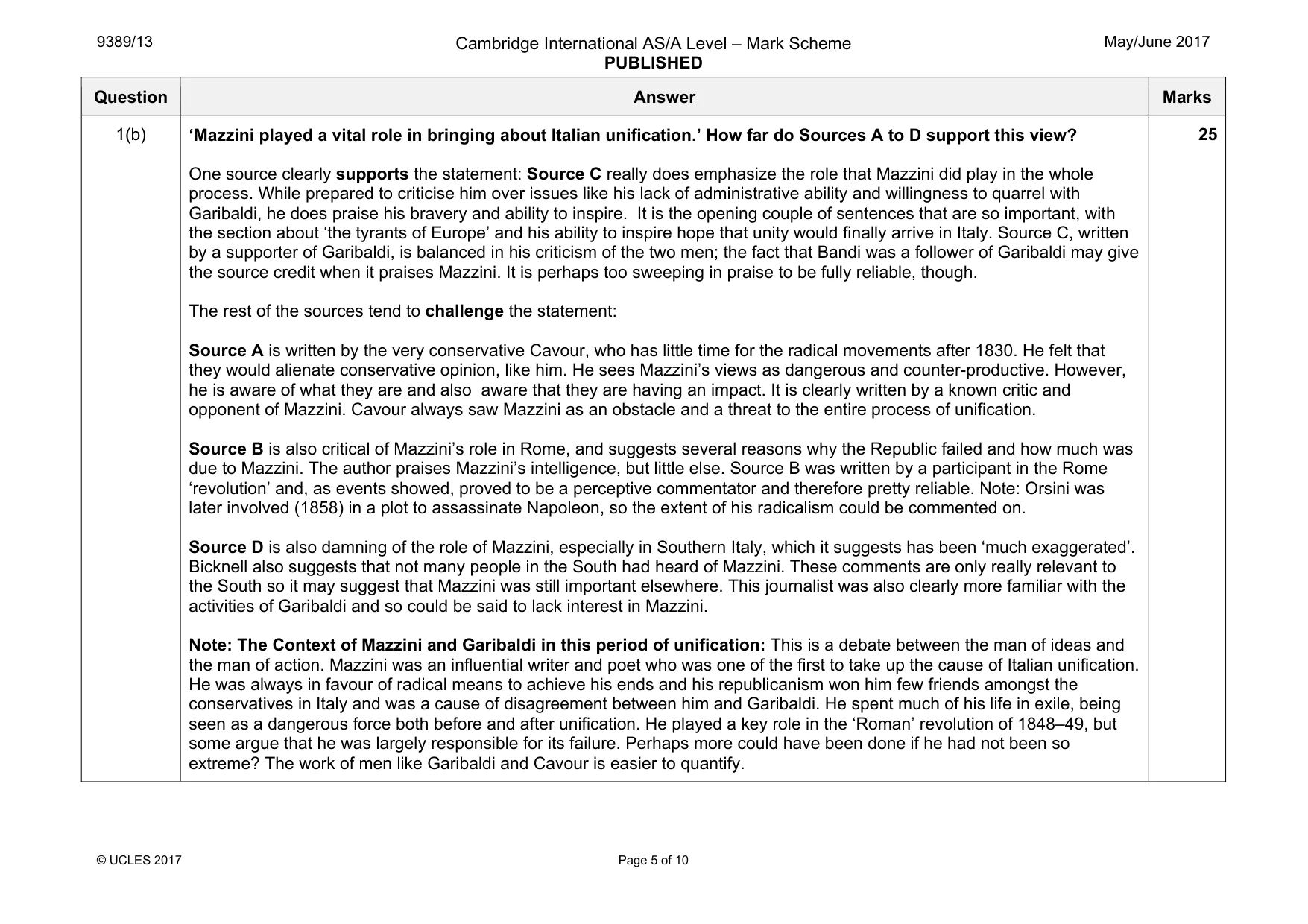
9389/13 Cambridge International AS/A Level – Mark Scheme PUBLISHED May/June 2017 © UCLES 2017 Page 5 of 10 Question Answer Marks 1(b) ‘Mazzini played a vital role in bringing about Italian unification.’ How far do Sources A to D support this view? One source clearly supports the statement: Source C really does emphasize the role that Mazzini did play in the whole process. While prepared to criticise him over issues like his lack of administrative ability and willingness to quarrel with Garibaldi, he does praise his bravery and ability to inspire. It is the opening couple of sentences that are so important, with the section about ‘the tyrants of Europe’ and his ability to inspire hope that unity would finally arrive in Italy. Source C, written by a supporter of Garibaldi, is balanced in his criticism of the two men; the fact that Bandi was a follower of Garibaldi may give the source credit when it praises Mazzini. It is perhaps too sweeping in praise to be fully reliable, though. The rest of the sources tend to challenge the statement: Source A is written by the very conservative Cavour, who has little time for the radical movements after 1830. He felt that they would alienate conservative opinion, like him. He sees Mazzini’s views as dangerous and counter-productive. However, he is aware of what they are and also aware that they are having an impact. It is clearly written by a known critic and opponent of Mazzini. Cavour always saw Mazzini as an obstacle and a threat to the entire process of unification. Source B is also critical of Mazzini’s role in Rome, and suggests several reasons why the Republic failed and how much was due to Mazzini. The author praises Mazzini’s intelligence, but little else. Source B was written by a participant in the Rome ‘revolution’ and, as events showed, proved to be a perceptive commentator and therefore pretty reliable. Note: Orsini was later involved (1858) in a plot to assassinate Napoleon, so the extent of his radicalism could be commented on. Source D is also damning of the role of Mazzini, especially in Southern Italy, which it suggests has been ‘much exaggerated’. Bicknell also suggests that not many people in the South had heard of Mazzini. These comments are only really relevant to the South so it may suggest that Mazzini was still important elsewhere. This journalist was also clearly more familiar with the activities of Garibaldi and so could be said to lack interest in Mazzini. Note: The Context of Mazzini and Garibaldi in this period of unification: This is a debate between the man of ideas and the man of action. Mazzini was an influential writer and poet who was one of the first to take up the cause of Italian unification. He was always in favour of radical means to achieve his ends and his republicanism won him few friends amongst the conservatives in Italy and was a cause of disagreement between him and Garibaldi. He spent much of his life in exile, being seen as a dangerous force both before and after unification. He played a key role in the ‘Roman’ revolution of 1848–49, but some argue that he was largely responsible for its failure. Perhaps more could have been done if he had not been so extreme? The work of men like Garibaldi and Cavour is easier to quantify. 25
Mark scheme, page 6
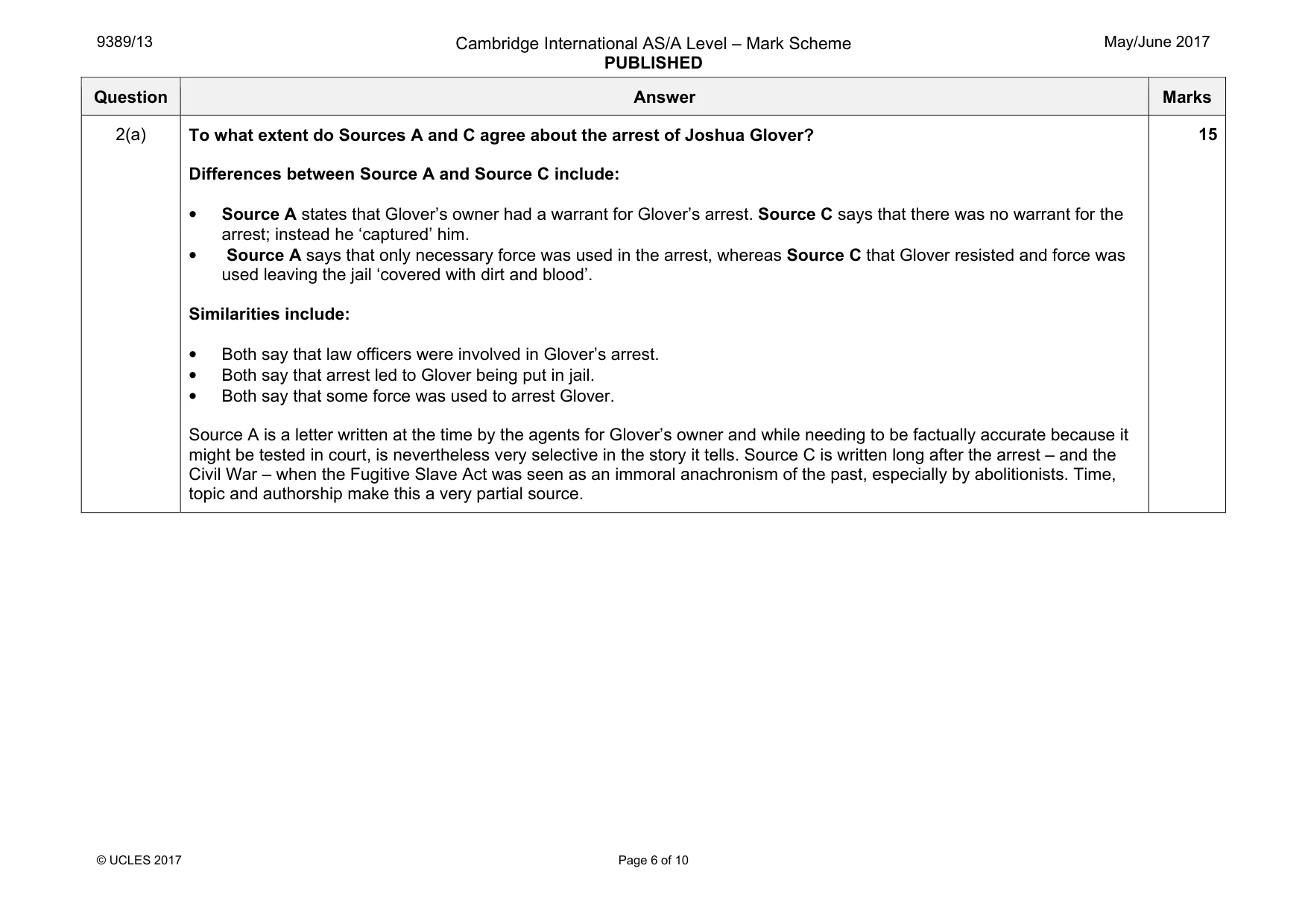
9389/13 Cambridge International AS/A Level – Mark Scheme PUBLISHED May/June 2017 © UCLES 2017 Page 6 of 10 Question Answer Marks 2(a) To what extent do Sources A and C agree about the arrest of Joshua Glover? Differences between Source A and Source C include: • Source A states that Glover’s owner had a warrant for Glover’s arrest. Source C says that there was no warrant for the arrest; instead he ‘captured’ him. • Source A says that only necessary force was used in the arrest, whereas Source C that Glover resisted and force was used leaving the jail ‘covered with dirt and blood’. Similarities include: • Both say that law officers were involved in Glover’s arrest. • Both say that arrest led to Glover being put in jail. • Both say that some force was used to arrest Glover. Source A is a letter written at the time by the agents for Glover’s owner and while needing to be factually accurate because it might be tested in court, is nevertheless very selective in the story it tells. Source C is written long after the arrest – and the Civil War – when the Fugitive Slave Act was seen as an immoral anachronism of the past, especially by abolitionists. Time, topic and authorship make this a very partial source. 15
Mark scheme, page 7
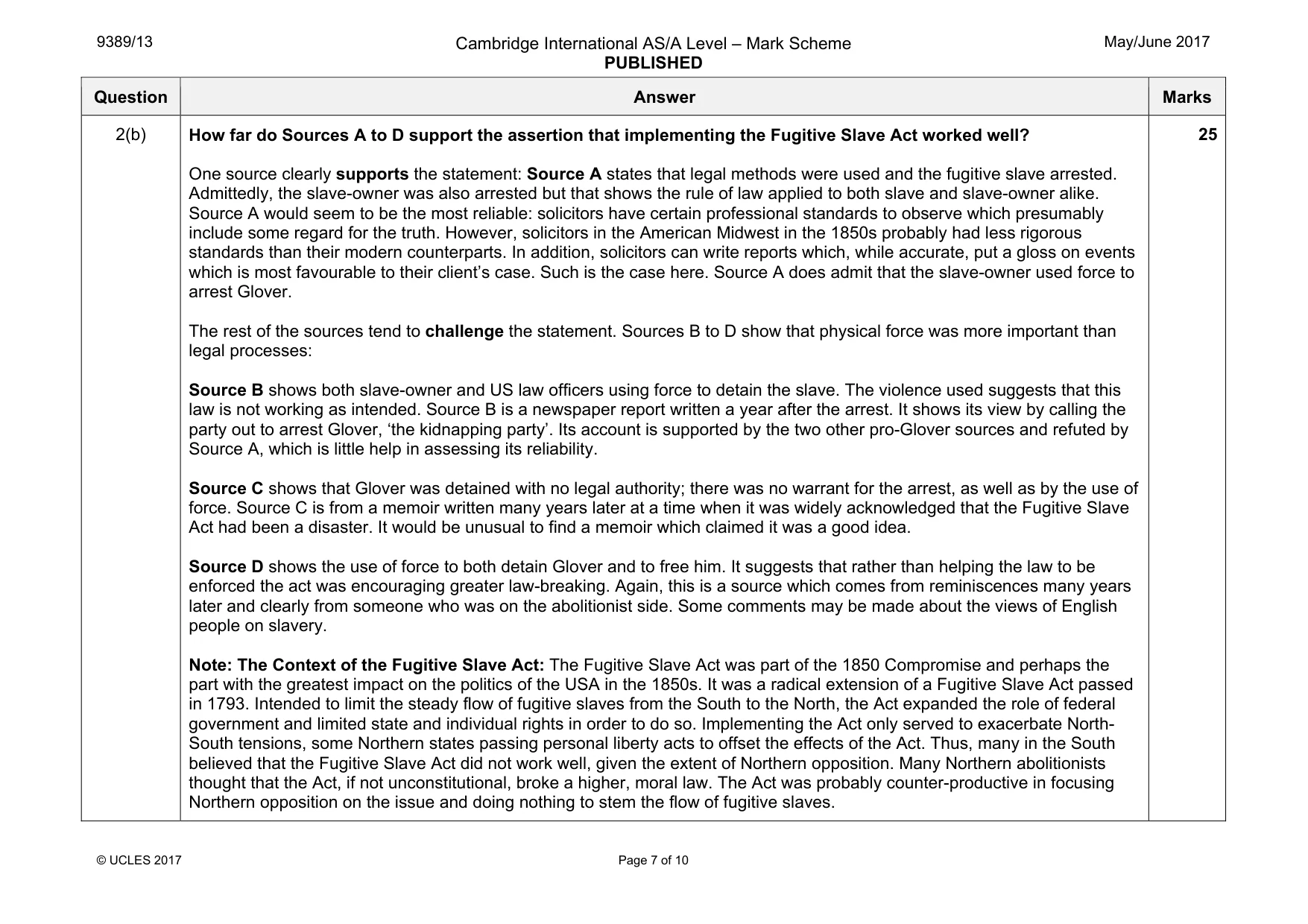
9389/13 Cambridge International AS/A Level – Mark Scheme PUBLISHED May/June 2017 © UCLES 2017 Page 7 of 10 Question Answer Marks 2(b) How far do Sources A to D support the assertion that implementing the Fugitive Slave Act worked well? One source clearly supports the statement: Source A states that legal methods were used and the fugitive slave arrested. Admittedly, the slave-owner was also arrested but that shows the rule of law applied to both slave and slave-owner alike. Source A would seem to be the most reliable: solicitors have certain professional standards to observe which presumably include some regard for the truth. However, solicitors in the American Midwest in the 1850s probably had less rigorous standards than their modern counterparts. In addition, solicitors can write reports which, while accurate, put a gloss on events which is most favourable to their client’s case. Such is the case here. Source A does admit that the slave-owner used force to arrest Glover. The rest of the sources tend to challenge the statement. Sources B to D show that physical force was more important than legal processes: Source B shows both slave-owner and US law officers using force to detain the slave. The violence used suggests that this law is not working as intended. Source B is a newspaper report written a year after the arrest. It shows its view by calling the party out to arrest Glover, ‘the kidnapping party’. Its account is supported by the two other pro-Glover sources and refuted by Source A, which is little help in assessing its reliability. Source C shows that Glover was detained with no legal authority; there was no warrant for the arrest, as well as by the use of force. Source C is from a memoir written many years later at a time when it was widely acknowledged that the Fugitive Slave Act had been a disaster. It would be unusual to find a memoir which claimed it was a good idea. Source D shows the use of force to both detain Glover and to free him. It suggests that rather than helping the law to be enforced the act was encouraging greater law-breaking. Again, this is a source which comes from reminiscences many years later and clearly from someone who was on the abolitionist side. Some comments may be made about the views of English people on slavery. Note: The Context of the Fugitive Slave Act: The Fugitive Slave Act was part of the 1850 Compromise and perhaps the part with the greatest impact on the politics of the USA in the 1850s. It was a radical extension of a Fugitive Slave Act passed in 1793. Intended to limit the steady flow of fugitive slaves from the South to the North, the Act expanded the role of federal government and limited state and individual rights in order to do so. Implementing the Act only served to exacerbate North- South tensions, some Northern states passing personal liberty acts to offset the effects of the Act. Thus, many in the South believed that the Fugitive Slave Act did not work well, given the extent of Northern opposition. Many Northern abolitionists thought that the Act, if not unconstitutional, broke a higher, moral law. The Act was probably counter-productive in focusing Northern opposition on the issue and doing nothing to stem the flow of fugitive slaves. 25
Mark scheme, page 8
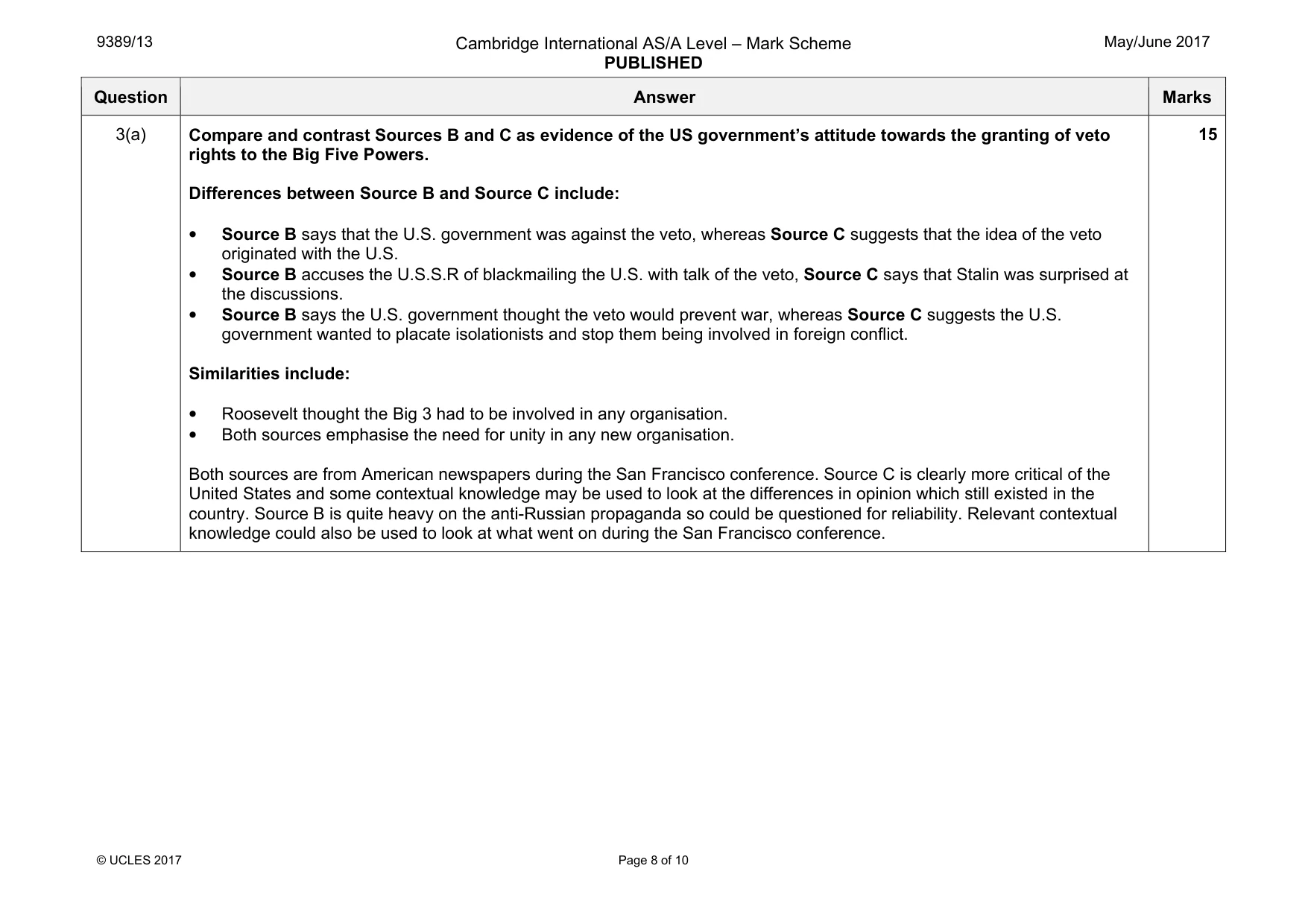
9389/13 Cambridge International AS/A Level – Mark Scheme PUBLISHED May/June 2017 © UCLES 2017 Page 8 of 10 Question Answer Marks 3(a) Compare and contrast Sources B and C as evidence of the US government’s attitude towards the granting of veto rights to the Big Five Powers. Differences between Source B and Source C include: • Source B says that the U.S. government was against the veto, whereas Source C suggests that the idea of the veto originated with the U.S. • Source B accuses the U.S.S.R of blackmailing the U.S. with talk of the veto, Source C says that Stalin was surprised at the discussions. • Source B says the U.S. government thought the veto would prevent war, whereas Source C suggests the U.S. government wanted to placate isolationists and stop them being involved in foreign conflict. Similarities include: • Roosevelt thought the Big 3 had to be involved in any organisation. • Both sources emphasise the need for unity in any new organisation. Both sources are from American newspapers during the San Francisco conference. Source C is clearly more critical of the United States and some contextual knowledge may be used to look at the differences in opinion which still existed in the country. Source B is quite heavy on the anti-Russian propaganda so could be questioned for reliability. Relevant contextual knowledge could also be used to look at what went on during the San Francisco conference. 15
Mark scheme, page 9
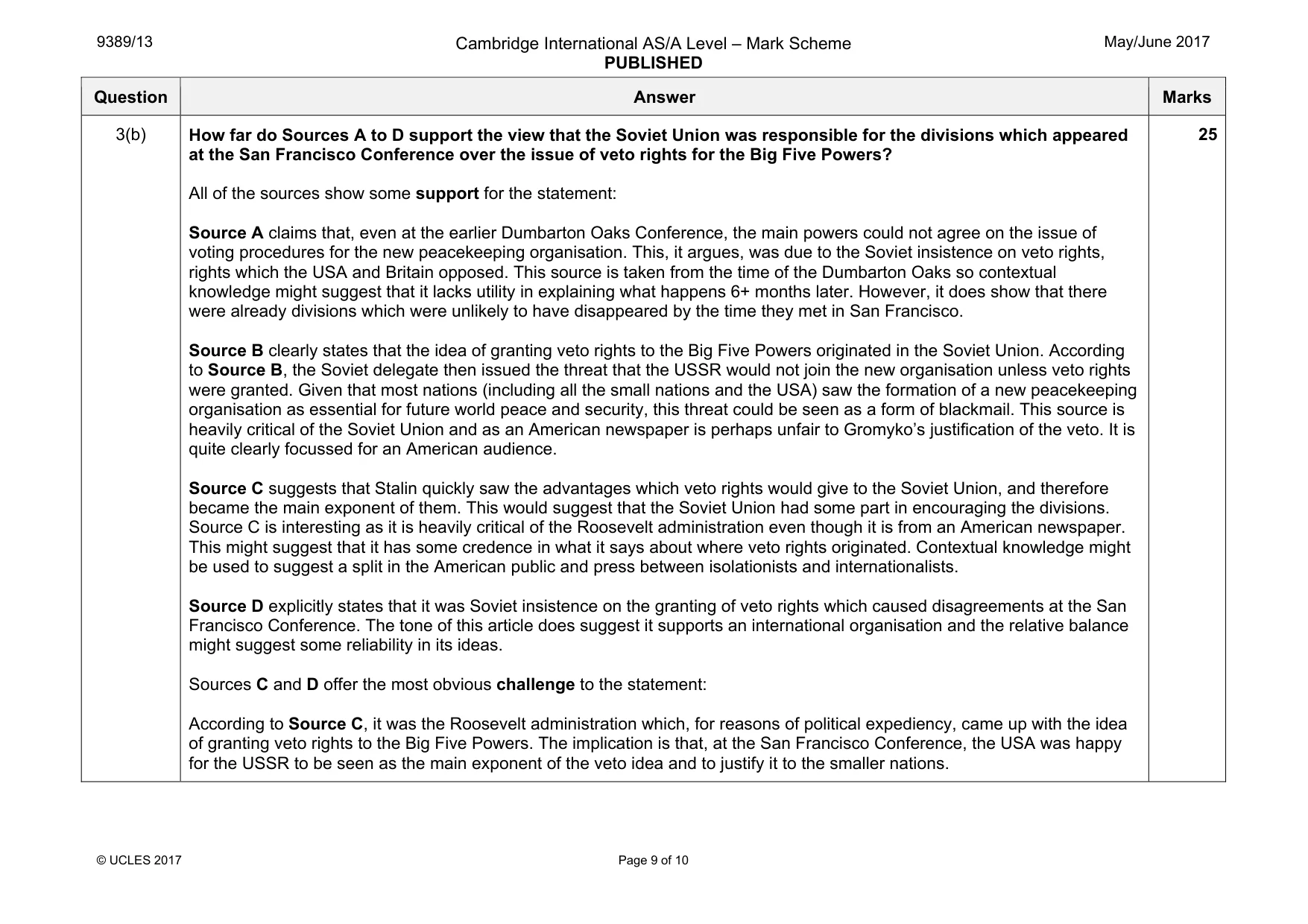
9389/13 Cambridge International AS/A Level – Mark Scheme PUBLISHED May/June 2017 © UCLES 2017 Page 9 of 10 Question Answer Marks 3(b) How far do Sources A to D support the view that the Soviet Union was responsible for the divisions which appeared at the San Francisco Conference over the issue of veto rights for the Big Five Powers? All of the sources show some support for the statement: Source A claims that, even at the earlier Dumbarton Oaks Conference, the main powers could not agree on the issue of voting procedures for the new peacekeeping organisation. This, it argues, was due to the Soviet insistence on veto rights, rights which the USA and Britain opposed. This source is taken from the time of the Dumbarton Oaks so contextual knowledge might suggest that it lacks utility in explaining what happens 6+ months later. However, it does show that there were already divisions which were unlikely to have disappeared by the time they met in San Francisco. Source B clearly states that the idea of granting veto rights to the Big Five Powers originated in the Soviet Union. According to Source B, the Soviet delegate then issued the threat that the USSR would not join the new organisation unless veto rights were granted. Given that most nations (including all the small nations and the USA) saw the formation of a new peacekeeping organisation as essential for future world peace and security, this threat could be seen as a form of blackmail. This source is heavily critical of the Soviet Union and as an American newspaper is perhaps unfair to Gromyko’s justification of the veto. It is quite clearly focussed for an American audience. Source C suggests that Stalin quickly saw the advantages which veto rights would give to the Soviet Union, and therefore became the main exponent of them. This would suggest that the Soviet Union had some part in encouraging the divisions. Source C is interesting as it is heavily critical of the Roosevelt administration even though it is from an American newspaper. This might suggest that it has some credence in what it says about where veto rights originated. Contextual knowledge might be used to suggest a split in the American public and press between isolationists and internationalists. Source D explicitly states that it was Soviet insistence on the granting of veto rights which caused disagreements at the San Francisco Conference. The tone of this article does suggest it supports an international organisation and the relative balance might suggest some reliability in its ideas. Sources C and D offer the most obvious challenge to the statement: According to Source C, it was the Roosevelt administration which, for reasons of political expediency, came up with the idea of granting veto rights to the Big Five Powers. The implication is that, at the San Francisco Conference, the USA was happy for the USSR to be seen as the main exponent of the veto idea and to justify it to the smaller nations. 25
Mark scheme, page 10
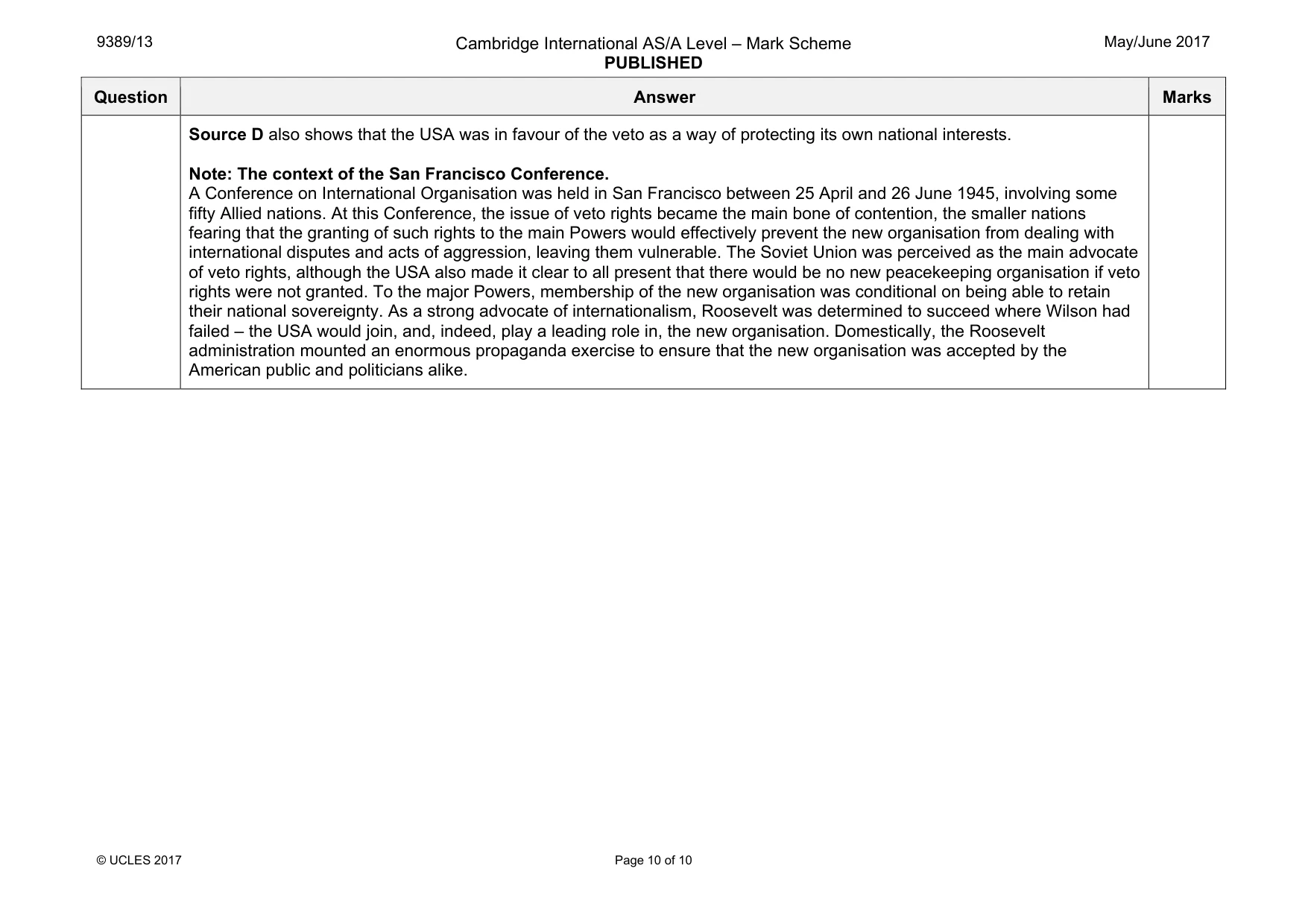
9389/13 Cambridge International AS/A Level – Mark Scheme PUBLISHED May/June 2017 © UCLES 2017 Page 10 of 10 Question Answer Marks Source D also shows that the USA was in favour of the veto as a way of protecting its own national interests. Note: The context of the San Francisco Conference. A Conference on International Organisation was held in San Francisco between 25 April and 26 June 1945, involving some fifty Allied nations. At this Conference, the issue of veto rights became the main bone of contention, the smaller nations fearing that the granting of such rights to the main Powers would effectively prevent the new organisation from dealing with international disputes and acts of aggression, leaving them vulnerable. The Soviet Union was perceived as the main advocate of veto rights, although the USA also made it clear to all present that there would be no new peacekeeping organisation if veto rights were not granted. To the major Powers, membership of the new organisation was conditional on being able to retain their national sovereignty. As a strong advocate of internationalism, Roosevelt was determined to succeed where Wilson had failed – the USA would join, and, indeed, play a leading role in, the new organisation. Domestically, the Roosevelt administration mounted an enormous propaganda exercise to ensure that the new organisation was accepted by the American public and politicians alike.
What you needed in this session
Cambridge’s own grade thresholds for 2017 May/June, Paper 1 · Variant 3. A higher threshold means an easier paper — the bar moves with how the cohort did.