Cambridge A Level History 9389 — 2017 May/June Paper 1 · Variant 1
9389/11/M/J/17 · 40 marks · ≈45 min
The question paper and its mark scheme, free to read here and free to download. This is Cambridge’s own paper, exactly as it was sat.
Question paper8 pages
Mark scheme14 pages
Answers below. Sit the paper first if you are practising.
Paper as text
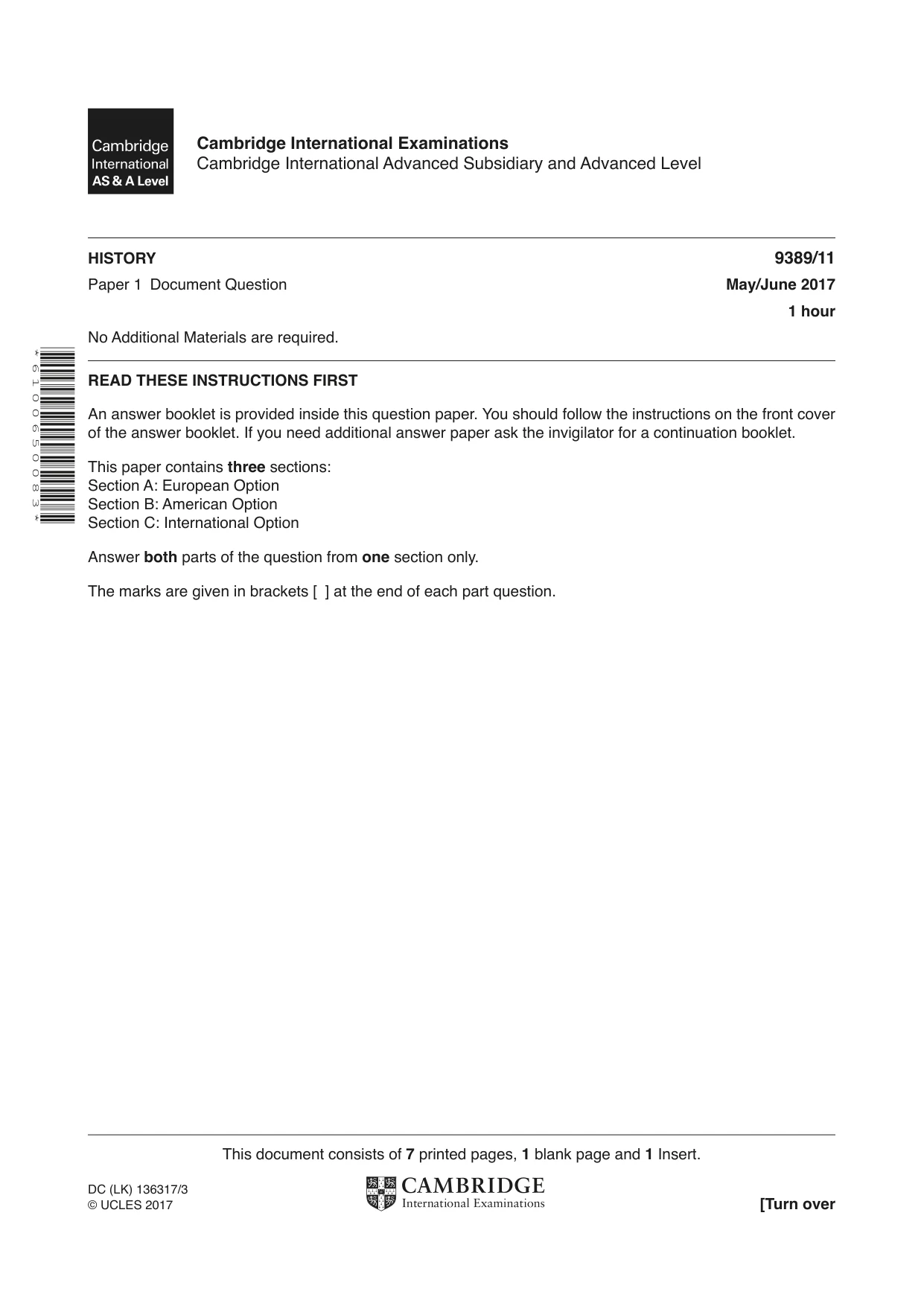
Question paper, page 1
* 6 1 0 0 6 5 0 0 8 3 * This document consists of 7 printed pages, 1 blank page and 1 Insert. DC (LK) 136317/3 © UCLES 2017 [Turn over Cambridge International Examinations Cambridge International Advanced Subsidiary and Advanced Level HISTORY 9389/11 Paper 1 Document Question May/June 2017 1 hour No Additional Materials are required. READ THESE INSTRUCTIONS FIRST An answer booklet is provided inside this question paper. You should follow the instructions on the front cover of the answer booklet. If you need additional answer paper ask the invigilator for a continuation booklet. This paper contains three sections: Section A: European Option Section B: American Option Section C: International Option Answer both parts of the question from one section only. The marks are given in brackets [ ] at the end of each part question.
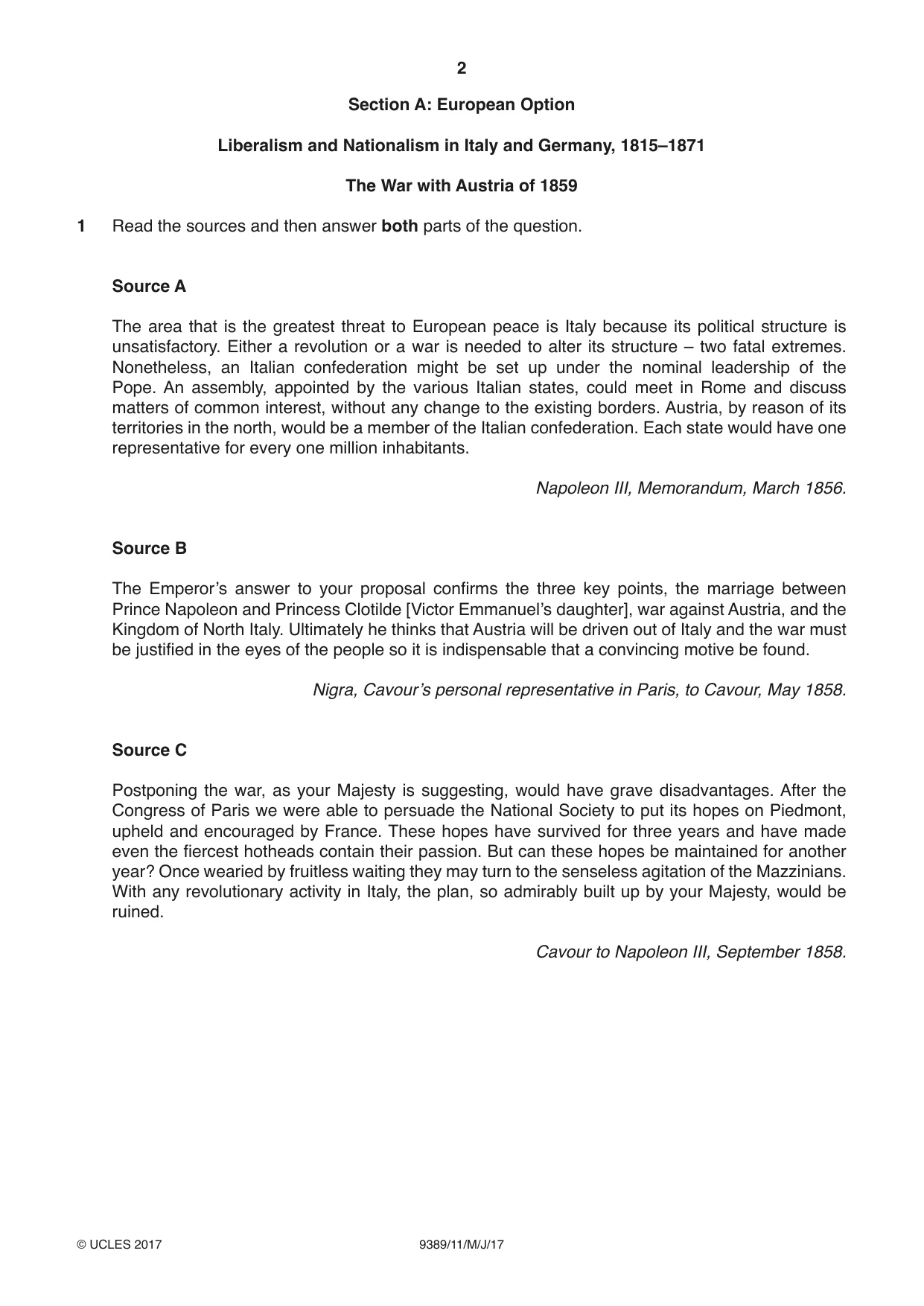
Question paper, page 2
2 9389/11/M/J/17 © UCLES 2017 Section A: European Option Liberalism and Nationalism in Italy and Germany, 1815–1871 The War with Austria of 1859 1 Read the sources and then answer both parts of the question. Source A The area that is the greatest threat to European peace is Italy because its political structure is unsatisfactory. Either a revolution or a war is needed to alter its structure – two fatal extremes. Nonetheless, an Italian confederation might be set up under the nominal leadership of the Pope. An assembly, appointed by the various Italian states, could meet in Rome and discuss matters of common interest, without any change to the existing borders. Austria, by reason of its territories in the north, would be a member of the Italian confederation. Each state would have one representative for every one million inhabitants. Napoleon III, Memorandum, March 1856. Source B The Emperor’s answer to your proposal confirms the three key points, the marriage between Prince Napoleon and Princess Clotilde [Victor Emmanuel’s daughter], war against Austria, and the Kingdom of North Italy. Ultimately he thinks that Austria will be driven out of Italy and the war must be justified in the eyes of the people so it is indispensable that a convincing motive be found. Nigra, Cavour’s personal representative in Paris, to Cavour, May 1858. Source C Postponing the war, as your Majesty is suggesting, would have grave disadvantages. After the Congress of Paris we were able to persuade the National Society to put its hopes on Piedmont, upheld and encouraged by France. These hopes have survived for three years and have made even the fiercest hotheads contain their passion. But can these hopes be maintained for another year? Once wearied by fruitless waiting they may turn to the senseless agitation of the Mazzinians. With any revolutionary activity in Italy, the plan, so admirably built up by your Majesty, would be ruined. Cavour to Napoleon III, September 1858.
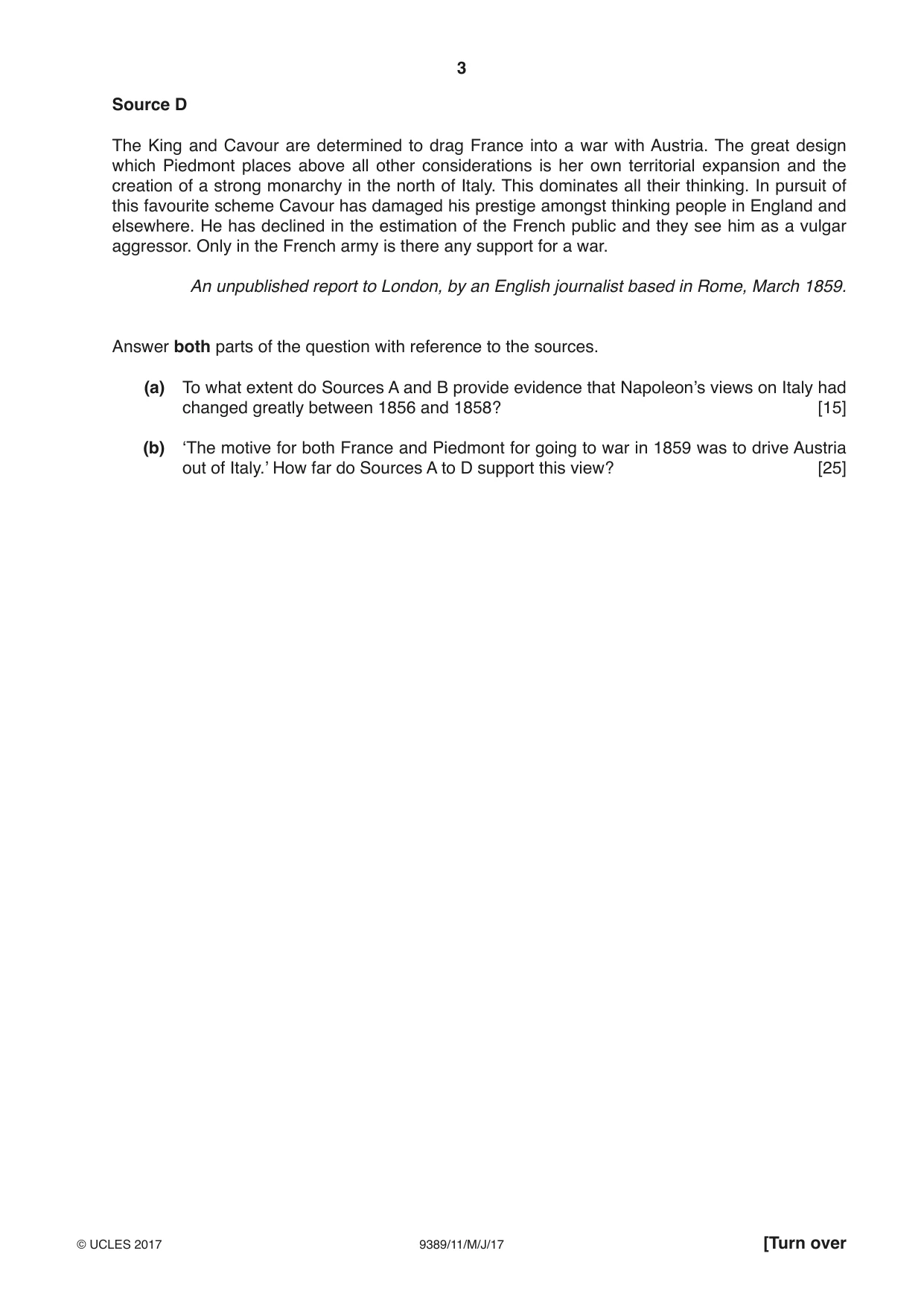
Question paper, page 3
3 9389/11/M/J/17 © UCLES 2017 [Turn over Source D The King and Cavour are determined to drag France into a war with Austria. The great design which Piedmont places above all other considerations is her own territorial expansion and the creation of a strong monarchy in the north of Italy. This dominates all their thinking. In pursuit of this favourite scheme Cavour has damaged his prestige amongst thinking people in England and elsewhere. He has declined in the estimation of the French public and they see him as a vulgar aggressor. Only in the French army is there any support for a war. An unpublished report to London, by an English journalist based in Rome, March 1859. Answer both parts of the question with reference to the sources. (a) To what extent do Sources A and B provide evidence that Napoleon’s views on Italy had changed greatly between 1856 and 1858? [15] (b) ‘The motive for both France and Piedmont for going to war in 1859 was to drive Austria out of Italy.’ How far do Sources A to D support this view? [25]
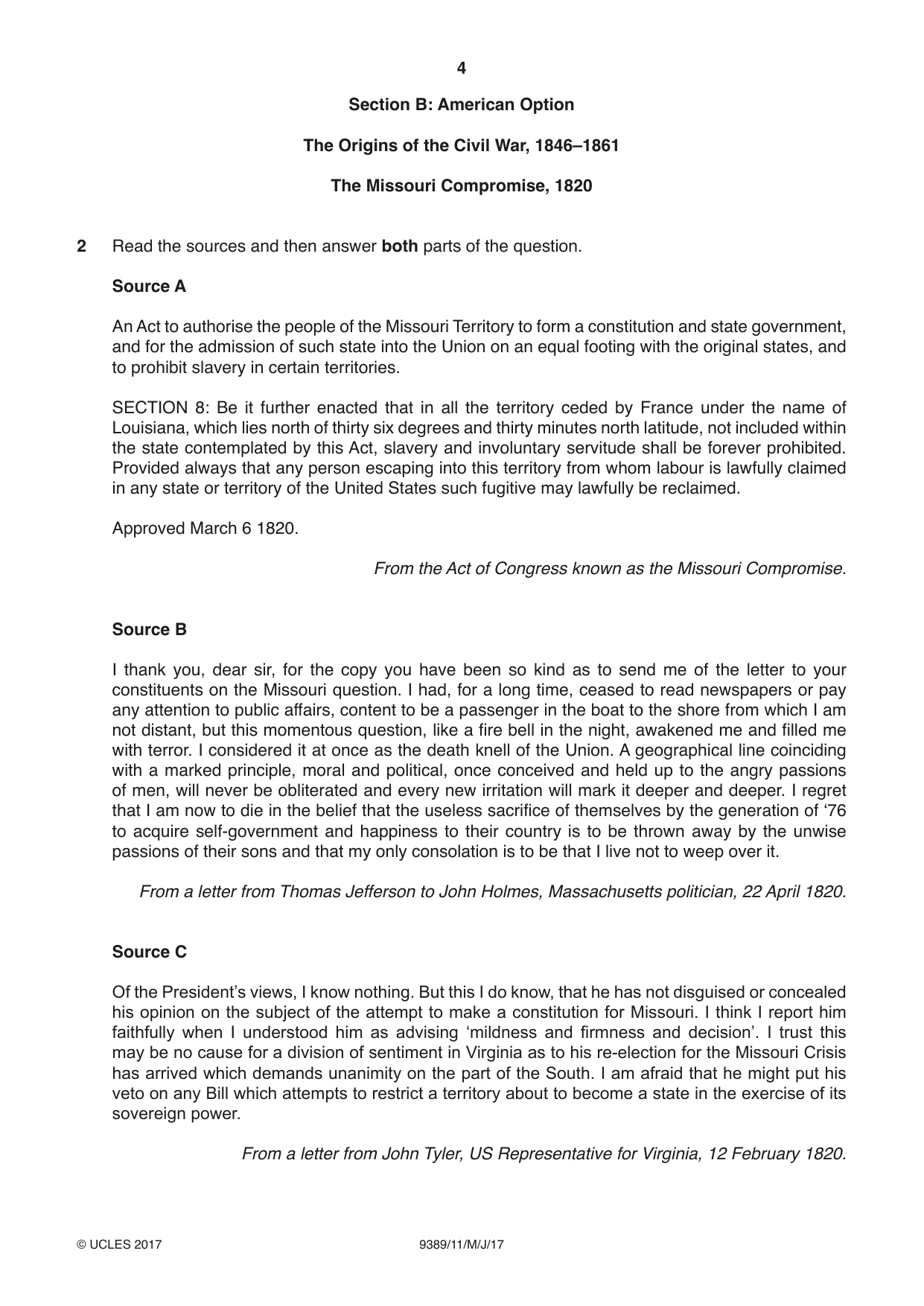
Question paper, page 4
4 9389/11/M/J/17 © UCLES 2017 Section B: American Option The Origins of the Civil War, 1846–1861 The Missouri Compromise, 1820 2 Read the sources and then answer both parts of the question. Source A An Act to authorise the people of the Missouri Territory to form a constitution and state government, and for the admission of such state into the Union on an equal footing with the original states, and to prohibit slavery in certain territories. SECTION 8: Be it further enacted that in all the territory ceded by France under the name of Louisiana, which lies north of thirty six degrees and thirty minutes north latitude, not included within the state contemplated by this Act, slavery and involuntary servitude shall be forever prohibited. Provided always that any person escaping into this territory from whom labour is lawfully claimed in any state or territory of the United States such fugitive may lawfully be reclaimed. Approved March 6 1820. From the Act of Congress known as the Missouri Compromise. Source B I thank you, dear sir, for the copy you have been so kind as to send me of the letter to your constituents on the Missouri question. I had, for a long time, ceased to read newspapers or pay any attention to public affairs, content to be a passenger in the boat to the shore from which I am not distant, but this momentous question, like a fire bell in the night, awakened me and filled me with terror. I considered it at once as the death knell of the Union. A geographical line coinciding with a marked principle, moral and political, once conceived and held up to the angry passions of men, will never be obliterated and every new irritation will mark it deeper and deeper. I regret that I am now to die in the belief that the useless sacrifice of themselves by the generation of ‘76 to acquire self-government and happiness to their country is to be thrown away by the unwise passions of their sons and that my only consolation is to be that I live not to weep over it. From a letter from Thomas Jefferson to John Holmes, Massachusetts politician, 22 April 1820. Source C Of the President’s views, I know nothing. But this I do know, that he has not disguised or concealed his opinion on the subject of the attempt to make a constitution for Missouri. I think I report him faithfully when I understood him as advising ‘mildness and firmness and decision’. I trust this may be no cause for a division of sentiment in Virginia as to his re-election for the Missouri Crisis has arrived which demands unanimity on the part of the South. I am afraid that he might put his veto on any Bill which attempts to restrict a territory about to become a state in the exercise of its sovereign power. From a letter from John Tyler, US Representative for Virginia, 12 February 1820.
Question paper, page 5
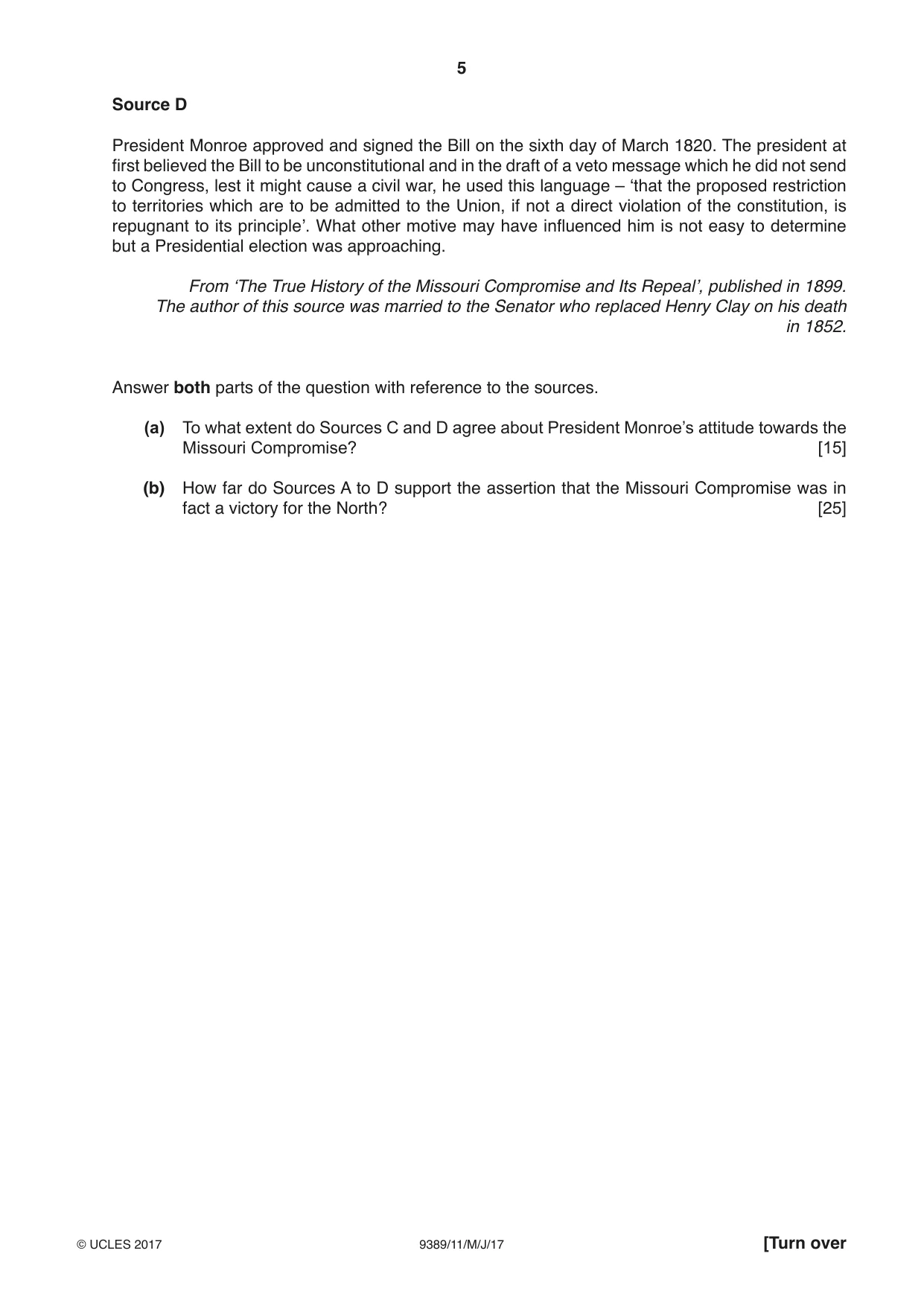
5 9389/11/M/J/17 © UCLES 2017 [Turn over Source D President Monroe approved and signed the Bill on the sixth day of March 1820. The president at first believed the Bill to be unconstitutional and in the draft of a veto message which he did not send to Congress, lest it might cause a civil war, he used this language – ‘that the proposed restriction to territories which are to be admitted to the Union, if not a direct violation of the constitution, is repugnant to its principle’. What other motive may have influenced him is not easy to determine but a Presidential election was approaching. From ‘The True History of the Missouri Compromise and Its Repeal’, published in 1899. The author of this source was married to the Senator who replaced Henry Clay on his death in 1852. Answer both parts of the question with reference to the sources. (a) To what extent do Sources C and D agree about President Monroe’s attitude towards the Missouri Compromise? [15] (b) How far do Sources A to D support the assertion that the Missouri Compromise was in fact a victory for the North? [25]
Question paper, page 6
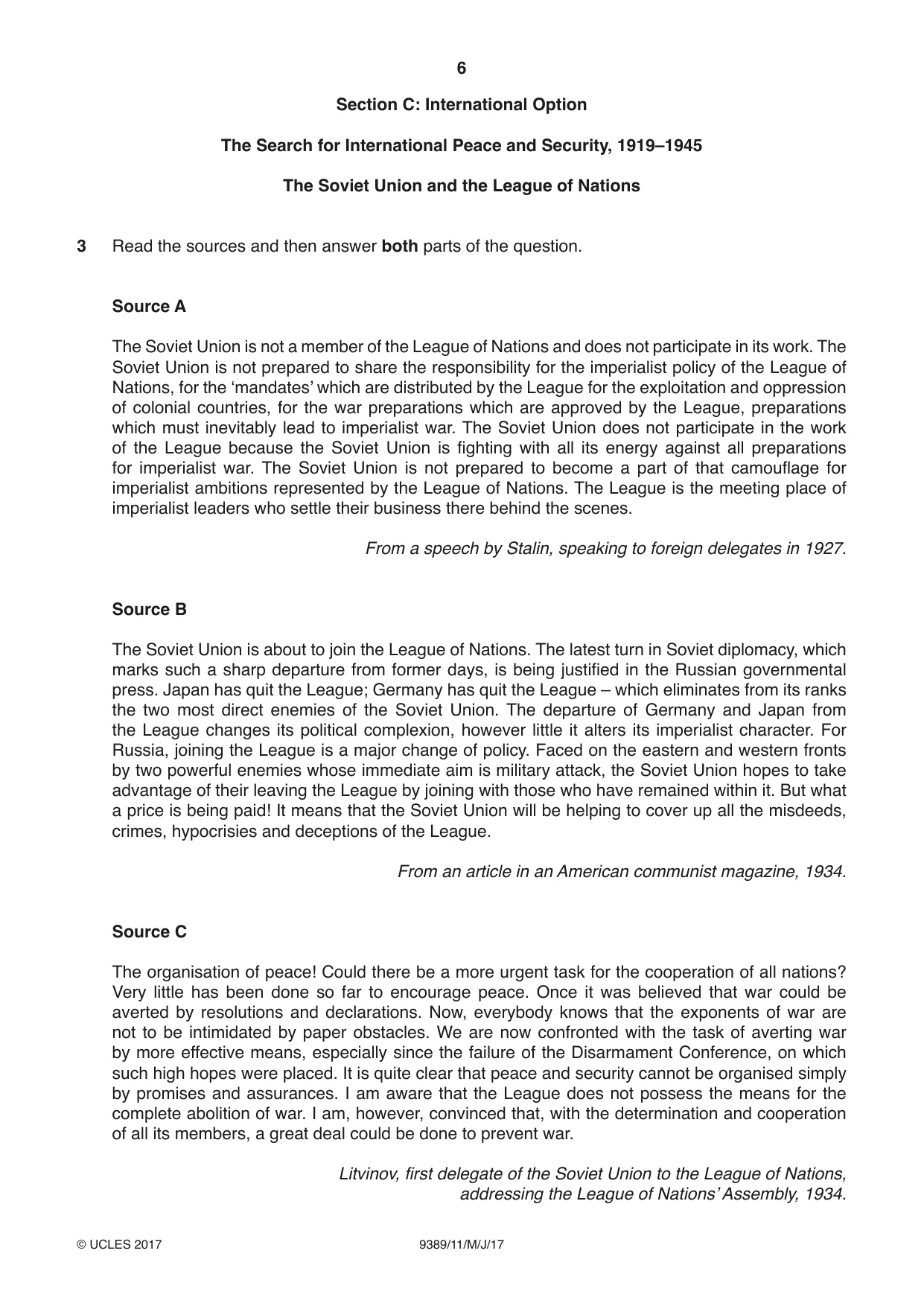
6 9389/11/M/J/17 © UCLES 2017 Section C: International Option The Search for International Peace and Security, 1919–1945 The Soviet Union and the League of Nations 3 Read the sources and then answer both parts of the question. Source A The Soviet Union is not a member of the League of Nations and does not participate in its work. The Soviet Union is not prepared to share the responsibility for the imperialist policy of the League of Nations, for the ‘mandates’ which are distributed by the League for the exploitation and oppression of colonial countries, for the war preparations which are approved by the League, preparations which must inevitably lead to imperialist war. The Soviet Union does not participate in the work of the League because the Soviet Union is fighting with all its energy against all preparations for imperialist war. The Soviet Union is not prepared to become a part of that camouflage for imperialist ambitions represented by the League of Nations. The League is the meeting place of imperialist leaders who settle their business there behind the scenes. From a speech by Stalin, speaking to foreign delegates in 1927. Source B The Soviet Union is about to join the League of Nations. The latest turn in Soviet diplomacy, which marks such a sharp departure from former days, is being justified in the Russian governmental press. Japan has quit the League; Germany has quit the League – which eliminates from its ranks the two most direct enemies of the Soviet Union. The departure of Germany and Japan from the League changes its political complexion, however little it alters its imperialist character. For Russia, joining the League is a major change of policy. Faced on the eastern and western fronts by two powerful enemies whose immediate aim is military attack, the Soviet Union hopes to take advantage of their leaving the League by joining with those who have remained within it. But what a price is being paid! It means that the Soviet Union will be helping to cover up all the misdeeds, crimes, hypocrisies and deceptions of the League. From an article in an American communist magazine, 1934. Source C The organisation of peace! Could there be a more urgent task for the cooperation of all nations? Very little has been done so far to encourage peace. Once it was believed that war could be averted by resolutions and declarations. Now, everybody knows that the exponents of war are not to be intimidated by paper obstacles. We are now confronted with the task of averting war by more effective means, especially since the failure of the Disarmament Conference, on which such high hopes were placed. It is quite clear that peace and security cannot be organised simply by promises and assurances. I am aware that the League does not possess the means for the complete abolition of war. I am, however, convinced that, with the determination and cooperation of all its members, a great deal could be done to prevent war. Litvinov, first delegate of the Soviet Union to the League of Nations, addressing the League of Nations’ Assembly, 1934.
Question paper, page 7
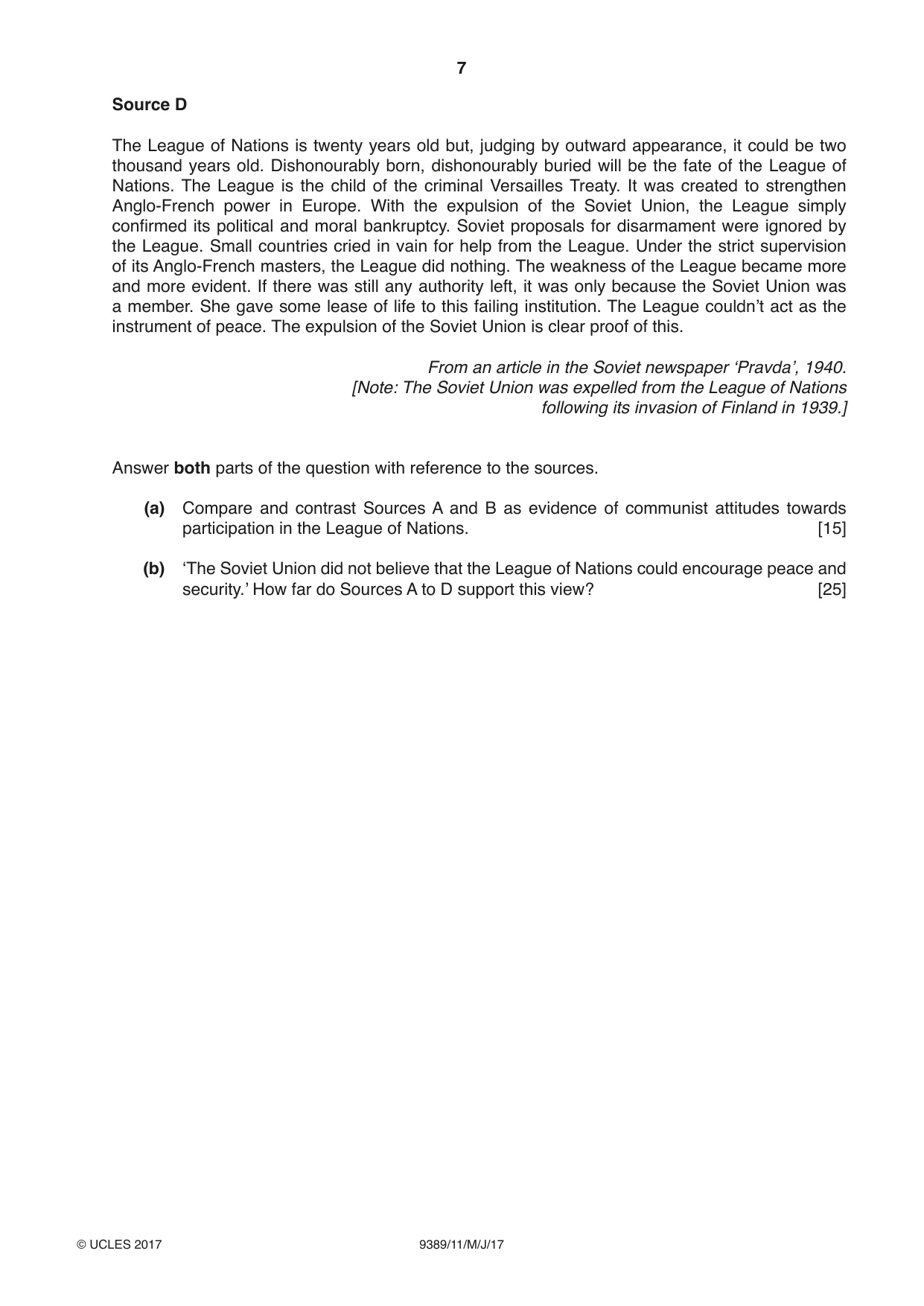
7 9389/11/M/J/17 © UCLES 2017 Source D The League of Nations is twenty years old but, judging by outward appearance, it could be two thousand years old. Dishonourably born, dishonourably buried will be the fate of the League of Nations. The League is the child of the criminal Versailles Treaty. It was created to strengthen Anglo-French power in Europe. With the expulsion of the Soviet Union, the League simply confirmed its political and moral bankruptcy. Soviet proposals for disarmament were ignored by the League. Small countries cried in vain for help from the League. Under the strict supervision of its Anglo-French masters, the League did nothing. The weakness of the League became more and more evident. If there was still any authority left, it was only because the Soviet Union was a member. She gave some lease of life to this failing institution. The League couldn’t act as the instrument of peace. The expulsion of the Soviet Union is clear proof of this. From an article in the Soviet newspaper ‘Pravda’, 1940. [Note: The Soviet Union was expelled from the League of Nations following its invasion of Finland in 1939.] Answer both parts of the question with reference to the sources. (a) Compare and contrast Sources A and B as evidence of communist attitudes towards participation in the League of Nations. [15] (b) ‘The Soviet Union did not believe that the League of Nations could encourage peace and security.’ How far do Sources A to D support this view? [25]
Question paper, page 8
8 9389/11/M/J/17 © UCLES 2017 Permission to reproduce items where third-party owned material protected by copyright is included has been sought and cleared where possible. Every reasonable effort has been made by the publisher (UCLES) to trace copyright holders, but if any items requiring clearance have unwittingly been included, the publisher will be pleased to make amends at the earliest possible opportunity. To avoid the issue of disclosure of answer-related information to candidates, all copyright acknowledgements are reproduced online in the Cambridge International Examinations Copyright Acknowledgements Booklet. This is produced for each series of examinations and is freely available to download at www.cie.org.uk after the live examination series. Cambridge International Examinations is part of the Cambridge Assessment Group. Cambridge Assessment is the brand name of University of Cambridge Local Examinations Syndicate (UCLES), which is itself a department of the University of Cambridge. BLANK PAGE
Mark scheme, page 1
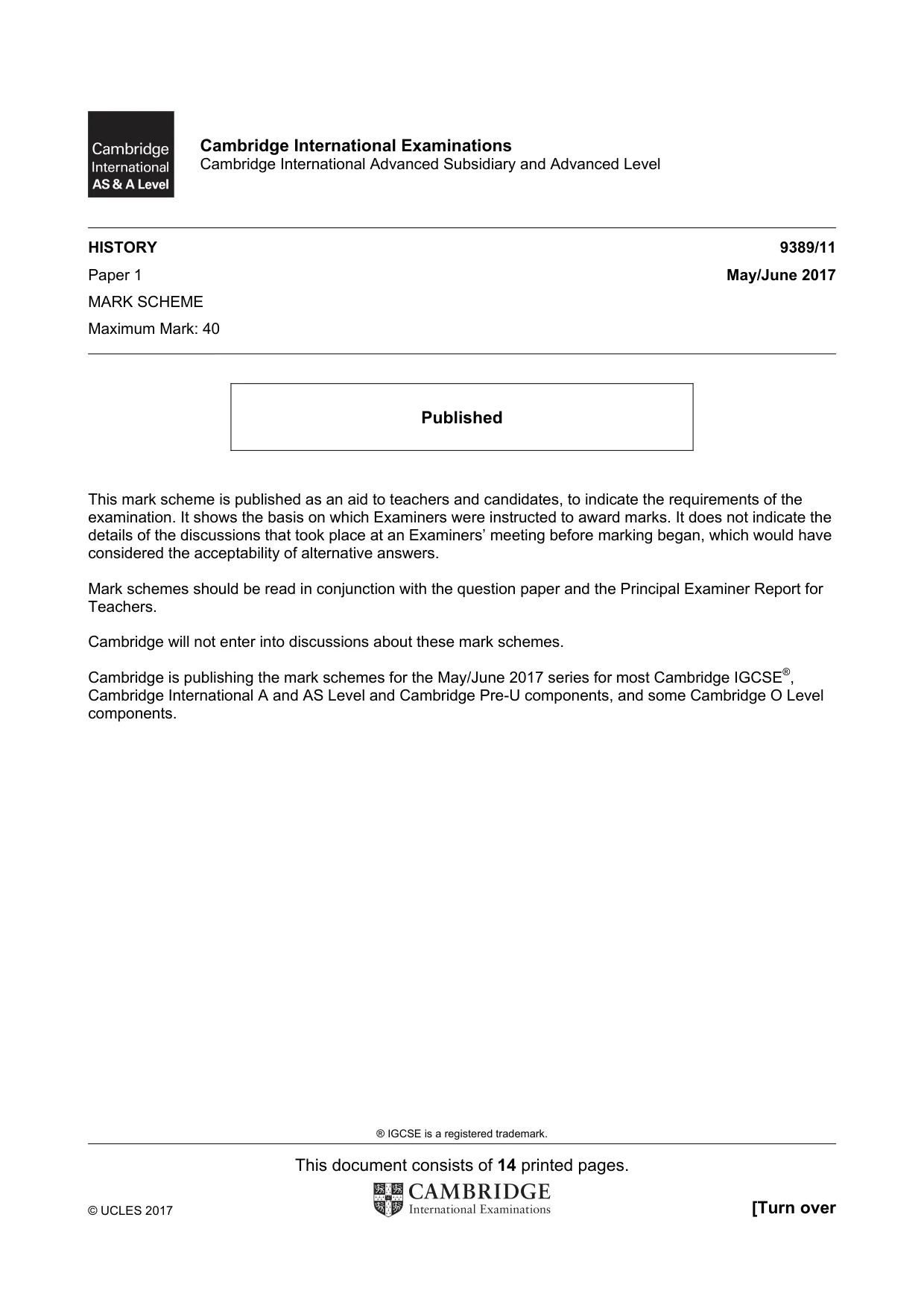
® IGCSE is a registered trademark. This document consists of 14 printed pages. © UCLES 2017 [Turn over Cambridge International Examinations Cambridge International Advanced Subsidiary and Advanced Level HISTORY 9389/11 Paper 1 May/June 2017 MARK SCHEME Maximum Mark: 40 Published This mark scheme is published as an aid to teachers and candidates, to indicate the requirements of the examination. It shows the basis on which Examiners were instructed to award marks. It does not indicate the details of the discussions that took place at an Examiners’ meeting before marking began, which would have considered the acceptability of alternative answers. Mark schemes should be read in conjunction with the question paper and the Principal Examiner Report for Teachers. Cambridge will not enter into discussions about these mark schemes. Cambridge is publishing the mark schemes for the May/June 2017 series for most Cambridge IGCSE®, Cambridge International A and AS Level and Cambridge Pre-U components, and some Cambridge O Level components.
Mark scheme, page 2
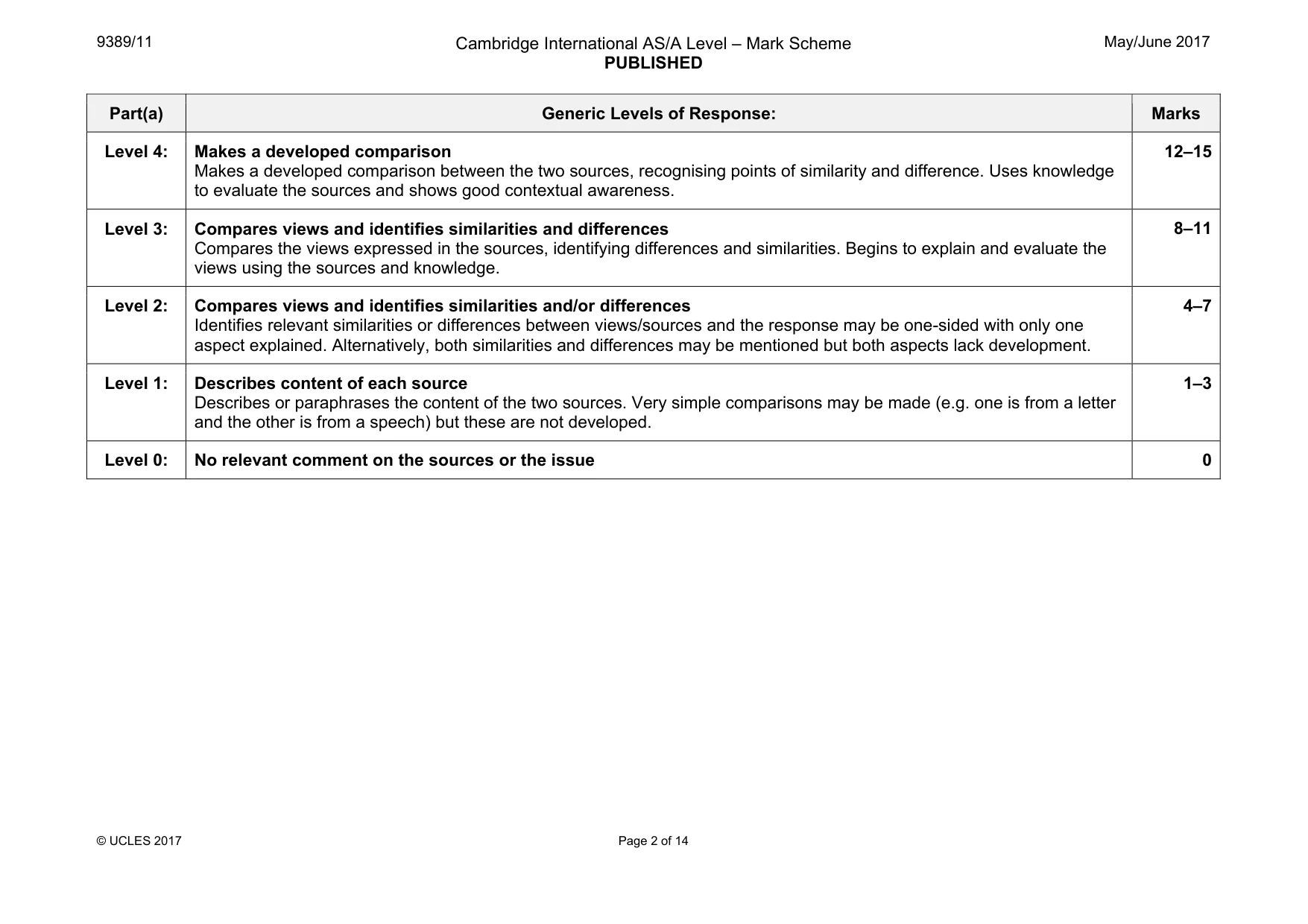
9389/11 Cambridge International AS/A Level – Mark Scheme PUBLISHED May/June 2017 © UCLES 2017 Page 2 of 14 Part(a) Generic Levels of Response: Marks Level 4: Makes a developed comparison Makes a developed comparison between the two sources, recognising points of similarity and difference. Uses knowledge to evaluate the sources and shows good contextual awareness. 12–15 Level 3: Compares views and identifies similarities and differences Compares the views expressed in the sources, identifying differences and similarities. Begins to explain and evaluate the views using the sources and knowledge. 8–11 Level 2: Compares views and identifies similarities and/or differences Identifies relevant similarities or differences between views/sources and the response may be one-sided with only one aspect explained. Alternatively, both similarities and differences may be mentioned but both aspects lack development. 4–7 Level 1: Describes content of each source Describes or paraphrases the content of the two sources. Very simple comparisons may be made (e.g. one is from a letter and the other is from a speech) but these are not developed. 1–3 Level 0: No relevant comment on the sources or the issue 0
Mark scheme, page 3
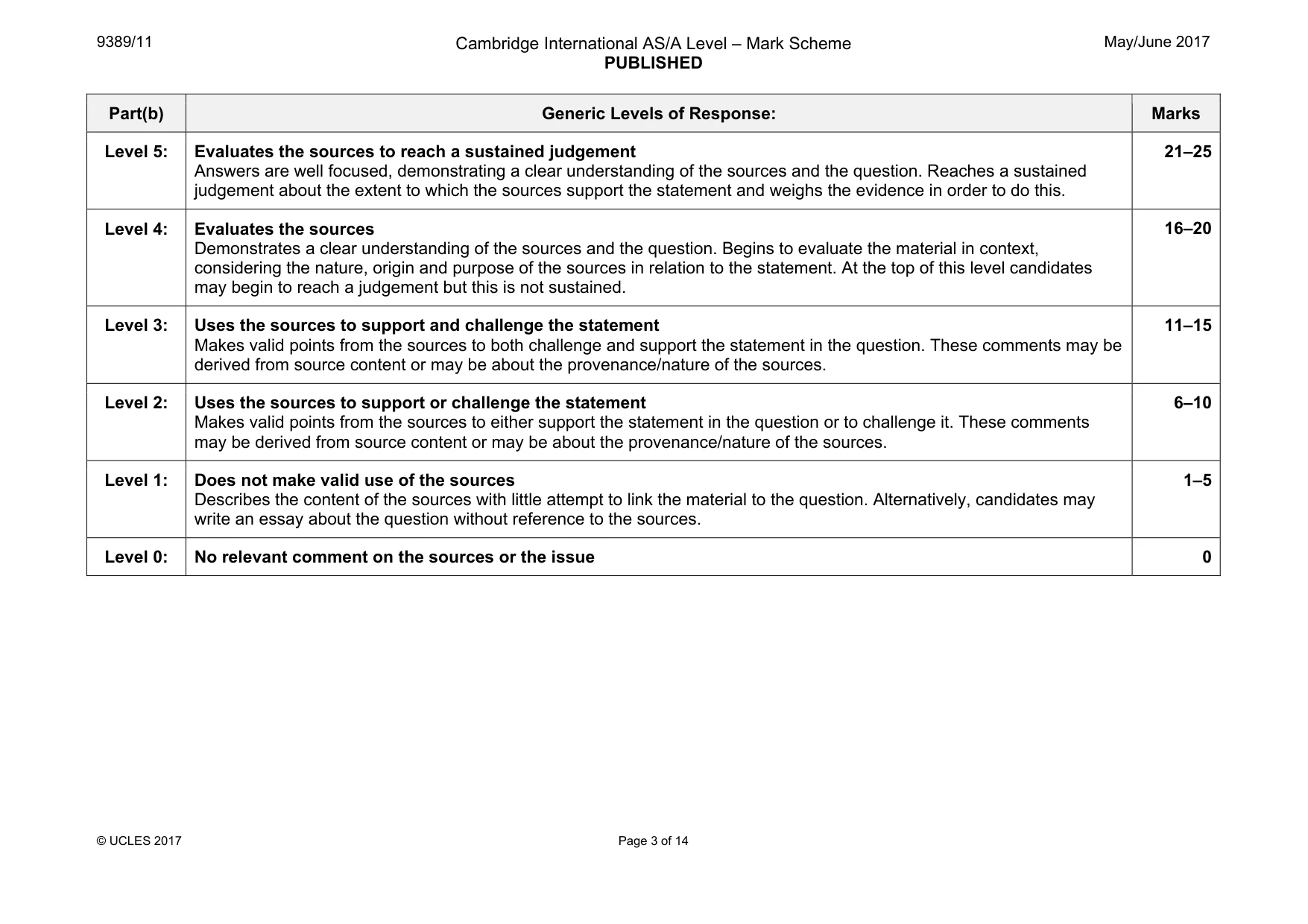
9389/11 Cambridge International AS/A Level – Mark Scheme PUBLISHED May/June 2017 © UCLES 2017 Page 3 of 14 Part(b) Generic Levels of Response: Marks Level 5: Evaluates the sources to reach a sustained judgement Answers are well focused, demonstrating a clear understanding of the sources and the question. Reaches a sustained judgement about the extent to which the sources support the statement and weighs the evidence in order to do this. 21–25 Level 4: Evaluates the sources Demonstrates a clear understanding of the sources and the question. Begins to evaluate the material in context, considering the nature, origin and purpose of the sources in relation to the statement. At the top of this level candidates may begin to reach a judgement but this is not sustained. 16–20 Level 3: Uses the sources to support and challenge the statement Makes valid points from the sources to both challenge and support the statement in the question. These comments may be derived from source content or may be about the provenance/nature of the sources. 11–15 Level 2: Uses the sources to support or challenge the statement Makes valid points from the sources to either support the statement in the question or to challenge it. These comments may be derived from source content or may be about the provenance/nature of the sources. 6–10 Level 1: Does not make valid use of the sources Describes the content of the sources with little attempt to link the material to the question. Alternatively, candidates may write an essay about the question without reference to the sources. 1–5 Level 0: No relevant comment on the sources or the issue 0
Mark scheme, page 4
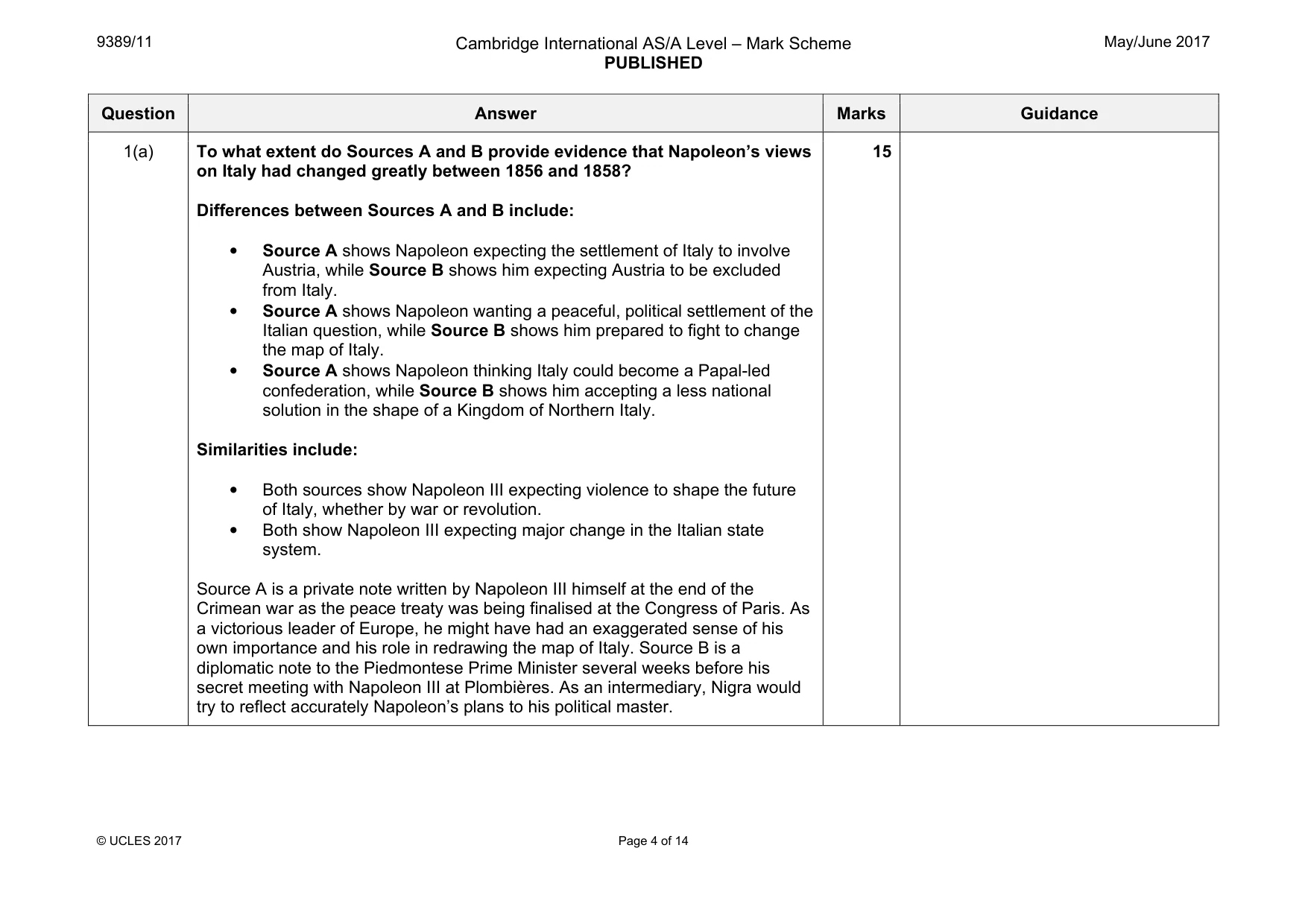
9389/11 Cambridge International AS/A Level – Mark Scheme PUBLISHED May/June 2017 © UCLES 2017 Page 4 of 14 Question Answer Marks Guidance 1(a) To what extent do Sources A and B provide evidence that Napoleon’s views on Italy had changed greatly between 1856 and 1858? Differences between Sources A and B include: • Source A shows Napoleon expecting the settlement of Italy to involve Austria, while Source B shows him expecting Austria to be excluded from Italy. • Source A shows Napoleon wanting a peaceful, political settlement of the Italian question, while Source B shows him prepared to fight to change the map of Italy. • Source A shows Napoleon thinking Italy could become a Papal-led confederation, while Source B shows him accepting a less national solution in the shape of a Kingdom of Northern Italy. Similarities include: • Both sources show Napoleon III expecting violence to shape the future of Italy, whether by war or revolution. • Both show Napoleon III expecting major change in the Italian state system. Source A is a private note written by Napoleon III himself at the end of the Crimean war as the peace treaty was being finalised at the Congress of Paris. As a victorious leader of Europe, he might have had an exaggerated sense of his own importance and his role in redrawing the map of Italy. Source B is a diplomatic note to the Piedmontese Prime Minister several weeks before his secret meeting with Napoleon III at Plombières. As an intermediary, Nigra would try to reflect accurately Napoleon’s plans to his political master. 15
Mark scheme, page 5
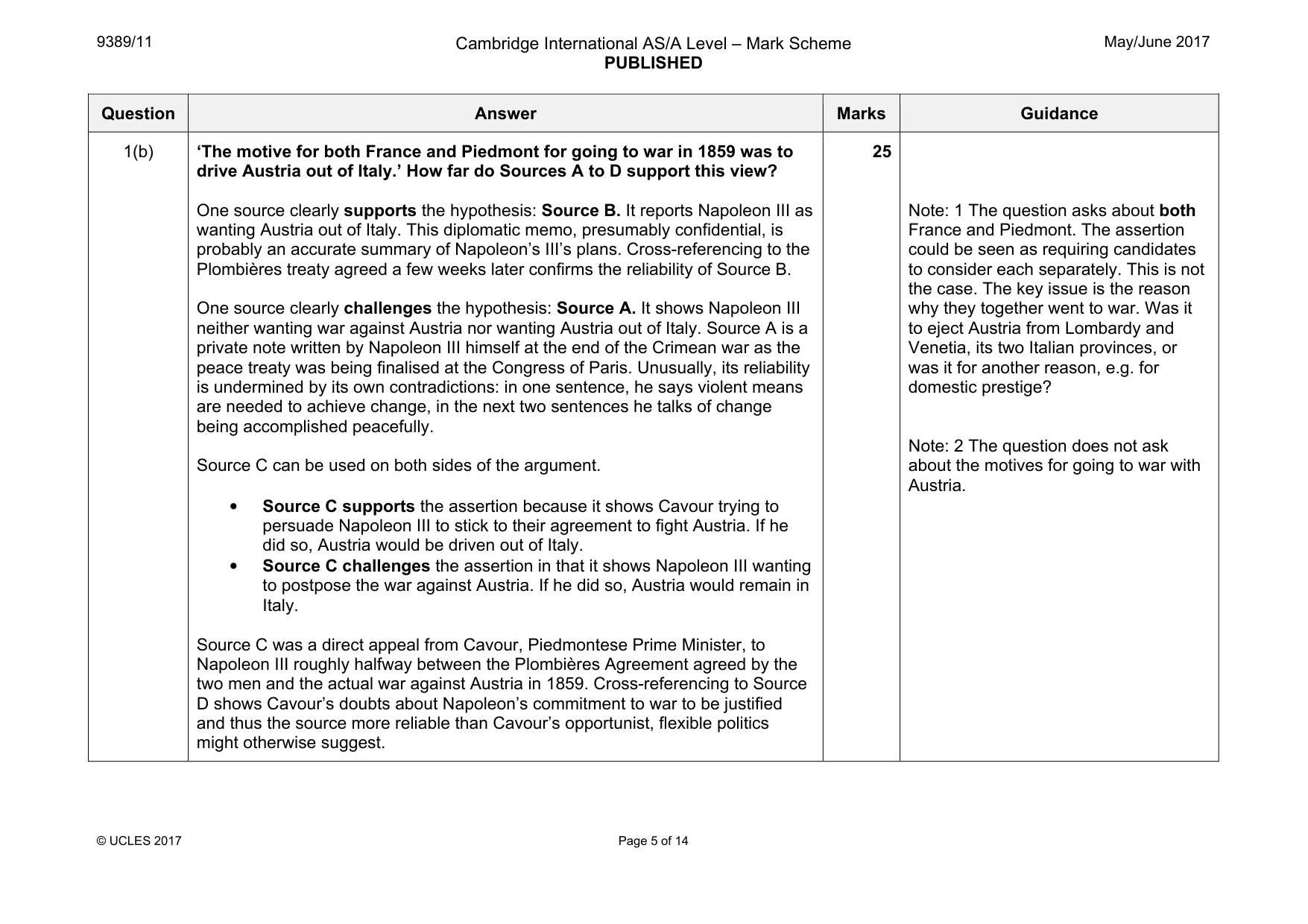
9389/11 Cambridge International AS/A Level – Mark Scheme PUBLISHED May/June 2017 © UCLES 2017 Page 5 of 14 Question Answer Marks Guidance 1(b) ‘The motive for both France and Piedmont for going to war in 1859 was to drive Austria out of Italy.’ How far do Sources A to D support this view? One source clearly supports the hypothesis: Source B. It reports Napoleon III as wanting Austria out of Italy. This diplomatic memo, presumably confidential, is probably an accurate summary of Napoleon’s III’s plans. Cross-referencing to the Plombières treaty agreed a few weeks later confirms the reliability of Source B. One source clearly challenges the hypothesis: Source A. It shows Napoleon III neither wanting war against Austria nor wanting Austria out of Italy. Source A is a private note written by Napoleon III himself at the end of the Crimean war as the peace treaty was being finalised at the Congress of Paris. Unusually, its reliability is undermined by its own contradictions: in one sentence, he says violent means are needed to achieve change, in the next two sentences he talks of change being accomplished peacefully. Source C can be used on both sides of the argument. • Source C supports the assertion because it shows Cavour trying to persuade Napoleon III to stick to their agreement to fight Austria. If he did so, Austria would be driven out of Italy. • Source C challenges the assertion in that it shows Napoleon III wanting to postpose the war against Austria. If he did so, Austria would remain in Italy. Source C was a direct appeal from Cavour, Piedmontese Prime Minister, to Napoleon III roughly halfway between the Plombières Agreement agreed by the two men and the actual war against Austria in 1859. Cross-referencing to Source D shows Cavour’s doubts about Napoleon’s commitment to war to be justified and thus the source more reliable than Cavour’s opportunist, flexible politics might otherwise suggest. 25 Note: 1 The question asks about both France and Piedmont. The assertion could be seen as requiring candidates to consider each separately. This is not the case. The key issue is the reason why they together went to war. Was it to eject Austria from Lombardy and Venetia, its two Italian provinces, or was it for another reason, e.g. for domestic prestige? Note: 2 The question does not ask about the motives for going to war with Austria.
Mark scheme, page 6
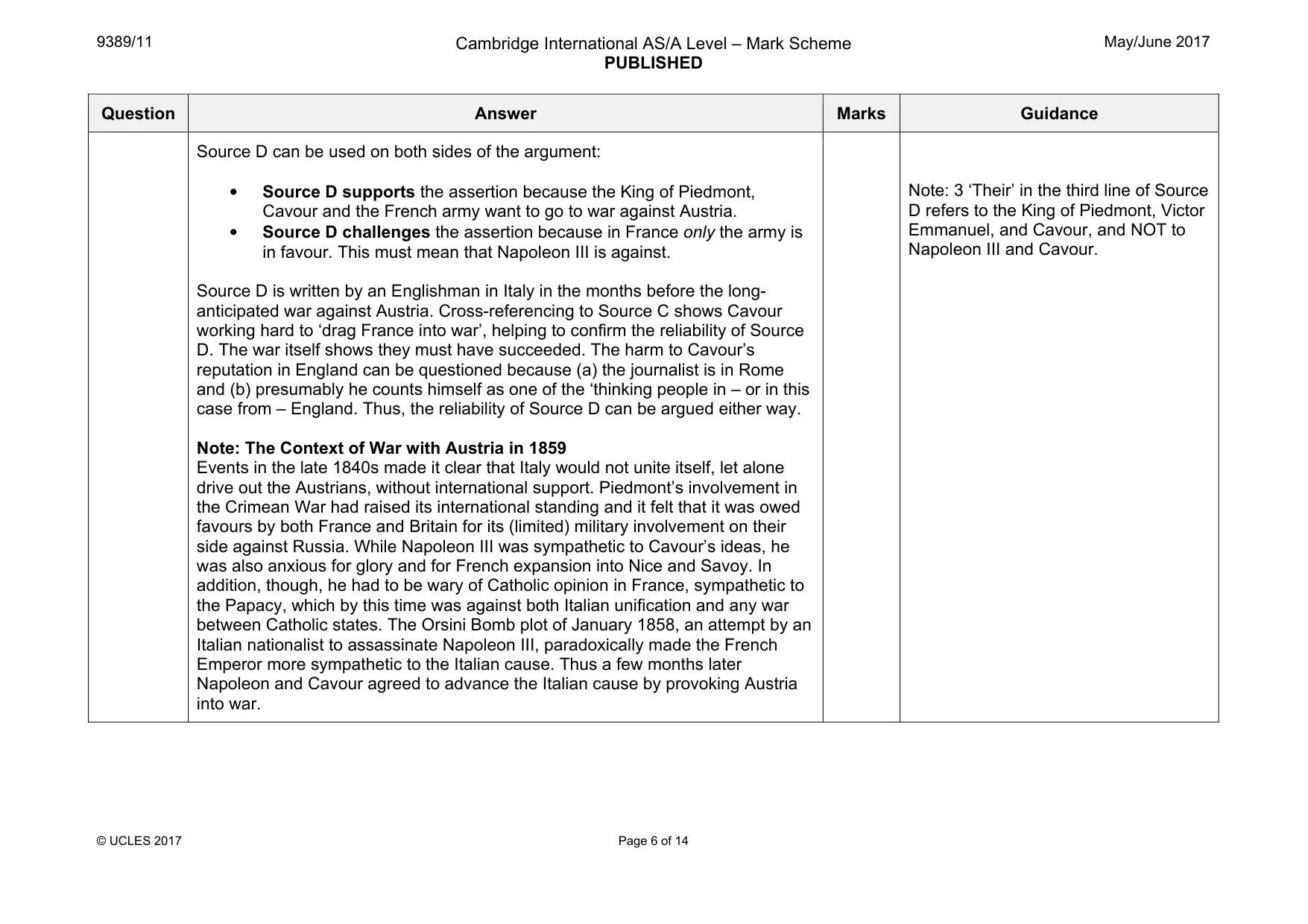
9389/11 Cambridge International AS/A Level – Mark Scheme PUBLISHED May/June 2017 © UCLES 2017 Page 6 of 14 Question Answer Marks Guidance Source D can be used on both sides of the argument: • Source D supports the assertion because the King of Piedmont, Cavour and the French army want to go to war against Austria. • Source D challenges the assertion because in France only the army is in favour. This must mean that Napoleon III is against. Source D is written by an Englishman in Italy in the months before the long- anticipated war against Austria. Cross-referencing to Source C shows Cavour working hard to ‘drag France into war’, helping to confirm the reliability of Source D. The war itself shows they must have succeeded. The harm to Cavour’s reputation in England can be questioned because (a) the journalist is in Rome and (b) presumably he counts himself as one of the ‘thinking people in – or in this case from – England. Thus, the reliability of Source D can be argued either way. Note: The Context of War with Austria in 1859 Events in the late 1840s made it clear that Italy would not unite itself, let alone drive out the Austrians, without international support. Piedmont’s involvement in the Crimean War had raised its international standing and it felt that it was owed favours by both France and Britain for its (limited) military involvement on their side against Russia. While Napoleon III was sympathetic to Cavour’s ideas, he was also anxious for glory and for French expansion into Nice and Savoy. In addition, though, he had to be wary of Catholic opinion in France, sympathetic to the Papacy, which by this time was against both Italian unification and any war between Catholic states. The Orsini Bomb plot of January 1858, an attempt by an Italian nationalist to assassinate Napoleon III, paradoxically made the French Emperor more sympathetic to the Italian cause. Thus a few months later Napoleon and Cavour agreed to advance the Italian cause by provoking Austria into war. Note: 3 ‘Their’ in the third line of Source D refers to the King of Piedmont, Victor Emmanuel, and Cavour, and NOT to Napoleon III and Cavour.
Mark scheme, page 7
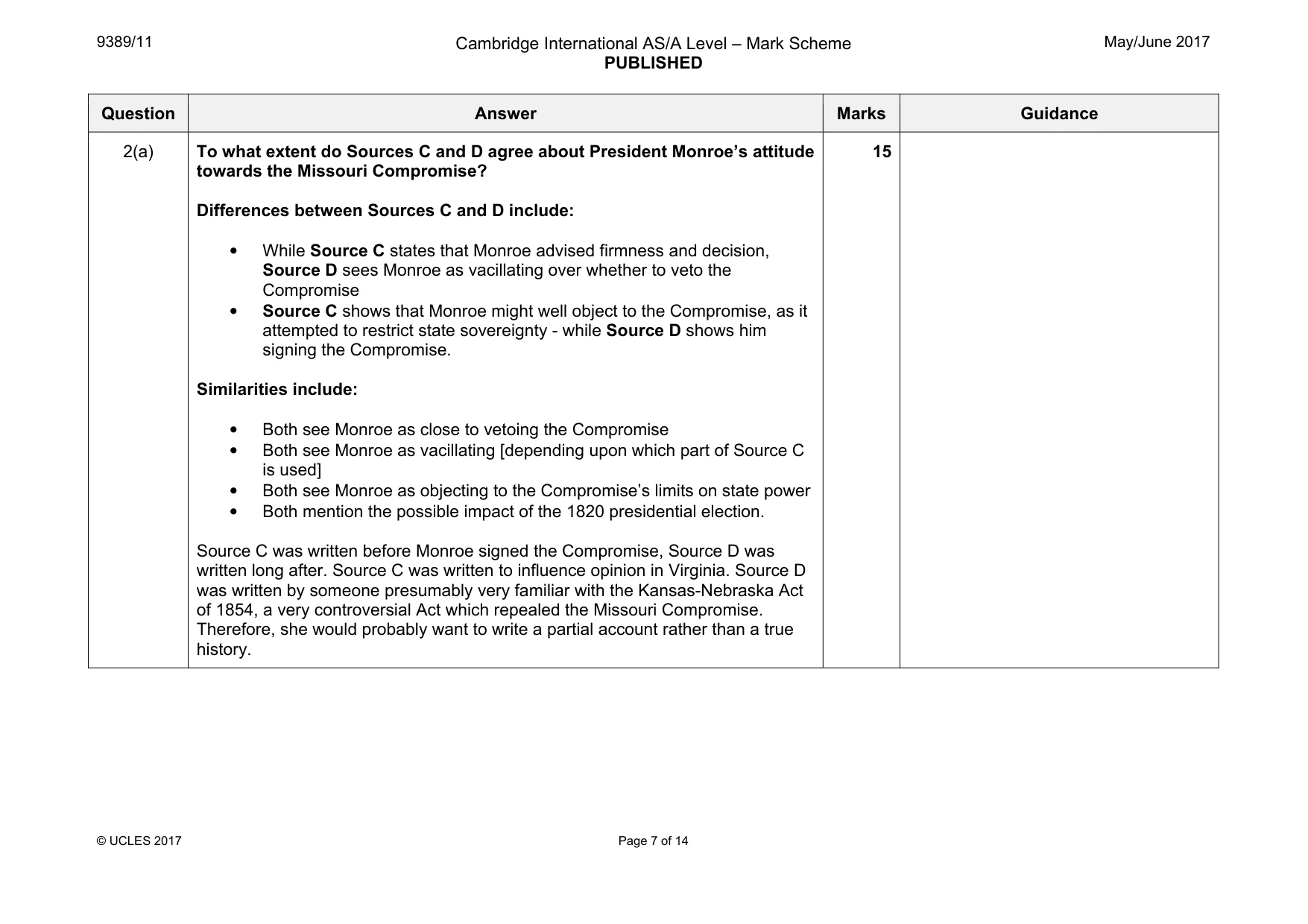
9389/11 Cambridge International AS/A Level – Mark Scheme PUBLISHED May/June 2017 © UCLES 2017 Page 7 of 14 Question Answer Marks Guidance 2(a) To what extent do Sources C and D agree about President Monroe’s attitude towards the Missouri Compromise? Differences between Sources C and D include: • While Source C states that Monroe advised firmness and decision, Source D sees Monroe as vacillating over whether to veto the Compromise • Source C shows that Monroe might well object to the Compromise, as it attempted to restrict state sovereignty - while Source D shows him signing the Compromise. Similarities include: • Both see Monroe as close to vetoing the Compromise • Both see Monroe as vacillating [depending upon which part of Source C is used] • Both see Monroe as objecting to the Compromise’s limits on state power • Both mention the possible impact of the 1820 presidential election. Source C was written before Monroe signed the Compromise, Source D was written long after. Source C was written to influence opinion in Virginia. Source D was written by someone presumably very familiar with the Kansas-Nebraska Act of 1854, a very controversial Act which repealed the Missouri Compromise. Therefore, she would probably want to write a partial account rather than a true history. 15
Mark scheme, page 8
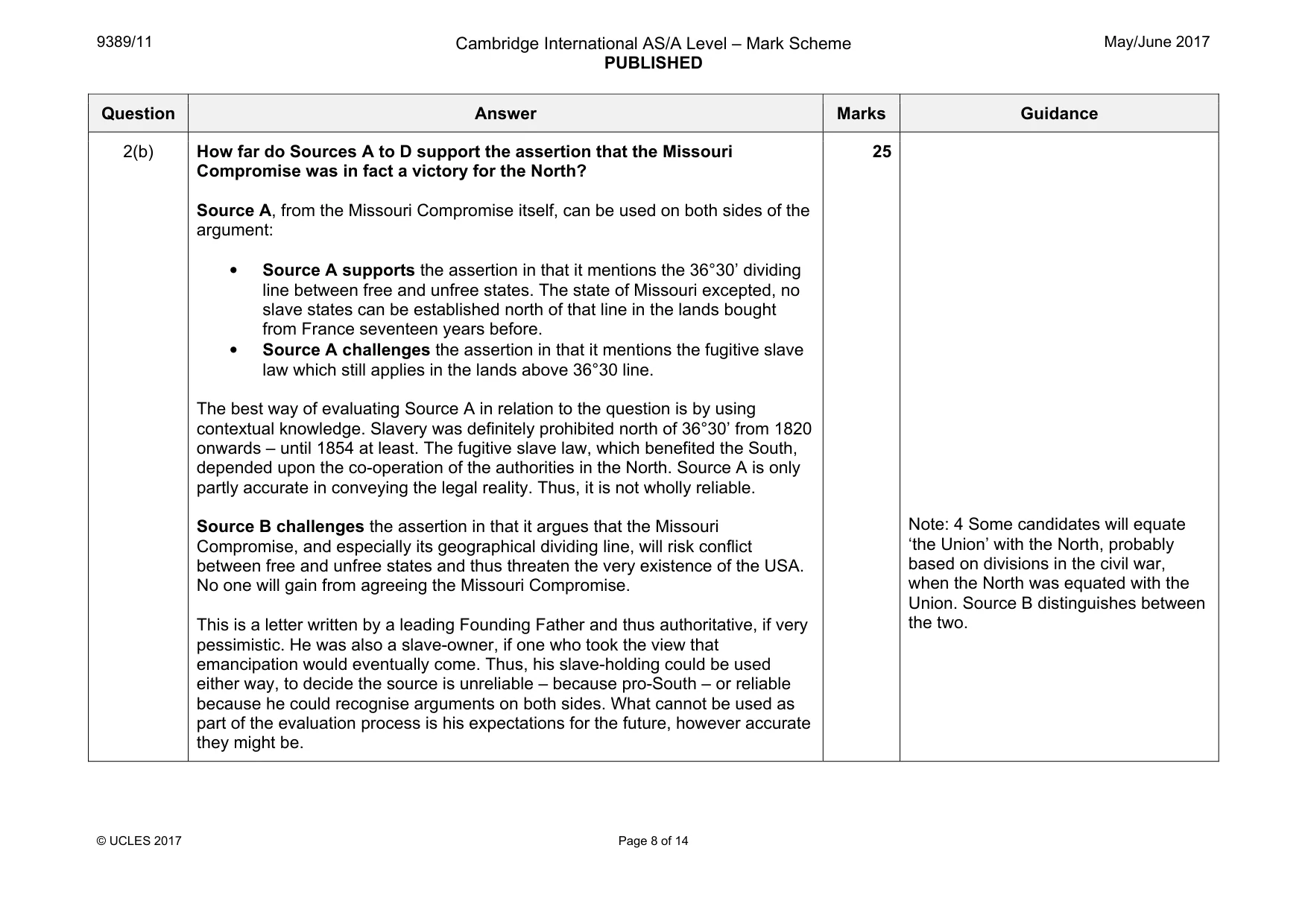
9389/11 Cambridge International AS/A Level – Mark Scheme PUBLISHED May/June 2017 © UCLES 2017 Page 8 of 14 Question Answer Marks Guidance 2(b) How far do Sources A to D support the assertion that the Missouri Compromise was in fact a victory for the North? Source A, from the Missouri Compromise itself, can be used on both sides of the argument: • Source A supports the assertion in that it mentions the 36°30’ dividing line between free and unfree states. The state of Missouri excepted, no slave states can be established north of that line in the lands bought from France seventeen years before. • Source A challenges the assertion in that it mentions the fugitive slave law which still applies in the lands above 36°30 line. The best way of evaluating Source A in relation to the question is by using contextual knowledge. Slavery was definitely prohibited north of 36°30’ from 1820 onwards – until 1854 at least. The fugitive slave law, which benefited the South, depended upon the co-operation of the authorities in the North. Source A is only partly accurate in conveying the legal reality. Thus, it is not wholly reliable. Source B challenges the assertion in that it argues that the Missouri Compromise, and especially its geographical dividing line, will risk conflict between free and unfree states and thus threaten the very existence of the USA. No one will gain from agreeing the Missouri Compromise. This is a letter written by a leading Founding Father and thus authoritative, if very pessimistic. He was also a slave-owner, if one who took the view that emancipation would eventually come. Thus, his slave-holding could be used either way, to decide the source is unreliable – because pro-South – or reliable because he could recognise arguments on both sides. What cannot be used as part of the evaluation process is his expectations for the future, however accurate they might be. 25 Note: 4 Some candidates will equate ‘the Union’ with the North, probably based on divisions in the civil war, when the North was equated with the Union. Source B distinguishes between the two.
Mark scheme, page 9
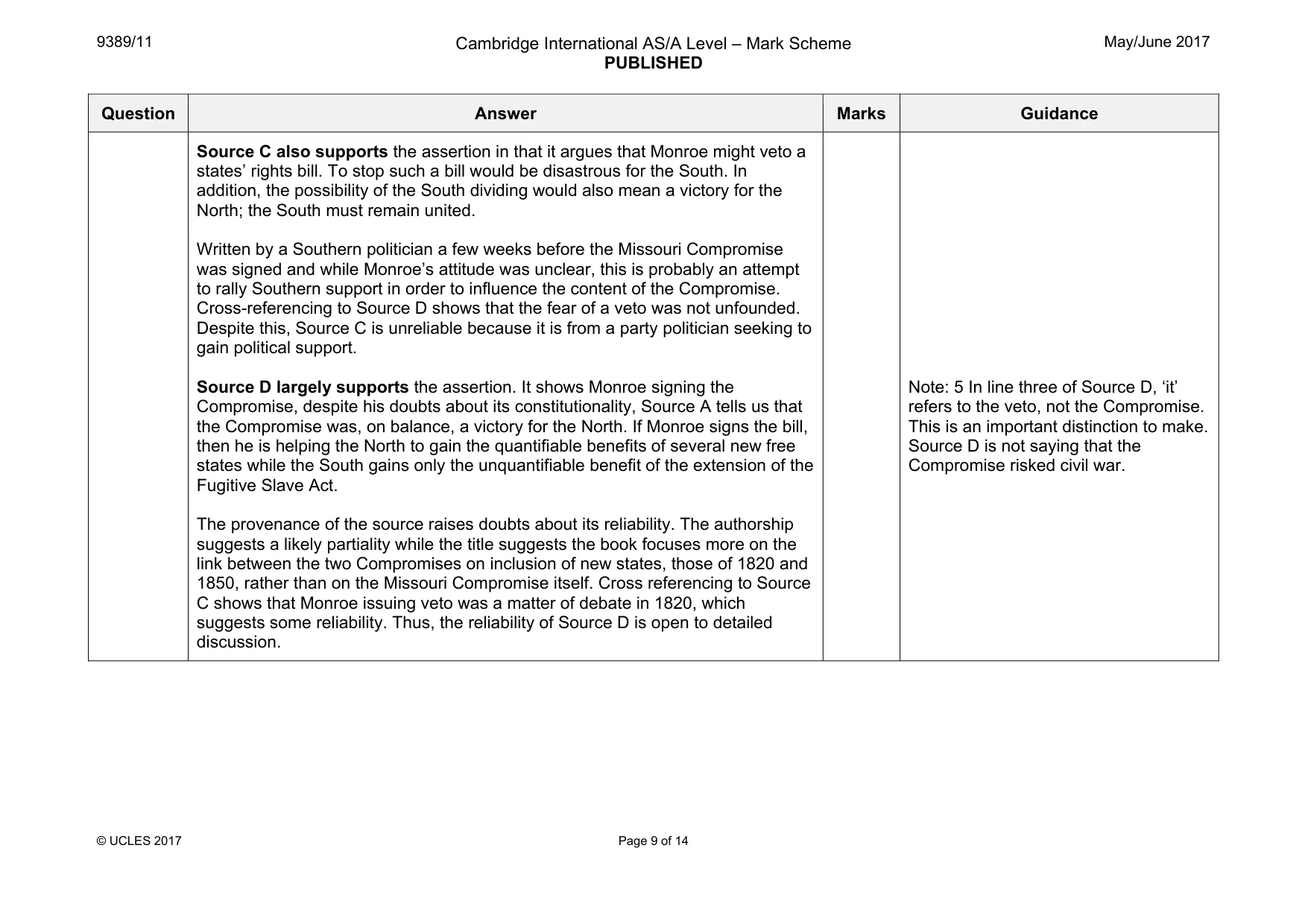
9389/11 Cambridge International AS/A Level – Mark Scheme PUBLISHED May/June 2017 © UCLES 2017 Page 9 of 14 Question Answer Marks Guidance Source C also supports the assertion in that it argues that Monroe might veto a states’ rights bill. To stop such a bill would be disastrous for the South. In addition, the possibility of the South dividing would also mean a victory for the North; the South must remain united. Written by a Southern politician a few weeks before the Missouri Compromise was signed and while Monroe’s attitude was unclear, this is probably an attempt to rally Southern support in order to influence the content of the Compromise. Cross-referencing to Source D shows that the fear of a veto was not unfounded. Despite this, Source C is unreliable because it is from a party politician seeking to gain political support. Source D largely supports the assertion. It shows Monroe signing the Compromise, despite his doubts about its constitutionality, Source A tells us that the Compromise was, on balance, a victory for the North. If Monroe signs the bill, then he is helping the North to gain the quantifiable benefits of several new free states while the South gains only the unquantifiable benefit of the extension of the Fugitive Slave Act. The provenance of the source raises doubts about its reliability. The authorship suggests a likely partiality while the title suggests the book focuses more on the link between the two Compromises on inclusion of new states, those of 1820 and 1850, rather than on the Missouri Compromise itself. Cross referencing to Source C shows that Monroe issuing veto was a matter of debate in 1820, which suggests some reliability. Thus, the reliability of Source D is open to detailed discussion. Note: 5 In line three of Source D, ‘it’ refers to the veto, not the Compromise. This is an important distinction to make. Source D is not saying that the Compromise risked civil war.
Mark scheme, page 10
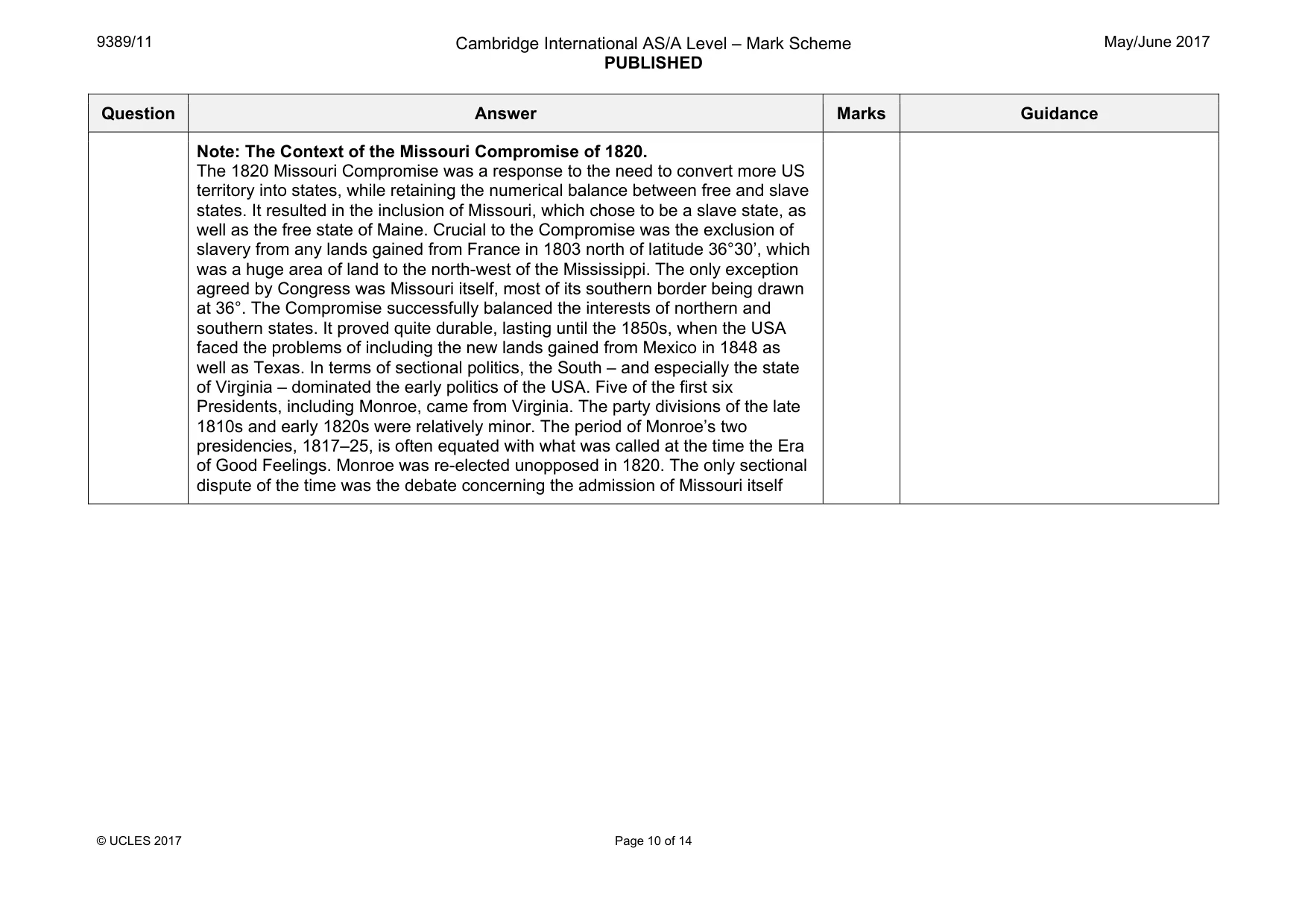
9389/11 Cambridge International AS/A Level – Mark Scheme PUBLISHED May/June 2017 © UCLES 2017 Page 10 of 14 Question Answer Marks Guidance Note: The Context of the Missouri Compromise of 1820. The 1820 Missouri Compromise was a response to the need to convert more US territory into states, while retaining the numerical balance between free and slave states. It resulted in the inclusion of Missouri, which chose to be a slave state, as well as the free state of Maine. Crucial to the Compromise was the exclusion of slavery from any lands gained from France in 1803 north of latitude 36°30’, which was a huge area of land to the north-west of the Mississippi. The only exception agreed by Congress was Missouri itself, most of its southern border being drawn at 36°. The Compromise successfully balanced the interests of northern and southern states. It proved quite durable, lasting until the 1850s, when the USA faced the problems of including the new lands gained from Mexico in 1848 as well as Texas. In terms of sectional politics, the South – and especially the state of Virginia – dominated the early politics of the USA. Five of the first six Presidents, including Monroe, came from Virginia. The party divisions of the late 1810s and early 1820s were relatively minor. The period of Monroe’s two presidencies, 1817–25, is often equated with what was called at the time the Era of Good Feelings. Monroe was re-elected unopposed in 1820. The only sectional dispute of the time was the debate concerning the admission of Missouri itself
Mark scheme, page 11
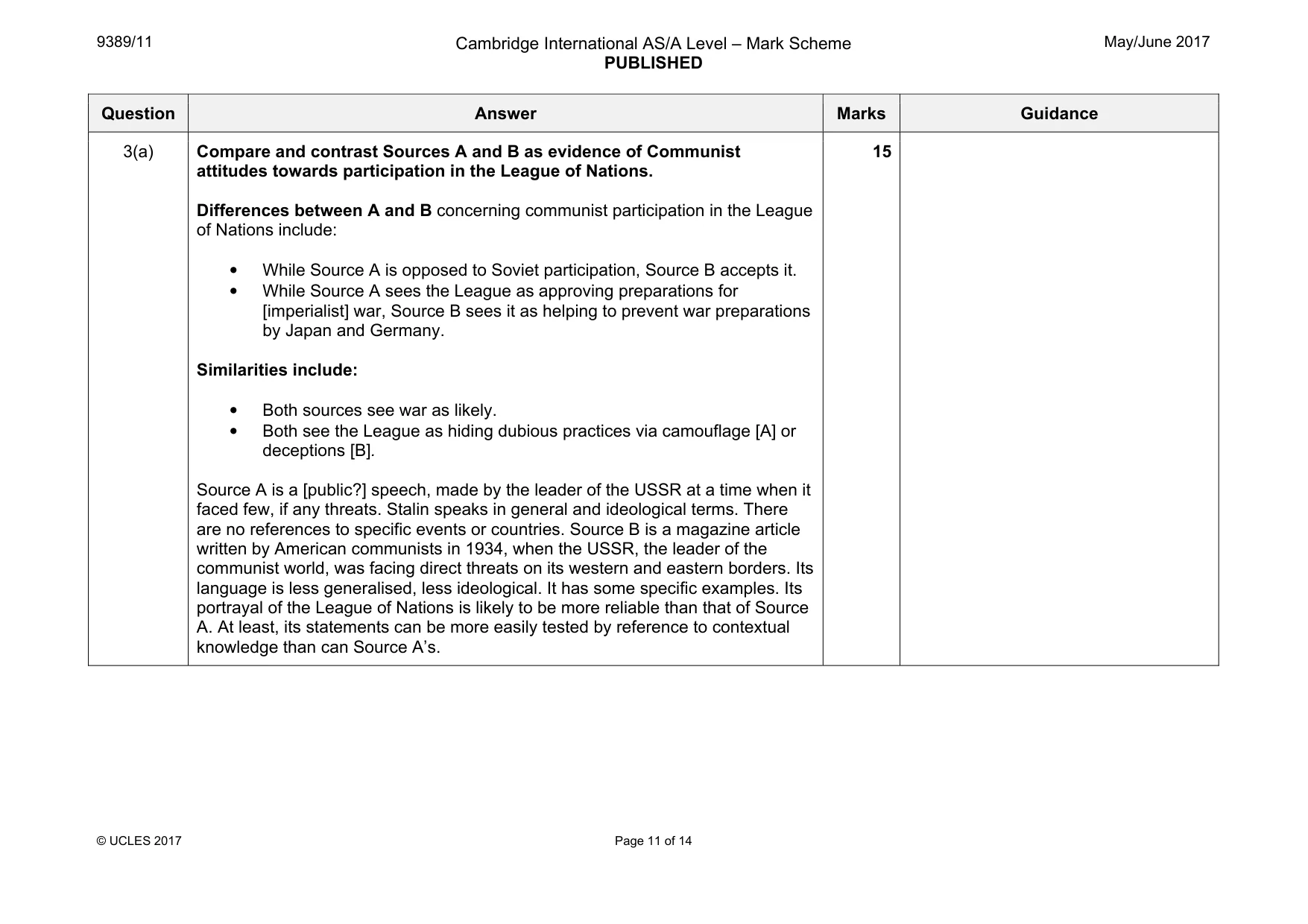
9389/11 Cambridge International AS/A Level – Mark Scheme PUBLISHED May/June 2017 © UCLES 2017 Page 11 of 14 Question Answer Marks Guidance 3(a) Compare and contrast Sources A and B as evidence of Communist attitudes towards participation in the League of Nations. Differences between A and B concerning communist participation in the League of Nations include: • While Source A is opposed to Soviet participation, Source B accepts it. • While Source A sees the League as approving preparations for [imperialist] war, Source B sees it as helping to prevent war preparations by Japan and Germany. Similarities include: • Both sources see war as likely. • Both see the League as hiding dubious practices via camouflage [A] or deceptions [B]. Source A is a [public?] speech, made by the leader of the USSR at a time when it faced few, if any threats. Stalin speaks in general and ideological terms. There are no references to specific events or countries. Source B is a magazine article written by American communists in 1934, when the USSR, the leader of the communist world, was facing direct threats on its western and eastern borders. Its language is less generalised, less ideological. It has some specific examples. Its portrayal of the League of Nations is likely to be more reliable than that of Source A. At least, its statements can be more easily tested by reference to contextual knowledge than can Source A’s. 15
Mark scheme, page 12
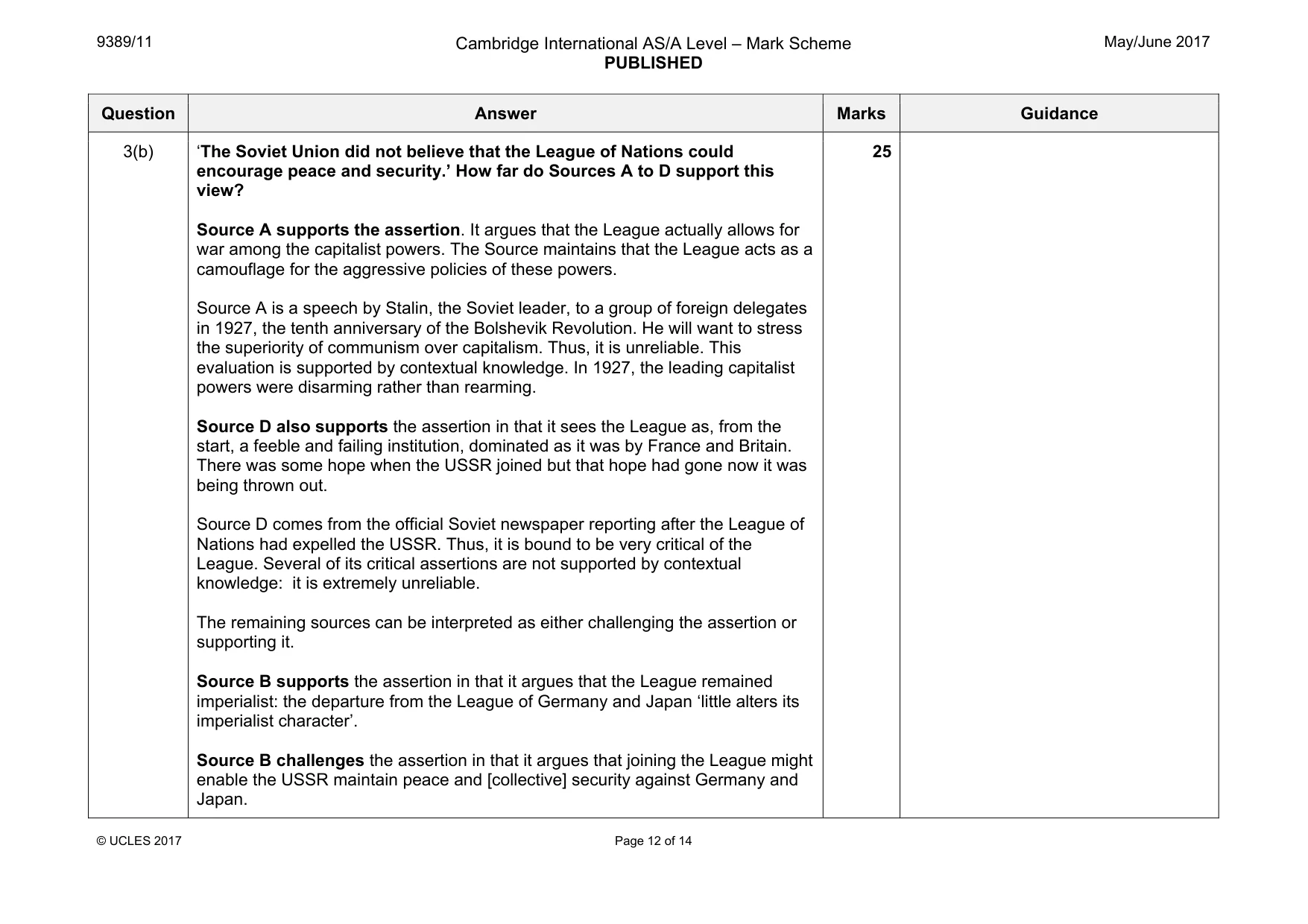
9389/11 Cambridge International AS/A Level – Mark Scheme PUBLISHED May/June 2017 © UCLES 2017 Page 12 of 14 Question Answer Marks Guidance 3(b) ‘The Soviet Union did not believe that the League of Nations could encourage peace and security.’ How far do Sources A to D support this view? Source A supports the assertion. It argues that the League actually allows for war among the capitalist powers. The Source maintains that the League acts as a camouflage for the aggressive policies of these powers. Source A is a speech by Stalin, the Soviet leader, to a group of foreign delegates in 1927, the tenth anniversary of the Bolshevik Revolution. He will want to stress the superiority of communism over capitalism. Thus, it is unreliable. This evaluation is supported by contextual knowledge. In 1927, the leading capitalist powers were disarming rather than rearming. Source D also supports the assertion in that it sees the League as, from the start, a feeble and failing institution, dominated as it was by France and Britain. There was some hope when the USSR joined but that hope had gone now it was being thrown out. Source D comes from the official Soviet newspaper reporting after the League of Nations had expelled the USSR. Thus, it is bound to be very critical of the League. Several of its critical assertions are not supported by contextual knowledge: it is extremely unreliable. The remaining sources can be interpreted as either challenging the assertion or supporting it. Source B supports the assertion in that it argues that the League remained imperialist: the departure from the League of Germany and Japan ‘little alters its imperialist character’. Source B challenges the assertion in that it argues that joining the League might enable the USSR maintain peace and [collective] security against Germany and Japan. 25
Mark scheme, page 13
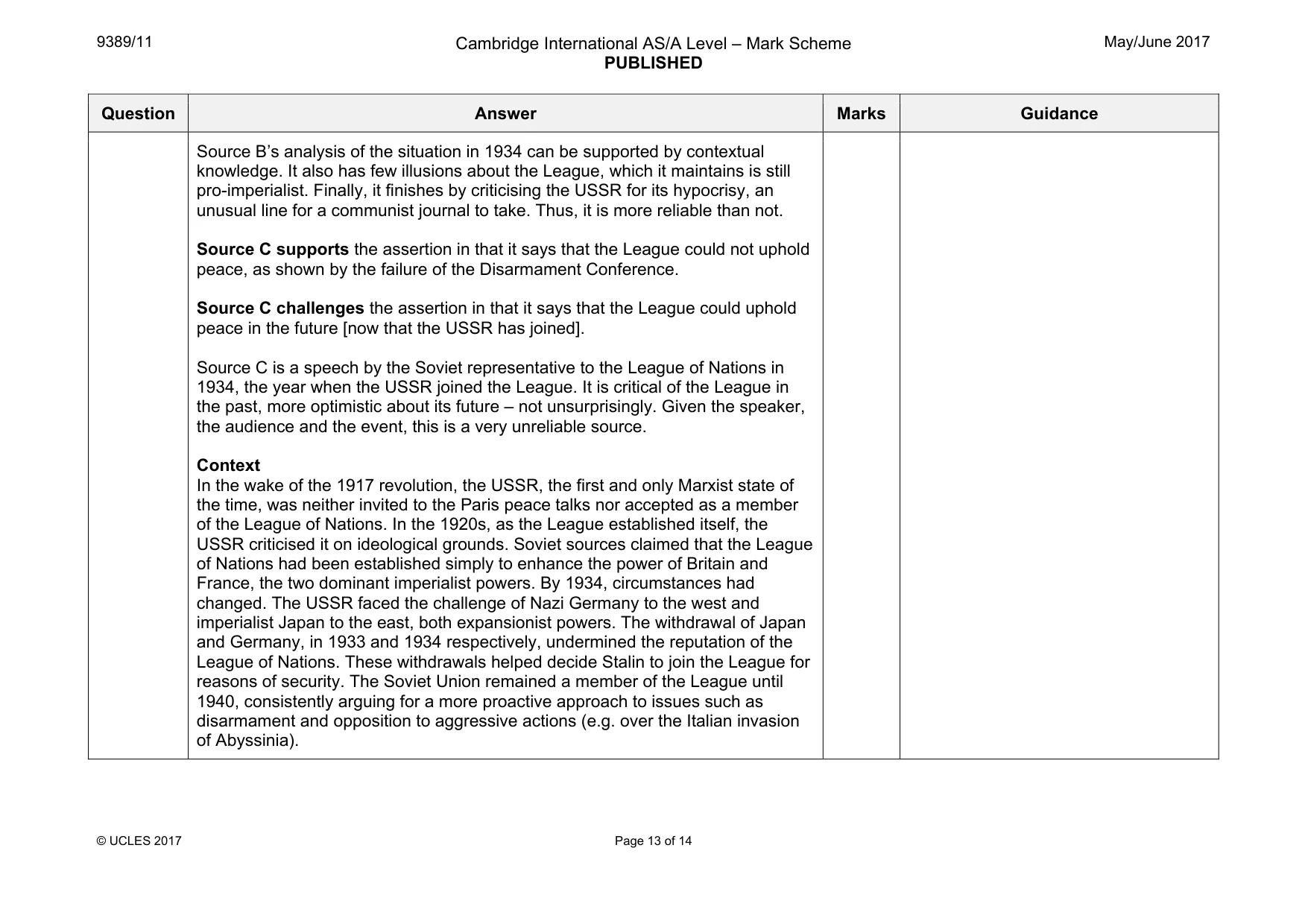
9389/11 Cambridge International AS/A Level – Mark Scheme PUBLISHED May/June 2017 © UCLES 2017 Page 13 of 14 Question Answer Marks Guidance Source B’s analysis of the situation in 1934 can be supported by contextual knowledge. It also has few illusions about the League, which it maintains is still pro-imperialist. Finally, it finishes by criticising the USSR for its hypocrisy, an unusual line for a communist journal to take. Thus, it is more reliable than not. Source C supports the assertion in that it says that the League could not uphold peace, as shown by the failure of the Disarmament Conference. Source C challenges the assertion in that it says that the League could uphold peace in the future [now that the USSR has joined]. Source C is a speech by the Soviet representative to the League of Nations in 1934, the year when the USSR joined the League. It is critical of the League in the past, more optimistic about its future – not unsurprisingly. Given the speaker, the audience and the event, this is a very unreliable source. Context In the wake of the 1917 revolution, the USSR, the first and only Marxist state of the time, was neither invited to the Paris peace talks nor accepted as a member of the League of Nations. In the 1920s, as the League established itself, the USSR criticised it on ideological grounds. Soviet sources claimed that the League of Nations had been established simply to enhance the power of Britain and France, the two dominant imperialist powers. By 1934, circumstances had changed. The USSR faced the challenge of Nazi Germany to the west and imperialist Japan to the east, both expansionist powers. The withdrawal of Japan and Germany, in 1933 and 1934 respectively, undermined the reputation of the League of Nations. These withdrawals helped decide Stalin to join the League for reasons of security. The Soviet Union remained a member of the League until 1940, consistently arguing for a more proactive approach to issues such as disarmament and opposition to aggressive actions (e.g. over the Italian invasion of Abyssinia).
Mark scheme, page 14
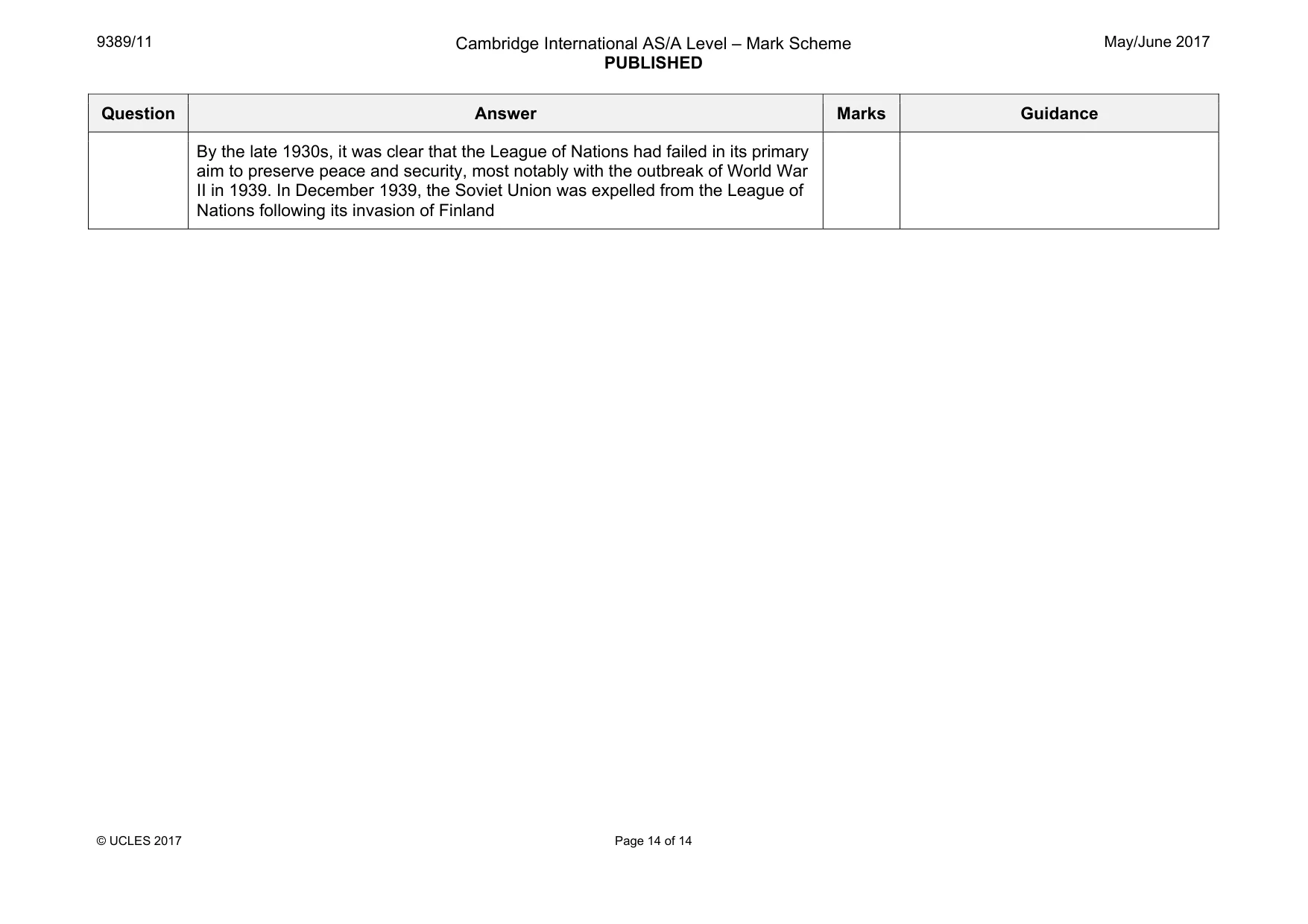
9389/11 Cambridge International AS/A Level – Mark Scheme PUBLISHED May/June 2017 © UCLES 2017 Page 14 of 14 Question Answer Marks Guidance By the late 1930s, it was clear that the League of Nations had failed in its primary aim to preserve peace and security, most notably with the outbreak of World War II in 1939. In December 1939, the Soviet Union was expelled from the League of Nations following its invasion of Finland
What you needed in this session
Cambridge’s own grade thresholds for 2017 May/June, Paper 1 · Variant 1. A higher threshold means an easier paper — the bar moves with how the cohort did.